EP1023359B1 - Process for preparing substituted polyamides - Google Patents
Process for preparing substituted polyamides Download PDFInfo
- Publication number
- EP1023359B1 EP1023359B1 EP98951032A EP98951032A EP1023359B1 EP 1023359 B1 EP1023359 B1 EP 1023359B1 EP 98951032 A EP98951032 A EP 98951032A EP 98951032 A EP98951032 A EP 98951032A EP 1023359 B1 EP1023359 B1 EP 1023359B1
- Authority
- EP
- European Patent Office
- Prior art keywords
- nylon
- autoclave
- polymer
- vinyl
- acid
- Prior art date
- Legal status (The legal status is an assumption and is not a legal conclusion. Google has not performed a legal analysis and makes no representation as to the accuracy of the status listed.)
- Expired - Lifetime
Links
- 229920002647 polyamide Polymers 0.000 title claims description 20
- 239000004952 Polyamide Substances 0.000 title claims description 18
- 238000004519 manufacturing process Methods 0.000 title description 4
- 229920000642 polymer Polymers 0.000 claims description 48
- 229920001778 nylon Polymers 0.000 claims description 43
- 238000000034 method Methods 0.000 claims description 23
- 239000004677 Nylon Substances 0.000 claims description 22
- 239000003607 modifier Substances 0.000 claims description 21
- 150000001412 amines Chemical class 0.000 claims description 19
- 230000008569 process Effects 0.000 claims description 17
- 150000003839 salts Chemical class 0.000 claims description 17
- 150000004985 diamines Chemical class 0.000 claims description 12
- BWYYYTVSBPRQCN-UHFFFAOYSA-M sodium;ethenesulfonate Chemical compound [Na+].[O-]S(=O)(=O)C=C BWYYYTVSBPRQCN-UHFFFAOYSA-M 0.000 claims description 9
- FUSUHKVFWTUUBE-UHFFFAOYSA-N buten-2-one Chemical compound CC(=O)C=C FUSUHKVFWTUUBE-UHFFFAOYSA-N 0.000 claims description 8
- 239000011734 sodium Substances 0.000 claims description 8
- 229920002302 Nylon 6,6 Polymers 0.000 claims description 7
- HJOVHMDZYOCNQW-UHFFFAOYSA-N isophorone Chemical compound CC1=CC(=O)CC(C)(C)C1 HJOVHMDZYOCNQW-UHFFFAOYSA-N 0.000 claims description 6
- LADXKQRVAFSPTR-UHFFFAOYSA-M sodium;2-hydroxyethanesulfonate Chemical compound [Na+].OCCS([O-])(=O)=O LADXKQRVAFSPTR-UHFFFAOYSA-M 0.000 claims description 6
- BAPJBEWLBFYGME-UHFFFAOYSA-N acrylic acid methyl ester Natural products COC(=O)C=C BAPJBEWLBFYGME-UHFFFAOYSA-N 0.000 claims description 5
- 229920003235 aromatic polyamide Polymers 0.000 claims description 5
- LIKMAJRDDDTEIG-UHFFFAOYSA-N n-hexene Natural products CCCCC=C LIKMAJRDDDTEIG-UHFFFAOYSA-N 0.000 claims description 5
- 239000004953 Aliphatic polyamide Substances 0.000 claims description 4
- VVQNEPGJFQJSBK-UHFFFAOYSA-N Methyl methacrylate Chemical compound COC(=O)C(C)=C VVQNEPGJFQJSBK-UHFFFAOYSA-N 0.000 claims description 4
- 229920002292 Nylon 6 Polymers 0.000 claims description 4
- 229920003231 aliphatic polyamide Polymers 0.000 claims description 4
- 239000000203 mixture Substances 0.000 claims description 4
- MHYFEEDKONKGEB-UHFFFAOYSA-N oxathiane 2,2-dioxide Chemical compound O=S1(=O)CCCCO1 MHYFEEDKONKGEB-UHFFFAOYSA-N 0.000 claims description 4
- MNCGMVDMOKPCSQ-UHFFFAOYSA-M sodium;2-phenylethenesulfonate Chemical compound [Na+].[O-]S(=O)(=O)C=CC1=CC=CC=C1 MNCGMVDMOKPCSQ-UHFFFAOYSA-M 0.000 claims description 4
- ISBHMJZRKAFTGE-ONEGZZNKSA-N (e)-pent-2-enenitrile Chemical compound CC\C=C\C#N ISBHMJZRKAFTGE-ONEGZZNKSA-N 0.000 claims description 3
- 229920000536 2-Acrylamido-2-methylpropane sulfonic acid Polymers 0.000 claims description 3
- XHZPRMZZQOIPDS-UHFFFAOYSA-N 2-Methyl-2-[(1-oxo-2-propenyl)amino]-1-propanesulfonic acid Chemical compound OS(=O)(=O)CC(C)(C)NC(=O)C=C XHZPRMZZQOIPDS-UHFFFAOYSA-N 0.000 claims description 3
- XEEYSDHEOQHCDA-UHFFFAOYSA-N 2-methylprop-2-ene-1-sulfonic acid Chemical compound CC(=C)CS(O)(=O)=O XEEYSDHEOQHCDA-UHFFFAOYSA-N 0.000 claims description 3
- KGIGUEBEKRSTEW-UHFFFAOYSA-N 2-vinylpyridine Chemical compound C=CC1=CC=CC=N1 KGIGUEBEKRSTEW-UHFFFAOYSA-N 0.000 claims description 3
- HRPVXLWXLXDGHG-UHFFFAOYSA-N Acrylamide Chemical compound NC(=O)C=C HRPVXLWXLXDGHG-UHFFFAOYSA-N 0.000 claims description 3
- WHNWPMSKXPGLAX-UHFFFAOYSA-N N-Vinyl-2-pyrrolidone Chemical compound C=CN1CCCC1=O WHNWPMSKXPGLAX-UHFFFAOYSA-N 0.000 claims description 3
- XTXRWKRVRITETP-UHFFFAOYSA-N Vinyl acetate Chemical compound CC(=O)OC=C XTXRWKRVRITETP-UHFFFAOYSA-N 0.000 claims description 3
- 239000004760 aramid Substances 0.000 claims description 3
- 150000003951 lactams Chemical class 0.000 claims description 3
- 239000002243 precursor Substances 0.000 claims description 3
- MBDNRNMVTZADMQ-UHFFFAOYSA-N sulfolene Chemical compound O=S1(=O)CC=CC1 MBDNRNMVTZADMQ-UHFFFAOYSA-N 0.000 claims description 3
- ZTWTYVWXUKTLCP-UHFFFAOYSA-N vinylphosphonic acid Chemical compound OP(O)(=O)C=C ZTWTYVWXUKTLCP-UHFFFAOYSA-N 0.000 claims description 3
- NLVXSWCKKBEXTG-UHFFFAOYSA-N vinylsulfonic acid Chemical group OS(=O)(=O)C=C NLVXSWCKKBEXTG-UHFFFAOYSA-N 0.000 claims 2
- 125000004836 hexamethylene group Chemical group [H]C([H])([*:2])C([H])([H])C([H])([H])C([H])([H])C([H])([H])C([H])([H])[*:1] 0.000 claims 1
- NAQMVNRVTILPCV-UHFFFAOYSA-N hexane-1,6-diamine Chemical compound NCCCCCCN NAQMVNRVTILPCV-UHFFFAOYSA-N 0.000 description 38
- 239000002253 acid Substances 0.000 description 13
- 239000000835 fiber Substances 0.000 description 13
- 150000001279 adipic acids Chemical class 0.000 description 12
- 239000007864 aqueous solution Substances 0.000 description 12
- 238000006116 polymerization reaction Methods 0.000 description 11
- 238000012986 modification Methods 0.000 description 10
- 230000004048 modification Effects 0.000 description 10
- 238000010186 staining Methods 0.000 description 10
- 239000000463 material Substances 0.000 description 8
- 238000005481 NMR spectroscopy Methods 0.000 description 7
- IJGRMHOSHXDMSA-UHFFFAOYSA-N Atomic nitrogen Chemical compound N#N IJGRMHOSHXDMSA-UHFFFAOYSA-N 0.000 description 6
- PPBRXRYQALVLMV-UHFFFAOYSA-N Styrene Chemical compound C=CC1=CC=CC=C1 PPBRXRYQALVLMV-UHFFFAOYSA-N 0.000 description 6
- 239000008187 granular material Substances 0.000 description 6
- 229910052757 nitrogen Inorganic materials 0.000 description 6
- 239000011541 reaction mixture Substances 0.000 description 6
- 239000000654 additive Substances 0.000 description 5
- 229920001577 copolymer Polymers 0.000 description 5
- -1 delustrants Substances 0.000 description 5
- 239000000243 solution Substances 0.000 description 5
- 239000004753 textile Substances 0.000 description 5
- 238000012546 transfer Methods 0.000 description 5
- XLYOFNOQVPJJNP-UHFFFAOYSA-N water Substances O XLYOFNOQVPJJNP-UHFFFAOYSA-N 0.000 description 5
- 239000000980 acid dye Substances 0.000 description 4
- 150000001408 amides Chemical class 0.000 description 4
- 238000010791 quenching Methods 0.000 description 4
- 150000003335 secondary amines Chemical class 0.000 description 4
- KVGPZIVDRKYWSE-UHFFFAOYSA-N 2-butyloctanamide Chemical compound CCCCCCC(C(N)=O)CCCC KVGPZIVDRKYWSE-UHFFFAOYSA-N 0.000 description 3
- 0 CC1(CCCCCCC1)C(CCC(C1)C(*)=O)(CC1N=O)[N+](*)[O-] Chemical compound CC1(CCCCCCC1)C(CCC(C1)C(*)=O)(CC1N=O)[N+](*)[O-] 0.000 description 3
- 125000001931 aliphatic group Chemical group 0.000 description 3
- 125000003277 amino group Chemical group 0.000 description 3
- 238000004458 analytical method Methods 0.000 description 3
- 239000002518 antifoaming agent Substances 0.000 description 3
- 239000003795 chemical substances by application Substances 0.000 description 3
- 150000001875 compounds Chemical class 0.000 description 3
- 238000004043 dyeing Methods 0.000 description 3
- CCIVGXIOQKPBKL-UHFFFAOYSA-M ethanesulfonate Chemical compound CCS([O-])(=O)=O CCIVGXIOQKPBKL-UHFFFAOYSA-M 0.000 description 3
- 239000004744 fabric Substances 0.000 description 3
- 239000000843 powder Substances 0.000 description 3
- 229940045998 sodium isethionate Drugs 0.000 description 3
- 238000001228 spectrum Methods 0.000 description 3
- 238000009987 spinning Methods 0.000 description 3
- 239000000126 substance Substances 0.000 description 3
- CARJPEPCULYFFP-UHFFFAOYSA-N 5-Sulfo-1,3-benzenedicarboxylic acid Chemical compound OC(=O)C1=CC(C(O)=O)=CC(S(O)(=O)=O)=C1 CARJPEPCULYFFP-UHFFFAOYSA-N 0.000 description 2
- OKTJSMMVPCPJKN-UHFFFAOYSA-N Carbon Chemical compound [C] OKTJSMMVPCPJKN-UHFFFAOYSA-N 0.000 description 2
- SJEYSFABYSGQBG-UHFFFAOYSA-M Patent blue Chemical compound [Na+].C1=CC(N(CC)CC)=CC=C1C(C=1C(=CC(=CC=1)S([O-])(=O)=O)S([O-])(=O)=O)=C1C=CC(=[N+](CC)CC)C=C1 SJEYSFABYSGQBG-UHFFFAOYSA-M 0.000 description 2
- GLUUGHFHXGJENI-UHFFFAOYSA-N Piperazine Chemical compound C1CNCCN1 GLUUGHFHXGJENI-UHFFFAOYSA-N 0.000 description 2
- WNLRTRBMVRJNCN-UHFFFAOYSA-N adipic acid Chemical compound OC(=O)CCCCC(O)=O WNLRTRBMVRJNCN-UHFFFAOYSA-N 0.000 description 2
- 239000012298 atmosphere Substances 0.000 description 2
- 239000006085 branching agent Substances 0.000 description 2
- 229910052799 carbon Inorganic materials 0.000 description 2
- 125000002091 cationic group Chemical group 0.000 description 2
- 238000006243 chemical reaction Methods 0.000 description 2
- 238000002425 crystallisation Methods 0.000 description 2
- 239000000975 dye Substances 0.000 description 2
- MQIGTIFMSSGUBS-UHFFFAOYSA-N ethenylphosphinic acid Chemical compound OP(=O)C=C MQIGTIFMSSGUBS-UHFFFAOYSA-N 0.000 description 2
- 238000001914 filtration Methods 0.000 description 2
- 229910052739 hydrogen Inorganic materials 0.000 description 2
- 238000011065 in-situ storage Methods 0.000 description 2
- 150000002500 ions Chemical class 0.000 description 2
- SUMDYPCJJOFFON-UHFFFAOYSA-N isethionic acid Chemical compound OCCS(O)(=O)=O SUMDYPCJJOFFON-UHFFFAOYSA-N 0.000 description 2
- 238000004949 mass spectrometry Methods 0.000 description 2
- 238000005259 measurement Methods 0.000 description 2
- 239000000155 melt Substances 0.000 description 2
- BDAGIHXWWSANSR-UHFFFAOYSA-N methanoic acid Natural products OC=O BDAGIHXWWSANSR-UHFFFAOYSA-N 0.000 description 2
- 239000000049 pigment Substances 0.000 description 2
- 229920001223 polyethylene glycol Polymers 0.000 description 2
- 229910052700 potassium Inorganic materials 0.000 description 2
- 229910052708 sodium Inorganic materials 0.000 description 2
- 239000012192 staining solution Substances 0.000 description 2
- 239000000758 substrate Substances 0.000 description 2
- XOAAWQZATWQOTB-UHFFFAOYSA-N taurine Chemical compound NCCS(O)(=O)=O XOAAWQZATWQOTB-UHFFFAOYSA-N 0.000 description 2
- 238000010998 test method Methods 0.000 description 2
- 238000012360 testing method Methods 0.000 description 2
- 238000001551 total correlation spectroscopy Methods 0.000 description 2
- 125000000391 vinyl group Chemical group [H]C([*])=C([H])[H] 0.000 description 2
- 229920002554 vinyl polymer Polymers 0.000 description 2
- BMVXCPBXGZKUPN-UHFFFAOYSA-N 1-hexanamine Chemical compound CCCCCCN BMVXCPBXGZKUPN-UHFFFAOYSA-N 0.000 description 1
- FZZMTSNZRBFGGU-UHFFFAOYSA-N 2-chloro-7-fluoroquinazolin-4-amine Chemical compound FC1=CC=C2C(N)=NC(Cl)=NC2=C1 FZZMTSNZRBFGGU-UHFFFAOYSA-N 0.000 description 1
- AGBXYHCHUYARJY-UHFFFAOYSA-N 2-phenylethenesulfonic acid Chemical compound OS(=O)(=O)C=CC1=CC=CC=C1 AGBXYHCHUYARJY-UHFFFAOYSA-N 0.000 description 1
- 238000005084 2D-nuclear magnetic resonance Methods 0.000 description 1
- OSWFIVFLDKOXQC-UHFFFAOYSA-N 4-(3-methoxyphenyl)aniline Chemical compound COC1=CC=CC(C=2C=CC(N)=CC=2)=C1 OSWFIVFLDKOXQC-UHFFFAOYSA-N 0.000 description 1
- KFDVPJUYSDEJTH-UHFFFAOYSA-N 4-ethenylpyridine Chemical compound C=CC1=CC=NC=C1 KFDVPJUYSDEJTH-UHFFFAOYSA-N 0.000 description 1
- BRIXOPDYGQCZFO-UHFFFAOYSA-N 4-ethylphenylsulfonic acid Chemical compound CCC1=CC=C(S(O)(=O)=O)C=C1 BRIXOPDYGQCZFO-UHFFFAOYSA-N 0.000 description 1
- CNPURSDMOWDNOQ-UHFFFAOYSA-N 4-methoxy-7h-pyrrolo[2,3-d]pyrimidin-2-amine Chemical compound COC1=NC(N)=NC2=C1C=CN2 CNPURSDMOWDNOQ-UHFFFAOYSA-N 0.000 description 1
- UFFRSDWQMJYQNE-UHFFFAOYSA-N 6-azaniumylhexylazanium;hexanedioate Chemical compound [NH3+]CCCCCC[NH3+].[O-]C(=O)CCCCC([O-])=O UFFRSDWQMJYQNE-UHFFFAOYSA-N 0.000 description 1
- IAYPIBMASNFSPL-UHFFFAOYSA-N Ethylene oxide Chemical compound C1CO1 IAYPIBMASNFSPL-UHFFFAOYSA-N 0.000 description 1
- UFHFLCQGNIYNRP-UHFFFAOYSA-N Hydrogen Chemical compound [H][H] UFHFLCQGNIYNRP-UHFFFAOYSA-N 0.000 description 1
- DGAQECJNVWCQMB-PUAWFVPOSA-M Ilexoside XXIX Chemical compound C[C@@H]1CC[C@@]2(CC[C@@]3(C(=CC[C@H]4[C@]3(CC[C@@H]5[C@@]4(CC[C@@H](C5(C)C)OS(=O)(=O)[O-])C)C)[C@@H]2[C@]1(C)O)C)C(=O)O[C@H]6[C@@H]([C@H]([C@@H]([C@H](O6)CO)O)O)O.[Na+] DGAQECJNVWCQMB-PUAWFVPOSA-M 0.000 description 1
- 229920000271 Kevlar® Polymers 0.000 description 1
- 238000006845 Michael addition reaction Methods 0.000 description 1
- FFOLXGQDCLEVBL-HNQUOIGGSA-N N=[NH]CCC/C=C/CNCCS Chemical compound N=[NH]CCC/C=C/CNCCS FFOLXGQDCLEVBL-HNQUOIGGSA-N 0.000 description 1
- QBJYAKJJLVIJNO-UHFFFAOYSA-N NCCCCCC=[NH2] Chemical compound NCCCCCC=[NH2] QBJYAKJJLVIJNO-UHFFFAOYSA-N 0.000 description 1
- 229910003202 NH4 Inorganic materials 0.000 description 1
- 238000012565 NMR experiment Methods 0.000 description 1
- 229920000784 Nomex Polymers 0.000 description 1
- 229920003171 Poly (ethylene oxide) Polymers 0.000 description 1
- ZLMJMSJWJFRBEC-UHFFFAOYSA-N Potassium Chemical compound [K] ZLMJMSJWJFRBEC-UHFFFAOYSA-N 0.000 description 1
- 229920002472 Starch Polymers 0.000 description 1
- 230000002378 acidificating effect Effects 0.000 description 1
- 235000011037 adipic acid Nutrition 0.000 description 1
- 239000001361 adipic acid Substances 0.000 description 1
- 125000003368 amide group Chemical group 0.000 description 1
- 239000003963 antioxidant agent Substances 0.000 description 1
- 239000002216 antistatic agent Substances 0.000 description 1
- 238000013459 approach Methods 0.000 description 1
- 125000003118 aryl group Chemical group 0.000 description 1
- 125000004429 atom Chemical group 0.000 description 1
- 239000000981 basic dye Substances 0.000 description 1
- 230000008901 benefit Effects 0.000 description 1
- 230000015572 biosynthetic process Effects 0.000 description 1
- 229920001400 block copolymer Polymers 0.000 description 1
- 238000000071 blow moulding Methods 0.000 description 1
- 125000003178 carboxy group Chemical group [H]OC(*)=O 0.000 description 1
- 150000001732 carboxylic acid derivatives Chemical class 0.000 description 1
- 230000003197 catalytic effect Effects 0.000 description 1
- 239000003153 chemical reaction reagent Substances 0.000 description 1
- IRHJEBOQDGCHDQ-UHFFFAOYSA-N chloro ethanesulfonate Chemical compound CCS(=O)(=O)OCl IRHJEBOQDGCHDQ-UHFFFAOYSA-N 0.000 description 1
- 238000010622 cold drawing Methods 0.000 description 1
- 239000003086 colorant Substances 0.000 description 1
- 238000006482 condensation reaction Methods 0.000 description 1
- 238000005100 correlation spectroscopy Methods 0.000 description 1
- 230000008025 crystallization Effects 0.000 description 1
- 150000001923 cyclic compounds Chemical class 0.000 description 1
- 125000004122 cyclic group Chemical group 0.000 description 1
- 230000003247 decreasing effect Effects 0.000 description 1
- 239000008367 deionised water Substances 0.000 description 1
- 229910021641 deionized water Inorganic materials 0.000 description 1
- 238000003795 desorption Methods 0.000 description 1
- 150000005690 diesters Chemical class 0.000 description 1
- 235000004879 dioscorea Nutrition 0.000 description 1
- 230000000694 effects Effects 0.000 description 1
- 238000005516 engineering process Methods 0.000 description 1
- 150000002148 esters Chemical class 0.000 description 1
- 238000001125 extrusion Methods 0.000 description 1
- 238000009408 flooring Methods 0.000 description 1
- 235000019253 formic acid Nutrition 0.000 description 1
- 229920000578 graft copolymer Polymers 0.000 description 1
- 229920001519 homopolymer Polymers 0.000 description 1
- 239000001257 hydrogen Substances 0.000 description 1
- 125000004435 hydrogen atom Chemical group [H]* 0.000 description 1
- 230000006872 improvement Effects 0.000 description 1
- 239000003317 industrial substance Substances 0.000 description 1
- 229940045996 isethionic acid Drugs 0.000 description 1
- 229910052744 lithium Inorganic materials 0.000 description 1
- 239000011159 matrix material Substances 0.000 description 1
- 238000002074 melt spinning Methods 0.000 description 1
- 238000002844 melting Methods 0.000 description 1
- 230000008018 melting Effects 0.000 description 1
- RTWNYYOXLSILQN-UHFFFAOYSA-N methanediamine Chemical compound NCN RTWNYYOXLSILQN-UHFFFAOYSA-N 0.000 description 1
- 125000000956 methoxy group Chemical group [H]C([H])([H])O* 0.000 description 1
- 238000002156 mixing Methods 0.000 description 1
- 239000000178 monomer Substances 0.000 description 1
- 239000004763 nomex Substances 0.000 description 1
- 125000000962 organic group Chemical group 0.000 description 1
- 238000010525 oxidative degradation reaction Methods 0.000 description 1
- 230000002688 persistence Effects 0.000 description 1
- 229910052698 phosphorus Inorganic materials 0.000 description 1
- 230000008092 positive effect Effects 0.000 description 1
- 239000011591 potassium Substances 0.000 description 1
- CHUPNGGCNPHUEN-UHFFFAOYSA-M potassium;ethanesulfonate Chemical compound [K+].CCS([O-])(=O)=O CHUPNGGCNPHUEN-UHFFFAOYSA-M 0.000 description 1
- 230000009467 reduction Effects 0.000 description 1
- 238000007086 side reaction Methods 0.000 description 1
- SZHIIIPPJJXYRY-UHFFFAOYSA-M sodium;2-methylprop-2-ene-1-sulfonate Chemical compound [Na+].CC(=C)CS([O-])(=O)=O SZHIIIPPJJXYRY-UHFFFAOYSA-M 0.000 description 1
- KQFAFFYKLIBKDE-UHFFFAOYSA-M sodium;ethanesulfonate Chemical compound [Na+].CCS([O-])(=O)=O KQFAFFYKLIBKDE-UHFFFAOYSA-M 0.000 description 1
- 239000007790 solid phase Substances 0.000 description 1
- 238000004611 spectroscopical analysis Methods 0.000 description 1
- 238000007655 standard test method Methods 0.000 description 1
- 235000019698 starch Nutrition 0.000 description 1
- 239000008107 starch Substances 0.000 description 1
- 125000001424 substituent group Chemical group 0.000 description 1
- 150000003457 sulfones Chemical class 0.000 description 1
- 229910052717 sulfur Inorganic materials 0.000 description 1
- 239000008399 tap water Substances 0.000 description 1
- 235000020679 tap water Nutrition 0.000 description 1
- 229960003080 taurine Drugs 0.000 description 1
- 229920001897 terpolymer Polymers 0.000 description 1
- 238000003828 vacuum filtration Methods 0.000 description 1
- 238000013022 venting Methods 0.000 description 1
- 239000012855 volatile organic compound Substances 0.000 description 1
Images
Classifications
-
- C—CHEMISTRY; METALLURGY
- C08—ORGANIC MACROMOLECULAR COMPOUNDS; THEIR PREPARATION OR CHEMICAL WORKING-UP; COMPOSITIONS BASED THEREON
- C08G—MACROMOLECULAR COMPOUNDS OBTAINED OTHERWISE THAN BY REACTIONS ONLY INVOLVING UNSATURATED CARBON-TO-CARBON BONDS
- C08G69/00—Macromolecular compounds obtained by reactions forming a carboxylic amide link in the main chain of the macromolecule
- C08G69/48—Polymers modified by chemical after-treatment
-
- C—CHEMISTRY; METALLURGY
- C08—ORGANIC MACROMOLECULAR COMPOUNDS; THEIR PREPARATION OR CHEMICAL WORKING-UP; COMPOSITIONS BASED THEREON
- C08G—MACROMOLECULAR COMPOUNDS OBTAINED OTHERWISE THAN BY REACTIONS ONLY INVOLVING UNSATURATED CARBON-TO-CARBON BONDS
- C08G69/00—Macromolecular compounds obtained by reactions forming a carboxylic amide link in the main chain of the macromolecule
- C08G69/02—Polyamides derived from amino-carboxylic acids or from polyamines and polycarboxylic acids
- C08G69/26—Polyamides derived from amino-carboxylic acids or from polyamines and polycarboxylic acids derived from polyamines and polycarboxylic acids
-
- C—CHEMISTRY; METALLURGY
- C08—ORGANIC MACROMOLECULAR COMPOUNDS; THEIR PREPARATION OR CHEMICAL WORKING-UP; COMPOSITIONS BASED THEREON
- C08G—MACROMOLECULAR COMPOUNDS OBTAINED OTHERWISE THAN BY REACTIONS ONLY INVOLVING UNSATURATED CARBON-TO-CARBON BONDS
- C08G69/00—Macromolecular compounds obtained by reactions forming a carboxylic amide link in the main chain of the macromolecule
- C08G69/02—Polyamides derived from amino-carboxylic acids or from polyamines and polycarboxylic acids
- C08G69/26—Polyamides derived from amino-carboxylic acids or from polyamines and polycarboxylic acids derived from polyamines and polycarboxylic acids
- C08G69/28—Preparatory processes
Definitions
- the present invention discloses a method for reacting an aliphatic or an aromatic molecule, on the nitrogen of a primary diamine, to form a secondary amine, then reacting the formed diamine with diacid, additional diamine and/or lactams, to form a polyamide polymer with a controlled amount of substituent groups pendant on a portion of the amide nitrogens.
- Many of the products produced have improved characteristics such as stain resistance, enhanced cationic dyeing or deep dyeing.
- U.S. Patent No. 5,175,038 relates to a highly bulked continuous filament yarns, comprised of filaments having a denier per filament of 10-25 and a trilobal filament cross section of modification ratio 1.4-4.0. including filament nylon yarns that have a yarn bulk level of at least 35, which can be ply-twisted together to high-twist levels and can be used in carpets at high-twist levels.
- U.S. Patent No. 5,155,178 relates to blends of nylon 6,6, nylon 6 or nylon, 6,6/6 copolymer which contain a randomly copolymerized cationic dye modifier, which are formed by melt blending the copolymer with a polyamide to form a block copolymer that is resistant to staining with acid dyes at ambient temperature and pH, but which can be dyed at pH 2-7 and 60-100°C.
- U.S. Patent No. 5,223,196 discloses terpolymers and interpolyamides which are either block or random. The patent involves making pigmented nylon fiber with decreased draw tension.
- U.S. Patent No. 3,962,159 discloses graft copolymers prepared by condensing a polyamideamine substrate with starch and a condensing reagent.
- U.S. Patent No. 3,846,507 discloses a fiber forming polyamide having basic dye receptivity and reduced acid dye receptivity, comprising a melt polymerized compound of the formula: wherein R is OH, Cl, OCH 3 or OC 2 H 5 and X is Li, Na, K or NH 4 and wherein the groups are not ortho to each other.
- the present invention relates to a process comprising reacting an amine reactive modifier with a polyamide-precursor salt to form a diamine and then reacting the formed diamine with diacid, additional diamine and/or lactams, to form a modified polyamide, wherein the amine reactive modifier is selected from
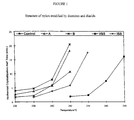
- Figure 1 is a graph of the isothermal crystallisation half time over a defined temperature range.
- nylons particularly nylons including nylon 6, nylon 6,6 and their copolymers
- polymers contain amine groups, which can be substituted with moieties which can modify the properties, such as dyeability, tensile strength and catalytic activity. See generally U.S. Patent No. 5,422,420, U.S. Patent No. 5,223,196, U.S. Patent No. 3,389,549, which are incorporated herein by reference and see Kirk Othmer Encyclopedia of Chemical Technology, 4th ed., 1996, Vol. 19, pp. 454-518, and Ullmann's Encyclopedia of Industrial Chemistry, 1992, Vol. A21, pp.190-191.
- the present invention allows the production of modified aliphatic and aromatic polyamides and other amide-, amine- or carboxylic acid-containing polymers and copolymers, particularly nylons and aramids, including but not limited to nylon 6, nylon 6,6, Kevlar® and Nomex®, in a less expensive way than is currently available.
- nylons and aramids including but not limited to nylon 6, nylon 6,6, Kevlar® and Nomex®
- sulfonated and/or acid-dye resistant modifiers may be used.
- the present improvement can be used with any process useful for making polyamides and other polymers, as described in the background above, including batch and continuous polymerization processes. No equipment modification is generally necessary, as additional ports on evaporators, transfer lines and autoclaves are generally available for addition of process and product property control additives.
- Additives include, but are not limited to, antifoam agents, antioxidants, delustrants, antistatic agents and branching agents.
- hexamethylenediammonium adipate salt (approximately 52% by weight in water) is added to an evaporator. Various additives may be added at this stage. Under inert atmosphere, this reaction mixture is then heated to a boil (about 160°C) under slight pressure to remove the excess water and thus increase its concentration. A slight pressure is desirable to minimize the loss of volatile materials like hexamethylenediamine.
- the reaction mixture is transferred through a transfer line to an autoclave, which is a high pressure reactor. The reaction mixture is maintained under an oxygen-free atmosphere to avoid undesirable side reactions such as oxidative degradation.
- the reaction mixture While in the autoclave, the reaction mixture is heated to a temperature between 175°C and 200°C, while increasing the pressure to about 300 psia to again minimize loss of volatile organic compounds. Oligomers are formed during this stage, which generally takes about an hour. The temperature is then increased to between 250°C and 310°C, and the pressure is released at a slow rate to bleed off steam and thus drive the condensation reaction towards polymerization. While maintaining approximately the same temperature, the reaction mixture is held at a low constant pressure for sufficient time to obtain the desired extent of reaction. The polyamide is then extruded from the reaction vessel and conveniently chopped and dried to produce flake.
- the relative viscosity (RV) from the autoclave of both nylon 6,6 homopolymer and the inventive material can be in the range of 15 to 80, but is generally between 20 and 55.
- the polyamide flake thus produced can be spun at the RV at which it is. produced, or it can be further polymerized to a higher RV by conventional solid phase polymerization processes.
- the RV can be increased by other means such as by venting off water as the polymer is melted in the extruder prior to spinning.
- Additives may be added to the reaction mixture through inlet ports in the evaporator, the transfer line, or the autoclave.
- Modifiers such as 5-sulfoisophthalic acid, may be added to the hexamethylene diamine to form a salt which can be added either to the evaporator or the autoclave. This provides the uniformity needed throughout the copolymer feed to produce uniform product.
- Such modification can be used, for example, to increase dyeability.
- One embodiment of this invention is the addition of amine-reactive modifiers, including vinyl and cyclic modifiers, such as vinyl sulfonate sodium salt (VSS), 1,4-butane sultone, styrene sulfonate, isethionic acid and chloroethane sulfonate, directly to the polyamide-precursor salt in the autoclave, the evaporator, or the transfer line between the two vessels.
- VSS vinyl sulfonate sodium salt
- 1,4-butane sultone 1,4-butane sultone
- styrene sulfonate 1,4-butane sultone
- isethionic acid and chloroethane sulfonate
- Vinyl pyridine, styrene, methyl vinyl ketone; nanofluoro-1-hexene and vinyl phosphinic acid can also be used as modifiers in this way.
- modifiers are generally added at concentrations of 0.1% to 2.5% by weight, preferably between 0.5% and 3% by weight, essentially all of which is incorporated into the polymeric product.
- concentrations 0.1% to 2.5% by weight, preferably between 0.5% and 3% by weight, essentially all of which is incorporated into the polymeric product.
- the only essential characteristic of such a modifier is that it reacts with the amine group(s) to form a secondary amine, before the amine group reacts with an acid group to form an amide.
- these materials are generally less expensive than other commonly used modifiers, such as 5-sulfoisophtalic acid or 1,4-bis (3-aminopropy)piperazine.
- the key to this approach is a Michael addition of the amine end of the diamine (hexamethylenediamine) to the double bond of the vinyl monomer wherein B is an organic group consisting of C, H, S, N, P and salts thereof; or an activated cyclic compound wherein B' is an ester, amide or sulfone.
- Selected modifiers for use in the polymerization herein include the following:
- the present polymerization starting with a modified secondary amine that results in a polyamide with a modifier as part of the N-pendant group.
- the present polymerization can be compared to modification during polymerization wherein the modifiers (R and R') become part of the polymer "backbone" and are not part of the N-pendant group.
- Branched polyamides may be used to enhance the relative viscosity (RV) of unbranched nylons, for use in high melt viscosity applications like blow molding, and the like.
- Branched nylon also generally has a higher "end" count, which, in the examples below, can be biased toward a higher amine count, thus giving a deeper dyeing product.
- Preferred branching agents are polyethylene oxide and ethylene oxide.
- the modified secondary amine reacts with the diacid to produce the modified nylon polymer with an N- pendant group
- the above process can be compared to modification during polymerization.
- the polyamides of the invention can be spun into fibers using conventional melt-spinning techniques.
- the polyamide(s) in flake form is (are) remelted, preferably using a screw melter type extruder.
- other materials including other polyamides and/or pigments, can be added before or during the remelt process. It is not necessary, of course, to use this remelt step if a continuous polymerizer is employed to prepare the polyamides.
- the melt is typically pumped through a transfer line to a metering pump.
- the metering pump controls the volume of polymer delivered to an extrusion pack consisting of filtration media and spinneret plate.
- the polymer melt typically at a temperature 20°C to 60°C higher than the polymer melting point, is extruded through spinneret orifices into a quench chimney to form filaments that are cooled to a non-tacky state by a cross-flow of gaseous media, usually humidified chilled air of at least 50% relative humidity at 10° to 30°C.
- the filaments may alternatively be cooled by a radial quench unit.
- the cooled filaments are converged, typically at the bottom of a quench drawer.
- a spin finish is applied to the converged filament bundle by using Roll applicators or metered finish tip applicators.
- the filaments are pulled through the quench zone and over the finish applicators by a feeder roll.
- Fibers of this invention can be engineered into essentially any form in which fibers are conventionally made, including, without limitation, filament yarns, staple fibers, monofilament, and strands.
- the fibers can be textured, bulked or crimped using well-known methods and can be colored using pigments or dyes. End-use applications for the fibers extend to all areas where polyamide fibers have been utilized, including, by way of example, apparel, carpets, rugs, upholstery, and industrial applications (tires, hoses, ropes, paper-making felts, etc.).
- inventive materials can also be used in films, engineering polymers and the like. Any end-use where stain resistance to acidic materials, including acid dyes, would benefit from the use of these materials.
- Relative viscosity was determined on solutions containing 8.40% by weight of the nylon polymers in 90.0% formic acid, based on ASTM Standard Test Method D789. Amine and carboxyl end groups were determined by methods similar to those described in the Encyclopedia of Industrial Chemical Analysis Vol. 17 John Wiley & Sons, New York 1973, p 293-294, which herein incorporated by reference.
- NMR Nuclear Magnetic Resonance
- Matrix Assisted Laser Desorption/Ionization (MALDI) mass spectroscopy measures the molecular weight of polymers and especially oligmers. These measurements are precise to less than one atomic weight unit and are used to determine the number of repeat units and ends. N-substituted nylon can be detected by measuring the polymer molecular weight. In addition to nylon standard peaks, additional peaks represent the additional weight of N-substituents on the amide are present. See McEwen, C. N.; Jackson, C.; Larsen, B. S. "Instrumental Effects in the Analysis of Polymers of Wide Polydispersity by MALDI Mass Spectrometry" Int. J. Mass Spectrom.
- a solution of staining agent is prepared by dissolving 45 grams of cherry-flavored, sugar-sweetened "Kool-Aid" premix powder in 500 cc of water, and it is allowed to reach room temperature, i.e., 75°F ( ⁇ 5°) or 24°C ( ⁇ 3°), before using. This solution was used to test stain resistance of either nylon polymer granules (pass through 20 mesh screen), fibers, knitted textile tubes or carpet.
- the test on nylon polymer granules and fibers was performed by placing 1 gm of powder in 20 ml of the "Kool-Aid" staining solution for 60 min.
- the nylon powder is separated from the staining solution by vacuum filtration followed by three rinsings with deionized water.
- the rating system is similar to that of the knitted textile tubes and carpet rating.
- a specimen approximately 1.5 in. x 3 in (3.8 x 7.6 cm) for carpet samples and approximately 2 in x 4 in (5.1 x 10.2 cm) for flattened knitted textile tubes, is cut from each sample and placed on a flat, non-absorbant surface and 20 cc (10 cc for textile samples) of the staining agent is poured onto each specimen through a cylinder to form a 1 to 2 inch (2.5 to 5.1 cm) circular stain. The cylinder is removed and the solution is worked into the fabric or carpet to achieve uniform staining. The samples are then lagged in the laboratory for twenty-four hours and then rinsed thoroughly with cool tap water and squeezed dry, using an extractor to remove excess solution.
- the stain resistance of the specimen is determined visually according to the amount of color left on the stained area of the fabric. This is referred to as the stain rating, and is herein determined for samples that are dyed to a very light beige color according to the Stain Rating Scale (a copy of which is currently used by and available from the Flooring Systems Division of E. I. du Pont de Nemours and Company, Wilmington, DE 19898). These colors can be categorized according to the following standards:
- a stain-rating of 5 is excellent, showing good stain-resistance, whereas 1 is a poor rating, showing persistence of heavy staining.
- a substrate to be considered to have adequate stain-resistance it should have a rating of at least 4 on the above-described Stain Rating Scale.
- the presence of ethyl sulfonate on the nitrogen amide was confirmed by NMR.
- the polymer produced has a 18.2 RV, 93.9 amine end equivalent per million grams of polymer and 136.3 acid end equivalent per million grams of polymer.
- Granules ( ⁇ 20 mesh) had a stain rating of 5.
- a medium size autoclave at room temperature was added 68 pounds of 51.5% aqueous solution of hexamethylenediamine/adipic acid salt (nylon salt), 0.35 gms of Carbowax®, Dow Chemical, Midland, MI, anti foaming agent, 55 gms of hexamethylenediamine, and 1.90 pounds of 25.6% aqueous vinylsulfonate sodium salt.
- the autoclave was closed with a vent pressure at 250 psi and was heated to 240°C over a period of 240 min. Over the following period of 90 min., the autoclave temperature was increased from 240°C to 275°C and the pressure was reduced to atmospheric pressure.
- the temperature was maintained at 275°C for an additional period of 60 min.
- the nylon polymer was removed from the autoclave and analyzed.
- the polymer produced has a 31.0 RV, 85.4 amine end equivalent per million grams of polymer and 82.3 acid end equivalent per million grams of polymer.
- Granules ( ⁇ 20 mesh) had a stain rating of 4.
- a medium size autoclave at room temperature was added 68 pounds of 51.5% aqueous solution of hexamethylenediamine/adipic acid salt (nylon salt), 0.35 gms of Carbowax® anti foaming agent. 55 gms of hexamethylenediamine, and 3.79 pounds of 25.6% aqueous vinylsulfonate sodium salt.
- the autoclave was closed with a vent pressure at 250 psi and was heated to 240°C over a period of 240 min. Over the following period of 90 min.. the autoclave temperature was increased from 240°C to 275°C and the pressure was reduced to atmospheric pressure. The temperature was maintained at 275°C for an additional period of 60 min.
- the nylon polymer was removed from the autoclave and analyzed.
- the polymer produced has a 37.0 RV, 76.3 amine end equivalent per million grams of polymer and 77.2 acid end equivalent per million grams of polymer.
- Granules ( ⁇ 20 mesh) had a stain rating of 5.
- aqueous solution of hexamethylenediamine/adipic acid salt (nylon salt) and 0.60 gms of styrenesulfonate sodium salt Into a small autoclave set at 120°C was added 59.07 gms of 51.5% aqueous solution of hexamethylenediamine/adipic acid salt (nylon salt) and 0.60 gms of styrenesulfonate sodium salt.
- the autoclave was equipped with a pressure relief valve set at 250 psi.
- the temperature of the autoclave was increased from 120°C to 240°C over a period of 100 min. Over the following period of 60 min., the autoclave temperature was increased from 240°C to 275°C and the pressure was reduced to atmospheric pressure. The temperature was maintained at 275°C for an additional period of 60 min.
- the nylon polymer was removed from the autoclave and analyzed.
- the polymer produced has a 42.9 RV, 48.6 amine end equivalent per million grams of polymer and 95.4 acid end equivalent per million grams of polymer.
- aqueous solution of hexamethylenediamine/adipic acid salt (nylon salt) and 0.42 gms of sodium isethionate was added Into a small autoclave set at 120°C was added 59.07 gms of 51.5% aqueous solution of hexamethylenediamine/adipic acid salt (nylon salt) and 0.42 gms of sodium isethionate.
- the autoclave was equipped with a pressure relief valve set at 250 psi.
- the temperature of the autoclave was increased from 120°C to 240°C over a period of 100 min. Over the following period of 60 min., the autoclave temperature was increased from 240°C to 275°C and the pressure was reduced to atmospheric pressure. The temperature was maintained at 275°C for an additional period of 40 min.
- the pressure of the autoclave was reduced to 250 mm Hg over a period of 10 min.
- the vacuum and heat were turned off and the nylon polymer was removed from the autoclave and analyzed.
- the polymer produced has a 44.4 RV, 48.1 amine end equivalent per million grams of polymer and 81.7 acid end equivalent per million grams of polymer. This polymer was spun into fiber and the fiber was stain tested and had a stain rating of 4.
- the presence of ethyl sulfonate on the nitrogen amide was confirmed by NMR.
- the polymer produced has a 8.9 RV.
- the structure of the N-ethylsulfonate on a portion of the amide linkages in the nylon backbone was confirmed by NMR (3.8-4.0 ppm).
- aqueous solution of hexamethylenediamine/adipic acid salt nylon salt
- 1.82 gms of 30.5% aqueous vinylsulfonate sodium salt aqueous vinylsulfonate sodium salt.
- the autoclave was equipped with a pressure relief valve set at 250 psi.
- the temperature of the autoclave was increased from 120°C to 240°C over a period of 100 min. Over the following period of 60 min., the autoclave temperature was increased from 240°C to 275°C and the pressure was reduced to atmospheric pressure. The temperature was maintained at 275°C for an additional period of 60 min.
- the nylon polymer was removed from the autoclave and analyzed.
- the presence of ethyl sulfonate on the nitrogen amide was confirmed by NMR.
- the polymer produced has a 16.8 RV, 96.8 amine end equivalent per million grams of polymer and 157.5 acid end equivalent per million grams of polymer.
- aqueous solution of hexamethylenediamine/adipic acid salt nylon salt
- the autoclave was equipped with a pressure relief valve set at 250 psi.
- the temperature of the autoclave was increased from 120°C to 240°C over a period of 100 min. Over the following period of 60 min., the autoclave temperature was increased from 240°C to 275°C and the pressure was reduced to atmospheric pressure. The temperature was maintained at 275°C for an additional period of 60 min.
- the nylon polymer was removed from the autoclave and analyzed.
- the polymer produced has a 43.0 RV, 40.9 amine end equivalent per million grams of polymer and 96.0 acid end equivalent per million grams of polymer.
Landscapes
- Chemical & Material Sciences (AREA)
- Health & Medical Sciences (AREA)
- Chemical Kinetics & Catalysis (AREA)
- Medicinal Chemistry (AREA)
- Polymers & Plastics (AREA)
- Organic Chemistry (AREA)
- General Chemical & Material Sciences (AREA)
- Polyamides (AREA)
- Addition Polymer Or Copolymer, Post-Treatments, Or Chemical Modifications (AREA)
- Compositions Of Macromolecular Compounds (AREA)
Description




or an activated cyclic compound






Claims (7)
- A process comprising reacting an amine reactive modifier with a polyamide-precursor salt to form a diamine and then reacting the formed diamine with diacid, additional diamine and/or lactams, to form a modified polyamide, wherein the amine reactive modifier is selected from1-hexene,nanofluoro-1-hexenestyrenemethyl acrylate,methyl methacrylate,styrene sulfonate sodium salt,vinyl acetate,2-pentenenitrile,acrylamide,butadiene sulfone,isethionic acid sodium salt,1,4-butane sultone2-methyl-2-propene-1-sulfonic acid Na,methyl vinyl ketone,N-vinyl-2-pyrrolidinone,isophorone,vinylphosphonic acid,vinyl sulfonate sodium salt,vinyl pyridine, and2-acrylamido-2-methylpropanesulfonic acid Na.
- The process Claim 1 wherein the amine reactive modifier is a vinyl sulfonate salt.
- The process of Claim 1 wherein the amine reactive modifier is added at concentrations of 0.1% to 5% by weight.
- The process of Claim 1 wherein the amine reactive modifier is added at concentrations of 0.5% to 3% by weight.
- The process of Claim 1 wherein the polyamide polymer to be modified is selected from the group consisting of aliphatic polyamides, aromatic polyamides and aramids.
- The process of Claim 5 wherein the aliphatic polyamide is nylon 6,6 or nylon 6.
- The process of Claim 6 wherein the aliphatic polyamide is nylon 6,6 and the resulting product is a nylon composition having pendant vinyl sulfonate groups on 0.1 to 2 percent of the amide nitrogens.
Applications Claiming Priority (3)
| Application Number | Priority Date | Filing Date | Title |
|---|---|---|---|
| US6210197P | 1997-10-14 | 1997-10-14 | |
| US62101P | 1997-10-14 | ||
| PCT/US1998/021399 WO1999019382A1 (en) | 1997-10-14 | 1998-10-09 | Substituted polyamides and process for preparing the same |
Publications (3)
| Publication Number | Publication Date |
|---|---|
| EP1023359A1 EP1023359A1 (en) | 2000-08-02 |
| EP1023359B1 true EP1023359B1 (en) | 2005-01-05 |
| EP1023359B2 EP1023359B2 (en) | 2010-09-08 |
Family
ID=22040237
Family Applications (1)
| Application Number | Title | Priority Date | Filing Date |
|---|---|---|---|
| EP98951032A Expired - Lifetime EP1023359B2 (en) | 1997-10-14 | 1998-10-09 | Process for preparing substituted polyamides |
Country Status (4)
| Country | Link |
|---|---|
| EP (1) | EP1023359B2 (en) |
| CA (1) | CA2303925C (en) |
| DE (1) | DE69828520T2 (en) |
| WO (1) | WO1999019382A1 (en) |
Families Citing this family (1)
| Publication number | Priority date | Publication date | Assignee | Title |
|---|---|---|---|---|
| EP3497393A4 (en) | 2016-08-08 | 2020-03-18 | Ticona LLC | THERMALLY CONDUCTIVE POLYMER COMPOSITION FOR HEAT DISSIPATOR |
Family Cites Families (7)
| Publication number | Priority date | Publication date | Assignee | Title |
|---|---|---|---|---|
| DE1260683B (en) * | 1964-02-08 | 1968-02-08 | Bayer Ag | Process for the production of threads and fibers from polyamides |
| NL128829C (en) * | 1964-05-08 | |||
| IT1165130B (en) * | 1979-06-28 | 1987-04-22 | Montedison Spa | POLYCONDENSATES OF PIPERIDINS REPLACED AND THEIR USE AS POLYMER STABILIZERS |
| US4578454A (en) * | 1984-05-08 | 1986-03-25 | Ciba-Geigy S.P.A. | Polyaminoamides containing polyalkylpiperidine radicals |
| US4894422A (en) * | 1987-12-21 | 1990-01-16 | Exxon Research & Engineering Company | N-sulfoalkyl polyamide water soluble hydrophobically-associating rigid rod polymer |
| US4987160A (en) * | 1989-01-31 | 1991-01-22 | Union Camp Corporation | Radiation-curable aminoamide acrylate polymer |
| US5155177A (en) * | 1991-03-18 | 1992-10-13 | Union Camp Corporation | Three component aminoamide acrylate resin compositions |
-
1998
- 1998-10-09 EP EP98951032A patent/EP1023359B2/en not_active Expired - Lifetime
- 1998-10-09 WO PCT/US1998/021399 patent/WO1999019382A1/en not_active Ceased
- 1998-10-09 CA CA002303925A patent/CA2303925C/en not_active Expired - Fee Related
- 1998-10-09 DE DE69828520T patent/DE69828520T2/en not_active Expired - Lifetime
Also Published As
| Publication number | Publication date |
|---|---|
| EP1023359B2 (en) | 2010-09-08 |
| CA2303925C (en) | 2009-12-01 |
| WO1999019382A1 (en) | 1999-04-22 |
| DE69828520T2 (en) | 2005-12-29 |
| DE69828520D1 (en) | 2005-02-10 |
| HK1028055A1 (en) | 2001-02-02 |
| CA2303925A1 (en) | 1999-04-22 |
| EP1023359A1 (en) | 2000-08-02 |
Similar Documents
| Publication | Publication Date | Title |
|---|---|---|
| US5290850A (en) | Processing of pigmented nylon fibers using modified polymers | |
| US5422420A (en) | Terpolyamides and multipolyamides containing amide units of 2-methylpentamethylenediamine and products prepared therefrom | |
| US5164261A (en) | Dyed antistain nylon with cationic dye modifier | |
| CA2048352C (en) | Antistain composition of nylon-cationic dye modifier copolymers melt blended with high carbon nylons | |
| EP0535082B1 (en) | Fiber-forming copolyamide and fibers produced therefrom | |
| US5559194A (en) | Modified nylon fibers | |
| WO2002018492A1 (en) | Fiber-forming polyamide composition | |
| US5242733A (en) | Carpets and fabrics of antistain block copolymer compositions of modified nylon copolymers and high carbon nylons | |
| US4083893A (en) | Ozone resistant, cationic dyeable nylon containing lithium, magnesium or calcium salts of sulfonated polystyrene | |
| EP0041371A2 (en) | Melt-processable copolyamides having aromatic amide unit and fibers prepared therefrom | |
| US6277948B1 (en) | Process and product for making polyamides | |
| CN118497921A (en) | Stain resistant polyamide polymers obtained by high end capping | |
| US4113794A (en) | Copolymer of blocks of random poly(dioxa-amide) and polyamide | |
| US4130602A (en) | Block copolymer of poly(dioxa-amide) and polyamide | |
| US6274697B1 (en) | Process and product for making polyamides | |
| EP1023359B2 (en) | Process for preparing substituted polyamides | |
| AU679353B2 (en) | Method for preparing colored polyamide fibers which contain polycarbonates and resultant fibers | |
| KR100826400B1 (en) | Treatment of polyamides with gaseous acids, anhydrides or amines | |
| CA1047194A (en) | Block copolymer of poly(dioxa-alkylene amide) and polyamide | |
| CA2199058C (en) | Stain-resistant polyamide fibers and articles comprising same | |
| HK1028055B (en) | Process for preparing substituted polyamides | |
| EP0901534B1 (en) | Process for dyeing cationic-dyeable modified polyamide fibers with acid dyes | |
| US5238982A (en) | Method for producing polyamide fibers with reduced flammability | |
| WO1994024342A1 (en) | Polyamide pigment dispersion |
Legal Events
| Date | Code | Title | Description |
|---|---|---|---|
| PUAI | Public reference made under article 153(3) epc to a published international application that has entered the european phase |
Free format text: ORIGINAL CODE: 0009012 |
|
| 17P | Request for examination filed |
Effective date: 20000313 |
|
| AK | Designated contracting states |
Kind code of ref document: A1 Designated state(s): DE FR GB NL |
|
| 17Q | First examination report despatched |
Effective date: 20020304 |
|
| GRAP | Despatch of communication of intention to grant a patent |
Free format text: ORIGINAL CODE: EPIDOSNIGR1 |
|
| RTI1 | Title (correction) |
Free format text: PROCESS FOR PREPARING SUBSTITUTED POLYAMIDES |
|
| RAP1 | Party data changed (applicant data changed or rights of an application transferred) |
Owner name: INVISTA TECHNOLOGIES S.AE.R.L. |
|
| GRAS | Grant fee paid |
Free format text: ORIGINAL CODE: EPIDOSNIGR3 |
|
| GRAA | (expected) grant |
Free format text: ORIGINAL CODE: 0009210 |
|
| 111Z | Information provided on other rights and legal means of execution |
Free format text: DEFRGBNL Effective date: 20040731 |
|
| AK | Designated contracting states |
Kind code of ref document: B1 Designated state(s): DE FR GB NL |
|
| REG | Reference to a national code |
Ref country code: GB Ref legal event code: FG4D |
|
| REF | Corresponds to: |
Ref document number: 69828520 Country of ref document: DE Date of ref document: 20050210 Kind code of ref document: P |
|
| RAP2 | Party data changed (patent owner data changed or rights of a patent transferred) |
Owner name: INVISTA TECHNOLOGIES S.AE.R.L. |
|
| NLT2 | Nl: modifications (of names), taken from the european patent patent bulletin |
Owner name: INVISTA TECHNOLOGIES S.A.R.L. |
|
| REG | Reference to a national code |
Ref country code: HK Ref legal event code: GR Ref document number: 1028055 Country of ref document: HK |
|
| PLBI | Opposition filed |
Free format text: ORIGINAL CODE: 0009260 |
|
| PLAB | Opposition data, opponent's data or that of the opponent's representative modified |
Free format text: ORIGINAL CODE: 0009299OPPO |
|
| PLAX | Notice of opposition and request to file observation + time limit sent |
Free format text: ORIGINAL CODE: EPIDOSNOBS2 |
|
| 26 | Opposition filed |
Opponent name: RHODIA CHIMIE Effective date: 20051004 |
|
| ET | Fr: translation filed | ||
| REG | Reference to a national code |
Ref country code: GB Ref legal event code: FG4D |
|
| NLR1 | Nl: opposition has been filed with the epo |
Opponent name: RHODIA CHIMIE |
|
| PLAF | Information modified related to communication of a notice of opposition and request to file observations + time limit |
Free format text: ORIGINAL CODE: EPIDOSCOBS2 |
|
| PLBB | Reply of patent proprietor to notice(s) of opposition received |
Free format text: ORIGINAL CODE: EPIDOSNOBS3 |
|
| REG | Reference to a national code |
Ref country code: GB Ref legal event code: 732E |
|
| RAP2 | Party data changed (patent owner data changed or rights of a patent transferred) |
Owner name: INVISTA TECHNOLOGIES S.A.R.L. |
|
| NLT2 | Nl: modifications (of names), taken from the european patent patent bulletin |
Owner name: INVISTA TECHNOLOGIES S.A.R.L. Effective date: 20080402 |
|
| REG | Reference to a national code |
Ref country code: GB Ref legal event code: 732E Free format text: REGISTERED BETWEEN 20090507 AND 20090513 |
|
| PLAB | Opposition data, opponent's data or that of the opponent's representative modified |
Free format text: ORIGINAL CODE: 0009299OPPO |
|
| PLAY | Examination report in opposition despatched + time limit |
Free format text: ORIGINAL CODE: EPIDOSNORE2 |
|
| PLBC | Reply to examination report in opposition received |
Free format text: ORIGINAL CODE: EPIDOSNORE3 |
|
| PGFP | Annual fee paid to national office [announced via postgrant information from national office to epo] |
Ref country code: DE Payment date: 20091001 Year of fee payment: 12 |
|
| PGFP | Annual fee paid to national office [announced via postgrant information from national office to epo] |
Ref country code: NL Payment date: 20091004 Year of fee payment: 12 |
|
| PGFP | Annual fee paid to national office [announced via postgrant information from national office to epo] |
Ref country code: GB Payment date: 20091007 Year of fee payment: 12 Ref country code: FR Payment date: 20091029 Year of fee payment: 12 |
|
| PUAH | Patent maintained in amended form |
Free format text: ORIGINAL CODE: 0009272 |
|
| STAA | Information on the status of an ep patent application or granted ep patent |
Free format text: STATUS: PATENT MAINTAINED AS AMENDED |
|
| 27A | Patent maintained in amended form |
Effective date: 20100908 |
|
| AK | Designated contracting states |
Kind code of ref document: B2 Designated state(s): DE FR GB NL |
|
| REG | Reference to a national code |
Ref country code: NL Ref legal event code: VDEP Effective date: 20100908 |
|
| PG25 | Lapsed in a contracting state [announced via postgrant information from national office to epo] |
Ref country code: NL Free format text: LAPSE BECAUSE OF FAILURE TO SUBMIT A TRANSLATION OF THE DESCRIPTION OR TO PAY THE FEE WITHIN THE PRESCRIBED TIME-LIMIT Effective date: 20100908 |
|
| GBPC | Gb: european patent ceased through non-payment of renewal fee |
Effective date: 20101009 |
|
| PG25 | Lapsed in a contracting state [announced via postgrant information from national office to epo] |
Ref country code: FR Free format text: LAPSE BECAUSE OF NON-PAYMENT OF DUE FEES Effective date: 20101102 |
|
| REG | Reference to a national code |
Ref country code: FR Ref legal event code: ST Effective date: 20110630 |
|
| PG25 | Lapsed in a contracting state [announced via postgrant information from national office to epo] |
Ref country code: GB Free format text: LAPSE BECAUSE OF NON-PAYMENT OF DUE FEES Effective date: 20101009 |
|
| REG | Reference to a national code |
Ref country code: DE Ref legal event code: R119 Ref document number: 69828520 Country of ref document: DE Effective date: 20110502 |
|
| PG25 | Lapsed in a contracting state [announced via postgrant information from national office to epo] |
Ref country code: DE Free format text: LAPSE BECAUSE OF NON-PAYMENT OF DUE FEES Effective date: 20110502 |