EP1023265B1 - Azetidinone derivatives for the treatment of hcmv infections - Google Patents
Azetidinone derivatives for the treatment of hcmv infections Download PDFInfo
- Publication number
- EP1023265B1 EP1023265B1 EP98947257A EP98947257A EP1023265B1 EP 1023265 B1 EP1023265 B1 EP 1023265B1 EP 98947257 A EP98947257 A EP 98947257A EP 98947257 A EP98947257 A EP 98947257A EP 1023265 B1 EP1023265 B1 EP 1023265B1
- Authority
- EP
- European Patent Office
- Prior art keywords
- lower alkyl
- group
- compound
- phenyl
- formula
- Prior art date
- Legal status (The legal status is an assumption and is not a legal conclusion. Google has not performed a legal analysis and makes no representation as to the accuracy of the status listed.)
- Expired - Lifetime
Links
- 206010011831 Cytomegalovirus infection Diseases 0.000 title claims abstract description 8
- MNFORVFSTILPAW-UHFFFAOYSA-N azetidin-2-one Chemical class O=C1CCN1 MNFORVFSTILPAW-UHFFFAOYSA-N 0.000 title description 17
- 150000001875 compounds Chemical class 0.000 claims abstract description 70
- 125000000217 alkyl group Chemical group 0.000 claims abstract description 64
- 125000001997 phenyl group Chemical group [H]C1=C([H])C([H])=C(*)C([H])=C1[H] 0.000 claims abstract description 37
- -1 methoxy, ethoxy Chemical group 0.000 claims abstract description 28
- 229910052739 hydrogen Inorganic materials 0.000 claims abstract description 19
- 239000001257 hydrogen Substances 0.000 claims abstract description 19
- 125000003545 alkoxy group Chemical group 0.000 claims abstract description 18
- 150000003839 salts Chemical class 0.000 claims abstract description 15
- 125000002496 methyl group Chemical group [H]C([H])([H])* 0.000 claims abstract description 10
- 125000001495 ethyl group Chemical group [H]C([H])([H])C([H])([H])* 0.000 claims abstract description 7
- 125000000587 piperidin-1-yl group Chemical group [H]C1([H])N(*)C([H])([H])C([H])([H])C([H])([H])C1([H])[H] 0.000 claims abstract description 7
- 229910052717 sulfur Inorganic materials 0.000 claims abstract description 7
- 229910052760 oxygen Inorganic materials 0.000 claims abstract description 6
- 125000004122 cyclic group Chemical group 0.000 claims abstract description 5
- 125000004435 hydrogen atom Chemical group [H]* 0.000 claims abstract description 5
- 125000006273 (C1-C3) alkyl group Chemical group 0.000 claims abstract description 4
- 229910052757 nitrogen Inorganic materials 0.000 claims abstract description 4
- 125000001584 benzyloxycarbonyl group Chemical group C(=O)(OCC1=CC=CC=C1)* 0.000 claims abstract description 3
- 125000000753 cycloalkyl group Chemical group 0.000 claims abstract description 3
- 125000004433 nitrogen atom Chemical group N* 0.000 claims abstract description 3
- UYWQUFXKFGHYNT-UHFFFAOYSA-N phenylmethyl ester of formic acid Natural products O=COCC1=CC=CC=C1 UYWQUFXKFGHYNT-UHFFFAOYSA-N 0.000 claims abstract description 3
- WYURNTSHIVDZCO-UHFFFAOYSA-N Tetrahydrofuran Chemical compound C1CCOC1 WYURNTSHIVDZCO-UHFFFAOYSA-N 0.000 claims description 34
- YLQBMQCUIZJEEH-UHFFFAOYSA-N tetrahydrofuran Natural products C=1C=COC=1 YLQBMQCUIZJEEH-UHFFFAOYSA-N 0.000 claims description 21
- JUJWROOIHBZHMG-UHFFFAOYSA-N Pyridine Chemical compound C1=CC=NC=C1 JUJWROOIHBZHMG-UHFFFAOYSA-N 0.000 claims description 12
- 125000004432 carbon atom Chemical group C* 0.000 claims description 12
- 238000002360 preparation method Methods 0.000 claims description 11
- 239000000137 peptide hydrolase inhibitor Substances 0.000 claims description 10
- RAXXELZNTBOGNW-UHFFFAOYSA-N 1H-imidazole Chemical compound C1=CNC=N1 RAXXELZNTBOGNW-UHFFFAOYSA-N 0.000 claims description 9
- 125000000449 nitro group Chemical group [O-][N+](*)=O 0.000 claims description 9
- 150000003254 radicals Chemical class 0.000 claims description 9
- UFHFLCQGNIYNRP-UHFFFAOYSA-N Hydrogen Chemical compound [H][H] UFHFLCQGNIYNRP-UHFFFAOYSA-N 0.000 claims description 8
- NQRYJNQNLNOLGT-UHFFFAOYSA-N Piperidine Chemical compound C1CCNCC1 NQRYJNQNLNOLGT-UHFFFAOYSA-N 0.000 claims description 8
- 125000001424 substituent group Chemical group 0.000 claims description 8
- 125000002023 trifluoromethyl group Chemical group FC(F)(F)* 0.000 claims description 8
- 230000003602 anti-herpes Effects 0.000 claims description 7
- 125000005843 halogen group Chemical group 0.000 claims description 7
- OISVCGZHLKNMSJ-UHFFFAOYSA-N 2,6-dimethylpyridine Chemical compound CC1=CC=CC(C)=N1 OISVCGZHLKNMSJ-UHFFFAOYSA-N 0.000 claims description 6
- YNAVUWVOSKDBBP-UHFFFAOYSA-N Morpholine Chemical compound C1COCCN1 YNAVUWVOSKDBBP-UHFFFAOYSA-N 0.000 claims description 6
- RWRDLPDLKQPQOW-UHFFFAOYSA-N Pyrrolidine Chemical compound C1CCNC1 RWRDLPDLKQPQOW-UHFFFAOYSA-N 0.000 claims description 6
- 125000004093 cyano group Chemical group *C#N 0.000 claims description 6
- 150000002431 hydrogen Chemical group 0.000 claims description 6
- ZJAOAACCNHFJAH-UHFFFAOYSA-N phosphonoformic acid Chemical compound OC(=O)P(O)(O)=O ZJAOAACCNHFJAH-UHFFFAOYSA-N 0.000 claims description 6
- UMJSCPRVCHMLSP-UHFFFAOYSA-N pyridine Natural products COC1=CC=CN=C1 UMJSCPRVCHMLSP-UHFFFAOYSA-N 0.000 claims description 6
- 241000124008 Mammalia Species 0.000 claims description 5
- 125000001797 benzyl group Chemical group [H]C1=C([H])C([H])=C(C([H])=C1[H])C([H])([H])* 0.000 claims description 5
- 239000003937 drug carrier Substances 0.000 claims description 5
- 229960002963 ganciclovir Drugs 0.000 claims description 5
- IRSCQMHQWWYFCW-UHFFFAOYSA-N ganciclovir Chemical compound O=C1NC(N)=NC2=C1N=CN2COC(CO)CO IRSCQMHQWWYFCW-UHFFFAOYSA-N 0.000 claims description 5
- BCMCBBGGLRIHSE-UHFFFAOYSA-N 1,3-benzoxazole Chemical compound C1=CC=C2OC=NC2=C1 BCMCBBGGLRIHSE-UHFFFAOYSA-N 0.000 claims description 4
- RYHBNJHYFVUHQT-UHFFFAOYSA-N 1,4-Dioxane Chemical compound C1COCCO1 RYHBNJHYFVUHQT-UHFFFAOYSA-N 0.000 claims description 4
- PAMIQIKDUOTOBW-UHFFFAOYSA-N 1-methylpiperidine Chemical compound CN1CCCCC1 PAMIQIKDUOTOBW-UHFFFAOYSA-N 0.000 claims description 4
- 241000701022 Cytomegalovirus Species 0.000 claims description 4
- KAESVJOAVNADME-UHFFFAOYSA-N Pyrrole Chemical compound C=1C=CNC=1 KAESVJOAVNADME-UHFFFAOYSA-N 0.000 claims description 4
- YTPLMLYBLZKORZ-UHFFFAOYSA-N Thiophene Chemical compound C=1C=CSC=1 YTPLMLYBLZKORZ-UHFFFAOYSA-N 0.000 claims description 4
- 229960004150 aciclovir Drugs 0.000 claims description 4
- MKUXAQIIEYXACX-UHFFFAOYSA-N aciclovir Chemical compound N1C(N)=NC(=O)C2=C1N(COCCO)C=N2 MKUXAQIIEYXACX-UHFFFAOYSA-N 0.000 claims description 4
- IOJUPLGTWVMSFF-UHFFFAOYSA-N benzothiazole Chemical compound C1=CC=C2SC=NC2=C1 IOJUPLGTWVMSFF-UHFFFAOYSA-N 0.000 claims description 4
- 229940042399 direct acting antivirals protease inhibitors Drugs 0.000 claims description 4
- 239000008194 pharmaceutical composition Substances 0.000 claims description 4
- GWFOVSGRNGAGDL-FSDSQADBSA-N 2-amino-9-[(1r,2r,3s)-2,3-bis(hydroxymethyl)cyclobutyl]-3h-purin-6-one Chemical compound C1=2NC(N)=NC(=O)C=2N=CN1[C@@H]1C[C@H](CO)[C@H]1CO GWFOVSGRNGAGDL-FSDSQADBSA-N 0.000 claims description 3
- VWFCHDSQECPREK-LURJTMIESA-N Cidofovir Chemical compound NC=1C=CN(C[C@@H](CO)OCP(O)(O)=O)C(=O)N=1 VWFCHDSQECPREK-LURJTMIESA-N 0.000 claims description 3
- JNTOCHDNEULJHD-UHFFFAOYSA-N Penciclovir Chemical compound N1C(N)=NC(=O)C2=C1N(CCC(CO)CO)C=N2 JNTOCHDNEULJHD-UHFFFAOYSA-N 0.000 claims description 3
- HDOVUKNUBWVHOX-QMMMGPOBSA-N Valacyclovir Chemical compound N1C(N)=NC(=O)C2=C1N(COCCOC(=O)[C@@H](N)C(C)C)C=N2 HDOVUKNUBWVHOX-QMMMGPOBSA-N 0.000 claims description 3
- 230000000798 anti-retroviral effect Effects 0.000 claims description 3
- 125000003118 aryl group Chemical group 0.000 claims description 3
- 229960000724 cidofovir Drugs 0.000 claims description 3
- 229960004396 famciclovir Drugs 0.000 claims description 3
- GGXKWVWZWMLJEH-UHFFFAOYSA-N famcyclovir Chemical compound N1=C(N)N=C2N(CCC(COC(=O)C)COC(C)=O)C=NC2=C1 GGXKWVWZWMLJEH-UHFFFAOYSA-N 0.000 claims description 3
- 229960005102 foscarnet Drugs 0.000 claims description 3
- 210000005260 human cell Anatomy 0.000 claims description 3
- 229950005339 lobucavir Drugs 0.000 claims description 3
- 230000008506 pathogenesis Effects 0.000 claims description 3
- 229960001179 penciclovir Drugs 0.000 claims description 3
- 239000003419 rna directed dna polymerase inhibitor Substances 0.000 claims description 3
- 229940093257 valacyclovir Drugs 0.000 claims description 3
- RAIPHJJURHTUIC-UHFFFAOYSA-N 1,3-thiazol-2-amine Chemical compound NC1=NC=CS1 RAIPHJJURHTUIC-UHFFFAOYSA-N 0.000 claims description 2
- OGYGFUAIIOPWQD-UHFFFAOYSA-N 1,3-thiazolidine Chemical compound C1CSCN1 OGYGFUAIIOPWQD-UHFFFAOYSA-N 0.000 claims description 2
- PVOAHINGSUIXLS-UHFFFAOYSA-N 1-Methylpiperazine Chemical compound CN1CCNCC1 PVOAHINGSUIXLS-UHFFFAOYSA-N 0.000 claims description 2
- MCTWTZJPVLRJOU-UHFFFAOYSA-N 1-methyl-1H-imidazole Chemical compound CN1C=CN=C1 MCTWTZJPVLRJOU-UHFFFAOYSA-N 0.000 claims description 2
- OMAFFHIGWTVZOH-UHFFFAOYSA-N 1-methyltetrazole Chemical compound CN1C=NN=N1 OMAFFHIGWTVZOH-UHFFFAOYSA-N 0.000 claims description 2
- PMCOWOCKUQWYRL-UHFFFAOYSA-N 2,4-dimethylpyrimidine Chemical compound CC1=CC=NC(C)=N1 PMCOWOCKUQWYRL-UHFFFAOYSA-N 0.000 claims description 2
- VZWOXDYRBDIHMA-UHFFFAOYSA-N 2-methyl-1,3-thiazole Chemical compound CC1=NC=CS1 VZWOXDYRBDIHMA-UHFFFAOYSA-N 0.000 claims description 2
- VRESBNUEIKZECD-UHFFFAOYSA-N 2-methyltetrazole Chemical compound CN1N=CN=N1 VRESBNUEIKZECD-UHFFFAOYSA-N 0.000 claims description 2
- ZCQWOFVYLHDMMC-UHFFFAOYSA-N Oxazole Chemical compound C1=COC=N1 ZCQWOFVYLHDMMC-UHFFFAOYSA-N 0.000 claims description 2
- WTKZEGDFNFYCGP-UHFFFAOYSA-N Pyrazole Chemical compound C=1C=NNC=1 WTKZEGDFNFYCGP-UHFFFAOYSA-N 0.000 claims description 2
- CZPWVGJYEJSRLH-UHFFFAOYSA-N Pyrimidine Chemical compound C1=CN=CN=C1 CZPWVGJYEJSRLH-UHFFFAOYSA-N 0.000 claims description 2
- FZWLAAWBMGSTSO-UHFFFAOYSA-N Thiazole Chemical compound C1=CSC=N1 FZWLAAWBMGSTSO-UHFFFAOYSA-N 0.000 claims description 2
- ISAKRJDGNUQOIC-UHFFFAOYSA-N Uracil Chemical compound O=C1C=CNC(=O)N1 ISAKRJDGNUQOIC-UHFFFAOYSA-N 0.000 claims description 2
- BBAWTPDTGRXPDG-UHFFFAOYSA-N [1,3]thiazolo[4,5-b]pyridine Chemical compound C1=CC=C2SC=NC2=N1 BBAWTPDTGRXPDG-UHFFFAOYSA-N 0.000 claims description 2
- 125000003236 benzoyl group Chemical group [H]C1=C([H])C([H])=C(C([H])=C1[H])C(*)=O 0.000 claims description 2
- 125000002619 bicyclic group Chemical group 0.000 claims description 2
- CTAPFRYPJLPFDF-UHFFFAOYSA-N isoxazole Chemical compound C=1C=NOC=1 CTAPFRYPJLPFDF-UHFFFAOYSA-N 0.000 claims description 2
- DWVCPSQPTSNMRX-UHFFFAOYSA-N n-methyl-1,3-thiazol-2-amine Chemical compound CNC1=NC=CS1 DWVCPSQPTSNMRX-UHFFFAOYSA-N 0.000 claims description 2
- ILVXOBCQQYKLDS-UHFFFAOYSA-N pyridine N-oxide Chemical compound [O-][N+]1=CC=CC=C1 ILVXOBCQQYKLDS-UHFFFAOYSA-N 0.000 claims description 2
- 125000000714 pyrimidinyl group Chemical group 0.000 claims description 2
- 125000002112 pyrrolidino group Chemical group [*]N1C([H])([H])C([H])([H])C([H])([H])C1([H])[H] 0.000 claims description 2
- 229930192474 thiophene Natural products 0.000 claims description 2
- 239000002253 acid Substances 0.000 abstract description 6
- 125000004573 morpholin-4-yl group Chemical group N1(CCOCC1)* 0.000 abstract description 3
- 125000000051 benzyloxy group Chemical group [H]C1=C([H])C([H])=C(C([H])=C1[H])C([H])([H])O* 0.000 abstract 1
- 125000000956 methoxy group Chemical group [H]C([H])([H])O* 0.000 abstract 1
- 125000002816 methylsulfanyl group Chemical group [H]C([H])([H])S[*] 0.000 abstract 1
- QJGQUHMNIGDVPM-UHFFFAOYSA-N nitrogen group Chemical group [N] QJGQUHMNIGDVPM-UHFFFAOYSA-N 0.000 abstract 1
- HEDRZPFGACZZDS-MICDWDOJSA-N Trichloro(2H)methane Chemical compound [2H]C(Cl)(Cl)Cl HEDRZPFGACZZDS-MICDWDOJSA-N 0.000 description 56
- XEKOWRVHYACXOJ-UHFFFAOYSA-N Ethyl acetate Chemical compound CCOC(C)=O XEKOWRVHYACXOJ-UHFFFAOYSA-N 0.000 description 54
- VYPSYNLAJGMNEJ-UHFFFAOYSA-N Silicium dioxide Chemical compound O=[Si]=O VYPSYNLAJGMNEJ-UHFFFAOYSA-N 0.000 description 36
- RTZKZFJDLAIYFH-UHFFFAOYSA-N Diethyl ether Chemical compound CCOCC RTZKZFJDLAIYFH-UHFFFAOYSA-N 0.000 description 33
- 239000000243 solution Substances 0.000 description 33
- YMWUJEATGCHHMB-UHFFFAOYSA-N Dichloromethane Chemical compound ClCCl YMWUJEATGCHHMB-UHFFFAOYSA-N 0.000 description 31
- 238000000034 method Methods 0.000 description 29
- 238000005160 1H NMR spectroscopy Methods 0.000 description 28
- CSNNHWWHGAXBCP-UHFFFAOYSA-L Magnesium sulfate Chemical compound [Mg+2].[O-][S+2]([O-])([O-])[O-] CSNNHWWHGAXBCP-UHFFFAOYSA-L 0.000 description 24
- OKKJLVBELUTLKV-UHFFFAOYSA-N Methanol Chemical compound OC OKKJLVBELUTLKV-UHFFFAOYSA-N 0.000 description 24
- VLKZOEOYAKHREP-UHFFFAOYSA-N n-Hexane Chemical compound CCCCCC VLKZOEOYAKHREP-UHFFFAOYSA-N 0.000 description 21
- JGFZNNIVVJXRND-UHFFFAOYSA-N N,N-Diisopropylethylamine (DIPEA) Chemical compound CCN(C(C)C)C(C)C JGFZNNIVVJXRND-UHFFFAOYSA-N 0.000 description 20
- 239000000203 mixture Substances 0.000 description 20
- 150000002513 isocyanates Chemical class 0.000 description 19
- YXFVVABEGXRONW-UHFFFAOYSA-N Toluene Chemical compound CC1=CC=CC=C1 YXFVVABEGXRONW-UHFFFAOYSA-N 0.000 description 18
- 239000011541 reaction mixture Substances 0.000 description 18
- 229910052681 coesite Inorganic materials 0.000 description 17
- 229910052906 cristobalite Inorganic materials 0.000 description 17
- 239000000377 silicon dioxide Substances 0.000 description 17
- 229910052682 stishovite Inorganic materials 0.000 description 17
- 229910052905 tridymite Inorganic materials 0.000 description 17
- 238000006243 chemical reaction Methods 0.000 description 16
- 238000003818 flash chromatography Methods 0.000 description 16
- 229910001868 water Inorganic materials 0.000 description 16
- 239000000543 intermediate Substances 0.000 description 15
- WEVYAHXRMPXWCK-UHFFFAOYSA-N Acetonitrile Chemical compound CC#N WEVYAHXRMPXWCK-UHFFFAOYSA-N 0.000 description 13
- 239000012267 brine Substances 0.000 description 13
- 239000003921 oil Substances 0.000 description 13
- HPALAKNZSZLMCH-UHFFFAOYSA-M sodium;chloride;hydrate Chemical compound O.[Na+].[Cl-] HPALAKNZSZLMCH-UHFFFAOYSA-M 0.000 description 13
- LFQSCWFLJHTTHZ-UHFFFAOYSA-N Ethanol Chemical compound CCO LFQSCWFLJHTTHZ-UHFFFAOYSA-N 0.000 description 12
- OAYLNYINCPYISS-UHFFFAOYSA-N ethyl acetate;hexane Chemical compound CCCCCC.CCOC(C)=O OAYLNYINCPYISS-UHFFFAOYSA-N 0.000 description 12
- 229910052943 magnesium sulfate Inorganic materials 0.000 description 12
- VEXZGXHMUGYJMC-UHFFFAOYSA-N Hydrochloric acid Chemical compound Cl VEXZGXHMUGYJMC-UHFFFAOYSA-N 0.000 description 11
- 230000000694 effects Effects 0.000 description 11
- 230000008569 process Effects 0.000 description 11
- 235000002639 sodium chloride Nutrition 0.000 description 11
- 239000007787 solid Substances 0.000 description 11
- 241000701024 Human betaherpesvirus 5 Species 0.000 description 10
- UIIMBOGNXHQVGW-UHFFFAOYSA-M Sodium bicarbonate Chemical compound [Na+].OC([O-])=O UIIMBOGNXHQVGW-UHFFFAOYSA-M 0.000 description 10
- 210000004027 cell Anatomy 0.000 description 10
- 238000010265 fast atom bombardment Methods 0.000 description 10
- 238000004896 high resolution mass spectrometry Methods 0.000 description 10
- ZMXDDKWLCZADIW-UHFFFAOYSA-N N,N-Dimethylformamide Chemical compound CN(C)C=O ZMXDDKWLCZADIW-UHFFFAOYSA-N 0.000 description 9
- ZMANZCXQSJIPKH-UHFFFAOYSA-N Triethylamine Chemical compound CCN(CC)CC ZMANZCXQSJIPKH-UHFFFAOYSA-N 0.000 description 9
- 238000003556 assay Methods 0.000 description 9
- 239000012074 organic phase Substances 0.000 description 9
- 108700016158 assemblin Proteins 0.000 description 8
- 238000009833 condensation Methods 0.000 description 7
- 230000005494 condensation Effects 0.000 description 7
- 239000003112 inhibitor Substances 0.000 description 7
- KMVUETPGTDAHIB-MRVPVSSYSA-N (4r)-1-[tert-butyl(dimethyl)silyl]-4-(hydroxymethyl)azetidin-2-one Chemical compound CC(C)(C)[Si](C)(C)N1[C@@H](CO)CC1=O KMVUETPGTDAHIB-MRVPVSSYSA-N 0.000 description 6
- HEDRZPFGACZZDS-UHFFFAOYSA-N Chloroform Chemical compound ClC(Cl)Cl HEDRZPFGACZZDS-UHFFFAOYSA-N 0.000 description 6
- IAZDPXIOMUYVGZ-UHFFFAOYSA-N Dimethylsulphoxide Chemical compound CS(C)=O IAZDPXIOMUYVGZ-UHFFFAOYSA-N 0.000 description 6
- SJRJJKPEHAURKC-UHFFFAOYSA-N N-Methylmorpholine Chemical compound CN1CCOCC1 SJRJJKPEHAURKC-UHFFFAOYSA-N 0.000 description 6
- 229940124158 Protease/peptidase inhibitor Drugs 0.000 description 6
- HEMHJVSKTPXQMS-UHFFFAOYSA-M Sodium hydroxide Chemical compound [OH-].[Na+] HEMHJVSKTPXQMS-UHFFFAOYSA-M 0.000 description 6
- XGPXXSJFZSZULR-SNVBAGLBSA-N [(1r)-1-isocyanatopropyl]benzene Chemical compound O=C=N[C@H](CC)C1=CC=CC=C1 XGPXXSJFZSZULR-SNVBAGLBSA-N 0.000 description 6
- 230000015572 biosynthetic process Effects 0.000 description 6
- XJHCXCQVJFPJIK-UHFFFAOYSA-M caesium fluoride Chemical compound [F-].[Cs+] XJHCXCQVJFPJIK-UHFFFAOYSA-M 0.000 description 6
- 239000012948 isocyanate Substances 0.000 description 6
- 239000002609 medium Substances 0.000 description 6
- 238000003756 stirring Methods 0.000 description 6
- WMFOQBRAJBCJND-UHFFFAOYSA-M Lithium hydroxide Chemical compound [Li+].[OH-] WMFOQBRAJBCJND-UHFFFAOYSA-M 0.000 description 5
- 108091005804 Peptidases Proteins 0.000 description 5
- 239000004365 Protease Substances 0.000 description 5
- 102100037486 Reverse transcriptase/ribonuclease H Human genes 0.000 description 5
- 150000001412 amines Chemical class 0.000 description 5
- 238000003776 cleavage reaction Methods 0.000 description 5
- 239000003814 drug Substances 0.000 description 5
- 239000000706 filtrate Substances 0.000 description 5
- YNESATAKKCNGOF-UHFFFAOYSA-N lithium bis(trimethylsilyl)amide Chemical compound [Li+].C[Si](C)(C)[N-][Si](C)(C)C YNESATAKKCNGOF-UHFFFAOYSA-N 0.000 description 5
- 230000007017 scission Effects 0.000 description 5
- 238000012360 testing method Methods 0.000 description 5
- RIOQSEWOXXDEQQ-UHFFFAOYSA-N triphenylphosphine Chemical compound C1=CC=CC=C1P(C=1C=CC=CC=1)C1=CC=CC=C1 RIOQSEWOXXDEQQ-UHFFFAOYSA-N 0.000 description 5
- 241000282412 Homo Species 0.000 description 4
- KWYHDKDOAIKMQN-UHFFFAOYSA-N N,N,N',N'-tetramethylethylenediamine Chemical compound CN(C)CCN(C)C KWYHDKDOAIKMQN-UHFFFAOYSA-N 0.000 description 4
- YGYAWVDWMABLBF-UHFFFAOYSA-N Phosgene Chemical compound ClC(Cl)=O YGYAWVDWMABLBF-UHFFFAOYSA-N 0.000 description 4
- 150000001299 aldehydes Chemical class 0.000 description 4
- 239000003443 antiviral agent Substances 0.000 description 4
- 150000004657 carbamic acid derivatives Chemical class 0.000 description 4
- 239000003153 chemical reaction reagent Substances 0.000 description 4
- 238000010511 deprotection reaction Methods 0.000 description 4
- FAMRKDQNMBBFBR-BQYQJAHWSA-N diethyl azodicarboxylate Substances CCOC(=O)\N=N\C(=O)OCC FAMRKDQNMBBFBR-BQYQJAHWSA-N 0.000 description 4
- FAMRKDQNMBBFBR-UHFFFAOYSA-N ethyl n-ethoxycarbonyliminocarbamate Chemical compound CCOC(=O)N=NC(=O)OCC FAMRKDQNMBBFBR-UHFFFAOYSA-N 0.000 description 4
- 239000010410 layer Substances 0.000 description 4
- 238000005259 measurement Methods 0.000 description 4
- AFVFQIVMOAPDHO-UHFFFAOYSA-N methanesulfonic acid Substances CS(O)(=O)=O AFVFQIVMOAPDHO-UHFFFAOYSA-N 0.000 description 4
- 238000010992 reflux Methods 0.000 description 4
- 229910000030 sodium bicarbonate Inorganic materials 0.000 description 4
- 239000000758 substrate Substances 0.000 description 4
- 239000000725 suspension Substances 0.000 description 4
- 150000003512 tertiary amines Chemical class 0.000 description 4
- 239000003981 vehicle Substances 0.000 description 4
- VKEUPMZNQWELHJ-ZCFIWIBFSA-N (4r)-4-(pyrimidin-2-ylsulfanylmethyl)azetidin-2-one Chemical compound N1C(=O)C[C@@H]1CSC1=NC=CC=N1 VKEUPMZNQWELHJ-ZCFIWIBFSA-N 0.000 description 3
- QCQCHGYLTSGIGX-GHXANHINSA-N 4-[[(3ar,5ar,5br,7ar,9s,11ar,11br,13as)-5a,5b,8,8,11a-pentamethyl-3a-[(5-methylpyridine-3-carbonyl)amino]-2-oxo-1-propan-2-yl-4,5,6,7,7a,9,10,11,11b,12,13,13a-dodecahydro-3h-cyclopenta[a]chrysen-9-yl]oxy]-2,2-dimethyl-4-oxobutanoic acid Chemical compound N([C@@]12CC[C@@]3(C)[C@]4(C)CC[C@H]5C(C)(C)[C@@H](OC(=O)CC(C)(C)C(O)=O)CC[C@]5(C)[C@H]4CC[C@@H]3C1=C(C(C2)=O)C(C)C)C(=O)C1=CN=CC(C)=C1 QCQCHGYLTSGIGX-GHXANHINSA-N 0.000 description 3
- CKDWPUIZGOQOOM-UHFFFAOYSA-N Carbamyl chloride Chemical class NC(Cl)=O CKDWPUIZGOQOOM-UHFFFAOYSA-N 0.000 description 3
- 239000006144 Dulbecco’s modified Eagle's medium Substances 0.000 description 3
- WSFSSNUMVMOOMR-UHFFFAOYSA-N Formaldehyde Chemical compound O=C WSFSSNUMVMOOMR-UHFFFAOYSA-N 0.000 description 3
- 206010019973 Herpes virus infection Diseases 0.000 description 3
- BAVYZALUXZFZLV-UHFFFAOYSA-N Methylamine Chemical compound NC BAVYZALUXZFZLV-UHFFFAOYSA-N 0.000 description 3
- 238000006751 Mitsunobu reaction Methods 0.000 description 3
- MZRVEZGGRBJDDB-UHFFFAOYSA-N N-Butyllithium Chemical compound [Li]CCCC MZRVEZGGRBJDDB-UHFFFAOYSA-N 0.000 description 3
- KEAYESYHFKHZAL-UHFFFAOYSA-N Sodium Chemical compound [Na] KEAYESYHFKHZAL-UHFFFAOYSA-N 0.000 description 3
- AGEZXYOZHKGVCM-UHFFFAOYSA-N benzyl bromide Chemical class BrCC1=CC=CC=C1 AGEZXYOZHKGVCM-UHFFFAOYSA-N 0.000 description 3
- 230000037396 body weight Effects 0.000 description 3
- 239000000872 buffer Substances 0.000 description 3
- 239000003795 chemical substances by application Substances 0.000 description 3
- 239000012091 fetal bovine serum Substances 0.000 description 3
- XMBWDFGMSWQBCA-UHFFFAOYSA-N hydrogen iodide Chemical compound I XMBWDFGMSWQBCA-UHFFFAOYSA-N 0.000 description 3
- CTSLXHKWHWQRSH-UHFFFAOYSA-N oxalyl chloride Substances ClC(=O)C(Cl)=O CTSLXHKWHWQRSH-UHFFFAOYSA-N 0.000 description 3
- 150000003138 primary alcohols Chemical class 0.000 description 3
- 239000000047 product Substances 0.000 description 3
- 229920006395 saturated elastomer Polymers 0.000 description 3
- 239000012312 sodium hydride Substances 0.000 description 3
- 229910000104 sodium hydride Inorganic materials 0.000 description 3
- 125000005931 tert-butyloxycarbonyl group Chemical group [H]C([H])([H])C(OC(*)=O)(C([H])([H])[H])C([H])([H])[H] 0.000 description 3
- 229940124597 therapeutic agent Drugs 0.000 description 3
- RMVRSNDYEFQCLF-UHFFFAOYSA-N thiophenol Chemical compound SC1=CC=CC=C1 RMVRSNDYEFQCLF-UHFFFAOYSA-N 0.000 description 3
- 241001529453 unidentified herpesvirus Species 0.000 description 3
- XLYOFNOQVPJJNP-UHFFFAOYSA-N water Substances O XLYOFNOQVPJJNP-UHFFFAOYSA-N 0.000 description 3
- RWFXYJMVEQAEEE-FVQBIDKESA-N (4R)-2-oxo-N-[(1R)-1-phenylpropyl]-4-[(1R)-1-pyrimidin-2-ylsulfanylethyl]azetidine-1-carboxamide Chemical compound S([C@H](C)[C@@H]1N(C(C1)=O)C(=O)N[C@H](CC)C=1C=CC=CC=1)C1=NC=CC=N1 RWFXYJMVEQAEEE-FVQBIDKESA-N 0.000 description 2
- RWFXYJMVEQAEEE-NUEKZKHPSA-N (4R)-2-oxo-N-[(1R)-1-phenylpropyl]-4-[(1S)-1-pyrimidin-2-ylsulfanylethyl]azetidine-1-carboxamide Chemical compound S([C@@H](C)[C@@H]1N(C(C1)=O)C(=O)N[C@H](CC)C=1C=CC=CC=1)C1=NC=CC=N1 RWFXYJMVEQAEEE-NUEKZKHPSA-N 0.000 description 2
- FUCNGCRKBIBOBV-MRVPVSSYSA-N (4r)-1-[tert-butyl(dimethyl)silyl]-4-(iodomethyl)azetidin-2-one Chemical compound CC(C)(C)[Si](C)(C)N1[C@@H](CI)CC1=O FUCNGCRKBIBOBV-MRVPVSSYSA-N 0.000 description 2
- OVICALNMBCYULA-LLVKDONJSA-N (4r)-1-[tert-butyl(dimethyl)silyl]-4-(pyrimidin-2-ylsulfanylmethyl)azetidin-2-one Chemical compound C1C(=O)N([Si](C)(C)C(C)(C)C)[C@H]1CSC1=NC=CC=N1 OVICALNMBCYULA-LLVKDONJSA-N 0.000 description 2
- SGTKYLNZZHMEAU-CQSZACIVSA-N (4r)-2-oxo-4-(phenylsulfanylmethyl)-n-(pyridin-4-ylmethyl)azetidine-1-carboxamide Chemical compound C([C@@H]1CSC=2C=CC=CC=2)C(=O)N1C(=O)NCC1=CC=NC=C1 SGTKYLNZZHMEAU-CQSZACIVSA-N 0.000 description 2
- IKBPWEXQFZLSGT-IAGOWNOFSA-N (4r)-2-oxo-n-[(1r)-1-phenylpropyl]-4-(piperidin-1-ylmethyl)azetidine-1-carboxamide Chemical compound C([C@@H]1N(C(C1)=O)C(=O)N[C@H](CC)C=1C=CC=CC=1)N1CCCCC1 IKBPWEXQFZLSGT-IAGOWNOFSA-N 0.000 description 2
- BVJPMVBQAJJWKX-HUUCEWRRSA-N (4r)-2-oxo-n-[(1r)-1-phenylpropyl]-4-(pyrimidin-2-ylsulfanylmethyl)azetidine-1-carboxamide Chemical compound C([C@@H]1N(C(C1)=O)C(=O)N[C@H](CC)C=1C=CC=CC=1)SC1=NC=CC=N1 BVJPMVBQAJJWKX-HUUCEWRRSA-N 0.000 description 2
- SPXOTSHWBDUUMT-UHFFFAOYSA-N 138-42-1 Chemical compound OS(=O)(=O)C1=CC=C([N+]([O-])=O)C=C1 SPXOTSHWBDUUMT-UHFFFAOYSA-N 0.000 description 2
- JYWKEVKEKOTYEX-UHFFFAOYSA-N 2,6-dibromo-4-chloroiminocyclohexa-2,5-dien-1-one Chemical compound ClN=C1C=C(Br)C(=O)C(Br)=C1 JYWKEVKEKOTYEX-UHFFFAOYSA-N 0.000 description 2
- YOETUEMZNOLGDB-UHFFFAOYSA-N 2-methylpropyl carbonochloridate Chemical compound CC(C)COC(Cl)=O YOETUEMZNOLGDB-UHFFFAOYSA-N 0.000 description 2
- KDCGOANMDULRCW-UHFFFAOYSA-N 7H-purine Chemical class N1=CNC2=NC=NC2=C1 KDCGOANMDULRCW-UHFFFAOYSA-N 0.000 description 2
- NLXLAEXVIDQMFP-UHFFFAOYSA-N Ammonia chloride Chemical class [NH4+].[Cl-] NLXLAEXVIDQMFP-UHFFFAOYSA-N 0.000 description 2
- CPELXLSAUQHCOX-UHFFFAOYSA-M Bromide Chemical compound [Br-] CPELXLSAUQHCOX-UHFFFAOYSA-M 0.000 description 2
- 241000701085 Human alphaherpesvirus 3 Species 0.000 description 2
- NBIIXXVUZAFLBC-UHFFFAOYSA-N Phosphoric acid Chemical compound OP(O)(O)=O NBIIXXVUZAFLBC-UHFFFAOYSA-N 0.000 description 2
- PMZURENOXWZQFD-UHFFFAOYSA-L Sodium Sulfate Chemical compound [Na+].[Na+].[O-]S([O-])(=O)=O PMZURENOXWZQFD-UHFFFAOYSA-L 0.000 description 2
- FAPWRFPIFSIZLT-UHFFFAOYSA-M Sodium chloride Chemical compound [Na+].[Cl-] FAPWRFPIFSIZLT-UHFFFAOYSA-M 0.000 description 2
- QAOWNCQODCNURD-UHFFFAOYSA-N Sulfuric acid Chemical compound OS(O)(=O)=O QAOWNCQODCNURD-UHFFFAOYSA-N 0.000 description 2
- 241000700605 Viruses Species 0.000 description 2
- CIUQDSCDWFSTQR-UHFFFAOYSA-N [C]1=CC=CC=C1 Chemical compound [C]1=CC=CC=C1 CIUQDSCDWFSTQR-UHFFFAOYSA-N 0.000 description 2
- 150000007513 acids Chemical class 0.000 description 2
- 239000004480 active ingredient Substances 0.000 description 2
- MDFFNEOEWAXZRQ-UHFFFAOYSA-N aminyl Chemical compound [NH2] MDFFNEOEWAXZRQ-UHFFFAOYSA-N 0.000 description 2
- 150000008064 anhydrides Chemical class 0.000 description 2
- 230000001512 anti-cytomegaloviral effect Effects 0.000 description 2
- 239000008346 aqueous phase Substances 0.000 description 2
- 150000008378 aryl ethers Chemical class 0.000 description 2
- 150000004832 aryl thioethers Chemical class 0.000 description 2
- 239000012911 assay medium Substances 0.000 description 2
- 230000004071 biological effect Effects 0.000 description 2
- UORVGPXVDQYIDP-UHFFFAOYSA-N borane Chemical compound B UORVGPXVDQYIDP-UHFFFAOYSA-N 0.000 description 2
- 239000000969 carrier Substances 0.000 description 2
- 238000004587 chromatography analysis Methods 0.000 description 2
- GKIRPKYJQBWNGO-OCEACIFDSA-N clomifene Chemical compound C1=CC(OCCN(CC)CC)=CC=C1C(\C=1C=CC=CC=1)=C(\Cl)C1=CC=CC=C1 GKIRPKYJQBWNGO-OCEACIFDSA-N 0.000 description 2
- 239000012230 colorless oil Substances 0.000 description 2
- 238000011262 co‐therapy Methods 0.000 description 2
- 239000002552 dosage form Substances 0.000 description 2
- 229940079593 drug Drugs 0.000 description 2
- 238000002330 electrospray ionisation mass spectrometry Methods 0.000 description 2
- 238000004992 fast atom bombardment mass spectroscopy Methods 0.000 description 2
- 239000007850 fluorescent dye Substances 0.000 description 2
- 238000009472 formulation Methods 0.000 description 2
- 239000007943 implant Substances 0.000 description 2
- 238000001727 in vivo Methods 0.000 description 2
- 238000011534 incubation Methods 0.000 description 2
- 230000002401 inhibitory effect Effects 0.000 description 2
- 230000005764 inhibitory process Effects 0.000 description 2
- 238000002347 injection Methods 0.000 description 2
- 239000007924 injection Substances 0.000 description 2
- INQOMBQAUSQDDS-UHFFFAOYSA-N iodomethane Chemical compound IC INQOMBQAUSQDDS-UHFFFAOYSA-N 0.000 description 2
- NXPHGHWWQRMDIA-UHFFFAOYSA-M magnesium;carbanide;bromide Chemical compound [CH3-].[Mg+2].[Br-] NXPHGHWWQRMDIA-UHFFFAOYSA-M 0.000 description 2
- 230000035800 maturation Effects 0.000 description 2
- UPSFMJHZUCSEHU-JYGUBCOQSA-N n-[(2s,3r,4r,5s,6r)-2-[(2r,3s,4r,5r,6s)-5-acetamido-4-hydroxy-2-(hydroxymethyl)-6-(4-methyl-2-oxochromen-7-yl)oxyoxan-3-yl]oxy-4,5-dihydroxy-6-(hydroxymethyl)oxan-3-yl]acetamide Chemical compound CC(=O)N[C@@H]1[C@@H](O)[C@H](O)[C@@H](CO)O[C@H]1O[C@H]1[C@H](O)[C@@H](NC(C)=O)[C@H](OC=2C=C3OC(=O)C=C(C)C3=CC=2)O[C@@H]1CO UPSFMJHZUCSEHU-JYGUBCOQSA-N 0.000 description 2
- SYSQUGFVNFXIIT-UHFFFAOYSA-N n-[4-(1,3-benzoxazol-2-yl)phenyl]-4-nitrobenzenesulfonamide Chemical class C1=CC([N+](=O)[O-])=CC=C1S(=O)(=O)NC1=CC=C(C=2OC3=CC=CC=C3N=2)C=C1 SYSQUGFVNFXIIT-UHFFFAOYSA-N 0.000 description 2
- 231100000252 nontoxic Toxicity 0.000 description 2
- 230000003000 nontoxic effect Effects 0.000 description 2
- 239000002777 nucleoside Substances 0.000 description 2
- 150000003833 nucleoside derivatives Chemical class 0.000 description 2
- 150000007530 organic bases Chemical group 0.000 description 2
- PBZUBCCXFGKULQ-UHFFFAOYSA-N phenoxycarbamic acid Chemical compound OC(=O)NOC1=CC=CC=C1 PBZUBCCXFGKULQ-UHFFFAOYSA-N 0.000 description 2
- AHWALFGBDFAJAI-UHFFFAOYSA-N phenyl carbonochloridate Chemical compound ClC(=O)OC1=CC=CC=C1 AHWALFGBDFAJAI-UHFFFAOYSA-N 0.000 description 2
- AHPFGWZVIZWCHP-UHFFFAOYSA-N phenyl n-(pyridin-4-ylmethyl)carbamate Chemical compound C=1C=CC=CC=1OC(=O)NCC1=CC=NC=C1 AHPFGWZVIZWCHP-UHFFFAOYSA-N 0.000 description 2
- 238000002962 plaque-reduction assay Methods 0.000 description 2
- 238000002953 preparative HPLC Methods 0.000 description 2
- 125000002924 primary amino group Chemical group [H]N([H])* 0.000 description 2
- 239000000376 reactant Substances 0.000 description 2
- 230000010076 replication Effects 0.000 description 2
- 150000003335 secondary amines Chemical class 0.000 description 2
- 238000000926 separation method Methods 0.000 description 2
- 239000000741 silica gel Substances 0.000 description 2
- 229910002027 silica gel Inorganic materials 0.000 description 2
- 229910000033 sodium borohydride Inorganic materials 0.000 description 2
- 239000012279 sodium borohydride Substances 0.000 description 2
- 229910052938 sodium sulfate Inorganic materials 0.000 description 2
- 239000002904 solvent Substances 0.000 description 2
- 239000007858 starting material Substances 0.000 description 2
- 239000000126 substance Substances 0.000 description 2
- 238000003786 synthesis reaction Methods 0.000 description 2
- DYHSDKLCOJIUFX-UHFFFAOYSA-N tert-butoxycarbonyl anhydride Chemical compound CC(C)(C)OC(=O)OC(=O)OC(C)(C)C DYHSDKLCOJIUFX-UHFFFAOYSA-N 0.000 description 2
- NRRWLVIUZOVWTI-UHFFFAOYSA-N tert-butyl 2-phenylpyrrolidine-1-carboxylate Chemical compound CC(C)(C)OC(=O)N1CCCC1C1=CC=CC=C1 NRRWLVIUZOVWTI-UHFFFAOYSA-N 0.000 description 2
- GLGLWGNZBMZWHG-UHFFFAOYSA-N tert-butyl n-(3-chloropropyl)carbamate Chemical compound CC(C)(C)OC(=O)NCCCCl GLGLWGNZBMZWHG-UHFFFAOYSA-N 0.000 description 2
- IVWHCFJBNXJXEV-UHFFFAOYSA-N tert-butyl n-benzyl-n-(3-chloropropyl)carbamate Chemical compound CC(C)(C)OC(=O)N(CCCCl)CC1=CC=CC=C1 IVWHCFJBNXJXEV-UHFFFAOYSA-N 0.000 description 2
- DUYAAUVXQSMXQP-UHFFFAOYSA-M thioacetate Chemical compound CC([S-])=O DUYAAUVXQSMXQP-UHFFFAOYSA-M 0.000 description 2
- JOXIMZWYDAKGHI-UHFFFAOYSA-N toluene-4-sulfonic acid Chemical compound CC1=CC=C(S(O)(=O)=O)C=C1 JOXIMZWYDAKGHI-UHFFFAOYSA-N 0.000 description 2
- UCPYLLCMEDAXFR-UHFFFAOYSA-N triphosgene Chemical compound ClC(Cl)(Cl)OC(=O)OC(Cl)(Cl)Cl UCPYLLCMEDAXFR-UHFFFAOYSA-N 0.000 description 2
- 229910052727 yttrium Inorganic materials 0.000 description 2
- AQFLVLHRZFLDDV-SECBINFHSA-N (1r)-1-phenylpropan-1-amine Chemical compound CC[C@@H](N)C1=CC=CC=C1 AQFLVLHRZFLDDV-SECBINFHSA-N 0.000 description 1
- HFVMEOPYDLEHBR-UHFFFAOYSA-N (2-fluorophenyl)-phenylmethanol Chemical compound C=1C=CC=C(F)C=1C(O)C1=CC=CC=C1 HFVMEOPYDLEHBR-UHFFFAOYSA-N 0.000 description 1
- KYGNLJRYQRMVNU-IUODEOHRSA-N (3R)-3-methyl-3-methylsulfanyl-2-oxo-N-[(1R)-1-phenylpropyl]azetidine-1-carboxamide Chemical compound C1(=CC=CC=C1)[C@@H](CC)NC(=O)N1C([C@](C1)(C)SC)=O KYGNLJRYQRMVNU-IUODEOHRSA-N 0.000 description 1
- WQAZECGBIIUVEU-YGPZHTELSA-N (4r)-1-[tert-butyl(dimethyl)silyl]-4-(1-hydroxyethyl)azetidin-2-one Chemical compound CC(O)[C@H]1CC(=O)N1[Si](C)(C)C(C)(C)C WQAZECGBIIUVEU-YGPZHTELSA-N 0.000 description 1
- DGOSETNSRYXZMH-PIJUOVFKSA-N (4r)-1-[tert-butyl(dimethyl)silyl]-4-(1-pyrimidin-2-ylsulfanylethyl)azetidin-2-one Chemical compound CC([C@@H]1N(C(=O)C1)[Si](C)(C)C(C)(C)C)SC1=NC=CC=N1 DGOSETNSRYXZMH-PIJUOVFKSA-N 0.000 description 1
- USLFEUCITJMNSB-CYBMUJFWSA-N (4r)-1-[tert-butyl(dimethyl)silyl]-4-(piperidin-1-ylmethyl)azetidin-2-one Chemical compound C1C(=O)N([Si](C)(C)C(C)(C)C)[C@H]1CN1CCCCC1 USLFEUCITJMNSB-CYBMUJFWSA-N 0.000 description 1
- IKSNDOVDVVPSMA-UHFFFAOYSA-N 1-(bromomethyl)-4-(trifluoromethyl)benzene Chemical compound FC(F)(F)C1=CC=C(CBr)C=C1 IKSNDOVDVVPSMA-UHFFFAOYSA-N 0.000 description 1
- TUSDEZXZIZRFGC-UHFFFAOYSA-N 1-O-galloyl-3,6-(R)-HHDP-beta-D-glucose Natural products OC1C(O2)COC(=O)C3=CC(O)=C(O)C(O)=C3C3=C(O)C(O)=C(O)C=C3C(=O)OC1C(O)C2OC(=O)C1=CC(O)=C(O)C(O)=C1 TUSDEZXZIZRFGC-UHFFFAOYSA-N 0.000 description 1
- AMGLHVNIKFFWGX-OEMAIJDKSA-N 1-[(2r)-2-phenylpyrrolidine-1-carbonyl]-4-(pyrimidin-2-ylsulfanylmethyl)azetidin-2-one Chemical compound N1([C@H](CCC1)C=1C=CC=CC=1)C(=O)N(C(C1)=O)C1CSC1=NC=CC=N1 AMGLHVNIKFFWGX-OEMAIJDKSA-N 0.000 description 1
- AMGLHVNIKFFWGX-LYKKTTPLSA-N 1-[(2s)-2-phenylpyrrolidine-1-carbonyl]-4-(pyrimidin-2-ylsulfanylmethyl)azetidin-2-one Chemical compound N1([C@@H](CCC1)C=1C=CC=CC=1)C(=O)N(C(C1)=O)C1CSC1=NC=CC=N1 AMGLHVNIKFFWGX-LYKKTTPLSA-N 0.000 description 1
- QXQAPNSHUJORMC-UHFFFAOYSA-N 1-chloro-4-propylbenzene Chemical compound CCCC1=CC=C(Cl)C=C1 QXQAPNSHUJORMC-UHFFFAOYSA-N 0.000 description 1
- AQFLVLHRZFLDDV-UHFFFAOYSA-N 1-phenylpropan-1-amine Chemical compound CCC(N)C1=CC=CC=C1 AQFLVLHRZFLDDV-UHFFFAOYSA-N 0.000 description 1
- IHPRVZKJZGXTBQ-UHFFFAOYSA-N 3-chloropropan-1-amine;hydron;chloride Chemical compound Cl.NCCCCl IHPRVZKJZGXTBQ-UHFFFAOYSA-N 0.000 description 1
- FOBJHKKQXSEUDV-UHFFFAOYSA-N 4-(phenylsulfanylmethyl)azetidin-2-one Chemical compound N1C(=O)CC1CSC1=CC=CC=C1 FOBJHKKQXSEUDV-UHFFFAOYSA-N 0.000 description 1
- JXRGUPLJCCDGKG-UHFFFAOYSA-N 4-nitrobenzenesulfonyl chloride Chemical compound [O-][N+](=O)C1=CC=C(S(Cl)(=O)=O)C=C1 JXRGUPLJCCDGKG-UHFFFAOYSA-N 0.000 description 1
- ZCYVEMRRCGMTRW-UHFFFAOYSA-N 7553-56-2 Chemical compound [I] ZCYVEMRRCGMTRW-UHFFFAOYSA-N 0.000 description 1
- QTBSBXVTEAMEQO-UHFFFAOYSA-M Acetate Chemical compound CC([O-])=O QTBSBXVTEAMEQO-UHFFFAOYSA-M 0.000 description 1
- QTBSBXVTEAMEQO-UHFFFAOYSA-N Acetic acid Chemical compound CC(O)=O QTBSBXVTEAMEQO-UHFFFAOYSA-N 0.000 description 1
- IJGRMHOSHXDMSA-UHFFFAOYSA-N Atomic nitrogen Chemical compound N#N IJGRMHOSHXDMSA-UHFFFAOYSA-N 0.000 description 1
- 108091003079 Bovine Serum Albumin Proteins 0.000 description 1
- COVZYZSDYWQREU-UHFFFAOYSA-N Busulfan Chemical compound CS(=O)(=O)OCCCCOS(C)(=O)=O COVZYZSDYWQREU-UHFFFAOYSA-N 0.000 description 1
- KXDHJXZQYSOELW-UHFFFAOYSA-N Carbamic acid Chemical group NC(O)=O KXDHJXZQYSOELW-UHFFFAOYSA-N 0.000 description 1
- 229920002134 Carboxymethyl cellulose Polymers 0.000 description 1
- 201000006082 Chickenpox Diseases 0.000 description 1
- VEXZGXHMUGYJMC-UHFFFAOYSA-M Chloride anion Chemical compound [Cl-] VEXZGXHMUGYJMC-UHFFFAOYSA-M 0.000 description 1
- CKLJMWTZIZZHCS-UWTATZPHSA-N D-aspartic acid Chemical compound OC(=O)[C@H](N)CC(O)=O CKLJMWTZIZZHCS-UWTATZPHSA-N 0.000 description 1
- QMMFVYPAHWMCMS-UHFFFAOYSA-N Dimethyl sulfide Chemical class CSC QMMFVYPAHWMCMS-UHFFFAOYSA-N 0.000 description 1
- KCXVZYZYPLLWCC-UHFFFAOYSA-N EDTA Chemical compound OC(=O)CN(CC(O)=O)CCN(CC(O)=O)CC(O)=O KCXVZYZYPLLWCC-UHFFFAOYSA-N 0.000 description 1
- 102000004190 Enzymes Human genes 0.000 description 1
- 108090000790 Enzymes Proteins 0.000 description 1
- 235000004694 Eucalyptus leucoxylon Nutrition 0.000 description 1
- 244000166102 Eucalyptus leucoxylon Species 0.000 description 1
- 239000001263 FEMA 3042 Substances 0.000 description 1
- 206010061978 Genital lesion Diseases 0.000 description 1
- WQZGKKKJIJFFOK-GASJEMHNSA-N Glucose Natural products OC[C@H]1OC(O)[C@H](O)[C@@H](O)[C@@H]1O WQZGKKKJIJFFOK-GASJEMHNSA-N 0.000 description 1
- 239000007818 Grignard reagent Substances 0.000 description 1
- 208000004898 Herpes Labialis Diseases 0.000 description 1
- 208000009889 Herpes Simplex Diseases 0.000 description 1
- 206010019972 Herpes viral infections Diseases 0.000 description 1
- 208000007514 Herpes zoster Diseases 0.000 description 1
- 208000029433 Herpesviridae infectious disease Diseases 0.000 description 1
- 241000700588 Human alphaherpesvirus 1 Species 0.000 description 1
- 241000701074 Human alphaherpesvirus 2 Species 0.000 description 1
- WHXSMMKQMYFTQS-UHFFFAOYSA-N Lithium Chemical compound [Li] WHXSMMKQMYFTQS-UHFFFAOYSA-N 0.000 description 1
- 241001465754 Metazoa Species 0.000 description 1
- 239000012359 Methanesulfonyl chloride Substances 0.000 description 1
- 239000007832 Na2SO4 Substances 0.000 description 1
- 208000001388 Opportunistic Infections Diseases 0.000 description 1
- 206010067152 Oral herpes Diseases 0.000 description 1
- LRBQNJMCXXYXIU-PPKXGCFTSA-N Penta-digallate-beta-D-glucose Natural products OC1=C(O)C(O)=CC(C(=O)OC=2C(=C(O)C=C(C=2)C(=O)OC[C@@H]2[C@H]([C@H](OC(=O)C=3C=C(OC(=O)C=4C=C(O)C(O)=C(O)C=4)C(O)=C(O)C=3)[C@@H](OC(=O)C=3C=C(OC(=O)C=4C=C(O)C(O)=C(O)C=4)C(O)=C(O)C=3)[C@H](OC(=O)C=3C=C(OC(=O)C=4C=C(O)C(O)=C(O)C=4)C(O)=C(O)C=3)O2)OC(=O)C=2C=C(OC(=O)C=3C=C(O)C(O)=C(O)C=3)C(O)=C(O)C=2)O)=C1 LRBQNJMCXXYXIU-PPKXGCFTSA-N 0.000 description 1
- ZLMJMSJWJFRBEC-UHFFFAOYSA-N Potassium Chemical compound [K] ZLMJMSJWJFRBEC-UHFFFAOYSA-N 0.000 description 1
- 241000700584 Simplexvirus Species 0.000 description 1
- PZBFGYYEXUXCOF-UHFFFAOYSA-N TCEP Chemical compound OC(=O)CCP(CCC(O)=O)CCC(O)=O PZBFGYYEXUXCOF-UHFFFAOYSA-N 0.000 description 1
- 206010046980 Varicella Diseases 0.000 description 1
- FKCMADOPPWWGNZ-YUMQZZPRSA-N [(2r)-1-[(2s)-2-amino-3-methylbutanoyl]pyrrolidin-2-yl]boronic acid Chemical compound CC(C)[C@H](N)C(=O)N1CCC[C@H]1B(O)O FKCMADOPPWWGNZ-YUMQZZPRSA-N 0.000 description 1
- 125000002777 acetyl group Chemical group [H]C([H])([H])C(*)=O 0.000 description 1
- 230000002378 acidificating effect Effects 0.000 description 1
- 239000013543 active substance Substances 0.000 description 1
- 230000002411 adverse Effects 0.000 description 1
- 125000003282 alkyl amino group Chemical group 0.000 description 1
- 125000005012 alkyl thioether group Chemical group 0.000 description 1
- 229910000147 aluminium phosphate Inorganic materials 0.000 description 1
- 150000001413 amino acids Chemical class 0.000 description 1
- 230000000844 anti-bacterial effect Effects 0.000 description 1
- 230000001796 anti-degenerative effect Effects 0.000 description 1
- 230000003110 anti-inflammatory effect Effects 0.000 description 1
- 230000000840 anti-viral effect Effects 0.000 description 1
- 239000007864 aqueous solution Substances 0.000 description 1
- 239000008135 aqueous vehicle Substances 0.000 description 1
- 239000012300 argon atmosphere Substances 0.000 description 1
- 150000001504 aryl thiols Chemical class 0.000 description 1
- 150000001539 azetidines Chemical class 0.000 description 1
- WXBLLCUINBKULX-UHFFFAOYSA-N benzoic acid Chemical compound OC(=O)C1=CC=CC=C1.OC(=O)C1=CC=CC=C1 WXBLLCUINBKULX-UHFFFAOYSA-N 0.000 description 1
- 125000001743 benzylic group Chemical group 0.000 description 1
- XGIUDIMNNMKGDE-UHFFFAOYSA-N bis(trimethylsilyl)azanide Chemical compound C[Si](C)(C)[N-][Si](C)(C)C XGIUDIMNNMKGDE-UHFFFAOYSA-N 0.000 description 1
- 229910000085 borane Inorganic materials 0.000 description 1
- 125000001246 bromo group Chemical group Br* 0.000 description 1
- 125000000484 butyl group Chemical group [H]C([*])([H])C([H])([H])C([H])([H])C([H])([H])[H] 0.000 description 1
- 239000002775 capsule Substances 0.000 description 1
- 125000001951 carbamoylamino group Chemical group C(N)(=O)N* 0.000 description 1
- 125000001589 carboacyl group Chemical group 0.000 description 1
- 239000001768 carboxy methyl cellulose Substances 0.000 description 1
- 235000010948 carboxy methyl cellulose Nutrition 0.000 description 1
- 239000008112 carboxymethyl-cellulose Substances 0.000 description 1
- 239000005018 casein Substances 0.000 description 1
- BECPQYXYKAMYBN-UHFFFAOYSA-N casein, tech. Chemical compound NCCCCC(C(O)=O)N=C(O)C(CC(O)=O)N=C(O)C(CCC(O)=N)N=C(O)C(CC(C)C)N=C(O)C(CCC(O)=O)N=C(O)C(CC(O)=O)N=C(O)C(CCC(O)=O)N=C(O)C(C(C)O)N=C(O)C(CCC(O)=N)N=C(O)C(CCC(O)=N)N=C(O)C(CCC(O)=N)N=C(O)C(CCC(O)=O)N=C(O)C(CCC(O)=O)N=C(O)C(COP(O)(O)=O)N=C(O)C(CCC(O)=N)N=C(O)C(N)CC1=CC=CC=C1 BECPQYXYKAMYBN-UHFFFAOYSA-N 0.000 description 1
- 235000021240 caseins Nutrition 0.000 description 1
- 238000012832 cell culture technique Methods 0.000 description 1
- 125000001309 chloro group Chemical group Cl* 0.000 description 1
- WORJEOGGNQDSOE-UHFFFAOYSA-N chloroform;methanol Chemical compound OC.ClC(Cl)Cl WORJEOGGNQDSOE-UHFFFAOYSA-N 0.000 description 1
- 230000006957 competitive inhibition Effects 0.000 description 1
- 238000001816 cooling Methods 0.000 description 1
- 239000012043 crude product Substances 0.000 description 1
- 239000012045 crude solution Substances 0.000 description 1
- 125000001995 cyclobutyl group Chemical group [H]C1([H])C([H])([H])C([H])(*)C1([H])[H] 0.000 description 1
- 125000000582 cycloheptyl group Chemical group [H]C1([H])C([H])([H])C([H])([H])C([H])([H])C([H])(*)C([H])([H])C1([H])[H] 0.000 description 1
- 125000000113 cyclohexyl group Chemical group [H]C1([H])C([H])([H])C([H])([H])C([H])(*)C([H])([H])C1([H])[H] 0.000 description 1
- 125000001511 cyclopentyl group Chemical group [H]C1([H])C([H])([H])C([H])([H])C([H])(*)C1([H])[H] 0.000 description 1
- 125000001559 cyclopropyl group Chemical group [H]C1([H])C([H])([H])C1([H])* 0.000 description 1
- 231100000433 cytotoxic Toxicity 0.000 description 1
- 230000001472 cytotoxic effect Effects 0.000 description 1
- 230000002939 deleterious effect Effects 0.000 description 1
- NKLCNNUWBJBICK-UHFFFAOYSA-N dess–martin periodinane Chemical compound C1=CC=C2I(OC(=O)C)(OC(C)=O)(OC(C)=O)OC(=O)C2=C1 NKLCNNUWBJBICK-UHFFFAOYSA-N 0.000 description 1
- 201000010099 disease Diseases 0.000 description 1
- 208000037265 diseases, disorders, signs and symptoms Diseases 0.000 description 1
- 238000006073 displacement reaction Methods 0.000 description 1
- ODCCJTMPMUFERV-UHFFFAOYSA-N ditert-butyl carbonate Chemical compound CC(C)(C)OC(=O)OC(C)(C)C ODCCJTMPMUFERV-UHFFFAOYSA-N 0.000 description 1
- 238000012377 drug delivery Methods 0.000 description 1
- 230000000857 drug effect Effects 0.000 description 1
- 239000003480 eluent Substances 0.000 description 1
- 230000007071 enzymatic hydrolysis Effects 0.000 description 1
- 238000006047 enzymatic hydrolysis reaction Methods 0.000 description 1
- DUYAAUVXQSMXQP-UHFFFAOYSA-N ethanethioic S-acid Chemical class CC(S)=O DUYAAUVXQSMXQP-UHFFFAOYSA-N 0.000 description 1
- QUPDWYMUPZLYJZ-UHFFFAOYSA-N ethyl Chemical compound C[CH2] QUPDWYMUPZLYJZ-UHFFFAOYSA-N 0.000 description 1
- 238000001704 evaporation Methods 0.000 description 1
- 230000008020 evaporation Effects 0.000 description 1
- 230000005284 excitation Effects 0.000 description 1
- 230000001747 exhibiting effect Effects 0.000 description 1
- 238000002474 experimental method Methods 0.000 description 1
- 238000000605 extraction Methods 0.000 description 1
- 238000001914 filtration Methods 0.000 description 1
- 125000001153 fluoro group Chemical group F* 0.000 description 1
- 239000012737 fresh medium Substances 0.000 description 1
- 230000008570 general process Effects 0.000 description 1
- 210000004392 genitalia Anatomy 0.000 description 1
- 239000008103 glucose Substances 0.000 description 1
- 150000004795 grignard reagents Chemical class 0.000 description 1
- 125000004051 hexyl group Chemical group [H]C([H])([H])C([H])([H])C([H])([H])C([H])([H])C([H])([H])C([H])([H])* 0.000 description 1
- 125000002887 hydroxy group Chemical group [H]O* 0.000 description 1
- 208000015181 infectious disease Diseases 0.000 description 1
- 239000004615 ingredient Substances 0.000 description 1
- 238000010255 intramuscular injection Methods 0.000 description 1
- 239000007927 intramuscular injection Substances 0.000 description 1
- 238000010253 intravenous injection Methods 0.000 description 1
- 229910052740 iodine Inorganic materials 0.000 description 1
- 239000011630 iodine Substances 0.000 description 1
- 125000002346 iodo group Chemical group I* 0.000 description 1
- 125000000959 isobutyl group Chemical group [H]C([H])([H])C([H])(C([H])([H])[H])C([H])([H])* 0.000 description 1
- 125000001449 isopropyl group Chemical group [H]C([H])([H])C([H])(*)C([H])([H])[H] 0.000 description 1
- JVTAAEKCZFNVCJ-UHFFFAOYSA-N lactic acid Chemical compound CC(O)C(O)=O JVTAAEKCZFNVCJ-UHFFFAOYSA-N 0.000 description 1
- 229910052744 lithium Inorganic materials 0.000 description 1
- DLEDOFVPSDKWEF-UHFFFAOYSA-N lithium butane Chemical compound [Li+].CCC[CH2-] DLEDOFVPSDKWEF-UHFFFAOYSA-N 0.000 description 1
- 235000019341 magnesium sulphate Nutrition 0.000 description 1
- 238000004949 mass spectrometry Methods 0.000 description 1
- 238000001819 mass spectrum Methods 0.000 description 1
- 239000000463 material Substances 0.000 description 1
- 230000002503 metabolic effect Effects 0.000 description 1
- TWXDDNPPQUTEOV-FVGYRXGTSA-N methamphetamine hydrochloride Chemical compound Cl.CN[C@@H](C)CC1=CC=CC=C1 TWXDDNPPQUTEOV-FVGYRXGTSA-N 0.000 description 1
- QARBMVPHQWIHKH-UHFFFAOYSA-N methanesulfonyl chloride Chemical compound CS(Cl)(=O)=O QARBMVPHQWIHKH-UHFFFAOYSA-N 0.000 description 1
- WCYWZMWISLQXQU-UHFFFAOYSA-N methyl Chemical compound [CH3] WCYWZMWISLQXQU-UHFFFAOYSA-N 0.000 description 1
- ZPPHDQQFYFSZHQ-UHFFFAOYSA-N methyl-[[4-(trifluoromethyl)phenyl]methyl]azanium;chloride Chemical compound Cl.CNCC1=CC=C(C(F)(F)F)C=C1 ZPPHDQQFYFSZHQ-UHFFFAOYSA-N 0.000 description 1
- 230000002906 microbiologic effect Effects 0.000 description 1
- 150000007522 mineralic acids Chemical class 0.000 description 1
- 239000000178 monomer Substances 0.000 description 1
- CQBRXUOMTDXWRO-UHFFFAOYSA-N n-methyl-n-[[4-(trifluoromethyl)phenyl]methyl]carbamoyl chloride Chemical compound ClC(=O)N(C)CC1=CC=C(C(F)(F)F)C=C1 CQBRXUOMTDXWRO-UHFFFAOYSA-N 0.000 description 1
- 239000012299 nitrogen atmosphere Substances 0.000 description 1
- 238000000655 nuclear magnetic resonance spectrum Methods 0.000 description 1
- 239000012038 nucleophile Substances 0.000 description 1
- 150000007524 organic acids Chemical class 0.000 description 1
- 235000005985 organic acids Nutrition 0.000 description 1
- 239000012044 organic layer Substances 0.000 description 1
- AICOOMRHRUFYCM-ZRRPKQBOSA-N oxazine, 1 Chemical compound C([C@@H]1[C@H](C(C[C@]2(C)[C@@H]([C@H](C)N(C)C)[C@H](O)C[C@]21C)=O)CC1=CC2)C[C@H]1[C@@]1(C)[C@H]2N=C(C(C)C)OC1 AICOOMRHRUFYCM-ZRRPKQBOSA-N 0.000 description 1
- 238000007911 parenteral administration Methods 0.000 description 1
- 239000013641 positive control Substances 0.000 description 1
- 229910052700 potassium Inorganic materials 0.000 description 1
- 239000011591 potassium Substances 0.000 description 1
- 239000003755 preservative agent Substances 0.000 description 1
- 108090000765 processed proteins & peptides Proteins 0.000 description 1
- 125000001436 propyl group Chemical group [H]C([*])([H])C([H])([H])C([H])([H])[H] 0.000 description 1
- 238000000746 purification Methods 0.000 description 1
- 239000002212 purine nucleoside Substances 0.000 description 1
- TXQWFIVRZNOPCK-UHFFFAOYSA-N pyridin-4-ylmethanamine Chemical compound NCC1=CC=NC=C1 TXQWFIVRZNOPCK-UHFFFAOYSA-N 0.000 description 1
- 125000004076 pyridyl group Chemical group 0.000 description 1
- 239000002718 pyrimidine nucleoside Chemical class 0.000 description 1
- HBCQSNAFLVXVAY-UHFFFAOYSA-N pyrimidine-2-thiol Chemical compound SC1=NC=CC=N1 HBCQSNAFLVXVAY-UHFFFAOYSA-N 0.000 description 1
- 150000003235 pyrrolidines Chemical class 0.000 description 1
- 238000010791 quenching Methods 0.000 description 1
- 230000000171 quenching effect Effects 0.000 description 1
- 230000002829 reductive effect Effects 0.000 description 1
- 238000012552 review Methods 0.000 description 1
- 238000007127 saponification reaction Methods 0.000 description 1
- 125000002914 sec-butyl group Chemical group [H]C([H])([H])C([H])([H])C([H])(*)C([H])([H])[H] 0.000 description 1
- 150000003333 secondary alcohols Chemical class 0.000 description 1
- 239000011780 sodium chloride Substances 0.000 description 1
- 235000011152 sodium sulphate Nutrition 0.000 description 1
- 238000001179 sorption measurement Methods 0.000 description 1
- 238000010254 subcutaneous injection Methods 0.000 description 1
- 239000007929 subcutaneous injection Substances 0.000 description 1
- 238000000967 suction filtration Methods 0.000 description 1
- 238000007910 systemic administration Methods 0.000 description 1
- 239000003826 tablet Substances 0.000 description 1
- LRBQNJMCXXYXIU-NRMVVENXSA-N tannic acid Chemical compound OC1=C(O)C(O)=CC(C(=O)OC=2C(=C(O)C=C(C=2)C(=O)OC[C@@H]2[C@H]([C@H](OC(=O)C=3C=C(OC(=O)C=4C=C(O)C(O)=C(O)C=4)C(O)=C(O)C=3)[C@@H](OC(=O)C=3C=C(OC(=O)C=4C=C(O)C(O)=C(O)C=4)C(O)=C(O)C=3)[C@@H](OC(=O)C=3C=C(OC(=O)C=4C=C(O)C(O)=C(O)C=4)C(O)=C(O)C=3)O2)OC(=O)C=2C=C(OC(=O)C=3C=C(O)C(O)=C(O)C=3)C(O)=C(O)C=2)O)=C1 LRBQNJMCXXYXIU-NRMVVENXSA-N 0.000 description 1
- 235000015523 tannic acid Nutrition 0.000 description 1
- 229940033123 tannic acid Drugs 0.000 description 1
- 229920002258 tannic acid Polymers 0.000 description 1
- 125000004213 tert-butoxy group Chemical group [H]C([H])([H])C(O*)(C([H])([H])[H])C([H])([H])[H] 0.000 description 1
- 125000000999 tert-butyl group Chemical group [H]C([H])([H])C(*)(C([H])([H])[H])C([H])([H])[H] 0.000 description 1
- 125000003831 tetrazolyl group Chemical group 0.000 description 1
- 230000001225 therapeutic effect Effects 0.000 description 1
- LENZDBCJOHFCAS-UHFFFAOYSA-N tris Chemical compound OCC(N)(CO)CO LENZDBCJOHFCAS-UHFFFAOYSA-N 0.000 description 1
- 230000029812 viral genome replication Effects 0.000 description 1
- 230000003612 virological effect Effects 0.000 description 1
- 150000003952 β-lactams Chemical class 0.000 description 1
Classifications
-
- C—CHEMISTRY; METALLURGY
- C07—ORGANIC CHEMISTRY
- C07D—HETEROCYCLIC COMPOUNDS
- C07D205/00—Heterocyclic compounds containing four-membered rings with one nitrogen atom as the only ring hetero atom
- C07D205/02—Heterocyclic compounds containing four-membered rings with one nitrogen atom as the only ring hetero atom not condensed with other rings
- C07D205/06—Heterocyclic compounds containing four-membered rings with one nitrogen atom as the only ring hetero atom not condensed with other rings having one double bond between ring members or between a ring member and a non-ring member
- C07D205/08—Heterocyclic compounds containing four-membered rings with one nitrogen atom as the only ring hetero atom not condensed with other rings having one double bond between ring members or between a ring member and a non-ring member with one oxygen atom directly attached in position 2, e.g. beta-lactams
-
- A—HUMAN NECESSITIES
- A61—MEDICAL OR VETERINARY SCIENCE; HYGIENE
- A61P—SPECIFIC THERAPEUTIC ACTIVITY OF CHEMICAL COMPOUNDS OR MEDICINAL PREPARATIONS
- A61P31/00—Antiinfectives, i.e. antibiotics, antiseptics, chemotherapeutics
- A61P31/12—Antivirals
- A61P31/20—Antivirals for DNA viruses
- A61P31/22—Antivirals for DNA viruses for herpes viruses
-
- C—CHEMISTRY; METALLURGY
- C07—ORGANIC CHEMISTRY
- C07D—HETEROCYCLIC COMPOUNDS
- C07D403/00—Heterocyclic compounds containing two or more hetero rings, having nitrogen atoms as the only ring hetero atoms, not provided for by group C07D401/00
- C07D403/02—Heterocyclic compounds containing two or more hetero rings, having nitrogen atoms as the only ring hetero atoms, not provided for by group C07D401/00 containing two hetero rings
- C07D403/12—Heterocyclic compounds containing two or more hetero rings, having nitrogen atoms as the only ring hetero atoms, not provided for by group C07D401/00 containing two hetero rings linked by a chain containing hetero atoms as chain links
Definitions
- This invention relates to azetidinone derivatives having activity against herpes infections. More specifically, the invention relates to azetidin-2-one derivatives exhibiting antiherpes activity, to pharmaceutical compositions comprising the derivatives, and methods of using the derivatives to inhibit the replication of herpes virus and to treat herpes infections.
- Herpes viruses inflict a wide range of diseases against humans and animals. For instance, herpes simplex viruses, types 1 and 2 (HSV-1 and HSV-2), are responsible for cold sores and genital lesions, respectively; varicella zoster virus (VZV) causes chicken pox and shingles; and the human cytomegalovirus (HCMV) is a leading cause of opportunistic infections in immunosuppressed individuals.
- HSV-1 and HSV-2 herpes simplex viruses
- VZV varicella zoster virus
- HCMV human cytomegalovirus
- nucleoside analogs Over the past two decades, a class of compounds known as the purine and pyrimidine nucleoside analogs has received the most attention by investigators in the search for new therapeutic agents for treatment of herpes virus infections. As a result, several nucleoside analogs have been developed as antiviral agents. The most successful to date is acyclovir which is the agent of choice for treating genital HSV infections. Another nucleoside analog, ganciclovir, has been used with some success in treating HCMV infections.
- the present application discloses a group of azetidin-2-one derivatives particularly active against cytomegalovirus. This activity coupled with a wide margin of safety, renders these derivatives. desirable agents for combating herpes infections.
- Azetidin-2-one derivatives have been reported in the literature as having variety of biological activities; mainly antibacterial, antiinflammatory, antidegenerative, etc. However, azetidin-2-one derivatives have not been reported to be antiviral agents against herpes viruses.
- the present azetidin-2-one derivatives are distinguished from the prior art compounds in that they possess different chemical structures and biological activities.
- More preferred compounds of the invention include compounds of formula 1 wherein R 1 , R 2 and R 3 each independently is hydrogen, methyl or ethyl;
- Most preferred compounds of the invention include compounds of formula (1) wherein R 1 , R 2 and R 3 each independently is hydrogen;
- compositions for treating cytomegalovirus infections in a human comprising a compound of formula 1, or a therapeutically acceptable salt thereof, and a pharmaceutically acceptable carrier.
- the scope of the invention also includes a method for treating cytomegalovirus infections in a human comprising administering thereto an effective amount of the compound of formula 1, or a therapeutically acceptable salt thereof.
- Also included within the scope is a method for protecting human cells against cytomegalovirus pathogenesis comprising treating said cells with an anti-cytomegalovirus effective amount of a compound of formula 1, or a therapeutically acceptable salt thereof.
- Compounds of formula 1 according to the present invention may also be used in co-therapies, with other conventional anti-herpes compounds, such as but not limited to ganciclovir, foscarnet, acyclovir, valaciclovir, famciclovir, cidofovir, penciclovir and lobucavir.
- other conventional anti-herpes compounds such as but not limited to ganciclovir, foscarnet, acyclovir, valaciclovir, famciclovir, cidofovir, penciclovir and lobucavir.
- Compounds of formula 1 according to the present invention may also be used in co-therapies with anti-retroviral compounds such as reverse transcriptase inhibitors (i.e. AZT, 3TC) or protease inhibitors.
- anti-retroviral compounds such as reverse transcriptase inhibitors (i.e. AZT, 3TC) or protease inhibitors.
- halo as used herein means a halo radical selected from bromo, chloro, fluoro or iodo.
- lower alkyl or (lower alkyl) as used herein, either alone or in combination with another radical, means straight or branched chain alkyl radicals containing up to six carbon atoms and includes methyl, ethyl, propyl, butyl, hexyl, 1-methylethyl, 1-methylpropyl, 2-methylpropyl and 1,1-dimethylethyl.
- lower alkoxy as used herein means straight chain alkoxy radicals containing one to four carbon atoms and branched chain alkoxy radicals containing three to four carbon atoms and includes methoxy, ethoxy, propoxy, 1-methylethoxy, butoxy and 1,1-dimethylethoxy.
- the latter radical is known commonly as tert -butoxy.
- lower alkanoyl as used herein, either alone or in combination with another radical, means a straight chain 1-oxoalkyl containing from one to six carbon atoms or a branched chain 1-oxoalkyl containing from four to six carbon atoms; for example, acetyl, propionyl(1-oxopropyl), 2-methylpropionyl and 2-ethylbutyryl.
- lower cycloalkyl as used herein, either alone or in combination with another radical, means saturated cyclic hydrocarbon radicals containing from three to seven carbon atoms and includes cyclopropyl, cyclobutyl, cyclopentyl, cyclohexyl and cycloheptyl.
- amino as used herein means an amino radical of formula -NH 2 .
- lower alkylamino as used herein means alkylamino radicals containing one to six carbon atoms and includes methylamino, propylamino, (1-methylethyl)amino and (2-methylbutyl)amino.
- di(lower alkyl)amino means an amino radical having two lower alkyl substituents each of which contains one to six carbon atoms and includes dimethylamino, diethylamino, ethylmethylamino and the like.
- pharmaceutically acceptable carrier means a non-toxic, generally inert vehicle for the active ingredient which does not adversely affect the ingredient.
- an effective amount means a predetermined antiviral amount of the antiviral agent, i.e. an amount of the agent sufficient to be effective against the virus in vivo.
- the azetidin-2-one derivatives of formula 1 can be obtained in the form of therapeutically acceptable acid addition salts.
- examples of such salts are those with organic acids, e.g. acetic, lactic, succinic, benzoic, salicylic, methanesulfonic or p-toluenesulfonic acid, as well as polymeric acids such as tannic acid or carboxymethyl cellulose, and salts with inorganic acids such as hydrohalic acids, e.g. hydrochloric acid, or sulfuric acid, or phosphoric acid.
- HCMV protease inhibitors The antiherpes activity of the aforementioned azetidinone derivatives of formula 1 (HCMV protease inhibitors) can be demonstrated by biochemical, microbiological and biological procedures.
- a biochemical procedure for demonstrating anti-cytomegalovirus activity for the azetidinone derivatives of formula 1 is described in the examples hereinafter.
- This particular assay determines the ability of a test compound to inhibit the activity (IC 50 ) of HCMV protease. More specifically, in the assay described herein, the inhibitory activity of the test compound is evaluated on the basis of its ability to interfere with the HCMV N o protease cleavage of a fluorogenic peptide substrate which in turn is based on the maturation cleavage site of the enzyme.
- the HCMV protease inhibitor When employed as an antiviral agent, it is administered orally or systemically to humans in a vehicle comprising one or more pharmaceutically acceptable carriers, the proportion of which is determined by the solubility and chemical nature of the compound, chosen route of administration and standard biological practice.
- a vehicle comprising one or more pharmaceutically acceptable carriers, the proportion of which is determined by the solubility and chemical nature of the compound, chosen route of administration and standard biological practice.
- the compound or a therapeutically acceptable salt thereof can be formulated in unit dosage forms such as capsules or tablets each containing a predetermined amount of the active ingredient, ranging from about 50 to 500 mg, in a pharmaceutically acceptable carrier.
- the HCMV protease inhibitor is administered by either intravenous, subcutaneous or intramuscular injection, in compositions with pharmaceutically acceptable vehicles or carriers.
- pharmaceutically acceptable vehicles or carriers for parenteral administration, it is preferred to use the compounds in solution in a sterile aqueous vehicle which may also contain other solutes such as buffers or preservatives as well as sufficient quantities of pharmaceutically acceptable salts or of glucose to make the solution isotonic.
- Suitable vehicles or carriers for the above noted formulations are described in standard pharmaceutical texts, e.g. in "Remington's, The Science and Practice of Pharmacy", 19 th ed., Mack Publishing Company, Easton, Penn., 1995, or in “Pharmaceutical Dosage Forms and Drug Delivery Systems", 6 th ed., H.C. Ansel et al., Eds., Williams & Wilkins, Baltimore, Maryland, 1995.
- the dosage of the HCMV protease inhibitor will vary with the form of administration and the particular active agent chosen. Furthermore, it will vary with the particular host under treatment. Generally, treatment is initiated with small increments until. the optimum effect under the circumstance is reached. In general, the inhibitor compound is most desirably administered at a concentration level that will generally afford antivirally effective results without causing any harmful or deleterious side effects.
- the HCMV protease inhibitor is administered in the range of 20 to 200 mg per kilogram of body weight per day, with a preferred range of 25 to 100 mg per kilogram.
- the HCMV protease inhibitor is administered either topically or intraocularly (injection or implant) in a suitable preparation.
- a suitable preparation for example, an implant containing the compound in a suitable formulation can be surgically implanted in the posterior segment of the eye through a small incision.
- the HCMV protease inhibitor is administered at a dosage of 10 mg to 150 mg per kilogram of body weight per day, although the aforementioned variations will occur. However, a dosage level that is in the range of from about 10 mg to 100 mg per kilogram of body weight per day is most desirably employed in order to achieve effective results.
- step B was followed to give 1-( tert -butyldimethylsilyl)-4( R )-[1-(pyrimidin-2-ylsulfanyl)ethyl]azetidin-2-one as a mixture of isomers. Separation of the two isomers was performed by preparative HPLC (C 18 column, 5% to 100% CH 3 CN/H 2 O/0.06% TFA).
- step D but using 4-(phenylsulfanylmethyl)azetidin-2-one and (pyridin-4-ylmethyl)carbamic acid phenyl ester as reactants gave 2-oxo-4( R )-(phenylsulfanylmethyl)azetidine-1-carboxylic acid (pyridin-4-ylmethyl)amide as a white solid.
- step D but using 4( R )-(methylsulfanylmethyl)azetidin-2-one as starting material, gave 2( R )-(methylsulfanyl)methyl-4-oxoazetidine-1-carboxylic acid (1-phenylpropyl)amide as yellowish oil.
- steps C and D one obtained 2-oxo-4( R )-(piperidin-1-ylmethyl)azetidine-1-carboxylic acid (1( R )-phenylpropyl)amide as a yellow gum.
- step D using 4-( R )-(pyrimidin-2-ylsulfanylmethyl) azetidin-2-one and 2-phenylpyrrolidine-1-carbamoyl chloride as reactants gave the title compounds as a 1/1 mixture. Separation of the isomers was accomplished by flash chromatography (SiO 2 , 50 % EtOAc-hexane) to give isomer A (less polar, 0.047 g, 18 % yield) and isomer B (more polar, 0.059 g, 31% yield).
- a protocol adaptable to a 96-well plate format was designed for the determination of IC 50 values of inhibitors.
- HCMV N o was incubated for 2.5 h at 30° in the presence of the substrate with a range of sequentially diluted inhibitor concentrations (300 to 0.06 ⁇ M depending on the potency of each compound). After this period, enzymatic hydrolysis of the fluorogenic substrate in the absence of inhibitor led to about a 30% conversion. Quenching was not required before fluorescence measurement since the total scanning time by the plate reader accessory was brief relative to the duration of the reaction.
- the aqueous incubation buffer contained 50 mM tris(hydroxymethyl)aminomethane ⁇ HCl pH 8, 0.5M Na 2 SO 4 , 50 mM NaCl, 0.1 mM EDTA, 1 mM tris(2-carboxyethyl)phosphine.HCl, 3% v / v DMSO and 0.05% w / v casein.
- the final concentrations of HCMV N o protease (expressed in terms of total monomer concentration) and substrate were 100 nM and 5 ⁇ M respectively.
- IC 50 values were obtained through fitting of the inhibition curve to a competitive inhibition model using SAS NLIN procedure. The mode of inhibition was determined by measurements of the initial rates (in cuvettes) at various substrate concentrations in the buffer as described above. The IC 50 values listed in the following tables were obtained according to this assay.
- Hs-68 cells (ATCC # CRL 1635) were seeded in 12-well plates at 83,000 cells/well in 1 mL of DMEM medium (Gibco Canada Inc.) supplemented with 10% fetal bovine serum (FBS, Gibco Canada Inc.). The plates were incubated for 3 days at 37° to allow the cells to reach 80-90% confluency prior to the assay.
- DMEM medium Gibco Canada Inc.
- FBS fetal bovine serum
- the medium was removed from the cells by aspiration.
- the cells were then infected with approximately 50 PFU of HCMV (strain AD169, ATCC VR-538) in DMEM medium supplemented with 5% inactivated FBS (assay medium).
- DMEM medium is commercially available and has been described by R. Dulbecco et al., Virology 1959 , 8 , 396.
- the virus was allowed to adsorb to cells for 2 h at 37°. Following viral adsorption, the medium was removed from the wells by aspiration. The cells were then incubated with or without 1 mL of appropriate concentrations of test reagent in assay medium. Occasionally, test compounds were added 24 h post-infection.
- EC 50 values obtained according to this assay for certain azetidine derivatives of this invention are listed in the following table under the heading EC 50 .
- examples 1 to 11 can be used to prepare other compounds of formula 1. Examples of compounds thus prepared are listed in the following Tables 1, 2, 3 and 4 together with mass spectrum data for the compounds, and results from the assays A and B of example 10.
- TC 50 Cytotoxic effects noted as TC 50 in the following tables were determined according to the tetrazolium salt (MTT) metabolic assay, F. Denizot and F. Lang, J. Immun. Meth ., 1986, 89, 271.
- MTT tetrazolium salt
- the TC 50 reported in tables 1 to 4 also indicate that these compounds are non-toxic and have a therapeutic window that allows safe use of these compounds in mammals, including humans.
Landscapes
- Chemical & Material Sciences (AREA)
- Organic Chemistry (AREA)
- Health & Medical Sciences (AREA)
- Life Sciences & Earth Sciences (AREA)
- Virology (AREA)
- Engineering & Computer Science (AREA)
- Biotechnology (AREA)
- Molecular Biology (AREA)
- Communicable Diseases (AREA)
- Oncology (AREA)
- Chemical Kinetics & Catalysis (AREA)
- General Chemical & Material Sciences (AREA)
- Medicinal Chemistry (AREA)
- Nuclear Medicine, Radiotherapy & Molecular Imaging (AREA)
- Pharmacology & Pharmacy (AREA)
- Animal Behavior & Ethology (AREA)
- General Health & Medical Sciences (AREA)
- Public Health (AREA)
- Veterinary Medicine (AREA)
- Pharmaceuticals Containing Other Organic And Inorganic Compounds (AREA)
- Plural Heterocyclic Compounds (AREA)
- Nitrogen And Oxygen Or Sulfur-Condensed Heterocyclic Ring Systems (AREA)
Abstract
Description
- This invention relates to azetidinone derivatives having activity against herpes infections. More specifically, the invention relates to azetidin-2-one derivatives exhibiting antiherpes activity, to pharmaceutical compositions comprising the derivatives, and methods of using the derivatives to inhibit the replication of herpes virus and to treat herpes infections.
- Herpes viruses inflict a wide range of diseases against humans and animals. For instance, herpes simplex viruses, types 1 and 2 (HSV-1 and HSV-2), are responsible for cold sores and genital lesions, respectively; varicella zoster virus (VZV) causes chicken pox and shingles; and the human cytomegalovirus (HCMV) is a leading cause of opportunistic infections in immunosuppressed individuals.
- Over the past two decades, a class of compounds known as the purine and pyrimidine nucleoside analogs has received the most attention by investigators in the search for new therapeutic agents for treatment of herpes virus infections. As a result, several nucleoside analogs have been developed as antiviral agents. The most successful to date is acyclovir which is the agent of choice for treating genital HSV infections. Another nucleoside analog, ganciclovir, has been used with some success in treating HCMV infections.
- Nevertheless, in spite of some significant advances, the need for effective, safe therapeutic agents for treating herpes viral infections continues to exist. For a review of current therapeutic agents in this area, see R.E. Boeheme et al., Annual Reports in Medicinal Chemistry, 1995, 30, 139.
- The present application discloses a group of azetidin-2-one derivatives particularly active against cytomegalovirus. This activity coupled with a wide margin of safety, renders these derivatives. desirable agents for combating herpes infections.
- Azetidin-2-one derivatives have been reported in the literature as having variety of biological activities; mainly antibacterial, antiinflammatory, antidegenerative, etc. However, azetidin-2-one derivatives have not been reported to be antiviral agents against herpes viruses.
- The following references disclose azetidin-2-ones having biological activity:
- S.K. Shah et al., European patent application 0,199,630, October 29, 1986,
- S.K. Shah et al., European patent application 0,377,549, October 18, 1989,
- P.L. Durette and M. Maccoss, US patent 5,100,880, March 31, 1992,
- P.L. Durette and M. Maccoss, US patent 5,104,862, April 14, 1992,
- W.K. Hagmann et al., Bioorg. Med. Chem. Lett. 1992, 2, 681,
- W.K. Hagmann et al., J. Med. Chem. 1993, 36, 771,
- J.B. Doherty et al., US patent 5,229,381, issued July 20, 1993,
- S.K. Shah et al., Bioorg. Med. Chem. Lett. 1993, 3, 2295,
- G. Crawley, PCT patent WO 95/02579, published January 26, 1995,
- P.E. Finke et al., J. Med.Chem. 1995, 38, 2449, and
- K. Kobayashi et al., Japanese patent application 07242624, published September 19, 1995; Chem. Abstr. 1996, 124, 29520.
-
- The present azetidin-2-one derivatives are distinguished from the prior art compounds in that they possess different chemical structures and biological activities.
- The azetidin-2-one derivatives are represented by formula 1:

- wherein R1 is hydrogen or C1-2 alkyl;
- R2 and R3 each independently is hydrogen, methyl or ethyl;
- R4 is hydrogen or lower alkyl;
- R5 is phenyl optionally substituted with a
substituent selected independently from the group
consisting of lower alkyl, lower alkoxy;
phenyl(lower alkyl) optionally mono- or di-substituted
on the phenyl portion thereof with a
substituent selected independently from the group
consisting of lower alkyl, lower alkoxy, nitro, halo,
cyano, trifluoromethyl, and C(O)OR7 wherein R7 is
lower alkyl or phenyl(lower alkyl); Het(lower alkyl) wherein Het is a heterocyclus selected from the group consisting pyrrolidine, tetrahydrofuran, thiazolidine, pyrrole, 1H-imidazole, 1-methyl-1H-imidazole, pyrazole, furan, thiophene, oxazole, isoxazole, thiazole, 2-methylthiazole, 2-aminothiazole, 2-(methylamino)-thiazole, piperidine, 1-methylpiperidine, 1-methylpiperazine, 1,4-dioxane, morpholine, pyridine, pyridine N-oxide, pyrimidine, 2,4-dihydroxypyrimidine, 2,4-dimethylpyrimidine, 2,6-dimethylpyridine, 1-methyl-1H-tetrazole, 2-methyl-2H-tetrazole, benzothiazole, benzoxazole and thiazolo[4,5-b]-pyridine, said Het being optionally mono- or di-substituted with a lower alkyl or lower alkoxy group;
or R4 and R5 together with the nitrogen atom to which they are attached form a pyrrolidino optionally substituted with benzyloxycarbonyl or phenyl said phenyl ring optionally mono- or di-substituted with halo, nitro, cyano or trifluoromethyl; - X is selected from the group consisting of O, S, NR8, wherein R8 is H or lower alkyl; and
- Y is C1-10 non-cyclic or cyclic alkyl; phenylcarbonyl;
phenyl or benzyl optionally mono- or di-substituted
with lower alkyl or lower alkoxy, said phenyl ring
being optionally fused with an aromatic ring to form
a bicyclic ring, or
Het or CH2-Het wherein Het is as defined for R5
or when X is NR8, wherein R8 is lower alkyl and Y is lower alkyl, X and Y are joined together to form a piperidino ring. -
- More preferred compounds of the invention include compounds of formula 1 wherein R1, R2 and R3 each independently is hydrogen, methyl or ethyl;
- R4 is hydrogen or C1-3 alkyl;
- R5 is phenyl optionally substituted with a substituent selected independently from the group consisting of lower alkyl or lower alkoxy;
- (C1-2 alkyl)phenyl optionally mono- or di-substituted on the phenyl portion thereof with a substituent selected independently from the group consisting of lower alkyl, lower alkoxy, nitro, halo, cyano, trifluoromethyl, and C(O)OR7 wherein R7 is lower alkyl or (lower alkyl)phenyl;
- X is selected from the group consisting of O, S, NR8,
wherein R8 is H or lower alkyl;
and - Y is lower non-cyclic or cyclic alkyl; phenyl optionally mono- or di-substituted with lower alkyl or lower alkoxy; or
- Het which is as defined hereinabove
or when X is NR8, wherein R8 is lower alkyl and Y is lower alkyl, X and Y are joined together to form a piperidino ring. -
- Most preferred compounds of the invention include compounds of formula (1) wherein R1, R2 and R3 each independently is hydrogen;
- R4 is hydrogen or methyl;
- R5 is benzyl optionally mono-substituted on the phenyl portion thereof with nitro or trifluromethyl, or 1(R)-phenylethyl;
- X is S; and
- Y is pyrimidine optionally substituted with lower alkyl; pyridine; N-Me-tetrazole; or benzoxazole.
-
- Included within the scope of this invention is a pharmaceutical composition for treating cytomegalovirus infections in a human comprising a compound of formula 1, or a therapeutically acceptable salt thereof, and a pharmaceutically acceptable carrier.
- The scope of the invention also includes a method for treating cytomegalovirus infections in a human comprising administering thereto an effective amount of the compound of formula 1, or a therapeutically acceptable salt thereof.
- Also included within the scope is a method for protecting human cells against cytomegalovirus pathogenesis comprising treating said cells with an anti-cytomegalovirus effective amount of a compound of formula 1, or a therapeutically acceptable salt thereof.
- Compounds of formula 1 according to the present invention may also be used in co-therapies, with other conventional anti-herpes compounds, such as but not limited to ganciclovir, foscarnet, acyclovir, valaciclovir, famciclovir, cidofovir, penciclovir and lobucavir.
- Compounds of formula 1 according to the present invention may also be used in co-therapies with anti-retroviral compounds such as reverse transcriptase inhibitors (i.e. AZT, 3TC) or protease inhibitors.
- Processes for preparing the compounds of formula 1 are described hereinafter.
- As used herein, the following definitions apply unless otherwise noted:
- With reference to the instances where (R) or (S) is used to designate the configuration of a radical, e.g. R5 of the compound of formula 1, the designation is done in the context of the compound and not in the context of the radical alone.
- The term "halo" as used herein means a halo radical selected from bromo, chloro, fluoro or iodo.
- The term "lower alkyl" or (lower alkyl) as used herein, either alone or in combination with another radical, means straight or branched chain alkyl radicals containing up to six carbon atoms and includes methyl, ethyl, propyl, butyl, hexyl, 1-methylethyl, 1-methylpropyl, 2-methylpropyl and 1,1-dimethylethyl.
- The term "lower alkoxy" as used herein means straight chain alkoxy radicals containing one to four carbon atoms and branched chain alkoxy radicals containing three to four carbon atoms and includes methoxy, ethoxy, propoxy, 1-methylethoxy, butoxy and 1,1-dimethylethoxy. The latter radical is known commonly as tert-butoxy.
- The term "lower alkanoyl" as used herein, either alone or in combination with another radical, means a straight chain 1-oxoalkyl containing from one to six carbon atoms or a branched chain 1-oxoalkyl containing from four to six carbon atoms; for example, acetyl, propionyl(1-oxopropyl), 2-methylpropionyl and 2-ethylbutyryl.
- The term "lower cycloalkyl" as used herein, either alone or in combination with another radical, means saturated cyclic hydrocarbon radicals containing from three to seven carbon atoms and includes cyclopropyl, cyclobutyl, cyclopentyl, cyclohexyl and cycloheptyl.
- The term "amino" as used herein means an amino radical of formula -NH2. The term "lower alkylamino" as used herein means alkylamino radicals containing one to six carbon atoms and includes methylamino, propylamino, (1-methylethyl)amino and (2-methylbutyl)amino. The term "di(lower alkyl)amino" means an amino radical having two lower alkyl substituents each of which contains one to six carbon atoms and includes dimethylamino, diethylamino, ethylmethylamino and the like.
- The term "pharmaceutically acceptable carrier" as used herein means a non-toxic, generally inert vehicle for the active ingredient which does not adversely affect the ingredient.
- The term "effective amount" means a predetermined antiviral amount of the antiviral agent, i.e. an amount of the agent sufficient to be effective against the virus in vivo.
- The azetidin-2-one derivatives of formula 1 can be obtained in the form of therapeutically acceptable acid addition salts. In the instance where a particular derivative has a residue which functions as a base, examples of such salts are those with organic acids, e.g. acetic, lactic, succinic, benzoic, salicylic, methanesulfonic or p-toluenesulfonic acid, as well as polymeric acids such as tannic acid or carboxymethyl cellulose, and salts with inorganic acids such as hydrohalic acids, e.g. hydrochloric acid, or sulfuric acid, or phosphoric acid.
- Compounds of formula 1 can be synthesized from commercially available, suitably protected amino acids, as exemplified hereinafter. (For general synthetic procedures see: The Organic Chemistry of beta-Lactams, Gunda I. Georg, Ed.; VCH Publishers Inc., New York, N.Y., USA, 1992, pp 1 to 48 and 257 to 293.)
- Compounds of formula 1 wherein R1 to R5 inclusive, X and Y are as defined in the summary of the invention, can be prepared by the following generic process illustrated in scheme A:

- Step a: Intermediate V is prepared according to known procedures starting from suitably protected D-aspartic acid (ref. P.E. Finke et al., J. Med. Chem. 1995, 38, 2449).
- Step b: The acid function of intermediate V is reduced to give alcohol IV.
- Step c: When X is O or S, and Y is aryl or Het, the
primary alcohol IV is converted into intermediate II,
using Mitsunobu reaction conditions (Ref. D.L.
Hughes, Org. Reaction 1992, 42, 335; J.R. Dormoy,
Synthesis 1982, 753). Alternatively, when X and Y are as defined in
the summary of the invention, the process is
carried out by an alternate route using steps b'
and c':
- Step b': The alcohol IV is converted into a leaving group "LG" (e.g. mesylate, iodide, bromide) to give intermediate III.
- Step c': The intermediate III is then reacted with a nucleophile (e.g. alkylthiolate or amine) to yield an alternative key intermediate II'.
- Step d: Key intermediates II or II' are converted to
the desired inhibitor via deprotection using fluoride
ions (e.g. cesium fluoride), followed by condensation
with the appropriate reagent.
In the case of compounds of formula 1 wherein R4
is hydrogen, the appropriate reagent is an
isocyanate of formula R5 '-NCO, wherein R5' is as
defined above but not pyridine, and the
condensation is done in the presence of a
tertiary amine (e.g. diisopropylethylamine) or
preferably lithium bis(trimethylsilyl) amide.Alternatively, in the case of compounds of
formula 1 wherein R4 is a lower alkyl, then the
appropriate reagent is an activated carbamate of
formula VI:
and the condensation is done in the presence of a base such as lithium bis(trimethylsilyl) amide.Still, as a further alternative to the general process of scheme A, compounds of formula 1 wherein R5 is pyridine can be produced by the condensation of an intermediate of formula II or II' with an activated carbamate of formula VI':
 Furthermore, the activated carbamate of formula VI or VI' can be used in the condensation of intermediate II or II' when the appropriate isocyanate R5'-NCO is not available commercially.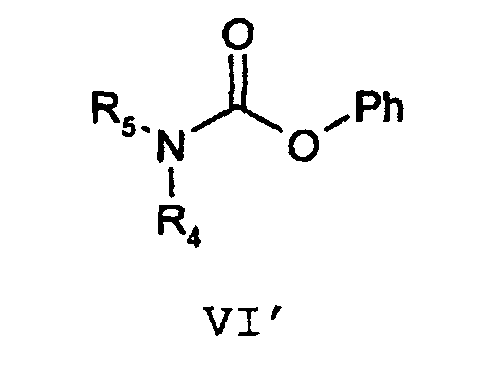
-
- To further illustrate the process according to the invention, there are provided specific examples of the alternative processes described in scheme A.
- As a first alternative, there is provided a process where compounds of formula 1 (wherein R1, R4 and R5 are as defined above and R2 and R3 are both H, X is O or S, and Y is phenyl or Het) were prepared as illustrated in scheme B:

- a) Reduction of acid 2 was achieved with borane in tetrahydrofuran or via the formation of a mixed anhydride with isobutylchloroformate in the presence of an organic tertiary amine e.g. N-methylmorpholine or diisopropylethylamine, and subsequent treatment of the mixed anhydride with sodium borohydride.
- b) Conversion of the alcohol 3 into arylether or arylthioether 4 was achieved using Mitsunobu reaction conditions (Ref. D.L. Hughes, Org. Reaction 1992, 42, 335; J.R. Dormoy, Synthesis 1982, 753) for example using triphenylphosphine and diethyl azodicarboxylate in a solvent such as tetrahydrofuran and in the presence of an arylthiol or arylalcohol.
- c, d) Intermediate 4 was converted to the desired inhibitor 1 via deprotection using a source of fluoride ions such as cesium fluoride, followed by condensation with the appropriate isocyanate R5 -NCO in the presence of a tertiary amine such as diisopropylethylamine or preferably lithium (or potassium) bis(trimethylsilyl)amide [when R4 is H]. Alternatively, an activated carbamate such as phenoxycarbamate could be used. When R4 is not hydrogen, an appropriate carbamoyl chloride derivative should be used.
-
- Alternatively, the compounds of formula 1 wherein R1 to R5 inclusive are as defined above, X is NR8 (wherein R8 is defined as in the summary of the invention) or X and Y are joined to form a morpholino or piperidino ring, were prepared by the process as illustrated in scheme C:

- a) The alcohol 3 was converted into a leaving group such as an iodide 5.
- b) The iodide 5 was then reacted with a secondary amine such as piperidine or morpholine to give 6 wherein X and Y are joined to form a piperidino or morpholino ring respectively.
- c) The intermediate 6 was then elaborated as described above to yield a compound of formula 1.
- d)
-
- Turning now to a further specific embodiment of the process of the invention, there is provided a process for producing compounds of formula 1 wherein R2 is C1-3 alkyl such as methyl, Y is phenyl or Het, R3 is H, and R1, R4, R5, and X are as defined in the summary of the invention. These compounds were prepared by the process as illustrated in scheme D:

- a, b) The primary alcohol 3 was oxidized to the corresponding aldehyde using oxalyl chloride-activated dimethyl sulfoxide (K. Omura and D. Swern, Tetrahedron 1978, 34, 1651) or triacetoxy periodinane (D.B. Dess and J.C. Martin, J. Org. Chem. 1983, 48, 4155). This aldehyde was then reacted with an appropriate Grignard reagent such as methylmagnesium bromide to give the addition product 7 as a mixture of diastereoisomers.
- c, d) Conversion of the secondary alcohols 7 into arylether or arylthioether 8 was achieved using Mitsunobu reaction conditions as exemplified in Scheme B, step b. The two diastereoisomers could then be separated using chromatography on silica gel or by preparative HPLC.
- e, f) The desired inhibitor 1 was obtained via deprotection and condensation as described above.
-
- Isocyanates or activated carbamates used in this invention which were not commercially available, were prepared as described in schemes E, F, G or H.
- Scheme E: Isocyanates such as 1(R)-phenylpropyl isocyanate 10 were prepared from commercially available amine via the formation of the hydrochloride salt and reaction with triphosgene in toluene under reflux.
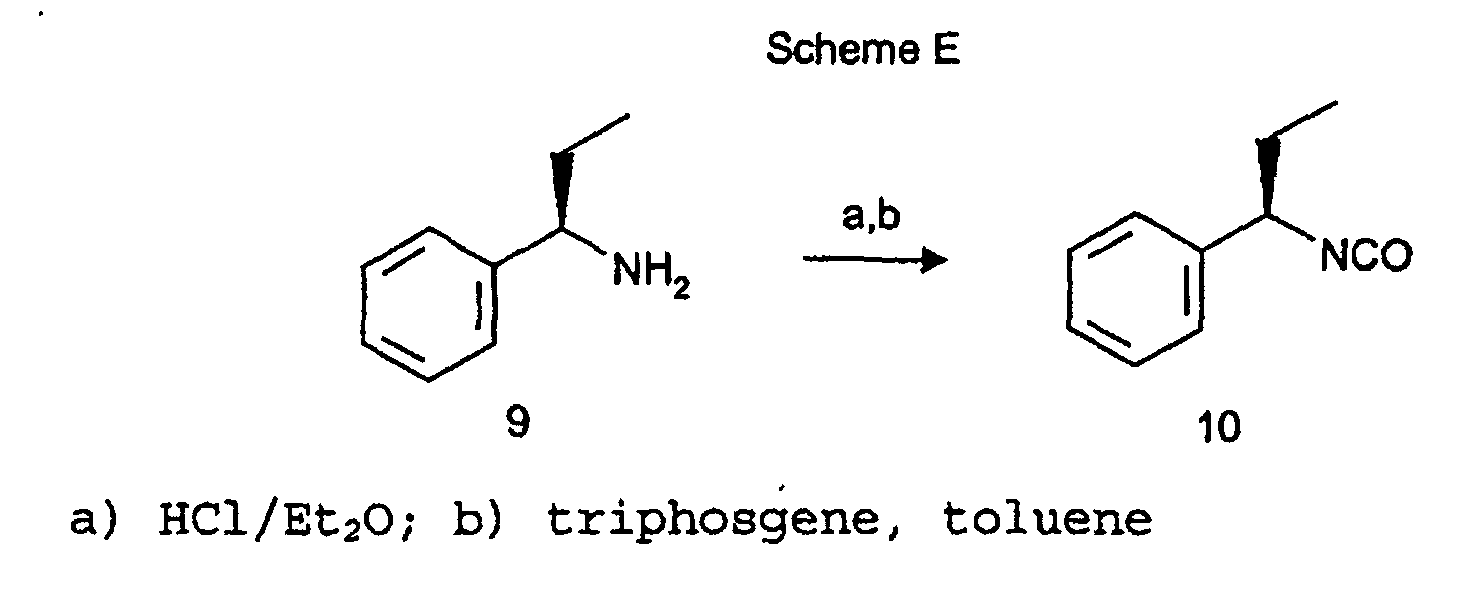
- Scheme F: Alternatively, non commercially available secondary benzylic amines could be prepared from the corresponding substituted benzyl bromides as follows:
- a) Benzylic bromide 11 was reacted with methylamine in ethanol to afford the corresponding secondary amine 12 which was isolated as the hydrochloride salt.
- b) Further reaction with phosgene in presence of a
tertiary organic base such as
diisopropylethylamine in dichloromethane gave the
desired carbamoyl chloride 13.

-
- Scheme G: Alternatively, preactivation could be achieved via formation of the N-phenoxycarbamate derivative 15 by reacting the amine 14 with phenyl chloroformate in the presence of a tertiary amine such as triethylamine in dichloromethane.

- Scheme H: Alternatively, non commercially available pyrrolidine derivatives such as 19 could be prepared as follows:
- a, b) Amine 16 was protected by reaction with di-tert-butylcarbonate in the presence of an aqueous base such as sodium hydroxide. The protected amine was reacted a benzyl halide such as benzyl bromide or chloride in presence of a base such as sodium hydride in tetrahydrofuran to give intermediate 17.
- c) Cyclisation of intermediate 17 was accomplished using strong base such as n-butyllithium in the presence of tetramethylethylenediamine in tetrahydrofuran to give pyrrolidine derivative 18.
- d, e) Cleavage of the tert-butyloxycarbonyl group is
carried out under anhydrous acidic conditions
followed by reaction with phosgene in presence of a
tertiary organic base such as diisopropylethylamine
in dichloromethane to give the desired carbamoyl
chloride 19.
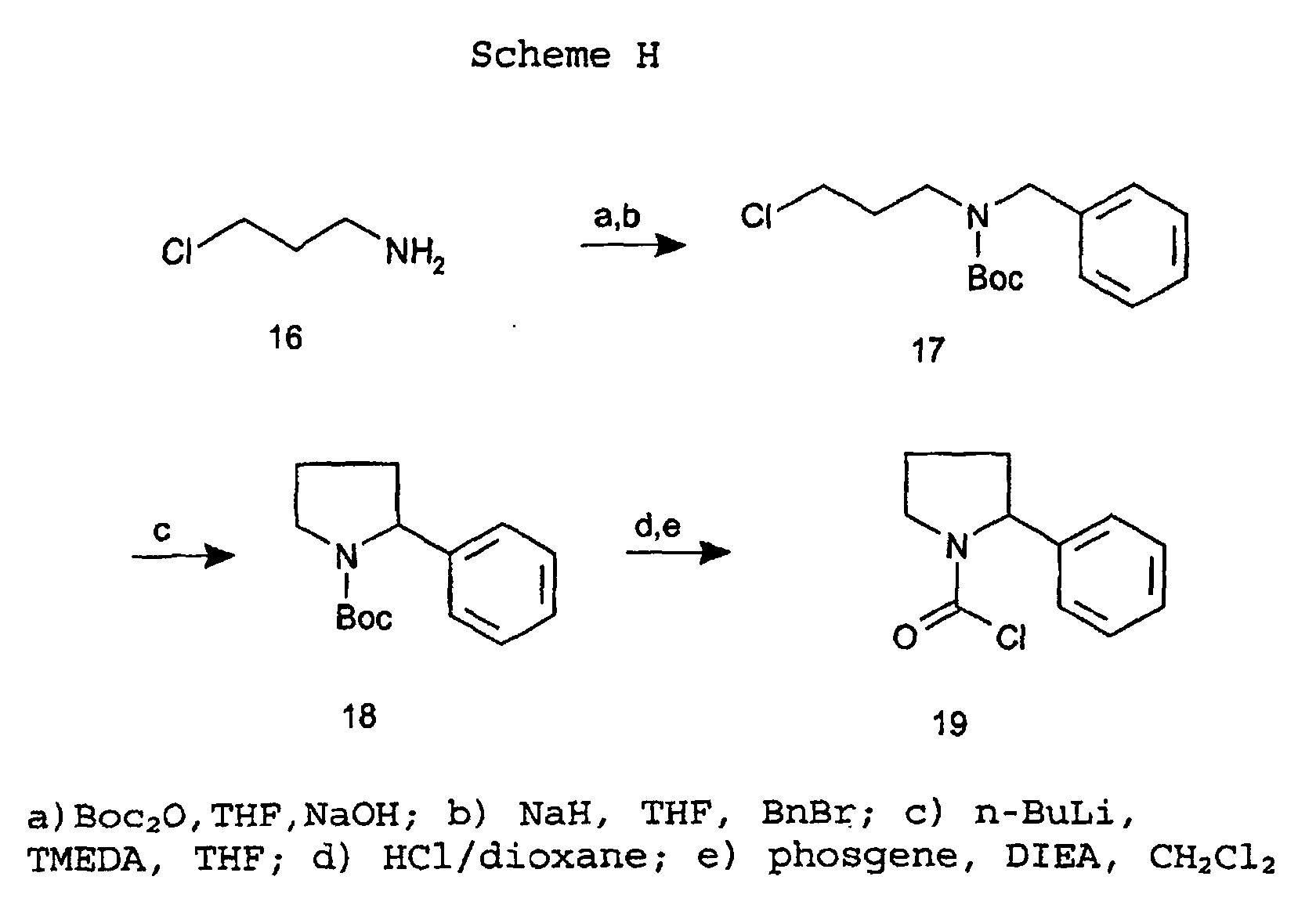
-
- For compounds of formula 1 wherein Y is lower alkyl, introduction of a lower alkyl thioether could be achieved via intermediate 3.
- a, b) The hydroxy group of the primary alcohol 3 was converted into a leaving group such as 4-nitrobenzenesulfonate, followed by displacement with potassium thioacetate to generate the corresponding thioacetate 21.
- c, d) Saponification of the acetate 21 in the
presence of lithium hydroxide in methanol followed by
addition of methyl iodide gave the desired
methylthioether derivative. Deprotection and ureido
formation as described above led to the desired
compound 1.

-
- The antiherpes activity of the aforementioned azetidinone derivatives of formula 1 (HCMV protease inhibitors) can be demonstrated by biochemical, microbiological and biological procedures.
- A biochemical procedure for demonstrating anti-cytomegalovirus activity for the azetidinone derivatives of formula 1 is described in the examples hereinafter. This particular assay determines the ability of a test compound to inhibit the activity (IC50) of HCMV protease. More specifically, in the assay described herein, the inhibitory activity of the test compound is evaluated on the basis of its ability to interfere with the HCMV No protease cleavage of a fluorogenic peptide substrate which in turn is based on the maturation cleavage site of the enzyme.
- Methods for demonstrating the inhibiting effect of the azetidinone derivatives of formula 1 on CMV replication involving cell culture techniques (EC50) are described in the examples herein.
- When the HCMV protease inhibitor is employed as an antiviral agent, it is administered orally or systemically to humans in a vehicle comprising one or more pharmaceutically acceptable carriers, the proportion of which is determined by the solubility and chemical nature of the compound, chosen route of administration and standard biological practice. For oral administration, the compound or a therapeutically acceptable salt thereof can be formulated in unit dosage forms such as capsules or tablets each containing a predetermined amount of the active ingredient, ranging from about 50 to 500 mg, in a pharmaceutically acceptable carrier.
- For parenteral administration, the HCMV protease inhibitor is administered by either intravenous, subcutaneous or intramuscular injection, in compositions with pharmaceutically acceptable vehicles or carriers. For administration by injection, it is preferred to use the compounds in solution in a sterile aqueous vehicle which may also contain other solutes such as buffers or preservatives as well as sufficient quantities of pharmaceutically acceptable salts or of glucose to make the solution isotonic.
- Suitable vehicles or carriers for the above noted formulations are described in standard pharmaceutical texts, e.g. in "Remington's, The Science and Practice of Pharmacy", 19th ed., Mack Publishing Company, Easton, Penn., 1995, or in "Pharmaceutical Dosage Forms and Drug Delivery Systems", 6th ed., H.C. Ansel et al., Eds., Williams & Wilkins, Baltimore, Maryland, 1995.
- The dosage of the HCMV protease inhibitor will vary with the form of administration and the particular active agent chosen. Furthermore, it will vary with the particular host under treatment. Generally, treatment is initiated with small increments until. the optimum effect under the circumstance is reached. In general, the inhibitor compound is most desirably administered at a concentration level that will generally afford antivirally effective results without causing any harmful or deleterious side effects.
- For oral administration, the HCMV protease inhibitor is administered in the range of 20 to 200 mg per kilogram of body weight per day, with a preferred range of 25 to 100 mg per kilogram.
- For ocular administration, the HCMV protease inhibitor is administered either topically or intraocularly (injection or implant) in a suitable preparation. For example, an implant containing the compound in a suitable formulation can be surgically implanted in the posterior segment of the eye through a small incision.
- With reference to systemic administration, the HCMV protease inhibitor is administered at a dosage of 10 mg to 150 mg per kilogram of body weight per day, although the aforementioned variations will occur. However, a dosage level that is in the range of from about 10 mg to 100 mg per kilogram of body weight per day is most desirably employed in order to achieve effective results.
- The following examples further illustrate this invention. All reactions were performed in a nitrogen or argon atmosphere. Temperatures are given in degrees Celsius. Solution percentages or ratios express a volume to volume relationship, unless stated otherwise. Nuclear magnetic resonance spectra were recorded on a Bruker 400 MHz spectrometer; the chemical shifts (δ) are reported in parts per million. Abbreviations or symbols used herein include: Boc: tert-butyloxycarbonyl; DEAD: diethyl azodicarboxylate; DIEA: diisopropylethylamine; DMF: dimethylformamide; Et: ethyl; EtOAc: ethyl acetate; Et2O: diethyl ether; LiHMDS: lithium bis(trimethylsilyl)amide; Me: methyl; MeOH: methanol; MeCN: acetonitrile; Ph: phenyl; THF: tetrahydrofuran; TMEDA: tetramethylethylenediamine; MS(ES): electrospray mass spectrometry; MS(FAB): fast atom bombardment mass spectrometry; HRMS: high resolution mass spectrometry; PFU: plaque forming units.
- To a solution of 1(R)-phenylpropylamine (14.33 g, 106 mmol) in Et2O (102 mL) was added a 1.0 M solution of HCl/Et2O (212 mL, 212 mmol). The mixture was stirred for 30 min, then the crude solution was evaporated to dryness on a rotary evaporator. The resulting white hydrochloride salt was suspended in toluene (200 mL), triphosgene was added (11.67 g, 39.3 mmol) and the resulting suspension was stirred at reflux for 3 h at room temperature overnight. The reaction mixture was concentrated and the final volume adjusted to 200 mL with toluene giving a final concentration of 0.53M. The resulting isocyanate solution was used as such. An aliquot (170 mL) was concentrated to give a colorless oil.
1H NMR (400 MHz, CDCl3) δ 7.36-7.22 (m, 5H), 4.50 (t, J = 6.7 Hz, 1H), 1.82 (q, J = 7.3 Hz, 2H), 0.94 (t, J = 7.3 Hz, 2H). - To a solution of 4-(aminomethyl)pyridine (10.7 g, 98.5 mmol) in CH2Cl2 (245 mL) at 0°, was added Et3N (14.2 mL, 19.9 g, 197 mmol) followed by dropwise addition of phenylchloroformate (14.8 mL, 18.5 g, 118 mmol). After stirring for 1 h, the resulting mixture was diluted with EtOAc (1.5 L), the organic phase was washed twice with water and brine, dried over sodium sulfate and concentrated under vacuum.
Chromatography (SiO2, gradient EtOAc to 10 % MeOH/CHCl3) gave a yellow solid which was recrystallized from EtOAc : hexane (2:1), to yield the desired compound (9.55 g, 41.85 mmol, 42 % yield).
1H NMR (400 MHz, CDCl3) δ 8.61 (d, J= 5.7 Hz, 2H), 7.40-7.15 (m, 7H), 5.61 (bs, 1H) , 4.50 (d, J= 6.4 Hz, 2H). - To a solution of {4-(trifluoromethyl)phenyl}methyl bromide (20.0 g, 83.7 mmol) in EtOH was added MeNH2 (100 mL of 40% aqueous solution, 1290 mmol). After 2 h the reaction was concentrated under vacuum. The aqueous phase was extracted with EtOAc (2 x 100 mL), The combined organic phase was washed with NaHCO3 and brine, dried over magnesium sulfate, filtered and evaporated to dryness. The resulting residue was dissolved in HCl/dioxane (4N, 100 mL) and the solvent removed under vacuum. The resulting solid was triturated with Et2O and collected by suction filtration to provide N-methyl {4-(trifluoromethyl)phenyl}methylamine hydrochloride salt (17.0 g, 90% yield) as a white solid.
- The salt was suspended in CH2Cl2 (150 mL), cooled at 0° and DIEA was added (30.2 mL, 173 mmol) followed by a phosgene solution in toluene (1.93 M, 55 mL, 105.7 mmol). After 2 h at 0° the reaction mixture was concentrated. The resulting thick gum was extracted with Et2O and evaporation of the extract gave a light yellow oil. This oil was further purified by flash chromatography (SiO2, eluent : 10% EtOAc in hexane) to give a pale yellow oil (16.0 g, 84% yield). 1H NMR (400 MHz, CDCl3) δ 7.59 (m, 2H), 7.33 (m, 2H), 4.72 and 4.58 (2 x s, 2H), 3.04 and 2.97 (2 x s, 3H).
- Preparation of 2-oxo-4(R)-(pyrimidin-2-ylsulfanylmethyl)azetidine-1-carboxylic acid (1(R)-phenylpropyl)amide (Table 1, entry #104).
- To a solution of i-(tert-butyldimethylsilyl)-4-oxoazetidine-2(R)-carboxylic acid (15.0 g, 65.40 mmol) in THF (367 mL) at 0°, was added N-methylmorpholine (7.2 mL, 65.40 mmol) and isobutyl chloroformate (8.5 mL, 65.40 mmol). After stirring for 1.5 h at 0°, a solution of NaBH4 (9.9 g, 261.61 mmol) in H2O (98 mL) was added portion wise. The reaction was stirred 45 min, then diluted with EtOAc and quenched with aqueous HCl solution (10%) to pH 5-6. The organic phase was collected and the aqueous phase was extracted twice with EtOAc. The combined organic layers were washed with saturated aqueous NaHCO3 and brine, dried (MgSO4), filtered and concentrated. The residual oil was purified by flash chromatography (SiO2, gradient 25% to 50% EtOAc/hexane) to provide 1-(tert-butyldimethylsilyl)-4(R)-(hydroxymethyl)azetidin-2-one (8.46 g, 60% yield) as a white solid . 1H NMR (400 MHz, CDCl3) δ 3.74-3.69 (m, 1H), 3.65-3.56 (m, 2H), 3.1-2.98 (m, 1H), 2.81-2.76 (m, 1H), 2.01 (s, 1H), 0.89 (s, 9H), 0.18 (s, 3H), 0.16 (s, 3H). FAB MS m/z 216.2 (MH+).
- To a solution of 1-(tert-butyldimethylsilyl)-4(R)-(hydroxymethyl)azetidin-2-one (2.75 g, 12.77 mmol) in THF (80 mL) was added PPh3 (6.70 g, 25.54 mmol). The reaction was cooled at 0° and DEAD (3.3 mL, 25.54 mmol) was added dropwise. After 5 min. 2-mercaptopyrimidine (3.60 g, 31.92 mmol) was added. After stirring for 15 min at 0° and 60 h at room temperature, the reaction mixture was concentrated. The residue was treated with EtOAc/hexane (1/1) and the resulting solid was filtered and rinsed with Et2O. The filtrate was concentrated and purified by flash chromatography (SiO2, 25% EtOAc/hexane) to provide 1-(tert-butyldimethylsilyl)-4(R)-(pyrimidin-2-ylsulfanylmethyl)azetidin-2-one (3.75 g, 95% yield) as clear oil. 1H NMR (400 MHz, CDCl3) δ 8.70 (d, J = 4.8 Hz, 2H), 7.20 (t, J = 4.9 Hz, 1H), 4.08-4.01 (m, 2H), 3.41-3.36 (m, 1H), 3.99 (dd, J = 14.3, 10.8 Hz, 1H), 2.98 (dd, J = 15.6, 2.5 Hz, 1H), 1.18 (s, 9H), 0.53 (s, 3H), 0.49 (s, 3H).
- To a solution of 1-(tert-butyldimethylsilyl)-4(R)-(pyrimidin-2-ylsulfanylmethyl)azetidin-2-one (280 mg, 0.905 mmol) in MeOH (4.5 mL) was added cesium fluoride (206 mg, 1.36 mmol). The reaction mixture was stirred 1.5 h at room temperature, then concentrated under vacuum. The residue was dissolved in CH2Cl2, washed with H2O and brine, dried (MgSO4), filtered and evaporated to give 4(R)-(pyrimidin-2-ylsulfanylmethyl)azetidin-2-one (184 mg) which was used as such. 1H NMR (400 MHz, CDCl3) δ 8.52 (d, J = 5.1 Hz, 2H), 7.02 (t, J = 5.1 Hz, 1H), 6.13-5.93 (m, 1H), 4.04-3.99 (m,1H), 3.54 (dd, J = 14.0. 5.4 Hz, 1H), 3.27 (dd, J = 14.0, 7.0, 1H). 3.14 (ddd, J = 15.0, 5.1, 1.9 Hz, 1H), 2.78 (ddd, J = 15.0, 2.2, 1.3. Hz, 1H).
- To a solution of 4(R) - (pyrimidin-2-ylsulfanylmethyl)azetidin-2-one (61.5 mg, 0.315 mmol) in THF (3 mL) at 0° was added dropwise LiHMDS (1M/THF) (0.33 mL, 0.331 mmol). After the reaction mixture was stirred 15 min at 0°, then cooled to -78°, 1(R)-phenylpropyl isocyanate (example 1) (0.53M/toluene, 0.63 mL, 0.315 mmol) was added dropwise and the mixture was warmed to room temperature and stirred for 1.5 h. The reaction mixture was quenched with H2O and diluted with EtOAc. The organic phase was washed with H2O and brine, dried (MgSO4), filtered and evaporated. The product was purified by flash chromatography (SiO2, 30% EtOAc/hexane) to give 2-oxo-4 (R) - (pyrimidin-2-ylsulfanylmethyl) azetidine-1-carboxylic acid (1(R)-phenylpropyl)amide(75 mg, 67% yield) as a viscous gum. 1H NMR (400 MHz, CDCl3) δ 8.45 (d, J = 4.8 Hz, 2H), 7.29-7.17 (m, 5H), 6.94 (t, J = 4.8 Hz, 1H), 6.82 (d, J = 8.3 Hz, 1H) 4.71 (q, J = 7.6 Hz, 1H), 4.33-4.28 (m, 1H), 4.03 (dd, J = 14.2, 3.3 Hz, 1H), 3.39 (dd, J = 14.2, 8.3 Hz, 1H), 3.03 (dd, J = 16.0, 5.6 Hz, 1H), 2.89 (dd, J = 16.0, 3.0 Hz, 1H), 1.83-1.75 (m, 2H), 0.86 (t, J = 7.3 Hz, 3H); IR (neat) υ 1758, 1692 cm-1; FAB MS m/z 357.3 (MH+); HRMS calcd. for C18H21N4O2S (MH+) 357.1385, found 357.1379.
- 2-oxo-4(R)-[1(R)-(pyrimidin-2-ylsulfanyl)ethyl] azetidine-1-carboxylic acid (1(R)-phenylpropyl)amide and 2-oxo-4 (R) - [1(S)-(pyrimidin-2-ylsulfanyl)ethyl]-azetidine-1-carboxylic acid (1(R)-phenylpropyl)amide (Table 2, mixture of entries #208 and 209).
- To a solution of oxalyl chloride (0.31 mL, 3.58 mmol) in CH2Cl2 (22 mL) at -78° was added dropwise a solution of DMSO (0.48 mL, 6.83 mmol) in CH2Cl2 (1.4 mL). After 15 min, a solution of 1-(tert-butyldimethylsilyl)-4(R)-(hydroxymethyl)azetidin-2-one (700 mg, 3.25 mmol) in CH2Cl2 (3.3 mL) was added and the reaction was stirred an extra 45 min. Finally, DIEA (2.8 mL, 16.25 mmol) was added and the reaction was stirred at room temperature for 2 h. The resulting mixture was diluted with H2O and extracted with CH2Cl2. The organic phase was washed with aqueous HCl (10%), saturated NaHCO3 and brine, dried (MgSO4), filtered and concentrated. The crude aldehyde was immediately used in the next step. To the crude aldehyde dissolved in THF (29 mL) was added dropwise MeMgBr (3M/Et2O, 2.7 mL, 8.18 mmol). The reaction mixture was stirred 1 h at 0° and 1 h at room temperature, followed by the addition of aqueous saturated NH4Cl solution. After extraction with EtOAc, the organic phase was washed with HCl (10%), saturated aqueous NaHCO3 and brine, dried (MgSO4), filtered and evaporated. The resulting mixture was purified by flash chromatography (SiO2, 40% EtOAc-hexane) to give 1-(tert-butyldimethylsilyl)-4(R)-(1-hydroxyethyl)azetidin-2-one (580 mg, 77% yield for two steps) as a mixture of isomers. 1H NMR (400 MHz, CDCl3) δ 4.02-3.96 (m, 1H), 3.81 (q, J = 6.5 Hz, 1H), 4.33-4.27 (m, 1H), 3.50-3.43 (m,2H), 3.01 (dd, J = 15.6, 5.6 Hz, 1H), 2.95 (dd, J = 15.3, 2.9 Hz, 1H), 2.84 (dd, J = 15.1, 5.6 Hz, 1H), 2.58 (dd, J = 15.6, 2.9 Hz, 1H), 1.14 (d, J = 6.4 Hz, 3H), 1.07 (d, J = 6.7 Hz, 3H), 0.92-0,91 (m, 18H), 0.22-0.11 (m, 6H).
- The procedure of example 4, step B was followed to give 1-(tert-butyldimethylsilyl)-4(R)-[1-(pyrimidin-2-ylsulfanyl)ethyl]azetidin-2-one as a mixture of isomers. Separation of the two isomers was performed by preparative HPLC (C18 column, 5% to 100% CH3CN/H2O/0.06% TFA).
- Syn diastereoisomer (13.4 min) : 1H NMR (400 MHz, CDCl3) δ 8.46 (d, J = 4.8 Hz, 2H), 6.94 (t, J = 4.8 Hz, 1H), 3.82 (q, J = 3.0 Hz, 1H), 3.08 (dd, J = 15.6, 5.7 Hz, 1H), 2.85 (dd, J = 15.6, 2.9 Hz, 1H), 1.38 (d, J = 6.7 Hz, 3H), 0.86 (s, 9H), 0.18 (s, 3H), 0.12 (s, 3H).
- Anti diastereoisomer (15 mm) : 1H NMR (400 MHz, CDCl3) δ 8.46 (d, J = 4.8 Hz, 2H), 6.96 (t, J = 4.9 Hz, 1H), 4.26-4.21 (m, 1H), 4.07-4.02 (m, 1H), 2.98 (dd, J = 15.7, 5.6 Hz, 1H), 2.81 (dd, J = 14.6, 2.9 Hz, 1H), 1.31 (d, J = 7.3 Hz, 3H), 0.94 (s, 9H), 0.32 (s, 3H), 0.24 (s, 3H).
- The procedure of example 4, steps C and D was followed to give the desired compounds: 2-oxo-4(R)-[1(R)-(pyrimidin-2-ylsulfanyl)ethyl]azetidine-1-carboxylic acid (1(R)-phenylpropyl)amide. 1H NMR (400 MHz, CDCl3) δ 8.45 (d, J = 4.8 Hz,2H), 7.29-7.18 (m, 5H), 6.93-6.89 (m, 2H), 4.76-4.66 (m, 2H), 4.53-4.49 (m, 1H), 3.00 (dd, J = 16.2, 5.7 Hz, 1H), 2.90 (dd, J = 16.3, 2.9 Hz, 1H), 1.86-1.79 (m, 2H), 1.37 (d, J = 7.3 Hz, 3H), 0.88 (t, J = 7.3 Hz, 3H); IR (CHCl3) ν 1764, 1700 cm-1; FAB MS m/z 371 (MH+); HRMS calcd. for C19H23N4O2S: 371.1542 (MH+) ; found: 371.1535. 2-oxo-4(R)-[1(S)-(pyrimidin-2-ylsulfanyl)ethyl]-azetidine-1-carboxylic acid (1(R)-phenylpropyl)amide. 1H NMR (400 MHz, CDCl3) δ 8.50 (d, J = 4.8 Hz, 2H), 7.30-7.16 (m, 5H), 6.96 (t, J = 4.8 Hz, 1H), 6.80 (d, J = 8.6 Hz, 1H), 4.66-4.60 (m, 2H), 4.25-4.19 (m, 1H), 3.05 (dd, J = 16.0, 5.6 Hz, 1H), 2.94 (dd, J = 16.2, 2.6 Hz, 1H), 1.70 (q, J = 7.3 Hz, 2H), 1.48 (d, J = 7.0 Hz, 3H), 0.75 (t, J = 7.5 Hz, 3H); IR (neat) υ 1764, 1702 cm-1; FAB MS m/z 371 (MH+); HRMS calcd. for C19H23N4O2S: 371.1542 (MH+); found: 371.1535.
- Preparation of 2-oxo-4(R) - (phenylsulfanylmethyl) azetidine-1-carboxylic acid (pyridin-4-ylmethyl)amide (Table 2, entry #201).
- 1-(tert-Butyldimethylsilyl)-4(R)-(hydroxymethyl)azetidin-2-one (from example 4, step A) was deprotected using the same procedure as in example 4, step C, to give 4(R)-(hydroxymethyl)azetidin-2-one. 1H NMR (400 MHz, CDCl3) δ 6.86-6.67 (bs, 1H), 3.77 (dd, J = 11.5, 3.4 Hz, 1H), 3.72-3.68 (m, 1H), 3.54 (dd, J = 11.5, 6.0 Hz), 3.34-3.07 (bs, 1H), 2.91 (ddd, J = 14.9, 5.1, 1.3 Hz, 1H), 2.66 (d, J = 14.9 Hz, 1H).
- To a solution of 4(R)-(hydroxymethyl)azetidin-2-one (502 mg, 4.96 mmol) in CH2Cl2 (7 mL) at 0° was added Et3N (0.83 mL, 5.96 mmol) followed by methanesulfonyl chloride (0.46 mL, 6.0 mmol) and stirred for 5 h at 0°. The reaction mixture was filtered and the filtrate concentrated in vacuo. The combined solids were purified by flash chromatography (SiO2, 10% MeOH-CHCl3) to yield the pure mesylate (610 mg, 3.40 mmol, 61% yield) as a white solid. 1H NMR (400 MHz, CDCl3) δ 6.07-5.90 (bs, 1H), 4.38 (dd, J = 11.0, 3.7 Hz, 1H), 4.17 (dd, J = 11.0, 7.2 Hz, 1H), 3.99-3.89 (m, 1H), 3.10 (ddd, J = 15.2, 5.4, 2.0 Hz, 1H), 3.02 (s, 3H), 2.72 (ddd, J = 15.2, 2.5, 1.3 Hz, 1H).
- To a cold (0°) suspension of sodium hydride (54.0 mg, 2.24 mmol) in DMF (4 mL) was added thiophenol (223 mL, 2.17 mmol) and the reaction mixture was stirred at 0° for 1 h. The mesylate (300 mg, 1.67 mmol) was then added and stirring was continued at room temperature overnight. The reaction mixture was diluted with a 1:1 mixture of Et2O/EtOAc (40 mL) and washed with H2O, saturated aqueous NaHCO3 and brine, dried (MgSO4), filtered and concentrated. The residue was purified by flash chromatography (SiO2, 70% EtOAc-hexane) to give 4(R)-(phenylsulfanylmethyl)azetidin-2-one (118 mg, 65% yield) as a colorless gum. 1H NMR (400 MHz, CDCl3) δ 7.38-7.31 (m, 2H), 7.29-7.15 (m, 3H), 5.97-5.80 (bs, 1H), 3.76-3.69 (m, 1H), 3.12 (dd, J = 13.7, 5.1 Hz, 1H), 3.02. (ddd, J = 15.0, 5.0, 1.9 Hz, 1H), 2.98 (dd, J = 13.7, 7.6 Hz, 1H), 2.60 (ddd, J = 15.0, 2.4, 1.5 Hz, 1H)
- Following the same procedure as in example 4, step D, but using 4-(phenylsulfanylmethyl)azetidin-2-one and (pyridin-4-ylmethyl)carbamic acid phenyl ester as reactants gave 2-oxo-4(R)-(phenylsulfanylmethyl)azetidine-1-carboxylic acid (pyridin-4-ylmethyl)amide as a white solid.
1H NMR (400 MHz, CDCl3) δ 8.56-8.50 (m, 2H), 7.39-7.34 (m, 2H), 7.31-7.14 (m, 5H), 6.90- 6.84 (m, 1H), 4.43 (dd, J = 16.5, 6.4 Hz, 1H), 4.38 (dd, J = 16.5, 6.4 Hz, 1H), 4.28-4.21 (m, 1H), 3.61 (dd, J = 14.3, 2.9 Hz, 1H), 3.19 (dd, J = 14.3, 7.9 Hz, 1H), 3.11 (dd, J = 16.2, 5.7 Hz, 1H), 2.87 (dd, J = 16.2, 2.9 Hz, 1H); IR (KBr) υ 3347, 1763, 1701 cm-1; FAB MS m/z 328 (MH+) ; HRMS calcd for C17H17N3O2S: 328.1119 (MH+); found: 328.1129. - Preparation of 4 (R) - (methylsulfanyl) methyl-2-oxoazetidine-1-carboxylic acid (1(R)-phenylpropyl)amide (Table 1, entry #127).
- 1-(tert-Butyldimethylsilyl)-4(R)-(hydroxymethyl)azetidin-2-one (from example 4, step A) (2.0 g, 9.29 mmol) was dissolved in CH2Cl2 (14 mL) and cooled to 0°. Et3N (1.55 mL, 11.1 mmol) was added followed by 4-nitrobenzenesulfonyl chloride (2.47 g, 11.1 mmol) and stirred at 0° for 2 h. The reaction mixture was filtered and the filtrate concentrated in vacuo. Et2O was added to the residue and the salt removed by filtration. The filtrate was concentrated and the crude product was purified by flash chromatography (SiO2, 30% EtOAc-hexane) to yield the desired product as a yellow solid (2.98 g, 80% yield).
- To a solution of the 4-nitrobenzenesulfonate derivative (1.0 g, 2.50 mmol) in MeCN (12 mL) was added potassium thioacetate (342 mg, 3.00 mmol). The reaction mixture was stirred at room temperature overnight and the orange suspension evaporated in vacuo. The residue was diluted with EtOAc (25 mL), washed with H2O and brine, dried (MgSO4) filtered and concentrated. The residue was purified by flash chromatography (SiO2, 20% EtOAc-hexane) to give the thioacetate derivative (586 mg, 86% yield) as a yellow oil. 1H NMR (400MHz, CDCl3) δ 3.65-3.57 (m, 1H), 3.42 (dd, J = 13.7, 3.2 Hz, 1H), 3.08 (dd, J = 15.6, 5.4 Hz, 1H), 2.69 (dd, J = 13.7, 9.2 Hz, 1H), 2.56 (dd, J = 15.6, 2.7 Hz, 1H), 2.31 (s, 3H), 0.91 (s, 9H), 0.24 (s, 3H), 0.20 (s, 3H).
- To a solution of the thioacetate (151 mg, 0.552 mmol) in MeOH (3 mL) was added a solution of LiOH (16.0 mg, 0.664 mmol) in MeOH (4 mL). The reaction mixture was stirred for 1 h at room temperature, MeI (41 mL, 0.659 mmol) was added and stirring was continued for 1 h. The reaction mixture was evaporated to dryness and purified by flash chromatography (SiO2, 80% EtOAc-hexane) to yield 4(R)-(methylsulfanylmethyl)azetidin-2-one as a colorless oil (41.1 mg, 57% yield). 1H NMR (400 MHz, CDCl3) δ 6.10-5.92 (bs, 1H), 3.79-3.72 (m, 1H), 3.06 (ddd, J = 14.9, 5.0, 2.2 Hz, 1H), 2.73 (dd, J = 13.6, 5.3 Hz, 1H), 2.66-2.59 (m, 1H), 2.58 (dd, J = 13.6. 8.0 Hz, 1H), 2.10 (s, 3H).
- Following the same procedure as in example 4, step D, but using 4(R)-(methylsulfanylmethyl)azetidin-2-one as starting material, gave 2(R)-(methylsulfanyl)methyl-4-oxoazetidine-1-carboxylic acid (1-phenylpropyl)amide as yellowish oil.
1H NMR (400 MHz, CDCl3) δ 7.31-7.24 (m, 2H), 7.23-7.16 (m, 3H), 6.83 (d, J = 8.0 Hz, 1H), 4.68 (ddd, J = 8.0, 7.6, 7.6 Hz, 1H), 4.18-4.10 (m, 1H), 3.14 (dd, J = 14.0, 3.2 Hz, 1H), 3.08 (dd, J = 16.0, 5.6 Hz, 1H), 2.83 (dd, J = 16.0, 2.9 Hz, 1H), 2.77 (dd, J = 14.0, 8.3 Hz, 1H), 2.10 (s, 3H), 1.83-1.73 (m, 2H), 0.85 (t, J = 7.3 Hz, 3H); IR υ (CHCl3) 1764, 1698 cm- 1; FAB MS m/z 293 (MH+); HRMS calcd. for C15H20N2O2S (MH+) 293.1324 found: 293.1311. - Preparation of 2-oxo-4(R)-(piperidin-1-ylmethyl)azetidine-1-carboxylic acid (1(R)-phenylpropyl)amide (Table 2, entry #206).
- Iodine (4.25 g, 16.7 mmol) was added to a solution of 1-(tert-butyldimethylsilyl)-4(R)-(hydroxymethyl)azetidin-2-one (2.25 g, 10.47 mmol), Ph3P (5.48 g, 20.93 mmol) and imidazole (1.64 g, 24.07 mmol) in MeCN (100 mL) at 0°. After stirring at room temperature for four days, the mixture was concentrated and suspended in EtOAc-hexane (1:1). The suspension was filtered through a silica gel pad and washed with EtOAc-hexane (1:1). Concentration of the filtrate and purification by flash chromatography (SiO2, 10 % EtOAc-hexane) afforded pure 1-(tert-butyldimethylsilyl)-4(R)-(iodomethyl)azetidin-2-one as a white solid (2.73 g, 80 % yield). 1H NMR (400 MHz, CDCl3) δ 3.72-3.66 (m, 1H), 3.50 (ddd, J = 9.8, 3.2, 0.6 Hz, 1H), 3.21 (ddd, J = 15.6, 5.4, 0.6 Hz, 1H), 3.11 (dd, J = 9.8, 9.8 Hz, 1H), 2.76 (dd, J = 15.6, 2.5 Hz, 1H), 0.96 (s, 9H), 0.27 (s, 3H), 0.22 (s, 3H).
- 1-(tert-butyldimethylsilyl)-4(R)-(iodomethyl)-azetidin-2-one (202 mg, 0.62 mmol) was heated at reflux in piperidine (5 mL) for 2 h. The solution was concentrated, dissolved in CH2Cl2 and washed with saturated NaHCO3 and brine, dried (MgSO4) and concentrated. The residue was purified by flash chromatography (SiO2, EtOAc) to give 1-(tert-butyldimethylsilyl)-4(R)-(piperidin-1-ylmethyl)azetidin-2-one (116 mg, 71% yield). 1H NMR (400 MHz, CDCl3) δ 3.70-3.63 (m, 1H), 3.16 (dd, J = 15.3, 5.4 Hz, 1H), 2.70-2.61 (m, 2H), 2.45-2.26 (m, 5H), 1.60-1.53 (m, 4H), 1.46-1.38 (m, 2H), 0.96 (s, 9H), 0.24 (s, 6H).
- Following the same procedures as in example 4, steps C and D one obtained 2-oxo-4(R)-(piperidin-1-ylmethyl)azetidine-1-carboxylic acid (1(R)-phenylpropyl)amide as a yellow gum.
1H NMR (400 MHz, CDCl3) δ 7.39-7.22 (m, 5H), 7.14-7.09 (m, 1H), 4.79 (q, J = 7.6 Hz, 1H), 4.13-4.06 (m, 1H), 3.09 (dd, J = 15.9, 5.7 Hz, 1H), 3.01 (dd, J = 13.2, 3.5 Hz, 1H), 2.86 (dd, J = 15.9, 2.5 Hz, 1H), 2.56 (dd, J = 13.2, 7.6 Hz, 1H), 2.50-2.39 (m, 4H), 1.60-1.50 (m, 4H), 1.88-1.80 (m, 2H), 1.45-1.35 (m, 2H), 0.92 (t, 7.3 Hz, 3H); IR (neat) υ 3354, 1798, 1763, 1703; FAB MS m/z 330 (MH+) ; HRMS calcd. For C19H28N3O2 (MH+) 330.2181 found 330.2172. - Preparation of 1-(2(R)-phenyl-pyrrolidine-1-carbonyl)-4-(pyrimidin-2-ylsulfanylmethyl)azetidin-2-one and 1-(2(S)-phenyl-pyrrolidine-1-carbonyl)-4-(pyrimidin-2-ylsulfanylmethyl)azetidin-2-one (Table 4, mixture of entries #402 and 403).
- To a solution of 3-chloropropylamine hydrochloride (10 g, 77.0 mmol) and NaOH (10 N, 7.6 mL, 76 mmol) in THF (50 mL) was added di-tert-butyldicarbonate (15.9 g, 73 mmol) in THF (10 mL) followed by a mixture of MeOH/H2O (20/10 mL). The resulting solution was stirred for 2 h, then concentrated to approximately 15 mL and Et2O was added. The organic phase was washed twice with aqueous HCl (1.0 N), water and brine, dried (MgSO4), filtered and concentrated to give N-Boc-3-chloropropylamine (14.2 g, 96% yield) as a yellow oil.
1H-NMR (400 MHz, CDCl3) δ 4.70 (m, 1H),3.59 (t, J = 6.3 Hz, 2H),3.25 (m, 2H), 1.91 (m, 2H), 1.42 (s, 9H). - To a solution of N-Boc-3-chloropropylamine (10.0 g, 51.8 mmol) in THF was added sodium hydride (1.87 g, 78 mmol). After 20 min, benzyl bromide (9.24 mL, 78 mmol) was added and the reaction mixture was heated at reflux for 16 h. After cooling, the reaction mixture was diluted with Et2O (150 mL) and H2O (50 mL), the layers were separated and the aqueous layer was extracted twice with Et2O. The combined organic phases were washed with H2O and brine, dried (MgSO4), filtered and concentrated. The resulting yellow oil was purified by flash chromatography (SiO2, 10% EtOAc-hexane) to give N-Boc-N-benzyl-3-chloropropylamine (1.97 g, 13% yield) as a pale yellow oil.
1H-NMR (400 MHz, CDCl3) δ 7.29-7.19 (m, 5H), 4.40 (bs, 2H), 3.45 (bm, 2H), 3.25 (bm, 2H), 1.90 (bm, 2H), 1.44, 1.39 (2s, 9H). - To a solution of tetramethylethylenediamine (0.83 mL, 5.47 mmol) and n-BuLi (1.6 M / hexane, 3.31 mL, 5.3 mmol) cooled at -78° was added dropwise N-Boc-N-benzyl-3-chloropropylamine (1.0 g, 3.53 mmol) in THF. The resulting yellow solution was stirred at -78° for 5 h. The reaction mixture was then quenched with aqueous NH4Cl (20 mL) and diluted with Et2O (150 mL), the layers were separated and-the aqueous layer was extracted twice with Et2O. The combined organic phases were washed with H2O and brine, dried (MgSO4), filtered and concentrated. The resulting yellow oil was purified by flash chromatography (SiO2, 10% EtOAc-hexane) to give 2-phenylpyrrolidine-1-carboxylic acid tert-butyl ester (0.57 g, 65% yield).
1H-NMR (400 MHz, CDCl3) δ 7.31-7.14 (m, 5H), 4.90-4.71 (m, 1H), 3.59 (m, 2H), 2.29 (m, 1H), 1.92-1.84 (m, 3H), 1.43, 1.16 (2s, 9H). - A solution of 2-phenylpyrrolidine-1-carboxylic acid tert-butyl ester (0.55 g, 2.23 mmol) in HCl/dioxane (4 M, 5 mL) was stirred for 30 min then evaporated to dryness. To the resulting oil was added CH2Cl2 (25 mL)and diisopropylethylamine (0.90 mL, 5.13 mmol), and the mixture was cooled to 0°. Phosgene (1.93 M in toluene, 1.62 mL, 3.12 mmol) was added rapidly, and the reaction mixture was stirred for 1 h then concentrated. The resulting solid was extracted with Et2O, the undissolved residue was filtered and discarded. The ethereal solution was concentrated and the resulting oil was purified by flash chromatography (SiO2, 10% EtOAc-hexane) to give 2-phenylpyrrolidine-1-carbamoyl chloride (0.43 g, 95% yield).
1H-NMR (400 MHz, CDCl3) δ 7.36-7.18 (m, 5H), 4.95-4.76 (m, 1H), 3.71 (m, 2H), 2.31 (m, 1H) 1.97-1.86 (m, 3H). - Following the same procedure as in example 4, step D using 4-(R)-(pyrimidin-2-ylsulfanylmethyl) azetidin-2-one and 2-phenylpyrrolidine-1-carbamoyl chloride as reactants gave the title compounds as a 1/1 mixture. Separation of the isomers was accomplished by flash chromatography (SiO2, 50 % EtOAc-hexane) to give isomer A (less polar, 0.047 g, 18 % yield) and isomer B (more polar, 0.059 g, 31% yield).
Isomer A (mixture of rotamers) : 1H-NMR (400 MHz, CDCl3) δ 8.44 (d, J = 4.8 Hz, 2H), 7.27-7.06 (m, 5H), 6.94 (t, J = 4.8 Hz, 1H), 5.50-4.80 (bm, 1H) 4.40-3.50 (bm, 5H), 3.36 (m, 1H), 3.00-2.15 (bm, 3H), 1.95-1.72 (m, 3H); IR (neat) υ 1776, 1665; FAB MS m/z 369 (MH+); HRMS calcd. for C19H21O2N4S: 369.1385 (MH+); found: 369.1398.
Isomer B (mixture of rotamers) : 1H-NMR (400 MHz, CDCl3) δ 8.45 (bs, 2H), 7.25-7.16 (m, 5H), 6.94 (bm, 1H), 5.49 and 4.99 (2 bm, 1H), 4.44-3.45 (bm, 4H), 3.11-2.76 (bm, 2H), 2.44-2.29 (bm, 1H), 2.18-1.10 (bm, 4H); IR (neat) υ 1776, 1665; FAB MS m/z 369 (MH+); HRMS calcd. for C19H21O2N4S: 369.1385 (MH+); found: 369.1402. - The following two assays (A and B) were used to evaluate anti HCMV activity.
- Material & Methods: Fluorescence measurements were recorded on a Perkin-Elmer LS-50B spectrofluorimeter equipped with a plate reader accessory. UV measurements were recorded on a Thermomax® microplate reader from Molecular Devices Corporation, Menlo Park, CA, USA.
- HCMV No protease was assayed with an internally quenched fluorogenic substrate based on the maturation cleavage site (Abz-VVNASSRLY(3-NO2)R-OH, kcat/KM = 260 M-1S-1). The fluorescence increase upon cleavage of the Ala-Ser amide bond was monitored using excitation λ = 312 nm (slit 2.5 nm) and emission λ = 415 nm (slit 5 nm). A protocol adaptable to a 96-well plate format was designed for the determination of IC50 values of inhibitors.
- Briefly, HCMV No was incubated for 2.5 h at 30° in the presence of the substrate with a range of sequentially diluted inhibitor concentrations (300 to 0.06 µM depending on the potency of each compound). After this period, enzymatic hydrolysis of the fluorogenic substrate in the absence of inhibitor led to about a 30% conversion. Quenching was not required before fluorescence measurement since the total scanning time by the plate reader accessory was brief relative to the duration of the reaction. The aqueous incubation buffer contained 50 mM tris(hydroxymethyl)aminomethane ·HCl pH 8, 0.5M Na2SO4, 50 mM NaCl, 0.1 mM EDTA, 1 mM tris(2-carboxyethyl)phosphine.HCl, 3% v/v DMSO and 0.05% w/v casein. The final concentrations of HCMV No protease (expressed in terms of total monomer concentration) and substrate were 100 nM and 5 µM respectively. IC50 values were obtained through fitting of the inhibition curve to a competitive inhibition model using SAS NLIN procedure. The mode of inhibition was determined by measurements of the initial rates (in cuvettes) at various substrate concentrations in the buffer as described above. The IC50 values listed in the following tables were obtained according to this assay.
- Hs-68 cells (ATCC # CRL 1635) were seeded in 12-well plates at 83,000 cells/well in 1 mL of DMEM medium (Gibco Canada Inc.) supplemented with 10% fetal bovine serum (FBS, Gibco Canada Inc.). The plates were incubated for 3 days at 37° to allow the cells to reach 80-90% confluency prior to the assay.
- The medium was removed from the cells by aspiration. The cells were then infected with approximately 50 PFU of HCMV (strain AD169, ATCC VR-538) in DMEM medium supplemented with 5% inactivated FBS (assay medium). (DMEM medium is commercially available and has been described by R. Dulbecco et al., Virology 1959, 8, 396.) The virus was allowed to adsorb to cells for 2 h at 37°. Following viral adsorption, the medium was removed from the wells by aspiration. The cells were then incubated with or without 1 mL of appropriate concentrations of test reagent in assay medium. Occasionally, test compounds were added 24 h post-infection. After 4 days of incubation at 37°, the medium was exchanged with fresh medium containing test compound and 4 days later the cells were fixed with 1% aqueous formaldehyde and stained with a 2% violet solution in 20% ethanol in water. Microscopic plaques were counted using a stereomicroscope. Drug effects were calculated as a percent reduction in the number of plaques in the presence of each drug concentration compared to the number observed in the absence of drug. Ganciclovir was used as a positive control in all experiments.
- The EC50 values obtained according to this assay for certain azetidine derivatives of this invention are listed in the following table under the heading EC50.
- In conjunction with the appropriate starting materials and intermediates, the procedures of examples 1 to 11 can be used to prepare other compounds of formula 1. Examples of compounds thus prepared are listed in the following Tables 1, 2, 3 and 4 together with mass spectrum data for the compounds, and results from the assays A and B of example 10.
- Cytotoxic effects noted as TC50 in the following tables were determined according to the tetrazolium salt (MTT) metabolic assay, F. Denizot and F. Lang, J. Immun. Meth., 1986, 89, 271.
- Symbols used in the following tables includes Ph: phenyl; Bn: benzyl; Py: pyridinyl; CF3: trifluoromethyl; MS: FAB mass spectrometry unless otherwise noted (such as ES).


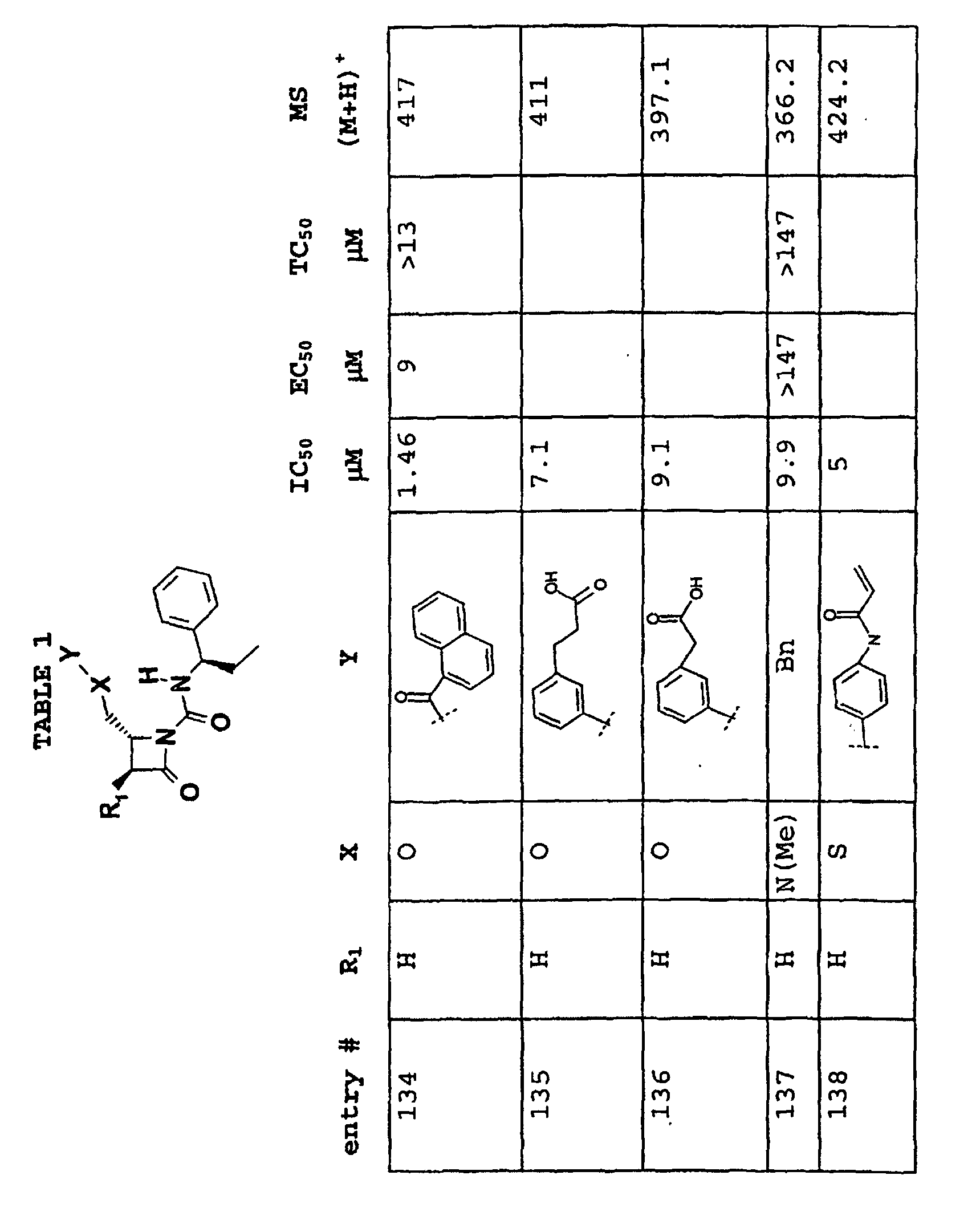
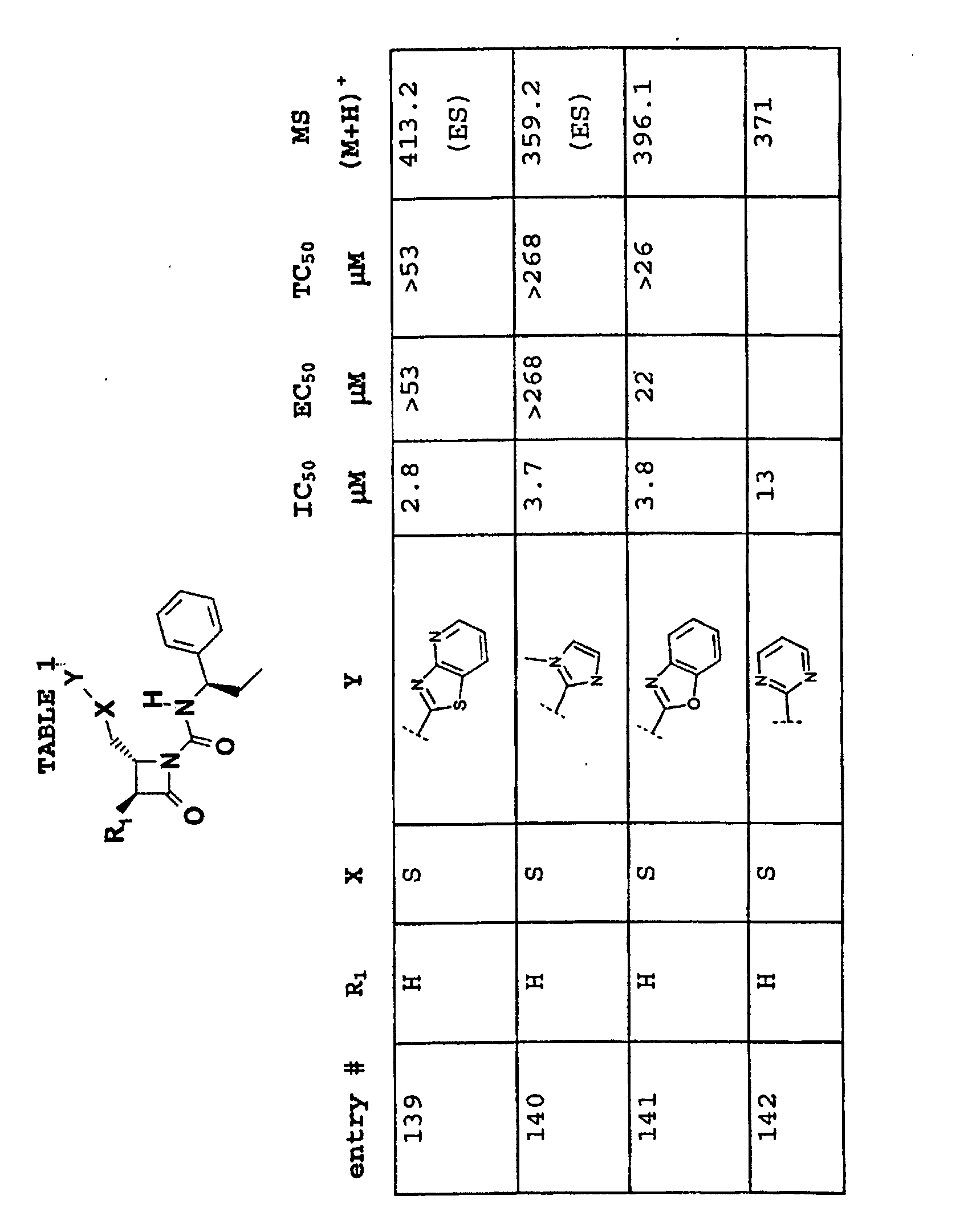

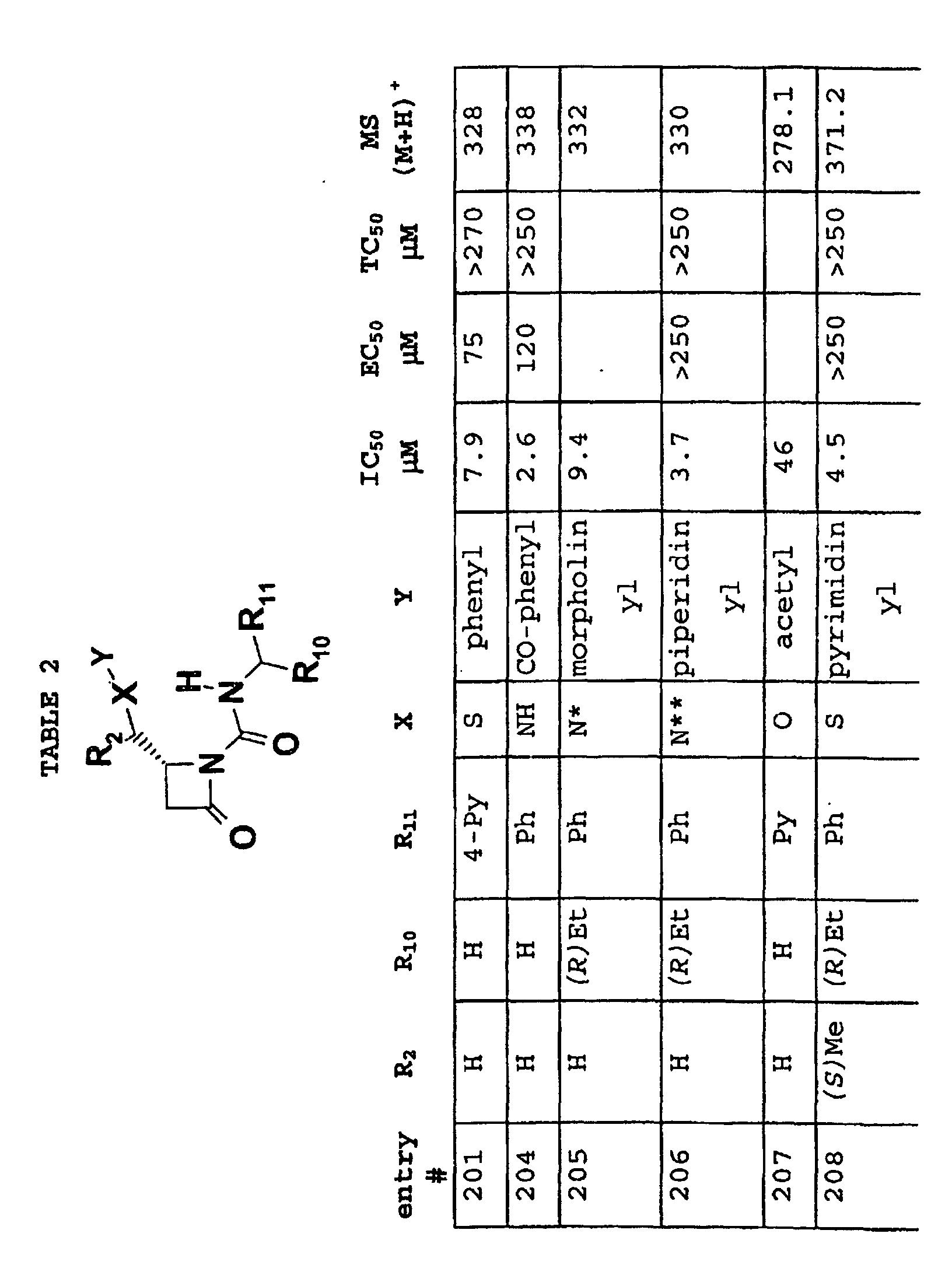

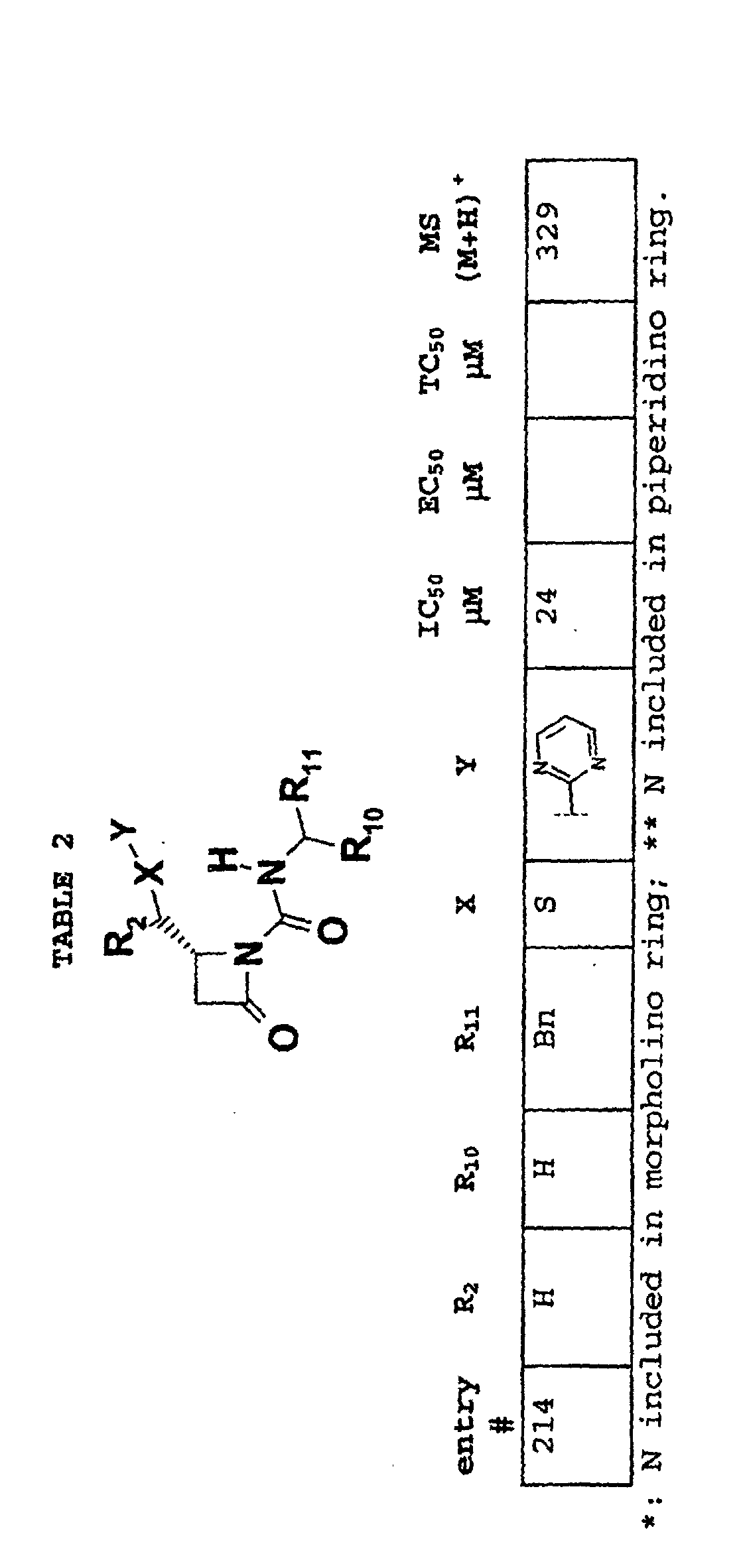


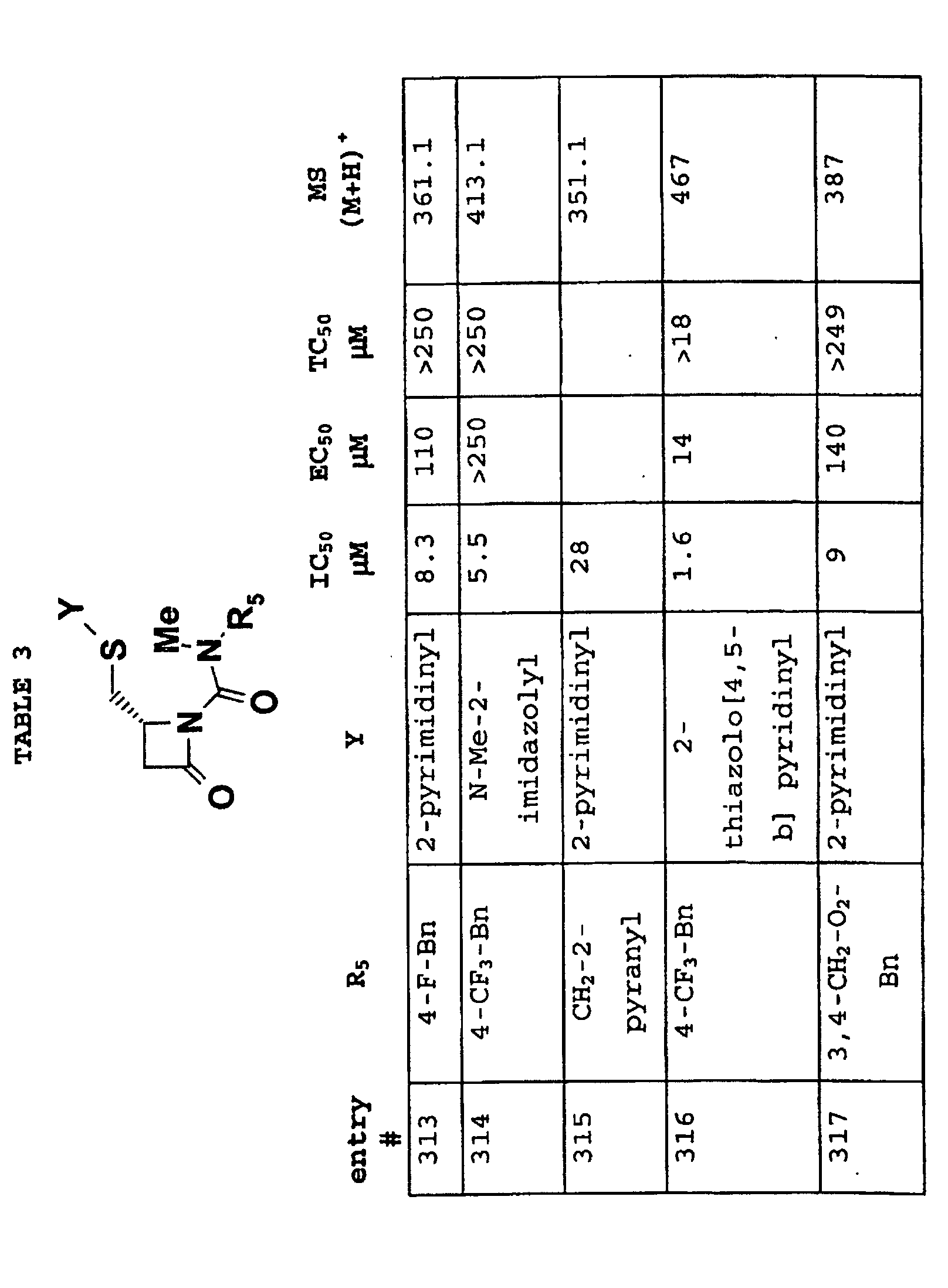
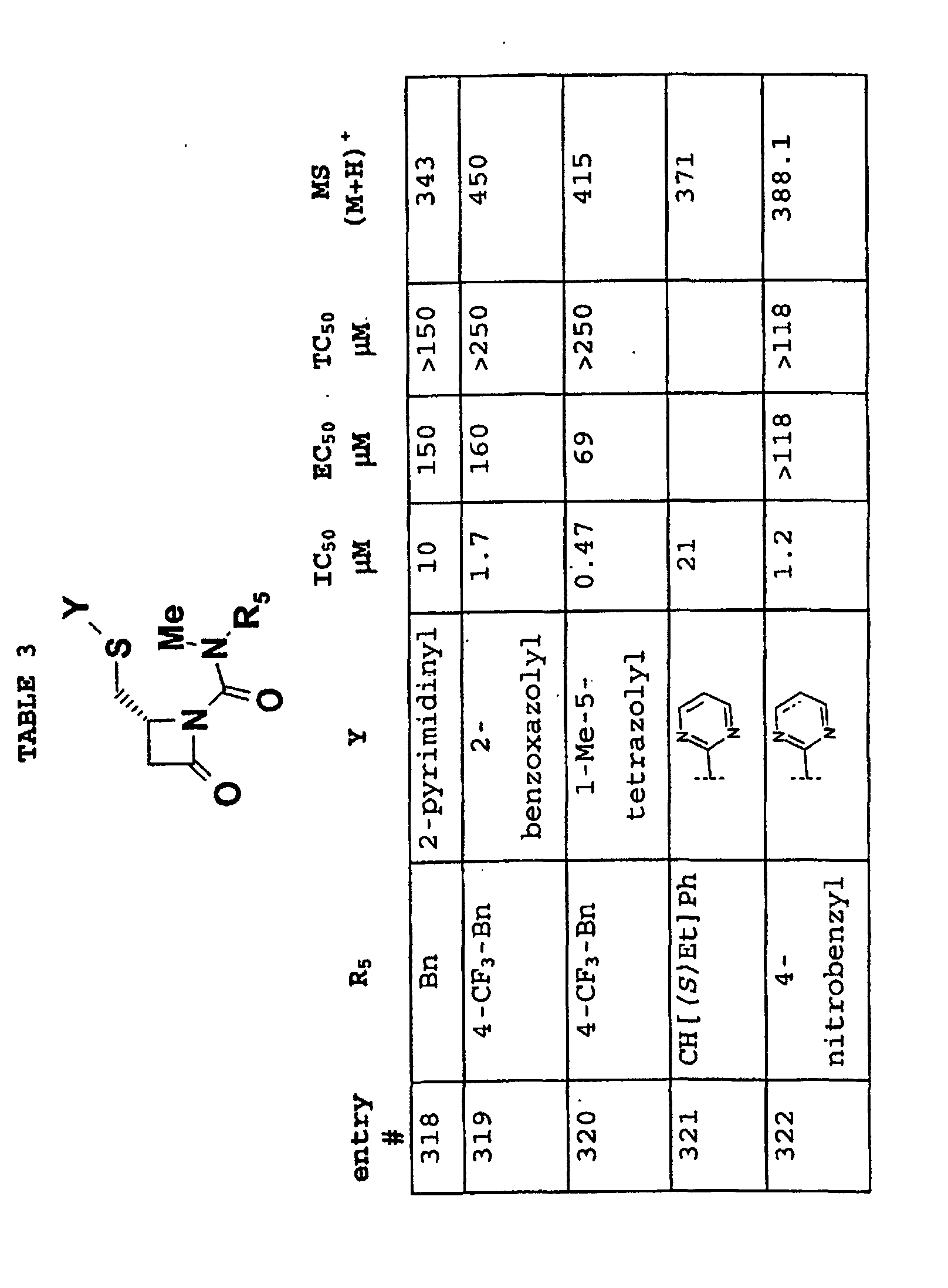


- From the results presented in tables 1 to 4, it can be concluded that the compounds of formula 1 are active against the protease of the HCMV virus. In addition, several of these compounds also inhibit virus replication in virus-infected cells, thereby indicating that these compounds are active in vivo in mammals, particularly humans.
- The TC50 reported in tables 1 to 4 also indicate that these compounds are non-toxic and have a therapeutic window that allows safe use of these compounds in mammals, including humans.
Claims (18)
- A compound of formula 1wherein
 R1 is hydrogen or C1-2 alkyl;R2 and R3 each independently is hydrogen, methyl or ethyl;R4 is hydrogen or lower alkyl;R5 is phenyl optionally substituted with a substituent selected independently from the group consisting of lower alkyl, lower alkoxy; phenyl(lower alkyl) optionally mono- or di-substituted on the phenyl portion thereof with a substituent selected independently from the group consisting of lower alkyl, lower alkoxy, nitro, halo, cyano, trifluoromethyl, and C(O)OR7 wherein R7 is lower alkyl or phenyl(lower alkyl);Het(lower alkyl) wherein wherein Het is a heterocyclus selected from the group consisting pyrrolidine, tetrahydrofuran, thiazolidine, pyrrole, 1H-imidazole, 1-methyl-1H-imidazole, pyrazole, furan, thiophene, oxazole, isoxazole, thiazole, 2-methylthiazole, 2-aminothiazole, 2-(methylamino)-thiazole, piperidine, 1-methylpiperidine, 1-methylpiperazine, 1,4-dioxane, morpholine, pyridine, pyridine N-oxide, pyrimidine, 2,4-dihydroxypyrimidine, 2,4-dimethylpyrimidine, 2,6-dimethylpyridine, 1-methyl-1H-tetrazole, 2-methyl-2H-tetrazole, benzothiazole, benzoxazole and thiazolo[4,5-b]-pyridine, said Het being optionally mono- or di-substituted with a lower alkyl or lower alkoxy group;or R4 and R5 together with the nitrogen atom to which they are attached form a pyrrolidino optionally substituted with benzyloxycarbonyl or phenyl said phenyl ring optionally mono- or di-substituted with halo, nitro, cyano or trifluoromethyl;X is selected from the group consisting of O, S, NR8, wherein R8 is H or lower alkyl; andY is C1-10 non-cyclic or cyclic alkyl; phenylcarbonyl; phenyl or benzyl optionally mono- or di-substituted with lower alkyl or lower alkoxy, said phenyl ring being optionally fused with an aromatic ring to form a bicyclic ring; orHet or CH2-Het, wherein Het is a heterocyclus as defined for R5;or when X is NR8, wherein R8 is lower alkyl and Y is lower alkyl, X and Y are joined together to form a piperidino ring;
whereinthe term "lower alkyl" as used herein, either alone or in combination with another radical, means straight or branched chain alkyl radicals containing up to six carbon atoms;the term "lower alkoxy" as used herein means straight chain alkoxy radicals containing one to four carbon atoms and branched chain alkoxy radicals containing three to four carbon atoms; andthe term "lower cycloalkyl" as used herein, either alone or in combination with another radical, means saturated cyclic hydrocarbon radicals containing from three to seven carbon atoms. - The compound of formula 1 according to claim 1 wherein R1, R2 and R3 each independently is hydrogen, methyl or ethyl;or when X is NR8, wherein R8 is lower alkyl and Y is lower alkyl, X and Y are joined together to form a piperidino ring.R4 is hydrogen or C1-3 alkyl;R5 is phenyl optionally substituted with a substituent selected independently from the group consisting of lower alkyl or lower alkoxy; (C1-2 alkyl)phenyl optionally mono- or di-substituted on the phenyl portion thereof with a substituent selected independently from the group consisting of lower alkyl, lower alkoxy, nitro, halo, cyano, trifluoromethyl, and C(O)OR7 wherein R7 is lower alkyl or (lower alkyl)phenyl;X is selected from the group consisting of O, S, NR8, wherein R8 is H or lower alkyl;
andY is lower non-cyclic or cyclic alkyl; phenyl optionally mono- or di-substituted with lower alkyl or lower alkoxy; orHet, which is as defined in claim 1; - The compound of formula 1 according to claim 2 wherein R1, R2 and R3 each independently is hydrogen;R4 is hydrogen or methyl;R5 is benzyl optionally mono-substituted on the phenyl portion thereof with nitro or trifluromethyl, or 1(R)-phenylethyl;X is S; andY is pyrimidine optionally substituted with lower alkyl; pyridine; N-Me-tetrazole; or benzoxazole.
- The compound of formula 1 according to claim 1 selected from the group consisting of:

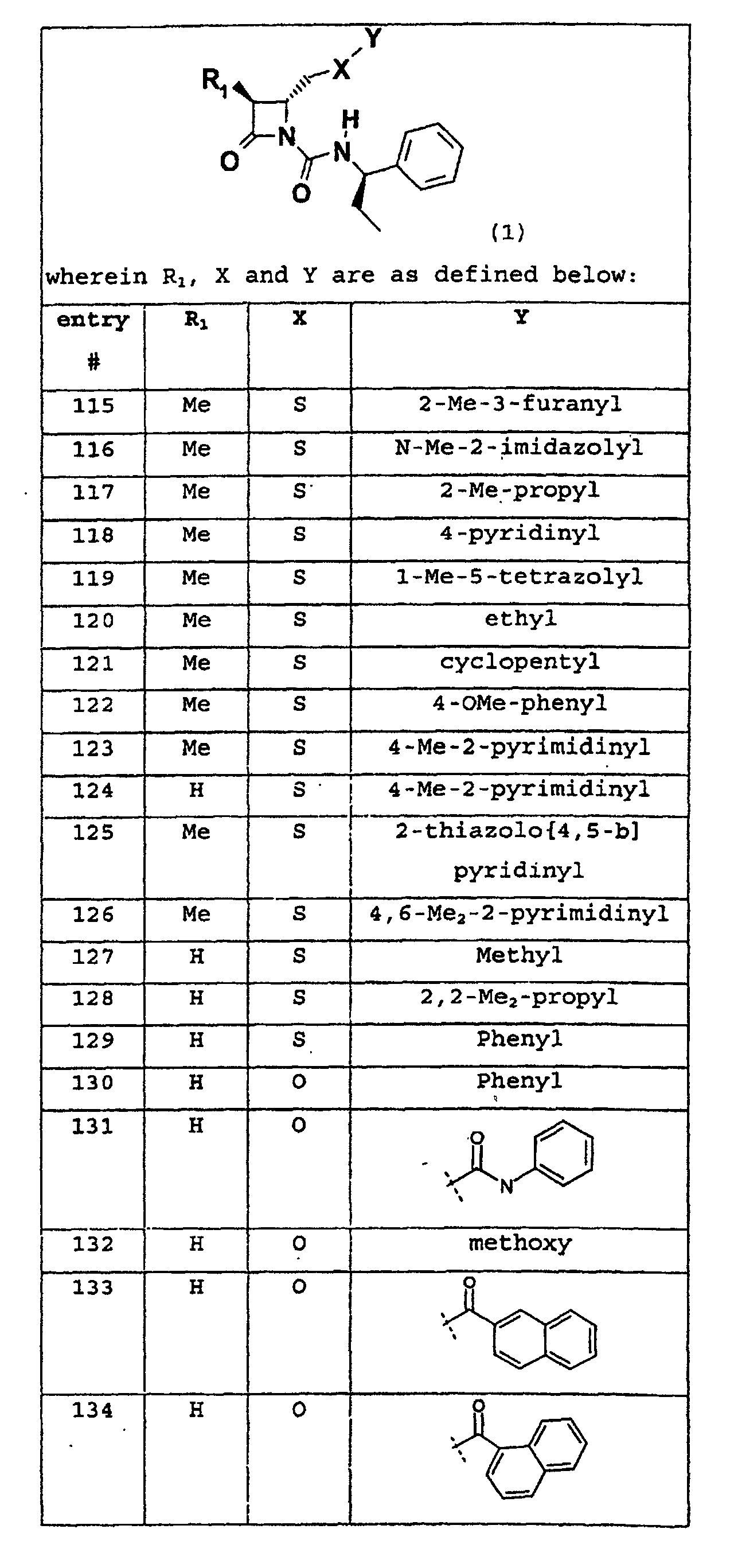
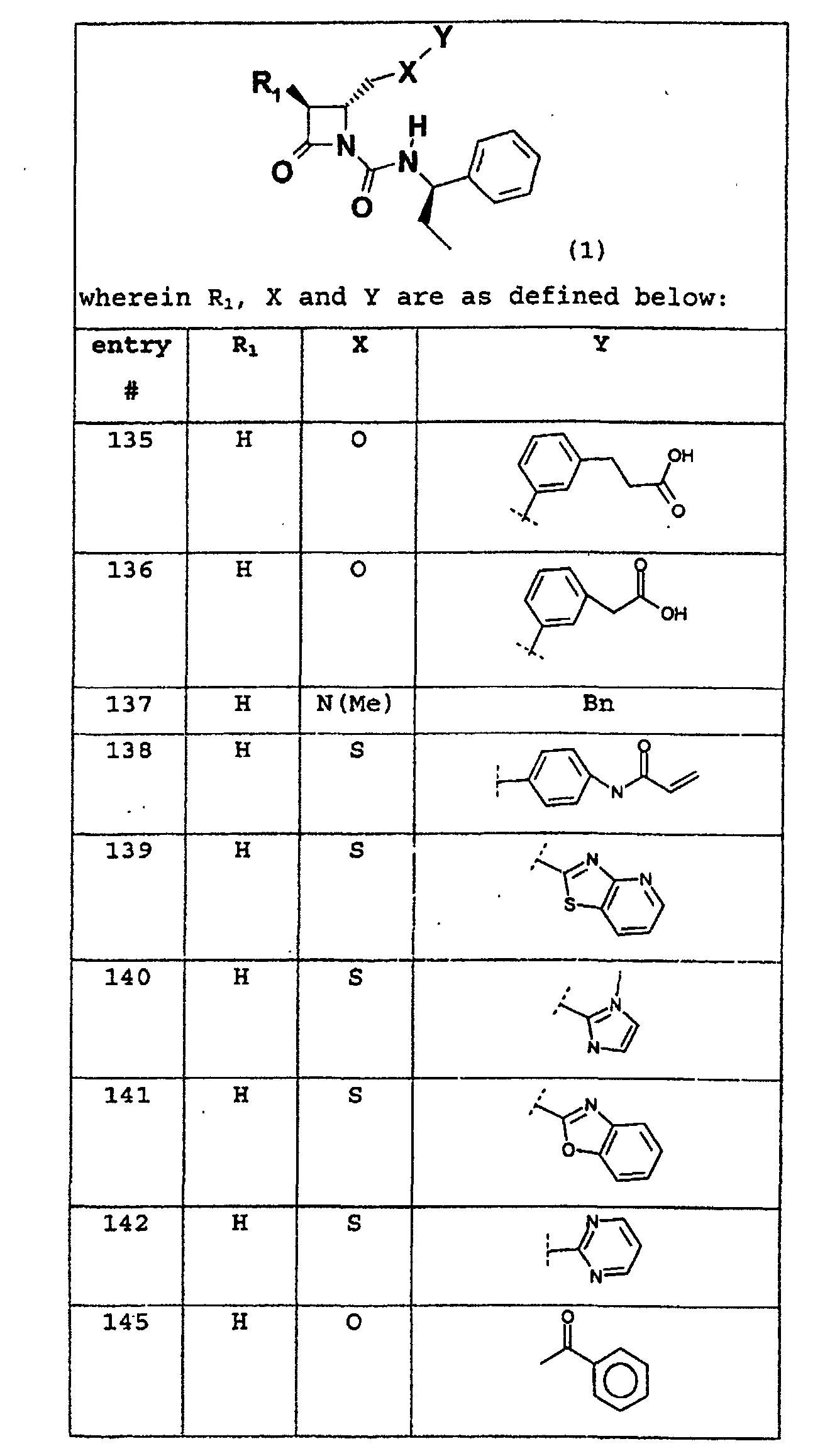
- The compound according to claim 4 selected from the group consisting of entries #: 102, 103, 104, 105, 106, 107, 108, 109, 111, 112, 113, 114, 115, 116, 117, 118, 119, 120, 121, 122, 123, 124, 125, 126, 127, 128, 129, 130, 131, 132, 133, 134, 138, 139, 140, 141 and 143.
- The compound according to claim 5 selected from the group consisting of entries #: 111, 112, 123, 125, and 133.
- The compound of formula 1 according to claim 1 selected from the group consisting of:

- The compound according to claim 7 selected from the group consisting of entries #: 204, 206, 207, and 210.
- The compound of formula 1 according to claim 1 selected from the group consisting of:
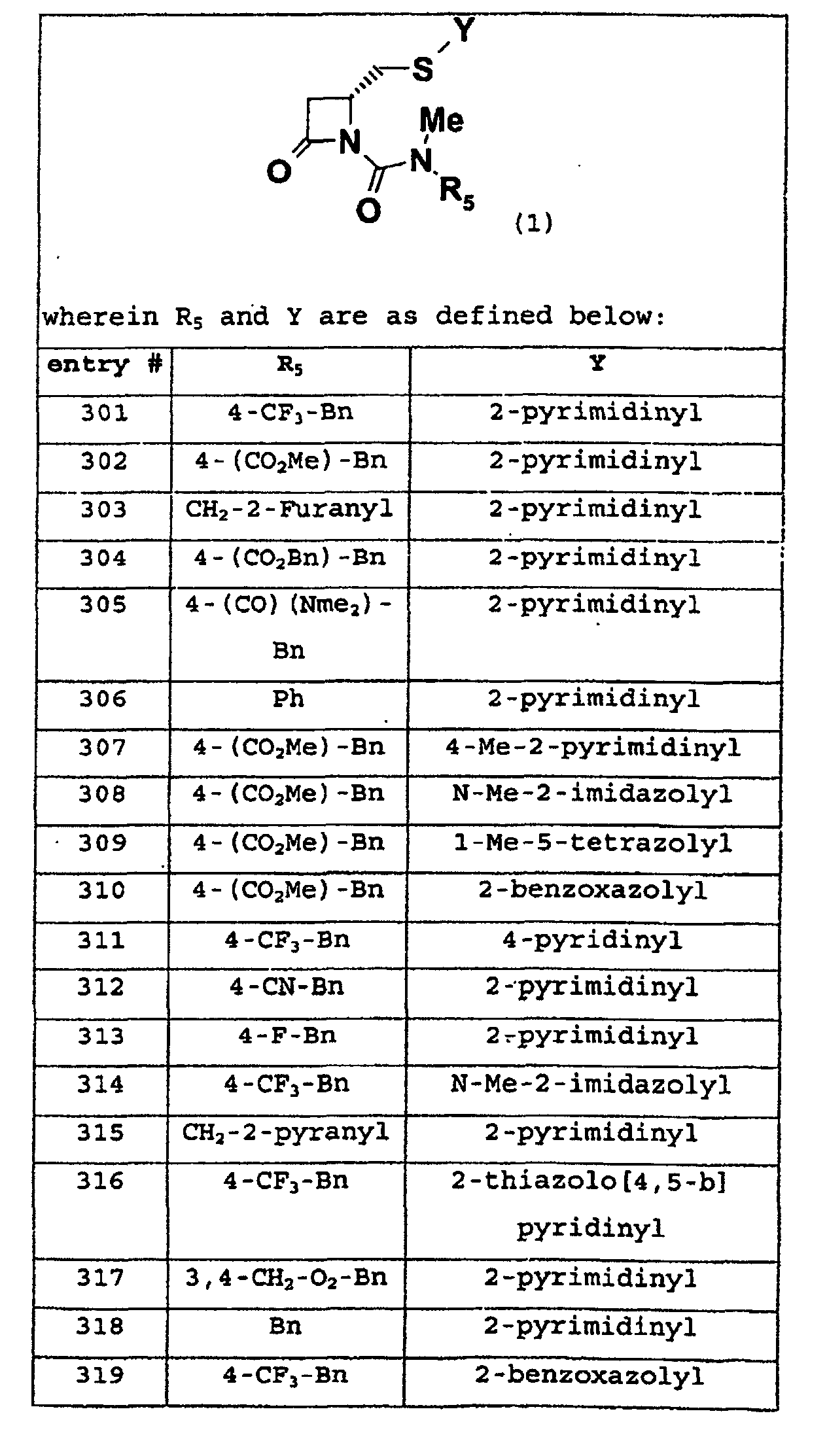

- The compound according to claim 9 selected from the group consisting of entries #: 301, 302, 304, 307, 309, 310, 311, 312, 316, 319, 320, and 322.
- The compound according to claim 10 selected from the group consisting of entries #: 309, 311, 320, and 322.
- The compound of formula 1 according to claim 1 selected from the group consisting of:

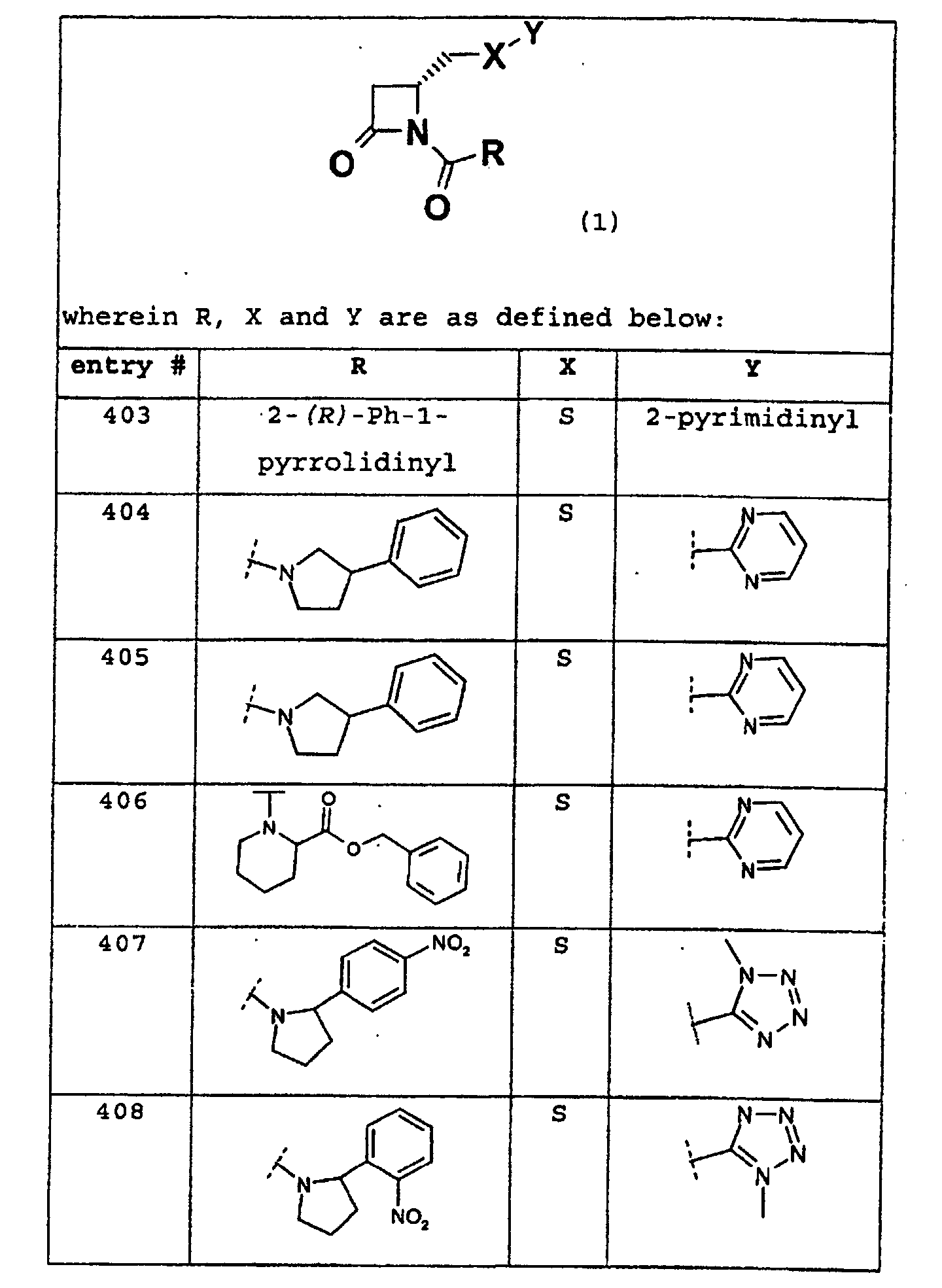
- The compound of claim 12 selected from the group consisting of entries #: 407 and 408.
- The compound of claim 13 selected as entry # 407.
- A pharmaceutical composition for treating cytomegalovirus infections in a mammal, including human, comprising a compound of formula 1 according to claim 1, or a therapeutically acceptable salt thereof, and a pharmaceutically acceptable carrier.
- A pharmaceutical composition according to claim 15 comprising a compound of formula 1 according to claim 1, or a therapeutically acceptable salt thereof, in combination with(a) another anti-herpes compound, selected from the group consisting of ganciclovir, foscarnet, acyclovir, valaciclovir, famciclovir, cidofovir, penciclovir and lobucavir; and/or(b) another anti-retroviral compound selected from the group consisting of reverse transcriptase inhibitors and protease inhibitors.
- The use of the compound of formula 1 according to claim 1, or a therapeutically acceptable salt thereof for the preparation of a medicamentation for treating cytomegalovirus infections in a mammal, including human or for protecting human cells against cytomegalovirus pathogenesis.
- The use of the compound of formula 1 according to claim 1, or a therapeutically acceptable salt thereof in combination withfor the preparation of a medicamentation for treating cytomegalovirus infections in a mammal, including human or for protecting human cells against cytomegalovirus pathogenesis.(a) another anti-herpes compound, selected from the group consisting of ganciclovir, foscarnet, acyclovir, valaciclovir, famciclovir, cidofovir, penciclovir and lobucavir; and/or(b) another anti-retroviral compound selected from the group consisting of reverse transcriptase inhibitors and protease inhibitors.
Applications Claiming Priority (3)
| Application Number | Priority Date | Filing Date | Title |
|---|---|---|---|
| US6154897P | 1997-10-07 | 1997-10-07 | |
| US61548 | 1997-10-07 | ||
| PCT/CA1998/000954 WO1999018073A1 (en) | 1997-10-07 | 1998-10-06 | Azetidinone derivatives for the treatment of hcmv infections |
Publications (2)
| Publication Number | Publication Date |
|---|---|
| EP1023265A1 EP1023265A1 (en) | 2000-08-02 |
| EP1023265B1 true EP1023265B1 (en) | 2003-01-15 |
Family
ID=22036473
Family Applications (1)
| Application Number | Title | Priority Date | Filing Date |
|---|---|---|---|
| EP98947257A Expired - Lifetime EP1023265B1 (en) | 1997-10-07 | 1998-10-06 | Azetidinone derivatives for the treatment of hcmv infections |
Country Status (10)
| Country | Link |
|---|---|
| US (1) | US6211170B1 (en) |
| EP (1) | EP1023265B1 (en) |
| JP (1) | JP2001519330A (en) |
| AT (1) | ATE231124T1 (en) |
| AU (1) | AU9426198A (en) |
| CA (1) | CA2301967C (en) |
| DE (1) | DE69810800T2 (en) |
| DK (1) | DK1023265T3 (en) |
| ES (1) | ES2187064T3 (en) |
| WO (1) | WO1999018073A1 (en) |
Families Citing this family (10)
| Publication number | Priority date | Publication date | Assignee | Title |
|---|---|---|---|---|
| AU2005274927B2 (en) | 2004-07-15 | 2011-11-03 | Albany Molecular Research, Inc. | Aryl-and heteroaryl-substituted tetrahydroisoquinolines and use thereof to block reuptake of norepinephrine, dopamine, and serotonin |
| GB0608899D0 (en) * | 2006-05-05 | 2006-06-14 | Leuven K U Res & Dev | Novel viral replication inhibitors |
| WO2009045382A1 (en) * | 2007-10-04 | 2009-04-09 | Merck & Co., Inc. | Substituted aryl sulfone derivatives as calcium channel blockers |
| US9156812B2 (en) | 2008-06-04 | 2015-10-13 | Bristol-Myers Squibb Company | Crystalline form of 6-[(4S)-2-methyl-4-(2-naphthyl)-1,2,3,4-tetrahydroisoquinolin-7-yl]pyridazin-3-amine |
| US8802696B2 (en) * | 2009-05-12 | 2014-08-12 | Albany Molecular Research, Inc. | 7-([1,2,4]triazolo[1,5-a]pyridin-6-yl)-4-(3,4-dichlorophenyl)-1,2,3,4-tetrahydroisoqu inoli and use thereof |
| WO2010132487A1 (en) | 2009-05-12 | 2010-11-18 | Bristol-Myers Squibb Company | CRYSTALLINE FORMS OF (S)-7-([1,2,4]TRIAZOLO[1,5-a]PYRIDIN-6-YL)-4-(3,4-DICHLOROHPHENYL)-1,2,3,4-TETRAHYDROISOQUINOLINE AND USE THEREOF |
| CN102458123A (en) * | 2009-05-12 | 2012-05-16 | 阿尔巴尼分子研究公司 | Aryl, heteroaryl, and heterocycle substituted tetrahydroisoquinolines and use thereof |
| US9216180B2 (en) | 2012-10-02 | 2015-12-22 | New York University | Pharmaceutical compositions and treatment of genetic diseases associated with nonsense mediated RNA decay |
| AU2019339777B2 (en) | 2018-09-12 | 2022-09-01 | Novartis Ag | Antiviral pyridopyrazinedione compounds |
| US11667613B2 (en) | 2019-09-26 | 2023-06-06 | Novartis Ag | Antiviral pyrazolopyridinone compounds |
Family Cites Families (9)
| Publication number | Priority date | Publication date | Assignee | Title |
|---|---|---|---|---|
| US5229381A (en) | 1983-12-01 | 1993-07-20 | Merck & Co., Inc. | Substituted azetidinones as anti-inflammatory and antidegenerative agents |
| US4680391A (en) | 1983-12-01 | 1987-07-14 | Merck & Co., Inc. | Substituted azetidinones as anti-inflammatory and antidegenerative agents |
| IL89835A0 (en) * | 1988-04-11 | 1989-12-15 | Merck & Co Inc | Substituted azetidinones,their preparation and pharmaceutical compositions containing them |
| EP0377549B1 (en) | 1989-01-03 | 1998-12-09 | Marcos Y. Kleinerman | Remote measurement of physical variables with fiber optic systems |
| US5104862A (en) | 1991-03-20 | 1992-04-14 | Merck & Co., Inc. | Bethalactam elastase inhibitors containing phosphorous acid derivatives at the 4-position of the 2-azetidinone |
| US5100880A (en) | 1991-03-20 | 1992-03-31 | Merck & Co., Inc. | Novel betalactam elastase inhibitors containing phosphorous acid derivatives at the 4-position of the 2-azetidinone |
| GB2266527A (en) * | 1992-03-17 | 1993-11-03 | Merck & Co Inc | Substituted azetidinones useful in the treatment of leukemia |
| GB9314350D0 (en) | 1993-07-12 | 1993-08-25 | Zeneca Ltd | Armide derivatives |
| NZ282488A (en) * | 1994-03-23 | 1999-09-29 | Tokyo Tanabe Co | Therapeutic or prophylactic medicament for viral disease containing antileukoprotease (serine protease inhibitor) |
-
1998
- 1998-10-06 CA CA002301967A patent/CA2301967C/en not_active Expired - Fee Related
- 1998-10-06 AU AU94261/98A patent/AU9426198A/en not_active Abandoned
- 1998-10-06 ES ES98947257T patent/ES2187064T3/en not_active Expired - Lifetime
- 1998-10-06 US US09/167,141 patent/US6211170B1/en not_active Expired - Lifetime
- 1998-10-06 EP EP98947257A patent/EP1023265B1/en not_active Expired - Lifetime
- 1998-10-06 JP JP2000514885A patent/JP2001519330A/en not_active Ceased
- 1998-10-06 DE DE69810800T patent/DE69810800T2/en not_active Expired - Lifetime
- 1998-10-06 AT AT98947257T patent/ATE231124T1/en active
- 1998-10-06 WO PCT/CA1998/000954 patent/WO1999018073A1/en not_active Ceased
- 1998-10-06 DK DK98947257T patent/DK1023265T3/en active
Also Published As
| Publication number | Publication date |
|---|---|
| US6211170B1 (en) | 2001-04-03 |
| ES2187064T3 (en) | 2003-05-16 |
| WO1999018073A1 (en) | 1999-04-15 |
| JP2001519330A (en) | 2001-10-23 |
| DK1023265T3 (en) | 2003-02-24 |
| AU9426198A (en) | 1999-04-27 |
| DE69810800D1 (en) | 2003-02-20 |
| ATE231124T1 (en) | 2003-02-15 |
| CA2301967A1 (en) | 1999-04-15 |
| DE69810800T2 (en) | 2003-09-18 |
| CA2301967C (en) | 2005-05-17 |
| EP1023265A1 (en) | 2000-08-02 |
Similar Documents
| Publication | Publication Date | Title |
|---|---|---|
| EP1308439B1 (en) | Proline derivatives and use thereof as drugs | |
| EP1021405B1 (en) | Azetidinone derivatives for the treatment of hcmv infections | |
| US4576749A (en) | 3-Acylamino-1-carboxymethylaminocarbonyl-2-azetidinones | |
| EP0303697A1 (en) | Derivatives of physiologically active substance k-252 | |
| AU2011327903A1 (en) | Drug derivatives | |
| US6215002B1 (en) | Pyrrolopyrrolone derivatives as inhibitors of neutrophil elastase | |
| CA3061238A1 (en) | Indole derivatives as efflux pump inhibitors | |
| AU598793B2 (en) | 1,2,3,4-tetrahydro-6-substituted-4-aryl(or heterocyclo)-3- substituted-2-thioxo(or oxo)-5-pyrimidinecarboxylic acids and esters | |
| US6211170B1 (en) | Azetidinone derivatives for the treatment of HCMV infections | |
| IE60114B1 (en) | 1,2,3,4-tetrahydro-6-substituted-4-aryl-(or heterocyclo)-3-[(substituted amino)carbonyl]-2-thioxo (or oxo)-5-pyrimidinecarboxylic acids and esters | |
| EP1021404B1 (en) | Azetidinone derivatives for the treatment of hcmv infections | |
| CZ254193A3 (en) | Antibiotic compounds | |
| JPWO2019208797A1 (en) | Oxo-substituted compound | |
| CZ300137B6 (en) | 1-Methyl carbapenem derivatives | |
| JP5475832B2 (en) | Process for producing N- (N'-substituted glycyl) -2-cyanopyrrolidine derivatives | |
| JP3048196B2 (en) | Carbapenem derivatives | |
| CA2131154A1 (en) | Antiviral peptides | |
| WO2004106329A2 (en) | Novel antiinfective compounds and their pharmaceutical compositions | |
| MXPA00003451A (en) | Azetidinone derivatives for the treatment of hcmv infections | |
| EP4594319A1 (en) | Bicyclic compounds | |
| WO1993023373A1 (en) | N-[N'-(5-AMINO-4-HYDROXY-ACYLOYL)-α-AMINOACYLOYL] SUBSTITUTED HETEROCYCLES AND THEIR USE AS ANTIVIRAL AGENTS | |
| AU6926198A (en) | Pyrolopyrrolone derivatives | |
| MXPA00003441A (en) | Azetidinone derivatives for the treatment of hcmv infections | |
| JPH07228570A (en) | 4-Mercaptopyrrolidine derivative | |
| MXPA00003450A (en) | Azetidinone derivatives for the treatment of hcmv infections |
Legal Events
| Date | Code | Title | Description |
|---|---|---|---|
| PUAI | Public reference made under article 153(3) epc to a published international application that has entered the european phase |
Free format text: ORIGINAL CODE: 0009012 |
|
| 17P | Request for examination filed |
Effective date: 20000508 |
|
| AK | Designated contracting states |
Kind code of ref document: A1 Designated state(s): AT BE CH CY DE DK ES FI FR GB GR IE IT LI LU MC NL PT SE |
|
| 17Q | First examination report despatched |
Effective date: 20010528 |
|
| GRAG | Despatch of communication of intention to grant |
Free format text: ORIGINAL CODE: EPIDOS AGRA |
|
| GRAG | Despatch of communication of intention to grant |
Free format text: ORIGINAL CODE: EPIDOS AGRA |
|
| GRAH | Despatch of communication of intention to grant a patent |
Free format text: ORIGINAL CODE: EPIDOS IGRA |
|
| GRAH | Despatch of communication of intention to grant a patent |
Free format text: ORIGINAL CODE: EPIDOS IGRA |
|
| GRAA | (expected) grant |
Free format text: ORIGINAL CODE: 0009210 |
|
| AK | Designated contracting states |
Kind code of ref document: B1 Designated state(s): AT BE CH CY DE DK ES FI FR GB GR IE IT LI LU MC NL PT SE |
|
| REG | Reference to a national code |
Ref country code: GB Ref legal event code: FG4D Ref country code: CH Ref legal event code: EP |
|
| REG | Reference to a national code |
Ref country code: IE Ref legal event code: FG4D |
|
| REF | Corresponds to: |
Ref document number: 69810800 Country of ref document: DE Date of ref document: 20030220 Kind code of ref document: P |
|
| REG | Reference to a national code |
Ref country code: DK Ref legal event code: T3 |
|
| REG | Reference to a national code |
Ref country code: CH Ref legal event code: NV Representative=s name: SCHMAUDER & PARTNER AG PATENTANWALTSBUERO |
|
| REG | Reference to a national code |
Ref country code: GR Ref legal event code: EP Ref document number: 20030400674 Country of ref document: GR |
|
| REG | Reference to a national code |
Ref country code: SE Ref legal event code: TRGR |
|
| REG | Reference to a national code |
Ref country code: ES Ref legal event code: FG2A Ref document number: 2187064 Country of ref document: ES Kind code of ref document: T3 |
|
| ET | Fr: translation filed | ||
| PLBE | No opposition filed within time limit |
Free format text: ORIGINAL CODE: 0009261 |
|
| STAA | Information on the status of an ep patent application or granted ep patent |
Free format text: STATUS: NO OPPOSITION FILED WITHIN TIME LIMIT |
|
| 26N | No opposition filed |
Effective date: 20031016 |
|
| REG | Reference to a national code |
Ref country code: CH Ref legal event code: PCAR Free format text: SCHMAUDER & PARTNER AG PATENT- UND MARKENANWAELTE VSP;ZWAENGIWEG 7;8038 ZUERICH (CH) |
|
| PGFP | Annual fee paid to national office [announced via postgrant information from national office to epo] |
Ref country code: NL Payment date: 20101013 Year of fee payment: 13 Ref country code: MC Payment date: 20101014 Year of fee payment: 13 Ref country code: IE Payment date: 20101021 Year of fee payment: 13 Ref country code: FR Payment date: 20101104 Year of fee payment: 13 Ref country code: DK Payment date: 20101015 Year of fee payment: 13 Ref country code: AT Payment date: 20101014 Year of fee payment: 13 |
|
| PGFP | Annual fee paid to national office [announced via postgrant information from national office to epo] |
Ref country code: PT Payment date: 20101004 Year of fee payment: 13 Ref country code: LU Payment date: 20101025 Year of fee payment: 13 Ref country code: FI Payment date: 20101014 Year of fee payment: 13 Ref country code: DE Payment date: 20101022 Year of fee payment: 13 Ref country code: CY Payment date: 20100927 Year of fee payment: 13 Ref country code: CH Payment date: 20101025 Year of fee payment: 13 |
|
| PGFP | Annual fee paid to national office [announced via postgrant information from national office to epo] |
Ref country code: BE Payment date: 20101013 Year of fee payment: 13 Ref country code: GR Payment date: 20101018 Year of fee payment: 13 Ref country code: GB Payment date: 20101021 Year of fee payment: 13 Ref country code: IT Payment date: 20101026 Year of fee payment: 13 Ref country code: SE Payment date: 20101014 Year of fee payment: 13 |
|
| PGFP | Annual fee paid to national office [announced via postgrant information from national office to epo] |
Ref country code: ES Payment date: 20101025 Year of fee payment: 13 |
|
| REG | Reference to a national code |
Ref country code: PT Ref legal event code: MM4A Free format text: LAPSE DUE TO NON-PAYMENT OF FEES Effective date: 20120409 |
|
| BERE | Be: lapsed |
Owner name: *BOEHRINGER INGELHEIM (CANADA) LTD Effective date: 20111031 |
|
| REG | Reference to a national code |
Ref country code: NL Ref legal event code: V1 Effective date: 20120501 |
|
| PG25 | Lapsed in a contracting state [announced via postgrant information from national office to epo] |
Ref country code: MC Free format text: LAPSE BECAUSE OF NON-PAYMENT OF DUE FEES Effective date: 20111031 |
|
| REG | Reference to a national code |
Ref country code: CH Ref legal event code: PL |
|
| REG | Reference to a national code |
Ref country code: GR Ref legal event code: ML Ref document number: 20030400674 Country of ref document: GR Effective date: 20120503 |
|
| GBPC | Gb: european patent ceased through non-payment of renewal fee |
Effective date: 20111006 |
|
| REG | Reference to a national code |
Ref country code: DK Ref legal event code: EBP |
|
| REG | Reference to a national code |
Ref country code: SE Ref legal event code: EUG |
|
| REG | Reference to a national code |
Ref country code: FR Ref legal event code: ST Effective date: 20120629 |
|
| PG25 | Lapsed in a contracting state [announced via postgrant information from national office to epo] |
Ref country code: BE Free format text: LAPSE BECAUSE OF NON-PAYMENT OF DUE FEES Effective date: 20111031 Ref country code: NL Free format text: LAPSE BECAUSE OF NON-PAYMENT OF DUE FEES Effective date: 20120501 Ref country code: LI Free format text: LAPSE BECAUSE OF NON-PAYMENT OF DUE FEES Effective date: 20111031 Ref country code: DE Free format text: LAPSE BECAUSE OF NON-PAYMENT OF DUE FEES Effective date: 20120501 Ref country code: CH Free format text: LAPSE BECAUSE OF NON-PAYMENT OF DUE FEES Effective date: 20111031 |
|
| REG | Reference to a national code |
Ref country code: IE Ref legal event code: MM4A |
|
| REG | Reference to a national code |
Ref country code: DE Ref legal event code: R119 Ref document number: 69810800 Country of ref document: DE Effective date: 20120501 |
|
| PG25 | Lapsed in a contracting state [announced via postgrant information from national office to epo] |
Ref country code: IT Free format text: LAPSE BECAUSE OF NON-PAYMENT OF DUE FEES Effective date: 20111006 Ref country code: GR Free format text: LAPSE BECAUSE OF NON-PAYMENT OF DUE FEES Effective date: 20120503 Ref country code: FR Free format text: LAPSE BECAUSE OF NON-PAYMENT OF DUE FEES Effective date: 20111102 Ref country code: PT Free format text: LAPSE BECAUSE OF NON-PAYMENT OF DUE FEES Effective date: 20120409 Ref country code: FI Free format text: LAPSE BECAUSE OF NON-PAYMENT OF DUE FEES Effective date: 20111006 Ref country code: GB Free format text: LAPSE BECAUSE OF NON-PAYMENT OF DUE FEES Effective date: 20111006 |
|
| PG25 | Lapsed in a contracting state [announced via postgrant information from national office to epo] |
Ref country code: CY Free format text: LAPSE BECAUSE OF NON-PAYMENT OF DUE FEES Effective date: 20111006 |
|
| PG25 | Lapsed in a contracting state [announced via postgrant information from national office to epo] |
Ref country code: SE Free format text: LAPSE BECAUSE OF NON-PAYMENT OF DUE FEES Effective date: 20111007 Ref country code: IE Free format text: LAPSE BECAUSE OF NON-PAYMENT OF DUE FEES Effective date: 20111006 Ref country code: DK Free format text: LAPSE BECAUSE OF NON-PAYMENT OF DUE FEES Effective date: 20111031 |
|
| REG | Reference to a national code |
Ref country code: AT Ref legal event code: MM01 Ref document number: 231124 Country of ref document: AT Kind code of ref document: T Effective date: 20111006 |
|
| PG25 | Lapsed in a contracting state [announced via postgrant information from national office to epo] |
Ref country code: AT Free format text: LAPSE BECAUSE OF NON-PAYMENT OF DUE FEES Effective date: 20111006 |
|
| PG25 | Lapsed in a contracting state [announced via postgrant information from national office to epo] |
Ref country code: LU Free format text: LAPSE BECAUSE OF NON-PAYMENT OF DUE FEES Effective date: 20111006 |
|
| REG | Reference to a national code |
Ref country code: ES Ref legal event code: FD2A Effective date: 20130606 |
|
| PG25 | Lapsed in a contracting state [announced via postgrant information from national office to epo] |
Ref country code: ES Free format text: LAPSE BECAUSE OF NON-PAYMENT OF DUE FEES Effective date: 20111007 |