EP1022921A2 - Dynamic management of traffic channel allocation - Google Patents
Dynamic management of traffic channel allocation Download PDFInfo
- Publication number
- EP1022921A2 EP1022921A2 EP00300426A EP00300426A EP1022921A2 EP 1022921 A2 EP1022921 A2 EP 1022921A2 EP 00300426 A EP00300426 A EP 00300426A EP 00300426 A EP00300426 A EP 00300426A EP 1022921 A2 EP1022921 A2 EP 1022921A2
- Authority
- EP
- European Patent Office
- Prior art keywords
- traffic channel
- subsets
- channel quality
- list
- switching center
- Prior art date
- Legal status (The legal status is an assumption and is not a legal conclusion. Google has not performed a legal analysis and makes no representation as to the accuracy of the status listed.)
- Withdrawn
Links
- 238000000034 method Methods 0.000 claims abstract description 73
- 238000005259 measurement Methods 0.000 claims abstract description 55
- 238000012544 monitoring process Methods 0.000 claims description 8
- 238000004590 computer program Methods 0.000 claims description 7
- 230000001413 cellular effect Effects 0.000 description 30
- 238000004891 communication Methods 0.000 description 22
- 230000006870 function Effects 0.000 description 19
- 238000012545 processing Methods 0.000 description 13
- 101100332284 Saccharomyces cerevisiae (strain ATCC 204508 / S288c) DSS1 gene Proteins 0.000 description 11
- 238000010586 diagram Methods 0.000 description 11
- 230000008569 process Effects 0.000 description 11
- 230000003044 adaptive effect Effects 0.000 description 10
- 230000005540 biological transmission Effects 0.000 description 6
- 230000002708 enhancing effect Effects 0.000 description 4
- 238000010295 mobile communication Methods 0.000 description 4
- 238000012986 modification Methods 0.000 description 4
- 230000004048 modification Effects 0.000 description 4
- 230000002093 peripheral effect Effects 0.000 description 4
- 238000005516 engineering process Methods 0.000 description 3
- 238000007726 management method Methods 0.000 description 3
- 230000009467 reduction Effects 0.000 description 3
- 230000011664 signaling Effects 0.000 description 3
- 238000012935 Averaging Methods 0.000 description 2
- 230000008859 change Effects 0.000 description 2
- 239000004744 fabric Substances 0.000 description 2
- 230000001965 increasing effect Effects 0.000 description 2
- 238000005192 partition Methods 0.000 description 2
- 230000000737 periodic effect Effects 0.000 description 2
- 238000007781 pre-processing Methods 0.000 description 2
- 238000012550 audit Methods 0.000 description 1
- 238000012790 confirmation Methods 0.000 description 1
- 238000013461 design Methods 0.000 description 1
- 239000002360 explosive Substances 0.000 description 1
- 238000011328 necessary treatment Methods 0.000 description 1
- 230000003287 optical effect Effects 0.000 description 1
- 230000004044 response Effects 0.000 description 1
- 238000001228 spectrum Methods 0.000 description 1
- 239000000126 substance Substances 0.000 description 1
- 238000012795 verification Methods 0.000 description 1
Images

Classifications
-
- H—ELECTRICITY
- H04—ELECTRIC COMMUNICATION TECHNIQUE
- H04W—WIRELESS COMMUNICATION NETWORKS
- H04W72/00—Local resource management
- H04W72/50—Allocation or scheduling criteria for wireless resources
- H04W72/54—Allocation or scheduling criteria for wireless resources based on quality criteria
- H04W72/542—Allocation or scheduling criteria for wireless resources based on quality criteria using measured or perceived quality
-
- H—ELECTRICITY
- H04—ELECTRIC COMMUNICATION TECHNIQUE
- H04W—WIRELESS COMMUNICATION NETWORKS
- H04W16/00—Network planning, e.g. coverage or traffic planning tools; Network deployment, e.g. resource partitioning or cells structures
- H04W16/02—Resource partitioning among network components, e.g. reuse partitioning
- H04W16/10—Dynamic resource partitioning
-
- H—ELECTRICITY
- H04—ELECTRIC COMMUNICATION TECHNIQUE
- H04W—WIRELESS COMMUNICATION NETWORKS
- H04W36/00—Hand-off or reselection arrangements
- H04W36/34—Reselection control
- H04W36/36—Reselection control by user or terminal equipment
- H04W36/362—Conditional handover
Definitions
- the present invention relates in general to an improved wireless communications system.
- the present invention relates to a method and system for improving the reliability of traffic channel allocation in a wireless communications system.
- the present invention relates to a method and system for dynamically managing traffic channel allocation by utilizing active mobile subscriber units to perform forward channel quality measurements on a specified list of traffic channels and combining those results with reverse channel quality measurements thereby enhancing adaptive channel allocation capacity.
- a cellular telephone system typically includes mobile subscriber units that may be mobile or portable, and cellular base stations that are connected to a public telephone company via one or more cellular switching networks. Each cellular subscriber has an assigned cellular telephone number that allows the subscriber to place and receive calls within a widespread range of the cellular base stations, such as throughout a metropolitan area.
- Cellular telephone systems are based on a structure of associated cells. Each cell covers a specified geographic area that (a) is defined for a specific mobile communications system; and (b) has its own base station and a single controller interconnected with a public telephone network.
- a base station system communicates with many mobile subscriber units at once via a base transceiver station (BTS), utilizing one defined transmit/receive communications channel per mobile subscriber unit.
- a mobile subscriber unit (a control unit and a transceiver that transmits and receives wireless transmissions to and from a cell site) utilizes a separate, temporary wireless channel to talk to a cell site.
- Transmit/receive communication channels utilize a pair of frequencies for communication - one for transmitting from the cell site base transceiver station, called the forward link, and one frequency for the cell site to receive calls from the users, called the reverse link. Both the forward and reverse link must have sufficient signal strength to allow transmission of user data.
- forward channel measurement will be utilized hereinafter to denote a measurement performed on the forward link of a given communications channel.
- reverse channel measurement will be utilized to denote a measurement performed on the reverse link of a given communications channel.
- Adaptive channel allocation (ACA), sometimes referred to as “dynamic channel allocation”, is recognized as one of the most promising techniques for enhancing wireless traffic capacity, especially when utilized within a hierarchical cell structure.
- the potential capacity of ACA depends critically on the ability to monitor a channel's condition, in terms of interference, in both forward and reverse directions before the channel is assigned or reassigned.
- channel quality measurements such as interference level measurements, should be made on all traffic channels. Given the unpredictability inherent in mobile communications, these measurements should be performed on a continuous basis.
- ACA utilizes network resources to monitor the real time status of communications traffic. In this way, any changes or problems that arise involving propagation of signals can be accommodated by dynamic adjustment of channel assignments.
- the goal of ACA is therefore to maintain adequate transmission channel quality in real time. This goal is particularly important in wireless, mobile communications systems, such as cellular telephone systems, since conditions affecting transmission quality may be constantly changing.
- Different ACA schemes utilize different criteria for selecting and updating available channels.
- Reverse channel monitoring currently constitutes the primary means by which many ACA schemes are able to effectively assign and reassign traffic channels. In general, reverse channel measurement is conducted by a base station system (BSS) on signals transmitted from mobile subscriber units (MSUs) within the BSS's coverage area. Limited forward traffic channel monitoring is therefore a limitation in many ACA schemes.
- BSS base station system
- MSUs mobile subscriber units
- MACA Mobile Assisted Channel Allocation
- DCCH digital control channel
- all sector scanning Another proposed method for verifying traffic channel quality is referred to as "all sector scanning", which utilizes idle radios within a base station system to monitor interference conditions that may exist outside the serving partition.
- This method of measurement is fundamentally similar to reverse channel measurement except that it may be utilized to provide a rough estimate of forward interference.
- the interference sources and propagation paths are different, and so this method also fails to be a reliable traffic channel verification method.
- Typical sector scanning methods may also require dedicated base station radios to perform scanning. Therefore the accuracy and speed of sector scanning may depend on the relative number of channels to be scanned as compared with how many radios are utilized to perform the scanning. If scanning is limited to idle radios, then at high traffic levels there is a corresponding reduction in the number of idle base station radios available to perform the required scanning, thus reducing the effectiveness of sector scanning as a method of tracking channel quality.
- a method and system are disclosed for dynamically managing traffic channel allocation within a wireless telecommunications system that includes a mobile switching center and a mobile subscriber unit.
- a traffic channel list is generated within a mobile switching center.
- the traffic channel list is grouped into a plurality of traffic channel subsets within the mobile switching center.
- one of the plurality of traffic channel subsets is selected and assigned to the mobile subscriber unit.
- forward channel quality measurements are periodically performed on the assigned traffic channel subset, thereby obtaining forward channel quality results.
- the forward channel quality results are reported to the mobile switching center, such that the traffic channel list may be dynamically updated.
- the present invention advantageously provides an improved wireless communications system in which there is an improved methodology yielding an increased reliability in traffic channel allocation.
- the present invention beneficially provides a method and system for dynamically managing traffic channel allocation by utilizing active mobile subscriber units to perform forward channel quality measurements on a specified list of traffic channels and combining those results with reverse channel quality measurements, thereby enhancing adaptive channel allocation capacity.
- the potential capacity of adaptive channel allocation depends critically on the determination of channel condition in terms of interference in both forward and reverse directions before assignment.
- the method and system of the present invention provide an effective means for traffic channel condition monitoring.
- the method and system of the present invention utilizes a Mobile Assisted Handoff (MAHO) reporting scheme that offers the ability to closely monitor traffic channel condition in a forward direction.
- MAHO Mobile Assisted Handoff
- the channel condition in a reverse direction is measured by utilizing idle base station system radios to make reverse channel quality measurements.
- the present invention includes an additional step in which active MSUs perform channel quality measurements (CQMs) on pre-assigned traffic channels and report the results utilizing a MAHO reporting procedure. Thereafter, for each traffic channel, CQMs in the forward direction are integrated with CQMs in the reverse direction.
- CQMs in the forward direction are integrated with CQMs in the reverse direction.
- the quality of channel allocation is thereby substantially enhanced, resulting in greater potential capacity and reliability of current adaptive channel allocation methods.
- communications system 100 includes the network interconnection of a cellular system 102 to a Public Switched Telephone Network (PSTN) 104.
- PSTN Public Switched Telephone Network
- Cellular system 102 is a TDMA wireless communications system in the depicted example.
- GSM Global System for Mobile communications
- Japanese Digital Cellular Standards are examples of wireless communications system.
- Cellular system 102 includes two mobile switching centers (MSCs), including a gateway MSC (GMSC) 108 and MSC 110.
- MSCs mobile switching centers
- GMSC gateway MSC
- MSC 110 may contain a channel database, referred to hereinafter as a channel allocation table.
- the channel allocation tables that may reside within the MSCs are not explicitly depicted in FIG. 1 but are discussed in further detail in association with the following figures.
- MSC 110 and GMSC 108 are responsible for the switching of trunk circuits as well as the processing of call setup and mobility management signaling messages.
- GMSC 108 functions as a telecommunications gateway, and is coupled to PSTN 104.
- BSSs base station systems
- BSS 120 includes a base transceiver station (BTS) 122 and a base station controller (BSC) 124.
- BSS 120 includes a BTS 126 and a BSC 128.
- wireless communications devices in the form of mobile subscriber units (MSUs) 130, 132 and 133.
- MSUs 130, 132 and 133 may be, for example, a handheld cellular phone, but may comprise other portable or stationary wireless communication devices.
- GMSC 108 performs switching of a call to or from PSTN 104 and MSUs 130 , 132 and 133 within cellular system 102 .
- Each MSU utilizes a separate, radio frequency (RF) channel to communicate with a BSS.
- the RF channels utilized for control functions such as user authentication will be referred to hereinafter as control channels.
- RF channels utilized by MSUs to conduct communications are sometimes referred to as voice channels and will be referred to hereinafter interchangeably as "traffic channels”.
- RF channels utilize a pair of frequencies for communication - one for transmitting from a BTS, the forward link, and one frequency for the BTS to receive transmissions from MSUs, the reverse link.
- a channel quality measurement taken on a forward link of an RF channel will be referred to as a forward channel measurement.
- a CQM performed on a reverse link will be referred to as a reverse channel measurement.
- a Home Location Register (HLR) 116 is a functional unit within typical cellular systems such as cellular system 102 , and is utilized for management of mobile subscribers. Subscriber information and the part of the MSU information that permits incoming calls to be routed to the MSC for a particular MSU are stored within HLR 116 . For example, MSU identity, ISDN number, and subscriber profile data are stored within HLR 116 . MSCs 108 and 110 perform the necessary switching functions for any compatible MSU located within a geographic area associated with a particular MSC, called an MSC area. An MSC monitors the mobility of its subscribers and manages necessary resources needed to handle and update location registration procedures and carry out handoff functions. Although, in the depicted example, only two MSCs are illustrated in cellular system 102 , other numbers of MSCs may be employed depending on the communications system.
- BSSs 118 and 120 are the physical equipment providing radio coverage to defined geographical areas called cells.
- BSSs 118 and 120 contain the hardware necessary to communicate with MSUs 130 , 132 and 133 .
- BSC 124 and BSC 128 within BSSs 118 and 120 respectively, perform control functions, while BTS 122 and BTS 126 perform the transmitting/receiving function.
- the BTSs are the radio transmission/receiving equipment and are employed to cover each cell.
- MSC 110 utilizes a Mobile Assisted Handoff (MAHO) capability, well known in TDMA digital technologies, to order MSUs such as MSUs 130 and 132 , through their serving BSS 118 , to perform forward RF channel quality measurements (CQMs) for a specified group of traffic channels and then to report the results back to BSS 118 .
- BSS 118 then pre-processes this frequent (once per second typically) CQM message in terms of proper averaging or other necessary treatment. Thereafter, BSS 118 , via BCS 124 and BTS 122 , delivers this CQM message to MSC 110 at which channel allocation is determined.
- Such forward channel quality information from active MSUs is then integrated into the existing reverse channel measurement information, thereby increasing the efficiency of channel management and enhancing the capacity of adaptive channel allocation.
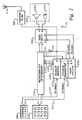
- FIG. 2 is a block diagram of a mobile subscriber unit (MSU) 12 with which the method and system of the present invention may be implemented.
- MSU 12 includes antenna 20 , cellular telephone transceiver 220 , microcomputer 230 , keypad 240 , display 280 , audio switch 250 , and handset 260 , including speaker 262 and microphone 264 .
- Microcomputer 230 is a computer built around a single chip microprocessor. Less powerful than a mini-computer or a mainframe computer, microcomputer 230 is nevertheless capable of complex tasks involving the processing of logical operations.
- Microcomputer 230 includes a central processing unit (CPU) (i.e., not shown), which is the computational and control unit of microcomputer 230 , and which interprets and executes instructions for MSU 12 .
- CPU central processing unit
- cellular telephone transceiver 220 may be coupled to a single antenna 219 in place of antenna 20 and by way of high-pass filter 287 , respectively.
- High-pass filter 287 is utilized to filter only those signals which fall within a frequency range utilized by cellular telephones in the United States.
- High-pass filter 287 can be further modified to allow for cellular telephone frequency ranges of countries other than the United States. Specific design parameters of such a high-pass filter are left to the discretion of the manufacturer of a MSU such as MSU 12 .
- Display 280 can be any type of display device which visually presents data to a MSU user.
- Keypad 240 is a set of keys that are mounted on a small keyboard and are dedicated to a specific purpose, such as inserting numbers.
- Control signals TX ENABLE 231 and RX ENABLE 232 enable cellular transmitter 224 and cellular receiver 222 , respectively.
- microcomputer 230 In addition to enabling cellular transceiver 220 , via enabling signals 231 and 232 , microcomputer 230 also monitors signals such as Received Signal Strength Indicator (RSSI) data 233 , Bit Error Rate (BER) data 234 , RX DATA 236 , and TX DATA 235 .
- RSSI Received Signal Strength Indicator
- BER Bit Error Rate
- Microcomputer 230 measures these signals as a means for detecting incoming and outgoing signal strength, for detecting receive data and for sending transmit data, respectively.
- MSU 12 When MSU 12 is in an active mode (during a call for example), MSU 12 contributes to implementing the method and system of the present invention by performing forward channel measurements on a set of currently available traffic channels. This is accomplished beginning at call setup, when the MSC that is currently serving MSU 12 assigns a set of traffic channels to MSU 12 . The identity of the traffic channels in the assigned set are delivered from the MSC to the BSS that is within the coverage area of MSU 12 . The BSS will commence transmitting these selected RF traffic channels to MSU 12 in accordance with a protocol utilized in a typical Mobile Assisted Handoff (MAHO) scheme. MSU will then perform channel quality measurements of these selected utilizing microcomputer 230 and other supporting equipment as described below.
- MAHO Mobile Assisted Handoff
- microcomputer 230 utilized in cooperation with the operation of cellular transceiver 220 .
- microcomputer 230 utilized in cooperation with the operation of cellular transceiver 220 .
- FIG. 2 merely describes one form of a MSU that can be utilized in accordance with the method and system of the present invention.
- MSU Mobility Management Entity
- FIG. 2 merely describes one form of a MSU that can be utilized in accordance with the method and system of the present invention.
- Other types of wireless MSU systems can be implemented with a preferred embodiment of the present invention, as long as the particular cellular telephone system utilized allows for performing forward channel quality measurements such as RSSI and BER measurements.
- an MSU such as MSU 12 performs channel quality measurements on a pre-assigned set of traffic channels while it is active (during a call for example). These channel quality measurements consist of the MSU received signal strength (RSSI) and Bit Error Rate (BER) for each traffic channel in the set. Consistent with current mobile assisted handoff (MAHO) procedures, the MSU may also measure RSSI levels for up to 24 control channels in accordance with the instructions it receives from its serving BTS. The pre-assigned traffic channel list is incorporated into the usual MAHO list which is then sent to MSU 12 at the call setup, and is updated after a handoff of MSU 12 to another BTS. According to MAHO procedures as they are currently implemented, the channel quality information thus obtained, is utilized for handoff decisions.
- RSSI received signal strength
- BER Bit Error Rate
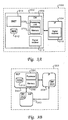
- FIG. 3A is a block diagram of a physical switch 300 representative of the DMS family of switch products available from Nortel Networks Corporation of Ottawa, Canada.
- Switch 300 may be employed within communications system 100 depicted in FIG . 1 as one of MSCs 108 or 110 and provides the functionality described with reference to FIG. 1 .
- Switch 300 as depicted in FIG. 3A includes a central unit 302 connected to intelligent peripheral (IP) 304 .
- Central unit 302 contains a computing module (CM) 306 , which employs processing unit 308 and memory 310 to provide switch intelligence functions for switch 300 .
- Processing unit 308 may comprise, for example, one or more processors executing instructions to provide logic for call processing and to implement processes described below for a preferred embodiment of the present invention.
- Memory 310 stores instructions and data and may include random access memory (RAM) and/or read only memory (ROM) for storing channel allocation data in accordance with the method and system of the present invention as described below.
- RAM random access memory
- ROM read only memory
- Central unit 302 also includes enhanced network (ENET) 312 , which provides a switch fabric function. Central unit 302 also includes an integral routing information database (RIDB) 312 . Voice server functions for switch 300 are provided by intelligent peripheral (IP) 304 , which also contains digital receiver 316 . Digital receiver 316 along with another digital receiver 314 , that is located within central unit 302 , may provide voice recognition functions in place of or in addition to recognizing DTMF tones.
- ENET enhanced network
- RIDB integral routing information database
- IP intelligent peripheral
- Digital receiver 316 along with another digital receiver 314 , that is located within central unit 302 , may provide voice recognition functions in place of or in addition to recognizing DTMF tones.
- FIG. 3B depicts a block diagram of physical components in an intelligent network 350 representative of a International Telecommunications Union switch, defined by ITU-T Q.1200.
- Intelligent network 350 may be implemented within cellular network 102 as MSCs 108 or 110 in FIG. 1 in accordance with a preferred embodiment of the present invention.
- Intelligent network 350 includes a service control platform (SCP) 352 , which is the switch intelligence for intelligent network 350 .
- SCP service control platform
- processor unit 354 Within service control platform 352 is a processor unit 354 and a memory 356 , which contain the processing logic for providing per call real-time channel allocation and assignment in the depicted example.
- service control platform 352 also contains a routing information database (RIDB) 312 .
- RIDB routing information database
- Network 350 also contains a service switch platform (SSP) 362 , which provides switch fabric functions.
- Specialized resource functions (SRFs) 360 is found within service switch platform 362 .
- Specialized resource function (SRF) 360 provides DTMF functions for recognizing signals from MSUs.
- Intelligent peripheral (IP) is 358 also a part of network 350 and provides voice server functions. Additionally, within intelligent peripheral 358 is specialized resource function 364 , which also serves to provide DTMF functions.
- a switch such as switch 300 or intelligent network 350 maintains a traffic channel list which requires forward measurement for future allocation.
- the switch groups those traffic channels into subsets containing a desired number of channels, and then distributes those subsets to active MSUs at call setup.
- Each MSU receives and measures only one such traffic channel subset.
- the channel list and its grouping can be updated anytime through SACCH (Slow Associated Control CHannel) message.
- a subset of such traffic channels thus occupies part of an MSU's MAHO channel list, and will be processed by the MSU in exactly same way as it does for control channels. Therefore, the number of traffic channels associated with a subset may be limited to a small number (three, for example) for an optimum tradeoff. For example, if there are ten active mobiles in a partition, then up to thirty different traffic channels may be monitored altogether (in the example of a TDM system having three timeslots per frame). The measurements conducted on the control channels remaining on each MSU's MAHO list (approximately twenty) still provides sufficient coverage for handoff adjacencies.
- the reporting scheme utilized in MAHO procedures is then utilized to deliver the resulting Channel Quality Measurement (CQM) values from the MSUs to the serving MSC.
- CQM Channel Quality Measurement
- This process may entail the BSS receiving CQM reports every second from all active MSUs, and processing those CQMs periodically.
- the serving BTS then delivers the processed CQMs to the serving MSC at the event of channel allocation.
- switches as the environments in which the processes of the present invention may be implemented
- the processes may also be implemented in other data processing systems.
- the processes of the present invention may be implemented within a computer having a connection to a switch, with the computer providing the logic and commands to the switch to execute the processes.
- the processes may be implemented to operate in an intelligent device operating in conjunction with a switch.
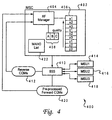
- Channel allocation system 400 is comprised of a mobile switching center (MSC) 402 , which contains an RF resource manager 404 that is responsible for several channel allocation functions in accordance with the teachings of the present invention.
- MSC mobile switching center
- RF manager 404 is connected to a channel allocation table 406 .
- channel allocation table 406 is depicted in FIG. 4 as a distinct entity, channel allocation table 406 may be contained within RF manager 404 .
- RF manager 404 is responsible for maintaining and updating a list of traffic channels within channel allocation table 406 .
- the traffic channel list within channel allocation table 406 may be initially generated by reverse RF scanning performed by a base station system (BSS).
- BSS base station system
- traffic channels may be arranged according to the relative quality of each traffic channel.
- Traffic channel subsets are depicted as block 408 , which is also connected to RF manager 404 and located within MSC 402 .
- Traffic channel subsets 408 are comprised of subsets of the traffic channels contained within channel allocation table 406 . As illustrated within block 408 , traffic channel subsets are denoted as "A”, “B” and “C” and are comprised of traffic channels “x1-x2-x3", “y1-y2-y3" and "z1-z2-z3" respectively.
- the number of traffic channel subsets depicted in FIG. 4 is limited to three for simplification. Those skilled in the art will appreciate and understand the extensions necessary for many more traffic channel subsets to be included within block 408 consistent with the method and system of the present invention.
- RF manager 404 may be utilized as the means by which the traffic channel subsets within block 408 are grouped and arranged.
- the subsets contained within block 408 may be delivered to MSUs during call setup. Within channel allocation system 400 , this is accomplished by utilizing MSC 402 to deliver one or more of the traffic channel subsets contained within block 408 to a BSS 410 .
- a traffic channel subset from within block 408 is added to a list of RF channels depicted in FIG. 4 as a MAHO list 422 .
- MAHO list 422 is comprised of RF channels including a traffic channel assigned to the current call and several control channels.
- MAHO list 422 is delivered from MSC 402 to BSS 410 .
- BSS 410 includes at least one BSC and at least one BTS (neither depicted in FIG. 4 ), with which communications are maintained with MSUs such as MSU1 414 , MSU2 416 and MSU3 418 .
- MSUs such as MSU1 414 , MSU2 416 and MSU3 418 .
- traffic channel subsets added to MAHO list 422 are described herein as discrete units for convenience of explanation only. Consistent with the scope of the present invention, traffic channel subsets may be periodically updated within the MAHO list of a given MSU. This update, for example, may entail removing or replacing one or more of the individual traffic channels within the traffic channel subset.
- traffic channel subsets "A”, "B” and “C” have been added to the MAHO lists assigned to MSU1 414 , MSU2 416 and MSU3 418 , respectively during call setup procedures for each of the three MSUs.
- the particular MAHO list depicted in FIG. 4 as MAHO list 422 , includes traffic channel subset "A”.
- MSU1 414 receives MAHO list 422 and, in accordance with MAHO procedure specified in TDMA digital technologies, performs forward RF channel quality measurements (CQMs) on the channels included within MAHO list 422 .
- CQMs forward RF channel quality measurements
- the forward CQMs are performed on traffic channels "x1-x2-x3" by MSU1 414 include RSSI and BER measurements.
- traffic channel subset "A" is processed by MSU1 414 in accordance with standard MAHO procedure.
- the results of the measurements performed on MAHO list 422 are utilized for handoff decisions and, in a preferred embodiment of the present invention, to update channel allocation table 406 such that adaptive channel allocation may be enhanced.
- MSU1 414 performs frequent, periodic (once per second for example) forward measurements of the traffic channels included within subset "A".
- BSS 410 receives these measurements from MSU1 414 as well as similar measurements from other MSUs and pre-processes these forward CQMs. This pre-processing may include such techniques as averaging in order to obtain a useful channel quality parameters.
- the resulting pre-processed forward CQMs 412 for traffic channel subset "A", are then delivered from BSS 410 to RF manager 404 .
- BSS 410 measures the signal strength of traffic channels in the reverse direction, resulting in reverse channel quality data illustrated at block 412 .
- RF manager 404 may then combine forward CQMs 412 with reverse CQMs 412 in order to effectively update channel allocation table 406 and allocate an traffic channel for the next call setup request.
- a new MAHO list is assigned at handoff.
- Another method by which a MAHO list and its accompanying subset of traffic channels may be updated during a call is by utilizing Slow Associated Control CHannel (SACCH) messages.
- SACCH Slow Associated Control CHannel
- An example of when the traffic channel subset such as traffic channel subset "A" may need to be updated would be if one of the channels ("x1" for example) has been allocated by RF manager 404 for an incoming call request.
- a SACCH message may then be delivered from MSC 402 to BSS 410 from which the MAHO list 422 for MSU1 414 may be updated.
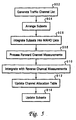
- FIG. 5 illustrates a simplified series of steps that may be utilized to enhance channel allocation in accordance with the teachings of the present invention.
- Step 502 depicts the creation of a traffic channel list such as that contained within channel allocation table 406 . Such a list of available traffic channels may be initially gathered by utilizing reverse radio scanning.
- step 504 illustrates the arrangement of traffic channel subsets such as the traffic channel subsets "A", "B" and "C" depicted as block 408 .
- the traffic channel subsets thus arranged are comprised of available traffic channels that, as illustrated in FIG. 4 , are included in a traffic channel list within channel allocation table 406 .
- the arrangement depicted at step 504 includes grouping available traffic channels in a particular manner and also updating the assignments of one or more of the traffic channel subsets to one or more MSUs.
- Step 506 depicts the addition of traffic channel subsets into MAHO list such as the MAHO list 422 assigned to MSU1 414 at call setup.
- step 508 there is illustrated the processing of the forward CQMs performed on the traffic channel subset included within the MAHO list.
- This processing is performed by a BSS such as BSS 410 for the purpose of converting CQM data into a useful parameter that may be utilized by RF manager 404 to update channel allocation table 406 .
- RF manager 404 or a similar device, and in accordance with a preferred embodiment of the present invention, reverse traffic channel measurements performed by BSS 410 are combined with the processed forward CQMs as illustrated at step 510 .
- RF manager 404 may then utilize the combined traffic channel quality information to update channel allocation table 406 , as depicted at step 512 .
- any given traffic channel subset may be updated during a call as illustrated at step 514 .
- a Slow Associated Control CHannel (SACCH) message is utilized to relay necessary update information from BSS 410 to a MSU such as MSU1 414 .
- ANSI-41 intersystem signaling protocol
- ANSI-41 is hereby incorporated by reference in its entirety herein.
- the ANSI-41 message modifications involve the addition of a new data element to selected ANSI-41 messages depending upon the particular call scenario. For example, the process of distributing traffic channel subsets to active mobiles at call setup may require modification of SACCH messages. Similarly, the periodic updates of these subsets may be made utilizing changes in the SACCH message format.
- Preferred implementations of the invention include implementations as a computer system programmed to execute the method or methods described herein, and as a program product.
- sets of instructions for executing the method and system of the present invention are resident in a storage device such as the random access memory (RAM) of one or more computer systems.
- the set of instructions may be stored as a computer-program product in another computer memory, for example, in a disk drive (which may include a removable memory such as an optical disk or floppy disk for eventual utilization in disk drive).
- the computer-program product can also be stored at another computer and transmitted when desired to the user's workstation by a network or by an external communications network.
- a network or by an external communications network One skilled in the art can appreciate that the physical storage of the sets of instructions physically changes the medium upon which it is stored so that the medium carries computer-readable information. The change may be electrical, magnetic, chemical, or some other physical change. While it is convenient to describe the invention in terms of instructions, symbols, characters, or the like, the reader should remember that all of these and similar terms should be associated with the appropriate physical elements.
- a method for implementing the steps described in association with Figures 1, 2, 3A, 3B, 4 , and 5 can be accomplished with a computer-aided device.
- data stored in a memory unit of a data-processing system such as a data-processing system, can represent steps in a method for implementing a preferred embodiment of the present invention.
Landscapes
- Engineering & Computer Science (AREA)
- Quality & Reliability (AREA)
- Computer Networks & Wireless Communication (AREA)
- Signal Processing (AREA)
- Mobile Radio Communication Systems (AREA)
Abstract
Description
Claims (17)
- A method in a wireless telecommunications system for dynamically managing traffic channel allocation, said wireless telecommunications system including a mobile switching center and a mobile subscriber unit, said method comprising the steps of:generating a traffic channel list within the mobile switching center;grouping said traffic channel list into a plurality of traffic channel subsets within said mobile switching center;selecting and assigning one of said plurality of traffic channel subsets to a mobile subscriber unit;periodically performing forward channel quality measurements on said one of said plurality of traffic channel subsets, thereby obtaining forward traffic channel quality results; andreporting said forward traffic channel quality results to said mobile switching center, such that said traffic channel list may be dynamically updated.
- The method of claim 1 wherein said mobile switching center includes a channel allocation table, said method further comprising the step of:generating and updating said traffic channel list within said channel allocation table.
- The method of claim 1 or 2, wherein said step of selecting and assigning one of said plurality of traffic channel subsets to said mobile subscriber unit is performed during call setup associated with said mobile subscriber unit.
- The method of claim 1, 2 or 3 wherein said step of periodically performing forward channel quality measurements on said one of said plurality of traffic channel subsets, and said step of reporting said forward traffic channel quality results to said mobile switching center are performed continuously during a call associated with said mobile subscriber unit.
- The method of preceding claim, wherein said step of selecting and assigning one of said plurality of traffic channel subsets to said mobile subscriber unit, comprises the steps of:during a call setup associated with said mobile subscriber unit, assigning a list of channels to be monitored by said mobile subscriber unit for handoff purposes; andintegrating said one of said plurality of traffic channel subsets into said list of channels.
- The method of any preceding claim, wherein said step of periodically performing forward channel quality measurements on said one of said plurality of traffic channel subsets, and said step of reporting said forward traffic channel quality results to said mobile switching center, are both performed utilizing mobile assisted handoff procedures.
- The method of any preceding claim, further comprising the steps of:performing reverse channel quality measurements on said one of said plurality of traffic channel subsets, thereby obtaining reverse channel quality results; andcombining said reverse channel quality results with said forward traffic channel quality results, such that quality of said one of said plurality of traffic channel subsets may be more accurately determined.
- The method of claim 7, wherein said step of performing reverse channel quality measurements on said one of said plurality of traffic channel subsets, and said step of combining said reverse channel quality results with said forward traffic channel quality results are performed continuously during a call associated with said mobile subscriber unit.
- A system for dynamically managing traffic channel allocation within a wireless telecommunications network, said wireless telecommunications network including a mobile switching center and a mobile subscriber unit, said system comprising:means for generating a traffic channel list within a mobile switching center;means for grouping said traffic channel list into a plurality of traffic channel subsets within said mobile switching center;means for selecting and assigning one of said plurality of traffic channel subsets to a mobile subscriber unit;means for periodically performing forward channel quality measurements on said one of said plurality of traffic channel subsets, thereby obtaining forward traffic channel quality results; andmeans for reporting said forward traffic channel quality results to said mobile switching center, such that said traffic channel list may be dynamically updated.
- The system of claim 9, wherein said mobile switching center includes a channel allocation table that includes said traffic channel list, said system further comprising:means for generating and updating said traffic channel list within said channel allocation table.
- The system of claim 9 or 10, wherein said means for selecting and assigning one of said plurality of said traffic channel subsets to said mobile subscriber unit, comprises:means for, during a call setup associated with said mobile subscriber unit, assigning a list of channels to be monitored by said mobile subscriber unit for handoff purposes; andmeans for integrating one of said plurality of traffic channel subsets into said list of channels.
- The system of claim 9, 10 or 11 further comprising:means for performing reverse channel quality measurements on said one of said plurality of traffic channel subsets, thereby obtaining reverse channel quality results; andmeans for combining said reverse channel quality results with said forward traffic channel quality results, such that quality of said one of said plurality of traffic channel subsets may be more accurately determined.
- The system of claim 12 wherein said means for performing reverse channel quality measurements on said one of said plurality of traffic channel subsets and said means for combining said reverse channel quality results with said forward traffic channel quality results, are both contained within a base station system.
- The system of claim 10 wherein said means for periodically performing forward channel quality measurements on said one of said plurality of traffic channel subsets comprises means for monitoring received signal strength and bit error rate for said one said plurality of traffic channel subsets.
- A computer program element for dynamically managing traffic channel allocation within a wireless telecommunications network, said computer program element comprising computer program code means to make a computer execute procedure to perform the method steps of any one of claims 1 to 8:means for generating a traffic channel list within a mobile switching center;instruction means stored in signal bearing media for grouping said traffic channel list into a plurality of traffic channel subsets within said mobile switching center;instruction means stored in signal bearing media for selecting and assigning one of said plurality of traffic channel subsets to a mobile subscriber unit;means for periodically performing forward channel quality measurements on said one of said plurality of traffic channel subsets, thereby obtaining forward traffic channel quality results; andmeans for reporting said forward traffic channel quality results to said mobile switching center, such that said traffic channel list may be dynamically updated.
- The computer program element of claim 15, embodied on a computer readable medium.
- The computer program product of claim 15 further comprising instruction means stored in signal bearing media for utilizing said traffic channel quality results to update said traffic channel list.
Applications Claiming Priority (2)
| Application Number | Priority Date | Filing Date | Title |
|---|---|---|---|
| US23481299A | 1999-01-21 | 1999-01-21 | |
| US234812 | 1999-01-21 |
Publications (2)
| Publication Number | Publication Date |
|---|---|
| EP1022921A2 true EP1022921A2 (en) | 2000-07-26 |
| EP1022921A3 EP1022921A3 (en) | 2001-01-10 |
Family
ID=22882930
Family Applications (1)
| Application Number | Title | Priority Date | Filing Date |
|---|---|---|---|
| EP00300426A Withdrawn EP1022921A3 (en) | 1999-01-21 | 2000-01-20 | Dynamic management of traffic channel allocation |
Country Status (2)
| Country | Link |
|---|---|
| EP (1) | EP1022921A3 (en) |
| BR (1) | BR0000838A (en) |
Cited By (2)
| Publication number | Priority date | Publication date | Assignee | Title |
|---|---|---|---|---|
| WO2001041491A3 (en) * | 1999-12-01 | 2001-12-06 | Ericsson Telefon Ab L M | A method and system for managing frequencies allocated to a base station |
| US7069012B2 (en) * | 2001-12-27 | 2006-06-27 | Nec Corporation | CDMA cellular system in which different channel is allocated |
Family Cites Families (1)
| Publication number | Priority date | Publication date | Assignee | Title |
|---|---|---|---|---|
| US5854981A (en) * | 1995-08-08 | 1998-12-29 | Telefonaktiebolaget L M Ericsson | Adaptive neighbor cell list |
-
2000
- 2000-01-14 BR BR0000838-9A patent/BR0000838A/en not_active Application Discontinuation
- 2000-01-20 EP EP00300426A patent/EP1022921A3/en not_active Withdrawn
Cited By (3)
| Publication number | Priority date | Publication date | Assignee | Title |
|---|---|---|---|---|
| WO2001041491A3 (en) * | 1999-12-01 | 2001-12-06 | Ericsson Telefon Ab L M | A method and system for managing frequencies allocated to a base station |
| US6418317B1 (en) | 1999-12-01 | 2002-07-09 | Telefonaktiebolaget Lm Ericsson (Publ) | Method and system for managing frequencies allocated to a base station |
| US7069012B2 (en) * | 2001-12-27 | 2006-06-27 | Nec Corporation | CDMA cellular system in which different channel is allocated |
Also Published As
| Publication number | Publication date |
|---|---|
| EP1022921A3 (en) | 2001-01-10 |
| BR0000838A (en) | 2001-10-09 |
Similar Documents
| Publication | Publication Date | Title |
|---|---|---|
| EP1155588B1 (en) | Mobile radio system and a method for channel allocation in a mobile radio system | |
| JP4581067B2 (en) | Method for transmitting measurement reports in a mobile communication system | |
| Li et al. | Personal communication systems (PCS) | |
| AU670819B2 (en) | Location updating in a cellular radio network | |
| EP0960545B1 (en) | Method of channel allocation and corresponding system | |
| US6847821B1 (en) | Method and system in a wireless communications network for the simultaneous transmission of both voice and non-voice data over a single radio frequency channel | |
| US6418317B1 (en) | Method and system for managing frequencies allocated to a base station | |
| US6360103B2 (en) | Cellular telephone system which increases efficiency of reserved channel usage | |
| EP0948231A2 (en) | Signal strength triggered handoff in wireless communication systems | |
| US6477367B1 (en) | System and method for identifying hot spots in the D-AMPS wireless system | |
| GB2250665A (en) | Improved call set-up in a radio communication system with dynamic channel allocation | |
| RU98117837A (en) | WIRELESS TELECOMMUNICATIONS NETWORKS TOGETHER USING THE GLOBAL MOBILE COMMUNICATION SYSTEM AND MULTIPLE ACCESS WITH CODE DIVISION OF CHANNELS | |
| EP0955781A2 (en) | A method and system for determining handoff priority based on relative change of measured signal intensity | |
| GB2406473A (en) | Determining the identity of an unknown neighbour cell | |
| WO2000049830A1 (en) | System and method for channel assignment with a forward and backward reassignment step | |
| KR100904512B1 (en) | Channel assignment in wireless communication systems with spatial channels, including grouping existing subscribers in anticipation of new subscribers | |
| CN1050257C (en) | Method of searching for a signalling channel in a radio system | |
| WO2016170718A1 (en) | Radio communication terminal and base station assignment method | |
| WO2016170719A1 (en) | Radio communication terminal and frequency assignment method | |
| US6507742B1 (en) | Automatic color code (SAT) assignment method used in frequency planning for wireless networks | |
| JP2002530958A (en) | Channel allocation method and cellular radio system | |
| CA2244533C (en) | Method for subscriber based management of neighbor list information during a communication session | |
| EP1473948B1 (en) | Traffic channel allocating method in gsm mobile communication | |
| CN1382361A (en) | Method and network for providing to positioning data | |
| CN101795464A (en) | Processing method of Abis interface signaling |
Legal Events
| Date | Code | Title | Description |
|---|---|---|---|
| PUAI | Public reference made under article 153(3) epc to a published international application that has entered the european phase |
Free format text: ORIGINAL CODE: 0009012 |
|
| AK | Designated contracting states |
Kind code of ref document: A2 Designated state(s): DE FR GB |
|
| AX | Request for extension of the european patent |
Free format text: AL;LT;LV;MK;RO;SI |
|
| RAP1 | Party data changed (applicant data changed or rights of an application transferred) |
Owner name: NORTEL NETWORKS LIMITED |
|
| PUAL | Search report despatched |
Free format text: ORIGINAL CODE: 0009013 |
|
| AK | Designated contracting states |
Kind code of ref document: A3 Designated state(s): AT BE CH CY DE DK ES FI FR GB GR IE IT LI LU MC NL PT SE |
|
| AX | Request for extension of the european patent |
Free format text: AL;LT;LV;MK;RO;SI |
|
| 17P | Request for examination filed |
Effective date: 20010119 |
|
| AKX | Designation fees paid |
Free format text: DE FR GB |
|
| STAA | Information on the status of an ep patent application or granted ep patent |
Free format text: STATUS: THE APPLICATION HAS BEEN WITHDRAWN |
|
| 18W | Application withdrawn |
Withdrawal date: 20011227 |