EP1022337A2 - Plasmids, their construction and their use in the manufacture of interleukin-4 and interleukin-4 muteins - Google Patents
Plasmids, their construction and their use in the manufacture of interleukin-4 and interleukin-4 muteins Download PDFInfo
- Publication number
- EP1022337A2 EP1022337A2 EP00100129A EP00100129A EP1022337A2 EP 1022337 A2 EP1022337 A2 EP 1022337A2 EP 00100129 A EP00100129 A EP 00100129A EP 00100129 A EP00100129 A EP 00100129A EP 1022337 A2 EP1022337 A2 EP 1022337A2
- Authority
- EP
- European Patent Office
- Prior art keywords
- expression
- gene
- interleukin
- plasmid
- plasmids
- Prior art date
- Legal status (The legal status is an assumption and is not a legal conclusion. Google has not performed a legal analysis and makes no representation as to the accuracy of the status listed.)
- Granted
Links
Images




Classifications
-
- C—CHEMISTRY; METALLURGY
- C07—ORGANIC CHEMISTRY
- C07K—PEPTIDES
- C07K14/00—Peptides having more than 20 amino acids; Gastrins; Somatostatins; Melanotropins; Derivatives thereof
- C07K14/435—Peptides having more than 20 amino acids; Gastrins; Somatostatins; Melanotropins; Derivatives thereof from animals; from humans
- C07K14/52—Cytokines; Lymphokines; Interferons
- C07K14/54—Interleukins [IL]
- C07K14/5406—IL-4
Definitions
- the present invention relates to the construction and use of expression plasmids in the manufacture of recombinant interleukin-4 (IL-4) and interleukin-4 muteins.
- IL-4 interleukin-4
- IL-4 muteins interleukin-4 muteins
- IL-4 Mature human interleukin-4
- IL-4 is composed of 129 amino acids with 50% homology to mouse IL-4.
- IL-4 is the only cytokine known to direct the differentiation of T helper cells to a T H2 phenotype (Mosmann and Sad, Immunol. Today 17, 138 - 146, 1996).
- IL-4 signals on lymphocytes and other cells through a heterodimeric complex of two cytokine receptors, the IL-4R ⁇ and the common ⁇ -chain ( ⁇ c).
- Antagonistic IL-4 mutants have been described (Kruse et aL, EMBO J. 11, 3237 - 3244, 1992).
- Three amino acids close to the C-terminus R121, Y124 and S125
- the introduction of Asp (D) into these positions blocks receptor dimerization and transmembrane signaling.
- the interleukin-4 double mutein (IL-4 DM) is an IL-4 variant with 2 amino acid changes in position 121 and 124 termed IL-4 R121D Y124D.
- IL-4 DM is able to block both IL-4 and IL-13 activities. In contrast to all single site mutants no residual agonistic activity has ever been found for this mutein. It is believed that these antagonistic properties of IL-4 DM are useful for the treatment of diseases which involve T H2 development and/or IgE production (Ryan, J. Allergy Clin. Immunol. 99, 1 - 5, 1997).
- procaryotic organisms can be used to produce recombinant IL-4 and IL-4 muteins.
- the described systems have a number of drawbacks (low expression level, low stability of the expression vector) which make large scale production of IL-4 and IL-4 muteins impossible or economically unfeasible.
- Expression plasmids for IL-4 and IL-4 muteins with modifications in all of the relevant elements for an efficient and safe expression system were generated.
- the quality and suitability of the corresponding expression system was ranked mainly according to the following criteria:
- the object of the present invention is, therefore, to make available a process for the construction and use of expression plasmids in the large scale manufacture of recombinant interleukin-4 (IL-4) and interleukin-4 muteins.
- IL-4 interleukin-4
- the newly developed host/vector system should be well suited for the expression of other proteins (cytokines, growth factors, soluble receptors, antibodies etc.).
- bacteria transformed with plasmids according to the present invention give expression rates, plasmid and expression stability values many times higher than those observed after transforming the identical hosts with plasmids known in the art. Therefore, the plasmids of this invention are far more useful for the preparation of recombinant interleukin-4 and interleukin-4 muteins than all plasmids previously known.
- the newly developed vector system contains the following elements:
- the E. coli phage T5 promoter together with two lac operator sequences is derived from the pQE30 plasmid (Qiagen) belonging to the pDS family of plasmids (Bujard et al., Methods Enzymol. 155, 416 - 433, 1987 and Stüber et al., Immunological Methods, I. Lefkovits and B. Pernis, eds., Academic Press, Inc., Vol. IV, 121 - 152, 1990).
- the ribosomal binding site is derived from the region upstream from gene 10 of the phage T7 (T7 g 10 leader).
- Gene 10 of phage T7 codes for the coat protein, which is the major protein expressed after T7 infection.
- the T7 g 10 rbs was obtained from the vector pET-9a (Studier et al., Methods Enzymol. 185, 60 - 89, 1990).
- the T7 g10 leader spans a region of about 100 bp (Olins et al., Gene 227 - 235, 1988). In the final expression construct the region upstream of the XbaI site is deleted.
- the T7 g10 leader sequence now spans 42 bp and harbours one base exchange from G to A in position 3638 of the preferred plasmid.
- CAI codon adaptation index
- the CAI is calculated as the geometric mean of relative synonymous codon usage (RSCU) values corresponding to each of the codons used in a gene, divided by the maximum possible CAI for a gene of the same amino acid composition.
- RSCU values for each codon are calculated from very highly expressed genes of a particular organism, e.g. E.
- a T7 DNA fragment containing the transcription terminator T ⁇ is derived from the vector pET-9a (Studier et al., Methods Enzymol. 185, 60 - 89, 1990).
- Transcriptional terminators determine the points where the mRNA-RNA polymerase- DNA complex dissociates, thereby ending transcription.
- the presence of a transcriptional terminator at the end of a highly expressed gene has several advantages: they minimize sequestering of RNA polymerase that might be engaged in unnecessary transcription, they restrict the mRNA length to the minimal, thus limiting energy expense, as strong transcription may interfere with the origin of replication, a transcriptional terminator increases plasmid stability due to copy number maintenance (Balbas and Bolivar, Methods Enzymol. 185, 14 -37, 1990).
- the kan resistance gene is derived from the vector pET-9a (Studier et al., Methods Enzymol. 185, 60 -89, 1990). Originally, this is the kan gene of Tn903 from the vector pUC4KISS (Barany, Gene 37, 111 - 123, 1985). In the preferred plasmid the kan gene and the IL-4 and IL-4 mutein gene have opposite orientations, so there should not be an increase in kan gene product after induction due to read-through transcription from the T5 promoter. Kanamycin was chosen as selective marker because it is the preferred antibiotic for GMP-purposes. In addition, kan gene based vectors are more stable than ampicillin resistant (bla) plasmids.
- Ampicillin selection tends to be lost in cultures as the drug is degraded by the secreted ⁇ -lactamase enzyme.
- the mode of bacterial resistance to kanamycin relies upon an aminoglycoside phosphotransferase that inactivates the antibiotic.
- Controlled gene expression is absolutely necessary for the set-up of a stable plasmid system, particularly if the protein of interest is deleterious to the host cell.
- the preferred plasmid uses a lac-based inducible system consisting of a lac repressor gene (lacI) and two synthetic lac operator sequences fused downstream to the E. coli phage T5 promoter.
- lacI lac repressor gene
- the lacI q promoter and the lad structural gene were isolated from the vector pTrc99A (Amann et al., Gene 69, 301 - 315, 1988).
- I q is a promoter mutation which leads to overproduction of the lad repressor.
- the wild-type lac repressor is a tetrameric molecule comprising four identical subunits of 360 amino acids each.
- the lac repressor tetramer is a dimer of two functional dimers.
- the four subunits are held together by a four-helix bundle formed from residues 340 - 360. Due to the isolation of the lacI gene from the vector pTrc99A by a NarI cut the residues beyond amino acid 331 are deleted and 10 amino acids not normally encoded in the lacI gene are added.
- the origin of replication (ori) of the preferred plasmid is derived from the vector pET-9a, the oil of which originates from pBR322.
- the preferred plasmid therefore carries the pMB1 (ColE1) replicon. Plasmids with this replicon are multicopy plasmids that replicate in a 'relaxed' fashion. A minimum of 15 - 20 copies of plasmid are maintained in each bacterial cell under normal growth conditions. The actual number for the preferred plasmid is within this range.
- Replication of the Co1E1-type ori is initiated by a 555-nucleotide RNA transcript, RNA II, which forms a persistent hybrid with its template DNA near the ori.
- RNA II-DNA hybrid is then cleaved by RNase H at the oil to yield a free 3'OH that serves as a primer for DNA polymerase I.
- This priming of DNA synthesis is negatively regulated by RNA I, a 108-nucleotide RNA molecule complementary to the 5'end of RNA II.
- Interaction of the antisense RNA I with RNA II causes a conformational change in RNA II that inhibits binding of RNA II to the template DNA and consequently prevents the initiation of plasmid DNA synthesis.
- RNAs I and II The binding between RNAs I and II is enhanced by a small protein of 63 amino acids (the Rop protein, R epressor o f p rimer), which is encoded by a gene located 400 nucleotides downstream from the origin of replication (Sambrook et al., Molecular Cloning, Cold Spring Harbor, 1989). Deletion of the rop gene leads to an increase in copy number and due to a gene dosage effect to enhanced expression levels of the plasmid encoded heterologous gene. This observation was also made for the IL-4 expression vectors tested. But it turned out that rop - -plasmids are instable and lost very rapidly during fermentation under non-selective conditions.
- the Rop protein the Rop protein, R epressor o f p rimer
- the replicon of the preferred plasmid contains the rop gene to ensure high plasmid stability.
- the preferred plasmid lacks the mob gene that is required for mobilization and is therefore incapable of directing its own conjugal transfer from one bacterium to another.
- the preferred expression plasmid not all of the above features have to be incorporated in the construction of the preferred expression plasmid.
- a natural interleukin-4 or interleukin-4 mutein gene can be used instead of a synthetic one with optimized E. coli codon usage.
- the preferred transcription terminator is T ⁇ , but other terminators like rrnB T2 or aspA can also be used.
- Restriction endoculeases calf intestinal alkaline phosphatase, T4 polynucleotide kinase and T4 DNA ligase were purchased from Boehringer Mannheim and GIBCO-BRL and used as recommended by the supplier.
- Oligonucleotides for site directed mutagenesis, PCR reactions and sequencing were obtained from MWG Biotech, Pharmacia Biotech or GIBCO BRL.
- the mutagenesis experiments were carried out by the method of Deng and Nickoloff (Deng and Nickoloff, Anal. Biochem. 200, 81 - 88, 1992) using the 'Unique Site Elimination Mutagenesis' system from Pharmacia Biotech.
- the primer used for the recreation of the T7 g10 rbs has the following sequence:
- the plasmid stability tests were always started with a culture frozen in liquid nitrogen.
- the OD 600 of the thawed culture was determined, the culture diluted up to 10 -4 in PBS buffer and plated on LB agar plates without antibiotic.
- 1 ml of the thawed culture was inoculated into 100 ml of peptone medium (30 g Soya peptone, 20 g Yeast extract, 5 g KH 2 PO 4 , 20 g Glycerol, 1 g MgSO 4 x 7H 2 O per liter, pH 7,0) and incubated at 37°C with 280 rpm for 24 hours.
- peptone medium (30 g Soya peptone, 20 g Yeast extract, 5 g KH 2 PO 4 , 20 g Glycerol, 1 g MgSO 4 x 7H 2 O per liter, pH 7,0
- the OD 600 of the grown culture was determined, the culture diluted up to 10 -6 in PBS buffer and plated on LB agar plates without antibiotic to get well separated colonies.
- 100 ⁇ l from the grown culture were inoculated into 100 ml peptone medium and incubated at 37°C with 280 rpm for 24 hours. This procedure was repeated eight times.
- the number of generations per day were calculated according to the following formula: log [OD 600 END /OD 600 BEG ]/log 2 .
- interleukin-4 and interleukin-4 muteins were grown in LB medium (10 g Bacto tryptone, 5 g Yeast extract, 10 g NaCl per liter, pH 7,5) until OD600 reached 0.8 - 1.0. Expression was induced by addition of IPTG to a final concentration of 0,5 mM and incubation continued for 5 hours. Cells were harvested by centrifugation.
Landscapes
- Chemical & Material Sciences (AREA)
- Health & Medical Sciences (AREA)
- Life Sciences & Earth Sciences (AREA)
- Organic Chemistry (AREA)
- General Health & Medical Sciences (AREA)
- Gastroenterology & Hepatology (AREA)
- Biochemistry (AREA)
- Biophysics (AREA)
- Zoology (AREA)
- Genetics & Genomics (AREA)
- Medicinal Chemistry (AREA)
- Molecular Biology (AREA)
- Proteomics, Peptides & Aminoacids (AREA)
- Toxicology (AREA)
- Micro-Organisms Or Cultivation Processes Thereof (AREA)
- Preparation Of Compounds By Using Micro-Organisms (AREA)
- Saccharide Compounds (AREA)
Abstract
Description
- high product yield
- regulatable stable expression
- stability of the expression vector
- Promoter
- Ribosomal binding site (rbs)
- Codon usage of the corresponding gene
- Transcriptional terminator
- Resistance gene
- Regulation of expression
- Origin of replication (ori)
- Yield of IL-4 and IL-4 muteins
- Plasmid stability
- Maintenance of induction capability

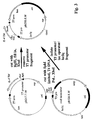
- FIG.1 to FIG.4:
- Construction of the preferred expression plasmid. (Abbreviations: IL-4 TM, IL-4 triple mutein; IL-4 DM, IL-4 double mutein).
- FIG. 5:
- Plasmid stability of the IL-4 mutein expression vectors pRO21.1.O and pRO2.1.O. The vector pRO2.1.O remains fully stable over 78 generations without antibiotic selection. In contrast the expression vector pRO21.1.O, which is based on the commercially available plasmid pET-30a (Novagen), is lost very rapidly. Only 16% of the colonies contain the plasmid after 78 generations without kanamycin selection.
- FIG. 6:
- Maintenance of induction and expression capability of the preferred IL-4 and IL-4 mutein expression vector.


Claims (4)
- An operon for the manufacture of IL-4 and IL-4 muteins in a strain of Escherichia coli, comprising in 5' to 3' order the following operatively linked elements: a regulatable promoter consisting of the E. coli phage T5 promoter and two lac operator sequences, a ribosome binding site from the E. coli phage T7 g10, a translational start codon, a structural gene for IL-4 or an IL-4 mutein and downstream of that structural gene one transcription terminator.
- E.coli / pRO2.1.O
- Escherichia coli transformed with one or more of the plasmids of claims 1 or 2.
- Use of the plasmids according to claims 1 or 2 in a method of preparation of IL-4 and IL-4 muteins.
Priority Applications (2)
| Application Number | Priority Date | Filing Date | Title |
|---|---|---|---|
| EP00100129A EP1022337B1 (en) | 1999-01-20 | 2000-01-07 | Plasmids, their construction and their use in the manufacture of interleukin-4 and interleukin-4 muteins |
| CY20061101343T CY1105277T1 (en) | 1999-01-20 | 2006-09-20 | PLASMIDS, CONSTRUCTION THEREOF AND USE THEREOF IN THE INDUSTRIAL PRODUCTION OF INTEPLEUKIN-4 AND INTEPLEUKIN-4 METALAXINS |
Applications Claiming Priority (3)
| Application Number | Priority Date | Filing Date | Title |
|---|---|---|---|
| EP99100967 | 1999-01-20 | ||
| EP99100967A EP1022339B1 (en) | 1999-01-20 | 1999-01-20 | Plasmids, their construction and their use in the manufacture of interleukin-4 and interleukin-4 muteins |
| EP00100129A EP1022337B1 (en) | 1999-01-20 | 2000-01-07 | Plasmids, their construction and their use in the manufacture of interleukin-4 and interleukin-4 muteins |
Publications (3)
| Publication Number | Publication Date |
|---|---|
| EP1022337A2 true EP1022337A2 (en) | 2000-07-26 |
| EP1022337A3 EP1022337A3 (en) | 2003-06-25 |
| EP1022337B1 EP1022337B1 (en) | 2006-07-26 |
Family
ID=26070403
Family Applications (1)
| Application Number | Title | Priority Date | Filing Date |
|---|---|---|---|
| EP00100129A Expired - Lifetime EP1022337B1 (en) | 1999-01-20 | 2000-01-07 | Plasmids, their construction and their use in the manufacture of interleukin-4 and interleukin-4 muteins |
Country Status (2)
| Country | Link |
|---|---|
| EP (1) | EP1022337B1 (en) |
| CY (1) | CY1105277T1 (en) |
Cited By (1)
| Publication number | Priority date | Publication date | Assignee | Title |
|---|---|---|---|---|
| US6936699B2 (en) | 2000-05-08 | 2005-08-30 | Bayer Aktiengesellschaft | Purification of protein inclusion bodies by crossflow microfiltration |
Family Cites Families (5)
| Publication number | Priority date | Publication date | Assignee | Title |
|---|---|---|---|---|
| US4689406A (en) * | 1983-08-10 | 1987-08-25 | Amgen | Enhancement of microbial expression of polypeptides |
| HUT43625A (en) * | 1986-03-27 | 1987-11-30 | Monsanto Co | Process for increasing yield of proteins with applying new ribosomal binding positions in bacteria |
| EP0303925B1 (en) * | 1987-08-17 | 1995-06-07 | F. Hoffmann-La Roche Ag | High repressible sequence for control of expression |
| FR2724665B1 (en) * | 1994-09-16 | 1996-12-20 | Rhone Poulenc Rorer Sa | PROCESS FOR PRODUCING RECOMBINANT PROTEINS, PLASMIDS AND MODIFIED CELLS |
| MY124565A (en) * | 1996-07-19 | 2006-06-30 | Bayer Corp | High-affinity interleukin-4-muteins |
-
2000
- 2000-01-07 EP EP00100129A patent/EP1022337B1/en not_active Expired - Lifetime
-
2006
- 2006-09-20 CY CY20061101343T patent/CY1105277T1/en unknown
Cited By (1)
| Publication number | Priority date | Publication date | Assignee | Title |
|---|---|---|---|---|
| US6936699B2 (en) | 2000-05-08 | 2005-08-30 | Bayer Aktiengesellschaft | Purification of protein inclusion bodies by crossflow microfiltration |
Also Published As
| Publication number | Publication date |
|---|---|
| EP1022337B1 (en) | 2006-07-26 |
| EP1022337A3 (en) | 2003-06-25 |
| CY1105277T1 (en) | 2010-03-03 |
Similar Documents
| Publication | Publication Date | Title |
|---|---|---|
| CA2274982C (en) | New escherichia coli host/vector system based on antibiotic-free selection by complementation of an auxotrophy | |
| EP0972838B1 (en) | Escherichia coli host/vector system based on antibiotic-free selection by complementation of an auxotrophy | |
| Sharma et al. | Temporal and spatial regulation of the symbiotic genes of Rhizobium meliloti in planta revealed by transposon Tn5-gusA. | |
| Amemura et al. | Nucleotide sequence of the phoM region of Escherichia coli: four open reading frames may constitute an operon | |
| Paddon et al. | Expression of Bacillus amyloliquefaciens extracellular ribonuclease (barnase) in Escherichia coli following an inactivating mutation | |
| Zhang et al. | Molecular analysis and characterization of a broad-host-range plasmid, pEP2 | |
| US9163247B2 (en) | Vector comprising mannose promoter and mannose promoter | |
| JP2010284174A (en) | Plasmid, their construction and their use in manufacture of interleukin-4 and interleukin-4 mutein | |
| Maneewannakul et al. | Characterization of trbC, a new F plasmid tra operon gene that is essential to conjugative transfer | |
| Zhao et al. | Nucleotide sequence of the Staphylococcus aureus signal peptidase II (lsp) gene | |
| US20120196323A1 (en) | Fermentation Process | |
| EP1022337B1 (en) | Plasmids, their construction and their use in the manufacture of interleukin-4 and interleukin-4 muteins | |
| US20080274503A1 (en) | Modified Shine-Dalgarno Sequences and Methods of Use Thereof | |
| Lammertyn et al. | Codon adjustment to maximise heterologous gene expression in Streptomyces lividans can lead to decreased mRNA stability and protein yield | |
| WO2000060103A2 (en) | Dna construct comprising a cyanophage of cyanobacteria promoter and its use | |
| GB2172001A (en) | Testing replication of plasmid comprising trna sequence | |
| Stieglitz et al. | Cloning, sequencing, and expression in Ficoll-generated minicells of an Escherichia coli heat-stable enterotoxin gene | |
| Gavini et al. | Role of translation of the pheA leader peptide coding region in attenuation regulation of the Escherichia coli pheA gene | |
| EP0105554A1 (en) | DNA and plasmids | |
| Gentschev et al. | Mini-Tn hlyA s: a new tool for the construction of secreted fusion proteins | |
| Roytrakul et al. | A Rapid and Simple Method for Construction and Expression of a Synthetic | |
| Koons et al. | Characterization of pPvu1, the autonomous plasmid from Proteus vulgaris that carries the genes of the PvuII restriction-modification system | |
| AU663139B2 (en) | A novel translational activating sequence | |
| Ouimet et al. | Transcription reporters that shuttle cloned DNA between high-copy Escherichia coli plasmids and low-copy broad-host-range plasmids | |
| Maekawa et al. | Identification of the region that determines the specificity of binding of the transposases encoded by Tn3 and γδ to the terminal inverted repeat sequences |
Legal Events
| Date | Code | Title | Description |
|---|---|---|---|
| PUAI | Public reference made under article 153(3) epc to a published international application that has entered the european phase |
Free format text: ORIGINAL CODE: 0009012 |
|
| AK | Designated contracting states |
Kind code of ref document: A2 Designated state(s): AT BE CH CY DE DK ES FI FR GB GR IE IT LI LU MC NL PT SE |
|
| AX | Request for extension of the european patent |
Free format text: AL;LT;LV;MK;RO;SI |
|
| PUAL | Search report despatched |
Free format text: ORIGINAL CODE: 0009013 |
|
| AK | Designated contracting states |
Designated state(s): AT BE CH CY DE DK ES FI FR GB GR IE IT LI LU MC NL PT SE |
|
| AX | Request for extension of the european patent |
Extension state: AL LT LV MK RO SI |
|
| RAP1 | Party data changed (applicant data changed or rights of an application transferred) |
Owner name: BAYER HEALTHCARE AG |
|
| 17P | Request for examination filed |
Effective date: 20031229 |
|
| AKX | Designation fees paid |
Designated state(s): AT BE CH CY DE DK ES FI FR GB GR IE IT LI LU MC NL PT SE |
|
| 17Q | First examination report despatched |
Effective date: 20050429 |
|
| GRAP | Despatch of communication of intention to grant a patent |
Free format text: ORIGINAL CODE: EPIDOSNIGR1 |
|
| REG | Reference to a national code |
Ref country code: DE Ref legal event code: 8566 |
|
| GRAS | Grant fee paid |
Free format text: ORIGINAL CODE: EPIDOSNIGR3 |
|
| GRAA | (expected) grant |
Free format text: ORIGINAL CODE: 0009210 |
|
| AK | Designated contracting states |
Kind code of ref document: B1 Designated state(s): AT BE CH CY DK ES FI FR GB GR IE IT LI LU MC NL PT SE |
|
| PG25 | Lapsed in a contracting state [announced via postgrant information from national office to epo] |
Ref country code: IT Free format text: LAPSE BECAUSE OF FAILURE TO SUBMIT A TRANSLATION OF THE DESCRIPTION OR TO PAY THE FEE WITHIN THE PRESCRIBED TIME-LIMIT;WARNING: LAPSES OF ITALIAN PATENTS WITH EFFECTIVE DATE BEFORE 2007 MAY HAVE OCCURRED AT ANY TIME BEFORE 2007. THE CORRECT EFFECTIVE DATE MAY BE DIFFERENT FROM THE ONE RECORDED. Effective date: 20060726 |
|
| REG | Reference to a national code |
Ref country code: GB Ref legal event code: FG4D |
|
| REG | Reference to a national code |
Ref country code: CH Ref legal event code: EP |
|
| REG | Reference to a national code |
Ref country code: IE Ref legal event code: FG4D |
|
| REG | Reference to a national code |
Ref country code: GR Ref legal event code: EP Ref document number: 20060403329 Country of ref document: GR |
|
| REG | Reference to a national code |
Ref country code: DK Ref legal event code: T3 |
|
| REG | Reference to a national code |
Ref country code: SE Ref legal event code: TRGR |
|
| REG | Reference to a national code |
Ref country code: PT Ref legal event code: SC4A Free format text: AVAILABILITY OF NATIONAL TRANSLATION Effective date: 20060915 |
|
| ET | Fr: translation filed | ||
| REG | Reference to a national code |
Ref country code: ES Ref legal event code: FG2A Ref document number: 2269027 Country of ref document: ES Kind code of ref document: T3 |
|
| PLBE | No opposition filed within time limit |
Free format text: ORIGINAL CODE: 0009261 |
|
| STAA | Information on the status of an ep patent application or granted ep patent |
Free format text: STATUS: NO OPPOSITION FILED WITHIN TIME LIMIT |
|
| 26N | No opposition filed |
Effective date: 20070427 |
|
| REG | Reference to a national code |
Ref country code: CH Ref legal event code: PFA Owner name: BAYER HEALTHCARE AG Free format text: BAYER HEALTHCARE AG# #51368 LEVERKUSEN (DE) -TRANSFER TO- BAYER HEALTHCARE AG# #51368 LEVERKUSEN (DE) |
|
| REG | Reference to a national code |
Ref country code: PT Ref legal event code: PC4A Owner name: BAYER SCHERING PHARMA AKTIENGESELLSCHAFT, DE Effective date: 20090324 |
|
| REG | Reference to a national code |
Ref country code: CH Ref legal event code: PUE Owner name: BAYER SCHERING PHARMA AKTIENGESELLSCHAFT Free format text: BAYER HEALTHCARE AG# #51368 LEVERKUSEN (DE) -TRANSFER TO- BAYER SCHERING PHARMA AKTIENGESELLSCHAFT#MUELLERSTRASSE 178#13353 BERLIN (DE) |
|
| NLS | Nl: assignments of ep-patents |
Owner name: BAYER SCHERING PHARMA AKTIENGESELLSCHAFT Effective date: 20090918 |
|
| REG | Reference to a national code |
Ref country code: FR Ref legal event code: TP |
|
| PGFP | Annual fee paid to national office [announced via postgrant information from national office to epo] |
Ref country code: GR Payment date: 20101222 Year of fee payment: 12 |
|
| PGFP | Annual fee paid to national office [announced via postgrant information from national office to epo] |
Ref country code: LU Payment date: 20110215 Year of fee payment: 12 |
|
| PGFP | Annual fee paid to national office [announced via postgrant information from national office to epo] |
Ref country code: PT Payment date: 20111221 Year of fee payment: 13 Ref country code: MC Payment date: 20111229 Year of fee payment: 13 |
|
| PGFP | Annual fee paid to national office [announced via postgrant information from national office to epo] |
Ref country code: CH Payment date: 20120112 Year of fee payment: 13 Ref country code: FR Payment date: 20120202 Year of fee payment: 13 Ref country code: IE Payment date: 20120117 Year of fee payment: 13 |
|
| PGFP | Annual fee paid to national office [announced via postgrant information from national office to epo] |
Ref country code: FI Payment date: 20120111 Year of fee payment: 13 Ref country code: CY Payment date: 20111221 Year of fee payment: 13 Ref country code: DK Payment date: 20120111 Year of fee payment: 13 Ref country code: SE Payment date: 20120112 Year of fee payment: 13 Ref country code: BE Payment date: 20120117 Year of fee payment: 13 Ref country code: GB Payment date: 20120104 Year of fee payment: 13 Ref country code: IT Payment date: 20111223 Year of fee payment: 13 |
|
| PGFP | Annual fee paid to national office [announced via postgrant information from national office to epo] |
Ref country code: NL Payment date: 20120125 Year of fee payment: 13 |
|
| PGFP | Annual fee paid to national office [announced via postgrant information from national office to epo] |
Ref country code: AT Payment date: 20111229 Year of fee payment: 13 |
|
| PGFP | Annual fee paid to national office [announced via postgrant information from national office to epo] |
Ref country code: ES Payment date: 20120127 Year of fee payment: 13 |
|
| REG | Reference to a national code |
Ref country code: PT Ref legal event code: MM4A Free format text: LAPSE DUE TO NON-PAYMENT OF FEES Effective date: 20130708 |
|
| BERE | Be: lapsed |
Owner name: BAYER SCHERING PHARMA A.G. Effective date: 20130131 |
|
| REG | Reference to a national code |
Ref country code: NL Ref legal event code: V1 Effective date: 20130801 |
|
| REG | Reference to a national code |
Ref country code: DK Ref legal event code: EBP |
|
| PG25 | Lapsed in a contracting state [announced via postgrant information from national office to epo] |
Ref country code: MC Free format text: LAPSE BECAUSE OF NON-PAYMENT OF DUE FEES Effective date: 20130131 |
|
| REG | Reference to a national code |
Ref country code: CH Ref legal event code: PL |
|
| REG | Reference to a national code |
Ref country code: SE Ref legal event code: EUG |
|
| REG | Reference to a national code |
Ref country code: AT Ref legal event code: MM01 Ref document number: 334202 Country of ref document: AT Kind code of ref document: T Effective date: 20130131 |
|
| GBPC | Gb: european patent ceased through non-payment of renewal fee |
Effective date: 20130107 |
|
| REG | Reference to a national code |
Ref country code: GR Ref legal event code: ML Ref document number: 20060403329 Country of ref document: GR Effective date: 20130802 |
|
| REG | Reference to a national code |
Ref country code: IE Ref legal event code: MM4A |
|
| REG | Reference to a national code |
Ref country code: FR Ref legal event code: ST Effective date: 20130930 |
|
| PG25 | Lapsed in a contracting state [announced via postgrant information from national office to epo] |
Ref country code: SE Free format text: LAPSE BECAUSE OF NON-PAYMENT OF DUE FEES Effective date: 20130108 Ref country code: PT Free format text: LAPSE BECAUSE OF NON-PAYMENT OF DUE FEES Effective date: 20130708 Ref country code: LI Free format text: LAPSE BECAUSE OF NON-PAYMENT OF DUE FEES Effective date: 20130131 Ref country code: CH Free format text: LAPSE BECAUSE OF NON-PAYMENT OF DUE FEES Effective date: 20130131 Ref country code: GR Free format text: LAPSE BECAUSE OF NON-PAYMENT OF DUE FEES Effective date: 20130802 Ref country code: NL Free format text: LAPSE BECAUSE OF NON-PAYMENT OF DUE FEES Effective date: 20130801 Ref country code: AT Free format text: LAPSE BECAUSE OF NON-PAYMENT OF DUE FEES Effective date: 20130131 Ref country code: BE Free format text: LAPSE BECAUSE OF NON-PAYMENT OF DUE FEES Effective date: 20130131 Ref country code: FI Free format text: LAPSE BECAUSE OF NON-PAYMENT OF DUE FEES Effective date: 20130107 |
|
| PG25 | Lapsed in a contracting state [announced via postgrant information from national office to epo] |
Ref country code: CY Free format text: LAPSE BECAUSE OF NON-PAYMENT OF DUE FEES Effective date: 20130107 Ref country code: GB Free format text: LAPSE BECAUSE OF NON-PAYMENT OF DUE FEES Effective date: 20130107 Ref country code: FR Free format text: LAPSE BECAUSE OF NON-PAYMENT OF DUE FEES Effective date: 20130131 |
|
| PG25 | Lapsed in a contracting state [announced via postgrant information from national office to epo] |
Ref country code: IT Free format text: LAPSE BECAUSE OF NON-PAYMENT OF DUE FEES Effective date: 20130107 |
|
| PG25 | Lapsed in a contracting state [announced via postgrant information from national office to epo] |
Ref country code: DK Free format text: LAPSE BECAUSE OF NON-PAYMENT OF DUE FEES Effective date: 20130131 Ref country code: IE Free format text: LAPSE BECAUSE OF NON-PAYMENT OF DUE FEES Effective date: 20130107 |
|
| REG | Reference to a national code |
Ref country code: ES Ref legal event code: FD2A Effective date: 20140321 |
|
| PG25 | Lapsed in a contracting state [announced via postgrant information from national office to epo] |
Ref country code: ES Free format text: LAPSE BECAUSE OF NON-PAYMENT OF DUE FEES Effective date: 20130108 |
|
| PG25 | Lapsed in a contracting state [announced via postgrant information from national office to epo] |
Ref country code: DE Free format text: LAPSE BECAUSE OF NON-PAYMENT OF DUE FEES Effective date: 20060726 |
|
| PG25 | Lapsed in a contracting state [announced via postgrant information from national office to epo] |
Ref country code: LU Free format text: LAPSE BECAUSE OF NON-PAYMENT OF DUE FEES Effective date: 20130107 |