EP1021957A1 - Heavily foaming coffee fraction and process for its manufacture - Google Patents
Heavily foaming coffee fraction and process for its manufacture Download PDFInfo
- Publication number
- EP1021957A1 EP1021957A1 EP99101042A EP99101042A EP1021957A1 EP 1021957 A1 EP1021957 A1 EP 1021957A1 EP 99101042 A EP99101042 A EP 99101042A EP 99101042 A EP99101042 A EP 99101042A EP 1021957 A1 EP1021957 A1 EP 1021957A1
- Authority
- EP
- European Patent Office
- Prior art keywords
- coffee
- water
- fraction
- foaming
- solution
- Prior art date
- Legal status (The legal status is an assumption and is not a legal conclusion. Google has not performed a legal analysis and makes no representation as to the accuracy of the status listed.)
- Granted
Links
Images


Classifications
-
- A—HUMAN NECESSITIES
- A23—FOODS OR FOODSTUFFS; TREATMENT THEREOF, NOT COVERED BY OTHER CLASSES
- A23F—COFFEE; TEA; THEIR SUBSTITUTES; MANUFACTURE, PREPARATION, OR INFUSION THEREOF
- A23F5/00—Coffee; Coffee substitutes; Preparations thereof
- A23F5/24—Extraction of coffee; Coffee extracts; Making instant coffee
- A23F5/36—Further treatment of dried coffee extract; Preparations produced thereby, e.g. instant coffee
- A23F5/40—Further treatment of dried coffee extract; Preparations produced thereby, e.g. instant coffee using organic additives, e.g. milk, sugar
-
- A—HUMAN NECESSITIES
- A23—FOODS OR FOODSTUFFS; TREATMENT THEREOF, NOT COVERED BY OTHER CLASSES
- A23F—COFFEE; TEA; THEIR SUBSTITUTES; MANUFACTURE, PREPARATION, OR INFUSION THEREOF
- A23F5/00—Coffee; Coffee substitutes; Preparations thereof
- A23F5/16—Removing unwanted substances
- A23F5/18—Removing unwanted substances from coffee extract
- A23F5/185—Removing unwanted substances from coffee extract using flocculating, precipitating, adsorbing or complex-forming agents, or ion-exchangers
Definitions
- This invention relates to a heavily foaming coffee fraction, a process for its manufacture, and its application as an additive to instant coffee, resp. coffee extract.
- Instant coffee is a beverage, well-known since decades.
- the product in question is a powdery and residue-free coffee product instantly soluble in water that is obtained by aqueous extraction of ground coffee and subsequent drying, preferentially by lyophilisation.
- the main advantage of instant coffee lies in the fact that a coffee drink may easily be obtained by simply dissolving the product in hot water without utilisation of a coffee machine.
- a disadvantage vs. roast coffee is the only minor formation of foam in the cup after preparation of the beverage, p.e. is highly important for cups of expresso coffees.
- Foam is a biphasic system composed of gas bubbles within a liquid film, constituted by an aqueous solution of surfactants.
- a liquid film constituted by an aqueous solution of surfactants.
- surfactants In roast coffee there is a two-layer configuration of surface-active molecules with water molecules between them. The high strength of the film explains the honeycomb-like structure formed by small bubbles growing together.
- the object of the present invention is to overcome said disadvantages and to provide a strongly foaming coffee fraction, suitable as additive for coffee extracts.
- a coffee fraction may be isolated from roasted coffee, preferably dark roasted coffee, that shows strong foaming properties of a beverage, prepared from instant coffee, where the fractions had been added individually.
- a heavily foaming coffee fraction which is characterized by the following bands in the FT-IR-spectrum: 3400 cm -1 , 2900 cm -1 , 1655 cm -1 , 1524 cm -1 , 1000-1150 cm -1 , 894 cm -1 and 876 cm -1 .
- the invention also provides a process for the production of said coffee fraction comprising the following steps:
- the heavily foaming coffee fraction of this invention is characterized by the following bands in in the FT-IR-spectrum: 3400 cm -1 (OH and NH stretching), 2900 cm -1 (CH stretching), 1655 cm -1 (Amide I band), 1524 cm -1 (Amide II band), 1000-1150 cm -1 (C-O-C stretching), 894 cm -1 and 876 cm -1 (carbohydrate anomeric bands).
- the heavily foaming coffee fraction of the present invention is characterized by certain proton signals in the 1H-NMR-spectrum, namely: carbohydrate proton signals (3-5 ppm), aliphatic proton signals (0.5-2.5 ppm), aromatic proton signals (around 7.0 ppm).
- the coffee fractions of the present invention are characterized by values of surface tension less than 55 mN/m as 3.7-3.9 g/l aqueous solution at 25°C.
- a further characterization of the coffee fraction of the present invention is given by the values for persistency and consistency after mixing with conventional coffee powder.
- dark roasted coffee for example Coffea Arabica origin
- a suitable apparatus e.g. a Soxhlet apparatus.
- the organic solvent aliphatic or aromatic hydrocarbons such as hexane, benzene, diisopropylether, petrolether, diethylether and dichloromethane may be used.
- a preferred organic solvent is n-hexane.
- the defatting can be carried out using the known supercritical carbon dioxide technique as described in German patent 21 06 133 under pressure and at temperatures of 20-50°C, preferably 40°C. In accordance with this technique the fatty substances are removed by circling the carbon dioxide through the coffee containing pressure vessel and transferring the solute into an adsorption pressure vessel containing activated charcoal.
- the defatted and dried product is subjected to an extraction process using hot water of about 80°C to 100°C, preferably about 90°C.
- the extraction step may be repeated once or twice or more.
- the extraction agent is hot water including ion exchanged water such as Milli-Q water.
- the extract obtained from step 1 is filtrated and the solid filter residue is discarded.
- the filtration is carried out according to the filtration techniques used in the coffee industries using known filtration apparatuses.
- a suitable precipitation agent is added to the filtrate obtained from step 2 .
- Suitable precipitation agents are ammonium sulfate, ethyl alcohol, acetone, acid and ethyl alcohol-acetic acid mixtures, ammonium sulfate or ethyl alcohol being preferred.
- the mixture is aged for some time, e.g. overnight, at low temperatures, e.g. temperatures in the range of 0-8°C, preferably 4°C.
- the resulting precipitate is collected by centrifuging in usual manner.
- the precipitate from step 3 is dissolved in water or an aqueous alcohol, such as aqueous ethyl alcohol, if necessary under heating.
- the thus obtained solution is dialysed extensively against water, e.g. an aqueous NaCl solution and Milli-Q water (in this sequence).
- the non-dialysable solution from step 5 is filtrated using conventional filtration techniques.
- the filtrate from step 6 is freeze-dried in the usual way.
- a preferred procedure comprises freezing the filtrate from Step 6 in liquid nitrogen and lyophilizing at room temperature and a pressure of 0.2 mbar.
- Example 1-3 the FTIR spectra were recorded using a Perkin-Elmer 1750 spectrometer interfaced with a Perkin-Elmer 7300 data processor. Pellets were prepared using 200 mg of IR spectroscopic grade KBr and 2 mg of freeze-dried samples previously maintained for 24 h in a dessiccator under low pressure.
- Ground dark roasted defatted Santos arabica coffee 80 g was extracted twice for 1 h with boiling Milli-Q water (350 ml). The solid residue was filtered off, ammonium sulfate was added to give a saturated solution and the mixture was maintained at 4°C overnight. The resulting precipitate was collected by centrifugation, dissolved in water and extensively dialysed against Milli-Q water. After dialysis and filtration, the solution was freeze-dried to give a fluffy dark brown material (4.0 g). The water content in the freeze-dried material was 7.41% (weight loss up to 150°C by thermogravimetry). The yield (corrected for the water content) was 4.63% w/w of defatted ground dark roasted coffee.
- Ground dark roasted defatted Kenya robusta coffee (79.7 g) was extracted twice for 1 h with boiling Milli-Q water (350 ml). The solid residue was filtered off, ammonium sulfate was added to give a saturated solution and the mixture was maintained at 4°C overnight. The resulting precipitate was collected by centrifugation, dissolved in water and extensively dialysed against Milli-Q water. After dialysis and filtration, the solution was freeze-dried to give a fluffy dark brown material (3.8 g). The water content in the freeze-dried material was 6.27% (weight loss up to 150°C by thermogravimetry). The yield (corrected for the water content) was 4.47% w/w of defatted ground dark roasted coffee.
- the beaker was located on the plate of the Stevens LFRA-Texture Analyser equipped with a plexiglass cylindrical probe (diameter 2.55 mm; length 3.5 mm) after setting the following parameters: distance: 15 mm; speed: 0.2 mm/sec. In the course of the penetration of the probe into the foam the load (in grams) was recorded. The final load is called "Consistency”.
Landscapes
- Life Sciences & Earth Sciences (AREA)
- Chemical & Material Sciences (AREA)
- Engineering & Computer Science (AREA)
- Food Science & Technology (AREA)
- Polymers & Plastics (AREA)
- Tea And Coffee (AREA)
- Compounds Of Unknown Constitution (AREA)
Abstract
Description
- This invention relates to a heavily foaming coffee fraction, a process for its manufacture, and its application as an additive to instant coffee, resp. coffee extract.
- Instant coffee is a beverage, well-known since decades. The product in question is a powdery and residue-free coffee product instantly soluble in water that is obtained by aqueous extraction of ground coffee and subsequent drying, preferentially by lyophilisation. The main advantage of instant coffee lies in the fact that a coffee drink may easily be obtained by simply dissolving the product in hot water without utilisation of a coffee machine. A disadvantage vs. roast coffee, however, is the only minor formation of foam in the cup after preparation of the beverage, p.e. is highly important for cups of expresso coffees.
- Many attempts had been made to improve the foaming properties of instant coffee. One proposal is the addition of bicarbonates; that, however, has the disadvantage of forming of too large gas bubbles. Foam is a biphasic system composed of gas bubbles within a liquid film, constituted by an aqueous solution of surfactants. In roast coffee there is a two-layer configuration of surface-active molecules with water molecules between them. The high strength of the film explains the honeycomb-like structure formed by small bubbles growing together.
- The object of the present invention is to overcome said disadvantages and to provide a strongly foaming coffee fraction, suitable as additive for coffee extracts.
- Surprisingly it was found that a coffee fraction may be isolated from roasted coffee, preferably dark roasted coffee, that shows strong foaming properties of a beverage, prepared from instant coffee, where the fractions had been added individually.
- Thus, there is provided according to this invention a heavily foaming coffee fraction which is characterized by the following bands in the FT-IR-spectrum: 3400 cm-1, 2900 cm-1, 1655 cm-1, 1524 cm-1, 1000-1150 cm-1, 894 cm-1 and 876 cm-1.
- The invention also provides a process for the production of said coffee fraction comprising the following steps:
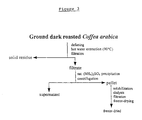
- (1) defatting of ground, roasted coffee with an organic solvent and extracting of the defatted ground, dark roasted coffee with hot water,
- (2) filtrating the extract obtained from step (1),
- (3) adding a precipitation agent to the extract obtained from step (2) and centrifugation of the thus obtained precipitate,
- (4) dissolving the precipitate obtained from step (3) in water or an aqueous alcohol,
- (5) dialysing the solution obtained in step (4) against water,
- (6) filtrating the non-dialysable solution and
- (7) freeze-drying the filtrate obtained in step (6).
-
- As stated above, the heavily foaming coffee fraction of this invention is characterized by the following bands in in the FT-IR-spectrum: 3400 cm-1 (OH and NH stretching), 2900 cm-1 (CH stretching), 1655 cm-1 (Amide I band), 1524 cm-1 (Amide II band), 1000-1150 cm-1 (C-O-C stretching), 894 cm-1 and 876 cm-1 (carbohydrate anomeric bands).
- Moreover, the heavily foaming coffee fraction of the present invention is characterized by certain proton signals in the 1H-NMR-spectrum, namely: carbohydrate proton signals (3-5 ppm), aliphatic proton signals (0.5-2.5 ppm), aromatic proton signals (around 7.0 ppm).
- Furthermore, the coffee fractions of the present invention are characterized by values of surface tension less than 55 mN/m as 3.7-3.9 g/l aqueous solution at 25°C. A further characterization of the coffee fraction of the present invention is given by the values for persistency and consistency after mixing with conventional coffee powder.
- In the following the production process for the coffee fraction of the present invention will be described in detail:
- In this step ground, dark roasted coffee, for example Coffea Arabica origin, is defatted in known manner by heating with an organic solvent under reflux in a suitable apparatus, e.g. a Soxhlet apparatus. As far as the organic solvent is concerned aliphatic or aromatic hydrocarbons such as hexane, benzene, diisopropylether, petrolether, diethylether and dichloromethane may be used. A preferred organic solvent is n-hexane. Alternatively the defatting can be carried out using the known supercritical carbon dioxide technique as described in German patent 21 06 133 under pressure and at temperatures of 20-50°C, preferably 40°C. In accordance with this technique the fatty substances are removed by circling the carbon dioxide through the coffee containing pressure vessel and transferring the solute into an adsorption pressure vessel containing activated charcoal.
- After said defatting treatment the defatted and dried product is subjected to an extraction process using hot water of about 80°C to 100°C, preferably about 90°C. The extraction step may be repeated once or twice or more. As stated, the extraction agent is hot water including ion exchanged water such as Milli-Q water.
- The extract obtained from
step 1 is filtrated and the solid filter residue is discarded. The filtration is carried out according to the filtration techniques used in the coffee industries using known filtration apparatuses. - To the filtrate obtained from step 2 a suitable precipitation agent is added. Suitable precipitation agents are ammonium sulfate, ethyl alcohol, acetone, acid and ethyl alcohol-acetic acid mixtures, ammonium sulfate or ethyl alcohol being preferred. The mixture is aged for some time, e.g. overnight, at low temperatures, e.g. temperatures in the range of 0-8°C, preferably 4°C. The resulting precipitate is collected by centrifuging in usual manner.
- The precipitate from step 3 is dissolved in water or an aqueous alcohol, such as aqueous ethyl alcohol, if necessary under heating.
- The thus obtained solution is dialysed extensively against water, e.g. an aqueous NaCl solution and Milli-Q water (in this sequence).
- The non-dialysable solution from step 5 is filtrated using conventional filtration techniques.
- The filtrate from step 6 is freeze-dried in the usual way. A preferred procedure comprises freezing the filtrate from Step 6 in liquid nitrogen and lyophilizing at room temperature and a pressure of 0.2 mbar.
- The following Examples and Figures illustrate the coffee fraction of the present invention as well as the process for its manufacture.
- Figure 1 shows the FTIR spectra of the inventive foaming coffee fractions of Examples 1, 2 and 3,
- Figure 2 shows the 1H-NMR spectra of the foaming coffee fractions of the present invention of Examples 1-3,
- Figure 3 shows the process steps for the production of the foaming coffee fractions of the present invention, and
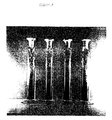
- Figure 4 comprises a photographic picture showing the foaming activity of the isolated foaming fractions of the present invention.
-
- In Examples 1-3 the FTIR spectra were recorded using a Perkin-Elmer 1750 spectrometer interfaced with a Perkin-Elmer 7300 data processor. Pellets were prepared using 200 mg of IR spectroscopic grade KBr and 2 mg of freeze-dried samples previously maintained for 24 h in a dessiccator under low pressure.
- All 1H-NMR spectra were recorded at 4.70 Tesla (1H, 200.13 MHz and 13C, 50.32 MHz) with a Bruker AC 200 instrument equipped with a multinuclear 5 mm probe. 10-15 mg of any sample were dissolved with 0.5 ml of D2O directly inside the NMR tube and the analysis was performed at 60°C.
- Ground dark roasted defatted Santos arabica coffee (80 g) was extracted twice for 1 h with boiling Milli-Q water (350 ml). The solid residue was filtered off, ammonium sulfate was added to give a saturated solution and the mixture was maintained at 4°C overnight. The resulting precipitate was collected by centrifugation, dissolved in water and extensively dialysed against Milli-Q water. After dialysis and filtration, the solution was freeze-dried to give a fluffy dark brown material (4.0 g). The water content in the freeze-dried material was 7.41% (weight loss up to 150°C by thermogravimetry). The yield (corrected for the water content) was 4.63% w/w of defatted ground dark roasted coffee.
- Elemental analysis: C 47.6%; H 5.88%; N 2.92%
- Molecular weight: 17.930 Da
- Surface tension: 52.13 mN/m (3.7 g/l aqueous solution at 25°C)
- FTIR spectrum (see Figure 1): 3400 cm-1 (OH and NH stretching), 2900 cm-1 (CH stretching), 1655 cm-1 (Amide I band),
- 1524 cm-1 (Amide II band), 1000-1150 cm-1 (C-O-C stretching), 894 and 876 cm-1 (carbohydrate anomeric bands).
- 1H-NMR spectrum (see Figure 2): carbohydrate proton signals (3-5 ppm), aliphatic proton signals (0.5-2.5 ppm), aromatic proton signals (around 7.0 ppm)
-
- Ground dark roasted defatted Giava robusta coffee (80 g) was extracted twice for 1 h with boiling Milli-Q water (350 ml). The solid residue was filtered off, ammonium sulfate was added to give a saturated solution and the mixture was maintained at 4°C overnight. The resulting precipitate was collected by centrifugation, dissolved in water and extensively dialysed against Milli-Q water. After dialysis and filtration, the solution was freeze-dried to give a fluffy dark brown material (3.1 g). The water content in the freeze-dried material was 6.36% (weight loss up to 150°C by thermogravimetry). The yield (corrected for the water content) was 3.63% w/w of defatted ground dark roasted coffee.
- Elemental analysis: C 48.6%; H 6.02%; N 3.52%
- Molecular weight: 17.040 Da
- Surface tension: 51.50 mN/m (3.9 g/l aqueous solution at 25°C)
- FTIR spectrum (see Figure 1): 3400 cm-1 (OH and NH stretching), 2900 cm-1 (CH stretching), 1655 cm-1 (Amide I band), 1524 cm-1 (Amide II band), 1000-1150 cm-1 (C-O-C stretching), 894 and 876 cm-1 (carbohydrate anomeric bands).
- 1H-NMR spectrum (see Figure 2): carbohydrate proton signals (3-5 ppm), aliphatic proton signals (0.5-2.5 ppm), aromatic proton signals (around 7.0 ppm)
-
- Ground dark roasted defatted Uganda robusta coffee (79.7 g) was extracted twice for 1 h with boiling Milli-Q water (350 ml). The solid residue was filtered off, ammonium sulfate was added to give a saturated solution and the mixture was maintained at 4°C overnight. The resulting precipitate was collected by centrifugation, dissolved in water and extensively dialysed against Milli-Q water. After dialysis and filtration, the solution was freeze-dried to give a fluffy dark brown material (3.8 g). The water content in the freeze-dried material was 6.27% (weight loss up to 150°C by thermogravimetry). The yield (corrected for the water content) was 4.47% w/w of defatted ground dark roasted coffee.
- Elemental analysis: C 49.9%; H 5.77%; N 3.96%
- Molecular weight: 14.420 Da
- Surface tension: 52.95 mN/m (3.8 g/l aqueous solution at 25°C)
- FTIR spectrum (see Figure 1): 3400 cm-1 (OH and NH stretching), 2900 cm-1 (CH stretching), 1655 cm-1 (Amide I band),
- 1524 cm-1 (Amide II band), 1000-1150 cm-1 (C-O-C stretching), 894 and 876 cm-1 (carbohydrate anomeric bands).
- 1H-NMR spectrum (see Figure 2): carbohydrate proton signals (3-5 ppm), aliphatic proton signals (0.5-2.5 ppm), aromatic proton signals (around 7.0 ppm)
-
- By using the foaming fractions of Examples 1-3, 20 ml of aqueous solution (concentration 4 g/l) of each fraction were introduced in a 50 ml graduated stoppered glass cylinder. The three cylinders were contemporarily wrist shaken for 10 sec and after 5 min at rest the photograph reported in Figure 4 was taken. In all cases the total volume in the cylinder resulted to be 40 ml with a ratio liquid/foam volume close to 1.
- 1 g of high quality Italian soluble coffee was dissolved in 30 ml of Milli-Q water in a glass cylinder graduated in millimeters. The resulting solution was stirred for 10 sec by using a Moca Crem stirrer. After 30 sec at rest the liquid and the foam levels were recorded. After 20 min the recording was repeated. The ratio liquid/foam level after 30 sec is called "Volume" while the ratio liquid/foam level after 20 min is called "Persistency". 1 g of high quality Italian soluble coffee powder was dissolved in 30 ml of Milli-Q water in a 50 ml high (tall) form glass beaker. The resulting solution was stirred for 30 sec by using a Moca Crem stirrer. The beaker was located on the plate of the Stevens LFRA-Texture Analyser equipped with a plexiglass cylindrical probe (diameter 2.55 mm; length 3.5 mm) after setting the following parameters: distance: 15 mm; speed: 0.2 mm/sec. In the course of the penetration of the probe into the foam the load (in grams) was recorded. The final load is called "Consistency".
- Volume, Persistency and Consistency were measured also after adding 100 mg of the foaming fractions of Examples 1-3 in the starting solutions of high quality Italian soluble coffee.
- The results are reported in the following Table:
Fraction Volume Persistency Consistency high quality Italian soluble coffee 1.6 4.30 6.4 high quality Italian soluble coffee + fraction of Example 1 1.5 2.55 9.0 high quality Italian soluble coffee + fraction of Example 2 1.5 2.88 8.6 high quality Italian soluble coffee + fraction of Example 3 1.6 2.88 9.2
Claims (3)
- Heavily foaming coffee fraction, characterized by the following bands in the FT-IR-spectrum: 3400 cm-1, 2900 cm-1, 1655 cm-1, 1524 cm-1, 1000-1150 cm-1, 894 cm-1 and 876 cm-1.
- Process for the production of the coffee fraction according to claim 1, characterized by the following steps:(1) defatting of ground, roasted coffee with an organic solvent and extracting of the defatted ground, dark roasted coffee with hot water,(2) filtrating the extract obtained from step (1),(3) adding a precipitation agent to the extract obtained from step (2) and centrifugation of the thus obtained precipitate,(4) dissolving the precipitate obtained from step (3) in water or an aqueous alcohol,(5) dialysing the solution obtained in step (4) against water,(6) filtrating the non-dialysable solution and(7) freeze-drying the filtrate obtained in step (6).
- Use of the coffee fraction according to claim 1 as foam-generating additive to soluble coffee.
Priority Applications (11)
| Application Number | Priority Date | Filing Date | Title |
|---|---|---|---|
| ES99101042T ES2224468T3 (en) | 1999-01-21 | 1999-01-21 | STRONGLY FOAM COFFEE FRACTION AND PROCESS FOR MANUFACTURING. |
| AT99101042T ATE272322T1 (en) | 1999-01-21 | 1999-01-21 | HIGHLY FOAMING COFFEE FRACTION AND METHOD FOR THE PRODUCTION THEREOF |
| PT99101042T PT1021957E (en) | 1999-01-21 | 1999-01-21 | HIGHLY SPARKLING COFFEE FRACTION AND PROCESS FOR YOUR MANUFACTURE |
| EP99101042A EP1021957B1 (en) | 1999-01-21 | 1999-01-21 | Heavily foaming coffee fraction and process for its manufacture |
| DK99101042T DK1021957T3 (en) | 1999-01-21 | 1999-01-21 | Highly frothy coffee fraction and process for making them |
| DE69919120T DE69919120T2 (en) | 1999-01-21 | 1999-01-21 | Highly foaming coffee fraction and process for its production |
| US09/482,618 US6296890B1 (en) | 1999-01-21 | 2000-01-14 | Heavily foaming coffee fraction and process for its manufacture |
| IL13406500A IL134065A (en) | 1999-01-21 | 2000-01-16 | Heavily foaming coffee fraction and process for its manufacture |
| CA002296622A CA2296622A1 (en) | 1999-01-21 | 2000-01-18 | Heavily foaming coffee fraction and process for its manufacture |
| JP9761A JP2000210022A (en) | 1999-01-21 | 2000-01-19 | High foaming coffee fraction and method for producing the same |
| BR0000535-5A BR0000535A (en) | 1999-01-21 | 2000-01-21 | Highly foaming coffee fraction and production process |
Applications Claiming Priority (1)
| Application Number | Priority Date | Filing Date | Title |
|---|---|---|---|
| EP99101042A EP1021957B1 (en) | 1999-01-21 | 1999-01-21 | Heavily foaming coffee fraction and process for its manufacture |
Publications (2)
| Publication Number | Publication Date |
|---|---|
| EP1021957A1 true EP1021957A1 (en) | 2000-07-26 |
| EP1021957B1 EP1021957B1 (en) | 2004-08-04 |
Family
ID=8237383
Family Applications (1)
| Application Number | Title | Priority Date | Filing Date |
|---|---|---|---|
| EP99101042A Expired - Lifetime EP1021957B1 (en) | 1999-01-21 | 1999-01-21 | Heavily foaming coffee fraction and process for its manufacture |
Country Status (11)
| Country | Link |
|---|---|
| US (1) | US6296890B1 (en) |
| EP (1) | EP1021957B1 (en) |
| JP (1) | JP2000210022A (en) |
| AT (1) | ATE272322T1 (en) |
| BR (1) | BR0000535A (en) |
| CA (1) | CA2296622A1 (en) |
| DE (1) | DE69919120T2 (en) |
| DK (1) | DK1021957T3 (en) |
| ES (1) | ES2224468T3 (en) |
| IL (1) | IL134065A (en) |
| PT (1) | PT1021957E (en) |
Cited By (6)
| Publication number | Priority date | Publication date | Assignee | Title |
|---|---|---|---|---|
| EP1815750A1 (en) * | 2006-02-02 | 2007-08-08 | Luigi Lavazza S.p.A. | Food product and process therefor |
| EP2100514A1 (en) * | 2008-03-12 | 2009-09-16 | Kraft Foods R & D, Inc. | Foaming coffee composition |
| WO2014102182A1 (en) * | 2012-12-28 | 2014-07-03 | Nestec S.A. | Emulsifier system containing a mixture of coffee extracts and coffee particles |
| WO2014102229A1 (en) * | 2012-12-28 | 2014-07-03 | Nestec S.A. | Foaming aid and process of its production |
| WO2014102181A1 (en) * | 2012-12-28 | 2014-07-03 | Nestec S.A. | Stabilizing system for foam |
| WO2014102231A1 (en) * | 2012-12-28 | 2014-07-03 | Nestec S.A. | Process of preparing a foaming aid and uses thereof |
Families Citing this family (4)
| Publication number | Priority date | Publication date | Assignee | Title |
|---|---|---|---|---|
| AU2005257925A1 (en) * | 2004-06-15 | 2006-01-05 | Nestec S.A. | Aerated creamers and processes |
| US7862687B2 (en) * | 2007-11-20 | 2011-01-04 | United States Gypsum Company | Process for producing a low density acoustical panel with improved sound absorption |
| US8043645B2 (en) | 2008-07-09 | 2011-10-25 | Starbucks Corporation | Method of making beverages with enhanced flavors and aromas |
| US11566999B2 (en) | 2018-04-24 | 2023-01-31 | Union College | Spectral analysis of gasses emitted during roasting food |
Citations (3)
| Publication number | Priority date | Publication date | Assignee | Title |
|---|---|---|---|---|
| GB1073738A (en) * | 1963-10-26 | 1967-06-28 | Walter Josef Mach | A method of producing instant coffee |
| US5350591A (en) * | 1992-09-11 | 1994-09-27 | Guantanamo Bay, Inc. | Additive for foaming coffee |
| EP0796562A2 (en) * | 1996-03-18 | 1997-09-24 | Kraft Foods, Inc. | Foaming coffee creamer and instant hot cappuccino |
-
1999
- 1999-01-21 DK DK99101042T patent/DK1021957T3/en active
- 1999-01-21 DE DE69919120T patent/DE69919120T2/en not_active Expired - Lifetime
- 1999-01-21 AT AT99101042T patent/ATE272322T1/en active
- 1999-01-21 PT PT99101042T patent/PT1021957E/en unknown
- 1999-01-21 ES ES99101042T patent/ES2224468T3/en not_active Expired - Lifetime
- 1999-01-21 EP EP99101042A patent/EP1021957B1/en not_active Expired - Lifetime
-
2000
- 2000-01-14 US US09/482,618 patent/US6296890B1/en not_active Expired - Lifetime
- 2000-01-16 IL IL13406500A patent/IL134065A/en not_active IP Right Cessation
- 2000-01-18 CA CA002296622A patent/CA2296622A1/en not_active Abandoned
- 2000-01-19 JP JP9761A patent/JP2000210022A/en active Pending
- 2000-01-21 BR BR0000535-5A patent/BR0000535A/en not_active IP Right Cessation
Patent Citations (3)
| Publication number | Priority date | Publication date | Assignee | Title |
|---|---|---|---|---|
| GB1073738A (en) * | 1963-10-26 | 1967-06-28 | Walter Josef Mach | A method of producing instant coffee |
| US5350591A (en) * | 1992-09-11 | 1994-09-27 | Guantanamo Bay, Inc. | Additive for foaming coffee |
| EP0796562A2 (en) * | 1996-03-18 | 1997-09-24 | Kraft Foods, Inc. | Foaming coffee creamer and instant hot cappuccino |
Non-Patent Citations (1)
| Title |
|---|
| S. COMPTON: "Headspace gas chromatograhy-Fourier transform infrared spectrometry for monitoring volatiles in commercial brand coffee", LC-GC INTERNATIONAL, vol. 4, no. 3, 1991, pages 42 - 47, XP002107807 * |
Cited By (17)
| Publication number | Priority date | Publication date | Assignee | Title |
|---|---|---|---|---|
| AU2007200464B2 (en) * | 2006-02-02 | 2011-11-03 | Lavazza, Luigi | Food product and process therefor |
| EP1815750A1 (en) * | 2006-02-02 | 2007-08-08 | Luigi Lavazza S.p.A. | Food product and process therefor |
| US9591863B2 (en) | 2008-03-12 | 2017-03-14 | Kraft Foods R & D, Inc. | Foaming coffee composition |
| CN102065700A (en) * | 2008-03-12 | 2011-05-18 | 卡夫食品研发公司 | Foaming coffee composition |
| EP2100514A1 (en) * | 2008-03-12 | 2009-09-16 | Kraft Foods R & D, Inc. | Foaming coffee composition |
| US8968809B2 (en) | 2008-03-12 | 2015-03-03 | Kraft Foods R & D, Inc. | Foaming coffee composition |
| WO2014102181A1 (en) * | 2012-12-28 | 2014-07-03 | Nestec S.A. | Stabilizing system for foam |
| WO2014102231A1 (en) * | 2012-12-28 | 2014-07-03 | Nestec S.A. | Process of preparing a foaming aid and uses thereof |
| WO2014102229A1 (en) * | 2012-12-28 | 2014-07-03 | Nestec S.A. | Foaming aid and process of its production |
| CN104869845A (en) * | 2012-12-28 | 2015-08-26 | 雀巢产品技术援助有限公司 | Foaming aid and process of its production |
| CN104883896A (en) * | 2012-12-28 | 2015-09-02 | 雀巢产品技术援助有限公司 | Process of preparing a foaming aid and uses thereof |
| AU2013369355B2 (en) * | 2012-12-28 | 2017-03-02 | Société des Produits Nestlé S.A. | Foaming aid and process of its production |
| WO2014102182A1 (en) * | 2012-12-28 | 2014-07-03 | Nestec S.A. | Emulsifier system containing a mixture of coffee extracts and coffee particles |
| AU2013369357B2 (en) * | 2012-12-28 | 2017-03-30 | Société des Produits Nestlé S.A. | Process of preparing a foaming aid and uses thereof |
| CN104869845B (en) * | 2012-12-28 | 2018-04-20 | 雀巢产品技术援助有限公司 | Blistering auxiliary agent and its production method |
| CN104883896B (en) * | 2012-12-28 | 2019-06-21 | 雀巢产品技术援助有限公司 | Preparation method of foaming aid and use thereof |
| US11147286B2 (en) | 2012-12-28 | 2021-10-19 | Societe Des Produits Nestle S.A. | Process of preparing a foaming aid and uses thereof |
Also Published As
| Publication number | Publication date |
|---|---|
| JP2000210022A (en) | 2000-08-02 |
| ES2224468T3 (en) | 2005-03-01 |
| IL134065A (en) | 2003-03-12 |
| DE69919120D1 (en) | 2004-09-09 |
| US6296890B1 (en) | 2001-10-02 |
| IL134065A0 (en) | 2001-04-30 |
| ATE272322T1 (en) | 2004-08-15 |
| BR0000535A (en) | 2001-10-09 |
| CA2296622A1 (en) | 2000-07-21 |
| DE69919120T2 (en) | 2004-12-30 |
| DK1021957T3 (en) | 2004-11-29 |
| EP1021957B1 (en) | 2004-08-04 |
| PT1021957E (en) | 2004-11-30 |
Similar Documents
| Publication | Publication Date | Title |
|---|---|---|
| EP1021957B1 (en) | Heavily foaming coffee fraction and process for its manufacture | |
| EP2119368B1 (en) | Processed and roasted coffee bean and method for production of processed and roasted coffee bean | |
| US8846127B2 (en) | Taste-improving agents and tea drinks containing thereof | |
| EP2000034B1 (en) | Method for production of chlorogenic acid-containing material | |
| MX2007015161A (en) | Processes for isolating bitter compounds for use in food and beverage products. | |
| JP5015755B2 (en) | Method for producing refined roasted coffee beans | |
| EP0554008A2 (en) | Coffee product high in dietary soluble fiber and process for making it | |
| AU704359B2 (en) | Process for producing coffee extract | |
| KR830000988B1 (en) | How to make coffee products without caffeine | |
| SU1637740A1 (en) | Method for preparation of soluble coffee drink | |
| IE914296A1 (en) | Decaffeinated coffee products with reduced potassium content | |
| US4226891A (en) | Treatment of Robusta coffee | |
| US4234613A (en) | Robusta coffee | |
| TR201909877T4 (en) | Preparation of a foaming aid, its use. | |
| JP5763523B2 (en) | Method for producing coffee beverages containing antioxidants obtained from roasted coffee beans | |
| US1866415A (en) | Concentrated coffee product and process of preparing it | |
| JP3498154B2 (en) | Manufacturing method of coffee extract | |
| JPH10202002A (en) | Improved method for extracting extract of guava leaf | |
| CA1183388A (en) | Method for the production of decaffeinated tea | |
| RU2826732C1 (en) | Method of producing dry soluble beverage | |
| US20250324995A1 (en) | Methods of Making White Coffee Solubles | |
| US20250324996A1 (en) | Instant White Coffee | |
| US20250324997A1 (en) | Methods for Producing Instant White Coffee | |
| DE19842858A1 (en) | Decaffeination of tea | |
| US3669680A (en) | Peroxide extraction of tea leaf |
Legal Events
| Date | Code | Title | Description |
|---|---|---|---|
| PUAI | Public reference made under article 153(3) epc to a published international application that has entered the european phase |
Free format text: ORIGINAL CODE: 0009012 |
|
| AK | Designated contracting states |
Kind code of ref document: A1 Designated state(s): AT BE CH CY DE DK ES FI FR GB GR IE IT LI LU MC NL PT SE |
|
| AX | Request for extension of the european patent |
Free format text: AL;LT;LV;MK;RO;SI |
|
| 17P | Request for examination filed |
Effective date: 20010116 |
|
| AKX | Designation fees paid |
Free format text: AT BE CH CY DE DK ES FI FR GB GR IE IT LI LU MC NL PT SE |
|
| 17Q | First examination report despatched |
Effective date: 20020806 |
|
| GRAP | Despatch of communication of intention to grant a patent |
Free format text: ORIGINAL CODE: EPIDOSNIGR1 |
|
| GRAS | Grant fee paid |
Free format text: ORIGINAL CODE: EPIDOSNIGR3 |
|
| GRAA | (expected) grant |
Free format text: ORIGINAL CODE: 0009210 |
|
| AK | Designated contracting states |
Kind code of ref document: B1 Designated state(s): AT BE CH CY DE DK ES FI FR GB GR IE IT LI LU MC NL PT SE |
|
| REG | Reference to a national code |
Ref country code: GB Ref legal event code: FG4D |
|
| REG | Reference to a national code |
Ref country code: CH Ref legal event code: NV Representative=s name: SERVOPATENT GMBH Ref country code: CH Ref legal event code: EP |
|
| REG | Reference to a national code |
Ref country code: IE Ref legal event code: FG4D |
|
| REF | Corresponds to: |
Ref document number: 69919120 Country of ref document: DE Date of ref document: 20040909 Kind code of ref document: P |
|
| REG | Reference to a national code |
Ref country code: SE Ref legal event code: TRGR |
|
| REG | Reference to a national code |
Ref country code: GR Ref legal event code: EP Ref document number: 20040403344 Country of ref document: GR |
|
| REG | Reference to a national code |
Ref country code: DK Ref legal event code: T3 |
|
| REG | Reference to a national code |
Ref country code: PT Ref legal event code: SC4A Free format text: AVAILABILITY OF NATIONAL TRANSLATION Effective date: 20040914 |
|
| REG | Reference to a national code |
Ref country code: ES Ref legal event code: FG2A Ref document number: 2224468 Country of ref document: ES Kind code of ref document: T3 |
|
| ET | Fr: translation filed | ||
| PLBE | No opposition filed within time limit |
Free format text: ORIGINAL CODE: 0009261 |
|
| STAA | Information on the status of an ep patent application or granted ep patent |
Free format text: STATUS: NO OPPOSITION FILED WITHIN TIME LIMIT |
|
| 26N | No opposition filed |
Effective date: 20050506 |
|
| PGFP | Annual fee paid to national office [announced via postgrant information from national office to epo] |
Ref country code: CY Payment date: 20060309 Year of fee payment: 8 |
|
| PGFP | Annual fee paid to national office [announced via postgrant information from national office to epo] |
Ref country code: MC Payment date: 20060310 Year of fee payment: 8 |
|
| PGFP | Annual fee paid to national office [announced via postgrant information from national office to epo] |
Ref country code: IE Payment date: 20060313 Year of fee payment: 8 |
|
| PGFP | Annual fee paid to national office [announced via postgrant information from national office to epo] |
Ref country code: PT Payment date: 20060328 Year of fee payment: 8 Ref country code: LU Payment date: 20060328 Year of fee payment: 8 |
|
| PG25 | Lapsed in a contracting state [announced via postgrant information from national office to epo] |
Ref country code: IE Free format text: LAPSE BECAUSE OF NON-PAYMENT OF DUE FEES Effective date: 20070122 |
|
| PG25 | Lapsed in a contracting state [announced via postgrant information from national office to epo] |
Ref country code: MC Free format text: LAPSE BECAUSE OF NON-PAYMENT OF DUE FEES Effective date: 20070131 |
|
| PG25 | Lapsed in a contracting state [announced via postgrant information from national office to epo] |
Ref country code: PT Free format text: LAPSE BECAUSE OF NON-PAYMENT OF DUE FEES Effective date: 20070723 |
|
| REG | Reference to a national code |
Ref country code: PT Ref legal event code: MM4A Free format text: LAPSE DUE TO NON-PAYMENT OF FEES Effective date: 20070723 |
|
| REG | Reference to a national code |
Ref country code: IE Ref legal event code: MM4A |
|
| PG25 | Lapsed in a contracting state [announced via postgrant information from national office to epo] |
Ref country code: CY Free format text: LAPSE BECAUSE OF NON-PAYMENT OF DUE FEES Effective date: 20070121 |
|
| REG | Reference to a national code |
Ref country code: CH Ref legal event code: PFA Owner name: ILLYCAFFE S.P.A. Free format text: ILLYCAFFE S.P.A.#VIA FLAVIA, 110#I-34147 TRIESTE (IT) -TRANSFER TO- ILLYCAFFE S.P.A.#VIA FLAVIA, 110#I-34147 TRIESTE (IT) |
|
| PG25 | Lapsed in a contracting state [announced via postgrant information from national office to epo] |
Ref country code: LU Free format text: LAPSE BECAUSE OF NON-PAYMENT OF DUE FEES Effective date: 20070121 |
|
| PGFP | Annual fee paid to national office [announced via postgrant information from national office to epo] |
Ref country code: IT Payment date: 20120130 Year of fee payment: 14 |
|
| PGFP | Annual fee paid to national office [announced via postgrant information from national office to epo] |
Ref country code: DK Payment date: 20130121 Year of fee payment: 15 Ref country code: SE Payment date: 20130122 Year of fee payment: 15 Ref country code: GB Payment date: 20130130 Year of fee payment: 15 Ref country code: FR Payment date: 20130213 Year of fee payment: 15 Ref country code: CH Payment date: 20130123 Year of fee payment: 15 Ref country code: ES Payment date: 20130128 Year of fee payment: 15 Ref country code: FI Payment date: 20130111 Year of fee payment: 15 Ref country code: DE Payment date: 20130122 Year of fee payment: 15 |
|
| PGFP | Annual fee paid to national office [announced via postgrant information from national office to epo] |
Ref country code: GR Payment date: 20130117 Year of fee payment: 15 Ref country code: BE Payment date: 20130128 Year of fee payment: 15 Ref country code: NL Payment date: 20130122 Year of fee payment: 15 |
|
| PGFP | Annual fee paid to national office [announced via postgrant information from national office to epo] |
Ref country code: AT Payment date: 20130111 Year of fee payment: 15 |
|
| BERE | Be: lapsed |
Owner name: *ILLYCAFFE S.P.A. Effective date: 20140131 |
|
| REG | Reference to a national code |
Ref country code: DE Ref legal event code: R119 Ref document number: 69919120 Country of ref document: DE |
|
| REG | Reference to a national code |
Ref country code: NL Ref legal event code: V1 Effective date: 20140801 |
|
| REG | Reference to a national code |
Ref country code: CH Ref legal event code: PL |
|
| REG | Reference to a national code |
Ref country code: DK Ref legal event code: EBP Effective date: 20140131 |
|
| REG | Reference to a national code |
Ref country code: AT Ref legal event code: MM01 Ref document number: 272322 Country of ref document: AT Kind code of ref document: T Effective date: 20140121 |
|
| REG | Reference to a national code |
Ref country code: SE Ref legal event code: EUG |
|
| GBPC | Gb: european patent ceased through non-payment of renewal fee |
Effective date: 20140121 |
|
| REG | Reference to a national code |
Ref country code: GR Ref legal event code: ML Ref document number: 20040403344 Country of ref document: GR Effective date: 20140801 |
|
| REG | Reference to a national code |
Ref country code: DE Ref legal event code: R119 Ref document number: 69919120 Country of ref document: DE Effective date: 20140801 |
|
| PG25 | Lapsed in a contracting state [announced via postgrant information from national office to epo] |
Ref country code: FI Free format text: LAPSE BECAUSE OF NON-PAYMENT OF DUE FEES Effective date: 20140121 Ref country code: LI Free format text: LAPSE BECAUSE OF NON-PAYMENT OF DUE FEES Effective date: 20140131 Ref country code: NL Free format text: LAPSE BECAUSE OF NON-PAYMENT OF DUE FEES Effective date: 20140801 Ref country code: GR Free format text: LAPSE BECAUSE OF NON-PAYMENT OF DUE FEES Effective date: 20140801 Ref country code: DE Free format text: LAPSE BECAUSE OF NON-PAYMENT OF DUE FEES Effective date: 20140801 Ref country code: CH Free format text: LAPSE BECAUSE OF NON-PAYMENT OF DUE FEES Effective date: 20140131 |
|
| REG | Reference to a national code |
Ref country code: FR Ref legal event code: ST Effective date: 20140930 |
|
| PG25 | Lapsed in a contracting state [announced via postgrant information from national office to epo] |
Ref country code: FR Free format text: LAPSE BECAUSE OF NON-PAYMENT OF DUE FEES Effective date: 20140131 Ref country code: SE Free format text: LAPSE BECAUSE OF NON-PAYMENT OF DUE FEES Effective date: 20140122 Ref country code: GB Free format text: LAPSE BECAUSE OF NON-PAYMENT OF DUE FEES Effective date: 20140121 Ref country code: AT Free format text: LAPSE BECAUSE OF NON-PAYMENT OF DUE FEES Effective date: 20140121 |
|
| PG25 | Lapsed in a contracting state [announced via postgrant information from national office to epo] |
Ref country code: BE Free format text: LAPSE BECAUSE OF NON-PAYMENT OF DUE FEES Effective date: 20140131 Ref country code: DK Free format text: LAPSE BECAUSE OF NON-PAYMENT OF DUE FEES Effective date: 20140131 |
|
| REG | Reference to a national code |
Ref country code: ES Ref legal event code: FD2A Effective date: 20150330 |
|
| PG25 | Lapsed in a contracting state [announced via postgrant information from national office to epo] |
Ref country code: ES Free format text: LAPSE BECAUSE OF NON-PAYMENT OF DUE FEES Effective date: 20140122 |
|
| PG25 | Lapsed in a contracting state [announced via postgrant information from national office to epo] |
Ref country code: IT Free format text: LAPSE BECAUSE OF NON-PAYMENT OF DUE FEES Effective date: 20140121 |