EP1021388B1 - Phosphorylation process and catalyst - Google Patents
Phosphorylation process and catalyst Download PDFInfo
- Publication number
- EP1021388B1 EP1021388B1 EP97914688A EP97914688A EP1021388B1 EP 1021388 B1 EP1021388 B1 EP 1021388B1 EP 97914688 A EP97914688 A EP 97914688A EP 97914688 A EP97914688 A EP 97914688A EP 1021388 B1 EP1021388 B1 EP 1021388B1
- Authority
- EP
- European Patent Office
- Prior art keywords
- process according
- group
- compound
- hydroxyfunctional
- inositol
- Prior art date
- Legal status (The legal status is an assumption and is not a legal conclusion. Google has not performed a legal analysis and makes no representation as to the accuracy of the status listed.)
- Expired - Lifetime
Links
- 238000000034 method Methods 0.000 title claims abstract description 52
- 239000003054 catalyst Substances 0.000 title claims abstract description 42
- 230000026731 phosphorylation Effects 0.000 title claims abstract description 13
- 238000006366 phosphorylation reaction Methods 0.000 title claims abstract description 13
- 150000001875 compounds Chemical class 0.000 claims abstract description 33
- 238000005731 phosphitylation reaction Methods 0.000 claims abstract description 20
- 125000002887 hydroxy group Chemical group [H]O* 0.000 claims abstract description 19
- 150000003018 phosphorus compounds Chemical class 0.000 claims abstract description 10
- 229910052794 bromium Inorganic materials 0.000 claims abstract description 7
- 229910052801 chlorine Inorganic materials 0.000 claims abstract description 7
- 229910052731 fluorine Inorganic materials 0.000 claims abstract description 7
- 229910052740 iodine Inorganic materials 0.000 claims abstract description 7
- 239000001257 hydrogen Substances 0.000 claims abstract description 4
- 229910052739 hydrogen Inorganic materials 0.000 claims abstract description 4
- 125000001273 sulfonato group Chemical group [O-]S(*)(=O)=O 0.000 claims abstract description 4
- -1 cycloalkanyl Chemical group 0.000 claims description 102
- IJOOHPMOJXWVHK-UHFFFAOYSA-N chlorotrimethylsilane Chemical group C[Si](C)(C)Cl IJOOHPMOJXWVHK-UHFFFAOYSA-N 0.000 claims description 32
- WYURNTSHIVDZCO-UHFFFAOYSA-N Tetrahydrofuran Chemical compound C1CCOC1 WYURNTSHIVDZCO-UHFFFAOYSA-N 0.000 claims description 30
- CDAISMWEOUEBRE-UHFFFAOYSA-N inositol Chemical compound OC1C(O)C(O)C(O)C(O)C1O CDAISMWEOUEBRE-UHFFFAOYSA-N 0.000 claims description 27
- 239000002904 solvent Substances 0.000 claims description 21
- YMWUJEATGCHHMB-UHFFFAOYSA-N Dichloromethane Chemical compound ClCCl YMWUJEATGCHHMB-UHFFFAOYSA-N 0.000 claims description 18
- LFQSCWFLJHTTHZ-UHFFFAOYSA-N Ethanol Chemical compound CCO LFQSCWFLJHTTHZ-UHFFFAOYSA-N 0.000 claims description 18
- 125000003118 aryl group Chemical group 0.000 claims description 18
- 229920002521 macromolecule Polymers 0.000 claims description 18
- YLQBMQCUIZJEEH-UHFFFAOYSA-N Furan Chemical compound C=1C=COC=1 YLQBMQCUIZJEEH-UHFFFAOYSA-N 0.000 claims description 17
- 229920000642 polymer Polymers 0.000 claims description 16
- 239000005051 trimethylchlorosilane Substances 0.000 claims description 16
- VLKZOEOYAKHREP-UHFFFAOYSA-N n-Hexane Chemical group CCCCCC VLKZOEOYAKHREP-UHFFFAOYSA-N 0.000 claims description 15
- SRBFZHDQGSBBOR-UHFFFAOYSA-N beta-D-Pyranose-Lyxose Natural products OC1COC(O)C(O)C1O SRBFZHDQGSBBOR-UHFFFAOYSA-N 0.000 claims description 12
- 125000003342 alkenyl group Chemical group 0.000 claims description 11
- 125000000304 alkynyl group Chemical group 0.000 claims description 11
- BHEPBYXIRTUNPN-UHFFFAOYSA-N hydridophosphorus(.) (triplet) Chemical compound [PH] BHEPBYXIRTUNPN-UHFFFAOYSA-N 0.000 claims description 10
- 125000003545 alkoxy group Chemical group 0.000 claims description 9
- 125000004104 aryloxy group Chemical group 0.000 claims description 9
- 229920001577 copolymer Polymers 0.000 claims description 9
- 125000000000 cycloalkoxy group Chemical group 0.000 claims description 9
- HEBKCHPVOIAQTA-UHFFFAOYSA-N meso ribitol Natural products OCC(O)C(O)C(O)CO HEBKCHPVOIAQTA-UHFFFAOYSA-N 0.000 claims description 9
- FBPFZTCFMRRESA-FSIIMWSLSA-N D-Glucitol Natural products OC[C@H](O)[C@H](O)[C@@H](O)[C@H](O)CO FBPFZTCFMRRESA-FSIIMWSLSA-N 0.000 claims description 8
- OAICVXFJPJFONN-UHFFFAOYSA-N Phosphorus Chemical compound [P] OAICVXFJPJFONN-UHFFFAOYSA-N 0.000 claims description 8
- 125000005024 alkenyl aryl group Chemical group 0.000 claims description 8
- 125000005025 alkynylaryl group Chemical group 0.000 claims description 8
- PYMYPHUHKUWMLA-UHFFFAOYSA-N arabinose Natural products OCC(O)C(O)C(O)C=O PYMYPHUHKUWMLA-UHFFFAOYSA-N 0.000 claims description 8
- 125000001797 benzyl group Chemical group [H]C1=C([H])C([H])=C(C([H])=C1[H])C([H])([H])* 0.000 claims description 8
- 239000007795 chemical reaction product Substances 0.000 claims description 8
- DCFKHNIGBAHNSS-UHFFFAOYSA-N chloro(triethyl)silane Chemical compound CC[Si](Cl)(CC)CC DCFKHNIGBAHNSS-UHFFFAOYSA-N 0.000 claims description 8
- 125000000392 cycloalkenyl group Chemical group 0.000 claims description 8
- 229910052698 phosphorus Inorganic materials 0.000 claims description 8
- 239000011574 phosphorus Substances 0.000 claims description 8
- OKTJSMMVPCPJKN-UHFFFAOYSA-N Carbon Chemical compound [C] OKTJSMMVPCPJKN-UHFFFAOYSA-N 0.000 claims description 7
- 229910019142 PO4 Inorganic materials 0.000 claims description 7
- 229910052799 carbon Inorganic materials 0.000 claims description 7
- OJMIONKXNSYLSR-UHFFFAOYSA-N phosphorous acid Chemical compound OP(O)O OJMIONKXNSYLSR-UHFFFAOYSA-N 0.000 claims description 7
- WEVYAHXRMPXWCK-UHFFFAOYSA-N Acetonitrile Chemical compound CC#N WEVYAHXRMPXWCK-UHFFFAOYSA-N 0.000 claims description 6
- PEDCQBHIVMGVHV-UHFFFAOYSA-N Glycerine Chemical compound OCC(O)CO PEDCQBHIVMGVHV-UHFFFAOYSA-N 0.000 claims description 6
- KWYUFKZDYYNOTN-UHFFFAOYSA-M Potassium hydroxide Chemical compound [OH-].[K+] KWYUFKZDYYNOTN-UHFFFAOYSA-M 0.000 claims description 6
- HEMHJVSKTPXQMS-UHFFFAOYSA-M Sodium hydroxide Chemical compound [OH-].[Na+] HEMHJVSKTPXQMS-UHFFFAOYSA-M 0.000 claims description 6
- YXFVVABEGXRONW-UHFFFAOYSA-N Toluene Chemical compound CC1=CC=CC=C1 YXFVVABEGXRONW-UHFFFAOYSA-N 0.000 claims description 6
- 125000003277 amino group Chemical group 0.000 claims description 6
- KRKNYBCHXYNGOX-UHFFFAOYSA-N citric acid Chemical compound OC(=O)CC(O)(C(O)=O)CC(O)=O KRKNYBCHXYNGOX-UHFFFAOYSA-N 0.000 claims description 6
- 125000002221 trityl group Chemical group [H]C1=C([H])C([H])=C([H])C([H])=C1C([*])(C1=C(C(=C(C(=C1[H])[H])[H])[H])[H])C1=C([H])C([H])=C([H])C([H])=C1[H] 0.000 claims description 6
- 125000000217 alkyl group Chemical group 0.000 claims description 5
- 125000000753 cycloalkyl group Chemical group 0.000 claims description 5
- NLGUJOVLAXLSMX-UHFFFAOYSA-N n-bis(phenylmethoxy)phosphanyl-n-ethylethanamine Chemical compound C=1C=CC=CC=1COP(N(CC)CC)OCC1=CC=CC=C1 NLGUJOVLAXLSMX-UHFFFAOYSA-N 0.000 claims description 5
- PTBDIHRZYDMNKB-UHFFFAOYSA-N 2,2-Bis(hydroxymethyl)propionic acid Chemical compound OCC(C)(CO)C(O)=O PTBDIHRZYDMNKB-UHFFFAOYSA-N 0.000 claims description 4
- UYEMGAFJOZZIFP-UHFFFAOYSA-N 3,5-dihydroxybenzoic acid Chemical compound OC(=O)C1=CC(O)=CC(O)=C1 UYEMGAFJOZZIFP-UHFFFAOYSA-N 0.000 claims description 4
- 239000004970 Chain extender Substances 0.000 claims description 4
- FBPFZTCFMRRESA-KVTDHHQDSA-N D-Mannitol Chemical compound OC[C@@H](O)[C@@H](O)[C@H](O)[C@H](O)CO FBPFZTCFMRRESA-KVTDHHQDSA-N 0.000 claims description 4
- FBPFZTCFMRRESA-KAZBKCHUSA-N D-altritol Chemical compound OC[C@@H](O)[C@H](O)[C@H](O)[C@H](O)CO FBPFZTCFMRRESA-KAZBKCHUSA-N 0.000 claims description 4
- HEBKCHPVOIAQTA-QWWZWVQMSA-N D-arabinitol Chemical compound OC[C@@H](O)C(O)[C@H](O)CO HEBKCHPVOIAQTA-QWWZWVQMSA-N 0.000 claims description 4
- FBPFZTCFMRRESA-OMMKOOBNSA-N L-altritol Chemical compound OC[C@H](O)[C@H](O)[C@H](O)[C@@H](O)CO FBPFZTCFMRRESA-OMMKOOBNSA-N 0.000 claims description 4
- HEBKCHPVOIAQTA-IMJSIDKUSA-N L-arabinitol Chemical compound OC[C@H](O)C(O)[C@@H](O)CO HEBKCHPVOIAQTA-IMJSIDKUSA-N 0.000 claims description 4
- ZAQJHHRNXZUBTE-UCORVYFPSA-N L-ribulose Chemical compound OC[C@H](O)[C@H](O)C(=O)CO ZAQJHHRNXZUBTE-UCORVYFPSA-N 0.000 claims description 4
- NINIDFKCEFEMDL-UHFFFAOYSA-N Sulfur Chemical compound [S] NINIDFKCEFEMDL-UHFFFAOYSA-N 0.000 claims description 4
- 239000005864 Sulphur Substances 0.000 claims description 4
- HMFHBZSHGGEWLO-UHFFFAOYSA-N alpha-D-Furanose-Ribose Natural products OCC1OC(O)C(O)C1O HMFHBZSHGGEWLO-UHFFFAOYSA-N 0.000 claims description 4
- 150000001408 amides Chemical class 0.000 claims description 4
- IYYIVELXUANFED-UHFFFAOYSA-N bromo(trimethyl)silane Chemical compound C[Si](C)(C)Br IYYIVELXUANFED-UHFFFAOYSA-N 0.000 claims description 4
- 125000003178 carboxy group Chemical group [H]OC(*)=O 0.000 claims description 4
- 239000003153 chemical reaction reagent Substances 0.000 claims description 4
- ACTAPAGNZPZLEF-UHFFFAOYSA-N chloro(tripropyl)silane Chemical compound CCC[Si](Cl)(CCC)CCC ACTAPAGNZPZLEF-UHFFFAOYSA-N 0.000 claims description 4
- FBPFZTCFMRRESA-GUCUJZIJSA-N galactitol Chemical compound OC[C@H](O)[C@@H](O)[C@@H](O)[C@H](O)CO FBPFZTCFMRRESA-GUCUJZIJSA-N 0.000 claims description 4
- 150000002386 heptoses Chemical class 0.000 claims description 4
- 150000002402 hexoses Chemical class 0.000 claims description 4
- 229960000367 inositol Drugs 0.000 claims description 4
- 150000004001 inositols Chemical class 0.000 claims description 4
- 125000002496 methyl group Chemical group [H]C([H])([H])* 0.000 claims description 4
- 150000002772 monosaccharides Chemical class 0.000 claims description 4
- 239000002777 nucleoside Substances 0.000 claims description 4
- 150000002972 pentoses Chemical class 0.000 claims description 4
- NBIIXXVUZAFLBC-UHFFFAOYSA-K phosphate Chemical compound [O-]P([O-])([O-])=O NBIIXXVUZAFLBC-UHFFFAOYSA-K 0.000 claims description 4
- 239000010452 phosphate Substances 0.000 claims description 4
- 150000005846 sugar alcohols Polymers 0.000 claims description 4
- ISIJQEHRDSCQIU-UHFFFAOYSA-N tert-butyl 2,7-diazaspiro[4.5]decane-7-carboxylate Chemical compound C1N(C(=O)OC(C)(C)C)CCCC11CNCC1 ISIJQEHRDSCQIU-UHFFFAOYSA-N 0.000 claims description 4
- JSQJUDVTRRCSRU-UHFFFAOYSA-N tributyl(chloro)silane Chemical compound CCCC[Si](Cl)(CCCC)CCCC JSQJUDVTRRCSRU-UHFFFAOYSA-N 0.000 claims description 4
- CSRZQMIRAZTJOY-UHFFFAOYSA-N trimethylsilyl iodide Chemical compound C[Si](C)(C)I CSRZQMIRAZTJOY-UHFFFAOYSA-N 0.000 claims description 4
- RMSGQZDGSZOJMU-UHFFFAOYSA-N 1-butyl-2-phenylbenzene Chemical group CCCCC1=CC=CC=C1C1=CC=CC=C1 RMSGQZDGSZOJMU-UHFFFAOYSA-N 0.000 claims description 3
- 125000001731 2-cyanoethyl group Chemical group [H]C([H])(*)C([H])([H])C#N 0.000 claims description 3
- LDHWBEHZLFDXCU-UHFFFAOYSA-N 3-[2-cyanoethoxy-[di(propan-2-yl)amino]phosphanyl]oxypropanenitrile Chemical compound N#CCCOP(N(C(C)C)C(C)C)OCCC#N LDHWBEHZLFDXCU-UHFFFAOYSA-N 0.000 claims description 3
- 239000004698 Polyethylene Substances 0.000 claims description 3
- 239000004721 Polyphenylene oxide Substances 0.000 claims description 3
- 239000004793 Polystyrene Substances 0.000 claims description 3
- 125000005018 aryl alkenyl group Chemical group 0.000 claims description 3
- 125000005015 aryl alkynyl group Chemical group 0.000 claims description 3
- UCKORWKZRPKRQE-UHFFFAOYSA-N bromo(triethyl)silane Chemical compound CC[Si](Br)(CC)CC UCKORWKZRPKRQE-UHFFFAOYSA-N 0.000 claims description 3
- ODVTYMXHGWDQQC-UHFFFAOYSA-N bromo(tripropyl)silane Chemical compound CCC[Si](Br)(CCC)CCC ODVTYMXHGWDQQC-UHFFFAOYSA-N 0.000 claims description 3
- 125000000484 butyl group Chemical group [H]C([*])([H])C([H])([H])C([H])([H])C([H])([H])[H] 0.000 claims description 3
- HEBKCHPVOIAQTA-NGQZWQHPSA-N d-xylitol Chemical compound OC[C@H](O)C(O)[C@H](O)CO HEBKCHPVOIAQTA-NGQZWQHPSA-N 0.000 claims description 3
- 125000002704 decyl group Chemical group [H]C([H])([H])C([H])([H])C([H])([H])C([H])([H])C([H])([H])C([H])([H])C([H])([H])C([H])([H])C([H])([H])C([H])([H])* 0.000 claims description 3
- 230000008030 elimination Effects 0.000 claims description 3
- 238000003379 elimination reaction Methods 0.000 claims description 3
- 125000005448 ethoxyethyl group Chemical group [H]C([H])([H])C([H])([H])OC([H])([H])C([H])([H])* 0.000 claims description 3
- 125000001495 ethyl group Chemical group [H]C([H])([H])C([H])([H])* 0.000 claims description 3
- CTIKAHQFRQTTAY-UHFFFAOYSA-N fluoro(trimethyl)silane Chemical compound C[Si](C)(C)F CTIKAHQFRQTTAY-UHFFFAOYSA-N 0.000 claims description 3
- DMTSDXQHAYTVGH-UHFFFAOYSA-N fluoro(tripropyl)silane Chemical compound CCC[Si](F)(CCC)CCC DMTSDXQHAYTVGH-UHFFFAOYSA-N 0.000 claims description 3
- 125000000262 haloalkenyl group Chemical group 0.000 claims description 3
- 125000000232 haloalkynyl group Chemical group 0.000 claims description 3
- 125000003106 haloaryl group Chemical group 0.000 claims description 3
- 125000006277 halobenzyl group Chemical group 0.000 claims description 3
- 229920005555 halobutyl Polymers 0.000 claims description 3
- 125000004968 halobutyl group Chemical group 0.000 claims description 3
- 125000004969 haloethyl group Chemical group 0.000 claims description 3
- 125000004970 halomethyl group Chemical group 0.000 claims description 3
- 125000005059 halophenyl group Chemical group 0.000 claims description 3
- 125000003187 heptyl group Chemical group [H]C([*])([H])C([H])([H])C([H])([H])C([H])([H])C([H])([H])C([H])([H])C([H])([H])[H] 0.000 claims description 3
- GNOIPBMMFNIUFM-UHFFFAOYSA-N hexamethylphosphoric triamide Chemical compound CN(C)P(=O)(N(C)C)N(C)C GNOIPBMMFNIUFM-UHFFFAOYSA-N 0.000 claims description 3
- 125000004051 hexyl group Chemical group [H]C([H])([H])C([H])([H])C([H])([H])C([H])([H])C([H])([H])C([H])([H])* 0.000 claims description 3
- ZATXIWVKBPBQHD-UHFFFAOYSA-N iodo(tripropyl)silane Chemical compound CCC[Si](I)(CCC)CCC ZATXIWVKBPBQHD-UHFFFAOYSA-N 0.000 claims description 3
- 150000002632 lipids Chemical class 0.000 claims description 3
- 125000004184 methoxymethyl group Chemical group [H]C([H])([H])OC([H])([H])* 0.000 claims description 3
- 125000001400 nonyl group Chemical group [H]C([*])([H])C([H])([H])C([H])([H])C([H])([H])C([H])([H])C([H])([H])C([H])([H])C([H])([H])C([H])([H])[H] 0.000 claims description 3
- 125000002347 octyl group Chemical group [H]C([*])([H])C([H])([H])C([H])([H])C([H])([H])C([H])([H])C([H])([H])C([H])([H])C([H])([H])[H] 0.000 claims description 3
- 125000001147 pentyl group Chemical group C(CCCC)* 0.000 claims description 3
- 125000001997 phenyl group Chemical group [H]C1=C([H])C([H])=C(*)C([H])=C1[H] 0.000 claims description 3
- 229920000728 polyester Polymers 0.000 claims description 3
- 229920000570 polyether Polymers 0.000 claims description 3
- 229920000573 polyethylene Polymers 0.000 claims description 3
- 229920002223 polystyrene Polymers 0.000 claims description 3
- 125000001436 propyl group Chemical group [H]C([*])([H])C([H])([H])C([H])([H])[H] 0.000 claims description 3
- HEBKCHPVOIAQTA-ZXFHETKHSA-N ribitol Chemical compound OC[C@H](O)[C@H](O)[C@H](O)CO HEBKCHPVOIAQTA-ZXFHETKHSA-N 0.000 claims description 3
- 150000003505 terpenes Chemical class 0.000 claims description 3
- STAGZMKHHNNCKQ-UHFFFAOYSA-N tributyl(fluoro)silane Chemical compound CCCC[Si](F)(CCCC)CCCC STAGZMKHHNNCKQ-UHFFFAOYSA-N 0.000 claims description 3
- RYHGFALZTBTGDK-UHFFFAOYSA-N tributyl(iodo)silane Chemical compound CCCC[Si](I)(CCCC)CCCC RYHGFALZTBTGDK-UHFFFAOYSA-N 0.000 claims description 3
- QVMRVWAOMIXFFW-UHFFFAOYSA-N triethyl(fluoro)silane Chemical compound CC[Si](F)(CC)CC QVMRVWAOMIXFFW-UHFFFAOYSA-N 0.000 claims description 3
- PPLMQFARLJLZAO-UHFFFAOYSA-N triethyl(iodo)silane Chemical compound CC[Si](I)(CC)CC PPLMQFARLJLZAO-UHFFFAOYSA-N 0.000 claims description 3
- 125000000391 vinyl group Chemical group [H]C([*])=C([H])[H] 0.000 claims description 3
- 229920002554 vinyl polymer Polymers 0.000 claims description 3
- 125000005023 xylyl group Chemical group 0.000 claims description 3
- WQZGKKKJIJFFOK-SVZMEOIVSA-N (+)-Galactose Chemical compound OC[C@H]1OC(O)[C@H](O)[C@@H](O)[C@H]1O WQZGKKKJIJFFOK-SVZMEOIVSA-N 0.000 claims description 2
- YPZMPEPLWKRVLD-PAMBMQIZSA-N (2r,3s,4s,5r,6s)-2,3,4,5,6,7-hexahydroxyheptanal Chemical compound OC[C@H](O)[C@@H](O)[C@H](O)[C@H](O)[C@@H](O)C=O YPZMPEPLWKRVLD-PAMBMQIZSA-N 0.000 claims description 2
- 125000004400 (C1-C12) alkyl group Chemical group 0.000 claims description 2
- CDAISMWEOUEBRE-LKPKBOIGSA-N 1D-chiro-inositol Chemical compound O[C@H]1[C@@H](O)[C@H](O)[C@H](O)[C@@H](O)[C@@H]1O CDAISMWEOUEBRE-LKPKBOIGSA-N 0.000 claims description 2
- KWMLJOLKUYYJFJ-UHFFFAOYSA-N 2,3,4,5,6,7-Hexahydroxyheptanoic acid Chemical compound OCC(O)C(O)C(O)C(O)C(O)C(O)=O KWMLJOLKUYYJFJ-UHFFFAOYSA-N 0.000 claims description 2
- WMYINDVYGQKYMI-UHFFFAOYSA-N 2-[2,2-bis(hydroxymethyl)butoxymethyl]-2-ethylpropane-1,3-diol Chemical compound CCC(CO)(CO)COCC(CC)(CO)CO WMYINDVYGQKYMI-UHFFFAOYSA-N 0.000 claims description 2
- TXBCBTDQIULDIA-UHFFFAOYSA-N 2-[[3-hydroxy-2,2-bis(hydroxymethyl)propoxy]methyl]-2-(hydroxymethyl)propane-1,3-diol Chemical compound OCC(CO)(CO)COCC(CO)(CO)CO TXBCBTDQIULDIA-UHFFFAOYSA-N 0.000 claims description 2
- PTJWCLYPVFJWMP-UHFFFAOYSA-N 2-[[3-hydroxy-2-[[3-hydroxy-2,2-bis(hydroxymethyl)propoxy]methyl]-2-(hydroxymethyl)propoxy]methyl]-2-(hydroxymethyl)propane-1,3-diol Chemical compound OCC(CO)(CO)COCC(CO)(CO)COCC(CO)(CO)CO PTJWCLYPVFJWMP-UHFFFAOYSA-N 0.000 claims description 2
- DSKYSDCYIODJPC-UHFFFAOYSA-N 2-butyl-2-ethylpropane-1,3-diol Chemical compound CCCCC(CC)(CO)CO DSKYSDCYIODJPC-UHFFFAOYSA-N 0.000 claims description 2
- FBPFZTCFMRRESA-FBXFSONDSA-N Allitol Chemical compound OC[C@H](O)[C@H](O)[C@H](O)[C@H](O)CO FBPFZTCFMRRESA-FBXFSONDSA-N 0.000 claims description 2
- 229920000858 Cyclodextrin Polymers 0.000 claims description 2
- YPZMPEPLWKRVLD-PJEQPVAWSA-N D-Glycero-D-gulo-Heptose Chemical compound OC[C@@H](O)[C@@H](O)[C@H](O)[C@@H](O)[C@@H](O)C=O YPZMPEPLWKRVLD-PJEQPVAWSA-N 0.000 claims description 2
- WQZGKKKJIJFFOK-CBPJZXOFSA-N D-Gulose Chemical compound OC[C@H]1OC(O)[C@H](O)[C@H](O)[C@H]1O WQZGKKKJIJFFOK-CBPJZXOFSA-N 0.000 claims description 2
- WQZGKKKJIJFFOK-IVMDWMLBSA-N D-allopyranose Chemical compound OC[C@H]1OC(O)[C@H](O)[C@H](O)[C@@H]1O WQZGKKKJIJFFOK-IVMDWMLBSA-N 0.000 claims description 2
- WQZGKKKJIJFFOK-RSVSWTKNSA-N D-altro-hexose Chemical compound OC[C@H]1OC(O)[C@@H](O)[C@H](O)[C@@H]1O WQZGKKKJIJFFOK-RSVSWTKNSA-N 0.000 claims description 2
- FBPFZTCFMRRESA-JGWLITMVSA-N D-glucitol Chemical compound OC[C@H](O)[C@@H](O)[C@H](O)[C@H](O)CO FBPFZTCFMRRESA-JGWLITMVSA-N 0.000 claims description 2
- FBPFZTCFMRRESA-ZXXMMSQZSA-N D-iditol Chemical compound OC[C@@H](O)[C@H](O)[C@@H](O)[C@H](O)CO FBPFZTCFMRRESA-ZXXMMSQZSA-N 0.000 claims description 2
- BJHIKXHVCXFQLS-PUFIMZNGSA-N D-psicose Chemical compound OC[C@@H](O)[C@@H](O)[C@@H](O)C(=O)CO BJHIKXHVCXFQLS-PUFIMZNGSA-N 0.000 claims description 2
- LKDRXBCSQODPBY-IANNHFEVSA-N D-sorbose Chemical compound OCC1(O)OC[C@@H](O)[C@H](O)[C@H]1O LKDRXBCSQODPBY-IANNHFEVSA-N 0.000 claims description 2
- LKDRXBCSQODPBY-OEXCPVAWSA-N D-tagatose Chemical compound OCC1(O)OC[C@@H](O)[C@H](O)[C@@H]1O LKDRXBCSQODPBY-OEXCPVAWSA-N 0.000 claims description 2
- ZAQJHHRNXZUBTE-UHFFFAOYSA-N D-threo-2-Pentulose Natural products OCC(O)C(O)C(=O)CO ZAQJHHRNXZUBTE-UHFFFAOYSA-N 0.000 claims description 2
- ZAQJHHRNXZUBTE-WUJLRWPWSA-N D-xylulose Chemical compound OC[C@@H](O)[C@H](O)C(=O)CO ZAQJHHRNXZUBTE-WUJLRWPWSA-N 0.000 claims description 2
- RFSUNEUAIZKAJO-ARQDHWQXSA-N Fructose Chemical compound OC[C@H]1O[C@](O)(CO)[C@@H](O)[C@@H]1O RFSUNEUAIZKAJO-ARQDHWQXSA-N 0.000 claims description 2
- WQZGKKKJIJFFOK-GASJEMHNSA-N Glucose Chemical compound OC[C@H]1OC(O)[C@H](O)[C@@H](O)[C@@H]1O WQZGKKKJIJFFOK-GASJEMHNSA-N 0.000 claims description 2
- MHAJPDPJQMAIIY-UHFFFAOYSA-N Hydrogen peroxide Chemical compound OO MHAJPDPJQMAIIY-UHFFFAOYSA-N 0.000 claims description 2
- LKDRXBCSQODPBY-AMVSKUEXSA-N L-(-)-Sorbose Chemical compound OCC1(O)OC[C@H](O)[C@@H](O)[C@@H]1O LKDRXBCSQODPBY-AMVSKUEXSA-N 0.000 claims description 2
- LKDRXBCSQODPBY-NSHGFSBMSA-N L-fructose Chemical compound OCC1(O)OC[C@H](O)[C@H](O)[C@H]1O LKDRXBCSQODPBY-NSHGFSBMSA-N 0.000 claims description 2
- WQZGKKKJIJFFOK-DHVFOXMCSA-N L-galactose Chemical compound OC[C@@H]1OC(O)[C@@H](O)[C@H](O)[C@@H]1O WQZGKKKJIJFFOK-DHVFOXMCSA-N 0.000 claims description 2
- 150000001036 L-glucoheptoses Chemical class 0.000 claims description 2
- WQZGKKKJIJFFOK-ZZWDRFIYSA-N L-glucose Chemical compound OC[C@@H]1OC(O)[C@@H](O)[C@H](O)[C@H]1O WQZGKKKJIJFFOK-ZZWDRFIYSA-N 0.000 claims description 2
- WQZGKKKJIJFFOK-QRXFDPRISA-N L-gulose Chemical compound OC[C@@H]1OC(O)[C@@H](O)[C@@H](O)[C@@H]1O WQZGKKKJIJFFOK-QRXFDPRISA-N 0.000 claims description 2
- FBPFZTCFMRRESA-UNTFVMJOSA-N L-iditol Chemical compound OC[C@H](O)[C@@H](O)[C@H](O)[C@@H](O)CO FBPFZTCFMRRESA-UNTFVMJOSA-N 0.000 claims description 2
- WQZGKKKJIJFFOK-ZNVMLXAYSA-N L-idopyranose Chemical compound OC[C@@H]1OC(O)[C@H](O)[C@@H](O)[C@@H]1O WQZGKKKJIJFFOK-ZNVMLXAYSA-N 0.000 claims description 2
- FBPFZTCFMRRESA-BXKVDMCESA-N L-mannitol Chemical compound OC[C@H](O)[C@H](O)[C@@H](O)[C@@H](O)CO FBPFZTCFMRRESA-BXKVDMCESA-N 0.000 claims description 2
- 229930182842 L-mannitol Natural products 0.000 claims description 2
- 150000001074 L-mannoheptoses Chemical class 0.000 claims description 2
- WQZGKKKJIJFFOK-JFNONXLTSA-N L-mannopyranose Chemical compound OC[C@@H]1OC(O)[C@H](O)[C@H](O)[C@H]1O WQZGKKKJIJFFOK-JFNONXLTSA-N 0.000 claims description 2
- BJHIKXHVCXFQLS-ZXEDONINSA-N L-psicose Chemical compound OC[C@H](O)[C@H](O)[C@H](O)C(=O)CO BJHIKXHVCXFQLS-ZXEDONINSA-N 0.000 claims description 2
- SRBFZHDQGSBBOR-OWMBCFKOSA-N L-ribopyranose Chemical compound O[C@H]1COC(O)[C@@H](O)[C@H]1O SRBFZHDQGSBBOR-OWMBCFKOSA-N 0.000 claims description 2
- 150000001114 L-sedoheptuloses Chemical class 0.000 claims description 2
- ZAQJHHRNXZUBTE-WVZVXSGGSA-N L-xylulose Chemical compound OC[C@H](O)[C@@H](O)C(=O)CO ZAQJHHRNXZUBTE-WVZVXSGGSA-N 0.000 claims description 2
- CTQNGGLPUBDAKN-UHFFFAOYSA-N O-Xylene Chemical compound CC1=CC=CC=C1C CTQNGGLPUBDAKN-UHFFFAOYSA-N 0.000 claims description 2
- PYMYPHUHKUWMLA-LMVFSUKVSA-N Ribose Natural products OC[C@@H](O)[C@@H](O)[C@@H](O)C=O PYMYPHUHKUWMLA-LMVFSUKVSA-N 0.000 claims description 2
- FBPFZTCFMRRESA-NQAPHZHOSA-N Sorbitol Chemical compound OCC(O)[C@H](O)[C@@H](O)[C@H](O)CO FBPFZTCFMRRESA-NQAPHZHOSA-N 0.000 claims description 2
- ZJCCRDAZUWHFQH-UHFFFAOYSA-N Trimethylolpropane Chemical compound CCC(CO)(CO)CO ZJCCRDAZUWHFQH-UHFFFAOYSA-N 0.000 claims description 2
- 239000002253 acid Substances 0.000 claims description 2
- GZCGUPFRVQAUEE-ZXXMMSQZSA-N aldehydo-D-idose Chemical compound OC[C@@H](O)[C@H](O)[C@@H](O)[C@H](O)C=O GZCGUPFRVQAUEE-ZXXMMSQZSA-N 0.000 claims description 2
- GZCGUPFRVQAUEE-KAZBKCHUSA-N aldehydo-D-talose Chemical compound OC[C@@H](O)[C@H](O)[C@H](O)[C@H](O)C=O GZCGUPFRVQAUEE-KAZBKCHUSA-N 0.000 claims description 2
- GZCGUPFRVQAUEE-MOJAZDJTSA-N aldehydo-L-allose Chemical compound OC[C@H](O)[C@H](O)[C@H](O)[C@H](O)C=O GZCGUPFRVQAUEE-MOJAZDJTSA-N 0.000 claims description 2
- GZCGUPFRVQAUEE-AZGQCCRYSA-N aldehydo-L-altrose Chemical compound OC[C@H](O)[C@H](O)[C@H](O)[C@@H](O)C=O GZCGUPFRVQAUEE-AZGQCCRYSA-N 0.000 claims description 2
- PYMYPHUHKUWMLA-YUPRTTJUSA-N aldehydo-L-lyxose Chemical compound OC[C@H](O)[C@@H](O)[C@@H](O)C=O PYMYPHUHKUWMLA-YUPRTTJUSA-N 0.000 claims description 2
- PYMYPHUHKUWMLA-MROZADKFSA-N aldehydo-L-ribose Chemical compound OC[C@H](O)[C@H](O)[C@H](O)C=O PYMYPHUHKUWMLA-MROZADKFSA-N 0.000 claims description 2
- GZCGUPFRVQAUEE-OMMKOOBNSA-N aldehydo-L-talose Chemical compound OC[C@H](O)[C@@H](O)[C@@H](O)[C@@H](O)C=O GZCGUPFRVQAUEE-OMMKOOBNSA-N 0.000 claims description 2
- PYMYPHUHKUWMLA-WISUUJSJSA-N aldehydo-L-xylose Chemical compound OC[C@H](O)[C@@H](O)[C@H](O)C=O PYMYPHUHKUWMLA-WISUUJSJSA-N 0.000 claims description 2
- 229930195726 aldehydo-L-xylose Natural products 0.000 claims description 2
- 125000001931 aliphatic group Chemical group 0.000 claims description 2
- 125000002877 alkyl aryl group Chemical group 0.000 claims description 2
- 150000001350 alkyl halides Chemical class 0.000 claims description 2
- SRBFZHDQGSBBOR-STGXQOJASA-N alpha-D-lyxopyranose Chemical compound O[C@@H]1CO[C@H](O)[C@@H](O)[C@H]1O SRBFZHDQGSBBOR-STGXQOJASA-N 0.000 claims description 2
- 125000003368 amide group Chemical group 0.000 claims description 2
- 150000001412 amines Chemical class 0.000 claims description 2
- 239000003849 aromatic solvent Substances 0.000 claims description 2
- HAIWUXASLYEWLM-BNWJMWRWSA-N beta-D-sedoheptulopyranose Chemical compound OC[C@H]1O[C@](O)(CO)[C@@H](O)[C@H](O)[C@@H]1O HAIWUXASLYEWLM-BNWJMWRWSA-N 0.000 claims description 2
- CDAISMWEOUEBRE-JMVOWJSSSA-N cis-inositol Chemical compound O[C@@H]1[C@H](O)[C@H](O)[C@H](O)[C@H](O)[C@@H]1O CDAISMWEOUEBRE-JMVOWJSSSA-N 0.000 claims description 2
- GPLRAVKSCUXZTP-UHFFFAOYSA-N diglycerol Chemical compound OCC(O)COCC(O)CO GPLRAVKSCUXZTP-UHFFFAOYSA-N 0.000 claims description 2
- 150000002016 disaccharides Chemical class 0.000 claims description 2
- CDAISMWEOUEBRE-NIPYSYMMSA-N epi-inositol Chemical compound O[C@H]1[C@H](O)[C@@H](O)[C@@H](O)[C@@H](O)[C@H]1O CDAISMWEOUEBRE-NIPYSYMMSA-N 0.000 claims description 2
- 150000004676 glycans Chemical class 0.000 claims description 2
- 238000007327 hydrogenolysis reaction Methods 0.000 claims description 2
- CDAISMWEOUEBRE-GPIVLXJGSA-N inositol Chemical compound O[C@H]1[C@H](O)[C@@H](O)[C@H](O)[C@H](O)[C@@H]1O CDAISMWEOUEBRE-GPIVLXJGSA-N 0.000 claims description 2
- BJHIKXHVCXFQLS-LFRDXLMFSA-N keto-L-tagatose Chemical compound OC[C@H](O)[C@@H](O)[C@@H](O)C(=O)CO BJHIKXHVCXFQLS-LFRDXLMFSA-N 0.000 claims description 2
- CDAISMWEOUEBRE-GNIYUCBRSA-N muco-inositol Chemical compound O[C@H]1[C@H](O)[C@@H](O)[C@@H](O)[C@H](O)[C@H]1O CDAISMWEOUEBRE-GNIYUCBRSA-N 0.000 claims description 2
- SLCVBVWXLSEKPL-UHFFFAOYSA-N neopentyl glycol Chemical compound OCC(C)(C)CO SLCVBVWXLSEKPL-UHFFFAOYSA-N 0.000 claims description 2
- 239000007800 oxidant agent Substances 0.000 claims description 2
- WXZMFSXDPGVJKK-UHFFFAOYSA-N pentaerythritol Chemical compound OCC(CO)(CO)CO WXZMFSXDPGVJKK-UHFFFAOYSA-N 0.000 claims description 2
- 150000002978 peroxides Chemical class 0.000 claims description 2
- 150000004965 peroxy acids Chemical class 0.000 claims description 2
- 150000008442 polyphenolic compounds Chemical class 0.000 claims description 2
- 235000013824 polyphenols Nutrition 0.000 claims description 2
- 229920001282 polysaccharide Polymers 0.000 claims description 2
- 239000005017 polysaccharide Substances 0.000 claims description 2
- CDAISMWEOUEBRE-CDRYSYESSA-N scyllo-inositol Chemical compound O[C@H]1[C@H](O)[C@@H](O)[C@H](O)[C@@H](O)[C@@H]1O CDAISMWEOUEBRE-CDRYSYESSA-N 0.000 claims description 2
- 229960002920 sorbitol Drugs 0.000 claims description 2
- QXJQHYBHAIHNGG-UHFFFAOYSA-N trimethylolethane Chemical compound OCC(C)(CO)CO QXJQHYBHAIHNGG-UHFFFAOYSA-N 0.000 claims description 2
- 239000008096 xylene Substances 0.000 claims description 2
- HEBKCHPVOIAQTA-SCDXWVJYSA-N xylitol Chemical compound OC[C@H](O)[C@@H](O)[C@H](O)CO HEBKCHPVOIAQTA-SCDXWVJYSA-N 0.000 claims description 2
- SRBFZHDQGSBBOR-SOOFDHNKSA-N D-ribopyranose Chemical compound O[C@@H]1COC(O)[C@H](O)[C@@H]1O SRBFZHDQGSBBOR-SOOFDHNKSA-N 0.000 claims 2
- ISWSIDIOOBJBQZ-UHFFFAOYSA-N Phenol Chemical compound OC1=CC=CC=C1 ISWSIDIOOBJBQZ-UHFFFAOYSA-N 0.000 claims 2
- 125000004435 hydrogen atom Chemical class [H]* 0.000 claims 2
- ULAGGPJVDRGWTI-UHFFFAOYSA-N 1,3,5-trioxepane Chemical compound C1COCOCO1 ULAGGPJVDRGWTI-UHFFFAOYSA-N 0.000 claims 1
- VDFVNEFVBPFDSB-UHFFFAOYSA-N 1,3-dioxane Chemical compound C1COCOC1 VDFVNEFVBPFDSB-UHFFFAOYSA-N 0.000 claims 1
- WNXJIVFYUVYPPR-UHFFFAOYSA-N 1,3-dioxolane Chemical compound C1COCO1 WNXJIVFYUVYPPR-UHFFFAOYSA-N 0.000 claims 1
- WQZGKKKJIJFFOK-QTVWNMPRSA-N D-mannopyranose Chemical compound OC[C@H]1OC(O)[C@@H](O)[C@@H](O)[C@@H]1O WQZGKKKJIJFFOK-QTVWNMPRSA-N 0.000 claims 1
- OXQKEKGBFMQTML-UHFFFAOYSA-N alpha-Glucoheptitol Chemical compound OCC(O)C(O)C(O)C(O)C(O)CO OXQKEKGBFMQTML-UHFFFAOYSA-N 0.000 claims 1
- 150000001732 carboxylic acid derivatives Chemical class 0.000 claims 1
- FBPFZTCFMRRESA-UHFFFAOYSA-N hexane-1,2,3,4,5,6-hexol Chemical compound OCC(O)C(O)C(O)C(O)CO FBPFZTCFMRRESA-UHFFFAOYSA-N 0.000 claims 1
- 150000003833 nucleoside derivatives Chemical class 0.000 claims 1
- HFHDHCJBZVLPGP-UHFFFAOYSA-N schardinger α-dextrin Chemical compound O1C(C(C2O)O)C(CO)OC2OC(C(C2O)O)C(CO)OC2OC(C(C2O)O)C(CO)OC2OC(C(O)C2O)C(CO)OC2OC(C(C2O)O)C(CO)OC2OC2C(O)C(O)C1OC2CO HFHDHCJBZVLPGP-UHFFFAOYSA-N 0.000 claims 1
- JLEXUIVKURIPFI-UHFFFAOYSA-N tris phosphate Chemical compound OP(O)(O)=O.OCC(N)(CO)CO JLEXUIVKURIPFI-UHFFFAOYSA-N 0.000 claims 1
- 125000001183 hydrocarbyl group Chemical group 0.000 abstract 2
- 229910052736 halogen Inorganic materials 0.000 abstract 1
- 150000002367 halogens Chemical group 0.000 abstract 1
- 150000002431 hydrogen Chemical group 0.000 abstract 1
- 125000002924 primary amino group Chemical group [H]N([H])* 0.000 abstract 1
- 238000006243 chemical reaction Methods 0.000 description 17
- DGAQECJNVWCQMB-PUAWFVPOSA-M Ilexoside XXIX Chemical compound C[C@@H]1CC[C@@]2(CC[C@@]3(C(=CC[C@H]4[C@]3(CC[C@@H]5[C@@]4(CC[C@@H](C5(C)C)OS(=O)(=O)[O-])C)C)[C@@H]2[C@]1(C)O)C)C(=O)O[C@H]6[C@@H]([C@H]([C@@H]([C@H](O6)CO)O)O)O.[Na+] DGAQECJNVWCQMB-PUAWFVPOSA-M 0.000 description 13
- 229910052708 sodium Inorganic materials 0.000 description 13
- 239000011734 sodium Substances 0.000 description 13
- XKRFYHLGVUSROY-UHFFFAOYSA-N Argon Chemical compound [Ar] XKRFYHLGVUSROY-UHFFFAOYSA-N 0.000 description 12
- IQFYYKKMVGJFEH-XLPZGREQSA-N Thymidine Chemical compound O=C1NC(=O)C(C)=CN1[C@@H]1O[C@H](CO)[C@@H](O)C1 IQFYYKKMVGJFEH-XLPZGREQSA-N 0.000 description 9
- 230000015572 biosynthetic process Effects 0.000 description 9
- 238000003786 synthesis reaction Methods 0.000 description 9
- 150000003536 tetrazoles Chemical class 0.000 description 9
- QVGXLLKOCUKJST-UHFFFAOYSA-N atomic oxygen Chemical compound [O] QVGXLLKOCUKJST-UHFFFAOYSA-N 0.000 description 8
- 239000001301 oxygen Substances 0.000 description 8
- 229910052760 oxygen Inorganic materials 0.000 description 8
- 239000011541 reaction mixture Substances 0.000 description 8
- 238000003756 stirring Methods 0.000 description 8
- 238000004679 31P NMR spectroscopy Methods 0.000 description 7
- RTZKZFJDLAIYFH-UHFFFAOYSA-N Diethyl ether Chemical compound CCOCC RTZKZFJDLAIYFH-UHFFFAOYSA-N 0.000 description 7
- 239000000243 solution Substances 0.000 description 7
- DWRXFEITVBNRMK-UHFFFAOYSA-N Beta-D-1-Arabinofuranosylthymine Natural products O=C1NC(=O)C(C)=CN1C1C(O)C(O)C(CO)O1 DWRXFEITVBNRMK-UHFFFAOYSA-N 0.000 description 6
- 239000007983 Tris buffer Substances 0.000 description 6
- 229910052786 argon Inorganic materials 0.000 description 6
- IQFYYKKMVGJFEH-UHFFFAOYSA-N beta-L-thymidine Natural products O=C1NC(=O)C(C)=CN1C1OC(CO)C(O)C1 IQFYYKKMVGJFEH-UHFFFAOYSA-N 0.000 description 6
- 229920001971 elastomer Polymers 0.000 description 6
- 235000021317 phosphate Nutrition 0.000 description 6
- 238000000746 purification Methods 0.000 description 6
- 229940104230 thymidine Drugs 0.000 description 6
- 238000004440 column chromatography Methods 0.000 description 5
- 239000000412 dendrimer Substances 0.000 description 5
- 239000003480 eluent Substances 0.000 description 5
- 238000002360 preparation method Methods 0.000 description 5
- 239000000047 product Substances 0.000 description 5
- IJGRMHOSHXDMSA-UHFFFAOYSA-N Atomic nitrogen Chemical compound N#N IJGRMHOSHXDMSA-UHFFFAOYSA-N 0.000 description 4
- IJKVHSBPTUYDLN-UHFFFAOYSA-N dihydroxy(oxo)silane Chemical compound O[Si](O)=O IJKVHSBPTUYDLN-UHFFFAOYSA-N 0.000 description 4
- 239000000203 mixture Substances 0.000 description 4
- RYHBNJHYFVUHQT-UHFFFAOYSA-N 1,4-Dioxane Chemical compound C1COCCO1 RYHBNJHYFVUHQT-UHFFFAOYSA-N 0.000 description 3
- GOFMMZHHJSELCM-KCTKAXTOSA-N O([C@@H]1C(O)O[C@@H]([C@H]([C@@H]1OP(O)(O)(CC=1C=CC=CC=1)CC=1C=CC=CC=1)OP(O)(O)(CC=1C=CC=CC=1)CC=1C=CC=CC=1)COC(=O)CC)P(O)(O)(CC=1C=CC=CC=1)CC1=CC=CC=C1 Chemical compound O([C@@H]1C(O)O[C@@H]([C@H]([C@@H]1OP(O)(O)(CC=1C=CC=CC=1)CC=1C=CC=CC=1)OP(O)(O)(CC=1C=CC=CC=1)CC=1C=CC=CC=1)COC(=O)CC)P(O)(O)(CC=1C=CC=CC=1)CC1=CC=CC=C1 GOFMMZHHJSELCM-KCTKAXTOSA-N 0.000 description 3
- 229920000736 dendritic polymer Polymers 0.000 description 3
- 239000003063 flame retardant Substances 0.000 description 3
- 125000003835 nucleoside group Chemical group 0.000 description 3
- AQSJGOWTSHOLKH-UHFFFAOYSA-N phosphite(3-) Chemical class [O-]P([O-])[O-] AQSJGOWTSHOLKH-UHFFFAOYSA-N 0.000 description 3
- 150000003013 phosphoric acid derivatives Chemical class 0.000 description 3
- DAQVNQRAUIJSHT-UHFFFAOYSA-N 2-ethoxy-1,3,2-benzodioxaphosphole Chemical compound C1=CC=C2OP(OCC)OC2=C1 DAQVNQRAUIJSHT-UHFFFAOYSA-N 0.000 description 2
- CNAJZRQKQRDTJQ-UHFFFAOYSA-N 2-ethoxy-5,5-dimethyl-1,3,2-dioxaphosphinane Chemical compound CCOP1OCC(C)(C)CO1 CNAJZRQKQRDTJQ-UHFFFAOYSA-N 0.000 description 2
- VQNWAWRYJQHLAV-UHFFFAOYSA-N 3,4,5,6-tetrakis(phenylmethoxy)cyclohexane-1,2-diol Chemical compound C=1C=CC=CC=1COC1C(OCC=2C=CC=CC=2)C(OCC=2C=CC=CC=2)C(O)C(O)C1OCC1=CC=CC=C1 VQNWAWRYJQHLAV-UHFFFAOYSA-N 0.000 description 2
- MTVWFVDWRVYDOR-UHFFFAOYSA-N 3,4-Dihydroxyphenylglycol Chemical compound OCC(O)C1=CC=C(O)C(O)=C1 MTVWFVDWRVYDOR-UHFFFAOYSA-N 0.000 description 2
- CSCPPACGZOOCGX-UHFFFAOYSA-N Acetone Chemical compound CC(C)=O CSCPPACGZOOCGX-UHFFFAOYSA-N 0.000 description 2
- FERIUCNNQQJTOY-UHFFFAOYSA-N Butyric acid Chemical compound CCCC(O)=O FERIUCNNQQJTOY-UHFFFAOYSA-N 0.000 description 2
- RGHNJXZEOKUKBD-SQOUGZDYSA-N D-gluconic acid Chemical compound OC[C@@H](O)[C@@H](O)[C@H](O)[C@@H](O)C(O)=O RGHNJXZEOKUKBD-SQOUGZDYSA-N 0.000 description 2
- 238000005481 NMR spectroscopy Methods 0.000 description 2
- KDLHZDBZIXYQEI-UHFFFAOYSA-N Palladium Chemical compound [Pd] KDLHZDBZIXYQEI-UHFFFAOYSA-N 0.000 description 2
- 239000003963 antioxidant agent Substances 0.000 description 2
- 239000006227 byproduct Substances 0.000 description 2
- 229920002678 cellulose Polymers 0.000 description 2
- KIGALSBMRYYLFJ-UHFFFAOYSA-N chloro-(2,3-dimethylbutan-2-yl)-dimethylsilane Chemical compound CC(C)C(C)(C)[Si](C)(C)Cl KIGALSBMRYYLFJ-UHFFFAOYSA-N 0.000 description 2
- KQIADDMXRMTWHZ-UHFFFAOYSA-N chloro-tri(propan-2-yl)silane Chemical compound CC(C)[Si](Cl)(C(C)C)C(C)C KQIADDMXRMTWHZ-UHFFFAOYSA-N 0.000 description 2
- 238000001816 cooling Methods 0.000 description 2
- 239000003599 detergent Substances 0.000 description 2
- DYUGVWSETOTNKQ-UHFFFAOYSA-N dibenzyl hydrogen phosphite Chemical compound C=1C=CC=CC=1COP(O)OCC1=CC=CC=C1 DYUGVWSETOTNKQ-UHFFFAOYSA-N 0.000 description 2
- HDFFVHSMHLDSLO-UHFFFAOYSA-M dibenzyl phosphate Chemical compound C=1C=CC=CC=1COP(=O)([O-])OCC1=CC=CC=C1 HDFFVHSMHLDSLO-UHFFFAOYSA-M 0.000 description 2
- BYLOHCRAPOSXLY-UHFFFAOYSA-N dichloro(diethyl)silane Chemical compound CC[Si](Cl)(Cl)CC BYLOHCRAPOSXLY-UHFFFAOYSA-N 0.000 description 2
- 229960004132 diethyl ether Drugs 0.000 description 2
- XBDQKXXYIPTUBI-UHFFFAOYSA-N dimethylselenoniopropionate Natural products CCC(O)=O XBDQKXXYIPTUBI-UHFFFAOYSA-N 0.000 description 2
- 150000002118 epoxides Chemical group 0.000 description 2
- UYTPUPDQBNUYGX-UHFFFAOYSA-N guanine Chemical compound O=C1NC(N)=NC2=C1N=CN2 UYTPUPDQBNUYGX-UHFFFAOYSA-N 0.000 description 2
- 239000011261 inert gas Substances 0.000 description 2
- 239000003999 initiator Substances 0.000 description 2
- 239000000178 monomer Substances 0.000 description 2
- 229910052757 nitrogen Inorganic materials 0.000 description 2
- RQKYHDHLEMEVDR-UHFFFAOYSA-N oxo-bis(phenylmethoxy)phosphanium Chemical compound C=1C=CC=CC=1CO[P+](=O)OCC1=CC=CC=C1 RQKYHDHLEMEVDR-UHFFFAOYSA-N 0.000 description 2
- 239000004014 plasticizer Substances 0.000 description 2
- ITMCEJHCFYSIIV-UHFFFAOYSA-M triflate Chemical compound [O-]S(=O)(=O)C(F)(F)F ITMCEJHCFYSIIV-UHFFFAOYSA-M 0.000 description 2
- NQPDZGIKBAWPEJ-UHFFFAOYSA-N valeric acid Chemical compound CCCCC(O)=O NQPDZGIKBAWPEJ-UHFFFAOYSA-N 0.000 description 2
- HDTRYLNUVZCQOY-UHFFFAOYSA-N α-D-glucopyranosyl-α-D-glucopyranoside Natural products OC1C(O)C(O)C(CO)OC1OC1C(O)C(O)C(O)C(CO)O1 HDTRYLNUVZCQOY-UHFFFAOYSA-N 0.000 description 1
- 150000000172 1,3,5-trioxepanes Chemical class 0.000 description 1
- 150000000093 1,3-dioxanes Chemical class 0.000 description 1
- OWEGMIWEEQEYGQ-UHFFFAOYSA-N 100676-05-9 Natural products OC1C(O)C(O)C(CO)OC1OCC1C(O)C(O)C(O)C(OC2C(OC(O)C(O)C2O)CO)O1 OWEGMIWEEQEYGQ-UHFFFAOYSA-N 0.000 description 1
- CMXKINNDZCNCEI-UHFFFAOYSA-N 2,2,3,3,4,4,4-heptafluoro-n-methyl-n-trimethylsilylbutanamide Chemical compound C[Si](C)(C)N(C)C(=O)C(F)(F)C(F)(F)C(F)(F)F CMXKINNDZCNCEI-UHFFFAOYSA-N 0.000 description 1
- PNJJKWLRMWJONM-UHFFFAOYSA-N 2,2,3-trihydroxybutanedioic acid Chemical compound OC(=O)C(O)C(O)(O)C(O)=O PNJJKWLRMWJONM-UHFFFAOYSA-N 0.000 description 1
- RNFJDJUURJAICM-UHFFFAOYSA-N 2,2,4,4,6,6-hexaphenoxy-1,3,5-triaza-2$l^{5},4$l^{5},6$l^{5}-triphosphacyclohexa-1,3,5-triene Chemical compound N=1P(OC=2C=CC=CC=2)(OC=2C=CC=CC=2)=NP(OC=2C=CC=CC=2)(OC=2C=CC=CC=2)=NP=1(OC=1C=CC=CC=1)OC1=CC=CC=C1 RNFJDJUURJAICM-UHFFFAOYSA-N 0.000 description 1
- BPXKZEMBEZGUAH-UHFFFAOYSA-N 2-(chloromethoxy)ethyl-trimethylsilane Chemical compound C[Si](C)(C)CCOCCl BPXKZEMBEZGUAH-UHFFFAOYSA-N 0.000 description 1
- AXPHHIYOYUYKFD-UHFFFAOYSA-N 2-cyanoethoxy(fluoro)phosphinous acid Chemical compound OP(F)OCCC#N AXPHHIYOYUYKFD-UHFFFAOYSA-N 0.000 description 1
- ARVQIYGIIOWVCP-UHFFFAOYSA-N 2-cyanoethyl dihydrogen phosphite Chemical compound OP(O)OCCC#N ARVQIYGIIOWVCP-UHFFFAOYSA-N 0.000 description 1
- GWONHJCLQKIXJH-UHFFFAOYSA-N 3-[[di(propan-2-yl)amino]-fluorophosphanyl]oxypropanenitrile Chemical compound CC(C)N(C(C)C)P(F)OCCC#N GWONHJCLQKIXJH-UHFFFAOYSA-N 0.000 description 1
- NHQDETIJWKXCTC-UHFFFAOYSA-N 3-chloroperbenzoic acid Chemical compound OOC(=O)C1=CC=CC(Cl)=C1 NHQDETIJWKXCTC-UHFFFAOYSA-N 0.000 description 1
- GUBGYTABKSRVRQ-XLOQQCSPSA-N Alpha-Lactose Chemical compound O[C@@H]1[C@@H](O)[C@@H](O)[C@@H](CO)O[C@H]1O[C@@H]1[C@@H](CO)O[C@H](O)[C@H](O)[C@H]1O GUBGYTABKSRVRQ-XLOQQCSPSA-N 0.000 description 1
- 239000004342 Benzoyl peroxide Substances 0.000 description 1
- OMPJBNCRMGITSC-UHFFFAOYSA-N Benzoylperoxide Chemical compound C=1C=CC=CC=1C(=O)OOC(=O)C1=CC=CC=C1 OMPJBNCRMGITSC-UHFFFAOYSA-N 0.000 description 1
- GUBGYTABKSRVRQ-CUHNMECISA-N D-Cellobiose Chemical compound O[C@@H]1[C@@H](O)[C@H](O)[C@@H](CO)O[C@H]1O[C@@H]1[C@@H](CO)OC(O)[C@H](O)[C@H]1O GUBGYTABKSRVRQ-CUHNMECISA-N 0.000 description 1
- RGHNJXZEOKUKBD-UHFFFAOYSA-N D-gluconic acid Natural products OCC(O)C(O)C(O)C(O)C(O)=O RGHNJXZEOKUKBD-UHFFFAOYSA-N 0.000 description 1
- 125000003603 D-ribosyl group Chemical group C1([C@H](O)[C@H](O)[C@H](O1)CO)* 0.000 description 1
- HOOWCUZPEFNHDT-UHFFFAOYSA-N DHPG Natural products OC(=O)C(N)C1=CC(O)=CC(O)=C1 HOOWCUZPEFNHDT-UHFFFAOYSA-N 0.000 description 1
- 229920002307 Dextran Polymers 0.000 description 1
- FEWJPZIEWOKRBE-JCYAYHJZSA-N Dextrotartaric acid Chemical compound OC(=O)[C@H](O)[C@@H](O)C(O)=O FEWJPZIEWOKRBE-JCYAYHJZSA-N 0.000 description 1
- 229920002527 Glycogen Polymers 0.000 description 1
- UFHFLCQGNIYNRP-UHFFFAOYSA-N Hydrogen Chemical compound [H][H] UFHFLCQGNIYNRP-UHFFFAOYSA-N 0.000 description 1
- SRBFZHDQGSBBOR-HWQSCIPKSA-N L-arabinopyranose Chemical compound O[C@H]1COC(O)[C@H](O)[C@H]1O SRBFZHDQGSBBOR-HWQSCIPKSA-N 0.000 description 1
- GUBGYTABKSRVRQ-QKKXKWKRSA-N Lactose Natural products OC[C@H]1O[C@@H](O[C@H]2[C@H](O)[C@@H](O)C(O)O[C@@H]2CO)[C@H](O)[C@@H](O)[C@H]1O GUBGYTABKSRVRQ-QKKXKWKRSA-N 0.000 description 1
- GUBGYTABKSRVRQ-PICCSMPSSA-N Maltose Natural products O[C@@H]1[C@@H](O)[C@H](O)[C@@H](CO)O[C@@H]1O[C@@H]1[C@@H](CO)OC(O)[C@H](O)[C@H]1O GUBGYTABKSRVRQ-PICCSMPSSA-N 0.000 description 1
- XCOBLONWWXQEBS-KPKJPENVSA-N N,O-bis(trimethylsilyl)trifluoroacetamide Chemical compound C[Si](C)(C)O\C(C(F)(F)F)=N\[Si](C)(C)C XCOBLONWWXQEBS-KPKJPENVSA-N 0.000 description 1
- MSPCIZMDDUQPGJ-UHFFFAOYSA-N N-methyl-N-(trimethylsilyl)trifluoroacetamide Chemical compound C[Si](C)(C)N(C)C(=O)C(F)(F)F MSPCIZMDDUQPGJ-UHFFFAOYSA-N 0.000 description 1
- VYPSYNLAJGMNEJ-UHFFFAOYSA-N Silicium dioxide Chemical compound O=[Si]=O VYPSYNLAJGMNEJ-UHFFFAOYSA-N 0.000 description 1
- 229920002472 Starch Polymers 0.000 description 1
- 229930006000 Sucrose Natural products 0.000 description 1
- CZMRCDWAGMRECN-UGDNZRGBSA-N Sucrose Chemical compound O[C@H]1[C@H](O)[C@@H](CO)O[C@@]1(CO)O[C@@H]1[C@H](O)[C@@H](O)[C@H](O)[C@@H](CO)O1 CZMRCDWAGMRECN-UGDNZRGBSA-N 0.000 description 1
- FEWJPZIEWOKRBE-UHFFFAOYSA-N Tartaric acid Natural products [H+].[H+].[O-]C(=O)C(O)C(O)C([O-])=O FEWJPZIEWOKRBE-UHFFFAOYSA-N 0.000 description 1
- 229910021627 Tin(IV) chloride Inorganic materials 0.000 description 1
- HDTRYLNUVZCQOY-WSWWMNSNSA-N Trehalose Natural products O[C@@H]1[C@@H](O)[C@@H](O)[C@@H](CO)O[C@@H]1O[C@@H]1[C@H](O)[C@@H](O)[C@@H](O)[C@@H](CO)O1 HDTRYLNUVZCQOY-WSWWMNSNSA-N 0.000 description 1
- DRQXUCVJDCRJDB-UHFFFAOYSA-N Turanose Natural products OC1C(CO)OC(O)(CO)C1OC1C(O)C(O)C(O)C(CO)O1 DRQXUCVJDCRJDB-UHFFFAOYSA-N 0.000 description 1
- NBKPHVWURRPBCP-LCJYRESISA-N [(2r,3r,4s,5s)-6-hydroxy-3,4,5-triphosphonooxyoxan-2-yl]methyl propanoate Chemical compound CCC(=O)OC[C@H]1OC(O)[C@@H](OP(O)(O)=O)[C@@H](OP(O)(O)=O)[C@@H]1OP(O)(O)=O NBKPHVWURRPBCP-LCJYRESISA-N 0.000 description 1
- QWQONZVLXJGXHV-UHFFFAOYSA-N [chlorosulfonyloxy(dimethyl)silyl]methane Chemical compound C[Si](C)(C)OS(Cl)(=O)=O QWQONZVLXJGXHV-UHFFFAOYSA-N 0.000 description 1
- HUHKPYLEVGCJTG-UHFFFAOYSA-N [ditert-butyl(trifluoromethylsulfonyloxy)silyl] trifluoromethanesulfonate Chemical compound FC(F)(F)S(=O)(=O)O[Si](C(C)(C)C)(OS(=O)(=O)C(F)(F)F)C(C)(C)C HUHKPYLEVGCJTG-UHFFFAOYSA-N 0.000 description 1
- WLLIXJBWWFGEHT-UHFFFAOYSA-N [tert-butyl(dimethyl)silyl] trifluoromethanesulfonate Chemical compound CC(C)(C)[Si](C)(C)OS(=O)(=O)C(F)(F)F WLLIXJBWWFGEHT-UHFFFAOYSA-N 0.000 description 1
- 230000004913 activation Effects 0.000 description 1
- 230000001476 alcoholic effect Effects 0.000 description 1
- 150000001298 alcohols Chemical class 0.000 description 1
- HDTRYLNUVZCQOY-LIZSDCNHSA-N alpha,alpha-trehalose Chemical compound O[C@@H]1[C@@H](O)[C@H](O)[C@@H](CO)O[C@@H]1O[C@@H]1[C@H](O)[C@@H](O)[C@H](O)[C@@H](CO)O1 HDTRYLNUVZCQOY-LIZSDCNHSA-N 0.000 description 1
- 238000004458 analytical method Methods 0.000 description 1
- 239000006053 animal diet Substances 0.000 description 1
- 235000019400 benzoyl peroxide Nutrition 0.000 description 1
- GUBGYTABKSRVRQ-QUYVBRFLSA-N beta-maltose Chemical compound OC[C@H]1O[C@H](O[C@H]2[C@H](O)[C@@H](O)[C@H](O)O[C@@H]2CO)[C@H](O)[C@@H](O)[C@@H]1O GUBGYTABKSRVRQ-QUYVBRFLSA-N 0.000 description 1
- DLRVVLDZNNYCBX-ZZFZYMBESA-N beta-melibiose Chemical compound O[C@@H]1[C@@H](O)[C@@H](O)[C@@H](CO)O[C@@H]1OC[C@@H]1[C@@H](O)[C@H](O)[C@@H](O)[C@H](O)O1 DLRVVLDZNNYCBX-ZZFZYMBESA-N 0.000 description 1
- HMYFIHNULFGLHS-UHFFFAOYSA-N bromo-dimethyl-tritylsilane Chemical compound C=1C=CC=CC=1C(C=1C=CC=CC=1)([Si](C)(Br)C)C1=CC=CC=C1 HMYFIHNULFGLHS-UHFFFAOYSA-N 0.000 description 1
- VFFLZSQFWJXUJJ-UHFFFAOYSA-N bromo-tert-butyl-methoxy-phenylsilane Chemical compound CO[Si](Br)(C(C)(C)C)C1=CC=CC=C1 VFFLZSQFWJXUJJ-UHFFFAOYSA-N 0.000 description 1
- CAURZYXCQQWBJO-UHFFFAOYSA-N bromomethyl-chloro-dimethylsilane Chemical compound C[Si](C)(Cl)CBr CAURZYXCQQWBJO-UHFFFAOYSA-N 0.000 description 1
- 150000001735 carboxylic acids Chemical class 0.000 description 1
- 239000001913 cellulose Substances 0.000 description 1
- MNKYQPOFRKPUAE-UHFFFAOYSA-N chloro(triphenyl)silane Chemical compound C=1C=CC=CC=1[Si](C=1C=CC=CC=1)(Cl)C1=CC=CC=C1 MNKYQPOFRKPUAE-UHFFFAOYSA-N 0.000 description 1
- ITKVLPYNJQOCPW-UHFFFAOYSA-N chloro-(chloromethyl)-dimethylsilane Chemical compound C[Si](C)(Cl)CCl ITKVLPYNJQOCPW-UHFFFAOYSA-N 0.000 description 1
- SXSNZRHGAMVNJE-UHFFFAOYSA-N chloro-[[[chloromethyl(dimethyl)silyl]amino]-dimethylsilyl]methane Chemical compound ClC[Si](C)(C)N[Si](C)(C)CCl SXSNZRHGAMVNJE-UHFFFAOYSA-N 0.000 description 1
- PQRFRTCWNCVQHI-UHFFFAOYSA-N chloro-dimethyl-(2,3,4,5,6-pentafluorophenyl)silane Chemical compound C[Si](C)(Cl)C1=C(F)C(F)=C(F)C(F)=C1F PQRFRTCWNCVQHI-UHFFFAOYSA-N 0.000 description 1
- IHMWVSNXULAOAZ-UHFFFAOYSA-N chloro-dimethyl-(3,3,4,4,5,5,6,6,6-nonafluorohexyl)silane Chemical compound C[Si](C)(Cl)CCC(F)(F)C(F)(F)C(F)(F)C(F)(F)F IHMWVSNXULAOAZ-UHFFFAOYSA-N 0.000 description 1
- DBKNGKYVNBJWHL-UHFFFAOYSA-N chloro-dimethyl-octylsilane Chemical compound CCCCCCCC[Si](C)(C)Cl DBKNGKYVNBJWHL-UHFFFAOYSA-N 0.000 description 1
- KWYZNESIGBQHJK-UHFFFAOYSA-N chloro-dimethyl-phenylsilane Chemical compound C[Si](C)(Cl)C1=CC=CC=C1 KWYZNESIGBQHJK-UHFFFAOYSA-N 0.000 description 1
- KMVZWUQHMJAWSY-UHFFFAOYSA-N chloro-dimethyl-prop-2-enylsilane Chemical compound C[Si](C)(Cl)CC=C KMVZWUQHMJAWSY-UHFFFAOYSA-N 0.000 description 1
- YCXVDEMHEKQQCI-UHFFFAOYSA-N chloro-dimethyl-propan-2-ylsilane Chemical compound CC(C)[Si](C)(C)Cl YCXVDEMHEKQQCI-UHFFFAOYSA-N 0.000 description 1
- OJZNZOXALZKPEA-UHFFFAOYSA-N chloro-methyl-diphenylsilane Chemical compound C=1C=CC=CC=1[Si](Cl)(C)C1=CC=CC=C1 OJZNZOXALZKPEA-UHFFFAOYSA-N 0.000 description 1
- 230000000052 comparative effect Effects 0.000 description 1
- 239000012043 crude product Substances 0.000 description 1
- 125000004122 cyclic group Chemical group 0.000 description 1
- 229940097362 cyclodextrins Drugs 0.000 description 1
- OSXYHAQZDCICNX-UHFFFAOYSA-N dichloro(diphenyl)silane Chemical compound C=1C=CC=CC=1[Si](Cl)(Cl)C1=CC=CC=C1 OSXYHAQZDCICNX-UHFFFAOYSA-N 0.000 description 1
- GNEPOXWQWFSSOU-UHFFFAOYSA-N dichloro-methyl-phenylsilane Chemical compound C[Si](Cl)(Cl)C1=CC=CC=C1 GNEPOXWQWFSSOU-UHFFFAOYSA-N 0.000 description 1
- 235000013681 dietary sucrose Nutrition 0.000 description 1
- GYZLOYUZLJXAJU-UHFFFAOYSA-N diglycidyl ether Chemical compound C1OC1COCC1CO1 GYZLOYUZLJXAJU-UHFFFAOYSA-N 0.000 description 1
- LIKFHECYJZWXFJ-UHFFFAOYSA-N dimethyldichlorosilane Chemical compound C[Si](C)(Cl)Cl LIKFHECYJZWXFJ-UHFFFAOYSA-N 0.000 description 1
- CNTIXUGILVWVHR-UHFFFAOYSA-N diphosphoryl chloride Chemical compound ClP(Cl)(=O)OP(Cl)(Cl)=O CNTIXUGILVWVHR-UHFFFAOYSA-N 0.000 description 1
- 238000007323 disproportionation reaction Methods 0.000 description 1
- PDYPRPVKBUOHDH-UHFFFAOYSA-N ditert-butyl(dichloro)silane Chemical compound CC(C)(C)[Si](Cl)(Cl)C(C)(C)C PDYPRPVKBUOHDH-UHFFFAOYSA-N 0.000 description 1
- 239000003814 drug Substances 0.000 description 1
- 230000007613 environmental effect Effects 0.000 description 1
- 238000001704 evaporation Methods 0.000 description 1
- 230000008020 evaporation Effects 0.000 description 1
- 150000002240 furans Chemical class 0.000 description 1
- 239000000174 gluconic acid Substances 0.000 description 1
- 235000012208 gluconic acid Nutrition 0.000 description 1
- 229940096919 glycogen Drugs 0.000 description 1
- 231100001261 hazardous Toxicity 0.000 description 1
- 239000000543 intermediate Substances 0.000 description 1
- 239000008101 lactose Substances 0.000 description 1
- 238000004519 manufacturing process Methods 0.000 description 1
- 239000000463 material Substances 0.000 description 1
- 229910021645 metal ion Inorganic materials 0.000 description 1
- 150000007523 nucleic acids Chemical class 0.000 description 1
- 102000039446 nucleic acids Human genes 0.000 description 1
- 108020004707 nucleic acids Proteins 0.000 description 1
- 150000002902 organometallic compounds Chemical class 0.000 description 1
- 150000002989 phenols Chemical class 0.000 description 1
- 229920005862 polyol Polymers 0.000 description 1
- 150000003077 polyols Chemical class 0.000 description 1
- 235000019260 propionic acid Nutrition 0.000 description 1
- IUVKMZGDUIUOCP-BTNSXGMBSA-N quinbolone Chemical compound O([C@H]1CC[C@H]2[C@H]3[C@@H]([C@]4(C=CC(=O)C=C4CC3)C)CC[C@@]21C)C1=CCCC1 IUVKMZGDUIUOCP-BTNSXGMBSA-N 0.000 description 1
- 230000035484 reaction time Effects 0.000 description 1
- 238000000926 separation method Methods 0.000 description 1
- 239000000741 silica gel Substances 0.000 description 1
- 229910002027 silica gel Inorganic materials 0.000 description 1
- 239000007787 solid Substances 0.000 description 1
- 239000008107 starch Substances 0.000 description 1
- 235000019698 starch Nutrition 0.000 description 1
- 229960004793 sucrose Drugs 0.000 description 1
- 235000000346 sugar Nutrition 0.000 description 1
- 150000008163 sugars Chemical class 0.000 description 1
- 239000011975 tartaric acid Substances 0.000 description 1
- 235000002906 tartaric acid Nutrition 0.000 description 1
- BCNZYOJHNLTNEZ-UHFFFAOYSA-N tert-butyldimethylsilyl chloride Chemical compound CC(C)(C)[Si](C)(C)Cl BCNZYOJHNLTNEZ-UHFFFAOYSA-N 0.000 description 1
- 125000003831 tetrazolyl group Chemical group 0.000 description 1
- HPGGPRDJHPYFRM-UHFFFAOYSA-J tin(iv) chloride Chemical compound Cl[Sn](Cl)(Cl)Cl HPGGPRDJHPYFRM-UHFFFAOYSA-J 0.000 description 1
- LHJCZOXMCGQVDQ-UHFFFAOYSA-N tri(propan-2-yl)silyl trifluoromethanesulfonate Chemical compound CC(C)[Si](C(C)C)(C(C)C)OS(=O)(=O)C(F)(F)F LHJCZOXMCGQVDQ-UHFFFAOYSA-N 0.000 description 1
- BNCXNUWGWUZTCN-UHFFFAOYSA-N trichloro(dodecyl)silane Chemical compound CCCCCCCCCCCC[Si](Cl)(Cl)Cl BNCXNUWGWUZTCN-UHFFFAOYSA-N 0.000 description 1
- ZDHXKXAHOVTTAH-UHFFFAOYSA-N trichlorosilane Chemical compound Cl[SiH](Cl)Cl ZDHXKXAHOVTTAH-UHFFFAOYSA-N 0.000 description 1
- CUTUXLDHERSDSK-UHFFFAOYSA-M trimethyl(3-triethylsilylpropyl)azanium;chloride Chemical compound [Cl-].CC[Si](CC)(CC)CCC[N+](C)(C)C CUTUXLDHERSDSK-UHFFFAOYSA-M 0.000 description 1
- HAIZQIKYAKUOBN-UHFFFAOYSA-N trimethylsilyl 2,2,2-trichloroacetate Chemical compound C[Si](C)(C)OC(=O)C(Cl)(Cl)Cl HAIZQIKYAKUOBN-UHFFFAOYSA-N 0.000 description 1
- VIYXXANHGYSBLY-UHFFFAOYSA-N trimethylsilyl 2,2,2-trifluoroacetate Chemical compound C[Si](C)(C)OC(=O)C(F)(F)F VIYXXANHGYSBLY-UHFFFAOYSA-N 0.000 description 1
- ZCHHFMWUDHXPFN-UHFFFAOYSA-N trimethylsilyl 2-bromoacetate Chemical compound C[Si](C)(C)OC(=O)CBr ZCHHFMWUDHXPFN-UHFFFAOYSA-N 0.000 description 1
- FTVLMFQEYACZNP-UHFFFAOYSA-N trimethylsilyl trifluoromethanesulfonate Chemical compound C[Si](C)(C)OS(=O)(=O)C(F)(F)F FTVLMFQEYACZNP-UHFFFAOYSA-N 0.000 description 1
- RULSWEULPANCDV-PIXUTMIVSA-N turanose Chemical compound OC[C@@H](O)[C@@H](O)[C@@H](C(=O)CO)O[C@H]1O[C@H](CO)[C@@H](O)[C@H](O)[C@H]1O RULSWEULPANCDV-PIXUTMIVSA-N 0.000 description 1
- 229940005605 valeric acid Drugs 0.000 description 1
Classifications
-
- C—CHEMISTRY; METALLURGY
- C07—ORGANIC CHEMISTRY
- C07H—SUGARS; DERIVATIVES THEREOF; NUCLEOSIDES; NUCLEOTIDES; NUCLEIC ACIDS
- C07H19/00—Compounds containing a hetero ring sharing one ring hetero atom with a saccharide radical; Nucleosides; Mononucleotides; Anhydro-derivatives thereof
- C07H19/02—Compounds containing a hetero ring sharing one ring hetero atom with a saccharide radical; Nucleosides; Mononucleotides; Anhydro-derivatives thereof sharing nitrogen
- C07H19/04—Heterocyclic radicals containing only nitrogen atoms as ring hetero atom
- C07H19/06—Pyrimidine radicals
-
- B—PERFORMING OPERATIONS; TRANSPORTING
- B01—PHYSICAL OR CHEMICAL PROCESSES OR APPARATUS IN GENERAL
- B01J—CHEMICAL OR PHYSICAL PROCESSES, e.g. CATALYSIS OR COLLOID CHEMISTRY; THEIR RELEVANT APPARATUS
- B01J31/00—Catalysts comprising hydrides, coordination complexes or organic compounds
- B01J31/02—Catalysts comprising hydrides, coordination complexes or organic compounds containing organic compounds or metal hydrides
- B01J31/0231—Halogen-containing compounds
-
- B—PERFORMING OPERATIONS; TRANSPORTING
- B01—PHYSICAL OR CHEMICAL PROCESSES OR APPARATUS IN GENERAL
- B01J—CHEMICAL OR PHYSICAL PROCESSES, e.g. CATALYSIS OR COLLOID CHEMISTRY; THEIR RELEVANT APPARATUS
- B01J31/00—Catalysts comprising hydrides, coordination complexes or organic compounds
- B01J31/02—Catalysts comprising hydrides, coordination complexes or organic compounds containing organic compounds or metal hydrides
- B01J31/0272—Catalysts comprising hydrides, coordination complexes or organic compounds containing organic compounds or metal hydrides containing elements other than those covered by B01J31/0201 - B01J31/0255
- B01J31/0274—Catalysts comprising hydrides, coordination complexes or organic compounds containing organic compounds or metal hydrides containing elements other than those covered by B01J31/0201 - B01J31/0255 containing silicon
-
- B—PERFORMING OPERATIONS; TRANSPORTING
- B01—PHYSICAL OR CHEMICAL PROCESSES OR APPARATUS IN GENERAL
- B01J—CHEMICAL OR PHYSICAL PROCESSES, e.g. CATALYSIS OR COLLOID CHEMISTRY; THEIR RELEVANT APPARATUS
- B01J31/00—Catalysts comprising hydrides, coordination complexes or organic compounds
- B01J31/02—Catalysts comprising hydrides, coordination complexes or organic compounds containing organic compounds or metal hydrides
- B01J31/0272—Catalysts comprising hydrides, coordination complexes or organic compounds containing organic compounds or metal hydrides containing elements other than those covered by B01J31/0201 - B01J31/0255
- B01J31/0275—Catalysts comprising hydrides, coordination complexes or organic compounds containing organic compounds or metal hydrides containing elements other than those covered by B01J31/0201 - B01J31/0255 also containing elements or functional groups covered by B01J31/0201 - B01J31/0269
-
- B—PERFORMING OPERATIONS; TRANSPORTING
- B01—PHYSICAL OR CHEMICAL PROCESSES OR APPARATUS IN GENERAL
- B01J—CHEMICAL OR PHYSICAL PROCESSES, e.g. CATALYSIS OR COLLOID CHEMISTRY; THEIR RELEVANT APPARATUS
- B01J31/00—Catalysts comprising hydrides, coordination complexes or organic compounds
- B01J31/02—Catalysts comprising hydrides, coordination complexes or organic compounds containing organic compounds or metal hydrides
- B01J31/12—Catalysts comprising hydrides, coordination complexes or organic compounds containing organic compounds or metal hydrides containing organo-metallic compounds or metal hydrides
- B01J31/122—Metal aryl or alkyl compounds
-
- C—CHEMISTRY; METALLURGY
- C07—ORGANIC CHEMISTRY
- C07F—ACYCLIC, CARBOCYCLIC OR HETEROCYCLIC COMPOUNDS CONTAINING ELEMENTS OTHER THAN CARBON, HYDROGEN, HALOGEN, OXYGEN, NITROGEN, SULFUR, SELENIUM OR TELLURIUM
- C07F9/00—Compounds containing elements of Groups 5 or 15 of the Periodic Table
- C07F9/02—Phosphorus compounds
- C07F9/06—Phosphorus compounds without P—C bonds
- C07F9/08—Esters of oxyacids of phosphorus
- C07F9/141—Esters of phosphorous acids
- C07F9/144—Esters of phosphorous acids with cycloaliphatic alcohols
-
- C—CHEMISTRY; METALLURGY
- C07—ORGANIC CHEMISTRY
- C07F—ACYCLIC, CARBOCYCLIC OR HETEROCYCLIC COMPOUNDS CONTAINING ELEMENTS OTHER THAN CARBON, HYDROGEN, HALOGEN, OXYGEN, NITROGEN, SULFUR, SELENIUM OR TELLURIUM
- C07F9/00—Compounds containing elements of Groups 5 or 15 of the Periodic Table
- C07F9/02—Phosphorus compounds
- C07F9/547—Heterocyclic compounds, e.g. containing phosphorus as a ring hetero atom
- C07F9/6564—Heterocyclic compounds, e.g. containing phosphorus as a ring hetero atom having phosphorus atoms, with or without nitrogen, oxygen, sulfur, selenium or tellurium atoms, as ring hetero atoms
- C07F9/6571—Heterocyclic compounds, e.g. containing phosphorus as a ring hetero atom having phosphorus atoms, with or without nitrogen, oxygen, sulfur, selenium or tellurium atoms, as ring hetero atoms having phosphorus and oxygen atoms as the only ring hetero atoms
- C07F9/6574—Esters of oxyacids of phosphorus
- C07F9/65744—Esters of oxyacids of phosphorus condensed with carbocyclic or heterocyclic rings or ring systems
-
- C—CHEMISTRY; METALLURGY
- C07—ORGANIC CHEMISTRY
- C07F—ACYCLIC, CARBOCYCLIC OR HETEROCYCLIC COMPOUNDS CONTAINING ELEMENTS OTHER THAN CARBON, HYDROGEN, HALOGEN, OXYGEN, NITROGEN, SULFUR, SELENIUM OR TELLURIUM
- C07F9/00—Compounds containing elements of Groups 5 or 15 of the Periodic Table
- C07F9/02—Phosphorus compounds
- C07F9/547—Heterocyclic compounds, e.g. containing phosphorus as a ring hetero atom
- C07F9/6564—Heterocyclic compounds, e.g. containing phosphorus as a ring hetero atom having phosphorus atoms, with or without nitrogen, oxygen, sulfur, selenium or tellurium atoms, as ring hetero atoms
- C07F9/6571—Heterocyclic compounds, e.g. containing phosphorus as a ring hetero atom having phosphorus atoms, with or without nitrogen, oxygen, sulfur, selenium or tellurium atoms, as ring hetero atoms having phosphorus and oxygen atoms as the only ring hetero atoms
- C07F9/6574—Esters of oxyacids of phosphorus
- C07F9/65746—Esters of oxyacids of phosphorus the molecule containing more than one cyclic phosphorus atom
-
- C—CHEMISTRY; METALLURGY
- C07—ORGANIC CHEMISTRY
- C07H—SUGARS; DERIVATIVES THEREOF; NUCLEOSIDES; NUCLEOTIDES; NUCLEIC ACIDS
- C07H11/00—Compounds containing saccharide radicals esterified by inorganic acids; Metal salts thereof
- C07H11/04—Phosphates; Phosphites; Polyphosphates
-
- B—PERFORMING OPERATIONS; TRANSPORTING
- B01—PHYSICAL OR CHEMICAL PROCESSES OR APPARATUS IN GENERAL
- B01J—CHEMICAL OR PHYSICAL PROCESSES, e.g. CATALYSIS OR COLLOID CHEMISTRY; THEIR RELEVANT APPARATUS
- B01J2231/00—Catalytic reactions performed with catalysts classified in B01J31/00
- B01J2231/40—Substitution reactions at carbon centres, e.g. C-C or C-X, i.e. carbon-hetero atom, cross-coupling, C-H activation or ring-opening reactions
Definitions
- the present invention relates to a process and use of at least one Si or Ge comprising catalyst for phosphorylation, in particular phosphitylation, of hydroxyl groups.
- a phosphorous compound is added to a hydroxyfunctional compound having at least one hydroxyl group and said addition yields in the presence of said catalyst a phosphorous reaction product having at least one O-P bond.
- phosphorous compounds such as phosphates, phosphites and phosphides
- manufacture and use of phosphorous compounds are of substantial importance in areas including various animal diets, fertilisers, detergents, pharmaceuticals, plasticisers, antioxidants, flame retardants and the like.
- Phosphorylation of hydroxyfunctional compounds is known to be performed using phosphorous acids, whereby the phosphorus containing groups react with hydroxyl groups and other similar procedures.
- Phosphorylations comprising a reaction between for instance an amide of a phosphorous acid and a hydroxyfunctional compound, as illustrated by the simplified reaction scheme (a) below wherein each R independently can be alkyl, cycloalkyl, aryl, alkoxy, cycloalkoxy, aryloxy, thiolo and the like, proceed very slowly and with exceptionally low yield, often as low as 20% or less, and a catalyst is normally used.
- a frequently used catalyst is tetrazole. derivatives thereof and structural analogues. The yield is thereby increased, but still very low, normally less than 50%.
- the use of tetrazole and its derivatives as catalysts exhibit, besides the low yield a number of drawbacks, such as
- the present invention refers to a process for phosphorylation, in particular a phosphitylation, of hydroxyl groups and use of at least one Si or Ge comprising catalyst during said process, whereby a phosphorous compound such as an amide of a trivalent phosphorous acid reacts with a hydroxyfunctional compound yielding a phosphorous reaction product having at least one O-P bond.
- the process is performed in the presence of at least one catalyst of general formula (1): (R 1 ) n X(R 2 ) 4-n wherein
- reaction scheme (b) illustrating the phosphitylation of thymidine using trimethylchlorosilane as catalyst:
- Activation by a catalyst in accordance with the present invention requires normally one equivalent or less.
- the reaction is fast, often 30 minutes to 2 hours at 20°C, and free of side products.
- the yield is excellent, in most cases 95-100%, and the resulting products are essentially pure requiring no further purification.
- each R 1 individually methyl, ethyl, butyl, propyl, pentyl, hexyl, heptyl, octyl, nonyl, decyl, methylethyl, methylbutyl, methylisobutyl, methylpropyl, methylisopropyl, methyloctyl methylphenyl, methyltrityl, allylmethyl, allylethyl, ethylbutyl, ethylisobutyl, ethylpropyl, ethylisopropyl, butylphenyl, butylmethoxyphenyl, ethoxy, propoxy, butoxy, ethoxymethyl, ethoxyethyl, thexylmethyl, phenyl, benzyl, xylyl, thexyl, thexylethyl, methyltrityl, but
- At least one R 1 can in these and other preferred embodiments can be a moiety derived from a carbon polymer or copolymer, such as polyethylene, a polystyrene, a polyether or a polyester, which polymer optionally is silylated and/or halogenated.
- X is in these and other especially preferred embodiments preferably Si.
- a trialkylhalosilane such as a trialkylchlorosilane, trialkyliodosilane, trialkylbromosilane or trialkylfluorosilane preferably selected from the group consisting of trimethylchlorosilane, triethylchlorosilane, tributylchlorosilane, tripropylchlorosilane, trimethyliodosilane, triethyliodosilane, tributyliodosilane, tripropyliodosilane, trimethylbromosilane, triethylbromosilane, tributylbromosilane, tripropylbromosilane, trimethylfluorosilane, triethylfluorosilane, tributylfluorosilane, tripropylfluorosilane.
- a trialkylchlorosilane such as a trialkylchlorosilane,
- the solvent is preferably selected from the group consisting of aliphatic solvents, cycloaliphatic solvents, aromatic solvents, 1,3-dioxanes, 1,3-dixolanes, 1,3,5-trioxepanes, furans and/or haloalkanes, such as hexane, toluene, xylene, tetrahydrofuran, dichloromethane and acetonitrile.
- the process of the invention and the catalyst used therein are suitable for phosphorylation, in particular phosphitylation, of hydroxyfunctional compounds such as mono, di, tri and polyfunctional alcohols, monosaccharides, disaccharides, polysaccharides, sugar alcohols, cyclodextrins, inositols, nucleosides, terpenoids, lipids, phenols, polyphenols, hydroxyfuncrional polymers, hydroxyfunctional carboxylic acids and/or derivatives of said hydroxyfunctional compounds.
- the hydroxyfunctional compound is advantageously selected from the group consisting of
- the hydroxyfunctional compound can also suitably be a dendritic or hyperbranched macromolecule.
- Hyperbranched and dendritic macromolecules normally consist of an initiator or nucleus having one or more reactive sites and a number of surrounding branching layers optionally being chain terminated. The layers are usually called generations, whereby each generation comprises one or more branches, usually called dendrons.
- a macromolecule suitable for a phosphitylation according to the present invention can be composed of a monomeric or polymeric nucleus to which 1-100, preferably 1-20, generations consisting of at least one monomeric or polymeric chain extender are added.
- the chain extender has at least one, preferably at least two, reactive hydroxyl groups and at least one reactive carboxyl group.
- the terminal functions of yielded macromolecule is, prior to the optional chain termination, substantially hydroxyl groups.
- An optional chain termination is performed in such a manner and to such a degree that the macromolecule finally has at least one terminal hydroxyl group.
- the nucleus may be a compound, such as an alcohol, a polyalcohol, a glycidyl ester, a glycidyl ether or the like having at least one reactive hydroxyl or epoxide group.
- the nucleus may be a metal ion or an organometallic compound being hydroxy and/or epoxide functional or the like.
- Hyperbranched and dendritic macromolecules can generally be described as three dimensional highly branched molecules having a tree-like structure. Dendrimers are highly symmetric, while similar macromolecules designated as hyperbranched may to a certain degree hold an asymmetry, yet maintaining the highly branched tree-like structure. Dendrimers can be said to be monodisperse variations of hyperbranched macromolecules.
- the composition of hyperbranched dendritic or near dendritic macromolecule can be illustrated by below simplified Formula (3.1) and (3.2) illustration a hyperbranched macromolecule (Formula 3.1) and a dendron (Formula 3.2) being part of the macromolecule. Regard is not taken to any three dimensional structure.
- the macromolecule has two generations of chain extenders (A and B) having 3 and 4 reactive sites.
- the reactive sites are one carboxyl group, reacted with the nucleus (Y), and hydroxyl groups.
- the macromolecule is partly chain terminated by means of a chain terminator (T).
- T chain terminator
- the nucleus or initiator (Y) is as previously defined.
- the hydroxyfunctional compound can, furthermore, be a dendron of for instance general formula (4) R 12 (OOR 13 ) q (OOR 14 ),(OOR 15 ) z , wherein each R 12 , R 13 , R 14 and R 15 independently is alkanyl, alkenyl, alkynyl, cycloalkanyl, cycloalkenyl, cycloalkynyl, aryl, alkanylaryl, alkenylaryl or alkynylaryl, q is an integer and at least 1, y is 0 or an integer and wherein z is an integer between 1 and 25, preferably between 1 and 10.
- a suitable dendron can be exemplified by self condensated 2,2-dimethylolpropionic acid, whereby a suitable number of moles of said compound is condensated (esterified) at a temperature of for instance 150-250°C.
- 2,2-Dimethylolpropionic acid has two hydroxyl groups and one carboxyl group and one molecule of the compound can thus react with two other molecules, whereby a highly branched chain consisting of esterified 2,2-dimethylolpropionic can be prepared.
- the phosphorous compound used in the phosphorylation process is advantageously an amide of a phosphorous acid containing trivalent phosphorus, which compound is of general formula (5), (6) or (7), R 5 R 6 PNR 7 R 8 , R 6 P(NR 7 R 8 ) 2 or P(NR 7 R 8 ) 3 , wherein each R 5 and R 6 independently is an alkyl, a cycloalkyl, an aryl, an alkoxy, a cycloalkoxy, an aryloxy, a thiolo or an amido group and wherein each R 7 and R 8 independently is an alkyl, a cycloalkyl or an aryl group.
- the phosphorous compound can alternatively be of general formula (8) or (9), (R 9 CH 2 O) 2 PNR 10 R 11 or (NCCH 2 CH 2 O) 2 PNR 10 R 11 , wherein each R 9 independently is aryl or alkaryl and wherein each R 10 and R 11 independently are C 1 -C 12 alkyl.
- Said phosphorous compounds can be exemplified by neopentylene-N,N-dimethylphosphoroamidite, o-phenylene-N,N-diisopropylphosphoroamidite, di-(2-cyanoethyl)-N,N-diisopropylphosphoroamidite, 2-cyanoethyl-N,N-diisopropylfluorophosporoamidite, dibenzyl-N,N-diethylphosphoroamidite and hexamethylphosphorotriamide.
- a phosphitylation process according to the present invention is preferably performed at a temperature of -80°C to 120°C, such as -10°C to 80°C or 0°C to 40°C, using a catalyst amount corresponding to 0 01 to 3, preferably 0.05 to 1 and most preferably 0 1 to 0.5, equivalents calculated on phosphorous equivalents
- the amount of catalyst is normally between 5% and 80%
- a suitable and preferred order of addition is 1 the phosphorous compound or coinpounas. 2 the hydroxyfunctional compound or compounds and 3 , the catalyst or catalysts
- the phosphorylated, in particular phosphitylated, reaction product obtained in the process and by using the catalyst of the present invention can optionally be further processed.
- Trivalent phosphorus included in the reaction product can for example be oxidised to pentavalent phosphorus using an oxidising agent, such as a peroxide, a hydroperoxide, a peracid, or by means of sulphur transferring reagents including elemental sulphur.
- Phosphites can thus be transformed into phosphates yielding for instance pharmaceutically active and important trisphosphates of monosaccharides and inositols.
- ⁇ -cyanoalkyl groups included in the phosphorylated product can be eliminated in the presence of a base, such as potassium hydroxide, sodium hydroxide or an amine and benzyl groups by means of a hydrogenolysis.
- the present invention makes it possible to employ simple phosphitylation reagents of for instance formula (8) or (9) for phosphitylation of 3'-protected nucleosides, 5'-protected nucleosides and other alcoholic compounds of biological importance, such as sugars, terpenoids and lipids Oxidisation of phosphites to phosphates, optional removal of ⁇ -cyanoalkyl and benzyl groups, result in a phosphate yield of normally more than 90%.
- Example 6 0.50 g of ⁇ -methyl-6-O-acetyl-D-mannopyranoside-2,3,4-tris(dibenzylphosphite), obtained in Example 6, was dissolved in 20 ml of dichloromethane. 0.97 g of m -chloroperbenzoic acid in 20 ml of dichloromethane was now instilled during 1 hour. The temperature was adjusted to 20°C and maintained for a further 1.5 hour followed by an evaporation of the solvent. The residue was by NMR identified to be a-methyl-6-O-acetyl-D-mannopyranoside-2,3,4-tris(dibenzylphosphate).
- Example 10 0.35 g of a-methyl-6-O-acetyl-D-mannopyranoside-2,3,4-tris(dibenzylphosphate), obtained in Example 10, was dissolved in 5 ml of ethanol and hydrogenated for 10 minutes at 1 bar and 20°C over 0.10 g of 5% Pd/C. The mixture was evaporated and the residue was by NMR identified to be ⁇ -methyl-6-O-acetyl-D-mannopyranoside-2,3,4-trisphosphate.
Landscapes
- Chemical & Material Sciences (AREA)
- Organic Chemistry (AREA)
- Engineering & Computer Science (AREA)
- Molecular Biology (AREA)
- Health & Medical Sciences (AREA)
- Life Sciences & Earth Sciences (AREA)
- Biochemistry (AREA)
- General Health & Medical Sciences (AREA)
- Materials Engineering (AREA)
- Chemical Kinetics & Catalysis (AREA)
- Biotechnology (AREA)
- Genetics & Genomics (AREA)
- Catalysts (AREA)
- Low-Molecular Organic Synthesis Reactions Using Catalysts (AREA)
- Transition And Organic Metals Composition Catalysts For Addition Polymerization (AREA)
- Steroid Compounds (AREA)
- Saccharide Compounds (AREA)
- Addition Polymer Or Copolymer, Post-Treatments, Or Chemical Modifications (AREA)
Abstract
Description
- The present invention relates to a process and use of at least one Si or Ge comprising catalyst for phosphorylation, in particular phosphitylation, of hydroxyl groups. A phosphorous compound is added to a hydroxyfunctional compound having at least one hydroxyl group and said addition yields in the presence of said catalyst a phosphorous reaction product having at least one O-P bond.
- The manufacture and use of phosphorous compounds, such as phosphates, phosphites and phosphides, are of substantial importance in areas including various animal diets, fertilisers, detergents, pharmaceuticals, plasticisers, antioxidants, flame retardants and the like.
- Phosphorylation of hydroxyfunctional compounds is known to be performed using phosphorous acids, whereby the phosphorus containing groups react with hydroxyl groups and other similar procedures.
- Phosphorylations comprising a reaction between for instance an amide of a phosphorous acid and a hydroxyfunctional compound, as illustrated by the simplified reaction scheme (a) belowwherein each R independently can be alkyl, cycloalkyl, aryl, alkoxy, cycloalkoxy, aryloxy, thiolo and the like, proceed very slowly and with exceptionally low yield, often as low as 20% or less, and a catalyst is normally used. A frequently used catalyst is tetrazole. derivatives thereof and structural analogues. The yield is thereby increased, but still very low, normally less than 50%. The use of tetrazole and its derivatives as catalysts exhibit, besides the low yield a number of drawbacks, such as

- the amount of tetrazole must be optimised in every case,
- excess of tetrazole must be used,
- formation of side products, usually derivatised from disproportionations,
- problems caused by separation, and
- freshly sublimed tetrazole must be used,
- tetrazole is very expensive making large scale syntheses impossible
- tetrazole is difficult, inconvenient and hazardous to handle.
- Dr. Leroy B. Townsend, "Nucleic Acid Chemistry - Improved and New Synthetic Procedures, Methods and Techniques- Part Four", John Wiley & Sons, Inc. (1991), p. 341-343, discloses the phosphorylation of 9-[(1,3-dihydroxy-2-propoxyl)methyl] guanine (DHPG) with pyrophosphoryl chloride and stannic chloride as catalyst.
- Through the present invention, it has quite unexpectedly been found that a range of compounds, not previously employed as catalysts in phosphitylations and phosphorylations, substantially improve reaction time and yield. The yield is for instance in comparison to tetrazole increased from less than 50% to 80-100%, normally 90-95%.
- The present invention refers to a process for phosphorylation, in particular a phosphitylation, of hydroxyl groups and use of at least one Si or Ge comprising catalyst during said process, whereby a phosphorous compound such as an amide of a trivalent phosphorous acid reacts with a hydroxyfunctional compound yielding a phosphorous reaction product having at least one O-P bond. The process is performed in the presence of at least one catalyst of general formula (1):
- i) each R1 independently is
- a) hydrogen,
- b) alkanyl, alkenyl, alkynyl, cycloalkanyl, cycloalkenyl, cycloalkynyl, aryl, alkanylaryl, alkenylaryl, alkynylaryl, trityl, alkoxy, cycloalkoxy, aryloxy or amino group,
- c) a polymeric moiety derived from a carbon polymer or copolymer,
- d) halogenated and/or silylated alkanyl, alkenyl, alkynyl, cycloalkanyl, cycloalkenyl, cycloalkynyl, aryl, alkanylaryl, alkenylaryl, alkynylaryl, trityl, alkoxy, cycloalkoxy, aryloxy or amino group, and/or
- e) a polymeric moiety derived from a halogenated and/or silylated carbon polymer or copolymer;
- ii) X is Si or Ge;
- iii) each R2 independently is a leavening group and is
- a) F, Cl, Br or I; or
- b) a sulphonate group of general formula (2)
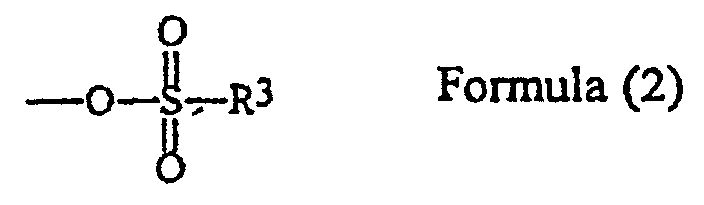 wherein R3 is F, Cl, Br, I, alkanyl, alkenyl, alkynyl, aryl, arylalkanyl,
arylalkenyl, arylalkynyl, haloalkanyl, haloalkenyl, haloalkynyl, haloaryl,
haloarylalkanyl, haloarylalkenyl, haloarylalkynyl, arylhaloalkanyl,
arylhaloalkenyl, arylhaloalkynyl or a group of formula CR4, wherein R4
is F3, Cl3, Br3 or I3;
wherein R3 is F, Cl, Br, I, alkanyl, alkenyl, alkynyl, aryl, arylalkanyl,
arylalkenyl, arylalkynyl, haloalkanyl, haloalkenyl, haloalkynyl, haloaryl,
haloarylalkanyl, haloarylalkenyl, haloarylalkynyl, arylhaloalkanyl,
arylhaloalkenyl, arylhaloalkynyl or a group of formula CR4, wherein R4
is F3, Cl3, Br3 or I3; - iv) n is 1, 2 or 3.
-
- The reaction performed during the process and activated by the compound of Formula (I) can be exemplified by below reaction scheme (b) illustrating the phosphitylation of thymidine using trimethylchlorosilane as catalyst:
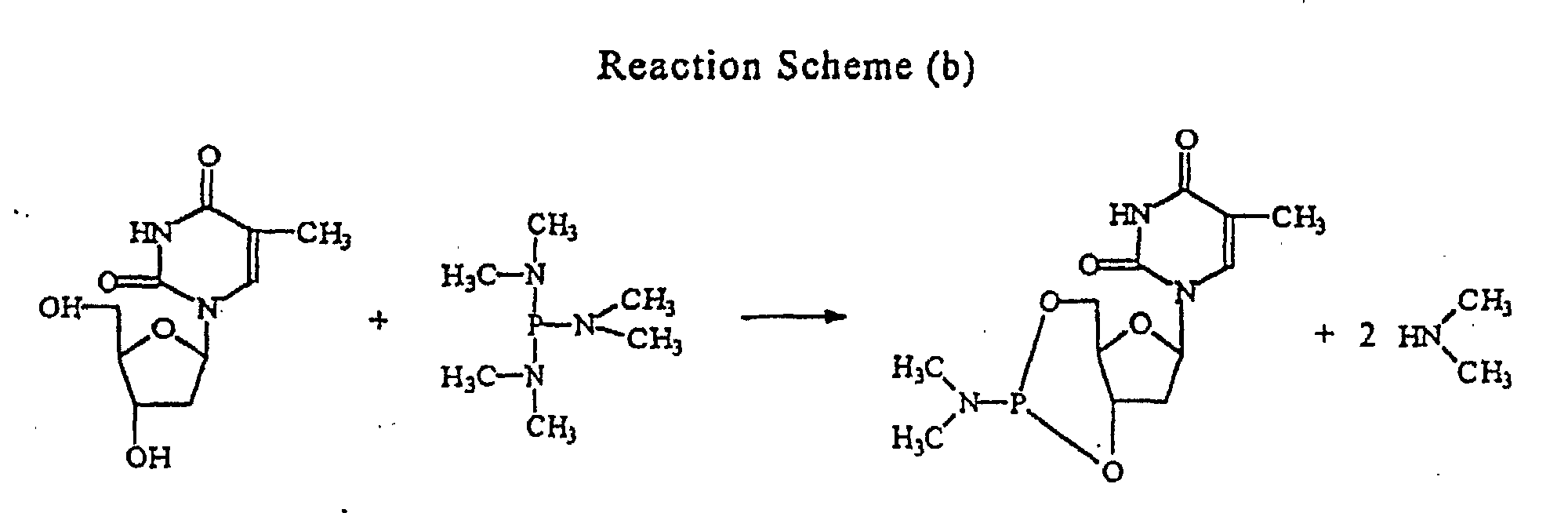
- Activation by a catalyst in accordance with the present invention requires normally one equivalent or less. The reaction is fast, often 30 minutes to 2 hours at 20°C, and free of side products. The yield is excellent, in most cases 95-100%, and the resulting products are essentially pure requiring no further purification.
- In preferred embodiments of the invention is each R1 individually methyl, ethyl, butyl, propyl, pentyl, hexyl, heptyl, octyl, nonyl, decyl, methylethyl, methylbutyl, methylisobutyl, methylpropyl, methylisopropyl, methyloctyl methylphenyl, methyltrityl, allylmethyl, allylethyl, ethylbutyl, ethylisobutyl, ethylpropyl, ethylisopropyl, butylphenyl, butylmethoxyphenyl, ethoxy, propoxy, butoxy, ethoxymethyl, ethoxyethyl, thexylmethyl, phenyl, benzyl, xylyl, thexyl, thexylethyl, methyltrityl, butylmethylene, butylphenoxymethyl, methoxymethyl, vinyl, vinylmethyl, vinylethyl, vinylethoxy, cyanomethyl, cyanoethyl, halomethyl, haloethyl, halobutyl, halopropyl, halopentyl, halohexyl, haloheptyl, haloctyl, halononyl, halodecyl, halophenyl, halobenzyl, haloxylyl, halothexyl, methylhalohexyl, halophenylmethyl, butylhalophenylmethyl, halovinyl, vinylhalomethyl or vinylhaloethyl. At least one R1 can in these and other preferred embodiments can be a moiety derived from a carbon polymer or copolymer, such as polyethylene, a polystyrene, a polyether or a polyester, which polymer optionally is silylated and/or halogenated. X is in these and other especially preferred embodiments preferably Si.
- Employed catalyst is in especially preferred embodiments a trialkylhalosilane, such as a trialkylchlorosilane, trialkyliodosilane, trialkylbromosilane or trialkylfluorosilane preferably selected from the group consisting of trimethylchlorosilane, triethylchlorosilane, tributylchlorosilane, tripropylchlorosilane, trimethyliodosilane, triethyliodosilane, tributyliodosilane, tripropyliodosilane, trimethylbromosilane, triethylbromosilane, tributylbromosilane, tripropylbromosilane, trimethylfluorosilane, triethylfluorosilane, tributylfluorosilane, tripropylfluorosilane.
- Further compounds, advantageously being used as catalysts in accordance with the present invention, of Formula (I) wherein X is Si are suitably exemplified by trimethylchlorosilane, trimethylbromosilane, trimethyliodosilane, trimethylsilyltrichloroacetate, trimethylsilyltrifluoroacetate, allyldimethylchlorosilane, bromomethyldimethylchlorosilane, tert-butyldimethylchlorosilane, N-tert.-butyldimethylsilyl-N-methyltrifluoroacetamide, N,O-bis(trimethylsilyl)trifluoroacetamide, N-methyl-N-trimethylsilyl-heptafluorobutyramide, N-methyl-N-trimethylsilyltrifluoroacetamide, trimethylsilyltrifluoromethanesulphonate, tert-butyldimethylsilyltrifluoromethanesulphonate, tert-butyldiphenylchiorosilane, tert-butyl-methoxy-phenylbromosilane, chloromethyldimethylchlorosilane, dimethyl-(3,3,4,4,5,5,6,6,6-nonafluorohexyl)chlorosilane, dimethylphenylchlorosilane, dimethyltritylbromosilane, diphenylmethylchlorosilane, isopropyldimethylchlorosilane, (pentafluorophenyl)dimethylchlorosilane, thexyldimethylchlorosilane, thexyldimethylsilyl trifluoromethanesulphonate, tributylchlorosilane, triethylchlorosilane, trithylsilyltrifluoromethanesulphonate, triisopropylchlorosilane, triisopropylsilyltrifluoromethanesulphonate, triphenylchlorosilane, tripropylchlorosilane, di-tert-butyldichlorosilane, di-tert-butylsilyl bis(trifluoromethanesulphonate), diethyldichlorosilane, diisopropylsilyl-bis(trifluoromethanesulphonate), dimethyldichlorosilane, diphenyldichlorosilane, methylphenyldichlorosilane, dimethyloctylchlorosilane, dodecyltrichlorosilane, thexyldimethylsilyl-trifluoromethanesulphonate, thexyl-dimethylchlorosilane, trichlorosilan, 3-(triethylsilyl)propyl-trimethylammoniumchloride, trimethylsilylbromoacetate, trimethylsilylchlorosulphonate, 2-(trimethylsilyl)ethoxymethyl chloride, tri(dimethylamino)sulphonium-difluorotrimethylsilicate and 1,3-bis(chloromethyl)-1,1,3,3-tetramethyldisilazane.
- One or more solvents are suitably present during the process of the present invention. The solvent is preferably selected from the group consisting of aliphatic solvents, cycloaliphatic solvents, aromatic solvents, 1,3-dioxanes, 1,3-dixolanes, 1,3,5-trioxepanes, furans and/or haloalkanes, such as hexane, toluene, xylene, tetrahydrofuran, dichloromethane and acetonitrile.
- The process of the invention and the catalyst used therein are suitable for phosphorylation, in particular phosphitylation, of hydroxyfunctional compounds such as mono, di, tri and polyfunctional alcohols, monosaccharides, disaccharides, polysaccharides, sugar alcohols, cyclodextrins, inositols, nucleosides, terpenoids, lipids, phenols, polyphenols, hydroxyfuncrional polymers, hydroxyfunctional carboxylic acids and/or derivatives of said hydroxyfunctional compounds. The hydroxyfunctional compound is advantageously selected from the group consisting of
- a) pentoses, hexoses and heptoses such as D/L-ribose, D/L-arabinose, D/L-xylose, D/L-lyxose, D/L-allose, D/L-altrose. D/L-glucose, D.'L-mannose. D/L-gulose, D/L-idose, D/L-galactose, D/L-talose, D/L-glucoheptose. D/L-mannoheptose, D/L-ribulose, D/L-xylulose, D/L-psicose, D/L-fructose, D/L-sorbose, D/L-tagatose, D/L-sedoheptulose and/or derivatives of said pentoses, hexoses and heptoses,
- b) pentitols, hexitols and heptitols such as D/L-ribitol, D/L-arabinitol, D/L-xylitol, D/L-lyxitol, D/L-allitol, D/L-altritol, D/L-glucitol, D/L-mannitol, D/L-gulitol, D/L-iditol, D/L-galactitol, D/L-talitol, D/L-glucoheptitol, D/L-mannoheptitol, D/L-ribulitol, D/L-xylulitol, D/L-psicitol, D/L-fructitol, D/L-tagatitol, D/L-sedoheptulitol and derivatives of said pentitols, hexitols and heptitols,
- c) anhydropentitols, anhydrohexitols, anhydroheptitols and derivatives thereof,
- d) cellobiose, maltose, lactose, saccharose, gentobiose, melibiose, trehalose, turanose and derivatives thereof,
- e) starch, glycogen, cellulose, dextran, tunicine and/or derivatives thereof, and
- f) myo-inositol, cis-inositol, epi-inositol, allo-inositol, neo-inositol, muco-inositol, D/L-chiro-inositol, scyllo-inositol and derivatives of said inositols,
- g) 5-ethyl-5-methanol-1,3-dioxane, 2-ethyl-2-butyl-1,3-propanediol, neopentyl glycol, glycerol, trimethylolpropane, trimethylolethane, pentaerythritol, diglycerol, ditrimethylolpropane, ditrimethylolethane, dipentaerythritol, tripentaerythritol and derivatives thereof,
- h) 2,2-dimethylolpropionic acid, α,α-bis-(hydroxymethyl)butyric acid, α,α,α-tris(hydroxymethyl)acetic acid, α,α-bis-(hydroxymethyl)valeric acid, α,α-bis(hydroxy)propionic acid, 3,5-dihydroxybenzoic acid, α,β-dihydroxypropionic acid, heptonic acid, citric acid, tartaric acid, dihydroxymaloic acid, gluconic acid and derivatives thereof.
-
- The hydroxyfunctional compound can also suitably be a dendritic or hyperbranched macromolecule. Hyperbranched and dendritic macromolecules normally consist of an initiator or nucleus having one or more reactive sites and a number of surrounding branching layers optionally being chain terminated. The layers are usually called generations, whereby each generation comprises one or more branches, usually called dendrons. A macromolecule suitable for a phosphitylation according to the present invention can be composed of a monomeric or polymeric nucleus to which 1-100, preferably 1-20, generations consisting of at least one monomeric or polymeric chain extender are added. The chain extender has at least one, preferably at least two, reactive hydroxyl groups and at least one reactive carboxyl group. The terminal functions of yielded macromolecule is, prior to the optional chain termination, substantially hydroxyl groups. An optional chain termination is performed in such a manner and to such a degree that the macromolecule finally has at least one terminal hydroxyl group. The nucleus may be a compound, such as an alcohol, a polyalcohol, a glycidyl ester, a glycidyl ether or the like having at least one reactive hydroxyl or epoxide group. In further embodiments, the nucleus may be a metal ion or an organometallic compound being hydroxy and/or epoxide functional or the like.
- Hyperbranched and dendritic macromolecules (dendrimers) can generally be described as three dimensional highly branched molecules having a tree-like structure. Dendrimers are highly symmetric, while similar macromolecules designated as hyperbranched may to a certain degree hold an asymmetry, yet maintaining the highly branched tree-like structure. Dendrimers can be said to be monodisperse variations of hyperbranched macromolecules. The composition of hyperbranched dendritic or near dendritic macromolecule can be illustrated by below simplified Formula (3.1) and (3.2) illustration a hyperbranched macromolecule (Formula 3.1) and a dendron (Formula 3.2) being part of the macromolecule. Regard is not taken to any three dimensional structure. The macromolecule has two generations of chain extenders (A and B) having 3 and 4 reactive sites. The reactive sites are one carboxyl group, reacted with the nucleus (Y), and hydroxyl groups. The macromolecule is partly chain terminated by means of a chain terminator (T). The nucleus or initiator (Y) is as previously defined.
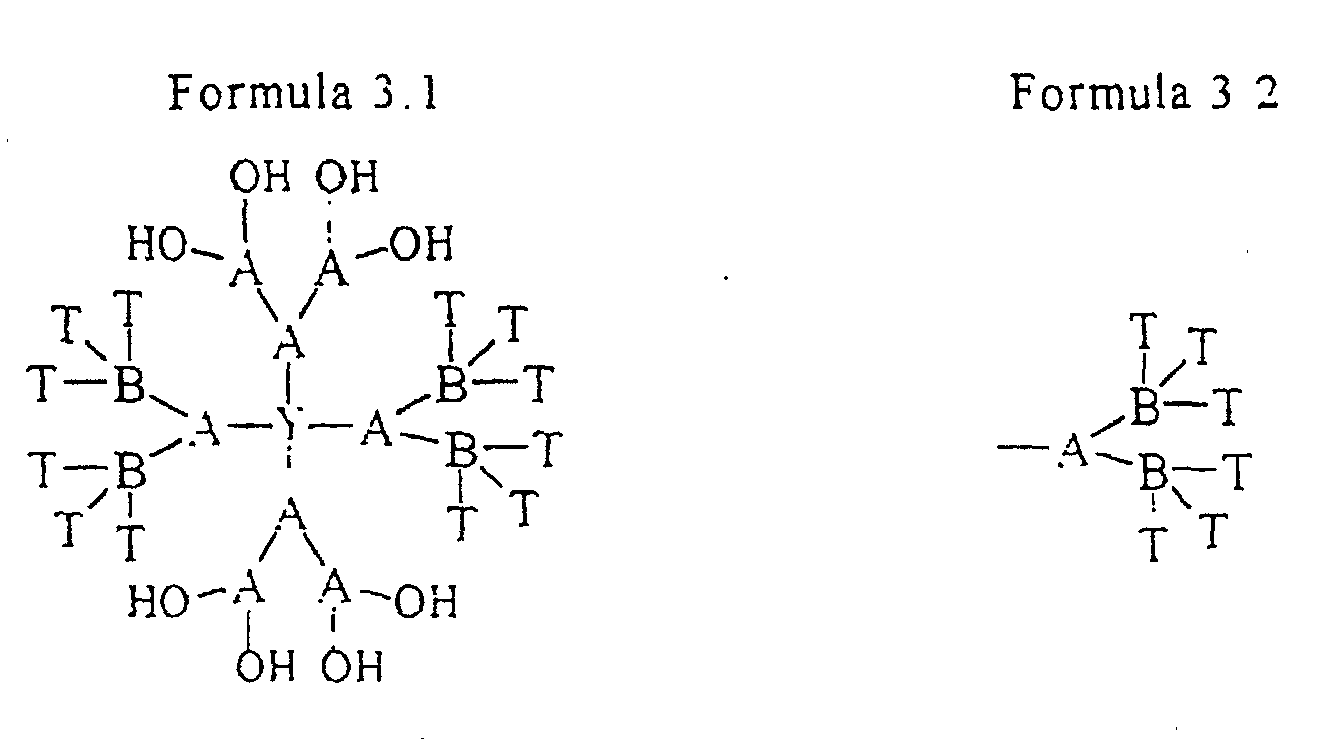
- The hydroxyfunctional compound can, furthermore, be a dendron of for instance general formula (4) R12(OOR13)q(OOR14),(OOR15)z, wherein each R12, R13, R14 and R15 independently is alkanyl, alkenyl, alkynyl, cycloalkanyl, cycloalkenyl, cycloalkynyl, aryl, alkanylaryl, alkenylaryl or alkynylaryl, q is an integer and at least 1, y is 0 or an integer and wherein z is an integer between 1 and 25, preferably between 1 and 10. A suitable dendron can be exemplified by self condensated 2,2-dimethylolpropionic acid, whereby a suitable number of moles of said compound is condensated (esterified) at a temperature of for instance 150-250°C. 2,2-Dimethylolpropionic acid has two hydroxyl groups and one carboxyl group and one molecule of the compound can thus react with two other molecules, whereby a highly branched chain consisting of esterified 2,2-dimethylolpropionic can be prepared.
- The phosphorous compound used in the phosphorylation process is advantageously an amide of a phosphorous acid containing trivalent phosphorus, which compound is of general formula (5), (6) or (7), R5R6PNR7R8, R6P(NR7R8)2 or P(NR7R8)3, wherein each R5 and R6 independently is an alkyl, a cycloalkyl, an aryl, an alkoxy, a cycloalkoxy, an aryloxy, a thiolo or an amido group and wherein each R7 and R8 independently is an alkyl, a cycloalkyl or an aryl group. The phosphorous compound can alternatively be of general formula (8) or (9), (R9CH2O)2PNR10R11 or (NCCH2CH2O)2PNR10R11, wherein each R9 independently is aryl or alkaryl and wherein each R10 and R11 independently are C1-C12 alkyl. Said phosphorous compounds can be exemplified by neopentylene-N,N-dimethylphosphoroamidite, o-phenylene-N,N-diisopropylphosphoroamidite, di-(2-cyanoethyl)-N,N-diisopropylphosphoroamidite, 2-cyanoethyl-N,N-diisopropylfluorophosporoamidite, dibenzyl-N,N-diethylphosphoroamidite and hexamethylphosphorotriamide.
- A phosphitylation process according to the present invention is preferably performed at a temperature of -80°C to 120°C, such as -10°C to 80°C or 0°C to 40°C, using a catalyst amount corresponding to 0 01 to 3, preferably 0.05 to 1 and most preferably 0 1 to 0.5, equivalents calculated on phosphorous equivalents The amount of catalyst is normally between 5% and 80% A suitable and preferred order of addition is 1 the phosphorous compound or coinpounas. 2 the hydroxyfunctional compound or compounds and 3 , the catalyst or catalysts
- The phosphorylated, in particular phosphitylated, reaction product obtained in the process and by using the catalyst of the present invention can optionally be further processed. Trivalent phosphorus included in the reaction product can for example be oxidised to pentavalent phosphorus using an oxidising agent, such as a peroxide, a hydroperoxide, a peracid, or by means of sulphur transferring reagents including elemental sulphur. Phosphites can thus be transformed into phosphates yielding for instance pharmaceutically active and important trisphosphates of monosaccharides and inositols. Furthermore, β-cyanoalkyl groups included in the phosphorylated product can be eliminated in the presence of a base, such as potassium hydroxide, sodium hydroxide or an amine and benzyl groups by means of a hydrogenolysis.
- The present invention makes it possible to employ simple phosphitylation reagents of for instance formula (8) or (9) for phosphitylation of 3'-protected nucleosides, 5'-protected nucleosides and other alcoholic compounds of biological importance, such as sugars, terpenoids and lipids Oxidisation of phosphites to phosphates, optional removal of β-cyanoalkyl and benzyl groups, result in a phosphate yield of normally more than 90%.
- Further application areas of the process of present invention and catalyst used therein are
- preparation of oligomeric and polymeric dendrons from polyols by a suitable choice of phosphitylation reagent,
- preparation of antioxidants containing a nucleus of trivalent phosphorus,
- preparation of intermediates containing trivalent phosphorus, which can be converted into tetravalent or pentavalent structures resulting in important biophosphates and their structural analogues as well as material improving components, such as plasticisers and flame retardants,
- preparation of olefinic monomers containing trivalent and pentavalent phosphorus, which monomers when heated in the presence of for instance benzoyl peroxide give flame retardant solids, and
- preparation of detergents
- These and other objects and the attendant advantages will be more fully understood from the following detailed description, taken in conjunction with embodiment Examples 1-11, whereby said Examples present:
- Example 1:
- Phosphitylation of uridine- Comparison between (i) no catalyst, (ii) tetrazole and (iii) catalyst according to the present invention.
- Example 2:
- Synthesis of ethyl neopentylene phosphite
- Example 3.
- Synthesis of ethyl o-phenylene phosphite
- Example 4:
- Synthesis of thymidine cyclic 3',5'-N,N-dimethylphosphoroamidite
- Example 5:
- Synthesis of (±) 2,3,6-tri-O-benzyl-myo-inositol-1,4,5-tris[di-(2-cyanoethyl) phosphite].
- Example 6:
- Synthesis of α-methyl-6-O-acetyl-D-mannopyranoside-2,3,4-tris-(dibenzyl phosphite).
- Example 7:
- Synthesis of (±) 3,4,5,6-tetra-O-benzyl-myo-inositol-1,2-bis(di-benzyl phosphite).
- Example 8:
- Synthesis of (±) 3,4,5-tri-O-benzyl-myo-inositol-1,2,6-O-tris(di-benzyl phosphite).
- Example 9:
- Synthesis of (±) 3,4,5,6-tetra-O-benzyl-myo-inositol-1,2-bis(2-cyanoethyl fluorophosphite).
- Example 10.
- Oxidisation the phosphite of Example 6 yielding corresponding phosphate.
- Example 11:
- Elimination of benzyl groups in included in the phosphate of Example 10.
- Phosphitylation of thymidine according to the following reaction schemewas repeatedly performed using

- i) no catalyst, dioxane as solvent and 80°C as reaction temperature.
- ii) a 6 fold excess of tetrazole (calculated on P) as catalyst. dioxane as solvent and 80°C as reaction temperature,
- iii) 0.25 equivalent of trimethylchlorosilane (calculated on P) as catalyst, dioxane as solvent and 20°C as reaction temperature, giving the following average yield of cyclic amidite
- i) ≈20% after 8 hours of reaction,
- ii) 25-30% after 6 hours of reaction
- iii) >95% after 2 hours of reaction,
-
- Above result clearly shows the great advantages obtained when using a phosphitylation process according to the present invention, such as a substantially
- increased yield,
- reduced amount of catalyst,
- reduced reaction temperature and time,
- reduced cost, and
- improved environmental and handling safety.
- 34.5 g (0.2 mole) of neopentylene-N,N-dimethylphosphoroamidite, 9 7 g (0.21 mole) of ethanol and 150 ml sodium dried tetrahydrofuran were charged in a 4-necked reaction flask equipped with a stirrer, a thermometer, an instillation funnel and an inlet for inert gas. The mixture was stirred and allowed to form a solution to which 5.4 g (0.05 mole) trimethylchlorosilane was instilled at such a rate that the temperature never exceeded 20°C. Stirring was maintained during the instillation and cooling of the reaction flask was applied if necessary. The reaction mixture was stirred and kept at 20°C for a further 30 minutes Solvent, excess of ethanol and unchanged trimethylchlorosilane were now removed in vacuo. The residue was vacuum distilled to give 30 4 g of ethyl neopentylene phosphite Yield 85%, Bp15 77-78°C. nD 20, 1.4437.
- All operations were, in order to secure a high yield and product purity, performed under a blanket of nitrogen free of oxygen and moisture
- 47 8 g (0.2 mole) of o-phenylene-N,N-diisopropylphosphoroamidite, 9.7 g (0.21 mole) of ethanol and 150 ml sodium dried tetrahydrofuran were charged in a 4-necked reaction flask equipped with a stirrer, a thermometer, an instillation funnel and an inlet for inert gas. The mixture was stirred and allowed to form a solution to which 5 4 g (0.05 mole) trimethylchlorosilane was instilled at such a rate that the temperature never exceeded 20°C. Stirring was maintained during the instillation and cooling of the reaction flask was applied if necessary. The reaction mixture was stirred and kept at 20°C for a further 30 minutes Solvent, excess of ethanol and unchanged trimethylchlorosilane were now removed in vacuo and 35.0 g of ethyl o-phenylene phosphite. Analysis indicated that obtained product had a purity of at least 96% Yield 95%; 31P NMR δ: -129 ppm (neat); nD 20: -1 4437.
- All operations were, in order to secure a high yield and product purity, performed under a blanket of nitrogen free of oxygen and moisture.
- 20 ml of sodium dried tetrahydrofuran was charged in a 50 ml flask (dried at 300°C) equipped with a magnetic stirrer and filled with dry oxygen free argon. The flask was covered with a rubber septum and 0.134 (0.83 mmole) of hexamethylphosphorotriamide and 0.076 g (0.83 mmole) of trimethylchlorosilane were added at 20°C and stirred. 0.2 g (0.83 mmole) of thymidine was after 5 minutes of stirring added at 20°C and the reaction mixture was stirred at 20°C for a further 60 minutes. Solvent and catalyst were now evaporated in vacuo and 0.3 g (yield 98%) of crude thymidine cyclic 3',5'-dimethylphosphoroamidite was obtained The crude product was dissolved in 5 ml of CH2Cl2 and purified by column chromatography on silica gel using CH2Cl2/CH3COCH3 10·3 as eluent. The purification resulted in 0 28 g of pure thymidine cyclic 3',5'-dimethylphosphoroamidite Yield 95%; 31P NMR (C6D6) δ. 138.27, 137 91.
- 20 ml of sodium dried tetrahydrofuran was charged in a 50 ml flask (dried at 300°C) equipped with a magnetic stirrer and filled with dry oxygen free argon. The flask was covered with a rubber septum and 3 mmole of di-(2-cyanoethyl)-N,N-diisopropylphosphoroamidite and 3 mmole of trimethylchlorosilane were added at 20°C and stirred. A solution of 1 mmole of (±) 1,2,4-tri-O-benzyl-myo-inositol in 10 ml of sodium dried tetrahydrofuran was after 5 minutes of stirring added at 20°C and the reaction mixture was stirred at 20°C for a further 2 hours. Solvent and catalyst were now evaporated in vacuo, yielding crude (±) 2,3,6-tri-O-benzyl-myo-inositol-1,4,5-tris[di-(2-cyanoethyl)phosphite) Yield 95%; 31P NMR (CDCl3) δ: 139.6; 137.91, P-1, 140.2, 141. 0, P-4, (5JPP =3.4 Hz).
- 20 ml of sodium dried tetrahydrofuran was charged in a 50 ml flask (dried at 300°C) equipped with a magnetic stirrer and filled with dry oxygen free argon. The flask was covered with a rubber septum and 3 mmole of dibenzyl-N,N-diethylphosphoroamidite and 0.05 mmole of trimethylchlorosilane were added at 20°C and stirred A solution of 1 mmole of α-methyl-6-O-acetyl-D-mannopyranoside in 10 ml of sodium dried tetrahydrofuran was after 5 minutes of stirring added at 20°C and the reaction mixture was stirred at 20°C for a further 2 hours. Solvent and catalyst were now evaporated in vacuo The residue was purified by column chromatography on silica gel 60 (230-400 mesh) using hexane/dietylether as eluent. The purification resulted in 0.87 g of pure α-methyl-6-O-acetyl-D-mannopyranoside-2,3,4-tris(dibenzylphosphite) Yield 89%; 31P NMR (C6D6) δ: 140.3, 141.6 (2P)
- 20 ml of sodium dried tetrahydrofuran was charged in a 50 ml flask (dried at 300°C) equipped with a magnetic stirrer and filled with dry oxygen free argon. The flask was covered with a rubber septum and 2 mmole of dibenzyl-N,N-diethylphosphoroamidite and 2 mmole of trimethylchlorosilane were added at 20°C and stirred A solution of 1 mmole of (±) 3,4,5,6-tetra-O-benzyl-myo-inositol in 10 ml of sodium dried tetrahydrofuran was after 5 minutes of stirring added at 20°C and the reaction mixture was stirred at 20°C for a further 2 hours. Solvent and catalyst were now evaporated in vacuo. The residue was purified by column chromatography on silica gel 60 (230-400 mesh) using hexane/diethylether 8·1 as eluent The purification resulted in 0.82 g of pure (±) 3,4,5,6-tetra-O-benzyl-myo-inositol-1,2-bis(dibenzylphosphite): Yield 80%, 31P NMR (C6D6) δ. 140.5 (d, J=1.8Hz), 140 6 (d, J=1:8 Hz).
- 20 ml of sodium dried tetrahydrofuran was charged in a 50 ml flask (dried at 300°C) equipped with a magnetic stirrer and filled with dry oxygen free argon The flask was covered with a rubber septum and 3 mmole of dibenzyl-N,N-diethylphosphoroamidite and 3 mmole of trimethylchlorosilane were added at 20°C and stirred. A solution of 1 mmole of (±) 3,4,5-tri-O-benzyl-myo-inositol in 10 ml of sodium dried tetrahydrofuran was after 5 minutes of stirring added at 20°C and the reaction mixture was stirred at 20°C for a further 2 hours. Solvent and catalyst were now evaporated in vacuo. The residue was purified by column chromatography on silica gel 60 (230-400 mesh) using hexane/diethylether 5:1 as eluent. The purification resulted in 1.2 g of pure (±) 3,4,5-tri-O-benzyl-myo-inositol-1,2,6-tris(dibenzylphosphite): Yield 100%; 31P NMR (C6D6) δ: 140.2 (d, JP1P2 2.1 Hz), 140.8 (dd, JP1P2 2.1 Hz, JP1P6 3.9 Hz, P-1), 143.2 (d, JP1P6 3.9 Hz, P-6).
- 20 ml of sodium dried tetrahydrofuran was charged in a 50 ml flask (dried at 300°C) equipped with a magnetic stirrer and filled with dry oxygen free argon. The flask was covered with a rubber septum and 0.86 mmole of 2-cyanoethyl-N,N-diisopropylfluorophosphoroamidite and 0.86 mmole of trimethylchlorosilane were added at 20°C and stirred. A solution of 0 4 mmole of (±) 3,4,5,6-tetra-O-benzyl-myo-inositol in 10 mi of sodium dried tetrahydrofuran was after 5 minutes of stirring added at 20°C and the reaction mixture was stirred at 20°C for a further 2 hours. Solvent and catalyst were now evaporated in vacuo The residue was purified by column chromatography on silica gel 60 (230-400 mesh) using CH2Cl2/CH3COCH3 10:3 as eluent. The purification resulted in 0.23 g of pure (±) 3,4,5,6-tetra-O-benzyl-myo-inositol-1,2-bis(2-cyanoethylphosphite): Yield 80%; 31P NMR (CDCl3) δ: 138.6 m, 123.6 m.
- 0.50 g of α-methyl-6-O-acetyl-D-mannopyranoside-2,3,4-tris(dibenzylphosphite), obtained in Example 6, was dissolved in 20 ml of dichloromethane. 0.97 g of m-chloroperbenzoic acid in 20 ml of dichloromethane was now instilled during 1 hour. The temperature was adjusted to 20°C and maintained for a further 1.5 hour followed by an evaporation of the solvent. The residue was by NMR identified to be a-methyl-6-O-acetyl-D-mannopyranoside-2,3,4-tris(dibenzylphosphate).
- 0.35 g of a-methyl-6-O-acetyl-D-mannopyranoside-2,3,4-tris(dibenzylphosphate), obtained in Example 10, was dissolved in 5 ml of ethanol and hydrogenated for 10 minutes at 1 bar and 20°C over 0.10 g of 5% Pd/C. The mixture was evaporated and the residue was by NMR identified to be α-methyl-6-O-acetyl-D-mannopyranoside-2,3,4-trisphosphate.
Claims (40)
- A process for phosphorylation, in particular phosphitylation, of hydroxyl groups, whereby a phosphorous compound is added to a hydroxyfunctional compound having at least one hydroxyl group, which addition yields a phosphorous reaction product having at least one O-P bond
characterised in, that
said phosphorylation is performed in the presence of at least one catalyst of general formula (R1)nX(R2)4-n, whereini) each R1 independently isa) hydrogen,b) alkanyl, alkenyl, alkynyl, cycloalkanyl, cycloalkenyl, cycloalkynyl, aryl, alkanylaryl, alkenylaryl, alkynylaryl, trityl, alkoxy, cycloalkoxy, aryloxy or amino group,c) a polymeric moiety derived from a carbon polymer or copolymer,d) halogenated and/or silylated alkanyl, alkenyl, alkynyl, cycloalkanyl, cycloalkenyl, cycloalkynyl, aryl, alkanylaryl, alkenylaryl, alkynylaryl, trityl, alkoxy, cycloalkoxy, aryloxy or amino group, ore) a polymeric moiety derived from a halogenated and/or silylated carbon polymer or copolymer;ii) X is Si or Ge;iii) each R2 independently is a leavening group and isa) F, Cl, Br or I; orb) a sulphonate group of formulawherein R3 is F, Cl, Br, I, alkanyl, alkenyl, alkynyl, aryl, arylalkanyl, arylalkenyl, arylalkynyl, haloalkanyl, haloalkenyl. haloalkynyl, haloaryl, haloarylalkanyl, haloarylalkenyl, haloarylalkynyl, arylhaloalkanyl, arylhaloalkenyl, arylhaloalkynyl or a group of formula CR4, wherein R4 is F3, Cl3, Br3 or I3; and iv) n is 1, 2 or 3.
 - A process according to claim 1
characterised in, that
each R1 individually is methyl, ethyl, butyl, propyl, pentyl, hexyl, heptyl, octyl, nonyl, decyl, methylethyl, methylbutyl, methylisobutyl, methylpropyl, methylisopropyl, methyloctyl methylphenyl, methyltrityl, allylmethyl, allylethyl, ethylbutyl, ethylisobutyl, ethylpropyl, ethylisopropyl, butylphenyl, butylmethoxyphenyl, ethoxy, propoxy, butoxy, ethoxymethyl, ethoxyethyl, t-hexylmethyl, phenyl, benzyl, xylyl, t-hexyl, t-hexylethyl, methyltrityl, butylmethylene, butylphenoxymethyl, methoxymethyl, vinyl, vinylmethyl, vinylethyl, vinylethoxy, cyanomethyl, cyanoethyl, halomethyl, haloethyl, halobutyl, halopropyl, halopentyl, halohexyl, haloheptyl, haloctyl, halononyl, halodecyl, halophenyl, halobenzyl, haloxylyl, halot-hexyl, methylhalohexyl, halophenylmethyl, butylhalophenylmethyl, halovinyl, vinylhalomethyl or vinylhaloethyl. - A process according to claim 1 or 2
characterised in, that
at least one R1 is a moiety derived from a polymer or copolymer, such as polyethylene, a polystyrene, a polyether or a polyester. - A process according to claim 3
characterised in, that
said polymer is silylated and/or halogenated. - A process according to any of the claims 1-4
characterised in, that
X is Si. - A process according to any of the claims 1-5
characterised in, that
the catalyst is a trialkylhalosilane. - A process according to claim 6
characterised in, that
the trialkylhalosilane is a trialkylchlorosilane, trialkyliodosilane, trialkylbromosilane or trialkylfluorosilane. - A process according to claim 6 or 7
characterised in, that
the catalyst is trimethylchlorosilane, triethylchlorosilane, tributylchlorosilane, tripropylchlorosilane, trimethyliodosilane, triethyliodosilane, tributyliodosilane, tripropyliodosilane, trimethylbromosilane, triethylbromosilane, tributylbromosilane, tripropylbromosilane, trimethylfluorosilane, triethylfluorosilane, tributylfluorosilane, tripropylfluorosilane. - A process according to any of the claims 1-8
characterised in, that
at least one solvent is present during said phosphitylation. - A process according to claim 9
characterised in, that
the solvent is an aliphatic solvent, a cycloaliphatic solvent, an aromatic solvent, a 1,3-dioxane, a 1,3-dixolane, a 1,3,5-trioxepane, a furan and/or a haloalkane. - A process according to claims 10
characterised in, that
the solvent is hexane, toluene, xylene, tetrahydrofuran, dichloromethane or acetonitrile. - A process according to any of the claims 1-11
characterised in, that
the hydroxyfunctional compound is an alcohol, a polyalcohol, a monosaccharide, a disaccharide, a polysaccharide, a sugar alcohol, a cyclodextrin, an inositol, a nucleoside, a terpenoid, a lipid, a phenol, a polyphenol, a hydroxyfunctional dendritic or hyperbranched macromolecule, a hydroxyfunctional polymer, a hydroxyfunctional carboxylic acid and/or a derivative of said hydroxyfunctional compounds. - A process according to claim 12
characterised in, that
the hydroxyfunctional compound is a pentose, a hexose or a heptose selected from the group consisting of D/L-ribose, D/L-arabinose, D/L-xylose, D/L-lyxose, D/L-allose, D/L-altrose, D/L-glucose, D/L-mannose, D/L-gulose, D/L-idose, D/L-galactose, D/L-talose, D/L-glucoheptose, D/L-mannoheptose, D/L-ribulose, D/L-xylulose, D/L-psicose, D/L-fructose, D/L-sorbose, D/L-tagatose, D/L-sedoheptulose and/or a derivative of said pentoses, hexoses or heptoses. - A process according to claim 12
characterised in, that
the hydroxyfunctional compound is a pentitol, a hexitol or a heptitol selected from the group consisting of D/L-ribitol, D/L-arabinitol, D/L-xylitol, D/L-lyxitol, D/L-allitol, D/L-altritol, D/L-glucitol, D/L-mannitol, D/L-gulitol, D/L-iditol, D/L-galactitol, D/L-talitol, D/L-glucoheptitol, D/L-mannoheptitol, D/L-ribulitol, D/L-xylulitol, D/L-psicitol, D/L-fructitol, D/L-tagatitol, D/L-sedohaptulitol and/or a derivative of said pentitols, hexitols or heptitols. - A process according to claims 14
characterised in, that
said pentitols, hexitols and heptitols are anhydropentitols, anhydrohexitols, anhydroheptitols and/or derivatives thereof. - A process according to claim 12
characterised in, that
the hydroxyfunctional compound is an inositol selected from the group consisting of myo-inositol, cis-inositol, epi-inositol, allo-inositol, neo-inositol, muco-inositol, D/L-chiro-inositol, scyllo-inositol and/or a derivative of any of said inositols. - A process according to claim 12
characterised in, that
the hydroxyfunctional compound is a mono, di, tri or polyfunctional alcohol, preferably selected from the group consisting of 5-ethyl-5-methanol-1,3-dioxane, 2-ethyl-2-butyl-1,3-propanediol, neopentyl glycol, glycerol, trimethylolpropane, trimethylolethane, pentaerythritol, diglycerol, ditrimethylolpropane, ditrimethylolethane, dipentaerythritol or tripentaerythritol. - A process according to claim 12
characterised in, that
the hydroxyfunctional compound is a hydroxyfunctional acid, such as 2,2-dimethylolpropionic acid, 3,5-dihydroxybenzoic acid, heptonic acid or citric acid. - A process according to claim 12
characterised in, that
the hydroxyfunctional compound is a dendritic or hyperbranched macromolecule composed of a monomeric or polymeric nucleus. to which 1-100, preferably 1-20, generations of at least one monomeric or polymeric chain extender having at least one, preferably at least two, reactive hydroxyl groups and at least one reactive carboxyl group are added and that terminal functions of said macromolecule substantially are hydroxyl groups. - A process according to claim 19
characterised in, that
the hyperbranched or dendritic macromolecule is partly chain terminated and that said macromolecule has at least one terminal function being a hydroxyl group. - A process according to claim 12
characterised in, that
the hydroxyfunctional compound is a dendron of general formula R12(OOR13)q(OOR14)y(OOR15)z, wherein each R12, R13, R14 and R15 independently is alkanyl, alkenyl, alkynyl, cycloalkanyl, cycloalkenyl, cycloalkynyl, aryl, alkanylaryl, alkenylaryl or alkynylaryl, q is an integer and at least 1, y is 0 or an integer and wherein z is an integer between 1 and 25, preferably between 1 and 10. - A process according to any of the claims 1-21
characterised in, that
the phosphorous compound is an amide of a phosphorous acid containing trivalent phosphorus, which compound is of general formula R5R6PNR7R8, R6P(NR7R8)2 or P(NR7R8)3, wherein each R5 and R6 independently is an alkyl, a cycloalkyl, an aryl, an alkoxy, a cycloalkoxy, an aryloxy, a thiolo or an amido group and wherein each R7 and R8 independently is an alkyl, a cycloalkyl or an aryl group. - A process according to any of the claims 1-21
characterised in, that
the phosphorous compound is of general formula (R9CH2O)2PNR10R11 or (NCCH2CH2O)2PNR10R11, wherein each R9 independently is aryl or alkaryl and wherein each R10 and R11 independently are C1-C12 alkyl. - A process according to claim 22 or 23 characterised in, that
the phosphorous compound is selected from the group consisting of neopentylene-N,N-dimethylphosphoroamidite, o-phenylene-N,N-diisopropylphosphoroamidite, di-(2-cyanoethyl)-N,N-diisopropylphosphoroamidite, 2-cyanoethyl-N,N-diisopropylfluorophosporoamidite, dibenzyl-N,N-diethylphosphoroamidite and hexamethylphosphorotriamide. - A process according to any of the claims 1-24
characterised in, that
said process is performed at a temperature of -80°C to 120°C, preferably -10°C to 80°C and most preferably 0°C to 40°C. - A process according to any of the claims 1-25
characterised in, that
the catalyst is present in an amount corresponding to 0.01 to 3, preferably 0.05 to 1 and most preferably 0.1 to 0.5, equivalents calculated on phosphorous equivalents. - A process according to any of the claims 1-26
characterised in, that
elimination of β-cyanoalkyl groups included in yielded phosphorous reaction product is performed in presence of a base, such as potassium hydroxide, sodium hydroxide or an amine - A process according to any of the claims 1-27
characterised in, that
elimination of any benzyl group or groups included in yielded phosphorous reaction product is performed by means of a hydrogenolysis. - A process according to any of the claims 1-28
characterised in, that
said process is a phosphitylation yielding a phosphite. - A process according to claim 29
characterised in, that
the phosphite by means of oxidisation is transformed into a phosphate. - A process according to claim 30
characterised in, that
the oxidisation is performed using at least one oxidising agents, such as a peroxide, a hydroperoxide, a peracid, or by means of a sulphur transferring reagent, such as elemental sulphur. - A process according to any of the claims 30 or 31
characterised in, that
the phosphite is a trisphosphite of a monosaccharide, or an inositol yielding corresponding trisphosphate. - Use of at least one compound of general formula (R1)nX(R2)4-n, whereinas catalyst for phosphorylation, in particular phosphitylation, of a hydroxyfunctional compound having at least one hydroxyl group, whereby a phosphorous reaction product having at least one O-P bond is yieldedi) each R1 independently isa) hydrogen,b) alkanyl, alkenyl, alkynyl, cycloalkanyl, cycloalkenyl, cycloalkynyl, aryl, alkanylaryl, alkenylaryl, alkynylaryl, trityl, alkoxy, cycloalkoxy, aryloxy or amino group,c) a polymeric moiety derived from a carbon polymer or copolymer,d) halogenated and/or silylated alkanyl, alkenyl, alkynyl, cycloalkanyl, cycloalkenyl, cycloalkynyl, aryl, alkanylaryl, alkenylaryl, alkynylaryl, trityl, alkoxy, cycloalkoxy, aryloxy or amino group, ore) a polymeric moiety derived from a halogenated and/or silylated carbon polymer or copolymer;ii) X is Si or Ge;iii) each R2 independently is a leavening group and isa) F, Cl, Br or I; orb) a sulphonate group of formulawherein R3, is F, Cl, Br, I, alkanyl, alkenyl, alkynyl, aryl, arylalkanyl, arylalkenyl, arylalkynyl, haloalkanyl, haloalkenyl, haloalkynyl, haloaryl, haloarylalkanyl, haloarylalkenyl, haloarylalkynyl, arylhaloalkanyl, arylhaloalkenyl, arylhaloalkynyl or a group of formula CR4, wherein R4 is F3, Cl3, Br3 or I3; and
 iv) n is 1, 2 or 3.
 - Use according to claim 33
characterised in, that
each R1 individually is methyl, ethyl, butyl, propyl, pentyl, hexyl, heptyl, octyl, nonyl, decyl, methylethyl, methylbutyl, methylisobutyl, methylpropyl, methylisopropyl, methyloctyl methylphenyl, methyltrityl, allylmethyl, allylethyl, ethylbutyl, ethylisobutyl, ethylpropyl, ethylisopropyl, butylphenyl, butylmethoxyphenyl, ethoxy, propoxy, butoxy, ethoxymethyl, ethoxyethyl, t-hexylmethyl, phenyl, benzyl, xylyl, t-hexyl, t-hexylethyl, methyltrityl, butylmethylene, butylphenoxymethyl, methoxymethyl, vinyl, vinylmethyl, vinylethyl, vinylethoxy, cyanomethyl, cyanoethyl, halomethyl, haloethyl, halobutyl, halopropyl, halopentyl, halohexyl, haloheptyl, haloctyl, halononyl, halodecyl, halophenyl, halobenzyl, haloxylyl, halot-hexyl, methylhalohexyl, halophenylmethyl, butylhalophenylmethyl, halovinyl, vinylhalomethyl or vinylhaloethyl. - Use according to claim 33 or 34
characterised in, that
at least one R1 is a moiety derived from a polymer or copolymer, such as polyethylene, a polystyrene, a polyether or a polyester. - Use according to claim 35
characterised in, that
said polymer is silylated and/or halogenated. - Use according to any of the claims 33-36
characterised in, that
X is Si. - Use according to any of the claims 33-37
characterised in, that
the catalyst is a trialkylhalosilane. - Use according to claim 38
characterised in, that
the trialkylhalosilane is a trialkylchlorosilane, trialkyliodosilane, trialkylbromosilane or trialkylfluorosilane. - Use according to claim 38 or 39
characterised in, that
the catalyst is trimethylchlorosilane, triethylchlorosilane, tributylchlorosilane, tripropylchlorosilane, trimethyliodosilane, triethyliodosilane, tributyliodosilane, tripropyliodosilane, trimethylbromosilane, triethylbromosilane, tributylbromosilane, tripropylbromosilane, trimethylfluorosilane, triethylfluorosilane, tributylfluorosilane, tripropylfluorosilane.
Applications Claiming Priority (3)
| Application Number | Priority Date | Filing Date | Title |
|---|---|---|---|
| SE9601016A SE9601016L (en) | 1996-03-18 | 1996-03-18 | phosphorylation |
| SE9601016 | 1996-03-18 | ||
| PCT/SE1997/000345 WO1997034853A1 (en) | 1996-03-18 | 1997-02-28 | Phosphorylation process and catalyst |
Publications (2)
| Publication Number | Publication Date |
|---|---|
| EP1021388A1 EP1021388A1 (en) | 2000-07-26 |
| EP1021388B1 true EP1021388B1 (en) | 2003-06-25 |
Family
ID=20401821
Family Applications (1)
| Application Number | Title | Priority Date | Filing Date |
|---|---|---|---|
| EP97914688A Expired - Lifetime EP1021388B1 (en) | 1996-03-18 | 1997-02-28 | Phosphorylation process and catalyst |
Country Status (8)
| Country | Link |
|---|---|
| US (1) | US6479656B1 (en) |
| EP (1) | EP1021388B1 (en) |
| JP (1) | JP4237257B2 (en) |
| AT (1) | ATE243669T1 (en) |
| AU (1) | AU2183897A (en) |
| DE (1) | DE69723118D1 (en) |
| SE (1) | SE9601016L (en) |
| WO (1) | WO1997034853A1 (en) |
Families Citing this family (2)
| Publication number | Priority date | Publication date | Assignee | Title |
|---|---|---|---|---|
| SE9601016L (en) * | 1996-03-18 | 1997-09-19 | Perstorp Ab | phosphorylation |
| EP1995323A1 (en) | 2007-05-24 | 2008-11-26 | Libragen | Method for preparing C-6 phosphorylated D-aldohexoses and C-6 phosphorylated D-aldohexose derivatives |
Family Cites Families (3)
| Publication number | Priority date | Publication date | Assignee | Title |
|---|---|---|---|---|
| US5159095A (en) * | 1991-06-07 | 1992-10-27 | Abbott Laboratories | Substituted silyl alcohols |
| US5380835A (en) * | 1991-06-07 | 1995-01-10 | Abbott Laboratories | Silyl phosphorylating reagents and methods of using them |
| SE9601016L (en) * | 1996-03-18 | 1997-09-19 | Perstorp Ab | phosphorylation |
-
1996
- 1996-03-18 SE SE9601016A patent/SE9601016L/en not_active Application Discontinuation
-
1997
- 1997-02-28 JP JP53339197A patent/JP4237257B2/en not_active Expired - Fee Related
- 1997-02-28 EP EP97914688A patent/EP1021388B1/en not_active Expired - Lifetime
- 1997-02-28 DE DE69723118T patent/DE69723118D1/en not_active Expired - Lifetime
- 1997-02-28 WO PCT/SE1997/000345 patent/WO1997034853A1/en not_active Ceased
- 1997-02-28 AT AT97914688T patent/ATE243669T1/en not_active IP Right Cessation
- 1997-02-28 AU AU21838/97A patent/AU2183897A/en not_active Abandoned
-
2000
- 2000-10-16 US US09/688,184 patent/US6479656B1/en not_active Expired - Fee Related
Also Published As
| Publication number | Publication date |
|---|---|
| ATE243669T1 (en) | 2003-07-15 |
| SE9601016L (en) | 1997-09-19 |
| DE69723118D1 (en) | 2003-07-31 |
| EP1021388A1 (en) | 2000-07-26 |
| US6479656B1 (en) | 2002-11-12 |
| SE9601016D0 (en) | 1996-03-18 |
| WO1997034853A1 (en) | 1997-09-25 |
| JP4237257B2 (en) | 2009-03-11 |
| JP2001501910A (en) | 2001-02-13 |
| AU2183897A (en) | 1997-10-10 |
Similar Documents
| Publication | Publication Date | Title |
|---|---|---|
| Kondo et al. | Glycosyl phosphites as glycosylation reagents: scope and mechanism | |
| CA2083386C (en) | Phosphorous prodrugs | |
| EP0543889A4 (en) | Incorporation of selectably clevable and/or abasic sites into oligonucleotide chains and reagents therefor | |
| Oza et al. | A mild preparation of protected phosphate esters from alcohols | |
| Elie et al. | Iodonium Ion-Mediated Mannosylations of Myo-Inositol: Synthesis of a Mycobacteria Phospholipid Fragment | |
| US6479656B1 (en) | Phosphorylation process and catalyst | |
| Van Boeckel et al. | Synthesis of phosphatidyl-α-glucosyl glycerol containing a dioleoyl phosphatidyl moiety. Application of the tetraisopropyldisiloxane-1, 3-diyl (tips) protecting group in sugar chemistry. part III | |
| Ramirez et al. | Synthesis of phosphodiesters: the cyclic enediol phosphoryl (CEP) method | |
| US3454684A (en) | Process for the manufacture of neutral polyphosphoric ester anhydrides | |
| JPH06508150A (en) | substituted silyl alcohol | |
| PENCZEK | Polymerization of cyclic esters of phosphoric acid | |
| McKenna et al. | Carbonylbisphosphonate and (diazomethylene) bisphosphonate analogues of AZT 5′-diphosphate | |
| Zamyatina et al. | The synthesis of 1-O-(2-N-stearoyl-D-erythro-sphinganinel-phosphoryl)-2-O-(α-D-mannopyranosyl-D-myo-inositol: a fragment of the naturally occurring inositol-containing glycophosphosphingolipids | |
| Tegge et al. | Syntheses of D-myo-Inositol 1, 4, 5-trisphosphate affinity ligands | |
| KR20090007558A (en) | Method and process for preparing cardiolipin | |
| Alexander et al. | Synthesis of 9-(2-phosphinomethoxyethyl) adenine and related compounds | |
| US3450798A (en) | Phosphate esters of hydroxy-carboranes | |
| Dabkowski et al. | Highly selective O-phosphitylation of amino alcohols using P III reagents containing 4-nitro and 2, 4-dinitro aryloxy leaving groups | |
| Panchal et al. | Synthesis of unsaturated phosphatidylinositol 4, 5-bisphosphate and analogues | |
| USRE38334E1 (en) | Synthesis of D-3 phosphorylated phosphoinositides and analogues | |
| Savin et al. | The synthesis of thio-and selenoanalogues of phospholipids on the basis of 2-butyl-2-hydroxymethyl-1, 3-propanediol | |
| US3103530A (en) | Pentraerythritol cyclic diphosphate | |
| WO1988007047A1 (en) | Inositol phosphate analogues | |
| Anderson et al. | Platelet-activating factor analogs. II. Synthesis of the 1-O-(4-decyloxymethylphenyl)-and 1-O-(4-decyloxyphenylmethyl) analogs | |
| Nuretdinova et al. | Isomerization of S-2-hydroxyalkyl esters of phosphorus acids |
Legal Events
| Date | Code | Title | Description |
|---|---|---|---|
| PUAI | Public reference made under article 153(3) epc to a published international application that has entered the european phase |
Free format text: ORIGINAL CODE: 0009012 |
|
| 17P | Request for examination filed |
Effective date: 19980918 |
|
| AK | Designated contracting states |
Kind code of ref document: A1 Designated state(s): AT BE CH DE DK ES FI FR GB GR IE IT LI LU MC NL PT SE |
|
| 17Q | First examination report despatched |
Effective date: 20020326 |
|
| GRAH | Despatch of communication of intention to grant a patent |
Free format text: ORIGINAL CODE: EPIDOS IGRA |
|
| GRAH | Despatch of communication of intention to grant a patent |
Free format text: ORIGINAL CODE: EPIDOS IGRA |
|
| RAP1 | Party data changed (applicant data changed or rights of an application transferred) |
Owner name: POLISH ACADEMY OF SCIENCES,CENTER OF MOLECULAR AND Owner name: BIONERIS AB, |
|
| GRAA | (expected) grant |
Free format text: ORIGINAL CODE: 0009210 |
|
| AK | Designated contracting states |
Designated state(s): AT BE CH DE DK ES FI FR GB GR IE IT LI LU MC NL PT SE |
|
| PG25 | Lapsed in a contracting state [announced via postgrant information from national office to epo] |
Ref country code: NL Free format text: LAPSE BECAUSE OF FAILURE TO SUBMIT A TRANSLATION OF THE DESCRIPTION OR TO PAY THE FEE WITHIN THE PRESCRIBED TIME-LIMIT Effective date: 20030625 Ref country code: IT Free format text: LAPSE BECAUSE OF FAILURE TO SUBMIT A TRANSLATION OF THE DESCRIPTION OR TO PAY THE FEE WITHIN THE PRESCRIBED TIME-LIMIT;WARNING: LAPSES OF ITALIAN PATENTS WITH EFFECTIVE DATE BEFORE 2007 MAY HAVE OCCURRED AT ANY TIME BEFORE 2007. THE CORRECT EFFECTIVE DATE MAY BE DIFFERENT FROM THE ONE RECORDED. Effective date: 20030625 Ref country code: FR Free format text: LAPSE BECAUSE OF FAILURE TO SUBMIT A TRANSLATION OF THE DESCRIPTION OR TO PAY THE FEE WITHIN THE PRESCRIBED TIME-LIMIT Effective date: 20030625 Ref country code: FI Free format text: LAPSE BECAUSE OF FAILURE TO SUBMIT A TRANSLATION OF THE DESCRIPTION OR TO PAY THE FEE WITHIN THE PRESCRIBED TIME-LIMIT Effective date: 20030625 Ref country code: BE Free format text: LAPSE BECAUSE OF FAILURE TO SUBMIT A TRANSLATION OF THE DESCRIPTION OR TO PAY THE FEE WITHIN THE PRESCRIBED TIME-LIMIT Effective date: 20030625 Ref country code: AT Free format text: LAPSE BECAUSE OF FAILURE TO SUBMIT A TRANSLATION OF THE DESCRIPTION OR TO PAY THE FEE WITHIN THE PRESCRIBED TIME-LIMIT Effective date: 20030625 |
|
| REG | Reference to a national code |
Ref country code: GB Ref legal event code: FG4D |
|
| REG | Reference to a national code |
Ref country code: CH Ref legal event code: EP |
|
| REG | Reference to a national code |
Ref country code: IE Ref legal event code: FG4D |
|
| REF | Corresponds to: |
Ref document number: 69723118 Country of ref document: DE Date of ref document: 20030731 Kind code of ref document: P |
|
| PG25 | Lapsed in a contracting state [announced via postgrant information from national office to epo] |
Ref country code: SE Free format text: LAPSE BECAUSE OF FAILURE TO SUBMIT A TRANSLATION OF THE DESCRIPTION OR TO PAY THE FEE WITHIN THE PRESCRIBED TIME-LIMIT Effective date: 20030925 Ref country code: PT Free format text: LAPSE BECAUSE OF FAILURE TO SUBMIT A TRANSLATION OF THE DESCRIPTION OR TO PAY THE FEE WITHIN THE PRESCRIBED TIME-LIMIT Effective date: 20030925 Ref country code: GR Free format text: LAPSE BECAUSE OF FAILURE TO SUBMIT A TRANSLATION OF THE DESCRIPTION OR TO PAY THE FEE WITHIN THE PRESCRIBED TIME-LIMIT Effective date: 20030925 Ref country code: DK Free format text: LAPSE BECAUSE OF FAILURE TO SUBMIT A TRANSLATION OF THE DESCRIPTION OR TO PAY THE FEE WITHIN THE PRESCRIBED TIME-LIMIT Effective date: 20030925 |
|
| PG25 | Lapsed in a contracting state [announced via postgrant information from national office to epo] |
Ref country code: DE Free format text: LAPSE BECAUSE OF FAILURE TO SUBMIT A TRANSLATION OF THE DESCRIPTION OR TO PAY THE FEE WITHIN THE PRESCRIBED TIME-LIMIT Effective date: 20030926 |
|
| REG | Reference to a national code |
Ref country code: CH Ref legal event code: NV Representative=s name: NOVAGRAAF INTERNATIONAL SA |
|
| NLV1 | Nl: lapsed or annulled due to failure to fulfill the requirements of art. 29p and 29m of the patents act | ||
| PG25 | Lapsed in a contracting state [announced via postgrant information from national office to epo] |
Ref country code: ES Free format text: LAPSE BECAUSE OF FAILURE TO SUBMIT A TRANSLATION OF THE DESCRIPTION OR TO PAY THE FEE WITHIN THE PRESCRIBED TIME-LIMIT Effective date: 20031222 |
|
| PG25 | Lapsed in a contracting state [announced via postgrant information from national office to epo] |
Ref country code: MC Free format text: LAPSE BECAUSE OF NON-PAYMENT OF DUE FEES Effective date: 20040228 Ref country code: LU Free format text: LAPSE BECAUSE OF NON-PAYMENT OF DUE FEES Effective date: 20040228 |
|
| PG25 | Lapsed in a contracting state [announced via postgrant information from national office to epo] |
Ref country code: IE Free format text: LAPSE BECAUSE OF NON-PAYMENT OF DUE FEES Effective date: 20040301 |
|
| PLBE | No opposition filed within time limit |
Free format text: ORIGINAL CODE: 0009261 |
|
| STAA | Information on the status of an ep patent application or granted ep patent |
Free format text: STATUS: NO OPPOSITION FILED WITHIN TIME LIMIT |
|
| 26N | No opposition filed |
Effective date: 20040326 |
|
| EN | Fr: translation not filed | ||
| REG | Reference to a national code |
Ref country code: IE Ref legal event code: MM4A |
|
| REG | Reference to a national code |
Ref country code: CH Ref legal event code: PCAR Free format text: NOVAGRAAF INTERNATIONAL SA;25, AVENUE DU PAILLY;1220 LES AVANCHETS (CH) |
|
| PGFP | Annual fee paid to national office [announced via postgrant information from national office to epo] |
Ref country code: GB Payment date: 20090818 Year of fee payment: 13 Ref country code: CH Payment date: 20090825 Year of fee payment: 13 |
|
| REG | Reference to a national code |
Ref country code: CH Ref legal event code: PL |
|
| GBPC | Gb: european patent ceased through non-payment of renewal fee |
Effective date: 20100228 |
|
| PG25 | Lapsed in a contracting state [announced via postgrant information from national office to epo] |
Ref country code: LI Free format text: LAPSE BECAUSE OF NON-PAYMENT OF DUE FEES Effective date: 20100228 Ref country code: CH Free format text: LAPSE BECAUSE OF NON-PAYMENT OF DUE FEES Effective date: 20100228 |
|
| PG25 | Lapsed in a contracting state [announced via postgrant information from national office to epo] |
Ref country code: GB Free format text: LAPSE BECAUSE OF NON-PAYMENT OF DUE FEES Effective date: 20100228 |