EP1021040A2 - Detecting content based defects in a video stream - Google Patents
Detecting content based defects in a video stream Download PDFInfo
- Publication number
- EP1021040A2 EP1021040A2 EP00300122A EP00300122A EP1021040A2 EP 1021040 A2 EP1021040 A2 EP 1021040A2 EP 00300122 A EP00300122 A EP 00300122A EP 00300122 A EP00300122 A EP 00300122A EP 1021040 A2 EP1021040 A2 EP 1021040A2
- Authority
- EP
- European Patent Office
- Prior art keywords
- detector
- output
- video stream
- recited
- content characteristic
- Prior art date
- Legal status (The legal status is an assumption and is not a legal conclusion. Google has not performed a legal analysis and makes no representation as to the accuracy of the status listed.)
- Granted
Links
Images
Classifications
-
- H—ELECTRICITY
- H04—ELECTRIC COMMUNICATION TECHNIQUE
- H04N—PICTORIAL COMMUNICATION, e.g. TELEVISION
- H04N7/00—Television systems
- H04N7/01—Conversion of standards, e.g. involving analogue television standards or digital television standards processed at pixel level
- H04N7/0112—Conversion of standards, e.g. involving analogue television standards or digital television standards processed at pixel level one of the standards corresponding to a cinematograph film standard
Definitions
- the present invention relates to processing of compressed video streams, and more particularly to a method of detecting content based defects in a video stream.
- channel starvation typically occurs when an error by an encoder, or the baseband transport from the encoder to the decoder, damages a video stream beyond the decoder's ability to understand it. In this case the decoder has no choice but to repeat a previous frame. Detecting these kinds of errors is a high priority for satellite and digital cable distributors. Unfortunately it is difficult to distinguish channel starvation in a stream from intentional repeat images, such as banners and still frames or freezes. False positives also may occur when detecting SMPTE-A 3:2 pulldown or SMPTE-B 3:2 pulldown from movies at 24 frames per second to NTSG video at 30 frames per second.
- the present invention provides a method of detecting content based defects in a video stream by detecting black or duplicate frames that almost never occur intentionally.
- a video stream is captured and compared each field with a black field and also with the corresponding field in the previous frame. Matching may be performed either as a direct comparison or via Power Signal to Noise Ratio (PSNR) against an operator adjustable comparison threshold.
- PSNR Power Signal to Noise Ratio
- the sequence of matching and non-matching fields is then used as an input to a decision module that determines whether the pattern is consistent with normal video input or is more likely the result of an error in the video stream.
- a Loss of Service (LOS) warning may be generated when fields are continuously black for longer than an operator adjustable timeout value, i.e., each field that matches a black field increments a counter that is compared with an error threshold.
- a Freeze Frame warning may be generated when the fields match their predecessor fields for longer than a different operator adjustable timeout value.
- a Duplicate Field warning may be generated if a short sequence of matching fields occur in a sequence of otherwise different fields, but only if the operator has made a setting that no pulldown sequences are expected. If the operator setting indicates that 3:2 or 2:3 pulldown patterns are to be expected in the video stream, then the alarm decision process includes a beat pattern generator.
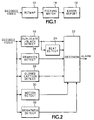
- a decoded video stream input is captured as a bitmap 12 .
- Each field from the bitmap 12 is compared in a picture match module 14 with a black field or a corresponding field from a previous frame.
- the output from the picture match module 14 is input to an error reporting module 16 that includes timers to give a separate alarm when either the black or duplicate field remains for over a user-specified period of time, usually several seconds.
- the alarm for continuous black fields is termed Loss of Service (LOS), and the alarm for extended duplicate fields is termed Freeze Frame.
- LOS Loss of Service
- Freeze Frame Freeze Frame
- the user may select to have the error reporting module 16 raise an alarm when a small group of identical fields is detected in a sequence of otherwise different fields.
- This detects Duplicate Fields in the video stream and is shown in Fig. 2 where the picture match module 14 is a duplicate field detector 18 .
- the output from the duplicate field detector 18 is input to a decision module 22 which generates the alarm signal.
- the decision module 22 includes appropriate counters so that the number of duplicate fields may be counted. When the count exceeds a specified value, an alarm condition is output to the error reporting module 16 which in turn reports the content defect in the video stream.
- the maximum number of Duplicate Frames to cause this alarm may be operator selectable, but may not be less than one duplicate.
- the duplicate frame detector 18 feeds a field beat pattern detector 24 which detects content based field duplication, typically due to SMPTE-B 3:2 pulldown from movies.
- the beat pattern detector 24 may be a state machine tat keeps track of skipped fields and has three states ⁇ Pulldown Detected, Pulldown Not Present and Unknown. When a non-black duplicate field is detected, the state machine latches into the Unknown state. Any immediately following Duplicate Field sets the state machine to be Pulldown Not Present. If exactly three frames later on the opposite field, i.e., five fields later, a second single Duplicate Field is detected, the state machine is set to the Pulldown Detected state.
- the Pulldown Detected state remains only as long as the Duplicate Fields continue every fifth field, no other Duplicate Fields are detected and the fields are not black.
- the machine state and the exact phase of the beat pattern may be input to the decision module 22 so that duplication of single fields due to 3:2 or 2:3 pulldown is either not reported as a Duplicate Field error, or it reduces the severity of the reported error.
- Duplicate Field errors that accompany change in the beat pattern are treated like a separate error ⁇ Bad Edit. These indicate likely incorrect video edits of movies in violation of SMPTE standards.
- the presence of pulldown in video and/or changes in pulldown beat pattern may be separately reported as status information. If the operator selects options that result in the beat pattern detection input being non-applicable to the decision process, then the beat pattern detection portion may be entirely disabled.
- the field video data is input to a graphics detector 26 that detects lettering and/or computer generated graphics in the video stream ⁇ content that is most likely to be intentionally static on a display screen.
- the graphics detector 26 examines the video fields looking for groups of adjacent pixels with a minimum brightness (luminance value) that are identical. If it finds these, it may report this as a graphic. It may also perform an edge search detect and compare the resulting outline to various typical patterns ⁇ straight horizontal and vertical lines being the most common. Other more sophisticated graphics detection may also be incorporated.
- Graphics/Lettering is input to the decision module 22 from the graphics detector 26 to indicate that extended duplication of fields is not cause for an Freeze Frame alarm.
- a separate counter may be set by the operator to indicate an extra length of time a field containing graphics may remain before an alarm is given.
- a counter also records the operator's preference for a minimum number of fields a Duplicate Field containing graphics must remain on the display for the graphic to be considered intentional, i.e., four Duplicate Fields are a content error regardless of whether it contains graphics because no one can read that fast.
- a closed caption module 28 may examine an ancillary portion of the video stream looking for closed caption data. This module reports whether it finds closed caption data and, if it does, whether the closed caption data is changing. This information is fed to the decision module 22 . Presence of closed caption data that is unchanging may be separately reported as an error at the operator's option, or used to further condition the Freeze Frame and/or LOS errors. Operator adjustable timeout counters in the decision module 22 may also be used to specify a maximum and minimum length of time closed caption data may occur before a Stuck Closed Caption or Unviewable Closed Caption warning is output. The closed caption module 28 may be disabled entirely at the operator's discretion.
- a motion detection module 30 that compares each field to its previous corresponding field to determine motion present in each block of the picture. This may be performed by any one of a number of motion estimation algorithms, such as the Mean Absolute Difference (MAD) algorithm, which are well known in the art.
- the results output from the motion detection module 30 are input to the decision module 22 . These results are used to detect Skipped Field errors by looking for overall motion, such as panning, in the same direction as, but disproportionate to, both previous and subsequent corresponding field motion.
- the decision module 22 modifies its expectation of what motion is to be expected.
- Motion detection also may be used to condition Duplicate Field and Skipped Field alarms. For example, the operator may set a threshold below which Skipped Field alarms are reported at a lower priority or not reported because skipped fields are difficult for viewers to perceive when movement is largely absent in the video sequence anyway.
- a similar method of detecting Skipped Fields may be employed when the motion detector module 30 detects identical but opposite motion around the edges of fields in a video sequence and not motion in the center ⁇ zoom in or zoom out. Abrupt discontinuities in zoom motion compared to both previous and subsequent zoom frames may be set at the operator's option to trigger the Skipped Field alarm. Again the motion detector module 30 may be entirely disabled at the operator's discretion.
- APL Average Picture Level
- brightness module 32 that calculates a maximum and overall brightness of the fields in the video sequence.
- the results from the APL module 32 are input to the decision module 22 .
- the APL results are used to differentiate between LOS and Freeze Frame errors. They may also be used by the operator to condition the alarms or the severity of the alarms based on overall picture level. For example, the operator may not wish to be informed of short sequences of Duplicate Fields that are very dim, which occur during fade to black -- steadily decreasing APL to zero brightness, or which occur during fade in ⁇ steadily increasing APL from zero brightness.
- This option may be implemented via an operator adjustable minimum APL threshold for each type of alarm, and separate adjustable time thresholds to present alarms during change from or to a minimum APL.
- the decision module 22 raises alarms based upon operator settings. These include any combination or permutation of the outputs from the above-discussed detectors. Default settings include, but are not limited to, LOS, Freeze Frame w/o Graphics, Extended Freeze Frame w/Graphics, Duplicate Fields or Frames, Unexpected Pulldown ⁇ 3:2 or 2:3 pulldown detected on video sequences where the operator states no pulldown exists, Bad Edit ⁇ DF during beat pattern change, SF and Unviewable Graphic ⁇ Duplicate Fields with graphics too short for viewers to see. The operator may designate degrees of severity for these errors or condition the severity on any combination or permutation of the inputs desired.
- the decision module 22 reports a severe error ⁇ immediate operator intervention suggested ⁇ for LOS and both types of Freeze Frame. Normal errors are returned for all Missing and Duplicate Field/Frame errors, Stuck Closed Caption and Unviewable Closed Caption errors. By default warnings are provided for Unexpected Pulldown and Bad Edit. Presence of other features may be reported at the operator's discretion, but by default are of an information status only. The operator may change any number of these or require different combinations for status reporting, and control the severity of the errors reported depending upon the combinations selected.
- the present invention provides for detecting content based defects in a video stream by testing the field data and changes in field data to generate an appropriate alarm signal to an operator.
Landscapes
- Engineering & Computer Science (AREA)
- Multimedia (AREA)
- Signal Processing (AREA)
- Television Systems (AREA)
- Compression Or Coding Systems Of Tv Signals (AREA)
Abstract
Description
Claims (23)
- An apparatus for detecting content based defects in a video stream comprising:means for detecting a specified content characteristic in the video stream;means for determining whether the specified content characteristic meets a predetermined alarm criterion; andmeans for reporting an error when the predetermined alarm criterion is met.
- The apparatus as recited in claim 1 wherein the detecting means comprises a detector selected from the group consisting of a duplicate field detector, a black field detector, a graphics detector, a closed caption detector, a motion detector and a brightness detector, each detector having an input coupled to receive the video stream and an output for providing an output signal representative of the specified content characteristic, the output signal being input to the determining means.
- The apparatus as recited in claim 1 wherein the detecting means comprises:a detector having an input coupled to receive the video stream and having an output to provide an output signal for each duplicate field detected; anda beat detector having an input coupled to receive the output signal from the detector and having an output to provide a pulldown indication output signal when the output signal from the detector indicates a duplicate field at specified regular intervals, the output being coupled to provide the pulldown indication signal to the determining means as the specified content characteristic.
- The apparatus as recited in claim 1 wherein the detecting means comprises a plurality of detectors, each having an input coupled in parallel to receive the video stream and having an output coupled to the determining means, the output from each detector providing a separate specified content characteristic.
- The apparatus as recited in claim 4 wherein the detectors include a duplicate field detector, a black field detector, a graphics detector, a closed caption detector, a motion detector and a brightness detector each having an input coupled to receive the video stream and an output coupled to provide the separate specified content characteristic to the determining means.
- The apparatus as recited in claim 5 further comprising a beat pattern detector having an input coupled to the output of the duplicate field detector and having an output coupled to provide a pulldown indicator signal as the separate specified content characteristic to the determining means.
- The apparatus as recited in claim 1 wherein the detecting means comprises a picture match module for matching each field of the video stream with a black field to provide an output for each match that occurs indicative of a missing field in the video stream as the specified content characteristic.
- The apparatus as recited in claim 1 wherein the detecting means comprises a picture match module for matching each field of the decoded version with a corresponding field from a previous frame of the video stream to provide an output for each match that occurs indicative of a duplicate field in the video stream as the specified content characteristic.
- The apparatus as recited in claim 8 wherein the detecting means further comprises a beat pattern detector having an input coupled to the output of the picture match module and having an output coupled to the determining means, the beat pattern detector providing a pulldown indication signal as the specified content characteristic.
- The apparatus as recited in claim 1 wherein the detecting means comprises a graphics detector having the video stream as an input and having an output coupled to the determining means to provide a graphics signal indicative of when duplicate fields result from graphic fields in the video stream as the specified content characteristic.
- The apparatus as recited in claims 7 or 8 wherein the determining means comprises:a counter for counting each output from the picture match module to provide a count output; andmeans for indicating the error when the count output reaches a designated number as the specified alarm criterion.
- The apparatus as recited in claim 9 wherein the determining means comprises:a counter for counting each output from the picture match module to provide a count output; andmeans for indicating the error when the count output reaches a designated number that is not related to pulldown.
- The apparatus as recited in claim 10 wherein the determining means comprises:a counter for counting each output from the picture match module to provide a count output; andmeans for indicating the error when the count output reaches a designated number that is not related to lettering/graphic video.
- The apparatus as recited in claim 1 wherein the detecting means comprises a closed caption detector having an input coupled to receive the video stream and having an output coupled to the determining means to provide an indication of the status of closed caption as the specified content characteristic.
- The apparatus as recited in claim 1 wherein the detecting means comprises a motion detector having an input coupled to receive the video stream and having an output coupled to the determining means to provide an indication of missing fields as the specified content characteristic.
- The apparatus as recited in claim 1 wherein the detecting means comprises a brightness detector having an input coupled to receive the video stream and having an output coupled to the determining means to provide a level signal as the specified content characteristic.
- The apparatus as recited in claims 4 or 5 wherein the determining means comprises logic having as inputs the outputs from the detectors to provide the error with a given priority.
- A method of detecting content based defects in a video stream comprising:detecting a specified content characteristic in the video stream;determining whether the specified content characteristic meets a predetermined alarm criterion; andreporting an error when the predetermined alarm criterion is met.
- The method as recited in claim 18 wherein the detecting step includes a detector selected from the group consisting of a duplicate field detector, a black field detector, a graphics detector, a closed caption detector, a motion detector, and a brightness detector, each detector having an input coupled to receive the video stream and an output for providing an output signal representative of the specified content characteristic, the output signal being input to the determining step.
- The method as recited in claim 18 wherein the detecting step further comprises the step of detecting a beat pattern to provide a pulldown indication output signal when the output signal from the detecting step indicates a duplicate field at specified regular intervals, the output being coupled to provide the pulldown indication signal to the determining step as the specified content characteristic.
- The method as recited in claim 18 wherein the detecting step includes a plurality of detectors, each having an input coupled in parallel to receive the video stream and having an output coupled to the determining means, the output from each detector providing a separate specified content characteristic to the determining step.
- The method as recited in claim 21 wherein the detectors include a duplicate field detector, a black field detector, a graphics detector, a closed caption detector, a motion detector and a brightness detector each having an input coupled to receive the video stream and an output coupled to provide the separate specified content characteristic to the determining step.
- The method as recited in claim 22 further comprising the step of detecting a beat pattern when a duplicate field is detected to provide a pulldown indicator signal as the separate specified content characteristic to the determining step.
Applications Claiming Priority (2)
| Application Number | Priority Date | Filing Date | Title |
|---|---|---|---|
| US231128 | 1999-01-13 | ||
| US09/231,128 US6906743B1 (en) | 1999-01-13 | 1999-01-13 | Detecting content based defects in a video stream |
Publications (3)
| Publication Number | Publication Date |
|---|---|
| EP1021040A2 true EP1021040A2 (en) | 2000-07-19 |
| EP1021040A3 EP1021040A3 (en) | 2002-01-16 |
| EP1021040B1 EP1021040B1 (en) | 2005-05-11 |
Family
ID=22867848
Family Applications (1)
| Application Number | Title | Priority Date | Filing Date |
|---|---|---|---|
| EP00300122A Expired - Lifetime EP1021040B1 (en) | 1999-01-13 | 2000-01-10 | Detecting content based defects in a video stream |
Country Status (4)
| Country | Link |
|---|---|
| US (1) | US6906743B1 (en) |
| EP (1) | EP1021040B1 (en) |
| JP (1) | JP4275280B2 (en) |
| DE (1) | DE60019983T2 (en) |
Cited By (6)
| Publication number | Priority date | Publication date | Assignee | Title |
|---|---|---|---|---|
| EP1592254A1 (en) * | 2004-04-30 | 2005-11-02 | Matsushita Electric Industrial Co., Ltd. | Film mode extrapolation |
| WO2007123813A3 (en) * | 2006-04-17 | 2008-01-24 | Omneon Video Networks | Video abnormality detection |
| WO2008119924A1 (en) * | 2007-04-03 | 2008-10-09 | British Telecommunications Public Limited Company | Method and system for video quality assessment |
| EP2259577A1 (en) * | 2009-05-29 | 2010-12-08 | The Nielsen Company (US), LLC | Methods and apparatus to monitor a multimedia presentation including multiple content windows |
| EP2227031A3 (en) * | 2009-03-05 | 2013-02-20 | Tektronix, Inc. | Methods and systems for detecting and locating skipped frames in a video sequence |
| US11302095B2 (en) | 2020-01-09 | 2022-04-12 | International Business Machines Corporation | Cognitive motion picture analysis |
Families Citing this family (54)
| Publication number | Priority date | Publication date | Assignee | Title |
|---|---|---|---|---|
| KR100510671B1 (en) * | 2003-01-08 | 2005-08-31 | 엘지전자 주식회사 | apparatus for detecting common frame in interlace image |
| US20040151469A1 (en) * | 2003-01-31 | 2004-08-05 | Engholm Kathryn A. | Video editing timeline with measurement results |
| US7800699B2 (en) | 2003-04-16 | 2010-09-21 | Nvidia Corporation | 3:2 Pulldown detection |
| US10862994B1 (en) | 2006-11-15 | 2020-12-08 | Conviva Inc. | Facilitating client decisions |
| US9549043B1 (en) | 2004-07-20 | 2017-01-17 | Conviva Inc. | Allocating resources in a content delivery environment |
| KR100666981B1 (en) * | 2004-08-09 | 2007-01-10 | 삼성전자주식회사 | Method and apparatus for managing data reception state of digital broadcasting system |
| JP2006325122A (en) * | 2005-05-20 | 2006-11-30 | Otsuka Denshi Co Ltd | Movie display performance judgment method, inspection screen and movie display performance judgment device |
| US8659654B2 (en) * | 2006-10-11 | 2014-02-25 | Microsoft Corporation | Image verification with tiered tolerance |
| US20090180546A1 (en) * | 2008-01-09 | 2009-07-16 | Rodriguez Arturo A | Assistance for processing pictures in concatenated video streams |
| US8416859B2 (en) * | 2006-11-13 | 2013-04-09 | Cisco Technology, Inc. | Signalling and extraction in compressed video of pictures belonging to interdependency tiers |
| US8873932B2 (en) | 2007-12-11 | 2014-10-28 | Cisco Technology, Inc. | Inferential processing to ascertain plural levels of picture interdependencies |
| US20080115175A1 (en) * | 2006-11-13 | 2008-05-15 | Rodriguez Arturo A | System and method for signaling characteristics of pictures' interdependencies |
| US8875199B2 (en) | 2006-11-13 | 2014-10-28 | Cisco Technology, Inc. | Indicating picture usefulness for playback optimization |
| US9264780B1 (en) | 2006-11-15 | 2016-02-16 | Conviva Inc. | Managing synchronized data requests in a content delivery network |
| US8874725B1 (en) | 2006-11-15 | 2014-10-28 | Conviva Inc. | Monitoring the performance of a content player |
| US8874964B1 (en) | 2006-11-15 | 2014-10-28 | Conviva Inc. | Detecting problems in content distribution |
| US8566436B1 (en) | 2006-11-15 | 2013-10-22 | Conviva Inc. | Data client |
| US8751605B1 (en) | 2006-11-15 | 2014-06-10 | Conviva Inc. | Accounting for network traffic |
| US9124601B2 (en) | 2006-11-15 | 2015-09-01 | Conviva Inc. | Data client |
| US8957961B2 (en) * | 2006-12-27 | 2015-02-17 | Intel Corporation | Method and sytem for telecine detection and restoration |
| US8804845B2 (en) | 2007-07-31 | 2014-08-12 | Cisco Technology, Inc. | Non-enhancing media redundancy coding for mitigating transmission impairments |
| US8958486B2 (en) | 2007-07-31 | 2015-02-17 | Cisco Technology, Inc. | Simultaneous processing of media and redundancy streams for mitigating impairments |
| KR101336951B1 (en) * | 2007-11-02 | 2013-12-04 | 삼성전자주식회사 | Mobile terminal and method for executing mode photographing panorama image thereof |
| US8416858B2 (en) | 2008-02-29 | 2013-04-09 | Cisco Technology, Inc. | Signalling picture encoding schemes and associated picture properties |
| WO2009152450A1 (en) | 2008-06-12 | 2009-12-17 | Cisco Technology, Inc. | Picture interdependencies signals in context of mmco to assist stream manipulation |
| US8699578B2 (en) * | 2008-06-17 | 2014-04-15 | Cisco Technology, Inc. | Methods and systems for processing multi-latticed video streams |
| US8971402B2 (en) | 2008-06-17 | 2015-03-03 | Cisco Technology, Inc. | Processing of impaired and incomplete multi-latticed video streams |
| US8705631B2 (en) | 2008-06-17 | 2014-04-22 | Cisco Technology, Inc. | Time-shifted transport of multi-latticed video for resiliency from burst-error effects |
| US20110001873A1 (en) * | 2008-08-06 | 2011-01-06 | Daniel Doswald | Frame rate converter for input frames with video and film content |
| EP2356812B1 (en) | 2008-11-12 | 2015-06-10 | Cisco Technology, Inc. | Processing of a video program having plural processed representations of a single video signal for reconstruction and output |
| US20100177161A1 (en) * | 2009-01-15 | 2010-07-15 | Dell Products L.P. | Multiplexed stereoscopic video transmission |
| US8402494B1 (en) * | 2009-03-23 | 2013-03-19 | Conviva Inc. | Switching content |
| US8782261B1 (en) | 2009-04-03 | 2014-07-15 | Cisco Technology, Inc. | System and method for authorization of segment boundary notifications |
| US8949883B2 (en) | 2009-05-12 | 2015-02-03 | Cisco Technology, Inc. | Signalling buffer characteristics for splicing operations of video streams |
| US8279926B2 (en) | 2009-06-18 | 2012-10-02 | Cisco Technology, Inc. | Dynamic streaming with latticed representations of video |
| US9203913B1 (en) | 2009-07-20 | 2015-12-01 | Conviva Inc. | Monitoring the performance of a content player |
| US20110222837A1 (en) * | 2010-03-11 | 2011-09-15 | Cisco Technology, Inc. | Management of picture referencing in video streams for plural playback modes |
| US9373039B2 (en) * | 2011-04-18 | 2016-06-21 | Supponor Oy | Detection of graphics added to a video signal |
| CA2831816A1 (en) | 2011-04-18 | 2012-10-26 | Supponor Oy | Detection of graphics added to a video signal |
| FR2982449A1 (en) * | 2011-11-07 | 2013-05-10 | France Telecom | METHOD FOR EVALUATING AT LEAST ONE QUALITY FAULT IN A DATA SIGNAL, DEVICE AND PROGRAM OF ASSOCIATED COMPUTERS |
| US20130127908A1 (en) * | 2011-11-22 | 2013-05-23 | General Instrument Corporation | Method and apparatus for dynamic placement of a graphics display window within an image |
| US9613042B1 (en) | 2012-04-09 | 2017-04-04 | Conviva Inc. | Dynamic generation of video manifest files |
| US10182096B1 (en) | 2012-09-05 | 2019-01-15 | Conviva Inc. | Virtual resource locator |
| US9246965B1 (en) | 2012-09-05 | 2016-01-26 | Conviva Inc. | Source assignment based on network partitioning |
| GB2511792B (en) * | 2013-03-13 | 2015-11-18 | Supponor Oy | Method and Apparatus for Dynamic Image Content Manipulation |
| US10305955B1 (en) | 2014-12-08 | 2019-05-28 | Conviva Inc. | Streaming decision in the cloud |
| US10178043B1 (en) | 2014-12-08 | 2019-01-08 | Conviva Inc. | Dynamic bitrate range selection in the cloud for optimized video streaming |
| US10397469B1 (en) | 2015-08-31 | 2019-08-27 | Snap Inc. | Dynamic image-based adjustment of image capture parameters |
| US10334154B2 (en) | 2015-08-31 | 2019-06-25 | Snap Inc. | Automated adjustment of digital image capture parameters |
| JP6742816B2 (en) * | 2016-05-26 | 2020-08-19 | キヤノン株式会社 | Electronic device, display device, and display control method |
| US11076202B2 (en) | 2018-04-05 | 2021-07-27 | International Business Machines Corporation | Customizing digital content based on consumer context data |
| US11012637B2 (en) | 2019-02-01 | 2021-05-18 | Ford Global Technologies, Llc | Systems and methods for live video freeze detection |
| CN110418184A (en) * | 2019-07-02 | 2019-11-05 | 广州清汇信息科技有限公司 | A kind of image compensation method and processing terminal based on recorded video |
| CN116912735B (en) * | 2023-07-05 | 2026-07-28 | 特斯联科技集团有限公司 | Sign abnormality detection method, device, electronic equipment and storage medium |
Family Cites Families (10)
| Publication number | Priority date | Publication date | Assignee | Title |
|---|---|---|---|---|
| US4430671A (en) * | 1982-02-24 | 1984-02-07 | Rca Corporation | Television channel indicator with automatic on-screen display |
| US5436653A (en) * | 1992-04-30 | 1995-07-25 | The Arbitron Company | Method and system for recognition of broadcast segments |
| JPH06268975A (en) | 1993-03-16 | 1994-09-22 | Toshiba Corp | Closed caption signal receiver |
| US5828786A (en) * | 1993-12-02 | 1998-10-27 | General Instrument Corporation | Analyzer and methods for detecting and processing video data types in a video data stream |
| US5757435A (en) | 1995-12-08 | 1998-05-26 | C-Cube Microsystems, Inc. | MPEG-2 inverse telecine circuit |
| JPH09266567A (en) * | 1996-03-27 | 1997-10-07 | Victor Co Of Japan Ltd | Television receiver |
| AU716341B2 (en) * | 1996-06-12 | 2000-02-24 | Au Optronics Corporation | Monitoring system of multimedia communication terminal |
| IL119504A (en) | 1996-10-28 | 2000-09-28 | Elop Electrooptics Ind Ltd | Audio-visual content verification method and system |
| KR100526907B1 (en) * | 1997-06-03 | 2005-11-09 | 코닌클리케 필립스 일렉트로닉스 엔.브이. | Television picture signal processing |
| US6100941A (en) * | 1998-07-28 | 2000-08-08 | U.S. Philips Corporation | Apparatus and method for locating a commercial disposed within a video data stream |
-
1999
- 1999-01-13 US US09/231,128 patent/US6906743B1/en not_active Expired - Lifetime
-
2000
- 2000-01-10 EP EP00300122A patent/EP1021040B1/en not_active Expired - Lifetime
- 2000-01-10 DE DE60019983T patent/DE60019983T2/en not_active Expired - Lifetime
- 2000-01-12 JP JP2000004072A patent/JP4275280B2/en not_active Expired - Fee Related
Cited By (10)
| Publication number | Priority date | Publication date | Assignee | Title |
|---|---|---|---|---|
| EP1592254A1 (en) * | 2004-04-30 | 2005-11-02 | Matsushita Electric Industrial Co., Ltd. | Film mode extrapolation |
| CN100425054C (en) * | 2004-04-30 | 2008-10-08 | 松下电器产业株式会社 | film mode extrapolation |
| WO2007123813A3 (en) * | 2006-04-17 | 2008-01-24 | Omneon Video Networks | Video abnormality detection |
| US7876355B2 (en) | 2006-04-17 | 2011-01-25 | Harmonic Inc. | Video abnormality detection |
| WO2008119924A1 (en) * | 2007-04-03 | 2008-10-09 | British Telecommunications Public Limited Company | Method and system for video quality assessment |
| CN101682796B (en) * | 2007-04-03 | 2011-11-23 | 英国电讯有限公司 | Method and system for video quality assessment |
| US8150234B2 (en) | 2007-04-03 | 2012-04-03 | British Telecommunications Public Limited Company | Method and system for video quality assessment |
| EP2227031A3 (en) * | 2009-03-05 | 2013-02-20 | Tektronix, Inc. | Methods and systems for detecting and locating skipped frames in a video sequence |
| EP2259577A1 (en) * | 2009-05-29 | 2010-12-08 | The Nielsen Company (US), LLC | Methods and apparatus to monitor a multimedia presentation including multiple content windows |
| US11302095B2 (en) | 2020-01-09 | 2022-04-12 | International Business Machines Corporation | Cognitive motion picture analysis |
Also Published As
| Publication number | Publication date |
|---|---|
| JP2000217104A (en) | 2000-08-04 |
| JP4275280B2 (en) | 2009-06-10 |
| DE60019983D1 (en) | 2005-06-16 |
| EP1021040A3 (en) | 2002-01-16 |
| DE60019983T2 (en) | 2006-01-19 |
| EP1021040B1 (en) | 2005-05-11 |
| US6906743B1 (en) | 2005-06-14 |
Similar Documents
| Publication | Publication Date | Title |
|---|---|---|
| US6906743B1 (en) | Detecting content based defects in a video stream | |
| US7349029B1 (en) | Method and apparatus for de-interlacing interlaced video fields originating from a progressive video source | |
| US8063984B2 (en) | Subtitle detection apparatus, subtitle detection method and pull-down signal detection apparatus | |
| EP2048871B1 (en) | Image evaluation | |
| CN106170087B (en) | Anomalous pixel detection | |
| Fernando et al. | Fade and dissolve detection in uncompressed and compressed video sequences | |
| US8433143B1 (en) | Automated detection of video artifacts in an information signal | |
| JP3957148B2 (en) | Freeze field detection method and apparatus | |
| JP4803376B2 (en) | Camera tampering detection method | |
| US20060209957A1 (en) | Motion sequence pattern detection | |
| EP1874055B1 (en) | Pulldown correction for progressive scan display of audiovisual recordings | |
| CN101485201A (en) | Field sequence detector, method and video apparatus | |
| EP0896483A2 (en) | Testing a video decoder | |
| EP1163801B1 (en) | Method and apparatus for interlaced/non-interlaced frame determination, repeat-field identification and scene-change detection | |
| CA2651173C (en) | Video processing system providing image pattern detection based upon image transition boundaries and related methods | |
| US6271879B1 (en) | Controlling and detecting alignment of composite video color frames | |
| US9800824B2 (en) | Video signal analysis | |
| Dosselmann et al. | A prototype no-reference video quality system | |
| US20040037361A1 (en) | Video block error sensing by detection of shapes in output | |
| JP2007501561A (en) | Block artifact detection | |
| CA2408435C (en) | Method for testing video sequences | |
| CN114189675B (en) | Method, device, equipment and storage medium for automatically detecting video input module | |
| EP0913994B1 (en) | Method and apparatus for automatic format detection in digital video pictures | |
| US20080088746A1 (en) | System and method for bad weave detection for inverse telecine | |
| Fenimore et al. | Test patterns and quality metrics for digital video compression. |
Legal Events
| Date | Code | Title | Description |
|---|---|---|---|
| PUAI | Public reference made under article 153(3) epc to a published international application that has entered the european phase |
Free format text: ORIGINAL CODE: 0009012 |
|
| AK | Designated contracting states |
Kind code of ref document: A2 Designated state(s): DE GB Kind code of ref document: A2 Designated state(s): AT BE CH CY DE DK ES FI FR GB GR IE IT LI LU MC NL PT SE |
|
| AX | Request for extension of the european patent |
Free format text: AL;LT;LV;MK;RO;SI |
|
| RAP1 | Party data changed (applicant data changed or rights of an application transferred) |
Owner name: TEKTRONIX, INC. |
|
| K1C1 | Correction of patent application (title page) published |
Effective date: 20000719 |
|
| PUAL | Search report despatched |
Free format text: ORIGINAL CODE: 0009013 |
|
| AK | Designated contracting states |
Kind code of ref document: A3 Designated state(s): AT BE CH CY DE DK ES FI FR GB GR IE IT LI LU MC NL PT SE |
|
| AX | Request for extension of the european patent |
Free format text: AL;LT;LV;MK;RO;SI |
|
| RIC1 | Information provided on ipc code assigned before grant |
Free format text: 7H 04N 7/26 A, 7H 04N 17/00 B |
|
| 17P | Request for examination filed |
Effective date: 20020221 |
|
| AKX | Designation fees paid |
Free format text: DE GB |
|
| 17Q | First examination report despatched |
Effective date: 20030804 |
|
| GRAP | Despatch of communication of intention to grant a patent |
Free format text: ORIGINAL CODE: EPIDOSNIGR1 |
|
| RAP1 | Party data changed (applicant data changed or rights of an application transferred) |
Owner name: TEKTRONIX, INC. |
|
| GRAS | Grant fee paid |
Free format text: ORIGINAL CODE: EPIDOSNIGR3 |
|
| GRAA | (expected) grant |
Free format text: ORIGINAL CODE: 0009210 |
|
| AK | Designated contracting states |
Kind code of ref document: B1 Designated state(s): DE GB |
|
| REG | Reference to a national code |
Ref country code: GB Ref legal event code: FG4D |
|
| REG | Reference to a national code |
Ref country code: IE Ref legal event code: FG4D |
|
| REF | Corresponds to: |
Ref document number: 60019983 Country of ref document: DE Date of ref document: 20050616 Kind code of ref document: P |
|
| PLBE | No opposition filed within time limit |
Free format text: ORIGINAL CODE: 0009261 |
|
| STAA | Information on the status of an ep patent application or granted ep patent |
Free format text: STATUS: NO OPPOSITION FILED WITHIN TIME LIMIT |
|
| 26N | No opposition filed |
Effective date: 20060214 |
|
| PGFP | Annual fee paid to national office [announced via postgrant information from national office to epo] |
Ref country code: GB Payment date: 20180129 Year of fee payment: 19 Ref country code: DE Payment date: 20180129 Year of fee payment: 19 |
|
| REG | Reference to a national code |
Ref country code: DE Ref legal event code: R119 Ref document number: 60019983 Country of ref document: DE |
|
| GBPC | Gb: european patent ceased through non-payment of renewal fee |
Effective date: 20190110 |
|
| PG25 | Lapsed in a contracting state [announced via postgrant information from national office to epo] |
Ref country code: DE Free format text: LAPSE BECAUSE OF NON-PAYMENT OF DUE FEES Effective date: 20190801 |
|
| PG25 | Lapsed in a contracting state [announced via postgrant information from national office to epo] |
Ref country code: GB Free format text: LAPSE BECAUSE OF NON-PAYMENT OF DUE FEES Effective date: 20190110 |