EP1021032A2 - A method for adjusting the tone scale of a digital image - Google Patents
A method for adjusting the tone scale of a digital image Download PDFInfo
- Publication number
- EP1021032A2 EP1021032A2 EP00200045A EP00200045A EP1021032A2 EP 1021032 A2 EP1021032 A2 EP 1021032A2 EP 00200045 A EP00200045 A EP 00200045A EP 00200045 A EP00200045 A EP 00200045A EP 1021032 A2 EP1021032 A2 EP 1021032A2
- Authority
- EP
- European Patent Office
- Prior art keywords
- digital image
- channel
- tone scale
- image channel
- signal
- Prior art date
- Legal status (The legal status is an assumption and is not a legal conclusion. Google has not performed a legal analysis and makes no representation as to the accuracy of the status listed.)
- Withdrawn
Links
Images




Classifications
-
- H—ELECTRICITY
- H04—ELECTRIC COMMUNICATION TECHNIQUE
- H04N—PICTORIAL COMMUNICATION, e.g. TELEVISION
- H04N1/00—Scanning, transmission or reproduction of documents or the like, e.g. facsimile transmission; Details thereof
- H04N1/40—Picture signal circuits
- H04N1/407—Control or modification of tonal gradation or of extreme levels, e.g. background level
-
- H—ELECTRICITY
- H04—ELECTRIC COMMUNICATION TECHNIQUE
- H04N—PICTORIAL COMMUNICATION, e.g. TELEVISION
- H04N5/00—Details of television systems
- H04N5/14—Picture signal circuitry for video frequency region
- H04N5/20—Circuitry for controlling amplitude response
Definitions
- the invention relates generally to the field of digital image processing and, more particularly, to a method for adjusting the tone scale of a digital image.
- tone scales Existing methods for applying tone scales to digital color images include applying the tone scale to each of the color channels independently, applying the tone scale to the neutral channel and preserving the original pixel color difference signal, or applying the tone scale to just the low frequency image. These methods of tone scale application alter the sharpness and appearance of the color in processed images, and the latter can produce displeasing artifacts.
- tone scale function modifies the amplitudes of high frequency detail information. This phenomenon occurs when the tone scale function is applied to each of the color channels independently, or when the tone scale function is applied to the neutral channel and original pixel color difference signals are preserved.
- the present invention permits the application of a tone scale function to a digital image which adjusts the macro contrast of the image, preserves the high frequency detail information, and prevents artifacts in the neighborhood of large edges.
- the invention resides in a method for adjusting tone scale of a digital image, the method comprising: (a) receiving a digital image channel from the digital image; (b) providing a tone scale function for adjusting the tone scale of the digital image channel; (c) calculating a difference signal derived from the digital image channel and the tone scale function; (d) calculating a compensation signal derived from a filtered version of the difference signal; and (e) combining the digital image channel and the compensation signal to generate a modified digital image channel.
- the present invention has the advantage of permitting the application of a tone scale function to a digital image that adjusts the macro contrast of the image, while preserving the spatial frequency detail information, without introducing artifacts in the neighborhood of large transitions.
- a computer readable storage medium may comprise, for example; magnetic storage media such as a magnetic disk (such as a floppy disk) or magnetic tape; optical storage media such as an optical disc, optical tape, or machine readable bar code; solid state electronic storage devices such as random access memory (RAM), or read only memory (ROM); or any other physical device or medium employed to store a computer program.
- magnetic storage media such as a magnetic disk (such as a floppy disk) or magnetic tape
- optical storage media such as an optical disc, optical tape, or machine readable bar code
- solid state electronic storage devices such as random access memory (RAM), or read only memory (ROM); or any other physical device or medium employed to store a computer program.
- the computer system 1 includes a microprocessor-based unit 2 for receiving and processing software programs and for performing other processing functions.
- a display 3 is electrically connected to the microprocessor-based unit 2 for displaying user-related information associated with the software.
- a keyboard 4a is also connected to the microprocessor based unit 2 for permitting a user to input information to the software.
- a mouse 4b may be used for moving a selector 5 on the display 3 and for selecting an item on which the selector 5 overlays, as is well known in the art.
- a compact disk-read only memory (CD-ROM) 6 is connected to the microprocessor based unit 2 for receiving software programs and for providing a means of inputting the software programs and other information to the microprocessor based unit 2 via a compact disk 7a, which typically includes a software program.
- a floppy disk 7b may also include a software program, and is inserted into the microprocessor-based unit 2 for inputting the software program.
- the microprocessor-based unit 2 may be programmed, as is well know in the art, for storing the software program internally.
- a printer 8 is connected to the microprocessor-based unit 2 for printing a hardcopy of the output of the computer system 1.
- Images may also be displayed on the display 3 via a personal computer card (PC card) 7c or, as it was formerly known, a personal computer memory card international association card (PCMCIA card) which contains digitized images electronically embodied in the card 7c.
- PC card 7c is ultimately inserted into the microprocessor based unit 2 for permitting visual display of the image on the display 3.
- a digital representation of a digital image channel is passed as to a plurality of tone scale processors 10.
- the digital image typically includes three-color channels - red, green, and blue image channels (RGB), and that each color channel is passed to a different tone scale processor.
- RGB red, green, and blue image channels
- each color channel is passed to a different tone scale processor.
- the red color channel is passed to the tone scale processor 10a.
- the digital image is also passed to a pre-avoidance channel generator 20, which generates a pre-avoidance channel that is also passed to each processor 10.
- the pre-avoidance channel for each of the tone scale processors 10 is equal to a linear combination of all the digital image channels representing the image.
- pre-avoidance channel signals may be used.
- the pre-avoidance channel may be equal to any one of the three color image channels of the digital image.
- the pre-avoidance channel need not be equal for each of the tone scale processors 10a, 10b, and 10c.
- the tone scale processors 10 also receive a desired tone scale function, and each processor 10 creates a transformed color image channel from the particular color channel value, the pre-avoidance channel, and the tone scale function.
- the tone scale functions received by each tone scale processor 10 may be identical, or alternatively, one or more tone scale functions received by each tone scale processor may be different from the remaining tone scale function(s).
- the three modified color-channel values form the pixel values of the transformed image.
- a tone scale differencer 30 calculates the difference between the image channel modified by the tone scale function and the original image channel for producing a difference signal, as will be described in detail below.
- the difference signal is passed to a frequency splitter 70 which performs a spatial filtering operation on the difference signal for producing a lowpass difference signal.
- the spatial filtering operation preformed by the frequency splitter 70 is preferably with a Finite Impulse Response (FIR) Gaussian filter having a width of 2.5 pixels.
- FIR Finite Impulse Response
- the preferred value of the standard deviation of the Gaussian filter may vary with image size.
- the value of 2.5 pixels for the sigma value was derived by optimizing the present invention with 1024 by 1536 pixel size images.
- the pre-avoidance channel pac(x,y) is input to the avoidance signal generator 80 for the purpose of controlling the weighted average of the lowpass difference signal and the difference signal.
- This controlling signal will be referred to as an avoidance signal (a); the generation of the avoidance signal (a) will also be described in detail below.
- the avoidance signal is input to the avoidance adder 90 along with the lowpass difference signal and the difference signal output from the tone scale differencer 30.
- An avoidance adder 90 requires three inputs: 2 signals to be summed, and the artifact avoidance signal (a).
- the two signals to be summed undergo a transformation such that one of the signals to be summed is multiplied by (a), and the other is multiplied by (1-a).
- the two transformed signals are then added.
- the signal input which is scaled by (a) is known as the "(a) input” of the avoidance adder 90 and the signal input which is scaled by (1-a) is known as the "(1-a)" input of the avoidance adder 90.
- the lowpass difference signal output from the frequency splitter 70 is applied to the (a) input of the avoidance adder and the difference signal output from the tone scale differencer 30 is applied to the (1-a) input of the avoidance adder 90.
- the compensation signal output from the avoidance adder 90 and the original digital image channel are passed to an adder 95.
- the output of the adder 95 is a modified image channel.
- the modified image channel has a modified tone scale with respect to the original image.
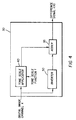
- Fig. 4 there is illustrated an exploded block diagram of the tone scale differencer 30.
- the digital image channel input to the tone scale differencer 30 is passed to a tone scale applicator 40.
- a tone scale function is applied to the input image channel by a tone scale applicator 40 in order to change the characteristics of the image for image enhancement.
- the tone scale function may be applied for the purposes of altering the relative brightness or contrast of the digital image.
- a tone scale applicator 40 is implemented by application of a look up table (LUT). Modification of a digital image channel by a LUT is well known in the art.
- a typical tone scale function that may be used in the present invention showing a 1 to 1 mapping of input values to output values is illustrated in Fig. 5.
- the digital image channel input to the tone scale differencer 30 is also passed to an inverter 50.
- the inverter 50 inverts the input signal by scaling the input by -1 to generate an inverted signal.
- the inverted signal is summed to the output of the tone scale applicator 40 by an adder 95 to generate a difference signal.
- the tone scale differencer 30 may be implemented as a single LUT, an example of which is shown in Fig. 6.
- the function d(x) is an example of a difference function.
- the pre-avoidance channel is input into a frequency splitter 75 in order to generate a lowpass signal; the operation of a frequency splitter is described above.
- the standard deviation of the spatial filter used in this frequency splitter 75 is equal to the standard deviation of the spatial filter of the frequency splitter 70 (2.5 pixels).
- the lowpass signal output from the frequency splitter 75 is input to the non-directional squared gradient calculator 110 for producing a non-directional squared gradient signal.
- This calculation is performed by first calculating the difference between the pixel and its upper vertical neighbor, as well as the difference between the pixel and its horizontal neighbor to the right.
- the non-directional squared gradient is the sum of the squares of these two differences.
- the non-directional squared gradient signal is then mapped by an artifact avoidance function applicator 120 to produce an artifact avoidance signal.
- this mapping function is performed by passing the non-directional squared gradient value through a look-up-table (LUT) formed in the following manner.
- LUT look-up-table
- the artifact avoidance signal returned is equal to: 1/2 * (1 + COS( ⁇ *(non-directional squared gradient - k1) /(k2 - k1)).
- the artifact avoidance signal returned by the LUT is equal to 0.0.
- the constants k1 and k2 are preferable 148 and 1300, respectively.
- the values of the constants k1 and k2 are dependent upon the data range of the input digital image channel.
- the each pixel of the input digital image channel is described by 12 bits (i.e. 0-4095).
- this mapping function may be performed by mapping the non-directional squared gradient value through any monotonically decreasing LUT ranging from 1.0 to 0.0 with increasing non-directional squared gradient.
- the artifact avoidance signal a(x) is 1 for pixels in regions of the image, which are generally, flat (i.e. regions of the image where U.S. patent No. 5,012,333 does not produce artifacts.)
- the signal a(x) becomes 0 for pixels in regions of the image that contain high transition edges (i.e. regions of the image where U.S. patent No. 5,012,333 produces artifacts.)
- the signal a(x) may take on any value within the range of 0.0 to 1.0 depending upon the structure of the local region of the image.
- the processed pixel will be bounded by f(x) and f(g(x)) + h(x).
- the method of the current invention allows a tone scale function to be applied to an image in such a way that the detail from the original image is preserved, except in those regions where preservation of the detail would produce unnatural artifacts. In these regions, the tone scale is applied to the original pixel to produce the final output pixel.
- FIG. 9 an alternative embodiment of the present invention is illustrated showing the implementation of the present invention on the luminance channel derived from the digital image.
- the digital image is passed as the input to a color difference transformer 130.
- the computation of the color difference signals by the color difference transformer 130 may be performed by a matrix operation.
- a luminance signal and two color difference signals may be determined for each pixel of the input image by the following matrix transform: where:
- tone scale processor 10 on the input luminance channel is the same as that described in the preferred embodiment of the present invention.
- the chrominance channels C 1 and C 2 output from the color difference transformer 130 are passed to the chrominance processor 150 in order to generate modified chrominance channels.
- the processed chrominance channels C p1 and C p2 output from the chrominance processor 150 are equal to the input chrominance channels C 1 and C 2 .
- the transformed luminance channel output from the tone scale processor 10 is then input to the RGB Converter 140.
- the processed chrominance channels C p1 and C p2 output from the chrominance processor 150 are input to the RGB converter 140.
- the RGB converter 140 transforms the input luminance channel and chrominance channels by multiplication with a matrix.
- the matrix used is the inverse of the matrix used by the color difference transformer 130. Multiplication by a matrix and generation of an inverse matrix is well known, and will not be further discussed.
Landscapes
- Engineering & Computer Science (AREA)
- Multimedia (AREA)
- Signal Processing (AREA)
- Image Processing (AREA)
- Apparatus For Radiation Diagnosis (AREA)
- Facsimile Image Signal Circuits (AREA)
- Color Image Communication Systems (AREA)
Abstract
Description
Claims (10)
- A method for adjusting tone scale of a digital image, the method comprising the step of:signal to generate a modified digital image channel.(a) receiving a digital image channel from the digital image;(b) providing a tone scale function for adjusting the tone scale of the digital image channel;(c) calculating a difference signal derived from the digital image channel and the tone scale function;(d) calculating a compensation signal derived from a filtered version of the difference signal; and,(e) combining the digital image channel and the compensation
- The method as in claim 1 wherein step (d) further comprises of the steps of (d1) providing a control signal and (d2) using the control signal and a spatial filter for assisting in the generation of the compensation signal.
- The method of claim 1, wherein step (a) includes receiving a luminance channel as the digital image channel.
- The method of claim 1, wherein step (a) includes receiving either a red, green or blue channel as the digital image channel.
- The method as in claim 1 wherein step (c) further comprises the step of (c1) applying the tone scale function to the digital image channel for forming a tone scaled signal; and (c2) calculating the difference signal by subtracting the digital image channel from the tone scaled signal.
- The method as in claim 1 wherein step (c) further comprises the step of (c1) generating a difference function derived from the tone scale function; and (c2) calculating the difference signal by applying the difference function to the digital image channel.
- A system for adjusting tone scale of a digital image, the system comprising:(a) means for receiving a digital image channel from the digital image;(b) means for providing a tone scale function for adjusting the tone scale of the digital image channel;(c) means for calculating a difference signal derived from the digital image channel and the tone scale function;(d) means for calculating a compensation signal derived from a filtered version of the difference signal; and,(e) means for combining the digital image channel and the compensation signal to generate a modified digital image channel.
- The system as in claim 7 wherein step (c) further comprises the step of (c1) applying the tone scale function to the digital image channel for forming a tone scaled signal; and (c2) calculating the difference signal by subtracting the digital image channel from the tone scaled signal.
- The system as in claim 7 wherein step (c) further comprises the step of (c1) generating a difference function derived from the tone scale function; and (c2) calculating the difference signal by applying the difference function to the digital image channel.
- A computer program product for adjusting tone scale of a digital image, comprising: a computer readable storage medium having a computer program stored thereon for performing the steps of:(a) receiving a digital image channel from the digital image;(b) providing a tone scale function for adjusting the tone scale of the digital image channel;(c) calculating a difference signal derived from the digital image channel and the tone scale function;(d) calculating a compensation signal derived from a filtered version of the difference signal; and,(e) combining the digital image channel and the compensation signal to generate a modified digital image channel.
Applications Claiming Priority (2)
| Application Number | Priority Date | Filing Date | Title |
|---|---|---|---|
| US232537 | 1994-04-20 | ||
| US09/232,537 US6275605B1 (en) | 1999-01-18 | 1999-01-18 | Method for adjusting the tone scale of a digital image |
Publications (2)
| Publication Number | Publication Date |
|---|---|
| EP1021032A2 true EP1021032A2 (en) | 2000-07-19 |
| EP1021032A3 EP1021032A3 (en) | 2002-10-09 |
Family
ID=22873533
Family Applications (1)
| Application Number | Title | Priority Date | Filing Date |
|---|---|---|---|
| EP00200045A Withdrawn EP1021032A3 (en) | 1999-01-18 | 2000-01-06 | A method for adjusting the tone scale of a digital image |
Country Status (3)
| Country | Link |
|---|---|
| US (1) | US6275605B1 (en) |
| EP (1) | EP1021032A3 (en) |
| JP (1) | JP2000207548A (en) |
Cited By (1)
| Publication number | Priority date | Publication date | Assignee | Title |
|---|---|---|---|---|
| EP1209900A3 (en) * | 2000-11-21 | 2004-04-21 | Eastman Kodak Company | Method and apparatus for performing tone scale modifications |
Families Citing this family (14)
| Publication number | Priority date | Publication date | Assignee | Title |
|---|---|---|---|---|
| US6438264B1 (en) * | 1998-12-31 | 2002-08-20 | Eastman Kodak Company | Method for compensating image color when adjusting the contrast of a digital color image |
| US6549678B1 (en) * | 1999-01-29 | 2003-04-15 | Eastman Kodak Company | Method for preserving spatial detail when applying a multidimensional tonal transform to a digital color image |
| US7136073B2 (en) * | 2002-10-17 | 2006-11-14 | Canon Kabushiki Kaisha | Automatic tone mapping for images |
| US20050036691A1 (en) * | 2003-08-13 | 2005-02-17 | Pascal Cathier | Method and system for using structure tensors to detect lung nodules and colon polyps |
| US20070165048A1 (en) * | 2003-09-11 | 2007-07-19 | Matsushita Electric Industrial Co., Ltd. | Image processing device, image processing method, and image processing program |
| KR101027825B1 (en) * | 2003-09-11 | 2011-04-07 | 파나소닉 주식회사 | Vision processing device, vision processing method, vision processing program and semiconductor device |
| WO2005027042A1 (en) * | 2003-09-11 | 2005-03-24 | Matsushita Electric Industrial Co., Ltd. | Visual processing apparatus, visual processing method, visual processing program, and semiconductor device |
| WO2005027043A1 (en) * | 2003-09-11 | 2005-03-24 | Matsushita Electric Industrial Co., Ltd. | Visual processing device, visual processing method, visual processing program, integrated circuit, display device, imaging device, and mobile information terminal |
| US7652808B2 (en) * | 2003-12-11 | 2010-01-26 | Xerox Corporation | Spatially varying luminance compression gamut mapping system and method |
| TWI355856B (en) * | 2006-12-14 | 2012-01-01 | Au Optronics Corp | Method and related apparatus of compensating color |
| US8023760B1 (en) * | 2007-12-06 | 2011-09-20 | The United States Of America As Represented By The Secretary Of The Navy | System and method for enhancing low-visibility imagery |
| US8509519B2 (en) * | 2009-07-29 | 2013-08-13 | Intellectual Ventures Fund 83 Llc | Adjusting perspective and disparity in stereoscopic image pairs |
| US8213052B2 (en) * | 2009-07-31 | 2012-07-03 | Eastman Kodak Company | Digital image brightness adjustment using range information |
| US8218823B2 (en) * | 2009-08-11 | 2012-07-10 | Eastman Kodak Company | Determining main objects using range information |
Family Cites Families (10)
| Publication number | Priority date | Publication date | Assignee | Title |
|---|---|---|---|---|
| JPS61214862A (en) * | 1985-03-21 | 1986-09-24 | Canon Inc | Color image forming method |
| US5012333A (en) * | 1989-01-05 | 1991-04-30 | Eastman Kodak Company | Interactive dynamic range adjustment system for printing digital images |
| US5060061A (en) * | 1989-06-30 | 1991-10-22 | Victor Company Of Japan, Ltd. | Method of reading an image recorded in a photographic film tone characteristic correcting method in reproducing an image recorded in a photographic film |
| JP2663189B2 (en) | 1990-01-29 | 1997-10-15 | 富士写真フイルム株式会社 | Image dynamic range compression processing method |
| US5164993A (en) * | 1991-11-25 | 1992-11-17 | Eastman Kodak Company | Method and apparatus for automatic tonescale generation in digital radiographic images |
| DE4309878C2 (en) * | 1992-04-06 | 1994-07-21 | Hell Ag Linotype | Method and device for analyzing and correcting the image gradation in image templates |
| EP0613294B1 (en) * | 1993-02-24 | 1998-10-28 | Matsushita Electric Industrial Co., Ltd. | Gradation correction device and image sensing device therewith |
| US5633511A (en) * | 1995-12-22 | 1997-05-27 | Eastman Kodak Company | Automatic tone scale adjustment using image activity measures |
| EP0813336B1 (en) * | 1996-06-12 | 2007-08-08 | FUJIFILM Corporation | Image processing method and apparatus |
| US6343158B1 (en) * | 1996-12-18 | 2002-01-29 | Fujitsu Limited | Apparatus for converting gray levels of an image, a method thereof, a program storage device thereof, and an infrared camera |
-
1999
- 1999-01-18 US US09/232,537 patent/US6275605B1/en not_active Expired - Lifetime
-
2000
- 2000-01-06 EP EP00200045A patent/EP1021032A3/en not_active Withdrawn
- 2000-01-18 JP JP9040A patent/JP2000207548A/en active Pending
Cited By (2)
| Publication number | Priority date | Publication date | Assignee | Title |
|---|---|---|---|---|
| EP1209900A3 (en) * | 2000-11-21 | 2004-04-21 | Eastman Kodak Company | Method and apparatus for performing tone scale modifications |
| US7068396B1 (en) | 2000-11-21 | 2006-06-27 | Eastman Kodak Company | Method and apparatus for performing tone scale modifications on a sparsely sampled extended dynamic range digital image |
Also Published As
| Publication number | Publication date |
|---|---|
| US6275605B1 (en) | 2001-08-14 |
| EP1021032A3 (en) | 2002-10-09 |
| JP2000207548A (en) | 2000-07-28 |
Similar Documents
| Publication | Publication Date | Title |
|---|---|---|
| EP0971314B1 (en) | A method for preserving image detail when adjusting the contrast of a digital image | |
| US6167165A (en) | Method for adjusting image detail to compensate for an applied tone scale | |
| US5793885A (en) | Computationally efficient low-artifact system for spatially filtering digital color images | |
| US7529425B2 (en) | Denoising method, apparatus, and program | |
| EP1111907B1 (en) | A method for enhancing a digital image with noise-dependent control of texture | |
| US6275605B1 (en) | Method for adjusting the tone scale of a digital image | |
| US6094511A (en) | Image filtering method and apparatus with interpolation according to mapping function to produce final image | |
| US6965416B2 (en) | Image processing circuit and method for processing image | |
| US6850342B2 (en) | Color transform method for preferential gamut mapping of colors in images | |
| US5818975A (en) | Method and apparatus for area selective exposure adjustment | |
| US7298917B2 (en) | Image processing program product and device for executing Retinex processing | |
| EP1174824B1 (en) | Noise reduction method utilizing color information, apparatus, and program for digital image processing | |
| EP2124190A1 (en) | Image processing to enhance image sharpness | |
| JP2001229377A (en) | Method for adjusting contrast of digital image by adaptive recursive filter | |
| JPS6359255A (en) | Method of copying color picture | |
| EP1111906A2 (en) | A method for enhancing the edge contrast of a digital image independently from the texture | |
| US6408103B1 (en) | Method for preserving spatial detail and color content when adjusting the tone scale of a digital color image | |
| US6549678B1 (en) | Method for preserving spatial detail when applying a multidimensional tonal transform to a digital color image | |
| Farup et al. | A multiscale framework for spatial gamut mapping | |
| US6453075B1 (en) | Method for preserving image detail when adjusting the tone scale of a digital color image | |
| US20070086650A1 (en) | Method and Device for Color Saturation and Sharpness Enhancement | |
| US8208750B2 (en) | Method and system for dual-envelope image enhancement | |
| EP2124189A1 (en) | Image processing to enhance image sharpness | |
| US20040012799A1 (en) | Method for making an exposure adjustment on a rendered image | |
| Zotta et al. | A directional edge-sensitive image interpolator |
Legal Events
| Date | Code | Title | Description |
|---|---|---|---|
| PUAI | Public reference made under article 153(3) epc to a published international application that has entered the european phase |
Free format text: ORIGINAL CODE: 0009012 |
|
| AK | Designated contracting states |
Kind code of ref document: A2 Designated state(s): CH DE FR GB LI |
|
| AX | Request for extension of the european patent |
Free format text: AL;LT;LV;MK;RO;SI |
|
| PUAL | Search report despatched |
Free format text: ORIGINAL CODE: 0009013 |
|
| AK | Designated contracting states |
Kind code of ref document: A3 Designated state(s): CH DE FR GB LI |
|
| AX | Request for extension of the european patent |
Free format text: AL;LT;LV;MK;RO;SI |
|
| RIC1 | Information provided on ipc code assigned before grant |
Free format text: 7H 04N 1/407 A, 7H 04N 1/60 B |
|
| 17P | Request for examination filed |
Effective date: 20030313 |
|
| 17Q | First examination report despatched |
Effective date: 20030430 |
|
| AKX | Designation fees paid |
Designated state(s): CH DE FR GB LI |
|
| STAA | Information on the status of an ep patent application or granted ep patent |
Free format text: STATUS: THE APPLICATION IS DEEMED TO BE WITHDRAWN |
|
| 18D | Application deemed to be withdrawn |
Effective date: 20030911 |