EP1020527A1 - Mutated barnase gene and plant transformed by the same - Google Patents
Mutated barnase gene and plant transformed by the same Download PDFInfo
- Publication number
- EP1020527A1 EP1020527A1 EP99933237A EP99933237A EP1020527A1 EP 1020527 A1 EP1020527 A1 EP 1020527A1 EP 99933237 A EP99933237 A EP 99933237A EP 99933237 A EP99933237 A EP 99933237A EP 1020527 A1 EP1020527 A1 EP 1020527A1
- Authority
- EP
- European Patent Office
- Prior art keywords
- gene
- plant
- barnase
- anther
- seq
- Prior art date
- Legal status (The legal status is an assumption and is not a legal conclusion. Google has not performed a legal analysis and makes no representation as to the accuracy of the status listed.)
- Withdrawn
Links
- 108010016529 Bacillus amyloliquefaciens ribonuclease Proteins 0.000 title claims abstract description 96
- 230000000694 effects Effects 0.000 claims abstract description 19
- 108090000623 proteins and genes Proteins 0.000 claims description 53
- 238000000034 method Methods 0.000 claims description 36
- 108091028043 Nucleic acid sequence Proteins 0.000 claims description 17
- 230000014509 gene expression Effects 0.000 claims description 12
- 238000003780 insertion Methods 0.000 claims description 11
- 230000037431 insertion Effects 0.000 claims description 11
- 239000002773 nucleotide Substances 0.000 claims description 8
- 125000003729 nucleotide group Chemical group 0.000 claims description 8
- 238000012217 deletion Methods 0.000 claims description 7
- 230000037430 deletion Effects 0.000 claims description 7
- 230000035772 mutation Effects 0.000 claims description 7
- 102000004169 proteins and genes Human genes 0.000 claims description 7
- 239000013598 vector Substances 0.000 claims description 7
- 230000009261 transgenic effect Effects 0.000 claims description 4
- 238000007792 addition Methods 0.000 claims description 3
- 238000004519 manufacturing process Methods 0.000 claims description 3
- 238000006467 substitution reaction Methods 0.000 claims description 3
- 238000011144 upstream manufacturing Methods 0.000 claims description 3
- 230000037433 frameshift Effects 0.000 claims description 2
- 125000003275 alpha amino acid group Chemical group 0.000 claims 2
- 230000001131 transforming effect Effects 0.000 claims 1
- 230000000994 depressogenic effect Effects 0.000 abstract description 2
- 238000002703 mutagenesis Methods 0.000 abstract 1
- 231100000350 mutagenesis Toxicity 0.000 abstract 1
- 241000588724 Escherichia coli Species 0.000 description 42
- 239000013612 plasmid Substances 0.000 description 37
- 241000196324 Embryophyta Species 0.000 description 34
- 101710183938 Barstar Proteins 0.000 description 26
- 238000013519 translation Methods 0.000 description 12
- 241000209094 Oryza Species 0.000 description 10
- 235000007164 Oryza sativa Nutrition 0.000 description 10
- 239000012634 fragment Substances 0.000 description 10
- 235000009566 rice Nutrition 0.000 description 10
- 206010021929 Infertility male Diseases 0.000 description 8
- 208000007466 Male Infertility Diseases 0.000 description 8
- 210000004027 cell Anatomy 0.000 description 8
- 108020004414 DNA Proteins 0.000 description 5
- 108010083644 Ribonucleases Proteins 0.000 description 5
- 102000006382 Ribonucleases Human genes 0.000 description 5
- 108091008146 restriction endonucleases Proteins 0.000 description 5
- 210000001519 tissue Anatomy 0.000 description 5
- 206010020649 Hyperkeratosis Diseases 0.000 description 4
- 240000008042 Zea mays Species 0.000 description 4
- 235000005824 Zea mays ssp. parviglumis Nutrition 0.000 description 4
- 235000002017 Zea mays subsp mays Nutrition 0.000 description 4
- 238000006243 chemical reaction Methods 0.000 description 4
- 235000005822 corn Nutrition 0.000 description 4
- 239000013600 plasmid vector Substances 0.000 description 4
- 238000012546 transfer Methods 0.000 description 4
- 102000004190 Enzymes Human genes 0.000 description 3
- 108090000790 Enzymes Proteins 0.000 description 3
- 240000008415 Lactuca sativa Species 0.000 description 3
- 235000003228 Lactuca sativa Nutrition 0.000 description 3
- 108091081024 Start codon Proteins 0.000 description 3
- 238000004520 electroporation Methods 0.000 description 3
- 230000002255 enzymatic effect Effects 0.000 description 3
- 230000030279 gene silencing Effects 0.000 description 3
- 238000012226 gene silencing method Methods 0.000 description 3
- 108020004999 messenger RNA Proteins 0.000 description 3
- 239000000047 product Substances 0.000 description 3
- 230000009466 transformation Effects 0.000 description 3
- 241000589158 Agrobacterium Species 0.000 description 2
- 108091026890 Coding region Proteins 0.000 description 2
- 108020004705 Codon Proteins 0.000 description 2
- 241001288713 Escherichia coli MC1061 Species 0.000 description 2
- LFQSCWFLJHTTHZ-UHFFFAOYSA-N Ethanol Chemical compound CCO LFQSCWFLJHTTHZ-UHFFFAOYSA-N 0.000 description 2
- 239000006142 Luria-Bertani Agar Substances 0.000 description 2
- TWRXJAOTZQYOKJ-UHFFFAOYSA-L Magnesium chloride Chemical compound [Mg+2].[Cl-].[Cl-] TWRXJAOTZQYOKJ-UHFFFAOYSA-L 0.000 description 2
- 244000061176 Nicotiana tabacum Species 0.000 description 2
- 235000002637 Nicotiana tabacum Nutrition 0.000 description 2
- 108010006785 Taq Polymerase Proteins 0.000 description 2
- 239000004098 Tetracycline Substances 0.000 description 2
- 230000003321 amplification Effects 0.000 description 2
- 230000002238 attenuated effect Effects 0.000 description 2
- 230000008901 benefit Effects 0.000 description 2
- 230000015556 catabolic process Effects 0.000 description 2
- 229960005091 chloramphenicol Drugs 0.000 description 2
- WIIZWVCIJKGZOK-RKDXNWHRSA-N chloramphenicol Chemical compound ClC(Cl)C(=O)N[C@H](CO)[C@H](O)C1=CC=C([N+]([O-])=O)C=C1 WIIZWVCIJKGZOK-RKDXNWHRSA-N 0.000 description 2
- 238000006731 degradation reaction Methods 0.000 description 2
- 230000035558 fertility Effects 0.000 description 2
- IAJOBQBIJHVGMQ-BYPYZUCNSA-M glufosinate-P zwitterion(1-) Chemical compound CP([O-])(=O)CC[C@H](N)C(O)=O IAJOBQBIJHVGMQ-BYPYZUCNSA-M 0.000 description 2
- 230000002401 inhibitory effect Effects 0.000 description 2
- 101150066555 lacZ gene Proteins 0.000 description 2
- 230000007246 mechanism Effects 0.000 description 2
- 239000002609 medium Substances 0.000 description 2
- 238000003199 nucleic acid amplification method Methods 0.000 description 2
- 229960002180 tetracycline Drugs 0.000 description 2
- 229930101283 tetracycline Natural products 0.000 description 2
- 235000019364 tetracycline Nutrition 0.000 description 2
- 150000003522 tetracyclines Chemical class 0.000 description 2
- 108091032973 (ribonucleotides)n+m Proteins 0.000 description 1
- QKNYBSVHEMOAJP-UHFFFAOYSA-N 2-amino-2-(hydroxymethyl)propane-1,3-diol;hydron;chloride Chemical compound Cl.OCC(N)(CO)CO QKNYBSVHEMOAJP-UHFFFAOYSA-N 0.000 description 1
- 229920000936 Agarose Polymers 0.000 description 1
- 241000589155 Agrobacterium tumefaciens Species 0.000 description 1
- 102000002260 Alkaline Phosphatase Human genes 0.000 description 1
- 108020004774 Alkaline Phosphatase Proteins 0.000 description 1
- 241000193744 Bacillus amyloliquefaciens Species 0.000 description 1
- 235000011331 Brassica Nutrition 0.000 description 1
- 241000219198 Brassica Species 0.000 description 1
- 241000701489 Cauliflower mosaic virus Species 0.000 description 1
- GUBGYTABKSRVRQ-WFVLMXAXSA-N DEAE-cellulose Chemical compound OC1C(O)C(O)C(CO)O[C@H]1O[C@@H]1C(CO)OC(O)C(O)C1O GUBGYTABKSRVRQ-WFVLMXAXSA-N 0.000 description 1
- 108010014303 DNA-directed DNA polymerase Proteins 0.000 description 1
- 102000016928 DNA-directed DNA polymerase Human genes 0.000 description 1
- 101150029662 E1 gene Proteins 0.000 description 1
- 241001465754 Metazoa Species 0.000 description 1
- 102000015636 Oligopeptides Human genes 0.000 description 1
- 108010038807 Oligopeptides Proteins 0.000 description 1
- 238000012408 PCR amplification Methods 0.000 description 1
- 108020005038 Terminator Codon Proteins 0.000 description 1
- 108090000992 Transferases Proteins 0.000 description 1
- 102000004357 Transferases Human genes 0.000 description 1
- 241000700605 Viruses Species 0.000 description 1
- 102000005421 acetyltransferase Human genes 0.000 description 1
- 108020002494 acetyltransferase Proteins 0.000 description 1
- 230000009471 action Effects 0.000 description 1
- 239000011543 agarose gel Substances 0.000 description 1
- 238000000246 agarose gel electrophoresis Methods 0.000 description 1
- 125000000539 amino acid group Chemical group 0.000 description 1
- 150000001413 amino acids Chemical class 0.000 description 1
- 239000005557 antagonist Substances 0.000 description 1
- 101150103518 bar gene Proteins 0.000 description 1
- 230000015572 biosynthetic process Effects 0.000 description 1
- 238000009395 breeding Methods 0.000 description 1
- 230000001488 breeding effect Effects 0.000 description 1
- 244000309466 calf Species 0.000 description 1
- 230000030833 cell death Effects 0.000 description 1
- 239000007795 chemical reaction product Substances 0.000 description 1
- 210000000349 chromosome Anatomy 0.000 description 1
- 238000010367 cloning Methods 0.000 description 1
- 238000010276 construction Methods 0.000 description 1
- 238000007796 conventional method Methods 0.000 description 1
- 230000002950 deficient Effects 0.000 description 1
- 230000030609 dephosphorylation Effects 0.000 description 1
- 238000006209 dephosphorylation reaction Methods 0.000 description 1
- 238000005516 engineering process Methods 0.000 description 1
- 239000003623 enhancer Substances 0.000 description 1
- 239000013604 expression vector Substances 0.000 description 1
- 238000002744 homologous recombination Methods 0.000 description 1
- 230000006801 homologous recombination Effects 0.000 description 1
- 230000006872 improvement Effects 0.000 description 1
- 238000010348 incorporation Methods 0.000 description 1
- 230000005764 inhibitory process Effects 0.000 description 1
- 210000000936 intestine Anatomy 0.000 description 1
- BPHPUYQFMNQIOC-NXRLNHOXSA-N isopropyl beta-D-thiogalactopyranoside Chemical compound CC(C)S[C@@H]1O[C@H](CO)[C@H](O)[C@H](O)[C@H]1O BPHPUYQFMNQIOC-NXRLNHOXSA-N 0.000 description 1
- 101150109249 lacI gene Proteins 0.000 description 1
- 229910001629 magnesium chloride Inorganic materials 0.000 description 1
- 239000003550 marker Substances 0.000 description 1
- 108020004707 nucleic acids Proteins 0.000 description 1
- 102000039446 nucleic acids Human genes 0.000 description 1
- 150000007523 nucleic acids Chemical class 0.000 description 1
- 239000002245 particle Substances 0.000 description 1
- 230000003389 potentiating effect Effects 0.000 description 1
- 238000002360 preparation method Methods 0.000 description 1
- 230000008569 process Effects 0.000 description 1
- 230000000644 propagated effect Effects 0.000 description 1
- 239000012264 purified product Substances 0.000 description 1
- 230000008929 regeneration Effects 0.000 description 1
- 238000011069 regeneration method Methods 0.000 description 1
- 238000012216 screening Methods 0.000 description 1
- 230000028327 secretion Effects 0.000 description 1
- 238000012163 sequencing technique Methods 0.000 description 1
- 238000002741 site-directed mutagenesis Methods 0.000 description 1
- 230000001954 sterilising effect Effects 0.000 description 1
- 238000004659 sterilization and disinfection Methods 0.000 description 1
- 238000003786 synthesis reaction Methods 0.000 description 1
- 108700026220 vif Genes Proteins 0.000 description 1
Classifications
-
- C—CHEMISTRY; METALLURGY
- C12—BIOCHEMISTRY; BEER; SPIRITS; WINE; VINEGAR; MICROBIOLOGY; ENZYMOLOGY; MUTATION OR GENETIC ENGINEERING
- C12N—MICROORGANISMS OR ENZYMES; COMPOSITIONS THEREOF; PROPAGATING, PRESERVING, OR MAINTAINING MICROORGANISMS; MUTATION OR GENETIC ENGINEERING; CULTURE MEDIA
- C12N9/00—Enzymes; Proenzymes; Compositions thereof; Processes for preparing, activating, inhibiting, separating or purifying enzymes
- C12N9/14—Hydrolases (3)
- C12N9/16—Hydrolases (3) acting on ester bonds (3.1)
- C12N9/22—Ribonucleases [RNase]; Deoxyribonucleases [DNase]
-
- C—CHEMISTRY; METALLURGY
- C12—BIOCHEMISTRY; BEER; SPIRITS; WINE; VINEGAR; MICROBIOLOGY; ENZYMOLOGY; MUTATION OR GENETIC ENGINEERING
- C12N—MICROORGANISMS OR ENZYMES; COMPOSITIONS THEREOF; PROPAGATING, PRESERVING, OR MAINTAINING MICROORGANISMS; MUTATION OR GENETIC ENGINEERING; CULTURE MEDIA
- C12N15/00—Mutation or genetic engineering; DNA or RNA concerning genetic engineering, vectors, e.g. plasmids, or their isolation, preparation or purification; Use of hosts therefor
- C12N15/09—Recombinant DNA-technology
- C12N15/11—DNA or RNA fragments; Modified forms thereof; Non-coding nucleic acids having a biological activity
- C12N15/52—Genes encoding for enzymes or proenzymes
-
- C—CHEMISTRY; METALLURGY
- C12—BIOCHEMISTRY; BEER; SPIRITS; WINE; VINEGAR; MICROBIOLOGY; ENZYMOLOGY; MUTATION OR GENETIC ENGINEERING
- C12N—MICROORGANISMS OR ENZYMES; COMPOSITIONS THEREOF; PROPAGATING, PRESERVING, OR MAINTAINING MICROORGANISMS; MUTATION OR GENETIC ENGINEERING; CULTURE MEDIA
- C12N15/00—Mutation or genetic engineering; DNA or RNA concerning genetic engineering, vectors, e.g. plasmids, or their isolation, preparation or purification; Use of hosts therefor
- C12N15/09—Recombinant DNA-technology
- C12N15/11—DNA or RNA fragments; Modified forms thereof; Non-coding nucleic acids having a biological activity
-
- C—CHEMISTRY; METALLURGY
- C12—BIOCHEMISTRY; BEER; SPIRITS; WINE; VINEGAR; MICROBIOLOGY; ENZYMOLOGY; MUTATION OR GENETIC ENGINEERING
- C12N—MICROORGANISMS OR ENZYMES; COMPOSITIONS THEREOF; PROPAGATING, PRESERVING, OR MAINTAINING MICROORGANISMS; MUTATION OR GENETIC ENGINEERING; CULTURE MEDIA
- C12N15/00—Mutation or genetic engineering; DNA or RNA concerning genetic engineering, vectors, e.g. plasmids, or their isolation, preparation or purification; Use of hosts therefor
- C12N15/09—Recombinant DNA-technology
- C12N15/63—Introduction of foreign genetic material using vectors; Vectors; Use of hosts therefor; Regulation of expression
- C12N15/79—Vectors or expression systems specially adapted for eukaryotic hosts
- C12N15/82—Vectors or expression systems specially adapted for eukaryotic hosts for plant cells, e.g. plant artificial chromosomes (PACs)
-
- C—CHEMISTRY; METALLURGY
- C12—BIOCHEMISTRY; BEER; SPIRITS; WINE; VINEGAR; MICROBIOLOGY; ENZYMOLOGY; MUTATION OR GENETIC ENGINEERING
- C12N—MICROORGANISMS OR ENZYMES; COMPOSITIONS THEREOF; PROPAGATING, PRESERVING, OR MAINTAINING MICROORGANISMS; MUTATION OR GENETIC ENGINEERING; CULTURE MEDIA
- C12N15/00—Mutation or genetic engineering; DNA or RNA concerning genetic engineering, vectors, e.g. plasmids, or their isolation, preparation or purification; Use of hosts therefor
- C12N15/09—Recombinant DNA-technology
- C12N15/63—Introduction of foreign genetic material using vectors; Vectors; Use of hosts therefor; Regulation of expression
- C12N15/79—Vectors or expression systems specially adapted for eukaryotic hosts
- C12N15/82—Vectors or expression systems specially adapted for eukaryotic hosts for plant cells, e.g. plant artificial chromosomes (PACs)
- C12N15/8241—Phenotypically and genetically modified plants via recombinant DNA technology
- C12N15/8261—Phenotypically and genetically modified plants via recombinant DNA technology with agronomic (input) traits, e.g. crop yield
- C12N15/8287—Phenotypically and genetically modified plants via recombinant DNA technology with agronomic (input) traits, e.g. crop yield for fertility modification, e.g. apomixis
- C12N15/8289—Male sterility
Definitions
- This invention relates to a mutant barnase gene which makes it possible to efficiently yield a male sterile transgenic plant when expressed in a specific site of a plant, in particular, anther-specifically.
- the present invention further relates to a recombinant vector capable of expressing the mutant barnase gene of the invention in host cells, a plant transformed by this vector and a method for constructing a transgenic plant.
- Barnase is an RNase originating in Bacillus amyloliquefaciens (S. Nishimura and M. Nomura, Biochem. Biophys. Acta 30, 430-431:1958; R.W. Hartley, J. Mol. Biol., 202, 913-915:1988).
- This enzyme has 110 amino acid residues and hydrolyzes RNA. When expressed in cells, this enzyme inhibits the functions of the cells as a result of its potent RNase activity and thus causes cell death in many cases. By using this characteristic, it is therefore expected that the function of the specific site can be selectively controlled by expressing the barnase gene in a specific site of a plant.
- PCT International Publication WO89/10396 discloses a technique whereby a male sterile plant is obtained by constructing a male sterility gene by ligating the above-described barnase gene to the downstream of an anther tapetal cell-specific expression promoter and introducing the thus obtained gene into a plant.
- Male sterilization techniques are of great value in efficiently developing an F1 hybrid variety.
- CaMV35S promoter cauliflower mosaic virus 35S promoter
- CaMV35S promoter an inhibitory protein against barnase
- the barstar gene ligated to a CaMV35S promoter is transferred into a plant simultaneously with a barnase gene and then the barstar gene is constitutively expressed in tissues other than the anthers, thereby eliminating the effects of the barnase in tissues other than the anthers.
- Gene silencing is a phenomenon wherein the expression of a gene is inhibited when plural copies of the foreign gene are introduced. It is known that this problem frequently occurs when the expression of a foreign gene is effected by a 35S promoter, though the detailed mechanism thereof has not been clarified yet (R.B. Flavel, Proc. Natl. Acad. Sci. USA 91, 3490-3496:1994; J. Finnegan, Bio. Technology 12, 883-888:1994; M.A.
- the present invention provides a method for constructing a male sterile plant by using a barnase gene without resort to a barstar gene.
- the present invention further provides a mutant barnase gene to be used in the above method and a process for producing the same.
- the DNA sequence of barnase gene (R.W. Hartley, J. Mol. Biol. 202, 913-915:1988) is mutated at least in part and then the thus obtained mutant barnase gene is anther-specifically expressed in a plant so as to make the plant substantially male sterile without any substantially disadvantageous effect on the tissues other than anthers.
- the mutation can be performed by a known method such as site-specific mutagenesis, deletion of a fragment by using restriction enzymes or the low fidelity PCR method. Among all, it is preferred to use the low fidelity PCR method. This method is described in detail in D. Leung, E. Chen and D. Goedda, Technique 1, 11-15:1989; Y.Z. Xiaoping and R.H. Ebright, Nucleic Acid Res. 19, 6052:1991; G.C. Rice et al., Proc. Natl. Acad. Sci. USA 89, 5467-5471: 1992 and the contents of these documents are incorporated herein by reference. By using this technique, PCR is carried out under such conditions as to induce some errors during the amplification reaction. Thus, random mutations can be introduced into the target DNA fragment.
- Primers to be used in the low fidelity PCR method in the present invention are selected as in the conventional PCR method. It is preferred that each of these primers has a similar number of nucleotides as in the conventional PCR method.
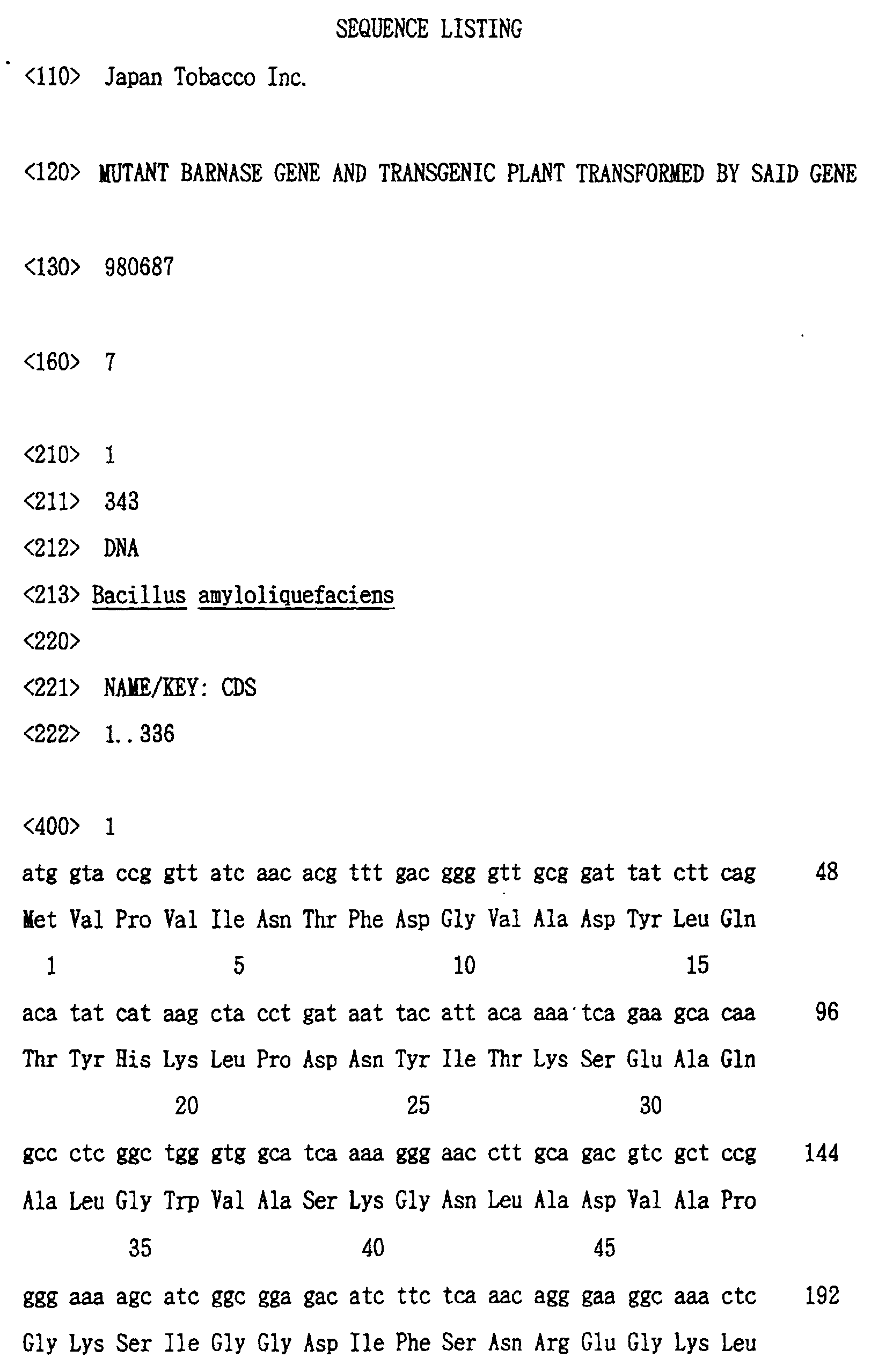
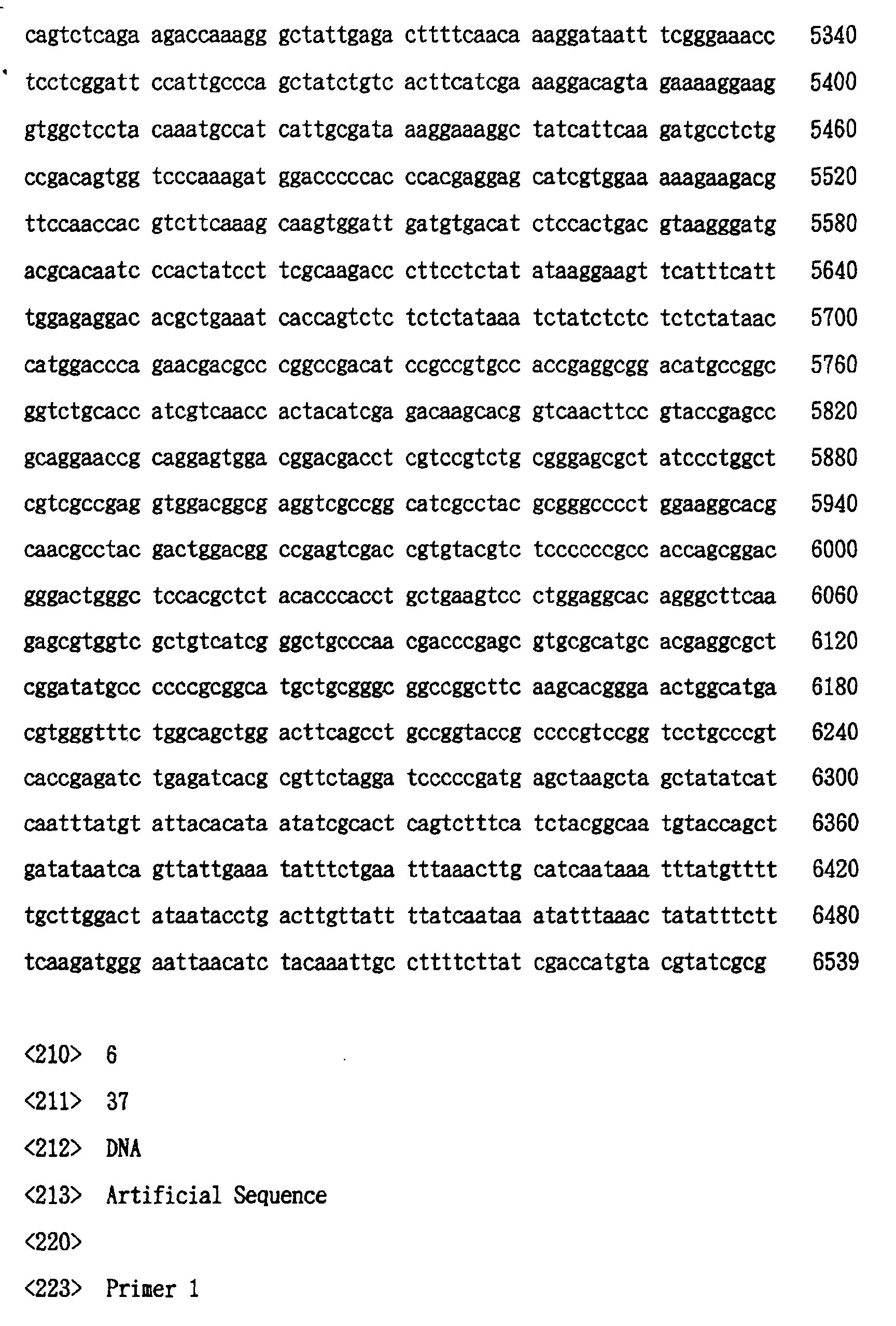
- the present inventors performed PCR by using a DNA containing the sequence represented by SEQ ID NO:1 as a template with the use of a combination of primer 1 (5'-CGTTCGGCTC GATGGTACCG GTTATCAACA CGTTTGA-3': SEQ ID NO: 6) and primer 2 (5'-CCTCTAGATT ATCTGATTTT TGTAAAGGTC TGATAATG-3': SEQ ID NO:7) under such conditions as to induce errors.
- primer 1 5'-CGTTCGGCTC GATGGTACCG GTTATCAACA CGTTTGA-3': SEQ ID NO: 6
- primer 2 5'-CCTCTAGATT ATCTGATTTT TGTAAAGGTC TGATAATG-3': SEQ ID NO:7
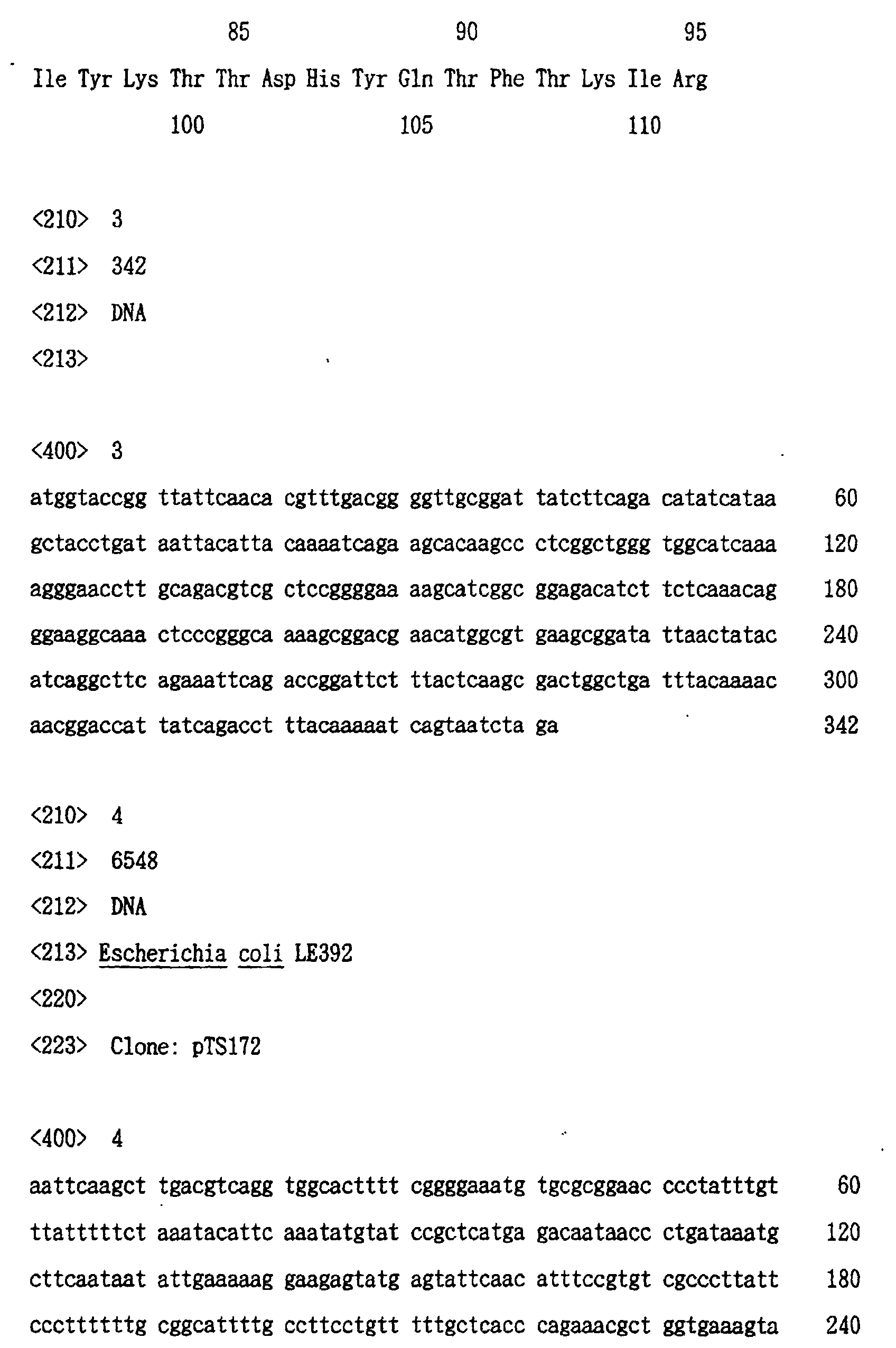
- SEQ ID NO:3 was isolated.
- the sequence represented by SEQ ID NO:1 employed herein is the sequence of the coding region of the barnase gene contained in the known plasmid pVE108 (WO92/ 13956). This sequence corresponds to the wild
- the PCR amplification product is cloned in a host (for example, Escherichia coli ) and clones containing a mutant barnase gene is isolated.
- a host for example, Escherichia coli
- clones having a mutant barnase gene may be screened by assaying the RNase activity expressed by the gene.
- a plasmid is prepared by using the mutant barnase gene obtained above and then E . coli is transformed thereby.
- the growth of the E . coli transformant thus obtained will be inhibited by the activity of the mutant barnase.
- a colony growing slowly i.e., a small colony
- E . coli having a control vector free from any barnase gene is selected. It is expected that the thus selected E . coli strain will contain the mutant barnase gene.
- the second step is then carried out.
- a barstar gene is employed.
- barstar is an inhibitory protein against barnase.
- E . coli which expresses barstar the enzymatic activity of barnase is inhibited and thus the degradation of mRNA, which otherwise takes place in the presence of barnase, can be inhibited.
- E . coli which expresses a barstar gene is transformed with a barnase gene, the growth will not be inhibited. Accordingly, it is expected that the thus obtained E . coli transformant will produce little difference in growth rate from the transformant constructed by the control plasmid which is free from any barnase gene and, therefore, these transformants will produce little difference in colony size too.
- a plasmid is prepared from the E . coli strain selected in the first step.
- the plasmid is then used to transform another E . coli strain, in which the barstar gene is constitutively expressed.
- mutant barnase gene-containing colonies having almost the same size as the one of the E . coli transformed by the control plasmid are selected.
- the E . coli with the constitutive expression of the barstar gene to be used herein can be prepared by, for example, the method as will be described in Example 1 hereinafter.
- the DNA sequence of the thus obtained mutant barnase gene may be analyzed by a conventional method, if necessary, to thereby examine the mutation in detail.
- a preferred example of the mutant barnase gene of the present invention is one which has the DNA sequence represented by SEQ ID NO:3. Compared with the nucleotide sequence of SEQ ID NO:1 coding for the wild type activity, the nucleotide sequence encoding this gene has an insertion of "T” at the 15-position from A in the initiation codon ATG and a deletion of "A” at the 333-position. According to the normal translation manner, translation will be initiated from ATG at the 1-position of this DNA sequence represented by SEQ ID NO:3, and terminated at the ninth codon which has been converted to a termination codon as a result of the insertion of the "T" at the 15-position.
- the frame shifting efficiency during the translation varies from gene to gene, i.e., ranging from several % to 50%.
- the efficiency of the shifting of the reading frame during the translation is not high and thus the translation product in the correct frame is formed in a smaller amount, thereby lowering the activity of the gene.
- a gene having a DNA sequence derived from the DNA sequence represented by SEQ ID NO:3 by substitution, deletion, insertion or addition of one or more nucleotides will be a mutant barnase gene which provides a lowered translation efficiency due to the shifting of the reading frame as a result of the insertion of T at the 15-position from A in the initiation codon ATG and/or the deletion of A at the 333-position, as in the DNA sequence represented by SEQ ID NO:3. It is considered that each of these genes, likewise the gene of SEQ ID NO:3, is capable of making a plant substantially male sterile when it is anther-specifically expressed in the plant. Accordingly, these genes are also included in the scope of the present invention similar to the gene of SEQ ID NO:3.
- the plant which is to be male sterilized by the mutant barnase gene is not particularly limited, so long as the gene can be transferred into the plant to provide a male sterilized plant.
- Examples of the plants include rice, corn, tobacco, lettuce and Brassica. Among all, rice and corn are preferred.
- the mutant barnase gene is expressed specifically in the anthers of the plant to inhibit the anther functions by the RNase activity of barnase.
- Such an anther-specific expression can be achieved by using the method described in WO92/13957.
- the mutant barnase gene is ligated to the downstream of an anther-specific promoter and then incorporated into plant cells with the use of an expression vector.
- the incorporation may be performed by using the Agrobacterium method, the electroporation method, the particle gun method, etc.
- a complete plant can be formed by the regeneration from a callus of the transformed plant cells in accordance with, for example, the method reported in Y. Hiel et al., Plant J. 6, 271-282:1994.
- the male sterility of the thus constructed plant can be confined by the inability of the plant to fertilize unless it is pollinated from another fertilizable plant.
- Primer 1 (CGTTCGGCTC GATGGTACCG GTTATCAACA CGTTTGA: SEQ ID NO: 6) and Primer 2 (CCTCTAGATT ATCTGATTTT TGTAAAGGTC TGATAATG: SEQ ID NO:7) were synthesized by a DNA synthesizer (manufactured by Applied Biosystems) in accordance with the method described in S.L. Beaucage et al., Tetrahedron Lett., 22. 1859-1862:1982.
- Known plasmid pVE108 (WO92/13956) was used as a template and PCR was carried out with the use of the combination of Primers 1 and 2.
- SEQ ID NO:1 shows the sequence of the coding region of the barnase gene which is contained in pVE108.
- the reaction was performed for 50 cycles with each cycle consisting of 1 minute at 94°C, 1 minute at 57°C and 1 minute at 72°C in 10 mM Tris-HCl (pH 9.5), 50 mM KCl, 2 mM MgCl 2 , and 1 mM each of dNTP, 10 ng of the template DNA and 0.5 U of Taq DNA polymerase.
- the amplification product was separated by electrophoreses on agarose gel (2% SeaKem GTG agarose, 1xTAE) and purified by the DEAE-cellulose method (M. Muramatsu, Labo-manual Idenshikogaku (Gene Engineering Labo-Manual), Maruzen, pp.111:1988). By using the purified product thus obtained as a template. PCR was performed again under the conditions as defined above.
- the reaction product from the above step was digested with SacI and XbaI in a conventional manner and then purified by agarose gel electrophoresis to give an "insertion fragment".
- a plasmid to be used for transferring this insertion fragment into E . coli can be appropriately selected.
- the plasmid pHM1 was constructed as follows. Plasmid pBR322 was cleaved at the EcoRI site and blunt-ended by using T4 DNA polymerase (manufactured by Takara Shuzo). Separately, lacZ expression cassette (322 bp) was excised from pUC18 with PvuII and the ends thereof were blunted. The cassette was integrated into the restriction site of the blunt-ended plasmid pBR 322 to give plasmid pHM1.
- Plasmid pHM1 was digested with SacI and XbaI followed by dephosphorylation with calf intestine alkaline phosphatase (manufactured by Takara Shuzo) to give a restriction enzyme-treated plasmid fragment.
- this restriction enzyme-treated plasmid pHM1 the above "insertion fragment" containing a barnase gene was ligated by using Takara Ligation Kit ver.1 (manufactured by Takara Shuzo).
- the E . coli having the barnase gene introduced thereinto may be selected by, for example, the following method. Since mRNA is degraded in cells by the barnase activity, the synthesis of protein is suppressed and, in its turn, the growth of E . coli is inhibited. Thus, the E . coli transformed by the barnase gene can be selected by taking advantage of the fact that the desired transformant colony has a smaller size than the E . coli colony transformed by the control plasmid free from the mutant barnase gene. When the wild type barnase or a mutant barnase still maintaining the activity comparable thereto is integrated into pHM1, E . coli cannot form any colony. Thus, clones having a sufficiently weakened barnase activity can be exclusively selected.
- the plasmid having the mutant barnase gene ligated thereto was precipitated from ethanol and then introduced into E . coli LE392 strain by the electroporation method with the use of GenePulser (BioRad) in accordance with the manufacture's instruction. Also, the control plasmid free from mutant barnase was introduced into the E . coli LE392 strain in the same manner.
- E . coli transformants were plated onto an LB agar medium containing tetracycline (25 ⁇ g/ml) and incubated at room temperature (25°C) for 72 hours. Then colonies of a smaller size than the colony of E . coli having the control plasmid pHM1 introduced thereinto were screened as colonies of the E . coli transformants having the mutant barnase transferred thereinto (Table 1, A).
- barstar is an enzyme acting as an antagonist to barnase.
- E . coli wherein barstar is expressed, the enzymatic activity of barnase is inhibited and thus the degradation of mRNA, which otherwise takes place in the presence of barnase, can be inhibited. Therefore, if E . coli expressing barstar is transformed by a plasmid containing a barnase gene, the growth thereof will not be inhibited. Accordingly, it is expected that the thus obtained E . coli transformant will show little difference in growth rate from the transformant constructed by using the control plasmid free from a barnase gene and, therefore, these transformants will show little difference in colony size too.
- the thus obtained plasmid was introduced into E . coli MC1061 strain thereby to transfer the transposon, which contained the barstar gene cassette, into the chromosome of the E . coli . It was confirmed based on the chloramphenicol tolerance that this E . coli was able to maintain the barstar gene cassette in a stable state. Since the E . coli MC1061 strain lacked the lacI gene, the tac promoter was continuously active and thus the barstar gene was constitutively expressed.
- the plasmid containing the mutant barnase gene as the insertion fragment and the control plasmid free from the same were each introduced into the above E . coli transformant by the electroporation method. Then the E . coli transformants were plated onto an LB agar medium containing IPTG (1mM) and tetracycline (25 ⁇ g/ml) and incubated at 25°C for 72 hours. Among the colonies of the E . coli transformed by the mutant barnase gene, a colony being comparable in size to the colony of the E . coli having the control plasmid pHM1, which had been simultaneously plate-cultured, was screened and named "#4-31" (Table 1, B).
- a cloned mutant barnase gene appropriate for the object of the present invention was prepared.
- the clone #4-31 screened in Example 1 was propagated.
- the mutant barnase gene fragment in the clone #4-31 was excised with KpnI and XbaI and ligated into the KpnI, XbaI-site of pUC119 having been cleaved similarly with KpnI and XbaI. After amplifying the obtained plasmid by using E .
- Example 3 Construction of male sterile rice by using attenuated mutant barnase gene
- the attenuated mutant barnase gene integrated into pUC119 as described above was cleaved with restriction enzymes XbaI and KpnI and thus the plasmid vector pTS431 represented by SEQ ID NO:5 was constructed.
- this plasmid pTS431 differs from the known plasmid pVE108 (PCT International Publication WO92/13956) in the following points, it is substantially equivalent thereto except for the moieties of the anther-specific promoter and the mutant barnase.
- the fragment of about 4.5 kbp was excised with a restriction enzyme EcoRI respectively from pTS431 (a plasmid having the mutant barnase gene transferred thereinto; SEQ ID NO:5) and pTS172 (a plasmid having the barnase gene transferred thereinto; SEQ ID NO:4) and inserted into the EcoRI-site of the intermediate vector pSB11 (T. Komari et al., Plant J. 10(1), 165-174:1996), and further, the T-DNA region thereof was integrated into the acceptor vector pSB1 (T. Komari et al., Plant J. 10(1). 165-174:1996) by way of homologous recombination.
- rice By using Agrobacterium tumefaciens LBA4404 having the obtained recombinant plasmids (pSB1431 and pSB1172 respectively), rice (variety: Asanohikari) was transformed. While the transformation was performed basically in accordance with the method of Hiei et al. (Plant J. 6(2), 271-282:1994).
- phosphinothricine Concentration: 10 mg/L was employed for screening transformants since the thus constructed male sterility genes contained bar gene encoding phosphinithricine acetyl transferase as a selective marker. Phosphinothricine facilitates selection of calluses having the gene transferred thereinto.
- a barnase gene having a weakened effect is constructed via mutation.
- a male sterility gene comprising the mutant barnase gene can be introduced into a plant to successfully produce a male sterile plant free from any unfavorable characteristic at a high efficiency with the use of a single gene without resort to the use of a barstar gene.
Landscapes
- Health & Medical Sciences (AREA)
- Life Sciences & Earth Sciences (AREA)
- Genetics & Genomics (AREA)
- Engineering & Computer Science (AREA)
- Chemical & Material Sciences (AREA)
- Bioinformatics & Cheminformatics (AREA)
- Biomedical Technology (AREA)
- Organic Chemistry (AREA)
- Zoology (AREA)
- Wood Science & Technology (AREA)
- Molecular Biology (AREA)
- General Engineering & Computer Science (AREA)
- Biotechnology (AREA)
- Biochemistry (AREA)
- Microbiology (AREA)
- General Health & Medical Sciences (AREA)
- Physics & Mathematics (AREA)
- Plant Pathology (AREA)
- Biophysics (AREA)
- Cell Biology (AREA)
- Medicinal Chemistry (AREA)
- Micro-Organisms Or Cultivation Processes Thereof (AREA)
- Breeding Of Plants And Reproduction By Means Of Culturing (AREA)
- Enzymes And Modification Thereof (AREA)
Abstract
A male sterile plant which is free from any undesirable character is constructed by expressing a barnase gene alone specifically in the
anther. The barnase gene, which has been depressed by mutagenesis while sustaining its activity, is transferred into a plant and then
expressed specifically in the anther to thereby efficiently give the aimed male sterile transformant.
Description
- The present application claims priority from Japanese Patent Application No.: Hei 10-220060, the disclosure of which is incorporated herein by reference.
- This invention relates to a mutant barnase gene which makes it possible to efficiently yield a male sterile transgenic plant when expressed in a specific site of a plant, in particular, anther-specifically. The present invention further relates to a recombinant vector capable of expressing the mutant barnase gene of the invention in host cells, a plant transformed by this vector and a method for constructing a transgenic plant.
- Barnase is an RNase originating in Bacillus amyloliquefaciens (S. Nishimura and M. Nomura, Biochem. Biophys. Acta 30, 430-431:1958; R.W. Hartley, J. Mol. Biol., 202, 913-915:1988). This enzyme has 110 amino acid residues and hydrolyzes RNA. When expressed in cells, this enzyme inhibits the functions of the cells as a result of its potent RNase activity and thus causes cell death in many cases. By using this characteristic, it is therefore expected that the function of the specific site can be selectively controlled by expressing the barnase gene in a specific site of a plant.
- PCT International Publication WO89/10396 discloses a technique whereby a male sterile plant is obtained by constructing a male sterility gene by ligating the above-described barnase gene to the downstream of an anther tapetal cell-specific expression promoter and introducing the thus obtained gene into a plant. Male sterilization techniques are of great value in efficiently developing an F1 hybrid variety.
- When the barnase gene is employed as a male sterility gene, however, it is frequently observed that resulting male sterile transgenic plants exhibit unfavorable characteristics. PCT International Publication WO96/26283 refers to this problem in rice. It is also reported that similar phenomena are observed not only in rice but in lettuce (Scientia Horticulturae 55, 125-139:1993; Arlette Reymaerts, Hilde Van de Wiele, Greta De Sutter, Jan Janssens: Engineered genes for fertility control and their application in hybrid seed production). According to this report, a plant with depressed activity was constructed by introducing a male sterility gene comprising a tobacco anther-specific promoter (TA29) and a barnase gene into lettuce.
- Although reasons for these phenomena have not been accurately clarified so far, it is assumed that the so-called "position effect" of the site in which the gene is transferred may account for the mechanism (PCT International Publication WO96/26283). More specifically, a desired male sterile plant should be constructed if the male sterility gene is expressed exclusively in the target site (i.e., anthers). However, there is a possibility that the barnase might be expressed also in tissues other than anthers although in a very small dose under the action of expression regulators (for example, an endogenous enhancer) existing in the vicinity of the gene transfer site. In such a case, the unfavorable characteristics as described above can appear because barnase has a strong enzymatic activity.
- To overcome this problem, the method disclosed in PCT International Publication WO96/26283 exploits the character of cauliflower mosaic virus 35S promoter (hereinafter referred to as CaMV35S promoter) of being expressed potently in tissues other than anthers. Namely, barstar, i.e., an inhibitory protein against barnase is employed therein. The barstar gene ligated to a CaMV35S promoter is transferred into a plant simultaneously with a barnase gene and then the barstar gene is constitutively expressed in tissues other than the anthers, thereby eliminating the effects of the barnase in tissues other than the anthers. However, it is necessary in this method to transfer not only a barnase gene but also a barstar gene, and hence, the problem is that the application of this technique to the breeding of F1 varieties of rice or corn seeds may give rise to a gene silencing. "Gene silencing" is a phenomenon wherein the expression of a gene is inhibited when plural copies of the foreign gene are introduced. It is known that this problem frequently occurs when the expression of a foreign gene is effected by a 35S promoter, though the detailed mechanism thereof has not been clarified yet (R.B. Flavel, Proc. Natl. Acad. Sci. USA 91, 3490-3496:1994; J. Finnegan, Bio. Technology 12, 883-888:1994; M.A. Matzke and A.J.M. Matzke, Plant Physiol., 107, 679-685:1995). Since, in rice and corn, a barstar gene is used as a "fertility-restoring gene" in the pollen parent (father) so as to allow the pollen in the F1 generation to restore the fertility (C. Mariani, et al., Nature 357, 384-387:1992), if an MS plant (mother) is constructed by the method with the use of a barstar gene as reported in WO96/26283, the F1 plant has plural copies of the barstar gene. In such a case, there is a possibility that the expression of the gene may be inhibited due to the gene silencing.
- The present invention provides a method for constructing a male sterile plant by using a barnase gene without resort to a barstar gene.
- The present invention further provides a mutant barnase gene to be used in the above method and a process for producing the same.
- In the present invention, the DNA sequence of barnase gene (R.W. Hartley, J. Mol. Biol. 202, 913-915:1988) is mutated at least in part and then the thus obtained mutant barnase gene is anther-specifically expressed in a plant so as to make the plant substantially male sterile without any substantially disadvantageous effect on the tissues other than anthers.
- The mutation can be performed by a known method such as site-specific mutagenesis, deletion of a fragment by using restriction enzymes or the low fidelity PCR method. Among all, it is preferred to use the low fidelity PCR method. This method is described in detail in D. Leung, E. Chen and D. Goedda, Technique 1, 11-15:1989; Y.Z. Xiaoping and R.H. Ebright, Nucleic Acid Res. 19, 6052:1991; G.C. Rice et al., Proc. Natl. Acad. Sci. USA 89, 5467-5471: 1992 and the contents of these documents are incorporated herein by reference. By using this technique, PCR is carried out under such conditions as to induce some errors during the amplification reaction. Thus, random mutations can be introduced into the target DNA fragment.
- Primers to be used in the low fidelity PCR method in the present invention are selected as in the conventional PCR method. It is preferred that each of these primers has a similar number of nucleotides as in the conventional PCR method.
- The present inventors performed PCR by using a DNA containing the sequence represented by SEQ ID NO:1 as a template with the use of a combination of primer 1 (5'-CGTTCGGCTC GATGGTACCG GTTATCAACA CGTTTGA-3': SEQ ID NO: 6) and primer 2 (5'-CCTCTAGATT ATCTGATTTT TGTAAAGGTC TGATAATG-3': SEQ ID NO:7) under such conditions as to induce errors. Thus, a mutant barnase gene having the DNA sequence represented by SEQ ID NO:3 was isolated. The sequence represented by SEQ ID NO:1 employed herein is the sequence of the coding region of the barnase gene contained in the known plasmid pVE108 (WO92/ 13956). This sequence corresponds to the wild type barnase gene from which the unnecessary moiety corresponding to the secretion signal in the N-terminal side has been deleted.
- It is also possible to acquire different mutant barnase genes by a similar method.
- The PCR amplification product is cloned in a host (for example, Escherichia coli) and clones containing a mutant barnase gene is isolated. In this cloning, clones having a mutant barnase gene may be screened by assaying the RNase activity expressed by the gene. However, it is advantageous to screen the clone by the method consisting of the following two steps by taking advantage of the fact that the RNase activity of barnase affects the growth of E. coli.
- In the first step, a plasmid is prepared by using the mutant barnase gene obtained above and then E. coli is transformed thereby. The growth of the E. coli transformant thus obtained will be inhibited by the activity of the mutant barnase. Based on this fact, a colony growing slowly (i.e., a small colony), compared with E. coli having a control vector free from any barnase gene, is selected. It is expected that the thus selected E. coli strain will contain the mutant barnase gene. To confirm that the inhibition of the growth of E. coli is due to the expression of the mutant barnase gene, the second step is then carried out.
- In the second step, a barstar gene is employed. As described above, barstar is an inhibitory protein against barnase. In E. coli which expresses barstar, the enzymatic activity of barnase is inhibited and thus the degradation of mRNA, which otherwise takes place in the presence of barnase, can be inhibited. Therefor if, E. coli which expresses a barstar gene is transformed with a barnase gene, the growth will not be inhibited. Accordingly, it is expected that the thus obtained E. coli transformant will produce little difference in growth rate from the transformant constructed by the control plasmid which is free from any barnase gene and, therefore, these transformants will produce little difference in colony size too. Based on this principle, a plasmid is prepared from the E. coli strain selected in the first step. The plasmid is then used to transform another E. coli strain, in which the barstar gene is constitutively expressed. Thus, mutant barnase gene-containing colonies having almost the same size as the one of the E. coli transformed by the control plasmid are selected. The E. coli with the constitutive expression of the barstar gene to be used herein can be prepared by, for example, the method as will be described in Example 1 hereinafter.
- The DNA sequence of the thus obtained mutant barnase gene may be analyzed by a conventional method, if necessary, to thereby examine the mutation in detail.
- A preferred example of the mutant barnase gene of the present invention is one which has the DNA sequence represented by SEQ ID NO:3. Compared with the nucleotide sequence of SEQ ID NO:1 coding for the wild type activity, the nucleotide sequence encoding this gene has an insertion of "T" at the 15-position from A in the initiation codon ATG and a deletion of "A" at the 333-position. According to the normal translation manner, translation will be initiated from ATG at the 1-position of this DNA sequence represented by SEQ ID NO:3, and terminated at the ninth codon which has been converted to a termination codon as a result of the insertion of the "T" at the 15-position. It is unlikely that the thus formed oligopeptide consisting of 8 amino acids has the barnase activity. Further, there is no other ATG or GTG codon from which the translation can be initiated in the correct frame in the vicinity thereof. However, the fact that the growth rate of E. coli was restored by the barstar protein strongly suggests that the translation of the barnase protein from the gene of SEQ ID NO:3 proceeded in the correct frame. This is seemingly due to a phenomenon called "frame shift re-coding" whereby the ribosome controls the translation while automatically shifting the reading frame during the course of translation into the protein. This phenomenon, which has been reported in several genes of viruses, E. coli and animals, generally depends exclusively on an individual nucleotide sequence and neither any special protein nor translation device is required. The frame shifting efficiency during the translation varies from gene to gene, i.e., ranging from several % to 50%. In the case of the mutant barnase gene, it is considered that the efficiency of the shifting of the reading frame during the translation is not high and thus the translation product in the correct frame is formed in a smaller amount, thereby lowering the activity of the gene.
- Moreover, there is a high possibility that other mutant barnase genes of which the translation efficiency is lowered due to the shifting of the reading frame, as in the case of the DNA sequence represented by SEQ ID NO:3, or some other reasons can be obtained by mutating the barnase gene by, for example, the low fidelity PCR method. Furthermore, there is a high possibility that a gene having a DNA sequence derived from the DNA sequence represented by SEQ ID NO:3 by substitution, deletion, insertion or addition of one or more nucleotides will be a mutant barnase gene which provides a lowered translation efficiency due to the shifting of the reading frame as a result of the insertion of T at the 15-position from A in the initiation codon ATG and/or the deletion of A at the 333-position, as in the DNA sequence represented by SEQ ID NO:3. It is considered that each of these genes, likewise the gene of SEQ ID NO:3, is capable of making a plant substantially male sterile when it is anther-specifically expressed in the plant. Accordingly, these genes are also included in the scope of the present invention similar to the gene of SEQ ID NO:3.
- The plant which is to be male sterilized by the mutant barnase gene is not particularly limited, so long as the gene can be transferred into the plant to provide a male sterilized plant. Examples of the plants include rice, corn, tobacco, lettuce and Brassica. Among all, rice and corn are preferred.
- In order to male sterilize a plant, the mutant barnase gene is expressed specifically in the anthers of the plant to inhibit the anther functions by the RNase activity of barnase. Such an anther-specific expression can be achieved by using the method described in WO92/13957. In brief, the mutant barnase gene is ligated to the downstream of an anther-specific promoter and then incorporated into plant cells with the use of an expression vector.
- The incorporation may be performed by using the Agrobacterium method, the electroporation method, the particle gun method, etc.
- From the transformed plant cells, a complete plant can be formed by the regeneration from a callus of the transformed plant cells in accordance with, for example, the method reported in Y. Hiel et al., Plant J. 6, 271-282:1994.
- The male sterility of the thus constructed plant can be confined by the inability of the plant to fertilize unless it is pollinated from another fertilizable plant.
- Primer 1 (CGTTCGGCTC GATGGTACCG GTTATCAACA CGTTTGA: SEQ ID NO: 6) and Primer 2 (CCTCTAGATT ATCTGATTTT TGTAAAGGTC TGATAATG: SEQ ID NO:7) were synthesized by a DNA synthesizer (manufactured by Applied Biosystems) in accordance with the method described in S.L. Beaucage et al., Tetrahedron Lett., 22. 1859-1862:1982. Known plasmid pVE108 (WO92/13956) was used as a template and PCR was carried out with the use of the combination of Primers 1 and 2. SEQ ID NO:1 shows the sequence of the coding region of the barnase gene which is contained in pVE108. The reaction was performed for 50 cycles with each cycle consisting of 1 minute at 94°C, 1 minute at 57°C and 1 minute at 72°C in 10 mM Tris-HCl (pH 9.5), 50 mM KCl, 2 mM MgCl2, and 1 mM each of dNTP, 10 ng of the template DNA and 0.5 U of Taq DNA polymerase.
- After the completion of the reaction, the amplification product was separated by electrophoreses on agarose gel (2% SeaKem GTG agarose, 1xTAE) and purified by the DEAE-cellulose method (M. Muramatsu, Labo-manual Idenshikogaku (Gene Engineering Labo-Manual), Maruzen, pp.111:1988). By using the purified product thus obtained as a template. PCR was performed again under the conditions as defined above.
- The reaction product from the above step was digested with SacI and XbaI in a conventional manner and then purified by agarose gel electrophoresis to give an "insertion fragment". A plasmid to be used for transferring this insertion fragment into E. coli can be appropriately selected. For example, use may be made of plasmid pHM1 therefor. The plasmid pHM1 was constructed as follows. Plasmid pBR322 was cleaved at the EcoRI site and blunt-ended by using T4 DNA polymerase (manufactured by Takara Shuzo). Separately, lacZ expression cassette (322 bp) was excised from pUC18 with PvuII and the ends thereof were blunted. The cassette was integrated into the restriction site of the blunt-ended plasmid pBR 322 to give plasmid pHM1.
- Plasmid pHM1 was digested with SacI and XbaI followed by dephosphorylation with calf intestine alkaline phosphatase (manufactured by Takara Shuzo) to give a restriction enzyme-treated plasmid fragment. Into this restriction enzyme-treated plasmid pHM1, the above "insertion fragment" containing a barnase gene was ligated by using Takara Ligation Kit ver.1 (manufactured by Takara Shuzo).
- The E. coli having the barnase gene introduced thereinto may be selected by, for example, the following method. Since mRNA is degraded in cells by the barnase activity, the synthesis of protein is suppressed and, in its turn, the growth of E. coli is inhibited. Thus, the E. coli transformed by the barnase gene can be selected by taking advantage of the fact that the desired transformant colony has a smaller size than the E. coli colony transformed by the control plasmid free from the mutant barnase gene. When the wild type barnase or a mutant barnase still maintaining the activity comparable thereto is integrated into pHM1, E. coli cannot form any colony. Thus, clones having a sufficiently weakened barnase activity can be exclusively selected.
- Thus, the plasmid having the mutant barnase gene ligated thereto was precipitated from ethanol and then introduced into E. coli LE392 strain by the electroporation method with the use of GenePulser (BioRad) in accordance with the manufacture's instruction. Also, the control plasmid free from mutant barnase was introduced into the E. coli LE392 strain in the same manner.
- Next, these E. coli transformants were plated onto an LB agar medium containing tetracycline (25 µg/ml) and incubated at room temperature (25°C) for 72 hours. Then colonies of a smaller size than the colony of E. coli having the control plasmid pHM1 introduced thereinto were screened as colonies of the E. coli transformants having the mutant barnase transferred thereinto (Table 1, A).
- As described above, barstar is an enzyme acting as an antagonist to barnase. In E. coli wherein barstar is expressed, the enzymatic activity of barnase is inhibited and thus the degradation of mRNA, which otherwise takes place in the presence of barnase, can be inhibited. Therefore, if E. coli expressing barstar is transformed by a plasmid containing a barnase gene, the growth thereof will not be inhibited. Accordingly, it is expected that the thus obtained E. coli transformant will show little difference in growth rate from the transformant constructed by using the control plasmid free from a barnase gene and, therefore, these transformants will show little difference in colony size too.
- An E. coli transformant which expressed barstar was constructed in the following manner. A barstar gene described in R.W. Hartley, J. Mol. Biol. 202, 913-915:1998 was excised with HindIII and XbaI and ligated in frame to a tac promoter (de Boer et al., Proc. Natl. Acad. Sci. USA 80, 21-25:1983). The gene, together with a chloramphenicol tolerance gene (N.K. Alton and D. Vapnek, Nature 282, 864-869:1979), was ligated into the defective transposon which lacked the transferase in a vector described in Herrero et al., J. Bacteriol. 172, 6557-6567:1990. Subsequently, the thus obtained plasmid was introduced into E. coli MC1061 strain thereby to transfer the transposon, which contained the barstar gene cassette, into the chromosome of the E. coli. It was confirmed based on the chloramphenicol tolerance that this E. coli was able to maintain the barstar gene cassette in a stable state. Since the E. coli MC1061 strain lacked the lacI gene, the tac promoter was continuously active and thus the barstar gene was constitutively expressed.
- The plasmid containing the mutant barnase gene as the insertion fragment and the control plasmid free from the same were each introduced into the above E. coli transformant by the electroporation method. Then the E. coli transformants were plated onto an LB agar medium containing IPTG (1mM) and tetracycline (25 µg/ml) and incubated at 25°C for 72 hours. Among the colonies of the E. coli transformed by the mutant barnase gene, a colony being comparable in size to the colony of the E. coli having the control plasmid pHM1, which had been simultaneously plate-cultured, was screened and named "#4-31" (Table 1, B).
Screened clone and colony size (mm) Screened clone pHM1 (control) A: E. coli LE392 1.77 ± 0.33 2.65 ± 0.47 B: E. coli with barstar gene expression 1.39 ± 0.10 1.55 ± 0.08 - From the E. coli screened in Example 1, a cloned mutant barnase gene appropriate for the object of the present invention was prepared. First, the clone #4-31 screened in Example 1 was propagated. Next, the mutant barnase gene fragment in the clone #4-31 was excised with KpnI and XbaI and ligated into the KpnI, XbaI-site of pUC119 having been cleaved similarly with KpnI and XbaI. After amplifying the obtained plasmid by using E. coli, a reaction was performed by the cycle sequence method with the use of Taq polymerase (Taq Dye Terminator Cycle Sequencing Kit, manufactured by Applied Biosystems Inc.) in accordance with the manufacturer's protocol. Subsequently, the sequence was analyzed with a DNA Sequencer (Model 373A, manufactured by Applied Biosytems Inc.), thereby yielding the sequence represented by SEQ ID NO:3. Compared with the DNA sequence of the wild type barnase gene, this sequence had an insertion of T at the 15-position from A of the initiation codon ATG and a deletion of A at the 333-position.
- The attenuated mutant barnase gene integrated into pUC119 as described above was cleaved with restriction enzymes XbaI and KpnI and thus the plasmid vector pTS431 represented by SEQ ID NO:5 was constructed. Although this plasmid pTS431 differs from the known plasmid pVE108 (PCT International Publication WO92/13956) in the following points, it is substantially equivalent thereto except for the moieties of the anther-specific promoter and the mutant barnase.
- (1) In the plasmid vector pTS431 according to the present invention, the barnase gene (SEQ ID NO:1) in the known plasmid pVE108 has been converted into the mutant barnase gene (SEQ ID NO:3).
- (2) A tobacco-origin anther specific promoter is used in the known plasmid pVE108, while the anther specific promoter of rice E1 gene (PCT International Publication WO92/13956) is used in the plasmid vector pTS431 according to the present invention.
- (3) In the present invention, a 35S3 promoter (EP 0344029) of 1376 bp, which is not used in the plasmid pVE108, is employed upstream of the barnase gene.
- (4) In the present invention, a sequence originating in the downstream of Agrobacterium T-DNA gene 7 excised from pJD884 (PCT International Publication WO93/09218) is employed whereas such a sequence is not used in the plasmid pVE108.
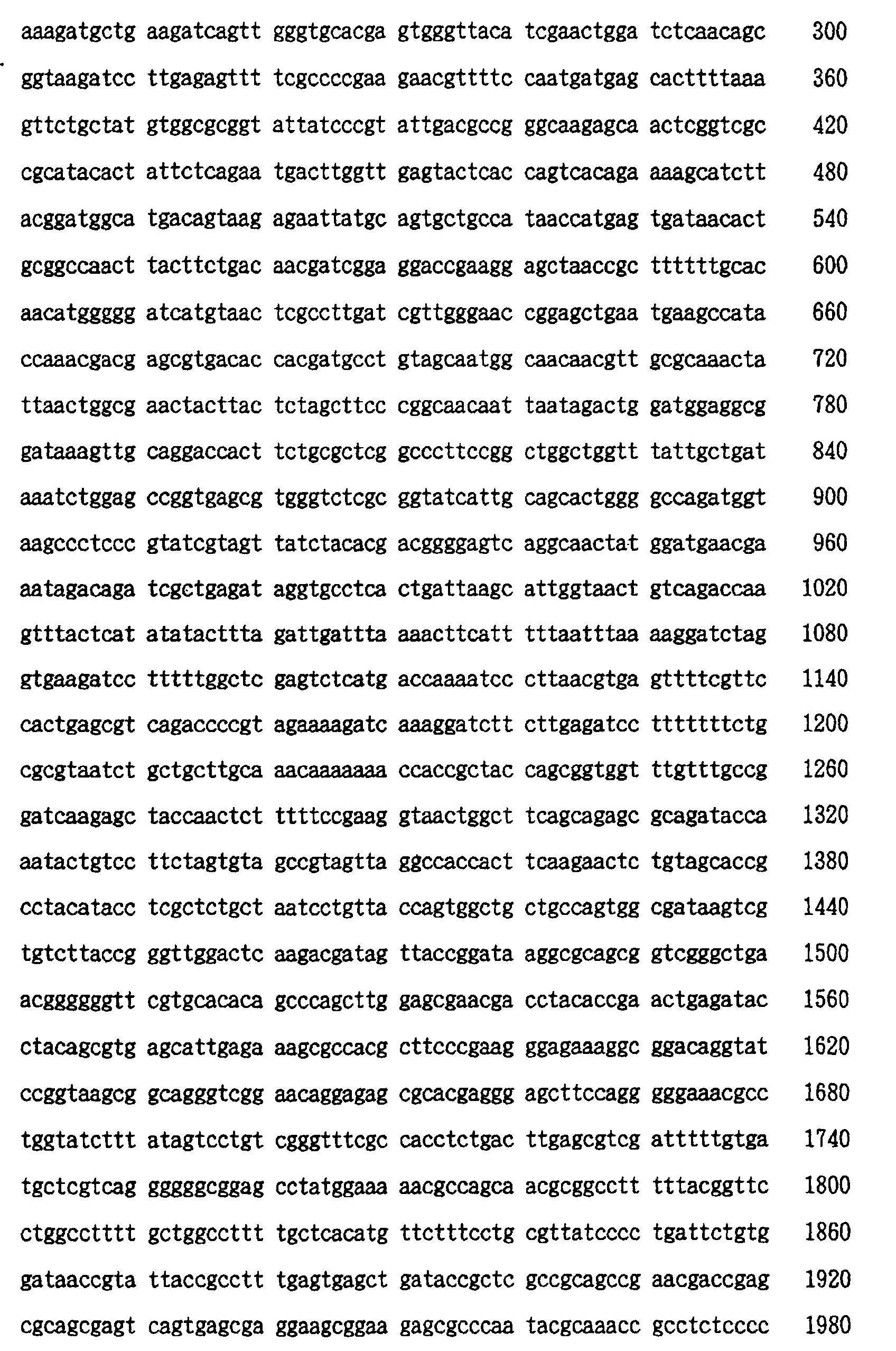
- (5) In the present invention, the region corresponding to lacZ has been deleted from the pUC19-origin moiety. In addition a plasmid (pTS172) having the wild type barnase gene integrated therein is represented by SEQ ID NO:4.
-
- The fragment of about 4.5 kbp was excised with a restriction enzyme EcoRI respectively from pTS431 (a plasmid having the mutant barnase gene transferred thereinto; SEQ ID NO:5) and pTS172 (a plasmid having the barnase gene transferred thereinto; SEQ ID NO:4) and inserted into the EcoRI-site of the intermediate vector pSB11 (T. Komari et al., Plant J. 10(1), 165-174:1996), and further, the T-DNA region thereof was integrated into the acceptor vector pSB1 (T. Komari et al., Plant J. 10(1). 165-174:1996) by way of homologous recombination. By using Agrobacterium tumefaciens LBA4404 having the obtained recombinant plasmids (pSB1431 and pSB1172 respectively), rice (variety: Asanohikari) was transformed. While the transformation was performed basically in accordance with the method of Hiei et al. (Plant J. 6(2), 271-282:1994). phosphinothricine (concentration: 10 mg/L) was employed for screening transformants since the thus constructed male sterility genes contained bar gene encoding phosphinithricine acetyl transferase as a selective marker. Phosphinothricine facilitates selection of calluses having the gene transferred thereinto.
- A comparison of the rice transformant obtained with the use of the wild type barnase gene with the one obtained with the use of the mutant barnase gene indicates that the transfer of the mutant barnase gene gave rise to a remarkable improvement in the transformation efficiency and an increase in the rate of morphologically normal male sterility transformants, as shown in Table 2.
Transformation efficiency No. of infected calluses No. of regenerated calluses No. of PCR-positive lines No. of morphologically normal male sterile lines pSB1172 (control) 2838 83 52/83 9/52(17.3%) pSB1431 (present invention) 787 69 43/45 27/28(96.4%) - In the present invention, a barnase gene having a weakened effect is constructed via mutation. A male sterility gene comprising the mutant barnase gene can be introduced into a plant to successfully produce a male sterile plant free from any unfavorable characteristic at a high efficiency with the use of a single gene without resort to the use of a barstar gene.




Claims (10)
- A mutant barnase gene having one or some mutations at least in part of the DNA sequence of barnase gene, wherein said mutant barnase gene is capable, when anther-specifically expressed in a plant, of making said plant substantially male sterile without exerting any substantially disadvantageous effect on the tissues except for the anthers.
- The gene as claimed in Claim 1, wherein said mutation is a mutation causing frame shift re-coding.
- A gene which is derived from a DNA sequence encoding the same amino acid sequence as shown in SEQ ID NO:1 by substitution, deletion, insertion or addition of one to several nucleotides in said DNA sequence, wherein said gene is capable of encoding a protein which makes a plant substantially male sterile when expressed anther-specifically in said plant.
- A gene comprising a DNA sequence which is derived from a DNA sequence encoding the same amino acid sequence as shown in SEQ ID NO:1 by substitution, deletion, insertion or addition of one to several nucleotides in the latter DNA sequence, and a promoter located upstream of said DNA sequence for allowing an anther-specific expression, wherein said gene is capable of making a plant substantially male sterile when introduced into the genome of said plant.
- A gene represented by SEQ ID NO:3 which encodes a protein capable of making a plant substantially male sterile when expressed anther-specifically in said plant.
- A gene comprising the sequence represented by SEQ ID NO:3 and a promoter located upstream of said sequence for allowing an anther-specific expression, wherein said gene is capable of making a plant substantially male sterile when introduced into the genome of said plant.
- A recombinant vector which contains a gene as claimed in any of Claims 1 to 6 and expresses said gene in a host plant.
- A method of making a plant male sterile which comprises transforming said plant by a mutant barnase gene as claimed in any of Claims 1 to 6 and allowing said mutant barnase gene to be expressed anther-specifically.
- The method as claimed in Claim 8, wherein said plant is transformed by said mutant barnase gene by integrating said gene into the genome of said plant.
- A transgenic plant wherein a gene as claimed in any of Claims 1 to 6 has been introduced.
Applications Claiming Priority (3)
| Application Number | Priority Date | Filing Date | Title |
|---|---|---|---|
| JP22006098A JP3478975B2 (en) | 1998-08-04 | 1998-08-04 | Mutant barnase gene and its transformed plant |
| JP22006098 | 1998-08-04 | ||
| PCT/JP1999/004167 WO2000008176A1 (en) | 1998-08-04 | 1999-08-03 | Mutated barnase gene and plant transformed by the same |
Publications (1)
| Publication Number | Publication Date |
|---|---|
| EP1020527A1 true EP1020527A1 (en) | 2000-07-19 |
Family
ID=16745319
Family Applications (1)
| Application Number | Title | Priority Date | Filing Date |
|---|---|---|---|
| EP99933237A Withdrawn EP1020527A1 (en) | 1998-08-04 | 1999-08-03 | Mutated barnase gene and plant transformed by the same |
Country Status (8)
| Country | Link |
|---|---|
| US (1) | US20020166140A1 (en) |
| EP (1) | EP1020527A1 (en) |
| JP (1) | JP3478975B2 (en) |
| KR (1) | KR20010024190A (en) |
| CN (1) | CN1274388A (en) |
| AU (1) | AU756092B2 (en) |
| CA (1) | CA2305784A1 (en) |
| WO (1) | WO2000008176A1 (en) |
Cited By (1)
| Publication number | Priority date | Publication date | Assignee | Title |
|---|---|---|---|---|
| US7851679B2 (en) | 2004-09-22 | 2010-12-14 | Arborgen, Llc | Reproductive ablation constructs |
Families Citing this family (5)
| Publication number | Priority date | Publication date | Assignee | Title |
|---|---|---|---|---|
| US8293503B2 (en) | 2003-10-03 | 2012-10-23 | Promega Corporation | Vectors for directional cloning |
| JP4583051B2 (en) * | 2004-03-02 | 2010-11-17 | 岩手県 | Novel plant cell death inducing factor NbCD3 |
| JP4583050B2 (en) * | 2004-03-02 | 2010-11-17 | 岩手県 | Novel plant cell death inducing factor NbCD2 |
| WO2016166776A1 (en) | 2015-04-16 | 2016-10-20 | Council Of Scientific & Industrial Research | Novel reversible expression system for transgene expression in plants |
| UA129369C2 (en) * | 2019-03-28 | 2025-04-02 | Байосіріз Елелсі | Soybean transgenic event ind-шш41ш-5 |
Family Cites Families (1)
| Publication number | Priority date | Publication date | Assignee | Title |
|---|---|---|---|---|
| ATE304600T1 (en) * | 1995-02-21 | 2005-09-15 | Bayer Bioscience Nv | METHOD FOR PRODUCING MALE STERILE PLANTS |
-
1998
- 1998-08-04 JP JP22006098A patent/JP3478975B2/en not_active Expired - Fee Related
-
1999
- 1999-08-03 CA CA002305784A patent/CA2305784A1/en not_active Abandoned
- 1999-08-03 US US09/509,945 patent/US20020166140A1/en not_active Abandoned
- 1999-08-03 KR KR1020007002963A patent/KR20010024190A/en not_active Withdrawn
- 1999-08-03 EP EP99933237A patent/EP1020527A1/en not_active Withdrawn
- 1999-08-03 AU AU49333/99A patent/AU756092B2/en not_active Ceased
- 1999-08-03 CN CN99801291A patent/CN1274388A/en active Pending
- 1999-08-03 WO PCT/JP1999/004167 patent/WO2000008176A1/en not_active Ceased
Non-Patent Citations (1)
| Title |
|---|
| See references of WO0008176A1 * |
Cited By (3)
| Publication number | Priority date | Publication date | Assignee | Title |
|---|---|---|---|---|
| US7851679B2 (en) | 2004-09-22 | 2010-12-14 | Arborgen, Llc | Reproductive ablation constructs |
| US8034998B2 (en) | 2004-09-22 | 2011-10-11 | Arborgen Inc. | Reproductive ablation constructs |
| US8476493B2 (en) | 2004-09-22 | 2013-07-02 | Arborgen Inc. | Reproductive ablation constructs |
Also Published As
| Publication number | Publication date |
|---|---|
| AU4933399A (en) | 2000-02-28 |
| KR20010024190A (en) | 2001-03-26 |
| JP2000041682A (en) | 2000-02-15 |
| AU756092B2 (en) | 2003-01-02 |
| CA2305784A1 (en) | 2000-02-17 |
| WO2000008176A1 (en) | 2000-02-17 |
| CN1274388A (en) | 2000-11-22 |
| JP3478975B2 (en) | 2003-12-15 |
| US20020166140A1 (en) | 2002-11-07 |
Similar Documents
| Publication | Publication Date | Title |
|---|---|---|
| US5589610A (en) | Stamen-specific promoters from corn | |
| US7667093B2 (en) | Site-specific recombination system to manipulate the plastid genome of higher plants | |
| JP4476359B2 (en) | How to get a male sterile plant | |
| JPH06504910A (en) | Stamen-specific promoter from rice | |
| HU223788B1 (en) | Chimera gene with several herbicide resistant genes,plant cell and plant resistant to several herbicides | |
| US8604281B2 (en) | Transgenic plants with controlled distribution of a trait to progeny | |
| EP1135982A1 (en) | Method of constructing male sterile plant | |
| AU743189B2 (en) | Protein complementation in transgenic plants | |
| EP0701619A1 (en) | Process for generating male sterile plants | |
| US6852909B2 (en) | Process for producing female-sterile plants | |
| AU4933399A (en) | Mutant barnase gene and transgenic plant transformed by said gene | |
| US11926823B2 (en) | Compositions and methods of modifying a plant genome to produce a MS9, MS22, MS26, or MS45 male-sterile plant | |
| EP0537399A1 (en) | A novel ribonuclease and its inhibitor | |
| US6262339B1 (en) | Process for generating male sterile plants | |
| US7012173B1 (en) | Promoter system and production and use of the same | |
| US7078587B1 (en) | Tapetum-specific promoters | |
| WO2006125678A2 (en) | Reversible male-sterile plants | |
| CZ297699A3 (en) | Complementation of proteins in transgenic plants |
Legal Events
| Date | Code | Title | Description |
|---|---|---|---|
| PUAI | Public reference made under article 153(3) epc to a published international application that has entered the european phase |
Free format text: ORIGINAL CODE: 0009012 |
|
| 17P | Request for examination filed |
Effective date: 20000504 |
|
| AK | Designated contracting states |
Kind code of ref document: A1 Designated state(s): AT BE CH CY DE DK ES FI FR GB GR IE IT LI LU MC NL PT SE |
|
| RIN1 | Information on inventor provided before grant (corrected) |
Inventor name: NAKAKIDO, FUMIO, JAPAN TOBACCO INC. Inventor name: HAMADA, KAZUYUKI, JAPAN TOBACCO INC. |
|
| STAA | Information on the status of an ep patent application or granted ep patent |
Free format text: STATUS: THE APPLICATION IS DEEMED TO BE WITHDRAWN |
|
| 18D | Application deemed to be withdrawn |
Effective date: 20050301 |