EP1020081B1 - Procede de synchronisation spatiale d'une image video codee numeriquement et/ou d'identification de la syntaxe d'une sequence video - Google Patents
Procede de synchronisation spatiale d'une image video codee numeriquement et/ou d'identification de la syntaxe d'une sequence video Download PDFInfo
- Publication number
- EP1020081B1 EP1020081B1 EP98946539A EP98946539A EP1020081B1 EP 1020081 B1 EP1020081 B1 EP 1020081B1 EP 98946539 A EP98946539 A EP 98946539A EP 98946539 A EP98946539 A EP 98946539A EP 1020081 B1 EP1020081 B1 EP 1020081B1
- Authority
- EP
- European Patent Office
- Prior art keywords
- image
- images
- activity
- stage
- analysis grid
- Prior art date
- Legal status (The legal status is an assumption and is not a legal conclusion. Google has not performed a legal analysis and makes no representation as to the accuracy of the status listed.)
- Expired - Lifetime
Links
- 238000000034 method Methods 0.000 title claims description 77
- 230000000694 effects Effects 0.000 claims description 64
- 238000004458 analytical method Methods 0.000 claims description 60
- 230000003595 spectral effect Effects 0.000 claims description 19
- 238000005070 sampling Methods 0.000 claims description 18
- 238000001914 filtration Methods 0.000 claims description 12
- 230000001360 synchronised effect Effects 0.000 claims description 5
- 238000006243 chemical reaction Methods 0.000 claims description 2
- 230000001747 exhibiting effect Effects 0.000 claims 3
- 102100037812 Medium-wave-sensitive opsin 1 Human genes 0.000 description 22
- 230000006870 function Effects 0.000 description 17
- 230000008569 process Effects 0.000 description 17
- 230000010363 phase shift Effects 0.000 description 16
- 238000005259 measurement Methods 0.000 description 12
- 230000002123 temporal effect Effects 0.000 description 12
- 238000004364 calculation method Methods 0.000 description 11
- 230000006835 compression Effects 0.000 description 11
- 238000007906 compression Methods 0.000 description 11
- 238000001514 detection method Methods 0.000 description 10
- 230000015556 catabolic process Effects 0.000 description 7
- 238000006731 degradation reaction Methods 0.000 description 7
- 230000009467 reduction Effects 0.000 description 7
- 230000008901 benefit Effects 0.000 description 6
- 238000012545 processing Methods 0.000 description 6
- 230000003044 adaptive effect Effects 0.000 description 5
- 238000005516 engineering process Methods 0.000 description 5
- 239000011159 matrix material Substances 0.000 description 5
- 238000012360 testing method Methods 0.000 description 5
- 238000012986 modification Methods 0.000 description 4
- 230000004048 modification Effects 0.000 description 4
- 230000009466 transformation Effects 0.000 description 4
- 238000013459 approach Methods 0.000 description 3
- 230000003111 delayed effect Effects 0.000 description 3
- 238000000605 extraction Methods 0.000 description 3
- 238000004519 manufacturing process Methods 0.000 description 3
- GNFTZDOKVXKIBK-UHFFFAOYSA-N 3-(2-methoxyethoxy)benzohydrazide Chemical compound COCCOC1=CC=CC(C(=O)NN)=C1 GNFTZDOKVXKIBK-UHFFFAOYSA-N 0.000 description 2
- 239000008186 active pharmaceutical agent Substances 0.000 description 2
- 230000002457 bidirectional effect Effects 0.000 description 2
- 230000001427 coherent effect Effects 0.000 description 2
- 238000005056 compaction Methods 0.000 description 2
- 239000013256 coordination polymer Substances 0.000 description 2
- 239000006185 dispersion Substances 0.000 description 2
- 238000009432 framing Methods 0.000 description 2
- 239000000203 mixture Substances 0.000 description 2
- 230000008447 perception Effects 0.000 description 2
- 238000011002 quantification Methods 0.000 description 2
- 238000013139 quantization Methods 0.000 description 2
- 230000004044 response Effects 0.000 description 2
- 238000011282 treatment Methods 0.000 description 2
- FGUUSXIOTUKUDN-IBGZPJMESA-N C1(=CC=CC=C1)N1C2=C(NC([C@H](C1)NC=1OC(=NN=1)C1=CC=CC=C1)=O)C=CC=C2 Chemical compound C1(=CC=CC=C1)N1C2=C(NC([C@H](C1)NC=1OC(=NN=1)C1=CC=CC=C1)=O)C=CC=C2 FGUUSXIOTUKUDN-IBGZPJMESA-N 0.000 description 1
- 101100536354 Drosophila melanogaster tant gene Proteins 0.000 description 1
- 101000969688 Homo sapiens Macrophage-expressed gene 1 protein Proteins 0.000 description 1
- 101000863856 Homo sapiens Shiftless antiviral inhibitor of ribosomal frameshifting protein Proteins 0.000 description 1
- 102100021285 Macrophage-expressed gene 1 protein Human genes 0.000 description 1
- 230000009471 action Effects 0.000 description 1
- 230000006978 adaptation Effects 0.000 description 1
- 230000033228 biological regulation Effects 0.000 description 1
- 230000005540 biological transmission Effects 0.000 description 1
- 239000012141 concentrate Substances 0.000 description 1
- 238000012937 correction Methods 0.000 description 1
- 238000005314 correlation function Methods 0.000 description 1
- 230000001186 cumulative effect Effects 0.000 description 1
- 238000006073 displacement reaction Methods 0.000 description 1
- 238000009826 distribution Methods 0.000 description 1
- 238000011156 evaluation Methods 0.000 description 1
- 230000000977 initiatory effect Effects 0.000 description 1
- 230000002427 irreversible effect Effects 0.000 description 1
- 238000001303 quality assessment method Methods 0.000 description 1
- 238000011946 reduction process Methods 0.000 description 1
- 230000008521 reorganization Effects 0.000 description 1
- 238000011160 research Methods 0.000 description 1
- 230000000717 retained effect Effects 0.000 description 1
- 230000033764 rhythmic process Effects 0.000 description 1
- 230000035945 sensitivity Effects 0.000 description 1
- 230000000007 visual effect Effects 0.000 description 1
Images



Classifications
-
- H—ELECTRICITY
- H04—ELECTRIC COMMUNICATION TECHNIQUE
- H04N—PICTORIAL COMMUNICATION, e.g. TELEVISION
- H04N19/00—Methods or arrangements for coding, decoding, compressing or decompressing digital video signals
- H04N19/85—Methods or arrangements for coding, decoding, compressing or decompressing digital video signals using pre-processing or post-processing specially adapted for video compression
- H04N19/86—Methods or arrangements for coding, decoding, compressing or decompressing digital video signals using pre-processing or post-processing specially adapted for video compression involving reduction of coding artifacts, e.g. of blockiness
- H04N19/865—Methods or arrangements for coding, decoding, compressing or decompressing digital video signals using pre-processing or post-processing specially adapted for video compression involving reduction of coding artifacts, e.g. of blockiness with detection of the former encoding block subdivision in decompressed video
-
- H—ELECTRICITY
- H04—ELECTRIC COMMUNICATION TECHNIQUE
- H04N—PICTORIAL COMMUNICATION, e.g. TELEVISION
- H04N19/00—Methods or arrangements for coding, decoding, compressing or decompressing digital video signals
- H04N19/40—Methods or arrangements for coding, decoding, compressing or decompressing digital video signals using video transcoding, i.e. partial or full decoding of a coded input stream followed by re-encoding of the decoded output stream
-
- H—ELECTRICITY
- H04—ELECTRIC COMMUNICATION TECHNIQUE
- H04N—PICTORIAL COMMUNICATION, e.g. TELEVISION
- H04N19/00—Methods or arrangements for coding, decoding, compressing or decompressing digital video signals
- H04N19/60—Methods or arrangements for coding, decoding, compressing or decompressing digital video signals using transform coding
- H04N19/61—Methods or arrangements for coding, decoding, compressing or decompressing digital video signals using transform coding in combination with predictive coding
-
- H—ELECTRICITY
- H04—ELECTRIC COMMUNICATION TECHNIQUE
- H04N—PICTORIAL COMMUNICATION, e.g. TELEVISION
- H04N19/00—Methods or arrangements for coding, decoding, compressing or decompressing digital video signals
- H04N19/85—Methods or arrangements for coding, decoding, compressing or decompressing digital video signals using pre-processing or post-processing specially adapted for video compression
-
- H—ELECTRICITY
- H04—ELECTRIC COMMUNICATION TECHNIQUE
- H04N—PICTORIAL COMMUNICATION, e.g. TELEVISION
- H04N19/00—Methods or arrangements for coding, decoding, compressing or decompressing digital video signals
- H04N19/85—Methods or arrangements for coding, decoding, compressing or decompressing digital video signals using pre-processing or post-processing specially adapted for video compression
- H04N19/86—Methods or arrangements for coding, decoding, compressing or decompressing digital video signals using pre-processing or post-processing specially adapted for video compression involving reduction of coding artifacts, e.g. of blockiness
-
- H—ELECTRICITY
- H04—ELECTRIC COMMUNICATION TECHNIQUE
- H04N—PICTORIAL COMMUNICATION, e.g. TELEVISION
- H04N19/00—Methods or arrangements for coding, decoding, compressing or decompressing digital video signals
- H04N19/10—Methods or arrangements for coding, decoding, compressing or decompressing digital video signals using adaptive coding
- H04N19/102—Methods or arrangements for coding, decoding, compressing or decompressing digital video signals using adaptive coding characterised by the element, parameter or selection affected or controlled by the adaptive coding
- H04N19/124—Quantisation
-
- H—ELECTRICITY
- H04—ELECTRIC COMMUNICATION TECHNIQUE
- H04N—PICTORIAL COMMUNICATION, e.g. TELEVISION
- H04N19/00—Methods or arrangements for coding, decoding, compressing or decompressing digital video signals
- H04N19/60—Methods or arrangements for coding, decoding, compressing or decompressing digital video signals using transform coding
Definitions
- the subject of the present invention is a method of synchronization of the spatial position of a video image, to find the position of an initial grid of initial digital coding, by coding blocks, of said image, as well as a method of at least partial identification of the temporal syntax of the initial coding.
- bit rate reduction coding methods in particular JPEG, CCITT H261, ISO / IEC 13918 MPEG2, in order to reduce the amount of data generated and manipulated during the various operations.
- the recommendations relating to the techniques of coding have specified a coding according to which the image is cut according to a coding grid presenting blocks of 8x8 pixels with a syntax of different processing for images in the same video sequence: images coded without prediction (Intra I), images coded with Prediction Monodirectional (P) and coded images with Bidirectional Prediction (B).
- the object of the present invention is to achieve in a manner automatic spatial (and possibly temporal) synchronization of encoded and decoded video sequences.
- This operation can be used at whenever the spatial and / or temporal position information is necessary. As an application example, it can be used to succeed any operation involving a succession of the aforementioned processes. In this case, this operation avoids the introduction of new faults in the signals video.
- Another example of use is synchronization spatial and / or temporal to compare the front image coding and decoded image. In this second case, this synchronization then highlights all the differences between the two images.
- the method according to the invention takes account of the properties specific techniques applied and possibly content structures of decoded digital images.
- the process uses spatial phase information (at pixel level, and modulo the block size), and / or the temporal phase information of a sequence video images (the composition of the image groups).
- a linear transform by blocks is used, similar to the discrete cosine transform.
- TCD used in the MPEG standard.
- the invention takes advantage of the properties characteristics of the image processing carried out during MPEG coding, which leaves these characteristics on the coded image. This original approach allows thus to rely exclusively on the video signal processing.
- the wavelet transform of the image is also usable, reorganizing the wavelet coefficients so as to obtain transformed blocks of desired size, in particular of the same size as the blocks obtained by the previous methods (transformed into wavelets discrete DWT).
- a method of reorganization is indicated in the article by R. de Queiroz et Collaborateurs, entitled “Wavelet Transforms in a JPEG-Like Image Coder "and published in April 1997 in the journal IEEE Trans. On Circuits and Systems for Video Technology, Vol. 7, No. 2, p. 419-424.
- Cosine Transformation Discrete TCD is very advantageous by its properties and its use in the MPEG standard.
- the basic idea of the invention is to take advantage of the fact that at the coding position by an initial digital block coding grid, it there is a high compaction rate of the coefficients of the block transform.
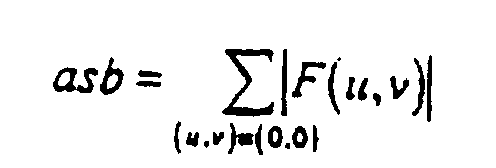
- Said activity parameter can be the mean AM of asb activities of the blocks of the analysis grid, the asb activity of a block being defined as a possibly weighted combination, and by example the sum, of the absolute values of the transformed coefficients Fu, v, of said block by a block transform, for example a transform into discrete cosine with (u, v) ⁇ (0,0).
- k (u, v) is a weighting coefficient for the component used, and p is a constant.
- F (u, v) designating the coefficients transformed from a single block, by a block transform, for example a cosine transform discreet.
- step c It is advantageous not to validate said position during step c, only if the minimum activity value represented by the activity parameter is greater than a given threshold A, which corresponds to a minimum "richness" of the image that is required to consider the synchronization position as relevant.
- Said movement of the analysis grid can be done by not equal to an inter-pixel distance or to a multiple thereof.
- said displacement can also be carried out in steps less than the inter-pixel distance.
- the synchronization of the spatial position implements a so-called sub-pixel offset, i.e. a horizontal spatial phase shift less than the inter-pixel distance.
- the method can then be characterized in that, during step d, a so-called sub-pixel scanning is carried out by shifting the analysis grid according to a plurality of said positions shifted from the analysis grid obtained by modifying in increments d ⁇ the sampling phase, in that, during step e, said transformed coefficients Fu, v and said parameter representative of the activity of the image are determined for each of the offset positions, and in that 'it includes a step f of determining the so-called sub-pixel position (d ⁇ o , dX o ) of the analysis grid for which said activity parameter represents a minimum value.
- the process may include, after step e, a step g of determination of said activity parameter according to two said offset positions, one of which is a so-called advanced position (dX + ⁇ ) and the other is a so-called position delayed (dX- ⁇ ).
- This step g can advantageously be followed by a step h of determination for each of the positions, advanced ((dX + ⁇ ) and delayed (dX- ⁇ ), from the average of the activity parameter over M images.
- the method implements a feedback on phase ⁇ of said sampling clock.
- This piloting can be carried out from an error signal which is the difference between said average of the activity parameter for the delayed position (dX- ⁇ ) and said average of the activity parameter for the advanced position (dX + ⁇ ).
- the activity parameter is preferably the spectral entropy ES, and said error signal is preferably normalized by the mean spectral entropy E S of at least one area of the image.
- the method according to the invention then makes it possible to identify the images of the type coded without prediction (I) by determining in a sequence spatially synchronized images, the images that have the highest value lower activity represented by an activity parameter, these images being therefore identified as being of coded type without prediction, that is to say of type I.
- the process can also identify the images of the type coded with prediction (P) by determining in a sequence images, the images with the highest activity value represented by an activity parameter, which is preferably the activity average AM of at least one zone of the images of said sequence.
- an activity parameter which is preferably the activity average AM of at least one zone of the images of said sequence.
- This activity parameter can be determined over the entire the image or on an area of interest thereof.
- a said determination is made after high-pass filtering of the signal representative of the image activity parameter of said image sequence, so as to at least partially eliminate the evolution of the content of the images within the sequence.
- Said high-pass filtering advantageously consists in calculating each point of the filtered signal by calculating the smallest positive difference between a point corresponding to the current image of the unfiltered signal and the neighboring points corresponding to the previous image and the following image.
- the invention as described below implements the knowledge of the method of coding image sequences by a standard, for example MPEG2. Indeed, the particularities of this technique offer advantageous possibilities for processing the coded video signal.
- a brief description of the algorithmic elements implemented in MPEG is useful for understanding the principle of the invention, but it will be noted that the invention also applies to other digital codings.
- coding for example MPEG1, MPEG2, or ISO H261 or JPEG for spatial synchronization
- the aforementioned algorithms take advantage of the resemblance between neighboring pixels on the same image (spatial redundancy) and between neighboring images (temporal redundancy).
- the cosine transform discrete (TCD) in blocks of 8x8 pixels, is applied to reduce the spatial redundancy.
- the image is therefore, beforehand, cut into blocks.
- the information reduction is done by rounding the values of the coefficients TCD obtained (scalar quantification).
- the transform into cosine by blocks of NxN pixels changes the representation base of the image.
- This transformation is carried out from an initial GI grid presenting blocks of NxN pixels and whose edges are the edges of the initial image coded IM (see figure 1).
- coding predictive is used. It performs an estimation of the samples to be coded by a prediction obtained based on previous signal values.
- the error of prediction is coded, and it offers a strong reduction of information to represent. Prediction is performed on the previous images in the axis the times.
- the "error" image obtained is subsequently coded by the transform TCD.
- the images are reconstructed from the images of prediction and coded data.
- TCD is widely used for coding images.
- the method described below proposes by way of example to apply it for analyze coded and decoded sequences in order to carry out all the synchronization operations. This advantageous approach demonstrates a high robustness efficiency.
- a first object of the invention is spatial synchronization of the image on the position of the initial coding grid GI. Indeed, for re-framing needs, a position identification operation is performed. For this, indicators obtained from the transformation into cosines are used.
- the scalar quantization tables of TCD coefficients lead to concentrate the energy of the analyzed block on a limited number of representative coefficients. Others are rounded up to one null value. This operation remains the very core of the flow reduction.
- this property remains valid. Indeed we note that, if a scan at the level of the blocks is performed, the position corresponding to the initial GI coding grid has a particular energy concentration. Therefore, this property constitutes the basic idea that is implemented to identify the position of the initial coding grid.
- the transformed TCD is advantageous because it is used in the standard MPEG.
- Other block transforms can be used (for example Fourier transform, transformed into DWT wavelets) and it is not necessary that the transform used is the same as that according to which the original image has been coded.
- the base property used to resynchronize spatially is the energy concentration of the coefficients for example TCD around the DC component of each image block.
- the property considered is more selective for "I" images than for other types of images.
- the activity of a block is defined for example by the following equation:
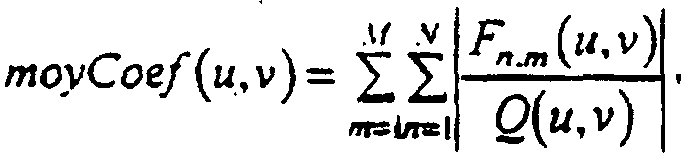
- the AM parameter indicates the quantity average information in the TCD domain which is contained in the blocks analyzes. This parameter is calculated for a given position of the GA grid blocks that can cover the entire image, or just the area of interest ZI.
- the asb parameter gives no energy distribution information in the TCD coefficients, and in in addition, asb is sensitive to the amplitude of the TCD coefficients.
- the spectral entropy ES of the image is given by the average of the spectral entropies esb of the blocks of the analysis grid GA in the analysis window Zl or for all of the image.
- ES e sb.
- a GA analysis grid is used. with blocks of NxN pixels and which are moved to achieve a horizontal and / or vertical scanning of the entire image or window analysis or area of interest ZI.
- the AM parameters and especially the parameter ES have a high compaction rate for the TCD coefficients.
- the coherent or initial position of the coding blocks is not not known a priori.
- the scanning of all positions with offsets horizontal and / or vertical of (dX, dY) pixels is performed using a grid GA analysis. It leads to consider that there is a minimum value of AM or ES parameter at the desired position (consistent).
- An example of a such scanning is shown in Figure 3.
- Point C corresponds to the minimum of ES among all GA grid scan positions for the same image.
- the calculated AM or ES parameter is therefore an indicator of the average dispersion of the coefficients F of the TCD transform of the blocks.
- a dispersion value having a relative minimum compared to the other scanning positions is obtained.
- a minimum can be obtained by scanning by moving the GA analysis grid only in the horizontal direction, to obtain a horizontal synchronization or by scanning by moving the analysis grid GA only in the vertical direction to obtain synchronization vertical, but preferably carry out a scan according to the two directions, horizontal X and vertical Y, the minimum value of AM or ES giving the synchronization position corresponding to the grid position initial.
- the GA analysis grid can cover the entire image, but it can be limited to only one region of the image constituting a zone of interest Zl as shown in FIG. 2.
- the GA analysis grid covers all of the image, its size remains slightly smaller than that of the image to be analyzed so that the GA analysis grid does not overflow the image during the scan. For example, we use a GA analysis grid whose dimension is less than N pixels than that of the image, both in the horizontally and / or vertically, depending on whether the polling must be operated in one direction or in these two directions.
- This criterion is used according to the invention for spatial synchronization.
- a prerequisite is defined from the indicator of the richness or average activity AM of the content of an image. Indeed, a minimum value is required at the spatial synchronization position, namely AM> AM o .
- the threshold AM o is determined so as to eliminate the low activity images over their entire surface or in the zone ZI.
- the parameter AM or ES has a minimum value when calculated at the coding position of the blocks.
- the same property is checked even if the response obtained is less clear.
- the search for the spatial phase of an image of the video sequence therefore consists in calculating the parameter AM or preferably ES. This calculation is carried out at each of the NxNs, ie 8x8 possible positions of the coding grid (see box in Figure 1).
- the spatial offset of the coding blocks with respect to an original grid whose edges correspond to those of the original image is given by the position of the minimum value of the AM or ES parameter.
- This calculation can be invalidated if the value of AM at the coding position found is less than a threshold AM o , which corresponds to content that is too poor to be able to make any reliable analysis.
- the spatial offset can indeed have a value which is not equal to an integer number of inter-pixel intervals (or not pixels) in the horizontal direction.
- This offset may possibly have been introduced at level of the Analog to Digital Converter. The process described more high makes it possible to detect the horizontal phase shift, but it performs a rounded to an integer number of pixels due to the discretization of the image.
- phase of the clock H digitizing the Analog to Digital ADC converter responsible for acquiring the video signal analog input VA is controlled by the signal CP generated by the equipment digital synchronization EQ. This control exploits the indicator ES of Spectral Entropy.
- EQ equipment receives video signal at input digital VN digitized by the CAN converter, and it produces as an output a signal DS of phase shift (X, Y), a signal CG of composition of group of GOP images and a logical signal SL of presence or absence of an image I, supplied to a COD coder.
- a processor NOT for calculating the activity parameter is put used to calculate the AM or ES parameter as a function of VN and possibly offset signals VN (- ⁇ ) and VN (+ ⁇ ) as will be explained further.
- the PCD command and decision processor analyzes the results produced by the PAS processor and performs the value search DS spatial synchronization, the phase command CP of the CAN converter and the MPEG-2 syntax analysis of the sequence and detection of "I" images.
- Said phase setting operation can be done punctually, for example only once at the initialization of the equipment. It can also be part of a process of adaptation to the chain analog whenever it is necessary to readjust the system to new conditions. It can also be conducted on a sequence video continues.
- phase control is carried out for example by controlling in phase the numerically controlled oscillator (OCN) which generates the sampling clock H. Thereafter, the acquisition of a new digital image is carried out for each new scanning position.
- OCN numerically controlled oscillator
- the optimal scanning phase is given as previously by the criterion of the minimum of AM or ES over a range of scan given by controlling the movement of the GA analysis grid by variation of phase d ⁇ .
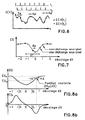
- the graph in Figure 7 shows the appearance of the continuous function ES (DX) and the values that are accessible with the process of spatial synchronization by an integer number of pixels.
- DX continuous function ES
- a very fine variation of d ⁇ over a time interval Te corresponding to an offset of one pixel offers the possibility of precisely covering the ES (dX) function (see Figure 7).
- the sub-pixel offset correction method preferably comprises two steps.
- the first step is to search by integer values for the position closest to the minimum of AM or ES.
- AM or ES is calculated for each increment of the phase.
- the optimal phase shift d ⁇ of the digitization clock that is to say that which is to be maintained, corresponds to the minimum of the AM or ES function.
- the method can be implemented with images variables, as illustrated in Figures 8a and 8b.
- ES ⁇ (dX) ES r (dX) - ES at (DX).
- This error controls a feedback on the phase of the sampling clock. It is shown in the figures.
- this error is normalized for each image, for example by the mean spectral entropy ES of the image or of the ZI area to make it more independent of the content of the image.
- the invention thus provides a means of spatial resynchronization fine to within (1 / N pixel) corresponding to the phase resolution of the oscillator at OCN digital control generating the sampling clock.
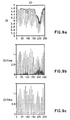
- Type "I” images give a clear local minimum in the time on a parameter such as AM or ES (see figure N ° 4). Because of coding mode without prediction of the "I" images, the latter are indeed temporally marked compared to other images. It's the case for sequences with low temporal activity or which exhibit restricted content changes. A representative example is the beginning of the sequence of Figure 9a, images [0,150].
- the values of the AM or ES parameter are linked to the image coding mode (I, P, B) but also the image content, being given its definition (see above). So an important movement is present in the second part of the sequence of figure 9a, towards the interval of images [170,220]. This visually translates into an image less Detailed.
- the coefficients of the TCD transform representing frequencies high spatial are less present: the energy of the image is therefore in more compacted towards low frequencies, resulting in a decrease in values of ES (t) in the interval of the images concerned. Therefore, in this sequence, an overall decrease in the values of ES (t) is noted for "I" images.
- the presence of discriminating local time minima for images "I” is kept. Correct identification of images preferably by processing on AM (t) or ES (t) to extract these minima local.
- each filtered ES point (t) is obtained by calculating the smallest positive difference between ES (t) for a given image and its two neighbors (for the previous image and for the image next)
- ES filtered (t) max [min (0, ES (t) - ES (t-1)), min (0, ES (t) - ES (t + 1))]
- an adaptive thresholding is performed on filtered ES (t). Indeed, as the value of ES (t) depends on the content of the image, that of filtered ES (t) also depends on it. To take account of this reality, an arbitrarily fixed threshold cannot ensure the expected discrimination for the detection of local maxima of filtered ES (t).
- K 16 here.
- the value of K must be chosen so that there is at least one "I” image in this duration.
- the filtered ES values below the ThresholdES 2 threshold (t l ) are forced to zero, and the others are maintained.
- the peaks corresponding to the “I” type images appearing clearly by counting zero values, the size of the group of GOP images is found.
- the number n of images in the groups of GOP images is equal to 12.
- this invention first proposes to identify the reference of the group of GOP images. Indeed, type "I" images can be considered as such, since they are distinguished from others by the compression algorithms applied to them. Once this operation performed, it is possible to detect the other categories of images.
- the spatial indicator of the AM images (t) is calculated for the entire video sequence. Knowing that the position of the "I” type images is now known, an analysis of the private image group of the "I” images can be carried out. This results in the replacement of the values AM (t) corresponding to type “I” images by the value corresponding to that of the image which precedes it (FIG. 10a). The method followed is similar to the previous one.
- AM filtered (t) min [max (0, AM (t) - AM (t-1)), max (0, AM (t) - AM (t + 1))]
- a adaptive thresholding gives the position of the "P" type images, in the case where it there are “B” type images.
- the present invention also provides a method of recognition of the structure of the groups of images as it was defined by the MPEG2 recommendations.
- the present invention has a field of application extended.
- the synchronization optimizes the performance of the operation in terms of quality video signals encoded and restored at the end of the chain.
- the absence of synchronization can defeat cascading by degradation definitive and not acceptable to users of signal quality encoded and decoded.
- the temporal method is used to identify the structure of the group of images as defined by MPEG2 standardization. This method makes it possible to detect images of type "I", "P” and "B". Of this way, the syntax of the GOP image groups is determined.
- the process according to the invention has great robustness to noise and variations the content of the image. It therefore demonstrates great efficiency for the analysis of data used by coding techniques. He finds its application in equipment handling image data digital and coded.
- the invention can be implemented using a linear and orthogonal transform.
- this transform can be a discrete sine transform, a transform of Haar, a transform of Hadamar or even a transform of Slant.
Landscapes
- Engineering & Computer Science (AREA)
- Multimedia (AREA)
- Signal Processing (AREA)
- Compression Or Coding Systems Of Tv Signals (AREA)
Description

avec :



- une étape d de décalage dX de la grille d'analyse dans le sens des lignes de l'image, en modifiant d'au moins un incrément dϕ la phase d'échantillonnage des signaux d'image ;
- une étape e de détermination, pour au moins une position décalée dX de la grille d'analyse, définie lors de l'étape d, desdits coefficients transformés Fu,v et dudit paramètre représentatif de l'activité de l'image.
- la figure 1 illustre le procédé mis en oeuvre selon la présente invention ;
- la figure 2 représente un exemple de structure de groupe d'images GOP ;
- la figure 3 est un exemple illustrant la variation du paramètre d'entropie spectrale ES en fonction du déphasage spatial de la grille d'analyse GA, pour une image I d'une séquence codée à 4Mbits/seconde ;
- la figure 4 illustre un exemple de variation temporelle du paramètre d'entropie spectrale ES sur une séquence GOP pour une scrutation selon la direction horizontale X en supposant connue la synchronisation verticale Y ;
- la figure 5 est un exemple de mise en oeuvre de l'invention appliquée à un signal analogique ;
- la figure 6 illustre différentes possibilités de numérisation d'une portion de ligne d'un signal analogique selon deux instants d'échantillonage t1 et t2 décalés en phase de dϕ ;
- la figure 7 illustre une recherche de la position correspondant au minimum du paramètre ES ;
- les figures 8a et 8b illustrent l'obtention d'un signal d'erreur de phase ;
- les figures 9a, 9b et 9c illustrent respectivement l'évolution de ES sur 250 images d'une séquence cochée à 4Mbits/seconde après synchronisation spatiale (9a), l'extraction des minima locaux de ES après filtrage passe-haut (9b), et enfin le résultat de la détection des images I(9c) ;
- et les figures 10a à 10c illustrent respectivement le signal AM d'extraction des pics du paramètre d'activité AM sur 12 images d'une séquence GOP codée à 4Mbits/seconde (10a), le signal AM filtré par filtrage passe-haut (10b), et le résultat de la détection des images P (10c).
- les images I (intra) sont codées par TCD sans prédiction et donc sans tenir compte de leur passé. Elles sont considérées comme des images fixes et isolées.
- les images P sont obtenues par codage prédictif à partir de l'image I ou P qui la précède.
- les images B (bi-directionnelles) spécifiques à MPEG-2 sont obtenues à partir des deux images I ou P les plus proches, par interpolation.


- si AM > AMo, alors la synchronisation est réalisée,
- sinon retour à a).
- soit en parallèle, ce qui nécessite trois chaínes d'acquisition (une pour la voie dite synchrone qui alimente le codeur vidéo, deux pour les mesures avance et retard de AM ou ES),
- soit séquentiellement, ce qui réduit le besoin à deux chaínes d'acquisition. Ce besoin est limité à une seule chaíne si une initialisation est permise (convergence de l'asservissement). Dans le cas séquentiel, l'altemance des mesures avance et retard sur des images successives doit être synchrone du rythme d'acquisition des images.
sinon :

sinon :
Claims (19)
- Procédé de synchronisation de la position spatiale d'une image vidéo pour retrouver la position d'une grille initiale de codage numérique, par blocs de codage de ladite image, caractérisé en ce qu'il met en oeuvre les étapes suivantes :a) déplacer selon la direction des lignes de l'image et/ou selon la direction perpendiculaire aux lignes de l'image, une grille d'analyse GA constituée de dits blocs de codage et correspondant à au moins une partie de l'image ;b) déterminer à chaque position de la grille d'analyse GA, les coefficients transformés Fu,v de chaque bloc de la grille d'analyse GA, par une transformée par blocs ; et calculer pour chaque position de la grille d'analyse GA et à partir des coefficients transformés Fu,v, un paramètre d'activité représentatif de l'activité spatiale de l'image ;c) déterminer la position de la grille d'analyse GA pour laquelle ledit paramètre d'activité représente une activité minimale et valider ladite position en tant que position de synchronisation.
- Procédé selon la revendication 1, caractérisé en ce que ledit paramètre d'activité est la moyenne AM des activités asb des blocs de la grille d'analyse, l'activité asb d'un bloc étant définie comme étant une combinaison éventuellement pondérée des valeurs absolues des coefficients transformés Fu,v, par ladite transformée par blocs avec (u,v) ≠ (0,0), selon la formule suivante :k(u,v) est un coefficient de pondération de la composante utilisée, et p une constante.

- Procédé selon la revendication 1 caractérisé en ce que ledit paramètre d'activité est la moyenne ES des entropies spectrales esb des blocs de la grille d'analyse
avec :avec et
et
- Procédé selon la revendication 3 caractérisé en ce que :où
 F(u,v) désignant les coefficients transformés d'un seul bloc, par ladite transformée par blocs.
- Procédé selon une des revendications précédentes, caractérisé en ce que ledit déplacement de la grille d'analyse s'effectue par pas égaux à une distance inter-pixels ou à un multiple de celle-ci.
- Procédé selon une des revendications 1 à 4, caractérisé en ce que ledit déplacement de la grille d'analyse s'effectue par pas inférieurs à une distance inter-pixels.
- Procédé selon une des revendications précédentes, caractérisé en ce que ladite position n'est validée à l'étape c que si ladite activité minimale que représente ledit paramètre d'activité est supérieure à un seuil donné A.
- Procédé selon une des revendications précédentes, caractérisé en ce qu'il comporte, avant l'étape a, une étape de conversion analogique-numérique à l'aide d'un convertisseur présentant une horloge d'échantillonnage pour échantillonner des signaux d'images, et en ce qu'il comporte, après l'étape c :une étape d de décalage dX de la grille d'analyse dans le sens des lignes de l'image, en modifiant d'au moins un incrément dϕ la phase d'échantillonnage des signaux d'image ;une étape e de détermination, pour au moins une position décalée dX de la grille d'analyse, définie lors de l'étape d, desdits coefficients transformés Fu,v et dudit paramètre représentatif de l'activité de l'image.
- Procédé selon la revendication 8, caractérisé en ce que lors de l'étape d, on réalise une scrutation dite sub-pixel en décalant la grille d'analyse selon une pluralité de dites positions décalées de la grille d'analyse, qui sont obtenues en modifiant par incréments dϕ la phase d'échantillonnage, en ce que, lors de l'étape e, on détermine, pour chacune des positions décalées, lesdits coefficients transformés Fu,v et ledit paramètre d'activité représentatif de l'activité de l'image, et en ce qu'il comporte une étape f de détermination de la position dite sub-pixel (dϕo, dXo) de la grille d'analyse pour laquelle ledit paramètre d'activité représente une valeur minimale de l'activité.
- Procédé selon une des revendications 8 ou 9, caractérisé en ce qu'il comporte, après l'étape e, une étape g de détermination dudit paramètre d'activité selon deux dites positions décalées, dont l'une est une position dite avancée (dX+Δ) et l'autre est une position dite retardée (dX-Δ).
- Procédé selon la revendication 10, caractérisé en ce qu'il comporte après l'étape g, une étape h de détermination pour chacune des positions, avancée (dX+Δ) et retardée (dX-Δ), de la moyenne du paramètre d'activité sur M images.
- Procédé selon la revendication 11, caractérisé en ce qu'il met en oeuvre un pilotage de la contre-réaction sur la phase ϕ de l'échantillonnage à partir d'un signal d'erreur qui est la différence entre ladite moyenne du paramètre d'activité pour la position retardée (dX-Δ) et ladite moyenne du paramètre d'activité pour la position avancée (dX+Δ).
- Procédé selon la revendication 12, caractérisé en ce que ledit paramètre d'activité est l'entropie spectrale et en ce que ledit signal d'erreur est normalisé par l'entropie spectrale moyenne ES d'au moins une zone de l'image.
- Procédé selon une des revendications précédentes, caractérisé en ce qu'il comporte une étape de détermination, dans une séquence d'images synchronisées spatialement, des images présentant les valeurs les plus faibles de l'activité représentée par ledit paramètre d'activité, ces images étant de ce fait identifiées comme étant du type codées sans prédiction I.
- Procédé selon une des revendications précédentes, caractérisé en ce qu'il comporte une étape de détermination, dans une séquence d'images, des images présentant pour un paramètre d'activité, de préférence l'activité moyenne AM, d'au moins une zone des images de ladite séquence, des valeurs correspondant à l'activité la plus élevée, ces images étant de ce fait identifiées comme étant du type P.
- Procédé selon les revendications 14 et 15, caractérisé en ce qu'il comporte une étape de caractérisation de la syntaxe du groupe d'images (GOP).
- Procédé selon les revendications 14 à 16, caractérisé en ce qu'une dite détermination s'effectue après filtrage passe-haut du signal représentatif du paramètre d'activité des images de ladite séquence d'image, de manière à éliminer au moins partiellement l'évolution du contenu des images à l'intérieur de la séquence.
- Procédé selon la revendication 17, caractérisé en ce que ledit filtrage passe-haut consiste à calculer chaque point du signal filtré par calcul du plus petit écart positif entre un point correspondant du signal non filtré et les points voisins correspondant à l'image précédente et à l'image suivante.
- Procédé selon une des revendications précédentes caractérisé en ce que ladite transformée par blocs est une transformée linéaire et orthogonale.
Applications Claiming Priority (3)
| Application Number | Priority Date | Filing Date | Title |
|---|---|---|---|
| FR9712415A FR2769452B1 (fr) | 1997-10-06 | 1997-10-06 | Procede de synchronisation spatiale d'une image video codee numeriquement et/ou d'identification de la syntaxe d'une sequence video |
| FR9712415 | 1997-10-06 | ||
| PCT/FR1998/002099 WO1999018733A1 (fr) | 1997-10-06 | 1998-10-01 | Procede de synchronisation spatiale d'une image video codee numeriquement et/ou d'identification de la syntaxe d'une sequence video |
Publications (2)
| Publication Number | Publication Date |
|---|---|
| EP1020081A1 EP1020081A1 (fr) | 2000-07-19 |
| EP1020081B1 true EP1020081B1 (fr) | 2002-03-20 |
Family
ID=9511856
Family Applications (1)
| Application Number | Title | Priority Date | Filing Date |
|---|---|---|---|
| EP98946539A Expired - Lifetime EP1020081B1 (fr) | 1997-10-06 | 1998-10-01 | Procede de synchronisation spatiale d'une image video codee numeriquement et/ou d'identification de la syntaxe d'une sequence video |
Country Status (6)
| Country | Link |
|---|---|
| EP (1) | EP1020081B1 (fr) |
| JP (1) | JP4081638B2 (fr) |
| CA (1) | CA2306404C (fr) |
| DE (1) | DE69804335T2 (fr) |
| FR (1) | FR2769452B1 (fr) |
| WO (1) | WO1999018733A1 (fr) |
Families Citing this family (5)
| Publication number | Priority date | Publication date | Assignee | Title |
|---|---|---|---|---|
| EP1326450A1 (fr) * | 2001-12-21 | 2003-07-09 | Sony International (Europe) GmbH | Procédé et dispositif pour détecter des artefacts en structure de bloc |
| FR2841424A1 (fr) * | 2002-06-25 | 2003-12-26 | Koninkl Philips Electronics Nv | Procede de detection d'artefacts de bloc |
| JP2005535204A (ja) * | 2002-07-31 | 2005-11-17 | コーニンクレッカ フィリップス エレクトロニクス エヌ ヴィ | ブロッキングアーチファクトの動的な検出 |
| FR2847411B1 (fr) * | 2002-11-15 | 2005-01-14 | Telediffusion De France Tdf | Procede et systeme de mesure des degradations d'une image video introduites par un codage a reduction de debit |
| FR2847412B1 (fr) * | 2002-11-15 | 2005-01-14 | Telediffusion De France Tdf | Procede et systeme de mesure des degradations d'une image video introduites par les systemes de diffusion numerique |
Family Cites Families (2)
| Publication number | Priority date | Publication date | Assignee | Title |
|---|---|---|---|---|
| JP3163837B2 (ja) * | 1993-04-16 | 2001-05-08 | ソニー株式会社 | ディジタルビデオ信号の符号化装置 |
| GB9413001D0 (en) * | 1994-06-28 | 1994-08-17 | Ntl | Methods for the synchronisation of successive digital video compression/decompression systems |
-
1997
- 1997-10-06 FR FR9712415A patent/FR2769452B1/fr not_active Expired - Lifetime
-
1998
- 1998-10-01 CA CA002306404A patent/CA2306404C/fr not_active Expired - Fee Related
- 1998-10-01 WO PCT/FR1998/002099 patent/WO1999018733A1/fr not_active Ceased
- 1998-10-01 EP EP98946539A patent/EP1020081B1/fr not_active Expired - Lifetime
- 1998-10-01 JP JP2000515392A patent/JP4081638B2/ja not_active Expired - Fee Related
- 1998-10-01 DE DE69804335T patent/DE69804335T2/de not_active Expired - Lifetime
Also Published As
| Publication number | Publication date |
|---|---|
| JP4081638B2 (ja) | 2008-04-30 |
| FR2769452B1 (fr) | 2000-01-14 |
| CA2306404A1 (fr) | 1999-04-15 |
| FR2769452A1 (fr) | 1999-04-09 |
| CA2306404C (fr) | 2007-01-09 |
| EP1020081A1 (fr) | 2000-07-19 |
| JP2001519630A (ja) | 2001-10-23 |
| DE69804335D1 (de) | 2002-04-25 |
| WO1999018733A1 (fr) | 1999-04-15 |
| DE69804335T2 (de) | 2002-11-14 |
Similar Documents
| Publication | Publication Date | Title |
|---|---|---|
| EP0248711B1 (fr) | Procédé de codage par transformation pour la transmission de signaux d'image | |
| EP0349454B1 (fr) | Procédé de codage de données d'assistance à la reconstruction d'une image électronique animée sous-échantillonnée | |
| Van Houten et al. | Source video camera identification for multiply compressed videos originating from YouTube | |
| FR2894421A1 (fr) | Procede et dispositif de decodage d'un flux video code suivant un codage hierarchique | |
| EP3314897B1 (fr) | Procédé de codage d'une image numérique, procédé de décodage, dispositifs, et programmes d'ordinateurs associés | |
| US8104055B2 (en) | Method of identifying target synchronization point pair through scan-line image matching scheme | |
| EP1692687A1 (fr) | Transcodage entre indices de dictionnaires multi-impulsionnels utilises en codage en compression de signaux numeriques | |
| JP2006500851A (ja) | 画像及び/または音声データの符号化方法及び装置 | |
| CA2306404C (fr) | Procede de synchronisation spatiale d'une image video codee numeriquement et/ou d'identification de la syntaxe d'une sequence video | |
| WO1994010800A1 (fr) | Procede et dispositif de reduction de debit pour l'enregistrement d'images sur magnetoscope | |
| FR2963190A1 (fr) | Procede et dispositif de codage d'une sequence d'images | |
| WO2018002474A1 (fr) | Procédé de codage intra d'une image numérique et procédé de décodage correspondant | |
| CA2423861C (fr) | Procede de synchronisation de signaux numeriques | |
| FR2835124A1 (fr) | Procede de synchronisation de deux flux de donnees numeriques de meme contenu | |
| EP1223554A1 (fr) | Méthode de réduction de bruit | |
| US6885702B1 (en) | Method for spatial synchronization of a digitally coded video image and/or for identification of the syntax of a video sequence | |
| FR3103342A1 (fr) | Procede et dispositif de compression d'images numeriques et procede et dispositif de decompression associes | |
| EP1297494B1 (fr) | Procede et dispositif de traitement de sequences d'images avec masquage | |
| FR2934453A1 (fr) | Procede et dispositif de masquage d'erreurs | |
| Al-Nuaimi et al. | ConCor+: Robust and confident video synchronization using consensus-based Cross-correlation | |
| FR3137240A1 (fr) | Procédé de segmentation d’une pluralité de données, procédé de codage, procédé de décodage, dispositifs, systèmes et programme d’ordinateur correspondants | |
| FR2938146A1 (fr) | Procede et dispositif d'optimisation du debit d'encodage d'une image video en mode entrelace. | |
| FR3164087A1 (fr) | Procédé et dispositif de codage et décodage d’images | |
| FR3164089A1 (fr) | Procédé et dispositif de codage et décodage d’images | |
| FR2931609A1 (fr) | Procedes de codage et de decodage pseudo-hierarchiques et systemes associes. |
Legal Events
| Date | Code | Title | Description |
|---|---|---|---|
| PUAI | Public reference made under article 153(3) epc to a published international application that has entered the european phase |
Free format text: ORIGINAL CODE: 0009012 |
|
| 17P | Request for examination filed |
Effective date: 20000407 |
|
| AK | Designated contracting states |
Kind code of ref document: A1 Designated state(s): DE ES GB IT NL SE |
|
| 17Q | First examination report despatched |
Effective date: 20001115 |
|
| GRAG | Despatch of communication of intention to grant |
Free format text: ORIGINAL CODE: EPIDOS AGRA |
|
| GRAG | Despatch of communication of intention to grant |
Free format text: ORIGINAL CODE: EPIDOS AGRA |
|
| GRAH | Despatch of communication of intention to grant a patent |
Free format text: ORIGINAL CODE: EPIDOS IGRA |
|
| GRAH | Despatch of communication of intention to grant a patent |
Free format text: ORIGINAL CODE: EPIDOS IGRA |
|
| REG | Reference to a national code |
Ref country code: GB Ref legal event code: IF02 |
|
| GRAA | (expected) grant |
Free format text: ORIGINAL CODE: 0009210 |
|
| AK | Designated contracting states |
Kind code of ref document: B1 Designated state(s): DE ES GB IT NL SE |
|
| PG25 | Lapsed in a contracting state [announced via postgrant information from national office to epo] |
Ref country code: IT Free format text: LAPSE BECAUSE OF FAILURE TO SUBMIT A TRANSLATION OF THE DESCRIPTION OR TO PAY THE FEE WITHIN THE PRESCRIBED TIME-LIMIT;WARNING: LAPSES OF ITALIAN PATENTS WITH EFFECTIVE DATE BEFORE 2007 MAY HAVE OCCURRED AT ANY TIME BEFORE 2007. THE CORRECT EFFECTIVE DATE MAY BE DIFFERENT FROM THE ONE RECORDED. Effective date: 20020320 |
|
| REF | Corresponds to: |
Ref document number: 69804335 Country of ref document: DE Date of ref document: 20020425 |
|
| PG25 | Lapsed in a contracting state [announced via postgrant information from national office to epo] |
Ref country code: SE Free format text: LAPSE BECAUSE OF FAILURE TO SUBMIT A TRANSLATION OF THE DESCRIPTION OR TO PAY THE FEE WITHIN THE PRESCRIBED TIME-LIMIT Effective date: 20020620 |
|
| GBT | Gb: translation of ep patent filed (gb section 77(6)(a)/1977) |
Effective date: 20020704 |
|
| PG25 | Lapsed in a contracting state [announced via postgrant information from national office to epo] |
Ref country code: ES Free format text: LAPSE BECAUSE OF FAILURE TO SUBMIT A TRANSLATION OF THE DESCRIPTION OR TO PAY THE FEE WITHIN THE PRESCRIBED TIME-LIMIT Effective date: 20020925 |
|
| PLBE | No opposition filed within time limit |
Free format text: ORIGINAL CODE: 0009261 |
|
| STAA | Information on the status of an ep patent application or granted ep patent |
Free format text: STATUS: NO OPPOSITION FILED WITHIN TIME LIMIT |
|
| 26N | No opposition filed |
Effective date: 20021223 |
|
| PGFP | Annual fee paid to national office [announced via postgrant information from national office to epo] |
Ref country code: NL Payment date: 20160923 Year of fee payment: 19 Ref country code: GB Payment date: 20160928 Year of fee payment: 19 |
|
| PGFP | Annual fee paid to national office [announced via postgrant information from national office to epo] |
Ref country code: DE Payment date: 20160922 Year of fee payment: 19 |
|
| REG | Reference to a national code |
Ref country code: DE Ref legal event code: R119 Ref document number: 69804335 Country of ref document: DE |
|
| REG | Reference to a national code |
Ref country code: NL Ref legal event code: MM Effective date: 20171101 |
|
| GBPC | Gb: european patent ceased through non-payment of renewal fee |
Effective date: 20171001 |
|
| PG25 | Lapsed in a contracting state [announced via postgrant information from national office to epo] |
Ref country code: DE Free format text: LAPSE BECAUSE OF NON-PAYMENT OF DUE FEES Effective date: 20180501 Ref country code: NL Free format text: LAPSE BECAUSE OF NON-PAYMENT OF DUE FEES Effective date: 20171101 Ref country code: GB Free format text: LAPSE BECAUSE OF NON-PAYMENT OF DUE FEES Effective date: 20171001 |