EP1017713B1 - CYCLIC ANTAGONISTS OF C5a RECEPTORS AND G PROTEIN-COUPLED RECEPTORS - Google Patents
CYCLIC ANTAGONISTS OF C5a RECEPTORS AND G PROTEIN-COUPLED RECEPTORS Download PDFInfo
- Publication number
- EP1017713B1 EP1017713B1 EP98930536A EP98930536A EP1017713B1 EP 1017713 B1 EP1017713 B1 EP 1017713B1 EP 98930536 A EP98930536 A EP 98930536A EP 98930536 A EP98930536 A EP 98930536A EP 1017713 B1 EP1017713 B1 EP 1017713B1
- Authority
- EP
- European Patent Office
- Prior art keywords
- compound according
- side chain
- group
- receptor
- amino acid
- Prior art date
- Legal status (The legal status is an assumption and is not a legal conclusion. Google has not performed a legal analysis and makes no representation as to the accuracy of the status listed.)
- Expired - Lifetime
Links
- 0 CC(C(*C(C(C1C(C*C(*C(C(C(C(C(C)=O)N)C=I)=O)N)=O)C1)=O)N)=O)[U]C(CN)=* Chemical compound CC(C(*C(C(C1C(C*C(*C(C(C(C(C(C)=O)N)C=I)=O)N)=O)C1)=O)N)=O)[U]C(CN)=* 0.000 description 1
Images





Classifications
-
- C—CHEMISTRY; METALLURGY
- C07—ORGANIC CHEMISTRY
- C07K—PEPTIDES
- C07K7/00—Peptides having 5 to 20 amino acids in a fully defined sequence; Derivatives thereof
- C07K7/50—Cyclic peptides containing at least one abnormal peptide link
- C07K7/54—Cyclic peptides containing at least one abnormal peptide link with at least one abnormal peptide link in the ring
- C07K7/56—Cyclic peptides containing at least one abnormal peptide link with at least one abnormal peptide link in the ring the cyclisation not occurring through 2,4-diamino-butanoic acid
-
- A—HUMAN NECESSITIES
- A61—MEDICAL OR VETERINARY SCIENCE; HYGIENE
- A61P—SPECIFIC THERAPEUTIC ACTIVITY OF CHEMICAL COMPOUNDS OR MEDICINAL PREPARATIONS
- A61P1/00—Drugs for disorders of the alimentary tract or the digestive system
- A61P1/02—Stomatological preparations, e.g. drugs for caries, aphtae, periodontitis
-
- A—HUMAN NECESSITIES
- A61—MEDICAL OR VETERINARY SCIENCE; HYGIENE
- A61P—SPECIFIC THERAPEUTIC ACTIVITY OF CHEMICAL COMPOUNDS OR MEDICINAL PREPARATIONS
- A61P11/00—Drugs for disorders of the respiratory system
-
- A—HUMAN NECESSITIES
- A61—MEDICAL OR VETERINARY SCIENCE; HYGIENE
- A61P—SPECIFIC THERAPEUTIC ACTIVITY OF CHEMICAL COMPOUNDS OR MEDICINAL PREPARATIONS
- A61P17/00—Drugs for dermatological disorders
- A61P17/06—Antipsoriatics
-
- A—HUMAN NECESSITIES
- A61—MEDICAL OR VETERINARY SCIENCE; HYGIENE
- A61P—SPECIFIC THERAPEUTIC ACTIVITY OF CHEMICAL COMPOUNDS OR MEDICINAL PREPARATIONS
- A61P19/00—Drugs for skeletal disorders
- A61P19/02—Drugs for skeletal disorders for joint disorders, e.g. arthritis, arthrosis
-
- A—HUMAN NECESSITIES
- A61—MEDICAL OR VETERINARY SCIENCE; HYGIENE
- A61P—SPECIFIC THERAPEUTIC ACTIVITY OF CHEMICAL COMPOUNDS OR MEDICINAL PREPARATIONS
- A61P25/00—Drugs for disorders of the nervous system
-
- A—HUMAN NECESSITIES
- A61—MEDICAL OR VETERINARY SCIENCE; HYGIENE
- A61P—SPECIFIC THERAPEUTIC ACTIVITY OF CHEMICAL COMPOUNDS OR MEDICINAL PREPARATIONS
- A61P25/00—Drugs for disorders of the nervous system
- A61P25/28—Drugs for disorders of the nervous system for treating neurodegenerative disorders of the central nervous system, e.g. nootropic agents, cognition enhancers, drugs for treating Alzheimer's disease or other forms of dementia
-
- A—HUMAN NECESSITIES
- A61—MEDICAL OR VETERINARY SCIENCE; HYGIENE
- A61P—SPECIFIC THERAPEUTIC ACTIVITY OF CHEMICAL COMPOUNDS OR MEDICINAL PREPARATIONS
- A61P29/00—Non-central analgesic, antipyretic or antiinflammatory agents, e.g. antirheumatic agents; Non-steroidal antiinflammatory drugs [NSAID]
-
- A—HUMAN NECESSITIES
- A61—MEDICAL OR VETERINARY SCIENCE; HYGIENE
- A61P—SPECIFIC THERAPEUTIC ACTIVITY OF CHEMICAL COMPOUNDS OR MEDICINAL PREPARATIONS
- A61P37/00—Drugs for immunological or allergic disorders
- A61P37/02—Immunomodulators
- A61P37/06—Immunosuppressants, e.g. drugs for graft rejection
-
- A—HUMAN NECESSITIES
- A61—MEDICAL OR VETERINARY SCIENCE; HYGIENE
- A61P—SPECIFIC THERAPEUTIC ACTIVITY OF CHEMICAL COMPOUNDS OR MEDICINAL PREPARATIONS
- A61P9/00—Drugs for disorders of the cardiovascular system
- A61P9/10—Drugs for disorders of the cardiovascular system for treating ischaemic or atherosclerotic diseases, e.g. antianginal drugs, coronary vasodilators, drugs for myocardial infarction, retinopathy, cerebrovascula insufficiency, renal arteriosclerosis
-
- C—CHEMISTRY; METALLURGY
- C07—ORGANIC CHEMISTRY
- C07K—PEPTIDES
- C07K14/00—Peptides having more than 20 amino acids; Gastrins; Somatostatins; Melanotropins; Derivatives thereof
- C07K14/435—Peptides having more than 20 amino acids; Gastrins; Somatostatins; Melanotropins; Derivatives thereof from animals; from humans
- C07K14/46—Peptides having more than 20 amino acids; Gastrins; Somatostatins; Melanotropins; Derivatives thereof from animals; from humans from vertebrates
- C07K14/47—Peptides having more than 20 amino acids; Gastrins; Somatostatins; Melanotropins; Derivatives thereof from animals; from humans from vertebrates from mammals
- C07K14/4701—Peptides having more than 20 amino acids; Gastrins; Somatostatins; Melanotropins; Derivatives thereof from animals; from humans from vertebrates from mammals not used
- C07K14/472—Complement proteins, e.g. anaphylatoxin, C3a, C5a
-
- A—HUMAN NECESSITIES
- A61—MEDICAL OR VETERINARY SCIENCE; HYGIENE
- A61K—PREPARATIONS FOR MEDICAL, DENTAL OR TOILETRY PURPOSES
- A61K38/00—Medicinal preparations containing peptides
-
- C—CHEMISTRY; METALLURGY
- C07—ORGANIC CHEMISTRY
- C07K—PEPTIDES
- C07K2299/00—Coordinates from 3D structures of peptides, e.g. proteins or enzymes
Definitions
- This invention relates to novel cyclic compounds which have the ability to modulate the activity of G protein-coupled receptors. agonists and antagonists.
- the invention provides cyclic peptidic and cyclic non-peptidic antagonists of C5a.
- the compounds of the invention are both potent and selective, and are useful in the treatment of a variety of inflammatory conditions.
- Complement During host defence, the complement system of plasma proteins initiates inflammatory and cellular immune responses to stimuli such as infectious organisms (bacteria, viruses, parasites), chemical or physical injury, radiation or neoplasia.
- Complement is activated through a complex cascade of interrelated proteolytic events that produce multiple bioactive peptides, some of which (eg. anaphylatoxins C3a and C5a) interact with cellular components to propagate inflammatory processes.
- Complement activation either by the classical pathway, after antigen-antibody (Ag/Ab) binding, or by the antibody-independent alternate pathway, ends with a terminal sequence in which protein C5 is proteolytically cleaved by C5 convertase to C5a and C5b.
- C5aR specific surface receptors
- C5aR specific surface receptors
- C5aR is a G protein-coupled receptor with seven transmembrane helices (Gerard and Gerard, 1991). This receptor is one of the rhodopsin superfamily of GTP-linked binding proteins, but differs from rhodopsin receptors in that the receptor and G protein are linked prior to activation.
- G protein-coupled receptors are prevalent throughout the human body, comprising approximately 80% of known cellular receptor types, and mediate signal transduction across the cell membrane for a very wide range of endogenous ligands. They participate in a diverse array of physiological and pathophysiological processes, including, but not limited to those associated with cardiovascular, central and peripheral nervous system, reproductive, metabolic, digestive, immunoinflammatory, and growth disorders, as well as other cell-regulatory and proliferative disorders. Agents, both agonists and antagonists, which selectively modulate functions of G protein-coupled receptors have important therapeutic applications.
- C5a is one of the most potent chemotactic agents known, and recruits neutrophils and macrophages to sites of injury, alters their morphology; induces degranulation; increases calcium mobilisation, vascular permeability (oedema) and neutrophil adhesiveness; contracts smooth muscle; stimulates release of inflammatory mediators (including histamine, TNF- ⁇ , IL-1, IL-6, IL-8, prostaglandins, leukotrienes) and lysosomal enzymes; promotes formation of oxygen radicals; and enhances antibody production (Gerard and Gerard, 1994).
- Overexpresion or underregulation of C5a is implicated in the pathogenesis of immunoinflammatory conditions such as rheumatoid arthritis, adult respiratory distress syndrome (ARDS), systemic lupus erythematosus, tissue graft rejection, ischaemic heart disease, reperfusion injury, septic shock, psoriasis, gingivitis, atherosclerosis, Alzheimer's disease, lung injury and extracorporeal post-dialysis syndrome, and in a variety of other conditions, as summarised in Table 1.
- ARDS adult respiratory distress syndrome
- systemic lupus erythematosus tissue graft rejection
- ischaemic heart disease reperfusion injury
- septic shock psoriasis
- gingivitis atherosclerosis
- Alzheimer's disease lung injury and extracorporeal post-dialysis syndrome
- agonists of C5a receptors or other G protein-coupled receptors may also be found to have therapeutic properties in conditions either where the G protein-coupled receptor can be used as a recognition site for drug delivery, or where triggering of such receptors can be used to stimulate some aspect of the human immune system, for example in the treatment of cancers, viral or parasitic infections.
- C5a has a highly ordered N-terminal core domain (residues 1-64; C5a 1 - 64 ), consisting of a compact antiparallel 4-helix bundle (residues 4-12, 18-26, 32-39, 46-63) connected by loops (13-17, 27-31, 40-45), and further stabilised by 3 disulphide bonds (C21-Cys47, Cys22-Cys54, Cys34-Cys55).
- C5a receptor C5aR
- C5a-binding subunit of human monocyte-derived C5aR has been cloned and identified as a G protein-coupled receptor with transmembrane helices (Gerard and Gerard, 1991).
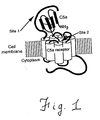
- Interactions between C5a and C5aR have been the subject of many investigations which, in summary, suggest that C5a binds via a two-site mechanism in which the N-terminal core domain of C5a is involved in receptor-recognition and binding, while the C-terminus is responsible for receptor activation. This mechanism is illustrated schematically in Figure 1.
- the C-terminal "effector" region alone possesses all the information necessary for signal transduction, and is thought to bind in the receptor's interhelical region (Siciliano et al , 1994; deMartino et al , 1995).
- An N-terminal interhelical positively-charged region of C5a is responsible for receptor recognition and binding, and binds to a negatively-charged extracellular domain of C5aR (site 1), while the C-terminal "effector" region of C5a is thought to bind with the interhelical region of the receptor (site 2), and is responsible for receptor activation leading to signal transduction (Siciliano et al, 1994).
- N-methylphenylalanine-lysine-proline-D-cyclohexylalanine-tryptophan-D-arginine (7, MeF-K-P-dCha-W-r), is a full antagonist of the C5a receptor, with no agonist activity when tested on isolated cellular membranes (Konteatis et al , 1994) or intact whole cells.
- This hexapeptide was developed by modifications of the agonist NMe-F-K-P-dCha-L-r, in which the molecule was progressively substituted at leucine residues with substituents of increasing size (Cha, F, Nph and W). This had the effect of reducing agonist activity.
- US-A-5,386,011 discloses cyclic C5a agonists and their use in the treatment of inflammatory disease states.
- WO-A 95/25957 relates to an assay to identify compounds useful as C5a antagonists and linear C5a antagonists and their use as anti-inflammatory agents and immunoregulants.
- the compounds of the present invention have antagonist activity against C5aR, have no C5a agonist activity, and have the general formula: where
- alkyl is to be taken to mean a straight, branched, or cyclic, substituted or unsubstituted alkyl chain of 1 to 6, preferably 1 to 4 carbons. Most preferably the alkyl group is a methyl group.
- acyl is to be taken to mean a substituted or unsubstituted acyl of 1 to 6, preferably 1 to 4 carbon atoms. Most preferably the acyl group is acetyl.
- aryl is to be understood to mean a substituted or unsubstituted homocyclic or heterocyclic aryl group, in which the ring preferably has 5 or 6 members.
- a "common” amino acid is a L-amino acid selected from the group consisting of glycine, leucine, isoleucine, valine, alanine, phenylalanine, tyrosine, tryptophan, aspartate, asparagine, glutamate, glutamine, cysteine, methionine, arginine, lysine, proline, serine, threonine and histidine.
- An "uncommon” amino acid includes, but is not restricted to, D-amino acids, homo-amino acids, N-alkyl amino acids, dehydroamino acids, aromatic amino acids (other than phenylalanine, tyrosine and tryptophan), ortho-, meta- or para-aminobenzoic acid, ornithine, citrulline, norleucine, ⁇ -glutamic acid, aminobutyric acid and ⁇ , ⁇ -disubstituted amino acids.
- the invention provides a composition, comprising a compound according to the invention together with a pharmaceutically-acceptable carrier or excipient.
- compositions of the invention may be formulated for oral or parenteral use, but oral formulations are preferred. It is expected that most if not all compounds of the invention will be stable in the presence of digestive enzymes. Such stability can readily be tested by routine methods known to those skilled in the art.
- Suitable formulations for administration by any desired route may be prepared by standard methods, for example by reference to well-known textbooks such as Remington; The Science and Practice of Pharmacy, Vol. II, 1995 (19th edition), A.R. Gennaro (ed), Mack Publishing Company, Easton, Pennsylvania , or Australian Prescription Products Guide, Vol. 1, 1995 (24th edition) J. Thomas (ed), Australian Pharmaceutical Publishing Company Ltd, Victoria, Australia .
- the invention provides the use of the compounds according to the invention in the manufacture of a medicament to be used in a method of treatment of a pathological condition mediated by a G protein-coupled receptor, comprising the step of administering an effective amount of a compound of the invention to a mammal in need of such treatment.
- condition mediated by a G protein-coupled receptor is a condition mediated by a C5a receptor, and more preferably involves overexpression or underregulation of C5a.
- conditions include but are not limited to rheumatoid arthritis, adult respiratory distress syndrome (ARDS), systemic lupus erythematosus, tissue graft rejection, ischaemic heart disease, reperfusion injury, septic shock, psoriasis, gingivitis, atherosclerosis, Alzheimer's disease, lung injury and extracorporeal post-dialysis syndrome.
- the invention is not in any way restricted to the treatment of any particular animal or species, it is particularly contemplated that the compounds of the invention will be useful in medical treatment of humans, and will also be useful in veterinary treatment, particularly of companion animals such as cats and dogs, livestock such as cattle, horses and sheep, and zoo animals, including large bovids, felids, ungulates and canids.
- the compounds may be administered at any suitable dose and by any suitable route. Oral administration is preferred because of its greater convenience and acceptability.
- the effective dose will depend on the nature of the condition to be treated, and the age, weight, and underlying state of health of the individual treatment. This will be at the discretion of the attending physician or veterinarian. Suitable dosage levels may readily be determined by trial and error experimentation, using methods which are well known in the art.
- the molecular weight of the peptides was determined by electrospray mass spectrometry recorded on a triple quadrupole mass spectrometer (PE SCIEX API III), as described elsewhere (Haviland et al , 1995). 1 H-NMR spectra were recorded on either a Bruker ARX 500 MHz or a Varian Unity 400 spectrometer. Proton assignments were determined by 2D NMR experiments (DFCOSY, TOCSY, NOESY).
- Non-peptidic compounds were synthesized using conventional organic chemical methods. Compounds were analysed by 1 H-NMR spectroscopy and by mass spectrometry.
- NMR data was processed using TRIAD software (Tripos Assoc.) on a Silicon Graphics Indy work station. 2D NOE cross peaks were integrated and characterised into strong (1.8-2.5 ⁇ ), medium (2.3-3.5 ⁇ ) and weak (3.3-5.0 ⁇ ).
- Preliminary three-dimensional structures were calculated from upper and lower distance limit files using Diana 2.8 (69 distance constraints, including 27 for adjacent residues and 6 further away) with the redundant dihedral angle constraints (REDAC) strategy. Upper and lower distance constraints were accurately calculated using MARDIGRAS. At this stage the peptide was examined for possible hydrogen bonds, and these were added as distance constraints. The 50 lowest energy Diana structures were subjected to restrained molecular dynamics (RMD) and energy minimisation (REM).
- RMD restrained molecular dynamics
- REM energy minimisation
- REM consisted of a 50 step steepest descent followed by 100 step conjugate gradient minimisation.
- RMD was performed by simulated heating of the structures to 300K for 1ps, followed by 500K for 1ps. The temperature was gradually lowered to 300K over 2ps and finally for 2ps at 200K.
- REM was performed again with a 50 step steepest descent, 200 step conjugate gradient followed by a 300 step Powell minimisation.
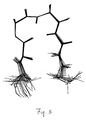
- the final structures were examined to obtain a mean pairwise rms difference over the backbone heavy atoms (N, C ⁇ and C). Twenty of the 50 structures had a mean rmsd ⁇ 0.5 ⁇ for all backbone atoms (O, N, C).
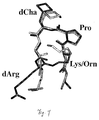
- a model of cycle 12 shown in Figure 7, was created from the NMR structure of 7 by deleting all NMR constraints, fusing the ornithine side chain amine to the C-terminal carboxylate of d-Arg to form an amide, and minimising using Powell forcefield (1000 iterations). The modelled structure was then superimposed on the NMR structure with an rmsd 0.224 ⁇ .
- Assays were performed with fresh human PMNs, isolated as previously described (Sanderson et al , 1995), using a buffer of 50 mM HEPES, 1 mM CaCl 2 , 5 mM MgCl 2 , 0.5% bovine serum albumin, 0.1% bacitracin and 100 ⁇ M phenylmethylsulfonyl fluoride (PMSF).
- PMSF phenylmethylsulfonyl fluoride
- Anaesthetised i.p. ketamine & xylazine
- Wistar rats 150-200g
- mice were injected with sterilised air (20ml day 1, 10ml day 4) into the subcutaneous tissue of the back.
- the cavity can be used after 6 days, whereupon carrageenan (2ml, 1% w/w in 0.9% saline) was injected into the air pouch and exudate was collected after 10 hr.
- Test compounds are administered daily after Day 6 and their anti-inflammatory effects assayed by differential counting of cells in the air-pouch exudate.
- Adjuvant arthritis was induced in rats (3 strains) either microbially (injection of heat-killed Mycobacterium tuberculosis ) or chemically (with avridine) by inoculation with the arthritogenic adjuvant co-administered with oily vehicles (Freund's adjuvants) in the tail base.
- rats 3 strains
- chemically with avridine
- oily vehicles Reund's adjuvants
- the NMR constraint data, 3 J NH-C ⁇ H values, deuterium exchange and temperature dependence data establish an unusual turn structure for hexapeptide 7 which is constrained by up to three hydrogen bonds, as shown in Figure 4.
- the dChaNH-O-TrpNH angle is 56.4°.
- the deuterium exchange data and NMR constraint data together point to a second intramolecular hydrogen bond Trp-NH....OC-Lys (3.31 ⁇ , N-H..O angle 159°, CO...H angle 137.3°) forming a 10-membered ring characteristic of a ⁇ -turn.
- NMR solution structures have also been determined for several of the cyclic antagonists described in the following examples, and show that in each case the type II ⁇ -turn is preserved and stabilized by the cyclic structure.
- a type II ⁇ -turn and an inverse ⁇ -turn have been identified in cyclic antagonists c-(D-Glu-Ala-D-allo-Ile-Leu-D-Trp] (Ihara et al, 1991; Coles et al, 1993; Ihara et al, 1992; Bean et al, 1994) and c-(D-Asp-Pro-D-Val-Leu-D-Trp) (Bean et al , 1994) for endothelin receptors, and in members of the rhodopsin family of G protein-coupled receptors with seven transmembrane domains (X.-M.Cheng et al, 1994).
- an inverse ⁇ -turn forms between residues (Asp-CO.....Val-NH, Lys-CO....dCha-NH) that flank the proline.
- Figure 5C compares C5aR binding and antagonist potency in vitro on human PMNs for compounds 15 and 17 with those for compound 7 .
- Their cyclic nature and the acetylation at the N-terminal phenylalanine both protect against the proteolytic degradation typically encountered by peptides, making such cyclic compounds more suitable than acyclic peptides as drug candidates. The results are shown in Table 5.
- This invention describes a series of conformationally-constrained turn-containing molecules that are preorganized for binding to the same G protein-coupled receptor(s) of human cells that are targeted by human C5a.
- the invention is applicable to other G protein-coupled receptors.
- the principal feature of the compounds of the invention is the preorganized arrangement, which brings at least three hydrophobic groups and a charged group into neighbouring space, creating a hydrophobic surface 'patch'.
- Cyclic and non-peptidic antagonists have several important advantages over peptides as drugs.
- the cycles described in this invention are stable to proteolytic degradation for at least several hours at 37°C in human blood or plasma, or in human or rat gastric juices or in the presence of digestive enzymes such as pepsin, trypsin and chymotrypsin.
- short peptides composed of L-amino acids are rapidly degraded to their component amino acids within a few minutes under these conditions.
- a second advantage lies in the constrained single conformations adopted by the cyclic and non-peptidic molecules, whereas acyclic or linear peptides are flexible enough to adopt several structures in solution other than the required receptor-binding structure.
- cyclic and non-peptidic compounds such as those described in this invention are usually more lipid-soluble and more pharmacologically bioavailable as drugs than peptides, which can rarely be administered orally.
- the plasma half-lives of cyclic and non-peptidic molecules are usually longer than those of peptides.
Landscapes
- Health & Medical Sciences (AREA)
- Chemical & Material Sciences (AREA)
- Organic Chemistry (AREA)
- Life Sciences & Earth Sciences (AREA)
- General Health & Medical Sciences (AREA)
- Medicinal Chemistry (AREA)
- Bioinformatics & Cheminformatics (AREA)
- Engineering & Computer Science (AREA)
- Public Health (AREA)
- Animal Behavior & Ethology (AREA)
- Veterinary Medicine (AREA)
- Chemical Kinetics & Catalysis (AREA)
- General Chemical & Material Sciences (AREA)
- Nuclear Medicine, Radiotherapy & Molecular Imaging (AREA)
- Pharmacology & Pharmacy (AREA)
- Biophysics (AREA)
- Biochemistry (AREA)
- Proteomics, Peptides & Aminoacids (AREA)
- Molecular Biology (AREA)
- Immunology (AREA)
- Genetics & Genomics (AREA)
- Biomedical Technology (AREA)
- Neurology (AREA)
- Neurosurgery (AREA)
- Toxicology (AREA)
- Rheumatology (AREA)
- Gastroenterology & Hepatology (AREA)
- Zoology (AREA)
- Vascular Medicine (AREA)
- Heart & Thoracic Surgery (AREA)
- Pulmonology (AREA)
- Dermatology (AREA)
- Pain & Pain Management (AREA)
- Urology & Nephrology (AREA)
- Transplantation (AREA)
- Orthopedic Medicine & Surgery (AREA)
- Cardiology (AREA)
- Physical Education & Sports Medicine (AREA)
- Psychiatry (AREA)
- Hospice & Palliative Care (AREA)
Abstract
Description
- This invention relates to novel cyclic compounds which have the ability to modulate the activity of G protein-coupled receptors. agonists and antagonists. In particular, the invention provides cyclic peptidic and cyclic non-peptidic antagonists of C5a. The compounds of the invention are both potent and selective, and are useful in the treatment of a variety of inflammatory conditions.
- Activation of human complement, a system of plasma proteins involved in immunological defence against infection and injury, contributes significantly to the pathogenesis of numerous acute and chronic diseases. In particular, the complement protein C5a has been extensively investigated. For general reviews, see Whaley (1987), and Sim (1993). Table 1 provides a summary of known roles of C5a in disease.
- During host defence, the complement system of plasma proteins initiates inflammatory and cellular immune responses to stimuli such as infectious organisms (bacteria, viruses, parasites), chemical or physical injury, radiation or neoplasia. Complement is activated through a complex cascade of interrelated proteolytic events that produce multiple bioactive peptides, some of which (eg. anaphylatoxins C3a and C5a) interact with cellular components to propagate inflammatory processes. Complement activation, either by the classical pathway, after antigen-antibody (Ag/Ab) binding, or by the antibody-independent alternate pathway, ends with a terminal sequence in which protein C5 is proteolytically cleaved by C5 convertase to C5a and C5b. The latter facilitates assembly of a "membrane attack complex" that punches holes in membranes of target cells such as bacteria, leading to leakage, lysis and cell death. Steps in the cascade are tightly regulated to avoid stepwise amplification of proteolysis by sequentially formed proteases. If these regulatory mechanisms become inefficient, protracted activation of complement can result, causing enhanced inflammatory responses as in autoimmune diseases.
- Although the broad features of the complement system and its activation are known, mechanistic details remain poorly understood. A principal and very potent mediator of inflammatory responses is the plasma glycoprotein C5a, which interacts with specific surface receptors (C5aR) on mast cells, neutrophils, monocytes, macrophages, non-myeloid cells, and vascular endothelial cells (Gerard and Gerard, 1994). C5aR is a G protein-coupled receptor with seven transmembrane helices (Gerard and Gerard, 1991). This receptor is one of the rhodopsin superfamily of GTP-linked binding proteins, but differs from rhodopsin receptors in that the receptor and G protein are linked prior to activation.
- G protein-coupled receptors are prevalent throughout the human body, comprising approximately 80% of known cellular receptor types, and mediate signal transduction across the cell membrane for a very wide range of endogenous ligands. They participate in a diverse array of physiological and pathophysiological processes, including, but not limited to those associated with cardiovascular, central and peripheral nervous system, reproductive, metabolic, digestive, immunoinflammatory, and growth disorders, as well as other cell-regulatory and proliferative disorders. Agents, both agonists and antagonists, which selectively modulate functions of G protein-coupled receptors have important therapeutic applications.
- C5a is one of the most potent chemotactic agents known, and recruits neutrophils and macrophages to sites of injury, alters their morphology; induces degranulation; increases calcium mobilisation, vascular permeability (oedema) and neutrophil adhesiveness; contracts smooth muscle; stimulates release of inflammatory mediators (including histamine, TNF-α, IL-1, IL-6, IL-8, prostaglandins, leukotrienes) and lysosomal enzymes; promotes formation of oxygen radicals; and enhances antibody production (Gerard and Gerard, 1994). Overexpresion or underregulation of C5a is implicated in the pathogenesis of immunoinflammatory conditions such as rheumatoid arthritis, adult respiratory distress syndrome (ARDS), systemic lupus erythematosus, tissue graft rejection, ischaemic heart disease, reperfusion injury, septic shock, psoriasis, gingivitis, atherosclerosis, Alzheimer's disease, lung injury and extracorporeal post-dialysis syndrome, and in a variety of other conditions, as summarised in Table 1.
Table 1 The Role of C5a in Disease Condition/disease C5a levels C5aR expression Details allergy ++ allergen challenge leads to nasal symptoms and increased C5a levels Alzheimer's disease ++ ++ up-regulation of the receptor in reactive astrocytes, microglia and endothelial cells in the CNS, complement system activated by β-amyloid ARDS/respiratory distress ++ Behcet's disease ++ levels highest just prior to ocular attack bronchial asthma ++ capillary leak syndrome ++ chronic lung disease ++ Increased C5a levels in pulmonary effluent fluid from mechanically ventilated infants with chronic lung disease Churg-Strauss hypersensitivity of granulocytes to C5a cystic fibrosis generation of C5a/effects on PMNs decompression stress ++ increased C5a levels during saturation diving diabetes type I ++ C5a generated during onset; circulating monocytes in newly diagnosed type 1 diabetes patients are activatedFamilial Mediterranean fever lack of C5a inactivator Guillain-Barre ++ CSF levels elevated ischaemic disease states/ myocardial infarct migration of monocytes into myocardium after reperfusion. Damage prevented with sCR1 Kimura's disease humoral factor up-regulates the response of PMNs to C5a Multiple Sclerosis ++ increased expression of the receptor on foamy macrophages in acute and chronic MS and fibrous astrocytes in chronic MS Meningitis C5a induces experimental meningitis; PMN accumulation seen in the CSF pancreatitis ++ post-dialysis syndrome ++ - C5a generated via complement activation by tubing material, C5aR levels decreased on PMNs & monocytes in chronic state preeclampsia/ HELLP ++ C5a levels elevated at delivery psoriasis ++ C5a levels high in scales reperfusion injury ++ inhibited by C5 antibody retinitis ++ C5a detected in vitreous humor Rheumatoid arthritis ++ elevated concentration of C5a found in synovial fluid (5-fold) and plasma (3-fold) Severe congenital neutropenia - transplant/graft rejection ++ monoclonal antibodies block the damage seen with xenogenic transplant; increased levels of C5a seen in the plasma and urine of patients with renal graft rejection - New agents which limit the pro-inflammatory actions of C5a have potential for inhibiting chronic inflammation, and its accompanying pain and tissue damage. For these reasons, molecules which prevent C5a binding to its receptors are useful for treating chronic inflammatory disorders driven by complement activation. Importantly, such compounds provide valuable new insights to mechanisms of complement-mediated immunity.
- In another context, agonists of C5a receptors or other G protein-coupled receptors may also be found to have therapeutic properties in conditions either where the G protein-coupled receptor can be used as a recognition site for drug delivery, or where triggering of such receptors can be used to stimulate some aspect of the human immune system, for example in the treatment of cancers, viral or parasitic infections.
- One approach to the development of agonists or antagonists of C5a is through receptor-based design, using knowledge of the three-dimensional structures of C5a, its receptor C5aR, and the interactions between them. The structure of the receptor is unknown. The solution structure of human C5a, a 74 amino acid peptide that is highly cationic and N-glycosylated with a 3 kDa carbohydrate at Asn64, has been determined and is essentially a 4-helix bundle. The C-terminal end (residues 65-74, C5a65-74) was found to be unstructured (Zuiderweg et al, 1989) and this conformational flexibility in the C-terminus has made structure-function studies extremely difficult to interpret.
- C5a has a highly ordered N-terminal core domain (residues 1-64; C5a1-64), consisting of a compact antiparallel 4-helix bundle (residues 4-12, 18-26, 32-39, 46-63) connected by loops (13-17, 27-31, 40-45), and further stabilised by 3 disulphide bonds (C21-Cys47, Cys22-Cys54, Cys34-Cys55).
- Although the structure of the C5a receptor, C5aR, is unknown, the C5a-binding subunit of human monocyte-derived C5aR has been cloned and identified as a G protein-coupled receptor with transmembrane helices (Gerard and Gerard, 1991). Interactions between C5a and C5aR have been the subject of many investigations which, in summary, suggest that C5a binds via a two-site mechanism in which the N-terminal core domain of C5a is involved in receptor-recognition and binding, while the C-terminus is responsible for receptor activation. This mechanism is illustrated schematically in Figure 1. The C-terminal "effector" region alone possesses all the information necessary for signal transduction, and is thought to bind in the receptor's interhelical region (Siciliano et al, 1994; deMartino et al, 1995).
- An N-terminal interhelical positively-charged region of C5a is responsible for receptor recognition and binding, and binds to a negatively-charged extracellular domain of C5aR (site 1), while the C-terminal "effector" region of C5a is thought to bind with the interhelical region of the receptor (site 2), and is responsible for receptor activation leading to signal transduction (Siciliano et al, 1994).
- Numerous short peptide derivatives of the C-terminus of C5a have been found to be agonists of C5a (Kawai et al, 1991; Kawai et al, 1992; Kohl et al, 1993; Drapeau et al, 1993; Ember et al, 1992; Sanderson et al, 1994; Sanderson et al, 1995; Finch et al, 1997; Tempero et al, 1997; Konteatis et al, 1994; DeMartino et al, 1995). The structures of some of these agonists are shown in Table 2 below (compounds 1-6). High molecular weight polypeptide inhibitors of the action of C5a at its receptor, such as monoclonal antibodies to the C5a receptor, are also known (Morgan et al, 1992).
- A small molecule, N-methylphenylalanine-lysine-proline-D-cyclohexylalanine-tryptophan-D-arginine (7, MeF-K-P-dCha-W-r), is a full antagonist of the C5a receptor, with no agonist activity when tested on isolated cellular membranes (Konteatis et al, 1994) or intact whole cells. This hexapeptide was developed by modifications of the agonist NMe-F-K-P-dCha-L-r, in which the molecule was progressively substituted at leucine residues with substituents of increasing size (Cha, F, Nph and W). This had the effect of reducing agonist activity. Receptor-binding assays, performed on isolated human neutrophil membranes, showed that the antagonist had only 0.04% relative affinity of C5a for the receptor (Konteatis et al, 1994). A key feature of these reports is the definition of the binding of 7 to the C5a receptor. These authors state that the C-terminal arginine is essential for receptor binding and antagonist activity. This is also the case in all the reports of agonist activity by small peptide analogues of the C-terminus of C5a. However, for the antagonist 7, the authors go further and state that
"the C-terminal carboxylate is an essential requirement for antagonist activity and receptor binding." - They proposed that the requirement of the carboxylate is probably the result of its specific interaction with an arginine (Arg 206) in the receptor (De Martino et al, 1995). This idea was supported by a great reduction in receptor-affinity for an analogue of 7 in which the D-arginine (NH2-CH(CO2H)-(CH2)3NHC(:NH)NH2) was replaced by agmatine (NH2-CH2-(CH2)3NHC(:NH)NH2). In summary, De Martino et al claim that the D-arginine interacts via its guanidinium side chain with a negatively-charged amino acid side chain in the receptor. A second interaction between the negatively-charged C-terminal carboxylate of 7 and a positively-charged side chain residue in the receptor is also thought to occur.
- We have now determined the solution structure of this hexapeptide 7 and several analogues, and have surprisingly found that in fact a terminal carboxylate group is not required for binding to C5aR or for antagonist activity, and that instead an unusual hitherto unrecognised structural feature, a turn conformation, is responsible for C5a antagonist or agonist binding and activity. The hexapeptide and several new structurally related antagonists have been examined for both their receptor-binding affinities and antagonist activity, using intact polymorphonuclear (PMN) cells. Our results show the hitherto unknown specific structural requirement for the binding of C5a antagonists or agonists to the C5a receptor, which we believe to be common to ligands for the G protein-coupled receptor family. Our establishment of this specific structural requirement has enabled us to design and develop improved molecular probes of the complement system and of C5a-based drugs, and to design small molecules that target other G protein-coupled receptors, which are becoming increasingly recognised as important drug targets due to their crucial roles in signal transduction (G protein-coupled Receptors, IBC Biomedical Library Series, 1996).
- Thus our results have enabled us to design constrained structural templates which enable hydrophobic groups to be assembled into a hydrophobic array for interaction with a G protein-coupled receptor, for example at
Site 2 of the C5a receptor illustrated in Figure 1. Such templates or scaffolds, which may be cyclic or acyclic, have not heretofore been suggested for modulators of the activity of C5a receptors or other G protein-coupled receptors. -
US-A-5,386,011 discloses cyclic C5a agonists and their use in the treatment of inflammatory disease states. -
WO-A 95/25957 - The invention provides cyclic modulators of the activity of G-protein-coupled receptors.
- The compounds of the present invention have antagonist activity against C5aR, have no C5a agonist activity, and have the general formula:

- A is H, alkyl, aryl, NH2, NHalkyl, N(alkyl)2, NHaryl or NHacyl;OH, Oalkyl, Oaryl.
- B is an alkyl, aryl, phenyl, benzyl, naphthyl or indole group, or the side chain of a D- or L-amino acid selected from phenylalanine, homophenylalanine, tryptophan, homotryptophan, tyrosine, and homotyrosine;
- C is the side chain of a D-, L- or homo-amino acid selected from the group consisting of proline, alanine, leucine, valine, isoleucine, arginine, histidine, aspartate, glutamate, glutamine, asparagine, lysine, tyrosine, phenylalanine, cyclohexylalanine, norleucine, tryptophan, cysteine and methionine;
- D is the side chain of a D- or L-amino acid selected from the group consisting of cyclohexylalanine, homocyclohexylalanine, leucine, norleucine, homoleucine, homonorleucine and tryptophan;
- E is the side chain of.a D- or L-amino acid selected from the group consisting of tryptophan and homotryptophan;
- F is the side chain of a D- or L-amino acid selected from the group consisting of arginine, homoarginine, lysine and homolysine; and
- X1 is -(CH2)nNH- or (CH2)n-S-, where n is an integer of from 1 to 4, preferably 2 or 3, -(CH2)2O-, -(CH2)3O-, -(CH2)3-, -(CH2)4-, or -CH2COCHRNH-, where R is the side chain of any common or uncommon amino acid.
- For the purposes of this specification, the term "alkyl" is to be taken to mean a straight, branched, or cyclic, substituted or unsubstituted alkyl chain of 1 to 6, preferably 1 to 4 carbons. Most preferably the alkyl group is a methyl group. The term "acyl" is to be taken to mean a substituted or unsubstituted acyl of 1 to 6, preferably 1 to 4 carbon atoms. Most preferably the acyl group is acetyl. The term "aryl" is to be understood to mean a substituted or unsubstituted homocyclic or heterocyclic aryl group, in which the ring preferably has 5 or 6 members.
- A "common" amino acid is a L-amino acid selected from the group consisting of glycine, leucine, isoleucine, valine, alanine, phenylalanine, tyrosine, tryptophan, aspartate, asparagine, glutamate, glutamine, cysteine, methionine, arginine, lysine, proline, serine, threonine and histidine.
- An "uncommon" amino acid includes, but is not restricted to, D-amino acids, homo-amino acids, N-alkyl amino acids, dehydroamino acids, aromatic amino acids (other than phenylalanine, tyrosine and tryptophan), ortho-, meta- or para-aminobenzoic acid, ornithine, citrulline, norleucine, γ-glutamic acid, aminobutyric acid and α,α-disubstituted amino acids.
- For the purposes of this specification it will be clearly understood that the word "comprising" means "including but not limited to", and that the word "comprises" has a corresponding meaning.
- According to a further aspect, the invention provides a composition, comprising a compound according to the invention together with a pharmaceutically-acceptable carrier or excipient.
- The compositions of the invention may be formulated for oral or parenteral use, but oral formulations are preferred. It is expected that most if not all compounds of the invention will be stable in the presence of digestive enzymes. Such stability can readily be tested by routine methods known to those skilled in the art.
- Suitable formulations for administration by any desired route may be prepared by standard methods, for example by reference to well-known textbooks such as Remington; The Science and Practice of Pharmacy, Vol. II, 1995 (19th edition), A.R. Gennaro (ed), Mack Publishing Company, Easton, Pennsylvania, or Australian Prescription Products Guide, Vol. 1, 1995 (24th edition) J. Thomas (ed), Australian Pharmaceutical Publishing Company Ltd, Victoria, Australia.
- In a further aspect, the invention provides the use of the compounds according to the invention in the manufacture of a medicament to be used in a method of treatment of a pathological condition mediated by a G protein-coupled receptor, comprising the step of administering an effective amount of a compound of the invention to a mammal in need of such treatment.
- Preferably the condition mediated by a G protein-coupled receptor is a condition mediated by a C5a receptor, and more preferably involves overexpression or underregulation of C5a. Such conditions include but are not limited to rheumatoid arthritis, adult respiratory distress syndrome (ARDS), systemic lupus erythematosus, tissue graft rejection, ischaemic heart disease, reperfusion injury, septic shock, psoriasis, gingivitis, atherosclerosis, Alzheimer's disease, lung injury and extracorporeal post-dialysis syndrome.
- While the invention is not in any way restricted to the treatment of any particular animal or species, it is particularly contemplated that the compounds of the invention will be useful in medical treatment of humans, and will also be useful in veterinary treatment, particularly of companion animals such as cats and dogs, livestock such as cattle, horses and sheep, and zoo animals, including large bovids, felids, ungulates and canids.
- The compounds may be administered at any suitable dose and by any suitable route. Oral administration is preferred because of its greater convenience and acceptability. The effective dose will depend on the nature of the condition to be treated, and the age, weight, and underlying state of health of the individual treatment. This will be at the discretion of the attending physician or veterinarian. Suitable dosage levels may readily be determined by trial and error experimentation, using methods which are well known in the art.
-
- Figure 1 shows a diagrammatic representation of the two-site model for binding of C5a to its G protein-coupled receptor, C5aR. The black rods represent α-helical regions, and the open cylinders represent the transmembrane helices.
Sites - Figure 2 shows stacked plots of 1H-NMR spectra, showing time-dependent decay of amide NH resonances for Trp (8.10 ppm) and D-Cha (7.90 ppm) residues of 7 in d6-DMSO containing D2O after 10 minutes (bottom plot) and then 25, 40, 55, 70, 130, 190, 250, 385 and 520 minutes.
- Figure 3 shows backbone C, N, O atoms of twenty lowest energy minimized NMR structures of 7 in d6-DMSO at 24°C).
- Figure 4 shows a schematic representation of H-bonding in the structure of 7 from proton NMR spectra in d6-DMSO.
- Figure 5a shows (a) receptor binding, as indicated by inhibition of binding of 125I-C5a to human PMNs by 7 (●) ; 8 (Δ) ; b (▲) ; 12 (O).
- Figure 5b shows C5a antagonist potency as inhibition of myeloperoxidase (MPO) release from human PMNs by : 7 (■, n= 9) and 12 (▲, n=4). Figure 5c shows C5aR binding and antagonist potencies of 7, 15 and 17.
A-C show the effect of increasing concentrations (top to bottom) of C5a antagonists inhibiting myeloperoxidase release in human PMNs (n=3 in A-C).- A: 7 at 0, 0.1, 0.3, 1.0 µM (top to bottom)
- B: 15 at 0, 0.1, 0.03, 0.1 µM (top to bottom)
- C: 17 at 0, 0.01, 0.03, 0.1 µM (top to bottom)
- D: Comparative affinities for PMN C5qR receptor. Inhibition of binding of 125I-C5a to human PMNs by 7 (top), 15 (middle), 17 (bottom). All data are means ± SEM.
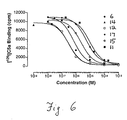
- Figure 6 shows receptor binding of cyclic C5a antagonists, as shown by inhibition of binding of 125I-C5a to human PMNs (n=5).
- Figure 7 shows superimposed structures of 7 (light, NMR structure) and 12 (dark, computer modelled structure). Phe and Trp side chains are omitted from 12 for clarity.
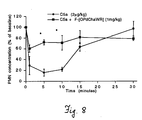
- Figure 8 shows inhibition of C5a-induced neutropenia in Wistar rats by the cyclic antagonist F-[OPdChaWR] given i.v. at 1mg/kg. Results shown from n=3 in each group, *P<0.05 compared to C5a-treated group only. Results are expressed as mean ± SEM.
- Figure 9 shows inhibition of LPS-induced neutropenia and changes in haematocrit induced by the cyclic antagonist F-[OPdChaWr] (0.03-10mg/kg, i.v., 10 min prior to lipopolysaccharide [LPS]) in Wistar rats. Abscissa: time after LPS (1 mg/kg i.v. injection). Ordinate: per cent change in haematocrit (A) value or level of circulating polymorphonuclear (PMN) leukocytes (B) compared to time zero.
- Figure 10 shows inhibition of carrageenan-induced (Wistar) rat paw oedema by cyclic antagonist (3D35) AcF-[OPdChaWr] (1 mg/kg single dose i.p. given 30 min prior to carrageenan). Results shown from 4 rats /group, mean ± SEM. Ordinate: percent change in paw volume. Abscissa: time (mins) after carrageenan injection
- The invention will now be described by way of reference only to the following general methods and experimental examples, and to the figures. Abbreviations used herein are as follows:
- BOP
- benzotriazole-1-yl-oxy-tris-(dimethylamino)-phosphonium hexafluorophosphate
- D-Cha
- D-cyclohexylamine
- DIPEA
- diisopropylethylamine
- DMF
- dimethylformamide
- DMSO
- dimethylsulphoxide
- HBTU
- O-benzotriazole N',N',N',N'-tetramethyluronium hexafluorophosphate;
- LPS
- lipopolysaccharide
- PMN
- polymorphonuclear granulocyte
- RMSD
- root mean square deviation
- RP-HPLC
- reverse phase-high performance liquid chromatography
- TFA
- trifluoroacetic acid;
- Throughout the specification conventional single-letter and three-letter codes are used to represent amino acids.
- Protected amino acids and resins were obtained from Novabiochem. TFA, DIPEA and DMF (peptide synthesis grade) were purchased from Auspep. All other materials were reagent grade unless otherwise stated. Preparative scale reverse-phase HPLC separations were performed on a Vydac C18 reverse-phase column (2.2 x 25 cm), and analytical reverse-phase HPLC separations were performed on a Waters Delta-Pak PrepPak C18 reverse-phase column (0.8 x 10 cm), using gradient mixtures of solvent A = water/0.1% TFA and solvent B =
water 10%/acetonitrile 90%, 0.09% TFA. The molecular weight of the peptides was determined by electrospray mass spectrometry recorded on a triple quadrupole mass spectrometer (PE SCIEX API III), as described elsewhere (Haviland et al, 1995). 1H-NMR spectra were recorded on either a Bruker ARX 500 MHz or a Varian Unity 400 spectrometer. Proton assignments were determined by 2D NMR experiments (DFCOSY, TOCSY, NOESY). - Non-peptidic compounds were synthesized using conventional organic chemical methods. Compounds were analysed by 1H-NMR spectroscopy and by mass spectrometry.
- Some representative peptide syntheses are now given. Linear peptide sequences were assembled by manual step-wise solid-phase peptide synthesis with HBTU activation and DIEA in situ neutralisation. Boc chemistry was employed for temporary Nα-protection of amino acids with two 1 min treatments with TFA for Boc group removal. The peptides were fully deprotected and cleaved by treatment with liquid HF (10 ml; p-cresol (1 ml); -5°C; 1-2 hr). Analytical HPLC (gradient; 0% B to 50% B over 40 min): 7, Rt = 32.0 min, [M+H]+(calc.) = 900.5, [M+H]+(exper.) = 900.7; 8, Rt = 32.2 min, [M+H]+(calc.) - 899.6, [M+H]+(exper.) = 899.7; 9, Rt = 30.0 min, [M+H]+(calc.) - 900.5, [M+H]+(exper.) = 900.7; 10, Rt = 23.8 min, [M+H]+(calc.) = 860.5, [M+H]+(exper.) = 860.5.
- Structures for the peptides are shown in Table 4 below.
- This is a general method used for the synthesis of a wide range of cyclic antagonists covered by this patent. For example, in the case of
cycle 11, its linear precursor peptide was synthesised by Fmoc chemistry using HBTU/DIEA activation on an Fmoc-D-Arg(Mtr)-Wang resin. Fmoc group removal was effected using two 1 min treatments with 50% piperidine/DMF. Cleavage and deprotection using 95% TFA/2.5% TIPS/2.5% H2O gave the Mtr-protected peptide, which was purified by RP-HPLC. Cyclization of the protected, purified peptide using 3eq BOP and 10eq DIEA at a 1 mM concentration in DMF stirring for 15 hr gave the cyclised product, which was fully deprotected using 1M TMSBr in TFA. A final RP-HPLC purification gave the desired peptide in yields of 50% for the cyclisation. Rt = 37.7 min, [M+H]+(calc.) - 910.5, [M+H]+(exper.) = 910.7. - Cyclization of the cleaved and fully deprotected peptide was achieved by stirring a 1mM solution in DMF with 3eq BOP and 10 eq pyridine as base for 15hr. A final RP-HPLC purification gave the desired peptide in yields of 22% for the cyclization. Rt = 37.3 min, [M+H]+(calc.) = 896.5, [M+H]+(exper.) = 896.5.
- 1H-NMR spectra were recorded for compound 7 (3 mg in 750 µl d6-DMSO, δ 2.50) referenced to solvent on a Varian Unity 400 spectrometer at 24°C. Two dimensional 1H-NMR NOESY (relaxation delay 2.0s, mix time 50-300 ms), DFQ- COSY and TOCSY (mixing time 75ms) experiments were acquired and recorded in phase sensitive mode. Acquisition times = 0.186 s, spectral width = 5500Hz, number of complex points (t1 dimension) = 1024 for all experiments. Data was zero-filled and Fourier transformed to 1024 real points in both dimensions.
- NMR data was processed using TRIAD software (Tripos Assoc.) on a Silicon Graphics Indy work station. 2D NOE cross peaks were integrated and characterised into strong (1.8-2.5Å), medium (2.3-3.5Å) and weak (3.3-5.0Å). Preliminary three-dimensional structures were calculated from upper and lower distance limit files using Diana 2.8 (69 distance constraints, including 27 for adjacent residues and 6 further away) with the redundant dihedral angle constraints (REDAC) strategy. Upper and lower distance constraints were accurately calculated using MARDIGRAS. At this stage the peptide was examined for possible hydrogen bonds, and these were added as distance constraints. The 50 lowest energy Diana structures were subjected to restrained molecular dynamics (RMD) and energy minimisation (REM). Initially, REM consisted of a 50 step steepest descent followed by 100 step conjugate gradient minimisation. RMD was performed by simulated heating of the structures to 300K for 1ps, followed by 500K for 1ps. The temperature was gradually lowered to 300K over 2ps and finally for 2ps at 200K. REM was performed again with a 50 step steepest descent, 200 step conjugate gradient followed by a 300 step Powell minimisation. The final structures were examined to obtain a mean pairwise rms difference over the backbone heavy atoms (N, Cα and C). Twenty of the 50 structures had a mean rmsd < 0.5 Å for all backbone atoms (O, N, C).
- A model of cycle 12, shown in Figure 7, was created from the NMR structure of 7 by deleting all NMR constraints, fusing the ornithine side chain amine to the C-terminal carboxylate of d-Arg to form an amide, and minimising using Powell forcefield (1000 iterations). The modelled structure was then superimposed on the NMR structure with an rmsd 0.224Å.
- Assays were performed with fresh human PMNs, isolated as previously described (Sanderson et al, 1995), using a buffer of 50 mM HEPES, 1 mM CaCl2, 5 mM MgCl2, 0.5% bovine serum albumin, 0.1% bacitracin and 100 µM phenylmethylsulfonyl fluoride (PMSF). In assays performed at 4°C, buffer, unlabelled human recombinant C5a (Sigma) or peptide, Hunter/Bolton labelled 125I-C5a (∼ 20 pM) (New England Nuclear, MA) and PMNs (0.2 x 10⁶) were added sequentially to a Millipore Multiscreen assay plate (HV 0.45) having a final volume of 200 µL/well. After incubation for 60 min at 4°C, the samples were filtered and the plate washed once with buffer. Filters were dried, punched and counted in an LKB gamma counter. Non-specific binding was assessed by the inclusion of 1 mM peptide or 100 nM C5a which typically resulted in 10-15% total binding.
- Data was analysed using non-linear regression and statistics with Dunnett post test.
- Cells were isolated as previously described (Sanderson et al, 1995) and incubated with cytochalasin B (5µg/mL, 15 min, 37°C). Hank's Balanced Salt solution containing 0.15% gelatin and peptide was added on to a 96 well plate (
total volume 100 µL/well), followed by 25 µL cells (4x10⁶/mL). To assess the capacity of each peptide to antagonise C5a, cells were incubated for 5 min at 37°C with each peptide, followed by addition of C5a (100 nM) and further incubation for 5 min. Then 50 µL of sodium phosphate (0.1M, pH 6.8) was added to each well, the plate was cooled to room temperature, and 25 µL of a fresh mixture of equal volumes of dimethoxybenzidine (5.7 mg/mL) and H2O2 (0.51%) was added to each well. The reaction was stopped at 10 min by addition of 2% sodium azide. Absorbances were measured at 450 nm in a Bioscan 450 plate reader, corrected for control values (no peptide), and analysed by non-linear regression. - The following well-known in vivo assay systems may be used to assess the anti-inflammatory activity of compounds of the invention. All assay data are analysed using non-linear regression analysis and Student's t-test, analysis of variance, with p<0.05 as the threshold level of significance.
- Anaesthetised (i.p. ketamine & xylazine) Wistar rats (150-200g) or mice were injected with sterilised air (20ml
day 1, 10ml day 4) into the subcutaneous tissue of the back. The cavity can be used after 6 days, whereupon carrageenan (2ml, 1% w/w in 0.9% saline) was injected into the air pouch and exudate was collected after 10 hr. Test compounds are administered daily after Day 6 and their anti-inflammatory effects assayed by differential counting of cells in the air-pouch exudate. Animals were killed at appropriate times after injection and 2ml 0.9% saline was used to lavage the cavity, lavage fluids were transferred to heparinised tube and cells were counted with a haemocytometer and Diff-Quik stained cytocentrifuged preparation. - Alternatively, a routine carrageenan paw oedema was developed in Wistar rats by administering a pedal injection of carrageenan to elicit oedema which is visible in 2h and maximised in 4h. Test compounds are given 40 min before inflammagen and evaluated by microcaliper measurements of paws after 2 & 4 hr. See Fairlie,D.P. et al (1987). Also see Walker and Whitehouse (1978).
- Adjuvant arthritis was induced in rats (3 strains) either microbially (injection of heat-killed Mycobacterium tuberculosis) or chemically (with avridine) by inoculation with the arthritogenic adjuvant co-administered with oily vehicles (Freund's adjuvants) in the tail base. (See Whitehouse, M. W., Handbook of Animal Models for the Rheumatic Diseases, Eds. Greenwald, R. A.; Diamond, H. S.; Vol. 1, pp. 3-16, CRC Press).
- Within 13 days the adjuvant arthritis is manifested by local inflammation and ulceration in the tail, gross swelling of all four paws, inflammatory lesions in paws and ears, weight loss and fever. These symptoms, which are similar to those of inflammatory disease in humans (Winter and Nuss, 1966), can be alleviated by agents such as indomethacin or cyclosporin which also show beneficial effects in man (eg. Ward and Cloud, 1966). Without drug treatment at Day 14, arthritic rats had hypertrophy of the paws, reduced albumin but raised acute phase reaction proteins in serum, and depressed hepatic metabolism of xenobiotics as indicated by prolonged barbiturate-induced sleeping times.
- To assess activity, compounds were administered for 4 days orally (≤10mg/kg/day) or i.p. from Days 10-13 following inoculation with arthritogen (Day 0). The inflammation was either not visible or very significantly reduced in rear or front paws as assessed by microcaliper measurements of paw thickness and tail volume, as well as by gross inspection of inflammatory lesions. Animals are sacrificed by cervical dislocation on Day 18 unless arthritis signs are absent, whereupon duration of observations is continued with special permission from the Ethics committees. Experiments are staggered to maximise throughput and allow early comparisons between compounds. This routine assay is well-accepted as identifying anti-inflammatory agents for use in humans.
- We used two dimensional nuclear magnetic resonance spectroscopy to determine the three dimensional structure of 7 and found that while there is no discernible structure in water, there is evidence of a stable gamma-turn structure in dimethylsulfoxide.
- The 1D 1H-NMR spectrum of peptide 7 in d6-DMSO at 24°C shows 4 distinct resonances for amide-NH protons, as summarized in Table 3. To establish their possible involvement in intramolecular hydrogen bonds, a deuterium exchange experiment was performed by adding a 10-fold excess of D2O to the solution. Two of the amide-NH doublets disappeared immediately, along with resonances attributable to the N-terminal methylamine protons. However, the other two amide NH resonances, as well as a broad resonance at approximately 8.05 ppm, persisted for up to 6.5 hours (Figure 2). These three slowly-exchanging protons are assigned to the amide NHs of Trp and d-Cha and the side chain amine of Lys, the slow exchange behaviour being characteristic of hydrogen-bonding. The amine assignment was established from the TOCSY spectrumm where cross peaks were observed between the protonated amine and the ε, δ and γ CH2 protons. A temperature dependence study (20-60°C) of the amide-NH chemical shifts (Δδ/T = 2.5 ppb/deg, dCha-NH; 6 ppb/deg, Trp-NH; 6.5 ppb, Lys-NH; 8.7ppb, d-Arg-NH) unambiguously confirmed the involvement of the dCha-NH only in intramolecular hydrogen bonding.
Table 3 1H-NMR Assignmentsa for 7 in d6-DMSO Residue bHN Hα Hβ Hγ Others MePhe - 4.06 3.09, 3.06 - c7.17, 7.29; d2.46; f8.98 Lys 8.83 4.54 1.74, 1.55 1. 32 e1.51; f2.74, g7.76 (NH2) Pro - 4.30 2.084, 1.74 1.88, 1.78 e3.61, f3.48 d-Cha 7.91 4.35 1.19 , 1.06 0.76 e1.43, 1.08; f1.61, 1.58; 0.73 Trp 8.01 4.65 3.11, 2.94 - c6.97,7.06,7.13,7.32,7.65; g10.80 d-Arg 8.44 4.20 1.73, 1. 58 1.42 e3.08; g7.60 a Referenced to residual d5-DMSO at 2.50 ppm.
b Amide NHs, 3JNH-CaH values (Hz):7.91 (Lys), 7.77 (d-Arg), 8.34 (Trp), 8.53 (d-Cha).
c Aromatics
d N-Me.
e Hδ.
f Hε
g NH/NH2 amine. - A series of 2D 1H-NMR spectra were measured for 7 at 24°C in d6-DMSO to determine the three-dimensional structure. TOCSY and DFQ-COSY experiments were used to identify residue types, while sequential assignments were made from analysis of NOESY data. From a series of 100 structures generated from NOESY data, fifty of the lowest energy structures were subjected to restrained molecular dynamics (200K-500K) and energy minimised. A set of 20 calculated structures with a root mean square deviation (rmsd) < 0.5Å (backbone atoms) are superimposed in Figure 3, and clearly depict a turn conformation.
- In combination, the NMR constraint data, 3JNH-CαH values, deuterium exchange and temperature dependence data establish an unusual turn structure for hexapeptide 7 which is constrained by up to three hydrogen bonds, as shown in Figure 4. The evidence is very strong for one intramolecular hydrogen bond from dCha-NH....OC-Lys (2.72 Å, N-H..O angle 157°, C=O...H angle 84°), forming a 7-membered ring that defines an inverse γ-turn. The dChaNH-O-TrpNH angle is 56.4°. The deuterium exchange data and NMR constraint data together point to a second intramolecular hydrogen bond Trp-NH....OC-Lys (3.31 Å, N-H..O angle 159°, CO...H angle 137.3°) forming a 10-membered ring characteristic of a β-turn. The φ and ψ angles (φ2=-58.4°, ψ2=62.0°; φ=96.6°, ψ3=16.6°) most closely match a type II β-turn (Bandekar, 1993; Hutchinson and Thornton, 1994) which is distorted by the presence of the γ-turn wholly within the β-turn.
- To our knowledge this is the first example of an intramolecular hydrogen bond between residues within a β-turn, although there are many examples of hydrogen bonds between a residue within the "10 membered ring" of a β-turn and a residue outside of it (Bandekar, 1993). A third hydrogen bond (2.76Å, N-H...O angle 160.3°), between the side-chain amine of Lys and the C-terminal carboxylate, is suggested by the NMR constraint data, by slow NH/ND exchange and by detection of a weak NOE between Lys-NH...Trp-αCH2. This may further constrain the molecule into the observed turn conformation. Such ion-pairing is common in dipolar aprotic solvents such as dimethylsulphoxide and may also be relevant in a hydrophobic protein environment.
- NMR solution structures have also been determined for several of the cyclic antagonists described in the following examples, and show that in each case the type II β-turn is preserved and stabilized by the cyclic structure.
- The constraining β and γ turns proposed in the linear peptide 7 have parallels in cyclic peptides. We have previously detected overlapping β and γ turns in a cyclic octapeptide from ascidiacyclamide (Abbenante et al, 1996). Combinations of a β- and γ-turn have also been found in the backbones of cyclic penta- and hexapeptides, particularly those containing alternating D- and L-amino acids (Marraud and Aubry 1996; Fairlie et al, 1995; Kessler et al, 1995; Stradley et al, 1990). For example a type II β-turn and an inverse γ-turn have been identified in cyclic antagonists c-(D-Glu-Ala-D-allo-Ile-Leu-D-Trp] (Ihara et al, 1991; Coles et al, 1993; Ihara et al, 1992; Bean et al, 1994) and c-(D-Asp-Pro-D-Val-Leu-D-Trp) (Bean et al, 1994) for endothelin receptors, and in members of the rhodopsin family of G protein-coupled receptors with seven transmembrane domains (X.-M.Cheng et al, 1994). In the latter case, as in 7, an inverse γ-turn forms between residues (Asp-CO.....Val-NH, Lys-CO....dCha-NH) that flank the proline.
- We also examined the receptor-binding and antagonist activity of the hexapeptide 7 for comparison with our new compounds. The previous report by Konteatis et al (1994) concerned the ability of 7 to compete with C5a binding to receptors on isolated PMN membranes (IC50 70 nM), which is not necessarily physiologically relevant. We examined competition between 7 and C5a using intact PMN cells, and found that, under these conditions, 7 binds with much lower receptor affinity of IC50 1.8 µm. We confirmed that 7 is a full antagonist with no agonist properties. These results are summarized in Figure 5a and Table 4. The relative affinity (ratio) of 7 for the C5aR in intact PMNs in our assays was similar to that previously reported for isolated PMN membranes.
- We have also found that 7 shows antagonist activity against both C5a (Figure 5b) and a C-terminal agonist decapeptide analogue 4 (YSFKPMPLaR) (Finch et al, 1997) of the C-terminus C5a65-74, suggesting that it acts on
site 2 of the receptor.Compounds 7 and 4 have similar µM affinity for the receptor C5aR on intact polymorphonuclear leukocytes, as shown in Table 4. - A new discovery from the data in Table 4 is the linear correlation between the log of binding affinities and the log of antagonist potencies for these
Site 2 antagonists (compounds 7-12, Table 4). The importance of this linear relationship is that since receptor affinity and antagonist activity are directly proportional, the experimentally simpler approach of measuring receptor binding may be used to estimate the antagonist activity for such small compounds, provided that there is no evidence of agonist activity.Table 4 Receptor-Binding Affinitiesa and Antagonist Activitiesb in Human PMNs Compound Receptor Affinitya Antagonist Potencyb Agonist Activityc IC50 (µM) IC50 (µM) 7 MeFKP(dCha)Wr 1.8 (15) 0.085 (9) No 8 MeFKP(dCha)Wr-CONH2 14 (5) 0.5 (3) No 9 MeFKP(dCha)WR 11 (5) 0.7 (3) No 10 MeFKPLWR 144 (1) >1000 (3) nd 11 Ac-F-[KP(dCha)Wr] 3.2 (40 0.090 (5) No 12 Ac-F-[OP(dCha)Wr] 0.28 (6) 0.012 (4) No 4 YSFKPMPLaR 6.0d - Yes 1 C5a65-74, ISHKDMQLGR >1000e - - C5a 0.0008 (9) - Yes Number of experiments in parenthesis. Corrected for amino acid content.
Square brackets indicate cyclic portion.
nd = not determined
a 50% reduction in binding of 125I-C5a to intact human PMNs
b 50% reduction in myeloperoxidase secretion from human PMNs mediated by 100 nM C5a
c Agonist activity in dose range 0.1 nM-1 mM
d Finch et al, 1997; e Kawai et al, 1991 - It has previously been proposed that the C-terminus of C5a and of agonist peptides is essential for activity, due to its interaction with a positively-charged Arg206 of the receptor (DeMartino et al, 1995). We confirm here that the C-terminal carboxylate is indeed important for activity (8 vs. 7), but wondered whether the origin of this effect might be due to hydrogen bonding between the carboxylate anion and the positively charged amine side chain of Lys. Conversion to the amide (8) certainly reduces both receptor-affinity and antagonist activity approximately 5-fold. Changing chirality of the Arg-Cα (9 vs. 7) causes a similar reduction in activity, and replacing dCha with the less bulky Leu residue (10) is also detrimental to receptor binding. However, potency is recovered for
cyclic compounds 11 and 12, in which an amide bond is tolerated at the C-terminus, consistent with the structural interpretation above that the advantage of the carboxylate in 7 may be associated with intramolecular hydrogen bonding. The replacement of this hydrogen bond in 7 with a covalent amide bond in 11 and 12 more effectively stabilizes the turn conformation. - Figure 5C compares C5aR binding and antagonist potency in vitro on human PMNs for
compounds 15 and 17 with those for compound 7. Both 15 and 17 are potent inhibitors at nM concentrations of the action of C5a and the binding of 125I-C5a to its receptor (e.g. 4, Kb = 1.4nM). Their cyclic nature and the acetylation at the N-terminal phenylalanine both protect against the proteolytic degradation typically encountered by peptides, making such cyclic compounds more suitable than acyclic peptides as drug candidates. The results are shown in Table 5.Table 5 Receptor Binding and Antagonist Activity of Cyclic Molecules 
Compound n R Isomer* Receptor Affinity µM Agonist Activity 13 1 H S- 9 No 14 R- 34 No 15 2 H S- 0.3 No 16 R- 3.7 No 17 3 Ac S- 0.3 No 11 Ac R- 38 No 18 4 Ac S- 3.2 No 12 Ac R- 51 No Refers to stereochemistry of Arg side chain. - Some examples of these cyclic antagonists and their apparent receptor-binding affinities and antagonist potencies are given in Tables 4, 5 and 6 as well as in Figures 5 and 6. In the tables the single letter code for amino acids is used.
Table 6 Effect of Cyclisation on Antagonist Binding Affinity and Antagonist Potency PEPTIDE pD2 ± SEa IC50 (µM)a (n) pD2 ± SEb IC50 (µM)b (n) 11 AcF-[KPdChaWr] 5.49 ± 0.22 3.2 4 7.07 ± 0.29 0.09 5 18 AcF-[OPdChaWr] 6.44 ± 0.14* 0.4 9 7.30 ± 0.09 0.05 9 19 [FWPdChaWr] 4.37 ± 0.36* 43 3 nd 20 AcF-[KMdChaWr] 4.81 ± 0.06 15 2 nd 21 AcF-[KKdChawr] 3.94 ± 0.4 116 3 4.88 13 1 Effect of length of linker in cycle on antagonist binding affinity and antagonist potency 22 AcF-[XPdChaWr] 5.02 ± 0.07 9.5 3 4.71 ± 0.23 20 3 23 ACF-[X2PdChaWr] 4.77 ± 0.14* 17 3 6.09 ± 0.08* 0.8 4 12 AcF-[OPdChaWr] 4.60 ± 0.06* 16 4 6.42 ± 0.10 0.4 4 24 AcKF-[OPdChaWr] 4.96 ± 0.03 11 3 6.73 0.2 1 14 F-[XPdChaWr] 4.39 ± 0.10* 41 3 nd 16 F-[X2PdChaWr] 5.42 ± 0.05 3.8 3 6.70 ± 0.04 0.4 3 25 F-[OPdChaWr] 5.51 ± 0.07 3.1 3 5.79 ± 0.34* 1.6 3 26 F-[KPdChaWr] 5.09 ± 0.08 8.1 3 5.55 ± 0.57* 2.8 3 Effect of L-Arg on antagonist binding affinity and antagonist potency 17 AcF-[OPdChaWR] 6.57 ± 0.05* 0.3 3 7.91 ± 0.17* 0.01 3 13 F-[XPdChaWR] 4.98 ± 0.05 10 3 5.63 ± 0.13* 2.4 3 15 F-[X2PdChaWR] 6.50 ± 0.04* 0.3 5 7.36 ± 0.13 0.04 3 27 F-[OPdChaWR] 7.21 ± 0.01* 0.06 3 7.41 ± 0.14 0.04 3 28 F-[KPdChaWR] 6.50 ± 0.12* 0.3 4 6.69 ± 0.04 0.2 3 a pD2/IC50; concentration of peptide resulting in 50% inhibition in the binding of [125I]C5a to intact PMNs. The IC50 is the antilog of the mean pD2 value
b pD2/IC50; concentration of peptide resulting in 50% inhibition in the ability of C5a (100 nM) to cause the release of MPQ from PMNs
X = (CH2)-NH2
X2 = (CH2)2-NH2
pD2 values are expressed as mean ± SE
n represents the number of experiments performed
* Significant change in affinity/potency compared to NMeFKPdChaWr (p<0.05)
# indicates isomer number - These results demonstrate:
- (1) that the cyclic molecules have higher apparent receptor affinity and may be more potent antagonists than acyclic (linear) peptides,
- (2) that one of the two possible cyclic diastereomers is consistently favoured for binding to the C5a receptor, and it is surprisingly the opposite stereochemistry (L-arginine) to that favoured in the linear compounds (D-arginine)
- (3) that the cycles have an optimum ring size for receptor-binding,
- (4) that there is a pseudo-linear relationship between log (antagonist potency) and log (receptor affinity).
- Tables 5 and 6 list the C5a receptor affinities of some examples of cyclic antagonists of C5a, and their ability to bind to, and inhibit, binding of C5a to human PMNs is illustrated in Figure 6. Surprisingly these data show that the L-arginine is preferred over the D-arginine, in contrast to the linear compound 7 in which the D-arginine confers higher affinity for the receptor than does L-arginine. The data also show that the size of the macrocycle is optimal when n = 2 or 3, the smaller cycle where n = 1 and the larger cycle when n = 4 being clearly less active. This requirement for a tightly constrained cycle is probably due to the need to correctly position the attached side chain residues of, for example, Trp, dCha, Arg and Phe for interaction with the receptor.
- Figure 7 compares the computer-modelled structure of the cyclic antagonist 12 with the NMR solution structure for the acyclic antagonist 7. These backbone structures are strikingly similar, and strongly suggest that the receptor-binding conformations of these molecules involve the same turn structure. Compound 12, a more potent antagonist than 11, also has a shorter linker, which tightens the turn and slightly alters the conformational space accessible to the key side chains of Phe, dCha, Trp and Arg. The conformational limitations placed on the hexapeptide derivative 12 by the cycle are responsible for a ≥104 increase in receptor-binding affinity over the conformationally flexible decapeptide C-terminus of C5a (1, Table 2).
- There is a correlation between binding affinities and antagonist potency for the
site 2 antagonists (compounds 7-12, Table 2). It thus appears that antagonist potency is dependent upon changes that occur atsite 2 alone. Without wishing to be bound by any proposed mechanism, we believe that this may be because the mechanism of antagonism is related to conformational change to a turn conformation induced by 7 atsite 2 of the receptor. - Currently there is no information about different types of C5aRs. We have previously shown marked differences in the responsiveness of different cells containing functional C5aRs to agonists (Sanderson et al, 1994, 1995; Finch et al, 1997) and we can now provide more information by examining potency and efficacy of selective agonists and antagonists relative to human recombinant C5a. For agonists, the tissue or cell selectivity may reveal functionally different receptors. Binding assays using human PMNs, U937 cells, or circulating monocytes are used to determine affinities for C5aRs. Selectivity for different C5aRs is ascertained by differential antagonism. This combined approach allows pharmacological characterisation of new agonists or antagonists, and may lead to a potential functional classification of C5aRson different cells.
- Compounds were evaluated in an acute model of C5a-induced neutropenia. Transient neutropenia maximises 5 min after i.v. C5a and is profound, with >90% of circulating neutrophils disappearing from circulation at effective doses of C5a, as shown in Figure 8. The neutropenia is due to transient adherence of circulating neutrophils to the vascular endothelium. Preliminary data show that neutropenia caused by i.v. C5a is blocked by a C5a antagonist. For example, F-[OPdChaWR], (1 mg/kg), given prior to 2µg C5a i.v., inhibits C5a-induced neutropenia in vivo (Figure 8).
- LPS causes rapid neutropenia in rats. If this effect of LPS is blocked by C5a antagonists, then C5a may be of major importance in the acute effects of LPS, and the results shown in Figure 9 were in agreement with this hypothesis. C5a antagonists were injected (bolus i.v.) 10 min prior to challenge with LPS. Rats were anaesthetised, and blood samples (0.3ml) were taken for measurements of PMNs. PMNs are isolated and quantified. Preliminary results show that F-[OPdChaWR], (1 mg/kg), given prior to i.v.LPS, inhibits neutropenia..
- The results also indicate that the C5a antagonist inhibits the increase in haematocrit caused by LPS, showing that vascular leakage of serum caused by LPS is also inhibited.
- These results demonstrate that C5a receptor antagonists, such as those described in this invention, may have therapeutic utility in septicaemic individuals. The ability to inhibit the adherence of PMNs to vascular endothelium, and to inhibit the vascular leakage to LPS as shown by the reduction of haematocrit values, indicates powerful anti-inflammatory effects of these compounds against proinflammatory stimuli activating the complement system, such as endotoxin or LPS.
- Preliminary experiments in rats have revealed that the cyclic antagonists summarized in Table 5 are active at less than 20 mg/kg as anti-inflammatory agents in suppressing the onset of either carrageenan-induced paw oedema or adjuvant-induced polyarthritis. The maximally effective dosages for even moderately-effective antagonists are 10 mg/kg or less, given i.p. or p.o. Many anti-inflammatory drugs currently used in humans were initially evaluated in such assays, and also showed activity in these rat models of inflammation. These preliminary indications of efficacy in vivo indicate that C5a antagonists have therapeutic potential in human inflammatory conditions.
- Using the rat carageenan paw oedema assay, we found that a compound, AcF-[O-P-dCha-W-r], which is 100 times less active than 17 in vitro as a C5a antagonist in PMNs, has some in vivo activity in rats given 1 mg/kg of the compound I.P, 30 min prior to the carageenan injection. Paw swelling was measured for up to 4.5 hr. The results, shown in Figure 10, suggest that even this weak C5a antagonist significantly inhibits development of the oedema after 180 and 270 min. This anti-inflammatory activity suggests that C5a receptor antagonists, such as those described in this invention, may have therapeutic activity in diseases involving vascular leakage following inflammatory stimuli.
- In recent years there have been many attempts to mimic β- and γ- turn peptides that represent bioactive protein surfaces, resulting in notable mimetics for RGD (arginine-glycine-aspartate) peptides, somatostatin and opioid peptides, to name a few derived through structure-activity relationships (see for example Marraud and Aubry, 1996; Fairlie et al, 1995). Most of these examples preserve a turn structure through cyclisation of the peptide. On the other hand, there are comparatively few short acyclic peptides that have been found to have substantial turn structure in solution (Dyson et al, 1988; Rizo and Gierasch, 1992; Pràcheur et al, 1994). It is usually argued that short acyclic peptides adopt a myriad of solution structures that may include small populations of turn structures that are responsible for bioactivity.
- This invention describes a series of conformationally-constrained turn-containing molecules that are preorganized for binding to the same G protein-coupled receptor(s) of human cells that are targeted by human C5a. The invention is applicable to other G protein-coupled receptors.
- The principal feature of the compounds of the invention is the preorganized arrangement, which brings at least three hydrophobic groups and a charged group into neighbouring space, creating a hydrophobic surface 'patch'. These results enable the design and development of even more potent conformationally-constrained, small molecule antagonists of C5a.
- In the light of the aforementioned prior art, it was surprising to find that a C-terminal carboxylate was not necessary in our compounds in order to obtain good receptor-binding or antagonist activity. The cyclic antagonists have an amide bond at the 'C-terminal' arginine position. The replacement of the carboxylate in 7 with a covalent amide bond effectively stabilises the required turn conformation.
- Cyclic and non-peptidic antagonists have several important advantages over peptides as drugs. The cycles described in this invention are stable to proteolytic degradation for at least several hours at 37°C in human blood or plasma, or in human or rat gastric juices or in the presence of digestive enzymes such as pepsin, trypsin and chymotrypsin. In contrast, short peptides composed of L-amino acids are rapidly degraded to their component amino acids within a few minutes under these conditions. A second advantage lies in the constrained single conformations adopted by the cyclic and non-peptidic molecules, whereas acyclic or linear peptides are flexible enough to adopt several structures in solution other than the required receptor-binding structure. Thirdly, cyclic and non-peptidic compounds such as those described in this invention are usually more lipid-soluble and more pharmacologically bioavailable as drugs than peptides, which can rarely be administered orally. Fourthly, the plasma half-lives of cyclic and non-peptidic molecules are usually longer than those of peptides.
- References cited herein are listed on the following pages,
-
- Abbenante, G., Fairlie, D.P., Gahan, L.R., Hanson, G.R., Pierens, G.K. and van den Brenk, A.L. J. Am. Chem. Soc., 1996 118 10384-10388
- Bandekar, J. Vib. Spectros., 1993 5 143-173
- Bean, J.W., Peishoff, C.E. and Kopple, K.D. Int. J. Protein Res., 1994 44 223
- Cheng, X. M., Doherty, A. M., Nikam, S. S. Curr. Med. Chem. 1994 1 271-312
- Coles, M., Sowemimo, V., Scanlon, D., Munro, S.L.A., Craik, D.J. J. Med. Chem., 1993 36 2658
- DeMartino, J.A., Konteatis, Z.D., Siciliano, S.J., Van Riper, G., Underwood, D.J., Fischer, P.A., Springer, M.S. J. Biol. Chem., 1995 270 15966-15969
- DeMartino, J.A., Van Riper, G., Siciliano, S.J., Molineaux, C.J., Konteatis, Z.D., Rosen, H. Springer, M.S. J. Biol. Chem., 1994 269 14446-14450.
- Drapeau, G., Brochu, S., Godin, D., Levesque, L., Rioux, F. and Marceau, F. Biochem. Pharm., 1993 45 1289-1299
- Dyson, H.J., Rance, M., Hougten, R.A., Lerner, R.A. and Wright, P.E. J. Mol. Biol., 1988 201 161-200
- Ember, J.A., Sanderson, S.D., Taylor, S.M., Kawahara, M. and Hugli, T.E. J. Immunol., 1992 148 3165-3173
- Fairlie, D.P., Abbenante, G. and March, D. Curr. Med. Chem., 1995 2 672-705
- Fairlie, D.P., Whitehouse, M. and Broomhead, J. Chem. Biol. Interact., 1987 61 277-291
- Finch, A.M., Vogen, S.M., Sherman, S.A., Kirnarsky, L., Taylor, S.M., and Sanderson, S.D.J. Med Chem., 1997 40 877
- Gerard, N and Gerard, C. Nature, 1991 349 614-617
- Gerard, C and Gerard, N.P. Ann. Rev. Immunol., 1994 12 775-808
- Haviland, D.L., McCoy, R.L., Whitehead, W.T., Akama, H., Molmenti, E.P., Brown, A., Haviland, J.C., Parks, W.C., Perlmutter, D.H. and Wetsel, R.A. J. Immunol., 1995 154 1861-1869
- Hutchinson, E.G. and Thornton, J.M. Protein Sci., 1994 3 2207-2216
- Ihara, M., Fukuroda, T., Saeki, T., Nishikibe, M., Kojiri, K., Suda, H. and Yano, M. Biochem. Biophys. Res. Comm., 1991 178 132-137
- Ihara, M., Noguchi, K., Saeki, T., Fukuroda, T., Tsuchida, S., Kimura, S., Fukami, T., Ishikawa, K., Nishikibe, M., and Yano, M. Life Sciences, 1992 50 247
- Kawai, M., Quincy, D.A., Lane, B., Mollison, K.W., Luly, J.R., Carter, G.W. J. Med. Chem., 1991 34 2068-71
- Kawai, M., Quincy, D.A., Lane, B., Mollison, K.W., Or, Y.-S., Luly, J.R., and Carter, G.W. J. Med. Chem., 1992 35 220-223
- Kessler, H., Diefenbach, B., Finsinger, D., Geyer, A., Gurrath, M., Goodman, S.L., Hoelzemann, G., Haubner, R., Jonczyk, A. et al Lett. Pept. Sci., 1995 2 155-160
- Kohl, J., Lubbers, B., Klos, A., et al. Eur. J. Immunol., 1993 23 646-652
- Konteatis, Z.D., Siciliano, S.J., Van Riper, G., Molineaux, C.J., Pandya, S., Fischer, P., Rosen, H., Mumford, R.A., and Springer, M.S. J. Immunol., 1994 153 4200- 4204
- Marraud, M. and Aubry, A. Biopolymers, 1996 40 45-83
- Morgan, E.L., Sanderson, S.D., Scholz, W., Noonal, D.J., Weigle, W.O. and Hugli, T.E. J. Immunol., 1992 48 3937-3942
- Pràcheur, Bossus, M., Gras-Masse, H., Quiniou, E., Tartar, A. and Craescu, C.T. J. Biochem., 1994 220 415-425
- Rizo, J. and Gierasch, L.M. Ann. Rev. Biochem., 1992 61 387
- Sanderson, S.D., Ember, J.A., Kirnarsky, L., Sherman, S.A., Finch, A.M., Taylor, S.M. J. Med. Chem., 1994 37 3171-3180
- Sanderson, S.D., Kirnarsky, L., Sherman, S.A., Vogen, S.M., Prakesh, O., Ember, J.A., Finch, A.M. and Taylor, S.M. J. Med. Chem., 1995 38 3669-3675
- Siciliano, S.J., Rollins, T.E., DeMartino, J., Konteatis, Z., Malkowitz, L., VanRiper, G., Bondy, S., Rosen, H. and Springer, M.S. Proc. Nat. Acad. Sci. USA, 1994 91 1214-1218.
- Sim, E. The Natural Immune System. Humoral Factors., 1993, IRL Press, Oxford University Press, Oxford.
- Tempero, R.M., Hollingsworth, M.A., Burdick, M.D., Finch, A.M., Taylor S.M., Vogen, S.M., Morgan, E.L., and Sanderson, S.D. J. Immunol., 1997 158 1377-1382
- Stradley, S., Rizo, J., Bruch, M., Stroup, A. and Gierasch, L. Biopolymers, 1990 29 263-287.
- Walker W.R. and Whitehouse, M.W. Agents & Actions, 1978 8 85
- Ward, J.R. and Cloud, R.S. J. Pharmacol. Exp. Ther., 1966 152 116
- Whaley, K. Complement in Health and Disease. Immunology and Medicine Series, Ed. Reeves, W. G., 1987, MTP Press Ltd, Lancaster
- Whitehouse, M.W. Handbook of Animal Models for the Rheumatic Diseases, Eds. Greenwald, R.A., Diamond, H.S., Vol. 1, pp 3-16 CRC Press
- Winter, C.A. and Nuss, G.W. Arth. & Rheumatism, 1966 9 394
- Zhang, X., Boyar, W., Galakatos, N. and Gonella, N.C. Protein Sci., 1997 6 65-72
- Zuiderweg, E.R.P., Nettesheim, D.G., Molison, K.W., Carter, G.W. Biochemistry, 1989 28 172-185; 29 2895-2905.
Claims (20)
- A compound which has an antagonist activity against C5a receptor and has no C5a agonist activity which has the general formula:
 A is H; alkyl; aryl; NH2, NHalkyl, N(alkyl)2, NHaryl or NHacyl;B is an alkyl, aryl, phenyl, benzyl, naphthyl or indole group, or the side chain of a D- or L-amino acid selected from the group consisting of phenylalanine, homophenylalanine, tryptophan, homotryptophan, tyrosine, and homotyrosine;C is the side chain of a D-, L- or homo-amino acid selected from the group consisting of proline, alanine, leucine, valine, isoleucine, arginine, histidine, aspartate, glutamate, glutamine, asparagine, lysine, tyrosine, phenylalanine, cyclohexylalanine, norleucine, tryptophan, cysteine and methionine;D is the side chain of a D- or L-amino acid selected from the group consisting of cyclohexylalanine, homocyclohexylalanine, leucine, norleucine, homoleucine, homonorleucine and tryptophan;E is the side chain of a D- or L-amino acid selected from the group consisting of tryptophan and homotryptophan;F is the side chain of a D- or L-amino acid selected from the group consisting of arginine, homoarginine, lysine and homolysine,in which X1 is -(CH2)nNH- or -(CH2)n-S-, -(CH2)2O-, -(CH2)3O-, -(CH2)3-, (CH2)4-, or -CH2COCHRNH-, where R is the side chain of any common or uncommon amino acid, "alkyl." refers to a straight, branched or cyclic alkyl chain of 1 to 6 carbon atoms, "aryl" refers to a homocyclic or heterocyclic group in which the ring has 5 or 6 carbon atoms, and "acyl" refers to an acyl group of 1 to 6 carbon atoms.
 - A compound according to claim 1, in which F is the side chain of an L-amino acid.
- A compound according to claim 2, in which F is the side chain of L-arginine.
- A compound according to any one of claims 1 to 3, in which A is H or NHacetyl.
- A compound according to any one of claims 1 to 4, in which B is an indole, benzyl, phenyl, or naphthyl group.
- A compound according to any one of claims 1 to 4, in which B is the side chain of phenylalanine.
- A compound according to any one of claims 1 to 6, in which C is D- or L-cyclohexylalanine (Cha), leucine, valine, isoleucine, phenylalanine, tryptophan or methionine.
- A compound according to any one of claims 1 to 6, in which C is the side chain of proline, methionine or lysine.
- A compound according to any one of claims 1 to 8, in which D is the side chain of D-cyclohexylalanine.
- A compound according to any one of claims 1 to 9, in which E is the side chain of tryptophan.
- A compound according to any one of claims 1 to 10, in which F is the side chain of arginine.
- A compound according to any one of claims 1 to 11, in which X1 is -(CH2)n-NH-, wherein n is 3 or 4.
- A compound according to any one of claims 1 to 12, selected from the group consisting of compounds Ac-F-[KP(dCha)Wr], Ac-F-[OP(dCha)Wr], R[NH(CH2NH)CO-PdChaWR], F-[NH[((CH2)2NH)CO-PdChaWR], AcF-[OPdChaWR], [FWPdChaWr], AcF-[KMdChaWr], ACF-[KKdChaWr], ACF-[NH(CH2NH)CO-PdChaWr], AcKF-[OPdChaWr], F-[OP(dCha)WR], and F-[KP(dCha)WR].
- A compound according to claim 13, of structure

- A composition comprising a compound according to any one of claims 1 to 14, optionally together with a pharmaceutically-acceptable carrier or excipient.
- Use of a compound according to any one of claims 1 to 14 in the manufacture of a medicament for the treatment of a pathological condition mediated by C5a receptor.
- Use according to claim 16, in which the condition mediated by C5a receptors involves overexpression or underregulation of C5a.
- Use of a compound according to any one of claims 1 to 14 in the manufacture of a medicament for the treatment of an inflammatory condition.
- Use according to claim 18, in which the inflammatory condition is inflammatory arthritis.
- Use according to claim 18, in which the condition is selected from the group consisting of rheumatoid arthritis, adult respiratory distress syndrome (ARDS), systemic lupus erythematosus, tissue graft rejection, ischaemic heart disease, reperfusion injury, septic shock, psoriasis, gingivitis, atherosclerosis, Alzheimer's disease, multiple sclerosis, lung injury and extracorporeal post-dialysis syndrome.
Priority Applications (1)
| Application Number | Priority Date | Filing Date | Title |
|---|---|---|---|
| CY20081100033T CY1107133T1 (en) | 1997-06-25 | 2008-01-10 | C5A Receptor Circular Competitors and Protein G Conjugates |
Applications Claiming Priority (3)
| Application Number | Priority Date | Filing Date | Title |
|---|---|---|---|
| AUPO755097 | 1997-06-25 | ||
| AUPO7550A AUPO755097A0 (en) | 1997-06-25 | 1997-06-25 | Receptor agonist and antagonist |
| PCT/AU1998/000490 WO1999000406A1 (en) | 1997-06-25 | 1998-06-25 | CYCLIC AGONISTS AND ANTAGONISTS OF C5a RECEPTORS AND G PROTEIN-COUPLED RECEPTORS |
Publications (3)
| Publication Number | Publication Date |
|---|---|
| EP1017713A1 EP1017713A1 (en) | 2000-07-12 |
| EP1017713A4 EP1017713A4 (en) | 2002-07-24 |
| EP1017713B1 true EP1017713B1 (en) | 2007-11-07 |
Family
ID=3801840
Family Applications (1)
| Application Number | Title | Priority Date | Filing Date |
|---|---|---|---|
| EP98930536A Expired - Lifetime EP1017713B1 (en) | 1997-06-25 | 1998-06-25 | CYCLIC ANTAGONISTS OF C5a RECEPTORS AND G PROTEIN-COUPLED RECEPTORS |
Country Status (11)
| Country | Link |
|---|---|
| US (5) | USRE41287E1 (en) |
| EP (1) | EP1017713B1 (en) |
| JP (1) | JP4686696B2 (en) |
| AT (1) | ATE377606T1 (en) |
| AU (2) | AUPO755097A0 (en) |
| CY (1) | CY1107133T1 (en) |
| DE (1) | DE69838678T2 (en) |
| DK (1) | DK1017713T3 (en) |
| ES (1) | ES2294816T3 (en) |
| PT (1) | PT1017713E (en) |
| WO (1) | WO1999000406A1 (en) |
Families Citing this family (54)
| Publication number | Priority date | Publication date | Assignee | Title |
|---|---|---|---|---|
| AUPO755097A0 (en) * | 1997-06-25 | 1997-07-17 | University Of Queensland, The | Receptor agonist and antagonist |
| AUPQ339899A0 (en) | 1999-10-13 | 1999-11-04 | University Of Queensland, The | Novel molecules |
| ES2353077T3 (en) | 2000-08-10 | 2011-02-25 | Mitsubishi Tanabe Pharma Corporation | DERIVATIVES OF UREA WITH REPLACEMENT IN POSITION 3 AND MEDICINAL USE OF THE SAME. |
| JP4751567B2 (en) | 2000-09-14 | 2011-08-17 | 田辺三菱製薬株式会社 | Novel amide derivatives and their use as pharmaceuticals |
| AUPR833401A0 (en) * | 2001-10-17 | 2001-11-08 | University Of Queensland, The | G protein-coupled receptor antagonists |
| ATE525391T1 (en) | 2002-03-19 | 2011-10-15 | Cincinnati Childrens S Hospital Medical Ct | MUTEINS OF C5A ANAPHYLATOXIN, NUCLEIC ACID MOLECULES CODING FOR SUCH MUTEINS, AND PHARMACEUTICAL USES OF MUTEINS OF C5A ANAPHYLATOXIN |
| WO2003084524A1 (en) * | 2002-03-29 | 2003-10-16 | Neurogen Corporation | Combination therapy for the treatment of conditions with pathogenic inflammatory components |
| AUPS160602A0 (en) * | 2002-04-08 | 2002-05-16 | University Of Queensland, The | Therapeutic method |
| AU2002950657A0 (en) | 2002-08-08 | 2002-09-12 | Alchemia Limited | Derivatives of monosaccharides for drug discovery |
| AU2003266858B2 (en) * | 2002-10-11 | 2006-09-14 | Vast Bioscience Pty Limited | Classes of compounds that interact with GPCRs |
| AU2002951995A0 (en) * | 2002-10-11 | 2002-10-31 | Alchemia Limited | Classes of compounds that interact with gpcrs |
| AU2002952086A0 (en) * | 2002-10-16 | 2002-11-07 | The University Of Queensland | Treatment of osteoarthritis |
| ATE509632T1 (en) * | 2002-10-16 | 2011-06-15 | Promics Pty Ltd | TREATMENT OF INFLAMMATORY BOWEL DISEASE |
| AU2002952129A0 (en) * | 2002-10-17 | 2002-10-31 | The University Of Queensland | Treatment of hypersensitivity conditions |
| AU2003902354A0 (en) * | 2003-05-15 | 2003-05-29 | Harkin, Denis W. | Treatment of haemorrhagic shock |
| AU2003902586A0 (en) * | 2003-05-26 | 2003-06-12 | The University Of Queensland | Treatment of burns |
| WO2005014849A2 (en) * | 2003-07-03 | 2005-02-17 | Euro-Celtique, S.A. | Genes associated with responses to neuropathic pain |
| EP1498422A1 (en) | 2003-07-17 | 2005-01-19 | Jerini AG | C5a Receptor Antagonists |
| CA2579678A1 (en) * | 2004-10-04 | 2006-04-13 | Alchemia Limited | Selective inhibitors |
| BRPI0606647A2 (en) * | 2005-01-17 | 2009-07-14 | Jerini Ag | c5a receptor antagonists |
| EP1861114B1 (en) * | 2005-03-11 | 2011-02-02 | Potentia Pharmaceuticals, Inc. | Compositions comprising modulators of g-protein-coupled receptor for treatment of macular degeneration |
| EP1739078A1 (en) | 2005-05-30 | 2007-01-03 | Jerini AG | Antagonists of C5a-receptor |
| US20070292421A1 (en) * | 2005-07-28 | 2007-12-20 | Feinberg Bruce B | Method for treating preeclampsia |
| US8168584B2 (en) | 2005-10-08 | 2012-05-01 | Potentia Pharmaceuticals, Inc. | Methods of treating age-related macular degeneration by compstatin and analogs thereof |
| EP2148691B1 (en) | 2007-02-05 | 2015-05-20 | Apellis Pharmaceuticals, Inc. | Compstatin analogues for use in the treatment of inflammatory conditions of the respiratory system |
| US20110092446A1 (en) * | 2007-07-20 | 2011-04-21 | Cedric Francois | Compositions and methods for treatment of trauma |
| WO2009121065A2 (en) * | 2008-03-28 | 2009-10-01 | Apellis Ag | Modulation and repletion/enhancement of the complement system for treatment of trauma |
| CN102165602A (en) * | 2008-07-02 | 2011-08-24 | 圣戈班性能塑料谢纳有限公司 | Framed device, seal, and method for manufacturing same |
| JP6223659B2 (en) | 2008-11-10 | 2017-11-01 | アレクシオン ファーマシューティカルズ, インコーポレイテッド | Methods and compositions for treating complement related disorders |
| US20130034568A1 (en) * | 2010-01-22 | 2013-02-07 | Georgios Hajishengallis | Methods of treating or preventing periodontitis and diseases associated with periodontitis |
| AU2011245117B2 (en) | 2010-04-30 | 2015-03-12 | Alexion Pharmaceuticals, Inc. | Anti-C5a antibodies and methods for using the antibodies |
| EP2588121A4 (en) * | 2010-06-29 | 2013-12-04 | Univ Nebraska | C5A ANALOGUES AND METHODS OF USE THEREOF |
| EP2468295A1 (en) * | 2010-12-21 | 2012-06-27 | Affiris AG | Vaccines based on peptides of the complement protein C5a |
| CA2840270C (en) | 2011-06-22 | 2023-09-26 | Apellis Pharmaceuticals, Inc. | Methods of treating chronic disorders with complement inhibitors |
| US9289467B2 (en) | 2011-08-10 | 2016-03-22 | Case Western Reserve University | Compositions and methods for treating bone conditions |
| WO2014043223A1 (en) * | 2012-09-11 | 2014-03-20 | Hospital For Special Surgery | Irhom2 inhibition for the treatment of complement mediated disorders |
| US10035822B2 (en) | 2012-11-15 | 2018-07-31 | Apellis Pharmaceuticals, Inc. | Cell-reactive, long-acting, or targeted compstatin analogs and related compositions and methods |
| WO2014152391A1 (en) | 2013-03-15 | 2014-09-25 | Apellis Pharmaceuticals, Inc. | Cell-penetrating compstatin analogs and uses thereof |
| US10092620B2 (en) * | 2013-04-02 | 2018-10-09 | The Scripps Research Institute | Uses of cyclic peptides for treating and preventing atherosclerosis |
| AU2014306002B2 (en) | 2013-08-07 | 2017-05-25 | Alexion Pharmaceuticals, Inc. | Atypical hemolytic uremic syndrome (aHUS) biomarker proteins |
| KR20180090785A (en) | 2015-10-07 | 2018-08-13 | 아펠리스 파마슈티컬스 인코포레이티드 | Dose therapy |
| MX2019001153A (en) | 2016-07-29 | 2019-06-10 | Pfizer | Cyclic peptides as c5 a receptor antagonists. |
| WO2018081400A1 (en) | 2016-10-27 | 2018-05-03 | Alexion Pharmaceuticals Inc. | Assay for c5b-9 deposition in complement-associated disorders |
| DK3411400T3 (en) | 2017-04-03 | 2021-10-11 | Inflarx Gmbh | TREATMENT OF INFLAMMATORY DISEASES WITH INHIBITORS OF C5A ACTIVITY |
| BR112019020955A2 (en) | 2017-04-07 | 2020-05-05 | Apellis Pharmaceuticals, Inc. | dosage regimens and related compositions and methods |
| AU2018286754A1 (en) | 2017-06-23 | 2019-12-19 | Inflarx Gmbh | Treatment of inflammatory diseases with inhibitors of C5A activity |
| JP2021507884A (en) | 2017-12-15 | 2021-02-25 | アペリス・ファーマシューティカルズ・インコーポレイテッドApellis Pharmaceuticals,Inc. | Administration regimen and related compositions and methods |
| US20220356234A1 (en) | 2019-10-02 | 2022-11-10 | Alexion Pharmaceuticals, Inc. | Complement inhibitors for treating drug-induced complement-mediated response |
| AU2020438234A1 (en) | 2020-03-27 | 2022-09-29 | Inflarx Gmbh | Inhibitors of C5a for the treatment of corona virus infection |
| TW202208427A (en) | 2020-05-06 | 2022-03-01 | 德商因夫萊亞斯有限公司 | Humanized anti-c5a antibodies |
| CN115667925A (en) | 2020-05-15 | 2023-01-31 | 阿雷克森制药公司 | Methods of using extracellular vesicles to detect complement activation and uses thereof for evaluating and/or monitoring treatment of complement-mediated diseases |
| WO2024238421A1 (en) | 2023-05-12 | 2024-11-21 | Alexion Pharmaceuticals, Inc. | Use of biomarkers for the identification and treatment of complement-mediated disorders |
| WO2024238422A1 (en) | 2023-05-12 | 2024-11-21 | Alexion Pharmaceuticals, Inc. | Use of a panel of lectins for detection of complement biomarkers in urine extracellular vesicles |
| US12180274B2 (en) | 2023-05-26 | 2024-12-31 | Inflarx Gmbh | Treatment of pneumonia and ARDS with inhibitors of C5a and IL-6 activity |
Family Cites Families (9)
| Publication number | Priority date | Publication date | Assignee | Title |
|---|---|---|---|---|
| US5386011A (en) * | 1990-12-27 | 1995-01-31 | Abbott Laboratories | Hexapeptide anaphylatoxin-receptor ligands |
| BR9408265A (en) | 1993-12-06 | 1996-12-10 | Ciba Geigy Ag | C5a receptor antagonists having substantially no antagonist activity |
| US5807824A (en) | 1993-12-06 | 1998-09-15 | Ciba-Geigy Corporation | C5A receptor antagonists having substantially no agonist activity |
| US5614370A (en) * | 1994-03-18 | 1997-03-25 | Merck & Co., Inc. | Assay to identify human C5a antagonists and agonists |
| US5696230A (en) | 1994-08-31 | 1997-12-09 | The Board Of Regents Of The University Of Nebraska | High-affinity response-selective C-terminal analogs of C5a anaphylatoxin |
| AUPO755097A0 (en) | 1997-06-25 | 1997-07-17 | University Of Queensland, The | Receptor agonist and antagonist |
| AUPR833401A0 (en) | 2001-10-17 | 2001-11-08 | University Of Queensland, The | G protein-coupled receptor antagonists |
| AUPS160602A0 (en) * | 2002-04-08 | 2002-05-16 | University Of Queensland, The | Therapeutic method |
| AU2002952086A0 (en) * | 2002-10-16 | 2002-11-07 | The University Of Queensland | Treatment of osteoarthritis |
-
1997
- 1997-06-25 AU AUPO7550A patent/AUPO755097A0/en not_active Abandoned
-
1998
- 1998-06-25 DK DK98930536T patent/DK1017713T3/en active
- 1998-06-25 AT AT98930536T patent/ATE377606T1/en active
- 1998-06-25 ES ES98930536T patent/ES2294816T3/en not_active Expired - Lifetime
- 1998-06-25 PT PT98930536T patent/PT1017713E/en unknown
- 1998-06-25 AU AU80926/98A patent/AU744991B2/en not_active Ceased
- 1998-06-25 JP JP50515499A patent/JP4686696B2/en not_active Expired - Fee Related
- 1998-06-25 EP EP98930536A patent/EP1017713B1/en not_active Expired - Lifetime
- 1998-06-25 WO PCT/AU1998/000490 patent/WO1999000406A1/en not_active Ceased
- 1998-06-25 US US12/045,088 patent/USRE41287E1/en not_active Expired - Fee Related
- 1998-06-25 DE DE69838678T patent/DE69838678T2/en not_active Expired - Lifetime
- 1998-06-25 US US09/446,109 patent/US6821950B1/en not_active Expired - Lifetime
-
2004
- 2004-09-10 US US10/937,852 patent/US20060160726A1/en not_active Abandoned
-
2008
- 2008-01-10 CY CY20081100033T patent/CY1107133T1/en unknown
- 2008-08-19 US US12/193,943 patent/US20090203760A1/en not_active Abandoned
-
2012
- 2012-01-12 US US13/348,869 patent/US20130005644A1/en not_active Abandoned
Also Published As
| Publication number | Publication date |
|---|---|
| US20090203760A1 (en) | 2009-08-13 |
| HK1029595A1 (en) | 2001-04-06 |
| DE69838678D1 (en) | 2007-12-20 |
| DE69838678T2 (en) | 2008-10-30 |
| USRE41287E1 (en) | 2010-04-27 |
| JP2002508767A (en) | 2002-03-19 |
| AU744991B2 (en) | 2002-03-07 |
| CY1107133T1 (en) | 2012-10-24 |
| EP1017713A1 (en) | 2000-07-12 |
| US6821950B1 (en) | 2004-11-23 |
| ES2294816T3 (en) | 2008-04-01 |
| US20060160726A1 (en) | 2006-07-20 |
| US20130005644A1 (en) | 2013-01-03 |
| PT1017713E (en) | 2007-12-18 |
| WO1999000406A1 (en) | 1999-01-07 |
| AU8092698A (en) | 1999-01-19 |
| ATE377606T1 (en) | 2007-11-15 |
| AUPO755097A0 (en) | 1997-07-17 |
| EP1017713A4 (en) | 2002-07-24 |
| DK1017713T3 (en) | 2008-02-11 |
| JP4686696B2 (en) | 2011-05-25 |
Similar Documents
| Publication | Publication Date | Title |
|---|---|---|
| USRE41287E1 (en) | Cyclic agonists and antagonists of C5A receptors and G Protein-coupled receptors | |
| US7579432B2 (en) | Cyclic peptides as G-protein-coupled receptor antagonists | |
| US8629241B2 (en) | Alpha helical mimics, their uses and methods for their production | |
| AU2008260326B2 (en) | Cyclic peptide CXCR4 antagonists | |
| AU2002336783A1 (en) | Cyclic peptides as G-protein-coupled receptor antagonists | |
| TW201305197A (en) | Glucose-dependent insulinotropic peptide analogs | |
| AU2003302610B2 (en) | Novel chi-conotoxin peptides (-II) | |
| US20040122013A1 (en) | Analogs of nocicettin | |
| WO2025161155A1 (en) | Long-acting glp-1 polypeptide compound, composition and use thereof | |
| CN108976287A (en) | The disulfide bond of one opioids and neuropeptide FF receptor multiple target point molecule BN-9 are cyclized analog and the preparation method and application thereof | |
| CN104693301A (en) | Exenatide derivative and preparation method and application thereof | |
| Rivier et al. | Design of potent dicyclic (1− 5/4− 10) gonadotropin releasing hormone (GnRH) antagonists | |
| HK1029595B (en) | Cyclic antagonists of c5a receptors and g protein-coupled receptors | |
| Seyfarth et al. | New cyclic bradykinin antagonists containing disulfide and lactam bridges at the N‐terminal sequence | |
| DK1851241T3 (en) | Highly effective whole and partial agonists and antagonists of the nociceptin / orphanin FQ receptor | |
| AU2005222732B2 (en) | Alpha helical mimics, their uses and methods for their production | |
| Arttamangkul | Synthesis and opioid activity of conformationally constrained dynorphin A analogues |
Legal Events
| Date | Code | Title | Description |
|---|---|---|---|
| PUAI | Public reference made under article 153(3) epc to a published international application that has entered the european phase |
Free format text: ORIGINAL CODE: 0009012 |
|
| 17P | Request for examination filed |
Effective date: 19991221 |
|
| AK | Designated contracting states |
Kind code of ref document: A1 Designated state(s): AT BE CH CY DE DK ES FI FR GB GR IE IT LI LU MC NL PT SE |
|
| A4 | Supplementary search report drawn up and despatched |
Effective date: 20020612 |
|
| AK | Designated contracting states |
Kind code of ref document: A4 Designated state(s): AT BE CH CY DE DK ES FI FR GB GR IE IT LI LU MC NL PT SE |
|
| RIC1 | Information provided on ipc code assigned before grant |
Free format text: 7C 07K 7/06 A, 7C 07K 7/64 B, 7A 61K 38/08 B, 7C 07K 7/56 B |
|
| 17Q | First examination report despatched |
Effective date: 20050112 |
|
| RTI1 | Title (correction) |
Free format text: CYCLIC ANTAGONISTS OF C5A RECEPTORS AND G PROTEIN-COUPLED RECEPTORS |
|
| GRAP | Despatch of communication of intention to grant a patent |
Free format text: ORIGINAL CODE: EPIDOSNIGR1 |
|
| GRAS | Grant fee paid |
Free format text: ORIGINAL CODE: EPIDOSNIGR3 |
|
| GRAA | (expected) grant |
Free format text: ORIGINAL CODE: 0009210 |
|
| AK | Designated contracting states |
Kind code of ref document: B1 Designated state(s): AT BE CH CY DE DK ES FI FR GB GR IE IT LI LU MC NL PT SE |
|
| REG | Reference to a national code |
Ref country code: GB Ref legal event code: FG4D |
|
| REG | Reference to a national code |
Ref country code: IE Ref legal event code: FG4D |
|
| REG | Reference to a national code |
Ref country code: CH Ref legal event code: EP |
|
| REG | Reference to a national code |
Ref country code: PT Ref legal event code: SC4A Free format text: AVAILABILITY OF NATIONAL TRANSLATION Effective date: 20071207 |
|
| REF | Corresponds to: |
Ref document number: 69838678 Country of ref document: DE Date of ref document: 20071220 Kind code of ref document: P |
|
| REG | Reference to a national code |
Ref country code: GR Ref legal event code: EP Ref document number: 20070403580 Country of ref document: GR |
|
| REG | Reference to a national code |
Ref country code: HK Ref legal event code: GR Ref document number: 1029595 Country of ref document: HK |
|
| REG | Reference to a national code |
Ref country code: SE Ref legal event code: TRGR |
|
| REG | Reference to a national code |
Ref country code: DK Ref legal event code: T3 |
|
| REG | Reference to a national code |
Ref country code: CH Ref legal event code: NV Representative=s name: VOSSIUS & PARTNER |
|
| REG | Reference to a national code |
Ref country code: ES Ref legal event code: FG2A Ref document number: 2294816 Country of ref document: ES Kind code of ref document: T3 |
|
| ET | Fr: translation filed | ||
| PLBE | No opposition filed within time limit |
Free format text: ORIGINAL CODE: 0009261 |
|
| STAA | Information on the status of an ep patent application or granted ep patent |
Free format text: STATUS: NO OPPOSITION FILED WITHIN TIME LIMIT |
|
| 26N | No opposition filed |
Effective date: 20080808 |
|
| REG | Reference to a national code |
Ref country code: GB Ref legal event code: 732E |
|
| REG | Reference to a national code |
Ref country code: FR Ref legal event code: TP |
|
| REG | Reference to a national code |
Ref country code: CH Ref legal event code: PUE Owner name: PROMICS PTY LIMITED Free format text: UNIQUEST PTY LIMITED#OF GENERAL PURPOSE SOUTH BUILDING STAFF HOUSE ROAD THE UNIVERSITY OF QUEENSLAND#BRISBANE, QUEENSLAND 4072 (AU) -TRANSFER TO- PROMICS PTY LIMITED#OF C/- ARANA THERAPEUTICS LIMITED OF LEVEL 2 37 EPPING ROAD#MACQUARIE PARK, NEW SOUTH WALES 2113 (AU) Ref country code: CH Ref legal event code: PUE Owner name: UNIQUEST PTY LIMITED Free format text: THE UNIVERSITY OF QUEENSLAND# #ST LUCIA, BRISBANE, QLD 4072 (AU) -TRANSFER TO- UNIQUEST PTY LIMITED#OF GENERAL PURPOSE SOUTH BUILDING STAFF HOUSE ROAD THE UNIVERSITY OF QUEENSLAND#BRISBANE, QUEENSLAND 4072 (AU) |
|
| REG | Reference to a national code |
Ref country code: CH Ref legal event code: NV Representative=s name: VOSSIUS & PARTNER |
|
| PG25 | Lapsed in a contracting state [announced via postgrant information from national office to epo] |
Ref country code: CY Free format text: LAPSE BECAUSE OF NON-PAYMENT OF DUE FEES Effective date: 20100625 |
|
| BECA | Be: change of holder's address |
Owner name: LEVEL 2 37 EPPING ROAD, MACQUARIE PARK NEW SOUTH W Effective date: 20110311 Owner name: PROMICS PTY LTD C/-ARANA THERAPEUTICS LTD Effective date: 20110311 |
|
| BECH | Be: change of holder |
Owner name: PROMICS PTY LTD C/-ARANA THERAPEUTICS LTD Effective date: 20110311 |
|
| REG | Reference to a national code |
Ref country code: NL Ref legal event code: SD Effective date: 20111118 Ref country code: PT Ref legal event code: PC4A Owner name: PROMICS PTY LIMITED, AU Effective date: 20111028 Ref country code: PT Ref legal event code: PC4A Owner name: UNIQUEST PTY LIMITED, AU Effective date: 20111028 |
|
| PGFP | Annual fee paid to national office [announced via postgrant information from national office to epo] |
Ref country code: ES Payment date: 20120626 Year of fee payment: 15 |
|
| PGFP | Annual fee paid to national office [announced via postgrant information from national office to epo] |
Ref country code: AT Payment date: 20120601 Year of fee payment: 15 |
|
| PGFP | Annual fee paid to national office [announced via postgrant information from national office to epo] |
Ref country code: MC Payment date: 20130612 Year of fee payment: 16 Ref country code: SE Payment date: 20130619 Year of fee payment: 16 Ref country code: DE Payment date: 20130620 Year of fee payment: 16 Ref country code: CH Payment date: 20130621 Year of fee payment: 16 Ref country code: IE Payment date: 20130621 Year of fee payment: 16 Ref country code: LU Payment date: 20130621 Year of fee payment: 16 Ref country code: DK Payment date: 20130619 Year of fee payment: 16 Ref country code: GB Payment date: 20130619 Year of fee payment: 16 |
|
| PGFP | Annual fee paid to national office [announced via postgrant information from national office to epo] |
Ref country code: GR Payment date: 20130618 Year of fee payment: 16 Ref country code: FI Payment date: 20130613 Year of fee payment: 16 Ref country code: PT Payment date: 20130619 Year of fee payment: 16 Ref country code: NL Payment date: 20130619 Year of fee payment: 16 Ref country code: FR Payment date: 20130703 Year of fee payment: 16 Ref country code: IT Payment date: 20130625 Year of fee payment: 16 |
|
| PGFP | Annual fee paid to national office [announced via postgrant information from national office to epo] |
Ref country code: BE Payment date: 20130619 Year of fee payment: 16 |
|
| PGFP | Annual fee paid to national office [announced via postgrant information from national office to epo] |
Ref country code: CY Payment date: 20130621 Year of fee payment: 16 |
|
| REG | Reference to a national code |
Ref country code: DE Ref legal event code: R119 Ref document number: 69838678 Country of ref document: DE |
|
| REG | Reference to a national code |
Ref country code: PT Ref legal event code: MM4A Free format text: LAPSE DUE TO NON-PAYMENT OF FEES Effective date: 20141226 |
|
| REG | Reference to a national code |
Ref country code: DK Ref legal event code: EBP Effective date: 20140630 |
|
| REG | Reference to a national code |
Ref country code: NL Ref legal event code: V1 Effective date: 20150101 |
|
| PG25 | Lapsed in a contracting state [announced via postgrant information from national office to epo] |
Ref country code: MC Free format text: LAPSE BECAUSE OF NON-PAYMENT OF DUE FEES Effective date: 20140630 Ref country code: FI Free format text: LAPSE BECAUSE OF NON-PAYMENT OF DUE FEES Effective date: 20140625 Ref country code: LU Free format text: LAPSE BECAUSE OF NON-PAYMENT OF DUE FEES Effective date: 20140625 Ref country code: PT Free format text: LAPSE BECAUSE OF NON-PAYMENT OF DUE FEES Effective date: 20141226 Ref country code: SE Free format text: LAPSE BECAUSE OF NON-PAYMENT OF DUE FEES Effective date: 20140626 |
|
| REG | Reference to a national code |
Ref country code: CH Ref legal event code: PL |
|
| REG | Reference to a national code |
Ref country code: SE Ref legal event code: EUG |
|
| REG | Reference to a national code |
Ref country code: AT Ref legal event code: MM01 Ref document number: 377606 Country of ref document: AT Kind code of ref document: T Effective date: 20140625 |
|
| GBPC | Gb: european patent ceased through non-payment of renewal fee |
Effective date: 20140625 |
|
| PG25 | Lapsed in a contracting state [announced via postgrant information from national office to epo] |
Ref country code: CY Free format text: LAPSE BECAUSE OF NON-PAYMENT OF DUE FEES Effective date: 20140625 |
|
| REG | Reference to a national code |
Ref country code: GR Ref legal event code: ML Ref document number: 20070403580 Country of ref document: GR Effective date: 20150105 |
|
| REG | Reference to a national code |
Ref country code: IE Ref legal event code: MM4A |
|
| REG | Reference to a national code |
Ref country code: FR Ref legal event code: ST Effective date: 20150227 |
|
| PG25 | Lapsed in a contracting state [announced via postgrant information from national office to epo] |
Ref country code: NL Free format text: LAPSE BECAUSE OF NON-PAYMENT OF DUE FEES Effective date: 20150101 |
|
| REG | Reference to a national code |
Ref country code: DE Ref legal event code: R119 Ref document number: 69838678 Country of ref document: DE Effective date: 20150101 |
|
| PG25 | Lapsed in a contracting state [announced via postgrant information from national office to epo] |
Ref country code: IE Free format text: LAPSE BECAUSE OF NON-PAYMENT OF DUE FEES Effective date: 20140625 Ref country code: LI Free format text: LAPSE BECAUSE OF NON-PAYMENT OF DUE FEES Effective date: 20140630 Ref country code: IT Free format text: LAPSE BECAUSE OF NON-PAYMENT OF DUE FEES Effective date: 20140625 Ref country code: CH Free format text: LAPSE BECAUSE OF NON-PAYMENT OF DUE FEES Effective date: 20140630 Ref country code: DE Free format text: LAPSE BECAUSE OF NON-PAYMENT OF DUE FEES Effective date: 20150101 |
|
| PG25 | Lapsed in a contracting state [announced via postgrant information from national office to epo] |
Ref country code: AT Free format text: LAPSE BECAUSE OF NON-PAYMENT OF DUE FEES Effective date: 20140625 Ref country code: GR Free format text: LAPSE BECAUSE OF NON-PAYMENT OF DUE FEES Effective date: 20150105 Ref country code: FR Free format text: LAPSE BECAUSE OF NON-PAYMENT OF DUE FEES Effective date: 20140630 Ref country code: GB Free format text: LAPSE BECAUSE OF NON-PAYMENT OF DUE FEES Effective date: 20140625 |
|
| REG | Reference to a national code |
Ref country code: ES Ref legal event code: FD2A Effective date: 20150728 |
|
| PG25 | Lapsed in a contracting state [announced via postgrant information from national office to epo] |
Ref country code: DK Free format text: LAPSE BECAUSE OF NON-PAYMENT OF DUE FEES Effective date: 20140630 |
|
| PG25 | Lapsed in a contracting state [announced via postgrant information from national office to epo] |
Ref country code: ES Free format text: LAPSE BECAUSE OF NON-PAYMENT OF DUE FEES Effective date: 20140626 |
|
| PG25 | Lapsed in a contracting state [announced via postgrant information from national office to epo] |
Ref country code: BE Free format text: LAPSE BECAUSE OF NON-PAYMENT OF DUE FEES Effective date: 20140630 |