EP1017253A2 - Blind source separation for hearing aids - Google Patents
Blind source separation for hearing aids Download PDFInfo
- Publication number
- EP1017253A2 EP1017253A2 EP99310611A EP99310611A EP1017253A2 EP 1017253 A2 EP1017253 A2 EP 1017253A2 EP 99310611 A EP99310611 A EP 99310611A EP 99310611 A EP99310611 A EP 99310611A EP 1017253 A2 EP1017253 A2 EP 1017253A2
- Authority
- EP
- European Patent Office
- Prior art keywords
- signal
- unmixing
- input signals
- microphones
- common axis
- Prior art date
- Legal status (The legal status is an assumption and is not a legal conclusion. Google has not performed a legal analysis and makes no representation as to the accuracy of the status listed.)
- Granted
Links
Images

Classifications
-
- H—ELECTRICITY
- H04—ELECTRIC COMMUNICATION TECHNIQUE
- H04R—LOUDSPEAKERS, MICROPHONES, GRAMOPHONE PICK-UPS OR LIKE ACOUSTIC ELECTROMECHANICAL TRANSDUCERS; ELECTRIC HEARING AIDS; PUBLIC ADDRESS SYSTEMS
- H04R25/00—Electric hearing aids
- H04R25/40—Arrangements for obtaining a desired directivity characteristic
- H04R25/405—Arrangements for obtaining a desired directivity characteristic by combining a plurality of transducers
-
- H—ELECTRICITY
- H04—ELECTRIC COMMUNICATION TECHNIQUE
- H04R—LOUDSPEAKERS, MICROPHONES, GRAMOPHONE PICK-UPS OR LIKE ACOUSTIC ELECTROMECHANICAL TRANSDUCERS; ELECTRIC HEARING AIDS; PUBLIC ADDRESS SYSTEMS
- H04R25/00—Electric hearing aids
- H04R25/40—Arrangements for obtaining a desired directivity characteristic
- H04R25/407—Circuits for combining signals of a plurality of transducers
-
- H—ELECTRICITY
- H04—ELECTRIC COMMUNICATION TECHNIQUE
- H04R—LOUDSPEAKERS, MICROPHONES, GRAMOPHONE PICK-UPS OR LIKE ACOUSTIC ELECTROMECHANICAL TRANSDUCERS; ELECTRIC HEARING AIDS; PUBLIC ADDRESS SYSTEMS
- H04R2225/00—Details of deaf aids covered by H04R25/00, not provided for in any of its subgroups
- H04R2225/43—Signal processing in hearing aids to enhance the speech intelligibility
-
- H—ELECTRICITY
- H04—ELECTRIC COMMUNICATION TECHNIQUE
- H04R—LOUDSPEAKERS, MICROPHONES, GRAMOPHONE PICK-UPS OR LIKE ACOUSTIC ELECTROMECHANICAL TRANSDUCERS; ELECTRIC HEARING AIDS; PUBLIC ADDRESS SYSTEMS
- H04R25/00—Electric hearing aids
- H04R25/50—Customised settings for obtaining desired overall acoustical characteristics
- H04R25/505—Customised settings for obtaining desired overall acoustical characteristics using digital signal processing
- H04R25/507—Customised settings for obtaining desired overall acoustical characteristics using digital signal processing implemented by neural network or fuzzy logic
Definitions
- the present invention generally relates to electronic filtering for enhancing a desired signal component of a mixed signal, and more specifically to a method and apparatus for real-time unmixing (separation or deconvolving) of a desired signal from a mixture of independent signals, particularly useful, for example, in a hearing aid.
- noise When one is listening to someone or something, "noise" or undesired signals that interfere with the voice or desired signal, are ubiquitous. People with hearing impairment are especially vulnerable to noise. Background conversations, interference from digital devices (mobile telephones), car, or other specific environment noises, can make it very difficult for a hearing impaired person to understand a desired speech signal.
- a reduction in the noise level of a signal, coupled with an automatic focus on a desired signal component, can significantly improve the performance of an electronic voice processor, such as one used in an advanced hearing aid.
- hearing aids using digital signal processing have been introduced. They contain one or more microphones, analog to digital converters, digital signal processors, and speakers. Usually the digital signal processors divide the incoming signals into several frequency regions using filter banks. Within each of those regions, signal gain and dynamic compression parameters can be individually adjusted in accordance with the requirement for a particular user of the hearing aid, in an attempt to improve intelligibility. Additionally, digital signal processing algorithms for feedback reduction and noise reduction are available, however they have major limitations. For example, some of the disadvantages of the currently available algorithms for noise reduction are the limited improvement they obtain when speech and background noise are in the same frequency region, due to their inability to distinguish between speech and background noise.
- BSS Blind Source Separation
- An electronic filtering device for performing real-time unmixing of a signal desired to be recovered by a user of the device, where the desired signal emanates from one of a plurality of independent signal sources.
- Two microphones positioned along a common axis develop first and second electrical input signals in response to reception by the microphones of acoustic signals from the plurality of independent signal sources.
- the spatial position of the common axis of the microphones is controllable in real time by the user to align the common axis so it points in the direction of the source of the desired signal, thereby imparting an inherent directionality to the input signals.
- An adaptive unmixing signal processor responsive to the input signals develops output signals wherein the desired signal is separated from the mixture signal.
- a preprocessor is provided to enhance the inherent directionality of the input signals by establishing a relative time delay therebetween. Furthermore, the preprocessor may subject the enhanced input signals to a decorrelation processing before their application to the unmixing signal processor.
- a selected output of the unmixing signal processor can be applied as an input to a speaker for reproduction, or can be further processed for signal enhancement by an additional processor before reproduction.
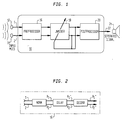
- FIG. 1 illustrates in block diagram form an application of the invention for use in hearing aids.
- a hearing aid 10 includes two microphones 12 and 14 for developing two input signals 1 and 2, respectively.
- the microphones are mounted in the hearing aid such that a common axis of their positioning always extends substantially in the direction in which the wearer of the hearing aid looks when being attentive to a signal source such as a voice.
- This microphone positioning imparts an inherent directionality to input signals 1 and 2. Since each microphone develops electrical signals representative of the acoustic waves received thereby from sound sources within it's operating range, each input signal may comprise a mixture of unknown signals from an unknown number of signal sources.
- Input signals 1 and 2 are processed in three main stages.
- the input signals are preprocessed for enhancing the inherent directionality already imparted thereto by their positioning.
- the resulting signals are subjected to an unmixing processing (sometimes referred to as separation processing), which is designed to produce estimates of the original unknown signals picked-up by microphones 12 and 14.
- the outputs of the unmixing processing are preferably postprocessed to produce the desired signal 22, which can then be applied to a speaker 24 of the hearing aid 10 for reproduction and presentation to a user.
- preprocessing stage 16 begins with normalization of the raw input signals.
- Automatic Gain Control is used to normalize input signals 1 and 2 to a [-1,+1] range.
- preprocessing stage 16 in order to adapt a blind source separation (BSS) technique for use in a device as small as a hearing aid, and to have it operate in real-time, preprocessing stage 16 also provides at least the first, and preferably both of the following additional processing:
- the window D comprised 16,000 samples.
- the above described preprocessing facilitates the subsequent BSS processing to arrive at a solution in a shorter time than if the preprocessing was not provided, and furthermore, increases the probability that the BSS processing will arrive at a valid solution instead of a local minimum.
- Figure 3 illustrates the principles of the operation of a BSS algorithm upon which the unmixing or separation of the desired component from the input signals is based.
- the technique is called Blind Source Separation because it makes few assumptions about the type of signals present in the mixture.
- BSS processing is intended to recover the set of n unknown source signals from a set of their mixtures, assuming that the n source signals are independent.
- FIG. 4 illustrates a block diagram of the main components of a BSS processor 400.
- BSS processor 400 comprises: an unmixing component 402 for recording and updating the state of the unmixing process defined by parameters W and v; a nonlinear component 404 for generating statistics used in the adaptation process; and an adaptation component 406 for computing changes in the values of the unmixing parameters, ⁇ W and ⁇ v.
- the BSS processor 400 continuously adapts two state variables: the 2 by 2 unmixing matrix W, and the 2 by 1 bias vector b .
- the nonlinear component 404 transforms the output of the system using an invertible mapping.
- the objective of component 404 is to avoid processing very large numeric values of the outputs, which may be infinities from a computational point of view. This objective is carried out by processing statistically equivalent quantities, obtained after running the outputs z through the invertible mapping.
- the adaptation component 406 determines changes in the unmixing parameters W and v: i.e., ⁇ W and ⁇ v.
- the objective is to maximize the mutual information that the outputs y contain about the inputs x , as well known to those skilled in this technology, and as described, for example by A.J. Bell and T.J. Sejnowski in their article entitled "An information-maximization approach to blind separation and blind deconvolution" published in Neural Computation, 7:1129--1159, 1995, and as also described in Bell's US patent 5,706,402.
- a typical value for the learning rate ⁇ is 0.005.
- unmixer 18 is the postprocessing step 20, wherein a determination is made of which output estimate of unmixer 18 is more likely to represent voice rather than noise, as well as a normalization of the power of the outputs by scaling them to the level of the input powers.
- the output signal section can be based on multiple criteria using, for example, voice specific feature extraction and analysis, and/or dominant speaker detection, which can also be accomplished using feature extraction and analysis.
- the BSS processing is applied for use in hearing aids.
- the inputs to the system are given by two microphones which, with the present invention, can be situated very close to one another.
- the present invention addresses the following problems:
- teaching of the present invention can be extremely useful for interference cancellation, separation of one voice from a mixture of many voices ("cocktail party" problem), and for preprocessing sound mixtures for noise reduction in order to allow further processing of a desired sound signal. x . All such changes, modifications, variations and other uses and applications which do not depart from the teachings herein are deemed to be covered by this patent, which is limited only by the claims which follow as interpreted in light of the foregoing description.
Landscapes
- Health & Medical Sciences (AREA)
- General Health & Medical Sciences (AREA)
- Neurosurgery (AREA)
- Otolaryngology (AREA)
- Physics & Mathematics (AREA)
- Engineering & Computer Science (AREA)
- Acoustics & Sound (AREA)
- Signal Processing (AREA)
- Circuit For Audible Band Transducer (AREA)
Abstract
Description
- Enhancement of signal source directionality inherent in the input signals,
resulting from a directional arrangement of
microphones - Decorrelation of the input signals. In the exemplary embodiment decorrelation
is carried out by a diagonalization of the correlation matrix. More specifically,
let C=Covariance( x T), where x T is a transpose of x. If significant correlation
exists between the two input signals (x1, x2), a decorrelation over a time
window D means transformation of the signals in two steps: (1) centering
around the mean over the data in the window D; and (2) Affine transformation
of the resulting data points in order to diagonalize the covariance matrix of the
resulting signals. Assuming that x is centered around its mean, we use the
following transformation:
x = As ,where x is the preprocessed signals shown in Figure 2 (i.e., x").
or equivalently, and as is done in the present invention, to find an unmixing or separating matrix W such that
z = Wx = s and ≈ s where z is the vector of the independent estimates of component signals s and z is an estimate of the source signals.
- It works with real world mixtures of signals in anechoic environments. The challenge is that a hearing aid using BSS would incorporate two microphones which, given the physical limitation imposed by in the ear hearing aids, may be less than 11 mm apart.
- It can cope with more signals than the number of microphones. Until now, this was thought to be impossible since the existing theory behind BSS guarantees that a solution exists only when n>m.
- It works under non-stationary mixing conditions in order to follow moving sources and adapt to changing listening environments.
- It works in real time so that the user is not subjected to disconcerting delays in the signals and so that the hearing aid can adapt as necessary.
Claims (23)
- An electronic filtering device for performing real-time unmixing of a signal desired to be recovered by a user of the device, where the desired signal emanates from one of a plurality of independent signal sources, comprising:two microphones positioned along a common axis for developing first and second electrical input signals in response to reception by the microphones of acoustic signals from the plurality of independent signal sources, wherein the spatial position of the common axis of the microphones is controllable in real time by the user to align the common axis so that it substantially continuously points in the direction of the source of the desired signal; andan adaptive unmixing signal processor responsive to said input signals for developing output signals wherein the desired signal is separate from the mixture signal.
- The apparatus of claim 1, wherein the common axis is positioned on the user in a manner so as to point in the direction of the source.
- The apparatus of claim 2, wherein said microphones are mounted in a common housing that is intended to be co-located with the ear of the user.
- The apparatus of claim 1, further including a preprocessor for modifying the input signals before they are applied to the unmixing signal processor.
- The apparatus of claim 4, wherein the preprocessor introduces a relative delay between components of the input signals.
- The apparatus of claim 4, wherein the preprocessor subjects the input signals to a decorrelation processing.
- The apparatus of claim 1, further including a postprocessor responsive to the output signals of the unmixing signal processor for selecting the desired signal for application to a signal reproduction device.
- The apparatus of claim 1, wherein the unmixing signal processor comprises a blind source signal separator.
- The apparatus of claim 8, wherein the blind source signal separator comprises a neural network for performing an unsupervised learning process that operates to maximize the joint output entropy of the output signals.
- A method for performing real-time unmixing of a signal desired to be recovered by a user, where the desired signal emanates from one of a plurality of independent signal sources, the method comprising the following steps:positioning two microphones along a common axis, for developing first and second electrical input signals in response to reception by the microphones of acoustic signals from the plurality of independent signal sources, said positioning being such that the common axis of the microphones is controllable in real time by the user to align the common axis so that it substantially continuously points in the direction of the source of the desired signal; andsubjecting said input signals to an adaptive unmixing signal processing for developing output signals wherein the desired signal is separated from the mixture signal.
- The method of claim 10, wherein said positioning locates the common axis proximate the user in a manner so that it points in the direction that the user is looking.
- The method of claim 11, wherein said positioning locates the common axis on a common housing that is intended to be co-located with the ear of the user.
- The method of claim 10, further including a preprocessing step for modifying the input signals before they are subjected to the unmixing signal processing.
- The method of claim 10, wherein the preprocessor step introduces a relative delay between the input signals.
- The method of claim 14, wherein the preprocessing step subjects the relatively delayed input signals to decorrelation processing.
- The method of claim 15, wherein the decorrelation processing step is carried out by a diagonalization of a correlation matrix formed using the relatively delayed input signals.
- The method of claim 10, further including a postprocessing step responsive to the output signals of the unmixing signal processing step for selecting the desired signal for application to a signal reproduction device.
- The method of claim 10, wherein the unmixing signal processing step comprises blind source signal separation processing.
- The method of claim 18, wherein the blind source signal separation processing comprises an unsupervised learning process that operates to maximize the joint output entropy of the output signals.
- A method for performing real-time unmixing of a signal desired to be recovered by a user, where the desired signal emanates from one of a plurality of independent signal sources, the method comprising the following steps:positioning two microphones along a common axis, for developing first and second electrical input signals in response to reception by the microphones of acoustic signals from the plurality of independent signal sources;preprocessing the first and second electrical input signals so as to enhance signal source directionality inherent therein due to the positioning of the microphones; andsubjecting said directionality enhanced input signals to an adaptive unmixing signal processing for developing output signals wherein the desired signal is separated from the mixture signal.
- The method of claim 20, wherein said positioning is such that the common axis of the microphones is controllable in real time by the user to align the common axis so that it substantially continuously points in the direction of the source of the desired signal.
- The method of claim 20, wherein said preprocessing comprises introducing a relative delay between the input signals so as to further enhance their directionality.
- The method of claim 22, wherein said preprocessing also includes a decorrelation processing of the relatively delayed input signals.
Applications Claiming Priority (2)
| Application Number | Priority Date | Filing Date | Title |
|---|---|---|---|
| US22348598A | 1998-12-30 | 1998-12-30 | |
| US223485 | 1998-12-30 |
Publications (3)
| Publication Number | Publication Date |
|---|---|
| EP1017253A2 true EP1017253A2 (en) | 2000-07-05 |
| EP1017253A3 EP1017253A3 (en) | 2003-03-26 |
| EP1017253B1 EP1017253B1 (en) | 2012-10-31 |
Family
ID=22836713
Family Applications (1)
| Application Number | Title | Priority Date | Filing Date |
|---|---|---|---|
| EP99310611A Revoked EP1017253B1 (en) | 1998-12-30 | 1999-12-24 | Blind source separation for hearing aids |
Country Status (3)
| Country | Link |
|---|---|
| EP (1) | EP1017253B1 (en) |
| CN (1) | CN1261759A (en) |
| DK (1) | DK1017253T3 (en) |
Cited By (18)
| Publication number | Priority date | Publication date | Assignee | Title |
|---|---|---|---|---|
| EP1196009A3 (en) * | 2000-10-04 | 2003-01-02 | Widex A/S | A hearing aid with adaptive matching of input transducers |
| WO2002030150A3 (en) * | 2000-10-04 | 2003-02-27 | Widex As | A hearing aid with adaptive matching of input transducers |
| WO2003059010A1 (en) * | 2002-01-12 | 2003-07-17 | Oticon A/S | Wind noise insensitive hearing aid |
| WO2004057914A1 (en) * | 2002-12-20 | 2004-07-08 | Oticon A/S | Microphone system with directional response |
| WO2005029914A1 (en) * | 2003-09-19 | 2005-03-31 | Widex A/S | A method for controlling the directionality of the sound receiving characteristic of a hearing aid and a signal processing apparatus for a hearing aid with a controllable directional characteristic |
| EP1530402A2 (en) | 2003-11-05 | 2005-05-11 | Siemens Audiologische Technik GmbH | Method for adapting a hearing aid considering the position of head and corresponding hearing aid |
| EP1912473A1 (en) * | 2006-10-10 | 2008-04-16 | Siemens Audiologische Technik GmbH | Processing an input signal in a hearing aid |
| EP1912472A1 (en) * | 2006-10-10 | 2008-04-16 | Siemens Audiologische Technik GmbH | Method for operating a hearing aid and hearing aid |
| EP1912474A1 (en) | 2006-10-10 | 2008-04-16 | Siemens Audiologische Technik GmbH | Method for operating a hearing aid and hearing aid |
| WO2008043731A1 (en) | 2006-10-10 | 2008-04-17 | Siemens Audiologische Technik Gmbh | Method for operating a hearing aid, and hearing aid |
| DE102006047986A1 (en) * | 2006-10-10 | 2008-04-24 | Siemens Audiologische Technik Gmbh | Processing an input signal in a hearing aid |
| JP2010506526A (en) * | 2006-10-10 | 2010-02-25 | シーメンス アウディオローギッシェ テヒニク ゲゼルシャフト ミット ベシュレンクテル ハフツング | Hearing aid operating method and hearing aid |
| US7761291B2 (en) | 2003-08-21 | 2010-07-20 | Bernafon Ag | Method for processing audio-signals |
| DE102009043775A1 (en) | 2009-09-30 | 2011-04-07 | Siemens Medical Instruments Pte. Ltd. | Hearing device i.e. combined hearing and tinnitus masker device, adjusting method, involves analyzing speech signal for recognizing emotional state of user and adjusting parameter of hearing device as function of recognized emotional state |
| US8139787B2 (en) | 2005-09-09 | 2012-03-20 | Simon Haykin | Method and device for binaural signal enhancement |
| WO2012152625A1 (en) | 2011-05-06 | 2012-11-15 | Rhein Chemie Rheinau Gmbh | Novel durable, hydrolysis-stable bio-based plastics based on polyhydroxyalkanoate (pha), method for producing same, and use thereof |
| EP1744589B2 (en) † | 2005-07-11 | 2014-04-23 | Siemens Audiologische Technik GmbH | Hearing device and corresponding method for ownvoices detection |
| EP2445230A4 (en) * | 2009-06-17 | 2016-05-18 | Panasonic Ip Corp America | HEARING AID |
Families Citing this family (10)
| Publication number | Priority date | Publication date | Assignee | Title |
|---|---|---|---|---|
| US7277554B2 (en) * | 2001-08-08 | 2007-10-02 | Gn Resound North America Corporation | Dynamic range compression using digital frequency warping |
| US6711528B2 (en) * | 2002-04-22 | 2004-03-23 | Harris Corporation | Blind source separation utilizing a spatial fourth order cumulant matrix pencil |
| US8767975B2 (en) | 2007-06-21 | 2014-07-01 | Bose Corporation | Sound discrimination method and apparatus |
| US8611554B2 (en) | 2008-04-22 | 2013-12-17 | Bose Corporation | Hearing assistance apparatus |
| US9078077B2 (en) | 2010-10-21 | 2015-07-07 | Bose Corporation | Estimation of synthetic audio prototypes with frequency-based input signal decomposition |
| DE102016225207A1 (en) * | 2016-12-15 | 2018-06-21 | Sivantos Pte. Ltd. | Method for operating a hearing aid |
| CN108597531B (en) * | 2018-03-28 | 2021-05-28 | 南京大学 | A method to improve dual-channel blind signal separation by multi-source activity detection |
| US11134350B2 (en) | 2020-01-10 | 2021-09-28 | Sonova Ag | Dual wireless audio streams transmission allowing for spatial diversity or own voice pickup (OVPU) |
| US11083031B1 (en) | 2020-01-10 | 2021-08-03 | Sonova Ag | Bluetooth audio exchange with transmission diversity |
| US11134349B1 (en) | 2020-03-09 | 2021-09-28 | International Business Machines Corporation | Hearing assistance device with smart audio focus control |
Family Cites Families (3)
| Publication number | Priority date | Publication date | Assignee | Title |
|---|---|---|---|---|
| US6002776A (en) * | 1995-09-18 | 1999-12-14 | Interval Research Corporation | Directional acoustic signal processor and method therefor |
| US5757933A (en) * | 1996-12-11 | 1998-05-26 | Micro Ear Technology, Inc. | In-the-ear hearing aid with directional microphone system |
| AUPO714197A0 (en) * | 1997-06-02 | 1997-06-26 | University Of Melbourne, The | Multi-strategy array processor |
-
1999
- 1999-12-24 DK DK99310611T patent/DK1017253T3/en active
- 1999-12-24 EP EP99310611A patent/EP1017253B1/en not_active Revoked
- 1999-12-30 CN CN 99127435 patent/CN1261759A/en active Pending
Cited By (37)
| Publication number | Priority date | Publication date | Assignee | Title |
|---|---|---|---|---|
| WO2002030150A3 (en) * | 2000-10-04 | 2003-02-27 | Widex As | A hearing aid with adaptive matching of input transducers |
| US6741714B2 (en) | 2000-10-04 | 2004-05-25 | Widex A/S | Hearing aid with adaptive matching of input transducers |
| EP1196009A3 (en) * | 2000-10-04 | 2003-01-02 | Widex A/S | A hearing aid with adaptive matching of input transducers |
| US7181030B2 (en) | 2002-01-12 | 2007-02-20 | Oticon A/S | Wind noise insensitive hearing aid |
| WO2003059010A1 (en) * | 2002-01-12 | 2003-07-17 | Oticon A/S | Wind noise insensitive hearing aid |
| WO2004057914A1 (en) * | 2002-12-20 | 2004-07-08 | Oticon A/S | Microphone system with directional response |
| US7212642B2 (en) | 2002-12-20 | 2007-05-01 | Oticon A/S | Microphone system with directional response |
| US7761291B2 (en) | 2003-08-21 | 2010-07-20 | Bernafon Ag | Method for processing audio-signals |
| WO2005029914A1 (en) * | 2003-09-19 | 2005-03-31 | Widex A/S | A method for controlling the directionality of the sound receiving characteristic of a hearing aid and a signal processing apparatus for a hearing aid with a controllable directional characteristic |
| US8600086B2 (en) | 2003-09-19 | 2013-12-03 | Widex A/S | Method for controlling the directionality of the sound receiving characteristic of a hearing aid and a signal processing apparatus |
| US7933423B2 (en) | 2003-09-19 | 2011-04-26 | Widex A/S | Method for controlling the directionality of the sound receiving characteristic of a hearing aid and a signal processing apparatus |
| EP1530402A2 (en) | 2003-11-05 | 2005-05-11 | Siemens Audiologische Technik GmbH | Method for adapting a hearing aid considering the position of head and corresponding hearing aid |
| DE10351509A1 (en) * | 2003-11-05 | 2005-06-09 | Siemens Audiologische Technik Gmbh | Method for adapting a hearing aid taking into account the head position and corresponding hearing aid |
| EP1530402A3 (en) * | 2003-11-05 | 2007-10-17 | Siemens Audiologische Technik GmbH | Method for adapting a hearing aid considering the position of head and corresponding hearing aid |
| US7295676B2 (en) | 2003-11-05 | 2007-11-13 | Siemens Audiologische Technik Gmbh | Hearing aid and method of adapting a hearing aid |
| DE10351509B4 (en) * | 2003-11-05 | 2015-01-08 | Siemens Audiologische Technik Gmbh | Hearing aid and method for adapting a hearing aid taking into account the head position |
| EP1744589B2 (en) † | 2005-07-11 | 2014-04-23 | Siemens Audiologische Technik GmbH | Hearing device and corresponding method for ownvoices detection |
| US8139787B2 (en) | 2005-09-09 | 2012-03-20 | Simon Haykin | Method and device for binaural signal enhancement |
| DE102006047983A1 (en) * | 2006-10-10 | 2008-04-24 | Siemens Audiologische Technik Gmbh | Processing an input signal in a hearing aid |
| US8199949B2 (en) | 2006-10-10 | 2012-06-12 | Siemens Audiologische Technik Gmbh | Processing an input signal in a hearing aid |
| JP2010506525A (en) * | 2006-10-10 | 2010-02-25 | シーメンス アウディオローギッシェ テヒニク ゲゼルシャフト ミット ベシュレンクテル ハフツング | Hearing aid driving method and hearing aid |
| DE102006047986A1 (en) * | 2006-10-10 | 2008-04-24 | Siemens Audiologische Technik Gmbh | Processing an input signal in a hearing aid |
| EP1912473A1 (en) * | 2006-10-10 | 2008-04-16 | Siemens Audiologische Technik GmbH | Processing an input signal in a hearing aid |
| DE102006047982A1 (en) * | 2006-10-10 | 2008-04-24 | Siemens Audiologische Technik Gmbh | Method for operating a hearing aid, and hearing aid |
| EP1912471A3 (en) * | 2006-10-10 | 2011-05-11 | Siemens Audiologische Technik GmbH | Processing of an input signal in a hearing aid |
| WO2008043731A1 (en) | 2006-10-10 | 2008-04-17 | Siemens Audiologische Technik Gmbh | Method for operating a hearing aid, and hearing aid |
| US8194900B2 (en) | 2006-10-10 | 2012-06-05 | Siemens Audiologische Technik Gmbh | Method for operating a hearing aid, and hearing aid |
| JP2010506526A (en) * | 2006-10-10 | 2010-02-25 | シーメンス アウディオローギッシェ テヒニク ゲゼルシャフト ミット ベシュレンクテル ハフツング | Hearing aid operating method and hearing aid |
| DE102006047986B4 (en) * | 2006-10-10 | 2012-06-14 | Siemens Audiologische Technik Gmbh | Processing an input signal in a hearing aid |
| EP1912472A1 (en) * | 2006-10-10 | 2008-04-16 | Siemens Audiologische Technik GmbH | Method for operating a hearing aid and hearing aid |
| US8325957B2 (en) | 2006-10-10 | 2012-12-04 | Siemens Audiologische Technik Gmbh | Hearing aid and method for operating a hearing aid |
| US8325954B2 (en) | 2006-10-10 | 2012-12-04 | Siemens Audiologische Technik Gmbh | Processing an input signal in a hearing aid |
| US8331591B2 (en) | 2006-10-10 | 2012-12-11 | Siemens Audiologische Technik Gmbh | Hearing aid and method for operating a hearing aid |
| EP1912474A1 (en) | 2006-10-10 | 2008-04-16 | Siemens Audiologische Technik GmbH | Method for operating a hearing aid and hearing aid |
| EP2445230A4 (en) * | 2009-06-17 | 2016-05-18 | Panasonic Ip Corp America | HEARING AID |
| DE102009043775A1 (en) | 2009-09-30 | 2011-04-07 | Siemens Medical Instruments Pte. Ltd. | Hearing device i.e. combined hearing and tinnitus masker device, adjusting method, involves analyzing speech signal for recognizing emotional state of user and adjusting parameter of hearing device as function of recognized emotional state |
| WO2012152625A1 (en) | 2011-05-06 | 2012-11-15 | Rhein Chemie Rheinau Gmbh | Novel durable, hydrolysis-stable bio-based plastics based on polyhydroxyalkanoate (pha), method for producing same, and use thereof |
Also Published As
| Publication number | Publication date |
|---|---|
| EP1017253A3 (en) | 2003-03-26 |
| CN1261759A (en) | 2000-08-02 |
| DK1017253T3 (en) | 2013-02-11 |
| EP1017253B1 (en) | 2012-10-31 |
Similar Documents
| Publication | Publication Date | Title |
|---|---|---|
| EP1017253B1 (en) | Blind source separation for hearing aids | |
| US10535362B2 (en) | Speech enhancement for an electronic device | |
| US9456275B2 (en) | Cardioid beam with a desired null based acoustic devices, systems, and methods | |
| CN110517701B (en) | Microphone array speech enhancement method and implementation device | |
| CN108986838B (en) | Self-adaptive voice separation method based on sound source positioning | |
| US20030061032A1 (en) | Selective sound enhancement | |
| EP1509065A1 (en) | Method for processing audio-signals | |
| EP1570464A1 (en) | System and method for speech processing using independent component analysis under stability constraints | |
| EP2211563A1 (en) | Method and apparatus for blind source separation improving interference estimation in binaural wiener filtering | |
| CN101188876A (en) | Method of operating a hearing aid and hearing aid | |
| WO2000041441A1 (en) | A method and a device for providing improved speech intelligibility | |
| Makino et al. | Audio source separation based on independent component analysis | |
| Doclo et al. | Extension of the multi-channel Wiener filter with ITD cues for noise reduction in binaural hearing aids | |
| US8737652B2 (en) | Method for operating a hearing device and hearing device with selectively adjusted signal weighing values | |
| Takatani et al. | High-fidelity blind separation of acoustic signals using SIMO-model-based independent component analysis | |
| D'Olne et al. | Model-based beamforming for wearable microphone arrays | |
| Obillaneni et al. | Ica based noise reduction in mobile phone speech communications | |
| KR20060085392A (en) | Array microphone system | |
| Shanmugapriya et al. | Evaluation of sound classification using modified classifier and speech enhancement using ICA algorithm for hearing aid application | |
| Baumann et al. | Beamforming-based convolutive source separation | |
| Matsuoka et al. | Independent component analysis and its applications to sound signal separation | |
| Sunohara et al. | Low-latency real-time blind source separation with binaural directional hearing aids | |
| Lorenzelli et al. | Broadband array processing using subband techniques | |
| Pan et al. | Combined spatial/beamforming and time/frequency processing for blind source separation | |
| Kawamoto et al. | Real world blind separation of convolved speech signals |
Legal Events
| Date | Code | Title | Description |
|---|---|---|---|
| PUAI | Public reference made under article 153(3) epc to a published international application that has entered the european phase |
Free format text: ORIGINAL CODE: 0009012 |
|
| AK | Designated contracting states |
Kind code of ref document: A2 Designated state(s): AT BE CH CY DE DK ES FI FR GB GR IE IT LI LU MC NL PT SE |
|
| AX | Request for extension of the european patent |
Free format text: AL;LT;LV;MK;RO;SI |
|
| PUAL | Search report despatched |
Free format text: ORIGINAL CODE: 0009013 |
|
| AK | Designated contracting states |
Kind code of ref document: A3 Designated state(s): AT BE CH CY DE DK ES FI FR GB GR IE IT LI LU MC NL PT SE |
|
| AX | Request for extension of the european patent |
Extension state: AL LT LV MK RO SI |
|
| 17P | Request for examination filed |
Effective date: 20030822 |
|
| AKX | Designation fees paid |
Designated state(s): CH DE DK FR GB LI |
|
| 17Q | First examination report despatched |
Effective date: 20070309 |
|
| RAP1 | Party data changed (applicant data changed or rights of an application transferred) |
Owner name: SIEMENS CORPORATION |
|
| GRAP | Despatch of communication of intention to grant a patent |
Free format text: ORIGINAL CODE: EPIDOSNIGR1 |
|
| GRAS | Grant fee paid |
Free format text: ORIGINAL CODE: EPIDOSNIGR3 |
|
| GRAA | (expected) grant |
Free format text: ORIGINAL CODE: 0009210 |
|
| AK | Designated contracting states |
Kind code of ref document: B1 Designated state(s): CH DE DK FR GB LI |
|
| REG | Reference to a national code |
Ref country code: GB Ref legal event code: FG4D Ref country code: CH Ref legal event code: EP |
|
| REG | Reference to a national code |
Ref country code: DE Ref legal event code: R096 Ref document number: 69944461 Country of ref document: DE Effective date: 20121227 |
|
| REG | Reference to a national code |
Ref country code: CH Ref legal event code: NV Representative=s name: SIEMENS SCHWEIZ AG, CH |
|
| RAP2 | Party data changed (patent owner data changed or rights of a patent transferred) |
Owner name: SIEMENS AUDIOLOGISCHE TECHNIK GMBH Owner name: SIEMENS CORPORATION |
|
| REG | Reference to a national code |
Ref country code: DK Ref legal event code: T3 |
|
| REG | Reference to a national code |
Ref country code: DE Ref legal event code: R081 Ref document number: 69944461 Country of ref document: DE Owner name: SIEMENS CORPORATION, ISELIN, US Free format text: FORMER OWNER: SIEMENS CORPORATE RESEARCH, INC., PRINCETON, N.J., US Effective date: 20121031 Ref country code: DE Ref legal event code: R081 Ref document number: 69944461 Country of ref document: DE Owner name: SIEMENS AUDIOLOGISCHE TECHNIK GMBH, DE Free format text: FORMER OWNER: SIEMENS CORPORATION, ISELIN, N.J., US Effective date: 20130121 Ref country code: DE Ref legal event code: R081 Ref document number: 69944461 Country of ref document: DE Owner name: SIEMENS AUDIOLOGISCHE TECHNIK GMBH, DE Free format text: FORMER OWNER: SIEMENS CORPORATE RESEARCH, INC., PRINCETON, N.J., US Effective date: 20121031 Ref country code: DE Ref legal event code: R081 Ref document number: 69944461 Country of ref document: DE Owner name: SIEMENS CORPORATION, ISELIN, US Free format text: FORMER OWNER: SIEMENS CORPORATION, ISELIN, N.J., US Effective date: 20130121 Ref country code: DE Ref legal event code: R081 Ref document number: 69944461 Country of ref document: DE Owner name: SIEMENS CORPORATION, US Free format text: FORMER OWNER: SIEMENS CORPORATION, ISELIN, US Effective date: 20130121 Ref country code: DE Ref legal event code: R081 Ref document number: 69944461 Country of ref document: DE Owner name: SIEMENS AUDIOLOGISCHE TECHNIK GMBH, DE Free format text: FORMER OWNER: SIEMENS CORPORATION, ISELIN, US Effective date: 20130121 Ref country code: DE Ref legal event code: R081 Ref document number: 69944461 Country of ref document: DE Owner name: SIEMENS CORPORATION, US Free format text: FORMER OWNER: SIEMENS CORPORATE RESEARCH, INC., PRINCETON, US Effective date: 20121031 Ref country code: DE Ref legal event code: R081 Ref document number: 69944461 Country of ref document: DE Owner name: SIEMENS AUDIOLOGISCHE TECHNIK GMBH, DE Free format text: FORMER OWNER: SIEMENS CORPORATE RESEARCH, INC., PRINCETON, US Effective date: 20121031 |
|
| PLBI | Opposition filed |
Free format text: ORIGINAL CODE: 0009260 |
|
| 26 | Opposition filed |
Opponent name: OTICON A/S Effective date: 20130731 |
|
| PLAX | Notice of opposition and request to file observation + time limit sent |
Free format text: ORIGINAL CODE: EPIDOSNOBS2 |
|
| PLAB | Opposition data, opponent's data or that of the opponent's representative modified |
Free format text: ORIGINAL CODE: 0009299OPPO |
|
| R26 | Opposition filed (corrected) |
Opponent name: OTICON A/S / GN RESOUND A/S / WIDEX A/S Effective date: 20130731 |
|
| REG | Reference to a national code |
Ref country code: DE Ref legal event code: R026 Ref document number: 69944461 Country of ref document: DE Effective date: 20130731 |
|
| PLBB | Reply of patent proprietor to notice(s) of opposition received |
Free format text: ORIGINAL CODE: EPIDOSNOBS3 |
|
| PGFP | Annual fee paid to national office [announced via postgrant information from national office to epo] |
Ref country code: GB Payment date: 20141208 Year of fee payment: 16 Ref country code: DK Payment date: 20141219 Year of fee payment: 16 |
|
| RDAF | Communication despatched that patent is revoked |
Free format text: ORIGINAL CODE: EPIDOSNREV1 |
|
| APAH | Appeal reference modified |
Free format text: ORIGINAL CODE: EPIDOSCREFNO |
|
| APBM | Appeal reference recorded |
Free format text: ORIGINAL CODE: EPIDOSNREFNO |
|
| APBP | Date of receipt of notice of appeal recorded |
Free format text: ORIGINAL CODE: EPIDOSNNOA2O |
|
| PGFP | Annual fee paid to national office [announced via postgrant information from national office to epo] |
Ref country code: DE Payment date: 20150220 Year of fee payment: 16 Ref country code: CH Payment date: 20150305 Year of fee payment: 16 |
|
| PGFP | Annual fee paid to national office [announced via postgrant information from national office to epo] |
Ref country code: FR Payment date: 20141217 Year of fee payment: 16 |
|
| RAP2 | Party data changed (patent owner data changed or rights of a patent transferred) |
Owner name: SIVANTOS GMBH Owner name: SIEMENS CORPORATION |
|
| APBU | Appeal procedure closed |
Free format text: ORIGINAL CODE: EPIDOSNNOA9O |
|
| REG | Reference to a national code |
Ref country code: DE Ref legal event code: R103 Ref document number: 69944461 Country of ref document: DE Ref country code: DE Ref legal event code: R064 Ref document number: 69944461 Country of ref document: DE |
|
| RDAG | Patent revoked |
Free format text: ORIGINAL CODE: 0009271 |
|
| REG | Reference to a national code |
Ref country code: CH Ref legal event code: PLX |
|
| 27W | Patent revoked |
Effective date: 20151024 |
|
| GBPR | Gb: patent revoked under art. 102 of the ep convention designating the uk as contracting state |
Effective date: 20151024 |
|
| PG25 | Lapsed in a contracting state [announced via postgrant information from national office to epo] |
Ref country code: CH Free format text: LAPSE BECAUSE OF THE APPLICANT RENOUNCES Effective date: 20121031 Ref country code: LI Free format text: LAPSE BECAUSE OF THE APPLICANT RENOUNCES Effective date: 20121031 |
|
| RDAC | Information related to revocation of patent modified |
Free format text: ORIGINAL CODE: 0009299REVO |
|
| STAA | Information on the status of an ep patent application or granted ep patent |
Free format text: STATUS: PATENT REVOKED |
|
| R27W | Patent revoked (corrected) |
Effective date: 20151030 |