EP1015511B1 - High internal phase ratio emulsions and stable aqueous dispersions of hydroxy-functional polymers - Google Patents
High internal phase ratio emulsions and stable aqueous dispersions of hydroxy-functional polymers Download PDFInfo
- Publication number
- EP1015511B1 EP1015511B1 EP98941068A EP98941068A EP1015511B1 EP 1015511 B1 EP1015511 B1 EP 1015511B1 EP 98941068 A EP98941068 A EP 98941068A EP 98941068 A EP98941068 A EP 98941068A EP 1015511 B1 EP1015511 B1 EP 1015511B1
- Authority
- EP
- European Patent Office
- Prior art keywords
- hydroxy
- phenylene
- composition
- independently
- functional polyether
- Prior art date
- Legal status (The legal status is an assumption and is not a legal conclusion. Google has not performed a legal analysis and makes no representation as to the accuracy of the status listed.)
- Expired - Lifetime
Links
- 239000000839 emulsion Substances 0.000 title claims abstract description 31
- 239000006185 dispersion Substances 0.000 title claims abstract description 21
- 229920001002 functional polymer Polymers 0.000 title description 2
- 229920000570 polyether Polymers 0.000 claims abstract description 52
- 239000004721 Polyphenylene oxide Substances 0.000 claims abstract description 49
- XLYOFNOQVPJJNP-UHFFFAOYSA-N water Substances O XLYOFNOQVPJJNP-UHFFFAOYSA-N 0.000 claims abstract description 30
- 229910001868 water Inorganic materials 0.000 claims abstract description 30
- 239000000203 mixture Substances 0.000 claims abstract description 21
- 229920001169 thermoplastic Polymers 0.000 claims abstract description 12
- 239000004416 thermosoftening plastic Substances 0.000 claims abstract description 12
- -1 ethylene, propylene, hexamethylene, p-phenylene Chemical group 0.000 claims description 38
- 125000000743 hydrocarbylene group Chemical group 0.000 claims description 20
- 239000004094 surface-active agent Substances 0.000 claims description 19
- 239000002904 solvent Substances 0.000 claims description 13
- YXFVVABEGXRONW-UHFFFAOYSA-N Toluene Chemical compound CC1=CC=CC=C1 YXFVVABEGXRONW-UHFFFAOYSA-N 0.000 claims description 12
- 229920000642 polymer Polymers 0.000 claims description 12
- GYZLOYUZLJXAJU-UHFFFAOYSA-N diglycidyl ether Chemical compound C1OC1COCC1CO1 GYZLOYUZLJXAJU-UHFFFAOYSA-N 0.000 claims description 11
- 239000001257 hydrogen Substances 0.000 claims description 11
- 229910052739 hydrogen Inorganic materials 0.000 claims description 11
- 238000000034 method Methods 0.000 claims description 11
- 239000002245 particle Substances 0.000 claims description 11
- LRHPLDYGYMQRHN-UHFFFAOYSA-N N-Butanol Chemical compound CCCCO LRHPLDYGYMQRHN-UHFFFAOYSA-N 0.000 claims description 10
- UFHFLCQGNIYNRP-UHFFFAOYSA-N Hydrogen Chemical compound [H][H] UFHFLCQGNIYNRP-UHFFFAOYSA-N 0.000 claims description 9
- 125000000217 alkyl group Chemical group 0.000 claims description 7
- 239000003945 anionic surfactant Substances 0.000 claims description 7
- IISBACLAFKSPIT-UHFFFAOYSA-N bisphenol A Chemical compound C=1C=C(O)C=CC=1C(C)(C)C1=CC=C(O)C=C1 IISBACLAFKSPIT-UHFFFAOYSA-N 0.000 claims description 7
- 238000002156 mixing Methods 0.000 claims description 6
- APSBXTVYXVQYAB-UHFFFAOYSA-M sodium docusate Chemical group [Na+].CCCCC(CC)COC(=O)CC(S([O-])(=O)=O)C(=O)OCC(CC)CCCC APSBXTVYXVQYAB-UHFFFAOYSA-M 0.000 claims description 6
- 125000001989 1,3-phenylene group Chemical group [H]C1=C([H])C([*:1])=C([H])C([*:2])=C1[H] 0.000 claims description 5
- 125000002887 hydroxy group Chemical group [H]O* 0.000 claims description 5
- 150000002989 phenols Chemical class 0.000 claims description 5
- 125000003545 alkoxy group Chemical group 0.000 claims description 4
- 125000004448 alkyl carbonyl group Chemical group 0.000 claims description 4
- 125000005129 aryl carbonyl group Chemical group 0.000 claims description 4
- 125000004104 aryloxy group Chemical group 0.000 claims description 4
- 125000004093 cyano group Chemical group *C#N 0.000 claims description 4
- 230000001804 emulsifying effect Effects 0.000 claims description 4
- 150000002148 esters Chemical class 0.000 claims description 4
- 125000001475 halogen functional group Chemical group 0.000 claims description 4
- 125000002496 methyl group Chemical group [H]C([H])([H])* 0.000 claims description 4
- 230000000087 stabilizing effect Effects 0.000 claims description 4
- 125000004400 (C1-C12) alkyl group Chemical group 0.000 claims description 3
- 125000006710 (C2-C12) alkenyl group Chemical group 0.000 claims description 3
- 125000001140 1,4-phenylene group Chemical group [H]C1=C([H])C([*:2])=C([H])C([H])=C1[*:1] 0.000 claims description 3
- VGGSQFUCUMXWEO-UHFFFAOYSA-N Ethene Chemical group C=C VGGSQFUCUMXWEO-UHFFFAOYSA-N 0.000 claims description 3
- 239000005977 Ethylene Substances 0.000 claims description 3
- MTHSVFCYNBDYFN-UHFFFAOYSA-N diethylene glycol Chemical compound OCCOCCO MTHSVFCYNBDYFN-UHFFFAOYSA-N 0.000 claims description 3
- 238000007865 diluting Methods 0.000 claims description 3
- 239000000155 melt Substances 0.000 claims description 3
- 238000002844 melting Methods 0.000 claims description 3
- 230000008018 melting Effects 0.000 claims description 3
- 239000002736 nonionic surfactant Substances 0.000 claims description 3
- 125000000383 tetramethylene group Chemical group [H]C([H])([*:1])C([H])([H])C([H])([H])C([H])([H])[*:2] 0.000 claims description 3
- 125000004955 1,4-cyclohexylene group Chemical group [H]C1([H])C([H])([H])C([H])([*:1])C([H])([H])C([H])([H])C1([H])[*:2] 0.000 claims description 2
- 125000003342 alkenyl group Chemical group 0.000 claims description 2
- LLHKCFNBLRBOGN-UHFFFAOYSA-N propylene glycol methyl ether acetate Chemical group COCC(C)OC(C)=O LLHKCFNBLRBOGN-UHFFFAOYSA-N 0.000 claims description 2
- RTVVXRKGQRRXFJ-UHFFFAOYSA-N sodium;2-sulfobutanedioic acid Chemical compound [Na].OC(=O)CC(C(O)=O)S(O)(=O)=O RTVVXRKGQRRXFJ-UHFFFAOYSA-N 0.000 claims description 2
- 229930185605 Bisphenol Natural products 0.000 claims 1
- QAOWNCQODCNURD-UHFFFAOYSA-L Sulfate Chemical compound [O-]S([O-])(=O)=O QAOWNCQODCNURD-UHFFFAOYSA-L 0.000 claims 1
- 125000004435 hydrogen atom Chemical group [H]* 0.000 claims 1
- 125000001273 sulfonato group Chemical group [O-]S(*)(=O)=O 0.000 claims 1
- 238000000576 coating method Methods 0.000 abstract description 10
- 230000004888 barrier function Effects 0.000 abstract description 9
- CURLTUGMZLYLDI-UHFFFAOYSA-N Carbon dioxide Chemical compound O=C=O CURLTUGMZLYLDI-UHFFFAOYSA-N 0.000 abstract description 8
- 239000011248 coating agent Substances 0.000 abstract description 8
- QVGXLLKOCUKJST-UHFFFAOYSA-N atomic oxygen Chemical compound [O] QVGXLLKOCUKJST-UHFFFAOYSA-N 0.000 abstract description 5
- 239000001301 oxygen Substances 0.000 abstract description 5
- 229910052760 oxygen Inorganic materials 0.000 abstract description 5
- 239000001569 carbon dioxide Substances 0.000 abstract description 4
- 229910002092 carbon dioxide Inorganic materials 0.000 abstract description 4
- 230000002411 adverse Effects 0.000 abstract description 3
- 235000013305 food Nutrition 0.000 abstract description 3
- 238000004806 packaging method and process Methods 0.000 abstract description 3
- LYCAIKOWRPUZTN-UHFFFAOYSA-N Ethylene glycol Chemical compound OCCO LYCAIKOWRPUZTN-UHFFFAOYSA-N 0.000 description 6
- WNLRTRBMVRJNCN-UHFFFAOYSA-N adipic acid Chemical compound OC(=O)CCCCC(O)=O WNLRTRBMVRJNCN-UHFFFAOYSA-N 0.000 description 6
- 229920001328 Polyvinylidene chloride Polymers 0.000 description 5
- 239000004816 latex Substances 0.000 description 5
- 229920000126 latex Polymers 0.000 description 5
- RTZKZFJDLAIYFH-UHFFFAOYSA-N Diethyl ether Chemical compound CCOCC RTZKZFJDLAIYFH-UHFFFAOYSA-N 0.000 description 4
- 150000001412 amines Chemical class 0.000 description 4
- QTBSBXVTEAMEQO-UHFFFAOYSA-N Acetic acid Chemical compound CC(O)=O QTBSBXVTEAMEQO-UHFFFAOYSA-N 0.000 description 3
- ZAMOUSCENKQFHK-UHFFFAOYSA-N Chlorine atom Chemical compound [Cl] ZAMOUSCENKQFHK-UHFFFAOYSA-N 0.000 description 3
- ISWSIDIOOBJBQZ-UHFFFAOYSA-N Phenol Chemical compound OC1=CC=CC=C1 ISWSIDIOOBJBQZ-UHFFFAOYSA-N 0.000 description 3
- 239000000460 chlorine Substances 0.000 description 3
- 229910052801 chlorine Inorganic materials 0.000 description 3
- WGCNASOHLSPBMP-UHFFFAOYSA-N hydroxyacetaldehyde Natural products OCC=O WGCNASOHLSPBMP-UHFFFAOYSA-N 0.000 description 3
- 239000003960 organic solvent Substances 0.000 description 3
- 238000002360 preparation method Methods 0.000 description 3
- IJGRMHOSHXDMSA-UHFFFAOYSA-N Atomic nitrogen Chemical compound N#N IJGRMHOSHXDMSA-UHFFFAOYSA-N 0.000 description 2
- 239000004593 Epoxy Substances 0.000 description 2
- KKEYFWRCBNTPAC-UHFFFAOYSA-N Terephthalic acid Chemical compound OC(=O)C1=CC=C(C(O)=O)C=C1 KKEYFWRCBNTPAC-UHFFFAOYSA-N 0.000 description 2
- 230000001464 adherent effect Effects 0.000 description 2
- 239000001361 adipic acid Substances 0.000 description 2
- 235000011037 adipic acid Nutrition 0.000 description 2
- 125000001931 aliphatic group Chemical group 0.000 description 2
- 125000002947 alkylene group Chemical group 0.000 description 2
- 150000008064 anhydrides Chemical class 0.000 description 2
- 125000003118 aryl group Chemical group 0.000 description 2
- 239000000463 material Substances 0.000 description 2
- 229920001343 polytetrafluoroethylene Polymers 0.000 description 2
- 239000004810 polytetrafluoroethylene Substances 0.000 description 2
- 239000007787 solid Substances 0.000 description 2
- 238000003756 stirring Methods 0.000 description 2
- 125000003837 (C1-C20) alkyl group Chemical group 0.000 description 1
- FALRKNHUBBKYCC-UHFFFAOYSA-N 2-(chloromethyl)pyridine-3-carbonitrile Chemical compound ClCC1=NC=CC=C1C#N FALRKNHUBBKYCC-UHFFFAOYSA-N 0.000 description 1
- 125000003358 C2-C20 alkenyl group Chemical group 0.000 description 1
- 239000004215 Carbon black (E152) Substances 0.000 description 1
- XZMCDFZZKTWFGF-UHFFFAOYSA-N Cyanamide Chemical compound NC#N XZMCDFZZKTWFGF-UHFFFAOYSA-N 0.000 description 1
- 229920003171 Poly (ethylene oxide) Polymers 0.000 description 1
- NINIDFKCEFEMDL-UHFFFAOYSA-N Sulfur Chemical compound [S] NINIDFKCEFEMDL-UHFFFAOYSA-N 0.000 description 1
- UCKMPCXJQFINFW-UHFFFAOYSA-N Sulphide Chemical compound [S-2] UCKMPCXJQFINFW-UHFFFAOYSA-N 0.000 description 1
- 239000000853 adhesive Substances 0.000 description 1
- 230000001070 adhesive effect Effects 0.000 description 1
- 150000001298 alcohols Chemical class 0.000 description 1
- 150000003863 ammonium salts Chemical class 0.000 description 1
- 125000000129 anionic group Chemical group 0.000 description 1
- 125000000732 arylene group Chemical group 0.000 description 1
- XMRUJYGYYCLRGJ-UHFFFAOYSA-N azanium;2-[2-[2-[2-(4-nonylphenoxy)ethoxy]ethoxy]ethoxy]ethyl sulfate Chemical compound [NH4+].CCCCCCCCCC1=CC=C(OCCOCCOCCOCCOS([O-])(=O)=O)C=C1 XMRUJYGYYCLRGJ-UHFFFAOYSA-N 0.000 description 1
- 230000005540 biological transmission Effects 0.000 description 1
- NEPKLUNSRVEBIX-UHFFFAOYSA-N bis(oxiran-2-ylmethyl) benzene-1,4-dicarboxylate Chemical compound C=1C=C(C(=O)OCC2OC2)C=CC=1C(=O)OCC1CO1 NEPKLUNSRVEBIX-UHFFFAOYSA-N 0.000 description 1
- 150000001732 carboxylic acid derivatives Chemical group 0.000 description 1
- 239000003054 catalyst Substances 0.000 description 1
- 239000007795 chemical reaction product Substances 0.000 description 1
- 239000003795 chemical substances by application Substances 0.000 description 1
- 239000002361 compost Substances 0.000 description 1
- 238000010924 continuous production Methods 0.000 description 1
- 125000002993 cycloalkylene group Chemical group 0.000 description 1
- 239000003085 diluting agent Substances 0.000 description 1
- HZZUMXSLPJFMCB-UHFFFAOYSA-M ethyl(triphenyl)phosphanium;acetate Chemical compound CC([O-])=O.C=1C=CC=CC=1[P+](C=1C=CC=CC=1)(CC)C1=CC=CC=C1 HZZUMXSLPJFMCB-UHFFFAOYSA-M 0.000 description 1
- 239000005038 ethylene vinyl acetate Substances 0.000 description 1
- 235000011389 fruit/vegetable juice Nutrition 0.000 description 1
- 125000000524 functional group Chemical group 0.000 description 1
- 239000007789 gas Substances 0.000 description 1
- 238000005227 gel permeation chromatography Methods 0.000 description 1
- 229930195733 hydrocarbon Natural products 0.000 description 1
- 150000002430 hydrocarbons Chemical class 0.000 description 1
- 150000002431 hydrogen Chemical group 0.000 description 1
- 238000004519 manufacturing process Methods 0.000 description 1
- VUQUOGPMUUJORT-UHFFFAOYSA-N methyl 4-methylbenzenesulfonate Chemical compound COS(=O)(=O)C1=CC=C(C)C=C1 VUQUOGPMUUJORT-UHFFFAOYSA-N 0.000 description 1
- 239000008267 milk Substances 0.000 description 1
- 235000013336 milk Nutrition 0.000 description 1
- 210000004080 milk Anatomy 0.000 description 1
- 229910052757 nitrogen Inorganic materials 0.000 description 1
- 239000012454 non-polar solvent Substances 0.000 description 1
- 239000012188 paraffin wax Substances 0.000 description 1
- 229940068918 polyethylene glycol 400 Drugs 0.000 description 1
- 229940057071 polyethylene glycol 4500 Drugs 0.000 description 1
- 239000000047 product Substances 0.000 description 1
- 239000000376 reactant Substances 0.000 description 1
- 238000004513 sizing Methods 0.000 description 1
- 150000003384 small molecules Chemical class 0.000 description 1
- 229910001220 stainless steel Inorganic materials 0.000 description 1
- 239000010935 stainless steel Substances 0.000 description 1
- 239000000126 substance Substances 0.000 description 1
- 239000000758 substrate Substances 0.000 description 1
- 229940014800 succinic anhydride Drugs 0.000 description 1
- 150000003871 sulfonates Chemical class 0.000 description 1
- 125000004962 sulfoxyl group Chemical group 0.000 description 1
- 229910052717 sulfur Inorganic materials 0.000 description 1
- 239000011593 sulfur Substances 0.000 description 1
- 150000003467 sulfuric acid derivatives Chemical class 0.000 description 1
- 238000005292 vacuum distillation Methods 0.000 description 1
- 239000001993 wax Substances 0.000 description 1
Images

Classifications
-
- C—CHEMISTRY; METALLURGY
- C08—ORGANIC MACROMOLECULAR COMPOUNDS; THEIR PREPARATION OR CHEMICAL WORKING-UP; COMPOSITIONS BASED THEREON
- C08J—WORKING-UP; GENERAL PROCESSES OF COMPOUNDING; AFTER-TREATMENT NOT COVERED BY SUBCLASSES C08B, C08C, C08F, C08G or C08H
- C08J3/00—Processes of treating or compounding macromolecular substances
- C08J3/02—Making solutions, dispersions, lattices or gels by other methods than by solution, emulsion or suspension polymerisation techniques
- C08J3/03—Making solutions, dispersions, lattices or gels by other methods than by solution, emulsion or suspension polymerisation techniques in aqueous media
-
- C—CHEMISTRY; METALLURGY
- C08—ORGANIC MACROMOLECULAR COMPOUNDS; THEIR PREPARATION OR CHEMICAL WORKING-UP; COMPOSITIONS BASED THEREON
- C08J—WORKING-UP; GENERAL PROCESSES OF COMPOUNDING; AFTER-TREATMENT NOT COVERED BY SUBCLASSES C08B, C08C, C08F, C08G or C08H
- C08J3/00—Processes of treating or compounding macromolecular substances
- C08J3/02—Making solutions, dispersions, lattices or gels by other methods than by solution, emulsion or suspension polymerisation techniques
- C08J3/03—Making solutions, dispersions, lattices or gels by other methods than by solution, emulsion or suspension polymerisation techniques in aqueous media
- C08J3/07—Making solutions, dispersions, lattices or gels by other methods than by solution, emulsion or suspension polymerisation techniques in aqueous media from polymer solutions
-
- C—CHEMISTRY; METALLURGY
- C08—ORGANIC MACROMOLECULAR COMPOUNDS; THEIR PREPARATION OR CHEMICAL WORKING-UP; COMPOSITIONS BASED THEREON
- C08G—MACROMOLECULAR COMPOUNDS OBTAINED OTHERWISE THAN BY REACTIONS ONLY INVOLVING UNSATURATED CARBON-TO-CARBON BONDS
- C08G59/00—Polycondensates containing more than one epoxy group per molecule; Macromolecules obtained by polymerising compounds containing more than one epoxy group per molecule using curing agents or catalysts which react with the epoxy groups
- C08G59/02—Polycondensates containing more than one epoxy group per molecule
- C08G59/04—Polycondensates containing more than one epoxy group per molecule of polyhydroxy compounds with epihalohydrins or precursors thereof
- C08G59/06—Polycondensates containing more than one epoxy group per molecule of polyhydroxy compounds with epihalohydrins or precursors thereof of polyhydric phenols
- C08G59/066—Polycondensates containing more than one epoxy group per molecule of polyhydroxy compounds with epihalohydrins or precursors thereof of polyhydric phenols with chain extension or advancing agents
-
- C—CHEMISTRY; METALLURGY
- C08—ORGANIC MACROMOLECULAR COMPOUNDS; THEIR PREPARATION OR CHEMICAL WORKING-UP; COMPOSITIONS BASED THEREON
- C08G—MACROMOLECULAR COMPOUNDS OBTAINED OTHERWISE THAN BY REACTIONS ONLY INVOLVING UNSATURATED CARBON-TO-CARBON BONDS
- C08G59/00—Polycondensates containing more than one epoxy group per molecule; Macromolecules obtained by polymerising compounds containing more than one epoxy group per molecule using curing agents or catalysts which react with the epoxy groups
- C08G59/02—Polycondensates containing more than one epoxy group per molecule
- C08G59/12—Polycondensates containing more than one epoxy group per molecule of polycarboxylic acids with epihalohydrins or precursors thereof
-
- C—CHEMISTRY; METALLURGY
- C08—ORGANIC MACROMOLECULAR COMPOUNDS; THEIR PREPARATION OR CHEMICAL WORKING-UP; COMPOSITIONS BASED THEREON
- C08L—COMPOSITIONS OF MACROMOLECULAR COMPOUNDS
- C08L71/00—Compositions of polyethers obtained by reactions forming an ether link in the main chain; Compositions of derivatives of such polymers
-
- C—CHEMISTRY; METALLURGY
- C08—ORGANIC MACROMOLECULAR COMPOUNDS; THEIR PREPARATION OR CHEMICAL WORKING-UP; COMPOSITIONS BASED THEREON
- C08J—WORKING-UP; GENERAL PROCESSES OF COMPOUNDING; AFTER-TREATMENT NOT COVERED BY SUBCLASSES C08B, C08C, C08F, C08G or C08H
- C08J2371/00—Characterised by the use of polyethers obtained by reactions forming an ether link in the main chain; Derivatives of such polymers
-
- Y—GENERAL TAGGING OF NEW TECHNOLOGICAL DEVELOPMENTS; GENERAL TAGGING OF CROSS-SECTIONAL TECHNOLOGIES SPANNING OVER SEVERAL SECTIONS OF THE IPC; TECHNICAL SUBJECTS COVERED BY FORMER USPC CROSS-REFERENCE ART COLLECTIONS [XRACs] AND DIGESTS
- Y10—TECHNICAL SUBJECTS COVERED BY FORMER USPC
- Y10S—TECHNICAL SUBJECTS COVERED BY FORMER USPC CROSS-REFERENCE ART COLLECTIONS [XRACs] AND DIGESTS
- Y10S516/00—Colloid systems and wetting agents; subcombinations thereof; processes of
- Y10S516/924—Significant dispersive or manipulative operation or step in making or stabilizing colloid system
- Y10S516/926—Phase change, e.g. melting
-
- Y—GENERAL TAGGING OF NEW TECHNOLOGICAL DEVELOPMENTS; GENERAL TAGGING OF CROSS-SECTIONAL TECHNOLOGIES SPANNING OVER SEVERAL SECTIONS OF THE IPC; TECHNICAL SUBJECTS COVERED BY FORMER USPC CROSS-REFERENCE ART COLLECTIONS [XRACs] AND DIGESTS
- Y10—TECHNICAL SUBJECTS COVERED BY FORMER USPC
- Y10S—TECHNICAL SUBJECTS COVERED BY FORMER USPC CROSS-REFERENCE ART COLLECTIONS [XRACs] AND DIGESTS
- Y10S516/00—Colloid systems and wetting agents; subcombinations thereof; processes of
- Y10S516/924—Significant dispersive or manipulative operation or step in making or stabilizing colloid system
- Y10S516/928—Mixing combined with non-mixing operation or step, successively or simultaneously, e.g. heating, cooling, ph change, ageing, milling
-
- Y—GENERAL TAGGING OF NEW TECHNOLOGICAL DEVELOPMENTS; GENERAL TAGGING OF CROSS-SECTIONAL TECHNOLOGIES SPANNING OVER SEVERAL SECTIONS OF THE IPC; TECHNICAL SUBJECTS COVERED BY FORMER USPC CROSS-REFERENCE ART COLLECTIONS [XRACs] AND DIGESTS
- Y10—TECHNICAL SUBJECTS COVERED BY FORMER USPC
- Y10S—TECHNICAL SUBJECTS COVERED BY FORMER USPC CROSS-REFERENCE ART COLLECTIONS [XRACs] AND DIGESTS
- Y10S526/00—Synthetic resins or natural rubbers -- part of the class 520 series
- Y10S526/939—Mositure proof or hydrophobic
Definitions
- the present invention relates to high internal phase ratio (HIPR) emulsions and stable aqueous dispersions of hydroxy-functional polymers.
- HIPR high internal phase ratio
- PVDC poly(vinylidene chloride)
- non-chlorine-containing latex that can be used to make a coating that is effective as a barrier against small molecules, but which barrier properties are not adversely affected by contact with water. It would be further advantageous if the coating adhered to a substrate without the aid of an ancillary adhesive. It would be desirable for some applications that this coating be biodegradable, so that the product can be composted subsequent to its intended use.
- the present invention is a composition
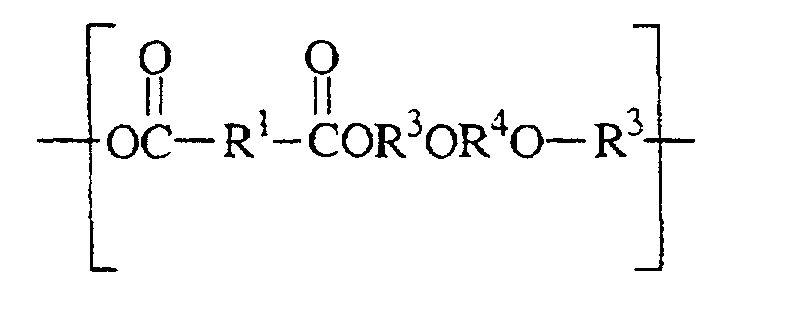
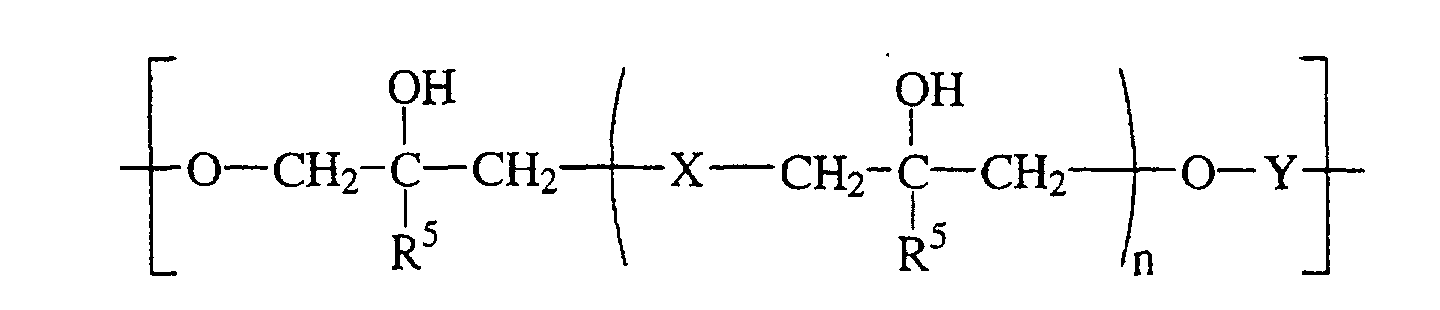
- a composition comprising either: a) an HIPR emulsion having water as a continuous phase and a thermoplastic hydroxy-functional polyether as a disperse phase; or b) a stable aqueous dispersion of the thermoplastic hydroxy-functional polyether, wherein the hydroxy-functional polyether has structural units represented by either of the formulae: or where R 1 is predominantly a hydrocarbylene moiety; R 5 is independently in each occurrence hydrogen or alkyl; n is 0 or 1; R 3 is and R 4 is where R 2 is predominantly a hydrocarbylene moiety or where R 6 is predominantly a hydrocarbylene moiety; R 7 is independently in each occurrence hydrogen or methyl; X is or or wherein R 8 is independently in each occurrence C 2 -C 20 hydrocarbylene; Z is independently in each occurrence H, alkylamido, hydroxyl, alkoxy, alkylcarbonyl, aryloxy, arylcarbonyl, halo
- the present invention is a method of preparing a stable aqueous dispersion of a hydroxy-functional polyether comprising the steps of:
- the present invention addresses a need in the art by providing an adherent thermoplastic coating that exhibits an excellent barrier to oxygen and carbon dioxide, but which barrier properties are not adversely affected by contact with water.
- the composition can provide a biodegradable coating which is particularly useful in paper packaging applications where resistance to spoilage of food and biodegradability are desirable.
- FIG. 1 is a graph of the polydispersity (D v /D n ) and volume average particle size (microns) versus the polymer solution:water feed ratio.
- thermoplastic hydroxy-functional polyether used to make the HIPR emulsion or the stable aqueous dispersion of the present invention has structural units represented by either of the formulae: or where X is preferably 2-hydroxyethylimino-, 2-hydroxypropylimino-, piperazenyl, N,N'-bis(2-hydroxyethyl)-1,2-ethylenediimino-; Y is preferably isopropylidenediphenylene, 1,3-phenylene, or 1,4-phenylene; R 3 is and R 4 is or where R 5 is preferably hydrogen, and preferably each m is independently an integer from 0 to 10.
- prodominantly hydrocarbylene is used herein to mean a divalent radical that is predominantly hydrocarbon, but which may contain a minor amount of a heteroatomic moiety such as oxygen, sulfur, imino, sulfonyl, and sulfoxyl.
- hydrocarbylene moieties useful as R 1 , R 2 and R 6 include unsubstituted and hydroxy-substituted hydrocarbylene including alkylene, cycloalkylene, alkylenearylene, poly(alkyleneoxyalkylene), alkylenethioalkylene, alkylenesulfonyl-alkylene, arylene, dialkylenearylene, diaryleneketone, diarylenesulfone, diarylene oxide and diarylene sulfide.
- R 1 , R 2 and R 6 are independently methylene, ethylene, propylene, butylene, pentamethylene, hexamethylene, heptamethylene, octamethylene, nonamethylene, decamethylene, dodecamethylene, 1,4-cyclohexylene, 1,3-cyclohexylene, 1,2-cyclohexylene, p -phenylene, m -phenylene, o -phenylene, 2,6-naphthalene, diphenylene-isopropylidene, sulfonyldiphenylene, carbonyldiphenylene, oxydiphenylene, or 9,9-fluorenediphenylene.
- the poly(hydroxy ester ethers) represented by Formula I can be prepared by reacting diglycidyl esters of aliphatic or aromatic diacids such as diglycidyl terephthalate, or diglycidyl ethers of dihydric phenols or alcohols with aliphatic or aromatic diacids such as adipic or terephthalic acid as described in U.S. Patents 5,171,820 and 5,496,910.
- These polyethers are described in U.S. Patent 5,275,853.
- These polyethers can also be prepared by contacting a diglycidyl ether or an epihalohydrin with a difunctional amine.
- the hydroxy-functional polyether represented by Formula II can also be prepared by contacting a diglycidyl ether or a combination of diglycidyl ethers with a dihydric phenol or combination of dihydric phenols using the process described in U.S. Patent 5,164,472.
- the hydroxy-functional polyether can be prepared by allowing a dihydric phenol or a combination of dihydric phenols to react with an epihalohydrin by the process described by Reinking, Barnabeo, and Hale in Journal of Applied Polymer Science, Vol. 7, pg. 2135 (1963).
- a more preferred hydroxy-functional polyether contains structural units formed from the reaction product of the diglycidyl ether of bisphenol A and adipic acid.
- the preferred weight average molecular weight of the hydroxy-functional polyether is not less than about 1000 Daltons, more preferably not less than 10,000 Daltons, most preferably not less than 20,000 Daltons, and preferably not more than 250,000 Daltons, more preferably not more than 100,000 Daltons.
- the stable aqueous dispersion of the hydroxy-functional polyether can be prepared by any suitable method including those described in U.S. Patents 3,360,599; 3,503,917; 4,123,403; 5,037,864; and 5,539,021.
- the stable aqueous dispersion of the hydroxy-functional polyether is prepared by first preparing an HIPR emulsion, then diluting the emulsion with water.
- the HIPR emulsion of the hydroxy-functional polyether may also be prepared by any suitable method, such as those described in U.S. Patents 4,018,426; 5,250.576; and 5,539,021.
- the HIPR emulsion is prepared by continuously merging into a disperser, in the presence of an emulsifying and stabilizing amount of a surfactant, a stream of water flowing at a rate r 1 , and a stream containing the hydroxy-functional polyether flowing at a rate r 2 , then mixing the streams with a sufficient amount of shear to form the HIPR emulsion.
- the ratio of the flow rates r 2 :r 1 is preferably in such a range that the polydispersity of the HIPR emulsion, defined as the ratio of the volume average particle size to the number average particle size (D v /D n ), is not greater than 3, more preferably not greater than 2, and most preferably not greater than 1.3; or the volume average particle size, as measured using a Coulter LS230 particle size analyzer (Coulter Instruments), is not greater than 3 microns, more preferably not greater than 1 micron, and most preferably not greater than 0.5 micron.
- FIG. 1 is a plot of the polydispersity (dotted lines, solid circles) and particle size (solid lines, open circles) versus feed ratio (polymer solution:water), the range of the feed ratio that gives the best results is not less than 3.5, preferably not less than 3.8, and not greater than 4.5, more preferably not greater than 4.4.
- the polymer solution is a polyhydroxy ester ether (prepared as described in the Example, part B) 45 percent by weight in a 60:40 volume:volume mixture of toluene and 1-butanol. It has surprisingly been discovered that aqueous dispersions of the hydroxy-functional polyether having low particle size and polydispersity can be prepared in the absence of grafted functional groups such as carboxylic acid-containing groups.
- the hydroxy-functional polyether is advantageously dissolved in an organic solvent or combination of solvents so that the stream containing the hydroxy-functional polyether has a sufficiently low viscosity to be pumped through a conduit.
- an otherwise unpumpable hydroxy-functional polyether may be rendered pumpable by the addition of a sufficient amount of heat.
- the hydroxy-functional polyether is dissolved in a solvent or a combination of solvents.
- the solvent or solvent combination is characterized by providing a solution of the polymer that is sufficiently immiscible with water so that an HIPR emulsion of the solution of the polymer in a water continuous phase can be formed.
- a preferred solvent is a glycol ether such as propylene glycol methyl ether acetate; a preferred solvent combination is a non-polar solvent and a C 1 -C 5 alcohol, such as a combination of toluene and n-butanol.
- the surfactant used to stabilize the HIPR emulsion is preferably anionic or nonionic, or a combination thereof.
- a preferred nonionic surfactant is a polymeric surfactant having the following structure: where R 6 , and R 3 are as previously defined; R 0 is alkylene, preferably C 2 -C 12 alkylene, more preferably ethylene, propylene, or butylene, most preferably ethylene; R 9 and R 10 are each independently H, alkyl or alkenyl, preferably H, C 1 -C 20 alkyl or C 2 -C 20 alkenyl, more preferably H, C 1 -C 12 alkyl or C 2 -C 12 alkenyl, most preferably H or 2-dodecene-1-yl; n' and x' are positive integers; and R 6 is preferably diphenylene-isopropylidene.
- the polymeric surfactant (IV) can be prepared by first reacting a polyoxyalkylene glycol, preferably a polyoxyethylene glycol, with an anhydride at a glycol:anhydride mole:mole ratio of 1:2 to form a diacid intermediate, then reacting the intermediate with a diglycidyl ether, preferably diglycidyl ether of bisphenol A, using a diglycidyl ether:diacid mole:mole ratio preferably in the range of 1 to 2.
- the reaction scheme is illustrated as follows:
- a more preferred surfactant is a combination of the polymeric surfactant (IV) with an anionic surfactant such as sulfonates or sulfates of ethoxylated phenols such as poly(oxy-1,2-ethanediyl) ⁇ -sulfo- ⁇ (nonylphenoxy) ammonium salt (available as RhodapexTM CO 436, a trademark of Rhone Pôulenc); or dialkyl esters of sodium sulfosuccinic acid such as dioctyl ester of sodium sulfosuccinic acid (available as Aerosol OT 75, Cytec Industries Inc., Division of American Cyanamid) preferably at a anionic surfactant:polymeric surfactant mole:mole ratio not greater than 2:1, more preferably not greater than 1:1.
- an anionic surfactant such as sulfonates or sulfates of ethoxylated phenols such as poly(oxy-1,2-ethane
- the HIPR emulsion can be simply diluted with water, preferably with mixing, to form the stable aqueous dispersion.
- the organic solvent, if present, can then be advantageously removed from the stable aqueous dispersion by any suitable means such as vacuum distillation.
- the stable aqueous dispersion of the hydroxy-functional polyether can be used to make a non-chlorine-containing, adherent thermoplastic coating having low oxygen and carbon dioxide transmission rates.
- the coatings formed from stable aqueous dispersions of poly(hydroxy ester ethers) are especially useful in applications where biodegradability is also desired. Such coatings are useful for food wrapping paper, or containers such as milk or juice cartons, where it would be desirable to lock in freshness and dispose of the container in a compost bin.
- a hydroxy-functional polyether was prepared from approximately equimolar amounts of the diglycidyl ether of bisphenol A and adipic acid (using substantially the same procedure as described in U.S. Patent 5,496,910, column 6, lines 14-25).
- a polymer solution was prepared by combining the hydroxy-functional polyether (45 g) with the polymeric surfactant prepared in Part A (4.5 g) in a 60:40 weight-to-weight mixture of toluene and n-butanol (65 g). The polymer solution was pumped continuously through an arm of a 0.5-inch (1.27-cm) i.d. stainless steel tube, fitted to a first T, at a rate of 35 g/min.
- Aerosol OT 75 was pumped through an arm of a 0.125-inch (0.32-cm) polytetrafluoroethylene tubing fitted to the first T at a rate of 0.7 g/minute. Water was pumped at the rate of 7.2 g/minute through an arm of a second 0.125-inch(0.32-cm) polytetrafluoroethylene tubing that was fitted to the 0.5-inch i.d. tube through a second T downstream of the first T.
- An HIPR emulsion of the polymer in a water-continuous phase was formed by merging and mixing together the polymer-Aerosol OT 75 stream and the water stream under condition of shear using a 4-inch (10-cm) centrifugal pump, and operating at 1200 rpm.
- the HIPR emulsion was passed through a second centrifugal pump along with a water diluent to form the stable aqueous dispersion (the latex).
- the organic solvents were removed from the latex in vacuo to obtain a 50 percent solids latex.
Landscapes
- Chemical & Material Sciences (AREA)
- Health & Medical Sciences (AREA)
- Chemical Kinetics & Catalysis (AREA)
- Medicinal Chemistry (AREA)
- Polymers & Plastics (AREA)
- Organic Chemistry (AREA)
- Dispersion Chemistry (AREA)
- Compositions Of Macromolecular Compounds (AREA)
- Paints Or Removers (AREA)
- Processes Of Treating Macromolecular Substances (AREA)
- Paper (AREA)
- Biological Depolymerization Polymers (AREA)
Abstract
Description
- The present invention relates to high internal phase ratio (HIPR) emulsions and stable aqueous dispersions of hydroxy-functional polymers.
- In paper packaging applications, it is desirable to provide barriers against water, oxygen, and carbon dioxide. Wettability of a paper surface can be reduced using sizing agents, while gas barriers can be formed by coating the paper with a continuous film of a suitable material. Examples of such barrier-producing films are paraffin wax, polyethylene, ethylene-vinyl acetate copolymer, and poly(vinylidene chloride) (PVDC). Of these, PVDC has the best water-, vapor-, and oxygen-barrier properties. Moreover, unlike other high oxygen-barrier materials, PVDC is almost insensitive to water. However, because of its high chlorine content, PVDC tends to corrode processing equipment, which increases manufacturing costs.
- It would be an advantage in the art to prepare a non-chlorine-containing latex that can be used to make a coating that is effective as a barrier against small molecules, but which barrier properties are not adversely affected by contact with water. It would be further advantageous if the coating adhered to a substrate without the aid of an ancillary adhesive. It would be desirable for some applications that this coating be biodegradable, so that the product can be composted subsequent to its intended use.
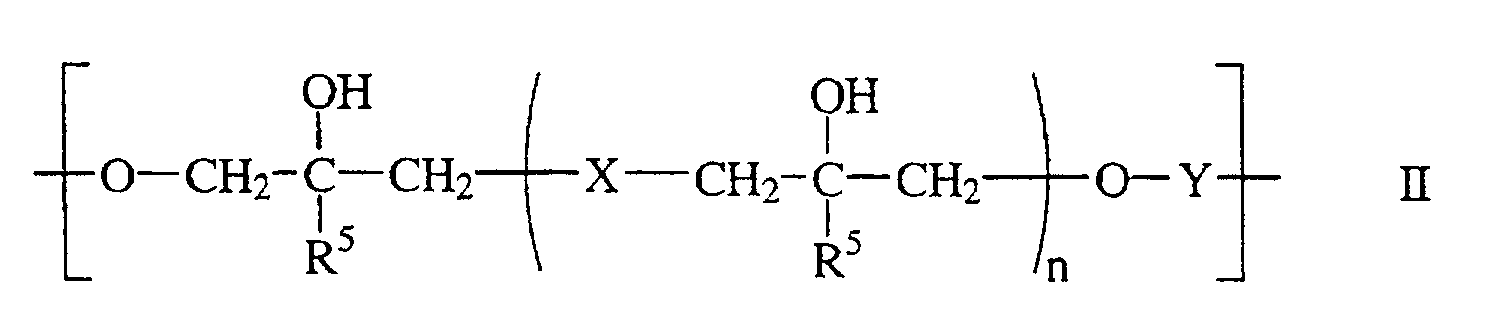
- The present invention is a composition comprising either: a) an HIPR emulsion having water as a continuous phase and a thermoplastic hydroxy-functional polyether as a disperse phase; or b) a stable aqueous dispersion of the thermoplastic hydroxy-functional polyether, wherein the hydroxy-functional polyether has structural units represented by either of the formulae:or
 where R1 is predominantly a hydrocarbylene moiety; R5 is independently in each occurrence hydrogen or alkyl; n is 0 or 1; R3 is
 and R4 is
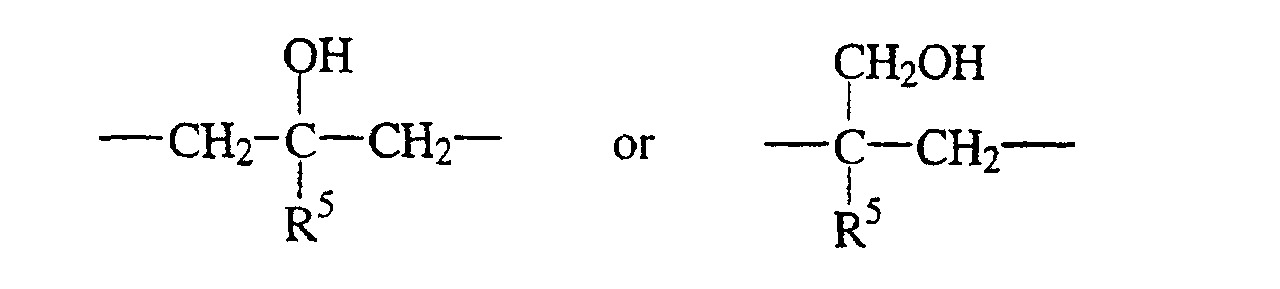 where R2 is predominantly a hydrocarbylene moiety or
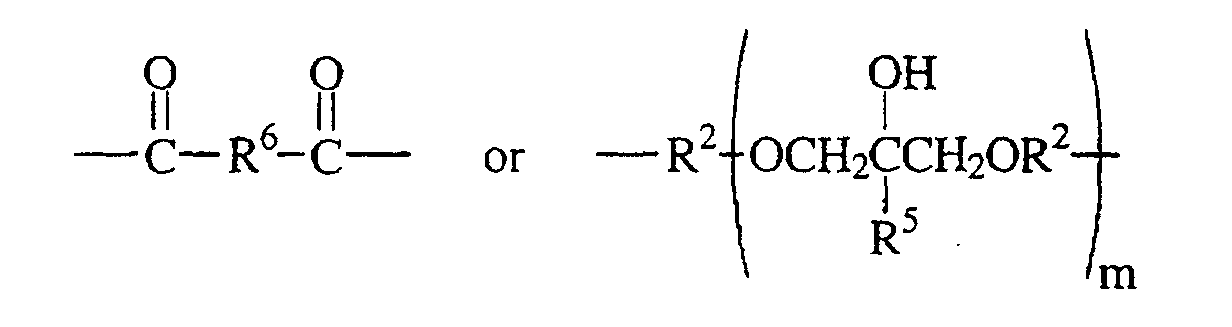 where R6 is predominantly a hydrocarbylene moiety; R7 is independently in each occurrence hydrogen or methyl; X is
 or
or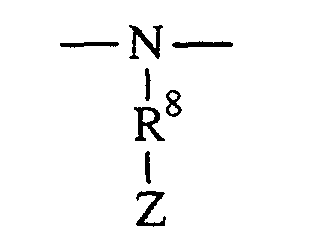 or
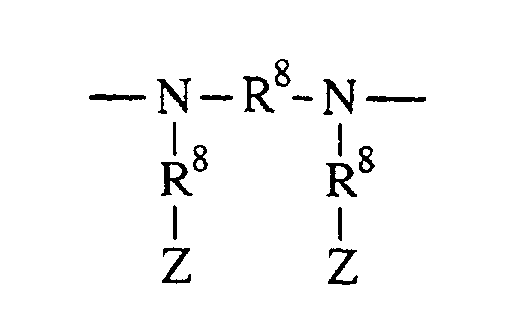
or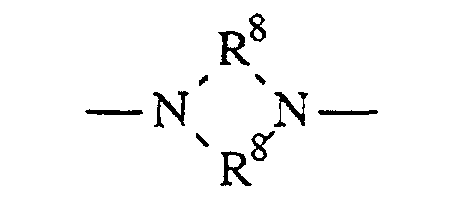 wherein R8 is independently in each occurrence C2-C20 hydrocarbylene; Z is independently in each occurrence H, alkylamido, hydroxyl, alkoxy, alkylcarbonyl, aryloxy, arylcarbonyl, halo, or cyano; Y is predominantly a hydrocarbylene moiety; and each m is independently an integer from 0 to 100.
- In a second aspect, the present invention is a method of preparing a stable aqueous dispersion of a hydroxy-functional polyether comprising the steps of:
- a) dissolving the hydroxy-functional polyether in a solvent or melting the polyether to form a solution or a melt that is, sufficiently immiscible with water so that a high internal phase ratio emulsion of the solution of the polyether in a water continuous phase can be formed;
- b) continuously merging into a disperser, in the presence of an emulsifying and stabilizing amount of a surfactant, a flowing stream of water flowing at a rate r1, and a flowing stream containing the solution of the hydroxy-functional polyether flowing at a rate r2;
- c) mixing the streams with a sufficient amount of shear to form a high internal phase ratio emulsion;
- d) diluting the high internal phase ratio emulsion with water to form the stable aqueous dispersion; and
- e) removing the solvent from the high internal phase ratio emulsion; wherein the hydroxy-functional polyether has structural units represented by either of the formulae:
-
- The present invention addresses a need in the art by providing an adherent thermoplastic coating that exhibits an excellent barrier to oxygen and carbon dioxide, but which barrier properties are not adversely affected by contact with water. In some embodiments, the composition can provide a biodegradable coating which is particularly useful in paper packaging applications where resistance to spoilage of food and biodegradability are desirable.
- The thermoplastic hydroxy-functional polyether used to make the HIPR emulsion or the stable aqueous dispersion of the present invention has structural units represented by either of the formulae:or
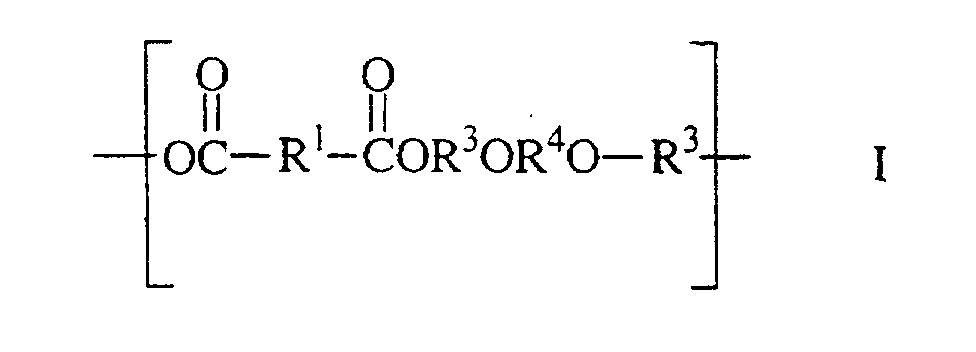 where X is preferably 2-hydroxyethylimino-, 2-hydroxypropylimino-, piperazenyl, N,N'-bis(2-hydroxyethyl)-1,2-ethylenediimino-; Y is preferably isopropylidenediphenylene, 1,3-phenylene, or 1,4-phenylene; R3 is
 and R4 is
 or
or where R5 is preferably hydrogen, and preferably each m is independently an integer from 0 to 10.
- The term "predominantly hydrocarbylene" is used herein to mean a divalent radical that is predominantly hydrocarbon, but which may contain a minor amount of a heteroatomic moiety such as oxygen, sulfur, imino, sulfonyl, and sulfoxyl.
- Representative hydrocarbylene moieties useful as R1, R2 and R6 include unsubstituted and hydroxy-substituted hydrocarbylene including alkylene, cycloalkylene, alkylenearylene, poly(alkyleneoxyalkylene), alkylenethioalkylene, alkylenesulfonyl-alkylene, arylene, dialkylenearylene, diaryleneketone, diarylenesulfone, diarylene oxide and diarylene sulfide.
- In the more preferred hydroxy-functional polyethers, R1, R2 and R6 are independently methylene, ethylene, propylene, butylene, pentamethylene, hexamethylene, heptamethylene, octamethylene, nonamethylene, decamethylene, dodecamethylene, 1,4-cyclohexylene, 1,3-cyclohexylene, 1,2-cyclohexylene, p-phenylene, m-phenylene, o-phenylene, 2,6-naphthalene, diphenylene-isopropylidene, sulfonyldiphenylene, carbonyldiphenylene, oxydiphenylene, or 9,9-fluorenediphenylene.
- The poly(hydroxy ester ethers) represented by Formula I can be prepared by reacting diglycidyl esters of aliphatic or aromatic diacids such as diglycidyl terephthalate, or diglycidyl ethers of dihydric phenols or alcohols with aliphatic or aromatic diacids such as adipic or terephthalic acid as described in U.S. Patents 5,171,820 and 5,496,910.
- The poly(hydroxy amino ether) represented by Formula II (where n = 1) can be prepared by contacting one or more of the diglycidyl ethers of a dihydric phenol with an amine having two amine hydrogens under conditions sufficient to cause the amine moieties to react with epoxy moieties to form a polymer backbone having amine linkages, ether linkages and pendant hydroxyl moieties. These polyethers are described in U.S. Patent 5,275,853. These polyethers can also be prepared by contacting a diglycidyl ether or an epihalohydrin with a difunctional amine.
- The hydroxy-functional polyether represented by Formula II (where n = 0) can also be prepared by contacting a diglycidyl ether or a combination of diglycidyl ethers with a dihydric phenol or combination of dihydric phenols using the process described in U.S. Patent 5,164,472. Alternatively, the hydroxy-functional polyether can be prepared by allowing a dihydric phenol or a combination of dihydric phenols to react with an epihalohydrin by the process described by Reinking, Barnabeo, and Hale in Journal of Applied Polymer Science, Vol. 7, pg. 2135 (1963).
- A more preferred hydroxy-functional polyether contains structural units formed from the reaction product of the diglycidyl ether of bisphenol A and adipic acid.
- The preferred weight average molecular weight of the hydroxy-functional polyether (as determined by gel permeation chromatography) is not less than about 1000 Daltons, more preferably not less than 10,000 Daltons, most preferably not less than 20,000 Daltons, and preferably not more than 250,000 Daltons, more preferably not more than 100,000 Daltons.
- The stable aqueous dispersion of the hydroxy-functional polyether can be prepared by any suitable method including those described in U.S. Patents 3,360,599; 3,503,917; 4,123,403; 5,037,864; and 5,539,021. Preferably, the stable aqueous dispersion of the hydroxy-functional polyether is prepared by first preparing an HIPR emulsion, then diluting the emulsion with water.
- The HIPR emulsion of the hydroxy-functional polyether may also be prepared by any suitable method, such as those described in U.S. Patents 4,018,426; 5,250.576; and 5,539,021. Preferably, the HIPR emulsion is prepared by continuously merging into a disperser, in the presence of an emulsifying and stabilizing amount of a surfactant, a stream of water flowing at a rate r1, and a stream containing the hydroxy-functional polyether flowing at a rate r2, then mixing the streams with a sufficient amount of shear to form the HIPR emulsion. The ratio of the flow rates r2:r1 is preferably in such a range that the polydispersity of the HIPR emulsion, defined as the ratio of the volume average particle size to the number average particle size (Dv/Dn), is not greater than 3, more preferably not greater than 2, and most preferably not greater than 1.3; or the volume average particle size, as measured using a Coulter LS230 particle size analyzer (Coulter Instruments), is not greater than 3 microns, more preferably not greater than 1 micron, and most preferably not greater than 0.5 micron.
- Referring now to FIG. 1, which is a plot of the polydispersity (dotted lines, solid circles) and particle size (solid lines, open circles) versus feed ratio (polymer solution:water), the range of the feed ratio that gives the best results is not less than 3.5, preferably not less than 3.8, and not greater than 4.5, more preferably not greater than 4.4. The polymer solution is a polyhydroxy ester ether (prepared as described in the Example, part B) 45 percent by weight in a 60:40 volume:volume mixture of toluene and 1-butanol. It has surprisingly been discovered that aqueous dispersions of the hydroxy-functional polyether having low particle size and polydispersity can be prepared in the absence of grafted functional groups such as carboxylic acid-containing groups.
- The hydroxy-functional polyether is advantageously dissolved in an organic solvent or combination of solvents so that the stream containing the hydroxy-functional polyether has a sufficiently low viscosity to be pumped through a conduit. Alternatively, an otherwise unpumpable hydroxy-functional polyether may be rendered pumpable by the addition of a sufficient amount of heat. Preferably, the hydroxy-functional polyether is dissolved in a solvent or a combination of solvents. The solvent or solvent combination is characterized by providing a solution of the polymer that is sufficiently immiscible with water so that an HIPR emulsion of the solution of the polymer in a water continuous phase can be formed. A preferred solvent is a glycol ether such as propylene glycol methyl ether acetate; a preferred solvent combination is a non-polar solvent and a C1-C5 alcohol, such as a combination of toluene and n-butanol.
- The surfactant used to stabilize the HIPR emulsion is preferably anionic or nonionic, or a combination thereof. A preferred nonionic surfactant is a polymeric surfactant having the following structure:where R6, and R3 are as previously defined; R0 is alkylene, preferably C2-C12 alkylene, more preferably ethylene, propylene, or butylene, most preferably ethylene; R9 and R10 are each independently H, alkyl or alkenyl, preferably H, C1-C20 alkyl or C2-C20 alkenyl, more preferably H, C1-C12 alkyl or C2-C12 alkenyl, most preferably H or 2-dodecene-1-yl; n' and x' are positive integers; and R6 is preferably diphenylene-isopropylidene.
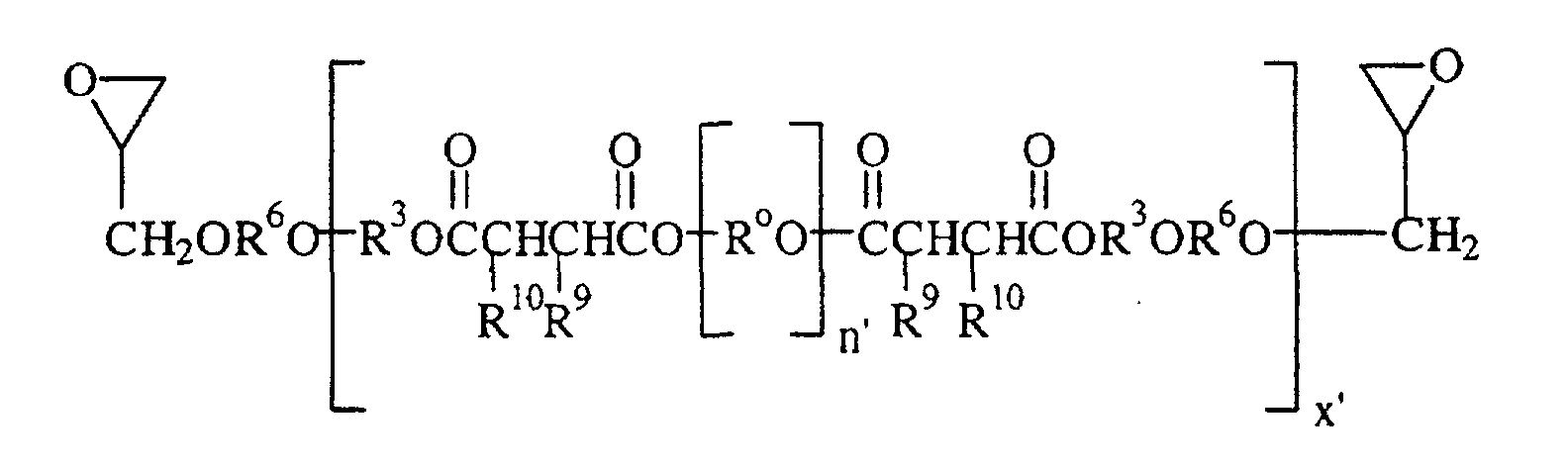
- The polymeric surfactant (IV) can be prepared by first reacting a polyoxyalkylene glycol, preferably a polyoxyethylene glycol, with an anhydride at a glycol:anhydride mole:mole ratio of 1:2 to form a diacid intermediate, then reacting the intermediate with a diglycidyl ether, preferably diglycidyl ether of bisphenol A, using a diglycidyl ether:diacid mole:mole ratio preferably in the range of 1 to 2. The reaction scheme is illustrated as follows:
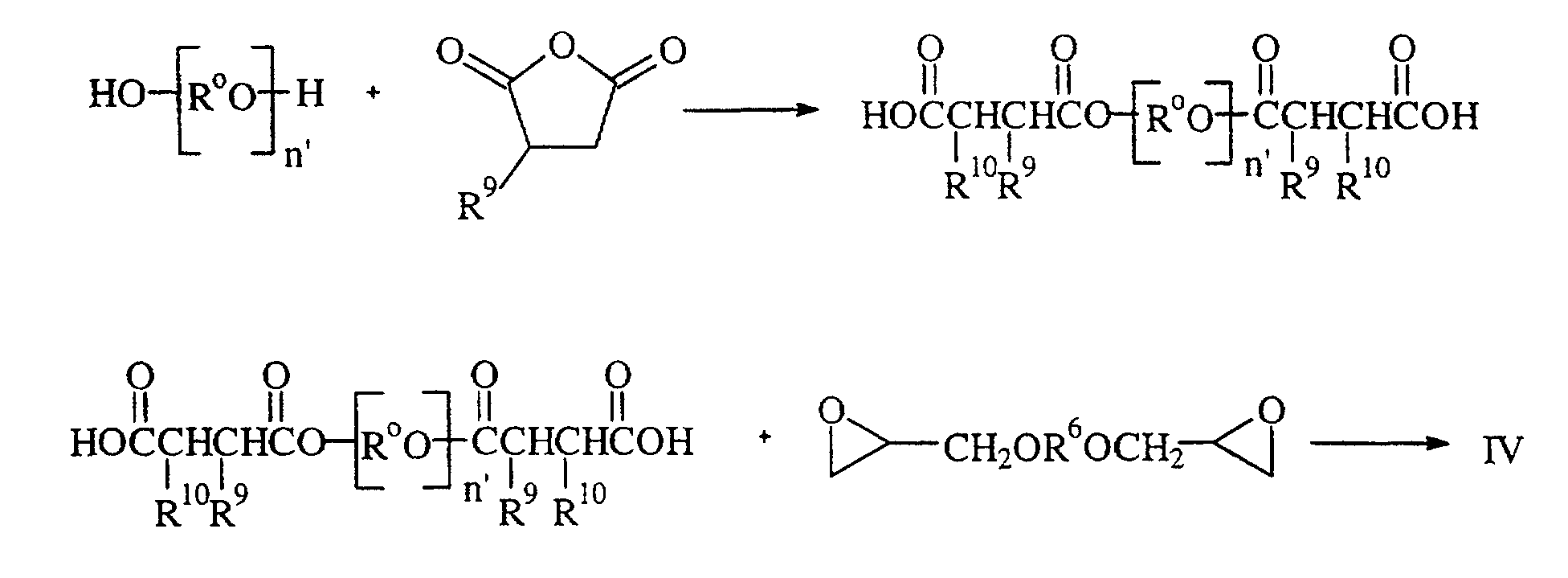
- A more preferred surfactant is a combination of the polymeric surfactant (IV) with an anionic surfactant such as sulfonates or sulfates of ethoxylated phenols such as poly(oxy-1,2-ethanediyl)α-sulfo-ω(nonylphenoxy) ammonium salt (available as Rhodapex™ CO 436, a trademark of Rhone Pôulenc); or dialkyl esters of sodium sulfosuccinic acid such as dioctyl ester of sodium sulfosuccinic acid (available as Aerosol OT 75, Cytec Industries Inc., Division of American Cyanamid) preferably at a anionic surfactant:polymeric surfactant mole:mole ratio not greater than 2:1, more preferably not greater than 1:1.
- The HIPR emulsion can be simply diluted with water, preferably with mixing, to form the stable aqueous dispersion. The organic solvent, if present, can then be advantageously removed from the stable aqueous dispersion by any suitable means such as vacuum distillation.
- The stable aqueous dispersion of the hydroxy-functional polyether can be used to make a non-chlorine-containing, adherent thermoplastic coating having low oxygen and carbon dioxide transmission rates. The coatings formed from stable aqueous dispersions of poly(hydroxy ester ethers) are especially useful in applications where biodegradability is also desired. Such coatings are useful for food wrapping paper, or containers such as milk or juice cartons, where it would be desirable to lock in freshness and dispose of the container in a compost bin.
- The following examples are for illustrative purposes only and are not intended to limit the scope of this invention.
- In a round-bottomed flask equipped with a nitrogen inlet, mechanical stirrer and a condenser are added with stirring over 30 minutes, polyethylene glycol 400 (molecular weight 400, 319.5 mmol), polyethylene glycol 4500 (molecular weight 4500, 28.5 mmol), and succinic anhydride (696 mmol). The reactants were heated for 2 hours at 90°C, whereupon A1 catalyst (400 ppm of a 70 percent methanolic solution of ethyltriphenylphosphonium acetate complex with acetic acid) and D.E.R.™ 330 (a Trademark of The Dow Chemical Company, 330.5 mmol, epoxy equivalent weight of 180) were added over 90 minutes at 150°C. Stirring at 150°C was continued for 3.5 hours, whereupon methyl-p-toluenesulfonate (280 ppm) was added. The solution was cooled and the polymeric surfactant was recovered as a yellow wax.
- A hydroxy-functional polyether was prepared from approximately equimolar amounts of the diglycidyl ether of bisphenol A and adipic acid (using substantially the same procedure as described in U.S. Patent 5,496,910, column 6, lines 14-25). A polymer solution was prepared by combining the hydroxy-functional polyether (45 g) with the polymeric surfactant prepared in Part A (4.5 g) in a 60:40 weight-to-weight mixture of toluene and n-butanol (65 g). The polymer solution was pumped continuously through an arm of a 0.5-inch (1.27-cm) i.d. stainless steel tube, fitted to a first T, at a rate of 35 g/min. Concurrently, Aerosol OT 75 was pumped through an arm of a 0.125-inch (0.32-cm) polytetrafluoroethylene tubing fitted to the first T at a rate of 0.7 g/minute. Water was pumped at the rate of 7.2 g/minute through an arm of a second 0.125-inch(0.32-cm) polytetrafluoroethylene tubing that was fitted to the 0.5-inch i.d. tube through a second T downstream of the first T. An HIPR emulsion of the polymer in a water-continuous phase was formed by merging and mixing together the polymer-Aerosol OT 75 stream and the water stream under condition of shear using a 4-inch (10-cm) centrifugal pump, and operating at 1200 rpm. The HIPR emulsion was passed through a second centrifugal pump along with a water diluent to form the stable aqueous dispersion (the latex). The organic solvents were removed from the latex in vacuo to obtain a 50 percent solids latex. The mean volume average particle size of the latex, as measured in a Coulter LS230, was 0.569 micron (Dv/Dn = 1.3).


Claims (18)
- A composition comprising either: a) a high internal phase ratio emulsion having water as a continuous phase and a thermoplastic hydroxy-functional polyether as a disperse phase; or b) a stable aqueous dispersion of the thermoplastic hydroxy-functional polyether, wherein the hydroxy-functional polyether has structural units represented by either of the formulae:or
 where R1 is predominantly a hydrocarbylene moiety; R5 is independently in each occurrence hydrogen or alkyl; n is 0 or 1; R3 is
 and R4 is
 where R2 is predominantly a hydrocarbylene moiety or
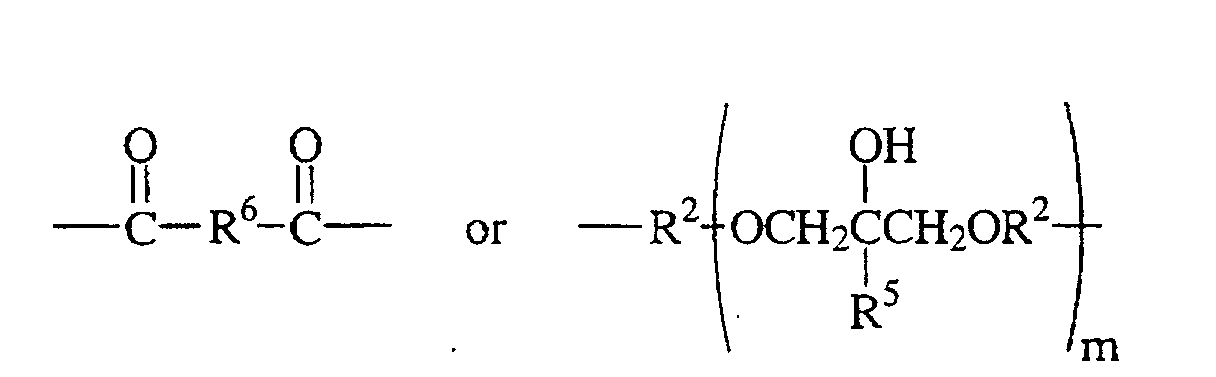 where R6 is predominantly hydrocarbylene; R7 is independently in each occurrence hydrogen or methyl; X is
 or
or or
or wherein R8 is independently in each occurrence C2-C20 hydrocarbylene; Z is independently in each occurrence H, alkylamido, hydroxyl, alkoxy, alkylcarbonyl, aryloxy, arylcarbonyl, halo, or cyano; Y is predominantly a hydrocarbylene moiety; and each m is independently an integer from 0 to 100.
- The composition of Claim 1 which is a high internal phase ratio emulsion having water as a continuous phase and a thermoplastic hydroxy-functional polyether as a disperse phase.
- The composition of Claim 2 wherein R4 ism is 0; R1 is ethylene, propylene, hexamethylene, p-phenylene, or m-phenylene; R2 is p-phenylene, m-phenylene, or diphenylene-isopropylidene; and R5 is H.
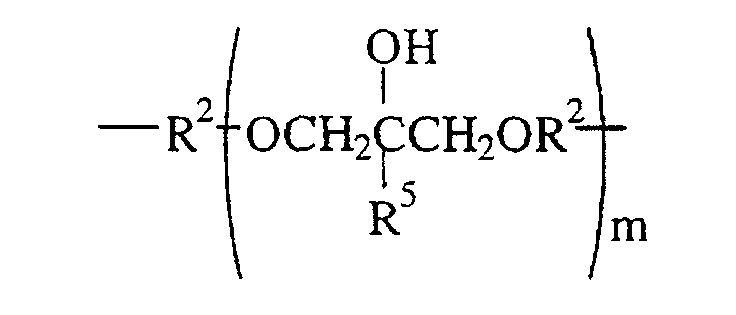
- The composition of Claim 2 wherein the hydroxy-functional polyether has structural units represented by the formula:where R1 is 1,4-cyclohexylene, 1,3-cyclohexylene or 1,2-cyclohexylene, p-phenylene, m-phenylene, 2,6-naphthalene, diphenylene-isopropylidene, sulfonyldiphenylene, carbonyldiphenylene, oxydiphenylene, or 9,9-fluorenediphenylene; and R6 is methylene, ethylene, propylene, butylene, pentamethylene, hexamethylene, heptamethylene, octamethylene, nonamethylene, decamethylene, or dodecamethylene.
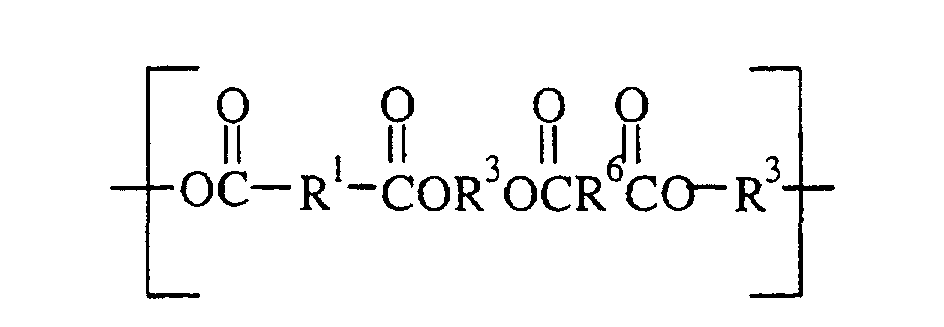
- The composition of Claim 3 where R1 is diphenylene-isopropylidene; R6 is tetramethylene; and the weight average molecular weight of the hydroxy-functional polyether is not less than 10,000 Daltons and not greater than 250,000 Daltons.
- The composition of Claim 2 which is prepared by the steps of:a) dissolving the hydroxy-functional polyether in a solvent or melting the polyether, to form a solution or a melt that is sufficiently immiscible with water so that a high internal phase ratio emulsion of the solution of the polyether in a water continuous phase can be formed;b) continuously merging into a disperser, in the presence of an emulsifying and stabilizing amount of a surfactant, a flowing stream of water flowing at a rate of r1, and a flowing stream containing the solution of the polyether flowing at a rate r2; andc) mixing the streams with a sufficient amount of shear to form the high internal phase ratio emulsion, wherein the ratio of the flow rates r2:r1 is such that the particle size of the high internal phase ratio emulsion is not greater than 3 microns.
- The composition of Claim 6 wherein the surfactant comprises an anionic surfactant and a polymeric nonionic surfactant having the following formula:where R6 is predominantly hydrocarbylene; R3 is
 where each R5 is independently in each occurrence hydrogen or alkyl; R0 is C2-C12 alkylene; R9 and R10 are each independently H, alkyl, or alkenyl; and n' and x' are positive integers.
- The composition of Claim 7 wherein the anionic surfactant is a sulfonate or sulfate of an ethoxylated phenol or a dialkyl ester of sodium sulfosuccinic acid; R6 is diphenylene-isopropylidene; R8 is ethylene, propylene, or butylene; R9 is H, C1-C12 alkyl, or C2-C12 alkenyl; wherein the mole:mole ratio of the anionic surfactant to the polymeric surfactant is not greater than 2:1.
- The composition of Claim 8 wherein the anionic surfactant is a dioctyl ester of sodium sulfosuccinic acid; R9 is 2-dodecene-1-yl or H, and R8 is ethylene; wherein the mole:mole ratio of the anionic surfactant to the polymeric surfactant is not greater than 1:1.
- The composition of Claim 1 which is a stable aqueous dispersion of the thermoplastic hydroxy-functional polyether.
- The composition of Claim 1 wherein the hydroxy-functional polyether has structural units represented by the formula:where X is
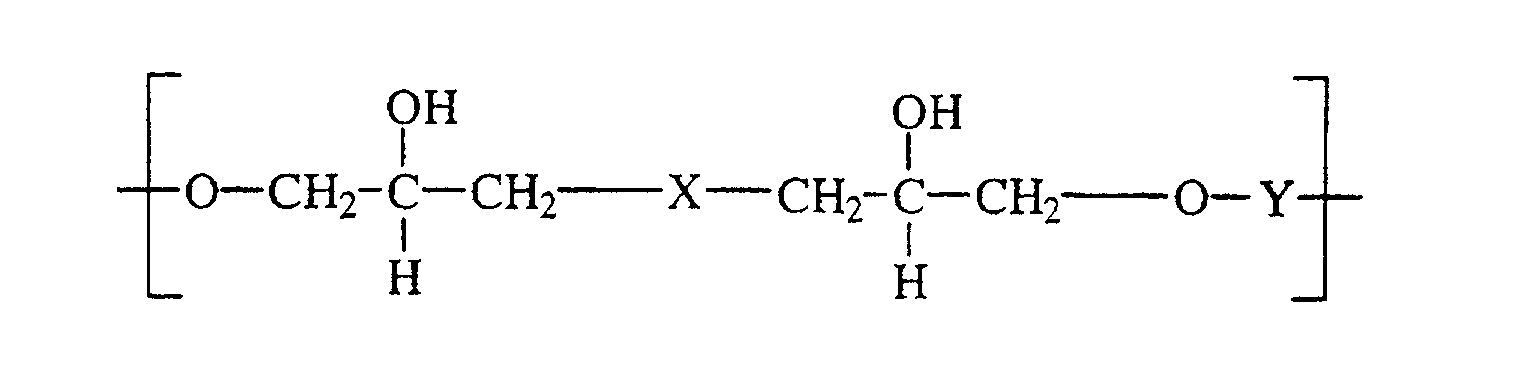 or
or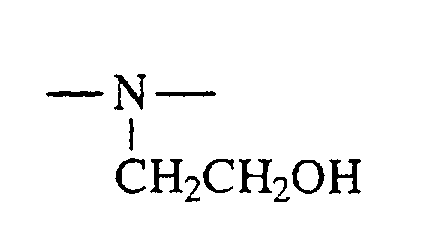 or
or and Y is isopropylidenediphenylene, 1,3-phenylene, or 1,4-phenylene, wherein the weight average molecular weight of the polymer is not less than 1000 and not more than 100,000 Daltons.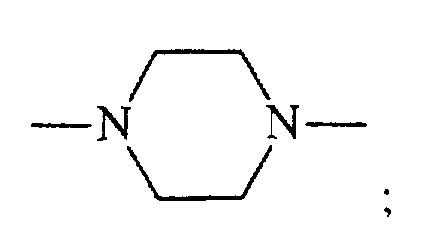
- The composition of Claim 1 wherein the hydroxy-functional polyether has structural units represented by the formula:where Y is isopropylidenediphenylene, 1,3-phenylene, or 1,4-phenylene, and the weight average molecular weight of the polymer is not less than 1000 and not more than 100,000 Daltons.

- The composition of Claim 12 which is formed by the reaction of a bisphenol with a diglycidyl ether or an epihalohydrin.
- A method of preparing a stable aqueous dispersion of a hydroxy-functional polyether comprising the steps of:wherein the hydroxy-functional polyether has structural units represented by either of the formulae:a) dissolving the hydroxy-functional polyether in a solvent or melting the polyether to form a solution or a melt that is, sufficiently immiscible with water so that a high internal phase ratio emulsion of the solution of the polyether in a water continuous phase can be formed;b) continuously merging into a disperser, in the presence of an emulsifying and stabilizing amount of a surfactant, a flowing stream of water flowing at a rate r1, and a flowing stream containing the solution of the hydroxy-functional polyether flowing at a rate r2;c) mixing the streams with a sufficient amount of shear to form a high internal phase ratio emulsion;d) diluting the high internal phase ratio emulsion with water to form the stable aqueous dispersion; ande) removing the solvent from the high internal phase ratio emulsion;or
 where R1 is predominantly a hydrocarbylene moiety; R5 is independently in each occurrence hydrogen or alkyl; n is 0 or 1; R3 is
 and R4 is
 where R2 is predominantly a hydrocarbylene moiety or
 where R6 is predominantly a hydrocarbylene moiety; R7 is independently in each occurrence hydrogen or methyl; X is
 or
or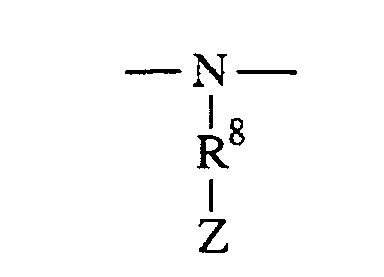 or
or wherein R8 is independently in each occurrence C2-C20 hydrocarbylene; Z is independently in each occurrence H, alkylamido, hydroxyl, alkoxy, alkylcarbonyl, aryloxy, arylcarbonyl, halo, or cyano; Y is predominantly a hydrocarbylene moiety; each m is independently an integer from 0 to 100; and wherein the ratio of the flow rates r2:r1 is in such a range that the volume average particle size of the high internal phase ratio emulsion is not greater than 3 microns.
- The method of Claim 14 wherein R4 ism is O; R1 is ethylene, propylene, hexamethylene, p-phenylene, or m-phenylene; R2 is p-phenylene, m-phenylene, or diphenylene-isopropylidene; and R5 is H; wherein the hydroxy-functional polyether has a weight average molecular weight in the range of 10,000 Daltons to 100,000 Daltons.

- The method of Claim 15 wherein the surfactant is a combination of a dioctyl ester of sodium sulfosuccinic acid and a polymeric nonionic surfactant represented by the following structure:where R6 is diphenylene-isopropylidene; R3 is
 wherein each R5 is hydrogen; R0 is ethylene; R9 and R10 are each independently H, C1-C12 alkyl, or C2-C12 alkenyl; and n' and x' are positive integers; wherein the mole:mole ratio of the dioctyl ester of sodium sulfosuccinic acid to the polymeric surfactant is not greater than 1:1.
- The method of Claim 16 wherein the solvent contains a mixture of 1-butanol and toluene or a glycol ether.
- The method of Claim 17 wherein the glycol ether is propylene glycol methyl ether acetate.
Applications Claiming Priority (3)
| Application Number | Priority Date | Filing Date | Title |
|---|---|---|---|
| US5806797P | 1997-09-05 | 1997-09-05 | |
| US58067P | 1997-09-05 | ||
| PCT/US1998/017694 WO1999012995A1 (en) | 1997-09-05 | 1998-08-26 | High internal phase ratio emulsions and stable aqueous dispersions of hydroxy-functional polymers |
Publications (2)
| Publication Number | Publication Date |
|---|---|
| EP1015511A1 EP1015511A1 (en) | 2000-07-05 |
| EP1015511B1 true EP1015511B1 (en) | 2002-04-24 |
Family
ID=22014457
Family Applications (1)
| Application Number | Title | Priority Date | Filing Date |
|---|---|---|---|
| EP98941068A Expired - Lifetime EP1015511B1 (en) | 1997-09-05 | 1998-08-26 | High internal phase ratio emulsions and stable aqueous dispersions of hydroxy-functional polymers |
Country Status (13)
| Country | Link |
|---|---|
| US (1) | US6156806A (en) |
| EP (1) | EP1015511B1 (en) |
| JP (1) | JP2001515938A (en) |
| KR (1) | KR20010023641A (en) |
| CN (1) | CN1108333C (en) |
| BR (1) | BR9812174A (en) |
| CA (1) | CA2302266A1 (en) |
| DE (1) | DE69805085T2 (en) |
| DK (1) | DK1015511T3 (en) |
| ES (1) | ES2172186T3 (en) |
| PL (1) | PL339077A1 (en) |
| TW (1) | TW482792B (en) |
| WO (1) | WO1999012995A1 (en) |
Families Citing this family (18)
| Publication number | Priority date | Publication date | Assignee | Title |
|---|---|---|---|---|
| MXPA02005688A (en) * | 1999-12-08 | 2004-09-10 | Dow Global Technologies Inc | Architectural concrete having a reinforcing polymer and process to make same. |
| AU2586201A (en) * | 1999-12-20 | 2001-07-03 | Advanced Plastics Technologies, Ltd. | Recycling of articles comprising hydroxy-phenoxyether polymers |
| WO2002081818A2 (en) | 2001-04-04 | 2002-10-17 | Advanced Plastics Technologies, Ltd. | Process for coating paper, paperboard, and molded fiber with a water-dispersible polyester polymer |
| US6713558B2 (en) | 2001-07-13 | 2004-03-30 | Dow Corning Corporation | High solids emulsions of silylated elastomeric polymers |
| US6737473B2 (en) | 2001-07-13 | 2004-05-18 | Dow Corning Corporation | High solids emulsions of elastomeric polymers |
| US6720373B2 (en) | 2001-07-13 | 2004-04-13 | Dow Corning Corporation | High solids emulsions of curable elastomeric polymers |
| EG23499A (en) | 2002-07-03 | 2006-01-17 | Advanced Plastics Technologies | Dip, spray, and flow coating process for forming coated articles |
| US8247051B2 (en) * | 2003-08-11 | 2012-08-21 | The Glidden Company | Curable polymeric water based coating compositions and resulting coatings with barrier properties for gases and laminate structures |
| US7588808B2 (en) | 2004-04-16 | 2009-09-15 | Advanced Plastics Technologies Luxembourg S.A. | Mono and multi-layer articles and injection molding methods of making the same |
| US7717697B2 (en) | 2005-08-30 | 2010-05-18 | Sharon Hutchinson | Methods and systems for controlling mold temperatures |
| JP2007321013A (en) * | 2006-05-30 | 2007-12-13 | Nippon Synthetic Chem Ind Co Ltd:The | Process for producing water-containing composition of ethylene-vinyl alcohol copolymer |
| JP5937885B2 (en) * | 2011-05-10 | 2016-06-22 | 大阪ガスケミカル株式会社 | Latex containing resin particles having fluorene skeleton and method for producing the same |
| CN102516839B (en) * | 2011-11-25 | 2014-02-19 | 清新县汉科化工科技有限公司 | A kind of preparation method for the dispersant of printing ink or paint |
| EP2814874A1 (en) | 2012-02-15 | 2014-12-24 | Dow Global Technologies LLC | Premolding article from thermoset and thermoplastic polymer dispersions |
| EP2814875A1 (en) | 2012-02-15 | 2014-12-24 | Dow Global Technologies LLC | Pre-molding article from thermoset polymer dispersions |
| WO2014078496A2 (en) | 2012-11-19 | 2014-05-22 | Dow Global Technologies Llc | Expanding foam core prepreg |
| CN104710554A (en) * | 2015-01-05 | 2015-06-17 | 泰山医学院 | Preparation method of interpenetrating network porous polymer composite material |
| CN104650667B (en) * | 2015-01-16 | 2017-03-22 | 安徽三联泵业股份有限公司 | Nanometer ceramic-polytetrafluoroethylene coating for centrifugal pump and method for preparing nanometer ceramic-polytetrafluoroethylene coating |
Family Cites Families (21)
| Publication number | Priority date | Publication date | Assignee | Title |
|---|---|---|---|---|
| US3360599A (en) * | 1963-11-06 | 1967-12-26 | Shell Oil Co | Preparation of coherent block copolymer films of high tensile strength and extensibility |
| US3503917A (en) * | 1967-03-09 | 1970-03-31 | Burke Oliver W Jun | Aqueous latices of high polymer compositions and processes for producing same |
| US4018426A (en) * | 1976-03-17 | 1977-04-19 | Petrolite Corporation | System for producing emulsions |
| US4123403A (en) * | 1977-06-27 | 1978-10-31 | The Dow Chemical Company | Continuous process for preparing aqueous polymer microsuspensions |
| US5037864A (en) * | 1989-07-11 | 1991-08-06 | The Dow Chemical Company | Semi-continuous process for the preparation of polyurethane-urea aqueous dispersions |
| US5164472A (en) * | 1990-01-18 | 1992-11-17 | The Dow Chemical Company | Hydroxy-functional polyethers as thermoplastic barrier resins |
| ATE163949T1 (en) * | 1990-10-03 | 1998-03-15 | Dow Chemical Co | HYDROXY FUNCTIONALIZED POLYETHERAMINES FOR USE AS A BARRIER LAYER IN OXYGEN SENSITIVE MATERIALS |
| US5171820A (en) * | 1991-05-13 | 1992-12-15 | The Dow Chemical Company | Hydroxy-functional polyesters as thermoplastic barrier resins |
| US5250576A (en) * | 1991-08-12 | 1993-10-05 | The Procter & Gamble Company | Process for preparing emulsions that are polymerizable to absorbent foam materials |
| US5814373A (en) * | 1991-11-26 | 1998-09-29 | Dow Chemical Company | Heat-resistant hydroxy-functional polyethers as thermoplastic barrier resins |
| US5686551A (en) * | 1994-01-07 | 1997-11-11 | The Dow Chemical Company | Hydroxy ether polymers as thermoplastic barrier resins |
| US5496910A (en) * | 1994-07-21 | 1996-03-05 | The Dow Chemical Company | Hydroxyfunctional thermoplastic polyesters |
| US5539021A (en) * | 1995-06-05 | 1996-07-23 | The Dow Chemical Company | Process for preparing high internal phase ratio emulsions and latexes derived thereof |
| CA2220866C (en) * | 1995-06-05 | 2006-11-07 | The Dow Chemical Company | A process for preparing high internal phase ratio emulsions and latexes derived thereof |
| US5665786A (en) * | 1996-05-24 | 1997-09-09 | Bradley University | Biodegradable polyester and natural polymer compositions and expanded articles therefrom |
| US5852078A (en) * | 1996-02-28 | 1998-12-22 | The United States Of America As Represented By The Secretary Of Agriculture | Biodegradable polyester compositions with natural polymers and articles thereof |
| US5861216A (en) * | 1996-06-28 | 1999-01-19 | The United States Of America As Represented By The Secretary Of Agriculture | Biodegradable polyester and natural polymer laminates |
| US5821286A (en) * | 1996-05-24 | 1998-10-13 | The United States Of America As Represented By The Secretary Of The Agriculture | Biodegradable polyester and natural polymer compositions and films therefrom |
| US5780582A (en) * | 1996-12-31 | 1998-07-14 | The Dow Chemical Company | Hydroxy-functionalized polyester and poly(ester ether) oligomers |
| US5834078A (en) * | 1997-08-14 | 1998-11-10 | The Dow Chemical Company | Hydroxy-functionalized poly(amino ether) salts |
| US5852163A (en) * | 1997-09-10 | 1998-12-22 | The Dow Chemical Company | Process for preparing hydroxy-functionalized polyesters |
-
1998
- 1998-08-26 ES ES98941068T patent/ES2172186T3/en not_active Expired - Lifetime
- 1998-08-26 JP JP2000510795A patent/JP2001515938A/en active Pending
- 1998-08-26 DE DE69805085T patent/DE69805085T2/en not_active Expired - Fee Related
- 1998-08-26 DK DK98941068T patent/DK1015511T3/en active
- 1998-08-26 WO PCT/US1998/017694 patent/WO1999012995A1/en not_active Ceased
- 1998-08-26 CN CN98809762A patent/CN1108333C/en not_active Expired - Fee Related
- 1998-08-26 CA CA002302266A patent/CA2302266A1/en not_active Abandoned
- 1998-08-26 US US09/140,055 patent/US6156806A/en not_active Expired - Fee Related
- 1998-08-26 PL PL98339077A patent/PL339077A1/en unknown
- 1998-08-26 BR BR9812174-0A patent/BR9812174A/en not_active IP Right Cessation
- 1998-08-26 KR KR1020007002292A patent/KR20010023641A/en not_active Ceased
- 1998-08-26 EP EP98941068A patent/EP1015511B1/en not_active Expired - Lifetime
- 1998-09-04 TW TW087114708A patent/TW482792B/en active
Also Published As
| Publication number | Publication date |
|---|---|
| ES2172186T3 (en) | 2002-09-16 |
| DE69805085T2 (en) | 2002-08-14 |
| BR9812174A (en) | 2000-07-18 |
| PL339077A1 (en) | 2000-12-04 |
| DE69805085D1 (en) | 2002-05-29 |
| CN1272859A (en) | 2000-11-08 |
| CA2302266A1 (en) | 1999-03-18 |
| KR20010023641A (en) | 2001-03-26 |
| CN1108333C (en) | 2003-05-14 |
| TW482792B (en) | 2002-04-11 |
| US6156806A (en) | 2000-12-05 |
| EP1015511A1 (en) | 2000-07-05 |
| JP2001515938A (en) | 2001-09-25 |
| DK1015511T3 (en) | 2002-07-22 |
| WO1999012995A1 (en) | 1999-03-18 |
Similar Documents
| Publication | Publication Date | Title |
|---|---|---|
| US6156806A (en) | High internal phase ratio emulsions and stable aqueous dispersions of hydroxy-functional polymers | |
| US4423170A (en) | One component water reduced epoxy adhesives | |
| EP1214369B1 (en) | Aqueous solution or dispersion of an acid salt of a polyetheramine | |
| EP1060205B1 (en) | Water dispersible curing agents for epoxy resin | |
| WO1996020971A1 (en) | Aqueous self-dispersible epoxy resin based on epoxy-amine adducts containing aromatic polyepoxide | |
| KR100541927B1 (en) | Epoxy Resin Aqueous Dispersion | |
| US6057388A (en) | Polymeric thickeners for aqueous compositions | |
| US5852163A (en) | Process for preparing hydroxy-functionalized polyesters | |
| KR100568095B1 (en) | Aqueous dispersion of epoxy resin and preparation method thereof | |
| EP2847256B1 (en) | Process for preparing stable aqueous epoxy resin dispersions | |
| EP0491550B1 (en) | Water-emulsifiable epoxy resin composition | |
| KR20010012142A (en) | Antiblock coating for hot melt adhesives | |
| MXPA00002275A (en) | High internal phase ratio emulsions and stable aqueous dispersions of hydroxy-functional polymers | |
| US6002049A (en) | Polymeric thickeners for aqueous compositions | |
| WO1992008753A1 (en) | Polymeric thickeners for aqueous compositions | |
| JPH07309954A (en) | Epoxy resin water dispersion | |
| AU692035B2 (en) | Epoxy-functional ethers or polyethers | |
| JP3444731B2 (en) | Epoxy resin aqueous dispersion | |
| CZ2000789A3 (en) | High disperse emulsions and stable aqueous dispersions of polymers containing hydroxy groups | |
| EP0799264B1 (en) | Epoxy-functional polyethers | |
| EP3204454A1 (en) | Surfactant composition |
Legal Events
| Date | Code | Title | Description |
|---|---|---|---|
| PUAI | Public reference made under article 153(3) epc to a published international application that has entered the european phase |
Free format text: ORIGINAL CODE: 0009012 |
|
| 17P | Request for examination filed |
Effective date: 20000405 |
|
| AK | Designated contracting states |
Kind code of ref document: A1 Designated state(s): BE CH DE DK ES FR GB IT LI NL SE |
|
| 17Q | First examination report despatched |
Effective date: 20001117 |
|
| GRAG | Despatch of communication of intention to grant |
Free format text: ORIGINAL CODE: EPIDOS AGRA |
|
| GRAG | Despatch of communication of intention to grant |
Free format text: ORIGINAL CODE: EPIDOS AGRA |
|
| GRAH | Despatch of communication of intention to grant a patent |
Free format text: ORIGINAL CODE: EPIDOS IGRA |
|
| REG | Reference to a national code |
Ref country code: GB Ref legal event code: IF02 |
|
| GRAH | Despatch of communication of intention to grant a patent |
Free format text: ORIGINAL CODE: EPIDOS IGRA |
|
| GRAA | (expected) grant |
Free format text: ORIGINAL CODE: 0009210 |
|
| AK | Designated contracting states |
Kind code of ref document: B1 Designated state(s): BE CH DE DK ES FR GB IT LI NL SE |
|
| REG | Reference to a national code |
Ref country code: GB Ref legal event code: FG4D |
|
| REG | Reference to a national code |
Ref country code: CH Ref legal event code: EP |
|
| REG | Reference to a national code |
Ref country code: CH Ref legal event code: NV Representative=s name: FIAMMENGHI-FIAMMENGHI |
|
| REF | Corresponds to: |
Ref document number: 69805085 Country of ref document: DE Date of ref document: 20020529 |
|
| REG | Reference to a national code |
Ref country code: DK Ref legal event code: T3 |
|
| REG | Reference to a national code |
Ref country code: ES Ref legal event code: FG2A Ref document number: 2172186 Country of ref document: ES Kind code of ref document: T3 |
|
| ET | Fr: translation filed | ||
| PLBE | No opposition filed within time limit |
Free format text: ORIGINAL CODE: 0009261 |
|
| STAA | Information on the status of an ep patent application or granted ep patent |
Free format text: STATUS: NO OPPOSITION FILED WITHIN TIME LIMIT |
|
| 26N | No opposition filed |
Effective date: 20030127 |
|
| PGFP | Annual fee paid to national office [announced via postgrant information from national office to epo] |
Ref country code: FR Payment date: 20030612 Year of fee payment: 6 Ref country code: DK Payment date: 20030612 Year of fee payment: 6 |
|
| PGFP | Annual fee paid to national office [announced via postgrant information from national office to epo] |
Ref country code: SE Payment date: 20030616 Year of fee payment: 6 Ref country code: CH Payment date: 20030616 Year of fee payment: 6 |
|
| PGFP | Annual fee paid to national office [announced via postgrant information from national office to epo] |
Ref country code: NL Payment date: 20030619 Year of fee payment: 6 |
|
| PGFP | Annual fee paid to national office [announced via postgrant information from national office to epo] |
Ref country code: GB Payment date: 20030625 Year of fee payment: 6 |
|
| PGFP | Annual fee paid to national office [announced via postgrant information from national office to epo] |
Ref country code: DE Payment date: 20030718 Year of fee payment: 6 |
|
| PGFP | Annual fee paid to national office [announced via postgrant information from national office to epo] |
Ref country code: BE Payment date: 20030722 Year of fee payment: 6 |
|
| PGFP | Annual fee paid to national office [announced via postgrant information from national office to epo] |
Ref country code: ES Payment date: 20030804 Year of fee payment: 6 |
|
| PG25 | Lapsed in a contracting state [announced via postgrant information from national office to epo] |
Ref country code: GB Free format text: LAPSE BECAUSE OF NON-PAYMENT OF DUE FEES Effective date: 20040826 |
|
| PG25 | Lapsed in a contracting state [announced via postgrant information from national office to epo] |
Ref country code: SE Free format text: LAPSE BECAUSE OF NON-PAYMENT OF DUE FEES Effective date: 20040827 Ref country code: ES Free format text: LAPSE BECAUSE OF NON-PAYMENT OF DUE FEES Effective date: 20040827 |
|
| PG25 | Lapsed in a contracting state [announced via postgrant information from national office to epo] |
Ref country code: LI Free format text: LAPSE BECAUSE OF NON-PAYMENT OF DUE FEES Effective date: 20040831 Ref country code: DK Free format text: LAPSE BECAUSE OF NON-PAYMENT OF DUE FEES Effective date: 20040831 Ref country code: CH Free format text: LAPSE BECAUSE OF NON-PAYMENT OF DUE FEES Effective date: 20040831 Ref country code: BE Free format text: LAPSE BECAUSE OF NON-PAYMENT OF DUE FEES Effective date: 20040831 |
|
| BERE | Be: lapsed |
Owner name: THE *DOW CHEMICAL CY Effective date: 20040831 |
|
| PG25 | Lapsed in a contracting state [announced via postgrant information from national office to epo] |
Ref country code: NL Free format text: LAPSE BECAUSE OF NON-PAYMENT OF DUE FEES Effective date: 20050301 Ref country code: DE Free format text: LAPSE BECAUSE OF NON-PAYMENT OF DUE FEES Effective date: 20050301 |
|
| EUG | Se: european patent has lapsed | ||
| REG | Reference to a national code |
Ref country code: CH Ref legal event code: PL |
|
| GBPC | Gb: european patent ceased through non-payment of renewal fee |
Effective date: 20040826 |
|
| PG25 | Lapsed in a contracting state [announced via postgrant information from national office to epo] |
Ref country code: FR Free format text: LAPSE BECAUSE OF NON-PAYMENT OF DUE FEES Effective date: 20050429 |
|
| NLV4 | Nl: lapsed or anulled due to non-payment of the annual fee |
Effective date: 20050301 |
|
| REG | Reference to a national code |
Ref country code: FR Ref legal event code: ST |
|
| REG | Reference to a national code |
Ref country code: DK Ref legal event code: EBP |
|
| PG25 | Lapsed in a contracting state [announced via postgrant information from national office to epo] |
Ref country code: IT Free format text: LAPSE BECAUSE OF NON-PAYMENT OF DUE FEES Effective date: 20050826 |
|
| REG | Reference to a national code |
Ref country code: ES Ref legal event code: FD2A Effective date: 20040827 |
|
| BERE | Be: lapsed |
Owner name: THE *DOW CHEMICAL CY Effective date: 20040831 |