EP1015457B1 - 1,3-dioxolo/4,5-h//2,3/benzodiazepine derivatives as ampa/kainate receptor inhibitors - Google Patents
1,3-dioxolo/4,5-h//2,3/benzodiazepine derivatives as ampa/kainate receptor inhibitors Download PDFInfo
- Publication number
- EP1015457B1 EP1015457B1 EP98939782A EP98939782A EP1015457B1 EP 1015457 B1 EP1015457 B1 EP 1015457B1 EP 98939782 A EP98939782 A EP 98939782A EP 98939782 A EP98939782 A EP 98939782A EP 1015457 B1 EP1015457 B1 EP 1015457B1
- Authority
- EP
- European Patent Office
- Prior art keywords
- formula
- group
- dioxolo
- benzodiazepine
- compound
- Prior art date
- Legal status (The legal status is an assumption and is not a legal conclusion. Google has not performed a legal analysis and makes no representation as to the accuracy of the status listed.)
- Expired - Lifetime
Links
- 125000003310 benzodiazepinyl group Chemical class N1N=C(C=CC2=C1C=CC=C2)* 0.000 title claims abstract description 27
- 229940053197 benzodiazepine derivative antiepileptics Drugs 0.000 title abstract description 15
- 102000003678 AMPA Receptors Human genes 0.000 title abstract description 11
- 108090000078 AMPA Receptors Proteins 0.000 title abstract description 11
- 102000000079 Kainic Acid Receptors Human genes 0.000 title abstract description 6
- 108010069902 Kainic Acid Receptors Proteins 0.000 title abstract description 6
- UUDAMDVQRQNNHZ-UHFFFAOYSA-N (S)-AMPA Chemical compound CC=1ONC(=O)C=1CC(N)C(O)=O UUDAMDVQRQNNHZ-UHFFFAOYSA-N 0.000 title abstract 2
- 239000003112 inhibitor Substances 0.000 title 1
- 150000001875 compounds Chemical class 0.000 claims abstract description 85
- 239000008194 pharmaceutical composition Substances 0.000 claims abstract description 13
- 229940049706 benzodiazepine Drugs 0.000 claims description 61
- SVUOLADPCWQTTE-UHFFFAOYSA-N 1h-1,2-benzodiazepine Chemical compound N1N=CC=CC2=CC=CC=C12 SVUOLADPCWQTTE-UHFFFAOYSA-N 0.000 claims description 54
- 229910052739 hydrogen Inorganic materials 0.000 claims description 40
- 229910052757 nitrogen Inorganic materials 0.000 claims description 30
- 150000003839 salts Chemical class 0.000 claims description 26
- 239000002253 acid Substances 0.000 claims description 25
- 239000001257 hydrogen Substances 0.000 claims description 24
- 125000004435 hydrogen atom Chemical class [H]* 0.000 claims description 20
- 125000004433 nitrogen atom Chemical group N* 0.000 claims description 16
- 125000001997 phenyl group Chemical group [H]C1=C([H])C([H])=C(*)C([H])=C1[H] 0.000 claims description 16
- 238000002360 preparation method Methods 0.000 claims description 16
- 125000005843 halogen group Chemical group 0.000 claims description 15
- 238000000034 method Methods 0.000 claims description 14
- 125000000623 heterocyclic group Chemical group 0.000 claims description 13
- 125000002924 primary amino group Chemical group [H]N([H])* 0.000 claims description 13
- 125000000217 alkyl group Chemical group 0.000 claims description 12
- UFHFLCQGNIYNRP-UHFFFAOYSA-N Hydrogen Chemical compound [H][H] UFHFLCQGNIYNRP-UHFFFAOYSA-N 0.000 claims description 11
- 125000003277 amino group Chemical group 0.000 claims description 11
- 150000001412 amines Chemical class 0.000 claims description 10
- 125000000449 nitro group Chemical group [O-][N+](*)=O 0.000 claims description 10
- 125000004178 (C1-C4) alkyl group Chemical group 0.000 claims description 9
- 125000004430 oxygen atom Chemical group O* 0.000 claims description 9
- 230000009467 reduction Effects 0.000 claims description 9
- 239000003153 chemical reaction reagent Substances 0.000 claims description 6
- 239000003795 chemical substances by application Substances 0.000 claims description 6
- 125000001309 chloro group Chemical group Cl* 0.000 claims description 6
- 125000001559 cyclopropyl group Chemical group [H]C1([H])C([H])([H])C1([H])* 0.000 claims description 6
- 230000008569 process Effects 0.000 claims description 6
- 125000000229 (C1-C4)alkoxy group Chemical group 0.000 claims description 5
- 125000005913 (C3-C6) cycloalkyl group Chemical group 0.000 claims description 5
- 239000004480 active ingredient Substances 0.000 claims description 5
- 239000003814 drug Substances 0.000 claims description 5
- 125000005842 heteroatom Chemical group 0.000 claims description 5
- 125000004573 morpholin-4-yl group Chemical group N1(CCOCC1)* 0.000 claims description 5
- 206010015037 epilepsy Diseases 0.000 claims description 4
- 230000004770 neurodegeneration Effects 0.000 claims description 4
- 208000015122 neurodegenerative disease Diseases 0.000 claims description 4
- 239000012050 conventional carrier Substances 0.000 claims description 2
- 125000000753 cycloalkyl group Chemical group 0.000 claims description 2
- 239000013543 active substance Substances 0.000 abstract 1
- 238000004519 manufacturing process Methods 0.000 abstract 1
- LFQSCWFLJHTTHZ-UHFFFAOYSA-N Ethanol Chemical compound CCO LFQSCWFLJHTTHZ-UHFFFAOYSA-N 0.000 description 69
- YMWUJEATGCHHMB-UHFFFAOYSA-N Dichloromethane Chemical compound ClCCl YMWUJEATGCHHMB-UHFFFAOYSA-N 0.000 description 51
- RTZKZFJDLAIYFH-UHFFFAOYSA-N Diethyl ether Chemical compound CCOCC RTZKZFJDLAIYFH-UHFFFAOYSA-N 0.000 description 48
- 239000000203 mixture Substances 0.000 description 45
- HEDRZPFGACZZDS-MICDWDOJSA-N Trichloro(2H)methane Chemical compound [2H]C(Cl)(Cl)Cl HEDRZPFGACZZDS-MICDWDOJSA-N 0.000 description 38
- OKKJLVBELUTLKV-UHFFFAOYSA-N Methanol Chemical compound OC OKKJLVBELUTLKV-UHFFFAOYSA-N 0.000 description 33
- XLYOFNOQVPJJNP-UHFFFAOYSA-N water Substances O XLYOFNOQVPJJNP-UHFFFAOYSA-N 0.000 description 33
- 229910001868 water Inorganic materials 0.000 description 32
- 230000002829 reductive effect Effects 0.000 description 28
- 238000005160 1H NMR spectroscopy Methods 0.000 description 25
- 239000013078 crystal Substances 0.000 description 22
- 238000001704 evaporation Methods 0.000 description 19
- 230000008020 evaporation Effects 0.000 description 19
- WEVYAHXRMPXWCK-UHFFFAOYSA-N Acetonitrile Chemical compound CC#N WEVYAHXRMPXWCK-UHFFFAOYSA-N 0.000 description 18
- HEDRZPFGACZZDS-UHFFFAOYSA-N Chloroform Chemical compound ClC(Cl)Cl HEDRZPFGACZZDS-UHFFFAOYSA-N 0.000 description 18
- 230000000694 effects Effects 0.000 description 17
- 229960004132 diethyl ether Drugs 0.000 description 16
- 239000000243 solution Substances 0.000 description 16
- -1 cyano, carboxyl Chemical group 0.000 description 15
- ZAFNJMIOTHYJRJ-UHFFFAOYSA-N Diisopropyl ether Chemical compound CC(C)OC(C)C ZAFNJMIOTHYJRJ-UHFFFAOYSA-N 0.000 description 13
- 238000004458 analytical method Methods 0.000 description 13
- 230000005764 inhibitory process Effects 0.000 description 13
- 239000003158 myorelaxant agent Substances 0.000 description 13
- 239000011541 reaction mixture Substances 0.000 description 12
- 238000012360 testing method Methods 0.000 description 12
- MGRVRXRGTBOSHW-UHFFFAOYSA-N (aminomethyl)phosphonic acid Chemical compound NCP(O)(O)=O MGRVRXRGTBOSHW-UHFFFAOYSA-N 0.000 description 11
- 239000003054 catalyst Substances 0.000 description 11
- 238000001816 cooling Methods 0.000 description 11
- 239000012043 crude product Substances 0.000 description 11
- 239000007858 starting material Substances 0.000 description 11
- 150000002431 hydrogen Chemical class 0.000 description 10
- 238000003756 stirring Methods 0.000 description 10
- 125000004169 (C1-C6) alkyl group Chemical group 0.000 description 9
- HEMHJVSKTPXQMS-UHFFFAOYSA-M Sodium hydroxide Chemical compound [OH-].[Na+] HEMHJVSKTPXQMS-UHFFFAOYSA-M 0.000 description 9
- 239000000126 substance Substances 0.000 description 9
- 241001465754 Metazoa Species 0.000 description 8
- KDLHZDBZIXYQEI-UHFFFAOYSA-N Palladium Chemical compound [Pd] KDLHZDBZIXYQEI-UHFFFAOYSA-N 0.000 description 8
- VYPSYNLAJGMNEJ-UHFFFAOYSA-N Silicium dioxide Chemical compound O=[Si]=O VYPSYNLAJGMNEJ-UHFFFAOYSA-N 0.000 description 8
- 125000003118 aryl group Chemical group 0.000 description 8
- 210000003169 central nervous system Anatomy 0.000 description 8
- 125000001501 propionyl group Chemical group O=C([*])C([H])([H])C([H])([H])[H] 0.000 description 8
- 239000002904 solvent Substances 0.000 description 8
- 230000002082 anti-convulsion Effects 0.000 description 7
- 201000010099 disease Diseases 0.000 description 7
- 208000037265 diseases, disorders, signs and symptoms Diseases 0.000 description 7
- NWZSZGALRFJKBT-KNIFDHDWSA-N (2s)-2,6-diaminohexanoic acid;(2s)-2-hydroxybutanedioic acid Chemical compound OC(=O)[C@@H](O)CC(O)=O.NCCCC[C@H](N)C(O)=O NWZSZGALRFJKBT-KNIFDHDWSA-N 0.000 description 6
- RQKDTQACQPHOQL-UHFFFAOYSA-N 3h-2,3-benzodiazepine Chemical class C1=NNC=CC2=CC=CC=C21 RQKDTQACQPHOQL-UHFFFAOYSA-N 0.000 description 6
- 206010010904 Convulsion Diseases 0.000 description 6
- IAZDPXIOMUYVGZ-WFGJKAKNSA-N Dimethyl sulfoxide Chemical compound [2H]C([2H])([2H])S(=O)C([2H])([2H])[2H] IAZDPXIOMUYVGZ-WFGJKAKNSA-N 0.000 description 6
- VLSMHEGGTFMBBZ-OOZYFLPDSA-M Kainate Chemical compound CC(=C)[C@H]1C[NH2+][C@H](C([O-])=O)[C@H]1CC([O-])=O VLSMHEGGTFMBBZ-OOZYFLPDSA-M 0.000 description 6
- TWRXJAOTZQYOKJ-UHFFFAOYSA-L Magnesium chloride Chemical compound [Mg+2].[Cl-].[Cl-] TWRXJAOTZQYOKJ-UHFFFAOYSA-L 0.000 description 6
- CSNNHWWHGAXBCP-UHFFFAOYSA-L Magnesium sulfate Chemical compound [Mg+2].[O-][S+2]([O-])([O-])[O-] CSNNHWWHGAXBCP-UHFFFAOYSA-L 0.000 description 6
- 125000002252 acyl group Chemical group 0.000 description 6
- 239000005557 antagonist Substances 0.000 description 6
- IKDUDTNKRLTJSI-UHFFFAOYSA-N hydrazine monohydrate Substances O.NN IKDUDTNKRLTJSI-UHFFFAOYSA-N 0.000 description 6
- 150000002828 nitro derivatives Chemical class 0.000 description 6
- 230000002040 relaxant effect Effects 0.000 description 6
- 239000000741 silica gel Substances 0.000 description 6
- 229910002027 silica gel Inorganic materials 0.000 description 6
- 230000008570 general process Effects 0.000 description 5
- 230000000324 neuroprotective effect Effects 0.000 description 5
- 239000012074 organic phase Substances 0.000 description 5
- 239000000725 suspension Substances 0.000 description 5
- 0 *C(C1)NN=C(c(cc2)ccc2[N+]([O-])=O)c2c1cc1OCOc1c2 Chemical compound *C(C1)NN=C(c(cc2)ccc2[N+]([O-])=O)c2c1cc1OCOc1c2 0.000 description 4
- QGZKDVFQNNGYKY-UHFFFAOYSA-N Ammonia Chemical compound N QGZKDVFQNNGYKY-UHFFFAOYSA-N 0.000 description 4
- 206010013975 Dyspnoeas Diseases 0.000 description 4
- 241000699670 Mus sp. Species 0.000 description 4
- WYURNTSHIVDZCO-UHFFFAOYSA-N Tetrahydrofuran Chemical compound C1CCOC1 WYURNTSHIVDZCO-UHFFFAOYSA-N 0.000 description 4
- 229910021626 Tin(II) chloride Inorganic materials 0.000 description 4
- 125000004429 atom Chemical group 0.000 description 4
- 239000002585 base Substances 0.000 description 4
- 125000003917 carbamoyl group Chemical group [H]N([H])C(*)=O 0.000 description 4
- 238000002425 crystallisation Methods 0.000 description 4
- 230000008025 crystallization Effects 0.000 description 4
- UKJLNMAFNRKWGR-UHFFFAOYSA-N cyclohexatrienamine Chemical group NC1=CC=C=C[CH]1 UKJLNMAFNRKWGR-UHFFFAOYSA-N 0.000 description 4
- 239000000706 filtrate Substances 0.000 description 4
- 150000007928 imidazolide derivatives Chemical class 0.000 description 4
- 238000000338 in vitro Methods 0.000 description 4
- BDAGIHXWWSANSR-UHFFFAOYSA-N methanoic acid Natural products OC=O BDAGIHXWWSANSR-UHFFFAOYSA-N 0.000 description 4
- 125000002496 methyl group Chemical group [H]C([H])([H])* 0.000 description 4
- 230000007480 spreading Effects 0.000 description 4
- 235000011150 stannous chloride Nutrition 0.000 description 4
- AXZWODMDQAVCJE-UHFFFAOYSA-L tin(II) chloride (anhydrous) Chemical compound [Cl-].[Cl-].[Sn+2] AXZWODMDQAVCJE-UHFFFAOYSA-L 0.000 description 4
- 230000001256 tonic effect Effects 0.000 description 4
- 238000005303 weighing Methods 0.000 description 4
- QTBSBXVTEAMEQO-UHFFFAOYSA-N Acetic acid Chemical compound CC(O)=O QTBSBXVTEAMEQO-UHFFFAOYSA-N 0.000 description 3
- 208000024255 Audiogenic seizures Diseases 0.000 description 3
- PEDCQBHIVMGVHV-UHFFFAOYSA-N Glycerine Chemical compound OCC(O)CO PEDCQBHIVMGVHV-UHFFFAOYSA-N 0.000 description 3
- KFZMGEQAYNKOFK-UHFFFAOYSA-N Isopropanol Chemical compound CC(C)O KFZMGEQAYNKOFK-UHFFFAOYSA-N 0.000 description 3
- ZMXDDKWLCZADIW-UHFFFAOYSA-N N,N-Dimethylformamide Chemical compound CN(C)C=O ZMXDDKWLCZADIW-UHFFFAOYSA-N 0.000 description 3
- 238000011785 NMRI mouse Methods 0.000 description 3
- DNIAPMSPPWPWGF-UHFFFAOYSA-N Propylene glycol Chemical compound CC(O)CO DNIAPMSPPWPWGF-UHFFFAOYSA-N 0.000 description 3
- 208000006011 Stroke Diseases 0.000 description 3
- 125000002777 acetyl group Chemical group [H]C([H])([H])C(*)=O 0.000 description 3
- 125000001931 aliphatic group Chemical group 0.000 description 3
- 150000001408 amides Chemical class 0.000 description 3
- PFKFTWBEEFSNDU-UHFFFAOYSA-N carbonyldiimidazole Chemical compound C1=CN=CN1C(=O)N1C=CN=C1 PFKFTWBEEFSNDU-UHFFFAOYSA-N 0.000 description 3
- KRKNYBCHXYNGOX-UHFFFAOYSA-N citric acid Chemical compound OC(=O)CC(O)(C(O)=O)CC(O)=O KRKNYBCHXYNGOX-UHFFFAOYSA-N 0.000 description 3
- 229940079593 drug Drugs 0.000 description 3
- 238000002474 experimental method Methods 0.000 description 3
- 229910052736 halogen Inorganic materials 0.000 description 3
- 150000002367 halogens Chemical class 0.000 description 3
- 239000005457 ice water Substances 0.000 description 3
- 229910001629 magnesium chloride Inorganic materials 0.000 description 3
- 125000000956 methoxy group Chemical group [H]C([H])([H])O* 0.000 description 3
- FWPIDFUJEMBDLS-UHFFFAOYSA-L tin(II) chloride dihydrate Chemical compound O.O.Cl[Sn]Cl FWPIDFUJEMBDLS-UHFFFAOYSA-L 0.000 description 3
- 125000000008 (C1-C10) alkyl group Chemical group 0.000 description 2
- 125000006273 (C1-C3) alkyl group Chemical group 0.000 description 2
- OSWFIVFLDKOXQC-UHFFFAOYSA-N 4-(3-methoxyphenyl)aniline Chemical compound COC1=CC=CC(C=2C=CC(N)=CC=2)=C1 OSWFIVFLDKOXQC-UHFFFAOYSA-N 0.000 description 2
- HBAQYPYDRFILMT-UHFFFAOYSA-N 8-[3-(1-cyclopropylpyrazol-4-yl)-1H-pyrazolo[4,3-d]pyrimidin-5-yl]-3-methyl-3,8-diazabicyclo[3.2.1]octan-2-one Chemical class C1(CC1)N1N=CC(=C1)C1=NNC2=C1N=C(N=C2)N1C2C(N(CC1CC2)C)=O HBAQYPYDRFILMT-UHFFFAOYSA-N 0.000 description 2
- DJXIVFHYOLZSBW-UHFFFAOYSA-N 8-methyl-5-(4-nitrophenyl)-8,9-dihydro-7h-[1,3]dioxolo[4,5-h][2,3]benzodiazepine Chemical compound N=1NC(C)CC2=CC=3OCOC=3C=C2C=1C1=CC=C([N+]([O-])=O)C=C1 DJXIVFHYOLZSBW-UHFFFAOYSA-N 0.000 description 2
- VZCYOOQTPOCHFL-OWOJBTEDSA-N Fumaric acid Chemical compound OC(=O)\C=C\C(O)=O VZCYOOQTPOCHFL-OWOJBTEDSA-N 0.000 description 2
- 241000287828 Gallus gallus Species 0.000 description 2
- 239000001828 Gelatine Substances 0.000 description 2
- OAKJQQAXSVQMHS-UHFFFAOYSA-N Hydrazine Chemical compound NN OAKJQQAXSVQMHS-UHFFFAOYSA-N 0.000 description 2
- VEXZGXHMUGYJMC-UHFFFAOYSA-N Hydrochloric acid Chemical compound Cl VEXZGXHMUGYJMC-UHFFFAOYSA-N 0.000 description 2
- 206010021118 Hypotonia Diseases 0.000 description 2
- AFVFQIVMOAPDHO-UHFFFAOYSA-N Methanesulfonic acid Chemical compound CS(O)(=O)=O AFVFQIVMOAPDHO-UHFFFAOYSA-N 0.000 description 2
- BAVYZALUXZFZLV-UHFFFAOYSA-N Methylamine Chemical compound NC BAVYZALUXZFZLV-UHFFFAOYSA-N 0.000 description 2
- YNAVUWVOSKDBBP-UHFFFAOYSA-N Morpholine Chemical compound C1COCCN1 YNAVUWVOSKDBBP-UHFFFAOYSA-N 0.000 description 2
- 208000007101 Muscle Cramp Diseases 0.000 description 2
- NBIIXXVUZAFLBC-UHFFFAOYSA-N Phosphoric acid Chemical compound OP(O)(O)=O NBIIXXVUZAFLBC-UHFFFAOYSA-N 0.000 description 2
- JUJWROOIHBZHMG-UHFFFAOYSA-N Pyridine Chemical compound C1=CC=NC=C1 JUJWROOIHBZHMG-UHFFFAOYSA-N 0.000 description 2
- 241000700159 Rattus Species 0.000 description 2
- 208000005392 Spasm Diseases 0.000 description 2
- 229910000831 Steel Inorganic materials 0.000 description 2
- QAOWNCQODCNURD-UHFFFAOYSA-N Sulfuric acid Chemical compound OS(O)(=O)=O QAOWNCQODCNURD-UHFFFAOYSA-N 0.000 description 2
- RUJBDQSFYCKFAA-UHFFFAOYSA-N Tofisopam Chemical compound N=1N=C(C)C(CC)C2=CC(OC)=C(OC)C=C2C=1C1=CC=C(OC)C(OC)=C1 RUJBDQSFYCKFAA-UHFFFAOYSA-N 0.000 description 2
- 230000009471 action Effects 0.000 description 2
- 230000010933 acylation Effects 0.000 description 2
- 238000005917 acylation reaction Methods 0.000 description 2
- 125000003282 alkyl amino group Chemical group 0.000 description 2
- 125000005115 alkyl carbamoyl group Chemical group 0.000 description 2
- 229910021529 ammonia Inorganic materials 0.000 description 2
- 230000002539 anti-aggressive effect Effects 0.000 description 2
- 239000001961 anticonvulsive agent Substances 0.000 description 2
- 239000008346 aqueous phase Substances 0.000 description 2
- 238000003556 assay Methods 0.000 description 2
- 230000008901 benefit Effects 0.000 description 2
- 125000003236 benzoyl group Chemical group [H]C1=C([H])C([H])=C(C([H])=C1[H])C(*)=O 0.000 description 2
- 239000011230 binding agent Substances 0.000 description 2
- 238000006243 chemical reaction Methods 0.000 description 2
- 230000036461 convulsion Effects 0.000 description 2
- 239000002552 dosage form Substances 0.000 description 2
- 125000001495 ethyl group Chemical group [H]C([H])([H])C([H])([H])* 0.000 description 2
- 230000000763 evoking effect Effects 0.000 description 2
- 230000002349 favourable effect Effects 0.000 description 2
- 125000001153 fluoro group Chemical group F* 0.000 description 2
- 235000019253 formic acid Nutrition 0.000 description 2
- 229920000159 gelatin Polymers 0.000 description 2
- 235000019322 gelatine Nutrition 0.000 description 2
- 125000003630 glycyl group Chemical group [H]N([H])C([H])([H])C(*)=O 0.000 description 2
- 150000004820 halides Chemical class 0.000 description 2
- 238000001727 in vivo Methods 0.000 description 2
- 230000002401 inhibitory effect Effects 0.000 description 2
- 208000028867 ischemia Diseases 0.000 description 2
- 125000001449 isopropyl group Chemical group [H]C([H])([H])C([H])(*)C([H])([H])[H] 0.000 description 2
- JVTAAEKCZFNVCJ-UHFFFAOYSA-N lactic acid Chemical compound CC(O)C(O)=O JVTAAEKCZFNVCJ-UHFFFAOYSA-N 0.000 description 2
- 239000007788 liquid Substances 0.000 description 2
- HQKMJHAJHXVSDF-UHFFFAOYSA-L magnesium stearate Chemical compound [Mg+2].CCCCCCCCCCCCCCCCCC([O-])=O.CCCCCCCCCCCCCCCCCC([O-])=O HQKMJHAJHXVSDF-UHFFFAOYSA-L 0.000 description 2
- 125000001570 methylene group Chemical group [H]C([H])([*:1])[*:2] 0.000 description 2
- 150000007522 mineralic acids Chemical class 0.000 description 2
- 230000036640 muscle relaxation Effects 0.000 description 2
- MSFAUJOUPQMLNF-UHFFFAOYSA-N n-benzyl-2-morpholin-4-ylethanamine Chemical compound C=1C=CC=CC=1CNCCN1CCOCC1 MSFAUJOUPQMLNF-UHFFFAOYSA-N 0.000 description 2
- 150000007524 organic acids Chemical class 0.000 description 2
- 125000000636 p-nitrophenyl group Chemical group [H]C1=C([H])C(=C([H])C([H])=C1*)[N+]([O-])=O 0.000 description 2
- 230000000144 pharmacologic effect Effects 0.000 description 2
- 239000012071 phase Substances 0.000 description 2
- AHWALFGBDFAJAI-UHFFFAOYSA-N phenyl carbonochloridate Chemical compound ClC(=O)OC1=CC=CC=C1 AHWALFGBDFAJAI-UHFFFAOYSA-N 0.000 description 2
- BWHMMNNQKKPAPP-UHFFFAOYSA-L potassium carbonate Chemical compound [K+].[K+].[O-]C([O-])=O BWHMMNNQKKPAPP-UHFFFAOYSA-L 0.000 description 2
- WFIZEGIEIOHZCP-UHFFFAOYSA-M potassium formate Chemical compound [K+].[O-]C=O WFIZEGIEIOHZCP-UHFFFAOYSA-M 0.000 description 2
- 230000005855 radiation Effects 0.000 description 2
- 230000004044 response Effects 0.000 description 2
- 239000007787 solid Substances 0.000 description 2
- 239000010959 steel Substances 0.000 description 2
- YLQBMQCUIZJEEH-UHFFFAOYSA-N tetrahydrofuran Natural products C=1C=COC=1 YLQBMQCUIZJEEH-UHFFFAOYSA-N 0.000 description 2
- 238000004809 thin layer chromatography Methods 0.000 description 2
- VZCYOOQTPOCHFL-UHFFFAOYSA-N trans-butenedioic acid Natural products OC(=O)C=CC(O)=O VZCYOOQTPOCHFL-UHFFFAOYSA-N 0.000 description 2
- 125000006272 (C3-C7) cycloalkyl group Chemical group 0.000 description 1
- BJEPYKJPYRNKOW-REOHCLBHSA-N (S)-malic acid Chemical compound OC(=O)[C@@H](O)CC(O)=O BJEPYKJPYRNKOW-REOHCLBHSA-N 0.000 description 1
- OACCNLXUIUKFGW-UHFFFAOYSA-N 1-(6-benzoyl-1,3-benzodioxol-5-yl)propan-2-one Chemical class CC(=O)CC1=CC=2OCOC=2C=C1C(=O)C1=CC=CC=C1 OACCNLXUIUKFGW-UHFFFAOYSA-N 0.000 description 1
- BMYNFMYTOJXKLE-UHFFFAOYSA-N 3-azaniumyl-2-hydroxypropanoate Chemical compound NCC(O)C(O)=O BMYNFMYTOJXKLE-UHFFFAOYSA-N 0.000 description 1
- INUNLMUAPJVRME-UHFFFAOYSA-N 3-chloropropanoyl chloride Chemical compound ClCCC(Cl)=O INUNLMUAPJVRME-UHFFFAOYSA-N 0.000 description 1
- CXJGWOVUBVPLNO-UHFFFAOYSA-N 4h-[1,3]dioxolo[4,5-h][2,3]benzodiazepine Chemical class C1=C2C=CN=NC=C2CC2=C1OCO2 CXJGWOVUBVPLNO-UHFFFAOYSA-N 0.000 description 1
- 208000030090 Acute Disease Diseases 0.000 description 1
- GUBGYTABKSRVRQ-XLOQQCSPSA-N Alpha-Lactose Chemical compound O[C@@H]1[C@@H](O)[C@@H](O)[C@@H](CO)O[C@H]1O[C@@H]1[C@@H](CO)O[C@H](O)[C@H](O)[C@H]1O GUBGYTABKSRVRQ-XLOQQCSPSA-N 0.000 description 1
- 208000002381 Brain Hypoxia Diseases 0.000 description 1
- 201000006474 Brain Ischemia Diseases 0.000 description 1
- 125000000882 C2-C6 alkenyl group Chemical group 0.000 description 1
- 229920002134 Carboxymethyl cellulose Polymers 0.000 description 1
- 206010008120 Cerebral ischaemia Diseases 0.000 description 1
- VGCXGMAHQTYDJK-UHFFFAOYSA-N Chloroacetyl chloride Chemical compound ClCC(Cl)=O VGCXGMAHQTYDJK-UHFFFAOYSA-N 0.000 description 1
- 208000017667 Chronic Disease Diseases 0.000 description 1
- 206010053398 Clonic convulsion Diseases 0.000 description 1
- 206010009346 Clonus Diseases 0.000 description 1
- HTJDQJBWANPRPF-UHFFFAOYSA-N Cyclopropylamine Chemical compound NC1CC1 HTJDQJBWANPRPF-UHFFFAOYSA-N 0.000 description 1
- FBPFZTCFMRRESA-FSIIMWSLSA-N D-Glucitol Natural products OC[C@H](O)[C@H](O)[C@@H](O)[C@H](O)CO FBPFZTCFMRRESA-FSIIMWSLSA-N 0.000 description 1
- FEWJPZIEWOKRBE-JCYAYHJZSA-N Dextrotartaric acid Chemical compound OC(=O)[C@H](O)[C@@H](O)C(O)=O FEWJPZIEWOKRBE-JCYAYHJZSA-N 0.000 description 1
- 238000010159 Duncan test Methods 0.000 description 1
- BDAGIHXWWSANSR-UHFFFAOYSA-M Formate Chemical compound [O-]C=O BDAGIHXWWSANSR-UHFFFAOYSA-M 0.000 description 1
- LFBZZHVSGAHQPP-UHFFFAOYSA-N GYKI 52466 Chemical compound C12=CC=3OCOC=3C=C2CC(C)=NN=C1C1=CC=C(N)C=C1 LFBZZHVSGAHQPP-UHFFFAOYSA-N 0.000 description 1
- WQZGKKKJIJFFOK-GASJEMHNSA-N Glucose Natural products OC[C@H]1OC(O)[C@H](O)[C@@H](O)[C@@H]1O WQZGKKKJIJFFOK-GASJEMHNSA-N 0.000 description 1
- 208000010496 Heart Arrest Diseases 0.000 description 1
- 206010022998 Irritability Diseases 0.000 description 1
- GUBGYTABKSRVRQ-QKKXKWKRSA-N Lactose Natural products OC[C@H]1O[C@@H](O[C@H]2[C@H](O)[C@@H](O)C(O)O[C@@H]2CO)[C@H](O)[C@@H](O)[C@H]1O GUBGYTABKSRVRQ-QKKXKWKRSA-N 0.000 description 1
- 208000019695 Migraine disease Diseases 0.000 description 1
- 208000010428 Muscle Weakness Diseases 0.000 description 1
- 206010028372 Muscular weakness Diseases 0.000 description 1
- WHNWPMSKXPGLAX-UHFFFAOYSA-N N-Vinyl-2-pyrrolidone Chemical compound C=CN1CCCC1=O WHNWPMSKXPGLAX-UHFFFAOYSA-N 0.000 description 1
- GMZVRMREEHBGGF-UHFFFAOYSA-N Piracetam Chemical compound NC(=O)CN1CCCC1=O GMZVRMREEHBGGF-UHFFFAOYSA-N 0.000 description 1
- OFOBLEOULBTSOW-UHFFFAOYSA-N Propanedioic acid Natural products OC(=O)CC(O)=O OFOBLEOULBTSOW-UHFFFAOYSA-N 0.000 description 1
- 239000007868 Raney catalyst Substances 0.000 description 1
- 229910000564 Raney nickel Inorganic materials 0.000 description 1
- NPXOKRUENSOPAO-UHFFFAOYSA-N Raney nickel Chemical compound [Al].[Ni] NPXOKRUENSOPAO-UHFFFAOYSA-N 0.000 description 1
- DBMJMQXJHONAFJ-UHFFFAOYSA-M Sodium laurylsulphate Chemical compound [Na+].CCCCCCCCCCCCOS([O-])(=O)=O DBMJMQXJHONAFJ-UHFFFAOYSA-M 0.000 description 1
- 229920002472 Starch Polymers 0.000 description 1
- KDYFGRWQOYBRFD-UHFFFAOYSA-N Succinic acid Natural products OC(=O)CCC(O)=O KDYFGRWQOYBRFD-UHFFFAOYSA-N 0.000 description 1
- FEWJPZIEWOKRBE-UHFFFAOYSA-N Tartaric acid Natural products [H+].[H+].[O-]C(=O)C(O)C(O)C([O-])=O FEWJPZIEWOKRBE-UHFFFAOYSA-N 0.000 description 1
- 206010047700 Vomiting Diseases 0.000 description 1
- 230000001154 acute effect Effects 0.000 description 1
- 229910052783 alkali metal Inorganic materials 0.000 description 1
- 125000005236 alkanoylamino group Chemical group 0.000 description 1
- 125000003545 alkoxy group Chemical group 0.000 description 1
- 125000004453 alkoxycarbonyl group Chemical group 0.000 description 1
- BJEPYKJPYRNKOW-UHFFFAOYSA-N alpha-hydroxysuccinic acid Natural products OC(=O)C(O)CC(O)=O BJEPYKJPYRNKOW-UHFFFAOYSA-N 0.000 description 1
- 229910000147 aluminium phosphate Inorganic materials 0.000 description 1
- 238000005576 amination reaction Methods 0.000 description 1
- 238000000540 analysis of variance Methods 0.000 description 1
- 238000010171 animal model Methods 0.000 description 1
- 230000001773 anti-convulsant effect Effects 0.000 description 1
- 230000001430 anti-depressive effect Effects 0.000 description 1
- 230000003556 anti-epileptic effect Effects 0.000 description 1
- 230000000648 anti-parkinson Effects 0.000 description 1
- 239000000935 antidepressant agent Substances 0.000 description 1
- 229940005513 antidepressants Drugs 0.000 description 1
- 229960003965 antiepileptics Drugs 0.000 description 1
- 239000000939 antiparkinson agent Substances 0.000 description 1
- 230000000949 anxiolytic effect Effects 0.000 description 1
- WQZGKKKJIJFFOK-VFUOTHLCSA-N beta-D-glucose Chemical compound OC[C@H]1O[C@@H](O)[C@H](O)[C@@H](O)[C@@H]1O WQZGKKKJIJFFOK-VFUOTHLCSA-N 0.000 description 1
- 230000004071 biological effect Effects 0.000 description 1
- 230000015572 biosynthetic process Effects 0.000 description 1
- 210000004556 brain Anatomy 0.000 description 1
- 125000001246 bromo group Chemical group Br* 0.000 description 1
- KDYFGRWQOYBRFD-NUQCWPJISA-N butanedioic acid Chemical compound O[14C](=O)CC[14C](O)=O KDYFGRWQOYBRFD-NUQCWPJISA-N 0.000 description 1
- 239000001506 calcium phosphate Substances 0.000 description 1
- 229910000389 calcium phosphate Inorganic materials 0.000 description 1
- 235000011010 calcium phosphates Nutrition 0.000 description 1
- 239000002775 capsule Substances 0.000 description 1
- 229910052799 carbon Inorganic materials 0.000 description 1
- 125000003178 carboxy group Chemical group [H]OC(*)=O 0.000 description 1
- 239000001768 carboxy methyl cellulose Substances 0.000 description 1
- 235000010948 carboxy methyl cellulose Nutrition 0.000 description 1
- 150000001244 carboxylic acid anhydrides Chemical class 0.000 description 1
- 239000008112 carboxymethyl-cellulose Substances 0.000 description 1
- 206010008118 cerebral infarction Diseases 0.000 description 1
- 238000004587 chromatography analysis Methods 0.000 description 1
- 235000015165 citric acid Nutrition 0.000 description 1
- 230000000052 comparative effect Effects 0.000 description 1
- 230000002860 competitive effect Effects 0.000 description 1
- 230000001186 cumulative effect Effects 0.000 description 1
- 125000004122 cyclic group Chemical group 0.000 description 1
- 125000001995 cyclobutyl group Chemical group [H]C1([H])C([H])([H])C([H])(*)C1([H])[H] 0.000 description 1
- 125000000113 cyclohexyl group Chemical group [H]C1([H])C([H])([H])C([H])([H])C([H])(*)C([H])([H])C1([H])[H] 0.000 description 1
- 125000001511 cyclopentyl group Chemical group [H]C1([H])C([H])([H])C([H])([H])C([H])(*)C1([H])[H] 0.000 description 1
- 230000003111 delayed effect Effects 0.000 description 1
- LIMAOLZSWRJOMG-HJPBWRTMSA-N dihydroergocristine Chemical compound C([C@H]1C(=O)N2CCC[C@H]2[C@]2(O)O[C@](C(N21)=O)(NC(=O)[C@H]1CN(C)[C@H]2[C@@H](C3=CC=CC4=NC=C([C]34)C2)C1)C(C)C)C1=CC=CC=C1 LIMAOLZSWRJOMG-HJPBWRTMSA-N 0.000 description 1
- 229960004318 dihydroergocristine Drugs 0.000 description 1
- 239000003995 emulsifying agent Substances 0.000 description 1
- 239000000839 emulsion Substances 0.000 description 1
- 150000002148 esters Chemical class 0.000 description 1
- 125000003754 ethoxycarbonyl group Chemical group C(=O)(OCC)* 0.000 description 1
- 239000000945 filler Substances 0.000 description 1
- 239000007941 film coated tablet Substances 0.000 description 1
- 239000006260 foam Substances 0.000 description 1
- 239000001530 fumaric acid Substances 0.000 description 1
- 239000011521 glass Substances 0.000 description 1
- 239000008103 glucose Substances 0.000 description 1
- 235000001727 glucose Nutrition 0.000 description 1
- 230000000971 hippocampal effect Effects 0.000 description 1
- 210000001320 hippocampus Anatomy 0.000 description 1
- 238000005984 hydrogenation reaction Methods 0.000 description 1
- XNXVOSBNFZWHBV-UHFFFAOYSA-N hydron;o-methylhydroxylamine;chloride Chemical compound Cl.CON XNXVOSBNFZWHBV-UHFFFAOYSA-N 0.000 description 1
- 238000005462 in vivo assay Methods 0.000 description 1
- 239000007924 injection Substances 0.000 description 1
- 238000002347 injection Methods 0.000 description 1
- 125000002346 iodo group Chemical group I* 0.000 description 1
- 125000000959 isobutyl group Chemical group [H]C([H])([H])C([H])(C([H])([H])[H])C([H])([H])* 0.000 description 1
- 239000004310 lactic acid Substances 0.000 description 1
- 235000014655 lactic acid Nutrition 0.000 description 1
- 239000008101 lactose Substances 0.000 description 1
- 231100001231 less toxic Toxicity 0.000 description 1
- 231100000225 lethality Toxicity 0.000 description 1
- 238000012417 linear regression Methods 0.000 description 1
- 210000003141 lower extremity Anatomy 0.000 description 1
- 235000019359 magnesium stearate Nutrition 0.000 description 1
- VZCYOOQTPOCHFL-UPHRSURJSA-N maleic acid Chemical compound OC(=O)\C=C/C(O)=O VZCYOOQTPOCHFL-UPHRSURJSA-N 0.000 description 1
- 239000011976 maleic acid Substances 0.000 description 1
- 239000001630 malic acid Substances 0.000 description 1
- 235000011090 malic acid Nutrition 0.000 description 1
- 229940098779 methanesulfonic acid Drugs 0.000 description 1
- 125000001160 methoxycarbonyl group Chemical group [H]C([H])([H])OC(*)=O 0.000 description 1
- 239000004292 methyl p-hydroxybenzoate Substances 0.000 description 1
- 235000010270 methyl p-hydroxybenzoate Nutrition 0.000 description 1
- LXCFILQKKLGQFO-UHFFFAOYSA-N methylparaben Chemical compound COC(=O)C1=CC=C(O)C=C1 LXCFILQKKLGQFO-UHFFFAOYSA-N 0.000 description 1
- 239000003094 microcapsule Substances 0.000 description 1
- 206010027599 migraine Diseases 0.000 description 1
- RWIVICVCHVMHMU-UHFFFAOYSA-N n-aminoethylmorpholine Chemical compound NCCN1CCOCC1 RWIVICVCHVMHMU-UHFFFAOYSA-N 0.000 description 1
- 125000006606 n-butoxy group Chemical group 0.000 description 1
- 125000004108 n-butyl group Chemical group [H]C([H])([H])C([H])([H])C([H])([H])C([H])([H])* 0.000 description 1
- 125000004123 n-propyl group Chemical group [H]C([H])([H])C([H])([H])C([H])([H])* 0.000 description 1
- 210000002569 neuron Anatomy 0.000 description 1
- 230000004112 neuroprotection Effects 0.000 description 1
- 230000006959 non-competitive inhibition Effects 0.000 description 1
- 230000036963 noncompetitive effect Effects 0.000 description 1
- 239000003921 oil Substances 0.000 description 1
- 239000003960 organic solvent Substances 0.000 description 1
- MUMZUERVLWJKNR-UHFFFAOYSA-N oxoplatinum Chemical compound [Pt]=O MUMZUERVLWJKNR-UHFFFAOYSA-N 0.000 description 1
- 229910003445 palladium oxide Inorganic materials 0.000 description 1
- 125000001312 palmitoyl group Chemical group O=C([*])C([H])([H])C([H])([H])C([H])([H])C([H])([H])C([H])([H])C([H])([H])C([H])([H])C([H])([H])C([H])([H])C([H])([H])C([H])([H])C([H])([H])C([H])([H])C([H])([H])C([H])([H])[H] 0.000 description 1
- 238000007911 parenteral administration Methods 0.000 description 1
- 230000037361 pathway Effects 0.000 description 1
- 229960004526 piracetam Drugs 0.000 description 1
- 229910003446 platinum oxide Inorganic materials 0.000 description 1
- 229920001223 polyethylene glycol Polymers 0.000 description 1
- 229910000027 potassium carbonate Inorganic materials 0.000 description 1
- 239000000843 powder Substances 0.000 description 1
- 238000000634 powder X-ray diffraction Methods 0.000 description 1
- 239000003755 preservative agent Substances 0.000 description 1
- 239000000047 product Substances 0.000 description 1
- 229960004063 propylene glycol Drugs 0.000 description 1
- 235000013772 propylene glycol Nutrition 0.000 description 1
- 125000006239 protecting group Chemical group 0.000 description 1
- UMJSCPRVCHMLSP-UHFFFAOYSA-N pyridine Natural products COC1=CC=CN=C1 UMJSCPRVCHMLSP-UHFFFAOYSA-N 0.000 description 1
- 102000005962 receptors Human genes 0.000 description 1
- 108020003175 receptors Proteins 0.000 description 1
- 239000013558 reference substance Substances 0.000 description 1
- 210000001525 retina Anatomy 0.000 description 1
- 230000002207 retinal effect Effects 0.000 description 1
- 238000012552 review Methods 0.000 description 1
- 229920006395 saturated elastomer Polymers 0.000 description 1
- 239000000377 silicon dioxide Substances 0.000 description 1
- 235000019333 sodium laurylsulphate Nutrition 0.000 description 1
- 239000000600 sorbitol Substances 0.000 description 1
- 239000008107 starch Substances 0.000 description 1
- 235000019698 starch Nutrition 0.000 description 1
- 238000007619 statistical method Methods 0.000 description 1
- 239000008174 sterile solution Substances 0.000 description 1
- 230000000638 stimulation Effects 0.000 description 1
- 125000001424 substituent group Chemical group 0.000 description 1
- 238000006467 substitution reaction Methods 0.000 description 1
- 239000000375 suspending agent Substances 0.000 description 1
- 230000009044 synergistic interaction Effects 0.000 description 1
- 239000003826 tablet Substances 0.000 description 1
- 239000000454 talc Substances 0.000 description 1
- 229910052623 talc Inorganic materials 0.000 description 1
- 239000011975 tartaric acid Substances 0.000 description 1
- 235000002906 tartaric acid Nutrition 0.000 description 1
- 230000001225 therapeutic effect Effects 0.000 description 1
- 229960002501 tofisopam Drugs 0.000 description 1
- 125000005208 trialkylammonium group Chemical group 0.000 description 1
- QORWJWZARLRLPR-UHFFFAOYSA-H tricalcium bis(phosphate) Chemical compound [Ca+2].[Ca+2].[Ca+2].[O-]P([O-])([O-])=O.[O-]P([O-])([O-])=O QORWJWZARLRLPR-UHFFFAOYSA-H 0.000 description 1
- 230000008673 vomiting Effects 0.000 description 1
- 239000000080 wetting agent Substances 0.000 description 1
Classifications
-
- C—CHEMISTRY; METALLURGY
- C07—ORGANIC CHEMISTRY
- C07D—HETEROCYCLIC COMPOUNDS
- C07D491/00—Heterocyclic compounds containing in the condensed ring system both one or more rings having oxygen atoms as the only ring hetero atoms and one or more rings having nitrogen atoms as the only ring hetero atoms, not provided for by groups C07D451/00 - C07D459/00, C07D463/00, C07D477/00 or C07D489/00
- C07D491/02—Heterocyclic compounds containing in the condensed ring system both one or more rings having oxygen atoms as the only ring hetero atoms and one or more rings having nitrogen atoms as the only ring hetero atoms, not provided for by groups C07D451/00 - C07D459/00, C07D463/00, C07D477/00 or C07D489/00 in which the condensed system contains two hetero rings
- C07D491/04—Ortho-condensed systems
-
- C—CHEMISTRY; METALLURGY
- C07—ORGANIC CHEMISTRY
- C07D—HETEROCYCLIC COMPOUNDS
- C07D491/00—Heterocyclic compounds containing in the condensed ring system both one or more rings having oxygen atoms as the only ring hetero atoms and one or more rings having nitrogen atoms as the only ring hetero atoms, not provided for by groups C07D451/00 - C07D459/00, C07D463/00, C07D477/00 or C07D489/00
- C07D491/02—Heterocyclic compounds containing in the condensed ring system both one or more rings having oxygen atoms as the only ring hetero atoms and one or more rings having nitrogen atoms as the only ring hetero atoms, not provided for by groups C07D451/00 - C07D459/00, C07D463/00, C07D477/00 or C07D489/00 in which the condensed system contains two hetero rings
- C07D491/04—Ortho-condensed systems
- C07D491/056—Ortho-condensed systems with two or more oxygen atoms as ring hetero atoms in the oxygen-containing ring
-
- A—HUMAN NECESSITIES
- A61—MEDICAL OR VETERINARY SCIENCE; HYGIENE
- A61P—SPECIFIC THERAPEUTIC ACTIVITY OF CHEMICAL COMPOUNDS OR MEDICINAL PREPARATIONS
- A61P25/00—Drugs for disorders of the nervous system
-
- A—HUMAN NECESSITIES
- A61—MEDICAL OR VETERINARY SCIENCE; HYGIENE
- A61P—SPECIFIC THERAPEUTIC ACTIVITY OF CHEMICAL COMPOUNDS OR MEDICINAL PREPARATIONS
- A61P25/00—Drugs for disorders of the nervous system
- A61P25/08—Antiepileptics; Anticonvulsants
-
- A—HUMAN NECESSITIES
- A61—MEDICAL OR VETERINARY SCIENCE; HYGIENE
- A61P—SPECIFIC THERAPEUTIC ACTIVITY OF CHEMICAL COMPOUNDS OR MEDICINAL PREPARATIONS
- A61P25/00—Drugs for disorders of the nervous system
- A61P25/22—Anxiolytics
-
- A—HUMAN NECESSITIES
- A61—MEDICAL OR VETERINARY SCIENCE; HYGIENE
- A61P—SPECIFIC THERAPEUTIC ACTIVITY OF CHEMICAL COMPOUNDS OR MEDICINAL PREPARATIONS
- A61P25/00—Drugs for disorders of the nervous system
- A61P25/24—Antidepressants
-
- A—HUMAN NECESSITIES
- A61—MEDICAL OR VETERINARY SCIENCE; HYGIENE
- A61P—SPECIFIC THERAPEUTIC ACTIVITY OF CHEMICAL COMPOUNDS OR MEDICINAL PREPARATIONS
- A61P25/00—Drugs for disorders of the nervous system
- A61P25/28—Drugs for disorders of the nervous system for treating neurodegenerative disorders of the central nervous system, e.g. nootropic agents, cognition enhancers, drugs for treating Alzheimer's disease or other forms of dementia
Definitions
- the invention refers to novel 1,3-dioxolo/4,5-h//2,3/benzodiazepine derivatives, a pharmaceutical composition containing the same, and a process for the preparation of the active ingredient as well as the use of the above compounds.
- the invention refers to novel 1,3-dioxolo/4,5-h//2,3/benzodiazepine derivatives of the formula I
- Tofisopam i.e. 1-(3,4-dimethoxyphenyl)--5-ethyl-7,8-dimethoxy-4-methyl-5H-2,3--benzodiazepine having anxiclytic effect is known from HU-P Nc. 155 572 and GB-P No. 1 202 579, respectively.
- the known compound does not comprise the ring system 1,3-dioxolo/4,5-h//2,3/benzodiazepine.
- a novel process for the preparation of partly new 8-methyl-9H-1,3-dioxolo/4,5-h//2,3/benzodiazepine derivatives having antiaggressive activity is known from HU-P No. 191 702. According to the novel process, the suitably substituted 2-acetonyl-4,5--methylenedioxybenzophenone is reacted with an excess of hydratine hydrate.
- AMPA/kainate receptors play an important role in the acute and chronic diseases of the central nervous system. Through the inhibition of these receptors, muscle relaxant, neuro-protective and anticonvulsive effects can be achieved /Vizi, E.S. et al., CNS Drug Reviews, 2 , 91-126 (1996); Lees, G.L., CNS Drugs, 5 , 51-74 (1996)/.
- R 1 und R 2 are identical or different and mean hydrogen, C 1 -C 6 -alkyl, nitro, halogen, the group -NR 8 R 9 or O-C 1-4 -alkyl or -CF 3
- R 3 stands for the group
- R 4 represents C 1 -C 6 -alkyl, optionally substituted
- R 5 means hydrogen or C 1 -C 6 -alkyl, optionally substituted
- R 6 and R 7 are identical or different and stand for hydrogen, C 1 -C 6 -alkyl, optionally substituted, or aryl, optionally substituted
- R 8 and R 9 are identical or different and represent hydrogen, C 1 -C 6 -alkyl or the group
- R 10 means hydrogen, C 1 -C 6 -alkyl, optionally substituted, aryl, optionally substituted, the group -NR 11 R 12 , -O
- R is an acyl group, substituted by an amino or di-(alkyl)-amino group
- R 1 is a hydrogen
- R 2 is a C 1-3 alkyl group
- R 3 and R 4 are hydrogen atoms.
- the aim of the invention is to prepare novel 2,3-benzodiazepine derivatives that are more effective and less toxic, respectively, than the known 2,3-benzodiazepine derivatives.
- novel 1,3-dioxolo/4,5-h//2,3/benzodiazepine derivatives which have - due to their non-competitive AMPA/kainate effect - considerable muscle relaxant, neuroprotective and anticonvulsive activities.
- the novel compounds can be employed for the treatment of any diseases (such as epilepsy, diseases resulting in muscle spasm, various neurodegenerative diseases. stroke,) in which the inhibition of the AMPA/kainate receptors is favourable.
- halo atom primarily a fluoro, chloro, bromo or iodo atom, preferably a fluoro or a chloro atom is meant.
- a C 1-4 alkyl group is a methyl, ethyl, n-propyl, isopropyl, n-butyl, sec.-butyl, tert.-butyl or isobutyl group.
- a C 1-4 alkyl group is a methyl, an ethyl or an isopropyl group.
- a C 1-4 alkoxy group is, primarily, a methoxy, ethoxy, n-propoxy, isopropoxy or n-butoxy group, preferably a methoxy group.
- a C 3-6 cycloalkyl group is a cyclopropyl, cyclobutyl, cyclopentyl or cyclohexyl group, preferably a cyclopropyl group.
- a saturated heterocyclic group having 5 or 6 members and comprising 1 nitrogen atom or a nitrogen atom and an oxygen atom as the heteroatom is preferably a morpholino group.
- an acid addition salt formed with a pharmaceutically suitable inorganic acid such as hydrochloric acid, hydrobromic acid, sulfuric acid, phosphoric acid, or with a pharmaceutically suitable organic acid such as formic acid, acetic acid, fumaric acid, maleic acid, lactic acid, malic acid, tartaric acid, succinic acid, citric acid, methanesulfonic acid, is meant.
- a pharmaceutically suitable inorganic acid such as hydrochloric acid, hydrobromic acid, sulfuric acid, phosphoric acid
- a pharmaceutically suitable organic acid such as formic acid, acetic acid, fumaric acid, maleic acid, lactic acid, malic acid, tartaric acid, succinic acid, citric acid, methanesulfonic acid
- the invention includes any isomers of the compounds of the formula I and the mixtures thereof.
- a preferred subgroup of the compounds of the formula I consists of the 7,8-dihydro-8-methyl-9H-1,3--dioxolo/4,5-h//2,3/benzodiazepine derivatives, wherein
- Suitable 7,8-dihydro-8-methyl-9H-1,3-dioxolo/4,5-h//2,3/benzodiazepine derivatives are the following compounds of the formula I, wherein
- the especially preferred 7,8-dihydro--8-methyl-9H-1,3-dioxolo/4,5-h//2,3/benzodiazepine derivatives are the following compounds of the formula I, wherein
- Another preferred subgroup of the compounds of the invention consists of the 8-methyl-7H-1,3-clioxolo/4,5-h//2,3/benzodiazepine derivatives of the formula I, wherein
- the reagent of the formula VI is an acylating agent, such as a carboxylic halide, a carboxylic anhydride, a carbonate ester, carbonyldiimidazole, an omega-halocarboxylic halide or an omega-halocarbonate ester.
- the acylation is carried out in the presence or absence of an acid binding agent and/or pyridine, at a temperature of -20 to +150 °C, in the presence or absence of an organic solvent.
- the nitro compounds of the formula I can be reduced in a manner known in itself to obtain the corresponding amino compound.
- the reduction can be carried out for example with tin(II) chloride or in the presence of a catalyse using a hydrogen source.
- the catalyse can be Raney nickel, palladium or platinum oxide
- the hydrogen source is, for example, hydrazine, hydrazine hydrate, formic acid, a trialkylammonium formate or an alkali metal formate.
- a base of the formula I is reacted with an inorganic or organic acid to transform it into a pharmaceutically suitable acid addition salt, or the base of the formula I is libereted from the acid addition salt using a stronger base.
- the starting compound 7,8-dihydro-8--methyl-5-(4-nitrophenyl)-9H-1,3-dioxolo/4,5-h//2,3/benzodiazepine of the formula III can be prepared by reducing 8-methyl--5-(4-nitrophenyl)-9H-1,3-dioxolo/4,5-h//2,3/benzodiazepine of the formula II in an analogous manner as described in the literature /Houben-Weyl: Methoden der Organischen Chemie, Band IV, Redutechnisch, G. Thieme Verlag, Stuttgart, 1989/ or using the processes known from HU-P No. 186 760.
- the compound of the formula II can be prepared by the process known from HU-P No. 191 702.
- the field potentials (population spike) evoked by electric stimulation of the Shaffer collateral comissural pathway were measured in the CAl neurones of rat hippocampus.
- the population spike can be inhibited by AMPA/kainate antagonists.
- the non-cumulative IC 50 values are shown in Table I. /Tarnawa, I., Molnár, P., Gaál, L., Andrási, F.: Inhibition of hippocampal field potentials by GYKI 52466 in vitro and in vivo, Acta Physiol. Hung., 79 (2), 163-9 (1992)/.
- the method is based on the phenomenon of spreading depression evoked by kainate in isolated retinal preparation of the chicken.
- the formation of spreading depression is inhibited (delayed) by AMPA/kainate antagonists.
- the obtained IC 50 values are shown in Table I. Results obtained in tests suitable for the determination of in vitro AMPA antagonist effect Compound (No. of Example) Percent inhibition of population spike (10 micron) SD IC 50 in microM 2 100 1.3 3 95 1.5 4 95 no data 6 no data 6.5 11 no data 2.8 "A" 58 9.5
- the assay was done according to Hoppe in male NMRI mice weighing 20 to 25 g, with 10 animals in each group /Hoppe, J.O., J . Pharmacol. Exp. Ther., 100 , 333 (1950)/. Following the ip. treatment of animals, the number of mice showing muscle weakness were recorded at every 10 minutes in the first hour and at half hour intervals afterwards. The animals falling off the 60° inclined screen within 30 seconds were considered positive. ED 50 values of the given compounds were determined at each time. The duration of effect was defined as the time of last reading when the effect was at least 30 %. The results obtained are summarized in Table II. Muscle relaxant effect Compound (No. of Example) Muscle relaxant ED 50 ip, in mg/kg effect duration in hr 2 21.1 higher than 2 3 18.1 4 "A" 24.5 1
- mice Male NMRI mice weighing 20 to 30 g were used for the method of Swinyard et al. /Swinyard, E.A., Brown, W.C. and Goodman, L.S.: Comparative assays of antiepileptic drugs in mice and rats, J. Pharmacol., 106 , 319 (1952)/.
- the animals, 10 in each group were treated ip. either with various doses of the test substance or with vehicle. After 30 minutes, a 50 Hz, 40 mA electroshock was applied for 0.4 s through corneal electrodes.
- the maximum response during the 60 s exposure was recorded for each animal. Lethality was also noted.
- the ED 50 values were determined by the method of Litchfield and Wilcoxon concerning the inhibition of clonic seizures and tonic extensor convulsions. The results are summarized in Table III.
- novel compounds are significantly more effective at the inhibition of maximal electroshock and audiogenic seizure than the reference compound "A" as shown in Table III.
- the compound of Example 6 has an approximate anticonvulsive ED 50 value of 10 mg/kg ip. in the MES test (not shown in Table III), while in 60 mg/kg dose it has no muscle relaxant effect in the inclined screen.
- the anticonvulsive ED 50 value of the reference compound "A" is 6.9 mg/kg, however, at about 4.5 times higher dose, the reference compound produces about 50 % muscle relaxant effect, and at 60 mg/kg dose all the treated animals showed muscle relaxation. Since strong muscle relaxation may seriously limit the therapeutic application of a drug, the lack of muscle relaxant effect of some novel compounds of the invention provides potential advantage over reference compound "A" in the clinical use.
- novel 8-substituted-9H--1,3-dioxolo/4,5-h//2,3/benzodiazepine derivatives of the formula I can be used as active ingredients of pharmaceutical compositions.
- the novel compounds of the invention due to their competitive AMPA/kainate antagonist property - have considerable muscle relaxant, neuroprotective and anticonvulsive effects. Consequently, the novel compounds can be used for the treatment of any disease such as epilepsy, diseases resulting in muscle spasm, neurodegenerative diseases, multitudes after stroke, migraine and vomiting, wherein the inhibition of the AMPA/kainate receptors may have a favourable effect.
- Some compounds of the invention which possess considerable anticonvulsive and neuroprotective activities, while they have no or weak muscle relaxant effect, can be primarily applied as antiepileptics. In the course of their application, the lack of muscle relaxant action provides notable benefit over the known AMPA/kainate antagonist 2,3-benzodiazepine derivatives.
- compositions of the invention contain a therapeutically active amount of a compound of the formula I or a pharmaceutically suitable acid addition salt thereof and one or more conventional carrier(s).
- compositions of the invention are suitable for peroral, parenteral or rectal administration or for local treatment, and can be solid or liquid.
- the solid pharmaceutical compositions suitable for peroral administration may be such as powders, capsules, tablets, film-coated tablets and microcapsules, and can comprise binding agents such as gelatine, sorbitol and poly (vinylpyrrolidone); filling agents such as lactose, glucose, starch and calcium phosphate; auxiliary substances for tabletting such as magnesium stearate, talc, poly (ethyleneglycol) and silica; wetting agents such as sodium laurylsulfate, as the carrier.
- binding agents such as gelatine, sorbitol and poly (vinylpyrrolidone)
- filling agents such as lactose, glucose, starch and calcium phosphate
- auxiliary substances for tabletting such as magnesium stearate, talc, poly (ethyleneglycol) and silica
- wetting agents such as sodium laurylsulfate, as the carrier.
- the liquid pharmaceutical compositions suitable for peroral administration may be solutions, suspensions or emulsions and can comprise e.g. suspending agents such as gelatine and carboxymethylcellulose; emulsifiers such as sorbitane monooleate; solvents such as water, oils, glycerol, propyleneglycol and ethanol; preservatives such as methyl p-hydroxybenzoate, as the carrier.
- suspending agents such as gelatine and carboxymethylcellulose
- emulsifiers such as sorbitane monooleate
- solvents such as water, oils, glycerol, propyleneglycol and ethanol
- preservatives such as methyl p-hydroxybenzoate
- compositions suitable for parenteral administration consist of sterile solutions of the active ingredient, in general.
- Dosage forms listed above as well as other dosage forms are known per se, see e.g. Remington's Pharmaceutical Sciences, 18th Edition, Mack Publishing Co., Easton, USA (1990).
- compositions of the invention contain, in general, 0.1 to 95.0 per cent by mass of a compound of the formula I or a pharmaceutically suitable acid addition salt thereof.
- a typical dose for adult patients amounts to 0.1 to 20 mg of the compound of the formula I or a pharmaceutically suitable acid addition salt thereof, daily.
- the above dose can be administered in one or more portions. The actual dosage depends on many factors and is determined by the doctor.
- compositions of the invention are prepared by admixing a compound of the formula I or a pharmaceutically suitable acid addition salt thereof to one or more carrier(s), and converting the mixture obtained to a pharmaceutical composition in a manner known per se.
- Useful methods are known from the literature, e.g. Remington's Pharmaceutical Sciences.
- the invention refers to the use of the above 1,3-dioxolo[4,5-h][2,3]-benzodiazepines for preparing medicaments for the treatment of epilepsy or a neurodegenerative disease or a state after stroke.
- 5.0 mmoles of the nitro compound are dissolved in a mixture of 100 cm 3 of dichloromethane and 100 cm 3 of methanol, and the solution is hydrogenized in the presence of 0.10 g of 10 % palladium/carbon catalyst at room temperature and 5.065x10 5 Pa pressure. Following the hydrogenization, the catalyst is filtered, the solvent is evaporated under reduced pressure, and the crude product is recrystallized.
- the starting compound ( ⁇ )-7-(N-Cyclopropylcarbamoyl)-7,8-dihydro-8--methyl-5-(4-nitrophenyl)-9H-1,3-dioxolo/4,5-h//2,3/benzodiazepine has been prepared as follows.
- the starting compound ( ⁇ )-7,8-Dihydro-8-methyl-7-(N-methoxycarbamoyl)-5-(4-nitrophenyl)-9H-1,3-dioxolo/4,5-h//2,3/benzodiazepine has been prepared as follows.
- the starting compound ( ⁇ )-7-(N-Aminocarbamoyl)-7,8-dihydro-8-methyl-5-(4-nitrophenyl)-9H-1,3-dioxolo/4,5-h//2,3/benzodiazepine has been prepared as follows.
- the reaction mixture is stirred at room temperature for 10 hours, then washed three times using 30 cm 3 of water each time, dried over anhydrous magnesium sulfate, and evaporated under reduced pressure.
- the crude product is crystallized from 45 cm 3 of ethanol, and the crystals are washed with 10 cm 3 of diethyl ether.
- reaction mixture is stirred at room temperature for 2 hours, then again a solution of 2.00 g (23.8 mmoles) of potassium formate in 2.0 cm 3 of water are added, drop by drop.
- the catalyst is filtered, washed with a large quantity of ethanol, the solvent is evaporated under reduced pressure, and the residue is suspended in 100 cm 3 of diethyl ether.
- the crystals obtained are filtered, and the crude product is recrystallized from a mixture of acetonitrile and water.
- the starting compound ( ⁇ )-7,8-Dihydro-8-methyl-7-morpholinoacetyl--5-(4-nitrophenyl)-9H-1,3-dioxolo/4,5-h//2,3/benzodiazepine has been prepared as follows.
- the filtrate is evaporated under reduced pressure, and, to the residue, 120 cm 3 of water are added. After an hour's stirring, the crystals are filtered, and washed with water.
- the crude product is transferred to a silica gel column that is eluted with a mixture of chloroform and methanol. The adequate fraction is evaporated, and the evaporation residue is crystallized from diethyl ether. The crystals obtained are filtered, and washed with diethyl ether.
- the starting compound 8-Methyl-5-(4-nitrophenyl)-7H-1,3-dioxolo/4,5-h//2,3/benzodiazepine-7-carboxylic acid-(2-morpholino-4-ylethyl)amide has been prepared as follows.
- the evaporation residue is stirred in 400 cm 3 of water for 5 hours, then extracted three times using 200 cm 3 of chloroform each time.
- the organic phase is dried over anhydrous magnesium sulfate, and evaporated under reduced pressure.
- the 8.0 g of evaporation residue are transferred to a silica gel column that is eluted with a mixture of chloroform and methanol. The adequate fraction is evaporated, the evaporation residue is stirred in 50 cm 3 of diisopropyl ether for an hour. The crystals are filtered, and washed with diisopropyl ether.
- the mixture is stirred at 25 °C for 100 hours, then further 2.4 g of 10 % palladium/carbon catalyst and 12.0 cm 3 (242 mmoles) of 98 % hydrazine hydrate are added. After further 72 hours' stirring, the catalyst is filtered, washed with methanol, and the filtrate is evaporated under reduced pressure. To the residue, 100 cm 3 of water and 150 cm 3 of dichloromethane are added. After 5 minutes' stirring, the phases are separated, the aqueous phase is still extracted twice with 150 cm 3 of dichloromethane each time. The organic phase is dried, and evaporated under reduced pressure.
- the evaporation residue is transferred to a silica gel column that is eluted with a mixture of chloroform and methanol. The adequate fraction is evaporated, and the evaporation residue is crystallized from diisopropyl ether. The crystals obtained are filtered, and washed with diisopropyl ether.
- the starting compound 7-[2-/N-Benzyl-(2-morpholinoethyl)amino/acetyl ]-8-methyl-5-(4-nitrophenyl)-7H--1,3-dioxolo/4,5-h//2,3/benzodiazepine has been prepared as follows.
- the evaporation residue (11.4 g) is transferred to a silica gel column that is eluted with a mixture of chloroform and methanol. The adequate fraction is evaporated under reduced pressure, then treated at a pressure of 0.1 mm Hg.
- the catalyst is filtered, washed with methanol, and the filtrate is evaporated under reduced pressure.
- 100 cm 3 of water and 150 cm 3 of dichloromethane are added. After 5 minutes' stirring, the phases are separated, and the aqueous phase is still twice extracted with 150 cm 3 of dichloromethane each time.
- the organic phase is dried, evaporated under reduced pressure, and the evaporation residue is transferred to a silica gel column that is eluted with a mixture of chloroform and methanol. The appropriate fraction is evaporated, and the evaporation residue is crystallized from diisopropyl ether. The crystals obtained are filtered, and washed with diisopropyl ether.
- the starting compound 7-[3-/N-Benzyl-(2-morpholinoethyl)amino/propionyl]-8-methyl-5-(4-nitrophenyl)-7H--1,3-dioxolo/4,5-h//2,3/- benzodiazepine has been prepared as follows.
- the crude product (10.8 g) is transferred to a silica gel column that is eluted with a mixture of chloroform and methanol. The adequate fraction is evaporated under reduced pressure, and treated at a pressure of 0.1 mm Hg. The crystals are collected.
- the combined dichloromethane layers are washed twice with 30 cm 3 of 5 % aqueous sodium hydroxide solution each time, and twice with 150 cm 3 of water each time, then dried, and evaporated under reduced pressure. To the evaporation residue, 50 cm 3 of diisopropyl ether are added. After 30 minutes' stirring, the crystals are filtered.
- the mixture is extracted five times using 200 cm 3 of dichloromethane each time.
- the combined dichloromethane layers are washed twice with 250 cm 3 of water each time, dried over anhydrous magnesium sulfate, and evaporated under reduced pressure.
- 100 cm 3 of diisopropyl ether are added. After 60 minutes' stirring, the crystals are filtered, and washed with diisopropyl ether.
- the crude product is recrystallized from ethanol.
- the mixture is extracted three times using 300 cm 3 of dichloromethane each time.
- the combined dichloromethane layers are dried over anhydrous magnesium sulfate, and evaporated under reduced pressure.
- 30 cm 3 of diisopropyl ether are added. After 60 minutes' stirring, the crystals are filtered, and washed with diisopropyl ether.
- the starting compound 8-Methyl-7-methylcarbamoyl-5-(4-nitrophenyl)-7H-1,3-dioxolo-/4,5-h//2,3/benzodiazepine has been prepared as follows.
- Phenyl 8-methyl-5-(4-nitrophenyl)-7H-1,3-dioxolo/4,5-h//2,3/benaodiacenine-7-carboxylate used above as starting substance has been prepared as follows.
Landscapes
- Health & Medical Sciences (AREA)
- Chemical & Material Sciences (AREA)
- Organic Chemistry (AREA)
- Engineering & Computer Science (AREA)
- Bioinformatics & Cheminformatics (AREA)
- Biomedical Technology (AREA)
- Neurology (AREA)
- Neurosurgery (AREA)
- Pharmacology & Pharmacy (AREA)
- General Health & Medical Sciences (AREA)
- Medicinal Chemistry (AREA)
- Nuclear Medicine, Radiotherapy & Molecular Imaging (AREA)
- Chemical Kinetics & Catalysis (AREA)
- Life Sciences & Earth Sciences (AREA)
- Animal Behavior & Ethology (AREA)
- General Chemical & Material Sciences (AREA)
- Public Health (AREA)
- Veterinary Medicine (AREA)
- Pain & Pain Management (AREA)
- Psychiatry (AREA)
- Hospice & Palliative Care (AREA)
- Pharmaceuticals Containing Other Organic And Inorganic Compounds (AREA)
- Nitrogen Condensed Heterocyclic Rings (AREA)
- Plural Heterocyclic Compounds (AREA)
Abstract
Description
- The invention refers to novel 1,3-dioxolo/4,5-h//2,3/benzodiazepine derivatives, a pharmaceutical composition containing the same, and a process for the preparation of the active ingredient as well as the use of the above compounds.
- More specifically, the invention refers to novel 1,3-dioxolo/4,5-h//2,3/benzodiazepine derivatives of the formula I
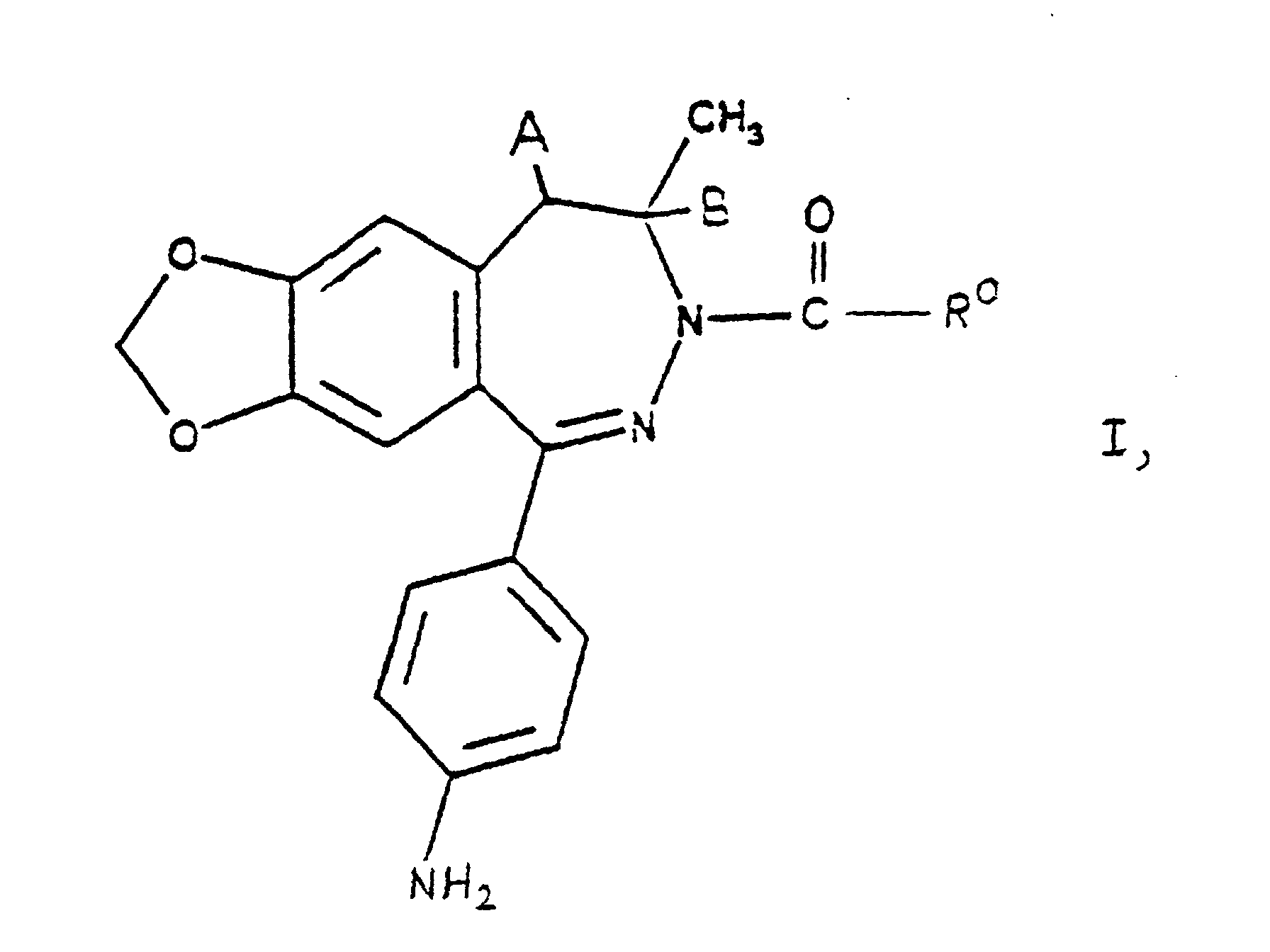
- a) A and B represent hydrogen or together form a
valence bond
and- R0
- stands for a group of
formula -(CH2)m-R,
wherein- R
- represents a halogen atom or a
group of formula -NR3R4,
wherein- R3
- represents hydrogen and
- R4
- means C3-6 cycloalkyl, C1-4 alkoxy, amino or C1-4 alkyl, which latter is substituted by a saturated heterocyclic group having 5 or 6 members and comprising 1 nitrogen atom or 1 nitrogen atom and 1 oxygen atom as the heteroatom(s),
- R3 and R4
- mean, independently
from each other,
C3-6 cycloalkyl,
C1-4 alkoxy,
amino or C1-4 alkyl,
which latter is
substituted by
a saturated
heterocyclic group
having 5 or 6
members and
comprising 1
nitrogen atom or 1
nitrogen atom and 1
oxygen atom as the
heteroatom(s),
or - R3 and R4
- together form with
the adjacent
nitrogen atom and
optionally with an
oxygen atom a
saturated
heterocyclic group
having 5 or 6
members
and
- m
- is 0, 1 or 2
or
- b) A and B together form a valence bond,
- R0
- stands for a group of
formula -(CH2)m-R, wherein
- R
- additionally to the meanings
defined under a) alternatively
represents a group of formula
- NR3R4,
wherein- R3 and R4
- mean, independently
from each other,
hydrogen or
unsubstituted C1-4
alkyl
and
- m
- is 0
or
- c) A and B represent hydrogen,
- R0
- stands for a group of
formula -(CH2)m-R, wherein
- R
- additionally to the meanings
defined under a) alternatively
represents a group of formula
-NR3R4, wherein
- R3
- means a hydrogen atom and
- R4
- stands for an
unsubstituted C2-4 alkyl
group
and
- m
- is 0,
-
- Several 2,3-benzodiazepine derivatives having biological activity are known.
- Tofisopam i.e. 1-(3,4-dimethoxyphenyl)--5-ethyl-7,8-dimethoxy-4-methyl-5H-2,3--benzodiazepine having anxiclytic effect is known from HU-P Nc. 155 572 and GB-P No. 1 202 579, respectively. The known compound does not comprise the ring system 1,3-dioxolo/4,5-h//2,3/benzodiazepine.
- From HU-P No. 186 760, 7,8-dihydro-8--methyl-9H-1,3-dioxolo/4,5-h//2,3/benzodiazepine derivatives having effect on the central nervous system are known, among others. The known compounds are prepared by reducing the corresponding 8-methyl-9H-1,3-dioxolo/4,5-h//2,3/benzodiazepine derivative.
- Various substituted 8-methyl-9H-1,3--dioxolo/4,5-h//2,3/benzodiazepine derivatives are known from HU-P No. 191 698 and the corresponding GB-P No. 2 162 184. The known compounds have antiaggressive and anxiolytic activities.
- A novel process for the preparation of partly new 8-methyl-9H-1,3-dioxolo/4,5-h//2,3/benzodiazepine derivatives having antiaggressive activity is known from HU-P No. 191 702. According to the novel process, the suitably substituted 2-acetonyl-4,5--methylenedioxybenzophenone is reacted with an excess of hydratine hydrate.
- Further 7,8-dihydro-8-methyl-9H-1,3--dioxolo/4,5-h//2,3/benzodiazepine derivatives having antidepressant and antiparkinsonian activities are known from HU-P No. 206 719.
- Some of the 2,3-benzodiazepine derivatives elicit their effect through the non-competitive inhibition of the AMPA/kainate receptors /Donevan, S.D. et al., J. Pharmacol. Exp. Ther., 271, 25-29 (1994)/.
- From the literature it is known that AMPA/kainate receptors play an important role in the acute and chronic diseases of the central nervous system. Through the inhibition of these receptors, muscle relaxant, neuro-protective and anticonvulsive effects can be achieved /Vizi, E.S. et al., CNS Drug Reviews, 2, 91-126 (1996); Lees, G.L., CNS Drugs, 5, 51-74 (1996)/.
- From WO 96/04283 there have been known 3-substituted 3H-2,3-benzodiazepine derivatives of general formulain which R1 und R2 are identical or different and mean hydrogen, C1-C6-alkyl, nitro, halogen, the group -NR8R9 or O-C1-4-alkyl or -CF3, R3 stands for the group
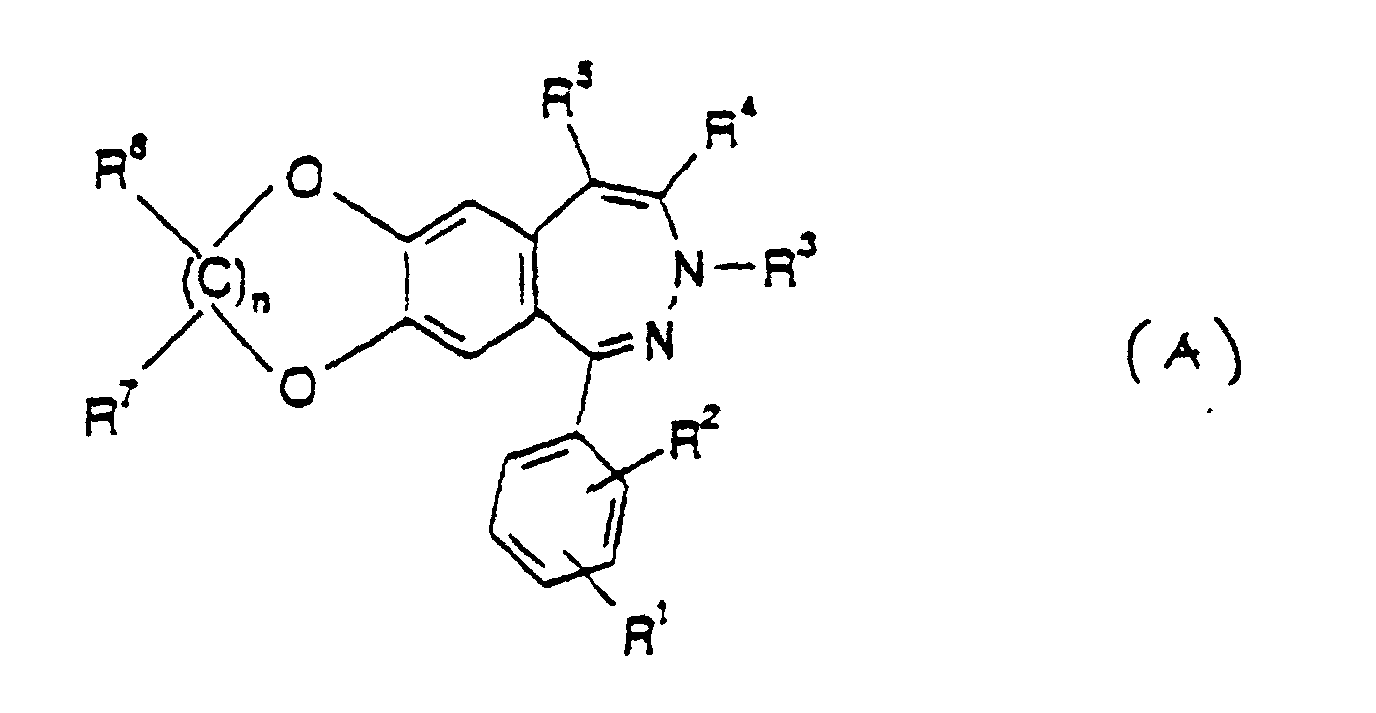 R4 represents C1-C6-alkyl, optionally substituted, R5 means hydrogen or C1-C6-alkyl, optionally substituted, R6 and R7 are identical or different and stand for hydrogen, C1-C6-alkyl, optionally substituted, or aryl, optionally substituted , R8 and R9 are identical or different and represent hydrogen, C1-C6-alkyl or the group
 R10 means hydrogen, C1-C6-alkyl, optionally substituted, aryl, optionally substituted, the group -NR11R12, -O-C1-6-alkyl, C3-7-cycloalkyl, C2-6-alkenyl or -O-C3-7-cycloalkyl, R11 and R12 are identical or different and stand for hydrogen, C1-C6-alkyl, optionally substituted, or aryl, optionally substituted; R13 means C1-C6-alkyl and n stands for 1, 2 or 3, and their physiologically tolerated salts and isomers. Specifically also compounds in which R1 is 4-NH2, R2 is hydrogen, R3 is alkoxycarbonyl (R10 being alkoxy), such as ethoxycarbonyl or methoxycarbonyl, R4 is methyl, R5, R6 and R7 are hydrogen atoms and n is 1 have been disclosed (Examples 46 and 47). Furthermore the activity of these compounds regarding diseases of the central nervous system, such as the inhibition of the AMPA-receptors, has been described.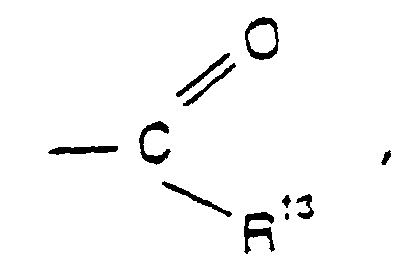
- In WO 95/01357 there have been described enantiomers of 1- (4-nitrophenyl)-4-methyl-7,8--methylenedioxy-3,4-dihydro-5H-2,3-benzodiazepine of formulaHowever, these compounds compulsorily are not substituted on the ring nitrogen atom in the 3 position but contain a hydrogen atom. Moreover the activity of these compounds regarding diseases of the central nervous system, such as the inhibition of the AMPA--receptors, has been described.

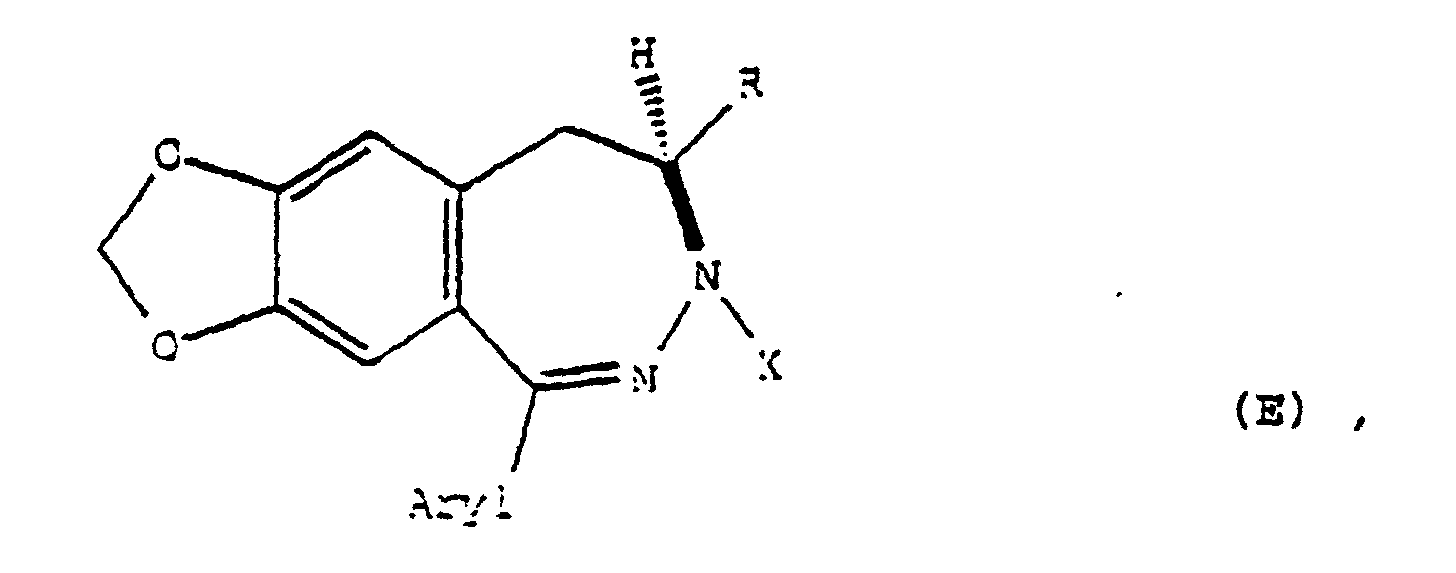
- From EP 699 678 there has been known compounds of general formulain which R is methyl, X is acetyl and Aryl is p-aminophenyl or p-nitrophenyl, that with Aryl = p--aminophenyl in a physical form having an X-ray powder diffraction pattern with d spacings al 12.78, 9.48, 8.99, 8.64, 8.23, 6.39, 6.27, 5.73, 4.01 and 3.96 Å. However, these compounds compulsorily contain an unsubstituted acetyl group on the ring nitrogen atom in the 3 position. Furthermore for the compound in which Aryl stands for p-aminophenyl the activity regarding diseases of the central nervous system, such as the inhibition of the AMPA-receptors, has been described.

- Moreover in EP 492 485 there have been described N-acyl-2,3-benzodiazepine derivatives of general formulawherein R stands for a C1-6 aliphatic acyl group, optionally substituted by a methoxy, cyano, carboxyl, amino, C1-4 alkylamino, di(C1-4 alkyl)amino, pyrrolidino, phthalimido or phenyl group, or by one or more halogen(s); or R is a benzoyl, cyclopropanecarbonyl, C1-5 alkylcarbamoyl or phenylcarbamoyl group; or R is absent when a double bond exists between the N(3) and C(4) atoms; R1 means hydrogen; or R1 is absent when a double bond exists between the N(3) and C(4) atoms; R2 means a C1-3 alkyl group; or R1 and R2 together stand for a methylene group and no double bond is present between the N(3) and C(4) atoms; R3 means hydrogen or a C1-4 aliphatic acyl group; R4 represents hydrogen; a C1-6 aliphatic acyl group optionally substituted by a methoxy, cyano, carboxyl, amino, C1-4 alkylamino, di(C1-4 alkyl)amino, pyrrolidino, phthalimido or phenyl group or by one or more halogen(s); as well as a benzoyl, palmitoyl, cyclopropanecarbonyl, C1-5 alkylcarbamoyl or phenylcarbamoyl group; and the dotted lines represent valence bonds, optionally being present, with the proviso that no double bond exists between the N(3) and C(4) atoms when both R3 and R4 stand for hydrogen, and their stereoisomers as well as acid-addition salts (where possible) of these compounds. Thus also compounds are comprised in which R is an acyl group, substituted by an amino or di-(alkyl)-amino group, R1 is a hydrogen, R2 is a C1-3 alkyl group and R3 and R4 are hydrogen atoms. Furthermore the activity of these compounds on the central nervous system, particularly muscle-relaxant, anticonvulsive and neuro-protective action, has been described no mention being made of an inhibition of AMPA-receptors.

- Furthermore from EP 699 677 there have been known dihydro-2,3-benzodiazepine derivatives of general formulawherein R is hydrogen or a C1-C10 alkyl: and X is hydrogen, C1-C10 alkyl, acyl, aryl, carboxyl or a substituted derivative thereof, or a protecting group, or a pharmaceutically acceptable salt thereof. As acyl group for which X can stand specifically a carbamoyl or N-methylcarbamoyl group and as "aryl" specifically a p-nitrophenyl, p-aminophenyl or p-(C1-C6 alkanoylamino)-phenyl have been mentioned. Furthermore also the activity of inhibiting the AMPA-receptors has been described without test data.
- The aim of the invention is to prepare novel 2,3-benzodiazepine derivatives that are more effective and less toxic, respectively, than the known 2,3-benzodiazepine derivatives.
- It was found that the above aim is achieved by the novel 1,3-dioxolo/4,5-h//2,3/benzodiazepine derivatives which have - due to their non-competitive AMPA/kainate effect - considerable muscle relaxant, neuroprotective and anticonvulsive activities. Thus, the novel compounds can be employed for the treatment of any diseases (such as epilepsy, diseases resulting in muscle spasm, various neurodegenerative diseases. stroke,) in which the inhibition of the AMPA/kainate receptors is favourable.
- In the description and claims, in the definition of the substituents, under a halo atom primarily a fluoro, chloro, bromo or iodo atom, preferably a fluoro or a chloro atom is meant.
- A C1-4 alkyl group is a methyl, ethyl, n-propyl, isopropyl, n-butyl, sec.-butyl, tert.-butyl or isobutyl group. Preferably, a C1-4 alkyl group is a methyl, an ethyl or an isopropyl group.
- A C1-4 alkoxy group is, primarily, a methoxy, ethoxy, n-propoxy, isopropoxy or n-butoxy group, preferably a methoxy group.
- A C3-6 cycloalkyl group is a cyclopropyl, cyclobutyl, cyclopentyl or cyclohexyl group, preferably a cyclopropyl group.
- A saturated heterocyclic group having 5 or 6 members and comprising 1 nitrogen atom or a nitrogen atom and an oxygen atom as the heteroatom is preferably a morpholino group.
- Under a pharmaceutically suitable acid addition salt an acid addition salt formed with a pharmaceutically suitable inorganic acid such as hydrochloric acid, hydrobromic acid, sulfuric acid, phosphoric acid, or with a pharmaceutically suitable organic acid such as formic acid, acetic acid, fumaric acid, maleic acid, lactic acid, malic acid, tartaric acid, succinic acid, citric acid, methanesulfonic acid, is meant.
- The invention includes any isomers of the compounds of the formula I and the mixtures thereof.
- Under the isomers of the compounds of the formula I - due to the presence of at least one chiral centre - both enantiomers, and - because of isomerisms that exist in case of certain substitutions - the isomers E and Z, diastereomers, tautomeric forms, and the mixtures thereof such as the racemate are meant.
- A preferred subgroup of the compounds of the formula I consists of the 7,8-dihydro-8-methyl-9H-1,3--dioxolo/4,5-h//2,3/benzodiazepine derivatives,
wherein - A and B
- represent hydrogen atoms
and
the halogen atom which may be represented by R is a chloro atom
or
the cycloalkyl group for which- R3 and/or R4
- may stand, is/are [a] cyclopropyl group(s) and
- m
- is as above defined
- Suitable 7,8-dihydro-8-methyl-9H-1,3-dioxolo/4,5-h//2,3/benzodiazepine derivatives are the following compounds of the formula I, wherein
- A and B
- represent hydrogen atoms,
the alkyl group(s) for which R3 and/or R4 may stand is/are [a] C1-2 alkyl group(s)
and
the heterocyclic group by which the alkyl group(s), for which R3 and/or R4 may stand, may be substituted or the heterocyclic group which may be formed by R3 and/or R4 with the adjacent nitrogen atom and with an oxygen atom is a morpholino group
and - m
- has a value of 0 or 1,
- The especially preferred 7,8-dihydro--8-methyl-9H-1,3-dioxolo/4,5-h//2,3/benzodiazepine derivatives are the following compounds of the formula I, wherein
- A and B
- represent hydrogen atoms,
- R3
- represents a hydrogen atom,
- R4
- stands for a cyclopropyl group or an amino
group
and - m
- has a value of 0
- Another preferred subgroup of the compounds of the invention consists of the 8-methyl-7H-1,3-clioxolo/4,5-h//2,3/benzodiazepine derivatives of the formula I, wherein
- A and B
- together form a valence bond,
and
the halogen atom which may be represented
by R is a chloro atom
or
the alkyl group(s) for which
the heterocyclic group(s), by which the alkyl group(s), for which R3 and/or R4 may stand, may be substituted, is/are [a] morpholino group(s)
and - m
- has a value of 0, 1 or 2,
- The 1,3-dioxolo/4,5-h//2,3/benzodiazepine derivatives of the formula I, wherein A, B and R0 are as above defined are prepared as follows:
- a) for the preparation of a compound of the formula
I, wherein R0 represents a group of the formula
-(CH2)m-R, in which R stands for a halogen atom, m
has a value of 0, 1 or 2 and A and B represent
hydrogen atoms, the 7,8-dihydro-8-methyl-5-(4--nitrophenyl)-9H-1,3-dioxolo/4,5-h//2,3/benzodiazepine
of the formula III
is reacted with a reagent of the formula VI
 wherein Y represents a leaving group and R5 is a halogen atom and the obtained compound in which instead of the amino group on the phenyl ring of the formula I there is a nitro group and R0, A and B are as defined in connection with the formula I, is transformed into a compound of the formula I by reduction;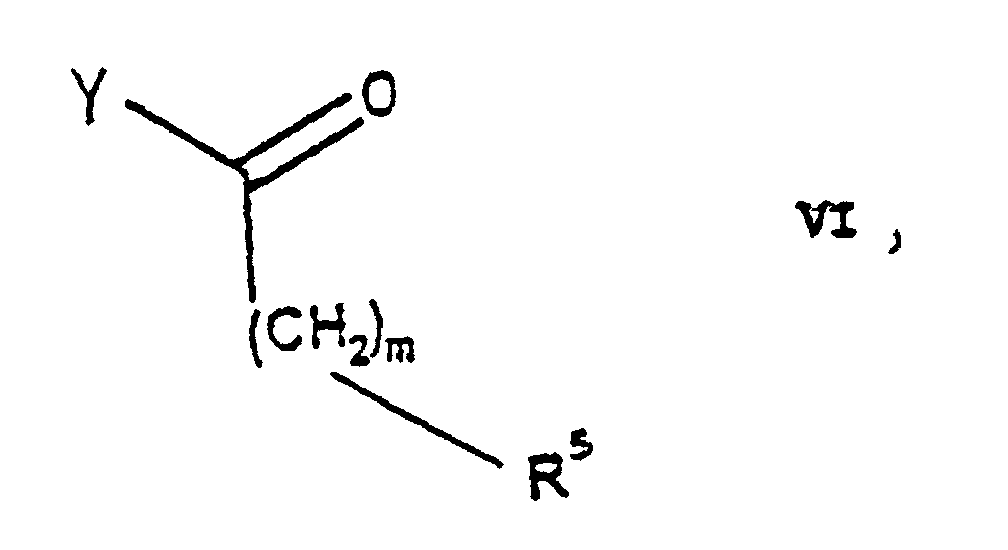
or - b) for the preparation of a compound of the formula
I, wherein R0 represents a group of the formula
-(CH2)m-R, wherein R stands for a group of the
formula -NR3R4, in which R3, R4 and m are as
defined in connection with formula I and A and B
represent hydrogen atoms, the 7,8-dihydro-8--methyl-5-(4-nitrophenyl)-9H-1,3-dioxolo/4,5--h//2,3/benzodiazepine
of the formula III is
reacted with a reagent of the formula VI, wherein
Y and R5 represent, independently, a leaving group
and m is as stated above, and the obtained
benzodiazepine derivative of the formula IV
wherein X stands for a leaving group, m is as stated above, is reacted with an amine of the formula VII
 wherein R3 and R4 are as stated above and the obtained compound in which instead of the amino group on the phenyl ring of the formula I there is a nitro group and R0, A and B are as defined in connection with the formula I, is transformed into a compound of the formula I by reduction;
or - c) for the preparation of a compound of the formula
I, wherein R0 stands for a group of the formula
- (CH2)m-R, in which R represents a halogen atom, m
has a value of 0, 1 or 2 and A forms together with
B a valence bond, the 8-methyl-5-(4-nitrophenyl)--
9H-1,3-dioxolo/9,5-h//2,3/benzodiazepine of the
formula II
is reacted with an acylating agent of the formula IX
 wherein Y represents a leaving group, X' stands for a halogen atom and m has a value of 0, 1 or 2 and the obtained compound in which instead of the amino group on the phenyl ring of the formula I there is a nitro group and R0, A and B are as defined in connection with the formula I, is transformed into a compound of the formula I by reduction;
or - d) for the preparation of a compound of the formula
I, wherein R0 stands for a group of the formula
-(CH2)m-R, in which R represents a group of the
formula -NR3R4, wherein R3, R4 and m are as defined
in connection with the formula I and A forms
together with B a valence bond, the 8-methyl-5-(4--nitrophenyl)-9H-1,3-dioxolo-/4,5--h//2,3/benzodiazepine
of the formula II is
reacted with an acylating agent of the formula IX,
wherein each of Y and X' represent, independently
from each other, a leaving group and m is as
stated above, and the obtained acylated compound
of the formula VIII
wherein X' and m are as defined above, is reacted with an amine of the formula HNR3R4, wherein R3 and R4 are as stated above; and the obtained compound in which instead of the amino group on the phenyl ring of the formula I there is a nitro group and R0, A and B are as defined in connection with the formula I, is transformed into a compound of the formula I by reduction;
 and, if desired, an obtained base of the formula I is
converted to a pharmaceutically suitable acid addition salt or
liberated from the acid addition salt.
and, if desired, an obtained base of the formula I is
converted to a pharmaceutically suitable acid addition salt or
liberated from the acid addition salt. -
- The reagent of the formula VI is an acylating agent, such as a carboxylic halide, a carboxylic anhydride, a carbonate ester, carbonyldiimidazole, an omega-halocarboxylic halide or an omega-halocarbonate ester. The acylation is carried out in the presence or absence of an acid binding agent and/or pyridine, at a temperature of -20 to +150 °C, in the presence or absence of an organic solvent.
- The reaction of the benzodiazepine derivative of the formula IV and the amine of the formula VII is carried out in a manner known from the literature /Houben-Weyl: Methoden der Organischen Chemie, Band XI, Amine, G. Thieme Verlag, Stuttgart, 1957; S. Patai: The chemistry of amine group, Interscience Publishers, 1968/.
- The acylation of the compound of the formula II with the acylating agent of the formula IX and the amination of the compound of the formula VIII with the amine of the formula HNR7R8 are performed in a similar manner as described above.
- The nitro compounds of the formula I can be reduced in a manner known in itself to obtain the corresponding amino compound. The reduction can be carried out for example with tin(II) chloride or in the presence of a catalyse using a hydrogen source. For example, the catalyse can be Raney nickel, palladium or platinum oxide, the hydrogen source is, for example, hydrazine, hydrazine hydrate, formic acid, a trialkylammonium formate or an alkali metal formate.
- If desired, a base of the formula I is reacted with an inorganic or organic acid to transform it into a pharmaceutically suitable acid addition salt, or the base of the formula I is libereted from the acid addition salt using a stronger base.
- The starting compound 7,8-dihydro-8--methyl-5-(4-nitrophenyl)-9H-1,3-dioxolo/4,5-h//2,3/benzodiazepine of the formula III can be prepared by reducing 8-methyl--5-(4-nitrophenyl)-9H-1,3-dioxolo/4,5-h//2,3/benzodiazepine of the formula II in an analogous manner as described in the literature /Houben-Weyl: Methoden der Organischen Chemie, Band IV, Reduktion, G. Thieme Verlag, Stuttgart, 1989/ or using the processes known from HU-P No. 186 760.
- The compound of the formula II can be prepared by the process known from HU-P No. 191 702.
- The reagents of the formulae VI and IX as well as the amines of the formula VII are commercially available.
- The pharmacological effect of the novel compounds of the formula I was studied by in vitro and in vivo methods. 8-Methyl-5--(4-aminophenyl)-9H-1,3-dioxolo/4,5-h//2,3/benzodiazepine (compound "A") known from HUP No. 191 698 and GB-P No. 2 162 184 was used as the reference substance.
- The field potentials (population spike) evoked by electric stimulation of the Shaffer collateral comissural pathway were measured in the CAl neurones of rat hippocampus. The population spike can be inhibited by AMPA/kainate antagonists. The non-cumulative IC50 values are shown in Table I. /Tarnawa, I., Molnár, P., Gaál, L., Andrási, F.: Inhibition of hippocampal field potentials by GYKI 52466 in vitro and in vivo, Acta Physiol. Hung., 79(2), 163-9 (1992)/.
- The method is based on the phenomenon of spreading depression evoked by kainate in isolated retinal preparation of the chicken. The formation of spreading depression is inhibited (delayed) by AMPA/kainate antagonists. /Sheardown M.J.: The triggering of spreading depression in the chicken retina: a pharmacological study, Brain Res., 607(1-2), 189-194 (1993)/. The obtained IC50 values are shown in Table I.
Results obtained in tests suitable for the determination of in vitro AMPA antagonist effect Compound (No. of Example) Percent inhibition of population spike (10 micron) SD IC50 in microM 2 100 1.3 3 95 1.5 4 95 no data 6 no data 6.5 11 no data 2.8 "A" 58 9.5 - As shown in Table I, the inhibitory effects of the novel compounds are significantly higher than that of reference compound "A".
- The assay was done according to Hoppe in male NMRI mice weighing 20 to 25 g, with 10 animals in each group /Hoppe, J.O., J . Pharmacol. Exp. Ther., 100, 333 (1950)/. Following the ip. treatment of animals, the number of mice showing muscle weakness were recorded at every 10 minutes in the first hour and at half hour intervals afterwards. The animals falling off the 60° inclined screen within 30 seconds were considered positive. ED50 values of the given compounds were determined at each time. The duration of effect was defined as the time of last reading when the effect was at least 30 %. The results obtained are summarized in Table II.
Muscle relaxant effect Compound (No. of Example) Muscle relaxant ED50 ip, in mg/kg effect duration in hr 2 21.1 higher than 2 3 18.1 4 "A" 24.5 1 - Although the muscle relaxant activity of the novel compounds are about the same as that of reference compound "A", the duration of action is significantly longer as shown in Table II.
- Male NMRI mice weighing 20 to 30 g were used for the method of Swinyard et al. /Swinyard, E.A., Brown, W.C. and Goodman, L.S.: Comparative assays of antiepileptic drugs in mice and rats, J. Pharmacol., 106, 319 (1952)/. The animals, 10 in each group, were treated ip. either with various doses of the test substance or with vehicle. After 30 minutes, a 50 Hz, 40 mA electroshock was applied for 0.4 s through corneal electrodes. The number of animals that developed tonic extensor convulsion of the hind-limbs was registered, percent inhibition was calculated, and ED50 values were determined by the method of Litchfield and Wilcoxon /Litchfield, J.T., Wilcoxon, F.A.: A simplified method of evaluating dose-effect experiments, J. Pharmacol. Exp. Ther., 96, 99 (1949)/ and summarized in Table III.
- The experiments were carried out by the slightly modified method of De Sarro et al. /De Sarro, G.B., Croucher, M.J. and Meldrum, B.S.: Anticonvulsant action of DS 103-282, Neuropharm., 23, 525 (1984)/. Groups of 8 male DBA/2j strain mice weighing 7 to 14 g were treated ip. with the test substance in 10 ml/kg volume. 15 minutes later, the animals were placed into a covered glass container (30 cm in diameter) and exposed to a 14 kHz 120 dB tone for 60 s at the most. Seizure response was assessed using the following scale: 0 = normal behaviour, 1 = wild running, 2 = clonus, 3 = tonic flexor seizure, 4 = tonic extensor seizure. The maximum response during the 60 s exposure was recorded for each animal. Lethality was also noted. The ED50 values were determined by the method of Litchfield and Wilcoxon concerning the inhibition of clonic seizures and tonic extensor convulsions. The results are summarized in Table III.
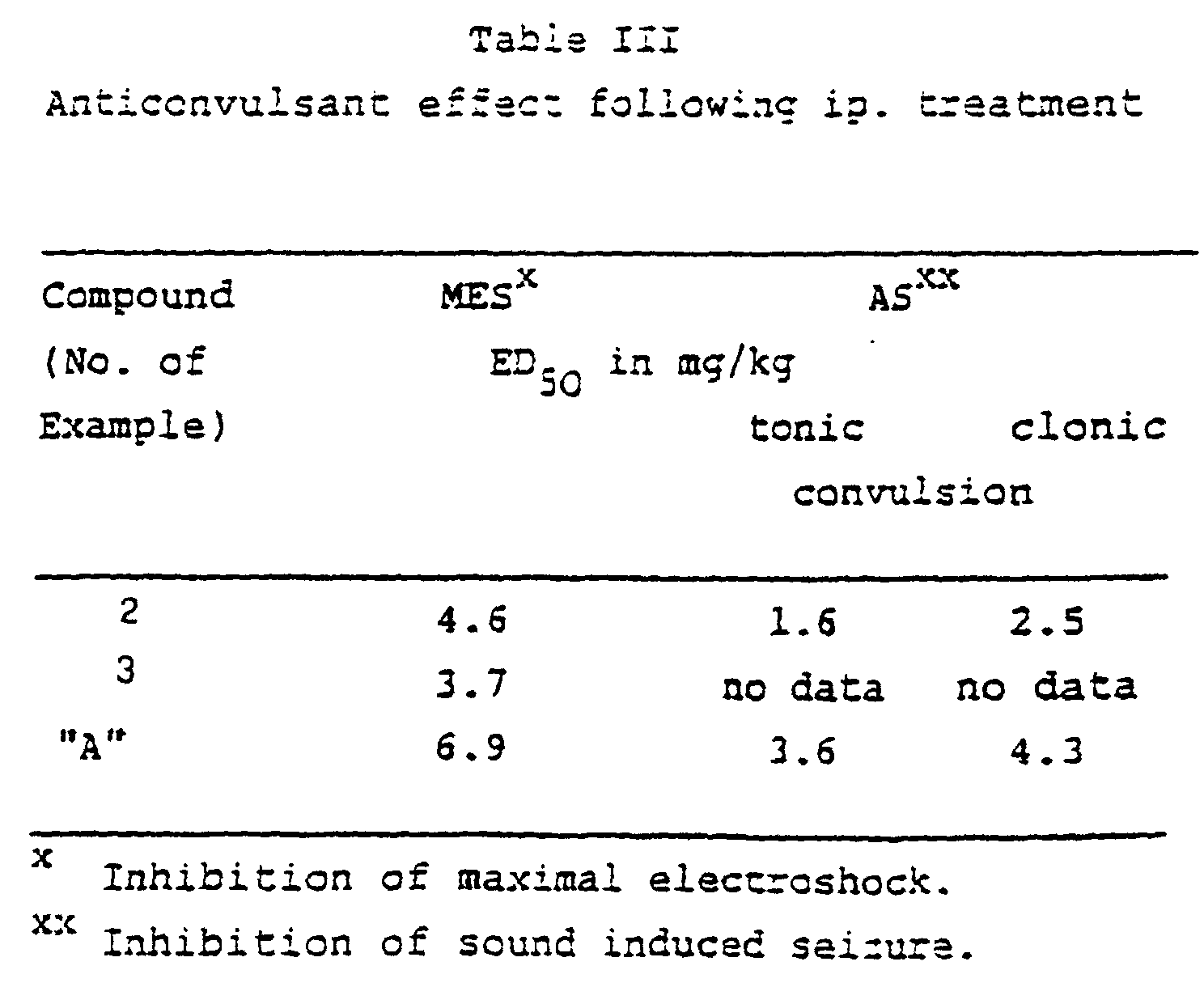
- The novel compounds are significantly more effective at the inhibition of maximal electroshock and audiogenic seizure than the reference compound "A" as shown in Table III.
- The compound of Example 6 has an approximate anticonvulsive ED50 value of 10 mg/kg ip. in the MES test (not shown in Table III), while in 60 mg/kg dose it has no muscle relaxant effect in the inclined screen. In contrast, the anticonvulsive ED50 value of the reference compound "A" is 6.9 mg/kg, however, at about 4.5 times higher dose, the reference compound produces about 50 % muscle relaxant effect, and at 60 mg/kg dose all the treated animals showed muscle relaxation. Since strong muscle relaxation may seriously limit the therapeutic application of a drug, the lack of muscle relaxant effect of some novel compounds of the invention provides potential advantage over reference compound "A" in the clinical use.
- The experiments were carried out as described by Berga et al. /Berga, P., Beckett, P.R., Roberts, D.J., Llenas, J., Massingham, R.: Synergistic interactions between piracetam and dihydroergocristine in some animal models of cerebral hypoxia and ischemia, Arzneim.--Forsch., 36, 1314-1320 (1986)/. Groups of 10 male NMRI mice weighing 20 to 25 g were treated ip. with the test substance in 10 mg/kg volume. After 30 minutes, saturated aqueous magnesium chloride solution was applied iv. (5 ml/kg) resulting in an immediate cardiac arrest. The elapsed time between the iv. injection and the last gasping was measured (gasping time). The means of the treated groups were expressed as percent of control. Statistical analysis was done by ANOVA followed by DUNCAN test. The dose resulting in 50 % descrease in gasping time (ID50) was calculated by linear regression. The results are shown in Table IV.
Increase in gasping time in the magnesium chloride induced global ischemia test in mice Compound (No. of Example) Dose in mg/kg ip. Effect in % ID50 in mg/kg ip. 2 30 61 13 3 30 52 27 "A" 30 55 30 - From Table IV it can be seen that the novel compound of Example 16 is as effective at neuroprotection in 13 mg/kg dose as the reference compound "A" in 30 mg/kg dose.
- Thus, the novel 8-substituted-9H--1,3-dioxolo/4,5-h//2,3/benzodiazepine derivatives of the formula I can be used as active ingredients of pharmaceutical compositions.
- On the basis of the above test results, the novel compounds of the invention - due to their competitive AMPA/kainate antagonist property - have considerable muscle relaxant, neuroprotective and anticonvulsive effects. Consequently, the novel compounds can be used for the treatment of any disease such as epilepsy, diseases resulting in muscle spasm, neurodegenerative diseases, spates after stroke, migraine and vomiting, wherein the inhibition of the AMPA/kainate receptors may have a favourable effect.
- Some compounds of the invention which possess considerable anticonvulsive and neuroprotective activities, while they have no or weak muscle relaxant effect, can be primarily applied as antiepileptics. In the course of their application, the lack of muscle relaxant action provides notable benefit over the known AMPA/kainate antagonist 2,3-benzodiazepine derivatives.
- The pharmaceutical compositions of the invention contain a therapeutically active amount of a compound of the formula I or a pharmaceutically suitable acid addition salt thereof and one or more conventional carrier(s).
- The pharmaceutical compositions of the invention are suitable for peroral, parenteral or rectal administration or for local treatment, and can be solid or liquid.
- The solid pharmaceutical compositions suitable for peroral administration may be such as powders, capsules, tablets, film-coated tablets and microcapsules, and can comprise binding agents such as gelatine, sorbitol and poly (vinylpyrrolidone); filling agents such as lactose, glucose, starch and calcium phosphate; auxiliary substances for tabletting such as magnesium stearate, talc, poly (ethyleneglycol) and silica; wetting agents such as sodium laurylsulfate, as the carrier.
- The liquid pharmaceutical compositions suitable for peroral administration may be solutions, suspensions or emulsions and can comprise e.g. suspending agents such as gelatine and carboxymethylcellulose; emulsifiers such as sorbitane monooleate; solvents such as water, oils, glycerol, propyleneglycol and ethanol; preservatives such as methyl p-hydroxybenzoate, as the carrier.
- Pharmaceutical compositions suitable for parenteral administration consist of sterile solutions of the active ingredient, in general.
- Dosage forms listed above as well as other dosage forms are known per se, see e.g. Remington's Pharmaceutical Sciences, 18th Edition, Mack Publishing Co., Easton, USA (1990).
- The pharmaceutical compositions of the invention contain, in general, 0.1 to 95.0 per cent by mass of a compound of the formula I or a pharmaceutically suitable acid addition salt thereof. A typical dose for adult patients amounts to 0.1 to 20 mg of the compound of the formula I or a pharmaceutically suitable acid addition salt thereof, daily. The above dose can be administered in one or more portions. The actual dosage depends on many factors and is determined by the doctor.
- The pharmaceutical compositions of the invention are prepared by admixing a compound of the formula I or a pharmaceutically suitable acid addition salt thereof to one or more carrier(s), and converting the mixture obtained to a pharmaceutical composition in a manner known per se. Useful methods are known from the literature, e.g. Remington's Pharmaceutical Sciences.
- In the pharmaceutical compositions of the invention in the active ingredients the preferred meanings of the symbols in formula I are the same as above defined regarding the compounds of formula I as such.
- Furthermore the invention refers to the use of the above 1,3-dioxolo[4,5-h][2,3]-benzodiazepines for preparing medicaments for the treatment of epilepsy or a neurodegenerative disease or a state after stroke.
- The invention is further elucidated, in detail, by means of the following Examples.
- A general process for reducing the nitro group of the starting compounds used in the following Examples 1 to 4 by catalytical hydrogenation
- 5.0 mmoles of the nitro compound are dissolved in a mixture of 100 cm3 of dichloromethane and 100 cm3 of methanol, and the solution is hydrogenized in the presence of 0.10 g of 10 % palladium/carbon catalyst at room temperature and 5.065x10⁵ Pa pressure. Following the hydrogenization, the catalyst is filtered, the solvent is evaporated under reduced pressure, and the crude product is recrystallized.
- For the preparation see the general process above described using the appropriate nitro compound (see below).
- Solvent for crystallization: dichloromethane.
M.p.: 262-264 °C.
Yield: 66 %.Analysis: for C24H29N5O4 (451.53) calculated C 63.84 %, H 6.47 %, N 15.51 %; found C 63.96 %, H 6.41 %, N 15.30 %. - (±)-7,8-Dihydro-8-methyl-7-/N-(4-morpholinoethyl)carbamoyl/-5-(4-nitrophenyl)-9H-1,3--dioxolo/4,5-h//2,3/benzodiazepine has been prepared as follows.
- 2.09 g (5.0 mmoles) of the imidazolide derivative (±)-7,8-Dihydro-8-methyl-5-(4-nitrophenyl)-9H--1,3-dioxolo/4,5-h//2,3/benzodiazepine-7--carboxylic acid-imidazolide prepared as described below are suspended in 100 cm3 of dichloromethane, and, to the suspension, 1.44 g (1.44 cm3, 11.0 mmoles) of (4-morpholinoethyl)amine are added. The reaction mixture is boiled for 10 hours, then washed three times using 30 cm3 of water each time, dried over anhydrous magnesium sulfate, and evaporated under reduced pressure. The crude product is crystallized from 85 cm3 of acetonitrile, the crystals are washed with 10 cm3 of diethyl ether.
- Thus, 1.83 g (76 %) of (±)-7,8-Dihydro-8-methyl-7-/N-(4-morpholinoethyl)carbamoyl/-5-(4-nitrophenyl)-9H-1,3--dioxolo/4,5-h//2,3/benzodiazepine
are obtained. M.p.: 198-203 °C.
1H NMR (CDCl3): δ 8.24 (2H, d, J=8.9 Hz), 7.68 (2H, d, J=8.9 Hz), 7.07 (1H, t, J=5.0 Hz), 6.73 (1H, s), 6.47 (1H, s), 6.01 (1H, s), 6.01 (1H, s), 6.00 (1H, s), 5.45 (1H, m), 3.71 (4H, m), 3.42 (2H, m), 3.12 (1H, dd, J=14.6 and 2.1 Hz), 2.87 (1H, dd, J=14.7 and 6.6 Hz), 2.55 (2H, m), 2.49 (4H, m), 0.97 (3H, d, J=6.6 Hz). - The (±)-7,8-Dihydro-8-methyl-5-(4-nitrophenyl)-9H--1,3-dioxolo/4,5-h//2,3/benzodiazepine-7-- carboxylic acid-imidazolide used above as starting substance has been prepared as follows.
- 3.25 g (10.0 mmoles) of (±)-7,8-dihydro--8-methyl-5-(4-nitrophenyl)-9H-1,3-dioxolo/4,5-h//2,3/benzodiazepine and 1.95 g (12.0 mmoles) of 1,1'-carbonyldiimidazole are boiled in 75 cm3 of anhydrous tetrahydrofuran for 20 hours. The reaction mixture is cooled with ice-water, the product precipitated is filtered, and washed with 50 cm3 of diethyl ether.
- Thus, 3.58 g (85 %) of (±)-7,8-Dihydro-8-methyl-5-(4-nitrophenyl)-9H--1,3-dioxolo/4,5-h//2,3/benzodiazepine-7--carboxylicacid-imidazolide
are obtained. M.p.: 244-248 °C.
1H NMR (CDCl3): δ 8.26 (2H, d, J=9.0 Hz), 7.91 (1H, s), 7.75 (2H, d, J=9.0 Hz), 7.31 (1H, s), 7.04 (1H, s), 6.88 (1H, s), 6.53 (1H, s), 6.08 (1H, d, J=1.3 Hz), 6.05 (1H, d, J=1.3 Hz), 5.24 (1H, m), 2.99 (1H, dd, J=14.5 and 4.8 Hz), 2.78 (1H, dd, J=14.6 and 10.2 Hz), 1.40 (3H, d, J=6.4 Hz). - For the preparation see the general process above described using the appropriate nitro compound (see below).
Solvent for crystallization: ethanol.
M.p.: 158-160 °C.
Yield: 72 %.Analysis: for C21H22N4O3 (378.43) calculated C 66.65 %, H 5.85 %, N 14.80 %; found C 65.96 %, H 6.09 %, N 14.52 %. - The starting compound (±)-7-(N-Cyclopropylcarbamoyl)-7,8-dihydro-8--methyl-5-(4-nitrophenyl)-9H-1,3-dioxolo/4,5-h//2,3/benzodiazepine has been prepared as follows.
- 2.09 g (5.0 mmoles) of the imidazolide derivative (±)-7,8-Dihydro-8-methyl-5-(4-nitrophenyl)-9H--1,3-dioxolo/4,5-h//2,3/benzodiazepine-7--carboxylicacid-imidazolide prepared as described at the end of Example 1 are boiled in 30 cm3 of cyclopropylamine for 4 hours, then the amine is distilled off under reduced pressure. The residue is taken up in 75 cm3 of dichloromethane, washed three times using 30 cm3 of water each time, dried over anhydrous magnesium sulfate, and evaporated under reduced pressure. The crude product is crystallized from 50 cm3 of ethanol, and washed with 10 cm3 of diethyl ether.
- Thus, 1.59 g (78 %) of (±)-7-(N-Cyclopropylcarbamoyl)-7,8-aihydro-8--methyl-5-(4-nitrophenyl)-9H-1,3-dioxolo/4,5-h//2,3/benzodiazepine
are obtained. M.p.: 198-203 °C.
1H NMR /(CD3)2SO/: δ 8.23 (2H, d, J=8.8 Hz), 7.77 (2H, d, J=8.( Hz), 6.99 (1H, s), 6.85 (1H, d, J=2.8 Hz), 6.48 (1H, s), 6.07 (2H, s), 5.20 (1H, m), 3.00 (1H, dd, J=14.5 and 2.1 Hz), 2.86 (1H, dd, J=14.5 and 7.2 Hz), 2.60 (1H, m), 0.90 (3H, d, J=6.4 Hz), 0.63 (2H, m), 0.53 (2H, m). - For the preparation see the general process above described using the appropriate nitro compound (see below).
Solvent for crystallization: ethanol.
M.p.: 159-162 °C.
Yield: 75 %.Analysis: for C19H20N4O4 (368.40) calculated: C 61.95 %, H 5.47 %, N 15.21 %; found: C 61.62 %, H 5.56 %, N 15.32 %. - The starting compound (±)-7,8-Dihydro-8-methyl-7-(N-methoxycarbamoyl)-5-(4-nitrophenyl)-9H-1,3-dioxolo/4,5-h//2,3/benzodiazepine has been prepared as follows.
- 2.03 g (25.0 mmoles) of methoxyamine hydrochloride and 3.45 g (25.0 mmoles) of potassium carbonate are stirred in 75 cm3 of anhydrous dimethylformamide for half an hour, then, 2.09 g (5.0 mmoles) of the imidazolide derivative
- (±)-7,8-Dihydro-8-methyl-5-(4-nitrophenyl)-9H--1,3-dioxolo/4,5-h//2,3/benzodiazepine-7--carboxylicacid-imidazolide prepared as described at the end of Example 1 are added. The reaction mixture is stirred for 6 hours, then the solvent is evaporated at a pressure of 55 Pa. The residue is suspended in 100 cm3 of water, stirred for half an hour, filtered, washed with 50 cm3 of water, and dried. The crude product is recrystallized from 35 cm3 of tetrahydrofuran, and washed with 10 cm3 of diethylether.
- Thus, 2.30 g (68 %) of (±)-7,8-Dihydro-8-methyl-7-(N-methoxycarbamoyl)-5-(4-nitrophenyl)-9H-1,3-dioxolo/4,5-h//2,3/benzodiazepine
are obtained. M.p.: 156-162 °C.
1H NMR /(CD3)2SO/: δ 10.00 (1H, s), 8.24 (2H, d, J=8.8 Hz), 7.90 (2H, d, J=8.8 Hz), 7.03 (1H, s), 6.51 (1H, s), 6.09 (1H, s), 6.08 (1H, s), 5.08 (1H, m), 3.63 (3H, s), 3.02 (1H, dd, J=14.4 and 3.5 Hz), 2.81 (1H, dd, J=14.4 and 8.2 Hz), 0.99 (3H, d, J=6.4 Hz). - For the preparation see the general process above described using the appropriate nitro compound (see below).
Solvent for crystallization: acetonitrile.
M.p.: 160-170 °C.
Yield: 64 %.Analysis: for C18H19N5O3 (353.38) calculated C 61.18 %, H 5.42 %, N 19.82 %; found C 59.68 %, H 5.37 %, N 19.32 %. - The starting compound (±)-7-(N-Aminocarbamoyl)-7,8-dihydro-8-methyl-5-(4-nitrophenyl)-9H-1,3-dioxolo/4,5-h//2,3/benzodiazepine has been prepared as follows.
- 2.09 g (5.0 mmoles) of the imidazolide derivative
(±)-7,8-Dihydro-8-methyl-5-(4-nitrophenyl)-9H--1,3-dioxolo/4,5-h//2,3/benzodiazepine-7--carboxylicacid-imidazolide prepared as described at the end of Example 1 are suspended in 75 cm3 of dichloromethane. To the suspension, 1.25 g (1.21 cm3, 25.0 mmoles) of 98-100 % hydrazine hydrate are added. The reaction mixture is stirred at room temperature for 10 hours, then washed three times using 30 cm3 of water each time, dried over anhydrous magnesium sulfate, and evaporated under reduced pressure. The crude product is crystallized from 45 cm3 of ethanol, and the crystals are washed with 10 cm3 of diethyl ether. - Thus, 1.04 g (54 %) of the title compound are obtained. M.p.: 219-220 °C.
1H NMR (CDCl3): δ 8.23 (2H, d, J=9.0 Hz), 7.62 (2H, d, J=9.0 Hz), 7.52 (1H, broad s), 6.73 (1H, s), 6.45 (1H, s), 6.01 (1H, d, J=1.3 Hz), 6.00 (1H, d, J=1.3 Hz), 5.38 (1H, m), 3.82 (2H, broad s), 3.12 (1H, dd, J=14.8 and 2.0 Hz), 2.86 (1H, dd, J=14.8 and 6.5 Hz), 0.99 (3H, d, J=6.6 Hz). - 5.00 g (11.0 mmoles) of (±)-7,8-Dihydro--8-methyl-7-morpholinoacetyl-5-(4-nitrophenyl)--9H-1,3-dioxolo/4,5-h//2,3/benzodiazepine prepared as described below are dissolved in 50 cm3 of ethanol. To the solution, 0.50 g of 10 % palladium/carbon catalyst suspended in 1.0 cm3 of water are added. Then, to the reaction mixture, a solution of 4.00 g (47.6 mmoles) of potassium formate in 4.0 cm3 of water are added, drop by drop. The reaction mixture is stirred at room temperature for 2 hours, then again a solution of 2.00 g (23.8 mmoles) of potassium formate in 2.0 cm3 of water are added, drop by drop. After further 2 hours' stirring, the catalyst is filtered, washed with a large quantity of ethanol, the solvent is evaporated under reduced pressure, and the residue is suspended in 100 cm3 of diethyl ether. The crystals obtained are filtered, and the crude product is recrystallized from a mixture of acetonitrile and water.
- Thus, 3.00 g (65 %) of the title compound are obtained. M.p.: 254-256 °C.
Analysis: for C23H26N4O4 (422.49) calculated N 13.26 %, H 6.20 %; found N 13.12 %, H 6.48 %. - The starting compound (±)-7,8-Dihydro-8-methyl-7-morpholinoacetyl--5-(4-nitrophenyl)-9H-1,3-dioxolo/4,5-h//2,3/benzodiazepine has been prepared as follows.
- A mixture of 6.00 g (15.0 mmoles) of (+)-7,8-dihydro-7-(2-chloroacetyl)-8-methyl-- 5-(4-nitrophenyl)-9H-1,3-dioxolo/4,5-h//2,3/benzodiazepine, 3.00 g (36.0 mmoles) of morpholine and 30 cm3 of acetonitrile is boiled for 2 hours. Then, the reaction mixture is evaporated. To the evaporation residue, 100 cm3 of diethyl ether are added, the crystals obtained are filtered, and recrystallized from a mixture of 2-propanol and water.
- Thus, 4.90 g (73 %) of the title compound are obtained. M.p. 206-208 °C.
- 2.0 g (4.17 mmoles) of 8-Methyl-5-(4-nitrophenyl)-7H-1,3-dioxolo/4,5-h//2,3/benzodiazepine-7-carboxylic acid-(2-morpholino-4-ylethyl)amide prepared as described below are transferred into a mixture of 80 cm3 of ethanol and 20 cm3 of water. To the mixture, 0.4 g of 10 % palladium/carbon catalyst, then, in 4 minutes, 4.0 cm3 (80.6 mmoles) of 98 % hydrazine hydrate are added at 15 to 20 °C. The mixture is stirred at 25 °C for 4.5 hours, the catalyst is filtered, and washed with ethanol. The filtrate is evaporated under reduced pressure, and, to the residue, 120 cm3 of water are added. After an hour's stirring, the crystals are filtered, and washed with water. The crude product is transferred to a silica gel column that is eluted with a mixture of chloroform and methanol. The adequate fraction is evaporated, and the evaporation residue is crystallized from diethyl ether. The crystals obtained are filtered, and washed with diethyl ether.
- Thus, 0.52 g (27.8 %) of the title compound are obtained. M.p.: 249-251 °C.
Analysis: for C24H27N5O4 (449.51) calculated C 64.13 %, H 6.05 %, N 15.58 %; found C 64.36 %, H 6.20 %, N 15.20 %. - The starting compound 8-Methyl-5-(4-nitrophenyl)-7H-1,3-dioxolo/4,5-h//2,3/benzodiazepine-7-carboxylic acid-(2-morpholino-4-ylethyl)amide has been prepared as follows.
- 10.0 g (22.6 mmoles) of Phenyl 8-methyl-5-(4-nitrophenyl)-7H-1,3--dioxolo/4,5-h//2,3/benzodiazepine-7--carboxylate prepared as described below, 100 cm3 of ethanol and 19.08 g (146.6 mmoles) of 4-(2-aminoethyl)morpholine are transferred to an acidresistant steel bomb tube of 200 cm3 capacity. The bomb tube is sealed, and the mixture is stirred at 110 °C for 24 hours. On the next day, the bomb tube is opened, and the mixture is evaporated under reduced pressure. The evaporation residue is stirred in 400 cm3 of water for 5 hours, then extracted three times using 200 cm3 of chloroform each time. The organic phase is dried over anhydrous magnesium sulfate, and evaporated under reduced pressure. The 8.0 g of evaporation residue are transferred to a silica gel column that is eluted with a mixture of chloroform and methanol. The adequate fraction is evaporated, the evaporation residue is stirred in 50 cm3 of diisopropyl ether for an hour. The crystals are filtered, and washed with diisopropyl ether.
- Thus, 5.8 g (35.8 %) of the title compound are obtained. M.p.: 218-220 °C.
1H NMR (DMSO-d6): δ 8.27 (2H, d, J=9.0 Hz), 7.88 (2H, d, J=9.0 Hz), 7.06 (1H, t, J=2.8 Hz), 6.98 (1H, s), 6.59 (1H, s), 6.31 (1H, s), 6.12 (2H, s), 3.60 (4H, m); 3.3 (2H, s), 2.5-2.1 (6H, m), 2.09 (3H, s). - The Phenyl 8-methyl-5-(4-nitrophenyl)-7H-1,3--dioxolo/4,5-h//2,3/benzodiazepine-7--carboxylate used above as starting substance has been prepared as follows.
- 20.0 g (61.9 mmoles) of 8-methyl-5-(4--nitrophenyl)-7H-1,3-dioxolo/4,5-h//2,3/benzodiazepine are added to 600 cm3 of chloroform, and, to the mixture, 37. 2 g (237.6 mmoles) of phenyl chloroformate are added, drop by drop, at 5 to 10 °C in 15 minutes. The suspension is boiled for 7 hours, while the mixture becomes a clear solution. After cooling, the solution is evaporated under reduced pressure, to the evaporation residue, 300 cm3 of diethyl ether are added, and the mixture is stirred at 25 °C for 16 hours. The crystals obtained are filtered, and washed three times using 50 cm3 of diethyl ether each time.
- Thus, 26.0 g (94.9 %) of Phenyl 8-methyl-5-(4-nitrophenyl)-7H-1,3--dioxolo/4,5-h//2,3/benzodiazepine-7--carboxylate
are obtained. M.p.: 218-220 °C.
1H NMR (CDCl3): δ 8.25 (2H; d, J=9.0 Hz), 7.77 (2H, d, J=9.0 Hz), 7.4 (2H, m), 7.2 (3H, m), 6.81 (1H, s), 6.55 (1H, s), 6.07 (1H, s), 6.02 (1H, s), 6.36 (1H, qa, J=1.1 Hz), 2.36 (3H, d, J=1.1 Hz). - 6.0 g (10.3 mmoles) of 7-[2-/N-Benzyl-(2-morpholinoethyl)amino/acetyl]-8-methyl-5-(4-nitrophenyl)-7H--1,3-dioxolo/4,5-h//2,3/benzodiazepine prepared as described below are transferred into a mixture of 240 cm3 of methanol and 50 cm3 of water. To the mixture, 4.8 g of 10 % palladium/carbon catalyst, then, in 20 minutes, 24.0 cm3 (484 mmoles) of 98 % hydrazine hydrate are added at 20 to 25 °C. The mixture is stirred at 25 °C for 100 hours, then further 2.4 g of 10 % palladium/carbon catalyst and 12.0 cm3 (242 mmoles) of 98 % hydrazine hydrate are added. After further 72 hours' stirring, the catalyst is filtered, washed with methanol, and the filtrate is evaporated under reduced pressure. To the residue, 100 cm3 of water and 150 cm3 of dichloromethane are added. After 5 minutes' stirring, the phases are separated, the aqueous phase is still extracted twice with 150 cm3 of dichloromethane each time. The organic phase is dried, and evaporated under reduced pressure. The evaporation residue is transferred to a silica gel column that is eluted with a mixture of chloroform and methanol. The adequate fraction is evaporated, and the evaporation residue is crystallized from diisopropyl ether. The crystals obtained are filtered, and washed with diisopropyl ether.
- Thus, 3.65 g (76.7 %) of the title compound are obtained. M.p.: 92-94 °C.
Analysis: for C25H29N5O4.H2O (481.56) calculated N 14.54 %; found N 14.25 %. - The starting compound 7-[2-/N-Benzyl-(2-morpholinoethyl)amino/acetyl ]-8-methyl-5-(4-nitrophenyl)-7H--1,3-dioxolo/4,5-h//2,3/benzodiazepine has been prepared as follows.
- A mixture of 12.0 g (30 mmoles) of 7-(2-Chloroacetyl)-8-methyl-5-(4-nitrophenyl)--7H-1,3-dioxolo/4,5-h//2,3/benzodiazepine prepared as described below,
250 cm3 of acetonitrile and 14.9 g (66 mmoles) of benzyl-(2-morpholine-4-ylethyl)amine is boiled for 7 hours. After cooling, the reaction mixture is filtered, and the filtrate is evaporated under reduced pressure. The evaporation residue is dissolved in 300 cm3 of dichloromethane, washed twice with 100 cm3 of water each time, and the organic phase is evaporated under reduced pressure. The evaporation residue (11.4 g) is transferred to a silica gel column that is eluted with a mixture of chloroform and methanol. The adequate fraction is evaporated under reduced pressure, then treated at a pressure of 0.1 mm Hg. - Thus, 10.0 g (57.1 %) of crystalline foam are obtained. M.p.: 69-70 °C.
Analysis: for C32H33N5O6 (583.65) calculated N 12.00 %; found N 11.82 %. - The 8-methyl-5-(4-nitrophenyl)-7H-1,3--dioxolo/4,5-h//2,3/benzodiazepine above used as starting substance has been prepared as follows.
- To 45 cm3 (564.6 mmoles) of chloroacetyl chloride, 15.0 g (46.4 mmoles) of 8-methyl--5-(4-nitrophenyl)-7H-1,3-dioxolo/4,5-h//2,3/benzodiazepine are added under ice-water cooling in 10 minutes. After 5 minutes' stirring at 25 °C, the solution becomes cloudy. The mixture is stirred at 80 °C for 60 minutes, then boiled for 15 minutes. After cooling, the mixture is poured onto 450 g of ice, stirred for 3 hours, the crystals precipitated are filtered, washed three times using 60 cm3 of water each time, and dried under a lamp emitting infra red radiation. The crude product is boiled in 150 cm3 of ethanol for 5 minutes. After cooling, the crystals are filtered, washed with ethanol and diethyl ether.
- Thus, 15.5 g (83.5 %) of 7-(2-Chloroacetyl)-8-methyl-5-(4-nitrophenyl)--7H-1,3-dioxolo/4,5-h//2,3/benzodiazepine are obtained. M.p.: 228-229 °C.
Analysis: for C19H14ClN3O5 (399.79) calculated N 10.51 %; found N 10.28 %. - The 7-[3-/N-Benzyl-(2-morpholinoethyl)amino/propionyl ]-8-methyl-5-(4-nitrophenyl)-7H--1,3-dioxolo/4,5-h//2,3/- benzodiazepine prepared as described below is reduced as follows.
- 5.2 g (8.7 mmoles) of 7-[3-/N-Benzyl-(2-morpholinoethyl)amino/propionyl]-8-methyl-5-(4-nitrophenyl)-7H--1,3-dioxolo/4,5-h//2,3/- benzodiazepine are added to a mixture of 175 cm3 of methanol and 35 cm3 of water. To the mixture, 1.4 g of 10 palladium/carbon catalyst, and, in 10 minutes, 7.0 cm3 (141 mmoles) of 98 % hydrazine hydrate are added at 20 to 25 °C. The mixture is stirred at 25 °C f or 24 hours. Then, the catalyst is filtered, washed with methanol, and the filtrate is evaporated under reduced pressure. To the residue, 100 cm3 of water and 150 cm3 of dichloromethane are added. After 5 minutes' stirring, the phases are separated, and the aqueous phase is still twice extracted with 150 cm3 of dichloromethane each time. The organic phase is dried, evaporated under reduced pressure, and the evaporation residue is transferred to a silica gel column that is eluted with a mixture of chloroform and methanol. The appropriate fraction is evaporated, and the evaporation residue is crystallized from diisopropyl ether. The crystals obtained are filtered, and washed with diisopropyl ether.
- Thus, 0.4 g (8.2 %) of 5-(4-Aminophenyl)-7-[3-/N-benzyl-(2--morpholinoethylamino)/propionyl]-8-methyl--7H-1,3-dioxolo/4,5-h//2,3/benzodiazepine are obtained (thin-layer chromatography: using a mixture of ethanol and ammonia in a ratio of 9:1, Rf = 0.75).
M.p.: 114-116 °C.
1H NMR (CDCl3): δ 7.31 (2H, d, J=8.7 Hz), 7.26 (5H, m), 6.72 (1H, s), 6.64 (2H, d, J=8.7 Hz), 6.62 (1H, s), 6.31 (1H, d, J=1.6 Hz), 6.05 (1H, d, J=1.6 Hz), 5.97 (1H, d, J=1.6 Hz), 3 .98 (2H, s), 3.64 (6H, m), 2.93-2.68 (4H, m), 2.63 (2H, m), 2.44 (2H, m), 2.36 (4H, m), 2.25 (3H, s). - Together with the latter also the debenzyl derivative of 5-(4-Aminophenyl)-7-[3-/N-benzyl-(2--morpholinoethylamino)/propionyl]-8-methyl--7H-1,3-dioxolo/4,5-h//2,3/benzodiazepine is formed in the reaction. The two compounds are separated by the above column chromatographic method. The appropriate fraction is evaporated, and the evaporation residue is crystallized from diisopropyl ether. The crystals obtained are filtered, and washed with diisopropyl ether.
- Thus, 0.7 g (16.9 %) of 5-(4-Aminophenyl)-8-methyl-7-/3-(2-morpholinoethylamino)propionyl/-7H-1,3-dioxolo/4,5-h//2,3/benzodiazepine are obtained (thin-layer chromatography: using a mixture of ethanol and ammonia in a ratio of 9:1, Rf = 0.65).
M.p.: 122-124 °C.Analysis: for C26H31N5O4 (477.57) calculated N 14.66 %; found N 14.46 %. - The starting compound 7-[3-/N-Benzyl-(2-morpholinoethyl)amino/propionyl]-8-methyl-5-(4-nitrophenyl)-7H--1,3-dioxolo/4,5-h//2,3/- benzodiazepine has been prepared as follows.
- A mixture of 10.34 g (25 mmoles) of 7-(3-Chloropropionyl)-8-methyl-5-(4-nitrophenyl)-7H-1,3-dioxolo/4,5-h//2,3/benzodiazepine prepared as described below, 250 cm3 of acetonitrile and 12.42 g (55.0 mmoles) of benzyl-(2-morpholine-4-ylethyl)amine is boiled for 8 hours. The reaction mixture is evaporated under reduced pressure. The evaporation residue is crystallized from 150 cm3 of water, stirred at 25 °C for 2 hours, the crystals obtained are filtered, and washed with water. The crude product (10.8 g) is transferred to a silica gel column that is eluted with a mixture of chloroform and methanol. The adequate fraction is evaporated under reduced pressure, and treated at a pressure of 0.1 mm Hg. The crystals are collected.
- Thus, 9.2 g (61.7 %) of 7-[3-/N-Benzyl-(2-morpholinoethyl)amino/propionyl ]-8-methyl-5-(4-nitrophenyl)-7H-- 1,3-dioxolo/4,5-h//2,3/- benzodiazepine are obtained. M.p.: 74-75 °C.
Analysis: for C33H35N5O6 (597.68) calculated C 66.32 %, H 5.90 %, N 11.72 %; found C 65.85 %, H 5.80 %, N 11.78 %. - The 7-(3-Chloropropionyl)-8-methyl-5-(4-nitrophenyl)-7H-1,3-dioxolo/4,5-h//2,3/benzodiazepine used above as starting substance has been prepared as follows.
- To 45 cm3 (461.9 mmoles) of 3-chloropropionyl chloride, 15.0 g (46.4 mmoles) of 8-methyl-5-(4-nitrophenyl)-7H-1,3-dioxolo/4,5-h//2,3/benzodiazepine are added under ice-water cooling in 10 minutes. The mixture is stirred at 25 °C for 22 hours, then poured onto 450 g of ice. After 3 hours' stirring, the crystals precipitated are filtered, washed three times with 60 cm3 of water each time, and dried under a lamp emitting infra red radiation. The crude product is dissolved in 300 cm3 of dichloromethane, and washed with 200 cm3 of water. The organic phase is evaporated under reduced pressure, and the evaporation residue is boiled in 100 cm3 of ethanol for 10 minutes. After cooling, the crystals are filtered, washed with ethanol and diethyl ether.
- Thus, 14.1 g (73.4 %) of 7-(3-Chloropropionyl)-8-methyl-5-(4-nitrophenyl)-7H-1,3-dioxolo/4,5-h//2,3/benzodiazepine are obtained. M.p.: 207-209 °C.
Analysis: for C20H16ClN3O5 (413.82) calculated C 58.05 %, H 3.90 %, N 10.15 %, Cl 8.57 %; found C 58.66 %, H 4.02 %, N 9.96 %, Cl 8.53 %. - 4.0 g (10 mmoles) of 7-(2-Chloroacetyl)-8-methyl-5-(4-nitrophenyl)-7H-1,3-dioxolo/4,5-h//2,3/benzodiazepine prepared as described at the end of Example 7 are transferred into 160 cm3 of ethanol, 9.0 g (40 mmoles) of crystalline tin(II) chloride (SnCl2.2H2O) are added, and the mixture is boiled for 1.5 hours. After cooling, the reaction mixture is evaporated. To the residue, 120 cm3 of water are added, and the mixture is extracted three times using 100 cm3 of dichloromethane each time. The combined dichloromethane layers are washed twice with 30 cm3 of 5 % aqueous sodium hydroxide solution each time, and twice with 150 cm3 of water each time, then dried, and evaporated under reduced pressure. To the evaporation residue, 50 cm3 of diisopropyl ether are added. After 30 minutes' stirring, the crystals are filtered.
- Thus, 1.9 g (51.6 %) of 5-(4-Aminophenyl)-7-(2-chloroacetyl)-8-methyl-7H-1,3-dioxolo/4,5-h//2,3/benzodiazepine are obtained. M.p.: 197-199 °C.
1H NMR (CDCl3 + DMSO-d6): δ 7.27 (2H, d, J=8.6 Hz), 6.75 (1H, s), 6.72 (1H, s), 6.65 (2H, d, J=8.6 Hz), 6.35 (1H, s), 6.02 (2H, bs), 4.59 (2H, bs), 4.35 (2H, m), 2.25 (3H, d, J=1.0 Hz). - 6.18 g (15 mmoles) of 7-(3-Chloropropionyl)-8-methyl-5-(4-nitrophenyl)-7H-1,3-dioxolo/4,5-h//2,3/benzodiazepine prepared as described at the end of Example 8 are transferred into 180 cm3 of ethanol, 16.92 g (75 mmoles) of crystalline tin(II) chloride (SnCl2.2H2O) are added, and the mixture is boiled for 70 minutes. After cooling, the reaction mixture is evaporated under reduced pressure. To the residue, 200 cm3 of water are added, and the pH of the solution is adjusted to 11 by the addition of 10 % aqueous sodium hydroxide solution. The mixture is extracted five times using 200 cm3 of dichloromethane each time. The combined dichloromethane layers are washed twice with 250 cm3 of water each time, dried over anhydrous magnesium sulfate, and evaporated under reduced pressure. To the evaporation residue, 100 cm3 of diisopropyl ether are added. After 60 minutes' stirring, the crystals are filtered, and washed with diisopropyl ether. The crude product is recrystallized from ethanol.
- Thus, 1.75 g (30.7 %) of 5-(4-Aminophenyl)-7-(3-chloropropionyl)-8-- methyl-7H-1,3-dioxolo/4,5-h//2,3/benzodiazepine are obtained: M.p.: 162-165 °C.
Analysis: for C20H18ClN3O3 (383.84) calculated N 10.95 %; found N 10.65 %. - 4.0 g (10.5 mmoles) of 8-Methyl-7-methylcarbamoyl-5-(4-nitrophenyl)-7H-1,3-dioxolo-/4,5-h//2,3/benzodiazepine prepared as described below are transferred into 200 cm3 of ethanol, 10.64 g (47.2 mmoles) of crystalline tin(II) chloride (SnCl2.2H2O) are added, and the mixture is boiled for 2 hours. After cooling, the reaction mixture is evaporated under reduced pressure. To the residue, 150 cm3 of water are added, and the pH of the solution is adjusted to 11 by the addition of 10 % aqueous sodium hydroxide solution. The mixture is extracted three times using 300 cm3 of dichloromethane each time. The combined dichloromethane layers are dried over anhydrous magnesium sulfate, and evaporated under reduced pressure. To the evaporation residue, 30 cm3 of diisopropyl ether are added. After 60 minutes' stirring, the crystals are filtered, and washed with diisopropyl ether.
- Thus, 1.02 g (27.7 %) of 5-(4-Aminophenyl)-8-methyl-7-methylcarbamoyl- 7H-1,3-dioxolo/4,5-h//2,3/benzodiazepine are obtained. M.p.: 188-190 °C.
1H NMR (CDCl3): δ 7.27 (2H, d, J=8.6 Hz), 6.66 (1H, s), 6. 65 (1H, s), 6. 62 (2H, d, J=8.6 Hz), 6.13 (1H, d, J=1.0 Hz), 6.05 (1H, m), 6.00 (1H, s), 5.94 (1H, s), 3.7 (2H, bs), 2.92 (3H, d, J=5.0 Hz), 2.22 (3H, d, J=1.2 Hz). - The starting compound 8-Methyl-7-methylcarbamoyl-5-(4-nitrophenyl)-7H-1,3-dioxolo-/4,5-h//2,3/benzodiazepine has been prepared as follows.
- 5 g (11.3 mmoles) of Phenyl 8-methyl-5-(4-nitrophenyl)-7H-1,3-- dioxolo/4,5-h//2,3/benzodiazepine-7-- carboxylate prepared as described below, 50 cm3 of ethanol and 14.4 cm3 (136.6 mmoles) of 33 % methylamine in ethanol are transferred to an acid resistant steel bomb tube of 200 cm3 capacity. The bomb tube is sealed, and the mixture is stirred at 90 °C for 8 hours. The mixture is allowed to stand at 25 °C for a night, on the other day the bomb tube is opened. The crystals precipitated are filtered, washed three times using 5 cm3 of ethanol each time, then twice with 20 cm3 of diethyl ether each time.
- Thus, 3.6 g (83.9 %) of 8-Methyl-7-methylcarbamoyl-5-(4-nitrophenyl)-7H-1,3-dioxolo-/4,5-h//2,3/benzodiazepine are obtained. M.p.: higher than 250 °C.
1H NMR (CDCl3): δ 8.25 (2H, d, J=8.8 Hz), 7.67 (2H, d, J=8.8 Hz), 6.70 (1H, s), 6.40 (1H, s), 6.15 (1H, s), 6.10 (1H, m), 6.01 (2H, s), 2.97 (3H, d, J=4.8 Hz), 2.21 (3H, s). - The Phenyl 8-methyl-5-(4-nitrophenyl)-7H-1,3-dioxolo/4,5-h//2,3/benaodiacenine-7-carboxylate used above as starting substance has been prepared as follows.
- 20.0 g (61.9 mmoles) of 8-methyl-5-(4-nitrophenyl)-7H-1,3-dioxolo/4,5-h//2,3/benzodiazepine are added to 600 cm3 of chloroform, and, to the mixture, 37.2 g (237.6 mmoles) of phenyl chloroformate are added, drop by drop, at 5 to 10 °C in 15 minutes. The suspension is boiled for 7 hours, while the mixture becomes a clear solution. After cooling, the solution is evaporated under reduced pressure, to the evaporation residue, 300 cm3 of diethyl ether are added, and the mixture is stirred at 25 °C for 16 hours. The crystals obtained are filtered, and washed three times using 50 cm3 of diethyl ether each time.
- Thus, 26.0 g (94.9 %) of Phenyl 8-methyl-5-(4-nitrophenyl)-7H-1,3-dioxolo/4,5-h//2,3/benzodiazepine-7- carboxylate
are obtained. M.p.: 218-220 °C.
1H NMR (CDCl3): δ 8.25 (2H; d, J=9.0 Hz), 7.77 (2H, d, J=9.0 Hz), 7.4 (2H, m), 7.2 (3H, m), 6.81 (1H, s), 6.55 (1H, s), 6.07 (1H, s), 6.02 (1H, s), 6.36 (1H, ga, J=1.1 Hz), 2.36 (3H, d, J=1.1 Hz).
Claims (8)
- A 1,3-dioxolo/4,5-h//2,3/benzodiazepine derivative of the formula Iwherein
 and pharmaceutically suitable acid addition salts thereof.a) A and B represent hydrogen or together form a valence bond
and- R0
- stands for a group of
- R
- represents a halogen atom or a
group of formula -NR3R4,
wherein
- R3
- represents hydrogen and
- R4 means
- C3-6 cycloalkyl, C1-4 alkoxy, amino or C1-4 alkyl, which latter is substituted by a saturated heterocyclic group having 5 or 6 members and comprising 1 nitrogen atom or 1 nitrogen atom and 1 oxygen atom as the heteroatom(s),
- R3 and R4
- mean, independently
from each other,
C3-6 cycloalkyl,
C1-4 alkoxy,
amino or C1-4 alkyl,
which latter is
substituted by
a saturated
heterocyclic group
having 5 or 6
members and
comprising 1
nitrogen atom or 1
nitrogen atom and 1
oxygen atom as the
heteroatom(s),
or - R3 and R4
- together form with
the adjacent
nitrogen atom and
optionally with an
oxygen atom a
saturated
heterocyclic group
having 5 or 6
members
and
- m
- is 0, 1 or 2
or
b) A and B together form a valence bond,- R0
- stands for a group of
formula -(CH2)m-R, wherein
- R
- additionally to the meanings
defined under a) alternatively
represents a group of formula
-NR3R4,
wherein- R3 and R4
- mean, independently
from each other,
hydrogen or
unsubstituted C1-4
alkyl
and
- m
- is 0
or
c) A and B represent hydrogen,- R0
- stands for a group of
formula -(CH2)m-R, wherein
- R
- additionally to the meanings
defined under a) alternatively
represents a group of formula
-NR3R4, wherein
- R3
- means a hydrogen atom and
- R4
- stands for an
unsubstituted C2-4 alkyl
group
and
- m
- is 0,
- A 1,3-dioxolo/4,5-h//2,3/benzodiazepine derivative according to claim 1, wherein
- A and B
- represent hydrogen atoms
and the halogen atom which may be represented by R is a chloro atom
or the cycloalkyl group for which- R3 and/or R4
- may stand, is/are [a] cyclopropyl group(s) and
- m
- is as defined in claim 1,
- A 1,3-dioxolo/4,5-h//2,3/benzodiazepine derivative according to claim 1, wherein
- A and B
- represent hydrogen atoms,
the alkyl group(s) for which R3 and/or R4 may stand is/are [a] C1-2 alkyl group(s)
and the heterocyclic group by which the alkyl group(s), for which R3 and/or R4 may stand, may be substituted or the heterocyclic group which may be formed by R3 and/or R4 with the adjacent nitrogen atom and with an oxygen atom is a morpholino group
and - m
- has a value of 0 or 1,
- A 1,3-dioxolo/4,5-h//2,3/benzodiazepine derivative according to claim 3, wherein
- A and B
- represent hydrogen atoms,
- R3
- represents a hydrogen atom,
- R4
- stands for a cyclopropyl group or an amino
group
and - m
- has a value of 0
- A 8-methyl-7H-1,3-dioxolo/4,5-h//2,3/benzodiazepine derivative according to claim 1, wherein
- A and B
- together form a valence bond,
and
the halogen atom which may be represented by R is a chloro atom
or
the alkyl group(s) for which
the heterocyclic group(s), by which the alkyl group(s), for which R3 and/or R4 may stand, may be substituted, is/are [a] morpholino group(s)
and - m
- has a value of 0, 1 or 2,
- A process for the preparation of a 1,3-dioxolo/4,5-h//2,3/benzodiazepine derivative of the formula I, wherein A, B and R0 are as defined in claim 1, according to claim 1, and pharmaceutically suitable acid addition salts thereof, characterized in thata) for the preparation of a compound of the formula I, wherein R0 represents a group of the formula -(CH2)m-R, in which R stands for a halogen atom, m has a value of 0, 1 or 2 and A and B represent hydrogen atoms, the 7,8-dihydro-8-methyl-5-(4-nitrophenyl)-9H-1,3-dioxolo/4,5-h//2,3/benzodiazepine of the formula IIIis reacted with a reagent of the formula VI
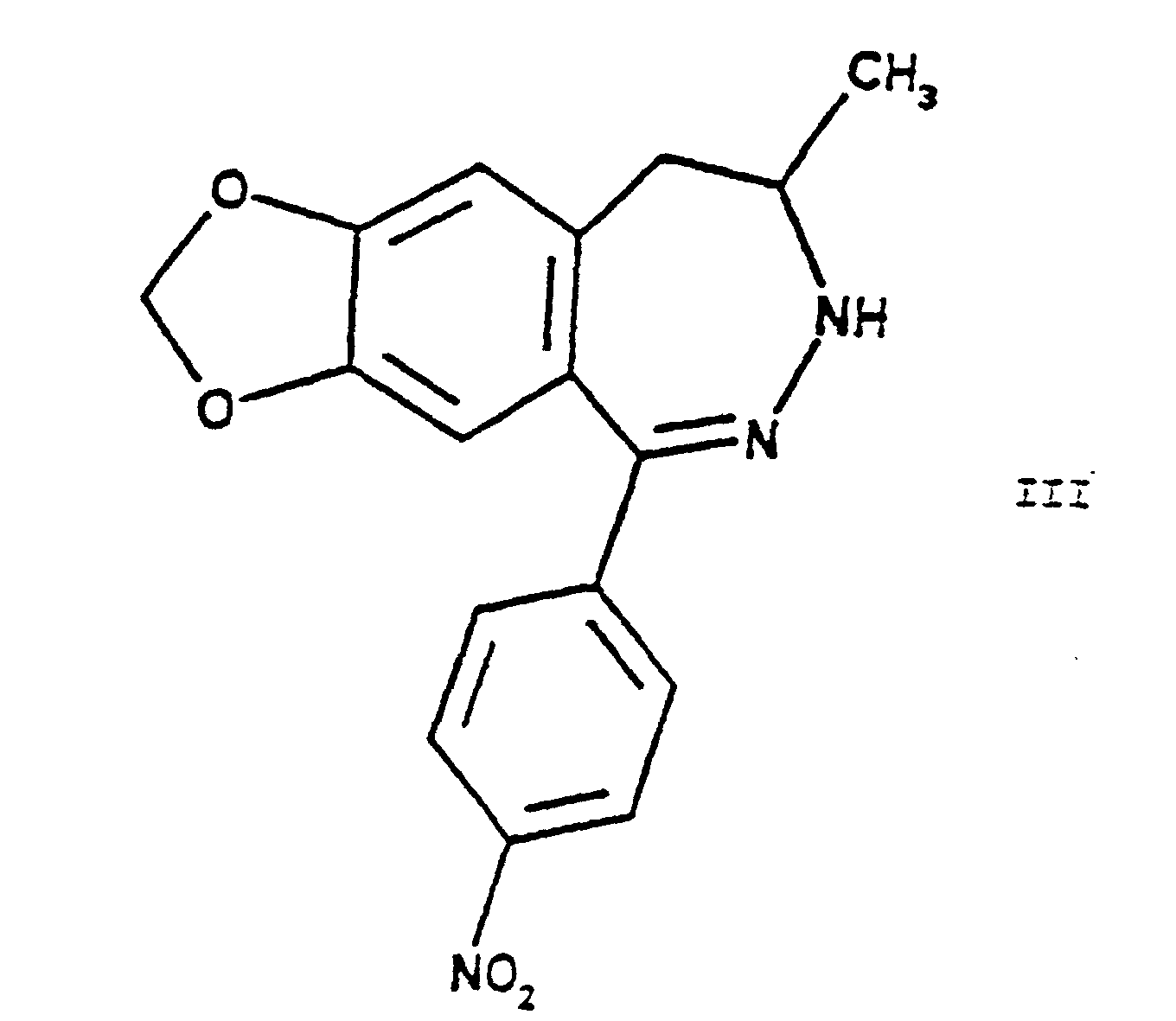 wherein Y represents a leaving group and R5 is a halogen atom and the obtained compound in which instead of the amino group on the phenyl ring of the formula I there is a nitro group and R0, A and B are as defined in connection with the formula I, is transformed into a compound of the formula I by reduction;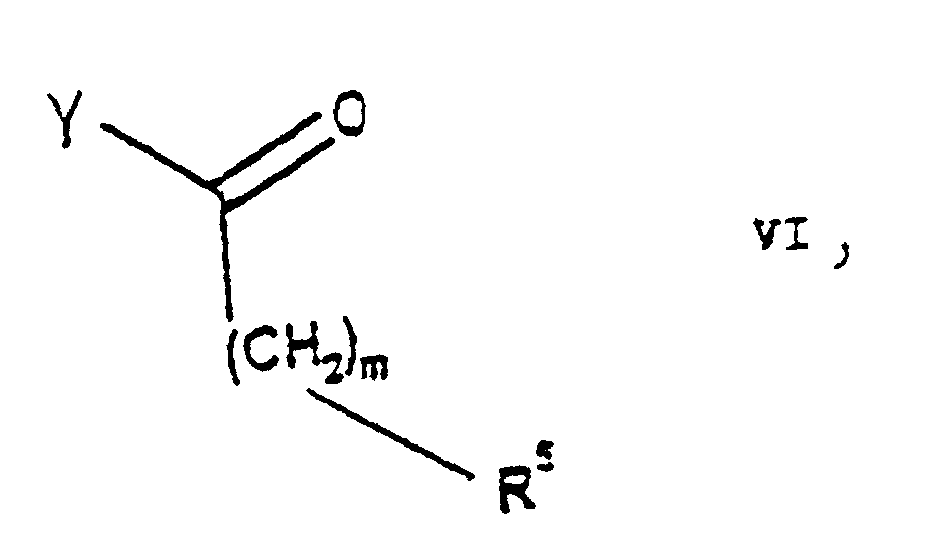
orb) for the preparation of a compound of the formula I, wherein R0 represents a group of the formula -(CH2)m-R, wherein R stands for a group of the formula -NR3R4, in which R3, R4 and m are as defined in connection with formula I and A and B represent hydrogen atoms, the 7,8-dihydro-8- methyl-5-(4-nitrophenyl)-9H-2,3-dioxolo/4,5- h//2,3/benzodiazepine of the formula III is reacted with a reagent of the formula VI, wherein Y and R5 represent, independently, a leaving group and m is as stated above, and the obtained benzodiazepine derivative of the formula IVwherein X stands for a leaving group, m is as stated above, is reacted with an amine of the formula VII wherein R3 and R4 are as stated above and the obtained compound in which instead of the amino group on the phenyl ring of the formula I there is a nitro group and R0, A and B are as defined in connection with the formula I, is transformed into a compound of the formula I by reduction;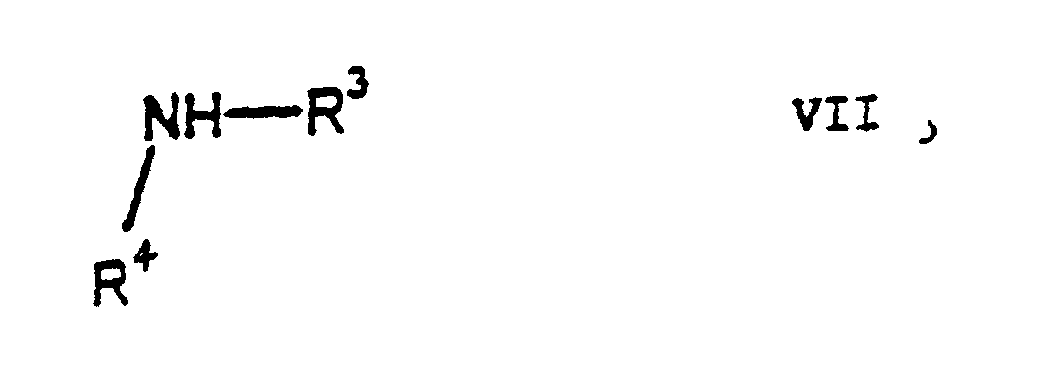
orc) for the preparation of a compound of the formula I, wherein R0 stands for a group of the formula -(CH2)m-R, in which R represents a halogen atom, m has a value of 0, 1 or 2 and A forms together with B a valence bond, the 8-methyl-5-(4-nitrophenyl)- 9H-1,3-dioxolo/4,5-h//2,3/benzodiazepine of the formula IIis reacted with an acylating agent of the formula IX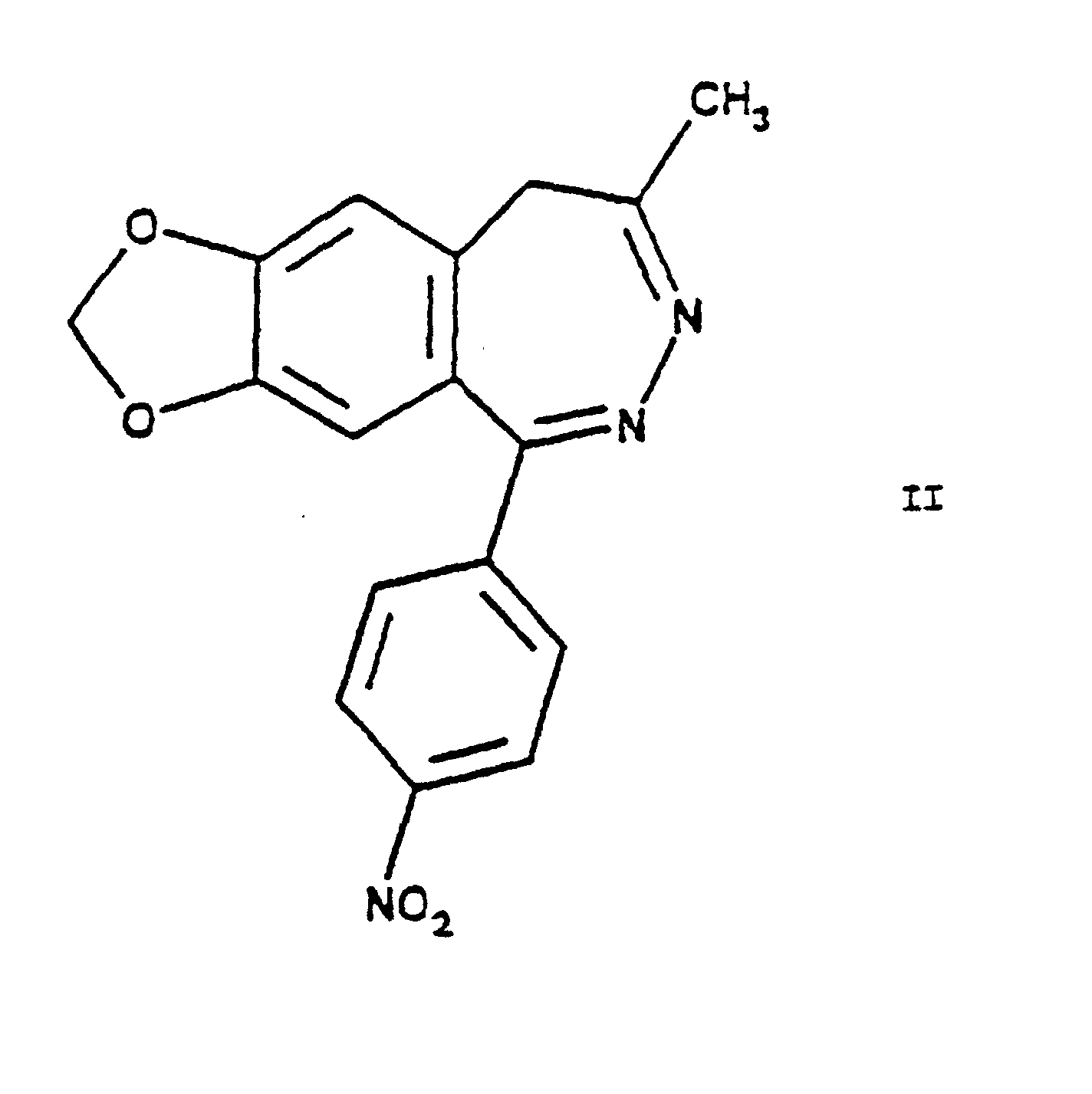 wherein Y represents a leaving group, X' stands for a halogen atom and m has a value of 0, 1 or 2 and the obtained compound in which instead of the amino group on the phenyl ring of the formula I there is a nitro group and R0, A and B are as defined in connection with the formula I, is transformed into a compound of the formula I by reduction;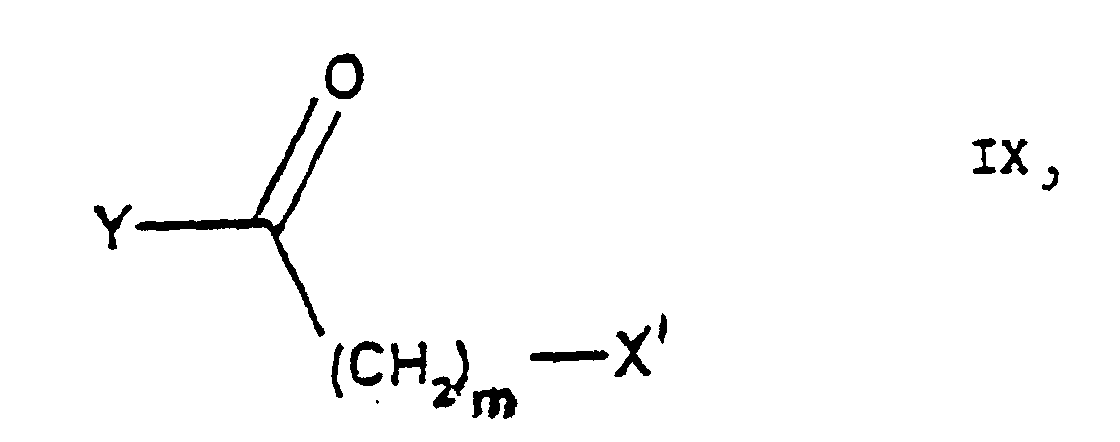
ord) for the preparation of a compound of the formula I, wherein R0 stands for a group of the formula -(CH2)m-R, in which R represents a group of the formula -NR3R4, wherein R3, R4 and m are as defined in connection with the formula I and A forms together with B a valence bond, the 8-methyl-5-(4-nitrophenyl)-9H-1,3-dioxolo-/4,5- h//2,3/benzodiazepine of the formula II is reacted with an acylating agent of the formula IX, wherein each of Y and X' represent, independently from each other, a leaving group and m is as stated above, and the obtained acylated compound of the formula VIIIwherein X' and m are as defined above, is reacted with an amine of the formula HNR3R4, wherein R3 and R4 are as stated above; and the obtained compound in which instead of the amino group on the phenyl ring of the formula I there is a nitro group and R0, A and B are as defined in connection with the formula I, is transformed into a compound of the formula I by reduction;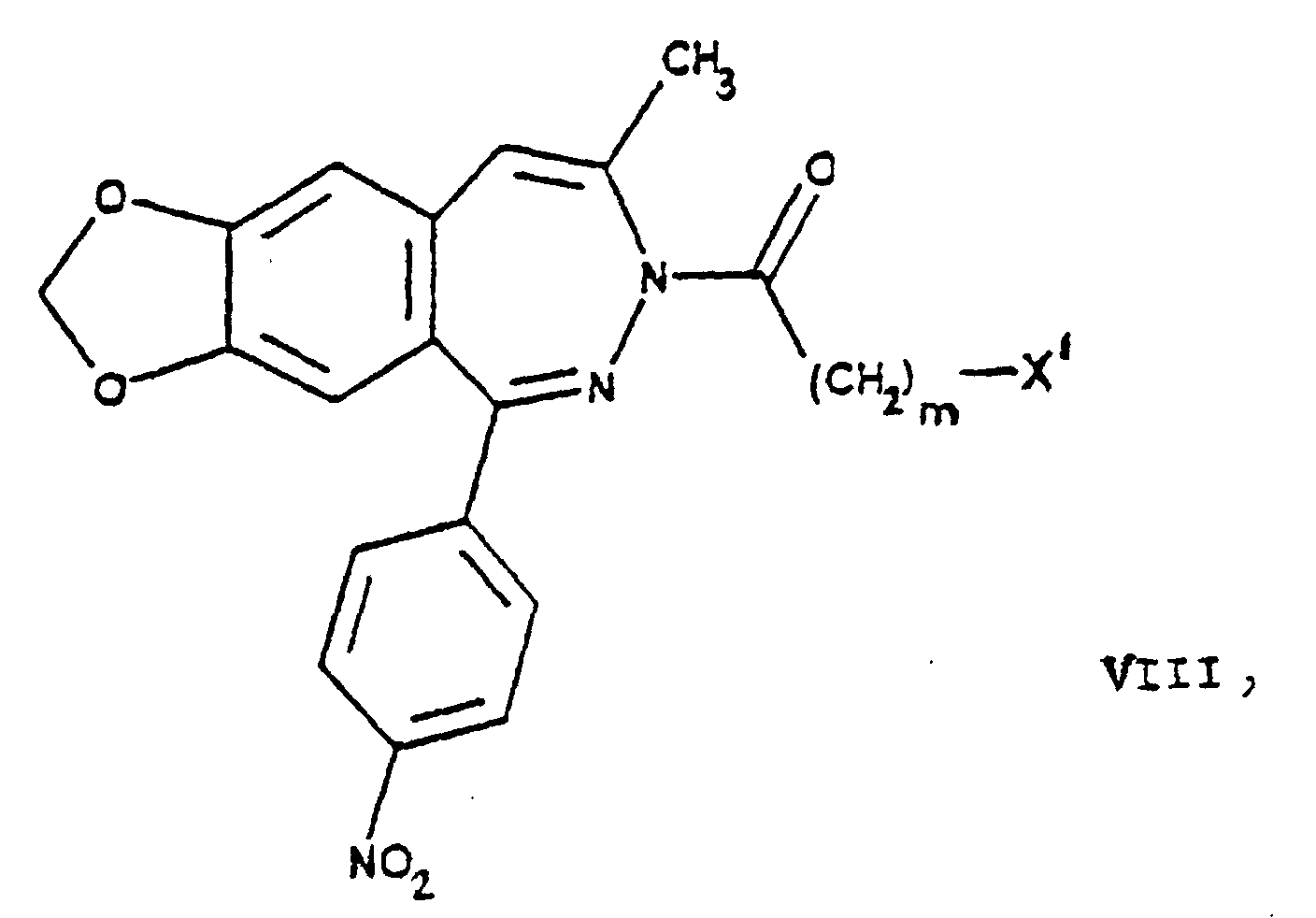
and, if desired, an obtained base of the formula I is converted to a pharmaceutically suitable acid addition salt or liberated from the acid addition salt. - A pharmaceutical composition comprising a 1,3- dioxolo/4,5-h//2,3/benzodiazepine derivative according to any of claims 1 to 5 as the active ingredient and one or more conventional carrier(s).
- The use of the 1,3-dioxolo/4,5-h//2,3/benzodiazepines according to claim 1 for preparing medicaments for the treatment of epilepsy or a neurodegenerative disease or a state after stroke.
Applications Claiming Priority (7)
| Application Number | Priority Date | Filing Date | Title |
|---|---|---|---|
| HU9701382A HUP9701382A3 (en) | 1997-08-12 | 1997-08-12 | New 7,8-dihydro-8-methyl-9h-1,3-dioxolo-[4,5-h][2,3]-benzodiazepine derivatives, pharmaceutical compositions containing them as active component and process for producing them |
| HU9701383 | 1997-08-12 | ||
| HU1300082 | 1997-08-12 | ||
| HU9701382 | 1997-08-12 | ||
| HU9701383A HUP9701383A3 (en) | 1997-08-12 | 1997-08-12 | New 8-methyl-7h-1,3-dioxolo[4,5-h][2,3]-benzodiazepine derivatives, pharmaceutical compositions containing them as active component, and process for producing them |
| HU1300083 | 1997-08-12 | ||
| PCT/HU1998/000076 WO1999007708A1 (en) | 1997-08-12 | 1998-08-07 | 1,3-dioxolo/4,5-h//2,3/benzodiazepine derivatives as ampa/kainate receptor inhibitors |
Publications (2)
| Publication Number | Publication Date |
|---|---|
| EP1015457A1 EP1015457A1 (en) | 2000-07-05 |
| EP1015457B1 true EP1015457B1 (en) | 2003-11-26 |
Family
ID=89995503
Family Applications (1)
| Application Number | Title | Priority Date | Filing Date |
|---|---|---|---|
| EP98939782A Expired - Lifetime EP1015457B1 (en) | 1997-08-12 | 1998-08-07 | 1,3-dioxolo/4,5-h//2,3/benzodiazepine derivatives as ampa/kainate receptor inhibitors |
Country Status (15)
| Country | Link |
|---|---|
| EP (1) | EP1015457B1 (en) |
| JP (1) | JP2001512731A (en) |
| KR (1) | KR20010022856A (en) |
| CN (1) | CN1271360A (en) |
| AT (1) | ATE255112T1 (en) |
| AU (1) | AU748801B2 (en) |
| BR (1) | BR9812119A (en) |
| CA (1) | CA2300142A1 (en) |
| DE (1) | DE69820081D1 (en) |
| NO (1) | NO20000654L (en) |
| NZ (1) | NZ503301A (en) |
| PL (1) | PL338681A1 (en) |
| RU (1) | RU2208014C2 (en) |
| SK (1) | SK1792000A3 (en) |
| WO (1) | WO1999007708A1 (en) |
Families Citing this family (6)
| Publication number | Priority date | Publication date | Assignee | Title |
|---|---|---|---|---|
| HUP9900354A3 (en) * | 1999-02-15 | 2001-02-28 | Egyt Gyogyszervegyeszeti Gyar | Use of condensed 2,3-benzodiazepine derivatives for the preparation of pharmaceutical compositions treating and preventing diseases related with the inhibition of lipide peroxidation |
| HU227128B1 (en) * | 1999-07-07 | 2010-07-28 | Egyt Gyogyszervegyeszeti Gyar | New 2,3-benzodiazepine derivatives |
| US6858605B2 (en) | 2003-02-04 | 2005-02-22 | Ivax Drug Research Institute, Ltd. | Substituted 2,3-benzodiazepine derivatives |
| EP2338492A1 (en) | 2009-12-24 | 2011-06-29 | Universidad del Pais Vasco | Methods and compositions for the treatment of alzheimer |
| FR2972454B1 (en) * | 2011-03-08 | 2013-03-01 | Servier Lab | NOVEL DIHYDRO-OXAZOLOBENZODIAZEPINONES DERIVATIVES, PROCESS FOR THEIR PREPARATION AND PHARMACEUTICAL COMPOSITIONS CONTAINING SAME |
| HU230684B1 (en) * | 2014-01-21 | 2017-08-28 | Egis Gyogyszergyar Nyilvanosan Muekoedoe Reszvenytarsasag | New dihydro-oxazinobenzodiazepine compounds, a process for their preparation and pharmaceutical compositions containing them |
Family Cites Families (6)
| Publication number | Priority date | Publication date | Assignee | Title |
|---|---|---|---|---|
| HU206719B (en) * | 1990-12-21 | 1992-12-28 | Gyogyszerkutato Intezet | Process for producing 1-/4-acylamino-phenyl/-7,8-methylenedioxy-5h-2,3-benzodiazepine derivatives, acid addicional salts and pharmaceutical compositions containing them |
| HU219778B (en) * | 1990-12-21 | 2001-07-30 | Gyógyszerkutató Intézet Közös Vállalat | Process for the preparation of N-acyl-2,3-benzodiazepines, their acid addition salts and pharmaceutical compositions containing them, and a group of compounds and pharmaceutical compositions containing them. |
| HU219777B (en) * | 1993-07-02 | 2001-07-30 | Gyógyszerkutató Intézet Kft. | Optical active 1-(4-nitrophenyl)-4-methyl-7,8-methylen dioxi-3,4-dihydro-5h-2,3-benzodiazepine and process for producing it |
| DE4428835A1 (en) * | 1994-08-01 | 1996-02-08 | Schering Ag | New 3-substituted 3H-2,3-benzodiazepine derivatives, their production and use as medicines |
| TR199501071A2 (en) * | 1994-08-31 | 1996-06-21 | Lilly Co Eli | Stereoselective process for producing dihydro-2,3-benzodiazepine derivatives. |
| TR199501070A2 (en) * | 1994-08-31 | 1996-06-21 | Lilly Co Eli | Crystalline form of the dihydro-2,3-benzodiazepine derivative. |
-
1998
- 1998-08-07 EP EP98939782A patent/EP1015457B1/en not_active Expired - Lifetime
- 1998-08-07 BR BR9812119-7A patent/BR9812119A/en not_active IP Right Cessation
- 1998-08-07 CN CN98809317A patent/CN1271360A/en active Pending
- 1998-08-07 AT AT98939782T patent/ATE255112T1/en not_active IP Right Cessation
- 1998-08-07 AU AU88182/98A patent/AU748801B2/en not_active Ceased
- 1998-08-07 RU RU2000106061/04A patent/RU2208014C2/en not_active IP Right Cessation
- 1998-08-07 CA CA002300142A patent/CA2300142A1/en not_active Abandoned
- 1998-08-07 SK SK179-2000A patent/SK1792000A3/en unknown
- 1998-08-07 KR KR1020007001458A patent/KR20010022856A/en not_active Ceased
- 1998-08-07 WO PCT/HU1998/000076 patent/WO1999007708A1/en not_active Ceased
- 1998-08-07 JP JP2000506211A patent/JP2001512731A/en active Pending
- 1998-08-07 PL PL98338681A patent/PL338681A1/en unknown
- 1998-08-07 NZ NZ503301A patent/NZ503301A/en unknown
- 1998-08-07 DE DE69820081T patent/DE69820081D1/en not_active Expired - Lifetime
-
2000
- 2000-02-09 NO NO20000654A patent/NO20000654L/en not_active Application Discontinuation
Non-Patent Citations (1)
| Title |
|---|
| SOLYOM, PHARMAZIE, vol. 56, 2001, pages 62 - 66 * |
Also Published As
| Publication number | Publication date |
|---|---|
| PL338681A1 (en) | 2000-11-20 |
| RU2208014C2 (en) | 2003-07-10 |
| NO20000654L (en) | 2000-04-10 |
| SK1792000A3 (en) | 2000-09-12 |
| DE69820081D1 (en) | 2004-01-08 |
| ATE255112T1 (en) | 2003-12-15 |
| CN1271360A (en) | 2000-10-25 |
| BR9812119A (en) | 2004-06-22 |
| WO1999007708A1 (en) | 1999-02-18 |
| JP2001512731A (en) | 2001-08-28 |
| NO20000654D0 (en) | 2000-02-09 |
| KR20010022856A (en) | 2001-03-26 |
| AU8818298A (en) | 1999-03-01 |
| CA2300142A1 (en) | 1999-02-18 |
| AU748801B2 (en) | 2002-06-13 |
| EP1015457A1 (en) | 2000-07-05 |
| NZ503301A (en) | 2002-09-27 |
Similar Documents
| Publication | Publication Date | Title |
|---|---|---|
| US5519019A (en) | N-acyl-2,3-benzoidazepine derivatives, pharmaceutical compositions containing them and process for preparing same | |
| CA1277660C (en) | 5h-2,3-benzodiazepine derivatives, process for the preparation thereofand pharmaceutical compositions containing the same | |
| NO310512B1 (en) | 5H-Thiazolo [3,2-a] pyrimidine derivatives | |
| NZ526150A (en) | Serotonergic agents | |
| US5639751A (en) | N-acyl-2,3-benzodiazepine derivatives for treating acute and chronic neurodegenerative disorders | |
| US6562810B1 (en) | 8-substituted-9H-1,3-dioxolo/4,5-h//2,3/benzodiazepine derivatives, as AMPA/kainate receptor inhibitors | |
| EP0216247A2 (en) | Use of alpha 2 adrenergic receptor antagonists for the production of pharmaceutical compositions for treating colonic spasm, irritable bowel syndrome and constipation and process for preparing such pharmaceutical compositions | |
| US5521174A (en) | N-acyl-2,3-benzodiazepine derivatives and a method of treating spasms of the skeletal musculature therewith | |
| US4710504A (en) | Anti-depressant spiro hexahydro arylquinolizine derivatives, composition, and method of use therefor | |
| AU748801B2 (en) | 1,3-dioxolo/4,5-H//2,3/benzodiazepine derivatives as ampa/kainate receptor inhibitors | |
| IE60265B1 (en) | Condensed diazepinones | |
| EP0162592B1 (en) | Heterocyclic amino compounds | |
| AU612495B2 (en) | Condensed diazepinones | |
| US4235901A (en) | 1-Hydroxyalkanamine pyrano(3,4-b)indole compositions and use thereof | |
| HRP20020015A2 (en) | New 2,3-benzodiazepine derivatives | |
| MXPA00001487A (en) | 1,3-dioxolo/4,5-h//2,3/benzodiazepine derivatives as ampa/kainate receptor inhibitors | |
| AU2004261491B2 (en) | 8-chloro-2,3-benzodiazepine derivatives | |
| CZ2000433A3 (en) | Derivatives of 1,3-dioxolo(4,5-H)(2,3)benzodiazepine, pharmaceutical compositions containing thereof and process for preparing active component | |
| PL211495B1 (en) | Novel 2,3-benzodiazepine derivatives and pharmaceutical compositions containing the same as the active ingredient | |
| MXPA00001486A (en) | 8-SUBSTITUTED-9H-1,3-DIOXOLO/4,5-h//2,3/BENZODIAZEPINE DERIVATIVES, AS AMPA/KAINATE RECEPTOR INHIBITORS | |
| CZ2000434A3 (en) | Derivatives of 8-substituted-9H-1,3-dioxolo-(4,5-h)(2,3)benzodiazepine as inhibitors of ampa/kainate receptor |
Legal Events
| Date | Code | Title | Description |
|---|---|---|---|
| PUAI | Public reference made under article 153(3) epc to a published international application that has entered the european phase |
Free format text: ORIGINAL CODE: 0009012 |
|
| 17P | Request for examination filed |
Effective date: 20000306 |
|
| AK | Designated contracting states |
Kind code of ref document: A1 Designated state(s): AT BE CH CY DE DK ES FI GB GR LI NL PT SE |
|
| AX | Request for extension of the european patent |
Free format text: LT PAYMENT 20000306;LV PAYMENT 20000306;RO PAYMENT 20000306;SI PAYMENT 20000306 |
|
| 17Q | First examination report despatched |
Effective date: 20020528 |
|
| GRAH | Despatch of communication of intention to grant a patent |
Free format text: ORIGINAL CODE: EPIDOS IGRA |
|
| GRAS | Grant fee paid |
Free format text: ORIGINAL CODE: EPIDOSNIGR3 |
|
| RBV | Designated contracting states (corrected) |
Designated state(s): AT BE CH DE DK ES FI GB GR LI NL PT SE |
|
| GRAA | (expected) grant |
Free format text: ORIGINAL CODE: 0009210 |
|
| AK | Designated contracting states |
Kind code of ref document: B1 Designated state(s): AT BE CH DE DK ES FI GB GR LI NL PT SE |
|
| AX | Request for extension of the european patent |
Extension state: LT LV RO SI |
|
| PG25 | Lapsed in a contracting state [announced via postgrant information from national office to epo] |
Ref country code: NL Free format text: LAPSE BECAUSE OF FAILURE TO SUBMIT A TRANSLATION OF THE DESCRIPTION OR TO PAY THE FEE WITHIN THE PRESCRIBED TIME-LIMIT Effective date: 20031126 Ref country code: LI Free format text: LAPSE BECAUSE OF FAILURE TO SUBMIT A TRANSLATION OF THE DESCRIPTION OR TO PAY THE FEE WITHIN THE PRESCRIBED TIME-LIMIT Effective date: 20031126 Ref country code: FI Free format text: LAPSE BECAUSE OF FAILURE TO SUBMIT A TRANSLATION OF THE DESCRIPTION OR TO PAY THE FEE WITHIN THE PRESCRIBED TIME-LIMIT Effective date: 20031126 Ref country code: ES Free format text: LAPSE BECAUSE OF FAILURE TO SUBMIT A TRANSLATION OF THE DESCRIPTION OR TO PAY THE FEE WITHIN THE PRESCRIBED TIME-LIMIT Effective date: 20031126 Ref country code: CH Free format text: LAPSE BECAUSE OF FAILURE TO SUBMIT A TRANSLATION OF THE DESCRIPTION OR TO PAY THE FEE WITHIN THE PRESCRIBED TIME-LIMIT Effective date: 20031126 Ref country code: BE Free format text: LAPSE BECAUSE OF FAILURE TO SUBMIT A TRANSLATION OF THE DESCRIPTION OR TO PAY THE FEE WITHIN THE PRESCRIBED TIME-LIMIT Effective date: 20031126 Ref country code: AT Free format text: LAPSE BECAUSE OF FAILURE TO SUBMIT A TRANSLATION OF THE DESCRIPTION OR TO PAY THE FEE WITHIN THE PRESCRIBED TIME-LIMIT Effective date: 20031126 |
|
| REG | Reference to a national code |
Ref country code: GB Ref legal event code: FG4D |
|
| REG | Reference to a national code |
Ref country code: CH Ref legal event code: EP |
|
| REF | Corresponds to: |
Ref document number: 69820081 Country of ref document: DE Date of ref document: 20040108 Kind code of ref document: P |
|
| PG25 | Lapsed in a contracting state [announced via postgrant information from national office to epo] |
Ref country code: SE Free format text: LAPSE BECAUSE OF FAILURE TO SUBMIT A TRANSLATION OF THE DESCRIPTION OR TO PAY THE FEE WITHIN THE PRESCRIBED TIME-LIMIT Effective date: 20040226 Ref country code: GR Free format text: LAPSE BECAUSE OF FAILURE TO SUBMIT A TRANSLATION OF THE DESCRIPTION OR TO PAY THE FEE WITHIN THE PRESCRIBED TIME-LIMIT Effective date: 20040226 Ref country code: DK Free format text: LAPSE BECAUSE OF FAILURE TO SUBMIT A TRANSLATION OF THE DESCRIPTION OR TO PAY THE FEE WITHIN THE PRESCRIBED TIME-LIMIT Effective date: 20040226 |
|
| PG25 | Lapsed in a contracting state [announced via postgrant information from national office to epo] |
Ref country code: DE Free format text: LAPSE BECAUSE OF FAILURE TO SUBMIT A TRANSLATION OF THE DESCRIPTION OR TO PAY THE FEE WITHIN THE PRESCRIBED TIME-LIMIT Effective date: 20040227 |
|
| NLV1 | Nl: lapsed or annulled due to failure to fulfill the requirements of art. 29p and 29m of the patents act | ||
| LTIE | Lt: invalidation of european patent or patent extension |
Effective date: 20031126 |
|
| REG | Reference to a national code |
Ref country code: CH Ref legal event code: PL |
|
| PG25 | Lapsed in a contracting state [announced via postgrant information from national office to epo] |
Ref country code: GB Free format text: LAPSE BECAUSE OF NON-PAYMENT OF DUE FEES Effective date: 20040807 |
|
| PLBE | No opposition filed within time limit |
Free format text: ORIGINAL CODE: 0009261 |
|
| STAA | Information on the status of an ep patent application or granted ep patent |
Free format text: STATUS: NO OPPOSITION FILED WITHIN TIME LIMIT |
|
| 26N | No opposition filed |
Effective date: 20040827 |
|
| GBPC | Gb: european patent ceased through non-payment of renewal fee |
Effective date: 20040807 |
|
| PG25 | Lapsed in a contracting state [announced via postgrant information from national office to epo] |
Ref country code: PT Free format text: LAPSE BECAUSE OF NON-PAYMENT OF DUE FEES Effective date: 20040426 |