EP1014652B1 - Method and system for software distribution - Google Patents
Method and system for software distribution Download PDFInfo
- Publication number
- EP1014652B1 EP1014652B1 EP99310254A EP99310254A EP1014652B1 EP 1014652 B1 EP1014652 B1 EP 1014652B1 EP 99310254 A EP99310254 A EP 99310254A EP 99310254 A EP99310254 A EP 99310254A EP 1014652 B1 EP1014652 B1 EP 1014652B1
- Authority
- EP
- European Patent Office
- Prior art keywords
- node
- packages
- branch
- target
- package
- Prior art date
- Legal status (The legal status is an assumption and is not a legal conclusion. Google has not performed a legal analysis and makes no representation as to the accuracy of the status listed.)
- Expired - Lifetime
Links
Images



Classifications
-
- G—PHYSICS
- G06—COMPUTING OR CALCULATING; COUNTING
- G06F—ELECTRIC DIGITAL DATA PROCESSING
- G06F15/00—Digital computers in general; Data processing equipment in general
- G06F15/16—Combinations of two or more digital computers each having at least an arithmetic unit, a program unit and a register, e.g. for a simultaneous processing of several programs
-
- H—ELECTRICITY
- H04—ELECTRIC COMMUNICATION TECHNIQUE
- H04L—TRANSMISSION OF DIGITAL INFORMATION, e.g. TELEGRAPHIC COMMUNICATION
- H04L67/00—Network arrangements or protocols for supporting network services or applications
- H04L67/34—Network arrangements or protocols for supporting network services or applications involving the movement of software or configuration parameters
-
- H—ELECTRICITY
- H04—ELECTRIC COMMUNICATION TECHNIQUE
- H04L—TRANSMISSION OF DIGITAL INFORMATION, e.g. TELEGRAPHIC COMMUNICATION
- H04L9/00—Cryptographic mechanisms or cryptographic arrangements for secret or secure communications; Network security protocols
- H04L9/40—Network security protocols
-
- G—PHYSICS
- G06—COMPUTING OR CALCULATING; COUNTING
- G06F—ELECTRIC DIGITAL DATA PROCESSING
- G06F8/00—Arrangements for software engineering
- G06F8/60—Software deployment
-
- H—ELECTRICITY
- H04—ELECTRIC COMMUNICATION TECHNIQUE
- H04L—TRANSMISSION OF DIGITAL INFORMATION, e.g. TELEGRAPHIC COMMUNICATION
- H04L69/00—Network arrangements, protocols or services independent of the application payload and not provided for in the other groups of this subclass
- H04L69/30—Definitions, standards or architectural aspects of layered protocol stacks
- H04L69/32—Architecture of open systems interconnection [OSI] 7-layer type protocol stacks, e.g. the interfaces between the data link level and the physical level
- H04L69/322—Intralayer communication protocols among peer entities or protocol data unit [PDU] definitions
- H04L69/329—Intralayer communication protocols among peer entities or protocol data unit [PDU] definitions in the application layer [OSI layer 7]
Definitions
- the present invention relates to software distribution and in particular to a method of software distribution across a network which minimizes the overall bandwidth used to transmit the software.
- the packages which are being distributed according to the invention are sets of files, optionally with accompanying scripts.
- the scripts are run at installation time, and might for example be pre-install scripts run before files are installed or post-install scripts run afterward.
- Software distribution packages are commonly hierarchical, in that files in the software distribution package can be logically grouped into smaller packages which might be required on certain clients but not on others. Such packages, containing a set of files, are referred to as simple packages, and might for example consist of the files constituting a single application.
- a software package might also contain one or more composite packages which do not contain actual files, but instead contain references to two or more simple or composite packages which constitute the composite package.
- a composite package might represent a suite of applications, the simple packages for which are referenced by the composite package.
- the packages referred to in the composite package need to be sent, along with the composite package.
- a composite package may also require that its referenced packages be installed in the order specified by its definition, even if it has no contingent scripts.
- An open package has no constraints upon the order or processing of its contents, but is simply an aggregation of other packages.
- the contents of an open package can be freely manipulated without compromising the package itself, and its presence is implied by the presence of its contents.
- a closed package has constraints that require that its contents be installed in the context of the package (installation) itself, and its presence must be explicitly indicated.
- target nodes on the network will already have one or more of the simple packages referred to in a composite package installed before the composite package is sent. If the composite package is an open package, it is highly wasteful of bandwidth to send simple composite package is an open package, it is highly wasteful of bandwidth to send simple packages already installed to a target node, as the simple packages are not required to complete installation of the composite package.
- Net News uses a filtering mechanism in order to send news articles to network machines, such that only what is requested and required be sent. There is no hierarchical structure to the articles, however, so the same problems do arise as with software distribution
- EP0782080 describes a system and method for propagating revisions through a communications network.
- the system includes status reporting circuitry associated with a second node in the network for collecting and transmitting the current status of second node information.
- Information revising circuitry is associated with a first node of the network and this receives the current status from the second node and determines whether a revision of the second node information is required. If revision is required the revision is transmitted to the second node to revise the second node information.
- the present invention provides a method and apparatus for transmitting a software package made up of other smaller packages across a network in a tree distribution pattern in which the transmitting node is the root, and clients requiring some part of the package are certain nodes in the tree.
- information is provided to nodes at branches in the tree concerning which parts of the composite package are required by the clients to which that node is supplying the package.
- the branch node transmits only parts of the package to each of its child nodes which are required by nodes below and including that child node in the tree.
- Each package constituting the software package can be unpacked once any packages upon which it is contingent have been unpacked.
- Different packages forming a software package may be multicasted independently to target nodes at which they are required, and then each package may be unpacked once all the packages required at a target node have been received.
- Figure 1 shows an example network on which the invention could be used.
- a network has nodes 2 which can act to route data over more than one network link 4, hereinafter referred to as branch nodes.
- Data can be received along at least one network link, and directed to other network links from a branch node 2.
- branch nodes might, for example, be routers of types commonly used on packet switched networks.
- a spanning tree across the network is generated from a distribution server (DS) 10 from which a software package 30 is to be distributed to a set of target nodes 14 which need to receive the software, with branching nodes 2 in the network acting as branches in the tree.
- Target nodes are represented with the letter "T" in Figures 1 and 2 .
- Target nodes might be leaves 16 of the tree or might be branching nodes 2 in the tree. Such a spanning tree to reach the targets is shown in Figure 2 .
- each of the branch nodes 2 does not need to be explicitly defined, and could, for example, be implicit in routing tables on each of the branch nodes 2 which forward data as is well known in the art. That is to say, each of the branch nodes maintains a routing table giving the shortest route currently available to a particular node.
- Such an architecture is well known, and there are well developed algorithms for maintaining routing tables which will provide appropriate routing to generate spanning trees from any source to any plurality of destinations. Algorithms and protocols which are used vary depending on the network architecture being used at the section of the network in question. For example, there are specific algorithms and protocols used for bridge connected LANs, one of which is described in IEEE 801.
- routing tables, or equivalent routing structures could be static, and updated manually, or dynamic based on communication between the nodes using a routing protocol such as the OSPF (Open Shortest Path First) Protocol.
- OSPF Open Shortest Path First Protocol
- Each of the branching nodes in the tree needs to be provided with information regarding which nodes require particular simple packages 34 and composite packages 32 constituting an overall software package 30 to be sent.
- An example of such a software package is shown in Figure 3A . According to this embodiment, this determination is made at the DS 10 and can be included in a transfer control file sent along with the software package 30.
- a record of that installation is kept, so that future transfers to that target node need to include only what is required.
- This record might be kept at the target itself, and the target polled by the DS 10 whenever new or updated software is to be installed, or it might be maintained by the DS so that it does not have to poll all the targets. A combination of these two methods is possible.
- the information required to determine which target nodes require which packages can accordingly either be achieved by querying all the target nodes with regard to what packages are already installed thereon, or keeping track of the packages installed on each node as they are installed. If for any reason, the packages installed on a particular target node cannot be ascertained, the entire software package 30 can be sent to that target node.
- branch nodes 2 operate to repackage data in a software package 30 as will become apparent.
- Such branch nodes are referred to hereinafter as repackaging nodes 12.
- these nodes are provided with storage media capable of storing an entire software package.
- embodiments are also envisaged in which the repackaging required by this embodiment of the invention is carried out "on the fly” without requiring sufficient space to store the software package.
- each of the repackaging nodes 12 is provided with all of the target nodes 14 to which it will ultimately be transmitting the data, and the packages which are required by each of these target nodes. This can easily be achieved in many ways. Two examples are as follows:
- Composite package A consists of references to simple packages B and C.
- the individual installation of package B is:
- package A is also installed, provided that package A is not contingent upon its scripts.
- a package is contingent upon its scripts, it means that the scripts must be executed for it to be considered effectively installed.
- software package contents are gathered up at a DS and sent to target nodes along the hierarchy of nodes in the spanning tree.
- the DS sends the package to the first-level branch nodes in the tree, each of these sends it to the next level, and so on until the package has been sent to all the target nodes of the transfer.
- the intermediate nodes used to forward the package may also be target nodes.
- Repackaging can occur whenever subsequent targets (those including and below the one being sent to) require only a portion of the contents of the package.
- the determination of what package contents are required at each target takes place at the DS (and is included in the transfer control file) before the transfer begins.
- the set of package contents required by subsequent targets defines the "new package”.
- the package contains two composite packages a and c, and three simple packages b, d and e.
- the intent is to install package a on targets P, Q, R, S and T.
- Package a is an open package, and package c is considered in both the open case in Figure 3B and the closed case shown in Figure 3C .
- a boolean array could be set up with a dimension corresponding to the different packages and a dimension corresponding to the different branches. All locations in this array are initially set to FALSE.
- a routine implemented on the repackaging node scans through the list of target nodes. When it finds a node to which it will be transmitting along a certain link, it sets the array locations in the array associated with that link in the first dimension and the packages required by that target node in the second dimension to TRUE.
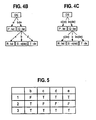
- Figure 5 shows an example of an array of this type for repackaging node Q in Figure 4C .
- each of the simple and composite packages which comprise an overall package do not need to be transmitted as a single contiguous package, but could each be transmitted separately with its own transfer control data to ensure it is only transmitted to selected nodes.
- Each package constituting the overall package would effectively then be multicasted to the appropriate nodes.
- the package could be provided with attachments instructing target nodes not to install the package until they receive the parent composite package.
- repackaging would not have to be carried out, and similar overall bandwidth would be used. Indeed, a different spanning tree could be used for each package which is being sent, depending on its target nodes. This is exemplified by Figs 6A and 6B .
- package B is sent over a first spanning tree over links 101, 103 and 104.
- package C is sent over a second spanning tree over a different three links, 102, 105 and 106. If the same spanning tree were to be used for both packages A and B, one package would have to be sent over 4 links. For example, using the tree of Figure 6A , package C would have to be transmitted over links 101, 102, 104 and 106.
Landscapes
- Engineering & Computer Science (AREA)
- Signal Processing (AREA)
- Computer Networks & Wireless Communication (AREA)
- Theoretical Computer Science (AREA)
- Computer Hardware Design (AREA)
- Computer Security & Cryptography (AREA)
- Software Systems (AREA)
- Physics & Mathematics (AREA)
- General Engineering & Computer Science (AREA)
- General Physics & Mathematics (AREA)
- Information Transfer Between Computers (AREA)
- Stored Programmes (AREA)
- Telephonic Communication Services (AREA)
- Computer And Data Communications (AREA)
- Data Exchanges In Wide-Area Networks (AREA)
Abstract
Description
- The present invention relates to software distribution and in particular to a method of software distribution across a network which minimizes the overall bandwidth used to transmit the software.
- It is well known to transmit software packages across a network from a server to one or more clients which require the package. Often, newer versions of a package will be released and will need distributing to clients running the older version of the software.
- The packages which are being distributed according to the invention are sets of files, optionally with accompanying scripts. The scripts are run at installation time, and might for example be pre-install scripts run before files are installed or post-install scripts run afterward.
- In certain circumstances, it is not imperative that all systems running the older software be upgraded or it is not possible for a server to have a record of all the systems running the software. In these circumstances, clients running the software could periodically poll the server which might or might not have a new version of the software, and request that the software be sent to the client if the server informs the client that it has a newer version. This approach is taken by many commercial software distributors who make upgrades of their products available over the internet.
- In many situations, the above solution to software distribution is not acceptable. For example, if the software in question has never been installed on a client system, the client system has no way of knowing it should request the new software. Furthermore, software upgrades often need installing immediately to maintain overall system integrity. In view of these situations, and other similar situations, it has become necessary to provide distribution software that actively distributes software packages from a server to one or more clients, rather than waiting for the clients to request the software. An example of such a system is Platinum Technology, Inc.'s AutoXfer product.
- Software distribution packages are commonly hierarchical, in that files in the software distribution package can be logically grouped into smaller packages which might be required on certain clients but not on others. Such packages, containing a set of files, are referred to as simple packages, and might for example consist of the files constituting a single application. A software package might also contain one or more composite packages which do not contain actual files, but instead contain references to two or more simple or composite packages which constitute the composite package. For example, a composite package might represent a suite of applications, the simple packages for which are referenced by the composite package. In order to send a composite package between nodes in a network, the packages referred to in the composite package need to be sent, along with the composite package. In addition, a composite package may also require that its referenced packages be installed in the order specified by its definition, even if it has no contingent scripts.
- During repackaging there are two kinds of composite packages to consider. An open package has no constraints upon the order or processing of its contents, but is simply an aggregation of other packages. The contents of an open package can be freely manipulated without compromising the package itself, and its presence is implied by the presence of its contents. A closed package has constraints that require that its contents be installed in the context of the package (installation) itself, and its presence must be explicitly indicated.
- Often, target nodes on the network will already have one or more of the simple packages referred to in a composite package installed before the composite package is sent. If the composite package is an open package, it is highly wasteful of bandwidth to send simple composite package is an open package, it is highly wasteful of bandwidth to send simple packages already installed to a target node, as the simple packages are not required to complete installation of the composite package.
- Standards have been implemented for software distribution formats, such as the Posix 1387.2 standard. It uses four primary objects: Fileset, Subproduct, Product, and Bundle. This standard essentially specifies installation format in a Unix environment. It calls upon other Posix standards for definitions and requirements used in the standard.
- Net News uses a filtering mechanism in order to send news articles to network machines, such that only what is requested and required be sent. There is no hierarchical structure to the articles, however, so the same problems do arise as with software distribution
-
EP0782080 describes a system and method for propagating revisions through a communications network. The system includes status reporting circuitry associated with a second node in the network for collecting and transmitting the current status of second node information. Information revising circuitry is associated with a first node of the network and this receives the current status from the second node and determines whether a revision of the second node information is required. If revision is required the revision is transmitted to the second node to revise the second node information. - The present invention provides a method and apparatus for transmitting a software package made up of other smaller packages across a network in a tree distribution pattern in which the transmitting node is the root, and clients requiring some part of the package are certain nodes in the tree. In a preferred example of the invention, information is provided to nodes at branches in the tree concerning which parts of the composite package are required by the clients to which that node is supplying the package. The branch node transmits only parts of the package to each of its child nodes which are required by nodes below and including that child node in the tree. Each package constituting the software package can be unpacked once any packages upon which it is contingent have been unpacked.
- According to the present invention there is provided: a system for hierarchical software distribution in accordance with
claim 1; and a method for distributing a software package in accordance with claim 7. - Different packages forming a software package may be multicasted independently to target nodes at which they are required, and then each package may be unpacked once all the packages required at a target node have been received.
- These and other objects of the invention will be apparent from the remaining portion of this specification.
-
-
FIGURE 1 shows an example of a network on which the invention might be implemented. -
FIGURE 3 shows the structure of a composite package according to a first example of the present invention. -
FIGURE 4A shows the structure of a composite package according to an example of the present invention. -
FIGURE 4B shows a first example of the distribution of the composite package shown inFigure 3A . -
FIGURE 4C shows a second example of the distribution of the composite package shown inFigure 3A . -
FIGURE 5 shows an array generated by the first embodiment in establishing which packages are to be sent along each link from node Q inFigure 4C . -
FIGURES 6A and 6B show different spanning trees as implemented in a second embodiment of the invention. - A first embodiment of the invention will hereinafter be described with reference to
Figures 1-3 . -
Figure 1 shows an example network on which the invention could be used. Such a network hasnodes 2 which can act to route data over more than one network link 4, hereinafter referred to as branch nodes. Data can be received along at least one network link, and directed to other network links from abranch node 2. In a standard configuration, data could be received from or transmitted along any of the network links 4 connected to the branch node. These branch nodes might, for example, be routers of types commonly used on packet switched networks. - A spanning tree across the network is generated from a distribution server (DS) 10 from which a
software package 30 is to be distributed to a set oftarget nodes 14 which need to receive the software, withbranching nodes 2 in the network acting as branches in the tree. Target nodes are represented with the letter "T" inFigures 1 and2 . Target nodes might beleaves 16 of the tree or might be branchingnodes 2 in the tree. Such a spanning tree to reach the targets is shown inFigure 2 . - The tree does not need to be explicitly defined, and could, for example, be implicit in routing tables on each of the
branch nodes 2 which forward data as is well known in the art. That is to say, each of the branch nodes maintains a routing table giving the shortest route currently available to a particular node. Such an architecture is well known, and there are well developed algorithms for maintaining routing tables which will provide appropriate routing to generate spanning trees from any source to any plurality of destinations. Algorithms and protocols which are used vary depending on the network architecture being used at the section of the network in question. For example, there are specific algorithms and protocols used for bridge connected LANs, one of which is described in IEEE 801. Id Such an architecture for use on Internet based systems is laid out in RFC 1716, which gives algorithms for efficiently routing Internet packages based on their IP addresses. The routing tables, or equivalent routing structures could be static, and updated manually, or dynamic based on communication between the nodes using a routing protocol such as the OSPF (Open Shortest Path First) Protocol. It should be noted that as long as the routing mechanism guarantees that the same route is always taken between any two nodes in a network, distribution from one node to a plurality of nodes will always occur in a spanning tree pattern. - Each of the branching nodes in the tree needs to be provided with information regarding which nodes require particular
simple packages 34 and composite packages 32 constituting anoverall software package 30 to be sent. An example of such a software package is shown inFigure 3A . According to this embodiment, this determination is made at theDS 10 and can be included in a transfer control file sent along with thesoftware package 30. - According to the first embodiment, when a package is installed on a
target node 14, a record of that installation is kept, so that future transfers to that target node need to include only what is required. This record might be kept at the target itself, and the target polled by theDS 10 whenever new or updated software is to be installed, or it might be maintained by the DS so that it does not have to poll all the targets. A combination of these two methods is possible. - The information required to determine which target nodes require which packages, can accordingly either be achieved by querying all the target nodes with regard to what packages are already installed thereon, or keeping track of the packages installed on each node as they are installed. If for any reason, the packages installed on a particular target node cannot be ascertained, the
entire software package 30 can be sent to that target node. - Certain of the
branch nodes 2 operate to repackage data in asoftware package 30 as will become apparent. Such branch nodes are referred to hereinafter as repackagingnodes 12. According to this embodiment, these nodes are provided with storage media capable of storing an entire software package. However, embodiments are also envisaged in which the repackaging required by this embodiment of the invention is carried out "on the fly" without requiring sufficient space to store the software package. - It is important that each of the repackaging
nodes 12 is provided with all of thetarget nodes 14 to which it will ultimately be transmitting the data, and the packages which are required by each of these target nodes. This can easily be achieved in many ways. Two examples are as follows: - 1) Data is transmitted with the
software package 30 from theDS 10 including a list of all thetarget nodes 14 to which the package is to be transmitted. Anybranch node 2 receiving the package, checks its routing table, or equivalent data store, to ascertain the shortest route to all of the nodes to which it is to transmit the package. It will send appropriate parts of the package along each of the appropriate branches to reach the targets. Thebranch node 2 edits the list of target nodes it forwards along each branch to include only the target nodes to be reached along the respective branch. - 2) Each repackaging
node 12 is provided with functionality to ascertain all targets for which it is responsible for transmitting data originating from any particular node. The list of target nodes does not need to be edited at each branch node, as long as the repackaging node knows where the packet originated. The list of target nodes could be stored in a single transfer control file as discussed above. - The following example illustrates how composite packages are sent according to the first embodiment of the present invention. As shown in
Figure 3 , Composite package A consists of references to simple packages B and C. The individual installation of package B is: - 1) Run B's pre-install script
- 2) Install B's files
- 3) Run B's post-install script
- The individual installation of package C is:
- 1) Run C's pre-install script
- 2) Install C's files
- 3) Run C's post-install script.
- However, the installation of composite package A is:
- 1) Run A's pre-install script
- 2) Run B's pre-install script
- 3) Install B's files
- 4) Run B's post-install script
- 5) Run C's pre-install script
- 6) Install C's files
- 7) Run C's post-install script
- 8) Run A's post-install script
- If package B and package C have been individually installed on a target (in separate transfers) it can be inferred that package A is also installed, provided that package A is not contingent upon its scripts. When a package is contingent upon its scripts, it means that the scripts must be executed for it to be considered effectively installed.
- For a given transfer, software package contents are gathered up at a DS and sent to target nodes along the hierarchy of nodes in the spanning tree. The DS sends the package to the first-level branch nodes in the tree, each of these sends it to the next level, and so on until the package has been sent to all the target nodes of the transfer. The intermediate nodes used to forward the package may also be target nodes.
- Repackaging can occur whenever subsequent targets (those including and below the one being sent to) require only a portion of the contents of the package. The determination of what package contents are required at each target takes place at the DS (and is included in the transfer control file) before the transfer begins. The set of package contents required by subsequent targets defines the "new package".
- In the case of an open package, referenced packages can simply be selected and sent where required. In the case of a closed package, the closed package and all packages it references, both directly and indirectly, must be sent.
- In the following example, shown in
Figures 4A ,4B and 4C , the package contains two composite packages a and c, and three simple packages b, d and e. The intent is to install package a on targets P, Q, R, S and T. Package a is an open package, and package c is considered in both the open case inFigure 3B and the closed case shown inFigure 3C . - In the case where package c is open (
Figure 4B ): - Target P has packages b and d installed and requires package e.
- Target Q has packages b and e installed and requires package d. Packages b and e are also sent for targets R, S and T.
- Target R has packages b and d installed and requires package e.
- Target S has package c[de] installed and requires package b.
- Target T has packages d and e installed and requires package b.
- In the case where package c is closed (
Figure 3C ): - Target P has packages b and d installed and requires package c[de].
- Target Q has packages b and e installed and requires package c[de]. Package b is also sent for targets S and T.
- Target R has packages b and d installed and requires package c[de].
- Target S has package c[de] installed and requires package b.
- Target T has packages d and e installed and requires packages b and c[de].
- The actual method of repackaging the packages constituting the
software package 30 will vary considerably depending on the protocol and the architecture being used, but it can be seen that such repackaging would be very straightforward to implement using the knowledge from the transfer control file as to which packages are required. For example, a boolean array could be set up with a dimension corresponding to the different packages and a dimension corresponding to the different branches. All locations in this array are initially set to FALSE. A routine implemented on the repackaging node scans through the list of target nodes. When it finds a node to which it will be transmitting along a certain link, it sets the array locations in the array associated with that link in the first dimension and the packages required by that target node in the second dimension to TRUE. Once all the target nodes have been considered by the routine, the contents of the software package required along each link will be defined by the locations in the array associated with that link which are set to TRUE.Figure 5 shows an example of an array of this type for repackaging node Q inFigure 4C . - In a second embodiment of the invention, each of the simple and composite packages which comprise an overall package do not need to be transmitted as a single contiguous package, but could each be transmitted separately with its own transfer control data to ensure it is only transmitted to selected nodes. Each package constituting the overall package would effectively then be multicasted to the appropriate nodes. If a package is part of a closed composite package, the package could be provided with attachments instructing target nodes not to install the package until they receive the parent composite package. Using this alternative method, repackaging would not have to be carried out, and similar overall bandwidth would be used. Indeed, a different spanning tree could be used for each package which is being sent, depending on its target nodes. This is exemplified by
Figs 6A and 6B . InFigure 6A , package B is sent over a first spanning tree overlinks Figure 6B , package C is sent over a second spanning tree over a different three links, 102, 105 and 106. If the same spanning tree were to be used for both packages A and B, one package would have to be sent over 4 links. For example, using the tree ofFigure 6A , package C would have to be transmitted overlinks - While preferred embodiments of the present invention have been illustrated and described, it will be understood by those of ordinary skill in the art that changes and modifications can be made without departure from the invention in its broader aspects. Various features of the present invention are set forth in the following claims.
Claims (12)
- A system (1) for hierarchical software distribution allowing distribution of software package(a) comprising at least a first, second and third software package (b,d,e) to a plurality of target nodes, said system comprising:a distribution node (10) for transmitting packages of software;a first branch node (2) arranged for communication with said distribution node (10), said first branch node (2) being arranged to receive at least a portion of said software package from said distribution node (10);a second branch node (2) being arranged for communication with said first branch node (2) via a first network link;first, second and third target nodes (14), wherein:said first target node is arranged for communication with said second branch node (2) via a third network link, and said first target node is further arranged for communication with said first branch node via said second branch node;said second target node is arranged for communication with said first branch node via a second network link, said second target node storing said first package (b); andsaid third target node (14) is arranged for communication with said second branch node via a fourth network link (4);wherein each of said first and second branch nodes (2) is arranged to be provided with information received from said distribution node regarding the target nodes (14) which require each of said software packages (a,b,c,d,e), and is further arranged to be provided with information regardingto which of said target nodes said branch node is responsible for forwarding the information received from said distribution node, and which of said network links the branch node (2) is to use, whereby each branch node can ascertain which software packages should be forwarded along each network link, and
wherein said first branch node (2) is arranged to transmit said software package (a) over said first network link, to automatically repackage said second and third software packages (d,e) into a fourth software package (c) and transmit the fourth software package (c) only over said second network link, and
whereby each of the first and second target nodes (14) is adapted to store said first, second and third software packages (b,d,e). - A system according to claim 1, wherein said software package (a) is sent as a contiguous package over said first network link (4).
- A system according to claim 1, wherein said first branch node (2) is arranged to be provided with information regarding which packages (a,b,c,d) should be forwarded to which target nodes (14).
- A system according to claim 1, wherein each of said branch nodes (2) is arranged to be provided with further information regarding (i) target nodes (14) to which each branch node (2) is responsible for sending said packages (a,b,c,d), and (ii) which of said first (c) and second (b) packages are required by said target nodes (14); and wherein each branch node is configured to forward said further information to subsequent nodes along each branch, and to edit said further information for each branch to include only target nodes (14) reached via that branch.
- A system according claim 1, wherein said first package (c) comprises at least two sub-packages (f,g) and where installation of said two sub-packages (f,g) on each of said target nodes (14) must be performed in a specified order; wherein one of said sub-packages (f,g) is already installed on said first target node; and wherein the system comprises means for distributing both of said sub-packages (f, g) to said first target node and neither of the sub-packages (f, g) to said second target node.
- A system according to claim 1, wherein each branch node (2) is arranged to receive each of said first, second and third packages (b, c, d) from said distribution node (1) independently, and to install each received package.
- A method of distributing a software package (a) comprising at least a first, second and third package (b,c,e), said method being performed in a system comprising:a distribution node (10) for transmitting packages of software;a first branch node (2) arranged for communication with said distribution node (10), said first branch node (2) being arranged to receive at least a portion of said software package from said distribution node (10);a second branch node (2) being arranged for communication with said first branch node (2) via a first network link;first, second and third target nodes (14), wherein:said first target node is arranged for communication with said second branch node (2) via a third network link, and said first target node is further arranged for communication with said first branch node via said second branch node;said second target node is arranged for communication with said first branch node via a second network link, said second target node storing said first package (b); andsaid third target node (14) is arranged for communication with said second branch node via a fourth network link (4),wherein said first package (b) is already present on said second target node, and said method comprises the steps of:
each of said first and second branch nodes (2) being provided with information received from said distribution node regarding the target nodes (14) which require each of said software packages (a,b,c,d,e), and further being provided with information regarding to which of said target nodes said branch node is responsible for forwarding the information received from said distribution node, and which of said network links the branch node (2) is to use;
ascertaining at each branch node which software packages should be forwarded along each network link;
repackaging said second and third packages (d,e) into a fourth software package (c);
sending said software package (a) over said first network link;
sending said fourth package (c) only over said second network link; and
sending said software package (a) to said first and third target nodes;
whereby both the first, second and third packages (b,c,d) are distributed to each of said first, second and third target nodes (14). - A method according to claim 7, further comprising sending said software package (a) as a contiguous package over said first network link (4).
- A method according to claim 7, further comprising providing said first branch node (2) with information regarding which packages (a,b,c,d) should be forwarded to which target nodes (14).
- A method according to claim 7, further comprising:providing each of said branch nodes (2) with further information regarding (i) target nodes (14) to which each branch node (2) is responsible for sending said packages (a,b,c,d), and (ii) which of said first (c) and second (b) packages are required by said target nodes (14);forwarding, by each branch node, said further information to subsequent nodes along each branch; andediting, at each branch node, said further information for each branch to include only target nodes (14) reached via that branch.
- A method according claim 7, wherein said first package (c) comprises at least two sub-packages (f,g) and where installation of said two sub-packages (f,g) on each of said target nodes (14) must be performed in a specified order; wherein one of said sub-packages (f,g) is already installed on said first target node; and wherein the method further comprises distributing both of said sub-packages (f, g) to said first target node and neither of the sub-packages (f, g) to said second target node.
- A computer readable medium comprising instructions which, when executed by a suitable computer, cause the computer to perform a method in accordance with any one of claims 7 to 11.
Applications Claiming Priority (2)
| Application Number | Priority Date | Filing Date | Title |
|---|---|---|---|
| US09/220,724 US6938075B1 (en) | 1998-12-24 | 1998-12-24 | Method and apparatus for hierarchical software distribution packages including composite packages |
| US220724 | 1998-12-24 |
Publications (3)
| Publication Number | Publication Date |
|---|---|
| EP1014652A2 EP1014652A2 (en) | 2000-06-28 |
| EP1014652A3 EP1014652A3 (en) | 2002-05-08 |
| EP1014652B1 true EP1014652B1 (en) | 2008-02-13 |
Family
ID=22824689
Family Applications (1)
| Application Number | Title | Priority Date | Filing Date |
|---|---|---|---|
| EP99310254A Expired - Lifetime EP1014652B1 (en) | 1998-12-24 | 1999-12-20 | Method and system for software distribution |
Country Status (11)
| Country | Link |
|---|---|
| US (1) | US6938075B1 (en) |
| EP (1) | EP1014652B1 (en) |
| JP (1) | JP2000207220A (en) |
| KR (1) | KR20000052565A (en) |
| CN (1) | CN1191525C (en) |
| AT (1) | ATE386396T1 (en) |
| AU (1) | AU779536B2 (en) |
| BR (1) | BR9905969A (en) |
| CA (1) | CA2292145A1 (en) |
| DE (1) | DE69938122T2 (en) |
| IL (1) | IL133564A0 (en) |
Families Citing this family (21)
| Publication number | Priority date | Publication date | Assignee | Title |
|---|---|---|---|---|
| NO314867B1 (en) | 2001-03-13 | 2003-06-02 | Ericsson Telefon Ab L M | Procedure for optimizing software distribution in large communications networks |
| CA2349654A1 (en) * | 2001-06-04 | 2002-12-04 | Ibm Canada Limited-Ibm Canada Limitee | Server configuration versioning tool |
| JP3729265B2 (en) * | 2002-08-22 | 2005-12-21 | 日本電気株式会社 | Network system, spanning tree configuration method, spanning tree configuration node, and spanning tree configuration program |
| US7853609B2 (en) | 2004-03-12 | 2010-12-14 | Microsoft Corporation | Update distribution system architecture and method for distributing software |
| DE102004047367A1 (en) * | 2004-09-29 | 2006-03-30 | Siemens Ag | Method for distributing software and configuration data with time monitoring and corresponding data network |
| US7770168B1 (en) * | 2005-05-25 | 2010-08-03 | Landesk Software Limited | Systems and methods for distributing software using nodes within a network group |
| JP4904746B2 (en) * | 2005-09-08 | 2012-03-28 | 富士通株式会社 | Check program and check method |
| CN100407650C (en) * | 2005-11-10 | 2008-07-30 | 中国工商银行股份有限公司 | System and method for upgrading software version in distributed business system |
| DE102008024809B3 (en) * | 2008-05-23 | 2009-11-19 | Universität Konstanz | A method of storing a plurality of revisions of tree-structured data family parts |
| CN103513998B (en) * | 2012-06-25 | 2018-05-04 | 中兴通讯股份有限公司 | Upgrade package generation method and device, the method and terminal of the upgrading of living document difference |
| US8924950B2 (en) * | 2012-12-17 | 2014-12-30 | Itron, Inc. | Utility node software/firmware update through a multi-type package |
| US8938730B2 (en) | 2012-12-17 | 2015-01-20 | Itron, Inc. | Utilizing a multi-system set configuration to update a utility node system set |
| CN103354505B (en) * | 2013-06-28 | 2016-08-10 | 国家电网公司 | A batch software upgrade method for electronic device groups |
| US9965262B2 (en) * | 2015-05-21 | 2018-05-08 | International Business Machines Corporation | Application bundle pulling |
| US9888057B2 (en) | 2015-05-21 | 2018-02-06 | International Business Machines Corporation | Application bundle management across mixed file system types |
| US10152516B2 (en) | 2015-05-21 | 2018-12-11 | International Business Machines Corporation | Managing staleness latency among application bundles |
| US10530660B2 (en) * | 2015-05-21 | 2020-01-07 | International Business Machines Corporation | Application bundle preloading |
| US10389794B2 (en) | 2015-05-21 | 2019-08-20 | International Business Machines Corporation | Managing redundancy among application bundles |
| US10389850B2 (en) | 2015-05-21 | 2019-08-20 | International Business Machines Corporation | Managing redundancy among application bundles |
| US10541876B2 (en) * | 2017-02-14 | 2020-01-21 | Nicira, Inc. | Inter-connecting logical control planes for state data exchange |
| US11165886B2 (en) * | 2020-01-03 | 2021-11-02 | Bank Of America Corporation | Multi-distribution resource allocation system |
Family Cites Families (16)
| Publication number | Priority date | Publication date | Assignee | Title |
|---|---|---|---|---|
| US4905233A (en) * | 1987-11-23 | 1990-02-27 | Harris Corporation | Multiple path routing mechanism for packet communications network |
| US5095480A (en) * | 1989-06-16 | 1992-03-10 | Fenner Peter R | Message routing system for shared communication media networks |
| US5495610A (en) * | 1989-11-30 | 1996-02-27 | Seer Technologies, Inc. | Software distribution system to build and distribute a software release |
| SE513182C2 (en) | 1991-06-12 | 2000-07-24 | Icl Systems Ab | Procedure and system for auditing data in a distributed computer system |
| US6134324A (en) * | 1991-07-31 | 2000-10-17 | Lsi Logic Corporation | Method and system for distributing a plurality of software products, and limiting access thereto |
| US5319705A (en) | 1992-10-21 | 1994-06-07 | International Business Machines Corporation | Method and system for multimedia access control enablement |
| WO1994025913A2 (en) | 1993-04-30 | 1994-11-10 | Novadigm, Inc. | Method and apparatus for enterprise desktop management |
| US5680548A (en) | 1994-12-02 | 1997-10-21 | Xcellenet, Inc. | Systems and methods for work assignment and distribution from a server to remote/mobile nodes |
| US5706431A (en) * | 1995-12-29 | 1998-01-06 | At&T | System and method for distributively propagating revisions through a communications network |
| JPH10171814A (en) | 1996-12-12 | 1998-06-26 | Digital Vision Lab:Kk | Information retrieval device |
| US6279005B1 (en) | 1997-03-04 | 2001-08-21 | Paul Zellweger | Method and apparatus for generating paths in an open hierarchical data structure |
| US6029004A (en) | 1997-03-17 | 2000-02-22 | International Business Machines Corporation | Method and apparatus for modular reordering of portions of a computer program based on profile data |
| US5953724A (en) | 1997-11-24 | 1999-09-14 | Lowry Software, Incorporated | Global database library data structure for hierarchical graphical listing computer software |
| US6185734B1 (en) | 1998-07-21 | 2001-02-06 | Hewlett-Packard Company | Hierarchical registry structure for managing multiple versions of software components |
| US6108698A (en) | 1998-07-29 | 2000-08-22 | Xerox Corporation | Node-link data defining a graph and a tree within the graph |
| US6381743B1 (en) | 1999-03-31 | 2002-04-30 | Unisys Corp. | Method and system for generating a hierarchial document type definition for data interchange among software tools |
-
1998
- 1998-12-24 US US09/220,724 patent/US6938075B1/en not_active Expired - Fee Related
-
1999
- 1999-12-15 CA CA002292145A patent/CA2292145A1/en not_active Abandoned
- 1999-12-16 IL IL13356499A patent/IL133564A0/en not_active IP Right Cessation
- 1999-12-20 DE DE69938122T patent/DE69938122T2/en not_active Expired - Lifetime
- 1999-12-20 AT AT99310254T patent/ATE386396T1/en not_active IP Right Cessation
- 1999-12-20 EP EP99310254A patent/EP1014652B1/en not_active Expired - Lifetime
- 1999-12-23 CN CNB991266684A patent/CN1191525C/en not_active Expired - Fee Related
- 1999-12-23 BR BR9905969-0A patent/BR9905969A/en not_active IP Right Cessation
- 1999-12-23 AU AU65475/99A patent/AU779536B2/en not_active Ceased
- 1999-12-24 KR KR1019990061739A patent/KR20000052565A/en not_active Abandoned
- 1999-12-24 JP JP11366401A patent/JP2000207220A/en active Pending
Also Published As
| Publication number | Publication date |
|---|---|
| DE69938122T2 (en) | 2009-02-12 |
| EP1014652A2 (en) | 2000-06-28 |
| CN1264077A (en) | 2000-08-23 |
| ATE386396T1 (en) | 2008-03-15 |
| KR20000052565A (en) | 2000-08-25 |
| CN1191525C (en) | 2005-03-02 |
| BR9905969A (en) | 2000-09-05 |
| DE69938122D1 (en) | 2008-03-27 |
| EP1014652A3 (en) | 2002-05-08 |
| AU6547599A (en) | 2000-06-29 |
| IL133564A0 (en) | 2001-04-30 |
| CA2292145A1 (en) | 2000-06-24 |
| US6938075B1 (en) | 2005-08-30 |
| JP2000207220A (en) | 2000-07-28 |
| AU779536B2 (en) | 2005-01-27 |
Similar Documents
| Publication | Publication Date | Title |
|---|---|---|
| US6938075B1 (en) | Method and apparatus for hierarchical software distribution packages including composite packages | |
| US8166185B2 (en) | System and method for enterprise software distribution | |
| FI103698B (en) | Process and system for processing data in a distributed data eat | |
| US5933601A (en) | Method for systems management of object-based computer networks | |
| US6684241B1 (en) | Apparatus and method of configuring a network device | |
| EP1665652B1 (en) | Virtual switch for providing a single point of management | |
| US5903566A (en) | Method for distributing program code to intelligent nodes in a wireless mesh data communication network | |
| US7165087B1 (en) | System and method for installing and configuring computing agents | |
| US6981034B2 (en) | Decentralized management architecture for a modular communication system | |
| EP1376932A2 (en) | Method and apparatus for dynamic configuration management | |
| EP1107507A2 (en) | Method and device for forwarding link state advertisements using multicast addressing | |
| US8948178B2 (en) | Network clustering | |
| WO2009034005A1 (en) | Protocol for enabling dynamic and hierarchical interconnection of autonomous federations of enterprise service | |
| US20020120694A1 (en) | Distributed intelligent information technology operations automation | |
| US20050192813A1 (en) | Process for data distribution through a network | |
| Hantouti et al. | Symmetry-aware SFC framework for 5G networks | |
| US6883169B1 (en) | Apparatus for managing the installation of software across a network | |
| US7653718B2 (en) | Shell specific filtering and display of log messages | |
| GB2354850A (en) | Message broker using tree structures | |
| US6888802B1 (en) | System, device, and method for address reporting in a distributed communication environment | |
| HK1028855A (en) | Method and apparatus for software distribution | |
| JP2002007255A (en) | Download destination management method | |
| US7580401B2 (en) | Method and apparatus for performing routing operations in a communications network | |
| US20060106916A1 (en) | Method of providing software components to nodes in a telecommunication network | |
| US20050204053A1 (en) | Data transfer to nodes of a communication network using a data channel and a control channel |
Legal Events
| Date | Code | Title | Description |
|---|---|---|---|
| PUAI | Public reference made under article 153(3) epc to a published international application that has entered the european phase |
Free format text: ORIGINAL CODE: 0009012 |
|
| AK | Designated contracting states |
Kind code of ref document: A2 Designated state(s): AT BE CH CY DE DK ES FI FR GB GR IE IT LI LU MC NL PT SE |
|
| AX | Request for extension of the european patent |
Free format text: AL;LT;LV;MK;RO;SI |
|
| PUAL | Search report despatched |
Free format text: ORIGINAL CODE: 0009013 |
|
| AK | Designated contracting states |
Kind code of ref document: A3 Designated state(s): AT BE CH CY DE DK ES FI FR GB GR IE IT LI LU MC NL PT SE |
|
| AX | Request for extension of the european patent |
Free format text: AL;LT;LV;MK;RO;SI |
|
| 17P | Request for examination filed |
Effective date: 20021107 |
|
| AKX | Designation fees paid |
Designated state(s): AT BE CH CY DE DK ES FI FR GB GR IE IT LI LU MC NL PT SE |
|
| 17Q | First examination report despatched |
Effective date: 20030728 |
|
| RAP1 | Party data changed (applicant data changed or rights of an application transferred) |
Owner name: COMPUTER ASSOCIATES THINK, INC. |
|
| RTI1 | Title (correction) |
Free format text: METHOD AND SYSTEM FOR SOFTWARE DISTRIBUTION |
|
| GRAP | Despatch of communication of intention to grant a patent |
Free format text: ORIGINAL CODE: EPIDOSNIGR1 |
|
| REG | Reference to a national code |
Ref country code: HK Ref legal event code: WD Ref document number: 1028855 Country of ref document: HK |
|
| GRAS | Grant fee paid |
Free format text: ORIGINAL CODE: EPIDOSNIGR3 |
|
| GRAA | (expected) grant |
Free format text: ORIGINAL CODE: 0009210 |
|
| AK | Designated contracting states |
Kind code of ref document: B1 Designated state(s): AT BE CH CY DE DK ES FI FR GB GR IE IT LI LU MC NL PT SE |
|
| REG | Reference to a national code |
Ref country code: GB Ref legal event code: FG4D |
|
| REG | Reference to a national code |
Ref country code: CH Ref legal event code: EP |
|
| REG | Reference to a national code |
Ref country code: IE Ref legal event code: FG4D |
|
| REF | Corresponds to: |
Ref document number: 69938122 Country of ref document: DE Date of ref document: 20080327 Kind code of ref document: P |
|
| REG | Reference to a national code |
Ref country code: DE Ref legal event code: R096 Ref document number: 69938122 Country of ref document: DE Effective date: 20080327 |
|
| PG25 | Lapsed in a contracting state [announced via postgrant information from national office to epo] |
Ref country code: FI Free format text: LAPSE BECAUSE OF FAILURE TO SUBMIT A TRANSLATION OF THE DESCRIPTION OR TO PAY THE FEE WITHIN THE PRESCRIBED TIME-LIMIT Effective date: 20080213 Ref country code: ES Free format text: LAPSE BECAUSE OF FAILURE TO SUBMIT A TRANSLATION OF THE DESCRIPTION OR TO PAY THE FEE WITHIN THE PRESCRIBED TIME-LIMIT Effective date: 20080524 |
|
| NLV1 | Nl: lapsed or annulled due to failure to fulfill the requirements of art. 29p and 29m of the patents act | ||
| PG25 | Lapsed in a contracting state [announced via postgrant information from national office to epo] |
Ref country code: AT Free format text: LAPSE BECAUSE OF FAILURE TO SUBMIT A TRANSLATION OF THE DESCRIPTION OR TO PAY THE FEE WITHIN THE PRESCRIBED TIME-LIMIT Effective date: 20080213 |
|
| PG25 | Lapsed in a contracting state [announced via postgrant information from national office to epo] |
Ref country code: BE Free format text: LAPSE BECAUSE OF FAILURE TO SUBMIT A TRANSLATION OF THE DESCRIPTION OR TO PAY THE FEE WITHIN THE PRESCRIBED TIME-LIMIT Effective date: 20080213 |
|
| PG25 | Lapsed in a contracting state [announced via postgrant information from national office to epo] |
Ref country code: SE Free format text: LAPSE BECAUSE OF FAILURE TO SUBMIT A TRANSLATION OF THE DESCRIPTION OR TO PAY THE FEE WITHIN THE PRESCRIBED TIME-LIMIT Effective date: 20080513 Ref country code: PT Free format text: LAPSE BECAUSE OF FAILURE TO SUBMIT A TRANSLATION OF THE DESCRIPTION OR TO PAY THE FEE WITHIN THE PRESCRIBED TIME-LIMIT Effective date: 20080714 Ref country code: NL Free format text: LAPSE BECAUSE OF FAILURE TO SUBMIT A TRANSLATION OF THE DESCRIPTION OR TO PAY THE FEE WITHIN THE PRESCRIBED TIME-LIMIT Effective date: 20080213 Ref country code: DK Free format text: LAPSE BECAUSE OF FAILURE TO SUBMIT A TRANSLATION OF THE DESCRIPTION OR TO PAY THE FEE WITHIN THE PRESCRIBED TIME-LIMIT Effective date: 20080213 |
|
| EN | Fr: translation not filed | ||
| PLBE | No opposition filed within time limit |
Free format text: ORIGINAL CODE: 0009261 |
|
| STAA | Information on the status of an ep patent application or granted ep patent |
Free format text: STATUS: NO OPPOSITION FILED WITHIN TIME LIMIT |
|
| 26N | No opposition filed |
Effective date: 20081114 |
|
| REG | Reference to a national code |
Ref country code: DE Ref legal event code: R097 Ref document number: 69938122 Country of ref document: DE Effective date: 20081114 |
|
| PG25 | Lapsed in a contracting state [announced via postgrant information from national office to epo] |
Ref country code: FR Free format text: LAPSE BECAUSE OF FAILURE TO SUBMIT A TRANSLATION OF THE DESCRIPTION OR TO PAY THE FEE WITHIN THE PRESCRIBED TIME-LIMIT Effective date: 20081205 |
|
| PGFP | Annual fee paid to national office [announced via postgrant information from national office to epo] |
Ref country code: GB Payment date: 20081217 Year of fee payment: 10 |
|
| PG25 | Lapsed in a contracting state [announced via postgrant information from national office to epo] |
Ref country code: MC Free format text: LAPSE BECAUSE OF NON-PAYMENT OF DUE FEES Effective date: 20081231 Ref country code: CY Free format text: LAPSE BECAUSE OF FAILURE TO SUBMIT A TRANSLATION OF THE DESCRIPTION OR TO PAY THE FEE WITHIN THE PRESCRIBED TIME-LIMIT Effective date: 20080213 |
|
| REG | Reference to a national code |
Ref country code: CH Ref legal event code: PL |
|
| PG25 | Lapsed in a contracting state [announced via postgrant information from national office to epo] |
Ref country code: IT Free format text: LAPSE BECAUSE OF FAILURE TO SUBMIT A TRANSLATION OF THE DESCRIPTION OR TO PAY THE FEE WITHIN THE PRESCRIBED TIME-LIMIT Effective date: 20080213 |
|
| PG25 | Lapsed in a contracting state [announced via postgrant information from national office to epo] |
Ref country code: LI Free format text: LAPSE BECAUSE OF NON-PAYMENT OF DUE FEES Effective date: 20081231 Ref country code: IE Free format text: LAPSE BECAUSE OF NON-PAYMENT OF DUE FEES Effective date: 20081222 Ref country code: CH Free format text: LAPSE BECAUSE OF NON-PAYMENT OF DUE FEES Effective date: 20081231 |
|
| PG25 | Lapsed in a contracting state [announced via postgrant information from national office to epo] |
Ref country code: LU Free format text: LAPSE BECAUSE OF NON-PAYMENT OF DUE FEES Effective date: 20081220 |
|
| GBPC | Gb: european patent ceased through non-payment of renewal fee |
Effective date: 20091220 |
|
| PG25 | Lapsed in a contracting state [announced via postgrant information from national office to epo] |
Ref country code: GR Free format text: LAPSE BECAUSE OF FAILURE TO SUBMIT A TRANSLATION OF THE DESCRIPTION OR TO PAY THE FEE WITHIN THE PRESCRIBED TIME-LIMIT Effective date: 20080514 |
|
| PG25 | Lapsed in a contracting state [announced via postgrant information from national office to epo] |
Ref country code: GB Free format text: LAPSE BECAUSE OF NON-PAYMENT OF DUE FEES Effective date: 20091220 |
|
| REG | Reference to a national code |
Ref country code: DE Ref legal event code: R082 Ref document number: 69938122 Country of ref document: DE Representative=s name: FELIX RUMMLER, DE |
|
| REG | Reference to a national code |
Ref country code: DE Ref legal event code: R082 Ref document number: 69938122 Country of ref document: DE Representative=s name: BETTEN & RESCH PATENT- UND RECHTSANWAELTE PART, DE Effective date: 20120829 Ref country code: DE Ref legal event code: R082 Ref document number: 69938122 Country of ref document: DE Representative=s name: RUMMLER, FELIX, DIPL.-ING.UNIV., DE Effective date: 20120829 Ref country code: DE Ref legal event code: R082 Ref document number: 69938122 Country of ref document: DE Representative=s name: FELIX RUMMLER, DE Effective date: 20120829 Ref country code: DE Ref legal event code: R081 Ref document number: 69938122 Country of ref document: DE Owner name: GOOGLE INC., MOUNTAIN VIEW, US Free format text: FORMER OWNER: COMPUTER ASSOCIATES THINK, INC., ISLANDIA, N.Y., US Effective date: 20120829 Ref country code: DE Ref legal event code: R081 Ref document number: 69938122 Country of ref document: DE Owner name: GOOGLE INC., US Free format text: FORMER OWNER: COMPUTER ASSOCIATES THINK, INC., ISLANDIA, US Effective date: 20120829 Ref country code: DE Ref legal event code: R081 Ref document number: 69938122 Country of ref document: DE Owner name: GOOGLE INC., MOUNTAIN VIEW, US Free format text: FORMER OWNER: PLATINUM TECHNOLOGY IP, INC., ISLANDIA, US Effective date: 20080117 |
|
| REG | Reference to a national code |
Ref country code: DE Ref legal event code: R082 Ref document number: 69938122 Country of ref document: DE Representative=s name: BETTEN & RESCH PATENT- UND RECHTSANWAELTE PART, DE |
|
| PGFP | Annual fee paid to national office [announced via postgrant information from national office to epo] |
Ref country code: DE Payment date: 20161229 Year of fee payment: 18 |
|
| REG | Reference to a national code |
Ref country code: DE Ref legal event code: R119 Ref document number: 69938122 Country of ref document: DE |
|
| PG25 | Lapsed in a contracting state [announced via postgrant information from national office to epo] |
Ref country code: DE Free format text: LAPSE BECAUSE OF NON-PAYMENT OF DUE FEES Effective date: 20180703 |
|
| P01 | Opt-out of the competence of the unified patent court (upc) registered |
Effective date: 20230516 |