EP1010978B1 - Indicateur coloré pour la mesure de la répartition des familles d'hydrocarbures - Google Patents
Indicateur coloré pour la mesure de la répartition des familles d'hydrocarbures Download PDFInfo
- Publication number
- EP1010978B1 EP1010978B1 EP99403112A EP99403112A EP1010978B1 EP 1010978 B1 EP1010978 B1 EP 1010978B1 EP 99403112 A EP99403112 A EP 99403112A EP 99403112 A EP99403112 A EP 99403112A EP 1010978 B1 EP1010978 B1 EP 1010978B1
- Authority
- EP
- European Patent Office
- Prior art keywords
- indicator
- carbon atoms
- eluted
- hydrocarbons
- coloured indicator
- Prior art date
- Legal status (The legal status is an assumption and is not a legal conclusion. Google has not performed a legal analysis and makes no representation as to the accuracy of the status listed.)
- Expired - Lifetime
Links
- 229930195733 hydrocarbon Natural products 0.000 title claims abstract description 38
- 150000002430 hydrocarbons Chemical class 0.000 title claims abstract description 37
- 238000009826 distribution Methods 0.000 title claims description 6
- 239000000975 dye Substances 0.000 claims abstract description 20
- 238000005259 measurement Methods 0.000 claims abstract description 19
- 150000004945 aromatic hydrocarbons Chemical class 0.000 claims abstract description 17
- 229920006395 saturated elastomer Polymers 0.000 claims abstract description 8
- 150000002894 organic compounds Chemical class 0.000 claims abstract description 6
- 239000007791 liquid phase Substances 0.000 claims abstract description 5
- 238000002360 preparation method Methods 0.000 claims abstract description 3
- 238000004440 column chromatography Methods 0.000 claims abstract 3
- 238000000034 method Methods 0.000 claims description 51
- 239000000203 mixture Substances 0.000 claims description 29
- NUMQCACRALPSHD-UHFFFAOYSA-N tert-butyl ethyl ether Chemical compound CCOC(C)(C)C NUMQCACRALPSHD-UHFFFAOYSA-N 0.000 claims description 29
- 125000004432 carbon atom Chemical group C* 0.000 claims description 25
- 239000001044 red dye Substances 0.000 claims description 15
- 238000004458 analytical method Methods 0.000 claims description 13
- ZAFNJMIOTHYJRJ-UHFFFAOYSA-N Diisopropyl ether Chemical compound CC(C)OC(C)C ZAFNJMIOTHYJRJ-UHFFFAOYSA-N 0.000 claims description 9
- 230000008569 process Effects 0.000 claims description 9
- 239000001045 blue dye Substances 0.000 claims description 8
- 238000010828 elution Methods 0.000 claims description 8
- YXFVVABEGXRONW-UHFFFAOYSA-N Toluene Chemical compound CC1=CC=CC=C1 YXFVVABEGXRONW-UHFFFAOYSA-N 0.000 claims description 6
- 239000001058 brown pigment Substances 0.000 claims description 6
- 239000003086 colorant Substances 0.000 claims description 6
- 150000001491 aromatic compounds Chemical class 0.000 claims description 5
- -1 TAME Chemical compound 0.000 claims description 4
- 238000000605 extraction Methods 0.000 claims description 4
- 239000001043 yellow dye Substances 0.000 claims description 3
- 239000003849 aromatic solvent Substances 0.000 claims description 2
- 108010037444 diisopropylglutathione ester Proteins 0.000 claims 1
- 230000001747 exhibiting effect Effects 0.000 claims 1
- 125000005027 hydroxyaryl group Chemical group 0.000 claims 1
- 239000000446 fuel Substances 0.000 abstract description 28
- 150000001875 compounds Chemical class 0.000 abstract description 24
- TVMXDCGIABBOFY-UHFFFAOYSA-N octane Chemical compound CCCCCCCC TVMXDCGIABBOFY-UHFFFAOYSA-N 0.000 abstract description 4
- 150000002170 ethers Chemical class 0.000 abstract description 2
- 239000000654 additive Substances 0.000 abstract 1
- 238000001514 detection method Methods 0.000 abstract 1
- 125000003118 aryl group Chemical group 0.000 description 11
- 238000002485 combustion reaction Methods 0.000 description 10
- BZLVMXJERCGZMT-UHFFFAOYSA-N Methyl tert-butyl ether Chemical compound COC(C)(C)C BZLVMXJERCGZMT-UHFFFAOYSA-N 0.000 description 8
- 125000004429 atom Chemical group 0.000 description 8
- HVZJRWJGKQPSFL-UHFFFAOYSA-N tert-Amyl methyl ether Chemical compound CCC(C)(C)OC HVZJRWJGKQPSFL-UHFFFAOYSA-N 0.000 description 8
- OKTJSMMVPCPJKN-UHFFFAOYSA-N Carbon Chemical compound [C] OKTJSMMVPCPJKN-UHFFFAOYSA-N 0.000 description 7
- 239000004215 Carbon black (E152) Substances 0.000 description 7
- 229910052799 carbon Inorganic materials 0.000 description 7
- 238000004587 chromatography analysis Methods 0.000 description 7
- LFQSCWFLJHTTHZ-UHFFFAOYSA-N Ethanol Chemical compound CCO LFQSCWFLJHTTHZ-UHFFFAOYSA-N 0.000 description 6
- 229930195734 saturated hydrocarbon Natural products 0.000 description 6
- VYPSYNLAJGMNEJ-UHFFFAOYSA-N Silicium dioxide Chemical compound O=[Si]=O VYPSYNLAJGMNEJ-UHFFFAOYSA-N 0.000 description 5
- 150000001336 alkenes Chemical class 0.000 description 5
- 239000000686 essence Substances 0.000 description 5
- 239000003921 oil Substances 0.000 description 5
- 230000004044 response Effects 0.000 description 5
- FHNINJWBTRXEBC-UHFFFAOYSA-N Sudan III Chemical compound OC1=CC=C2C=CC=CC2=C1N=NC(C=C1)=CC=C1N=NC1=CC=CC=C1 FHNINJWBTRXEBC-UHFFFAOYSA-N 0.000 description 4
- 239000003269 fluorescent indicator Substances 0.000 description 4
- JEIPFZHSYJVQDO-UHFFFAOYSA-N iron(III) oxide Inorganic materials O=[Fe]O[Fe]=O JEIPFZHSYJVQDO-UHFFFAOYSA-N 0.000 description 4
- 238000004811 liquid chromatography Methods 0.000 description 4
- OKKJLVBELUTLKV-UHFFFAOYSA-N Methanol Chemical compound OC OKKJLVBELUTLKV-UHFFFAOYSA-N 0.000 description 3
- DKGAVHZHDRPRBM-UHFFFAOYSA-N Tert-Butanol Chemical compound CC(C)(C)O DKGAVHZHDRPRBM-UHFFFAOYSA-N 0.000 description 3
- 239000000470 constituent Substances 0.000 description 3
- 238000004519 manufacturing process Methods 0.000 description 3
- 238000000926 separation method Methods 0.000 description 3
- 239000000741 silica gel Substances 0.000 description 3
- 229910002027 silica gel Inorganic materials 0.000 description 3
- HIXDQWDOVZUNNA-UHFFFAOYSA-N 2-(3,4-dimethoxyphenyl)-5-hydroxy-7-methoxychromen-4-one Chemical compound C=1C(OC)=CC(O)=C(C(C=2)=O)C=1OC=2C1=CC=C(OC)C(OC)=C1 HIXDQWDOVZUNNA-UHFFFAOYSA-N 0.000 description 2
- KFZMGEQAYNKOFK-UHFFFAOYSA-N Isopropanol Chemical compound CC(C)O KFZMGEQAYNKOFK-UHFFFAOYSA-N 0.000 description 2
- RCTGMCJBQGBLKT-UHFFFAOYSA-N Sudan IV Chemical compound CC1=CC=CC=C1N=NC(C=C1C)=CC=C1N=NC1=C(O)C=CC2=CC=CC=C12 RCTGMCJBQGBLKT-UHFFFAOYSA-N 0.000 description 2
- RTZKZFJDLAIYFH-UHFFFAOYSA-N ether Substances CCOCC RTZKZFJDLAIYFH-UHFFFAOYSA-N 0.000 description 2
- 239000000499 gel Substances 0.000 description 2
- 239000001054 red pigment Substances 0.000 description 2
- 230000000717 retained effect Effects 0.000 description 2
- UFHFLCQGNIYNRP-UHFFFAOYSA-N Hydrogen Chemical compound [H][H] UFHFLCQGNIYNRP-UHFFFAOYSA-N 0.000 description 1
- 239000003463 adsorbent Substances 0.000 description 1
- 150000001298 alcohols Chemical class 0.000 description 1
- 150000004982 aromatic amines Chemical class 0.000 description 1
- QVGXLLKOCUKJST-UHFFFAOYSA-N atomic oxygen Chemical compound [O] QVGXLLKOCUKJST-UHFFFAOYSA-N 0.000 description 1
- 230000003416 augmentation Effects 0.000 description 1
- 239000000987 azo dye Substances 0.000 description 1
- 238000006243 chemical reaction Methods 0.000 description 1
- 230000001609 comparable effect Effects 0.000 description 1
- 238000005859 coupling reaction Methods 0.000 description 1
- 239000010779 crude oil Substances 0.000 description 1
- 230000001627 detrimental effect Effects 0.000 description 1
- 238000004817 gas chromatography Methods 0.000 description 1
- 230000036541 health Effects 0.000 description 1
- 239000001257 hydrogen Substances 0.000 description 1
- 229910052739 hydrogen Inorganic materials 0.000 description 1
- 230000014759 maintenance of location Effects 0.000 description 1
- 238000004949 mass spectrometry Methods 0.000 description 1
- JRZJOMJEPLMPRA-UHFFFAOYSA-N olefin Natural products CCCCCCCC=C JRZJOMJEPLMPRA-UHFFFAOYSA-N 0.000 description 1
- 239000001301 oxygen Substances 0.000 description 1
- 229910052760 oxygen Inorganic materials 0.000 description 1
- 239000012071 phase Substances 0.000 description 1
- 125000001997 phenyl group Chemical group [H]C1=C([H])C([H])=C(*)C([H])=C1[H] 0.000 description 1
- 239000000377 silicon dioxide Substances 0.000 description 1
- 238000001179 sorption measurement Methods 0.000 description 1
- 239000003381 stabilizer Substances 0.000 description 1
- 230000009897 systematic effect Effects 0.000 description 1
- 125000000999 tert-butyl group Chemical group [H]C([H])([H])C(*)(C([H])([H])[H])C([H])([H])[H] 0.000 description 1
- 238000011144 upstream manufacturing Methods 0.000 description 1
Classifications
-
- G—PHYSICS
- G01—MEASURING; TESTING
- G01N—INVESTIGATING OR ANALYSING MATERIALS BY DETERMINING THEIR CHEMICAL OR PHYSICAL PROPERTIES
- G01N31/00—Investigating or analysing non-biological materials by the use of the chemical methods specified in the subgroup; Apparatus specially adapted for such methods
- G01N31/22—Investigating or analysing non-biological materials by the use of the chemical methods specified in the subgroup; Apparatus specially adapted for such methods using chemical indicators
-
- G—PHYSICS
- G01—MEASURING; TESTING
- G01N—INVESTIGATING OR ANALYSING MATERIALS BY DETERMINING THEIR CHEMICAL OR PHYSICAL PROPERTIES
- G01N33/00—Investigating or analysing materials by specific methods not covered by groups G01N1/00 - G01N31/00
- G01N33/26—Oils; Viscous liquids; Paints; Inks
- G01N33/28—Oils, i.e. hydrocarbon liquids
-
- Y—GENERAL TAGGING OF NEW TECHNOLOGICAL DEVELOPMENTS; GENERAL TAGGING OF CROSS-SECTIONAL TECHNOLOGIES SPANNING OVER SEVERAL SECTIONS OF THE IPC; TECHNICAL SUBJECTS COVERED BY FORMER USPC CROSS-REFERENCE ART COLLECTIONS [XRACs] AND DIGESTS
- Y10—TECHNICAL SUBJECTS COVERED BY FORMER USPC
- Y10T—TECHNICAL SUBJECTS COVERED BY FORMER US CLASSIFICATION
- Y10T436/00—Chemistry: analytical and immunological testing
- Y10T436/13—Tracers or tags
-
- Y—GENERAL TAGGING OF NEW TECHNOLOGICAL DEVELOPMENTS; GENERAL TAGGING OF CROSS-SECTIONAL TECHNOLOGIES SPANNING OVER SEVERAL SECTIONS OF THE IPC; TECHNICAL SUBJECTS COVERED BY FORMER USPC CROSS-REFERENCE ART COLLECTIONS [XRACs] AND DIGESTS
- Y10—TECHNICAL SUBJECTS COVERED BY FORMER USPC
- Y10T—TECHNICAL SUBJECTS COVERED BY FORMER US CLASSIFICATION
- Y10T436/00—Chemistry: analytical and immunological testing
- Y10T436/21—Hydrocarbon
Definitions
- the present invention relates to a new indicator colored allowing quantitative measurement of different families of hydrocarbons present in a mixture and, in particular, in a gasoline for combustion engine internal and spark ignition, or in jet fuel, by the technique using the selective retention of these different families of molecules on an adsorbent support.
- the invention also relates to a method for obtaining this new colored indicator and its uses.
- a gasoline intended to power an engine internal combustion and positive ignition is usually made up of different families hydrocarbons, such as so-called “saturated” hydrocarbons, having single bonds between atoms of carbon, such as molecules of the type paraffinic or naphthenic, as well as hydrocarbons called “unsaturated”, with benzene rings, or at least one double bond between carbon atoms, like molecules with an aromatic or olefinic structure.
- saturated hydrocarbons having single bonds between atoms of carbon, such as molecules of the type paraffinic or naphthenic, as well as hydrocarbons called “unsaturated”, with benzene rings, or at least one double bond between carbon atoms, like molecules with an aromatic or olefinic structure.
- the FIA method is based on the principle of liquid chromatography, a technique in which gasoline or jet fuel is eluted by alcohol desorbent, such as isopropanol, on a column filled with silica.
- Component separation is implemented evidence through the use of a colored indicator, mainly consisting of yellow, blue and red dyes, specific to families of hydrocarbons, which migrate in the column selectively according to the nature of these hydrocarbons, and whose coloration is detectable, in especially for yellow and blue dyes, preferably under ultraviolet light.
- the zone of the column corresponding to the hydrocarbons saturated is measured from the elution front located at the bottom of the column up to the level of the most yellow color intense, while the olefin zone ends at level of the most intense blue coloration indicating the beginning of the aromatics zone, the latter being limited, upstream, by a red ring.
- each zone thus identified on the column is directly proportional to the content of volume of saturated, olefinic or aromatic, present in the fuel, the sum of these three zones representing 100% of the hydrocarbons present in the fuel.
- oxygenated compounds in the form of alcohols, such as methanol or ethanol, or in the form of ethers, such as methyl-tert-butyl ether (MTBE), ethyl-tert-butyl ether (ETBE), or di-isopropyl ether (DIPE), or tert-amylmethyl ether (TAME), or mixtures of these compounds oxygenated, which avoid pollution risks to vehicle exhaust due to organic derivatives of lead previously used and whose ban of use is planned in Europe from the year 2000, except derogations which could be granted to certain country.
- alcohols such as methanol or ethanol
- ethers such as methyl-tert-butyl ether (MTBE), ethyl-tert-butyl ether (ETBE), or di-isopropyl ether (DIPE), or tert-amylmethyl ether (TAME), or mixtures of these compounds oxygenated, which avoid pollution risks to vehicle exhaust due to organic derivatives of lead previously used and
- ASTM D1319 which has undergone two revisions in 1995, indicates that at the concentrations normally used in commercial species and which usually vary between 5% and 20% by volume, these oxygenated compounds introduced into the essences do not interfere with the determination of the families of hydrocarbons. These compounds oxygenated are not detected by the FIA method because, eluting with the desorbing alcohol, they would not have therefore no influence on the distribution of hydrocarbons in the chromatographic column and therefore on their measure.
- ETBE and others oxygenated compounds such as, for example, TAME and DIPE, alone or mixed in essences with hydrocarbons, is responsible for a systematic error on the measurement of the contents of certain constituents of a petrol by the FIA method, when we strictly apply ASTM D1319 method, the hydrocarbon content aromatic being overestimated while the content of saturated hydrocarbons is underestimated.
- the Applicant has established that the oxygenated products present in mixtures of hydrocarbons to be analyzed by the FIA method and whose molecule has at least 6 carbon atoms behave like aromatic hydrocarbons during elution and explain the differences recorded by this analysis, especially when mixtures contain ETBE.
- the colored indicator proposed today in the method and commercially available is therefore not suitable for all the types of fuel and in particular those which contain, for example, ETBE.
- the invention therefore aims to propose a colored indicator, usable for determining families of hydrocarbons present in a mixture, by the technique analysis using liquid chromatography on column, like, for example, the one taught in the ASTM D1319 method, or equivalent, the answer to which is independent of the constitution of the sample and more precisely from the presence of certain oxygenated compounds commonly used, alone or in mixtures, in gasoline for internal combustion engine.
- the first object of the invention is a colored indicator for measurement by chromatography in liquid phase on column of compound contents hydrocarbons belonging to the hydrocarbon families saturated, olefinic and aromatic, present in a mixture, which also contains oxygenated compounds having at least six carbon atoms, this indicator colored containing substantial amounts of various dyes capable of being eluted selectively with each of these families by expressing colors different for each of them, and being characterized in that the dyes capable of being eluted with the family of aromatic hydrocarbons are devoid of organic compounds with affinity for the compounds oxygenated comprising at least 6 carbon atoms.
- the colored indicator according to the invention can be derived from any type of colored indicator recommended for chromatographic analysis and, in particular, for the application of the ASTM D1319 method, for example, of the type marketed under the name "Fluorescent Indicator", by the companies Universal Oil Products or Merck.
- This commercially available colored indicator is consisting, for example, of a colored gel composed of a mixture of the dye called "Petrol Red AB4" which has been recrystallized, and fractions of olefinic dyes and aromatic (yellow and blue) purified and deposited on a silica gel.
- a red dye which can also be used in the colored indicator for FIA and well known to those skilled in the art for being easily eluted by aromatic hydrocarbons is marketed under the name "Sudan 3" or "Sudan 4", and belongs to the family of aromatic azo dyes and, more generally, the family of aryl hydroxy compounds which are obtained, for example for Sudan 3 (C 22 H 16 N 4 O), by coupling reaction between a denitrogenation derivative and a coupler aromatic amine type.
- the dyes intended for be eluted by the aromatic hydrocarbons present are made up, as in the case of Sudan 3, a mixture of red and brown pigments, the red pigment being eluted by aromatics and oxygenated compounds containing at least 6 atoms of carbon, while the brown pigment is eluted only by aromatic compounds. It is this brown pigment which is only retained by the Applicant and which is included in the new colored indicator to be specifically eluted by the aromatic molecules present, for example, in a fuel or jet fuel.
- the colored indicator conforms to the invention may contain all types of dyes likely to be eluted with hydrocarbons aromatic, if these dyes have no affinity for oxygenated products containing at least 6 atoms of carbon and, in particular, ETBE, TAME, DIPE, used alone or in mixtures.
- the second object of the invention is therefore a process for preparing a colored indicator of the type defined above, based on a colored indicator of a type known, used for determination by chromatography in liquid phase on column of hydrocarbon families contained in a mixture, this process being characterized by what we extract from the known indicator, using at least at least one oxygenated compound containing at least 6 atoms of carbon, organic dyes likely to be eluted by oxygenated compounds comprising at least 6 atoms of carbon.
- the indicator is elected for example known color, recommended by the FIA method, on a chromatographic column, using an oxygenated compound comprising at least 6 carbon atoms, and separating and collects separately the different constituents of this colored indicator, red dye is again elected thus separated on a chromatographic column with a oxygenated compound comprising at least 6 carbon atoms, which can be identical to that of the first elution, in view to separate this red dye into two fractions, one red and the other brown, we collect the brown fraction and we mix it intimately with the yellow and blue dyes previously separated, to form the colored indicator according to the invention.
- the oxygenated compound with at least 6 carbon atoms used in this process is preferably chosen from the group including ETBE, TAME, DIPE or their mixtures.
- Another form of extraction of red dye from the colored indicator of a known type includes the mixture shaking this colored indicator with products oxygenated containing at least 6 carbon atoms, the red dye thus separated and collected in the phase organic then being eluted in a column chromatographic for separation in the manner indicated above.
- an aromatic solvent such as toluene, to which is added the oxygen-containing compound containing minus 6 carbon atoms.
- the colored indicator according to the invention can by therefore be prepared from a red dye commercially available, e.g. Sudan 3 or Sudan 4, from which is extracted, for example by elution, the brown fraction, this brown fraction being then mixed with the yellow and blue dyes.
- a red dye commercially available, e.g. Sudan 3 or Sudan 4 from which is extracted, for example by elution, the brown fraction, this brown fraction being then mixed with the yellow and blue dyes.
- the present invention finally relates to the use of the colored indicator according to the invention for the measurement of the distribution of hydrocarbon families contained in a mixture, by a variant of the method FIA according to ASTM D1319 method, according to which the reading of the chromatographic column is carried out so usual, with reference to respectively yellow rings and blue, for saturated and olefinic hydrocarbons, this use being characterized in that, for detect the end of the aromatic compounds, we take for reference on the chromatographic column a brown ring and no longer red, the brown pigment of the colored indicator being eluted specifically by hydrocarbons aromatics.
- This example is intended to illustrate errors appearing in the measurement results by the method FIA, according to ASTM D1319 method, of the distribution of families of hydrocarbons in a mixture, by liquid chromatography using an indicator commercial color, when the mixture of hydrocarbons contains an oxygenated compound such as an ether, at least 6 carbon atoms.
- the Applicant has used an essence of trade, carrying the reference SP95, which it carried out analysis by strictly applying the ASTM D1319 method, using the colored indicator marketed by the Universal Oil Products.
- the reading of the end of the aromatic compounds zone on the chromatography column is carried out on the brown ring, since the indicator used no longer contains dye red.
Landscapes
- Life Sciences & Earth Sciences (AREA)
- Health & Medical Sciences (AREA)
- Chemical & Material Sciences (AREA)
- Analytical Chemistry (AREA)
- Biochemistry (AREA)
- Pathology (AREA)
- Immunology (AREA)
- General Physics & Mathematics (AREA)
- General Health & Medical Sciences (AREA)
- Physics & Mathematics (AREA)
- Engineering & Computer Science (AREA)
- Medicinal Chemistry (AREA)
- Oil, Petroleum & Natural Gas (AREA)
- Food Science & Technology (AREA)
- Chemical Kinetics & Catalysis (AREA)
- General Chemical & Material Sciences (AREA)
- Biophysics (AREA)
- Molecular Biology (AREA)
- Investigating Or Analyzing Non-Biological Materials By The Use Of Chemical Means (AREA)
- Investigating Or Analysing Materials By The Use Of Chemical Reactions (AREA)
Description
- les propriétés de combustion dans les cylindres ;
- le rapport hydrogène/carbone pour augmenter le pouvoir calorifique du carburant ;
- la stabilité du carburant aux hautes températures ;
- l'indice d'octane pour éviter l'autoinflammation non contrôlée du carburant dans les cylindres ;
- la densité, pour améliorer le rendement du moteur tout en réduisant sa consommation.
- la spectrométrie de masse utilisant la méthode ASTM D2789, pour la mesure, par exemple, des composés aromatiques ;
- la chromatographie gazeuse et la méthode ASTM D5443, permettant de déterminer quantitativement les paraffines, les naphtènes, ainsi que les molécules aromatiques ;
- la chromatographie sur gel de silice, en application de la méthode ASTM D1319 (ou ISO 3837), pour la détermination des hydrocarbures aromatiques, oléfiniques et saturés.
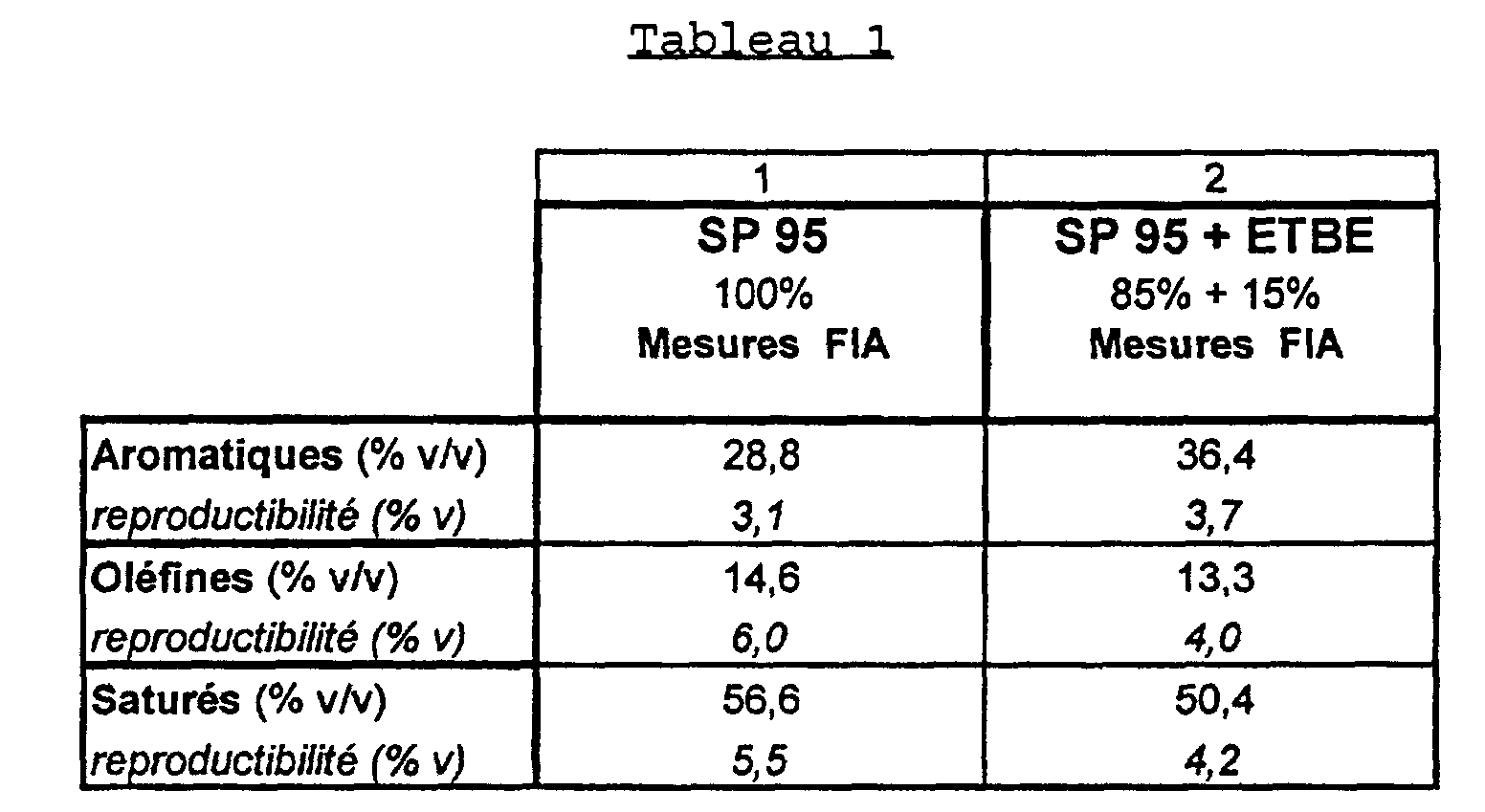
- écart positif et significatif (+7,6 %) sur la mesure des hydrocarbures aromatiques,
- écart négatif et significatif (-6,2 %) sur la mesure des hydrocarbures saturés.
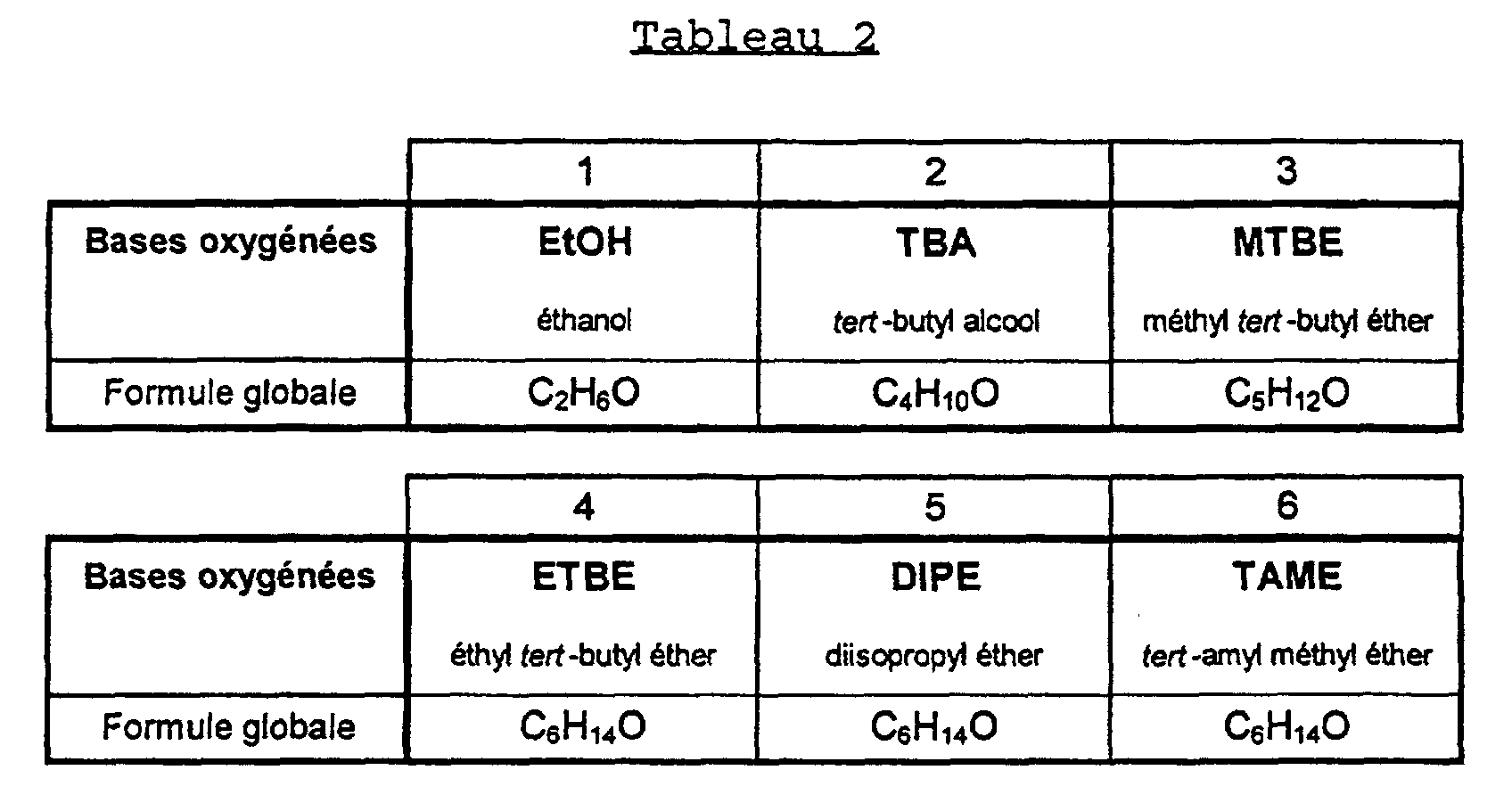
- pour les composés oxygénés légers comportant par exemple de 2 à 5 atomes de carbone (colonnes 1,2 et 3), comme l'éthanol, le TBA (tert-butyl alcool) ou le MTBE, aucune réponse FIA n'est attribuable à une famille d'hydrocarbures. Les colorants jaune, bleu et rouge, spécifiques des différentes familles d'hydrocarbures présentes dans le carburant, sont élués régulièrement et traversent la colonne à des vitesses sensiblement comparables, pour se situer au niveau du front d'élution, au bas de la colonne, traduisant ainsi une absence de réponse FIA ;
- pour les oxygénés plus lourds avec au moins 6 atomes de carbone (colonnes 4,5 et 6) comme par exemple l'ETBE, le DIPE ou le TAME, les colorants jaune et bleu migrent régulièrement comme précédemment, pour se stabiliser sur le front d'élution au bas de la colonne, tandis que le colorant rouge progresse plus lentement et reste en queue de colonne, en place de la limite haute des aromatiques. Selon l'application de la méthode ASTM D1319, cette mesure à l'anneau rouge est équivalente à une réponse correspondant à 100% de molécules aromatiques.
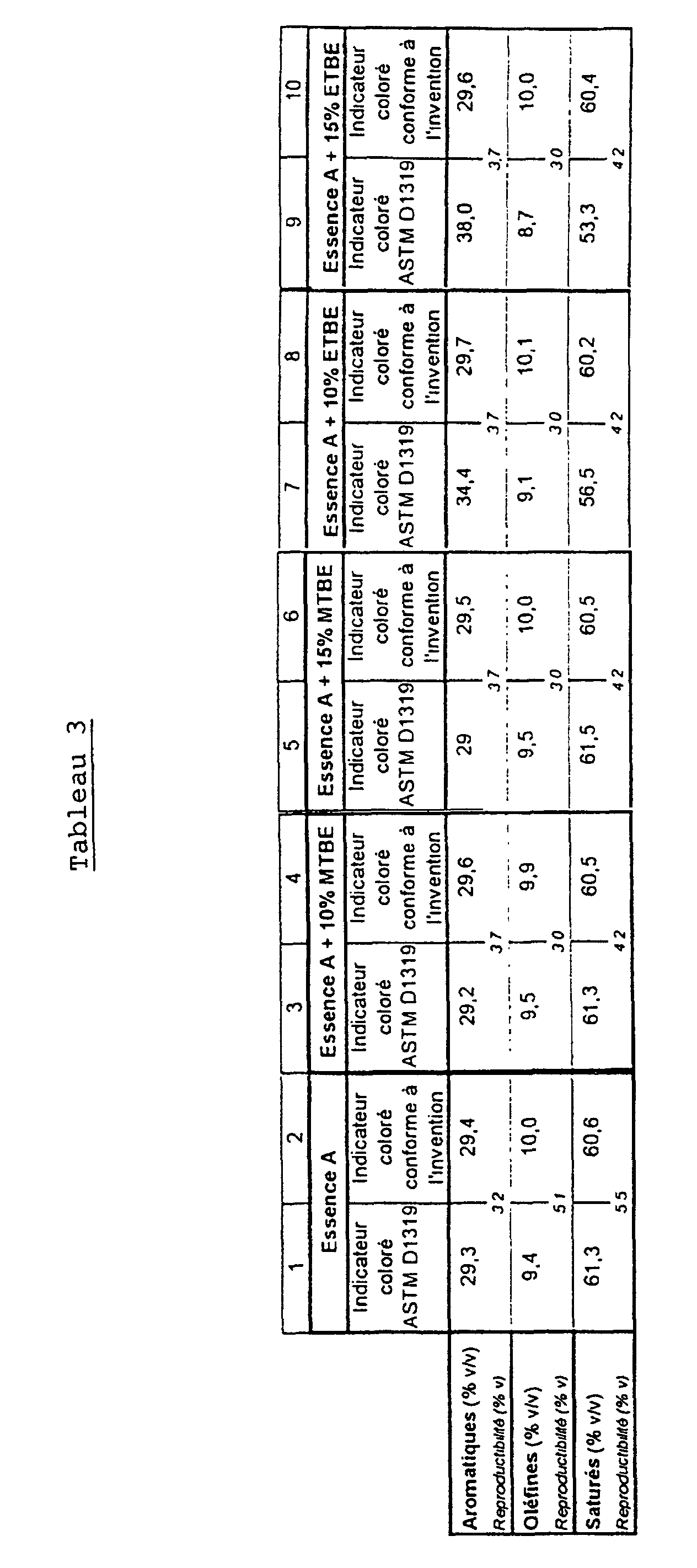
- l'indicateur coloré commercialisé sous l'appellation "Fluorescent Indicator", par la société Universal Oil Products ;
- l'indicateur coloré conforme à l'invention, obtenu à partir du précédent par extraction du colorant rouge qu'il contient.
Claims (12)
- Indicateur coloré pour la mesure par chromatographie en phase liquide sur colonne des teneurs en composés hydrocarbonés appartenant aux familles des hydrocarbures saturés, oléfiniques et aromatiques, présents dans un mélange, qui contient par ailleurs des composés oxygénés possédant au moins six atomes de carbone, cet indicateur coloré contenant des quantités substantielles de divers colorants susceptibles d'être élués sélectivement avec chacune de ces familles en exprimant des couleurs différentes pour chacune de celles-ci, et étant caractérisé en ce que les colorants susceptibles d'être élués avec la famille des hydrocarbures aromatiques sont dépourvus de composés organiques ayant une affinité avec les composés oxygénés comprenant au moins 6 atomes de carbone.
- Indicateur selon la revendication 1, caractérisé en ce les colorants susceptibles d'être élués sélectivement avec la famille des hydrocarbures aromatiques appartiennent à la famille des composés hydroxy arylés.
- Indicateur coloré selon la revendication 2, caractérisé en ce que les colorants susceptibles d'être élués sélectivement avec la famille des hydrocarbures aromatiques sont des colorants de type azoïque aromatique.
- Indicateur coloré selon l'une des revendications 1 à 3, caractérisé en ce qu'il comprend un indicateur coloré d'un type connu en soi préconisé pour la mise en oeuvre de la méthode d'analyse selon la norme ASTM D1319, dont ont été éliminés les colorants susceptibles d'être élués avec la famille des hydrocarbures aromatiques et ayant une affinité avec les composés oxygénés comprenant au moins 6 atomes de carbone.
- Indicateur coloré selon la revendication 4, caractérisé en ce qu'il est dépourvu du colorant rouge présent dans l'indicateur coloré connu préconisé pour la mise en oeuvre de la méthode d'analyse selon la norme ASTM 1319, mais non du pigment brun présent également dans cet indicateur connu.
- Procédé de préparation d'un indicateur coloré selon l'une des revendications 1 à 5, à partir d'un indicateur coloré d'un type connu, utilisé pour la détermination par chromatographie en phase liquide sur colonne des familles d'hydrocarbures contenues dans un mélange, ce procédé étant caractérisé en ce que l'on extrait de l'indicateur connu, à l'aide d'au moins un composé oxygéné contenant au moins 6 atomes de carbone, les colorants organiques susceptibles d'être élués par les composés oxygénés comprenant au moins 6 atomes de carbone.
- Procédé selon la revendication 6, caractérisé en ce que le composé oxygéné contenant au moins 6 atomes de carbone est choisi dans le groupe comprenant l'ETBE, le TAME, le DIPE et leurs mélanges.
- Procédé selon l'une des revendications 6 et 7, caractérisé en ce que l'on élue sur une colonne chromatographique à l'aide d'un composé oxygéné comprenant au moins 6 atomes de carbone, un indicateur coloré préconisé pour la mise en oeuvre de la méthode d'analyse selon la norme ASTM D1319, en ce que l'on sépare et recueille séparément les colorants jaune, bleu et rouge de cet indicateur, en ce que l'on élue à nouveau le colorant rouge ainsi séparé sur une colonne chromatographique avec un composé oxygéné comprenant au moins 6 atomes de carbone, qui peut être identique à celui de la première élution, en vue de séparer ce colorant rouge en deux fractions, l'une rouge et l'autre brune, en ce que l'on recueille la fraction brune et en ce qu'on la mélange intimement avec les colorants jaune et bleu précédemment séparés, pour former l'indicateur coloré désiré.
- Procédé selon la revendication 6, caractérisé en ce que l'extraction de l'indicateur coloré d'un type connu des colorants organiques susceptibles d'être élués par les composés organiques comprenant au moins 6 atomes de carbone s'effectue par mélange sous agitation de cet indicateur coloré connu avec au moins un produit oxygéné comportant au moins 6 atomes de carbone.
- Procédé selon l'une des revendications 6 à 9, caractérisé en ce que le produit oxygéné à au moins 6 atomes de carbone est utilisé en mélange avec un solvant aromatique, tel que le toluène.
- Utilisation de l'indicateur coloré selon l'une des revendications 1 à 5, pour la mesure de la répartition des familles d'hydrocarbures contenues dans un mélange, par une variante de la méthode FIA selon la norme ASTM D1319, dans laquelle la lecture de la colonne chromatographique s'effectue de façon usuelle, en se référant à des anneaux respectivement jaune et bleu, pour les hydrocarbures saturés et oléfiniques, cette utilisation étant caractérisée en ce que, pour déceler la fin des composés aromatiques, on prend pour référence sur la colonne chromatographique un anneau brun et non plus rouge, le pigment brun de l'indicateur coloré étant élué spécifiquement par les hydrocarbures aromatiques.
- Utilisation selon la revendication 11, pour l'analyse d'un mélange dans lequel est en outre présent au moins un composé oxygéné du type éther à au moins 6 atomes de carbone.
Applications Claiming Priority (2)
| Application Number | Priority Date | Filing Date | Title |
|---|---|---|---|
| FR9815884 | 1998-12-16 | ||
| FR9815884A FR2787577B1 (fr) | 1998-12-16 | 1998-12-16 | Indicateur colore pour la mesure de la repartition des familles d'hydrocarbures contenues dans un melange, son procede d'obtention et ses utilisations |
Publications (2)
| Publication Number | Publication Date |
|---|---|
| EP1010978A1 EP1010978A1 (fr) | 2000-06-21 |
| EP1010978B1 true EP1010978B1 (fr) | 2002-07-24 |
Family
ID=9534035
Family Applications (1)
| Application Number | Title | Priority Date | Filing Date |
|---|---|---|---|
| EP99403112A Expired - Lifetime EP1010978B1 (fr) | 1998-12-16 | 1999-12-10 | Indicateur coloré pour la mesure de la répartition des familles d'hydrocarbures |
Country Status (5)
| Country | Link |
|---|---|
| US (1) | US6451615B1 (fr) |
| EP (1) | EP1010978B1 (fr) |
| AT (1) | ATE221198T1 (fr) |
| DE (1) | DE69902218D1 (fr) |
| FR (1) | FR2787577B1 (fr) |
Families Citing this family (2)
| Publication number | Priority date | Publication date | Assignee | Title |
|---|---|---|---|---|
| CN109596735A (zh) * | 2018-12-21 | 2019-04-09 | 康美药业股份有限公司 | 一种中药材黄色系染色剂的检测方法 |
| CN109596736A (zh) * | 2018-12-21 | 2019-04-09 | 康美药业股份有限公司 | 一种中药饮片中黄色系染色剂的检测方法 |
Family Cites Families (9)
| Publication number | Priority date | Publication date | Assignee | Title |
|---|---|---|---|---|
| DE2716674A1 (de) * | 1977-04-15 | 1978-10-19 | Basf Ag | Farbstoffmischungen |
| DE3212241A1 (de) * | 1982-04-02 | 1983-10-06 | Basf Ag | Disazofarbstoffe |
| JPH03210472A (ja) * | 1990-01-13 | 1991-09-13 | Cosmo Sogo Kenkyusho:Kk | 軽質炭化水素油の組成分析方法 |
| US5190882A (en) * | 1990-03-02 | 1993-03-02 | Exxon Research And Engineering Company | Method for quantitatively determining the amount of saturates, olefins, and aromatics in a mixture thereof |
| US5358873A (en) * | 1992-07-27 | 1994-10-25 | Atlantic Richfield Company | Method for determining adulteration of gasolines |
| US5304493A (en) * | 1993-01-22 | 1994-04-19 | Atlantic Richfield Company | Method for detecting a marker dye in aged petroleum distillate fuels |
| DE4334678A1 (de) * | 1993-10-12 | 1995-04-13 | Basf Ag | Verfahren zum Nachweis von markierten Mineralölen sowie neue Azofarbstoffe |
| DE4343823A1 (de) * | 1993-12-22 | 1995-06-29 | Basf Ag | Verwendung von Azofarbstoffen zum Markieren von Kohlenwasserstoffen sowie neue Azofarbstoffe |
| IT1269947B (it) * | 1994-06-24 | 1997-04-16 | Basf Italia | Composizione marcante-denaturante particolarmente adatta per marcare e denaturare combustibili |
-
1998
- 1998-12-16 FR FR9815884A patent/FR2787577B1/fr not_active Expired - Fee Related
-
1999
- 1999-12-10 AT AT99403112T patent/ATE221198T1/de not_active IP Right Cessation
- 1999-12-10 DE DE69902218T patent/DE69902218D1/de not_active Expired - Lifetime
- 1999-12-10 EP EP99403112A patent/EP1010978B1/fr not_active Expired - Lifetime
- 1999-12-16 US US09/464,088 patent/US6451615B1/en not_active Expired - Fee Related
Also Published As
| Publication number | Publication date |
|---|---|
| ATE221198T1 (de) | 2002-08-15 |
| US6451615B1 (en) | 2002-09-17 |
| FR2787577A1 (fr) | 2000-06-23 |
| DE69902218D1 (de) | 2002-08-29 |
| FR2787577B1 (fr) | 2001-03-02 |
| EP1010978A1 (fr) | 2000-06-21 |
Similar Documents
| Publication | Publication Date | Title |
|---|---|---|
| KR100545054B1 (ko) | 스파크 점화 연소 엔진용 에탄올 함유 모터 연료의증기압을 낮추는 방법 | |
| Khorasani | Novel development in fluorescence microscopy of complex organic mixtures: application in petroleum geochemistry | |
| EA026446B1 (ru) | Жидкие композиции для маркировки жидкого углеводородного моторного топлива и других горючих материалов, моторное топливо и другие горючие материалы, содержащие их, и способ обнаружения маркеров | |
| Thiébaut | Separations of petroleum products involving supercritical fluid chromatography | |
| EA200500361A1 (ru) | Способ уменьшения выбросов отработавших газов при сжигании неэтилированного автомобильного бензинового топлива | |
| EP2120047A1 (fr) | Procédé pour déterminer des propriétés physico-chimiques d'un échantillon pétrolier à partir de chromatographie en phase gazeuse bidimensionnelle | |
| US4918020A (en) | Analyzing marker dyes in liquid hydrocarbon fuels | |
| Robbins | Quantitative measurement of mass and aromaticity distributions for heavy distillates 1. Capabilities of the HPLC-2 system | |
| Quimby et al. | Improved measurement of sulfur and nitrogen compounds in refinery liquids using gas chromatography—atomic emission detection | |
| EP1010978A1 (fr) | Indicateur coloré pour la mesure de la répartition des familles d'hydrocarbures | |
| Auersvald et al. | Determination of olefins in pyrolysis oils from waste plastics and tires–Comparability of titration and chromatographic methods | |
| Buchanan et al. | Analysis of olefinic gasolines with multidimensional gas chromatography | |
| Pavlova et al. | GC methods for quantitative determination of benzene in gasoline | |
| Stout et al. | Diagnostic compounds for fingerprinting petroleum in the environment | |
| dos Santos et al. | Fuel Quality Monitoring by Color | |
| Knight et al. | Fluorescent Indicator Adsorption Method for Hydrocarbon Type Analysis | |
| Den Otter et al. | Effect of gasoline reformulation on exhaust emissions in current European vehicles | |
| Beens et al. | A comparison of ten different methods for the analysis of saturates, olefins, benzene, total aromatics, and oxygenates in finished gasolines | |
| Kröll et al. | Influence of fuel composition on NMOG-emissions and ozone forming potential | |
| Cebolla et al. | Determination of hydrocarbon types in petroleum and coal-derived products by thin-layer chromatography/densitometry | |
| Davis et al. | Inverse gas-liquid chromatographic studies of asphalt. Comparison with analyses by fractionation | |
| Petrović et al. | Recognition and qualitative characterization of commercial petroleum fuels and synthetic fuels by a gas chromatographic fingerprinting technique: I. General considerations | |
| Johnson | Routine analysis of oxygenates and benzene in retail motor fuel: a survey by the State of Alabama | |
| Spakowski et al. | Determination of Aromatics and Olefins in Wide Boiling Petroleum Fractions | |
| Zerlia et al. | UV spectrometry as a tool for rapid screening of petroleum products |
Legal Events
| Date | Code | Title | Description |
|---|---|---|---|
| PUAI | Public reference made under article 153(3) epc to a published international application that has entered the european phase |
Free format text: ORIGINAL CODE: 0009012 |
|
| AK | Designated contracting states |
Kind code of ref document: A1 Designated state(s): AT BE CH CY DE DK ES FI FR GB GR IE IT LI LU MC NL PT SE |
|
| AX | Request for extension of the european patent |
Free format text: AL;LT;LV;MK;RO;SI |
|
| 17P | Request for examination filed |
Effective date: 20001012 |
|
| AKX | Designation fees paid |
Free format text: AT BE CH CY DE DK ES FI FR GB GR IE IT LI LU MC NL PT SE |
|
| GRAG | Despatch of communication of intention to grant |
Free format text: ORIGINAL CODE: EPIDOS AGRA |
|
| GRAG | Despatch of communication of intention to grant |
Free format text: ORIGINAL CODE: EPIDOS AGRA |
|
| GRAH | Despatch of communication of intention to grant a patent |
Free format text: ORIGINAL CODE: EPIDOS IGRA |
|
| 17Q | First examination report despatched |
Effective date: 20020104 |
|
| GRAH | Despatch of communication of intention to grant a patent |
Free format text: ORIGINAL CODE: EPIDOS IGRA |
|
| GRAA | (expected) grant |
Free format text: ORIGINAL CODE: 0009210 |
|
| AK | Designated contracting states |
Kind code of ref document: B1 Designated state(s): AT BE CH CY DE DK ES FI FR GB GR IE IT LI LU MC NL PT SE |
|
| PG25 | Lapsed in a contracting state [announced via postgrant information from national office to epo] |
Ref country code: NL Free format text: LAPSE BECAUSE OF FAILURE TO SUBMIT A TRANSLATION OF THE DESCRIPTION OR TO PAY THE FEE WITHIN THE PRESCRIBED TIME-LIMIT Effective date: 20020724 Ref country code: IT Free format text: LAPSE BECAUSE OF FAILURE TO SUBMIT A TRANSLATION OF THE DESCRIPTION OR TO PAY THE FEE WITHIN THE PRE;WARNING: LAPSES OF ITALIAN PATENTS WITH EFFECTIVE DATE BEFORE 2007 MAY HAVE OCCURRED AT ANY TIME BEFORE 2007. THE CORRECT EFFECTIVE DATE MAY BE DIFFERENT FROM THE ONE RECORDED.SCRIBED TIME-LIMIT Effective date: 20020724 Ref country code: IE Free format text: LAPSE BECAUSE OF FAILURE TO SUBMIT A TRANSLATION OF THE DESCRIPTION OR TO PAY THE FEE WITHIN THE PRESCRIBED TIME-LIMIT Effective date: 20020724 Ref country code: GR Free format text: LAPSE BECAUSE OF FAILURE TO SUBMIT A TRANSLATION OF THE DESCRIPTION OR TO PAY THE FEE WITHIN THE PRESCRIBED TIME-LIMIT Effective date: 20020724 Ref country code: GB Free format text: LAPSE BECAUSE OF FAILURE TO SUBMIT A TRANSLATION OF THE DESCRIPTION OR TO PAY THE FEE WITHIN THE PRESCRIBED TIME-LIMIT Effective date: 20020724 Ref country code: FI Free format text: LAPSE BECAUSE OF FAILURE TO SUBMIT A TRANSLATION OF THE DESCRIPTION OR TO PAY THE FEE WITHIN THE PRESCRIBED TIME-LIMIT Effective date: 20020724 Ref country code: AT Free format text: LAPSE BECAUSE OF FAILURE TO SUBMIT A TRANSLATION OF THE DESCRIPTION OR TO PAY THE FEE WITHIN THE PRESCRIBED TIME-LIMIT Effective date: 20020724 |
|
| REF | Corresponds to: |
Ref document number: 221198 Country of ref document: AT Date of ref document: 20020815 Kind code of ref document: T |
|
| REG | Reference to a national code |
Ref country code: GB Ref legal event code: FG4D Free format text: NOT ENGLISH |
|
| REG | Reference to a national code |
Ref country code: CH Ref legal event code: EP |
|
| REG | Reference to a national code |
Ref country code: IE Ref legal event code: FG4D Free format text: FRENCH |
|
| REF | Corresponds to: |
Ref document number: 69902218 Country of ref document: DE Date of ref document: 20020829 |
|
| PG25 | Lapsed in a contracting state [announced via postgrant information from national office to epo] |
Ref country code: SE Free format text: LAPSE BECAUSE OF FAILURE TO SUBMIT A TRANSLATION OF THE DESCRIPTION OR TO PAY THE FEE WITHIN THE PRESCRIBED TIME-LIMIT Effective date: 20021024 Ref country code: DK Free format text: LAPSE BECAUSE OF FAILURE TO SUBMIT A TRANSLATION OF THE DESCRIPTION OR TO PAY THE FEE WITHIN THE PRESCRIBED TIME-LIMIT Effective date: 20021024 |
|
| PG25 | Lapsed in a contracting state [announced via postgrant information from national office to epo] |
Ref country code: PT Free format text: LAPSE BECAUSE OF FAILURE TO SUBMIT A TRANSLATION OF THE DESCRIPTION OR TO PAY THE FEE WITHIN THE PRESCRIBED TIME-LIMIT Effective date: 20021025 Ref country code: DE Free format text: LAPSE BECAUSE OF FAILURE TO SUBMIT A TRANSLATION OF THE DESCRIPTION OR TO PAY THE FEE WITHIN THE PRESCRIBED TIME-LIMIT Effective date: 20021025 |
|
| PGFP | Annual fee paid to national office [announced via postgrant information from national office to epo] |
Ref country code: FR Payment date: 20021128 Year of fee payment: 4 |
|
| PG25 | Lapsed in a contracting state [announced via postgrant information from national office to epo] |
Ref country code: LU Free format text: LAPSE BECAUSE OF NON-PAYMENT OF DUE FEES Effective date: 20021210 |
|
| PG25 | Lapsed in a contracting state [announced via postgrant information from national office to epo] |
Ref country code: CY Free format text: LAPSE BECAUSE OF FAILURE TO SUBMIT A TRANSLATION OF THE DESCRIPTION OR TO PAY THE FEE WITHIN THE PRESCRIBED TIME-LIMIT Effective date: 20021231 Ref country code: BE Free format text: LAPSE BECAUSE OF NON-PAYMENT OF DUE FEES Effective date: 20021231 |
|
| NLV1 | Nl: lapsed or annulled due to failure to fulfill the requirements of art. 29p and 29m of the patents act | ||
| GBV | Gb: ep patent (uk) treated as always having been void in accordance with gb section 77(7)/1977 [no translation filed] |
Effective date: 20020724 |
|
| PG25 | Lapsed in a contracting state [announced via postgrant information from national office to epo] |
Ref country code: ES Free format text: LAPSE BECAUSE OF FAILURE TO SUBMIT A TRANSLATION OF THE DESCRIPTION OR TO PAY THE FEE WITHIN THE PRESCRIBED TIME-LIMIT Effective date: 20030130 |
|
| REG | Reference to a national code |
Ref country code: IE Ref legal event code: FD4D Ref document number: 1010978E Country of ref document: IE |
|
| PLBE | No opposition filed within time limit |
Free format text: ORIGINAL CODE: 0009261 |
|
| STAA | Information on the status of an ep patent application or granted ep patent |
Free format text: STATUS: NO OPPOSITION FILED WITHIN TIME LIMIT |
|
| BERE | Be: lapsed |
Owner name: S.A. *TOTAL RAFFINAGE DISTRIBUTION Effective date: 20021231 |
|
| PG25 | Lapsed in a contracting state [announced via postgrant information from national office to epo] |
Ref country code: MC Free format text: LAPSE BECAUSE OF NON-PAYMENT OF DUE FEES Effective date: 20030701 |
|
| 26N | No opposition filed |
Effective date: 20030425 |
|
| PG25 | Lapsed in a contracting state [announced via postgrant information from national office to epo] |
Ref country code: LI Free format text: LAPSE BECAUSE OF NON-PAYMENT OF DUE FEES Effective date: 20031231 Ref country code: CH Free format text: LAPSE BECAUSE OF NON-PAYMENT OF DUE FEES Effective date: 20031231 |
|
| REG | Reference to a national code |
Ref country code: CH Ref legal event code: PL |
|
| PG25 | Lapsed in a contracting state [announced via postgrant information from national office to epo] |
Ref country code: FR Free format text: LAPSE BECAUSE OF NON-PAYMENT OF DUE FEES Effective date: 20040831 |
|
| REG | Reference to a national code |
Ref country code: FR Ref legal event code: ST |