EP1007624B1 - Ds11 (kctc 0231bp), novel bacillus sp. strain and novel phytase produced by it - Google Patents
Ds11 (kctc 0231bp), novel bacillus sp. strain and novel phytase produced by it Download PDFInfo
- Publication number
- EP1007624B1 EP1007624B1 EP97906341A EP97906341A EP1007624B1 EP 1007624 B1 EP1007624 B1 EP 1007624B1 EP 97906341 A EP97906341 A EP 97906341A EP 97906341 A EP97906341 A EP 97906341A EP 1007624 B1 EP1007624 B1 EP 1007624B1
- Authority
- EP
- European Patent Office
- Prior art keywords
- phytase
- novel
- strain
- bacillus
- kctc
- Prior art date
- Legal status (The legal status is an assumption and is not a legal conclusion. Google has not performed a legal analysis and makes no representation as to the accuracy of the status listed.)
- Expired - Lifetime
Links
Images

Classifications
-
- C—CHEMISTRY; METALLURGY
- C12—BIOCHEMISTRY; BEER; SPIRITS; WINE; VINEGAR; MICROBIOLOGY; ENZYMOLOGY; MUTATION OR GENETIC ENGINEERING
- C12N—MICROORGANISMS OR ENZYMES; COMPOSITIONS THEREOF; PROPAGATING, PRESERVING, OR MAINTAINING MICROORGANISMS; MUTATION OR GENETIC ENGINEERING; CULTURE MEDIA
- C12N1/00—Microorganisms; Compositions thereof; Processes of propagating, maintaining or preserving microorganisms or compositions thereof; Processes of preparing or isolating a composition containing a microorganism; Culture media therefor
- C12N1/20—Bacteria; Culture media therefor
-
- C—CHEMISTRY; METALLURGY
- C12—BIOCHEMISTRY; BEER; SPIRITS; WINE; VINEGAR; MICROBIOLOGY; ENZYMOLOGY; MUTATION OR GENETIC ENGINEERING
- C12Y—ENZYMES
- C12Y301/00—Hydrolases acting on ester bonds (3.1)
- C12Y301/03—Phosphoric monoester hydrolases (3.1.3)
- C12Y301/03008—3-Phytase (3.1.3.8)
-
- A—HUMAN NECESSITIES
- A23—FOODS OR FOODSTUFFS; TREATMENT THEREOF, NOT COVERED BY OTHER CLASSES
- A23K—FODDER
- A23K20/00—Accessory food factors for animal feeding-stuffs
- A23K20/10—Organic substances
- A23K20/189—Enzymes
-
- C—CHEMISTRY; METALLURGY
- C12—BIOCHEMISTRY; BEER; SPIRITS; WINE; VINEGAR; MICROBIOLOGY; ENZYMOLOGY; MUTATION OR GENETIC ENGINEERING
- C12N—MICROORGANISMS OR ENZYMES; COMPOSITIONS THEREOF; PROPAGATING, PRESERVING, OR MAINTAINING MICROORGANISMS; MUTATION OR GENETIC ENGINEERING; CULTURE MEDIA
- C12N1/00—Microorganisms; Compositions thereof; Processes of propagating, maintaining or preserving microorganisms or compositions thereof; Processes of preparing or isolating a composition containing a microorganism; Culture media therefor
- C12N1/20—Bacteria; Culture media therefor
- C12N1/205—Bacterial isolates
-
- C—CHEMISTRY; METALLURGY
- C12—BIOCHEMISTRY; BEER; SPIRITS; WINE; VINEGAR; MICROBIOLOGY; ENZYMOLOGY; MUTATION OR GENETIC ENGINEERING
- C12N—MICROORGANISMS OR ENZYMES; COMPOSITIONS THEREOF; PROPAGATING, PRESERVING, OR MAINTAINING MICROORGANISMS; MUTATION OR GENETIC ENGINEERING; CULTURE MEDIA
- C12N9/00—Enzymes; Proenzymes; Compositions thereof; Processes for preparing, activating, inhibiting, separating or purifying enzymes
- C12N9/14—Hydrolases (3)
- C12N9/16—Hydrolases (3) acting on ester bonds (3.1)
-
- C—CHEMISTRY; METALLURGY
- C12—BIOCHEMISTRY; BEER; SPIRITS; WINE; VINEGAR; MICROBIOLOGY; ENZYMOLOGY; MUTATION OR GENETIC ENGINEERING
- C12Y—ENZYMES
- C12Y301/00—Hydrolases acting on ester bonds (3.1)
- C12Y301/03—Phosphoric monoester hydrolases (3.1.3)
- C12Y301/03026—4-Phytase (3.1.3.26), i.e. 6-phytase
-
- C—CHEMISTRY; METALLURGY
- C12—BIOCHEMISTRY; BEER; SPIRITS; WINE; VINEGAR; MICROBIOLOGY; ENZYMOLOGY; MUTATION OR GENETIC ENGINEERING
- C12R—INDEXING SCHEME ASSOCIATED WITH SUBCLASSES C12C - C12Q, RELATING TO MICROORGANISMS
- C12R2001/00—Microorganisms ; Processes using microorganisms
- C12R2001/01—Bacteria or Actinomycetales ; using bacteria or Actinomycetales
- C12R2001/07—Bacillus
Definitions
- This invention relates to a novel phytase produced from novel strain Bacillus sp. DS11 (KCTC 0231BP) and more precisely, to a novel strain Bacillus sp. DS11 and phytase enzyme enhancing the phosphate bioavailability present in grains supplied to monogastric animals.
- Phytase is an enzyme to degrade phytic acid into phosphate and phosphate inositol. 50 to 70% of phosphate in grain used as livestock feeds exists in form of phytic acid but phytase is not present in monogastric animals such as hens and hogs, resulting in low phosphate availibility.
- the addition of phytase in the feeds may greatly improve the productivity of livestock by enhancing the availability of some bioactive substances(phosphate, calcium and zinc etc.) which, otherwise chelate with phytictaine and lose their activity.
- the inventor et al. have identified a novel phytase-producing microorganism among hundred kinds of molds, Actinomycetes, bacteria, etc., obtained from soils and barns throughout the country, in an effort to produce phytase having excellent enzymatic potency and shorten the production period compared with the conventional phytase. Because of the high enzymatic potency of this novel microorganism and its physiological suitability to use for monogastric animals and short period of production compared to those of conventional enzymes the inventor et al. have judged that this enzyme has novelty and they have completed this invention.
- the object of this invention is to provide novel strain Bacillus sp. DS11 (KCTC 0231BP) and phytase enzyme, which is suitable to use for monogastric animals with excellent properties and more shortened production period.
- This invention relates to a novel phytase produced from novel strain Bacillus sp. DS11 (KCTC 0231BP) and particularly, to a novel strain Bacillus sp. DS11 and phytase enzyme enhancing the phosphate bioavailability present in grains supplied to monogastric animals.
- This invention relates to novel strain Bacillus sp. DS11(KCTC 0231BP).
- this invention includes its novel enzyme phytase whose N-terminal amino acid sequence is expressed by the following [Sequence table 1] under the following conditions:
- this invention includes the use of said microorganism as feed additives.
- This invention relates to a novel strain Bacillus sp. DS11 (KCTC 0231BP) and novel phytase produced from said strain.
- the procedure for isolating and identifying said novel microorganism is as follows:
- strain In the grams staining test of the strain cultivated in an optimal growth medium, the strain was proven to be gram-positive.
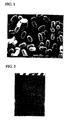
- Fig. 1 the picture of electron microscope shows that strain is a rod type of 0.8 ⁇ 1.8 ⁇ m in cell size.
- thermostable spores In the growth test of the thermally inactivated cells at 80 °C, said strain has formed thermostable spores. Further, its catalase test in which it shows the positive response demonstrates that it coincides with the morphological property of Bacillus sp.
- the physiological property of said strain is as follows:
- test results of physiological property of the strain are represented in the following table 1.
- table 1 it is assumed that strain is a facultative microorganism which may be grow in both aerobic and anaerobic states. With the difference of grown strains found at 50 °C and pH 5.7 compared with Bacillus pantothenticus, the strain of this invention is a mutant derived from Bacillus pantothenticus.
- Property Bacillus pantotheniticus Strain of this invention Catalase + + Anaerobic culture + + V-p.
- test results of their various properties are represented in the following table 2.
- the strain of this invention is similar to Bacillus pantotheniticus in terms of G + C content, murein type and main melaquinone including fatty acid of strain but it seems to difficult to make a judgement that both strains are the same species. Thus, it seems that the strain of this invention is a mutant derived from Bacillus pantothenticus.
- the strain of this invention belongs to Bacillus sp. from Bergys Manual of Systemic Bacteriology Vol. 2 (Williams & Wilkins Co., 1989). Therefore, the microorganism isolated was nominated as Bacillus sp. DS11 and deposited on February 1, 1996, to Korea Research Institute of Bioscience and Biotechnology Korean Collection for type cultures, Korean Patent Strain Deposit Associations located in #52, Oun-dong, Yusongku, Taejeon 305-333, Republic of Korea, with an accession number KCTC 0231BP.
- the potency of produced enzyme was measured as follows: By using a substrate, comprising 2 mM phytic acid sodium salts and 2mM CaCl 2 in 0.1 M Tris buffer solution (pH 7.0), the enzyme was reacted at 37°C for 30 minutes to measure the amount of phosphoric acid generated.
- One unit of the enzymatic potency is equivalent to the enzymatic amount degrading 1 ⁇ mol of inorganic phosphate per 1 minute.
- the novel enzyme has the enzymatic potency of 0.3 unit per protein mg.
- the maximum amount of enzyme in fermentation yielding 0.6 unit/mg was obtained when 30 l of strains, a working volume, was charged to a 50 l fermenter and cultivated at 37 °C for 48 hours under the following conditions: air influx - 0.8 vvm; stirring rate - 150 rpm- Compared with the enzymatic production amount of 0.3 unit/mg when phytase enzyme derived from Aspergillus ficuum is cultivated for 96 hours [Donna M. Gibson, 1987], it is well observed that the novel organism of this invention has a production amount twice higher.
- the sequencing No. 1 of [Sequence table] is the sequence of N-terminal amino acids of the phytase produced from a novel strain of this invention; the sequencing No. 2 is the sequence of the N-terminal amino adds of the phytase produced from E. coli (Arch. Biochem. Biophys. 303(1993)]; the sequencing No. 3 is the sequence of the N-terminal amino acids of the phytase produced from Aspegillus ficuum [Prep. Biochem. 18(1988)].
- the optimal temperature was proved to be 65°C by using the enzyme isolated by the same method as described in the experimental example 2. To measure the thermal stability, the enzyme was left at each temperature for 10 minutes so as to assess the residual activity. As shown in the attached drawing Fig. 3 (3-1), the results show that when Ca 2+ was not added, the activity began to decrease at 40 °C but in case of adding 5mM calcium ion, the activity was stable up to 70°C and 50% of the activity at 75°C was sustained.
- a novel phytase of this invention may be expected to a higher activity in the body of livestock. Therefore, it seems to be preferable that the feeds should be pelleted or extruded at more than 75 °C so as to use them as processing ones.
- novel phytase of this invention may be applicable as a feed additive of monogastric animals.
- Influence of metal ion and inhibitor on enzyme activity is represented in the following table 3.
- broilers were divided into three groups such as novel phytase group, soybean-extracted plant phytase group and mold phytase group on the market(manufacturer: Sigma). Each of hatched-out 200 males of Avaachre broiler chicken was announced publicly for this experiment. The cultured medium containing phytase was ultrafiltrated and further concentrated at low temperature under vacuum and dried by lyophilizer. Each 500 unit of this lyophilized phytase was added to per kg of feed.
Landscapes
- Chemical & Material Sciences (AREA)
- Life Sciences & Earth Sciences (AREA)
- Health & Medical Sciences (AREA)
- Engineering & Computer Science (AREA)
- Organic Chemistry (AREA)
- Zoology (AREA)
- Bioinformatics & Cheminformatics (AREA)
- Genetics & Genomics (AREA)
- Wood Science & Technology (AREA)
- General Engineering & Computer Science (AREA)
- General Health & Medical Sciences (AREA)
- Biochemistry (AREA)
- Biotechnology (AREA)
- Medicinal Chemistry (AREA)
- Biomedical Technology (AREA)
- Microbiology (AREA)
- Polymers & Plastics (AREA)
- Tropical Medicine & Parasitology (AREA)
- Virology (AREA)
- Molecular Biology (AREA)
- Animal Husbandry (AREA)
- Food Science & Technology (AREA)
- Enzymes And Modification Thereof (AREA)
- Micro-Organisms Or Cultivation Processes Thereof (AREA)
- Fodder In General (AREA)
Abstract
Description
| Property | Bacillus pantotheniticus | Strain of this invention | |
| Catalase | + | + | |
| Anaerobic culture | + | + | |
| V-p. test | - | + | |
| Acid-forming | glucose | + | + |
| L-arabinose | - | + | |
| D-xylose | - | - | |
| D-mannitol | - | + | |
| Hydrolysis | Casein | d | + |
| Gelatin | + | + | |
| Starch | + | + | |
| Synthesis | Indole | - | - |
| Dihydroacetone | - | - | |
| Growth pH | 6.8 | + | + |
| 5.7 | - | + | |
| Concentration of | 2% | + | + |
| growth salt | 5% | + | + |
| (at NaCl) | 7% | + | + |
| 10% | + | + | |
| | 5°C | - | - |
| 10°C | - | - | |
| 30°C | + | + | |
| 40°C | + | + | |
| 50°C | - | + | |
| Note) +: positive. -: negative. d: different from species. |
| Property | Bacillus pantotheniticus | Strain of this invention | |
| G + C content | 36.9 | 45.6 | |
| Murein type | Mezo-DAP | Mezo-DAP | |
| Main melaquinone | MK-7 | MK-7 | |
| Fatty acid of strain (%) | 14 : 0 ISO | 4.71 | 1.96 |
| 14 : 0 | 1.50 | 1.21 | |
| 15 : 0 ISO | 19.34 | 18.72 | |
| 15 : 0 ANTEISO | 37.95 | 38.51 | |
| 16 : 0 ISO | 10.01 | 6.16 | |
| 16 : 0 | 9.77 | 9.77 | |
| 17 : 0 ISO | 4.37 | 9.02 | |
| 17 : 0 ANTEISO | 12.00 | 11.20 | |
| 18 : 0 | x | 2.03 |
| Additives | Concentration | |
| 1 | 5 | |
| Non-addition | ||
| 100 | 100 | |
| CuCl2 | 63 | 43 |
| ZnCl2 | 87 | 47 |
| MgCl2 | 95 | 49 |
| MnCl2 | 65 | 20 |
| LiCl2 | 95 | 100 |
| HgCl2 | 83 | 62 |
| CaCl2 | 99 | 116 |
| RbCl2 | 103 | 102 |
| EDTA | 7.5 | 7.6 |
| PMSF | 86 | 88 |
| Classification | Plant (soybean) phytase | Commercial mold phytase | Novel phytase |
| Phosphate contents in feeds (g/kg) | 5.5 | 5.5 | 5.5 |
| Intake of total feeds (g/kg) | 2.7 | 2.7 | 2.7 |
| Intake of phosphate (g/head) | 15.1 | 15.2 | 15.1 |
| Accumulation of phosphate (g/head) | 7.1 | 7.8 | 8.8 |
| Discharge of phosphate (g/head) | 8.0 | 7.4 | 6.3 |
| Absorption of phosphate (%) | 47 | 51 | 58 |
- Sequencing No.: 2
- Sequencing length: 11
- Sequencing form: amino acid
- Shape: straight chain
- Sequencing type: protein
- Sequence: Ser-Glu-Pro-Glu-Leu-Lys-Leu-Glu-Ala-Val-Val
- Sequencing No.: 3
- Sequencing length: 12
- Sequencing form: amino acid
- Shape: straight chain
- Sequencing type: protein
- Sequence: Pro-Ala-Ser-Arg-x-Gin-Ser-Ser-Cys-Asp-Thr-Val
Claims (4)
- Strain Bacillus sp. DS11(KCTC 0231BP).
- Use of strain Bacillus sp. DS11(KCTC 0231BP) as feed additives.
- A phytase obtainable from Bacillus sp. DS11 as defined in claim 1 and having the following characteristics:
Optimal temperature 65 °C Optimal pH 7.0 Molecular weight 43,000 dalton Isoelectric point 5.6 Sequence of N-terminal amino acid No. 1 based on [sequencing table] - Use of a phytase according to claim 3 as a feed additive.
Applications Claiming Priority (3)
| Application Number | Priority Date | Filing Date | Title |
|---|---|---|---|
| KR9606817 | 1996-03-14 | ||
| KR1019960006817A KR0169913B1 (en) | 1996-03-14 | 1996-03-14 | New strain Bacillus DS11 and novel phytase produced therefrom |
| PCT/KR1997/000040 WO1997033976A1 (en) | 1996-03-14 | 1997-03-14 | Ds11 (kctc 0231bp), novel bacillus sp. strain and novel phytase produced by it |
Publications (2)
| Publication Number | Publication Date |
|---|---|
| EP1007624A1 EP1007624A1 (en) | 2000-06-14 |
| EP1007624B1 true EP1007624B1 (en) | 2003-11-12 |
Family
ID=19453071
Family Applications (1)
| Application Number | Title | Priority Date | Filing Date |
|---|---|---|---|
| EP97906341A Expired - Lifetime EP1007624B1 (en) | 1996-03-14 | 1997-03-14 | Ds11 (kctc 0231bp), novel bacillus sp. strain and novel phytase produced by it |
Country Status (8)
| Country | Link |
|---|---|
| US (1) | US6255098B1 (en) |
| EP (1) | EP1007624B1 (en) |
| JP (1) | JP3165813B2 (en) |
| KR (1) | KR0169913B1 (en) |
| CA (1) | CA2249014C (en) |
| DE (1) | DE69726194T2 (en) |
| DK (1) | DK1007624T3 (en) |
| WO (1) | WO1997033976A1 (en) |
Families Citing this family (39)
| Publication number | Priority date | Publication date | Assignee | Title |
|---|---|---|---|---|
| GB2316082A (en) * | 1996-08-13 | 1998-02-18 | Finnfeeds Int Ltd | Phytase |
| US7432097B2 (en) | 1997-08-13 | 2008-10-07 | Verenium Corporation | Phytases, nucleic acids encoding them and methods of making and using them |
| US6720014B1 (en) | 1997-08-13 | 2004-04-13 | Diversa Corporation | Phytase-containing foodstuffs and methods of making and using them |
| US7078035B2 (en) | 1997-08-13 | 2006-07-18 | Diversa Corporation | Phytases, nucleic acids encoding them and methods for making and using them |
| US6183740B1 (en) | 1997-08-13 | 2001-02-06 | Diversa Corporation | Recombinant bacterial phytases and uses thereof |
| US5876997A (en) * | 1997-08-13 | 1999-03-02 | Diversa Corporation | Phytase |
| KR100351620B1 (en) * | 1999-07-09 | 2002-09-10 | 주식회사대성미생물연구소 | A thermo-stable enzyme with 2.1Å crystal structure |
| EP1527164A4 (en) * | 2001-05-04 | 2006-02-01 | Univ Florida | CLONING AND SEQUENING OF PYRUVATE DECARBOXYLASE (PDC) GENES FROM BACTERIA AND USES THEREOF |
| KR100470310B1 (en) * | 2002-02-07 | 2005-02-05 | 대한제당 주식회사 | An Anti-fungal Composition Comprising Phytase |
| US20040063184A1 (en) | 2002-09-26 | 2004-04-01 | Novozymes North America, Inc. | Fermentation processes and compositions |
| US20040253696A1 (en) | 2003-06-10 | 2004-12-16 | Novozymes North America, Inc. | Fermentation processes and compositions |
| CN101056540A (en) | 2004-09-27 | 2007-10-17 | 诺维信公司 | Enzyme granules |
| GB0423139D0 (en) * | 2004-10-18 | 2004-11-17 | Danisco | Enzymes |
| CN100419071C (en) * | 2004-10-26 | 2008-09-17 | 中国农业大学 | Bacillus capable of high protease production and use thereof |
| EP2051590B1 (en) | 2006-08-07 | 2016-04-20 | Novozymes A/S | Enzyme granules for animal feed |
| US20080031998A1 (en) | 2006-08-07 | 2008-02-07 | Novozymes A/S | Enzyme Granules for Animal Feed |
| US8143046B2 (en) * | 2007-02-07 | 2012-03-27 | Danisco Us Inc., Genencor Division | Variant Buttiauxella sp. phytases having altered properties |
| US20080220498A1 (en) * | 2007-03-06 | 2008-09-11 | Cervin Marguerite A | Variant Buttiauxella sp. phytases having altered properties |
| PL2011858T3 (en) * | 2007-07-06 | 2012-11-30 | Chr Hansen As | A bile resistant bacillus composition secreting high levels of phytase |
| ES2613805T5 (en) | 2008-12-19 | 2020-05-26 | Chr Hansen As | Bacillus composition resistant to bile |
| RU2564127C2 (en) | 2008-12-19 | 2015-09-27 | Кр. Хансен А/С | Bile resistant bacillus composition secreting high levels of essential amino acids |
| HUE030948T2 (en) | 2009-05-21 | 2017-06-28 | Basf Enzymes Llc | Phytases, nucleic acids encoding them and methods for making and using them |
| US9951364B2 (en) | 2013-09-11 | 2018-04-24 | Novozymes A/S | Processes for producing fermentation products |
| CN108699572A (en) | 2015-12-22 | 2018-10-23 | 诺维信公司 | Increase the method for fermentation product yield using phospholipase C |
| CN111164214A (en) | 2017-09-15 | 2020-05-15 | 诺维信公司 | Enzyme blends and methods for improving the nutritional quality of animal feed |
| US11326187B2 (en) | 2017-10-23 | 2022-05-10 | Novozymes A/S | Processes for producing a fermentation product |
| WO2019231944A2 (en) | 2018-05-31 | 2019-12-05 | Novozymes A/S | Processes for enhancing yeast growth and productivity |
| WO2020160126A1 (en) | 2019-01-31 | 2020-08-06 | Novozymes A/S | Polypeptides having xylanase activity and use thereof for improving the nutritional quality of animal feed |
| EP4009807A1 (en) | 2019-08-05 | 2022-06-15 | Novozymes A/S | Enzyme blends and processes for producing a high protein feed ingredient from a whole stillage byproduct |
| MX2022006438A (en) | 2019-12-16 | 2022-06-22 | Novozymes As | Processes for producing fermentation products. |
| EP4638767A1 (en) | 2022-12-19 | 2025-10-29 | Novozymes A/S | Process for reducing syrup viscosity in the backend of a process for producing a fermentation product |
| CN120283060A (en) | 2022-12-19 | 2025-07-08 | 诺维信公司 | Process for producing fermentation products using fiber degrading enzymes and engineered yeasts |
| CN120380140A (en) | 2022-12-19 | 2025-07-25 | 诺维信公司 | Carbohydrate esterase family 1 (CE 1) polypeptides having feruloyl esterase and/or acetylxylan esterase activity and polynucleotides encoding same |
| EP4638725A1 (en) | 2022-12-19 | 2025-10-29 | Novozymes A/S | Carbohydrate esterase family 3 (ce3) polypeptides having acetyl xylan esterase activity and polynucleotides encoding same |
| WO2024137248A1 (en) | 2022-12-19 | 2024-06-27 | Novozymes A/S | Compositions comprising arabinofuranosidases and a xylanase, and use thereof for increasing hemicellulosic fiber solubilization |
| AU2024303961A1 (en) | 2023-06-13 | 2025-12-11 | Novozymes A/S | Processes for producing fermentation products using engineered yeast expressing a beta-xylosidase |
| WO2025128568A1 (en) | 2023-12-11 | 2025-06-19 | Novozymes A/S | Composition and use thereof for increasing hemicellulosic fiber solubilization |
| WO2026008449A2 (en) | 2024-07-04 | 2026-01-08 | Novozymes A/S | A process for producing a fermentation product and a concentrated protein co-product |
| WO2026132160A1 (en) | 2024-12-19 | 2026-06-25 | Novozymes A/S | Stabilization of enzymes in animal feed |
Family Cites Families (2)
| Publication number | Priority date | Publication date | Assignee | Title |
|---|---|---|---|---|
| JPH0638745A (en) | 1992-03-18 | 1994-02-15 | Natl Fedelation Of Agricult Coop Assoc | Neutral phytase as well as its production method |
| WO1994019471A1 (en) * | 1993-02-26 | 1994-09-01 | The Finnish National Public Health Institute | Method and system for enhanced production of commercially important exoproteins in gram-positive bacteria |
-
1996
- 1996-03-14 KR KR1019960006817A patent/KR0169913B1/en not_active Expired - Fee Related
-
1997
- 1997-03-14 DE DE69726194T patent/DE69726194T2/en not_active Expired - Lifetime
- 1997-03-14 JP JP53245997A patent/JP3165813B2/en not_active Expired - Lifetime
- 1997-03-14 US US09/142,612 patent/US6255098B1/en not_active Expired - Lifetime
- 1997-03-14 CA CA002249014A patent/CA2249014C/en not_active Expired - Fee Related
- 1997-03-14 EP EP97906341A patent/EP1007624B1/en not_active Expired - Lifetime
- 1997-03-14 DK DK97906341T patent/DK1007624T3/en active
- 1997-03-14 WO PCT/KR1997/000040 patent/WO1997033976A1/en not_active Ceased
Also Published As
| Publication number | Publication date |
|---|---|
| JP3165813B2 (en) | 2001-05-14 |
| CA2249014C (en) | 2002-10-29 |
| US6255098B1 (en) | 2001-07-03 |
| KR0169913B1 (en) | 1999-01-15 |
| EP1007624A1 (en) | 2000-06-14 |
| DE69726194T2 (en) | 2004-09-02 |
| DK1007624T3 (en) | 2004-02-23 |
| DE69726194D1 (en) | 2003-12-18 |
| KR970065705A (en) | 1997-10-13 |
| CA2249014A1 (en) | 1997-09-18 |
| WO1997033976A1 (en) | 1997-09-18 |
| JPH11510397A (en) | 1999-09-14 |
Similar Documents
| Publication | Publication Date | Title |
|---|---|---|
| US6255098B1 (en) | DS11 (KCTC 0231BP), novel Bacillus sp. strain and novel phytase produced by it | |
| CA2295570C (en) | Enzymes mixture | |
| US6337085B1 (en) | Phytase having a low michaelis constant for phytic acid from monascus | |
| Vohra et al. | Purification and characterization of a thermostable and acid-stable phytase from Pichia anomala | |
| Kim et al. | Purification and properties of a thermostable phytase from Bacillus sp. DS11 | |
| CA1318623C (en) | Animal feeds containing bacillus subitilis c-3102 | |
| EP0531437B1 (en) | Hemicellulase supplement to improve the energy efficiency of hemicellulose-containing food and animal feed | |
| Wang et al. | Phytase of molds used in oriental food fermentation | |
| US5147642A (en) | Use of bacteriolytic enzyme product and protease as additive for improving feed conversion in livestock production | |
| Volfova et al. | Phytase from Aspergillus niger | |
| Kim et al. | Enzymatic evaluation of Bacillus amyloliquefaciens phytase as a feed additive | |
| JP3876046B2 (en) | Novel phytase and method for producing the same | |
| US6180390B1 (en) | Phytase-producing bacteria, phytase and production method of phytase | |
| Dan et al. | Purification and characterization of extracellular phytase from Bacillus licheniformis isolated from fish gut | |
| Chen | Novel screening method for extracellular phytase-producing microorganisms | |
| KR0154398B1 (en) | Novel penicillum sp. am301 and phytase | |
| KR100377781B1 (en) | A novel phytase and a gene thereof derived from Bacillus amyloliquefaciens | |
| PARK et al. | Comparative enzymatic hydrolysis of phytate in various animal feedstuff with two different phytases | |
| KR19990086028A (en) | Novel phytase genes, recombinant phytase and uses thereof | |
| Sanni et al. | Isolation of phytate degrading activity from African giant Land Snail (Archachatina marginata) | |
| Thyagarajan et al. | Influence of carbon source on phytase production by Aspergillus niger | |
| KR100414532B1 (en) | Pseudomonas syringae | |
| Ogbonna et al. | Isolation and optimization of Phytase from Pseudomonas aeruginosa and Aspergillus niger isolated from poultry Faeces | |
| Abd El Nasser et al. | Keratinase Production from Chicken Feather by New Egyptian Local Streptomyces Isolates | |
| JPS59192086A (en) | Bacillus licheniformis mn001 |
Legal Events
| Date | Code | Title | Description |
|---|---|---|---|
| PUAI | Public reference made under article 153(3) epc to a published international application that has entered the european phase |
Free format text: ORIGINAL CODE: 0009012 |
|
| 17P | Request for examination filed |
Effective date: 19980911 |
|
| AK | Designated contracting states |
Kind code of ref document: A1 Designated state(s): BE DE DK FI FR GB IT NL |
|
| 17Q | First examination report despatched |
Effective date: 20020909 |
|
| GRAH | Despatch of communication of intention to grant a patent |
Free format text: ORIGINAL CODE: EPIDOS IGRA |
|
| GRAS | Grant fee paid |
Free format text: ORIGINAL CODE: EPIDOSNIGR3 |
|
| GRAA | (expected) grant |
Free format text: ORIGINAL CODE: 0009210 |
|
| AK | Designated contracting states |
Kind code of ref document: B1 Designated state(s): BE DE DK FI FR GB IT NL |
|
| REG | Reference to a national code |
Ref country code: GB Ref legal event code: FG4D |
|
| REF | Corresponds to: |
Ref document number: 69726194 Country of ref document: DE Date of ref document: 20031218 Kind code of ref document: P |
|
| REG | Reference to a national code |
Ref country code: DK Ref legal event code: T3 |
|
| ET | Fr: translation filed | ||
| PLBE | No opposition filed within time limit |
Free format text: ORIGINAL CODE: 0009261 |
|
| 26N | No opposition filed |
Effective date: 20040813 |
|
| PGFP | Annual fee paid to national office [announced via postgrant information from national office to epo] |
Ref country code: FR Payment date: 20120403 Year of fee payment: 16 |
|
| PGFP | Annual fee paid to national office [announced via postgrant information from national office to epo] |
Ref country code: DE Payment date: 20120323 Year of fee payment: 16 |
|
| PGFP | Annual fee paid to national office [announced via postgrant information from national office to epo] |
Ref country code: GB Payment date: 20120322 Year of fee payment: 16 Ref country code: DK Payment date: 20120322 Year of fee payment: 16 Ref country code: FI Payment date: 20120313 Year of fee payment: 16 Ref country code: BE Payment date: 20120329 Year of fee payment: 16 Ref country code: IT Payment date: 20120322 Year of fee payment: 16 |
|
| PGFP | Annual fee paid to national office [announced via postgrant information from national office to epo] |
Ref country code: NL Payment date: 20120327 Year of fee payment: 16 |
|
| BERE | Be: lapsed |
Owner name: KOREA *INSTITUTE OF SCIENCE AND TECHNOLOGY Effective date: 20130331 |
|
| REG | Reference to a national code |
Ref country code: NL Ref legal event code: V1 Effective date: 20131001 |
|
| REG | Reference to a national code |
Ref country code: DK Ref legal event code: EBP |
|
| PG25 | Lapsed in a contracting state [announced via postgrant information from national office to epo] |
Ref country code: FI Free format text: LAPSE BECAUSE OF NON-PAYMENT OF DUE FEES Effective date: 20130314 |
|
| GBPC | Gb: european patent ceased through non-payment of renewal fee |
Effective date: 20130314 |
|
| REG | Reference to a national code |
Ref country code: FR Ref legal event code: ST Effective date: 20131129 |
|
| REG | Reference to a national code |
Ref country code: DE Ref legal event code: R119 Ref document number: 69726194 Country of ref document: DE Effective date: 20131001 |
|
| PG25 | Lapsed in a contracting state [announced via postgrant information from national office to epo] |
Ref country code: DE Free format text: LAPSE BECAUSE OF NON-PAYMENT OF DUE FEES Effective date: 20131001 Ref country code: BE Free format text: LAPSE BECAUSE OF NON-PAYMENT OF DUE FEES Effective date: 20130331 Ref country code: GB Free format text: LAPSE BECAUSE OF NON-PAYMENT OF DUE FEES Effective date: 20130314 Ref country code: FR Free format text: LAPSE BECAUSE OF NON-PAYMENT OF DUE FEES Effective date: 20130402 |
|
| PG25 | Lapsed in a contracting state [announced via postgrant information from national office to epo] |
Ref country code: NL Free format text: LAPSE BECAUSE OF NON-PAYMENT OF DUE FEES Effective date: 20131001 Ref country code: IT Free format text: LAPSE BECAUSE OF NON-PAYMENT OF DUE FEES Effective date: 20130314 |
|
| PG25 | Lapsed in a contracting state [announced via postgrant information from national office to epo] |
Ref country code: DK Free format text: LAPSE BECAUSE OF NON-PAYMENT OF DUE FEES Effective date: 20130331 |