EP1005478B1 - Ribonucleoside-derivative and method for preparing the same - Google Patents
Ribonucleoside-derivative and method for preparing the same Download PDFInfo
- Publication number
- EP1005478B1 EP1005478B1 EP98948841A EP98948841A EP1005478B1 EP 1005478 B1 EP1005478 B1 EP 1005478B1 EP 98948841 A EP98948841 A EP 98948841A EP 98948841 A EP98948841 A EP 98948841A EP 1005478 B1 EP1005478 B1 EP 1005478B1
- Authority
- EP
- European Patent Office
- Prior art keywords
- ribonucleoside
- derivative
- group
- protection
- substituents
- Prior art date
- Legal status (The legal status is an assumption and is not a legal conclusion. Google has not performed a legal analysis and makes no representation as to the accuracy of the status listed.)
- Expired - Lifetime
Links
- 238000000034 method Methods 0.000 title claims description 16
- 238000003786 synthesis reaction Methods 0.000 claims abstract description 28
- 125000003118 aryl group Chemical group 0.000 claims abstract description 8
- 150000003009 phosphonic acids Chemical class 0.000 claims abstract description 6
- 125000004432 carbon atom Chemical group C* 0.000 claims abstract description 5
- QVGXLLKOCUKJST-UHFFFAOYSA-N atomic oxygen Chemical compound [O] QVGXLLKOCUKJST-UHFFFAOYSA-N 0.000 claims abstract 4
- 229910052760 oxygen Inorganic materials 0.000 claims abstract 4
- 239000001301 oxygen Substances 0.000 claims abstract 4
- OPTASPLRGRRNAP-UHFFFAOYSA-N cytosine Chemical compound NC=1C=CNC(=O)N=1 OPTASPLRGRRNAP-UHFFFAOYSA-N 0.000 claims description 24
- UYTPUPDQBNUYGX-UHFFFAOYSA-N guanine Chemical compound O=C1NC(N)=NC2=C1N=CN2 UYTPUPDQBNUYGX-UHFFFAOYSA-N 0.000 claims description 18
- 125000001424 substituent group Chemical group 0.000 claims description 15
- ISAKRJDGNUQOIC-UHFFFAOYSA-N Uracil Natural products O=C1C=CNC(=O)N1 ISAKRJDGNUQOIC-UHFFFAOYSA-N 0.000 claims description 14
- JLCPHMBAVCMARE-UHFFFAOYSA-N [3-[[3-[[3-[[3-[[3-[[3-[[3-[[3-[[3-[[3-[[3-[[5-(2-amino-6-oxo-1H-purin-9-yl)-3-[[3-[[3-[[3-[[3-[[3-[[5-(2-amino-6-oxo-1H-purin-9-yl)-3-[[5-(2-amino-6-oxo-1H-purin-9-yl)-3-hydroxyoxolan-2-yl]methoxy-hydroxyphosphoryl]oxyoxolan-2-yl]methoxy-hydroxyphosphoryl]oxy-5-(5-methyl-2,4-dioxopyrimidin-1-yl)oxolan-2-yl]methoxy-hydroxyphosphoryl]oxy-5-(6-aminopurin-9-yl)oxolan-2-yl]methoxy-hydroxyphosphoryl]oxy-5-(6-aminopurin-9-yl)oxolan-2-yl]methoxy-hydroxyphosphoryl]oxy-5-(6-aminopurin-9-yl)oxolan-2-yl]methoxy-hydroxyphosphoryl]oxy-5-(6-aminopurin-9-yl)oxolan-2-yl]methoxy-hydroxyphosphoryl]oxyoxolan-2-yl]methoxy-hydroxyphosphoryl]oxy-5-(5-methyl-2,4-dioxopyrimidin-1-yl)oxolan-2-yl]methoxy-hydroxyphosphoryl]oxy-5-(4-amino-2-oxopyrimidin-1-yl)oxolan-2-yl]methoxy-hydroxyphosphoryl]oxy-5-(5-methyl-2,4-dioxopyrimidin-1-yl)oxolan-2-yl]methoxy-hydroxyphosphoryl]oxy-5-(5-methyl-2,4-dioxopyrimidin-1-yl)oxolan-2-yl]methoxy-hydroxyphosphoryl]oxy-5-(6-aminopurin-9-yl)oxolan-2-yl]methoxy-hydroxyphosphoryl]oxy-5-(6-aminopurin-9-yl)oxolan-2-yl]methoxy-hydroxyphosphoryl]oxy-5-(4-amino-2-oxopyrimidin-1-yl)oxolan-2-yl]methoxy-hydroxyphosphoryl]oxy-5-(4-amino-2-oxopyrimidin-1-yl)oxolan-2-yl]methoxy-hydroxyphosphoryl]oxy-5-(4-amino-2-oxopyrimidin-1-yl)oxolan-2-yl]methoxy-hydroxyphosphoryl]oxy-5-(6-aminopurin-9-yl)oxolan-2-yl]methoxy-hydroxyphosphoryl]oxy-5-(4-amino-2-oxopyrimidin-1-yl)oxolan-2-yl]methyl [5-(6-aminopurin-9-yl)-2-(hydroxymethyl)oxolan-3-yl] hydrogen phosphate Polymers Cc1cn(C2CC(OP(O)(=O)OCC3OC(CC3OP(O)(=O)OCC3OC(CC3O)n3cnc4c3nc(N)[nH]c4=O)n3cnc4c3nc(N)[nH]c4=O)C(COP(O)(=O)OC3CC(OC3COP(O)(=O)OC3CC(OC3COP(O)(=O)OC3CC(OC3COP(O)(=O)OC3CC(OC3COP(O)(=O)OC3CC(OC3COP(O)(=O)OC3CC(OC3COP(O)(=O)OC3CC(OC3COP(O)(=O)OC3CC(OC3COP(O)(=O)OC3CC(OC3COP(O)(=O)OC3CC(OC3COP(O)(=O)OC3CC(OC3COP(O)(=O)OC3CC(OC3COP(O)(=O)OC3CC(OC3COP(O)(=O)OC3CC(OC3COP(O)(=O)OC3CC(OC3COP(O)(=O)OC3CC(OC3COP(O)(=O)OC3CC(OC3CO)n3cnc4c(N)ncnc34)n3ccc(N)nc3=O)n3cnc4c(N)ncnc34)n3ccc(N)nc3=O)n3ccc(N)nc3=O)n3ccc(N)nc3=O)n3cnc4c(N)ncnc34)n3cnc4c(N)ncnc34)n3cc(C)c(=O)[nH]c3=O)n3cc(C)c(=O)[nH]c3=O)n3ccc(N)nc3=O)n3cc(C)c(=O)[nH]c3=O)n3cnc4c3nc(N)[nH]c4=O)n3cnc4c(N)ncnc34)n3cnc4c(N)ncnc34)n3cnc4c(N)ncnc34)n3cnc4c(N)ncnc34)O2)c(=O)[nH]c1=O JLCPHMBAVCMARE-UHFFFAOYSA-N 0.000 claims description 12
- GFFGJBXGBJISGV-UHFFFAOYSA-N Adenine Chemical compound NC1=NC=NC2=C1N=CN2 GFFGJBXGBJISGV-UHFFFAOYSA-N 0.000 claims description 11
- 229940104302 cytosine Drugs 0.000 claims description 11
- 229930024421 Adenine Natural products 0.000 claims description 9
- 229960000643 adenine Drugs 0.000 claims description 9
- NYHBQMYGNKIUIF-UUOKFMHZSA-N Guanosine Chemical compound C1=NC=2C(=O)NC(N)=NC=2N1[C@@H]1O[C@H](CO)[C@@H](O)[C@H]1O NYHBQMYGNKIUIF-UUOKFMHZSA-N 0.000 claims description 8
- XUIMIQQOPSSXEZ-UHFFFAOYSA-N Silicon Chemical compound [Si] XUIMIQQOPSSXEZ-UHFFFAOYSA-N 0.000 claims description 8
- 229910052710 silicon Inorganic materials 0.000 claims description 8
- 125000001449 isopropyl group Chemical group [H]C([H])([H])C([H])(*)C([H])([H])[H] 0.000 claims description 7
- 238000002360 preparation method Methods 0.000 claims description 7
- 125000001731 2-cyanoethyl group Chemical group [H]C([H])(*)C([H])([H])C#N 0.000 claims description 5
- 125000005842 heteroatom Chemical group 0.000 claims description 4
- RWQNBRDOKXIBIV-UHFFFAOYSA-N thymine Chemical compound CC1=CNC(=O)NC1=O RWQNBRDOKXIBIV-UHFFFAOYSA-N 0.000 claims description 4
- 125000004122 cyclic group Chemical group 0.000 claims description 2
- 239000002342 ribonucleoside Substances 0.000 claims description 2
- 229940113082 thymine Drugs 0.000 claims description 2
- 239000010703 silicon Substances 0.000 claims 4
- 229910052736 halogen Inorganic materials 0.000 claims 2
- 125000005843 halogen group Chemical group 0.000 claims 2
- 108091028043 Nucleic acid sequence Proteins 0.000 claims 1
- 238000005859 coupling reaction Methods 0.000 abstract description 37
- 230000008878 coupling Effects 0.000 abstract description 36
- 238000010168 coupling process Methods 0.000 abstract description 36
- 230000015572 biosynthetic process Effects 0.000 abstract description 22
- 229920002477 rna polymer Polymers 0.000 abstract description 7
- 238000006317 isomerization reaction Methods 0.000 abstract description 5
- 125000004430 oxygen atom Chemical group O* 0.000 abstract description 5
- 125000000371 nucleobase group Chemical group 0.000 abstract 1
- 229910052739 hydrogen Inorganic materials 0.000 description 74
- VLKZOEOYAKHREP-UHFFFAOYSA-N n-Hexane Chemical compound CCCCCC VLKZOEOYAKHREP-UHFFFAOYSA-N 0.000 description 33
- HEDRZPFGACZZDS-MICDWDOJSA-N Trichloro(2H)methane Chemical compound [2H]C(Cl)(Cl)Cl HEDRZPFGACZZDS-MICDWDOJSA-N 0.000 description 26
- XEKOWRVHYACXOJ-UHFFFAOYSA-N Ethyl acetate Chemical compound CCOC(C)=O XEKOWRVHYACXOJ-UHFFFAOYSA-N 0.000 description 18
- 150000008300 phosphoramidites Chemical class 0.000 description 15
- 150000001875 compounds Chemical class 0.000 description 10
- 238000005160 1H NMR spectroscopy Methods 0.000 description 9
- HXJZHJLLMIGFCM-UHFFFAOYSA-N hydroxy-imino-di(propan-2-yloxy)-$l^{5}-phosphane Chemical compound CC(C)OP(N)(=O)OC(C)C HXJZHJLLMIGFCM-UHFFFAOYSA-N 0.000 description 9
- 150000003833 nucleoside derivatives Chemical class 0.000 description 9
- 238000004809 thin layer chromatography Methods 0.000 description 9
- YMWUJEATGCHHMB-UHFFFAOYSA-N Dichloromethane Chemical compound ClCCl YMWUJEATGCHHMB-UHFFFAOYSA-N 0.000 description 8
- 239000000047 product Substances 0.000 description 7
- 235000019439 ethyl acetate Nutrition 0.000 description 6
- 239000002777 nucleoside Substances 0.000 description 6
- LFQSCWFLJHTTHZ-UHFFFAOYSA-N Ethanol Chemical compound CCO LFQSCWFLJHTTHZ-UHFFFAOYSA-N 0.000 description 5
- BAVYZALUXZFZLV-UHFFFAOYSA-N Methylamine Chemical compound NC BAVYZALUXZFZLV-UHFFFAOYSA-N 0.000 description 5
- 238000003556 assay Methods 0.000 description 5
- 238000004679 31P NMR spectroscopy Methods 0.000 description 4
- 108091034117 Oligonucleotide Proteins 0.000 description 4
- VYPSYNLAJGMNEJ-UHFFFAOYSA-N Silicium dioxide Chemical compound O=[Si]=O VYPSYNLAJGMNEJ-UHFFFAOYSA-N 0.000 description 4
- 239000002253 acid Substances 0.000 description 4
- 230000008901 benefit Effects 0.000 description 4
- 238000006243 chemical reaction Methods 0.000 description 4
- 238000006642 detritylation reaction Methods 0.000 description 4
- 125000000956 methoxy group Chemical group [H]C([H])([H])O* 0.000 description 4
- 239000000203 mixture Substances 0.000 description 4
- 230000004048 modification Effects 0.000 description 4
- 238000012986 modification Methods 0.000 description 4
- 125000006237 oxymethylenoxy group Chemical group [H]C([H])([*:1])[*:2] 0.000 description 4
- 238000003756 stirring Methods 0.000 description 4
- 239000000126 substance Substances 0.000 description 4
- FPGGTKZVZWFYPV-UHFFFAOYSA-M tetrabutylammonium fluoride Chemical compound [F-].CCCC[N+](CCCC)(CCCC)CCCC FPGGTKZVZWFYPV-UHFFFAOYSA-M 0.000 description 4
- 108091032973 (ribonucleotides)n+m Proteins 0.000 description 3
- RAXXELZNTBOGNW-UHFFFAOYSA-N imidazole Natural products C1=CNC=N1 RAXXELZNTBOGNW-UHFFFAOYSA-N 0.000 description 3
- 229910052757 nitrogen Inorganic materials 0.000 description 3
- 125000003835 nucleoside group Chemical group 0.000 description 3
- 239000011541 reaction mixture Substances 0.000 description 3
- 239000000741 silica gel Substances 0.000 description 3
- 229910002027 silica gel Inorganic materials 0.000 description 3
- XLYOFNOQVPJJNP-UHFFFAOYSA-N water Substances O XLYOFNOQVPJJNP-UHFFFAOYSA-N 0.000 description 3
- 0 *[C@](C1OCOS(*)(*)*)O[C@](CO)C1O Chemical compound *[C@](C1OCOS(*)(*)*)O[C@](CO)C1O 0.000 description 2
- KQLXBKWUVBMXEM-UHFFFAOYSA-N 2-amino-3,7-dihydropurin-6-one;7h-purin-6-amine Chemical compound NC1=NC=NC2=C1NC=N2.O=C1NC(N)=NC2=C1NC=N2 KQLXBKWUVBMXEM-UHFFFAOYSA-N 0.000 description 2
- QGZKDVFQNNGYKY-UHFFFAOYSA-N Ammonia Chemical compound N QGZKDVFQNNGYKY-UHFFFAOYSA-N 0.000 description 2
- IJGRMHOSHXDMSA-UHFFFAOYSA-N Atomic nitrogen Chemical compound N#N IJGRMHOSHXDMSA-UHFFFAOYSA-N 0.000 description 2
- CSNNHWWHGAXBCP-UHFFFAOYSA-L Magnesium sulfate Chemical compound [Mg+2].[O-][S+2]([O-])([O-])[O-] CSNNHWWHGAXBCP-UHFFFAOYSA-L 0.000 description 2
- JGFZNNIVVJXRND-UHFFFAOYSA-N N,N-Diisopropylethylamine (DIPEA) Chemical compound CCN(C(C)C)C(C)C JGFZNNIVVJXRND-UHFFFAOYSA-N 0.000 description 2
- ZMANZCXQSJIPKH-UHFFFAOYSA-N Triethylamine Chemical compound CCN(CC)CC ZMANZCXQSJIPKH-UHFFFAOYSA-N 0.000 description 2
- 125000000217 alkyl group Chemical group 0.000 description 2
- 238000005915 ammonolysis reaction Methods 0.000 description 2
- 238000012668 chain scission Methods 0.000 description 2
- SYZFQLUYDBIQCR-UHFFFAOYSA-N chloromethoxy-tri(propan-2-yl)silane Chemical compound CC(C)[Si](C(C)C)(C(C)C)OCCl SYZFQLUYDBIQCR-UHFFFAOYSA-N 0.000 description 2
- YPLXXDFJPFOJML-UHFFFAOYSA-N chloromethoxysilane Chemical class [SiH3]OCCl YPLXXDFJPFOJML-UHFFFAOYSA-N 0.000 description 2
- 238000004587 chromatography analysis Methods 0.000 description 2
- 238000004440 column chromatography Methods 0.000 description 2
- 239000003480 eluent Substances 0.000 description 2
- DNJIEGIFACGWOD-UHFFFAOYSA-N ethanethiol Chemical compound CCS DNJIEGIFACGWOD-UHFFFAOYSA-N 0.000 description 2
- 239000006260 foam Substances 0.000 description 2
- 230000003993 interaction Effects 0.000 description 2
- 230000005012 migration Effects 0.000 description 2
- 238000013508 migration Methods 0.000 description 2
- 108020004707 nucleic acids Proteins 0.000 description 2
- 102000039446 nucleic acids Human genes 0.000 description 2
- 150000007523 nucleic acids Chemical class 0.000 description 2
- 239000012074 organic phase Substances 0.000 description 2
- 238000005191 phase separation Methods 0.000 description 2
- 108090000623 proteins and genes Proteins 0.000 description 2
- 238000000926 separation method Methods 0.000 description 2
- 239000007790 solid phase Substances 0.000 description 2
- 239000000725 suspension Substances 0.000 description 2
- 238000012360 testing method Methods 0.000 description 2
- 238000002560 therapeutic procedure Methods 0.000 description 2
- WSLDOOZREJYCGB-UHFFFAOYSA-N 1,2-Dichloroethane Chemical compound ClCCCl WSLDOOZREJYCGB-UHFFFAOYSA-N 0.000 description 1
- HCWXSPAXEQSMLP-DOVDTPAYSA-N 1-[(2r,3r,4r,5r)-5-[[bis(4-methoxyphenyl)-phenylmethoxy]methyl]-4-hydroxy-3-[tri(propan-2-yl)silyloxymethoxy]oxolan-2-yl]pyrimidine-2,4-dione Chemical compound C1=CC(OC)=CC=C1C(C=1C=CC(OC)=CC=1)(C=1C=CC=CC=1)OC[C@@H]1[C@@H](O)[C@@H](OCO[Si](C(C)C)(C(C)C)C(C)C)[C@H](N2C(NC(=O)C=C2)=O)O1 HCWXSPAXEQSMLP-DOVDTPAYSA-N 0.000 description 1
- XDQFBMPFEBUDIC-UHFFFAOYSA-N 1h-pyrimidine-2,4-dione Chemical compound O=C1C=CNC(=O)N1.O=C1C=CNC(=O)N1 XDQFBMPFEBUDIC-UHFFFAOYSA-N 0.000 description 1
- HZOYZGXLSVYLNF-UHFFFAOYSA-N 2-amino-3,7-dihydropurin-6-one;1h-pyrimidine-2,4-dione Chemical compound O=C1C=CNC(=O)N1.O=C1NC(N)=NC2=C1NC=N2 HZOYZGXLSVYLNF-UHFFFAOYSA-N 0.000 description 1
- NOIRDLRUNWIUMX-UHFFFAOYSA-N 2-amino-3,7-dihydropurin-6-one;6-amino-1h-pyrimidin-2-one Chemical compound NC=1C=CNC(=O)N=1.O=C1NC(N)=NC2=C1NC=N2 NOIRDLRUNWIUMX-UHFFFAOYSA-N 0.000 description 1
- FKVFIIQPEPLSRC-BIPLCDCWSA-N 3-[[(2r,3r,4r,5r)-2-[[bis(4-methoxyphenyl)-phenylmethoxy]methyl]-5-(2,4-dioxopyrimidin-1-yl)-4-[tri(propan-2-yl)silyloxymethoxy]oxolan-3-yl]oxy-[di(propan-2-yl)amino]phosphanyl]oxypropanenitrile Chemical compound C1=CC(OC)=CC=C1C(C=1C=CC(OC)=CC=1)(C=1C=CC=CC=1)OC[C@@H]1[C@@H](OP(OCCC#N)N(C(C)C)C(C)C)[C@@H](OCO[Si](C(C)C)(C(C)C)C(C)C)[C@H](N2C(NC(=O)C=C2)=O)O1 FKVFIIQPEPLSRC-BIPLCDCWSA-N 0.000 description 1
- QWTBDIBOOIAZEF-UHFFFAOYSA-N 3-[chloro-[di(propan-2-yl)amino]phosphanyl]oxypropanenitrile Chemical compound CC(C)N(C(C)C)P(Cl)OCCC#N QWTBDIBOOIAZEF-UHFFFAOYSA-N 0.000 description 1
- MRBCEWCMDNCIDB-UHFFFAOYSA-N 7h-purin-6-amine;1h-pyrimidine-2,4-dione Chemical compound O=C1C=CNC(=O)N1.NC1=NC=NC2=C1NC=N2 MRBCEWCMDNCIDB-UHFFFAOYSA-N 0.000 description 1
- 108091023037 Aptamer Proteins 0.000 description 1
- 108090000994 Catalytic RNA Proteins 0.000 description 1
- 102000053642 Catalytic RNA Human genes 0.000 description 1
- 108090000790 Enzymes Proteins 0.000 description 1
- 102000004190 Enzymes Human genes 0.000 description 1
- KRHYYFGTRYWZRS-UHFFFAOYSA-M Fluoride anion Chemical compound [F-] KRHYYFGTRYWZRS-UHFFFAOYSA-M 0.000 description 1
- WSFSSNUMVMOOMR-UHFFFAOYSA-N Formaldehyde Chemical compound O=C WSFSSNUMVMOOMR-UHFFFAOYSA-N 0.000 description 1
- GPYCAYHRMSJDGI-UHFFFAOYSA-N N=C(CCC=O)C1=CC=CC1 Chemical compound N=C(CCC=O)C1=CC=CC1 GPYCAYHRMSJDGI-UHFFFAOYSA-N 0.000 description 1
- -1 O-substituted phosphoramidite group Chemical group 0.000 description 1
- 229930040373 Paraformaldehyde Natural products 0.000 description 1
- CZPWVGJYEJSRLH-UHFFFAOYSA-N Pyrimidine Chemical compound C1=CN=CN=C1 CZPWVGJYEJSRLH-UHFFFAOYSA-N 0.000 description 1
- 230000006819 RNA synthesis Effects 0.000 description 1
- 108020004566 Transfer RNA Proteins 0.000 description 1
- 238000002441 X-ray diffraction Methods 0.000 description 1
- DHKHKXVYLBGOIT-UHFFFAOYSA-N acetaldehyde Diethyl Acetal Natural products CCOC(C)OCC DHKHKXVYLBGOIT-UHFFFAOYSA-N 0.000 description 1
- 150000001241 acetals Chemical class 0.000 description 1
- 150000007513 acids Chemical class 0.000 description 1
- 230000003213 activating effect Effects 0.000 description 1
- 125000003277 amino group Chemical group 0.000 description 1
- 229910021529 ammonia Inorganic materials 0.000 description 1
- 230000031018 biological processes and functions Effects 0.000 description 1
- 238000009835 boiling Methods 0.000 description 1
- 230000015556 catabolic process Effects 0.000 description 1
- 230000008859 change Effects 0.000 description 1
- WBLIXGSTEMXDSM-UHFFFAOYSA-N chloromethane Chemical compound Cl[CH2] WBLIXGSTEMXDSM-UHFFFAOYSA-N 0.000 description 1
- 239000012141 concentrate Substances 0.000 description 1
- 239000005289 controlled pore glass Substances 0.000 description 1
- 238000001816 cooling Methods 0.000 description 1
- 239000013078 crystal Substances 0.000 description 1
- 238000000354 decomposition reaction Methods 0.000 description 1
- 238000006731 degradation reaction Methods 0.000 description 1
- 238000011161 development Methods 0.000 description 1
- RJGHQTVXGKYATR-UHFFFAOYSA-L dibutyl(dichloro)stannane Chemical compound CCCC[Sn](Cl)(Cl)CCCC RJGHQTVXGKYATR-UHFFFAOYSA-L 0.000 description 1
- 239000012039 electrophile Substances 0.000 description 1
- 238000004128 high performance liquid chromatography Methods 0.000 description 1
- 125000002887 hydroxy group Chemical group [H]O* 0.000 description 1
- 239000013067 intermediate product Substances 0.000 description 1
- 229910052943 magnesium sulfate Inorganic materials 0.000 description 1
- 238000004519 manufacturing process Methods 0.000 description 1
- 108020004999 messenger RNA Proteins 0.000 description 1
- 239000012038 nucleophile Substances 0.000 description 1
- 239000002773 nucleotide Substances 0.000 description 1
- 125000003729 nucleotide group Chemical group 0.000 description 1
- 239000003921 oil Substances 0.000 description 1
- 238000002515 oligonucleotide synthesis Methods 0.000 description 1
- 239000012071 phase Substances 0.000 description 1
- 229910052698 phosphorus Inorganic materials 0.000 description 1
- 238000011002 quantification Methods 0.000 description 1
- 238000011160 research Methods 0.000 description 1
- 108020004418 ribosomal RNA Proteins 0.000 description 1
- 125000000548 ribosyl group Chemical group C1([C@H](O)[C@H](O)[C@H](O1)CO)* 0.000 description 1
- 108091092562 ribozyme Proteins 0.000 description 1
- 229920006395 saturated elastomer Polymers 0.000 description 1
- 239000007787 solid Substances 0.000 description 1
- 238000004611 spectroscopical analysis Methods 0.000 description 1
- 125000003638 stannyl group Chemical group [H][Sn]([H])([H])* 0.000 description 1
- 239000007858 starting material Substances 0.000 description 1
- 230000003335 steric effect Effects 0.000 description 1
- 238000012916 structural analysis Methods 0.000 description 1
- YBBRCQOCSYXUOC-UHFFFAOYSA-N sulfuryl dichloride Chemical compound ClS(Cl)(=O)=O YBBRCQOCSYXUOC-UHFFFAOYSA-N 0.000 description 1
- 238000001308 synthesis method Methods 0.000 description 1
- 150000003512 tertiary amines Chemical class 0.000 description 1
- 125000004665 trialkylsilyl group Chemical group 0.000 description 1
- 229940045145 uridine Drugs 0.000 description 1
Classifications
-
- C—CHEMISTRY; METALLURGY
- C07—ORGANIC CHEMISTRY
- C07H—SUGARS; DERIVATIVES THEREOF; NUCLEOSIDES; NUCLEOTIDES; NUCLEIC ACIDS
- C07H19/00—Compounds containing a hetero ring sharing one ring hetero atom with a saccharide radical; Nucleosides; Mononucleotides; Anhydro-derivatives thereof
- C07H19/02—Compounds containing a hetero ring sharing one ring hetero atom with a saccharide radical; Nucleosides; Mononucleotides; Anhydro-derivatives thereof sharing nitrogen
- C07H19/04—Heterocyclic radicals containing only nitrogen atoms as ring hetero atom
- C07H19/06—Pyrimidine radicals
-
- C—CHEMISTRY; METALLURGY
- C07—ORGANIC CHEMISTRY
- C07F—ACYCLIC, CARBOCYCLIC OR HETEROCYCLIC COMPOUNDS CONTAINING ELEMENTS OTHER THAN CARBON, HYDROGEN, HALOGEN, OXYGEN, NITROGEN, SULFUR, SELENIUM OR TELLURIUM
- C07F7/00—Compounds containing elements of Groups 4 or 14 of the Periodic Table
- C07F7/02—Silicon compounds
- C07F7/08—Compounds having one or more C—Si linkages
- C07F7/18—Compounds having one or more C—Si linkages as well as one or more C—O—Si linkages
- C07F7/1804—Compounds having Si-O-C linkages
-
- C—CHEMISTRY; METALLURGY
- C07—ORGANIC CHEMISTRY
- C07H—SUGARS; DERIVATIVES THEREOF; NUCLEOSIDES; NUCLEOTIDES; NUCLEIC ACIDS
- C07H19/00—Compounds containing a hetero ring sharing one ring hetero atom with a saccharide radical; Nucleosides; Mononucleotides; Anhydro-derivatives thereof
- C07H19/02—Compounds containing a hetero ring sharing one ring hetero atom with a saccharide radical; Nucleosides; Mononucleotides; Anhydro-derivatives thereof sharing nitrogen
- C07H19/04—Heterocyclic radicals containing only nitrogen atoms as ring hetero atom
- C07H19/16—Purine radicals
-
- C—CHEMISTRY; METALLURGY
- C07—ORGANIC CHEMISTRY
- C07H—SUGARS; DERIVATIVES THEREOF; NUCLEOSIDES; NUCLEOTIDES; NUCLEIC ACIDS
- C07H21/00—Compounds containing two or more mononucleotide units having separate phosphate or polyphosphate groups linked by saccharide radicals of nucleoside groups, e.g. nucleic acids
-
- Y—GENERAL TAGGING OF NEW TECHNOLOGICAL DEVELOPMENTS; GENERAL TAGGING OF CROSS-SECTIONAL TECHNOLOGIES SPANNING OVER SEVERAL SECTIONS OF THE IPC; TECHNICAL SUBJECTS COVERED BY FORMER USPC CROSS-REFERENCE ART COLLECTIONS [XRACs] AND DIGESTS
- Y02—TECHNOLOGIES OR APPLICATIONS FOR MITIGATION OR ADAPTATION AGAINST CLIMATE CHANGE
- Y02P—CLIMATE CHANGE MITIGATION TECHNOLOGIES IN THE PRODUCTION OR PROCESSING OF GOODS
- Y02P20/00—Technologies relating to chemical industry
- Y02P20/50—Improvements relating to the production of bulk chemicals
- Y02P20/55—Design of synthesis routes, e.g. reducing the use of auxiliary or protecting groups
Definitions
- the invention is in the field of nucleic acid chemistry and concerns a ribonucleoside-derivative and a method for preparing the ribonucleoside-derivative.
- the inventive ribonucleoside derivative is especially suitable for machine synthesis of ribonucleic acids.
- the present invention is connected to the chemical synthesis of ribonucleic acids (ribo-oligonucleotides, RNA), especially to the machine synthesis of such oligomers as well as to the synthesis of structurally related derivatives of such oligomers.
- ribonucleic acids ribo-oligonucleotides, RNA
- oligonucleotides of a defined sequence prepared in a chemical synthesis are e.g. used in the field of structural analysis of unit crystals by means of X-ray diffraction or by means of nuclear magnetic spectroscopy.
- This kind of research contributes to the understanding of biological processes on a molecular level and among other things make development of novel therapy concepts possible.
- Ribonucleic acids constituting a central biological class of compounds are interesting objects for medical chemistry. In this context the availability of assays for fast and reliable testing of compounds potentially interacting with RNA is highly desireable.
- RNA-oligonucleotides also find use as tools for selective recognition and/or selective modification of RNA- and DNA-oligonucleotide-sequences and other compounds (aptamers and ribozymes). Improvements to be achieved in the chemical synthesis of such compounds could make the introduction of purposeful modifications possible and thus considerably extend the field of application of the types of compounds as described above in medical diagnostics and therapy.
- RNA-oligonucleotides All known methods for chemical synthesis of RNA-oligonucleotides and derivatives thereof are related to concepts which have been very successfully developed for the synthesis of DNA-oligonucleotides (2'-desoxyribonucleic acids, opposed to RNA which comprises a hydroxy-group in the 2'-position).
- the machine synthesis of DNA- and RNA-oligonucleotides is normally based on a protected nucleoside-derivative immobilized on a solid phase to which further protected nucleoside-derivatives are coupled in steps of one synthesis cycle each until the desired length of chain is achieved. Finally the built-up sequence is freed of all protection-groups and separated from the solid phase.
- Ribonucleoside-derivatives for application in the chemical synthesis of ribonucleic acids comprise a D- or L-ribose-unit and have the following general structural formula: whereby R 1 is a base of the purine- or pyrimidine-family or a derivative of such a base, R 2 is a proton or a substituted derivative of phosphonic acid, R 3 is a proton or a protection-group for the oxygen atom in 5'-position, X is a protection-group for the oxygen atom in 2'-position.
- the protection-group X for the oxygen atom in 2'-position is to fulfil substantially the following conditions:
- protection-groups which have been used so far for the 2'-position substantially belong to the three following types. A number of further such protection-group types exist. However, they have not been completely successful for different reasons.
- the yield of chain building corresponds to the yield of each coupling step to the power of the number of units contained in the chain. This means that increasing the coupling yield is not only advantageous for economic reasons but it makes it possible to build longer chains. Past and present efforts for increasing the coupling yield concentrate on the coupling parameters and resulted in the above mentioned maximum of 98%
- the object of the invention is a substantial increase of the yield of RNA-chain building steps (coupling yield) without important changes to the chain building chemistry such that established equipment and established method steps are still applicable.
- This object is achieved by coupling ribonucleoside derivatives being protected in 2'-O-position with a novel protection group.
- a novel protection group As will be shown in the examples, using the novel ribonucleoside derivative coupling yields higher than 99% and possibly higher than 99.5% can be achieved. Furthermore, this coupling yield is achievable with a shorter coupling time, which constitutes a further advantage of the inventive ribonucleoside-derivative.
- the coupling yield increase in the order of at least one percent as achieved by using the inventive ribonucleoside derivative results in a chain building yield in the order of 60 to 70% for a chain with 50 units (according to known methods: ca. 35%) and in the order of 40 to 60% for a chain of 100 units (according to known methods: ca. 13%).
- the inventive nucleoside-derivatives unite the advantages of nucleoside-derivatives with known protection-groups as mentioned above under b) and c) (good introduceability of the protection-group, good stability of the protection-group, simple de-protecting) but do not show the known disadvantages in particular of the protection group as mentioned under c), which are isomerization and chain scission under de-protection conditions.
- the inventive ribonucleoside-derivatives contain a 2'-O-silyloxymethyl-protection-group (structural formula 5), whereby the silicon atom of the silyloxymethyl-group additionally comprises three identical or different substituents.
- These three substituents are advantageously alkyl- or aryl-substituents.
- the three alkyl- or aryl-groups can also be aryl-alkyl-combinations, can be substituted with heteroatoms and/or can be connected to each other in ring-form. It shows that the three substituents of the 2'-O-silyloxymethyl-group can together comprise between 6 and 30 C-atoms.
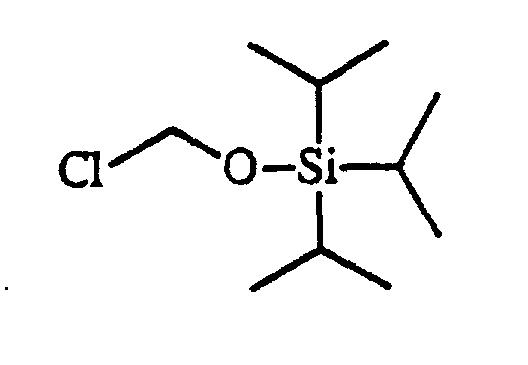
- the three substituents of the silicon atom in the 2'-O-silyloxymethyl-protection-group are three isopropyl-groups (structural formula 6)
- the methoxy-spacer of the protection-group of the inventive ribonucleic-acid-unit steric effects can be substantially neglected when choosing the three substituents of the silicon atom. Instead, additional criteria, in particular stability against acid and/or base can be taken into consideration. Furthermore, the protection-group can be adapted to a higher degree to the requirements of a specific case.
- the separation of the 2'-O-silyloxymethyl-protection-group can be carried out substantially under the same conditions as the separation of the conventional 2'-O-Silyl-protection-groups, i.e. by treatment with fluoride-ions or fluorosilicic acid.
- This de-protecting reaction is known to users of ribonucleic-acid-units as a well established and problem-free reaction and the fact that this reaction can be taken over for de-protecting the inventive units is a further advantage of these units.
- inventive compounds For preparing the inventive compounds an efficient, cheap and simple method of synthesis is used, which method yields products substantially free of unwanted isomers (purity > 99.8%).
- inventive ribonucleoside-derivatives synthetically prepared oligo-nucleic-acids with chains (more than 40 nucleotide units) longer than previously possible become available and RNA-oligonucleotides in generally larger amounts (1 - 20 mg per individual synthesis) and in uniform, chemically pure form (over 90% in weight of the compound with the desired structure) become available for many interesting applications.
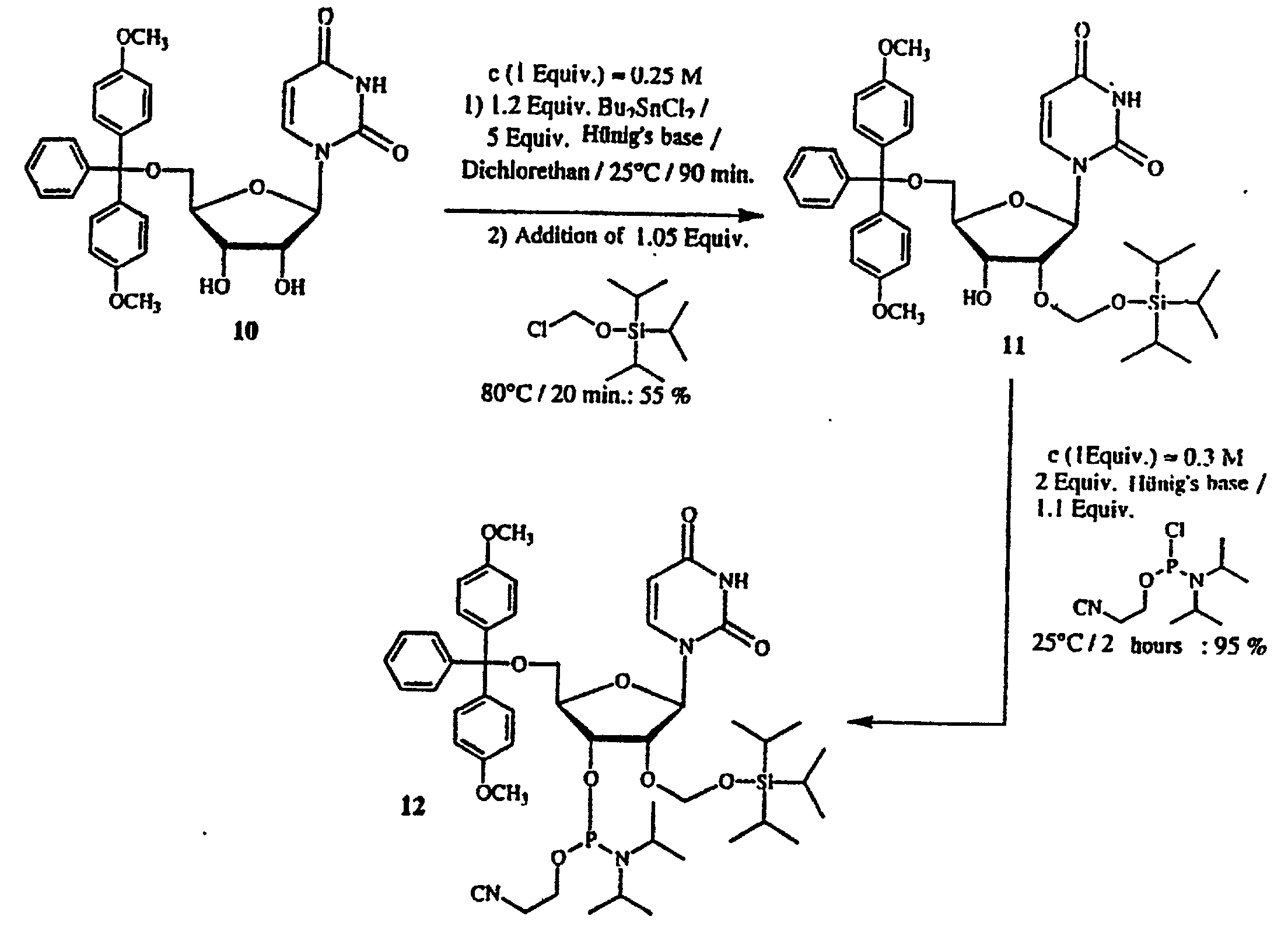
- the reaction 7 ⁇ 8 ⁇ 9 shows an example of the synthesis of a compound according to the invention.
- This synthesis starts from nucleosides 7 which are already partly protected.
- a cyclic 2',3'-di-O-dialkyl-(or diaryl-)stannyl derivative e.g. dibutyl-stannyl-derivative
- a tertiary amine base which derivative reacts with a tri(alkyl- and/or aryl)-substituted silyloxymethylchloride (or other halogenide) to form the ribonucleoside-derivative 8.
- This is then converted to the corresponding phosphoramidite 9 under established conditions [4].
- substituents R 4 , R 5 and R 6 of the 2'-O-silyloxymethyl-protection-group which protection-group distinguishes the inventive nucleoside-derivative are identical or different alkyl- or aryl-substituents or combinations of these and can also be substituted with heteroatoms and/or be connected to each other forming ring structures.
- the three substituents together comprise advantageously between 6 and 30 carbon atoms. They are e.g. three isopropyl-groups.
- the components and other substituents of the initial product which is not yet protected in 2'-O-position and of the protected product correspond precisely to the components and substituents which are used in conventional synthesis methods for preparing protected ribonucleoside-derivatives.
- the protection-group R 3 in 5'-O-position is e.g. a monomethoxytrityl- or dimethoxytrityl-group or a different, suitable group which is removed from the growing sequence during chain building such freeing a bonding position for coupling the next unit to be added to the chain.
- the base-component R 1 of the ribonucleoside-derivative is a base of the purine- or pyrimidine family, e.g. one of the five nucleobases adenine, cytosine, thymine, uracile, guanine or a derivative thereof. It can be protected by an acyl-substituent which can be removed after chain creation.
- the derivative of phosphonic acid in the 3'-O-position is an N,N- and O-substituted phosphoramidite group, whereby the N-substituents R 7 and R 8 are alkyl- or aryl-groups which can be further substituted and/or cyclically connected to each other.
- R 7 and R 8 are e.g. isopropyl-groups.
- the 0-substituent R 9 of the phosphoramidite-group is an alkyl- or aryl-substituent (possibly substituted by heteroatoms) which is removed after chain creation.
- oligonucleotide-synthesis knows the principles of the synthesis of the inventive ribonucleoside-derivatives and their coupling to form oligo-nucleotides. For further illustration of the simplicity of the synthesis and the superiority of the inventive units for the synthesis of ribonucleic acids several examples follow.
- the protected ribonucleoside-derivative 11 was purified to an isomerically pure form by means of simple chromatography on silica gel.
- electrophile unit nucleophile unit coupling yield adenine adenine 99.6% adenine cytosine 99.0% adenine guanine 99.1% adenine uracile 99.5% cytosine adenine 99.1% cytosine cytosine 99.3% cytosine guanine 98.4% cytosine uracile 99.5% guanine adenine 99.5% guanine cytosine 99.5% guanine guanine 99.9% guanine uracile 99.9% uracile adenine 99.5% uracile cytosine 99.1% uracile guanine 98.4% uracile uracile 99.9%
- a suspension of 0.1 mol para-formaldehyde in 0.1 mol ethanethiol was treated with 1 drop 10N aequous NaOH-solution and stirred at room temperature until a clear solution was obtained. After stirring for 1 hour at 50°C, 50 ml CH 2 Cl 2 and 0.2 mol imidazole, followed by 0.09 mol (i-Prop) 3 SiCl were added. The resulting suspension was stirred at room temperature overnight and diluted with 400 ml hexane. After addition of 250 ml aequous 2M NaH 2 PO 4 - solution, stirring and phase separation, the organic phase was evaporated.
- reaction mixture was diluted with 200 ml CH 2 Cl 2 , 200 ml aqueous saturated NaHCO 3 -solution were added and the resulting mixture was stirred for 20 minutes.
- the cloudy organic phase obtained after phase separation was dried over MgSO 4 and filtered through a pad of Celite(Trade mark).
- the residue, obtained after concentration, was subjected to column-chromatography on 100 g of silica gel using as eluent hexane/ethyl acetate mixtures, containing 2 % NEt 3 .
- the products were obtained as colorless foams.
- the sequence r(UUUUUUUUUUUUUUUUUUUUUUUUUUUUUUUUUUUUUUUUUUUUUUUUU) was produced with an overall coupling yield of 87%, the sequence r(GCUCGUCUGAUGAGUCCGUGAGGACGAAAGACCGU) with an overall coupling yield of 74%.
- the chains built from phosphoramidites A were treated during 3 hours and the chains built from phosphoramidites B during 14 to 26 hours with tetrabutylammonium fluoride in water. Further treatment of the chains built from phosphoramidites A for up to 48 hours did not result in any chain scission.
Landscapes
- Chemical & Material Sciences (AREA)
- Organic Chemistry (AREA)
- Biochemistry (AREA)
- Health & Medical Sciences (AREA)
- Molecular Biology (AREA)
- Life Sciences & Earth Sciences (AREA)
- Engineering & Computer Science (AREA)
- Biotechnology (AREA)
- General Health & Medical Sciences (AREA)
- Genetics & Genomics (AREA)
- Saccharide Compounds (AREA)
- Preparation Of Compounds By Using Micro-Organisms (AREA)
- Pharmaceuticals Containing Other Organic And Inorganic Compounds (AREA)
Abstract
Description
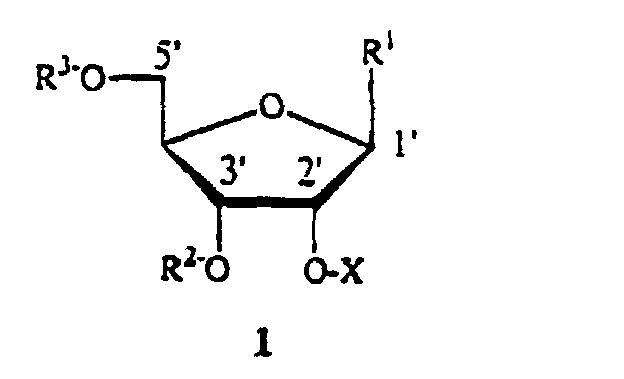
R1 is a base of the purine- or pyrimidine-family or a derivative of such a base,
R2 is a proton or a substituted derivative of phosphonic acid,
R3 is a proton or a protection-group for the oxygen atom in 5'-position,
X is a protection-group for the oxygen atom in 2'-position.
- The introduction of the protection-group has to be as simple as possible and has to yield uniform compounds which are as free from isomerization products as possible.
- The protection-group has to be absolutely stable under the coupling conditions.
- The protection-group has to have a structure which allows high coupling yields.
- The protection-group has to be completely removable without decomposition or chemical change of the compound to be prepared.

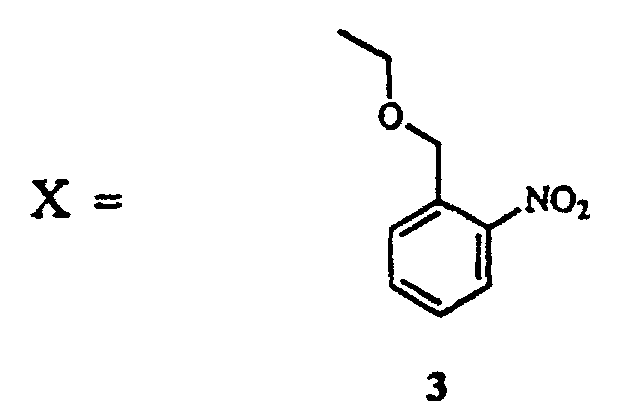
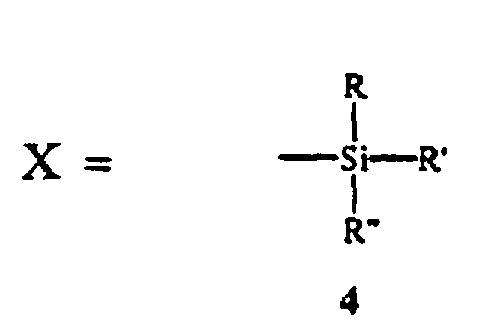


- Due to the acetal nature of the bond between nucleoside and protection-group in the inventive 2'-O-protected ribonucleoside-derivative no migration of the protection-group to a different position inside the ribonucleoside-derivative, in particular no migration to the neighboring 3'-O-position can occur. Such isomerization is an important and well known problem in the synthesis of the conventional 2'-O-silyl-substituted RNA-units (type of protection-group c), see above) [6, 7] which problem is solved for the inventive ribonucleoside-derivatives by the new protection-group.
- The 2'-O-silyloxymethyl-protection-group is less bulky because it is linked to the ribose unit via the relatively small and sterically undemanding methene-unit. This, in opposition to units with the known considerably more bulky trialkylsilyl-groups bonded directly to the 2'-oxygen atom (types of protection-groups c), see above) reduces steric hinderance of the reaction center for the coupling reaction (3'-O-phosphor atom) and thus increases the coupling yield.


| electrophile unit | nucleophile unit | coupling yield |
| adenine | adenine | 99.6% |
| adenine | cytosine | 99.0% |
| adenine | guanine | 99.1% |
| adenine | uracile | 99.5% |
| cytosine | adenine | 99.1% |
| cytosine | cytosine | 99.3% |
| cytosine | guanine | 98.4% |
| cytosine | uracile | 99.5% |
| guanine | adenine | 99.5% |
| guanine | cytosine | 99.5% |
| guanine | guanine | 99.9% |
| guanine | uracile | 99.9% |
| uracile | adenine | 99.5% |
| uracile | cytosine | 99.1% |
| uracile | guanine | 98.4% |
| uracile | uracile | 99.9% |


| Phosphoramidite | coupling time | mean coupling yield |
| A | 12 min. | >99.5% |
| A | 15 min. | >995% |
| B | 12 min. | max. 98% |
| B | 1.5 min | ca. 92% |
Claims (15)
- Ribonucleoside-derivative comprising a D- or L-ribose-unit and having the structural formulawherein
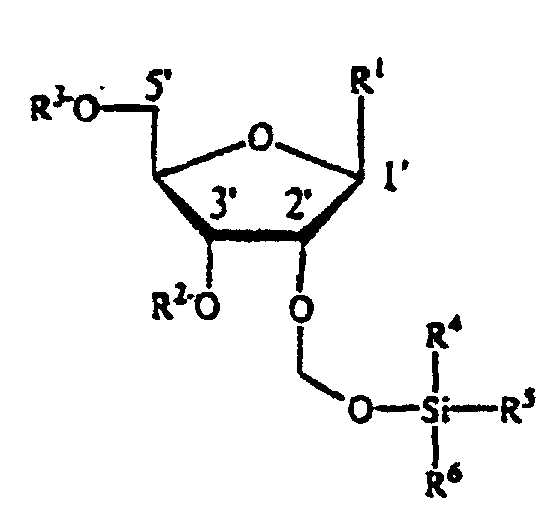
R1 is a base of the purine- or pyrimidine-family or a derivative of such a base,
R2 is a proton or a substituted derivative of phosphonic acid,
R3 is a proton or a suitable protection-group,
and R4, R5 and R6 are three aryl- or alkyl- substituents together comprising six to thirty C-atoms. - Ribonucleoside-derivative according to claim 1, characterized in that the substituents (R4, R5, R6) on the silicon of the silyloxymethyl-group in 2'-O-position are at least partly aryl-substituted alkyl-groups or alkyl-substituted aryl-groups.
- Ribonucleoside-derivative according to claim 1, characterized in that the substituents (R4, R5, R6) on the silicon of the silyloxymethyl-group in 2'-O-position are at least partly substituted with heteroatoms.
- Ribonucleoside-derivative according to claim 1, characterized in that the substituents (R4, R5, R6) on the silicon of the silyloxymethyl-group in 2'-O-position are at least partly interconnected.
- Ribonucleoside-derivative according to claim 1, characterized in that the substituents (R4, R5, R6) on the silicon of the silyloxymethyl-group in 2'-O-position are isopropyl-groups.
- Ribonucleoside-derivative according to claim 1, characterized in that the base (R1) is cytosine, guanine, adenine, uracile or thymine.
- Ribonucleoside-derivative according to claim 1, characterized in that the base (R1) carries an acyl-protection-group.
- Ribonucleoside-derivative according to claim 1, characterized in that the substituted derivative of phosphonic acid (R2) is an O- and N,N-substituted amino-phosphino-group.
- Ribonucleoside-derivative according to claim 8, characterized in that the O-substituent is a 2-cyanoethyl-group and that the N-substituents are isopropyl groups.
- Ribonucleoside-derivative according to claim 1, characterized in that the protection group (R3) of the oxygen in 5'-position is a monomethoxytrityl- or a dimethoxytrityl-group.
- Use of the ribonucleoside-derivative according to claim 1 for the chemical synthesis of RNA-oligonucleotides with a predetermined nucleotide-sequence.
- Method for the preparation of the ribonucleoside-derivative according to claim 1, characterized in that a cyclic 2',3'-di-O-stannyl-derivative is prepared in the presence of a base from a ribonucleoside the oxygen in 5'-position of which is protected by a protection-group and that this stannyl-derivative is converted to the ribonucleoside-derivative by addition of a silyloxymethylhalogenide carrying three additional substituents on the silicon atom.
- Method according to claim 12, characterized in that in a further step the ribonucleoside-derivative is substituted on the oxygen in 3'-position with a group comprising a derivative of phosphonic acid.
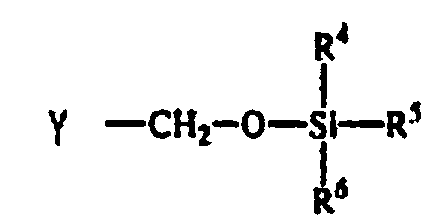
- A silyloxymethylhalogenide of the formulawherein Y is halogen and R4, R5 and R6 are isopropyl.

- A silyloxymethylhalogenide of the formulawherein Y is halogen and R4, R5 and R6 are alky- or aryl substituents together comprising between six and thirty C-atoms and being at least partly interconnected.
Applications Claiming Priority (3)
| Application Number | Priority Date | Filing Date | Title |
|---|---|---|---|
| CH193197 | 1997-08-18 | ||
| CH193197 | 1997-08-18 | ||
| PCT/EP1998/005215 WO1999009044A1 (en) | 1997-08-18 | 1998-08-17 | Ribonucleoside-derivative and method for preparing the same |
Publications (2)
| Publication Number | Publication Date |
|---|---|
| EP1005478A1 EP1005478A1 (en) | 2000-06-07 |
| EP1005478B1 true EP1005478B1 (en) | 2003-01-22 |
Family
ID=4221948
Family Applications (1)
| Application Number | Title | Priority Date | Filing Date |
|---|---|---|---|
| EP98948841A Expired - Lifetime EP1005478B1 (en) | 1997-08-18 | 1998-08-17 | Ribonucleoside-derivative and method for preparing the same |
Country Status (8)
| Country | Link |
|---|---|
| US (1) | US5986084A (en) |
| EP (1) | EP1005478B1 (en) |
| JP (1) | JP4473445B2 (en) |
| AT (1) | ATE231518T1 (en) |
| AU (1) | AU9532198A (en) |
| DE (1) | DE69810934T2 (en) |
| ES (1) | ES2191343T3 (en) |
| WO (1) | WO1999009044A1 (en) |
Families Citing this family (16)
| Publication number | Priority date | Publication date | Assignee | Title |
|---|---|---|---|---|
| US6867294B1 (en) | 1998-07-14 | 2005-03-15 | Isis Pharmaceuticals, Inc. | Gapped oligomers having site specific chiral phosphorothioate internucleoside linkages |
| WO2001040515A1 (en) * | 1999-11-12 | 2001-06-07 | Isis Pharmaceuticals, Inc. | Gapped oligomers having site specific chiral phosphorothioate internucleoside linkages |
| GB0227352D0 (en) * | 2002-11-22 | 2002-12-31 | Novartis Ag | Organic compounds |
| US7560231B2 (en) | 2002-12-20 | 2009-07-14 | Roche Molecular Systems, Inc. | Mannitol and glucitol derivatives |
| KR20060135830A (en) * | 2004-03-23 | 2006-12-29 | 준 후지타 | Sequences that promote gene expression at mild low temperatures |
| CA2513340A1 (en) | 2004-08-25 | 2006-02-25 | F. Hoffmann-La Roche Ag | Reusable substrate for dna microarray production |
| EP1657306B1 (en) | 2004-11-16 | 2011-04-13 | QIAGEN GmbH | Gene silencing using sense DNA and antisense RNA hybrid constructs coupled to peptides facilitating the uptake into cells |
| US20060234973A1 (en) * | 2005-04-14 | 2006-10-19 | Kevin Fitzgerald | Transcription factor RNA interference reagents and methods of use thereof |
| CA2620136A1 (en) * | 2005-09-05 | 2007-03-15 | Jun Fujita | Sequence capable of enhancing the expression of gene under moderately low temperature |
| US7759471B2 (en) | 2005-10-31 | 2010-07-20 | Agilent Technologies, Inc. | Monomer compositions for the synthesis of RNA, methods of synthesis, and methods of deprotection |
| US20090203897A1 (en) * | 2008-02-08 | 2009-08-13 | Operon Biotechnologies, Inc. | Method of Using Polymer Embedded Solid Supports for Small Scale Oligonucleotide Synthesis |
| US9399655B2 (en) | 2012-06-06 | 2016-07-26 | University of Pittsburgh—of the Commonwealth System of Higher Education | Catalytic glycosylation with designer thioglycoside and novel protecting groups for same and for synthesis of oligosaccharides |
| PL221806B1 (en) | 2013-03-21 | 2016-05-31 | Inst Chemii Bioorg Polskiej Akademii Nauk | Method for introduction of acetal and acetal-ester protecting group and its use to protect a hydroxyl function |
| CN104447848B (en) * | 2014-12-15 | 2017-01-18 | 扬州三友合成化工有限公司 | Method for preparing (isopropoxy silicon) chloromethane |
| EP4441066A1 (en) | 2021-11-29 | 2024-10-09 | Hongene Biotech Corporation | Synthesis of 2' acetyl-ester protected nucleosides |
| WO2026048956A1 (en) * | 2024-08-29 | 2026-03-05 | 住友化学株式会社 | Method for producing nucleic acid oligomer |
-
1997
- 1997-11-07 US US08/965,780 patent/US5986084A/en not_active Expired - Lifetime
-
1998
- 1998-08-17 EP EP98948841A patent/EP1005478B1/en not_active Expired - Lifetime
- 1998-08-17 AU AU95321/98A patent/AU9532198A/en not_active Abandoned
- 1998-08-17 ES ES98948841T patent/ES2191343T3/en not_active Expired - Lifetime
- 1998-08-17 JP JP2000509723A patent/JP4473445B2/en not_active Expired - Lifetime
- 1998-08-17 DE DE69810934T patent/DE69810934T2/en not_active Expired - Lifetime
- 1998-08-17 AT AT98948841T patent/ATE231518T1/en active
- 1998-08-17 WO PCT/EP1998/005215 patent/WO1999009044A1/en not_active Ceased
Also Published As
| Publication number | Publication date |
|---|---|
| JP2001515087A (en) | 2001-09-18 |
| JP4473445B2 (en) | 2010-06-02 |
| DE69810934T2 (en) | 2003-11-27 |
| US5986084A (en) | 1999-11-16 |
| AU9532198A (en) | 1999-03-08 |
| ATE231518T1 (en) | 2003-02-15 |
| ES2191343T3 (en) | 2003-09-01 |
| DE69810934D1 (en) | 2003-02-27 |
| EP1005478A1 (en) | 2000-06-07 |
| WO1999009044A1 (en) | 1999-02-25 |
Similar Documents
| Publication | Publication Date | Title |
|---|---|---|
| JP3207915B2 (en) | Methods and compounds for solid-phase synthesis of oligonucleotides and oligonucleotide analogs | |
| US5986084A (en) | Ribonucleoside-derivative and method for preparing the same | |
| US5883237A (en) | Oligonucleotides having Rp and Sp linkages at predetermined locations | |
| RU2200738C2 (en) | Method of synthesis of nucleoside analogs | |
| AU739468B2 (en) | Activators for oligonucleotide synthesis | |
| US5646267A (en) | Method of making oligonucleotides and oligonucleotide analogs using phospholanes and enantiomerically resolved phospholane analogues | |
| Pitsch | An Efficient Synthesis of Enantiomeric Ribonucleic Acids from D‐Glucose | |
| JP3884492B2 (en) | Solid-phase synthesis of oligoribonucleotides | |
| KR19990022711A (en) | Improved method for oligonucleotide synthesis | |
| JPH0812698A (en) | In vitro oligonucleotide synthesis method | |
| WO2005085272A1 (en) | Boranophosphate monomer and process for producing oligonucleotide derivative therefrom | |
| AU716391B2 (en) | Solid phase synthesis of oligonucleotides | |
| US5998604A (en) | Polynucleotide purification method | |
| US5789576A (en) | Methylphosphonate dimer synthesis | |
| EP0611075B1 (en) | Modified oligodeoxyribonucleotides, their preparation and their therapeutic use | |
| DE60109047T2 (en) | SYNTHONE FOR THE MANUFACTURE OF OLIGONUCLEOTIDES | |
| Wang et al. | A stereoselective synthesis of dinucleotide phosphorothioate triesters through a chiral indol-oxazaphosphorine intermediate | |
| JPH05262787A (en) | Nucleoside alkyl-, aralkyl-and aryl-phosphonite and its production | |
| Tsurusaki et al. | Development of a new synthetic method for oligodeoxynucleotides using 3′-H-phosphonamidate derivatives | |
| US6124484A (en) | Recovery of triarylmethyl halide protecting groups cleaved during oligonucleotide synthesis | |
| EP0876380A1 (en) | $i(IN SITU) PREPARATION OF NUCLEOSIDE PHOSPHORAMIDITES AND OLIGONUCLEOTIDE SYNTHESIS | |
| WO2021080021A1 (en) | Method for producing oligonucleotide | |
| EP0592534A4 (en) | Silyl phosphorylating reagents and methods of using them | |
| Cramer et al. | Nucleotides, Part LX, Synthesis and Characterization of New 2′‐O‐Methylriboside 3′‐O‐Phosphoramidites Useful for the Solid‐Phase Synthesis of 2′‐O‐Methyloligoribonucleotides | |
| Eleuteri et al. | Efficient Synthesis of Deoxyribonucleoside Phosphoramidites by Eliminating the Use of Additional Activator |
Legal Events
| Date | Code | Title | Description |
|---|---|---|---|
| PUAI | Public reference made under article 153(3) epc to a published international application that has entered the european phase |
Free format text: ORIGINAL CODE: 0009012 |
|
| 17P | Request for examination filed |
Effective date: 20000218 |
|
| AK | Designated contracting states |
Kind code of ref document: A1 Designated state(s): AT BE CH DE ES FI FR GB IT LI LU NL SE |
|
| GRAG | Despatch of communication of intention to grant |
Free format text: ORIGINAL CODE: EPIDOS AGRA |
|
| 17Q | First examination report despatched |
Effective date: 20020404 |
|
| GRAG | Despatch of communication of intention to grant |
Free format text: ORIGINAL CODE: EPIDOS AGRA |
|
| GRAH | Despatch of communication of intention to grant a patent |
Free format text: ORIGINAL CODE: EPIDOS IGRA |
|
| RAP1 | Party data changed (applicant data changed or rights of an application transferred) |
Owner name: QIAGEN AG |
|
| RIN1 | Information on inventor provided before grant (corrected) |
Inventor name: JENNY, LUZI Inventor name: WEISS, PATRICK A. Inventor name: PITSCH, STEFAN |
|
| GRAH | Despatch of communication of intention to grant a patent |
Free format text: ORIGINAL CODE: EPIDOS IGRA |
|
| GRAA | (expected) grant |
Free format text: ORIGINAL CODE: 0009210 |
|
| AK | Designated contracting states |
Kind code of ref document: B1 Designated state(s): AT BE CH DE ES FI FR GB IT LI LU NL SE |
|
| REG | Reference to a national code |
Ref country code: GB Ref legal event code: FG4D |
|
| REG | Reference to a national code |
Ref country code: CH Ref legal event code: EP |
|
| REF | Corresponds to: |
Ref document number: 69810934 Country of ref document: DE Date of ref document: 20030227 Kind code of ref document: P |
|
| REG | Reference to a national code |
Ref country code: SE Ref legal event code: TRGR |
|
| REG | Reference to a national code |
Ref country code: CH Ref legal event code: NV Representative=s name: FREI PATENTANWALTSBUERO |
|
| ET | Fr: translation filed | ||
| REG | Reference to a national code |
Ref country code: ES Ref legal event code: FG2A Ref document number: 2191343 Country of ref document: ES Kind code of ref document: T3 |
|
| PLBE | No opposition filed within time limit |
Free format text: ORIGINAL CODE: 0009261 |
|
| STAA | Information on the status of an ep patent application or granted ep patent |
Free format text: STATUS: NO OPPOSITION FILED WITHIN TIME LIMIT |
|
| 26N | No opposition filed |
Effective date: 20031023 |
|
| PGFP | Annual fee paid to national office [announced via postgrant information from national office to epo] |
Ref country code: LU Payment date: 20060824 Year of fee payment: 9 |
|
| PG25 | Lapsed in a contracting state [announced via postgrant information from national office to epo] |
Ref country code: LU Free format text: LAPSE BECAUSE OF NON-PAYMENT OF DUE FEES Effective date: 20070817 |
|
| PGFP | Annual fee paid to national office [announced via postgrant information from national office to epo] |
Ref country code: SE Payment date: 20131010 Year of fee payment: 16 |
|
| REG | Reference to a national code |
Ref country code: SE Ref legal event code: EUG |
|
| PG25 | Lapsed in a contracting state [announced via postgrant information from national office to epo] |
Ref country code: SE Free format text: LAPSE BECAUSE OF NON-PAYMENT OF DUE FEES Effective date: 20140818 |
|
| REG | Reference to a national code |
Ref country code: DE Ref legal event code: R082 Ref document number: 69810934 Country of ref document: DE Representative=s name: PATENTANWAELTE UND RECHTSANWALT WEISS, ARAT & , DE Ref country code: DE Ref legal event code: R082 Ref document number: 69810934 Country of ref document: DE Representative=s name: PATENTANWAELTE UND RECHTSANWALT DR. WEISS, ARA, DE |
|
| REG | Reference to a national code |
Ref country code: FR Ref legal event code: PLFP Year of fee payment: 19 |
|
| REG | Reference to a national code |
Ref country code: FR Ref legal event code: PLFP Year of fee payment: 20 |
|
| PGFP | Annual fee paid to national office [announced via postgrant information from national office to epo] |
Ref country code: NL Payment date: 20170821 Year of fee payment: 20 |
|
| PGFP | Annual fee paid to national office [announced via postgrant information from national office to epo] |
Ref country code: FI Payment date: 20170822 Year of fee payment: 20 Ref country code: CH Payment date: 20170821 Year of fee payment: 20 Ref country code: FR Payment date: 20170822 Year of fee payment: 20 Ref country code: IT Payment date: 20170828 Year of fee payment: 20 Ref country code: DE Payment date: 20170822 Year of fee payment: 20 Ref country code: GB Payment date: 20170822 Year of fee payment: 20 Ref country code: ES Payment date: 20170928 Year of fee payment: 20 |
|
| PGFP | Annual fee paid to national office [announced via postgrant information from national office to epo] |
Ref country code: AT Payment date: 20170822 Year of fee payment: 20 Ref country code: BE Payment date: 20170821 Year of fee payment: 20 |
|
| REG | Reference to a national code |
Ref country code: DE Ref legal event code: R071 Ref document number: 69810934 Country of ref document: DE |
|
| REG | Reference to a national code |
Ref country code: NL Ref legal event code: MK Effective date: 20180816 |
|
| REG | Reference to a national code |
Ref country code: CH Ref legal event code: PL |
|
| REG | Reference to a national code |
Ref country code: GB Ref legal event code: PE20 Expiry date: 20180816 |
|
| REG | Reference to a national code |
Ref country code: AT Ref legal event code: MK07 Ref document number: 231518 Country of ref document: AT Kind code of ref document: T Effective date: 20180817 |
|
| REG | Reference to a national code |
Ref country code: BE Ref legal event code: MK Effective date: 20180817 |
|
| PG25 | Lapsed in a contracting state [announced via postgrant information from national office to epo] |
Ref country code: GB Free format text: LAPSE BECAUSE OF EXPIRATION OF PROTECTION Effective date: 20180816 |
|
| REG | Reference to a national code |
Ref country code: ES Ref legal event code: FD2A Effective date: 20220127 |
|
| PG25 | Lapsed in a contracting state [announced via postgrant information from national office to epo] |
Ref country code: ES Free format text: LAPSE BECAUSE OF EXPIRATION OF PROTECTION Effective date: 20180818 |