Technical Field
The present invention relates to a composition containing L-ascorbic
acid, an L-ascorbic acid derivative or a salt thereof as an active ingredient.
The composition of the present invention has the effect of reducing lactic
acid levels in blood, and is useful, for example, for reducing side effect
caused by a drug which has lactic acidosis as a side effect.
Background Art
Lactic acidosis is a state in which the lactic acid level in blood is 45
mg/dL or more, and pH of arterial blood is 7.25 or less. As to clinical
symptoms, though lactic acidosis usually does not result in any symptoms
in the early stage, later there appear, for example, low blood pressure,
unconsciousness, nausea, vomiting, stomach ache, diarrhea, muscular
ache, the state of hyperventilation and circulatory disorder etc. These
symptoms often occur especially severely in elderly persons and patients
with cardiac or renal disease etc.
Certain kind of drugs and medical supplements are known to cause
lactic acid levels to increase in blood as a side effect and to induce lactic
acidosis. After lactic acidosis occurs, usage of the drugs and the medical
supplements may be restricted, because of the possibility that they might
worsen renal failure etc.
Biguanide compounds have excellent activity in reducing blood sugar
levels. Therefore they have long been used as a medicament for treating
diabetes, as have sulfonylureas (SU). Since some biguanide compounds
have recently been found to have a unique pharmaceutical profile that
they do not promote insulin secretion, do not induce fatness, and improve
insulin resistance, biguanide compounds such as metformin (1,1-dimethylbiguanide
hydrochloride) have been paid attention. However,
biguanide compounds are known to cause hyperlactatemia (Brit.Med.J.,
5794/1, 205-206(1972)) and lactic acidosis (Acta.Med.Scand., 191, 203-208
(1972)) as a side effect by inducing accumulation of lactic acid. In fact,
phenformin (1-(2-phenethyl)biguanide), a biguanide, is known to cause
often serious lactic acidosis as a side effect.
A dichloroacetic acid salt of a biguanide compound is reported as a
safer drug (JP 51-125718 (A)). However, dichloroacetic acid has
comparatively strong toxicity (LD50/rat oral: 2820 mg/kg), so the salt is not
a satisfactorily safer drug.
PROBLEM TO BE SOLVED
The problem to be solved is to provide a medicament for reducing
lactic acid levels in blood, and to provide a pharmaceutical composition or
a compound with a reduced side effect, which contains a drug or a medical
supplement which causes lactic acid levels in blood to increase as a side
effect.
SOLUTION OF THE PROBLEM
The inventors of the present invention have intensively carried out
research on pharmaceutical compositions or compounds for reducing side
effect caused by a drug or the like which causes lactic acid levels in blood
to increase as a side effect, and found that L-ascorbic acid or the like can
reduce lactic acid in blood. Thus, the present invention has been
accomplished.
That is, the present invention is as follows.
or a salt thereof.
[8] A pharmaceutical composition according to [5], [6] or [7]
wherein L-ascorbic acid, the L-ascorbic acid derivative or the salt thereof
is L-ascorbic acid. [9] A pharmaceutical composition according to any one of [5] to [8]
wherein the dose of L-ascorbic acid, the L-ascorbic acid derivative or the
salt thereof is in the range between about 50 mg/day and about 10 g/day. [10] A salt formed from L-ascorbic acid or an L-ascorbic acid
derivative and a drug having basic group(s) which causes lactic acid levels
in blood to increase as a side effect. [11] A salt according to [10] wherein the drug having basic group(s)
which causes lactic acid levels in blood to increase as a side effect is a
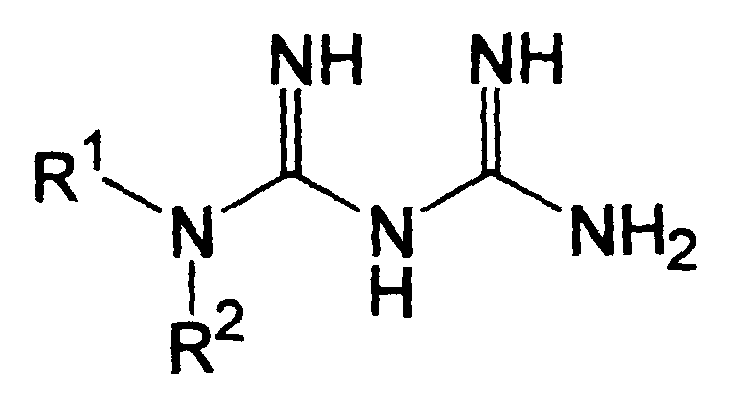
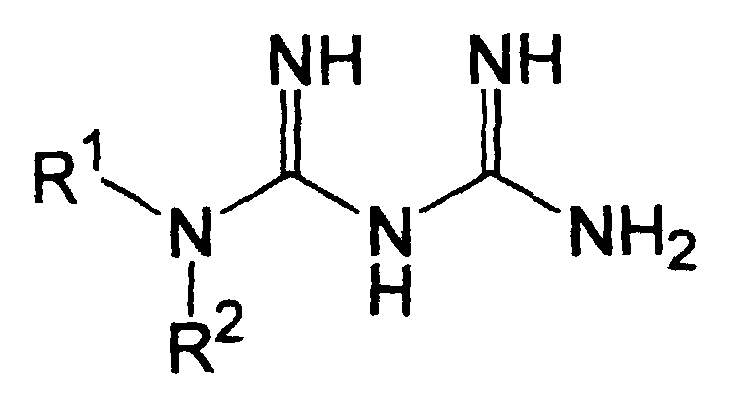
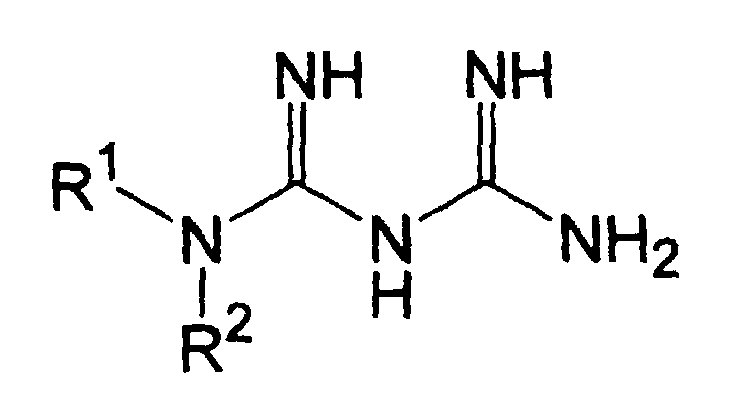
biguanide represented by formula 1:
wherein R1 and R2 are as defined above. [12] A salt according to [10] wherein the drug having basic group(s)
which causes lactic acid levels in blood to increase as a side effect is
metformin, phenformin or buformrn. [13] A salt according to [10] wherein the drug having basic group(s)
which causes lactic acid levels in blood to increase as a side effect is
metformin. [14] A salt according to any one of [10] to [13] wherein L-ascorbic
acid, the L-ascorbic acid or the salt thereof is L-ascorbic acid. [15] A medicament containing a salt according to any one of [10] to
[14]. [16] A medicament for treating diabetes containing a salt according
to any one of [10] to [14]. [17] A method for treating diabetes comprising administrating a salt
according to any one of [10] to [14].
"L-Ascorbic acid derivative" includes any L-ascorbic acid derivatives
which have a pharmacological effect as Vitamin C, such as esters,
stereoisomers, glycosides, aminated derivatives, ethers and the like of L-ascorbic
acid ("Unknown Abilities of L-Ascorbic Acid" Kumao Ebihara, ed.
by Maruzen (1992)).
"Ester of L-ascorbic acid" includes esters esterified at one or more of
2-, 3-, 5- or 6-hydroxyl group of L-ascorbic acid or stereoisomers thereof,
for example, esters of phosphoric acid, sulfuric acid, straight or branched
C2-C20 alkanoic acid or anti carboxylic acid, and esters esterified by
straight or branched C2-C6 alkoxycarbonyl and the like. Examples of the
straight or branched C2-C20 alkanoic acid are acetic acid, propionic acid,
butyric acid, isobutyric acid, valeric acid, isovaleric acid, hexanoic acid,
octanoic acid, decanoic acid, lauric acid, myristic acid, palmitic acid,
stearic acid and the like. Preferred example are the straight C12-C20
alkanoic acids. Examples of the anti carboxylic acid include benzoic acid
and the like. Examples of the straight or branched C2-C6 alkoxycarbonyl
include methoxycarbonyl, ethoxycarbonyl, propoxycarbonyl,
butoxycarbonyl, pentoxycarbonyl and the like. Preferred examples of the
esters of phosphoric acid or sulfuric acid are ones esterified at the 2-hydroxyl
group. Preferred examples of the esters of straight or branched
C2-C20 alkanoic acid or aryl carboxylic acid, and the esters of straight or
branched C2-C6 alkoxycarbonyl are those esterified at the 5- and/or 6-position(s).
"Stereoisomer of L-ascorbic acid" includes erythorbic acid and the
like. "Glycoside of L-ascorbic acid" includes glycosides glycosidated at
one or more of 2-, 3-, 5- and 6-hydroxyl groups of L-ascorbic acid or
stereoisomers thereof, for example, 2-α-glycoside and the like (Biochem.
Biophys. Acta, 1035, 44-50 (1990)). "Aminated derivatives of L-ascorbic
acid" include derivatives substituted by amino at one or more of 2-, 3-, 5-and
6-hydroxyl groups of L-ascorbic acid or stersoisomers thereof, for
example, scorbamic acid, erythroscorbamic acid and the like. "Ether of
L-ascorbic acid" includes ethers formed at one or more of 2-, 3-, 5- or 6-hydroxyl
group of L-ascorbic acid or stereoisomers thereof, for example,
ethers of straight or branched C1-C20 alkyl at 5- or 6-hydroxyl groups.
Especially preferred examples of the L-ascorbic acid derivatives are
L-ascorbic acid 2-phosphate, L-ascorbic acid 2-sulfate, L-ascorbic acid 6-palmitate,
L-ascorbic acid 6-stearate, L-ascorbic acid 2-a-glycoside and the
like.
"Salt of L-ascorbic acid or an L-ascorbic acid derivative" includes
pharmaceutically acceptable salts of L-ascorbic acid and L-ascorbic acid
derivatives. Examples of such salts are alkaline metal salts such as
sodium salt, potassium salt and the like; alkaline earth metal salts such as
magnesium salt, calcium salt, barium salt and the like; ammonium salts
and the like.
L-Ascorbic acid, an L-ascorbic acid derivative or a salt thereof may be
in the form of a solvate such as a hydrate and the like.
"Drug which causes lactic acid levels in blood to increase as a side
effect" includes drugs which cause lactic acid levels in blood to increase as
a side effect when administered, especially drugs which cause lactic
acidosis by administration. Examples are amoxapine (psychotropic
agent), theophylline (antitussive; expectorant), nalidixic acid
(chemotherapeutic), calcium hopantenate (brain metabolic stimulant),
azidothymidine, dideoxycytidine (HIV reverse transcriptase inhibitor),
biguanides represented by formula 1:
wherein R
1 and R
2 are as defined above, or a salt thereof, for example,
metformin, phenformin, buformin ((1-butylbiguanide): medicament for
diabetes) and the like, and the like. Those drugs and the salts thereof
may be in the form of a solvate such as a hydrates and the like.
"Medical supplement which causes lactic acid levels in blood to
increase as a side effect" includes medical supplements which are
administered to maintain living bodies without pharmaceutical effects and
which cause lactic acid levels in blood to increase as a side effect on
administration, especially medical supplements which cause lactic
acidosis on administration. Typical examples are high calorie
transfusion, propylene glycol, ethylene glycol, pentoses such as xylitol,
lactose, sorbitol and the like ("Igaku no ayumi", 183, 617(1997)) and the
like.
"Lower alkyl" includes straight or branched C1-C6 alkyl. Typical
examples are methyl, ethyl, propyl, 2-propyl, butyl, 2-butyl, 3-methylpropyl,
1,1-dimethylethyl, pentyl, hexyl and the like.
"Aryl" includes C6-C10 aryl. Typical examples are phenyl, naphthyl
and the like.
"Aralkyl" includes C7-C15 aralkyl. Typical examples are benzyl,
phenylethyl, naphthylmethyl, naphthylpropyl and the like.
"Aryloxy-lower alkyl" includes lower alkyl substituted by aryloxy.
Typical examples of the aryloxy are phenoxy, 1-naphthoxy, 2-naphthoxy
and the like. Typical examples of the aryloxy-lower alkyl are 2-phenoxyethyl,
2-phenoxypropyl, 3-phenoxypropyl, 4-phenoxybutyl, 5-phenoxypentyl,
6-phenoxyhexyl, 2-(1-naphthoxy)ethyl, 2-(1-naphthoxy)propyl,
3-(1-naphthoxy)propyl, 4-(1-naphthoxy)butyl, 5-(1-naphthoxy)pentyl,
6-(1-naphthoxy)hexyl, 2-(2-naphthoxy)ethyl, 2-(2-naphthoxy)propyl,
3-(2-naphthoxy)propyl, 4-(2-naphthoxy)butyl, 5-(2-naphthoxy)pentyl,
6-(2-naphthoxy)hexyl and the like.
The substituent of "substituted aryl, substituted aralkyl and
substituted aryloxy-lower alkyl" includes hydroxy, halogen atom, lower
alkyl, lower alkoxy, amino, aminocarbonyl, aminosulfonyl, benzyloxy,
phenyl, phenoxy, 2-phenylethyloxy, 3-phenylpropyloxy, cyano, nitro, acyl,
acyloxy and the like. The position(s) of the substituent(s) on aralkyl and
aryloxy-lower alkyl are preferably any position(s) on the aryl moiety. The
number of the substituent(s) is 1 to 5, preferably 1 to 3.
Typical examples of the substituted aryl are 2-nitrophenyl, 4-methoxyphenyl,
2,3-dimethoxyphenyl, 2,3,4-trimethoxyphenyl, 4-methoxycarbonylphenyl,
4-cyanophenyl, 4-methylphenyl, 3,4-difluorophenyl,
4-bromophenyl, 4-(N,N-dimethylaminocarbonyl)phenyl, 4-(N,N-dimethylaminosulfonyl)phenyl,
4-benzyloxyphenyl, 4-hydroxyphenyl,
4-biphenyl, N,N-dimethylaminophenyl, 3-phenoxyphenyl, 3-(2-phenylethyloxy)phenyl,
3-(3-phenylpropyloxy)phenyl and the like.
Typical examples of the substituted aralkyl are 2-nitrobenzyl, 4-methoxybenzyl,
2,3-dimethoxybenzyl, 2,3,4-trimethoxybenzyl, 4-methoxycarbonylbenzyl,
4-cyanobenzyl, 4-methylbenzyl, 3,4-difluorobenzyl,
4-bromobenzyl, 4-(N,N-dimethylaminocarbonyl)benzyl, 4-(N,N-dimethylaminosulfonyl)benzyl,
4-benzyloxybenzyl, 4-hydroxybenzyl,
4-phenylbenzyl, N,N-dimethylaminobenzyl, 3-phenoxybenzyl, 3-(2-phenylethyloxy)benzyl,
3-(3-phenylpropyloxy)benzyl, 2-(2-nitrophenyl)ethyl,
2-(4-methoxyphenyl)ethyl, 2-(2,3-dimethoxyphenyl)ethyl,
2-(2,3,4-trimethoxyphenyl)ethyl, 2-(4-methoxycarbonylphenyl)ethyl,
2-(4-cyanophenyl)ethyl, 2-(4-methylphenyl)ethyl,
2-(3,4-difluorophenyl)ethyl, 2-(4-bromophenyl)ethyl,
2-(4-(N,N-dimethylaminocarbonyl)phenyl)ethyl, 2-(4-(N,N-dimethylaminosulfonyl)phenyl)ethyl,
2-(4-phenylethyloxyphenyl)ethyl, 2-(4-hydroxyphenyl)ethyl,
2-(4-phenylphenyl)ethyl, 2-(N,N-dimethylaminophenyl)ethyl,
2-(3-phenoxyphenyl)ethyl, 2-(3-(2-phenylethyloxy)phenyl)ethyl,
2-(3-(3-phenylpropyloxy)phenyl)ethyl and
the like.
Typical examples of the substituted aryloxy-lower alkyl are 2-(2-nitrophenyl)oxyethyl,
2-(4-methoxyphenyl)oxyethyl, 3-(4-methoxyphenyl)oxypropyl,
2-(2,3-dimethoxyphenyl)oxypropyl, 3-(2,3,4-trimethoxyphenyl)oxypropyl,
2-(4-methoxycarbonylphenyl)oxyethyl, 2-(4-cyanophenyl)oxyethyl,
4-(4-methylphenyl)oxybutyl, 2-(3,4-difluorophenyl)oxyethyl,
2-(4-bromophenyl)oxyethyl, 5-(4-(N,N-dimethylaminocarbonyl)phenyloxypentyl,
2-(4-(N,N-dimethylaminosulfonyl)phenyl)oxyethyl,
2-(4-benzyloxyphenyl)oxyethyl,
2-(4-hydroxyphenyl)oxyethyl, 2-(4-phenylphenyl) oxyethyl, 2-(N,N-dimethylaminophenyl)oxyethyl,
2-(3-phenoxyphenyl)oxyethyl, 2-(3-(2-phenylethyloxy)phenyl)oxyethyl,
2-(3-(3-phenylpropyloxy)phenyl)oxyethyl
and the like.
L-Ascorbic acid, L-ascorbic acid derivatives and the salts thereof
have inhibitory effect against gluconeogenesis as shown in Experiment 5,
and they can enhance the inhibitory effect against gluconeogenesis of
biguanides represented by formula 1 which are useful as a medicament for
diabetes. Therefore, "the pharmaceutical composition containing L-ascorbic
acid, an L-ascorbic acid derivative or a salt thereof and a
biguanide represented by formula 1 or the salt thereof" and "the salt
formed from L-ascorbic acid or an L-ascorbic acid derivative and a
biguanide represented by formula 1" are useful as medicaments for
treating diabetes.
"Saturated heterocyclic ring which R1 and R2 are taken together with
the nitrogen atom to form" includes 3- to 7-membered, nitrogen-containing
saturated heterocyclic rings containing at least one nitrogen, sulfur or
oxygen atom. Typical examples include 3-membered nitrogen-containing
saturated heterocyclic rings such as aziridine and the like; 4-membered
nitrogen-containing saturated heterocyclic rings such as azetidine and the
like; 5-membered nitrogen-containing saturated heterocyclic rings such as
imidazolidine, pyrrolidine, pyrazoline, thiazolidine, oxazolidine and the
like; 6-membered nitrogen-containing saturated heterocyclic rings such as
piperidine, piperazine, morpholine and the like; 7-membered nitrogen-containing
saturated heterocyclic rings such as homopiperidine and the
like; and the like.
The salts of "amoxapine, theophylline, metformin, phenformin,
buformin, nalidixic acid, hopantenic acid, azidothymidine, dideoxycytidine
or a biguanide represented by formula 1" include pharmaceutically
acceptable salts thereof. Typical examples include salts with inorganic
acids such as the hydrochloride, sulfate, hydrobromide, phosphate salts
and the like; salts with organic acids such as the oxalate, malonate,
fumarate, benzenesulfonate, methanesulfonate salts and the like; salts
with inorganic bases such as the sodium, potassium, calcium, barium,
ammonium salts and the like; salts with organic bases such as the lysine,
triethylammonium salts and the like. The salt may be in the form of a
solvate such as a hydrate and the like.
The basic group in "drug having basic group(s) which causes lactic
acid levels in blood to increase as a side effect" includes basic groups which
are able to form salts with L-ascorbic acid or L-ascorbic acid derivatives.
Typical examples include optionally substituted amino, optionally
substituted cyclic amino, hydroxyamino, optionally substituted guanidino,
optionally substituted amidino and the like.
"Cyclic amino" includes 3- to 7-membered cyclic amino containing at
least one of nitrogen, sulfur and oxygen atoms. Typical examples include
3-membered cyclic amino such as aziridinyl and the like; 4-membered
cyclic amino such as azetidinyl and the like; 5-membered cyclic amino
such as imidazolidinyl, pyrrolidinyl, pyrazolinyl, thiazolidinyl,
oxazolidinyl and the like; 6-membered cyclic amino such as piperidinyl,
piperazinyl, morpholinyl and the like; 7-membered cyclic amino such as
homopiperidinyl and the like; and the like.
The substituent of "substituted amino, substituted cyclic amino,
substituted guanidino and substituted amidino" includes lower alkyl,
optionally substituted aralkyl, optionally substituted aryl, optionally
substituted aryloxy-lower alkyl and the like. They may be substituted by
two substituents.
Typical examples of substituted amino include methylamino,
dimethylamino, ethylamino, diethylamino, butylamino, benzylamino, 4-aminobenzylamino,
3-methoxybenzylamino, 2-phenylethylamino and the
like.
Typical examples of substituted guanidino include methylguanidino,
dimethylguanidino, ethylguanidino, diethylguanidino, butylguanidino,
benzylguanidino, 4-aminobenzylguanidino, 3-methoxybentylguanidino, 2-phenylethylguanidino
and the like.
Typical examples of the substituted amidino are methylamidino,
dimethylamidino, ethylamidino, diethylamidino, butylamidino,
benzylamidino, 4-aminobenzylamidino, 3-methoxybenzylamidino, 2-phenylethylamidino
and the like.
Preferred examples of the "salt formed from L-ascorbic acid or an L-ascorbic
acid derivative and a drug having basic group(s) which causes
lactic acid levels in blood to increase as a side effect" include "salts formed
from L-ascorbic acid or an L-ascorbic acid derivative and a biguanide
represented by formula 1", and more preferred are "salts formed from L-ascorbic
acid or an L-ascorbic acid derivative and metformin, buformin or
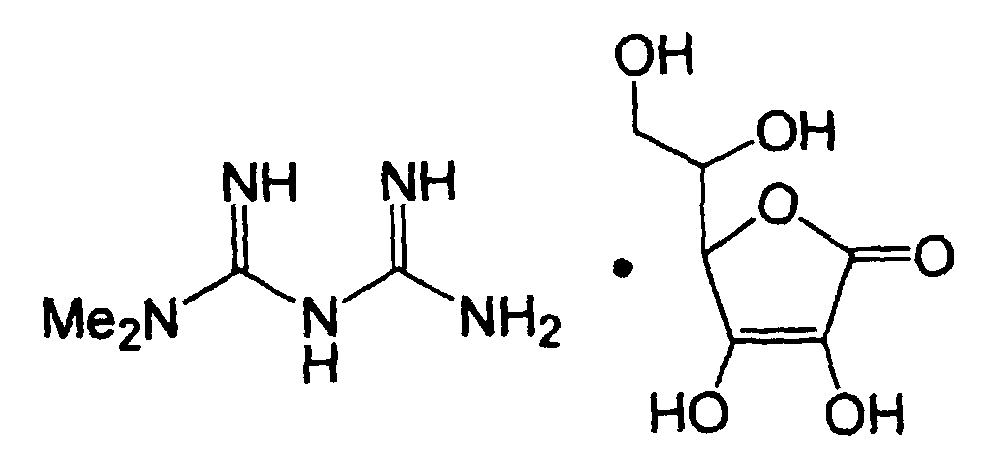
phenformin". Typical examples include metformin L-ascorbate,
metformin L-ascorbic acid 2-phosphate, metformin L-ascorbic acid 2-sulfate,
metformin L-ascorbic acid 6-palmitate, metformin L-ascorbic acid
6-stearate, buformin L-ascorbate, buformin L-ascorbic acid 2-phosphate,
buformin L-ascorbic acid 2-sulfate, buformin L-ascorbic acid 6-palmitate,
buformin L-ascorbic acid 6-stearate, phenformin L-ascorbate, phenformin
L-ascorbic acid 2-phosphate, phenformin L-ascorbic acid 2-sulfate,
phenformin L-ascorbic acid 6-palmitate, phenformin L-ascorbic acid 6-stearate
and the like.
The biguanide represented by formula 1 can be produced for example
by the following method:
wherein R
1 and R
2 are as defined above.
The hydrochlorides of the biguanides represented by formula 1 can
be produced, for example, by heating a mixture of a compound represented
by the formula: R1R2NH HCl and dicyandiamide at 120 °C or above
without or in a solvent. Preferred reaction solvents are high-boiling point
ethers such as methyl cellosolve and the like. The hydrochloride of
biguanide of formula 1 can be changed to free base or another salt by a
conventional method. The free base of biguanide of formula 1 can be
produced for example by letting the hydrochloride flow through ion
exchange resin column according to the method described in JP 50-53520
(A). The free base can be also produced by neutralizing the hydrochloride
by sodium hydroxide solution or the like and concentrating the mixture in
vacuo, followed by extraction from the residue with an organic solvent
such as acetone.
"Salt formed from L-ascorbic acid or an L-ascorbic acid derivative
and a drug having basic group(s) which causes lactic acid levels in blood to
increase as a side effect" can be produced by a conventional method. The
salt can be formed for example by mixing L-ascorbic acid or an L-ascorbic
acid derivative and "a drug having basic group(s) which causes lactic acid
levels in blood to increase as a side effect" in an inactive solvent. The
inactive solvents include alcohols such as methanol, ethanol, 2-propanol
and the like, water, acetone, mixtures of any of these and the like. The
amount of L-ascorbic acid or an L-ascorbic acid derivative is selected for
example from about 0.3 to about 3 equivalent, preferably about 1 to about
1.5 equivalent, per 1 equivalent of the "drug having basic group(s) which
causes lactic acid levels in blood to increase as a side effect."
When such a salt can be easily crystallized, the salt may be produced
in a crystalline form, and may be purified by recrystallization if needed.
Solvents for recrystallization include alcohols such as methanol, ethanol,
2-propanol and the like, ethers such as diethyl ether and the like, esters
such as ethyl acetate and the like, aromatic hydrocarbons such as toluene
and the like, ketones such as acetone and the like, hydrocarbons such as
hexane and the like, water and mixture of any of these and the like.
The salt formed from L-ascorbic acid or an L-ascorbic acid derivative
and a biguanide of formula 1 can be produced in a crystalline form for
example by mixing L-ascorbic acid or the L-ascorbic acid derivative and
the free biguanide in an inert solvent. The amount of L-ascorbic acid or
the L-ascorbic acid derivative is preferably about 1 to about 1.5 equivalent
per 1 equivalent of the biguanide of formula 1. Inert solvents include
alcohols such as methanol, ethanol, 2-propanol and the like, water,
acetone and mixture of any of these. The crystallization temperature is
for example about -20 to about 70 °C, preferably about -10 to about 20 °C.
An "L-ascorbic acid, an L-ascorbic acid derivative or a salt thereof" as
a medicament for reducing lactic acid levels in blood, "a pharmaceutical
composition containing L-ascorbic acid, an L-ascorbic acid derivative or a
salt thereof, and a drug or a medical supplement which causes lactic acid
levels in blood to increase as a side effect" and "a salt formed from L-ascorbic
acid or an L-ascorbic acid derivative and a drug having basic
group(s) which causes lactic acid levels in blood to increase as a side effect"
may be administered orally or parenterally. Pharmaceutical forms for
oral administration include generally acceptable forms, for example,
tablets, capsules, granules, fine granules, powders, pills, syrups,
suspensions and the like. Pharmaceutical forms for parenteral
administration include for example injections such as solutions, emulsions,
suspensions and the like; suppository for administration through the
rectum; dermal preparations and the like. These compositions can be
prepared by mixing the active compound with conventional carriers,
excipients, binders, stabilizers and the like. Injections may contain
buffers, solubilizers, agents for influencing osmotic pressure and the like.
The dose for administration of "L-Ascorbic acid, an L-ascorbic acid
derivative or a salt thereof" as a medicament for reducing lactic acid levels
in blood generally varies depending on the severity of the symptoms, the
patient's age, body weight, administration route and the like, L-Ascorbic
acid, L-ascorbic acid derivatives and salts thereof are usually
administered to an adult (body weight: 60 kg) in a dose of about 50 mg to
about 10 g, preferably about 100 mg to about 5 g, more preferably about
300 mg to about 3 g per day in one portion or several portions.
The dose for administration of "pharmaceutical composition
containing L-ascorbic acid, an L-ascorbic acid derivative or a salt thereof,
and a drug or a medical supplement which causes lactic acid levels in
blood to increase as a side effect" generally varies depending on the
severity of the symptoms, the patient's age, body weight, administration
route and the like. L-Ascorbic acid, an L-ascorbic acid derivative or a salt
thereof in the pharmaceutical composition is usually administered to an
adult (body weight: 60 kg) in a dose of about 50 mg to about 10 g,
preferably about 100 mg to about 5 g, more preferably about 300 mg to
about 3 g per day in one portion or several portions. A drug or a medical
supplement which causes lactic acid levels in blood to increase as a side
effect in the pharmaceutical composition may be administered in the usual
dose in which the drug or the medical supplement has their own effects.
When the drug is a biguanide represented by formula 1 or the salt thereof,
the drug is usually administered to an adult (body weight: 60 kg) in a dose
of about 100 mg to about 5 g, preferably about 300 mg to about 3 g, more
preferably about 500 mg to about 2 g per day in one portion or several
portions.
The dose for administration of "salt formed from L-ascorbic acid or an
L-ascorbic acid derivative and a drug having basic group(s) which causes
lactic acid levels in blood to increase as a side effect" generally varies
depending on the severity of the symptoms, the patient's age, body weight,
administration route and the like. The salt may be administered in the
usual dose in which "the drug having basic group(s) which causes lactic
acid levels in blood to increase as a side effect" contained in the salt has its
own effects. However, when the amount of "L-ascorbic acid or an L-ascorbic
acid derivative" contained in the salt is lower than the necessary
dose for reducing lactic acid levels in blood, additional "L-ascorbic acid, an
L-ascorbic acid derivative or a salt thereof" may be administered together.
When the salt is "salt formed from L-ascorbic acid or an L-ascorbic acid
derivative and a biguanide represented by formula 1", the salt is usually
administered to an adult (body weight: 60 kg) in a dose of about 100 mg to
about 20 g, preferably about 200 mg to about 10 g, more preferably about
600 mg to about 6 g per day in one portion or several portions.
Examples
Example 1
Production of metformin L-ascorbate
Metformin hydrochloride (49.68 g: 0.3 mol) was dissolved in pure
water, and neutralized with 2N sodium hydroxide aqueous solution (150
mL). The mixture was condensed in vacuo until it contained about 30 mL
of water. To the mixture was added 2-propanol (300 mL) and stirred at
room temperature for 30 minutes. The mixture was filtered and the
residue was washed with acetone. The filtrate and the acetone were
gathered and the solvent was evaporated in vacuo. Acetone (500 mL) and
magnesium sulfate were added to the residue, stirred and filtered. The
filtrate was concentrated in vacuo to give free metformin (32.9 g: yield
85 %) as white prisms.
The solution of free metformin (32.9 g: 255 mmol) obtained above in
methanol (150 mL) was added dropwise to the solution of L-ascorbic acid
(44.9 g: 255 mmol) in methanol (600 mL) with stirring in ice-water bath for
30 minutes. The obtained slurry was stirred in ice-water bath for 30
minutes, at room temperature for 30 minutes, and then in ice-water bath
for 1 hour. The crystals were collected by filtration, washed with
methanol (100 mL) and acetone (500 mL x 2) successively, and dried
in
vacuo to give metformin L-ascorbate (56.9 g: yield from free metformin
73 %) as white powders. The filtrate were combined and concentrated to
200 mL. The formed crystals was collected by filtration, and washed by
methanol (20 mL) and acetone (100 mL), followed by drying
in vacuo to
give metformin L-ascorbate (7.2 g: yield 9 %).
| Elemental Analysis (C10H19N5O6) |
| Calculated (%) | C 39.34, | H 6.27, | N 22.94 |
| Found (%) | C 39.24, | H 6.27, | N 22.82 |
IR γ (KBr, cm-1) 3337, 3209, 2935, 1702, 1660, 1644, 1585, 1542, 1420,
1406, 1137, 1108, 1053 1H-NMR δ (DMSO-D6, ppm) 2.92(6H,s), 3.30(2H,m), 3.46(1H,dd,J=11.2
and 8.3Hz), 3.85(1H,d,J=7.6Hz), 4.75(1H,br), 6.58(4H,br),
7.20(2H,br)
Example 2
Production of metformin L-ascorbic acid 2-phosphate 1.5 hydrates
L-Ascorbic acid 2-phosphate 2/3 magnesium salts n hydrates (Wako
Pure Chemicals: 23.5 g) was dissolved in water (200 mL), and was let flow
through column chromatography with ion exchange resin (A.G.IR-120B(H):
Organo Ltd.: 400 mL), and was eluted with water. The first 500
mL of eluent which was acidic was collected. To the collected eluent was
added free metformin (7.7 g: 52 mmol), and concentrated to about 100 mL.
To the mixture was added acetone (800 mL) at room temperature with
stirring to form white crystals gradually. The mixture was stirred for
another 1 hour. The crystals were collected by filtration and washed with
acetone/water (10:1) and acetone, followed by drying
in vacuo to give
metformin L-ascorbic acid 2-phosphate 1.5 hydrates (19.34 g).
White prisms (washed with acetone/water): mp 105-7 °C
| Elemental Analysis (C10H20N5O9P 1.5 H2O) |
| Calculated (%) | C 29.13, | H 5.62, | N 16.99, | P 7.51 |
| Found (%) | C 28.98, | H 5.83, | N 16.96, | P 8.10 |
Materials and methods
Materials
Distilled water for injection (Otsuka pharmaceuticals), saline
(Otsuka pharmaceuticals) and metformin hydrochloride (Sigma) were
purchased and used. All other reagents and chemicals used were at
commercial analytical grade.
Method to prepare metformin solution and other acid solutions
Metformin hydrochloride was dissolved in distilled water for
injection to give 100 mM solution. L-Ascorbic acid, citric acid, succinic
acid and malic acid were dissolved in distilled water for injection to give
400 mM solution.
Cell culture
3T3-L1 cells (ACTT CL173: preadipose cells from fetal mouse) were
grown on gelatin coated 96-well plate (2 x 10³ cells/well) in DMEM
(Dulbecco's modified Eagle medium) supplemented with 10% calf serum
under the 5% CO2/95% air condition until getting sufficiently confluent.
Then the cells were differentiated to adipocytes according to the following
procedure. At first the medium was changed to DMEM containing 0.5
mM 1-methy-3-isobutylxanthine, 1 µM dexamethasone, 10 µg/mL insulin,
8 µg/mL biotin and 10% fetal calf serum, and after 48 hr the medium was
changed to DMEM containing 1 µg/mL insulin, 8 µg/mL biotin and 10%
fetal calf serum. After maintenance for 48 hr, the medium was changed
to DMEM containing 8 µg/mL biotin and 10% fetal calf serum. The
medium was changed with the same fresh medium every 48 hr until
experiments.
Hepatocytes primary culture was prepared by Seglen's method
(Methods Cell Biol., 13, 29-83 (1976)). Hepatocytes were isolated from a
male Wistar rat. The isolated hepatocytes were grown on gelatin coated
24-well plate (3 x 10⁵ cells/well) in Williams E medium containing 10 nM
dexamethasone and 5% fetal calf serum under the 37 °C, 5% CO2 / 95% air
condition for 24 hr.
Animals
Breeding Condition
Animals that did not have any indisposition during 1-week
quarantine after purchase were used for experiments. The animals were
maintained in a room which was managed in the condition: 23±2 °C, 55±10 %
humidity, air exchange: more than 10 times/hr, light time: 8:00 a.m.
to 8:00 p.m. Less than 5 heads of the animals were housed in each plastic
cage (31 x 36 x 17.5 cm) with shavers on floors during quarantine and
breeding. To the animals were fed solid feed CE-2 (Nihon CREA) and
filtrated water from bottles or automatic system ad libitum. The animals
were weighed by automatic animal scale (Shimadzu).
5/6 nephrectomy rats
5/6 Nephrectomy (2/3 of left kidney and all right kidney) rats were
prepared by Hamburger's method (Pathological Biology, 18, 403-406
(1970)). After 5-week old Wistar rats were acclimatized for 7 to 10 days,
2/3 of left kidney were removed. After the rats were bred and observed
for 7 days, all right kidney was removed. After the rats were bred and
observed for 7 to 10 days, the rats were used for experiments.
KKAy mice
10-Week old KKAy mice (individually housed during their 6- to 10-week),
a model for insulin-resistant diabetes, were obtained from Nihon
CREA. To determine diabetic stage in KKAy mice, urine glucose levels of
the mice were checked with urine glucose level test paper (Wako, Pretest
2g). It was affirmed that the urine glucose levels of all mice used in the
experiment were more than 1000 mg/dL. After 7-day acclimatization, the
mice were used for the experiment.
Method to measure lactic acid levels
Lactic acid levels were measured by enzyme assay on lactate
dehydrogenase and glutamate pyruvate transaminase, using Lactate Test
BMY (Boehringer Mannheim).
Method to measure glucose levels
Glucose levels were measured by mutarotase / glucose oxidase
method, using Glucose Test CII (WAKO).
Method to measure blood biochemicals levels
Blood biochemicals levels were determined by using Cynchron CX3
delta (Beckman). Blood creatinine levels were measured by alkaline
picric acid method. Blood urea nitrogen levels were measured by urease
enzyme methods.
Statistical analysis
Statistical significance of biochemicals levels etc. was evaluated
using Dunnett's test or Tukey's test.
Example 1
The effects of L-ascorbic acid against lactic acid increase induced by
metformin hydrochloride in 3T3-L1 adipocytes
To the plate of the differentiated 3T3-L1 cells were added
metoformin hydrochloride (10 mM) and various acids (40 mM), and the
differentiated 3T3-L1 cells were incubated under 30% O
2 / 5% CO
2
condition for 24 hr. Lactic acid levels in the medium were measured.
Consequently as shown in Table 1, L-ascorbic acid prevented lactic acid
increase induced by metformin hydrochloride.
| Concentration of Metformin hydrochloride (mM) | Additive (40 mM) | Lactic acid levels (mg/dL) |
| 0 | - | 53 |
| 10 | - | 154 |
| L-Ascorbic acid | 73 |
| Citric acid | 155 |
| Succinic acid | 145 |
| Malic acid | 143 |
Three independently executed experiments indicated almost the
same results.
Example 2
The effect of L-ascorbic acid against lactic acidosis induced by metformin
hydrochloride in 5/6 nephrectomy rats
The effects of metformin hydrochloride, metformin L-ascorbate and
metformin hydrochloride + L-ascorbic acid against lactic acidosis were
examined using 5/6 nephrectomy rats. The experimental schedule was as
follows. 5/6 Nephrectomy rats were divided into four groups according to
their weight, blood urea nitrogen levels and serum creatinine levels after
preliminary breeding and observation after purchase. The rats of the
groups were treated with vehicle (saline), metformin hydrochloride,
metformin L-ascorbate and metformin hydrochloride + L-ascorbic acid p.o.
twice a day for 4 days. The volume of administrated liquids was 5
mL/kg/dose. Metformin hydrochloride 250 mg/kg/dose (500 mg/kg/day),
metformin L-ascorbate 461 mg/kg/dose (922 mg/kg/day), metformin
hydrochloride 250 mg/kg/dose (500 mg/kg/day) + L-ascorbic acid 266
mg/kg/dose (532 mg/kg/day) were dissolved in vehicle (saline) that was
used in negative control group, and administered, so that the compounds
of each group contained the same moles of metformin. The number of the
animals used was 5 heads for vehicle group, 5 heads for metformin
hydrochloride group, 5 heads for metformin L-ascorbate group and 3 heads
for metformin hydrochloride + L-ascorbic acid group. Blood was collected
from tail vein under ether anesthetics at the day 5, and the blood lactic
acid levels were measured. Blood lactic acid levels are indicated in table
2.
| | Blood lactic acid levels (mg/dL) |
| Saline | 26.9 ± 2.9 |
| Metformin hydrochloride | 52.5 ± 9.6 (**) |
| Metformin L-ascorbate | 40.2 ± 6.2 (†)(*) |
| Metformin hydrochloride + L-ascorbic acid | 41.0 ± 11.6 |
Blood lactic acid levels in metformin hydrochloride group were
significantly higher than vehicle group (**:P<0.01). Blood lactic acid
levels in metformin L-ascorbate group were significantly higher than
vehicle group (*:P<0.05), and significantly lower than metformin
hydrochloride group († :P<0.05). Almost the same result was observed in
metformin L-ascorbate group as one in metformin hydrochloride + L-ascorbic
acid group.
Example 3
Examination of the influence of L-ascorbic acid to the metformin's effect
for reducing blood sugar levels in diabetic model animals (KKAy mice)
The effect for reducing blood sugar levels which is the main effect of
metformin was analyzed using metformin hydrochloride, L-ascorbic acid
and metformin L-ascorbate in diabetic model animals (KKAy mice). The
experimental schedule was as follows. The mice were divided into four
groups according to their weight after preliminary breeding after purchase.
The mice of each groups were treated with saline, metformin
hydrochloride, l-ascorbic acid and metformin L-ascorbate p.o. twice a day
for 5 days. The volume of administrated liquids was 10 mL/kg/dose.
Metformin hydrochloride 600 mg/kg/dose (1200 mg/kg/day), L-ascorbic
acid 800 mg/kg/dose (1600 mg/kg/day) and metformin L-ascorbate 1400
mg/kg/dose (2800 mg/kg/day) were administered. Blood was collected
from main vein under ether anesthetization, after 2hr from the last
administration. Blood glucose levels in each group are indicated in table
3.
| | Blood glucose levels (mg/dL) |
| Saline | 480.0 ± 114.5 |
| Metformin hydrochloride | 247.6 ± 30.2 (**) |
| L-ascorbic acid | 392.8 ± 45.3 |
| Metformin L-ascorbate | 270.3 ± 78.2 (**) |
Significant effects for reducing blood glucose levels were observed in
metformin hydrochloride group and metformin L-ascorbate group.
Example 4
Examination of the influence of L-ascorbic acid to the metformin's effect
for reducing blood sugar levels in diabetic model animals (KKAy mice)
The effect for reducing blood sugar levels which is the main effect of
metformin was analyzed using metformin hydrochloride, L-ascorbic acid
and metformin hydrochloride + L-ascorbic acid in diabetic model animals
(KKAy mice). The experimental schedule was as follows. The mice were
divided into four groups according to their weight after preliminary
breeding after purchase. The mice of each groups were treated with
saline, metformin hydrochloride, l-ascorbic acid and metformin L-ascorbate
p.o. twice a day for 5 days. The volume of administrated
liquids was 10 mL/kg/dose. Metformin hydrochloride 600 mg/kg/dose
(1200 mg/kg/day), L-ascorbic acid 2900 mg/kg/dose (5800 mg/kg/day) and
metformin hydrochloride 600 mg/kg/dose (1200 mg/kg/day) + L-ascorbic
acid 2900 mg/kg/dose (5800 mg/kg/day) were administered. Blood was
collected from main vein under ether anesthetization, after 2hr from the
last administration. Blood glucose levels in each group are indicated in
table 4.
| | Blood glucose levels (mg/dL) |
| Saline | 454.2 ± 93.6 |
| Metformin hydrochloride | 286.5 ± 63.1 (**) |
| L-ascorbic acid | 367.0 ± 45.3 |
| Metformin hydrochloride + L-ascorbic acid | 269.2 ± 67.4 (**) |
Significant effects for reducing blood glucose levels were observed in
metformin hydrochloride group and metformin hydrochloride + L-ascorbic
acid group.
Example 5
Examination of the effect of L-ascorbic acid to the inhibitory effect against
gluconeogenesis of metformin hydrochloride in rat hepatocytes primary
culture
After the plates of hepatocytes primary culture were washed by
phosphate buffer twice, the medium were changed to Hanks solution
containing 0.1 % fructose (depletion glucose). Each well was treated with
metformin hydrochloride (1 or 3 mM), L-ascorbic acid (1 or 3 mM) or
metformin hydrochloride + L-ascorbic acid (each 1 or 3 mM) and then
incubated for 6 hr at 37 °C under 5% CO
2 / 95% air. Glucose levels
(mg/dL) in the medium were measured. The results are indicated in table
5.
| | None | 1 mM | 3 mM |
| Metformin hydrochloride | 18.7 | 17.7 | 15.2 |
| L-ascorbic acid | - | 14.6 | 10.6 |
| Metformin hydrochloride + L-ascorbic acid | - | 13.5 | 9.0 |
Gluconeogenesis was reduced by addition of metformin
hydrochloride or L-ascorbic acid. Inhibitory effect against
gluconeogenesis was enhanced by coexistence of metformin hydrochloride
and L-ascorbic acid.
Preparation 1
Preparation of Tablets
A 200 mg tablet is prepared by mixing the following ingredients
followed by compressing the mixture into a tablet.
| Metformin | 50 mg |
| L-ascorbic acid | 50 mg |
| Lactic acid | 70 mg |
| Corn starch | 15 mg |
| Low substituted Hydroxypropylcellulose | 8 mg |
| Polyvinylpyrrolidone | 6 mg |
| Magnesium stearate | 1 mg |
| Total | 200 mg |
A 200 mg tablet is prepared by mixing the following ingredients
followed by compressing the mixture into a tablet.
| Metformin | 50 mg |
| L-ascorbic acid | 50 mg |
| D-mannitol | 60 mg |
| Crystalline cellulose | 25 mg |
| Carmellose Calcium | 8 mg |
| Hydroxypropylmethylcellulose | 6 mg |
| Magnesium stearate | 1 mg |
| Total | 200 mg |
A capsule is prepared by mixing the following ingredients followed by
filling the mixture into a capsule.
| Metformin | 50 mg |
| L-ascorbic acid | 50 mg |
| D-mannitol | 110 mg |
| Low substituted Hydroxypropylcellulose | 8 mg |
| Magnesium stearate | 2 mg |
| Total | 220 mg |
A capsule is prepared by mixing the following ingredients followed by
filling the mixture into a capsule.
| Metformin | 50 mg |
| L-ascorbic acid | 50 mg |
| D-mannitol | 43.5 mg |
| Carmellose Calcium | 5 mg |
| Magnesium stearate | 1.5 mg |
| Total | 150 mg |
Powders are prepared by mixing the following ingredients followed
by granulating the mixture optionally.
| Metformin | 250 mg |
| L-ascorbic acid | 250 mg |
| Lactic acid | 400 mg |
| Corn starch | 90 mg |
| Magnesium stearate | 10 mg |
| Total | 1000 mg |
In the above preparations, preparations containing metformin and
L-ascorbic acid are shown. Other "pharmaceutical composition
containing L-ascorbic acid, an L-ascorbic acid derivative or a salt thereof,
and a drug or a medical supplement which causes lactic acid levels in
blood to increase as a side effect", "medicament for reducing lactic acid
levels in blood containing L-ascorbic acid, an L-ascorbic acid derivative or
a salt thereof as an active ingredient" and preparation containing "salt
formed from L-ascorbic acid or an L-ascorbic acid derivative and a drug
having basic group(s) which causes lactic acid levels in blood to increase as
a side effect" can be produced by the same method.
Industrial Applicability
The present invention can provide a medicament for reducing lactic
acid levels in blood. The present invention can also provide a
pharmaceutical composition or a compound with a reduced side effect,
which contains a drug or a medical supplement which causes lactic acid
levels in blood to increase as a side effect.



 or a salt thereof.R1 is hydrogen or lower alkyl;R2 is lower alkyl, optionally substituted aryl, optionally substituted aralkyl or optionally substituted aryloxy-lower alkyl; or R1 and R2 are taken together with the nitrogen atom to form saturated heterocyclic ring,