EP1003709B1 - Fungicidal compounds having a fluorovinyloxyphenyl moiety and process for the preparation thereof - Google Patents
Fungicidal compounds having a fluorovinyloxyphenyl moiety and process for the preparation thereof Download PDFInfo
- Publication number
- EP1003709B1 EP1003709B1 EP98938995A EP98938995A EP1003709B1 EP 1003709 B1 EP1003709 B1 EP 1003709B1 EP 98938995 A EP98938995 A EP 98938995A EP 98938995 A EP98938995 A EP 98938995A EP 1003709 B1 EP1003709 B1 EP 1003709B1
- Authority
- EP
- European Patent Office
- Prior art keywords
- compound
- preparation
- formula
- methyl
- mol
- Prior art date
- Legal status (The legal status is an assumption and is not a legal conclusion. Google has not performed a legal analysis and makes no representation as to the accuracy of the status listed.)
- Expired - Lifetime
Links
- 0 C*C(C(c1c(COc2cc(OC(F)=C*)ccc2)cccc1)=[*+]C)=O Chemical compound C*C(C(c1c(COc2cc(OC(F)=C*)ccc2)cccc1)=[*+]C)=O 0.000 description 2
Classifications
-
- A—HUMAN NECESSITIES
- A01—AGRICULTURE; FORESTRY; ANIMAL HUSBANDRY; HUNTING; TRAPPING; FISHING
- A01N—PRESERVATION OF BODIES OF HUMANS OR ANIMALS OR PLANTS OR PARTS THEREOF; BIOCIDES, e.g. AS DISINFECTANTS, AS PESTICIDES OR AS HERBICIDES; PEST REPELLANTS OR ATTRACTANTS; PLANT GROWTH REGULATORS
- A01N37/00—Biocides, pest repellants or attractants, or plant growth regulators containing organic compounds containing a carbon atom having three bonds to hetero atoms with at the most two bonds to halogen, e.g. carboxylic acids
- A01N37/44—Biocides, pest repellants or attractants, or plant growth regulators containing organic compounds containing a carbon atom having three bonds to hetero atoms with at the most two bonds to halogen, e.g. carboxylic acids containing at least one carboxylic group or a thio analogue, or a derivative thereof, and a nitrogen atom attached to the same carbon skeleton by a single or double bond, this nitrogen atom not being a member of a derivative or of a thio analogue of a carboxylic group, e.g. amino-carboxylic acids
- A01N37/50—Biocides, pest repellants or attractants, or plant growth regulators containing organic compounds containing a carbon atom having three bonds to hetero atoms with at the most two bonds to halogen, e.g. carboxylic acids containing at least one carboxylic group or a thio analogue, or a derivative thereof, and a nitrogen atom attached to the same carbon skeleton by a single or double bond, this nitrogen atom not being a member of a derivative or of a thio analogue of a carboxylic group, e.g. amino-carboxylic acids the nitrogen atom being doubly bound to the carbon skeleton
-
- C—CHEMISTRY; METALLURGY
- C07—ORGANIC CHEMISTRY
- C07C—ACYCLIC OR CARBOCYCLIC COMPOUNDS
- C07C251/00—Compounds containing nitrogen atoms doubly-bound to a carbon skeleton
- C07C251/02—Compounds containing nitrogen atoms doubly-bound to a carbon skeleton containing imino groups
- C07C251/04—Compounds containing nitrogen atoms doubly-bound to a carbon skeleton containing imino groups having carbon atoms of imino groups bound to hydrogen atoms or to acyclic carbon atoms
- C07C251/10—Compounds containing nitrogen atoms doubly-bound to a carbon skeleton containing imino groups having carbon atoms of imino groups bound to hydrogen atoms or to acyclic carbon atoms to carbon atoms of an unsaturated carbon skeleton
- C07C251/16—Compounds containing nitrogen atoms doubly-bound to a carbon skeleton containing imino groups having carbon atoms of imino groups bound to hydrogen atoms or to acyclic carbon atoms to carbon atoms of an unsaturated carbon skeleton containing six-membered aromatic rings
-
- A—HUMAN NECESSITIES
- A01—AGRICULTURE; FORESTRY; ANIMAL HUSBANDRY; HUNTING; TRAPPING; FISHING
- A01N—PRESERVATION OF BODIES OF HUMANS OR ANIMALS OR PLANTS OR PARTS THEREOF; BIOCIDES, e.g. AS DISINFECTANTS, AS PESTICIDES OR AS HERBICIDES; PEST REPELLANTS OR ATTRACTANTS; PLANT GROWTH REGULATORS
- A01N37/00—Biocides, pest repellants or attractants, or plant growth regulators containing organic compounds containing a carbon atom having three bonds to hetero atoms with at the most two bonds to halogen, e.g. carboxylic acids
-
- A—HUMAN NECESSITIES
- A01—AGRICULTURE; FORESTRY; ANIMAL HUSBANDRY; HUNTING; TRAPPING; FISHING
- A01N—PRESERVATION OF BODIES OF HUMANS OR ANIMALS OR PLANTS OR PARTS THEREOF; BIOCIDES, e.g. AS DISINFECTANTS, AS PESTICIDES OR AS HERBICIDES; PEST REPELLANTS OR ATTRACTANTS; PLANT GROWTH REGULATORS
- A01N37/00—Biocides, pest repellants or attractants, or plant growth regulators containing organic compounds containing a carbon atom having three bonds to hetero atoms with at the most two bonds to halogen, e.g. carboxylic acids
- A01N37/36—Biocides, pest repellants or attractants, or plant growth regulators containing organic compounds containing a carbon atom having three bonds to hetero atoms with at the most two bonds to halogen, e.g. carboxylic acids containing at least one carboxylic group or a thio analogue, or a derivative thereof, and a singly bound oxygen or sulfur atom attached to the same carbon skeleton, this oxygen or sulfur atom not being a member of a carboxylic group or of a thio analogue, or of a derivative thereof, e.g. hydroxy-carboxylic acids
- A01N37/38—Biocides, pest repellants or attractants, or plant growth regulators containing organic compounds containing a carbon atom having three bonds to hetero atoms with at the most two bonds to halogen, e.g. carboxylic acids containing at least one carboxylic group or a thio analogue, or a derivative thereof, and a singly bound oxygen or sulfur atom attached to the same carbon skeleton, this oxygen or sulfur atom not being a member of a carboxylic group or of a thio analogue, or of a derivative thereof, e.g. hydroxy-carboxylic acids having at least one oxygen or sulfur atom attached to an aromatic ring system
-
- C—CHEMISTRY; METALLURGY
- C07—ORGANIC CHEMISTRY
- C07C—ACYCLIC OR CARBOCYCLIC COMPOUNDS
- C07C235/00—Carboxylic acid amides, the carbon skeleton of the acid part being further substituted by oxygen atoms
- C07C235/70—Carboxylic acid amides, the carbon skeleton of the acid part being further substituted by oxygen atoms having carbon atoms of carboxamide groups and doubly-bound oxygen atoms bound to the same carbon skeleton
- C07C235/72—Carboxylic acid amides, the carbon skeleton of the acid part being further substituted by oxygen atoms having carbon atoms of carboxamide groups and doubly-bound oxygen atoms bound to the same carbon skeleton with the carbon atoms of the carboxamide groups bound to acyclic carbon atoms
- C07C235/76—Carboxylic acid amides, the carbon skeleton of the acid part being further substituted by oxygen atoms having carbon atoms of carboxamide groups and doubly-bound oxygen atoms bound to the same carbon skeleton with the carbon atoms of the carboxamide groups bound to acyclic carbon atoms of an unsaturated carbon skeleton
- C07C235/78—Carboxylic acid amides, the carbon skeleton of the acid part being further substituted by oxygen atoms having carbon atoms of carboxamide groups and doubly-bound oxygen atoms bound to the same carbon skeleton with the carbon atoms of the carboxamide groups bound to acyclic carbon atoms of an unsaturated carbon skeleton the carbon skeleton containing rings
-
- C—CHEMISTRY; METALLURGY
- C07—ORGANIC CHEMISTRY
- C07C—ACYCLIC OR CARBOCYCLIC COMPOUNDS
- C07C251/00—Compounds containing nitrogen atoms doubly-bound to a carbon skeleton
- C07C251/32—Oximes
- C07C251/34—Oximes with oxygen atoms of oxyimino groups bound to hydrogen atoms or to carbon atoms of unsubstituted hydrocarbon radicals
- C07C251/42—Oximes with oxygen atoms of oxyimino groups bound to hydrogen atoms or to carbon atoms of unsubstituted hydrocarbon radicals with the carbon atom of at least one of the oxyimino groups bound to a carbon atom of a ring other than a six-membered aromatic ring
-
- C—CHEMISTRY; METALLURGY
- C07—ORGANIC CHEMISTRY
- C07C—ACYCLIC OR CARBOCYCLIC COMPOUNDS
- C07C323/00—Thiols, sulfides, hydropolysulfides or polysulfides substituted by halogen, oxygen or nitrogen atoms, or by sulfur atoms not being part of thio groups
- C07C323/50—Thiols, sulfides, hydropolysulfides or polysulfides substituted by halogen, oxygen or nitrogen atoms, or by sulfur atoms not being part of thio groups containing thio groups and carboxyl groups bound to the same carbon skeleton
- C07C323/51—Thiols, sulfides, hydropolysulfides or polysulfides substituted by halogen, oxygen or nitrogen atoms, or by sulfur atoms not being part of thio groups containing thio groups and carboxyl groups bound to the same carbon skeleton having the sulfur atoms of the thio groups bound to acyclic carbon atoms of the carbon skeleton
- C07C323/56—Thiols, sulfides, hydropolysulfides or polysulfides substituted by halogen, oxygen or nitrogen atoms, or by sulfur atoms not being part of thio groups containing thio groups and carboxyl groups bound to the same carbon skeleton having the sulfur atoms of the thio groups bound to acyclic carbon atoms of the carbon skeleton the carbon skeleton containing six-membered aromatic rings
-
- C—CHEMISTRY; METALLURGY
- C07—ORGANIC CHEMISTRY
- C07C—ACYCLIC OR CARBOCYCLIC COMPOUNDS
- C07C65/00—Compounds having carboxyl groups bound to carbon atoms of six—membered aromatic rings and containing any of the groups OH, O—metal, —CHO, keto, ether, groups, groups, or groups
-
- C—CHEMISTRY; METALLURGY
- C07—ORGANIC CHEMISTRY
- C07C—ACYCLIC OR CARBOCYCLIC COMPOUNDS
- C07C69/00—Esters of carboxylic acids; Esters of carbonic or haloformic acids
- C07C69/66—Esters of carboxylic acids having esterified carboxylic groups bound to acyclic carbon atoms and having any of the groups OH, O—metal, —CHO, keto, ether, acyloxy, groups, groups, or in the acid moiety
- C07C69/73—Esters of carboxylic acids having esterified carboxylic groups bound to acyclic carbon atoms and having any of the groups OH, O—metal, —CHO, keto, ether, acyloxy, groups, groups, or in the acid moiety of unsaturated acids
- C07C69/734—Ethers
- C07C69/736—Ethers the hydroxy group of the ester being etherified with a hydroxy compound having the hydroxy group bound to a carbon atom of a six-membered aromatic ring
Definitions
- the present invention relates to novel fungicidal compounds having a fluorovinyloxyphenyl moiety, a process for preparing same and a fungicidal composition containing same as an active ingredient.
- a number of fungicidal compounds have been in practical use to protect crops from various pathogenic fungi; and they may be classified into several groups having similar structural features.
- the repetitive use of a fungicide over a long period induces the appearance of new fungal strains resistant not only to the particular fungicide but also to related fungicides having common structural features. For this reason, continuous efforts have been undertaken to develop fungicides having new structures.
- the compound of the present invention has four stereoisomers resulting from two unsymmetrically substituted double bonds, and according to the terminology defined in the Cahn-Ingold-Prelog system(J. March, Advanced Organic Chemistry , 3rd Ed., Wiley-Interscience), these four stereoisomers may be expressed as ( E , E ), ( E , Z ), ( Z , E ) and ( Z , Z ) isomers, which are included within the scope of the present invention.
- Y is O; Z is O; R 1 is hydrogen; and R 2 is a naphthyl or phenyl group optionally substituted with methyl, methoxy or halogen; and those wherein Y is O; R 1 is CF 3 ; and R 2 is a phenyl group optionally substituted with methyl, methoxy or halogen.
- the compound of the present invention may be prepared by the steps of (a) reacting a compound of formula (II) with 3-hydroxyphenol(Resorcinol) in the presence of a base to obtain a compound of formula (III); and (b) reacting the compound of formula (III) with a compound of formula (IV) in the presence of a base, as shown in Reaction Scheme A: wherein, X, Y, Z, R 1 and R 2 have the same meanings as defined in formula (I) above.
- a compound of formula (II-a) may be prepared by esterification, formylation, methylation and bromination of o -tolylacetic acid according to a conventional method(Yamada, K. et al., Tetrahedron Lett., 2745(1973); Vyas, G.N. et al., Org. Syn. Coll., 4 , 836(1963); and Kalir, A., Org. Syn. Coll. , 5 , 825(1973)), as shown in Reaction Scheme B:
- a compound of formula (II-b) may be prepared by Grignard reaction, oxalylation, condensation and bromination of o -bromotoluene according to a conventional method(Rambaud, M. et al., Synthesis , 564(1988); Korean Patent No. 88,673; and PCT/KR 95/00020), as shown in Reaction Scheme C:
- a compound of formula (II-c) may be prepared by sulfonylation, nucleophilic substitution and bromination of methyl 3-hydroxy-2-(2'-methyl)phenyl-2-propenoate according to a conventional method(Korean Patent Application No. 95-37559), as shown in Reaction Scheme D: wherein, MsO represents a methansulfonyloxy group.
- a compound of formula (II) is reacted with 3-hydroxyphenol in the presence of a base to produce a compound of formula (III).
- the compound of formula (II) and 3-hydroxyphenol may be used in equimolar amounts and the base may be used in twice the molar amount.
- the base may be an inorganic base, e.g., sodium hydride, potassium t -butoxide, sodium carbonate or potassium carbonate; or an organic base, e.g., triethylamine or pyridine.
- the solvent which may be used in the reaction includes acetone, benzene, toluene, tetrahydrofuran, acetonitrile, dichloromethane or dimethylformamide, and the reaction may be conducted at a temperature ranging from room temperature to 100 °C.
- the progress of the reaction is conveniently followed by measuring the disappearance of the compound of formula (II) with thin layer chromatography(TLC).
- a compound of formula (IV) is reacted with a compound of formula (III) to produce a compound of formula (I), as in Reaction scheme A.
- a compound of formula (IV-a), i.e. a compound of formula (IV) wherein R 1 is hydrogen, may be prepared by a Grignard reaction, reduction, halogenation, dehalogenation of a halide of R 2 according to a conventional method(Herkes, F.E. et al., J. Org. Chem., 32 , 1311(1967); and Nemeth, G. et al., J. fluorine Chem., 76 , 91(1996)), as shown in Reaction Scheme E: wherein R 2 has the same meaning as defined in formula (I) above; and W represents a halogen.
- a compound of formula (IV-b), i.e. a compound of formula (IV) wherein R 1 is CF 3 , may be prepared by a Grignard reaction and Wittig reaction of a halide of R 2 according to a conventional method(Herkes, F.E. et al., J. Org. Chem., 32 , 1311(1967); and Wheatman. G.A. et al., J. Org. Chem., 48, 917(1983)), as shown in Reaction Scheme F: wherein R 2 and W have the same meanings as above.
- the compound of the present invention may be prepared by reacting a compound of formula (III) with a compound of formula (IV) in the presence of a base.
- the compounds (III) and (IV) may be used in equimolar amounts and the base may be used in one to two equivalent amounts.
- the base may be an inorganic base, e.g., sodium hydride, potassium t -butoxide, sodium carbonate or potassium carbonate; or an organic base, e.g., triethylamine or pyridine.
- the solvent which may be used in the reaction is benzene, toluene, tetrahydrofuran, acetonitrile, dichloromethane or dimethylformamide, and the reaction temperature is in the range of room temperature to 100 °C.
- the compound of the present invention is obtained as a mixture of the ( E , E ) and ( E , Z ) isomers, as is confirmed by 1 H-NMR or 19 F-NMR analysis.
- a hydrogen of vinyl group of ( E , E ) isomer is shown as a doublet having a coupling constant of 5 to 6 Hz at 5.5 to 5.8 ppm, while that of ( E , Z ) isomer is represented as a doublet having a coupling constant of 30 Hz at 5.0 to 5.4 ppm.
- the ratio of the ( E , E ) isomer to ( E , Z ) isomer is about 3.5:1 which may be calculated from integration on the 1 H-NMR spectroscopy.
- a fluorine substituent of vinyl group and fluorine of CF 3 of ( E , Z ) isomer are shown as a quartet having a coupling constant of 23.4 Hz at -75.9 ppm and a doublet having a coupling constant of 23.7 Hz at -58.5 ppm, respectively, while those of ( E , E ) isomer are represented as a quartet having a coupling constant of 12.6 Hz at -75.3 ppm and a doublet having a coupling constant of 12.6 Hz at -58.7 ppm.
- the ratio of the ( E , Z ) isomer to ( E , E ) isomer is about 2:1 which may be calculated from integration on the 19 F-NMR spectroscopy.
- the compound of the present invention wherein Z is NH may be prepared by reacting the corresponding propenoic ester derivative or iminophenylacetic acid derivative of the present invention with an excess amount of methylamine in an organic solvent, e.g., alcohol including methanol, acetonitrile, dichloromethane or dimethylformamide.
- an organic solvent e.g., alcohol including methanol, acetonitrile, dichloromethane or dimethylformamide.
- the compound of the present invention has a broad spectrum of fungicidal activity against various plant pathogenic fungus, e.g. Pyricularia oryzae Carvara KA301 which causes Rice Blast, Rhizoctonia solani AG-1 which causes Rice Sheath Blight, Botrytis cinerae which causes Cucumber Gray Mold Rot, Phytophthora infestans which causes Tomato Late Blight, Puccinia recondita which causes Wheat Leaf Rust and Erysiphe graminis which causes Barley Powdery Mildew.
- the present invention also includes within its scope fungicidal compositions comprising one or more of the compounds of formula (I) or stereoisomer thereof as an the compounds of formula (I) or stereoisomer thereof as an active ingredient, in association with fungicidally acceptable carriers.
- the fungicidal compositions of the invention may be formulated in various forms such as an emulsion, aqueous dispersion, powder and granules which may contain conventional additives.
- the compound of the formula (I) may be used in an amount of 10 to 90 % on the basis of the weight of an emulsion or aqueous dispersion, and 0.1 to 10% on the basis of the weight of granules.
- Fungicidally acceptable carrier that may be used in the present invention is a liquid carrier, e.g., water, an alcohol(ethanol, ethylene glycol, glycerine), ketone(acetone, methylethylketone), ether(dioxane, tetrahydrofuran, cellosolve), aliphatic hydrpcarbon(gasoline, Kerosene), halogenated hydrocarbon(chloroform, carbon tetrachloride), amide(dimethylformamide), ester(ethyl acetate, butyl acetate, fatty glycerine ester) and acetonitrile; and a solid carrier, e.g., mineral particle(Kaoline, clay, bentonite, dolomite, talc, silica, sand) and vegetable powder(shrubs).
- a liquid carrier e.g., water, an alcohol(ethanol, ethylene glycol, glycerine), ket
- the additive that may be used in the fungicidal composition of the present invention includes an emulsifier, adhesive, dispersion agent or permeating agent, e.g., nonionic, anionic or cationic interface active agent(fatty acid sodium salt, polyoxy alkyl ester, alkyl sulfonate ester).
- an agrochemically active ingredient e.g., an insecticide, herbicide, plant growth regulator, germicide, and fertilizer, may be added in the composition of the present invention.
- Step 2 Preparation of methyl 3-hydroxy-2-(2'-methyl)phenyl-2-propenoate
- Step 3 Preparation of methyl 3-methoxy-2-(2'-methyl)phenyl-2-propenoate
- Step 4 Preparation of methyl (2 E )-3-methoxy-2-(2'-bromomethyl)phenyl-2-propenoate
- Step 1 Preparation of methyl o -methylbenzoylformate
- Step 2 Preparation of methyl 2-methoxyimino-2-(2'-methyl)phenylacetate
- the title compound thus obtained was composed of 50% Z isomer and 50% E isomer.
- the Z isomer was a liquid and the E isomer was a solid obtained by recrystallization in n-hexane.
- the structure of E isomer was identified by X-ray crystallography.
- the E isomer was employed in following step.
- Step 3 Preparation of methyl (2 E )-2-methoxyimino-2-(2'-bromomethyl)phenylacetate
- Step 1 Preparation of methyl 3-methansulfonyloxy-2-(2'-methyl)phenyl-2-propenoate
- Step 2 Preparation of methyl 3-thiomethoxy-2-(2'-methyl)phenyl-2-propenoate
- the E isomer was isolated and employed in the following step.
- Step 3 Preparation of methyl (2 E )-3-thiomethoxy-2-(2'-bromomethyl)phenyl-2-propenoate
- Example 1 The procedure of Example 1 was repeated except that 208 mg of the compound(1 mmol) obtained in the Preparation 22 was used in place of the compound obtained in Preparation 7 to obtain 462 mg (yield 92 %) of the title compound as a colorless liquid.
- Example 2 The procedure of Example 2 was repeated except that 251 mg of the compound 45 (0.5 mmol) obtained in the Example 45 was used in place of the compound 1 obtained in Example 1 to obtain 213 mg(yield 85 %) of the title compound as a colorless liquid.
- each of the compounds listed in Table 3 and 4 was dissolved in 10% acetone to a concentration of 250 ppm, and Tween-20 was added thereto to a concentration of 250 or 500 ppm. 50 ml of the resulting solution was sprayed on leaves of a host plant. The plant was kept at room temperature for 24 hours to let the solvent evaporate, and then, a pathogenic fungus was inoculated thereonto. The plant was held in a humidity chamber for 24 hours, transferred to an plant growth room kept at 20 to 27 °C and a relative humidity of 60 to 80% and kept to induce disease.
- the lesion area(L.A.) attacked by the pathogenic fungus was measured according to a method of Cho(Cho, K.Y., Search Report by Korea Research Institute of Chemical Technology(1989))". This procedure was repeated twice for each test. 10% Acetone solution containing 250 ppm of Tween-20 was used as a control.
- Test Example 1 Fungicidal activity against Rice Blast (RCB) disease
- Pyricularia oryzae Carvara KA301 was inoculated on a rice bran agar medium (rice bran 20 g, dextrose 10 g, agar 15 g and distilled water 1 l) and cultured at 26 °C for 1 week.
- the surface of the medium was scratched using a rubber polishman to remove aerial mycelia, and cultured under a fluorescent light for 48 hours to form a spore.
- Spores were suspended in sterilized water at a concentration of 1x10 6 spore/ml. The spore suspension was sprayed enough to soak the leaves of a RBC disease-sensitive Nakdong rice plant having 3 or 4 leaves.
- the rice plant was held in a humidified dark room for 24 hours, transferred to an incubator kept at 24 to 28 °C and a relative humidity of more than 80% and kept for 5 days to induce RCB.
- L.A. on a fully grown leaf appearing underneath an uppermost leaf was measured to calculate an C.V.
- Test Example 2 Fungicidal activity against Rice Sheath Blight(RSB) disease
- Rhizoctonia solani AG-1 was cultured on a PDA medium(potato 200 g, dextrose 20 g, agar 20 g and distilled water 1 l) for 3 days and the agar disc(diameter 0.6 cm) was inoculated and cultured on sterilized wheat bran medium in a 1 l bottle at 26 to 28 °C for 7 days.
- a mycelial mass was ground using a homogenizer, inoculated uniformly on soil of a pot wherein a Nakdong rice plant having 2 or 3 leaves and an height of 5 cm grew, and kept in humidity polyvinyl chamber for 5 days to induce RSB.
- L.A. on a leaf sheath was measured to calculate an C.V.
- Test Example 3 Fungicidal activity against Cucumber Gray Mold Rot(CGM) disease
- Botrytis cinerae which was isolated from cucumber infected thereby, was inoculated on a PDA agar medium and cultured under a 12L/12D cycle at 25 °C for 15 days to form spore.
- the spores were scraped, filtered through a gauze and then suspended in potato dextrose liquid medium at a concentration of 1x10 6 spore/ml.
- the spore suspension was sprayed on a cucumber plant having one leaf.
- the cucumber plant was held in a humidified room at 20 °C for 3 days. L.A. on a leaf was measured to calculate an C.V.
- Test Example 4 Fungicidal activity on Tomato Late Blight(TLB) disease
- Phytophthora infestans was cultured on a juice agar medium(V-8 juice 200 ml, CaCO 3 4.5 g, agar 15 g and distilled water 800 ml) under a 16L/8D cycle at 20 °C for 14 days. Sterilized water was added thereto, the vessel was shaken to free zoospore sacs from the fungus mass and the zoospore sacs were collected using a four-layered gauze. A zoospore sac suspension having a concentration of 1x10 5 spore/ml was sprayed on a young tomato plant.
- the tomato plant was held in a humidified room at 20 °C for 24 hours, transferred to an incubator maintained at a temperature of 20 °C and a relative humidity of more than 80% for 4 days and cultured in to induce RBC.
- L.A. on primary and secondary leaves was measured to calculate an C.V.
- Test Example 5 Fungicidal activity against Wheat Leaf Rust(WLR) disease
- Puccinia recondita was subcultured on a wheat plant in a laboratory. 15 g of wheat seeds was sowed in a pot(diameter 6.5 cm) and cultured in a greenhouse for 7 days to obtain a wheat plant having only a primary leaf. The wheat plant was inoculated with spores by shaking thereover another plant infected thereby. The inoculated wheat plant was held in a humidified room at 20 °C for 24 hours, transferred to an incubator maintained at a temperature of 20 °C and a relative humidity of 70% and cultured for 10 days to induce WLR. L.A. on the primary leaf was measured to calculate an C.V.
- Erysiphae graminis was subcultured on a wheat plant in a laboratory. 15 g of barley seeds was sowed in a pot(diameter 6.5 cm) and cultured in a greenhouse for 7 days to obtain a barley plant having only a primary leaf. The barley plant was inoculated with spores by shaking thereover another plant infected by BPM. The inoculated barley plant was cultured in an incubator maintained at a temperature of 22 to 24 °C and a relative humidity of 50% for 7 days to induce BPM. L.A. on the leaf was measured to calculate an C.V.
- Test example 1 to 6 The results of subjecting the compounds of the present invention in Test example 1 to 6 at a concentration level of 250 ppm was more than 90% in most cases.
- the compounds of the present invention have a broad fungicidal activity spectrum against RCB, RSB, WLR and BPM.
- the compounds of the present invention are very active in controlling fungicidal plant disease even at a 10 ppm.
Landscapes
- Chemical & Material Sciences (AREA)
- Organic Chemistry (AREA)
- Life Sciences & Earth Sciences (AREA)
- Agronomy & Crop Science (AREA)
- Pest Control & Pesticides (AREA)
- Plant Pathology (AREA)
- Health & Medical Sciences (AREA)
- Engineering & Computer Science (AREA)
- Dentistry (AREA)
- General Health & Medical Sciences (AREA)
- Wood Science & Technology (AREA)
- Zoology (AREA)
- Environmental Sciences (AREA)
- Organic Low-Molecular-Weight Compounds And Preparation Thereof (AREA)
- Agricultural Chemicals And Associated Chemicals (AREA)
Description
- The present invention relates to novel fungicidal compounds having a fluorovinyloxyphenyl moiety, a process for preparing same and a fungicidal composition containing same as an active ingredient.
- A number of fungicidal compounds have been in practical use to protect crops from various pathogenic fungi; and they may be classified into several groups having similar structural features. However, the repetitive use of a fungicide over a long period induces the appearance of new fungal strains resistant not only to the particular fungicide but also to related fungicides having common structural features. For this reason, continuous efforts have been undertaken to develop fungicides having new structures.
- Such efforts have led to the development of new fungicides, e.g., propenoic ester derived from strobilurin(U.S. Patent No. 4,994,495; WO 94/19331; and U.S. Patent No. 5,003,101). However, these propenoic ester derivatives have the problem of limited fungicidal activity.
- Accordingly, it is a primary object of the present invention to provide a novel compound having a superior fungicidal activity against a wide spectrum of plant pathogenic fungi.
- It is another object of the present invention to provide a process for the preparation of said compound.
- It is a further object of the present invention to provide a fungicidal composition containing said compound.
- In accordance with one aspect of the present invention, there are provided a novel compound of formula (I) and stereoisomers thereof:wherein:

- X is CH or N;
- Y is O or S;
- Z is O or NH;
- R1 is hydrogen or CF3; and
- R2 is hydrogen, a C1-10 alkyl, naphthyl, thiophenyl or phenyl group optionally carrying one or more substituents selected from the group consisting of C1-6 alkyl, halogen-substituted C1-6 alkyl, C1-6 alkoxy, phenoxy, halogen and methylenedioxy radicals.
-
- The structure of the compound of formula (I) of the present invention is characterized by the fluorovinyloxyphenoxy moiety, but depending on whether X is CH or N, it may also be classified as a propenoic acid derivative(X=CH) or as an iminophenylacetic acid derivative(X=N).
- The compound of the present invention has four stereoisomers resulting from two unsymmetrically substituted double bonds, and according to the terminology defined in the Cahn-Ingold-Prelog system(J. March, Advanced Organic Chemistry, 3rd Ed., Wiley-Interscience), these four stereoisomers may be expressed as (E,E), (E,Z), (Z,E) and (Z,Z) isomers, which are included within the scope of the present invention.
- Among the compounds of the present invention, preferred are those wherein Y is O; Z is O; R1 is hydrogen; and R2 is a naphthyl or phenyl group optionally substituted with methyl, methoxy or halogen; and those wherein Y is O; R1 is CF3; and R2 is a phenyl group optionally substituted with methyl, methoxy or halogen.
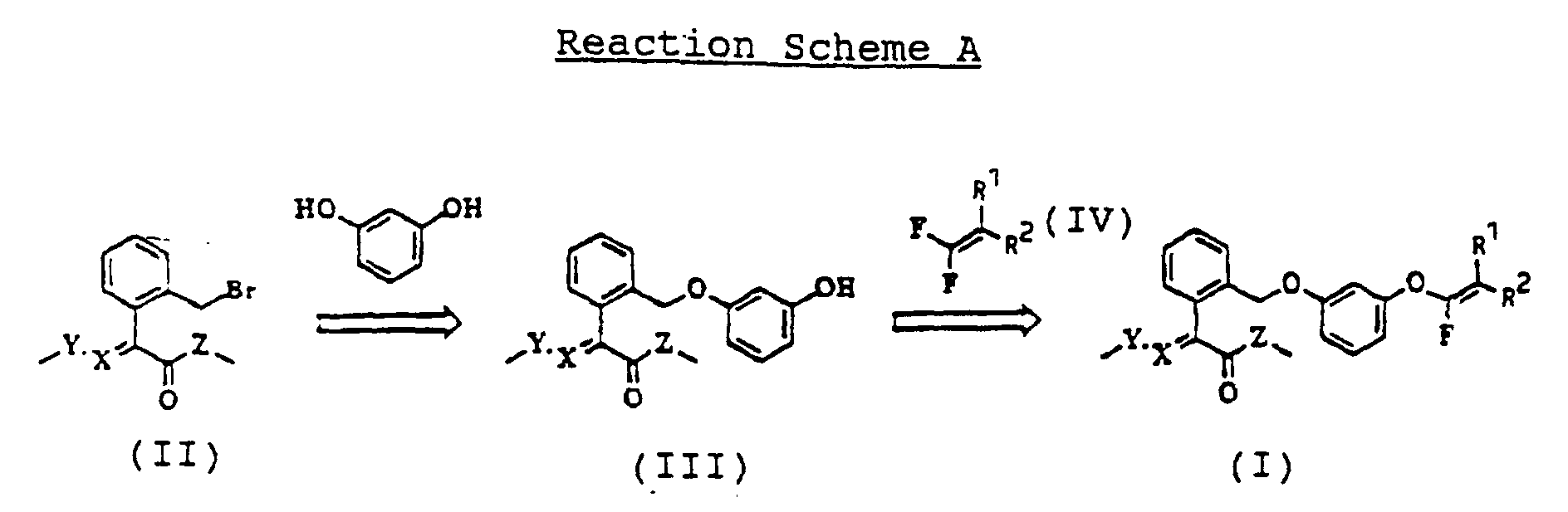
- The compound of the present invention may be prepared by the steps of (a) reacting a compound of formula (II) with 3-hydroxyphenol(Resorcinol) in the presence of a base to obtain a compound of formula (III); and (b) reacting the compound of formula (III) with a compound of formula (IV) in the presence of a base, as shown in Reaction Scheme A:wherein, X, Y, Z, R1 and R2 have the same meanings as defined in formula (I) above.
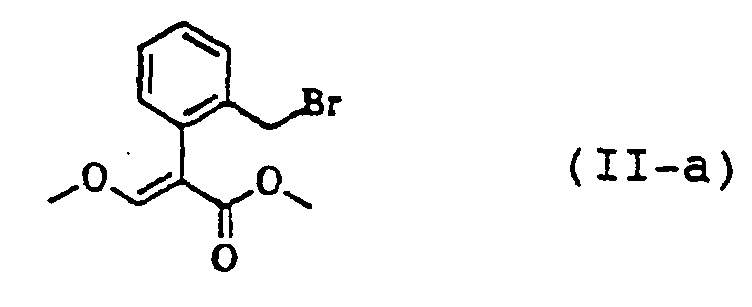
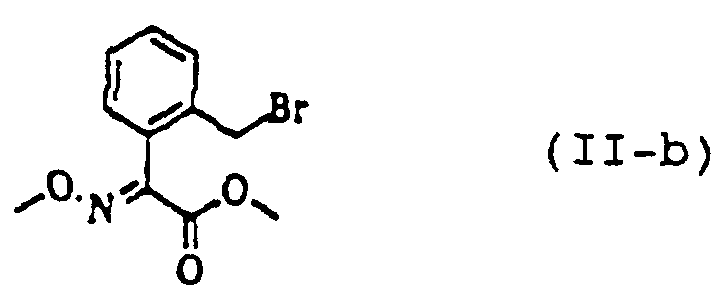
- Representative compounds of formula (II) are those of formula (II-a)(X=CH, Y=O and Z=O), formula (II-b)(X=N, Y=O, Z=O) and formula (II-c)(X=CH, Y=S, Z=O):

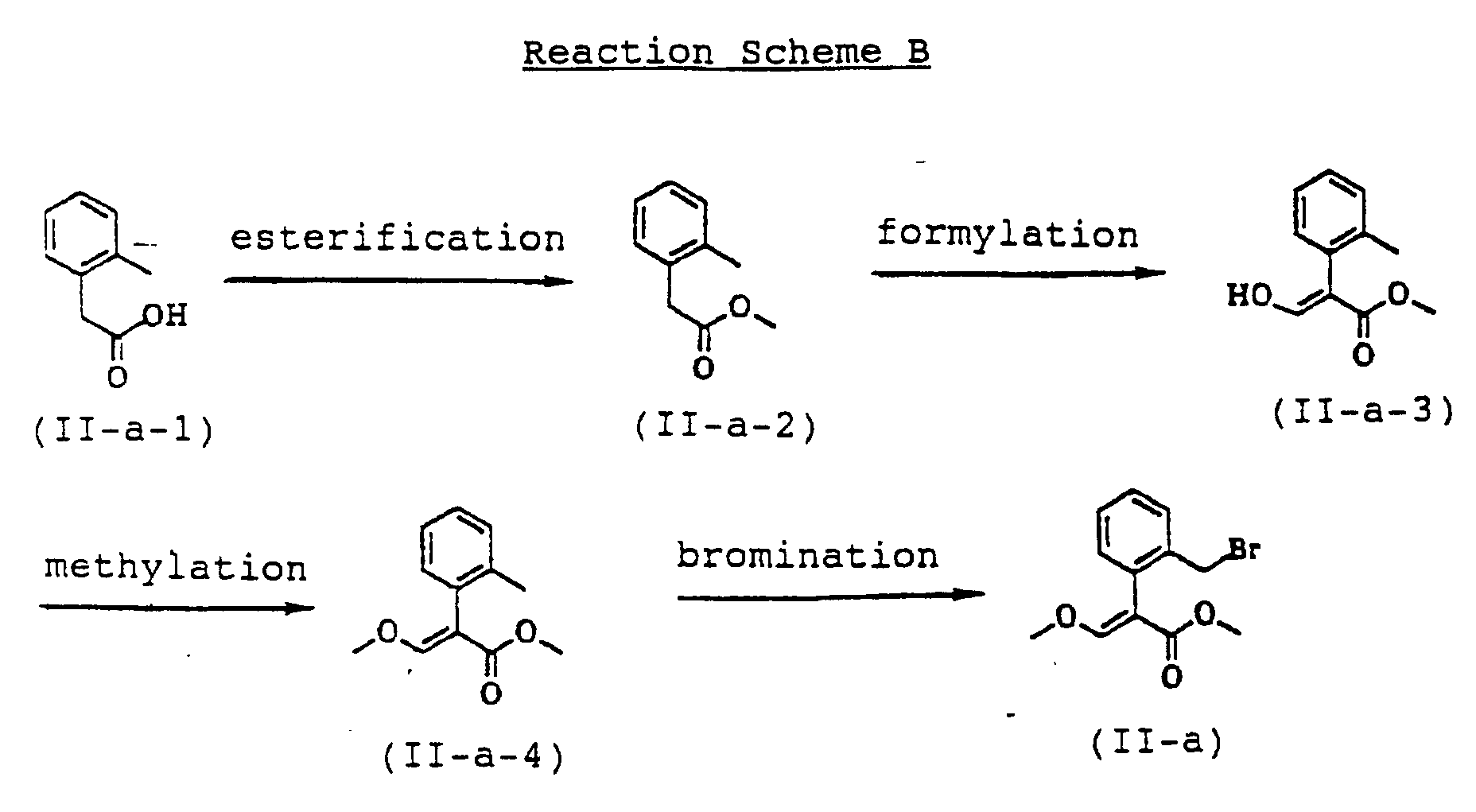
- A compound of formula (II-a) may be prepared by esterification, formylation, methylation and bromination of o-tolylacetic acid according to a conventional method(Yamada, K. et al., Tetrahedron Lett., 2745(1973); Vyas, G.N. et al., Org. Syn. Coll., 4, 836(1963); and Kalir, A., Org. Syn. Coll., 5, 825(1973)), as shown in Reaction Scheme B:
- A compound of formula (II-b) may be prepared by Grignard reaction, oxalylation, condensation and bromination of o-bromotoluene according to a conventional method(Rambaud, M. et al., Synthesis, 564(1988); Korean Patent No. 88,673; and PCT/KR 95/00020), as shown in Reaction Scheme C:
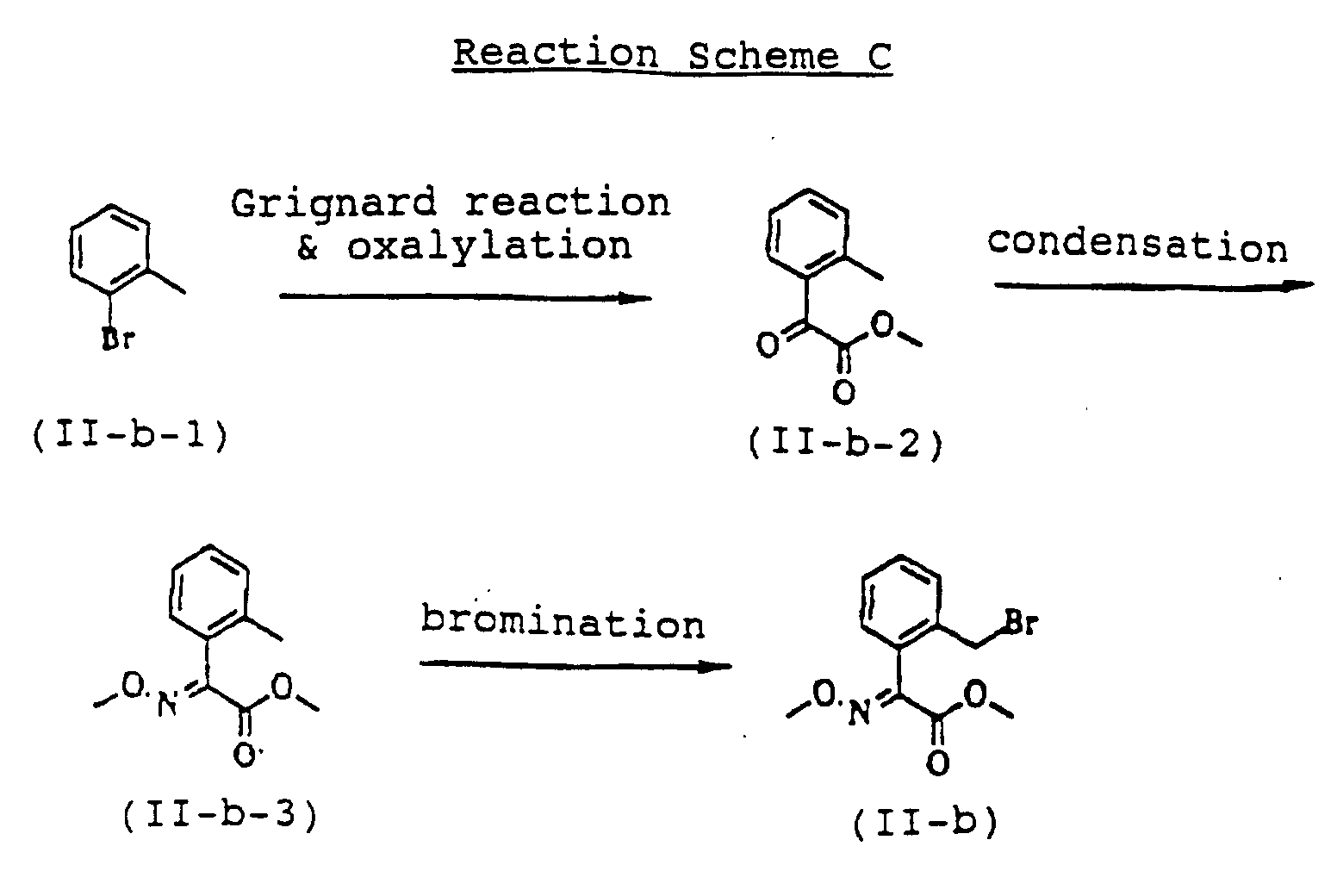
- A compound of formula (II-c) may be prepared by sulfonylation, nucleophilic substitution and bromination of methyl 3-hydroxy-2-(2'-methyl)phenyl-2-propenoate according to a conventional method(Korean Patent Application No. 95-37559), as shown in Reaction Scheme D:wherein, MsO represents a methansulfonyloxy group.
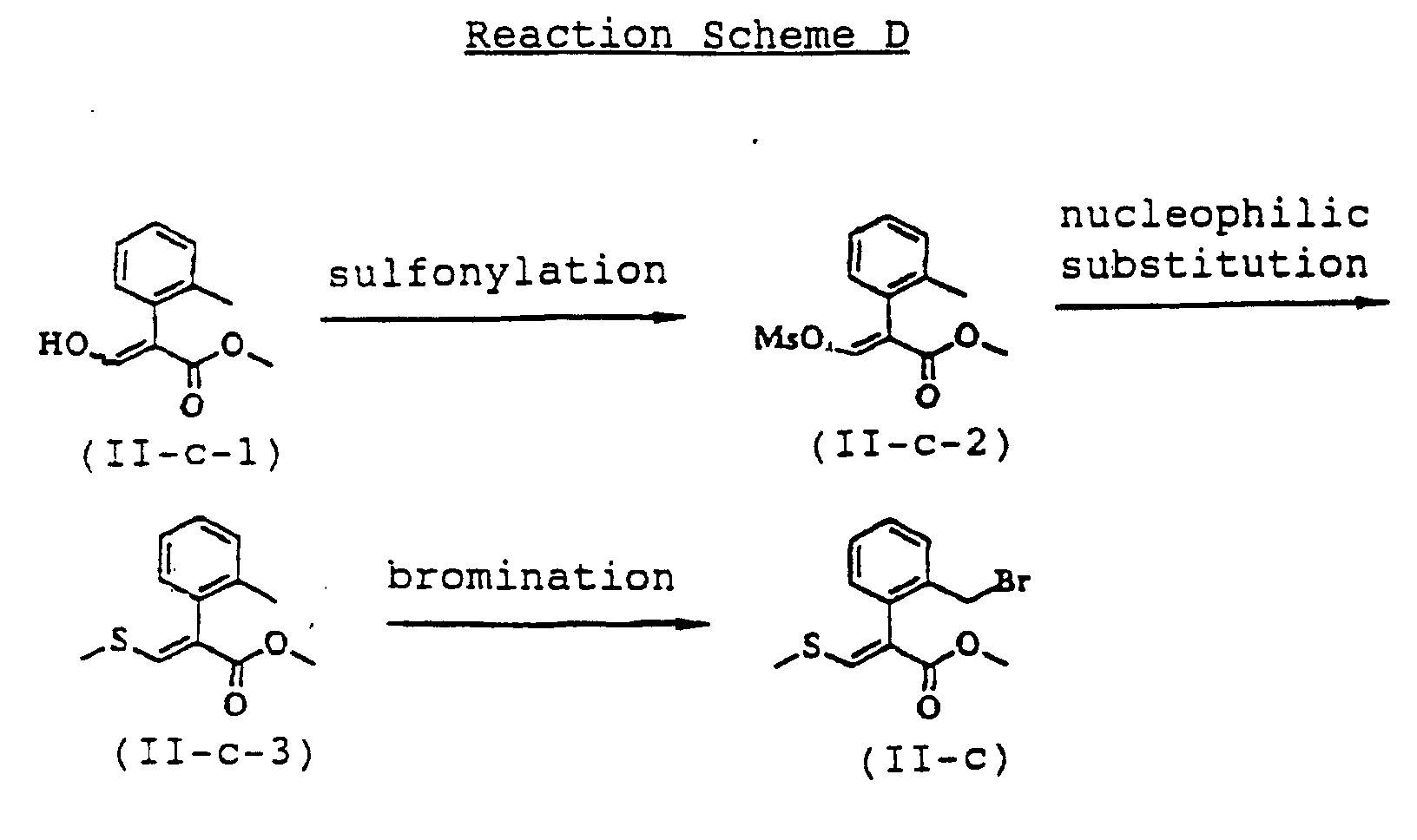
- Representative compounds of formula (III) are those of formula (III-a)(X=CH, Y=O and Z=O), formula (III-b)(X=N, Y=O, Z=O) and formula (III-c)(X=CH, Y=S, Z=O):
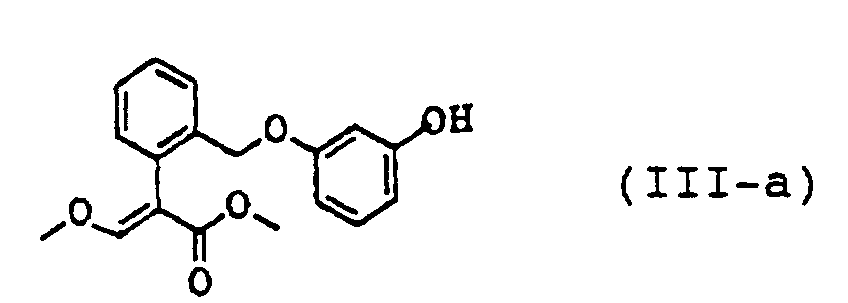

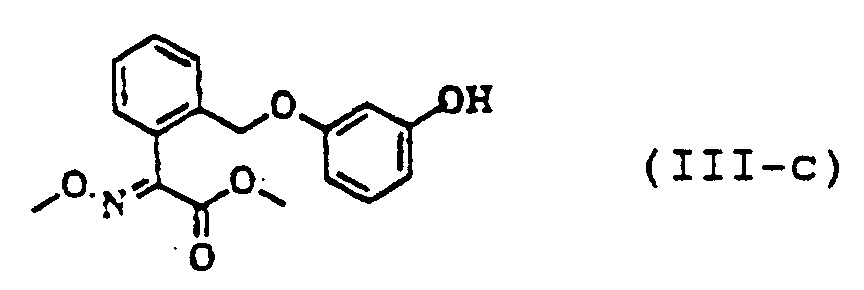
- A compound of formula (II) is reacted with 3-hydroxyphenol in the presence of a base to produce a compound of formula (III). The compound of formula (II) and 3-hydroxyphenol may be used in equimolar amounts and the base may be used in twice the molar amount. The base may be an inorganic base, e.g., sodium hydride, potassium t-butoxide, sodium carbonate or potassium carbonate; or an organic base, e.g., triethylamine or pyridine. The solvent which may be used in the reaction includes acetone, benzene, toluene, tetrahydrofuran, acetonitrile, dichloromethane or dimethylformamide, and the reaction may be conducted at a temperature ranging from room temperature to 100 °C. The progress of the reaction is conveniently followed by measuring the disappearance of the compound of formula (II) with thin layer chromatography(TLC).
- A compound of formula (IV) is reacted with a compound of formula (III) to produce a compound of formula (I), as in Reaction scheme A.
- A compound of formula (IV-a), i.e. a compound of formula (IV) wherein R1 is hydrogen, may be prepared by a Grignard reaction, reduction, halogenation, dehalogenation of a halide of R2 according to a conventional method(Herkes, F.E. et al., J. Org. Chem., 32, 1311(1967); and Nemeth, G. et al., J. fluorine Chem., 76, 91(1996)), as shown in Reaction Scheme E:wherein R2 has the same meaning as defined in formula (I) above; and W represents a halogen.

- A compound of formula (IV-b), i.e. a compound of formula (IV) wherein R1 is CF3, may be prepared by a Grignard reaction and Wittig reaction of a halide of R2 according to a conventional method(Herkes, F.E. et al., J. Org. Chem., 32, 1311(1967); and Wheatman. G.A. et al., J. Org. Chem., 48, 917(1983)), as shown in Reaction Scheme F:wherein R2 and W have the same meanings as above.

- The compound of the present invention may be prepared by reacting a compound of formula (III) with a compound of formula (IV) in the presence of a base. The compounds (III) and (IV) may be used in equimolar amounts and the base may be used in one to two equivalent amounts. The base may be an inorganic base, e.g., sodium hydride, potassium t-butoxide, sodium carbonate or potassium carbonate; or an organic base, e.g., triethylamine or pyridine. The solvent which may be used in the reaction is benzene, toluene, tetrahydrofuran, acetonitrile, dichloromethane or dimethylformamide, and the reaction temperature is in the range of room temperature to 100 °C.
- In case a mixture of E and Z isomers of compound of formula (II-a-4), (II-b-3) or (II-c-3) is used in the reaction(Reaction Scheme A), the compound of the present invention is obtained as a mixture of four isomers wherein the (E,E) and (E,Z) isomers predominate with minor amounts of the (Z,E) and (Z,Z) isomers. The structures of the four stereoisomers of the compound of the present invention are illustrated below:
- In case R1 is hydrogen

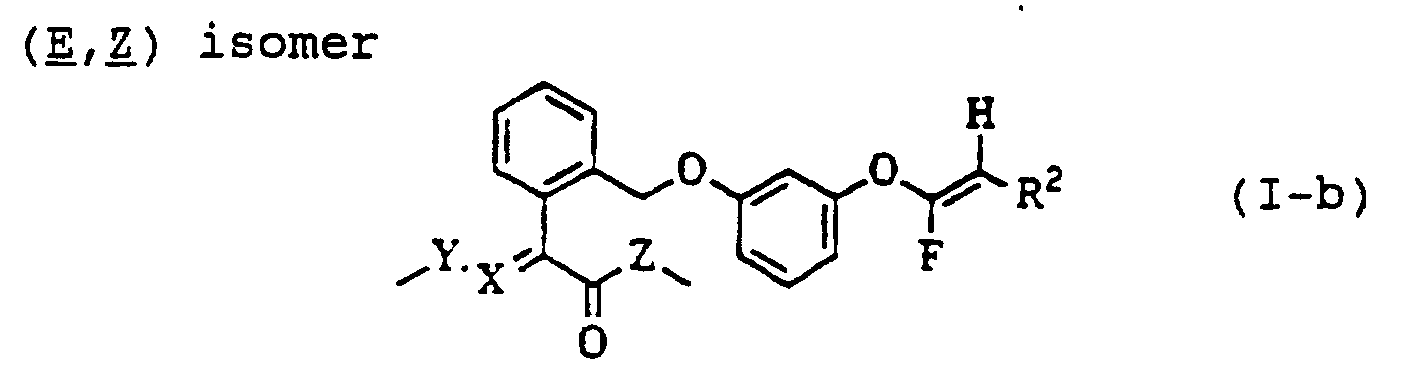


- In case R1 is CF3


 wherein, X, Y, Z, R1 and R2 have the same meanings as defined
in formula (I) above.
wherein, X, Y, Z, R1 and R2 have the same meanings as defined
in formula (I) above. -
- In case only the E isomer of the compound of formula (II-a-4), (II-b-3) or (II-c-3) is used, the compound of the present invention is obtained as a mixture of the (E,E) and (E,Z) isomers, as is confirmed by 1H-NMR or 19F-NMR analysis.
- According to the 1H-NMR analysis(reference compound, TMS) of the compound of the present invention wherein R1 is hydrogen, a hydrogen of vinyl group of (E,E) isomer is shown as a doublet having a coupling constant of 5 to 6 Hz at 5.5 to 5.8 ppm, while that of (E,Z) isomer is represented as a doublet having a coupling constant of 30 Hz at 5.0 to 5.4 ppm. The ratio of the (E,E) isomer to (E,Z) isomer is about 3.5:1 which may be calculated from integration on the 1H-NMR spectroscopy.
- According to the 19F-NMR analysis data of the compound of the present invention wherein R1 is CF3, a fluorine substituent of vinyl group and fluorine of CF3 of (E,Z) isomer are shown as a quartet having a coupling constant of 23.4 Hz at -75.9 ppm and a doublet having a coupling constant of 23.7 Hz at -58.5 ppm, respectively, while those of (E,E) isomer are represented as a quartet having a coupling constant of 12.6 Hz at -75.3 ppm and a doublet having a coupling constant of 12.6 Hz at -58.7 ppm. The ratio of the (E,Z) isomer to (E,E) isomer is about 2:1 which may be calculated from integration on the 19F-NMR spectroscopy.
- The compound of the present invention wherein Z is NH(the propenamide derivative or iminophenylacetamide derivative of the present invention) may be prepared by reacting the corresponding propenoic ester derivative or iminophenylacetic acid derivative of the present invention with an excess amount of methylamine in an organic solvent, e.g., alcohol including methanol, acetonitrile, dichloromethane or dimethylformamide.
- The compound of the present invention has a broad spectrum of fungicidal activity against various plant pathogenic fungus, e.g. Pyricularia oryzae Carvara KA301 which causes Rice Blast, Rhizoctonia solani AG-1 which causes Rice Sheath Blight, Botrytis cinerae which causes Cucumber Gray Mold Rot, Phytophthora infestans which causes Tomato Late Blight, Puccinia recondita which causes Wheat Leaf Rust and Erysiphe graminis which causes Barley Powdery Mildew.
- Accordingly, the present invention also includes within its scope fungicidal compositions comprising one or more of the compounds of formula (I) or stereoisomer thereof as an the compounds of formula (I) or stereoisomer thereof as an active ingredient, in association with fungicidally acceptable carriers.
- The fungicidal compositions of the invention may be formulated in various forms such as an emulsion, aqueous dispersion, powder and granules which may contain conventional additives. The compound of the formula (I) may be used in an amount of 10 to 90 % on the basis of the weight of an emulsion or aqueous dispersion, and 0.1 to 10% on the basis of the weight of granules.
- Fungicidally acceptable carrier that may be used in the present invention is a liquid carrier, e.g., water, an alcohol(ethanol, ethylene glycol, glycerine), ketone(acetone, methylethylketone), ether(dioxane, tetrahydrofuran, cellosolve), aliphatic hydrpcarbon(gasoline, Kerosene), halogenated hydrocarbon(chloroform, carbon tetrachloride), amide(dimethylformamide), ester(ethyl acetate, butyl acetate, fatty glycerine ester) and acetonitrile; and a solid carrier, e.g., mineral particle(Kaoline, clay, bentonite, dolomite, talc, silica, sand) and vegetable powder(shrubs).
- The additive that may be used in the fungicidal composition of the present invention includes an emulsifier, adhesive, dispersion agent or permeating agent, e.g., nonionic, anionic or cationic interface active agent(fatty acid sodium salt, polyoxy alkyl ester, alkyl sulfonate ester). Further, an agrochemically active ingredient, e.g., an insecticide, herbicide, plant growth regulator, germicide, and fertilizer, may be added in the composition of the present invention.
- The following Preparation and Examples are given for the purpose of illustration only and are not intended to limit the scope of the invention.
- 30.0 g of o-tolylacetic acid(0.2 mol) was dissolved in 100 ml of methanol, 5 ml of concentrated sulfuric acid was added thereto and the resulting solution was stirred with heating for 6 to 12 hours. The resulting solution was cooled and the solvent was removed under a reduced pressure to obtain a residue. The residue was washed twice with water and extracted with ethyl acetate. The organic layer was dried over magnesium sulfate and the solvent was removed under a reduced pressure. The residue thus obtained was subjected to column chromatography using a mixture of n-hexane and ethyl acetate (4:1) as an eluent to obtain 32.15 g (yield 98 %) of the title compound as a colorless liquid.
1H-NMR (CDCl3, TMS) δ: 7.21-7.01(m, 4H), 3.61(s, 3H), 3.60(s, 2H), 2.35(s, 3H)
MS (m/e): 164(M+, 42), 133(100), 31(82). - 24.6 g of the compound(0.15 mol) obtained in Step 1 and 24.3 g of sodium methoxide(0.45 mol) were added to 300 ml of toluene, and 27 g of methyl formate(0.45 mol) was added dropwise thereto over a period of 1 hour while cooling and stirring. The resulting solution was stirred at room temperature for 12 hours and extracted twice or three times with water. The combined aqueous layer was acidified with concentrated hydrochloric acid and then extracted with ethyl acetate. The organic layer was dried over magnesium sulfate and then the solvent was removed under a reduced pressure to obtain a residue. The residue was subjected to column chromatography using a mixture of n-hexane and ethyl acetate (9:1) as an eluent to obtain 27.36 g (yield 95 %) of the title compound as a colorless liquid.
1H-NMR (CDCl3, TMS) δ: 11.92(d, 1H), 7.32-7.01(m, 4H), 3.71(s, 3H), 2.21(s, 3H)
MS (m/e): 192(M+, 26), 160(52), 132(48), 84(100) - 19.2 g of the compound(0.1 mol) obtained in Step 2, 15.12 g of dimethylsulfate(0.12 mol) and 13.82 g of potassium carbonate(0.1 mol) were added to 200 ml of acetone, and the resulting solution was stirred for 12 hours with heating. The solvent was removed under a reduced pressure and the residue was extracted with ethyl acetate. The organic layer was dried over magnesium sulfate and the solvent was removed under a reduced pressure to obtain a residue. The residue was subjected to column chromatography using a mixture of n-hexane and ethyl acetate (4:1) as an eluent to obtain 17.1 g (yield 83 %) of the title compound having two isomers as a colorless liquid.
- The title compound thus obtained was composed of 82% E isomer and 18% Z isomer.
E isomer(upper spot)
1H-NMR (CDCl3, TMS) δ: 7.51(s, 1H), 7.35-6.98(m, 4H), 3.79(s, 3H), 3.68(s, 3H), 2.21(s, 3H)
MS (m/e): 206(M+, 10), 176(73), 117(100), 77(57)
Z isomer(down spot)
1H-NMR (CDCl3, TMS) δ: 7.34-6.98(m, 4H), 6.50(s, 1H), 3.85(s, 3H), 3.68(s, 3H), 2.21(s, 3H)
MS (m/e): 206(M+, 8), 176(100), 117(92), 77(30) - These isomers were separated and the E isomer was used in the following step.
- 18.54 g of methyl (2E)-3-methoxy-2-(2'-methyl)phenyl-2-propenoate(0.09 mol) obtained in Step 3 and 16.0 g of N-bromosuccinimide(0.09 mol) were added to 100 ml of carbon tetrachloride. Then, 0.16 g of 2,2'-azobisisobutyronitrile(l mmol) was added thereto, and the resulting solution was stirred for 12 hours with heating. The resultant solution was cooled and filtered to remove succinimide. The solvent was removed under a reduced pressure and a oily residue thus obtained was subjected to column chromatography using a mixture of n-hexane and ethyl acetate (4:1) as an eluent to obtain 21.73 g (yield 85 %) of the title compound as a colorless solid.
Melting Point: 64-65 °C
1H-NMR (CDCl3, TMS) δ: 7.63(s, 1H), 7.51-7.09(m, 4H), 4.40(s, 2H), 3.82(s, 3H), 3.69(s, 3H)
MS (m/e): 284(M+, 10), 253(12), 205(21), 173(38), 145(100). - 5.1 g of magnesium(0.21 mol) was placed in 300 ml of dry ether and 34.18 g of o-bromotoluene (0.2 mol) was added dropwise thereto under a nitrogen atmosphere to prepare a Grignard reagent. The Grignard reagent solution was cooled to -78 °C and 23.6 g of dimethyl oxalate(0.2 mol) was added dropwise thereto. The resulting solution was stirred for 30 minutes, mixed with crushed ice, acidified with 20% hydrochloric acid and then extracted with ether. The organic layer was washed three times with water, dried over magnesium sulfate, and the solvent was removed under a reduced pressure to obtain a residue. The residue was subjected to column chromatography using a mixture of n-hexane and ethyl acetate (9:1) as an eluent to obtain 24.2 g (yield 68 %) of the title compound as a colorless liquid.
1H-NMR (CDCl3, TMS) δ: 7.88-7.01(m, 4H), 3.98(s, 3H), 2.65(s, 3H)
MS (m/e): 178(M+, 21), 119(100), 91(71), 65(37). - 8.35 g of O-methylhydroxylamine hydrochloride (0.1 mol) and 8.1 ml of pyridine(0.1 mol) were added to 100 ml of methanol, and then, 17.8 g of the compound(0.1 mol) obtained in Step 1 was added thereto. The resulting solution was stirred for 12 hours with heating and concentrated under a reduced pressure. The resultant solution was mixed with water and extracted with ethyl acetate. The organic layer was dried over magnesium sulfate and the solvent was removed under a reduced pressure to obtain a residue. The residue was subjected to column chromatography using a mixture of n-hexane and ethyl acetate (4:1) as an eluent to obtain 19.04 g (yield 92 %) of the title compound as a colorless liquid.
- The title compound thus obtained was composed of 50% Z isomer and 50% E isomer. The Z isomer was a liquid and the E isomer was a solid obtained by recrystallization in n-hexane. The structure of E isomer was identified by X-ray crystallography.
Z isomer(upper spot)
1H-NMR (CDCl3, TMS) δ: 7.41-7.15(m, 4H), 4.01(s, 3H), 3.85(s, 3H), 2.45(s, 3H)
MS (m/e): 207(M+, 8), 176(41), 116(100), 89(62)
E isomer(down spot)
m.p.: 63-64 °C
1H-NMR (CDCl3, TMS) δ: 7.38-7.05(m, 4H), 4.04(s, 3H), 3.85(s, 3H), 2.19(s, 3H)
MS (m/e): 207(M+, 11), 176(82), 116(100), 89(70) - The E isomer was employed in following step.
- 9.0 g of methyl (2E)-2-methoxyimino-2-(2'-methyl)phenylacetate(0.0435 mol) obtained in Step 2 and 7.74 g of N-bromosuccinimide(0.0435 mol) were added to 50 ml of carbon tetrachloride, and then, 0.16 g of 2,2'-azobisisobutyronitrile(1 mmol) was added thereto. The resulting solution was stirred for 12 hours with heating, solvent was removed under a reduced pressure and obtained a oily residue which was subjected to silica gel column chromatography using a mixture of n-hexane and ethyl acetate (4:1) as an eluent to obtain 11.08 g (yield 90 %) of the title compound as a colorless liquid.
1H-NMR (CDCl3, TMS) δ: 7.62-7.01(m, 4H), 4.39(s, 2H), 4.04(s, 3H), 3.85(s, 3H)
MS (m/e): 285(M+, 46), 252(35), 175(100), 146(94), 116(78). - 17 g of the compound(0.089 mol) obtained in Step 2 of Preparation 1 was dissolved in 400 ml of dry ethyl acetate, and then, 14 ml of triethylamine(0.1 mol) was added thereto under a nitrogen atmosphere. To the resulting solution, 7.74 ml of methansulfonyl chloride(0.1 mol) was added dropwise over a period of 30 minutes with stirring at room temperature. The resultant solution was stirred for 1 to 3 hours, washed three times with water, and then dried over magnesium sulfate. The solvent was removed under a reduced pressure and the residue was subjected to silica gel column chromatography using a mixture of n-hexane and ethyl acetate (4:1) as an eluent to obtain 21.34 g (yield 88.8 %) of the title compound as a colorless liquid.
1H-NMR (CDCl3, TMS) δ: 8.01(s, 1H), 7.49-7.01(m, 4H), 3.81(s, 3H), 3.09(s, 3H), 2.23(s, 3H)
MS (m/e): 270(M+, 51), 174(100), 159(96), 103(89). - 16.2 g of the compound(0.06 mol) obtained in Step 1 was dissolved in 150 ml of methanol, and then, 4.9 g of sodium thiomethoxide(0.07 mol) was added thereto. The resulting solution was stirred at room temperature for 4 hours, concentrated under a reduced pressure, mixed with water, and then, extracted with ethyl acetate. The organic layer was dried over magnesium sulfate and the solvent was removed under a reduced pressure. The residue was subjected to silica gel column chromatography using a mixture of n-hexane and ethyl acetate (9:1) as an eluent to obtain 10.3 g (yield 77.3 %) of the title compound as a colorless liquid.
- The title compound thus obtained was composed of 92% E isomer and 8% Z isomer.
E isomer(upper spot)
1H-NMR (CDCl3, TMS) δ: 7.85(s, 1H), 7.38-6.91(m, 4H),
3.75(s, 3H), 2.35(s, 3H), 2.16(s, 3H)
MS (m/e): 222(M+, 20), 175(21), 147(36), 115(100) - The E isomer was isolated and employed in the following step.
- 10.2 g of methyl (2E)-3-thiomethoxy-2-(2'-methyl)phenyl-2-propenoate(0.046 mol) obtained in Step 2 and 9.25 g of N-bromosuccinimide(0.052 mol) were added to 150 ml of carbon tetrachloride and 0.16 g of 2,2'-azobisisobutyronitrile(1 mmol) was added thereto. The resulting solution was stirred for 12 hours with heating, cooled and filtrated to remove succinimide. The solvent was removed under a reduced pressure and the residue was subjected to silica gel column chromatography using a mixture of n-hexane and ethyl acetate (9:1) as an eluent to obtain 8.58 g (yield 62.0%) of the title compound as a colorless liquid.
1H-NMR (CDCl3, TMS) δ: 7.98(s, 1H), 7.69-7.01(m, 4H), 4.45(s, 2H), 3.73(s, 3H), 2.45(s, 3H)
MS (m/e): 300(M+, 14), 161(100), 145(30), 115(79). - 5.7 g of compound(0.02 mol) obtained in Preparation 1, 2.2 g of 3-hydroxyphenol(Resorcinol, 0.02 mol) and 2.76 g of potassium carbonate(0.02 mol) were added to 100 ml of acetone and the mixture was refluxed with heating for 24 hours. The solvent was removed and the resulting mixture was extracted with ethyl acetate. The organic layer was dried over magnesium sulfate and the solvent was removed under a reduced pressure to obtain a residue. The residue was subjected to silica gel column chromatography using a mixture of n-hexane and ethyl acetate (2:1) as an eluent to obtain 4.52 g (yield 72%) of the title compound as a colorless liquid.
1H-NMR (CDCl3, TMS) δ: 7.67(s, 1H), 7.65-6.21(m, 8H), 4.89(s, 2H), 3.78(s, 3H), 3.65(s, 3H), 2.50(br.s, 1H)
MS (m/e): 314(M+, 21), 205(98), 174(28), 145(100). - The procedure of Preparation 4 was repeated except that 5.66 g of compound(0.02 mol) obtained in Preparation 2 was used in place of compound obtained in Preparation 1 to obtain 4.92 g (yield 78 %) of the title compound as a colorless liquid.
1H-NMR (CDCl3, TMS) δ: 7.54-7.01(m, 9H), 4.89(s, 2H), 4.01(s, 3H), 3.85(s, 3H)
MS (m/e): 315(M+, 28), 284(51), 206(86), 132(100), 116(89). - The procedure of Preparation 4 was repeated except that 6.0 g of the compound(0.02 mol) obtained in Preparation 3 was used in place of the compound obtained in Preparation 1 to obtain 3.23 g (yield 49 %) of the title compound as a colorless liquid.
1H-NMR (CDCl3, TMS) δ: 7.98(s, 1H), 7.71-6.28(m, 8H), 5.81(br.s, 1H), 4.89(s, 2H), 3.78(s, 3H), 2.35(s, 3H)
MS (m/e): 330(M+, 51), 221(77), 161(100), 145(22), 115(54). - 5.1 g of magnesium(0.21 mol) was placed in 300 ml of dry diethyl ether and 37.4 g of p-bromoanisole (0.2 mol) was added dropwise thereto under a nitrogen atmosphere to prepare a Grignard reagent. The Grignard reagent solution was cooled to -78 °C and 28.3 g of ethyl trifluoroacetate(0.2 mol) was added dropwise thereto. The resulting solution was stirred for 1 hour, mixed with an crushed ice, acidified with 20% hydrochloric acid and then extracted three times with diethyl ether. The organic layer was dried over magnesium sulfate and the solvent was removed under a reduced pressure to obtain a residue. The residue was distilled at 72 to 73 °C/20 mmHg to obtain 35.09 g (yield 86%) of the title compound as a colorless liquid.
1H-NMR (CDCl3, TMS) δ: 7.62-6.81(m, 4H), 3.86(s, 3H)
MS (m/e): 204(M+, 56), 135(100), 107(86), 92(66), 77(92). - 14.28 g of compound(150ml) obtained in Step 1 was dissolved in 150 ml of methanol and 1.32 g of sodium borohydride(0.035 mol) was added dropwise thereto for 30 minutes. The resulting solution was stirred at room temperature for 2 hours and the solvent was removed. Ethyl acetate was added thereto and the resultant solution was washed three times with water. The organic layer was dried over magnesium sulfate and the solvent was removed under a reduced pressure to obtain a residue. The residue was subjected to silica gel column chromatography using a mixture of n-hexane and ethyl acetate (4:1) as an eluent to obtain 14 g (yield 97%) of the title compound as a colorless liquid.
1H-NMR (CDCl3, TMS) δ: 7.62-6.78(m, 4H), 4.29(q, 1H), 3.94(br.s, 1H), 3.86(s, 3H)
MS (m/e): 206(M+, 42), 191(62), 137(100), 107(26), 69(56). - 14 g of the compound(0.068 mol) obtained in Step 2 and 50 g of thionyl chloride(0.7 mol) were added to 100 ml of toluene and the mixture was stirred with heating for 12 hours. The resulting solution was cooled and washed with water. The organic layer was dried over magnesium sulfate and the solvent was removed under a reduced pressure to obtain a residue. The residue was subjected to silica gel column chromatography using n-hexane as an eluent to obtain 12 g (yield 79%) of the title compound as a colorless liquid.
1H-NMR (CDCl3, TMS) δ: 7.62-6.81(m, 4H), 5.01(q, 1H), 3.86(s, 3H)
MS (m/e): 224(M+, 23), 189(100), 158(79), 120(56), 69(43). - 11.2 g of the compound(0.05 mol) obtained in Step 3 was dissolved in 50 ml of dry tetrahydrofuran, and then, 3.27 g of activated zinc(0.05 mol) was added thereto. The resulting solution was refluxed for 12 hours while stirring and heating. The resulting solution was cooled and filtered to remove precipitated salts. The solvent was removed under a reduced pressure and the residue was subjected to silica gel column chromatography using n-hexane as an eluent to obtain 6.8 g (yield 80%) of the title compound as a colorless liquid.
1H-NMR (CDCl3, TMS) δ: 7.51-6.69(m, 4H), 5.29(dd, 1H, J=26Hz, J=4Hz), 3.86(s, 3H)
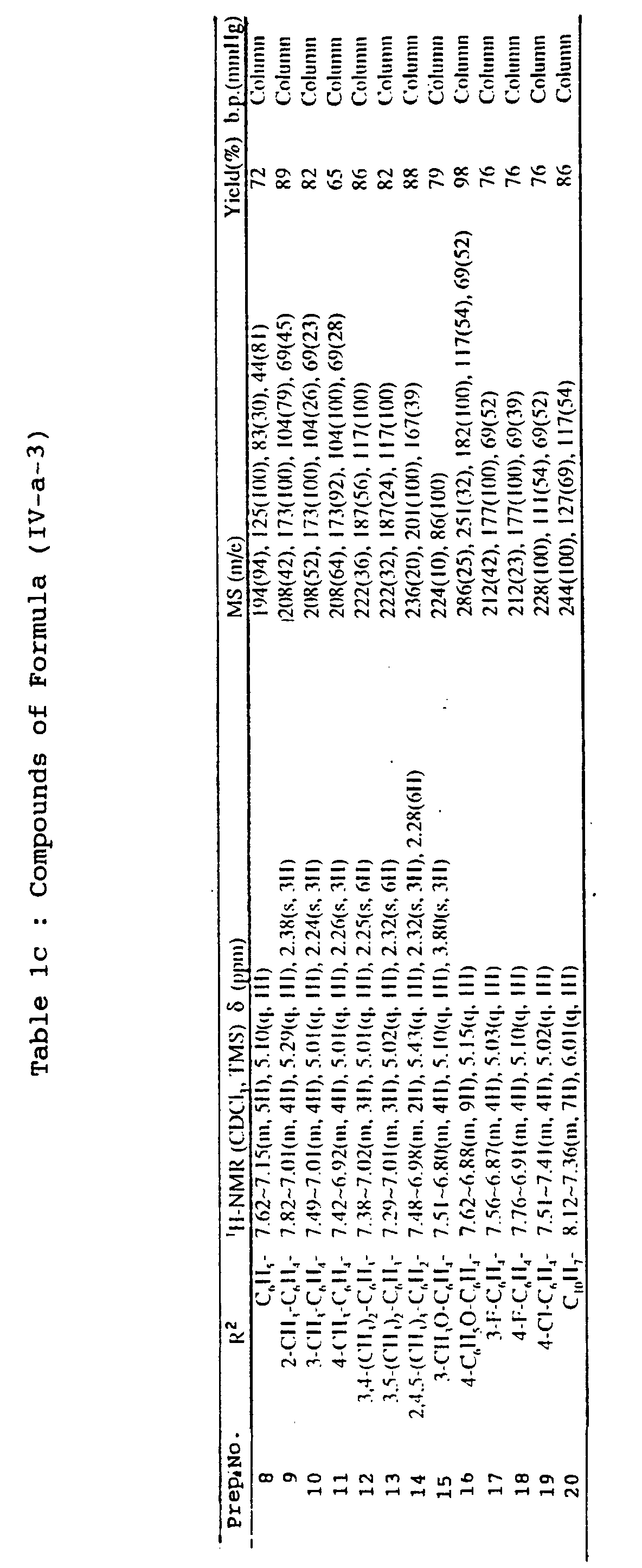
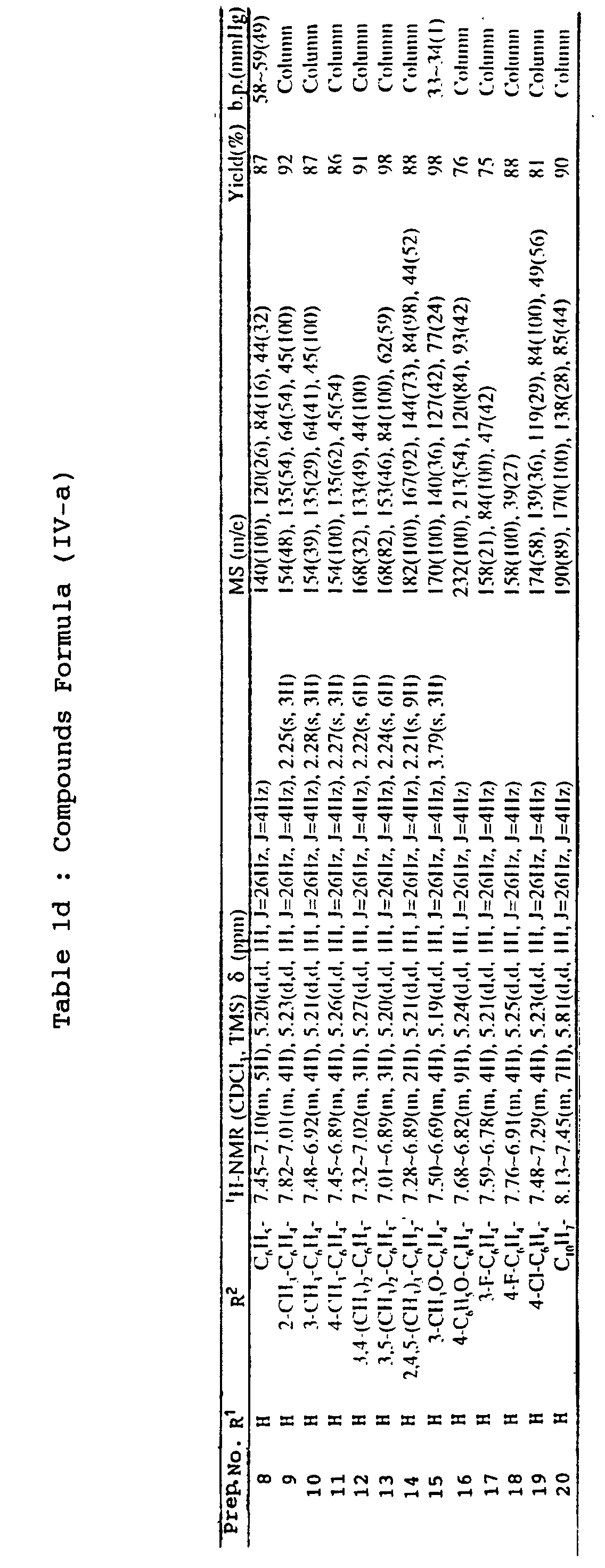
MS (m/e): 170(M+, 100), 155(68), 127(92), 84(21). - The procedure of Preparation 7 was repeated to obtain intermediate compounds of formulas (IV-a-1), (IV-a-2), (IV-a-3) and (IV-a) having various R2 groups, as in Tables 1a, 1b, 1c and 1d, respectively. The 1H-NMR and MS analysis data of these compounds are also shown in respective tables.


- 26.2 g of triphenylphosphine(0.1 mol) was dissolved in 250 ml of dry triglyme and 25.2 g of dibromodifluoromethan(0.12 mol) was added dropwise thereto under a nitrogen atmosphere at a temperature below 10 °C. To the resulting solution was added 10.2 g of compound(0.05 mol) obtained in Step 1 of Preparation 7. The resultant solution was stirred at 100 °C with heating for 12 hours, cooled and distilled under a reduced pressure. The obtained oil was redistilled to obtain 9.39 g of a title compound having a temperature of 72 to 74 °C at 10 mmHg as a colorless liquid.
1H-NMR (CDCl3, TMS) δ: 7.48-6.79(m, 4H), 3.79(s, 3H)
MS (m/e): 238(M+, 69), 195(14), 145(35), 74(33), 59(100). - Using each of the compounds of formula (IV-a-1) listed in Table 1a and Table 2a, the procedure of Preparation 21 was repeated to obtain compounds of formula (IV-b) having various R2 groups, as shown in Table 2b. The 1H-NMR and MS data of these compounds are also listed in Table 2b.


- 314 mg of the compound(1 mmol) obtained in Preparation 4 was added to 10 ml of acetonitrile and 40 mg of sodium hydride(1 mol) dispersed in mineral oil(60%) was added thereto under a nitrogen atmosphere. The resulting solution was stirred for 30 minutes and 140 mg of the compound(1 mmol) obtained in Preparation 8 was added slowly thereto. The resultant solution was stirred for 4 hours with heating, mixed with water and extracted with ethyl acetate. The organic layer was dried over magnesium sulfate and the solvent was removed under a reduced pressure. The residue was subjected to silica gel column chromatography using a mixture of n-hexane and ethyl acetate (4:1) as an eluent to obtain 400 mg (yield 92%) of the title compound as a colorless liquid.
1H-NMR (CDCl3, TMS) δ: 7.68(s, 1H), 7.62-6.62(m, 13H), 5.68(d, 1H), 4.98(s, 2H), 3.78(s, 3H), 3.69(s, 3H)
MS (m/e): 434(M+, 13), 205(87), 145(100). - 217 mg of the compound 1(0.5 mmol) obtained in Example 1 was dissolved in 5 ml of methanol and 2 ml of aqueous methylamine solution(40%) were added thereto. The resulting solution was stirred for 12 hours and the solvent was removed under a reduced pressure. The resultant solution was extracted with ethyl acetate and the organic layer was dried over magnesium sulfate. The solvent was removed under a reduced pressure and the residue was subjected to silica gel column chromatography using a mixture of n-hexane and ethyl acetate (4:1) as an eluent to obtain 206 mg (yield 95%) of the title compound as a colorless liquid.
1H-NMR (CDCl3, TMS) δ: 8.12(br, 1H), 7.62-6.58(m, 14H), 5.62(d, 1H), 4.98(s, 2H), 3.69(s, 3H), 2.78(d, 3H)
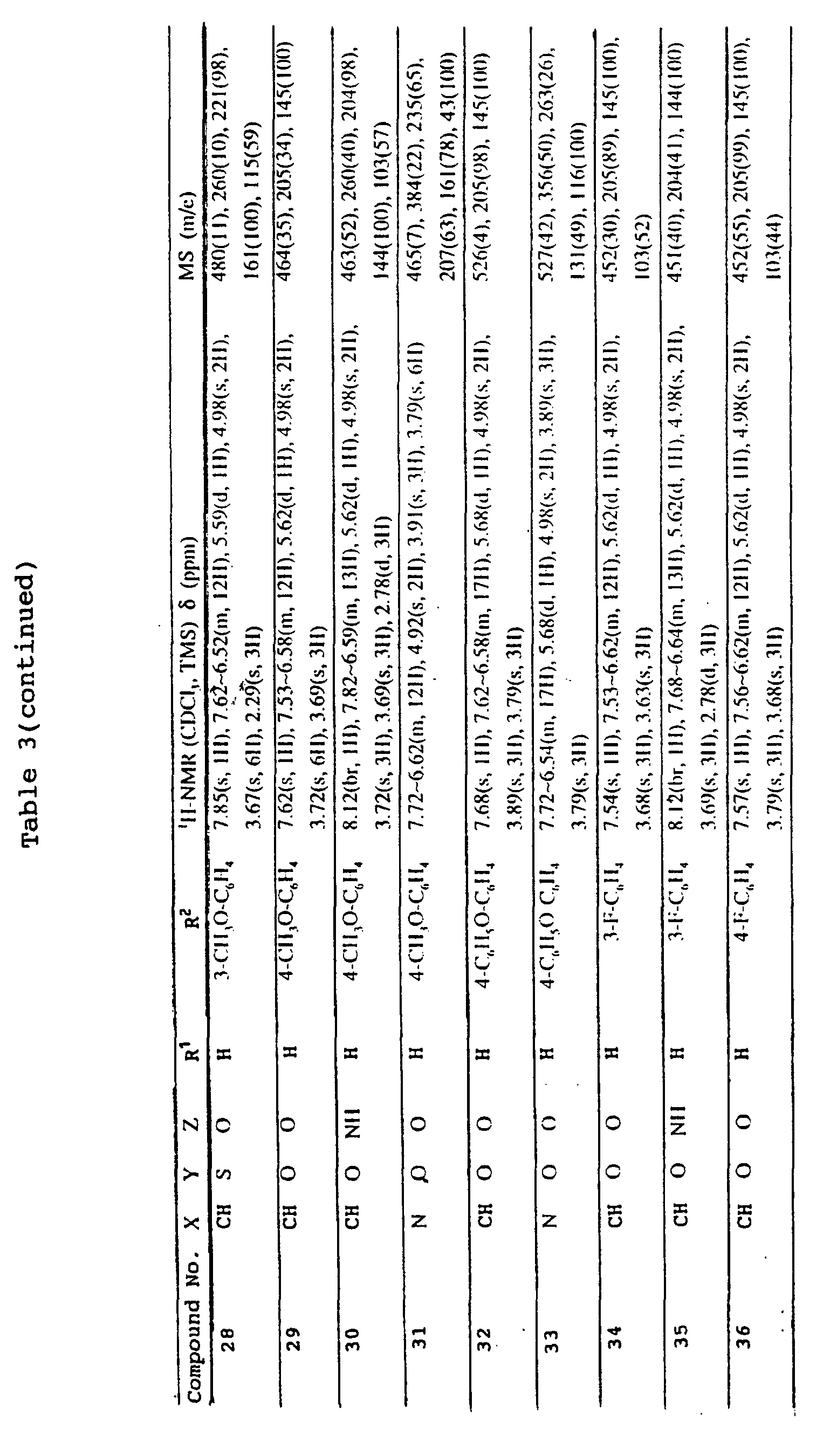
MS (m/e) : 433(M+, 6), 204(41), 144(100), 103(24). - Using each of the compounds obtained in Preparations 4 to 20, the procedure of Example 1 or 2 was repeated to obtain 42 compounds(Compound 3 to 44) of formula (I) of the present invention having various R2 groups listed in Table 3. The 1H-NMR and MS data of these compounds are also shown in Table 3.



- The procedure of Example 1 was repeated except that 208 mg of the compound(1 mmol) obtained in the Preparation 22 was used in place of the compound obtained in Preparation 7 to obtain 462 mg (yield 92 %) of the title compound as a colorless liquid.
1H-NMR (CDCl3, TMS) δ: 7.62(s, 1H), 7.58-6.52(m, 13H), 4.98(s, 2H), 3.72(s, 3H), 3.62(s, 3H)
MS (m/e): 502(M+, 7), 205(98), 145(100). - The procedure of Example 2 was repeated except that 251 mg of the compound 45 (0.5 mmol) obtained in the Example 45 was used in place of the compound 1 obtained in Example 1 to obtain 213 mg(yield 85 %) of the title compound as a colorless liquid.
1H-NMR (CDCl3, TMS) δ: 8.02(br, 1H), 7.72-6.53(m, 14H), 4.92(s, 2H), 3.69(s, 3H), 2.85(d, 3H)
MS (m/e): 501(M+, 13), 204(41), 145(100). - Using each of the compounds obtained in Preparations 4 to 40, the procedure of Examples 1 or 2 was repeated to obtain 61 compounds(Compound 47 to 107) of formula (I) of the present invention having various R2 groups, as shown in Table 4. The 1H-NMR and MS analysis data of these compounds are also listed in Table 4.


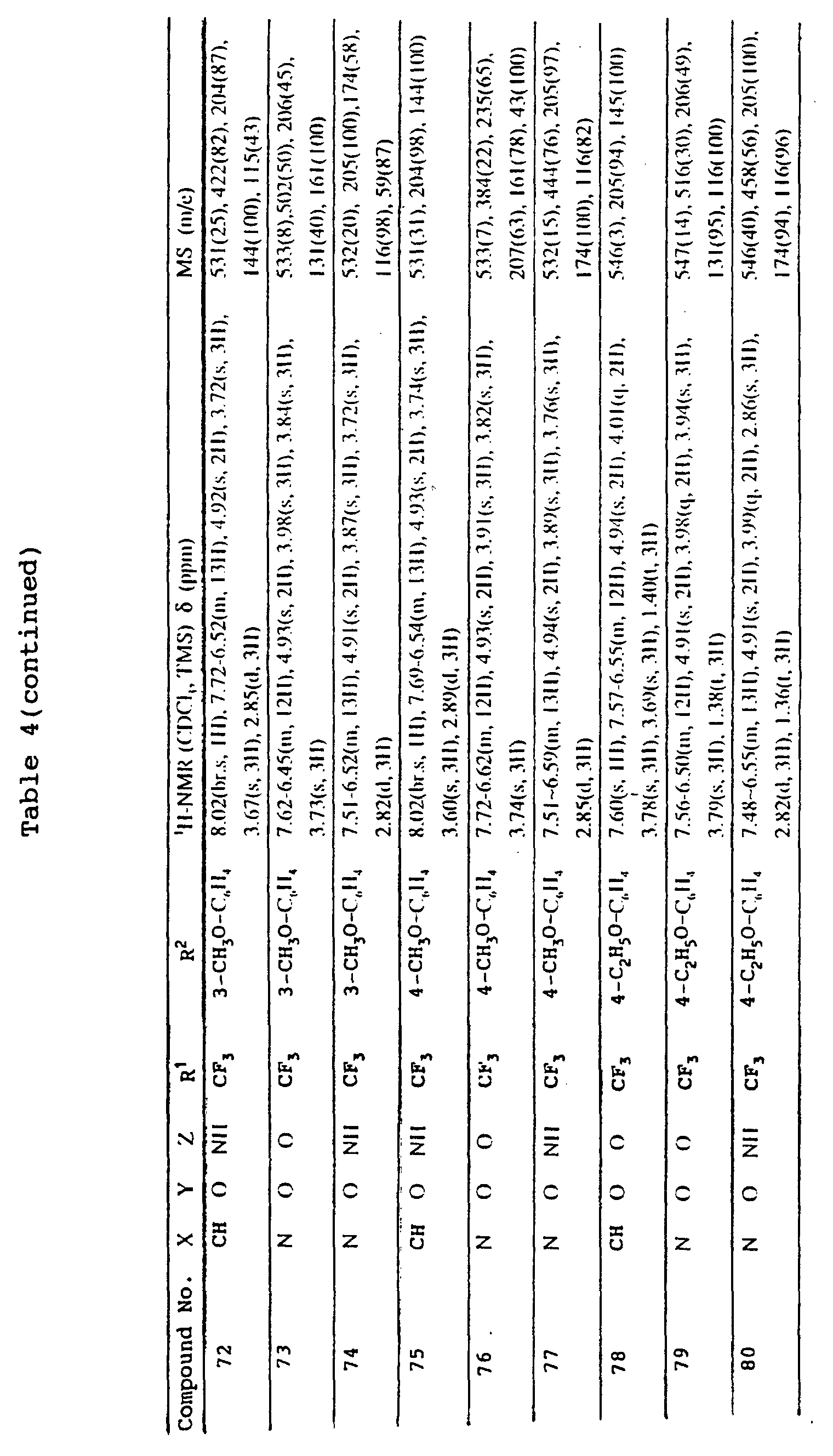


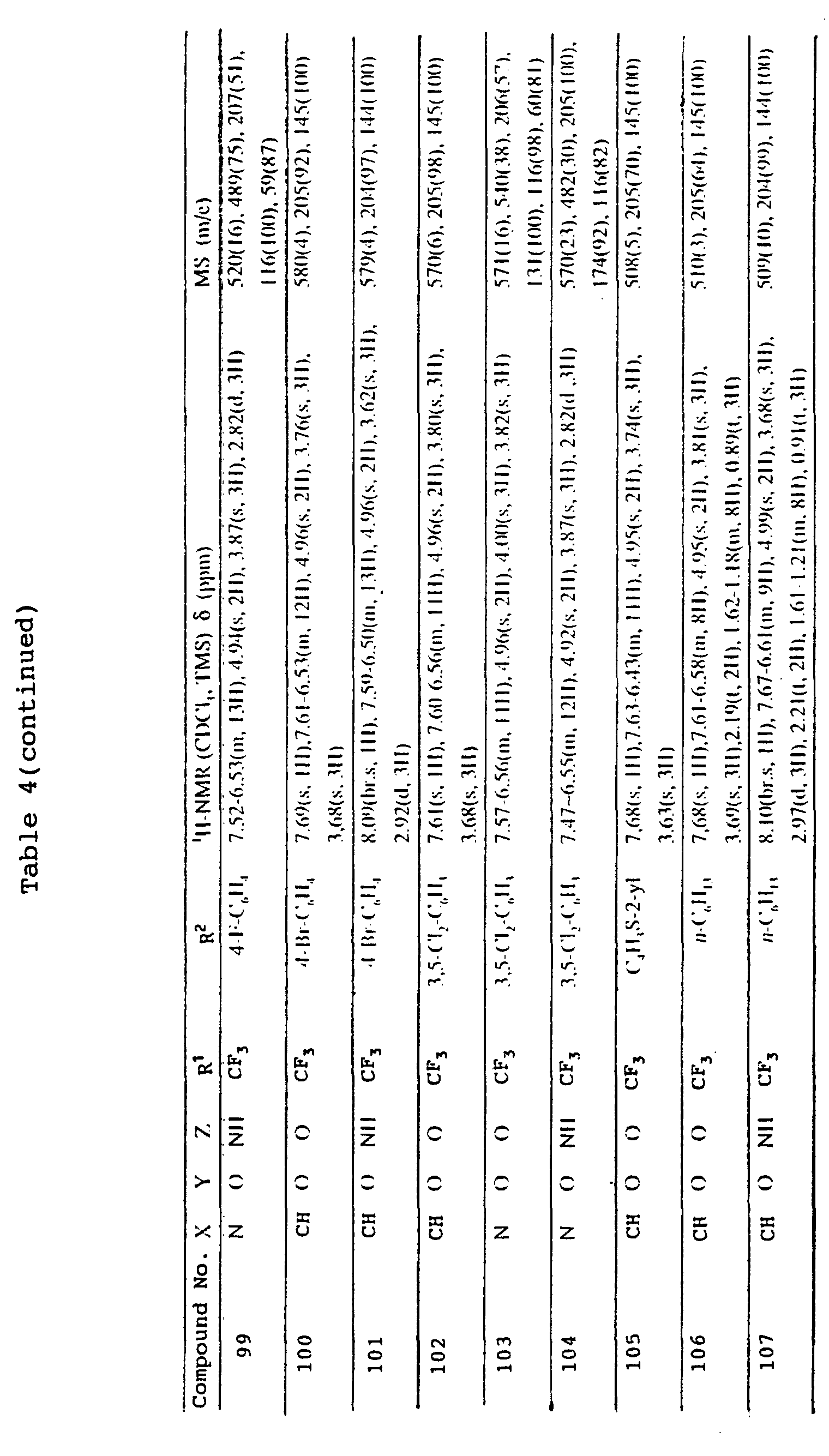
- To examine fungicidal activity of the compounds of the present invention, each of the compounds listed in Table 3 and 4 was dissolved in 10% acetone to a concentration of 250 ppm, and Tween-20 was added thereto to a concentration of 250 or 500 ppm. 50 ml of the resulting solution was sprayed on leaves of a host plant. The plant was kept at room temperature for 24 hours to let the solvent evaporate, and then, a pathogenic fungus was inoculated thereonto. The plant was held in a humidity chamber for 24 hours, transferred to an plant growth room kept at 20 to 27 °C and a relative humidity of 60 to 80% and kept to induce disease. Subsequently, the lesion area(L.A.) attacked by the pathogenic fungus was measured according to a method of Cho(Cho, K.Y., Search Report by Korea Research Institute of Chemical Technology(1989))". This procedure was repeated twice for each test. 10% Acetone solution containing 250 ppm of Tween-20 was used as a control.
- The fungicidal activity of the compound of the present invention is repressed by a control value(C.V.) calculated as;
- Pyricularia oryzae Carvara KA301 was inoculated on a rice bran agar medium (rice bran 20 g, dextrose 10 g, agar 15 g and distilled water 1 ℓ) and cultured at 26 °C for 1 week. The surface of the medium was scratched using a rubber polishman to remove aerial mycelia, and cultured under a fluorescent light for 48 hours to form a spore. Spores were suspended in sterilized water at a concentration of 1x10⁶ spore/ml. The spore suspension was sprayed enough to soak the leaves of a RBC disease-sensitive Nakdong rice plant having 3 or 4 leaves. The rice plant was held in a humidified dark room for 24 hours, transferred to an incubator kept at 24 to 28 °C and a relative humidity of more than 80% and kept for 5 days to induce RCB. L.A. on a fully grown leaf appearing underneath an uppermost leaf was measured to calculate an C.V.
- Rhizoctonia solani AG-1 was cultured on a PDA medium(potato 200 g, dextrose 20 g, agar 20 g and distilled water 1 ℓ) for 3 days and the agar disc(diameter 0.6 cm) was inoculated and cultured on sterilized wheat bran medium in a 1 ℓ bottle at 26 to 28 °C for 7 days. A mycelial mass was ground using a homogenizer, inoculated uniformly on soil of a pot wherein a Nakdong rice plant having 2 or 3 leaves and an height of 5 cm grew, and kept in humidity polyvinyl chamber for 5 days to induce RSB. L.A. on a leaf sheath was measured to calculate an C.V.
- Botrytis cinerae, which was isolated from cucumber infected thereby, was inoculated on a PDA agar medium and cultured under a 12L/12D cycle at 25 °C for 15 days to form spore. The spores were scraped, filtered through a gauze and then suspended in potato dextrose liquid medium at a concentration of 1x10⁶ spore/ml. The spore suspension was sprayed on a cucumber plant having one leaf. The cucumber plant was held in a humidified room at 20 °C for 3 days. L.A. on a leaf was measured to calculate an C.V.
- Phytophthora infestans was cultured on a juice agar medium(V-8 juice 200 ml, CaCO3 4.5 g, agar 15 g and distilled water 800 ml) under a 16L/8D cycle at 20 °C for 14 days. Sterilized water was added thereto, the vessel was shaken to free zoospore sacs from the fungus mass and the zoospore sacs were collected using a four-layered gauze. A zoospore sac suspension having a concentration of 1x10⁵ spore/ml was sprayed on a young tomato plant. The tomato plant was held in a humidified room at 20 °C for 24 hours, transferred to an incubator maintained at a temperature of 20 °C and a relative humidity of more than 80% for 4 days and cultured in to induce RBC. L.A. on primary and secondary leaves was measured to calculate an C.V.
- Puccinia recondita was subcultured on a wheat plant in a laboratory. 15 g of wheat seeds was sowed in a pot(diameter 6.5 cm) and cultured in a greenhouse for 7 days to obtain a wheat plant having only a primary leaf. The wheat plant was inoculated with spores by shaking thereover another plant infected thereby. The inoculated wheat plant was held in a humidified room at 20 °C for 24 hours, transferred to an incubator maintained at a temperature of 20 °C and a relative humidity of 70% and cultured for 10 days to induce WLR. L.A. on the primary leaf was measured to calculate an C.V.
- Erysiphae graminis was subcultured on a wheat plant in a laboratory. 15 g of barley seeds was sowed in a pot(diameter 6.5 cm) and cultured in a greenhouse for 7 days to obtain a barley plant having only a primary leaf. The barley plant was inoculated with spores by shaking thereover another plant infected by BPM. The inoculated barley plant was cultured in an incubator maintained at a temperature of 22 to 24 °C and a relative humidity of 50% for 7 days to induce BPM. L.A. on the leaf was measured to calculate an C.V.
- The results of subjecting the compounds of the present invention in Test example 1 to 6 at a concentration level of 250 ppm was more than 90% in most cases.
- Accordingly, these compounds having a C.V. of more than 90% were subjected to another series of tests at a reduced concentration level of 50 ppm and the results are shown in Table 5.
Fungicidal Activities at 50 ppm Compound No. C.V.(%) RCB RSB CGM TLB WLR BPM 1 97 95 62 70 100 100 2 100 50 84 74 96 86 3 100 70 15 70 93 41 4 90 75 33 86 85 91 5 95 95 0 50 100 99 6 100 65 41 86 98 100 7 26 10 33 46 0 0 8 100 92 51 92 98 97 9 96 92 33 26 88 95 10 97 92 0 50 100 95 11 16 5 15 20 43 25 12 100 80 27 84 93 94 13 97 50 58 85 98 100 14 16 5 63 20 16 25 15 92 90 15 25 96 100 16 53 60 0 33 83 97 17 90 60 50 81 100 99 18 26 5 21 6 0 0 19 100 90 0 33 100 98 20 73 35 0 46 83 93 21 93 90 33 44 96 98 22 0 26 0 25 0 0 23 88 90 20 10 93 100 24 62 46 27 18 98 96 25 95 92 0 43 100 98 26 20 35 0 55 70 88 27 100 90 0 80 86 96 28 93 70 21 73 91 97 29 93 90 28 56 100 99 30 93 5 28 6 0 16 31 93 30 0 84 93 50 32 30 30 20 24 88 90 33 20 5 20 10 83 94 34 99 95 0 75 98 100 35 15 30 35 35 40 58 36 100 95 0 66 100 99 37 95 45 58 93 98 98 38 33 5 15 33 0 8 39 100 90 15 80 86 96 40 73 70 9 33 83 93 41 86 65 46 31 93 99 42 37 26 0 33 73 16 43 90 73 21 40 97 98 44 93 10 0 46 66 93 45 90 94 0 0 100 100 46 0 20 27 11 53 0 47 96 90 26 64 86 98 48 97 45 28 70 100 98 49 95 50 41 0 100 100 50 0 25 5 33 0 0 51 41 60 0 3 100 100 52 95 90 28 55 100 100 53 100 50 55 0 100 100 54 16 20 9 20 16 41 55 100 30 0 85 100 100 56 97 65 0 48 100 100 57 53 45 9 40 96 98 58 90 40 25 0 100 100 59 12 33 0 33 0 0 60 0 40 0 18 98 100 61 100 50 5 64 100 100 62 0 35 28 3 93 98 63 75 40 25 25 100 100 64 16 0 0 22 0 0 65 91 90 16 33 99 99 66 98 40 0 18 100 100 67 80 50 16 25 100 100 68 0 0 0 22 56 0 69 58 75 38 33 100 100 70 100 0 0 0 100 100 71 90 40 41 62 100 100 72 0 33 0 33 0 0 73 93 92 9 60 98 93 74 100 70 52 64 100 100 75 0 40 0 33 0 0 76 63 90 0 44 96 99 77 99 60 11 82 100 100 78 0 40 0 0 98 100 79 0 55 7 18 100 100 80 100 0 0 0 100 100 81 86 65 0 33 100 100 82 50 45 0 0 98 100 83 25 50 0 11 100 100 84 90 25 16 81 100 100 85 16 10 16 22 73 0 86 90 90 27 22 100 100 87 100 0 0 0 100 100 88 92 25 25 31 98 100 89 0 25 22 33 33 0 90 90 30 25 0 100 99 91 99 90 17 64 100 100 92 93 55 16 81 100 100 93 0 5 0 0 73 0 94 41 60 0 40 100 100 95 100 72 0 0 100 100 96 90 67 33 62 100 100 97 0 10 11 22 83 33 98 33 65 0 25 100 100 99 80 90 21 48 100 100 100 16 45 0 0 100 100 101 0 0 21 3 73 0 102 0 45 0 3 96 100 103 0 60 0 3 100 100 104 100 50 0 0 100 100 105 96 78 0 0 100 70 106 0 45 0 0 98 100 107 0 0 21 3 80 41 - As can be seen from Table 5, the compounds of the present invention have a broad fungicidal activity spectrum against RCB, RSB, WLR and BPM.
- Those compounds having a C.V. of more than 90% at 50 ppm level were subjected to Test Example 1, 2, 5 and 6 again at a 10 ppm concentration level and the results are shown in Table 6, 7, 8 and 9, respectively.
Fungicidal Activities against RCB at 10 ppm Compound No. C.V. (%) Compound No. C.V. (%) Compound No. C.V. (%) 5 94 37 100 77 96 6 96 45 90 80 95 8 90 48 100 84 95 10 95 52 95 87 100 13 97 55 94 90 93 17 95 56 92 91 99 25 95 61 96 95 100 29 92 66 100 96 95 34 100 70 100 99 95 36 94 74 93 104 98 Fungicidal Activities against RSB at 10 ppm Compound No. C.V. (%) Compound No. C.V. (%) 45 94 48 90 Fungicidal Activities against WLB at 10 ppm Compound No. C.V. (%) Compound No. C.V. (%) Compound No. C.V. (%) 1 96 51 90 81 100 5 95 52 100 82 96 6 91 53 99 83 94 8 90 56 100 84 97 10 96 58 95 86 96 12 97 60 93 87 100 13 95 61 100 88 93 17 99 65 100 91 100 21 90 66 100 92 100 23 91 69 95 94 95 25 99 70 100 95 100 29 99 71 95 96 97 34 100 73 96 98 96 36 100 74 100 99 100 37 97 76 99 100 95 41 95 77 100 103 96 45 100 78 97 104 100 48 100 79 96 105 96 49 95 80 100 106 91 Fungicidal activities against TLB at 10 ppm Compound No. C.V. (%) Compound No. C.V. (%) Compound No. C.V. (%) 1 100 53 96 82 97 5 94 55 97 83 100 6 100 56 100 84 100 8 93 58 99 86 95 10 97 60 97 87 100 12 96 61 100 88 100 13 99 63 100 90 97 23 91 65 94 91 100 25 91 66 100 92 99 27 97 67 100 94 99 29 90 69 95 95 100 34 100 70 100 96 100 36 100 71 100 98 98 37 100 73 88 99 100 39 95 74 100 100 99 45 100 76 96 102 98 47 98 77 100 103 100 48 100 78 100 104 100 49 100 79 99 106 100 51 98 80 100 52 100 81 100 - As can be seen from Tables 6 to 9, the compounds of the present invention are very active in controlling fungicidal plant disease even at a 10 ppm.
- While the invention has been described with respect to the specific embodiments, it should be recognized that various modifications and changes may be made by those skilled in the art to the invention which also fall within the scope of the invention as defined by the appended claims.
Claims (5)
- A compound of formula (I) or a stereoisomer thereof:wherein:
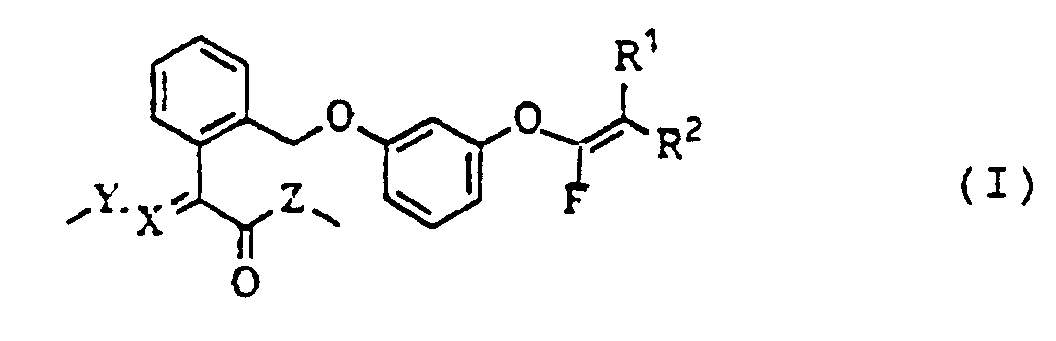 X is CH or N;Y is O or S;Z is O or NH;R1 is hydrogen or CF3; andR2 is hydrogen, a C1-10 alkyl, naphthyl, thiophenyl or phenyl group optionally carrying one or more substituents selected from the group consisting of C1-6 alkyl, halogen-substituted C1-6 alkyl, C1-6 alkoxy, phenoxy, halogen, and methylenedioxy radicals.
 - The compound of claim 1 wherein Y is O; Z is O; R1 is hydrogen; and R2 is a naphthyl or phenyl group optionally substituted with a methyl, methoxy or halogen radical.
- The compound of claim 1 wherein Y is O; R1 is CF3; and R2 is a phenyl group optionally substituted with methyl, methoxy or halogen radical.
- A process for the preparation of the compound of claim 1 which comprises (a) reacting a compound of formula (II) with 3-hydroxyphenol in the presence of a base to obtain a compound of formula (III); and (b) reacting the compound of formula (III) with a compound formula (IV) in the presence of a base:

 wherein, X, Y, Z, R1 and R2 have the same meanings as defined in claim 1.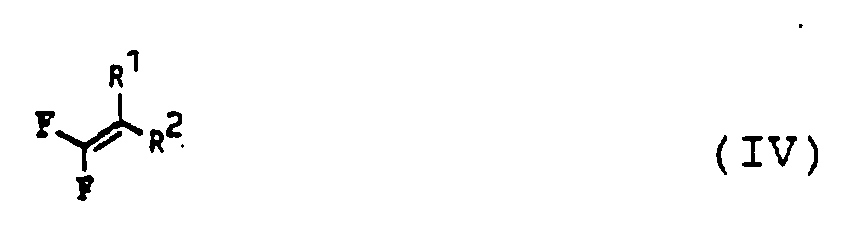
- An fungicidal composition comprising a fungicidally effective amount of the compound of claim 1 as an active ingredient and an inert carrier.
Applications Claiming Priority (4)
| Application Number | Priority Date | Filing Date | Title |
|---|---|---|---|
| KR9738087 | 1997-08-09 | ||
| KR3800087 | 1997-08-09 | ||
| KR1019970038087A KR100240198B1 (en) | 1997-08-09 | 1997-08-09 | Novel propenoic ester and amide derivatives having alkenyl groups substituted with trifluoromethyl groups |
| PCT/KR1998/000245 WO1999007665A1 (en) | 1997-08-09 | 1998-08-08 | Fungicidal compounds having a fluorovinyloxyphenyl moiety and process for the preparation thereof |
Publications (2)
| Publication Number | Publication Date |
|---|---|
| EP1003709A1 EP1003709A1 (en) | 2000-05-31 |
| EP1003709B1 true EP1003709B1 (en) | 2002-02-06 |
Family
ID=19517184
Family Applications (1)
| Application Number | Title | Priority Date | Filing Date |
|---|---|---|---|
| EP98938995A Expired - Lifetime EP1003709B1 (en) | 1997-08-09 | 1998-08-08 | Fungicidal compounds having a fluorovinyloxyphenyl moiety and process for the preparation thereof |
Country Status (6)
| Country | Link |
|---|---|
| US (1) | US6444850B1 (en) |
| EP (1) | EP1003709B1 (en) |
| JP (1) | JP3280373B2 (en) |
| KR (1) | KR100240198B1 (en) |
| DE (1) | DE69803776T2 (en) |
| WO (1) | WO1999007665A1 (en) |
Cited By (1)
| Publication number | Priority date | Publication date | Assignee | Title |
|---|---|---|---|---|
| CN106795093A (en) * | 2014-10-14 | 2017-05-31 | 先正达参股股份有限公司 | Process for the preparation of 1-(3,5-dichlorophenyl)-2,2,2-trifluoroethanone and its derivatives |
Families Citing this family (8)
| Publication number | Priority date | Publication date | Assignee | Title |
|---|---|---|---|---|
| US6261836B1 (en) * | 1996-10-01 | 2001-07-17 | Geron Corporation | Telomerase |
| KR100884933B1 (en) * | 2007-07-03 | 2009-02-23 | 주식회사경농 | Photoactive (R) -allyloxypropionic acid amide compound and herbicide composition comprising the same |
| AU2008332105B2 (en) | 2007-12-06 | 2011-02-10 | Kyung Nong Corporation | Methoxyimino compounds and fungicide composition comprising same |
| EP2565180A4 (en) * | 2010-04-21 | 2014-02-05 | Oscotec Inc | Alpha-arylmethoxyacrylate derivative, preparation method thereof, and pharmaceutical composition containing same |
| WO2013144924A1 (en) | 2012-03-29 | 2013-10-03 | Rallis India Ltd. | An improved process for the synthesis of strobilurin fungicides viz trifloxystrobin and kresoxim-methyl |
| MX2020002703A (en) | 2017-09-11 | 2020-10-19 | Hikal Ltd | "an improved process for the preparation of trifloxystrobin". |
| CN109627211A (en) * | 2018-12-24 | 2019-04-16 | 合肥利夫生物科技有限公司 | The method that one kettle way prepares ZEN 90160 |
| AR133732A1 (en) | 2023-09-08 | 2025-10-29 | Pi Industries Ltd | NEW 1,2,4-OXADIAZOLE COMPOUNDS AS A FUNGICIDE |
Family Cites Families (1)
| Publication number | Priority date | Publication date | Assignee | Title |
|---|---|---|---|---|
| JPS56123956A (en) * | 1980-03-05 | 1981-09-29 | Agency Of Ind Science & Technol | Beta-trifluorovinylalanine and its preparation |
-
1997
- 1997-08-09 KR KR1019970038087A patent/KR100240198B1/en not_active Expired - Fee Related
-
1998
- 1998-08-08 EP EP98938995A patent/EP1003709B1/en not_active Expired - Lifetime
- 1998-08-08 DE DE69803776T patent/DE69803776T2/en not_active Expired - Lifetime
- 1998-08-08 WO PCT/KR1998/000245 patent/WO1999007665A1/en not_active Ceased
- 1998-08-08 JP JP2000507202A patent/JP3280373B2/en not_active Expired - Fee Related
-
2000
- 2000-02-08 US US09/499,937 patent/US6444850B1/en not_active Expired - Fee Related
Cited By (2)
| Publication number | Priority date | Publication date | Assignee | Title |
|---|---|---|---|---|
| CN106795093A (en) * | 2014-10-14 | 2017-05-31 | 先正达参股股份有限公司 | Process for the preparation of 1-(3,5-dichlorophenyl)-2,2,2-trifluoroethanone and its derivatives |
| CN106795093B (en) * | 2014-10-14 | 2019-05-28 | 先正达参股股份有限公司 | Process for the preparation of 1-(3,5-dichlorophenyl)-2,2,2-trifluoroethanone and derivatives thereof |
Also Published As
| Publication number | Publication date |
|---|---|
| WO1999007665A1 (en) | 1999-02-18 |
| DE69803776T2 (en) | 2002-09-12 |
| US6444850B1 (en) | 2002-09-03 |
| KR100240198B1 (en) | 2000-01-15 |
| EP1003709A1 (en) | 2000-05-31 |
| DE69803776D1 (en) | 2002-03-21 |
| JP3280373B2 (en) | 2002-05-13 |
| JP2001513524A (en) | 2001-09-04 |
| KR19990015785A (en) | 1999-03-05 |
Similar Documents
| Publication | Publication Date | Title |
|---|---|---|
| US4465507A (en) | Herbicidal acetanilides | |
| US20030208086A1 (en) | Acylacetonitriles, process for preparation thereof and miticides containing the same | |
| EP0606011B1 (en) | Aminopyrimidine derivatives and their production and use | |
| US6444850B1 (en) | Fungicidial compounds having a fluorovinyloxphyenyl moiety and process for the preparation thereof | |
| EP1204632B1 (en) | Fungicidal compounds having a fluorovinyl- or fluoropropenyl-oxyphenyloxime moiety and process for the preparation thereof | |
| US5770614A (en) | 2-(substituted phenyl)-2-alkoxyimino-N-alkylacetamide compounds and fungicides containing the same | |
| AU661181B2 (en) | Benzyl derivatives and pesticides containing them | |
| KR100229440B1 (en) | Novel propenoic ester and amide derivatives with fluorovinyl groups | |
| US4504486A (en) | 3-Isoxazolin-5-one fungicides | |
| JP2851933B2 (en) | Carbocyclic anilide carbamate | |
| RU2050348C1 (en) | (s)-enantiomer or racemate of 2-chloro-5-(2-chloro-4-trifluoromethylphenoxy)-benzoate derivative showing herbicide activity | |
| KR100311195B1 (en) | Flurovinyl-substituted propenoic ester and amide compound having oxime bridge, process for preparing same and antifungal composition comprising sae | |
| KR100311196B1 (en) | Fluropropenyl-substituted propenoic ester and amide compound having oxime bridge, process for preparing same and antifungal composition comprising same | |
| US4382954A (en) | Fungicidal N-1-substituted cyclopropyl-N-acyl-2,6-dialkylaniline | |
| US4255447A (en) | Acaricidal compounds of cyclopropane carboxylic acid derivatives | |
| KR100379761B1 (en) | New propenoic ester and amide compound having oxime side chain, process for preparing same and antifungal composition comprising same | |
| KR100508496B1 (en) | Propenoic ester and amide derivatives having fluorostyrene substituent, process for preparing same and antifungal composition comprising same | |
| KR100285539B1 (en) | Novel oxyacetanilide substituted with a fluoroalkenyl group and process for the preparation thereof | |
| JP2673175B2 (en) | Naphthoquinone compound, acaricide containing the same and method for controlling acarids | |
| WO2000021915A1 (en) | Methyl acetate derivatives and pesticide compositions containing the same as the active ingredient | |
| KR100256548B1 (en) | Novel fluoropropenyloxyacetamide and process for the preparation thereof | |
| KR20090059181A (en) | Methoxyimino Compound and Fungicide Composition Comprising the Same | |
| JPH09143176A (en) | Epoxycyclopentyl benzyl ethers |
Legal Events
| Date | Code | Title | Description |
|---|---|---|---|
| PUAI | Public reference made under article 153(3) epc to a published international application that has entered the european phase |
Free format text: ORIGINAL CODE: 0009012 |
|
| 17P | Request for examination filed |
Effective date: 20000209 |
|
| AK | Designated contracting states |
Kind code of ref document: A1 Designated state(s): CH DE ES FR GB IT LI NL |
|
| GRAG | Despatch of communication of intention to grant |
Free format text: ORIGINAL CODE: EPIDOS AGRA |
|
| 17Q | First examination report despatched |
Effective date: 20010412 |
|
| GRAG | Despatch of communication of intention to grant |
Free format text: ORIGINAL CODE: EPIDOS AGRA |
|
| GRAH | Despatch of communication of intention to grant a patent |
Free format text: ORIGINAL CODE: EPIDOS IGRA |
|
| GRAH | Despatch of communication of intention to grant a patent |
Free format text: ORIGINAL CODE: EPIDOS IGRA |
|
| GRAA | (expected) grant |
Free format text: ORIGINAL CODE: 0009210 |
|
| REG | Reference to a national code |
Ref country code: GB Ref legal event code: IF02 |
|
| AK | Designated contracting states |
Kind code of ref document: B1 Designated state(s): CH DE ES FR GB IT LI NL |
|
| PG25 | Lapsed in a contracting state [announced via postgrant information from national office to epo] |
Ref country code: NL Free format text: LAPSE BECAUSE OF FAILURE TO SUBMIT A TRANSLATION OF THE DESCRIPTION OR TO PAY THE FEE WITHIN THE PRESCRIBED TIME-LIMIT Effective date: 20020206 Ref country code: LI Free format text: LAPSE BECAUSE OF FAILURE TO SUBMIT A TRANSLATION OF THE DESCRIPTION OR TO PAY THE FEE WITHIN THE PRESCRIBED TIME-LIMIT Effective date: 20020206 Ref country code: IT Free format text: LAPSE BECAUSE OF FAILURE TO SUBMIT A TRANSLATION OF THE DESCRIPTION OR TO PAY THE FEE WITHIN THE PRESCRIBED TIME-LIMIT;WARNING: LAPSES OF ITALIAN PATENTS WITH EFFECTIVE DATE BEFORE 2007 MAY HAVE OCCURRED AT ANY TIME BEFORE 2007. THE CORRECT EFFECTIVE DATE MAY BE DIFFERENT FROM THE ONE RECORDED. Effective date: 20020206 Ref country code: CH Free format text: LAPSE BECAUSE OF FAILURE TO SUBMIT A TRANSLATION OF THE DESCRIPTION OR TO PAY THE FEE WITHIN THE PRESCRIBED TIME-LIMIT Effective date: 20020206 |
|
| REG | Reference to a national code |
Ref country code: CH Ref legal event code: EP |
|
| REF | Corresponds to: |
Ref document number: 69803776 Country of ref document: DE Date of ref document: 20020321 |
|
| NLV1 | Nl: lapsed or annulled due to failure to fulfill the requirements of art. 29p and 29m of the patents act | ||
| ET | Fr: translation filed | ||
| REG | Reference to a national code |
Ref country code: CH Ref legal event code: PL |
|
| PG25 | Lapsed in a contracting state [announced via postgrant information from national office to epo] |
Ref country code: ES Free format text: LAPSE BECAUSE OF FAILURE TO SUBMIT A TRANSLATION OF THE DESCRIPTION OR TO PAY THE FEE WITHIN THE PRESCRIBED TIME-LIMIT Effective date: 20020829 |
|
| PLBE | No opposition filed within time limit |
Free format text: ORIGINAL CODE: 0009261 |
|
| STAA | Information on the status of an ep patent application or granted ep patent |
Free format text: STATUS: NO OPPOSITION FILED WITHIN TIME LIMIT |
|
| 26N | No opposition filed |
Effective date: 20021107 |
|
| PGFP | Annual fee paid to national office [announced via postgrant information from national office to epo] |
Ref country code: FR Payment date: 20090814 Year of fee payment: 12 |
|
| PGFP | Annual fee paid to national office [announced via postgrant information from national office to epo] |
Ref country code: GB Payment date: 20090805 Year of fee payment: 12 Ref country code: DE Payment date: 20090806 Year of fee payment: 12 |
|
| GBPC | Gb: european patent ceased through non-payment of renewal fee |
Effective date: 20100808 |
|
| REG | Reference to a national code |
Ref country code: FR Ref legal event code: ST Effective date: 20110502 |
|
| REG | Reference to a national code |
Ref country code: DE Ref legal event code: R119 Ref document number: 69803776 Country of ref document: DE Effective date: 20110301 |
|
| PG25 | Lapsed in a contracting state [announced via postgrant information from national office to epo] |
Ref country code: DE Free format text: LAPSE BECAUSE OF NON-PAYMENT OF DUE FEES Effective date: 20110301 Ref country code: FR Free format text: LAPSE BECAUSE OF NON-PAYMENT OF DUE FEES Effective date: 20100831 |
|
| PG25 | Lapsed in a contracting state [announced via postgrant information from national office to epo] |
Ref country code: GB Free format text: LAPSE BECAUSE OF NON-PAYMENT OF DUE FEES Effective date: 20100808 |