EP1001956B1 - 2,3-benzodiazepine derivatives - Google Patents
2,3-benzodiazepine derivatives Download PDFInfo
- Publication number
- EP1001956B1 EP1001956B1 EP98936578A EP98936578A EP1001956B1 EP 1001956 B1 EP1001956 B1 EP 1001956B1 EP 98936578 A EP98936578 A EP 98936578A EP 98936578 A EP98936578 A EP 98936578A EP 1001956 B1 EP1001956 B1 EP 1001956B1
- Authority
- EP
- European Patent Office
- Prior art keywords
- group
- general formula
- compounds
- benzodiazepine
- methyl
- Prior art date
- Legal status (The legal status is an assumption and is not a legal conclusion. Google has not performed a legal analysis and makes no representation as to the accuracy of the status listed.)
- Expired - Lifetime
Links
- RPBDCDQMCRHNLM-UHFFFAOYSA-N C1=NNC=C2C=CC=CC2=C1 Chemical class C1=NNC=C2C=CC=CC2=C1 RPBDCDQMCRHNLM-UHFFFAOYSA-N 0.000 title abstract description 10
- 239000002253 acid Substances 0.000 claims abstract description 11
- 150000003839 salts Chemical class 0.000 claims abstract description 11
- 208000007101 Muscle Cramp Diseases 0.000 claims abstract description 6
- 208000005392 Spasm Diseases 0.000 claims abstract description 6
- 206010015037 epilepsy Diseases 0.000 claims abstract description 6
- 208000015122 neurodegenerative disease Diseases 0.000 claims abstract description 6
- 230000001154 acute effect Effects 0.000 claims abstract description 5
- 230000001684 chronic effect Effects 0.000 claims abstract description 5
- 239000008194 pharmaceutical composition Substances 0.000 claims abstract description 5
- 230000004770 neurodegeneration Effects 0.000 claims abstract description 4
- 150000001875 compounds Chemical class 0.000 claims description 92
- 229910052739 hydrogen Inorganic materials 0.000 claims description 24
- 239000000460 chlorine Substances 0.000 claims description 19
- 239000001257 hydrogen Substances 0.000 claims description 18
- 125000004178 (C1-C4) alkyl group Chemical group 0.000 claims description 15
- 229940079593 drug Drugs 0.000 claims description 11
- 239000003814 drug Substances 0.000 claims description 11
- 150000002431 hydrogen Chemical class 0.000 claims description 11
- 208000037265 diseases, disorders, signs and symptoms Diseases 0.000 claims description 10
- 201000010099 disease Diseases 0.000 claims description 9
- 238000002360 preparation method Methods 0.000 claims description 9
- 125000003277 amino group Chemical group 0.000 claims description 7
- 125000006555 (C3-C5) cycloalkyl group Chemical group 0.000 claims description 6
- 125000000041 C6-C10 aryl group Chemical group 0.000 claims description 6
- UFHFLCQGNIYNRP-UHFFFAOYSA-N Hydrogen Chemical compound [H][H] UFHFLCQGNIYNRP-UHFFFAOYSA-N 0.000 claims description 6
- 229910052801 chlorine Chemical group 0.000 claims description 6
- 229910052736 halogen Inorganic materials 0.000 claims description 6
- 150000002367 halogens Chemical class 0.000 claims description 6
- 125000000449 nitro group Chemical group [O-][N+](*)=O 0.000 claims description 6
- 125000001309 chloro group Chemical group Cl* 0.000 claims description 5
- 125000000623 heterocyclic group Chemical group 0.000 claims description 4
- 125000004433 nitrogen atom Chemical group N* 0.000 claims description 4
- 125000000229 (C1-C4)alkoxy group Chemical group 0.000 claims description 3
- NINIDFKCEFEMDL-UHFFFAOYSA-N Sulfur Chemical compound [S] NINIDFKCEFEMDL-UHFFFAOYSA-N 0.000 claims description 3
- 125000003545 alkoxy group Chemical group 0.000 claims description 3
- 125000001072 heteroaryl group Chemical group 0.000 claims description 3
- 125000004435 hydrogen atom Chemical group [H]* 0.000 claims description 3
- 239000000463 material Substances 0.000 claims description 3
- 229910052717 sulfur Inorganic materials 0.000 claims description 3
- 239000011593 sulfur Substances 0.000 claims description 3
- WKBOTKDWSSQWDR-UHFFFAOYSA-N Bromine atom Chemical group [Br] WKBOTKDWSSQWDR-UHFFFAOYSA-N 0.000 claims description 2
- 125000000882 C2-C6 alkenyl group Chemical group 0.000 claims description 2
- KZBUYRJDOAKODT-UHFFFAOYSA-N Chlorine Chemical compound ClCl KZBUYRJDOAKODT-UHFFFAOYSA-N 0.000 claims description 2
- 125000006193 alkinyl group Chemical group 0.000 claims description 2
- QVGXLLKOCUKJST-UHFFFAOYSA-N atomic oxygen Chemical compound [O] QVGXLLKOCUKJST-UHFFFAOYSA-N 0.000 claims description 2
- 239000000969 carrier Substances 0.000 claims description 2
- 125000000000 cycloalkoxy group Chemical group 0.000 claims description 2
- 229910052757 nitrogen Inorganic materials 0.000 claims description 2
- 229910052760 oxygen Inorganic materials 0.000 claims description 2
- 239000001301 oxygen Substances 0.000 claims description 2
- 125000002023 trifluoromethyl group Chemical group FC(F)(F)* 0.000 claims description 2
- QWLVPYAHCLEUQP-UHFFFAOYSA-N 4-(8,9-dichloro-2-methyl-11h-imidazo[1,2-c][2,3]benzodiazepin-6-yl)aniline Chemical compound C12=CC(Cl)=C(Cl)C=C2CC2=NC(C)=CN2N=C1C1=CC=C(N)C=C1 QWLVPYAHCLEUQP-UHFFFAOYSA-N 0.000 claims 1
- YDLZGDLWWLXSOR-UHFFFAOYSA-N 4-(8-bromo-2-methyl-11h-imidazo[1,2-c][2,3]benzodiazepin-6-yl)aniline Chemical compound C12=CC(Br)=CC=C2CC2=NC(C)=CN2N=C1C1=CC=C(N)C=C1 YDLZGDLWWLXSOR-UHFFFAOYSA-N 0.000 claims 1
- FPXVCCSOTAQPIV-UHFFFAOYSA-N 4-(8-chloro-2-methyl-11h-imidazo[1,2-c][2,3]benzodiazepin-6-yl)aniline Chemical compound C12=CC(Cl)=CC=C2CC2=NC(C)=CN2N=C1C1=CC=C(N)C=C1 FPXVCCSOTAQPIV-UHFFFAOYSA-N 0.000 claims 1
- ADBVMVSGVBBXHN-UHFFFAOYSA-N 4-(8-chloro-3-methyl-11h-imidazo[1,2-c][2,3]benzodiazepin-6-yl)aniline Chemical compound N=1N2C(C)=CN=C2CC2=CC=C(Cl)C=C2C=1C1=CC=C(N)C=C1 ADBVMVSGVBBXHN-UHFFFAOYSA-N 0.000 claims 1
- 239000003085 diluting agent Substances 0.000 claims 1
- 239000013583 drug formulation Substances 0.000 claims 1
- 239000002904 solvent Substances 0.000 claims 1
- LFQSCWFLJHTTHZ-UHFFFAOYSA-N Ethanol Chemical compound CCO LFQSCWFLJHTTHZ-UHFFFAOYSA-N 0.000 description 43
- YMWUJEATGCHHMB-UHFFFAOYSA-N Dichloromethane Chemical compound ClCCl YMWUJEATGCHHMB-UHFFFAOYSA-N 0.000 description 27
- 238000000034 method Methods 0.000 description 27
- UHOVQNZJYSORNB-UHFFFAOYSA-N Benzene Chemical compound C1=CC=CC=C1 UHOVQNZJYSORNB-UHFFFAOYSA-N 0.000 description 25
- 239000011541 reaction mixture Substances 0.000 description 23
- 239000000203 mixture Substances 0.000 description 22
- 230000008569 process Effects 0.000 description 22
- VEXZGXHMUGYJMC-UHFFFAOYSA-N Hydrochloric acid Chemical compound Cl VEXZGXHMUGYJMC-UHFFFAOYSA-N 0.000 description 21
- XLYOFNOQVPJJNP-UHFFFAOYSA-N water Substances O XLYOFNOQVPJJNP-UHFFFAOYSA-N 0.000 description 21
- CSCPPACGZOOCGX-UHFFFAOYSA-N Acetone Chemical compound CC(C)=O CSCPPACGZOOCGX-UHFFFAOYSA-N 0.000 description 18
- OKKJLVBELUTLKV-UHFFFAOYSA-N Methanol Chemical compound OC OKKJLVBELUTLKV-UHFFFAOYSA-N 0.000 description 18
- 239000012043 crude product Substances 0.000 description 16
- 239000000243 solution Substances 0.000 description 15
- QTBSBXVTEAMEQO-UHFFFAOYSA-N Acetic acid Chemical compound CC(O)=O QTBSBXVTEAMEQO-UHFFFAOYSA-N 0.000 description 13
- XEKOWRVHYACXOJ-UHFFFAOYSA-N Ethyl acetate Chemical compound CCOC(C)=O XEKOWRVHYACXOJ-UHFFFAOYSA-N 0.000 description 12
- ZMXDDKWLCZADIW-UHFFFAOYSA-N N,N-Dimethylformamide Chemical compound CN(C)C=O ZMXDDKWLCZADIW-UHFFFAOYSA-N 0.000 description 12
- 239000000047 product Substances 0.000 description 12
- NWZSZGALRFJKBT-KNIFDHDWSA-N (2s)-2,6-diaminohexanoic acid;(2s)-2-hydroxybutanedioic acid Chemical compound OC(=O)[C@@H](O)CC(O)=O.NCCCC[C@H](N)C(O)=O NWZSZGALRFJKBT-KNIFDHDWSA-N 0.000 description 11
- MGRVRXRGTBOSHW-UHFFFAOYSA-N (aminomethyl)phosphonic acid Chemical compound NCP(O)(O)=O MGRVRXRGTBOSHW-UHFFFAOYSA-N 0.000 description 11
- 230000002082 anti-convulsion Effects 0.000 description 11
- IKDUDTNKRLTJSI-UHFFFAOYSA-N hydrazine monohydrate Substances O.NN IKDUDTNKRLTJSI-UHFFFAOYSA-N 0.000 description 11
- 102000003678 AMPA Receptors Human genes 0.000 description 10
- 108090000078 AMPA Receptors Proteins 0.000 description 10
- JUJWROOIHBZHMG-UHFFFAOYSA-N Pyridine Chemical compound C1=CC=NC=C1 JUJWROOIHBZHMG-UHFFFAOYSA-N 0.000 description 10
- 239000003158 myorelaxant agent Substances 0.000 description 10
- UKWHYYKOEPRTIC-UHFFFAOYSA-N mercury(ii) oxide Chemical compound [Hg]=O UKWHYYKOEPRTIC-UHFFFAOYSA-N 0.000 description 9
- -1 methylenedioxy Chemical group 0.000 description 9
- VLSMHEGGTFMBBZ-OOZYFLPDSA-M Kainate Chemical compound CC(=C)[C@H]1C[NH2+][C@H](C([O-])=O)[C@H]1CC([O-])=O VLSMHEGGTFMBBZ-OOZYFLPDSA-M 0.000 description 8
- VYPSYNLAJGMNEJ-UHFFFAOYSA-N Silicium dioxide Chemical compound O=[Si]=O VYPSYNLAJGMNEJ-UHFFFAOYSA-N 0.000 description 8
- 238000006243 chemical reaction Methods 0.000 description 8
- 230000000694 effects Effects 0.000 description 8
- 239000000706 filtrate Substances 0.000 description 8
- 238000007429 general method Methods 0.000 description 8
- 239000007858 starting material Substances 0.000 description 8
- 229910052727 yttrium Inorganic materials 0.000 description 8
- JIAARYAFYJHUJI-UHFFFAOYSA-L zinc dichloride Chemical compound [Cl-].[Cl-].[Zn+2] JIAARYAFYJHUJI-UHFFFAOYSA-L 0.000 description 8
- XNWFRZJHXBZDAG-UHFFFAOYSA-N 2-METHOXYETHANOL Chemical compound COCCO XNWFRZJHXBZDAG-UHFFFAOYSA-N 0.000 description 7
- KFZMGEQAYNKOFK-UHFFFAOYSA-N Isopropanol Chemical compound CC(C)O KFZMGEQAYNKOFK-UHFFFAOYSA-N 0.000 description 7
- 230000004913 activation Effects 0.000 description 7
- 239000013078 crystal Substances 0.000 description 7
- 230000005764 inhibitory process Effects 0.000 description 7
- VMARWJSHGHYPHQ-UHFFFAOYSA-N 8-chloro-3-methyl-6-(4-nitrophenyl)-11h-imidazo[1,5-c][2,3]benzodiazepine Chemical compound N=1N2C(C)=NC=C2CC2=CC=C(Cl)C=C2C=1C1=CC=C([N+]([O-])=O)C=C1 VMARWJSHGHYPHQ-UHFFFAOYSA-N 0.000 description 6
- AFVFQIVMOAPDHO-UHFFFAOYSA-N Methanesulfonic acid Chemical compound CS(O)(=O)=O AFVFQIVMOAPDHO-UHFFFAOYSA-N 0.000 description 6
- WYURNTSHIVDZCO-UHFFFAOYSA-N Tetrahydrofuran Chemical compound C1CCOC1 WYURNTSHIVDZCO-UHFFFAOYSA-N 0.000 description 6
- 239000003153 chemical reaction reagent Substances 0.000 description 6
- 230000002829 reductive effect Effects 0.000 description 6
- 238000012360 testing method Methods 0.000 description 6
- HJKLEAOXCZIMPI-UHFFFAOYSA-N 2,2-diethoxyethanamine Chemical compound CCOC(CN)OCC HJKLEAOXCZIMPI-UHFFFAOYSA-N 0.000 description 5
- 0 Cc1nc(*)c(*)[n]1C Chemical compound Cc1nc(*)c(*)[n]1C 0.000 description 5
- 229960000583 acetic acid Drugs 0.000 description 5
- 210000003169 central nervous system Anatomy 0.000 description 5
- UMJSCPRVCHMLSP-UHFFFAOYSA-N pyridine Natural products COC1=CC=CN=C1 UMJSCPRVCHMLSP-UHFFFAOYSA-N 0.000 description 5
- 230000007480 spreading Effects 0.000 description 5
- 230000001225 therapeutic effect Effects 0.000 description 5
- UXOYBKBXUPOUOQ-UHFFFAOYSA-N 1-(1,3-dioxolan-2-yl)ethanamine Chemical compound CC(N)C1OCCO1 UXOYBKBXUPOUOQ-UHFFFAOYSA-N 0.000 description 4
- NUKYPUAOHBNCPY-UHFFFAOYSA-N 4-aminopyridine Chemical compound NC1=CC=NC=C1 NUKYPUAOHBNCPY-UHFFFAOYSA-N 0.000 description 4
- BXRFQSNOROATLV-UHFFFAOYSA-N 4-nitrobenzaldehyde Chemical compound [O-][N+](=O)C1=CC=C(C=O)C=C1 BXRFQSNOROATLV-UHFFFAOYSA-N 0.000 description 4
- 125000000339 4-pyridyl group Chemical group N1=C([H])C([H])=C([*])C([H])=C1[H] 0.000 description 4
- HEDRZPFGACZZDS-UHFFFAOYSA-N Chloroform Chemical compound ClC(Cl)Cl HEDRZPFGACZZDS-UHFFFAOYSA-N 0.000 description 4
- RTZKZFJDLAIYFH-UHFFFAOYSA-N Diethyl ether Chemical compound CCOCC RTZKZFJDLAIYFH-UHFFFAOYSA-N 0.000 description 4
- 239000003810 Jones reagent Substances 0.000 description 4
- 241000699670 Mus sp. Species 0.000 description 4
- UIIMBOGNXHQVGW-UHFFFAOYSA-M Sodium bicarbonate Chemical compound [Na+].OC([O-])=O UIIMBOGNXHQVGW-UHFFFAOYSA-M 0.000 description 4
- 208000006011 Stroke Diseases 0.000 description 4
- 239000005557 antagonist Substances 0.000 description 4
- 239000007859 condensation product Substances 0.000 description 4
- 238000001704 evaporation Methods 0.000 description 4
- 230000008020 evaporation Effects 0.000 description 4
- 150000003840 hydrochlorides Chemical class 0.000 description 4
- 230000002401 inhibitory effect Effects 0.000 description 4
- VLTRZXGMWDSKGL-UHFFFAOYSA-N perchloric acid Chemical compound OCl(=O)(=O)=O VLTRZXGMWDSKGL-UHFFFAOYSA-N 0.000 description 4
- 125000001997 phenyl group Chemical group [H]C1=C([H])C([H])=C(*)C([H])=C1[H] 0.000 description 4
- CYQAYERJWZKYML-UHFFFAOYSA-N phosphorus pentasulfide Chemical compound S1P(S2)(=S)SP3(=S)SP1(=S)SP2(=S)S3 CYQAYERJWZKYML-UHFFFAOYSA-N 0.000 description 4
- XHXFXVLFKHQFAL-UHFFFAOYSA-N phosphoryl trichloride Chemical compound ClP(Cl)(Cl)=O XHXFXVLFKHQFAL-UHFFFAOYSA-N 0.000 description 4
- JPJALAQPGMAKDF-UHFFFAOYSA-N selenium dioxide Chemical compound O=[Se]=O JPJALAQPGMAKDF-UHFFFAOYSA-N 0.000 description 4
- QMGVPVSNSZLJIA-FVWCLLPLSA-N strychnine Chemical compound O([C@H]1CC(N([C@H]2[C@H]1[C@H]1C3)C=4C5=CC=CC=4)=O)CC=C1CN1[C@@H]3[C@]25CC1 QMGVPVSNSZLJIA-FVWCLLPLSA-N 0.000 description 4
- 239000000725 suspension Substances 0.000 description 4
- 238000002560 therapeutic procedure Methods 0.000 description 4
- RIOQSEWOXXDEQQ-UHFFFAOYSA-N triphenylphosphine Chemical compound C1=CC=CC=C1P(C=1C=CC=CC=1)C1=CC=CC=C1 RIOQSEWOXXDEQQ-UHFFFAOYSA-N 0.000 description 4
- 239000011592 zinc chloride Substances 0.000 description 4
- 235000005074 zinc chloride Nutrition 0.000 description 4
- YQHRIORZKUWFPX-UHFFFAOYSA-N 4-methyl-5h-2,3-benzodiazepine Chemical class C1C(C)=NN=CC2=CC=CC=C21 YQHRIORZKUWFPX-UHFFFAOYSA-N 0.000 description 3
- CVTCUJXKENCQGL-UHFFFAOYSA-N 8-chloro-4-methyl-1-(4-nitrophenyl)-5h-2,3-benzodiazepine Chemical compound C12=CC(Cl)=CC=C2CC(C)=NN=C1C1=CC=C([N+]([O-])=O)C=C1 CVTCUJXKENCQGL-UHFFFAOYSA-N 0.000 description 3
- WFDIJRYMOXRFFG-UHFFFAOYSA-N Acetic anhydride Chemical compound CC(=O)OC(C)=O WFDIJRYMOXRFFG-UHFFFAOYSA-N 0.000 description 3
- 102000018899 Glutamate Receptors Human genes 0.000 description 3
- 108010027915 Glutamate Receptors Proteins 0.000 description 3
- WHUUTDBJXJRKMK-VKHMYHEASA-N L-glutamic acid Chemical compound OC(=O)[C@@H](N)CCC(O)=O WHUUTDBJXJRKMK-VKHMYHEASA-N 0.000 description 3
- 229910000564 Raney nickel Inorganic materials 0.000 description 3
- NPXOKRUENSOPAO-UHFFFAOYSA-N Raney nickel Chemical compound [Al].[Ni] NPXOKRUENSOPAO-UHFFFAOYSA-N 0.000 description 3
- 241000700159 Rattus Species 0.000 description 3
- HEMHJVSKTPXQMS-UHFFFAOYSA-M Sodium hydroxide Chemical compound [OH-].[Na+] HEMHJVSKTPXQMS-UHFFFAOYSA-M 0.000 description 3
- 230000003042 antagnostic effect Effects 0.000 description 3
- 239000001961 anticonvulsive agent Substances 0.000 description 3
- 229940049706 benzodiazepine Drugs 0.000 description 3
- 239000003054 catalyst Substances 0.000 description 3
- 230000002490 cerebral effect Effects 0.000 description 3
- KRKNYBCHXYNGOX-UHFFFAOYSA-N citric acid Chemical compound OC(=O)CC(O)(C(O)=O)CC(O)=O KRKNYBCHXYNGOX-UHFFFAOYSA-N 0.000 description 3
- 239000003257 excitatory amino acid Substances 0.000 description 3
- 230000002461 excitatory amino acid Effects 0.000 description 3
- 125000004029 hydroxymethyl group Chemical group [H]OC([H])([H])* 0.000 description 3
- 239000000543 intermediate Substances 0.000 description 3
- 208000028867 ischemia Diseases 0.000 description 3
- 239000010410 layer Substances 0.000 description 3
- 229940098779 methanesulfonic acid Drugs 0.000 description 3
- 230000000324 neuroprotective effect Effects 0.000 description 3
- 230000036963 noncompetitive effect Effects 0.000 description 3
- 238000000746 purification Methods 0.000 description 3
- 102000005962 receptors Human genes 0.000 description 3
- 108020003175 receptors Proteins 0.000 description 3
- 238000006798 ring closing metathesis reaction Methods 0.000 description 3
- 238000006467 substitution reaction Methods 0.000 description 3
- YLQBMQCUIZJEEH-UHFFFAOYSA-N tetrahydrofuran Natural products C=1C=COC=1 YLQBMQCUIZJEEH-UHFFFAOYSA-N 0.000 description 3
- SNICXCGAKADSCV-JTQLQIEISA-N (-)-Nicotine Chemical compound CN1CCC[C@H]1C1=CC=CN=C1 SNICXCGAKADSCV-JTQLQIEISA-N 0.000 description 2
- BVVSUFVLGBJYOR-UHFFFAOYSA-N (2-methyl-1,3-dioxolan-2-yl)methanamine Chemical compound NCC1(C)OCCO1 BVVSUFVLGBJYOR-UHFFFAOYSA-N 0.000 description 2
- IXDJNJHGOQUYCG-UHFFFAOYSA-N 1-(2-methyl-1,3-dioxolan-2-yl)ethanamine Chemical compound CC(N)C1(C)OCCO1 IXDJNJHGOQUYCG-UHFFFAOYSA-N 0.000 description 2
- NRGGDWGRGDCVAF-UHFFFAOYSA-N 2,3-benzodiazepin-4-one Chemical class N1=NC(=O)C=C2C=CC=CC2=C1 NRGGDWGRGDCVAF-UHFFFAOYSA-N 0.000 description 2
- JODALPHMMKAWRT-UHFFFAOYSA-N 2-[4-bromo-2-(4-nitrobenzoyl)phenyl]acetic acid Chemical compound OC(=O)CC1=CC=C(Br)C=C1C(=O)C1=CC=C([N+]([O-])=O)C=C1 JODALPHMMKAWRT-UHFFFAOYSA-N 0.000 description 2
- AYLGNGQVJHAQPV-UHFFFAOYSA-N 2-[4-chloro-2-(4-nitrobenzoyl)phenyl]acetic acid Chemical compound OC(=O)CC1=CC=C(Cl)C=C1C(=O)C1=CC=C([N+]([O-])=O)C=C1 AYLGNGQVJHAQPV-UHFFFAOYSA-N 0.000 description 2
- MIEDIVUAVHIVRF-UHFFFAOYSA-N 3-bromo-2-oxopentanoic acid Chemical compound CCC(Br)C(=O)C(O)=O MIEDIVUAVHIVRF-UHFFFAOYSA-N 0.000 description 2
- DKIDEFUBRARXTE-UHFFFAOYSA-N 3-mercaptopropanoic acid Chemical compound OC(=O)CCS DKIDEFUBRARXTE-UHFFFAOYSA-N 0.000 description 2
- FAXDZWQIWUSWJH-UHFFFAOYSA-N 3-methoxypropan-1-amine Chemical compound COCCCN FAXDZWQIWUSWJH-UHFFFAOYSA-N 0.000 description 2
- ORRZGUBHBVWWOP-UHFFFAOYSA-N 4-ethyl-4-methylpiperidine-2,6-dione Chemical compound CCC1(C)CC(=O)NC(=O)C1 ORRZGUBHBVWWOP-UHFFFAOYSA-N 0.000 description 2
- ITBIMDLRMZYPNY-UHFFFAOYSA-N 6,7-dichloro-1-(4-nitrophenyl)-3,4-dihydro-1h-isochromene Chemical compound C1=CC([N+](=O)[O-])=CC=C1C1C2=CC(Cl)=C(Cl)C=C2CCO1 ITBIMDLRMZYPNY-UHFFFAOYSA-N 0.000 description 2
- XLBKJLYZDDUPOL-UHFFFAOYSA-N 7-bromo-1-(4-nitrophenyl)-3,4-dihydro-1h-isochromene Chemical compound C1=CC([N+](=O)[O-])=CC=C1C1C2=CC(Br)=CC=C2CCO1 XLBKJLYZDDUPOL-UHFFFAOYSA-N 0.000 description 2
- SQIJUBRIDNBRQV-UHFFFAOYSA-N 7-chloro-1-(4-nitrophenyl)-3,4-dihydro-1h-isochromene Chemical compound C1=CC([N+](=O)[O-])=CC=C1C1C2=CC(Cl)=CC=C2CCO1 SQIJUBRIDNBRQV-UHFFFAOYSA-N 0.000 description 2
- OXAKIROHSHCRGT-UHFFFAOYSA-N 8-chloro-1-(4-nitrophenyl)-5h-2,3-benzodiazepine-4-carbaldehyde Chemical compound C1=CC([N+](=O)[O-])=CC=C1C1=NN=C(C=O)CC2=CC=C(Cl)C=C12 OXAKIROHSHCRGT-UHFFFAOYSA-N 0.000 description 2
- 208000024827 Alzheimer disease Diseases 0.000 description 2
- IYGYMKDQCDOMRE-QRWMCTBCSA-N Bicculine Chemical compound O([C@H]1C2C3=CC=4OCOC=4C=C3CCN2C)C(=O)C2=C1C=CC1=C2OCO1 IYGYMKDQCDOMRE-QRWMCTBCSA-N 0.000 description 2
- QOSSAOTZNIDXMA-UHFFFAOYSA-N Dicylcohexylcarbodiimide Chemical compound C1CCCCC1N=C=NC1CCCCC1 QOSSAOTZNIDXMA-UHFFFAOYSA-N 0.000 description 2
- 208000005189 Embolism Diseases 0.000 description 2
- VZCYOOQTPOCHFL-OWOJBTEDSA-N Fumaric acid Chemical compound OC(=O)\C=C\C(O)=O VZCYOOQTPOCHFL-OWOJBTEDSA-N 0.000 description 2
- LFBZZHVSGAHQPP-UHFFFAOYSA-N GYKI 52466 Chemical compound C12=CC=3OCOC=3C=C2CC(C)=NN=C1C1=CC=C(N)C=C1 LFBZZHVSGAHQPP-UHFFFAOYSA-N 0.000 description 2
- 241000287828 Gallus gallus Species 0.000 description 2
- WHUUTDBJXJRKMK-UHFFFAOYSA-N Glutamic acid Natural products OC(=O)C(N)CCC(O)=O WHUUTDBJXJRKMK-UHFFFAOYSA-N 0.000 description 2
- 206010021143 Hypoxia Diseases 0.000 description 2
- 238000006751 Mitsunobu reaction Methods 0.000 description 2
- HOKKHZGPKSLGJE-GSVOUGTGSA-N N-Methyl-D-aspartic acid Chemical compound CN[C@@H](C(O)=O)CC(O)=O HOKKHZGPKSLGJE-GSVOUGTGSA-N 0.000 description 2
- 208000012902 Nervous system disease Diseases 0.000 description 2
- 208000025966 Neurological disease Diseases 0.000 description 2
- QMGVPVSNSZLJIA-UHFFFAOYSA-N Nux Vomica Natural products C1C2C3C4N(C=5C6=CC=CC=5)C(=O)CC3OCC=C2CN2C1C46CC2 QMGVPVSNSZLJIA-UHFFFAOYSA-N 0.000 description 2
- KDLHZDBZIXYQEI-UHFFFAOYSA-N Palladium Chemical compound [Pd] KDLHZDBZIXYQEI-UHFFFAOYSA-N 0.000 description 2
- CWRVKFFCRWGWCS-UHFFFAOYSA-N Pentrazole Chemical compound C1CCCCC2=NN=NN21 CWRVKFFCRWGWCS-UHFFFAOYSA-N 0.000 description 2
- CXOFVDLJLONNDW-UHFFFAOYSA-N Phenytoin Chemical compound N1C(=O)NC(=O)C1(C=1C=CC=CC=1)C1=CC=CC=C1 CXOFVDLJLONNDW-UHFFFAOYSA-N 0.000 description 2
- NBIIXXVUZAFLBC-UHFFFAOYSA-N Phosphoric acid Chemical compound OP(O)(O)=O NBIIXXVUZAFLBC-UHFFFAOYSA-N 0.000 description 2
- CDBYLPFSWZWCQE-UHFFFAOYSA-L Sodium Carbonate Chemical compound [Na+].[Na+].[O-]C([O-])=O CDBYLPFSWZWCQE-UHFFFAOYSA-L 0.000 description 2
- 241001279009 Strychnos toxifera Species 0.000 description 2
- QAOWNCQODCNURD-UHFFFAOYSA-N Sulfuric acid Chemical compound OS(O)(=O)=O QAOWNCQODCNURD-UHFFFAOYSA-N 0.000 description 2
- 150000008065 acid anhydrides Chemical class 0.000 description 2
- 239000004480 active ingredient Substances 0.000 description 2
- 125000002252 acyl group Chemical group 0.000 description 2
- 239000002671 adjuvant Substances 0.000 description 2
- 125000003172 aldehyde group Chemical group 0.000 description 2
- YNQLUTRBYVCPMQ-UHFFFAOYSA-N alpha-methyl toluene Natural products CCC1=CC=CC=C1 YNQLUTRBYVCPMQ-UHFFFAOYSA-N 0.000 description 2
- 125000004202 aminomethyl group Chemical group [H]N([H])C([H])([H])* 0.000 description 2
- 229960000750 bemegride Drugs 0.000 description 2
- AACMFFIUYXGCOC-UHFFFAOYSA-N bicuculline Natural products CN1CCc2cc3OCOc3cc2C1C4OCc5c6OCOc6ccc45 AACMFFIUYXGCOC-UHFFFAOYSA-N 0.000 description 2
- 230000015572 biosynthetic process Effects 0.000 description 2
- 210000004556 brain Anatomy 0.000 description 2
- 239000000872 buffer Substances 0.000 description 2
- WORJEOGGNQDSOE-UHFFFAOYSA-N chloroform;methanol Chemical compound OC.ClC(Cl)Cl WORJEOGGNQDSOE-UHFFFAOYSA-N 0.000 description 2
- GRWVQDDAKZFPFI-UHFFFAOYSA-H chromium(III) sulfate Chemical compound [Cr+3].[Cr+3].[O-]S([O-])(=O)=O.[O-]S([O-])(=O)=O.[O-]S([O-])(=O)=O GRWVQDDAKZFPFI-UHFFFAOYSA-H 0.000 description 2
- 230000002860 competitive effect Effects 0.000 description 2
- 238000009833 condensation Methods 0.000 description 2
- 230000005494 condensation Effects 0.000 description 2
- 238000001816 cooling Methods 0.000 description 2
- HGCIXCUEYOPUTN-UHFFFAOYSA-N cyclohexene Chemical compound C1CCC=CC1 HGCIXCUEYOPUTN-UHFFFAOYSA-N 0.000 description 2
- IYGYMKDQCDOMRE-UHFFFAOYSA-N d-Bicucullin Natural products CN1CCC2=CC=3OCOC=3C=C2C1C1OC(=O)C2=C1C=CC1=C2OCO1 IYGYMKDQCDOMRE-UHFFFAOYSA-N 0.000 description 2
- 229960004979 fampridine Drugs 0.000 description 2
- 239000006260 foam Substances 0.000 description 2
- 239000012362 glacial acetic acid Substances 0.000 description 2
- 235000013922 glutamic acid Nutrition 0.000 description 2
- 239000004220 glutamic acid Substances 0.000 description 2
- 229940093915 gynecological organic acid Drugs 0.000 description 2
- 208000014674 injury Diseases 0.000 description 2
- INQOMBQAUSQDDS-UHFFFAOYSA-N iodomethane Chemical compound IC INQOMBQAUSQDDS-UHFFFAOYSA-N 0.000 description 2
- 150000002500 ions Chemical class 0.000 description 2
- JVTAAEKCZFNVCJ-UHFFFAOYSA-N lactic acid Chemical compound CC(O)C(O)=O JVTAAEKCZFNVCJ-UHFFFAOYSA-N 0.000 description 2
- HQKMJHAJHXVSDF-UHFFFAOYSA-L magnesium stearate Chemical compound [Mg+2].CCCCCCCCCCCCCCCCCC([O-])=O.CCCCCCCCCCCCCCCCCC([O-])=O HQKMJHAJHXVSDF-UHFFFAOYSA-L 0.000 description 2
- BDAGIHXWWSANSR-UHFFFAOYSA-N methanoic acid Natural products OC=O BDAGIHXWWSANSR-UHFFFAOYSA-N 0.000 description 2
- 125000004184 methoxymethyl group Chemical group [H]C([H])([H])OC([H])([H])* 0.000 description 2
- 125000002496 methyl group Chemical group [H]C([H])([H])* 0.000 description 2
- 150000007522 mineralic acids Chemical class 0.000 description 2
- HNNIJPGSGBELFD-UHFFFAOYSA-N n-[[8-chloro-1-(4-nitrophenyl)-5h-2,3-benzodiazepin-4-yl]methyl]acetamide Chemical compound C12=CC(Cl)=CC=C2CC(CNC(=O)C)=NN=C1C1=CC=C([N+]([O-])=O)C=C1 HNNIJPGSGBELFD-UHFFFAOYSA-N 0.000 description 2
- 210000002569 neuron Anatomy 0.000 description 2
- 229960002715 nicotine Drugs 0.000 description 2
- SNICXCGAKADSCV-UHFFFAOYSA-N nicotine Natural products CN1CCCC1C1=CC=CN=C1 SNICXCGAKADSCV-UHFFFAOYSA-N 0.000 description 2
- 150000007524 organic acids Chemical class 0.000 description 2
- 235000005985 organic acids Nutrition 0.000 description 2
- 239000012044 organic layer Substances 0.000 description 2
- 239000003960 organic solvent Substances 0.000 description 2
- 125000000636 p-nitrophenyl group Chemical group [H]C1=C([H])C(=C([H])C([H])=C1*)[N+]([O-])=O 0.000 description 2
- 230000001575 pathological effect Effects 0.000 description 2
- VLTRZXGMWDSKGL-UHFFFAOYSA-M perchlorate Inorganic materials [O-]Cl(=O)(=O)=O VLTRZXGMWDSKGL-UHFFFAOYSA-M 0.000 description 2
- 230000000144 pharmacologic effect Effects 0.000 description 2
- 229960002036 phenytoin Drugs 0.000 description 2
- XKJCHHZQLQNZHY-UHFFFAOYSA-N phthalimide Chemical compound C1=CC=C2C(=O)NC(=O)C2=C1 XKJCHHZQLQNZHY-UHFFFAOYSA-N 0.000 description 2
- BASFCYQUMIYNBI-UHFFFAOYSA-N platinum Chemical compound [Pt] BASFCYQUMIYNBI-UHFFFAOYSA-N 0.000 description 2
- BWHMMNNQKKPAPP-UHFFFAOYSA-L potassium carbonate Chemical compound [K+].[K+].[O-]C([O-])=O BWHMMNNQKKPAPP-UHFFFAOYSA-L 0.000 description 2
- 239000002244 precipitate Substances 0.000 description 2
- 208000020016 psychiatric disease Diseases 0.000 description 2
- 238000001953 recrystallisation Methods 0.000 description 2
- 238000006722 reduction reaction Methods 0.000 description 2
- 210000001525 retina Anatomy 0.000 description 2
- 238000007363 ring formation reaction Methods 0.000 description 2
- 239000000741 silica gel Substances 0.000 description 2
- 229910002027 silica gel Inorganic materials 0.000 description 2
- 229960001866 silicon dioxide Drugs 0.000 description 2
- 210000002027 skeletal muscle Anatomy 0.000 description 2
- 229910000030 sodium bicarbonate Inorganic materials 0.000 description 2
- 235000017557 sodium bicarbonate Nutrition 0.000 description 2
- 239000012279 sodium borohydride Substances 0.000 description 2
- 229910000033 sodium borohydride Inorganic materials 0.000 description 2
- 229960005453 strychnine Drugs 0.000 description 2
- 238000003786 synthesis reaction Methods 0.000 description 2
- JOXIMZWYDAKGHI-UHFFFAOYSA-N toluene-4-sulfonic acid Chemical compound CC1=CC=C(S(O)(=O)=O)C=C1 JOXIMZWYDAKGHI-UHFFFAOYSA-N 0.000 description 2
- VZCYOOQTPOCHFL-UHFFFAOYSA-N trans-butenedioic acid Natural products OC(=O)C=CC(O)=O VZCYOOQTPOCHFL-UHFFFAOYSA-N 0.000 description 2
- 230000008733 trauma Effects 0.000 description 2
- 125000004455 (C1-C3) alkylthio group Chemical group 0.000 description 1
- 125000006656 (C2-C4) alkenyl group Chemical group 0.000 description 1
- SCYULBFZEHDVBN-UHFFFAOYSA-N 1,1-Dichloroethane Chemical compound CC(Cl)Cl SCYULBFZEHDVBN-UHFFFAOYSA-N 0.000 description 1
- ZWTDYJYUPDLEGM-UHFFFAOYSA-N 1,2-benzodiazepine-4-thione Chemical compound S=C1C=NN=C2C=CC=CC2=C1 ZWTDYJYUPDLEGM-UHFFFAOYSA-N 0.000 description 1
- QXXRLUXAOFVOTE-UHFFFAOYSA-N 1,3-dioxolan-2-ylmethanamine Chemical compound NCC1OCCO1 QXXRLUXAOFVOTE-UHFFFAOYSA-N 0.000 description 1
- RYHBNJHYFVUHQT-UHFFFAOYSA-N 1,4-Dioxane Chemical compound C1COCCO1 RYHBNJHYFVUHQT-UHFFFAOYSA-N 0.000 description 1
- SRJCFQCOGAKYLQ-UHFFFAOYSA-N 1-(1,3-dioxolan-2-yl)propan-1-amine Chemical compound CCC(N)C1OCCO1 SRJCFQCOGAKYLQ-UHFFFAOYSA-N 0.000 description 1
- NIMKQJOVJKIOPX-UHFFFAOYSA-N 1-(4-chlorophenyl)propan-2-ol Chemical compound CC(O)CC1=CC=C(Cl)C=C1 NIMKQJOVJKIOPX-UHFFFAOYSA-N 0.000 description 1
- XAEPJGPTFHSUGJ-UHFFFAOYSA-N 2,2-dimethoxy-1-phenylethanamine Chemical compound COC(OC)C(N)C1=CC=CC=C1 XAEPJGPTFHSUGJ-UHFFFAOYSA-N 0.000 description 1
- PRVUEBVVGOFTAX-UHFFFAOYSA-N 2,3-benzodiazepine-4-thione Chemical class N1=NC(=S)C=C2C=CC=CC2=C1 PRVUEBVVGOFTAX-UHFFFAOYSA-N 0.000 description 1
- GITOMJDYNUMCOV-UHFFFAOYSA-N 2-(3,4-dichlorophenyl)ethanol Chemical compound OCCC1=CC=C(Cl)C(Cl)=C1 GITOMJDYNUMCOV-UHFFFAOYSA-N 0.000 description 1
- PMOSJSPFNDUAFY-UHFFFAOYSA-N 2-(4-bromophenyl)ethanol Chemical compound OCCC1=CC=C(Br)C=C1 PMOSJSPFNDUAFY-UHFFFAOYSA-N 0.000 description 1
- HZFRKZWBVUJYDA-UHFFFAOYSA-N 2-(4-chlorophenyl)ethanol Chemical compound OCCC1=CC=C(Cl)C=C1 HZFRKZWBVUJYDA-UHFFFAOYSA-N 0.000 description 1
- FDMRJEBZYSQZHI-UHFFFAOYSA-N 2-[4,5-dichloro-2-(4-nitrobenzoyl)phenyl]acetic acid Chemical compound OC(=O)CC1=CC(Cl)=C(Cl)C=C1C(=O)C1=CC=C([N+]([O-])=O)C=C1 FDMRJEBZYSQZHI-UHFFFAOYSA-N 0.000 description 1
- FFMZXRCILMPLMV-UHFFFAOYSA-N 2-[[8-chloro-1-(4-nitrophenyl)-5h-2,3-benzodiazepin-4-yl]methyl]isoindole-1,3-dione Chemical compound C1=CC([N+](=O)[O-])=CC=C1C(C1=CC(Cl)=CC=C1C1)=NN=C1CN1C(=O)C2=CC=CC=C2C1=O FFMZXRCILMPLMV-UHFFFAOYSA-N 0.000 description 1
- BMYNFMYTOJXKLE-UHFFFAOYSA-N 3-azaniumyl-2-hydroxypropanoate Chemical compound NCC(O)C(O)=O BMYNFMYTOJXKLE-UHFFFAOYSA-N 0.000 description 1
- XKTYXVDYIKIYJP-UHFFFAOYSA-N 3h-dioxole Chemical compound C1OOC=C1 XKTYXVDYIKIYJP-UHFFFAOYSA-N 0.000 description 1
- OSWFIVFLDKOXQC-UHFFFAOYSA-N 4-(3-methoxyphenyl)aniline Chemical compound COC1=CC=CC(C=2C=CC(N)=CC=2)=C1 OSWFIVFLDKOXQC-UHFFFAOYSA-N 0.000 description 1
- KSEIWEJGRNGUJW-UHFFFAOYSA-N 4-(8-chloro-2-phenyl-11h-imidazo[1,2-c][2,3]benzodiazepin-6-yl)aniline Chemical compound C1=CC(N)=CC=C1C(C1=CC(Cl)=CC=C1C1)=NN2C1=NC(C=1C=CC=CC=1)=C2 KSEIWEJGRNGUJW-UHFFFAOYSA-N 0.000 description 1
- OBPBRTHKHVQCCH-UHFFFAOYSA-N 4-methylsulfanyl-5h-2,3-benzodiazepine Chemical class C1C(SC)=NN=CC2=CC=CC=C21 OBPBRTHKHVQCCH-UHFFFAOYSA-N 0.000 description 1
- IEAWRICRQOZUPS-UHFFFAOYSA-N 7-chloro-3-methyl-1-(4-nitrophenyl)-3,4-dihydro-1h-isochromene Chemical compound O1C(C)CC2=CC=C(Cl)C=C2C1C1=CC=C([N+]([O-])=O)C=C1 IEAWRICRQOZUPS-UHFFFAOYSA-N 0.000 description 1
- HBAQYPYDRFILMT-UHFFFAOYSA-N 8-[3-(1-cyclopropylpyrazol-4-yl)-1H-pyrazolo[4,3-d]pyrimidin-5-yl]-3-methyl-3,8-diazabicyclo[3.2.1]octan-2-one Chemical class C1(CC1)N1N=CC(=C1)C1=NNC2=C1N=C(N=C2)N1C2C(N(CC1CC2)C)=O HBAQYPYDRFILMT-UHFFFAOYSA-N 0.000 description 1
- IILADQKCCLTCIU-UHFFFAOYSA-N 8-chloro-1-(4-nitrophenyl)-2-phenyl-11,11a-dihydroimidazo[1,2-c][2,3]benzodiazepine Chemical compound C1=CC([N+](=O)[O-])=CC=C1N1C(C=2C=CC=CC=2)=CN2N=CC3=CC(Cl)=CC=C3CC21 IILADQKCCLTCIU-UHFFFAOYSA-N 0.000 description 1
- FDDBGYYFUDZZEO-UHFFFAOYSA-N 8-chloro-1-(4-nitrophenyl)-3,5-dihydro-2,3-benzodiazepine-4-thione Chemical compound C1=CC([N+](=O)[O-])=CC=C1C1=NNC(=S)CC2=CC=C(Cl)C=C12 FDDBGYYFUDZZEO-UHFFFAOYSA-N 0.000 description 1
- YCPGYKWUNIRMJT-UHFFFAOYSA-N 8-chloro-3-methyl-6-phenyl-11h-imidazo[1,2-c][2,3]benzodiazepine Chemical compound N=1N2C(C)=CN=C2CC2=CC=C(Cl)C=C2C=1C1=CC=CC=C1 YCPGYKWUNIRMJT-UHFFFAOYSA-N 0.000 description 1
- RJUFNEWNRFVVLT-UHFFFAOYSA-N 8-chloro-4-methylsulfanyl-1-(4-nitrophenyl)-5h-2,3-benzodiazepine Chemical compound C12=CC(Cl)=CC=C2CC(SC)=NN=C1C1=CC=C([N+]([O-])=O)C=C1 RJUFNEWNRFVVLT-UHFFFAOYSA-N 0.000 description 1
- AHBVXELZGFQVHZ-UHFFFAOYSA-N 8-chloro-6-(4-nitrophenyl)-2-phenyl-11h-imidazo[1,2-c][2,3]benzodiazepine Chemical compound C1=CC([N+](=O)[O-])=CC=C1C(C1=CC(Cl)=CC=C1C1)=NN2C1=NC(C=1C=CC=CC=1)=C2 AHBVXELZGFQVHZ-UHFFFAOYSA-N 0.000 description 1
- 208000030507 AIDS Diseases 0.000 description 1
- 208000000187 Abnormal Reflex Diseases 0.000 description 1
- 208000030090 Acute Disease Diseases 0.000 description 1
- 206010002660 Anoxia Diseases 0.000 description 1
- 241000976983 Anoxia Species 0.000 description 1
- 208000019901 Anxiety disease Diseases 0.000 description 1
- KPYSYYIEGFHWSV-UHFFFAOYSA-N Baclofen Chemical compound OC(=O)CC(CN)C1=CC=C(Cl)C=C1 KPYSYYIEGFHWSV-UHFFFAOYSA-N 0.000 description 1
- 201000006474 Brain Ischemia Diseases 0.000 description 1
- LRDYNULLQYSCHM-UHFFFAOYSA-N CSC1=NNC=C2C=CC=CC2=C1 Chemical class CSC1=NNC=C2C=CC=CC2=C1 LRDYNULLQYSCHM-UHFFFAOYSA-N 0.000 description 1
- OKTJSMMVPCPJKN-UHFFFAOYSA-N Carbon Chemical compound [C] OKTJSMMVPCPJKN-UHFFFAOYSA-N 0.000 description 1
- 206010008089 Cerebral artery occlusion Diseases 0.000 description 1
- 206010008120 Cerebral ischaemia Diseases 0.000 description 1
- 208000017667 Chronic Disease Diseases 0.000 description 1
- 206010010904 Convulsion Diseases 0.000 description 1
- ASNFTDCKZKHJSW-UHFFFAOYSA-N DL-Quisqualic acid Natural products OC(=O)C(N)CN1OC(=O)NC1=O ASNFTDCKZKHJSW-UHFFFAOYSA-N 0.000 description 1
- 206010012289 Dementia Diseases 0.000 description 1
- FEWJPZIEWOKRBE-JCYAYHJZSA-N Dextrotartaric acid Chemical compound OC(=O)[C@H](O)[C@@H](O)C(O)=O FEWJPZIEWOKRBE-JCYAYHJZSA-N 0.000 description 1
- 108091006027 G proteins Proteins 0.000 description 1
- 102000030782 GTP binding Human genes 0.000 description 1
- 108091000058 GTP-Binding Proteins 0.000 description 1
- 108010010803 Gelatin Proteins 0.000 description 1
- 229920000084 Gum arabic Polymers 0.000 description 1
- 208000023105 Huntington disease Diseases 0.000 description 1
- 102000004310 Ion Channels Human genes 0.000 description 1
- 108090000862 Ion Channels Proteins 0.000 description 1
- 102000006541 Ionotropic Glutamate Receptors Human genes 0.000 description 1
- 108010008812 Ionotropic Glutamate Receptors Proteins 0.000 description 1
- 102000000079 Kainic Acid Receptors Human genes 0.000 description 1
- 108010069902 Kainic Acid Receptors Proteins 0.000 description 1
- GUBGYTABKSRVRQ-QKKXKWKRSA-N Lactose Natural products OC[C@H]1O[C@@H](O[C@H]2[C@H](O)[C@@H](O)C(O)O[C@@H]2CO)[C@H](O)[C@@H](O)[C@H]1O GUBGYTABKSRVRQ-QKKXKWKRSA-N 0.000 description 1
- 241000124008 Mammalia Species 0.000 description 1
- 208000001089 Multiple system atrophy Diseases 0.000 description 1
- 208000029549 Muscle injury Diseases 0.000 description 1
- XZILVHMGIGSSES-UHFFFAOYSA-N NCC1=NNC=C2C=CC=CC2=C1 Chemical class NCC1=NNC=C2C=CC=CC2=C1 XZILVHMGIGSSES-UHFFFAOYSA-N 0.000 description 1
- NQLSEALTQXNSCW-UHFFFAOYSA-N NNC1=NNC=C2C=CC=CC2=C1 Chemical class NNC1=NNC=C2C=CC=CC2=C1 NQLSEALTQXNSCW-UHFFFAOYSA-N 0.000 description 1
- 208000018737 Parkinson disease Diseases 0.000 description 1
- OFOBLEOULBTSOW-UHFFFAOYSA-N Propanedioic acid Natural products OC(=O)CC(O)=O OFOBLEOULBTSOW-UHFFFAOYSA-N 0.000 description 1
- ASNFTDCKZKHJSW-REOHCLBHSA-N Quisqualic acid Chemical compound OC(=O)[C@@H](N)CN1OC(=O)NC1=O ASNFTDCKZKHJSW-REOHCLBHSA-N 0.000 description 1
- 239000007868 Raney catalyst Substances 0.000 description 1
- 238000000297 Sandmeyer reaction Methods 0.000 description 1
- 206010039966 Senile dementia Diseases 0.000 description 1
- DWAQJAXMDSEUJJ-UHFFFAOYSA-M Sodium bisulfite Chemical compound [Na+].OS([O-])=O DWAQJAXMDSEUJJ-UHFFFAOYSA-M 0.000 description 1
- 229920002472 Starch Polymers 0.000 description 1
- KDYFGRWQOYBRFD-UHFFFAOYSA-N Succinic acid Natural products OC(=O)CCC(O)=O KDYFGRWQOYBRFD-UHFFFAOYSA-N 0.000 description 1
- FEWJPZIEWOKRBE-UHFFFAOYSA-N Tartaric acid Natural products [H+].[H+].[O-]C(=O)C(O)C(O)C([O-])=O FEWJPZIEWOKRBE-UHFFFAOYSA-N 0.000 description 1
- 206010044565 Tremor Diseases 0.000 description 1
- YGEMWAHBTNWKET-UHFFFAOYSA-N [8-chloro-1-(4-nitrophenyl)-5h-2,3-benzodiazepin-4-yl]methanamine Chemical compound C12=CC(Cl)=CC=C2CC(CN)=NN=C1C1=CC=C([N+]([O-])=O)C=C1 YGEMWAHBTNWKET-UHFFFAOYSA-N 0.000 description 1
- YWYGHDSSBJJLMQ-UHFFFAOYSA-N [8-chloro-1-(4-nitrophenyl)-5h-2,3-benzodiazepin-4-yl]methanol Chemical compound C12=CC(Cl)=CC=C2CC(CO)=NN=C1C1=CC=C([N+]([O-])=O)C=C1 YWYGHDSSBJJLMQ-UHFFFAOYSA-N 0.000 description 1
- 239000000205 acacia gum Substances 0.000 description 1
- 235000010489 acacia gum Nutrition 0.000 description 1
- DHKHKXVYLBGOIT-UHFFFAOYSA-N acetaldehyde Diethyl Acetal Natural products CCOC(C)OCC DHKHKXVYLBGOIT-UHFFFAOYSA-N 0.000 description 1
- 150000001241 acetals Chemical class 0.000 description 1
- WETWJCDKMRHUPV-UHFFFAOYSA-N acetyl chloride Chemical compound CC(Cl)=O WETWJCDKMRHUPV-UHFFFAOYSA-N 0.000 description 1
- 239000012346 acetyl chloride Substances 0.000 description 1
- 230000002378 acidificating effect Effects 0.000 description 1
- 230000009471 action Effects 0.000 description 1
- 230000009692 acute damage Effects 0.000 description 1
- 230000010933 acylation Effects 0.000 description 1
- 238000005917 acylation reaction Methods 0.000 description 1
- 239000000654 additive Substances 0.000 description 1
- 239000000556 agonist Substances 0.000 description 1
- 125000003342 alkenyl group Chemical group 0.000 description 1
- 125000000217 alkyl group Chemical group 0.000 description 1
- 125000004414 alkyl thio group Chemical group 0.000 description 1
- 230000029936 alkylation Effects 0.000 description 1
- 238000005804 alkylation reaction Methods 0.000 description 1
- 125000002947 alkylene group Chemical group 0.000 description 1
- 229910000147 aluminium phosphate Inorganic materials 0.000 description 1
- VZTDIZULWFCMLS-UHFFFAOYSA-N ammonium formate Chemical compound [NH4+].[O-]C=O VZTDIZULWFCMLS-UHFFFAOYSA-N 0.000 description 1
- 206010002026 amyotrophic lateral sclerosis Diseases 0.000 description 1
- 238000010171 animal model Methods 0.000 description 1
- 230000007953 anoxia Effects 0.000 description 1
- 230000001430 anti-depressive effect Effects 0.000 description 1
- 239000000935 antidepressant agent Substances 0.000 description 1
- 229940005513 antidepressants Drugs 0.000 description 1
- 230000036506 anxiety Effects 0.000 description 1
- 239000002249 anxiolytic agent Substances 0.000 description 1
- 230000000949 anxiolytic effect Effects 0.000 description 1
- 239000008346 aqueous phase Substances 0.000 description 1
- 125000006615 aromatic heterocyclic group Chemical group 0.000 description 1
- 125000003118 aryl group Chemical group 0.000 description 1
- 125000000852 azido group Chemical group *N=[N+]=[N-] 0.000 description 1
- 229960000794 baclofen Drugs 0.000 description 1
- 230000009286 beneficial effect Effects 0.000 description 1
- 239000011230 binding agent Substances 0.000 description 1
- 230000004071 biological effect Effects 0.000 description 1
- 230000036770 blood supply Effects 0.000 description 1
- 125000001246 bromo group Chemical group Br* 0.000 description 1
- KDYFGRWQOYBRFD-NUQCWPJISA-N butanedioic acid Chemical compound O[14C](=O)CC[14C](O)=O KDYFGRWQOYBRFD-NUQCWPJISA-N 0.000 description 1
- 239000002775 capsule Substances 0.000 description 1
- 229910052799 carbon Inorganic materials 0.000 description 1
- 230000003197 catalytic effect Effects 0.000 description 1
- 210000004027 cell Anatomy 0.000 description 1
- 230000005779 cell damage Effects 0.000 description 1
- 208000037887 cell injury Diseases 0.000 description 1
- 210000001638 cerebellum Anatomy 0.000 description 1
- 206010008118 cerebral infarction Diseases 0.000 description 1
- 230000008859 change Effects 0.000 description 1
- 239000013043 chemical agent Substances 0.000 description 1
- 229940055042 chromic sulfate Drugs 0.000 description 1
- 150000001844 chromium Chemical class 0.000 description 1
- 229910000356 chromium(III) sulfate Inorganic materials 0.000 description 1
- 239000011696 chromium(III) sulphate Substances 0.000 description 1
- 235000015217 chromium(III) sulphate Nutrition 0.000 description 1
- 230000009693 chronic damage Effects 0.000 description 1
- 235000015165 citric acid Nutrition 0.000 description 1
- 238000004440 column chromatography Methods 0.000 description 1
- 238000006482 condensation reaction Methods 0.000 description 1
- 230000036461 convulsion Effects 0.000 description 1
- 125000000753 cycloalkyl group Chemical group 0.000 description 1
- 125000001995 cyclobutyl group Chemical group [H]C1([H])C([H])([H])C([H])(*)C1([H])[H] 0.000 description 1
- UKJLNMAFNRKWGR-UHFFFAOYSA-N cyclohexatrienamine Chemical group NC1=CC=C=C[CH]1 UKJLNMAFNRKWGR-UHFFFAOYSA-N 0.000 description 1
- 125000001511 cyclopentyl group Chemical group [H]C1([H])C([H])([H])C([H])([H])C([H])(*)C1([H])[H] 0.000 description 1
- 125000001559 cyclopropyl group Chemical group [H]C1([H])C([H])([H])C1([H])* 0.000 description 1
- 238000011161 development Methods 0.000 description 1
- 238000006193 diazotization reaction Methods 0.000 description 1
- FAMRKDQNMBBFBR-BQYQJAHWSA-N diethyl azodicarboxylate Substances CCOC(=O)\N=N\C(=O)OCC FAMRKDQNMBBFBR-BQYQJAHWSA-N 0.000 description 1
- 125000001891 dimethoxy group Chemical group [H]C([H])([H])O* 0.000 description 1
- 208000035475 disorder Diseases 0.000 description 1
- 230000004064 dysfunction Effects 0.000 description 1
- 239000003995 emulsifying agent Substances 0.000 description 1
- 239000000839 emulsion Substances 0.000 description 1
- 230000001037 epileptic effect Effects 0.000 description 1
- PWGBEGRXRORJDP-UHFFFAOYSA-N ethyl 6-(4-aminophenyl)-8-chloro-11h-pyrrolo[1,2-c][2,3]benzodiazepine-2-carboxylate Chemical compound N=1N2C=C(C(=O)OCC)C=C2CC2=CC=C(Cl)C=C2C=1C1=CC=C(N)C=C1 PWGBEGRXRORJDP-UHFFFAOYSA-N 0.000 description 1
- PBLLGMKIFRUDTH-UHFFFAOYSA-N ethyl 8-chloro-6-(4-nitrophenyl)-11h-pyrrolo[1,2-c][2,3]benzodiazepine-2-carboxylate Chemical compound N=1N2C=C(C(=O)OCC)C=C2CC2=CC=C(Cl)C=C2C=1C1=CC=C([N+]([O-])=O)C=C1 PBLLGMKIFRUDTH-UHFFFAOYSA-N 0.000 description 1
- FAMRKDQNMBBFBR-UHFFFAOYSA-N ethyl n-ethoxycarbonyliminocarbamate Chemical compound CCOC(=O)N=NC(=O)OCC FAMRKDQNMBBFBR-UHFFFAOYSA-N 0.000 description 1
- 230000005284 excitation Effects 0.000 description 1
- 230000002964 excitative effect Effects 0.000 description 1
- 239000000928 excitatory amino acid agonist Substances 0.000 description 1
- 238000002474 experimental method Methods 0.000 description 1
- 235000019253 formic acid Nutrition 0.000 description 1
- 239000001530 fumaric acid Substances 0.000 description 1
- 235000011087 fumaric acid Nutrition 0.000 description 1
- 125000002541 furyl group Chemical group 0.000 description 1
- 239000007789 gas Substances 0.000 description 1
- 239000008273 gelatin Substances 0.000 description 1
- 229920000159 gelatin Polymers 0.000 description 1
- 235000019322 gelatine Nutrition 0.000 description 1
- 235000011852 gelatine desserts Nutrition 0.000 description 1
- 230000008570 general process Effects 0.000 description 1
- 229930195712 glutamate Natural products 0.000 description 1
- 125000005843 halogen group Chemical group 0.000 description 1
- 238000010438 heat treatment Methods 0.000 description 1
- 238000012735 histological processing Methods 0.000 description 1
- 238000006698 hydrazinolysis reaction Methods 0.000 description 1
- 150000007857 hydrazones Chemical class 0.000 description 1
- 125000002887 hydroxy group Chemical group [H]O* 0.000 description 1
- 206010020745 hyperreflexia Diseases 0.000 description 1
- 230000035859 hyperreflexia Effects 0.000 description 1
- 230000002218 hypoglycaemic effect Effects 0.000 description 1
- 230000007954 hypoxia Effects 0.000 description 1
- 238000000338 in vitro Methods 0.000 description 1
- 230000001939 inductive effect Effects 0.000 description 1
- 230000000297 inotrophic effect Effects 0.000 description 1
- 238000011835 investigation Methods 0.000 description 1
- OWFXIOWLTKNBAP-UHFFFAOYSA-N isoamyl nitrite Chemical compound CC(C)CCON=O OWFXIOWLTKNBAP-UHFFFAOYSA-N 0.000 description 1
- 150000002511 isochromanes Chemical class 0.000 description 1
- 239000004310 lactic acid Substances 0.000 description 1
- 235000014655 lactic acid Nutrition 0.000 description 1
- 239000008101 lactose Substances 0.000 description 1
- CFHGBZLNZZVTAY-UHFFFAOYSA-N lawesson's reagent Chemical compound C1=CC(OC)=CC=C1P1(=S)SP(=S)(C=2C=CC(OC)=CC=2)S1 CFHGBZLNZZVTAY-UHFFFAOYSA-N 0.000 description 1
- 230000000670 limiting effect Effects 0.000 description 1
- 239000007788 liquid Substances 0.000 description 1
- 239000003589 local anesthetic agent Substances 0.000 description 1
- 235000019359 magnesium stearate Nutrition 0.000 description 1
- 239000011976 maleic acid Substances 0.000 description 1
- VZCYOOQTPOCHFL-UPHRSURJSA-N maleic acid Chemical compound OC(=O)\C=C/C(O)=O VZCYOOQTPOCHFL-UPHRSURJSA-N 0.000 description 1
- 230000010534 mechanism of action Effects 0.000 description 1
- 229910000474 mercury oxide Inorganic materials 0.000 description 1
- 102000006239 metabotropic receptors Human genes 0.000 description 1
- 108020004083 metabotropic receptors Proteins 0.000 description 1
- VNWKTOKETHGBQD-UHFFFAOYSA-N methane Natural products C VNWKTOKETHGBQD-UHFFFAOYSA-N 0.000 description 1
- 230000001035 methylating effect Effects 0.000 description 1
- 230000011987 methylation Effects 0.000 description 1
- 238000007069 methylation reaction Methods 0.000 description 1
- 125000002816 methylsulfanyl group Chemical group [H]C([H])([H])S[*] 0.000 description 1
- 210000003657 middle cerebral artery Anatomy 0.000 description 1
- 201000007309 middle cerebral artery infarction Diseases 0.000 description 1
- 230000004899 motility Effects 0.000 description 1
- 229940035363 muscle relaxants Drugs 0.000 description 1
- 230000003387 muscular Effects 0.000 description 1
- WBAZAIVLRNYWOM-UHFFFAOYSA-N n-[4-(8-chloro-2-methyl-11h-imidazo[1,2-c][2,3]benzodiazepin-6-yl)phenyl]acetamide Chemical compound C1=CC(NC(=O)C)=CC=C1C(C1=CC(Cl)=CC=C1C1)=NN2C1=NC(C)=C2 WBAZAIVLRNYWOM-UHFFFAOYSA-N 0.000 description 1
- 125000001624 naphthyl group Chemical group 0.000 description 1
- 239000004081 narcotic agent Substances 0.000 description 1
- 230000000626 neurodegenerative effect Effects 0.000 description 1
- 230000000926 neurological effect Effects 0.000 description 1
- 239000004090 neuroprotective agent Substances 0.000 description 1
- 239000002858 neurotransmitter agent Substances 0.000 description 1
- 230000006959 non-competitive inhibition Effects 0.000 description 1
- 239000003921 oil Substances 0.000 description 1
- 235000019198 oils Nutrition 0.000 description 1
- 208000031237 olivopontocerebellar atrophy Diseases 0.000 description 1
- 230000003647 oxidation Effects 0.000 description 1
- 238000007254 oxidation reaction Methods 0.000 description 1
- 229910052763 palladium Inorganic materials 0.000 description 1
- 230000010412 perfusion Effects 0.000 description 1
- 239000012071 phase Substances 0.000 description 1
- 239000003279 phenylacetic acid Substances 0.000 description 1
- 229910052697 platinum Inorganic materials 0.000 description 1
- 239000002798 polar solvent Substances 0.000 description 1
- 229920001223 polyethylene glycol Polymers 0.000 description 1
- 229940068917 polyethylene glycols Drugs 0.000 description 1
- 230000009090 positive inotropic effect Effects 0.000 description 1
- 229910000027 potassium carbonate Inorganic materials 0.000 description 1
- 239000000843 powder Substances 0.000 description 1
- 239000003755 preservative agent Substances 0.000 description 1
- 210000000449 purkinje cell Anatomy 0.000 description 1
- 125000004076 pyridyl group Chemical group 0.000 description 1
- 230000009467 reduction Effects 0.000 description 1
- 238000010992 reflux Methods 0.000 description 1
- 230000002040 relaxant effect Effects 0.000 description 1
- 238000011160 research Methods 0.000 description 1
- 230000004044 response Effects 0.000 description 1
- 230000002207 retinal effect Effects 0.000 description 1
- 238000010825 rotarod performance test Methods 0.000 description 1
- 201000000980 schizophrenia Diseases 0.000 description 1
- 239000000932 sedative agent Substances 0.000 description 1
- 230000001624 sedative effect Effects 0.000 description 1
- 238000010898 silica gel chromatography Methods 0.000 description 1
- 229910000029 sodium carbonate Inorganic materials 0.000 description 1
- 235000010267 sodium hydrogen sulphite Nutrition 0.000 description 1
- 239000007787 solid Substances 0.000 description 1
- 210000000278 spinal cord Anatomy 0.000 description 1
- 239000003381 stabilizer Substances 0.000 description 1
- 230000000087 stabilizing effect Effects 0.000 description 1
- 239000008107 starch Substances 0.000 description 1
- 235000019698 starch Nutrition 0.000 description 1
- 239000008174 sterile solution Substances 0.000 description 1
- 239000012258 stirred mixture Substances 0.000 description 1
- 238000003756 stirring Methods 0.000 description 1
- 238000011631 stroke animal model Methods 0.000 description 1
- QXKXDIKCIPXUPL-UHFFFAOYSA-N sulfanylidenemercury Chemical compound [Hg]=S QXKXDIKCIPXUPL-UHFFFAOYSA-N 0.000 description 1
- 239000000829 suppository Substances 0.000 description 1
- 208000024891 symptom Diseases 0.000 description 1
- 239000003826 tablet Substances 0.000 description 1
- 239000000454 talc Substances 0.000 description 1
- 229910052623 talc Inorganic materials 0.000 description 1
- 235000012222 talc Nutrition 0.000 description 1
- 239000011975 tartaric acid Substances 0.000 description 1
- 235000002906 tartaric acid Nutrition 0.000 description 1
- 125000001544 thienyl group Chemical group 0.000 description 1
- 230000001131 transforming effect Effects 0.000 description 1
- 235000015112 vegetable and seed oil Nutrition 0.000 description 1
- 239000008158 vegetable oil Substances 0.000 description 1
Classifications
-
- C—CHEMISTRY; METALLURGY
- C07—ORGANIC CHEMISTRY
- C07D—HETEROCYCLIC COMPOUNDS
- C07D487/00—Heterocyclic compounds containing nitrogen atoms as the only ring hetero atoms in the condensed system, not provided for by groups C07D451/00 - C07D477/00
- C07D487/02—Heterocyclic compounds containing nitrogen atoms as the only ring hetero atoms in the condensed system, not provided for by groups C07D451/00 - C07D477/00 in which the condensed system contains two hetero rings
- C07D487/04—Ortho-condensed systems
-
- A—HUMAN NECESSITIES
- A61—MEDICAL OR VETERINARY SCIENCE; HYGIENE
- A61P—SPECIFIC THERAPEUTIC ACTIVITY OF CHEMICAL COMPOUNDS OR MEDICINAL PREPARATIONS
- A61P21/00—Drugs for disorders of the muscular or neuromuscular system
- A61P21/02—Muscle relaxants, e.g. for tetanus or cramps
-
- A—HUMAN NECESSITIES
- A61—MEDICAL OR VETERINARY SCIENCE; HYGIENE
- A61P—SPECIFIC THERAPEUTIC ACTIVITY OF CHEMICAL COMPOUNDS OR MEDICINAL PREPARATIONS
- A61P25/00—Drugs for disorders of the nervous system
- A61P25/08—Antiepileptics; Anticonvulsants
-
- A—HUMAN NECESSITIES
- A61—MEDICAL OR VETERINARY SCIENCE; HYGIENE
- A61P—SPECIFIC THERAPEUTIC ACTIVITY OF CHEMICAL COMPOUNDS OR MEDICINAL PREPARATIONS
- A61P25/00—Drugs for disorders of the nervous system
- A61P25/14—Drugs for disorders of the nervous system for treating abnormal movements, e.g. chorea, dyskinesia
-
- A—HUMAN NECESSITIES
- A61—MEDICAL OR VETERINARY SCIENCE; HYGIENE
- A61P—SPECIFIC THERAPEUTIC ACTIVITY OF CHEMICAL COMPOUNDS OR MEDICINAL PREPARATIONS
- A61P25/00—Drugs for disorders of the nervous system
- A61P25/14—Drugs for disorders of the nervous system for treating abnormal movements, e.g. chorea, dyskinesia
- A61P25/16—Anti-Parkinson drugs
-
- A—HUMAN NECESSITIES
- A61—MEDICAL OR VETERINARY SCIENCE; HYGIENE
- A61P—SPECIFIC THERAPEUTIC ACTIVITY OF CHEMICAL COMPOUNDS OR MEDICINAL PREPARATIONS
- A61P25/00—Drugs for disorders of the nervous system
- A61P25/18—Antipsychotics, i.e. neuroleptics; Drugs for mania or schizophrenia
-
- A—HUMAN NECESSITIES
- A61—MEDICAL OR VETERINARY SCIENCE; HYGIENE
- A61P—SPECIFIC THERAPEUTIC ACTIVITY OF CHEMICAL COMPOUNDS OR MEDICINAL PREPARATIONS
- A61P25/00—Drugs for disorders of the nervous system
- A61P25/20—Hypnotics; Sedatives
-
- A—HUMAN NECESSITIES
- A61—MEDICAL OR VETERINARY SCIENCE; HYGIENE
- A61P—SPECIFIC THERAPEUTIC ACTIVITY OF CHEMICAL COMPOUNDS OR MEDICINAL PREPARATIONS
- A61P25/00—Drugs for disorders of the nervous system
- A61P25/24—Antidepressants
-
- A—HUMAN NECESSITIES
- A61—MEDICAL OR VETERINARY SCIENCE; HYGIENE
- A61P—SPECIFIC THERAPEUTIC ACTIVITY OF CHEMICAL COMPOUNDS OR MEDICINAL PREPARATIONS
- A61P25/00—Drugs for disorders of the nervous system
- A61P25/28—Drugs for disorders of the nervous system for treating neurodegenerative disorders of the central nervous system, e.g. nootropic agents, cognition enhancers, drugs for treating Alzheimer's disease or other forms of dementia
-
- A—HUMAN NECESSITIES
- A61—MEDICAL OR VETERINARY SCIENCE; HYGIENE
- A61P—SPECIFIC THERAPEUTIC ACTIVITY OF CHEMICAL COMPOUNDS OR MEDICINAL PREPARATIONS
- A61P25/00—Drugs for disorders of the nervous system
- A61P25/30—Drugs for disorders of the nervous system for treating abuse or dependence
-
- A—HUMAN NECESSITIES
- A61—MEDICAL OR VETERINARY SCIENCE; HYGIENE
- A61P—SPECIFIC THERAPEUTIC ACTIVITY OF CHEMICAL COMPOUNDS OR MEDICINAL PREPARATIONS
- A61P25/00—Drugs for disorders of the nervous system
- A61P25/30—Drugs for disorders of the nervous system for treating abuse or dependence
- A61P25/32—Alcohol-abuse
-
- A—HUMAN NECESSITIES
- A61—MEDICAL OR VETERINARY SCIENCE; HYGIENE
- A61P—SPECIFIC THERAPEUTIC ACTIVITY OF CHEMICAL COMPOUNDS OR MEDICINAL PREPARATIONS
- A61P43/00—Drugs for specific purposes, not provided for in groups A61P1/00-A61P41/00
-
- A—HUMAN NECESSITIES
- A61—MEDICAL OR VETERINARY SCIENCE; HYGIENE
- A61P—SPECIFIC THERAPEUTIC ACTIVITY OF CHEMICAL COMPOUNDS OR MEDICINAL PREPARATIONS
- A61P9/00—Drugs for disorders of the cardiovascular system
- A61P9/10—Drugs for disorders of the cardiovascular system for treating ischaemic or atherosclerotic diseases, e.g. antianginal drugs, coronary vasodilators, drugs for myocardial infarction, retinopathy, cerebrovascula insufficiency, renal arteriosclerosis
Definitions
- the invention relates to tricyclic 2,3-benzodiazepine derivatives substituted by halogen atom and to pharmaceutical compositions containing the same.
- L-giutamic acid is the most important excitatory neurotransmitter. At pathological conditions the extracellular glutamic acid concentration is pathologically increased causing acute or chronic damage in the neurons of the central nervous system.
- excitatory amino acids such as glutamic acid
- inotropic ion channel
- G-protein bound metabotropic receptors The types of ionotropic glutamate receptors were designated according to the agonists which are suitable for their selective excitation. Accordingly three types of receptors are differentiated: NMDA, AMPA and kainate (formerly quisqualate) receptors which are subdivided into further subgroups [Ann. Rev. Neurosci. 17 , 31, (1994)].
- AMPA-type glutamate receptors are playing a major role, and anticonvulsive, muscle relaxant and neuroprotective effect may be achieved by inhibiting the AMPA receptors [Cerebrovasc. Brain Metab. Rev. 6 , 225 (1994); Neurology 44 , Suppl. 8 , S14 (1994); J. Pharmacol. Exp. Ther. 260 , 742 (1992)].
- the inhibition of AMPA receptor activation may be attained with both competitive and noncompetitive antagonists.
- the use of noncompetitive antagonists may be generally more advantageous than that of competitive antagonists as they give a higher level of protection at extremely high endogenous concentrations of excitatory amino acids [Epilepsy Res., 15 , 179 (1993)].
- the alkyl and alkenyl groups can be both straight and branched groups.
- the cycloalkyl group can be a cyclopropyl, cyclobutyl or cyclopentyl group.
- the aryl group can be a phenyl or naphthyl group.
- the heteroaryl group can be an aromatic heterocyclic group, e.g. thienyl, furyl, pyridyl, etc.
- the salts of the compounds of general formula (I) are physiologically acceptable salts formed with inorganic and organic acids.
- Suitable inorganic acids are e.g. hydrochloric acid, hydrobromic acid, phosphoric acid or sulfuric acid.
- Suitable organic acids are formic acid, acetic acid, maleic and fumaric acid, succinic acid, lactic acid, tartaric acid, citric acid or methanesulfonic acid.
- a preferred group of the compounds of general formula (I) of the invention are those of general formula (Ia) wherein X and Y, or at least Y represent a chlorine atom, R 1 represents an amino group in position 4 and R 2 stands for hydrogen, furthermore one of R 3 or R 4 stands for a methyl group.
- the 4-thioxo-2,3-benzodiazepines of general formula (II), used for preparing some of the compounds of the invention, are synthesized by thionating the corresponding 4-oxo-2,3-benzodiazepine derivatives, using advantageously phosphorus pentasulfide or Lawesson reagent, and conducting the reaction in pyridine.
- the preparation of 4-oxo- 2,3-benzodiazepines is known from the literature [F. Gatta. et al.: Il - Farmaco Ed. Sc. 40 , 942 (1985) and A. Chimirri et al.: J. Med. Chem. 40 , 1258 (1997)] and essentially the process reported therein was followed.
- the same compounds can also be prepared by reacting first the 4-methylthio-2,3-benzodiazepine derivative of general formula (III) with hydrazine hydrate or by a condensation reaction between the corresponding 4-thioxo-benzodiazepine and hydrazine hydrate in the presence of e.g. mercury oxide and the resulting 4-hydrazino-2,3--benzodiazepine derivative is reacted with the chosen acid anhydride yielding the expected triazolo-2,3-benzodiazepine.
- the compounds of general formula (I), wherein (A) represents a group of general formula (c), are advantageously prepared by converting the 4-methyl group of the corresponding 4-methyl-5H-2,3-benzodiazepine derivative to an aldehyde group e. g. by oxidation with selenium dioxide, then reducing the aldehyde group with sodium borohydride to a hydroxymethyl group.
- the hydroxy group is converted into an amino group by the Mitsunobu reaction (O. Mitsunobu: Synthesis 1, 1981).
- the compound of general formula (III), wherein Z represents a hydroxymethyl group is reacted under the known reaction conditions with phthalimide, the resulting phthalimidomethyl group is converted to the aminomethyl group by hydrazinolysis, or in the Mitsunobu reaction the hydroxymethyl compound is first transformed into the azidomethyl compound, then by methods known from the literature the azido group is reduced or treated with triphenylphosphine to yield the amino group.
- the ring closure of the compounds obtained after acylating the 4-aminomethyl-2,3-benzodiazepine derivatives is carried out preferably by a reaction with e. g. phosphorus oxychloride.
- the compounds of general formula (I), wherein (A) means a group of general formula (d), are prepared by reacting the above 4-methyl-5H-2,3-benzodiazepine derivatives with a 3-halo-2-oxo-carboxylic acid ester of general formula (VI), e. g. ethyl bromopyruvic acid or ⁇ -haloketones.
- the reactions are performed on the basis of analogue ring closing reactions known from the literature [e. g. C. Casagrande et al.: J. Med. Chem. 11 , 765 (1968); C. Galera et al.: J. Het. Chem. 23 , 1889 (1986); Y. Blache et al.: J. Het. Chem. 32 , 1317 (1995)].
- the reduction of the nitro group is usually carried out in polar solvents, at room temperature or at higher temperatures, in the presence of Raney-nickel, platinum or palladium catalysts.
- polar solvents at room temperature or at higher temperatures, in the presence of Raney-nickel, platinum or palladium catalysts.
- ammonium formate or cyclohexene may serve as hydrogen sources.
- amino group can be transformed further by known methods, e. g. alkylation, acylation or in a Sandmeyer reaction.
- the kainate and AMPA antagonizing effect was studied in vitro in the retinal "spreading depression" model [M. J. Sheardown: Brain Res. 607 , 189 (1993)].
- the AMPA/kainate antagonists extend the latency of the kainate (5 ⁇ M) or AMPA (5 ⁇ M) induced development of "spreading depression".
- the kainate induced "spreading depression” was inhibited by the compounds of the invention at IC 50 values of 0.5 and 5 ⁇ M.
- the IC 50 value of the compound of Example 17 amounted to 2.5 ⁇ M while those of Examples 18 and 35 amounted to 0.5 and 0.98 ⁇ M, resp.
- the response to AMPA could usually be inhibited slightly less and the major part of IC 50 values was in the range of 3 - 15 ⁇ M.
- the AMPA induced "spreading depression” was inhibited by the compound of Example 17 at an IC 50 value of 7.3 ⁇ M and by compounds of Examples 21 and 27 at IC 50 values of 4.3 and 3.1 ⁇ M, resp.
- the ion current induced by AMPA receptor activation is twice as strongly inhibited by the compound of Example 17 than by the reference compound GYKI 52466 having also a 2,3-benzodiazepine structure [5-(4--aminophenyl)-9H-1,3-dioxolo[4,5-h][2,3]-benzodiazepine; Hungarian Patent specification No. 191,698, Example 8], which had IC 50 values of 8.8 and 11.0, resp.
- the above data demonstrate the significant anticonvulsive effect of the compounds of general formula (I) in the ES test.
- the compound of Example 17 has a broad spectrum anticonvulsive effect even compared to phenytoin, a drug widely used in therapy.
- central muscle relaxants are used when the tonicity of skeletal muscles is increased due to muscle injury, trauma of the spinal cord or brain, or some chronic degenerative disease, and hyperreflexia or tremor develops. Muscle spasms are often painful and inhibit normal motility.
- the muscle relaxant activity of the compounds of general formula (I) was measured in the "inclined screen” test of Randall [J. Pharmacol. Exp. Ther. 129 , 163 (1960)] and in the rotarod test [J. Am. Pharm. Assoc. 46 , 208 (1975)].
- the compounds were administered in 3 i. p. doses to ten CD 1 mice in each dose group.
- the muscle relaxant activity of the compounds of the invention was demonstrated by the results obtained with the compounds of Examples 17 and 27 (Table 2). Muscle relaxant activity in mice Compound Example No. Inclined screen ED 50 i. p. (mg/kg) Rotarod ED 50 i. p. (mg/kg) Baclofen 26 13 GYKI 52466 47 24 17 36 16 27 47 14
- the compounds of general formula (I) according to the invention can influence the dysfunctions of the AMPA receptors.
- the compounds according to the invention are suitable for the treatment of neurological and psychiatric disorders induced by the extremely increased activation of the AMPA receptor. Consequently in therapy they can be applied as muscle relaxants, anticonvulsive and neuroprotective agents. They possess therapeutic value in the treatment of epilepsy, diseases associated with spasms of the skeletal muscles, acute and chronic neurodegenerative disorders, e. g. cerebral ischemia (stroke).
- stroke cerebral ischemia
- Neurological diseases which can be prevented or treated in this way are the following: Parkinson's disease, Alzheimer's disease, Huntington chorea, amyotrophic lateral sclerosis, olivopontocerebellar atrophy, AIDS dementia and senile dementia. They are also suitable for the treatment of neurodegenerative states developed as a result of cerebrovascular disasters (stroke, cerebral and spinal traumas), hypoxia, anoxia or hypoglycemic states, resp.
- the compounds of the invention can be advantageously applied for the treatment of various psychiatric diseases, e. g. anxiety, schizophrenia, sleeping disorders, alleviation of symptoms of alcohol, drug and narcotics withdrawal. They can be beneficial in preventing the development of tolerance against sedative drugs and pain killers.
- the compounds of general formula (I) of the invention can be converted into enteral or parenteral pharmaceutical compositions.
- organic and inorganic carriers and auxiliary materials are employed, e. g. water, gelatin, acacia gum, lactose, starch, magnesium stearate, talc, vegetable oil, polyethyleneglycols, etc.
- the pharmaceutical composition can be prepared in solid form, e. g. tablet, coated tablet, suppository or capsule form or also in liquid form, e. g. solution, suspension or emulsion form.
- auxiliary materials can be also supplemented with other additives, such as preservatives, stabilizing, emulsifying agents, buffers, etc.
- the active ingredient is prepared in the form of sterile solution or suspension.
- the sterile vehicle can contain in addition adjuvants such as a local anesthetic agent, stabilizing agent or buffer, resp.
- the dosage of the active ingredient depends on the route of administration, the type and severity of the disease as well as the mass and age of the patient.
- the daily dose can be 0,5 - 1000 mg, preferably 20 - 200 mg, in a single dose or divided in several doses.
- condensation product was refluxed for 1 - 2 hours in a 1:1 mixture of concentrated hydrochloric acid and ethanol, yielding the product presented in Table 4 in hydrochloride form.
- Products isolated as bases are suitably prepared as follows: the above condensation product is stirred for 1 - 2 hours with methanesulfonic acid, the reaction mixture is diluted with water and made alkaline with 5 M sodium hydroxide, finally the formed crystalline product is filtered.
- the starting compound of this Example was prepared as follows:
- the starting compound of this Example was prepared as follows:
Landscapes
- Health & Medical Sciences (AREA)
- Chemical & Material Sciences (AREA)
- Organic Chemistry (AREA)
- Engineering & Computer Science (AREA)
- Bioinformatics & Cheminformatics (AREA)
- Public Health (AREA)
- Neurology (AREA)
- Veterinary Medicine (AREA)
- General Health & Medical Sciences (AREA)
- Chemical Kinetics & Catalysis (AREA)
- General Chemical & Material Sciences (AREA)
- Medicinal Chemistry (AREA)
- Nuclear Medicine, Radiotherapy & Molecular Imaging (AREA)
- Pharmacology & Pharmacy (AREA)
- Life Sciences & Earth Sciences (AREA)
- Animal Behavior & Ethology (AREA)
- Neurosurgery (AREA)
- Biomedical Technology (AREA)
- Psychiatry (AREA)
- Addiction (AREA)
- Pain & Pain Management (AREA)
- Psychology (AREA)
- Physical Education & Sports Medicine (AREA)
- Orthopedic Medicine & Surgery (AREA)
- Urology & Nephrology (AREA)
- Heart & Thoracic Surgery (AREA)
- Vascular Medicine (AREA)
- Anesthesiology (AREA)
- Hospice & Palliative Care (AREA)
- Cardiology (AREA)
- Pharmaceuticals Containing Other Organic And Inorganic Compounds (AREA)
- Nitrogen Condensed Heterocyclic Rings (AREA)
- Plural Heterocyclic Compounds (AREA)
Abstract
Description
- The invention relates to tricyclic 2,3-benzodiazepine derivatives substituted by halogen atom and to pharmaceutical compositions containing the same.
- Among the 2,3-benzodiazepines with dimethoxy or methylenedioxy substitution at the benzene ring several became known for their biological activity and therapeutic use. The Hungarian patent specifications Nos. 155,572, 179,018, 191, 702 and 195,788 disclose 7,8-dimethoxy derivatives. These compounds exhibit primarily anxiolytic and/or antidepressant as well as positive inotropic effect. Compounds having methylenedioxy substitution at the same position of the benzene ring are disclosed in the Hungarian patent specifications Nos. 191,698, 191,702, 206,719, in the US patent specification No. 5,459,137 and the published international patent application No. WO 96/04283.
- Unlike the former compounds the 2,3-benzodiazepine derivatives substituted with a methylenedioxy group have mainly anticonvulsive, muscle relaxant and neuroprotective effect. In the literature it is widely known that the noncompetitive inhibition of the AMPA receptor constitutes the basis of the action of these compounds [S. D. Donevan et al.: Neuron 10, 51-59 (1993), J. Pharmacol. Exp. Ther. 271, 25-29 (1994), I. Tarnawa et al.: Bioorg. Med. Chem. Lett., 3, 99-104 (1993)].
- It is known that in the central nervous system of mammals L-giutamic acid is the most important excitatory neurotransmitter. At pathological conditions the extracellular glutamic acid concentration is pathologically increased causing acute or chronic damage in the neurons of the central nervous system.
- The effect of excitatory amino acids (such as glutamic acid) is exerted by the activation of the inotropic (ion channel) and G-protein bound metabotropic receptors. The types of ionotropic glutamate receptors were designated according to the agonists which are suitable for their selective excitation. Accordingly three types of receptors are differentiated: NMDA, AMPA and kainate (formerly quisqualate) receptors which are subdivided into further subgroups [Ann. Rev. Neurosci. 17, 31, (1994)].
- It was confirmed that in several acute and chronic diseases where the central nervous system is involved, e. g. epilepsy, diseases with adjuvant muscle spasms and various neurodegenerative diseases, AMPA-type glutamate receptors are playing a major role, and anticonvulsive, muscle relaxant and neuroprotective effect may be achieved by inhibiting the AMPA receptors [Cerebrovasc. Brain Metab. Rev. 6, 225 (1994); Neurology 44, Suppl. 8, S14 (1994); J. Pharmacol. Exp. Ther. 260, 742 (1992)].
- The inhibition of AMPA receptor activation may be attained with both competitive and noncompetitive antagonists. The use of noncompetitive antagonists may be generally more advantageous than that of competitive antagonists as they give a higher level of protection at extremely high endogenous concentrations of excitatory amino acids [Epilepsy Res., 15, 179 (1993)].
- Based on the above it was an observation of major importance that the types of 2,3-benzodiazepines, substituted with a methylenedioxy group, described in the introduction, possess anticonvulsive, muscle relaxant and neuroprotective properties due to their noncompetitive AMPA antagonist effect and consequently can be used in therapy as anticonvulsive, antiepileptic agents in acute and chronic neurodegenerative diseases as well as potentially in all diseases where the inhibition of excitatory amino acids is desirable at receptor levels.
- Research involving the synthesis and pharmacological investigation of 2,3-benzodiazepines designed for therapeutic use revealed that the 2,3-benzodiazepine derivatives according to the invention, substituted with halogen on the benzene ring and having a heterocyclic ring fused to the 7-membered ring, possess significant AMPA antagonistic effect and thus can be used for the treatment of the diseases of the central nervous system mentioned above. Furthermore it was found that the compounds according to the invention have more advantageous properties than the known compounds.
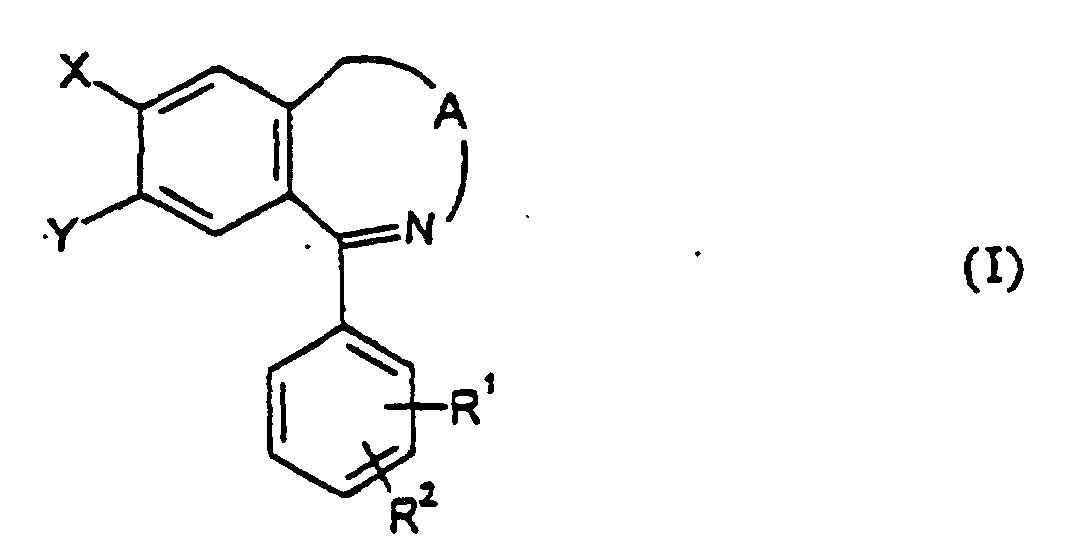
- Based on the above the invention relates to 2,3-benzodiazepines of general formula (I), their potential stereoisomers and acid addition salts,wherein
- R1 and R2
- represent independently hydrogen, halogen, a C1-4 alkyl, C1-
4 alkoxy, nitro, trifluoromethyl group or a group of general formula
NR8R9, wherein
- R8 and R9
- represent independently hydrogen, a C1-4 alkyl group or
a group of general formula -COR10, wherein
- R10
- represents hydrogen, a C1-4 alkyl
group, C6-10 aryl group, C1-4 alkoxy group, C3-5 cycloalkyl
group, C2-6 alkenyl group, C3-5 cycloalkoxy group
or a group of general formula -NR11R12,
wherein
- R11 and R12
- represent independently hydrogen, a C1-4 alkyl group, C3-5 cycloalkyl group or C6-10 aryl group,
- X
- represents hydrogen or chlorine atom,
- Y
- represents chlorine or bromine atom,
- A
- represents a group of general formula (a), (b), (c) or (d),
- R3, R4, R5, R6 and R7
- represent independently hydrogen, a C1-4 alkyl
group, C3-5 cycloalkyl group, C2-4 alkenyl group, C2-4
alkinyl group or C6-10 aryl group which can optionally be
substituted by one or more halogen, nitro, alkoxy or amino
groups; furthermore heteroaryl group; groups of general
formula -COOR13 or -CO-NR14R15, wherein
- R13
- represents hydrogen or C1-4 alkyl group,
- R14 and R15
- represent independently hydrogen or a C1-4 alkyl group or form together with the nitrogen atom a 5 to 7-membered saturated heterocycle which can contain further oxygen, sulfur or nitrogen atoms.
- In the groups of general formula (I) the alkyl and alkenyl groups can be both straight and branched groups. The cycloalkyl group can be a cyclopropyl, cyclobutyl or cyclopentyl group. The aryl group can be a phenyl or naphthyl group. The heteroaryl group can be an aromatic heterocyclic group, e.g. thienyl, furyl, pyridyl, etc.
- When compounds of general formula (I) have a chiral centrum, the term "isomer" represents both enantiomers, furthermore, due to stereoisomers developing because of particular substitutions, E and Z isomers, diastereomers, tautomers as well as mixtures thereof, e. g. racemates.
- The salts of the compounds of general formula (I) are physiologically acceptable salts formed with inorganic and organic acids. Suitable inorganic acids are e.g. hydrochloric acid, hydrobromic acid, phosphoric acid or sulfuric acid. Suitable organic acids are formic acid, acetic acid, maleic and fumaric acid, succinic acid, lactic acid, tartaric acid, citric acid or methanesulfonic acid.
- A preferred group of the compounds of general formula (I) of the invention are those of general formula (Ia) wherein X and Y, or at least Y represent a chlorine atom, R1 represents an amino group in position 4 and R2 stands for hydrogen, furthermore one of R3 or R4 stands for a methyl group.
- Compounds of general formula (I) of the invention are prepared by
- a) reacting a compound of general formula (II) or (III),
wherein R1, R2, X and Y have the same meaning as above and Z represents a C1-3 alkylthio group, with

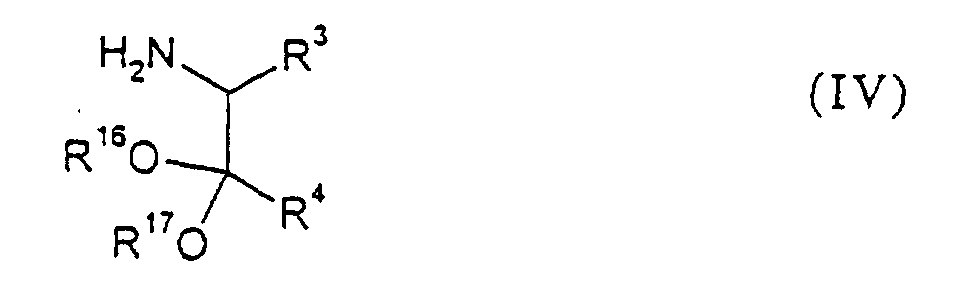
- α) an aminoacetal or aminoketal of general formula (IV),
wherein R3 and R4 have the same meaning as above, R16 and R17 represent independently C1-4 alkyl group or together a C2-4 alkylene group,
the intermediate formed in the reaction is submitted to acidic ring closure resulting in a compound of general formula (I), wherein R1, R2, X and Y have the same meaning as above and (A) represents a group of general formula (a), wherein R3 and R4 have the same meaning as above, or - β) an acid hydrazide of general formula (V)
wherein R5 has the same meaning as above, or the compounds of general formula (II) or (III) are first reacted with hydrazine hydrate and the resulting intermediates are treated with an acid anhydride, yielding compounds of general formula (I) wherein R1, R2, X and Y have the same meaning as above and (A) represents a group of general formula (b), wherein R5 has the same meaning as above, or

- (b) in a compound of general formula (III), wherein R1, R2, X and Y have the same meaning as above and Z represents a hydroxymethyl group, this latter group is converted into an aminomethyl group which is acylated and closed to a ring, resulting in a compound of general formula (I) wherein (A) represents a group of general formula (c), wherein R6 has the same meaning as above, or
- (c) a compound of general formula (III), wherein R1, R2, X and Y have
the same meaning as above and Z represents a methyl group, is reacted
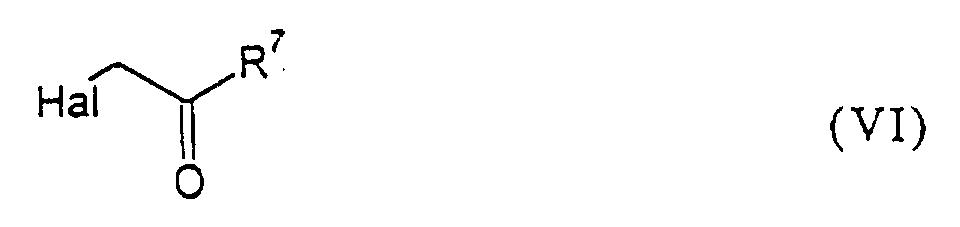
with a compound of general formula (VI),
wherein R7 has the same meaning as above and Hal represents a chloro or bromo substituent, wherby a compound of general formula (I) is obtained, wherein (A) represents a group of general formula (d), wherein R7 has the same meaning as above, then, if desired, in the compound of general formula (I) obtained by any of the alternative processes the nitro group is reduced or the amino group is acylated, alkylated, or via diazotization substituted by a halogen or hydrogen atom, thus transforming it into an other compound of general formula (I) and/or the stereoisomers are separated and optionally a salt is formed.
-
- The 4-thioxo-2,3-benzodiazepines of general formula (II), used for preparing some of the compounds of the invention, are synthesized by thionating the corresponding 4-oxo-2,3-benzodiazepine derivatives, using advantageously phosphorus pentasulfide or Lawesson reagent, and conducting the reaction in pyridine. The preparation of 4-oxo- 2,3-benzodiazepines is known from the literature [F. Gatta. et al.: Il - Farmaco Ed. Sc. 40, 942 (1985) and A. Chimirri et al.: J. Med. Chem. 40, 1258 (1997)] and essentially the process reported therein was followed.
- Eventually the preparation of the compounds of the invention can be advantageously realized by starting from compounds of general formula (III), wherein Z represents an alkylthio group. In a suitable process 4-(methylthio)-5H-2,3-benzodiazepine derivatives are applied as starting materials which are suitably prepared by methylating compounds of general formula (II). The methylation of compounds of general formula (II) is preferably carried out with e. g. methyliodide in acetone in the presence of an acid binding agent.
- Compounds of general formula (I) wherein (A) represents a group of general formula (a) are prepared by condensing the corresponding 4-thioxo compound of general formula (II) in an organic solvent, e. g. ethyleneglycol monomethyl ether, with an α-aminoacetal or -ketal of general formula (IV). The acetal or ketal group can be open or can have a ring structure. In the course of condensation the liberated sulfur is bound by a suitable reagent, preferably e. g. mercuri oxide or silver salts. The resulting intermediate compound is isolated and processed usually as a raw product in the ring closing reaction which is preferably realized by heating in a mixture of ethanol and hydrochloric acid.
- The α-aminoacetals or -ketals used as reagents are known in the literature and are prepared accordingly [Jiro Adachi et al. : J. Org. Chem. 37, 221 (1972); Skinzo Kano et al. : Heterocycles 26, 2805 (1987); Org. Synth. 64, 19 (1986)].
- Compounds of general formula (I), wherein (A) represents a group of general formula (b), are advantageously prepared by reacting a compound of general formula (III), wherein Z represents a methylthio group, in an organic solvent, e. g. ethyleneglycol monomethyl ether, with an acyl hydrazide, in the presence of catalytic amounts of an acid, e.g. p-toluenesulfonic acid. In this case condensation and ring closure proceed in a single reaction step resulting in the corresponding triazolo-2,3-benzodiazepine.
- The same compounds can also be prepared by reacting first the 4-methylthio-2,3-benzodiazepine derivative of general formula (III) with hydrazine hydrate or by a condensation reaction between the corresponding 4-thioxo-benzodiazepine and hydrazine hydrate in the presence of e.g. mercury oxide and the resulting 4-hydrazino-2,3--benzodiazepine derivative is reacted with the chosen acid anhydride yielding the expected triazolo-2,3-benzodiazepine.
- Compounds of general formula (I) wherein (A) represents a group of general formula (c) or (d) can be prepared by starting from the corresponding 4-methyl-5H-2,3-benzodiazepines. The latter ones can be synthesized by analogous processes disclosed in the Hungarian patent specifications Nos. 179,018, 191,702, 194,529 and 194,550.
- The compounds of general formula (I), wherein (A) represents a group of general formula (c), are advantageously prepared by converting the 4-methyl group of the corresponding 4-methyl-5H-2,3-benzodiazepine derivative to an aldehyde group e. g. by oxidation with selenium dioxide, then reducing the aldehyde group with sodium borohydride to a hydroxymethyl group. In the obtained compound of general formula (III), wherein Z stands for a -CH2OH group, the hydroxy group is converted into an amino group by the Mitsunobu reaction (O. Mitsunobu: Synthesis 1, 1981). Namely, the compound of general formula (III), wherein Z represents a hydroxymethyl group, is reacted under the known reaction conditions with phthalimide, the resulting phthalimidomethyl group is converted to the aminomethyl group by hydrazinolysis, or in the Mitsunobu reaction the hydroxymethyl compound is first transformed into the azidomethyl compound, then by methods known from the literature the azido group is reduced or treated with triphenylphosphine to yield the amino group. The ring closure of the compounds obtained after acylating the 4-aminomethyl-2,3-benzodiazepine derivatives is carried out preferably by a reaction with e. g. phosphorus oxychloride.
- The compounds of general formula (I), wherein (A) means a group of general formula (d), are prepared by reacting the above 4-methyl-5H-2,3-benzodiazepine derivatives with a 3-halo-2-oxo-carboxylic acid ester of general formula (VI), e. g. ethyl bromopyruvic acid or α-haloketones. The reactions are performed on the basis of analogue ring closing reactions known from the literature [e. g. C. Casagrande et al.: J. Med. Chem. 11, 765 (1968); C. Galera et al.: J. Het. Chem. 23, 1889 (1986); Y. Blache et al.: J. Het. Chem. 32, 1317 (1995)].
- In the compounds of general formula (I) the reduction of the nitro group is usually carried out in polar solvents, at room temperature or at higher temperatures, in the presence of Raney-nickel, platinum or palladium catalysts. In addition to hydrogen gas hydrazine hydrate, ammonium formate or cyclohexene may serve as hydrogen sources. Optionally the amino group can be transformed further by known methods, e. g. alkylation, acylation or in a Sandmeyer reaction.
- The AMPA antagonistic effect of the compounds of general formula (I) is confirmed by the following studies.
- Two experimental models were applied to demonstrate the inhibitory effect of the compounds of general formula (I) on AMPA receptor activation. In the first model the "spreading depression" inducing effect of glutamate agonists was studied, while in the second model the transmembrane ion current induced by the activation of glutamate receptors was directly measured.
- The kainate and AMPA antagonizing effect was studied in vitro in the retinal "spreading depression" model [M. J. Sheardown: Brain Res. 607, 189 (1993)]. The AMPA/kainate antagonists extend the latency of the kainate (5 µM) or AMPA (5 µM) induced development of "spreading depression".
- In the chicken retina model the kainate induced "spreading depression" was inhibited by the compounds of the invention at IC50 values of 0.5 and 5 µM. The IC50 value of the compound of Example 17 amounted to 2.5 µM while those of Examples 18 and 35 amounted to 0.5 and 0.98 µM, resp. The response to AMPA could usually be inhibited slightly less and the major part of IC50 values was in the range of 3 - 15 µM. Thus the AMPA induced "spreading depression" was inhibited by the compound of Example 17 at an IC50 value of 7.3 µM and by compounds of Examples 21 and 27 at IC50 values of 4.3 and 3.1 µM, resp. This demonstrates that the compounds of the invention, beyond strongly inhibiting AMPA receptors, also inhibit an other non-NMDA type glutamate receptor group, the specific kainate receptors.
- The effect of the compound of Example 17 on whole cell currents induced by 100 µM kainate or 5 µM AMPA, resp., was studied on Purkinje cells of the cerebellum according to the method of Bleakman et al. [Neuropharmacology 12, 1689 (1996)]. The IC50 value against kainate was 4.97 µM and that against AMPA 2.02 µM. In this preparation kainate was also exerting its effect through the activation of AMPA receptors. According to the obtained IC50 values the ion current induced by AMPA receptor activation is twice as strongly inhibited by the compound of Example 17 than by the reference compound GYKI 52466 having also a 2,3-benzodiazepine structure [5-(4--aminophenyl)-9H-1,3-dioxolo[4,5-h][2,3]-benzodiazepine; Hungarian Patent specification No. 191,698, Example 8], which had IC50 values of 8.8 and 11.0, resp.
- In the therapy of epilepsy a great variety of drugs is used but unfortunately they have severe side effects, furthermore the disease exists in particular forms which fail to respond to the available drugs. Thus novel antiepileptic drugs are required with a mechanism of action which is different from that of the available drugs. The introduction of drugs acting on the central nervous system by lowering the overactivation by glutamate are awaited with great expectation [TIPS 15, 456 (1994)].
- In Table 1 the anticonvulsive effect of some compounds of the invention in the electroshock test is presented [J. Pharmacol. Exp. Ther. 106, 319 (1952)]. The anticonvulsive effect was also studied in convulsions induced by various chemical agents, e. g. pentetrazole [J. Pharmacol. Exp. Ther 108, 168 (1953)], strychnine [J. Pharmacol. Exp. Ther. 129, 75 (1960)], bemegride, nicotine, bicuculline, 4-aminopyridine and 3-mercaptopropionic acid. The pretreatment period was 60 minutes. The test compounds were administered orally in 3 doses to 10 male CD 1 mice in each dose group. The results are presented in Table 1.
Anticonvulsive effect in mice Compound Example No. ED50 (mg/kg, p. o.) ES Pentetrazole Strychnine Bemegride Nicotine Bicuculline 4-AP 3-MPA Phenytoin 10 >400 160 >200 12 - - - GYKI-52466 38 115 87 73 70 35 43 47 17 24 54 67 41 13 23 55 38 20 44 ∼100 >100 - ∼25 ∼25 ∼50 50-100 27 24 62 44 40 18 22 7 67 Abbreviations: ES = electroshock 4-AP = 4-aminopyridine 3-MPA = 3-mercaptopropionic acid - The above data demonstrate the significant anticonvulsive effect of the compounds of general formula (I) in the ES test. The compound of Example 17 has a broad spectrum anticonvulsive effect even compared to phenytoin, a drug widely used in therapy.
- In clinical practice central muscle relaxants are used when the tonicity of skeletal muscles is increased due to muscle injury, trauma of the spinal cord or brain, or some chronic degenerative disease, and hyperreflexia or tremor develops. Muscle spasms are often painful and inhibit normal motility.
- The muscle relaxant activity of the compounds of general formula (I) was measured in the "inclined screen" test of Randall [J. Pharmacol. Exp. Ther. 129, 163 (1960)] and in the rotarod test [J. Am. Pharm. Assoc. 46, 208 (1975)]. The compounds were administered in 3 i. p. doses to ten CD 1 mice in each dose group. The muscle relaxant activity of the compounds of the invention was demonstrated by the results obtained with the compounds of Examples 17 and 27 (Table 2).
Muscle relaxant activity in mice Compound Example No. Inclined screen ED50 i. p. (mg/kg) Rotarod ED50 i. p. (mg/kg) Baclofen 26 13 GYKI 52466 47 24 17 36 16 27 47 14 - The efficacy of the compounds of general formula (I) in the above muscle relaxant tests demonstrates that they can have therapeutic value in treating diseases where increased muscular tone is the problem to be solved.
- The focal ischemia inhibiting effect of the compound of Example 17 was studied on the "middle cerebral artery occlusion" (MCAO) test in anesthesized rats.The blood supply of the arteria cerebri media was transitorily inhibited with an intralaminarly introduced embolus, then perfusion was reinstated by removing the embolus and thus a human "stroke" like status was induced in an experimental animal model, in rats. After histological processing the developed infarcted area was measured by a computerized scanner program [R. T. Bartus: Stroke 11, 2265 (1994) and S. G. Sydserff: Brit. J. Pharmacol. 114, 1631 (1995)]. The results obtained are presented in Table 3.
Inhibition of focal ischemia in rats a) Size of infarcted area Compound Example No. Dose (mg/kg) i. v. N Score of infarcted area Change % Vehicle - 10 40518±5924 17 6 x 1 7 16122±4368 -60.2 17 6 x 2 10 13229±2313 -67.4 b) Infarcted area in percent of cerebral hemosphere Compound Example No. Dose (mg/kg) i. v. N Score of infarcted area Vehicle - 10 33.7±4.94 17 6 x 1 7 13.4±3.64* 17 6 x 2 10 11.0±1.93* - In the above experiment the rate of cerebral cell damage, induced by the occlusion of the middle cerebral artery, was significantly reduced by 6 x 1 mg/kg i. v. doses of the compound of Example 17 in the best human stroke animal model.
- Based on the above pharmacological results the compounds of general formula (I) according to the invention can influence the dysfunctions of the AMPA receptors. Thus the compounds according to the invention are suitable for the treatment of neurological and psychiatric disorders induced by the extremely increased activation of the AMPA receptor. Consequently in therapy they can be applied as muscle relaxants, anticonvulsive and neuroprotective agents. They possess therapeutic value in the treatment of epilepsy, diseases associated with spasms of the skeletal muscles, acute and chronic neurodegenerative disorders, e. g. cerebral ischemia (stroke).
- Neurological diseases which can be prevented or treated in this way are the following: Parkinson's disease, Alzheimer's disease, Huntington chorea, amyotrophic lateral sclerosis, olivopontocerebellar atrophy, AIDS dementia and senile dementia. They are also suitable for the treatment of neurodegenerative states developed as a result of cerebrovascular disasters (stroke, cerebral and spinal traumas), hypoxia, anoxia or hypoglycemic states, resp. The compounds of the invention can be advantageously applied for the treatment of various psychiatric diseases, e. g. anxiety, schizophrenia, sleeping disorders, alleviation of symptoms of alcohol, drug and narcotics withdrawal. They can be beneficial in preventing the development of tolerance against sedative drugs and pain killers.
- They are assumed to be suitable drugs in epileptic diseases, in the treatment of muscle spasms of central origin and in the alleviation of pathological pain.
- For therapeutic use the compounds of general formula (I) of the invention can be converted into enteral or parenteral pharmaceutical compositions. For this purpose organic and inorganic carriers and auxiliary materials are employed, e. g. water, gelatin, acacia gum, lactose, starch, magnesium stearate, talc, vegetable oil, polyethyleneglycols, etc.
- The pharmaceutical composition can be prepared in solid form, e. g. tablet, coated tablet, suppository or capsule form or also in liquid form, e. g. solution, suspension or emulsion form. The above auxiliary materials can be also supplemented with other additives, such as preservatives, stabilizing, emulsifying agents, buffers, etc.
- For parenteral use the active ingredient is prepared in the form of sterile solution or suspension. The sterile vehicle can contain in addition adjuvants such as a local anesthetic agent, stabilizing agent or buffer, resp. The dosage of the active ingredient depends on the route of administration, the type and severity of the disease as well as the mass and age of the patient. The daily dose can be 0,5 - 1000 mg, preferably 20 - 200 mg, in a single dose or divided in several doses.
- The compounds according to the invention and the process for their preparation are illustrated in detail by the following non-limiting Examples.
- 10 mM of 8-chloro-1-(4-nitrophenyl)-3H-4,5-dihydro-2,3-benzo-diazepin-4-thione were refluxed for 1 - 10 hours in ethyleneglycol monomethyl ether with 11 - 20 mM of aminoacetal or aminoketal of general formula (IV) and 10 mM of red mercury oxide. The reaction mixture was filtered, evaporated and purified- on a Kieselgel column using a mixture of chloroform - methanol (98:2) as eluant.
- The obtained condensation product was refluxed for 1 - 2 hours in a 1:1 mixture of concentrated hydrochloric acid and ethanol, yielding the product presented in Table 4 in hydrochloride form.
- Products isolated as bases are suitably prepared as follows: the above condensation product is stirred for 1 - 2 hours with methanesulfonic acid, the reaction mixture is diluted with water and made alkaline with 5 M sodium hydroxide, finally the formed crystalline product is filtered.
- Compounds of general formula (I) prepared by the above process are presented in Table 4.
Example No. R3 R4 Reagent Yield % M.p.°C (HCl salt) 1 H H 2-Aminomethyl-1,3-dioxolane 48 210-215 2 Me H 2-(1-Aminoethyl)-1,3-dioxolane 34 215-220 3 H Me 2-Aminomethyl-2-methyl1,3-dioxolane 41 205-208 4 Me Me 2-(1-Aminoethyl)-2-methyl-1,3-dioxolane 46 207-210 5 Et H 2-(1-Aminopropyl)-1,3-dioxolane 20 150-153 6 H 4-NO2-phenyl 2,2-Diethoxy-2-(4-nitrophenyl)-ethylamine 30 270-272 7 H 4-Pyri-dyl 2,2-Diethoxy-2-(4-pyridyl)-ethylamine 30 250-252 - Starting compounds of Examples 1 - 7 can be prepared as follows:
- Step a)
- 7-Chloro-1-(4-nitrophenyl)-isochromane 24.97 g (160 mM) of 2-(4-chlorophenyl)-ethanol and 24.17 g (160 mM) of 4-nitrobenzaldehyde were dissolved in 480 ml of anhydrous benzene, then 21.76 g (160 mM) of anhydrous zinc chloride were added. Dry HCl gas was led into the stirred suspension for 4 hours and stirring was continued overnight. The reaction mixture was first washed with water then with a solution of sodium bisulfite, dried, filtered and finally evaporated. The residue was recrystallized from ethanol.
- Step b)
- 4-Chloro-2-(4-nitrobenzoyl)-phenylacetic acid 26.1 g (90 mM) of 7-chloro-1-(4-nitrophenyl)-isochromane were dissolved in 360 ml of acetone, then 260 ml of Jones reagent were added and the reaction mixture was stirred for 16 hours. The precipitated chromic sulfate was filtered and the filtrate was evaporated. The evaporation residue was treated with 10 % aqueous sodium carbonate solution and dichloromethane. The aqueous phase was acidified with 36 % hydrochloric acid and the precipitated crystalline product was filtered.
- Step c)
- 8-Chloro-1-(4-nitrophenyl)-3H-4,5-dihydro-2,3-benzodiazepin-- 4-one 17.6 g (55 mM) of 4-chloro-2-(4-nitrobenzoyl)-phenylacetic acid and 8 ml of 85 % hydrazine hydrate were refluxed in 340 ml of ethanol for 4 hours. The reaction mixture was cooled, acidified with 115 ml of 1 M hydrochloric acid and evaporated. The residue was mixed with 50 ml of water, the crystals were filtered and dried. The resulting hydrazone derivative was dissolved in 300 ml of anhydrous dichloromethane and treated with a solution of 13.4 g (65 mM) of dicyclohexyl-carbodiimide in 210 ml of anhydrous dichloromethane. The reaction mixture was stirred at room temperature overnight, then the precipitated crystals were filtered and washed with dichloromethane. Yield 12.5 g (72 %), m. p. 275- 278°C.
- Step d)
- 8-Chloro-1-(4-nitrophenyl)-3H-4,5-dihydro-2,3-benzo-diazepine-4-thione 12.0 g (38 mM) of 8-chloro-1-(4-nitrophenyl)-3H-4,5--dihydro-2,3-benzodiazepin-4-one and 13.3 g (60 mM) of phosphorus pentasulfide were heated at 80° for 2 hours in 150 ml of anhydrous pyridine. After cooling the reaction mixture was poured on 1 kg of ice, the precipitated crystals were filtered and washed with water. The crude product was recrystallized from ethyleneglycol monomethyl ether.
-
- 10 mM of 8-bromo-1-(4-nitrophenyl)-3H-4,5-dihydro-2,3-benzo-diazepine-4-thione were refluxed with 11 - 20 mM of an aminoacetal or aminoketal of general formula (IV) and 10 mM of red mercury oxide for 1 - 10 hours, then the process described in Examples 1 - 7 was applied.
- Compounds isolated as bases were processed as reported under Examples 1 - 7.
- Compounds of general formula (I) prepared by the above process are presented in Table 5.
Example No. R3 R4 Reagent Yield % M.p.°C (HCl salt) 8 Me H 2-(1-Aminoethyl)-1,3-dioxolane 28 215-220 9 H Me 2-Aminomethyl-2-methyl-1,3-dioxolane 50 194-202 10 Me Me 2-(1-Aminoethyl)-2-methyl-1,3-dioxolane 42 212-219 11 H 4-Pyridyl 2,2-Diethoxy-2-(4pyridyl)-ethylamine 60 Foam - Starting compounds of Examples 8 - 11 can be prepared as follows:
- Step a)
- 7-Bromo-1-(4-nitrophenyl)-isochromane20.1 g (100 mM) of 2-(4-bromophenyl)-ethanol and 15.1 g (100
mM) of 4-nitrobenzaldehyde were dissolved in 300 ml of anhydrous
benzene, then 13.6 g (100 mM) of anhydrous zinc chloride were added
and dry hydrochloric acid gas was led into the stirred mixture for 4
hours. Then the process described under Examples 1-7, Step a) was
applied. The crude product was recrystallized from ethyl acetate.
Yield 20.7 g (62 %), m. p. 104 - 107°C. - Step b)
- 4-Bromo-2-(4-nitrobenzoyl)-phenylacetic acid20.0 g (60 mM) of 7-bromo-1-(4-nitrophenyl)-isochromane were
dissolved in 240 ml of acetone, then 174 ml of Jones reagent were
added and the reaction mixture was stirred for 16 hours. Thereafter
the process described under Examples 1 - 7, Step b) was applied.
Yield 13.3 g (61 %), m. p. 127 - 130°C. - Step c)
- 8-Bromo-1-(4-nitrophenyl)-3H-4,5-dihydro-2,3-benzodiazepin-4--one12.7 g (35 mM) of 4-bromo-2-(4-nitrobenzoyl)-phenylacetic acid
and 5 ml of 85 % hydrazine hydrate were refluxed in 210 ml of ethanol
for 4 hours. Thereafter the process described under Examples 1 - 7,
Step c) was applied.
Yield 8.19 g (65 %), m. p. 264- 267°C. - Step d)
- 8-Bromo-1-(4-nitrophenyl)-3H-4,5-dihydro-2,3-benzo-diazepine-4-thione7.92 g (22 mM) of 8-bromo-1-(4-nitrophenyl)-3H-4,5-dihydro--2,3-benzodiazepin-4-one
and 7.78 g (35 mM) of phosphorus pentasulfide
were heated at 80°C for 2 hours in 90 ml of anhydrous pyridine.
Thereafter the process described under Examples 1 - 7 was applied.
The crude product was recrystallized from ethyleneglycol
monomethyl ether.
Yield 5.55 g (67 %), m. p. 220- 223°C. -
- 10 mM of 7,8-dichloro-1-(4-nitrophenyl)-3H-4,5-dihydro-2,3--benzodiazepine-4-thione were refluxed for 1 - 10 hours with 11 - 20 mM of an aminoacetal or aminoketal of general formula (IV) and 10 mM of red mercury oxide, then the process described under Examples 1 - 7 was applied.
- The compounds of general formula (I) prepared by this process are presented in Table 6.
Example No. R3 R4 Reagent Yield % M.p.°C (HCl salt) 12 Me H 2-(1-Aminoethyl)-1,3-dioxolane 13 221-224 13 H Me 2-Aminomethyl-2-methy1,3-dioxolane 41 240-244 - Starting compounds of Examples 12 and 13 can be prepared as follows:
- Step a)
- 6,7-Dichloro-1-(4-nitrophenyl)-isochromane19.1 g (100 mM) of 2-(3,4-dichlorophenyl)-ethanol [G. J. Park et
al.: J. Org. Chem. 22, 93 (1957)] and 15.1 g (100 mM) of 4--nitrobenzaldehyde
were dissolved in 300 ml of anhydrous benzene,
then 13.6 g (100 mM) of anhydrous zinc chloride were added and dry
hydrochloric acid gas was led into the stirred suspension for 4 hours.
Then the process described under Examples 1-7, Step a) was applied.
The crude product was recrystallized from ethanol.
Yield 9.11 g (30 %), m. p. 130 - 132°C. - Step b)
- 4,5-Dichloro-2-(4-nitrobenzoyi)-phenylacetic acid8.70 g (26.8 mM) of 6,7-dichloro-1-(4-nitrophenyl)-isochromane
were dissolved in 180 ml of acetone, then 78 ml of Jones reagent were
added and the reaction mixture was stirred for 16 hours. The precipitated
chromium sulfate was filtered, the filtrate was evaporated and
the evaporation residue was recrystallized from 96 % acetic acid. The
obtained crystals were filtered and purified on a Kieselgel column using
a mixture of chloroform - methanol (9:1) as eluant.
Yield 5.1 g (54 %), m. p. 187 - 190°C. - Step c)
- 7,8-Dichloro-1-(4-nitrophenyl)-3H-4,5-dihydro-2,3--benzodiazepin-4-one 6.10 g (17.2 mM) of 4,5-dichloro-2-(4-nitrobenzoyl)-phenylacetic
acid and 6 ml of 85 % hydrazine hydrate were refluxed in 300 ml of 2-propanol
for 6 hours. The reaction mixture was evaporated and the
residue was dissolved in a mixture of 45 ml 40 % acetic acid and 400
ml of dichloromethane. The mixture was separated and the dichloromethane
phase was washed with water, dried, then 3.60 g (17.5 mM)
of dicyclohexyl-carbodiimide were added to the stirred solution. The
reaction mixture was stirred at room temperature overnight, the
formed precipitate was filtered and the filtrate was evaporated. The
evaporation residue was refluxed in 120 ml of methanol and the hot
mixture was filtered.
Yield 4.40 g (73 %), m. p. 268- 270°C. - Step d)
- 7,8-Dichloro-1-(4-nitrophenyl)-3H-4,5-dihydro-2,3-benzo-diazepine-4-thione2.21 g (6.31 mM) of 7,8-dichloro-1-(4-nitrophenyl)-3H-4,5-dichloro-2,3-benzodiazepin-4-one
and 2.24 g (10.1 mM) of phosphorus
pentasulfide were heated at 82°C for 3 hours in 50 ml of anhydrous
pyridine. Thereafter the process described under Examples 1 - 7, Step
d) was applied. The crude product was recrystallized from ethyleneglycol
mono-methyl ether.
Yield 1.41 g (61 %), m. p. 210- 213°C. -
- 2 mM of 8-bromo-1-(2-chlorophenyl)-3H-4,5-dihydro-2,3-benzo-diazepine-4-thione were refluxed for 1 - 2 hours with 2.2 - 4 mM of an aminoacetal or aminoketal of general formula (IV) and 2 mM of red mercury oxide in ethyleneglycol monomethyl ether. The mercury sulfide was filtered and the filtrate evaporated. The obtained condensation product was refluxed for 1 - 2 hours in a mixture of concentrated hydrochloric acid and ethanol (1:1), then the mixture was evaporated. The crystalline residue was recrystallized from ethanol.
- The compounds of general formula (I) prepared by this process are presented in Table 7.
Example No. R3 R4 Reagent Yield % M.p.°C (HCl salt) 14 Me H 2-(1-Aminoethyl)-1,3-dioxolane 21 132-140 15 H Me 2-Aminomethyl-2-methy-l-1,3-dioxolane 48 210-215 - 2 mM of a compound of general formula (I), wherein R1 represents a 4-nitrophenyl group, furthermore R2, R3, R4, X and Y have the same meaning as above, were dissolved in a mixture of methanol and dichloromethane, then stirred for 1 - 5 hours with 8 - 10 mM of 85 - 98 % hydrazine hydrate and 0,1 - 2 g of Raney-nickel catalyst at 20 - 40°C. The catalyst was filtered off and the filtrate was evaporated. The crude product was recrystallized from ethanol. The compounds of general formula (I) prepared by this process are presented in Table 8.
Example No. X Y R3 R4 Starting compound Example No. Yield % M.p. °C 16 H Cl H H 1 67 210-214 17 H Cl Me H 2 79 229-230 18 H Cl H Me 3 71 267-270 19 H Cl Me Me 4 83 274-278 20 H Cl Et H 5 72 247-250 21 H Cl H 4-NH2-phenyl 6 84 250-253 22 H Cl H 4-Pyridyl 7 68 293-294 (d) 23 H Br Me H 8 64 248-251 24 H Br H Me 9 77 263-268 25 H Br Me Me 10 84 272-275 26 H Br H 4-Pyridyl 11 41 295-300 (d) 27 Cl Cl Me H 12 40 254-255 28 Cl Cl H Me 13 71 284-286 - 10 mM of 8-chloro-4-methylthio-1-(4-nitrophenyl)-5H-2,3-benzo-diazepine were reacted in dimethylformamide at 120 - 130°C for 9-15 hours with 20 - 25 mM of an acyl hydrazide of general formula (V) in the presence of 0.5 mM of concentrated hydrochloric acid. The reaction mixture was poured on crushed ice, then the crude product was filtered and purified by recrystallization.
- The compounds of general formula (I) prepared by this process are presented in Table 9.
Example No. R5 Yield % M. p. °C 29 Methyl 72 271-274 30 4-Pyridyl 86 287-289 31 4-Nitrophenyl 68 287-290 32 Methoxymethyl 88 266-268 - Starting compounds of Examples 29 - 32 can be prepared as follows:
- To a solution of 10 mM of 8-chloro-1-(4-nitrophenyl)-5H--2,3-benzodiazepine-4-thione [Example 1 - 7, Step d)] in acetone 20 mM of potassium carbonate and 30 mM of methyliodide were added and the reaction mixture was stirred at room temperature for 3 hours. The product was filtered, washed with water and purified by recrystallizing from dimethylformamide.
Yield 82 %, m. p. 249- 252°C. - 10 mM of a compound of general formula (I), wherein X = H, Y = Cl, R1 = 4-nitro group, R2 = H, A represents a group of general formula (b) and R5 represents a group listed in Table 9, described in Examples 29 - 32, were dissolved in a mixture of methanol and dichloromethane and stirred for 1 - 5 hours with 35 - 45 mM of 85 - 98 % hydrazine hydrate and 0.5 - 2.0 g of Raney-nickel catalyst at 20 - 40°C. The catalyst was filtered off and the filtrate was evaporated. The crude product was purified by recrystallization or column chromatography.
- The compounds of general formula (I) prepared by this process are presented in Table 10.
Example No. R5 Yield % M. p. °C 33 Methyl 91 228-231 34 4-Pyridyl 92 284-288 35 4-Aminophenyl 85 191-193 36 Methoxymethyl 83 195-197 - The solution of 0.46 g (1.42 mM) of the compound described in Example 17 in 8 ml of anhydrous pyridine was stirred with 0.20 ml of acetylchloride for 1.5 hours at 5 - 10°C. The reaction mixture was poured on crushed ice, the precipitated product was filtered and recrystallized from ethanol.
Yield 0.33 g (63 %), m. p. 265 - 266°C. - The solution of 1.10 g (3.2 mM) of the compound described in Example 18 was treated in 12 ml of dimethylformamide with 0.8 ml of isoamyl nitrite at 65°C. The reaction mixture was diluted with 5 M hydrochloric acid and extracted with ether. The ether layer was evaporated and purified on a Kieselgel column using a mixture of chloroform and methanol (98:2) as eluant.
Yield 0.39 g (39 %), m. p. 166 - 169°C. - The solution of 0.50 g (1.6 mM) of 8-chloro-4-methyl-- 1-(4-nitrophenyl)-5H-2,3-benzodiazepine and 0.27 ml (2.2 mM) of ethyl bromopyruvic acid in 20 ml of ethanol was refluxed for 12 hours. The reaction mixture was evaporated and the product was purified on a silicagel column applying benzene as eluant.
Yield 0.29 g (44 %) of the aimed product which was used in the next reaction without further purification. - The starting compound of this Example was prepared as follows:
- Step a)
- 7-Chloro-3-methyl-1-(4-nitrophenyl)-isochromane11.94 g (70 mM) of 1-(4-chlorophenyl)-2-propanol [J. Med. Chem. 21, 454 (1978)] and 10.57 g (70 mM) of 4-nitrobenzaldehyde were dissolved in 70 ml of anhydrous benzene, then 9.56 g (70 mM) of freshly prepared anhydrous zinc chloride were added and dry hydrochloric acid gas was led into the mixture for 3 hours. Then the mixture was refluxed for 1.5 hours, cooled, diluted with water and the layers were separated. The organic layer was first washed with water then with a solution of sodium hydrogen carbonate, dried and evaporated. The resulting crude product was recrystallized from ethanol. Yield 6.8 g (32 %), m. p. 120 - 123°C.
- Step b)
- 7-Chloro-3-methyl-1-(4-nitrophenyl)-2-benzopyrilium perchlorateTo a solution of 6.8 g (22.44 mM) of the isochromane derivative [prepared in the above Step a)] in 70 ml of acetone 29 ml (78 mM) of Jones reagent were added dropwise under ice chilling, during 1 hour and the reaction mixture was stirred for 4 hours at 25°C. The precipitated chromium salt was filtered off, the filtrate was evaporated and the crystalline residue was resuspended in water and repeatedly filtered. The resulting crystalline product was dissolved in 76 ml of hot glacial acetic acid, 1.48 ml of 70 % perchloric acid were added, after chilling the precipitated crystalline product was filtered and washed several times with small portions of glacial acetic acid. Yield 3.73 g (42 %), m. p. 247- 255°C.
- Step c)
- 8-Chloro-4-methyl-1-(4-nitrophenyl)-5H-2,3-benzodiazepine4.1 g (10.25 mM) of benzopyrilium perchlorate, prepared according
to the above Step b, were added to a mixture of 20.5 ml of
dimethylformamide and 1.5 ml (70.7 mM) of 98 % hydrazine hydrate
while cooling with water. The reaction mixture was stirred for 1.5
hours at 25°C, then 25 ml of water were added, the precipitated crude
product was filtered and washed with water. The resulting crude product
was recrystallized from 25 ml of isopropanol.
Yield 2.82 g (87 %), m. p. 199 - 203°C. -
- 0.29 g (0.7 mM) of 2-ethoxycarbonyl-8-choro-6-(4-nitrophenyl)--11H-pyrrolo[1,2-c][2,3]-benzodiazepine (Example 39) was reduced according to the general method described in Examples 16 - 28.
Yield 0.11 g (41 %), m. p. 247- 249°C. - 0.59 g (1.6 mM) of 4-(acetaminomethyl)-8-chloro-1-(4-nitrophenyl)-5H-2,3-benzodiazepine [Step e)] was dissolved in 30 ml of anhydrous dichloroethane, then 0.73 ml (7.95 mM) of phosphorus oxychloride were added and the reaction mixture was refluxed for 3 hours.
- Thereafter the solution was mixed under ice-chilling with a solution of sodium hydrogen carbonate, the layers were separated, the organic layer was washed with water, dried and evaporated. The crude product, an oil, was purified on a silicagel column using a mixture of ethyl acetate and benzene (4:1) as eluant.
- Yield 0.24 g (43 %) of a foam which was used without further purification in the reduction reaction (Example 42).
- The starting compound of this Example was prepared as follows:
- Step a)
- 4-Formyl-8-chloro-1-(4-nitrophenyl)-5H-2,3-benzodiazepine9.17 g (29.0 mM) of 8-chloro-4-methyl-1-(4-nitrophenyl)-5H-2,3-benzodiazepine (prepared according to the method described in Example 39) were dissolved in 120 ml of dioxane, then 2.27 g (20.5 mM) of selenium dioxide powder were added and the mixture was stirred on a 90°C water bath for 40 minutes. Then the solution was treated with active carbon, filtered and poured into 1500 ml of water. The precipitated crystals were filterd and washed with water. The crude product was purified on a Kieselgel column using benzene as eluant. Yield 2.8 g (29 %), m. p. 208- 210°C (decomp.).
- Step b)
- 4-(Hydroxymethyl)-8-chloro-1-(4-nitrophenyl)-5H-2,3-benzo-diazepine2.15 g (6.6 mM) of 4-formyl-8-chloro-1-(4-nitrophenyl)-5H-2,3--benzodiazepine
[prepared according to Step a)] were dissolved in 88
ml of a mixture of tetrahydrofuran and water (1:1), then under ice
chilling 0.12 g (3.3 mM) of sodium borohydride was added portionwise.
The reaction mixture was stirred at 25°C for 40 minutes then it
was diluted with 90 ml of water. The precipitated crystals were filtered
and purified on a Kieselgel column using a mixture of benzene
and ethyl acetate (1:1) as eluant.
Yield 1.62 g (75 %), gradually decomposing from 163 °C on. - Step c)
- 4-(Phthalimidomethyl)-8-chloro-1-(4-nitrophenyl)-5H-2,3--benzodiazepine1.62 g (4.9 mM) of the 4-(hydroxymethyl) derivative [Step b)],
2.54 g (9.7 mM) of triphenylphosphine and 1.42 g (9.7 mM) of
phthalimide were dissolved in 72 ml of anhydrous tetrahydrofuran,
then a solution of 1.52 ml (9.7 mM) of diethyl azodicarboxylate in anhydrous
tetrahydrofuran were added dropwise and the reaction mixture
was stirred for 3 hours. After evaporation the resulting residue was
recrystallized from 20 ml of ethanol.
Yield 1.34 g (60 %), m. p. 254- 256°C (decomp.). - Step d)
- 4-(Aminomethyl)-8-chloro-1-(4-nitrophenyl)-5H-2,3-benzo-diazepine1.34 g (2.9 mM) of the 4-(phthalimidomethyl) derivative [Step c)]
and 1.09 ml (21.7 mM) of 98 % hydrazine hydrate were refluxed in
134 ml of methanol for 4 hours. The reaction mixture was evaporated,
the residue was mixed with 50 ml of dichloromethane and the precipitate
was filtered. The filtrate was evaporated, the residue was suspended
in water and filtered.
Yield 0.97 g (100 %), m. p. 105 - 107°C (decomp.) which was used without further purification in the next reaction step. - Step e)
- 4-(Acetaminomethyl)-8-chloro-1-(4-nitrophenyl)-5H-
-2,3-benzodiazepine0.97 g (3.0 mM) of the 4-(aminomethyl) derivative prepared according
to Step d) was stirred for 2 hours with 8 ml of acetic anhydride.
Then the reaction mixture was diluted with 40 ml of water, the
precipitated crystals were filtered and the crude product was subjected
to silicagel column chromatography using a 4:1 mixture of ethyl acetate
and benzene as eluant.
Yield 0.59 g (54 %), m. p. 216 - 218°C (decomp.). -
- 0.24 g (0.7 mM) of 8-Chloro-3-methyl-6-(4-nitrophenyl)-11H--imidazo[3,4-c][2,3]-benzodiazepine (Example 41) was reduced according to the general process of Examples 16 - 28). The crude product was purified by refluxing with ethanol.
Yield 0.12 g (56 %), m. p. 256- 258°C (decomp.). - 1.99 g (6.0 mM) of 8-chloro-1-(4-nitrophenyl)-3H-4,5-dihydro-2,3-benzodiazepine-4-thione were reacted with 1.79 g (12.0 mM) of 2,2-dimethoxy-1-phenyl-ethylamine [W. R. Boon: J. Chem. Soc. 2146 (1957)] according to the process described in Examples 1 - 7. The resulting condensation product was purified on a Kieselgel column using a mixture of chloroform and methanol (98:2) as eluant, then it was treated with methanesulfonic acid and the product was isolated as a base according to the method described in Examples 1-7.
Yield 0.70 g (28 %), m. p. 230 - 232°C. - 0.62 g (1.5 mM) of 2-phenyl-8-chloro-1-(4-nitrophenyl)-11H--imidazo[1,2-c][2,3]-benzodiazepine was reduced according to the process described in Examples 16 - 28 and the crude product was recrystallized from 90 % isopropanol.
Yield 0.47 g (81 %), m. p. 223- 226°C.

Yield 26.2 g (56 %), m. p. 98 - 101°C.
Yield 18.1 g (63 %), m. p. 135 - 139°C.
Yield 8.92 g (71 %), m. p. 231 - 234°C.
Claims (9)
- Compounds of general formula (I), stereoisomers and acid addition salts thereof,wherein
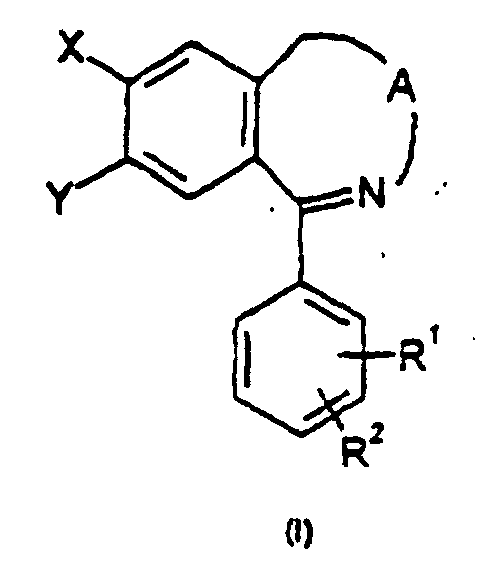
- R1 and R2
- represent independently hydrogen, halogen, a C1-4 alkyl,
C1-4 alkoxy, nitro, trifluoromethyl group or a group of general
formula NR8R9, wherein
- R8 and R9
- represent independently hydrogen, a C1-4 alkyl group or
a group of general formula -COR10, wherein
- R10
- represents hydrogen, a C1-4 alkyl
group, C6-10 aryl group, C1-4 alkoxy group, C3-5 cycloalkyl
group, C2-6 alkenyl group, C3-5 cycloalkoxy group
or a group of general formula -NR11R12, wherein
- R11 and R12
- represent independently hydrogen, a C1-4 alkyl group, C3-5 cycloalkyl group or C6-10 aryl group,
- X
- represents hydrogen or chlorine atom,
- Y
- represents chlorine or bromine atom,
- A
- represents a group of general formula (a), (b), (c) or (d),
wherein
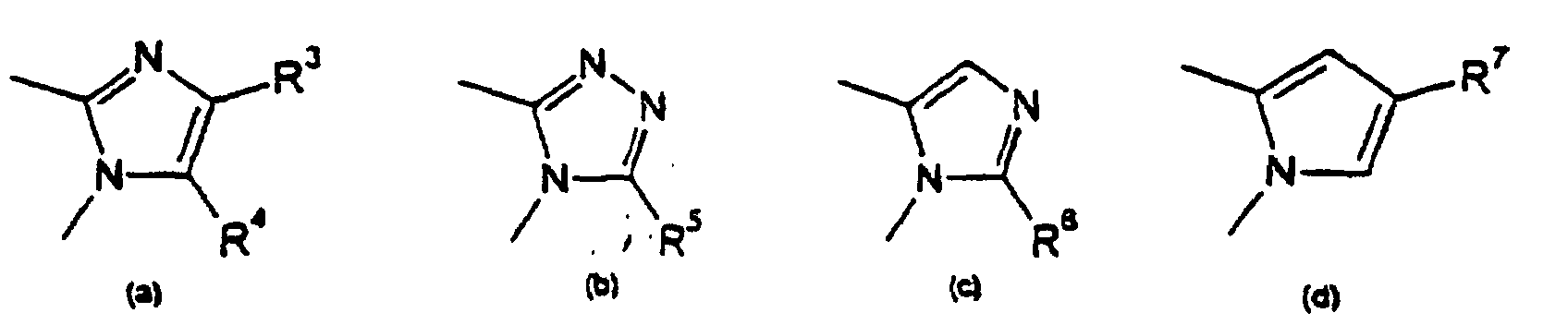
- R3, R4, R5, R6 and R7
- represent independently hydrogen, a C1-4 alkyl
group, C3-5 cycloalkyl group, C2-4 alkanyl group, C2-4
alkinyl group or C6-10 aryl group which can optionally be
substituted by one or more halogen, nitro, alkoxy or amino
groups; furthermore heteroaryl group; groups of general
formula -COOR13 or -CO-NR14R15, wherein
- R13
- represents hydrogen or C1-4 alkyl group,
- R14 and R15
- represent independently hydrogen or a C1-4 alkyl group or form together with the nitrogen atom a 5 to 7-membered saturated heterocycle which can contain further oxygen, sulfur or nitrogen atoms.
- 6-(4-Aminophenyl)-8-chloro-2-methyl-11H-imidazo[1,2-c]-[2,3]-benzodiazepine and its acid addition salts according to claim 1.
- 6-(4-Aminophenyl)-8-chloro-3-methyl-11H-imidazo[1,2-c]-[2,3]-benzodiazepine and its acid addition salts according to claim 1.
- 6-(4-Aminophenyl)-8-bromo-2-methyl-11H-imidazo[1,2-c]-[2,3]-benzodiazepine and its acid addition salts according to claim 1.
- 6-(4-Aminophenyl)-8,9-dichloro-2-methyl-11H-imidazo[1,2-c]-[2,3]-benzodiazepine and its acid addition salts according to claim 1.
- Pharmaceutical composition comprising a compound of general formula (I), wherein R1 - R15, X, Y and (A) have the same meaning as claimed in claim 1, or stereoisomers or pharmaceutically acceptable salts thereof, together with solvents, diluents, carriers or filling materials usually employed in the preparation of drug formulations.
- Use of compounds according to claim 1 for the preparation of drugs suitable for treating diseases associated with muscle spasms.
- Use of compounds according to claim 1 for the preparation of drugs suitable for treating epilepsy.
- Use of compounds according to claim 1 for the preparation of drugs suitable for treating acute or chronic neurodegenerative diseases.
Applications Claiming Priority (3)
| Application Number | Priority Date | Filing Date | Title |
|---|---|---|---|
| HU9701325A HUP9701325A1 (en) | 1997-07-31 | 1997-07-31 | New 2,3-benzodiazepine derivatives |
| HU9701325 | 1997-07-31 | ||
| PCT/HU1998/000071 WO1999006408A1 (en) | 1997-07-31 | 1998-07-27 | New 2,3-benzodiazepine derivatives |
Publications (2)
| Publication Number | Publication Date |
|---|---|
| EP1001956A1 EP1001956A1 (en) | 2000-05-24 |
| EP1001956B1 true EP1001956B1 (en) | 2003-05-07 |
Family
ID=89995445
Family Applications (1)
| Application Number | Title | Priority Date | Filing Date |
|---|---|---|---|
| EP98936578A Expired - Lifetime EP1001956B1 (en) | 1997-07-31 | 1998-07-27 | 2,3-benzodiazepine derivatives |
Country Status (13)
| Country | Link |
|---|---|
| US (1) | US6482819B1 (en) |
| EP (1) | EP1001956B1 (en) |
| JP (1) | JP2001512124A (en) |
| KR (2) | KR100521959B1 (en) |
| AT (1) | ATE239729T1 (en) |
| AU (1) | AU741162B2 (en) |
| CA (1) | CA2296586C (en) |
| DE (1) | DE69814401T2 (en) |
| DK (1) | DK1001956T3 (en) |
| ES (1) | ES2202879T3 (en) |
| HU (1) | HUP9701325A1 (en) |
| PT (1) | PT1001956E (en) |
| WO (1) | WO1999006408A1 (en) |
Families Citing this family (5)
| Publication number | Priority date | Publication date | Assignee | Title |
|---|---|---|---|---|
| DE10041671C1 (en) | 2000-08-10 | 2002-06-13 | Schering Ag | Process for the preparation of imidazo [1,2-c] [2,3] benzodiazepines and phenylacetic acid esters and oxazole derivatives as intermediates in their preparation |
| EP2338492A1 (en) * | 2009-12-24 | 2011-06-29 | Universidad del Pais Vasco | Methods and compositions for the treatment of alzheimer |
| CN112321401B (en) * | 2020-11-10 | 2023-04-28 | 西安石油大学 | Method for preparing 2-hydroxyethyl phenyl ketone by catalytic oxidation of heterochroman |
| JPWO2023042888A1 (en) | 2021-09-15 | 2023-03-23 | ||
| US20240398775A1 (en) | 2021-09-15 | 2024-12-05 | University Of The Ryukyus | Pharmaceutical composition for use in treating cognitive decline or for use in treating overweight or obesity |
Family Cites Families (4)
| Publication number | Priority date | Publication date | Assignee | Title |
|---|---|---|---|---|
| HU219778B (en) | 1990-12-21 | 2001-07-30 | Gyógyszerkutató Intézet Közös Vállalat | Process for the preparation of N-acyl-2,3-benzodiazepines, their acid addition salts and pharmaceutical compositions containing them, and a group of compounds and pharmaceutical compositions containing them. |
| DE4428835A1 (en) | 1994-08-01 | 1996-02-08 | Schering Ag | New 3-substituted 3H-2,3-benzodiazepine derivatives, their production and use as medicines |
| CA2198751C (en) | 1994-08-31 | 2006-07-11 | Benjamin Alan Anderson | Dihydro-2,3-benzodiazepine derivatives |
| DE19604919A1 (en) * | 1996-02-01 | 1997-08-07 | Schering Ag | New 2,3-benzodiazepine derivatives, their production and use as medicines |
-
1997
- 1997-07-31 HU HU9701325A patent/HUP9701325A1/en unknown
-
1998
- 1998-07-27 CA CA002296586A patent/CA2296586C/en not_active Expired - Fee Related
- 1998-07-27 EP EP98936578A patent/EP1001956B1/en not_active Expired - Lifetime
- 1998-07-27 AU AU85540/98A patent/AU741162B2/en not_active Ceased
- 1998-07-27 US US09/463,440 patent/US6482819B1/en not_active Expired - Fee Related
- 1998-07-27 AT AT98936578T patent/ATE239729T1/en not_active IP Right Cessation
- 1998-07-27 WO PCT/HU1998/000071 patent/WO1999006408A1/en not_active Ceased
- 1998-07-27 DE DE69814401T patent/DE69814401T2/en not_active Expired - Fee Related
- 1998-07-27 JP JP2000505166A patent/JP2001512124A/en not_active Ceased
- 1998-07-27 PT PT98936578T patent/PT1001956E/en unknown
- 1998-07-27 DK DK98936578T patent/DK1001956T3/en active
- 1998-07-27 KR KR10-2000-7000873A patent/KR100521959B1/en not_active Expired - Fee Related
- 1998-07-27 ES ES98936578T patent/ES2202879T3/en not_active Expired - Lifetime
- 1998-07-28 KR KR1020007000864A patent/KR20010022287A/en not_active Ceased
Also Published As
| Publication number | Publication date |
|---|---|
| PT1001956E (en) | 2003-09-30 |
| HU9701325D0 (en) | 1997-09-29 |
| HUP9701325A1 (en) | 2000-08-28 |
| CA2296586A1 (en) | 1999-02-11 |
| AU741162B2 (en) | 2001-11-22 |
| ATE239729T1 (en) | 2003-05-15 |
| CA2296586C (en) | 2007-04-03 |
| DE69814401T2 (en) | 2004-02-26 |
| ES2202879T3 (en) | 2004-04-01 |
| KR100521959B1 (en) | 2005-10-14 |
| DE69814401D1 (en) | 2003-06-12 |
| KR20010022287A (en) | 2001-03-15 |
| US6482819B1 (en) | 2002-11-19 |
| WO1999006408A1 (en) | 1999-02-11 |
| EP1001956A1 (en) | 2000-05-24 |
| AU8554098A (en) | 1999-02-22 |
| DK1001956T3 (en) | 2003-08-18 |
| KR20010022294A (en) | 2001-03-15 |
| JP2001512124A (en) | 2001-08-21 |
Similar Documents
| Publication | Publication Date | Title |
|---|---|---|
| PL190218B1 (en) | Derivatives of 5h-thiazole[3,2-a]pyrimidine, method of obtaining them and medicine containing such derivatives | |
| JP2005502662A (en) | 1-alkyl or 1-cycloalkyltriazolo [4,3-a] quinazolin-5-ones as phosphodiesterase inhibitors | |
| JP2002543199A (en) | 1-aminotriazolo [4,3-a] quinazolin-5-one and / or -5-thione that inhibit phosphodiesterase IV | |
| AU2006276998A1 (en) | Gabaergic agents to treat memory deficits | |
| KR100304177B1 (en) | (1,2,4) triazolo (4,3-A) quinoxaline compounds, methods for their preparation and pharmaceutical compositions containing them_ | |
| JP3131767B2 (en) | Novel 2,3-benzodiazepine derivatives | |
| US6124287A (en) | Imidazo[1,2-a]quinoxalin-4-amines active as adenosine antagonists, process for their preparation and pharmaceutical compositions thereof | |
| US6482819B1 (en) | 2,3-benzodiazepine derivatives | |
| KR100386709B1 (en) | New 3-Substituted 3H-2,3-Benzodiazepine Derivatives, Their Preparation and Use as Medicaments | |
| EP0888356B1 (en) | Condensed 2,3-benzodiazepine derivatives and their use as ampa-receptor inhibitors | |
| JP2001501949A (en) | Alkyl-substituted-3-oxo-pyrido (1,2-a) benzimidazole-4-carboxamide derivatives containing 5-heteroatoms useful for treating central nervous system disorders | |
| EA005071B1 (en) | NOVEL SUBSTITUTED PYRAZOLO[4,3-e]DIAZEPINES, PHARMACEUTICAL COMPOSITIONS CONTAINING THEM, USE AS MEDICAL PRODUCTS AND PROCESSES FOR PREPARING THEM | |
| US6602865B1 (en) | Pyridazino(4,5-b)(1,5)oxazepinone, -thiazepinone and -diazepinone compounds | |
| KR100636515B1 (en) | New Forms of Condensed Pyridazinone Compounds | |
| EP1456210A1 (en) | Pyrazolyl-substituted triazoloquinoxalines | |
| KR100330658B1 (en) | 1- [2- (substituted vinyl)]-5H-2,3-benzodiazepine derivative | |
| CZ301371B6 (en) | 2,3-Benzodiazepine derivatives, their use and pharmaceutical composition in which the derivatives are comprised | |
| AT395155B (en) | Process for the preparation of novel imidazo(1,5- A)(1,4)diazepine compounds | |
| PL203096B1 (en) | PYRROLO[2,1-b][1,3]BENZOTHIAZEPINES AND THEIR USE FOR THE PREPARATION OF MEDICAMENTS WITH ANTIPSYCHOTIC ACTIVITY | |
| MXPA98005698A (en) | Derivatives of 5h-tiazolo [3,2-a] pyramid | |
| ITMI970776A1 (en) | DERIVATIVES OF 2, 3-BENZODIAZEPIN | |
| WO1996040141A1 (en) | 4,5-bridged quinoxalinediones and quinolones and the use thereof as excitatory amino acid receptor antagonists | |
| EP0726257A1 (en) | 1-(Hetero)Arylvinyl-5H-2,3-benzodiazepine derivatives useful for the treatment of central nervous system disorders, and benzopyrylium intermediates for their preparation | |
| CA2534458A1 (en) | 8-chloro-2,3-benzodiazepine derivatives |
Legal Events
| Date | Code | Title | Description |
|---|---|---|---|
| PUAI | Public reference made under article 153(3) epc to a published international application that has entered the european phase |
Free format text: ORIGINAL CODE: 0009012 |
|
| 17P | Request for examination filed |
Effective date: 20000211 |
|
| AK | Designated contracting states |
Kind code of ref document: A1 Designated state(s): AT BE CH CY DE DK ES FI FR GB GR IE IT LI LU MC NL PT SE |
|
| 17Q | First examination report despatched |
Effective date: 20020617 |
|
| GRAH | Despatch of communication of intention to grant a patent |
Free format text: ORIGINAL CODE: EPIDOS IGRA |
|
| RTI1 | Title (correction) |
Free format text: 2,3-BENZODIAZEPINE DERIVATIVES |
|
| GRAH | Despatch of communication of intention to grant a patent |
Free format text: ORIGINAL CODE: EPIDOS IGRA |
|
| GRAA | (expected) grant |
Free format text: ORIGINAL CODE: 0009210 |
|
| AK | Designated contracting states |
Designated state(s): AT BE CH CY DE DK ES FI FR GB GR IE IT LI LU MC NL PT SE |
|
| REG | Reference to a national code |
Ref country code: GB Ref legal event code: FG4D |
|
| REG | Reference to a national code |
Ref country code: CH Ref legal event code: EP |
|
| REG | Reference to a national code |
Ref country code: IE Ref legal event code: FG4D |
|
| REF | Corresponds to: |
Ref document number: 69814401 Country of ref document: DE Date of ref document: 20030612 Kind code of ref document: P |
|
| REG | Reference to a national code |
Ref country code: CH Ref legal event code: PFA Owner name: IVAX DRUG RESEARCH INSTITUTE LIMITED Free format text: GYOGYSZERKUTATO INTEZET KFT.#BERLINI U. 47-49#H-1045 BUDAPEST (HU) -TRANSFER TO- IVAX DRUG RESEARCH INSTITUTE LIMITED#BERLINI U. 47-49#1045 BUDAPEST (HU) Ref country code: CH Ref legal event code: NV Representative=s name: PATENTANWAELTE FELDMANN & PARTNER AG |
|
| REG | Reference to a national code |
Ref country code: DK Ref legal event code: T3 |
|
| REG | Reference to a national code |
Ref country code: SE Ref legal event code: TRGR |
|
| REG | Reference to a national code |
Ref country code: GR Ref legal event code: EP Ref document number: 20030402789 Country of ref document: GR |
|
| REG | Reference to a national code |
Ref country code: PT Ref legal event code: SC4A Free format text: AVAILABILITY OF NATIONAL TRANSLATION Effective date: 20030722 |
|
| NLT1 | Nl: modifications of names registered in virtue of documents presented to the patent office pursuant to art. 16 a, paragraph 1 |
Owner name: IVAX DRUG RESEARCH INSTITUTE LTD. |
|
| REG | Reference to a national code |
Ref country code: PT Ref legal event code: PD4A Free format text: IVAK DRUG RESEARCH INSTITUTE LTD. HU Effective date: 20040107 |
|
| ET | Fr: translation filed | ||
| PLBE | No opposition filed within time limit |
Free format text: ORIGINAL CODE: 0009261 |
|
| STAA | Information on the status of an ep patent application or granted ep patent |
Free format text: STATUS: NO OPPOSITION FILED WITHIN TIME LIMIT |
|
| REG | Reference to a national code |
Ref country code: ES Ref legal event code: PC2A Ref country code: ES Ref legal event code: FG2A Ref document number: 2202879 Country of ref document: ES Kind code of ref document: T3 |
|
| REG | Reference to a national code |
Ref country code: FR Ref legal event code: CD |
|
| 26N | No opposition filed |
Effective date: 20040210 |
|
| PGFP | Annual fee paid to national office [announced via postgrant information from national office to epo] |
Ref country code: GB Payment date: 20060614 Year of fee payment: 9 Ref country code: AT Payment date: 20060614 Year of fee payment: 9 |
|
| PGFP | Annual fee paid to national office [announced via postgrant information from national office to epo] |
Ref country code: DK Payment date: 20060615 Year of fee payment: 9 |
|
| PGFP | Annual fee paid to national office [announced via postgrant information from national office to epo] |
Ref country code: NL Payment date: 20060616 Year of fee payment: 9 |
|
| PGFP | Annual fee paid to national office [announced via postgrant information from national office to epo] |
Ref country code: PT Payment date: 20060626 Year of fee payment: 9 |
|
| PGFP | Annual fee paid to national office [announced via postgrant information from national office to epo] |
Ref country code: LU Payment date: 20060628 Year of fee payment: 9 |
|
| PGFP | Annual fee paid to national office [announced via postgrant information from national office to epo] |
Ref country code: GR Payment date: 20060704 Year of fee payment: 9 |
|
| PGFP | Annual fee paid to national office [announced via postgrant information from national office to epo] |
Ref country code: FR Payment date: 20060705 Year of fee payment: 9 |
|
| PGFP | Annual fee paid to national office [announced via postgrant information from national office to epo] |
Ref country code: MC Payment date: 20060707 Year of fee payment: 9 Ref country code: CH Payment date: 20060707 Year of fee payment: 9 |
|
| PGFP | Annual fee paid to national office [announced via postgrant information from national office to epo] |
Ref country code: ES Payment date: 20060717 Year of fee payment: 9 |
|
| PGFP | Annual fee paid to national office [announced via postgrant information from national office to epo] |
Ref country code: IE Payment date: 20060720 Year of fee payment: 9 |
|
| PGFP | Annual fee paid to national office [announced via postgrant information from national office to epo] |
Ref country code: BE Payment date: 20060726 Year of fee payment: 9 |
|
| PGFP | Annual fee paid to national office [announced via postgrant information from national office to epo] |
Ref country code: FI Payment date: 20060728 Year of fee payment: 9 |
|
| PGFP | Annual fee paid to national office [announced via postgrant information from national office to epo] |
Ref country code: DE Payment date: 20060731 Year of fee payment: 9 Ref country code: IT Payment date: 20060731 Year of fee payment: 9 |
|
| PGFP | Annual fee paid to national office [announced via postgrant information from national office to epo] |
Ref country code: CY Payment date: 20061109 Year of fee payment: 9 |
|
| BERE | Be: lapsed |
Owner name: *IVAX GYOGYSZERKUTATO INTEZET KORLATOLT FELELOSSEG Effective date: 20070731 |
|
| PGFP | Annual fee paid to national office [announced via postgrant information from national office to epo] |
Ref country code: SE Payment date: 20060706 Year of fee payment: 9 |
|
| REG | Reference to a national code |
Ref country code: PT Ref legal event code: MM4A Free format text: LAPSE DUE TO NON-PAYMENT OF FEES Effective date: 20080128 |
|
| REG | Reference to a national code |
Ref country code: CH Ref legal event code: PL |
|
| EUG | Se: european patent has lapsed | ||
| REG | Reference to a national code |
Ref country code: DK Ref legal event code: EBP |
|
| GBPC | Gb: european patent ceased through non-payment of renewal fee |
Effective date: 20070727 |
|
| NLV4 | Nl: lapsed or anulled due to non-payment of the annual fee |
Effective date: 20080201 |
|
| PG25 | Lapsed in a contracting state [announced via postgrant information from national office to epo] |
Ref country code: SE Free format text: LAPSE BECAUSE OF NON-PAYMENT OF DUE FEES Effective date: 20070728 Ref country code: NL Free format text: LAPSE BECAUSE OF NON-PAYMENT OF DUE FEES Effective date: 20080201 Ref country code: MC Free format text: LAPSE BECAUSE OF NON-PAYMENT OF DUE FEES Effective date: 20070731 Ref country code: LI Free format text: LAPSE BECAUSE OF NON-PAYMENT OF DUE FEES Effective date: 20070731 Ref country code: DE Free format text: LAPSE BECAUSE OF NON-PAYMENT OF DUE FEES Effective date: 20080201 Ref country code: CH Free format text: LAPSE BECAUSE OF NON-PAYMENT OF DUE FEES Effective date: 20070731 |
|
| REG | Reference to a national code |
Ref country code: IE Ref legal event code: MM4A |
|
| PG25 | Lapsed in a contracting state [announced via postgrant information from national office to epo] |
Ref country code: PT Free format text: LAPSE BECAUSE OF NON-PAYMENT OF DUE FEES Effective date: 20080128 Ref country code: GB Free format text: LAPSE BECAUSE OF NON-PAYMENT OF DUE FEES Effective date: 20070727 Ref country code: FI Free format text: LAPSE BECAUSE OF NON-PAYMENT OF DUE FEES Effective date: 20070727 |
|
| REG | Reference to a national code |
Ref country code: FR Ref legal event code: ST Effective date: 20080331 |
|
| PG25 | Lapsed in a contracting state [announced via postgrant information from national office to epo] |
Ref country code: CY Free format text: LAPSE BECAUSE OF NON-PAYMENT OF DUE FEES Effective date: 20070727 Ref country code: AT Free format text: LAPSE BECAUSE OF NON-PAYMENT OF DUE FEES Effective date: 20070727 |
|
| PG25 | Lapsed in a contracting state [announced via postgrant information from national office to epo] |
Ref country code: DK Free format text: LAPSE BECAUSE OF NON-PAYMENT OF DUE FEES Effective date: 20070731 |
|
| PG25 | Lapsed in a contracting state [announced via postgrant information from national office to epo] |
Ref country code: BE Free format text: LAPSE BECAUSE OF NON-PAYMENT OF DUE FEES Effective date: 20070731 |
|
| PG25 | Lapsed in a contracting state [announced via postgrant information from national office to epo] |
Ref country code: FR Free format text: LAPSE BECAUSE OF NON-PAYMENT OF DUE FEES Effective date: 20070731 |
|
| REG | Reference to a national code |
Ref country code: ES Ref legal event code: FD2A Effective date: 20070728 |
|
| PG25 | Lapsed in a contracting state [announced via postgrant information from national office to epo] |
Ref country code: IE Free format text: LAPSE BECAUSE OF NON-PAYMENT OF DUE FEES Effective date: 20070727 |
|
| PG25 | Lapsed in a contracting state [announced via postgrant information from national office to epo] |
Ref country code: GR Free format text: LAPSE BECAUSE OF NON-PAYMENT OF DUE FEES Effective date: 20080206 Ref country code: ES Free format text: LAPSE BECAUSE OF NON-PAYMENT OF DUE FEES Effective date: 20070728 |
|
| PG25 | Lapsed in a contracting state [announced via postgrant information from national office to epo] |
Ref country code: LU Free format text: LAPSE BECAUSE OF NON-PAYMENT OF DUE FEES Effective date: 20070727 |
|
| PG25 | Lapsed in a contracting state [announced via postgrant information from national office to epo] |
Ref country code: IT Free format text: LAPSE BECAUSE OF NON-PAYMENT OF DUE FEES Effective date: 20070727 |