EP1001928B1 - Improved hydrocyanation process - Google Patents
Improved hydrocyanation process Download PDFInfo
- Publication number
- EP1001928B1 EP1001928B1 EP98936024A EP98936024A EP1001928B1 EP 1001928 B1 EP1001928 B1 EP 1001928B1 EP 98936024 A EP98936024 A EP 98936024A EP 98936024 A EP98936024 A EP 98936024A EP 1001928 B1 EP1001928 B1 EP 1001928B1
- Authority
- EP
- European Patent Office
- Prior art keywords
- solvent
- ligand
- polar
- reaction
- phase
- Prior art date
- Legal status (The legal status is an assumption and is not a legal conclusion. Google has not performed a legal analysis and makes no representation as to the accuracy of the status listed.)
- Expired - Lifetime
Links
Classifications
-
- C—CHEMISTRY; METALLURGY
- C07—ORGANIC CHEMISTRY
- C07C—ACYCLIC OR CARBOCYCLIC COMPOUNDS
- C07C253/00—Preparation of carboxylic acid nitriles
- C07C253/08—Preparation of carboxylic acid nitriles by addition of hydrogen cyanide or salts thereof to unsaturated compounds
- C07C253/10—Preparation of carboxylic acid nitriles by addition of hydrogen cyanide or salts thereof to unsaturated compounds to compounds containing carbon-to-carbon double bonds
-
- C—CHEMISTRY; METALLURGY
- C07—ORGANIC CHEMISTRY
- C07F—ACYCLIC, CARBOCYCLIC OR HETEROCYCLIC COMPOUNDS CONTAINING ELEMENTS OTHER THAN CARBON, HYDROGEN, HALOGEN, OXYGEN, NITROGEN, SULFUR, SELENIUM OR TELLURIUM
- C07F9/00—Compounds containing elements of Groups 5 or 15 of the Periodic Table
- C07F9/02—Phosphorus compounds
- C07F9/06—Phosphorus compounds without P—C bonds
- C07F9/08—Esters of oxyacids of phosphorus
- C07F9/141—Esters of phosphorous acids
- C07F9/145—Esters of phosphorous acids with hydroxyaryl compounds
Definitions
- the invention generally relates to a process useful for the hydrocyanation of an ethylenically unsaturated compounds in the presence of a Lewis Acid promoter and a catalyst system comprising zero-valent nickel and an organic phosphorous containing ligand having the structure (PR 2 ) n R' where n is an integer from 1 to 2, R and R' are organic residues which may be the same or different and where the R or R' contain at least one C9 to C40 aliphatic group positioned as a tail extending away from the primary ligand structure rendering the ligand lipophilic.
- Hydrocyanation catalyst systems particularly pertaining to the hydrocyanation of olefins, are known in the art.
- systems useful for the hydrocyanation of butadiene to form pentenenitrile (PN) and in the subsequent hydrocyanation of the pentenenitrile (PN) to form adiponitrile (ADN) are known in the commercially important nylon synthesis field.
- hydrocyanation of activated olefins such as conjugated olefins (e.g., butadiene and styrene) and strained olefins (e.g., norborene) proceeds without the use of a Lewis Acid promoter, while hydrocyanation of unactivated olefins such as 1-octene and 3-pentenenitrile requires the use of a Lewis Acid promoter.
- teachings regarding the use of a promoter in the hydrocyanation reaction appear, for example, in U.S. Pat. No. 3,496,217. This patent discloses an improvement in hydrocyanation using a promoter selected from a large number of metal cation compounds with a variety of anions as catalyst promoters.
- U.S. Pat. No. 3,496,218 discloses a nickel hydrocyanation catalyst promoted with various boron-containing compounds, including triphenylboron and alkali metal borohydrates.
- U.S. Pat. No. 4,774,353 discloses a process for the preparation of dinitriles, including ADN, from unsaturated nitriles, including PN, in the presence of a zero-valent nickel catalyst and a triorganotin catalyst promoter.
- U.S. Pat. No. 4,874,884 discloses a process for producing ADN by the zero-valent nickel catalyzed hydrocyanation of pentenenitriles in the presence of a synergistic combination of promoters selected in accordance with the reaction kinetics of the ADN synthesis.
- the present invention provides a process by which the reaction products, including high boiling products and byproducts may be easily separated from the reaction catalyst system.
- the catalyst system may be readily separated from reaction products and recycled for use in the process thus providing longer active catalyst system productivity.
- the present invention provides a process for hydrocyanation comprising reacting a nonconjugated, ethylenically unsaturated compound with HCN in the presence of a Lewis acid promoter and a catalyst system comprising a zero valent nickel compound and an organic phosphorous containing ligand having the structure (PR 2 ) n R' where n is an integer from 1 to 2, R and R' are organic residues which may be the same or different and where the R or R' contain at least one C9 to C40 aliphatic group positioned as a tail extending away from the primary ligand structure rendering the ligand lipophilic.
- the process solvent is a two phase mixture of an organic compound having from 5 to 20 carbon atoms and polar solvent.
- the most preferred ligands are bidentate phosphites, (POR 2 ) 2 OR', where at least one C9 to C40 aliphatic group positioned on the backbone or side arm ring structures of the ligand.
- the present process may be represented as a series of process steps comprising:
- the preferred ligand is a bidentate phosphite ligand having the structure (POR 2 ) 2 OR' where R and R' are organic residues and where the R or R' contain at least one C9 to C20 aliphatic group positioned as a tail extending away from the bridging group(R') or the side arms (R) rendering the ligand lipophilic.
- Volatiles may be removed in the present process from the reaction mixture of step (a) before the addition of the non-polar solvent of step (b). Also in the present process steps (a) and (b) may be combined so that the hydrocyanation is carried out in a two phase reaction solvent.
- the present process may be run as a batch or a continuous process.
- the recovered catalyst is returned to step (a) and the steps are repeated.
- the present process also provides an improved hydrocyanation process where a nonconjugated, ethylenically unsaturated compound is reacted with HCN in the presence of a Lewis acid promoter and a catalyst system composed of a zero valent nickel compound and a bidentate organic phosphorous containing ligand wherein the ethylenically unsaturated compound also functions as reaction solvent, the improvement comprising:
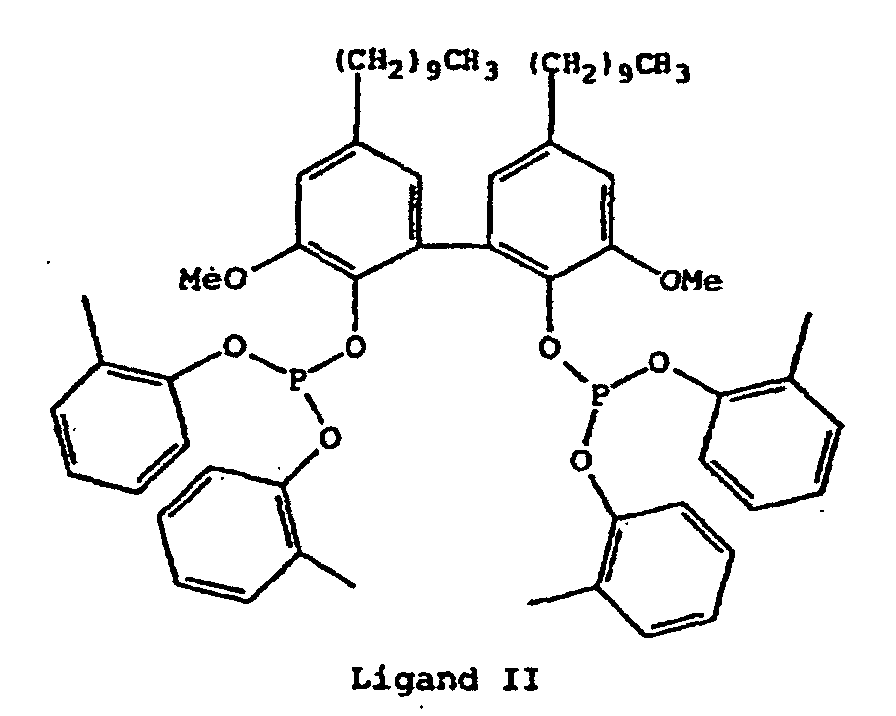
- Ligands I-III as noted below: where in Ligand III R is either CO(CH 2 ) 8 CH 3 or (CH 2 ) 9 CH 3 .
- the present invention provides a process for hydrocyanation, comprising reacting a nonconjugated ethylenically unsaturated compound with hydrogen cyanide in the presence of a Lewis Acid promoter and a catalyst system comprising a zero valent nickel compound and an organic phosphorus containing ligand having the structure (PR 2 ) n R' where n is an integer from 1 to 2, R and R' are organic residues which may be the same or different and where the R or R' contain at least one C9 to C40 aliphatic group positioned as a tail extending away from the primary ligand structure rendering the ligand lipophilic.
- the most preferred ligands are bidentate phosphites having at least one C9 to C40 aliphatic group positioned as a tail extending away from the bridging group(R') or the side arms (R) rendering the ligand lipophilic.
- the term lipophilic when used to modify the term ligand means that the ligand, in a two phase solvent system formed by mixing a polar with a non-polar solvent, will be substantially distributed in the non-polar phase.
- the present process combines a ligand structure and a two phase process solvent that allows the easy isolation of reaction products and byproducts from the catalyst system.
- process solvent as used herein means a solvent, added initially to the reaction as the reaction solvent, or a solvent or a mixture of solvents added following the reaction that is used to extract and separate components of the reaction system.
- extraction means the preferential partitioning or distribution of a compound in one of two immiscible liquid phases.
- a suitable starting material for the present process are nonconjugated acyclic aliphatic mono-olefins substrates containing from 2 to approximately 30 carbon atoms having at least one nonconjugated aliphatic carbon-carbon double bond.
- 3-Pentenenitrile, 4-pentenenitrile and alkyl-3-pentenoate are preferred.
- the alkyl group is preferably C1-C6. Most preferably, the alkyl group is methyl.
- 3-Pentenenitrile and 4-pentenenitrile are especially preferred.
- the nonconjugated acyclic aliphatic mono-olefins when used in accordance with this invention, up to about 10% by weight of the mono-olefin may be present in the form of a conjugated isomer, which itself may be subject to hydrocyanation.
- a conjugated isomer which itself may be subject to hydrocyanation.
- 3-pentenenitrile when used, as much as 10% by weight may be 2-pentenenitrile.
- Suitable unsaturated compounds include olefins and olefins substituted with groups which do not attack the catalyst, such as cyano.
- These unsaturated compounds include monoolefins containing 2 to 30 carbon atoms such as ethylene, propylene, butene-1, pentene-2, hexene-2, etc., nonconjugated diolefins such as allene, and substituted compounds such as 3-pentenenitrile, 4-pentenenitrile, and methyl-3-pentenoate.
- the present hydrocyanation process may be carried out by charging a reactor with all of the reactants, or preferably the reactor is charged with the catalyst precursor or catalyst components, the unsaturated organic compound, the promoter, and any solvent to be used.
- the hydrogen cyanide is added slowly.
- HCN may be delivered as a liquid or as a vapor to the reaction.
- Another technique is to charge the reactor with the catalyst, promoter, and any solvent to be used, and feed both the unsaturated compound and the HCN to the reaction mixture.
- the molar ratio of the unsaturated compound to catalyst generally is varied from about 10:1 to 2000:1.
- reaction medium is agitated, such as by stirring or shaking.
- the cyanated product can be recovered by conventional techniques such as distillation.
- the reaction may be run either batchwise or in a continuous manner.
- temperatures of from -25°C to 200°C can be used with from 0° to 150°C being preferred.
- Atmospheric pressure is satisfactory for carrying out the present invention and, hence, pressure of from about 0.05 to 10 atmospheres are preferred due to the obvious economic considerations, although pressures of from about 0.05 to 100 atmospheres can be used if desired.
- the zero-valent nickel can be prepared or generated according to techniques well known in the art (U.S. Pat. Nos. 3,496,217, 3,631,191, 3,846,461, 3,847,959, and 3,903,120 which are incorporated by reference).
- Zero-valent nickel compounds that contain ligands which can be displaced by the organophosphorous ligand are a preferred source of zero-valent nickel.
- Two such preferred zero-valent nickel compounds are Ni(COD) 2 (COD is 1,5-cyclooctadiene) and Ni(P(O-O-C 6 H 4 CH 3 ) 3 ) 2 (C 2 H 4 ), both of which are known in the art.
- divalent nickel compounds may be combined with a reducing agent, and are then able to serve as suitable sources of zero-valent nickel in the reaction.
- Suitable divalent nickel compounds include compounds of the formula NiY2 where Y is a halide, carboxylate, or acetylacetonate.
- Suitable reducing agents include metal borohydrides, metal aluminum hydrides, metal alkyls, Zn, Fe, Al, Na, or H 2 .
- Elemental nickel, preferably nickel powder, when combined with a halogenated catalyst, as described in U.S. Pat. No. 3,903,120, is also a suitable source of zero-valent nickel.
- the process of the present invention run in the presence of one or more Lewis acid promoters which may affect the activity and the selectivity of the catalyst system.
- the promoter may be an inorganic or organometallic compound in which the cation is selected from the group consisting of scandium, titanium, vanadium, chromium, manganese, iron, cobalt, copper, zinc, boron, aluminum, yttrium, zirconium, niobium, molybdenum, cadmium, rhenium and tin.
- nitriles by hydrocyanation particularly, in a continuous process, often times produces high boiling products that are formed from the condensation of the nitrile reaction products. These high boiling materials are particularly difficult to remove from the catalyst reaction system. In some cases the desired product may, itself, be high boiling and difficult to separate from the catalyst system.
- the present invention provides, through the proper selection of the ligand structure for the catalyst system and the selective use of solvents, a process in which the high boiling reaction products and byproducts may be easily separated from the catalyst system.
- the ligand of the present invention may be monodentate or bidentate
- the preferred ligands of the present invention are bidentate organic ligand having two trivalent phosphorous atoms wherein the ligand contains at least one C9 to C40 aliphatic group positioned on the backbone or side arm ring structures of the ligand.
- Bidentate ligands having two trivalent phosphorous may be of the class of phosphine, phosphite, phosphinite, or phosphonite.
- Particularly preferred ligands are bidentate organic phosphite ligands having at least one C9 to C40 aliphatic group positioned on the backbone or side arm ring structures of the ligand.
- the structure of any ligand used in a hydrocyanation catalyst system is generally selected such that backbone and side arms of the ligand structure provide the desired selectivity and activity.
- backbone refers to the bridging group between the two phosphorus atoms and the term side arms refer the non-bridging groups attached to the phosphorus atoms.
- backbone and side arm structures of bidentate ligands known for hydrocyanation may be modified for use in the present invention by adding to the ligand at least one C9 to C40 aliphatic group substituted for a hydrogen or some R group of the aromatic ring backbone or side arm structure.
- ligands known for hydrocyanation that already have at least one C9 to C40 aliphatic group on the backbone or side arm structures of the ligand may be used in the present invention.
- modifying is meant the substitution of the aliphatic group of the invention on a ligand already synthesized or changing the synthesis of the ligand so that the final structure contains at least one C9 to C40 aliphatic group.
- the ligand structures of the present invention provide long chain aliphatic group or tails that extend from the ligand structure causing the ligand to become preferentially soluble in a non-polar solvent.
- the substitution of the aliphatic group on a backbone or side arm position will contribute little if any to a change in the activity or selectivity of the ligand as used in the catalyst system for hydrocyanation.
- the present invention provides a ligand property that can work together with the two phase process solvent to make the separation of ligand and product simple and easy, while maintaining the activity and selectivity of the basic ligand structure (that is the activity and selectivity of the ligand not having the substitution of a smaller group by a C9 to C40 aliphatic group).
- the second aspect of the present invention is the use of a two phase process solvent.
- the two phase solvent mixture or process solvent may be used in three ways in the practice of the present invention. It may be used as the reaction solvent; or one of the components of the two phase solvent mixture may be used as the reaction solvent for the hydrocyanation reaction, and then the other component added following the hydrocyanation to serve to extract and separate products from the catalyst system; or the hydrocyanation reaction may be carried out with the ethylenically unsaturated compound also functioning as the reaction solvent; then following the hydrocyanation, the two phase process solvent is added to the reaction mixture to extract and separate products from the catalyst system.
- the two solvents are said to be immiscible.
- immiscible solvents When immiscible solvents are mixed together, they separate into two phases - the less dense phase floating on the more dense phase.
- polar solvents are generally those that contain electronegative atoms such as oxygen or nitrogen, are of lower molecular weights and mix with water.
- Non-polar solvents are those that contain primarily hydrogen and carbon, that do not mix with water but that mix readily with oil.
- polar means to hydrophilic or lipophobic; while the term non-polar means hydrophobic or lipophilic.
- a lipophilic ligand is one that is preferentially soluble in a non-polar solvent or in the more non-polar of a two solvent mixture.
- this two phase solvent mixture may be present as the initial reaction solvent for the hydrocyanation. It may be added as a two phase mixed solvent following the hydrocyanation as an extraction medium. Or a single solvent may be added to the reaction mixture causing the formation of a two phase mixture from which the desired component of the hydrocyanation reaction system may be isolated.
- the ligand structures of the present invention having extended aliphatic tails that may be as long as C40, cause the ligand to be preferentially soluble in the non-polar component of the two phase solvent mixture.
- the present invention also allows for the adjustment of the polarity of the ligand by the choice of longer tails and a greater number of tails being used to provide a more non-polar ligand.
- Examples of polar compounds suitable for forming the two phase solvent mixture include water, dimethylacetamide (DMAc), dimethyl sulfoxide (DMSO); methanol, ethanol, dimethylformamide (DMF), acetonitrile, adiponitrile (ADN) N-methyl pyrrolidone(NMP).
- DMAc dimethylacetamide
- DMSO dimethyl sulfoxide
- DMF dimethylformamide
- ADN acetonitrile
- NMP N-methyl pyrrolidone
- Non-polar component Compounds such as C5 to C20 hydrocarbons including linear, branched, cyclic or aromatic compounds are examples of compounds that may be used as the non-polar component. Higher molecular weight alcohols, aldehydes, esters or ketones may also be used as the non-polar component.
- non-polar compounds suitable in the process of the present invention include hexane, cyclohexane, hexene, petroleum ethers and naphta.
- aromatic solvent it is preferred that the aromatic solvent molecule have aliphatic side chains to ensure that it is non-polar enough to form a second phase when mixed with the reaction products of the hydrocyanation.
- a polar solvent may be added to the reaction mixture after the hydrocyanation reaction is completed but before any products are isolated from the mixture.
- a process would occur as follows: (a) reacting the ethylenically unsaturated compound with HCN in the presence of Lewis acid promoter and a catalyst system composed of a zero valent nickel compound and a ligand of the present invention in a reaction solvent to form a reaction mixture, (b) adding a non-polar solvent to the reaction product of step (a) so that two phases are formed and allowing the catalyst system to be extracted into the non-polar solvent, (c) isolation of the non-polar solvent layer, (d) evaporation of the non-polar solvent to isolate the catalyst system, (e) returning the isolated catalyst system to step (a).
- the reaction solvent may be an the olefinic reactant.
- Another way to practice the present invention is by removing any volatiles, including reaction products prior to addition of a non-polar solvent.
- Such a process would occur as follows: (a) reacting an ethylenically unsaturated compound by hydrocyanation in the presence a polar solvent or an excess of the ethylenically unsaturated compound and a catalyst system comprising a zero valent nickel and the ligand of the present invention, (b) removal of volatiles from the reaction media of step (a), (c) dissolving the catalyst system in a non-polar solvent such as a C5 to C20 hydrocarbon solvent so that two layers are formed or adding a two phases solvent mixture to the reaction mixture, (d) isolation of the non-polar solvent containing the catalyst system, (d) evaporation of the hydrocarbon solvent to isolate the catalyst system, (e) returning the isolated catalyst system to step (a) and recovery of either solvent or products distributed in the polar phase.
- a non-polar solvent such as a C5 to C20 hydrocarbon solvent
- reaction would be run in a two phase reaction solvent.
- phase can be separated by conventional means and the product recovered and the catalyst may be recycled for further reaction.
- the extraction step in the present invention may be carried out at room temperature and atmospheric pressure or at other conditions that are suitable in the overall processing of batch or continuous hydrocyanation operations.
- pressures for extraction may be from 0.1 to 1 Pa, with a range of 0.1 to 0.2 Pa being preferred, and temperatures for the extraction may be from 0 to 120°C, with a preferred range from 15 to 50°C.
- the preferred way to practice the present invention is to allow the hydrocyanation reaction to take place in an excess of the ethylenically unsaturated compound. Then following the hydrocyanation reaction to add a two phase solvent mixture to partition and extract the reaction products in the polar phase of the solvent mixture and the catalyst system in the non-polar phase.
- the process of this invention may be run in either a continuous or batch mode.
- a continuous mode is preferred while batch mode is more practical for smaller scale reactions.
- Zinc (22 g, 0.34 mol) was amalgamated with a solution of 0.475 g (17.5 mmol) of mercuric chloride in 100 mL H 2 O.
- the amalgamated zinc was suspended in a mixture of 20 mL of H 2 O and 20 mL of concentrated HCl and then 3.69 g (14 mmol) of 2, dissolved in 50 mL ethanol were added.
- the mixture was agitated vigorously and refluxed for 48 hours.
- the reaction mixture was extracted with toluene and the organic layer extracted with 3 portions of 100 mL of water.
- the organic layer was dried over MgSO 4 , the solvent removed under vacuum and the product isolated by high vacuum distillation (130°C at 0.01 mm Hg). 3 (3 g) was isolated as a colorless oil in 80% yield.
- Zinc (20 g, 0.306 mol) was amalgamated with a solution of 0.44 g (0.162 mmol) of mercuric chloride in 30 mL H 2 O.
- the amalgamated zinc was suspended in a mixture of 20 mL of H 2 O and 20 mL of concentrated HCl and then 5.79 g (21 mmol) of 7, dissolved in 100 mL ethanol were added.
- the mixture was agitated vigorously and refluxed for 48 hours.
- the reaction mixture was extracted with toluene and the organic layer extracted with 3 portions of 100 mL of water.
- the organic layer was dried over MgSO4, the solvent removed under vacuum and the product isolated by high vacuum distillation (140°C at 0.005 mm Hg). 8 (5 g) was isolated as a colorless oil in 86% yield.
- Zinc (22 g, 0.34 mol) was amalgamated with a solution of 0.475 g (17.5 mmol) of mercuric chloride in 100 mL H 2 O.
- the amalgamated zinc was suspended in a mixture of 20 mL of H 2 O and 20 mL of concentrated HCl and then 6.1 g (0.021 mmol) of 12, dissolved in 50 mL ethanol, were added.
- the mixture was agitated vigorously and refluxed for 48 hours.
- the reaction mixture was extracted with toluene and the organic layer extracted with 3 portions of 100 mL of water.
- the organic layer was dried over MgSO 4 , the solvent removed under vacuum and the product isolated by high vacuum distillation (170°C at 0.005 mmHg). 13 (5.07 g) was isolated as a colorless oil in 87% yield.
- Reaction mixtures were heated in a thermostatically controlled oil bath.
- HCN vapor was delivered to the reaction flask as an HCN/N 2 gas mixture by bubbling dry N 2 gas through liquid HCN maintained at 0°C in a wet ice bath. This provided a vapor stream which was roughly 35% HCN (vol/vol).
- the rate of HCN delivery was adjusted by varying the rate of N 2 flow.
- Sample analyses were done by gas chromatography using a DB-23 capillary column.
Landscapes
- Chemical & Material Sciences (AREA)
- Organic Chemistry (AREA)
- Health & Medical Sciences (AREA)
- Toxicology (AREA)
- Life Sciences & Earth Sciences (AREA)
- Biochemistry (AREA)
- General Health & Medical Sciences (AREA)
- Molecular Biology (AREA)
- Organic Low-Molecular-Weight Compounds And Preparation Thereof (AREA)
- Low-Molecular Organic Synthesis Reactions Using Catalysts (AREA)
- Catalysts (AREA)
Abstract
Description
- The invention generally relates to a process useful for the hydrocyanation of an ethylenically unsaturated compounds in the presence of a Lewis Acid promoter and a catalyst system comprising zero-valent nickel and an organic phosphorous containing ligand having the structure (PR2)nR' where n is an integer from 1 to 2, R and R' are organic residues which may be the same or different and where the R or R' contain at least one C9 to C40 aliphatic group positioned as a tail extending away from the primary ligand structure rendering the ligand lipophilic.
- Hydrocyanation catalyst systems, particularly pertaining to the hydrocyanation of olefins, are known in the art. For example, systems useful for the hydrocyanation of butadiene to form pentenenitrile (PN) and in the subsequent hydrocyanation of the pentenenitrile (PN) to form adiponitrile (ADN) are known in the commercially important nylon synthesis field.
- The hydrocyanation of olefins using transition metal complexes with monodentate phosphite ligand is documented in the prior art. See for example; U.S. Pat. Nos. 3,496,215, 3,631,191, 3,655,723, and 3,766,237, and Tolman, C.A.; McKinney, R.J.; Seidel, W.C.; Druliner, J.D.; and Stevens, W.R. in Catalysis, 33, 1, 1985.
- The hydrocyanation of activated olefins such as conjugated olefins (e.g., butadiene and styrene) and strained olefins (e.g., norborene) proceeds without the use of a Lewis Acid promoter, while hydrocyanation of unactivated olefins such as 1-octene and 3-pentenenitrile requires the use of a Lewis Acid promoter. Teachings regarding the use of a promoter in the hydrocyanation reaction appear, for example, in U.S. Pat. No. 3,496,217. This patent discloses an improvement in hydrocyanation using a promoter selected from a large number of metal cation compounds with a variety of anions as catalyst promoters.
- U.S. Pat. No. 3,496,218 discloses a nickel hydrocyanation catalyst promoted with various boron-containing compounds, including triphenylboron and alkali metal borohydrates. U.S. Pat. No. 4,774,353 discloses a process for the preparation of dinitriles, including ADN, from unsaturated nitriles, including PN, in the presence of a zero-valent nickel catalyst and a triorganotin catalyst promoter. U.S. Pat. No. 4,874,884 discloses a process for producing ADN by the zero-valent nickel catalyzed hydrocyanation of pentenenitriles in the presence of a synergistic combination of promoters selected in accordance with the reaction kinetics of the ADN synthesis.
- Use of bidentate phosphorous ligands similar to those used in the present invention have been disclosed in the literature for the hydrocyanation of both activated and unactivated olefins. Such publications include: Baker, M.M. and Pringle, P.G.; J. Chem. Soc., Chem. Commun. 1292, 1991; Baker, M.J.; Harrison, R.N.; Orpen, A.G.; Pringle, P.G.; and Shaw, G.; J. Chem. Soc., Chem. Commun., 803, 1991, WO/93/03839, WO/95/14659, and WO/96/22968.
- These prior patents teach catalyst structures and improvements in continuous processes for hydrocyanation, but none address the problem of isolating product, byproduct and catalyst one from the other. Yet, in all hydrocyanation processes the catalyst must be separated from the reaction products. U.S. Pat. No.'s 3,773,809; 4,082,811 and 4,339,395 teach processing techniques for the isolation of the hydrocyanation reactants, products and catalyst system. Patent 3,773,809 teaches a control of the ratio of the product mononitrile to the product dinitriles such that the reaction mixture is two phase. Patent 4,433,395 teaches the addition of ammonia to aid in the separation of products, reactants and the catalyst system. Patent 4,082,811 teaches the precipitation of the catalyst as a means to recover it from the process mixture.
- The present invention provides a process by which the reaction products, including high boiling products and byproducts may be easily separated from the reaction catalyst system. In the present process the catalyst system may be readily separated from reaction products and recycled for use in the process thus providing longer active catalyst system productivity.
- The present invention provides a process for hydrocyanation comprising reacting a nonconjugated, ethylenically unsaturated compound with HCN in the presence of a Lewis acid promoter and a catalyst system comprising a zero valent nickel compound and an organic phosphorous containing ligand having the structure (PR2)nR' where n is an integer from 1 to 2, R and R' are organic residues which may be the same or different and where the R or R' contain at least one C9 to C40 aliphatic group positioned as a tail extending away from the primary ligand structure rendering the ligand lipophilic. The process solvent is a two phase mixture of an organic compound having from 5 to 20 carbon atoms and polar solvent. The most preferred ligands are bidentate phosphites, (POR2)2OR', where at least one C9 to C40 aliphatic group positioned on the backbone or side arm ring structures of the ligand.
- The present process may be represented as a series of process steps comprising:
- (a) reacting the ethylenically unsaturated compound in a reaction solvent to form a reaction mixture with HCN in the presence of Lewis acid promoter and a catalyst system composed of a zero valent nickel compound and an organic phosphorous containing ligand having the structure (PR2)nR' where n is an integer from 1 to 2, R and R' are organic residues which may be the same or different and where the R or R' contain at least one C9 to C40 aliphatic group positioned as a tail extending away from the primary ligand structure rendering the ligand lipophilic;
- (b) adding a non-polar solvent to the reaction mixture to form two phases, one a polar phase predominately formed from the reaction products and one formed predominately from the non-polar solvent and the catalyst system such that the reaction products including the high boiling reaction products of the hydrocyanation remain in the polar phase and the catalyst system is partitioned substantially into the non-polar phase; and
- (c) separating the two phases and isolating the reaction products from the polar phase and the catalyst from the non-polar phase.
-
- The preferred ligand is a bidentate phosphite ligand having the structure (POR2)2OR' where R and R' are organic residues and where the R or R' contain at least one C9 to C20 aliphatic group positioned as a tail extending away from the bridging group(R') or the side arms (R) rendering the ligand lipophilic.
- Volatiles may be removed in the present process from the reaction mixture of step (a) before the addition of the non-polar solvent of step (b). Also in the present process steps (a) and (b) may be combined so that the hydrocyanation is carried out in a two phase reaction solvent.
- The present process may be run as a batch or a continuous process. In a continuous process the recovered catalyst is returned to step (a) and the steps are repeated.
- The present process also provides an improved hydrocyanation process where a nonconjugated, ethylenically unsaturated compound is reacted with HCN in the presence of a Lewis acid promoter and a catalyst system composed of a zero valent nickel compound and a bidentate organic phosphorous containing ligand wherein the ethylenically unsaturated compound also functions as reaction solvent, the improvement comprising:
- forming the catalyst system from the ligand having the structure (PR2)nR' where n is an integer from 1 to 2, R and R' are organic residues which may be the same or different and where the R or R' contain at least one C9 to C40 aliphatic group positioned as a tail extending away from the primary ligand structure rendering the ligand lipophilic; and following hydrocyanation of the ethylenically unsaturated compound adding to the reaction mixture a two phase solvent mixture consisting of a polar and a non-polar phase so that the reaction products of the hydrocyanation are extracted into the polar phase of the solvent mixture and the catalyst system remains substantially in the non-polar phase of the solvent mixture.
-
- Preferred structures for the ligands of the present invention are Ligands I-III as noted below:
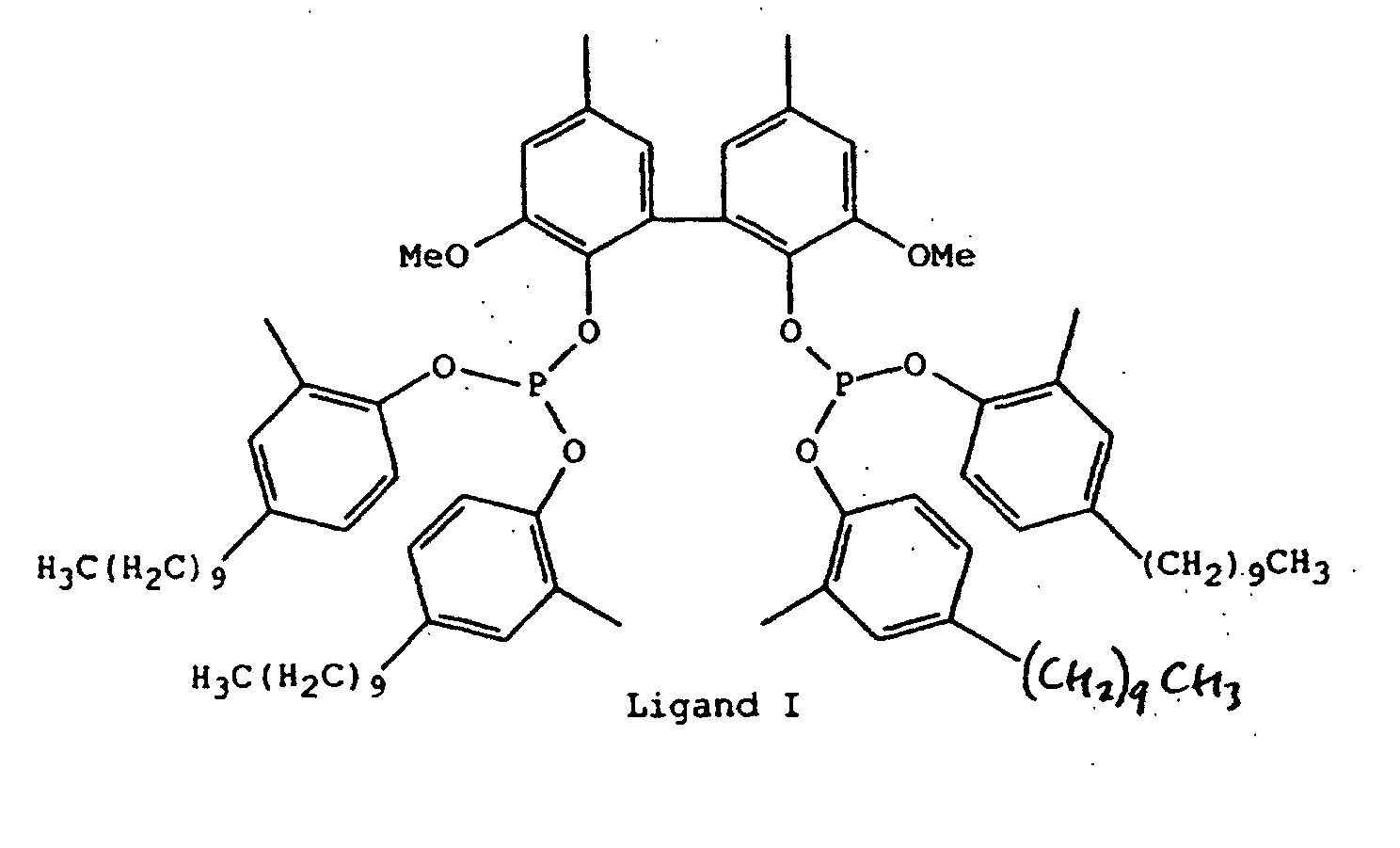
 where in Ligand III R is either CO(CH2)8CH3 or (CH2)9CH3.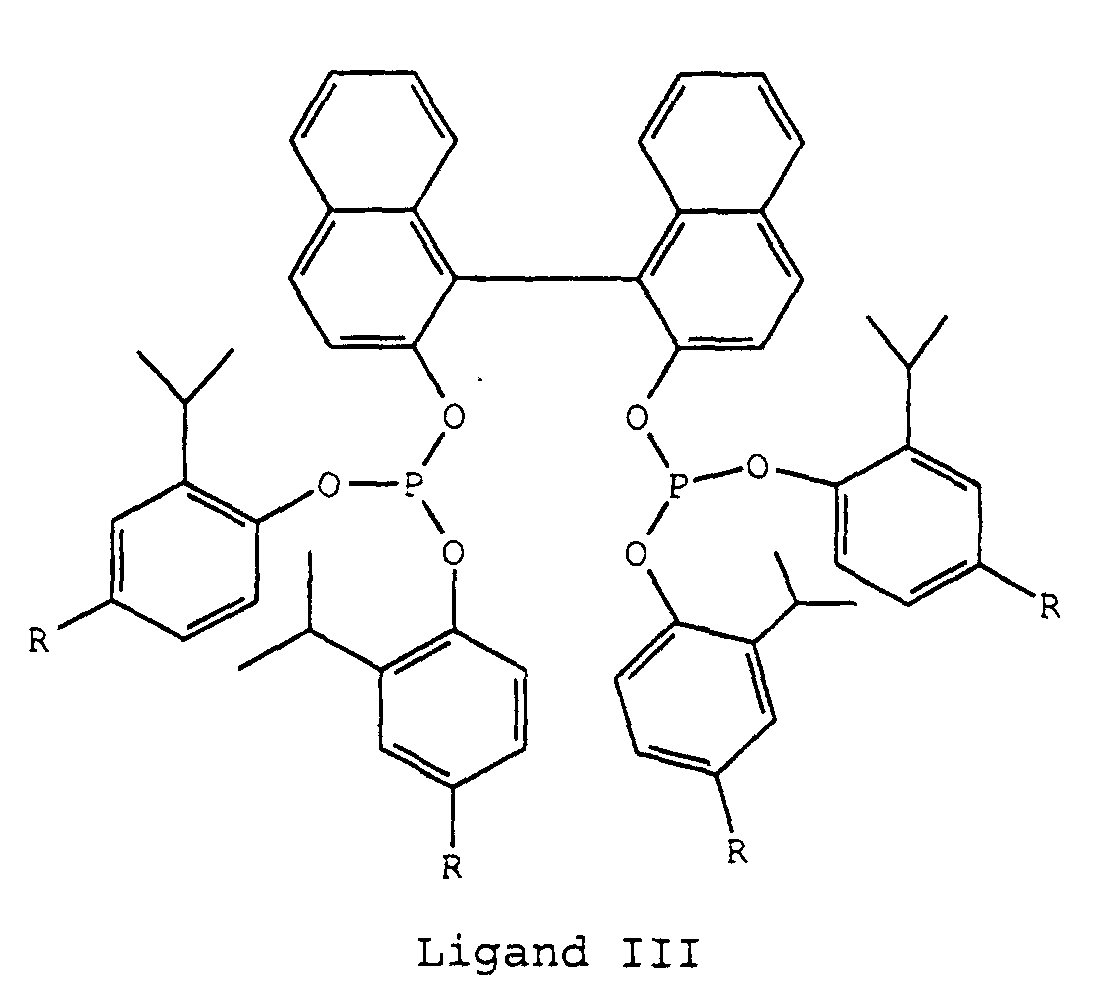
- The present invention provides a process for hydrocyanation, comprising reacting a nonconjugated ethylenically unsaturated compound with hydrogen cyanide in the presence of a Lewis Acid promoter and a catalyst system comprising a zero valent nickel compound and an organic phosphorus containing ligand having the structure (PR2)nR' where n is an integer from 1 to 2, R and R' are organic residues which may be the same or different and where the R or R' contain at least one C9 to C40 aliphatic group positioned as a tail extending away from the primary ligand structure rendering the ligand lipophilic. The most preferred ligands are bidentate phosphites having at least one C9 to C40 aliphatic group positioned as a tail extending away from the bridging group(R') or the side arms (R) rendering the ligand lipophilic. The term lipophilic when used to modify the term ligand means that the ligand, in a two phase solvent system formed by mixing a polar with a non-polar solvent, will be substantially distributed in the non-polar phase.
- The present process combines a ligand structure and a two phase process solvent that allows the easy isolation of reaction products and byproducts from the catalyst system. The term process solvent as used herein means a solvent, added initially to the reaction as the reaction solvent, or a solvent or a mixture of solvents added following the reaction that is used to extract and separate components of the reaction system. The term extraction means the preferential partitioning or distribution of a compound in one of two immiscible liquid phases.
- A suitable starting material for the present process are nonconjugated acyclic aliphatic mono-olefins substrates containing from 2 to approximately 30 carbon atoms having at least one nonconjugated aliphatic carbon-carbon double bond. 3-Pentenenitrile, 4-pentenenitrile and alkyl-3-pentenoate are preferred. In the case of alkyl-3-pentenoate, the alkyl group is preferably C1-C6. Most preferably, the alkyl group is methyl. 3-Pentenenitrile and 4-pentenenitrile are especially preferred. As a practical matter, when the nonconjugated acyclic aliphatic mono-olefins are used in accordance with this invention, up to about 10% by weight of the mono-olefin may be present in the form of a conjugated isomer, which itself may be subject to hydrocyanation. For example, when 3-pentenenitrile is used, as much as 10% by weight may be 2-pentenenitrile. Suitable unsaturated compounds include olefins and olefins substituted with groups which do not attack the catalyst, such as cyano. These unsaturated compounds include monoolefins containing 2 to 30 carbon atoms such as ethylene, propylene, butene-1, pentene-2, hexene-2, etc., nonconjugated diolefins such as allene, and substituted compounds such as 3-pentenenitrile, 4-pentenenitrile, and methyl-3-pentenoate.
- The present hydrocyanation process may be carried out by charging a reactor with all of the reactants, or preferably the reactor is charged with the catalyst precursor or catalyst components, the unsaturated organic compound, the promoter, and any solvent to be used. The hydrogen cyanide is added slowly. HCN may be delivered as a liquid or as a vapor to the reaction. Another technique is to charge the reactor with the catalyst, promoter, and any solvent to be used, and feed both the unsaturated compound and the HCN to the reaction mixture. The molar ratio of the unsaturated compound to catalyst generally is varied from about 10:1 to 2000:1.
- Preferably the reaction medium is agitated, such as by stirring or shaking. The cyanated product can be recovered by conventional techniques such as distillation. The reaction may be run either batchwise or in a continuous manner.
- The exact temperature which is preferred is dependent to a certain extent on the particular catalyst being used, the particular unsaturated compound being used, and the desired rate. Generally, temperatures of from -25°C to 200°C can be used with from 0° to 150°C being preferred.
- Atmospheric pressure is satisfactory for carrying out the present invention and, hence, pressure of from about 0.05 to 10 atmospheres are preferred due to the obvious economic considerations, although pressures of from about 0.05 to 100 atmospheres can be used if desired.
- The zero-valent nickel can be prepared or generated according to techniques well known in the art (U.S. Pat. Nos. 3,496,217, 3,631,191, 3,846,461, 3,847,959, and 3,903,120 which are incorporated by reference). Zero-valent nickel compounds that contain ligands which can be displaced by the organophosphorous ligand are a preferred source of zero-valent nickel. Two such preferred zero-valent nickel compounds are Ni(COD)2(COD is 1,5-cyclooctadiene) and Ni(P(O-O-C6H4CH3)3)2(C2H4), both of which are known in the art. Alternatively, divalent nickel compounds may be combined with a reducing agent, and are then able to serve as suitable sources of zero-valent nickel in the reaction. Suitable divalent nickel compounds include compounds of the formula NiY2 where Y is a halide, carboxylate, or acetylacetonate. Suitable reducing agents include metal borohydrides, metal aluminum hydrides, metal alkyls, Zn, Fe, Al, Na, or H2. Elemental nickel, preferably nickel powder, when combined with a halogenated catalyst, as described in U.S. Pat. No. 3,903,120, is also a suitable source of zero-valent nickel.
- Typically the process of the present invention run in the presence of one or more Lewis acid promoters which may affect the activity and the selectivity of the catalyst system. The promoter may be an inorganic or organometallic compound in which the cation is selected from the group consisting of scandium, titanium, vanadium, chromium, manganese, iron, cobalt, copper, zinc, boron, aluminum, yttrium, zirconium, niobium, molybdenum, cadmium, rhenium and tin.
- The formation of nitriles by hydrocyanation, particularly, in a continuous process, often times produces high boiling products that are formed from the condensation of the nitrile reaction products. These high boiling materials are particularly difficult to remove from the catalyst reaction system. In some cases the desired product may, itself, be high boiling and difficult to separate from the catalyst system. The present invention provides, through the proper selection of the ligand structure for the catalyst system and the selective use of solvents, a process in which the high boiling reaction products and byproducts may be easily separated from the catalyst system.
- Although the ligand of the present invention may be monodentate or bidentate, the preferred ligands of the present invention are bidentate organic ligand having two trivalent phosphorous atoms wherein the ligand contains at least one C9 to C40 aliphatic group positioned on the backbone or side arm ring structures of the ligand. Bidentate ligands having two trivalent phosphorous may be of the class of phosphine, phosphite, phosphinite, or phosphonite.
- Particularly preferred ligands are bidentate organic phosphite ligands having at least one C9 to C40 aliphatic group positioned on the backbone or side arm ring structures of the ligand. Especially preferred are ligands having the structure:

 wherein Ligand III R is either CO(CH2)8CH3 or (CH2)9CH3.
- The structure of any ligand used in a hydrocyanation catalyst system is generally selected such that backbone and side arms of the ligand structure provide the desired selectivity and activity. The term backbone refers to the bridging group between the two phosphorus atoms and the term side arms refer the non-bridging groups attached to the phosphorus atoms.
- Many backbone and side arm structures of bidentate ligands known for hydrocyanation may be modified for use in the present invention by adding to the ligand at least one C9 to C40 aliphatic group substituted for a hydrogen or some R group of the aromatic ring backbone or side arm structure. Also ligands known for hydrocyanation that already have at least one C9 to C40 aliphatic group on the backbone or side arm structures of the ligand may be used in the present invention. By the term modifying is meant the substitution of the aliphatic group of the invention on a ligand already synthesized or changing the synthesis of the ligand so that the final structure contains at least one C9 to C40 aliphatic group.
- The ligand structures of the present invention provide long chain aliphatic group or tails that extend from the ligand structure causing the ligand to become preferentially soluble in a non-polar solvent. The substitution of the aliphatic group on a backbone or side arm position will contribute little if any to a change in the activity or selectivity of the ligand as used in the catalyst system for hydrocyanation. Thus by adapting the ligand to be preferentially soluble in a non-polar solvent, the present invention provides a ligand property that can work together with the two phase process solvent to make the separation of ligand and product simple and easy, while maintaining the activity and selectivity of the basic ligand structure (that is the activity and selectivity of the ligand not having the substitution of a smaller group by a C9 to C40 aliphatic group).
- The second aspect of the present invention is the use of a two phase process solvent. As described below the two phase solvent mixture or process solvent may be used in three ways in the practice of the present invention. It may be used as the reaction solvent; or one of the components of the two phase solvent mixture may be used as the reaction solvent for the hydrocyanation reaction, and then the other component added following the hydrocyanation to serve to extract and separate products from the catalyst system; or the hydrocyanation reaction may be carried out with the ethylenically unsaturated compound also functioning as the reaction solvent; then following the hydrocyanation, the two phase process solvent is added to the reaction mixture to extract and separate products from the catalyst system.
- Generally when one solvent does not dissolve in another solvent, or when a first solvent has a low or limited solubility in a second solvent, the two solvents are said to be immiscible. When immiscible solvents are mixed together, they separate into two phases - the less dense phase floating on the more dense phase. Also generally, when a mixture of two or more solvents form separate phases one phase is said to polar relative to the other. Polar and non-polar are relative terms, but polar solvents are generally those that contain electronegative atoms such as oxygen or nitrogen, are of lower molecular weights and mix with water. Non-polar solvents are those that contain primarily hydrogen and carbon, that do not mix with water but that mix readily with oil. As used herein, the term polar means to hydrophilic or lipophobic; while the term non-polar means hydrophobic or lipophilic. Thus, a lipophilic ligand is one that is preferentially soluble in a non-polar solvent or in the more non-polar of a two solvent mixture.
- To form the two phase process solvent of the present invention, one mixes a polar and a non-polar solvent or mixtures of polar and non-polar solvents to form two phases. One phase is more lipophilic than the other. As described above, this two phase solvent mixture may be present as the initial reaction solvent for the hydrocyanation. It may be added as a two phase mixed solvent following the hydrocyanation as an extraction medium. Or a single solvent may be added to the reaction mixture causing the formation of a two phase mixture from which the desired component of the hydrocyanation reaction system may be isolated.
- In selecting solvent components for the two phase solvent mixture, it is only essential that the two components form two separate phases when mixed together. The ligand structures of the present invention, having extended aliphatic tails that may be as long as C40, cause the ligand to be preferentially soluble in the non-polar component of the two phase solvent mixture. The present invention also allows for the adjustment of the polarity of the ligand by the choice of longer tails and a greater number of tails being used to provide a more non-polar ligand.
- Examples of polar compounds suitable for forming the two phase solvent mixture include water, dimethylacetamide (DMAc), dimethyl sulfoxide (DMSO); methanol, ethanol, dimethylformamide (DMF), acetonitrile, adiponitrile (ADN) N-methyl pyrrolidone(NMP).
- Compounds such as C5 to C20 hydrocarbons including linear, branched, cyclic or aromatic compounds are examples of compounds that may be used as the non-polar component. Higher molecular weight alcohols, aldehydes, esters or ketones may also be used as the non-polar component. Examples of non-polar compounds suitable in the process of the present invention include hexane, cyclohexane, hexene, petroleum ethers and naphta. For an aromatic solvent used in the practice of the present invention, it is preferred that the aromatic solvent molecule have aliphatic side chains to ensure that it is non-polar enough to form a second phase when mixed with the reaction products of the hydrocyanation.
- If the reaction conditions are at sufficient pressure, even C4 hydrocarbons could be used as the non-polar component of the solvent mixture.
- In the practice of the present invention, a polar solvent may be added to the reaction mixture after the hydrocyanation reaction is completed but before any products are isolated from the mixture. Such a process would occur as follows: (a) reacting the ethylenically unsaturated compound with HCN in the presence of Lewis acid promoter and a catalyst system composed of a zero valent nickel compound and a ligand of the present invention in a reaction solvent to form a reaction mixture, (b) adding a non-polar solvent to the reaction product of step (a) so that two phases are formed and allowing the catalyst system to be extracted into the non-polar solvent, (c) isolation of the non-polar solvent layer, (d) evaporation of the non-polar solvent to isolate the catalyst system, (e) returning the isolated catalyst system to step (a). In the case of this method to practice the present invention, the reaction solvent may be an the olefinic reactant.
- Another way to practice the present invention is by removing any volatiles, including reaction products prior to addition of a non-polar solvent. Such a process would occur as follows: (a) reacting an ethylenically unsaturated compound by hydrocyanation in the presence a polar solvent or an excess of the ethylenically unsaturated compound and a catalyst system comprising a zero valent nickel and the ligand of the present invention, (b) removal of volatiles from the reaction media of step (a), (c) dissolving the catalyst system in a non-polar solvent such as a C5 to C20 hydrocarbon solvent so that two layers are formed or adding a two phases solvent mixture to the reaction mixture, (d) isolation of the non-polar solvent containing the catalyst system, (d) evaporation of the hydrocarbon solvent to isolate the catalyst system, (e) returning the isolated catalyst system to step (a) and recovery of either solvent or products distributed in the polar phase.
- In another way of practicing the present invention of the invention, the reaction would be run in a two phase reaction solvent. Following reaction, the phase can be separated by conventional means and the product recovered and the catalyst may be recycled for further reaction.
- The extraction step in the present invention may be carried out at room temperature and atmospheric pressure or at other conditions that are suitable in the overall processing of batch or continuous hydrocyanation operations. For example, pressures for extraction may be from 0.1 to 1 Pa, with a range of 0.1 to 0.2 Pa being preferred, and temperatures for the extraction may be from 0 to 120°C, with a preferred range from 15 to 50°C.
- The preferred way to practice the present invention is to allow the hydrocyanation reaction to take place in an excess of the ethylenically unsaturated compound. Then following the hydrocyanation reaction to add a two phase solvent mixture to partition and extract the reaction products in the polar phase of the solvent mixture and the catalyst system in the non-polar phase.
- The process of this invention may be run in either a continuous or batch mode. In general for large scale industrial processes, a continuous mode is preferred while batch mode is more practical for smaller scale reactions.
- The following examples are presented to further illustrate but not limit the instant invention.
-
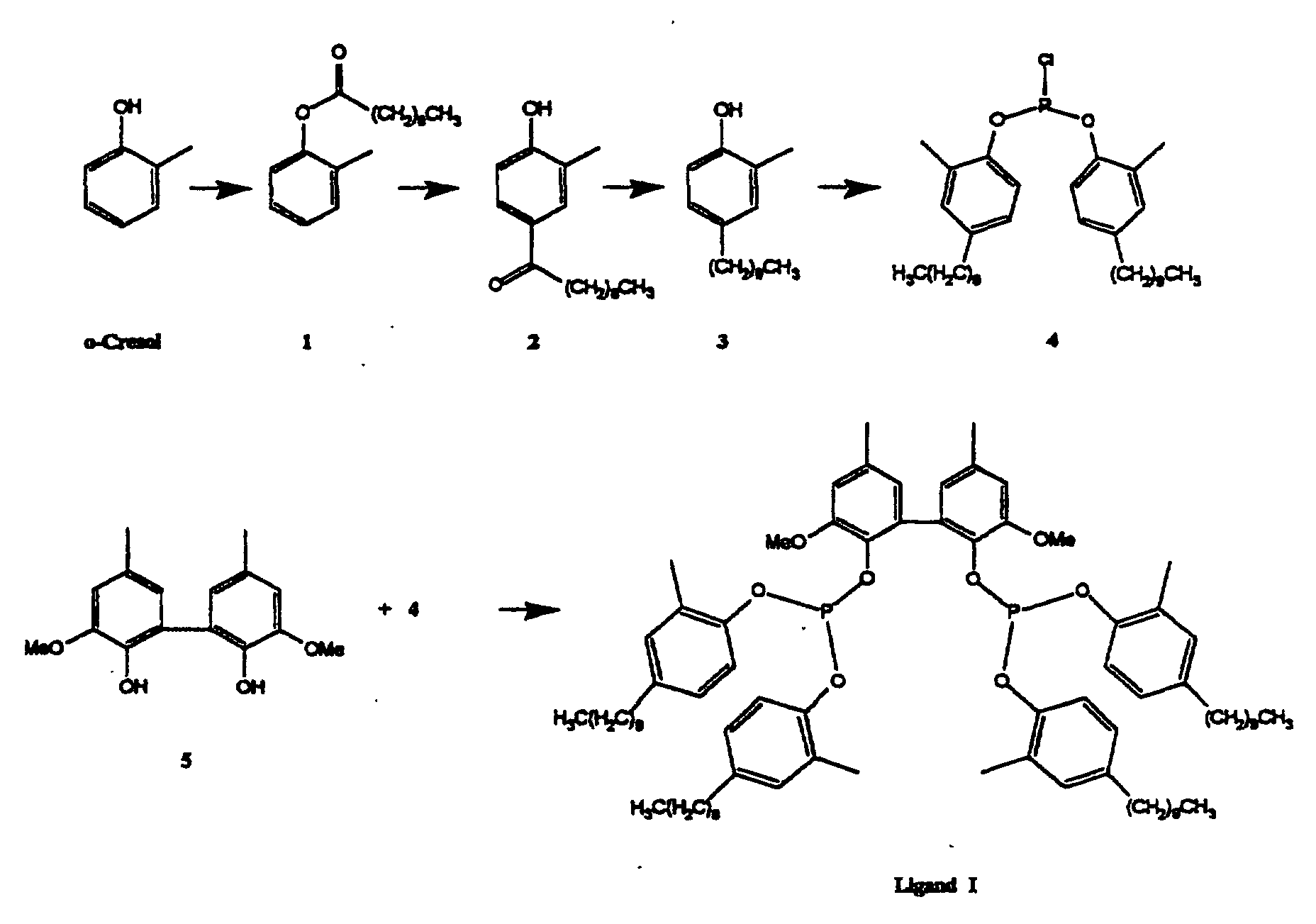
- A solution of 109 g (1.08 mol) of triethylamine and 74.4 g (0.688 mol) of o-cresol in 100 mL of diethyl ether was added slowly over a period of three hours to a solution of 130 g (0.682 mol) of decanoyl chloride in 200 mL of diethyl ether. The mixture was stirred at 25°C for 5 hours and diethyl ether was removed under vacuum. 200 mL of pentane were added, triethylamine hydrochloride filtered and the solvent was evaporated under vacuum to yield 175 g (97%) of 1 as a colorless oil.
- A solution of 26 g (0.099 mol) of 1 in 250 mL of nitrobenzene was cooled to 0°C. TiCl4 (38.5 g, 0.203 mol) was added over a 20 minutes period and the solution was stirred for 1 hour at 0°C, then the mixture was allowed to warm to room temperature and stirred overnight. The reaction was quenched by adding 100 mL of 10% HCl. The mixture was extracted with 500 mL of hexane and dried with MgSO4. The solvents were removed under vacuum and the product distilled (140°C at 0.005 mm Hg) to yield 3.9 g (15%) 2 as a colorless oil.
- Zinc (22 g, 0.34 mol) was amalgamated with a solution of 0.475 g (17.5 mmol) of mercuric chloride in 100 mL H2O. The amalgamated zinc was suspended in a mixture of 20 mL of H2O and 20 mL of concentrated HCl and then 3.69 g (14 mmol) of 2, dissolved in 50 mL ethanol were added. The mixture was agitated vigorously and refluxed for 48 hours. The reaction mixture was extracted with toluene and the organic layer extracted with 3 portions of 100 mL of water. The organic layer was dried over MgSO4, the solvent removed under vacuum and the product isolated by high vacuum distillation (130°C at 0.01 mm Hg). 3 (3 g) was isolated as a colorless oil in 80% yield.
- A solution of Cl2PNEt2 (0.347 g, 1.99 mmol) in 50 mL of diethylether was added slowly to a mixture of 3 (0.99 g, 3.99 mmol) and NEt3 (0.515 g, 5.09 mmol) in 50 mL of Et2O. After stirring for 1 hour at room temperature, 3 mL of 1M HCl in Et2O were added and stirring was continued for 15 minutes. The solvent was removed under vacuum and replaced with 50 mL of pentane. The mixture was filtered through celite and the solvent evaporated leaving an oily residue. 4 was isolated as colorless oil (0.47 g) in 42% yield.
- A solution of the 5 (0.183 g, 0.668 mmol) and NEt3 (0.268 g, 2.64 mmol) in 20 mL of toluene was added in small portions to a solution of 4 (0.75 g, 1.34 mmol) in 20 mL of toluene. The solvent was removed under vacuum and replaced with 50 mL of pentane. The mixture was filtered through celite and the solvent evaporated in vacuo, leaving an oily residue. The residue was dissolved in 5 mL of CH2Cl2 and filtered through a small pad of neutral alumina.
- Ligand I (0.83 g) was isolated as a colorless oil in 94% yield. 31P{1H} (500 MHz, CD2Cl2) :135.5
-
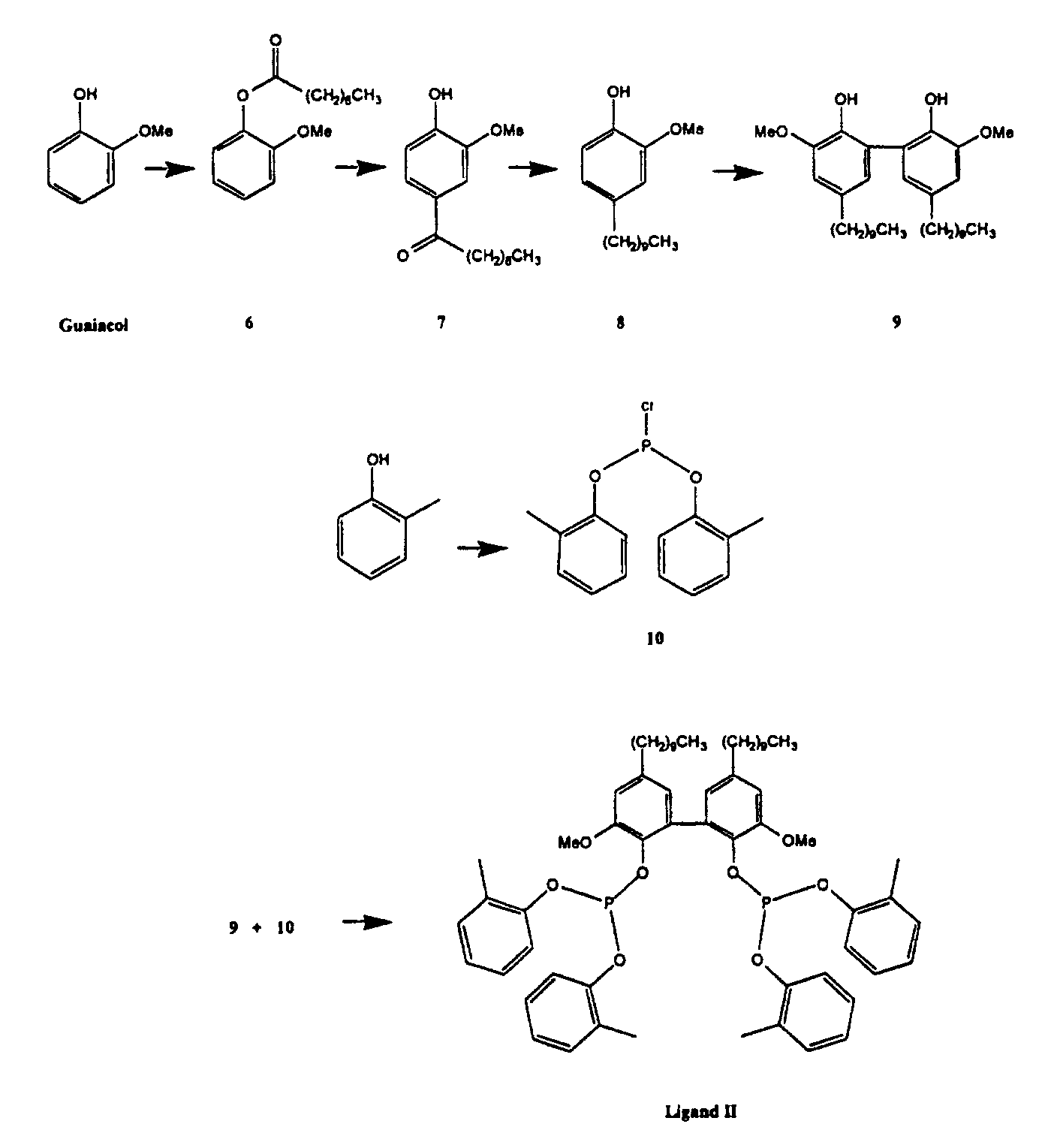
- A solution of 35.7 g (0.353 mol) of triethylamine and 38.1 g (0.307 mol) of Guaiacol in 100 mL of diethyl ether was added slowly over a period of three hours to a solution of 58.6 g (0.307 mol) of decanoyl chloride in 200 mL of diethyl ether. The mixture was stirred at 25°C for 5 hours and diethyl ether removed under vacuum. 200 mL of pentane were added, triethylamine hydrochloride filtered and the solvent was evaporated under vacuum to yield 77.7 g (91%) of 6 as a colorless oil.
- A solution of 20.68 g (0.074 mol) of 6 in 200 mL of nitrobenzene was cooled to 0°C. TiCl4 (29.5 g, 0.156 mol) was added over a 20 minutes period and the solution was stirred for 1 hour at 0°C, then the mixture was allowed to warm to room temperature and stirred overnight at room temperature. The reaction was quenched by adding 100 mL of 10% HCl. The mixture was extracted with 500 mL of hexane and dried with MgSO4. The solvents were removed under vacuum and the product distilled (160°C at 0.005 mm Hg) to yield 6.4 g (31%) 7 as a colorless oil.
- Zinc (20 g, 0.306 mol) was amalgamated with a solution of 0.44 g (0.162 mmol) of mercuric chloride in 30 mL H2O. The amalgamated zinc was suspended in a mixture of 20 mL of H2O and 20 mL of concentrated HCl and then 5.79 g (21 mmol) of 7, dissolved in 100 mL ethanol were added. The mixture was agitated vigorously and refluxed for 48 hours. The reaction mixture was extracted with toluene and the organic layer extracted with 3 portions of 100 mL of water. The organic layer was dried over MgSO4, the solvent removed under vacuum and the product isolated by high vacuum distillation (140°C at 0.005 mm Hg). 8 (5 g) was isolated as a colorless oil in 86% yield.
- A solution of 8 (3.76 g, 14.2 mmol) in 75 mL of acetone was combined with 45 mL of H2O and 25 mL of NH4OH (30%), followed by the slow addition of K3Fe(CN)6 (4.9 g, 14.9 mmol) in 20 mL of H2O. The pH of the solution was adjusted to 7 by adding concentrated HCl dropwise and stirring was continued overnight. The solution was extracted with CH2Cl2, the organic layer was extracted with water and dried over MgSO4. The product was purified by column chromatography on silica gel using 15% ethylacetate in hexane as eluent. 9 was isolated as colorless oil (1.57 g) in 42% yield.
- A solution of Cl2PNEt2 (0.769 g, 4.42 mmol) in x mL of diethylether was added slowly to a mixture of o-cresol (0.937 g, 8.66 mmol) and NEt3 (0.975 g, 9.64 mmol) in 25 mL Et2O. After stirring for 1 hour at room temperature, 6 mL of 1M HCl in Et2O were added and stirring was continued for 15 minutes. The solvent was removed under vacuum and replaced with 50 mL of pentane. The mixture was filtered through celite and the solvent evaporated leaving an oily residue. 10 was isolated as colorless oil (0.5 g) in 42% yield.
- A solution of 9 (1.01 g, 2.0 mmol) and NEt3 (0.678 g, 6.7 mmol) in 10 mL of toluene was added in small portions to a solution of 10 (1.1 g, 4 mmol) in 10 mL of toluene. The solvent was removed under vacuum and replaced with 50 mL of pentane. The mixture was filtered through celite and the solvent evaporated in vacuo, leaving an oily residue. The residue was dissolved in 10 mL of CH2Cl2 and filtered through a small pad of neutral alumina. Ligand II (1.7 g) was isolated as a colorless oil in 82% yield. 31P{1H} (500 MHz, CD2Cl2) :136.
-
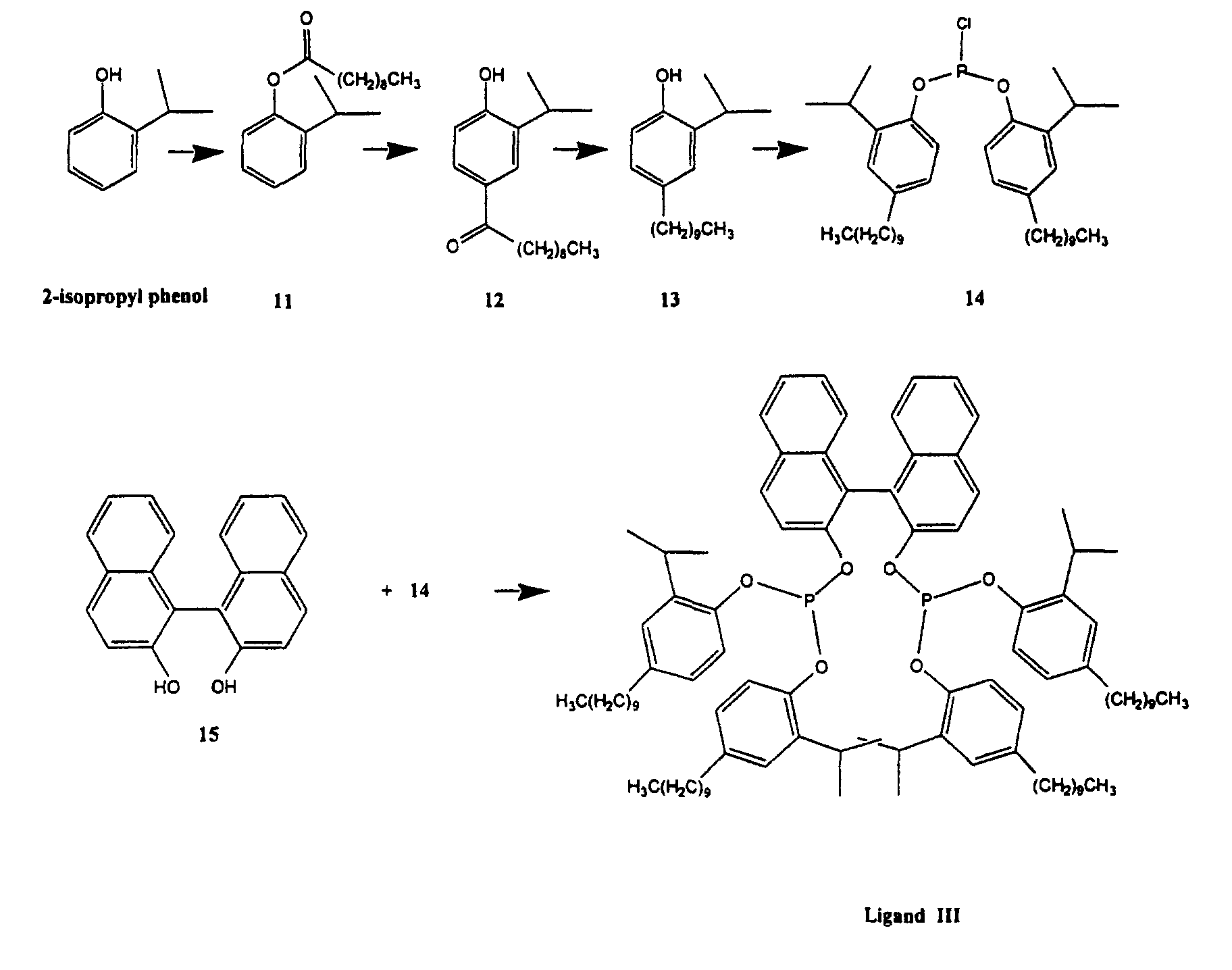
- A solution of 32.9 g (0.326 mol) of triethylamine and 39.0 g (0.286 mol) of 2-isopropylphenol in 200 mL diethyl ether was added slowly over a period of three hours to a solution of 54.6 g (0.286 mol) of decanoyl chloride in 300 mL diethyl ether. The mixture was stirred at 25°C for 5 hours and diethyl ether was removed under vacuum. 200 mL of pentane were added, triethylamine hydrochloride filtered and the solvent was evaporated under vacuum to yield 73.6 g (87%) of 11 as a colorless oil.
- A solution of 74 g (0.253 mol) of 11 in 250mL of nitrobenzene was cooled to 0°C. TiCl4 (96 g, 0.506 mol) was added over a 20 minute period, and the solution was stirred for 1 hour at 0°C, then the mixture was allowed to warm to room temperature and stirred overnight. The reaction was quenched by adding 100 mL of 10% HCl. The mixture was extracted with 500 mL of hexane and dried with MgSO4. The solvents were removed under vacuum and the product distilled ( 150°C at 0.005 mm Hg) to yield 12.7g (17%) 12 as a colorless oil.
- Zinc (22 g, 0.34 mol) was amalgamated with a solution of 0.475 g (17.5 mmol) of mercuric chloride in 100 mL H2O. The amalgamated zinc was suspended in a mixture of 20 mL of H2O and 20 mL of concentrated HCl and then 6.1 g (0.021 mmol) of 12, dissolved in 50 mL ethanol, were added. The mixture was agitated vigorously and refluxed for 48 hours. The reaction mixture was extracted with toluene and the organic layer extracted with 3 portions of 100 mL of water. The organic layer was dried over MgSO4, the solvent removed under vacuum and the product isolated by high vacuum distillation (170°C at 0.005 mmHg). 13 (5.07 g) was isolated as a colorless oil in 87% yield.
- A solution of Cl2PNEt2 (1.59 g, 9.11 mmol) in 50 mL of diethyl ether was added slowly to a mixture of 13 (5.07 g, 18.3 mmol) and NEt3 (2.3 g, 22.7 mmol) in 50 mL of Et2O. After stirring for 1 hour at room temperature, 3 mL of 1M HCl in Et2O were added and stirring was continued for 15 minutes. The solvent was removed under vacuum and replaced with 50 mL of pentane. The mixture was filtered through celite and the solvent evaporated leaving an oily residue. 14 was isolated as colorless oil (8.29 g) in 73% yield.
- A solution of 15 (0.252 g, 0.88 mmol) and NEt3 (0.34 g, 3.3 mmol) in 20 mL of toluene was added in small portions to a solution of 14 (1.09 g, 1.76 mmol) in 20 mL of toluene. The solvent was removed under vacuum and replaced with 50 mL of pentane. The mixture was filtered through celite and the solvent evaporated in vacuo, giving Ligand III as an oil in 80% yield. 31P{1H} (500 MHz, CD2Cl2): 135.
- Reaction mixtures were heated in a thermostatically controlled oil bath. HCN vapor was delivered to the reaction flask as an HCN/N2 gas mixture by bubbling dry N2 gas through liquid HCN maintained at 0°C in a wet ice bath. This provided a vapor stream which was roughly 35% HCN (vol/vol). The rate of HCN delivery was adjusted by varying the rate of N2 flow. Sample analyses were done by gas chromatography using a DB-23 capillary column.
- 500 mg of Ligand (I or II), 40 mg of Ni(COD)2 and 20 mg of ZnCl2 were dissolved in 5 mL of 3-pentenonitrile. The mixture was treated with HCN at a nitrogen flow rate of 30 mL/min at 70°C for one hour. GC analysis indicated:
- Ligand I: 61% Conversion, 91% Selectivity to ADN
- Ligand II: 83% Conversion, 93% Selectivity to ADN
-
- The product mixture obtained as described before was extracted three times with 20 mL of pentane. The combined pentane extracts were combined and the solvent removed under vacuum. 3-pentenonitrile (5 mL) and ZnCl2 (20 mg) were added and the mixture was treated again with HCN under the same conditions described before. GC analysis indicated:
- Ligand I: 61% Conversion, 91% Selectivity to ADN
- Ligand II: 83% Conversion, 93% Selectivity to ADN
-
Claims (11)
- A process for hydrocyanation comprising reacting a nonconjugated, ethylenically unsaturated compound with HCN in the presence of a Lewis acid promoter and a catalyst system comprising a zero valent nickel compound and an organic phosphorous containing ligand having the structure (PR2)nR' where n is an integer from 1 to 2, R and R' are organic residues which may be the same or different and where the R or R' contain at least one C9 to C40 aliphatic group positioned as a tail extending away from the primary ligand structure rendering the ligand lipophilic and wherein the process solvent is a two phase mixture of an organic compound having from 5 to 20 carbon atoms and polar solvent.
- The process of claim 1 wherein the ligand is a bidentate phosphite.
- A process of claim 1 comprising the steps of:(a) reacting the ethylenically unsaturated compound in a polar reaction solvent to form a reaction mixture; and(b) adding a non-polar solvent selected from the group of C5 to C20 hydrocarbon solvents to the reaction mixture to form two phases, one a polar phase predominately formed from the reaction products and one formed predominately from the non-polar solvent and the catalyst system such that the reaction products including the high boiling reaction products of the hydrocyanation remain in the polar phase and the catalyst system is partitioned substantially into the non-polar phase.
- The process of claim 1 or 3 further comprising separating the two phases and isolating the reaction products from the polar phase and the catalyst from the non-polar phase.
- The process of claim 3 wherein volatiles are removed from the reaction mixture of step (a) before the addition of the polar solvent of step (b).
- The process of claim 1 wherein the hydrocyanation reaction is carried out in a two phase solvent mixture.
- The process of claim 1, wherein the ethylenically unsaturated compound also functions as the reaction solvent and the two phase process solvent is added to the reaction mixture after hydrocyanation.
- The process of claim 4 wherein the recovered catalyst is returned to step (a) and the steps are repeated.
- The process of claim 1 or 7 wherein the non-polar solvent is chosen from the group of C5 to C20 hydrocarbon solvents.
- The process of claim 1, 3 or 7, wherein the ethylenically unsaturated compound is chosen from the group consisting of 3-pentenenitrile, 4-pentenenitrile and alkyl-3-pentenoate.
- The process of claim 1, 3 or 7 wherein the organic ligand is chosen from the structures:
 and
and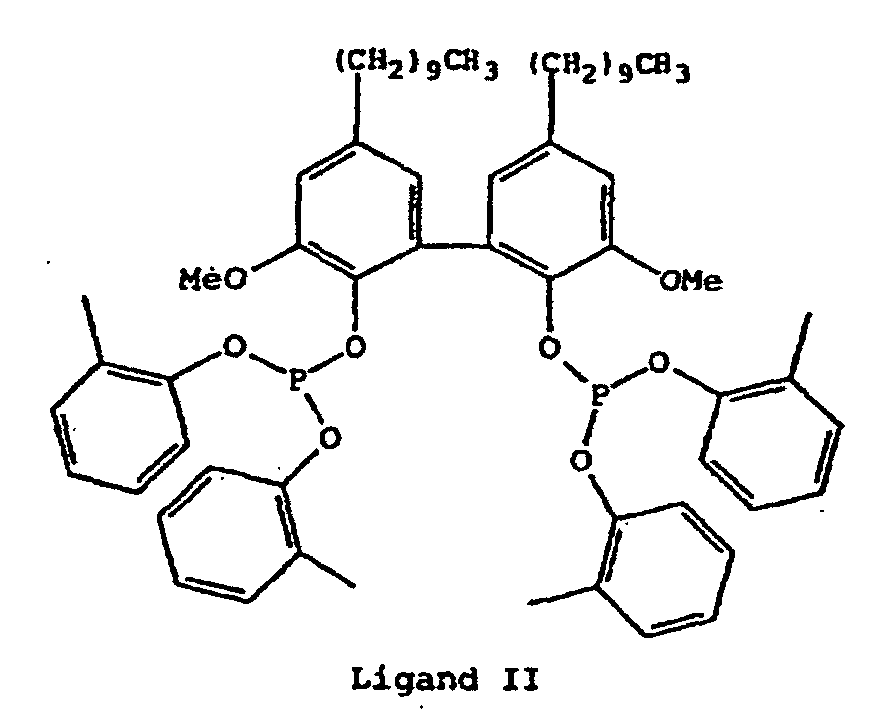 wherein Ligand III R is either CO(CH2)8CH3 or (CH2)9CH3.
Applications Claiming Priority (3)
| Application Number | Priority Date | Filing Date | Title |
|---|---|---|---|
| US08/902,438 US5847191A (en) | 1997-07-29 | 1997-07-29 | Process for the hydrocyanation of monoolefins using bidentate phosphite ligands and zero-valent nickel |
| US902438 | 1997-07-29 | ||
| PCT/US1998/015621 WO1999006359A1 (en) | 1997-07-29 | 1998-07-28 | Improved hydrocyanation process |
Publications (2)
| Publication Number | Publication Date |
|---|---|
| EP1001928A1 EP1001928A1 (en) | 2000-05-24 |
| EP1001928B1 true EP1001928B1 (en) | 2005-04-06 |
Family
ID=25415867
Family Applications (1)
| Application Number | Title | Priority Date | Filing Date |
|---|---|---|---|
| EP98936024A Expired - Lifetime EP1001928B1 (en) | 1997-07-29 | 1998-07-28 | Improved hydrocyanation process |
Country Status (11)
| Country | Link |
|---|---|
| US (1) | US5847191A (en) |
| EP (1) | EP1001928B1 (en) |
| JP (1) | JP3380543B2 (en) |
| KR (1) | KR100540959B1 (en) |
| CN (1) | CN100361966C (en) |
| CA (1) | CA2291640C (en) |
| DE (1) | DE69829667T2 (en) |
| ID (1) | ID24323A (en) |
| MY (1) | MY133280A (en) |
| TW (1) | TW580490B (en) |
| WO (1) | WO1999006359A1 (en) |
Cited By (11)
| Publication number | Priority date | Publication date | Assignee | Title |
|---|---|---|---|---|
| US7880028B2 (en) | 2006-07-14 | 2011-02-01 | Invista North America S.A R.L. | Process for making 3-pentenenitrile by hydrocyanation of butadiene |
| US7897801B2 (en) | 2003-05-12 | 2011-03-01 | Invista North America S.A R.L. | Process for the preparation of dinitriles |
| US7919646B2 (en) | 2006-07-14 | 2011-04-05 | Invista North America S.A R.L. | Hydrocyanation of 2-pentenenitrile |
| US7973174B2 (en) | 2005-10-18 | 2011-07-05 | Invista North America S.A.R.L. | Process of making 3-aminopentanenitrile |
| US7977502B2 (en) | 2008-01-15 | 2011-07-12 | Invista North America S.A R.L. | Process for making and refining 3-pentenenitrile, and for refining 2-methyl-3-butenenitrile |
| US8088943B2 (en) | 2008-01-15 | 2012-01-03 | Invista North America S.A R.L. | Hydrocyanation of pentenenitriles |
| US8101790B2 (en) | 2007-06-13 | 2012-01-24 | Invista North America S.A.R.L. | Process for improving adiponitrile quality |
| US8178711B2 (en) | 2006-03-17 | 2012-05-15 | Invista North America S.A R.L. | Method for the purification of triorganophosphites by treatment with a basic additive |
| US8247621B2 (en) | 2008-10-14 | 2012-08-21 | Invista North America S.A.R.L. | Process for making 2-secondary-alkyl-4,5-di-(normal-alkyl)phenols |
| US8338636B2 (en) | 2009-08-07 | 2012-12-25 | Invista North America S.A R.L. | Hydrogenation and esterification to form diesters |
| US8373001B2 (en) | 2003-02-10 | 2013-02-12 | Invista North America S.A R.L. | Method of producing dinitrile compounds |
Families Citing this family (31)
| Publication number | Priority date | Publication date | Assignee | Title |
|---|---|---|---|---|
| WO2001021580A1 (en) * | 1999-09-20 | 2001-03-29 | E.I. Du Pont De Nemours And Company | Multidentate phosphite ligands, catalytic compositions containing such ligands and catalytic processes utilizing such catalytic compositions |
| US6515161B1 (en) | 1999-09-20 | 2003-02-04 | E. I. Du Pont De Nemours And Company | Hydroformylation process utilizing multidentate phosphite ligands |
| US6380421B1 (en) | 1999-09-20 | 2002-04-30 | E. I. Du Pont De Nemours And Company | Multidentate phosphite ligands, catalytic compositions containing such ligands and catalytic processes utilizing such catalytic compositions |
| KR100714324B1 (en) * | 1999-09-20 | 2007-05-04 | 이 아이 듀폰 디 네모아 앤드 캄파니 | Multidentate phosphite ligands, and catalyst compositions containing them |
| DE10136488A1 (en) * | 2001-07-27 | 2003-02-06 | Basf Ag | Catalyst system comprising Ni(0) and phosphorous ligands is useful for the production of nitrile and dinitrile compounds |
| AR038161A1 (en) | 2002-01-24 | 2004-12-29 | Basf Ag | PROCEDURE FOR SEPARATING ACIDS FROM CHEMICAL REACTION MIXTURES WITH THE HELP OF ION LIQUIDS |
| US6906218B2 (en) | 2002-12-18 | 2005-06-14 | Invista North America S.A.R.L. | Cyclohexane derivatives and methods for their preparation |
| US6936171B2 (en) * | 2003-01-08 | 2005-08-30 | Invista North America S.A.R.L. | Process for catalyst recovery from hydrocyanation product mixtures |
| US6897329B2 (en) * | 2003-01-14 | 2005-05-24 | Invista North America S.A.R.L. | Process for the preparation of nickel/phosphorous ligand catalyst for olefin hydrocyanation |
| FR2854892B1 (en) | 2003-05-12 | 2005-06-24 | Rhodia Polyamide Intermediates | PROCESS FOR PRODUCING DINITRILES |
| DE10351000A1 (en) * | 2003-10-30 | 2005-06-09 | Basf Ag | Process for the preparation of nickel (0) phosphorus ligand complexes |
| DE102004050935A1 (en) * | 2004-10-18 | 2006-04-20 | Basf Ag | Extraction of nickel (0) complexes from nitrile mixtures with reduced leaching |
| CN101460229A (en) * | 2006-04-07 | 2009-06-17 | 巴斯夫欧洲公司 | Method for separating nickel (0) complexes and phosphorus-containing ligands from nitrile mixtures |
| US7709674B2 (en) | 2006-07-14 | 2010-05-04 | Invista North America S.A R.L | Hydrocyanation process with reduced yield losses |
| KR20090037973A (en) * | 2006-08-08 | 2009-04-16 | 바스프 에스이 | Process for preparing 3-pentenenitrile through hydrocyanation of 1,3-butadiene |
| EP2146930A2 (en) | 2007-05-14 | 2010-01-27 | INVISTA Technologies S.à.r.l. | High efficiency reactor and process |
| EP2237683B1 (en) * | 2008-01-22 | 2015-11-11 | Givaudan SA | Method of flavoring |
| FR2926816B1 (en) | 2008-01-25 | 2010-05-14 | Rhodia Operations | PROCESS FOR PRODUCING COMPOUNDS COMPRISING NITRIL FUNCTIONS |
| FR2932477B1 (en) | 2008-06-17 | 2013-01-18 | Rhodia Operations | PROCESS FOR THE PRODUCTION OF NITRILIC COMPOUNDS FROM ETHYLENE-UNSATURATED COMPOUNDS |
| FR2937321B1 (en) | 2008-10-21 | 2010-10-22 | Rhodia Operations | PROCESS FOR PRODUCING COMPOUNDS COMPRISING NITRIL FUNCTIONS |
| FR2941455B1 (en) | 2009-01-29 | 2011-02-11 | Rhodia Operations | PROCESS FOR PRODUCING COMPOUNDS COMPRISING NITRIL FUNCTIONS |
| WO2012033555A1 (en) | 2010-09-07 | 2012-03-15 | Invista Technologies S.A.R.L. | Nickel compositions for preparing nickel metal and nickel complexes |
| JP2014530221A (en) * | 2011-10-07 | 2014-11-17 | インヴィスタテクノロジーズ エスアエルエル | Nitrile production method |
| WO2013120057A1 (en) | 2012-02-10 | 2013-08-15 | The Regents Of The University Of California | First row metal-based catalysts for hydosilylation |
| US20250296945A1 (en) | 2022-05-23 | 2025-09-25 | Inv Nylon Chemicals Americas, Llc | Multidentate phosphite ligands, catalytic compositions containing such ligands, and catalytic processes utilizing such catalytic compositions |
| WO2023228077A1 (en) | 2022-05-23 | 2023-11-30 | Inv Nylon Chemicals Americas, Llc | Multidentate phosphite ligands, catalytic compositions containing such ligands, and catalytic processes utilizing such catalytic compositions |
| WO2024028719A2 (en) | 2022-08-02 | 2024-02-08 | Inv Nylon Chemicals Americas, Llc | Bidentate phosphite ligands, catalytic compositions containing such ligands, and catalytic processes utilizing such catalytic compositions |
| WO2024028718A1 (en) | 2022-08-02 | 2024-02-08 | Inv Nylon Chemicals Americas, Llc | Bidfntate phosphite ligands. catalytic compositions containing such ligands. and catalytic processes utilizing such catalytic compositions |
| EP4499654A1 (en) | 2022-08-02 | 2025-02-05 | INVISTA Textiles (U.K.) Limited | Bidentate phosphite ligands, catalytic compositions containing such ligands, and catalytic processes utilizing such catalytic compositions |
| EP4511380B1 (en) | 2022-08-02 | 2025-11-05 | INVISTA Textiles (U.K.) Limited | Arsenic-containing ligands, catalytic compositions containing such ligands, and catalytic processes utilizing such catalytic compositions |
| US20260015319A1 (en) | 2022-08-02 | 2026-01-15 | Inv Nylon Chemicals Americas, Llc | Bidentate phosphite ligands, catalytic compositions containing such ligands, and catalytic processes utilizing such catalytic compositions |
Family Cites Families (20)
| Publication number | Priority date | Publication date | Assignee | Title |
|---|---|---|---|---|
| US3496215A (en) * | 1965-11-23 | 1970-02-17 | Du Pont | Hydrocyanation of olefins using selected nickel phosphite catalysts |
| GB1112539A (en) * | 1965-11-26 | 1968-05-08 | Du Pont | Preparation of organic nitriles |
| US3496217A (en) * | 1967-05-23 | 1970-02-17 | Du Pont | Hydrocyanation of olefins |
| US3655723A (en) * | 1969-10-31 | 1972-04-11 | Du Pont | Hydrocyanation of olefins |
| US3631191A (en) * | 1970-04-08 | 1971-12-28 | Du Pont | Synthesis of zero valent nickel-tetrakis triaryl phosphite complexes |
| US3766237A (en) * | 1972-01-25 | 1973-10-16 | Du Pont | Hydrocyanation of olefins |
| US3773809A (en) * | 1972-06-28 | 1973-11-20 | Du Pont | Separation of organic phosphorus compounds and their metal complexes from organic nitriles in the hydrocyanation of olefins |
| FR2338253A1 (en) * | 1976-01-13 | 1977-08-12 | Rhone Poulenc Ind | PROCESS FOR HYDROCYANATION OF UNSATURATED ORGANIC COMPOUNDS CONTAINING AT LEAST A DOUBLE ETHYLENIC BOND |
| US4082811A (en) * | 1977-02-23 | 1978-04-04 | E. I. Du Pont De Nemours And Company | Recovery of metal and triarylborane catalyst components from olefin hydrocyanation residue |
| US4339395A (en) * | 1981-04-15 | 1982-07-13 | E. I. Du Pont De Nemours And Company | Treatment of olefin hydrocyanation products |
| US4774353A (en) * | 1986-06-05 | 1988-09-27 | E. I. Du Pont De Nemours And Company | Triorganotin catalyst promoters for hydrocyanation |
| US4874884A (en) * | 1988-03-31 | 1989-10-17 | E. I. Du Pont De Nemours And Company | Promoter synergism in pentenenitrile hydrocyanation |
| US5360938A (en) * | 1991-08-21 | 1994-11-01 | Union Carbide Chemicals & Plastics Technology Corporation | Asymmetric syntheses |
| US5463082A (en) * | 1993-07-08 | 1995-10-31 | Exxon Research And Engineering Company | Fluorous multiphase systems |
| DK0730574T3 (en) * | 1993-11-23 | 1999-05-25 | Du Pont | Methods and catalyst compositions for hydrocyanation of monoolefins |
| US5512695A (en) * | 1994-04-14 | 1996-04-30 | E. I. Du Pont De Nemours And Company | Bidentate phosphite and nickel catalyst compositions for hydrocyanation of monoolefins |
| US5512696A (en) * | 1995-07-21 | 1996-04-30 | E. I. Du Pont De Nemours And Company | Hydrocyanation process and multidentate phosphite and nickel catalyst composition therefor |
| TW315370B (en) * | 1994-10-07 | 1997-09-11 | Du Pont | |
| IN187044B (en) * | 1995-01-27 | 2002-01-05 | Du Pont | |
| US5523453A (en) * | 1995-03-22 | 1996-06-04 | E. I. Du Pont De Nemours And Company | Process for hydrocyanation |
-
1997
- 1997-07-29 US US08/902,438 patent/US5847191A/en not_active Expired - Lifetime
-
1998
- 1998-07-15 TW TW087111507A patent/TW580490B/en not_active IP Right Cessation
- 1998-07-24 MY MYPI98003394A patent/MY133280A/en unknown
- 1998-07-28 WO PCT/US1998/015621 patent/WO1999006359A1/en not_active Ceased
- 1998-07-28 JP JP2000505121A patent/JP3380543B2/en not_active Expired - Fee Related
- 1998-07-28 CN CNB988076063A patent/CN100361966C/en not_active Expired - Fee Related
- 1998-07-28 DE DE69829667T patent/DE69829667T2/en not_active Expired - Lifetime
- 1998-07-28 CA CA002291640A patent/CA2291640C/en not_active Expired - Fee Related
- 1998-07-28 EP EP98936024A patent/EP1001928B1/en not_active Expired - Lifetime
- 1998-07-28 KR KR1020007000947A patent/KR100540959B1/en not_active Expired - Fee Related
- 1998-07-28 ID IDW20000179A patent/ID24323A/en unknown
Cited By (12)
| Publication number | Priority date | Publication date | Assignee | Title |
|---|---|---|---|---|
| US8373001B2 (en) | 2003-02-10 | 2013-02-12 | Invista North America S.A R.L. | Method of producing dinitrile compounds |
| US7897801B2 (en) | 2003-05-12 | 2011-03-01 | Invista North America S.A R.L. | Process for the preparation of dinitriles |
| US7973174B2 (en) | 2005-10-18 | 2011-07-05 | Invista North America S.A.R.L. | Process of making 3-aminopentanenitrile |
| US8178711B2 (en) | 2006-03-17 | 2012-05-15 | Invista North America S.A R.L. | Method for the purification of triorganophosphites by treatment with a basic additive |
| US7880028B2 (en) | 2006-07-14 | 2011-02-01 | Invista North America S.A R.L. | Process for making 3-pentenenitrile by hydrocyanation of butadiene |
| US7919646B2 (en) | 2006-07-14 | 2011-04-05 | Invista North America S.A R.L. | Hydrocyanation of 2-pentenenitrile |
| US8394981B2 (en) | 2006-07-14 | 2013-03-12 | Invista North America S.A R.L. | Hydrocyanation of 2-pentenenitrile |
| US8101790B2 (en) | 2007-06-13 | 2012-01-24 | Invista North America S.A.R.L. | Process for improving adiponitrile quality |
| US7977502B2 (en) | 2008-01-15 | 2011-07-12 | Invista North America S.A R.L. | Process for making and refining 3-pentenenitrile, and for refining 2-methyl-3-butenenitrile |
| US8088943B2 (en) | 2008-01-15 | 2012-01-03 | Invista North America S.A R.L. | Hydrocyanation of pentenenitriles |
| US8247621B2 (en) | 2008-10-14 | 2012-08-21 | Invista North America S.A.R.L. | Process for making 2-secondary-alkyl-4,5-di-(normal-alkyl)phenols |
| US8338636B2 (en) | 2009-08-07 | 2012-12-25 | Invista North America S.A R.L. | Hydrogenation and esterification to form diesters |
Also Published As
| Publication number | Publication date |
|---|---|
| ID24323A (en) | 2000-07-13 |
| KR100540959B1 (en) | 2006-01-12 |
| JP2001512097A (en) | 2001-08-21 |
| US5847191A (en) | 1998-12-08 |
| CA2291640C (en) | 2004-09-21 |
| MY133280A (en) | 2007-10-31 |
| DE69829667T2 (en) | 2006-03-09 |
| KR20010022368A (en) | 2001-03-15 |
| JP3380543B2 (en) | 2003-02-24 |
| EP1001928A1 (en) | 2000-05-24 |
| CN1265094A (en) | 2000-08-30 |
| CA2291640A1 (en) | 1999-02-11 |
| TW580490B (en) | 2004-03-21 |
| DE69829667D1 (en) | 2005-05-12 |
| WO1999006359A1 (en) | 1999-02-11 |
| CN100361966C (en) | 2008-01-16 |
Similar Documents
| Publication | Publication Date | Title |
|---|---|---|
| US5847191A (en) | Process for the hydrocyanation of monoolefins using bidentate phosphite ligands and zero-valent nickel | |
| EP0757672B1 (en) | Monodentate phosphite and nickel catalyst composition for monoolefin hydrocyanation | |
| EP0730574B1 (en) | Processes and catalyst compositions for hydrocyanation of monoolefins | |
| JP3535172B2 (en) | Hydrocyanation process and polydentate phosphite and nickel catalyst compositions therefor | |
| EP1000019B1 (en) | Hydrocyanation processes and multidentate phosphite ligand and nickel catalyst compositions therefor | |
| JP2911608B2 (en) | Hydocyanation method in the presence of zero-valent nickel, bidentate phosphorus compound and Lewis acid | |
| EP0804412B1 (en) | Hydrocyanation of diolefins and isomerization of nonconjugated 2-alkyl-3-monoalkenenitriles | |
| US5512695A (en) | Bidentate phosphite and nickel catalyst compositions for hydrocyanation of monoolefins | |
| EP1000020B1 (en) | Hydrocyanation of diolefins and isomerization of nonconjugated 2-alkyl-3-monoalkenenitriles | |
| US6646148B1 (en) | Bidentate phosphite and nickel catalyst compositions for hydrocyanation of monoolefins | |
| JP2004501058A (en) | Phosphite | |
| KR20060107797A (en) | Sterically hindered chelate phosphinite-phosphite ligands, catalysts comprising one or more nickel (0) complexes stabilized by said ligands, and methods of making nitriles | |
| EP1073520B1 (en) | Hydrocyanation of olefins and isomerisation of nonconjugated 2-alkyl-3-monoalkenenitriles | |
| CA2186351C (en) | Bidentate phosphite and nickel catalyst compositions for hydrocyanation of monoolefins | |
| HK1025950B (en) | Hydrocyanation processes and multidentate phosphite ligand and nickel catalyst compositions therefor |
Legal Events
| Date | Code | Title | Description |
|---|---|---|---|
| PUAI | Public reference made under article 153(3) epc to a published international application that has entered the european phase |
Free format text: ORIGINAL CODE: 0009012 |
|
| 17P | Request for examination filed |
Effective date: 20000119 |
|
| AK | Designated contracting states |
Kind code of ref document: A1 Designated state(s): BE DE ES FR GB IT NL |
|
| 17Q | First examination report despatched |
Effective date: 20030506 |
|
| RAP1 | Party data changed (applicant data changed or rights of an application transferred) |
Owner name: E.I. DU PONT DE NEMOURS AND COMPANY |
|
| RAP1 | Party data changed (applicant data changed or rights of an application transferred) |
Owner name: INVISTA TECHNOLOGIES S.AE.R.L. |
|
| GRAP | Despatch of communication of intention to grant a patent |
Free format text: ORIGINAL CODE: EPIDOSNIGR1 |
|
| 111Z | Information provided on other rights and legal means of execution |
Free format text: BEDEESFRGBITNL Effective date: 20040731 |
|
| GRAS | Grant fee paid |
Free format text: ORIGINAL CODE: EPIDOSNIGR3 |
|
| GRAA | (expected) grant |
Free format text: ORIGINAL CODE: 0009210 |
|
| RAP1 | Party data changed (applicant data changed or rights of an application transferred) |
Owner name: INVISTA TECHNOLOGIES S.AE.R.L. |
|
| AK | Designated contracting states |
Kind code of ref document: B1 Designated state(s): BE DE ES FR GB IT NL |
|
| REG | Reference to a national code |
Ref country code: GB Ref legal event code: FG4D |
|
| REF | Corresponds to: |
Ref document number: 69829667 Country of ref document: DE Date of ref document: 20050512 Kind code of ref document: P |
|
| PG25 | Lapsed in a contracting state [announced via postgrant information from national office to epo] |
Ref country code: ES Free format text: LAPSE BECAUSE OF FAILURE TO SUBMIT A TRANSLATION OF THE DESCRIPTION OR TO PAY THE FEE WITHIN THE PRESCRIBED TIME-LIMIT Effective date: 20050717 |
|
| PLBE | No opposition filed within time limit |
Free format text: ORIGINAL CODE: 0009261 |
|
| STAA | Information on the status of an ep patent application or granted ep patent |
Free format text: STATUS: NO OPPOSITION FILED WITHIN TIME LIMIT |
|
| ET | Fr: translation filed | ||
| 26N | No opposition filed |
Effective date: 20060110 |
|
| REG | Reference to a national code |
Ref country code: GB Ref legal event code: 732E |
|
| BECA | Be: change of holder's address |
Owner name: *INVISTA TECHNOLOGIES S.A.R.L.TALSTRASSE 80, CH-80 Effective date: 20050406 |
|
| REG | Reference to a national code |
Ref country code: GB Ref legal event code: 732E Free format text: REGISTERED BETWEEN 20090507 AND 20090513 |
|
| REG | Reference to a national code |
Ref country code: FR Ref legal event code: PLFP Year of fee payment: 18 |
|
| PGFP | Annual fee paid to national office [announced via postgrant information from national office to epo] |
Ref country code: NL Payment date: 20150709 Year of fee payment: 18 |
|
| PGFP | Annual fee paid to national office [announced via postgrant information from national office to epo] |
Ref country code: GB Payment date: 20150722 Year of fee payment: 18 Ref country code: DE Payment date: 20150722 Year of fee payment: 18 |
|
| PGFP | Annual fee paid to national office [announced via postgrant information from national office to epo] |
Ref country code: BE Payment date: 20150713 Year of fee payment: 18 Ref country code: FR Payment date: 20150629 Year of fee payment: 18 |
|
| PGFP | Annual fee paid to national office [announced via postgrant information from national office to epo] |
Ref country code: IT Payment date: 20150727 Year of fee payment: 18 |
|
| PG25 | Lapsed in a contracting state [announced via postgrant information from national office to epo] |
Ref country code: BE Free format text: LAPSE BECAUSE OF NON-PAYMENT OF DUE FEES Effective date: 20160731 |
|
| REG | Reference to a national code |
Ref country code: DE Ref legal event code: R119 Ref document number: 69829667 Country of ref document: DE |
|
| REG | Reference to a national code |
Ref country code: NL Ref legal event code: MM Effective date: 20160801 |
|
| GBPC | Gb: european patent ceased through non-payment of renewal fee |
Effective date: 20160728 |
|
| PG25 | Lapsed in a contracting state [announced via postgrant information from national office to epo] |
Ref country code: NL Free format text: LAPSE BECAUSE OF NON-PAYMENT OF DUE FEES Effective date: 20160801 Ref country code: FR Free format text: LAPSE BECAUSE OF NON-PAYMENT OF DUE FEES Effective date: 20160801 Ref country code: DE Free format text: LAPSE BECAUSE OF NON-PAYMENT OF DUE FEES Effective date: 20170201 |
|
| REG | Reference to a national code |
Ref country code: FR Ref legal event code: ST Effective date: 20170331 |
|
| PG25 | Lapsed in a contracting state [announced via postgrant information from national office to epo] |
Ref country code: GB Free format text: LAPSE BECAUSE OF NON-PAYMENT OF DUE FEES Effective date: 20160728 |
|
| PG25 | Lapsed in a contracting state [announced via postgrant information from national office to epo] |
Ref country code: IT Free format text: LAPSE BECAUSE OF NON-PAYMENT OF DUE FEES Effective date: 20160728 |