EP1000352B1 - Method, composition and device for the determination of free halogens in aqueous fluids - Google Patents
Method, composition and device for the determination of free halogens in aqueous fluids Download PDFInfo
- Publication number
- EP1000352B1 EP1000352B1 EP98934650A EP98934650A EP1000352B1 EP 1000352 B1 EP1000352 B1 EP 1000352B1 EP 98934650 A EP98934650 A EP 98934650A EP 98934650 A EP98934650 A EP 98934650A EP 1000352 B1 EP1000352 B1 EP 1000352B1
- Authority
- EP
- European Patent Office
- Prior art keywords
- test
- catalyst
- group
- chromogenic indicator
- composition
- Prior art date
- Legal status (The legal status is an assumption and is not a legal conclusion. Google has not performed a legal analysis and makes no representation as to the accuracy of the status listed.)
- Expired - Lifetime
Links
- XDTMQSROBMDMFD-UHFFFAOYSA-N C1CCCCC1 Chemical compound C1CCCCC1 XDTMQSROBMDMFD-UHFFFAOYSA-N 0.000 description 1
Images


Classifications
-
- G—PHYSICS
- G01—MEASURING; TESTING
- G01N—INVESTIGATING OR ANALYSING MATERIALS BY DETERMINING THEIR CHEMICAL OR PHYSICAL PROPERTIES
- G01N31/00—Investigating or analysing non-biological materials by the use of the chemical methods specified in the subgroup; Apparatus specially adapted for such methods
- G01N31/22—Investigating or analysing non-biological materials by the use of the chemical methods specified in the subgroup; Apparatus specially adapted for such methods using chemical indicators
-
- Y—GENERAL TAGGING OF NEW TECHNOLOGICAL DEVELOPMENTS; GENERAL TAGGING OF CROSS-SECTIONAL TECHNOLOGIES SPANNING OVER SEVERAL SECTIONS OF THE IPC; TECHNICAL SUBJECTS COVERED BY FORMER USPC CROSS-REFERENCE ART COLLECTIONS [XRACs] AND DIGESTS
- Y10—TECHNICAL SUBJECTS COVERED BY FORMER USPC
- Y10T—TECHNICAL SUBJECTS COVERED BY FORMER US CLASSIFICATION
- Y10T436/00—Chemistry: analytical and immunological testing
- Y10T436/19—Halogen containing
-
- Y—GENERAL TAGGING OF NEW TECHNOLOGICAL DEVELOPMENTS; GENERAL TAGGING OF CROSS-SECTIONAL TECHNOLOGIES SPANNING OVER SEVERAL SECTIONS OF THE IPC; TECHNICAL SUBJECTS COVERED BY FORMER USPC CROSS-REFERENCE ART COLLECTIONS [XRACs] AND DIGESTS
- Y10—TECHNICAL SUBJECTS COVERED BY FORMER USPC
- Y10T—TECHNICAL SUBJECTS COVERED BY FORMER US CLASSIFICATION
- Y10T436/00—Chemistry: analytical and immunological testing
- Y10T436/19—Halogen containing
- Y10T436/193333—In aqueous solution
Definitions
- the present invention relates to a method, composition and test device for the determination of free halogens in aqueous fluids such as swimming pool and spa water and other aqueous environments where such chemicals are used as disinfectants and sanitizers.
- aqueous fluids such as swimming pool and spa water and other aqueous environments where such chemicals are used as disinfectants and sanitizers.
- the present invention excels as an on-site or field test system, it can also advantageously be used in a laboratory setting.
- Halogens have for many years been used as sanitizers, disinfectants and cold chemical sterilants in a wide variety of settings and environments that require the attenuation or elimination of microorganisms that adversely affect human and animal health.
- the evaluation of the sterility or safety of a particular aqueous fluid suggests that a representative sample of such fluid be actually tested for the presence, level and type of adverse or harmful microorganisms.
- This is, however, not always possible as such a testing methodology usually requires the use of time consuming microorganism culturing techniques or large and expensive laboratory instrumentation and equipment.
- a simpler technique involves a system for the determination of a safe and effective level of an anti-microorganism chemical such as a halogen in the subject fluid.
- Such test system should be rapid and easy to use in order to ensure that this level be achieved and maintained. This is usually done by utilizing a test kit or system which is adapted to the particular fluid or environment under scrutiny.
- a safe and effective level of the chemical being used as a disinfectant be maintained in the aqueous environment under consideration.
- This level is usually monitored by employing a test device or system which is reasonably specific for the material being used.
- halogens and particularly hypochlorous acid (HOCl) such materials, by their very nature, are very reactive substances and numerous test methodologies based on such reactivity have been developed over the years and sold to users as testing kits and devices.
- HOCl hypochlorous acid
- hypochlorous acid tends to react with ammonia and other nitrogenous materials to produce what is known as combined chlorine or chloramines. These materials are considered to be, at least in the case of chlorine, less effective as sanitizers or disinfectants.
- Hypochlorous acid is also known as free or available chlorine and after a portion of such material combines with nitrogenous substances, is known as combined chlorine.
- the present invention accordingly relates to an easy to use, sensitive and effective test system for the detection of free or available halogens over a broad range of concentrations in aqueous fluids.
- halogen includes chlorine, bromine and iodine when such materials are used alone or in combination with other sanitizers.
- free or “available” or “free available” halogen (chlorine) is defined as a measure of oxidizing capacity and is expressed in terms of the equivalent amount of elemental chlorine.
- combined or “combined available” chlorine is defined as chlorine which has reacted with ammonia or other nitrogenous compounds and finally the “free” and “combined available” chlorine, when present in the water, are collectively described as “total residual (available)” chlorine or simply “total” chlorine.
- the present invention involves the unexpected discovery that a catalytic or small amount of a benzidine type compound such as 3,3',5,5'-tetramethylbenzidine (TMB) can enhance or catalyze the response of an azine type indicator material such as syringaldazine to the presence of free halogen in an aqueous fluid.
- a benzidine type compound such as 3,3',5,5'-tetramethylbenzidine (TMB)
- TMB 3,3',5,5'-tetramethylbenzidine
- azine type indicator material such as syringaldazine
- excipients and other additives such as buffers and color stabilizers
- the composition described immediately above is incorporated into or onto a matrix such as absorbent paper or a polymeric material and retained as a dry test device until used for the quantitative or semi-quantitative determination of halogen in the aqueous test fluid sample.
- Figure 1 is a spectrophotometric graph showing the response and color of an indicator solution of syringaldazine to the presence of free chlorine in an aqueous fluid.
- FIG 2 is a spectrophotometric graph of the response of an indicator solution of 3,3',5,5'-tetramethylbenzidine (TMB) to the presence of the same solution of free chlorine as in Figure 1.
- TMB 3,3',5,5'-tetramethylbenzidine
- Figure 3 is a spectrophotometric graph of the response of an indicator solution of syringaldazine to presence of the same solution of free chlorine as in Figure 1, except that the indicator solution contained a catalytic quantity of TMB.
- FIG. 4 is a graph showing the response of the use of TMB as an indicator responding to various concentration solutions of free chlorine.
- Figure 5 is a graph showing the response of the use of syringaldazine plus a catalytic amount of TMB responding to various concentration solution of free chlorine.
- the two basic ingredients of the test compositions of the present invention are the azine type indicator and the benzidine type catalyst.
- catalyst When using the term catalyst to describe the action of the benzidine type material in the present specification, the intention is to convey the fact that spectrophotometric data shows that this material does not itself contribute a color to the reaction between the test composition and the halogen analyte but rather enhances or accelerates the reaction of the indicator material to give a substantially more sensitive test system.
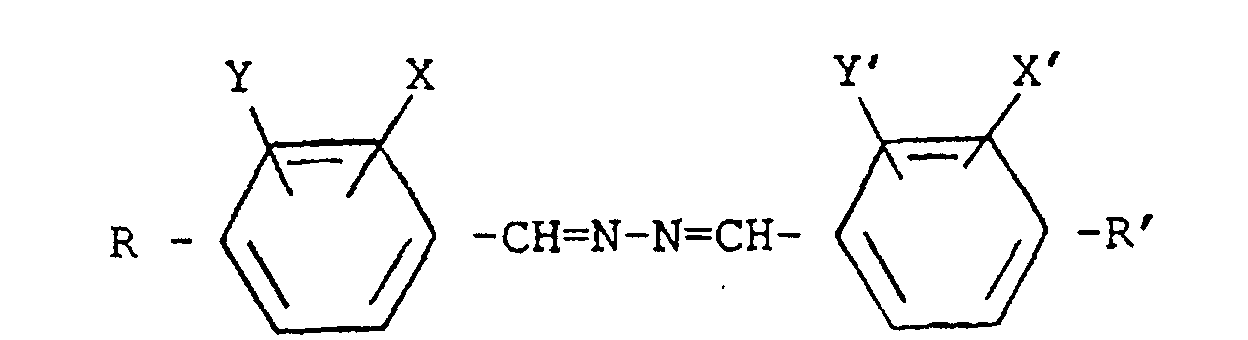
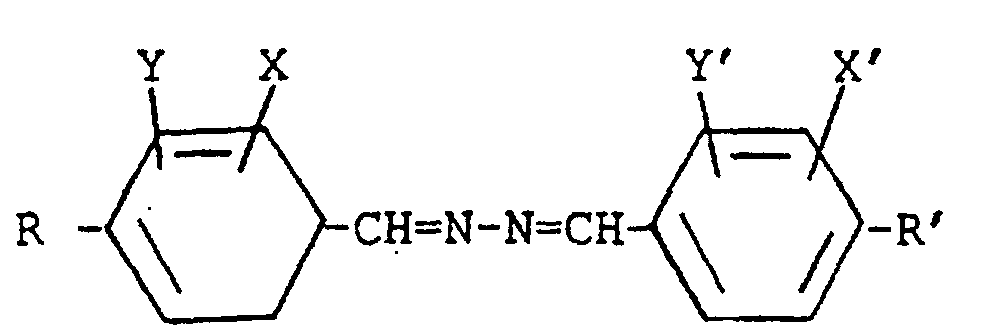
- the chromogenic indicator material of the present test composition and device is an azine compound having the formula: where R and R' are hydroxy or amino groups and X,X',Y and Y' are hydrogen, hydroxy, methyl, methoxy, ethyl and ethoxy groups and combinations thereof.
- X,X',Y and Y" are meta substituted and are methoxy groups.
- Exemplary of such indicator materials which can be used in the present invention are syringaldazine; vanillinazine; 2,4,6,2'4'6'hexahydroxy benzaldazine; 3,4,3',4' tetrahydroxybenzaldazine; 3,3'-diethoxybenzaldazine; and the like.
- the second basic ingredient in the present test composition is the benzidine type catalyst having the formula: where X, X', Y and Y' and R and R' are hydrogen or an alkyl group of up to six carbon atoms and may be the same or different. Preferably the alkyl group contains four or less carbon atoms.
- Benzidine type compounds such as 3,3',5,5'-tetramethylbenzidine, o-tolidine, o-dianisidine, N,N'-tetramethylbenzidine, and the like may be used. 3,3',5,5'-tetramethylbenzidine is the preferable compound for use as the catalyst in the present composition.
- the test composition contain a buffer to keep the test system within the pH range of about from 3.5 to 8.0. This is especially true in a recreational water test sample wherein the fluid itself contains little or no buffering capacity. Buffers such as phosphate, citrate, maleate and butanetetracarboxylate may be utilized.
- the composition of the present invention be incorporated in or on a matrix or carrier so that the test system may be stored and used as a dry reagent test device.
- a system can advantageously be used as a field test device by simply dipping the device into the fluid being tested and reading the color response on the surface of the matrix.
- Typical matrix materials comprise absorbent paper, both natural and synthetic, as well as woven and non-woven, and porous or nonporous polymeric materials whereby the test composition is mixed with the matrix material prior to its being solidified.
- Other devices may be prepared by attaching the test composition onto the surface of the carrier by chemical or physical methods.
- the matrix structure may be flat or curved and the surface thereof may be smooth or rough.
- the matrix be utilized in conjunction with a handle means so that the resulting device may be easily presented to the fluid being tested. This is usually accomplished by attaching the impregnated matrix material to one end of an elongated strip of semi-rigid plastic sheet material.
- Common handle materials comprise polystyrene, polyethylene and so forth.
- test composition as determined by the formulator and use of the device.
- additives such as surfactants, thickeners, stabilizers, extenders, background dyestuffs and so forth may be included in the test composition as determined by the formulator and use of the device.
- the patent literature is replete with such materials and formulations.
- the azine type indicator material is advantageously utilized in a concentration range in the impregnating solution of about from 75 mg/L to 300 mg/L and preferably in a range of about from 90 mg/L to 110 mg/L.
- concentration range in the impregnating solution of about from 75 mg/L to 300 mg/L and preferably in a range of about from 90 mg/L to 110 mg/L.
- concentrations of azine type material are used as indicated next above, it has been found that the benezidine type catalyst is ideally present in the test composition in a ratio of about one part catalyst to about from five to ten parts of indicator material.
- the concentration of buffer used depends upon the particular sample fluid being tested and may be adjusted by the skilled formulator according to the particular needs of the analytical process. Other components are used as needed and concentrations adjusted accordingly.
- compositions of the present invention are exemplified by the following experimental examples or models; however, the limits of this invention are not to be limited by or restricted to such examples.
- the final solution contained 25 ⁇ M of buffer adjusted to a pH of 6.5.
- the final solvent concentration was 50/50 reagent ethyl alcohol and distilled water.
- This example shows the catalytic effect of TMB on the color response of the chromogenic indicator to the presence of free chlorine.
- 10 ⁇ M syringaldazine and 10 ⁇ M TMB were used and the concentration of free chlorine was again 3.7 ⁇ M.
- the spectrophotometric curve resulting from this reaction is shown in Figure 3. It should be noted that the color response is results from the syringaldazine and not the TMB and is enhanced significantly.
- This example shows the response of the chromogenic indicator to free chlorine using varying amounts of catalyst.
- the syringaldazine concentration was 10 ⁇ M
- the free chlorine was 3.7 ⁇ M
- the TMB set at 0, 0.5, 1.5, and 10 ⁇ M. The results are shown in Figure 4.
- This example demonstrates the utilization of a matrix to contain the ingredients of the present invention in preparing a test device for field testing for free chlorine.
- 0.101 g of syringaldazine and 0.0156 g of 3,3',5,5'-TMB were dissolved in 0.5 L of reagent alcohol.
- 1.80 g of polyvinyl alcohol was dissolved in 0.5 L of hot distilled water, allowed to cool, 2.61 g of maleic acid added thereto and the mixture adjusted to a pH of 7.1.
- These two solutions were then combined and absorbent filter paper saturated therewith followed by oven drying. Small squares of this dried paper were attached to one end of elongated strips of Tricite sheet material to form reagent strip test devices.
- the resulting strip devices were momentarily dipped into concentrations of 0, 0.5, 1, 3, 5, and 10 ppm free chlorine and read in 15 seconds by comparing the color formed to a standard color chart containing printed color squares based on standardized color reactions.
- the color developed ranged from buff colored for 0 concentration free chlorine to deep lilac color for 10 ppm free chlorine with good color differentiation between chlorine concentrations.
Landscapes
- Life Sciences & Earth Sciences (AREA)
- Health & Medical Sciences (AREA)
- Analytical Chemistry (AREA)
- Molecular Biology (AREA)
- Physics & Mathematics (AREA)
- Chemical & Material Sciences (AREA)
- Biophysics (AREA)
- Biochemistry (AREA)
- General Health & Medical Sciences (AREA)
- General Physics & Mathematics (AREA)
- Immunology (AREA)
- Pathology (AREA)
- Investigating Or Analyzing Non-Biological Materials By The Use Of Chemical Means (AREA)
- Investigating Or Analysing Biological Materials (AREA)
Abstract
Description

| Ingredient | Volume | Final Conc. |
| 0.05 M buffer, pH 6.5 | 1.9 ml | 25 µM |
| 0.5 mM syringaldazine | 80 µL | 10.5 µL |
| 0.1 mM 3,3',5,5- | 400 µL | 10.5 µL |
| chlorine solution | 1.0 mL | 3.7 µM |
Claims (19)
- A method for the determination of free halogens in aqueous solutions comprising: A. contacting a test solution sample with a reagent composition comprising a) a chromogenic indicator material selected from the group consisting of (1) a compound having the formulawhere R and R' are selected from the group consisting of hydroxy and amino groups and X,X',Y and Y' are selected from the group consisting of hydrogen, hydroxy, methyl, methoxy, ethyl and ethoxy groups and (2) combinations thereof, b) an effective amount of a catalyst to enhance the response of the chromogenic indicator material to the presence of free halogen in the test solution sample, said catalyst having the formula
 where X, X', Y, Y', R and R' are selected from the group consisting of hydrogen and alkyl groups of up to six carbon atoms, and c) a buffer to maintain the test composition and test solution sample in a pH range of about from 3.5 to 8.0 ; and, B. comparing the color response obtained to color responses from standardized solutions of free halogen and translating such comparison to the amount of free halogen in the test solution.
- A method as in claim 1 wherein the catalyst is used in a ratio of about from one part catalyst to about five to ten parts chromogenic indicator.
- A method as in claim 1 wherein the alkyl group contains not more than four carbon atoms.
- A method as in claim 1 herein the chromogenic indicator is syringaldazine.
- A method as in claim 1 wherein the catalyst is 3,3',5,5'-tetramethylbenzidine.
- A method as in claim 1 wherein the chromogenic indicator is syringaldazine and the catalyst is 3,3',5,5',-tetramethylbenzidine.
- A method as in claim 1 wherein the reagent composition is incorporated with a fluid absorbent matrix material and the matrix is contacted with the test solution sample.
- A test composition for the determination of free halogen in aqueous fluid samples comprising: A. a chromogenic indicator material selected from the group consisting of (1) a compound having the formulawhere R and R' are selected from the group consisting of hydroxy and amino groups and X,X',Y and Y' are selected from the group consisting of hydrogen, hydroxy, methyl, methoxy, ethyl and ethoxy groups and (2) combinations thereof; and, B. an effective amount of a catalyst to enhance the response of the chromogenic indicator material, said catalyst having the formula
 where X, X', Y, Y', R and R' are selected from the group consisting of hydrogen, and alkyl groups of up to six carbon atoms groups.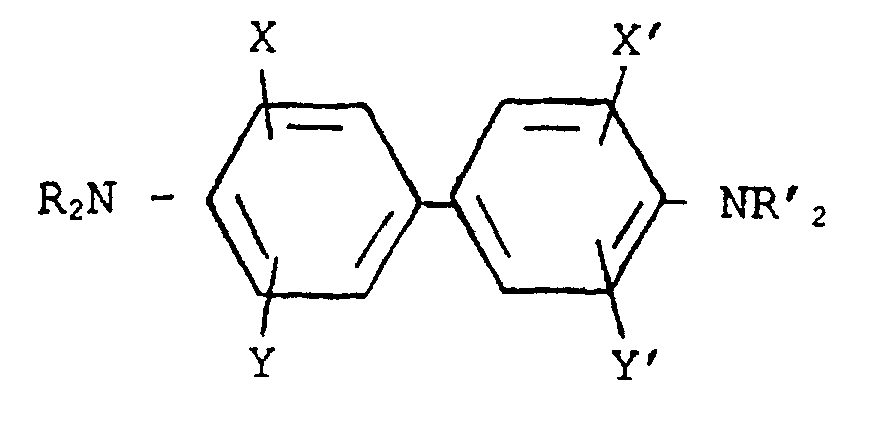
- A test composition as in claim 8 wherein the catalyst is used in a ratio of about one part catalyst to about five to ten parts chromogenic indicator.
- A test composition as in claim 8 which additionally contains a buffer for maintaining the test composition and test fluid sample at about a pH of from 3.5 to 8.0.
- A test composition as in claim 8 wherein the alkyl group contains not more than four carbon atoms.
- A test composition as in claim 8 wherein the chromogenic indicator is syringaldazine.
- A test composition as in claim 8 wherein the catalyst is 3,3',5,5'-tetramethylbenzidine.
- A test device for the determination of free halogens in aqueous test solutions comprising a matrix material incorporated with the dried residue of a test composition comprising the following constituents: A. a chromogenic indicator material selected from the group consisting of (1) a compound having the formulawhere R and R' are selected from the group consisting of hydroxy and amino groups and X,X',Y and Y' are selected from the group consisting of hydrogen, hydroxy, methyl, methoxy, ethyl and ethoxy groups and (2) combinations thereof; B. an effective amount of a catalyst to enhance the response of the chromogenic indicator material to the presence of free halogen in the test solution sample, said catalyst having the formula
 where X, X', Y, Y', R and R' are selected from the group consisting of hydrogen, and alkyl groups of up to six carbon atoms groups; and, C. a buffer for maintaining the test composition in the matrix at a pH in the range of about 3.5 to 8.0 when the test device is contacted with the test solution sample.
- A test device as in claim14 wherein the catalyst is used in a ratio of about one part catalyst to about five to ten parts chromogenic indicator.
- A test device as in claim 14 wherein the alkyl group contains not more than four carbon atoms.
- A test device as in claim 14 wherein the chromogenic indicator is syringaldazine.
- A test device as in claim 14 wherein the catalyst is 3,3',5,5'-tetramethylbenzidine.
- A test device as in claim 14 wherein the matrix is absorbent paper.
Applications Claiming Priority (3)
| Application Number | Priority Date | Filing Date | Title |
|---|---|---|---|
| US08/897,473 US6030842A (en) | 1997-07-21 | 1997-07-21 | Method, composition and device for the determination of free halogens in aqueous fluids |
| US897473 | 1997-07-21 | ||
| PCT/US1998/014954 WO1999004257A1 (en) | 1997-07-21 | 1998-07-20 | Method, composition and device for the determination of free halogens in aqueous fluids |
Publications (2)
| Publication Number | Publication Date |
|---|---|
| EP1000352A1 EP1000352A1 (en) | 2000-05-17 |
| EP1000352B1 true EP1000352B1 (en) | 2002-06-05 |
Family
ID=25407951
Family Applications (1)
| Application Number | Title | Priority Date | Filing Date |
|---|---|---|---|
| EP98934650A Expired - Lifetime EP1000352B1 (en) | 1997-07-21 | 1998-07-20 | Method, composition and device for the determination of free halogens in aqueous fluids |
Country Status (8)
| Country | Link |
|---|---|
| US (1) | US6030842A (en) |
| EP (1) | EP1000352B1 (en) |
| AT (1) | ATE218706T1 (en) |
| AU (1) | AU730860B2 (en) |
| BR (1) | BR9811477B1 (en) |
| CA (1) | CA2295617C (en) |
| DE (1) | DE69805804T2 (en) |
| WO (1) | WO1999004257A1 (en) |
Families Citing this family (34)
| Publication number | Priority date | Publication date | Assignee | Title |
|---|---|---|---|---|
| JP3806889B2 (en) * | 1998-01-08 | 2006-08-09 | 株式会社オメガ | Evaluation method of residual halogen concentration and its evaluation mechanism |
| US6143184A (en) | 1999-03-02 | 2000-11-07 | United States Filter Corporation | Air and water purification using continuous breakpoint halogenation |
| US6409926B1 (en) | 1999-03-02 | 2002-06-25 | United States Filter Corporation | Air and water purification using continuous breakpoint halogenation and peroxygenation |
| US6255117B1 (en) * | 1999-06-04 | 2001-07-03 | Lamotte Company | Method and device for determining monopersulfate |
| US20030027350A1 (en) * | 2001-07-20 | 2003-02-06 | Smith Jack V. | Method for detection of bromine in urine using liquid chemistry, dry chemistry test pads, and lateral flow |
| US6419817B1 (en) | 2000-06-22 | 2002-07-16 | United States Filter Corporation | Dynamic optimization of chemical additives in a water treatment system |
| MXPA02012886A (en) | 2000-06-22 | 2003-05-14 | United States Filter Corp | Corrosion control utilizing a hydrogen peroxide donor. |
| US6716359B1 (en) | 2000-08-29 | 2004-04-06 | United States Filter Corporation | Enhanced time-based proportional control |
| US6620315B2 (en) | 2001-02-09 | 2003-09-16 | United States Filter Corporation | System for optimized control of multiple oxidizer feedstreams |
| US6776926B2 (en) * | 2001-08-09 | 2004-08-17 | United States Filter Corporation | Calcium hypochlorite of reduced reactivity |
| US7108781B2 (en) * | 2002-02-26 | 2006-09-19 | Usfilter Corporation | Enhanced air and water purification using continuous breakpoint halogenation with free oxygen radicals |
| US6991735B2 (en) * | 2002-02-26 | 2006-01-31 | Usfilter Corporation | Free radical generator and method |
| JP4656603B2 (en) * | 2005-09-29 | 2011-03-23 | 三浦工業株式会社 | Residual chlorine concentration measurement composition |
| US12103874B2 (en) | 2006-06-06 | 2024-10-01 | Evoqua Water Technologies Llc | Ultraviolet light activated oxidation process for the reduction of organic carbon in semiconductor process water |
| WO2007146671A2 (en) | 2006-06-06 | 2007-12-21 | Fluid Lines | Ultaviolet light activated oxidation process for the reduction of organic carbon in semiconductor process water |
| US10343939B2 (en) | 2006-06-06 | 2019-07-09 | Evoqua Water Technologies Llc | Ultraviolet light activated oxidation process for the reduction of organic carbon in semiconductor process water |
| US8142722B2 (en) * | 2006-08-08 | 2012-03-27 | Hach Company | Test element and tester for analyzing solutions |
| US8703057B2 (en) * | 2006-08-08 | 2014-04-22 | Hach Company | Electronic device for analyzing aqueous solutions |
| US20080245737A1 (en) * | 2007-04-03 | 2008-10-09 | Siemens Water Technologies Corp. | Method and system for providing ultrapure water |
| US9725343B2 (en) | 2007-04-03 | 2017-08-08 | Evoqua Water Technologies Llc | System and method for measuring and treating a liquid stream |
| US9365436B2 (en) | 2007-04-03 | 2016-06-14 | Evoqua Water Technologies Llc | Method of irradiating a liquid |
| US8961798B2 (en) | 2007-04-03 | 2015-02-24 | Evoqua Water Technologies Llc | Method for measuring a concentration of a compound in a liquid stream |
| US8753522B2 (en) | 2007-04-03 | 2014-06-17 | Evoqua Water Technologies Llc | System for controlling introduction of a reducing agent to a liquid stream |
| US8741155B2 (en) | 2007-04-03 | 2014-06-03 | Evoqua Water Technologies Llc | Method and system for providing ultrapure water |
| US9365435B2 (en) | 2007-04-03 | 2016-06-14 | Evoqua Water Technologies Llc | Actinic radiation reactor |
| US20090004747A1 (en) * | 2007-06-29 | 2009-01-01 | Agree Alan M | Film sensors for detecting free chlorine |
| US8591730B2 (en) | 2009-07-30 | 2013-11-26 | Siemens Pte. Ltd. | Baffle plates for an ultraviolet reactor |
| US8343771B2 (en) | 2011-01-12 | 2013-01-01 | General Electric Company | Methods of using cyanine dyes for the detection of analytes |
| EP2527301B1 (en) | 2011-05-26 | 2016-04-27 | Evoqua Water Technologies GmbH | Method and arrangement for a water treatment |
| EP3036541B1 (en) | 2013-08-16 | 2019-06-12 | Hach Company | A chlorine analytical test element, stabilized n,n-diethyl-p-phenylenediamine solution and method for making the test element |
| US11161762B2 (en) | 2015-01-21 | 2021-11-02 | Evoqua Water Technologies Llc | Advanced oxidation process for ex-situ groundwater remediation |
| US10494281B2 (en) | 2015-01-21 | 2019-12-03 | Evoqua Water Technologies Llc | Advanced oxidation process for ex-situ groundwater remediation |
| JP6996955B2 (en) * | 2017-11-30 | 2022-01-17 | オルガノ株式会社 | Method for measuring the concentration of stabilized hypobromous acid composition |
| DE102018209082A1 (en) * | 2018-06-07 | 2019-12-12 | Axagarius Gmbh & Co. Kg | Test to determine the phosphate concentration |
Family Cites Families (8)
| Publication number | Priority date | Publication date | Assignee | Title |
|---|---|---|---|---|
| US3233974A (en) * | 1961-08-28 | 1966-02-08 | Miles Lab | Diagnostic compositions |
| US3811840A (en) * | 1969-04-01 | 1974-05-21 | Miles Lab | Test device for detecting low concentrations of substances in fluids |
| US4092115A (en) * | 1974-04-11 | 1978-05-30 | Miles Laboratories, Inc. | Method, device and test reagent for detecting free available chlorine in aqueous fluids |
| US4211845A (en) * | 1978-11-24 | 1980-07-08 | Miles Laboratories, Inc. | Glucose indicator and method |
| US4290773A (en) * | 1979-11-13 | 1981-09-22 | Miles Laboratories, Inc. | Stabilization of benzidine-type indicators with various enhancers |
| US4340669A (en) * | 1981-02-12 | 1982-07-20 | Miles Laboratories, Inc. | System for the determination of glucose in fluids |
| US5491094A (en) * | 1994-06-03 | 1996-02-13 | Industrial Test Systems, Inc. | Test strip for free chlorine analysis |
| AU7374796A (en) * | 1995-09-27 | 1997-04-17 | Mercury Diagnostics Inc. | Direct reading chemical test strip for aqueous solutions |
-
1997
- 1997-07-21 US US08/897,473 patent/US6030842A/en not_active Expired - Lifetime
-
1998
- 1998-07-20 DE DE69805804T patent/DE69805804T2/en not_active Expired - Lifetime
- 1998-07-20 CA CA002295617A patent/CA2295617C/en not_active Expired - Fee Related
- 1998-07-20 AU AU84132/98A patent/AU730860B2/en not_active Ceased
- 1998-07-20 EP EP98934650A patent/EP1000352B1/en not_active Expired - Lifetime
- 1998-07-20 WO PCT/US1998/014954 patent/WO1999004257A1/en not_active Ceased
- 1998-07-20 BR BRPI9811477-8A patent/BR9811477B1/en not_active IP Right Cessation
- 1998-07-20 AT AT98934650T patent/ATE218706T1/en not_active IP Right Cessation
Also Published As
| Publication number | Publication date |
|---|---|
| BR9811477A (en) | 2000-08-15 |
| AU730860B2 (en) | 2001-03-15 |
| WO1999004257A1 (en) | 1999-01-28 |
| BR9811477B1 (en) | 2009-12-01 |
| US6030842A (en) | 2000-02-29 |
| EP1000352A1 (en) | 2000-05-17 |
| ATE218706T1 (en) | 2002-06-15 |
| CA2295617A1 (en) | 1999-01-28 |
| AU8413298A (en) | 1999-02-10 |
| DE69805804D1 (en) | 2002-07-11 |
| DE69805804T2 (en) | 2003-02-06 |
| CA2295617C (en) | 2009-01-20 |
Similar Documents
| Publication | Publication Date | Title |
|---|---|---|
| US6030842A (en) | Method, composition and device for the determination of free halogens in aqueous fluids | |
| DE69522576T2 (en) | Method for stabilizing the response of a biosensor | |
| EP0071934B1 (en) | Method for preparing a color stable chromogenic analytical element | |
| CA1114268A (en) | Glucose indicator and method | |
| US6413473B1 (en) | Multicomponent test systems useful in analyzing liquid samples, and uses therefor | |
| US4273868A (en) | Color stable glucose test | |
| US4260393A (en) | Method and combined test elements for detection of heme | |
| US5888758A (en) | Broad range total available chlorine test strip | |
| US4642286A (en) | Composition and method for ethanol determination | |
| US3453180A (en) | Test article | |
| MY117657A (en) | Diagnostics based on tetrazolium compounds | |
| DK156730B (en) | TEST COMPOSITION AND MATERIALS FOR DETERMINING THE EXISTENCE OF GLUCOSE IN A LIQUID SAMPLE AND PROCEDURE FOR SEMIQUANTITATIVE DETERMINATION OF GLUCOSE IN URINE | |
| US5976823A (en) | Low range total available chlorine test strip | |
| US3123443A (en) | Composition for diagnosing glucose | |
| SE466158B (en) | METHOD OF ANALYSIS FOR GLUCOSE DETERMINATION IN WHOLE BLOOD | |
| JPH04120464A (en) | Method of determining calcium and magnesium | |
| US3654180A (en) | Indicator for detecting hydrogen peroxide and peroxidative compounds containing alpha naphthoflavone | |
| JPS6054624B2 (en) | Test device for measuring components in samples | |
| EP0036563A1 (en) | Bilirubin-resistant composition for the determination of cholesterol, test device containing the composition and method of making the test device | |
| US6087089A (en) | Peroxide and chlorine test strip | |
| AU754237B2 (en) | Uric acid assay device with stabilized uricase reagent composition | |
| CA1134247A (en) | Bilirubin-resistant determination of uric acid | |
| US6753159B1 (en) | Uric acid assay device with stabilized uricase reagent composition | |
| US4870024A (en) | Concurrent analysis of a fluid sample for calcium and a monovalent ion | |
| US5955027A (en) | Reagent composition, testing piece, and assay kit |
Legal Events
| Date | Code | Title | Description |
|---|---|---|---|
| PUAI | Public reference made under article 153(3) epc to a published international application that has entered the european phase |
Free format text: ORIGINAL CODE: 0009012 |
|
| 17P | Request for examination filed |
Effective date: 20000112 |
|
| AK | Designated contracting states |
Kind code of ref document: A1 Designated state(s): AT BE CH CY DE DK ES FI FR GB GR IE IT LI LU MC NL PT SE |
|
| GRAG | Despatch of communication of intention to grant |
Free format text: ORIGINAL CODE: EPIDOS AGRA |
|
| 17Q | First examination report despatched |
Effective date: 20010731 |
|
| GRAG | Despatch of communication of intention to grant |
Free format text: ORIGINAL CODE: EPIDOS AGRA |
|
| GRAH | Despatch of communication of intention to grant a patent |
Free format text: ORIGINAL CODE: EPIDOS IGRA |
|
| GRAH | Despatch of communication of intention to grant a patent |
Free format text: ORIGINAL CODE: EPIDOS IGRA |
|
| GRAA | (expected) grant |
Free format text: ORIGINAL CODE: 0009210 |
|
| AK | Designated contracting states |
Kind code of ref document: B1 Designated state(s): AT BE CH CY DE DK ES FI FR GB GR IE IT LI LU MC NL PT SE |
|
| PG25 | Lapsed in a contracting state [announced via postgrant information from national office to epo] |
Ref country code: NL Free format text: LAPSE BECAUSE OF FAILURE TO SUBMIT A TRANSLATION OF THE DESCRIPTION OR TO PAY THE FEE WITHIN THE PRESCRIBED TIME-LIMIT Effective date: 20020605 Ref country code: LI Free format text: LAPSE BECAUSE OF FAILURE TO SUBMIT A TRANSLATION OF THE DESCRIPTION OR TO PAY THE FEE WITHIN THE PRESCRIBED TIME-LIMIT Effective date: 20020605 Ref country code: GR Free format text: LAPSE BECAUSE OF FAILURE TO SUBMIT A TRANSLATION OF THE DESCRIPTION OR TO PAY THE FEE WITHIN THE PRESCRIBED TIME-LIMIT Effective date: 20020605 Ref country code: FI Free format text: LAPSE BECAUSE OF FAILURE TO SUBMIT A TRANSLATION OF THE DESCRIPTION OR TO PAY THE FEE WITHIN THE PRESCRIBED TIME-LIMIT Effective date: 20020605 Ref country code: CH Free format text: LAPSE BECAUSE OF FAILURE TO SUBMIT A TRANSLATION OF THE DESCRIPTION OR TO PAY THE FEE WITHIN THE PRESCRIBED TIME-LIMIT Effective date: 20020605 Ref country code: BE Free format text: LAPSE BECAUSE OF FAILURE TO SUBMIT A TRANSLATION OF THE DESCRIPTION OR TO PAY THE FEE WITHIN THE PRESCRIBED TIME-LIMIT Effective date: 20020605 Ref country code: AT Free format text: LAPSE BECAUSE OF FAILURE TO SUBMIT A TRANSLATION OF THE DESCRIPTION OR TO PAY THE FEE WITHIN THE PRESCRIBED TIME-LIMIT Effective date: 20020605 |
|
| REF | Corresponds to: |
Ref document number: 218706 Country of ref document: AT Date of ref document: 20020615 Kind code of ref document: T |
|
| REG | Reference to a national code |
Ref country code: GB Ref legal event code: FG4D |
|
| REG | Reference to a national code |
Ref country code: CH Ref legal event code: EP |
|
| REG | Reference to a national code |
Ref country code: IE Ref legal event code: FG4D |
|
| REF | Corresponds to: |
Ref document number: 69805804 Country of ref document: DE Date of ref document: 20020711 |
|
| PG25 | Lapsed in a contracting state [announced via postgrant information from national office to epo] |
Ref country code: LU Free format text: LAPSE BECAUSE OF NON-PAYMENT OF DUE FEES Effective date: 20020720 |
|
| PG25 | Lapsed in a contracting state [announced via postgrant information from national office to epo] |
Ref country code: IE Free format text: LAPSE BECAUSE OF NON-PAYMENT OF DUE FEES Effective date: 20020722 |
|
| PG25 | Lapsed in a contracting state [announced via postgrant information from national office to epo] |
Ref country code: CY Free format text: LAPSE BECAUSE OF FAILURE TO SUBMIT A TRANSLATION OF THE DESCRIPTION OR TO PAY THE FEE WITHIN THE PRESCRIBED TIME-LIMIT Effective date: 20020731 |
|
| PG25 | Lapsed in a contracting state [announced via postgrant information from national office to epo] |
Ref country code: SE Free format text: LAPSE BECAUSE OF FAILURE TO SUBMIT A TRANSLATION OF THE DESCRIPTION OR TO PAY THE FEE WITHIN THE PRESCRIBED TIME-LIMIT Effective date: 20020905 Ref country code: PT Free format text: LAPSE BECAUSE OF FAILURE TO SUBMIT A TRANSLATION OF THE DESCRIPTION OR TO PAY THE FEE WITHIN THE PRESCRIBED TIME-LIMIT Effective date: 20020905 Ref country code: DK Free format text: LAPSE BECAUSE OF FAILURE TO SUBMIT A TRANSLATION OF THE DESCRIPTION OR TO PAY THE FEE WITHIN THE PRESCRIBED TIME-LIMIT Effective date: 20020905 |
|
| NLV1 | Nl: lapsed or annulled due to failure to fulfill the requirements of art. 29p and 29m of the patents act | ||
| REG | Reference to a national code |
Ref country code: CH Ref legal event code: PL |
|
| PG25 | Lapsed in a contracting state [announced via postgrant information from national office to epo] |
Ref country code: ES Free format text: LAPSE BECAUSE OF FAILURE TO SUBMIT A TRANSLATION OF THE DESCRIPTION OR TO PAY THE FEE WITHIN THE PRESCRIBED TIME-LIMIT Effective date: 20021220 |
|
| PG25 | Lapsed in a contracting state [announced via postgrant information from national office to epo] |
Ref country code: MC Free format text: LAPSE BECAUSE OF NON-PAYMENT OF DUE FEES Effective date: 20030201 |
|
| PLBE | No opposition filed within time limit |
Free format text: ORIGINAL CODE: 0009261 |
|
| STAA | Information on the status of an ep patent application or granted ep patent |
Free format text: STATUS: NO OPPOSITION FILED WITHIN TIME LIMIT |
|
| 26N | No opposition filed |
Effective date: 20030306 |
|
| REG | Reference to a national code |
Ref country code: IE Ref legal event code: MM4A |
|
| REG | Reference to a national code |
Ref country code: GB Ref legal event code: 732E |
|
| REG | Reference to a national code |
Ref country code: FR Ref legal event code: TP |
|
| REG | Reference to a national code |
Ref country code: FR Ref legal event code: PLFP Year of fee payment: 19 |
|
| PGFP | Annual fee paid to national office [announced via postgrant information from national office to epo] |
Ref country code: IT Payment date: 20160722 Year of fee payment: 19 Ref country code: GB Payment date: 20160727 Year of fee payment: 19 |
|
| REG | Reference to a national code |
Ref country code: FR Ref legal event code: PLFP Year of fee payment: 20 |
|
| PGFP | Annual fee paid to national office [announced via postgrant information from national office to epo] |
Ref country code: DE Payment date: 20170727 Year of fee payment: 20 Ref country code: FR Payment date: 20170726 Year of fee payment: 20 |
|
| GBPC | Gb: european patent ceased through non-payment of renewal fee |
Effective date: 20170720 |
|
| PG25 | Lapsed in a contracting state [announced via postgrant information from national office to epo] |
Ref country code: GB Free format text: LAPSE BECAUSE OF NON-PAYMENT OF DUE FEES Effective date: 20170720 |
|
| REG | Reference to a national code |
Ref country code: DE Ref legal event code: R071 Ref document number: 69805804 Country of ref document: DE |
|
| PG25 | Lapsed in a contracting state [announced via postgrant information from national office to epo] |
Ref country code: IT Free format text: LAPSE BECAUSE OF NON-PAYMENT OF DUE FEES Effective date: 20170720 |