EP1000022B1 - Hydrocyanation processes and multidentate phosphite ligand and nickel catalyst compositions therefor - Google Patents
Hydrocyanation processes and multidentate phosphite ligand and nickel catalyst compositions therefor Download PDFInfo
- Publication number
- EP1000022B1 EP1000022B1 EP98937046A EP98937046A EP1000022B1 EP 1000022 B1 EP1000022 B1 EP 1000022B1 EP 98937046 A EP98937046 A EP 98937046A EP 98937046 A EP98937046 A EP 98937046A EP 1000022 B1 EP1000022 B1 EP 1000022B1
- Authority
- EP
- European Patent Office
- Prior art keywords
- ligand
- alkyl
- pentenenitrile
- primary
- alcl
- Prior art date
- Legal status (The legal status is an assumption and is not a legal conclusion. Google has not performed a legal analysis and makes no representation as to the accuracy of the status listed.)
- Expired - Lifetime
Links
- 0 Cc1c(*)c(*)cc(OP(O)Oc2c(*)cc(cccc3)c3c2-c(c(cccc2)c2cc2*)c2O)c1* Chemical compound Cc1c(*)c(*)cc(OP(O)Oc2c(*)cc(cccc3)c3c2-c(c(cccc2)c2cc2*)c2O)c1* 0.000 description 18
Classifications
-
- C—CHEMISTRY; METALLURGY
- C07—ORGANIC CHEMISTRY
- C07F—ACYCLIC, CARBOCYCLIC OR HETEROCYCLIC COMPOUNDS CONTAINING ELEMENTS OTHER THAN CARBON, HYDROGEN, HALOGEN, OXYGEN, NITROGEN, SULFUR, SELENIUM OR TELLURIUM
- C07F9/00—Compounds containing elements of Groups 5 or 15 of the Periodic Table
- C07F9/02—Phosphorus compounds
- C07F9/547—Heterocyclic compounds, e.g. containing phosphorus as a ring hetero atom
- C07F9/6564—Heterocyclic compounds, e.g. containing phosphorus as a ring hetero atom having phosphorus atoms, with or without nitrogen, oxygen, sulfur, selenium or tellurium atoms, as ring hetero atoms
- C07F9/6571—Heterocyclic compounds, e.g. containing phosphorus as a ring hetero atom having phosphorus atoms, with or without nitrogen, oxygen, sulfur, selenium or tellurium atoms, as ring hetero atoms having phosphorus and oxygen atoms as the only ring hetero atoms
- C07F9/6574—Esters of oxyacids of phosphorus
- C07F9/65746—Esters of oxyacids of phosphorus the molecule containing more than one cyclic phosphorus atom
-
- B—PERFORMING OPERATIONS; TRANSPORTING
- B01—PHYSICAL OR CHEMICAL PROCESSES OR APPARATUS IN GENERAL
- B01J—CHEMICAL OR PHYSICAL PROCESSES, e.g. CATALYSIS OR COLLOID CHEMISTRY; THEIR RELEVANT APPARATUS
- B01J31/00—Catalysts comprising hydrides, coordination complexes or organic compounds
- B01J31/16—Catalysts comprising hydrides, coordination complexes or organic compounds containing coordination complexes
- B01J31/18—Catalysts comprising hydrides, coordination complexes or organic compounds containing coordination complexes containing nitrogen, phosphorus, arsenic or antimony as complexing atoms, e.g. in pyridine ligands, or in resonance therewith, e.g. in isocyanide ligands C=N-R or as complexed central atoms
- B01J31/1845—Catalysts comprising hydrides, coordination complexes or organic compounds containing coordination complexes containing nitrogen, phosphorus, arsenic or antimony as complexing atoms, e.g. in pyridine ligands, or in resonance therewith, e.g. in isocyanide ligands C=N-R or as complexed central atoms the ligands containing phosphorus
- B01J31/185—Phosphites ((RO)3P), their isomeric phosphonates (R(RO)2P=O) and RO-substitution derivatives thereof
-
- C—CHEMISTRY; METALLURGY
- C07—ORGANIC CHEMISTRY
- C07C—ACYCLIC OR CARBOCYCLIC COMPOUNDS
- C07C253/00—Preparation of carboxylic acid nitriles
- C07C253/08—Preparation of carboxylic acid nitriles by addition of hydrogen cyanide or salts thereof to unsaturated compounds
- C07C253/10—Preparation of carboxylic acid nitriles by addition of hydrogen cyanide or salts thereof to unsaturated compounds to compounds containing carbon-to-carbon double bonds
-
- C—CHEMISTRY; METALLURGY
- C07—ORGANIC CHEMISTRY
- C07F—ACYCLIC, CARBOCYCLIC OR HETEROCYCLIC COMPOUNDS CONTAINING ELEMENTS OTHER THAN CARBON, HYDROGEN, HALOGEN, OXYGEN, NITROGEN, SULFUR, SELENIUM OR TELLURIUM
- C07F9/00—Compounds containing elements of Groups 5 or 15 of the Periodic Table
- C07F9/02—Phosphorus compounds
- C07F9/06—Phosphorus compounds without P—C bonds
- C07F9/08—Esters of oxyacids of phosphorus
- C07F9/141—Esters of phosphorous acids
- C07F9/145—Esters of phosphorous acids with hydroxyaryl compounds
-
- B—PERFORMING OPERATIONS; TRANSPORTING
- B01—PHYSICAL OR CHEMICAL PROCESSES OR APPARATUS IN GENERAL
- B01J—CHEMICAL OR PHYSICAL PROCESSES, e.g. CATALYSIS OR COLLOID CHEMISTRY; THEIR RELEVANT APPARATUS
- B01J2231/00—Catalytic reactions performed with catalysts classified in B01J31/00
- B01J2231/30—Addition reactions at carbon centres, i.e. to either C-C or C-X multiple bonds
- B01J2231/32—Addition reactions to C=C or C-C triple bonds
- B01J2231/323—Hydrometalation, e.g. bor-, alumin-, silyl-, zirconation or analoguous reactions like carbometalation, hydrocarbation
-
- B—PERFORMING OPERATIONS; TRANSPORTING
- B01—PHYSICAL OR CHEMICAL PROCESSES OR APPARATUS IN GENERAL
- B01J—CHEMICAL OR PHYSICAL PROCESSES, e.g. CATALYSIS OR COLLOID CHEMISTRY; THEIR RELEVANT APPARATUS
- B01J2531/00—Additional information regarding catalytic systems classified in B01J31/00
- B01J2531/02—Compositional aspects of complexes used, e.g. polynuclearity
- B01J2531/0261—Complexes comprising ligands with non-tetrahedral chirality
- B01J2531/0266—Axially chiral or atropisomeric ligands, e.g. bulky biaryls such as donor-substituted binaphthalenes, e.g. "BINAP" or "BINOL"
-
- B—PERFORMING OPERATIONS; TRANSPORTING
- B01—PHYSICAL OR CHEMICAL PROCESSES OR APPARATUS IN GENERAL
- B01J—CHEMICAL OR PHYSICAL PROCESSES, e.g. CATALYSIS OR COLLOID CHEMISTRY; THEIR RELEVANT APPARATUS
- B01J2531/00—Additional information regarding catalytic systems classified in B01J31/00
- B01J2531/80—Complexes comprising metals of Group VIII as the central metal
- B01J2531/84—Metals of the iron group
- B01J2531/847—Nickel
-
- B—PERFORMING OPERATIONS; TRANSPORTING
- B01—PHYSICAL OR CHEMICAL PROCESSES OR APPARATUS IN GENERAL
- B01J—CHEMICAL OR PHYSICAL PROCESSES, e.g. CATALYSIS OR COLLOID CHEMISTRY; THEIR RELEVANT APPARATUS
- B01J31/00—Catalysts comprising hydrides, coordination complexes or organic compounds
- B01J31/26—Catalysts comprising hydrides, coordination complexes or organic compounds containing in addition, inorganic metal compounds not provided for in groups B01J31/02 - B01J31/24
- B01J31/28—Catalysts comprising hydrides, coordination complexes or organic compounds containing in addition, inorganic metal compounds not provided for in groups B01J31/02 - B01J31/24 of the platinum group metals, iron group metals or copper
Definitions
- the invention generally relates to a process and catalyst precursor composition for the hydrocyanation of monoethylenically unsaturated compounds wherein zero-valent nickel and a multidentate phosphite ligand are used in the presence of a Lewis acid promoter.
- Hydrocyanation catalyst systems particularly pertaining to the hydrocyanation of ethylenically unsaturated compounds, are known in the art.
- systems useful for the hydrocyanation of butadiene to form pentenenitrile (PN) and in the subsequent hydrocyanation of pentenenitrile to form adiponitrile (ADN), are known in the commercially important nylon synthesis field.
- hydrocyanation of activated ethylenically unsaturated compounds proceeds without the use of a Lewis acid promoter, while hydrocyanation of unactivated ethylenically unsaturated compounds, such as 1-octene and 3-pentenenitrile, requires the use of a Lewis acid promoter.
- conjugated ethylenically unsaturated compounds e.g., butadiene and styrene
- strained ethylenically unsaturated compounds e.g., norbomene
- U.S. Patent 3,496,217 discloses an improvement in hydrocyanation using a promoter selected from a large number of metal cation compounds with a variety of anions as catalyst promoters.
- U.S. Patent 3,496,218 discloses a nickel hydrocyanation catalyst promoted with various boron-containing compounds, including triphenylboron and alkali metal borohydrides.
- U.S. Patent 4,774,353 discloses a process for the preparation of dinitriles, including ADN, from unsaturated nitriles, including PN, in the presence of a zero-valent nickel catalyst and a triorganotin catalyst promoter.
- ADN dinitriles
- PN unsaturated nitriles
- PN triorganotin catalyst promoter.
- Patent 4,874,884 discloses a process for producing ADN by the zero-valent nickel-catalyzed hydrocyanation of pentenenitriles in the presence of a synergistic combination of promoters selected in accordance with the reaction kinetics of the ADN synthesis.
- Phosphite ligands have been shown to be useful ligands in the hydrocyanation of activated ethylenically unsaturated compounds. See, for example, Baker, M. J., and Pringle, P. G., J. Chem. Soc., Chem. Commun. , 1991 , 1292; Baker et al., J Chem. Soc., Chem. Commun. , 1991 , 803; Union Carbide, WO 93,03839. Also, phosphite ligands have been disclosed with rhodium in the hydroformylation of functionalized ethylenically unsaturated compounds: see, Cuny et al., J. Am. Chem. Soc . , 1993, 115 , 2066.
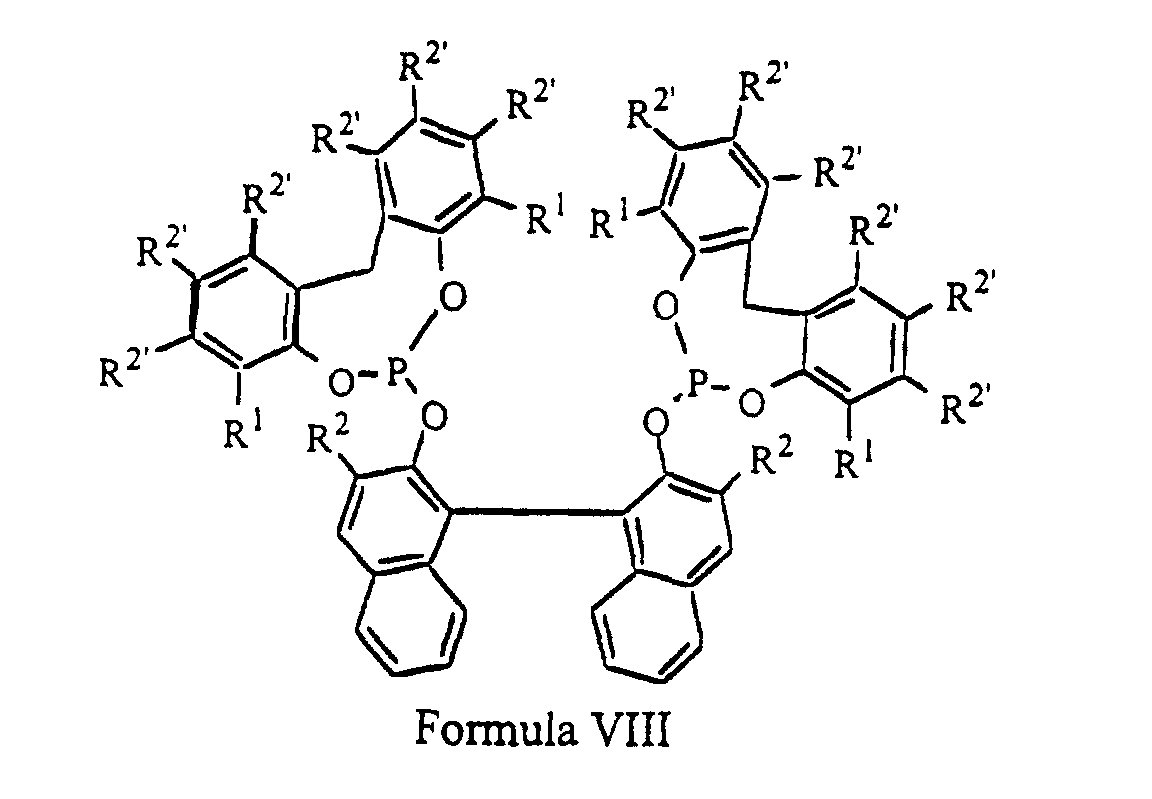
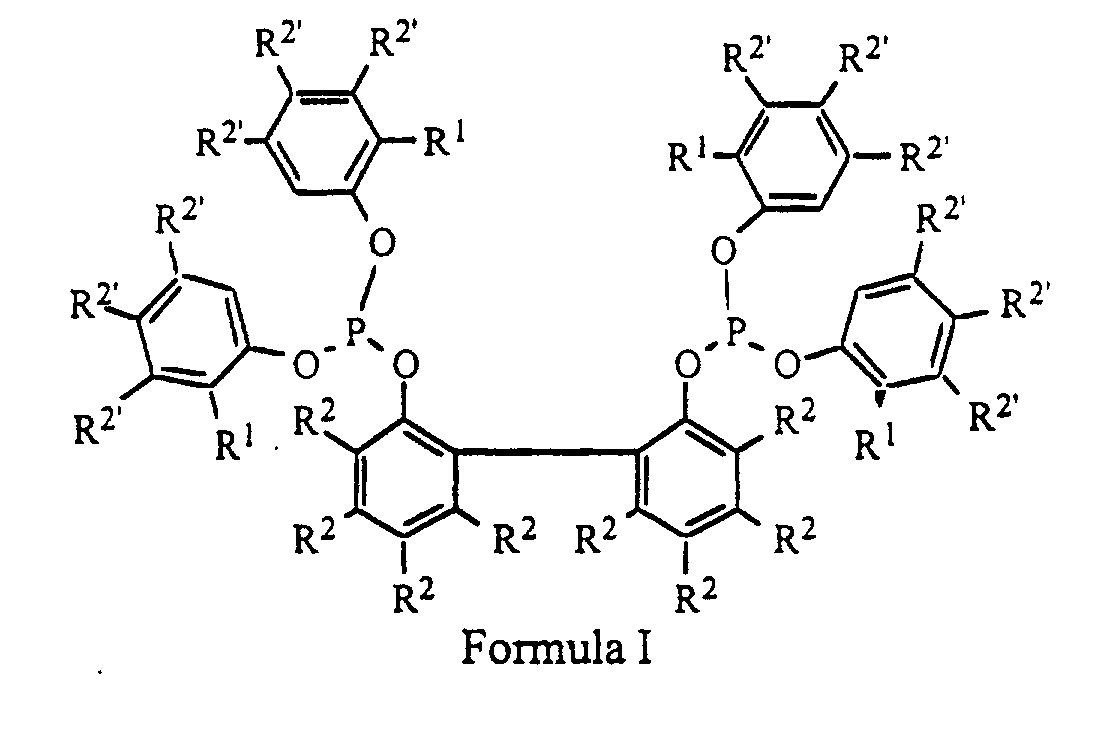
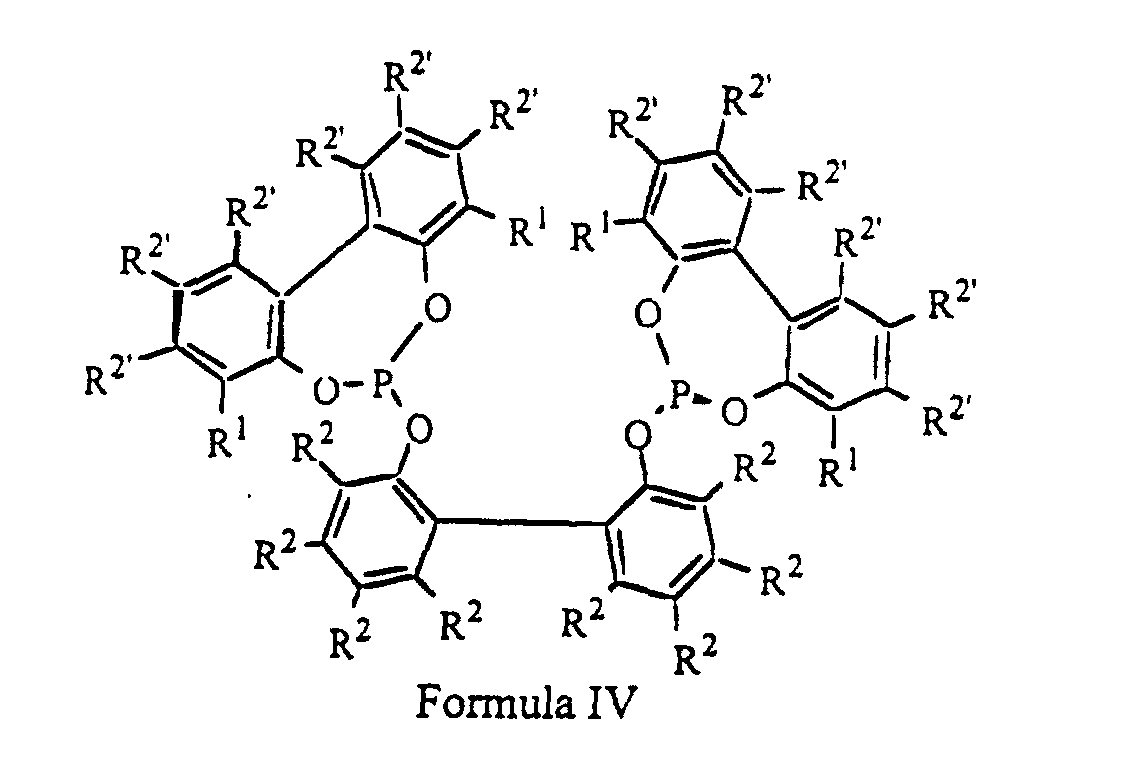
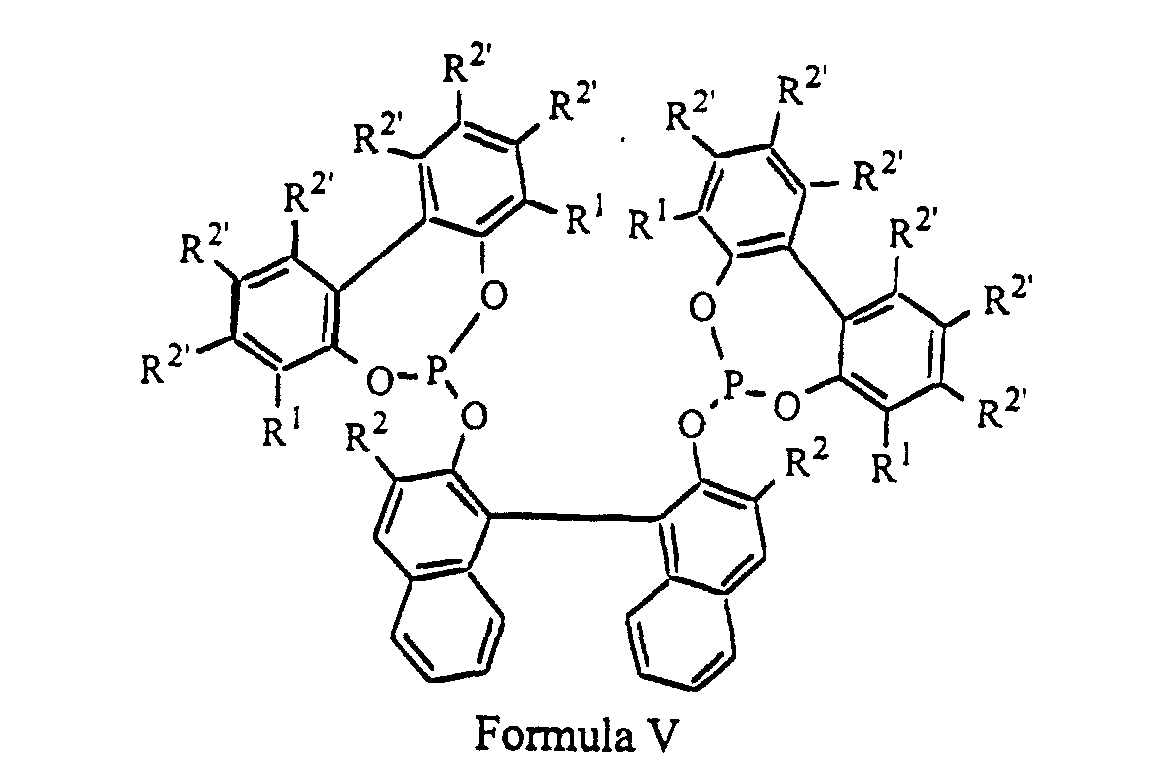
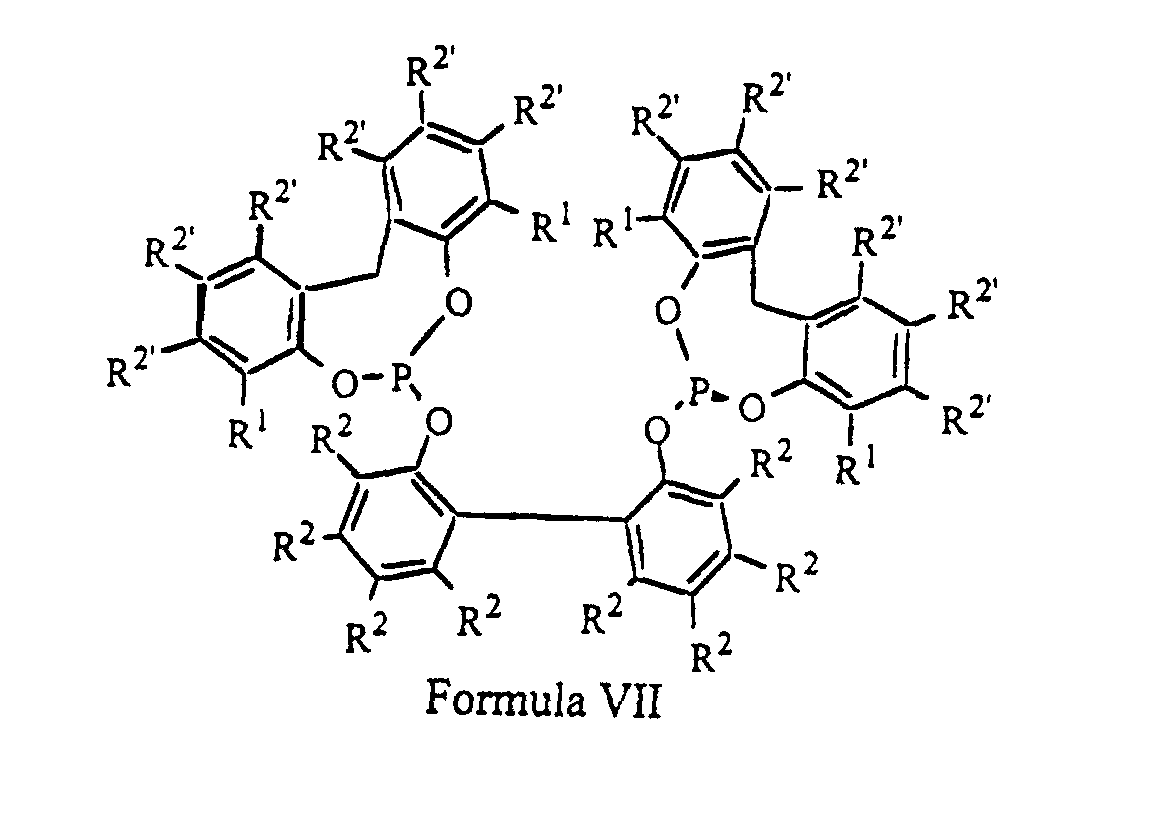
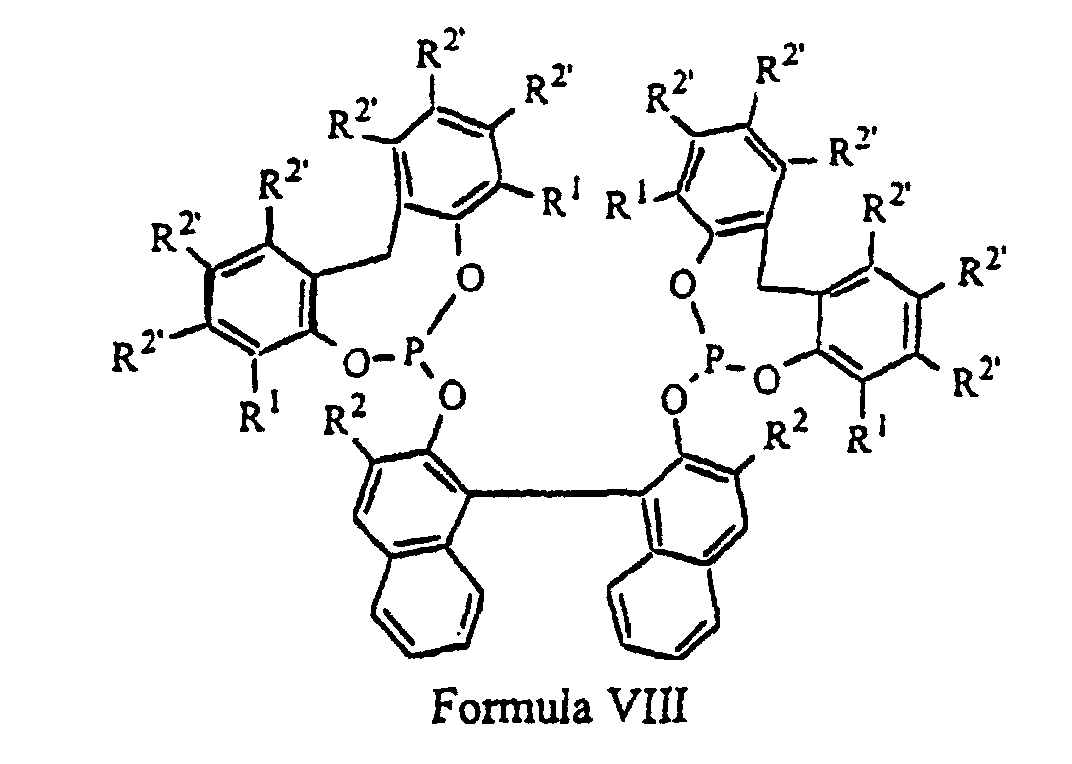
- the present invention provides for a hydrocyanation process, comprising reacting an acyclic, aliphatic, monoethylenically unsaturated compound in which the ethylenic double bond is not conjugated to any other olefinic group in the molecule, or a monoethylenically unsaturated compound in which the ethylenic double bond is conjugated to an organic ester group, with a source of HCN in the presence of a catalyst precursor composition comprising a Lewis acid, a zero-valent nickel, and at least one multidentate phosphite ligand selected from the group represented by the following Formulas I, II, III, IV, V, VI, VII, VIII, and IX, in which all like reference characters have the same meaning, except as further explicitly limited.
- the Lewis acid is considered to be a promoter.
- hydrocarbyl is well known in the art and designates a hydrocarbon molecule from which one hydrogen atom has been removed. Such molecules can contain single, double or triple bonds.
- the present invention further provides for novel multidentate phosphite ligands selected from one of Formulas I-IX, as defined above and catalyst precursor compositions made therefrom with zero-valent nickel.
- the catalyst precursor compositions also have a Lewis acid present.
- the zero-valent nickel and the multidentate phosphite ligand are supported on the same solid support.
- R 1 is a primary alkyl, examples of which include methyl, ethyl and n-propyl.
- each R 1 is methyl
- each R 2 is methyl except R 2 para to oxygen
- R 2 para to oxygen is hydrogen
- R 2' is hydrogen.
- the catalyst composition of the invention may be considered a "precursor" composition in that the zero-valent nickel at some point becomes complexed to the multidentate phosphite ligand, and, further in all likelihood, additional reactions occur during hydrocyanation, such as, for example, complexing of the initial catalyst composition to an ethylenically unsaturated compound.
- ligands can be prepared by a variety of methods known in the art, for example, see descriptions in European Patent Application 92109599.8 of Mitsubishi Kasei Corporation and the corresponding U.S. Patent 5,235,113 to Sato et al.
- the reaction of o-cresol with phosphorus trichloride gives the phosphorochloridite.
- the reaction of this phosphorochloridite with 3,3',4,4',6,6'-hexamethyl-2,2'-biphenol in the presence of triethylamine gives the above-identified preferred ligand of Formula I.
- the phosphorochloridite may be prepared by a variety of methods known in the art, for example, see descriptions in Polymer , 1992 , 33 , 161; Inorganic Synthesis , 1966 , 8 , 68;.U.S. 5,210,260; Z. Anorg . Allg. Chem. , 1986 , 535 , 221.
- phosphorochloridites With bulky ortho-substituted phenols (e.g., 2-t-butylphenol), phosphorochloridites can be prepared in situ from PCl 3 and the phenol. With less bulky groups, purification by high vacuum distillation is typically necessary. High vacuum distillation is difficult for large scale operations.
- An improved process for preparing the phosphochlorodite comprises treatment of N,N-dialkyl diarylphosphoramidite with HCl.
- CIP(OMe) 2 has been prepared in this manner, see Z. Naturforsch , 1972 , 27B, 1429.
- Phosphorochloridites derived from substituted phenols have been prepared using this procedure as described in copending commonly assigned application Serial No. 08/563,718, filed November 28, 1995. It has also been found that phosphorochloridite of o-cresol can be prepared in situ from PCl 3 and o-cresol.
- the zero-valent nickel compounds can be prepared or generated according to techniques well known in the art, as described, for example, in U.S. Patents 3,496,217; 3,631,191; 3,846,461; 3,847,959; and 3,903,120, which are incorporated herein by reference.
- Zero-valent nickel compounds that contain ligands which can be displaced by the organophosphorus ligand are a preferred source of zero-valent nickel.
- Two such preferred zero-valent nickel compounds are Ni(COD) 2 (COD is 1,5-cyclooctadiene) and Ni4 ⁇ P(O-o-C 6 H 4 CH 3 ) 3 ⁇ 2 (C 2 H 4 ), both of which are known in the art.
- divalent nickel compounds may be combined with a reducing agent, to serve as a source of zero-valent nickel in the reaction.
- Suitable divalent nickel compounds include compounds of the formula NiY 2 where Y is halide, carboxylate, or acetylacetonate.
- Suitable reducing agents include metal borohydrides, metal aluminum hydrides, metal alkyls, Zn, Fe, Al, Na, or H 2 .
- the nonconjugated acyclic, aliphatic, monoethylenically unsaturated starting materials useful in this invention include unsaturated organic compounds containing from 2 to approximately 30 carbon atoms. 3-Pentenenitrile and 4-pentenenitrile are especially preferred.
- 3-Pentenenitrile and 4-pentenenitrile are especially preferred.
- up to about 10% by weight of the monoethylenically unsaturated compound may be present in the form of a conjugated isomer, which itself may undergo hydrocyanation.
- 3-pentenenitrile is used, as much as 10% by weight thereof may be 2-pentenenitrile.
- Suitable unsaturated compounds include unsubstituted hydrocarbons as well as hydrocarbons substituted with groups which do not attack the catalyst, such as cyano.
- These unsaturated compounds include monoethylenically unsaturated compounds containing from 2 to 30 carbons such as ethylene, propylene, butene-1, pentene-2, hexene-2, etc., nonconjugated diethylenically unsaturated compounds such as allene, substituted compounds such as 3-pentenenitrile, 4-pentenenitrile, methyl pent-3-enoate, and ethylenically unsaturated compounds having perfluoroalkyl substituents such as, for example, C z F 2z+1 , where z is an integer of up to 20.
- the monoethylenically unsaturated compounds may also be conjugated to an ester group such as methyl pent-2-enoate.
- the starting ethylenically unsaturated compounds useful in this invention and the hydrocyanation products thereof are those shown above in Formulas X through XII. Those of Formula X yield terminal nitriles of Formula XI, while those of Formula XII yield terminal nitriles of Formula XIII.
- nonconjugated linear alkenes Preferred are nonconjugated linear alkenes, nonconjugated linear alkenenitriles, nonconjugated linear alkenoates, linear alk-2-enoates and perfluoroalkyl ethylenes.
- the preferred products are terminal alkanenitriles, linear dicyanoalkylenes, linear aliphatic cyanoesters, and 3-(perfluoroalkyl)propionitrile. Most preferred products are adiponitrile, alkyl 5-cyanovalerate, and C 2 F 2z+1 CH 2 CH 2 CN, where z is 1 to 12.
- the present hydrocyanation process may be carried out, for example, by charging a reactor with the reactants, catalyst composition, and solvent, if any; but preferably, the hydrogen cyanide is added slowly to the mixture of the other components of the reaction. Hydrogen cyanide may be delivered as a liquid or as a vapor to the reaction. Another suitable technique is to charge the reactor with the catalyst and the solvent to be used, and feed both the unsaturated compound and the HCN slowly to the reaction mixture.
- the molar ratio of unsaturated compound to catalyst can be varied from about 10:1 to about 2000:1.
- the reaction medium is agitated, for example, by stirring or shaking.
- the reaction product can be recovered by conventional techniques such as, for example, by distillation.
- the reaction may be run either batchwise or in a continuous manner.
- the hydrocyanation reaction can be carried out with or without a solvent.
- the solvent if used, should be liquid at the reaction temperature and pressure and inert towards the unsaturated compound and the catalyst. Suitable solvents include hydrocarbons, such as benzene or xylene, and nitriles, such as acetonitrile or benzonitrile. In some cases, the unsaturated compound to be hydrocyanated may itself serve as the solvent.
- temperatures of from -25°C to 200°C can be used, the range of 0°C to 150°C being preferred.
- Atmospheric pressure is satisfactory for carrying out the present invention and hence pressures of from about 0.05 to 10 atmospheres (50.6 to 1013 kPa) are preferred. Higher pressures, up to 10,000 kPa or more, can be used, if desired, but any benefit that may be obtained thereby would probably not justify the increased cost of such operations.
- HCN can be introduced to the reaction as a vapor or liquid.
- a cyanohydrin can be used as the source of HCN. See, for example, U.S. Patent 3,655,723.
- the process of this invention is carried out in the presence of one or more Lewis acid promoters which affect both the activity and the selectivity of the catalyst system.
- the promoter may be an inorganic or organometallic compound in which the cation is selected from scandium, titanium, vanadium, chromium, manganese, iron, cobalt, copper, zinc, boron, aluminum, yttrium, zirconium, niobium, molybdenum, cadmium, rhenium and tin.
- Examples include ZnBr 2 , ZnI 2 , ZnCl 2 , ZnSO 4 , CuCl 2 , CuCl, Cu(O 3 SCF 3 ) 2 , CoCl 2 , CoI 2 , FeI 2 , FeCl 3 , FeCl 2 , FeCl 2 (THF) 2 , TiCl 4 (THF) 2 , TiCl 4 , TiCl 3 , ClTi(OiPr) 3 , MnCl 2 , ScCl 3 , AlCl 3 , (C 8 H 17 )AlCl 2 , (C 8 H 17 ) 2 AlCl, (iso-C 4 H 9 ) 2 AlCl, Ph 2 AlCl, PhAlCl 2 , ReCl 5 , ZrCl 4 , NbCl 5 , VCl 3 , CrCl 2 , MoCl 5 , YCl 3 , CdCl 2 , LaCl 3
- Suitable promoters are further described in U.S. Patents 3,496,217; 3,496,218; and 4,774,353. These include metal salts (such as ZnCl 2 , CoI 2 , and SnCl 2 ), and organometallic compounds (such as RAlCl 2 , R 3 SnO 3 SCF 3 , and R 3 B, where R is an alkyl or aryl group).
- metal salts such as ZnCl 2 , CoI 2 , and SnCl 2
- organometallic compounds such as RAlCl 2 , R 3 SnO 3 SCF 3 , and R 3 B, where R is an alkyl or aryl group.
- U.S. Patent 4,874,884 describes how synergistic combinations of promoters can be chosen to increase the catalytic activity of the catalyst system.
- the mole ratio of promoter to nickel present in the reaction can be within the range of about 1:16 to about 50:1.
- HCN gas chromatography
- Ligand "A” 325 mg of Ligand "A”, 40 mg Ni(COD) 2 , and 20 mg of ZnCl 2 were dissolved in 5 mL of 3-pentenenitrile. The mixture was treated with HCN at a nitrogen flow rate of 30 mL/min at 70°C for one hour. GC analysis indicated 68.2% ADN, 9.1% MGN, and 1.4% ESN (selectivity to ADN: 86.6%).
- Example 2 The procedure is the same as Example 1 but with 2-ethylphenol (978 mg, 8 mmoles), PCl 3 (550 mg, 4 mmoles) and NEt 3 (1.0 g, 10 mmoles) followed by 2,2'-ethylidenebis(4,6-dimethylphenol) (370 mg, 2 mmoles), prepared according to Yamada et al., Bull. Chem. Soc. Jpn. , 1989 , 62 , 3603, and NEt 3 (0.4 g, 4 mmoles).
- Example 2 The procedure is the same as Example 1 but with 2,5-dimethylphenol (978 mg, 8 mmoles), PCl 3 (550 mg, 4 mmoles) and NEt 3 (1.0 g, 10 mmoles) followed by 2,2'-dihydroxy-3,3'-dimethoxy-5,5'-dimethyl-1,1'-biphenylene (550 mg, 2 mmoles), and NEt 3 (0.4 g, 4 mmoles).
- Example 2 The procedure is the same as Example 1 but with 2-methyl-4-t-butylphenol (1.314 g, 8 mmoles), PCl 3 (550 mg, 4 mmoles) and NEt 3 (0.9 g, 9 mmoles) followed by 2,2'-dihydroxy-3,3'-dimethoxy-5,5'-dimethyl-1,1'-biphenylene (550 mg, 2 mmoles), and NEt 3 (0.6 g, 6 mmoles).
- Example 2 The procedure is the same as Example 1 but with o-cresol (865 mg, 8 mmoles), PCl 3 (550 mg, 4 mmoles) and NEt 3 (1.0 g, 10 mmoles) followed by dihydrodieugenol (653 mg, 2 mmoles), prepared according to Phytochemistry , 1988 , 27 , 3008 and NEt 3 (0.4 g, 4 mmoles).
- Et 2 NPCl 2 (6.92 gm, 39.7 mmol) and triethylamine (10.1 gm, 100 mmol) were added to a 250 mL round bottom flask with a magnetic stirbar and 100 mL dry ether. This solution was cooled to -30°C in the drybox freezer. Ortho-cresol was diluted in dry ether (50 mL) then poured dropwise into the stirred cold ether solution of PCl 2 (NEt 2 ) and triethylamine. The reaction mixture was allowed to warm to ambient temperature with stirring. After two hours at ambient temperature, a 31 P NMR analysis indicated that the reaction was complete (single signal at 142.2 ppm).
- Diphenyl 2,2'-dihydroxy-1,1'-binaphthalene-3,3'-dicarboxylate was prepared by oxidatively coupling phenyl 2-hydroxy-3-naphthoate in toluene with oxygen and Cu(TMEDA)(OH)Cl catalyst as described in Tetrahedron Lett . 1990 , 413.
- a toluene solution of (2-CH 3 C 6 H 4 O) 2 PCl (5 mmol) was prepared as described in Example 11.
- This phosphorochloridite was treated with diphenyl 2,2'-dihydroxy-1,1'-binaphthalene-3,3'-dicarboxylate (1.05 gm, 2.0 mmol) in the presence of excess triethylamine base using the procedure described in Example 11.
- a 31 P NMR analysis gave a major phosphite signal at 130 ppm with minor signals at 131 and 127 ppm.
- Diisopropyl 2,2'-dihydroxy-1,1'-binaphthalene-3,3'-dicarboxylate was prepared by oxidatively coupling isopropyl 2-hydroxy-3-naphthoate in toluene with oxygen and Cu(TMEDA)(OH)Cl catalyst as described in Tetrahedron Lett . 1990 , 413.
- a toluene solution of (2-CH 3 C 6 H 4 O) 2 PCl (5 mmol) was prepared as described in Example 11.
- This phosphorochloridite was treated with diisopropyl 2,2'-dihydroxy-1,1'-binaphthalene-3,3'-dicarboxylate (0.917 gm, 2.0 mmol) in the presence of excess triethylamine base using the procedure described in Example 11.
- a 31 P NMR analysis gave a major phosphite signal at 129.9 ppm with minor signals at 131.3, 131.2 and 127 ppm.
- This ligand was prepared similar to Ligand "O" but 3,3',4,4',6,6'-hexamethyl-2,2'-biphenol (prepared by coupling of 2.3,5-trimethylphenol using the literature procedure for 3,3',5,5' tetramethyl-2,2'-biphenol: W. W. Kaeding, J. Org. Chem. , 1963 , 28 , 1063 was used as the backbone. 31 P NMR (C 6 D 6 ): 135.2 ppm. APCI MS (m/z): Found: 759.72 (M + + H); calculated for M + + H (C 46 H 48 O 6 P 2 + H): 759,30.
- This ligand was prepared similar to Ligand "Q" but 3,3'-dimethoxy-5,5'-dimethyl-2,2'-dihydroxy-1,1'-biphenylene [prepared by coupling 2-methoxy-4-methylphenol using the procedure described in Phytochemistry 1988 , 27 , 3008] was used instead of 3,3',5,5'-tetramethyl-2,2'-biphenol as the backbone. After the usual workup, the residue was vacuum dried and then treated with 100 mL of isopropyl alcohol. A solid formed which was collected and vacuum dried to give the desired product as a white solid. 31 P NMR (C 6 D 6 ): 134.6 ppm with minor peak due to an impurity at 145.6 ppm.
- This ligand was prepared similar to Ligand "Q" but 2,2'-ethylidenebis(4,6-dimethylphenol) [prepared according to Yamada et. al., Bull, Chem. Soc. Jpn. 1989 , 62 , 3603] was used instead of 3,3',5,5'-tetramethyl-2,2'-biphenol as the backbone.
- This ligand was prepared similar to Ligand "T" but 2,2'-ethylidenebis(4,6-dimethylphenol) (prepared using a literature procedure: F. Yamada, T. Nishiyama, M. Yamamoto, K. Tanaka, Bull. Chem. Soc. Jpn. , 1989 , 62, 3603 was used instead of 3,3',5,5'-tetramethyl-2,2'-biphenol as the backbone. 31 P NMR (C 6 D 6 ): 144.6 ppm as the major signal with minor signal at 135.1 ppm. FAB MS (m/z): Found: 811.45 (M + + H); calculated for M + + H (C 50 H 52 O 6 P 2 + H): 811.33.
Landscapes
- Chemical & Material Sciences (AREA)
- Organic Chemistry (AREA)
- Health & Medical Sciences (AREA)
- General Health & Medical Sciences (AREA)
- Life Sciences & Earth Sciences (AREA)
- Biochemistry (AREA)
- Molecular Biology (AREA)
- Materials Engineering (AREA)
- Chemical Kinetics & Catalysis (AREA)
- Engineering & Computer Science (AREA)
- Inorganic Chemistry (AREA)
- Toxicology (AREA)
- Organic Low-Molecular-Weight Compounds And Preparation Thereof (AREA)
- Catalysts (AREA)
- Low-Molecular Organic Synthesis Reactions Using Catalysts (AREA)
Description
- The invention generally relates to a process and catalyst precursor composition for the hydrocyanation of monoethylenically unsaturated compounds wherein zero-valent nickel and a multidentate phosphite ligand are used in the presence of a Lewis acid promoter.
- Hydrocyanation catalyst systems, particularly pertaining to the hydrocyanation of ethylenically unsaturated compounds, are known in the art. For example, systems useful for the hydrocyanation of butadiene to form pentenenitrile (PN) and in the subsequent hydrocyanation of pentenenitrile to form adiponitrile (ADN), are known in the commercially important nylon synthesis field.
- The hydrocyanation of ethylenically unsaturated compounds using transition metal complexes with monodentate phosphite ligands is documented in the prior art. See, for example, U.S. Patents 3,496,215; 3,631,191; 3,655,723; and 3,766,237, and Tolman et al., Advances in Catalysis, 1985, 33, 1. The hydrocyanation of activated ethylenically unsaturated compounds, such as with conjugated ethylenically unsaturated compounds (e.g., butadiene and styrene), and strained ethylenically unsaturated compounds (e.g., norbomene) proceeds without the use of a Lewis acid promoter, while hydrocyanation of unactivated ethylenically unsaturated compounds, such as 1-octene and 3-pentenenitrile, requires the use of a Lewis acid promoter.
- Teachings regarding the use of a promoter in the hydrocyanation reaction appear, for example, in U.S. Patent 3,496,217. This patent discloses an improvement in hydrocyanation using a promoter selected from a large number of metal cation compounds with a variety of anions as catalyst promoters. U.S. Patent 3,496,218 discloses a nickel hydrocyanation catalyst promoted with various boron-containing compounds, including triphenylboron and alkali metal borohydrides. U.S. Patent 4,774,353 discloses a process for the preparation of dinitriles, including ADN, from unsaturated nitriles, including PN, in the presence of a zero-valent nickel catalyst and a triorganotin catalyst promoter. Moreover, U.S. Patent 4,874,884 discloses a process for producing ADN by the zero-valent nickel-catalyzed hydrocyanation of pentenenitriles in the presence of a synergistic combination of promoters selected in accordance with the reaction kinetics of the ADN synthesis.
- Phosphite ligands have been shown to be useful ligands in the hydrocyanation of activated ethylenically unsaturated compounds. See, for example, Baker, M. J., and Pringle, P. G., J. Chem. Soc., Chem. Commun., 1991, 1292; Baker et al., J Chem. Soc., Chem. Commun., 1991, 803; Union Carbide, WO 93,03839. Also, phosphite ligands have been disclosed with rhodium in the hydroformylation of functionalized ethylenically unsaturated compounds: see, Cuny et al., J. Am. Chem. Soc., 1993, 115, 2066.
- U.S. Patent 5,512,696, which issued April 30, 1996, discloses processes and catalyst compositions for the hydrocyanation of monoethyleneically unsaturated compounds using zero-valent nickel and certain multidentate phosphite ligands, and Lewis acid promoters, which are similar to those encompassed by the present invention, except for the choice of the ortho substituent for the group on the phosphite phenyl termini.
- Like U.S. Patent 5,512,696, the present invention provides processes and catalyst precursor compositions which are more rapid, selective, efficient and stable than prior processes and catalyst complexes employed in the hydrocyanation of monoethylenically unsaturated compounds. Other objects and advantages of the present invention will become apparent to those skilled in the art upon reference to the detailed description of the invention which hereinafter follows.
- The present invention provides for a hydrocyanation process, comprising reacting an acyclic, aliphatic, monoethylenically unsaturated compound in which the ethylenic double bond is not conjugated to any other olefinic group in the molecule, or a monoethylenically unsaturated compound in which the ethylenic double bond is conjugated to an organic ester group, with a source of HCN in the presence of a catalyst precursor composition comprising a Lewis acid, a zero-valent nickel, and at least one multidentate phosphite ligand selected from the group represented by the following Formulas I, II, III, IV, V, VI, VII, VIII, and IX, in which all like reference characters have the same meaning, except as further explicitly limited.
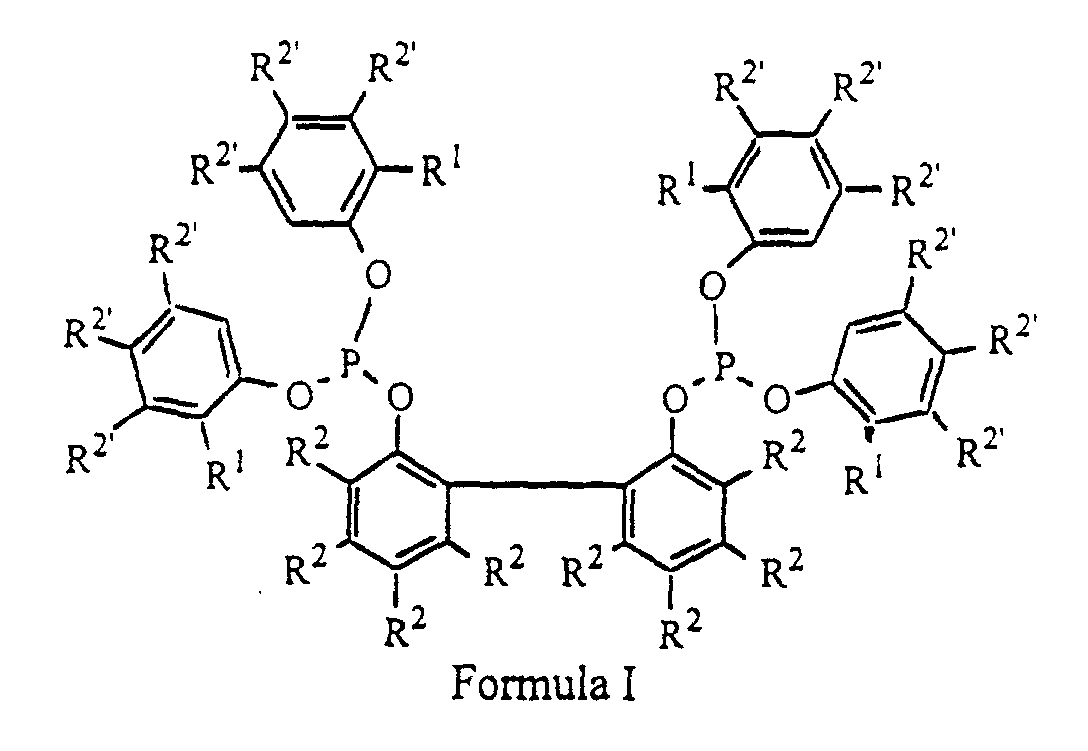

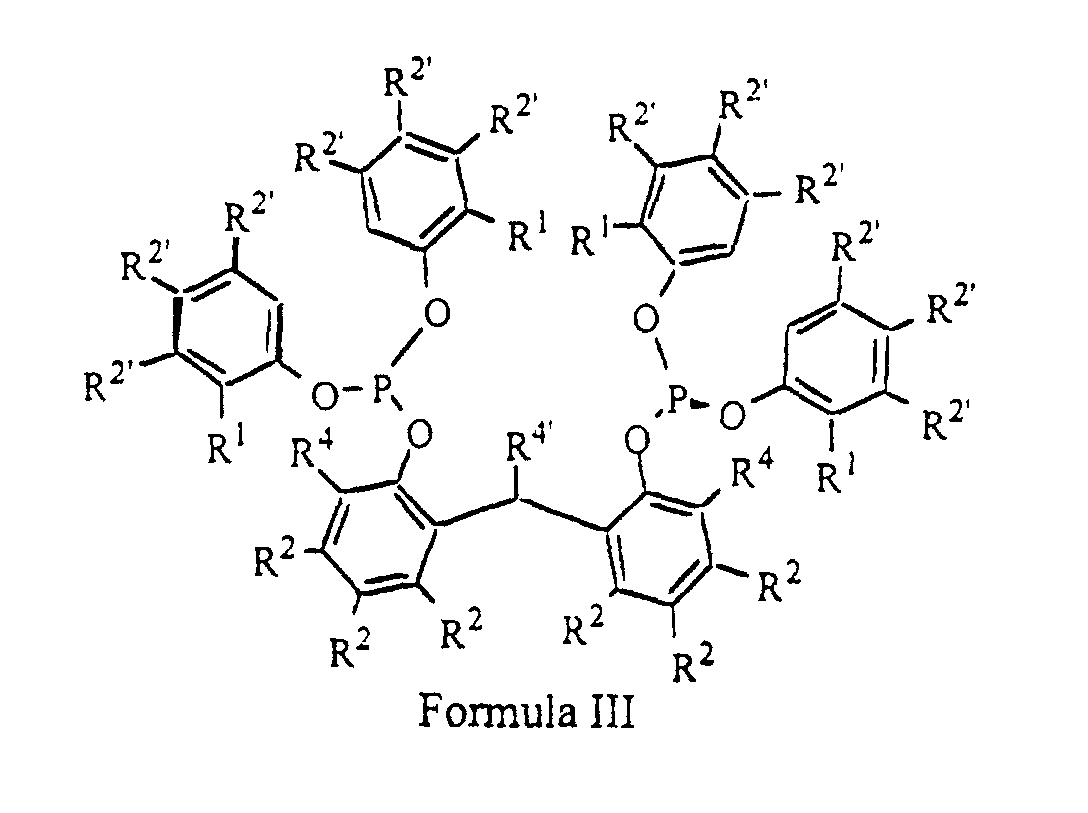


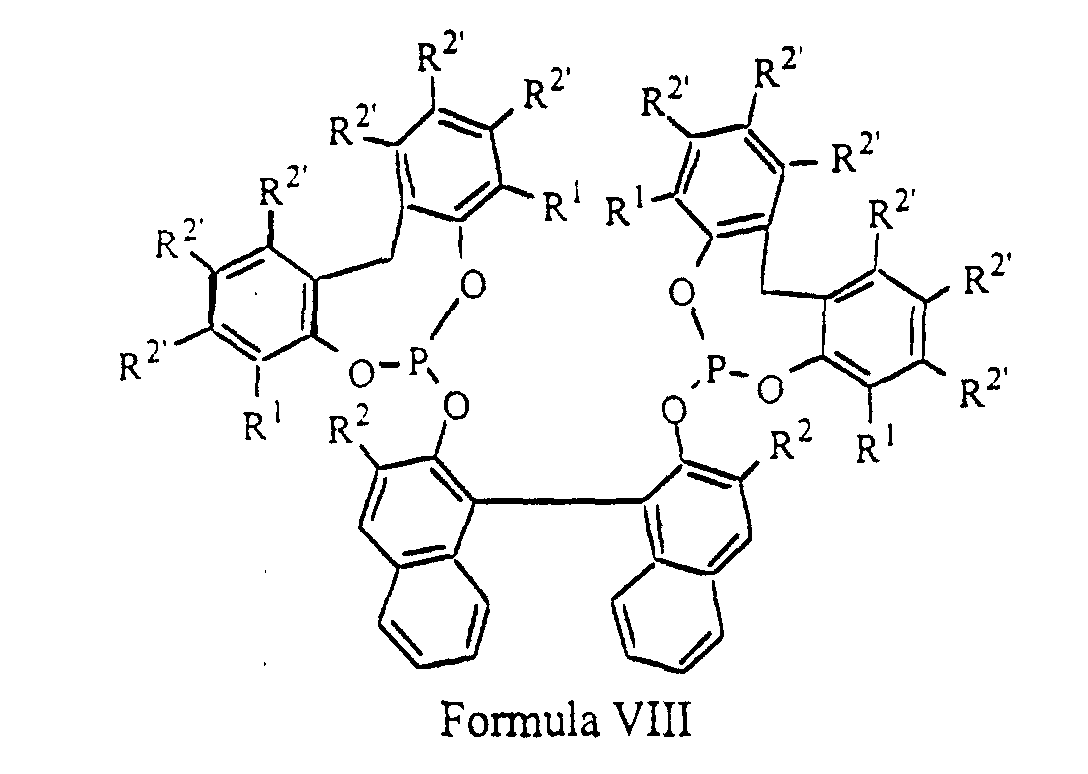 wherein
- each R1
- is independently a primary, secondary, or tertiary hydrocarbyl of 1 to 12 carbon atoms; with the proviso that at least one of R1 must be a primary hydrocarbyl;
- each R2
- is independently H, halogen, primary or secondary hydrocarbyl of 1 to 12 carbon atoms, OR3 wherein R3 is a C1 to C12 alkyl, or CO2R3' wherein R3' is an aryl or a C1 to C12 alkyl;
- each R2'
- is independently H, halogen, CHO, primary, secondary or tertiary hydrocarbyl of 1 to 12 carbon atoms, OR3 wherein R3 is a C1 to C12 alkyl, CO2R3' wherein R3' is an aryl or a C1 to C12 alkyl, or C(R3)(O) wherein R3 is a C1 to C12 alkyl;
- each R4
- is independently H, a primary or secondary hydrocarbyl of 1 to 12 carbon atoms or CO2R3 wherein R3 is a C1 to C12 alkyl; and
- each R4'
- is independently H, a primary or secondary hydrocarbyl of 1 to 12 carbon atoms or aryl,
- In the above catalyst precursor compositions, the Lewis acid is considered to be a promoter.
- The term "hydrocarbyl" is well known in the art and designates a hydrocarbon molecule from which one hydrogen atom has been removed. Such molecules can contain single, double or triple bonds.
- The present invention further provides for novel multidentate phosphite ligands selected from one of Formulas I-IX, as defined above and catalyst precursor compositions made therefrom with zero-valent nickel. Preferably, the catalyst precursor compositions also have a Lewis acid present.
- Preferably the zero-valent nickel and the multidentate phosphite ligand are supported on the same solid support.
- Representative ethylenically unsaturated compounds which are useful in the process of this invention are shown in Formulas X or XII, and the corresponding terminal nitrile compounds produced are illustrated by Formulas XI or XIII, respectively, wherein like reference characters have same meaning.
 wherein
- R5 is H, CN, CO2R3', or perfluoroalkyl;
- y is an integer of 0 to 12;
- x is an integer of 0 to 12 when R5 is H, CO2R3' or perfluoroalkyl;
- x is an integer of 1 to 12 when R5 is CN; and
- R3' is aryl or a C1 to C12 alkyl.
-
- One of the ligands useful in the catalyst compositions of the present invention is illustrated above by Formula I, as defined above. At least one of R1 is a primary alkyl, examples of which include methyl, ethyl and n-propyl. In the preferred Formula I ligand, each R1 is methyl, each R2 is methyl except R2 para to oxygen, R2 para to oxygen is hydrogen and R2' is hydrogen.
- The catalyst composition of the invention may be considered a "precursor" composition in that the zero-valent nickel at some point becomes complexed to the multidentate phosphite ligand, and, further in all likelihood, additional reactions occur during hydrocyanation, such as, for example, complexing of the initial catalyst composition to an ethylenically unsaturated compound.
- These ligands can be prepared by a variety of methods known in the art, for example, see descriptions in European Patent Application 92109599.8 of Mitsubishi Kasei Corporation and the corresponding U.S. Patent 5,235,113 to Sato et al. The reaction of o-cresol with phosphorus trichloride gives the phosphorochloridite. The reaction of this phosphorochloridite with 3,3',4,4',6,6'-hexamethyl-2,2'-biphenol in the presence of triethylamine gives the above-identified preferred ligand of Formula I.
- The phosphorochloridite may be prepared by a variety of methods known in the art, for example, see descriptions in Polymer, 1992, 33, 161; Inorganic Synthesis, 1966, 8, 68;.U.S. 5,210,260; Z. Anorg. Allg. Chem., 1986, 535, 221. With bulky ortho-substituted phenols (e.g., 2-t-butylphenol), phosphorochloridites can be prepared in situ from PCl3 and the phenol. With less bulky groups, purification by high vacuum distillation is typically necessary. High vacuum distillation is difficult for large scale operations. An improved process for preparing the phosphochlorodite comprises treatment of N,N-dialkyl diarylphosphoramidite with HCl. CIP(OMe)2 has been prepared in this manner, see Z. Naturforsch, 1972, 27B, 1429. Phosphorochloridites derived from substituted phenols have been prepared using this procedure as described in copending commonly assigned application Serial No. 08/563,718, filed November 28, 1995. It has also been found that phosphorochloridite of o-cresol can be prepared in situ from PCl3 and o-cresol.
- The zero-valent nickel compounds can be prepared or generated according to techniques well known in the art, as described, for example, in U.S. Patents 3,496,217; 3,631,191; 3,846,461; 3,847,959; and 3,903,120, which are incorporated herein by reference. Zero-valent nickel compounds that contain ligands which can be displaced by the organophosphorus ligand are a preferred source of zero-valent nickel. Two such preferred zero-valent nickel compounds are Ni(COD)2 (COD is 1,5-cyclooctadiene) and Ni4{P(O-o-C6H4CH3)3}2(C2H4 ), both of which are known in the art. Alternatively, divalent nickel compounds may be combined with a reducing agent, to serve as a source of zero-valent nickel in the reaction. Suitable divalent nickel compounds include compounds of the formula NiY2 where Y is halide, carboxylate, or acetylacetonate. Suitable reducing agents include metal borohydrides, metal aluminum hydrides, metal alkyls, Zn, Fe, Al, Na, or H2. Elemental nickel, preferably nickel powder, when combined with a halogenated cataylst, as described in U.S. Patent 3,903,120, is also a suitable source of zero-valent nickel.
- The nonconjugated acyclic, aliphatic, monoethylenically unsaturated starting materials useful in this invention include unsaturated organic compounds containing from 2 to approximately 30 carbon atoms. 3-Pentenenitrile and 4-pentenenitrile are especially preferred. As a practical matter, when the nonconjugated acyclic aliphatic monoethylenically unsaturated compounds are used in accordance with this invention, up to about 10% by weight of the monoethylenically unsaturated compound may be present in the form of a conjugated isomer, which itself may undergo hydrocyanation. For example, when 3-pentenenitrile is used, as much as 10% by weight thereof may be 2-pentenenitrile. (As used herein, the term "pentenenitrile" is intended to be identical with "cyanobutene"). Suitable unsaturated compounds include unsubstituted hydrocarbons as well as hydrocarbons substituted with groups which do not attack the catalyst, such as cyano. These unsaturated compounds include monoethylenically unsaturated compounds containing from 2 to 30 carbons such as ethylene, propylene, butene-1, pentene-2, hexene-2, etc., nonconjugated diethylenically unsaturated compounds such as allene, substituted compounds such as 3-pentenenitrile, 4-pentenenitrile, methyl pent-3-enoate, and ethylenically unsaturated compounds having perfluoroalkyl substituents such as, for example, CzF2z+1, where z is an integer of up to 20. The monoethylenically unsaturated compounds may also be conjugated to an ester group such as methyl pent-2-enoate.
- The starting ethylenically unsaturated compounds useful in this invention and the hydrocyanation products thereof are those shown above in Formulas X through XII. Those of Formula X yield terminal nitriles of Formula XI, while those of Formula XII yield terminal nitriles of Formula XIII.
- Preferred are nonconjugated linear alkenes, nonconjugated linear alkenenitriles, nonconjugated linear alkenoates, linear alk-2-enoates and perfluoroalkyl ethylenes. Most preferred substrates include 3- and 4-pentenenitrile, alkyl 2-, 3-, and 4-pentenoates, and CzF2z+1 CH=CH2 (where z is 1 to 12).
- The preferred products are terminal alkanenitriles, linear dicyanoalkylenes, linear aliphatic cyanoesters, and 3-(perfluoroalkyl)propionitrile. Most preferred products are adiponitrile, alkyl 5-cyanovalerate, and C2F2z+1CH2CH2CN, where z is 1 to 12.
- The present hydrocyanation process may be carried out, for example, by charging a reactor with the reactants, catalyst composition, and solvent, if any; but preferably, the hydrogen cyanide is added slowly to the mixture of the other components of the reaction. Hydrogen cyanide may be delivered as a liquid or as a vapor to the reaction. Another suitable technique is to charge the reactor with the catalyst and the solvent to be used, and feed both the unsaturated compound and the HCN slowly to the reaction mixture. The molar ratio of unsaturated compound to catalyst can be varied from about 10:1 to about 2000:1.
- Preferably, the reaction medium is agitated, for example, by stirring or shaking. The reaction product can be recovered by conventional techniques such as, for example, by distillation. The reaction may be run either batchwise or in a continuous manner.
- The hydrocyanation reaction can be carried out with or without a solvent. The solvent, if used, should be liquid at the reaction temperature and pressure and inert towards the unsaturated compound and the catalyst. Suitable solvents include hydrocarbons, such as benzene or xylene, and nitriles, such as acetonitrile or benzonitrile. In some cases, the unsaturated compound to be hydrocyanated may itself serve as the solvent.
- The exact temperature is dependent to a certain extent on the particular catalyst being used, the particular unsaturated compound being used and the desired rate. Normally, temperatures of from -25°C to 200°C can be used, the range of 0°C to 150°C being preferred.
- Atmospheric pressure is satisfactory for carrying out the present invention and hence pressures of from about 0.05 to 10 atmospheres (50.6 to 1013 kPa) are preferred. Higher pressures, up to 10,000 kPa or more, can be used, if desired, but any benefit that may be obtained thereby would probably not justify the increased cost of such operations.
- HCN can be introduced to the reaction as a vapor or liquid. As an alternative, a cyanohydrin can be used as the source of HCN. See, for example, U.S. Patent 3,655,723.
- The process of this invention is carried out in the presence of one or more Lewis acid promoters which affect both the activity and the selectivity of the catalyst system. The promoter may be an inorganic or organometallic compound in which the cation is selected from scandium, titanium, vanadium, chromium, manganese, iron, cobalt, copper, zinc, boron, aluminum, yttrium, zirconium, niobium, molybdenum, cadmium, rhenium and tin. Examples include ZnBr2, ZnI2, ZnCl2, ZnSO4, CuCl2, CuCl, Cu(O3SCF3)2, CoCl2, CoI2, FeI2, FeCl3, FeCl2, FeCl2(THF)2, TiCl4(THF)2, TiCl4, TiCl3, ClTi(OiPr)3, MnCl2, ScCl3, AlCl3, (C8H17)AlCl2, (C8H17)2AlCl, (iso-C4H9)2AlCl, Ph2AlCl, PhAlCl2, ReCl5, ZrCl4, NbCl5, VCl3, CrCl2, MoCl5, YCl3, CdCl2, LaCl3, Er(O3SCF3)3, Yb(O2CCF3)3, SmCl3, B(C6H5)3, TaCl5. Suitable promoters are further described in U.S. Patents 3,496,217; 3,496,218; and 4,774,353. These include metal salts (such as ZnCl2, CoI2, and SnCl2), and organometallic compounds (such as RAlCl2, R3SnO3SCF3, and R3B, where R is an alkyl or aryl group). U.S. Patent 4,874,884 describes how synergistic combinations of promoters can be chosen to increase the catalytic activity of the catalyst system. Preferred promoters include CdCl2, FeCl2, ZnCl2, B(C6H5)3, and (C6H5)3SnX, where X = CF3SO3, CH3C6H5SO3, or (C6H5)3BCN. The mole ratio of promoter to nickel present in the reaction can be within the range of about 1:16 to about 50:1.
- The mixtures were heated in a thermostatically-controlled oil bath. HCN was delivered to the flask as an HCN/N2 gas mixture by bubbling dry nitrogen carrier gas through liquid HCN maintained in an ice bath at 0°C. This provided a vapor stream which was about 35% HCN (vol/vol). Samples were periodically analyzed by gas chromatography (GC). In the examples, ADN stands for adiponitrile, MGN stands for 2-methylglutaronitrile, and ESN stands for ethylsuccinonitrile. COD stands for 1,5-cyclooctadiene and THF stands for tetrahydrofuran.
-

- To a 200 mL round bottom flask, 1.09 g 2-n - propylphenol (8 mmol) and 0.55 g PCl3 (4 mmol) were added, followed by the addition of 80 mL dry toluene. The flask was cooled to -30°C and a precooled toluene solution (-30°C, 20 mL) containing 1.0 g NEt3 (10 mmol) was added dropwise. About 1 hour later; the 31P NMR spectrum of the reaction mixture in toluene/C6D6 showed a single peak at 162.30 ppm. A toluene solution (20 mL) containing 0.57 g 1,1'-binaphthol (4 mmol) and 0.4 g NEt3 (4 mmol) was added to the above solution and stirred for 0.5 hour. The mixture was filtered through Celite® (a product of Johns-Manville Company) washed with 10 mL toluene and the solvent was taken off under vacuum. The product was dried under vacuum overnight. 1H NMR (300.15 MHz, C6D6): δ 0.76 (t, 12 H), 1.43 (m, 8 H), 2.41 (m, 8 H), 6.7 ∼ 7.7 (m, 28 H), 31P NMR (121.77 MHz, C6D6):130.63 ppm. FB MS (Fast Atom Bombardment Mass Spectroscopy) m/z:(M + 1) measured: 885.24; calcd mass: 885.35.
- 325 mg of Ligand "A", 40 mg Ni(COD)2, and 20 mg of ZnCl2 were dissolved in 5 mL of 3-pentenenitrile. The mixture was treated with HCN at a nitrogen flow rate of 30 mL/min at 70°C for one hour. GC analysis indicated 68.2% ADN, 9.1% MGN, and 1.4% ESN (selectivity to ADN: 86.6%).
-

- The procedure was the same as in Example 1 but with 2-ethylphenol (978 mg, 8 mmoles), PCl3 (549 mg, 4 mmoles) and NEt3 (1 g, 10 mmoles) followed by 1,1'-binaphthol (573 mg, 2 mmoles) and NEt3 (0.5 g, 5 mmoles). 31PNMR(δ,C6D6): 130.94 ppm with minor peaks at 146.06 and 131.54 ppm.
- 348 mg of Ligand "B", 40 mg Ni(COD)2, and 20 mg of ZnCl2 were dissolved in 5 mL of 3-pentenenitrile. The mixture was treated with HCN at a nitrogen flow rate of 30 mL/min at 70°C for one hour. GC analysis indicated 73.5% ADN, 11.3% MGN, and 1.7% ESN (selectivity to ADN: 85.0%).
-
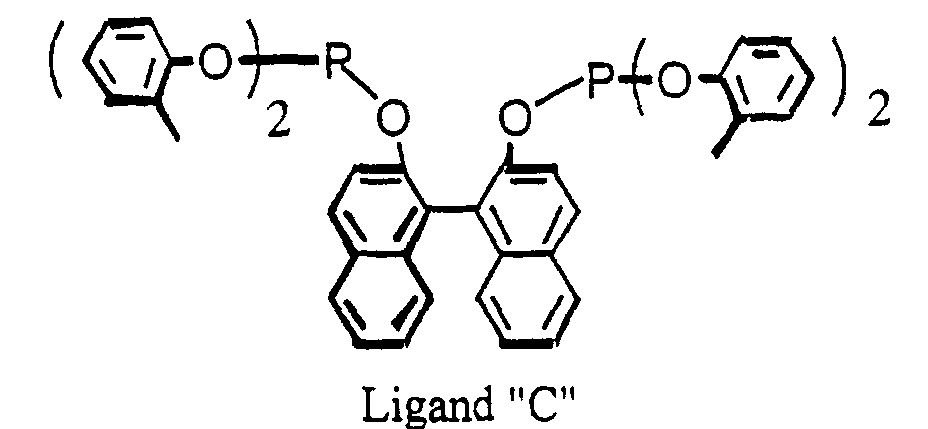
- The procedure was the same as Example 1 but with o-cresol (865 mg, 8 mmoles), PCl3 (550 mg, 4 mmoles) and NEt3 (1 g, 10 mmoles) followed by 1,1'-binaphthol (573 mg, 2 mmoles) and NEt3 (0.4 g, 4 mmoles). 31P NMR (δ, C6D6): 130.65 ppm with minor peak at 131.37 ppm.
- 372 mg of Ligand "C", 40 mg Ni(COD)2, and 20 mg of ZnCl2 were dissolved in 5 mL of 3-pentenenitrile. The mixture was treated with HCN at a nitrogen flow rate of 30 mL/min at 70°C for one hour. GC analysis indicated 79.5% ADN, 13.0% MGN, and 2.2% ESN (selectivity to ADN: 83.9%).
-
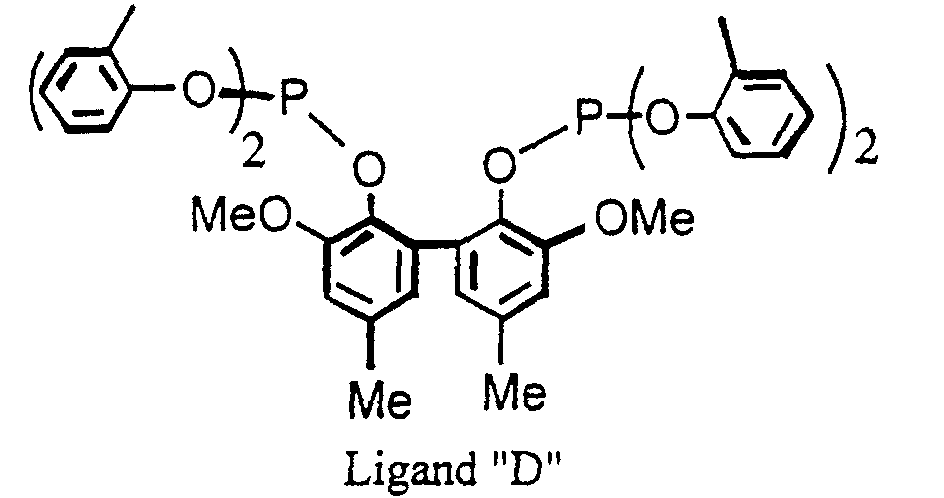
- The procedure is the same as Example 1 but with o-cresol (865 mg, 8 mmoles), PCl3 (550 mg, 4 mmoles) and NEt3 (1 g, 10 mmoles) followed by 2,2'-dihydroxy-3,3'-dimethoxy-5,5'-dimethyl-1,1'-biphenylene (550 mg, 2 mmoles) and NEt3 (0.4 g, 4 mmoles). The 2,2'-dihydroxy-3,3'-dimethoxy-5,5'-dimethyl- 1,1'-biphenylene was prepared by coupling 2-methoxy-4-methylphenol using the procedure described in Phytochemistry, 1988, 27, 3008. 31P NMR (C6D6): 133.68 ppm with minor peaks at 144.9, 136.9, 134.3, and 131.5 ppm.
- 320 mg of Ligand "D", 40 mg Ni(COD)2, and 20 mg of ZnCl2 were dissolved in 5 mL of 3-pentenenitrile. The mixture was treated with HCN at a nitrogen flow rate of 30 mL/min at 70°C for one hour. GC analysis indicated 81.4% ADN, 5.9% MGN, and 0.6% ESN (selectivity to ADN: 92.6%).
-
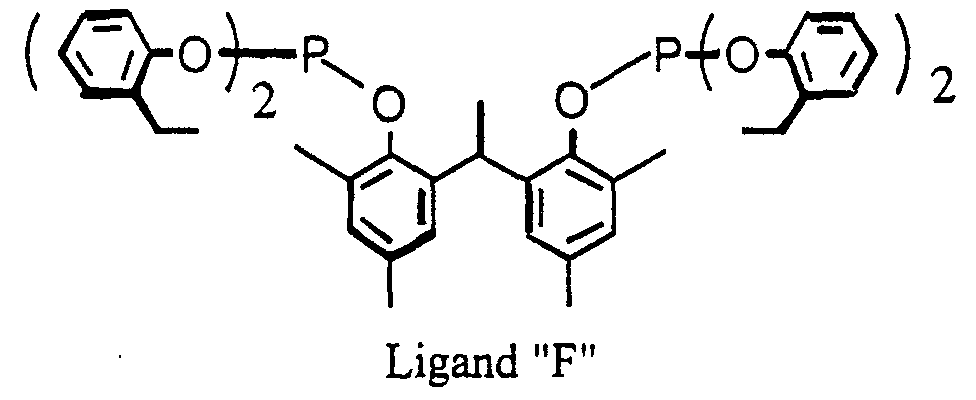
- The procedure is the same as Example 1 but with 2-ethylphenol (978 mg, 8 mmoles), PCl3 (550 mg, 4 mmoles) and NEt3 (1.0 g, 10 mmoles) followed by 2,2'-ethylidenebis(4,6-dimethylphenol) (370 mg, 2 mmoles), prepared according to Yamada et al., Bull. Chem. Soc. Jpn., 1989, 62, 3603, and NEt3 (0.4 g, 4 mmoles). 31P NMR (C6D6): 134.91 ppm with minor peaks due to impurities at 136.24, 131.41, 131.18, 127.67, and 107.10 ppm.
- 343 mg of Ligand "F", 40 mg Ni(COD)2, and 20 mg of ZnCl2 were dissolved in 5 mL of 3-pentenenitrile. The mixture was treated with HCN at a nitrogen flow rate of 30 mL/min at 70°C for one hour. GC analysis indicated 72.2% ADN; 9.7% MGN, 1.3% ESN (selectivity to ADN: 86.7%)
-

- The procedure is the same as Example 1 but with o-cresol (866 mg, 8 mmoles), PCl3 (550 mg, 4 mmoles) and NEt3 (0.9 g, 9 mmoles) followed by dimethyl 2,2'-dihydroxy-1,1'-binaphthalene-3,3'-dicarboxylate (804 mg, 2 mmoles), prepared according to the literature: J. Am. Chem. Soc., 1954, 76, 296 and Tetrahedron Lett., 1990, 413, and NEt3 (0.6 g, 6 mmoles). 31P NMR (CD2Cl2): 130.09 ppm with minor peaks due to impurities at 145.32, 131.65, and 131.39 ppm.
- To 5 mL of THF was added 40 mg of Ni(COD)2, and 374 mg of ligand "G". The solvent was removed by vacuum evaporation and 5 mL of 3-pentenenitrile and 20 mg ZnCl2 were added. The mixture was treated with HCN at a nitrogen flow rate of 30 mL/min at 70°C for one hour. The mixture was analyzed by GC analyses indicates 51.7% ADN; 3.7% MGN; 0.4 ESN (selectivity to ADN: 92.6%)
-

- The procedure is the same as Example 1 but with 2,5-dimethylphenol (978 mg, 8 mmoles), PCl3 (550 mg, 4 mmoles) and NEt3 (1.0 g, 10 mmoles) followed by 2,2'-dihydroxy-3,3'-dimethoxy-5,5'-dimethyl-1,1'-biphenylene (550 mg, 2 mmoles), and NEt3 (0.4 g, 4 mmoles). 31P NMR (C6D6): 133.64 with minor peaks due to impurities at 144.82,137.03, 134.52, 131.99 ppm.
- 352 mg of Ligand "H", 40 mg Ni(COD)2, and 20 mg of ZnCl2 were dissolved in 5 mL of 3-pentenenitrile. The mixture was treated with HCN at a nitrogen flow rate of 30 mL/min at 70°C for one hour. GC analysis indicated 58.0% ADN, 5.9% MGN, and 0.4% ESN (selectivity to ADN: 90.2%).
-
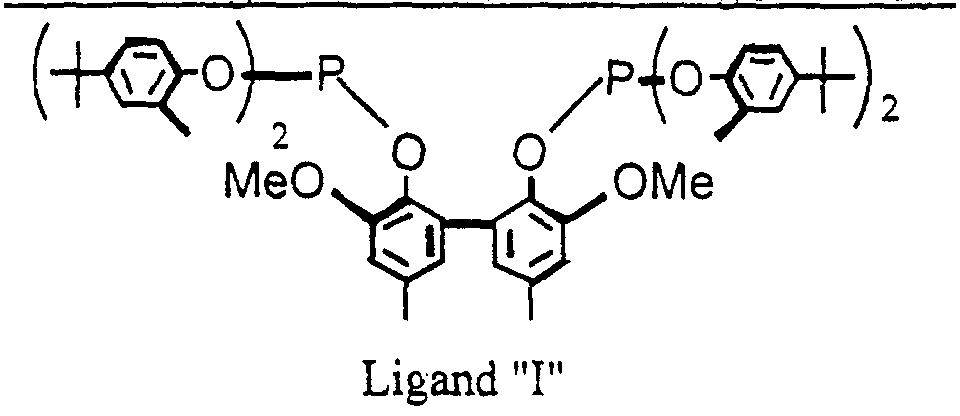
- The procedure is the same as Example 1 but with 2-methyl-4-t-butylphenol (1.314 g, 8 mmoles), PCl3 (550 mg, 4 mmoles) and NEt3 (0.9 g, 9 mmoles) followed by 2,2'-dihydroxy-3,3'-dimethoxy-5,5'-dimethyl-1,1'-biphenylene (550 mg, 2 mmoles), and NEt3 (0.6 g, 6 mmoles). 31P NMR (C6D6): 134.32 ppm with minor peaks due to impurities at 148.97, 145.04, 135.30, 134.99, 134.55, 134.46, 134.40, 132.00 ppm.
- 415 mg of Ligand "I", 40 mg Ni(COD)2, and 20 mg of ZnCl2 were dissolved in 5 mL of 3-pentenenitrile. The mixture was treated with HCN at a nitrogen flow rate of 30 mL/min at 70°C for one hour. GC analysis indicated 71.0% ADN, 6.7% MGN, and 0.8% ESN (selectivity to ADN: 90.2%).
-

- The procedure is the same as Example 1 but with o-cresol (865 mg, 8 mmoles), PCl3 (550 mg, 4 mmoles) and NEt3 (1.0 g, 10 mmoles) followed by dihydrodieugenol (653 mg, 2 mmoles), prepared according to Phytochemistry, 1988, 27, 3008 and NEt3 (0.4 g, 4 mmoles). 31P NMR (C6D6): 133.62 ppm with minor peaks due to impurities at 137.33, 134.20, and 131.41 ppm.
- 355 mg of Ligand "J", 40 mg Ni(COD)2, and 20 mg of ZnCl2 were dissolved in 5 mL of 3-pentenenitrile. The mixture was treated with HCN at a nitrogen flow rate of 30 mL/min at 70°C for one hour. GC analysis indicated 78.1 % ADN, 5.8% MGN, and 0.6% ESN (selectivity to ADN: 92.4%).
-

- In the drybox, Et2NPCl2 (6.92 gm, 39.7 mmol) and triethylamine (10.1 gm, 100 mmol) were added to a 250 mL round bottom flask with a magnetic stirbar and 100 mL dry ether. This solution was cooled to -30°C in the drybox freezer. Ortho-cresol was diluted in dry ether (50 mL) then poured dropwise into the stirred cold ether solution of PCl2(NEt2) and triethylamine. The reaction mixture was allowed to warm to ambient temperature with stirring. After two hours at ambient temperature, a 31P NMR analysis indicated that the reaction was complete (single signal at 142.2 ppm). The triethylammonium chloride salts were filtered from the ether solution then washed with dry ether (2 x 50 mL). The ether filtrates were evaporated to yield (2-CH3C6H4O)2PNEt2 as an oil.
- In the drybox, (2-CH3C6H4O)2PNEt2 (1.59 gm, 5.0 mmol) was added to a 100 mL round bottom flask with a magnetic stirbar and 50 mL dry toluene. This solution was cooled to -30°C in the drybox freezer then a 1.0 M hydrogen chloride solution in ether (10.0 mL, 10.0 mmol) was added dropwise with a syringe. An analysis of the resulting toluene / ether solution by 31P NMR indicated that (2-CH3C6H4O)2PNEt2 had been completely converted to (2-CH3C6H4O)2PCl (δ = 162 ppm). The diethylammonium chloride solids were separated from the toluene/ether solution by filtration then washed with dry toluene (2 x 5 mL). The ether was evaporated from the combined filtrates then 3,3'-dimethyl-2,2'-dihydroxy-1,1'-binaphthalene (0.63 gm, 2.0 mmol) was added followed by dry triethylamine (0.61 gm, 6.0 mmol). The mixture was stirred at ambient temperature overnight. A 31P NMR analysis of the resulting solution showed a signal for the major phosphite product at 132 ppm with minor signals at 143, 134, 131, and 127 ppm.
- 338 mg of Ligand "K", 40 mg Ni(COD)2, and 20 mg of ZnCl2 were dissolved in 5 mL of 3-pentenenitrile. The mixture was treated with HCN at a nitrogen flow rate of 30 mL/min at 70°C for one hour. GC analysis indicated 85.0% ADN, 6.0% MGN, and 1.3% ESN (selectivity to ADN: 92.1%).
-
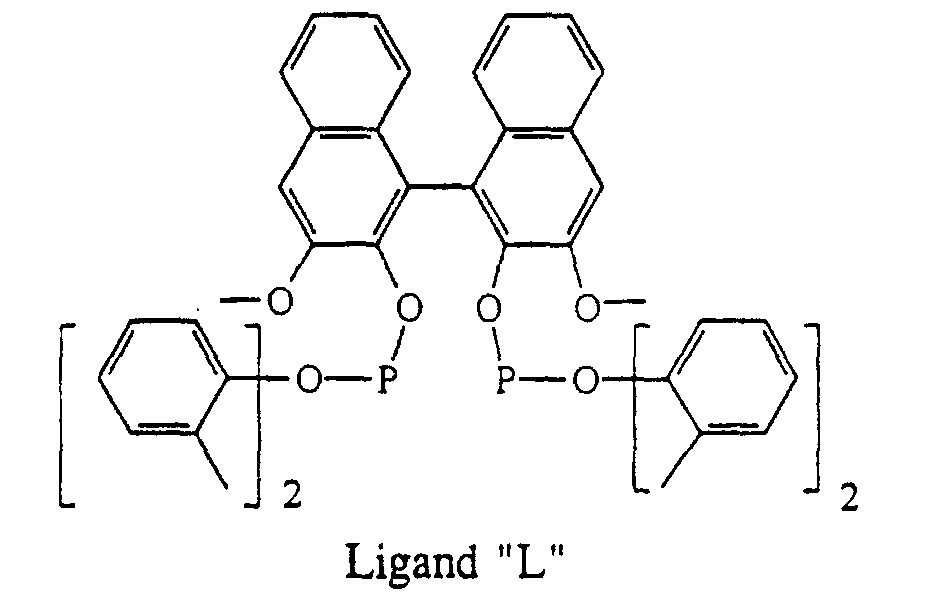
- 3,3'-Dimethoxy-2,2'-dihydroxy-1,1'-binaphthalene was prepared by oxidatively coupling 3-methoxy-2-naphthol (Recl. Trav. Chim. Pays. Bas. 1995, 112, 216) in toluene with oxygen and Cu(TMEDA)(OH)Cl catalyst (TMEDA = tetramethylethylenediamine) as described in Tetrahedron Lett. 1990, 413.
- A toluene solution of (2-CH3C6H4O)2PCl (5 mmol) was prepared as described in Example 11. This phosphorochloridite was reacted with 3,3'-dimethoxy-2,2'-dihydroxy-1,1'-binaphthalene (0.693 gm, 2.0 mmol) in the presence of excess triethylamine base using the procedure described in Example 11. A 31P NMR analysis gave a major phosphite signal at 130.8 ppm with minor signals at 146 and 131.4 ppm.
- 351 mg of Ligand "L", 40 mg Ni(COD)2, and 20 mg of ZnCl2 were dissolved in 5 mL of 3-pentenenitrile. The mixture was treated with HCN at a nitrogen flow rate of 30 mL/min at 70°C for one hour. GC analysis indicated 71.7% ADN, 5.4% MGN, and 0.6% ESN (selectivity to ADN: 92.2%).
-
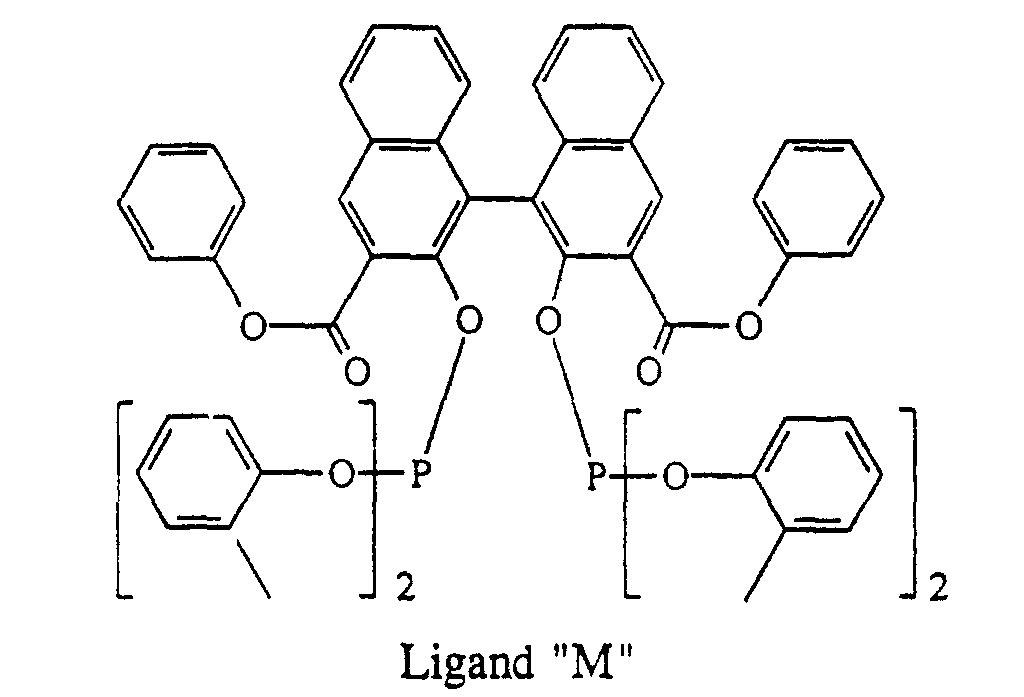
- Diphenyl 2,2'-dihydroxy-1,1'-binaphthalene-3,3'-dicarboxylate was prepared by oxidatively coupling phenyl 2-hydroxy-3-naphthoate in toluene with oxygen and Cu(TMEDA)(OH)Cl catalyst as described in Tetrahedron Lett. 1990, 413.
- A toluene solution of (2-CH3C6H4O)2PCl (5 mmol) was prepared as described in Example 11. This phosphorochloridite was treated with diphenyl 2,2'-dihydroxy-1,1'-binaphthalene-3,3'-dicarboxylate (1.05 gm, 2.0 mmol) in the presence of excess triethylamine base using the procedure described in Example 11. A 31P NMR analysis gave a major phosphite signal at 130 ppm with minor signals at 131 and 127 ppm.
- 426 mg of Ligand "M", 40 mg Ni(COD)2, and 20 mg of ZnCl2 were dissolved in 5 mL of 3-pentenenitrile. The mixture was treated with HCN at a nitrogen flow rate of 30 mL/min at 70°C for one hour. GC analysis indicated 13.6% ADN, 1.0% MGN, and 0.1% ESN (selectivity to ADN: 92.6%).
-

- Diisopropyl 2,2'-dihydroxy-1,1'-binaphthalene-3,3'-dicarboxylate was prepared by oxidatively coupling isopropyl 2-hydroxy-3-naphthoate in toluene with oxygen and Cu(TMEDA)(OH)Cl catalyst as described in Tetrahedron Lett. 1990, 413.
- A toluene solution of (2-CH3C6H4O)2PCl (5 mmol) was prepared as described in Example 11. This phosphorochloridite was treated with diisopropyl 2,2'-dihydroxy-1,1'-binaphthalene-3,3'-dicarboxylate (0.917 gm, 2.0 mmol) in the presence of excess triethylamine base using the procedure described in Example 11. A 31P NMR analysis gave a major phosphite signal at 129.9 ppm with minor signals at 131.3, 131.2 and 127 ppm.
- 398 mg of Ligand "N", 40 mg Ni(COD)2, and 20 mg of ZnCl2 were dissolved in 5 mL of 3-pentenenitrile. The mixture was treated with HCN at a nitrogen flow rate of 30 mL/min at 70°C for one hour. GC analysis indicated 52.3% ADN, 3.2% MGN, and 0.4% ESN (selectivity to ADN: 93.5%).
-

- To a 200 mL round bottom flask, 0.86 g o-cresol (8 mmol) and 0.55 g PCl3 (4 mmol) were added, followed by the addition of 100 mL dry toluene. The flask was cooled to -20°C and a precooled toluene solution (-20°C, 20 mL) containing 1.0 g NEt3 (10 mmol) was added dropwise. A toluene solution (20 mL) containing 0.48 g 3,3',5,5'-tetramethyl-2,2'-biphenol (2 mmol, prepared using a literature procedure: W. W. Kaeding, J. Org. Chem., 1963, 28, 1063 and 0.6 g NEt3 (6 mmol) was added to the above solution and stirred overnight. The mixture was filtered. washed with 10 mL toluene and the solvent was evaporated under vacuum. After drying under vacuum for one day, a yellow oil was obtained (1.4 g). A 31P NMR analysis gave a major signal at 133.8 ppm with minor signals at 142.2 and 131.5. APCI (atmospheric pressure chemical ionization) MS (m/z): Found: 731.63 (M+-H); calculated for M+-H (C44H46O6P2 - H): 731.27.
- 308 mg of Ligand "O", 40 mg Ni(COD)2, and 20 mg of ZnCl2 were dissolved in 5 mL of 3-pentenenitrile. The mixture was treated with HCN at a nitrogen flow rate of 30 mL/min at 70°C for one hour. GC analysis indicated 69.1% ADN, 3.7% MGN, and 0.7% ESN (selectivity to ADN: 94%).
-
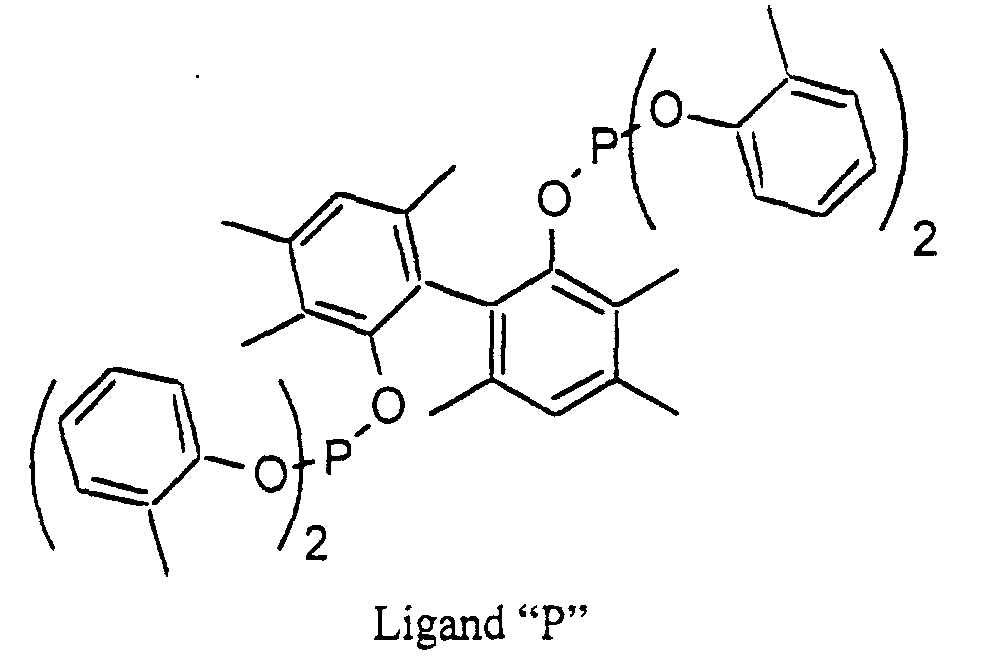
- This ligand was prepared similar to Ligand "O" but 3,3',4,4',6,6'-hexamethyl-2,2'-biphenol (prepared by coupling of 2.3,5-trimethylphenol using the literature procedure for 3,3',5,5' tetramethyl-2,2'-biphenol: W. W. Kaeding, J. Org. Chem., 1963, 28, 1063 was used as the backbone. 31P NMR (C6D6): 135.2 ppm. APCI MS (m/z): Found: 759.72 (M+ + H); calculated for M+ + H (C46H48O6P2 + H): 759,30.
- 318 mg of Ligand "P", 40 mg Ni(COD)2, and 20 mg of ZnCl2 were dissolved in 5 mL of 3-pentenenitrile. The mixture was treated with HCN at a nitrogen flow rate of 30 mL/min at 70°C for one hour. GC analysis indicated 90.4% ADN, 3.9% MGN, and 0.5% ESN (selectivity to ADN: 95%).
-

- To a 200 mL round bottom flask, 1.18 g 1,2,3,4-tetrahydro-1-naphthol (8 mmol) and 0.55 g PCl3 (4 mmol) were added, followed by the addition of 100 mL dry toluene. The flask was cooled to -20°C and a precooled toluene solution (-20°C, 20 mL) containing 1.0 g NEt3 (10 mmol) was added dropwise. About 1 hour later, a toluene solution (20 mL) containing 0.48 g 3,3',5,5'-tetramethyl-2,2'-biphenol (2 mmol) and 0.6 g NEt3 (6 mmol) was added to the above solution and stirred overnight. The mixture was filtered, washed with 10 mL toluene and the solvent was taken off under vacuum. After drying under vacuum for one day, a yellow oil was obtained (1.8 g, toluene present in the 1H NMR spectrum). 31P NMR (C6D6) indicated a major signal at 134.1 ppm with minor signals at 142.2 and 131.4 ppm. APCI MS (m/z): Found: 891.21 (M+-H); calculated for M+-H (C56H62O6P2-H): 891.39.
- 375 mg of Ligand "Q", 40 mg Ni(COD)2, and 20 mg of ZnCl2 were dissolved in 5 mL of 3-pentenenitrile. The mixture was treated with HCN at a nitrogen flow rate of 30 mL/min at 70°C for one hour. GC analysis indicated 85.6% ADN, 4.8% MGN, and 1.4% ESN (selectivity to ADN: 93%).
-

- This ligand was prepared similar to Ligand "Q" but 3,3'-dimethoxy-5,5'-dimethyl-2,2'-dihydroxy-1,1'-biphenylene [prepared by coupling 2-methoxy-4-methylphenol using the procedure described in Phytochemistry 1988, 27, 3008] was used instead of 3,3',5,5'-tetramethyl-2,2'-biphenol as the backbone. After the usual workup, the residue was vacuum dried and then treated with 100 mL of isopropyl alcohol. A solid formed which was collected and vacuum dried to give the desired product as a white solid. 31P NMR (C6D6): 134.6 ppm with minor peak due to an impurity at 145.6 ppm.
- 388 mg of Ligand "R", 40 mg Ni(COD)2, and 20 mg of ZnCl2 were dissolved in 5 mL of 3-pentenenitrile. The mixture was treated with HCN at a nitrogen flow rate of 30 mL/min at 70°C for one hour. GC analysis indicated 80.2% ADN, 6.1% MGN, and 0.7% ESN (selectivity to ADN: 92%).
-
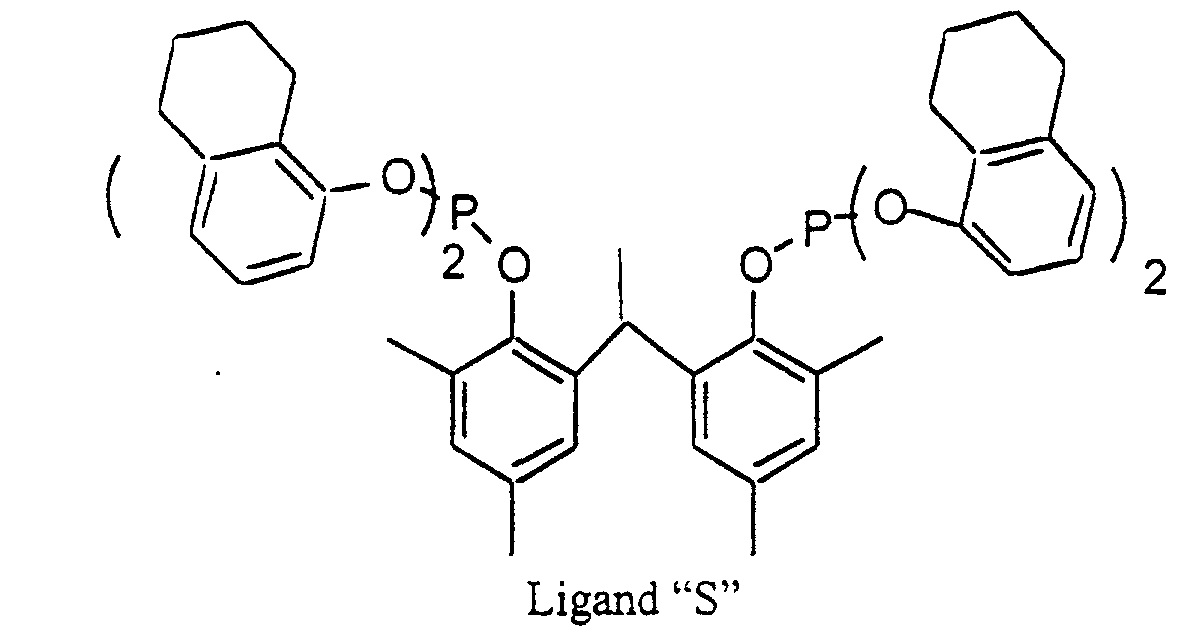
- This ligand was prepared similar to Ligand "Q" but 2,2'-ethylidenebis(4,6-dimethylphenol) [prepared according to Yamada et. al., Bull, Chem. Soc. Jpn. 1989, 62, 3603] was used instead of 3,3',5,5'-tetramethyl-2,2'-biphenol as the backbone. 31P NMR (C6D6): 134.5 ppm with a minor peak due to an impurity at 131.5 ppm.
- 390 mg of Ligand "S", 40 mg Ni(COD)2, and 20 mg of ZnCl2 were dissolved in 5 mL of 3-pentenenitrile. The mixture was treated with HCN at a nitrogen flow rate of 30 mL/min at 70°C for one hour. GC analysis indicated 71.1% ADN, 11.5% MGN, and 1.3% ESN (selectivity to ADN: 85%).
-

- To a 300 mL round bottom flask, 1.92 g 3,3',5,5'-tetramethyl-2,2'-biphenol (8 mmol) and 1.10 g PCl3 (8 mmol) were added, followed by the addition of 200 mL dry toluene. The flask was cooled to -20°C and a precooled toluene solution (-20°C, 20 mL) containing 2.0 g NEt3 (20 mmol) was added dropwise. A toluene solution (20 mL) containing 0.96 g 3,3',5,5'-tetramethyl-2,2'-biphenol (4 mmol) and 1.2 g NEt3 (12 mmol) was added to the above solution and stirred overnight. The usual workup gave 3.0 g of white solid. 31P NMR: 144.6 ppm. APCI MS (m/z): Found: 782.96 (M+ + H); calculated for M+ + H (C48H48O6P2 + H): 783.30.
- 329 mg of Ligand "T", 40 mg Ni(COD)2, and 20 mg of ZnCl2 were dissolved in 5 mL of 3-pentenenitrile. The mixture was treated with HCN at a nitrogen flow rate of 30 mL/min at 70°C for one hour. GC analysis indicated 41.1% ADN, 8.8% MGN, and 0.8% ESN (selectivity to ADN: 81%).
-

- This ligand was prepared similar to Ligand "T" but 1,1'-bi-2-naphthol was used instead of 3,3',5,5'-tetramethyl-2,2'-biphenol as the backbone. 31P NMR (C6D6): 142.2 ppm. APCI MS (m/z): Found: 826.94 (M+ + H); calculated for M+ + H (C52H44O6P2 + H): 827.27.
- 347 mg of Ligand "U", 40 mg Ni(COD)2, and 20 mg of ZnCl2 were dissolved in 5 mL of 3-pentenenitrile. The mixture was treated with HCN at a nitrogen flow rate of 30 mL/min at 70°C for one hour. GC analysis indicated 68.2% ADN, 22.3% MGN, and 3.0% ESN (selectivity to ADN: 73%).
-

- This ligand was prepared similar to Ligand "T" but 2,2'-ethylidenebis(4,6-dimethylphenol) (prepared using a literature procedure: F. Yamada, T. Nishiyama, M. Yamamoto, K. Tanaka, Bull. Chem. Soc. Jpn., 1989, 62, 3603 was used instead of 3,3',5,5'-tetramethyl-2,2'-biphenol as the backbone. 31P NMR (C6D6): 144.6 ppm as the major signal with minor signal at 135.1 ppm. FAB MS (m/z): Found: 811.45 (M+ + H); calculated for M+ + H (C50H52O6P2 + H): 811.33.
- 340 mg of Ligand "V", 40 mg Ni(COD)2, and 20 mg of ZnCl2 were dissolved in 5 mL of 3-pentenenitrile. The mixture was treated with HCN at a nitrogen flow rate of 30 mL/min at 70°C for one hour. GC analysis indicated 66.3% ADN, 22.7% MGN, and 2.2% ESN (selectivity to ADN: 73%).
-
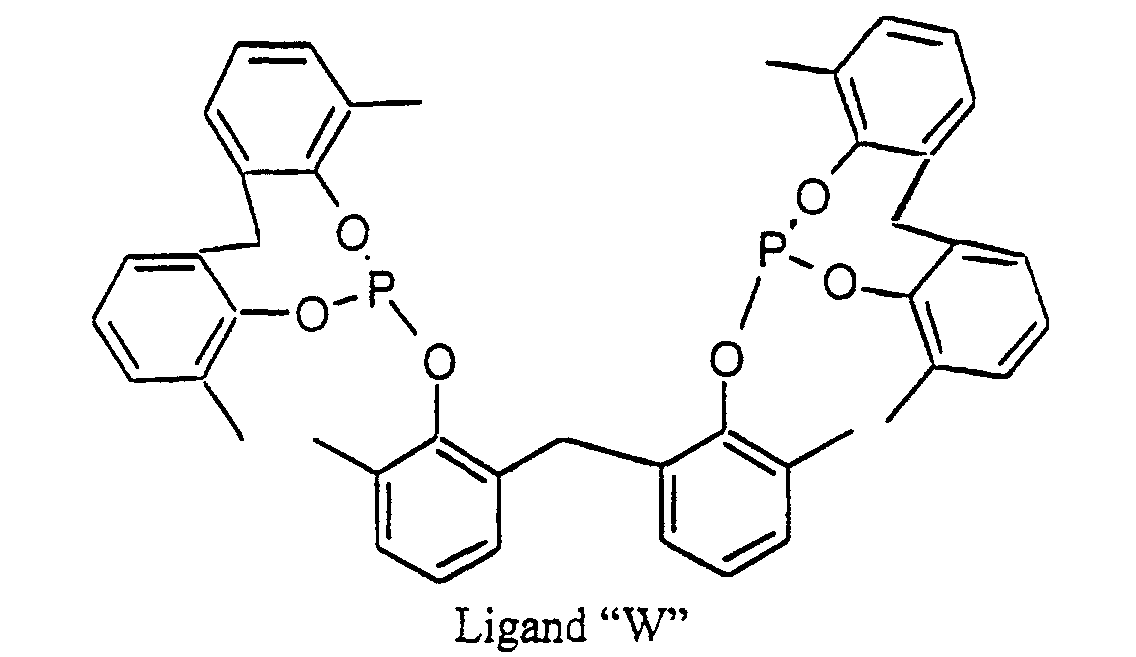
- In a flask were added 0.92 g 3,3'-dimethyl-2,2'-dihydroxydiphenylmethane (4 mmol, prepared by a literature procedure: G. Casiraghi, G. Casnati, A. Pochini, G. Puglia, R. Ungaro, G. Sartori, Synthesis, 1981, 2, 143, 0.55 g PCl3 (4 mmol) and 100 mL of dry toluene. The flask was cooled to -20°C and a precooled toluene solution (-20°C, 20 mL) containing 1.0 g NEt3 (10 mmol) was added dropwise. A toluene solution (20 mL) containing 0.46 g (2 mmol) 3,3'-dimethyl-2,2'-dihydroxydiphenylmethane and 0.6 g NEt3 (6 mmol) was added to the above solution and stirred overnight. The mixture was filtered, washed with 10 mL toluene and the solvent was evaporated under vacuum. After drying under vacuum for one day, a white solid was obtained (1.5 g, toluene detected in the 1H NMR spectrum). 31PNMR (C6D6): 138.2 ppm.
- 311 mg of Ligand "W", 40 mg Ni(COD)2, and 20 mg of ZnCl2 were dissolved in 5 mL of 3-pentenenitrile. The mixture was treated with HCN at a nitrogen flow rate of 30 mL/min at 70°C for one hour. GC analysis indicated 47.2% ADN, 14.7% MGN, and 2.5% ESN (selectivity to ADN: 73%).
-

- This ligand was prepared similar to Ligand "W" but 2,2'-biphenol was used instead of 3,3'-dimethyl-2,2'-dihydroxydiphenylmethane as the backbone. 31P NMR (C6D6): 128.1 ppm. APCI MS (m/z): Found: 699.85 (M+ + H); calculated for M+ + H (C42H36O6P2 + H): 699.20.
- 293 mg of Ligand "X", 40 mg Ni(COD)2, and 20 mg of ZnCl2 were dissolved in 5 mL of 3-pentenenitrile. The mixture was treated with HCN at a nitrogen flow rate of 30 mL/min at 70°C for one hour GC analysis indicated 55.3% ADN, 10.6% MGN, and 1.8% ESN (selectivity to ADN: 82%).
-

- This ligand was prepared similar to Ligand "T" but 1, 1'-bi-2-naphthol was used instead of 3,3'-dimethyl-2,2'-dihydroxydiphenylmethane as the backbone. 31P NMR (C6D6): 129.8 ppm. APCI MS (m/z): Found: 799.21 (M+ + H); calculated for M+ + H (C50H40O6P2 + H): 799.23.
- 335 mg of Ligand "Y", 40 mg Ni(COD)2, and 20 mg of ZnCl2 were dissolved in 5 mL of 3-pentenenitrile. The mixture was treated with HCN at a nitrogen flow rate of 30 mL/min at 70°C for one hour. GC analysis indicated 74.4% ADN, 14.8% MGN, and 3.6% ESN (selectivity to ADN: 80%).
-
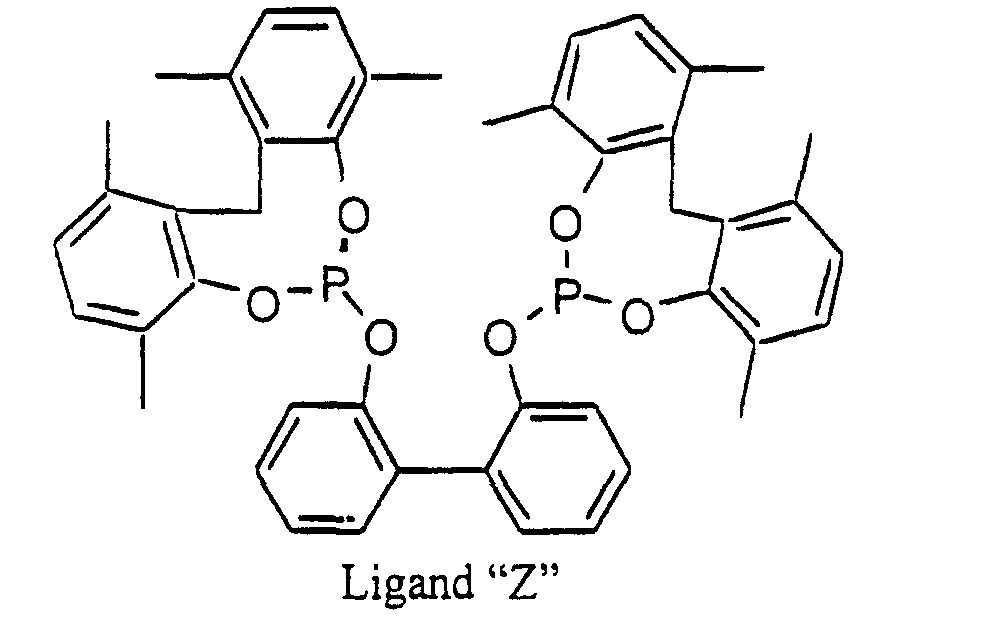
- To a flask were added 1.02 g 3,3',6,6'-tetramethyl-2,2'-dihydroxydiphenylmethane (4 mmol), 0.55 g PCl3 (4 mmol) and 100 mL of dry toluene. The flask was cooled to -20°C and a precooled toluene solution (-20°C, 20 mL) containing 1.0 g NEt3 (10 mmol) was added dropwise. A toluene solution (20 mL) containing 0.37 g 2,2'-biphenol (2 mmol) and 0.6 g NEt3 (6 mmol) was added to the above solution and stirred overnight. The mixture was filtered, washed with 10 mL toluene and the solvent was taken off under vacuum. After drying under vacuum for one day, a yellow solid was obtained (1.6 g). 31P NMR (CDCl3): 130.2 ppm. APCI MS (m/z): Found: 755.11 (M++ H); calculated for M+ + H (C46H44O6P2 + H): 755.27.
- 317 mg of Ligand "Z", 40 mg Ni(COD)2, and 20 mg of ZnCl2 were dissolved in 5 mL of 3-pentenenitrile. The mixture was treated with HCN at a nitrogen flow rate of 30 mL/min at 70°C for one hour. GC analysis indicated 85.3% ADN, 6.6% MGN, and 1.3% ESN (selectivity to ADN: 91%).
-
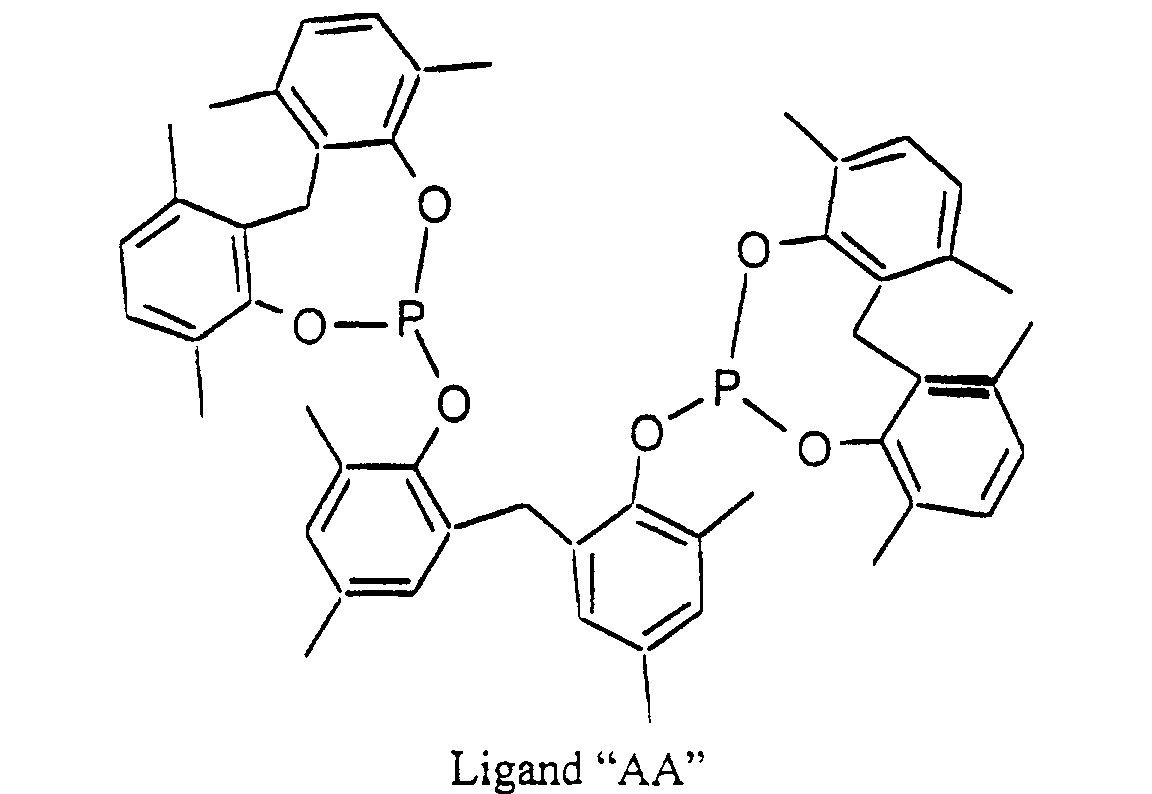
- This ligand was prepared similarly to Ligand "Z" except 3,3',5,5'-tetramethyl-2,2'-dihydroxydiphenylmethane was used instead of 2,2'-biphenol as the backbone. 31P NMR (CDCl3): 131.36 ppm. APCI MS (m/z): Found: 825.22 (M+ + H); calculated for M+ + H (C51H54O6P2 + H): 825.34.
- 346 mg of Ligand "AA", 40 mg Ni(COD)2, and 20 mg of ZnCl2 were dissolved in 5 mL of 3-pentenenitrile. The mixture was treated with HCN at a nitrogen flow rate of 30 mL/min at 70°C for one hour. GC analysis indicated 49.2% ADN, 17.4% MGN, and 9.3% ESN (selectivity to ADN: 65%).
-
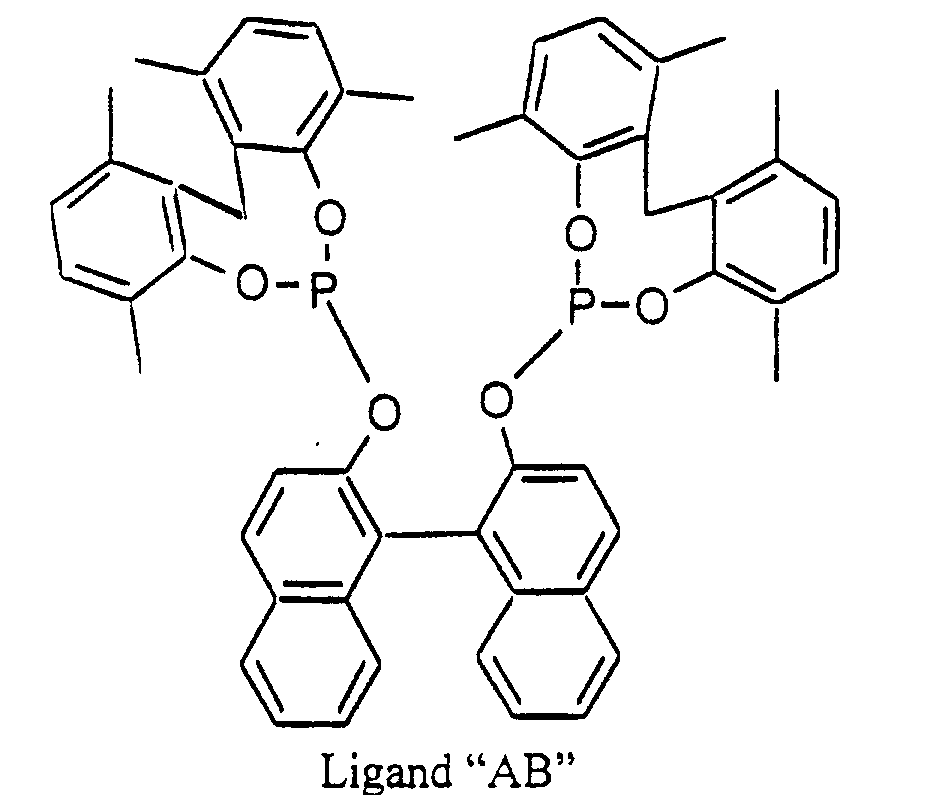
- This ligand was prepared similar to Ligand "Z" except 1,1'-binaphthol was used instead of 2,2'-biphenol as the backbone. 31P NMR (C6D6): 130.73 ppm. APCI MS (m/z): Found: 855.60 (M+ + H); calculated for M+ + H (C54H48O6P2 + H): 855.30.
- 359 mg of Ligand "AB", 40 mg Ni(COD)2, and 20 mg of ZnCl2 were dissolved in 5 mL of 3-pentenenitrile. The mixture was treated with HCN at a nitrogen flow rate of 30 mL/min at 70°C for one hour. GC analysis indicated 84.2% ADN, 7.9% MGN, and 1.5% ESN (selectivity to ADN: 90%).
-

- This ligand was prepared similar to Ligand "Z" except 3,3'-dimethoxy-5,5'-dimethyl-2,2'-biphenol was used instead of 2,2'-biphenol as the backbone. 31 P NMR (C6D6): 133.28 ppm with a minor signal at 148.80 ppm due to an impurity. APCI MS (m/z): Found: 842.96 (M+ + H); calculated for M+ + H (C50H52O8P2+H): 843.32.
- 354 mg of Ligand "AC", 40 mg Ni(COD)2, and 20 mg of ZnCl2 were dissolved in 5 mL of 3-pentenenitrile. The mixture was treated with HCN at a nitrogen flow rate of 30 mL/min at 70°C for one hour. GC analysis indicated 53.1% ADN, 1.7% MGN, and 0.2% ESN (selectivity to ADN: 97%).
Claims (13)
- A hydrocyanation process comprising reacting an acyclic, aliphatic, monoethylenically unsaturated compound in which the ethylenic double bond is not conjugated to any other olefinic group in the molecule, or a monoethylenically unsaturated compound in which the ethylenic double bond is conjugated to an organic ester group, with a source of HCN in the presence of a catalyst precursor composition comprising a Lewis acid, a zero-valent nickel, and at least one multidentate phosphite ligand selected from the group represented by the following Formulas I, II, III, IV, V, VI, VII, VIII, and IX:

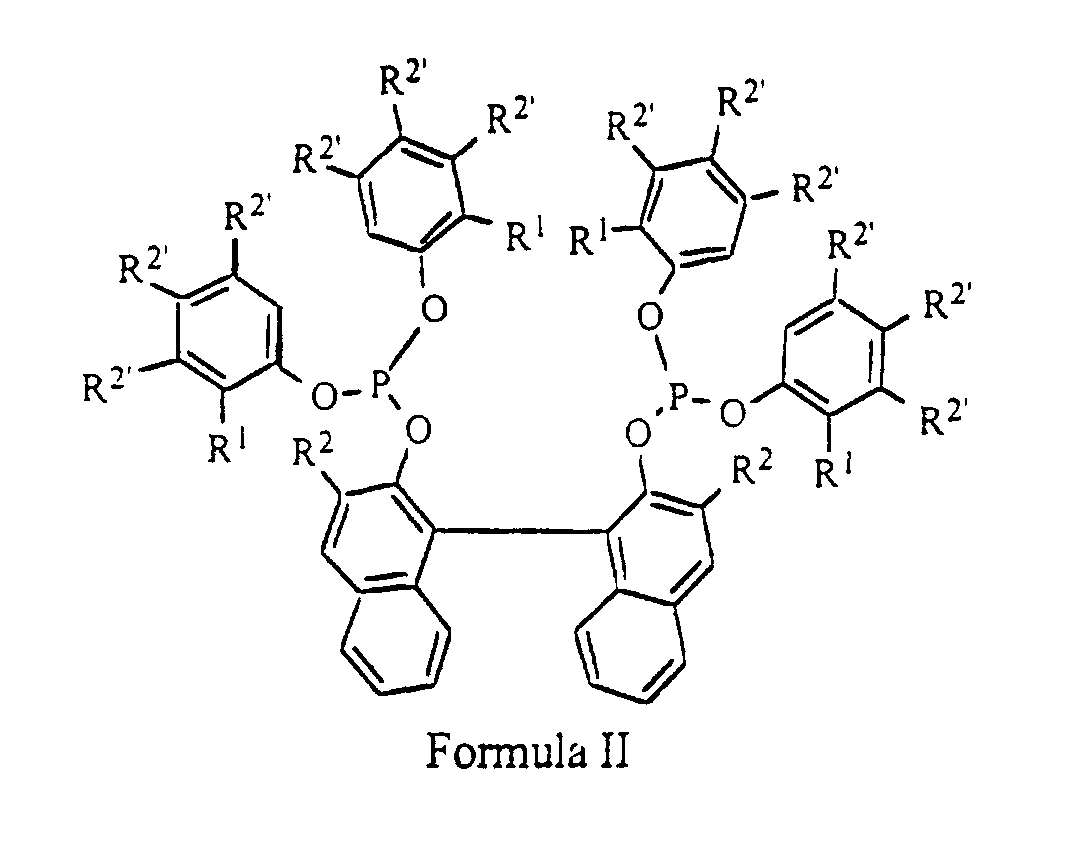
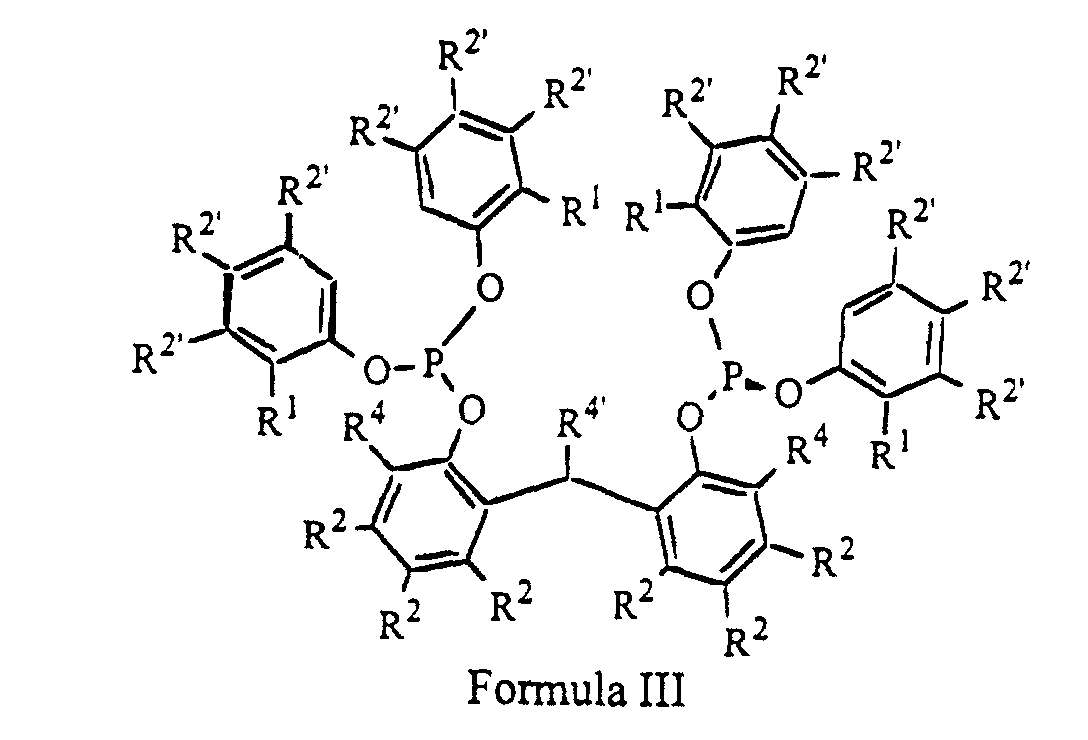
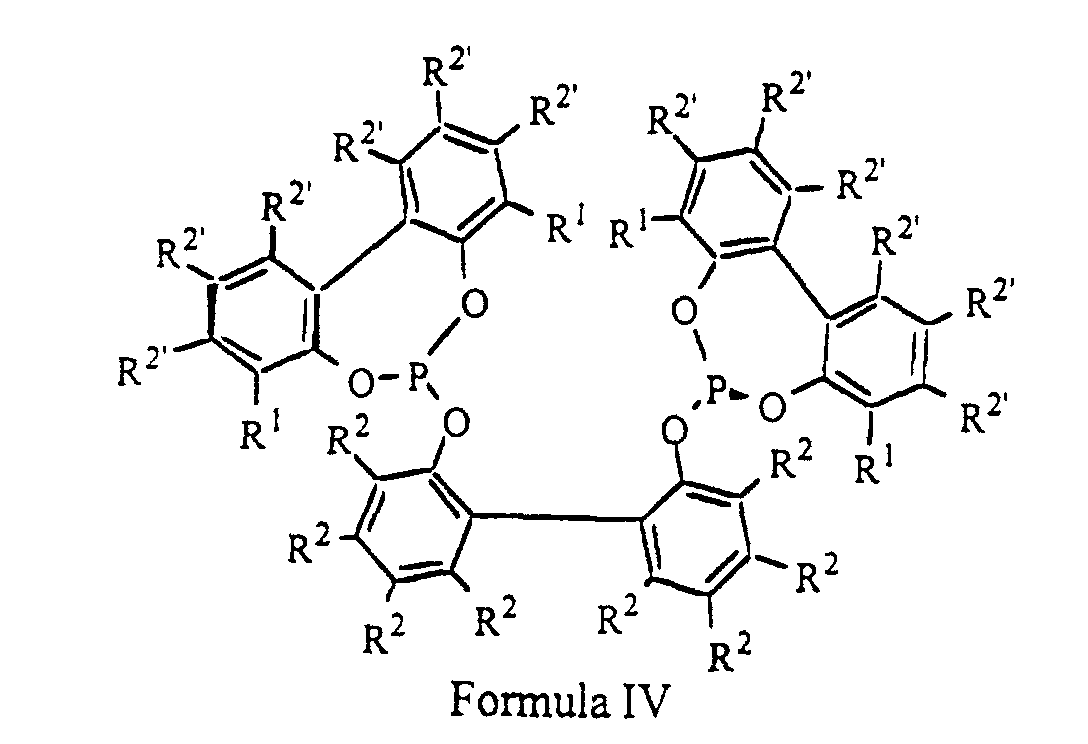
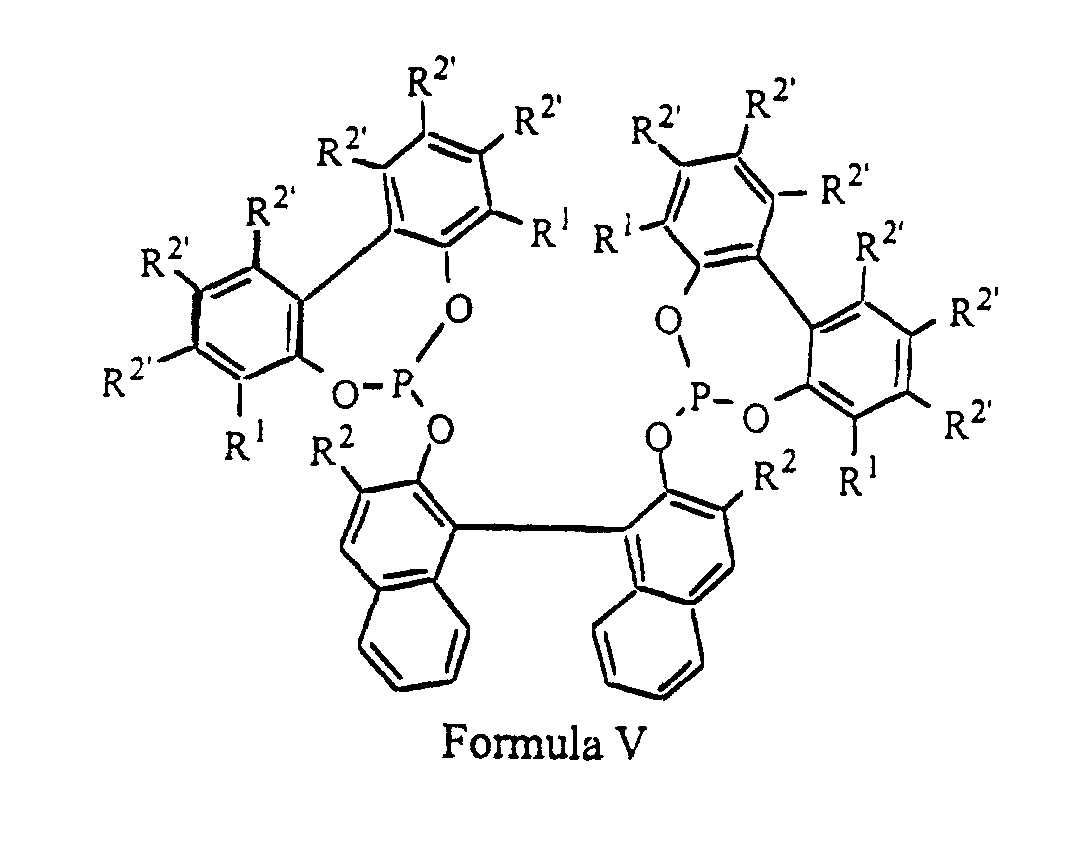
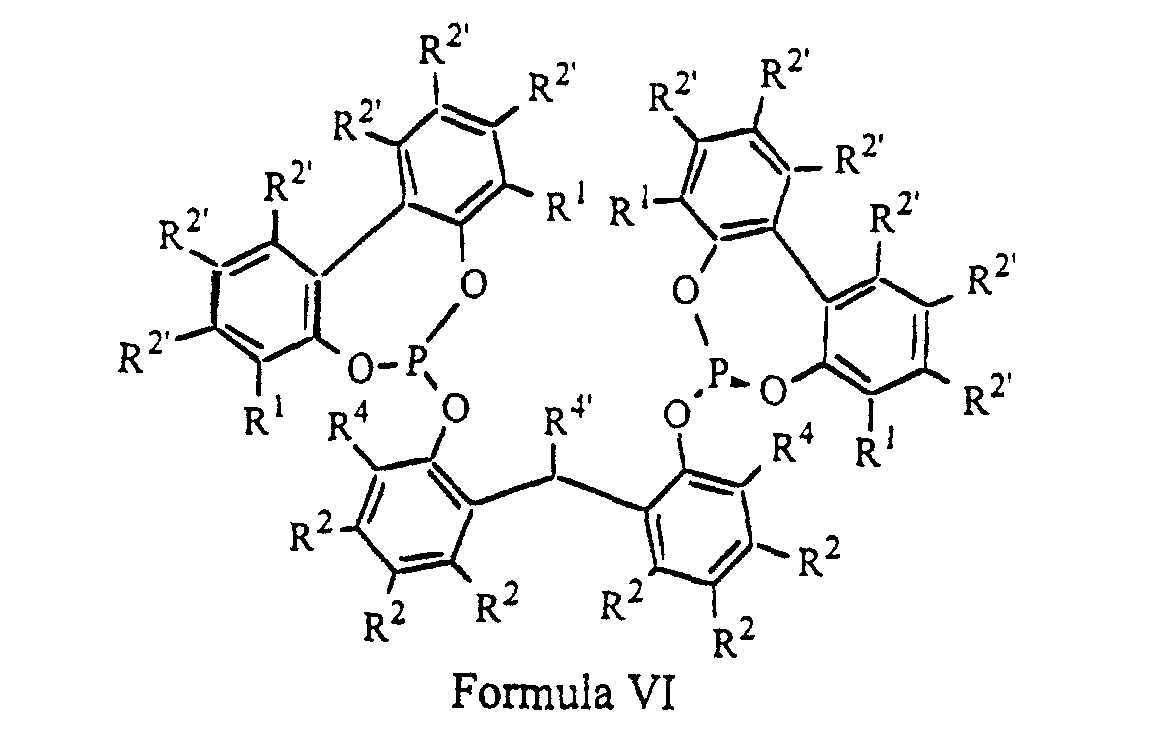

 wherein
- each R1
- is independently a primary, secondary, or tertiary hydrocarbyl of 1 to 12 carbon atoms; with the proviso that at least one of R1 must be a primary hydrocarbyl;
- each R2
- is independently H, halogen, primary or secondary hydrocarbyl of 1 to 12 carbon atoms, OR3 wherein R3 is a C1 to C12 alkyl, or CO2R3' wherein R3' is an aryl or a C1 to C12 alkyl;
- each R2'
- is independently H, halogen, CHO, primary, secondary or tertiary hydrocarbyl of 1 to 12 carbon atoms, OR3 wherein R3 is a C1 to C12 alkyl, CO2R3' wherein R3' is an aryl or a C1 to C12 alkyl, or C(R3)(O) wherein R3 is a C1 to C12 alkyl;
- each R4
- is independently H, a primary or secondary hydrocarbyl of 1 to 12 carbon atoms or CO2R3 wherein R3 is a C1 to C12 alkyl; and
- each R4'
- is independently H, a primary or secondary hydrocarbyl of 1 to 12 carbon atoms or aryl,
- The process of Claim 1 wherein the starting ethylenically unsaturated compound is selected from the group consisting of the compounds of the following Formulas X and XII:
- R5
- is H, CN, CO2R3', or perfluoroalkyl;
- y
- is an integer of 0 to 12;
- x
- is an integer of 0 to 12 when R5 is H, CO2R3' or perfluoroalkyl;
- x
- is an integer of 1 to 12 when R5 is CN; and
- R3'
- is aryl or a C1 to C12 alkyl.
- The process of Claim 1 wherein the starting monoethylenically unsaturated compound is selected from the group consisting of 3-pentenenitrile, 4-pentenenitrile; alkyl 2-, 3-, and 4-pentenoates, and C2F2z+1CH=CH2, where z is an integer of 1 to 12.
- The process of Claim 3 wherein the starting monoethylenically unsaturated compound is 3-pentenenitrile or 4-pentenenitrile.
- The process of Claim 1 which is carried out at a temperature of -25°C to 200°C and at a pressure of 50.6 to 1013 kPa.
- The process of Claim 5 which is carried out at atmospheric pressure and at a temperature of 0°C to 150°C.
- The process of Claim 1 wherein the Lewis acid is selected from the group consisting of inorganic or organometallic compounds in which the cation is selected from scandium, titanium, vanadium, chromium, manganese, iron, cobalt, copper, zinc, boron, aluminum, yttrium, zirconium, niobium, molybdenum, cadmium, rhenium and tin.
- The process of Claim 7 wherein the Lewis acid is selected from the group consisting of ZnBr2, ZnI2, ZnCl2, ZnSO4, CuCl2, CuCl, Cu(O3SCF3)2, CoCl2, CoI2, FeI2, FeCl3, FeCl2(tetrahydrofuran)2, TiCl4(tetrahydrofuran)2, FeCl2, TiCl4, TiCl3, ClTi(OiPr)3, MnCl2, ScCl3, AlCl3, (C8H17)AlCl2, (C8H17)2AlCl, (iso-C4H9)2AlCl, (phenyl)2AlCl, phenylAlCl2, ReCl5, ZrCl4, NbCl5, VCl3, CrCl2, MoCl5, YCl3, CdCl2, LaCl3, Er(O3SCF3)3, Yb(O2CCF3)3, SmCl3, TaCl5, CdCl2, B(C6H5)3, and (C6H5)3SnX, where X = CF3SO3, CH3C6H5SO3, or (C6H5)3BCN.
- A multidentate phosphite ligand selected from the group represented by the following Formula I, II, III, IV, V, VI, VII, VIII and IX:



 wherein
- each R1
- is independently a primary, secondary, or tertiary hydrocarbyl of 1 to 12 carbon atoms; with the proviso that at least one of R1 must be a primary hydrocarbyl;
- each R2
- is independently H, halogen, primary or secondary hydrocarbyl of to 12 carbon atoms, OR3 wherein R3 is a C1 to C12 alkyl, or CO2R3' wherein R3' is an aryl or a C1 to C12 alkyl;
- each R2'
- is independently H, halogen, CHO, primary, secondary or tertiary hydrocarbyl of 1 to 12 carbon atoms, OR3 wherein R3 is a C1 to C12 alkyl, CO2R3' wherein R3' is an aryl or a C1 to C12 alkyl, or C(R3)(O) wherein R3 is a C1 to C12 alkyl;
- each R4
- is independently H, a primary or secondary hydrocarbyl of 1 to 12 carbon atoms or CO2R3 wherein R3 is a C1 to C12 alkyl; and
- each R4'
- is independently H, a primary or secondary hydrocarbyl of 1 to 12 carbon atoms or aryl,
- A catalyst precursor composition comprising zero-valent nickel and a multidentate phosphite ligand according to Claim 9.
- The catalyst precursor composition of Claim 10 wherein a Lewis acid is also present.
- The catalyst composition of Claim 11 wherein the Lewis acid is selected from the group consisting of ZnBr2, Znl2, ZnCl2, ZnSO4, CuCl2, CuCl, Cu(O3SCF3)2, CoCl2, CoI2, FeI2, FeCl3, FeCl2(tetrahydrofuran)2, FeCl2, TiCl4(tetrahydrofuran)2, TiCl4, TiCl3, ClTi(OiPr)3, MnCl2, ScCl3, AlCl3, (C8H17)AlCl2, (C8H17)2AlCl, (iso-C4H9)2AlCl, (phenyl)2AlCl, phenylAlCl2, ReCl5, ZrCl4, NbCl5, VCl3, CrCl2, MoCl5, YCl3, CdCl2, LaCl3, Er(O3SCF3)3, Yb(O2CCF3)3, SmCl3, TaCl5, CdCl2, B(C6H5)3, and (C6H5)3SnX, where X = CF3SO3, CH3C6H5SO3, or (C6H5)3BCN.
- The catalyst precursor composition of Claim 10 wherein the zero-valent nickel and the multidentate phosphite ligand are supported on the same solid support.
Applications Claiming Priority (3)
| Application Number | Priority Date | Filing Date | Title |
|---|---|---|---|
| US5383197P | 1997-07-29 | 1997-07-29 | |
| US53831P | 1997-07-29 | ||
| PCT/US1998/015305 WO1999006358A1 (en) | 1997-07-29 | 1998-07-23 | Hydrocyanation processes and multidentate phosphite ligand and nickel catalyst compositions therefor |
Publications (2)
| Publication Number | Publication Date |
|---|---|
| EP1000022A1 EP1000022A1 (en) | 2000-05-17 |
| EP1000022B1 true EP1000022B1 (en) | 2005-03-30 |
Family
ID=21986832
Family Applications (1)
| Application Number | Title | Priority Date | Filing Date |
|---|---|---|---|
| EP98937046A Expired - Lifetime EP1000022B1 (en) | 1997-07-29 | 1998-07-23 | Hydrocyanation processes and multidentate phosphite ligand and nickel catalyst compositions therefor |
Country Status (7)
| Country | Link |
|---|---|
| US (2) | US6127567A (en) |
| EP (1) | EP1000022B1 (en) |
| DE (1) | DE69829562T2 (en) |
| MY (1) | MY124170A (en) |
| TW (1) | TWI285194B (en) |
| WO (1) | WO1999006358A1 (en) |
| ZA (1) | ZA986376B (en) |
Families Citing this family (70)
| Publication number | Priority date | Publication date | Assignee | Title |
|---|---|---|---|---|
| US6380421B1 (en) * | 1999-09-20 | 2002-04-30 | E. I. Du Pont De Nemours And Company | Multidentate phosphite ligands, catalytic compositions containing such ligands and catalytic processes utilizing such catalytic compositions |
| DE10136488A1 (en) * | 2001-07-27 | 2003-02-06 | Basf Ag | Catalyst system comprising Ni(0) and phosphorous ligands is useful for the production of nitrile and dinitrile compounds |
| DE10150285A1 (en) * | 2001-10-12 | 2003-04-17 | Basf Ag | New bisphosphonites useful for preparing transition metal complexes for use as olefin hydrocyanation and nitrile isomerization catalysts |
| DE10150286A1 (en) * | 2001-10-12 | 2003-04-17 | Basf Ag | New bisphosphinites useful for preparing transition metal complexes for use as olefin hydrocyanation and nitrile isomerization catalysts |
| AR036636A1 (en) * | 2001-10-12 | 2004-09-22 | Basf Ag | PHOSPHONITE I, ITS USE AS BINDING IN TRANSITION METAL COMPLEXES, SUCH COMPLEXES, PROCEDURE FOR OBTAINING THESE LAST, USE OF TRANSITORY METAL COMPLEXES AS CATALYST AND PROCEDURES FOR THE ADDITION OF CYANHYDIC ACID TO A DOUBLE LINK D |
| US6660876B2 (en) * | 2001-11-26 | 2003-12-09 | E. I. Du Pont De Nemours And Company | Phosphorus-containing compositions and their use in hydrocyanation, isomerization and hydroformylation reactions |
| US6489517B1 (en) * | 2001-11-26 | 2002-12-03 | E. I. Du Pont De Nemours And Company | Process for preparing 3,3′,6,6′-tetraalkyl-2,2′-biphenols and 3,3′,6,6′-tetraalkyl-5,5′-dihalo-2,2′-biphenols |
| AR038161A1 (en) | 2002-01-24 | 2004-12-29 | Basf Ag | PROCEDURE FOR SEPARATING ACIDS FROM CHEMICAL REACTION MIXTURES WITH THE HELP OF ION LIQUIDS |
| MY134370A (en) * | 2002-07-10 | 2007-12-31 | Basf Ag | Recycling of a lewis acid |
| FR2842195B1 (en) * | 2002-07-15 | 2005-12-02 | Rhodia Polyamide Intermediates | PROCESS FOR PRODUCING NITRILE COMPOUNDS FROM ETHYLENE-UNSATURATED COMPOUNDS |
| US6906218B2 (en) | 2002-12-18 | 2005-06-14 | Invista North America S.A.R.L. | Cyclohexane derivatives and methods for their preparation |
| FR2849027B1 (en) * | 2002-12-23 | 2005-01-21 | Rhodia Polyamide Intermediates | PROCESS FOR THE SYNTHESIS OF COMPOUNDS COMPRISING NITRIL FUNCTIONS FROM ETHYLENE-UNSATURATED COMPOUNDS |
| US6936171B2 (en) * | 2003-01-08 | 2005-08-30 | Invista North America S.A.R.L. | Process for catalyst recovery from hydrocyanation product mixtures |
| US6897329B2 (en) * | 2003-01-14 | 2005-05-24 | Invista North America S.A.R.L. | Process for the preparation of nickel/phosphorous ligand catalyst for olefin hydrocyanation |
| FR2850966B1 (en) | 2003-02-10 | 2005-03-18 | Rhodia Polyamide Intermediates | PROCESS FOR PRODUCING DINITRIL COMPOUNDS |
| DE10314761A1 (en) * | 2003-03-31 | 2004-10-14 | Basf Ag | As a catalyst for the hydrocyanation of olefinically unsaturated compounds suitable system |
| US6844289B2 (en) * | 2003-04-08 | 2005-01-18 | Invista North America S.A.R.L. | Process for the preparation of a nickel/phosphorous ligand catalyst |
| FR2854892B1 (en) | 2003-05-12 | 2005-06-24 | Rhodia Polyamide Intermediates | PROCESS FOR PRODUCING DINITRILES |
| FR2854891B1 (en) | 2003-05-12 | 2006-07-07 | Rhodia Polyamide Intermediates | PROCESS FOR PREPARING DINITRILES |
| EP2295400A3 (en) | 2003-09-11 | 2012-10-24 | Invista Technologies S.à.r.l. | Process of hydrocyanation of unsaturated carboxylic acid derivatives |
| DE10350999A1 (en) * | 2003-10-30 | 2005-06-02 | Basf Ag | Catalyst comprising at least one nickel (O) complex stabilized by a sterically demanding chelate phosphinite phosphite ligand, and a process for the preparation of nitriles |
| DE10351000A1 (en) * | 2003-10-30 | 2005-06-09 | Basf Ag | Process for the preparation of nickel (0) phosphorus ligand complexes |
| DE102004004682A1 (en) | 2004-01-29 | 2005-08-18 | Basf Ag | Process for the preparation of adiponitrile by hydrocyanation of 1,3-butadiene |
| US8119829B2 (en) | 2004-09-08 | 2012-02-21 | Invista North America S.A.R.L. | Process of hydrocyanation of unsaturated carboxylic acid derivatives |
| WO2007046799A1 (en) * | 2005-10-18 | 2007-04-26 | Invista Technologies S.A R.L. | Process of making 3-aminopentanenitrile |
| WO2007105896A1 (en) | 2006-03-13 | 2007-09-20 | Lg Chem, Ltd. | 1-alkene-acrylate based copolymer |
| CA2644961A1 (en) | 2006-03-17 | 2007-09-27 | Invista Technologies S.A.R.L. | Method for the purification of triorganophosphites by treatment with a basic additive |
| KR100882315B1 (en) * | 2006-04-28 | 2009-02-10 | 주식회사 엘지화학 | Method for preparing α-olefin-acrylate-norbornene terpolymer using Lewis acid and copolymer prepared therefrom |
| US7919646B2 (en) | 2006-07-14 | 2011-04-05 | Invista North America S.A R.L. | Hydrocyanation of 2-pentenenitrile |
| US7709674B2 (en) | 2006-07-14 | 2010-05-04 | Invista North America S.A R.L | Hydrocyanation process with reduced yield losses |
| US7659422B2 (en) | 2006-07-14 | 2010-02-09 | Invista North America S.A.R.L. | Hydrocyanation process with reduced yield losses |
| US7880028B2 (en) | 2006-07-14 | 2011-02-01 | Invista North America S.A R.L. | Process for making 3-pentenenitrile by hydrocyanation of butadiene |
| US7709673B2 (en) * | 2006-07-14 | 2010-05-04 | Invista North America S.A R.L. | Process for making 3-pentenenitrile by hydrocyanation of butadiene |
| CN101679565B (en) * | 2007-03-30 | 2012-05-23 | Lg化学株式会社 | Copolymers comprising alkenes, acrylates and unsaturated organic acids and methods for their preparation |
| US8906334B2 (en) | 2007-05-14 | 2014-12-09 | Invista North America S.A R.L. | High efficiency reactor and process |
| US8101790B2 (en) * | 2007-06-13 | 2012-01-24 | Invista North America S.A.R.L. | Process for improving adiponitrile quality |
| US7977502B2 (en) | 2008-01-15 | 2011-07-12 | Invista North America S.A R.L. | Process for making and refining 3-pentenenitrile, and for refining 2-methyl-3-butenenitrile |
| EP2229353B1 (en) * | 2008-01-15 | 2018-01-03 | INVISTA Textiles (U.K.) Limited | Hydrocyanation of pentenenitriles |
| FR2926816B1 (en) | 2008-01-25 | 2010-05-14 | Rhodia Operations | PROCESS FOR PRODUCING COMPOUNDS COMPRISING NITRIL FUNCTIONS |
| EP2257516A4 (en) * | 2008-03-19 | 2012-12-12 | Invista Tech Sarl | METHOD FOR THE PRODUCTION OF CYCLODODECATRIOS AND METHOD FOR THE PRODUCTION OF LAUROLACTONE |
| FR2932477B1 (en) | 2008-06-17 | 2013-01-18 | Rhodia Operations | PROCESS FOR THE PRODUCTION OF NITRILIC COMPOUNDS FROM ETHYLENE-UNSATURATED COMPOUNDS |
| EP2334624B1 (en) * | 2008-10-14 | 2014-10-01 | Invista Technologies S.à.r.l. | Process for making 2-secondary-alkyl-4,5-di-(normal-alkyl)phenols |
| FR2937321B1 (en) * | 2008-10-21 | 2010-10-22 | Rhodia Operations | PROCESS FOR PRODUCING COMPOUNDS COMPRISING NITRIL FUNCTIONS |
| FR2941455B1 (en) | 2009-01-29 | 2011-02-11 | Rhodia Operations | PROCESS FOR PRODUCING COMPOUNDS COMPRISING NITRIL FUNCTIONS |
| KR20120047251A (en) * | 2009-08-07 | 2012-05-11 | 인비스타 테크놀러지스 에스.에이.알.엘. | Hydrogenation and esterification to form diesters |
| WO2011075494A1 (en) | 2009-12-18 | 2011-06-23 | Invista Technologies S.A.R.L. | Nickel metal compositions and nickel complexes derived from basic nickel carbonates |
| EP2574191B1 (en) | 2010-07-07 | 2013-11-20 | Invista Technologies S.a r.l. | Process for making nitriles |
| WO2012033555A1 (en) | 2010-09-07 | 2012-03-15 | Invista Technologies S.A.R.L. | Nickel compositions for preparing nickel metal and nickel complexes |
| EP2718015A2 (en) | 2011-06-10 | 2014-04-16 | Invista Technologies S.à.r.l. | Improvement in nickel metal-ligand catalyst formation |
| EP2718013A2 (en) * | 2011-06-10 | 2014-04-16 | Invista Technologies S.à.r.l. | Nickel calcination and reduction process including a fluidizing bed reactor |
| EP2763960B1 (en) | 2011-10-07 | 2017-03-01 | Invista Technologies S.à.r.l. | Process for making nitriles |
| KR20140127220A (en) | 2011-12-21 | 2014-11-03 | 인비스타 테크놀러지스 에스.에이 알.엘. | Extraction solvent control for reducing stable emulsions |
| KR20140108683A (en) | 2011-12-21 | 2014-09-12 | 인비스타 테크놀러지스 에스.에이 알.엘. | Extraction solvent control for reducing stable emulsions |
| KR20140127218A (en) | 2011-12-21 | 2014-11-03 | 인비스타 테크놀러지스 에스.에이 알.엘. | Extraction solvent control for reducing stable emulsions |
| US9011691B2 (en) | 2011-12-21 | 2015-04-21 | Invista North America S.A.R.L. | Extraction solvent control for reducing stable emulsions |
| US9108988B2 (en) | 2011-12-30 | 2015-08-18 | Basf Se | Method of purifying organic diphosphite compounds |
| CN104144935B (en) | 2011-12-30 | 2016-07-06 | 巴斯夫欧洲公司 | 6,6'-[[3,3',5,5'-tetrakis(1,1-dimethylethyl)-[1,1'-biphenyl]-2,2'-diyl]bis( Oxy)]bis-dibenzo[d,f][1,3,2]-dioxaphosphapine crystalline solvated and unsolvated forms |
| MY164954A (en) | 2011-12-30 | 2018-02-28 | Basf Se | Method for purifying organic diphosphite compounds |
| KR20150018590A (en) | 2012-06-01 | 2015-02-23 | 인비스타 테크놀러지스 에스.에이 알.엘. | Process for stabilizing hydrocyanation catalyst |
| CN104854118B (en) * | 2012-10-12 | 2016-12-14 | 赢创德固赛有限公司 | Various different asymmetric diphosphite ester admixtures and as catalyst mixture purposes in hydroformylation |
| CN109999913A (en) | 2012-12-07 | 2019-07-12 | 英威达纺织(英国)有限公司 | For improving the deliquescent composition of nickel-ligand |
| US9932298B2 (en) | 2012-12-07 | 2018-04-03 | Invista North America S.A R.L. | Process for producing pentenenitriles |
| US10759741B2 (en) | 2013-07-17 | 2020-09-01 | Invista North America S.A R.L. | Separating a solvent from a nickel catalyst by distillation |
| CN103467517B (en) * | 2013-10-10 | 2015-12-02 | 中国海洋石油总公司 | A kind of microwave synthesis method of diphosphite three (3,3 ', 5,5 '-tetramethyl--2,2 '-xenol) ester |
| CN103664691B (en) * | 2013-12-27 | 2016-01-20 | 安徽省安庆市曙光化工股份有限公司 | Prepare the method for adiponitrile |
| EP3160933B1 (en) | 2014-06-27 | 2018-08-15 | INVISTA Textiles (U.K.) Limited | Integrated process for nitrile manufacture with enhanced liquid-liquid extraction |
| CN106573879B (en) | 2014-06-27 | 2019-09-24 | 英威达纺织(英国)有限公司 | Enhanced extraction of impurities from mixtures containing nitriles |
| EP3029046A1 (en) * | 2014-12-04 | 2016-06-08 | Evonik Degussa GmbH | One pot synthesis for the preparation of diphosphites and triphosphites |
| JP6974332B2 (en) | 2016-02-11 | 2021-12-01 | ヘンケル アイピー アンド ホールディング ゲゼルシャフト ミット ベシュレンクテル ハフツング | Olefin-acrylate copolymers with pendant hydroxyl functional groups and their use |
| CA3012843A1 (en) | 2016-02-11 | 2017-08-17 | Henkel IP & Holding GmbH | Olefin-acrylate copolymers with pendant hydroxyl functionality and use thereof |
Family Cites Families (14)
| Publication number | Priority date | Publication date | Assignee | Title |
|---|---|---|---|---|
| US591600A (en) * | 1897-10-12 | Samuel gotjldelsr | ||
| US3496215A (en) * | 1965-11-23 | 1970-02-17 | Du Pont | Hydrocyanation of olefins using selected nickel phosphite catalysts |
| GB1112539A (en) * | 1965-11-26 | 1968-05-08 | Du Pont | Preparation of organic nitriles |
| US3496217A (en) * | 1967-05-23 | 1970-02-17 | Du Pont | Hydrocyanation of olefins |
| US3655723A (en) * | 1969-10-31 | 1972-04-11 | Du Pont | Hydrocyanation of olefins |
| US3631191A (en) * | 1970-04-08 | 1971-12-28 | Du Pont | Synthesis of zero valent nickel-tetrakis triaryl phosphite complexes |
| US3766237A (en) * | 1972-01-25 | 1973-10-16 | Du Pont | Hydrocyanation of olefins |
| US4774353A (en) * | 1986-06-05 | 1988-09-27 | E. I. Du Pont De Nemours And Company | Triorganotin catalyst promoters for hydrocyanation |
| US4874884A (en) * | 1988-03-31 | 1989-10-17 | E. I. Du Pont De Nemours And Company | Promoter synergism in pentenenitrile hydrocyanation |
| US5360938A (en) * | 1991-08-21 | 1994-11-01 | Union Carbide Chemicals & Plastics Technology Corporation | Asymmetric syntheses |
| ATE196745T1 (en) * | 1994-04-14 | 2000-10-15 | Du Pont | CATALYST COMPOSITIONS CONTAINING NICKEL AND PHOSPHINEBIDENTATE FOR THE HYDROCYANATION OF MONOOLEFINS |
| US5512696A (en) * | 1995-07-21 | 1996-04-30 | E. I. Du Pont De Nemours And Company | Hydrocyanation process and multidentate phosphite and nickel catalyst composition therefor |
| TW315370B (en) * | 1994-10-07 | 1997-09-11 | Du Pont | |
| DE19717359B4 (en) | 1996-04-30 | 2014-10-30 | Mitsubishi Chemical Corp. | Bisphosphite compounds and process for their preparation |
-
1998
- 1998-07-16 MY MYPI98003247A patent/MY124170A/en unknown
- 1998-07-17 ZA ZA9806376A patent/ZA986376B/en unknown
- 1998-07-23 WO PCT/US1998/015305 patent/WO1999006358A1/en not_active Ceased
- 1998-07-23 EP EP98937046A patent/EP1000022B1/en not_active Expired - Lifetime
- 1998-07-23 US US09/121,105 patent/US6127567A/en not_active Expired - Lifetime
- 1998-07-23 DE DE69829562T patent/DE69829562T2/en not_active Expired - Lifetime
- 1998-08-01 TW TW087111728A patent/TWI285194B/en not_active IP Right Cessation
-
1999
- 1999-07-13 US US09/351,642 patent/US6171996B1/en not_active Expired - Lifetime
Also Published As
| Publication number | Publication date |
|---|---|
| ZA986376B (en) | 2000-01-17 |
| MY124170A (en) | 2006-06-30 |
| WO1999006358A1 (en) | 1999-02-11 |
| DE69829562T2 (en) | 2006-02-16 |
| US6127567A (en) | 2000-10-03 |
| US6171996B1 (en) | 2001-01-09 |
| DE69829562D1 (en) | 2005-05-04 |
| EP1000022A1 (en) | 2000-05-17 |
| TWI285194B (en) | 2007-08-11 |
Similar Documents
| Publication | Publication Date | Title |
|---|---|---|
| US6171996B1 (en) | Hydrocyanation processes and multidentate phosphite ligand and nickel catalyst compositions therefor | |
| EP1000019B1 (en) | Hydrocyanation processes and multidentate phosphite ligand and nickel catalyst compositions therefor | |
| EP0784610B1 (en) | Hydrocyanation process and multidentate phosphite and nickel catalyst composition therefor | |
| US5512696A (en) | Hydrocyanation process and multidentate phosphite and nickel catalyst composition therefor | |
| KR100249873B1 (en) | Monodentate phosphite and nickel catalyst compositions for monoolefin hydrocyanation | |
| EP0804412B1 (en) | Hydrocyanation of diolefins and isomerization of nonconjugated 2-alkyl-3-monoalkenenitriles | |
| EP0730574B1 (en) | Processes and catalyst compositions for hydrocyanation of monoolefins | |
| EP0911339B1 (en) | Method of making phosphorochloridites | |
| EP1000021B1 (en) | Hydrocyanation of diolefins and isomerization of nonconjugated 2-alykl-3-monoalkenenitriles | |
| US5512695A (en) | Bidentate phosphite and nickel catalyst compositions for hydrocyanation of monoolefins | |
| EP1214289B1 (en) | Multidentate phosphite ligands and their use in catalytic compositions for hydrocyanation processes | |
| EP0755302B1 (en) | Bidentate phosphite and nickel catalyst compositions for hydrocyanation of monoolefins | |
| EP1448668B1 (en) | Polymeric, phosphorous-containing compositions and their use in hydrocyanation, isomerization and hydroformylation reactions | |
| EP1073520B1 (en) | Hydrocyanation of olefins and isomerisation of nonconjugated 2-alkyl-3-monoalkenenitriles | |
| HK1025950B (en) | Hydrocyanation processes and multidentate phosphite ligand and nickel catalyst compositions therefor | |
| KR100714324B1 (en) | Multidentate phosphite ligands, and catalyst compositions containing them |
Legal Events
| Date | Code | Title | Description |
|---|---|---|---|
| PUAI | Public reference made under article 153(3) epc to a published international application that has entered the european phase |
Free format text: ORIGINAL CODE: 0009012 |
|
| 17P | Request for examination filed |
Effective date: 20000119 |
|
| AK | Designated contracting states |
Kind code of ref document: A1 Designated state(s): BE DE FR GB IT NL |
|
| RIN1 | Information on inventor provided before grant (corrected) |
Inventor name: TAM, WILSON Inventor name: KRUETZER, KRISTINA, ANN Inventor name: GARNER, JAMES MICHAEL |
|
| RAP1 | Party data changed (applicant data changed or rights of an application transferred) |
Owner name: E.I. DU PONT DE NEMOURS AND COMPANY |
|
| 17Q | First examination report despatched |
Effective date: 20020222 |
|
| RAP1 | Party data changed (applicant data changed or rights of an application transferred) |
Owner name: INVISTA TECHNOLOGIES S.AE.R.L. |
|
| GRAP | Despatch of communication of intention to grant a patent |
Free format text: ORIGINAL CODE: EPIDOSNIGR1 |
|
| 111Z | Information provided on other rights and legal means of execution |
Free format text: BEDEFRGBITNL Effective date: 20040731 |
|
| GRAS | Grant fee paid |
Free format text: ORIGINAL CODE: EPIDOSNIGR3 |
|
| GRAA | (expected) grant |
Free format text: ORIGINAL CODE: 0009210 |
|
| RAP1 | Party data changed (applicant data changed or rights of an application transferred) |
Owner name: INVISTA TECHNOLOGIES S.AE.R.L. |
|
| AK | Designated contracting states |
Kind code of ref document: B1 Designated state(s): BE DE FR GB IT NL |
|
| REG | Reference to a national code |
Ref country code: GB Ref legal event code: FG4D |
|
| REF | Corresponds to: |
Ref document number: 69829562 Country of ref document: DE Date of ref document: 20050504 Kind code of ref document: P |
|
| PLBE | No opposition filed within time limit |
Free format text: ORIGINAL CODE: 0009261 |
|
| STAA | Information on the status of an ep patent application or granted ep patent |
Free format text: STATUS: NO OPPOSITION FILED WITHIN TIME LIMIT |
|
| ET | Fr: translation filed | ||
| 26N | No opposition filed |
Effective date: 20060102 |
|
| REG | Reference to a national code |
Ref country code: GB Ref legal event code: 732E |
|
| REG | Reference to a national code |
Ref country code: HK Ref legal event code: WD Ref document number: 1026198 Country of ref document: HK |
|
| BECA | Be: change of holder's address |
Owner name: *INVISTA TECHNOLOGIES S.A.R.L.TALSTRASSE 80, CH-80 Effective date: 20050330 |
|
| REG | Reference to a national code |
Ref country code: GB Ref legal event code: 732E Free format text: REGISTERED BETWEEN 20090507 AND 20090513 |
|
| PGFP | Annual fee paid to national office [announced via postgrant information from national office to epo] |
Ref country code: NL Payment date: 20090705 Year of fee payment: 12 Ref country code: GB Payment date: 20090722 Year of fee payment: 12 |
|
| PGFP | Annual fee paid to national office [announced via postgrant information from national office to epo] |
Ref country code: BE Payment date: 20090805 Year of fee payment: 12 |
|
| PGFP | Annual fee paid to national office [announced via postgrant information from national office to epo] |
Ref country code: IT Payment date: 20090724 Year of fee payment: 12 |
|
| BERE | Be: lapsed |
Owner name: *INVISTA TECHNOLOGIES S.A.R.L. Effective date: 20100731 |
|
| REG | Reference to a national code |
Ref country code: NL Ref legal event code: V1 Effective date: 20110201 |
|
| GBPC | Gb: european patent ceased through non-payment of renewal fee |
Effective date: 20100723 |
|
| PG25 | Lapsed in a contracting state [announced via postgrant information from national office to epo] |
Ref country code: NL Free format text: LAPSE BECAUSE OF NON-PAYMENT OF DUE FEES Effective date: 20110201 Ref country code: IT Free format text: LAPSE BECAUSE OF NON-PAYMENT OF DUE FEES Effective date: 20100723 |
|
| PG25 | Lapsed in a contracting state [announced via postgrant information from national office to epo] |
Ref country code: BE Free format text: LAPSE BECAUSE OF NON-PAYMENT OF DUE FEES Effective date: 20100731 |
|
| PG25 | Lapsed in a contracting state [announced via postgrant information from national office to epo] |
Ref country code: GB Free format text: LAPSE BECAUSE OF NON-PAYMENT OF DUE FEES Effective date: 20100723 |
|
| PGFP | Annual fee paid to national office [announced via postgrant information from national office to epo] |
Ref country code: DE Payment date: 20150714 Year of fee payment: 18 |
|
| REG | Reference to a national code |
Ref country code: FR Ref legal event code: PLFP Year of fee payment: 19 |
|
| PGFP | Annual fee paid to national office [announced via postgrant information from national office to epo] |
Ref country code: FR Payment date: 20160613 Year of fee payment: 19 |
|
| REG | Reference to a national code |
Ref country code: DE Ref legal event code: R119 Ref document number: 69829562 Country of ref document: DE |
|
| PG25 | Lapsed in a contracting state [announced via postgrant information from national office to epo] |
Ref country code: DE Free format text: LAPSE BECAUSE OF NON-PAYMENT OF DUE FEES Effective date: 20170201 |
|
| REG | Reference to a national code |
Ref country code: FR Ref legal event code: ST Effective date: 20180330 |
|
| PG25 | Lapsed in a contracting state [announced via postgrant information from national office to epo] |
Ref country code: FR Free format text: LAPSE BECAUSE OF NON-PAYMENT OF DUE FEES Effective date: 20170731 |