EP0999840B1 - Use of a draflazine analogue for treating pain - Google Patents
Use of a draflazine analogue for treating pain Download PDFInfo
- Publication number
- EP0999840B1 EP0999840B1 EP98934969A EP98934969A EP0999840B1 EP 0999840 B1 EP0999840 B1 EP 0999840B1 EP 98934969 A EP98934969 A EP 98934969A EP 98934969 A EP98934969 A EP 98934969A EP 0999840 B1 EP0999840 B1 EP 0999840B1
- Authority
- EP
- European Patent Office
- Prior art keywords
- pain
- compound
- formula
- pharmaceutically acceptable
- forms
- Prior art date
- Legal status (The legal status is an assumption and is not a legal conclusion. Google has not performed a legal analysis and makes no representation as to the accuracy of the status listed.)
- Expired - Lifetime
Links
- 208000002193 Pain Diseases 0.000 title abstract description 31
- IWMYIWLIESDFRZ-UHFFFAOYSA-N 1-[2-(4-amino-2,6-dichloroanilino)-2-oxoethyl]-4-[5,5-bis(4-fluorophenyl)pentyl]piperazine-2-carboxamide Chemical class C1CN(CC(=O)NC=2C(=CC(N)=CC=2Cl)Cl)C(C(=O)N)CN1CCCCC(C=1C=CC(F)=CC=1)C1=CC=C(F)C=C1 IWMYIWLIESDFRZ-UHFFFAOYSA-N 0.000 title description 7
- 150000001875 compounds Chemical class 0.000 claims abstract description 45
- 150000003839 salts Chemical class 0.000 claims abstract description 16
- 239000002253 acid Substances 0.000 claims abstract description 13
- 125000000815 N-oxide group Chemical group 0.000 claims abstract 2
- 239000008194 pharmaceutical composition Substances 0.000 claims description 8
- 238000000034 method Methods 0.000 claims description 7
- 239000003937 drug carrier Substances 0.000 claims description 5
- PEOZWTQTANVQSY-UHFFFAOYSA-N 4-[2-(2-acetyl-6-chloroanilino)-2-oxoethyl]-1-[5,5-bis(4-fluorophenyl)pent-4-enyl]-n-methylpiperazine-2-carboxamide Chemical compound C1CN(CCCC=C(C=2C=CC(F)=CC=2)C=2C=CC(F)=CC=2)C(C(=O)NC)CN1CC(=O)NC1=C(Cl)C=CC=C1C(C)=O PEOZWTQTANVQSY-UHFFFAOYSA-N 0.000 claims description 2
- 230000008569 process Effects 0.000 claims description 2
- 239000003112 inhibitor Substances 0.000 abstract description 9
- 239000002777 nucleoside Substances 0.000 abstract description 9
- 150000003833 nucleoside derivatives Chemical class 0.000 abstract description 8
- 238000011282 treatment Methods 0.000 abstract description 8
- 241001465754 Metazoa Species 0.000 abstract description 6
- 125000001997 phenyl group Chemical group [H]C1=C([H])C([H])=C(*)C([H])=C1[H] 0.000 abstract 3
- 125000003917 carbamoyl group Chemical group [H]N([H])C(*)=O 0.000 abstract 2
- 125000004076 pyridyl group Chemical group 0.000 abstract 2
- 125000004178 (C1-C4) alkyl group Chemical group 0.000 abstract 1
- 239000003814 drug Substances 0.000 abstract 1
- 238000004519 manufacturing process Methods 0.000 abstract 1
- OIRDTQYFTABQOQ-KQYNXXCUSA-N adenosine Chemical compound C1=NC=2C(N)=NC=NC=2N1[C@@H]1O[C@H](CO)[C@@H](O)[C@H]1O OIRDTQYFTABQOQ-KQYNXXCUSA-N 0.000 description 22
- 239000000203 mixture Substances 0.000 description 16
- 239000002126 C01EB10 - Adenosine Substances 0.000 description 11
- 229960005305 adenosine Drugs 0.000 description 11
- WSFSSNUMVMOOMR-UHFFFAOYSA-N Formaldehyde Chemical compound O=C WSFSSNUMVMOOMR-UHFFFAOYSA-N 0.000 description 8
- 230000000202 analgesic effect Effects 0.000 description 8
- 208000000094 Chronic Pain Diseases 0.000 description 7
- ZMXDDKWLCZADIW-UHFFFAOYSA-N N,N-Dimethylformamide Chemical compound CN(C)C=O ZMXDDKWLCZADIW-UHFFFAOYSA-N 0.000 description 7
- 239000000243 solution Substances 0.000 description 7
- 150000001204 N-oxides Chemical group 0.000 description 6
- 208000004296 neuralgia Diseases 0.000 description 6
- 208000021722 neuropathic pain Diseases 0.000 description 6
- 108010078791 Carrier Proteins Proteins 0.000 description 5
- 150000007513 acids Chemical class 0.000 description 5
- 239000003826 tablet Substances 0.000 description 5
- ZBIAKUMOEKILTF-UHFFFAOYSA-N 2-[4-[4,4-bis(4-fluorophenyl)butyl]-1-piperazinyl]-N-(2,6-dimethylphenyl)acetamide Chemical compound CC1=CC=CC(C)=C1NC(=O)CN1CCN(CCCC(C=2C=CC(F)=CC=2)C=2C=CC(F)=CC=2)CC1 ZBIAKUMOEKILTF-UHFFFAOYSA-N 0.000 description 4
- 239000002775 capsule Substances 0.000 description 4
- 230000015556 catabolic process Effects 0.000 description 4
- 229950007723 draflazine Drugs 0.000 description 4
- 239000000543 intermediate Substances 0.000 description 4
- 229960001941 lidoflazine Drugs 0.000 description 4
- 238000004811 liquid chromatography Methods 0.000 description 4
- 230000000144 pharmacologic effect Effects 0.000 description 4
- 238000002360 preparation method Methods 0.000 description 4
- HBAQYPYDRFILMT-UHFFFAOYSA-N 8-[3-(1-cyclopropylpyrazol-4-yl)-1H-pyrazolo[4,3-d]pyrimidin-5-yl]-3-methyl-3,8-diazabicyclo[3.2.1]octan-2-one Chemical class C1(CC1)N1N=CC(=C1)C1=NNC2=C1N=C(N=C2)N1C2C(N(CC1CC2)C)=O HBAQYPYDRFILMT-UHFFFAOYSA-N 0.000 description 3
- 206010058019 Cancer Pain Diseases 0.000 description 3
- 241000700198 Cavia Species 0.000 description 3
- 206010065390 Inflammatory pain Diseases 0.000 description 3
- KFZMGEQAYNKOFK-UHFFFAOYSA-N Isopropanol Chemical compound CC(C)O KFZMGEQAYNKOFK-UHFFFAOYSA-N 0.000 description 3
- ZMANZCXQSJIPKH-UHFFFAOYSA-N Triethylamine Chemical compound CCN(CC)CC ZMANZCXQSJIPKH-UHFFFAOYSA-N 0.000 description 3
- 239000004480 active ingredient Substances 0.000 description 3
- 208000005298 acute pain Diseases 0.000 description 3
- 239000000654 additive Substances 0.000 description 3
- 239000002585 base Substances 0.000 description 3
- 230000037396 body weight Effects 0.000 description 3
- IZEKFCXSFNUWAM-UHFFFAOYSA-N dipyridamole Chemical compound C=12N=C(N(CCO)CCO)N=C(N3CCCCC3)C2=NC(N(CCO)CCO)=NC=1N1CCCCC1 IZEKFCXSFNUWAM-UHFFFAOYSA-N 0.000 description 3
- 229960002768 dipyridamole Drugs 0.000 description 3
- 239000002552 dosage form Substances 0.000 description 3
- -1 hydrohalic acids Chemical class 0.000 description 3
- 230000005764 inhibitory process Effects 0.000 description 3
- 239000007788 liquid Substances 0.000 description 3
- 239000007787 solid Substances 0.000 description 3
- 239000000725 suspension Substances 0.000 description 3
- 230000001225 therapeutic effect Effects 0.000 description 3
- VWXFUOAKGNJSBI-UHFFFAOYSA-N 1-[4,4-bis(4-fluorophenyl)butyl]-4-[2-(2,6-dichloroanilino)-2-oxoethyl]piperazine-2-carboxamide Chemical compound C1CN(CCCC(C=2C=CC(F)=CC=2)C=2C=CC(F)=CC=2)C(C(=O)N)CN1CC(=O)NC1=C(Cl)C=CC=C1Cl VWXFUOAKGNJSBI-UHFFFAOYSA-N 0.000 description 2
- RZVAJINKPMORJF-UHFFFAOYSA-N Acetaminophen Chemical compound CC(=O)NC1=CC=C(O)C=C1 RZVAJINKPMORJF-UHFFFAOYSA-N 0.000 description 2
- 241000700199 Cavia porcellus Species 0.000 description 2
- 206010008479 Chest Pain Diseases 0.000 description 2
- 206010016059 Facial pain Diseases 0.000 description 2
- WQZGKKKJIJFFOK-GASJEMHNSA-N Glucose Natural products OC[C@H]1OC(O)[C@H](O)[C@@H](O)[C@@H]1O WQZGKKKJIJFFOK-GASJEMHNSA-N 0.000 description 2
- 208000004454 Hyperalgesia Diseases 0.000 description 2
- HOKKHZGPKSLGJE-GSVOUGTGSA-N N-Methyl-D-aspartic acid Chemical compound CN[C@@H](C(O)=O)CC(O)=O HOKKHZGPKSLGJE-GSVOUGTGSA-N 0.000 description 2
- FAPWRFPIFSIZLT-UHFFFAOYSA-M Sodium chloride Chemical compound [Na+].[Cl-] FAPWRFPIFSIZLT-UHFFFAOYSA-M 0.000 description 2
- WQZGKKKJIJFFOK-VFUOTHLCSA-N beta-D-glucose Chemical compound OC[C@H]1O[C@@H](O)[C@H](O)[C@@H](O)[C@@H]1O WQZGKKKJIJFFOK-VFUOTHLCSA-N 0.000 description 2
- 230000015572 biosynthetic process Effects 0.000 description 2
- 239000000969 carrier Substances 0.000 description 2
- 239000003795 chemical substances by application Substances 0.000 description 2
- 238000004587 chromatography analysis Methods 0.000 description 2
- 230000000694 effects Effects 0.000 description 2
- 210000002889 endothelial cell Anatomy 0.000 description 2
- 239000012458 free base Substances 0.000 description 2
- 239000008103 glucose Substances 0.000 description 2
- 210000000548 hind-foot Anatomy 0.000 description 2
- CGIGDMFJXJATDK-UHFFFAOYSA-N indomethacin Chemical compound CC1=C(CC(O)=O)C2=CC(OC)=CC=C2N1C(=O)C1=CC=C(Cl)C=C1 CGIGDMFJXJATDK-UHFFFAOYSA-N 0.000 description 2
- 208000028867 ischemia Diseases 0.000 description 2
- 230000004060 metabolic process Effects 0.000 description 2
- 229950008080 mioflazine Drugs 0.000 description 2
- BQJCRHHNABKAKU-KBQPJGBKSA-N morphine Chemical compound O([C@H]1[C@H](C=C[C@H]23)O)C4=C5[C@@]12CCN(C)[C@@H]3CC5=CC=C4O BQJCRHHNABKAKU-KBQPJGBKSA-N 0.000 description 2
- 229940021182 non-steroidal anti-inflammatory drug Drugs 0.000 description 2
- 239000006186 oral dosage form Substances 0.000 description 2
- 239000006187 pill Substances 0.000 description 2
- 239000000902 placebo Substances 0.000 description 2
- 229940068196 placebo Drugs 0.000 description 2
- 239000000843 powder Substances 0.000 description 2
- 230000010410 reperfusion Effects 0.000 description 2
- 230000004044 response Effects 0.000 description 2
- 238000010956 selective crystallization Methods 0.000 description 2
- 239000012453 solvate Substances 0.000 description 2
- 239000002904 solvent Substances 0.000 description 2
- 230000003238 somatosensory effect Effects 0.000 description 2
- 230000000638 stimulation Effects 0.000 description 2
- KDYFGRWQOYBRFD-UHFFFAOYSA-N succinic acid Chemical compound OC(=O)CCC(O)=O KDYFGRWQOYBRFD-UHFFFAOYSA-N 0.000 description 2
- XLYOFNOQVPJJNP-UHFFFAOYSA-N water Substances O XLYOFNOQVPJJNP-UHFFFAOYSA-N 0.000 description 2
- AHOUBRCZNHFOSL-YOEHRIQHSA-N (+)-Casbol Chemical compound C1=CC(F)=CC=C1[C@H]1[C@H](COC=2C=C3OCOC3=CC=2)CNCC1 AHOUBRCZNHFOSL-YOEHRIQHSA-N 0.000 description 1
- VLPIATFUUWWMKC-SNVBAGLBSA-N (2r)-1-(2,6-dimethylphenoxy)propan-2-amine Chemical compound C[C@@H](N)COC1=C(C)C=CC=C1C VLPIATFUUWWMKC-SNVBAGLBSA-N 0.000 description 1
- RDJGLLICXDHJDY-NSHDSACASA-N (2s)-2-(3-phenoxyphenyl)propanoic acid Chemical compound OC(=O)[C@@H](C)C1=CC=CC(OC=2C=CC=CC=2)=C1 RDJGLLICXDHJDY-NSHDSACASA-N 0.000 description 1
- WRRSFOZOETZUPG-FFHNEAJVSA-N (4r,4ar,7s,7ar,12bs)-9-methoxy-3-methyl-2,4,4a,7,7a,13-hexahydro-1h-4,12-methanobenzofuro[3,2-e]isoquinoline-7-ol;hydrate Chemical compound O.C([C@H]1[C@H](N(CC[C@@]112)C)C3)=C[C@H](O)[C@@H]1OC1=C2C3=CC=C1OC WRRSFOZOETZUPG-FFHNEAJVSA-N 0.000 description 1
- RTHCYVBBDHJXIQ-MRXNPFEDSA-N (R)-fluoxetine Chemical compound O([C@H](CCNC)C=1C=CC=CC=1)C1=CC=C(C(F)(F)F)C=C1 RTHCYVBBDHJXIQ-MRXNPFEDSA-N 0.000 description 1
- VDELBLLYVWQDHA-UHFFFAOYSA-N 1-[5,5-bis(4-fluorophenyl)pent-4-enyl]-n-methylpiperazine-2-carboxamide Chemical compound CNC(=O)C1CNCCN1CCCC=C(C=1C=CC(F)=CC=1)C1=CC=C(F)C=C1 VDELBLLYVWQDHA-UHFFFAOYSA-N 0.000 description 1
- BMYNFMYTOJXKLE-UHFFFAOYSA-N 3-azaniumyl-2-hydroxypropanoate Chemical compound NCC(O)C(O)=O BMYNFMYTOJXKLE-UHFFFAOYSA-N 0.000 description 1
- KQZLAOQGNIIITJ-UHFFFAOYSA-N 4-[2-(2,6-dichloroanilino)-2-oxoethyl]-1-[4-(4-fluorophenyl)-4-pyridin-3-ylbutyl]piperazine-2-carboxamide;dihydrochloride Chemical compound Cl.Cl.C1CN(CCCC(C=2C=CC(F)=CC=2)C=2C=NC=CC=2)C(C(=O)N)CN1CC(=O)NC1=C(Cl)C=CC=C1Cl KQZLAOQGNIIITJ-UHFFFAOYSA-N 0.000 description 1
- BCVDFBGODHEFEO-UHFFFAOYSA-N 4-[2-(2-acetyl-6-chloroanilino)-2-oxoethyl]-1-[5,5-bis(4-fluorophenyl)pent-4-enyl]-N-methylpiperazine-2-carboxamide oxalic acid Chemical compound OC(=O)C(O)=O.C1CN(CCCC=C(C=2C=CC(F)=CC=2)C=2C=CC(F)=CC=2)C(C(=O)NC)CN1CC(=O)NC1=C(Cl)C=CC=C1C(C)=O BCVDFBGODHEFEO-UHFFFAOYSA-N 0.000 description 1
- 208000004998 Abdominal Pain Diseases 0.000 description 1
- 239000005995 Aluminium silicate Substances 0.000 description 1
- 206010002383 Angina Pectoris Diseases 0.000 description 1
- 206010002388 Angina unstable Diseases 0.000 description 1
- BSYNRYMUTXBXSQ-UHFFFAOYSA-N Aspirin Chemical compound CC(=O)OC1=CC=CC=C1C(O)=O BSYNRYMUTXBXSQ-UHFFFAOYSA-N 0.000 description 1
- 208000008035 Back Pain Diseases 0.000 description 1
- QVZCXCJXTMIDME-UHFFFAOYSA-N Biopropazepan Trimethoxybenzoate Chemical compound COC1=C(OC)C(OC)=CC(C(=O)OCCCN2CCN(CCCOC(=O)C=3C=C(OC)C(OC)=C(OC)C=3)CCC2)=C1 QVZCXCJXTMIDME-UHFFFAOYSA-N 0.000 description 1
- COVZYZSDYWQREU-UHFFFAOYSA-N Busulfan Chemical compound CS(=O)(=O)OCCCCOS(C)(=O)=O COVZYZSDYWQREU-UHFFFAOYSA-N 0.000 description 1
- 241000282472 Canis lupus familiaris Species 0.000 description 1
- GJSURZIOUXUGAL-UHFFFAOYSA-N Clonidine Chemical compound ClC1=CC=CC(Cl)=C1NC1=NCCN1 GJSURZIOUXUGAL-UHFFFAOYSA-N 0.000 description 1
- 208000001640 Fibromyalgia Diseases 0.000 description 1
- 230000005526 G1 to G0 transition Effects 0.000 description 1
- VEXZGXHMUGYJMC-UHFFFAOYSA-N Hydrochloric acid Chemical compound Cl VEXZGXHMUGYJMC-UHFFFAOYSA-N 0.000 description 1
- 208000035154 Hyperesthesia Diseases 0.000 description 1
- HEFNNWSXXWATRW-UHFFFAOYSA-N Ibuprofen Chemical compound CC(C)CC1=CC=C(C(C)C(O)=O)C=C1 HEFNNWSXXWATRW-UHFFFAOYSA-N 0.000 description 1
- 229930010555 Inosine Natural products 0.000 description 1
- UGQMRVRMYYASKQ-KQYNXXCUSA-N Inosine Chemical compound O[C@@H]1[C@H](O)[C@@H](CO)O[C@H]1N1C2=NC=NC(O)=C2N=C1 UGQMRVRMYYASKQ-KQYNXXCUSA-N 0.000 description 1
- 102000004310 Ion Channels Human genes 0.000 description 1
- YQEZLKZALYSWHR-UHFFFAOYSA-N Ketamine Chemical compound C=1C=CC=C(Cl)C=1C1(NC)CCCCC1=O YQEZLKZALYSWHR-UHFFFAOYSA-N 0.000 description 1
- NNJVILVZKWQKPM-UHFFFAOYSA-N Lidocaine Chemical compound CCN(CC)CC(=O)NC1=C(C)C=CC=C1C NNJVILVZKWQKPM-UHFFFAOYSA-N 0.000 description 1
- 208000008930 Low Back Pain Diseases 0.000 description 1
- 208000002720 Malnutrition Diseases 0.000 description 1
- OKKJLVBELUTLKV-UHFFFAOYSA-N Methanol Chemical compound OC OKKJLVBELUTLKV-UHFFFAOYSA-N 0.000 description 1
- 241000699670 Mus sp. Species 0.000 description 1
- 208000000112 Myalgia Diseases 0.000 description 1
- 208000030858 Myofascial Pain Syndromes Diseases 0.000 description 1
- CMWTZPSULFXXJA-UHFFFAOYSA-N Naproxen Natural products C1=C(C(C)C(O)=O)C=CC2=CC(OC)=CC=C21 CMWTZPSULFXXJA-UHFFFAOYSA-N 0.000 description 1
- 208000028389 Nerve injury Diseases 0.000 description 1
- 102000019055 Nucleoside Transport Proteins Human genes 0.000 description 1
- 241000283973 Oryctolagus cuniculus Species 0.000 description 1
- MUBZPKHOEPUJKR-UHFFFAOYSA-N Oxalic acid Chemical class OC(=O)C(O)=O MUBZPKHOEPUJKR-UHFFFAOYSA-N 0.000 description 1
- AHOUBRCZNHFOSL-UHFFFAOYSA-N Paroxetine hydrochloride Natural products C1=CC(F)=CC=C1C1C(COC=2C=C3OCOC3=CC=2)CNCC1 AHOUBRCZNHFOSL-UHFFFAOYSA-N 0.000 description 1
- 208000004983 Phantom Limb Diseases 0.000 description 1
- 206010056238 Phantom pain Diseases 0.000 description 1
- 206010063837 Reperfusion injury Diseases 0.000 description 1
- VYPSYNLAJGMNEJ-UHFFFAOYSA-N Silicium dioxide Chemical compound O=[Si]=O VYPSYNLAJGMNEJ-UHFFFAOYSA-N 0.000 description 1
- 229920002472 Starch Polymers 0.000 description 1
- 208000007814 Unstable Angina Diseases 0.000 description 1
- LNUFLCYMSVYYNW-ZPJMAFJPSA-N [(2r,3r,4s,5r,6r)-2-[(2r,3r,4s,5r,6r)-6-[(2r,3r,4s,5r,6r)-6-[(2r,3r,4s,5r,6r)-6-[[(3s,5s,8r,9s,10s,13r,14s,17r)-10,13-dimethyl-17-[(2r)-6-methylheptan-2-yl]-2,3,4,5,6,7,8,9,11,12,14,15,16,17-tetradecahydro-1h-cyclopenta[a]phenanthren-3-yl]oxy]-4,5-disulfo Chemical compound O([C@@H]1[C@@H](COS(O)(=O)=O)O[C@@H]([C@@H]([C@H]1OS(O)(=O)=O)OS(O)(=O)=O)O[C@@H]1[C@@H](COS(O)(=O)=O)O[C@@H]([C@@H]([C@H]1OS(O)(=O)=O)OS(O)(=O)=O)O[C@@H]1[C@@H](COS(O)(=O)=O)O[C@H]([C@@H]([C@H]1OS(O)(=O)=O)OS(O)(=O)=O)O[C@@H]1C[C@@H]2CC[C@H]3[C@@H]4CC[C@@H]([C@]4(CC[C@@H]3[C@@]2(C)CC1)C)[C@H](C)CCCC(C)C)[C@H]1O[C@H](COS(O)(=O)=O)[C@@H](OS(O)(=O)=O)[C@H](OS(O)(=O)=O)[C@H]1OS(O)(=O)=O LNUFLCYMSVYYNW-ZPJMAFJPSA-N 0.000 description 1
- POMBFNAHCZQQLP-UHFFFAOYSA-N [C].N1CCNCC1 Chemical group [C].N1CCNCC1 POMBFNAHCZQQLP-UHFFFAOYSA-N 0.000 description 1
- HHRFWSALGNYPHA-UHFFFAOYSA-N [N].C1CNCCN1 Chemical compound [N].C1CNCCN1 HHRFWSALGNYPHA-UHFFFAOYSA-N 0.000 description 1
- 229960001138 acetylsalicylic acid Drugs 0.000 description 1
- 230000001154 acute effect Effects 0.000 description 1
- 239000000048 adrenergic agonist Substances 0.000 description 1
- 150000001298 alcohols Chemical class 0.000 description 1
- 206010053552 allodynia Diseases 0.000 description 1
- 235000012211 aluminium silicate Nutrition 0.000 description 1
- 239000000730 antalgic agent Substances 0.000 description 1
- 230000002785 anti-thrombosis Effects 0.000 description 1
- 239000003146 anticoagulant agent Substances 0.000 description 1
- 239000000935 antidepressant agent Substances 0.000 description 1
- 229940005513 antidepressants Drugs 0.000 description 1
- 206010003074 arachnoiditis Diseases 0.000 description 1
- 230000008901 benefit Effects 0.000 description 1
- 239000011230 binding agent Substances 0.000 description 1
- 230000005540 biological transmission Effects 0.000 description 1
- 230000000903 blocking effect Effects 0.000 description 1
- RMRJXGBAOAMLHD-IHFGGWKQSA-N buprenorphine Chemical compound C([C@]12[C@H]3OC=4C(O)=CC=C(C2=4)C[C@@H]2[C@]11CC[C@]3([C@H](C1)[C@](C)(O)C(C)(C)C)OC)CN2CC1CC1 RMRJXGBAOAMLHD-IHFGGWKQSA-N 0.000 description 1
- 229960001736 buprenorphine Drugs 0.000 description 1
- YKPUWZUDDOIDPM-SOFGYWHQSA-N capsaicin Chemical class COC1=CC(CNC(=O)CCCC\C=C\C(C)C)=CC=C1O YKPUWZUDDOIDPM-SOFGYWHQSA-N 0.000 description 1
- 229910052799 carbon Inorganic materials 0.000 description 1
- 125000004432 carbon atom Chemical group C* 0.000 description 1
- 210000004027 cell Anatomy 0.000 description 1
- 210000003169 central nervous system Anatomy 0.000 description 1
- 238000006243 chemical reaction Methods 0.000 description 1
- 230000001684 chronic effect Effects 0.000 description 1
- 229960002896 clonidine Drugs 0.000 description 1
- OROGSEYTTFOCAN-DNJOTXNNSA-N codeine Natural products C([C@H]1[C@H](N(CC[C@@]112)C)C3)=C[C@H](O)[C@@H]1OC1=C2C3=CC=C1OC OROGSEYTTFOCAN-DNJOTXNNSA-N 0.000 description 1
- 229960004126 codeine Drugs 0.000 description 1
- 238000004440 column chromatography Methods 0.000 description 1
- 230000000052 comparative effect Effects 0.000 description 1
- 238000007906 compression Methods 0.000 description 1
- 230000006835 compression Effects 0.000 description 1
- 210000003464 cuspid Anatomy 0.000 description 1
- 230000006735 deficit Effects 0.000 description 1
- 230000003111 delayed effect Effects 0.000 description 1
- 230000002939 deleterious effect Effects 0.000 description 1
- 238000009792 diffusion process Methods 0.000 description 1
- 229960001079 dilazep Drugs 0.000 description 1
- 230000002222 downregulating effect Effects 0.000 description 1
- ODQWQRRAPPTVAG-GZTJUZNOSA-N doxepin Chemical compound C1OC2=CC=CC=C2C(=C/CCN(C)C)/C2=CC=CC=C21 ODQWQRRAPPTVAG-GZTJUZNOSA-N 0.000 description 1
- 229960005426 doxepin Drugs 0.000 description 1
- 230000004064 dysfunction Effects 0.000 description 1
- 239000003480 eluent Substances 0.000 description 1
- 230000008497 endothelial barrier function Effects 0.000 description 1
- 230000003511 endothelial effect Effects 0.000 description 1
- 230000002349 favourable effect Effects 0.000 description 1
- 229960001395 fenbufen Drugs 0.000 description 1
- ZPAKPRAICRBAOD-UHFFFAOYSA-N fenbufen Chemical compound C1=CC(C(=O)CCC(=O)O)=CC=C1C1=CC=CC=C1 ZPAKPRAICRBAOD-UHFFFAOYSA-N 0.000 description 1
- 229960001419 fenoprofen Drugs 0.000 description 1
- 229960002428 fentanyl Drugs 0.000 description 1
- IVLVTNPOHDFFCJ-UHFFFAOYSA-N fentanyl citrate Chemical compound OC(=O)CC(O)(C(O)=O)CC(O)=O.C=1C=CC=CC=1N(C(=O)CC)C(CC1)CCN1CCC1=CC=CC=C1 IVLVTNPOHDFFCJ-UHFFFAOYSA-N 0.000 description 1
- 229960002464 fluoxetine Drugs 0.000 description 1
- 229960002390 flurbiprofen Drugs 0.000 description 1
- SYTBZMRGLBWNTM-UHFFFAOYSA-N flurbiprofen Chemical compound FC1=CC(C(C(O)=O)C)=CC=C1C1=CC=CC=C1 SYTBZMRGLBWNTM-UHFFFAOYSA-N 0.000 description 1
- 150000002334 glycols Chemical class 0.000 description 1
- 150000004677 hydrates Chemical class 0.000 description 1
- OROGSEYTTFOCAN-UHFFFAOYSA-N hydrocodone Natural products C1C(N(CCC234)C)C2C=CC(O)C3OC2=C4C1=CC=C2OC OROGSEYTTFOCAN-UHFFFAOYSA-N 0.000 description 1
- 229960001680 ibuprofen Drugs 0.000 description 1
- 210000004283 incisor Anatomy 0.000 description 1
- 229960000905 indomethacin Drugs 0.000 description 1
- 208000015181 infectious disease Diseases 0.000 description 1
- 239000004615 ingredient Substances 0.000 description 1
- 239000007924 injection Substances 0.000 description 1
- 238000002347 injection Methods 0.000 description 1
- 208000014674 injury Diseases 0.000 description 1
- 229960003786 inosine Drugs 0.000 description 1
- 201000004332 intermediate coronary syndrome Diseases 0.000 description 1
- 239000007928 intraperitoneal injection Substances 0.000 description 1
- NLYAJNPCOHFWQQ-UHFFFAOYSA-N kaolin Chemical compound O.O.O=[Al]O[Si](=O)O[Si](=O)O[Al]=O NLYAJNPCOHFWQQ-UHFFFAOYSA-N 0.000 description 1
- 229960003299 ketamine Drugs 0.000 description 1
- DKYWVDODHFEZIM-UHFFFAOYSA-N ketoprofen Chemical compound OC(=O)C(C)C1=CC=CC(C(=O)C=2C=CC=CC=2)=C1 DKYWVDODHFEZIM-UHFFFAOYSA-N 0.000 description 1
- 229960000991 ketoprofen Drugs 0.000 description 1
- 210000003734 kidney Anatomy 0.000 description 1
- 230000003902 lesion Effects 0.000 description 1
- 229960004194 lidocaine Drugs 0.000 description 1
- 210000004185 liver Anatomy 0.000 description 1
- 239000000314 lubricant Substances 0.000 description 1
- 239000012528 membrane Substances 0.000 description 1
- 229960003404 mexiletine Drugs 0.000 description 1
- 150000007522 mineralic acids Chemical class 0.000 description 1
- 229960005181 morphine Drugs 0.000 description 1
- 210000003205 muscle Anatomy 0.000 description 1
- 208000013465 muscle pain Diseases 0.000 description 1
- 208000031225 myocardial ischemia Diseases 0.000 description 1
- QITCTAVZGAYDAU-UHFFFAOYSA-N n-(2-acetyl-6-chlorophenyl)-2-chloroacetamide Chemical compound CC(=O)C1=CC=CC(Cl)=C1NC(=O)CCl QITCTAVZGAYDAU-UHFFFAOYSA-N 0.000 description 1
- UZHSEJADLWPNLE-GRGSLBFTSA-N naloxone Chemical compound O=C([C@@H]1O2)CC[C@@]3(O)[C@H]4CC5=CC=C(O)C2=C5[C@@]13CCN4CC=C UZHSEJADLWPNLE-GRGSLBFTSA-N 0.000 description 1
- 229960004127 naloxone Drugs 0.000 description 1
- 229960002009 naproxen Drugs 0.000 description 1
- CMWTZPSULFXXJA-VIFPVBQESA-N naproxen Chemical compound C1=C([C@H](C)C(O)=O)C=CC2=CC(OC)=CC=C21 CMWTZPSULFXXJA-VIFPVBQESA-N 0.000 description 1
- 210000005036 nerve Anatomy 0.000 description 1
- 230000008764 nerve damage Effects 0.000 description 1
- 230000007971 neurological deficit Effects 0.000 description 1
- 201000001119 neuropathy Diseases 0.000 description 1
- 230000007823 neuropathy Effects 0.000 description 1
- 125000004433 nitrogen atom Chemical group N* 0.000 description 1
- 231100000252 nontoxic Toxicity 0.000 description 1
- 230000003000 nontoxic effect Effects 0.000 description 1
- 125000003835 nucleoside group Chemical group 0.000 description 1
- 108091006527 nucleoside transporters Proteins 0.000 description 1
- 239000002773 nucleotide Substances 0.000 description 1
- 125000003729 nucleotide group Chemical group 0.000 description 1
- 235000018343 nutrient deficiency Nutrition 0.000 description 1
- 239000003921 oil Substances 0.000 description 1
- 239000002674 ointment Substances 0.000 description 1
- 229940005483 opioid analgesics Drugs 0.000 description 1
- 150000007524 organic acids Chemical class 0.000 description 1
- 235000005985 organic acids Nutrition 0.000 description 1
- 229960005489 paracetamol Drugs 0.000 description 1
- 229960002296 paroxetine Drugs 0.000 description 1
- 239000003961 penetration enhancing agent Substances 0.000 description 1
- VOKSWYLNZZRQPF-GDIGMMSISA-N pentazocine Chemical compound C1C2=CC=C(O)C=C2[C@@]2(C)[C@@H](C)[C@@H]1N(CC=C(C)C)CC2 VOKSWYLNZZRQPF-GDIGMMSISA-N 0.000 description 1
- 229960005301 pentazocine Drugs 0.000 description 1
- 230000010412 perfusion Effects 0.000 description 1
- 230000002093 peripheral effect Effects 0.000 description 1
- 210000000578 peripheral nerve Anatomy 0.000 description 1
- 210000001428 peripheral nervous system Anatomy 0.000 description 1
- 208000033808 peripheral neuropathy Diseases 0.000 description 1
- 239000000825 pharmaceutical preparation Substances 0.000 description 1
- 229940127557 pharmaceutical product Drugs 0.000 description 1
- 238000000053 physical method Methods 0.000 description 1
- 230000003389 potentiating effect Effects 0.000 description 1
- 238000011321 prophylaxis Methods 0.000 description 1
- 230000035484 reaction time Effects 0.000 description 1
- 239000002464 receptor antagonist Substances 0.000 description 1
- 229940044551 receptor antagonist Drugs 0.000 description 1
- 230000008653 root damage Effects 0.000 description 1
- 239000000741 silica gel Substances 0.000 description 1
- 229910002027 silica gel Inorganic materials 0.000 description 1
- 210000002027 skeletal muscle Anatomy 0.000 description 1
- 208000019116 sleep disease Diseases 0.000 description 1
- 239000011780 sodium chloride Substances 0.000 description 1
- 239000004544 spot-on Substances 0.000 description 1
- 239000003381 stabilizer Substances 0.000 description 1
- 235000019698 starch Nutrition 0.000 description 1
- 239000007858 starting material Substances 0.000 description 1
- 239000008223 sterile water Substances 0.000 description 1
- 239000000126 substance Substances 0.000 description 1
- 229960005137 succinic acid Drugs 0.000 description 1
- 235000000346 sugar Nutrition 0.000 description 1
- 150000008163 sugars Chemical class 0.000 description 1
- 239000000375 suspending agent Substances 0.000 description 1
- 208000024891 symptom Diseases 0.000 description 1
- 239000006188 syrup Substances 0.000 description 1
- 235000020357 syrup Nutrition 0.000 description 1
- 238000007910 systemic administration Methods 0.000 description 1
- 238000002560 therapeutic procedure Methods 0.000 description 1
- 239000003053 toxin Substances 0.000 description 1
- 231100000765 toxin Toxicity 0.000 description 1
- 108700012359 toxins Proteins 0.000 description 1
- 230000008736 traumatic injury Effects 0.000 description 1
- 229940086542 triethylamine Drugs 0.000 description 1
- 210000001364 upper extremity Anatomy 0.000 description 1
- 230000002792 vascular Effects 0.000 description 1
- 210000005166 vasculature Anatomy 0.000 description 1
- 235000012431 wafers Nutrition 0.000 description 1
- 239000000080 wetting agent Substances 0.000 description 1
Classifications
-
- A—HUMAN NECESSITIES
- A61—MEDICAL OR VETERINARY SCIENCE; HYGIENE
- A61K—PREPARATIONS FOR MEDICAL, DENTAL OR TOILETRY PURPOSES
- A61K31/00—Medicinal preparations containing organic active ingredients
- A61K31/33—Heterocyclic compounds
- A61K31/395—Heterocyclic compounds having nitrogen as a ring hetero atom, e.g. guanethidine or rifamycins
- A61K31/495—Heterocyclic compounds having nitrogen as a ring hetero atom, e.g. guanethidine or rifamycins having six-membered rings with two or more nitrogen atoms as the only ring heteroatoms, e.g. piperazine or tetrazines
-
- C—CHEMISTRY; METALLURGY
- C07—ORGANIC CHEMISTRY
- C07D—HETEROCYCLIC COMPOUNDS
- C07D295/00—Heterocyclic compounds containing polymethylene-imine rings with at least five ring members, 3-azabicyclo [3.2.2] nonane, piperazine, morpholine or thiomorpholine rings, having only hydrogen atoms directly attached to the ring carbon atoms
- C07D295/04—Heterocyclic compounds containing polymethylene-imine rings with at least five ring members, 3-azabicyclo [3.2.2] nonane, piperazine, morpholine or thiomorpholine rings, having only hydrogen atoms directly attached to the ring carbon atoms with substituted hydrocarbon radicals attached to ring nitrogen atoms
- C07D295/14—Heterocyclic compounds containing polymethylene-imine rings with at least five ring members, 3-azabicyclo [3.2.2] nonane, piperazine, morpholine or thiomorpholine rings, having only hydrogen atoms directly attached to the ring carbon atoms with substituted hydrocarbon radicals attached to ring nitrogen atoms substituted by carbon atoms having three bonds to hetero atoms with at the most one bond to halogen, e.g. ester or nitrile radicals
- C07D295/145—Heterocyclic compounds containing polymethylene-imine rings with at least five ring members, 3-azabicyclo [3.2.2] nonane, piperazine, morpholine or thiomorpholine rings, having only hydrogen atoms directly attached to the ring carbon atoms with substituted hydrocarbon radicals attached to ring nitrogen atoms substituted by carbon atoms having three bonds to hetero atoms with at the most one bond to halogen, e.g. ester or nitrile radicals with the ring nitrogen atoms and the carbon atoms with three bonds to hetero atoms attached to the same carbon chain, which is not interrupted by carbocyclic rings
- C07D295/15—Heterocyclic compounds containing polymethylene-imine rings with at least five ring members, 3-azabicyclo [3.2.2] nonane, piperazine, morpholine or thiomorpholine rings, having only hydrogen atoms directly attached to the ring carbon atoms with substituted hydrocarbon radicals attached to ring nitrogen atoms substituted by carbon atoms having three bonds to hetero atoms with at the most one bond to halogen, e.g. ester or nitrile radicals with the ring nitrogen atoms and the carbon atoms with three bonds to hetero atoms attached to the same carbon chain, which is not interrupted by carbocyclic rings to an acyclic saturated chain
-
- A—HUMAN NECESSITIES
- A61—MEDICAL OR VETERINARY SCIENCE; HYGIENE
- A61K—PREPARATIONS FOR MEDICAL, DENTAL OR TOILETRY PURPOSES
- A61K31/00—Medicinal preparations containing organic active ingredients
- A61K31/33—Heterocyclic compounds
- A61K31/395—Heterocyclic compounds having nitrogen as a ring hetero atom, e.g. guanethidine or rifamycins
- A61K31/495—Heterocyclic compounds having nitrogen as a ring hetero atom, e.g. guanethidine or rifamycins having six-membered rings with two or more nitrogen atoms as the only ring heteroatoms, e.g. piperazine or tetrazines
- A61K31/496—Non-condensed piperazines containing further heterocyclic rings, e.g. rifampin, thiothixene or sparfloxacin
-
- A—HUMAN NECESSITIES
- A61—MEDICAL OR VETERINARY SCIENCE; HYGIENE
- A61P—SPECIFIC THERAPEUTIC ACTIVITY OF CHEMICAL COMPOUNDS OR MEDICINAL PREPARATIONS
- A61P23/00—Anaesthetics
-
- A—HUMAN NECESSITIES
- A61—MEDICAL OR VETERINARY SCIENCE; HYGIENE
- A61P—SPECIFIC THERAPEUTIC ACTIVITY OF CHEMICAL COMPOUNDS OR MEDICINAL PREPARATIONS
- A61P25/00—Drugs for disorders of the nervous system
- A61P25/04—Centrally acting analgesics, e.g. opioids
-
- C—CHEMISTRY; METALLURGY
- C07—ORGANIC CHEMISTRY
- C07D—HETEROCYCLIC COMPOUNDS
- C07D213/00—Heterocyclic compounds containing six-membered rings, not condensed with other rings, with one nitrogen atom as the only ring hetero atom and three or more double bonds between ring members or between ring members and non-ring members
- C07D213/02—Heterocyclic compounds containing six-membered rings, not condensed with other rings, with one nitrogen atom as the only ring hetero atom and three or more double bonds between ring members or between ring members and non-ring members having three double bonds between ring members or between ring members and non-ring members
- C07D213/04—Heterocyclic compounds containing six-membered rings, not condensed with other rings, with one nitrogen atom as the only ring hetero atom and three or more double bonds between ring members or between ring members and non-ring members having three double bonds between ring members or between ring members and non-ring members having no bond between the ring nitrogen atom and a non-ring member or having only hydrogen or carbon atoms directly attached to the ring nitrogen atom
- C07D213/24—Heterocyclic compounds containing six-membered rings, not condensed with other rings, with one nitrogen atom as the only ring hetero atom and three or more double bonds between ring members or between ring members and non-ring members having three double bonds between ring members or between ring members and non-ring members having no bond between the ring nitrogen atom and a non-ring member or having only hydrogen or carbon atoms directly attached to the ring nitrogen atom with substituted hydrocarbon radicals attached to ring carbon atoms
- C07D213/36—Radicals substituted by singly-bound nitrogen atoms
- C07D213/38—Radicals substituted by singly-bound nitrogen atoms having only hydrogen or hydrocarbon radicals attached to the substituent nitrogen atom
Definitions
- Nucleoside transport inhibition is a pharmacological activity mainly associated with treatment of problems arising during myocardial ischemia and reperfusion. Indeed adenosine exhibits a multitude of pharmacological properties which makes it particularly suitable for tackling the above mentioned problems.
- the nucleoside transporter plays a key role in the catabolism and fate of endogenous adenosine, produced in the interstitial space during ischemia. Being located almost exclusively in endothelial cells lining the vasculature, this transporter facilitates diffusion according to the existing gradient. Hence, because of extensive catabolism within these cells, the transporter accelerates adenosine breakdown.
- nucleoside transport inhibition can be experimentally determined.
- Known potent nucleoside transport inhibitors are dipyridamole, dilazep, and members of lidoflazine family (e.g. lidoflazine, mioflazine, soluflazine, R 75231 and draflazine, which is the (-)-enantiomer of R 75231).
- nucleoside transport inhibitor thus far approved for human therapy is dipyridamole.
- the mean therapeutic uses for dipyridamole are the prophylaxis of angina pectoris and as an antithrombotic.
- Ijzerman et al introduce a new series of compounds related to the nucleoside transport inhibitors, lidoflazine and mioflazine.
- the article does not mention any relationship between these compounds and pain, more specifically chronic pain conditions, more particularly neuropathic pain.
- WO-94/18200 discloses that AMP monoaminase inhibitors can find application in the treatment of chronic pain, for example neuropathy, by blocking the metabolism of adenosine which increases the concentration of adenosine in the spinal chord and thereby down-regulating pain transmission.
- US-5,236,908 discloses that extracellular adenosine levals can be increased using e.g. AMP monoaminase inhibitors and adenosine transport inhibitors.
- N-aryl-piperazineal-kanamides are know from EP 0 068 544 and EP 0 285 219 for the treatment of reperfusion injuries and sleep disorders.
- the compound of formula (I) is useful for the treatment of warm-blooded animals suffering from chronic pain conditions such as neuropatic pain, inflammatory pain and cancer pain.
- the present invention concerns the nucleoside transport inhibitor of formula the N -oxide forms, the pharmaceutically acceptable acid addition salts and the stereochemically isomeric forms thereof.
- the pharmaceutically acceptable acid addition salts as mentioned hereinabove are meant to comprise the therapeutically active non-toxic acid addition salt forms which the compound of formula (I) is able to form.
- the compound of formula (I) which appear in its free form as a base can be converted in its acid addition salt by treating said free base form with an appropriate acid.
- Appropriate acids comprise, for example, inorganic acids such as hydrohalic acids, e.g. hydrochloric or hydrobromic acid; sulfuric; nitric; phosphoric and the like acids; or organic acids such as, for example, acetic, propanoic, hydroxyacetic, lactic, pyruvic, oxalic, malonic, succinic ( i.e.
- butanedioic acid maleic, fumaric, malic, tartaric, citric, methanesulfonic, ethanesulfonic, benzenesulfonic, p -toluenesulfonic, cyclamic, salicylic, p -aminosalicylic, pamoic and the like acids.
- salt forms can be converted by treatment with an appropriate base into the free base form.
- addition salt as used hereinabove also comprises the solvates which the compound of formula (I) as well as the salts thereof, is able to form.
- solvates are for example hydrates, alcoholates and the like.
- stereochemically isomeric forms as used hereinbefore defines the possible different isomeric as well as conformational forms which the compound of formula (I) may possess.
- chemical designation of compounds denotes the mixture, in particular the racemic mixture, of all possible stereochemically and conformationally isomeric forms, said mixtures containing all diastereomers, enantiomers and/or conformers of the basic molecular structure.
- All stereochemically isomeric forms of the compound of formula (I) both in pure form or in admixture with each other are intended to be embraced within the scope of the present invention.
- N -oxide forms of the compound of formula (I) are meant to comprise those compounds of formula (I) wherein one or several nitrogen atoms are oxidized to the so-called N -oxide, particularly those N -oxides wherein the piperazine-nitrogen is N -oxidized.
- novel compound of formula (I) is N -(2-acetyl-6-chlorophenyl)-4-[5,5-bis(4-fluorophenyl)-4-pentenyl]-3-[(methyl-amino)carbonyl]-1-piperazineacetamide.
- the compound of formula (I) can be prepared as described in EP-0,068,544, EP-A-0,285,219, US-4,968,684, US-5,026,853 and EP-A-0,455,789.
- Compound of formula (I) and some of the intermediates in the present invention contain at least one asymmetric carbon atom in their structure, namely the piperazine carbon atom bearing the R 1 -radical which may be present in a R- or S-configuration. Consequently, the compound of formula (I) may be present in two different enantiomeric forms, which may be separated from each other. Pure stereochemically isomeric forms of said compound and said intermediates can he obtained by the application of art-known procedures. For example, diastereoisomers can be separated by physical methods such as selective crystallization or chromatographic techniques, e.g. counter current distribution, liquid chromatography and the like methods.
- Enantiomers can be obtained from racemic mixtures by first converting said racemic mixtures with suitable resolving agents such as, for example, chiral acids, to mixtures of diastereomeric salts or compounds; then physically separating said mixtures of diastereomeric salts or compounds by, for example, selective crystallization or chromatographic techniques, e.g. liquid chromatography and the like methods; and finally converting said separated diastereomeric salts or compounds into the corresponding enantiomers.
- suitable resolving agents such as, for example, chiral acids
- Pure stereochemically isomeric forms of the compound of formula (I) may also be obtained from the pure stereochemically isomeric forms of the appropriate intermediates and starting materials, provided that the intervening reactions occur stereospecifically.
- the pure and mixed, in particular racemic, stereochemically isomeric forms of the compound of formula (I) is intended to be embraced within the scope of the present invention.
- the pain-relieving properties of the compound of formula (I) are illustrated by the "Formalin test on guinea pigs", described in Example B.1, which demonstrates the acute and chronic pain-relieving effect of the subject compounds.
- the compound of formula (I), the pharmaceutically acceptable addition salts, stereochemically isomeric forms and N -oxide forms thereof, are useful to treat or relieve warm-blooded animals suffering from chronic pain conditions, such as neuropathic pain, inflammatory pain, cancer pain. These conditions are related to hyperalgesia and allodynia. These conditions might include acute pain, skeletal muscle pain, low back pain, upper extremity pain, fibromyalgia and myofascial pain syndromes, orofacial pain, abdominal pain, phantom pain, tic douloureux and atypical face pain, nerve root damage and arachnoiditis, geriatric pain, central pain, inflammatory pain.
- chronic pain conditions such as neuropathic pain, inflammatory pain, cancer pain.
- These conditions are related to hyperalgesia and allodynia. These conditions might include acute pain, skeletal muscle pain, low back pain, upper extremity pain, fibromyalgia and myofascial pain syndromes, orofacial pain
- the subject compound is useful to treat chronic non-cancer pain such as, neuropathic pain.
- Neuropathic pain results from lesions in the peripheral or central nervous system. It is often associated with somatosensory deficits and the distribution of pain is mostly related to the area of somatosensory dysfunction. The onset of the pain can be delayed after the causative event, even up to months or years.
- the subject compound may be formulated into various pharmaceutical forms for administration purposes.
- an effective amount of the compound, in base or acid addition salt form, as the active ingredient is combined in intimate admixture with a pharmaceutically acceptable carrier, which carrier may take a wide variety of forms depending on the form of preparation desired for administration.
- a pharmaceutically acceptable carrier which carrier may take a wide variety of forms depending on the form of preparation desired for administration.
- These pharmaceutical compositions are desirably in unitary dosage form suitable, preferably, for administration orally, rectally, percutaneously, or by parenteral injection.
- any of the usual pharmaceutical media may be employed, such as, for example, water, glycols, oils, alcohols and the like in the case of oral liquid preparations such as suspensions, syrups, elixirs and solutions; or solid carriers such as starches, sugars, kaolin, lubricants, binders, disintegrating agents and the like in the case of powders, pills, capsules and tablets. Because of their ease in administration, tablets and capsules represent the most advantageous oral dosage unit form, in which case solid pharmaceutical carriers are obviously employed.
- the carrier will usually comprise sterile water, at least in large part, though other ingredients, to aid solubility for example, maybe included.
- Injectable solutions may be prepared in which the carrier comprises saline solution, glucose solution or a mixture of saline and glucose solution. Injectable suspensions may also be prepared in which case appropriate liquid carriers, suspending agents and the like may be employed.
- the carrier optionally comprises a penetration enhancing agent and/or a suitable wetting agent, optionally combined with suitable additives of any nature in minor proportions, which additives do not cause a significant deleterious effect to the skin. Said additives may facilitate the administration to the skin and/or may be helpful for preparing the desired compositions.
- These compositions may be administered in various ways, e.g., as a transdermal patch, as a spot-on, as an ointment.
- Dosage unit form as used in the specification and claims herein refers to physically discrete units suitable as unitary dosages, each unit containing a predetermined quantity of active ingredient calculated to produce the desired therapeutic effect in association with the required pharmaceutical carrier.
- dosage unit forms are tablets (including scored or coated tablets), capsules, pills, powder packets, wafers, injectable solutions or suspensions, teaspoonfuls, tablespoonfuls and the like, and segregated multiples thereof.
- an effective amount of the compound of formula (I) would be from 0.001 mg/kg to 100 mg/kg body weight, and in particular from 0.01 mg/kg to 10 mg/kg body weight. It may be appropriate to administer the required dose as two, three, four or more sub-doses at appropriate intervals throughout the day.
- Said sub-doses may be formulated as unit dosage forms, for example, containing 0.1 to 500 mg, and in particular 1 mg to 200 mg of compound of formula (I) per unit dosage form.
- said sub-doses are formulated as an oral dosage form being either a solid such as, e.g. tablets (both swallowable-only and chewable forms), capsules, gelcabs and the like, or a liquid.
- the compound of formula (I), the pharmaceutically acceptable addition salts, stereochemically isomeric forms and N -oxide forms thereof, may conveniently be used in combination with an analgesic such as, for example, nonnarcotic analgesics, e.g. aspirin or acetaminophen; NSAIDS (nonsteroidal antiinflammatory drugs), e.g. ibuprofen, naproxen, fenoprofen, ketoprofen, flurbiprofen, fenbufen, indomethacin and the like; opioids, e.g.
- analgesic such as, for example, nonnarcotic analgesics, e.g. aspirin or acetaminophen
- NSAIDS nonsteroidal antiinflammatory drugs
- opioids e.g. ibuprofen, naproxen, fenoprofen, ketoprofen, flurbiprofen, fenbufen, indomethacin and
- the invention thus provides a combination comprising a composition as defined herein, together with an analgesic.
- a pharmaceutical product comprising (a) a compound of formula (I) and (b) an analgesic as defined hereinbefore, as a combined preparation for simultaneous, separate or sequential use in the treatment of warm-blooded animals suffering from pain.
- a product may comprise a kit comprising a container containing a pharmaceutical composition of a compound of formula (I), and another container comprising a pharmaceutical composition of the analgesic.
- the product with separate compositions of the two active ingredients has the advantage that appropriate amounts of each component, and timing and sequence of administration can be selected in function of the patient.
- the dose of the analgesic may vary from the dose when used alone.
- the dose of the latter may be the same or more commonly, lower, than the dose employed when the analgesic is used alone. Appropriate doses will be readily appreciated by those skilled in the art.
- the present invention also provides a method of treating warm-blooded animals suffering from pain, said method comprising the oral or systemic administration of a therapeutic amount of a compound of formula (I) effective in relieving pain.
- DMF N,N -dimethylformamide
- the pain-relieving potential of the compound of formula (I) was assesed using the "formalin test" on guinea pigs.
- Female guinea pigs (280 - 320 g) were starved overnight, weighed and placed in an observation cage.
- a 5% formalin solution (0.05 ml) was injected in the right hindpaw of the guinea pig.
- the flinching and licking responses were counted. Over the next 25 minutes, the eyereflex and effect on muscle tone was recorded.
- the left hindpaw of the guinea pig was also injected with 0.05 ml of a 5% solution of formalin and the same observations were recorded. Afterwards, the animals were sacrificed. The estimated effective lowest dose of the compound, whereby the number of pain-induced responses was reduced by more than 50%, ranged between 0.63 and 40 mg/kg body weight.
Landscapes
- Chemical & Material Sciences (AREA)
- Health & Medical Sciences (AREA)
- Organic Chemistry (AREA)
- Veterinary Medicine (AREA)
- Pharmacology & Pharmacy (AREA)
- Public Health (AREA)
- General Health & Medical Sciences (AREA)
- Animal Behavior & Ethology (AREA)
- Life Sciences & Earth Sciences (AREA)
- Medicinal Chemistry (AREA)
- Epidemiology (AREA)
- General Chemical & Material Sciences (AREA)
- Chemical Kinetics & Catalysis (AREA)
- Nuclear Medicine, Radiotherapy & Molecular Imaging (AREA)
- Pain & Pain Management (AREA)
- Biomedical Technology (AREA)
- Bioinformatics & Cheminformatics (AREA)
- Neurosurgery (AREA)
- Engineering & Computer Science (AREA)
- Anesthesiology (AREA)
- Neurology (AREA)
- Pharmaceuticals Containing Other Organic And Inorganic Compounds (AREA)
- Plural Heterocyclic Compounds (AREA)
- Saccharide Compounds (AREA)
- Medicines That Contain Protein Lipid Enzymes And Other Medicines (AREA)
Abstract
Description
- Nucleoside transport inhibition is a pharmacological activity mainly associated with treatment of problems arising during myocardial ischemia and reperfusion. Indeed adenosine exhibits a multitude of pharmacological properties which makes it particularly suitable for tackling the above mentioned problems. The nucleoside transporter plays a key role in the catabolism and fate of endogenous adenosine, produced in the interstitial space during ischemia. Being located almost exclusively in endothelial cells lining the vasculature, this transporter facilitates diffusion according to the existing gradient. Hence, because of extensive catabolism within these cells, the transporter accelerates adenosine breakdown. In addition, if perfusion prevails or during reperfusion, when the vascular compartment constitutes a major sink, the transporter will carry the adenosine, surviving intra-endothelial metabolism, into the lumen and enhance the washout. Paracellular passage (via clefts in between the endothelial layer) seems to be a very slow process, so that the main escape of adenosine (and inosine) through the endothelial barrier depends on a functioning transporter. While not provoking adenosine formation, inhibition of the transporter will considerably prolong the presence of adenosine at its site of formation by preventing uptake and catabolism in the endothelial cells.
- An overview of how nucleoside transport inhibition can be experimentally determined is given in "Comparative pharmacology of nucleoside transport inhibitors" in Nucleosides and Nucleotides 10:975-982, 1991 (Van Belle H, Janssen PAJ).
- Known potent nucleoside transport inhibitors are dipyridamole, dilazep, and members of lidoflazine family (e.g. lidoflazine, mioflazine, soluflazine, R 75231 and draflazine, which is the (-)-enantiomer of R 75231).
- The only nucleoside transport inhibitor thus far approved for human therapy is dipyridamole. The mean therapeutic uses for dipyridamole are the prophylaxis of angina pectoris and as an antithrombotic.
- In the European Journal of Pharmacology, vol 11, no 1, 1 july (1970) Türker et al. disclose lidoflazine significantly increased reaction time of mice to thermal stimulation and increased pain treshold to electrical stimulation of incisor teeth in rabbits, but not of canine teeth in dogs. The pain stimuli used in these models are typically acute pain stimuli. These types of pain are not related to chronic pain conditions, more particularly neuropatic pain.
- In the Eur. J. Pharmacol., Mol. Pharmacol. Sect., 1989, 273-81, Ijzerman et al introduce a new series of compounds related to the nucleoside transport inhibitors, lidoflazine and mioflazine. The article does not mention any relationship between these compounds and pain, more specifically chronic pain conditions, more particularly neuropathic pain.
- In the European Journal of Clinical Pharmacology, 51(1) (1996) 7-13 Andersen et al discuss a randomized, double-blind, placebo-controlled study, wherein the tolerability and safety of draflazine in the treatment of patients with unstable angina was evaluated. The article discloses that the mean duration of chest pain during the 24 hour observation period was 91.4 min in the placebo group (i.e. the group not treated with draflazine) compared to 75.5 min in draflazine treated patients. The chest pain experienced by these patients is not a chronic pain condition, more particularly neuropathic pain.
- WO-94/18200 discloses that AMP monoaminase inhibitors can find application in the treatment of chronic pain, for example neuropathy, by blocking the metabolism of adenosine which increases the concentration of adenosine in the spinal chord and thereby down-regulating pain transmission.
- US-5,236,908 discloses that extracellular adenosine levals can be increased using e.g. AMP monoaminase inhibitors and adenosine transport inhibitors.
- N-aryl-piperazineal-kanamides are know from EP 0 068 544 and EP 0 285 219 for the treatment of reperfusion injuries and sleep disorders.
- Surprisingly it has now been found that the compound of formula (I) is useful for the treatment of warm-blooded animals suffering from chronic pain conditions such as neuropatic pain, inflammatory pain and cancer pain.
- The present invention concerns the nucleoside transport inhibitor of formulathe N-oxide forms, the pharmaceutically acceptable acid addition salts and the stereochemically isomeric forms thereof.
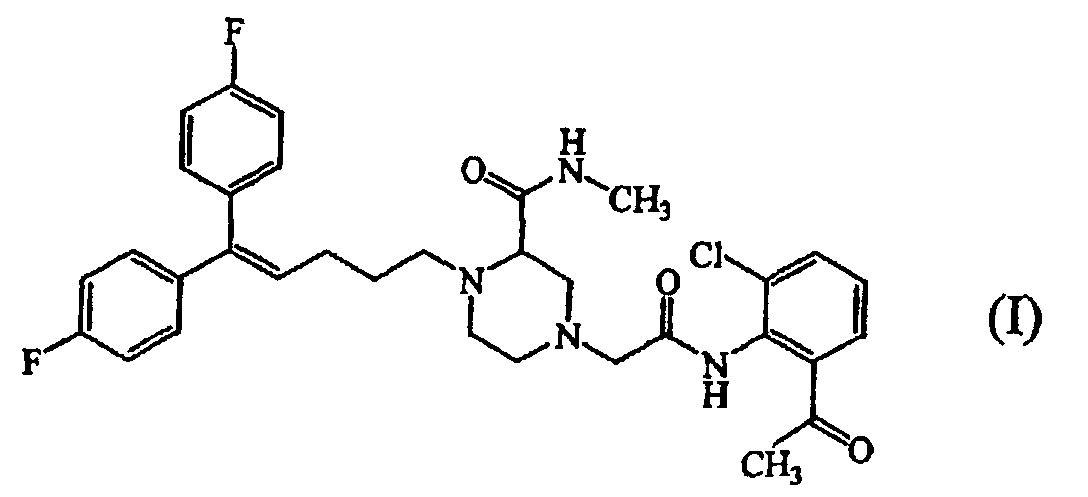
- The pharmaceutically acceptable acid addition salts as mentioned hereinabove are meant to comprise the therapeutically active non-toxic acid addition salt forms which the compound of formula (I) is able to form. The compound of formula (I) which appear in its free form as a base can be converted in its acid addition salt by treating said free base form with an appropriate acid. Appropriate acids comprise, for example, inorganic acids such as hydrohalic acids, e.g. hydrochloric or hydrobromic acid; sulfuric; nitric; phosphoric and the like acids; or organic acids such as, for example, acetic, propanoic, hydroxyacetic, lactic, pyruvic, oxalic, malonic, succinic (i.e. butanedioic acid), maleic, fumaric, malic, tartaric, citric, methanesulfonic, ethanesulfonic, benzenesulfonic, p-toluenesulfonic, cyclamic, salicylic, p-aminosalicylic, pamoic and the like acids.
- Conversely said salt forms can be converted by treatment with an appropriate base into the free base form.
- The term addition salt as used hereinabove also comprises the solvates which the compound of formula (I) as well as the salts thereof, is able to form. Such solvates are for example hydrates, alcoholates and the like.
- The term stereochemically isomeric forms as used hereinbefore defines the possible different isomeric as well as conformational forms which the compound of formula (I) may possess. Unless otherwise mentioned or indicated, the chemical designation of compounds denotes the mixture, in particular the racemic mixture, of all possible stereochemically and conformationally isomeric forms, said mixtures containing all diastereomers, enantiomers and/or conformers of the basic molecular structure. All stereochemically isomeric forms of the compound of formula (I) both in pure form or in admixture with each other are intended to be embraced within the scope of the present invention.
- The N-oxide forms of the compound of formula (I) are meant to comprise those compounds of formula (I) wherein one or several nitrogen atoms are oxidized to the so-called N-oxide, particularly those N-oxides wherein the piperazine-nitrogen is N-oxidized.
- The novel compound of formula (I) is N-(2-acetyl-6-chlorophenyl)-4-[5,5-bis(4-fluorophenyl)-4-pentenyl]-3-[(methyl-amino)carbonyl]-1-piperazineacetamide.
- The compound of formula (I) can be prepared as described in EP-0,068,544, EP-A-0,285,219, US-4,968,684, US-5,026,853 and EP-A-0,455,789.
- Compound of formula (I) and some of the intermediates in the present invention contain at least one asymmetric carbon atom in their structure, namely the piperazine carbon atom bearing the R1-radical which may be present in a R- or S-configuration. Consequently, the compound of formula (I) may be present in two different enantiomeric forms, which may be separated from each other. Pure stereochemically isomeric forms of said compound and said intermediates can he obtained by the application of art-known procedures. For example, diastereoisomers can be separated by physical methods such as selective crystallization or chromatographic techniques, e.g. counter current distribution, liquid chromatography and the like methods. Enantiomers can be obtained from racemic mixtures by first converting said racemic mixtures with suitable resolving agents such as, for example, chiral acids, to mixtures of diastereomeric salts or compounds; then physically separating said mixtures of diastereomeric salts or compounds by, for example, selective crystallization or chromatographic techniques, e.g. liquid chromatography and the like methods; and finally converting said separated diastereomeric salts or compounds into the corresponding enantiomers. An alternative manner of separating the enantiomeric forms of the compound of formula (I) and intermediates involves liquid chromatography, in particular liquid chromatography using a chiral stationary phase.
- Pure stereochemically isomeric forms of the compound of formula (I) may also be obtained from the pure stereochemically isomeric forms of the appropriate intermediates and starting materials, provided that the intervening reactions occur stereospecifically. The pure and mixed, in particular racemic, stereochemically isomeric forms of the compound of formula (I) is intended to be embraced within the scope of the present invention.
- The pain-relieving properties of the compound of formula (I) are illustrated by the "Formalin test on guinea pigs", described in Example B.1, which demonstrates the acute and chronic pain-relieving effect of the subject compounds.
- In view of their favourable pain-relieving properties, the compound of formula (I), the pharmaceutically acceptable addition salts, stereochemically isomeric forms and N-oxide forms thereof, are useful to treat or relieve warm-blooded animals suffering from chronic pain conditions, such as neuropathic pain, inflammatory pain, cancer pain. These conditions are related to hyperalgesia and allodynia. These conditions might include acute pain, skeletal muscle pain, low back pain, upper extremity pain, fibromyalgia and myofascial pain syndromes, orofacial pain, abdominal pain, phantom pain, tic douloureux and atypical face pain, nerve root damage and arachnoiditis, geriatric pain, central pain, inflammatory pain.
- In particular, the subject compound is useful to treat chronic non-cancer pain such as, neuropathic pain. Neuropathic pain results from lesions in the peripheral or central nervous system. It is often associated with somatosensory deficits and the distribution of pain is mostly related to the area of somatosensory dysfunction. The onset of the pain can be delayed after the causative event, even up to months or years. There are several causes of neuropathic pain with a considerable variability in symptoms and neurological deficits. Examples are peripheral nerve damage due to traumatic injury compression, ischemia, toxins, nutritional deficiencies, infections and complications of liver and kidney.
- In view of its useful pharmacological properties, the subject compound may be formulated into various pharmaceutical forms for administration purposes.
To prepare the pharmaceutical compositions of this invention, an effective amount of the compound, in base or acid addition salt form, as the active ingredient is combined in intimate admixture with a pharmaceutically acceptable carrier, which carrier may take a wide variety of forms depending on the form of preparation desired for administration. These pharmaceutical compositions are desirably in unitary dosage form suitable, preferably, for administration orally, rectally, percutaneously, or by parenteral injection. For example, in preparing the compositions in oral dosage form, any of the usual pharmaceutical media may be employed, such as, for example, water, glycols, oils, alcohols and the like in the case of oral liquid preparations such as suspensions, syrups, elixirs and solutions; or solid carriers such as starches, sugars, kaolin, lubricants, binders, disintegrating agents and the like in the case of powders, pills, capsules and tablets. Because of their ease in administration, tablets and capsules represent the most advantageous oral dosage unit form, in which case solid pharmaceutical carriers are obviously employed. For parenteral compositions, the carrier will usually comprise sterile water, at least in large part, though other ingredients, to aid solubility for example, maybe included. Injectable solutions, for example, may be prepared in which the carrier comprises saline solution, glucose solution or a mixture of saline and glucose solution. Injectable suspensions may also be prepared in which case appropriate liquid carriers, suspending agents and the like may be employed. In the compositions suitable for percutaneous administration, the carrier optionally comprises a penetration enhancing agent and/or a suitable wetting agent, optionally combined with suitable additives of any nature in minor proportions, which additives do not cause a significant deleterious effect to the skin. Said additives may facilitate the administration to the skin and/or may be helpful for preparing the desired compositions. These compositions may be administered in various ways, e.g., as a transdermal patch, as a spot-on, as an ointment. It is especially advantageous to formulate the aforementioned pharmaceutical compositions in dosage unit form for ease of administration and uniformity of dosage. Dosage unit form as used in the specification and claims herein refers to physically discrete units suitable as unitary dosages, each unit containing a predetermined quantity of active ingredient calculated to produce the desired therapeutic effect in association with the required pharmaceutical carrier. Examples of such dosage unit forms are tablets (including scored or coated tablets), capsules, pills, powder packets, wafers, injectable solutions or suspensions, teaspoonfuls, tablespoonfuls and the like, and segregated multiples thereof. - Those skilled in the art could easily determine the effective amount from the test results presented hereinafter. In general it is contemplated that an effective amount of the compound of formula (I) would be from 0.001 mg/kg to 100 mg/kg body weight, and in particular from 0.01 mg/kg to 10 mg/kg body weight. It may be appropriate to administer the required dose as two, three, four or more sub-doses at appropriate intervals throughout the day. Said sub-doses may be formulated as unit dosage forms, for example, containing 0.1 to 500 mg, and in particular 1 mg to 200 mg of compound of formula (I) per unit dosage form. In particular, said sub-doses are formulated as an oral dosage form being either a solid such as, e.g. tablets (both swallowable-only and chewable forms), capsules, gelcabs and the like, or a liquid.
- The compound of formula (I), the pharmaceutically acceptable addition salts, stereochemically isomeric forms and N-oxide forms thereof, may conveniently be used in combination with an analgesic such as, for example, nonnarcotic analgesics, e.g. aspirin or acetaminophen; NSAIDS (nonsteroidal antiinflammatory drugs), e.g. ibuprofen, naproxen, fenoprofen, ketoprofen, flurbiprofen, fenbufen, indomethacin and the like; opioids, e.g. codeine, morphine, naloxone, buprenorphine, pentazocine, fentanyl and the like; antidepressants, e.g. doxepin, fluoxetine, paroxetine and the like; ion channel modulators and/or membrane stabilising agents, e.g. lidocaine or mexiletine; α2-adrenergic agonists, e.g. clonidine; capsaicin analogues; or NMDA (N-methyl-D-aspartate) receptor antagonists, e.g. ketamine. The invention thus provides a combination comprising a composition as defined herein, together with an analgesic. The combination may be administered separately, simultaneously, concurrently or consecutively by any of the routes described above, or the combination may also be presented in the form of one pharmaceutical formulation. Thus, a pharmaceutical product comprising (a) a compound of formula (I) and (b) an analgesic as defined hereinbefore, as a combined preparation for simultaneous, separate or sequential use in the treatment of warm-blooded animals suffering from pain. Such a product may comprise a kit comprising a container containing a pharmaceutical composition of a compound of formula (I), and another container comprising a pharmaceutical composition of the analgesic. The product with separate compositions of the two active ingredients has the advantage that appropriate amounts of each component, and timing and sequence of administration can be selected in function of the patient.
- When the compound of formula (I) is used in combination with an analgesic, the dose of the analgesic may vary from the dose when used alone. Thus when the compound of formula (I) is used together with an analgesic the dose of the latter may be the same or more commonly, lower, than the dose employed when the analgesic is used alone. Appropriate doses will be readily appreciated by those skilled in the art.
- In view of the above uses of the compound of formula (I), it follows that the present invention also provides a method of treating warm-blooded animals suffering from pain, said method comprising the oral or systemic administration of a therapeutic amount of a compound of formula (I) effective in relieving pain.
- The following examples are intended to illustrate and not to limit the scope of the present invention.
- Hereinafter "DMF" means N,N-dimethylformamide.
- A mixture of (±)-1-[5,5-bis(4-fluorophenyl)-4-pentenyl]-N-methyl-2-piperazine-carboxamide (4 g), N-(2-acetyl-6-chlorophenyl)-2-chloroacetamide (3.2 g) and triethyl amine (75 ml) in DMF (75 ml) was stirred for 3 hours at 70°C. The solvent was evaporated. The residue was purified by column chromatography over silica gel (eluent :CH2CI2/CH3OH 97/3). The desired fractions were collected and the solvent was evaporated. The residue was dissolved in 2-propanol and converted into the ethanedioic acid salt (1:2). The salt was filtered off and dried (vacuum; 70°C), yielding 3.72g of (±)-N-(2-acetyl-6-chlorophenyl)-4-[5,5-bis(4-fluorophenyl)-4-pentenyl]-3-[(methylamino)carbonyl]-1-piperazineacetamide ethanedioate (1:2) (compound 18, mp. 140°C).
- The pain-relieving potential of the compound of formula (I) was assesed using the "formalin test" on guinea pigs.
Female guinea pigs (280 - 320 g) were starved overnight, weighed and placed in an observation cage. One hour after intraperitoneal injection of a compound of formula (I), a 5% formalin solution (0.05 ml) was injected in the right hindpaw of the guinea pig. During 5 minutes the flinching and licking responses were counted. Over the next 25 minutes, the eyereflex and effect on muscle tone was recorded. The left hindpaw of the guinea pig was also injected with 0.05 ml of a 5% solution of formalin and the same observations were recorded. Afterwards, the animals were sacrificed.
The estimated effective lowest dose of the compound, whereby the number of pain-induced responses was reduced by more than 50%, ranged between 0.63 and 40 mg/kg body weight.
Claims (3)
- A compound of formula N-(2-acetyl-6-chlorophenyl)-4-[5,5-bis(4-fluorophenyl)-4-pentenyl]-3-[(methylamino)carbonyl]-1-piperazineacetamide; the stereochemically isomeric forms, pharmaceutically acceptable acid addition salts and the N-oxide forms thereof.
- A pharmaceutical composition comprising a therapeutically effective amount of a compound as claimed in claim 1 and a pharmaceutically acceptable carrier.
- A process of preparing a pharmaceutical composition as claimed in claim 2 wherein the pharmaceutically acceptable carriers and a compound as claimed in claim 3 are intimately mixed.
Priority Applications (1)
| Application Number | Priority Date | Filing Date | Title |
|---|---|---|---|
| EP98934969A EP0999840B1 (en) | 1997-06-16 | 1998-06-09 | Use of a draflazine analogue for treating pain |
Applications Claiming Priority (4)
| Application Number | Priority Date | Filing Date | Title |
|---|---|---|---|
| EP97201813 | 1997-06-16 | ||
| EP97201813 | 1997-06-16 | ||
| EP98934969A EP0999840B1 (en) | 1997-06-16 | 1998-06-09 | Use of a draflazine analogue for treating pain |
| PCT/EP1998/003664 WO1998057643A1 (en) | 1997-06-16 | 1998-06-09 | Use of draflazine-analogues for treating pain |
Publications (2)
| Publication Number | Publication Date |
|---|---|
| EP0999840A1 EP0999840A1 (en) | 2000-05-17 |
| EP0999840B1 true EP0999840B1 (en) | 2003-05-02 |
Family
ID=8228446
Family Applications (1)
| Application Number | Title | Priority Date | Filing Date |
|---|---|---|---|
| EP98934969A Expired - Lifetime EP0999840B1 (en) | 1997-06-16 | 1998-06-09 | Use of a draflazine analogue for treating pain |
Country Status (10)
| Country | Link |
|---|---|
| US (1) | US6403589B1 (en) |
| EP (1) | EP0999840B1 (en) |
| JP (1) | JP2002504134A (en) |
| KR (1) | KR20010013387A (en) |
| AT (1) | ATE238794T1 (en) |
| AU (1) | AU8438798A (en) |
| CA (1) | CA2294011A1 (en) |
| DE (1) | DE69814089T2 (en) |
| ES (1) | ES2199447T3 (en) |
| WO (1) | WO1998057643A1 (en) |
Families Citing this family (8)
| Publication number | Priority date | Publication date | Assignee | Title |
|---|---|---|---|---|
| MXPA02006137A (en) * | 1999-12-20 | 2002-12-05 | Neuromed Tech Inc | Partially saturated calcium channel blockers. |
| DK1539124T3 (en) * | 2002-09-05 | 2018-10-08 | Vanderbilt Royalty Sub L P | : COMPOSITIONS AND KITS FOR REMOVAL OF BODY SURFACES |
| JPWO2004101593A1 (en) * | 2003-05-16 | 2006-07-13 | キッセイ薬品工業株式会社 | 5'-modified nucleoside derivative and pharmaceutical use thereof |
| ES2353399T3 (en) * | 2005-04-01 | 2011-03-01 | Neurogesx, Inc. | CAPSAICINOID OILS AND METHODS TO OBTAIN AND USE THEM. |
| TW201113280A (en) | 2009-07-03 | 2011-04-16 | Nensius Res As | Aminoalkamides for use in the treatment of inflammatory, degenerative or demyelinating diseases of the CNS |
| MX375169B (en) | 2014-06-26 | 2025-03-06 | Hoffmann La Roche | DERIVATIVES OF INDOLIN-2-ONE OR PYRROLO-PYRIDIN-2-ONE. |
| RU2727179C2 (en) | 2015-11-06 | 2020-07-21 | Ф. Хоффманн-Ля Рош Аг | Indolin-2-one derivatives |
| WO2017076931A1 (en) | 2015-11-06 | 2017-05-11 | F. Hoffmann-La Roche Ag | Indolin-2-one derivatives for use in the treatment of cns and related disorders |
Family Cites Families (6)
| Publication number | Priority date | Publication date | Assignee | Title |
|---|---|---|---|---|
| FR2368280A1 (en) | 1976-10-20 | 1978-05-19 | Theramex | Aspirin and dipyridamole salt compsn. - having blood platelet aggregation inhibitory activity |
| US4766125A (en) * | 1981-06-23 | 1988-08-23 | Janssen Pharmaceutica N.V. | N-aryl-piperazinealkanamides useful for protecting hearts from myocardial injury caused by ischaemia, anoxia or hypoxia |
| FR2513118A1 (en) | 1981-09-18 | 1983-03-25 | Rocador Sa | PHARMACEUTICAL COMPOSITION BASED ON DIPYRIDAMOL AND ALUMINUM SALT OF ACETYLSALICYLIC ACID TO COMBAT PLATELET AGGREGATION |
| NZ223847A (en) * | 1987-04-01 | 1989-12-21 | Janssen Pharmaceutica Nv | Substituted piperazine derivatives and pharmaceutical compositions |
| US5236908A (en) | 1991-06-07 | 1993-08-17 | Gensia Pharmaceuticals, Inc. | Methods of treating injury to the central nervous system |
| IL108524A0 (en) | 1993-02-03 | 1994-05-30 | Gensia Inc | Imidazodiazepine analogs |
-
1998
- 1998-06-09 DE DE69814089T patent/DE69814089T2/en not_active Expired - Fee Related
- 1998-06-09 WO PCT/EP1998/003664 patent/WO1998057643A1/en not_active Ceased
- 1998-06-09 US US09/446,140 patent/US6403589B1/en not_active Expired - Lifetime
- 1998-06-09 AU AU84387/98A patent/AU8438798A/en not_active Abandoned
- 1998-06-09 AT AT98934969T patent/ATE238794T1/en not_active IP Right Cessation
- 1998-06-09 EP EP98934969A patent/EP0999840B1/en not_active Expired - Lifetime
- 1998-06-09 KR KR19997011386A patent/KR20010013387A/en not_active Ceased
- 1998-06-09 CA CA002294011A patent/CA2294011A1/en not_active Abandoned
- 1998-06-09 JP JP50374399A patent/JP2002504134A/en not_active Withdrawn
- 1998-06-09 ES ES98934969T patent/ES2199447T3/en not_active Expired - Lifetime
Also Published As
| Publication number | Publication date |
|---|---|
| ATE238794T1 (en) | 2003-05-15 |
| EP0999840A1 (en) | 2000-05-17 |
| JP2002504134A (en) | 2002-02-05 |
| DE69814089D1 (en) | 2003-06-05 |
| WO1998057643A1 (en) | 1998-12-23 |
| CA2294011A1 (en) | 1998-12-23 |
| AU8438798A (en) | 1999-01-04 |
| ES2199447T3 (en) | 2004-02-16 |
| US6403589B1 (en) | 2002-06-11 |
| DE69814089T2 (en) | 2004-02-19 |
| KR20010013387A (en) | 2001-02-26 |
Similar Documents
| Publication | Publication Date | Title |
|---|---|---|
| EP1255537B1 (en) | Farnesyl protein transferase inhibitors for treating breast cancer | |
| JP2000508341A (en) | Composition for treating migraine and for enhancing its efficacy | |
| JP2007536241A (en) | A2A adenosine receptor agonist for the treatment of diabetic nephropathy | |
| JP2001513557A (en) | How to treat pain | |
| US20010006972A1 (en) | Nk-1 receptor antagonists for the treatment of symptoms of irritable bowel syndrome | |
| SK75999A3 (en) | 3-pyridyl enantiomers and their use as analgesics | |
| EP0873753A1 (en) | Use of NK-1 receptor antagonists for the manufacture of a medicament in the treatment of symptoms of irritable bowel syndrome | |
| MXPA02005336A (en) | Novel methods for the treatment and prevention of ileus. | |
| US6403589B1 (en) | Method of treating pain with draflazine-analogues | |
| CZ285633B6 (en) | Use of indole derivatives for preparing medicaments | |
| HUP9904243A2 (en) | Procedure for inhibiting the expression of Fas | |
| CN1085979C (en) | Inhibitor for narcotic analgetic dependence/resistance acquisition | |
| EP1359905B1 (en) | Use of mglur5 antagonists for the treatment of pruritic conditions | |
| Awadzi et al. | The chemotherapy of onchocerciasis VII: The effect of prednisone on the Mazzotti reaction | |
| US20140142113A1 (en) | Method of treating inflammatory diseases using adenosine 2b receptor antagonists | |
| EP3954374A1 (en) | Pharmaceutical combination of pimozide and methotrexate and use thereof | |
| EP1610785B1 (en) | Pharmaceutical combination for the treatment of spasticity and/or pain | |
| WO1998004261A1 (en) | Nefazodone: use in migraine prophylaxis | |
| JP4737686B2 (en) | New medicine | |
| JPS6379831A (en) | Medicinal composition containing 1,4-dihydropyridine derivative and acylated 1,2,3,4-tetrahydroisoquinoline-3-carboxylic acid | |
| NZ509177A (en) | Use of azabicyclic compounds for treating psychosis and neuropsychiatric symptoms in patients with alzheimerÆs disease | |
| JPH1160483A (en) | Tnf production inhibitor | |
| CA1280695C (en) | Nalbuphine-local anesthetic analgesic composition and method of producing analgesia | |
| EP3897653A1 (en) | Methods for treating cancer using tozadenant | |
| JPH03218313A (en) | Brain cell protecting agent |
Legal Events
| Date | Code | Title | Description |
|---|---|---|---|
| PUAI | Public reference made under article 153(3) epc to a published international application that has entered the european phase |
Free format text: ORIGINAL CODE: 0009012 |
|
| 17P | Request for examination filed |
Effective date: 20000117 |
|
| AK | Designated contracting states |
Kind code of ref document: A1 Designated state(s): AT BE CH CY DE DK ES FI FR GB GR IE IT LI LU NL PT SE |
|
| 17Q | First examination report despatched |
Effective date: 20001009 |
|
| GRAH | Despatch of communication of intention to grant a patent |
Free format text: ORIGINAL CODE: EPIDOS IGRA |
|
| RIC1 | Information provided on ipc code assigned before grant |
Free format text: 7A 61K 31/495 A, 7C 07D 241/04 B, 7A 61P 23/00 B |
|
| RTI1 | Title (correction) |
Free format text: USE OF A DRAFLAZINE ANALOGUE FOR TREATING PAIN |
|
| GRAH | Despatch of communication of intention to grant a patent |
Free format text: ORIGINAL CODE: EPIDOS IGRA |
|
| GRAA | (expected) grant |
Free format text: ORIGINAL CODE: 0009210 |
|
| AK | Designated contracting states |
Designated state(s): AT BE CH CY DE DK ES FI FR GB GR IE IT LI LU NL PT SE |
|
| PG25 | Lapsed in a contracting state [announced via postgrant information from national office to epo] |
Ref country code: NL Free format text: LAPSE BECAUSE OF FAILURE TO SUBMIT A TRANSLATION OF THE DESCRIPTION OR TO PAY THE FEE WITHIN THE PRESCRIBED TIME-LIMIT Effective date: 20030502 Ref country code: FI Free format text: LAPSE BECAUSE OF FAILURE TO SUBMIT A TRANSLATION OF THE DESCRIPTION OR TO PAY THE FEE WITHIN THE PRESCRIBED TIME-LIMIT Effective date: 20030502 Ref country code: AT Free format text: LAPSE BECAUSE OF FAILURE TO SUBMIT A TRANSLATION OF THE DESCRIPTION OR TO PAY THE FEE WITHIN THE PRESCRIBED TIME-LIMIT Effective date: 20030502 |
|
| REG | Reference to a national code |
Ref country code: GB Ref legal event code: FG4D |
|
| REG | Reference to a national code |
Ref country code: CH Ref legal event code: EP |
|
| REF | Corresponds to: |
Ref document number: 69814089 Country of ref document: DE Date of ref document: 20030605 Kind code of ref document: P |
|
| PG25 | Lapsed in a contracting state [announced via postgrant information from national office to epo] |
Ref country code: LU Free format text: LAPSE BECAUSE OF NON-PAYMENT OF DUE FEES Effective date: 20030609 Ref country code: IE Free format text: LAPSE BECAUSE OF NON-PAYMENT OF DUE FEES Effective date: 20030609 Ref country code: CY Free format text: LAPSE BECAUSE OF FAILURE TO SUBMIT A TRANSLATION OF THE DESCRIPTION OR TO PAY THE FEE WITHIN THE PRESCRIBED TIME-LIMIT Effective date: 20030609 |
|
| REG | Reference to a national code |
Ref country code: IE Ref legal event code: FG4D |
|
| PG25 | Lapsed in a contracting state [announced via postgrant information from national office to epo] |
Ref country code: SE Free format text: LAPSE BECAUSE OF FAILURE TO SUBMIT A TRANSLATION OF THE DESCRIPTION OR TO PAY THE FEE WITHIN THE PRESCRIBED TIME-LIMIT Effective date: 20030802 Ref country code: GR Free format text: LAPSE BECAUSE OF FAILURE TO SUBMIT A TRANSLATION OF THE DESCRIPTION OR TO PAY THE FEE WITHIN THE PRESCRIBED TIME-LIMIT Effective date: 20030802 Ref country code: DK Free format text: LAPSE BECAUSE OF FAILURE TO SUBMIT A TRANSLATION OF THE DESCRIPTION OR TO PAY THE FEE WITHIN THE PRESCRIBED TIME-LIMIT Effective date: 20030802 |
|
| PG25 | Lapsed in a contracting state [announced via postgrant information from national office to epo] |
Ref country code: PT Free format text: LAPSE BECAUSE OF FAILURE TO SUBMIT A TRANSLATION OF THE DESCRIPTION OR TO PAY THE FEE WITHIN THE PRESCRIBED TIME-LIMIT Effective date: 20030804 |
|
| NLV1 | Nl: lapsed or annulled due to failure to fulfill the requirements of art. 29p and 29m of the patents act | ||
| REG | Reference to a national code |
Ref country code: ES Ref legal event code: FG2A Ref document number: 2199447 Country of ref document: ES Kind code of ref document: T3 |
|
| ET | Fr: translation filed | ||
| PLBE | No opposition filed within time limit |
Free format text: ORIGINAL CODE: 0009261 |
|
| STAA | Information on the status of an ep patent application or granted ep patent |
Free format text: STATUS: NO OPPOSITION FILED WITHIN TIME LIMIT |
|
| REG | Reference to a national code |
Ref country code: IE Ref legal event code: MM4A |
|
| 26N | No opposition filed |
Effective date: 20040203 |
|
| PGFP | Annual fee paid to national office [announced via postgrant information from national office to epo] |
Ref country code: DE Payment date: 20070607 Year of fee payment: 10 |
|
| PGFP | Annual fee paid to national office [announced via postgrant information from national office to epo] |
Ref country code: CH Payment date: 20070614 Year of fee payment: 10 |
|
| PGFP | Annual fee paid to national office [announced via postgrant information from national office to epo] |
Ref country code: ES Payment date: 20070717 Year of fee payment: 10 |
|
| PGFP | Annual fee paid to national office [announced via postgrant information from national office to epo] |
Ref country code: GB Payment date: 20070606 Year of fee payment: 10 |
|
| PGFP | Annual fee paid to national office [announced via postgrant information from national office to epo] |
Ref country code: IT Payment date: 20070618 Year of fee payment: 10 Ref country code: BE Payment date: 20070417 Year of fee payment: 10 |
|
| PGFP | Annual fee paid to national office [announced via postgrant information from national office to epo] |
Ref country code: FR Payment date: 20070608 Year of fee payment: 10 |
|
| BERE | Be: lapsed |
Owner name: *JANSSEN PHARMACEUTICA N.V. Effective date: 20080630 |
|
| REG | Reference to a national code |
Ref country code: CH Ref legal event code: PL |
|
| GBPC | Gb: european patent ceased through non-payment of renewal fee |
Effective date: 20080609 |
|
| PG25 | Lapsed in a contracting state [announced via postgrant information from national office to epo] |
Ref country code: BE Free format text: LAPSE BECAUSE OF NON-PAYMENT OF DUE FEES Effective date: 20080630 |
|
| REG | Reference to a national code |
Ref country code: FR Ref legal event code: ST Effective date: 20090228 |
|
| PG25 | Lapsed in a contracting state [announced via postgrant information from national office to epo] |
Ref country code: DE Free format text: LAPSE BECAUSE OF NON-PAYMENT OF DUE FEES Effective date: 20090101 |
|
| PG25 | Lapsed in a contracting state [announced via postgrant information from national office to epo] |
Ref country code: LI Free format text: LAPSE BECAUSE OF NON-PAYMENT OF DUE FEES Effective date: 20080630 Ref country code: GB Free format text: LAPSE BECAUSE OF NON-PAYMENT OF DUE FEES Effective date: 20080609 Ref country code: CH Free format text: LAPSE BECAUSE OF NON-PAYMENT OF DUE FEES Effective date: 20080630 |
|
| REG | Reference to a national code |
Ref country code: ES Ref legal event code: FD2A Effective date: 20080610 |
|
| PG25 | Lapsed in a contracting state [announced via postgrant information from national office to epo] |
Ref country code: IT Free format text: LAPSE BECAUSE OF NON-PAYMENT OF DUE FEES Effective date: 20080609 Ref country code: FR Free format text: LAPSE BECAUSE OF NON-PAYMENT OF DUE FEES Effective date: 20080630 |
|
| PG25 | Lapsed in a contracting state [announced via postgrant information from national office to epo] |
Ref country code: ES Free format text: LAPSE BECAUSE OF NON-PAYMENT OF DUE FEES Effective date: 20080610 |