EP0998460B1 - Novel tetrazole derivatives - Google Patents
Novel tetrazole derivatives Download PDFInfo
- Publication number
- EP0998460B1 EP0998460B1 EP98941361A EP98941361A EP0998460B1 EP 0998460 B1 EP0998460 B1 EP 0998460B1 EP 98941361 A EP98941361 A EP 98941361A EP 98941361 A EP98941361 A EP 98941361A EP 0998460 B1 EP0998460 B1 EP 0998460B1
- Authority
- EP
- European Patent Office
- Prior art keywords
- hydrogen
- substituted
- alkoxy
- alkyl
- compounds
- Prior art date
- Legal status (The legal status is an assumption and is not a legal conclusion. Google has not performed a legal analysis and makes no representation as to the accuracy of the status listed.)
- Expired - Lifetime
Links
- 150000003536 tetrazoles Chemical class 0.000 title description 5
- 150000001875 compounds Chemical class 0.000 claims abstract description 114
- 239000003814 drug Substances 0.000 claims abstract description 14
- 229910052739 hydrogen Inorganic materials 0.000 claims description 68
- 239000001257 hydrogen Substances 0.000 claims description 68
- 150000002431 hydrogen Chemical group 0.000 claims description 54
- 150000003839 salts Chemical class 0.000 claims description 35
- 125000000229 (C1-C4)alkoxy group Chemical group 0.000 claims description 26
- CIUQDSCDWFSTQR-UHFFFAOYSA-N [C]1=CC=CC=C1 Chemical group [C]1=CC=CC=C1 CIUQDSCDWFSTQR-UHFFFAOYSA-N 0.000 claims description 20
- 238000011282 treatment Methods 0.000 claims description 14
- 125000004435 hydrogen atom Chemical group [H]* 0.000 claims description 11
- 208000037265 diseases, disorders, signs and symptoms Diseases 0.000 claims description 10
- 229910052736 halogen Inorganic materials 0.000 claims description 6
- UFHFLCQGNIYNRP-UHFFFAOYSA-N Hydrogen Chemical compound [H][H] UFHFLCQGNIYNRP-UHFFFAOYSA-N 0.000 claims description 5
- 125000001301 ethoxy group Chemical group [H]C([H])([H])C([H])([H])O* 0.000 claims description 5
- 238000004519 manufacturing process Methods 0.000 claims description 5
- 125000000449 nitro group Chemical group [O-][N+](*)=O 0.000 claims description 5
- 125000001495 ethyl group Chemical group [H]C([H])([H])C([H])([H])* 0.000 claims description 4
- 125000002887 hydroxy group Chemical group [H]O* 0.000 claims description 4
- 125000000956 methoxy group Chemical group [H]C([H])([H])O* 0.000 claims description 4
- 125000004217 4-methoxybenzyl group Chemical group [H]C1=C([H])C(=C([H])C([H])=C1OC([H])([H])[H])C([H])([H])* 0.000 claims description 3
- 150000002367 halogens Chemical class 0.000 claims description 3
- 125000004093 cyano group Chemical group *C#N 0.000 claims description 2
- 239000000546 pharmaceutical excipient Substances 0.000 claims description 2
- 125000002023 trifluoromethyl group Chemical group FC(F)(F)* 0.000 claims description 2
- 201000010099 disease Diseases 0.000 claims 1
- -1 alkyl radical Chemical class 0.000 description 54
- LFQSCWFLJHTTHZ-UHFFFAOYSA-N Ethanol Chemical compound CCO LFQSCWFLJHTTHZ-UHFFFAOYSA-N 0.000 description 37
- 238000000034 method Methods 0.000 description 19
- XEKOWRVHYACXOJ-UHFFFAOYSA-N Ethyl acetate Chemical compound CCOC(C)=O XEKOWRVHYACXOJ-UHFFFAOYSA-N 0.000 description 15
- YXFVVABEGXRONW-UHFFFAOYSA-N Toluene Chemical compound CC1=CC=CC=C1 YXFVVABEGXRONW-UHFFFAOYSA-N 0.000 description 15
- 239000000243 solution Substances 0.000 description 15
- 239000002904 solvent Substances 0.000 description 13
- YMWUJEATGCHHMB-UHFFFAOYSA-N Dichloromethane Chemical compound ClCCl YMWUJEATGCHHMB-UHFFFAOYSA-N 0.000 description 12
- OKKJLVBELUTLKV-UHFFFAOYSA-N Methanol Chemical compound OC OKKJLVBELUTLKV-UHFFFAOYSA-N 0.000 description 12
- 238000006243 chemical reaction Methods 0.000 description 12
- XLYOFNOQVPJJNP-UHFFFAOYSA-N water Substances O XLYOFNOQVPJJNP-UHFFFAOYSA-N 0.000 description 11
- 239000000203 mixture Substances 0.000 description 10
- QTBSBXVTEAMEQO-UHFFFAOYSA-N Acetic acid Chemical compound CC(O)=O QTBSBXVTEAMEQO-UHFFFAOYSA-N 0.000 description 9
- WEVYAHXRMPXWCK-UHFFFAOYSA-N Acetonitrile Chemical compound CC#N WEVYAHXRMPXWCK-UHFFFAOYSA-N 0.000 description 9
- 102000004861 Phosphoric Diester Hydrolases Human genes 0.000 description 9
- 108090001050 Phosphoric Diester Hydrolases Proteins 0.000 description 9
- 239000002585 base Substances 0.000 description 9
- 239000003921 oil Substances 0.000 description 9
- 238000002360 preparation method Methods 0.000 description 9
- 150000003254 radicals Chemical class 0.000 description 9
- VEXZGXHMUGYJMC-UHFFFAOYSA-N Hydrochloric acid Chemical compound Cl VEXZGXHMUGYJMC-UHFFFAOYSA-N 0.000 description 8
- 208000035475 disorder Diseases 0.000 description 8
- 239000003112 inhibitor Substances 0.000 description 8
- 230000008569 process Effects 0.000 description 8
- RTZKZFJDLAIYFH-UHFFFAOYSA-N Diethyl ether Chemical compound CCOCC RTZKZFJDLAIYFH-UHFFFAOYSA-N 0.000 description 7
- UIIMBOGNXHQVGW-UHFFFAOYSA-M Sodium bicarbonate Chemical compound [Na+].OC([O-])=O UIIMBOGNXHQVGW-UHFFFAOYSA-M 0.000 description 7
- 239000002253 acid Substances 0.000 description 7
- QGZKDVFQNNGYKY-UHFFFAOYSA-N Ammonia Chemical class N QGZKDVFQNNGYKY-UHFFFAOYSA-N 0.000 description 6
- ZMXDDKWLCZADIW-UHFFFAOYSA-N N,N-Dimethylformamide Chemical compound CN(C)C=O ZMXDDKWLCZADIW-UHFFFAOYSA-N 0.000 description 6
- KWYUFKZDYYNOTN-UHFFFAOYSA-M Potassium hydroxide Chemical compound [OH-].[K+] KWYUFKZDYYNOTN-UHFFFAOYSA-M 0.000 description 6
- QAOWNCQODCNURD-UHFFFAOYSA-N Sulfuric acid Chemical compound OS(O)(=O)=O QAOWNCQODCNURD-UHFFFAOYSA-N 0.000 description 6
- ZMANZCXQSJIPKH-UHFFFAOYSA-N Triethylamine Chemical compound CCN(CC)CC ZMANZCXQSJIPKH-UHFFFAOYSA-N 0.000 description 6
- 230000005764 inhibitory process Effects 0.000 description 6
- XHXFXVLFKHQFAL-UHFFFAOYSA-N phosphoryl trichloride Chemical compound ClP(Cl)(Cl)=O XHXFXVLFKHQFAL-UHFFFAOYSA-N 0.000 description 6
- 238000003756 stirring Methods 0.000 description 6
- KJUGUADJHNHALS-UHFFFAOYSA-N 1H-tetrazole Chemical compound C=1N=NNN=1 KJUGUADJHNHALS-UHFFFAOYSA-N 0.000 description 5
- 101100296719 Caenorhabditis elegans pde-4 gene Proteins 0.000 description 5
- PMZURENOXWZQFD-UHFFFAOYSA-L Sodium Sulfate Chemical compound [Na+].[Na+].[O-]S([O-])(=O)=O PMZURENOXWZQFD-UHFFFAOYSA-L 0.000 description 5
- 208000006673 asthma Diseases 0.000 description 5
- 208000010668 atopic eczema Diseases 0.000 description 5
- 125000004432 carbon atom Chemical group C* 0.000 description 5
- 239000012074 organic phase Substances 0.000 description 5
- 125000001997 phenyl group Chemical group [H]C1=C([H])C([H])=C(*)C([H])=C1[H] 0.000 description 5
- 239000002244 precipitate Substances 0.000 description 5
- 238000011321 prophylaxis Methods 0.000 description 5
- 239000011541 reaction mixture Substances 0.000 description 5
- 229910052938 sodium sulfate Inorganic materials 0.000 description 5
- 235000011152 sodium sulphate Nutrition 0.000 description 5
- 239000007858 starting material Substances 0.000 description 5
- KAKZBPTYRLMSJV-UHFFFAOYSA-N Butadiene Chemical compound C=CC=C KAKZBPTYRLMSJV-UHFFFAOYSA-N 0.000 description 4
- HEDRZPFGACZZDS-UHFFFAOYSA-N Chloroform Chemical compound ClC(Cl)Cl HEDRZPFGACZZDS-UHFFFAOYSA-N 0.000 description 4
- QIGBRXMKCJKVMJ-UHFFFAOYSA-N Hydroquinone Chemical compound OC1=CC=C(O)C=C1 QIGBRXMKCJKVMJ-UHFFFAOYSA-N 0.000 description 4
- KDLHZDBZIXYQEI-UHFFFAOYSA-N Palladium Chemical compound [Pd] KDLHZDBZIXYQEI-UHFFFAOYSA-N 0.000 description 4
- 239000007868 Raney catalyst Substances 0.000 description 4
- NPXOKRUENSOPAO-UHFFFAOYSA-N Raney nickel Chemical compound [Al].[Ni] NPXOKRUENSOPAO-UHFFFAOYSA-N 0.000 description 4
- 229910000564 Raney nickel Inorganic materials 0.000 description 4
- WYURNTSHIVDZCO-UHFFFAOYSA-N Tetrahydrofuran Chemical compound C1CCOC1 WYURNTSHIVDZCO-UHFFFAOYSA-N 0.000 description 4
- 229960000583 acetic acid Drugs 0.000 description 4
- 229910052783 alkali metal Inorganic materials 0.000 description 4
- 125000000217 alkyl group Chemical group 0.000 description 4
- 238000005804 alkylation reaction Methods 0.000 description 4
- 230000000172 allergic effect Effects 0.000 description 4
- 229940082638 cardiac stimulant phosphodiesterase inhibitors Drugs 0.000 description 4
- 230000000694 effects Effects 0.000 description 4
- 238000000921 elemental analysis Methods 0.000 description 4
- 230000002757 inflammatory effect Effects 0.000 description 4
- 229910052740 iodine Inorganic materials 0.000 description 4
- 238000002156 mixing Methods 0.000 description 4
- 239000002571 phosphodiesterase inhibitor Substances 0.000 description 4
- 239000000047 product Substances 0.000 description 4
- 230000009467 reduction Effects 0.000 description 4
- 208000017520 skin disease Diseases 0.000 description 4
- BIVMWDQSMDXTCT-RYUDHWBXSA-N (1s,2s)-2-(3,4-dimethoxyphenyl)cyclohexan-1-amine Chemical compound C1=C(OC)C(OC)=CC=C1[C@H]1[C@@H](N)CCCC1 BIVMWDQSMDXTCT-RYUDHWBXSA-N 0.000 description 3
- WJDOGOZRUNXQOX-STQMWFEESA-N (1s,2s)-2-(3-ethoxy-4-methoxyphenyl)cyclohexan-1-amine Chemical compound C1=C(OC)C(OCC)=CC([C@H]2[C@H](CCCC2)N)=C1 WJDOGOZRUNXQOX-STQMWFEESA-N 0.000 description 3
- BUCVREXKEGAVJF-QWHCGFSZSA-N 2-ethoxy-1-methoxy-4-[(1s,6r)-6-nitrocyclohex-3-en-1-yl]benzene Chemical compound C1=C(OC)C(OCC)=CC([C@H]2[C@@H](CC=CC2)[N+]([O-])=O)=C1 BUCVREXKEGAVJF-QWHCGFSZSA-N 0.000 description 3
- BUCVREXKEGAVJF-STQMWFEESA-N 2-ethoxy-1-methoxy-4-[(1s,6s)-6-nitrocyclohex-3-en-1-yl]benzene Chemical compound C1=C(OC)C(OCC)=CC([C@H]2[C@H](CC=CC2)[N+]([O-])=O)=C1 BUCVREXKEGAVJF-STQMWFEESA-N 0.000 description 3
- XXWONCALJGBUFK-UHFFFAOYSA-N 6-phenylphenanthridine Chemical class C1=CC=CC=C1C1=NC2=CC=CC=C2C2=CC=CC=C12 XXWONCALJGBUFK-UHFFFAOYSA-N 0.000 description 3
- HBAQYPYDRFILMT-UHFFFAOYSA-N 8-[3-(1-cyclopropylpyrazol-4-yl)-1H-pyrazolo[4,3-d]pyrimidin-5-yl]-3-methyl-3,8-diazabicyclo[3.2.1]octan-2-one Chemical class C1(CC1)N1N=CC(=C1)C1=NNC2=C1N=C(N=C2)N1C2C(N(CC1CC2)C)=O HBAQYPYDRFILMT-UHFFFAOYSA-N 0.000 description 3
- 108010044467 Isoenzymes Proteins 0.000 description 3
- MUBZPKHOEPUJKR-UHFFFAOYSA-N Oxalic acid Chemical compound OC(=O)C(O)=O MUBZPKHOEPUJKR-UHFFFAOYSA-N 0.000 description 3
- 206010040070 Septic Shock Diseases 0.000 description 3
- VYPSYNLAJGMNEJ-UHFFFAOYSA-N Silicium dioxide Chemical compound O=[Si]=O VYPSYNLAJGMNEJ-UHFFFAOYSA-N 0.000 description 3
- 108060008682 Tumor Necrosis Factor Proteins 0.000 description 3
- 230000029936 alkylation Effects 0.000 description 3
- 229910021529 ammonia Inorganic materials 0.000 description 3
- KXDAEFPNCMNJSK-UHFFFAOYSA-N benzene carboxamide Natural products NC(=O)C1=CC=CC=C1 KXDAEFPNCMNJSK-UHFFFAOYSA-N 0.000 description 3
- GDTBXPJZTBHREO-UHFFFAOYSA-N bromine Substances BrBr GDTBXPJZTBHREO-UHFFFAOYSA-N 0.000 description 3
- 125000003178 carboxy group Chemical group [H]OC(*)=O 0.000 description 3
- 150000001735 carboxylic acids Chemical class 0.000 description 3
- 239000003795 chemical substances by application Substances 0.000 description 3
- 229910052801 chlorine Inorganic materials 0.000 description 3
- KRKNYBCHXYNGOX-UHFFFAOYSA-N citric acid Chemical compound OC(=O)CC(O)(C(O)=O)CC(O)=O KRKNYBCHXYNGOX-UHFFFAOYSA-N 0.000 description 3
- 125000000113 cyclohexyl group Chemical group [H]C1([H])C([H])([H])C([H])([H])C([H])(*)C([H])([H])C1([H])[H] 0.000 description 3
- 239000000499 gel Substances 0.000 description 3
- 239000012362 glacial acetic acid Substances 0.000 description 3
- 239000005457 ice water Substances 0.000 description 3
- 230000002401 inhibitory effect Effects 0.000 description 3
- 239000002674 ointment Substances 0.000 description 3
- 239000008194 pharmaceutical composition Substances 0.000 description 3
- 238000000926 separation method Methods 0.000 description 3
- 239000000741 silica gel Substances 0.000 description 3
- 229910002027 silica gel Inorganic materials 0.000 description 3
- 239000000126 substance Substances 0.000 description 3
- 239000000725 suspension Substances 0.000 description 3
- 102000003390 tumor necrosis factor Human genes 0.000 description 3
- NWZSZGALRFJKBT-KNIFDHDWSA-N (2s)-2,6-diaminohexanoic acid;(2s)-2-hydroxybutanedioic acid Chemical compound OC(=O)[C@@H](O)CC(O)=O.NCCCC[C@H](N)C(O)=O NWZSZGALRFJKBT-KNIFDHDWSA-N 0.000 description 2
- CKUUWZSXSMTFIO-RYUDHWBXSA-N 1,2-dimethoxy-4-[(1s,2s)-2-nitrocyclohexyl]benzene Chemical compound C1=C(OC)C(OC)=CC=C1[C@H]1[C@@H]([N+]([O-])=O)CCCC1 CKUUWZSXSMTFIO-RYUDHWBXSA-N 0.000 description 2
- HFGWXWJFQQCBEY-NWDGAFQWSA-N 1,2-dimethoxy-4-[(1s,6r)-6-nitrocyclohex-3-en-1-yl]benzene Chemical compound C1=C(OC)C(OC)=CC=C1[C@H]1[C@H]([N+]([O-])=O)CC=CC1 HFGWXWJFQQCBEY-NWDGAFQWSA-N 0.000 description 2
- HFGWXWJFQQCBEY-RYUDHWBXSA-N 1,2-dimethoxy-4-[(1s,6s)-6-nitrocyclohex-3-en-1-yl]benzene Chemical compound C1=C(OC)C(OC)=CC=C1[C@H]1[C@@H]([N+]([O-])=O)CC=CC1 HFGWXWJFQQCBEY-RYUDHWBXSA-N 0.000 description 2
- SYJMYDMKPSZMSB-AATRIKPKSA-N 1,2-dimethoxy-4-[(e)-2-nitroethenyl]benzene Chemical compound COC1=CC=C(\C=C\[N+]([O-])=O)C=C1OC SYJMYDMKPSZMSB-AATRIKPKSA-N 0.000 description 2
- RYHBNJHYFVUHQT-UHFFFAOYSA-N 1,4-Dioxane Chemical compound C1COCCO1 RYHBNJHYFVUHQT-UHFFFAOYSA-N 0.000 description 2
- 206010001052 Acute respiratory distress syndrome Diseases 0.000 description 2
- NLXLAEXVIDQMFP-UHFFFAOYSA-N Ammonia chloride Chemical compound [NH4+].[Cl-] NLXLAEXVIDQMFP-UHFFFAOYSA-N 0.000 description 2
- USFZMSVCRYTOJT-UHFFFAOYSA-N Ammonium acetate Chemical compound N.CC(O)=O USFZMSVCRYTOJT-UHFFFAOYSA-N 0.000 description 2
- 239000005695 Ammonium acetate Substances 0.000 description 2
- FERIUCNNQQJTOY-UHFFFAOYSA-N Butyric acid Chemical compound CCCC(O)=O FERIUCNNQQJTOY-UHFFFAOYSA-N 0.000 description 2
- OKTJSMMVPCPJKN-UHFFFAOYSA-N Carbon Chemical compound [C] OKTJSMMVPCPJKN-UHFFFAOYSA-N 0.000 description 2
- IVOMOUWHDPKRLL-KQYNXXCUSA-N Cyclic adenosine monophosphate Chemical compound C([C@H]1O2)OP(O)(=O)O[C@H]1[C@@H](O)[C@@H]2N1C(N=CN=C2N)=C2N=C1 IVOMOUWHDPKRLL-KQYNXXCUSA-N 0.000 description 2
- 102000004127 Cytokines Human genes 0.000 description 2
- 108090000695 Cytokines Proteins 0.000 description 2
- 208000010228 Erectile Dysfunction Diseases 0.000 description 2
- VZCYOOQTPOCHFL-OWOJBTEDSA-N Fumaric acid Chemical compound OC(=O)\C=C\C(O)=O VZCYOOQTPOCHFL-OWOJBTEDSA-N 0.000 description 2
- NTYJJOPFIAHURM-UHFFFAOYSA-N Histamine Chemical compound NCCC1=CN=CN1 NTYJJOPFIAHURM-UHFFFAOYSA-N 0.000 description 2
- KFZMGEQAYNKOFK-UHFFFAOYSA-N Isopropanol Chemical compound CC(C)O KFZMGEQAYNKOFK-UHFFFAOYSA-N 0.000 description 2
- 241000124008 Mammalia Species 0.000 description 2
- AFVFQIVMOAPDHO-UHFFFAOYSA-N Methanesulfonic acid Chemical compound CS(O)(=O)=O AFVFQIVMOAPDHO-UHFFFAOYSA-N 0.000 description 2
- 101000909851 Mycobacterium tuberculosis (strain ATCC 25618 / H37Rv) cAMP/cGMP dual specificity phosphodiesterase Rv0805 Proteins 0.000 description 2
- 108010008211 N-Formylmethionine Leucyl-Phenylalanine Proteins 0.000 description 2
- PRQROPMIIGLWRP-UHFFFAOYSA-N N-formyl-methionyl-leucyl-phenylalanin Chemical group CSCCC(NC=O)C(=O)NC(CC(C)C)C(=O)NC(C(O)=O)CC1=CC=CC=C1 PRQROPMIIGLWRP-UHFFFAOYSA-N 0.000 description 2
- NBIIXXVUZAFLBC-UHFFFAOYSA-N Phosphoric acid Chemical compound OP(O)(O)=O NBIIXXVUZAFLBC-UHFFFAOYSA-N 0.000 description 2
- 208000013616 Respiratory Distress Syndrome Diseases 0.000 description 2
- PXIPVTKHYLBLMZ-UHFFFAOYSA-N Sodium azide Chemical compound [Na+].[N-]=[N+]=[N-] PXIPVTKHYLBLMZ-UHFFFAOYSA-N 0.000 description 2
- IVOMOUWHDPKRLL-UHFFFAOYSA-N UNPD107823 Natural products O1C2COP(O)(=O)OC2C(O)C1N1C(N=CN=C2N)=C2N=C1 IVOMOUWHDPKRLL-UHFFFAOYSA-N 0.000 description 2
- 150000007513 acids Chemical class 0.000 description 2
- 230000009471 action Effects 0.000 description 2
- 230000004913 activation Effects 0.000 description 2
- 208000011341 adult acute respiratory distress syndrome Diseases 0.000 description 2
- 201000000028 adult respiratory distress syndrome Diseases 0.000 description 2
- 229940043376 ammonium acetate Drugs 0.000 description 2
- 235000019257 ammonium acetate Nutrition 0.000 description 2
- WPYMKLBDIGXBTP-UHFFFAOYSA-N benzoic acid Chemical compound OC(=O)C1=CC=CC=C1 WPYMKLBDIGXBTP-UHFFFAOYSA-N 0.000 description 2
- 230000015572 biosynthetic process Effects 0.000 description 2
- 238000009835 boiling Methods 0.000 description 2
- 229910052794 bromium Inorganic materials 0.000 description 2
- 125000000484 butyl group Chemical group [H]C([*])([H])C([H])([H])C([H])([H])C([H])([H])[H] 0.000 description 2
- 239000011575 calcium Substances 0.000 description 2
- 230000001413 cellular effect Effects 0.000 description 2
- 210000003169 central nervous system Anatomy 0.000 description 2
- 150000008280 chlorinated hydrocarbons Chemical class 0.000 description 2
- 239000000460 chlorine Substances 0.000 description 2
- 230000001684 chronic effect Effects 0.000 description 2
- 125000004802 cyanophenyl group Chemical group 0.000 description 2
- 229940095074 cyclic amp Drugs 0.000 description 2
- 238000006352 cycloaddition reaction Methods 0.000 description 2
- 230000000916 dilatatory effect Effects 0.000 description 2
- POULHZVOKOAJMA-UHFFFAOYSA-N dodecanoic acid Chemical compound CCCCCCCCCCCC(O)=O POULHZVOKOAJMA-UHFFFAOYSA-N 0.000 description 2
- 239000000839 emulsion Substances 0.000 description 2
- 239000000706 filtrate Substances 0.000 description 2
- 238000001914 filtration Methods 0.000 description 2
- 210000003714 granulocyte Anatomy 0.000 description 2
- 150000004677 hydrates Chemical class 0.000 description 2
- IKDUDTNKRLTJSI-UHFFFAOYSA-N hydrazine monohydrate Substances O.NN IKDUDTNKRLTJSI-UHFFFAOYSA-N 0.000 description 2
- 201000001881 impotence Diseases 0.000 description 2
- 239000012442 inert solvent Substances 0.000 description 2
- 210000004969 inflammatory cell Anatomy 0.000 description 2
- 230000004054 inflammatory process Effects 0.000 description 2
- 208000030603 inherited susceptibility to asthma Diseases 0.000 description 2
- 238000011835 investigation Methods 0.000 description 2
- 125000000959 isobutyl group Chemical group [H]C([H])([H])C([H])(C([H])([H])[H])C([H])([H])* 0.000 description 2
- 125000001449 isopropyl group Chemical group [H]C([H])([H])C([H])(*)C([H])([H])[H] 0.000 description 2
- 150000002617 leukotrienes Chemical class 0.000 description 2
- 239000007788 liquid Substances 0.000 description 2
- 239000000463 material Substances 0.000 description 2
- 210000000440 neutrophil Anatomy 0.000 description 2
- 230000003448 neutrophilic effect Effects 0.000 description 2
- LYGJENNIWJXYER-UHFFFAOYSA-N nitromethane Chemical compound C[N+]([O-])=O LYGJENNIWJXYER-UHFFFAOYSA-N 0.000 description 2
- 239000002777 nucleoside Substances 0.000 description 2
- 150000003833 nucleoside derivatives Chemical class 0.000 description 2
- 239000003208 petroleum Substances 0.000 description 2
- 230000000144 pharmacologic effect Effects 0.000 description 2
- RDOWQLZANAYVLL-UHFFFAOYSA-N phenanthridine Chemical group C1=CC=C2C3=CC=CC=C3C=NC2=C1 RDOWQLZANAYVLL-UHFFFAOYSA-N 0.000 description 2
- 239000000843 powder Substances 0.000 description 2
- 230000002062 proliferating effect Effects 0.000 description 2
- 125000001436 propyl group Chemical group [H]C([*])([H])C([H])([H])C([H])([H])[H] 0.000 description 2
- 238000000746 purification Methods 0.000 description 2
- 230000000241 respiratory effect Effects 0.000 description 2
- 125000002914 sec-butyl group Chemical group [H]C([H])([H])C([H])([H])C([H])(*)C([H])([H])[H] 0.000 description 2
- 230000028327 secretion Effects 0.000 description 2
- 229910000030 sodium bicarbonate Inorganic materials 0.000 description 2
- 235000017557 sodium bicarbonate Nutrition 0.000 description 2
- 239000012453 solvate Substances 0.000 description 2
- 125000001424 substituent group Chemical group 0.000 description 2
- 238000006467 substitution reaction Methods 0.000 description 2
- 238000003786 synthesis reaction Methods 0.000 description 2
- 239000003826 tablet Substances 0.000 description 2
- 125000000999 tert-butyl group Chemical group [H]C([H])([H])C(*)(C([H])([H])[H])C([H])([H])[H] 0.000 description 2
- YLQBMQCUIZJEEH-UHFFFAOYSA-N tetrahydrofuran Natural products C=1C=COC=1 YLQBMQCUIZJEEH-UHFFFAOYSA-N 0.000 description 2
- 238000002560 therapeutic procedure Methods 0.000 description 2
- FYSNRJHAOHDILO-UHFFFAOYSA-N thionyl chloride Chemical compound ClS(Cl)=O FYSNRJHAOHDILO-UHFFFAOYSA-N 0.000 description 2
- 230000000699 topical effect Effects 0.000 description 2
- VZCYOOQTPOCHFL-UHFFFAOYSA-N trans-butenedioic acid Natural products OC(=O)C=CC(O)=O VZCYOOQTPOCHFL-UHFFFAOYSA-N 0.000 description 2
- WJUFSDZVCOTFON-UHFFFAOYSA-N veratraldehyde Chemical compound COC1=CC=C(C=O)C=C1OC WJUFSDZVCOTFON-UHFFFAOYSA-N 0.000 description 2
- SCTLXXMFDHZDFW-PXNSSMCTSA-N (4as,10bs)-6-[4-(2-ethyltetrazol-5-yl)phenyl]-8,9-dimethoxy-1,2,3,4,4a,10b-hexahydrophenanthridine Chemical compound CCN1N=NC(C=2C=CC(=CC=2)C=2C3=CC(OC)=C(OC)C=C3[C@@H]3CCCC[C@@H]3N=2)=N1 SCTLXXMFDHZDFW-PXNSSMCTSA-N 0.000 description 1
- DNIAPMSPPWPWGF-GSVOUGTGSA-N (R)-(-)-Propylene glycol Chemical compound C[C@@H](O)CO DNIAPMSPPWPWGF-GSVOUGTGSA-N 0.000 description 1
- IWYDHOAUDWTVEP-SSDOTTSWSA-N (R)-mandelic acid Chemical compound OC(=O)[C@H](O)C1=CC=CC=C1 IWYDHOAUDWTVEP-SSDOTTSWSA-N 0.000 description 1
- BJEPYKJPYRNKOW-REOHCLBHSA-N (S)-malic acid Chemical compound OC(=O)[C@@H](O)CC(O)=O BJEPYKJPYRNKOW-REOHCLBHSA-N 0.000 description 1
- 0 **c1c(*)cc(C=O)cc1 Chemical compound **c1c(*)cc(C=O)cc1 0.000 description 1
- 125000004815 1,2-dimethylethylene group Chemical group [H]C([H])([H])C([H])([*:1])C([H])([*:2])C([H])([H])[H] 0.000 description 1
- 125000004793 2,2,2-trifluoroethoxy group Chemical group FC(CO*)(F)F 0.000 description 1
- YGTUPRIZNBMOFV-UHFFFAOYSA-N 2-(4-hydroxybenzoyl)benzoic acid Chemical compound OC(=O)C1=CC=CC=C1C(=O)C1=CC=C(O)C=C1 YGTUPRIZNBMOFV-UHFFFAOYSA-N 0.000 description 1
- LBLYYCQCTBFVLH-UHFFFAOYSA-N 2-Methylbenzenesulfonic acid Chemical compound CC1=CC=CC=C1S(O)(=O)=O LBLYYCQCTBFVLH-UHFFFAOYSA-N 0.000 description 1
- HVAUUPRFYPCOCA-AREMUKBSSA-N 2-O-acetyl-1-O-hexadecyl-sn-glycero-3-phosphocholine Chemical compound CCCCCCCCCCCCCCCCOC[C@@H](OC(C)=O)COP([O-])(=O)OCC[N+](C)(C)C HVAUUPRFYPCOCA-AREMUKBSSA-N 0.000 description 1
- WXHLLJAMBQLULT-UHFFFAOYSA-N 2-[[6-[4-(2-hydroxyethyl)piperazin-1-yl]-2-methylpyrimidin-4-yl]amino]-n-(2-methyl-6-sulfanylphenyl)-1,3-thiazole-5-carboxamide;hydrate Chemical compound O.C=1C(N2CCN(CCO)CC2)=NC(C)=NC=1NC(S1)=NC=C1C(=O)NC1=C(C)C=CC=C1S WXHLLJAMBQLULT-UHFFFAOYSA-N 0.000 description 1
- 125000000094 2-phenylethyl group Chemical group [H]C1=C([H])C([H])=C(C([H])=C1[H])C([H])([H])C([H])([H])* 0.000 description 1
- ALKYHXVLJMQRLQ-UHFFFAOYSA-N 3-Hydroxy-2-naphthoate Chemical compound C1=CC=C2C=C(O)C(C(=O)O)=CC2=C1 ALKYHXVLJMQRLQ-UHFFFAOYSA-N 0.000 description 1
- WBKCKEHGXNWYMO-UHFFFAOYSA-N 3-[[2-(2-pyridinyl)-6-(1,2,4,5-tetrahydro-3-benzazepin-3-yl)-4-pyrimidinyl]amino]propanoic acid ethyl ester Chemical compound N=1C(NCCC(=O)OCC)=CC(N2CCC3=CC=CC=C3CC2)=NC=1C1=CC=CC=N1 WBKCKEHGXNWYMO-UHFFFAOYSA-N 0.000 description 1
- BMYNFMYTOJXKLE-UHFFFAOYSA-N 3-azaniumyl-2-hydroxypropanoate Chemical compound NCC(O)C(O)=O BMYNFMYTOJXKLE-UHFFFAOYSA-N 0.000 description 1
- RFFOODCKJPANTP-UHFFFAOYSA-N 3-ethoxy-2-methoxybenzaldehyde Chemical compound CCOC1=CC=CC(C=O)=C1OC RFFOODCKJPANTP-UHFFFAOYSA-N 0.000 description 1
- CUYQMWHYIMTIEB-UHFFFAOYSA-N 4-(2-ethyltetrazol-5-yl)benzoyl chloride Chemical compound CCN1N=NC(C=2C=CC(=CC=2)C(Cl)=O)=N1 CUYQMWHYIMTIEB-UHFFFAOYSA-N 0.000 description 1
- ADCUEPOHPCPMCE-UHFFFAOYSA-N 4-cyanobenzoic acid Chemical class OC(=O)C1=CC=C(C#N)C=C1 ADCUEPOHPCPMCE-UHFFFAOYSA-N 0.000 description 1
- 125000004801 4-cyanophenyl group Chemical group [H]C1=C([H])C(C#N)=C([H])C([H])=C1* 0.000 description 1
- 102000004008 5'-Nucleotidase Human genes 0.000 description 1
- WSSJGVWIESHLOL-UHFFFAOYSA-N 6-[2-(2h-tetrazol-5-yl)phenyl]phenanthridine Chemical class C=1C=CC=C(C=2C3=CC=CC=C3C3=CC=CC=C3N=2)C=1C=1N=NNN=1 WSSJGVWIESHLOL-UHFFFAOYSA-N 0.000 description 1
- SFHYNDMGZXWXBU-LIMNOBDPSA-N 6-amino-2-[[(e)-(3-formylphenyl)methylideneamino]carbamoylamino]-1,3-dioxobenzo[de]isoquinoline-5,8-disulfonic acid Chemical compound O=C1C(C2=3)=CC(S(O)(=O)=O)=CC=3C(N)=C(S(O)(=O)=O)C=C2C(=O)N1NC(=O)N\N=C\C1=CC=CC(C=O)=C1 SFHYNDMGZXWXBU-LIMNOBDPSA-N 0.000 description 1
- ZCYVEMRRCGMTRW-UHFFFAOYSA-N 7553-56-2 Chemical group [I] ZCYVEMRRCGMTRW-UHFFFAOYSA-N 0.000 description 1
- 208000030507 AIDS Diseases 0.000 description 1
- 208000004998 Abdominal Pain Diseases 0.000 description 1
- 208000002874 Acne Vulgaris Diseases 0.000 description 1
- 208000000884 Airway Obstruction Diseases 0.000 description 1
- 206010052613 Allergic bronchitis Diseases 0.000 description 1
- 206010049153 Allergic sinusitis Diseases 0.000 description 1
- QGZKDVFQNNGYKY-UHFFFAOYSA-O Ammonium Chemical compound [NH4+] QGZKDVFQNNGYKY-UHFFFAOYSA-O 0.000 description 1
- 206010002556 Ankylosing Spondylitis Diseases 0.000 description 1
- 239000005711 Benzoic acid Substances 0.000 description 1
- 238000006407 Bischler-Napieralski reaction Methods 0.000 description 1
- WKBOTKDWSSQWDR-UHFFFAOYSA-N Bromine atom Chemical compound [Br] WKBOTKDWSSQWDR-UHFFFAOYSA-N 0.000 description 1
- 101100135867 Caenorhabditis elegans pde-3 gene Proteins 0.000 description 1
- OYPRJOBELJOOCE-UHFFFAOYSA-N Calcium Chemical compound [Ca] OYPRJOBELJOOCE-UHFFFAOYSA-N 0.000 description 1
- 208000020446 Cardiac disease Diseases 0.000 description 1
- 102000019034 Chemokines Human genes 0.000 description 1
- 108010012236 Chemokines Proteins 0.000 description 1
- KZBUYRJDOAKODT-UHFFFAOYSA-N Chlorine Chemical compound ClCl KZBUYRJDOAKODT-UHFFFAOYSA-N 0.000 description 1
- ZAMOUSCENKQFHK-UHFFFAOYSA-N Chlorine atom Chemical compound [Cl] ZAMOUSCENKQFHK-UHFFFAOYSA-N 0.000 description 1
- 206010009137 Chronic sinusitis Diseases 0.000 description 1
- 208000032544 Cicatrix Diseases 0.000 description 1
- 208000002881 Colic Diseases 0.000 description 1
- 206010009900 Colitis ulcerative Diseases 0.000 description 1
- 206010010744 Conjunctivitis allergic Diseases 0.000 description 1
- 208000011231 Crohn disease Diseases 0.000 description 1
- 241000271537 Crotalus atrox Species 0.000 description 1
- RGHNJXZEOKUKBD-SQOUGZDYSA-N D-gluconic acid Chemical compound OC[C@@H](O)[C@@H](O)[C@H](O)[C@@H](O)C(O)=O RGHNJXZEOKUKBD-SQOUGZDYSA-N 0.000 description 1
- RGHNJXZEOKUKBD-UHFFFAOYSA-N D-gluconic acid Natural products OCC(O)C(O)C(O)C(O)C(O)=O RGHNJXZEOKUKBD-UHFFFAOYSA-N 0.000 description 1
- 206010012438 Dermatitis atopic Diseases 0.000 description 1
- 206010012442 Dermatitis contact Diseases 0.000 description 1
- FEWJPZIEWOKRBE-JCYAYHJZSA-N Dextrotartaric acid Chemical compound OC(=O)[C@H](O)[C@@H](O)C(O)=O FEWJPZIEWOKRBE-JCYAYHJZSA-N 0.000 description 1
- 101100135868 Dictyostelium discoideum pde3 gene Proteins 0.000 description 1
- 238000005698 Diels-Alder reaction Methods 0.000 description 1
- 208000006926 Discoid Lupus Erythematosus Diseases 0.000 description 1
- VGGSQFUCUMXWEO-UHFFFAOYSA-N Ethene Chemical compound C=C VGGSQFUCUMXWEO-UHFFFAOYSA-N 0.000 description 1
- 239000005977 Ethylene Substances 0.000 description 1
- PXGOKWXKJXAPGV-UHFFFAOYSA-N Fluorine Chemical compound FF PXGOKWXKJXAPGV-UHFFFAOYSA-N 0.000 description 1
- ZRALSGWEFCBTJO-UHFFFAOYSA-N Guanidine Chemical class NC(N)=N ZRALSGWEFCBTJO-UHFFFAOYSA-N 0.000 description 1
- 206010019280 Heart failures Diseases 0.000 description 1
- 241000282412 Homo Species 0.000 description 1
- DGAQECJNVWCQMB-PUAWFVPOSA-M Ilexoside XXIX Chemical compound C[C@@H]1CC[C@@]2(CC[C@@]3(C(=CC[C@H]4[C@]3(CC[C@@H]5[C@@]4(CC[C@@H](C5(C)C)OS(=O)(=O)[O-])C)C)[C@@H]2[C@]1(C)O)C)C(=O)O[C@H]6[C@@H]([C@H]([C@@H]([C@H](O6)CO)O)O)O.[Na+] DGAQECJNVWCQMB-PUAWFVPOSA-M 0.000 description 1
- 206010061218 Inflammation Diseases 0.000 description 1
- 102000003996 Interferon-beta Human genes 0.000 description 1
- 108090000467 Interferon-beta Proteins 0.000 description 1
- 102000008070 Interferon-gamma Human genes 0.000 description 1
- 108010074328 Interferon-gamma Proteins 0.000 description 1
- 102000015696 Interleukins Human genes 0.000 description 1
- 108010063738 Interleukins Proteins 0.000 description 1
- 208000000913 Kidney Calculi Diseases 0.000 description 1
- 239000005639 Lauric acid Substances 0.000 description 1
- WHXSMMKQMYFTQS-UHFFFAOYSA-N Lithium Chemical compound [Li] WHXSMMKQMYFTQS-UHFFFAOYSA-N 0.000 description 1
- FYYHWMGAXLPEAU-UHFFFAOYSA-N Magnesium Chemical compound [Mg] FYYHWMGAXLPEAU-UHFFFAOYSA-N 0.000 description 1
- MBBZMMPHUWSWHV-BDVNFPICSA-N N-methylglucamine Chemical compound CNC[C@H](O)[C@@H](O)[C@H](O)[C@H](O)CO MBBZMMPHUWSWHV-BDVNFPICSA-N 0.000 description 1
- 208000000592 Nasal Polyps Diseases 0.000 description 1
- 206010029148 Nephrolithiasis Diseases 0.000 description 1
- 201000009053 Neurodermatitis Diseases 0.000 description 1
- GRYLNZFGIOXLOG-UHFFFAOYSA-N Nitric acid Chemical compound O[N+]([O-])=O GRYLNZFGIOXLOG-UHFFFAOYSA-N 0.000 description 1
- CTQNGGLPUBDAKN-UHFFFAOYSA-N O-Xylene Chemical compound CC1=CC=CC=C1C CTQNGGLPUBDAKN-UHFFFAOYSA-N 0.000 description 1
- 102000035195 Peptidases Human genes 0.000 description 1
- 108091005804 Peptidases Proteins 0.000 description 1
- ZLMJMSJWJFRBEC-UHFFFAOYSA-N Potassium Chemical compound [K] ZLMJMSJWJFRBEC-UHFFFAOYSA-N 0.000 description 1
- OFOBLEOULBTSOW-UHFFFAOYSA-N Propanedioic acid Natural products OC(=O)CC(O)=O OFOBLEOULBTSOW-UHFFFAOYSA-N 0.000 description 1
- 239000004365 Protease Substances 0.000 description 1
- 208000003251 Pruritus Diseases 0.000 description 1
- 201000004681 Psoriasis Diseases 0.000 description 1
- IWYDHOAUDWTVEP-UHFFFAOYSA-N R-2-phenyl-2-hydroxyacetic acid Natural products OC(=O)C(O)C1=CC=CC=C1 IWYDHOAUDWTVEP-UHFFFAOYSA-N 0.000 description 1
- 206010039085 Rhinitis allergic Diseases 0.000 description 1
- 238000003436 Schotten-Baumann reaction Methods 0.000 description 1
- 206010039793 Seborrhoeic dermatitis Diseases 0.000 description 1
- 206010040047 Sepsis Diseases 0.000 description 1
- 235000021355 Stearic acid Nutrition 0.000 description 1
- KDYFGRWQOYBRFD-UHFFFAOYSA-N Succinic acid Natural products OC(=O)CCC(O)=O KDYFGRWQOYBRFD-UHFFFAOYSA-N 0.000 description 1
- 206010042496 Sunburn Diseases 0.000 description 1
- OUUQCZGPVNCOIJ-UHFFFAOYSA-M Superoxide Chemical compound [O-][O] OUUQCZGPVNCOIJ-UHFFFAOYSA-M 0.000 description 1
- 210000001744 T-lymphocyte Anatomy 0.000 description 1
- FEWJPZIEWOKRBE-UHFFFAOYSA-N Tartaric acid Natural products [H+].[H+].[O-]C(=O)C(O)C(O)C([O-])=O FEWJPZIEWOKRBE-UHFFFAOYSA-N 0.000 description 1
- RTAQQCXQSZGOHL-UHFFFAOYSA-N Titanium Chemical compound [Ti] RTAQQCXQSZGOHL-UHFFFAOYSA-N 0.000 description 1
- 206010044248 Toxic shock syndrome Diseases 0.000 description 1
- 231100000650 Toxic shock syndrome Toxicity 0.000 description 1
- 201000006704 Ulcerative Colitis Diseases 0.000 description 1
- 201000004810 Vascular dementia Diseases 0.000 description 1
- 238000010521 absorption reaction Methods 0.000 description 1
- 235000011054 acetic acid Nutrition 0.000 description 1
- 238000005903 acid hydrolysis reaction Methods 0.000 description 1
- 206010000496 acne Diseases 0.000 description 1
- 230000001154 acute effect Effects 0.000 description 1
- 150000001340 alkali metals Chemical class 0.000 description 1
- 238000005904 alkaline hydrolysis reaction Methods 0.000 description 1
- 239000013566 allergen Substances 0.000 description 1
- 208000002205 allergic conjunctivitis Diseases 0.000 description 1
- 201000010105 allergic rhinitis Diseases 0.000 description 1
- 208000004631 alopecia areata Diseases 0.000 description 1
- BJEPYKJPYRNKOW-UHFFFAOYSA-N alpha-hydroxysuccinic acid Natural products OC(=O)C(O)CC(O)=O BJEPYKJPYRNKOW-UHFFFAOYSA-N 0.000 description 1
- 229910052782 aluminium Inorganic materials 0.000 description 1
- XAGFODPZIPBFFR-UHFFFAOYSA-N aluminium Chemical compound [Al] XAGFODPZIPBFFR-UHFFFAOYSA-N 0.000 description 1
- 229910000147 aluminium phosphate Inorganic materials 0.000 description 1
- 235000019270 ammonium chloride Nutrition 0.000 description 1
- VZTDIZULWFCMLS-UHFFFAOYSA-N ammonium formate Chemical compound [NH4+].[O-]C=O VZTDIZULWFCMLS-UHFFFAOYSA-N 0.000 description 1
- 238000004458 analytical method Methods 0.000 description 1
- 239000003963 antioxidant agent Substances 0.000 description 1
- 239000002249 anxiolytic agent Substances 0.000 description 1
- YZXBAPSDXZZRGB-DOFZRALJSA-N arachidonic acid Chemical class CCCCC\C=C/C\C=C/C\C=C/C\C=C/CCCC(O)=O YZXBAPSDXZZRGB-DOFZRALJSA-N 0.000 description 1
- 230000002917 arthritic effect Effects 0.000 description 1
- 206010003246 arthritis Diseases 0.000 description 1
- 150000005840 aryl radicals Chemical class 0.000 description 1
- QVGXLLKOCUKJST-UHFFFAOYSA-N atomic oxygen Chemical compound [O] QVGXLLKOCUKJST-UHFFFAOYSA-N 0.000 description 1
- 208000024998 atopic conjunctivitis Diseases 0.000 description 1
- 201000008937 atopic dermatitis Diseases 0.000 description 1
- 235000010233 benzoic acid Nutrition 0.000 description 1
- 150000001558 benzoic acid derivatives Chemical class 0.000 description 1
- 238000006480 benzoylation reaction Methods 0.000 description 1
- 206010006451 bronchitis Diseases 0.000 description 1
- 230000003182 bronchodilatating effect Effects 0.000 description 1
- KDYFGRWQOYBRFD-NUQCWPJISA-N butanedioic acid Chemical compound O[14C](=O)CC[14C](O)=O KDYFGRWQOYBRFD-NUQCWPJISA-N 0.000 description 1
- 229910052791 calcium Inorganic materials 0.000 description 1
- 239000002775 capsule Substances 0.000 description 1
- 239000003054 catalyst Substances 0.000 description 1
- 230000003197 catalytic effect Effects 0.000 description 1
- 238000009903 catalytic hydrogenation reaction Methods 0.000 description 1
- 210000004027 cell Anatomy 0.000 description 1
- 210000000038 chest Anatomy 0.000 description 1
- 125000001309 chloro group Chemical group Cl* 0.000 description 1
- 238000004587 chromatography analysis Methods 0.000 description 1
- 201000009151 chronic rhinitis Diseases 0.000 description 1
- 208000027157 chronic rhinosinusitis Diseases 0.000 description 1
- 235000015165 citric acid Nutrition 0.000 description 1
- 238000004440 column chromatography Methods 0.000 description 1
- 208000010247 contact dermatitis Diseases 0.000 description 1
- 238000001816 cooling Methods 0.000 description 1
- 239000006071 cream Substances 0.000 description 1
- 239000012043 crude product Substances 0.000 description 1
- 238000002425 crystallisation Methods 0.000 description 1
- 230000008025 crystallization Effects 0.000 description 1
- 208000004921 cutaneous lupus erythematosus Diseases 0.000 description 1
- 125000000753 cycloalkyl group Chemical group 0.000 description 1
- 125000001995 cyclobutyl group Chemical group [H]C1([H])C([H])([H])C([H])(*)C1([H])[H] 0.000 description 1
- 125000000582 cycloheptyl group Chemical group [H]C1([H])C([H])([H])C([H])([H])C([H])([H])C([H])(*)C([H])([H])C1([H])[H] 0.000 description 1
- 125000003113 cycloheptyloxy group Chemical group C1(CCCCCC1)O* 0.000 description 1
- 125000001511 cyclopentyl group Chemical group [H]C1([H])C([H])([H])C([H])([H])C([H])(*)C1([H])[H] 0.000 description 1
- 125000004851 cyclopentylmethyl group Chemical group C1(CCCC1)C* 0.000 description 1
- 125000001887 cyclopentyloxy group Chemical group C1(CCCC1)O* 0.000 description 1
- 125000001559 cyclopropyl group Chemical group [H]C1([H])C([H])([H])C1([H])* 0.000 description 1
- 238000001212 derivatisation Methods 0.000 description 1
- YWEUIGNSBFLMFL-UHFFFAOYSA-N diphosphonate Chemical compound O=P(=O)OP(=O)=O YWEUIGNSBFLMFL-UHFFFAOYSA-N 0.000 description 1
- 239000002270 dispersing agent Substances 0.000 description 1
- 230000009977 dual effect Effects 0.000 description 1
- 239000003995 emulsifying agent Substances 0.000 description 1
- 230000002255 enzymatic effect Effects 0.000 description 1
- 210000000222 eosinocyte Anatomy 0.000 description 1
- DQYBDCGIPTYXML-UHFFFAOYSA-N ethoxyethane;hydrate Chemical compound O.CCOCC DQYBDCGIPTYXML-UHFFFAOYSA-N 0.000 description 1
- 238000001704 evaporation Methods 0.000 description 1
- 230000008020 evaporation Effects 0.000 description 1
- 239000012530 fluid Substances 0.000 description 1
- 229910052731 fluorine Inorganic materials 0.000 description 1
- 239000011737 fluorine Substances 0.000 description 1
- 125000001153 fluoro group Chemical group F* 0.000 description 1
- 230000003325 follicular Effects 0.000 description 1
- 239000001530 fumaric acid Substances 0.000 description 1
- 235000011087 fumaric acid Nutrition 0.000 description 1
- 229940044627 gamma-interferon Drugs 0.000 description 1
- 230000002496 gastric effect Effects 0.000 description 1
- 229950006191 gluconic acid Drugs 0.000 description 1
- 235000012208 gluconic acid Nutrition 0.000 description 1
- 229940093915 gynecological organic acid Drugs 0.000 description 1
- 208000019622 heart disease Diseases 0.000 description 1
- 125000003187 heptyl group Chemical group [H]C([*])([H])C([H])([H])C([H])([H])C([H])([H])C([H])([H])C([H])([H])C([H])([H])[H] 0.000 description 1
- 125000004051 hexyl group Chemical group [H]C([H])([H])C([H])([H])C([H])([H])C([H])([H])C([H])([H])C([H])([H])* 0.000 description 1
- 229960001340 histamine Drugs 0.000 description 1
- 239000000852 hydrogen donor Substances 0.000 description 1
- 238000005984 hydrogenation reaction Methods 0.000 description 1
- 230000001969 hypertrophic effect Effects 0.000 description 1
- 230000001900 immune effect Effects 0.000 description 1
- 210000000987 immune system Anatomy 0.000 description 1
- 229940047122 interleukins Drugs 0.000 description 1
- 239000000543 intermediate Substances 0.000 description 1
- 210000000936 intestine Anatomy 0.000 description 1
- 230000003834 intracellular effect Effects 0.000 description 1
- 238000005342 ion exchange Methods 0.000 description 1
- 238000002955 isolation Methods 0.000 description 1
- 125000000654 isopropylidene group Chemical group C(C)(C)=* 0.000 description 1
- 210000003734 kidney Anatomy 0.000 description 1
- 229910052744 lithium Inorganic materials 0.000 description 1
- 231100000053 low toxicity Toxicity 0.000 description 1
- 210000002540 macrophage Anatomy 0.000 description 1
- 239000011777 magnesium Substances 0.000 description 1
- 229910052749 magnesium Inorganic materials 0.000 description 1
- VZCYOOQTPOCHFL-UPHRSURJSA-N maleic acid Chemical compound OC(=O)\C=C/C(O)=O VZCYOOQTPOCHFL-UPHRSURJSA-N 0.000 description 1
- 239000011976 maleic acid Substances 0.000 description 1
- 239000001630 malic acid Substances 0.000 description 1
- 235000011090 malic acid Nutrition 0.000 description 1
- 230000007246 mechanism Effects 0.000 description 1
- 230000001404 mediated effect Effects 0.000 description 1
- 229960003194 meglumine Drugs 0.000 description 1
- 238000002844 melting Methods 0.000 description 1
- 230000008018 melting Effects 0.000 description 1
- 229940098779 methanesulfonic acid Drugs 0.000 description 1
- WCYWZMWISLQXQU-UHFFFAOYSA-N methyl Chemical compound [CH3] WCYWZMWISLQXQU-UHFFFAOYSA-N 0.000 description 1
- 125000002496 methyl group Chemical group [H]C([H])([H])* 0.000 description 1
- 150000007522 mineralic acids Chemical class 0.000 description 1
- 210000001616 monocyte Anatomy 0.000 description 1
- 201000006417 multiple sclerosis Diseases 0.000 description 1
- FEWOIZJGLIFICL-WOJBJXKFSA-N n-[(1r,2r)-2-(3,4-dimethoxyphenyl)cyclohexyl]-4-(2-ethyltetrazol-5-yl)benzamide Chemical compound CCN1N=NC(C=2C=CC(=CC=2)C(=O)N[C@H]2[C@H](CCCC2)C=2C=C(OC)C(OC)=CC=2)=N1 FEWOIZJGLIFICL-WOJBJXKFSA-N 0.000 description 1
- 125000005244 neohexyl group Chemical group [H]C([H])([H])C(C([H])([H])[H])(C([H])([H])[H])C([H])([H])C([H])([H])* 0.000 description 1
- 239000002547 new drug Substances 0.000 description 1
- 229910017604 nitric acid Inorganic materials 0.000 description 1
- 210000001331 nose Anatomy 0.000 description 1
- 239000002773 nucleotide Substances 0.000 description 1
- QIQXTHQIDYTFRH-UHFFFAOYSA-N octadecanoic acid Chemical compound CCCCCCCCCCCCCCCCCC(O)=O QIQXTHQIDYTFRH-UHFFFAOYSA-N 0.000 description 1
- OQCDKBAXFALNLD-UHFFFAOYSA-N octadecanoic acid Natural products CCCCCCCC(C)CCCCCCCCC(O)=O OQCDKBAXFALNLD-UHFFFAOYSA-N 0.000 description 1
- 239000003883 ointment base Substances 0.000 description 1
- 230000003287 optical effect Effects 0.000 description 1
- 150000007524 organic acids Chemical class 0.000 description 1
- 235000005985 organic acids Nutrition 0.000 description 1
- 201000008482 osteoarthritis Diseases 0.000 description 1
- 235000006408 oxalic acid Nutrition 0.000 description 1
- 229910052760 oxygen Inorganic materials 0.000 description 1
- 239000001301 oxygen Substances 0.000 description 1
- 125000004430 oxygen atom Chemical group O* 0.000 description 1
- 229940094443 oxytocics prostaglandins Drugs 0.000 description 1
- 230000020477 pH reduction Effects 0.000 description 1
- 229910052763 palladium Inorganic materials 0.000 description 1
- WLJNZVDCPSBLRP-UHFFFAOYSA-N pamoic acid Chemical compound C1=CC=C2C(CC=3C4=CC=CC=C4C=C(C=3O)C(=O)O)=C(O)C(C(O)=O)=CC2=C1 WLJNZVDCPSBLRP-UHFFFAOYSA-N 0.000 description 1
- 210000003695 paranasal sinus Anatomy 0.000 description 1
- 239000006072 paste Substances 0.000 description 1
- 125000001147 pentyl group Chemical group C(CCCC)* 0.000 description 1
- 210000003800 pharynx Anatomy 0.000 description 1
- UHZYTMXLRWXGPK-UHFFFAOYSA-N phosphorus pentachloride Chemical compound ClP(Cl)(Cl)(Cl)Cl UHZYTMXLRWXGPK-UHFFFAOYSA-N 0.000 description 1
- DLYUQMMRRRQYAE-UHFFFAOYSA-N phosphorus pentoxide Inorganic materials O1P(O2)(=O)OP3(=O)OP1(=O)OP2(=O)O3 DLYUQMMRRRQYAE-UHFFFAOYSA-N 0.000 description 1
- FAIAAWCVCHQXDN-UHFFFAOYSA-N phosphorus trichloride Chemical compound ClP(Cl)Cl FAIAAWCVCHQXDN-UHFFFAOYSA-N 0.000 description 1
- 229920000137 polyphosphoric acid Polymers 0.000 description 1
- 150000007519 polyprotic acids Polymers 0.000 description 1
- 229910052700 potassium Inorganic materials 0.000 description 1
- 239000011591 potassium Substances 0.000 description 1
- 238000001556 precipitation Methods 0.000 description 1
- 239000003755 preservative agent Substances 0.000 description 1
- 230000000770 proinflammatory effect Effects 0.000 description 1
- 150000003180 prostaglandins Chemical class 0.000 description 1
- 108010043671 prostatic acid phosphatase Proteins 0.000 description 1
- 238000001226 reprecipitation Methods 0.000 description 1
- 230000019254 respiratory burst Effects 0.000 description 1
- 210000002345 respiratory system Anatomy 0.000 description 1
- 206010039073 rheumatoid arthritis Diseases 0.000 description 1
- 206010039083 rhinitis Diseases 0.000 description 1
- 238000007363 ring formation reaction Methods 0.000 description 1
- 201000004700 rosacea Diseases 0.000 description 1
- 231100000241 scar Toxicity 0.000 description 1
- 230000037387 scars Effects 0.000 description 1
- 208000008742 seborrheic dermatitis Diseases 0.000 description 1
- 230000036303 septic shock Effects 0.000 description 1
- 230000035939 shock Effects 0.000 description 1
- 239000003998 snake venom Substances 0.000 description 1
- 229910052708 sodium Inorganic materials 0.000 description 1
- 239000011734 sodium Substances 0.000 description 1
- 239000007787 solid Substances 0.000 description 1
- 239000007921 spray Substances 0.000 description 1
- 239000008117 stearic acid Substances 0.000 description 1
- 239000000758 substrate Substances 0.000 description 1
- 239000000829 suppository Substances 0.000 description 1
- 230000001629 suppression Effects 0.000 description 1
- 238000009121 systemic therapy Methods 0.000 description 1
- 235000002906 tartaric acid Nutrition 0.000 description 1
- 239000011975 tartaric acid Substances 0.000 description 1
- 125000004299 tetrazol-5-yl group Chemical group [H]N1N=NC(*)=N1 0.000 description 1
- 230000001225 therapeutic effect Effects 0.000 description 1
- 239000010936 titanium Substances 0.000 description 1
- 229910052719 titanium Inorganic materials 0.000 description 1
- 231100000331 toxic Toxicity 0.000 description 1
- 230000002588 toxic effect Effects 0.000 description 1
- 125000000876 trifluoromethoxy group Chemical group FC(F)(F)O* 0.000 description 1
- 125000003258 trimethylene group Chemical group [H]C([H])([*:2])C([H])([H])C([H])([H])[*:1] 0.000 description 1
- 210000000626 ureter Anatomy 0.000 description 1
- 230000002792 vascular Effects 0.000 description 1
- 239000008096 xylene Substances 0.000 description 1
- HJMQDJPMQIHLPB-UHFFFAOYSA-N zardaverine Chemical compound C1=C(OC(F)F)C(OC)=CC(C2=NNC(=O)C=C2)=C1 HJMQDJPMQIHLPB-UHFFFAOYSA-N 0.000 description 1
- 229950001080 zardaverine Drugs 0.000 description 1
Classifications
-
- C—CHEMISTRY; METALLURGY
- C07—ORGANIC CHEMISTRY
- C07D—HETEROCYCLIC COMPOUNDS
- C07D401/00—Heterocyclic compounds containing two or more hetero rings, having nitrogen atoms as the only ring hetero atoms, at least one ring being a six-membered ring with only one nitrogen atom
- C07D401/02—Heterocyclic compounds containing two or more hetero rings, having nitrogen atoms as the only ring hetero atoms, at least one ring being a six-membered ring with only one nitrogen atom containing two hetero rings
- C07D401/10—Heterocyclic compounds containing two or more hetero rings, having nitrogen atoms as the only ring hetero atoms, at least one ring being a six-membered ring with only one nitrogen atom containing two hetero rings linked by a carbon chain containing aromatic rings
-
- A—HUMAN NECESSITIES
- A61—MEDICAL OR VETERINARY SCIENCE; HYGIENE
- A61P—SPECIFIC THERAPEUTIC ACTIVITY OF CHEMICAL COMPOUNDS OR MEDICINAL PREPARATIONS
- A61P1/00—Drugs for disorders of the alimentary tract or the digestive system
-
- A—HUMAN NECESSITIES
- A61—MEDICAL OR VETERINARY SCIENCE; HYGIENE
- A61P—SPECIFIC THERAPEUTIC ACTIVITY OF CHEMICAL COMPOUNDS OR MEDICINAL PREPARATIONS
- A61P11/00—Drugs for disorders of the respiratory system
-
- A—HUMAN NECESSITIES
- A61—MEDICAL OR VETERINARY SCIENCE; HYGIENE
- A61P—SPECIFIC THERAPEUTIC ACTIVITY OF CHEMICAL COMPOUNDS OR MEDICINAL PREPARATIONS
- A61P11/00—Drugs for disorders of the respiratory system
- A61P11/02—Nasal agents, e.g. decongestants
-
- A—HUMAN NECESSITIES
- A61—MEDICAL OR VETERINARY SCIENCE; HYGIENE
- A61P—SPECIFIC THERAPEUTIC ACTIVITY OF CHEMICAL COMPOUNDS OR MEDICINAL PREPARATIONS
- A61P11/00—Drugs for disorders of the respiratory system
- A61P11/06—Antiasthmatics
-
- A—HUMAN NECESSITIES
- A61—MEDICAL OR VETERINARY SCIENCE; HYGIENE
- A61P—SPECIFIC THERAPEUTIC ACTIVITY OF CHEMICAL COMPOUNDS OR MEDICINAL PREPARATIONS
- A61P11/00—Drugs for disorders of the respiratory system
- A61P11/08—Bronchodilators
-
- A—HUMAN NECESSITIES
- A61—MEDICAL OR VETERINARY SCIENCE; HYGIENE
- A61P—SPECIFIC THERAPEUTIC ACTIVITY OF CHEMICAL COMPOUNDS OR MEDICINAL PREPARATIONS
- A61P13/00—Drugs for disorders of the urinary system
- A61P13/12—Drugs for disorders of the urinary system of the kidneys
-
- A—HUMAN NECESSITIES
- A61—MEDICAL OR VETERINARY SCIENCE; HYGIENE
- A61P—SPECIFIC THERAPEUTIC ACTIVITY OF CHEMICAL COMPOUNDS OR MEDICINAL PREPARATIONS
- A61P15/00—Drugs for genital or sexual disorders; Contraceptives
-
- A—HUMAN NECESSITIES
- A61—MEDICAL OR VETERINARY SCIENCE; HYGIENE
- A61P—SPECIFIC THERAPEUTIC ACTIVITY OF CHEMICAL COMPOUNDS OR MEDICINAL PREPARATIONS
- A61P17/00—Drugs for dermatological disorders
-
- A—HUMAN NECESSITIES
- A61—MEDICAL OR VETERINARY SCIENCE; HYGIENE
- A61P—SPECIFIC THERAPEUTIC ACTIVITY OF CHEMICAL COMPOUNDS OR MEDICINAL PREPARATIONS
- A61P17/00—Drugs for dermatological disorders
- A61P17/06—Antipsoriatics
-
- A—HUMAN NECESSITIES
- A61—MEDICAL OR VETERINARY SCIENCE; HYGIENE
- A61P—SPECIFIC THERAPEUTIC ACTIVITY OF CHEMICAL COMPOUNDS OR MEDICINAL PREPARATIONS
- A61P17/00—Drugs for dermatological disorders
- A61P17/10—Anti-acne agents
-
- A—HUMAN NECESSITIES
- A61—MEDICAL OR VETERINARY SCIENCE; HYGIENE
- A61P—SPECIFIC THERAPEUTIC ACTIVITY OF CHEMICAL COMPOUNDS OR MEDICINAL PREPARATIONS
- A61P17/00—Drugs for dermatological disorders
- A61P17/14—Drugs for dermatological disorders for baldness or alopecia
-
- A—HUMAN NECESSITIES
- A61—MEDICAL OR VETERINARY SCIENCE; HYGIENE
- A61P—SPECIFIC THERAPEUTIC ACTIVITY OF CHEMICAL COMPOUNDS OR MEDICINAL PREPARATIONS
- A61P19/00—Drugs for skeletal disorders
- A61P19/02—Drugs for skeletal disorders for joint disorders, e.g. arthritis, arthrosis
-
- A—HUMAN NECESSITIES
- A61—MEDICAL OR VETERINARY SCIENCE; HYGIENE
- A61P—SPECIFIC THERAPEUTIC ACTIVITY OF CHEMICAL COMPOUNDS OR MEDICINAL PREPARATIONS
- A61P25/00—Drugs for disorders of the nervous system
- A61P25/24—Antidepressants
-
- A—HUMAN NECESSITIES
- A61—MEDICAL OR VETERINARY SCIENCE; HYGIENE
- A61P—SPECIFIC THERAPEUTIC ACTIVITY OF CHEMICAL COMPOUNDS OR MEDICINAL PREPARATIONS
- A61P25/00—Drugs for disorders of the nervous system
- A61P25/28—Drugs for disorders of the nervous system for treating neurodegenerative disorders of the central nervous system, e.g. nootropic agents, cognition enhancers, drugs for treating Alzheimer's disease or other forms of dementia
-
- A—HUMAN NECESSITIES
- A61—MEDICAL OR VETERINARY SCIENCE; HYGIENE
- A61P—SPECIFIC THERAPEUTIC ACTIVITY OF CHEMICAL COMPOUNDS OR MEDICINAL PREPARATIONS
- A61P29/00—Non-central analgesic, antipyretic or antiinflammatory agents, e.g. antirheumatic agents; Non-steroidal antiinflammatory drugs [NSAID]
-
- A—HUMAN NECESSITIES
- A61—MEDICAL OR VETERINARY SCIENCE; HYGIENE
- A61P—SPECIFIC THERAPEUTIC ACTIVITY OF CHEMICAL COMPOUNDS OR MEDICINAL PREPARATIONS
- A61P37/00—Drugs for immunological or allergic disorders
-
- A—HUMAN NECESSITIES
- A61—MEDICAL OR VETERINARY SCIENCE; HYGIENE
- A61P—SPECIFIC THERAPEUTIC ACTIVITY OF CHEMICAL COMPOUNDS OR MEDICINAL PREPARATIONS
- A61P37/00—Drugs for immunological or allergic disorders
- A61P37/08—Antiallergic agents
-
- A—HUMAN NECESSITIES
- A61—MEDICAL OR VETERINARY SCIENCE; HYGIENE
- A61P—SPECIFIC THERAPEUTIC ACTIVITY OF CHEMICAL COMPOUNDS OR MEDICINAL PREPARATIONS
- A61P43/00—Drugs for specific purposes, not provided for in groups A61P1/00-A61P41/00
-
- A—HUMAN NECESSITIES
- A61—MEDICAL OR VETERINARY SCIENCE; HYGIENE
- A61P—SPECIFIC THERAPEUTIC ACTIVITY OF CHEMICAL COMPOUNDS OR MEDICINAL PREPARATIONS
- A61P9/00—Drugs for disorders of the cardiovascular system
-
- A—HUMAN NECESSITIES
- A61—MEDICAL OR VETERINARY SCIENCE; HYGIENE
- A61P—SPECIFIC THERAPEUTIC ACTIVITY OF CHEMICAL COMPOUNDS OR MEDICINAL PREPARATIONS
- A61P9/00—Drugs for disorders of the cardiovascular system
- A61P9/04—Inotropic agents, i.e. stimulants of cardiac contraction; Drugs for heart failure
Definitions
- the invention relates to novel 6-[(tetrazol-5-yl)-phenyl]phenanthridines, which are used in the pharmaceutical industry for the production of medicaments.
- the invention thus relates to compounds of the formula I in which
- 1-4C-Alkyl represents a straight-chain or branched alkyl radical having 1 to 4 carbon atoms. Examples which may be mentioned are the butyl, isobutyl, sec-butyl, tert-butyl, propyl, isopropyl and, preferably, the ethyl and methyl radicals.
- 1-4C-Alkoxy represents radicals which, in addition to the oxygen atom, contain a straight-chain or branched alkyl radical having 1 to 4 carbon atoms. Examples which may be mentioned are the butoxy, isobutoxy, sec-butoxy, tert-butoxy, propoxy, isopropoxy and, preferably, the ethoxy and methoxy radicals.
- 3-7C-Cycloalkoxy represents cyclopropyloxy, cyclobutyloxy, cyclopentyloxy, cyclohexyloxy and cycloheptyloxy, of which cyclopropyloxy, cyclobutyloxy and cyclopentyloxy are preferred.
- 3-7C-Cycloalkylmethoxy represents cyclopropylmethoxy, cyclobutylmethoxy, cyclopentylmethoxy, cyclohexylmethoxy and cycloheptylmethoxy, of which cyclopropylmethoxy, cyclobutylmethoxy and cyclopentylmethoxy are preferred.
- 1-2C-Alkylenedioxy represents, for example, the methylenedioxy (-O-CH 2 -O-) and the ethylenedioxy radicals (-O-CH 2 -CH 2 -O-).
- R3 and R31 together have the meaning 1-4C-alkylene
- the positions 1 and 4 in compounds of the formula I are linked to one another by a 1-4C-alkylene bridge, 1-4C-alkylene representing straight-chain or branched alkylene radicals having 1 to 4 carbon atoms.
- 1-4C-alkylene representing straight-chain or branched alkylene radicals having 1 to 4 carbon atoms. Examples which may be mentioned are the radicals methylene (-CH 2 -), ethylene (-CH 2 -CH 2 -), trimethylene (-CH 2 -CH 2 -CH 2 -), 1,2-dimethylethylene [-CH(CH 3 )-CH(CH 3 )-] and isopropylidene [-C(CH 3 ) 2 -].
- 1-7C-Alkyl represents straight-chain or branched alkyl radicals having 1 to 7 carbon atoms. Examples which may be mentioned are the heptyl, isoheptyl (5-methylhexyl), hexyl, isohexyl (4-methylpentyl), neohexyl (3,3-dimethylbutyl), pentyl, isopentyl (3-methylbutyl), neopentyl (2,2-dimethylpropyl), butyl, isobutyl, sec-butyl, tert-butyl, propyl, isopropyl, ethyl and methyl radicals.
- 3-7C-Cycloalkyl represents the cyclopropyl, cyclobutyl, cyclopentyl, cyclohexyl and the cycloheptyl radicals.
- the 5-7C-cycloalkyl radicals cyclopentyl, cyclohexyl and cycloheptyl may be mentioned as preferred.
- 3-7C-Cycloalkylmethyl represents a methyl radical which is substituted by one of the abovementioned 3-7C-cycloalkyl radicals. Examples which may be mentioned are the cyclopentylmethyl and the cyclohexylmethyl radicals.
- Ar-1-4C-alkyl represents one of the abovementioned 1-4C-alkyl radicals, which is substituted by one of the aryl radicals defined above. Examples which may be mentioned are the p-methoxybenzyl, the phenethyl and the benzyl radicals.
- Halogen within the meaning of the invention is bromine, chlorine and fluorine.
- Suitable salts for compounds of the formula I - depending on substitution - are all acid addition salts or all salts with bases. Particular mention may be made of the pharmacologically tolerable salts of the inorganic and organic acids and bases customarily used in pharmacy.
- water-soluble and water-insoluble acid addition salts with acids such as, for example, hydrochloric acid, hydrobromic acid, phosphoric acid, nitric acid, sulfuric acid, acetic acid, citric acid, D-gluconic acid, benzoic acid, 2-(4-hydroxybenzoyl)benzoic acid, butyric acid, sulfosalicylic acid, maleic acid, lauric acid, malic acid, fumaric acid, succinic acid, oxalic acid, tartaric acid, embonic acid, stearic acid, toluenesulfonic acid, methanesulfonic acid or 3-hydroxy-2-naphthoic acid, where the acids are employed in salt preparation - depending on whether it is a mono- or polybasic acid and depending on which salt is desired - in an equimolar quantitative ratio or one differing therefrom.
- acids such as, for example, hydrochloric acid, hydrobromic acid, phosphoric acid, nitric
- salts with bases are also suitable.
- salts with bases which may be mentioned are alkali metal (lithium, sodium, potassium) or calcium, aluminum, magnesium, titanium, ammonium, meglumine or guanidinium salts, where here too the bases are employed in salt preparation in an equimolar quantitative ratio or one differing therefrom.
- Pharmacologically intolerable salts which may be obtained initially as process products, for example in the preparation of the compounds according to the invention on an industrial scale, are converted into pharmacologically tolerable salts by processes known to the person skilled in the art.
- the compounds of the invention as well as their salts may contain, e.g. when isolated in crystalline form, varying amounts of solvents. Included within the scope of the invention are therefore all solvates and in particular all hydrates of the compounds of formula I as well as all solvates and in particular all hydrates of the salts of the compounds of formula I.
- Preferred compounds of the formula I are those in which
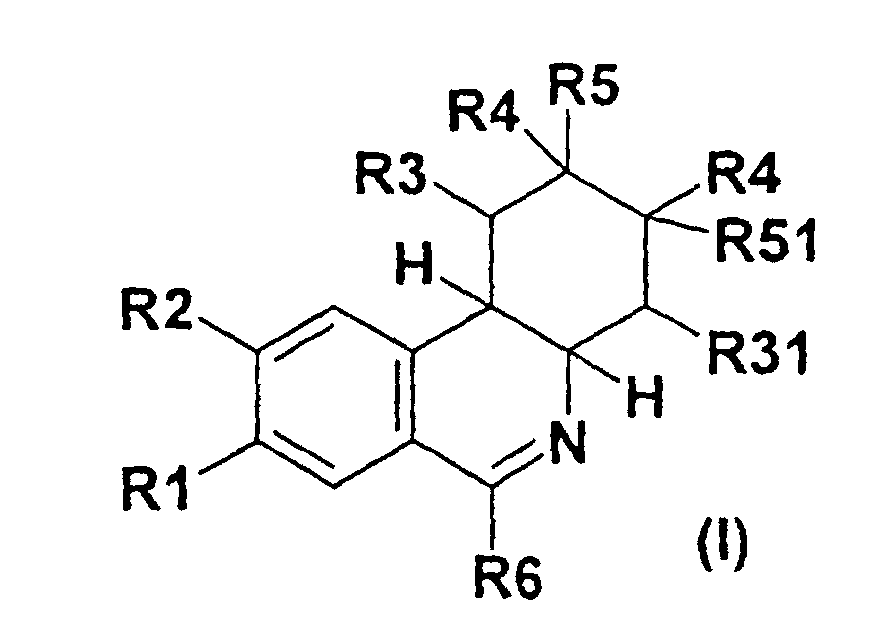
- the compounds of the formula I are chiral compounds having chiral centers in the positions 4a and 10b and, depending on the meaning of the substituents R3, R31, R4, R5 and R51, further chiral centers in the positions 1, 2, 3 and 4.
- the invention therefore includes all conceivable pure diastereomers and pure enantiomers and their mixtures in any mixing ratio, including the racemates.
- the compounds of the formula I are preferred in which the hydrogen atoms in the positions 4a and 10b are cis to one another. Particularly preferred here are the pure cis-diastereomers and the pure cis-enantiomers and their mixtures in any mixing ratio and including the racemates.
- the enantiomers can be separated in a manner known per se (for example by preparation and separation of appropriate diastereoisomeric compounds).
- a separation of enantiomers takes place at the stage of the starting compounds of the formula III for example via salt formation of the racemic compounds of the formula III with optically active carboxylic acids.
- enantiomerically pure starting compounds of the formula III can also be prepared via asymmetric syntheses.
- the tetrazol-5-yl radical R7 of the compounds of the formula I can be bonded to the phenyl radical R6 either in the ortho, meta or para position to the phenanthridine ring.
- tetrazol-5-yl radical R7 is bonded to the phenyl radical R6 in the meta or para position to the phenanthridine ring.
- the compounds of the formula I in which the tetrazol-5-yl radical R7 is bonded in the para position are particular preferred in this connection.
- the invention therefore also relates to the 1 H- and 2H-tetrazol-5-yl compounds of the formula I substituted by a radical R8 (R8 ⁇ H), both in pure form and in any mixing ratio.
- R8 R8 ⁇ H
- the compounds of the formula I are preferred in which the tetrazol-5-yl radical is substituted in the 2 position by one of the radicals R8 (R8 ⁇ H).
- the invention further relates to a process for the preparation of the compounds of the formula I, in which R1, R2, R3, R31, R4, R5, R51, A and R6 have the meanings indicated above, and their salts.
- the process comprises
- compounds of the formula I obtained can be converted into further compounds of the formula I by derivatization.
- compounds of the formula I in which R6 is a phenyl radical substituted by R7 and R7 is an unsubstituted 1 H- or 2H-tetrazol-5-yl radical can be converted into the corresponding substituted tetrazole compounds of the formula I by alkylation reactions, the hydrogen on the tetrazole ring being replaced by the radicals mentioned for R8 - excluding hydrogen.
- the reactions are expediently carried out analogously to the methods known to the person skilled in the art, e.g.
- Cyclocondensation is carried out in a manner known per se to the person skilled in the art according to Bischler-Napieralski (e.g. as described in J. Chem. Soc., 1956 , 4280-4282) in the presence of a suitable condensing agent, such as, for example, polyphosphoric acid, phosphorus pentachloride, phosphorus trichloride, phosphorus pentoxide, thionyl chloride or preferably phosphorus oxychloride, in a suitable inert solvent, e.g.
- a chlorinated hydrocarbon such as chloroform
- a cyclic hydrocarbon such as toluene or xylene
- another inert solvent such as acetonitrile
- an excess of condensing agent preferably at elevated temperature, in particular at the boiling temperature of the solvent or condensing agent used.
- R6-CO-X Compounds of the formula R6-CO-X can be prepared, for example, from the corresponding carboxylic acids R6-COOH, in which R6 has the meaning indicated above, by reaction in a manner familiar to the person skilled in the art.
- R6-COOH in which R6 has the meaning indicated above, are either known or can be obtained from alkyl 2-, 3- or 4-cyanobenzoates in a manner known to the person skilled in the art, e.g. by reaction with alkali metal azides and halogen salts of ammonia to give alkyl 2-, 3- or 4-(1H- or 2H-tetrazol-5-yl)benzoates which are unsubstituted in the tetrazole moiety. Such a reaction is described, for example, in J. Med. Chem. 1993 , 36, 3246.
- these intermediates can be converted by alkylation with compounds of the formula R8-X in the presence of a base - as described above for the 1 H- or 2H-tetrazole compounds of the formula I or in the abovementioned literature - into alkyl R6-carboxylates, in which R6 is a phenyl radical substituted by R7, R7 is a 1 H- or 2H-tetrazol-5-yl radical substituted by a radical R8 and R8 is not hydrogen, but has one of the other abovementioned meanings for R8.
- the alkyl R6-carboxylates are converted into the free carboxylic acids R6-COOH.
- the compounds of the formula III can be prepared, for example, from compounds of the formula IV in which R1, R2, R3, R31, R4, R5 and R51 have the meanings mentioned above, by reduction of the nitro group.
- Reduction is carried out in a manner known to the person skilled in the art, for example as described in J. Org. Chem. 1962 , 27, 4426 or as described in the following examples.
- reduction is carried out by catalytic hydrogenation, e.g. in the presence of Raney nickel, in a lower alcohol such as methanol or ethanol at room temperature and under normal or elevated pressure.
- a catalytic amount of an acid such as, for example, hydrochloric acid, can be added to the solvent.
- the compounds of the formula III in which R1, R2, R3, R31 and R4 have the meanings indicated above and R5 and R51 together are an additional bond, can be prepared from the corresponding compounds of the formula IV by selective reduction of the nitro group in a manner known to the person skilled in the art, for example in the presence of Raney nickel in a lower alcohol as a solvent using hydrazine hydrate as a hydrogen donor.
- the compounds of the formula IV in which R1, R2, R3, R31 and R4 have the meanings indicated above and R5 and R51 are hydrogen, are either known or can be prepared from corresponding compounds of the formula IV, in which R5 and R51 together are an additional bond.
- the reaction can be carried out in a manner known to the person skilled in the art, preferably by hydrogenation in the presence of a catalyst, such as, for example, palladium on activated carbon, e.g. as described in J. Chem. Soc. (C), 1971 , 1805-1808.
- Cycloaddition is carried out here in a manner known to the person skilled in the art according to Diels-Alder, e.g. as described in J. Amer. Chem. Soc. 1957 , 79 , 6559 or in J. Org. Chem. 1952 , 17, 581 or as described in the following examples.
- the compounds of the formula V and VI are either known or can be prepared in a known manner.
- the compounds of the formula V can be prepared, for example, from corresponding compounds of the formula VII in a manner known to the person skilled in the art, as described, for example, in J. Chem. Soc. 1951 , 2524 or in J. Org. Chem. 1944 , 9 , 170 or as in the following examples.
- the isolation and purification of the substances according to the invention are carried out in a manner known per se, for example by distilling off the solvent in vacuo and recrystallizing the resulting residue from a suitable solvent or subjecting it to one of the customary purification methods, such as, for example column chromatography on suitable support material.
- Salts are obtained by dissolving the free compound in a suitable solvent, e.g. in a chlorinated hydrocarbon, such as methylene chloride or chloroform, or a low molecular weight aliphatic alcohol (ethanol, isopropanol), which contains the desired acid or base, or to which the desired acid or base is then added.
- a suitable solvent e.g. in a chlorinated hydrocarbon, such as methylene chloride or chloroform, or a low molecular weight aliphatic alcohol (ethanol, isopropanol), which contains the desired acid or base, or to which the desired acid or base is then added.
- the salts are obtained by filtering, reprecipitation, precipitation with a nonsolvent for the addition salt or by evaporation of the solvent.
- Salts obtained can be converted by alkalization or by acidification into the free compounds, which in turn can be converted into salts. In this manner, pharmacologically intolerable salts can be converted into pharmacologically to
- m.p. stands for melting point, h for hour(s), RT for room temperature, EF for empirical formula, MW for molecular weight, calc. for calculated, fnd for found.
- (+/-)-cis-9-ethoxy-8-methoxy-6-(4-cyano-phenyl)-1,2,3,4,4a,10b-hexahydrophenanthridine (compound A1), 0.65 g of ammonium chloride and 0.83 g of sodium azide are suspended in 150 ml of abs. dimethylformamide and heated at 120°C for 24 h.
- the reaction mixture is partitioned between water and diethyl ether, and the organic phase is dried with sodium sulfate and concentrated.
- the residue is chromatographed on silica gel using methylene chloride/methanol in the ratio 4/1. After concentration of the corresponding eluate fractions, the title compound is obtained as a solidified oil.
- (+/-)-cis-N-[2-(3-ethoxy-4-methoxyphenyl)-cyclohexyl]-4-cyanobenzamide (compound A5) are dissolved in 100 ml of acetonitrile and 3 ml of phosphorus oxychloride and the solution is stirred at 50°C for 8 h.
- the reaction mixture is added to 100 ml of saturated sodium hydrogencarbonate solution and extracted with ethyl acetate.
- the organic phase is washed with sodium hydrogencarbonate solution and water, dried using sodium sulfate and concentrated.
- 4.3 g of the title compound are obtained as solidified oil.
- (+/-)-cis-2-ethoxy-1-methoxy-4-(2-amino-cyclohexyl)benzene (compound B1) are dissolved in 60 ml of methylene chloride and 5.3 ml of triethylamine.
- a solution of 7.4 g of 4-(2-ethyl-2H-tetrazol-5-yl)benzoyl chloride in 60 ml of methylene chloride is added dropwise at RT, and the mixture is extracted after stirring overnight with 100 ml each of water, 2N hydrochloric acid, saturated sodium hydrogencarbonate solution and water again. The organic phase is dried using sodium sulfate and concentrated.
- (+/-)-cis-2-ethoxy-1-methoxy-4-(2-nitro-cyclohex-4-enyl)benzene (compound C1) are dissolved in 1000 ml of ethanol and 500 ml of tetrahydrofuran, treated with 10 g of Raney nickel and hydrogenated at a hydrogen pressure of 100 bar for 4 days in an autoclave. After filtration and removal of the solvent in vacuo, 35.9 g of the title compound are obtained as a solidifying oil.
- the compounds according to the invention have useful pharmacological properties which make them industrially utilizable.
- selective cyclic nucleotide phosphodiesterase (PDE) inhibitors specifically of type 4
- they are suitable on the one hand as bronchial therapeutics (for the treatment of airway obstructions on account of their dilating action but also on account of their respiratory rate- or respiratory drive-increasing action) and for the removal of erectile dysfunction on account of their vascular dilating action, but on the other hand especially for the treatment of disorders, in particular of an inflammatory nature, e.g.
- the compounds according to the invention are distinguished by a low toxicity, a good enteral absorption (high bioavailability), a large therapeutic breadth and the absence of significant side effects.
- the compounds according to the invention can be employed in human and veterinary medicine as therapeutics, where they can be used, for example, for the treatment and prophylaxis of the following illnesses: acute and chronic (in particular inflammatory and allergen-induced) airway disorders of varying origin (bronchitis, allergic bronchitis, bronchial asthma); dermatoses (especially of proliferative, inflammatory and allergic type) such as psoriasis (vulgaris), toxic and allergic contact eczema, atopic eczema, seborrhoeic eczema, Lichen simplex, sunburn, pruritus in the anogenital area, alopecia areata, hypertrophic scars, discoid lupus erythematosus, follicular and widespread pyodermias, endogenous and exogenous acne, acne rosacea and other proliferative, inflammatory and allergic skin disorders; disorders which
- the invention further relates to a method for the treatment of mammals, including humans, which are suffering from one of the abovementioned illnesses.
- the method is characterized in that a therapeutically active and pharmacologically effective and tolerable amount of one or more of the compounds according to the invention is administered to the ill mammal.
- the invention further relates to the compounds according to the invention for use in the treatment and/or prophylaxis of illnesses, especially the illnesses mentioned.
- the invention also relates to the use of the compounds according to the invention for the production of medicaments which are employed for the treatment and/or prophylaxis of the illnesses mentioned.
- the invention furthermore relates to medicaments for the treatment and/or prophylaxis of the illnesses mentioned, which contain one or more of the compounds according to the invention.
- the medicaments are prepared by processes which are known per se and familiar to the person skilled in the art.
- auxiliaries which are suitable for the desired pharmaceutical formulations on account of his expert knowledge.
- solvents for example antioxidants, dispersants, emulsifiers, preservatives, solubilizers or permeation promoters, can be used.
- the compounds according to the invention are preferably also administered by inhalation.
- these are either administered directly as a powder (preferably in micronized form) or by atomizing solutions or suspensions which contain them.
- atomizing solutions or suspensions which contain them.
- the compounds according to the invention are in particular administered in the form of those medicaments which are suitable for topical application.
- suitable pharmaceutical formulations are, for example, powders, emulsions, suspensions, sprays, oils, ointments, fatty ointments, creams, pastes, gels or solutions.
- the medicaments according to the invention are prepared by processes known per se.
- the dosage of the active compounds is carried out in the order of magnitude customary for PDE inhibitors.
- Topical application forms (such as ointments) for the treatment of dermatoses thus contain the active compounds in a concentration of, for example, 0.1-99%.
- the dose for administration by inhalation is customary between 0.1 and 3 mg per day.
- the customary dose in the case of systemic therapy (p.o. or i.v.) is between 0.03 and 3 mg/kg per day.
- FMLP N-formyl-methionyl-leucyl-phenylalanine
- Mc Phail LC Strum SL, Leone PA and Sozzani S, The neutrophil respiratory burst mechanism.
- Coffey RG Marcel Decker, Inc., New York-Basel-Hong Kong
- Substances which inhibit chemiluminescence and cytokine secretion and the secretion of proinflammatory mediators on inflammatory cells are those which inhibit PDE 4.
- This isoenzyme of the phosphodiesterase families is particularly represented in granulocytes. Its inhibition leads to an increase in the intracellular cyclic AMP concentration and thus to the inhibition of cellular activation. PDE 4 inhibition by the substances according to the invention is thus a central indicator for the suppression of inflammatory processes.
- the activity test was carried out by the method of Bauer and Schwabe, which was adapted to microtiter plates (Naunyn-Schmiedeberg's Arch. Pharmacol. 1980 , 311 , 193-198).
- the PDE reaction is carried out in the first step.
- the resultant 5'-nucleotide is cleaved to give the uncharged nucleoside by a 5'-nucleotidase of the snake venom from Crotalus atrox.
- the nucleoside is separated from the remaining charged substrate on ion exchange columns. The columns are eluted with 2 ml of 30 mM ammonium formate (pH 6.0) directly into minivials to which 2 ml of scintilation fluid is additionally added for counting.
- inhibitory values determined for the compounds according to the invention [inhibitory concentration as -log IC 50 (mol/l)] follow from Table A below, in which the numbers of the compounds correspond to the numbers of the examples.
- Inhibition of the PDE 4 activity Compound -log IC 50 2 8.78
Landscapes
- Health & Medical Sciences (AREA)
- Organic Chemistry (AREA)
- Chemical & Material Sciences (AREA)
- Bioinformatics & Cheminformatics (AREA)
- Engineering & Computer Science (AREA)
- Life Sciences & Earth Sciences (AREA)
- Public Health (AREA)
- General Chemical & Material Sciences (AREA)
- Medicinal Chemistry (AREA)
- Nuclear Medicine, Radiotherapy & Molecular Imaging (AREA)
- Chemical Kinetics & Catalysis (AREA)
- Veterinary Medicine (AREA)
- Animal Behavior & Ethology (AREA)
- Pharmacology & Pharmacy (AREA)
- General Health & Medical Sciences (AREA)
- Pulmonology (AREA)
- Dermatology (AREA)
- Immunology (AREA)
- Cardiology (AREA)
- Neurosurgery (AREA)
- Biomedical Technology (AREA)
- Neurology (AREA)
- Heart & Thoracic Surgery (AREA)
- Psychiatry (AREA)
- Pain & Pain Management (AREA)
- Rheumatology (AREA)
- Hospice & Palliative Care (AREA)
- Reproductive Health (AREA)
- Endocrinology (AREA)
- Physical Education & Sports Medicine (AREA)
- Orthopedic Medicine & Surgery (AREA)
- Urology & Nephrology (AREA)
- Otolaryngology (AREA)
- Pharmaceuticals Containing Other Organic And Inorganic Compounds (AREA)
- Plural Heterocyclic Compounds (AREA)
- Nitrogen Condensed Heterocyclic Rings (AREA)
- Cephalosporin Compounds (AREA)
Abstract
Description
- The invention relates to novel 6-[(tetrazol-5-yl)-phenyl]phenanthridines, which are used in the pharmaceutical industry for the production of medicaments.
- Chem. Ber. 1939, 72, 675-677, J. Chem. Soc., 1956, 4280-4283 and J. Chem. Soc. (C), 1971, 1805 describe the synthesis of partial hydrogenated 6-phenylphenanthridines. In the international patent applications WO97/35854 and WO97/28131 partial hydrogenated 6-phenylphenanthridines are described as cyclic nucleotide phosphodiesterase (PDE) inhibitors of type 4.
- It has now been found that the novel 6-phenyl-phenanthridines, which are described below in greater detail, which differ from the prior art, in particular, by the substitution on the 6-phenyl ring, have surprising and particularly advantageous properties.
- The invention thus relates to compounds of the formula Iin which
- R1
- is hydroxyl, 1-4C-alkoxy, 3-7C-cycloalkoxy, 3-7C-cycloalkylmethoxy or completely or predominantly fluorine-substituted 1-4C-alkoxy,
- R2
- is hydroxyl, 1-4C-alkoxy, 3-7C-cycloalkoxy, 3-7C-cycloalkylmethoxy or completely or predominantly fluorine-substituted 1-4C-alkoxy,
- R1 and R2
- together are a 1-2C-alkylenedioxy group,
- R3
- is hydrogen or 1-4C-alkyl,
- R31
- is hydrogen or 1-4C-alkyl,
- R3 and R31
- together are a 1-4C-alkylene group,
- R4
- is hydrogen or 1-4C-alkyl,
- R5
- is hydrogen,
- R51
- is hydrogen,
- R5 and R51
- together are an additional bond,
- R6
- is a phenyl radical substituted by R7, where
- R7
- is a tetrazol-5-yl radical substituted by a radical R8, where
- R8
- is hydrogen, 1-7C-alkyl, 3-7C-cycloalkyl, 3-7C-cycloalkylmethyl or Ar-1-4C-alkyl, where
- Ar
- is a phenyl radical which is unsubstituted or substituted by R9 and/or R10, and
- R9 and R10
- independently of one another are halogen, nitro, cyano, 1-4C-alkyl, trifluoromethyl or 1-4C-alkoxy,
- 1-4C-Alkyl represents a straight-chain or branched alkyl radical having 1 to 4 carbon atoms. Examples which may be mentioned are the butyl, isobutyl, sec-butyl, tert-butyl, propyl, isopropyl and, preferably, the ethyl and methyl radicals.
- 1-4C-Alkoxy represents radicals which, in addition to the oxygen atom, contain a straight-chain or branched alkyl radical having 1 to 4 carbon atoms. Examples which may be mentioned are the butoxy, isobutoxy, sec-butoxy, tert-butoxy, propoxy, isopropoxy and, preferably, the ethoxy and methoxy radicals.
- 3-7C-Cycloalkoxy represents cyclopropyloxy, cyclobutyloxy, cyclopentyloxy, cyclohexyloxy and cycloheptyloxy, of which cyclopropyloxy, cyclobutyloxy and cyclopentyloxy are preferred.
- 3-7C-Cycloalkylmethoxy represents cyclopropylmethoxy, cyclobutylmethoxy, cyclopentylmethoxy, cyclohexylmethoxy and cycloheptylmethoxy, of which cyclopropylmethoxy, cyclobutylmethoxy and cyclopentylmethoxy are preferred.
- Completely or predominantly fluorine-substituted 1-4C-alkoxy which may be mentioned are, for example, the 2,2,3,3,3-pentafluoropropoxy, the perfluoroethoxy, the 1,2,2-trifluoroethoxy, in particular the 1,1,2,2-tetrafluoroethoxy, the trifluoromethoxy, the 2,2,2-trifluoroethoxy and, preferably, the difluoromethoxy radicals. "Predominantly" in this connection means that more than half of the hydrogen atoms are substituted by fluorine atoms.
- 1-2C-Alkylenedioxy represents, for example, the methylenedioxy (-O-CH2-O-) and the ethylenedioxy radicals (-O-CH2-CH2-O-).
- If R3 and R31 together have the meaning 1-4C-alkylene, the positions 1 and 4 in compounds of the formula I are linked to one another by a 1-4C-alkylene bridge, 1-4C-alkylene representing straight-chain or branched alkylene radicals having 1 to 4 carbon atoms. Examples which may be mentioned are the radicals methylene (-CH2-), ethylene (-CH2-CH2-), trimethylene (-CH2-CH2-CH2-), 1,2-dimethylethylene [-CH(CH3)-CH(CH3)-] and isopropylidene [-C(CH3)2-].
- If R5 and R51 together are an additional bond, then the carbon atoms in positions 2 and 3 in compounds of the formula I are linked to one another via a double bond.
- 1-7C-Alkyl represents straight-chain or branched alkyl radicals having 1 to 7 carbon atoms. Examples which may be mentioned are the heptyl, isoheptyl (5-methylhexyl), hexyl, isohexyl (4-methylpentyl), neohexyl (3,3-dimethylbutyl), pentyl, isopentyl (3-methylbutyl), neopentyl (2,2-dimethylpropyl), butyl, isobutyl, sec-butyl, tert-butyl, propyl, isopropyl, ethyl and methyl radicals.
- 3-7C-Cycloalkyl represents the cyclopropyl, cyclobutyl, cyclopentyl, cyclohexyl and the cycloheptyl radicals. The 5-7C-cycloalkyl radicals cyclopentyl, cyclohexyl and cycloheptyl may be mentioned as preferred.
- 3-7C-Cycloalkylmethyl represents a methyl radical which is substituted by one of the abovementioned 3-7C-cycloalkyl radicals. Examples which may be mentioned are the cyclopentylmethyl and the cyclohexylmethyl radicals.
- Ar-1-4C-alkyl represents one of the abovementioned 1-4C-alkyl radicals, which is substituted by one of the aryl radicals defined above. Examples which may be mentioned are the p-methoxybenzyl, the phenethyl and the benzyl radicals.
- Halogen within the meaning of the invention is bromine, chlorine and fluorine.
- Suitable salts for compounds of the formula I - depending on substitution - are all acid addition salts or all salts with bases. Particular mention may be made of the pharmacologically tolerable salts of the inorganic and organic acids and bases customarily used in pharmacy. Those which are suitable are, on the one hand, water-soluble and water-insoluble acid addition salts with acids such as, for example, hydrochloric acid, hydrobromic acid, phosphoric acid, nitric acid, sulfuric acid, acetic acid, citric acid, D-gluconic acid, benzoic acid, 2-(4-hydroxybenzoyl)benzoic acid, butyric acid, sulfosalicylic acid, maleic acid, lauric acid, malic acid, fumaric acid, succinic acid, oxalic acid, tartaric acid, embonic acid, stearic acid, toluenesulfonic acid, methanesulfonic acid or 3-hydroxy-2-naphthoic acid, where the acids are employed in salt preparation - depending on whether it is a mono- or polybasic acid and depending on which salt is desired - in an equimolar quantitative ratio or one differing therefrom.
- On the other hand - for example if the tetrazol-5-yl radical R7 is substituted by R8=H - salts with bases are also suitable. Examples of salts with bases which may be mentioned are alkali metal (lithium, sodium, potassium) or calcium, aluminum, magnesium, titanium, ammonium, meglumine or guanidinium salts, where here too the bases are employed in salt preparation in an equimolar quantitative ratio or one differing therefrom.
- Pharmacologically intolerable salts which may be obtained initially as process products, for example in the preparation of the compounds according to the invention on an industrial scale, are converted into pharmacologically tolerable salts by processes known to the person skilled in the art.
- According to expert's knowledge the compounds of the invention as well as their salts may contain, e.g. when isolated in crystalline form, varying amounts of solvents. Included within the scope of the invention are therefore all solvates and in particular all hydrates of the compounds of formula I as well as all solvates and in particular all hydrates of the salts of the compounds of formula I.
- Compounds of the formula I to be emphasized are those in which
- R1
- is 1-4C-alkoxy, 3-7C-cycloalkoxy, 3-7C-cycloalkylmethoxy or completely or predominantly fluorine-substituted 1-2C-alkoxy,
- R2
- is 1-4C-alkoxy, 3-7C-cycloalkoxy, 3-7C-cycloalkylmethoxy or completely or predominantly fluorine-substituted 1-2C-alkoxy,
- R3
- is hydrogen,
- R31
- is hydrogen,
- R3 and R31
- together are a 1-2C-alkylene group,
- R4
- is hydrogen or 1-4C-alkyl,
- R5
- is hydrogen,
- R51
- is hydrogen,
- R5 and R51
- together are an additional bond,
- R6
- is a phenyl radical substituted by R7, where
- R7
- is a tetrazol-5-yl radical substituted by a radical R8, where
- R8
- is hydrogen, 1-7C-alkyl, 3-7C-cycloalkyl, 3-7C-cycloalkylmethyl or Ar-1-4C-alkyl, where
- Ar
- is a phenyl radical which is unsubstituted or substituted by R9 and/or R10, and
- R9 and R10
- independently of one another are 1-4C-alkyl or 1-4C-alkoxy,
- Compounds of the formula I particularly to be emphasized are those in which
- R1
- is 1-4C-alkoxy, 3-7C-cycloalkoxy or completely or predominantly fluorine-substituted 1-2C-alkoxy,
- R2
- is 1-4C-alkoxy, 3-7C-cycloalkoxy or completely or predominantly fluorine-substituted 1-2C-alkoxy,
- R3
- is hydrogen,
- R31
- is hydrogen,
- R3 and R31
- together are a 1-2C-alkylene group,
- R4
- is hydrogen or 1-4C-alkyl,
- R5
- is hydrogen,
- R51
- is hydrogen,
- R5 and R51
- together are an additional bond,
- R6
- is a phenyl radical substituted by R7, where
- R7
- is a tetrazol-5-yl radical substituted by a radical R8, where
- R8
- is hydrogen, 1-4C-alkyl, 5-7C-cycloalkyl, 3-7C-cycloalkylmethyl or Ar-1-2C-alkyl, where
- .Ar
- is a phenyl radical which is unsubstituted or substituted by R9, and
- R9
- is 1-2C-alkyl or 1-2C-alkoxy,
- Preferred compounds of the formula I are those in which
- R1
- is 1-4C-alkoxy,
- R2
- is 1-4C-alkoxy,
- R3
- is hydrogen,
- R31
- is hydrogen,
- R4
- is hydrogen,
- R5
- is hydrogen,
- R51
- is hydrogen,
- R6
- is a phenyl radical substituted by R7, where
- R7
- is a tetrazol-5-yl radical substituted by R8, where
- R8
- is hydrogen, 1-4C-alkyl or 4-methoxybenzyl,
- Particularly preferred compounds of the formula I are those in which
- R1
- is methoxy or ethoxy,
- R2
- is methoxy or ethoxy,
- R3
- is hydrogen,
- R31
- is hydrogen,
- R4
- is hydrogen,
- R5
- is hydrogen,
- R51
- is hydrogen,
- R6
- is a phenyl radical substituted by R7, where
- R7
- is a 2H-tetrazol-5-yl radical substituted by R8, where
- R8
- is hydrogen, ethyl or 4-methoxybenzyl,
- The compounds of the formula I are chiral compounds having chiral centers in the positions 4a and 10b and, depending on the meaning of the substituents R3, R31, R4, R5 and R51, further chiral centers in the positions 1, 2, 3 and 4.
- The invention therefore includes all conceivable pure diastereomers and pure enantiomers and their mixtures in any mixing ratio, including the racemates. The compounds of the formula I are preferred in which the hydrogen atoms in the positions 4a and 10b are cis to one another. Particularly preferred here are the pure cis-diastereomers and the pure cis-enantiomers and their mixtures in any mixing ratio and including the racemates.
- The enantiomers can be separated in a manner known per se (for example by preparation and separation of appropriate diastereoisomeric compounds). Preferably, a separation of enantiomers takes place at the stage of the starting compounds of the formula IIIfor example via salt formation of the racemic compounds of the formula III with optically active carboxylic acids. Alternatively, enantiomerically pure starting compounds of the formula III can also be prepared via asymmetric syntheses.

- The tetrazol-5-yl radical R7 of the compounds of the formula I can be bonded to the phenyl radical R6 either in the ortho, meta or para position to the phenanthridine ring.
- Those compounds of the formula I are preferred in which the tetrazol-5-yl radical R7 is bonded to the phenyl radical R6 in the meta or para position to the phenanthridine ring. The compounds of the formula I in which the tetrazol-5-yl radical R7 is bonded in the para position are particular preferred in this connection.
- Compounds of the formula I in which R1, R2, R3, R31, R4, R5, R51, R6 and R7 have the meanings indicated above and R8 is hydrogen occur in 2 tautomeric forms, which are in equilibrium with one another (1H and 2H form of the tetrazol-5-yl radical). The invention therefore includes both tautomeric forms in any mixing ratio.
- By bonding of the substituent R8 (R8≠H) to the tetrazol-5-yl group, the conversion of the two tautomeric forms into one another is blocked. The invention therefore also relates to the 1 H- and 2H-tetrazol-5-yl compounds of the formula I substituted by a radical R8 (R8≠H), both in pure form and in any mixing ratio. In this connection, the compounds of the formula I are preferred in which the tetrazol-5-yl radical is substituted in the 2 position by one of the radicals R8 (R8≠H).
- The invention further relates to a process for the preparation of the compounds of the formula I, in which R1, R2, R3, R31, R4, R5, R51, A and R6 have the meanings indicated above, and their salts.
- The process comprises
- a) for the preparation of compounds of the formula I in which R1, R2, R3, R31, R4, R5, R51, R6 and R7 have the meanings indicated above and R8 is hydrogen, reacting corresponding compounds of the formula I, in which R6 is cyanophenyl, with alkali metal azides and halogen salts of ammonia, or
- b) for the preparation of compounds of the formula I in which R1, R2, R3, R31, R4, R5, R51, R6,
R7 and R8 (R8≠H) have the meanings indicated above, cyclocondensing corresponding
compounds of the formula II
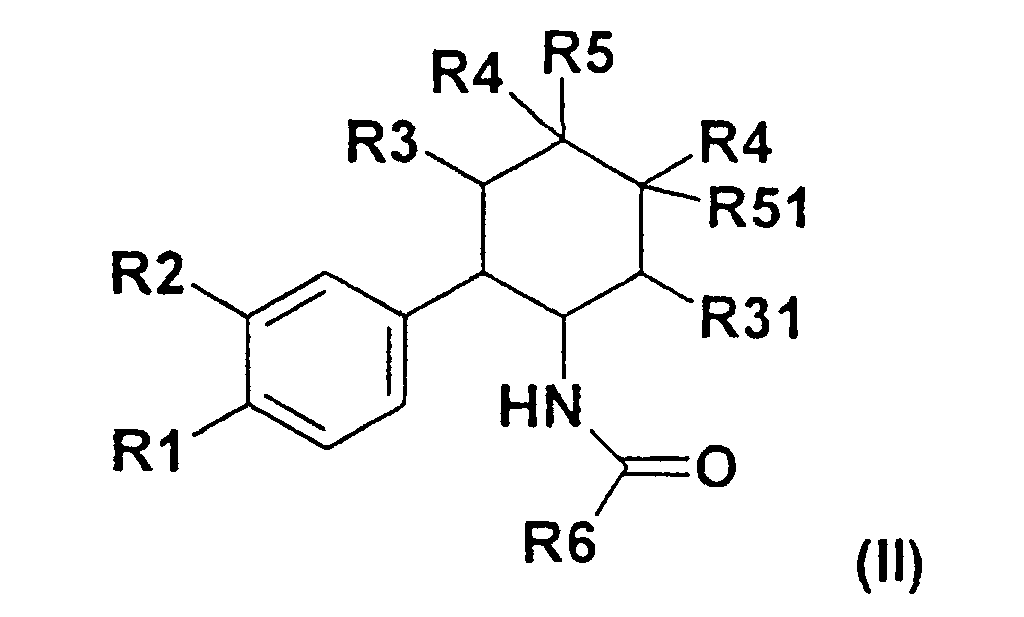 and,
and, -
- If desired, compounds of the formula I obtained can be converted into further compounds of the formula I by derivatization. For example, compounds of the formula I in which R6 is a phenyl radical substituted by R7 and R7 is an unsubstituted 1 H- or 2H-tetrazol-5-yl radical can be converted into the corresponding substituted tetrazole compounds of the formula I by alkylation reactions, the hydrogen on the tetrazole ring being replaced by the radicals mentioned for R8 - excluding hydrogen. The reactions are expediently carried out analogously to the methods known to the person skilled in the art, e.g. by reaction of the 1H- or 2H-tetrazole compounds of the formula I with compounds of the formula R8-X in the presence of a base, R8 having the abovementioned meanings - excluding hydrogen - and X being a suitable leaving group such as, for example, a chlorine, bromine or iodine atom or an alkylsulfate radical. The 1- and 2-substituted tetrazole regioisomer mixtures usually formed in the alkylation are separated by methods known to the person skilled in the art, such as crystallization or chromatography on suitable support materials. An analogous alkylation of tetrazoles and separation of the regioisomers is described, for example, in J. Med. Chem. 1996, 39, 2354.
- The reaction of cyanophenyl derivatives with alkali metal azides and halogen salts of ammonia to give 2-, 3- or 4-(1H- or 2H-tetrazol-5-yl)phenyl derivatives which are unsubstituted in the tetrazole moiety is described, for example, in J. Med. Chem. 1993, 36, 3246.
- Cyclocondensation is carried out in a manner known per se to the person skilled in the art according to Bischler-Napieralski (e.g. as described in J. Chem. Soc., 1956, 4280-4282) in the presence of a suitable condensing agent, such as, for example, polyphosphoric acid, phosphorus pentachloride, phosphorus trichloride, phosphorus pentoxide, thionyl chloride or preferably phosphorus oxychloride, in a suitable inert solvent, e.g. in a chlorinated hydrocarbon such as chloroform, or in a cyclic hydrocarbon such as toluene or xylene, or another inert solvent such as acetonitrile, or without further solvent using an excess of condensing agent, preferably at elevated temperature, in particular at the boiling temperature of the solvent or condensing agent used.
- Compounds of the formula II, in which R1, R2, R3, R31, R4, R5, R51 and R6 have the meanings indicated above, are accessible from the corresponding compounds of the formula III, in which R1, R2, R3, R31, R4, R5 and R51 have the meanings indicated above, by reaction with compounds of the formula R6-CO-X, in which R6 has the meaning indicated above and X is a suitable leaving group, preferably a chlorine atom..For example, benzoylation is carried out as in the following examples according to the Einhorn process, the Schotten-Baumann variant or as described in J. Chem. Soc. (C), 1971, 1805-1808.
- Compounds of the formula R6-CO-X and compounds of the formula III are either known or can be prepared in a known manner.
- Compounds of the formula R6-CO-X can be prepared, for example, from the corresponding carboxylic acids R6-COOH, in which R6 has the meaning indicated above, by reaction in a manner familiar to the person skilled in the art.
- The compounds R6-COOH, in which R6 has the meaning indicated above, are either known or can be obtained from alkyl 2-, 3- or 4-cyanobenzoates in a manner known to the person skilled in the art, e.g. by reaction with alkali metal azides and halogen salts of ammonia to give alkyl 2-, 3- or 4-(1H- or 2H-tetrazol-5-yl)benzoates which are unsubstituted in the tetrazole moiety. Such a reaction is described, for example, in J. Med. Chem. 1993, 36, 3246. If desired, these intermediates can be converted by alkylation with compounds of the formula R8-X in the presence of a base - as described above for the 1 H- or 2H-tetrazole compounds of the formula I or in the abovementioned literature - into alkyl R6-carboxylates, in which R6 is a phenyl radical substituted by R7, R7 is a 1 H- or 2H-tetrazol-5-yl radical substituted by a radical R8 and R8 is not hydrogen, but has one of the other abovementioned meanings for R8. By means of alkaline or acidic hydrolysis conditions familiar to the person skilled in the art, the alkyl R6-carboxylates are converted into the free carboxylic acids R6-COOH.
- The compounds of the formula III can be prepared, for example, from compounds of the formula IVin which R1, R2, R3, R31, R4, R5 and R51 have the meanings mentioned above, by reduction of the nitro group.
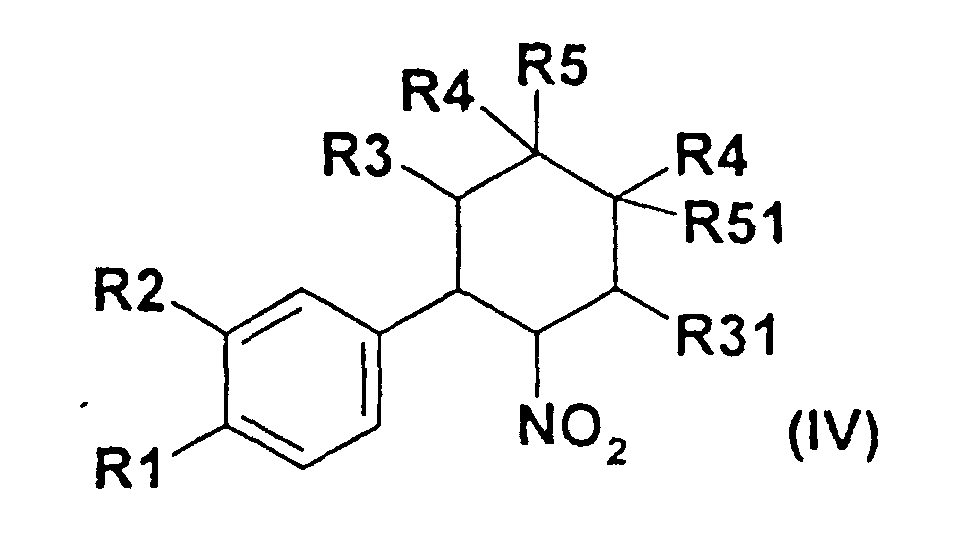
- Reduction is carried out in a manner known to the person skilled in the art, for example as described in J. Org. Chem. 1962, 27, 4426 or as described in the following examples. Preferably, reduction is carried out by catalytic hydrogenation, e.g. in the presence of Raney nickel, in a lower alcohol such as methanol or ethanol at room temperature and under normal or elevated pressure. If desired, a catalytic amount of an acid, such as, for example, hydrochloric acid, can be added to the solvent.
- The compounds of the formula III, in which R1, R2, R3, R31 and R4 have the meanings indicated above and R5 and R51 together are an additional bond, can be prepared from the corresponding compounds of the formula IV by selective reduction of the nitro group in a manner known to the person skilled in the art, for example in the presence of Raney nickel in a lower alcohol as a solvent using hydrazine hydrate as a hydrogen donor.
- The compounds of the formula IV, in which R1, R2, R3, R31 and R4 have the meanings indicated above and R5 and R51 are hydrogen, are either known or can be prepared from corresponding compounds of the formula IV, in which R5 and R51 together are an additional bond. The reaction can be carried out in a manner known to the person skilled in the art, preferably by hydrogenation in the presence of a catalyst, such as, for example, palladium on activated carbon, e.g. as described in J.
Chem. Soc. (C), 1971, 1805-1808. - The compounds of the formula IV, in which R5 and R51 together are an additional bond, are either known or can be obtained by reaction of compounds of the formula Vin which R1 and R2 have the abovementioned meanings, with compounds of the formula VI
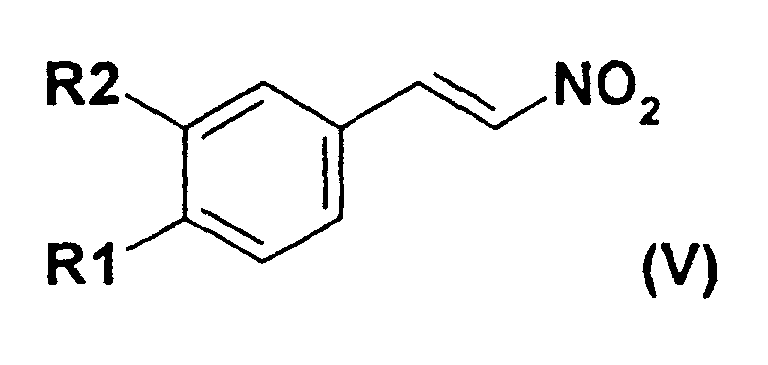
- Cycloaddition is carried out here in a manner known to the person skilled in the art according to Diels-Alder, e.g. as described in J. Amer. Chem. Soc. 1957, 79, 6559 or in J. Org. Chem. 1952, 17, 581 or as described in the following examples.
- Compounds of the formula IV obtained in the cycloaddition, in which the phenyl ring and the nitro group are trans to one another, can be converted into the corresponding cis compounds in a manner known to the person skilled in the art, e.g. as described in J. Amer. Chem. Soc. 1957, 79, 6559 or as described in the following examples.
- The compounds of the formula V and VI are either known or can be prepared in a known manner. The compounds of the formula V can be prepared, for example, from corresponding compounds of the formula VII in a manner known to the person skilled in the art, as described, for example, in J. Chem. Soc. 1951, 2524 or in J. Org. Chem. 1944, 9, 170 or as in the following examples.
- The compounds of the formula VIIin which R1 and R2 have the meanings indicated above, are either known or can be prepared in a manner known to the person skilled in the art, as described, for example, in Ber. Dtsch. Chem. Ges. 1925, 58, 203.

- The isolation and purification of the substances according to the invention are carried out in a manner known per se, for example by distilling off the solvent in vacuo and recrystallizing the resulting residue from a suitable solvent or subjecting it to one of the customary purification methods, such as, for example column chromatography on suitable support material.
- Salts are obtained by dissolving the free compound in a suitable solvent, e.g. in a chlorinated hydrocarbon, such as methylene chloride or chloroform, or a low molecular weight aliphatic alcohol (ethanol, isopropanol), which contains the desired acid or base, or to which the desired acid or base is then added. The salts are obtained by filtering, reprecipitation, precipitation with a nonsolvent for the addition salt or by evaporation of the solvent. Salts obtained can be converted by alkalization or by acidification into the free compounds, which in turn can be converted into salts. In this manner, pharmacologically intolerable salts can be converted into pharmacologically tolerable salts.
- The following examples serve to explain the invention in greater detail without restricting it. Likewise, further compounds of the formula I whose preparation is not described explicitly can be prepared in an analogous manner or in a manner familiar to the person skilled in the art using customary process techniques.
- In the examples, m.p. stands for melting point, h for hour(s), RT for room temperature, EF for empirical formula, MW for molecular weight, calc. for calculated, fnd for found. The compounds and their salts mentioned in the examples are a preferred subject of the invention.
- 4.2 g of (+/-)-cis-9-ethoxy-8-methoxy-6-(4-cyano-phenyl)-1,2,3,4,4a,10b-hexahydrophenanthridine (compound A1), 0.65 g of ammonium chloride and 0.83 g of sodium azide are suspended in 150 ml of abs. dimethylformamide and heated at 120°C for 24 h. The reaction mixture is partitioned between water and diethyl ether, and the organic phase is dried with sodium sulfate and concentrated. The residue is chromatographed on silica gel using methylene chloride/methanol in the ratio 4/1. After concentration of the corresponding eluate fractions, the title compound is obtained as a solidified oil.
- EF: C23H25N5O2; MW 403.48
Elemental analysis × 0.7 H2O calc. C 66.39 H 6.40 N 16.83 fnd C 66.34 H 6.46 N 16.45 - 3.55 g of (+/-)-cis-N-[2-(3-ethoxy-4-methoxyphenyl)-cyclohexyl]-4-(2-ethyl-2H-tetrazol-5-yl)benzamide (compound A2) are dissolved in 150 ml of acetonitrile and 1.0 ml of phosphorus oxychloride and the solution is stirred at 80°C overnight. The reaction mixture is treated with 60 ml of ethyl acetate and extracted with sodium hydrogencarbonate solution. The organic phase is dried using sodium sulfate and concentrated. The residue is extracted by stirring with ethyl acetate/petroleum ether in the ratio 1/1, filtered off with suction and dried. 2.06 g of the title compound of m.p. 167-170°C are obtained.
- EF: C25H29N5O2; MW 431.54
Elemental analysis calc. C 69.58 H 6.77 N 16.23 fnd. C 69.50 H 6.92 N 16.38 - Starting from starting compounds described below, the following is obtained according to the procedure in Example 2:
- M.p.: solidified oil
- EF: C31H33N5O3; MW 523.62
Elemental analysis × 0.3 H2O calc. C 70.38 H 6.40 N 13.24 fnd. C 70.67 H 6.57 N 12.97 - M.p.: solidified oil
- EF: C24H27N5O2; MW 417.52
Elemental analysis × 0.12 H2O calc. C 68.62 H 6.55 N 16.67 fnd. C 68.63 H 6.81 N 16.59 - Specific rotation: [α] 20 / D = -75.2° (c=2, ethanol)
- 5.1 g of (+/-)-cis-N-[2-(3-ethoxy-4-methoxyphenyl)-cyclohexyl]-4-cyanobenzamide (compound A5) are dissolved in 100 ml of acetonitrile and 3 ml of phosphorus oxychloride and the solution is stirred at 50°C for 8 h. The reaction mixture is added to 100 ml of saturated sodium hydrogencarbonate solution and extracted with ethyl acetate. The organic phase is washed with sodium hydrogencarbonate solution and water, dried using sodium sulfate and concentrated. 4.3 g of the title compound are obtained as solidified oil.
- 5.0 g of (+/-)-cis-2-ethoxy-1-methoxy-4-(2-amino-cyclohexyl)benzene (compound B1) are dissolved in 60 ml of methylene chloride and 5.3 ml of triethylamine. A solution of 7.4 g of 4-(2-ethyl-2H-tetrazol-5-yl)benzoyl chloride in 60 ml of methylene chloride is added dropwise at RT, and the mixture is extracted after stirring overnight with 100 ml each of water, 2N hydrochloric acid, saturated sodium hydrogencarbonate solution and water again. The organic phase is dried using sodium sulfate and concentrated. The residue is chromatographed on silica gel using a mixture of toluene/dioxane in the ratio 10/1. After concentration of the product fractions, 3.6 g of the title compound of m.p. 157-159°C are obtained.
- Starting from starting compounds described below, the following is obtained according to the procedure described in Example A2:
- M.p.: 176-179°C
- M.p. solidified oil
- Optical rotation: [α] 20 / D = -195.5° (c=0.2, ethanol)
- M.p. solidified oil
- 40.0 g of (+/-)-cis-2-ethoxy-1-methoxy-4-(2-nitro-cyclohex-4-enyl)benzene (compound C1) are dissolved in 1000 ml of ethanol and 500 ml of tetrahydrofuran, treated with 10 g of Raney nickel and hydrogenated at a hydrogen pressure of 100 bar for 4 days in an autoclave. After filtration and removal of the solvent in vacuo, 35.9 g of the title compound are obtained as a solidifying oil.
- 8.5 g of (+/-)-cis-1,2-dimethoxy-4-(2-nitrocyclohexyl)benzene are dissolved in 400 ml of methanol and treated with 7 ml of hydrazine hydrate and 2.5 g of Raney nickel in portions at RT in the course of 8 h. After stirring overnight at RT, the reaction mixture is filtered, the filtrate is concentrated and the residue is chromatographed on silica gel using a mixture of toluene/ethyl acetate/triethylamine = 4/2/0.5. The title compound is obtained as an oil.
- 12.0 g of (+/-)-cis-1,2-dimethoxy-4-(2-aminocyclohexyl)benzene and 6.2 g of (-)-mandelic acid are dissolved in 420 ml of dioxane and 60 ml of tetrahydrofuran and the solution is stirred at RT overnight. The solid is filtered off with suction, dried, treated with 100 ml of saturated sodium hydrogencarbonate solution and extracted with ethyl acetate. The organic phase is dried using sodium sulfate and concentrated under reduced pressure. 4.8 g of the title compound of m.p.: 80-81.5°C are obtained.
- Specific rotation: [α] 20 / D = -58.5° (c=1, ethanol)
- 89.25 g of (+/-)-trans-2-ethoxy-1-methoxy-4-(2-nitrocyclohex-4-enyl)benzene (compound D1) and 37 g of potassium hydroxide are dissolved in 500 ml of absolute ethanol. A solution of 23.5 ml of conc. sulfuric acid in 120 ml of absolute ethanol is then added dropwise such that the internal temperature does not exceed -2°C. After stirring for 1 h, the mixture is added to 4 I of ice water, and the precipitate is filtered off with suction, washed with water and dried. M.p.: 66-67°C.
- 10.0 g of (+/-)-trans-1,2-dimethoxy-4-(2-nitrocyclohex-4-enyl)benzene and 20.0 g of potassium hydroxide are dissolved in 150 ml of ethanol and 35 ml of dimethyl formamide. A solution of 17.5 ml of conc. sulfuric acid in 60 ml of ethanol is then added dropwise such that the internal temperature does not exceed 4°C. After stirring for 1 h, the mixture is added to 1 l of ice water, the precipitate is filtered off with suction, washed with water and dried, and the crude product is recrystallized from ethanol. 8.6 g of the title compound of m.p. 82.5-84°C are obtained.
- 8.4 g of (+/-)-cis-1,2-dimethoxy-4-(2-nitrocyclohex-4-enyl)benzene are dissolved in 450 ml of methanol, treated with 2 ml of conc. hydrochloric acid and hydrogenated after addition of 500 mg of 10% strength Pd/C. The reaction mixture is filtered and the filtrate is concentrated. M.p.: 84-86.5°C.
- 110 g of 3-ethoxy-2-methoxy-ω-nitrostyrene (compound E1) and 360 mg of hydroquinone are suspended in 360 ml of absolute toluene and treated at -70°C with 180 ml of liquid 1,3-butadiene. The mixture is stirred at 160-180°C for 6 days in an autoclave and then cooled. The product is extracted by stirring with ethanol, filtered off with suction and dried. M.p.: 130-131°C.
- 50.0 g of 3,4-dimethoxy-ω-nitrostyrene and 1.0 g (9.1 mmol) of hydroquinone are suspended in 200 ml of abs. toluene and treated at -70°C with 55.0 g (1.02 mmol) of liquid 1,3-butadiene. The mixture is stirred at 160°C for 6 days in an autoclave and then cooled. Some of the solvent is removed on a rotary evaporator, and the resulting precipitate is filtered off with suction and recrystallized in ethanol. M.p.: 113.5-115.5°C.
- 236 g of 3-ethoxy-2-methoxybenzaldehyde, 101 g of ammonium acetate and 320 ml of nitromethane are heated to 100°C for 4 h in 655 ml of glacial acetic acid. The solution is added to 5 I of ice water, and the precipitate is filtered off with suction, washed with water and dried. M.p.: 132-133°C.
- 207.0 g of 3,4-dimethoxybenzaldehyde, 100.0 g of ammonium acetate and 125 ml of nitromethane are heated to boiling for 3-4 h in 1.0 I of glacial acetic acid. After cooling in an ice bath, the precipitate is filtered off with suction, rinsed with glacial acetic acid and petroleum ether and dried. M.p.: 140-141°C. Yield: 179.0 g.
- The compounds according to the invention have useful pharmacological properties which make them industrially utilizable. As selective cyclic nucleotide phosphodiesterase (PDE) inhibitors (specifically of type 4), they are suitable on the one hand as bronchial therapeutics (for the treatment of airway obstructions on account of their dilating action but also on account of their respiratory rate- or respiratory drive-increasing action) and for the removal of erectile dysfunction on account of their vascular dilating action, but on the other hand especially for the treatment of disorders, in particular of an inflammatory nature, e.g. of the airways (asthma prophylaxis), of the skin, of the intestine, of the eyes, of the CNS and of the joints, which are mediated by mediators such as histamine, PAF (platelet-activating factor), arachidonic acid derivatives such as leukotrienes and prostaglandins, cytokines, interleukins, chemokines, alpha-, beta- and gamma-interferon, tumor necrosis factor (TNF) or oxygen free radicals and proteases. In this context, the compounds according to the invention are distinguished by a low toxicity, a good enteral absorption (high bioavailability), a large therapeutic breadth and the absence of significant side effects.
- On account of their PDE-inhibiting properties, the compounds according to the invention can be employed in human and veterinary medicine as therapeutics, where they can be used, for example, for the treatment and prophylaxis of the following illnesses: acute and chronic (in particular inflammatory and allergen-induced) airway disorders of varying origin (bronchitis, allergic bronchitis, bronchial asthma); dermatoses (especially of proliferative, inflammatory and allergic type) such as psoriasis (vulgaris), toxic and allergic contact eczema, atopic eczema, seborrhoeic eczema, Lichen simplex, sunburn, pruritus in the anogenital area, alopecia areata, hypertrophic scars, discoid lupus erythematosus, follicular and widespread pyodermias, endogenous and exogenous acne, acne rosacea and other proliferative, inflammatory and allergic skin disorders; disorders which are based on an excessive release of TNF and leukotrienes, for example disorders of the arthritis type (rheumatoid arthritis, rheumatoid spondylitis, osteoarthritis and other arthritic conditions), disorders of the immune system (AIDS, multiple sclerosis), types of shock (septic shock, endotoxin shock, gram-negative sepsis, toxic shock syndrome and ARDS (adult respiratory distress syndrome)) and also generalized inflammations in the gastrointestinal region (Crohn's disease and ulcerative colitis); disorders which are based on allergic and/or chronic, immunological false reactions in the region of the upper airways (pharynx, nose) and the adjacent regions (paranasal sinuses, eyes), such as allergic rhinitis/sinusitis, chronic rhinitis/sinusitis, allergic conjunctivitis and also nasal polyps; but also disorders of the heart which can be treated by PDE inhibitors, such as cardiac insufficiency, or disorders which can be treated on account of the tissue-relaxant action of the PDE inhibitors, such as, for example, erectile dysfunction or colics of the kidneys and of the ureters in connection with kidney stones; and also illnesses of the central nervous system, such as depressions or arteriosclerotic dementia.
- The invention further relates to a method for the treatment of mammals, including humans, which are suffering from one of the abovementioned illnesses. The method is characterized in that a therapeutically active and pharmacologically effective and tolerable amount of one or more of the compounds according to the invention is administered to the ill mammal.
- The invention further relates to the compounds according to the invention for use in the treatment and/or prophylaxis of illnesses, especially the illnesses mentioned.
- The invention also relates to the use of the compounds according to the invention for the production of medicaments which are employed for the treatment and/or prophylaxis of the illnesses mentioned.
- The invention furthermore relates to medicaments for the treatment and/or prophylaxis of the illnesses mentioned, which contain one or more of the compounds according to the invention.
- The medicaments are prepared by processes which are known per se and familiar to the person skilled in the art. As medicaments, the compounds according to the invention (= active compounds) are either employed as such, or preferably in combination with suitable pharmaceutical auxiliaries, e.g. in the form of tablets, coated tablets, capsules, suppositories, patches, emulsions, suspensions, gels or solutions, the active compound content advantageously being between 0.1 and 95%.
- The person skilled in the art is familiar with auxiliaries which are suitable for the desired pharmaceutical formulations on account of his expert knowledge. In addition to solvents, gel formers, ointment bases and other active compound excipients, for example antioxidants, dispersants, emulsifiers, preservatives, solubilizers or permeation promoters, can be used.
- For the treatment of disorders of the respiratory tract, the compounds according to the invention are preferably also administered by inhalation. To do this, these are either administered directly as a powder (preferably in micronized form) or by atomizing solutions or suspensions which contain them. With respect to the preparations and administration forms, reference is made, for example, to the details in European Patent 163 965.
- For the treatment of dermatoses, the compounds according to the invention are in particular administered in the form of those medicaments which are suitable for topical application. For the production of the medicaments, the compounds according to the invention (= active compounds) are preferably mixed with suitable pharmaceutical auxiliaries and further processed to give suitable pharmaceutical formulations. Suitable pharmaceutical formulations are, for example, powders, emulsions, suspensions, sprays, oils, ointments, fatty ointments, creams, pastes, gels or solutions.
- The medicaments according to the invention are prepared by processes known per se. The dosage of the active compounds is carried out in the order of magnitude customary for PDE inhibitors. Topical application forms (such as ointments) for the treatment of dermatoses thus contain the active compounds in a concentration of, for example, 0.1-99%. The dose for administration by inhalation is customary between 0.1 and 3 mg per day. The customary dose in the case of systemic therapy (p.o. or i.v.) is between 0.03 and 3 mg/kg per day.
- In the investigation of PDE 4 inhibition on the cellular plane, the activation of inflammatory cells is ascribed particular importance. An example is FMLP (N-formyl-methionyl-leucyl-phenylalanine)-induced superoxide production of neutrophilic granulocytes, which can be measured as luminol-amplified chemiluminescence. (Mc Phail LC, Strum SL, Leone PA and Sozzani S, The neutrophil respiratory burst mechanism. In "Immunology Series" 57: 47-76, 1992; ed. Coffey RG (Marcel Decker, Inc., New York-Basel-Hong Kong)).
- Substances which inhibit chemiluminescence and cytokine secretion and the secretion of proinflammatory mediators on inflammatory cells, in particular neutrophilic and eosinophilic granulocytes, T-lymphocytes, monocytes and macrophages are those which inhibit PDE 4. This isoenzyme of the phosphodiesterase families is particularly represented in granulocytes. Its inhibition leads to an increase in the intracellular cyclic AMP concentration and thus to the inhibition of cellular activation. PDE 4 inhibition by the substances according to the invention is thus a central indicator for the suppression of inflammatory processes. (Giembycz MA, Could isoenzyme-selective phosphodiesterase inhibitors render bronchodilatory therapy redundant in the treatment of bronchial asthma?. Biochem Pharmacol 43: 2041-2051, 1992; Torphy TJ et al., Phosphodiesterase inhibitors: new opportunities for treatment of asthma. Thorax 46: 512-523, 1991; Schudt C et al., Zardaverine: a cyclic AMP PDE 3/4 inhibitor. In "New Drugs for Asthma Therapy", 379-402, Birkhäuser Verlag Basel 1991; Schudt C et al., Influence of selective phosphodiesterase inhibitors on human neutrophil functions and levels of cAMP and Ca; Naunyn-Schmiedebergs Arch Pharmacol 344; 682-690, 1991; Tenor H and Schudt C, Analysis of PDE isoenzyme profiles in cells and tissues by pharmacological methods. In "Phophodiesterase Inhibitors", 21-40, "The Handbook of Immunopharmacology", Academic Press, 1996; Hatzelmann A et al., Enzymatic and functional aspects of dual-selective PDE3/4-Inhibitors. In "Phosphodiesterase Inhibitors", 147-160, "The Handbook of Immunopharmacology", Academic Press, 1996.
- The activity test was carried out by the method of Bauer and Schwabe, which was adapted to microtiter plates (Naunyn-Schmiedeberg's Arch. Pharmacol. 1980, 311, 193-198). In this connection, the PDE reaction is carried out in the first step. In a second step, the resultant 5'-nucleotide is cleaved to give the uncharged nucleoside by a 5'-nucleotidase of the snake venom from Crotalus atrox. In the third step, the nucleoside is separated from the remaining charged substrate on ion exchange columns. The columns are eluted with 2 ml of 30 mM ammonium formate (pH 6.0) directly into minivials to which 2 ml of scintilation fluid is additionally added for counting.
- The inhibitory values determined for the compounds according to the invention [inhibitory concentration as -log IC50 (mol/l)] follow from Table A below, in which the numbers of the compounds correspond to the numbers of the examples.
Inhibition of the PDE 4 activity Compound -log IC50 2 8.78
if desired, then converting the compounds of the formula I obtained according to a) or b) into their salts, or, if desired, then converting salts of the compounds of the formula I obtained according to a) or b) into the free compounds.
Claims (8)
- A compound of the formula Iin which

- R1
- is hydroxyl, 1-4C-alkoxy, 3-7C-cycloalkoxy, 3-7C-cycloalkylmethoxy or completely or predominantly fluorine-substituted 1-4C-alkoxy,
- R2
- is hydroxyl, 1-4C-alkoxy, 3-7C-cycloalkoxy, 3-7C-cycloalkylmethoxy or completely or predominantly fluorine-substituted 1-4C-alkoxy,
- R1 and R2
- together are a 1-2C-alkylenedioxy group,
- R3
- is hydrogen or 1-4C-alkyl,
- R31
- is hydrogen or 1-4C-alkyl,
- R3 and R31
- together are a 1-4C-alkylene group,
- R4
- is hydrogen or 1-4C-alkyl,
- R5
- is hydrogen,
- R51
- is hydrogen,
- R5 and R51
- together are an additional bond,
- R6
- is a phenyl radical substituted by R7, where
- R7
- is a tetrazol-5-yl radical substituted by a radical R8, where
- R8
- is hydrogen, 1-7C-alkyl, 3-7C-cycloalkyl, 3-7C-cycloalkylmethyl or Ar-1-4C-alkyl, where
- Ar
- is a phenyl radical which is unsubstituted or substituted by R9 and/or R10, and
- R9 and R10
- independently of one another are halogen, nitro, cyano, 1-4C-alkyl, trifluoromethyl or 1-4C-alkoxy,
- A compound of the formula I as claimed in claim 1, in which
- R1
- is 1-4C-alkoxy, 3-7C-cycloalkoxy, 3-7C-cycloalkylmethoxy or completely or predominantly fluorine-substituted 1-2C-alkoxy,
- R2
- is 1-4C-alkoxy, 3-7C-cycloalkoxy, 3-7C-cycloalkylmethoxy or completely or predominantly fluorine-substituted 1-2C-alkoxy,
- R3
- is hydrogen,
- R31
- is hydrogen,
- R3 and R31
- together are a 1-2C-alkylene group,
- R4
- is hydrogen or 1-4C-alkyl,
- R5
- is hydrogen,
- R51
- is hydrogen,
- R5 and R51
- together are an additional bond,
- R6
- is a phenyl radical substituted by R7, where
- R7
- is a tetrazol-5-yl radical substituted by a radical R8, where
- R8
- is hydrogen, 1-7C-alkyl, 3-7C-cycloalkyl, 3-7C-cycloalkylmethyl or Ar-1-4C-alkyl, where
- Ar
- is a phenyl radical which is unsubstituted or substituted by R9 and/or R10, and
- R9 and R10
- independently of one another are 1-4C-alkyl or 1-4C-alkoxy,
- A compound of the formula I as claimed in claim 1, in which
- R1
- is 1-4C-alkoxy, 3-7C-cycloalkoxy or completely or predominantly fluorine-substituted 1-2C-alkoxy,
- R2
- is 1-4C-alkoxy, 3-7C-cycloalkoxy or completely or predominantly fluorine-substituted 1-2C-alkoxy,
- R3
- is hydrogen,
- R31
- is hydrogen,
- R3 and R31
- together are a 1-2C-alkylene group,
- R4
- is hydrogen or 1-4C-alkyl,
- R5
- is hydrogen,
- R51
- is hydrogen,
- R5 and R51
- together are an additional bond,
- R6
- is a phenyl radical substituted by R7, where
- R7
- is a tetrazol-5-yl radical substituted by a radical R8, where
- R8
- is hydrogen, 1-4C-alkyl, 5-7C-cycloalkyl, 3-7C-cycloalkylmethyl or Ar-1-2C-alkyl, where
- Ar
- is a phenyl radical which is unsubstituted or substituted by R9, and
- R9
- is 1-2C-alkyl or 1-2C-alkoxy.
- A compound of the formula I as claimed in claim 1, in which
- R1
- is 1-4C-alkoxy,
- R2
- is 1-4C-alkoxy,
- R3
- is hydrogen,
- R31
- is hydrogen,
- R4
- is hydrogen,
- R5
- is hydrogen,
- R51
- is hydrogen,
- R6
- is a phenyl radical substituted by R7, where
- R7
- is a tetrazol-5-yl radical substituted by R8, where
- R8
- is hydrogen, 1-4C-alkyl or 4-methoxyhenzyl
- A compound of the formula I as claimed in claim 1, in which
- R1
- is methoxy or ethoxy,
- R2
- is methoxy or ethoxy,
- R3
- is hydrogen,
- R31
- is hydrogen,
- R4
- is hydrogen,
- R5
- is hydrogen,
- R51
- is hydrogen,
- R6
- is a phenyl radical substituted by R7, where
- R7
- is a 2H-tetrazol-5-yl radical substituted by R8, where
- R8
- is hydrogen, ethyl or 4-methoxybenzyl,
- A compound of the formula I as claimed in claim 1 for use in the treatment of diseases.
- A medicament comprising at least one compound of the formula I as claimed in claim 1 together with pharmaceutical auxiliaries and/or excipients.
- The use of compounds of the formula I as claimed in claim 1 for the production of medicaments for the treatment of airway disorders.
Priority Applications (2)
| Application Number | Priority Date | Filing Date | Title |
|---|---|---|---|
| EP98941361A EP0998460B1 (en) | 1997-07-25 | 1998-07-18 | Novel tetrazole derivatives |
| SI9830644T SI0998460T1 (en) | 1997-07-25 | 1998-07-18 | Novel tetrazole derivatives |
Applications Claiming Priority (4)
| Application Number | Priority Date | Filing Date | Title |
|---|---|---|---|
| EP97112792 | 1997-07-25 | ||
| EP97112792 | 1997-07-25 | ||
| EP98941361A EP0998460B1 (en) | 1997-07-25 | 1998-07-18 | Novel tetrazole derivatives |
| PCT/EP1998/004477 WO1999005111A1 (en) | 1997-07-25 | 1998-07-18 | Novel tetrazole derivatives |
Publications (2)
| Publication Number | Publication Date |
|---|---|
| EP0998460A1 EP0998460A1 (en) | 2000-05-10 |
| EP0998460B1 true EP0998460B1 (en) | 2004-03-03 |
Family
ID=8227116
Family Applications (1)
| Application Number | Title | Priority Date | Filing Date |
|---|---|---|---|
| EP98941361A Expired - Lifetime EP0998460B1 (en) | 1997-07-25 | 1998-07-18 | Novel tetrazole derivatives |
Country Status (17)
| Country | Link |
|---|---|
| US (1) | US6410551B1 (en) |
| EP (1) | EP0998460B1 (en) |
| JP (1) | JP2001510825A (en) |
| AT (1) | ATE260899T1 (en) |
| AU (1) | AU753615B2 (en) |
| CA (1) | CA2297923A1 (en) |
| CZ (1) | CZ293725B6 (en) |
| DE (1) | DE69822162T2 (en) |
| DK (1) | DK0998460T3 (en) |
| EE (1) | EE04054B1 (en) |
| ES (1) | ES2217575T3 (en) |
| HU (1) | HUP0002510A3 (en) |
| IL (1) | IL133824A (en) |
| PL (1) | PL190685B1 (en) |
| PT (1) | PT998460E (en) |
| SI (1) | SI0998460T1 (en) |
| WO (1) | WO1999005111A1 (en) |
Families Citing this family (27)
| Publication number | Priority date | Publication date | Assignee | Title |
|---|---|---|---|---|
| EE05105B1 (en) * | 1999-01-15 | 2008-12-15 | Byk Gulden Lomberg Chemische Fabrik Gmbh | Phenphenanthridines, their use in the manufacture of medicaments, and medicaments containing them |
| AU2107700A (en) | 1999-01-15 | 2000-08-01 | Byk Gulden Lomberg Chemische Fabrik Gmbh | Phenanthridine-n-oxides with pde-iv inhibiting activity |
| EP1147103B1 (en) | 1999-01-15 | 2005-05-04 | ALTANA Pharma AG | Phenantrhridine-n-oxides with pde-iv inhibiting activity |
| DE60025327T2 (en) | 1999-01-15 | 2006-08-24 | Altana Pharma Ag | 6-ARYLPHENANTHRIDINE WITH PDE-IV HEMMENDER EFFECT |
| ATE356810T1 (en) | 1999-01-15 | 2007-04-15 | Altana Pharma Ag | POLYSUBSTITUTED 6-PHENYLPHENANTHRIDINES WITH PDE-IV INHIBITING EFFECT |
| PL200923B1 (en) | 1999-08-21 | 2009-02-27 | Nycomed Gmbh | SYNERGISTIC COMBINATION OF PDE INHIBITORS AND ß₂ ADRENOCEPTOR AGONIST |
| WO2001051470A1 (en) | 2000-01-11 | 2001-07-19 | Byk Gulden Lomberg Chemische Fabrik Gmbh | Phenanthridine-n-oxides |
| AU2001267589A1 (en) * | 2000-07-14 | 2002-01-30 | Byk Gulden Lomberg Chemische Fabrik G.M.B.H. | Cycloalkyl - or cycloalkylmethyl-substituted 6-phenylphenanthridines |
| WO2002005616A1 (en) * | 2000-07-14 | 2002-01-24 | Altana Pharma Ag | Novel 6-phenylphenanthridines |
| AU2001269126A1 (en) * | 2000-07-14 | 2002-01-30 | Byk Gulden Lomberg Chemische Fabrik G.M.B.H. | Phenanthridine n-oxides |
| SI1303506T1 (en) * | 2000-07-14 | 2005-06-30 | Altana Pharma Ag | 6-heteroarylphenanthridines |
| CA2495597A1 (en) * | 2002-08-17 | 2004-03-04 | Altana Pharma Ag | Novel phenanthridines |
| CA2496459C (en) | 2002-08-29 | 2013-06-25 | Altana Pharma Ag | 3-hydroxy-6-phenylphenanthridines as pde-4 inhibitors |
| AU2003255493B8 (en) * | 2002-08-29 | 2009-03-26 | Takeda Gmbh | 2-hydroxy-6-phenylphenanthridines as PDE-4 inhibitors |
| ES2307974T3 (en) | 2002-11-20 | 2008-12-01 | Pfizer Products Inc. | INDAN-1,2-DICARBOXILIC ACID PREPARATION PROCEDURE. |
| JP2006522151A (en) | 2003-04-01 | 2006-09-28 | アプライド リサーチ システムズ エーアールエス ホールディング ナームロゼ フェンノートシャップ | Phosphodiesterase inhibitors in infertility |
| EP1658270A1 (en) * | 2003-07-31 | 2006-05-24 | ALTANA Pharma AG | Novel 6-phenylphenantridines |
| JP2007500686A (en) * | 2003-07-31 | 2007-01-18 | アルタナ ファルマ アクチエンゲゼルシャフト | Novel 6-phenylphenanthridine |
| EP1720835B1 (en) * | 2004-02-18 | 2012-12-12 | Nycomed GmbH | Novel guanidinyl-substituted hydroxy-6-phenylphenanthridines as effective phosphodiesterase (pde) 4 inhibitors |
| PL2589599T4 (en) | 2004-03-03 | 2015-06-30 | Takeda Gmbh | Novel hydroxy-6-heteroarylphenanthridines and their use as PDE4 inhibitors |
| AR049419A1 (en) * | 2004-03-03 | 2006-08-02 | Altana Pharma Ag | HYDROXI-6-PHENYLPHENANTRIDINES REPLACED WITH HETEROCICLYL |
| AU2005220034A1 (en) * | 2004-03-09 | 2005-09-15 | Nycomed Gmbh | Novel isoamido-substituted hydroxy-6-phenylphenanthridines and their use as PDE4 inhibitors |
| MXPA06009892A (en) * | 2004-03-10 | 2007-03-01 | Altana Pharma Ag | Novel amido-substituted hydroxy-6-phenylphenanthridines and their use as pde4 inhibitors. |
| BRPI0508471A8 (en) * | 2004-03-10 | 2019-01-15 | Altana Pharma Ag | difluoroethoxy substituted hydroxy-6-phenylphenantidines compounds, pharmaceutical composition and use for their production |
| CA2558390A1 (en) * | 2004-03-10 | 2005-09-22 | Altana Pharma Ag | Novel thio-containing hydroxy-6-phenylphenanthridines and their use as pde4 inhibitors |
| ES2337083T3 (en) | 2005-03-02 | 2010-04-20 | Nycomed Gmbh | (2R, 4AR, 10BR) -6- (2,6-DIMETOXIPIRIDIN-3-IL) -9-EXOTI-8-METOXI-1,2,3,4,4A, 10B-HEXAHYDROPHENANTRIDIN-2-OL, SALT HC1. |
| KR101178674B1 (en) | 2007-10-04 | 2012-08-30 | 에프. 호프만-라 로슈 아게 | Cyclopropyl aryl amide derivatives and uses thereof |
Family Cites Families (3)
| Publication number | Priority date | Publication date | Assignee | Title |
|---|---|---|---|---|
| GB9027055D0 (en) * | 1990-12-13 | 1991-02-06 | Sandoz Ltd | Organic compounds |
| EE03523B1 (en) * | 1996-01-31 | 2001-10-15 | Byk Gulden Lomberg Chemische Fabrik Gmbh | Phenanthridines, drugs containing them and their use |
| CA2250569C (en) * | 1996-03-26 | 2005-05-10 | Byk Gulden Lomberg Chemische Fabrik Gmbh | Novel phenanthridines substituted in the 6 position |
-
1998
- 1998-07-18 AU AU89770/98A patent/AU753615B2/en not_active Ceased
- 1998-07-18 PL PL98338339A patent/PL190685B1/en not_active IP Right Cessation
- 1998-07-18 AT AT98941361T patent/ATE260899T1/en not_active IP Right Cessation
- 1998-07-18 DE DE69822162T patent/DE69822162T2/en not_active Expired - Fee Related
- 1998-07-18 IL IL13382498A patent/IL133824A/en not_active IP Right Cessation
- 1998-07-18 EE EEP200000033A patent/EE04054B1/en not_active IP Right Cessation
- 1998-07-18 US US09/446,703 patent/US6410551B1/en not_active Expired - Fee Related
- 1998-07-18 CZ CZ2000282A patent/CZ293725B6/en not_active IP Right Cessation
- 1998-07-18 WO PCT/EP1998/004477 patent/WO1999005111A1/en not_active Ceased
- 1998-07-18 EP EP98941361A patent/EP0998460B1/en not_active Expired - Lifetime
- 1998-07-18 SI SI9830644T patent/SI0998460T1/en unknown
- 1998-07-18 ES ES98941361T patent/ES2217575T3/en not_active Expired - Lifetime
- 1998-07-18 CA CA002297923A patent/CA2297923A1/en not_active Abandoned
- 1998-07-18 DK DK98941361T patent/DK0998460T3/en active
- 1998-07-18 PT PT98941361T patent/PT998460E/en unknown
- 1998-07-18 HU HU0002510A patent/HUP0002510A3/en unknown
- 1998-07-18 JP JP2000504110A patent/JP2001510825A/en not_active Withdrawn
Also Published As
| Publication number | Publication date |
|---|---|
| PL190685B1 (en) | 2005-12-30 |
| DK0998460T3 (en) | 2004-07-05 |
| DE69822162T2 (en) | 2005-01-27 |
| JP2001510825A (en) | 2001-08-07 |
| ES2217575T3 (en) | 2004-11-01 |
| PT998460E (en) | 2004-07-30 |
| IL133824A (en) | 2005-12-18 |
| US6410551B1 (en) | 2002-06-25 |
| HUP0002510A3 (en) | 2002-10-28 |
| EE04054B1 (en) | 2003-06-16 |
| SI0998460T1 (en) | 2004-08-31 |
| AU753615B2 (en) | 2002-10-24 |
| AU8977098A (en) | 1999-02-16 |
| PL338339A1 (en) | 2000-10-23 |
| CZ2000282A3 (en) | 2000-08-16 |
| CZ293725B6 (en) | 2004-07-14 |
| ATE260899T1 (en) | 2004-03-15 |
| DE69822162D1 (en) | 2004-04-08 |
| WO1999005111A1 (en) | 1999-02-04 |
| EP0998460A1 (en) | 2000-05-10 |
| HUP0002510A2 (en) | 2000-12-28 |
| EE200000033A (en) | 2000-10-16 |
| IL133824A0 (en) | 2001-04-30 |
| CA2297923A1 (en) | 1999-02-04 |
Similar Documents
| Publication | Publication Date | Title |
|---|---|---|
| US6410551B1 (en) | Tetrazole derivatives | |
| EP1000035B1 (en) | Substituted 6-phenylphenanthridines | |
| US6476025B1 (en) | Phenylphennanthridines with PDE-IV inhibiting activity | |
| CA2245142C (en) | New phenanthridines | |
| CA2495597A1 (en) | Novel phenanthridines | |
| EP1147103B1 (en) | Phenantrhridine-n-oxides with pde-iv inhibiting activity | |
| US6534518B1 (en) | Polysubstituted 6-phenylphenanthridines with PDE-IV inhibiting activity | |
| EP1000034B1 (en) | Substituted 6-alkylphenanthridines | |
| EP1147088B1 (en) | 6-arylphenanthridines with pde-iv inhibiting activity | |
| EP1147087B1 (en) | Phenanthridine-n-oxides with pde-iv inhibiting activity | |
| WO2002005616A1 (en) | Novel 6-phenylphenanthridines | |
| AU782908B2 (en) | Phenanthridine-N-oxides | |
| WO2002006238A1 (en) | Cycloalkyl - or cycloalkylmethyl-substituted 6-phenylphenanthridines | |
| WO2002006239A1 (en) | Phenanthridine n-oxides |
Legal Events
| Date | Code | Title | Description |
|---|---|---|---|
| PUAI | Public reference made under article 153(3) epc to a published international application that has entered the european phase |
Free format text: ORIGINAL CODE: 0009012 |
|
| 17P | Request for examination filed |
Effective date: 20000225 |
|
| AK | Designated contracting states |
Kind code of ref document: A1 Designated state(s): AT BE CH CY DE DK ES FI FR GB GR IE IT LI LU MC NL PT SE |
|
| AX | Request for extension of the european patent |
Free format text: AL PAYMENT 20000225;LT PAYMENT 20000225;LV PAYMENT 20000225;MK PAYMENT 20000225;RO PAYMENT 20000225;SI PAYMENT 20000225 |
|
| RAP1 | Party data changed (applicant data changed or rights of an application transferred) |
Owner name: ALTANA PHARMA AG |
|
| GRAP | Despatch of communication of intention to grant a patent |
Free format text: ORIGINAL CODE: EPIDOSNIGR1 |
|
| GRAA | (expected) grant |
Free format text: ORIGINAL CODE: 0009210 |
|
| GRAS | Grant fee paid |
Free format text: ORIGINAL CODE: EPIDOSNIGR3 |
|
| RIN1 | Information on inventor provided before grant (corrected) |
Inventor name: SCHMIDT, BEATE Inventor name: KLEY, HANS-PETER Inventor name: BOSS, HILDEGARD Inventor name: HAEFNER, DIETRICH Inventor name: BEUME, ROLF Inventor name: HATZELMANN, ARMIN Inventor name: SCHUDT, CHRISTIAN Inventor name: MARTIN, THOMAS Inventor name: BAER, THOMAS Inventor name: ULRICH, WOLF-RUEDIGER Inventor name: FLOCKERZI, DIETER Inventor name: AMSCHLER, HERMANN |
|
| AK | Designated contracting states |
Kind code of ref document: B1 Designated state(s): AT BE CH CY DE DK ES FI FR GB GR IE IT LI LU MC NL PT SE |
|
| AX | Request for extension of the european patent |
Extension state: AL LT LV MK RO SI |
|
| REG | Reference to a national code |
Ref country code: GB Ref legal event code: FG4D |
|
| REG | Reference to a national code |
Ref country code: CH Ref legal event code: EP |
|
| REG | Reference to a national code |
Ref country code: IE Ref legal event code: FG4D |
|
| REF | Corresponds to: |
Ref document number: 69822162 Country of ref document: DE Date of ref document: 20040408 Kind code of ref document: P |
|
| REG | Reference to a national code |
Ref country code: CH Ref legal event code: NV Representative=s name: ALTANA PHARMA AG |
|
| REG | Reference to a national code |
Ref country code: SE Ref legal event code: TRGR |
|
| REG | Reference to a national code |
Ref country code: GR Ref legal event code: EP Ref document number: 20040401533 Country of ref document: GR |
|
| REG | Reference to a national code |
Ref country code: DK Ref legal event code: T3 |
|
| REG | Reference to a national code |
Ref country code: PT Ref legal event code: SC4A Free format text: AVAILABILITY OF NATIONAL TRANSLATION Effective date: 20040603 |
|
| REG | Reference to a national code |
Ref country code: ES Ref legal event code: FG2A Ref document number: 2217575 Country of ref document: ES Kind code of ref document: T3 |
|
| ET | Fr: translation filed | ||
| PLBE | No opposition filed within time limit |
Free format text: ORIGINAL CODE: 0009261 |
|
| STAA | Information on the status of an ep patent application or granted ep patent |
Free format text: STATUS: NO OPPOSITION FILED WITHIN TIME LIMIT |
|
| REG | Reference to a national code |
Ref country code: SI Ref legal event code: IF |
|
| 26N | No opposition filed |
Effective date: 20041206 |
|
| REG | Reference to a national code |
Ref country code: CH Ref legal event code: PFA Owner name: ALTANA PHARMA AG Free format text: ALTANA PHARMA AG#BYK-GULDEN-STRASSE 2#78467 KONSTANZ (DE) -TRANSFER TO- ALTANA PHARMA AG#BYK-GULDEN-STRASSE 2#78467 KONSTANZ (DE) |
|
| PGFP | Annual fee paid to national office [announced via postgrant information from national office to epo] |
Ref country code: MC Payment date: 20080627 Year of fee payment: 11 |
|
| PGFP | Annual fee paid to national office [announced via postgrant information from national office to epo] |
Ref country code: PT Payment date: 20080702 Year of fee payment: 11 Ref country code: LU Payment date: 20080805 Year of fee payment: 11 Ref country code: ES Payment date: 20080821 Year of fee payment: 11 Ref country code: DK Payment date: 20080721 Year of fee payment: 11 Ref country code: DE Payment date: 20080724 Year of fee payment: 11 Ref country code: CH Payment date: 20080815 Year of fee payment: 11 |
|
| PGFP | Annual fee paid to national office [announced via postgrant information from national office to epo] |
Ref country code: NL Payment date: 20080703 Year of fee payment: 11 Ref country code: IT Payment date: 20080729 Year of fee payment: 11 Ref country code: IE Payment date: 20080714 Year of fee payment: 11 Ref country code: FR Payment date: 20080718 Year of fee payment: 11 Ref country code: FI Payment date: 20080714 Year of fee payment: 11 Ref country code: AT Payment date: 20080711 Year of fee payment: 11 |
|
| REG | Reference to a national code |
Ref country code: CH Ref legal event code: PFA Owner name: NYCOMED GMBH Free format text: ALTANA PHARMA AG#BYK-GULDEN-STRASSE 2#78467 KONSTANZ (DE) -TRANSFER TO- NYCOMED GMBH#BYK-GULDEN-STRASSE 2#78467 KONSTANZ (DE) |
|
| PGFP | Annual fee paid to national office [announced via postgrant information from national office to epo] |
Ref country code: GB Payment date: 20080723 Year of fee payment: 11 Ref country code: CY Payment date: 20080709 Year of fee payment: 11 |
|
| PGFP | Annual fee paid to national office [announced via postgrant information from national office to epo] |
Ref country code: SE Payment date: 20080709 Year of fee payment: 11 |
|
| PGFP | Annual fee paid to national office [announced via postgrant information from national office to epo] |
Ref country code: GR Payment date: 20080619 Year of fee payment: 11 |
|
| PGFP | Annual fee paid to national office [announced via postgrant information from national office to epo] |
Ref country code: BE Payment date: 20090126 Year of fee payment: 11 |
|
| REG | Reference to a national code |
Ref country code: PT Ref legal event code: MM4A Free format text: LAPSE DUE TO NON-PAYMENT OF FEES Effective date: 20100118 |
|
| BERE | Be: lapsed |
Owner name: *ALTANA PHARMA A.G. Effective date: 20090731 |
|
| LTLA | Lt: lapse of european patent or patent extension |
Effective date: 20090718 |
|
| PG25 | Lapsed in a contracting state [announced via postgrant information from national office to epo] |
Ref country code: MC Free format text: LAPSE BECAUSE OF NON-PAYMENT OF DUE FEES Effective date: 20090731 |
|
| REG | Reference to a national code |
Ref country code: CH Ref legal event code: PL |
|
| REG | Reference to a national code |
Ref country code: DK Ref legal event code: EBP |
|
| EUG | Se: european patent has lapsed | ||
| GBPC | Gb: european patent ceased through non-payment of renewal fee |
Effective date: 20090718 |
|
| NLV4 | Nl: lapsed or anulled due to non-payment of the annual fee |
Effective date: 20100201 |
|
| REG | Reference to a national code |
Ref country code: FR Ref legal event code: ST Effective date: 20100331 |
|
| REG | Reference to a national code |
Ref country code: IE Ref legal event code: MM4A |
|
| PG25 | Lapsed in a contracting state [announced via postgrant information from national office to epo] |
Ref country code: PT Free format text: LAPSE BECAUSE OF NON-PAYMENT OF DUE FEES Effective date: 20100118 Ref country code: LI Free format text: LAPSE BECAUSE OF NON-PAYMENT OF DUE FEES Effective date: 20090731 Ref country code: FR Free format text: LAPSE BECAUSE OF NON-PAYMENT OF DUE FEES Effective date: 20090731 Ref country code: FI Free format text: LAPSE BECAUSE OF NON-PAYMENT OF DUE FEES Effective date: 20090718 Ref country code: CH Free format text: LAPSE BECAUSE OF NON-PAYMENT OF DUE FEES Effective date: 20090731 |
|
| REG | Reference to a national code |
Ref country code: SI Ref legal event code: KO00 Effective date: 20100301 |
|
| PG25 | Lapsed in a contracting state [announced via postgrant information from national office to epo] |
Ref country code: GB Free format text: LAPSE BECAUSE OF NON-PAYMENT OF DUE FEES Effective date: 20090718 Ref country code: CY Free format text: LAPSE BECAUSE OF NON-PAYMENT OF DUE FEES Effective date: 20090718 |
|
| PG25 | Lapsed in a contracting state [announced via postgrant information from national office to epo] |
Ref country code: DE Free format text: LAPSE BECAUSE OF NON-PAYMENT OF DUE FEES Effective date: 20100202 Ref country code: BE Free format text: LAPSE BECAUSE OF NON-PAYMENT OF DUE FEES Effective date: 20090731 Ref country code: AT Free format text: LAPSE BECAUSE OF NON-PAYMENT OF DUE FEES Effective date: 20090718 |
|
| PG25 | Lapsed in a contracting state [announced via postgrant information from national office to epo] |
Ref country code: IE Free format text: LAPSE BECAUSE OF NON-PAYMENT OF DUE FEES Effective date: 20090720 Ref country code: DK Free format text: LAPSE BECAUSE OF NON-PAYMENT OF DUE FEES Effective date: 20090731 |
|
| REG | Reference to a national code |
Ref country code: ES Ref legal event code: FD2A Effective date: 20090720 |
|
| PG25 | Lapsed in a contracting state [announced via postgrant information from national office to epo] |
Ref country code: GR Free format text: LAPSE BECAUSE OF NON-PAYMENT OF DUE FEES Effective date: 20100204 Ref country code: ES Free format text: LAPSE BECAUSE OF NON-PAYMENT OF DUE FEES Effective date: 20090720 |
|
| PG25 | Lapsed in a contracting state [announced via postgrant information from national office to epo] |
Ref country code: IT Free format text: LAPSE BECAUSE OF NON-PAYMENT OF DUE FEES Effective date: 20090718 |
|
| PG25 | Lapsed in a contracting state [announced via postgrant information from national office to epo] |
Ref country code: LU Free format text: LAPSE BECAUSE OF NON-PAYMENT OF DUE FEES Effective date: 20090718 |
|
| PG25 | Lapsed in a contracting state [announced via postgrant information from national office to epo] |
Ref country code: SE Free format text: LAPSE BECAUSE OF NON-PAYMENT OF DUE FEES Effective date: 20090719 |
|
| PG25 | Lapsed in a contracting state [announced via postgrant information from national office to epo] |
Ref country code: NL Free format text: LAPSE BECAUSE OF NON-PAYMENT OF DUE FEES Effective date: 20100201 |