EP0996608B1 - Method of making 2,6-dimethylnaphthalene from other dimethylnaphthalene isomers and from dimethyltetralins/dimethyldecalins with a methyl group on each ring - Google Patents
Method of making 2,6-dimethylnaphthalene from other dimethylnaphthalene isomers and from dimethyltetralins/dimethyldecalins with a methyl group on each ring Download PDFInfo
- Publication number
- EP0996608B1 EP0996608B1 EP98921216A EP98921216A EP0996608B1 EP 0996608 B1 EP0996608 B1 EP 0996608B1 EP 98921216 A EP98921216 A EP 98921216A EP 98921216 A EP98921216 A EP 98921216A EP 0996608 B1 EP0996608 B1 EP 0996608B1
- Authority
- EP
- European Patent Office
- Prior art keywords
- dmn
- catalyst
- dimethylnaphthalene
- dmt
- hydroisomerization
- Prior art date
- Legal status (The legal status is an assumption and is not a legal conclusion. Google has not performed a legal analysis and makes no representation as to the accuracy of the status listed.)
- Expired - Lifetime
Links
Images


Classifications
-
- C—CHEMISTRY; METALLURGY
- C07—ORGANIC CHEMISTRY
- C07C—ACYCLIC OR CARBOCYCLIC COMPOUNDS
- C07C15/00—Cyclic hydrocarbons containing only six-membered aromatic rings as cyclic parts
- C07C15/20—Polycyclic condensed hydrocarbons
- C07C15/24—Polycyclic condensed hydrocarbons containing two rings
-
- C—CHEMISTRY; METALLURGY
- C07—ORGANIC CHEMISTRY
- C07C—ACYCLIC OR CARBOCYCLIC COMPOUNDS
- C07C5/00—Preparation of hydrocarbons from hydrocarbons containing the same number of carbon atoms
- C07C5/02—Preparation of hydrocarbons from hydrocarbons containing the same number of carbon atoms by hydrogenation
- C07C5/13—Preparation of hydrocarbons from hydrocarbons containing the same number of carbon atoms by hydrogenation with simultaneous isomerisation
-
- C—CHEMISTRY; METALLURGY
- C07—ORGANIC CHEMISTRY
- C07C—ACYCLIC OR CARBOCYCLIC COMPOUNDS
- C07C5/00—Preparation of hydrocarbons from hydrocarbons containing the same number of carbon atoms
- C07C5/32—Preparation of hydrocarbons from hydrocarbons containing the same number of carbon atoms by dehydrogenation with formation of free hydrogen
- C07C5/367—Formation of an aromatic six-membered ring from an existing six-membered ring, e.g. dehydrogenation of ethylcyclohexane to ethylbenzene
-
- C—CHEMISTRY; METALLURGY
- C07—ORGANIC CHEMISTRY
- C07C—ACYCLIC OR CARBOCYCLIC COMPOUNDS
- C07C2521/00—Catalysts comprising the elements, oxides or hydroxides of magnesium, boron, aluminium, carbon, silicon, titanium, zirconium or hafnium
- C07C2521/02—Boron or aluminium; Oxides or hydroxides thereof
-
- C—CHEMISTRY; METALLURGY
- C07—ORGANIC CHEMISTRY
- C07C—ACYCLIC OR CARBOCYCLIC COMPOUNDS
- C07C2521/00—Catalysts comprising the elements, oxides or hydroxides of magnesium, boron, aluminium, carbon, silicon, titanium, zirconium or hafnium
- C07C2521/02—Boron or aluminium; Oxides or hydroxides thereof
- C07C2521/04—Alumina
-
- C—CHEMISTRY; METALLURGY
- C07—ORGANIC CHEMISTRY
- C07C—ACYCLIC OR CARBOCYCLIC COMPOUNDS
- C07C2521/00—Catalysts comprising the elements, oxides or hydroxides of magnesium, boron, aluminium, carbon, silicon, titanium, zirconium or hafnium
- C07C2521/06—Silicon, titanium, zirconium or hafnium; Oxides or hydroxides thereof
-
- C—CHEMISTRY; METALLURGY
- C07—ORGANIC CHEMISTRY
- C07C—ACYCLIC OR CARBOCYCLIC COMPOUNDS
- C07C2521/00—Catalysts comprising the elements, oxides or hydroxides of magnesium, boron, aluminium, carbon, silicon, titanium, zirconium or hafnium
- C07C2521/06—Silicon, titanium, zirconium or hafnium; Oxides or hydroxides thereof
- C07C2521/08—Silica
-
- C—CHEMISTRY; METALLURGY
- C07—ORGANIC CHEMISTRY
- C07C—ACYCLIC OR CARBOCYCLIC COMPOUNDS
- C07C2521/00—Catalysts comprising the elements, oxides or hydroxides of magnesium, boron, aluminium, carbon, silicon, titanium, zirconium or hafnium
- C07C2521/12—Silica and alumina
-
- C—CHEMISTRY; METALLURGY
- C07—ORGANIC CHEMISTRY
- C07C—ACYCLIC OR CARBOCYCLIC COMPOUNDS
- C07C2523/00—Catalysts comprising metals or metal oxides or hydroxides, not provided for in group C07C2521/00
- C07C2523/08—Catalysts comprising metals or metal oxides or hydroxides, not provided for in group C07C2521/00 of gallium, indium or thallium
-
- C—CHEMISTRY; METALLURGY
- C07—ORGANIC CHEMISTRY
- C07C—ACYCLIC OR CARBOCYCLIC COMPOUNDS
- C07C2523/00—Catalysts comprising metals or metal oxides or hydroxides, not provided for in group C07C2521/00
- C07C2523/14—Catalysts comprising metals or metal oxides or hydroxides, not provided for in group C07C2521/00 of germanium, tin or lead
-
- C—CHEMISTRY; METALLURGY
- C07—ORGANIC CHEMISTRY
- C07C—ACYCLIC OR CARBOCYCLIC COMPOUNDS
- C07C2523/00—Catalysts comprising metals or metal oxides or hydroxides, not provided for in group C07C2521/00
- C07C2523/16—Catalysts comprising metals or metal oxides or hydroxides, not provided for in group C07C2521/00 of arsenic, antimony, bismuth, vanadium, niobium, tantalum, polonium, chromium, molybdenum, tungsten, manganese, technetium or rhenium
- C07C2523/24—Chromium, molybdenum or tungsten
- C07C2523/26—Chromium
-
- C—CHEMISTRY; METALLURGY
- C07—ORGANIC CHEMISTRY
- C07C—ACYCLIC OR CARBOCYCLIC COMPOUNDS
- C07C2523/00—Catalysts comprising metals or metal oxides or hydroxides, not provided for in group C07C2521/00
- C07C2523/16—Catalysts comprising metals or metal oxides or hydroxides, not provided for in group C07C2521/00 of arsenic, antimony, bismuth, vanadium, niobium, tantalum, polonium, chromium, molybdenum, tungsten, manganese, technetium or rhenium
- C07C2523/32—Manganese, technetium or rhenium
- C07C2523/36—Rhenium
-
- C—CHEMISTRY; METALLURGY
- C07—ORGANIC CHEMISTRY
- C07C—ACYCLIC OR CARBOCYCLIC COMPOUNDS
- C07C2523/00—Catalysts comprising metals or metal oxides or hydroxides, not provided for in group C07C2521/00
- C07C2523/38—Catalysts comprising metals or metal oxides or hydroxides, not provided for in group C07C2521/00 of noble metals
- C07C2523/40—Catalysts comprising metals or metal oxides or hydroxides, not provided for in group C07C2521/00 of noble metals of the platinum group metals
- C07C2523/42—Platinum
-
- C—CHEMISTRY; METALLURGY
- C07—ORGANIC CHEMISTRY
- C07C—ACYCLIC OR CARBOCYCLIC COMPOUNDS
- C07C2523/00—Catalysts comprising metals or metal oxides or hydroxides, not provided for in group C07C2521/00
- C07C2523/38—Catalysts comprising metals or metal oxides or hydroxides, not provided for in group C07C2521/00 of noble metals
- C07C2523/40—Catalysts comprising metals or metal oxides or hydroxides, not provided for in group C07C2521/00 of noble metals of the platinum group metals
- C07C2523/44—Palladium
-
- C—CHEMISTRY; METALLURGY
- C07—ORGANIC CHEMISTRY
- C07C—ACYCLIC OR CARBOCYCLIC COMPOUNDS
- C07C2523/00—Catalysts comprising metals or metal oxides or hydroxides, not provided for in group C07C2521/00
- C07C2523/38—Catalysts comprising metals or metal oxides or hydroxides, not provided for in group C07C2521/00 of noble metals
- C07C2523/54—Catalysts comprising metals or metal oxides or hydroxides, not provided for in group C07C2521/00 of noble metals combined with metals, oxides or hydroxides provided for in groups C07C2523/02 - C07C2523/36
- C07C2523/56—Platinum group metals
- C07C2523/64—Platinum group metals with arsenic, antimony, bismuth, vanadium, niobium, tatalum, polonium, chromium, molybdenum, tungsten, manganese, technetium or rhenium
- C07C2523/656—Manganese, technetium or rhenium
-
- C—CHEMISTRY; METALLURGY
- C07—ORGANIC CHEMISTRY
- C07C—ACYCLIC OR CARBOCYCLIC COMPOUNDS
- C07C2523/00—Catalysts comprising metals or metal oxides or hydroxides, not provided for in group C07C2521/00
- C07C2523/70—Catalysts comprising metals or metal oxides or hydroxides, not provided for in group C07C2521/00 of the iron group metals or copper
- C07C2523/74—Iron group metals
- C07C2523/745—Iron
-
- C—CHEMISTRY; METALLURGY
- C07—ORGANIC CHEMISTRY
- C07C—ACYCLIC OR CARBOCYCLIC COMPOUNDS
- C07C2529/00—Catalysts comprising molecular sieves
- C07C2529/04—Catalysts comprising molecular sieves having base-exchange properties, e.g. crystalline zeolites, pillared clays
-
- C—CHEMISTRY; METALLURGY
- C07—ORGANIC CHEMISTRY
- C07C—ACYCLIC OR CARBOCYCLIC COMPOUNDS
- C07C2529/00—Catalysts comprising molecular sieves
- C07C2529/04—Catalysts comprising molecular sieves having base-exchange properties, e.g. crystalline zeolites, pillared clays
- C07C2529/06—Crystalline aluminosilicate zeolites; Isomorphous compounds thereof
- C07C2529/08—Crystalline aluminosilicate zeolites; Isomorphous compounds thereof of the faujasite type, e.g. type X or Y
-
- C—CHEMISTRY; METALLURGY
- C07—ORGANIC CHEMISTRY
- C07C—ACYCLIC OR CARBOCYCLIC COMPOUNDS
- C07C2529/00—Catalysts comprising molecular sieves
- C07C2529/04—Catalysts comprising molecular sieves having base-exchange properties, e.g. crystalline zeolites, pillared clays
- C07C2529/06—Crystalline aluminosilicate zeolites; Isomorphous compounds thereof
- C07C2529/40—Crystalline aluminosilicate zeolites; Isomorphous compounds thereof of the pentasil type, e.g. types ZSM-5, ZSM-8 or ZSM-11
- C07C2529/42—Crystalline aluminosilicate zeolites; Isomorphous compounds thereof of the pentasil type, e.g. types ZSM-5, ZSM-8 or ZSM-11 containing iron group metals, noble metals or copper
- C07C2529/44—Noble metals
-
- C—CHEMISTRY; METALLURGY
- C07—ORGANIC CHEMISTRY
- C07C—ACYCLIC OR CARBOCYCLIC COMPOUNDS
- C07C2529/00—Catalysts comprising molecular sieves
- C07C2529/04—Catalysts comprising molecular sieves having base-exchange properties, e.g. crystalline zeolites, pillared clays
- C07C2529/06—Crystalline aluminosilicate zeolites; Isomorphous compounds thereof
- C07C2529/70—Crystalline aluminosilicate zeolites; Isomorphous compounds thereof of types characterised by their specific structure not provided for in groups C07C2529/08 - C07C2529/65
- C07C2529/72—Crystalline aluminosilicate zeolites; Isomorphous compounds thereof of types characterised by their specific structure not provided for in groups C07C2529/08 - C07C2529/65 containing iron group metals, noble metals or copper
- C07C2529/74—Noble metals
-
- C—CHEMISTRY; METALLURGY
- C07—ORGANIC CHEMISTRY
- C07C—ACYCLIC OR CARBOCYCLIC COMPOUNDS
- C07C2529/00—Catalysts comprising molecular sieves
- C07C2529/82—Phosphates
- C07C2529/84—Aluminophosphates containing other elements, e.g. metals, boron
- C07C2529/85—Silicoaluminophosphates (SAPO compounds)
-
- C—CHEMISTRY; METALLURGY
- C07—ORGANIC CHEMISTRY
- C07C—ACYCLIC OR CARBOCYCLIC COMPOUNDS
- C07C2602/00—Systems containing two condensed rings
- C07C2602/02—Systems containing two condensed rings the rings having only two atoms in common
- C07C2602/04—One of the condensed rings being a six-membered aromatic ring
- C07C2602/10—One of the condensed rings being a six-membered aromatic ring the other ring being six-membered, e.g. tetraline
-
- C—CHEMISTRY; METALLURGY
- C07—ORGANIC CHEMISTRY
- C07C—ACYCLIC OR CARBOCYCLIC COMPOUNDS
- C07C2602/00—Systems containing two condensed rings
- C07C2602/02—Systems containing two condensed rings the rings having only two atoms in common
- C07C2602/14—All rings being cycloaliphatic
- C07C2602/26—All rings being cycloaliphatic the ring system containing ten carbon atoms
- C07C2602/28—Hydrogenated naphthalenes
Definitions
- the present invention relates to a method for making 2,6-dimethylnaphthalene from a hydrocarbon feed comprising isomers of dimethylnaphthalene (DMN) and dimethyltetralins/dimethyldecalins (DMT/DMD) having a methyl group on each ring.
- DN dimethylnaphthalene
- DMT/DMD dimethyltetralins/dimethyldecalins
- DN dimethylnaphthalene
- Several different isomers of dimethylnaphthalene (DMN) can be grouped into three triads based on the relative ease of isomerization within a certain triad.
- Such an intra-triad isomerization can be done using a wide variety of solid acids as catalysts.
- This ease of isomerization within a triad is based on the fact that a methyl group on naphthalene shifts relatively easily from an alpha position to a beta position or vice versa on the same ring but does not shift easily from a beta position to another beta position on the same ring or from an alpha position to another alpha position.
- the three triad groups are as follows: 2,7-, 1,7- and 1,8-dimethylnaphthalene; 2,6-, 1,6- and 1,5-dimethylnaphthalene; and 1,4-, 1,3- and 2,3-dimethylnaphthalene.
- 1,2-dimethylnaphthalene is the tenth isomer and doesn't fit into any of the three triads.
- isomerization of dimethylnaphthatenes within these triad groups is relatively easy, isomerization from one triad group to another triad group is much more difficult. Since certain of the isomers of dimethylnaphthalene are much more valuable than others for use in plastics synthesis, investigators are continually making attempts to find ways of converting from less useful to more useful isomers. A particularly valuable isomer is 2,6-dimethylnaphthalene. Certain processes for synthesizing dimethylnaphthalenes result in high yields of 2,7- and 1,7-dimethylnaphthalenes.
- U.S. Patent No. 3,890,403 discloses a method which can reportedly be used to obtain 2,6-dimethylnaphthalene from a dimethylnaphthalene mixture containing the various isomers of dimethylnaphthalene.
- the method involves (a) partially hydrogenating the dimethylnaphthalene mixture to obtain dimethyltetralins (DMT) with a hydrogenation catalyst such as nickel, platinum, palladium, rhodium, copperchromium, iridium or ruthenium; (b) isomerizing the dimethyltetralins with a solid acid catalyst such as a zeolite catalyst so that the dimethyltetralin isomers in which the two methyl groups occur on the same ring can be converted to the dimethyltetralin isomers in which the two methyl groups occur on opposite rings and the amount of dimethyltetralin isomers in which the two methyl groups occur on opposite rings is brought near to thermodynamical equilibrium; (c) separating and collecting the dimethyltetralin isomers in which the two methyl group occur on opposite rings from the isomers in which the two methyl groups occur on the same ring; (d) dehydrogenating the collected DMT mixture to convert it into a DMN mixture; (e)
- U.S. Patent No. 3,803,253 discloses a process of hydroisomerization/dehydrogenation of a mixture of dimethylnaphthalenes, so that 2,6-dimethylnaphthalene can be obtained and isolated out from the reaction mixture. The other remaining products are then recycled and the process is repeated to obtain more 2,6-dimethylnaphthalene.
- the catalyst used for the hydroisomerization/dehydrogenation step is described as a combination of a calcium-containing faujasite and a hydrogenation/dehydrogenation catalyst component.
- the process step, with hydroisomerization and dehydrogenation performed simultaneously in the same reaction vessel in the presence of the described combination catalyst simplifies the process but makes the overall efficiency and yield of the process quite low.
- U.S. Patent No. 3,928,482 (Hedge et al.), which is related to '253 discussed above, discloses a hydroisomerization process by which 2,6-DMT is obtained from a feed mixture which is rich in 2,7- or 1,7-DMT using an aluminosilicate zeolite containing polyvalent metal cations in exchange positions. This process is intended to be incorporated as an improvement to the method of '253 discussed above but does not overcome the basic lack of success of that process for obtaining 2,6-DMN in high yields in a cost-effective way.
- US-A-3243469 relates to a process in which dicyclic naphthenes having 12 carbon atoms are isomerized to produce 2,6-dimethyldecalin which is subsequently converted to 2,6 dimethylnaphthalene.
- One object of the present invention is to provide an economical method of making 2,6-dimethylnaphthalene in relatively high and stable yields.
- Another object of the present invention is to provide a method of utilizing a dimethylnaphthalene isomer or mixture of isomers selected from the group consisting of 1,6-dimethylnaphthalene, 1,5-dimethylnaphthalene, 2,7-dimethylnaphthalene, 1,7-dimethylnaphthalene, 1,8-dimethylnaphthalene and partially or fully hydrogenated counterparts thereof to produce 2,6-dimethylnaphthalene.
- Still another object of the present invention is to provide a method of making 2,6-dimethylnaphthalene with no significant formation of naphthalene, methylnaphthalenes, trimethylnaphthalenes and 1,4-, 1,3-, 2,3- and 1,2-dimethylnaphthalene.
- Yet another object of the present invention is to provide a method of making 2,6-dimethylnaphthalene using a two-step hydroisomerization/dehydrogenation process.
- An additional object of the present invention is to provide a method of making 2,6-dimethylnaphthalene using a two-step hydroisomerization/dehydrogenation process in conjunction with an intra-triad isomerization process in which 1,7- and 1,8-DMN are converted on an acid catalyst to 2,7-DMN and 1,6- and 1,5-DMN are converted on an acid catalyst to 2,6-DMN, respectively, the 2,6-DMN is separated out and the 2,7-DMN is then converted to 2,6-DMN with the hydroisomerization/dehydrogenation process.
- Another object of the present invention is to provide a method of utilizing an acid catalyst in a hydroisomerization step followed by a reforming or dehydrogenation catalyst in a dehydrogenation step to convert 2,7-dimethylnaphthalene triad isomers (especially 2,7- and 1,7-DMN) to 2,6-dimethylnaphthalene triad isomers (especially 2,6- and 1,6-DMN).
- This invention relates to a method of making 2,6-dimethylnaphthalene. Specifically, the invention relates to a method of using dimethylnaphthalene isomer or mixture of isomers selected from the group consisting of 1,6-dimethylnaphthalene, 1,5-dimethylnaphthalene, 2,7-dimethylnaphthalene, 1,7-dimethylnaphthalene, 1,8-dimethylnaphthalene, and partially or fully hydrogenated counterparts thereof to obtain 2,6-dimethylnaphthalene.
- dimethylnaphthalene isomer or mixture of isomers selected from the group consisting of 1,6-dimethylnaphthalene, 1,5-dimethylnaphthalene, 2,7-dimethylnaphthalene, 1,7-dimethylnaphthalene, 1,8-dimethylnaphthalene, and partially or fully hydrogenated counterparts thereof to obtain 2,6-dimethylnaphthalene.
- the invention also relates to using an acid catalyst (the catalyst's acidity being measured by the catalyst's positive adsorption of ammonia, pyridine, and piperidine probes on its surface sites) with a metal in a hydroisomerization step followed by a reforming catalyst in a dehydrogenation step to obtain 2,6-dimethylnaphthalene from a dimethylnaphthalene isomer or mixture of isomers selected from the group consisting of 1,6-dimethylnaphthalene, 1,5-dimethylnaphthalene, 2,7-dimethylnaphthalene, 1,7-dimethylnaphthalene, 1,8-dimethylnaphthalene, and partially or fully hydrogenated counterparts thereof.
- an acid catalyst the catalyst's acidity being measured by the catalyst's positive adsorption of ammonia, pyridine, and piperidine probes on its surface sites
- a metal in a hydroisomerization step followed by a reforming catalyst in a dehydrogen
- the invention further relates to the use of a metal with an acid catalyst.
- a metal with an acid catalyst can be any metal that is effective as a catalyst in hydrogenation reactions, such as, for example, palladium, nickel, copper or platinum.
- the acid catalyst is used with a metal in a range of from 0.1 to 30 weight %.
- the metal used with the acid catalyst is palladium.
- the metal used with the acid catalyst is platinum.
- the metal is sulfided.
- Non-limiting examples of hydroisomerization catalysts which can be used are PdS/Boron-Beta (in the presence of 500 ppm aluminum), PtS/Boron-Beta (in the presence of 500 ppm aluminum), PdS/Y, and non-sulfided Pd/Boron-Beta (in the presence of 500 ppm aluminum).
- PtS/Boron-SSZ-33 is not as effective as a hydroisomerization catalyst because of its tendency to serve only a hydrogenating function and not to isomerize the various DMN isomers to the 2,6-DMD or -DMT isomer.
- a possible mechanism for the process of obtaining 2,6-dimethylnaphthalene from 2,7-, 1,7-, 1,8-, 1,5- and 1,6-dimethylnaphthalene with the acid catalyst and the noble metal could relate to dimethylnaphthalenes being partially or fully saturated to dimethyltetralins or dimethyldecalins on or in the catalyst.
- this possible mechanism once at least one of the aromatic rings in dimethylnaphthalenes is saturated, the beta-beta migration of methyl groups becomes much easier because the energy barriers for such a migration are lifted by changing the reaction pathways. It appears, according to this mechanism, that if there is sufficient acidity on or in the catalyst, the saturated DMN's will isomerize near to equilibrium.
- the reforming step should be done over a catalyst which avoids transalkylation, dealkylation, and cracking reactions.
- catalysts that can be used in the reforming step are both acidic and non-acidic catalysts.
- a non-limiting example of an acidic catalyst that can be used is a mixture of rhenium and platinum on alumina (sulfided Pt/Re/Al 2 O 3 ).
- Non-limiting examples of a non-acidic catalyst that can be used are sulfided Pt/Na-ZSM-5 and PtS/Cs/Boron-SSZ-42.
- An alternative method of obtaining 2,6-DMN from other DMN isomers, particularly those in the 2,7-DMN triad, is by means of an acid-catalyzed DMN isomerization. Unlike the hydroisomerization/dehydrogenation two-step process discussed above, this process proceeds in one step and does not involve the partially or fully saturated intermediate DMT and/or DMD forms.
- a non-limiting example of a catalyst that can be used for such an acid-catalyzed isomerization is H-ZSM-11.
- This process is less preferred than the hydroisomerization/dehydrogenation process discussed above because it has a tendency to produce a fair amount of methylnaphthalenes (MN) and trimethylnaphthalenes (TMN) as well as the undesired isomers of DMN. Thus, its yield of 2,6-DMN is low in comparison to the hydroisomerization/dehydrogenation process.
- the dimethylnaphthalene feed (neat or in solution) can be flowed over the catalyst along with hydrogen gas or the reaction can be performed batchwise.
- the temperature needs to be high enough to hydrogenate the dimethylnaphthalene feed and to isomerize the resulting DMD's and DMTs.
- the hydroisomerization reaction depends on both the hydrogenation/dehydrogenation activity and acid strength of the catalyst.
- the hydrogen pressure needs to be sufficiently high. Thermodynamically, higher temperatures drive the equilibrium towards DMN while higher hydrogen pressures help shift the equilibrium towards the saturated species (DMD).
- the reaction kinetics which are dependent on the catalyst type, also have a strong influence on the product selectivity in relation to the hydrogenation/dehydrogenation activity and acid strength of the catalyst.
- the yield of partially saturated species (DMT) from the hydroisomerization reaction should be at least 5 weight percent. In a more preferred embodiment, the yield of partially saturated species (DMT) should be at least 10 weight percent.
- the Weight Hourly Space Velocity can be varied over a broad range (e.g., about 0.1 to 100 h -1 ), the pressure can vary from 0-20,682kPa (0 to 3000 psig), the hydrogen/hydrocarbon molar ratio can vary from -0.0 to 100, and the reactor temperature can vary from about 148.9°C to 537.8°C (300 to 1000°F).
- the unreacted material and the partially hydrogenated products other than 2,6-isomers can be recycled back to the reactor or reformed back to DMN's in a separate reactor.
- Various product separation schemes can be used at different points of the process.
- a more conventional isomerization process to interconvert isomers within triads can be used in conjunction with this process.
- the DMT isomers (1,5-, 1,6-, 2,5-, 1,7-, 2,8- and 2,7-DMT) produced in Examples 1-4, together with 1,4- and 2,6-DMT which are supplied as standards by Chemsampco and API/Camegie Mellon University, respectively, are used to identify and quantify the major DMT isomers produced in the hydroisomerization step of this invention (see Example 8) on an expanded scale, it is beneficial to have the major DMD's and DMTs, especially DMT's, identified in the hydroisomerization step since it roughly gives the information on how much 2,6-isomers can be produced, useful for the prediction of 2,6-DMN yield even prior to the reforming step to be conducted after the hydroisomerization.
- Examples 5-10 describe the results of experiments performing the hydroisomerization step without a subsequent dehydrogenation of the hydroisomerization products.
- Experiment 1 Experiment 2
- Experiment 3 Experiment 4 Temperature (°C/°F) 343.3/650 315.6/600 260/500 343.3/650 Pressure (kPa/psig) 1380/200 1380/200 1380/200 690/100 WHSV (h -1 ) 2 2 2 2 DMD's 13.0 45.2 100 14.2 DMT's 34.5 34.4 19.3 DMN (total) 52.0 20.4 65.9 2,7-DMN 24.9 11.1 46.5 1,7-DMN 6.2 1.9 6.1 1,8-DMN 0 0 0 2,6-DMN 14.5 5.7 10.5 1,6-DMN 6.2 1.6 2.7 1,5-DMN 0.2 0.1 0.1 1,3-DMN 0 0 0 2,3-DMN 0 0 0 1,4-DMN 0 0 0 0 1,2-DMN 0 0 0 MN's ⁇ 0.5 ⁇ 0.6 ⁇ 0.3 TMN's 0 0 ⁇ 0.1 DMN
- Example 11 shows the results of an experiment in which an acid catalyst is used without combining it with a hydrogenating catalyst.
- Examples 12-25 describe experiments in which product of the hydroisomerization step is then dehydrogenated with a separate catalyst.
- Experiment 1 Experiment 2 Reactor 1 Reactor 2 Reactor 1 Reactor 2 Temperature, °C/°F 343.3/650 398.9/750 343.3/650 398.9/795 Pressure, (kPa/ psig) 1380/200 ⁇ 34.5/ ⁇ 5 138/200 ⁇ 34.5/ ⁇ 5 Feed Rate, ml/hr 1 1 1 1 H 2 Rate, ml/min 40 40 40 40 C 5 - ⁇ 1 ⁇ 0 ⁇ 1 ⁇ 0 DMD's 12.7 3.2 12.0 2.1 DMT's, C 3 l's, MN's 38.2 4.8 38.2 4.7 DMN's (total) 48.1 92.0 48.8 93.2 2,7-DMN 68.7 69.2 1,7-DMN 8.1 8.5 2,6-DMN 12.6 12.6 1,6-DMN 2.6 2.5 1,5-DMN ⁇ 0 ⁇ 0 Other DMN's ⁇ 0 ⁇ 0 DMN: dimethylna
- GC Gas chromatography
- MS mass spectrometry
- Experiment A (reactor 1 only)
- Experiment 3 Experiment 4 Reactor 1 Reactor 2 Reactor 1 Reactor 2 Temperature, (°C/°F) 260/500 426.7/850 246.1/475 426.7/850 Pressure, (kPa/psig) 1380/200 ⁇ 34.5/-5 1380/200 ⁇ 34.5/-5 Feed Rate, ml/hr 1 1 1 1 H 2 Rate, ml/min 40 40 40 C 5 - ⁇ 0.3 - ⁇ 0.4 - DMD's 28.9 7.7 27.0 5.5 DMT's, C 3 l's 69.4 2.0 71.8 1.4 MN's ⁇ 0 4.2 ⁇ 0 5.1 DMN's (total) 1.4 86.1 0.8 88.0 2,7-DMN 47.9 59.4 1,7-DMN 7.1 4.7 2,6-DMN 24.6 19.6 1,6-DMN 6.5 4.1 1,5-DMN - 0.2 Other DMN's - trace
- Example 8 a hydrocarbon feed of 5:1 (wt:wt) o-xylene:2,7-dimethylnaphthalene was hydroisomerized in a reactor with a Pd/Boron/Al/Beta catalyst (0.5 g) containing 500 ppm aluminum at 246.1°C (475°F) and 1380kPa (200 psig) .
- the hydroisomerization products including the solvent o-xylene were collected and then dehydrogenated by being subjected as feed to PtS/Na-ZSM-5 in a reactor at 426.7°C (850°F), 690kPa (100 psig), 0.5 ml/hr feed, 23 ml/min H 2 and 0.5 g catalyst.
- compositions of the feed for the dehydrogenation reaction (hydroisomerization products of 2,7 DMN in Example 8) and its dehydrogenation product are shown in weight % in Table XVIII.
- 2,7-DMN (used as feed for hydroisomerization) Feed for dehydrogenation (made from 2,7-DMN hydroisomerization)
- Product of dehydrogenation DMN's (total) 100 2.1 94.2 2,7-DMN 100 0.9 50.1 2,6-DMN 0 0.6 27.5 1,7-DMN 0 0.2 7.3 1,6-DMN 0 0.2 9.1 1,5-DMN 0 0.1 0.2 other DMN's 0 0.1 0 DMD's + other C12's 0 8.7 1.7 DMTs (total) 0 89.2 4.1 1,5-DMT 0 0.1 0 1,6-DMT 0 2.4 0.1 2,5-DMT 0 6.2 0.2 1,7-DMT 0 2.4 0.1 2,8-D
- Example 6 a hydrocarbon feed of 5:1 (wt:wt) o-xylene:2,7-dimethylnaphthalene was hydroisomerized in a reactor with PdS/Y (0.5 g) catalyst at 204.4°C (400°F) and 3450kPa (500 psig).
- the hydroisomertization products including the solvent o-xylene were collected and then dehydrogenated by being subjected as feed to PtS/Na-ZSM-5 in a reactor at 426.7°C (850°F), 690 kPa (100 psig), 0.5 ml/hr feed, 23 ml/min H 2 and 0.5 g catalyst.
- a hydrocarbon feed of 5:1 (wt:wt) o-xylene:2,7-dimethylnaphthalene was hydroisomerized in a reactor with PdS/Y catalyst at 176.7-246.1°C (350-475°F), 1380kPa (200psig), 1.0 ml/hr feed, 40 ml/min H 2 and 0.5 g catalyst.
- the hydroisomerization product including the solvent o-xylene was collected and then dehydrogenated by being fed to a sulfided Pt/Re/Al 2 O 3 catalyst (0.3 wt. % Pt, 0.3 wt % Re, 1.1 wt.
- Example 1 a hydrocarbon feed of 5:1 (wt:wt) o-xylene:1,5-dimethylnaphthalene was hydrogenated in a reactor with a PtS/Boron-SSZ-33 catalyst (0.5 g) at 204.4°C (400°F) and 1380kPa (200 psig).
- the hydrogenation products including the solvent o-xylene were collected and then dehydrogenated by being fed to PtS/Na-ZSM-5 in a reactor at 426.7°C (850°F), 690kPa (100 psig), 0.5 ml/hr feed, 23 ml/min H 2 and 0.5 g catalyst.
- the resulting dehydrogenation product has the following composition: ⁇ 0% DMD's and other C12's, 0.9% 1,5-DMT, 1.3% other DMT's, 96.5% 1,5-DMN, 1.3% 1,6/1,7-DMN. No MN's were detected. Since PtS/Na-ZSM-5 works for the "bulky" 1,5-isomers as demonstrated in this example, this catalyst. apparently also works for the dehydrogenation of other DMN isomers.
- a hydrocarbon feed of 5:1 (wt:wt) o-xylene:1,5-dimethylnaphthalene was hydroisomerized in a reactor with a PdS/Y catalyst at 226.7°C (440°F) 3450kPa(500 psig), 0.5 ml/hr feed, 40 ml/min H 2 and 0.5 g catalyst.
- the hydroisomerization products including the solvent o-xylene were collected and then dehydrogenated by being fed to a PtS/Na-ZSM-5 in a reactor at 426.7°C (850°F), 690kPa (100 psig), 0.5 ml/hr feed, 23 ml/min H 2 and 0.5 g catalyst.
- compositions of the 1,5-DMN feed (for the hydroisomerization), the dehydrogenation feed (hydroisomerization products of 1,5-DMN), and the dehydrogenation product are shown in weight % in Table XXII.
- 1,5-DMN used as feed for hydroisomerization
- Feed for dehydrogenation made from 1,5-DMN hydroisomerization
- 1,5-DMN 100 0.1 7.9
- a hydrocarbon feed of 5:1 (wt:wt) o-xylene:1,6-dimethylnaphthalene was hydroisomerized in a reactor with PdS/Y catalyst at 226.7°C (440°F) 3450 kPa (500 psig), 0.5 ml/hr feed, 40 ml/min H 2 and 0.5 g catalyst.
- the hydroisomerization products including the solvent o-xylene were collected and then dehydrogenated by being subjected as feed to a PtS/Na-ZSM-5 in a reactor at 426.7°C (850°F), 690kPa (100 psig), 0.5 ml/hr feed, 23 ml/min H 2 and 0.5 g catalyst.
- compositions of the 1,6-DMN feed (for the hydroisomerization), the dehydrogenation feed (hydroisomerization products of 1,6-DMN) and the dehydrogenation product are shown in weight % in Table XXIII.
- 1,6-DMN used as feed for hydroisomerization
- Feed for dehydrogenation made from 1,6-DMN hydroisomerization
- Product of dehydrogenation DMN's 100 2.2 86.8 2,7-DMN 0 0.5 11.0 2,6-DMN 0 0.3 16.9 1,7-DMN 0.7 0.3 18.7 1,6-DMN 98.0 0.5 33.8 1,5-DMN 0.7 0.1 5.8
- a hydrocarbon feed of 5:1 (wt:wt) o-xylene:1,7-dimethylnaphthalene was hydroisomerized in a reactor with PdS/Y catalyst at 226.7°C (440°F), 3450kPa (500 psig.) 0.5 ml/hr feed, 40 ml/min H 2 and 0.5 g catalyst.
- the hydroisomerization products including the solvent o-xylene were collected and then dehydrogenated by being fed to PtS/Na-ZSM-5 in a reactor at 426.7°C (850°F), 690kPa (100 psig), 1.0 ml/hr feed, 23 ml/min H 2 and 0.5 g catalyst.
- compositions of the 1,7-DMN feed (for the hydroisomerization), the dehydrogenation feed (hydroisomerization products of 1,7-DMN), and the dehydrogenation product are shown in weight % in Table XXIV.
- the hydroisomerization products including the solvent o-xylene were collected and then dehydrogenated by being fed to PtS/Na-ZSM-5 in a reactor at 426.7°C (850°F), 690kPa (100 psig), 1.0 ml/hr feed, 23 ml/min H 2 and 0.5 g catalyst.
- the compositions of the DMN mixture feed (for the hydroisomerization), the dehydrogenation feed (hydroisomenzation products of DMN mixture), and the dehydrogenation product are shown in weight % in Table XXV.
- DMN mixture (used as feed for hydroisomerization) Feed for dehydrogenation (made from DMN mixture hydroisomerization) Product of dehydrogenation DMN's (total) 100 1.5 87.8 2,7-DMN 28.3 0.4 23.2 2,6-DMN 0 0.3 18.3 1,7-DMN 28.7 0.1 20.4 1,6-DMN 28.4 0.1 21.0 1,5-DMN 14.6 0.1 4.0
Landscapes
- Chemical & Material Sciences (AREA)
- Organic Chemistry (AREA)
- Organic Low-Molecular-Weight Compounds And Preparation Thereof (AREA)
- Low-Molecular Organic Synthesis Reactions Using Catalysts (AREA)
- Catalysts (AREA)
Abstract
Description
- The present invention relates to a method for making 2,6-dimethylnaphthalene from a hydrocarbon feed comprising isomers of dimethylnaphthalene (DMN) and dimethyltetralins/dimethyldecalins (DMT/DMD) having a methyl group on each ring.
- There are ten different isomers of dimethylnaphthalene (DMN). Of these, nine of them can be grouped into three triads based on the relative ease of isomerization within a certain triad. Such an intra-triad isomerization can be done using a wide variety of solid acids as catalysts. This ease of isomerization within a triad is based on the fact that a methyl group on naphthalene shifts relatively easily from an alpha position to a beta position or vice versa on the same ring but does not shift easily from a beta position to another beta position on the same ring or from an alpha position to another alpha position. The three triad groups are as follows: 2,7-, 1,7- and 1,8-dimethylnaphthalene; 2,6-, 1,6- and 1,5-dimethylnaphthalene; and 1,4-, 1,3- and 2,3-dimethylnaphthalene. 1,2-dimethylnaphthalene is the tenth isomer and doesn't fit into any of the three triads.
- Although isomerization of dimethylnaphthatenes within these triad groups is relatively easy, isomerization from one triad group to another triad group is much more difficult. Since certain of the isomers of dimethylnaphthalene are much more valuable than others for use in plastics synthesis, investigators are continually making attempts to find ways of converting from less useful to more useful isomers. A particularly valuable isomer is 2,6-dimethylnaphthalene. Certain processes for synthesizing dimethylnaphthalenes result in high yields of 2,7- and 1,7-dimethylnaphthalenes. Conversion of 2,7- and 1,7-dimethylnaphthalenes into 2,6-dimethylnaphthalene has been accomplished using certain zeolites such as ZSM-5. However, such conversion has resulted in an excess of undesirable side products such as methylnaphthalenes, trimethylnaphthalenes and 1,4-, 1,3- and 2,3-dimethylnaphthalene via dealkylation, cracking and transalkylation. Usually, this acid-catalyzed isomerization is associated with catalyst deactivation as the reaction goes on, resulting in a short catalyst life.
- It would be very useful to find an economical way to convert 2,7- and 1,7-dimethylnaphthalene which occur as abundant products in dimethylnaphthalene synthesis to 2,6-dimethylnaphthalene in a high yield.
- Other investigators have found methods of converting the dimethylnaphthalene isomers, particularly 2,7-dimethynaphthalene to the most useful, and therefore most valuable isomer, 2,6-dimethylnaphthalene, but none of these conversion methods have been sufficiently simple and economical to warrant the general use of such methods.
- U.S. Patent No. 3,890,403 (Shimada et al.) discloses a method which can reportedly be used to obtain 2,6-dimethylnaphthalene from a dimethylnaphthalene mixture containing the various isomers of dimethylnaphthalene. The method involves (a) partially hydrogenating the dimethylnaphthalene mixture to obtain dimethyltetralins (DMT) with a hydrogenation catalyst such as nickel, platinum, palladium, rhodium, copperchromium, iridium or ruthenium; (b) isomerizing the dimethyltetralins with a solid acid catalyst such as a zeolite catalyst so that the dimethyltetralin isomers in which the two methyl groups occur on the same ring can be converted to the dimethyltetralin isomers in which the two methyl groups occur on opposite rings and the amount of dimethyltetralin isomers in which the two methyl groups occur on opposite rings is brought near to thermodynamical equilibrium; (c) separating and collecting the dimethyltetralin isomers in which the two methyl group occur on opposite rings from the isomers in which the two methyl groups occur on the same ring; (d) dehydrogenating the collected DMT mixture to convert it into a DMN mixture; (e) separating and recovering 2,6-DMN from the recovered DMN mixture. Although this method obtains the desirable 2,6-DMN isomer from other DMN isomers, the method is quite time-consuming and expensive because it involves several quite separate and distinct steps.
- U.S. Patent No. 3,803,253 (Suld) discloses a process of hydroisomerization/dehydrogenation of a mixture of dimethylnaphthalenes, so that 2,6-dimethylnaphthalene can be obtained and isolated out from the reaction mixture. The other remaining products are then recycled and the process is repeated to obtain more 2,6-dimethylnaphthalene. The catalyst used for the hydroisomerization/dehydrogenation step is described as a combination of a calcium-containing faujasite and a hydrogenation/dehydrogenation catalyst component. The process step, with hydroisomerization and dehydrogenation performed simultaneously in the same reaction vessel in the presence of the described combination catalyst, simplifies the process but makes the overall efficiency and yield of the process quite low.
- U.S. Patent No. 3,928,482 (Hedge et al.), which is related to '253 discussed above, discloses a hydroisomerization process by which 2,6-DMT is obtained from a feed mixture which is rich in 2,7- or 1,7-DMT using an aluminosilicate zeolite containing polyvalent metal cations in exchange positions. This process is intended to be incorporated as an improvement to the method of '253 discussed above but does not overcome the basic lack of success of that process for obtaining 2,6-DMN in high yields in a cost-effective way.
- US-A-3243469 relates to a process in which dicyclic naphthenes having 12 carbon atoms are isomerized to produce 2,6-dimethyldecalin which is subsequently converted to 2,6 dimethylnaphthalene.
- An economical method of obtaining 2,6-DMN from other DMN isomers, especially isomers in the 2,7-DMN triad, with few steps and at relatively high yields is needed. The present inventors have found such a method.
- One object of the present invention is to provide an economical method of making 2,6-dimethylnaphthalene in relatively high and stable yields.
- Another object of the present invention is to provide a method of utilizing a dimethylnaphthalene isomer or mixture of isomers selected from the group consisting of 1,6-dimethylnaphthalene, 1,5-dimethylnaphthalene, 2,7-dimethylnaphthalene, 1,7-dimethylnaphthalene, 1,8-dimethylnaphthalene and partially or fully hydrogenated counterparts thereof to produce 2,6-dimethylnaphthalene.
- Still another object of the present invention is to provide a method of making 2,6-dimethylnaphthalene with no significant formation of naphthalene, methylnaphthalenes, trimethylnaphthalenes and 1,4-, 1,3-, 2,3- and 1,2-dimethylnaphthalene.
- Yet another object of the present invention is to provide a method of making 2,6-dimethylnaphthalene using a two-step hydroisomerization/dehydrogenation process.
- An additional object of the present invention is to provide a method of making 2,6-dimethylnaphthalene using a two-step hydroisomerization/dehydrogenation process in conjunction with an intra-triad isomerization process in which 1,7- and 1,8-DMN are converted on an acid catalyst to 2,7-DMN and 1,6- and 1,5-DMN are converted on an acid catalyst to 2,6-DMN, respectively, the 2,6-DMN is separated out and the 2,7-DMN is then converted to 2,6-DMN with the hydroisomerization/dehydrogenation process.
- Another object of the present invention is to provide a method of utilizing an acid catalyst in a hydroisomerization step followed by a reforming or dehydrogenation catalyst in a dehydrogenation step to convert 2,7-dimethylnaphthalene triad isomers (especially 2,7- and 1,7-DMN) to 2,6-dimethylnaphthalene triad isomers (especially 2,6- and 1,6-DMN).
- Other features and advantages of the invention will be apparent from the following description.
-
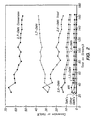
- Figure 1 is a graph plotting the yields of DMT and DMD products resulting from the hydroisomerization run of 2,7-DMN at 204.4°C (400°F) versus the time-on-stream at which the products were analyzed on-line as described in Example 6.
- Figure 2 is a graph plotting the conversion of 2,7-DMN and yields of various products resulting from an acid-catalyzed isomerization of 2,7-DMN on H-ZSM-11 versus the time-on-stream, as described in Example 11. Figure 3 is a similar graph plotting the conversion and selectivities versus the time-on-stream when the resulting 1,5-, 1,6- and 1,7-DMN as well as the unconverted 2,7-DMN are assumed to be recycled and finally converted to 2,6-DMN.
-
- This invention relates to a method of making 2,6-dimethylnaphthalene. Specifically, the invention relates to a method of using dimethylnaphthalene isomer or mixture of isomers selected from the group consisting of 1,6-dimethylnaphthalene, 1,5-dimethylnaphthalene, 2,7-dimethylnaphthalene, 1,7-dimethylnaphthalene, 1,8-dimethylnaphthalene, and partially or fully hydrogenated counterparts thereof to obtain 2,6-dimethylnaphthalene. The invention also relates to using an acid catalyst (the catalyst's acidity being measured by the catalyst's positive adsorption of ammonia, pyridine, and piperidine probes on its surface sites) with a metal in a hydroisomerization step followed by a reforming catalyst in a dehydrogenation step to obtain 2,6-dimethylnaphthalene from a dimethylnaphthalene isomer or mixture of isomers selected from the group consisting of 1,6-dimethylnaphthalene, 1,5-dimethylnaphthalene, 2,7-dimethylnaphthalene, 1,7-dimethylnaphthalene, 1,8-dimethylnaphthalene, and partially or fully hydrogenated counterparts thereof. The invention further relates to the use of a metal with an acid catalyst. This can be any metal that is effective as a catalyst in hydrogenation reactions, such as, for example, palladium, nickel, copper or platinum. In another preferred embodiment, the acid catalyst is used with a metal in a range of from 0.1 to 30 weight %. In one preferred embodiment, the metal used with the acid catalyst is palladium. In another preferred embodiment, the metal used with the acid catalyst is platinum. In yet another preferred embodiment, the metal is sulfided. Non-limiting examples of hydroisomerization catalysts which can be used are PdS/Boron-Beta (in the presence of 500 ppm aluminum), PtS/Boron-Beta (in the presence of 500 ppm aluminum), PdS/Y, and non-sulfided Pd/Boron-Beta (in the presence of 500 ppm aluminum). PtS/Boron-SSZ-33 is not as effective as a hydroisomerization catalyst because of its tendency to serve only a hydrogenating function and not to isomerize the various DMN isomers to the 2,6-DMD or -DMT isomer.
- A possible mechanism for the process of obtaining 2,6-dimethylnaphthalene from 2,7-, 1,7-, 1,8-, 1,5- and 1,6-dimethylnaphthalene with the acid catalyst and the noble metal could relate to dimethylnaphthalenes being partially or fully saturated to dimethyltetralins or dimethyldecalins on or in the catalyst. According to this possible mechanism, once at least one of the aromatic rings in dimethylnaphthalenes is saturated, the beta-beta migration of methyl groups becomes much easier because the energy barriers for such a migration are lifted by changing the reaction pathways. It appears, according to this mechanism, that if there is sufficient acidity on or in the catalyst, the saturated DMN's will isomerize near to equilibrium.
- After the above hydroisomerization, the saturated dimethylnaphthalenes must be reformed back to unsaturated dimethylnaphthalenes by dehydrogenation. For this step to work with high selectivity, i.e., avoiding non-2,6-dimethylnaphthalenes, the reforming step should be done over a catalyst which avoids transalkylation, dealkylation, and cracking reactions. In a preferred embodiment, catalysts that can be used in the reforming step are both acidic and non-acidic catalysts. A non-limiting example of an acidic catalyst that can be used is a mixture of rhenium and platinum on alumina (sulfided Pt/Re/Al2O3). Non-limiting examples of a non-acidic catalyst that can be used are sulfided Pt/Na-ZSM-5 and PtS/Cs/Boron-SSZ-42.
- An alternative method of obtaining 2,6-DMN from other DMN isomers, particularly those in the 2,7-DMN triad, is by means of an acid-catalyzed DMN isomerization. Unlike the hydroisomerization/dehydrogenation two-step process discussed above, this process proceeds in one step and does not involve the partially or fully saturated intermediate DMT and/or DMD forms. A non-limiting example of a catalyst that can be used for such an acid-catalyzed isomerization is H-ZSM-11. This process is less preferred than the hydroisomerization/dehydrogenation process discussed above because it has a tendency to produce a fair amount of methylnaphthalenes (MN) and trimethylnaphthalenes (TMN) as well as the undesired isomers of DMN. Thus, its yield of 2,6-DMN is low in comparison to the hydroisomerization/dehydrogenation process.
- In all the embodiments of the hydroisomerization/dehydrogenation process, the dimethylnaphthalene feed (neat or in solution) can be flowed over the catalyst along with hydrogen gas or the reaction can be performed batchwise. In this process, the temperature needs to be high enough to hydrogenate the dimethylnaphthalene feed and to isomerize the resulting DMD's and DMTs. The hydroisomerization reaction depends on both the hydrogenation/dehydrogenation activity and acid strength of the catalyst. Additionally, in order to generate a significant amount of DMT/DMD's, the hydrogen pressure needs to be sufficiently high. Thermodynamically, higher temperatures drive the equilibrium towards DMN while higher hydrogen pressures help shift the equilibrium towards the saturated species (DMD). The reaction kinetics, which are dependent on the catalyst type, also have a strong influence on the product selectivity in relation to the hydrogenation/dehydrogenation activity and acid strength of the catalyst. In a preferred embodiment, the yield of partially saturated species (DMT) from the hydroisomerization reaction should be at least 5 weight percent. In a more preferred embodiment, the yield of partially saturated species (DMT) should be at least 10 weight percent. Accordingly, the Weight Hourly Space Velocity (WHSV) can be varied over a broad range (e.g., about 0.1 to 100 h-1), the pressure can vary from 0-20,682kPa (0 to 3000 psig), the hydrogen/hydrocarbon molar ratio can vary from -0.0 to 100, and the reactor temperature can vary from about 148.9°C to 537.8°C (300 to 1000°F). The unreacted material and the partially hydrogenated products other than 2,6-isomers can be recycled back to the reactor or reformed back to DMN's in a separate reactor. Various product separation schemes can be used at different points of the process. Also, in one embodiment, a more conventional isomerization process to interconvert isomers within triads can be used in conjunction with this process.
- In both the hydroisomerization and the reforming step, there are many variables to be optimized. These include: run temperature, pressure, space velocity, and the catalyst itself. As shown below, when such variables are optimized, approximately 50% conversion of 2,7- to 2,6-triad can be achieved. The resulting non-2,6-DMN C12-isomers can be separated from 2,6-DMN product and recycled to the hydroisomerization reactor to be further converted to 2,6-DMN, boosting the 2,6-DMN production. Furthermore, little or no formation of 1,2-DMN, 1,3-DMN, 1,4-DMN, 2,3-DMN or TMN is encountered. There is also relatively little formation of MN's with the isomerization catalysts used. By taking measures to minimize hydrogenolysis during the isomerization reaction, such as by adding a little sulfur to the feed, formation of MN's can be minimized even further. With such results achieved with the present invention, it is now possible to achieve large scale isomerization of 2,7-, 1,7-, 1,8-, 1,5- and 1,6-DMN to 2,6-DMN. In addition, the yield of 2,6-DMN can be also increased through enhancing the DMN feedstocks by incorporating the more conventional, acid-catalyzed intra-triad isomerization of DMN's into the hydroisomerization/dehydrogenation process. Such intra-triad isomerization of DMN's may be further associated with a recycling step described above.
- In experiments described below, various hydroisomerization catalysts were used. In these experiments, there was little evidence of deactivation of the catalysts, in some cases after up to approximately three weeks of continuous use. It was also found in these experiments that the reforming step converted almost all of the saturated species back to DMN's. In fact, a ratio of ~95/5 DMN/saturated species or better can be achieved if the various conditions are optimized.
- The present invention will be further described with the following tables and figures showing the results of several experiments.
- The results of Examples 1-4 with PtS/Boron-SSZ-33 reveal that effective hydroisomerization of DMN's to DMT's requires not only a sufficient hydrogenation/dehydrogenation function such as that of PtS but also a sufficient acidity since PtS/Boron-SSZ-33 tends to serve only a hydrogenating function and not to isomerize the resulting DMT's to other DMT isomers.
- Taking advantage of these results, the DMT isomers (1,5-, 1,6-, 2,5-, 1,7-, 2,8- and 2,7-DMT) produced in Examples 1-4, together with 1,4- and 2,6-DMT which are supplied as standards by Chemsampco and API/Camegie Mellon University, respectively, are used to identify and quantify the major DMT isomers produced in the hydroisomerization step of this invention (see Example 8) on an expanded scale, it is beneficial to have the major DMD's and DMTs, especially DMT's, identified in the hydroisomerization step since it roughly gives the information on how much 2,6-isomers can be produced, useful for the prediction of 2,6-DMN yield even prior to the reforming step to be conducted after the hydroisomerization.
- An experiment was performed to hydrogenate a hydrocarbon feed of 5:1 (wt:wt) o-xylene:1,5-dimethylnaphthalene in a reactor with a PtS/Boron-SSZ-33 catalyst (0.5 g). The reaction was conducted at 204.4°C (400°F), 1380kPa (200 psig),1 ml/hr feed and 40 ml/min H2. 96% of 1,5-DMN was converted, yielding 88% 1,5-DMT and 8% DMD's and other C12's. No other DMT isomers are observed. The identification of the GC peaks was confirmed by GC/MS analysis. In this example and the examples which follow, the diluent o-xylene and its reaction products are subtracted out of the yield data shown in the tables.
- An experiment was performed to hydrogenate a hydrocarbon feed of 5:1 (wt:wt) o-xylene:1,6-dimethylnaphthalene in a reactor with a PtS/Boron-SSZ-33 catalyst (0.5 g). The reaction was conducted at 215.5°C (420°F), 1380kPa (200 psig), 0.5 ml/hr feed and 40 ml/min H2. Depending on which aromatic ring of 1,6-DMN is hydrogenated, two different DMT isomers were produced; namely, 1,6-DMT and 2,5-DMT. Basically, no other DMTs were present in the product. At 100% conversion of 1,6-DMN, 31% 1,6-DMT and 23% 2,5-DMT were yielded with other 46% as DMD's and other C12 species. The identification of the GC peaks was confirmed by GC/MS analysis.
- An experiment was performed to hydrogenate a hydrocarbon feed of 5:1 (wt:wt) o-xylene:1,7-dimethylnaphthalene in a reactor with a PtS/Boron-SSZ-33 catalyst (0.5 g). The reaction was conducted at 215.5°C (420°F), 1380kPa (200 psig), 0.5 ml/hr feed and 40 ml/min H2. Depending on which aromatic ring of 1,7-DMN is hydrogenated, two different DMT isomers were produced, namely, 1,7-DMT and 2,8-DMT. Basically, no other DMTs were present in the product. At -100% conversion of 1,7-DMN, 26% 1,7-DMT and 28% 2,8-DMT were yielded with the other 46% as DMD's and other C12 species. The identification of the GC peaks was confirmed by GC/MS analysis.
- An experiment was performed to hydrogenate a hydrocarbon feed of 5:1 (wt:wt) o-xylene:2,7-dimethylnaphthalene in a reactor with a PtS/Boron-SSZ-33 catalyst (0.5 g). The reaction was conducted at 193.3°C (380°F), 1380kPa (200 psig), 1 ml/hr feed, and 40 ml/min H2. At 100% conversion of 2,7-DMN, 2,7-DMT yield was 75%. Other 25% are DMD's and other C12's. No other DMT isomers are observed. The identification of the GC peaks is confirmed by GC/MS analysis.
- Examples 5-10 describe the results of experiments performing the hydroisomerization step without a subsequent dehydrogenation of the hydroisomerization products.
- Three experiments were performed to hydroisomerize a hydrocarbon feed of 5:1 (wt:wt) o-xylene:2,7-dimethylnaphthalene in a reactor with PdS/Y to produce DMT's and DMN's at 215.5, 204.4 and 176.7°C (420, 400 and 350°F), respectively. Other conditions were 1380kPa (200 psig), 1 ml/hr feed, 40 ml/min H2 and 0.5 g catalyst. The compositions of the products are given in weight % in Table V. No methylnaphthalenes were detected. Essentially no cracking products were observed.
Temperature (°C/°F) 215.5 /420 204.4/400 176.7/350 DMN's 3.1 2.9 2.6 DMD's + other C12's 33.2 23.5 9.0 DMT's (total) 63.7 73.6 88.4 1,5-DMT 0.4 0.2 0 1,6-DMT 1.8 1.1 0.2 2,5-DMT 4.6 3.6 0.9 1,7-DMT 2.1 1.8 1.1 2,8-DMT 4.3 3.8 1.3 2,7-DMT 29.8 45.3 78.9 2,6-DMT 20.1 17.4 5.8 1,4- DMT 0 0 0 Other DMT's 0.6 0.4 0.2 - Four experiments were performed to hydroisomerize a hydrocarbon feed of 5:1 (wt:wt) o-xylene:2,7-dimethylnaphthalene in a reactor with PdS/Y at 3450kPa (500 psig), 1 ml/hr feed, 40 ml/min H2 and 0.5 g catalyst. The reaction temperature was 193.3, 204.4, 215.5 and 226.7°C (380, 400, 420 and 440°F), respectively. The compositions of the products are given in weight % in Table VI. No methylnaphthalenes were detected. Essentially no cracking products were observed. Figure 1 demonstrates the DMT and DMD yields versus the reaction time for the run at 204.4°C (400°F). After an initial period of about 70 hours, the catalyst activity and selectivity became stable. For the next two weeks, this catalyst in the same reactor was uninterruptedly screened under various conditions with various feeds containing various DMN isomers. The results indicate no apparent deactivation of the catalyst.
Temperature (°C/°F) 226/7 440 215.5/420 204.4/400 193.3/380 DMN's 1.9 1.3 0.3 0.2 DMD's + other C12's 38.3 34.4 31.1 19.9 DMT's (total) 59.8 64.3 68.6 79.9 1,5-DMT 1.1 0.8 0.3 0.1 1,6-DMT 3.5 3.0 1.3 1.0 2,5-DMT 6.5 6.5 6.0 4.4 1,7-DMT 3.5 3.1 1.5 1.5 2,8-DMT 6.3 6.5 5.9 4.8 2,7-DMT 18.8 23.3 33.4 49.5 2,6-DMT 17.7 19.6 20.1 18.6 1,4- DMT 0 0 0 0 Other DMT's 2.4 1.5 0.1 0 - Three experiments were performed to hydroisomerize a hydrocarbon feed of 5:1 (wt:wt) o-xylene:2,7-dimethylnaphthalene in a reactor with PdS/Y at 3450kPa (500 psig), 2 ml/hr feed, 40 ml/min and 0.5 g catalyst The reaction temperature was 204.4, 215.5 and 226.7°C (400, 420 and 440°F), respectively. The compositions of the products are given in weight % in Table VII. No methylnaphthalenes were detected. Essentially no cracking products were observed.
Temperature (°C/°F) 226.7/440 215.5/420 204.4/400 DMN's 1.4 1.0 1.7 DMD's + other C12's 22.5 12.2 7.5 DMT's (total) 76.1 86.8 90.8 1,5-DMT 0.9 0.4 0.2 1,6-DMT 2.9 1.7 0.9 2,5-DMT 8.7 7.0 4.3 1,7-DMT 2.9 1.9 1.7 2,8-DMT 8.3 7.1 4.7 2,7-DMT 26.3 42.3 61.0 2,6-DMT 24.4 26.0 17.8 1,4- DMT 0 0 0 Other DMT's 1.7 0.4 0.2 - An experiment was performed to isomerize a hydrocarbon feed of 5:1 (wt:wt) o-xylene:2,7-dimethylnaphthalene in a reactor with a Pd/Boron-Beta catalyst (0.5 g) containing 500 ppm aluminum. The reaction conditions were: 246.1°C (475°F), 1380kPa (200 psig), 1 ml/hr feed, 40 ml/min H2. 89.2% of the product was DMT's. 8.7% of the product was DMD's and others. 2.1% of the product was DMN's.
- Several experiments were made to hydroisomerize a hydrocarbon feed of 5:1 (wt:wt) o-xylene:2,7-dimethylnaphthalene in a reactor with a PdS/SAPO-11 (0.5 g) with 40 ml/min H2 at a feed rate of 1 ml/hr. The results are shown in weight % in Tables IXa-IXc.
Experiment 1 Experiment 2 Experiment 3 Experiment 4 Temperature (°C/°F) 343.3/650 315.6/600 260/500 343.3/650 Pressure (kPa/psig) 1380/200 1380/200 1380/200 690/100 WHSV (h-1) 2 2 2 2 DMD's 13.0 45.2 100 14.2 DMT's 34.5 34.4 19.3 DMN (total) 52.0 20.4 65.9 2,7-DMN 24.9 11.1 46.5 1,7-DMN 6.2 1.9 6.1 1,8- DMN 0 0 0 2,6-DMN 14.5 5.7 10.5 1,6-DMN 6.2 1.6 2.7 1,5-DMN 0.2 0.1 0.1 1,3- DMN 0 0 0 2,3- DMN 0 0 0 1,4- DMN 0 0 0 1,2- DMN 0 0 0 MN's ∼0.5 ∼0.6 ∼0.3 TMN's 0 0 ∼0.1 DMN: dimethylnaphthalene; DMT: dimethyltetralin; DMD: dimethyldecalin; MN: methylnaphthalene; TMN: trimethylnaphthalene. Experiment 5 Experiment 6 Experiment 7 Experiment 8 Temperature (°C/°F) 371.1/700 385/725 385/725 385/725 Pressure (kPa/psig) 1380/200 1380/200 1030/150 1030/150 WHSV (h-1) 6 6 6 6 DMD's 2-1 1.4 0.3 trace DMT's 20.3 13.7 8.3 ∼9 DMN (total) 77.2 84.4 90.9 90.5 2,7-DMN 50.5 55.0 ∼70 ∼70 1,7-DMN 9.6 14.6 15.4 15.4 1,8-DMN 0 0 0 0 2,6-DMN 13.2 9.7 ~3 ~3 1,6-DMN 3.8 4.8 2.4 2.0 1,5-DMN 0.1 0.3 0.1 0.1 1,3-DMN 0 0 0 0 2,3-DMN 0 0 0 0 1,4-DMN 0 0 0 0 1,2-DMN 0 0 0 0 MN's ∼0.3 ∼0.5 ∼0.4 ∼0.3 TMN's ∼0.1 0 ∼0.1 0 Experiment 9 Experiment 10 Experiment 11 Experiment 11 (reanalyzed) Temperature (°C/°F) 385/725 385/725 412.8/775 412.8/775 Pressure (kPa/psig) 1030/150 1030/150 1030/150 1030/150 WHSV (h-1) 12 2 2 2 DMD's Trace trace trace 0,7 DMT's -8 8.0 5.2 4.6 DMN (total) 93.0 92.0 93.6 93.7 2,7-DMN -80 55.5 45.5 44.7 1,7-DMN ∼12 21.3 31.7 32.1 1,8-DMN 0 0 0 0 2,6-DMN Trace 8.4 8.2 8.9 1,6-DMN -1 6.5 7.4 7.5 1,5-DMN 0 0.3 0.8 0.5 1,3-DMN 0 0 0 0 2,3-DMN 0 0 0 0 1,4-DMN 0 0 0 0 1,2-DMN 0 0 trace 0 MN's 0 trace ∼0.9 0.9 TMN's(wt.%) 0 0 0.3 0.1 - Gas chromatography coupled with mass spectrometry was used to identify the products from a particular yield period (Experiment 5 in Example 9). The composition of the products from Experiment 5 at 371.1°C (700°F) 1380kPa (200psig), 6 h-1 WHSV is listed in weight % in Tables Xa and Xb. The difference between the compositions determined by on-line GC (see Table IXb) and off-line GC/MS (see Tables Xa and Xb) is apparently due to the different sensitivity of these two different analytical techniques.
DMD's C3l's DMT's MN's C6Bz + C5Tol 2.3 3.4 21.0 0.6 0.8 DMN: dimethylnaphthalene; DMT: dimethyltetralin; DMD: dimethyldecalin; MN: methylnaphthalene; C3l: indan substituted with a C3 alkyl group; C6Bz: benzene substituted with a C6 alkyl group; C5Tol: toluene substituted with a C5 alkyl group. 2,7-DMN 1,7-DMN 2,6-DMN 1,6-DMN 1,5-DMN -45.5 10.5 -11 4.2 0.2 - Example 11 shows the results of an experiment in which an acid catalyst is used without combining it with a hydrogenating catalyst.
- An experiment was performed to isomerize a hydrocarbon feed of 5:1 (wt:wt) o-xylene:2,7-dimethylnaphthalene in a reactor with an acid catalyst, H-ZSM-11 with no carrier gas at 315.5°C (600°F), ∼34.5kPa (∼5 psig), 1 ml/hr feed and 0.2 h-1 WHSV. The results are shown in graphic form in Figure 2. Assuming that the resulting 1,5-, 1,6- and 1,7-DMN as well as the unconverted 2,7-DMN are recyclable and can be finally converted to 2,6-DMN, the selectivities of the desirable 2,6-DMN and other major by-products such as MN's and TMN's then can be depicted as shown in Figure 3. it is apparent that this kind of acid-catalyzed DMN isomerization results in a significant amount of by-products such as MN's (methylnaphthalenes) and TMN's (trimethylnaphthalenes) that can be depicted as shown in Figure 3.
- Examples 12-25 describe experiments in which product of the hydroisomerization step is then dehydrogenated with a separate catalyst.
- Experiments were conducted using a two-reactor hydroisomerization/dehydrogenation system. The first reactor facilitates the hydroisomerization function and the second reactor performs the function of dehydrogenating saturated compounds back to DMN's. In the first reactor, a PdS/SAPO-11 catalyst (0.5 g) was used. In the second reactor, a PtS/Cs/Boron-SSZ-42 (0.45 g) catalyst was used. Tables Xlla and Xllb show results from using the two reactor system. The feed was composed of o-xylene and 2,7-DMN in a 5:1 (wt:wt) ratio.
Experiment 1 Experiment 2 Reactor 1 Reactor 2 Reactor 1 Reactor 2 Temperature, °C/°F 343.3/650 398.9/750 343.3/650 398.9/795 Pressure, (kPa/ psig) 1380/200 ∼34.5/∼5 138/200 ∼34.5/∼5 Feed Rate, ml/hr 1 1 1 1 H2 Rate, ml/ min 40 40 40 40 C5- <1 ∼0 <1 ∼0 DMD's 12.7 3.2 12.0 2.1 DMT's, C3l's, MN's 38.2 4.8 38.2 4.7 DMN's (total) 48.1 92.0 48.8 93.2 2,7-DMN 68.7 69.2 1,7-DMN 8.1 8.5 2,6-DMN 12.6 12.6 1,6-DMN 2.6 2.5 1,5-DMN ~0 ~0 Other DMN's ~0 ∼0 DMN: dimethylnaphthalene; DMT: dimethyltetralin; DMD: dimethyldecalin; MN: methylnaphthalene; C3I: indan substituted with a C3 alkyl group. Experiment 3 Experiment 4 Reactor 1 Reactor 2 Reactor 1 Reactor 2 Temperature, (°C/°F) 343.3/650 482.2/900 385/725 426.7/800 Pressure, (kPa/psig) 1380/200 ~34.5/~5 2780/400 ∼34.5/-5 Feed Rate, ml/hr 1 1 1 0.5 0.5 H2 Rate, ml/ min 40 40 30 30 C5- <1 ∼0 ∼5 ∼0 DMD's 11.1 0.6 14.9 5.3 DMT's, C3l's, MN's 39.0 5.2 39.6 22.7 DMN's (total) 48.9 94.2 40.3 72.0 2,7-DMN - 70.2 32.2 1,7-DMN 9.0 12.7 2,6-DMN 12.4 17.1 1,6-DMN 2.6 10.0 1,5-DMN ∼0 ∼0 Other DMN's ∼0 ∼0 - Gas chromatography (GC) coupled with mass spectrometry (MS) was used to identify the products from particular yield periods (shown in Example 12) after Reactor 2. The distributions of different non-DMN's in the non-DMN products are listed in weight % in Table XIII based on the GC/MS results.
Experiment 1 Experiment 2 Experiment 3 Experiment 4 MI's -- 1.9 9.1 -- El's -- -- 4.8 0.8 DMD's 39.5 30.8 9.4 19.0 DMT's 28.3 29.1 6.8 34.1 MEl's 3.5 3.8 -- -- MEI='s 11.0 12.3 17.2 13.6 MN's 10.1 14.8 43.8 6.1 C5Tol's 7.6 7.3 8.9 24.9 EN's -- -- -- 1.5 Ml: methylindan; El: ethylindan; DMD: dimethyldecalin; DMT: dimethyltetralin; MEI: methylethylindan; MEI=: methylethylindene; MN: methylnaphthalene; C5Tol: toluene substituted with a C5 alkyl group; EN: ethylnaphthalene. - Experiments were conducted using a two-reactor hydroisomerization/dehydrogenation system. The first reactor facilitates the hydroisomerization function and the second reactor performs the function of dehydrogenating saturated compounds back to DMN's. In the first reactor, a Pd/Boron/500 ppm Al/beta catalyst (0.5) was used. In the second reactor, a PtS/Cs/Boron-SSZ-42 (0.45 g) catalyst was used. Table XIV shows results for the example. In this example, the feed was composed of o-xylene and 2,7-DMN of a 5:1 wt:wt ratio. The slightly high yield of MN's after reactor 2 is likely related to the dealkylation of the resulting DMN's on PtS/Cs/B-SSZ-42.
Experiment 1 Experiment 2 Experiment 3 Reactor 1 Reactor 2 Reactor 1 Reactor 2 Reactor 1 Reactor 2 Temperature, (°C/°F) 279.4/535 426.7/850 260/500 454.4/850 246.1/475 426.7/850 Pressure, (kPa/psig) 1380/200 ∼34.5/∼5 1380/200 ∼34.5/∼5 1380/200 ∼34.5/∼5 Feed Rate, ml/hr 1 1 1 1 1 1 H2 Rate, ml/ min 40 40 40 40 40 40 C5- 1.8 - - ∼0.6 - <0.3 - DMD's 20.1 12.4 13.7 4.3 9.6 1.7 DMT's, C3l's 72.7 17.2 84.2 4.2 89.4 2.0 MN's ~0 3.3 ~0 3.0 ~0 3.7 DMN's (total) 5.4 67.1 1.5 86.9 0.7 92.6 2,7-DMN 21.0 32.1 41.3 1,7-DMN 11.3 10.2 6.9 2,6-DMN 20.6 31.1 34.4 1,6-DMN 13.0 12.8 10.0 1,5-DMN 0.9 0.4 - Other DMN's 0.3 0.3 - DMN: dimethylnaphthalene; DMT: dimethyltetralin; DMD: dimethyldecalin; MN: methylnaphthalene; C3l: indan substituted with a C3 alkyl group. - Further experiments were conducted using a two-reactor. hydroisomerization/dehydrogenation system similar to Example 14. The first reactor facilitates the hydroisomerization function and the second reactor performs the function of dehydrogenating saturated compounds back to DMN's. In the first reactor, a Pd/Boron/500 ppm Al/beta catalyst (0.5 g) was used. In the second reactor, a PtS/Cs/Boron-SSZ-42 (0.45 g) catalyst was . used. Table XV shows results for the example. In this example, the feed was composed of o-xylene and 2,7-DMN of a 5:1 wt:wt ratio. As described in Example 14, the slightly high yield of MN's after reactor 2 is likely related to the dealkylafion of the resulting DMN's on PtS/Cs/B-SSZ-42.
Experiment 1 Experiment 2 Reactor 1 Reactor 2 Reactor 1 Reactor 2 Temperature,(°C/°F) 246.1/475 426.7/850 246.1/475 426.7/850 Pressure, (kPa/psig) 1380/200 ∼34.5/∼5 1380/200 ∼34.5/∼5 Feed Rate, ml/hr 1.3 1.3 1.1 1.1 H2 Rate, ml/ min 40 40 40 40 C5- <1 - - - DMD's 5.0 0.9 2.7 0.8 DMT's. C3l's 94.2 1.5 96.3 2.0 MN's ∼0 2.5 ∼0 5.3 DMN's (total) 0.7 95.1 <1 91.9 2.7-DMN 51.5 42.4 1,7-DMN 4.8 6.7 2,6-DMN 32.0 33.4 1,6-DMN 6.8 9.4 1,5-DMN ∼0 ∼0 Other DMN's ∼0 ∼0 DMN: dimethylnaphthalene; DMT: dimethyltetralin; DMD: dimethyldecalin; MN: methylnaphthalene; C3l: indan substituted with a C3 alkyl group. - Gas chromatography coupled with mass spectrometry was used to identify some of the products obtained from Example 15 described. The product from Experiment 1 of Example 15 was collected from Reactor 1 only and is designated in this example as Experiment A. The product from Experiment 2 of Example 15 was collected from both Reactors 1 and 2 and is designated in this example as Experiment B. The results of the identification of the products from both experiments in weight % are shown in Table XVI. The difference between the compositions determined by GC (see Table XV of Example 15) and GC/MS (see Table XVI of this example) is apparently due to the different sensitivities of these two different analytical techniques.
Experiment A (reactor 1 only) Experiment B (reactors 1+2) N (naphthalene) 0 0.2 Ml's (methylindans) 0 0.2 El's (ethylindans) or DMI's (dimethylindans) 0 0.3 DMD's (dimethyldecalins) 13.5 1.4 DMT's (dimethyltetralins) 78.1 2.7 MEI's (methylethylindans) or TMI's (trimethylindans) 4.5 0.2 MEI='s (methylethylindenes) 0 0 MN's (methylnaphthalenes) 0 7.0 C5Tol's (C5-toluenes) 1.0 0 EN's (ethylnaphthalenes) 0 0.2 DMN's (dimethylnaphthalenes) 2.5 87.1 TMT's (trimethyltetralins) 0.4 0 TMN's (trimethylnaphthalenes) 0 0.7 - Experiments were conducted using a two-reactor hydroisomerization/dehydrogenation system. The first reactor facilitates the hydroisomerization function and the second reactor performs the function of dehydrogenating saturated compounds back to DMN's. In the first reactor, a PdS/
Siral 40 catalyst, consisting of sulfided Pd deposited oncommercial Siral 40 silica-alumina (0.5 g), was used. In the second reactor, a PtS/Cs/Boron-SSZ-42 (0.45 g) catalyst was used. Tables XVIIa and XVIIb show results in weight % for the experiments. In these experiments, the feed was composed of o-xylene and 2,7-DMN in a 5:1 (wt:wt) ratio.Experiment 1 Experiment 2 Reactor 1 Reactor 2 Reactor 1 Reactor 2 Temperature, (°C/°F) 287.7/550 426.7/850 260/500 426.7/850 Pressure, (kPa/psig) 1380/200 ∼34.5/-5 1380/200 ∼34.5/-5 Feed Rate, ml/hr 1 1 1 1 H2 Rate, ml/ min 40 40 40 40 C5- ∼1.2 - ∼0.7 - DMD's 55.8 22.5 42.9 13.4 DMT's, C3l's 38.8 13.2 54.7 6.7 MN's ∼0 2.6 ∼0 3.7 DMN's (total) 4.1 61.7 1.7 76.2 2,7-DMN 28.5 39.2 1,7-DMN 5.5 8.1 2,6-DMN 18.6 19.5 1,6-DMN 6.7 8.4 1,5-DMN 0.5 0.5 Other DMN's 1.9 (2,3- & 1,2-DMN) 0.5 (2,3- & 1,2-DMN) (also 0.3 TMN's) DMN: dimethylnaphthalene; DMT: dimethyltetralin; DMD: dimethyldecalin; MN: methylnaphthalene; C3l: indan with a C3 alkyl group; TMN: trimethylnaphthalene. Experiment 3 Experiment 4 Reactor 1 Reactor 2 Reactor 1 Reactor 2 Temperature, (°C/°F) 260/500 426.7/850 246.1/475 426.7/850 Pressure, (kPa/psig) 1380/200 ∼34.5/-5 1380/200 ∼34.5/-5 Feed Rate, ml/hr 1 1 1 1 H2 Rate, ml/ min 40 40 40 40 C5- ∼0.3 - ∼0.4 - DMD's 28.9 7.7 27.0 5.5 DMT's, C3l's 69.4 2.0 71.8 1.4 MN's ∼0 4.2 ∼0 5.1 DMN's (total) 1.4 86.1 0.8 88.0 2,7-DMN 47.9 59.4 1,7-DMN 7.1 4.7 2,6-DMN 24.6 19.6 1,6-DMN 6.5 4.1 1,5-DMN - 0.2 Other DMN's - trace - In Example 8, a hydrocarbon feed of 5:1 (wt:wt) o-xylene:2,7-dimethylnaphthalene was hydroisomerized in a reactor with a Pd/Boron/Al/Beta catalyst (0.5 g) containing 500 ppm aluminum at 246.1°C (475°F) and 1380kPa (200 psig) .The hydroisomerization products including the solvent o-xylene were collected and then dehydrogenated by being subjected as feed to PtS/Na-ZSM-5 in a reactor at 426.7°C (850°F), 690kPa (100 psig), 0.5 ml/hr feed, 23 ml/min H2 and 0.5 g catalyst. The compositions of the feed for the dehydrogenation reaction (hydroisomerization products of 2,7 DMN in Example 8) and its dehydrogenation product are shown in weight % in Table XVIII.
2,7-DMN (used as feed for hydroisomerization) Feed for dehydrogenation (made from 2,7-DMN hydroisomerization) Product of dehydrogenation DMN's (total) 100 2.1 94.2 2,7- DMN 100 0.9 50.1 2,6- DMN 0 0.6 27.5 1,7- DMN 0 0.2 7.3 1,6- DMN 0 0.2 9.1 1,5- DMN 0 0.1 0.2 other DMN's 0 0.1 0 DMD's + other C12's 0 8.7 1.7 DMTs (total) 0 89.2 4.1 1,5- DMT 0 0.1 0 1,6- DMT 0 2.4 0.1 2,5- DMT 0 6.2 0.2 1,7- DMT 0 2.4 0.1 2,8- DMT 0 4.5 0.2 2,7- DMT 0 43.7 1.7 2,6- DMT 0 29.2 1.0 1,4- DMT 0 0 0 Other DMT's 0 0.7 0.8 MN's 0 0 0 - In Example 6, a hydrocarbon feed of 5:1 (wt:wt) o-xylene:2,7-dimethylnaphthalene was hydroisomerized in a reactor with PdS/Y (0.5 g) catalyst at 204.4°C (400°F) and 3450kPa (500 psig). The hydroisomertization products including the solvent o-xylene were collected and then dehydrogenated by being subjected as feed to PtS/Na-ZSM-5 in a reactor at 426.7°C (850°F), 690 kPa (100 psig), 0.5 ml/hr feed, 23 ml/min H2 and 0.5 g catalyst. The compositions of the feed (hydroisomerization products of 2,7-DMN in Example 6) and its dehydrogenation product are shown in weight % in Table XIX. The dehydrogenation catalyst was stable under these condition for at least 9 days.
2,7-DMN (used as feed for hydroisomerization) Feed for dehydrogenation (made from 2,7-DMN hydroisomerization) Product of dehydrogenation DMN's (total) 100 0.3 94.8 2,7- DMN 100 0.1 52.7 2,6- DMN 0 0.1 22.3 1,7- DMN 0 0.1 9.7 1,6- DMN 0 0 8.9 1,5- DMN 0 0 0.9 Other DMN's 0 0 0.3 DMD's + other C12's O 31.1 1.0 DMT's (total) 0 68.6 1.6 1,5- DMT 0 0.3 0 1,6- DMT 0 1.3 0.1 2,5- DMT 0 6.0 0.1 1,7- DMT 0 1.5 0.1 2,8- DMT 0 5.9 0.1 2,7- DMT 0 33.4 0.4 2,6- DMT 0 20.1 0.3 1,4- DMT 0 0 0 Other DMTs 0 0.1 0.5 MN's 0 0 2.6 - A hydrocarbon feed of 5:1 (wt:wt) o-xylene:2,7-dimethylnaphthalene was hydroisomerized in a reactor with PdS/Y catalyst at 176.7-246.1°C (350-475°F), 1380kPa (200psig), 1.0 ml/hr feed, 40 ml/min H2 and 0.5 g catalyst. The hydroisomerization product including the solvent o-xylene was collected and then dehydrogenated by being fed to a sulfided Pt/Re/Al2O3 catalyst (0.3 wt. % Pt, 0.3 wt % Re, 1.1 wt. % Cl on Al2O3) in a reactor at 426.7°C (850°F) 690kPa (100 psig), 0.3 ml/hr feed, 23 ml/min H2 and 0.5 g catalyst. It appears that due to the acidic properties of Pt/Re/Al2O3 catalyst a significant amount of methylnaphthalenes were produced as by-products in the dehydrogenation step when Pt/Re/Al2O3 was used as dehydrogenation catalyst. The compositions of the 2,7-DMN feed (for the hydroisomerization), the dehydrogenation feed (hydroisomerization products of 2,7-DMN) and the dehydrogenation product are shown in weight % in Table XX.
2,7-DMN (used as feed for hydroisomerization) Feed for dehydrogenation (made from 2,7-DMN hydroisomerization) Product of dehydrogenation DMN's (total) 100 0.8 85.3 2,7- DMN 100 0.4 27.5 2,6- DMN 0 0.2 15.9 1,7- DMN 0 0.1 22.3 1,6- DMN 0 0.1 16.4 1,5- DMN 0 0 2.9 Other DMN's 0 0 0.3 DMD's + other C12's 0 32.5 2.7 DMT's (total) 0 66.7 ∼0 1,5- DMT 0 0.2 ∼0 1,6- DMT 0 1.4 ∼0 2,5- DMT 0 3.4 ∼0 1,7- DMT 0 1.9 ∼0 2,8- DMT 0 3.5 ∼0 2,7- DMT 0 42.7 ∼0 2,6- DMT 0 13.5 ∼0 1,4- DMT 0 0 ∼0 Other DMT's 0 0.1 ∼0 1- MN 0 0 3.5 2- MN 0 0 8.3 TMN's 0 0 0.2 - In Example 1, a hydrocarbon feed of 5:1 (wt:wt) o-xylene:1,5-dimethylnaphthalene was hydrogenated in a reactor with a PtS/Boron-SSZ-33 catalyst (0.5 g) at 204.4°C (400°F) and 1380kPa (200 psig). The hydrogenation products including the solvent o-xylene were collected and then dehydrogenated by being fed to PtS/Na-ZSM-5 in a reactor at 426.7°C (850°F), 690kPa (100 psig), 0.5 ml/hr feed, 23 ml/min H2 and 0.5 g catalyst. As described in Example 1, in the hydrogenation step, 96% of 1,5-DMN was converted, yielding 88% 1,5-DMT and 8% DMD's and other C12's. No other DMT isomers were observed. In the dehydrogenation step of this example, the resulting dehydrogenation product has the following composition: ∼0% DMD's and other C12's, 0.9% 1,5-DMT, 1.3% other DMT's, 96.5% 1,5-DMN, 1.3% 1,6/1,7-DMN. No MN's were detected. Since PtS/Na-ZSM-5 works for the "bulky" 1,5-isomers as demonstrated in this example, this catalyst. apparently also works for the dehydrogenation of other DMN isomers.
- A hydrocarbon feed of 5:1 (wt:wt) o-xylene:1,5-dimethylnaphthalene was hydroisomerized in a reactor with a PdS/Y catalyst at 226.7°C (440°F) 3450kPa(500 psig), 0.5 ml/hr feed, 40 ml/min H2 and 0.5 g catalyst. The hydroisomerization products including the solvent o-xylene were collected and then dehydrogenated by being fed to a PtS/Na-ZSM-5 in a reactor at 426.7°C (850°F), 690kPa (100 psig), 0.5 ml/hr feed, 23 ml/min H2 and 0.5 g catalyst. The compositions of the 1,5-DMN feed (for the hydroisomerization), the dehydrogenation feed (hydroisomerization products of 1,5-DMN), and the dehydrogenation product are shown in weight % in Table XXII.
1,5-DMN (used as feed for hydroisomerization) Feed for dehydrogenation (made from 1,5-DMN hydroisomerization) Product of dehydrogenation DMN's (total) 100 2.6 81.7 2,7- DMN 0 0.7 12.9 2,6- DMN 0 0.6 13.3 1,7- DMN 0 0.3 20.9 1,6- DMN 0 0.2 26.3 1,5- DMN 100 0.1 7.9 Other DMN's 0 0.7 0.4 DMD's + other C12's 0 26.2 7.5 DMT's (total) 0 70.8 5.6 1,5- DMT 0 6.5 0.2 1,6- DMT 0 14.3 0.1 2,5- DMT 0 6.7 0.1 1,7- DMT 0 12.7 0.2 2,8- DMT 0 4.7 0.1 2,7- DMT 0 9.7 0.1 2,6- DMT 0 10.7 0.2 1,4- DMT 0 0 0 Other DMT's 0 5.5 4.6 1- MN 0 0 2.2 2- MN 0 0 2.0 TMN's 0 0.4 1.0 - A hydrocarbon feed of 5:1 (wt:wt) o-xylene:1,6-dimethylnaphthalene was hydroisomerized in a reactor with PdS/Y catalyst at 226.7°C (440°F) 3450 kPa (500 psig), 0.5 ml/hr feed, 40 ml/min H2 and 0.5 g catalyst. The hydroisomerization products including the solvent o-xylene were collected and then dehydrogenated by being subjected as feed to a PtS/Na-ZSM-5 in a reactor at 426.7°C (850°F), 690kPa (100 psig), 0.5 ml/hr feed, 23 ml/min H2 and 0.5 g catalyst. The compositions of the 1,6-DMN feed (for the hydroisomerization), the dehydrogenation feed (hydroisomerization products of 1,6-DMN) and the dehydrogenation product are shown in weight % in Table XXIII.
1,6-DMN (used as feed for hydroisomerization) Feed for dehydrogenation (made from 1,6-DMN hydroisomerization) Product of dehydrogenation DMN's (total) 100 2.2 86.8 2,7- DMN 0 0.5 11.0 2,6- DMN 0 0.3 16.9 1,7-DMN 0.7 0.3 18.7 1,6-DMN 98.0 0.5 33.8 1,5-DMN 0.7 0.1 5.8 Other DMN's 0.6 0.5 0.6 DMD's + other C12's 0 10.4 2.7 DMT's (total) 0 86.4 4.7 1,5- DMT 0 5.6 0.1 1,6- DMT 0 17.8 0.1 2,5- DMT 0 13.9 0.1 1,7- DMT 0 11.9 0.1 2,8- DMT 0 5.7 0.1 2,7- DMT 0 10.0 0.1 2,6- DMT 0 16.6 0.6 1,4- DMT 0 0 0 Other DMT's 0 4.9 3.5 1- MN 0 0 1.7 2- MN 0 0 1.7 TMN's 0 1.0 2.4 - A hydrocarbon feed of 5:1 (wt:wt) o-xylene:1,7-dimethylnaphthalene was hydroisomerized in a reactor with PdS/Y catalyst at 226.7°C (440°F), 3450kPa (500 psig.) 0.5 ml/hr feed, 40 ml/min H2 and 0.5 g catalyst. The hydroisomerization products including the solvent o-xylene were collected and then dehydrogenated by being fed to PtS/Na-ZSM-5 in a reactor at 426.7°C (850°F), 690kPa (100 psig), 1.0 ml/hr feed, 23 ml/min H2 and 0.5 g catalyst. The compositions of the 1,7-DMN feed (for the hydroisomerization), the dehydrogenation feed (hydroisomerization products of 1,7-DMN), and the dehydrogenation product are shown in weight % in Table XXIV.
1,7-DMN(used as feed for hydroisomerization) Feed for dehydrogenation (made from 1,7-DMN hydroisomerization) Product of dehydrogenation DMN's (total) 100 2.4 78.4 2,7- DMN 0 0.5 20.2 2,6- DMN 0 0.4 17.0 1,7- DMN 100 0.2 19.4 1,6- DMN 0 0.2 18.2 1,5- DMN 0 0.1 3.0 Other DMN's 0 1.0 0.6 DMD's + other C12's 0 40.4 10.0 DMT's (total) 0 57.2 5.6 1,5- DMT 0 2.3 0.2 1,6- DMT 0 7.1 0.1 2,5- DMT 0 5.7 0.2 1,7- DMT 0 6.9 0.2 2,8- DMT 0 5.5 0.2 2,7- DMT 0 12.4 0.2 2,6- DMT 0 12.6 0.3 1,4- DMT 0 0 0 Other DMT's 0 4.7 4.2 1- MN 0 0 1.9 2- MN 0 0 2.8 TMN's 0 0 1.3 - A hydrocarbon feed of 5:1 (wt:wt) o-xylene:DMN mixture (approximately 2,7-DMN:1,7-DMN:1,6-DMN:1,5-DMN = 2:2:2:1 by weight) was hydroisomerized in a reactor with PdS/Y catalyst at 215.5°C (420°F), 3450kPa (500 psig), 1.0 ml/hr feed, 40 ml/min H2 and 0.5 g catalyst. The hydroisomerization products including the solvent o-xylene were collected and then dehydrogenated by being fed to PtS/Na-ZSM-5 in a reactor at 426.7°C (850°F), 690kPa (100 psig), 1.0 ml/hr feed, 23 ml/min H2 and 0.5 g catalyst. The compositions of the DMN mixture feed (for the hydroisomerization), the dehydrogenation feed (hydroisomenzation products of DMN mixture), and the dehydrogenation product are shown in weight % in Table XXV.
DMN mixture (used as feed for hydroisomerization) Feed for dehydrogenation (made from DMN mixture hydroisomerization) Product of dehydrogenation DMN's (total) 100 1.5 87.8 2,7-DMN 28.3 0.4 23.2 2,6- DMN 0 0.3 18.3 1,7-DMN 28.7 0.1 20.4 1,6-DMN 28.4 0.1 21.0 1,5-DMN 14.6 0.1 4.0 Other DMN's 0 0.5 0.9 DMD's + other C12's 0 45.1 6.3 DMT's (total) 0 53.4 2.1 1,5- DMT 0 2.2 0.1 1,6- DMT 0 6.8 0.1 2,5- DMT 0 5.5 0.1 1,7- DMT 0 6.6 0.2 2,8- DMT 0 5.1 0.1 2,7- DMT 0 12.1 0.2 2,6- DMT 0 12.1 0.3 1,4- DMT 0 0 0 Other DMTs 0 3.0 1.0 1- MN 0 0 1.3 2- MN 0 0 1.9 TMN's 0 0 0.6
Claims (18)
- A method of making 2,6-dimethylnaphthalene comprising:(a) contacting a hydrocarbon feed comprising a dimethylnaphthalene isomer or mixture of isomers selected from the group consisting of 1,6-dimethylnaphthalene, 1,5-dimethylnaphthalene, 2,7-dimethylnaphthalene, 1,7-dimethylnaphthalene, 1,8-dimethylnaphthalene, and partially or fully hydrogenated counterparts thereof with an acidic catalyst in the presence of hydrogen gas to obtain a hydroisomerized mixture comprising 2,6-dimethyltetralin, 2,6-dimethyldecalin; and(b) contacting the hydroisomerized mixture with a reforming catalyst to dehydrogenate the hydroisomerized mixture thus obtaining a dehydrogenated mixture comprising 2,6-dimethylnaphthalene.
- The method of Claim 1 further comprising recycling through step (a) and step (b) hydrocarbons other than 2,6-dimethylnaphthalene, 2,6-dimethyldecalin, and 2,6-dimethyltetralin from the hydroisomerized mixture produced in step (a) and/or hydrocarbons other than 2,6-dimethylnaphthalene from the dehydrogenated mixture of step (b) to yield additional 2,6-DMN.
- The method of Claim 1 further comprising contacting the feed mixture before and/or after step (a) with an acidic catalyst under conditions sufficient to maximize production of 2,6-DMN through intra-triad isomerization of DMN.
- The method of Claim 1 wherein the feed mixture is neat or in solution.
- The method of Claim 1 wherein the weight hourly space velocity is in a range from 0.1 to 100 hr-1.
- The method of Claim 1 wherein the molar ratio of hydrogen to hydrocarbon in step (a) is in a range from 0.1 to 100.
- The method of Claim 1 wherein step (a) is conducted at a temperature in a range from 148.9°C (300°F) to 537.8°C (1000°F).
- The method of Claim 1 wherein the catalyst in step (a) is selected from the group consisting of oxides of silica, boron, aluminum, gallium, germanium, iron, chromium, zirconium and mixtures thereof.
- The method of Claim 8 wherein the catalyst in step (a) further comprises a noble metal.
- The method of Claim 9 wherein the noble metal is in a range from 0.1 to 10% by weight of the catalyst in step (a).
- The method of Claim 9 wherein the noble metal is selected from the group consisting of palladium and platinum.
- The method of Claim 8 wherein the catalyst in step (a) is selected from the group consisting of amorphous materials and zeolitic materials.
- The method of Claim 12 wherein the catalyst in step (a) is selected from the group consisting of SAPO-11, Al/B/beta catalyst, Y zeolite and amorphous silica-aluminum catalyst.
- The method of Claim 1 wherein the catalyst in step (b) comprises a catalyst which is substantially non-acidic.
- The method of Claim 14 wherein the non-acidic catalyst in step (b) is selected from the group consisting of Pt/Na-ZSM-5 and Pt/Cs/B-SSZ-42,
- The method of Claim 14 wherein the non-acidic catalyst in step (b) is sulfided.
- The method of Claim 1 wherein the catalyst in step (b) comprises an acidic reforming catalyst
- The method of Claim 17 wherein the acidic reforming catalyst in step (b) is Pt/Re on alumina.
Applications Claiming Priority (3)
| Application Number | Priority Date | Filing Date | Title |
|---|---|---|---|
| US892508 | 1997-07-14 | ||
| US08/892,508 US6015930A (en) | 1997-07-14 | 1997-07-14 | Method of making 2,6-dimethylnaphthalene from other dimethylnaphthalene isomers and from dimethyltetralins/dimethyldecalins with a methyl group on each ring |
| PCT/US1998/009928 WO1999003805A1 (en) | 1997-07-14 | 1998-05-14 | Method of making 2,6-dimethylnaphthalene from other dimethylnaphthalene isomers and from dimethyltetralins/dimethyldecalins with a methyl group on each ring |
Publications (2)
| Publication Number | Publication Date |
|---|---|
| EP0996608A1 EP0996608A1 (en) | 2000-05-03 |
| EP0996608B1 true EP0996608B1 (en) | 2002-07-03 |
Family
ID=25400042
Family Applications (1)
| Application Number | Title | Priority Date | Filing Date |
|---|---|---|---|
| EP98921216A Expired - Lifetime EP0996608B1 (en) | 1997-07-14 | 1998-05-14 | Method of making 2,6-dimethylnaphthalene from other dimethylnaphthalene isomers and from dimethyltetralins/dimethyldecalins with a methyl group on each ring |
Country Status (13)
| Country | Link |
|---|---|
| US (1) | US6015930A (en) |
| EP (1) | EP0996608B1 (en) |
| JP (1) | JP2001510175A (en) |
| KR (1) | KR20010021765A (en) |
| CN (1) | CN1119305C (en) |
| AU (1) | AU7387998A (en) |
| BR (1) | BR9810709A (en) |
| CA (1) | CA2295538A1 (en) |
| DE (1) | DE69806387T2 (en) |
| ID (1) | ID23664A (en) |
| MY (1) | MY133173A (en) |
| TW (1) | TW577872B (en) |
| WO (1) | WO1999003805A1 (en) |
Families Citing this family (7)
| Publication number | Priority date | Publication date | Assignee | Title |
|---|---|---|---|---|
| KR100621823B1 (en) * | 2004-07-21 | 2006-09-14 | 재단법인서울대학교산학협력재단 | Method for producing 2,6-dialkyltetraline |
| GB0504079D0 (en) * | 2005-02-28 | 2005-04-06 | Davy Process Techn Ltd | Process |
| US11208514B2 (en) | 2008-03-20 | 2021-12-28 | Chevron Phillips Chemical Company Lp | Silica-coated alumina activator-supports for metallocene catalyst compositions |
| US7884163B2 (en) | 2008-03-20 | 2011-02-08 | Chevron Phillips Chemical Company Lp | Silica-coated alumina activator-supports for metallocene catalyst compositions |
| HUE030927T2 (en) | 2009-06-12 | 2017-06-28 | Albemarle Europe Sprl | Sapo molecular sieve catalysts and their preparation and uses |
| CN104447179A (en) * | 2013-09-24 | 2015-03-25 | 中国石油化工股份有限公司 | Method for producing 2,6-dimethylnaphthalene by utilizing amyl alcohol |
| CN104447180A (en) * | 2013-09-24 | 2015-03-25 | 中国石油化工股份有限公司 | Method for producing 2,6-dimethylnaphthalene by using amylene in fischer-tropsch reaction product |
Family Cites Families (4)
| Publication number | Priority date | Publication date | Assignee | Title |
|---|---|---|---|---|
| US3243469A (en) * | 1962-08-10 | 1966-03-29 | Schneider Abraham | Production of 2, 6-dimethyl-naphthalene |
| US3890403A (en) * | 1973-11-14 | 1975-06-17 | Teijin Ltd | Process for separating and recovering 2,6-dimethylnaththalenes |
| US5004853A (en) * | 1988-03-29 | 1991-04-02 | Uop | Continuous process for the production of 2,6-dimethylnaphthalene |
| US5189234A (en) * | 1991-10-31 | 1993-02-23 | Amoco Corporation | Selective dehydrogenation processes and catalysts |
-
1997
- 1997-07-14 US US08/892,508 patent/US6015930A/en not_active Expired - Fee Related
-
1998
- 1998-05-14 CN CN98807159A patent/CN1119305C/en not_active Expired - Fee Related
- 1998-05-14 AU AU73879/98A patent/AU7387998A/en not_active Abandoned
- 1998-05-14 KR KR1020007000328A patent/KR20010021765A/en not_active Withdrawn
- 1998-05-14 JP JP2000503039A patent/JP2001510175A/en active Pending
- 1998-05-14 EP EP98921216A patent/EP0996608B1/en not_active Expired - Lifetime
- 1998-05-14 DE DE69806387T patent/DE69806387T2/en not_active Expired - Fee Related
- 1998-05-14 BR BR9810709-7A patent/BR9810709A/en not_active IP Right Cessation
- 1998-05-14 ID IDW20000057A patent/ID23664A/en unknown
- 1998-05-14 WO PCT/US1998/009928 patent/WO1999003805A1/en not_active Ceased
- 1998-05-14 CA CA002295538A patent/CA2295538A1/en not_active Abandoned
- 1998-06-15 TW TW087109494A patent/TW577872B/en active
- 1998-07-13 MY MYPI98003191A patent/MY133173A/en unknown
Also Published As
| Publication number | Publication date |
|---|---|
| CN1119305C (en) | 2003-08-27 |
| DE69806387T2 (en) | 2003-03-20 |
| BR9810709A (en) | 2000-08-08 |
| JP2001510175A (en) | 2001-07-31 |
| KR20010021765A (en) | 2001-03-15 |
| MY133173A (en) | 2007-10-31 |
| CN1263518A (en) | 2000-08-16 |
| US6015930A (en) | 2000-01-18 |
| TW577872B (en) | 2004-03-01 |
| ID23664A (en) | 2000-05-11 |
| EP0996608A1 (en) | 2000-05-03 |
| DE69806387D1 (en) | 2002-08-08 |
| WO1999003805A1 (en) | 1999-01-28 |
| CA2295538A1 (en) | 1999-01-28 |
| AU7387998A (en) | 1999-02-10 |
Similar Documents
| Publication | Publication Date | Title |
|---|---|---|
| US4899012A (en) | Catalyst for the isomerization of aromatics | |
| EP1062193B1 (en) | Method of making dimethylnaphtalenes | |
| US3855328A (en) | Isomerization and/or transalkylation and/or disproportionation of alkylnaphthalenes | |
| US6015930A (en) | Method of making 2,6-dimethylnaphthalene from other dimethylnaphthalene isomers and from dimethyltetralins/dimethyldecalins with a methyl group on each ring | |
| US3890403A (en) | Process for separating and recovering 2,6-dimethylnaththalenes | |
| US5004853A (en) | Continuous process for the production of 2,6-dimethylnaphthalene | |
| US3888938A (en) | Process for obtaining 2,6-dimethylnaphthalene-rich or 2,7-dimethylnaphthalene-rich product | |
| US3775496A (en) | Preparation of 2,6-dimethylnaphthalene and 2,7-dimethylnaphthalene | |
| JP4757966B2 (en) | Method for producing 2,6-dimethylnaphthalene | |
| US3919339A (en) | Hydrogenolysis/isomerization process | |
| CA2315628A1 (en) | Method for producing 2,6-dmn from mixed dimethylnaphthalenes by crystallization, adsorption and isomerization | |
| US4962260A (en) | Preparation of a dimethylnaphthalene | |
| CA2323305C (en) | Process for the preparation of 2,6-dimethylnaphthalene | |
| Röbschläger et al. | Reaction mechanism of ethylbenzene isomerization | |
| MXPA00000333A (en) | Method of making 2,6-dimethylnaphthalene from other dimethylnaphthalene isomers and from dimethyltetralins/dimethyldecalins with a methyl group on each ring | |
| US4740647A (en) | Cyclization catalyst | |
| Raichle et al. | Preparation of a high-quality synthetic steamcracker feedstock from methylcyclohexane on acidic zeolite H-ZSM-5: influence of the hydrogen partial pressure | |
| EP0841316B1 (en) | Process for preparing 2-methylnaphthalene | |
| US5118892A (en) | Preparation of a dimethylnaphthalene | |
| US4783569A (en) | Selective gas-phase isomerization of dimethylnaphthalene: 2,6-DMN triad | |
| US5446226A (en) | Process for producing dimethylnaphthalene | |
| US3928482A (en) | Process for conversion of alkyldecalins and/or alkyltetralins | |
| KR100345344B1 (en) | Process for the Preparation of 2,6-Dimethylnaphthalene from 5-ortho-Tolylpentene | |
| US3261876A (en) | Method for producing vicinal polymethylbenzenes | |
| US3188358A (en) | Preparation of methylpentalane |
Legal Events
| Date | Code | Title | Description |
|---|---|---|---|
| PUAI | Public reference made under article 153(3) epc to a published international application that has entered the european phase |
Free format text: ORIGINAL CODE: 0009012 |
|
| 17P | Request for examination filed |
Effective date: 20000214 |
|
| AK | Designated contracting states |
Kind code of ref document: A1 Designated state(s): DE FR GB IT NL |
|
| RIN1 | Information on inventor provided before grant (corrected) |
Inventor name: CHEN, CONG-YAN Inventor name: SANTILLI, DONALD, S. |
|
| RAP1 | Party data changed (applicant data changed or rights of an application transferred) |
Owner name: CHEVRON CHEMICAL COMPANY LLC |
|
| GRAG | Despatch of communication of intention to grant |
Free format text: ORIGINAL CODE: EPIDOS AGRA |
|
| 17Q | First examination report despatched |
Effective date: 20010726 |
|
| GRAG | Despatch of communication of intention to grant |
Free format text: ORIGINAL CODE: EPIDOS AGRA |
|
| GRAH | Despatch of communication of intention to grant a patent |
Free format text: ORIGINAL CODE: EPIDOS IGRA |
|
| GRAH | Despatch of communication of intention to grant a patent |
Free format text: ORIGINAL CODE: EPIDOS IGRA |
|
| RAP1 | Party data changed (applicant data changed or rights of an application transferred) |
Owner name: CHEVRON PHILLIPS CHEMICAL COMPANY LP |
|
| GRAA | (expected) grant |
Free format text: ORIGINAL CODE: 0009210 |
|
| RAP1 | Party data changed (applicant data changed or rights of an application transferred) |
Owner name: CHEVRON PHILLIPS CHEMICAL COMPANY LP |
|
| AK | Designated contracting states |
Kind code of ref document: B1 Designated state(s): DE FR GB IT NL |
|
| REF | Corresponds to: |
Ref document number: 69806387 Country of ref document: DE Date of ref document: 20020808 |
|
| ET | Fr: translation filed | ||
| PGFP | Annual fee paid to national office [announced via postgrant information from national office to epo] |
Ref country code: GB Payment date: 20030401 Year of fee payment: 6 |
|
| PGFP | Annual fee paid to national office [announced via postgrant information from national office to epo] |
Ref country code: NL Payment date: 20030403 Year of fee payment: 6 |
|
| PGFP | Annual fee paid to national office [announced via postgrant information from national office to epo] |
Ref country code: FR Payment date: 20030505 Year of fee payment: 6 |
|
| PLBE | No opposition filed within time limit |
Free format text: ORIGINAL CODE: 0009261 |
|
| STAA | Information on the status of an ep patent application or granted ep patent |
Free format text: STATUS: NO OPPOSITION FILED WITHIN TIME LIMIT |
|
| PGFP | Annual fee paid to national office [announced via postgrant information from national office to epo] |
Ref country code: DE Payment date: 20030530 Year of fee payment: 6 |
|
| 26N | No opposition filed |
Effective date: 20030404 |
|
| PG25 | Lapsed in a contracting state [announced via postgrant information from national office to epo] |
Ref country code: GB Free format text: LAPSE BECAUSE OF NON-PAYMENT OF DUE FEES Effective date: 20040514 |
|
| PG25 | Lapsed in a contracting state [announced via postgrant information from national office to epo] |
Ref country code: NL Free format text: LAPSE BECAUSE OF NON-PAYMENT OF DUE FEES Effective date: 20041201 Ref country code: DE Free format text: LAPSE BECAUSE OF NON-PAYMENT OF DUE FEES Effective date: 20041201 |
|
| GBPC | Gb: european patent ceased through non-payment of renewal fee |
Effective date: 20040514 |
|
| PG25 | Lapsed in a contracting state [announced via postgrant information from national office to epo] |
Ref country code: FR Free format text: LAPSE BECAUSE OF NON-PAYMENT OF DUE FEES Effective date: 20050131 |
|
| NLV4 | Nl: lapsed or anulled due to non-payment of the annual fee |
Effective date: 20041201 |
|
| REG | Reference to a national code |
Ref country code: FR Ref legal event code: ST |
|
| PG25 | Lapsed in a contracting state [announced via postgrant information from national office to epo] |
Ref country code: IT Free format text: LAPSE BECAUSE OF NON-PAYMENT OF DUE FEES Effective date: 20050514 |