EP0994930B1 - Film-forming compositions - Google Patents
Film-forming compositions Download PDFInfo
- Publication number
- EP0994930B1 EP0994930B1 EP98934427A EP98934427A EP0994930B1 EP 0994930 B1 EP0994930 B1 EP 0994930B1 EP 98934427 A EP98934427 A EP 98934427A EP 98934427 A EP98934427 A EP 98934427A EP 0994930 B1 EP0994930 B1 EP 0994930B1
- Authority
- EP
- European Patent Office
- Prior art keywords
- film
- forming composition
- weight
- percent
- polymer
- Prior art date
- Legal status (The legal status is an assumption and is not a legal conclusion. Google has not performed a legal analysis and makes no representation as to the accuracy of the status listed.)
- Expired - Lifetime
Links
- 239000000203 mixture Substances 0.000 title claims abstract description 92
- 239000000178 monomer Substances 0.000 claims abstract description 59
- 239000002253 acid Substances 0.000 claims abstract description 42
- -1 vinyl aromatic compound Chemical class 0.000 claims abstract description 35
- 229920000642 polymer Polymers 0.000 claims abstract description 34
- 229920003180 amino resin Polymers 0.000 claims abstract description 27
- 125000004432 carbon atom Chemical group C* 0.000 claims abstract description 21
- 125000002768 hydroxyalkyl group Chemical group 0.000 claims abstract description 14
- SMZOUWXMTYCWNB-UHFFFAOYSA-N 2-(2-methoxy-5-methylphenyl)ethanamine Chemical compound COC1=CC=C(C)C=C1CCN SMZOUWXMTYCWNB-UHFFFAOYSA-N 0.000 claims abstract description 12
- 125000000217 alkyl group Chemical group 0.000 claims abstract description 12
- CERQOIWHTDAKMF-UHFFFAOYSA-N Methacrylic acid Chemical compound CC(=C)C(O)=O CERQOIWHTDAKMF-UHFFFAOYSA-N 0.000 claims abstract description 10
- 239000004615 ingredient Substances 0.000 claims abstract description 10
- 239000003431 cross linking reagent Substances 0.000 claims abstract description 9
- 229920002554 vinyl polymer Polymers 0.000 claims abstract description 9
- 125000005907 alkyl ester group Chemical group 0.000 claims abstract description 7
- 239000002131 composite material Substances 0.000 claims abstract description 7
- 238000005530 etching Methods 0.000 claims abstract description 5
- 238000000576 coating method Methods 0.000 claims description 32
- 239000007787 solid Substances 0.000 claims description 31
- PPBRXRYQALVLMV-UHFFFAOYSA-N Styrene Natural products C=CC1=CC=CC=C1 PPBRXRYQALVLMV-UHFFFAOYSA-N 0.000 claims description 23
- OKKJLVBELUTLKV-UHFFFAOYSA-N Methanol Chemical compound OC OKKJLVBELUTLKV-UHFFFAOYSA-N 0.000 claims description 21
- 239000011248 coating agent Substances 0.000 claims description 21
- 239000004593 Epoxy Substances 0.000 claims description 17
- 150000001875 compounds Chemical class 0.000 claims description 16
- LRHPLDYGYMQRHN-UHFFFAOYSA-N N-Butanol Chemical compound CCCCO LRHPLDYGYMQRHN-UHFFFAOYSA-N 0.000 claims description 15
- ZXEKIIBDNHEJCQ-UHFFFAOYSA-N isobutanol Chemical compound CC(C)CO ZXEKIIBDNHEJCQ-UHFFFAOYSA-N 0.000 claims description 12
- 229920005989 resin Polymers 0.000 claims description 12
- 239000011347 resin Substances 0.000 claims description 12
- 239000003795 chemical substances by application Substances 0.000 claims description 10
- NIXOWILDQLNWCW-UHFFFAOYSA-N 2-Propenoic acid Natural products OC(=O)C=C NIXOWILDQLNWCW-UHFFFAOYSA-N 0.000 claims description 9
- 239000007795 chemical reaction product Substances 0.000 claims description 7
- 229920002818 (Hydroxyethyl)methacrylate Polymers 0.000 claims description 6
- WOBHKFSMXKNTIM-UHFFFAOYSA-N Hydroxyethyl methacrylate Chemical compound CC(=C)C(=O)OCCO WOBHKFSMXKNTIM-UHFFFAOYSA-N 0.000 claims description 6
- 150000001298 alcohols Chemical class 0.000 claims description 6
- WDQMWEYDKDCEHT-UHFFFAOYSA-N 2-ethylhexyl 2-methylprop-2-enoate Chemical compound CCCCC(CC)COC(=O)C(C)=C WDQMWEYDKDCEHT-UHFFFAOYSA-N 0.000 claims description 5
- 239000002671 adjuvant Substances 0.000 claims description 5
- QZPSOSOOLFHYRR-UHFFFAOYSA-N 3-hydroxypropyl prop-2-enoate Chemical compound OCCCOC(=O)C=C QZPSOSOOLFHYRR-UHFFFAOYSA-N 0.000 claims description 4
- KXDHJXZQYSOELW-UHFFFAOYSA-N Carbamic acid Chemical group NC(O)=O KXDHJXZQYSOELW-UHFFFAOYSA-N 0.000 claims description 4
- OMIGHNLMNHATMP-UHFFFAOYSA-N 2-hydroxyethyl prop-2-enoate Chemical compound OCCOC(=O)C=C OMIGHNLMNHATMP-UHFFFAOYSA-N 0.000 claims description 3
- NDWUBGAGUCISDV-UHFFFAOYSA-N 4-hydroxybutyl prop-2-enoate Chemical compound OCCCCOC(=O)C=C NDWUBGAGUCISDV-UHFFFAOYSA-N 0.000 claims description 3
- 239000004215 Carbon black (E152) Substances 0.000 claims description 3
- 239000004793 Polystyrene Substances 0.000 claims description 3
- 229910052799 carbon Chemical group 0.000 claims description 3
- 238000005227 gel permeation chromatography Methods 0.000 claims description 3
- 230000009477 glass transition Effects 0.000 claims description 3
- 229930195733 hydrocarbon Natural products 0.000 claims description 3
- 229920002223 polystyrene Polymers 0.000 claims description 3
- 125000003011 styrenyl group Chemical group [H]\C(*)=C(/[H])C1=C([H])C([H])=C([H])C([H])=C1[H] 0.000 claims description 3
- JAHNSTQSQJOJLO-UHFFFAOYSA-N 2-(3-fluorophenyl)-1h-imidazole Chemical compound FC1=CC=CC(C=2NC=CN=2)=C1 JAHNSTQSQJOJLO-UHFFFAOYSA-N 0.000 claims description 2
- GNSFRPWPOGYVLO-UHFFFAOYSA-N 3-hydroxypropyl 2-methylprop-2-enoate Chemical compound CC(=C)C(=O)OCCCO GNSFRPWPOGYVLO-UHFFFAOYSA-N 0.000 claims description 2
- YKXAYLPDMSGWEV-UHFFFAOYSA-N 4-hydroxybutyl 2-methylprop-2-enoate Chemical compound CC(=C)C(=O)OCCCCO YKXAYLPDMSGWEV-UHFFFAOYSA-N 0.000 claims description 2
- OKTJSMMVPCPJKN-UHFFFAOYSA-N Carbon Chemical group [C] OKTJSMMVPCPJKN-UHFFFAOYSA-N 0.000 claims description 2
- OAICVXFJPJFONN-UHFFFAOYSA-N Phosphorus Chemical group [P] OAICVXFJPJFONN-UHFFFAOYSA-N 0.000 claims description 2
- NINIDFKCEFEMDL-UHFFFAOYSA-N Sulfur Chemical group [S] NINIDFKCEFEMDL-UHFFFAOYSA-N 0.000 claims description 2
- QVGXLLKOCUKJST-UHFFFAOYSA-N atomic oxygen Chemical group [O] QVGXLLKOCUKJST-UHFFFAOYSA-N 0.000 claims description 2
- LVHBHZANLOWSRM-UHFFFAOYSA-N methylenebutanedioic acid Natural products OC(=O)CC(=C)C(O)=O LVHBHZANLOWSRM-UHFFFAOYSA-N 0.000 claims description 2
- 229910052757 nitrogen Inorganic materials 0.000 claims description 2
- IJGRMHOSHXDMSA-UHFFFAOYSA-N nitrogen Substances N#N IJGRMHOSHXDMSA-UHFFFAOYSA-N 0.000 claims description 2
- QJGQUHMNIGDVPM-UHFFFAOYSA-N nitrogen group Chemical group [N] QJGQUHMNIGDVPM-UHFFFAOYSA-N 0.000 claims description 2
- 229910052760 oxygen Inorganic materials 0.000 claims description 2
- 239000001301 oxygen Chemical group 0.000 claims description 2
- 229910052698 phosphorus Inorganic materials 0.000 claims description 2
- 239000011574 phosphorus Chemical group 0.000 claims description 2
- 239000011593 sulfur Chemical group 0.000 claims description 2
- 229910052717 sulfur Inorganic materials 0.000 claims description 2
- 229940035429 isobutyl alcohol Drugs 0.000 claims 2
- 239000008199 coating composition Substances 0.000 abstract description 13
- 229920005862 polyol Polymers 0.000 description 20
- 238000006243 chemical reaction Methods 0.000 description 17
- 238000006116 polymerization reaction Methods 0.000 description 14
- LFQSCWFLJHTTHZ-UHFFFAOYSA-N Ethanol Chemical compound CCO LFQSCWFLJHTTHZ-UHFFFAOYSA-N 0.000 description 13
- 125000002887 hydroxy group Chemical group [H]O* 0.000 description 11
- KXDHJXZQYSOELW-UHFFFAOYSA-M Carbamate Chemical compound NC([O-])=O KXDHJXZQYSOELW-UHFFFAOYSA-M 0.000 description 10
- 150000003254 radicals Chemical class 0.000 description 10
- DKPFZGUDAPQIHT-UHFFFAOYSA-N Butyl acetate Natural products CCCCOC(C)=O DKPFZGUDAPQIHT-UHFFFAOYSA-N 0.000 description 9
- 238000005886 esterification reaction Methods 0.000 description 9
- 239000003054 catalyst Substances 0.000 description 8
- 238000000034 method Methods 0.000 description 8
- 239000000049 pigment Substances 0.000 description 8
- 229920001228 polyisocyanate Polymers 0.000 description 8
- 239000005056 polyisocyanate Substances 0.000 description 8
- 239000000758 substrate Substances 0.000 description 8
- CTQNGGLPUBDAKN-UHFFFAOYSA-N O-Xylene Chemical compound CC1=CC=CC=C1C CTQNGGLPUBDAKN-UHFFFAOYSA-N 0.000 description 7
- 230000000052 comparative effect Effects 0.000 description 7
- 239000000463 material Substances 0.000 description 7
- 239000008096 xylene Substances 0.000 description 7
- XMNIXWIUMCBBBL-UHFFFAOYSA-N 2-(2-phenylpropan-2-ylperoxy)propan-2-ylbenzene Chemical compound C=1C=CC=CC=1C(C)(C)OOC(C)(C)C1=CC=CC=C1 XMNIXWIUMCBBBL-UHFFFAOYSA-N 0.000 description 6
- VVQNEPGJFQJSBK-UHFFFAOYSA-N Methyl methacrylate Chemical compound COC(=O)C(C)=C VVQNEPGJFQJSBK-UHFFFAOYSA-N 0.000 description 6
- 230000032050 esterification Effects 0.000 description 6
- 239000003999 initiator Substances 0.000 description 6
- 229920000058 polyacrylate Polymers 0.000 description 6
- 239000000047 product Substances 0.000 description 6
- 238000010992 reflux Methods 0.000 description 6
- 238000005507 spraying Methods 0.000 description 6
- ARXJGSRGQADJSQ-UHFFFAOYSA-N 1-methoxypropan-2-ol Chemical compound COCC(C)O ARXJGSRGQADJSQ-UHFFFAOYSA-N 0.000 description 5
- 125000001931 aliphatic group Chemical group 0.000 description 5
- 238000002360 preparation method Methods 0.000 description 5
- 239000002904 solvent Substances 0.000 description 5
- SOGAXMICEFXMKE-UHFFFAOYSA-N Butylmethacrylate Chemical compound CCCCOC(=O)C(C)=C SOGAXMICEFXMKE-UHFFFAOYSA-N 0.000 description 4
- MTHSVFCYNBDYFN-UHFFFAOYSA-N diethylene glycol Chemical compound OCCOCCO MTHSVFCYNBDYFN-UHFFFAOYSA-N 0.000 description 4
- 125000005442 diisocyanate group Chemical group 0.000 description 4
- 125000003055 glycidyl group Chemical group C(C1CO1)* 0.000 description 4
- JDSHMPZPIAZGSV-UHFFFAOYSA-N melamine Chemical compound NC1=NC(N)=NC(N)=N1 JDSHMPZPIAZGSV-UHFFFAOYSA-N 0.000 description 4
- 239000003960 organic solvent Substances 0.000 description 4
- 150000003077 polyols Chemical class 0.000 description 4
- 239000007921 spray Substances 0.000 description 4
- 239000000126 substance Substances 0.000 description 4
- ZWEHNKRNPOVVGH-UHFFFAOYSA-N 2-Butanone Chemical compound CCC(C)=O ZWEHNKRNPOVVGH-UHFFFAOYSA-N 0.000 description 3
- 229920003270 Cymel® Polymers 0.000 description 3
- WSFSSNUMVMOOMR-UHFFFAOYSA-N Formaldehyde Chemical compound O=C WSFSSNUMVMOOMR-UHFFFAOYSA-N 0.000 description 3
- YXFVVABEGXRONW-UHFFFAOYSA-N Toluene Chemical compound CC1=CC=CC=C1 YXFVVABEGXRONW-UHFFFAOYSA-N 0.000 description 3
- 238000003916 acid precipitation Methods 0.000 description 3
- 230000002378 acidificating effect Effects 0.000 description 3
- 150000001299 aldehydes Chemical class 0.000 description 3
- 150000001408 amides Chemical class 0.000 description 3
- 150000001412 amines Chemical class 0.000 description 3
- 239000011230 binding agent Substances 0.000 description 3
- 150000002148 esters Chemical class 0.000 description 3
- 238000010438 heat treatment Methods 0.000 description 3
- 238000005259 measurement Methods 0.000 description 3
- BDERNNFJNOPAEC-UHFFFAOYSA-N propan-1-ol Chemical compound CCCO BDERNNFJNOPAEC-UHFFFAOYSA-N 0.000 description 3
- 125000000391 vinyl group Chemical group [H]C([*])=C([H])[H] 0.000 description 3
- XLYOFNOQVPJJNP-UHFFFAOYSA-N water Substances O XLYOFNOQVPJJNP-UHFFFAOYSA-N 0.000 description 3
- RXGUIWHIADMCFC-UHFFFAOYSA-N 2-Methylpropyl 2-methylpropionate Chemical compound CC(C)COC(=O)C(C)C RXGUIWHIADMCFC-UHFFFAOYSA-N 0.000 description 2
- QQZOPKMRPOGIEB-UHFFFAOYSA-N 2-Oxohexane Chemical compound CCCCC(C)=O QQZOPKMRPOGIEB-UHFFFAOYSA-N 0.000 description 2
- BYVKCQBOHJQWIO-UHFFFAOYSA-N 2-ethoxyethyl propanoate Chemical compound CCOCCOC(=O)CC BYVKCQBOHJQWIO-UHFFFAOYSA-N 0.000 description 2
- YIWUKEYIRIRTPP-UHFFFAOYSA-N 2-ethylhexan-1-ol Chemical compound CCCCC(CC)CO YIWUKEYIRIRTPP-UHFFFAOYSA-N 0.000 description 2
- JLBJTVDPSNHSKJ-UHFFFAOYSA-N 4-Methylstyrene Chemical group CC1=CC=C(C=C)C=C1 JLBJTVDPSNHSKJ-UHFFFAOYSA-N 0.000 description 2
- NIXOWILDQLNWCW-UHFFFAOYSA-M Acrylate Chemical compound [O-]C(=O)C=C NIXOWILDQLNWCW-UHFFFAOYSA-M 0.000 description 2
- 241001550224 Apha Species 0.000 description 2
- VZCYOOQTPOCHFL-OWOJBTEDSA-N Fumaric acid Chemical compound OC(=O)\C=C\C(O)=O VZCYOOQTPOCHFL-OWOJBTEDSA-N 0.000 description 2
- BAPJBEWLBFYGME-UHFFFAOYSA-N Methyl acrylate Chemical compound COC(=O)C=C BAPJBEWLBFYGME-UHFFFAOYSA-N 0.000 description 2
- PXHVJJICTQNCMI-UHFFFAOYSA-N Nickel Chemical compound [Ni] PXHVJJICTQNCMI-UHFFFAOYSA-N 0.000 description 2
- FQYUMYWMJTYZTK-UHFFFAOYSA-N Phenyl glycidyl ether Chemical compound C1OC1COC1=CC=CC=C1 FQYUMYWMJTYZTK-UHFFFAOYSA-N 0.000 description 2
- XYFCBTPGUUZFHI-UHFFFAOYSA-N Phosphine Chemical compound P XYFCBTPGUUZFHI-UHFFFAOYSA-N 0.000 description 2
- GWEVSGVZZGPLCZ-UHFFFAOYSA-N Titan oxide Chemical compound O=[Ti]=O GWEVSGVZZGPLCZ-UHFFFAOYSA-N 0.000 description 2
- XSQUKJJJFZCRTK-UHFFFAOYSA-N Urea Chemical compound NC(N)=O XSQUKJJJFZCRTK-UHFFFAOYSA-N 0.000 description 2
- 150000007860 aryl ester derivatives Chemical class 0.000 description 2
- 125000003118 aryl group Chemical group 0.000 description 2
- HUMNYLRZRPPJDN-UHFFFAOYSA-N benzaldehyde Chemical compound O=CC1=CC=CC=C1 HUMNYLRZRPPJDN-UHFFFAOYSA-N 0.000 description 2
- 230000001680 brushing effect Effects 0.000 description 2
- 239000004202 carbamide Substances 0.000 description 2
- 230000001010 compromised effect Effects 0.000 description 2
- 239000006184 cosolvent Substances 0.000 description 2
- 150000001991 dicarboxylic acids Chemical class 0.000 description 2
- GYZLOYUZLJXAJU-UHFFFAOYSA-N diglycidyl ether Chemical class C1OC1COCC1CO1 GYZLOYUZLJXAJU-UHFFFAOYSA-N 0.000 description 2
- 238000007598 dipping method Methods 0.000 description 2
- GMSCBRSQMRDRCD-UHFFFAOYSA-N dodecyl 2-methylprop-2-enoate Chemical compound CCCCCCCCCCCCOC(=O)C(C)=C GMSCBRSQMRDRCD-UHFFFAOYSA-N 0.000 description 2
- 238000001035 drying Methods 0.000 description 2
- 238000007590 electrostatic spraying Methods 0.000 description 2
- 150000002170 ethers Chemical class 0.000 description 2
- LYCAIKOWRPUZTN-UHFFFAOYSA-N ethylene glycol Natural products OCCO LYCAIKOWRPUZTN-UHFFFAOYSA-N 0.000 description 2
- 150000002334 glycols Chemical class 0.000 description 2
- ZSIAUFGUXNUGDI-UHFFFAOYSA-N hexan-1-ol Chemical compound CCCCCCO ZSIAUFGUXNUGDI-UHFFFAOYSA-N 0.000 description 2
- AOGQPLXWSUTHQB-UHFFFAOYSA-N hexyl acetate Chemical compound CCCCCCOC(C)=O AOGQPLXWSUTHQB-UHFFFAOYSA-N 0.000 description 2
- WGCNASOHLSPBMP-UHFFFAOYSA-N hydroxyacetaldehyde Natural products OCC=O WGCNASOHLSPBMP-UHFFFAOYSA-N 0.000 description 2
- 230000007246 mechanism Effects 0.000 description 2
- 150000002734 metacrylic acid derivatives Chemical class 0.000 description 2
- QQWAKSKPSOFJFF-UHFFFAOYSA-N oxiran-2-ylmethyl 2,2-dimethyloctanoate Chemical compound CCCCCCC(C)(C)C(=O)OCC1CO1 QQWAKSKPSOFJFF-UHFFFAOYSA-N 0.000 description 2
- 229920001451 polypropylene glycol Polymers 0.000 description 2
- 239000004814 polyurethane Substances 0.000 description 2
- 229920002635 polyurethane Polymers 0.000 description 2
- 239000011541 reaction mixture Substances 0.000 description 2
- 238000010561 standard procedure Methods 0.000 description 2
- 239000004094 surface-active agent Substances 0.000 description 2
- 239000013008 thixotropic agent Substances 0.000 description 2
- VZCYOOQTPOCHFL-UHFFFAOYSA-N trans-butenedioic acid Natural products OC(=O)C=CC(O)=O VZCYOOQTPOCHFL-UHFFFAOYSA-N 0.000 description 2
- 150000003918 triazines Chemical class 0.000 description 2
- APAUNQLFVGBQQW-UHFFFAOYSA-N (1,2,2-trimethylcyclohexyl) 2-methylprop-2-enoate Chemical compound CC(=C)C(=O)OC1(C)CCCCC1(C)C APAUNQLFVGBQQW-UHFFFAOYSA-N 0.000 description 1
- XPEMPJFPRCHICU-UHFFFAOYSA-N (1-tert-butylcyclohexyl) prop-2-enoate Chemical compound C=CC(=O)OC1(C(C)(C)C)CCCCC1 XPEMPJFPRCHICU-UHFFFAOYSA-N 0.000 description 1
- PSGCQDPCAWOCSH-UHFFFAOYSA-N (4,7,7-trimethyl-3-bicyclo[2.2.1]heptanyl) prop-2-enoate Chemical compound C1CC2(C)C(OC(=O)C=C)CC1C2(C)C PSGCQDPCAWOCSH-UHFFFAOYSA-N 0.000 description 1
- QWOZZTWBWQMEPD-UHFFFAOYSA-N 1-(2-ethoxypropoxy)propan-2-ol Chemical compound CCOC(C)COCC(C)O QWOZZTWBWQMEPD-UHFFFAOYSA-N 0.000 description 1
- JOLQKTGDSGKSKJ-UHFFFAOYSA-N 1-ethoxypropan-2-ol Chemical compound CCOCC(C)O JOLQKTGDSGKSKJ-UHFFFAOYSA-N 0.000 description 1
- LIPRQQHINVWJCH-UHFFFAOYSA-N 1-ethoxypropan-2-yl acetate Chemical compound CCOCC(C)OC(C)=O LIPRQQHINVWJCH-UHFFFAOYSA-N 0.000 description 1
- AVTLBBWTUPQRAY-UHFFFAOYSA-N 2-(2-cyanobutan-2-yldiazenyl)-2-methylbutanenitrile Chemical compound CCC(C)(C#N)N=NC(C)(CC)C#N AVTLBBWTUPQRAY-UHFFFAOYSA-N 0.000 description 1
- OZAIFHULBGXAKX-UHFFFAOYSA-N 2-(2-cyanopropan-2-yldiazenyl)-2-methylpropanenitrile Chemical compound N#CC(C)(C)N=NC(C)(C)C#N OZAIFHULBGXAKX-UHFFFAOYSA-N 0.000 description 1
- HIXDQWDOVZUNNA-UHFFFAOYSA-N 2-(3,4-dimethoxyphenyl)-5-hydroxy-7-methoxychromen-4-one Chemical compound C=1C(OC)=CC(O)=C(C(C=2)=O)C=1OC=2C1=CC=C(OC)C(OC)=C1 HIXDQWDOVZUNNA-UHFFFAOYSA-N 0.000 description 1
- ZMWRRFHBXARRRT-UHFFFAOYSA-N 2-(benzotriazol-2-yl)-4,6-bis(2-methylbutan-2-yl)phenol Chemical compound CCC(C)(C)C1=CC(C(C)(C)CC)=CC(N2N=C3C=CC=CC3=N2)=C1O ZMWRRFHBXARRRT-UHFFFAOYSA-N 0.000 description 1
- YSUQLAYJZDEMOT-UHFFFAOYSA-N 2-(butoxymethyl)oxirane Chemical compound CCCCOCC1CO1 YSUQLAYJZDEMOT-UHFFFAOYSA-N 0.000 description 1
- HRWYHCYGVIJOEC-UHFFFAOYSA-N 2-(octoxymethyl)oxirane Chemical compound CCCCCCCCOCC1CO1 HRWYHCYGVIJOEC-UHFFFAOYSA-N 0.000 description 1
- GOXQRTZXKQZDDN-UHFFFAOYSA-N 2-Ethylhexyl acrylate Chemical compound CCCCC(CC)COC(=O)C=C GOXQRTZXKQZDDN-UHFFFAOYSA-N 0.000 description 1
- XNWFRZJHXBZDAG-UHFFFAOYSA-N 2-METHOXYETHANOL Chemical compound COCCO XNWFRZJHXBZDAG-UHFFFAOYSA-N 0.000 description 1
- POAOYUHQDCAZBD-UHFFFAOYSA-N 2-butoxyethanol Chemical compound CCCCOCCO POAOYUHQDCAZBD-UHFFFAOYSA-N 0.000 description 1
- WBIQQQGBSDOWNP-UHFFFAOYSA-N 2-dodecylbenzenesulfonic acid Chemical compound CCCCCCCCCCCCC1=CC=CC=C1S(O)(=O)=O WBIQQQGBSDOWNP-UHFFFAOYSA-N 0.000 description 1
- ZNQVEEAIQZEUHB-UHFFFAOYSA-N 2-ethoxyethanol Chemical compound CCOCCO ZNQVEEAIQZEUHB-UHFFFAOYSA-N 0.000 description 1
- IFXDUNDBQDXPQZ-UHFFFAOYSA-N 2-methylbutan-2-yl 2-ethylhexaneperoxoate Chemical compound CCCCC(CC)C(=O)OOC(C)(C)CC IFXDUNDBQDXPQZ-UHFFFAOYSA-N 0.000 description 1
- WJQOZHYUIDYNHM-UHFFFAOYSA-N 2-tert-Butylphenol Chemical group CC(C)(C)C1=CC=CC=C1O WJQOZHYUIDYNHM-UHFFFAOYSA-N 0.000 description 1
- FRIBMENBGGCKPD-UHFFFAOYSA-N 3-(2,3-dimethoxyphenyl)prop-2-enal Chemical compound COC1=CC=CC(C=CC=O)=C1OC FRIBMENBGGCKPD-UHFFFAOYSA-N 0.000 description 1
- IWTBVKIGCDZRPL-LURJTMIESA-N 3-Methylbutanol Natural products CC[C@H](C)CCO IWTBVKIGCDZRPL-LURJTMIESA-N 0.000 description 1
- QQGZSWNELYFQPD-UHFFFAOYSA-N 3-chloroprop-1-en-2-ylbenzene Chemical compound ClCC(=C)C1=CC=CC=C1 QQGZSWNELYFQPD-UHFFFAOYSA-N 0.000 description 1
- BSBQJOWZSCCENI-UHFFFAOYSA-N 3-hydroxypropyl carbamate Chemical compound NC(=O)OCCCO BSBQJOWZSCCENI-UHFFFAOYSA-N 0.000 description 1
- VVAAYFMMXYRORI-UHFFFAOYSA-N 4-butoxy-2-methylidene-4-oxobutanoic acid Chemical compound CCCCOC(=O)CC(=C)C(O)=O VVAAYFMMXYRORI-UHFFFAOYSA-N 0.000 description 1
- GZVHEAJQGPRDLQ-UHFFFAOYSA-N 6-phenyl-1,3,5-triazine-2,4-diamine Chemical compound NC1=NC(N)=NC(C=2C=CC=CC=2)=N1 GZVHEAJQGPRDLQ-UHFFFAOYSA-N 0.000 description 1
- YPIFGDQKSSMYHQ-UHFFFAOYSA-M 7,7-dimethyloctanoate Chemical compound CC(C)(C)CCCCCC([O-])=O YPIFGDQKSSMYHQ-UHFFFAOYSA-M 0.000 description 1
- OAOABCKPVCUNKO-UHFFFAOYSA-N 8-methyl Nonanoic acid Chemical compound CC(C)CCCCCCC(O)=O OAOABCKPVCUNKO-UHFFFAOYSA-N 0.000 description 1
- 239000004342 Benzoyl peroxide Substances 0.000 description 1
- OMPJBNCRMGITSC-UHFFFAOYSA-N Benzoylperoxide Chemical compound C=1C=CC=CC=1C(=O)OOC(=O)C1=CC=CC=C1 OMPJBNCRMGITSC-UHFFFAOYSA-N 0.000 description 1
- LSNNMFCWUKXFEE-UHFFFAOYSA-M Bisulfite Chemical compound OS([O-])=O LSNNMFCWUKXFEE-UHFFFAOYSA-M 0.000 description 1
- 102100032373 Coiled-coil domain-containing protein 85B Human genes 0.000 description 1
- RYGMFSIKBFXOCR-UHFFFAOYSA-N Copper Chemical compound [Cu] RYGMFSIKBFXOCR-UHFFFAOYSA-N 0.000 description 1
- 101000868814 Homo sapiens Coiled-coil domain-containing protein 85B Proteins 0.000 description 1
- 239000005058 Isophorone diisocyanate Substances 0.000 description 1
- 229920000877 Melamine resin Polymers 0.000 description 1
- NTIZESTWPVYFNL-UHFFFAOYSA-N Methyl isobutyl ketone Chemical compound CC(C)CC(C)=O NTIZESTWPVYFNL-UHFFFAOYSA-N 0.000 description 1
- UIHCLUNTQKBZGK-UHFFFAOYSA-N Methyl isobutyl ketone Natural products CCC(C)C(C)=O UIHCLUNTQKBZGK-UHFFFAOYSA-N 0.000 description 1
- IGFHQQFPSIBGKE-UHFFFAOYSA-N Nonylphenol Natural products CCCCCCCCCC1=CC=C(O)C=C1 IGFHQQFPSIBGKE-UHFFFAOYSA-N 0.000 description 1
- 229910019142 PO4 Inorganic materials 0.000 description 1
- 239000001825 Polyoxyethene (8) stearate Substances 0.000 description 1
- OFOBLEOULBTSOW-UHFFFAOYSA-N Propanedioic acid Natural products OC(=O)CC(O)=O OFOBLEOULBTSOW-UHFFFAOYSA-N 0.000 description 1
- 229920003265 Resimene® Polymers 0.000 description 1
- AWMVMTVKBNGEAK-UHFFFAOYSA-N Styrene oxide Chemical compound C1OC1C1=CC=CC=C1 AWMVMTVKBNGEAK-UHFFFAOYSA-N 0.000 description 1
- ATJFFYVFTNAWJD-UHFFFAOYSA-N Tin Chemical compound [Sn] ATJFFYVFTNAWJD-UHFFFAOYSA-N 0.000 description 1
- WGLPBDUCMAPZCE-UHFFFAOYSA-N Trioxochromium Chemical compound O=[Cr](=O)=O WGLPBDUCMAPZCE-UHFFFAOYSA-N 0.000 description 1
- IAXXETNIOYFMLW-COPLHBTASA-N [(1s,3s,4s)-4,7,7-trimethyl-3-bicyclo[2.2.1]heptanyl] 2-methylprop-2-enoate Chemical compound C1C[C@]2(C)[C@@H](OC(=O)C(=C)C)C[C@H]1C2(C)C IAXXETNIOYFMLW-COPLHBTASA-N 0.000 description 1
- 239000006096 absorbing agent Substances 0.000 description 1
- IKHGUXGNUITLKF-XPULMUKRSA-N acetaldehyde Chemical compound [14CH]([14CH3])=O IKHGUXGNUITLKF-XPULMUKRSA-N 0.000 description 1
- ZCZSIDMEHXZRLG-UHFFFAOYSA-N acetic acid heptyl ester Natural products CCCCCCCOC(C)=O ZCZSIDMEHXZRLG-UHFFFAOYSA-N 0.000 description 1
- 150000001252 acrylic acid derivatives Chemical class 0.000 description 1
- 239000000654 additive Substances 0.000 description 1
- 238000007605 air drying Methods 0.000 description 1
- 150000007933 aliphatic carboxylic acids Chemical group 0.000 description 1
- 229920000180 alkyd Polymers 0.000 description 1
- 125000005250 alkyl acrylate group Chemical group 0.000 description 1
- XYLMUPLGERFSHI-UHFFFAOYSA-N alpha-Methylstyrene Chemical compound CC(=C)C1=CC=CC=C1 XYLMUPLGERFSHI-UHFFFAOYSA-N 0.000 description 1
- 229910052782 aluminium Inorganic materials 0.000 description 1
- XAGFODPZIPBFFR-UHFFFAOYSA-N aluminium Chemical compound [Al] XAGFODPZIPBFFR-UHFFFAOYSA-N 0.000 description 1
- 150000008064 anhydrides Chemical class 0.000 description 1
- 239000003963 antioxidant agent Substances 0.000 description 1
- 235000006708 antioxidants Nutrition 0.000 description 1
- 150000004945 aromatic hydrocarbons Chemical class 0.000 description 1
- 239000003849 aromatic solvent Substances 0.000 description 1
- 239000012298 atmosphere Substances 0.000 description 1
- 230000009286 beneficial effect Effects 0.000 description 1
- LPTWEDZIPSKWDG-UHFFFAOYSA-N benzenesulfonic acid;dodecane Chemical compound OS(=O)(=O)C1=CC=CC=C1.CCCCCCCCCCCC LPTWEDZIPSKWDG-UHFFFAOYSA-N 0.000 description 1
- 235000019400 benzoyl peroxide Nutrition 0.000 description 1
- 244000309464 bull Species 0.000 description 1
- CQEYYJKEWSMYFG-UHFFFAOYSA-N butyl acrylate Chemical compound CCCCOC(=O)C=C CQEYYJKEWSMYFG-UHFFFAOYSA-N 0.000 description 1
- 125000000484 butyl group Chemical group [H]C([*])([H])C([H])([H])C([H])([H])C([H])([H])[H] 0.000 description 1
- UTOVMEACOLCUCK-PLNGDYQASA-N butyl maleate Chemical compound CCCCOC(=O)\C=C/C(O)=O UTOVMEACOLCUCK-PLNGDYQASA-N 0.000 description 1
- 239000006229 carbon black Substances 0.000 description 1
- 125000003178 carboxy group Chemical group [H]OC(*)=O 0.000 description 1
- 229940072282 cardura Drugs 0.000 description 1
- 239000000969 carrier Substances 0.000 description 1
- 239000012986 chain transfer agent Substances 0.000 description 1
- 229910000423 chromium oxide Inorganic materials 0.000 description 1
- 239000011247 coating layer Substances 0.000 description 1
- 239000003086 colorant Substances 0.000 description 1
- XCJYREBRNVKWGJ-UHFFFAOYSA-N copper(II) phthalocyanine Chemical compound [Cu+2].C12=CC=CC=C2C(N=C2[N-]C(C3=CC=CC=C32)=N2)=NC1=NC([C]1C=CC=CC1=1)=NC=1N=C1[C]3C=CC=CC3=C2[N-]1 XCJYREBRNVKWGJ-UHFFFAOYSA-N 0.000 description 1
- 238000004132 cross linking Methods 0.000 description 1
- MLUCVPSAIODCQM-NSCUHMNNSA-N crotonaldehyde Chemical compound C\C=C\C=O MLUCVPSAIODCQM-NSCUHMNNSA-N 0.000 description 1
- MLUCVPSAIODCQM-UHFFFAOYSA-N crotonaldehyde Natural products CC=CC=O MLUCVPSAIODCQM-UHFFFAOYSA-N 0.000 description 1
- LDHQCZJRKDOVOX-NSCUHMNNSA-N crotonic acid Chemical compound C\C=C\C(O)=O LDHQCZJRKDOVOX-NSCUHMNNSA-N 0.000 description 1
- HPXRVTGHNJAIIH-UHFFFAOYSA-N cyclohexanol Chemical compound OC1CCCCC1 HPXRVTGHNJAIIH-UHFFFAOYSA-N 0.000 description 1
- OIWOHHBRDFKZNC-UHFFFAOYSA-N cyclohexyl 2-methylprop-2-enoate Chemical compound CC(=C)C(=O)OC1CCCCC1 OIWOHHBRDFKZNC-UHFFFAOYSA-N 0.000 description 1
- KBLWLMPSVYBVDK-UHFFFAOYSA-N cyclohexyl prop-2-enoate Chemical compound C=CC(=O)OC1CCCCC1 KBLWLMPSVYBVDK-UHFFFAOYSA-N 0.000 description 1
- LSXWFXONGKSEMY-UHFFFAOYSA-N di-tert-butyl peroxide Chemical compound CC(C)(C)OOC(C)(C)C LSXWFXONGKSEMY-UHFFFAOYSA-N 0.000 description 1
- LVTYICIALWPMFW-UHFFFAOYSA-N diisopropanolamine Chemical compound CC(O)CNCC(C)O LVTYICIALWPMFW-UHFFFAOYSA-N 0.000 description 1
- QYMFNZIUDRQRSA-UHFFFAOYSA-N dimethyl butanedioate;dimethyl hexanedioate;dimethyl pentanedioate Chemical compound COC(=O)CCC(=O)OC.COC(=O)CCCC(=O)OC.COC(=O)CCCCC(=O)OC QYMFNZIUDRQRSA-UHFFFAOYSA-N 0.000 description 1
- 229940060296 dodecylbenzenesulfonic acid Drugs 0.000 description 1
- RUZYUOTYCVRMRZ-UHFFFAOYSA-N doxazosin Chemical compound C1OC2=CC=CC=C2OC1C(=O)N(CC1)CCN1C1=NC(N)=C(C=C(C(OC)=C2)OC)C2=N1 RUZYUOTYCVRMRZ-UHFFFAOYSA-N 0.000 description 1
- RTZKZFJDLAIYFH-UHFFFAOYSA-N ether Substances CCOCC RTZKZFJDLAIYFH-UHFFFAOYSA-N 0.000 description 1
- 239000000945 filler Substances 0.000 description 1
- MSYLJRIXVZCQHW-UHFFFAOYSA-N formaldehyde;6-phenyl-1,3,5-triazine-2,4-diamine Chemical compound O=C.NC1=NC(N)=NC(C=2C=CC=CC=2)=N1 MSYLJRIXVZCQHW-UHFFFAOYSA-N 0.000 description 1
- 239000001530 fumaric acid Substances 0.000 description 1
- 239000011521 glass Substances 0.000 description 1
- VPVSTMAPERLKKM-UHFFFAOYSA-N glycoluril Chemical compound N1C(=O)NC2NC(=O)NC21 VPVSTMAPERLKKM-UHFFFAOYSA-N 0.000 description 1
- CATSNJVOTSVZJV-UHFFFAOYSA-N heptan-2-one Chemical compound CCCCCC(C)=O CATSNJVOTSVZJV-UHFFFAOYSA-N 0.000 description 1
- JPXGPRBLTIYFQG-UHFFFAOYSA-N heptan-4-yl acetate Chemical compound CCCC(CCC)OC(C)=O JPXGPRBLTIYFQG-UHFFFAOYSA-N 0.000 description 1
- FUZZWVXGSFPDMH-UHFFFAOYSA-N hexanoic acid Chemical compound CCCCCC(O)=O FUZZWVXGSFPDMH-UHFFFAOYSA-N 0.000 description 1
- ARZLUCYKIWYSHR-UHFFFAOYSA-N hydroxymethoxymethanol Chemical group OCOCO ARZLUCYKIWYSHR-UHFFFAOYSA-N 0.000 description 1
- 125000001841 imino group Chemical group [H]N=* 0.000 description 1
- 239000003112 inhibitor Substances 0.000 description 1
- 239000001023 inorganic pigment Substances 0.000 description 1
- UQSXHKLRYXJYBZ-UHFFFAOYSA-N iron oxide Inorganic materials [Fe]=O UQSXHKLRYXJYBZ-UHFFFAOYSA-N 0.000 description 1
- 235000013980 iron oxide Nutrition 0.000 description 1
- VBMVTYDPPZVILR-UHFFFAOYSA-N iron(2+);oxygen(2-) Chemical class [O-2].[Fe+2] VBMVTYDPPZVILR-UHFFFAOYSA-N 0.000 description 1
- PHTQWCKDNZKARW-UHFFFAOYSA-N isoamylol Chemical compound CC(C)CCO PHTQWCKDNZKARW-UHFFFAOYSA-N 0.000 description 1
- 229940119545 isobornyl methacrylate Drugs 0.000 description 1
- 239000012948 isocyanate Substances 0.000 description 1
- 150000002513 isocyanates Chemical class 0.000 description 1
- NIMLQBUJDJZYEJ-UHFFFAOYSA-N isophorone diisocyanate Chemical compound CC1(C)CC(N=C=O)CC(C)(CN=C=O)C1 NIMLQBUJDJZYEJ-UHFFFAOYSA-N 0.000 description 1
- 150000002576 ketones Chemical class 0.000 description 1
- 150000003951 lactams Chemical class 0.000 description 1
- PBOSTUDLECTMNL-UHFFFAOYSA-N lauryl acrylate Chemical compound CCCCCCCCCCCCOC(=O)C=C PBOSTUDLECTMNL-UHFFFAOYSA-N 0.000 description 1
- 239000010410 layer Substances 0.000 description 1
- MOUPNEIJQCETIW-UHFFFAOYSA-N lead chromate Chemical compound [Pb+2].[O-][Cr]([O-])(=O)=O MOUPNEIJQCETIW-UHFFFAOYSA-N 0.000 description 1
- VZCYOOQTPOCHFL-UPHRSURJSA-N maleic acid Chemical compound OC(=O)\C=C/C(O)=O VZCYOOQTPOCHFL-UPHRSURJSA-N 0.000 description 1
- 239000011976 maleic acid Substances 0.000 description 1
- 150000007974 melamines Chemical class 0.000 description 1
- 238000002844 melting Methods 0.000 description 1
- 230000008018 melting Effects 0.000 description 1
- 229910052751 metal Inorganic materials 0.000 description 1
- 239000002184 metal Substances 0.000 description 1
- 229910044991 metal oxide Inorganic materials 0.000 description 1
- 150000004706 metal oxides Chemical class 0.000 description 1
- 150000002739 metals Chemical class 0.000 description 1
- 125000005395 methacrylic acid group Chemical group 0.000 description 1
- DCUFMVPCXCSVNP-UHFFFAOYSA-N methacrylic anhydride Chemical compound CC(=C)C(=O)OC(=O)C(C)=C DCUFMVPCXCSVNP-UHFFFAOYSA-N 0.000 description 1
- VPKDCDLSJZCGKE-UHFFFAOYSA-N methanediimine Chemical compound N=C=N VPKDCDLSJZCGKE-UHFFFAOYSA-N 0.000 description 1
- WSFSSNUMVMOOMR-NJFSPNSNSA-N methanone Chemical compound O=[14CH2] WSFSSNUMVMOOMR-NJFSPNSNSA-N 0.000 description 1
- 239000010445 mica Substances 0.000 description 1
- 229910052618 mica group Inorganic materials 0.000 description 1
- 238000002156 mixing Methods 0.000 description 1
- 150000002763 monocarboxylic acids Chemical class 0.000 description 1
- VGPBPWRBXBKGRE-UHFFFAOYSA-N n-(oxomethylidene)hydroxylamine Chemical compound ON=C=O VGPBPWRBXBKGRE-UHFFFAOYSA-N 0.000 description 1
- 229910052759 nickel Inorganic materials 0.000 description 1
- SNQQPOLDUKLAAF-UHFFFAOYSA-N nonylphenol Chemical compound CCCCCCCCCC1=CC=CC=C1O SNQQPOLDUKLAAF-UHFFFAOYSA-N 0.000 description 1
- 239000012860 organic pigment Substances 0.000 description 1
- 150000002923 oximes Chemical class 0.000 description 1
- QNGNSVIICDLXHT-UHFFFAOYSA-N para-ethylbenzaldehyde Natural products CCC1=CC=C(C=O)C=C1 QNGNSVIICDLXHT-UHFFFAOYSA-N 0.000 description 1
- QMMOXUPEWRXHJS-UHFFFAOYSA-N pentene-2 Natural products CCC=CC QMMOXUPEWRXHJS-UHFFFAOYSA-N 0.000 description 1
- 150000002978 peroxides Chemical class 0.000 description 1
- 150000002989 phenols Chemical class 0.000 description 1
- 235000021317 phosphate Nutrition 0.000 description 1
- 150000003013 phosphoric acid derivatives Chemical class 0.000 description 1
- 229910000073 phosphorus hydride Inorganic materials 0.000 description 1
- IEQIEDJGQAUEQZ-UHFFFAOYSA-N phthalocyanine Chemical compound N1C(N=C2C3=CC=CC=C3C(N=C3C4=CC=CC=C4C(=N4)N3)=N2)=C(C=CC=C2)C2=C1N=C1C2=CC=CC=C2C4=N1 IEQIEDJGQAUEQZ-UHFFFAOYSA-N 0.000 description 1
- IUGYQRQAERSCNH-UHFFFAOYSA-M pivalate Chemical compound CC(C)(C)C([O-])=O IUGYQRQAERSCNH-UHFFFAOYSA-M 0.000 description 1
- 229920003023 plastic Polymers 0.000 description 1
- 239000004033 plastic Substances 0.000 description 1
- 239000004014 plasticizer Substances 0.000 description 1
- 229920001485 poly(butyl acrylate) polymer Polymers 0.000 description 1
- 229920000728 polyester Polymers 0.000 description 1
- 239000002954 polymerization reaction product Substances 0.000 description 1
- ODGAOXROABLFNM-UHFFFAOYSA-N polynoxylin Chemical compound O=C.NC(N)=O ODGAOXROABLFNM-UHFFFAOYSA-N 0.000 description 1
- 239000000843 powder Substances 0.000 description 1
- 238000001556 precipitation Methods 0.000 description 1
- 230000002028 premature Effects 0.000 description 1
- 230000001737 promoting effect Effects 0.000 description 1
- HJWLCRVIBGQPNF-UHFFFAOYSA-N prop-2-enylbenzene Chemical compound C=CCC1=CC=CC=C1 HJWLCRVIBGQPNF-UHFFFAOYSA-N 0.000 description 1
- BWJUFXUULUEGMA-UHFFFAOYSA-N propan-2-yl propan-2-yloxycarbonyloxy carbonate Chemical compound CC(C)OC(=O)OOC(=O)OC(C)C BWJUFXUULUEGMA-UHFFFAOYSA-N 0.000 description 1
- 150000003460 sulfonic acids Chemical class 0.000 description 1
- SJMYWORNLPSJQO-UHFFFAOYSA-N tert-butyl 2-methylprop-2-enoate Chemical compound CC(=C)C(=O)OC(C)(C)C SJMYWORNLPSJQO-UHFFFAOYSA-N 0.000 description 1
- ISXSCDLOGDJUNJ-UHFFFAOYSA-N tert-butyl prop-2-enoate Chemical compound CC(C)(C)OC(=O)C=C ISXSCDLOGDJUNJ-UHFFFAOYSA-N 0.000 description 1
- 150000003512 tertiary amines Chemical class 0.000 description 1
- 238000012360 testing method Methods 0.000 description 1
- 239000012974 tin catalyst Substances 0.000 description 1
- 239000004408 titanium dioxide Substances 0.000 description 1
- JOXIMZWYDAKGHI-UHFFFAOYSA-N toluene-4-sulfonic acid Chemical compound CC1=CC=C(S(O)(=O)=O)C=C1 JOXIMZWYDAKGHI-UHFFFAOYSA-N 0.000 description 1
- LDHQCZJRKDOVOX-UHFFFAOYSA-N trans-crotonic acid Natural products CC=CC(O)=O LDHQCZJRKDOVOX-UHFFFAOYSA-N 0.000 description 1
- 239000002023 wood Substances 0.000 description 1
Classifications
-
- C—CHEMISTRY; METALLURGY
- C09—DYES; PAINTS; POLISHES; NATURAL RESINS; ADHESIVES; COMPOSITIONS NOT OTHERWISE PROVIDED FOR; APPLICATIONS OF MATERIALS NOT OTHERWISE PROVIDED FOR
- C09D—COATING COMPOSITIONS, e.g. PAINTS, VARNISHES OR LACQUERS; FILLING PASTES; CHEMICAL PAINT OR INK REMOVERS; INKS; CORRECTING FLUIDS; WOODSTAINS; PASTES OR SOLIDS FOR COLOURING OR PRINTING; USE OF MATERIALS THEREFOR
- C09D133/00—Coating compositions based on homopolymers or copolymers of compounds having one or more unsaturated aliphatic radicals, each having only one carbon-to-carbon double bond, and at least one being terminated by only one carboxyl radical, or of salts, anhydrides, esters, amides, imides, or nitriles thereof; Coating compositions based on derivatives of such polymers
- C09D133/04—Homopolymers or copolymers of esters
- C09D133/06—Homopolymers or copolymers of esters of esters containing only carbon, hydrogen and oxygen, the oxygen atom being present only as part of the carboxyl radical
- C09D133/062—Copolymers with monomers not covered by C09D133/06
- C09D133/066—Copolymers with monomers not covered by C09D133/06 containing -OH groups
-
- C—CHEMISTRY; METALLURGY
- C08—ORGANIC MACROMOLECULAR COMPOUNDS; THEIR PREPARATION OR CHEMICAL WORKING-UP; COMPOSITIONS BASED THEREON
- C08L—COMPOSITIONS OF MACROMOLECULAR COMPOUNDS
- C08L61/00—Compositions of condensation polymers of aldehydes or ketones; Compositions of derivatives of such polymers
- C08L61/20—Condensation polymers of aldehydes or ketones with only compounds containing hydrogen attached to nitrogen
- C08L61/32—Modified amine-aldehyde condensates
-
- Y—GENERAL TAGGING OF NEW TECHNOLOGICAL DEVELOPMENTS; GENERAL TAGGING OF CROSS-SECTIONAL TECHNOLOGIES SPANNING OVER SEVERAL SECTIONS OF THE IPC; TECHNICAL SUBJECTS COVERED BY FORMER USPC CROSS-REFERENCE ART COLLECTIONS [XRACs] AND DIGESTS
- Y10—TECHNICAL SUBJECTS COVERED BY FORMER USPC
- Y10T—TECHNICAL SUBJECTS COVERED BY FORMER US CLASSIFICATION
- Y10T428/00—Stock material or miscellaneous articles
- Y10T428/31504—Composite [nonstructural laminate]
- Y10T428/31511—Of epoxy ether
-
- Y—GENERAL TAGGING OF NEW TECHNOLOGICAL DEVELOPMENTS; GENERAL TAGGING OF CROSS-SECTIONAL TECHNOLOGIES SPANNING OVER SEVERAL SECTIONS OF THE IPC; TECHNICAL SUBJECTS COVERED BY FORMER USPC CROSS-REFERENCE ART COLLECTIONS [XRACs] AND DIGESTS
- Y10—TECHNICAL SUBJECTS COVERED BY FORMER USPC
- Y10T—TECHNICAL SUBJECTS COVERED BY FORMER US CLASSIFICATION
- Y10T428/00—Stock material or miscellaneous articles
- Y10T428/31504—Composite [nonstructural laminate]
- Y10T428/31511—Of epoxy ether
- Y10T428/31529—Next to metal
-
- Y—GENERAL TAGGING OF NEW TECHNOLOGICAL DEVELOPMENTS; GENERAL TAGGING OF CROSS-SECTIONAL TECHNOLOGIES SPANNING OVER SEVERAL SECTIONS OF THE IPC; TECHNICAL SUBJECTS COVERED BY FORMER USPC CROSS-REFERENCE ART COLLECTIONS [XRACs] AND DIGESTS
- Y10—TECHNICAL SUBJECTS COVERED BY FORMER USPC
- Y10T—TECHNICAL SUBJECTS COVERED BY FORMER US CLASSIFICATION
- Y10T428/00—Stock material or miscellaneous articles
- Y10T428/31504—Composite [nonstructural laminate]
- Y10T428/31551—Of polyamidoester [polyurethane, polyisocyanate, polycarbamate, etc.]
-
- Y—GENERAL TAGGING OF NEW TECHNOLOGICAL DEVELOPMENTS; GENERAL TAGGING OF CROSS-SECTIONAL TECHNOLOGIES SPANNING OVER SEVERAL SECTIONS OF THE IPC; TECHNICAL SUBJECTS COVERED BY FORMER USPC CROSS-REFERENCE ART COLLECTIONS [XRACs] AND DIGESTS
- Y10—TECHNICAL SUBJECTS COVERED BY FORMER USPC
- Y10T—TECHNICAL SUBJECTS COVERED BY FORMER US CLASSIFICATION
- Y10T428/00—Stock material or miscellaneous articles
- Y10T428/31504—Composite [nonstructural laminate]
- Y10T428/31551—Of polyamidoester [polyurethane, polyisocyanate, polycarbamate, etc.]
- Y10T428/31554—Next to second layer of polyamidoester
-
- Y—GENERAL TAGGING OF NEW TECHNOLOGICAL DEVELOPMENTS; GENERAL TAGGING OF CROSS-SECTIONAL TECHNOLOGIES SPANNING OVER SEVERAL SECTIONS OF THE IPC; TECHNICAL SUBJECTS COVERED BY FORMER USPC CROSS-REFERENCE ART COLLECTIONS [XRACs] AND DIGESTS
- Y10—TECHNICAL SUBJECTS COVERED BY FORMER USPC
- Y10T—TECHNICAL SUBJECTS COVERED BY FORMER US CLASSIFICATION
- Y10T428/00—Stock material or miscellaneous articles
- Y10T428/31504—Composite [nonstructural laminate]
- Y10T428/31551—Of polyamidoester [polyurethane, polyisocyanate, polycarbamate, etc.]
- Y10T428/31573—Next to addition polymer of ethylenically unsaturated monomer
-
- Y—GENERAL TAGGING OF NEW TECHNOLOGICAL DEVELOPMENTS; GENERAL TAGGING OF CROSS-SECTIONAL TECHNOLOGIES SPANNING OVER SEVERAL SECTIONS OF THE IPC; TECHNICAL SUBJECTS COVERED BY FORMER USPC CROSS-REFERENCE ART COLLECTIONS [XRACs] AND DIGESTS
- Y10—TECHNICAL SUBJECTS COVERED BY FORMER USPC
- Y10T—TECHNICAL SUBJECTS COVERED BY FORMER US CLASSIFICATION
- Y10T428/00—Stock material or miscellaneous articles
- Y10T428/31504—Composite [nonstructural laminate]
- Y10T428/31855—Of addition polymer from unsaturated monomers
- Y10T428/31909—Next to second addition polymer from unsaturated monomers
- Y10T428/31928—Ester, halide or nitrile of addition polymer
-
- Y—GENERAL TAGGING OF NEW TECHNOLOGICAL DEVELOPMENTS; GENERAL TAGGING OF CROSS-SECTIONAL TECHNOLOGIES SPANNING OVER SEVERAL SECTIONS OF THE IPC; TECHNICAL SUBJECTS COVERED BY FORMER USPC CROSS-REFERENCE ART COLLECTIONS [XRACs] AND DIGESTS
- Y10—TECHNICAL SUBJECTS COVERED BY FORMER USPC
- Y10T—TECHNICAL SUBJECTS COVERED BY FORMER US CLASSIFICATION
- Y10T428/00—Stock material or miscellaneous articles
- Y10T428/31504—Composite [nonstructural laminate]
- Y10T428/31855—Of addition polymer from unsaturated monomers
- Y10T428/31935—Ester, halide or nitrile of addition polymer
Definitions
- the present invention relates to aminoplast-curable film-forming (coating) compositions, and multi-component composite coating compositions comprising a pigmented or colored base coat and a transparent (clear) coat.
- Color-plus-clear coating systems involving the application of a colored or pigmented base coat to a substrate followed by the application of a transparent or clear topcoat to the base coat have become very popular as original finishes for automobiles.
- the color-plus-clear systems have outstanding gloss and distinctness of image.
- the clear coat is particularly important for these properties.
- Coating compositions based on hydroxyl functional acrylic polymers and aminoplast crosslinking agents have been particularly desirable as automotive top coats because they exhibit excellent durability, hardness, gloss and appearance.
- Conventional coating systems that contain hydroxyl functional film-forming resins and aminoplast crosslinking agents rely on a cure mechanism wherein hydroxyl groups on the resin react with the aminoplast to form ether linkages. See, for example, European Patent Application 0 257 848. Historically, such coating systems have been vulnerable to acid attack and hence show poor acid etch resistance.
- curable film-forming composition which, when cured, yields a coating which is resistant to acid etching.
- the curable film-forming composition comprises:
- a multi-component composite coating composition is also provided by the present invention.
- the coating composition comprises a base coat deposited from a pigmented film-forming composition and a transparent top coat applied over the base coat in which the transparent coat, or clear coat, is deposited from the curable film-forming composition described above.
- the polymer used in the film-forming composition of the present invention comprises the free radical initiated polymerization reaction product of:
- ethylenically unsaturated acid functional monomers include monocarboxylic acids such as acrylic acid, methacrylic acid, and crotonic acid; dicarboxylic acids such as itaconic acid, maleic acid, and fumaric acid; and monoesters of dicarboxylic acids such as monobutyl maleate and monobutyl itaconate. Acrylic acid and methacrylic acid are preferred.
- the epoxy compound does not contain ethylenic unsaturation which would participate in free radical initiated polymerization with the unsaturated acid monomer.
- examples of such epoxy compounds are glycidyl esters and ethers, preferably those containing from 8 to 30 carbon atoms.
- examples of glycidyl ethers are glycidyl ethers of alcohols and phenols such as butyl glycidyl ether, octyl glycidyl ether, phenyl glycidyl ether and para-(tertiary-butyl) phenyl glycidyl ether.
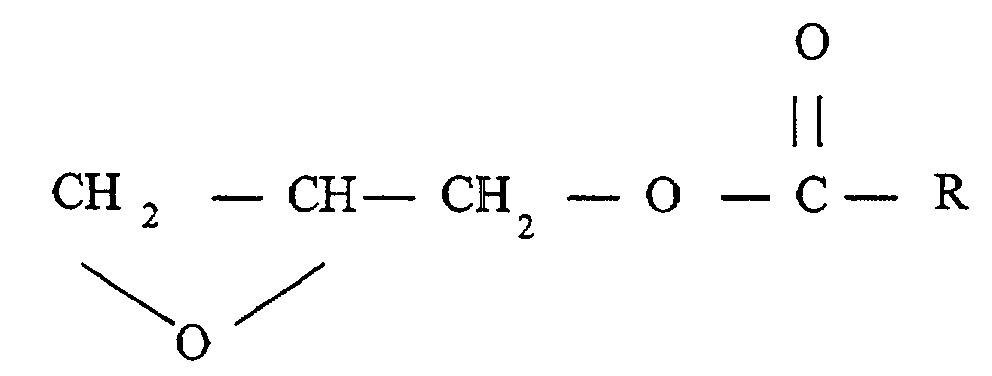
- glycidyl esters are those of the structure: wherein R is a hydrocarbon radical containing from about 4 to about 26 carbon atoms.
- R is a branched hydrocarbon radical, more preferably a tertiary aliphatic group of about 8 to about 10 carbon atoms such as neopentanoate, neoheptanoate, and neodecanoate.
- Glycidyl esters of commercially available mixtures of tertiary aliphatic carboxylic acids such as those available from Shell Chemical Company as VERSATIC ACID® 911 are particularly preferred.
- glycidyl esters themselves are also commercially available from Shell Chemical Company as CARDURA® E; and from Exxon Chemical Company as GLYDEXX-10®.
- examples of other epoxy compounds are 1,2-pentene oxide and styrene oxide.
- the ethylenically unsaturated acid functional monomer and epoxy compound are typically in an equivalent ratio (acid to epoxy) of about 1:1. Higher or lower ratios can be used as desired.
- the beta-hydroxy ester functional monomer may be prepared in several ways, for example (1) the ethylenically unsaturated acid functional monomer and epoxy compound can be preesterified prior to polymerization and the resultant reaction product addition polymerized by free radical initiated polymerization techniques; (2) the unsaturated acid functional monomer can be addition polymerized by free radical initiated polymerization techniques, typically along with one or more hydroxyalkyl functional monomers and one or more other additional ethylenically unsaturated monomers, in the presence of the epoxy compound under conditions which promote the carboxyl/epoxy esterification reaction; and (3) the unsaturated acid functional monomer can be addition polymerized by free radical initiated polymerization techniques, typically along with one or more hydroxyalkyl functional monomers and one or more other additional ethylenically unsaturated monomers, to form a polymeric product having acid functionality, which polymeric product can be subsequently esterified by reaction with the epoxy compound.
- the polymerization and esterification reactions are generally conducted at from about 80 °C to about 170 °C, preferably from about 120 °C to about 145 °C.
- pre-esterification of the epoxy compound and unsaturated acid functional monomer followed by reaction of the resulting adduct with other ethylenically unsaturated monomers it may be desirable to avoid temperatures in excess of about 120 °C so as to minimize or avoid premature polymerization of the unsaturated acid functional monomer.
- a catalyst for promoting the epoxy/acid reaction such as tertiary amine, phosphine, or tin catalyst.
- a free radical inhibitor may be used to inhibit polymerization.
- the temperature should be high enough to ensure that the polymerization and esterification are occurring at about the same rate.
- an esterification catalyst such as those mentioned above may be utilized. However, such a catalyst is not necessary if the reaction temperature is high enough; for example, greater than about 130 °C.
- the reactive ingredients are heated, typically in the presence of a free radical initiator and optionally a chain transfer agent, in an organic solvent in which the ingredients as well as the resultant polymer product are compatible.
- the epoxy compound along with organic solvent is charged to a reaction vessel and heated to reflux, optionally under an inert atmosphere.
- the ethylenically unsaturated acid functional monomer and other monomers and free radical initiator are added slowly to the refluxing reaction mixture. After the addition is complete, some additional initiator may be added and the reaction mixture held at an elevated temperature to complete the reaction.
- Suitable ethylenically unsaturated hydroxyalkyl functional monomers used to prepare the polymer in the film-forming composition of the present invention include hydroxyalkyl functional acrylates and methacrylates such as hydroxyethyl acrylate, hydroxyethyl methacrylate, hydroxypropyl acrylate, hydroxypropyl methacrylate, 4-hydroxybutyl acrylate, 4-hydroxybutyl methacrylate and the like. Mixtures of these hydroxyalkyl functional monomers may also be used.
- Suitable vinyl aromatic compounds include styrene which is preferred, alpha-methylstyrene, alpha-chloromethyl styrene and vinyl toluene.
- Suitable alkyl esters of acrylic and methacrylic acid or anhydride, wherein the alkyl portion of the ester contains from about 1 to about 30, preferably 4 to 30, carbon atoms, are those in which the alkyl group is linear or branched, aliphatic including cycloaliphatic.
- Suitable monomers include alkyl acrylates such as methyl acrylate, n-butyl acrylate and t-butyl acrylate, 2-ethylhexyl acrylate, isobornyl acrylate, cyclohexyl acrylate, t-butyl cyclohexyl acrylate, trimethyl cyclohexyl acrylate, lauryl acrylate, and the like; alkyl methacrylates, including methyl methacrylate, n-butyl methacrylate, t-butyl methacrylate, 2-ethylhexyl methacrylate (which is preferred), isobornyl methacrylate, cyclohexyl methacrylate, t-butyl cyclohexyl methacrylate, trimethyl cyclohexyl methacrylate, and lauryl methacrylate.
- Suitable aryl esters include acrylate and methacrylate esters secondary and
- both styrene and 2-ethylhexyl methacrylate are used together.
- styrene is used in an amount of about 30 to about 40 percent by weight, based on the total weight of resin solids in the film-forming composition
- 2-ethylhexyl methacrylate in an amount of about 10 to about 20 percent by weight, based on the total weight of resin solids in the film-forming composition.
- the polymer may be partially carbamoylated, i.e., have pendant carbamate functional groups.
- groups may be incorporated into the polymer in several ways.
- Carbamate functional groups may be incorporated into the polymer by copolymerizing the acrylic monomers with a carbamate functional vinyl monomer, for example a carbamate functional alkyl ester of methacrylic acid.
- carbamate functional alkyl esters are prepared by reacting, for example, a hydroxyalkyl carbamate with methacrylic anhydride.
- carbamate functional vinyl monomers are, for instance, the reaction product of a hydroxyalkyl (meth)acrylate such as hydroxyethyl methacrylate, a diisocyanate such as isophorone diisocyanate, and a carbamate functional alcohol such as hydroxypropyl carbamate.
- a hydroxyalkyl (meth)acrylate such as hydroxyethyl methacrylate
- a diisocyanate such as isophorone diisocyanate
- carbamate functional alcohol such as hydroxypropyl carbamate.
- Such monomers are disclosed in U.S. Patent 5,098,947.
- Still other carbamate functional vinyl monomers may be used, such as the reaction product of isocyanic acid (HNCO) with a hydroxyl functional acrylic or methacrylic monomer such as hydroxyethyl acrylate.
- Carbamate groups can also be incorporated into the acrylic polymer by reacting a hydroxyl functional acrylic polymer with a low molecular weight carbamate functional material via a "transcarbamoylation" reaction. Such a reaction may be performed at about 130 to about 170 °C, and at pressures up to ambient pressure. In this reaction, a low molecular weight carbamate functional material derived from an alcohol or glycol ether is reacted with the hydroxyl groups of the acrylic polymer, yielding a carbamate functional acrylic polymer and the original alcohol or glycol ether.
- the low molecular weight carbamate functional material derived from an alcohol or glycol ether is first prepared by reacting the alcohol or glycol ether with urea in the presence of a catalyst.
- Suitable alcohols include lower molecular weight aliphatic, cycloaliphatic, and aromatic alcohols such as methanol, ethanol, propanol, butanol, cyclohexanol, 2-ethylhexanol, and 3-methylbutanol.
- Suitable glycol ethers include ethylene glycol methyl ether and propylene glycol methyl ether. Propylene glycol methyl ether is preferred.
- Suitable free radical initiators are those which are soluble in the polymerization medium, including azo compounds such as alpha,alpha'-azobis-(isobutyronitrile), azobis-(alpha,gamma-dimethyl valeronitrile), and 2,2'-azobis(methylbutyronitrile); peroxides such as benzoyl peroxide, ditertiarybutyl peroxide, and cumene hydroperoxide; tertiary butyl peracetate; isopropyl percarbonate; butyl isopropyl peroxy carbonate; and similar compounds.
- the quantity of initiator may vary considerably depending on the type, but usually is between about 0.5 and about 7 percent by weight based on the total solid weight of monomers used to prepare the polymer.
- the polymer used in the film-forming composition of the present invention typically has a weight average molecular weight of about 5000 to about 25,000, preferably about 7000 to about 15,000 as determined by gel permeation chromatography using a polystyrene standard. Molecular weights less than 5000 are less desirable because acid etch resistance of the cured coating may be compromised; whereas molecular weights greater than 25,000 are less desirable because higher molecular weights contribute to higher viscosities, making the film-forming composition difficult to spray at ambient conditions while maintaining good appearance and acceptable solvent levels.
- the hydroxyl equivalent weight of the polymer is generally about 300 to about 800, preferably about 300 to about 500.
- the polymer used in the film-forming composition of the present invention preferably has a glass transition temperature (T g ) of at least about 10, more preferably at least about 20 and most preferably at least about 30°C. T g 's less than 10 are less desirable because acid etch resistance of the cured coating may be compromised,
- T g is described in PRINCIPLES OF POLYMER CHEMISTRY, Flory, Cornell University Press, Ithaca, NY, 1953, pages 52-57.
- the T g can be calculated as described by Fox in Bull. Amer. Physic. Society, 1,3, page 123 (1956).
- the T g can be measured experimentally by using a penetrometer such as a Du Pont 940 Thermomedian Analyzer.
- the T g of the polymers as used herein refers to the calculated values unless otherwise indicated.
- the polymer is present in the film-forming composition in amounts of about 55 to about 85, preferably about 65 to about 75 percent by weight based on the total weight of resin solids in the film-forming composition.
- Levels that are too high i. e., above about 85%
- levels that are too low i. e., below about 55%) can cause reduced acid etch resistance.
- Film-forming compositions of the present invention further comprise an aminoplast crosslinking agent containing methylol ether groups.
- Aminoplasts are obtained from the reaction of formaldehyde with an amine or amide.
- the most common amines or amides are melamine, urea, or benzoguanamine, and are preferred.
- condensates with other amines or amides can be used; for example, aldehyde condensates of glycoluril, which give a high melting crystalline product which is useful in powder coatings. While the aldehyde used is most often formaldehyde, other aldehydes such as acetaldehyde, crotonaldehyde, and benzaldehyde may be used.
- the aminoplast contains imino and methylol groups and preferably at least a portion of the methylol groups are etherified with an alcohol to modify the cure response.
- Any monohydric alcohol may be employed for this purpose including methanol, ethanol, n-butyl alcohol, isobutanol, and hexanol, with methanol, n-butyl alcohol and isobutanol being preferred.
- the aminoplasts which are used are melamine-, urea-, or benzoguanamine-formaldehyde condensates, preferably monomeric and at least partially etherified with one or more alcohols containing from one to four carbon atoms.
- the methylol groups are fully etherified with at least one alcohol selected from the group consisting of methanol, n-butanol, and isobutanol.
- a preferred aminoplast is available from Monsanto Chemical Company as RESIMENE® 751, a highly monomeric fully alkylated melamine etherified with both methanol and n-butanol. Alternatively, the aminoplast is preferably at least partially etherified with isobutanol. A particularly preferred aminoplast is available from CYTEC Industries as CYMEL® 1161. Such aminoplast provides optimal acid etch resistance.
- the aminoplast is present in the film-forming composition in amounts of about 15 to about 45, preferably about 15 to about 35 percent by weight based on the total weight of resin solids in the film-forming composition.
- the film-forming composition of the present invention may also contain adjuvant curing agents such as a capped polyisocyanate.
- the polyisocyanate can be an aliphatic or an aromatic polyisocyanate or a mixture of the two. Diisocyanates may be used, although higher polyisocyanates such as isocyanurates of diisocyanates are preferred. Higher polyisocyanates can also be used in combination with diisocyanates. Isocyanate prepolymers, for example, reaction products of polyisocyanates with polyols can also be used.
- any suitable aliphatic, cycloaliphatic, or aromatic alkyl monoalcohol known to those skilled in the art may be used as a capping agent for the polyisocyanate.
- Other suitable capping agents include oximes and lactams.
- adjuvant curing agents include triazines such as tricarbamoyl triazine compounds having the formula C 3 N 3 (NHCOXR) 3 , wherein X is nitrogen, oxygen, sulfur, phosphorus, or carbon, and R is a lower alkyl group having one to twelve carbon atoms, or mixtures of lower alkyl groups.
- triazines such as tricarbamoyl triazine compounds having the formula C 3 N 3 (NHCOXR) 3 , wherein X is nitrogen, oxygen, sulfur, phosphorus, or carbon, and R is a lower alkyl group having one to twelve carbon atoms, or mixtures of lower alkyl groups.
- the adjuvant crosslinking agent is present in the film-forming composition in an amount ranging up to about 20, preferably of about 1 to 20, percent by weight based on the total weight of resin solids in the film-forming composition.
- the film-forming composition will also preferably contain catalysts to accelerate the cure of the aminoplast with reactive groups on the polymer.
- suitable catalysts are acidic materials and include acid phosphates and sulfonic acid or a substituted sulfonic acid such as dodecylbenzene sulfonic acid or paratoluene sulfonic acid.
- the catalyst is usually present in an amount of about 0.5 to about 5.0 percent by weight, preferably about 0.5 to about 1.5 percent by weight, based on the total weight of resin solids.
- Optional ingredients such as, for example, plasticizers, surfactants, thixotropic agents, anti-gassing agents, organic cosolvents, flow controllers, anti-oxidants, UV light absorbers and similar additives conventional in the art may be included in the composition. These ingredients are typically present at up to about 40% by weight based on the total weight of resin solids.
- the film-forming composition of the present invention may be solventborne or waterborne; preferably it is solventborne.
- Suitable solvent carriers include the various alcohols, esters, ethers, aromatic solvents, and other solvents, including mixtures thereof, that are known in the art of coating formulation.
- the film-forming composition typically has a total solids content of about 40 to about 60 percent by weight.
- the film-forming composition of the present invention may contain color pigments conventionally used in surface coatings and may be used as a high gloss monocoat; that is, a high gloss pigmented coating.
- high gloss it is meant that the cured coating has a 20° gloss and/or a DOI ("distinctness of image") measurement of at least about 80 as measured by standard techniques known to those skilled in the art. Such standard techniques include ASTM D523 for gloss measurement and ASTM E430 for DOI measurement.
- the film-forming composition of the present invention is preferably used as the clear coat layer in a multi-component composite coating composition such as a "color-plus-clear" coating system, which includes at least one pigmented or colored base coat and at least one clear topcoat.
- a multi-component composite coating composition such as a "color-plus-clear" coating system, which includes at least one pigmented or colored base coat and at least one clear topcoat.
- the film-forming composition of the base coat in the color-plus-clear system can be any of the compositions useful in coatings applications, particularly automotive applications.
- the film-forming composition of the base coat comprises a resinous binder and a pigment to act as the colorant.
- Particularly useful resinous binders are acrylic polymers, polyesters, including alkyds, and polyurethanes.
- the base coat compositions may be solventborne or waterborne.
- Waterborne base coats in color-plus-clear compositions are disclosed in U. S. Patent No. 4,403,003, and the resinous compositions used in preparing these base coats can be used in the practice of this invention.
- waterborne polyurethanes such as those prepared in accordance with U. S. Patent No. 4,147,679 can be used as the resinous binder in the base coat.
- waterborne coatings such as those described in U. S. Patent 5,071,904 can be used as the base coat.
- Suitable solventborne coatings include any known to those skilled in the art. Examples include DCT-6373, a solventborne base coat commercially available from PPG Industries, Inc.
- the base coat composition contains pigments.
- Color pigments conventionally used in surface coatings are suitable and include, for example, inorganic pigments such as titanium dioxide, iron oxides, chromium oxide, lead chromate, and carbon black, and organic pigments such as phthalocyanine blue and phthalocyanine green. Mixtures of the above mentioned pigments may also be used.
- Suitable metallic pigments include in particular aluminum flake, copper bronze flake and metal oxide coated mica, nickel flakes, tin flakes, and mixtures thereof.
- the pigment is incorporated into the coating composition in amounts of about 1 to about 80 percent by weight based on the total weight of coating solids.
- the metallic pigment is employed in amounts of about 0.5 to about 25 percent by weight based on the total weight of coating solids.
- the base coat composition may contain additional materials well known in the art of formulated surface coatings. These would include surfactants, flow control agents, thixotropic agents, fillers, anti-gassing agents, organic cosolvents, catalysts, and other customary auxiliaries. These materials can constitute up to about 40 percent by weight of the total weight of the coating composition.
- the base coating compositions can be applied to various substrates to which they adhere including wood, metals, glass, and plastic.
- the compositions can be applied by conventional means including brushing, dipping, flow coating, spraying and the like, but they are most often applied by spraying.
- the usual spray techniques and equipment for air spraying and electrostatic spraying and either manual or automatic methods can be used.
- the base coat thickness will be about 0.01 to about 5 mils (about 0.254 to about 127 ⁇ m), preferably about 0.1 to about 2 mils (about 2.54 to about 50.8 ⁇ m) in thickness.
- a film is formed on the surface of the substrate by driving solvent, i. e., organic solvent and/or water, out of the base coat film by heating or by an air drying period.
- driving solvent i. e., organic solvent and/or water
- the heating will only be for a short period of time, sufficient to ensure that the clear coat can be applied to the base coat without dissolving the base coat composition.
- Suitable drying conditions will depend on the particular base coat composition, and on the ambient humidity with certain waterborne compositions, but in general a drying time of from about 1 to 5 minutes at a temperature of about 80-250 °F (20-121 °C) will be adequate to ensure that mixing of the two coats is minimized.
- the base coat film is adequately wetted by the clear coat composition so that satisfactory intercoat adhesion is obtained.
- more than one base coat and multiple clear coats may be applied to develop the optimum appearance. Usually between coats, the previously applied coat is flashed; that is, exposed to ambient conditions for about 1 to 20 minutes.
- the clear topcoat composition may be applied to the base coated substrate by any conventional coating technique such as brushing, spraying, dipping or flowing, but spray applications are preferred because of superior gloss. Any of the known spraying techniques may be employed such as compressed air spraying, electrostatic spraying and either manual or automatic methods.
- the coated substrate is heated to cure the coating layers.
- solvents are driven off and the film-forming materials of the clear coat and the base coat are each crosslinked.
- the heating or curing operation is usually carried out at a temperature in the range of from 160-350 °F (71-177 °C) but if needed, lower or higher temperatures may be used as necessary to activate crosslinking mechanisms.
- the thickness of the clear coat is usually from about 0.5 to about 5 mils (about 12.7 to about 127 ⁇ m), preferably about 1.2 to about 3 mils (about 30.5 to about 76.2 ⁇ m).
- the resultant crosslinked coating exhibits a high level of acid etch resistance.
- “high level” it is meant that the resistance of the coating composition to etching by acid rain is significantly improved compared to conventional high solids hydroxyl-aminoplast cured coating compositions.
- Examples A through F illustrate the preparation of polymeric acrylic polyols.
- This example illustrates the preparation of an acrylic polyol containing hydroxyl groups derived from hydroxyethyl methacrylate and an adduct of acrylic acid and glycidyl neodecanoate.
- Feed A consisted of a mixture of 672.0 g styrene, 484.8 g hydroxyethyl methacrylate, 320.0 g methyl methacrylate and 123.2 g acrylic acid.
- Feed B consisted of a mixture of 80.0 g t-amyl peroxy-2-ethyl hexanoate (LUPEROX 575 available from Elf-Atochem) and 262.0 g 2-ethoxyethyl propionate. After the addition of the two feeds A and B was complete, a mixture of 3.2 g LUPEROX 575 and 13.1 g xylene was added and the reaction contents stirred for one hour. After this time another addition consisting of 3.2 g LUPEROX 575 and 13.1 g xylene was made. The reaction contents were stirred for an additional hour and cooled while adding 170.3 g n-butyl acetate.
- LUPEROX 575 available from Elf-Atochem
- the resultant product had a total solids content of 60.3% measured for 1 hour at 110 °C; a viscosity of 33.3 stokes; had an acid value of 7.51 mg KOH/g; a hydroxyl value of 94.1 mg KOH/g; had an APHA color of 15 - 20; and a weight average molecular weight of 11,200 and a T g of 50 °C.
- An acrylic polyol was prepared as in Example A, except that methyl methacrylate was replaced with lauryl methacrylate.
- the weight average molecular weight was 11,705 and the Tg was 17 °C.
- This example illustrates the preparation of an acrylic polyol with hydroxyl groups derived from hydroxypropyl acrylate.
- Feed A consisted of a mixture of 738.1 g styrene, 773.7 g hydroxypropyl acrylate, 551.4 g methyl methacrylate, 155.6 g butyl methacrylate, 4.4 g acrylic acid.
- Feed B consisted of a mixture of 88.0 g LUPEROX 575 and 288.2 g 2-ethoxyethyl propionate. After the addition of the two feeds A and B was complete, a feed consisting of 3.5 g LUPEROX 575 and 14.4 g xylene was added and the reaction contents stirred for one hour. After this time another addition consisting of 3.5 g LUPEROX 575 and 14.4 g xylene was made. When the addition was complete, the reaction contents were stirred for an additional hour and cooled while adding 187.3 n-butyl acetate.
- the resultant product had a total solids content of 60.6% measured for 1 hour at 110 °C; a Gardner-Holdt bubble tube viscosity X -Y; and acid of 2.18 mg KOH/g; a hydroxyl value of 89.6 mg KOH/g; an APHA color of 5-10; and a weight average molecular weight of 12,464 and a T g of 57 °C.
- An acrylic polyol was prepared as in Example A, except that hydroxyethyl methacrylate was replaced with hydroxybutyl acrylate.
- the weight average molecular weight was 13,908 and the T g was 23 °C.
- An acrylic polyol was prepared as in Example A, except that styrene was replaced with methylstyrene.
- the weight average molecular weight was 7234 and the T g was 62 °C.
- An acrylic polyol was prepared as in Example A, except that styrene was replaced with methyl methacrylate.
- the weight average molecular weight was 13,077 and the T g was 49 °C.
- Examples 1-9 illustrate the preparation of clear film-forming compositions using the polymeric acrylic polyols of Examples A through F.
- Examples 1-3, 5, and 7 are illustrative of the present invention.
- Examples 4, 6, 8 and 9 are comparative.
- the clear coat of Example 4 contains acrylic polyol in an amount less than that of the present invention.
- the clear coat of Example 6 does not contain an acrylic polyol derived from a reaction product of an ethylenically unsaturated acid functional monomer and an epoxy compound containing at least 5 carbon atoms.
- Example 6 illustrates a conventional polyol-aminoplast film-forming composition.
- the clear coats of Examples 8 and 9 contain acrylic polyols that do not contain styrene.
- compositions were spray applied in two coats as clear coats over a black solventborne base coat, available from PPG Industries, Inc., as HDCT9939M.
- the base coat was flashed for five minutes at 200 °F (93.3 °C) before application of the clear coat.
- the clear coats were given a ten-minute air flash before baking for thirty minutes at 250 °F (121.1 °C).
- Example # Solid weight percent, polyol gloss DOI Tukon hardness Water spot Acid etch 1 79 91.5 89 13.3 2-3 3 2 69 91.7 94 12.1 2 4 3 59 91.9 95 11.4 3 4 4 49 92.4 89 9.6 2-3 5 6 69 90.6 94 12.1 3 5
- Example 6 The data in Table II indicate that as the level of polyol increases in the film-forming composition, hardness and acid etch resistance decrease. Note that conventional film-forming compositions (Example 6) exhibit poor acid etch resistance.
- Example Crack Test Day 1 Day 2 Day 3 Day 4 Day 5 Day 6 Day 7 2 1 1 1 2 2 3 3 5 1 1 1 1 1 1 1 7 1 1 1 1 1 1 8 1 4 5 5 5 5 5 9* 2 4 5 5 5 5 5 5
- Example 3 The data in Table III indicate that crack resistance of the film-forming composition is improved with the use of acrylic polyols formed from acrylate ester monomers having at least four carbon atoms in the alkyl group (Examples 5 and 7).
- comparative Examples 8 and 9 illustrate the benefits obtained from styrene in the acrylic polyol used in the film-forming composition.
- the acrylic polyol in the film-forming composition of Example 9 contains methylstyrene in place of styrene, and the acrylic polyol in the film-forming composition of Example 9 contains methyl methacrylate in place of styrene.
Landscapes
- Chemical & Material Sciences (AREA)
- Life Sciences & Earth Sciences (AREA)
- Engineering & Computer Science (AREA)
- Materials Engineering (AREA)
- Wood Science & Technology (AREA)
- Organic Chemistry (AREA)
- Paints Or Removers (AREA)
Abstract
Description

| Total (grams) | |
| SOLVESSO 100 | 39 |
| DME dibasic ester | 4.4 |
| TINUVIN 328 | 6.7 |
| Flow control agent | 7.6 |
| CYMEL 1161 | See Table I |
| Acrylic polyol | See Table I |
| n-Propyl alcohol | 11 |
| Poly (Butyl Acrylate) | 1.3 |
| MULTIFLOW | 1.5 |
| TINUVIN 123 | 1.2 |
| DDBSA/DIPA | 3.4 |
| Example | Acrylic polyol, total (grams) | CYMEL 1161 |
| 1 | Example A, 305 | 46.4 |
| 2 | Example A, 257 | 69.6 |
| 3 | Example A, 228 | 92.8 |
| 4(Comparative) | Example A, 189 | 116.0 |
| 5 | Example B, 272.3 | 69.6 |
| 6(Comparative) | Example C, 264.2 | 69.6 |
| 7 | Example D, 276.4 | 69.6 |
| 8 | Example E, 313.8 | 69.6 |
| 9(Comparative) | Example F, 261 | 69.6 |
| Example # | Solid weight percent, polyol | gloss | DOI | Tukon hardness | Water spot | Acid etch |
| 1 | 79 | 91.5 | 89 | 13.3 | 2-3 | 3 |
| 2 | 69 | 91.7 | 94 | 12.1 | 2 | 4 |
| 3 | 59 | 91.9 | 95 | 11.4 | 3 | 4 |
| 4 | 49 | 92.4 | 89 | 9.6 | 2-3 | 5 |
| 6 | 69 | 90.6 | 94 | 12.1 | 3 | 5 |
| Example | Crack Test | ||||||
| Day 1 | Day 2 | Day 3 | Day 4 | Day 5 | Day 6 | Day 7 | |
| 2 | 1 | 1 | 1 | 2 | 2 | 3 | 3 |
| 5 | 1 | 1 | 1 | 1 | 1 | 1 | 1 |
| 7 | 1 | 1 | 1 | 1 | 1 | 1 | 1 |
| 8 | 1 | 4 | 5 | 5 | 5 | 5 | 5 |
| 9* | 2 | 4 | 5 | 5 | 5 | 5 | 5 |
Claims (14)
- A curable film-forming composition which when cured yields a resultant coating resistant to acid etching, comprising:A) a polymer having a weight average molecular weight of 5000 to 15,000 as determined by gel permeation chromatography using a polystyrene standard, and having a glass transition temperature of at least about 20 °C, said polymer prepared from the following ingredients:1) 10 to 70 percent by weight, based on the total solid weight of monomers used to prepare the polymer, of a reaction product of an ethylenically unsaturated acid functional monomer and an epoxy compound containing at least 5 carbon atoms which is not polymerizable with the ethylenically unsaturated acid functional monomer;2) 5 to 50 percent by weight, based on the total solid weight of monomers used to prepare the polymer, of an ethylenically unsaturated, hydroxyalkyl functional monomer having from 2 to 4 carbon atoms in the hydroxyalkyl group;3) 15 to 40 percent by weight, based on the total solid weight of monomers used to prepare the polymer, of a vinyl aromatic monomer; and4) 10 to 60 percent by weight, based on the total solid weight of monomers used to prepare the polymer, of an alkyl ester of acrylic or methacrylic acid containing from 1 to 30 carbon atoms in the alkyl group, such that the sum of the weight percentages of the ingredients 1) 2), 3) and 4) is 100; andB) an etherified aminoplast crosslinking agent.
- The film-forming composition of claim 1, wherein the polymer is present in the film-forming composition in an amount of 55 to 85 percent by weight based on the total weight of resin solids in the film-forming composition.
- The film-forming composition of claim 1, wherein the aminoplast is present in the film-forming composition in an amount of 15 to 45 percent by weight based on the total weight of resin solids in the film-forming composition.
- The film-forming composition of claim 1, wherein the ethylenically unsaturated, acid functional monomer is selected from the group consisting of acrylic acid, methacrylic acid, itaconic acid, and mixtures thereof.
- The film-forming composition of claim 1, wherein the epoxy compound has the following structure:wherein R is a hydrocarbon radical containing from 4 to 26 carbon atoms.
- The film-forming composition of claim 1, wherein the ethylenically unsaturated, hydroxyalkyl functional monomer is selected from the group consisting of hydroxyethyl acrylate, hydroxyethyl methacrylate, hydroxypropyl acrylate, hydroxypropyl methacrylate, 4-hydroxybutyl acrylate, 4-hydroxybutyl methacrylate, and mixtures thereof.
- The film-forming composition of claim 1 in which the vinyl aromatic monomer is styrene.
- The film-forming composition of claim 1, wherein the aminoplast is etherified at least in part with isobutyl alcohol.
- The film-forming composition of claim 1, wherein the alkyl ester of acrylic or methacrylic acid is 2-ethylhexyl methacrylate.
- The film-forming composition of claim 7, wherein styrene is present in an amount of 30 to 40 percent, and the 2-ethylhexyl methacrylate is present in an amount of 10 to 20 percent, based on the total solid weight of monomers used to prepare the polymer.
- The film-forming composition of claim 1, wherein the polymer contains carbamate functionality.
- The film-forming composition of claim 1, further comprising an adjuvant curing agent in an amount of up to about 20 percent by weight based on the total weight of resin solids in the film-forming composition.
- The film-forming composition of claim 12, wherein said adjuvant curing agent comprises a tricarbamoyl triazine compound having the formula C3N3(NHCOXR)3, wherein X is nitrogen, oxygen, sulfur, phosphorus, or carbon, and R is a lower alkyl group having one to twelve carbon atoms or mixtures of lower alkyl groups.
- A multi-component composite coating comprising a base coat deposited from a pigmented film-forming composition and a transparent top coat applied over the base coat in which the transparent top coat is deposited from a clear film-forming composition according to any of the preceding claims, whereby the etherified aminoplast crosslinking agent is etherified with one or more alcohols selected from the group consisting of methanol, n-butyl alcohol, and isobutyl alcohol.
Applications Claiming Priority (5)
| Application Number | Priority Date | Filing Date | Title |
|---|---|---|---|
| US74920 | 1993-06-10 | ||
| US5233097P | 1997-07-11 | 1997-07-11 | |
| US52330P | 1997-07-11 | ||
| US09/074,920 US6136443A (en) | 1997-07-11 | 1998-05-08 | Acid etch resistant film-forming compositions and composite coating compositions |
| PCT/US1998/014379 WO1999002618A1 (en) | 1997-07-11 | 1998-07-10 | Film-forming compositions |
Publications (3)
| Publication Number | Publication Date |
|---|---|
| EP0994930A1 EP0994930A1 (en) | 2000-04-26 |
| EP0994930B1 true EP0994930B1 (en) | 2002-03-20 |
| EP0994930B2 EP0994930B2 (en) | 2010-06-23 |
Family
ID=26730484
Family Applications (1)
| Application Number | Title | Priority Date | Filing Date |
|---|---|---|---|
| EP19980934427 Expired - Lifetime EP0994930B2 (en) | 1997-07-11 | 1998-07-10 | Film-forming compositions |
Country Status (7)
| Country | Link |
|---|---|
| US (2) | US6136443A (en) |
| EP (1) | EP0994930B2 (en) |
| AU (1) | AU8394698A (en) |
| CA (1) | CA2294942C (en) |
| DE (1) | DE69804313T3 (en) |
| ES (1) | ES2174458T5 (en) |
| WO (1) | WO1999002618A1 (en) |
Cited By (2)
| Publication number | Priority date | Publication date | Assignee | Title |
|---|---|---|---|---|
| DE10305119A1 (en) * | 2003-02-07 | 2004-08-26 | Basf Coatings Ag | Coating materials, processes for their production and their use |
| DE10305115A1 (en) * | 2003-02-07 | 2004-09-02 | Basf Coatings Ag | Coating materials, processes for their production and their use |
Families Citing this family (10)
| Publication number | Priority date | Publication date | Assignee | Title |
|---|---|---|---|---|
| US6136443A (en) * | 1997-07-11 | 2000-10-24 | Ppg Industries Ohio, Inc. | Acid etch resistant film-forming compositions and composite coating compositions |
| US6652971B1 (en) * | 2000-10-30 | 2003-11-25 | E. I. Du Pont De Nemours And Company | Hydroxy-functional (meth)acrylic copolymers and coating composition |
| US7442325B2 (en) | 2004-09-29 | 2008-10-28 | Cytec Technology Corp. | Stabilized crosslinking composition |
| US20110097482A1 (en) * | 2009-10-27 | 2011-04-28 | Basf Coatings Ag | Compact coating system and process |
| WO2018081613A1 (en) | 2016-10-28 | 2018-05-03 | Ppg Industries Ohio, Inc. | Coatings for increasing near-infrared detection distances |
| US10370555B2 (en) | 2017-05-16 | 2019-08-06 | Ppg Industries Ohio, Inc. | Curable film-forming compositions containing hydroxyl functional acrylic polymers and bisurea compounds and multilayer composite coatings |
| KR102458569B1 (en) | 2017-07-14 | 2022-10-24 | 피피지 인더스트리즈 오하이오 인코포레이티드 | Curable film-forming compositions comprising reactive functional polymers and polysiloxane resins, multilayer composite coatings and methods of using the same |
| EP3873973A1 (en) * | 2018-11-01 | 2021-09-08 | PPG Industries Ohio, Inc. | Solvent-borne coating compositions, coatings formed therefrom, and methods of forming such coatings |
| KR20240144457A (en) | 2018-11-13 | 2024-10-02 | 피피지 인더스트리즈 오하이오 인코포레이티드 | Method of detecting a concealed pattern |
| US11561329B2 (en) | 2019-01-07 | 2023-01-24 | Ppg Industries Ohio, Inc. | Near infrared control coating, articles formed therefrom, and methods of making the same |
Family Cites Families (24)
| Publication number | Priority date | Publication date | Assignee | Title |
|---|---|---|---|---|
| US3256225A (en) * | 1962-01-24 | 1966-06-14 | Staley Mfg Co A E | Vicinal acryloxy hydroxy long chain fatty compounds and polymers thereof |
| US3549583A (en) * | 1966-12-14 | 1970-12-22 | Nippon Paint Co Ltd | Polyurethane liquid containing compositions |
| JPS4818088B1 (en) * | 1966-12-27 | 1973-06-04 | ||
| GB1337141A (en) * | 1969-09-08 | 1973-11-14 | Nippon Paint Co Ltd | Quick drying synthetic resin coating compositions |
| CH519532A (en) * | 1969-12-18 | 1972-02-29 | Reichhold Albert Chemie Ag | Process for the production of soluble organic copolymers and their use as binder components, in particular in primers and top coats for galvanized iron sheets |
| US4065425A (en) * | 1974-02-28 | 1977-12-27 | Inmont Corporation | Process for the preparation of non-aqueous dispersion coatings |
| GB1549059A (en) * | 1975-04-10 | 1979-08-01 | Hoechst Ag | Copolymer solution of acrylic resin |
| DE2603259C3 (en) * | 1976-01-29 | 1982-10-21 | Hoechst Ag, 6000 Frankfurt | Process for the production of copolymers containing hydroxyl groups |
| DE2618810C3 (en) * | 1976-04-29 | 1978-12-07 | Hoechst Ag, 6000 Frankfurt | Process for the production of coatings |
| DE2618809C2 (en) * | 1976-04-29 | 1983-06-30 | Hoechst Ag, 6230 Frankfurt | Process for the production of copolymers which are soluble in organic solvents and their use in reactive lacquers |
| DE2626900C2 (en) * | 1976-06-16 | 1978-04-13 | Hoechst Ag, 6000 Frankfurt | Process for the production of copolymers containing hydroxyl groups |
| DE2732693C3 (en) * | 1977-07-20 | 1980-04-17 | Hoechst Ag, 6000 Frankfurt | Process for the preparation of copolymers containing hydroxyl groups which are soluble in organic solvents |
| NL7708218A (en) * | 1977-07-23 | 1979-01-25 | Akzo Nv | LIQUID COATING COMPOSITION WITH A HIGH SOLID CONTENT ON THE BASIS OF AN ACRYLIC COPOLYMER. |
| DE3128062A1 (en) * | 1981-07-16 | 1983-02-03 | Hoechst Ag, 6000 Frankfurt | AQUEOUS COPOLYMERISAT DISPERSIONS, METHOD FOR THE PRODUCTION AND USE OF THE DISPERSIONS |
| US4818796A (en) * | 1987-05-13 | 1989-04-04 | Ppg Industries, Inc. | Polymers prepared by polymerizing alpha, beta-ethylenically unsaturated acids and epoxy compounds |
| DE3740774A1 (en) * | 1987-12-02 | 1989-06-15 | Herberts Gmbh | BINDER, METHOD FOR THE PRODUCTION THEREOF AND THEIR USE IN CLEAR OR PIGMENTED CONTAINERS |
| US4939213A (en) * | 1988-12-19 | 1990-07-03 | American Cyanamid Company | Triazine crosslinking agents and curable compositions containing the same |
| ES2050299T3 (en) * | 1989-05-19 | 1994-05-16 | Basf Corp | PROCEDURE FOR THE PREPARATION OF A SOLID BODY RICH COATING COMPOUND. |
| CA2020166A1 (en) * | 1989-07-07 | 1991-01-08 | Jonathan T. Martz | Polymers for high gloss coatings |
| JPH04130168A (en) * | 1990-09-20 | 1992-05-01 | Nippon Paint Co Ltd | Clear coating material and method for forming coating film |
| US5565243A (en) * | 1995-05-01 | 1996-10-15 | Ppg Industries, Inc. | Color-clear composite coatings having improved hardness, acid etch resistance, and mar and abrasion resistance |
| EP0823922B1 (en) * | 1995-05-01 | 2003-01-22 | PPG Industries Ohio, Inc. | Curable compositions composite coatings and process for having improved mar and abrasion resistance |
| JP4230537B2 (en) * | 1995-05-02 | 2009-02-25 | イー・アイ・デュポン・ドウ・ヌムール・アンド・カンパニー | Scratch resistant coating composition |
| US6136443A (en) * | 1997-07-11 | 2000-10-24 | Ppg Industries Ohio, Inc. | Acid etch resistant film-forming compositions and composite coating compositions |
-
1998
- 1998-05-08 US US09/074,920 patent/US6136443A/en not_active Expired - Fee Related
- 1998-07-10 EP EP19980934427 patent/EP0994930B2/en not_active Expired - Lifetime
- 1998-07-10 ES ES98934427T patent/ES2174458T5/en not_active Expired - Lifetime
- 1998-07-10 CA CA002294942A patent/CA2294942C/en not_active Expired - Fee Related
- 1998-07-10 AU AU83946/98A patent/AU8394698A/en not_active Abandoned
- 1998-07-10 WO PCT/US1998/014379 patent/WO1999002618A1/en not_active Ceased
- 1998-07-10 DE DE1998604313 patent/DE69804313T3/en not_active Expired - Lifetime
-
2000
- 2000-08-18 US US09/641,592 patent/US6306505B1/en not_active Expired - Fee Related
Cited By (4)
| Publication number | Priority date | Publication date | Assignee | Title |
|---|---|---|---|---|
| DE10305119A1 (en) * | 2003-02-07 | 2004-08-26 | Basf Coatings Ag | Coating materials, processes for their production and their use |
| DE10305115A1 (en) * | 2003-02-07 | 2004-09-02 | Basf Coatings Ag | Coating materials, processes for their production and their use |
| DE10305115B4 (en) * | 2003-02-07 | 2007-02-22 | Basf Coatings Ag | Coating materials, process for their preparation and their use |
| DE10305119B4 (en) * | 2003-02-07 | 2007-02-22 | Basf Coatings Ag | Coating materials, process for their preparation and their use |
Also Published As
| Publication number | Publication date |
|---|---|
| CA2294942A1 (en) | 1999-01-21 |
| US6136443A (en) | 2000-10-24 |
| DE69804313T3 (en) | 2010-12-09 |
| ES2174458T3 (en) | 2002-11-01 |
| ES2174458T5 (en) | 2010-10-28 |
| US6306505B1 (en) | 2001-10-23 |
| EP0994930A1 (en) | 2000-04-26 |
| CA2294942C (en) | 2007-04-03 |
| WO1999002618A1 (en) | 1999-01-21 |
| EP0994930B2 (en) | 2010-06-23 |
| AU8394698A (en) | 1999-02-08 |
| DE69804313T2 (en) | 2002-10-31 |
| DE69804313D1 (en) | 2002-04-25 |
Similar Documents
| Publication | Publication Date | Title |
|---|---|---|
| US5989642A (en) | Method for preparing color-clear composite coatings having resistance to acid etching | |
| KR100193018B1 (en) | Aqueous branched polymer dispersion | |
| KR0179461B1 (en) | Aqueous aminoplast-curable film-forming compositions providing films having resistance to acid etching | |
| EP0835293B1 (en) | Coating composition containing acrylic polymers with pendant carbamate groups | |
| EP0757701B1 (en) | Flexible aminoplast-curable film-forming compositions providing films having resistance to acid etching | |
| US5445850A (en) | Aminoplast cured acid etch resistant coating with good durability | |
| GB2247632A (en) | Two-layer coatings | |
| EP0994930B1 (en) | Film-forming compositions | |
| EP1042402B1 (en) | Curable film-forming compositions | |
| WO1994009916A1 (en) | Method for forming a paint film and coating obtained by the method | |
| KR20080059630A (en) | Method of forming a multi-layer coating on automobile bodies without a primer bake | |
| EP0925318B1 (en) | Carbamate functional polymers and compositions containing same | |
| US5980993A (en) | Method for applying a color-plus-clear composite coating to a substrate | |
| US4748211A (en) | Hydroxyl functional graft copolymers | |
| US4801653A (en) | Coating compositions prepared from hydroxyl functional graft copolymers | |
| US20030236324A1 (en) | Pigment dispersing resin and water-based pigment dispersion which contains the same | |
| US5959040A (en) | Film-forming composition suitable for use as a monocoat | |
| CA1286430C (en) | Hydroxyl functional graft copolymers | |
| EP0406854A2 (en) | Polymers for high gloss coatings | |
| JPH0327595B2 (en) |
Legal Events
| Date | Code | Title | Description |
|---|---|---|---|
| PUAI | Public reference made under article 153(3) epc to a published international application that has entered the european phase |
Free format text: ORIGINAL CODE: 0009012 |
|
| 17P | Request for examination filed |
Effective date: 20000113 |
|
| AK | Designated contracting states |
Kind code of ref document: A1 Designated state(s): DE ES FR GB IT |
|
| RIN1 | Information on inventor provided before grant (corrected) |
Inventor name: RUSH-BATISTA, MELISSA, S. Inventor name: KISH, DANIEL, D. Inventor name: MAUER, GEROGE, W. |
|
| GRAG | Despatch of communication of intention to grant |
Free format text: ORIGINAL CODE: EPIDOS AGRA |
|
| 17Q | First examination report despatched |
Effective date: 20010531 |
|
| GRAG | Despatch of communication of intention to grant |
Free format text: ORIGINAL CODE: EPIDOS AGRA |
|
| GRAH | Despatch of communication of intention to grant a patent |
Free format text: ORIGINAL CODE: EPIDOS IGRA |
|
| GRAH | Despatch of communication of intention to grant a patent |
Free format text: ORIGINAL CODE: EPIDOS IGRA |
|
| REG | Reference to a national code |
Ref country code: GB Ref legal event code: IF02 |
|
| GRAA | (expected) grant |
Free format text: ORIGINAL CODE: 0009210 |
|
| AK | Designated contracting states |
Kind code of ref document: B1 Designated state(s): DE ES FR GB IT |
|
| REF | Corresponds to: |
Ref document number: 69804313 Country of ref document: DE Date of ref document: 20020425 |
|
| ET | Fr: translation filed | ||
| REG | Reference to a national code |
Ref country code: ES Ref legal event code: FG2A Ref document number: 2174458 Country of ref document: ES Kind code of ref document: T3 |
|
| PLBQ | Unpublished change to opponent data |
Free format text: ORIGINAL CODE: EPIDOS OPPO |
|
| PLBI | Opposition filed |
Free format text: ORIGINAL CODE: 0009260 |
|
| PLBF | Reply of patent proprietor to notice(s) of opposition |
Free format text: ORIGINAL CODE: EPIDOS OBSO |
|
| 26 | Opposition filed |
Opponent name: BASF COATINGS AG Effective date: 20021218 Opponent name: AKZO NOBEL N.V. Effective date: 20021217 Opponent name: RESOLUTION RESEARCH NEDERLAND B.V.INTELLECTUAL PRO Effective date: 20021216 |
|
| PLBF | Reply of patent proprietor to notice(s) of opposition |
Free format text: ORIGINAL CODE: EPIDOS OBSO |
|
| PLAY | Examination report in opposition despatched + time limit |
Free format text: ORIGINAL CODE: EPIDOSNORE2 |
|
| PLBC | Reply to examination report in opposition received |
Free format text: ORIGINAL CODE: EPIDOSNORE3 |
|
| PLAB | Opposition data, opponent's data or that of the opponent's representative modified |
Free format text: ORIGINAL CODE: 0009299OPPO |
|
| PLAB | Opposition data, opponent's data or that of the opponent's representative modified |
Free format text: ORIGINAL CODE: 0009299OPPO |
|
| R26 | Opposition filed (corrected) |
Opponent name: BASF COATINGS AG Effective date: 20021218 Opponent name: AKZO NOBEL N.V. Effective date: 20021217 Opponent name: RESOLUTION RESEARCH NEDERLAND B.V. INTELLECTUAL PR Effective date: 20021216 |
|
| APBP | Date of receipt of notice of appeal recorded |
Free format text: ORIGINAL CODE: EPIDOSNNOA2O |
|
| APAH | Appeal reference modified |
Free format text: ORIGINAL CODE: EPIDOSCREFNO |
|
| PLAB | Opposition data, opponent's data or that of the opponent's representative modified |
Free format text: ORIGINAL CODE: 0009299OPPO |
|
| R26 | Opposition filed (corrected) |
Opponent name: BASF COATINGS AG Effective date: 20021218 Opponent name: AKZO NOBEL N.V. Effective date: 20021217 Opponent name: RESOLUTION RESEARCH NEDERLAND B.V. INTELLECTUAL PR Effective date: 20021216 |
|
| APBQ | Date of receipt of statement of grounds of appeal recorded |
Free format text: ORIGINAL CODE: EPIDOSNNOA3O |
|
| PLAB | Opposition data, opponent's data or that of the opponent's representative modified |
Free format text: ORIGINAL CODE: 0009299OPPO |
|
| R26 | Opposition filed (corrected) |
Opponent name: BASF COATINGS AG Effective date: 20021218 Opponent name: AKZO NOBEL N.V. Effective date: 20021217 Opponent name: RESOLUTION RESEARCH NEDERLAND B.V. INTELLECTUAL PR Effective date: 20021216 |
|
| APBU | Appeal procedure closed |
Free format text: ORIGINAL CODE: EPIDOSNNOA9O |
|
| PUAH | Patent maintained in amended form |
Free format text: ORIGINAL CODE: 0009272 |
|
| STAA | Information on the status of an ep patent application or granted ep patent |
Free format text: STATUS: PATENT MAINTAINED AS AMENDED |
|
| 27A | Patent maintained in amended form |
Effective date: 20100623 |
|
| AK | Designated contracting states |
Kind code of ref document: B2 Designated state(s): DE ES FR GB IT |
|
| REG | Reference to a national code |
Ref country code: ES Ref legal event code: DC2A Date of ref document: 20100827 Kind code of ref document: T5 |
|
| PGFP | Annual fee paid to national office [announced via postgrant information from national office to epo] |
Ref country code: ES Payment date: 20100726 Year of fee payment: 13 |
|
| PGFP | Annual fee paid to national office [announced via postgrant information from national office to epo] |
Ref country code: IT Payment date: 20100728 Year of fee payment: 13 Ref country code: FR Payment date: 20100805 Year of fee payment: 13 Ref country code: DE Payment date: 20100728 Year of fee payment: 13 |
|
| PGFP | Annual fee paid to national office [announced via postgrant information from national office to epo] |
Ref country code: GB Payment date: 20100726 Year of fee payment: 13 |
|
| GBPC | Gb: european patent ceased through non-payment of renewal fee |
Effective date: 20110710 |
|
| REG | Reference to a national code |
Ref country code: FR Ref legal event code: ST Effective date: 20120330 |
|
| PG25 | Lapsed in a contracting state [announced via postgrant information from national office to epo] |
Ref country code: DE Free format text: LAPSE BECAUSE OF NON-PAYMENT OF DUE FEES Effective date: 20120201 Ref country code: FR Free format text: LAPSE BECAUSE OF NON-PAYMENT OF DUE FEES Effective date: 20110801 |
|
| REG | Reference to a national code |
Ref country code: DE Ref legal event code: R119 Ref document number: 69804313 Country of ref document: DE Effective date: 20120201 |
|
| PG25 | Lapsed in a contracting state [announced via postgrant information from national office to epo] |
Ref country code: IT Free format text: LAPSE BECAUSE OF NON-PAYMENT OF DUE FEES Effective date: 20110710 |
|
| PG25 | Lapsed in a contracting state [announced via postgrant information from national office to epo] |
Ref country code: GB Free format text: LAPSE BECAUSE OF NON-PAYMENT OF DUE FEES Effective date: 20110710 |
|
| REG | Reference to a national code |
Ref country code: ES Ref legal event code: FD2A Effective date: 20130605 |
|
| PG25 | Lapsed in a contracting state [announced via postgrant information from national office to epo] |
Ref country code: ES Free format text: LAPSE BECAUSE OF NON-PAYMENT OF DUE FEES Effective date: 20110711 |