EP0993455B1 - POLYMORPHS OF 8-CHLORO-6, 11-DIHYDRO-11- (4-PIPERIDYLIDENE) -5H-BENZO[5,6] CYCLOHEPTA[1,2-b]PYRIDINE - Google Patents
POLYMORPHS OF 8-CHLORO-6, 11-DIHYDRO-11- (4-PIPERIDYLIDENE) -5H-BENZO[5,6] CYCLOHEPTA[1,2-b]PYRIDINE Download PDFInfo
- Publication number
- EP0993455B1 EP0993455B1 EP98932930A EP98932930A EP0993455B1 EP 0993455 B1 EP0993455 B1 EP 0993455B1 EP 98932930 A EP98932930 A EP 98932930A EP 98932930 A EP98932930 A EP 98932930A EP 0993455 B1 EP0993455 B1 EP 0993455B1
- Authority
- EP
- European Patent Office
- Prior art keywords
- vwd
- polymorph form
- descarbonylethoxyloratadine
- crystalline polymorph
- approximately
- Prior art date
- Legal status (The legal status is an assumption and is not a legal conclusion. Google has not performed a legal analysis and makes no representation as to the accuracy of the status listed.)
- Expired - Lifetime
Links
Images


Classifications
-
- C—CHEMISTRY; METALLURGY
- C07—ORGANIC CHEMISTRY
- C07D—HETEROCYCLIC COMPOUNDS
- C07D401/00—Heterocyclic compounds containing two or more hetero rings, having nitrogen atoms as the only ring hetero atoms, at least one ring being a six-membered ring with only one nitrogen atom
- C07D401/02—Heterocyclic compounds containing two or more hetero rings, having nitrogen atoms as the only ring hetero atoms, at least one ring being a six-membered ring with only one nitrogen atom containing two hetero rings
- C07D401/04—Heterocyclic compounds containing two or more hetero rings, having nitrogen atoms as the only ring hetero atoms, at least one ring being a six-membered ring with only one nitrogen atom containing two hetero rings directly linked by a ring-member-to-ring-member bond
-
- A—HUMAN NECESSITIES
- A61—MEDICAL OR VETERINARY SCIENCE; HYGIENE
- A61P—SPECIFIC THERAPEUTIC ACTIVITY OF CHEMICAL COMPOUNDS OR MEDICINAL PREPARATIONS
- A61P37/00—Drugs for immunological or allergic disorders
-
- A—HUMAN NECESSITIES
- A61—MEDICAL OR VETERINARY SCIENCE; HYGIENE
- A61P—SPECIFIC THERAPEUTIC ACTIVITY OF CHEMICAL COMPOUNDS OR MEDICINAL PREPARATIONS
- A61P37/00—Drugs for immunological or allergic disorders
- A61P37/08—Antiallergic agents
-
- A—HUMAN NECESSITIES
- A61—MEDICAL OR VETERINARY SCIENCE; HYGIENE
- A61P—SPECIFIC THERAPEUTIC ACTIVITY OF CHEMICAL COMPOUNDS OR MEDICINAL PREPARATIONS
- A61P43/00—Drugs for specific purposes, not provided for in groups A61P1/00-A61P41/00
Definitions
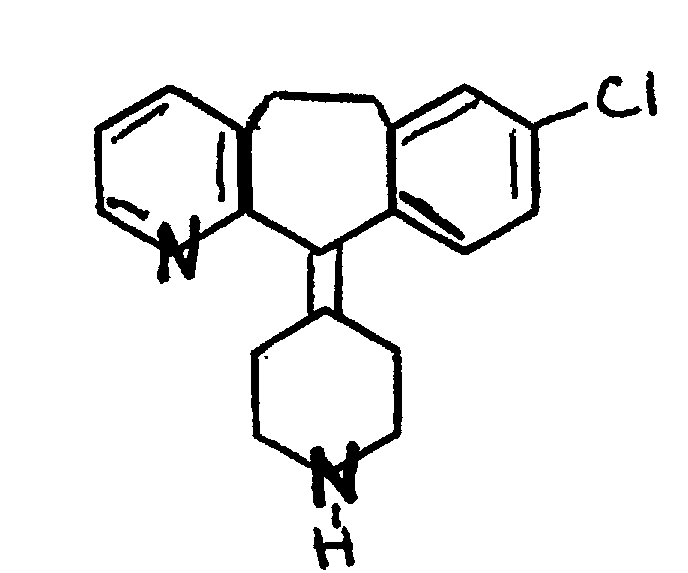
- This invention relates to crystalline polymorphs of 8-chloro-6,11-dihydro-11-(4-piperidylidene)-5H-benzo[5,6]cyclohepta[1,2-b]pyridine (hereinafter "descarbonylethoxyloratadine”) represented by the formula pharmaceutical compositions containing such polymorphs, and methods of using such polymorphs to treat allergic reactions in mammals.
- descarbonylethoxyloratadine 8-chloro-6,11-dihydro-11-(4-piperidylidene)-5H-benzo[5,6]cyclohepta[1,2-b]pyridine
- U.S. Patent No. 4,659,716 discloses descarbonylethoxyloratadine which possesses antihistaminic properties with substantially no sedative properties.
- This U.S. Patent also discloses methods of making descarbonylethoxyloratadine and using it to treat allergic reactions in mammals.
- this invention provides crystalline polymorph form 1 descarbonylethoxyloratadine essentially free of polymorph form 2 and characterized by the following x-ray powder diffraction pattern having characteristic peaks expressed in terms of "d" spacing and relative intensities("RI") at approximately: d spacing ( ⁇ 0.04) RI 9.04 Weak 6.42 Weak 5.67 Weak 5.02 Weak 3.58 Weak
- This invention further provides crystalline polymorph form 2 descarbonylethoxyloratadine substantially free of poymorph form 1 and characterized by the following x-ray powder diffraction pattern having characteristic peaks expressed in terms of "d" spacing and relative intensities("RI") approximately: d spacing ( ⁇ 0.04) RI 8.34 Weak 6.87 Medium 6.20 Medium 4.90 Medium
- polymorph form 1 essentially free of polymorph form 2 means that descarbonylethoxyloratadine polymorph form 1 prepared in accordance with this invention contains less than about 1% of form 2 as measured by infrared spectral analysis on a FTIR spectrometer.
- the polymorph form 1 prepared in accordance with Examples 1 and 2 had no detectable amount of form 2 by FTIR spectrophotometry.
- polymorph form 2 substantially free of polymorph form 1 means that the descarbonylethoxyloratadine polymorph form 2 prepared in accordance with this invention contains less than about 15%, preferably less than about 10%, and more preferably less than about 5-8% of form 1 as measured by infrared spectral analysis on a FTIR spectrometer.
- Descarboxyloratine prepared as described in U.S. Patent No. 4,659,716 was isolated as the acetic acid salt (Example III) and as a mixture of polymorphs of the free base from hexane (see Examples V + VI). We have discovered that descarbonylethoxyloratadine exists as a mixture of polymorphs.
- Chlorinated solvents e.g., dichloromethane produced form 1 substantially free of form 2 but the compounds were discolored.
- Ether solvents such as dioxane produced form 1 substantially free of form 2 but other alkane ethers, e.g., diisopropyl ether produced form 1 with significant amounts of form 2 and di-n-butyl ether favored formation of form 2.
- Ketones such as methyl isobutyl ketone produced crystalline polymorph form 1 essentially free of form 2 but methyl butyl ketone produced a 8:1 ratio of form 1 to form 2.
- Use of methyl isubutyl ketone is preferred to produce crystalline polymorph form 1 essentially free of form 2. Only ethyl acetate and di-n-butyl ether were found to produce crystalline polymorph form 2 substantially free of form 1.
- Use of di-n-butyl ether is preferred for producing crystalline form 2 substantially free of form 1.
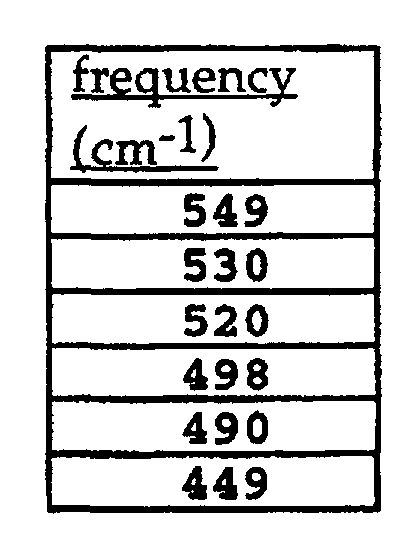
- a more complete infrared spectrum of crystalline polymorph form 1 descarbonylethoxyloratadine taken as a mull in mineral oil is characterized by the following characteristic peaks( in reciprocal centimeters) at approximately:
- a more complete infrared spectrum of crystalline polymorph form 2 descarbonylethoxyloratadine taken as a mull in mineral oil is characterized by the following characteristic peaks( in reciprocal centimeters at approximately: frequency (cm -1 ) 3326 3304 3052 3015 1635 1586 1569 1558 1479 1456 1437 1420 1398 1383 1328 1301 1282 1265 1250 1199 1174 1153 1133 1118 1089 1010 977 951 915 887 868 846 816 795 781 771 730 707 688 655 623 570 550 528 515 493 467 447
- the x-ray powder diffraction patterns were measured on a Philips APD3720 automated diffractometer system (model PW 1800).
- the radiation source was copper (K-alpha) and the long fine focus tube connected to a Philips XRG 3100 x-ray generator operated at 45 KV and 40 mA.
- the take-off angle was 6 degrees and a graphite monochromator as used.
- a scintillation detector was employed and data was acquired with a scan rate of 0.025 degrees per second, a step size of 0.010 and a step time of 40 seconds per degree.
- d spacing RI 9.04 W 7.24 M 7.11 VWD 6.69 M 6.42 W 6.02 W 5.84 VW 5.67 W 5.02 W 4.73 M 4.54 W 4.48 W 4.40 M 4.29 WD 4.25 W 4.18 VS 3.72 W 3.68 W 3.63 W 3.58 W 3.52 M 3.45 W 3.37 S 3.23 W 3.19 M 3.14 VWD 3.10 VWD 3.04 M 2.99 VWD 2.93 VWD 2.87 VWD 2.84 W 2.79 VWD 2.73 VWD 2.70 VWD 2.65 W 2.57 VWD 2.56 VWD 2.55 VWD 2.51 VWD 2.48 VWD 2.47 VWD 2.44 VWD 2.42 WD 2.37 VWD 2.34 WD 2.32 WD 2.29 VWD 2.27 W
- d spacing R I 8.34 W 7.21 W 6.87 M 6.75 M 6.20 M 6.04 M 5.91 VW 4.90 M 4.71 M 4.64 M 4.50 WD 4.39 VS 4.34 S 4.19 VWD 4.08 W 3.95 S 3.84 M 3.66 S 3.52 W 3.46 W 3.45 WD 3.39 W 3.25 S 3.18 W 3.11 W 3.07 M 2.95 W 2.88 WD 2.81 WD 2.79 WD 2.72 VW 2.59 VW 2.51 WD 2.45 VWD 2.40 VWD 2.38 VWD 2.32 VWD 2.30 VWD
- compositions of this invention may contain in addition to an anti-allergically effective amount of crystalline polymorph form 1 or form 2 descarbonylethoxyloratadine as the active ingredient, inert pharma-ceutically acceptable carriers that may be solids or liquids.
- Solid form compositions include powders, tablets, dispersible granules, capsules, cachets, and suppositories.
- a solid carrier can be one or more substances which may also act as diluants, flavoring agents, solubilizers, lubricants, suspending agents, binders or tablet disintegration agents; it can also be an encapsulating material.
- the carrier is a finely divided solid which is in admixture with the finely divided active compound.
- the active compound is mixed with carrier having the necessary binding properties in suitable proportions and compacted in the shape and size desired.
- the powders and tablets preferably contain from about 5 to about 20 percent of the active ingredient.
- Suitable solid carriers are magnesium carbonate, magnesium stearate, talc, sugar, lactose, pectin, dextrin, starch, gelatin, tragacanth, methycelluloseose, sodium carboxymethylcellulose, a low melting wax. cocoa butter and the like.
- compositions is intended to include the formulation of the active compound with encapsulating material as carrier providing a capsule in which the active component (with or without other carriers) is surrounded by carrier, which is thus in association with it. Similarly, caches are included. Tablets, powders, cachets and capsules can be used as solid dosage forms suitable for oral administration.
- a low melting wax such as a mixture of fatty acid glycerides or cocoa butter is first melted, and the active ingredient is dispersed homogeneously therein as by stirring. The molten homogeneous mixture is then poured into convenient sized molds, allowed to cool and thereby solidify.
- Liquid form preparations include solutions, suspensions and emulsions. As an example may be mentioned water or water-propylene glycol solutions for topical administration. Liquid preparations can also be formulated in solution in aqueous polyethylene glycol solution.
- Aqueous solutions suitable for oral use can be prepared by adding the active component in water and adding suitable colorants, flavors, stabilizing, sweetening, solubilizing and thickening agents as desired.
- Aqueous suspensions suitable for oral use can e made by dispersing the finely divided active component in water with viscous material, i.e., natural or synthetic gums, resins, methylcellulose, sodium carboxymethylcellulose and other well-known suspending agents.
- Topical formulation useful for nasal or ophthalmic administration are also contemplated.
- Topical formulation suitable for nasal administration may be solutions or suspensions.
- Ophthalmic formulations may be solutions, suspension or ointments.
- Ointments usually contain lipophilic carriers such as mineral oil and/or petrolatum.
- Solution for ophthalmic administration may contain sodium chloride, acid and/or base to adjust the pH as well as purified water and preservatives.
- the anti-allergic effective amount of polymorph form 1 or form 2 descarbonylethoxyloratadine for topical administration varies from 0.1 to 5% by weight of the total pharmaceutical composition.
- the preferred amount varies from 0.5 to 2% by weight of the total pharmaceutical composition.
- the precise dosage and dosage regimen may be varied depending upon the requirements of the patients. (e.g., his or her sex, age) as well as the severity of the allergic condition being treated. Determination of the proper dosage and dosage regimen for a particular patient will be within the skill of the attending clinician.
- Loratadine( 45 Kg, 117 moles) was refluxed in about 180 liters of ethanol containing potassium hydroxide (about 40.5 Kg, excess) for about 5 hours to complete the carbomate hydrolysis( see also Example VI of U.S. Patent No. 4,659,716).
- the warm reaction mixture was diluted with about 135 liters of water and distilled at atmospheric pressure until a reaction mixture temperature of 105-110°C was achieved.
- the reaction mixture was than cooled to 50-70°C, diluted with about 135 liters of methyl isobutyl ketone (MIBK), and the so-formed mixture was reheated to 80-90°C to redissolve solids.
- the aqueous layer was separated, and the MIBK layer was washed with additional portions of water until a pH of 6-9 was achieved in the aqueous layer.
- MIBK methyl isobutyl ketone
- the MIBK layer was then concentrated under atmospheric pressure and slowly cooled to -5 to 0°C as crude descarbonylethoxyloratadine crystallized. Crude descarbonylethoxyloratadine was filtered, washed with MIBK, and dried at about 60°C to produce about 33.5 Kg (92% of theory) of crude descarbonyl-ethoxyloratadine which may also be carried into the next step as a wet cake.
- Crystalline polymorph form 1 was micronized using a fluid energy mill and packaged in double polyethylene bags in a fiber drum closed with a metal ring.
- thermocouple and nitrogen gas source was added 10g of descarbonylethoxyloratadine (prepared as described in Example VI of USP 4,65,716) and 150 mL of di-n-butyl ether. The so-formed mixture was heated to 100 °C and held at this temperature until all solid material dissolved, and a clear solution was formed.
- second 250 mL three neck round bottom flask("second flask) equipped identically as the first flask was added 50mL of di-n-butyl ether. The second flask was cooled to -50 °C.
- a cendula was connected to both flasks and the ends of the cendula were placed below the surface of the solutions in both flasks. Nitrogen pressure was applied to the first flask sufficient to completely force the solution in first flask into the second flask. The temperature of the second flask was maintained at below -20 °C and the so-formed very turbid solution in the second flask was stirred for five minutes. The resulting precipitate was vaccum filtered. The solid was dried in a vaccum oven under a nitrogen atmosphere at room temperature. No heat was applied to prevent discoloration of the product. Seven grams (7 g) of polymorph form 2 descarbonylethoxyloratadine was obtained as a crystalline solid which contained 92% ( ⁇ 5%) of form 2 by FTIR spectrophotometry.
- Samples of crystalline polymorph form 1 prepared in accordance with this invention were subjected to stability testing at various temperatures (25, 30 and 40 °C) and relative humidities of 60%, 60% and 75%, respectively.
- Assay for form 1 and total related compounds were performed including physical appearance, X-ray diffraction, FTIR (identity), FTIR (polymorph ratio) and pH. No significant change ( ⁇ 1%) from initial sample % form 1 and related compounds was observed.
Landscapes
- Chemical & Material Sciences (AREA)
- Organic Chemistry (AREA)
- Health & Medical Sciences (AREA)
- Nuclear Medicine, Radiotherapy & Molecular Imaging (AREA)
- Pharmacology & Pharmacy (AREA)
- Chemical Kinetics & Catalysis (AREA)
- General Chemical & Material Sciences (AREA)
- Medicinal Chemistry (AREA)
- Bioinformatics & Cheminformatics (AREA)
- Engineering & Computer Science (AREA)
- Veterinary Medicine (AREA)
- Life Sciences & Earth Sciences (AREA)
- Animal Behavior & Ethology (AREA)
- General Health & Medical Sciences (AREA)
- Public Health (AREA)
- Immunology (AREA)
- Pulmonology (AREA)
- Pharmaceuticals Containing Other Organic And Inorganic Compounds (AREA)
- Plural Heterocyclic Compounds (AREA)
Abstract
Description
- This invention relates to crystalline polymorphs of 8-chloro-6,11-dihydro-11-(4-piperidylidene)-5H-benzo[5,6]cyclohepta[1,2-b]pyridine (hereinafter "descarbonylethoxyloratadine") represented by the formulapharmaceutical compositions containing such polymorphs, and methods of using such polymorphs to treat allergic reactions in mammals.
U.S. Patent No. 4,659,716 discloses descarbonylethoxyloratadine which possesses antihistaminic properties with substantially no sedative properties. This U.S. Patent also discloses methods of making descarbonylethoxyloratadine and using it to treat allergic reactions in mammals.
To prepare pharmaceutical compositions containing descarbonylethoxyloratadine for administration to mammals in accordance with exacting health registration requirements of the U.S. and international health registration authorities, e.g. the FDA's Good Manufacturing Practices("GMP")requirements, there is a need to produce descarbonylethoxyloratadine in as pure a form as possible, especially a form having constant physical properties. - We have discovered that descarbonylethoxyloratadine can exist in the form of two distinct crystalline polymorphs, each having distinctly different physical properties.
Accordingly, this invention provides crystalline polymorph form 1 descarbonylethoxyloratadine essentially free of polymorph form 2 and characterized by the following x-ray powder diffraction pattern having characteristic peaks expressed in terms of "d" spacing and relative intensities("RI") at approximately:d spacing (± 0.04) RI 9.04 Weak 6.42 Weak 5.67 Weak 5.02 Weak 3.58 Weak - This invention also provides crystalline polymorph form 1 descarbonylethoxyloratadine essentially free of polymorph form 2 and characterized by the following x-ray powder diffraction pattern essentially free of poymorph form 2 and having characteristic peaks expressed in terms of "d" spacings and relative intensities ("RI")(s=strong, m=medium, w=weak, v=very and d=diffuse) at approximately:
d spacing RI 9.04 W 7.24 M 7.11 VWD 6.69 M 6.42 W 6.02 W 5.84 VW 5.67 W 5.02 W 4.73 M 4.54 W 4.48 W 4.40 M 4.29 WD 4.25 W 4.18 VS 3.72 W 3.68 W 3.63 W 3.58 W 3.52 M 3.45 W 3.37 S 3.23 W 3.19 M 3.14 VWD 3.10 VWD 3.04 M 2.99 VWD 2.93 VWD 2.87 VWD 2.84 W 2.79 VWD 2.73 VWD 2.70 VWD 2.65 W 2.57 VWD 2.56 VWD 2.55 VWD 2.51 VWD 2.48 VWD 2.47 VWU 2.44 VWD 2.42 WD 2.37 VWD 2.34 WD 2.32 WD 2.29 VWD 2.27 W - This invention further provides crystalline polymorph form 2 descarbonylethoxyloratadine substantially free of poymorph form 1 and
characterized by the following x-ray powder diffraction pattern having characteristic peaks expressed in terms of "d" spacing and relative intensities("RI") approximately:d spacing (± 0.04) RI 8.34 Weak 6.87 Medium 6.20 Medium 4.90 Medium - This invention also provides crystalline polymorph form 2 descarbonylethoxyloratadine substantially free of poymorph form 1 and characterized by the following x-ray powder diffraction having characteristic peaks expressed in terms of "d" spacing and relative intensities ("RI") s=strong, m=medium, w=weak, v=very and d=diffuse) at approximately:
d spacing RI 8.34 W 7.21 W 6.87 M 6.75 M 6.20 M 6.04 M 5.91 VW 4.90 M 4.71 M 4.64 M 4.50 WD 4.39 VS 4.34 S 4.19 VWD 4.08 W 3.95 S 3.84 M 3.66 S 3.52 W 3.46 W 3.45 WD 3.39 W 3.25 S 3.18 W 3.11 W 3.07 M 2.95 W 2.88 WD 2.81 WD 2.79 WD 2.72 VW 2.59 VW 2.51 WD 2.45 VWD 2.40 VWD 2.38 VWD 2.32 VWD 2.30 VWD -
- Figure 1 presents the infrared spectrum of crystalline polymorph form 1 descarbonylethoxyloratadine as a mull in mineral oil.
- Figure 2 presents an infrared spectrum of crystalline polymorph form 2 descarbonylethoxyloratadine as a mull in mineral oil.
-
- By the phrase "polymorph form 1 essentially free of polymorph form 2" as used herein means that descarbonylethoxyloratadine polymorph form 1 prepared in accordance with this invention contains less than about 1% of form 2 as measured by infrared spectral analysis on a FTIR spectrometer. The polymorph form 1 prepared in accordance with Examples 1 and 2 had no detectable amount of form 2 by FTIR spectrophotometry. By the phrase "polymorph form 2 substantially free of polymorph form 1" as used herein means that the descarbonylethoxyloratadine polymorph form 2 prepared in accordance with this invention contains less than about 15%, preferably less than about 10%, and more preferably less than about 5-8% of form 1 as measured by infrared spectral analysis on a FTIR spectrometer.
Descarboxyloratine prepared as described in U.S. Patent No. 4,659,716 was isolated as the acetic acid salt (Example III) and as a mixture of polymorphs of the free base from hexane (see Examples V + VI).
We have discovered that descarbonylethoxyloratadine exists as a mixture of polymorphs. Such a mixture could lead to production of a descarbonylethoxyloratadine product which would exist as a variable mixture of variable composition (i.e., variable percent amounts of polymorphs) having variable physical properties, a situation unacceptable in view of stringent GMP requirements. - We have discovered specific solvents and experimental conditions which consistently produce two distinctly different crystalline polymorphs of descarbonylethoxyloratadine thereby allowing commercial production of a consistent pharmaceutical product having constant physical properties.
In the course of developing pure descarbonylethoxyloratadine crystalline polymorphs for a pharmaceutical composition prepared in compliance with exacting GMP regulations, we tried many solvent systems, most of which produced only mixtures of polymorphs. Surprisingly we discovered that certain alcoholic solvents, e.g., hexanol and methanol produced 100% polymorph form 1, but others, e.g., 3-methyl-1-butanol and cyclohexanol produced significant amounts of form 2. Chlorinated solvents, e.g., dichloromethane produced form 1 substantially free of form 2 but the compounds were discolored. Ether solvents such as dioxane produced form 1 substantially free of form 2 but other alkane ethers, e.g., diisopropyl ether produced form 1 with significant amounts of form 2 and di-n-butyl ether favored formation of form 2. Ketones such as methyl isobutyl ketone produced crystalline polymorph form 1 essentially free of form 2 but methyl butyl ketone produced a 8:1 ratio of form 1 to form 2. Use of methyl isubutyl ketone is preferred to produce crystalline polymorph form 1 essentially free of form 2.
Only ethyl acetate and di-n-butyl ether were found to produce crystalline polymorph form 2 substantially free of form 1. Use of di-n-butyl ether is preferred for producing crystalline form 2 substantially free of form 1. - The infrared spectrum of crystalline polymorph form 1 descarbonylethoxyloratadine taken on as a mull in mineral oil is characterized by the following three characteristic peaks( in reciprocal centimeters) not found in pure polymorph form 2 at approximately:
frequency (cm-1) 3303 1290 803 780 - A more complete infrared spectrum of crystalline polymorph form 1 descarbonylethoxyloratadine taken as a mull in mineral oil is characterized by the following characteristic peaks( in reciprocal centimeters) at approximately:

- The infrared spectrum of crystalline polymorph form 2 descarbonylethoxyloratadine taken as a mull in mineral oil is characterized by the following five characteristic peaks( in reciprocal centimeters) not found in the polymorph form 1 at approximately:
frequency (cm-1) 3326 1153 1133 795 771 655 - A more complete infrared spectrum of crystalline polymorph form 2 descarbonylethoxyloratadine taken as a mull in mineral oil is characterized by the following characteristic peaks( in reciprocal centimeters at approximately:
frequency (cm-1) 3326 3304 3052 3015 1635 1586 1569 1558 1479 1456 1437 1420 1398 1383 1328 1301 1282 1265 1250 1199 1174 1153 1133 1118 1089 1010 977 951 915 887 868 846 816 795 781 771 730 707 688 655 623 570 550 528 515 493 467 447 - These infrared spectra were obtained on mulls in mineral oil measured a Mattson Galaxy 6021 FTIR spectrometer. The mineral oil mulls were prepared and placed between NaCl or KBr plates in accordance with the USP procedure <197M>. See also "Experiments in Techniques of OInfrared Spectroscopy", R.W. Hannah and J. S. Swinehart, Perkin-Elmer Corpation, September,1974, pps, 6-1 to 6-6.The spectral data was presented in absorbance from about 3370 to 3250 cm-1. The area of the peaks at 3326 ±1 cm-1 (form 2) and at 3303±1 cm-1 (form 1) were integrated to obtain the ratio of form 2 to form 1,
- The x-ray powder diffraction patterns were measured on a Philips APD3720 automated diffractometer system (model PW 1800). The radiation source was copper (K-alpha) and the long fine focus tube connected to a Philips XRG 3100 x-ray generator operated at 45 KV and 40 mA. The take-off angle was 6 degrees and a graphite monochromator as used. A scintillation detector was employed and data was acquired with a scan rate of 0.025 degrees per second, a step size of 0.010 and a step time of 40 seconds per degree.
The x-ray powder diffraction pattern distinctive for crystalline polymorph form 1 descarbonylethoxyloratadine having characteristic peaks expressed in terms of "d" spacing and relative intensities("RI") is provided hereinbelow:"d" spacing (±0.04) RI 9.04 Weak 6.42 Weak 5.67 Weak 5.02 Weak 3.58 Weak - A more complete x-ray powder diffraction pattern for crystalline polymorph form 1 descarbonylethoxyloratadine having characteristic peaks expressed in terms of "d" spacing and relative intensities("RI") is provided hereinbelow:
d spacing RI 9.04 W 7.24 M 7.11 VWD 6.69 M 6.42 W 6.02 W 5.84 VW 5.67 W 5.02 W 4.73 M 4.54 W 4.48 W 4.40 M 4.29 WD 4.25 W 4.18 VS 3.72 W 3.68 W 3.63 W 3.58 W 3.52 M 3.45 W 3.37 S 3.23 W 3.19 M 3.14 VWD 3.10 VWD 3.04 M 2.99 VWD 2.93 VWD 2.87 VWD 2.84 W 2.79 VWD 2.73 VWD 2.70 VWD 2.65 W 2.57 VWD 2.56 VWD 2.55 VWD 2.51 VWD 2.48 VWD 2.47 VWD 2.44 VWD 2.42 WD 2.37 VWD 2.34 WD 2.32 WD 2.29 VWD 2.27 W - The x-ray powder diffraction pattern distinctive for crystalline polymorph form 2 having characteristic peaks expressed in terms of "d" spacing and relative intensities("RI") is provided hereinbelow:
d spacings (± 0.04) RI 8.34 Weak 6.87 Medium 6.30 Medium 4.90 Medium - A more complete x-ray powder diffraction pattern for polymorph form 2 descarbonylethoxyloratadine having characteristic peaks expressed in terms of "d" spacing and relative intensities("RI") is provided hereinbelow:
d spacing R I 8.34 W 7.21 W 6.87 M 6.75 M 6.20 M 6.04 M 5.91 VW 4.90 M 4.71 M 4.64 M 4.50 WD 4.39 VS 4.34 S 4.19 VWD 4.08 W 3.95 S 3.84 M 3.66 S 3.52 W 3.46 W 3.45 WD 3.39 W 3.25 S 3.18 W 3.11 W 3.07 M 2.95 W 2.88 WD 2.81 WD 2.79 WD 2.72 VW 2.59 VW 2.51 WD 2.45 VWD 2.40 VWD 2.38 VWD 2.32 VWD 2.30 VWD - Pharmaceutical compositions of this invention may contain in addition to an anti-allergically effective amount of crystalline polymorph form 1 or form 2 descarbonylethoxyloratadine as the active ingredient, inert pharma-ceutically acceptable carriers that may be solids or liquids. Solid form compositions include powders, tablets, dispersible granules, capsules, cachets, and suppositories. A solid carrier can be one or more substances which may also act as diluants, flavoring agents, solubilizers, lubricants, suspending agents, binders or tablet disintegration agents; it can also be an encapsulating material. In powders, the carrier is a finely divided solid which is in admixture with the finely divided active compound. In the tablet the active compound is mixed with carrier having the necessary binding properties in suitable proportions and compacted in the shape and size desired. The powders and tablets preferably contain from about 5 to about 20 percent of the active ingredient. Suitable solid carriers are magnesium carbonate, magnesium stearate, talc, sugar, lactose, pectin, dextrin, starch, gelatin, tragacanth, methycelulose, sodium carboxymethylcellulose, a low melting wax. cocoa butter and the like. The term "compositions" is intended to include the formulation of the active compound with encapsulating material as carrier providing a capsule in which the active component (with or without other carriers) is surrounded by carrier, which is thus in association with it. Similarly, caches are included. Tablets, powders, cachets and capsules can be used as solid dosage forms suitable for oral administration.
- For preparing suppositories, a low melting wax such as a mixture of fatty acid glycerides or cocoa butter is first melted, and the active ingredient is dispersed homogeneously therein as by stirring. The molten homogeneous mixture is then poured into convenient sized molds, allowed to cool and thereby solidify.
- Liquid form preparations include solutions, suspensions and emulsions. As an example may be mentioned water or water-propylene glycol solutions for topical administration. Liquid preparations can also be formulated in solution in aqueous polyethylene glycol solution. Aqueous solutions suitable for oral use can be prepared by adding the active component in water and adding suitable colorants, flavors, stabilizing, sweetening, solubilizing and thickening agents as desired. Aqueous suspensions suitable for oral use can e made by dispersing the finely divided active component in water with viscous material, i.e., natural or synthetic gums, resins, methylcellulose, sodium carboxymethylcellulose and other well-known suspending agents.
- Topical formulation useful for nasal or ophthalmic administration are also contemplated. Topical formulation suitable for nasal administration may be solutions or suspensions. Ophthalmic formulations may be solutions, suspension or ointments. Ointments usually contain lipophilic carriers such as mineral oil and/or petrolatum. Solution for ophthalmic administration may contain sodium chloride, acid and/or base to adjust the pH as well as purified water and preservatives.
- The anti-allergic effective amount of polymorph form 1 or form 2 descarbonylethoxyloratadine for topical administration varies from 0.1 to 5% by weight of the total pharmaceutical composition. The preferred amount varies from 0.5 to 2% by weight of the total pharmaceutical composition.
- The anti-allergic effective amount of polymorph form 1 or form 2 descarbonylethoxyloratadine for oral administration varies from about 1 to 50 mg/day, preferably about 2.5 to 20 mg/day and more preferably about 5 to 10 mg/day in single or divided doses. The most preferred amount is 5.0 mg, once a day.
- Of course the precise dosage and dosage regimen may be varied depending upon the requirements of the patients. (e.g., his or her sex, age) as well as the severity of the allergic condition being treated. Determination of the proper dosage and dosage regimen for a particular patient will be within the skill of the attending clinician.
- The polymorph form 1 and form 2 descarbonylethoxyloratadine possess antihistaminic properties. These antihistaminic properties have been demonstrated in standard animal models, such as prevention of histamine - induced lethality in guinea pigs. Antihistaminic activity of form 1 and form 2 has also been demonstrated in a monkey model.
- To a solution of 60.0 kg of potassium hydroxide flakes in 200 liters of industrial methylated spirits was added 50.0 kg of loratadine (available from Schering Corporation, Kenilworth, NJ, see also U.S. Patent No. 4,282,233). The so-formed mixture was heated under reflux for 3 hours and 150 liters of water were added. The so-formed mixture was distilled at atmospheric pressure until a temperature of the mixture reached 108°C. The mixture was cooled to 68°C and 150 liters of methyl isobutyl ketone (MIBK) were added and the mixture was agitated until all the solids were dissolved. The organic layer was separated and washed with water at 80°C until the separated aqueous layer had a pH of 9. Fifty (50) liters of MIBK were then removed from the organic layer by distillation at atmospheric pressure and the so formed organic layer was cooled to around 0°C for 1 hour. The resulting crystalline product was separated by centrifugation, washed with 2 x 12 liters of room temperature MIBK and spun dry in a centrifuge at high speed. The so-formed product was dried at 60°C for 6 hours to give 29.05 kg of polymorph form 1 descarbonylethoxyloratadine as a white crystalline solid, mp 156.8-157.7. The structure of the title compound was confirmed by comparison of its IR and NMR with spectra of a reference standard.
- Loratadine( 45 Kg, 117 moles) was refluxed in about 180 liters of ethanol containing potassium hydroxide (about 40.5 Kg, excess) for about 5 hours to complete the carbomate hydrolysis( see also Example VI of U.S. Patent No. 4,659,716). The warm reaction mixture was diluted with about 135 liters of water and distilled at atmospheric pressure until a reaction mixture temperature of 105-110°C was achieved. The reaction mixture was than cooled to 50-70°C, diluted with about 135 liters of methyl isobutyl ketone (MIBK), and the so-formed mixture was reheated to 80-90°C to redissolve solids. The aqueous layer was separated, and the MIBK layer was washed with additional portions of water until a pH of 6-9 was achieved in the aqueous layer.
- The MIBK layer was then concentrated under atmospheric pressure and slowly cooled to -5 to 0°C as crude descarbonylethoxyloratadine crystallized. Crude descarbonylethoxyloratadine was filtered, washed with MIBK, and dried at about 60°C to produce about 33.5 Kg (92% of theory) of crude descarbonyl-ethoxyloratadine which may also be carried into the next step as a wet cake.
- Crude descarbonylethoxyloratadine (33.6 Kg, 108 moles) was dissolved in about 135 liters of hot (85-95°C) MIBK, filtered, and about 50 liters of the MIBK was distilled from the mixture at atmospheric pressure. The so-formed solution was then slowly cooled to 15-22°C, aged for about an hour, and the resulting crystalline slurry of descarbonylethoxy-loratadine was filtered, washed with MIBK, and dried at about 80°C to produce 31 Kg (92% yield) of polymorph form 1 descarbonylethoxy-loratadine as a white crystalline solid.This white crystalline solid contained 100% of form I, with no detectable amount of form 2 by FTIR spectrophotometry.
- Crystalline polymorph form 1 was micronized using a fluid energy mill and packaged in double polyethylene bags in a fiber drum closed with a metal ring.
-
- A. To a 50 mL Erlenmeyer flask was added 3.3 g of descarbonylethoxyloratadine (prepared in accordance with Example VI of U.S. Patent No. 4,659,716) and methanol (3.5 ml). The so-formed mixture was heated until complete dissolution was obtained. The so-formed clear solution was allowed to cool slowly to room temperature and kept at room temperature for 4 hours. The resulting crystalline product was filtered, washed with hexane (10 ml) and dried in a vacuum oven at 40°C under nitrogen for 24 hours to provide 2.77 g of polymorph form 1 descarbonylethoxyloratadine as a white crystalline solid, (DSC 157.30).
- B. To a 250 mL three neck round bottom flask equipped with an overhead agitator, thermocouple and nitrogen gas source was added 10 g of descarbonylethoxyloratadine (prepared as described in Example VI of USP 4,65,716) and 60 mL of MIBK. The so-formed mixture was heated to 105 °C and the temperature was maintained at 105 °C until complete dissolution was obtained. The so- formed solution was slowly cooled to room temperature to allow the crystalline product to precipitate out of solution. The so-formed mixture was cooled to 5 °C and the temperature was maintained at 5 °C for 1 hour. The solid was vacuum filtered and washed with 2 volumes of MIBK (chilled to 5 °C). The solid was dried in an oven at 50 °C until the loss on drying was 0.4% or less. 8.30 g of polymorph form 1 descarbonylethoxyloratadine (100% by FTIR spectrophotometry) was obtained as a white crystalline solid.
-
- A solution of 366 g of descarbonylethoxyloratadine (prepared as described in Example VI of USP 4,65,716) in 3 liters of ethyl acetate was heated to reflux; 15 g of Darco decolorizing charcoal and 25 g of Supercel filtering aid were added and the so-formed mixture was further refluxed for 10 minutes. The mixture was filtered while hot through a Supercel filter mat. The filtrate was concentrated at elevated temperature to 650 ml. The so-formed concentrated filtrate was rapidly cooled to 0°C. The resulting precipitate was filtered, washed with hexane and dried in an air-draft oven at 55-60°C to give 333.2 g of polymorph form 2 descarbonylethoxyloratadine as a white crystalline solid,having mp 154.0-155.5°C, and containing 100% form 2 by FTIR spectrophotometry.
- To a first 250 mL three neck round bottom flask ("first flask")equipped with an overhead agitator, thermocouple and nitrogen gas source was added 10g of descarbonylethoxyloratadine (prepared as described in Example VI of USP 4,65,716) and 150 mL of di-n-butyl ether. The so-formed mixture was heated to 100 °C and held at this temperature until all solid material dissolved, and a clear solution was formed. To a second 250 mL three neck round bottom flask("second flask") equipped identically as the first flask was added 50mL of di-n-butyl ether. The second flask was cooled to -50 °C. A cendula was connected to both flasks and the ends of the cendula were placed below the surface of the solutions in both flasks. Nitrogen pressure was applied to the first flask sufficient to completely force the solution in first flask into the second flask. The temperature of the second flask was maintained at below -20 °C and the so-formed very turbid solution in the second flask was stirred for five minutes. The resulting precipitate was vaccum filtered. The solid was dried in a vaccum oven under a nitrogen atmosphere at room temperature. No heat was applied to prevent discoloration of the product. Seven grams (7 g) of polymorph form 2 descarbonylethoxyloratadine was obtained as a crystalline solid which contained 92% (± 5%) of form 2 by FTIR spectrophotometry.
- Samples of crystalline polymorph form 1 prepared in accordance with this invention were subjected to stability testing at various temperatures (25, 30 and 40 °C) and relative humidities of 60%, 60% and 75%, respectively. Assay for form 1 and total related compounds were performed including physical appearance, X-ray diffraction, FTIR (identity), FTIR (polymorph ratio) and pH. No significant change (<1%) from initial sample % form 1 and related compounds was observed.
Claims (21)
- Crystalline polymorph form 1 descarbonylethoxyloratadine essentially free of polymorph form 2 and characterized by the following x-ray powder diffraction pattern having characteristic peaks expressed in terms of "d" spacing and relative intensities("RI") at approximately:
d spacing (±0.04) RI 9.04 Weak 6.42 Weak 5.67 Weak 5.02 Weak 3.58 Weak - Crystalline polymorph form 1 descarbonylethoxyloratadine essentially free of polymorph form 2 according to claim 1 and characterized by the following x-ray powder diffraction pattern having characteristic peaks expressed in terms of "d" spacing and relative intensities("RI") (s=strong, m=medium, w=weak, v=very and d=diffuse) at approximately:
d spacing RI 9.04 W 7.24 M 7.11 VWD 6.69 M 6.42 W 6.02 W 5.84 VW 5.67 W 5.02 W 4.73 M 4.54 W 4.48 W 4.40 M 4.29 WD 4.25 W 4.18 VS 3.72 W 3.68 W 3.63 W 3.58 W 3.52 M 3.45 W 3.37 S 3.23 W 3.19 M 3.14 VWD 3.10 VWD 3.04 M 2.99 VWD 2.93 VWD 2.87 VWD 2.84 W 2.79 VWD 2.73 VWD 2.70 VWD 2.65 W 2.57 VWD 2.56 VWD 2.55 VWD 2.51 VWD 2.48 VWD 2.47 VWD 2.44 VWD 2.42 WD 2.37 VWD 2.34 WD 2.32 WD 2.29 VWD 2.27 W - The crystalline polymorph form 1 descarbonylethoxyloratadine of claim 1 further characterized by an infrared spectrum generated on a mull of the polymorph form 1 in mineral oil showing the following characteristic peaks in reciprocal centimeters at approximately:
frequency (cm-1) 3303 1290 803 780 
- The crystalline polymorph form 1 descarbonylethoxyloratadine of claim 1 further characterized by an infrared spectrum generated on a mull of the polymorph form 1 in mineral oil showing the following characteristic peaks in reciprocal centimeters at approximately:

- The crystalline polymorph form 1 descarboxy loratadine of claim 2 further characterized by an infrared spectrum generated on a mull of said polymorph form 1 in mineral oil showing the following characteristic peaks in reciprocal centimeters at approximately:
frequency (cm-1) 3303 1290 803 780 - The crystalline polymorph form 1 descarbonylethoxyloratadine of claim 2 which is further characterized by infrared spectrum generated on a mull of said polymorph form1 in mineral oil showing the following characteristic peaks in reciprocal centimeters at approximately:


- A pharmaceutical composition comprising an anti-allergic effective amount of the crystalline polymorph form 1 descarbonylethoxyloratadine of claim 1 and a pharmaceutically acceptable carrier.
- Crystalline polymorph form 2 descarbonylethoxyloratadine substantially free of polymorph form 1 and characterized by the following x-ray powder diffraction pattern having characteristic peaks expressed in terms of "d" spacing and relative intensities("RI") at approximately:
d spacing (±0.04) RI 8.34 Weak 6.87 Medium 6.20 Medium 4.90 Medium - Crystalline polymorph form 2 descarbonylethoxyloratadine substantially free of polymorph form 1 according to claim 8 and characterized by the following x-ray powder diffraction pattern having characteristic peaks expressed in terms of "d" spacings and relative intensities ("RI")(s=strong, m=medium, w=weak, v=very and d=diffuse) at approximately:
d spacing RI 8.34 W 7.21 W 6.87 M 6.75 M 6.20 M 6.04 M 5.91 VW 4.90 M 4.71 M 4.64 M 4.50 WD 4.39 VS 4.34 S 4.19 VWD 4.08 W 3.95 S 3.84 M 3.66 S 3.52 W 3.46 W 3.45 WD 3.39 W 3.25 S 3.18 W 3.11 W 3.07 M 2.95 W 2.88 WD 2.81 WD 2.79 WD 2.72 VW 2.59 VW 2.51 WD 2.45 VWD 2.40 VWD 2.38 VWD 2.32 VWD 2.30 VWD - The crystalline polymorph form 2 descarboxy loratadine of claim 8 further characterized by an infrared spectrum generated on a mull of said polymorph form 2 in mineral oil showing the following characteristic peaks in reciprocal centimeters at approximately: .
frequency (cm-1) 3326 1153 1133 795 771 655 - The crystalline polymorph form 2 descarbonylethoxyloratadine of claim 8 further characterized by an infrared spectrum generated on a mull of said polymorph form 1 in mineral oil showing the following characteristic peaks in reciprocal centimeters at approximately:
frequency (cm-1) 3326 3304 3052 3015 1635 1586 1569 1558 1479 1456 1437 1420 1398 1383 1328 1301 1282 1265 1250 1199 1174 1153 1133 1118 1089 1010 977 951 915 887 868 846 816 795 781 771 730 707 688 655 623 570 550 528 515 493 467 447 - The crystalline polymorph form 2 descarbonylethoxyloratadine of claim 9 further characterized by an infrared spectrum generated on a mull of said polymorph form 2 in mineral oil showing the following characteristic peaks in reciprocal centimeters at approximately:
frequency (cm-1) 3326 1153 1133 795 771 655 - The crystallinepolymorph form 2 descarboxy loratadine of claim 9 further characterized by an infrared spectrum generated on a mull of said polymorph form 2 in mineral oil showing the following characteristic peaks in reciprocal centimeters at approximately:
frequency (cm-1) 3326 3304 3052 3015 1635 1586 1569 1558 1479 1456 1437 1420 1398 1383 1328 1301 1282 1265 1250 1199 1174 1133 1118 1089 1010 977 951 915 887 868 846 816 795 781 771 730 707 688 655 623 570 550 528 515 493 467 447 - A pharmaceutical composition comprising an anti-allergic amount of the crystalline polymorph form 2 descarbonylethoxyloratadine of any of Claims 8 to 13 and a pharmaceutically acceptable carrier.
- A pharmaceutical composition comprising an anti-allergic amount of the crystalline polymorph form 1 descarbonylethoxyloratadine of any of Claims 1 to 7 and a pharmaceutically acceptable carrier.
- The crystalline polymorph form 1 descarbonylethoxyloratadine of any of Claims 1 to 7 for use in treating allergic reactions in a mammal.
- The crystalline polymorph form 2 descarbonylethoxyloratadine of any of Claims 8 to 13 for use in treating allergic reactions in mammal.
- A process for the production of pure crystalline polymorph form 1 descarbonylethoxyloratadine according to claim 1, substantially free of polymorph form 2, the process comprising the steps of:(i) forming a solution of descarbonylethoxyloratadine in a solvent selected from methanol, hexanol, methylisobutyl ketone or dioxane; and(ii) cooling the so-formed solution at a temperature and for a time sufficient to produce a solid form 1 descarbonylethoxyloratadine substantially free of form 2.
- A process according to Claim 18 wherein the solvent is methylisobutyl ketone.
- A process for the production of pure crystalline polymorph form 2 descarbonylethoxyloratadine according to claim 8, substantially free of polymorph form 1, the process comprising the steps of:(i) forming a solution of descarbonylethoxyloratadine in a solvent selected from ethyl acetate and di-n-butyl ether; and(ii) cooling the so-formed solution at a temperature and for a time sufficient to produce a solid form 2 descarbonylethoxyloratadine substantially free of form 1.
- A process according to Claim 20 wherein the solvent is di-n-butyl ether.
Applications Claiming Priority (3)
| Application Number | Priority Date | Filing Date | Title |
|---|---|---|---|
| US88676697A | 1997-07-02 | 1997-07-02 | |
| US886766 | 1997-07-02 | ||
| PCT/US1998/013433 WO1999001450A1 (en) | 1997-07-02 | 1998-07-01 | POLYMORPHS OF 8-CHLORO-6, 11-DIHYDRO-11- (4-PIPERIDYLIDENE) -5H-BENZO[5,6] CYCLOHEPTA[1,2-b]PYRIDINE |
Publications (2)
| Publication Number | Publication Date |
|---|---|
| EP0993455A1 EP0993455A1 (en) | 2000-04-19 |
| EP0993455B1 true EP0993455B1 (en) | 2003-05-02 |
Family
ID=25389724
Family Applications (1)
| Application Number | Title | Priority Date | Filing Date |
|---|---|---|---|
| EP98932930A Expired - Lifetime EP0993455B1 (en) | 1997-07-02 | 1998-07-01 | POLYMORPHS OF 8-CHLORO-6, 11-DIHYDRO-11- (4-PIPERIDYLIDENE) -5H-BENZO[5,6] CYCLOHEPTA[1,2-b]PYRIDINE |
Country Status (25)
| Country | Link |
|---|---|
| EP (1) | EP0993455B1 (en) |
| JP (2) | JP2002507991A (en) |
| KR (1) | KR20010014316A (en) |
| CN (1) | CN1261886A (en) |
| AR (1) | AR013161A1 (en) |
| AT (1) | ATE239010T1 (en) |
| AU (1) | AU734487B2 (en) |
| BR (1) | BR9811658A (en) |
| CA (1) | CA2294352C (en) |
| CO (1) | CO4940423A1 (en) |
| DE (1) | DE69814076T2 (en) |
| ES (1) | ES2197480T3 (en) |
| HU (1) | HUP0004308A3 (en) |
| IL (1) | IL133387A (en) |
| MY (1) | MY132943A (en) |
| NO (1) | NO996547L (en) |
| NZ (1) | NZ501417A (en) |
| PE (1) | PE86399A1 (en) |
| PL (1) | PL337712A1 (en) |
| RU (1) | RU2197485C2 (en) |
| SK (1) | SK185299A3 (en) |
| TR (1) | TR199903308T2 (en) |
| UA (1) | UA62976C2 (en) |
| WO (1) | WO1999001450A1 (en) |
| ZA (1) | ZA985783B (en) |
Families Citing this family (14)
| Publication number | Priority date | Publication date | Assignee | Title |
|---|---|---|---|---|
| US7405223B2 (en) | 2000-02-03 | 2008-07-29 | Schering Corporation | Treating allergic and inflammatory conditions |
| WO2003086275A2 (en) * | 2002-04-15 | 2003-10-23 | Sun Pharmaceutical Industries Limited | Preperation of desloratatine |
| BR0313231A (en) * | 2002-08-05 | 2007-07-24 | Sandoz Ag | desloratadine hemifumarate salt and polymorphs |
| US20040242619A1 (en) * | 2003-03-12 | 2004-12-02 | Toth Zoltan G. | Processes for preparation of polymorphic forms of desloratadine |
| US20060135547A1 (en) * | 2003-03-12 | 2006-06-22 | Toth Zoltan G | Stable pharmaceutical compositions of desloratadine and processes for preparation of polymorphic forms of desloratadine |
| CZ200798A3 (en) * | 2004-07-07 | 2007-06-20 | Egis Gyogyszergyár Nyrt. | Novel desloratadine pseudopolymorph prepared with the aid of carbon dioxide |
| US20100216831A1 (en) * | 2005-11-17 | 2010-08-26 | Teva Pharmaceutical Industries, Ltd. | Desloratadine crystalline forms mixtures having a low level of residual solvents |
| HU230417B1 (en) * | 2006-10-26 | 2016-05-30 | Egis Gyógyszergyár Zrt | Process for producing adduct comprising desloratadine and carbon dioxide |
| CA2687019A1 (en) * | 2007-05-11 | 2008-11-20 | Ratiopharm Gmbh | Pharmaceutical composition comprising desloratadine |
| EP2269586B1 (en) | 2009-07-01 | 2011-09-21 | Alfred E. Tiefenbacher (GmbH & Co. KG) | Pharmaceutical composition comprising desloratadine |
| PT2568970T (en) | 2010-05-10 | 2019-02-11 | Lesvi Laboratorios Sl | Stable pharmaceutical formulations containing an antihistaminic |
| EP2727592A1 (en) | 2012-11-05 | 2014-05-07 | Kücükgüzel, Sükriye Güniz | A combination of desloratadine and paracetamol |
| CN103755682A (en) * | 2013-12-30 | 2014-04-30 | 山东达因海洋生物制药股份有限公司 | Novel crystal form for desloratadine and preparation method thereof |
| CN108358892A (en) * | 2018-04-11 | 2018-08-03 | 常州方圆制药有限公司 | A kind of method of purification of Desloratadine crude product |
Family Cites Families (3)
| Publication number | Priority date | Publication date | Assignee | Title |
|---|---|---|---|---|
| JPS61501205A (en) * | 1984-02-15 | 1986-06-19 | シェリング・コ−ポレ−ション | 8↓-chloro↓-6,11↓-dihydro↓-11↓-(4↓-piperidylidene)↓-5H↓-benzo[5,6]cyclohepta[1,2-b]pyridine and its salts, compounds thereof and pharmaceutical compositions containing these compounds. |
| DE3677842D1 (en) * | 1985-05-13 | 1991-04-11 | Schering Corp | METHOD FOR THE PRODUCTION OF PIPERIDYLIDES-DIHYDRODIBENZO (A, D) CYCLOHEPTENES AND THEIR AZODERIVATES, COMPOUNDS MADE THEREOF AND THEIR USE FOR THE PREPARATION OF MEDICINAL PRODUCTS. |
| ZA914764B (en) * | 1990-06-22 | 1992-03-25 | Schering Corp | Bis-benzo or benzopyrido cyclohepta piperidene,piperidylidene and piperazine compounds,compositions and methods of use |
-
1998
- 1998-01-07 UA UA2000010519A patent/UA62976C2/en unknown
- 1998-07-01 ES ES98932930T patent/ES2197480T3/en not_active Expired - Lifetime
- 1998-07-01 AT AT98932930T patent/ATE239010T1/en not_active IP Right Cessation
- 1998-07-01 AU AU82710/98A patent/AU734487B2/en not_active Ceased
- 1998-07-01 JP JP50726599A patent/JP2002507991A/en active Pending
- 1998-07-01 SK SK1852-99A patent/SK185299A3/en unknown
- 1998-07-01 NZ NZ501417A patent/NZ501417A/en unknown
- 1998-07-01 WO PCT/US1998/013433 patent/WO1999001450A1/en not_active Ceased
- 1998-07-01 RU RU2000102669/04A patent/RU2197485C2/en not_active IP Right Cessation
- 1998-07-01 BR BR9811658-4A patent/BR9811658A/en not_active IP Right Cessation
- 1998-07-01 HU HU0004308A patent/HUP0004308A3/en unknown
- 1998-07-01 AR ARP980103203A patent/AR013161A1/en unknown
- 1998-07-01 TR TR1999/03308T patent/TR199903308T2/en unknown
- 1998-07-01 ZA ZA985783A patent/ZA985783B/en unknown
- 1998-07-01 KR KR1019997012456A patent/KR20010014316A/en not_active Ceased
- 1998-07-01 DE DE69814076T patent/DE69814076T2/en not_active Expired - Lifetime
- 1998-07-01 CO CO98037139A patent/CO4940423A1/en unknown
- 1998-07-01 PL PL98337712A patent/PL337712A1/en unknown
- 1998-07-01 CN CN98806712A patent/CN1261886A/en active Pending
- 1998-07-01 IL IL13338798A patent/IL133387A/en not_active IP Right Cessation
- 1998-07-01 EP EP98932930A patent/EP0993455B1/en not_active Expired - Lifetime
- 1998-07-01 CA CA002294352A patent/CA2294352C/en not_active Expired - Fee Related
- 1998-07-02 PE PE1998000594A patent/PE86399A1/en not_active Application Discontinuation
- 1998-07-02 MY MYPI98003024A patent/MY132943A/en unknown
-
1999
- 1999-12-29 NO NO996547A patent/NO996547L/en not_active Application Discontinuation
-
2009
- 2009-07-27 JP JP2009174701A patent/JP2009242436A/en not_active Withdrawn
Also Published As
| Publication number | Publication date |
|---|---|
| DE69814076D1 (en) | 2003-06-05 |
| MY132943A (en) | 2007-10-31 |
| IL133387A0 (en) | 2001-04-30 |
| JP2009242436A (en) | 2009-10-22 |
| SK185299A3 (en) | 2000-07-11 |
| PE86399A1 (en) | 1999-10-23 |
| HUP0004308A3 (en) | 2004-07-28 |
| ZA985783B (en) | 1999-01-19 |
| TR199903308T2 (en) | 2000-11-21 |
| JP2002507991A (en) | 2002-03-12 |
| HUP0004308A2 (en) | 2001-10-28 |
| EP0993455A1 (en) | 2000-04-19 |
| NZ501417A (en) | 2000-10-27 |
| ATE239010T1 (en) | 2003-05-15 |
| WO1999001450A1 (en) | 1999-01-14 |
| CA2294352C (en) | 2008-05-06 |
| PL337712A1 (en) | 2000-08-28 |
| RU2197485C2 (en) | 2003-01-27 |
| AR013161A1 (en) | 2000-12-13 |
| UA62976C2 (en) | 2004-01-15 |
| CA2294352A1 (en) | 1999-01-14 |
| IL133387A (en) | 2004-02-08 |
| BR9811658A (en) | 2000-09-05 |
| CO4940423A1 (en) | 2000-07-24 |
| HK1024687A1 (en) | 2000-10-20 |
| NO996547D0 (en) | 1999-12-29 |
| NO996547L (en) | 2000-03-01 |
| AU734487B2 (en) | 2001-06-14 |
| DE69814076T2 (en) | 2004-02-26 |
| ES2197480T3 (en) | 2004-01-01 |
| KR20010014316A (en) | 2001-02-26 |
| AU8271098A (en) | 1999-01-25 |
| CN1261886A (en) | 2000-08-02 |
Similar Documents
| Publication | Publication Date | Title |
|---|---|---|
| US6506767B1 (en) | 8-chloro-6,11-dihydro-11-(4-piperidylidine)-5H-benzo[5,6]cyclohepta[1-2-b] pyridine | |
| JP2009242436A (en) | POLYMORPHIC FORM OF 8-CHLORO-6,11-DIHYDRO-11-(4-PIPERIDYLIDENE)-5H-BENZO[5,6]CYCLOHEPTA[1,2-b]-PYRIDINE | |
| CA2305803C (en) | Crystalline antifungal polymorph | |
| US7642353B2 (en) | Process of making crystalline aripiprazole | |
| US20040204423A1 (en) | Crystalline antifungal polymorph | |
| DE602004004453T2 (en) | STABLE PHARMACEUTICAL COMPOSITIONS WITH DESLORATADIN | |
| KR20150046369A (en) | Polymorphic forms of deferasirox (icl670a) | |
| US6962924B2 (en) | Salt and polymorphs of desloratadine hemifumarate | |
| HK1024687B (en) | Polymorphs of 8-chloro-6, 11-dihydro-11-(4-piperidylidene) -5h-benzo[5,6] cyclohepta[1,2-b]pyridine | |
| CA2615842A1 (en) | Polymorphs of 8-chloro-6,11-dihydro-11-(4-piperidylidene)-5h-benzo[5,6]cyclohepta[1,2-b]pyridine | |
| MXPA00000133A (en) | POLYMORPHS OF 8-CHLORO-6, 11-DIHYDRO-11- (4-PIPERIDYLIDENE) -5H-BENZO[5,6]CYCLOHEPTA[1, 2-b]PYRIDINE | |
| EP1858855B1 (en) | Process of making crystalline type ii aripiprazole | |
| CZ460399A3 (en) | Polymorphs of 8-chloro-6,11-dihydro-11-(4-piperidylidene)-5H-benzo/5,6/cyclohepta/1,2¡b/pyridine | |
| EP1021436A1 (en) | ETHYL 4-(8-CHLORO-5, 6-DIHYDRO-11H- BENZO 5,6]CYCLOHEPTA 1,2-b]PYRIDIN -11-YLIDENE)-1- PIPERIDENE CARBOXYLATE POLYMORPH | |
| EP0864572A1 (en) | Crystal of hydrate and process for preparation thereof | |
| HK1029588B (en) | Crystalline antifungal polymorph |
Legal Events
| Date | Code | Title | Description |
|---|---|---|---|
| PUAI | Public reference made under article 153(3) epc to a published international application that has entered the european phase |
Free format text: ORIGINAL CODE: 0009012 |
|
| 17P | Request for examination filed |
Effective date: 19991227 |
|
| AK | Designated contracting states |
Kind code of ref document: A1 Designated state(s): AT BE CH DE DK ES FI FR GB GR IE IT LI LU NL PT SE |
|
| AX | Request for extension of the european patent |
Free format text: LT PAYMENT 19991227;LV PAYMENT 19991227;RO PAYMENT 19991227 |
|
| RIN1 | Information on inventor provided before grant (corrected) |
Inventor name: MITCHELL, MICHAEL, B. Inventor name: SAWANT, NANESHWAR, S. Inventor name: ECKHART, CHARLES, G. Inventor name: ROGERS, LAWRENCE R. Inventor name: LEE, JUNNING Inventor name: SCHUMACHER, DORIS, P. |
|
| RTI1 | Title (correction) |
Free format text: POLYMORPHS OF 8-CHLORO-6, 11-DIHYDRO-11- (4-PIPERIDYLIDENE) -5H-BENZO(5,6) CYCLOHEPTA(1,2-B)PYRIDINE |
|
| 17Q | First examination report despatched |
Effective date: 20010808 |
|
| GRAG | Despatch of communication of intention to grant |
Free format text: ORIGINAL CODE: EPIDOS AGRA |
|
| GRAG | Despatch of communication of intention to grant |
Free format text: ORIGINAL CODE: EPIDOS AGRA |
|
| GRAG | Despatch of communication of intention to grant |
Free format text: ORIGINAL CODE: EPIDOS AGRA |
|
| GRAH | Despatch of communication of intention to grant a patent |
Free format text: ORIGINAL CODE: EPIDOS IGRA |
|
| GRAH | Despatch of communication of intention to grant a patent |
Free format text: ORIGINAL CODE: EPIDOS IGRA |
|
| GRAA | (expected) grant |
Free format text: ORIGINAL CODE: 0009210 |
|
| AK | Designated contracting states |
Designated state(s): AT BE CH DE DK ES FI FR GB GR IE IT LI LU NL PT SE |
|
| AX | Request for extension of the european patent |
Extension state: LT LV RO |
|
| PG25 | Lapsed in a contracting state [announced via postgrant information from national office to epo] |
Ref country code: NL Free format text: LAPSE BECAUSE OF FAILURE TO SUBMIT A TRANSLATION OF THE DESCRIPTION OR TO PAY THE FEE WITHIN THE PRESCRIBED TIME-LIMIT Effective date: 20030502 Ref country code: LI Free format text: LAPSE BECAUSE OF FAILURE TO SUBMIT A TRANSLATION OF THE DESCRIPTION OR TO PAY THE FEE WITHIN THE PRESCRIBED TIME-LIMIT Effective date: 20030502 Ref country code: FI Free format text: LAPSE BECAUSE OF FAILURE TO SUBMIT A TRANSLATION OF THE DESCRIPTION OR TO PAY THE FEE WITHIN THE PRESCRIBED TIME-LIMIT Effective date: 20030502 Ref country code: CH Free format text: LAPSE BECAUSE OF FAILURE TO SUBMIT A TRANSLATION OF THE DESCRIPTION OR TO PAY THE FEE WITHIN THE PRESCRIBED TIME-LIMIT Effective date: 20030502 Ref country code: BE Free format text: LAPSE BECAUSE OF FAILURE TO SUBMIT A TRANSLATION OF THE DESCRIPTION OR TO PAY THE FEE WITHIN THE PRESCRIBED TIME-LIMIT Effective date: 20030502 Ref country code: AT Free format text: LAPSE BECAUSE OF FAILURE TO SUBMIT A TRANSLATION OF THE DESCRIPTION OR TO PAY THE FEE WITHIN THE PRESCRIBED TIME-LIMIT Effective date: 20030502 |
|
| REG | Reference to a national code |
Ref country code: GB Ref legal event code: FG4D |
|
| REG | Reference to a national code |
Ref country code: CH Ref legal event code: EP |
|
| REF | Corresponds to: |
Ref document number: 69814076 Country of ref document: DE Date of ref document: 20030605 Kind code of ref document: P |
|
| REG | Reference to a national code |
Ref country code: IE Ref legal event code: FG4D |
|
| PG25 | Lapsed in a contracting state [announced via postgrant information from national office to epo] |
Ref country code: LU Free format text: LAPSE BECAUSE OF NON-PAYMENT OF DUE FEES Effective date: 20030701 Ref country code: IE Free format text: LAPSE BECAUSE OF NON-PAYMENT OF DUE FEES Effective date: 20030701 |
|
| PG25 | Lapsed in a contracting state [announced via postgrant information from national office to epo] |
Ref country code: SE Free format text: LAPSE BECAUSE OF FAILURE TO SUBMIT A TRANSLATION OF THE DESCRIPTION OR TO PAY THE FEE WITHIN THE PRESCRIBED TIME-LIMIT Effective date: 20030802 Ref country code: GR Free format text: LAPSE BECAUSE OF FAILURE TO SUBMIT A TRANSLATION OF THE DESCRIPTION OR TO PAY THE FEE WITHIN THE PRESCRIBED TIME-LIMIT Effective date: 20030802 Ref country code: DK Free format text: LAPSE BECAUSE OF FAILURE TO SUBMIT A TRANSLATION OF THE DESCRIPTION OR TO PAY THE FEE WITHIN THE PRESCRIBED TIME-LIMIT Effective date: 20030802 |
|
| PG25 | Lapsed in a contracting state [announced via postgrant information from national office to epo] |
Ref country code: PT Free format text: LAPSE BECAUSE OF FAILURE TO SUBMIT A TRANSLATION OF THE DESCRIPTION OR TO PAY THE FEE WITHIN THE PRESCRIBED TIME-LIMIT Effective date: 20030804 |
|
| NLV1 | Nl: lapsed or annulled due to failure to fulfill the requirements of art. 29p and 29m of the patents act | ||
| LTIE | Lt: invalidation of european patent or patent extension |
Effective date: 20030502 |
|
| REG | Reference to a national code |
Ref country code: CH Ref legal event code: PL |
|
| REG | Reference to a national code |
Ref country code: ES Ref legal event code: FG2A Ref document number: 2197480 Country of ref document: ES Kind code of ref document: T3 |
|
| PLBI | Opposition filed |
Free format text: ORIGINAL CODE: 0009260 |
|
| PLBQ | Unpublished change to opponent data |
Free format text: ORIGINAL CODE: EPIDOS OPPO |
|
| PLAX | Notice of opposition and request to file observation + time limit sent |
Free format text: ORIGINAL CODE: EPIDOSNOBS2 |
|
| ET | Fr: translation filed | ||
| 26 | Opposition filed |
Opponent name: EGIS GYOGYSZERGYAR RT. Effective date: 20040202 |
|
| REG | Reference to a national code |
Ref country code: IE Ref legal event code: MM4A |
|
| PLAX | Notice of opposition and request to file observation + time limit sent |
Free format text: ORIGINAL CODE: EPIDOSNOBS2 |
|
| PLAX | Notice of opposition and request to file observation + time limit sent |
Free format text: ORIGINAL CODE: EPIDOSNOBS2 |
|
| PLBB | Reply of patent proprietor to notice(s) of opposition received |
Free format text: ORIGINAL CODE: EPIDOSNOBS3 |
|
| PLBD | Termination of opposition procedure: decision despatched |
Free format text: ORIGINAL CODE: EPIDOSNOPC1 |
|
| PLBM | Termination of opposition procedure: date of legal effect published |
Free format text: ORIGINAL CODE: 0009276 |
|
| STAA | Information on the status of an ep patent application or granted ep patent |
Free format text: STATUS: OPPOSITION PROCEDURE CLOSED |
|
| 27C | Opposition proceedings terminated |
Effective date: 20070122 |
|
| PGFP | Annual fee paid to national office [announced via postgrant information from national office to epo] |
Ref country code: GB Payment date: 20110622 Year of fee payment: 14 |
|
| PGFP | Annual fee paid to national office [announced via postgrant information from national office to epo] |
Ref country code: FR Payment date: 20110727 Year of fee payment: 14 |
|
| PGFP | Annual fee paid to national office [announced via postgrant information from national office to epo] |
Ref country code: ES Payment date: 20110712 Year of fee payment: 14 Ref country code: DE Payment date: 20110729 Year of fee payment: 14 |
|
| PGFP | Annual fee paid to national office [announced via postgrant information from national office to epo] |
Ref country code: IT Payment date: 20110725 Year of fee payment: 14 |
|
| GBPC | Gb: european patent ceased through non-payment of renewal fee |
Effective date: 20120701 |
|
| REG | Reference to a national code |
Ref country code: FR Ref legal event code: ST Effective date: 20130329 |
|
| PG25 | Lapsed in a contracting state [announced via postgrant information from national office to epo] |
Ref country code: FR Free format text: LAPSE BECAUSE OF NON-PAYMENT OF DUE FEES Effective date: 20120731 Ref country code: DE Free format text: LAPSE BECAUSE OF NON-PAYMENT OF DUE FEES Effective date: 20130201 Ref country code: GB Free format text: LAPSE BECAUSE OF NON-PAYMENT OF DUE FEES Effective date: 20120701 |
|
| REG | Reference to a national code |
Ref country code: DE Ref legal event code: R119 Ref document number: 69814076 Country of ref document: DE Effective date: 20130201 |
|
| PG25 | Lapsed in a contracting state [announced via postgrant information from national office to epo] |
Ref country code: IT Free format text: LAPSE BECAUSE OF NON-PAYMENT OF DUE FEES Effective date: 20120701 |
|
| REG | Reference to a national code |
Ref country code: ES Ref legal event code: FD2A Effective date: 20131021 |
|
| PG25 | Lapsed in a contracting state [announced via postgrant information from national office to epo] |
Ref country code: ES Free format text: LAPSE BECAUSE OF NON-PAYMENT OF DUE FEES Effective date: 20120702 |