EP0993301B1 - Cocaine receptor binding ligands - Google Patents
Cocaine receptor binding ligands Download PDFInfo
- Publication number
- EP0993301B1 EP0993301B1 EP97940580A EP97940580A EP0993301B1 EP 0993301 B1 EP0993301 B1 EP 0993301B1 EP 97940580 A EP97940580 A EP 97940580A EP 97940580 A EP97940580 A EP 97940580A EP 0993301 B1 EP0993301 B1 EP 0993301B1
- Authority
- EP
- European Patent Office
- Prior art keywords
- alkyl
- compound
- pharmaceutical composition
- compounds
- phenyl
- Prior art date
- Legal status (The legal status is an assumption and is not a legal conclusion. Google has not performed a legal analysis and makes no representation as to the accuracy of the status listed.)
- Expired - Lifetime
Links
- 230000027455 binding Effects 0.000 title description 24
- 108010063333 cocaine receptor Proteins 0.000 title description 11
- 239000003446 ligand Substances 0.000 title description 2
- 150000001875 compounds Chemical class 0.000 claims abstract description 94
- 230000002401 inhibitory effect Effects 0.000 claims abstract description 19
- 239000000203 mixture Substances 0.000 claims abstract description 13
- 125000004169 (C1-C6) alkyl group Chemical group 0.000 claims description 45
- 125000001997 phenyl group Chemical group [H]C1=C([H])C([H])=C(*)C([H])=C1[H] 0.000 claims description 31
- -1 X=H Chemical group 0.000 claims description 23
- 239000008194 pharmaceutical composition Substances 0.000 claims description 19
- 229910052801 chlorine Inorganic materials 0.000 claims description 17
- 125000000217 alkyl group Chemical group 0.000 claims description 16
- 239000003368 psychostimulant agent Substances 0.000 claims description 15
- 229910052739 hydrogen Inorganic materials 0.000 claims description 14
- 239000001257 hydrogen Substances 0.000 claims description 12
- 229910052740 iodine Inorganic materials 0.000 claims description 12
- 125000000229 (C1-C4)alkoxy group Chemical group 0.000 claims description 11
- 125000006552 (C3-C8) cycloalkyl group Chemical group 0.000 claims description 11
- UFHFLCQGNIYNRP-UHFFFAOYSA-N Hydrogen Chemical group [H][H] UFHFLCQGNIYNRP-UHFFFAOYSA-N 0.000 claims description 10
- 230000009471 action Effects 0.000 claims description 10
- 229910052794 bromium Inorganic materials 0.000 claims description 10
- 229910052731 fluorine Inorganic materials 0.000 claims description 10
- 229910052736 halogen Inorganic materials 0.000 claims description 10
- 150000002367 halogens Chemical class 0.000 claims description 10
- 125000000304 alkynyl group Chemical group 0.000 claims description 9
- 125000003917 carbamoyl group Chemical group [H]N([H])C(*)=O 0.000 claims description 9
- 125000000956 methoxy group Chemical group [H]C([H])([H])O* 0.000 claims description 9
- 125000002924 primary amino group Chemical group [H]N([H])* 0.000 claims description 9
- 108010078791 Carrier Proteins Proteins 0.000 claims description 6
- 208000015122 neurodegenerative disease Diseases 0.000 claims description 6
- QUPDWYMUPZLYJZ-UHFFFAOYSA-N ethyl Chemical group C[CH2] QUPDWYMUPZLYJZ-UHFFFAOYSA-N 0.000 claims description 4
- 125000001449 isopropyl group Chemical group [H]C([H])([H])C([H])(*)C([H])([H])[H] 0.000 claims description 4
- 230000001561 neurotransmitter reuptake Effects 0.000 claims description 4
- 102000005665 Neurotransmitter Transport Proteins Human genes 0.000 claims description 2
- 108010084810 Neurotransmitter Transport Proteins Proteins 0.000 claims description 2
- RMRFFCXPLWYOOY-UHFFFAOYSA-N allyl radical Chemical compound [CH2]C=C RMRFFCXPLWYOOY-UHFFFAOYSA-N 0.000 claims description 2
- 125000000219 ethylidene group Chemical group [H]C(=[*])C([H])([H])[H] 0.000 claims description 2
- 208000022531 anorexia Diseases 0.000 claims 2
- 206010061428 decreased appetite Diseases 0.000 claims 2
- ZPUCINDJVBIVPJ-LJISPDSOSA-N cocaine Chemical class O([C@H]1C[C@@H]2CC[C@@H](N2C)[C@H]1C(=O)OC)C(=O)C1=CC=CC=C1 ZPUCINDJVBIVPJ-LJISPDSOSA-N 0.000 abstract description 19
- 238000000034 method Methods 0.000 abstract description 13
- 230000005764 inhibitory process Effects 0.000 abstract description 8
- 229960003920 cocaine Drugs 0.000 abstract description 7
- 230000002285 radioactive effect Effects 0.000 abstract description 7
- 239000003795 chemical substances by application Substances 0.000 abstract description 4
- 230000008569 process Effects 0.000 abstract description 3
- 239000003112 inhibitor Substances 0.000 abstract description 2
- ULSIYEODSMZIPX-UHFFFAOYSA-N phenylethanolamine Chemical compound NCC(O)C1=CC=CC=C1 ULSIYEODSMZIPX-UHFFFAOYSA-N 0.000 abstract 8
- QHGUCRYDKWKLMG-QMMMGPOBSA-N (R)-octopamine Chemical compound NC[C@H](O)C1=CC=C(O)C=C1 QHGUCRYDKWKLMG-QMMMGPOBSA-N 0.000 abstract 4
- QHGUCRYDKWKLMG-MRVPVSSYSA-N Octopamine Natural products NC[C@@H](O)C1=CC=C(O)C=C1 QHGUCRYDKWKLMG-MRVPVSSYSA-N 0.000 abstract 4
- 241000607479 Yersinia pestis Species 0.000 abstract 4
- 229960001576 octopamine Drugs 0.000 abstract 4
- 229950006768 phenylethanolamine Drugs 0.000 abstract 4
- 238000003556 assay Methods 0.000 abstract 3
- 230000000366 juvenile effect Effects 0.000 abstract 1
- 230000035800 maturation Effects 0.000 abstract 1
- 230000001537 neural effect Effects 0.000 abstract 1
- YMWUJEATGCHHMB-UHFFFAOYSA-N Dichloromethane Chemical compound ClCCl YMWUJEATGCHHMB-UHFFFAOYSA-N 0.000 description 30
- VYFYYTLLBUKUHU-UHFFFAOYSA-N dopamine Chemical compound NCCC1=CC=C(O)C(O)=C1 VYFYYTLLBUKUHU-UHFFFAOYSA-N 0.000 description 28
- QZAYGJVTTNCVMB-UHFFFAOYSA-N serotonin Chemical compound C1=C(O)C=C2C(CCN)=CNC2=C1 QZAYGJVTTNCVMB-UHFFFAOYSA-N 0.000 description 25
- OKKJLVBELUTLKV-UHFFFAOYSA-N Methanol Chemical compound OC OKKJLVBELUTLKV-UHFFFAOYSA-N 0.000 description 19
- CTAPFRYPJLPFDF-UHFFFAOYSA-N isoxazole Chemical compound C=1C=NOC=1 CTAPFRYPJLPFDF-UHFFFAOYSA-N 0.000 description 18
- VLKZOEOYAKHREP-UHFFFAOYSA-N n-Hexane Chemical compound CCCCCC VLKZOEOYAKHREP-UHFFFAOYSA-N 0.000 description 18
- XLRPYZSEQKXZAA-OCAPTIKFSA-N tropane Chemical compound C1CC[C@H]2CC[C@@H]1N2C XLRPYZSEQKXZAA-OCAPTIKFSA-N 0.000 description 15
- 229930004006 tropane Natural products 0.000 description 15
- 229960003638 dopamine Drugs 0.000 description 14
- HEDRZPFGACZZDS-MICDWDOJSA-N Trichloro(2H)methane Chemical compound [2H]C(Cl)(Cl)Cl HEDRZPFGACZZDS-MICDWDOJSA-N 0.000 description 12
- ZMANZCXQSJIPKH-UHFFFAOYSA-N Triethylamine Chemical compound CCN(CC)CC ZMANZCXQSJIPKH-UHFFFAOYSA-N 0.000 description 12
- 239000003814 drug Substances 0.000 description 12
- 238000005160 1H NMR spectroscopy Methods 0.000 description 11
- 229940079593 drug Drugs 0.000 description 11
- RTZKZFJDLAIYFH-UHFFFAOYSA-N Diethyl ether Chemical compound CCOCC RTZKZFJDLAIYFH-UHFFFAOYSA-N 0.000 description 10
- 239000000243 solution Substances 0.000 description 10
- 230000001225 therapeutic effect Effects 0.000 description 10
- HEDRZPFGACZZDS-UHFFFAOYSA-N Chloroform Chemical compound ClC(Cl)Cl HEDRZPFGACZZDS-UHFFFAOYSA-N 0.000 description 8
- 239000002253 acid Substances 0.000 description 8
- 210000004556 brain Anatomy 0.000 description 8
- 238000006243 chemical reaction Methods 0.000 description 8
- 238000003818 flash chromatography Methods 0.000 description 8
- 229940076279 serotonin Drugs 0.000 description 8
- 239000002904 solvent Substances 0.000 description 8
- 102000019208 Serotonin Plasma Membrane Transport Proteins Human genes 0.000 description 7
- 108010012996 Serotonin Plasma Membrane Transport Proteins Proteins 0.000 description 7
- 238000001727 in vivo Methods 0.000 description 7
- 125000002496 methyl group Chemical group [H]C([H])([H])* 0.000 description 7
- 238000000746 purification Methods 0.000 description 7
- 108020003175 receptors Proteins 0.000 description 7
- 102000005962 receptors Human genes 0.000 description 7
- QCQCHGYLTSGIGX-GHXANHINSA-N 4-[[(3ar,5ar,5br,7ar,9s,11ar,11br,13as)-5a,5b,8,8,11a-pentamethyl-3a-[(5-methylpyridine-3-carbonyl)amino]-2-oxo-1-propan-2-yl-4,5,6,7,7a,9,10,11,11b,12,13,13a-dodecahydro-3h-cyclopenta[a]chrysen-9-yl]oxy]-2,2-dimethyl-4-oxobutanoic acid Chemical compound N([C@@]12CC[C@@]3(C)[C@]4(C)CC[C@H]5C(C)(C)[C@@H](OC(=O)CC(C)(C)C(O)=O)CC[C@]5(C)[C@H]4CC[C@@H]3C1=C(C(C2)=O)C(C)C)C(=O)C1=CN=CC(C)=C1 QCQCHGYLTSGIGX-GHXANHINSA-N 0.000 description 6
- IJGRMHOSHXDMSA-UHFFFAOYSA-N Atomic nitrogen Chemical compound N#N IJGRMHOSHXDMSA-UHFFFAOYSA-N 0.000 description 6
- 102000006441 Dopamine Plasma Membrane Transport Proteins Human genes 0.000 description 6
- 108010044266 Dopamine Plasma Membrane Transport Proteins Proteins 0.000 description 6
- LFQSCWFLJHTTHZ-UHFFFAOYSA-N Ethanol Chemical compound CCO LFQSCWFLJHTTHZ-UHFFFAOYSA-N 0.000 description 6
- 239000004480 active ingredient Substances 0.000 description 6
- IOJUPLGTWVMSFF-UHFFFAOYSA-N benzothiazole Chemical compound C1=CC=C2SC=NC2=C1 IOJUPLGTWVMSFF-UHFFFAOYSA-N 0.000 description 6
- 238000003384 imaging method Methods 0.000 description 6
- OKKJLVBELUTLKV-VMNATFBRSA-N methanol-d1 Chemical compound [2H]OC OKKJLVBELUTLKV-VMNATFBRSA-N 0.000 description 6
- VZGDMQKNWNREIO-UHFFFAOYSA-N tetrachloromethane Chemical compound ClC(Cl)(Cl)Cl VZGDMQKNWNREIO-UHFFFAOYSA-N 0.000 description 6
- 238000011282 treatment Methods 0.000 description 6
- 150000003813 tropane derivatives Chemical class 0.000 description 6
- VEXZGXHMUGYJMC-UHFFFAOYSA-N Hydrochloric acid Chemical compound Cl VEXZGXHMUGYJMC-UHFFFAOYSA-N 0.000 description 5
- 239000002858 neurotransmitter agent Substances 0.000 description 5
- 239000000126 substance Substances 0.000 description 5
- 238000010626 work up procedure Methods 0.000 description 5
- SNICXCGAKADSCV-JTQLQIEISA-N (-)-Nicotine Chemical compound CN1CCC[C@H]1C1=CC=CN=C1 SNICXCGAKADSCV-JTQLQIEISA-N 0.000 description 4
- 150000001336 alkenes Chemical class 0.000 description 4
- 230000003542 behavioural effect Effects 0.000 description 4
- 229960002715 nicotine Drugs 0.000 description 4
- SNICXCGAKADSCV-UHFFFAOYSA-N nicotine Natural products CN1CCCC1C1=CC=CN=C1 SNICXCGAKADSCV-UHFFFAOYSA-N 0.000 description 4
- 229910052757 nitrogen Inorganic materials 0.000 description 4
- CTSLXHKWHWQRSH-UHFFFAOYSA-N oxalyl chloride Chemical compound ClC(=O)C(Cl)=O CTSLXHKWHWQRSH-UHFFFAOYSA-N 0.000 description 4
- 238000002360 preparation method Methods 0.000 description 4
- 238000010992 reflux Methods 0.000 description 4
- SFLSHLFXELFNJZ-QMMMGPOBSA-N (-)-norepinephrine Chemical compound NC[C@H](O)C1=CC=C(O)C(O)=C1 SFLSHLFXELFNJZ-QMMMGPOBSA-N 0.000 description 3
- KJUGUADJHNHALS-UHFFFAOYSA-N 1H-tetrazole Substances C=1N=NNN=1 KJUGUADJHNHALS-UHFFFAOYSA-N 0.000 description 3
- NGNBDVOYPDDBFK-UHFFFAOYSA-N 2-[2,4-di(pentan-2-yl)phenoxy]acetyl chloride Chemical compound CCCC(C)C1=CC=C(OCC(Cl)=O)C(C(C)CCC)=C1 NGNBDVOYPDDBFK-UHFFFAOYSA-N 0.000 description 3
- 208000007848 Alcoholism Diseases 0.000 description 3
- 0 C[C@@](CCC1)C(*2)=CC2(*)CC1[C@@](CC1*23CC1)C(*)C2N3I Chemical compound C[C@@](CCC1)C(*2)=CC2(*)CC1[C@@](CC1*23CC1)C(*)C2N3I 0.000 description 3
- 241000581364 Clinitrachus argentatus Species 0.000 description 3
- PEDCQBHIVMGVHV-UHFFFAOYSA-N Glycerine Chemical compound OCC(O)CO PEDCQBHIVMGVHV-UHFFFAOYSA-N 0.000 description 3
- 208000018737 Parkinson disease Diseases 0.000 description 3
- HEMHJVSKTPXQMS-UHFFFAOYSA-M Sodium hydroxide Chemical compound [OH-].[Na+] HEMHJVSKTPXQMS-UHFFFAOYSA-M 0.000 description 3
- 239000000556 agonist Substances 0.000 description 3
- 150000001345 alkine derivatives Chemical group 0.000 description 3
- 125000003545 alkoxy group Chemical group 0.000 description 3
- 150000001408 amides Chemical class 0.000 description 3
- 150000001412 amines Chemical class 0.000 description 3
- 239000000935 antidepressant agent Substances 0.000 description 3
- 230000015572 biosynthetic process Effects 0.000 description 3
- 150000003857 carboxamides Chemical class 0.000 description 3
- 229940000406 drug candidate Drugs 0.000 description 3
- 206010013663 drug dependence Diseases 0.000 description 3
- 230000000694 effects Effects 0.000 description 3
- 238000000099 in vitro assay Methods 0.000 description 3
- 238000002347 injection Methods 0.000 description 3
- 239000007924 injection Substances 0.000 description 3
- ZGEGCLOFRBLKSE-UHFFFAOYSA-N methylene hexane Natural products CCCCCC=C ZGEGCLOFRBLKSE-UHFFFAOYSA-N 0.000 description 3
- MZRVEZGGRBJDDB-UHFFFAOYSA-N n-Butyllithium Substances [Li]CCCC MZRVEZGGRBJDDB-UHFFFAOYSA-N 0.000 description 3
- 239000002547 new drug Substances 0.000 description 3
- 150000002825 nitriles Chemical class 0.000 description 3
- SFLSHLFXELFNJZ-UHFFFAOYSA-N norepinephrine Natural products NCC(O)C1=CC=C(O)C(O)=C1 SFLSHLFXELFNJZ-UHFFFAOYSA-N 0.000 description 3
- 229960002748 norepinephrine Drugs 0.000 description 3
- 239000012044 organic layer Substances 0.000 description 3
- 239000000546 pharmaceutical excipient Substances 0.000 description 3
- 230000003389 potentiating effect Effects 0.000 description 3
- 239000002287 radioligand Substances 0.000 description 3
- SIIICDNNMDMWCI-YJNKXOJESA-N rti-55 Chemical compound C1([C@H]2C[C@@H]3CC[C@@H](N3C)[C@H]2C(=O)OC)=CC=C(I)C=C1 SIIICDNNMDMWCI-YJNKXOJESA-N 0.000 description 3
- 210000000225 synapse Anatomy 0.000 description 3
- 238000003786 synthesis reaction Methods 0.000 description 3
- 150000003536 tetrazoles Chemical class 0.000 description 3
- 238000004809 thin layer chromatography Methods 0.000 description 3
- XLYOFNOQVPJJNP-UHFFFAOYSA-N water Substances O XLYOFNOQVPJJNP-UHFFFAOYSA-N 0.000 description 3
- AHOUBRCZNHFOSL-YOEHRIQHSA-N (+)-Casbol Chemical compound C1=CC(F)=CC=C1[C@H]1[C@H](COC=2C=C3OCOC3=CC=2)CNCC1 AHOUBRCZNHFOSL-YOEHRIQHSA-N 0.000 description 2
- JWOFBAPJYPWTNI-FAJBIJEISA-N 3-methyl-5-[(1R,2S,3S,5S)-8-methyl-3-(4-methylphenyl)-8-azabicyclo[3.2.1]octan-2-yl]-1,2-oxazole Chemical compound C1([C@@H]2[C@@H]([C@H]3CC[C@@H](C2)N3C)C=2ON=C(C)C=2)=CC=C(C)C=C1 JWOFBAPJYPWTNI-FAJBIJEISA-N 0.000 description 2
- ZCYVEMRRCGMTRW-UHFFFAOYSA-N 7553-56-2 Chemical group [I] ZCYVEMRRCGMTRW-UHFFFAOYSA-N 0.000 description 2
- CSCPPACGZOOCGX-UHFFFAOYSA-N Acetone Chemical compound CC(C)=O CSCPPACGZOOCGX-UHFFFAOYSA-N 0.000 description 2
- 208000006096 Attention Deficit Disorder with Hyperactivity Diseases 0.000 description 2
- 208000036864 Attention deficit/hyperactivity disease Diseases 0.000 description 2
- 208000020925 Bipolar disease Diseases 0.000 description 2
- ZGCYMNJHHKQEGA-KPYOPSEVSA-N C1([C@@H]2[C@@H]([C@H]3CC[C@@H](C2)N3C)C=2ON=C(C=2)C=2C=CC=CC=2)=CC=C(Cl)C=C1 Chemical compound C1([C@@H]2[C@@H]([C@H]3CC[C@@H](C2)N3C)C=2ON=C(C=2)C=2C=CC=CC=2)=CC=C(Cl)C=C1 ZGCYMNJHHKQEGA-KPYOPSEVSA-N 0.000 description 2
- 208000022497 Cocaine-Related disease Diseases 0.000 description 2
- 208000030814 Eating disease Diseases 0.000 description 2
- 208000019454 Feeding and Eating disease Diseases 0.000 description 2
- 239000007832 Na2SO4 Substances 0.000 description 2
- 206010057852 Nicotine dependence Diseases 0.000 description 2
- 208000008589 Obesity Diseases 0.000 description 2
- 208000021384 Obsessive-Compulsive disease Diseases 0.000 description 2
- 208000011958 Panic attacks and disease Diseases 0.000 description 2
- VYPSYNLAJGMNEJ-UHFFFAOYSA-N Silicium dioxide Chemical compound O=[Si]=O VYPSYNLAJGMNEJ-UHFFFAOYSA-N 0.000 description 2
- PMZURENOXWZQFD-UHFFFAOYSA-L Sodium Sulfate Chemical compound [Na+].[Na+].[O-]S([O-])(=O)=O PMZURENOXWZQFD-UHFFFAOYSA-L 0.000 description 2
- QAOWNCQODCNURD-UHFFFAOYSA-N Sulfuric acid Chemical compound OS(O)(=O)=O QAOWNCQODCNURD-UHFFFAOYSA-N 0.000 description 2
- 208000025569 Tobacco Use disease Diseases 0.000 description 2
- DTQVDTLACAAQTR-UHFFFAOYSA-N Trifluoroacetic acid Chemical compound OC(=O)C(F)(F)F DTQVDTLACAAQTR-UHFFFAOYSA-N 0.000 description 2
- 239000005557 antagonist Substances 0.000 description 2
- 229940005513 antidepressants Drugs 0.000 description 2
- 208000015802 attention deficit-hyperactivity disease Diseases 0.000 description 2
- 230000006399 behavior Effects 0.000 description 2
- 210000003710 cerebral cortex Anatomy 0.000 description 2
- 239000003153 chemical reaction reagent Substances 0.000 description 2
- 201000006145 cocaine dependence Diseases 0.000 description 2
- 238000002425 crystallisation Methods 0.000 description 2
- 230000008025 crystallization Effects 0.000 description 2
- 208000037265 diseases, disorders, signs and symptoms Diseases 0.000 description 2
- 235000014632 disordered eating Nutrition 0.000 description 2
- 125000000623 heterocyclic group Chemical group 0.000 description 2
- 150000002431 hydrogen Chemical group 0.000 description 2
- 210000003016 hypothalamus Anatomy 0.000 description 2
- 239000012216 imaging agent Substances 0.000 description 2
- 208000035231 inattentive type attention deficit hyperactivity disease Diseases 0.000 description 2
- 238000001990 intravenous administration Methods 0.000 description 2
- CFHGBZLNZZVTAY-UHFFFAOYSA-N lawesson's reagent Chemical compound C1=CC(OC)=CC=C1P1(=S)SP(=S)(C=2C=CC(OC)=CC=2)S1 CFHGBZLNZZVTAY-UHFFFAOYSA-N 0.000 description 2
- 230000006742 locomotor activity Effects 0.000 description 2
- 238000002483 medication Methods 0.000 description 2
- 238000002844 melting Methods 0.000 description 2
- 230000008018 melting Effects 0.000 description 2
- VNWKTOKETHGBQD-UHFFFAOYSA-N methane Natural products C VNWKTOKETHGBQD-UHFFFAOYSA-N 0.000 description 2
- 238000002610 neuroimaging Methods 0.000 description 2
- 235000020824 obesity Nutrition 0.000 description 2
- 150000004866 oxadiazoles Chemical class 0.000 description 2
- 150000002916 oxazoles Chemical class 0.000 description 2
- 230000037361 pathway Effects 0.000 description 2
- XHXFXVLFKHQFAL-UHFFFAOYSA-N phosphoryl trichloride Chemical compound ClP(Cl)(Cl)=O XHXFXVLFKHQFAL-UHFFFAOYSA-N 0.000 description 2
- 238000002600 positron emission tomography Methods 0.000 description 2
- BWHMMNNQKKPAPP-UHFFFAOYSA-L potassium carbonate Chemical compound [K+].[K+].[O-]C([O-])=O BWHMMNNQKKPAPP-UHFFFAOYSA-L 0.000 description 2
- 238000007363 ring formation reaction Methods 0.000 description 2
- 238000012216 screening Methods 0.000 description 2
- 239000000741 silica gel Substances 0.000 description 2
- 229910002027 silica gel Inorganic materials 0.000 description 2
- 238000002603 single-photon emission computed tomography Methods 0.000 description 2
- 229910052938 sodium sulfate Inorganic materials 0.000 description 2
- 238000003756 stirring Methods 0.000 description 2
- 210000002784 stomach Anatomy 0.000 description 2
- 125000001424 substituent group Chemical group 0.000 description 2
- 210000003568 synaptosome Anatomy 0.000 description 2
- 238000012360 testing method Methods 0.000 description 2
- 150000004867 thiadiazoles Chemical class 0.000 description 2
- 150000003557 thiazoles Chemical class 0.000 description 2
- 210000001519 tissue Anatomy 0.000 description 2
- QUSLQENMLDRCTO-YJNKXOJESA-N win 35428 Chemical compound C1([C@H]2C[C@@H]3CC[C@@H](N3C)[C@H]2C(=O)OC)=CC=C(F)C=C1 QUSLQENMLDRCTO-YJNKXOJESA-N 0.000 description 2
- 125000004191 (C1-C6) alkoxy group Chemical group 0.000 description 1
- KWTSXDURSIMDCE-QMMMGPOBSA-N (S)-amphetamine Chemical compound C[C@H](N)CC1=CC=CC=C1 KWTSXDURSIMDCE-QMMMGPOBSA-N 0.000 description 1
- JHNRZXQVBKRYKN-VQHVLOKHSA-N (ne)-n-(1-phenylethylidene)hydroxylamine Chemical compound O\N=C(/C)C1=CC=CC=C1 JHNRZXQVBKRYKN-VQHVLOKHSA-N 0.000 description 1
- HEQOJEGTZCTHCF-UHFFFAOYSA-N 2-amino-1-phenylethanone Chemical compound NCC(=O)C1=CC=CC=C1 HEQOJEGTZCTHCF-UHFFFAOYSA-N 0.000 description 1
- VRVRGVPWCUEOGV-UHFFFAOYSA-N 2-aminothiophenol Chemical compound NC1=CC=CC=C1S VRVRGVPWCUEOGV-UHFFFAOYSA-N 0.000 description 1
- 125000003903 2-propenyl group Chemical group [H]C([*])([H])C([H])=C([H])[H] 0.000 description 1
- JCFQMEPVIGHHNV-CDDIXHLPSA-N 5-[(1s,3s,4s,5r)-3-(4-chlorophenyl)-8-methyl-8-azabicyclo[3.2.1]octan-4-yl]-3-phenyl-1,2-oxazole;hydrochloride Chemical compound Cl.C1([C@@H]2[C@@H]([C@]3(CC[C@@](C2)(N3C)[H])[H])C=2ON=C(C=2)C=2C=CC=CC=2)=CC=C(Cl)C=C1 JCFQMEPVIGHHNV-CDDIXHLPSA-N 0.000 description 1
- XVMSFILGAMDHEY-UHFFFAOYSA-N 6-(4-aminophenyl)sulfonylpyridin-3-amine Chemical compound C1=CC(N)=CC=C1S(=O)(=O)C1=CC=C(N)C=N1 XVMSFILGAMDHEY-UHFFFAOYSA-N 0.000 description 1
- JXSDNZWLQQQVOZ-QBBMROGASA-N CCc1ccc([C@@H](C[C@@H]2[IH]C3CC2)C3C(C)=O)cc1I Chemical compound CCc1ccc([C@@H](C[C@@H]2[IH]C3CC2)C3C(C)=O)cc1I JXSDNZWLQQQVOZ-QBBMROGASA-N 0.000 description 1
- IBOZZWGMZPMXBO-DBBXXEFVSA-N COC(C(C(CC1)NC1C1)[C@H]1c(cc1)ccc1I)=O Chemical compound COC(C(C(CC1)NC1C1)[C@H]1c(cc1)ccc1I)=O IBOZZWGMZPMXBO-DBBXXEFVSA-N 0.000 description 1
- FDKDCPSITWLEPS-SSPASSIJSA-N C[I]([C@H](CC1)C[C@@H]2c(cc3)ccc3Cl)C1C2c1cc(-c2ccccc2)n[o]1 Chemical compound C[I]([C@H](CC1)C[C@@H]2c(cc3)ccc3Cl)C1C2c1cc(-c2ccccc2)n[o]1 FDKDCPSITWLEPS-SSPASSIJSA-N 0.000 description 1
- OKTJSMMVPCPJKN-UHFFFAOYSA-N Carbon Chemical group [C] OKTJSMMVPCPJKN-UHFFFAOYSA-N 0.000 description 1
- LFRYYCBCVGLZFY-UKJIHQRVSA-N Cc1n[o]c(C(C(CC2)CC2C2)[C@H]2c2ccc(C)cc2)c1 Chemical compound Cc1n[o]c(C(C(CC2)CC2C2)[C@H]2c2ccc(C)cc2)c1 LFRYYCBCVGLZFY-UKJIHQRVSA-N 0.000 description 1
- WQZGKKKJIJFFOK-GASJEMHNSA-N Glucose Natural products OC[C@H]1OC(O)[C@H](O)[C@@H](O)[C@@H]1O WQZGKKKJIJFFOK-GASJEMHNSA-N 0.000 description 1
- DGAQECJNVWCQMB-PUAWFVPOSA-M Ilexoside XXIX Chemical compound C[C@@H]1CC[C@@]2(CC[C@@]3(C(=CC[C@H]4[C@]3(CC[C@@H]5[C@@]4(CC[C@@H](C5(C)C)OS(=O)(=O)[O-])C)C)[C@@H]2[C@]1(C)O)C)C(=O)O[C@H]6[C@@H]([C@H]([C@@H]([C@H](O6)CO)O)O)O.[Na+] DGAQECJNVWCQMB-PUAWFVPOSA-M 0.000 description 1
- 229940121948 Muscarinic receptor antagonist Drugs 0.000 description 1
- 125000003047 N-acetyl group Chemical group 0.000 description 1
- 238000005481 NMR spectroscopy Methods 0.000 description 1
- 108090000590 Neurotransmitter Receptors Proteins 0.000 description 1
- 102000004108 Neurotransmitter Receptors Human genes 0.000 description 1
- 102000008092 Norepinephrine Plasma Membrane Transport Proteins Human genes 0.000 description 1
- 108010049586 Norepinephrine Plasma Membrane Transport Proteins Proteins 0.000 description 1
- 241000700159 Rattus Species 0.000 description 1
- 201000001880 Sexual dysfunction Diseases 0.000 description 1
- FAPWRFPIFSIZLT-UHFFFAOYSA-M Sodium chloride Chemical compound [Na+].[Cl-] FAPWRFPIFSIZLT-UHFFFAOYSA-M 0.000 description 1
- 229910000831 Steel Inorganic materials 0.000 description 1
- 101710164184 Synaptic vesicular amine transporter Proteins 0.000 description 1
- 102100034333 Synaptic vesicular amine transporter Human genes 0.000 description 1
- 238000010521 absorption reaction Methods 0.000 description 1
- PXAJQJMDEXJWFB-UHFFFAOYSA-N acetone oxime Chemical compound CC(C)=NO PXAJQJMDEXJWFB-UHFFFAOYSA-N 0.000 description 1
- 239000011149 active material Substances 0.000 description 1
- 230000002411 adverse Effects 0.000 description 1
- 201000007930 alcohol dependence Diseases 0.000 description 1
- 125000002877 alkyl aryl group Chemical group 0.000 description 1
- 229940025084 amphetamine Drugs 0.000 description 1
- 210000004727 amygdala Anatomy 0.000 description 1
- 150000001450 anions Chemical class 0.000 description 1
- 230000001430 anti-depressive effect Effects 0.000 description 1
- 239000000883 anti-obesity agent Substances 0.000 description 1
- 239000000939 antiparkinson agent Substances 0.000 description 1
- 239000000164 antipsychotic agent Substances 0.000 description 1
- 229940005529 antipsychotics Drugs 0.000 description 1
- 210000003295 arcuate nucleus Anatomy 0.000 description 1
- 239000012298 atmosphere Substances 0.000 description 1
- 238000000211 autoradiogram Methods 0.000 description 1
- WARCRYXKINZHGQ-UHFFFAOYSA-N benzohydrazide Chemical compound NNC(=O)C1=CC=CC=C1 WARCRYXKINZHGQ-UHFFFAOYSA-N 0.000 description 1
- WQZGKKKJIJFFOK-VFUOTHLCSA-N beta-D-glucose Chemical compound OC[C@H]1O[C@@H](O)[C@H](O)[C@@H](O)[C@@H]1O WQZGKKKJIJFFOK-VFUOTHLCSA-N 0.000 description 1
- 238000010256 biochemical assay Methods 0.000 description 1
- 239000008280 blood Substances 0.000 description 1
- 210000004369 blood Anatomy 0.000 description 1
- 230000037396 body weight Effects 0.000 description 1
- 125000004432 carbon atom Chemical group C* 0.000 description 1
- 238000001460 carbon-13 nuclear magnetic resonance spectrum Methods 0.000 description 1
- 230000015556 catabolic process Effects 0.000 description 1
- 210000004027 cell Anatomy 0.000 description 1
- 230000001413 cellular effect Effects 0.000 description 1
- 239000007795 chemical reaction product Substances 0.000 description 1
- 239000000812 cholinergic antagonist Substances 0.000 description 1
- 239000012043 crude product Substances 0.000 description 1
- 238000006352 cycloaddition reaction Methods 0.000 description 1
- 230000003247 decreasing effect Effects 0.000 description 1
- 230000007850 degeneration Effects 0.000 description 1
- 238000006731 degradation reaction Methods 0.000 description 1
- 230000001419 dependent effect Effects 0.000 description 1
- 239000008121 dextrose Substances 0.000 description 1
- 239000003085 diluting agent Substances 0.000 description 1
- 238000006073 displacement reaction Methods 0.000 description 1
- 230000003291 dopaminomimetic effect Effects 0.000 description 1
- 238000000921 elemental analysis Methods 0.000 description 1
- 239000003995 emulsifying agent Substances 0.000 description 1
- 230000007368 endocrine function Effects 0.000 description 1
- 230000001747 exhibiting effect Effects 0.000 description 1
- 230000002349 favourable effect Effects 0.000 description 1
- 238000009472 formulation Methods 0.000 description 1
- 239000012458 free base Substances 0.000 description 1
- 239000007789 gas Substances 0.000 description 1
- 238000000338 in vitro Methods 0.000 description 1
- 238000005462 in vivo assay Methods 0.000 description 1
- 230000006698 induction Effects 0.000 description 1
- 238000001802 infusion Methods 0.000 description 1
- 239000004615 ingredient Substances 0.000 description 1
- 238000000185 intracerebroventricular administration Methods 0.000 description 1
- 238000007912 intraperitoneal administration Methods 0.000 description 1
- 239000011630 iodine Substances 0.000 description 1
- 125000002346 iodo group Chemical group I* 0.000 description 1
- 230000003447 ipsilateral effect Effects 0.000 description 1
- 238000002955 isolation Methods 0.000 description 1
- 150000002545 isoxazoles Chemical class 0.000 description 1
- 239000010410 layer Substances 0.000 description 1
- 230000000670 limiting effect Effects 0.000 description 1
- 239000007788 liquid Substances 0.000 description 1
- 239000006193 liquid solution Substances 0.000 description 1
- 239000006194 liquid suspension Substances 0.000 description 1
- DLEDOFVPSDKWEF-UHFFFAOYSA-N lithium butane Chemical compound [Li+].CCC[CH2-] DLEDOFVPSDKWEF-UHFFFAOYSA-N 0.000 description 1
- 239000003589 local anesthetic agent Substances 0.000 description 1
- 229960005015 local anesthetics Drugs 0.000 description 1
- 230000005923 long-lasting effect Effects 0.000 description 1
- 239000000463 material Substances 0.000 description 1
- 210000003442 median eminence Anatomy 0.000 description 1
- 239000012528 membrane Substances 0.000 description 1
- 125000004573 morpholin-4-yl group Chemical group N1(CCOCC1)* 0.000 description 1
- 230000007659 motor function Effects 0.000 description 1
- AUYFJUMCPAMOKN-UHFFFAOYSA-N n-(1-phenylpropan-2-ylidene)hydroxylamine Chemical class ON=C(C)CC1=CC=CC=C1 AUYFJUMCPAMOKN-UHFFFAOYSA-N 0.000 description 1
- 125000004123 n-propyl group Chemical group [H]C([H])([H])C([H])([H])C([H])([H])* 0.000 description 1
- 125000001624 naphthyl group Chemical group 0.000 description 1
- 230000010807 negative regulation of binding Effects 0.000 description 1
- 210000001577 neostriatum Anatomy 0.000 description 1
- 210000005036 nerve Anatomy 0.000 description 1
- 230000001722 neurochemical effect Effects 0.000 description 1
- 230000000926 neurological effect Effects 0.000 description 1
- 230000003957 neurotransmitter release Effects 0.000 description 1
- 239000012299 nitrogen atmosphere Substances 0.000 description 1
- 210000004940 nucleus Anatomy 0.000 description 1
- 210000001009 nucleus accumben Anatomy 0.000 description 1
- UOKZUTXLHRTLFH-UHFFFAOYSA-N o-phenylhydroxylamine Chemical group NOC1=CC=CC=C1 UOKZUTXLHRTLFH-UHFFFAOYSA-N 0.000 description 1
- 230000003287 optical effect Effects 0.000 description 1
- 229910052760 oxygen Inorganic materials 0.000 description 1
- 239000006179 pH buffering agent Substances 0.000 description 1
- 239000003208 petroleum Substances 0.000 description 1
- 239000008177 pharmaceutical agent Substances 0.000 description 1
- 230000004526 pharmaceutical effect Effects 0.000 description 1
- 125000000951 phenoxy group Chemical group [H]C1=C([H])C([H])=C(O*)C([H])=C1[H] 0.000 description 1
- 230000000704 physical effect Effects 0.000 description 1
- 230000004962 physiological condition Effects 0.000 description 1
- 125000003386 piperidinyl group Chemical group 0.000 description 1
- 229910000027 potassium carbonate Inorganic materials 0.000 description 1
- 210000003814 preoptic area Anatomy 0.000 description 1
- 239000000047 product Substances 0.000 description 1
- 238000000425 proton nuclear magnetic resonance spectrum Methods 0.000 description 1
- 125000000719 pyrrolidinyl group Chemical group 0.000 description 1
- 210000001609 raphe nuclei Anatomy 0.000 description 1
- 239000011541 reaction mixture Substances 0.000 description 1
- 230000011514 reflex Effects 0.000 description 1
- 238000011160 research Methods 0.000 description 1
- 230000004044 response Effects 0.000 description 1
- BSMPOYNWUIFFDN-XNISGKROSA-N rti-353 Chemical compound C1=C(I)C(CC)=CC=C1[C@@H]1[C@H](C(=O)OC)[C@H](N2)CC[C@H]2C1 BSMPOYNWUIFFDN-XNISGKROSA-N 0.000 description 1
- 150000003839 salts Chemical group 0.000 description 1
- 229920006395 saturated elastomer Polymers 0.000 description 1
- 231100000872 sexual dysfunction Toxicity 0.000 description 1
- 230000035939 shock Effects 0.000 description 1
- 108010085082 sigma receptors Proteins 0.000 description 1
- 229910052708 sodium Inorganic materials 0.000 description 1
- 239000011734 sodium Substances 0.000 description 1
- 239000011780 sodium chloride Substances 0.000 description 1
- 239000007787 solid Substances 0.000 description 1
- 238000010561 standard procedure Methods 0.000 description 1
- 239000007858 starting material Substances 0.000 description 1
- 239000010959 steel Substances 0.000 description 1
- 238000007920 subcutaneous administration Methods 0.000 description 1
- 208000011117 substance-related disease Diseases 0.000 description 1
- 210000003523 substantia nigra Anatomy 0.000 description 1
- 229910052717 sulfur Inorganic materials 0.000 description 1
- 210000000221 suprachiasmatic nucleus Anatomy 0.000 description 1
- 239000000725 suspension Substances 0.000 description 1
- 238000001308 synthesis method Methods 0.000 description 1
- 229940124597 therapeutic agent Drugs 0.000 description 1
- 238000002560 therapeutic procedure Methods 0.000 description 1
- SEDZOYHHAIAQIW-UHFFFAOYSA-N trimethylsilyl azide Chemical compound C[Si](C)(C)N=[N+]=[N-] SEDZOYHHAIAQIW-UHFFFAOYSA-N 0.000 description 1
- 238000009736 wetting Methods 0.000 description 1
- 239000000080 wetting agent Substances 0.000 description 1
Images

Classifications
-
- C—CHEMISTRY; METALLURGY
- C07—ORGANIC CHEMISTRY
- C07D—HETEROCYCLIC COMPOUNDS
- C07D451/00—Heterocyclic compounds containing 8-azabicyclo [3.2.1] octane, 9-azabicyclo [3.3.1] nonane, or 3-oxa-9-azatricyclo [3.3.1.0<2,4>] nonane ring systems, e.g. tropane or granatane alkaloids, scopolamine; Cyclic acetals thereof
- C07D451/02—Heterocyclic compounds containing 8-azabicyclo [3.2.1] octane, 9-azabicyclo [3.3.1] nonane, or 3-oxa-9-azatricyclo [3.3.1.0<2,4>] nonane ring systems, e.g. tropane or granatane alkaloids, scopolamine; Cyclic acetals thereof containing not further condensed 8-azabicyclo [3.2.1] octane or 3-oxa-9-azatricyclo [3.3.1.0<2,4>] nonane ring systems, e.g. tropane; Cyclic acetals thereof
-
- A—HUMAN NECESSITIES
- A61—MEDICAL OR VETERINARY SCIENCE; HYGIENE
- A61P—SPECIFIC THERAPEUTIC ACTIVITY OF CHEMICAL COMPOUNDS OR MEDICINAL PREPARATIONS
- A61P25/00—Drugs for disorders of the nervous system
-
- A—HUMAN NECESSITIES
- A61—MEDICAL OR VETERINARY SCIENCE; HYGIENE
- A61P—SPECIFIC THERAPEUTIC ACTIVITY OF CHEMICAL COMPOUNDS OR MEDICINAL PREPARATIONS
- A61P25/00—Drugs for disorders of the nervous system
- A61P25/14—Drugs for disorders of the nervous system for treating abnormal movements, e.g. chorea, dyskinesia
- A61P25/16—Anti-Parkinson drugs
-
- A—HUMAN NECESSITIES
- A61—MEDICAL OR VETERINARY SCIENCE; HYGIENE
- A61P—SPECIFIC THERAPEUTIC ACTIVITY OF CHEMICAL COMPOUNDS OR MEDICINAL PREPARATIONS
- A61P25/00—Drugs for disorders of the nervous system
- A61P25/24—Antidepressants
-
- A—HUMAN NECESSITIES
- A61—MEDICAL OR VETERINARY SCIENCE; HYGIENE
- A61P—SPECIFIC THERAPEUTIC ACTIVITY OF CHEMICAL COMPOUNDS OR MEDICINAL PREPARATIONS
- A61P25/00—Drugs for disorders of the nervous system
- A61P25/30—Drugs for disorders of the nervous system for treating abuse or dependence
-
- A—HUMAN NECESSITIES
- A61—MEDICAL OR VETERINARY SCIENCE; HYGIENE
- A61P—SPECIFIC THERAPEUTIC ACTIVITY OF CHEMICAL COMPOUNDS OR MEDICINAL PREPARATIONS
- A61P25/00—Drugs for disorders of the nervous system
- A61P25/30—Drugs for disorders of the nervous system for treating abuse or dependence
- A61P25/36—Opioid-abuse
-
- A—HUMAN NECESSITIES
- A61—MEDICAL OR VETERINARY SCIENCE; HYGIENE
- A61P—SPECIFIC THERAPEUTIC ACTIVITY OF CHEMICAL COMPOUNDS OR MEDICINAL PREPARATIONS
- A61P3/00—Drugs for disorders of the metabolism
-
- A—HUMAN NECESSITIES
- A61—MEDICAL OR VETERINARY SCIENCE; HYGIENE
- A61P—SPECIFIC THERAPEUTIC ACTIVITY OF CHEMICAL COMPOUNDS OR MEDICINAL PREPARATIONS
- A61P43/00—Drugs for specific purposes, not provided for in groups A61P1/00-A61P41/00
-
- C—CHEMISTRY; METALLURGY
- C07—ORGANIC CHEMISTRY
- C07F—ACYCLIC, CARBOCYCLIC OR HETEROCYCLIC COMPOUNDS CONTAINING ELEMENTS OTHER THAN CARBON, HYDROGEN, HALOGEN, OXYGEN, NITROGEN, SULFUR, SELENIUM OR TELLURIUM
- C07F7/00—Compounds containing elements of Groups 4 or 14 of the Periodic Table
- C07F7/22—Tin compounds
- C07F7/2208—Compounds having tin linked only to carbon, hydrogen and/or halogen
Definitions
- This invention is directed to a class of binding ligands for cocaine receptors and other receptors in the brain.
- a novel family of compounds shows high binding specificity and activity, and, in a radiolabeled form, can be used to bind to these receptors, for biochemical assays and imaging techniques. Such imaging is useful for determining effective doses of new drug candidates in human populations.
- the higl specificity, slow onset and long duration of the action of these compounds at the receptors makes them particularly well suited for therapeutic uses, for example as substitute medication for psychostimulant abuse.
- Some of these compounds may be useful in treating Parkinson's Disease or depression, by virtue of their inhibitory properties at monoamine transporters.
- the iodo substituent may be at o , m , p , or multisubstituted;
- R 2 CH 3 , C 2 H 5 , CH 3 (CH 2 ) 3 , (CH 3 ) 2 CH, C 6 H 5 , C 6 H 5 CH 2 , C 6 H 5 (CH 2 ) 2 ;
- X pharmacologically acceptable anion
- Sites of specific interest included cocaine receptors associated with dopamine (DA) transporter sites.
- the PCT filing also reveals the affinity of these compounds for cocaine receptors associated with serotonin (5-hydroxytryptamine, 5-HT) transporters, and confirms, for the first time, that the in vitro binding reported in the earlier-filed application, is confirmed in in vivo testing.
- 5-HT serotonin
- These compounds in addition to being used in treatment of these disorders, may be used to examine in general the density and distribution of specific cocaine receptors in various parts of the brain and/or body, to determine the efficacy of neurological treatments aimed at halting or reversing the degeneration of specific nerves in the brain, and for screening drugs, such as antidepressant drugs.
- These compounds exhibit unusually high affinity and specificity for binding to receptors for the dopamine transporter site, as well as the serotonin transporter site, based on inhibition of [ 3 H]paroxetine binding. This high affinity makes certain of these compounds particularly well suited for use as therapeutic agents, as well as for imaging agents for dopamine and serotonin transporters.
- one object of this invention is to provide novel compounds which bind to cocaine receptors.
- Another object of the invention is to provide novel 3-(substituted phenyl)-2-(substituted)tropane analogs which bind to cocaine receptors.
- Still another object of the invention is to provide 3-(substituted phenyl)-2-(substituted)tropane analogs which bind preferentially to the dopamine transporter.
- Yet another object of the invention is to provide 3-(substituted phenyl)-2-(substituted)tropane analogs which bind preferentially to the serotonin transporter.
- Another object of the invention is to provide compounds having the following formulas: wherein
- a further object of the invention is to provide a pharmaceutical composition for treating psychostimulant abuse, comprising a pharmaceutically efefctive amount of a 3-(substituted phenyl)-2-(substituted) tropane analog.
- a still further object of the invention is to provide a pharmaceutical composition for inhibiting the action of a psychostimulant, comprising a psychostimulant-inhibiting amount of a 3-(substituted phenyl)-2-(substituted) tropane analog.
- Still another object of the invention is to provide a pharmaceutical composition for inhibiting neurotransmitter re-uptake comprising a neurotransmitter transporter-inhibiting amount of a 3-(substituted phenyl)-2-(substituted) tropane analog.
- Another object of the invention is to provide a pharmaceutical composition for treating neurodegenerative disorders, comprising a pharmaceutically effective amount of a 3-(substituted phenyl) -2- (substituted) tropane analog.
- Still another object of the invention is to provide a pharmaceutical composition for treating depression, comprising a pharmaceutically effective amount of a 3-(substituted phenyl)-2-(substituted) tropane analog.
- the invention pertains to the discovery that certain cocaine analogs are particularly well suited for therapeutic use as neurochemical agents. These particular cocaine analogs, in modulating neurotransmitter actions, may also be useful for modulating the actions of pyschostimulant drugs, for modulating endocrine function, for modulating motor function, and for modulating complex behaviors.
- the present invention includes novel compounds having the following formula:
- the compounds of this invention can be prepared according to the synthesis methods described in the parent applications. Alternative synthesis for related compounds will be apparent to those of ordinary skill in the art. Particular synthesis schemes are exemplified in U.S. Patent No. 5,444,070, which is incorporated herein in its entirety. Additional schemes follow hersinbelow.
- the tropane acid was refluxed with N-acetyl and benzoic hydrazide in phosphorous oxychloride to obtain the corresponding 5-substituted 1,3,4-oxadiazoles (Afanasiadi et al., Chem. Heterocyclic Compd . 397-400 (1995)).
- N-benzoyl hydrazide amide obtained by the reaction of the acid chloride of tropane acid with N-benzoic hydrazide was cyclized with Lawesson's reagent (El-Barbary et al., Acta Chimica Scandinavica 597-601 (1980)) in refluxing THF to the 5-substituted 1,3,4-thiadiazoles.
- the N-phenylacyl carboxamide obtained from tropane acid and 2-aminoacetophenone was cyclized by refluxing the amide in phosphorous oxychloride to obtain the required 5-substituted oxazoles (Carroll et al., Med. Chem. Res. 3:468 (1993)).
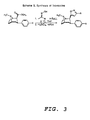
- Figure 3 outlines the route used to prepare 3-substituted isoxazole.
- the known tropane compounds (Carroll et al., J. Med. Chem. 34 :2719-2725 (1991)) were treated with dilithiated methyl or phenyl acetoneoximes, obtained by the treatment of acetone or acetophenoneoxime with n-BuLi at 0°C.
- the corresponding addition product was cyclized without isolation using suifuric acid at reflux temperature to furnish the required isoxazoles (Saunders et al., 1990).
- both in vitro and in vivo assay systems may be used for the screening of potential drugs which act as agonists or antagonists at cocaine receptors, or drugs which are effective to modulate neurotransmitter level or activity, in particular by binding to a transporter of that neurotransmitter.
- the compounds of the invention may be prepared and labeled with any detectable moiety, in particular a radioactive element, and may then be introduced into a tissue or cellular sample. After the labeled material or its binding partner(s) has had an opportunity to react with sites within the sample, the location and concentration of binding of the compound may be examined by known techniques, which may vary with the nature of the label attached,
- a particularly preferred in vitro assay involves the ability of a compound in question to displace the binding of a known labelled compound to binding sites in a tissue sample, isolated membranes or synaptosomes.
- the compounds may be analyzed by their ability to inhibit reuptake of a labelled neurotransmitter in a sample, in particular, in synaptosomes.
- the compound or its binding partner(s) can also be labeled with any detectable moiety, but are preferably labelled with a radioactive element.
- the radioactive label can be detected by any of the currently available counting procedures, including the imaging procedures detailed in the disclosures of the parent applications.
- the preferred isotope may be selected from 3 H, 11 C, 14 C, 11 C, 12 P, 35 S, 36 Cl, 51 Cr, 57 Co, 58 Co, 59 Fe, 90 Y, 125 I 131 I, and 186 Re.c,
- the binding of the labelled compounds may be analyzed by various imaging techniques, including positron emission tomography (PET), single photon emission computed tomography (SPECT), autoradiogram, and the like.
- PET positron emission tomography
- SPECT single photon emission computed tomography
- autoradiogram autoradiogram
- imaging techniques are useful for determining effective doses of new drug candidates.
- brain imaging studies By performing in vivo competition studies, it is possible to use brain imaging studies to determine the oral doses of new drug candidates, which produce significant receptor occupancy in the brain.
- In vivo displacement studies which determine in vivo IC50's which in turn reflect doses that occupy receptors in vivo are described in Cline et al ((1992) Synapse 12 :37-46).
- the binding of the compounds of the invention may be at any location where a receptor for a particular psychostimulant is present, and more specifically, any location where a dopamine or serotonin transporter is present.
- locations are in general any area comprising a part of the dopamine or serotonin pathway, in particular at synapses.
- locations known to be associated with dopamine transport include the cerebral cortex, hypothalamus, substantia nigra, nucleus accumbens, arcuate nucleus, anterior periventricular nuclei, median eminence and amygdala.
- locations known to be associated with serotonin include the striatum, cerebral cortex, hypothalamus, Raphe nuclei, pre-optic area and suprachiasmatic nucleus.
- psychostimulant any compounds whose abuse is dependent upon mesolimbic and mesocortical dopaminergic pathways.
- psychostimulant relates to cocaine.
- the compounds of the invention may also be used to treat abuse of compounds not traditionally classified as “psychostimulants,” but which act at a dopamine or serotonin transporter.
- abused compounds include ethanol and nicotine.
- the compounds of the invention may be prepared in pharmaceutical compositions, with a suitable carrier and at a strength effective for administration by various means to a patient experiencing an adverse medical condition associated with cocaine receptor binding or neurotransmitter release and reuptake, for the treatment thereof.
- the action of the compounds may be analyzed by the imaging methods noted above, and also by behavioral studies.
- the pharmaceutical effects of the compounds of the invention may be reflected in locomotor activity, including the induction of ipsilateral rotation, stereotyped sniffing and the "swim test" , in schedule-controlled operant behavior (i.e., response for food or shock termination) or drug self-administration. In general, maximal behavioral effects are seen at near complete occupancy of transporter sites.
- a variety of administrative techniques may be utilized, among them oral or parenteral techniques such as subcutaneous, intravenous, intraperitoneal, intracerebral and intracerebroventricular injections, catheterizations and the like. Average quantities of the compounds may vary in accordance with the binding properties of the compound (i.e., affinity, onset and duration of binding) and in particular should be based upon the recommendations and prescription of a qualified physician or veterinarian.
- the compounds of the invention preferably have a long duration of action, which is important to facilitate dosing schedules.
- the present compounds In rats, the present compounds have a 7-10 fold longer duration of action than cocaine (Fleckenstein et al, "Highly potent cocaine analogs cause long-lasting increases in locomotor activity," Eur. J. Pharmacol ., in press, which is incorporated herein by reference in its entirety).
- the present compounds also preferably have a slow rate of entry into the brain, which is important in decreasing the potential for abuse (Stathis et al, supra , which is incorporated herein by reference in its entirety). The present compounds enter the brain more slowly than cocaine.
- compositions useful in practicing the therapeutic methods of this invention may include, in admixture, a pharmaceutically acceptable excipient (carrier) and one or more of the compounds of the invention, as described herein as an active ingredient.
- compositions which contain such neuroactive compounds as active ingredients are well understood in the art.
- Such compositions may be prepared for oral adminstration, or as injectables, either as liquid solutions or suspensions, however, solid forms suitable for solution in, or suspension in, liquid prior to injection can also be prepared.
- the preparation can also be emulsified.
- the active therapeutic ingredient is often mixed with excipients which are pharmaceutically acceptable and compatible with the active ingredient. Suitable excipients are, for example, water, saline, dextrose, glycerol, ethanol, or the like and combinations thereof.
- the composition can contain minor amounts of auxiliary substances such as wetting or emulsifying agents, and pH buffering agents which enhance the effectiveness of the active ingredient.
- the compounds of the invention can be formulated into the therapeutic composition as neutralized pharmaceutically acceptable salt forms.
- unit dose when used in reference to a therapeutic composition of the present invention refers to physically discrete units suitable as unitary dosage for humans, each unit containing a predetermined quantity of active material calculated to produce the desired therapeutic effect in association with the required diluent; i.e., carrier, or vehicle.
- compositions are administered in a manner compatible with the dosage formulation, and in a therapeutically effeccive amount.
- quantity to be administered depends on the subject to be treated, the presence of other agonists and antagonists in the subject's system, and degree of binding or inhibition of binding desired.
- Precise amounts of active ingredient required to be administered depend on the judgment of the practitioner and are peculiar to each individual.
- suitable dosages may range from about 0.01 to about 1000, preferably about .25 to about 500, and more preferably 10 to 50 milligrams of active ingredient per kilogram body weight of individual per day and depend on the route of administration.
- the exact dosage must be determined by factoring in rate of degradation in the stomach, absorption from the stomach, other medications administered, etc.
- Suitable regimes for administration are also variable, but are typified by an initial administration followed by repeated doses at one or more hour intervals by a subsequent injection or other administration.
- continuous intravenous infusion sufficient to maintain appropriate concentrations in the blood are contemplated.
- the compounds of the present invention may be administered for their activities as surrogate agonist medications for cocaine, nicotine, alcohol, amphetamine and other psychostimulant abuse. Because of their favorable binding characteristics to transporters of neurotransmitters, they may be used for inhibiting the uptake of dopamine, norepinephrine, serotonin and other monoamines.
- the compounds of the present invention may find use as antipsychotics, antidepressants, local anesthetics, anti-Parkinsonian agents, anti-obesity drugs, drugs useful in the treatment of bipolar disorder, eating disorders, obesity, attention deficit disorder, panic attacks and disorder, obsessive-compulsive disorder, sexual dysfunction, as anticholinergic agents and as sigma receptor drugs.
- the compounds of the invention may also be useful in treating neurodegenerative disorders, in particular for treating Parkinson's Disease, but also may be useful in the treatment of cocaine, nicotine and alcohol addiction.
- the preferred compounds of the present invention are derived from the series of compounds designated RTI-4229. The physical properties of some of these compounds are given in Table I. Many of the preferred compounds of the invention fall within the broad class of compounds described by the formula:
- RTI-4229 series include the following : RTI-4229-98, 153 and 279.
- the chemical structures of these compounds, along with their IC 50 values for inhibition of radioligand binding are given below.
- DA is dopamine
- 5-HT is 5-hydroxytriptamine (serotonin)
- NE norepinephrine
- DA [ 3 H]WIN 35,428
- 5-HT [ 3 H] paroxetine
- NE N [ 3 H] nisofetine:
- Particularly preferred compounds include RTI-4229-165, 171, 176, 177, 180, 181, 334, 335, 336, 337 and 353.
- the chemical structures of these compounds are given below :
- compound RTI-353 is a highly potent compound at the serotonin site, and is selective relative to the dopamine and norepinephrine sites. This compound is particularly useful as an antidepressant, and as an imaging agent for serotonin transporters.
- Reaction products were purified by flash column chromatography using silica gel (mesh size 230-400) purchased from VWR Scientific. Thin layer chromatography (TLC) was performed on Whatman 254 nm fluorescent silica gel 60A (1 x 3 inches, 250 [ ⁇ L thickness]) precoated TLC plates using the solvent systems indicated. Developed chromatograms were evaluated under 254 nm UV light or with iodine.
- the isoxazole was crystallized as the hydrochloride salt: 1 H NMR (MeOD) ⁇ 2.01 (s, 3 H), 2.24 (s, 3 H), 2.32 (m, 2 H), 2.42 (m, 4 H), 2.81 (s, 3 H), 3.61 (m.
Landscapes
- Health & Medical Sciences (AREA)
- Organic Chemistry (AREA)
- Chemical & Material Sciences (AREA)
- Bioinformatics & Cheminformatics (AREA)
- Engineering & Computer Science (AREA)
- Veterinary Medicine (AREA)
- Nuclear Medicine, Radiotherapy & Molecular Imaging (AREA)
- General Chemical & Material Sciences (AREA)
- Pharmacology & Pharmacy (AREA)
- Life Sciences & Earth Sciences (AREA)
- Animal Behavior & Ethology (AREA)
- General Health & Medical Sciences (AREA)
- Public Health (AREA)
- Chemical Kinetics & Catalysis (AREA)
- Medicinal Chemistry (AREA)
- Neurology (AREA)
- Neurosurgery (AREA)
- Biomedical Technology (AREA)
- Psychiatry (AREA)
- Addiction (AREA)
- Pain & Pain Management (AREA)
- Diabetes (AREA)
- Hematology (AREA)
- Obesity (AREA)
- Psychology (AREA)
- Pharmaceuticals Containing Other Organic And Inorganic Compounds (AREA)
- Nitrogen Condensed Heterocyclic Rings (AREA)
- Transition And Organic Metals Composition Catalysts For Addition Polymerization (AREA)
- Medicines Containing Antibodies Or Antigens For Use As Internal Diagnostic Agents (AREA)
Abstract
Description
- This application is a continuation-in-part application of U.S. Patent Application 08/506,541, filed July 24, 1995, which is a continuation-in-part of (1) U.S. Patent Application 07/972,472, filed March 23, 1993, which issued May 9, 1995 as U.S. Patent 5,413,779; (2) U.S. Patent Application 08/164,576, filed December 10, 1993, which is in turn a continuation-in-part of U.S. Patent Application 07/792,648, filed November 15, 1991, now U.S. Patent No. 5,380,848, which is in turn a continuation-in-part of U.S. Patent Application 07/564,755, filed August 9, 1990, now U.S. Patent 5,128,118 and U.S. PCT Application PCT/US91/05553, filed August 9, 1991, filed in the U.S. PCT Receiving Office and designating the United States; and (3) U.S. Patent Application 08/436,970, filed May 8, 1995, all of which are incorporated herein by reference in their entirety.
- This invention is directed to a class of binding ligands for cocaine receptors and other receptors in the brain. Specifically, a novel family of compounds shows high binding specificity and activity, and, in a radiolabeled form, can be used to bind to these receptors, for biochemical assays and imaging techniques. Such imaging is useful for determining effective doses of new drug candidates in human populations. In addition, the higl specificity, slow onset and long duration of the action of these compounds at the receptors makes them particularly well suited for therapeutic uses, for example as substitute medication for psychostimulant abuse. Some of these compounds may be useful in treating Parkinson's Disease or depression, by virtue of their inhibitory properties at monoamine transporters.
- This application claims priority, inter alia, from of U.S. Patent Application 07/972,472 filed March 23, 1993, now U.S. Patent 5,413,779, the entirety of which is incorporated by reference. This application also claims priority from U.S. Patent Application 07/564,755, now U.S. Patent 5,128,118, and U.S. PCT Application PCT/US91/05553 (the U.S. National Phase of which is U.S. 07/972,472), filed August 9, 1991, both applications being incorporated herein by reference. In U.S. Application Serial No. 07/564,755, there is disclosure of a family of compounds exhibiting particularly high specificity and affinity for cocaine receptors and other . neurotransmitter receptors in the brain of the formula:

- Where the broken line represents an optional chemical bond and the substituents at 2 and 3 may be at any position;
- The iodo substituent may be at o, m, p, or multisubstituted;
R1 = CH3, CH2CH=CH2, (CH2)nC6H5 n = 1-4;
R2 = CH3, C2H5, CH3(CH2)3, (CH3)2CH, C6H5, C6H5CH2, C6H5(CH2)2;
X = pharmacologically acceptable anion
Sites of specific interest included cocaine receptors associated with dopamine (DA) transporter sites. - Subsequently, in the U.S. PCT Application from which priority is claimed, and which is incorporated herein by reference, the values for R1 and R2 were expanded, such that R1 may be an alkyl of 1-7 carbon atoms, CH2CR3=CR4R5 wherein R3-R5 are each, independently C1-6 alkyl, or phenyl compounds of the formula C6H5(CH2)y, wherein y = 1-6. The PCT filing also reveals the affinity of these compounds for cocaine receptors associated with serotonin (5-hydroxytryptamine, 5-HT) transporters, and confirms, for the first time, that the in vitro binding reported in the earlier-filed application, is confirmed in in vivo testing. Specific disclosure for a variety of applications, including using the compounds in both PET and SPECT scanning, wherein either the iodine substituent, or one of the carbon groups is radioactive (I-123, 125 or 131 and C11) thus providing methods for scanning for the presence of specific cocaine receptors. Such scanning processes may be used to determine physiological conditions associated with dopamine and serotonin reuptabe inhibitors, which lead to behavioral and neurodegenerative disorders/diseases. Such disorders include depression, bipolar disorder, eating disorders, obesity, attention deficit disorder, panic attacks and disorders, obsessive-compulsive disorder, Parkinson's Disease, and cocaine, nicotine and alcohol addiction. These compounds, in addition to being used in treatment of these disorders, may be used to examine in general the density and distribution of specific cocaine receptors in various parts of the brain and/or body, to determine the efficacy of neurological treatments aimed at halting or reversing the degeneration of specific nerves in the brain, and for screening drugs, such as antidepressant drugs.
- The affinity and specificity of these compounds, as reported in the applications incorporated, is surprisingly high, and compared with prior art compounds, such as [3H]WIN 35,428, the novel compounds of these applications exhibit extremely low IC50 values for binding inhibition.
- In U.S. Patent Application 08/164,576, filed December 10, 1993, also incorporated herein by reference in its entirety, a family of compounds was disclosed, having the formula:
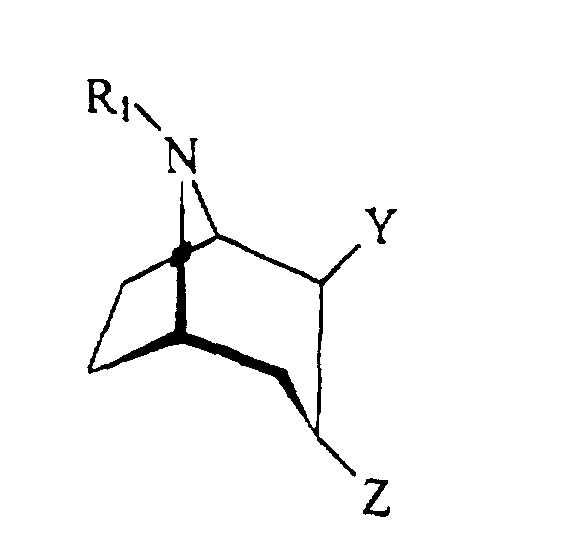
- Wherein Y isor
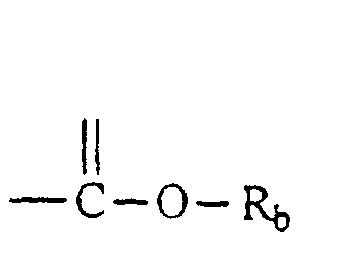 Wherein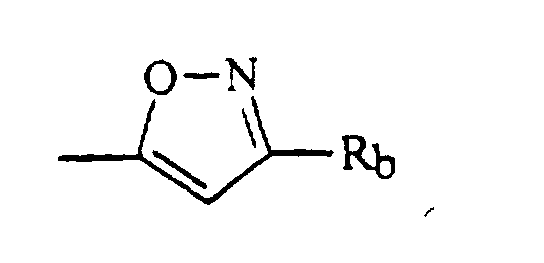
- R1 is hydrogen, C1-5 alkyl
- Ra is phenyl, C1-6 alkyl, C1-6 alkyl-substituted phenyl
- Rb is C1-6 alkyl, phenyl, C1-6 alkyl substituted phenyl and
- Z is phenyl or naphtyl bearing 1-3 substituents selected from the group consisting of F, Cl, I, and C1-6 alkyl.
-
- These compounds exhibit unusually high affinity and specificity for binding to receptors for the dopamine transporter site, as well as the serotonin transporter site, based on inhibition of [3H]paroxetine binding. This high affinity makes certain of these compounds particularly well suited for use as therapeutic agents, as well as for imaging agents for dopamine and serotonin transporters.
- Accordingly, one object of this invention is to provide novel compounds which bind to cocaine receptors.
- Another object of the invention is to provide novel 3-(substituted phenyl)-2-(substituted)tropane analogs which bind to cocaine receptors.
- Still another object of the invention is to provide 3-(substituted phenyl)-2-(substituted)tropane analogs which bind preferentially to the dopamine transporter.
- Yet another object of the invention is to provide 3-(substituted phenyl)-2-(substituted)tropane analogs which bind preferentially to the serotonin transporter.
- Another object of the invention is to provide a compound of the formulawherein R is CH3, C2H5, CH2CH2CH3, or CH(CH3)2, CH=CH2, CH3-C=CH2, CH2-CH=CH2, CH=CHCH3, R1 is CH3, CH2C6H5, (CH2)2C6H5, (CH2)3C6H5, or wherein X is H, OCH3, or Cl and Y is H, OCH3, or Cl, and n=1-8.

- Another object of the invention is to provide compounds having the following formulas:wherein

- R1=hydrogen, C1-5 alkyl,
- X=H, C1-6 alkyl, C3-8 cycloalkyl, C1-4 alkoxy, C1-6 alkynyl, halogen, amino, acylamido, and
- Z=H, I, Br, Cl, F, CN, CF3, NO2, N3, OR1, CONH2, CO2R1, C1-6 alkyl, NR4R5, NHCOR5, NHCO2R6,
- Rb is C1-6 alkyl, phenyl, C1-6 alkyl substituted phenyl
-
- A further object of the invention is to provide a pharmaceutical composition for treating psychostimulant abuse, comprising a pharmaceutically efefctive amount of a 3-(substituted phenyl)-2-(substituted) tropane analog.
- A still further object of the invention is to provide a pharmaceutical composition for inhibiting the action of a psychostimulant, comprising a psychostimulant-inhibiting amount of a 3-(substituted phenyl)-2-(substituted) tropane analog.
- Still another object of the invention is to provide a pharmaceutical composition for inhibiting neurotransmitter re-uptake comprising a neurotransmitter transporter-inhibiting amount of a 3-(substituted phenyl)-2-(substituted) tropane analog.
- Another object of the invention is to provide a pharmaceutical composition for treating neurodegenerative disorders, comprising a pharmaceutically effective amount of a 3-(substituted phenyl) -2- (substituted) tropane analog.
- Still another object of the invention is to provide a pharmaceutical composition for treating depression, comprising a pharmaceutically effective amount of a 3-(substituted phenyl)-2-(substituted) tropane analog.
- Briefly, the invention pertains to the discovery that certain cocaine analogs are particularly well suited for therapeutic use as neurochemical agents. These particular cocaine analogs, in modulating neurotransmitter actions, may also be useful for modulating the actions of pyschostimulant drugs, for modulating endocrine function, for modulating motor function, and for modulating complex behaviors.
- With the foregoing and other objects, advantages and features of the invention that will become here in after apparent, the nature of the invention may be more clearly understood by reference to the following detailed description of the preferred embodiments of the invention and to the appended claims.
- A more complete appreciation of the invention and many of the attendant advantages thereof will be readily obtained as the same becomes better understood by reference to the following detailed description when considered in connection with the accompanying drawings, wherein:
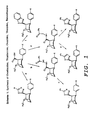
- Figure 1 depicts the scheme for converting 3-(substituted phenyl)-2-tropane carboxylic acid (tropane acid) to 2-substituted tetrazoles, oxazoles. oxadiazoles, thiazoles, thiadiazoles and benzothiazole.
- Figure 2 depicts the scheme in which the carboxamide obtained from the tropane acid was treated to obtain nitriles and tetrazoles.
- Figure 3 depicts the scheme used to prepare 3-substituted isoxazoles.
-
- The present invention includes novel compounds having the following formula:

- The compounds of this invention can be prepared according to the synthesis methods described in the parent applications. Alternative synthesis for related compounds will be apparent to those of ordinary skill in the art. Particular synthesis schemes are exemplified in U.S. Patent No. 5,444,070, which is incorporated herein in its entirety. Additional schemes follow hersinbelow.
- The known 2β-(substituted phenyl) -2β-tropane carboxylic acid (tropane acid) (Carroll et al., J. Med. Chem. 35:1813-1817 (1992)) served as the starting material for the synthesis of 2β-substituted tetrazoles, oxazoles, oxadiazoles, thiazoles, thiadiazoles and benzothiazole as shown in Figure 1.
- The tropane acid was refluxed with N-acetyl and benzoic hydrazide in phosphorous oxychloride to obtain the corresponding 5-substituted 1,3,4-oxadiazoles (Afanasiadi et al., Chem. Heterocyclic Compd. 397-400 (1995)). N-benzoyl hydrazide amide obtained by the reaction of the acid chloride of tropane acid with N-benzoic hydrazide was cyclized with Lawesson's reagent (El-Barbary et al., Acta Chimica Scandinavica 597-601 (1980)) in refluxing THF to the 5-substituted 1,3,4-thiadiazoles. The N-phenylacyl carboxamide obtained from tropane acid and 2-aminoacetophenone was cyclized by refluxing the amide in phosphorous oxychloride to obtain the required 5-substituted oxazoles (Carroll et al., Med. Chem. Res. 3:468 (1993)). Cyclization of the same amide with Lawesson's reagent (El-Barbary et al., 1980) in refluxing THF gave the 5-substituted thiazoles respectively. The benzothiazole was obtained without the cyclization step by the reaction of acid chloride obtained from the appropriate tropane acid with 2-aminothiophenol.
- The previously reported carboxamide (Carroll et al., 1993) obtained from the tropane acid was dehydrated with trifluoroacetic acid and pyridine in THF to the nitriles (Campagna et al., Tet. Letts. 22:1813-1816 (1977)) as shown in Figure 2. Cycloaddition of trimethylsilylazide to the nitrile afforded the corresponding tetrazoles (Saunders et al., Med. Chem. 33:1128-1138 (1990)).
- Figure 3 outlines the route used to prepare 3-substituted isoxazole. The known tropane compounds (Carroll et al., J. Med. Chem. 34:2719-2725 (1991)) were treated with dilithiated methyl or phenyl acetoneoximes, obtained by the treatment of acetone or acetophenoneoxime with n-BuLi at 0°C. The corresponding addition product was cyclized without isolation using suifuric acid at reflux temperature to furnish the required isoxazoles (Saunders et al., 1990).
- The therapeutic effects of the present cocaine analogs can be analyzed in various ways, many of which are well known to those of skill in the art. In particular, both in vitro and in vivo assay systems may be used for the screening of potential drugs which act as agonists or antagonists at cocaine receptors, or drugs which are effective to modulate neurotransmitter level or activity, in particular by binding to a transporter of that neurotransmitter.
- The compounds of the invention may be prepared and labeled with any detectable moiety, in particular a radioactive element, and may then be introduced into a tissue or cellular sample. After the labeled material or its binding partner(s) has had an opportunity to react with sites within the sample, the location and concentration of binding of the compound may be examined by known techniques, which may vary with the nature of the label attached,
- Illustrative in vitro assays for binding are described in Boja et al Ann. NY Acad. Sci. 654:282-291 (1992), which is incorporated herein by reference in its entirety. A particularly preferred in vitro assay involves the ability of a compound in question to displace the binding of a known labelled compound to binding sites in a tissue sample, isolated membranes or synaptosomes. Alternatively, the compounds may be analyzed by their ability to inhibit reuptake of a labelled neurotransmitter in a sample, in particular, in synaptosomes.
- The compound or its binding partner(s) can also be labeled with any detectable moiety, but are preferably labelled with a radioactive element. The radioactive label can be detected by any of the currently available counting procedures, including the imaging procedures detailed in the disclosures of the parent applications. The preferred isotope may be selected from 3H, 11C, 14C, 11C, 12P, 35S, 36Cl, 51Cr, 57Co, 58Co, 59Fe, 90Y, 125I 131I, and 186Re.c,
- As noted in the parent disclosures, the binding of the labelled compounds may be analyzed by various imaging techniques, including positron emission tomography (PET), single photon emission computed tomography (SPECT), autoradiogram, and the like. Such imaging techniques are useful for determining effective doses of new drug candidates. By performing in vivo competition studies, it is possible to use brain imaging studies to determine the oral doses of new drug candidates, which produce significant receptor occupancy in the brain. In vivo displacement studies which determine in vivo IC50's which in turn reflect doses that occupy receptors in vivo are described in Cline et al ((1992) Synapse 12:37-46). In addition to its uses in determining in vivo potency/occupancy, these same brain imaging methods can be used to determine rate of entry of compounds into the brain (Stathis et al (1995) Psychopharmacology 119:376-384) and duration of action (Volkow et al (1995) Synapse 19:206-211).
- The binding of the compounds of the invention may be at any location where a receptor for a particular psychostimulant is present, and more specifically, any location where a dopamine or serotonin transporter is present. Such locations are in general any area comprising a part of the dopamine or serotonin pathway, in particular at synapses. Examples of locations known to be associated with dopamine transport include the cerebral cortex, hypothalamus, substantia nigra, nucleus accumbens, arcuate nucleus, anterior periventricular nuclei, median eminence and amygdala. Examples of locations known to be associated with serotonin include the striatum, cerebral cortex, hypothalamus, Raphe nuclei, pre-optic area and suprachiasmatic nucleus.
- By "psychostimulant" is meant any compounds whose abuse is dependent upon mesolimbic and mesocortical dopaminergic pathways. In particular, psychostimulant relates to cocaine. However, the compounds of the invention may also be used to treat abuse of compounds not traditionally classified as "psychostimulants," but which act at a dopamine or serotonin transporter. Such abused compounds include ethanol and nicotine.
- For in vivo studies, the compounds of the invention may be prepared in pharmaceutical compositions, with a suitable carrier and at a strength effective for administration by various means to a patient experiencing an adverse medical condition associated with cocaine receptor binding or neurotransmitter release and reuptake, for the treatment thereof. The action of the compounds may be analyzed by the imaging methods noted above, and also by behavioral studies. In particular, the pharmaceutical effects of the compounds of the invention may be reflected in locomotor activity, including the induction of ipsilateral rotation, stereotyped sniffing and the "swim test" , in schedule-controlled operant behavior (i.e., response for food or shock termination) or drug self-administration. In general, maximal behavioral effects are seen at near complete occupancy of transporter sites. Such protocols are described in Boja et al (1992), Balster et al Drug and Alcohol Dependence 29:145-151 (1991), Cline et al Pharm. Exp. Ther. 260:1174-1179 (1992), and Cline et al Behavioral Pharmacology 3:113-116 (1992), which are hereby incorporated herein by reference in their entireties.
- A variety of administrative techniques may be utilized, among them oral or parenteral techniques such as subcutaneous, intravenous, intraperitoneal, intracerebral and intracerebroventricular injections, catheterizations and the like. Average quantities of the compounds may vary in accordance with the binding properties of the compound (i.e., affinity, onset and duration of binding) and in particular should be based upon the recommendations and prescription of a qualified physician or veterinarian.
- The compounds of the invention preferably have a long duration of action, which is important to facilitate dosing schedules. In rats, the present compounds have a 7-10 fold longer duration of action than cocaine (Fleckenstein et al, "Highly potent cocaine analogs cause long-lasting increases in locomotor activity," Eur. J. Pharmacol., in press, which is incorporated herein by reference in its entirety). In addition, the present compounds also preferably have a slow rate of entry into the brain, which is important in decreasing the potential for abuse (Stathis et al, supra, which is incorporated herein by reference in its entirety). The present compounds enter the brain more slowly than cocaine.
- The therapeutic compositions useful in practicing the therapeutic methods of this invention may include, in admixture, a pharmaceutically acceptable excipient (carrier) and one or more of the compounds of the invention, as described herein as an active ingredient.
- The preparation of therapeutic compositions which contain such neuroactive compounds as active ingredients is well understood in the art. Such compositions may be prepared for oral adminstration, or as injectables, either as liquid solutions or suspensions, however, solid forms suitable for solution in, or suspension in, liquid prior to injection can also be prepared. The preparation can also be emulsified. The active therapeutic ingredient is often mixed with excipients which are pharmaceutically acceptable and compatible with the active ingredient. Suitable excipients are, for example, water, saline, dextrose, glycerol, ethanol, or the like and combinations thereof. In addition, if desired, the composition can contain minor amounts of auxiliary substances such as wetting or emulsifying agents, and pH buffering agents which enhance the effectiveness of the active ingredient. The compounds of the invention can be formulated into the therapeutic composition as neutralized pharmaceutically acceptable salt forms.
- The therapeutic compositions are conventionally administered orally, by unit dose, for example. The term "unit dose" when used in reference to a therapeutic composition of the present invention refers to physically discrete units suitable as unitary dosage for humans, each unit containing a predetermined quantity of active material calculated to produce the desired therapeutic effect in association with the required diluent; i.e., carrier, or vehicle.
- The compositions are administered in a manner compatible with the dosage formulation, and in a therapeutically effeccive amount. The quantity to be administered depends on the subject to be treated, the presence of other agonists and antagonists in the subject's system, and degree of binding or inhibition of binding desired. Precise amounts of active ingredient required to be administered depend on the judgment of the practitioner and are peculiar to each individual. However, suitable dosages may range from about 0.01 to about 1000, preferably about .25 to about 500, and more preferably 10 to 50 milligrams of active ingredient per kilogram body weight of individual per day and depend on the route of administration. However, the exact dosage must be determined by factoring in rate of degradation in the stomach, absorption from the stomach, other medications administered, etc. Suitable regimes for administration and are also variable, but are typified by an initial administration followed by repeated doses at one or more hour intervals by a subsequent injection or other administration. Alternatively, continuous intravenous infusion sufficient to maintain appropriate concentrations in the blood are contemplated.
- The compounds of the present invention may be administered for their activities as surrogate agonist medications for cocaine, nicotine, alcohol, amphetamine and other psychostimulant abuse. Because of their favorable binding characteristics to transporters of neurotransmitters, they may be used for inhibiting the uptake of dopamine, norepinephrine, serotonin and other monoamines. The compounds of the present invention may find use as antipsychotics, antidepressants, local anesthetics, anti-Parkinsonian agents, anti-obesity drugs, drugs useful in the treatment of bipolar disorder, eating disorders, obesity, attention deficit disorder, panic attacks and disorder, obsessive-compulsive disorder, sexual dysfunction, as anticholinergic agents and as sigma receptor drugs.
- The compounds of the invention may also be useful in treating neurodegenerative disorders, in particular for treating Parkinson's Disease, but also may be useful in the treatment of cocaine, nicotine and alcohol addiction.
- The preferred compounds of the present invention are derived from the series of compounds designated RTI-4229. The physical properties of some of these compounds are given in Table I.Many of the preferred compounds of the invention fall within the broad class of compounds described by the formula:


- Wherein Y=CH2R3, CO2R2, CONRR1
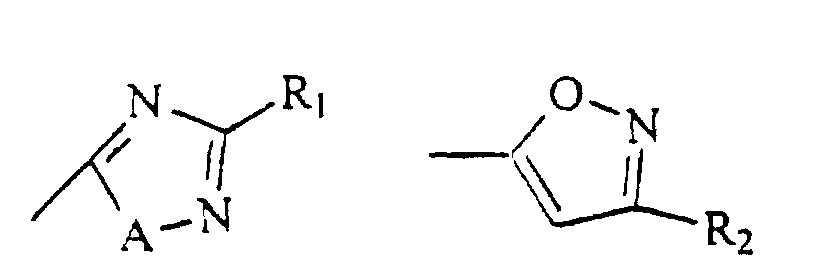
- R1=hydrogen, C1-5 alkyl,
- R2=hydrogen, C1-6 alkyl, C3-8 cycloalkyl, C1-4 alkoxy, C1-6alkynyl,
halogen, amine, CH2C6H5, (CH2)2C6H5, (CH2)3C6H5 or
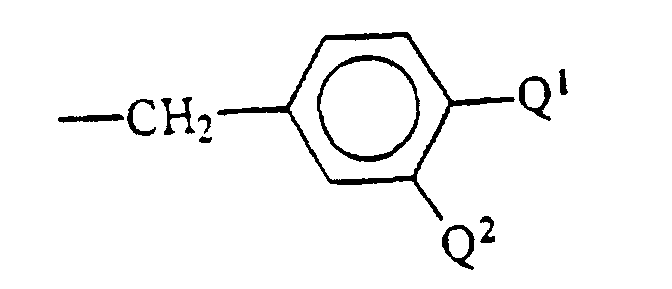
- R3=OH, hydrogen, C1-6 alkyl, C3-8 cycloalkyl, C1-4 alkoxy, Cl, Br, I, CN, NH2, NHC1-6 alkyl, NC1-6 alkyl, OCOC1-6 alkyl, OCOC1-3 alkylaryl,
- A=S, O or N
- X=H, C1-6 alkyl, C3-8 cycloalkyl, C1-4 alkoxy, C1-6 alkynyl, halogen, amino, acylamido, C2H5, CH2CH3CH3, CH(CH3)2,
- Z=H, I, Br, Cl, F, CN, CF3, NO2, N3, OR1, CONH2, CO2R1, C1-6 alkyl, NR4R5, NHCOR5, NHCO2R6, and
- Q1 and Q2 may be the same or different and = H, OCH3, or Cl,
wherein R4-R5 are each C1-6 alkyl, R and R1 are independently H, C1-5 alkyl, C1-6 alkene, C1-6 alkyne, phenyl, phenyl substituted with 1-3 of C1-6 alkyl, alkene, alkyl or alkoxy, C1-6 alkoxy, phenoxy, amine, amine substituted with 1-2 of C1-6 alkyl, alkene, alkyne, alkoxy or phenyl or phenoxy or R and R1 may combine to form heterocyclic structure including pyrrolidinyl, piperidinyl and morpholino moieties, unsubstituted or substituted with 1-2 C1-6 alkyl, alkene, alkyne or alkoxy groups. -
- The present inventors have surprisingly found that certain of the RTI-4229 series of compounds are particularly potent pharmaceutical agents in accordance with the present invention.
- Preferred compounds of the RTI-4229 series include the following : RTI-4229-98, 153 and 279. The chemical structures of these compounds, along with their IC50 values for inhibition of radioligand binding are given below. DA is dopamine, 5-HT is 5-hydroxytriptamine (serotonin), and NE is norepinephrine, DA=[3H]WIN 35,428; 5-HT = [3H] paroxetine and NEN = [3H] nisofetine:


- Particularly preferred compounds include RTI-4229-165, 171, 176, 177, 180, 181, 334, 335, 336, 337 and 353. The chemical structures of these compounds are given below :
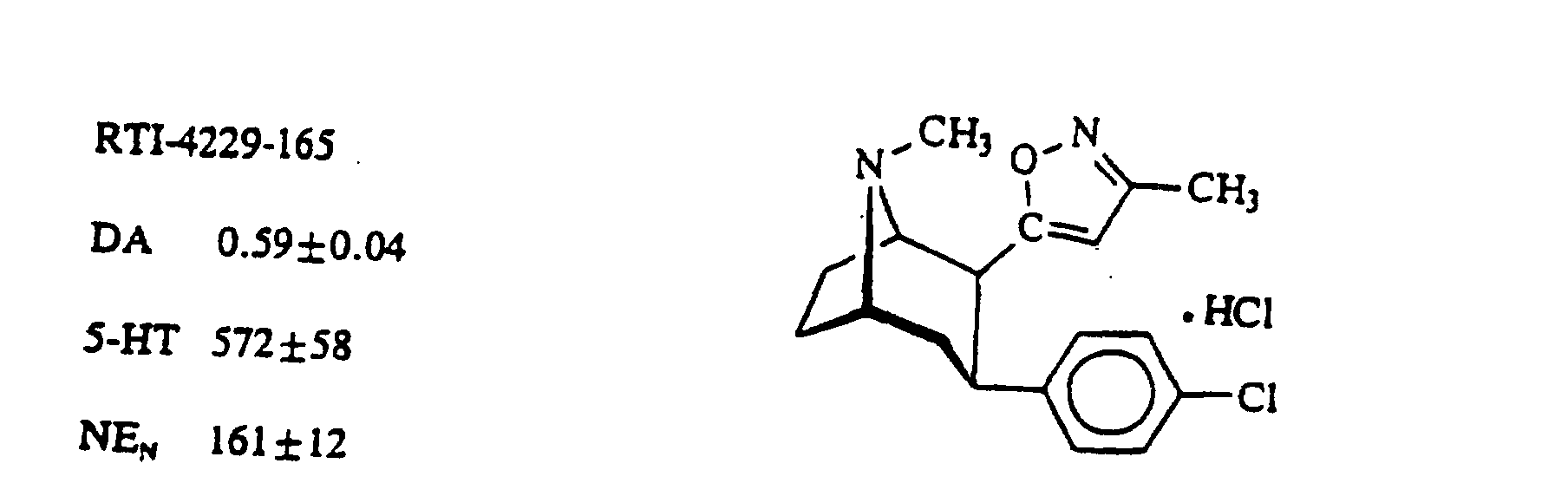

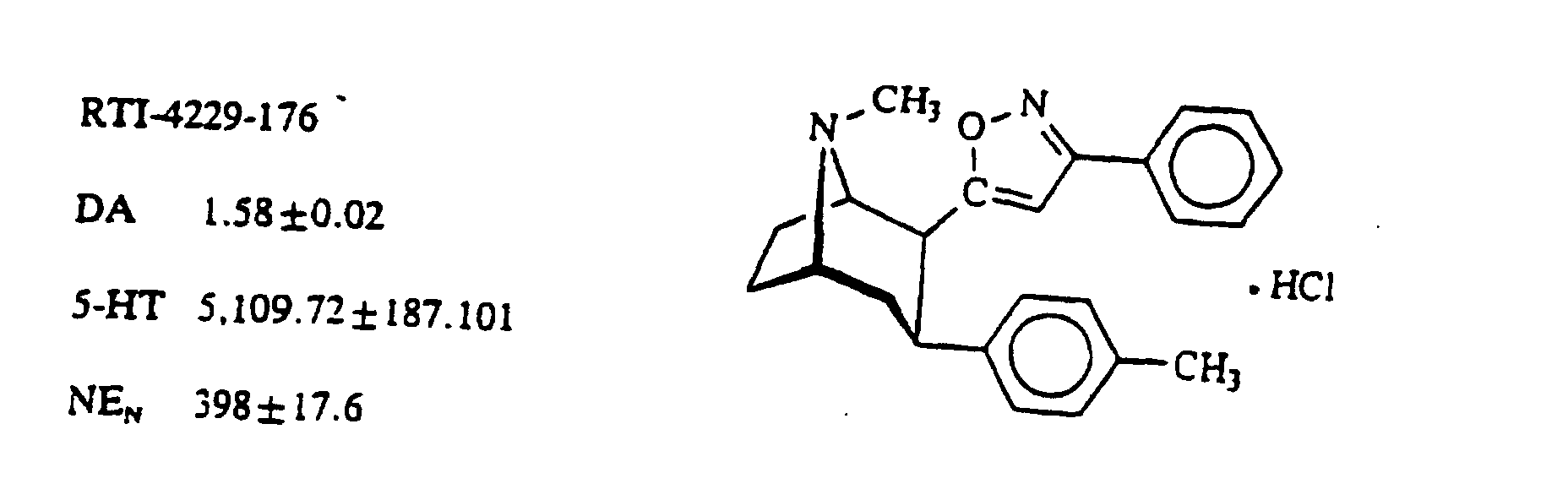
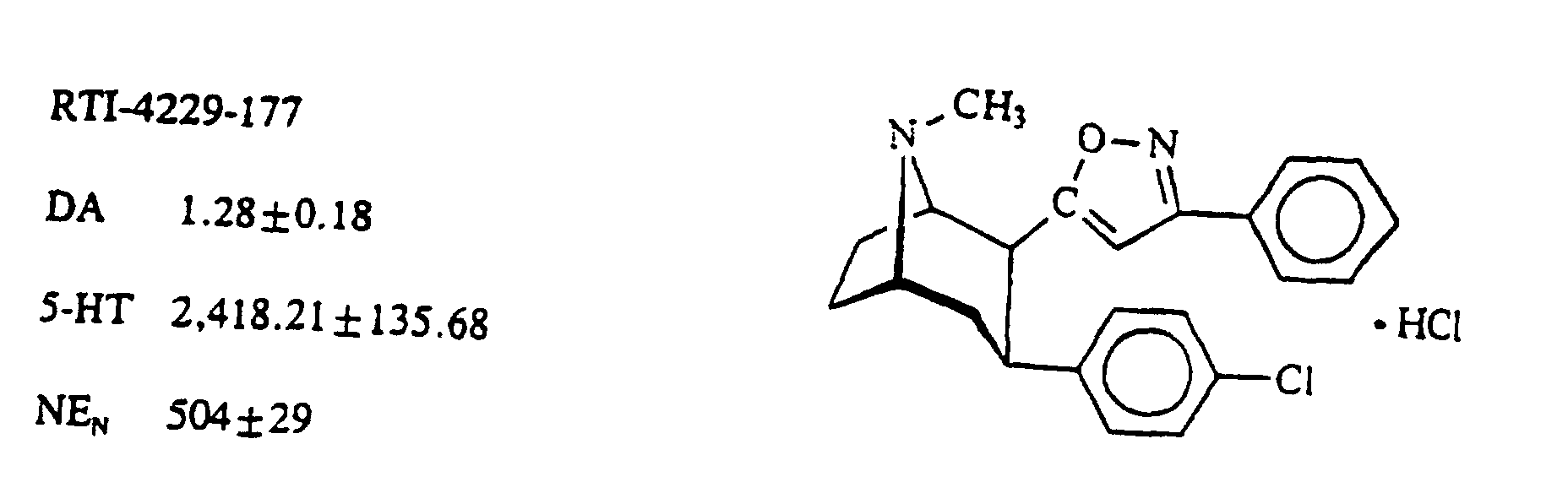

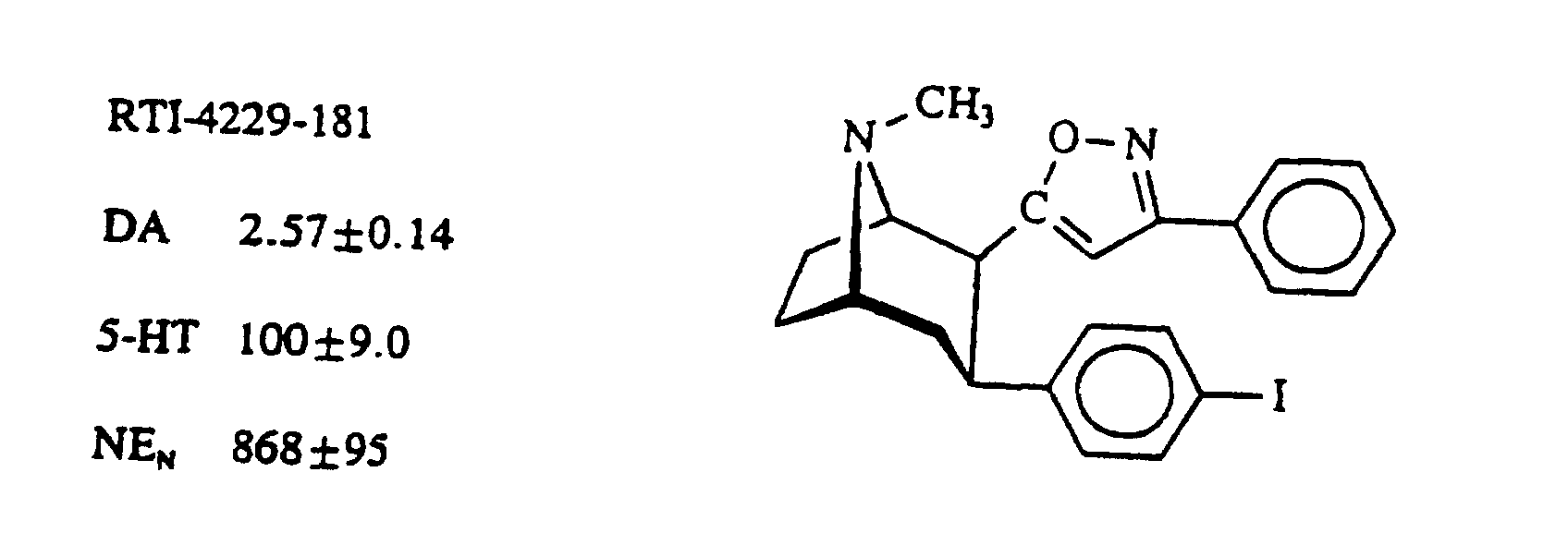
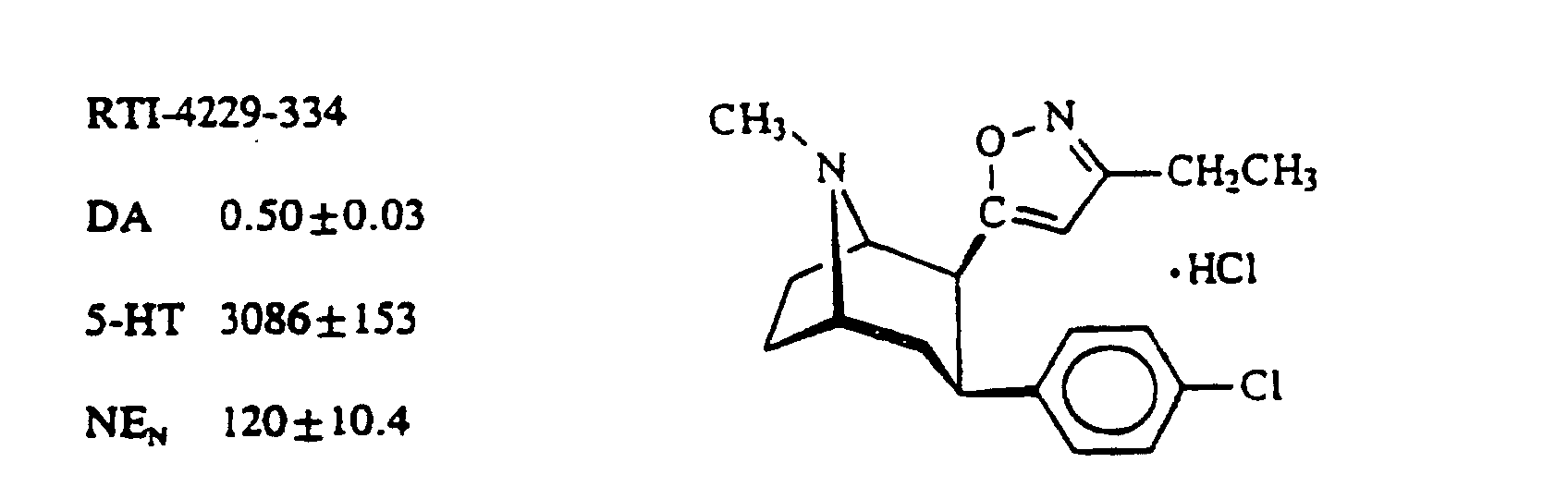
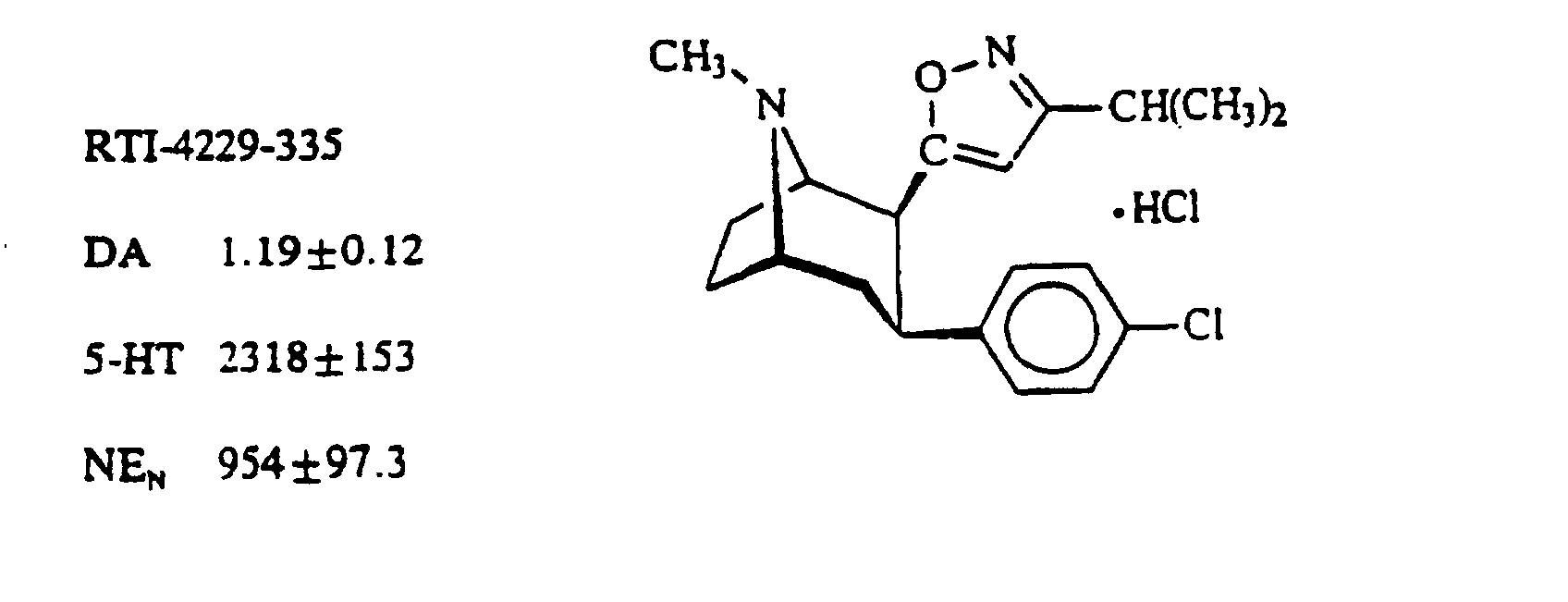
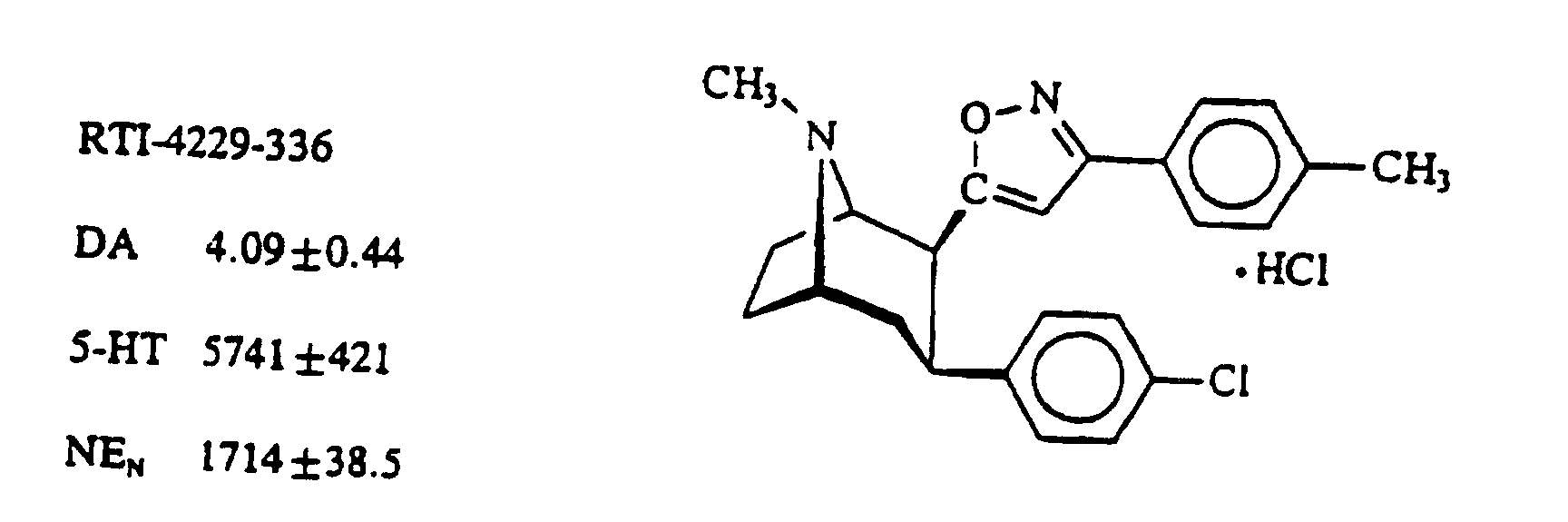
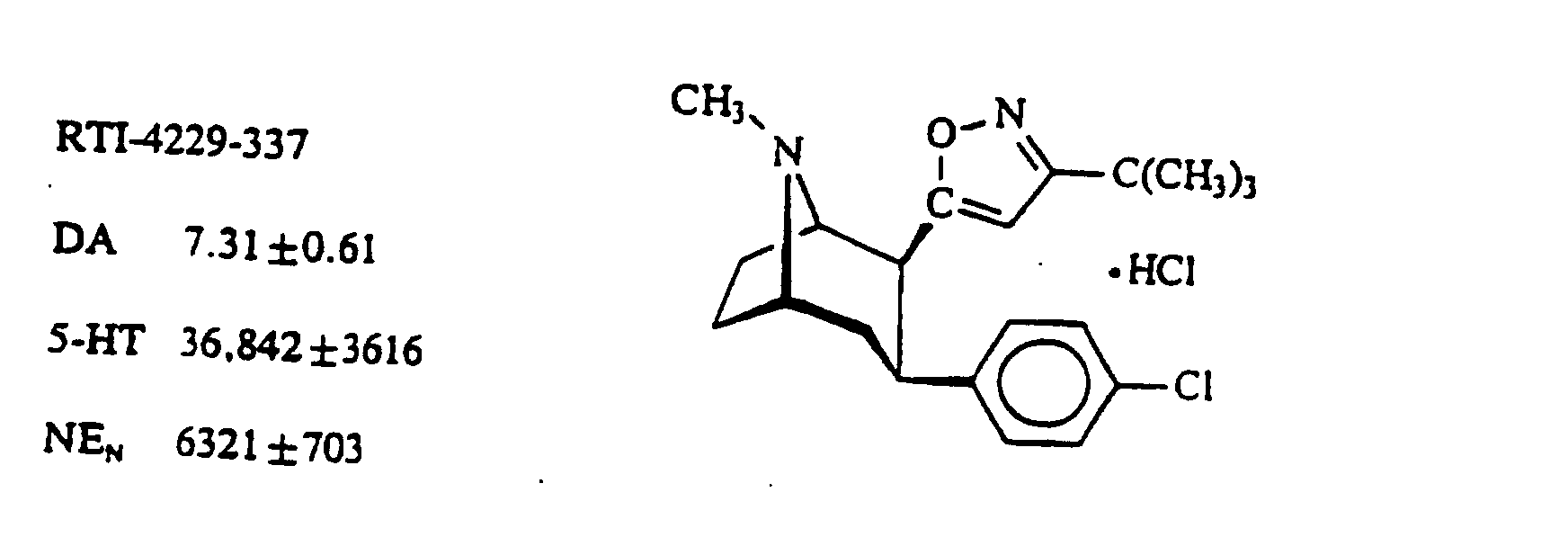

- The chemical structures of the following compounds along with their IC50 values for inhibition of radioligand binding are given below as a comparison.

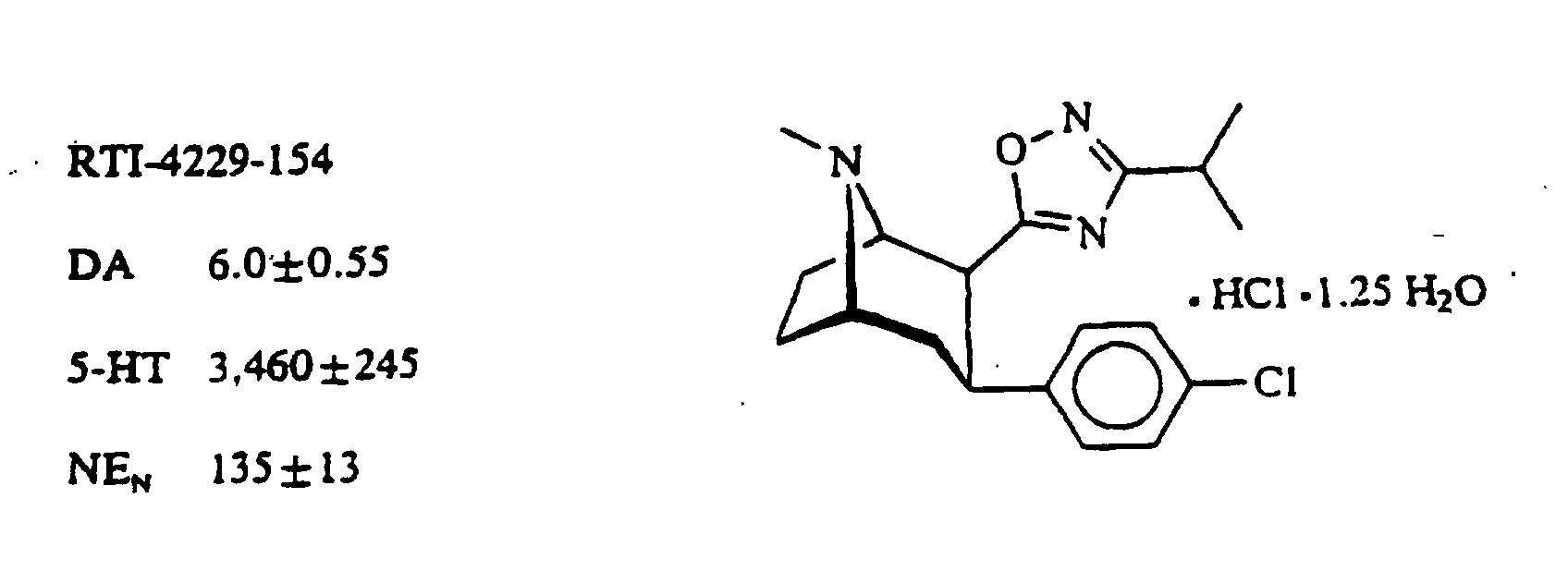
- It should be noted that compound RTI-353 is a highly potent compound at the serotonin site, and is selective relative to the dopamine and norepinephrine sites. This compound is particularly useful as an antidepressant, and as an imaging agent for serotonin transporters.
- Having generally described this invention, a further understanding can be obtained by reference to certain specific examples which are provided herein for purposes of illustration only and are not intended to be limiting unless otherwise specified.
- All certified grade reagents or solvents were purchased from Aldrich Chemical Co. or Fluka Chemical Co. All reagents were normally used without further purification. When anhydrous conditions were required, solvents were distilled and dried by standard techniques immediately prior to use.
- All air and moisture sensitive reactions were conducted under a prepurified nitrogen atmosphere in flame-dried glassware, previously dried at 150°C. Anhydrous solvents were transferred using conventional syringe or steel canula techniques under an inert atmosphere. Removal of solvents in vacuo was done on a Buchi rotavapor rotary evaporator operated at water aspirator pressure.
- 1H NMR and 13C NMR spectra were recorded at 250 Mhz on a Bruker AM250 spectrometer. Optical rotations were recorded on at the Sodium D line on a Rudolph Research Autopol III polarimeter (1 dm cell). Melting point was recorded on a Unimelt Thomas Hoover capillary melting point apparatus in open capillary tubes and were uncorrected. Elemental analysis were performed by Atlantic Microlab, Inc., Norcross, Georgia.
- Reaction products were purified by flash column chromatography using silica gel (mesh size 230-400) purchased from VWR Scientific. Thin layer chromatography (TLC) was performed on Whatman 254 nm fluorescent silica gel 60A (1 x 3 inches, 250 [µL thickness]) precoated TLC plates using the solvent systems indicated. Developed chromatograms were evaluated under 254 nm UV light or with iodine.
- To a solution of 1 mmol of 3β-(4-Chlorophenyl)-tropane-2β-carboxylic acid or 3β-(4-Methylphenyl)-tropane-2β-carboxylic acid in 5 ml of methylene chloride was added dropwise with stirring under nitrogen 2.0 eq oxalyl chloride (2 M solution in methylene chloride). The resulting solution was stirred at room temperature for an hour after evolution of gas has ceased. The solvent was removed in vacuo at room temperature and then at high vacuum to remove residual traces of oxalyl chloride. The resulting residue of acid chloride was suspended in 5 ml methylene chloride under nitrogen at 0 °C, and 2.0 eq of the amine hydrochloride containing 4.0 eq of triethylamine, or 2.5 eq of the amine free base was added. The mixture was stirred at room temperature overnight. Aqueous 3N NaOH (5 ml) was added to basify the reaction mixture, the organic layer was separated and the aqueous layer extracted with 3 x 10 ml chloroform. The combined organic layers were dried (Na2SO4), filtered and the solvent removed in vacuo to give crude product. The crude was purified by flash column chromatography or crystallization.
- A solution of n-butyl lithium in hexane 5.9 ml (2.5 M. 14.6 mmol) was added to a stirred solution of acetone oxime 0.55 g (7.3 mmol) in dry THF (15 ml) at 0 °C under nitrogen. After 1 hour, a solution of 1.65 g (5.62 mmol) 3β-(4-chlorophenyl)-2β-(carbomethoxy)tropane in 10 ml dry was added dropwise with stirring at 0°C. The solution was allowed to warm to room temperature over 18 hours. The mixture was poured into a stirred solution of concentrated sulfuric acid (3.2 g) in THF (15 ml) and water (4 ml) and was heated under reflex for 1 hour. The cooled solution was made basic using saturated aqueous K2CO3 (10 ml) and extracted thrice with 10 ml methylene chloride. The combined organic layers were dried (Na2SO4), filtered and solvent removed in vacuo to give 1.8 g of crude isoxazole. Purification of the crude residue by flash column chromatography (10% CMA in methylene chloride) gave 0.74 g (46%) of pure isoxazole RTI-165 which was further purified by crystallization from methylene chloride/hexane: 1H NMR (CDCl3) δ 1.71 (m, 3 H), 2.10 (m, 3 H), 2.18 (s, 3 H), 2.24 (s, 3 H), 3.20 (m, 2 H), 3.32 (m, 2 H), 6.18 (s, 1 H), 6.9 (d, J = 8 Hz, 2 H), 7.14 (d, J = 8, Hz, 2 H); IR (CCl4) 2950, 1590, 1490, 1420, 1350, 1020, 910 cm-1; mp 154-156°C; Anal calcd for C18H21N2OCl; C = 68.28, H = 6.68, N = 8.84, Cl = 11.19; found C = 68.22, H = 6.69, N = 8.87, Cl = 11.19; [α]D - 125.58° (c = 0.43, MeOH).
- The isoxazole was crystallized as the hydrochloride salt: 1H NMR (MeOD) δ 2.04 (s, 3 H), 2.19 (m, 1 H), 2.30 (m, 1 H), 2.48 (m, 2 H), 2.60 (m, 1 H), 2.70 (m, 1 H), 2.90 (s, 3 H), 3.68 (m, 1 H), 3.81 (m, 1 H), 4.04 (m, 1 H), 4.15 (m, 1 H), 5.55 (s, 1 H), 7.04 (d, J = 8 Hz, 2 H), 7.14 (d, J = 8 Hz, 2 H); mp >235°C (dec); Anal calcd for C18H22Cl2N2O; C = 61.19, H = 6.28, N = 7.93, Cl = 20.07; found c = 60.98, H = 6.38, N = 7.91, Cl = 19.96; [α]D -102.89° (c = 0.46, MeOH).
- Reaction of 1.09 g (4 mmol) of 3β-(4-Methylphenyl)-2β-(carbomethoxy)tropane as described above for RTI-165 gave after workup 1.21 g crude isoxazole. Purification of the crude by flash column chromatography (15% CMA in methylene chloride) gave 0.73 g (62%) pure isoxazole (RTI-171) : 1H NMR (CDCl3) δ 1.73 (m, 3 H), 2.11 (m, 3 H), 2.17 (s, 3 H), 2.23 (s, 3 H), 2.25 (s, 3 H), 3.20 (m, 2 H), 3.32 (m, 2 H), 6.13 (s, 1 H), 6.97 (m, 4 H); IR (CCl4) 2935, 2785, 1590, 1510, 1460, 1421, 1350, 1125, 1010, 910 cm-1.
- The isoxazole was crystallized as the hydrochloride salt: 1H NMR (MeOD) δ 2.01 (s, 3 H), 2.24 (s, 3 H), 2.32 (m, 2 H), 2.42 (m, 4 H), 2.81 (s, 3 H), 3.61 (m. 1 H), 3.78 (m, 1 H), 4.03 (m, 1 H), 4.15 (m, 1 H), 5.45 (s, 1 H), 6.96 (m, 4 H); mp 277°C; Anal calcd for C19H25CIN2O; C = 68.55, H = 7.57, N = 8.42, Cl = 10.65; found C = 68.65, H = 7.62, N = 8.42, Cl = 10.56; [α]D -107.28° (c = 0.71, MEOH).
- Reaction of 0.73 g (1.9 mmol) of 3β-(4-Iodophenyl)-2β-(carbomethoxy)tropane as described above for RTI-165 gave after workup 0.77 g of crude isoxazole. Purification of the crude by flash column chromatography (5% CMA80 in methylene chloride) gave 0.37 g (49%) of pure isoxazole RTI-180: 1H NMR (CDCl3) δ 1.71 (m, 3 H), 2.12 (m, 3 H), 2.18 (s, 3 H), 2.24 (s, 3 H), 3.17 (m, 2 H), 3.33 (m, 2 H), 6.18 (s, 1 H), 6.74 (m, 2 H), 7.49 (m, 2 H); IR (CHCl3) 2940, 1600, 1485, 1450, 1420, 1355 cm-1.
- The isoxazole was crystallized as the hydrochloride salt: 1H NMR (MeOD) δ 2.11 (s, 3 H), 2.50 (m, 6 H), 2.89 (s, 3 H), 3.70 (m, 1 H), 3.90 (m, 1 H), 4.14 (m, 1 H), 4.22 (m, 1 H), 5.66 (s, 1 H), 6.96 (m, 2 H), 7.56 (m, 2 H); mp >235°C (dec); Anal calcd for C18H22ClIN2O·0.25H2O C = 48.12, H = 5.05, N = 6.24, Cl = 15.79; I = 56.50; found C = 47.84, H = 5.05, N = 6.19, Cl = 15.77; I = 56.46; [α]D -94.57° (c = 0.39, MeOH).
- Reaction of 1.18 g (4 mmol) of 3β-(4-Chlorophenyl)-2β-(carbomethoxy)tropane as described above for RTI-165 gave after work up 1.46 g of crude isoxazole. Purification of the crude by flash column chromatography [20% (ether/triethylamine 9 : 1) in hexane] gave 0.75 g (50%) of pure isoxazole RTI-177 which was further purified by crystallizing from ether/petroleum ether: 1H NMR (CDCl3) δ 1.74 (m, 3 H), 2.22 (m, 3 H), 2.27 (s, 3 H), 3.24 (m, 2 H), 3.36 (m, 2 H), 6.80 (s, 1 H), 6.94 (m, 2 H), 7.12 (m, 2 H), 7.40 (m, 3 H), 7.76 (m, 2 H); IR (CHCl3) 2940, 1600, 1590, 1490, 1450, 1405, 1350 cm-1.
- The isoxazole was crystallized as the hydrochloride salt: 1H NMR (MeOD) δ 2.35 (m, 6 H), 2.84 (s, 3 H), 3.73 (m, 1 H), 4.09 (m, 1 H), 4.21 (m, 1 H), 6.12 (s, 1 H), 7.14 (m, 4 H), 7.34 (m, 3 H), 7.57 (m, 2 H); mp 287°C; Anal calcd for C23H24Cl2IN2O·0.25H2O C = 65.79, H = 5.88, N 6.67, Cl = 16.89; found C = 65.94, H = 5.79, N = 6.68, Cl = 17.00; [α]D -97.5° (c = 0.28, MeOH).
- Reaction of 1.09 g (4 mmol) of 3β-(4-Methylphenyl)-2β-(carbomethoxy)tropane as described above for RTI-165 gave after work up 1.56 g of crude isoxazole. Purification of the crude by flash column chromatography [25% (ether/triethylamine 9 : 1) in hexane] gave 1.1 g (77%) of pure isoxazole RTI-176 which was further purified by crystallizing from methylene chloride/hexane 1H NMR (CDCl3) δ 1.76 (m, 3 H), 2.23 (m, 3 H), 2.24 (s, 3 H), 2.27 (s, 3 H), 3.23 (m, 2 H), 3.36 (m, 2 H), 6.74 (s, 1 H), 6.93 (m, 4 H), 7.41 (m,3 H), 7.76 (m, 2 H); IR (CCl4) 2935, 1590, 1455, 1410, 1215 cm-1
- The isoxazole was crystallized as the hydrochloride salt: 1H NMR (MeOD) δ 2.08 (m, 1 H), 2.15 (s, 3 H), 2.45 (m, 5 H), 2.84 (s, 3 H), 3.68 (m, 1 H), 3.88 (m, 1 H), 4.07 (m, 1 H), 4.22 (m, 1 H), 5.97 (s, 1 H), 7.0 (m, 4 H), 7.33 (m, 3 H), 7.54 (m, 2 H); mp 270-295°C (dec); Anal calcd for C24H27CIN2O; C = 72.99, H = 6.89, N = 7.10, Cl = 8.98; found C = 72.91, H = 6.91, N = 7.15, Cl = 8.98; [α]D -102.22 (c = 0.68, MeOH).
- Reaction of 0.73 g (1.9 mmol) of 3β-(4-Iodophenyl)-2β-(carbomethoxy)tropane as described above for RTI-181 gave after workup 1.46 g of crude isoxazole. Purification of the crude by flash column chromatography [20% (ether/triethylamine 9 : 1) in hexane] gave 0.5 g (56%) of pure isoxazole RTI-181 which was further purified by crystallizing from methylene chloride/hexane: 1H NMR (CDCl3) δ 1.72 (m, 3 H), 2.15 (m, 2 H), 2.28 (s, 3 H), 3.22 (m, 2 H), 3.35 (m, 2 H), 6.74 (m, 2 H), 6.79 (s, 1 H), 7.44 (m, 5 H), 7.75 (m, 2 H); IR (CHCl3) 2940, 1580, 1480, 1475, 1450, 1400, 1355, 1005 cm-1
- The isoxazole was crystallized as the hydrochloride salt: 1 H NMR (MeOD) δ 2.54 (m, 6 H), 2.92 (s, 3 H), 3.79 (m, 1 H), 4.05 (m, 1 H), 4.19 (m, 1 H), 4.33 (m, 1 H), 6.18 (s, 1 H), 7.02 (m, 2 H), 7.43 (m, 3 H), 7.63 (m, 4 H); mp >267°C (dec); Anal calcd for C23H24ClIN2O·0.5H2O C = 53.55, H = 4.89, N = 5.43, Cl = 13.75; I = 49.21: found C = 53.75, H = 4.87, N = 5.41, Cl = 13.68; I = 48.95; [α]D -91.11° (c = 0.43, MeOH).
- Inhibition of radioligand binding data at the dopamine, serotonin, and norepinephrine transporters are listed in Table II and III.


Claims (31)
- A compound of the formulawherein R is CH3, C2H5, CH2CH3CH3, or CH(CH3)2, CH=CH2, CH3-C=CH2, CH2CH=CH2, CH=CHCH3, R1 is CH3, CH2C6H5, (CH2)2C6H5, (CH2)3C6H5, or
 wherein X is H, OCH3, or Cl and Y is H, OCH3, or Cl, and n= 1-8.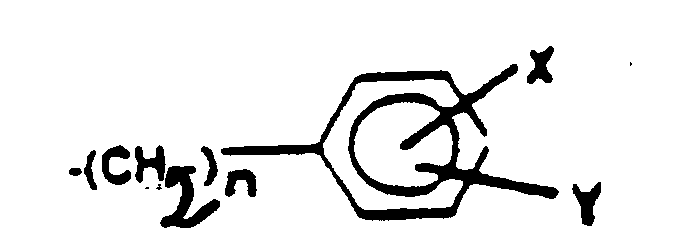
- The compound of Claim 1, wherein R1 is CH3.
- The compound of Claim 2, wherein R is C2H5.
- The compound of Claim 2, wherein R is CH2CH3CH3.
- The compound of Claim 2, wherein R is CH(CH3)2.
- The compound of Claim 1, wherein R is C2H5.
- The compound of Claim 6, wherein R1 is CH2C6H5.
- The compound of Claim 6, wherein R1 is (CH2)2C6H5.
- The compound of Claim 6, wherein R1 is (CH2)3C6H5.
- The compound of Claim 6, wherein R1 is

- The compound of Claim 10, wherein X is H and Y is OCH3.
- The compound of Claim 10, wherein X is OCH3 and Y is H.
- The compound of Claim 10, wherein X is OCH3 and Y is OCH3.
- The compound of Claim 10, wherein X is Cl and Y is H.
- The compound of Claim 10, wherein X is H and Y is Cl.
- The compound of Claim 10, wherein X is Cl and Y is Cl.
- A pharmaceutical composition for treating psychostimulant abuse, comprising a pharmaceutically effective amount of the compound of claim 1.
- A pharmaceutical composition for inhibiting the action of a psychostimulant, comprising a psychostimulant-inhibiting amount of the compound of claim 1.
- A pharmaceutical composition for inhibiting neurotransmitter re-uptake, comprising a neurotransmitter transporter-inhibiting amount of the compound of claim 1.
- A pharmaceutical composition for treating neurodegenerative disorders, comprising a pharmaceutically effective amount of the compound of claim 1.
- A pharmaceutical composition for treating depression, comprising a pharmaceutically effective amount of the compound of claim 1.
- A pharmaceutical composition for treating anorexia, comprising a pharmaceutically effective amount of the compound of claim 1.
- The pharmaceutical composition of anyone of claims 17 to 21 wherein the compound has the following formula :or


- The composition of claim 21, wherein the compound has the following formula :

- A compound of the formula :wherein

R1=hydrogen, C1-5 alkyl,- X=H,
- C1-6 alkyl, C3-8 cycloalkyl, C1-4 alkoxy, C1-6 alkynyl, halogen, amino or acylamido
- Z=H,
- I, Br, Cl, F, CN, CF3, NO2, N3, OR1, CONH2, CO2R1, C1-6 alkyl, NR4R5, NHCOR5, or NHCO2R6, and
- Rb
- is C1-6 alkyl, phenyl, or C1-6 alkyl substituted phenyl.
- A pharmaceutical composition for treating psychostimulant abuse, comprising a pharmaceutically effective amount of the compound of formula :wherein

R1=hydrogen or C1-5 alkyl,- X=H,
- C1-6 alkyl, C3-8 cycloalkyl, C1-4 alkoxy, C1-6 alkynyl, halogen, amino or acylamido
- Z=H,
- I, Br, Cl, F, CN, CF3, NO2, N3, OR1, CONH2, CO2R1, C1-6 alkyl, NR4R5, NHCOR5, or NHCO2R6, and
- Rb
- is C1-6 alkyl, phenyl, or C1-6 alkyl substituted phenyl.
- A pharmaceutical composition for inhibiting the action of a psychostimulant, comprising a psychostimulant-inhibiting amount of the compound of formula :wherein

R1=hydrogen or C1-5 alkyl,- X=H,
- C1-6 alkyl, C3-8 cycloalkyl, C1-4 alkoxy, C1-6 alkynyl, halogen, amino or acylamido
- Z=H,
- I, Br, Cl, F, CN, CF3, NO2, N3, OR1, CONH2, CO2R1, C1-6 alkyl, NR4R5, NHCOR5, or NHCO2R6, and
- Rb
- is C1-6 alkyl, phenyl, or C1-6 alkyl substituted phenyl.
- A pharmaceutical composition for inhibiting neurotransmitter re-uptake, comprising a neurostransmitter transporter-inhibiting amount of the compound of formula :wherein

R1=hydrogen or C1-5 alkyl,- X=H,
- C1-6 alkyl, C3-8 cycloalkyl, C1-4 alkoxy, C1-6 alkynyl, halogen, amino or acylamido
- Z=H,
- I, Br, Cl, F, CN, CF3, NO2, N3, OR1, CONH2, CO2R1, C1-6 alkyl, NR4R5, NHCOR5, or NHCO2R6, and
- Rb
- is C1-6 alkyl, phenyl, or C1-6 alkyl substituted phenyl.
- A pharmaceutical composition for treating neurodegenerative disorders, comprising a pharmaceutically effective amount of the compound of formula :wherein

R1=hydrogen or C1-5 alkyl,- X=H,
- C1-6 alkyl, C3-8 cycloalkyl, C1-4 alkoxy, C1-6 alkynyl, halogen, amino or acylamido
- Z=H,
- I, Br, Cl, F, CN, CF3, NO2, N3, OR1, CONH2, CO2R1, C1-6 alkyl, NR4R5, NHCOR5, or NHCO2R6, and
- Rb
- is C1-6 alkyl, phenyl, or C1-6 alkyl substituted phenyl.
- A pharmaceutical composition for treating depression, comprising a pharmaceutically effective amount of the compound of formula :wherein

R1=hydrogen or C1-5 alkyl,- X=H,
- C1-6 alkyl, C3-8 cycloalkyl, C1-4 alkoxy, C1-6 alkynyl, halogen, amino or acylamido
- Z=H,
- I, Br, Cl, F, CN, CF3, NO2, N3, OR1, CONH2, CO2R1, C1-6 alkyl, NR4R5, NHCOR5, or NHCO2R6, and
- Rb
- is C1-6 alkyl, phenyl, or C1-6 alkyl substituted phenyl.
- A pharmaceutical composition for treating anorexia, comprising a pharmaceutically effective amount of the compound of formula :wherein

R1=hydrogen or C1-5 alkyl,- X=H,
- C1-6 alkyl, C3-8 cycloalkyl, C1-4 alkoxy, C1-6 alkynyl, halogen, amino or acylamido
- Z=H,
- I, Br, Cl, F, CN, CF3, NO2, N3, OR1, CONH2, CO2R1, C1-6 alkyl , NR4R5, NHCOR5, or NHCO2R6, and
- Rb
- is C1-6 alkyl, phenyl, or C1-6 alkyl substituted phenyl.
Applications Claiming Priority (7)
| Application Number | Priority Date | Filing Date | Title |
|---|---|---|---|
| US70150396A | 1996-08-22 | 1996-08-22 | |
| US701503 | 1996-08-22 | ||
| US706263 | 1996-09-04 | ||
| US08/706,263 US6531483B1 (en) | 1990-08-09 | 1996-09-04 | Cocaine receptor binding ligands |
| US08/823,563 US5935953A (en) | 1990-08-09 | 1997-03-25 | Methods for controlling invertebrate pests using cocaine receptor binding ligands |
| US823563 | 1997-03-25 | ||
| PCT/US1997/014702 WO1998007427A1 (en) | 1996-08-22 | 1997-08-22 | Cocaine receptor binding ligands |
Publications (3)
| Publication Number | Publication Date |
|---|---|
| EP0993301A4 EP0993301A4 (en) | 2000-04-19 |
| EP0993301A1 EP0993301A1 (en) | 2000-04-19 |
| EP0993301B1 true EP0993301B1 (en) | 2003-04-09 |
Family
ID=27418725
Family Applications (1)
| Application Number | Title | Priority Date | Filing Date |
|---|---|---|---|
| EP97940580A Expired - Lifetime EP0993301B1 (en) | 1996-08-22 | 1997-08-22 | Cocaine receptor binding ligands |
Country Status (8)
| Country | Link |
|---|---|
| US (1) | US5935953A (en) |
| EP (1) | EP0993301B1 (en) |
| JP (2) | JP4354531B2 (en) |
| AT (1) | ATE236635T1 (en) |
| AU (1) | AU4232797A (en) |
| CA (1) | CA2263961C (en) |
| DE (1) | DE69720800T2 (en) |
| WO (1) | WO1998007427A1 (en) |
Families Citing this family (18)
| Publication number | Priority date | Publication date | Assignee | Title |
|---|---|---|---|---|
| US6329520B1 (en) * | 1990-08-09 | 2001-12-11 | Research Triangle Institute | Cocaine receptor binding ligands |
| US7189737B2 (en) * | 1991-08-09 | 2007-03-13 | Research Triangle Institute | Cocaine receptor binding ligands |
| US7011813B2 (en) * | 1990-08-09 | 2006-03-14 | Research Triangle Institute | Cocaine receptor binding ligands |
| AU5790598A (en) * | 1996-12-02 | 1998-06-29 | Georgetown University | Tropane derivatives and method for their synthesis |
| US6900228B1 (en) | 1998-03-10 | 2005-05-31 | Research Triangle Institute | Opiate compounds, methods of making and methods of use |
| GB9809161D0 (en) * | 1998-04-29 | 1998-07-01 | Zeneca Ltd | Chemical compounds |
| US6150376A (en) * | 1998-08-05 | 2000-11-21 | Georgetown University | Bi- and tri-cyclic aza compounds and their uses |
| US6538010B1 (en) | 2000-11-08 | 2003-03-25 | Research Triangle Institute | Compounds and methods for promoting smoking cessation |
| JP2005508872A (en) * | 2001-05-23 | 2005-04-07 | ニューロサーチ、アクティーゼルスカブ | Tropane derivatives and methods of using them as monoamine neurotransmitter reuptake inhibitors |
| EP1417174A2 (en) * | 2001-08-08 | 2004-05-12 | Neurosearch A/S | Substituted amine derivatives and their use as monoamine neurotransmitter re-uptake inhibitors |
| JP4804346B2 (en) * | 2004-03-31 | 2011-11-02 | 日本曹達株式会社 | Cyclic amine compounds and pest control agents |
| US7872023B2 (en) * | 2005-02-17 | 2011-01-18 | Research Triangle Institute | Kappa opioid receptor ligands |
| US7399762B2 (en) * | 2005-04-25 | 2008-07-15 | Research Triangle Institute | Opioid receptor agonist compounds and their use in treatment of pain |
| US7476679B2 (en) * | 2005-07-26 | 2009-01-13 | Research Triangle Institute | Octahydroisoquinoline compounds as opioid receptor modulators |
| NZ567127A (en) * | 2005-10-06 | 2010-04-30 | Nippon Soda Co | Bridged cyclic amine compound and pest control agent |
| US8048895B2 (en) * | 2008-04-18 | 2011-11-01 | Research Triangle Institute | Kappa opioid receptor ligands |
| EP2539706B1 (en) | 2010-02-24 | 2015-03-04 | Research Triangle Institute | Arylpiperazine opioid receptor antagonists |
| US11020496B2 (en) * | 2017-09-11 | 2021-06-01 | University Of Central Florida Research Foundation, Inc. | Compositions for neuromodulation of mosquito feeding behavior and uses thereof |
Family Cites Families (7)
| Publication number | Priority date | Publication date | Assignee | Title |
|---|---|---|---|---|
| US3813404A (en) * | 1972-11-15 | 1974-05-28 | Sterling Drug Inc | Tropane-2-carboxylates and derivatives |
| US5380848A (en) * | 1990-08-09 | 1995-01-10 | Research Triangle Institute | Cocaine receptor binding ligands |
| US5496953A (en) * | 1990-08-09 | 1996-03-05 | Research Triangle Institute | Cocaine receptor binding ligands |
| US5128118A (en) * | 1990-08-09 | 1992-07-07 | Research Triangle Institute | Cocaine receptor binding ligands |
| WO1993000811A1 (en) * | 1991-07-01 | 1993-01-21 | The General Hospital Corporation | Invertebrate phenylethanolamine transporter and the use thereof |
| DE69233536D1 (en) * | 1991-11-15 | 2005-08-25 | Res Triangle Inst Res Triangle | Cocaine receptor binding ligands |
| DK154192D0 (en) * | 1992-12-23 | 1992-12-23 | Neurosearch As | HETEROCYCLIC COMPOUNDS |
-
1997
- 1997-03-25 US US08/823,563 patent/US5935953A/en not_active Expired - Fee Related
- 1997-08-22 AU AU42327/97A patent/AU4232797A/en not_active Abandoned
- 1997-08-22 AT AT97940580T patent/ATE236635T1/en not_active IP Right Cessation
- 1997-08-22 WO PCT/US1997/014702 patent/WO1998007427A1/en not_active Ceased
- 1997-08-22 EP EP97940580A patent/EP0993301B1/en not_active Expired - Lifetime
- 1997-08-22 JP JP51095598A patent/JP4354531B2/en not_active Expired - Fee Related
- 1997-08-22 CA CA002263961A patent/CA2263961C/en not_active Expired - Fee Related
- 1997-08-22 DE DE69720800T patent/DE69720800T2/en not_active Expired - Lifetime
-
2008
- 2008-12-24 JP JP2008327662A patent/JP2009102364A/en active Pending
Also Published As
| Publication number | Publication date |
|---|---|
| DE69720800D1 (en) | 2003-05-15 |
| JP2001525795A (en) | 2001-12-11 |
| CA2263961C (en) | 2007-03-06 |
| AU4232797A (en) | 1998-03-06 |
| ATE236635T1 (en) | 2003-04-15 |
| JP4354531B2 (en) | 2009-10-28 |
| CA2263961A1 (en) | 1998-02-26 |
| WO1998007427A1 (en) | 1998-02-26 |
| EP0993301A4 (en) | 2000-04-19 |
| JP2009102364A (en) | 2009-05-14 |
| EP0993301A1 (en) | 2000-04-19 |
| DE69720800T2 (en) | 2004-01-29 |
| US5935953A (en) | 1999-08-10 |
Similar Documents
| Publication | Publication Date | Title |
|---|---|---|
| JP2009102364A (en) | Cocaine receptor binding ligand | |
| US6329520B1 (en) | Cocaine receptor binding ligands | |
| EP0542903B1 (en) | Cocaine receptor binding ligands | |
| US20080153870A1 (en) | Cocaine receptor binding ligands | |
| US6531483B1 (en) | Cocaine receptor binding ligands | |
| JP3100159B2 (en) | Heterocyclic compounds and their preparation and use | |
| US8119642B2 (en) | Structurally rigid dopamine D3 receptor selective ligands and process for making them | |
| EP1199068B1 (en) | Use of an NMDA NR2B antagonist for treatment of depression. | |
| US6706880B2 (en) | Cocaine receptor binding ligands | |
| JPH069400A (en) | Medical treatment of nerve denaturation sickness | |
| Robertson et al. | Synthesis and biochemical evaluation of tritium-labeled 1-methyl-N-(8-methyl-8-azabicyclo [3.2. 1] oct-3-yl)-1H-indazole-3-carboxamide, a useful radioligand for 5HT3 receptors | |
| JP2011513459A (en) | Novel 1,4-diaza-bicyclo [3.2.2] nonyloxadiazolyl derivatives useful as modulators of nicotinic acetylcholine receptors | |
| US6835371B1 (en) | Diagnostic and therapeutic piperazine and piperidine compounds and process | |
| EP1478356A2 (en) | Therapeutic compounds | |
| US6251363B1 (en) | Diagnostic and therapeutic alkylenediamine compounds and process | |
| US7361667B2 (en) | 4′,4″-substituted 3α-(diphenylmethoxy) tropane analogs for treatment of mental disorders | |
| AU2004200015A1 (en) | Cocaine receptor binding ligands | |
| AU8362901A (en) | Cocaine receptor binding ligands | |
| JPS63307823A (en) | Medicinal composition | |
| US4904673A (en) | Agent for treating bradycardia and bradyarrhythmia | |
| AU612494B2 (en) | Substituted condensed diazepinones | |
| JP2011513461A (en) | Novel 1,4-diaza-bicyclo [3.2.1] octane derivatives useful as nicotinic acetylcholine receptor modulators |
Legal Events
| Date | Code | Title | Description |
|---|---|---|---|
| PUAI | Public reference made under article 153(3) epc to a published international application that has entered the european phase |
Free format text: ORIGINAL CODE: 0009012 |
|
| 17P | Request for examination filed |
Effective date: 19990727 |
|
| A4 | Supplementary search report drawn up and despatched |
Effective date: 19991108 |
|
| AK | Designated contracting states |
Kind code of ref document: A4 Designated state(s): AT BE CH DE DK ES FI FR GB GR IE IT LI LU MC NL PT SE Kind code of ref document: A1 Designated state(s): AT BE CH DE DK ES FI FR GB GR IE IT LI LU MC NL PT SE |
|
| 17Q | First examination report despatched |
Effective date: 20010315 |
|
| GRAG | Despatch of communication of intention to grant |
Free format text: ORIGINAL CODE: EPIDOS AGRA |
|
| GRAG | Despatch of communication of intention to grant |
Free format text: ORIGINAL CODE: EPIDOS AGRA |
|
| GRAH | Despatch of communication of intention to grant a patent |
Free format text: ORIGINAL CODE: EPIDOS IGRA |
|
| GRAH | Despatch of communication of intention to grant a patent |
Free format text: ORIGINAL CODE: EPIDOS IGRA |
|
| GRAA | (expected) grant |
Free format text: ORIGINAL CODE: 0009210 |
|
| AK | Designated contracting states |
Designated state(s): AT BE CH DE DK ES FI FR GB GR IE IT LI LU MC NL PT SE |
|
| PG25 | Lapsed in a contracting state [announced via postgrant information from national office to epo] |
Ref country code: NL Free format text: LAPSE BECAUSE OF FAILURE TO SUBMIT A TRANSLATION OF THE DESCRIPTION OR TO PAY THE FEE WITHIN THE PRESCRIBED TIME-LIMIT Effective date: 20030409 Ref country code: LI Free format text: LAPSE BECAUSE OF FAILURE TO SUBMIT A TRANSLATION OF THE DESCRIPTION OR TO PAY THE FEE WITHIN THE PRESCRIBED TIME-LIMIT Effective date: 20030409 Ref country code: FI Free format text: LAPSE BECAUSE OF FAILURE TO SUBMIT A TRANSLATION OF THE DESCRIPTION OR TO PAY THE FEE WITHIN THE PRESCRIBED TIME-LIMIT Effective date: 20030409 Ref country code: CH Free format text: LAPSE BECAUSE OF FAILURE TO SUBMIT A TRANSLATION OF THE DESCRIPTION OR TO PAY THE FEE WITHIN THE PRESCRIBED TIME-LIMIT Effective date: 20030409 Ref country code: BE Free format text: LAPSE BECAUSE OF FAILURE TO SUBMIT A TRANSLATION OF THE DESCRIPTION OR TO PAY THE FEE WITHIN THE PRESCRIBED TIME-LIMIT Effective date: 20030409 Ref country code: AT Free format text: LAPSE BECAUSE OF FAILURE TO SUBMIT A TRANSLATION OF THE DESCRIPTION OR TO PAY THE FEE WITHIN THE PRESCRIBED TIME-LIMIT Effective date: 20030409 |
|
| REG | Reference to a national code |
Ref country code: GB Ref legal event code: FG4D |
|
| REG | Reference to a national code |
Ref country code: CH Ref legal event code: EP |
|
| REG | Reference to a national code |
Ref country code: IE Ref legal event code: FG4D |
|
| PG25 | Lapsed in a contracting state [announced via postgrant information from national office to epo] |
Ref country code: SE Free format text: LAPSE BECAUSE OF FAILURE TO SUBMIT A TRANSLATION OF THE DESCRIPTION OR TO PAY THE FEE WITHIN THE PRESCRIBED TIME-LIMIT Effective date: 20030709 Ref country code: PT Free format text: LAPSE BECAUSE OF FAILURE TO SUBMIT A TRANSLATION OF THE DESCRIPTION OR TO PAY THE FEE WITHIN THE PRESCRIBED TIME-LIMIT Effective date: 20030709 Ref country code: GR Free format text: LAPSE BECAUSE OF FAILURE TO SUBMIT A TRANSLATION OF THE DESCRIPTION OR TO PAY THE FEE WITHIN THE PRESCRIBED TIME-LIMIT Effective date: 20030709 Ref country code: DK Free format text: LAPSE BECAUSE OF FAILURE TO SUBMIT A TRANSLATION OF THE DESCRIPTION OR TO PAY THE FEE WITHIN THE PRESCRIBED TIME-LIMIT Effective date: 20030709 |
|
| PG25 | Lapsed in a contracting state [announced via postgrant information from national office to epo] |
Ref country code: LU Free format text: LAPSE BECAUSE OF NON-PAYMENT OF DUE FEES Effective date: 20030822 Ref country code: IE Free format text: LAPSE BECAUSE OF NON-PAYMENT OF DUE FEES Effective date: 20030822 |
|
| PG25 | Lapsed in a contracting state [announced via postgrant information from national office to epo] |
Ref country code: MC Free format text: LAPSE BECAUSE OF NON-PAYMENT OF DUE FEES Effective date: 20030831 |
|
| NLV1 | Nl: lapsed or annulled due to failure to fulfill the requirements of art. 29p and 29m of the patents act | ||
| REG | Reference to a national code |
Ref country code: CH Ref legal event code: PL |
|
| PG25 | Lapsed in a contracting state [announced via postgrant information from national office to epo] |
Ref country code: ES Free format text: LAPSE BECAUSE OF FAILURE TO SUBMIT A TRANSLATION OF THE DESCRIPTION OR TO PAY THE FEE WITHIN THE PRESCRIBED TIME-LIMIT Effective date: 20031030 |
|
| ET | Fr: translation filed | ||
| PLBE | No opposition filed within time limit |
Free format text: ORIGINAL CODE: 0009261 |
|
| STAA | Information on the status of an ep patent application or granted ep patent |
Free format text: STATUS: NO OPPOSITION FILED WITHIN TIME LIMIT |
|
| 26N | No opposition filed |
Effective date: 20040112 |
|
| REG | Reference to a national code |
Ref country code: IE Ref legal event code: MM4A |
|
| PGFP | Annual fee paid to national office [announced via postgrant information from national office to epo] |
Ref country code: GB Payment date: 20110817 Year of fee payment: 15 Ref country code: FR Payment date: 20110818 Year of fee payment: 15 Ref country code: DE Payment date: 20110817 Year of fee payment: 15 |
|
| PGFP | Annual fee paid to national office [announced via postgrant information from national office to epo] |
Ref country code: IT Payment date: 20110813 Year of fee payment: 15 |
|
| GBPC | Gb: european patent ceased through non-payment of renewal fee |
Effective date: 20120822 |
|
| REG | Reference to a national code |
Ref country code: FR Ref legal event code: ST Effective date: 20130430 |
|
| PG25 | Lapsed in a contracting state [announced via postgrant information from national office to epo] |
Ref country code: IT Free format text: LAPSE BECAUSE OF NON-PAYMENT OF DUE FEES Effective date: 20120822 |
|
| PG25 | Lapsed in a contracting state [announced via postgrant information from national office to epo] |
Ref country code: DE Free format text: LAPSE BECAUSE OF NON-PAYMENT OF DUE FEES Effective date: 20130301 Ref country code: GB Free format text: LAPSE BECAUSE OF NON-PAYMENT OF DUE FEES Effective date: 20120822 |
|
| PG25 | Lapsed in a contracting state [announced via postgrant information from national office to epo] |
Ref country code: FR Free format text: LAPSE BECAUSE OF NON-PAYMENT OF DUE FEES Effective date: 20120831 |
|
| REG | Reference to a national code |
Ref country code: DE Ref legal event code: R119 Ref document number: 69720800 Country of ref document: DE Effective date: 20130301 |