EP0991048B1 - Tags having a metallic heft and appearance and process for making them - Google Patents
Tags having a metallic heft and appearance and process for making them Download PDFInfo
- Publication number
- EP0991048B1 EP0991048B1 EP99119526A EP99119526A EP0991048B1 EP 0991048 B1 EP0991048 B1 EP 0991048B1 EP 99119526 A EP99119526 A EP 99119526A EP 99119526 A EP99119526 A EP 99119526A EP 0991048 B1 EP0991048 B1 EP 0991048B1
- Authority
- EP
- European Patent Office
- Prior art keywords
- mass transfer
- thermal mass
- transfer printer
- resin
- printer image
- Prior art date
- Legal status (The legal status is an assumption and is not a legal conclusion. Google has not performed a legal analysis and makes no representation as to the accuracy of the status listed.)
- Expired - Lifetime
Links
- 238000000034 method Methods 0.000 title claims abstract description 23
- 229920005989 resin Polymers 0.000 claims abstract description 68
- 239000011347 resin Substances 0.000 claims abstract description 68
- 229920006254 polymer film Polymers 0.000 claims abstract description 55
- 239000010410 layer Substances 0.000 claims description 56
- 239000003086 colorant Substances 0.000 claims description 39
- 229910052751 metal Inorganic materials 0.000 claims description 22
- 239000002184 metal Substances 0.000 claims description 22
- 238000002310 reflectometry Methods 0.000 claims description 12
- 230000007547 defect Effects 0.000 claims description 7
- 229920000642 polymer Polymers 0.000 claims description 7
- 239000011241 protective layer Substances 0.000 claims description 5
- 239000012790 adhesive layer Substances 0.000 claims description 4
- 229910052782 aluminium Inorganic materials 0.000 abstract description 14
- XAGFODPZIPBFFR-UHFFFAOYSA-N aluminium Chemical compound [Al] XAGFODPZIPBFFR-UHFFFAOYSA-N 0.000 abstract description 14
- 238000007639 printing Methods 0.000 abstract description 11
- 239000011230 binding agent Substances 0.000 description 31
- 239000000463 material Substances 0.000 description 11
- 239000000853 adhesive Substances 0.000 description 9
- 230000001070 adhesive effect Effects 0.000 description 9
- BQCADISMDOOEFD-UHFFFAOYSA-N Silver Chemical compound [Ag] BQCADISMDOOEFD-UHFFFAOYSA-N 0.000 description 7
- 239000011248 coating agent Substances 0.000 description 7
- 238000000576 coating method Methods 0.000 description 7
- 229910052709 silver Inorganic materials 0.000 description 6
- 239000004332 silver Substances 0.000 description 6
- 238000005520 cutting process Methods 0.000 description 5
- 238000004519 manufacturing process Methods 0.000 description 5
- 239000011140 metalized polyester Substances 0.000 description 5
- 150000002739 metals Chemical class 0.000 description 5
- 239000004820 Pressure-sensitive adhesive Substances 0.000 description 4
- 239000000758 substrate Substances 0.000 description 4
- 238000010023 transfer printing Methods 0.000 description 4
- 239000004925 Acrylic resin Substances 0.000 description 3
- 229920000178 Acrylic resin Polymers 0.000 description 3
- XKRFYHLGVUSROY-UHFFFAOYSA-N Argon Chemical compound [Ar] XKRFYHLGVUSROY-UHFFFAOYSA-N 0.000 description 3
- 239000003795 chemical substances by application Substances 0.000 description 3
- 230000004907 flux Effects 0.000 description 3
- 239000000203 mixture Substances 0.000 description 3
- 239000002245 particle Substances 0.000 description 3
- 229920000728 polyester Polymers 0.000 description 3
- -1 polyethylene Polymers 0.000 description 3
- 239000001993 wax Substances 0.000 description 3
- PXHVJJICTQNCMI-UHFFFAOYSA-N Nickel Chemical compound [Ni] PXHVJJICTQNCMI-UHFFFAOYSA-N 0.000 description 2
- 239000004698 Polyethylene Substances 0.000 description 2
- NIXOWILDQLNWCW-UHFFFAOYSA-N acrylic acid group Chemical group C(C=C)(=O)O NIXOWILDQLNWCW-UHFFFAOYSA-N 0.000 description 2
- 229910052786 argon Inorganic materials 0.000 description 2
- 239000008199 coating composition Substances 0.000 description 2
- 238000009792 diffusion process Methods 0.000 description 2
- 238000005530 etching Methods 0.000 description 2
- 238000007733 ion plating Methods 0.000 description 2
- 239000011254 layer-forming composition Substances 0.000 description 2
- 239000007788 liquid Substances 0.000 description 2
- 229920000573 polyethylene Polymers 0.000 description 2
- 239000011253 protective coating Substances 0.000 description 2
- 238000004544 sputter deposition Methods 0.000 description 2
- 238000005019 vapor deposition process Methods 0.000 description 2
- 229920000298 Cellophane Polymers 0.000 description 1
- 229920001747 Cellulose diacetate Polymers 0.000 description 1
- 229920002284 Cellulose triacetate Polymers 0.000 description 1
- VYZAMTAEIAYCRO-UHFFFAOYSA-N Chromium Chemical compound [Cr] VYZAMTAEIAYCRO-UHFFFAOYSA-N 0.000 description 1
- RYGMFSIKBFXOCR-UHFFFAOYSA-N Copper Chemical compound [Cu] RYGMFSIKBFXOCR-UHFFFAOYSA-N 0.000 description 1
- 241000283070 Equus zebra Species 0.000 description 1
- 239000004793 Polystyrene Substances 0.000 description 1
- 239000004372 Polyvinyl alcohol Substances 0.000 description 1
- RTAQQCXQSZGOHL-UHFFFAOYSA-N Titanium Chemical compound [Ti] RTAQQCXQSZGOHL-UHFFFAOYSA-N 0.000 description 1
- XTXRWKRVRITETP-UHFFFAOYSA-N Vinyl acetate Chemical compound CC(=O)OC=C XTXRWKRVRITETP-UHFFFAOYSA-N 0.000 description 1
- NNLVGZFZQQXQNW-ADJNRHBOSA-N [(2r,3r,4s,5r,6s)-4,5-diacetyloxy-3-[(2s,3r,4s,5r,6r)-3,4,5-triacetyloxy-6-(acetyloxymethyl)oxan-2-yl]oxy-6-[(2r,3r,4s,5r,6s)-4,5,6-triacetyloxy-2-(acetyloxymethyl)oxan-3-yl]oxyoxan-2-yl]methyl acetate Chemical compound O([C@@H]1O[C@@H]([C@H]([C@H](OC(C)=O)[C@H]1OC(C)=O)O[C@H]1[C@@H]([C@@H](OC(C)=O)[C@H](OC(C)=O)[C@@H](COC(C)=O)O1)OC(C)=O)COC(=O)C)[C@@H]1[C@@H](COC(C)=O)O[C@@H](OC(C)=O)[C@H](OC(C)=O)[C@H]1OC(C)=O NNLVGZFZQQXQNW-ADJNRHBOSA-N 0.000 description 1
- 239000000654 additive Substances 0.000 description 1
- 239000000956 alloy Substances 0.000 description 1
- 229910045601 alloy Inorganic materials 0.000 description 1
- 229920006378 biaxially oriented polypropylene Polymers 0.000 description 1
- 239000011127 biaxially oriented polypropylene Substances 0.000 description 1
- 239000005025 cast polypropylene Substances 0.000 description 1
- 229910052804 chromium Inorganic materials 0.000 description 1
- 239000011651 chromium Substances 0.000 description 1
- 150000001875 compounds Chemical class 0.000 description 1
- 238000009833 condensation Methods 0.000 description 1
- 230000005494 condensation Effects 0.000 description 1
- 229910052802 copper Inorganic materials 0.000 description 1
- 239000010949 copper Substances 0.000 description 1
- 229920006037 cross link polymer Polymers 0.000 description 1
- 238000009826 distribution Methods 0.000 description 1
- 238000001035 drying Methods 0.000 description 1
- 238000005516 engineering process Methods 0.000 description 1
- 239000007789 gas Substances 0.000 description 1
- PCHJSUWPFVWCPO-UHFFFAOYSA-N gold Chemical compound [Au] PCHJSUWPFVWCPO-UHFFFAOYSA-N 0.000 description 1
- 239000010931 gold Substances 0.000 description 1
- 229910052737 gold Inorganic materials 0.000 description 1
- 238000010438 heat treatment Methods 0.000 description 1
- 238000003384 imaging method Methods 0.000 description 1
- 238000009776 industrial production Methods 0.000 description 1
- 238000010030 laminating Methods 0.000 description 1
- 230000008018 melting Effects 0.000 description 1
- 238000002844 melting Methods 0.000 description 1
- 239000007769 metal material Substances 0.000 description 1
- 238000001465 metallisation Methods 0.000 description 1
- 239000000178 monomer Substances 0.000 description 1
- 229910052759 nickel Inorganic materials 0.000 description 1
- 230000003287 optical effect Effects 0.000 description 1
- 239000000049 pigment Substances 0.000 description 1
- 229920000058 polyacrylate Polymers 0.000 description 1
- 229920000515 polycarbonate Polymers 0.000 description 1
- 239000004417 polycarbonate Substances 0.000 description 1
- 229920001225 polyester resin Polymers 0.000 description 1
- 239000004645 polyester resin Substances 0.000 description 1
- 239000002952 polymeric resin Substances 0.000 description 1
- 238000006116 polymerization reaction Methods 0.000 description 1
- 229920002223 polystyrene Polymers 0.000 description 1
- 229920002635 polyurethane Polymers 0.000 description 1
- 239000004814 polyurethane Substances 0.000 description 1
- 229920005749 polyurethane resin Polymers 0.000 description 1
- 229920002689 polyvinyl acetate Polymers 0.000 description 1
- 239000011118 polyvinyl acetate Substances 0.000 description 1
- 229920002451 polyvinyl alcohol Polymers 0.000 description 1
- 229920000915 polyvinyl chloride Polymers 0.000 description 1
- 239000004800 polyvinyl chloride Substances 0.000 description 1
- 230000001681 protective effect Effects 0.000 description 1
- 238000007650 screen-printing Methods 0.000 description 1
- 229920002050 silicone resin Polymers 0.000 description 1
- 239000007787 solid Substances 0.000 description 1
- 239000000126 substance Substances 0.000 description 1
- 229920003002 synthetic resin Polymers 0.000 description 1
- 238000007651 thermal printing Methods 0.000 description 1
- 229910052719 titanium Inorganic materials 0.000 description 1
- 239000010936 titanium Substances 0.000 description 1
- 238000009834 vaporization Methods 0.000 description 1
- 230000008016 vaporization Effects 0.000 description 1
- 239000002966 varnish Substances 0.000 description 1
- 229920001567 vinyl ester resin Polymers 0.000 description 1
- 125000000391 vinyl group Chemical group [H]C([*])=C([H])[H] 0.000 description 1
Images
Classifications
-
- B—PERFORMING OPERATIONS; TRANSPORTING
- B44—DECORATIVE ARTS
- B44C—PRODUCING DECORATIVE EFFECTS; MOSAICS; TARSIA WORK; PAPERHANGING
- B44C1/00—Processes, not specifically provided for elsewhere, for producing decorative surface effects
- B44C1/16—Processes, not specifically provided for elsewhere, for producing decorative surface effects for applying transfer pictures or the like
- B44C1/165—Processes, not specifically provided for elsewhere, for producing decorative surface effects for applying transfer pictures or the like for decalcomanias; sheet material therefor
- B44C1/17—Dry transfer
- B44C1/1733—Decalcomanias applied under pressure only, e.g. provided with a pressure sensitive adhesive
- B44C1/1737—Decalcomanias provided with a particular decorative layer, e.g. specially adapted to allow the formation of a metallic or dyestuff on a substrate unsuitable for direct deposition
-
- G—PHYSICS
- G09—EDUCATION; CRYPTOGRAPHY; DISPLAY; ADVERTISING; SEALS
- G09F—DISPLAYING; ADVERTISING; SIGNS; LABELS OR NAME-PLATES; SEALS
- G09F3/00—Labels, tag tickets, or similar identification or indication means; Seals; Postage or like stamps
- G09F3/02—Forms or constructions
-
- G—PHYSICS
- G09—EDUCATION; CRYPTOGRAPHY; DISPLAY; ADVERTISING; SEALS
- G09F—DISPLAYING; ADVERTISING; SIGNS; LABELS OR NAME-PLATES; SEALS
- G09F3/00—Labels, tag tickets, or similar identification or indication means; Seals; Postage or like stamps
- G09F3/08—Fastening or securing by means not forming part of the material of the label itself
- G09F3/10—Fastening or securing by means not forming part of the material of the label itself by an adhesive layer
-
- Y—GENERAL TAGGING OF NEW TECHNOLOGICAL DEVELOPMENTS; GENERAL TAGGING OF CROSS-SECTIONAL TECHNOLOGIES SPANNING OVER SEVERAL SECTIONS OF THE IPC; TECHNICAL SUBJECTS COVERED BY FORMER USPC CROSS-REFERENCE ART COLLECTIONS [XRACs] AND DIGESTS
- Y10—TECHNICAL SUBJECTS COVERED BY FORMER USPC
- Y10S—TECHNICAL SUBJECTS COVERED BY FORMER USPC CROSS-REFERENCE ART COLLECTIONS [XRACs] AND DIGESTS
- Y10S428/00—Stock material or miscellaneous articles
- Y10S428/914—Transfer or decalcomania
-
- Y—GENERAL TAGGING OF NEW TECHNOLOGICAL DEVELOPMENTS; GENERAL TAGGING OF CROSS-SECTIONAL TECHNOLOGIES SPANNING OVER SEVERAL SECTIONS OF THE IPC; TECHNICAL SUBJECTS COVERED BY FORMER USPC CROSS-REFERENCE ART COLLECTIONS [XRACs] AND DIGESTS
- Y10—TECHNICAL SUBJECTS COVERED BY FORMER USPC
- Y10T—TECHNICAL SUBJECTS COVERED BY FORMER US CLASSIFICATION
- Y10T428/00—Stock material or miscellaneous articles
- Y10T428/14—Layer or component removable to expose adhesive
-
- Y—GENERAL TAGGING OF NEW TECHNOLOGICAL DEVELOPMENTS; GENERAL TAGGING OF CROSS-SECTIONAL TECHNOLOGIES SPANNING OVER SEVERAL SECTIONS OF THE IPC; TECHNICAL SUBJECTS COVERED BY FORMER USPC CROSS-REFERENCE ART COLLECTIONS [XRACs] AND DIGESTS
- Y10—TECHNICAL SUBJECTS COVERED BY FORMER USPC
- Y10T—TECHNICAL SUBJECTS COVERED BY FORMER US CLASSIFICATION
- Y10T428/00—Stock material or miscellaneous articles
- Y10T428/14—Layer or component removable to expose adhesive
- Y10T428/1438—Metal containing
-
- Y—GENERAL TAGGING OF NEW TECHNOLOGICAL DEVELOPMENTS; GENERAL TAGGING OF CROSS-SECTIONAL TECHNOLOGIES SPANNING OVER SEVERAL SECTIONS OF THE IPC; TECHNICAL SUBJECTS COVERED BY FORMER USPC CROSS-REFERENCE ART COLLECTIONS [XRACs] AND DIGESTS
- Y10—TECHNICAL SUBJECTS COVERED BY FORMER USPC
- Y10T—TECHNICAL SUBJECTS COVERED BY FORMER US CLASSIFICATION
- Y10T428/00—Stock material or miscellaneous articles
- Y10T428/14—Layer or component removable to expose adhesive
- Y10T428/1467—Coloring agent
-
- Y—GENERAL TAGGING OF NEW TECHNOLOGICAL DEVELOPMENTS; GENERAL TAGGING OF CROSS-SECTIONAL TECHNOLOGIES SPANNING OVER SEVERAL SECTIONS OF THE IPC; TECHNICAL SUBJECTS COVERED BY FORMER USPC CROSS-REFERENCE ART COLLECTIONS [XRACs] AND DIGESTS
- Y10—TECHNICAL SUBJECTS COVERED BY FORMER USPC
- Y10T—TECHNICAL SUBJECTS COVERED BY FORMER US CLASSIFICATION
- Y10T428/00—Stock material or miscellaneous articles
- Y10T428/14—Layer or component removable to expose adhesive
- Y10T428/1486—Ornamental, decorative, pattern, or indicia
-
- Y—GENERAL TAGGING OF NEW TECHNOLOGICAL DEVELOPMENTS; GENERAL TAGGING OF CROSS-SECTIONAL TECHNOLOGIES SPANNING OVER SEVERAL SECTIONS OF THE IPC; TECHNICAL SUBJECTS COVERED BY FORMER USPC CROSS-REFERENCE ART COLLECTIONS [XRACs] AND DIGESTS
- Y10—TECHNICAL SUBJECTS COVERED BY FORMER USPC
- Y10T—TECHNICAL SUBJECTS COVERED BY FORMER US CLASSIFICATION
- Y10T428/00—Stock material or miscellaneous articles
- Y10T428/14—Layer or component removable to expose adhesive
- Y10T428/149—Sectional layer removable
Definitions
- the present invention relates to the manufacture of tags, particularly asset tags having a metallic heft and appearance.
- Anodized aluminum asset tags have become a well established means for identification of capital equipment belonging to facilities such as offices, medical treatment centers, laboratories, industrial production facilities, and mobile service providers. They are often applied to computer equipment, medical devices, laboratory instrumentation, and production machinery as a means of keeping track of such equipment for service, replacement and tax purposes; increasing the likelihood that theft would be detected; and simplifying insurance claims in the event of theft or loss. When applied by a manufacturer, such tags are useful for identification of the product for general product service, product warranty service and possible recall.
- the use of anodized aluminum asset tags for these end uses evolved from their sturdy metallic heft and appearance. Their sturdy metallic heft and appearance conveys a high perceived quality and, from a security standpoint, a sense of indestructibility and intent to enforce security measures. They are often perceived to be an essential component of responsible asset management.
- Document EP-A-0 794 522 describes a label with a metallic layer, whereby a layer of printing is applied to a substrate film having an undertreatment layer and the metallic layer thereon.
- Document US-A-4 643 454 describes a lottery with a coating an its front side which includes a first metallic layer and an outwardly facing layer of thermally responsive chemicals.
- anodized aluminum asset tags are manufactured by applying the required graphic and text information in reverse on the anodized aluminum substrate using conventional imaging processes such as screen printing, letterpress, and etching, all of which require the wasteful, time consuming and expensive step of making a master plate or screen for applying ink, or a mask in the case of etching, which must be stored for possible future use or destroyed after final use.
- the aluminum substrate having the required heft also requires the use of special printing, stamping, handling and die cutting equipment, which can undergo substantial wear and tear from contact with hard aluminum surfaces. There is also the cost of the aluminum itself to consider.
- asset tags such as a unique numeric or alphanumeric code associated with the records concerning the specific equipment to which it is attached, along with a corresponding bar code to minimize errors and worker time associated with entry of the same into a computer database.
- printing of numeric sequences can be carried out using a mechanical device that automatically advances to the next number for each tag, such devices are not appropriate for generating a corresponding unique bar code.
- Generation of multiple varying bar codes generally requires a printer capable of producing computer-generated output, such as a mass transfer thermal printer, ink jet printer or electrophotographic printer. Such printers are generally not considered appropriate for use on anodized aluminum tag material.
- One aspect of the present invention is an asset tag having a metallic heft and appearance comprising:
- Another aspect of the present invention is a process for making an asset tag having a metallic heft and appearance comprising:
- the starting point for the manufacture of the label having a metallic appearance according to the present invention is a metallized polymer film.
- metallized polymer films are commercially available and can also be manufactured according to processes known in the prior art. They comprise a transparent polymer film having a metallic layer evenly deposited on at least one side of the film.
- the polymer film may be made of various transparent polymers, such as polyester, cellulose triacetate, cellulose diacetate, cellophane, biaxially oriented polypropylene, cast polypropylene, polyethylene, polystyrene, polycarbonate, polyvinyl alcohol, polyvinyl chloride, polyacrylate, polyurethane, and polyvinyl acetate.
- the thickness of the film is preferably at least about 0.001, more preferably at least about 0.003, and even more preferably at least about 0.0045, inches and preferably up to about 0.010, more preferably up to about 0.007, and even more up to about 0.0055, inches.
- the metal layer may be selected from a variety of metals, such as aluminum, chromium, nickel, titanium, copper, gold, and silver; alloys of these metals; and compounds of these metals. Among these metals aluminum is preferred.
- the metals may be deposited by any known process, such as the vacuum vapor deposition process, the sputtering process, and the ion plating process. In the vacuum vapor deposition process, a metallic material for forming a layer by metal deposition and the polymer film are placed under a high vacuum as the metal is vaporized by heating above the surface of the film. Metal attaches to the surface of the film by condensation, forming a thin layer on the surface of the film.
- argon gas of low pressure is introduced into a chamber maintained under a high vacuum containing the polymer film and the metal is placed at a cathode within the chamber.
- Argon ions formed by a glow discharge generated by the cathode sputter the metal, which becomes attached to and accumulated on the surface of the polymer film to form the metal layer.
- the polymer film is placed on the cathode and the metal used for vaporization is placed on the anode. Particles of vaporized metal are ionized while the particles pass through glow discharge, causing ionized particles of metal to be adsorbed on the surface of the polymer film to form the metal layer.
- the thickness of the metal layer is preferably at least about 20, more preferably at least about 180, angstroms and preferably up to about 2000, more preferably up to about 230, angstroms.
- the metallized polymer film also has a layer of adhesive material formed on the metallic layer.
- Any adhesive conventionally used for labels can be used.
- the adhesive is preferably pressure-sensitive.
- the thickness of the adhesive material is preferably in the range of about 4 to about 250 microns.
- a protective layer may be present between the metallic layer and the layer of adhesive material, such as an acrylic resin, a polyester resin, a polyurethane resin, or a vinyl acetate resin.
- the preferred embodiment with the adhesive layer preferably has a release liner attached to the layer of adhesive material.
- the release liner may be selected from any of those known in the art, such as paper, coated paper, polyethylene, laminated paper, or polymer films having a coating of releasing agent, such as a silicone resin.
- Examples of commercially available metallized polymer film include those sold by FLEXcon Company, , Inc., such as MM-500 Silver P/T/P V-88 80B PFM which is a silver-colored metallized polyester material having a thickness of 0.005 inch plus a 0.0015 inch of pressure-sensitive adhesive and a 0.0045 inch thick liner on the back side of the film.
- the optional translucent print receptive layer is applied to the surface of the metallized polymer film when color matching is desired and/or when needed to improve the print receptivity of the metallized polymer film. If the metallized polymer film has an adhesive layer, the translucent print receptive layer is applied to the opposite side of the metallized polymer film.
- the translucent print receptive layer may contain a wide range of polymer resins and optional additives having sufficient functionality to provide compatibility, and preferably adhesion to, resin-based thermal mass transfer printer images.
- the print receptive layer is obtainable by applying to the metallized polymer film a print receptive layer forming composition comprising at least one acrylic resin, optionally at least one colorant and optionally at least one curing agent, such as a composition comprising at least one acrylic resin, optionally at least one colorant, at least one polyester oligomer, at least one monomer and at least one photoiniator.
- the colorant when present, is preferably compatible with at least one resin comprising the translucent print receptive layer, and more preferably is miscible with at least one such resin.
- the colorant is present when contrast between the first thermal mass transfer printer image and the metallized polymer film is desired and the metallized polymer film does not have a color which has the desired contrast with the color of the first thermal mass transfer printer image.
- the colorant may, for example, be a known pigment or dye.
- the print receptive layer preferably comprises an at least partially crosslinked polymer, which is obtainable by, for example, at least partially curing a composition comprising at least one polymer and at least one curing agent after it is applied to the metallized polymer film.
- the print receptive layer may be cured by any means compatible with the integrity of the film.
- the print receptive layer forming composition is ultraviolet light (“UV") curable and is cured by exposure to UV light.
- Such translucent print receptive resins may be obtained from Cavanaugh, Inc.
- a specific UV curable example sold by that company is CavFlex Plus UV Flexo.
- the term "translucent" means that the layer as applied has less than 0.5, preferably less than 0.2, and even more preferably less than 0.1, opacity.
- the translucent resin layer has a light transmissivity of at least about 80, more preferably at least about 90, even more preferably at least about 95, and yet even more preferably at least about 98, percent of incident light.
- a first image is applied to the metallized polymer film, either with or without an intervening print receptive layer, using a resin-based thermal mass transfer printing system.
- a thermal mass transfer printing system generally comprises a means for selectively applying heat to the resin-based colorant/binder on a carrier so as to cause the resin-based colorant/binder to be transferred from the carrier to receiving surface adjacent to the resin-based colorant/binder.
- the resin-based colorant/binder carrier is generally a ribbon and the resin-based colorant/binder is defined herein as a colorant/binder in which at least 50 wt%, more preferably at least 80 wt%, of the binder is at least one resin.
- Waxes are distinguishable from resins by their low viscosity at just above their melting point and/or by their substantially lower degree of polymerization.
- the resin-based colorant/binder is preferably made for use as spot color, as opposed to process color.
- Spot color colorant/binders are opaque colors designed to not mix with other colorant/binders applied over it.
- Process color colorant/binders are either relatively transparent or are intended to mix with other colorant/binders so that when two or more process color colorant/binders are applied they combine to produce a third color different from the color of any one of the individual process color colorant/binders.
- the opacity of the applied spot color colorant/binders is preferably at least 0.90, more preferably at least 0.95, and even more preferably at least 0.98.
- the light transmissivity of these latter applied colorant/binders is preferably less than 0.1.
- the specular reflectivity of the applied colorant/binder i.e., the specular reflectivity of the first thermal mass transfer printer image
- a low specular reflectivity is particularly desirable when a second thermal mass transfer printer image is applied over the first thermal mass transfer printer image that comprises a bar code. The low specular reflectivity aids in allowing the bar code to be read from a wide range of angles.
- spectrum reflection is defined as “reflection without diffusion, in accordance with the laws of optical reflection, as in a mirror” in ASTM E 284-81a.
- Diffusion is defined in ASTM E 284-81a as "change of the angular distribution of a beam of radiant flux by a transmitting material or reflecting surface such that the flux incident in one direction is continuously distributed in many directions, the process not conforming (on a macroscopic scale) to the laws of Fresnell (regular) reflection and refraction and there being no change in frequency (wave length) of the monochromatic component of the flux.”
- the applied colorant/binder preferably has a printed bar code readability edge contrast rating and a printed bar code readability symbol contrast rating of "A" or "B", more preferably "A”, measured according to The American National Standards Institute (ANSI) Barcode Print Quality Guideline” (ANSX3.182-1990) using a Quick-Check 500 bar code verifier manufactured by PSC, Inc., of Webster, New York (United States) set to have an aperture of 6 mil and a wavelength of 660 nm.
- ANSI American National Standards Institute
- the first thermal mass transfer printer image preferably has a color which is of a lighter hue than the color of the metallized polymer film. This may be achieved not only by appropriate selection of the colorant used for the first thermal mass transfer printer image, but also by selection of the color of the metallized polymer film, with or without the optional translucent print receptive layer, as explained above.
- the first thermal mass transfer printer image has metallic appearance. That objective can be achieved by, for example, selecting a colorant/binder having a finely divided metal, such as silver, preferably in the form of plates or flakes, as a colorant.
- a second resin-based thermal mass transfer printer image will be applied over the first thermal mass transfer printer image, appropriate colorant/binder and printing conditions are preferably selected to obtain a first thermal mass transfer printer image edge contrast and/or symbol contrast as explained above.
- the printing process uses a resin-based colorant/binder having a silver flake-containing colorant, such as Astro-Med RAA series of thermal mass transfer ribbons, such as Silver 3300 4508, commercially available from Astro-Med, Inc.
- a resin-based colorant/binder having a silver flake-containing colorant such as Astro-Med RAA series of thermal mass transfer ribbons, such as Silver 3300 4508, commercially available from Astro-Med, Inc.
- This ribbon which is said to have a Pantone 877 color, has a low specular reflectivity.
- Thermal mass transfer printers are commercially available. Examples include those sold by Zebra Technologies, Astro-Med, Inc., and Intermec Corporation, such as Astro-Med's QLS-2000 and TEC America's CB416 color printer. More than one printer may be used apply the first and second thermal mass transfer printer images or the first and second thermal mass transfer printer images are applied by a single printer designed to apply more than one colorant/binder. The images are preferably created or reproduced by an electronic device, such as a digital computer, capable of communicating with the printer.
- a second thermal mass transfer printer image is applied over a portion of the first thermal mass transfer printer image which has a color that preferably contrasts with the color of the first thermal mass transfer printer image.
- the colorant/binder of the second thermal mass transfer printer image is selected to be compatible with the colorant/binder of the first thermal mass transfer printer image. Spot color colorant/binders are preferred, particularly those intended for use on synthetics, such as vinyl and polyester, and metallized surfaces.
- the preferences regarding opacity/light transmissivity values specified for the preferred colorant/binders of the first thermal mass transfer printer image and regarding thermal mass transfer printers are also applicable to the second thermal mass transfer printer image.
- the colorant/binder for the second thermal mass transfer printer image is an Astro-Med RF ribbon, such as Astro-Med RF black.
- Compatibility between the colorant/binder used to apply the second thermal mass transfer printer image and the first thermal mass transfer printer image is determined by determining the print quality grade of printed bar code (i.e., bar code readability) according to The American National Standards Institute (ANSI) Barcode Print Quality Guideline” (ANSX3.182-1990) using a Quick-Check 500 bar code verifier manufactured by PSC, Inc., of Webster, New York (United States) set to have an aperture of 6 mil and a wavelength of 660 nm.
- the standard assigns a letter grade, "A" through “F", to the bar code based on the lowest letter grade obtained on several different test parameters.
- a letter grade “C” represents the preferred minimum for compatibility
- a letter grade “B” or better i.e., "B” or "A”
- a letter grade "A” represents the most preferred compatibility.
- the letter grades specifically associated with each of "modulation", “defects” and “decode margin” determined by the foregoing test are, independently, “B” or “A”, more preferably "A”.
- the color of the second resin-based thermal mass transfer printer image is preferably of a darker hue than the color of the first resin-based thermal mass transfer printer image, particularly when the first resin-based thermal mass transfer printer image has a color of a lighter hue than the color of the metallized polymer film having a translucent print receptive layer.
- the thermal mass transfer printing step may be preceded or succeeded by other printing processes known in the art, such as ink jet, electrophotographic, flexographic, etc., so long as they do not interfere with the print receptivity of the print receptive layer or the compatibility between the thermal mass transfer printer images.
- Printing of registration marks on the liner side of the polymer film may be desired to assist in automated registration of the cutting, scoring and/or perforating step with the thermal mass transfer images corresponding to individual labels.
- the registration marks are preferably added prior to application of the first thermal mass transfer printer image.
- the present invention may include one or more additional thermal mass transfer printer images made with resin-based or wax-based, preferably resin-based, colorant/binder on the translucent print receptive layer and/or on the final resin-based thermal mass transfer printer image.
- a transparent protective layer may be desired to increase the durability of the thermal mass transfer image(s).
- a transparent protective coating may be applied using means known in the field of labels, such as coating the surface with a liquid polymeric coating composition and then curing or drying that coating to form a solid transparent polymer coating or laminating a transparent polymer film over the thermal mass transfer print image.
- Useful coating compositions and transparent overlaminate materials are readily available commercially. Liquid varnish may be applied to the surface of the metallized polymer laminate and then cured and transparent overlaminate materials are available as a transparent polymer web having an adhesive backing and a protective release liner which is stripped off before application.
- the transparent protective layer can be obtained with any desired surface finish, such as matt or glossy, so long as it does not impair bar code readability.
- Sources of the transparent polymer web with adhesive backing include FLEXcon Company, Inc., for example FLEXcon's A-200 Clear V-344 150 Polyliner, which is a glossy acrylic overlaminate having a thickness of 0.001 inch.
- the term "transparent" means that the layer as applied has less than 0.5, preferably less than 0.2, and even more preferably less than 0.1, opacity.
- the transparent overlaminate has a light transmissivity of at least 90, more preferably at least 95, and even more preferably at least 98, percent of incident light.
- the overlaminate has a gloss of at least 100, preferably at least 140, Gardner units, measured at a 60 degree angle.
- the portion of the laminate in which the first thermal mass transfer printer image does not cover the print receptive layer of the metallized polymer film preferably has a reflectivity greater than 80%, preferably greater than 90%, more preferably greater than 95%, and even more preferably greater than 98% when measured according to Japanese Industrial Standard K 7105.
- a reflectivity greater than 80%, preferably greater than 90%, more preferably greater than 95%, and even more preferably greater than 98% when measured according to Japanese Industrial Standard K 7105.
- at least 50 percent, more preferably at least 80 percent and even more preferably at least 90 percent, of the reflectivity of the at least one portion not covered by the first thermal mass transfer image is specular reflectivity as defined in ASTM E 284-81a.
- the portion of the print receptive layer not covered by the first thermal mass transfer printer image preferably also has an opacity of at least 0.95, more preferably at least 0.98.
- the metallized polymer film containing the printed image(s) may be in the form of a web to facilitate being fed through one or more thermal mass transfer printers.
- a web may be cut, scored, and/or perforated to form individual labels in a manner which is conventional in the art, such as by using a die cut press.
- the web is kiss cut after the last thermal printing step and optional application of a transparent protective layer so that individual tags may be removed from the release liner while leaving the release liner intact.
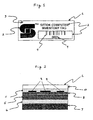
- Figure 1 shows a plan view of an asset tag 1 , having a first resin-based thermal mass transfer printer image 2 on a metallic polymer film having a print receptive layer 3 as the substrate for the first resin-based thermal mass transfer printer image 2 .
- a second resin-based thermal mass transfer printer image 4 is shown on a portion of the first resin-based thermal mass transfer printer image 2 .
- FIG. 2 illustrates an enlarged, expanded, sectional, elevational view of a preferred asset tag of the present invention.
- the asset tag 1 includes a metallized polyester 5 having on one side a pressure sensitive adhesive 6 and a release liner 7 and on the other side a translucent print receptive layer 8 .
- On the translucent print receptive layer 8 is a resin-based thermal mass transfer printer image 9 .
- Over the translucent print receptive layer 8 and the resin-based thermal mass transfer printer image 9 is an acrylic overlaminate 10 adhered to the translucent print receptive layer 8 and the resin-based thermal mass transfer printer image 9 with an intervening layer of pressure sensitive adhesive 11 .
- the resin-based thermal mass transfer printer image 9 may comprise a first resin-based thermal mass transfer printer image and a second resin-based thermal mass transfer printer image on a portion of the first resin-based thermal mass transfer printer image.
- FLEXcon's MM500 Silver P/T/P V-88 80B PFM a silver-colored metallized polyester material having a pressure-sensitive adhesive and liner, is flood coated on the side opposite the adhesive-coated side with CavFlex Plus UV Flexo ink using a flexographic press. The ink is cured using UV light. After printing registration marks on the back side of the web (i.e., on the release sheet), the web stock is slit and wound up on rolls for later use.
- a roll of the metallized polyester material having the ink coating manufactured in Part 1 of this example is mounted on an Intermec 3440 thermal mass transfer printer having an Astro-Med Silver 3300 4508 thermal transfer ribbon. Computer-generated images are sent to the printer, which prints them onto the ink coating. FLEXcon's A-200 Clear-V344 150 Polyliner is applied over the side of the metallized polyester web having the printed indicia as the web exits the printer. Then the web is die-cut to form individual tags on a continuous release sheet by only cutting through the other layers. The resulting tags have a thickness of about 0.013 inch and have the look and feel of anodized aluminum asset tag products.
Landscapes
- Physics & Mathematics (AREA)
- General Physics & Mathematics (AREA)
- Engineering & Computer Science (AREA)
- Theoretical Computer Science (AREA)
- Thermal Transfer Or Thermal Recording In General (AREA)
- Laminated Bodies (AREA)
- Making Paper Articles (AREA)
Abstract
Description
- The present invention relates to the manufacture of tags, particularly asset tags having a metallic heft and appearance.
- Anodized aluminum asset tags have become a well established means for identification of capital equipment belonging to facilities such as offices, medical treatment centers, laboratories, industrial production facilities, and mobile service providers. They are often applied to computer equipment, medical devices, laboratory instrumentation, and production machinery as a means of keeping track of such equipment for service, replacement and tax purposes; increasing the likelihood that theft would be detected; and simplifying insurance claims in the event of theft or loss. When applied by a manufacturer, such tags are useful for identification of the product for general product service, product warranty service and possible recall. The use of anodized aluminum asset tags for these end uses evolved from their sturdy metallic heft and appearance. Their sturdy metallic heft and appearance conveys a high perceived quality and, from a security standpoint, a sense of indestructibility and intent to enforce security measures. They are often perceived to be an essential component of responsible asset management.
- Document EP-A-0 794 522 describes a label with a metallic layer, whereby a layer of printing is applied to a substrate film having an undertreatment layer and the metallic layer thereon. Document US-A-4 643 454 describes a lottery with a coating an its front side which includes a first metallic layer and an outwardly facing layer of thermally responsive chemicals.
- One disadvantage of anodized aluminum asset tags is that on the one hand they are often only needed sporadically in small quantities while on the other hand they are not easy to manufacture in small production runs. Typically, anodized aluminum asset tags are manufactured by applying the required graphic and text information in reverse on the anodized aluminum substrate using conventional imaging processes such as screen printing, letterpress, and etching, all of which require the wasteful, time consuming and expensive step of making a master plate or screen for applying ink, or a mask in the case of etching, which must be stored for possible future use or destroyed after final use. The aluminum substrate having the required heft also requires the use of special printing, stamping, handling and die cutting equipment, which can undergo substantial wear and tear from contact with hard aluminum surfaces. There is also the cost of the aluminum itself to consider.
- There is also an increasing desire to have variable information appear on asset tags such as a unique numeric or alphanumeric code associated with the records concerning the specific equipment to which it is attached, along with a corresponding bar code to minimize errors and worker time associated with entry of the same into a computer database. While printing of numeric sequences can be carried out using a mechanical device that automatically advances to the next number for each tag, such devices are not appropriate for generating a corresponding unique bar code. Generation of multiple varying bar codes generally requires a printer capable of producing computer-generated output, such as a mass transfer thermal printer, ink jet printer or electrophotographic printer. Such printers are generally not considered appropriate for use on anodized aluminum tag material.
- Thus, there continues to be a need for asset tags having the heft and appearance of anodized aluminum asset tags and containing variable information that can be conveniently, quickly and inexpensively manufactured on demand using conventional printing, handling and die cutting equipment, which reduces the wear and tear on such equipment. The present invention overcomes these limitations.
- One aspect of the present invention is an asset tag having a metallic heft and appearance comprising:
- (A) A metallized polymer film having a front side and a back side, the front side optionally having a translucent print receptive layer;
- (B) a first resin-based thermal mass transfer printer image covering a portion of the front side of the metallized polymer film such that at least one portion of the front side of the metallized polymer film is not covered by the first thermal mass transfer printer image; and
- (C) an optional second resin-based thermal mass transfer printer image covering at least a portion of the first resin-based thermal mass transfer printer image such that at least one portion of the first resin-based thermal mass transfer printer image is not covered by the second resin-based thermal mass transfer printer image,
- Another aspect of the present invention is a process for making an asset tag having a metallic heft and appearance comprising:
- (A) Providing a metallized polymer film having a front side and a back side, the front side optionally having a translucent print receptive layer;
- (B) Applying a first resin-based thermal mass transfer printer image having a substantially opaque first color to the front side of the metallized polymer film (A) such that at least one portion of the front side of the metallized polymer film (A) is not covered by the first thermal mass transfer printer image; and
- (C) Optionally applying a second resin-based thermal mass transfer printer image having a substantially opaque second color over the first thermal mass transfer printer image (B) such that at least one portion of the first thermal mass transfer printer image (B) is not covered by the second thermal mass transfer printer image.
- FIG. 1 is a front plan view of an asset tag according to the present invention and
- FIG. 2 is an enlarged, expanded, sectional, elevational view of the asset tag of an asset tag according to the present invention.
- The starting point for the manufacture of the label having a metallic appearance according to the present invention is a metallized polymer film. Such metallized polymer films are commercially available and can also be manufactured according to processes known in the prior art. They comprise a transparent polymer film having a metallic layer evenly deposited on at least one side of the film.
- The polymer film may be made of various transparent polymers, such as polyester, cellulose triacetate, cellulose diacetate, cellophane, biaxially oriented polypropylene, cast polypropylene, polyethylene, polystyrene, polycarbonate, polyvinyl alcohol, polyvinyl chloride, polyacrylate, polyurethane, and polyvinyl acetate. The thickness of the film is preferably at least about 0.001, more preferably at least about 0.003, and even more preferably at least about 0.0045, inches and preferably up to about 0.010, more preferably up to about 0.007, and even more up to about 0.0055, inches.
- The metal layer may be selected from a variety of metals, such as aluminum, chromium, nickel, titanium, copper, gold, and silver; alloys of these metals; and compounds of these metals. Among these metals aluminum is preferred. The metals may be deposited by any known process, such as the vacuum vapor deposition process, the sputtering process, and the ion plating process. In the vacuum vapor deposition process, a metallic material for forming a layer by metal deposition and the polymer film are placed under a high vacuum as the metal is vaporized by heating above the surface of the film. Metal attaches to the surface of the film by condensation, forming a thin layer on the surface of the film. In the sputtering process, argon gas of low pressure is introduced into a chamber maintained under a high vacuum containing the polymer film and the metal is placed at a cathode within the chamber. Argon ions formed by a glow discharge generated by the cathode sputter the metal, which becomes attached to and accumulated on the surface of the polymer film to form the metal layer. In the ion plating process, the polymer film is placed on the cathode and the metal used for vaporization is placed on the anode. Particles of vaporized metal are ionized while the particles pass through glow discharge, causing ionized particles of metal to be adsorbed on the surface of the polymer film to form the metal layer. Those processes are conducted until sufficient metal is deposited on the polymer film to achieve a light transmissivity less than 20 percent, preferably less than 5 percent, even more preferably less than 3 percent, such as about 2 percent or less, or even more preferably about 1 percent or less, when measured according to Japanese Industrial Standard K 7105.
- The thickness of the metal layer is preferably at least about 20, more preferably at least about 180, angstroms and preferably up to about 2000, more preferably up to about 230, angstroms.
- In a preferred embodiment, the metallized polymer film also has a layer of adhesive material formed on the metallic layer. Any adhesive conventionally used for labels can be used. The adhesive is preferably pressure-sensitive. The thickness of the adhesive material is preferably in the range of about 4 to about 250 microns. A protective layer may be present between the metallic layer and the layer of adhesive material, such as an acrylic resin, a polyester resin, a polyurethane resin, or a vinyl acetate resin.
- The preferred embodiment with the adhesive layer preferably has a release liner attached to the layer of adhesive material. The release liner may be selected from any of those known in the art, such as paper, coated paper, polyethylene, laminated paper, or polymer films having a coating of releasing agent, such as a silicone resin.
- Examples of commercially available metallized polymer film include those sold by FLEXcon Company, , Inc., such as MM-500 Silver P/T/P V-88 80B PFM which is a silver-colored metallized polyester material having a thickness of 0.005 inch plus a 0.0015 inch of pressure-sensitive adhesive and a 0.0045 inch thick liner on the back side of the film.
- The optional translucent print receptive layer is applied to the surface of the metallized polymer film when color matching is desired and/or when needed to improve the print receptivity of the metallized polymer film. If the metallized polymer film has an adhesive layer, the translucent print receptive layer is applied to the opposite side of the metallized polymer film. The translucent print receptive layer may contain a wide range of polymer resins and optional additives having sufficient functionality to provide compatibility, and preferably adhesion to, resin-based thermal mass transfer printer images.
- In a preferred embodiment, the print receptive layer is obtainable by applying to the metallized polymer film a print receptive layer forming composition comprising at least one acrylic resin, optionally at least one colorant and optionally at least one curing agent, such as a composition comprising at least one acrylic resin, optionally at least one colorant, at least one polyester oligomer, at least one monomer and at least one photoiniator. The colorant, when present, is preferably compatible with at least one resin comprising the translucent print receptive layer, and more preferably is miscible with at least one such resin. In one embodiment, the colorant is present when contrast between the first thermal mass transfer printer image and the metallized polymer film is desired and the metallized polymer film does not have a color which has the desired contrast with the color of the first thermal mass transfer printer image. The colorant may, for example, be a known pigment or dye. The print receptive layer preferably comprises an at least partially crosslinked polymer, which is obtainable by, for example, at least partially curing a composition comprising at least one polymer and at least one curing agent after it is applied to the metallized polymer film. The print receptive layer may be cured by any means compatible with the integrity of the film. Preferably, the print receptive layer forming composition is ultraviolet light ("UV") curable and is cured by exposure to UV light.
- Such translucent print receptive resins may be obtained from Cavanaugh, Inc. A specific UV curable example sold by that company is CavFlex Plus UV Flexo.
- As used herein, the term "translucent" means that the layer as applied has less than 0.5, preferably less than 0.2, and even more preferably less than 0.1, opacity. Preferably, the translucent resin layer has a light transmissivity of at least about 80, more preferably at least about 90, even more preferably at least about 95, and yet even more preferably at least about 98, percent of incident light.
- A first image is applied to the metallized polymer film, either with or without an intervening print receptive layer, using a resin-based thermal mass transfer printing system. A thermal mass transfer printing system generally comprises a means for selectively applying heat to the resin-based colorant/binder on a carrier so as to cause the resin-based colorant/binder to be transferred from the carrier to receiving surface adjacent to the resin-based colorant/binder. The resin-based colorant/binder carrier is generally a ribbon and the resin-based colorant/binder is defined herein as a colorant/binder in which at least 50 wt%, more preferably at least 80 wt%, of the binder is at least one resin. Preferably, less than 50 wt%, more preferably less than 20 wt% of the binder is wax. Waxes are distinguishable from resins by their low viscosity at just above their melting point and/or by their substantially lower degree of polymerization.
- In particular, the resin-based colorant/binder is preferably made for use as spot color, as opposed to process color. Spot color colorant/binders are opaque colors designed to not mix with other colorant/binders applied over it. Process color colorant/binders are either relatively transparent or are intended to mix with other colorant/binders so that when two or more process color colorant/binders are applied they combine to produce a third color different from the color of any one of the individual process color colorant/binders.
- The opacity of the applied spot color colorant/binders (i.e., the opacity of the first thermal mass transfer printer image) is preferably at least 0.90, more preferably at least 0.95, and even more preferably at least 0.98. The light transmissivity of these latter applied colorant/binders is preferably less than 0.1. Preferably, the specular reflectivity of the applied colorant/binder (i.e., the specular reflectivity of the first thermal mass transfer printer image) is less than 50 percent, more preferably less than 20 percent, and even more preferably less than 10 percent of the overall reflectivity of the applied colorant/binder. A low specular reflectivity is particularly desirable when a second thermal mass transfer printer image is applied over the first thermal mass transfer printer image that comprises a bar code. The low specular reflectivity aids in allowing the bar code to be read from a wide range of angles.
- The term "specular reflection" is defined as "reflection without diffusion, in accordance with the laws of optical reflection, as in a mirror" in ASTM E 284-81a. "Diffusion" is defined in ASTM E 284-81a as "change of the angular distribution of a beam of radiant flux by a transmitting material or reflecting surface such that the flux incident in one direction is continuously distributed in many directions, the process not conforming (on a macroscopic scale) to the laws of Fresnell (regular) reflection and refraction and there being no change in frequency (wave length) of the monochromatic component of the flux."
- When a second resin-based thermal mass transfer printer image will be applied over the first resin-based thermal mass transfer printer image, the applied colorant/binder preferably has a printed bar code readability edge contrast rating and a printed bar code readability symbol contrast rating of "A" or "B", more preferably "A", measured according to The American National Standards Institute (ANSI) Barcode Print Quality Guideline" (ANSX3.182-1990) using a Quick-Check 500 bar code verifier manufactured by PSC, Inc., of Webster, New York (United States) set to have an aperture of 6 mil and a wavelength of 660 nm.
- To enhance the appearance of the tag and improve the contrast between the first thermal mass transfer printer image and the underlying metallized polymer film, the first thermal mass transfer printer image preferably has a color which is of a lighter hue than the color of the metallized polymer film. This may be achieved not only by appropriate selection of the colorant used for the first thermal mass transfer printer image, but also by selection of the color of the metallized polymer film, with or without the optional translucent print receptive layer, as explained above.
- Preferably the first thermal mass transfer printer image has metallic appearance. That objective can be achieved by, for example, selecting a colorant/binder having a finely divided metal, such as silver, preferably in the form of plates or flakes, as a colorant. When a second resin-based thermal mass transfer printer image will be applied over the first thermal mass transfer printer image, appropriate colorant/binder and printing conditions are preferably selected to obtain a first thermal mass transfer printer image edge contrast and/or symbol contrast as explained above.
- In a preferred embodiment, the printing process uses a resin-based colorant/binder having a silver flake-containing colorant, such as Astro-Med RAA series of thermal mass transfer ribbons, such as Silver 3300 4508, commercially available from Astro-Med, Inc. This ribbon, which is said to have a Pantone 877 color, has a low specular reflectivity.
- Thermal mass transfer printers are commercially available. Examples include those sold by Zebra Technologies, Astro-Med, Inc., and Intermec Corporation, such as Astro-Med's QLS-2000 and TEC America's CB416 color printer. More than one printer may be used apply the first and second thermal mass transfer printer images or the first and second thermal mass transfer printer images are applied by a single printer designed to apply more than one colorant/binder. The images are preferably created or reproduced by an electronic device, such as a digital computer, capable of communicating with the printer.
- In a preferred embodiment, a second thermal mass transfer printer image is applied over a portion of the first thermal mass transfer printer image which has a color that preferably contrasts with the color of the first thermal mass transfer printer image. The colorant/binder of the second thermal mass transfer printer image is selected to be compatible with the colorant/binder of the first thermal mass transfer printer image. Spot color colorant/binders are preferred, particularly those intended for use on synthetics, such as vinyl and polyester, and metallized surfaces. The preferences regarding opacity/light transmissivity values specified for the preferred colorant/binders of the first thermal mass transfer printer image and regarding thermal mass transfer printers are also applicable to the second thermal mass transfer printer image. In a preferred embodiment, the colorant/binder for the second thermal mass transfer printer image is an Astro-Med RF ribbon, such as Astro-Med RF black.
- Compatibility between the colorant/binder used to apply the second thermal mass transfer printer image and the first thermal mass transfer printer image is determined by determining the print quality grade of printed bar code (i.e., bar code readability) according to The American National Standards Institute (ANSI) Barcode Print Quality Guideline" (ANSX3.182-1990) using a Quick-Check 500 bar code verifier manufactured by PSC, Inc., of Webster, New York (United States) set to have an aperture of 6 mil and a wavelength of 660 nm. The standard assigns a letter grade, "A" through "F", to the bar code based on the lowest letter grade obtained on several different test parameters. A letter grade "C" represents the preferred minimum for compatibility, a letter grade "B" or better (i.e., "B" or "A") represents a more preferred compatibility range and a letter grade "A" represents the most preferred compatibility. These letter grades and letter grade ranges are based on use of printer parameters adjusted to obtain optimum results.
- In a preferred embodiment, the letter grades specifically associated with each of "modulation", "defects" and "decode margin" determined by the foregoing test are, independently, "B" or "A", more preferably "A".
- To enhance the appearance of the tag and improve on color contrast, the color of the second resin-based thermal mass transfer printer image is preferably of a darker hue than the color of the first resin-based thermal mass transfer printer image, particularly when the first resin-based thermal mass transfer printer image has a color of a lighter hue than the color of the metallized polymer film having a translucent print receptive layer.
- The thermal mass transfer printing step may be preceded or succeeded by other printing processes known in the art, such as ink jet, electrophotographic, flexographic, etc., so long as they do not interfere with the print receptivity of the print receptive layer or the compatibility between the thermal mass transfer printer images. Printing of registration marks on the liner side of the polymer film may be desired to assist in automated registration of the cutting, scoring and/or perforating step with the thermal mass transfer images corresponding to individual labels. The registration marks are preferably added prior to application of the first thermal mass transfer printer image.
- In addition, the present invention may include one or more additional thermal mass transfer printer images made with resin-based or wax-based, preferably resin-based, colorant/binder on the translucent print receptive layer and/or on the final resin-based thermal mass transfer printer image.
- After thermal transfer printing, a transparent protective layer may be desired to increase the durability of the thermal mass transfer image(s). Such a transparent protective coating may be applied using means known in the field of labels, such as coating the surface with a liquid polymeric coating composition and then curing or drying that coating to form a solid transparent polymer coating or laminating a transparent polymer film over the thermal mass transfer print image. Useful coating compositions and transparent overlaminate materials are readily available commercially. Liquid varnish may be applied to the surface of the metallized polymer laminate and then cured and transparent overlaminate materials are available as a transparent polymer web having an adhesive backing and a protective release liner which is stripped off before application. The transparent protective layer can be obtained with any desired surface finish, such as matt or glossy, so long as it does not impair bar code readability. Sources of the transparent polymer web with adhesive backing include FLEXcon Company, Inc., for example FLEXcon's A-200 Clear V-344 150 Polyliner, which is a glossy acrylic overlaminate having a thickness of 0.001 inch.
- As used herein, the term "transparent" means that the layer as applied has less than 0.5, preferably less than 0.2, and even more preferably less than 0.1, opacity. Preferably, the transparent overlaminate has a light transmissivity of at least 90, more preferably at least 95, and even more preferably at least 98, percent of incident light. Preferably, the overlaminate has a gloss of at least 100, preferably at least 140, Gardner units, measured at a 60 degree angle.
- The portion of the laminate in which the first thermal mass transfer printer image does not cover the print receptive layer of the metallized polymer film preferably has a reflectivity greater than 80%, preferably greater than 90%, more preferably greater than 95%, and even more preferably greater than 98% when measured according to Japanese Industrial Standard K 7105. Preferably at least 50 percent, more preferably at least 80 percent and even more preferably at least 90 percent, of the reflectivity of the at least one portion not covered by the first thermal mass transfer image is specular reflectivity as defined in ASTM E 284-81a.
- The portion of the print receptive layer not covered by the first thermal mass transfer printer image preferably also has an opacity of at least 0.95, more preferably at least 0.98.
- The metallized polymer film containing the printed image(s) may be in the form of a web to facilitate being fed through one or more thermal mass transfer printers. Such a web may be cut, scored, and/or perforated to form individual labels in a manner which is conventional in the art, such as by using a die cut press. Typically, the web is kiss cut after the last thermal printing step and optional application of a transparent protective layer so that individual tags may be removed from the release liner while leaving the release liner intact.
- An illustration of the preferred asset tags of the present invention is presented in Figure 1. Figure 1 shows a plan view of an
asset tag 1, having a first resin-based thermal masstransfer printer image 2 on a metallic polymer film having a printreceptive layer 3 as the substrate for the first resin-based thermal masstransfer printer image 2. A second resin-based thermal masstransfer printer image 4 is shown on a portion of the first resin-based thermal masstransfer printer image 2. - Figure 2 illustrates an enlarged, expanded, sectional, elevational view of a preferred asset tag of the present invention. The
asset tag 1 includes a metallizedpolyester 5 having on one side a pressuresensitive adhesive 6 and arelease liner 7 and on the other side a translucent printreceptive layer 8. On the translucent printreceptive layer 8 is a resin-based thermal masstransfer printer image 9. Over the translucent printreceptive layer 8 and the resin-based thermal masstransfer printer image 9 is anacrylic overlaminate 10 adhered to the translucent printreceptive layer 8 and the resin-based thermal masstransfer printer image 9 with an intervening layer of pressure sensitive adhesive 11. As described above, the resin-based thermal masstransfer printer image 9 may comprise a first resin-based thermal mass transfer printer image and a second resin-based thermal mass transfer printer image on a portion of the first resin-based thermal mass transfer printer image. - The present invention is illustrated by the example which follows. This example is not to be construed as limiting the scope of the invention, which is defined by the appended claims.
- FLEXcon's MM500 Silver P/T/P V-88 80B PFM, a silver-colored metallized polyester material having a pressure-sensitive adhesive and liner, is flood coated on the side opposite the adhesive-coated side with CavFlex Plus UV Flexo ink using a flexographic press. The ink is cured using UV light. After printing registration marks on the back side of the web (i.e., on the release sheet), the web stock is slit and wound up on rolls for later use.
- A roll of the metallized polyester material having the ink coating manufactured in
Part 1 of this example is mounted on an Intermec 3440 thermal mass transfer printer having an Astro-Med Silver 3300 4508 thermal transfer ribbon. Computer-generated images are sent to the printer, which prints them onto the ink coating. FLEXcon's A-200 Clear-V344 150 Polyliner is applied over the side of the metallized polyester web having the printed indicia as the web exits the printer. Then the web is die-cut to form individual tags on a continuous release sheet by only cutting through the other layers. The resulting tags have a thickness of about 0.013 inch and have the look and feel of anodized aluminum asset tag products.
Claims (19)
- An asset tag (1) having a metallic heft and appearance comprising:(A) a metallized polymer film (5) having a front side and a back side, the front side optionally having a translucent print receptive layer (8),(B) a first resin-based thermal mass transfer printer image applied directly to the front side of the metallized polymer film or the optional translucent print receptive layer and covering a portion of the front side of the metallized polymer film (5) such that at least one portion of the front side of the metallized polymer film (5) is not covered by the first thermal mass transfer printer image; and(C) an optional second resin-based thermal mass transfer printer image applied directly to and covering at least a portion of the first resin-based thermal mass transfer printer image such that at least one portion of the first resin-based thermal mass transfer printer image is not covered by the second resin-based thermal mass transfer printer image,wherein the first resin-based thermal mass transfer printer image has a substantially opaque first color and the optional second resin-based thermal mass transfer printer image, when present, has a substantially opaque second color.
- The tag of claim 1 wherein the metallized polymer film (5) comprises a transparent polymer film having a metal layer, the metal layer having a light transmissivity less than 3 percent.
- The tag of claim 1 or 2 wherein the reflectivity of the portion of the metallized polymer film (5) having the translucent print receptive layer (8), but not the first resin-based thermal mass transfer printer image, is greater than 80 percent.
- The tag of any of claims 1 to 3 wherein the specular reflectivity of the portion of the metallized polymer flim (5) having the translucent print receptive layer (8), but not the first resin-based thermal mass transfer printer image, is greater than 50 percent of the total reflectivity of the same portion of the metallized polymer film.
- The tag of any of claims 1 to 4 having the optional second resin-based thermal mass transfer printer image and having a printed quality grade of "C", "B" or "A" according to The American National Standards Institute (ANSI) Barcode Print Quality Guideline (ANSX3.182-1990) conducted at an aperture of 6 mil and a wavelength of 660 nm.
- The tag of claim 5 wherein the optional second resin-based thermal mass transfer printer image has a modulation grade, defects grade or decode margin grade of "B" or "A", each grade measured according to The American National Standards Institute (ANSI) Barcode Print Quality Guideline (ANSX3.182-1990) conducted at an aperture of 6 mil and a wavelength of 660 nm.
- The tag of claim 6 wherein each of the modulation grade, defects grade and decode margin grade is "B" or "A" and at least one of the modulation grade, defects grade or decode margin grade is "A", each grade measured according to The American National Standards Institute (ANSI) Barcode Print Quality Guideline (ANSX3.182-1990) conducted at an aperture of 6 mil and a wavelength of 660 nm.
- The tag of any of claims 1 to 7 wherein the metallized polymer film (5) has a color which contrasts with the first color of the first resin-based thermal mass transfer printer image.
- The tag of any of claims 1 to 8 wherein the metallized polymer film has a print receptive layer comprising a colorant.
- The tag of any of claims 1 to 9 further comprising a clear protective layer over the first resin-based thermal mass transfer printer image.
- The tag of claim 1 wherein the metallized polymer film (5) comprises a transparent polymer film having a metal layer, the metal layer having a light transmissivity less than 3 percent; the optional second resin-based thermal mass transfer printer image is present and has a printed quality grade of "C", "B" or "A", a modulation grade of "B" or "A", a defects grade of "B" or "A" and a decode margin grade of "B" or "A", each grade measured according to The American National Standards Institute (ANSI) Barcode Print Quality Guideline (ANSX3.182-1990) conducted at an aperture of 6 mil and a wavelength of 660 nm.
- The tag of any of claims 1 to 11 further comprising an adhesive layer on the back side of the metallized polymer film (5).
- The tag of claim 12 further comprising a release liner on the adhesive layer.
- A web comprising a plurality of tags according to any of claims 1 to 13 on a continuous release liner.
- A process for making an asset tag (1) having a metallic heft and appearance comprising:(A) providing a metallized polymer film (5) having a front side and a back side, the front side optionally having a translucent print receptive layer (8);(B) applying a first resin-based thermal mass transfer printer image having a substantially opaque first color directly the front side of the metallized polymer film (A) (5) or the optional translucent print receptive layer such that at least one portion of the front side of the metallized polymer film (A) (5) is not covered by the first thermal mass transfer printer image; and(C) optionally applying a second resin-based thermal mass transfer printer image having a substantially opaque second color directly over the first thermal mass transfer printer image (B) such that at least one portion of the first thermal mass transfer printer image (B) is not covered by the second thermal mass transfer printer image.
- The process of claim 15 including optional step (C).
- The process of claim 16 wherein the image of optional step (C) includes a printed bar code.
- The process of claim 17 wherein the printed bar code has a print quality grade of "C", "B" or "A" according to The American National Standards Institute (ANSI) Barcode Print Quality Guideline (ANSX3.182-1990) conducted at an aperture of 6 mil and a wavelength of 660 nm.
- The process of claim 18 wherein each of the modulation grade, defects grade and decode margin grade is "B" or "A" and at least one of the modulation grade, defects grade or decode margin grade is "A", each grade measured according to The American National Standards Institute (ANSI) Barcode Print Quality Guideline (ANSX3.182-1990) conducted at an aperture of 6 mil and a wavelength of 660 nm.
Applications Claiming Priority (2)
| Application Number | Priority Date | Filing Date | Title |
|---|---|---|---|
| US165659 | 1988-03-08 | ||
| US09/165,659 US6358588B1 (en) | 1998-10-03 | 1998-10-03 | Tags having a metallic heft and appearance and process for making them |
Publications (3)
| Publication Number | Publication Date |
|---|---|
| EP0991048A2 EP0991048A2 (en) | 2000-04-05 |
| EP0991048A3 EP0991048A3 (en) | 2003-08-06 |
| EP0991048B1 true EP0991048B1 (en) | 2006-06-14 |
Family
ID=22599891
Family Applications (1)
| Application Number | Title | Priority Date | Filing Date |
|---|---|---|---|
| EP99119526A Expired - Lifetime EP0991048B1 (en) | 1998-10-03 | 1999-10-01 | Tags having a metallic heft and appearance and process for making them |
Country Status (7)
| Country | Link |
|---|---|
| US (1) | US6358588B1 (en) |
| EP (1) | EP0991048B1 (en) |
| AT (1) | ATE330303T1 (en) |
| BR (1) | BR9907524A (en) |
| DE (1) | DE69931869T2 (en) |
| DK (1) | DK0991048T3 (en) |
| ES (1) | ES2262282T3 (en) |
Families Citing this family (21)
| Publication number | Priority date | Publication date | Assignee | Title |
|---|---|---|---|---|
| FI112288B (en) * | 2000-01-17 | 2003-11-14 | Rafsec Oy | Procedure for producing an input path for smart labels |
| US6993149B2 (en) * | 2001-09-25 | 2006-01-31 | Digimarc Corporation | Embedding digital watermarks in spot colors |
| EP1188570B1 (en) * | 2000-09-14 | 2007-05-09 | Dai Nippon Printing Co., Ltd. | Intermediate transfer recording medium and method for image formation |
| FI112121B (en) * | 2000-12-11 | 2003-10-31 | Rafsec Oy | Smart label web, process for making the same, method for making a carrier web and construction part for a smart label in a smart label web |
| GB0106410D0 (en) * | 2001-03-15 | 2001-05-02 | Ucb Sa | Labels |
| FI117331B (en) | 2001-07-04 | 2006-09-15 | Rafsec Oy | Method of manufacturing an injection molded product |
| US6653061B2 (en) | 2001-12-21 | 2003-11-25 | Eastman Kodak Company | Photographic label for reproduction of fine print |
| US20030207066A1 (en) * | 2002-05-03 | 2003-11-06 | Green Bay Packaging, Inc. | Thermally printed ticket structure |
| KR101016081B1 (en) * | 2002-07-26 | 2011-02-17 | 닛토덴코 가부시키가이샤 | A pressure-sensitive adhesive sheet and a method of manufacturing the same, a method of using the pressure-sensitive adhesive sheet, and a multilayer sheet used in the pressure-sensitive adhesive sheet and a method of manufacturing the same |
| DE60301770T2 (en) * | 2002-08-07 | 2006-06-22 | Eastman Kodak Company | Thermal transfer printing process |
| US6896428B2 (en) * | 2002-08-14 | 2005-05-24 | Printronix, Inc. | Printer read after print correlation method and apparatus |
| US6883286B2 (en) * | 2002-11-08 | 2005-04-26 | Wright Of Thomasville, Inc. | Flooring display panel with durable label |
| US7048307B1 (en) * | 2003-03-14 | 2006-05-23 | Serigraph, Inc. | Reflective display |
| FR2877677B1 (en) * | 2004-11-05 | 2006-12-15 | Stephanois Rech Mec | USE OF AN ALLOY BASED ON TITANIUM-COPPER-NICKEL |
| US20060127155A1 (en) * | 2004-12-14 | 2006-06-15 | Eastman Kodak Company | Continuous decorative thermal print |
| US7383999B2 (en) * | 2004-12-28 | 2008-06-10 | Digimarc Corporation | ID document structure with pattern coating providing variable security features |
| US9188889B2 (en) | 2007-09-07 | 2015-11-17 | Ccl Label, Inc. | High opacity laser printable facestock |
| MX2010002651A (en) | 2007-09-07 | 2010-03-25 | Avery Dennison Corp | Block out label, label sheet, and related method. |
| US20090324898A1 (en) * | 2008-06-25 | 2009-12-31 | Chu Kuo-Hua | Accouterment having thermal transfer printing patterns |
| US20120273576A1 (en) * | 2011-04-28 | 2012-11-01 | John Tomczyk | Articles having machine or human readable indicia imaged under a protective layer for theft prevention and minimizing damage thereto, and methods of making such |
| CN110534014B (en) * | 2019-09-09 | 2021-09-21 | 郑州市晶森彩印有限公司 | Aluminum foil paper grinding wheel label and manufacturing method thereof |
Family Cites Families (19)
| Publication number | Priority date | Publication date | Assignee | Title |
|---|---|---|---|---|
| US4068028A (en) | 1971-06-09 | 1978-01-10 | Unical Corporation | Apparatus and method of producing transparent labels with printing on the adhesive and product produced thereby |
| US4567072A (en) | 1984-09-21 | 1986-01-28 | Murfin Incorporated | Article exhibiting apparent luminescence and its method of manufacture |
| US4678690A (en) | 1986-01-10 | 1987-07-07 | Rexham Corporation | Premasked decal |
| US4643454A (en) | 1986-01-14 | 1987-02-17 | Astro-Med, Inc. | Lottery ticket |
| US5225267A (en) | 1990-01-08 | 1993-07-06 | Nippon Carbide Kogyo Kabushiki Kaisha | Laminated resin film having a metallic appearance |
| US5246812A (en) | 1990-03-22 | 1993-09-21 | Hoechst Celanese Corporation | Partially translucent white film having a metallized surface |
| US5085918A (en) * | 1990-05-15 | 1992-02-04 | Minnesota Mining And Manufacturing Company | Printed retroreflective sheet |
| US5042842A (en) | 1990-06-26 | 1991-08-27 | Avery International Corporation | High security label |
| US5518787A (en) | 1992-03-16 | 1996-05-21 | The Standard Register Company | Construction for a laminated card or label |
| US5284688A (en) | 1992-04-16 | 1994-02-08 | Unique Label Systems, Inc. | Pressure sensitive adhesive labels and manufacture thereof |
| US5328738A (en) * | 1993-01-11 | 1994-07-12 | Ccl Label, Inc. | Metallized label |
| US5670005A (en) | 1993-02-16 | 1997-09-23 | Minnesota Mining And Manufacturing Company | Method for manufacturing improved data display retroreflective sheeting |
| ATE159591T1 (en) * | 1993-02-16 | 1997-11-15 | Minnesota Mining & Mfg | THERMAL PRESSURE RECEIVING LAYER AND FRAGILE RETROREFLECTIVE POLYMER SHEETS |
| US5984363A (en) * | 1993-05-03 | 1999-11-16 | The Standard Register Company | Business record having a thermally imagable surface |
| US5683774A (en) | 1994-12-09 | 1997-11-04 | Minnesota Mining And Manufacturing Company | Durable, tamper resistant security laminate |
| JP3647924B2 (en) * | 1995-04-28 | 2005-05-18 | 株式会社フジシールインターナショナル | Thermal label for battery exterior |
| JPH09237045A (en) | 1996-02-29 | 1997-09-09 | Lintec Corp | Half vapor deposited label |
| US5759727A (en) | 1997-01-21 | 1998-06-02 | Xerox Corporation | Method of generating simulated photographic quality images on luminescent, mirror coated, melt-formed backing substrates |
| US6024455A (en) * | 1998-01-13 | 2000-02-15 | 3M Innovative Properties Company | Reflective article with concealed retroreflective pattern |
-
1998
- 1998-10-03 US US09/165,659 patent/US6358588B1/en not_active Expired - Lifetime
-
1999
- 1999-10-01 DE DE69931869T patent/DE69931869T2/en not_active Expired - Lifetime
- 1999-10-01 EP EP99119526A patent/EP0991048B1/en not_active Expired - Lifetime
- 1999-10-01 AT AT99119526T patent/ATE330303T1/en not_active IP Right Cessation
- 1999-10-01 ES ES99119526T patent/ES2262282T3/en not_active Expired - Lifetime
- 1999-10-01 DK DK99119526T patent/DK0991048T3/en active
- 1999-10-04 BR BR9907524-5A patent/BR9907524A/en not_active IP Right Cessation
Also Published As
| Publication number | Publication date |
|---|---|
| EP0991048A2 (en) | 2000-04-05 |
| US6358588B1 (en) | 2002-03-19 |
| DE69931869T2 (en) | 2007-05-16 |
| EP0991048A3 (en) | 2003-08-06 |
| BR9907524A (en) | 2000-10-17 |
| DE69931869D1 (en) | 2006-07-27 |
| ES2262282T3 (en) | 2006-11-16 |
| DK0991048T3 (en) | 2006-10-09 |
| ATE330303T1 (en) | 2006-07-15 |
Similar Documents
| Publication | Publication Date | Title |
|---|---|---|
| US6358588B1 (en) | Tags having a metallic heft and appearance and process for making them | |
| EP1113935B1 (en) | Laminated identification document and method for its' manufacture | |
| KR100424044B1 (en) | Security label with diffusing identifier medium and method of making same | |
| EP0497837B1 (en) | Optical security device | |
| CA2115180C (en) | Security pressure sensitive label | |
| EP0978373B1 (en) | Inorganic sheet for making pigments | |
| EP2084014B1 (en) | Laminated identification document | |
| US6688529B1 (en) | Method of making transaction card assemblies | |
| JP2002543989A (en) | Method of forming an image on an article | |
| AU7642000A (en) | Transfer film for applying a decorative layer system on a substrate | |
| JP2010194722A (en) | Patch transfer medium | |
| CA2128787A1 (en) | Image enhancement | |
| EP1007370A1 (en) | Laminate structure | |
| EP0225301A1 (en) | Label structure for protected printing | |
| JP5379230B2 (en) | Method for producing multilayer film | |
| EP0626909B1 (en) | Transfer method and device | |
| US20040247832A1 (en) | Label with improved anti-forgery security | |
| EP1566707A2 (en) | Method of attaching hologram films to printed matter | |
| JP2010143039A (en) | Patch transfer medium | |
| US6004656A (en) | Color changeable device | |
| US20050140768A1 (en) | Subsurface imaged labels and tags using thermal transfer ribbon carrier as overlaminate and method of manufacture | |
| JP2000177281A (en) | Admission ticket with OVD image | |
| JP2000211256A (en) | Visible information recording medium | |
| CN218478701U (en) | Laser etching-based anti-counterfeiting and anti-tampering self-adhesive tape | |
| WO1999052714A1 (en) | Security feature for retroreflective sticker |
Legal Events
| Date | Code | Title | Description |
|---|---|---|---|
| PUAI | Public reference made under article 153(3) epc to a published international application that has entered the european phase |
Free format text: ORIGINAL CODE: 0009012 |
|
| AK | Designated contracting states |
Kind code of ref document: A2 Designated state(s): AT BE CH CY DE DK ES FI FR GB GR IE IT LI LU MC NL PT SE |
|
| AX | Request for extension of the european patent |
Free format text: AL;LT;LV;MK;RO;SI |
|
| PUAL | Search report despatched |
Free format text: ORIGINAL CODE: 0009013 |
|
| AK | Designated contracting states |
Designated state(s): AT BE CH CY DE DK ES FI FR GB GR IE IT LI LU MC NL PT SE |
|
| AX | Request for extension of the european patent |
Extension state: AL LT LV MK RO SI |
|
| 17P | Request for examination filed |
Effective date: 20031024 |
|
| AKX | Designation fees paid |
Designated state(s): AT BE CH CY DE DK ES FI FR GB GR IE IT LI LU MC NL PT SE |
|
| 17Q | First examination report despatched |
Effective date: 20041209 |
|
| GRAP | Despatch of communication of intention to grant a patent |
Free format text: ORIGINAL CODE: EPIDOSNIGR1 |
|
| GRAS | Grant fee paid |
Free format text: ORIGINAL CODE: EPIDOSNIGR3 |
|
| GRAA | (expected) grant |
Free format text: ORIGINAL CODE: 0009210 |
|
| AK | Designated contracting states |
Kind code of ref document: B1 Designated state(s): AT BE CH CY DE DK ES FI FR GB GR IE IT LI LU MC NL PT SE |
|
| PG25 | Lapsed in a contracting state [announced via postgrant information from national office to epo] |
Ref country code: IT Free format text: LAPSE BECAUSE OF FAILURE TO SUBMIT A TRANSLATION OF THE DESCRIPTION OR TO PAY THE FEE WITHIN THE PRESCRIBED TIME-LIMIT;WARNING: LAPSES OF ITALIAN PATENTS WITH EFFECTIVE DATE BEFORE 2007 MAY HAVE OCCURRED AT ANY TIME BEFORE 2007. THE CORRECT EFFECTIVE DATE MAY BE DIFFERENT FROM THE ONE RECORDED. Effective date: 20060614 |
|
| REG | Reference to a national code |
Ref country code: GB Ref legal event code: FG4D |
|
| REG | Reference to a national code |
Ref country code: CH Ref legal event code: EP |
|
| REG | Reference to a national code |
Ref country code: SE Ref legal event code: TRGR |
|
| REG | Reference to a national code |
Ref country code: IE Ref legal event code: FG4D |
|
| REF | Corresponds to: |
Ref document number: 69931869 Country of ref document: DE Date of ref document: 20060727 Kind code of ref document: P |
|
| REG | Reference to a national code |
Ref country code: CH Ref legal event code: NV Representative=s name: E. BLUM & CO. PATENTANWAELTE |
|
| PG25 | Lapsed in a contracting state [announced via postgrant information from national office to epo] |
Ref country code: IE Free format text: LAPSE BECAUSE OF NON-PAYMENT OF DUE FEES Effective date: 20061002 |
|
| REG | Reference to a national code |
Ref country code: DK Ref legal event code: T3 |
|
| PG25 | Lapsed in a contracting state [announced via postgrant information from national office to epo] |
Ref country code: MC Free format text: LAPSE BECAUSE OF NON-PAYMENT OF DUE FEES Effective date: 20061031 |
|
| PG25 | Lapsed in a contracting state [announced via postgrant information from national office to epo] |
Ref country code: PT Free format text: LAPSE BECAUSE OF FAILURE TO SUBMIT A TRANSLATION OF THE DESCRIPTION OR TO PAY THE FEE WITHIN THE PRESCRIBED TIME-LIMIT Effective date: 20061114 |
|
| REG | Reference to a national code |
Ref country code: ES Ref legal event code: FG2A Ref document number: 2262282 Country of ref document: ES Kind code of ref document: T3 |
|
| ET | Fr: translation filed | ||
| PLBI | Opposition filed |
Free format text: ORIGINAL CODE: 0009260 |
|
| PLAX | Notice of opposition and request to file observation + time limit sent |
Free format text: ORIGINAL CODE: EPIDOSNOBS2 |
|
| 26 | Opposition filed |
Opponent name: SCHREINER GROUP GMBH & CO. KG Effective date: 20070314 |
|
| NLR1 | Nl: opposition has been filed with the epo |
Opponent name: SCHREINER GROUP GMBH & CO. KG |
|
| PLAF | Information modified related to communication of a notice of opposition and request to file observations + time limit |
Free format text: ORIGINAL CODE: EPIDOSCOBS2 |
|
| REG | Reference to a national code |
Ref country code: CH Ref legal event code: PFA Owner name: BRADY WORLDWIDE, INC. Free format text: BRADY WORLDWIDE, INC.#6555 W. GOOD HOPE ROAD#MILWAUKEE, WISCONSIN 53223 (US) -TRANSFER TO- BRADY WORLDWIDE, INC.#6555 W. GOOD HOPE ROAD#MILWAUKEE, WISCONSIN 53223 (US) |
|
| PLAF | Information modified related to communication of a notice of opposition and request to file observations + time limit |
Free format text: ORIGINAL CODE: EPIDOSCOBS2 |
|
| PLAF | Information modified related to communication of a notice of opposition and request to file observations + time limit |
Free format text: ORIGINAL CODE: EPIDOSCOBS2 |
|
| PLBB | Reply of patent proprietor to notice(s) of opposition received |
Free format text: ORIGINAL CODE: EPIDOSNOBS3 |
|
| PG25 | Lapsed in a contracting state [announced via postgrant information from national office to epo] |
Ref country code: GR Free format text: LAPSE BECAUSE OF FAILURE TO SUBMIT A TRANSLATION OF THE DESCRIPTION OR TO PAY THE FEE WITHIN THE PRESCRIBED TIME-LIMIT Effective date: 20060915 |
|
| PG25 | Lapsed in a contracting state [announced via postgrant information from national office to epo] |
Ref country code: CY Free format text: LAPSE BECAUSE OF FAILURE TO SUBMIT A TRANSLATION OF THE DESCRIPTION OR TO PAY THE FEE WITHIN THE PRESCRIBED TIME-LIMIT Effective date: 20060614 |
|
| PLAB | Opposition data, opponent's data or that of the opponent's representative modified |
Free format text: ORIGINAL CODE: 0009299OPPO |
|
| R26 | Opposition filed (corrected) |
Opponent name: SCHREINER GROUP GMBH & CO. KG Effective date: 20070314 |
|
| NLR1 | Nl: opposition has been filed with the epo |
Opponent name: SCHREINER GROUP GMBH & CO. KG |
|
| PGFP | Annual fee paid to national office [announced via postgrant information from national office to epo] |
Ref country code: SE Payment date: 20091007 Year of fee payment: 11 Ref country code: LU Payment date: 20091120 Year of fee payment: 11 Ref country code: ES Payment date: 20091117 Year of fee payment: 11 Ref country code: CH Payment date: 20091014 Year of fee payment: 11 Ref country code: AT Payment date: 20091013 Year of fee payment: 11 |
|
| PLBP | Opposition withdrawn |
Free format text: ORIGINAL CODE: 0009264 |
|
| PGFP | Annual fee paid to national office [announced via postgrant information from national office to epo] |
Ref country code: IT Payment date: 20091016 Year of fee payment: 11 |
|
| PLBD | Termination of opposition procedure: decision despatched |
Free format text: ORIGINAL CODE: EPIDOSNOPC1 |
|
| PLBM | Termination of opposition procedure: date of legal effect published |
Free format text: ORIGINAL CODE: 0009276 |
|
| STAA | Information on the status of an ep patent application or granted ep patent |
Free format text: STATUS: OPPOSITION PROCEDURE CLOSED |
|
| 27C | Opposition proceedings terminated |
Effective date: 20100520 |
|
| REG | Reference to a national code |
Ref country code: CH Ref legal event code: PL |
|
| PG25 | Lapsed in a contracting state [announced via postgrant information from national office to epo] |
Ref country code: LI Free format text: LAPSE BECAUSE OF NON-PAYMENT OF DUE FEES Effective date: 20101031 Ref country code: CH Free format text: LAPSE BECAUSE OF NON-PAYMENT OF DUE FEES Effective date: 20101031 |
|
| PG25 | Lapsed in a contracting state [announced via postgrant information from national office to epo] |
Ref country code: AT Free format text: LAPSE BECAUSE OF NON-PAYMENT OF DUE FEES Effective date: 20101001 |
|
| PG25 | Lapsed in a contracting state [announced via postgrant information from national office to epo] |
Ref country code: SE Free format text: LAPSE BECAUSE OF NON-PAYMENT OF DUE FEES Effective date: 20101002 |
|
| REG | Reference to a national code |
Ref country code: ES Ref legal event code: FD2A Effective date: 20111118 |
|
| PG25 | Lapsed in a contracting state [announced via postgrant information from national office to epo] |
Ref country code: IT Free format text: LAPSE BECAUSE OF NON-PAYMENT OF DUE FEES Effective date: 20101001 |
|
| PG25 | Lapsed in a contracting state [announced via postgrant information from national office to epo] |
Ref country code: ES Free format text: LAPSE BECAUSE OF NON-PAYMENT OF DUE FEES Effective date: 20101002 |
|
| PG25 | Lapsed in a contracting state [announced via postgrant information from national office to epo] |
Ref country code: LU Free format text: LAPSE BECAUSE OF NON-PAYMENT OF DUE FEES Effective date: 20101001 |
|
| REG | Reference to a national code |
Ref country code: FR Ref legal event code: PLFP Year of fee payment: 18 |
|
| REG | Reference to a national code |
Ref country code: FR Ref legal event code: PLFP Year of fee payment: 19 |
|
| REG | Reference to a national code |
Ref country code: FR Ref legal event code: PLFP Year of fee payment: 20 |
|
| PGFP | Annual fee paid to national office [announced via postgrant information from national office to epo] |
Ref country code: FR Payment date: 20180828 Year of fee payment: 20 |
|
| PGFP | Annual fee paid to national office [announced via postgrant information from national office to epo] |
Ref country code: NL Payment date: 20180912 Year of fee payment: 20 Ref country code: GB Payment date: 20180926 Year of fee payment: 20 Ref country code: BE Payment date: 20180823 Year of fee payment: 20 |
|
| PGFP | Annual fee paid to national office [announced via postgrant information from national office to epo] |
Ref country code: DK Payment date: 20181010 Year of fee payment: 20 Ref country code: FI Payment date: 20181009 Year of fee payment: 20 Ref country code: DE Payment date: 20180918 Year of fee payment: 20 |
|
| REG | Reference to a national code |
Ref country code: DE Ref legal event code: R071 Ref document number: 69931869 Country of ref document: DE |
|
| REG | Reference to a national code |
Ref country code: NL Ref legal event code: MK Effective date: 20190930 |
|
| REG | Reference to a national code |
Ref country code: DK Ref legal event code: EUP Effective date: 20191001 |
|
| REG | Reference to a national code |
Ref country code: GB Ref legal event code: PE20 Expiry date: 20190930 |
|
| REG | Reference to a national code |
Ref country code: BE Ref legal event code: MK Effective date: 20191001 |
|
| PG25 | Lapsed in a contracting state [announced via postgrant information from national office to epo] |
Ref country code: GB Free format text: LAPSE BECAUSE OF EXPIRATION OF PROTECTION Effective date: 20190930 |