EP0988332B1 - Castable polyurethane elastomers for industrial rollers - Google Patents
Castable polyurethane elastomers for industrial rollers Download PDFInfo
- Publication number
- EP0988332B1 EP0988332B1 EP98926501A EP98926501A EP0988332B1 EP 0988332 B1 EP0988332 B1 EP 0988332B1 EP 98926501 A EP98926501 A EP 98926501A EP 98926501 A EP98926501 A EP 98926501A EP 0988332 B1 EP0988332 B1 EP 0988332B1
- Authority
- EP
- European Patent Office
- Prior art keywords
- composition
- diisocyanate
- roll
- polyurethane
- prepolymer
- Prior art date
- Legal status (The legal status is an assumption and is not a legal conclusion. Google has not performed a legal analysis and makes no representation as to the accuracy of the status listed.)
- Expired - Lifetime
Links
- 229920003225 polyurethane elastomer Polymers 0.000 title abstract description 10
- 239000000203 mixture Substances 0.000 claims abstract description 81
- 229920002635 polyurethane Polymers 0.000 claims abstract description 22
- 239000004814 polyurethane Substances 0.000 claims abstract description 22
- 229920002121 Hydroxyl-terminated polybutadiene Polymers 0.000 claims abstract description 17
- DVKJHBMWWAPEIU-UHFFFAOYSA-N toluene 2,4-diisocyanate Chemical compound CC1=CC=C(N=C=O)C=C1N=C=O DVKJHBMWWAPEIU-UHFFFAOYSA-N 0.000 claims description 28
- 229920000909 polytetrahydrofuran Polymers 0.000 claims description 27
- IBOFVQJTBBUKMU-UHFFFAOYSA-N 4,4'-methylene-bis-(2-chloroaniline) Chemical compound C1=C(Cl)C(N)=CC=C1CC1=CC=C(N)C(Cl)=C1 IBOFVQJTBBUKMU-UHFFFAOYSA-N 0.000 claims description 16
- 239000003795 chemical substances by application Substances 0.000 claims description 14
- 125000005442 diisocyanate group Chemical group 0.000 claims description 14
- 150000004985 diamines Chemical class 0.000 claims description 10
- 238000000034 method Methods 0.000 claims description 10
- VIOMIGLBMQVNLY-UHFFFAOYSA-N 4-[(4-amino-2-chloro-3,5-diethylphenyl)methyl]-3-chloro-2,6-diethylaniline Chemical compound CCC1=C(N)C(CC)=CC(CC=2C(=C(CC)C(N)=C(CC)C=2)Cl)=C1Cl VIOMIGLBMQVNLY-UHFFFAOYSA-N 0.000 claims description 6
- AOFIWCXMXPVSAZ-UHFFFAOYSA-N 4-methyl-2,6-bis(methylsulfanyl)benzene-1,3-diamine Chemical compound CSC1=CC(C)=C(N)C(SC)=C1N AOFIWCXMXPVSAZ-UHFFFAOYSA-N 0.000 claims description 3
- 238000010438 heat treatment Methods 0.000 claims description 2
- 239000007795 chemical reaction product Substances 0.000 claims 1
- XLYOFNOQVPJJNP-UHFFFAOYSA-N water Chemical compound O XLYOFNOQVPJJNP-UHFFFAOYSA-N 0.000 abstract description 20
- 230000005540 biological transmission Effects 0.000 abstract description 9
- 150000004984 aromatic diamines Chemical class 0.000 abstract description 6
- 230000003301 hydrolyzing effect Effects 0.000 abstract description 6
- 229920001730 Moisture cure polyurethane Polymers 0.000 abstract description 4
- 229920005989 resin Polymers 0.000 abstract description 3
- 239000011347 resin Substances 0.000 abstract description 3
- 150000001875 compounds Chemical class 0.000 description 55
- 238000012360 testing method Methods 0.000 description 30
- 235000019589 hardness Nutrition 0.000 description 28
- 238000007654 immersion Methods 0.000 description 12
- 230000035882 stress Effects 0.000 description 10
- 241001112258 Moca Species 0.000 description 9
- 230000008859 change Effects 0.000 description 8
- 239000000463 material Substances 0.000 description 8
- 239000005056 polyisocyanate Substances 0.000 description 8
- 229920001228 polyisocyanate Polymers 0.000 description 8
- 238000005299 abrasion Methods 0.000 description 7
- 238000005553 drilling Methods 0.000 description 7
- ALQLPWJFHRMHIU-UHFFFAOYSA-N 1,4-diisocyanatobenzene Chemical compound O=C=NC1=CC=C(N=C=O)C=C1 ALQLPWJFHRMHIU-UHFFFAOYSA-N 0.000 description 6
- UPMLOUAZCHDJJD-UHFFFAOYSA-N 4,4'-Diphenylmethane Diisocyanate Chemical compound C1=CC(N=C=O)=CC=C1CC1=CC=C(N=C=O)C=C1 UPMLOUAZCHDJJD-UHFFFAOYSA-N 0.000 description 5
- 229920005862 polyol Polymers 0.000 description 5
- 150000003077 polyols Chemical class 0.000 description 5
- 238000012545 processing Methods 0.000 description 5
- 238000007542 hardness measurement Methods 0.000 description 4
- LYCAIKOWRPUZTN-UHFFFAOYSA-N Ethylene glycol Chemical compound OCCO LYCAIKOWRPUZTN-UHFFFAOYSA-N 0.000 description 3
- ZXHZWRZAWJVPIC-UHFFFAOYSA-N 1,2-diisocyanatonaphthalene Chemical compound C1=CC=CC2=C(N=C=O)C(N=C=O)=CC=C21 ZXHZWRZAWJVPIC-UHFFFAOYSA-N 0.000 description 2
- 239000005057 Hexamethylene diisocyanate Substances 0.000 description 2
- 238000004458 analytical method Methods 0.000 description 2
- 230000009477 glass transition Effects 0.000 description 2
- RRAMGCGOFNQTLD-UHFFFAOYSA-N hexamethylene diisocyanate Chemical compound O=C=NCCCCCCN=C=O RRAMGCGOFNQTLD-UHFFFAOYSA-N 0.000 description 2
- 238000003754 machining Methods 0.000 description 2
- 229920001610 polycaprolactone Polymers 0.000 description 2
- 239000004632 polycaprolactone Substances 0.000 description 2
- 238000012546 transfer Methods 0.000 description 2
- AZYRZNIYJDKRHO-UHFFFAOYSA-N 1,3-bis(2-isocyanatopropan-2-yl)benzene Chemical compound O=C=NC(C)(C)C1=CC=CC(C(C)(C)N=C=O)=C1 AZYRZNIYJDKRHO-UHFFFAOYSA-N 0.000 description 1
- 239000005059 1,4-Cyclohexyldiisocyanate Substances 0.000 description 1
- CDMDQYCEEKCBGR-UHFFFAOYSA-N 1,4-diisocyanatocyclohexane Chemical compound O=C=NC1CCC(N=C=O)CC1 CDMDQYCEEKCBGR-UHFFFAOYSA-N 0.000 description 1
- ICLCCFKUSALICQ-UHFFFAOYSA-N 1-isocyanato-4-(4-isocyanato-3-methylphenyl)-2-methylbenzene Chemical compound C1=C(N=C=O)C(C)=CC(C=2C=C(C)C(N=C=O)=CC=2)=C1 ICLCCFKUSALICQ-UHFFFAOYSA-N 0.000 description 1
- JRQLZCFSWYQHPI-UHFFFAOYSA-N 4,5-dichloro-2-cyclohexyl-1,2-thiazol-3-one Chemical compound O=C1C(Cl)=C(Cl)SN1C1CCCCC1 JRQLZCFSWYQHPI-UHFFFAOYSA-N 0.000 description 1
- VGGSQFUCUMXWEO-UHFFFAOYSA-N Ethene Chemical compound C=C VGGSQFUCUMXWEO-UHFFFAOYSA-N 0.000 description 1
- 239000005977 Ethylene Substances 0.000 description 1
- -1 MOCA Chemical class 0.000 description 1
- UQBRAHLFLCMLBA-UHFFFAOYSA-N N=C=O.N=C=O.CC1=CC=CC(C)=C1 Chemical compound N=C=O.N=C=O.CC1=CC=CC(C)=C1 UQBRAHLFLCMLBA-UHFFFAOYSA-N 0.000 description 1
- IXQBIOPGDNZYNA-UHFFFAOYSA-N N=C=O.N=C=O.CC1=CC=CC=C1C1=CC=CC=C1C Chemical compound N=C=O.N=C=O.CC1=CC=CC=C1C1=CC=CC=C1C IXQBIOPGDNZYNA-UHFFFAOYSA-N 0.000 description 1
- 240000007817 Olea europaea Species 0.000 description 1
- 239000004721 Polyphenylene oxide Substances 0.000 description 1
- 230000032683 aging Effects 0.000 description 1
- 125000001931 aliphatic group Chemical group 0.000 description 1
- 239000003054 catalyst Substances 0.000 description 1
- 238000004737 colorimetric analysis Methods 0.000 description 1
- 238000010276 construction Methods 0.000 description 1
- 238000011161 development Methods 0.000 description 1
- 230000018109 developmental process Effects 0.000 description 1
- KORSJDCBLAPZEQ-UHFFFAOYSA-N dicyclohexylmethane-4,4'-diisocyanate Chemical compound C1CC(N=C=O)CCC1CC1CCC(N=C=O)CC1 KORSJDCBLAPZEQ-UHFFFAOYSA-N 0.000 description 1
- 238000009792 diffusion process Methods 0.000 description 1
- 229920001971 elastomer Polymers 0.000 description 1
- 239000000806 elastomer Substances 0.000 description 1
- 238000011067 equilibration Methods 0.000 description 1
- 238000011156 evaluation Methods 0.000 description 1
- NIMLQBUJDJZYEJ-UHFFFAOYSA-N isophorone diisocyanate Chemical compound CC1(C)CC(N=C=O)CC(C)(CN=C=O)C1 NIMLQBUJDJZYEJ-UHFFFAOYSA-N 0.000 description 1
- 238000004519 manufacturing process Methods 0.000 description 1
- 238000005259 measurement Methods 0.000 description 1
- 238000002844 melting Methods 0.000 description 1
- 230000008018 melting Effects 0.000 description 1
- 238000012986 modification Methods 0.000 description 1
- 230000004048 modification Effects 0.000 description 1
- 238000012544 monitoring process Methods 0.000 description 1
- 238000000465 moulding Methods 0.000 description 1
- 229920003052 natural elastomer Polymers 0.000 description 1
- 229920001194 natural rubber Polymers 0.000 description 1
- 229920000515 polycarbonate Polymers 0.000 description 1
- 239000004417 polycarbonate Substances 0.000 description 1
- 229920005906 polyester polyol Polymers 0.000 description 1
- 229920000570 polyether Polymers 0.000 description 1
- 230000008569 process Effects 0.000 description 1
- 239000011253 protective coating Substances 0.000 description 1
- 238000003908 quality control method Methods 0.000 description 1
- 230000009467 reduction Effects 0.000 description 1
- 238000009877 rendering Methods 0.000 description 1
- 238000003860 storage Methods 0.000 description 1
- 239000000126 substance Substances 0.000 description 1
- 229920003051 synthetic elastomer Polymers 0.000 description 1
- 239000005061 synthetic rubber Substances 0.000 description 1
- 238000010998 test method Methods 0.000 description 1
- 125000000383 tetramethylene group Chemical group [H]C([H])([*:1])C([H])([H])C([H])([H])C([H])([H])[*:2] 0.000 description 1
- 238000001757 thermogravimetry curve Methods 0.000 description 1
- 230000007704 transition Effects 0.000 description 1
- 238000005406 washing Methods 0.000 description 1
Images











Classifications
-
- C—CHEMISTRY; METALLURGY
- C08—ORGANIC MACROMOLECULAR COMPOUNDS; THEIR PREPARATION OR CHEMICAL WORKING-UP; COMPOSITIONS BASED THEREON
- C08G—MACROMOLECULAR COMPOUNDS OBTAINED OTHERWISE THAN BY REACTIONS ONLY INVOLVING UNSATURATED CARBON-TO-CARBON BONDS
- C08G18/00—Polymeric products of isocyanates or isothiocyanates
- C08G18/06—Polymeric products of isocyanates or isothiocyanates with compounds having active hydrogen
- C08G18/28—Polymeric products of isocyanates or isothiocyanates with compounds having active hydrogen characterised by the compounds used containing active hydrogen
- C08G18/65—Low-molecular-weight compounds having active hydrogen with high-molecular-weight compounds having active hydrogen
- C08G18/6576—Compounds of group C08G18/69
- C08G18/6582—Compounds of group C08G18/69 with compounds of group C08G18/32 or polyamines of C08G18/38
- C08G18/6594—Compounds of group C08G18/69 with compounds of group C08G18/32 or polyamines of C08G18/38 with compounds of C08G18/3225 or C08G18/3271 or polyamines of C08G18/38
-
- C—CHEMISTRY; METALLURGY
- C08—ORGANIC MACROMOLECULAR COMPOUNDS; THEIR PREPARATION OR CHEMICAL WORKING-UP; COMPOSITIONS BASED THEREON
- C08G—MACROMOLECULAR COMPOUNDS OBTAINED OTHERWISE THAN BY REACTIONS ONLY INVOLVING UNSATURATED CARBON-TO-CARBON BONDS
- C08G18/00—Polymeric products of isocyanates or isothiocyanates
- C08G18/06—Polymeric products of isocyanates or isothiocyanates with compounds having active hydrogen
- C08G18/28—Polymeric products of isocyanates or isothiocyanates with compounds having active hydrogen characterised by the compounds used containing active hydrogen
- C08G18/40—High-molecular-weight compounds
- C08G18/48—Polyethers
- C08G18/4854—Polyethers containing oxyalkylene groups having four carbon atoms in the alkylene group
-
- C—CHEMISTRY; METALLURGY
- C08—ORGANIC MACROMOLECULAR COMPOUNDS; THEIR PREPARATION OR CHEMICAL WORKING-UP; COMPOSITIONS BASED THEREON
- C08G—MACROMOLECULAR COMPOUNDS OBTAINED OTHERWISE THAN BY REACTIONS ONLY INVOLVING UNSATURATED CARBON-TO-CARBON BONDS
- C08G18/00—Polymeric products of isocyanates or isothiocyanates
- C08G18/06—Polymeric products of isocyanates or isothiocyanates with compounds having active hydrogen
- C08G18/28—Polymeric products of isocyanates or isothiocyanates with compounds having active hydrogen characterised by the compounds used containing active hydrogen
- C08G18/67—Unsaturated compounds having active hydrogen
- C08G18/69—Polymers of conjugated dienes
Definitions
- This invention relates generally to rollers for paper-making machines and more particularly to polyurethane compositions used to cover paper-making rollers that exhibit improved dynamics, hydrolytic stability and reduced water vapor transmission.
- Polyurethane is generally the product of a reaction between a polyurethane prepolymer and a curing agent.
- the polyurethane prepolymer is typically made by combining a polyol with a diisocyanate, such as toluene diisocyanate (TPI).
- TPI toluene diisocyanate
- the curing agent is often either a diamine or a short chain dial.
- a catalyst is added to the polyurethane prepolymer and curing agent to promote the reaction that forms the polyurethane.
- Polyurethane elastomers have been employed in the construction of industrial rollers, such as paper mill rolls.
- Polyurethane elastomers have been selected for use in paper mill rolls because they exhibit advantages in load bearing capability and abrasion resistance over natural and synthetic rubber materials; this is particularly important for paper mill rolls, where they experience high dynamic loads.
- the rolls are also exposed to high moisture and elevated temperatures. These conditions can cause melting or debonding of the polyurethane, thereby rendering it unsuitable for use.
- PTMEG polytetramethylene ether glycol
- TDI free toluene diisocyanate
- the modified TDI prepolymers are cured with aromatic diamine 4,4'-methylene-bis-(3-chloro-2,6-diethyl aniline) (M-CDEA).
- M-CDEA aromatic diamine 4,4'-methylene-bis-(3-chloro-2,6-diethyl aniline)
- the composition of the present invention comprises a diisocyanate, a polyol, a diamine curing agent, and a hydroxy-terminated polybutadiene (HTPB) as defined in claim 1.
- HTPB hydroxy-terminated polybutadiene
- the diisocyanate and the polyol are combined as a prepolymer, and the HTPB is included with the diamine curing agent.
- This composition has proven to have good dynamic load bearing capabilities, low hysteresis, good hydrolytic stability, and low water vapor transmission.
- the composition can be formed in a variety of hardnesses as desired. As such, the composition is ideal for articles that require such properties, such as paper machine rolls.
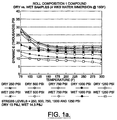
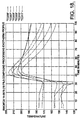
- Figure 1A is a graph plotting dynamic modulus as a function of temperature for polyurethane compounds having a Pusey & Jones hardness rating (“P&J”) of 12.
- Figure 1B is a graph of plotting hysteresis as a function of temperature for 12 P&J compounds.
- Figure 2 is a graph plotting modulus as a function of temperature for both wet and dry 12 P&J compounds at a stress level of 750 psi.
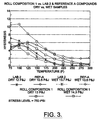
- Figure 3 is a graph plotting hysteresis as a function of temperature for both wet and dry 12 P&J compounds at a stress level of 750 psi.
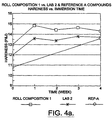
- Figure 4A is a graph plotting P&J hardness as a function of water immersion time for 12 P&J compounds.
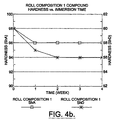
- Figure 4B is a graph plotting Shore A and Shore D hardness as a function of water immersion time for 12 P&J compounds.
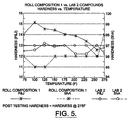
- Figure 5 is a graph plotting P&J hardness and Shore A hardness as a function of temperature for 12 P&J compounds.
- Figure 6 is a bar graph plotting water vapor transfer for 12 P&J compounds measured at 152°F and 90% relative humidity.
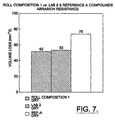
- Figure 7 is a bar graph plotting abrasion resistance for 12 P&J compounds.
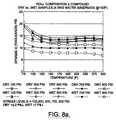
- Figure 8A is a graph plotting dynamic modulus as a function of temperature for 16 P&J compounds.
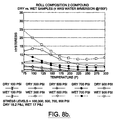
- Figure 8B is a graph plotting hysteresis as a function of temperature for 16 P&J compounds.
- Figure 9 is a graph plotting dynamic modulus as a function of the temperature for both wet and dry 16 P&J compounds at a stress level of 500 psi.
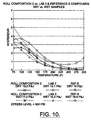
- Figure 10 is a graph plotting hysteresis as a function of temperature for both wet and dry 16 P&J compounds at a stress level of 500 psi.
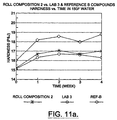
- Figure 11A is a graph plotting P&J hardness as a function of water immersion time for 16 P&J compounds.
- Figure 11B is a graph plotting Shore A hardness as a function of water immersion time for 16 P&J compounds.
- Figure 12 is a graph plotting P&J hardness and Shore A hardness as a function of temperature for 16 P&J compounds.
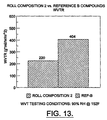
- Figure 13 is a bar graph showing water vapor transfer for 16 P&J compounds at 152°F and 90% relative humidity.
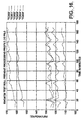
- Figure 14 is a graph showing abrasion resistance of 16 P&J compounds.
- Figure 15 and 16 are graphs plotting temperature as a function of time measured at the thermocouples of the mold of Figure 21 during processing.
- Figure 17 and 18 are graphs plotting exotherm temperature as a function of time for the thermocouples shown in Figure 21.
- Figures 19 and 20 are graphs showing post cure temperature as a function of time for the thermocouples of Figure 21 .
- Figure 21 is a schematic illustration of the test mold used to construct the two-part paper roll used in testing of polyurethane compositions of the present invention.
- the present invention relates to a castable polyurethane elastomer system which comprises two components: a prepolymer component A and a curing component B.
- Component A includes a diisocyanate and a polyol.
- Component B includes an aromatic diamine and preferably include a hydroxyl-terminated polybutadiene resin.
- the component A polyisocyanates are isocyanate-encapped prepolymers which are the adduct of an organic diisocyanate and polytetramethyl ethylene glycol.
- Suitable organic diisocyanates include aliphatic diisocyanates, such as hexamethylene diisocyanate (HDI), 1,3-xylene diisocyanate (XDI), isophorone diisocyanate (IPDI), 1,4-cyclohexane diisocyanate (CHDI), 1,1'-methylene-bis-4-(isocyanatocyclohexane) (H12MDI) and its generic isomers, and 1,1,4,4-tetramethylxylene diisocyanate in its para- or meta-isomer forms (p-TMDI, m-TMXDI).
- HDI hexamethylene diisocyanate
- XDI 1,3-xylene diisocyanate
- IPDI isophorone diis
- aromatic diisocyanates such as toluene diisocyanate (TDI) and its geometric isomers (2,4 and 2,6 isomer mixtures), 4,4'-diphenylmethane diisocyanate (MDI), 3,3'-dimethyl-4,4'-biphenyl diisocyanate (TODI), naphthalene diisocyanate (NDI), and para-phenylene diisocyanate (PPDI).
- Preferred aromatic diisocyanates are TDI, MDI, and PPDI, with TDI being the most preferred.
- TDI is available from BASF Corporation, Mt. Olive, New Jersey under the trade name TDI.
- PTMEG is available from E.I. dupont de Nemours & Co., Wilmington, Delaware, under the tradename Tetrathane. Suitable polyester polyols include polyadipate, polycaprolactone and polycarbonate, with polycaprolactone being preferred. PTMEG of component A can also include other materials, such as HTPB or hydroxyl-terminated ethylene/butylene (HTEB), which can be blended with PTMEG.
- HTPB hydroxyl-terminated ethylene/butylene
- the polyisocyanates employed in component A are preferably the adducts of PTMEG and TDI, PTMEG and MDI, and PTMEG and PPDI, with PTMEG/TDI-based polyisocyanates being more preferred. If a PTMFG/TDI adduct is employed, it is preferably one having a PTMEG molecular weight of between 250 and 1,500 glmol. It should be prepared to minimize the residual free TDI content, and should typically have a NCO% content between 1.9-9.0% ("NCO%" being the measure of the weight percentage of the unreacted NCO group on TDI over the TDI prepolymer).
- PTMEG/TDI-based systems are available as Adiprene L-series and Vibrathanc B-series from Uniroyal Chemical Co., Middleburg, Connecticut.
- PTMEG and MDI- or PPDI-based polyisocyanates typically have a NCO% content of between 4.0-9.0%.
- An exemplary PTMEG/MDI-based system is the Adiprene B-series (6%-9% NCO%), available from Uniroyal.
- An exemplary PTMEG and PPDI-based polyisocyanate system is available as the Adiprene PP-series (NCO between 3.5 and 6.0%; available from Uniroyal).
- aromatic diamines to be employed in component B of the present invention are: 4,4'-methylene-bis-(2-chloroaniline) (MOCA, available as Curene 442 from Anderson Development, Adrian, Michigan); 4,4'-methylene-bis-(3-chloro-2,6-diethylaniline) (M-CDEA, available as Lonzacure from Lonza Corporation, Fair Lawn, New Jersey); and dimethylthio-toluene diamine (available as Ethacure 300 from Albemarle).
- MOCA 4,4'-methylene-bis-(2-chloroaniline)
- M-CDEA 4,4'-methylene-bis-(3-chloro-2,6-diethylaniline)
- M-CDEA dimethylthio-toluene diamine
- Ethacure 300 from Albemarle
- the preferred aromatic diamine is MOCA.
- the hydroxyl-terminated polybutadienes of component B should have a molecular weight of between about 1,000 and 2,000 glmol.
- Exemplary hydroxyl-terminated polybutadienes that can be used in component B of the present invention include: Polybd R20LM, R-45HT and R-45M (Elf Atochem North America, Inc., Philadelphia, Pennsylvania), with Polybd R-20LM being preferred.
- DIFOL HTPB resins are also available from Amoco Chemicals, Chicago, Illinois.
- the curing component B can also include additional materials.
- PTMEG is blended with HTPB and MOCA to form a curing agent.
- the total number of -NH2 groups in the aromatic diamine and the -OH groups in the hydroxyl-terminated polybutadiene components of component B should be about equal to the number of -NCO groups in the polyisocyanate component A, although some deviation is permissible.
- the composition typically comprises component B being about 80%-110% of the stoichiometric equivalent of component A.
- the diamine component of component B can be about 5 %-95 % by weight of component B and the HTPD component can be about 95%-5% by weight of component B.
- compositions include 100 pph PTMEG and TDI-based polyisocyanate as component A and about 30-45 pph of component B, wherein component B comprises about 10%-50% MOCA and about 90%-50% Polybd R-20LM.
- the desired stoichiometry for such compositions is between about 90%-100%.
- compositions of the present invention are set forth in Table 1.
- Exemplary Polyurethane Compositions Composition No. PTMEG/TDI prepolymer MOCA
- Polybd g
- P&J Hardness 1 100g 18.62 18.54 12 2 100g 16.29 27.81 15.1 3 100g 14.80 14.74 18.2 4 100g 12.95 22.12 21 5 100g 9.25 35.02 28.2 6 100g 9.30 36.9 30.1
- the P&J (Pusey & Jones) rating is the hardness rating used in the paper industry that is measured via a Plastometer, (Model 1000, Hobbs & Warren, Boston, Massachusetts) according to ASTM D531-89 method.
- component A is PTMEG/TDI-based polyisocyanate blended with HTPB/TDI. This mixture is then reacted with a diamine, such as MOCA, to yield polyurethane elastomers.
- the blend ratios are in the range of about 90%-50% of PTMEG/TDI to HTPB/TDI.
- the component B diamine has a stoichiometric equivalent range of about 80%-110% to component A (preferably about 90%-100%).
- the polyurethane composition of the present invention exhibits dynamic load-bearing properties, hydrolytic stability, low water vapor transmission, and low hysteresis to make it a useful material in paper machine rolls.
- the composition can be employed in articles for which such properties are desirable, such as other types of rolls, industrial piping and valves, protective coatings for elevated temperature and/or humidity environments, washing machine components, and the like.
- a sample roll for testing of the polyurethane compositions of the present invention was made using the mold shown in FIG. 21.
- the cylindrically-shaped mold outer cover was sized and secured to form a 3/4 inch gap between the core and the outer cover within which a roll could be molded.
- the mold had a roll face approximately 129 inches long, with an inner diameter of approximately 29 inches and an outer diameter of approximately 30.5 inches.
- thermocouples Two sets of thermocouples were located approximately 30 inches from the tailstock can and situated 90° and 180° apart from the nozzle area to monitor processing temperature conditions for the portion of the roll formed in the headstock portion of the mold.
- the other two sets of thermocouples were located 20 inches from the headstock can in similar 90° and 180° positions to monitor the temperature of the portion of the roll formed in the tailstock portion of the mold.
- thermocouples were positioned at the base, in the middle, and near the outer cover of the mold.
- each thermocouple was assigned a number: 0, 1, and 2 for the base, center, and surface headstock 180° thermocouples; 3, 4, and 5 for the headstock 90° set; 6, 7, and 8 for the tailstock 180° set; and 9, 10, and 11 for the tailstock 90° set.
- the exothermic temperature at each location was taken from the middle thermocouple such as 1, 4 for the headstock and 7, 10 for the tailstock.
- Roll Compositions 1 and 2 were made in the same molding trial by altering the ratios of the curing agent components in the premix before the premix was fed into the mold via the nozzle.
- the sample roll took approximately 35 minutes to cast, with the mixture being fed in at a 4 in./min. rise rate.
- the temperature profiles illustrated in Figures 15 through 20 depict the temperature changes monitored throughout the sample roll processing. It can be seen from the tailstock preheat profile ( Fig. 15 ) that the temperatures in the middle and near the outer surface of the roll are more than 20°F lower the temperature at the base. As seen in Fig. 16 , the headstock exhibited a similar temperature profile; however, the temperatures in the middle and near the surface were about 30°F higher than that of the tailstock and 10°F higher at the base.
- the exothermic temperature profiles obtained during processing are shown in Figs. 17 and 18 .
- the exothermic temperatures of the Roll Composition 1 were 232°F at the 90° thermocouple location and 225°F at the 180° location.
- the exothermic temperatures of the Roll Composition 2 were 216°F at the 90° location and 213°F at the 180° location.
- the sample roll also received a postcure treatment at 240°F for 20 hours.
- the postcure temperature profiles are shown in Figs. 19 and 20 for the Roll Compositions 1 and 2, respectively. It should be noted that fluctuations seen in the temperature readings were the result of a power outage that occurred during the postcure period.
- the dynamic properties of the Roll Compositions 1 and 2 were tested using standard MTS test procedures and equipment. Samples of the Roll Composition 1 were tested at stress levels of 250, 500, 750, 1000, and 1250 psi. Testing was conducted on both dry and wet samples; the wet samples were prepared by immersion in 150°F water for four weeks. Wet and dry samples of the Roll Composition 2 were tested at stress levels of 100, 300, 500, 700, and 900 psi. In both instances, the temperature range for testing was 75 to 300°F.
- Figures 1a and 1b show the MTS testing results (Roll Composition 1 is identified as such therein).
- the dry moduli for tests at conducted at stress levels of 750 psi and lower, are all very close in value; these values drop with increases in load ( i.e. , above 1000 psi).
- Similar behavior is shown in the wet dynamic moduli versus the temperature profiles, which indicate stable moduli over the range of temperatures tested.
- Fig. 1b illustrates that, in both wet and dry testing, the hysteresis of this compound is very low at lower stress levels and increases dramatically at 1000 and 1250 psi.
- Figures 2 and 3 compare the dry and wet dynamic moduli and the hysteresis of the Roll Composition 1 with a sample formed of the same compound cast in the laboratory (labelled "lab 2"), and a reference 12 P&J polyurethane compound (labelled Ref-A) formed of PTMEG/TDI and MOCA. Testing was conducted at a stress level of 750 psi.
- Fig. 2 shows that the Roll Composition 1 has a higher dynamic moduli than the lab cast sample. Both of these samples exhibit more stable moduli than the standard compound Ref-A.
- the dry hysteresis results of Roll Composition 1 are slightly higher than that of the lab cast sample, while the wet moduli of both samples are all significantly lower than the standard compound.
- Figures 8a and 8b illustrate the MTS testing results of Composition 2 (identified as such therein).
- the dynamic moduli of the dry samples are not significantly different than those of the wet samples.
- the hysteresis results are very low for both wet and dry samples until the stress level reaches 900 psi.
- Figures 9 and 10 compare the dry and wet moduli and hysteresis of the Roll Composition 1 at 500 psi compared to those of a laboratory-cast sample of the same compound (identified therein as "lab 3"), and those of a reference 16 P&J compound (labelled Ref-B) formed of PTMEG/TDI and MOCA.
- the Roll Composition 2 showed higher dry and wet dynamic moduli than the lab cast version.
- Both the Roll Composition 2 and the lab cast version have dynamic moduli readings that are higher and relatively more stable than those of the Ref-B compound.
- the hysteresis results show similar behavior; the Roll Composition 2 has the lowest dry and wet hysteresis ( Fig. 10 ).
- Dynamic Mechanical Analysis was performed to further investigate the dynamic properties of both Roll Compositions 1 and 2.
- the testing apparatus and procedure conformed to the requirements of ASTM D4065-82 with slight modifications.
- the parameters of the test were an induced strain value of 0.0002, a frequency of 1 rad/sec, a temperature range of 25-190°C at a 5°C/min. heating rate, and a heat equilibration duration prior to testing of 120 seconds.
- Fig. 4a shows the P&J hardness change versus immersion time in 150°F water for the Roll Composition 1, the lab 2 compound and the reference A 12 P&J compound.
- the Roll Composition 1 and the lab cast version sample have similar hardness change profiles, with P&J changes of 1.3 and 1, respectively, after four weeks of immersion.
- the reference A compound has a 3.1 P&J change.
- Fig. 11a shows the P&J hardness versus immersion time profiles of the Roll Composition 2, the lab 3 compound, and the Ref-B compound.
- the Roll Composition 2 data are consistent with the lab cast version data. Both show less than 2 P&J point changes, whereas the reference B compound has about a 3 P&J point change.
- Shore Hardness testing was conducted on the polyurethanes of the present invention with durometers supplied by Shore Instrument and Mfg. Co., Inc. The measurement were made in accordance with ASTM D 2240. Both Shore A and Shore D durometers were used. Typically, Shore A (ShA) readings are preferred up to a reading of 95; for harder materials above this level, Shore D (ShD) readings are preferred. Both dry samples and samples immersed in 150°F water for increasing periods of time were tested.
- Fig. 4b shows the ShA and ShD hardness changes as a function of immersion time for the Roll Composition 1. It can be seen that the changes in Shore A hardness with increasing immersion time are less than that for Shore D hardness.
- Fig. 11b the ShA hardness changes during the four weeks of immersion for the Roll Composition 2, the lab compound, and the reference B compound are shown. Both the Roll Composition 2 and the lab cast version sample have a 1 ShA level change over the range of immersion times tested, while the reference B compound has a 2 ShA level change.
- Fig. 5 illustrates the change in hardness of the Roll Composition 1 as a function of temperature.
- the Composition 1 samples seem to be slightly less stable than the lab cast sample. Nevertheless, the hardness of the Composition 1 samples in both P&J and ShA testing returned to their original readings at room temperature after the heat aging.
- Fig. 12 hardness stability versus temperature profiles for the 16 P & J compounds are shown.
- the Roll Composition 2 profile is similar to that of the reference B compound but is more stable than the lab cast compound.
- WVT Water vapor transmission
- Figs. 6 and 13 show the WVT rate comparisons for the 12 and 16 P&J compounds, respectively.
- the Roll Composition 1 exhibited consistent WVT rates of 214 WVTR g-ml/hrm 2 .
- the lab cast version exhibited a 206 WVT rate. Both compounds had considerably lower WVT rates (30%) than the reference A compound.
- the Roll Composition 2 had a WVT rate almost 50% less than the WVT rate of the reference B compound.
- Figs. 7 and Figs. 14 present the DIN abrasion resistance comparisons for the 12 and 16 P&J compounds, respectively.
- the test results demonstrate there is no difference found between the dry volume loss of Roll Composition 1 and the lab cast version. Both show 30% reductions in volume loss compared to the reference A compound.
- the Roll Composition 2 demonstrated comparable abrasion resistance to the reference B compound.
- the glass transition temperature (Tg) of the test roll samples were also identified using Differential Scanning Colorimetry (DSC) thermograms. The samples were tested at a temperature increase rate of 10°C/min. between 30°-250°C. The onset transition temperatures of the Roll Compositions 1 and 2 were 190°C and 186°C, respectively.
- Drilling and grooving tests were conducted on the Roll Composition 1 and 2 cover samples. Holes were drilled in samples using both standard and brad bits in a #4 drilling pattern. A #3 drilling pattern was also tried on the Roll Composition 2 sample. A 0.028 in. wide blade was used to form grooves on both the Roll Composition 1 and 2 sections.
- the drilling and grooving processes did not reveal any problems with the Roll Compositions 1 and 2.
- the cover without machining had 12-12.2 P&J and 59 ShD ratings.
- Drilled the compound had a 13.8 P&J rating.
- Grooved the compound had a 17.5 P&J rating. Drilling and grooving combined produced a 18.5 P&J rating.
- the cover without machining had 15.2 P&J, 53 ShD, and 96 ShA ratings. Drilled, the compound had a 17 P&J rating. Grooved, the compound had a 17 P&J rating. Drilling and grooving combined produced a 20 P&J rating.
Landscapes
- Chemical & Material Sciences (AREA)
- Health & Medical Sciences (AREA)
- Chemical Kinetics & Catalysis (AREA)
- Medicinal Chemistry (AREA)
- Polymers & Plastics (AREA)
- Organic Chemistry (AREA)
- Rolls And Other Rotary Bodies (AREA)
- Paper (AREA)
- Polyurethanes Or Polyureas (AREA)
- Polyethers (AREA)
- Biological Depolymerization Polymers (AREA)
- Preparation Of Compounds By Using Micro-Organisms (AREA)
Abstract
Description
| Exemplary Polyurethane Compositions | ||||
| Composition No. | PTMEG/TDI prepolymer | MOCA (g) | Polybd (g) | |
| 1 | 100g | 18.62 | 18.54 | 12 |
| 2 | 100g | 16.29 | 27.81 | 15.1 |
| 3 | 100g | 14.80 | 14.74 | 18.2 |
| 4 | 100g | 12.95 | 22.12 | 21 |
| 5 | 100g | 9.25 | 35.02 | 28.2 |
| 6 | 100g | 9.30 | 36.9 | 30.1 |
| The P&J (Pusey & Jones) rating is the hardness rating used in the paper industry that is measured via a Plastometer, ( |
Claims (11)
- A composition, comprising:a prepolymer comprising the reaction product of the combination of a diisocyanate and polytetramethylene ether glycol (PTMEG); anda curing agent comprising a diamine selected from the group consisting of 4,4'-methylene-bis-(2-chloroaniline), 4,4'-methylene-bis-(3-chloro-2,6-diethylaniline), dimethylthio-toluene diamine and a hydroxyl-terminated polybutadiene;said prepolymer and said curing agent being combined in a stoichiometric ratio of between about 80 and 110 percent.
- The composition defined in Claim 1, wherein said diisocyanate is an aromatic diisocyanate.
- The composition defined in Claim 1, wherein said diisocyanate comprises toluene diisocyanate.
- The composition defined in Claim 1, wherein said diamine comprises 4,4'-methylene-bis-(2-chloroaniline).
- The composition defined in Claim 1, wherein said hydroxyl-terminated polybutadiene has a molecular weight of between about 1,000 and 2,000 g/mol.
- A method of forming a polyurethane article, comprising the steps of:providing a prepolymer composition comprising a diisocyanate and polytetramethylene ether glycol (PTMEG), and a curing agent comprising a diamine selected from the group consisting of 4,4'-methylene-bis-(2-chloroaniline) and 4,4'-methylene-bis-(3-chloro-2,6-diethylaniline), dimethylthio-toluene diamine and a hydroxyl-terminated polybutadiene;combining said prepolymer composition with said curing agent, said prepolymer and said curing agent being combined in a stoichlometric ratio of between about 80 and 110 percent; andcuring said prepolymer composition and said curing agent to conditions sufficient to form a polyurethane article.
- The method defined in Claim 6, wherein said curing step comprises heating said prepolymer composition and said curing agent to a temperature and for a duration sufficient to effect curing thereof.
- The method defined in Claim 6, wherein said diisocyanate is an aromatic diisocyanate.
- The method defined in Claim 6, wherein said diisocyanate comprises toluene diisocyanate.
- The method defined in Claim 6, wherein said diamine comprises 4,4'-methylene-bis-(2-chloroaniline).
- The method defined in Claim 6, wherein said hydroxyl-terminated polybutadiene has a molecular weight of between about 1,000 and 2,000 g/mol.
Applications Claiming Priority (3)
| Application Number | Priority Date | Filing Date | Title |
|---|---|---|---|
| US08/873,224 US5994466A (en) | 1996-06-12 | 1997-06-11 | Castable polyurethane elastomers for industrial rollers |
| US873224 | 1997-06-11 | ||
| PCT/US1998/011979 WO1998056841A1 (en) | 1997-06-11 | 1998-06-10 | Castable polyurethane elastomers for industrial rollers |
Publications (2)
| Publication Number | Publication Date |
|---|---|
| EP0988332A1 EP0988332A1 (en) | 2000-03-29 |
| EP0988332B1 true EP0988332B1 (en) | 2003-02-19 |
Family
ID=25361215
Family Applications (1)
| Application Number | Title | Priority Date | Filing Date |
|---|---|---|---|
| EP98926501A Expired - Lifetime EP0988332B1 (en) | 1997-06-11 | 1998-06-10 | Castable polyurethane elastomers for industrial rollers |
Country Status (7)
| Country | Link |
|---|---|
| US (1) | US5994466A (en) |
| EP (1) | EP0988332B1 (en) |
| AT (1) | ATE232886T1 (en) |
| AU (1) | AU7832398A (en) |
| CA (1) | CA2281219A1 (en) |
| DE (1) | DE69811493T2 (en) |
| WO (1) | WO1998056841A1 (en) |
Families Citing this family (17)
| Publication number | Priority date | Publication date | Assignee | Title |
|---|---|---|---|---|
| US6645091B2 (en) * | 1999-05-14 | 2003-11-11 | Acushnet Company | Thermoplastic polyurethane golf ball with improved resiliency |
| RU2280048C1 (en) * | 2004-12-07 | 2006-07-20 | Леонид Васильевич Забелин | Polyurethane composition |
| US20060223967A1 (en) * | 2005-03-29 | 2006-10-05 | Conner Mark D | Novel polyurea isocyanates |
| DE102005015635A1 (en) * | 2005-04-05 | 2006-10-12 | Basf Ag | polyurethane rubber |
| US10287731B2 (en) * | 2005-11-08 | 2019-05-14 | Stowe Woodward Licensco Llc | Abrasion-resistant rubber roll cover with polyurethane coating |
| US20070276114A1 (en) * | 2006-05-23 | 2007-11-29 | 3M Innovative Properties Company | Polyurethane based resin composition |
| CN100460437C (en) * | 2006-08-11 | 2009-02-11 | 中国石油天然气集团公司 | Synthetic method of high-performance multi-purpose polyurethane elastomer |
| FI126363B (en) | 2008-12-12 | 2016-10-31 | Valmet Technologies Oy | The shoe press belt |
| FI20115400A7 (en) * | 2011-04-26 | 2012-10-27 | Metso Paper Inc | Roll coating and method for producing the same |
| KR102030865B1 (en) | 2012-02-13 | 2019-10-10 | 다우 글로벌 테크놀로지스 엘엘씨 | Elastomers for paper mill equipment |
| BR112015030611B1 (en) | 2013-06-27 | 2020-12-29 | Dow Global Technologies Llc | method for forming a polyurethane coating on an industrial roller, polyurethane coating on an industrial roller and polyurethane coating on a suction press roller |
| EP3328913B1 (en) * | 2015-07-30 | 2021-12-01 | Sika Technology AG | Hydrophobic, highly elastic two-component polyurethane compound with mechanical properties and adhesive properties which are not dependent on the temperature |
| WO2018232239A1 (en) * | 2017-06-15 | 2018-12-20 | Dow Global Technologies, Llc | Compositions containing hydrophobic modified isocyanate functional prepolymer containing adhesives |
| JP6756353B2 (en) * | 2018-09-28 | 2020-09-16 | 横浜ゴム株式会社 | Two-component curable adhesive composition |
| JP6756352B2 (en) * | 2018-09-28 | 2020-09-16 | 横浜ゴム株式会社 | Two-component curable adhesive composition |
| EP3966264A2 (en) * | 2019-05-10 | 2022-03-16 | Construction Research & Technology GmbH | Two-component polyurethane elastomer coating for corrosion and weathering protection |
| TWI895284B (en) * | 2019-09-10 | 2025-09-01 | 美商盧伯利索先進材料有限公司 | Article made from thermoplastic polyurethane composition and method of making the same |
Family Cites Families (9)
| Publication number | Priority date | Publication date | Assignee | Title |
|---|---|---|---|---|
| JPS5232996A (en) * | 1975-09-09 | 1977-03-12 | Bridgestone Corp | Process for preparing polyurethanes based on polydienes |
| DE2838756A1 (en) * | 1978-09-06 | 1980-03-27 | Bayer Ag | METHOD FOR PRODUCING VULCANIZED ELASTOMERS HAVING URETHANE GROUPS |
| DE3943080A1 (en) * | 1989-12-27 | 1991-07-04 | Henkel Kgaa | USE OF REACTION MIXTURES CONTAINING POLYESTER POLYOLS IN THE PRODUCTION OF SOLID POLYURETHANE MATERIALS BY THE MOLDING PROCESS |
| JP2689376B2 (en) * | 1992-12-07 | 1997-12-10 | ユニロイヤル ケミカル カンパニー インコーポレイテッド | Polyurethane cured with 4,4'-methylene-bis (3-chloro-2,6-diethylaniline) |
| US5459200A (en) * | 1994-10-11 | 1995-10-17 | Shell Oil Company | Polyurethane coatings and adhesives containing monohydroxylated diene polymers and epoxidized derivatives thereof |
| US5925724A (en) * | 1995-06-23 | 1999-07-20 | Shell Oil Company | Use of polydiene diols in thermoplastic polyurethanes |
| GB9513713D0 (en) * | 1995-07-05 | 1995-09-06 | Exxon Chemical Patents Inc | Curable elastomeric compositions and a process to produce curable elastomeric compositions |
| US5895806A (en) * | 1996-05-06 | 1999-04-20 | Uniroyal Chemical Company, Inc. | Polyurethane composition useful for coating cylindrical parts |
| US5955559A (en) * | 1996-09-17 | 1999-09-21 | Shell Oil Company | Cast polyurethane elastomers containing low polarity amine curing agents |
-
1997
- 1997-06-11 US US08/873,224 patent/US5994466A/en not_active Expired - Fee Related
-
1998
- 1998-06-10 WO PCT/US1998/011979 patent/WO1998056841A1/en not_active Ceased
- 1998-06-10 EP EP98926501A patent/EP0988332B1/en not_active Expired - Lifetime
- 1998-06-10 CA CA002281219A patent/CA2281219A1/en not_active Abandoned
- 1998-06-10 DE DE69811493T patent/DE69811493T2/en not_active Expired - Lifetime
- 1998-06-10 AU AU78323/98A patent/AU7832398A/en not_active Abandoned
- 1998-06-10 AT AT98926501T patent/ATE232886T1/en not_active IP Right Cessation
Also Published As
| Publication number | Publication date |
|---|---|
| AU7832398A (en) | 1998-12-30 |
| US5994466A (en) | 1999-11-30 |
| EP0988332A1 (en) | 2000-03-29 |
| DE69811493D1 (en) | 2003-03-27 |
| ATE232886T1 (en) | 2003-03-15 |
| DE69811493T2 (en) | 2003-12-24 |
| WO1998056841A1 (en) | 1998-12-17 |
| CA2281219A1 (en) | 1998-12-17 |
Similar Documents
| Publication | Publication Date | Title |
|---|---|---|
| US5994466A (en) | Castable polyurethane elastomers for industrial rollers | |
| Lee et al. | Properties of segmented polyurethanes derived from different diisocyanates | |
| KR100275076B1 (en) | Polyurethane cured with 4,4'-methylene-bis- (3-chloro-2,6-diethylaniline) | |
| US6747117B2 (en) | Polyurethane/urea composition for coating cylindrical parts | |
| US4195148A (en) | Polyurethane spray composition containing lactone viscosity modifier | |
| EP2235086B1 (en) | Low melting polyurethane elastomers | |
| CA1073890A (en) | Polyurethane composition | |
| WO2020067527A1 (en) | Two-part curable adhesive composition | |
| US4786656A (en) | Polyhydroxyalkane/aromatic diamine chain extenders | |
| JP6480437B2 (en) | Hardener for coating on industrial roller | |
| US5026815A (en) | Chain-lengthening agents for p-phenylene-methylenediisocyanate-prepolymers for cast polyurethane elastomers | |
| WO2020067529A1 (en) | Two-part curable adhesive composition | |
| CA2236597C (en) | Cellular polyurethane elastomers | |
| GB1563771A (en) | Method for producing a urethane elastomer | |
| US20240218106A1 (en) | Polyurethane, roller covering and production method | |
| JPH04213316A (en) | Polyurethane elastomer composition | |
| JPS6126616A (en) | Preparation of polyurethane having improved performance | |
| WO2026038420A1 (en) | Two-part curing resin raw material | |
| US20240368359A1 (en) | Polyurethane resin film | |
| US20150114584A1 (en) | Roll cover and method for the production thereof | |
| JP3978768B2 (en) | Method for producing thermosetting polyurethane elastomer | |
| JPS6126613A (en) | Roll made of polyurethane | |
| EP4692151A1 (en) | Polyurethane resin composition | |
| JP2000072844A (en) | Polyurethane elastomer composition for casting and molded article thereof | |
| JPH07292237A (en) | Polyurethane composition for belt |
Legal Events
| Date | Code | Title | Description |
|---|---|---|---|
| PUAI | Public reference made under article 153(3) epc to a published international application that has entered the european phase |
Free format text: ORIGINAL CODE: 0009012 |
|
| 17P | Request for examination filed |
Effective date: 19990805 |
|
| AK | Designated contracting states |
Kind code of ref document: A1 Designated state(s): AT BE CH CY DE DK ES FI FR GB GR IE IT LI LU MC NL PT SE |
|
| 17Q | First examination report despatched |
Effective date: 20000904 |
|
| GRAH | Despatch of communication of intention to grant a patent |
Free format text: ORIGINAL CODE: EPIDOS IGRA |
|
| GRAH | Despatch of communication of intention to grant a patent |
Free format text: ORIGINAL CODE: EPIDOS IGRA |
|
| GRAA | (expected) grant |
Free format text: ORIGINAL CODE: 0009210 |
|
| AK | Designated contracting states |
Designated state(s): AT BE CH CY DE DK ES FI FR GB GR IE IT LI LU MC NL PT SE |
|
| PG25 | Lapsed in a contracting state [announced via postgrant information from national office to epo] |
Ref country code: NL Free format text: LAPSE BECAUSE OF FAILURE TO SUBMIT A TRANSLATION OF THE DESCRIPTION OR TO PAY THE FEE WITHIN THE PRESCRIBED TIME-LIMIT Effective date: 20030219 Ref country code: LI Free format text: LAPSE BECAUSE OF FAILURE TO SUBMIT A TRANSLATION OF THE DESCRIPTION OR TO PAY THE FEE WITHIN THE PRESCRIBED TIME-LIMIT Effective date: 20030219 Ref country code: IT Free format text: LAPSE BECAUSE OF FAILURE TO SUBMIT A TRANSLATION OF THE DESCRIPTION OR TO PAY THE FEE WITHIN THE PRESCRIBED TIME-LIMIT;WARNING: LAPSES OF ITALIAN PATENTS WITH EFFECTIVE DATE BEFORE 2007 MAY HAVE OCCURRED AT ANY TIME BEFORE 2007. THE CORRECT EFFECTIVE DATE MAY BE DIFFERENT FROM THE ONE RECORDED. Effective date: 20030219 Ref country code: GR Free format text: LAPSE BECAUSE OF FAILURE TO SUBMIT A TRANSLATION OF THE DESCRIPTION OR TO PAY THE FEE WITHIN THE PRESCRIBED TIME-LIMIT Effective date: 20030219 Ref country code: FR Free format text: LAPSE BECAUSE OF NON-PAYMENT OF DUE FEES Effective date: 20030219 Ref country code: CH Free format text: LAPSE BECAUSE OF FAILURE TO SUBMIT A TRANSLATION OF THE DESCRIPTION OR TO PAY THE FEE WITHIN THE PRESCRIBED TIME-LIMIT Effective date: 20030219 Ref country code: BE Free format text: LAPSE BECAUSE OF FAILURE TO SUBMIT A TRANSLATION OF THE DESCRIPTION OR TO PAY THE FEE WITHIN THE PRESCRIBED TIME-LIMIT Effective date: 20030219 |
|
| REG | Reference to a national code |
Ref country code: GB Ref legal event code: FG4D |
|
| REG | Reference to a national code |
Ref country code: CH Ref legal event code: EP |
|
| REG | Reference to a national code |
Ref country code: IE Ref legal event code: FG4D |
|
| REF | Corresponds to: |
Ref document number: 69811493 Country of ref document: DE Date of ref document: 20030327 Kind code of ref document: P |
|
| PG25 | Lapsed in a contracting state [announced via postgrant information from national office to epo] |
Ref country code: SE Free format text: LAPSE BECAUSE OF FAILURE TO SUBMIT A TRANSLATION OF THE DESCRIPTION OR TO PAY THE FEE WITHIN THE PRESCRIBED TIME-LIMIT Effective date: 20030519 Ref country code: PT Free format text: LAPSE BECAUSE OF FAILURE TO SUBMIT A TRANSLATION OF THE DESCRIPTION OR TO PAY THE FEE WITHIN THE PRESCRIBED TIME-LIMIT Effective date: 20030519 Ref country code: DK Free format text: LAPSE BECAUSE OF FAILURE TO SUBMIT A TRANSLATION OF THE DESCRIPTION OR TO PAY THE FEE WITHIN THE PRESCRIBED TIME-LIMIT Effective date: 20030519 |
|
| PG25 | Lapsed in a contracting state [announced via postgrant information from national office to epo] |
Ref country code: LU Free format text: LAPSE BECAUSE OF NON-PAYMENT OF DUE FEES Effective date: 20030610 Ref country code: IE Free format text: LAPSE BECAUSE OF NON-PAYMENT OF DUE FEES Effective date: 20030610 Ref country code: GB Free format text: LAPSE BECAUSE OF NON-PAYMENT OF DUE FEES Effective date: 20030610 Ref country code: CY Free format text: LAPSE BECAUSE OF FAILURE TO SUBMIT A TRANSLATION OF THE DESCRIPTION OR TO PAY THE FEE WITHIN THE PRESCRIBED TIME-LIMIT Effective date: 20030610 |
|
| PG25 | Lapsed in a contracting state [announced via postgrant information from national office to epo] |
Ref country code: MC Free format text: LAPSE BECAUSE OF NON-PAYMENT OF DUE FEES Effective date: 20030630 |
|
| NLV1 | Nl: lapsed or annulled due to failure to fulfill the requirements of art. 29p and 29m of the patents act | ||
| RAP2 | Party data changed (patent owner data changed or rights of a patent transferred) |
Owner name: STOWE WOODWARD, L.L.C. |
|
| PG25 | Lapsed in a contracting state [announced via postgrant information from national office to epo] |
Ref country code: ES Free format text: LAPSE BECAUSE OF FAILURE TO SUBMIT A TRANSLATION OF THE DESCRIPTION OR TO PAY THE FEE WITHIN THE PRESCRIBED TIME-LIMIT Effective date: 20030828 |
|
| REG | Reference to a national code |
Ref country code: CH Ref legal event code: PL |
|
| PLBE | No opposition filed within time limit |
Free format text: ORIGINAL CODE: 0009261 |
|
| STAA | Information on the status of an ep patent application or granted ep patent |
Free format text: STATUS: NO OPPOSITION FILED WITHIN TIME LIMIT |
|
| EN | Fr: translation not filed | ||
| GBPC | Gb: european patent ceased through non-payment of renewal fee |
Effective date: 20030610 |
|
| 26N | No opposition filed |
Effective date: 20031120 |
|
| REG | Reference to a national code |
Ref country code: IE Ref legal event code: MM4A |
|
| PGFP | Annual fee paid to national office [announced via postgrant information from national office to epo] |
Ref country code: DE Payment date: 20050609 Year of fee payment: 8 |
|
| PGFP | Annual fee paid to national office [announced via postgrant information from national office to epo] |
Ref country code: AT Payment date: 20050613 Year of fee payment: 8 |
|
| PGFP | Annual fee paid to national office [announced via postgrant information from national office to epo] |
Ref country code: FI Payment date: 20050614 Year of fee payment: 8 |
|
| PG25 | Lapsed in a contracting state [announced via postgrant information from national office to epo] |
Ref country code: DE Free format text: LAPSE BECAUSE OF THE APPLICANT RENOUNCES Effective date: 20060606 |
|
| PG25 | Lapsed in a contracting state [announced via postgrant information from national office to epo] |
Ref country code: FI Free format text: LAPSE BECAUSE OF NON-PAYMENT OF DUE FEES Effective date: 20060610 Ref country code: AT Free format text: LAPSE BECAUSE OF NON-PAYMENT OF DUE FEES Effective date: 20060610 |