EP0988310B1 - 4"-substituted-9-deoxo-9a-aza-9a-homoerythromycin a derivatives - Google Patents
4"-substituted-9-deoxo-9a-aza-9a-homoerythromycin a derivatives Download PDFInfo
- Publication number
- EP0988310B1 EP0988310B1 EP98920693A EP98920693A EP0988310B1 EP 0988310 B1 EP0988310 B1 EP 0988310B1 EP 98920693 A EP98920693 A EP 98920693A EP 98920693 A EP98920693 A EP 98920693A EP 0988310 B1 EP0988310 B1 EP 0988310B1
- Authority
- EP
- European Patent Office
- Prior art keywords
- compound
- hydroxy
- formula
- groups
- alkyl
- Prior art date
- Legal status (The legal status is an assumption and is not a legal conclusion. Google has not performed a legal analysis and makes no representation as to the accuracy of the status listed.)
- Expired - Lifetime
Links
- 0 CC(C)C*CCN(*)C(*)c1ccccc1 Chemical compound CC(C)C*CCN(*)C(*)c1ccccc1 0.000 description 4
Classifications
-
- C—CHEMISTRY; METALLURGY
- C07—ORGANIC CHEMISTRY
- C07H—SUGARS; DERIVATIVES THEREOF; NUCLEOSIDES; NUCLEOTIDES; NUCLEIC ACIDS
- C07H17/00—Compounds containing heterocyclic radicals directly attached to hetero atoms of saccharide radicals
- C07H17/04—Heterocyclic radicals containing only oxygen as ring hetero atoms
- C07H17/08—Hetero rings containing eight or more ring members, e.g. erythromycins
-
- A—HUMAN NECESSITIES
- A61—MEDICAL OR VETERINARY SCIENCE; HYGIENE
- A61P—SPECIFIC THERAPEUTIC ACTIVITY OF CHEMICAL COMPOUNDS OR MEDICINAL PREPARATIONS
- A61P31/00—Antiinfectives, i.e. antibiotics, antiseptics, chemotherapeutics
- A61P31/04—Antibacterial agents
-
- A—HUMAN NECESSITIES
- A61—MEDICAL OR VETERINARY SCIENCE; HYGIENE
- A61P—SPECIFIC THERAPEUTIC ACTIVITY OF CHEMICAL COMPOUNDS OR MEDICINAL PREPARATIONS
- A61P33/00—Antiparasitic agents
- A61P33/02—Antiprotozoals, e.g. for leishmaniasis, trichomoniasis, toxoplasmosis
-
- Y—GENERAL TAGGING OF NEW TECHNOLOGICAL DEVELOPMENTS; GENERAL TAGGING OF CROSS-SECTIONAL TECHNOLOGIES SPANNING OVER SEVERAL SECTIONS OF THE IPC; TECHNICAL SUBJECTS COVERED BY FORMER USPC CROSS-REFERENCE ART COLLECTIONS [XRACs] AND DIGESTS
- Y02—TECHNOLOGIES OR APPLICATIONS FOR MITIGATION OR ADAPTATION AGAINST CLIMATE CHANGE
- Y02P—CLIMATE CHANGE MITIGATION TECHNOLOGIES IN THE PRODUCTION OR PROCESSING OF GOODS
- Y02P20/00—Technologies relating to chemical industry
- Y02P20/50—Improvements relating to the production of bulk chemicals
- Y02P20/55—Design of synthesis routes, e.g. reducing the use of auxiliary or protecting groups
Definitions
- This invention relates to C-4" substituted derivatives of 9-deoxo-9a-aza-9a-homoerythromycin A that are useful as antibacterial and antiprotozoa agents in mammals. induding man, as well as in fish and birds.
- This invention also relates to pharmaceutical compositions containing the compounds and to methods of treating bacterial infections and protozoa infections in mammals, fish and birds by administering the novel compounds to mammals, fish and birds requiring such treatment
- Macrolide antibiotics are known to be useful in the treatment of a broad sprectrum of bacterial infections and protozoa infections in mammals, fish and birds.
- Such antibiotics include various derivatives of erythromycin A such as azithromycin which is commercially available and is referred to in United States patents 4.474.768 and 4,517,359,
- the macrolide compounds of the present invention possess potent activity against various bacterial infections and protozoa infections as described below.
- the present invention relates to compounds of the formula and to pharmaceutically acceptable salts thereof, wherein:
- Preferred compounds of formula 1 include those wherein R 1 is hydroxy, R 2 is hydroxy, R 3 is -CH 2 NR 15 R 8 or -CH 2 SR 8 , and R 4 is H.
- R 1 is hydroxy
- R 2 is hydroxy
- R 3 is -CH 2 NR 8
- R 15 , R 4 is H
- R 15 and R 8 are each selected from H, C 1 -C 10 alkyl, C 2 -C 10 alkenyl, and C 2 -C 10 alkynyl, wherein said R 15 and R 8 groups, except H, are optionally substituted by 1 or 2 substituents independently selected from hydroxy, halo and C 1 -C 6 alkoxy.
- Speck preferred compounds having the foregoing general structure include those wherein R 15 is either H or is selected from the following groups from which R 8 is also independently selected: methyl, ethyl, allyl, n-butyl, isobutyl, 2-methoxyethyl, cyclopentyl, 3-methoxypropyl, 3-ethoxypropyl, n-propyl, isopropyl, 2-hydroxyethyl, cyclopropyl, 2,2,2-trifluoroethyl, 2-propynyl, sec -butyl, tert -butyl, and n-hexyl.
- R 1 is hydroxy
- R 2 is hydroxy
- R 3 is -CH 2 NHR 8
- R 4 is H
- R 8 is -(CH 2 ) m (C 6 -C 10 aryl) wherein m is an integer ranging from 0 to 4.
- Specific preferred compounds having the foregoing general structure include those wherein R 8 is phenyl or benzyl.
- R 1 is hydroxy
- R 2 is hydroxy
- R 3 is -CH 2 NR 15 R 8
- R 4 is H
- R 15 and R 8 are taken together to form a saturated ring.
- Specific preferred compounds having the foregoing general structure include those wherein R 6 and R 8 are taken together to form a piperidino, trimethyleneimino, or morpholino ring.
- R 1 is hydroxy
- R 2 is hydroxy
- R 3 is -CH 2 NR 15 R 8
- R 4 is H
- R 15 and R 8 are taken together to form a heteroaryl ring optionally substituted by 1 or 2 C 1 -C 6 alkyl groups.
- Specific preferred compounds having the foregoing general structure include those wherein R 15 and R 8 are taken together to form a pyrrolidino, triazolyl, or imidazolyl ring wherein said heteroaryl groups are optionally substituted by 1 or 2 methyl groups.
- R 1 is hydroxy
- R 2 is hydroxy
- R 3 is -CH 2 SR 8
- R 4 is H
- R 8 is selected from C 1 -C 10 alkyl, C 2 -C 10 alkenyl, and C 2 -C 10 alkynyl, wherein said R 8 groups are optionally substituted by 1 or 2 substituents independently selected from hydroxy, halo and C 1 -C 6 alkoxy.
- Specific preferred compounds having the foregoing general structure include those wherein R 8 is methyl, ethyl, or 2-hydroxyethyl.
- R 1 is hydroxy
- R 2 is hydroxy
- R 4 is H
- R 3 is selected from C 1 -C 10 alkyl, C 2 -C 10 alkenyl, and C 2 -C 10 alkynyl, wherein said R 3 groups are optionally substituted by 1 or 2 substituents independently selected from hydroxy, -C(O)R 17 , -NF 6 R 7 , halo, cyano, azido, 5-10 membered heteroaryl, and C 1 -C 6 alkoxy.
- R 3 is methyl, allyl, vinyl, ethynyl, 1-methyl-1-propenyl, 3-methoxy-1-propynyl, 3-dimethylamino-1-propynyl, 2-pyridylethynyl, 1-propynyl, 3-hydroxy-1-propynyl, 3-hydroxy-1-propenyl, 3-hydroxypropyl, 3-methoxy-1-propenyl, 3-methoxypropyl, 1-propynyl, n-butyl, ethyl, propyl, 2-hydroxyethyl, formylmethyl, 6-cyano-1-pentynyl, 3-dimethylamino-1-propenyl, or 3-dimethylaminopropyl.
- R 1 is hydroxy
- R 2 is hydroxy
- R 4 is H
- R 3 is -(CH 2 ) m (5-10 membered heteroaryl) wherein m is an integer ranging from 0 to 4.
- Specific preferred compounds having the foregoing general structure include those wherein R 3 is 2-thienyl, 2-pyridyl, 1-methyl-2-imidazolyl, 2-furyl, or 1-methyl-2-pyrrolyl.
- R 1 is hydroxy
- R 2 is hydroxy
- R 4 is H
- R 3 is -(CH 2 ) m (C 6 -C 10 aryl) wherein m is an integer ranging from 0 to 4.
- Specific preferred compounds having the foregoing general structure include those wherein R 3 is phenyl.
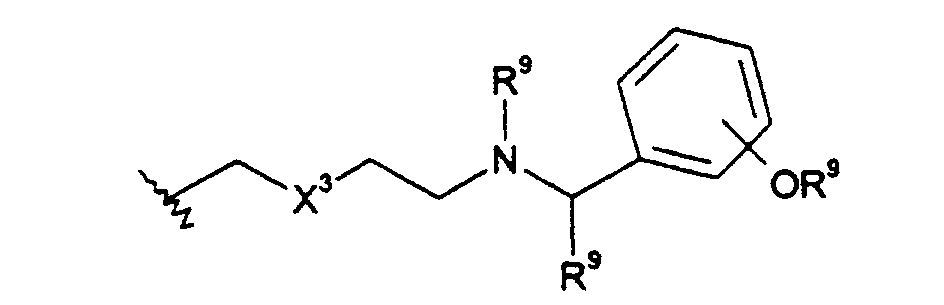
- R 3 is selected from the following: wherein X 3 is O, S or -N(R 15 )-, and wherein the -OR 9 group may be attached at any available carbon on the phenyl group.
- the invention also relates to a pharmaceutical composition for the treatment of a bacterial infection or a protozoa infection in a mammal, fish, or bird which comprises a therapeutically effective amount of a compound of formula 1 , or a pharmaceutically acceptable salt thereof, and a pharmaceutically acceptable carrier.
- the invention also relates to a method of treating a bacterial infection or a protozoa infection in a mammal, fish, or bird which comprises administering to said mammal, fish or bird a therapeutically effective amount of a compound of formula 1 or a pharmaceutically acceptable salt thereof.
- treatment includes the treatment or prevention of a bacterial infection or protozoa infection as provided in the method of the present invention.
- bacterial infection(s) and protozoa infection(s) include bacterial infections and protozoa infections that occur in mammals, fish and birds as well as disorders related to bacterial infections and protozoa infections that may be treated or prevented by administering antibiotics such as the compounds of the present invention.
- Such bacterial infections and protozoa infections, and disorders related to such infections include the following: pneumonia, otitis media, sinusitus, bronchitis, tonsillitis, and mastoiditis related to infection by Streptococcus pneumoniae, Haemophilus influenzae, Moraxella catarrhalis , Staphylococcus aureus, or Peptostreptococcus spp.; pharynigitis, rheumatic fever, and glomerulonephritis related to infection by Streptococcus pyogenes, Groups C and G streptococci, Clostridium diptheriae, or Actinobacillus haemolyticum; respiratory tract infections related to infection by Mycoplasma pneumoniae, Legionella pneumophila, Streptococcus pneumoniae, Haemophilus influenzae, or Chlamydia pneumoniae; uncomplicated skin and soft tissue infections, abscesses and osteomyelitis, and puerperal fever
- aureus food poisoning and Toxic shock syndrome
- Groups A, B, and C streptococci ulcers related to infection by Helicobacter pylori; systemic febrile syndromes related to infection by Borrelia recurrentis; Lyme disease related to infection by Borrelia burgdorferi; conjunctivitis, keratitis, and dacrocystitis related to infection by Chlamydia trachomatis, Neisseria gonorrhoeae, S. aureus, S. pneumoniae, S. pyogenes, H.
- MAC Mycobacterium avium complex
- gastroenteritis related to infection by Campylobacter jejuni
- intestinal protozoa related to infection by Cryptosporidium spp.
- odontogenic infection related to infection by viridans streptococci
- persistent cough related to infection by Bordetella pertussis
- gas gangrene related to infection by Clostridium perfringens or Bacteroides spp.
- atherosclerosis related to infection by Helicobacter pylori or Chlamydia pneumoniae.
- Bacterial infections and protozoa infections and disorders related to such infections that may be treated or prevented in animals include the following: bovine respiratory disease related to infection by P. haem., P. multocida, Mycoplasma bovis, or Bordetella spp.; cow enteric disease related to infection by E. coli or protozoa (i.e., coccidia, cryptosporidia, etc.); dairy cow mastitis related to infection by Staph. aureus, Strep. uberis, Strep. agalactiae, Strep. dysgalactiae, Klebsiella spp., Corynebacterium, or Enterococcus spp.; swine respiratory disease related to infection by A.
- pleuro., P. multocida, or Mycoplasma spp. swine enteric disease related to infection by E. coli, Lawsonia intracellularis, Salmonella, or Serpulina hyodyisinteriae
- cow footrot related to infection by Fusobacterium spp.
- cow metritis related to infection by E. coli
- cow hairy warts related to infection by Fusobacterium necrophorum or Bacteroides nodosus
- cow pink-eye related to infection by Moraxella bovis cow premature abortion related to infection by protozoa (i.e. neosporium); urinary tract infection in dogs and cats related to infection by E.
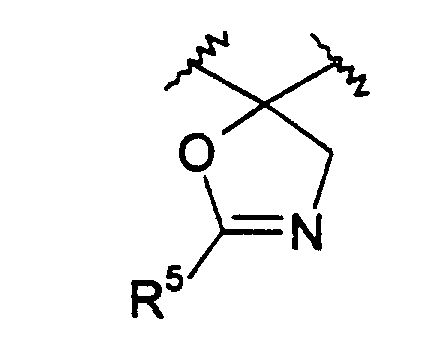
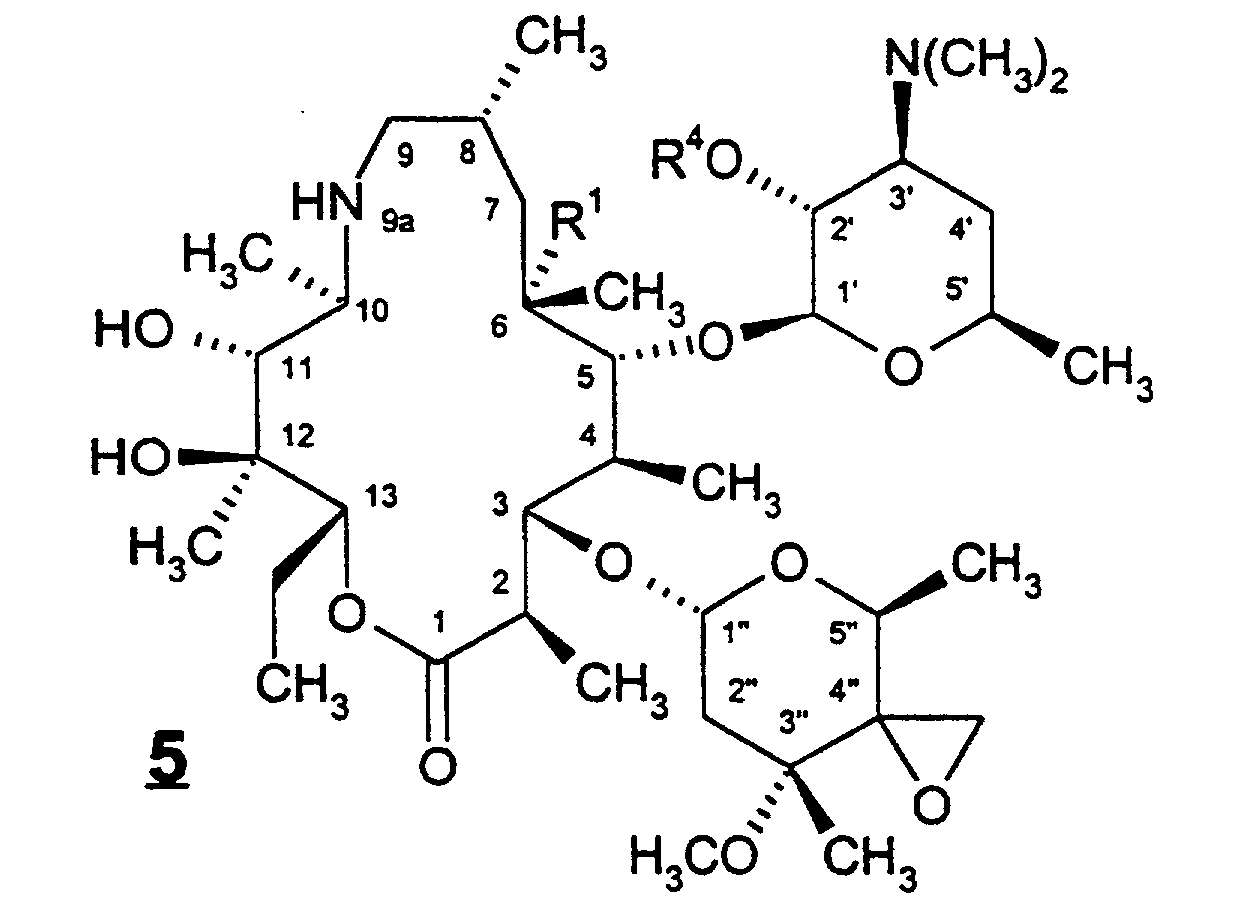
- the present invention also relates to a method of preparing the above compound of formula 1, or a pharmaceutically acceptable salt thereof, wherein R 3 is -CH 2 S(O) n R 8 , -CH 2 OR 8 or - CH 2 NR 8 R 15 , wherein n, R 15 and R 8 are as defined above with the proviso that R 8 is not H where R 3 is -CH 2 S(O) n R 8 , which comprises treating a compound of the formula wherein R 1 and R 4 are as defined above, with a compound of the formula HSR 8 , HOR 8 or HNR 15 R 8 , wherein n, R 15 and R 8 are as defined above, optionally followed by oxidation of the -SR 8 substituent to form -S(O)R 8 or -S(O) 2 R 8 .
- the above compound of formula 5 is prepared by treating a compound of the formula wherein R 1 and R 4 are as defined above, with (CH 3 ) 3 S(O) n X 2 , wherein n is 0 or 1 and X 2 is halo, -BF 4 or -PF 6 , preferably iodo or -BF 4 , in the presence of a base such as as potassium tert-butoxide, sodium tert-butoxide, sodium ethoxide, sodium hydride, 1,1,3,3-tetramethylguanidine, 1,8-diazabicyclo[5.4.0]undec-7-ene, 1,5-diazabicylo[4.3.0]non-5-ene, potassium hexamethyldisilazide (KHMDS), potassium ethoxide, or sodium methoxide, preferably KHMDS or a sodium-containing base
- KHMDS potassium ethoxide
- sodium methoxide preferably KHMDS or a sodium
- the present invention also relates to the above compounds of formulas 4 and 5 which, as indicated above, are useful in the preparation of the above compounds of formula 1 and pharmaceutically acceptable salts thereof.
- hydroxy protecting group includes acetyl, benzyloxycarbonyl, and various hydroxy protecting groups familiar to those skilled in the art include the groups referred to in T. W. Greene, P. G. M. Wuts, "Protective Groups In Organic Synthesis,” (J. Wiley & Sons, 1991).
- halo as used herein, unless otherwise indicated, includes fluoro, chloro, bromo or iodo.
- alkyl as used herein, unless otherwise indicated, includes saturated monovalent hydrocarbon radicals having straight, cyclic or branched moieties, or mixtures thereof. It is to be understood that where cyclic moieties are intended, at least three carbons in said alkyl must be present. Such cydic moieties include cyclopropyl, cyclobutyl and cyclopentyl.
- alkoxy as used herein, unless otherwise indicated, includes -O-alkyl groups wherein alkyl is as defined above.
- aryl as used herein, unless otherwise indicated, includes an organic radical derived from an aromatic hydrocarbon by removal of one hydrogen, such as phenyl or naphthyl.
- 5-10 membered heteroaryl includes aromatic heterocyclic groups containing one or more heteroatoms each selected from O, S and N, wherein each heterocydic group has from 5 to 10 atoms in its ring system.
- suitable 5-10 membered heteroaryl groups include pyridinyl, imidazolyl, pyrimidinyl, pyrazolyl, (1,2,3,)- and (1,2,4)-triazolyl, pyrazinyl, tetrazolyl, furyl, thienyl, isoxazolyl, oxazolyl, pyrrolyl and thiazolyl.
- phrases "pharmaceutically acceptable salt(s)", as used herein, unless otherwise indicated, includes salts of acidic or basic groups which may be present in the compounds of the present invention.
- the compounds of the present invention that are basic in nature are capable of forming a wide variety of salts with various inorganic and organic adds.
- the acids that may be used to prepare pharmaceutically acceptable add addition salts of such bask compounds of the present invention are those that form non-toxic acid addition salts, i.e.
- salts containing pharmacologically acceptable anions such as the hydrochloride, hydrobromide, hydroiodide, nitrate, sulfate, bisulfate, phosphate, acid phosphate, isonicotinate, acetate, lactate, salicylate, citrate, acid citrate, tartrate, pantothenate, bitartrate, ascorbate, succinate, maleate, gentisinate, fumarate, gluconate, glucaronate, saccharate, formate, benzoate, glutamate, methanesulfonate, ethanesulfonate, benzenesulfonate, p-toluenesulfonate and pamoate [ i.e. , 1,1'-methylene-bis-(2-hydroxy-3-naphthoate)] salts.
- the compounds of the present invention that include an amino moiety may form pharmaceutically acceptable salts with various amino acids, in addition to the acids mentioned above.
- Those compounds of the present invention that are acidic in nature are capable of forming base salts with various pharmacologically acceptable cations.
- Examples of such salts include the alkali metal or alkaline earth metal salts and, particulary, the calcium, magnesium, sodium and potassium salts of the compounds of the present invention.
- Certain compounds of the present invention may have asymmetric centers and therefore exist in different enantiomeric and diastereomic forms.
- This invention relates to the use of all optical isomers and stereoisomers of the compounds of the present invention, and mixtures thereof, and to all pharmaceutical compositions and methods of treatment that may employ or contain them.
- the present invention includes the compounds of claim 1 and the pharmaceutically acceptable salts thereof, wherein one or more hydrogen, carbon or other atoms are replaced by isotopes thereof.
- Such compounds may be useful as research and diagnostic tools in metabolism phamacokinetic studies and in binding assays.
- the starting compound of formula 2 may be prepared according to one or more methods familiar to those skilled in the art including the synthetic methods described in United States patents 4,474,768 and 4,517,359, referred to above.
- the C-2' hydroxy group may be selectively protected by treating the compound of formula 2 with one equivalent of acetic anhydride in dichloromethane in the absence of external base to provide the compound of formula 3 wherein R 4 is acetyl.
- the acetyl protecting group may be removed by treating the compound of formula 3 with methanol at 23-65°C for 10-48 hours.
- the C-2' hydroxy may also be protected with other hydroxy protecting groups familiar to those skilled in the art, such as the benzytoxycarbonyl (Cbz) group.
- the C-9a amino group may also require protection before further synthetic modifications are performed. Suitable protecting groups for the amino moiety are Cbz and t -butyloxycarbonyl (Boc) groups.
- the macrolide may be treated with t -butyl dicarbonate in anhydrous tetrahydrofuran (THF) or benzyloxycarbonyl N-hydroxysuccinimide ester or benzylchloroformate to protect the amino group as its t -butyl or benzyl carbamate.
- Both the C-9a amino and C-2' hydroxy may be selectively protected with the Cbz group in one step by treating the compound of formula 2 with benzylchloroformate in THF and water.
- the Boc group may be removed by acid treatment and the Cbz group may be removed by conventional catalytic hydrogenation.
- step 2 of Scheme 1 the C-4" hydroxy group of the compound of formula 3 is oxidized to the corresponding ketone by methods familiar to those skilled in the art, including one or more methods described in the Journal of Antibiotics, 1988, pages 1029-1047.
- the ketone of formula 4 may be prepared with DMSO and an appropriate activating agent.
- Typical reaction conditions for the oxidation include: (a) Moffatt oxidation which employs N-ethyl-N'-(N,N-dimethylaminopropy))carbodiimide and DMSO in the presence of pyridinium trifluoroacetate; or (b) Swem oxidation in which oxalyl chloride and DMSO in CH 2 Cl 2 is followed by the addition of triethylamine or alternatively trifluoracetic anhydride and DMSO in CH 2 Cl 2 is followed by the addition of triethylamine.
- step 3 of Scheme 1 the compound of formula 4 is treated with R 3 MgX 1 or R 3 -Li and Mg(X 1 ) 2 , wherein X 1 is a halide such as chloro or bromo, in a solvent such as THF, ethytene glycol dimethyl ether (DME), diisopropyl ether, toluene, diethyl ether, or tetramethylethylenediamine (TMEDA), hexanes, or a mixture of two or more of the foregoing solvents, preferably an ether solvent, at a temperature ranging from about -78°C to about room temperature (20-25°C), to provide the compound of formula 1 wherein R 2 is hydroxy and R 1 , R 3 and R 4 are as defined above.
- a solvent such as THF, ethytene glycol dimethyl ether (DME), diisopropyl ether, toluene, diethyl ether, or tetramethylethylene
- Scheme 2 illustrates the preparation of compounds of formula 1 through use of an epoxide intermediate.
- the compound of formula 5 may be generated by two methods.
- the compound of formula 4 is treated with (CH 3 ) 3 S(O)X 2 , wherein X 2 is halo, -BF 4 or -PF 6 , preferably iodo, in the presence of a base such as as potassium tert-butoxide, sodium tert-butoxide, sodium ethoxide, sodium hydride, 1,1,3,3-tetramethylguanidine, 1,8-diazabicyclo[5.4.0]undec-7-ene, 1,5-diazabicylo[4.3.0]non-5-ene, potassium ethoxide, or sodium methoxide, preferably a sodium-containing base such as sodium hydride, in a solvent such as THF, an ether solvent, dimethylformamide (DMF), or methyl sulfoxide
- a base such as potassium tert
- the compound of formula 4 is treated with (CH 3 ) 3 SX 2 , wherein X 2 is halo, -BF 4 or -PF 6 , preferably -BF 4 , in the presence of a base such as as potassium tert-butoxide, sodium ethoxide, sodium tert-butoxide, sodium hydride, 1,1,3,3-tetramethylguanidine, 1,8-diazabicyclo[5.4.0]undec-7-ene, 1,5-diazabicylo[4.3.0]non-5-ene, potassium ethoxide, potassium hexamethyldisilazide (KHMDS) or sodium methoxide, preferably KHMDS, in a solvent such as THF, an ether solvent, DMF, or DMSO, or a mixture of two or more of the foregoing solvents, at a temperature within the range of about -78°C to about 60°C, to provide the compound of
- step 2 of Scheme 2 the compound of formula 5 may be converted to a compound of formula 1 wherein R 2 is hydroxy and R 3 is a group that is attached to the C-4" carbon through a methylene group, such as where R 3 is CH 2 NR 15 R 8 or -CH 2 S(O) n R 8 wherein n, R 15 and R 8 are as defined above.
- the compound of formula 5 may be treated with a compound of the formula HNR 15 R 8 , wherein R 15 and R 8 are as defined above, in the absence or presence of a polar solvent such as water, methanol, or THF, or a mixture of the foregoing solvents, at a temperature ranging from about room temperature to about 100°C, preferably about 60°C, optionally in the presence of a halide reagent such as potassium iodide, lithium perchlorate, magnesium perchlorate, lithium tetrafluoroborate, pyridinium hydrochloride, or a tetraalkylammonium halide reagent such as tetrabutylammonium iodide.
- a polar solvent such as water, methanol, or THF, or a mixture of the foregoing solvents
- the compound of formula 5 may be treated with a compound of the formula HSR 8 in the presence of K 2 CO 3 , Kl, or sodium methoxide, in an aromatic solvent such as methanol, benzene or toluene at a temperature ranging from about room temperature to about 120°C.
- an aromatic solvent such as methanol, benzene or toluene at a temperature ranging from about room temperature to about 120°C.
- the sulfur moiety may be oxidized to -SO- or -SO 2 - according to methods familiar to those skilled in the art.
- the compound of formula 5 may be treated with a compound of the formula HS-(CH 2 ) q CR 11 R 12 (CH 2 ) r -NPhth, wherein NPhth represents phthalimido, and potassium iodide to provide the compound of formula 1 wherein R 3 is -CH 2 S(CH 2 ) q CR 11 R 12 (CH 2 ) r NH 2 , after removal of the phthalimido moiety, which may be further modified as necessary.
- a compound of formula 1 wherein R 3 is -CH 2 NR 15 R 8 and R 8 is -(CH 2 ) q CR 11 R 12 (CH 2 ) r NR 13 R 14 may be prepared by treating the compound of formula 5 with either a compound of the formula HNR 9 -(CH 2 ) q CR 11 R 12 (CH 2 ) r -NR 13 R 14 or a compound of the formula H 2 N-(CH 2 ) q CR 11 R 12 (CH 2 ) r NH 2 followed by reductive alkylation of the nitrogen atoms.
- a compound of formula 1 wherein R 3 is -CH 2 OR 8 and R 8 is as defined above may be prepared by treating a compound of formula 5 with a compound of the formula HOR 8 .
- Scheme 3 illustrates the preparation of compounds of formula 1 in which R 2 and R 3 are taken together to form an oxazolyl moiety.
- the compound of formula 5 is treated with sodium azide in the presence of NH 4 Cl in methanol or water, or a mixture of the two solvents, at a temperature ranging from about 0°C to about 100°C, preferably about 80°C, to provide the compound of formula 6 .
- the compound of formula 6 may be converted to the corresponding amine of formula Z via conventional catalytic hydrogenation. Preferably, such hydrogenation is done using Pd (10% on carbon) powder under an H 2 atmosphere (1 atm).
- the resulting amine of formula 7 may be converted to various compounds of formula 1 wherein R 3 is -CH 2 NR 15 R 8 using conventional synthetic methods such as reductive amination.
- R 5 is as defined above, except it is not NH 2 , in the presence or absence of an acid, such as HCl, or a Lewis acid, such as ZnCl 2 or BF 4 Et
- the compound of formula 7 may proceed as indicated in steps 4 and 5 of Scheme 3.
- step 4 of Scheme 3 the compound of formula 7 is treated with thiocarbonyldiimidazole in methylene chloride at a temperature ranging from about 0°C to room temperature to provide the compound of formula 13 .
- step 5 of Scheme 3 the compound of formula 13 , is treated with R 5 -X 1 , wherein X 1 is a halide such as bromo or iodo, and a base such as sodium methoxide in a solvent such as methanol or acetone, or a mixture of the two solvents, at a temperature ranging from about 0°C to room temperature.
- the compounds of the present invention may have asymmetric carbon atoms and therefore exist in different enantiomeric and diastereomeric forms.
- Diastereomeric mixtures can be separated into their individual diastereomers on the basis of their physical chemical differences by methods known to those skilled in the art, for example, by chromatography or fractional crystallization.
- Enantiomers may be separated by converting the enantiomeric mixtures into a diastereomeric mixture by reaction with an appropriate optically active compound (e.g., alcohol), separating the diastereomers and converting (e.g., hydrolyzing) the individual diastereomers to the corresponding pure enantiomers.
- an appropriate optically active compound e.g., alcohol
- the compounds of the present invention that are basic in nature are capable of forming a wide variety of different salts with various inorganic and organic acids. Although such salts must be pharmaceutically acceptable for administration to mammals, it is often desirable in practice to initially isolate the compound of the present invention from the reaction mixture as a pharmaceutically unacceptable salt and then simply convert the latter back to the free base compound by treatment with an alkaline reagent and subsequently convert the latter free base to a pharmaceutically acceptable acid addition salt.
- the acid addition salts of the base compounds of this invention are readily prepared by treating the base compound with a substantially equivalent amount of the chosen mineral or organic acid in an aqueous solvent medium or in a suitable organic solvent, such as methanol or ethanol. Upon careful evaporation of the solvent, the desired solid salt is readily obtained.
- the desired salt can also be precipitated from a solution of the free base in an organic solvent by adding to the solution an appropriate mineral or organic acid.
- Those compounds of the present invention that are acidic in nature are capable of forming base salts with various cations.
- base salts include the alkali metal or alkaline-earth metal salts and particularly the sodium, amine and potassium salts. These salts are all prepared by conventional techniques.
- the chemical bases which are used as reagents to prepare the pharmaceutically acceptable base salts of this invention are those which form non-toxic base salts with the acidic compounds of the present invention.
- Such non-toxic base salts include those derived from such pharmacologically acceptable cations as sodium, potassium, calcium, magnesium, various amine cations, etc.
- These salts can easily be prepared by treating the corresponding acidic compounds with an aqueous solution containing the desired pharmacologically acceptable bases with cations such as sodium, potassium, calcium, magnesium, various amine cations, etc., and then evaporating the resulting solution to dryness, preferably under reduced pressure.
- they may also be prepared by mixing lower alkanolic solutions of the acidic compounds and the desired alkali metal alkoxide together, and then evaporating the resulting solution to dryness in the same manner as before.
- stoichiometric quantities of reagents are preferably employed in order to ensure completeness of reaction and maximum yields of the desired final product.
- the antibacterial and antiprotozoa activity of the compounds of the present invention against bacterial and protozoa pathogens is demonstrated by the compound's ability to inhibit growth of defined strains of human (Assay I) or animal (Assays II and III) pathogens.
- Assay I employs conventional methodology and interpretation criteria and is designed to provide direction for chemical modifications that may lead to compounds that circumvent defined mechanisms of macrolide resistance.
- Assay I a panel of bacterial strains is assembled to include a variety of target pathogenic species, including representatives of macrolide resistance mechanisms that have been characterized. Use of this panel enables the chemical structure/activity relationship to be determined with respect to potency, spectrum of activity, and structural elements or modifications that may be necessary to obviate resistance mechanisms.
- Bacterial pathogens that comprise the screening panel are shown in the table below. In many cases, both the macrolide-susceptible parent strain and the macrolide-resistant strain derived from it are available to provide a more accurate assessment of the compound's ability to circumvent the resistance mechanism.
- Strains that contain the gene with the designation of ermA / ermB / ermC are resistant to macrolides, lincosamides, and streptogramin B antibiotics due to modifications (methylation) of 23S rRNA molecules by an Erm methylase, thereby generally prevent the binding of all three structural classes.
- Two types of macrolide efflux have been described; msrA encodes a component of an efflux system in staphylococci that prevents the entry of macrolides and streptogramins while mefAlE encodes a transmembrane protein that appears to efflux only macrolides.
- Inactivation of macrolide antibiotics can occur and can be mediated by either a phosphorylation of the 2'-hydroxyl (mph) or by cleavage of the macrocyclic lactone (esterase).
- the strains may be characterized using conventional polymerase chain reaction (PCR) technology and/or by sequencing the resistance determinant.
- PCR polymerase chain reaction
- the use of PCR technology in this application is described in J. Sutcliffe et at., "Detection Of Erythromycin-Resistant Determinants By PCR", Antimicrobial Agents and Chemotherapy, 40(11), 2562-2566 (1996).
- the assay is performed in microtiter trays and interpreted according to Performance Standards for Antimicrobial Disk Susceptibility Tests - Sixth Edition: Approved Standard, published by The National Committee for Clinical Laboratory Standards (NCCLS) guidelines; the minimum inhibitory concentration (MIC) is used to compare strains.
- Compounds are initially dissolved in dimethylsulfoxide (DMSO) as 40 mg/ml stock solutions.
- DMSO dimethylsulfoxide
- Assay II is utilized to test for activity against Pasteurella multocida and Assay III is utilized to test for activity against Pasteurella haemolytica.
- This assay is based on the liquid dilution method in microliter format.
- a single colony of P . multocida (strain 59A067) is inoculated into 5 ml of brain heart infusion (BHI) broth.
- the test compounds are prepared by solubilizing 1 mg of the compound in 125 ⁇ l of dimethylsulfoxide (DMSO). Dilutions of the test compound are prepared using uninoculated BHI broth. The concentrations of the test compound used range from 200 ⁇ g/ml to 0.098 ⁇ g/ml by two-fold serial dilutions.
- the P. multocida inoculated BHI is diluted with uninoculated BHI broth to make a 10 4 cell suspension per 200 ⁇ l.
- the BHI cell suspensions are mixed with respective serial dilutions of the test compound, and incubated at 37°C for 18 hours.
- the minimum inhibitory concentration (MIC) is equal to the concentration of the compound exhibiting 100% inhibition of growth of P. multocida as determined by comparison with an uninoculated control.
- This assay is based on the agar dilution method using a Steers Replicator. Two to five colonies isolated from an agar plate are inoculated into BHI broth and incubated overnight at 37°C with shaking (200 rpm). The next morning, 300 ⁇ l of the fully grown P. haemolytica preculture is inoculated into 3 ml of fresh BHI broth and is incubated at 37°C with shaking (200 rpm). The appropriate amounts of the test compounds are dissolved in ethanol and a series of two-fold serial dilutions are prepared. Two ml of the respective serial dilution is mixed with 18 ml of molten BHI agar and solidified. When the inoculated P.
- haemolytica culture reaches 0.5 McFarland standard density, about 5 ⁇ l of the P. haemolytica culture is inoculated onto BHI agar plates containing the various concentrations of the test compound using a Steers Replicator and incubated for 18 hours at 37°C. Initial concentrations of the test compound range from 100-200 ⁇ g/ml. The MIC is equal to the concentration of the test compound exhibiting 100% inhibition of growth of P. haemolytica as determined by comparison with an uninoculated control.
- the in vivo activity of the compounds of formula (I) can be determined by conventional animal protection studies well known to those skilled in the art, usually gamed out in mice.
- mice are allotted to cages (10 per cage) upon their arrival, and allowed to acclimate for a minimum of 48 hours before being used.
- Animals are inoculated with 0.5 ml of a 3 x 10 3 CFU/ml bacterial suspension ( P. multocida strain 59A006) intraperitoneally.
- Each experiment has at least 3 non-medicated control groups including one infected with 0.1X challenge dose and two infected with 1X challenge dose; a 10X challenge data group may also be used.
- all mice in a given study can be challenged within 30-90 minutes, especially if a repeating syringe (such as a Cornwall® syringe) is used to administer the challenge.
- a repeating syringe such as a Cornwall® syringe
- the first compound treatment is given. It may be necessary for a second person to begin compound dosing if all of the animals have not been challenged at the end of 30 minutes.
- the routes of administration are subcutaneous or oral doses. Subcutaneous doses are administered into the loose skin in the back of the neck whereas oral doses are given by means of a feeding needle. In both cases, a volume of 0.2 ml is used per mouse. Compounds are administered 30 minutes, 4 hours, and 24 hours after challenge. A control compound of known efficacy administered by the same route is included in each test. Animals are observed daily, and the number of survivors in each group is recorded. The P. multocida model monitoring continues for 96 hours (four days) post challenge.
- the PD 50 is a calculated dose at which the compound tested protects 50% of a group of mice from mortality due to the bacterial infection which would be lethal in the absence of drug treatment.
- the compounds of formula 1, and the pharmaceutically acceptable salts thereof may be adminstered through oral, parenteral, topical, or rectal routes in the treatment of bacterial and protozoa infections.
- these compounds are most desirably administered in dosages ranging from about 02 mg per kg body weight per day (mg/kg/day) to about 200 mg/kg/day in single or divided doses (i.e., from 1 to 4 doses per day), although variations will necessarily occur depending upon the species, weight and condition of the subject being treated and the particular route of administration chosen.
- a dosage level that is in the range of about 4 mg/kg/day to about 50 mg/kg/day is most desirably employed.
- Variations may nevertheless occur depending upon the species of mammal, fish or bird being treated and its individual response to said medicament, as well as on the type of pharmaceutical formulation chosen and the time period and interval at which such administration is carried out.
- dosage levels below the lower limit of the aforesaid range may be more than adequate, while in other cases still larger doses may be employed without causing any harmful side effects, provided that such larger doses are first divided into several small doses for administration throughout the day.
- the active compounds may be administered alone or in combination with pharmaceutically acceptable carriers or diluents by the routes previously indicated, and such administration may be carried out in single or multiple doses. More particularly, the active compounds may be administered in a wide variety of different dosage forms, i.e., they may be combined with various pharmaceutically acceptable inert carriers in the form of tablets, capsules, lozenges, troches, hard candies, powders, sprays, creams, salves, suppositories, jellies, gels, pastes, lotions, ointments, aqueous suspensions, injectable solutions, elixirs, syrups, and the like.
- Such carriers include solid diluents or fillers, sterile aqueous media and various non-toxic organic solvents, etc.
- oral pharmaceutical compositions can be suitably sweetened and/or flavored.
- the active compounds are present in such dosage forms at concentration levels ranging from about 5.0% to about 70% by weight.
- tablets containing various excipients such as microcrystalline cellulose, sodium citrate, calcium carbonate, dicalcium phosphate and glycine may be employed along with various disintegrants such as starch (and preferably com, potato or tapioca starch), alginic acid and certain complex silicates, together with granulation binders like polyvinylpyrrolidone, sucrose, gelatin and acacia.
- disintegrants such as starch (and preferably com, potato or tapioca starch), alginic acid and certain complex silicates, together with granulation binders like polyvinylpyrrolidone, sucrose, gelatin and acacia.
- lubricating agents such as magnesium stearate, sodium lauryl sulfate and talc are often very useful for tabletting purposes.
- compositions of a similar type may also be employed as fillers in gelatin capsules; preferred materials in this connection also include lactose or milk sugar as well as high molecular weight polyethylene glycols.
- the active compound may be combined with various sweetening or flavoring agents, coloring matter or dyes, and, if so desired, emulsifying and/or suspending agents as well, together with such diluents as water, ethanol, propylene glycol, glycerin and various like combinations thereof.
- solutions of an active compound in either sesame or peanut oil or in aqueous propylene glycol may be employed.
- the aqueous solutions should be suitably buffered (preferably pH greater than 8) if necessary and the liquid diluent first rendered isotonic.
- These aqueous solutions are suitable for intravenous injection purposes.
- the oily solutions are suitable for intraarticular, intramuscular and subcutaneous injection purposes. The preparation of all these solutions under sterile conditions is readily accomplished by standard pharmaceutical techniques will known to those skilled in the art.
- the active compounds may be administered in the feed of the animals or orally as a drench composition.
- the active compounds may also be adminstered in the form of liposome delivery systems, such as small unilamellar vesicles, large unilamellar vesicles and multilamellar vesides.
- Liposomes can be formed from a variety of phospholipids, such as cholesterol, stearylamine or phosphatidylcholines.
- the active compounds may also be coupled with soluble polymers as targetable drug carriers.
- soluble polymers can include polyvinylpyrrolidone, pyran copolymer, polyhydroxypropylmethacrylamide phenyl, polyhydroxyethylaspartamide-phenol, or polyethyleneoxide-polylysine substituted with palmitoylresidues.
- the active compounds may be coupled to a class of biodegradable polymers useful in achieving controlled release of a drug, for example, polylactic acid, polyglycolic acid, copolymers of polylactic and polyglycolic acid, polyepsilon caprolactone, polyhydroxy butyric acid, polyorthoesters, polyacetals, polydihydropyrans, polycyanoacrylates and cross-linked or amphipathic block copolymers of hydrogels.
- a drug for example, polylactic acid, polyglycolic acid, copolymers of polylactic and polyglycolic acid, polyepsilon caprolactone, polyhydroxy butyric acid, polyorthoesters, polyacetals, polydihydropyrans, polycyanoacrylates and cross-linked or amphipathic block copolymers of hydrogels.
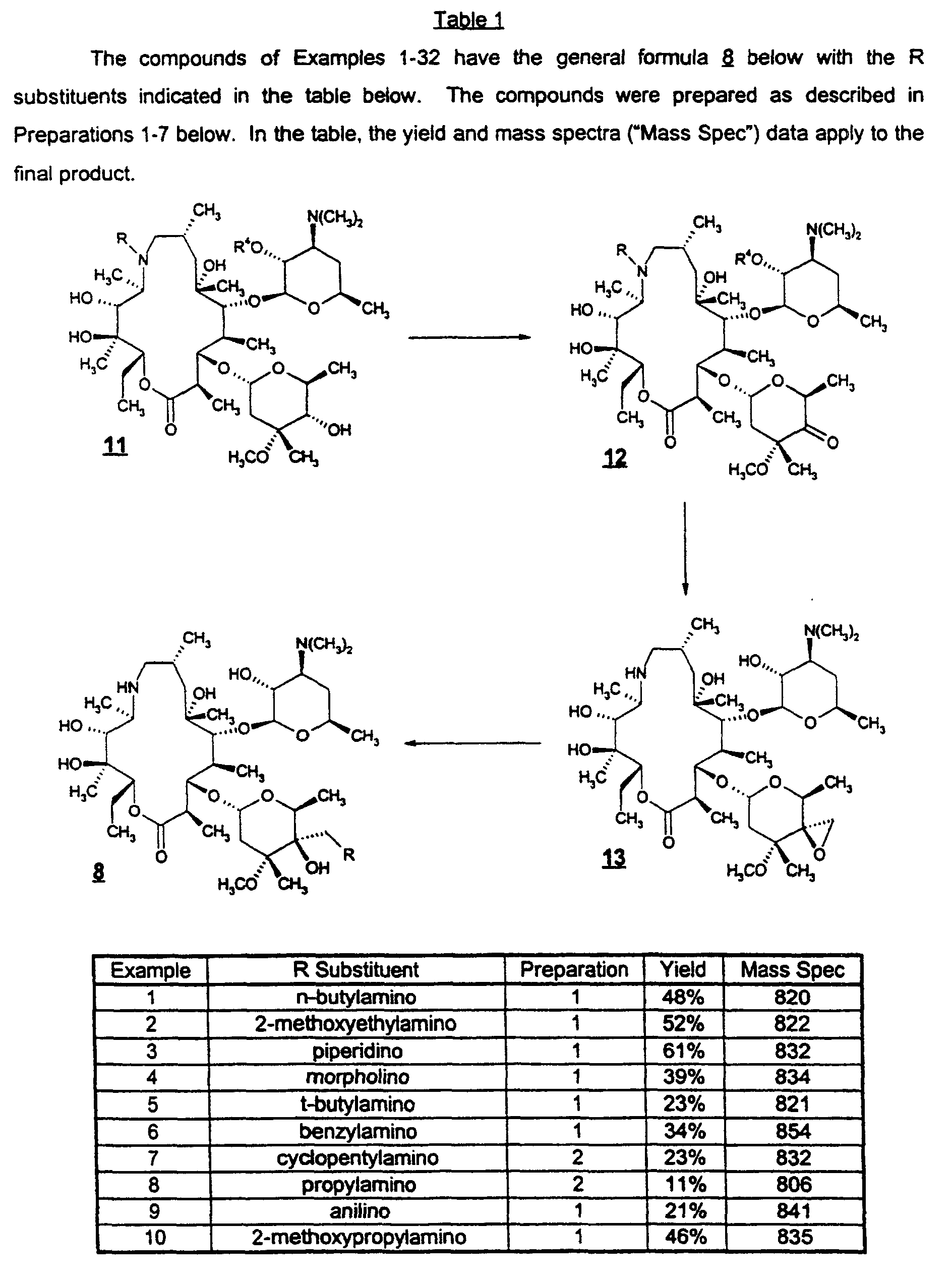
- the compound of formula 11 wherein R is H and R 4 is H was mixed in a solution with phenol red in 250 mL THF and 125 mL water. To this pink solution was slowly added 29 mL (204.1 mmol, 6.0 equiv) benzylchloroformate and 2N NaOH to keep the solution basic. The reaction was allowed to stir at room temperature overnight The reaction mixture was concentrated to remove the THF and the aqueous phase was adjusted to the pH of 9.5 and extracted 3 X 500 mL EtOAc. The combined organic layers were washed with 500 mL brine and then dried over Na 2 CO 3 .
- Palladium catalyst (20 mg, 10% Pd/C) was added to a solution of the compound from example 42 in isopropanol (8 mL). The reaction vessel was flushed and filled with hydrogen (50 psi) and shaken at room temperature for 24 hours. Filtration of an aliquot of the reaction mixture through CeliteTM and concentration under vacuum afforded the compound of formula 9 wherein R is 3-hydroxy-1 -propenyl: MS: 791 (API).
- Palladium catalyst (15 mg, 10% Pd/C) was added to a solution of the title compound from example 38 in isopropanol (8 mL). The reaction vessel was flushed and filled with hydrogen (50 psi) and shaken at room temperature for 24 hours. Filtration of an aliquot of the reaction mixture through CeliteTM and concentration under vacuum afforded the compound of formula 9 wherein R is 3-methoxy-1-propenyl: MS: 806 (APl).
- Palladium catalyst (0.250 g. 10% Pd/C) was added to a solution of the compound described above (0.500 g 0.491 mmol) in isopropanol (50 mL). The reaction vessel was flushed and filled with hydrogen 345KPa (50 psi) and shaken at room temperature for 48 hours. Additional palladium catalyst (0.250 g. 10% Pd/C) was added and hydrogenation was continued at 345KPa (50 psi) for 24 hours. The reaction mixture was filtered through CeliteTM and concentrated under vacuum.
- Palladium catalyst (0.087 g, 10% Pd/C) was added to a solution of the compound described above (0.087 g. 0.082 mmol) in isopropanol (15 mL). The reaction vessel was flushed and filled with hydrogen 345KPa (50 psi) and shaken at room temperature for 24 hours. Additional palladium catalyst (0.087 g. 10% Pd/C) was added and hydrogenation was continued at 345KPa (50 psi) for 60 hours. The reaction mixture was filtered through CeliteTM and concentrated under vacuum.
- Palladium catalyst (0.035 g, 10% Pd/C) was added to a solution of the compound described above (0.079 g, 0.077 mmol) in ethanol (20 mL). The reaction vessel was flushed and filled with hydrogen 345KPa (50 psi) and shaken at room temperature for 24 hours. Additional palladium catalyst (0.036 g. 10% Pd/C) was added and hydrogenation was continued at 345KPa (50psi) or 24 hours. The reaction mixture was filtered through CeliteTM and concentrated under vacuum, affording 0.056 g (96% yield) of the compound of formula 9 wherein R is ethyl: MS: 763 (TS).
- Palladium catalyst (0.075 g. 10% Pd/C) was added to a solution of the compound described above (0.150 g, 0.165 mmol) in ethanol (30 mL). The reaction vessel was flushed and filled with hydrogen 345KPa (50 psi) and shaken at room temperature for 24 hours. Additional palladium catalyst (0.075 g. 10% Pd/C) was added and hydrogenation was continued at 345KPa(50 psi) for 24 hours. The reaction mixture was filtered through Celite TM and concentrated under vacuum.
- Palladium catalyst (0.175 g, 10% Pd/C) was added to a solution of the compound described above (0.350 g, 0.335 mmol) in isopropanol (100 mL). The reaction vessel was flushed and filled with hydrogen 345KPa (50 psi) and shaken at room temperature for 24 hours. Additional palladium catalyst (0.150 g, 10% Pd/C) was added and hydrogenation was continued at for 24 hours. The reaction mixture was filtered through Celite TM and concentrated under vacuum.
- Palladium catalyst (0.012 g, 10% Pd/C) was added to a solution of the compound described above (0.022 g, 0.024 mmol) in isopropanol (10 mL). The reaction vessel was flushed and filed with hydrogen 345 KPa (50 psi) and shaken at room temperature for 24 hours. Additional palladium catalyst (0.020 g, 10% Pd/C) was added and hydrogenation was continued at 345KPa (50 psi) for 24 hours. The reaction mixture was filtered through Celite TM and concentrated under vacuum.
- Palladium catalyst (0.040 g. 10% Pd/C) was added to a solution of the compound described above (0.057 g. 0.063 mmol) in isopropanol (15 mL). The reaction vessel was flushed and filled with hydrogen 345KPa (50 psi) and shaken at room temperature for 24 hours. Additiona palladium catalyst (0.040 g. 10% Po/C) was added and hydrogenation was continued at 345KPa (50 psi) for 24 hours.
- Palladium catalyst (0.073 g, 10% Pd/C) was added to a solution of the compound described above (0.073 g. 0.077 mmol) in isopropanol (30 mL).
- the reaction vessel was flushed and filled with hydrogen 345KPa (50 psi) and shaken at room temperature for 48 hours.
- the reaction mixture was filtered through CeliteTM and concentrated under vacuum.
- the reaction mixture was diluted with a saturated aqueous solution of sodium bicarbonate (100 mL) and EtOAc (100 mL). After separation, the aqueous layer was washed with EtOAc (3 x 100 mL). The combined organic extracts were washed with a saturated aqueous solution of sodium bicarbonate (100 mL) and brine (100 mL). dried over Na 2 SO 4 and concentrated under vacuum to afford 0.660 g of a yellow foam (MS: 949 (API)).
- Palladium catalyst (0.700 g. 10% Pd/C) was added to a solution of the compound decribed above in isopropanol (60 mL). The reaction vessel was flushed and filled with hydrogen 345KPa (50 psi) and shaken at room temperature for 24 hours. Addtional palladium catalyst (0.500 g. 10% Pd/C) was added and hydrogenation was continued at 345KPa (50 psi) for 24 hours. The reaction mixture was filtered through Celite TM and concentrated under vacuum.
- Palladium catalyst (0.100 g. 10% Pd/C) was added to a solution of the compound described above in isopropanol (15 mL).
- the reaction vessel was flushed and filled with hydrogen 345KPa (50 psi) and shaken at room temperature for 72 hours.
- the reaction mixture was filtered through Celite TM and concentrated under vacuum.
- Silica gel chromatography with MeOH:CH 2 Cl 2 :NH 4 OH (1:98:1 to 8:91:1) afforded 0.053 g (13% yield) of the compound of formula 9 wherein R is 2-furyl: MS: 802 (API).
- the reaction mixture was diluted with a saturated aqueous solution of sodium bicarbonate (50 mL) and EtOAc (50 mL). After separation, the aqueous layer was washed with EtOAc (3 x 50 mL). The combined organic extracts were washed with a saturated aqueous solution of sodium bicarbonate (50 mL) and brine (50 mL), dried over Na 2 SO 4 and concentrated under vacuum to afford 0.293 g of a yellow foam (MS: 949 (API)).
- Palladium catalyst (0.324 g, 10% Pd/C) was added to a solution of the compound decribed above in isopropanol (30 mL). The reaction vessel was flushed and filled with hydrogen 345KPa (50 psi) and shaken at room temperature for 24 hours. Additional palladium catalyst (0.300 g, 10% Pd/C) was added and hydrogenation was continued at 345KPa (50 psi) for 24 hours. The reaction mixture was filtered through Celite TM and concentrated under vacuum.
Landscapes
- Chemical & Material Sciences (AREA)
- Health & Medical Sciences (AREA)
- Organic Chemistry (AREA)
- General Health & Medical Sciences (AREA)
- Life Sciences & Earth Sciences (AREA)
- Biotechnology (AREA)
- Veterinary Medicine (AREA)
- Molecular Biology (AREA)
- Genetics & Genomics (AREA)
- Biochemistry (AREA)
- Engineering & Computer Science (AREA)
- Chemical Kinetics & Catalysis (AREA)
- Public Health (AREA)
- Animal Behavior & Ethology (AREA)
- Medicinal Chemistry (AREA)
- Pharmacology & Pharmacy (AREA)
- General Chemical & Material Sciences (AREA)
- Nuclear Medicine, Radiotherapy & Molecular Imaging (AREA)
- Oncology (AREA)
- Tropical Medicine & Parasitology (AREA)
- Communicable Diseases (AREA)
- Pharmaceuticals Containing Other Organic And Inorganic Compounds (AREA)
- Saccharide Compounds (AREA)
- Nitrogen Condensed Heterocyclic Rings (AREA)
Description




| Strain Designation | Macrolide Resistance Mechanism(s) |
| Staphylococcus aureus 1116 | susceptible parent |
| Staphylococcus aureus 1117 | ermB |
| Staphylococcus aureus 0052 | susceptible parent |
| Staphylococcus aureus 1120 | ermC |
| Staphylococcus aureus 1032 | msrA, mph, esterase |
| Staphylococcus hemolyticus 1006 | msrA, mph |
| Streptococcus pyogenes 0203 | susceptible parent |
| Streptococcus pyogenes 1079 | ermB |
| Streptococcus pyogenes 1062 | susceptible parent |
| Streptococcus pyogenes 1061 | ermB |
| Streptococcus pyogenes 1064 | ermB |
| Streptococcus agalactiae 1024 | susceptible parent |
| Streptococcus agalactiae 1023 | ermB |
| Streptococcus pneumoniae 1016 | susceptible |
| Streptococcus pneumoniae 1046 | ermB |
| Streptococcus pneumoniae 1095 | ermB |
| Streptococcus pneumoniae 1175 | mefE |
| Streptococcus pneumoniae 0085 | susceptible |
| Haemophilus influenzae 0131 | susceptible |
| Moraxella catarrhalis 0040 | susceptible |
| Moraxella catarrhalis 1055 | erythromycin intermediate resistance |
| Escherichia coli 0266 | susceptible |




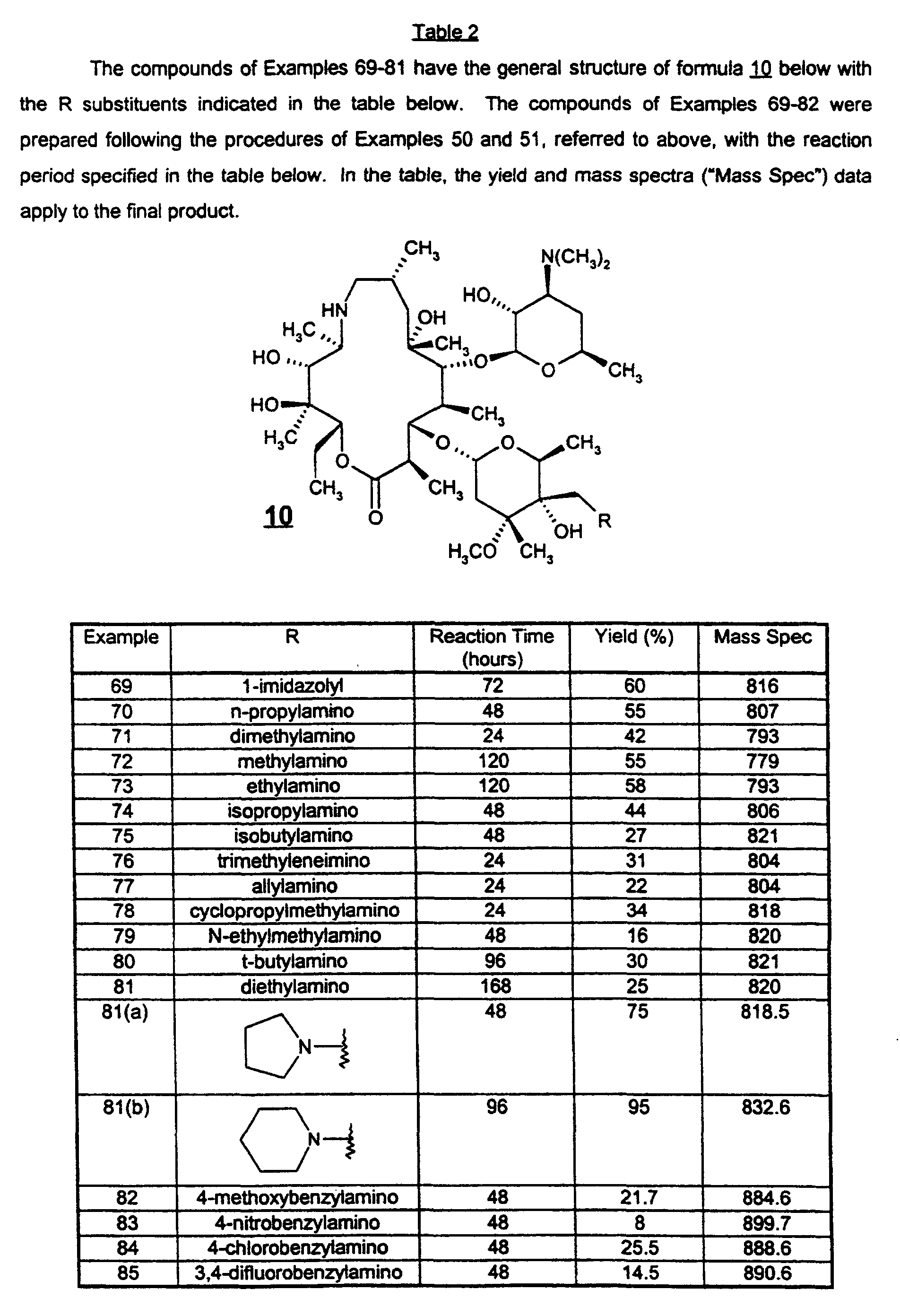

Claims (31)
- A compound of the formulaor a pharmaceutically acceptable salt thereof, wherein:
 with the proviso that R8 is not H where R3 is -CH2S(O)nR8.R1 is H, hydroxy or methoxy;R2 is hydroxy;R3 is C1-C10 alkyl, C2-C10 alkenyl, C2-C10 alkynyl, cyano, -CH2S(O)nR8 wherein n is an integer ranging from 0 to 2, -CH2OR8, -CH2N(OR9)R8, -CH2NR8R15, (CH2)m(C6-C10 aryl), or -(CH2)m(5-10 membered heteroaryl), wherein m is an integer ranging from 0 to 4, and wherein the foregoing R3 groups are optionally substituted by 1 to 3 R16 groups;or R2 and R3 are taken together to form an oxazolyl ring as shown below
 R4 is H, -C(O)R9, -C(O)OR9, -C(O)NR9R10 or a hydroxy protecting group;R5 is -SR8, -(CH2)nC(O)R8 wherein n is 0 or 1, C1-C10 alkyl, C2-C10 alkenyl, C2-C10 alkynyl, -(CH2)m(C6-C10 aryl), or -(CH2)m(5-10 membered heteroaryl), wherein m is an integer ranging from 0 to 4, and wherein the foregoing R5 groups are optionally substituted by 1 to 3 R16 groups;each R6 and R7 is independently H, hydroxy, C1-C8 alkoxy, C1-C6 alkyl, C2-C6 alkenyl, C2-C6 alkynyl, -(CH2)m(C6-C10 aryl), or -(CH2)m(5-10 membered heteroaryl), wherein m is an integer ranging from 0 to 4;each R8 is independently H, C1-C10 alkyl, C2-C10 alkenyl, C2-C10 alkynyl, -(CH2)qCR11R12(CH2)rNR13R14 wherein q and r are each independently an integer ranging from 0 to 3 except q and r are not both 0, -(CH2)m(C6-C10 aryl), or -(CH2)m(5-10 membered heteroaryl), wherein m is an integer ranging from 0 to 4, and wherein the foregoing R8 groups, except H, are optionally substituted by 1 to 3 R16 groups;or where R8 is as -CH2NR8R15, R15 and R8 may be taken together to form a 4-10 membered monocydic or polycyclic saturated ring or a 5-10 membered heteroaryl ring, wherein said saturated and heteroaryl rings optionally include 1 or 2 heteroatoms selected from O, S and -N(R8)-, in addition to the nitrogen to which R15 and R8 are attached, said saturated ring optionally includes 1 or 2 carbon-carbon double or triple bonds, and said saturated and heteroaryl rings are optionally substituted by 1 to 3 R16 groups;each R9 and R10 is independently H or C1-C6 alkyl;each R11, R12, R13 and R14 is independently selected from H, C1-C10 alkyl, -(CH2)m(C6-C10 aryl), and -(CH2)m(5-10 membered heteroaryl), wherein m is an integer ranging from 0 to 4, and wherein the foregoing R11, R12, R13 and R14 groups, except H, are optionally substituted by 1 to 3 R16 groups;or R" and R13 are taken together to form -(CH2)p- wherein p is an integer ranging from 0 to 3 such that a 4-7 membered saturated ring is formed that optionally includes 1 or 2 carbon-carbon double or triple bonds;or R13 and R14 are taken together to form a 4-10 membered monocydic or polycyclic saturated ring or a 5-10 membered heteroaryl ring, wherein said saturated and heteroaryl rings optionally include 1 or 2 heteroatoms selected from O, S and -N(R8)-, in addition to the nitrogen to which R13 and R14 are attached, said saturated ring optionally indudes 1 or 2 carbon-carbon double or triple bonds, and said saturated and heteroaryl rings are optionally substituted by 1 to 3 R16 groups;R15 is H, C1-C10 alkyl, C2-C10 alkenyl, or C2-C10 alkynyl, wherein the foregoing R15 groups are optionally substituted by 1 to 3 substituents independently selected from halo and -OR9;each R16 is independently selected from halo, cyano, nitro, trifluoromethyl, azido, -C(O)R17, -C(O)OR17, -C(O)OR17, -OC(O)OR17, -NR6C(O)R7, C(O)NR6R7, -NR6R7, hydroxy, C1-C6 alkyl, C1-C6 alkoxy, -(CH2)m(C6-C10 aryl), and (CH2)m(5-10 membered heteroaryl), wherein m is an integer ranging from 0 to 4, and wherein said aryl and heteroaryl subsituents are optionally substituted by 1 or 2 substituents independently selected from halo, cyano, nitro, trifluoromethyl, azido, -C(O)R17, -C(O)OR17, -C(O)OR17, -C(O)OR17, -NR6C(O)R7, -C(O)NR6R7, -NR6R7, hydroxy, C1-C6 alkyl, and C1-C6 alkoxy;each R17 is independently selected from H, C1-C10 alkyl, C2-C10 alkenyl, C2-C10 alkynyl, -(CH2)m(C6-C10 aryl), and -(CH2)m(5-10 membered heteroaryl), wherein m is an integer ranging from 0 to 4;
 - The compound of claim 1 wherein R4 is H, acetyl, or benzyloxycarbonyl.
- The compound of claim 2 wherein R1 is hydroxy, R2 is hydroxy, R3 is -CH2NR15R8 or -CH2SR8.
- The compound of claim 3 wherein R3 is -CH2NR15R8 and R15 and R8 are independently selected from H, C1-C10 alkyl, C2-C10 alkenyl, and C2-C10 alkynyl, wherein the foregoing R15 and R8 groups, except H, are optionally substituted by 1 or 2 substituents independently selected from hydroxy, halo and C1-C6 alkoxy.
- The compound of claim 4 wherein R15 and R8 are each independently selected from H, methyl, ethyl, allyl, n-butyl, isobutyl, 2-methoxyethyl, cyclopentyl, 3-methoxypropyl, 3-ethoxypropyl, n-propyl, isopropyl, 2-hydroxyethyl, cyclopropyl, 2,2,2-trifluoroethyl, 2-propynyl, sec-butyl, tert-butyl, and n-hexyl.
- The compound of claim 2 wherein R1 is hydroxy, R2 is hydroxy, R3 is -CH2NHR8, and R8 is -(CH2)m(C6-C10 aryl) wherein m is an integer ranging from 0 to 4.
- The compound of claim 6 wherein R8 is phenyl or benzyl.
- The compound of claim 2 wherein R1 is hydroxy, R2 is hydroxy, R3 is -CH2NR15R8, and R15 and R8 are taken together to form a 4-10 membered saturated ring.
- The compound of claim 8 wherein R15 and R8 are taken together to form a piperidino, trimethyleneimino, or morpholino ring.
- The compound of claim 2 wherein R1 is hydroxy, R2 is hydroxy, R3 is -CH2NR15R8, and R15 and R8 are taken together to form a 5-10 membered heteroaryl ring optionally substituted by 1 or 2 C1-C6 alkyl groups.
- The compound of claim 10 wherein R15 and R8 are taken together to form a pyrrolidino, triazolyl, or imidazolyl ring wherein said heteroaryl groups are optionally substituted by 1 or 2 methyl groups.
- The compound of claim 2 wherein R1 is hydroxy, R2 is hydroxy, R3 is -CH2R8, and R8 is selected from C1-C10 alkyl, C2-C10 alkenyl, and C2-C10 alkynyl, wherein said R8 groups are optionally substituted by 1 or 2 substituents independently selected from hydroxy, halo and C1-C6 alkoxy.
- The compound of claim 12 wherein R8 is methyl, ethyl, or 2-hydroxyethyl.
- The compound of daim 2 wherein R1 is hydroxy, R2 is hydroxy, and R3 is selected from C1-C10 alkyl, C2-C10 alkenyl, and C2-C10 alkynyl, wherein said R3 groups are optionally substituted by 1 or 2 substituents independently selected from hydroxy, -C(O)R17, -NR6R7, halo, cyano, azido, 5-10 membered heteroaryl, and C1-C6 alkoxy.
- The compound of claim 14 wherein R3 is methyl, allyl, vinyl, ethynyl, 1-(methyl-1-propenyl, 3-methoxy-1-propynyl, 3-dimethylamino-1-propynyl, 2-pyridylethynyl, 1-propynyl, 3-hydroxy-1-propynyl, 3-hydroxy-1-propenyl, 3-hydroxypropyl, 3-methoxy-1-propenyl, 3-methoxypropyl, 1-propynyl, n-butyl,ethyl, propyl, 2-hydroxyethyl, azidomethyl, formylmethyl, 6-cyano-1-pentynyl, 3-dimethylamino-1-propenyl, or 3-dimethylaminopropyl.
- The compound of claim 2 wherein R1 is hydroxy, R2 is hydroxy, and R3 is -(CH2)m(5-10 membered heteroaryl) wherein m is an integer ranging from 0 to 4.
- The compound of claim 16 wherein R3 is 2-thienyl, 2-pyridyl, 1-methyl-2-imidazolyl, 2-furyl, or 1-methyl-2-pyrrolyl.
- The compound of claim 2 wherein R1 is hydroxy, R2 is hydroxy, and R3 is -(CH2)m(C6-C10 aryl) wherein m is an integer ranging from 0 to 4.
- The compound of claim 18 wherein R3 is phenyl.
- The compound of claim 2 wherein R2 and R3 are taken together to form an oxazolyl ring as shown below

- The compound of claim 2 wherein R3 is selected from the following:wherein X3 is O, S or -N(R15)-. R9 and R15 are as defined in claim 1, and the -OR9 group may be attached at any available carbon on the phenyl group.

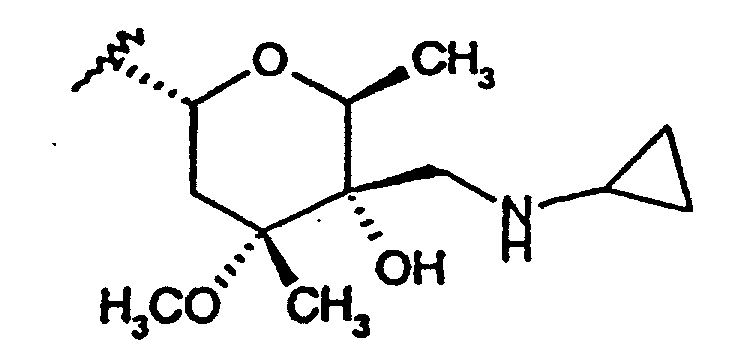
- 11-(4-Dimethylamino-3-hydroxy-6-methyl-tetrahydro-pyran-2-yloxy)-2-ethyl-3,4,10-trihydroxy-13-(5-hydroxy-4-methoxy-4,8-dimethy)-5-propylaminomethy)-tetrahydro-pyran-2-yloxy)-3,5,8,10,12,14-hexamethyl-1-oxa-6-aza-cyclapentadecan-15-ore
- A compound as claimed in any of claims 1 to 22 for use as a medicament.
- The use of a compound as claimed in any of claims 1 to 22 for the manufacture of a medicament for the treatment of a bacterial or protozoal infection in a mammal, fish or bird.
- A pharmaceutical composition comprising a compound as claimed in any of claims 1 to 22 and a pharmaceutically acceptable carrier.
- A composition as claimed in claim 25, wherein said composition is for the treatment of a bacterical or protozoal infection in a mammal, fish or bird.
- A method of preparing a compound of the formula (1) as described in claim 1. which comprises treating a compound of the formulawherein R1 and R4 are as defined above, with a compound of the formula HOR8, HSR8 or HNR15R8, wherein n, R15 and R8 are as defined in claim 1, wherein if said compound of formula HSR8 is used the resulting R3 group of formula -CH2SR8 is optionally oxidised to -CH2S(O)R8 or -CH2S(O)2R8.

- The method of claim 27 wherein the compound of formula 5 is separated by treating a compound of the formulawherein R1 and R4 are as defined in claim 1, with (CH3)3S(O)nX2, wherein n is 0 or 1 and X2 is halo, -BF4 or -PF6, in the presence of a base.

- The method of claim 28 wherein X2 is iodo or BF4 and said base is selected from potassium tert-butoxide, sodium tert-butoxide, sodium ethoxide, sodium hydride, 1.1,3,3-tetramethylguanidine, 1,8-diazabicyclo[5.4.0]undec-7-ene, 1,5-diazabicylo[4.3.0]non-5-ene, potassium hexamethyldisilazide (KHMDS), potassium ethoxide, and sodium methoxide.
- A compound of the formulaor a pharmaceutically acceptable salt thereof, wherein:
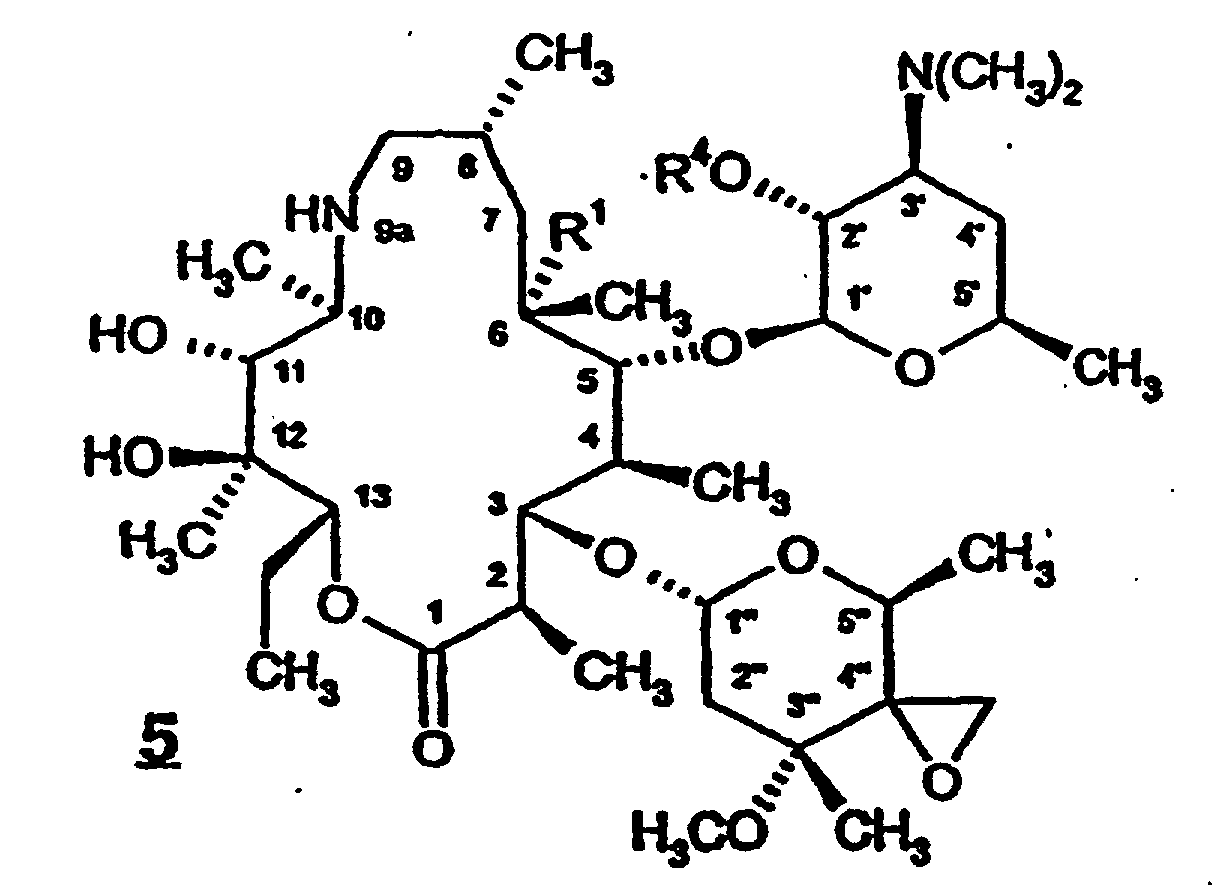 R1 is H, hydroxy or methoxy; and,R4 is H, -C(O)R9.-C(O)OR9,-C(O)NR9R10 or a hydroxy protecting group; and,each R9 and R10 is independently H or C1-C6 alkyl.
 - A compound of the formulaor a pharmaceutically acceptable salt thereof, wherein:
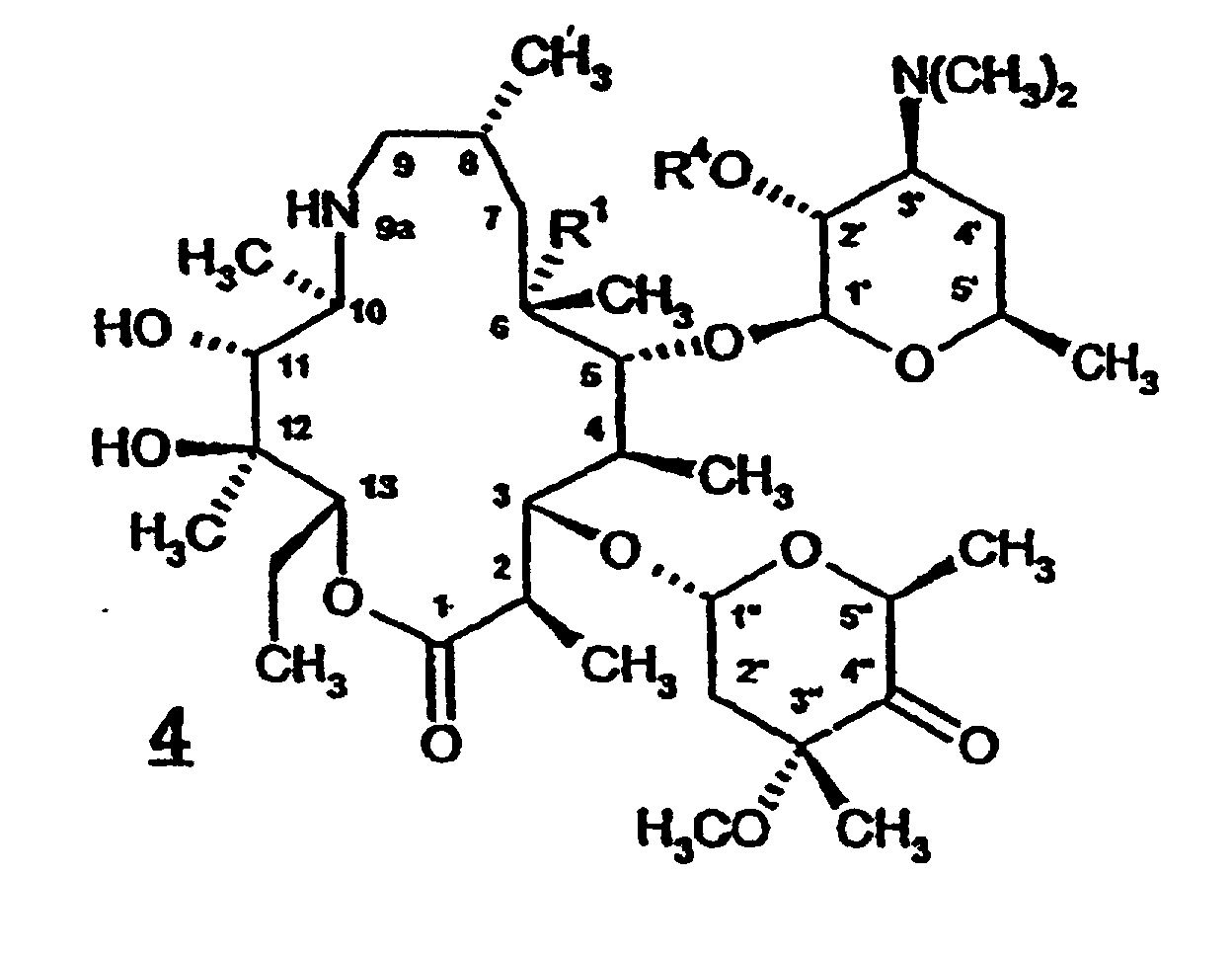 R1 is H, hydroxy or methoxy; and,is H, -C(O)R9, -C(O)OR9, -C(O)NR9R10 or a hydroxy protecting group; and, each R9 and R10 is independently H or C1-C6 alkyl.
Priority Applications (1)
| Application Number | Priority Date | Filing Date | Title |
|---|---|---|---|
| SI9830572T SI0988310T1 (en) | 1997-06-11 | 1998-05-29 | 4"-substituted-9-deoxo-9a-aza-9a-homoerythromycin a derivatives |
Applications Claiming Priority (3)
| Application Number | Priority Date | Filing Date | Title |
|---|---|---|---|
| US4934897P | 1997-06-11 | 1997-06-11 | |
| US49348P | 1997-06-11 | ||
| PCT/IB1998/000839 WO1998056802A1 (en) | 1997-06-11 | 1998-05-29 | 4'-substituted-9-deoxo-9a-aza-9a-homoerythromycin a derivatives |
Publications (3)
| Publication Number | Publication Date |
|---|---|
| EP0988310A1 EP0988310A1 (en) | 2000-03-29 |
| EP0988310B1 true EP0988310B1 (en) | 2003-10-01 |
| EP0988310B9 EP0988310B9 (en) | 2006-03-08 |
Family
ID=21959336
Family Applications (1)
| Application Number | Title | Priority Date | Filing Date |
|---|---|---|---|
| EP98920693A Expired - Lifetime EP0988310B9 (en) | 1997-06-11 | 1998-05-29 | 4"-substituted-9-deoxo-9a-aza-9a-homoerythromycin a derivatives |
Country Status (49)
Families Citing this family (54)
| Publication number | Priority date | Publication date | Assignee | Title |
|---|---|---|---|---|
| HN1998000086A (en) * | 1997-06-11 | 1999-03-08 | Pfizer Prod Inc | DERIVATIVES OF 9 - DESOFO - 9 AZA - 9A - HOMOERITROMICINA A - C - 4 SUBSTITUTED. |
| ATE353014T1 (en) * | 1997-09-10 | 2007-02-15 | Merial Ltd | USE OF 9A-AZALIDES AS ANTIMICROBIAL AGENTS FOR ANIMALS |
| US6339063B1 (en) | 1997-09-10 | 2002-01-15 | Merck & Co., Inc. | 9a-azalides as veterinary antimicrobial agents |
| EP1779853A3 (en) * | 1997-09-10 | 2010-01-27 | Merial Ltd. | 9a-azalides as veterinary antimicrobial agents |
| AP9801420A0 (en) * | 1998-01-02 | 1998-12-31 | Pfizer Prod Inc | Novel macrolides. |
| US6043227A (en) * | 1998-08-19 | 2000-03-28 | Pfizer Inc. | C11 carbamates of macrolide antibacterials |
| EP1437360A3 (en) * | 1998-08-19 | 2005-04-06 | Pfizer Products Inc. | C11 Carbamates of macrolide antibacterials |
| US6100240A (en) * | 1998-10-09 | 2000-08-08 | Pfizer Inc | Macrolide derivatives |
| CA2292359C (en) * | 1999-01-28 | 2004-09-28 | Pfizer Products Inc. | Novel azalides and methods of making same |
| EP1189912B1 (en) * | 1999-05-18 | 2008-04-16 | Pfizer Products Inc. | Novel crystalline forms of a macrolide antibiotic |
| IL145739A0 (en) * | 1999-05-24 | 2002-07-25 | Pfizer Prod Inc | 13-methyl-erythromycin derivatives |
| US6465437B1 (en) * | 1999-06-30 | 2002-10-15 | Pfizer Inc. | Diphosphate salt of a 4″-substituted-9-deoxo-9A-AZA-9A- homoerythromycin derivative and its pharmaceutical composition |
| ATE315042T1 (en) * | 1999-08-24 | 2006-02-15 | Abbott Lab | 9A-AZALIDE WITH ANTIBACTERIAL EFFECT |
| US6764996B1 (en) | 1999-08-24 | 2004-07-20 | Abbott Laboratories | 9a-azalides with antibacterial activity |
| US6608033B1 (en) * | 1999-08-27 | 2003-08-19 | Pfizer Inc. | Treatment or prevention of coccidiosis |
| BRPI0017013B1 (en) | 2000-01-27 | 2015-07-14 | Zoetis P Llc | Azalide antibiotic composition and method for obtaining it |
| AU4269301A (en) * | 2000-04-27 | 2001-11-07 | Pfizer Products Inc. | The use of azalide antibiotic compositions for treating or preventing a bacterial or protozoal infection in mammals |
| WO2002088158A1 (en) * | 2001-04-27 | 2002-11-07 | Pfizer Products Inc. | Process for preparing 4'-substituted-9-deoxo-9a-aza-9a-homoerythromycin a derivatives |
| WO2003011266A2 (en) * | 2001-08-01 | 2003-02-13 | Pfizer Products Inc. | Azalide antibiotic compositions |
| EP1638549A4 (en) | 2003-03-10 | 2011-06-15 | Optimer Pharmaceuticals Inc | NEW ANTIBACTERIAL AGENTS |
| WO2005030227A1 (en) | 2003-09-23 | 2005-04-07 | Enanta Pharmaceuticals, Inc. | 9a, 11-3C-BICYCLIC 9a-AZALIDE DERIVATIVES |
| CN1882360A (en) * | 2003-11-21 | 2006-12-20 | 辉瑞产品公司 | The use of antibiotics as vaccine adjuvants |
| EP2360165A3 (en) * | 2004-03-16 | 2012-01-04 | Boehringer Ingelheim International GmbH | Glucopyranosyl-substituted benzene derivatives, medicaments containing such compounds, their use and process for their manufacture |
| US20060116336A1 (en) * | 2004-03-17 | 2006-06-01 | American Pharmaceutical Partners, Inc. | Lyophilized azithromycin formulation |
| US7468428B2 (en) * | 2004-03-17 | 2008-12-23 | App Pharmaceuticals, Llc | Lyophilized azithromycin formulation |
| US7402568B2 (en) | 2004-09-29 | 2008-07-22 | Enanta Pharmaceuticals, Inc. | Bicyclic 9a-azalide derivatives |
| US7767797B1 (en) * | 2004-09-30 | 2010-08-03 | Synovo Gmbh | Macrocyclic compounds and methods of use thereof |
| US7271155B2 (en) | 2005-01-07 | 2007-09-18 | Enanta Pharmaceuticals, Inc. | 9A, 11-2C-bicyclic 9a-azalide derivatives |
| US20080227730A1 (en) * | 2005-01-14 | 2008-09-18 | Glaxosmithkline Istrazivacki Centar Zagreb D.O.O. | 9A-Carbamoyl and Thiocarbamoyl Azalides With Antimalarial Activity |
| CA2703475A1 (en) * | 2007-10-25 | 2009-04-30 | Cempra Pharmaceuticals, Inc. | Process for the preparation of macrolide antibacterial agents |
| US8796232B2 (en) * | 2008-10-24 | 2014-08-05 | Cempra Pharmaceuticals, Inc. | Methods for treating resistant diseases using triazole containing macrolides |
| US9937194B1 (en) * | 2009-06-12 | 2018-04-10 | Cempra Pharmaceuticals, Inc. | Compounds and methods for treating inflammatory diseases |
| JP5914335B2 (en) | 2009-09-10 | 2016-05-11 | センプラ ファーマシューティカルズ,インコーポレイテッド | Method for treating malaria, tuberculosis and MAC disease |
| CN103080122A (en) | 2010-03-22 | 2013-05-01 | 森普拉制药公司 | Crystalline forms of macrolides and their uses |
| WO2011146829A1 (en) | 2010-05-20 | 2011-11-24 | Cempra Pharmaceuticals, Inc. | Processes for preparing macrolides and ketolides and intermediates therefor |
| JP6042334B2 (en) | 2010-09-10 | 2016-12-14 | センプラ ファーマシューティカルズ,インコーポレイテッド | Hydrogen bond forming fluoroketolides for disease treatment |
| ES2532455T3 (en) * | 2010-09-20 | 2015-03-27 | Novartis Tiergesundheit Ag | New procedure for the preparation of 9-desoxo-9a-aza-9a-homoerithromycin modified in the C-4 '' of the cladinose ring by an epoxy group |
| CA2814333A1 (en) * | 2010-10-10 | 2012-04-19 | Synovo Gmbh | Anti-inflammatory macrolides |
| CN102993250B (en) * | 2011-07-06 | 2016-02-10 | 洛阳惠中兽药有限公司 | -9-deoxidation-9A-azepine-9A-the a-homoerythromycin A derivatives that C-3 replaces |
| CN102260306B (en) * | 2011-07-22 | 2012-07-18 | 山东鲁抗舍里乐药业有限公司 | Novel method for preparing tulathromycin |
| WO2013013834A1 (en) | 2011-07-27 | 2013-01-31 | Farma Grs, D.O.O. | New crystalline forms of tulathromycin |
| CN104470527B (en) | 2012-03-27 | 2019-05-28 | 森普拉制药公司 | Parenteral formulations for administration of macrolide antibiotics |
| CN102786569B (en) * | 2012-09-07 | 2016-12-07 | 安徽中升药业有限公司 | The preparation method of Tulathromycin intermediate and preparation method thereof and Tulathromycin |
| RU2015138796A (en) | 2013-03-14 | 2017-04-19 | Семпра Фармасьютикалс, Инк. | METHODS AND COMPOSITIONS FOR TREATMENT OF RESPIRATORY DISEASES |
| WO2014145210A1 (en) | 2013-03-15 | 2014-09-18 | Cempra Pharmaceuticals, Inc. | Convergent processes for preparing macrolide antibacterial agents |
| SI3027634T1 (en) * | 2013-07-31 | 2018-10-30 | Farma Grs, D.O.O. | Process for preparation of tulathromycin |
| CN103497227B (en) * | 2013-09-13 | 2015-09-30 | 青岛科技大学 | A kind of preparation method of tulathromycin intermediate |
| CN104725446B (en) * | 2015-03-26 | 2017-10-27 | 宁夏泰瑞制药股份有限公司 | A kind of method that Tulathromycin A and Tulathromycin B is separated in the crude product from Tulathromycin |
| CN104861018A (en) * | 2015-06-17 | 2015-08-26 | 瑞普(天津)生物药业有限公司 | Preparation method of draxxin |
| CN105646617A (en) * | 2016-01-21 | 2016-06-08 | 杭州海尔希畜牧科技有限公司 | Method for preparing tulathromycin |
| FR3048612B1 (en) * | 2016-03-14 | 2020-10-02 | Septeos | POTENTIALIZED TULATHROMYCIN |
| CN106046077B (en) * | 2016-08-04 | 2019-07-26 | 湖北美天生物科技股份有限公司 | A kind of synthetic method of Tulathromycin A |
| CN108003207B (en) | 2017-12-19 | 2019-05-10 | 海门慧聚药业有限公司 | Method for preparing tulathromycin |
| CN111087433B (en) * | 2018-10-23 | 2023-03-21 | 湖北美天生物科技股份有限公司 | Preparation method of tulathromycin intermediate |
Family Cites Families (9)
| Publication number | Priority date | Publication date | Assignee | Title |
|---|---|---|---|---|
| SI8110592A8 (en) * | 1981-03-06 | 1996-06-30 | Pliva Pharm & Chem Works | Process for preparing of n-methyl-11-aza-10-deoxo-10-dihydroerythromycine a and derivatives thereof |
| US4474768A (en) * | 1982-07-19 | 1984-10-02 | Pfizer Inc. | N-Methyl 11-aza-10-deoxo-10-dihydro-erytromycin A, intermediates therefor |
| US4512982A (en) * | 1984-04-13 | 1985-04-23 | Pfizer Inc. | 9α-Aza-9α-homoerythromycin compounds, pharmaceutical composition and therapeutic method |
| CA2064634C (en) * | 1991-04-04 | 1998-08-04 | James V. Heck | 9-deoxo-8a-aza-8a-homoerythromycin a derivatives modified at the 4"- and8a-positions |
| US5226958A (en) * | 1991-04-11 | 1993-07-13 | Pacemark, Inc. | Sealant for pneumatic inner tubes and tubeless tires |
| EP0549040A1 (en) | 1991-12-20 | 1993-06-30 | Merck & Co. Inc. | Methods of making 4" derivatives of 9-deoxo-8a-aza-8a-alkyl-8a-homoerythromycin A |
| US5441939A (en) * | 1994-03-04 | 1995-08-15 | Pfizer Inc. | 3"-desmethoxy derivatives of erythromycin and azithromycin |
| HN1998000086A (en) * | 1997-06-11 | 1999-03-08 | Pfizer Prod Inc | DERIVATIVES OF 9 - DESOFO - 9 AZA - 9A - HOMOERITROMICINA A - C - 4 SUBSTITUTED. |
| UA70972C2 (en) | 1998-11-20 | 2004-11-15 | Пфайзер Продактс Інк. | 13-membered azalides and use thereof as antibiotics |
-
1998
- 1998-05-03 HN HN1998000086A patent/HN1998000086A/en unknown
- 1998-05-27 PA PA19988452201A patent/PA8452201A1/en unknown
- 1998-05-29 WO PCT/IB1998/000839 patent/WO1998056802A1/en not_active Ceased
- 1998-05-29 ID IDW991569A patent/ID22992A/en unknown
- 1998-05-29 PL PL337505A patent/PL191601B1/en unknown
- 1998-05-29 DK DK98920693T patent/DK0988310T3/en active
- 1998-05-29 CN CNB2004100491122A patent/CN1243766C/en not_active Expired - Lifetime
- 1998-05-29 JP JP50193599A patent/JP3315704B2/en not_active Expired - Lifetime
- 1998-05-29 US US09/424,104 patent/US6420536B1/en not_active Expired - Lifetime
- 1998-05-29 BR BRPI9810519A patent/BRPI9810519B8/en not_active IP Right Cessation
- 1998-05-29 NZ NZ500660A patent/NZ500660A/en not_active IP Right Cessation
- 1998-05-29 CZ CZ0442199A patent/CZ298556B6/en not_active IP Right Cessation
- 1998-05-29 DE DE122004000018C patent/DE122004000018I2/en active Active
- 1998-05-29 EA EA199901015A patent/EA002441B1/en not_active IP Right Cessation
- 1998-05-29 EP EP98920693A patent/EP0988310B9/en not_active Expired - Lifetime
- 1998-05-29 CN CN200910145318A patent/CN101691390A/en active Pending
- 1998-05-29 SI SI9830572T patent/SI0988310T1/en unknown
- 1998-05-29 SK SK168399A patent/SK284171B9/en not_active IP Right Cessation
- 1998-05-29 AU AU73475/98A patent/AU749816B2/en not_active Expired
- 1998-05-29 RS YUP-586/99A patent/RS49675B/en unknown
- 1998-05-29 NZ NZ514871A patent/NZ514871A/en not_active IP Right Cessation
- 1998-05-29 CN CN2006100513455A patent/CN1793155B/en not_active Expired - Lifetime
- 1998-05-29 PT PT98920693T patent/PT988310E/en unknown
- 1998-05-29 HU HU0002209A patent/HU228005B1/en active Protection Beyond IP Right Term
- 1998-05-29 IL IL13280998A patent/IL132809A0/en not_active IP Right Cessation
- 1998-05-29 DE DE69818665T patent/DE69818665T2/en not_active Expired - Lifetime
- 1998-05-29 CA CA002293823A patent/CA2293823C/en not_active Expired - Lifetime
- 1998-05-29 AT AT98920693T patent/ATE251173T1/en active
- 1998-05-29 CN CNB988059223A patent/CN1172947C/en not_active Expired - Lifetime
- 1998-05-29 ME MEP-1999-586A patent/ME00876B/en unknown
- 1998-05-29 UA UA99126736A patent/UA67744C2/en unknown
- 1998-05-29 KR KR10-1999-7011642A patent/KR100396168B1/en not_active Expired - Lifetime
- 1998-05-29 ES ES98920693T patent/ES2205487T3/en not_active Expired - Lifetime
- 1998-06-04 AP APAP/P/1998/001255A patent/AP1231A/en active
- 1998-06-08 PE PE1998000471A patent/PE79699A1/en not_active Application Discontinuation
- 1998-06-09 AR ARP980102706A patent/AR013086A1/en active IP Right Grant
- 1998-06-09 EG EG64098A patent/EG24081A/en active
- 1998-06-09 MY MYPI98002575A patent/MY123354A/en unknown
- 1998-06-10 CO CO98033232A patent/CO4950611A1/en unknown
- 1998-06-10 DZ DZ980124A patent/DZ2514A1/en active
- 1998-06-10 TN TNTNSN98082A patent/TNSN98082A1/en unknown
- 1998-06-10 GT GT199800077A patent/GT199800077A/en unknown
- 1998-06-10 ZA ZA9805017A patent/ZA985017B/en unknown
- 1998-06-10 MA MA25107A patent/MA24564A1/en unknown
- 1998-06-11 UY UY25040A patent/UY25040A1/en not_active IP Right Cessation
- 1998-06-11 HR HR980314A patent/HRP980314B1/en not_active IP Right Cessation
-
1999
- 1999-02-26 TW TW087109077A patent/TW472060B/en not_active IP Right Cessation
- 1999-11-16 IS IS5252A patent/IS1998B/en unknown
- 1999-12-03 BG BG103945A patent/BG64391B1/en unknown
- 1999-12-03 OA OA9900268A patent/OA11224A/en unknown
- 1999-12-10 NO NO996106A patent/NO316911B1/en not_active IP Right Cessation
-
2001
- 2001-11-21 US US09/989,936 patent/US20020061858A1/en not_active Abandoned
-
2002
- 2002-03-13 JP JP2002068432A patent/JP2002316933A/en active Pending
- 2002-10-18 US US10/273,879 patent/US6777393B2/en not_active Expired - Lifetime
-
2004
- 2004-03-26 US US10/810,922 patent/US6936592B2/en not_active Expired - Lifetime
- 2004-05-04 FR FR04C0013C patent/FR04C0013I2/fr active Active
- 2004-05-05 LU LU91076C patent/LU91076I9/en unknown
- 2004-05-10 NL NL300150C patent/NL300150I2/en unknown
-
2012
- 2012-11-26 HU HUS1200028C patent/HUS1200028I1/en unknown
Also Published As
Similar Documents
| Publication | Publication Date | Title |
|---|---|---|
| EP0988310B9 (en) | 4"-substituted-9-deoxo-9a-aza-9a-homoerythromycin a derivatives | |
| EP0988309B1 (en) | C-4''-substituted macrolide derivatives | |
| US6300316B1 (en) | C-4 substituted macrolide antibiotics | |
| US6329345B1 (en) | 13-membered azalides and their use as antibiotic agents | |
| US6576749B2 (en) | C-4″-substituted macrolide derivatives | |
| EP0988308A1 (en) | 9-oxime erythromycin derivatives | |
| EP0984019B1 (en) | C11 carbamates of macrolide antibacterials | |
| US6162794A (en) | Erythromycin derivatives | |
| US20020025937A1 (en) | 9-oxime erythromycin derivatives | |
| MXPA99011495A (en) | 4"-substituted-9-deoxo-9a-aza-9a-homoerythromycin a derivatives | |
| EP1437360A2 (en) | C11 Carbamates of macrolide antibacterials |
Legal Events
| Date | Code | Title | Description |
|---|---|---|---|
| PUAI | Public reference made under article 153(3) epc to a published international application that has entered the european phase |
Free format text: ORIGINAL CODE: 0009012 |
|
| 17P | Request for examination filed |
Effective date: 19991210 |
|
| AK | Designated contracting states |
Kind code of ref document: A1 Designated state(s): AT BE CH CY DE DK ES FI FR GB GR IE IT LI LU NL PT SE |
|
| AX | Request for extension of the european patent |
Free format text: AL PAYMENT 19991210;LT PAYMENT 19991210;LV PAYMENT 19991210;MK PAYMENT 19991210;RO PAYMENT 19991210;SI PAYMENT 19991210 |
|
| 17Q | First examination report despatched |
Effective date: 20010618 |
|
| GRAH | Despatch of communication of intention to grant a patent |
Free format text: ORIGINAL CODE: EPIDOS IGRA |
|
| GRAH | Despatch of communication of intention to grant a patent |
Free format text: ORIGINAL CODE: EPIDOS IGRA |
|
| GRAA | (expected) grant |
Free format text: ORIGINAL CODE: 0009210 |
|
| AK | Designated contracting states |
Kind code of ref document: B1 Designated state(s): AT BE CH CY DE DK ES FI FR GB GR IE IT LI LU NL PT SE |
|
| AX | Request for extension of the european patent |
Extension state: AL LT LV MK RO SI |
|
| REG | Reference to a national code |
Ref country code: GB Ref legal event code: FG4D |
|
| REG | Reference to a national code |
Ref country code: CH Ref legal event code: EP |
|
| REG | Reference to a national code |
Ref country code: IE Ref legal event code: FG4D |
|
| REF | Corresponds to: |
Ref document number: 69818665 Country of ref document: DE Date of ref document: 20031106 Kind code of ref document: P |
|
| REG | Reference to a national code |
Ref country code: CH Ref legal event code: NV Representative=s name: DR. R.C. SALGO & PARTNER |
|
| REG | Reference to a national code |
Ref country code: GR Ref legal event code: EP Ref document number: 20030404210 Country of ref document: GR |
|
| REG | Reference to a national code |
Ref country code: DK Ref legal event code: T3 |
|
| REG | Reference to a national code |
Ref country code: SE Ref legal event code: TRGR |
|
| REG | Reference to a national code |
Ref country code: AT Ref legal event code: UEP Ref document number: 251173 Country of ref document: AT Kind code of ref document: T |
|
| REG | Reference to a national code |
Ref country code: ES Ref legal event code: FG2A Ref document number: 2205487 Country of ref document: ES Kind code of ref document: T3 |
|
| REG | Reference to a national code |
Ref country code: DE Ref legal event code: V448 Ref document number: 69818665 Country of ref document: DE Free format text: PRODUCT NAME: TULATHROMYCIN ODER EIN PHARMAZEUTISCH VERTRAEGLICHES SALZ DAVON; REGISTRATION NO/DATE: EU/2/03/041/001 - EU/2/03/041/005; 20031111 Spc suppl protection certif: 12 2004 000 018 Filing date: 20040504 Ref country code: FR Ref legal event code: CP Free format text: PRODUCT NAME: TULATHROMYCINE; REGISTRATION NO/DATE: EU/2/03/041/001-005 20031111 Spc suppl protection certif: 04C0013 Filing date: 20040504 |
|
| REG | Reference to a national code |
Ref country code: IT Ref legal event code: SPCF Ref document number: 502003901166335 Country of ref document: IT Free format text: PRODUCT NAME: TULATROMICINA(DRAXXIN); AUTHORISATION NUMBER(S) AND DATE(S): EU/2/03/041/001-005, 20031111 Spc suppl protection certif: 132004901210477 Ref country code: FI Ref legal event code: SPCF Spc suppl protection certif: L20040008 |
|
| ET | Fr: translation filed | ||
| REG | Reference to a national code |
Ref country code: SE Ref legal event code: SPCF Free format text: MARKETING AUTHORIZATION NUMBER AND DATE OF GRANT/NOTIFICATION: EG EU/2/03/041/001, 2003-11-11 Spc suppl protection certif: 0490011-4 Filing date: 20040510 |
|
| REG | Reference to a national code |
Ref country code: IE Ref legal event code: SPCF Free format text: SPC007/2004: 20040507 Spc suppl protection certif: SPC007/2004 Filing date: 20040507 |
|
| REG | Reference to a national code |
Ref country code: FR Ref legal event code: CR Free format text: 04C0013, 20040504 Spc suppl protection certif: 04C0013 Filing date: 20040504 |
|
| REG | Reference to a national code |
Ref country code: LU Ref legal event code: CCP Free format text: 91076, EXPIRES: 20181111 Spc suppl protection certif: 91076 Expiry date: 20181111 |
|
| REG | Reference to a national code |
Ref country code: NL Ref legal event code: AC1 Spc suppl protection certif: 300150 Filing date: 20040510 |
|
| PLBE | No opposition filed within time limit |
Free format text: ORIGINAL CODE: 0009261 |
|
| STAA | Information on the status of an ep patent application or granted ep patent |
Free format text: STATUS: NO OPPOSITION FILED WITHIN TIME LIMIT |
|
| REG | Reference to a national code |
Ref country code: FR Ref legal event code: CP |
|
| REG | Reference to a national code |
Ref country code: NL Ref legal event code: KC1 Free format text: 300150, 20180529, EXPIRES: 20181110 Spc suppl protection certif: 300150 Expiry date: 20181110 |
|
| 26N | No opposition filed |
Effective date: 20040702 |
|
| REG | Reference to a national code |
Ref country code: DE Ref legal event code: 8364 Ref document number: 69818665 Country of ref document: DE |
|
| REG | Reference to a national code |
Ref country code: AT Ref legal event code: ESZA Free format text: PRODUCT NAME: ''TULATHROMYCIN'' ODER EIN PHARMAZEUTISCH VERTR?GLICHES SALZ DAVON Spc suppl protection certif: SZ 10/2004 Filing date: 20040506 |
|
| REG | Reference to a national code |
Ref country code: GB Ref legal event code: CTFG Free format text: SPC/GB04/018: 20041128, EXPIRES: 20181110 Spc suppl protection certif: SPC/GB04/018 Filing date: 20041128 Expiry date: 20181110 |
|
| REG | Reference to a national code |
Ref country code: LT Ref legal event code: SPCF Free format text: PRODUCT NAME: (2R,3S,4R,5S,8R,10R,11R,12S,13S,14R)-2-ETIL-3,4,10,13-TETRAHIDROKSI-3,5,8,10,12,14-HEKSAMETIL-11-((3,4,6-TRIDEOKSI-3-(DIMETILAMINO)-BETA-D-KSILOHEKSOPIRANOZIL)OKSI)-1-OKSA-6-AZACIKLOPENTADEKAN-15-ONAS (TULATHROMYCIN);; REGISTRATION NO/DATE: EU/2/03/041/001, EU/2/03/041/002, EU/2/03/041/003, EU/2/03/041/004, EU/2/03/041/005 20031111 Spc suppl protection certif: PA2004007 Filing date: 20041013 Expiry date: 20180529 |
|
| REG | Reference to a national code |
Ref country code: SI Ref legal event code: IF |
|
| REG | Reference to a national code |
Ref country code: DK Ref legal event code: CTFF Spc suppl protection certif: CA 2004 00010 Filing date: 20040505 Expiry date: 20181111 |
|
| REG | Reference to a national code |
Ref country code: IE Ref legal event code: SPCG Free format text: SPC007/2004: 20050504, EXPIRES: 20181110 Spc suppl protection certif: SPC007/2004 Filing date: 20050504 Expiry date: 20181110 |
|
| REG | Reference to a national code |
Ref country code: IT Ref legal event code: SPCG Ref document number: 502003901166335 Country of ref document: IT Free format text: PRODUCT NAME: TULATROMICINA(DRAXXIN); AUTHORISATION NUMBER(S) AND DATE(S): EU/2/03/041/001-005, 20031111 Spc suppl protection certif: 132004901210477 Extension date: 20181111 |
|
| REG | Reference to a national code |
Ref country code: SE Ref legal event code: SPCG Free format text: PRODUCT NAME: (2R,3S,4R,5R,8R,10R,11R,12S,13S,14R)-13-((2,6-DIDEOXI-3-C-METYL-3-0-METYL-4-C-((PROPYLAMIN)METYL)ALFA-L-RIBOHEXOPYRANOSYL)OXI)-3-ETYL-3,4,10-TRIHYDROXI-3,5,8,10,12,14-HEXAMETYL-11-((3,4,6-TRIDEOXI-3-(DIMETYLAMIN)-BETA-D-XYLOHEXOPYRANOSYL)OXI)-1-OXA-6-AZACYKLOPENTADEKAN-15(TULATROMYCIN OCH FARMACEUTISKT GOOEDTAGBARA SALTER DAERAV) Spc suppl protection certif: 0490011-4 Effective date: 20050816 |
|
| REG | Reference to a national code |
Ref country code: FR Ref legal event code: CY Free format text: 04C0013, 20040504, EXPIRES: 20181111 Spc suppl protection certif: 04C0013 Filing date: 20040504 |
|
| REG | Reference to a national code |
Ref country code: FR Ref legal event code: AV |
|
| REG | Reference to a national code |
Ref country code: LT Ref legal event code: SPCR Free format text: PRODUCT NAME: (2R,3S,4R,5S,8R,10R,11R,12S,13S,14R)-2-ETIL-3,4,10,13-TETRAHIDROKSI-3,5,8,10,12,14-HEKSAMETIL-11-((3,4,6-TRIDEOKSI-3-(DIMETILAMINO)-BETA-D-KSILOHEKSOPIRANOZIL)OKSI)-1-OKSA-6-AZACIKLOPENTADEKAN-15-ONAS (TULATHROMYCIN);; REGISTRATION NO/DATE: EU/2/03/041/001, EU/2/03/041/002, EU/2/03/041/003, EU/2/03/041/004, EU/2/03/041/005 20031111 Spc suppl protection certif: PA2004007 Filing date: 20041013 Expiry date: 20180529 Effective date: 20050217 |
|
| REG | Reference to a national code |
Ref country code: SI Ref legal event code: SPCF Ref document number: 0988310 Country of ref document: SI Kind code of ref document: T1 Free format text: PRODUCT NAME: TULATHROMYCIN, OPTIONALLY IN THE FORM OF PHARMACEUTICALLY ACCEPTABLE SALT; NATIONAL AUTHORISATION NUMBER: EU/2/03/041/001-005; DATE OF NATIONAL AUTHORISATION: 20040501; AUTHORITY FOR NATIONAL AUTHORISATION: EU; FIRST AUTHORISATION IN THE EUROPEAN ECONOMIC AREA: EU/2/03/041/001-005; DATE OF FIRST AUTHORISATION IN THE EUROPEAN ECONOMIC AREA: 20031111; AUTHORITY OF FIRST AUTHORISATION IN THE EUROPEAN ECONOMIC AREA: EU Spc suppl protection certif: 200440013 Filing date: 20041014 |
|
| REG | Reference to a national code |
Ref country code: AT Ref legal event code: EEZF Spc suppl protection certif: SZ 10/2004 Filing date: 20040506 Extension date: 20181111 Effective date: 20060420 |
|
| REG | Reference to a national code |
Ref country code: SI Ref legal event code: SPCG Ref document number: 0988310 Country of ref document: SI Kind code of ref document: T1 Free format text: PRODUCT NAME: TULATHROMYCIN, OPTIONALLY IN THE FORM OF PHARMACEUTICALLY ACCEPTABLE SALT; NATIONAL AUTHORISATION NUMBER: EU/2/03/041/001-005; DATE OF NATIONAL AUTHORISATION: 20040501; AUTHORITY FOR NATIONAL AUTHORISATION: EU; FIRST AUTHORISATION IN THE EUROPEAN ECONOMIC AREA: EU/2/03/041/001-005; DATE OF FIRST AUTHORISATION IN THE EUROPEAN ECONOMIC AREA: 20031111; AUTHORITY OF FIRST AUTHORISATION IN THE EUROPEAN ECONOMIC AREA: EU Spc suppl protection certif: 200440013 Filing date: 20041014 Expiry date: 20180529 Extension date: 20181111 |
|
| REG | Reference to a national code |
Ref country code: CH Ref legal event code: SPCG Free format text: PRODUCT NAME: TULATHROMYCIN; REGISTRATION NUMBER/DATE: SWISSMEDIC 57173 23.02.2005 Spc suppl protection certif: C00988310/01 Filing date: 20050822 Extension date: 20200222 |
|
| REG | Reference to a national code |
Ref country code: CH Ref legal event code: SPCN Free format text: FORMER REPRESENTATIVE: E. BLUM AND CO. PATENTANWAELTE, CH Spc suppl protection certif: C00988310/01 Representative=s name: E. BLUM AND CO. AG PATENT- UND MARKENANWAELTE VSP |
|
| REG | Reference to a national code |
Ref country code: CH Ref legal event code: PFA Owner name: PFIZER PRODUCTS INC. Free format text: PFIZER PRODUCTS INC.#EASTERN POINT ROAD#GROTON, CONNECTICUT 06340 (US) -TRANSFER TO- PFIZER PRODUCTS INC.#EASTERN POINT ROAD#GROTON, CONNECTICUT 06340 (US) |
|
| REG | Reference to a national code |
Ref country code: DK Ref legal event code: CTFG Free format text: PRODUCT NAME: TULATHROMYCIN, EVENTUELT I FORM AF ET FARMACEUTISK ACCEPTABELT SALT DERAF Spc suppl protection certif: CA 2004 00010 Filing date: 20040505 |
|
| REG | Reference to a national code |
Ref country code: DE Ref legal event code: V484 Ref document number: 69818665 Country of ref document: DE Free format text: PRODUCT NAME: TULATHROMYCIN ODER EIN PHARMAZEUTISCH VERTRAEGLICHES SALZ DAVON; REGISTRATION NO/DATE: EU/2/03/041/001 - EU/2/03/041/005; 20031111 Spc suppl protection certif: 12 2004 000 018 Filing date: 20040504 |
|
| REG | Reference to a national code |
Ref country code: DE Ref legal event code: V457 Ref document number: 69818665 Country of ref document: DE Free format text: PRODUCT NAME: TULATHROMYCIN ODER EIN PHARMAZEUTISCH VERTRAEGLICHES SALZ DAVON; REGISTRATION NO/DATE: EU/2/03/041/001 - EU/2/03/041/005; 20031111 Spc suppl protection certif: 12 2004 000 018 Filing date: 20040504 |
|
| PGFP | Annual fee paid to national office [announced via postgrant information from national office to epo] |
Ref country code: CY Payment date: 20120425 Year of fee payment: 15 |
|
| REG | Reference to a national code |
Ref country code: CH Ref legal event code: SPCP Owner name: ZOETIS P LLC, US Free format text: FORMER OWNER: PAH USA 15 LLC, US Spc suppl protection certif: C00988310/01 Ref country code: CH Ref legal event code: SPCM Owner name: PAH USA 15 LLC, US Free format text: FORMER OWNER: PFIZER PRODUCTS INC., US Spc suppl protection certif: C00988310/01 Ref country code: CH Ref legal event code: PUE Owner name: PAH USA 15 LLC, US Free format text: FORMER OWNER: PFIZER PRODUCTS INC., US Ref country code: CH Ref legal event code: PFA Owner name: ZOETIS P LLC, US Free format text: FORMER OWNER: PAH USA 15 LLC, US |
|
| BECA | Be: change of holder's address |
Owner name: OETIS P LLC Effective date: 20130419 Owner name: 100 CAMPUS DRIVE,FLORHAM PARK NEW JERSEY 07932 Effective date: 20130419 |
|
| BECN | Be: change of holder's name |
Owner name: ZOETIS P LLC Effective date: 20130419 |
|
| REG | Reference to a national code |
Ref country code: BE Ref legal event code: CCCN Owner name: *ZOETIS P LLC Spc suppl protection certif: 2004C/012 Effective date: 20130419 Ref country code: BE Ref legal event code: CCCA Owner name: ZOETIS P LLC, US Spc suppl protection certif: 2004C/012 Effective date: 20130419 |
|
| REG | Reference to a national code |
Ref country code: PT Ref legal event code: PC4A Owner name: PAH USA 15 LLC, US Effective date: 20130426 |
|
| REG | Reference to a national code |
Ref country code: FR Ref legal event code: SPCT Owner name: PAH USA 15 LLC, US Free format text: PRODUCT NAME: TULATHROMYCINE; REGISTRATION NO/DATE: EU/2/03/041/001-005 20031111 Spc suppl protection certif: 04C0013 Filing date: 20040504 |
|
| REG | Reference to a national code |
Ref country code: NL Ref legal event code: TD Owner name: ZOETIS P LLC, US Effective date: 20130618 Ref country code: NL Ref legal event code: SD Owner name: ZOETIS P LLC, US Effective date: 20130618 |
|
| REG | Reference to a national code |
Ref country code: ES Ref legal event code: PC2A Owner name: ZOETIS P LLC Effective date: 20130628 |
|
| REG | Reference to a national code |
Ref country code: FR Ref legal event code: TP Owner name: PAH USA 15 LLC, US Effective date: 20130619 Ref country code: FR Ref legal event code: CD Owner name: PAH USA 15 LLC, US Effective date: 20130619 Ref country code: FR Ref legal event code: CA Effective date: 20130619 |
|
| REG | Reference to a national code |
Ref country code: SI Ref legal event code: SP73 Owner name: ZOETIS P LLC; US Effective date: 20130626 |
|
| REG | Reference to a national code |
Ref country code: DE Ref legal event code: R082 Ref document number: 69818665 Country of ref document: DE Representative=s name: LEDERER & KELLER, DE |
|
| REG | Reference to a national code |
Ref country code: AT Ref legal event code: SPCT Ref document number: 251173 Country of ref document: AT Kind code of ref document: T Owner name: ZOETIS W LLC, US Free format text: PRODUCT NAME: ''TULATHROMYCIN'' ODER EIN PHARMAZEUTISCH VERTRAEGLICHES SALZ DAVON; REGISTRATION NO/DATE: EU/2/03/041/001 - EU/2/03/041/005 20031111 Spc suppl protection certif: 10/2004 Filing date: 20040506 Expiry date: 20180529 Extension date: 20181111 Effective date: 20130729 Ref country code: AT Ref legal event code: PC Ref document number: 251173 Country of ref document: AT Kind code of ref document: T Owner name: ZOETIS W LLC, US Effective date: 20130729 |
|
| REG | Reference to a national code |
Ref country code: GB Ref legal event code: 732E Free format text: REGISTERED BETWEEN 20130829 AND 20130904 |
|
| REG | Reference to a national code |
Ref country code: DE Ref legal event code: R082 Ref document number: 69818665 Country of ref document: DE Representative=s name: LEDERER & KELLER PATENTANWAELTE PARTNERSCHAFT , DE Effective date: 20130904 Ref country code: DE Ref legal event code: R082 Ref document number: 69818665 Country of ref document: DE Representative=s name: LEDERER & KELLER, DE Effective date: 20130904 Ref country code: DE Ref legal event code: R081 Ref document number: 69818665 Country of ref document: DE Owner name: ZOETIS SERVICES LLC (N.D.GES.D.STAATES DELAWAR, US Free format text: FORMER OWNER: PFIZER PRODUCTS INC., GROTON, CONN., US Effective date: 20130904 Ref country code: DE Ref legal event code: R081 Ref document number: 69818665 Country of ref document: DE Owner name: ZOETIS P LLC, FLORHAM PARK, US Free format text: FORMER OWNER: PFIZER PRODUCTS INC., GROTON, CONN., US Effective date: 20130904 Ref country code: DE Ref legal event code: R081 Ref document number: 69818665 Country of ref document: DE Owner name: ZOETIS P LLC, US Free format text: FORMER OWNER: PFIZER PRODUCTS INC., GROTON, US Effective date: 20130904 |
|
| PG25 | Lapsed in a contracting state [announced via postgrant information from national office to epo] |
Ref country code: CY Free format text: LAPSE BECAUSE OF NON-PAYMENT OF DUE FEES Effective date: 20130416 |
|
| REG | Reference to a national code |
Ref country code: GB Ref legal event code: SPCX Free format text: PRODUCT NAME: TULATHROMYCIN, OPTIONALLY IN THE FORM OF A PHARMACEUTICALLY ACCEPTABLE SALT THEREOF; REGISTRATION NO/DATE: 20031113 Spc suppl protection certif: SPC/GB04/018 Filing date: 20040504 Extension date: 20181112 |
|
| PG25 | Lapsed in a contracting state [announced via postgrant information from national office to epo] |
Ref country code: CY Free format text: LAPSE BECAUSE OF NON-PAYMENT OF DUE FEES Effective date: 20130529 |
|
| REG | Reference to a national code |
Ref country code: FR Ref legal event code: PLFP Year of fee payment: 18 |
|
| REG | Reference to a national code |
Ref country code: GB Ref legal event code: 732E Free format text: REGISTERED BETWEEN 20150611 AND 20150617 |
|
| REG | Reference to a national code |
Ref country code: DE Ref legal event code: R082 Ref document number: 69818665 Country of ref document: DE Representative=s name: LEDERER & KELLER PATENTANWAELTE PARTNERSCHAFT , DE Ref country code: DE Ref legal event code: R081 Ref document number: 69818665 Country of ref document: DE Owner name: ZOETIS SERVICES LLC (N.D.GES.D.STAATES DELAWAR, US Free format text: FORMER OWNER: ZOETIS P LLC, FLORHAM PARK, N.J., US |
|
| REG | Reference to a national code |
Ref country code: PT Ref legal event code: PC4A Owner name: ZOETIS SERVICES LLC, US Effective date: 20150813 |
|
| REG | Reference to a national code |
Ref country code: ES Ref legal event code: PC2A Owner name: ZOETIS SERVICES LLC Effective date: 20150910 |
|
| REG | Reference to a national code |
Ref country code: CH Ref legal event code: SPCM Owner name: ZOETIS SERVICES LLC, US Free format text: FUSION; FORMER OWNER: ZOETIS P LLC, US Spc suppl protection certif: C00988310/01 Ref country code: CH Ref legal event code: PFUS Owner name: ZOETIS SERVICES LLC, US Free format text: FORMER OWNER: ZOETIS P LLC, US |
|
| REG | Reference to a national code |
Ref country code: SI Ref legal event code: SP73 Owner name: ZOETIS SERVICES LLC; US Effective date: 20150923 |
|
| REG | Reference to a national code |
Ref country code: FR Ref legal event code: SPCT Owner name: ZOETIS SERVICES LLC, US Free format text: PRODUCT NAME: TULATHROMYCINE; REGISTRATION NO/DATE: EU/2/03/041/001-005 20031111 Spc suppl protection certif: 04C0013 Filing date: 20040504 Extension date: 20181111 |
|
| REG | Reference to a national code |
Ref country code: FR Ref legal event code: TP Owner name: ZOETIS SERVICES LLC, US Effective date: 20160202 |
|
| REG | Reference to a national code |
Ref country code: FR Ref legal event code: PLFP Year of fee payment: 19 |
|
| REG | Reference to a national code |
Ref country code: AT Ref legal event code: SPCT Ref document number: 251173 Country of ref document: AT Kind code of ref document: T Owner name: ZOETIS SERVICES LLC, US Free format text: PRODUCT NAME: ''TULATHROMYCIN'' ODER EIN PHARMAZEUTISCH VERTRAEGLICHES SALZ DAVON; REGISTRATION NO/DATE: EU/2/03/041/001 - EU/2/03/041/005 20031111 Spc suppl protection certif: 10/2004 Filing date: 20040506 Expiry date: 20180529 Extension date: 20181111 Effective date: 20161128 Ref country code: AT Ref legal event code: PC Ref document number: 251173 Country of ref document: AT Kind code of ref document: T Owner name: ZOETIS SERVICES LLC, US Effective date: 20161128 |
|
| REG | Reference to a national code |
Ref country code: DE Ref legal event code: R082 Ref document number: 69818665 Country of ref document: DE Representative=s name: LEDERER & KELLER PATENTANWAELTE PARTNERSCHAFT , DE Ref country code: DE Ref legal event code: R081 Ref document number: 69818665 Country of ref document: DE Owner name: ZOETIS SERVICES LLC (N.D.GES.D.STAATES DELAWAR, US Free format text: FORMER OWNER: ZOETIS SERVICES LLC (N.D.GES.D.STAATES DELAWARE), FLORHAM PARK, N.J., US |
|
| REG | Reference to a national code |
Ref country code: SI Ref legal event code: SPC1 Ref document number: 0988310 Country of ref document: SI Kind code of ref document: T1 Free format text: PRODUCT NAME: TULATHROMYCIN, OPTIONALLY IN THE FORM OF PHARMACEUTICALLY ACCEPTABLE SALT; NATIONAL AUTHORISATION NUMBER: EU/2/03/041/001-005; DATE OF NATIONAL AUTHORISATION: 20040501; AUTHORITY FOR NATIONAL AUTHORISATION: EU; FIRST AUTHORISATION IN THE EUROPEAN ECONOMIC AREA: EU/2/03/041/001-005; DATE OF FIRST AUTHORISATION IN THE EUROPEAN ECONOMIC AREA: 20031111; AUTHORITY OF FIRST AUTHORISATION IN THE EUROPEAN ECONOMIC AREA: EU Spc suppl protection certif: 200440013 Filing date: 20041014 Ref country code: SI Ref legal event code: SP73 Owner name: ZOETIS SERVICES LLC; US Effective date: 20170110 |
|
| REG | Reference to a national code |
Ref country code: FR Ref legal event code: PLFP Year of fee payment: 20 |
|
| PGFP | Annual fee paid to national office [announced via postgrant information from national office to epo] |
Ref country code: NL Payment date: 20170510 Year of fee payment: 20 |
|
| REG | Reference to a national code |
Ref country code: FR Ref legal event code: SPCC Owner name: ZOETIS SERVICES LLC, US Free format text: PRODUCT NAME: TULATHROMYCINE; REGISTRATION NO/DATE: EU/2/03/041/001-005 20031111 Spc suppl protection certif: 04C0013 Filing date: 20040504 Extension date: 20181111 |
|
| PGFP | Annual fee paid to national office [announced via postgrant information from national office to epo] |
Ref country code: GB Payment date: 20170426 Year of fee payment: 20 Ref country code: DK Payment date: 20170426 Year of fee payment: 20 Ref country code: CH Payment date: 20170424 Year of fee payment: 20 Ref country code: GR Payment date: 20170426 Year of fee payment: 20 Ref country code: IE Payment date: 20170426 Year of fee payment: 20 Ref country code: DE Payment date: 20170531 Year of fee payment: 20 Ref country code: FR Payment date: 20170418 Year of fee payment: 20 |
|
| PGFP | Annual fee paid to national office [announced via postgrant information from national office to epo] |
Ref country code: AT Payment date: 20170426 Year of fee payment: 20 Ref country code: IT Payment date: 20170510 Year of fee payment: 20 Ref country code: LU Payment date: 20170501 Year of fee payment: 20 Ref country code: ES Payment date: 20170612 Year of fee payment: 20 Ref country code: PT Payment date: 20170426 Year of fee payment: 20 Ref country code: SE Payment date: 20170508 Year of fee payment: 20 Ref country code: BE Payment date: 20170510 Year of fee payment: 20 Ref country code: FI Payment date: 20170426 Year of fee payment: 20 |
|
| REG | Reference to a national code |
Ref country code: FR Ref legal event code: CA Effective date: 20170725 |
|
| REG | Reference to a national code |
Ref country code: FR Ref legal event code: SPAY Free format text: PRODUCT NAME: TULATHROMYCINE; REGISTRATION NO/DATE: EU/2/03/041/001-005 20031111 Spc suppl protection certif: 04C0013 Filing date: 20040504 Year of fee payment: 1 Extension date: 20181111 |
|
| REG | Reference to a national code |
Ref country code: FI Ref legal event code: SPCX Spc suppl protection certif: 244 Extension date: 20181113 |
|
| REG | Reference to a national code |
Ref country code: AT Ref legal event code: SPCC Ref document number: 251173 Country of ref document: AT Kind code of ref document: T Free format text: PRODUCT NAME: ''TULATHROMYCIN'' ODER EIN PHARMAZEUTISCH VERTRAEGLICHES SALZ DAVON; REGISTRATION NO/DATE: EU/2/03/041/001 - EU/2/03/041/005 20031111 Spc suppl protection certif: 10/2004 Filing date: 20040506 Expiry date: 20180529 Extension date: 20181113 Effective date: 20180415 |
|
| REG | Reference to a national code |
Ref country code: SE Ref legal event code: SPCD Free format text: MARKETING AUTHORIZATION NUMBER AND DATE OF GRANT/NOTIFICAT: EU/2/03/041/001, 2003-11-13; PERIOD OF VALIDITY (FROM - UNTIL): 2018-05-30 - 2018-11-12 Spc suppl protection certif: 0490011-4 |
|
| REG | Reference to a national code |
Ref country code: DE Ref legal event code: R071 Ref document number: 69818665 Country of ref document: DE |
|
| REG | Reference to a national code |
Ref country code: NL Ref legal event code: MK Effective date: 20180528 |
|
| REG | Reference to a national code |
Ref country code: DK Ref legal event code: EUP Effective date: 20180529 |
|
| REG | Reference to a national code |
Ref country code: CH Ref legal event code: PL |
|
| REG | Reference to a national code |
Ref country code: GB Ref legal event code: PE20 Expiry date: 20180528 Ref country code: GB Ref legal event code: CTFE Free format text: PRODUCT NAME: TULATHROMYCIN, OPTIONALLY IN THE FORM OF A PHARMACEUTICALLY ACCEPTABLE SALT THEREOF.; REGISTERED: UK EU/2/03/041/001 20031113; UK EU/2/03/041/002 20031113; UK EU/2/03/041/003 20031113; UK EU/2/03/041/004 20031113; UK EU/2/03/041/005 20031113 Spc suppl protection certif: SPC/GB04/018 Filing date: 20040504 Expiry date: 20180529 Extension date: 20181112 |
|
| REG | Reference to a national code |
Ref country code: IE Ref legal event code: MK9A |
|
| REG | Reference to a national code |
Ref country code: SE Ref legal event code: EUG |
|
| REG | Reference to a national code |
Ref country code: AT Ref legal event code: MK07 Ref document number: 251173 Country of ref document: AT Kind code of ref document: T Effective date: 20180529 |
|
| REG | Reference to a national code |
Ref country code: BE Ref legal event code: SPCT Owner name: ZOETIS SERVICES LLC; US Free format text: DETAILS ASSIGNMENT: CHANGE OF OWNER(S), AUTRE, CHANGEMENT D'ADRESSE Spc suppl protection certif: 2004C/012 Effective date: 20170119 Ref country code: BE Ref legal event code: SPCT Owner name: ZOETIS SERVICES LLC; US Free format text: DETAILS ASSIGNMENT: CHANGE OF OWNER(S), AFFECTATION / CESSION Spc suppl protection certif: 2004C/012 Effective date: 20150706 Ref country code: BE Ref legal event code: PD Owner name: ZOETIS SERVICES LLC; US Free format text: DETAILS ASSIGNMENT: CHANGE OF OWNER(S), AUTRE, CHANGEMENT D'ADRESSE; FORMER OWNER NAME: ZOETIS SERVICES LLC Effective date: 20170119 Ref country code: BE Ref legal event code: PD Owner name: ZOETIS SERVICES LLC; US Free format text: DETAILS ASSIGNMENT: CHANGE OF OWNER(S), AFFECTATION / CESSION; FORMER OWNER NAME: ZOETIS P LLC Effective date: 20150706 Ref country code: BE Ref legal event code: MK Effective date: 20180529 |
|
| PG25 | Lapsed in a contracting state [announced via postgrant information from national office to epo] |
Ref country code: IE Free format text: LAPSE BECAUSE OF EXPIRATION OF PROTECTION Effective date: 20180529 Ref country code: GB Free format text: LAPSE BECAUSE OF EXPIRATION OF PROTECTION Effective date: 20180528 Ref country code: PT Free format text: LAPSE BECAUSE OF EXPIRATION OF PROTECTION Effective date: 20180608 |
|
| REG | Reference to a national code |
Ref country code: DE Ref legal event code: R071 Ref document number: 69818665 Country of ref document: DE Free format text: PRODUCT NAME: TULATHROMYCIN ODER EIN PHARMAZEUTISCH VERTRAEGLICHES SALZ DAVON; REGISTRATION NO/DATE: EU/2/03/041/001-005 20031111 Spc suppl protection certif: 122004000018 Filing date: 20040504 Expiry date: 20180530 Extension date: 20181113 |
|
| REG | Reference to a national code |
Ref country code: NL Ref legal event code: SPCX Free format text: PRODUCT NAME: TULATHROMYCINE, DESGEWENST IN DE VORM VAN EEN FARMACEUTISCH AANVAARDBAAR ZOUT; NATIONAL REGISTRATION NO/DATE: EU/2/03/041/002 20031113; FIRST REGISTRATION: EU EU/2/03/041/001 20031113 Spc suppl protection certif: 300150 Filing date: 20040510 Expiry date: 20180528 Extension date: 20181112 |
|
| REG | Reference to a national code |
Ref country code: GB Ref legal event code: SPCE Free format text: PRODUCT NAME: TULATHROMYCIN, OPTIONALLY IN THE FORM OF A PHARMACEUTICALLY ACCEPTABLE SALT THEREOF.; REGISTERED: UK EU/2/03/041/001 20031113; UK EU/2/03/041/002 20031113; UK EU/2/03/041/003 20031113; UK EU/2/03/041/004 20031113; UK EU/2/03/041/005 20031113 Spc suppl protection certif: SPC/GB04/018 Filing date: 20040504 Expiry date: 20180529 Extension date: 20181112 |
|
| REG | Reference to a national code |
Ref country code: BE Ref legal event code: SPCX Free format text: PRODUCT NAME: TULATHROMYCINE; AUTHORISATION NUMBER AND DATE: EU/2/03/041/001 20031113 Spc suppl protection certif: 2004C/012 Extension date: 20181113 |
|
| REG | Reference to a national code |
Ref country code: AT Ref legal event code: SPCX Ref document number: 251173 Country of ref document: AT Kind code of ref document: T Free format text: PRODUCT NAME: ''TULATHROMYCIN'' ODER EIN PHARMAZEUTISCH VERTRAEGLICHES SALZ DAVON; REGISTRATION NO/DATE: EU/2/03/041/001 - EU/2/03/041/005 20031111 Spc suppl protection certif: 10/2004 Filing date: 20040506 Expiry date: 20180529 Extension date: 20181113 Effective date: 20181113 |
|
| REG | Reference to a national code |
Ref country code: RO Ref legal event code: SPCG Free format text: PRODUCT NAME: (2R,3S,4R,5R,8R,10R,11R,12S,13S,14R)-13-[(2,6-DIDEOXI-3-C-METIL-3-O-METIL-4-C-[(PROPILAMINO)METIL]-ALFA-L-RIBO-XEXOPIRANOZIL)OXI]-2-ETIL-3,4,10-TRIHIDROXI-3.5.8.10.12.14-HEXAMETIL-11-[[3,4,6-TRIDEOXI-3-(DIMETILAMINO)-BETA-D-XILOHEXOPIRANOZIL]OXI]-1-O XA-6-AZACICLOPENTADECAN-15-ONA) - TULATROMICINA SISARURILE ACCEPTABILE FARMACEUTIC ALE ACESTEIA; NATIONAL AUTHORISATION NUMBER: RO 050508; DATE OF NATIONAL AUTHORISATION: 20050817; NUMBER OF FIRST AUTHORISATION IN EUROPEAN ECONOMIC AREA (EEA): EU/2/03/041/001,EU/2/03/041/002, EU/2/03/041/003, EU/2/03/041/004, EU/2/03/041/005; DATE OF FIRST AUTHORISATION IN EEA: 20031111 Spc suppl protection certif: C 2007 041 Extension date: 20181113 Effective date: 20120130 |
|
| REG | Reference to a national code |
Ref country code: CH Ref legal event code: SPCL Spc suppl protection certif: C00988310/01 |
|
| REG | Reference to a national code |
Ref country code: ES Ref legal event code: FD2A Effective date: 20200723 |
|
| PG25 | Lapsed in a contracting state [announced via postgrant information from national office to epo] |
Ref country code: ES Free format text: LAPSE BECAUSE OF EXPIRATION OF PROTECTION Effective date: 20180530 |