EP0988045B1 - Peptide nucleic acid monomers and oligomers - Google Patents
Peptide nucleic acid monomers and oligomers Download PDFInfo
- Publication number
- EP0988045B1 EP0988045B1 EP98923764A EP98923764A EP0988045B1 EP 0988045 B1 EP0988045 B1 EP 0988045B1 EP 98923764 A EP98923764 A EP 98923764A EP 98923764 A EP98923764 A EP 98923764A EP 0988045 B1 EP0988045 B1 EP 0988045B1
- Authority
- EP
- European Patent Office
- Prior art keywords
- compound
- pna
- nucleic acid
- formula
- oligomer
- Prior art date
- Legal status (The legal status is an assumption and is not a legal conclusion. Google has not performed a legal analysis and makes no representation as to the accuracy of the status listed.)
- Expired - Lifetime
Links
- 108091093037 Peptide nucleic acid Proteins 0.000 title claims abstract description 244
- 239000000178 monomer Substances 0.000 title abstract description 40
- 150000007523 nucleic acids Chemical class 0.000 claims abstract description 56
- 102000039446 nucleic acids Human genes 0.000 claims abstract description 53
- 108020004707 nucleic acids Proteins 0.000 claims abstract description 53
- 150000001875 compounds Chemical class 0.000 claims description 141
- 125000001570 methylene group Chemical group [H]C([H])([*:1])[*:2] 0.000 claims description 115
- 108020004414 DNA Proteins 0.000 claims description 109
- 102000053602 DNA Human genes 0.000 claims description 107
- RWQNBRDOKXIBIV-UHFFFAOYSA-N thymine Chemical group CC1=CNC(=O)NC1=O RWQNBRDOKXIBIV-UHFFFAOYSA-N 0.000 claims description 62
- 230000000295 complement effect Effects 0.000 claims description 61
- 239000000203 mixture Substances 0.000 claims description 59
- 238000000034 method Methods 0.000 claims description 34
- 239000000126 substance Substances 0.000 claims description 28
- 229910052739 hydrogen Inorganic materials 0.000 claims description 19
- 239000001257 hydrogen Substances 0.000 claims description 19
- 125000006239 protecting group Chemical group 0.000 claims description 18
- 125000005647 linker group Chemical group 0.000 claims description 17
- 125000002924 primary amino group Chemical group [H]N([H])* 0.000 claims description 17
- 125000004209 (C1-C8) alkyl group Chemical group 0.000 claims description 15
- 150000001413 amino acids Chemical class 0.000 claims description 15
- 229910052760 oxygen Inorganic materials 0.000 claims description 14
- 125000001997 phenyl group Chemical group [H]C1=C([H])C([H])=C(*)C([H])=C1[H] 0.000 claims description 14
- 102000040430 polynucleotide Human genes 0.000 claims description 14
- 108091033319 polynucleotide Proteins 0.000 claims description 14
- 239000002157 polynucleotide Substances 0.000 claims description 14
- 229910052717 sulfur Inorganic materials 0.000 claims description 13
- 125000004432 carbon atom Chemical group C* 0.000 claims description 12
- 229910052736 halogen Inorganic materials 0.000 claims description 12
- 150000002367 halogens Chemical class 0.000 claims description 12
- 230000002906 microbiologic effect Effects 0.000 claims description 11
- 125000004178 (C1-C4) alkyl group Chemical group 0.000 claims description 9
- RUVRGYVESPRHSZ-UHFFFAOYSA-N 2-[2-(2-azaniumylethoxy)ethoxy]acetate Chemical group NCCOCCOCC(O)=O RUVRGYVESPRHSZ-UHFFFAOYSA-N 0.000 claims description 9
- 125000002887 hydroxy group Chemical group [H]O* 0.000 claims description 9
- 125000000217 alkyl group Chemical group 0.000 claims description 8
- 238000001514 detection method Methods 0.000 claims description 8
- UFHFLCQGNIYNRP-UHFFFAOYSA-N Hydrogen Chemical compound [H][H] UFHFLCQGNIYNRP-UHFFFAOYSA-N 0.000 claims description 7
- 125000003545 alkoxy group Chemical group 0.000 claims description 7
- 125000004414 alkyl thio group Chemical group 0.000 claims description 7
- 125000003588 lysine group Chemical group [H]N([H])C([H])([H])C([H])([H])C([H])([H])C([H])([H])C([H])(N([H])[H])C(*)=O 0.000 claims description 6
- IJGRMHOSHXDMSA-UHFFFAOYSA-N Atomic nitrogen Chemical compound N#N IJGRMHOSHXDMSA-UHFFFAOYSA-N 0.000 claims description 5
- 108020004682 Single-Stranded DNA Proteins 0.000 claims description 5
- 201000010099 disease Diseases 0.000 claims description 5
- 208000037265 diseases, disorders, signs and symptoms Diseases 0.000 claims description 5
- 125000004435 hydrogen atom Chemical group [H]* 0.000 claims description 5
- 229910052757 nitrogen Inorganic materials 0.000 claims description 5
- 108091032973 (ribonucleotides)n+m Proteins 0.000 claims description 2
- QVGXLLKOCUKJST-UHFFFAOYSA-N atomic oxygen Chemical group [O] QVGXLLKOCUKJST-UHFFFAOYSA-N 0.000 claims description 2
- IPZJQDSFZGZEOY-UHFFFAOYSA-N dimethylmethylene Chemical compound C[C]C IPZJQDSFZGZEOY-UHFFFAOYSA-N 0.000 claims description 2
- 238000002560 therapeutic procedure Methods 0.000 claims 1
- 229940104230 thymidine Drugs 0.000 abstract description 24
- IQFYYKKMVGJFEH-XLPZGREQSA-N Thymidine Chemical compound O=C1NC(=O)C(C)=CN1[C@@H]1O[C@H](CO)[C@@H](O)C1 IQFYYKKMVGJFEH-XLPZGREQSA-N 0.000 abstract description 15
- DWRXFEITVBNRMK-UHFFFAOYSA-N Beta-D-1-Arabinofuranosylthymine Natural products O=C1NC(=O)C(C)=CN1C1C(O)C(O)C(CO)O1 DWRXFEITVBNRMK-UHFFFAOYSA-N 0.000 abstract description 7
- IQFYYKKMVGJFEH-UHFFFAOYSA-N beta-L-thymidine Natural products O=C1NC(=O)C(C)=CN1C1OC(CO)C(O)C1 IQFYYKKMVGJFEH-UHFFFAOYSA-N 0.000 abstract description 7
- 239000000470 constituent Substances 0.000 abstract description 4
- IAZDPXIOMUYVGZ-WFGJKAKNSA-N Dimethyl sulfoxide Chemical compound [2H]C([2H])([2H])S(=O)C([2H])([2H])[2H] IAZDPXIOMUYVGZ-WFGJKAKNSA-N 0.000 description 129
- YMWUJEATGCHHMB-UHFFFAOYSA-N Dichloromethane Chemical compound ClCCl YMWUJEATGCHHMB-UHFFFAOYSA-N 0.000 description 95
- WYURNTSHIVDZCO-UHFFFAOYSA-N Tetrahydrofuran Chemical compound C1CCOC1 WYURNTSHIVDZCO-UHFFFAOYSA-N 0.000 description 90
- RTZKZFJDLAIYFH-UHFFFAOYSA-N Diethyl ether Chemical compound CCOCC RTZKZFJDLAIYFH-UHFFFAOYSA-N 0.000 description 87
- 239000000243 solution Substances 0.000 description 79
- XLYOFNOQVPJJNP-UHFFFAOYSA-N water Substances O XLYOFNOQVPJJNP-UHFFFAOYSA-N 0.000 description 66
- OKKJLVBELUTLKV-UHFFFAOYSA-N Methanol Chemical compound OC OKKJLVBELUTLKV-UHFFFAOYSA-N 0.000 description 60
- XEKOWRVHYACXOJ-UHFFFAOYSA-N Ethyl acetate Chemical compound CCOC(C)=O XEKOWRVHYACXOJ-UHFFFAOYSA-N 0.000 description 53
- 125000002496 methyl group Chemical group [H]C([H])([H])* 0.000 description 50
- CSNNHWWHGAXBCP-UHFFFAOYSA-L Magnesium sulfate Chemical compound [Mg+2].[O-][S+2]([O-])([O-])[O-] CSNNHWWHGAXBCP-UHFFFAOYSA-L 0.000 description 48
- 239000000047 product Substances 0.000 description 48
- 238000005160 1H NMR spectroscopy Methods 0.000 description 45
- QTBSBXVTEAMEQO-UHFFFAOYSA-N Acetic acid Chemical compound CC(O)=O QTBSBXVTEAMEQO-UHFFFAOYSA-N 0.000 description 45
- 125000003118 aryl group Chemical group 0.000 description 40
- 238000001644 13C nuclear magnetic resonance spectroscopy Methods 0.000 description 38
- ZMXDDKWLCZADIW-UHFFFAOYSA-N N,N-Dimethylformamide Chemical compound CN(C)C=O ZMXDDKWLCZADIW-UHFFFAOYSA-N 0.000 description 37
- VEXZGXHMUGYJMC-UHFFFAOYSA-N Hydrochloric acid Chemical compound Cl VEXZGXHMUGYJMC-UHFFFAOYSA-N 0.000 description 32
- VYPSYNLAJGMNEJ-UHFFFAOYSA-N Silicium dioxide Chemical compound O=[Si]=O VYPSYNLAJGMNEJ-UHFFFAOYSA-N 0.000 description 32
- UIIMBOGNXHQVGW-UHFFFAOYSA-M Sodium bicarbonate Chemical compound [Na+].OC([O-])=O UIIMBOGNXHQVGW-UHFFFAOYSA-M 0.000 description 32
- VLKZOEOYAKHREP-UHFFFAOYSA-N n-Hexane Chemical compound CCCCCC VLKZOEOYAKHREP-UHFFFAOYSA-N 0.000 description 31
- WMFOQBRAJBCJND-UHFFFAOYSA-M Lithium hydroxide Chemical compound [Li+].[OH-] WMFOQBRAJBCJND-UHFFFAOYSA-M 0.000 description 29
- 229960004132 diethyl ether Drugs 0.000 description 27
- 239000008346 aqueous phase Substances 0.000 description 26
- 239000012043 crude product Substances 0.000 description 26
- 238000009396 hybridization Methods 0.000 description 24
- 229910052943 magnesium sulfate Inorganic materials 0.000 description 24
- OPTASPLRGRRNAP-UHFFFAOYSA-N cytosine Chemical class NC=1C=CNC(=O)N=1 OPTASPLRGRRNAP-UHFFFAOYSA-N 0.000 description 23
- 230000015572 biosynthetic process Effects 0.000 description 22
- UYTPUPDQBNUYGX-UHFFFAOYSA-N guanine Chemical compound O=C1NC(N)=NC2=C1N=CN2 UYTPUPDQBNUYGX-UHFFFAOYSA-N 0.000 description 20
- 229940113082 thymine Drugs 0.000 description 20
- 239000012074 organic phase Substances 0.000 description 19
- 108091034117 Oligonucleotide Proteins 0.000 description 18
- HEMHJVSKTPXQMS-UHFFFAOYSA-M Sodium hydroxide Chemical compound [OH-].[Na+] HEMHJVSKTPXQMS-UHFFFAOYSA-M 0.000 description 18
- HEDRZPFGACZZDS-MICDWDOJSA-N Trichloro(2H)methane Chemical compound [2H]C(Cl)(Cl)Cl HEDRZPFGACZZDS-MICDWDOJSA-N 0.000 description 18
- 125000002777 acetyl group Chemical group [H]C([H])([H])C(*)=O 0.000 description 18
- 235000019439 ethyl acetate Nutrition 0.000 description 18
- 239000000843 powder Substances 0.000 description 18
- 229940093499 ethyl acetate Drugs 0.000 description 17
- 239000002244 precipitate Substances 0.000 description 17
- 239000007787 solid Substances 0.000 description 17
- DHMQDGOQFOQNFH-UHFFFAOYSA-M Aminoacetate Chemical compound NCC([O-])=O DHMQDGOQFOQNFH-UHFFFAOYSA-M 0.000 description 16
- QOSSAOTZNIDXMA-UHFFFAOYSA-N Dicylcohexylcarbodiimide Chemical compound C1CCCCC1N=C=NC1CCCCC1 QOSSAOTZNIDXMA-UHFFFAOYSA-N 0.000 description 16
- 229910000030 sodium bicarbonate Inorganic materials 0.000 description 16
- 239000000377 silicon dioxide Substances 0.000 description 15
- 239000012267 brine Substances 0.000 description 14
- UAOMVDZJSHZZME-UHFFFAOYSA-N diisopropylamine Chemical compound CC(C)NC(C)C UAOMVDZJSHZZME-UHFFFAOYSA-N 0.000 description 14
- 125000001495 ethyl group Chemical group [H]C([H])([H])C([H])([H])* 0.000 description 14
- HPALAKNZSZLMCH-UHFFFAOYSA-M sodium;chloride;hydrate Chemical compound O.[Na+].[Cl-] HPALAKNZSZLMCH-UHFFFAOYSA-M 0.000 description 14
- JLCPHMBAVCMARE-UHFFFAOYSA-N [3-[[3-[[3-[[3-[[3-[[3-[[3-[[3-[[3-[[3-[[3-[[5-(2-amino-6-oxo-1H-purin-9-yl)-3-[[3-[[3-[[3-[[3-[[3-[[5-(2-amino-6-oxo-1H-purin-9-yl)-3-[[5-(2-amino-6-oxo-1H-purin-9-yl)-3-hydroxyoxolan-2-yl]methoxy-hydroxyphosphoryl]oxyoxolan-2-yl]methoxy-hydroxyphosphoryl]oxy-5-(5-methyl-2,4-dioxopyrimidin-1-yl)oxolan-2-yl]methoxy-hydroxyphosphoryl]oxy-5-(6-aminopurin-9-yl)oxolan-2-yl]methoxy-hydroxyphosphoryl]oxy-5-(6-aminopurin-9-yl)oxolan-2-yl]methoxy-hydroxyphosphoryl]oxy-5-(6-aminopurin-9-yl)oxolan-2-yl]methoxy-hydroxyphosphoryl]oxy-5-(6-aminopurin-9-yl)oxolan-2-yl]methoxy-hydroxyphosphoryl]oxyoxolan-2-yl]methoxy-hydroxyphosphoryl]oxy-5-(5-methyl-2,4-dioxopyrimidin-1-yl)oxolan-2-yl]methoxy-hydroxyphosphoryl]oxy-5-(4-amino-2-oxopyrimidin-1-yl)oxolan-2-yl]methoxy-hydroxyphosphoryl]oxy-5-(5-methyl-2,4-dioxopyrimidin-1-yl)oxolan-2-yl]methoxy-hydroxyphosphoryl]oxy-5-(5-methyl-2,4-dioxopyrimidin-1-yl)oxolan-2-yl]methoxy-hydroxyphosphoryl]oxy-5-(6-aminopurin-9-yl)oxolan-2-yl]methoxy-hydroxyphosphoryl]oxy-5-(6-aminopurin-9-yl)oxolan-2-yl]methoxy-hydroxyphosphoryl]oxy-5-(4-amino-2-oxopyrimidin-1-yl)oxolan-2-yl]methoxy-hydroxyphosphoryl]oxy-5-(4-amino-2-oxopyrimidin-1-yl)oxolan-2-yl]methoxy-hydroxyphosphoryl]oxy-5-(4-amino-2-oxopyrimidin-1-yl)oxolan-2-yl]methoxy-hydroxyphosphoryl]oxy-5-(6-aminopurin-9-yl)oxolan-2-yl]methoxy-hydroxyphosphoryl]oxy-5-(4-amino-2-oxopyrimidin-1-yl)oxolan-2-yl]methyl [5-(6-aminopurin-9-yl)-2-(hydroxymethyl)oxolan-3-yl] hydrogen phosphate Polymers Cc1cn(C2CC(OP(O)(=O)OCC3OC(CC3OP(O)(=O)OCC3OC(CC3O)n3cnc4c3nc(N)[nH]c4=O)n3cnc4c3nc(N)[nH]c4=O)C(COP(O)(=O)OC3CC(OC3COP(O)(=O)OC3CC(OC3COP(O)(=O)OC3CC(OC3COP(O)(=O)OC3CC(OC3COP(O)(=O)OC3CC(OC3COP(O)(=O)OC3CC(OC3COP(O)(=O)OC3CC(OC3COP(O)(=O)OC3CC(OC3COP(O)(=O)OC3CC(OC3COP(O)(=O)OC3CC(OC3COP(O)(=O)OC3CC(OC3COP(O)(=O)OC3CC(OC3COP(O)(=O)OC3CC(OC3COP(O)(=O)OC3CC(OC3COP(O)(=O)OC3CC(OC3COP(O)(=O)OC3CC(OC3COP(O)(=O)OC3CC(OC3CO)n3cnc4c(N)ncnc34)n3ccc(N)nc3=O)n3cnc4c(N)ncnc34)n3ccc(N)nc3=O)n3ccc(N)nc3=O)n3ccc(N)nc3=O)n3cnc4c(N)ncnc34)n3cnc4c(N)ncnc34)n3cc(C)c(=O)[nH]c3=O)n3cc(C)c(=O)[nH]c3=O)n3ccc(N)nc3=O)n3cc(C)c(=O)[nH]c3=O)n3cnc4c3nc(N)[nH]c4=O)n3cnc4c(N)ncnc34)n3cnc4c(N)ncnc34)n3cnc4c(N)ncnc34)n3cnc4c(N)ncnc34)O2)c(=O)[nH]c1=O JLCPHMBAVCMARE-UHFFFAOYSA-N 0.000 description 13
- 238000012986 modification Methods 0.000 description 13
- 230000004048 modification Effects 0.000 description 13
- LFQSCWFLJHTTHZ-UHFFFAOYSA-N Ethanol Chemical compound CCO LFQSCWFLJHTTHZ-UHFFFAOYSA-N 0.000 description 12
- FAPWRFPIFSIZLT-UHFFFAOYSA-M Sodium chloride Chemical compound [Na+].[Cl-] FAPWRFPIFSIZLT-UHFFFAOYSA-M 0.000 description 12
- 235000001014 amino acid Nutrition 0.000 description 12
- BWHMMNNQKKPAPP-UHFFFAOYSA-L potassium carbonate Chemical compound [K+].[K+].[O-]C([O-])=O BWHMMNNQKKPAPP-UHFFFAOYSA-L 0.000 description 12
- AAILEWXSEQLMNI-UHFFFAOYSA-N 1h-pyridazin-6-one Chemical compound OC1=CC=CN=N1 AAILEWXSEQLMNI-UHFFFAOYSA-N 0.000 description 11
- LYCAIKOWRPUZTN-UHFFFAOYSA-N Ethylene glycol Chemical compound OCCO LYCAIKOWRPUZTN-UHFFFAOYSA-N 0.000 description 11
- 230000000694 effects Effects 0.000 description 11
- 238000010992 reflux Methods 0.000 description 11
- 238000003786 synthesis reaction Methods 0.000 description 11
- KDCGOANMDULRCW-UHFFFAOYSA-N 7H-purine Chemical compound N1=CNC2=NC=NC2=C1 KDCGOANMDULRCW-UHFFFAOYSA-N 0.000 description 10
- GFFGJBXGBJISGV-UHFFFAOYSA-N Adenine Chemical compound NC1=NC=NC2=C1N=CN2 GFFGJBXGBJISGV-UHFFFAOYSA-N 0.000 description 10
- DHMQDGOQFOQNFH-UHFFFAOYSA-N Glycine Chemical compound NCC(O)=O DHMQDGOQFOQNFH-UHFFFAOYSA-N 0.000 description 10
- ISAKRJDGNUQOIC-UHFFFAOYSA-N Uracil Chemical compound O=C1C=CNC(=O)N1 ISAKRJDGNUQOIC-UHFFFAOYSA-N 0.000 description 10
- 239000003480 eluent Substances 0.000 description 10
- -1 glycyl amino group Chemical group 0.000 description 10
- 125000000896 monocarboxylic acid group Chemical group 0.000 description 10
- 229940046166 oligodeoxynucleotide Drugs 0.000 description 10
- NLXLAEXVIDQMFP-UHFFFAOYSA-N Ammonia chloride Chemical compound [NH4+].[Cl-] NLXLAEXVIDQMFP-UHFFFAOYSA-N 0.000 description 9
- 239000000460 chlorine Substances 0.000 description 9
- GOORECODRBZTKF-UHFFFAOYSA-N ditert-butyl butanedioate Chemical compound CC(C)(C)OC(=O)CCC(=O)OC(C)(C)C GOORECODRBZTKF-UHFFFAOYSA-N 0.000 description 9
- 229930024421 Adenine Natural products 0.000 description 8
- 0 C*C(C)(*)C(C)(*)N Chemical compound C*C(C)(*)C(C)(*)N 0.000 description 8
- HEDRZPFGACZZDS-UHFFFAOYSA-N Chloroform Chemical compound ClC(Cl)Cl HEDRZPFGACZZDS-UHFFFAOYSA-N 0.000 description 8
- MZRVEZGGRBJDDB-UHFFFAOYSA-N N-Butyllithium Chemical compound [Li]CCCC MZRVEZGGRBJDDB-UHFFFAOYSA-N 0.000 description 8
- 229960000643 adenine Drugs 0.000 description 8
- UHDGCWIWMRVCDJ-ZAKLUEHWSA-N cytidine Chemical compound O=C1N=C(N)C=CN1[C@H]1[C@H](O)[C@@H](O)[C@H](CO)O1 UHDGCWIWMRVCDJ-ZAKLUEHWSA-N 0.000 description 8
- 229940104302 cytosine Drugs 0.000 description 8
- RYHBNJHYFVUHQT-UHFFFAOYSA-N 1,4-Dioxane Chemical compound C1COCCO1 RYHBNJHYFVUHQT-UHFFFAOYSA-N 0.000 description 7
- VBJPGTSCCAPBKV-UHFFFAOYSA-N 2-[acetyl(2-aminoethyl)amino]acetic acid Chemical group NCCN(C(=O)C)CC(O)=O VBJPGTSCCAPBKV-UHFFFAOYSA-N 0.000 description 7
- 239000004471 Glycine Substances 0.000 description 7
- 125000003178 carboxy group Chemical group [H]OC(*)=O 0.000 description 7
- 239000000523 sample Substances 0.000 description 7
- 229920006395 saturated elastomer Polymers 0.000 description 7
- UHDGCWIWMRVCDJ-UHFFFAOYSA-N 1-beta-D-Xylofuranosyl-NH-Cytosine Natural products O=C1N=C(N)C=CN1C1C(O)C(O)C(CO)O1 UHDGCWIWMRVCDJ-UHFFFAOYSA-N 0.000 description 6
- 125000000022 2-aminoethyl group Chemical group [H]C([*])([H])C([H])([H])N([H])[H] 0.000 description 6
- WEVYAHXRMPXWCK-UHFFFAOYSA-N Acetonitrile Chemical compound CC#N WEVYAHXRMPXWCK-UHFFFAOYSA-N 0.000 description 6
- UHDGCWIWMRVCDJ-PSQAKQOGSA-N Cytidine Natural products O=C1N=C(N)C=CN1[C@@H]1[C@@H](O)[C@@H](O)[C@H](CO)O1 UHDGCWIWMRVCDJ-PSQAKQOGSA-N 0.000 description 6
- ZMANZCXQSJIPKH-UHFFFAOYSA-N Triethylamine Chemical compound CCN(CC)CC ZMANZCXQSJIPKH-UHFFFAOYSA-N 0.000 description 6
- 239000007864 aqueous solution Substances 0.000 description 6
- 239000003446 ligand Substances 0.000 description 6
- 229910000027 potassium carbonate Inorganic materials 0.000 description 6
- 238000002360 preparation method Methods 0.000 description 6
- 239000011780 sodium chloride Substances 0.000 description 6
- 238000003756 stirring Methods 0.000 description 6
- CUFTXCGRSKZNSS-UHFFFAOYSA-N tert-butyl 2-amino-3-[(2-methoxy-2-oxoethyl)amino]propanoate Chemical compound COC(=O)CNCC(N)C(=O)OC(C)(C)C CUFTXCGRSKZNSS-UHFFFAOYSA-N 0.000 description 6
- 108020004394 Complementary RNA Proteins 0.000 description 5
- KCXVZYZYPLLWCC-UHFFFAOYSA-N EDTA Chemical compound OC(=O)CN(CC(O)=O)CCN(CC(O)=O)CC(O)=O KCXVZYZYPLLWCC-UHFFFAOYSA-N 0.000 description 5
- CZPWVGJYEJSRLH-UHFFFAOYSA-N Pyrimidine Chemical compound C1=CN=CN=C1 CZPWVGJYEJSRLH-UHFFFAOYSA-N 0.000 description 5
- 230000009102 absorption Effects 0.000 description 5
- 238000010521 absorption reaction Methods 0.000 description 5
- LPQVLIUFLWUMHG-UHFFFAOYSA-N acetyl 2-aminoacetate Chemical compound CC(=O)OC(=O)CN LPQVLIUFLWUMHG-UHFFFAOYSA-N 0.000 description 5
- 125000003710 aryl alkyl group Chemical group 0.000 description 5
- 239000003153 chemical reaction reagent Substances 0.000 description 5
- 239000003184 complementary RNA Substances 0.000 description 5
- 125000000524 functional group Chemical group 0.000 description 5
- 238000004128 high performance liquid chromatography Methods 0.000 description 5
- 230000003993 interaction Effects 0.000 description 5
- 238000002844 melting Methods 0.000 description 5
- 230000008018 melting Effects 0.000 description 5
- 238000011160 research Methods 0.000 description 5
- 239000000725 suspension Substances 0.000 description 5
- 229940035893 uracil Drugs 0.000 description 5
- PIINGYXNCHTJTF-UHFFFAOYSA-N 2-(2-azaniumylethylamino)acetate Chemical group NCCNCC(O)=O PIINGYXNCHTJTF-UHFFFAOYSA-N 0.000 description 4
- RGKBRPAAQSHTED-UHFFFAOYSA-N 8-oxoadenine Chemical compound NC1=NC=NC2=C1NC(=O)N2 RGKBRPAAQSHTED-UHFFFAOYSA-N 0.000 description 4
- OKTJSMMVPCPJKN-UHFFFAOYSA-N Carbon Chemical compound [C] OKTJSMMVPCPJKN-UHFFFAOYSA-N 0.000 description 4
- JGFZNNIVVJXRND-UHFFFAOYSA-N N,N-Diisopropylethylamine (DIPEA) Chemical compound CCN(C(C)C)C(C)C JGFZNNIVVJXRND-UHFFFAOYSA-N 0.000 description 4
- 150000001298 alcohols Chemical class 0.000 description 4
- 125000003277 amino group Chemical group 0.000 description 4
- 230000000692 anti-sense effect Effects 0.000 description 4
- 229910052799 carbon Inorganic materials 0.000 description 4
- 125000002915 carbonyl group Chemical group [*:2]C([*:1])=O 0.000 description 4
- 238000001816 cooling Methods 0.000 description 4
- 230000000368 destabilizing effect Effects 0.000 description 4
- 229940043279 diisopropylamine Drugs 0.000 description 4
- 239000003814 drug Substances 0.000 description 4
- 238000001035 drying Methods 0.000 description 4
- 238000011156 evaluation Methods 0.000 description 4
- 125000000623 heterocyclic group Chemical group 0.000 description 4
- 239000000463 material Substances 0.000 description 4
- 239000003921 oil Substances 0.000 description 4
- 239000001488 sodium phosphate Substances 0.000 description 4
- 229910000162 sodium phosphate Inorganic materials 0.000 description 4
- 125000001424 substituent group Chemical group 0.000 description 4
- DYHSDKLCOJIUFX-UHFFFAOYSA-N tert-butoxycarbonyl anhydride Chemical compound CC(C)(C)OC(=O)OC(=O)OC(C)(C)C DYHSDKLCOJIUFX-UHFFFAOYSA-N 0.000 description 4
- RYFMWSXOAZQYPI-UHFFFAOYSA-K trisodium phosphate Chemical compound [Na+].[Na+].[Na+].[O-]P([O-])([O-])=O RYFMWSXOAZQYPI-UHFFFAOYSA-K 0.000 description 4
- FPIRBHDGWMWJEP-UHFFFAOYSA-N 1-hydroxy-7-azabenzotriazole Chemical compound C1=CN=C2N(O)N=NC2=C1 FPIRBHDGWMWJEP-UHFFFAOYSA-N 0.000 description 3
- WJFKNYWRSNBZNX-UHFFFAOYSA-N 10H-phenothiazine Chemical compound C1=CC=C2NC3=CC=CC=C3SC2=C1 WJFKNYWRSNBZNX-UHFFFAOYSA-N 0.000 description 3
- ZFRUGZMCGCYBRC-UHFFFAOYSA-N 1h-1,8-naphthyridin-2-one Chemical group C1=CC=NC2=NC(O)=CC=C21 ZFRUGZMCGCYBRC-UHFFFAOYSA-N 0.000 description 3
- HJBLUNHMOKFZQX-UHFFFAOYSA-N 3-hydroxy-1,2,3-benzotriazin-4-one Chemical compound C1=CC=C2C(=O)N(O)N=NC2=C1 HJBLUNHMOKFZQX-UHFFFAOYSA-N 0.000 description 3
- 108700028369 Alleles Proteins 0.000 description 3
- WVDDGKGOMKODPV-UHFFFAOYSA-N Benzyl alcohol Chemical compound OCC1=CC=CC=C1 WVDDGKGOMKODPV-UHFFFAOYSA-N 0.000 description 3
- 108020004635 Complementary DNA Proteins 0.000 description 3
- 108020001019 DNA Primers Proteins 0.000 description 3
- 239000003155 DNA primer Substances 0.000 description 3
- HEMHJVSKTPXQMS-DYCDLGHISA-M Sodium hydroxide-d Chemical compound [Na+].[2H][O-] HEMHJVSKTPXQMS-DYCDLGHISA-M 0.000 description 3
- DKGAVHZHDRPRBM-UHFFFAOYSA-N Tert-Butanol Chemical compound CC(C)(C)O DKGAVHZHDRPRBM-UHFFFAOYSA-N 0.000 description 3
- YXFVVABEGXRONW-UHFFFAOYSA-N Toluene Chemical compound CC1=CC=CC=C1 YXFVVABEGXRONW-UHFFFAOYSA-N 0.000 description 3
- 125000002877 alkyl aryl group Chemical group 0.000 description 3
- 125000004429 atom Chemical group 0.000 description 3
- 238000010804 cDNA synthesis Methods 0.000 description 3
- 210000004027 cell Anatomy 0.000 description 3
- 239000002299 complementary DNA Substances 0.000 description 3
- 239000000032 diagnostic agent Substances 0.000 description 3
- 229940039227 diagnostic agent Drugs 0.000 description 3
- 239000000284 extract Substances 0.000 description 3
- 239000006260 foam Substances 0.000 description 3
- 239000011159 matrix material Substances 0.000 description 3
- GRVDJDISBSALJP-UHFFFAOYSA-N methyloxidanyl Chemical compound [O]C GRVDJDISBSALJP-UHFFFAOYSA-N 0.000 description 3
- 229950000688 phenothiazine Drugs 0.000 description 3
- 108090000765 processed proteins & peptides Proteins 0.000 description 3
- 108090000623 proteins and genes Proteins 0.000 description 3
- 239000011541 reaction mixture Substances 0.000 description 3
- 229910000104 sodium hydride Inorganic materials 0.000 description 3
- 238000006467 substitution reaction Methods 0.000 description 3
- UTCLIPUYRPBWBD-UHFFFAOYSA-N tert-butyl 2-amino-3-[(2-ethoxy-2-oxoethyl)amino]propanoate Chemical compound CCOC(=O)CNCC(N)C(=O)OC(C)(C)C UTCLIPUYRPBWBD-UHFFFAOYSA-N 0.000 description 3
- YBJHBAHKTGYVGT-ZKWXMUAHSA-N (+)-Biotin Chemical compound N1C(=O)N[C@@H]2[C@H](CCCCC(=O)O)SC[C@@H]21 YBJHBAHKTGYVGT-ZKWXMUAHSA-N 0.000 description 2
- MMQLBTDCVNCJBE-UHFFFAOYSA-N 1h-benzo[b][1,8]naphthyridin-2-one Chemical compound C1=CC=C2N=C(NC(=O)C=C3)C3=CC2=C1 MMQLBTDCVNCJBE-UHFFFAOYSA-N 0.000 description 2
- FEAQUSMNEFLOFW-UHFFFAOYSA-N 2-(7-methyl-2-oxo-1h-1,8-naphthyridin-3-yl)acetic acid Chemical compound C1=C(CC(O)=O)C(=O)NC2=NC(C)=CC=C21 FEAQUSMNEFLOFW-UHFFFAOYSA-N 0.000 description 2
- DDIUKNUGXAORRH-UHFFFAOYSA-N 2-[[2-(6-methyl-2-oxo-1h-1,8-naphthyridin-3-yl)acetyl]-[2-[(2-methylpropan-2-yl)oxycarbonylamino]ethyl]amino]acetic acid Chemical compound N1C(=O)C(CC(=O)N(CCNC(=O)OC(C)(C)C)CC(O)=O)=CC2=CC(C)=CN=C21 DDIUKNUGXAORRH-UHFFFAOYSA-N 0.000 description 2
- OMLBYAICXYTGDX-UHFFFAOYSA-N 3-[(6-chloropyridazin-3-yl)amino]propanoic acid Chemical compound OC(=O)CCNC1=CC=C(Cl)N=N1 OMLBYAICXYTGDX-UHFFFAOYSA-N 0.000 description 2
- OUOKUWUYFQWGBB-UHFFFAOYSA-N 3-[(6-phenylmethoxypyridazin-3-yl)amino]propanoic acid Chemical compound N1=NC(NCCC(=O)O)=CC=C1OCC1=CC=CC=C1 OUOKUWUYFQWGBB-UHFFFAOYSA-N 0.000 description 2
- SJZRECIVHVDYJC-UHFFFAOYSA-M 4-hydroxybutyrate Chemical compound OCCCC([O-])=O SJZRECIVHVDYJC-UHFFFAOYSA-M 0.000 description 2
- 229940006015 4-hydroxybutyric acid Drugs 0.000 description 2
- SJZRECIVHVDYJC-UHFFFAOYSA-N 4-hydroxybutyric acid Chemical compound OCCCC(O)=O SJZRECIVHVDYJC-UHFFFAOYSA-N 0.000 description 2
- SLXKOJJOQWFEFD-UHFFFAOYSA-N 6-aminohexanoic acid Chemical compound NCCCCCC(O)=O SLXKOJJOQWFEFD-UHFFFAOYSA-N 0.000 description 2
- UVBBXHDRJXIQCH-UHFFFAOYSA-N 7-methyl-1h-1,8-naphthyridin-2-one Chemical compound C1=CC(=O)NC2=NC(C)=CC=C21 UVBBXHDRJXIQCH-UHFFFAOYSA-N 0.000 description 2
- WKBOTKDWSSQWDR-UHFFFAOYSA-N Bromine atom Chemical compound [Br] WKBOTKDWSSQWDR-UHFFFAOYSA-N 0.000 description 2
- BGRDGMRNKXEXQD-UHFFFAOYSA-N Maleic hydrazide Chemical compound OC1=CC=C(O)N=N1 BGRDGMRNKXEXQD-UHFFFAOYSA-N 0.000 description 2
- LRHPLDYGYMQRHN-UHFFFAOYSA-N N-Butanol Chemical compound CCCCO LRHPLDYGYMQRHN-UHFFFAOYSA-N 0.000 description 2
- OKJIRPAQVSHGFK-UHFFFAOYSA-N N-acetylglycine Chemical compound CC(=O)NCC(O)=O OKJIRPAQVSHGFK-UHFFFAOYSA-N 0.000 description 2
- 239000004793 Polystyrene Substances 0.000 description 2
- XBDQKXXYIPTUBI-UHFFFAOYSA-N Propionic acid Substances CCC(O)=O XBDQKXXYIPTUBI-UHFFFAOYSA-N 0.000 description 2
- KAESVJOAVNADME-UHFFFAOYSA-N Pyrrole Chemical compound C=1C=CNC=1 KAESVJOAVNADME-UHFFFAOYSA-N 0.000 description 2
- ANNBMCWRFPMNRK-UHFFFAOYSA-N [N]C(=O)CN Chemical group [N]C(=O)CN ANNBMCWRFPMNRK-UHFFFAOYSA-N 0.000 description 2
- 125000002252 acyl group Chemical group 0.000 description 2
- LCIIOYPBHIZBOD-JMVBYTIWSA-N albonoursin Chemical compound N1C(=O)C(=C/C(C)C)/NC(=O)\C1=C\C1=CC=CC=C1 LCIIOYPBHIZBOD-JMVBYTIWSA-N 0.000 description 2
- 125000003282 alkyl amino group Chemical group 0.000 description 2
- 150000001371 alpha-amino acids Chemical class 0.000 description 2
- 235000008206 alpha-amino acids Nutrition 0.000 description 2
- 229960002684 aminocaproic acid Drugs 0.000 description 2
- 235000019270 ammonium chloride Nutrition 0.000 description 2
- 238000003556 assay Methods 0.000 description 2
- 230000008901 benefit Effects 0.000 description 2
- UCMIRNVEIXFBKS-UHFFFAOYSA-N beta-alanine Chemical compound NCCC(O)=O UCMIRNVEIXFBKS-UHFFFAOYSA-N 0.000 description 2
- 230000004071 biological effect Effects 0.000 description 2
- GDTBXPJZTBHREO-UHFFFAOYSA-N bromine Substances BrBr GDTBXPJZTBHREO-UHFFFAOYSA-N 0.000 description 2
- 229910052794 bromium Inorganic materials 0.000 description 2
- 239000003054 catalyst Substances 0.000 description 2
- 238000005119 centrifugation Methods 0.000 description 2
- 150000005829 chemical entities Chemical class 0.000 description 2
- 238000006243 chemical reaction Methods 0.000 description 2
- 238000003776 cleavage reaction Methods 0.000 description 2
- 238000010367 cloning Methods 0.000 description 2
- 229920001577 copolymer Polymers 0.000 description 2
- 230000008878 coupling Effects 0.000 description 2
- 238000010168 coupling process Methods 0.000 description 2
- 238000005859 coupling reaction Methods 0.000 description 2
- 238000004132 cross linking Methods 0.000 description 2
- 239000013058 crude material Substances 0.000 description 2
- 239000013078 crystal Substances 0.000 description 2
- 230000001419 dependent effect Effects 0.000 description 2
- 238000006073 displacement reaction Methods 0.000 description 2
- XJISBTXZAKCSQS-UHFFFAOYSA-N ethyl 2-(6-oxo-4,5-dihydro-1h-pyridazin-3-yl)propanoate Chemical compound CCOC(=O)C(C)C1=NNC(=O)CC1 XJISBTXZAKCSQS-UHFFFAOYSA-N 0.000 description 2
- 238000000605 extraction Methods 0.000 description 2
- 238000001914 filtration Methods 0.000 description 2
- GNBHRKFJIUUOQI-UHFFFAOYSA-N fluorescein Chemical compound O1C(=O)C2=CC=CC=C2C21C1=CC=C(O)C=C1OC1=CC(O)=CC=C21 GNBHRKFJIUUOQI-UHFFFAOYSA-N 0.000 description 2
- 125000005842 heteroatom Chemical group 0.000 description 2
- 239000008241 heterogeneous mixture Substances 0.000 description 2
- IKDUDTNKRLTJSI-UHFFFAOYSA-N hydrazine hydrate Chemical compound O.NN IKDUDTNKRLTJSI-UHFFFAOYSA-N 0.000 description 2
- 150000002431 hydrogen Chemical group 0.000 description 2
- 230000005764 inhibitory process Effects 0.000 description 2
- 238000011835 investigation Methods 0.000 description 2
- 239000010410 layer Substances 0.000 description 2
- 239000012528 membrane Substances 0.000 description 2
- VIEPTRFLRKGQQM-UHFFFAOYSA-N methyl 2-[2-[(2-methylpropan-2-yl)oxycarbonylamino]ethylamino]acetate Chemical compound COC(=O)CNCCNC(=O)OC(C)(C)C VIEPTRFLRKGQQM-UHFFFAOYSA-N 0.000 description 2
- PYIKPRYQLLDSAH-UHFFFAOYSA-N methyl 2-[[2-(5-methyl-2-oxo-1h-1,8-naphthyridin-3-yl)acetyl]-[2-[(2-methylpropan-2-yl)oxycarbonylamino]ethyl]amino]acetate Chemical compound C1=CN=C2NC(=O)C(CC(=O)N(CCNC(=O)OC(C)(C)C)CC(=O)OC)=CC2=C1C PYIKPRYQLLDSAH-UHFFFAOYSA-N 0.000 description 2
- IZXBGWOHIVHZND-UHFFFAOYSA-N methyl 2-[[2-(7-methyl-2-oxo-1h-1,8-naphthyridin-3-yl)acetyl]-[2-[(2-methylpropan-2-yl)oxycarbonylamino]ethyl]amino]acetate Chemical compound C1=C(C)N=C2NC(=O)C(CC(=O)N(CCNC(=O)OC(C)(C)C)CC(=O)OC)=CC2=C1 IZXBGWOHIVHZND-UHFFFAOYSA-N 0.000 description 2
- 230000003278 mimic effect Effects 0.000 description 2
- 239000002480 mineral oil Substances 0.000 description 2
- 235000010446 mineral oil Nutrition 0.000 description 2
- LCEDQNDDFOCWGG-UHFFFAOYSA-N morpholine-4-carbaldehyde Chemical compound O=CN1CCOCC1 LCEDQNDDFOCWGG-UHFFFAOYSA-N 0.000 description 2
- 230000035772 mutation Effects 0.000 description 2
- JBNWWTXYDQRUQV-UHFFFAOYSA-N n-(3-formyl-4-methylpyridin-2-yl)-2,2-dimethylpropanamide Chemical compound CC1=CC=NC(NC(=O)C(C)(C)C)=C1C=O JBNWWTXYDQRUQV-UHFFFAOYSA-N 0.000 description 2
- HMOHLNKCBWHRFI-UHFFFAOYSA-N n-(3-formyl-5-methylpyridin-2-yl)-2,2-dimethylpropanamide Chemical compound CC1=CN=C(NC(=O)C(C)(C)C)C(C=O)=C1 HMOHLNKCBWHRFI-UHFFFAOYSA-N 0.000 description 2
- UMXRUAAAGYJAEM-UHFFFAOYSA-N n-(3-formylquinolin-2-yl)-2,2-dimethylpropanamide Chemical compound C1=CC=C2C=C(C=O)C(NC(=O)C(C)(C)C)=NC2=C1 UMXRUAAAGYJAEM-UHFFFAOYSA-N 0.000 description 2
- ZEQSQAMGUMPKIB-UHFFFAOYSA-N n-(6-aminopyridin-2-yl)-2,2-dimethylpropanamide Chemical compound CC(C)(C)C(=O)NC1=CC=CC(N)=N1 ZEQSQAMGUMPKIB-UHFFFAOYSA-N 0.000 description 2
- QTIICTFBNRXNRF-UHFFFAOYSA-N n-(6-chloro-3-formylpyridin-2-yl)-2,2-dimethylpropanamide Chemical compound CC(C)(C)C(=O)NC1=NC(Cl)=CC=C1C=O QTIICTFBNRXNRF-UHFFFAOYSA-N 0.000 description 2
- 125000004433 nitrogen atom Chemical group N* 0.000 description 2
- 238000006384 oligomerization reaction Methods 0.000 description 2
- 239000012044 organic layer Substances 0.000 description 2
- 150000002990 phenothiazines Chemical class 0.000 description 2
- 229920000642 polymer Polymers 0.000 description 2
- 229920002223 polystyrene Polymers 0.000 description 2
- 238000012552 review Methods 0.000 description 2
- PYWVYCXTNDRMGF-UHFFFAOYSA-N rhodamine B Chemical compound [Cl-].C=12C=CC(=[N+](CC)CC)C=C2OC2=CC(N(CC)CC)=CC=C2C=1C1=CC=CC=C1C(O)=O PYWVYCXTNDRMGF-UHFFFAOYSA-N 0.000 description 2
- 230000007017 scission Effects 0.000 description 2
- 239000000741 silica gel Substances 0.000 description 2
- 229910002027 silica gel Inorganic materials 0.000 description 2
- PCMORTLOPMLEFB-UHFFFAOYSA-N sinapic acid Chemical compound COC1=CC(C=CC(O)=O)=CC(OC)=C1O PCMORTLOPMLEFB-UHFFFAOYSA-N 0.000 description 2
- 239000011343 solid material Substances 0.000 description 2
- 239000007790 solid phase Substances 0.000 description 2
- 230000008685 targeting Effects 0.000 description 2
- 229940124597 therapeutic agent Drugs 0.000 description 2
- 230000032258 transport Effects 0.000 description 2
- 239000011782 vitamin Substances 0.000 description 2
- 235000013343 vitamin Nutrition 0.000 description 2
- 229940088594 vitamin Drugs 0.000 description 2
- 229930003231 vitamin Natural products 0.000 description 2
- 150000003722 vitamin derivatives Chemical class 0.000 description 2
- DYLIWHYUXAJDOJ-OWOJBTEDSA-N (e)-4-(6-aminopurin-9-yl)but-2-en-1-ol Chemical compound NC1=NC=NC2=C1N=CN2C\C=C\CO DYLIWHYUXAJDOJ-OWOJBTEDSA-N 0.000 description 1
- 102000040650 (ribonucleotides)n+m Human genes 0.000 description 1
- SCYULBFZEHDVBN-UHFFFAOYSA-N 1,1-Dichloroethane Chemical compound CC(Cl)Cl SCYULBFZEHDVBN-UHFFFAOYSA-N 0.000 description 1
- UFSCXDAOCAIFOG-UHFFFAOYSA-N 1,10-dihydropyrimido[5,4-b][1,4]benzothiazin-2-one Chemical compound S1C2=CC=CC=C2N=C2C1=CNC(=O)N2 UFSCXDAOCAIFOG-UHFFFAOYSA-N 0.000 description 1
- MYRTYDVEIRVNKP-UHFFFAOYSA-N 1,2-Divinylbenzene Chemical class C=CC1=CC=CC=C1C=C MYRTYDVEIRVNKP-UHFFFAOYSA-N 0.000 description 1
- LHASLBSEALHFGO-ASZAQJJISA-N 1-[(4s,5r)-4-hydroxy-5-(hydroxymethyl)oxolan-2-yl]-5-[[(2r,3r,4s,5s,6r)-3,4,5-trihydroxy-6-(hydroxymethyl)oxan-2-yl]oxymethyl]pyrimidine-2,4-dione Chemical compound C1[C@H](O)[C@@H](CO)OC1N1C(=O)NC(=O)C(CO[C@H]2[C@@H]([C@@H](O)[C@H](O)[C@@H](CO)O2)O)=C1 LHASLBSEALHFGO-ASZAQJJISA-N 0.000 description 1
- MXHRCPNRJAMMIM-SHYZEUOFSA-N 2'-deoxyuridine Chemical compound C1[C@H](O)[C@@H](CO)O[C@H]1N1C(=O)NC(=O)C=C1 MXHRCPNRJAMMIM-SHYZEUOFSA-N 0.000 description 1
- CKTSBUTUHBMZGZ-SHYZEUOFSA-N 2'‐deoxycytidine Chemical class O=C1N=C(N)C=CN1[C@@H]1O[C@H](CO)[C@@H](O)C1 CKTSBUTUHBMZGZ-SHYZEUOFSA-N 0.000 description 1
- GMKUFMYZJOPWSH-UHFFFAOYSA-N 2,2-dimethyl-n-(4-methylpyridin-2-yl)propanamide Chemical compound CC1=CC=NC(NC(=O)C(C)(C)C)=C1 GMKUFMYZJOPWSH-UHFFFAOYSA-N 0.000 description 1
- VJLMZTBNJBUWHJ-UHFFFAOYSA-N 2,2-dimethyl-n-quinolin-2-ylpropanamide Chemical compound C1=CC=CC2=NC(NC(=O)C(C)(C)C)=CC=C21 VJLMZTBNJBUWHJ-UHFFFAOYSA-N 0.000 description 1
- JVSFQJZRHXAUGT-UHFFFAOYSA-N 2,2-dimethylpropanoyl chloride Chemical compound CC(C)(C)C(Cl)=O JVSFQJZRHXAUGT-UHFFFAOYSA-N 0.000 description 1
- YRWAXOORAGTCEI-UHFFFAOYSA-N 2-(5-methyl-2-oxo-1h-1,8-naphthyridin-3-yl)acetic acid Chemical compound N1C(=O)C(CC(O)=O)=CC2=C1N=CC=C2C YRWAXOORAGTCEI-UHFFFAOYSA-N 0.000 description 1
- SQUHRTZIHAZLKV-UHFFFAOYSA-N 2-(7-chloro-2-oxo-1h-1,8-naphthyridin-3-yl)acetic acid Chemical compound C1=C(Cl)N=C2NC(=O)C(CC(=O)O)=CC2=C1 SQUHRTZIHAZLKV-UHFFFAOYSA-N 0.000 description 1
- SQAKLIARZIEAIA-UHFFFAOYSA-N 2-[[2-(5-methyl-2-oxo-1h-1,8-naphthyridin-3-yl)acetyl]-[2-[(2-methylpropan-2-yl)oxycarbonylamino]ethyl]amino]acetic acid Chemical compound N1C(=O)C(CC(=O)N(CCNC(=O)OC(C)(C)C)CC(O)=O)=CC2=C1N=CC=C2C SQAKLIARZIEAIA-UHFFFAOYSA-N 0.000 description 1
- VKYXSWPXEKFECM-UHFFFAOYSA-N 2-[[2-amino-3-[(2-methylpropan-2-yl)oxy]-3-oxopropyl]-[3-[(6-oxo-1H-pyridazin-3-yl)amino]propanoyl]amino]acetic acid Chemical compound C(=O)(OC(C)(C)C)C(CN(CC(=O)O)C(CCNC=1C=CC(NN1)=O)=O)N VKYXSWPXEKFECM-UHFFFAOYSA-N 0.000 description 1
- ASJSAQIRZKANQN-CRCLSJGQSA-N 2-deoxy-D-ribose Chemical group OC[C@@H](O)[C@@H](O)CC=O ASJSAQIRZKANQN-CRCLSJGQSA-N 0.000 description 1
- 102100027324 2-hydroxyacyl-CoA lyase 1 Human genes 0.000 description 1
- GUSWJGOYDXFJSI-UHFFFAOYSA-N 3,6-dichloropyridazine Chemical compound ClC1=CC=C(Cl)N=N1 GUSWJGOYDXFJSI-UHFFFAOYSA-N 0.000 description 1
- HKALFHXVWXZCPT-UHFFFAOYSA-N 5-methyl-1h-1,8-naphthyridin-2-one Chemical compound N1C(=O)C=CC2=C1N=CC=C2C HKALFHXVWXZCPT-UHFFFAOYSA-N 0.000 description 1
- LRSASMSXMSNRBT-UHFFFAOYSA-N 5-methylcytosine Chemical compound CC1=CNC(=O)N=C1N LRSASMSXMSNRBT-UHFFFAOYSA-N 0.000 description 1
- FCSKOFQQCWLGMV-UHFFFAOYSA-N 5-{5-[2-chloro-4-(4,5-dihydro-1,3-oxazol-2-yl)phenoxy]pentyl}-3-methylisoxazole Chemical compound O1N=C(C)C=C1CCCCCOC1=CC=C(C=2OCCN=2)C=C1Cl FCSKOFQQCWLGMV-UHFFFAOYSA-N 0.000 description 1
- IYWRHKRVRGDEMY-UHFFFAOYSA-N 6-chloro-1h-1,8-naphthyridin-2-one Chemical compound N1C(=O)C=CC2=CC(Cl)=CN=C21 IYWRHKRVRGDEMY-UHFFFAOYSA-N 0.000 description 1
- GDBWRRUKQJRSAO-UHFFFAOYSA-N 6-methyl-1h-1,8-naphthyridin-2-one Chemical compound N1C(=O)C=CC2=CC(C)=CN=C21 GDBWRRUKQJRSAO-UHFFFAOYSA-N 0.000 description 1
- VOFMYNBQUTUEOS-UHFFFAOYSA-N 7-chloro-1h-1,8-naphthyridin-2-one Chemical compound C1=CC(=O)NC2=NC(Cl)=CC=C21 VOFMYNBQUTUEOS-UHFFFAOYSA-N 0.000 description 1
- ZCYVEMRRCGMTRW-UHFFFAOYSA-N 7553-56-2 Chemical compound [I] ZCYVEMRRCGMTRW-UHFFFAOYSA-N 0.000 description 1
- 125000005915 C6-C14 aryl group Chemical group 0.000 description 1
- GJWFNIFYJUUJHH-UHFFFAOYSA-N CC(C)CC(C(N1)=O)=Cc2c1ncc(C)c2 Chemical compound CC(C)CC(C(N1)=O)=Cc2c1ncc(C)c2 GJWFNIFYJUUJHH-UHFFFAOYSA-N 0.000 description 1
- ONHFOEKJXNWQFC-UHFFFAOYSA-N CC1=CC2=Cc(cccc3)c3NCC2NC1=O Chemical compound CC1=CC2=Cc(cccc3)c3NCC2NC1=O ONHFOEKJXNWQFC-UHFFFAOYSA-N 0.000 description 1
- POYSUXIHCXBJPN-UHFFFAOYSA-N CC1=Cc(cccc2)c2NC1=O Chemical compound CC1=Cc(cccc2)c2NC1=O POYSUXIHCXBJPN-UHFFFAOYSA-N 0.000 description 1
- HFPXKFJCPCYKEX-UHFFFAOYSA-N CCOC(C)CNCCN Chemical compound CCOC(C)CNCCN HFPXKFJCPCYKEX-UHFFFAOYSA-N 0.000 description 1
- DRSHXJFUUPIBHX-UHFFFAOYSA-N COc1ccc(cc1)N1N=CC2C=NC(Nc3cc(OC)c(OC)c(OCCCN4CCN(C)CC4)c3)=NC12 Chemical compound COc1ccc(cc1)N1N=CC2C=NC(Nc3cc(OC)c(OC)c(OCCCN4CCN(C)CC4)c3)=NC12 DRSHXJFUUPIBHX-UHFFFAOYSA-N 0.000 description 1
- ZAMOUSCENKQFHK-UHFFFAOYSA-N Chlorine atom Chemical compound [Cl] ZAMOUSCENKQFHK-UHFFFAOYSA-N 0.000 description 1
- FKLJPTJMIBLJAV-UHFFFAOYSA-N Compound IV Chemical compound O1N=C(C)C=C1CCCCCCCOC1=CC=C(C=2OCCN=2)C=C1 FKLJPTJMIBLJAV-UHFFFAOYSA-N 0.000 description 1
- 108090000790 Enzymes Proteins 0.000 description 1
- 102000004190 Enzymes Human genes 0.000 description 1
- VGGSQFUCUMXWEO-UHFFFAOYSA-N Ethene Chemical compound C=C VGGSQFUCUMXWEO-UHFFFAOYSA-N 0.000 description 1
- 239000005977 Ethylene Substances 0.000 description 1
- PXGOKWXKJXAPGV-UHFFFAOYSA-N Fluorine Chemical compound FF PXGOKWXKJXAPGV-UHFFFAOYSA-N 0.000 description 1
- 101001009252 Homo sapiens 2-hydroxyacyl-CoA lyase 1 Proteins 0.000 description 1
- KDXKERNSBIXSRK-UHFFFAOYSA-N Lysine Natural products NCCCCC(N)C(O)=O KDXKERNSBIXSRK-UHFFFAOYSA-N 0.000 description 1
- 239000004472 Lysine Substances 0.000 description 1
- 241001465754 Metazoa Species 0.000 description 1
- JLTDJTHDQAWBAV-UHFFFAOYSA-N N,N-dimethylaniline Chemical compound CN(C)C1=CC=CC=C1 JLTDJTHDQAWBAV-UHFFFAOYSA-N 0.000 description 1
- 238000007126 N-alkylation reaction Methods 0.000 description 1
- 239000007832 Na2SO4 Substances 0.000 description 1
- KDLHZDBZIXYQEI-UHFFFAOYSA-N Palladium Chemical compound [Pd] KDLHZDBZIXYQEI-UHFFFAOYSA-N 0.000 description 1
- ONIBWKKTOPOVIA-UHFFFAOYSA-N Proline Natural products OC(=O)C1CCCN1 ONIBWKKTOPOVIA-UHFFFAOYSA-N 0.000 description 1
- KEAYESYHFKHZAL-UHFFFAOYSA-N Sodium Chemical compound [Na] KEAYESYHFKHZAL-UHFFFAOYSA-N 0.000 description 1
- PMZURENOXWZQFD-UHFFFAOYSA-L Sodium Sulfate Chemical compound [Na+].[Na+].[O-]S([O-])(=O)=O PMZURENOXWZQFD-UHFFFAOYSA-L 0.000 description 1
- PPBRXRYQALVLMV-UHFFFAOYSA-N Styrene Chemical group C=CC1=CC=CC=C1 PPBRXRYQALVLMV-UHFFFAOYSA-N 0.000 description 1
- NINIDFKCEFEMDL-UHFFFAOYSA-N Sulfur Chemical compound [S] NINIDFKCEFEMDL-UHFFFAOYSA-N 0.000 description 1
- QAOWNCQODCNURD-UHFFFAOYSA-N Sulfuric acid Chemical compound OS(O)(=O)=O QAOWNCQODCNURD-UHFFFAOYSA-N 0.000 description 1
- 241000251539 Vertebrata <Metazoa> Species 0.000 description 1
- 241000700605 Viruses Species 0.000 description 1
- AZFNGPAYDKGCRB-XCPIVNJJSA-M [(1s,2s)-2-amino-1,2-diphenylethyl]-(4-methylphenyl)sulfonylazanide;chlororuthenium(1+);1-methyl-4-propan-2-ylbenzene Chemical compound [Ru+]Cl.CC(C)C1=CC=C(C)C=C1.C1=CC(C)=CC=C1S(=O)(=O)[N-][C@@H](C=1C=CC=CC=1)[C@@H](N)C1=CC=CC=C1 AZFNGPAYDKGCRB-XCPIVNJJSA-M 0.000 description 1
- CSCPPACGZOOCGX-WFGJKAKNSA-N acetone d6 Chemical compound [2H]C([2H])([2H])C(=O)C([2H])([2H])[2H] CSCPPACGZOOCGX-WFGJKAKNSA-N 0.000 description 1
- 239000012042 active reagent Substances 0.000 description 1
- 125000002723 alicyclic group Chemical group 0.000 description 1
- 125000002947 alkylene group Chemical group 0.000 description 1
- 239000004411 aluminium Substances 0.000 description 1
- 229910052782 aluminium Inorganic materials 0.000 description 1
- XAGFODPZIPBFFR-UHFFFAOYSA-N aluminium Chemical compound [Al] XAGFODPZIPBFFR-UHFFFAOYSA-N 0.000 description 1
- 150000001412 amines Chemical class 0.000 description 1
- 125000000539 amino acid group Chemical group 0.000 description 1
- 230000003321 amplification Effects 0.000 description 1
- 238000004458 analytical method Methods 0.000 description 1
- 238000013459 approach Methods 0.000 description 1
- 230000001580 bacterial effect Effects 0.000 description 1
- 235000019445 benzyl alcohol Nutrition 0.000 description 1
- 125000001797 benzyl group Chemical group [H]C1=C([H])C([H])=C(C([H])=C1[H])C([H])([H])* 0.000 description 1
- 229960002685 biotin Drugs 0.000 description 1
- 235000020958 biotin Nutrition 0.000 description 1
- 239000011616 biotin Substances 0.000 description 1
- IRXBNHGNHKNOJI-UHFFFAOYSA-N butanedioyl dichloride Chemical compound ClC(=O)CCC(Cl)=O IRXBNHGNHKNOJI-UHFFFAOYSA-N 0.000 description 1
- 150000001720 carbohydrates Chemical class 0.000 description 1
- 238000001460 carbon-13 nuclear magnetic resonance spectrum Methods 0.000 description 1
- 210000000170 cell membrane Anatomy 0.000 description 1
- 230000004656 cell transport Effects 0.000 description 1
- 230000001413 cellular effect Effects 0.000 description 1
- 239000002738 chelating agent Substances 0.000 description 1
- 229910052801 chlorine Inorganic materials 0.000 description 1
- 239000011248 coating agent Substances 0.000 description 1
- 238000000576 coating method Methods 0.000 description 1
- 238000005094 computer simulation Methods 0.000 description 1
- 239000003431 cross linking reagent Substances 0.000 description 1
- 125000004122 cyclic group Chemical group 0.000 description 1
- 125000000753 cycloalkyl group Chemical group 0.000 description 1
- 125000001559 cyclopropyl group Chemical group [H]C1([H])C([H])([H])C1([H])* 0.000 description 1
- MXHRCPNRJAMMIM-UHFFFAOYSA-N desoxyuridine Natural products C1C(O)C(CO)OC1N1C(=O)NC(=O)C=C1 MXHRCPNRJAMMIM-UHFFFAOYSA-N 0.000 description 1
- 150000004985 diamines Chemical class 0.000 description 1
- ZGBUXZJMZBBISR-UHFFFAOYSA-N diethyl 4-oxoheptanedioate Chemical compound CCOC(=O)CCC(=O)CCC(=O)OCC ZGBUXZJMZBBISR-UHFFFAOYSA-N 0.000 description 1
- YWEUIGNSBFLMFL-UHFFFAOYSA-N diphosphonate Chemical compound O=P(=O)OP(=O)=O YWEUIGNSBFLMFL-UHFFFAOYSA-N 0.000 description 1
- BNIILDVGGAEEIG-UHFFFAOYSA-L disodium hydrogen phosphate Chemical compound [Na+].[Na+].OP([O-])([O-])=O BNIILDVGGAEEIG-UHFFFAOYSA-L 0.000 description 1
- 229910000397 disodium phosphate Inorganic materials 0.000 description 1
- 239000006185 dispersion Substances 0.000 description 1
- 229940079593 drug Drugs 0.000 description 1
- NLFBCYMMUAKCPC-KQQUZDAGSA-N ethyl (e)-3-[3-amino-2-cyano-1-[(e)-3-ethoxy-3-oxoprop-1-enyl]sulfanyl-3-oxoprop-1-enyl]sulfanylprop-2-enoate Chemical compound CCOC(=O)\C=C\SC(=C(C#N)C(N)=O)S\C=C\C(=O)OCC NLFBCYMMUAKCPC-KQQUZDAGSA-N 0.000 description 1
- WVFXXOLKYIPCAX-UHFFFAOYSA-N ethyl 2-[2-[(2-methylpropan-2-yl)oxycarbonylamino]ethylamino]acetate Chemical compound CCOC(=O)CNCCNC(=O)OC(C)(C)C WVFXXOLKYIPCAX-UHFFFAOYSA-N 0.000 description 1
- CZTZMHQGYIOSNM-UHFFFAOYSA-N ethyl 2-[2-[(2-methylpropan-2-yl)oxycarbonylamino]ethylamino]acetate;hydrochloride Chemical compound Cl.CCOC(=O)CNCCNC(=O)OC(C)(C)C CZTZMHQGYIOSNM-UHFFFAOYSA-N 0.000 description 1
- JFHAMNVZHGKQDQ-UHFFFAOYSA-N ethyl 4,6-dimethyl-2-oxo-3,4-dihydro-1h-pyrimidine-5-carboxylate Chemical compound CCOC(=O)C1=C(C)NC(=O)NC1C JFHAMNVZHGKQDQ-UHFFFAOYSA-N 0.000 description 1
- XBPOBCXHALHJFP-UHFFFAOYSA-N ethyl 4-bromobutanoate Chemical compound CCOC(=O)CCCBr XBPOBCXHALHJFP-UHFFFAOYSA-N 0.000 description 1
- PQJJJMRNHATNKG-UHFFFAOYSA-N ethyl bromoacetate Chemical compound CCOC(=O)CBr PQJJJMRNHATNKG-UHFFFAOYSA-N 0.000 description 1
- 238000001704 evaporation Methods 0.000 description 1
- 230000008020 evaporation Effects 0.000 description 1
- 238000004992 fast atom bombardment mass spectroscopy Methods 0.000 description 1
- 239000011737 fluorine Substances 0.000 description 1
- 229910052731 fluorine Inorganic materials 0.000 description 1
- 239000012634 fragment Substances 0.000 description 1
- 125000002541 furyl group Chemical group 0.000 description 1
- 230000014509 gene expression Effects 0.000 description 1
- 238000001415 gene therapy Methods 0.000 description 1
- 150000002334 glycols Chemical class 0.000 description 1
- ZRALSGWEFCBTJO-UHFFFAOYSA-N guanidine group Chemical group NC(=N)N ZRALSGWEFCBTJO-UHFFFAOYSA-N 0.000 description 1
- 125000001072 heteroaryl group Chemical group 0.000 description 1
- 239000000852 hydrogen donor Substances 0.000 description 1
- 230000007062 hydrolysis Effects 0.000 description 1
- 238000006460 hydrolysis reaction Methods 0.000 description 1
- 230000002209 hydrophobic effect Effects 0.000 description 1
- 125000002883 imidazolyl group Chemical group 0.000 description 1
- 238000007901 in situ hybridization Methods 0.000 description 1
- 238000000338 in vitro Methods 0.000 description 1
- 238000010348 incorporation Methods 0.000 description 1
- 239000000138 intercalating agent Substances 0.000 description 1
- 230000009545 invasion Effects 0.000 description 1
- 239000011630 iodine Substances 0.000 description 1
- 229910052740 iodine Inorganic materials 0.000 description 1
- 150000002500 ions Chemical class 0.000 description 1
- DRAVOWXCEBXPTN-UHFFFAOYSA-N isoguanine Chemical compound NC1=NC(=O)NC2=C1NC=N2 DRAVOWXCEBXPTN-UHFFFAOYSA-N 0.000 description 1
- 125000001449 isopropyl group Chemical group [H]C([H])([H])C([H])(*)C([H])([H])[H] 0.000 description 1
- 238000002372 labelling Methods 0.000 description 1
- 150000002632 lipids Chemical class 0.000 description 1
- 238000004811 liquid chromatography Methods 0.000 description 1
- UBJFKNSINUCEAL-UHFFFAOYSA-N lithium;2-methylpropane Chemical compound [Li+].C[C-](C)C UBJFKNSINUCEAL-UHFFFAOYSA-N 0.000 description 1
- 238000001819 mass spectrum Methods 0.000 description 1
- 238000000816 matrix-assisted laser desorption--ionisation Methods 0.000 description 1
- 238000001840 matrix-assisted laser desorption--ionisation time-of-flight mass spectrometry Methods 0.000 description 1
- 238000005259 measurement Methods 0.000 description 1
- 230000009061 membrane transport Effects 0.000 description 1
- 229910052751 metal Inorganic materials 0.000 description 1
- 239000002184 metal Substances 0.000 description 1
- YDCHPLOFQATIDS-UHFFFAOYSA-N methyl 2-bromoacetate Chemical compound COC(=O)CBr YDCHPLOFQATIDS-UHFFFAOYSA-N 0.000 description 1
- 239000003068 molecular probe Substances 0.000 description 1
- 125000002950 monocyclic group Chemical group 0.000 description 1
- QLKPDJVBEUIQNC-UHFFFAOYSA-N n-(3-formyl-6-methylpyridin-2-yl)-2,2-dimethylpropanamide Chemical compound CC1=CC=C(C=O)C(NC(=O)C(C)(C)C)=N1 QLKPDJVBEUIQNC-UHFFFAOYSA-N 0.000 description 1
- SOSXRMQQJURPLU-UHFFFAOYSA-N n-(5-chloro-3-formylpyridin-2-yl)-2,2-dimethylpropanamide Chemical compound CC(C)(C)C(=O)NC1=NC=C(Cl)C=C1C=O SOSXRMQQJURPLU-UHFFFAOYSA-N 0.000 description 1
- YPWKLBCTOUEZKE-UHFFFAOYSA-N n-(6-chloropyridin-2-yl)-2,2-dimethylpropanamide Chemical compound CC(C)(C)C(=O)NC1=CC=CC(Cl)=N1 YPWKLBCTOUEZKE-UHFFFAOYSA-N 0.000 description 1
- 125000001624 naphthyl group Chemical group 0.000 description 1
- 230000007935 neutral effect Effects 0.000 description 1
- 238000003199 nucleic acid amplification method Methods 0.000 description 1
- 238000001668 nucleic acid synthesis Methods 0.000 description 1
- 239000002773 nucleotide Substances 0.000 description 1
- 125000003729 nucleotide group Chemical group 0.000 description 1
- 239000001301 oxygen Substances 0.000 description 1
- 125000004430 oxygen atom Chemical group O* 0.000 description 1
- 125000005440 p-toluyl group Chemical group [H]C1=C([H])C(=C([H])C([H])=C1C(*)=O)C([H])([H])[H] 0.000 description 1
- 230000001717 pathogenic effect Effects 0.000 description 1
- 239000003208 petroleum Substances 0.000 description 1
- 150000003904 phospholipids Chemical class 0.000 description 1
- 150000008300 phosphoramidites Chemical class 0.000 description 1
- DLYUQMMRRRQYAE-UHFFFAOYSA-N phosphorus pentoxide Inorganic materials O1P(O2)(=O)OP3(=O)OP1(=O)OP2(=O)O3 DLYUQMMRRRQYAE-UHFFFAOYSA-N 0.000 description 1
- 230000004962 physiological condition Effects 0.000 description 1
- 239000013612 plasmid Substances 0.000 description 1
- 229920000570 polyether Polymers 0.000 description 1
- 150000004032 porphyrins Chemical class 0.000 description 1
- 239000004304 potassium nitrite Substances 0.000 description 1
- 235000010289 potassium nitrite Nutrition 0.000 description 1
- 238000001556 precipitation Methods 0.000 description 1
- 102000004196 processed proteins & peptides Human genes 0.000 description 1
- 125000001436 propyl group Chemical group [H]C([*])([H])C([H])([H])C([H])([H])[H] 0.000 description 1
- QQONPFPTGQHPMA-UHFFFAOYSA-N propylene Natural products CC=C QQONPFPTGQHPMA-UHFFFAOYSA-N 0.000 description 1
- 125000004805 propylene group Chemical group [H]C([H])([H])C([H])([*:1])C([H])([H])[*:2] 0.000 description 1
- 235000018102 proteins Nutrition 0.000 description 1
- 102000004169 proteins and genes Human genes 0.000 description 1
- 238000000425 proton nuclear magnetic resonance spectrum Methods 0.000 description 1
- 230000005588 protonation Effects 0.000 description 1
- VHNQIURBCCNWDN-UHFFFAOYSA-N pyridine-2,6-diamine Chemical compound NC1=CC=CC(N)=N1 VHNQIURBCCNWDN-UHFFFAOYSA-N 0.000 description 1
- YXIBEDNUBXHWOD-UHFFFAOYSA-N pyridine-2,6-diamine;hydrochloride Chemical compound Cl.NC1=CC=CC(N)=N1 YXIBEDNUBXHWOD-UHFFFAOYSA-N 0.000 description 1
- 229940083082 pyrimidine derivative acting on arteriolar smooth muscle Drugs 0.000 description 1
- 150000003230 pyrimidines Chemical class 0.000 description 1
- 108020003175 receptors Proteins 0.000 description 1
- 102000005962 receptors Human genes 0.000 description 1
- 230000004044 response Effects 0.000 description 1
- 108091008146 restriction endonucleases Proteins 0.000 description 1
- 229920002477 rna polymer Polymers 0.000 description 1
- 150000003839 salts Chemical class 0.000 description 1
- 235000017557 sodium bicarbonate Nutrition 0.000 description 1
- 239000012312 sodium hydride Substances 0.000 description 1
- 229910052938 sodium sulfate Inorganic materials 0.000 description 1
- 241000894007 species Species 0.000 description 1
- 230000000087 stabilizing effect Effects 0.000 description 1
- 239000007858 starting material Substances 0.000 description 1
- 150000003431 steroids Chemical class 0.000 description 1
- 239000011593 sulfur Substances 0.000 description 1
- 125000004434 sulfur atom Chemical group 0.000 description 1
- 238000010557 suspension polymerization reaction Methods 0.000 description 1
- LMBFAGIMSUYTBN-MPZNNTNKSA-N teixobactin Chemical compound C([C@H](C(=O)N[C@@H]([C@@H](C)CC)C(=O)N[C@@H](CO)C(=O)N[C@H](CCC(N)=O)C(=O)N[C@H]([C@@H](C)CC)C(=O)N[C@@H]([C@@H](C)CC)C(=O)N[C@@H](CO)C(=O)N[C@H]1C(N[C@@H](C)C(=O)N[C@@H](C[C@@H]2NC(=N)NC2)C(=O)N[C@H](C(=O)O[C@H]1C)[C@@H](C)CC)=O)NC)C1=CC=CC=C1 LMBFAGIMSUYTBN-MPZNNTNKSA-N 0.000 description 1
- 150000003505 terpenes Chemical class 0.000 description 1
- 235000007586 terpenes Nutrition 0.000 description 1
- MHXWKROXZGDLPL-UHFFFAOYSA-N tert-butyl 2-amino-3-[(2-bromoacetyl)-(2-ethoxy-2-oxoethyl)amino]propanoate Chemical compound CCOC(=O)CN(C(=O)CBr)CC(N)C(=O)OC(C)(C)C MHXWKROXZGDLPL-UHFFFAOYSA-N 0.000 description 1
- 125000005931 tert-butyloxycarbonyl group Chemical group [H]C([H])([H])C(OC(*)=O)(C([H])([H])[H])C([H])([H])[H] 0.000 description 1
- 238000012360 testing method Methods 0.000 description 1
- YLQBMQCUIZJEEH-UHFFFAOYSA-N tetrahydrofuran Natural products C=1C=COC=1 YLQBMQCUIZJEEH-UHFFFAOYSA-N 0.000 description 1
- 229940126585 therapeutic drug Drugs 0.000 description 1
- 230000001225 therapeutic effect Effects 0.000 description 1
- 238000013518 transcription Methods 0.000 description 1
- 230000035897 transcription Effects 0.000 description 1
- 238000012546 transfer Methods 0.000 description 1
- 125000005023 xylyl group Chemical group 0.000 description 1
Classifications
-
- C—CHEMISTRY; METALLURGY
- C07—ORGANIC CHEMISTRY
- C07K—PEPTIDES
- C07K14/00—Peptides having more than 20 amino acids; Gastrins; Somatostatins; Melanotropins; Derivatives thereof
- C07K14/001—Peptides having more than 20 amino acids; Gastrins; Somatostatins; Melanotropins; Derivatives thereof by chemical synthesis
- C07K14/003—Peptide-nucleic acids (PNAs)
Definitions
- the present invention is directed to oligomeric compounds and their constituent monomers, especially peptide nucleic acid (PNA) oligomers and monomers.
- PNA peptide nucleic acid
- the peptide nucleic acid oligomers are useful for forming triple helix (triplex) structures with nucleic acids with increased binding specificity.
- novel PNA oligomers have increased specificity for thymidine and deoxyuridine in triplex structures.
- Peptide nucleic acids are useful surrogates for oligonucleotides in binding to both DNA and RNA. (see Egholm et al., Nature , 1993 , 365 , 566-568 and references cited therein).
- PNA binds both DNA and RNA to form PNA/DNA or PNA/RNA duplexes.
- the resulting PNA/DNA or PNA/RNA duplexes are bound with greater affinity than corresponding DNA/DNA or DNA/RNA duplexes as evidence by their higher melting temperatures (Tm).
- Tm melting temperatures
- This high thermal stability has been attributed to the neutrality of the PNA backbone, which does not encounter the charge repulsion present in DNA or RNA duplexes.
- the neutral backbone of the PNA also renders the Tms of PNA/DNA(RNA) duplexes practically independent of salt concentration.
- the PNA/DNA duplex offers a further advantage over DNA/DNA duplex interactions which are highly dependent on ionic strength.
- Homopyrimidine PNAs have been shown to bind complementary DNA or RNA forming (PNA) 2 /DNA-(RNA) triplexes of high thermal stability (see, e . g ., Nielsen, et al., Science, 1991 , 254, 1497; Egholm, et al ., J. Am. Chem. Soc., 1992 , 114 , 1895; Egholm, et al., J. Am. Chem. Soc., 1992 , 114 , 9677).
- PNA has also been shown to bind to DNA with increased specificity.
- a PNA/DNA duplex mismatch is melted relative to the DNA/DNA duplex there is seen an 8 to 20 °C drop in the Tm. This magnitude of a drop in Tm is not seen with the corresponding DNA/DNA duplex with a mismatch present. See Egholm, M., et al., Nature 1993 365 p. 566.
- the binding of a PNA strand to a DNA or RNA strand can occur in one of two orientations.
- the orientation is said to be anti-parallel when the DNA or RNA strand in a 5' to 3' orientation binds to the complementary PNA strand such that the carboxyl end of the PNA is directed towards the 5' end of the DNA or RNA and amino end of the PNA is directed towards the 3' end of the DNA or RNA.
- the carboxyl end and amino end of the PNA are in reverse orientation with respect to the 5'-3' direction of the DNA or RNA.
- PNAs are known to be useful in several different applications.
- PNAs have been used to form duplexes and triplexes with complementary RNA or DNA (see e.g., Knudsen et al., Nucleic Acids Res., 1996, 24, 494-500; and Nielsen et al., J. Am. Chem. Soc., 1996, 118, 2287-2288).
- several review articles have recently been published in this area. See e.g., Hyrup et al., Bioorganic & Med. Chem., 1996 , 4 , 5-23; Nielsen, "Peptide nucleic acid (PNA): A lead for gene therapeutic drugs," in Trainor (Ed.), Perspectives Drug Disc. Des ., 1996, 4 , 76-84.
- PNAs have stronger binding and greater specificity than oligonucleotides, they are of great utility as probes in cloning, blotting procedures, and in applications such as fluorescence in situ hybridization (FISH).
- Homopyrimidine PNAs are used for strand displacement in homopurine targets. The local triplex inhibits gene transcription. Additionally, the restriction sites that overlap with or are adjacent to the D-loop will not be cleaved by restriction enzymes. The binding of PNAs to specific restriction sites within a DNA fragment can inhibit cleavage at those sites. Such inhibition is useful in cloning and subcloning procedures. Labeled PNAs are also used to directly map DNA molecules by hybridizing PNA molecules having a fluorescent or other type of detectable label to complementary sequences in duplex DNA using strand invasion.
- PNAs also have been used to detect point mutations in PCR-based assays (PCR clamping).
- PCR clamping PNA is used to detect point mutations in a PCR-based assay, e.g. the distinction between a common wild type allele and a mutant allele, in a segment of DNA under investigation.
- a PNA oligomer complementary to the wild type sequence is synthesized and included in the PCR reaction mixture with two DNA primers, one of which is complementary to the mutant sequence.
- the wild type PNA oligomer and the DNA primer compete for hybridization to the target. Hybridization of the DNA primer and subsequent amplification will only occur if the target is a mutant allele. With this method, the presence and exact identity of a mutant can be determined.
- oligonucleotides and oligonucleotide analogs that bind complementary DNA and RNA strands for use as diagnostics, research reagents and potential therapeutics.
- the oligonucleotides and oligonucleotide analogs must be transported across cell membranes or taken up by cells to express activity.
- PCT/EP 92/01219 describes novel peptide nucleic acid (PNA) compounds which bind complementary DNA and RNA more tightly than the corresponding DNA. It is desirable to append to these compounds groups which modulate or otherwise influence their activity or their membrane or cellular transport. One method for increasing such transport is by the attachment of a pendant lipophilic group.
- PNA peptide nucleic acid
- Triple helix formation by oligonucleotides has been an area of intense investigation since sequence-specific cleavage of double-stranded deoxyribonucleic acid (DNA) was demonstrated by Moser et al., Science, 1987 , 238 , 645-650. Triplex-forming oligonucleotides are believed to be of potential use in gene therapy, diagnostic probing, and other biomedical applications. See e.g., Uhlmann et al., Chemical Reviews , 1990 , 90 , 543-584.
- Pyrimidine oligonucleotides have been shown to form triple helix structures through binding to homopurine targets in double-stranded DNA.
- the new pyrimidine strand is oriented parallel to the purine Watson-Crick strand in the major groove of the DNA, and binds through sequence-specific Hoogsteen hydrogen bonds.
- the sequence-specificity is derived from thymine recognizing adenine (T:A-T) and protonated cytosine recognizing guanine (C + :G-C). See Best et al., J. Am. Chem. Soc., 1995 , 117 , 1187-1193).
- purine-rich oligonucleotides bind to purine targets of double-stranded DNA.
- the orientation of the third strand in this motif is anti-parallel to the purine Watson-Crick strand, and the specificity is derived from guanine recognizing guanine (G:G-C) and thymine or adenine recognizing adenine (A:A-T or T:A-T).
- G:G-C guanine recognizing guanine
- A:A-T or T:A-T adenine recognizing adenine
- Homopyrimidine PNAs form highly stable PNA:DNA-PNA complexes with complementary oligonucleotides.
- the formation of triple helix structures involving two PNA strands and one nucleotide strand has been previously reported in U.S. Patent 6,228,982.
- the formation of triplexes in which the Hoogsteen strand is parallel to the DNA purine target strand is preferred to formation of anti-parallel complexes.
- This allows for the use of bis-PNAs to obtain triple helix structures with increased pH-independent thermal stability using pseudoisocytosine instead of cytosine in the Hoogsteen strand. See, Egholm et al., J. Am. Chem. Soc ., 1992 , 114 , 1895-1897, also see Published PCT application WO 96/02558.
- Peptide nucleic acids have been shown to have higher binding affinities (as determined by their melting temperatures) for both DNA and RNA than that of DNA or RNA to either DNA or RNA. This increase in binding affinity makes these peptide nucleic acid oligomers especially useful as molecular probes and diagnostic agents for nucleic acid species.
- oligomeric compounds particularly peptide nucleic acids, comprising a monomeric unit having the Formula II: wherein:
- g and h are each 0. In more preferred embodiments g and h are each 0, and a is 0. In further preferred embodiments a is 0, g is 0, V is NH and h is 1.
- L one of the formulas:
- Q is N; and in other preferred embodiments Q is CH.
- T is lower alkyl or alkylamino.
- T is -CH 2 -CH 2 -NH-, -CH 2 -, -CH 2 -CH 2 -, -(CH 2 ) m -.
- W has the formula: where b is preferably an integer between D and 4, with 2 and 3 being particularly preferred. In further preferred embodiments at least one of C ⁇ or C ⁇ is in the s configuration.
- the compounds of the invention are peptide nucleic acids.
- the compounds of the invention comprise a plurality of peptide nucleic acid oligomers, preferably 2 oligomers, that are linked by linking groups, wherein at least one of the peptide nucleic acid oligomers comprises a moiety having Formula II.
- two peptide nucleic acid oligomers are linked by a linking moiety, which is preferably one or more B-amino-3,6-dioxaoctanoic acid groups and more preferable three B-amino-3,6-dioxaoctanoic acid groups.
- R 15 is OH, a protected hydroxyl group, or a protecting group
- R 16 is H or an amino protecting group
- L has the formula: Q is CH or N; R 17 is H or C 1 -C 8 alkyl; each R 11 and R 12 is, independently, H, C 1 -C 8 alkyl, or halogen; or R 11 and R 12 together with the carbon atoms to which they are attached form a phenyl group; A is a single bond, a methylene group or a group of formula: where:
- compositions comprising a single stranded DNA coding for a sequence suspected of being implicated in a disease state and containing one or more thymine residues; a first peptide nucleic acid oligomer that comprises a region that is complementary to a region of the single stranded nucleic acid; and a second peptide nucleic acid oligomer comprising a sequence that is complementary to a region of the single stranded nucleic acid, the second peptide nucleic acid oligomer having at one or more positions complementary to the thymine residues of the single stranded nucleic acid a residue having a nonpurine nucleobase, preferably a residue of Formula II.
- the present invention also provides methods for forming a triplex compound comprising the steps of:
- the first oligomer is oriented antiparallel to the single stranded nucleic acid
- the second oligomer is oriented parallel to the single stranded nucleic acid in the triplex compound.
- the triplex compound has the formula PNA-DNA-PNA.
- the single stranded nucleic acid is DNA or RNA.
- the first oligomer is a peptide nucleic acid, and the first oligomer is linked to the second oligomer by a linking moiety.
- the first and second oligomers are each from 4 to about 20 nucleobases in length.
- the present invention also provides methods for the detection of a chemical or microbiological entity which contains a known nucleobase sequence comprising:
- Methods are also provided for the sequence-specific recognition of a double-stranded polynucleotide, comprising contacting the polynucleotide with a compound having a residue of Formula II.
- Methods are also provided for the sequence-specific recognition of a double-stranded polynucleotide, comprising contacting the polynucleotide with an oligomeric compound that binds to the polynucleotide to form a triplex structure, wherein the oligomeric compound comprises a monomeric unit having Formula II.
- the present invention provides novel oligomeric compounds, especially peptide nucleic acids, that are useful as research reagents, and as specific probes for complementary nucleic acid.
- the present invention also provides monomeric synthons useful in the preparation of the oligomeric compounds.
- the compounds of the present invention contain a moiety of Formula II: wherein:
- Preferred embodiments of the compounds of the invention include oligomeric compounds that contain one or more moieties of Formula II. There can be as few as one moiety of Formula II in the oligomer, or the majority of monomeric units in the oligomer can be moieties of Formula II.
- the compounds of the invention include two PNA oligomers that are linked together by one or more linking moieties, wherein one or both of the PNA oligomers contain at least one moiety of Formula II ("bis-PNA oligomers").
- the present invention also includes higher order linked PNA oligomers, wherein a plurality of PNA oligomers are linked by linking moieties, wherein one or more of the linked PNA oligomers contain at least one moiety of Formula II.
- peptide nucleic acid refers to compounds that in some respects are analogous to oligonucleotides, but which differ in structure.
- the deoxyribose backbone of oligonucleotides has been replaced with a backbone having peptide linkages. Each subunit has attached a naturally occurring or non-naturally occurring base.
- One such backbone is constructed of repeating units of N-(2-aminoethyl)glycine linked through amide bonds.
- the present invention also provides PNA monomers, which are useful, for example, in the preparation of the PNA oligomers of the invention.
- the PNA monomers of the present invention have an achiral backbone.
- an achiral PNA backbone is the 2-aminoethylglycine backbone. See, for example, International patent applications WO 92/20702 and WO 92/20703.
- the invention provides PNA monomers containing a chiral backbone.
- chirality is introduced into the PNA backbone through the incorporation of an aliphatic cyclic structure.
- the aliphatic cyclic structure includes the ⁇ and ⁇ carbons of the 2-aminoethyl portion of an aminoethylglycine backbone, and has the formula: where b is an integer from 0 to 4; ⁇ denotes the carbon that is adjacent to the glycyl amino group; and ⁇ denotes the carbon that is one adjacent to the ⁇ carbon.
- the aliphatic cyclic structure may be a 4, 5, 6 or 7 membered ring. In preferred embodiments the aliphatic cyclic structure is a 5 or 6 membered ring, with 6 being especially preferred.
- optically active reagents permits the synthesis of pure SS, RR, SR, and RS isomers.
- the SS isomer is preferred in some embodiments of the present invention.
- monomers having a chiral backbone are prepared using (1,2)-diaminocyclohexane, which is available as the cis, or the trans isomer.
- the cis -(1,2)-diaminocyclohexane is a meso compound. Use of such meso compound requires resolution of a racemic mixture.
- the trans -(1,2)-diaminocyclohexane is commercially available in enantiomerically pure form, making it well suited for monomers of predetermined chirality about both the C ⁇ and the C ⁇ of the 2-aminoethyl portion of the backbone.
- the diamine. is typically protected at one of the amino groups with di-t-butylpyrocarbonate (Boc 2 O), followed by N-alkylation with methyl bromoacetate to give the chiral backbone.
- Coupling of a ligand (suitably protected where necessary) with the chiral backbone using DCC/DhbtOH followed by basic hydrolysis will give the desired monomer containing the chiral backbone.
- the SS and RR monomers may be synthesized.
- the RS and the SR isomers can be synthesized using the cis -(1,2)-diaminocyclohexane, and resolving the resulting racemic mixture. Resolution can be achieved, for example, by liquid chromatography.
- the resulting monomer has increased conformational restriction, and is expected to increase the lipophilicity of the monomer.
- PNA monomers containing chiral backbones are disclosed in U.S. Patent 5,977,296.
- PNA oligomers comprising at least one chiral monomer of the invention are prepared in accordance with methods known to those skilled in the art.
- Established methods for the stepwise or fragmentwise solid-phase assembly of amino acids into peptides normally employ a beaded matrix of slightly cross-linked styrene-divinylbenzene copolymer, the cross-linked copolymer having been formed by the pearl polymerization of styrene monomer to which has been added a mixture of divinylbenzenes. A level of 1-2% cross-linking is usually employed.
- Such a matrix also can be used in solid-phase PNA synthesis in accordance with the present invention.
- the PNA oligomers of the invention contain one or more chiral monomeric subunits.
- the PNA oligomers of the invention can contain one chiral subunit, a plurality of chiral subunits, or can be composed primarily or entirely of chiral subunits.
- the PNA oligomer is prepared to be complementary to a target molecule, i.e. at least a portion of the PNA oligomer has the ability to hybridize due to Watson-Crick base pair attraction to the target molecule, or due to Hoogsteen hydrogen bonds in triplex structures.
- aminoalkyl nitrogen of the PNA backbone can bear a substituent, which is denoted R 8 in Formulas II and IV.
- R 8 is hydrogen, COCH 3 , or an amino protecting group.
- Functional groups present on the compounds of the invention may contain protecting groups.
- Protecting groups are known per se as chemical functional groups that can be selectively appended to and removed from functionalities, such as amino groups and carboxyl groups. These groups are present in a chemical compound to render such functionality inert to chemical reaction conditions to which the compound is exposed. Any of a variety of protecting groups may be employed with the present invention.
- One preferred protecting group for amino groups is the Boc group.
- Other preferred protecting groups according to the invention may be found in Greene, T.W. and Wuts, P.G.M., "Protective Groups in Organic Synthesis” 2d. Ed., Wiley & Sons, 1991.
- Substituent R 9 is hydrogen, or the sidechain of a naturally occurring amino acid.
- amino acid denotes a molecule containing both an amino group and a carboxyl group, and has the general formula CH(COOH)(NH 2 ) - (side chain).
- a naturally occurring amino acid is an amino acid that is found in nature; i.e., one that is produced by living organisms.
- One representative amino acid side chain is the lysyl side chain, -(CH 2 ) 4 -NH 2 .
- Other representative naturally occurring amino acids can be found, for example, in Lehninger, Biochemistry, Second Edition, Worth Publishers, Inc, 1975, pages 73-77.
- R 10 is O, NH, O-alkylene, or a lysine residue.
- alkyl includes straight-chain, branched and cyclic hydrocarbon groups such as, for example, ethyl, isopropyl and cyclopropyl groups. Preferred alkyl groups have 1 to about 10 carbon atoms.
- alkylene denotes divalent alkyl groups; i.e., methylene (-CH 2 -), ethylene (-CH 2 CH 2 -), propylene (-CH 2 CH 2 CH 2 -), etc.
- alkoxy has its accustomed meaning as an -O-alkyl group.
- An "alkylthio” group denotes a group of formula -S-alkyl, halogens include fluorine, chlorine, Bromine, and iodine.
- aryl is intended to denote monocyclic and polycyclic aromatic groups including, for example, phenyl, naphthyl, xylyl, pyrrole, and furyl groups.
- aryl groups e . g ., imidazole groups
- preferred aryl groups have 6 to about 14 carbon atoms, more preferably 6 to about 10 carbon atoms.
- Aralkyl and alkaryl groups according to the invention each include alkyl and aryl portions. Aralkyl groups are attached through their alkyl portions, and alkaryl groups are attached through their aryl portions.
- Benzyl groups provide one example of an aralkyl group, and p-toluyl provides an example of an alkaryl group.
- heterocyclic denotes a ring system that includes at least one hetero atom, such as nitrogen, sulfur or oxygen.
- heteroaryl specifically denotes aryl heterocyclic groups.
- polynucleotide refers to an oligomer or polymer of ribonucleic acid or deoxyribonucleic acid.
- an adenosine-thymidine nucleobase pair recognition moiety is connected to the PNA backbone by a tether.
- the tether terminates in a carbonyl group, which is preferably attached to a nitrogen atom of the PNA backbone.
- the tether terminates in a carbonyl group which is attached to the glycyl nitrogen of a 2-aminoethylgylcine backbone.
- the tether terminates in a carbonyl group which is attached to the glycyl nitrogen of a chiral derivative of a 2-aminoethylgylcine backbone, wherein the ⁇ and ⁇ carbons of the 2-aminoethyl portion of the aminoethylglycine backbone participate in an alicyclic ring, as described above.
- the tether is alkyl or alkylamino, preferably having fewer than about six carbons, with two carbons being especially preferred.
- Particularly preferred tethers include -CH 2 -CH 2 -NH-, -CH 2 -, -CH 2 -CH 2 -, -O-CH 2 -CH 2 -, and -O-CH 2 -CH 2 -CH 2 - groups. It is desirable to select the tether such that the ligand has the proper placement and orientation to maximize the interaction between the ligand and the AT pair (especially thymine) residing on complementary positions in the triplex structures.
- the tether is linear and contains from 3 to 6 atoms in the linear chain, more preferably 4 or 5 atoms, with 4 being especially preferred.
- At least one PNA monomer having a chiral center in the ethyl portion thereof is incorporated into the PNA oligomer at the site where a mismatch (i.e. variability of the target molecule) is expected or known to occur.
- the PNA oligomers of the invention can have a variety of substituents attached thereto.
- the oligomers of the invention have a conjugate group attached, to afford easier detection or transport of the PNA.
- the conjugate group can be a reporter enzyme, a reporter molecule, a steroid, a carbohydrate, a terpene, a peptide, a protein, an aromatic lipophilic molecule, a non aromatic lipophilic molecule, a phospholipid, an intercalator, a cell receptor binding molecule, a crosslinking agent, a water soluble vitamin, a lipid soluble vitamin, an RNA cleaving complex, a metal chelator, a porphyrin, an alkylator, and polymeric compounds such as polymeric amines, polymeric glycols and polyethers.
- PNAs of the present invention can include one or more conjugates attached directly or through an optional linking moiety.
- the PNA is useful, for example, as a diagnostic or therapeutic agent, to render other properties to a complementary nucleic acid or triplex in a test structure or to transfer a therapeutic or diagnostic agent across cellular membranes.
- the conjugate group can be attached to the PNA oligomers of the invention anywhere on the PNA backbone, either on the monomeric unit of Formula II, or elsewhere on the PNA.
- the conjugate group can be attached to a monomer, and incorporated into the PNA oligomer.
- the conjugate group can be attached to the PNA oligomer after assembly from constituent monomers. Methods for the attachment of conjugate groups can be found in WO 98/25467.
- the oligomeric compounds of the invention bear a reporter molecule such as a chromaphore or a fluorophore, for example fluorescein or rhodamine.
- a reporter molecule such as a chromaphore or a fluorophore, for example fluorescein or rhodamine.
- PNA oligomers of the invention including those having at least one chiral monomer, are easily derivatized to include a fluorescein or rhodamine using an aminohexanoic linker group. These derivatized PNA oligomers are well suited for use as probes for a section of DNA of interest.
- the present invention is amenable to a variety of other types of labeling reagents and linkers.
- the adenosine-thymidine nucleobase pair recognition moieties of the compounds of the present invention are surrogates for nucleobases that are ordinarily found in triple helix strands at positions complementary to thymidine (i.e., complementary to adenosine-thymidine base pairs).
- the adenosine-thymidine nucleobase pair recognition moieties of the invention can also be used as surrogates for thymine in antisense applications, by both duplex and triplex motifs.
- Triplex structures which incorporate oligomers of the invention, which have a monomeric unit containing an adenosine-thymidine nucleobase pair recognition moiety at a position complementary to a Watson-Crick adenosine-thymidine base pair (that is, which have a monomeric unit of Formula I or II at a position complementary to the Watson-Crick adenosine-thymidine base pair), display increased binding (i.e., have a higher melting temperature) relative to otherwise identical triplex structures having a natural nucleobase at the site complementary to the Watson-Crick adenosine-thymidine base pair.
- the compounds of the invention are able to "recognize" thymine residues in triple helix structures by this increased binding.
- adenosine-thymidine nucleobase pair recognition moiety as defined herein is a non-natural heterocyclic moiety that, when substituted for a natural nucleobase able to bind to Watson-Crick base pairs in triple helix structures, forms a triplex structure having increased binding relative to identical triplexes not having the adenosine-thymidine nucleobase pair recognition moiety.
- the adenosine-thymidine nucleobase pair recognition moiety is a C-pyrimidine (e.g. a pyrimidine in which the linkage connecting the pyrimidine to the backbone either with or without a tether is made through a carbon and not a nitrogen atom) or an iso-pyrimidine.
- adenosine-thymidine nucleobase pair recognition moieties and tethers of the compounds of the invention are selected to afford the maximum affinity for complementary thymine residues in the DNA portion of triplex structures, for example PNA:DNA-PNA triplex structures.
- PNA:DNA-PNA triplex structures for example PNA:DNA-PNA triplex structures.
- the selected ligand preferably has a hydrogen donor that can bind to the 4-oxo group of thymine.
- a further useful feature is the presence of a second functionality, located on or attached to the ligand, that can act as a hydrogen acceptor to form a hydrogen bond to the N-6 hydrogen atoms of adenine. It is believed that the compounds of the present invention that recognize thymine in a Watson and Crick double helix structure posses these attributes.
- Adenosine-thymidine nucleobase pair recognition moieties can be selected by methods known to those of skill in the art. For example, adenosine-thymidine nucleobase pair recognition moieties can be selected by appropriate computer modeling programs, such as the Insight II and Discover programs, available from Biosym, San Diego, California.
- adenosine-thymidine nucleobase pair recognition moieties have the formula: wherein Q is CH or N; R 17 is H or C 1 -C 8 alkyl; each R 11 and R 12 is, independently, H, C 1 -C 8 alkyl, or halogen; or R 11 and R 12 together with the carbon atoms to which they are attached form a phenyl group.
- the tether connecting the adenosine-thymidine nucleobase pair recognition moiety, A in Formula V or T in Formula II is -CH 2 -CH 2 -NH-, -CH 2 -, -CH 2 -CH 2 -, -O-CH 2 -CH 2 -, or -O-CH 2 -CH 2 -CH 2 -.
- monomers of the present invention have the formula V:
- L has the formula: Q is CH or N;
- R 17 is H or C 1 -C 8 alkyl;
- each R 11 and R 12 is, independently, H, C 1 -C 8 alkyl, or halogen; or R 11 and R 12 together with the carbon atoms to which they are attached form a phenyl group;
- A is a single bond, a methylene group or a group of formula:
- the PNA oligomers and linked PNA oligomers of the present invention are useful for forming PNA 2 /DNA triple helix structures.
- Preferred embodiments of the compounds of the invention include triple helix (i.e., triplex) PNA ⁇ DNA-PNA structures in which at least one of the PNA strands contains at least one monomer moiety in accordance with Formula II.
- the two PNA oligomers in the PNA ⁇ DNA-PNA are constituent members of a bis-PNA; i.e., the two PNA oligomers are linked together by one or more linking moieties ("linking groups").
- Linking moieties that link PNA oligomers in compounds of the invention are selected such that the PNA oligomers have sufficient freedom to permit formation of the triplex structure.
- groups can be used as linking moieties, for example "egl groups” (ethylene glycol) and "Aha groups” (6-amino hexanoic acid) linked together by amino acid groups.
- a further linking segment includes the above Aha groups interspaced with ⁇ -amino acids particularly glycine or lysine.
- One especially preferred linking moiety is one or more 8-amino-3,6-dioxaoctanoic acid residues which, effectively gives upon coupling, "multiple ethylene glycol units" ("egl").
- the linking segment is a compound having a primary amino group and a carboxy group separated with a space spanning group, wherein the space spanning group consists of one or more functional groups.
- Some representative space spanning groups are C 1 to C 20 alkyl, C 2 to C 20 alkenyl, C 2 to C 20 alkynyl, C 1 to C 20 alkanoyl having at least one O or S atom, C 7 to C 34 aralkyl, C 6 -C 14 aryl and amino acids.
- Preferred alkanoyl groups can have from 1 to 10 hetero atoms such as O or S.
- Preferred alkanoyl groups include methyl, ethyl and propyl alkanoxy particularly polyethoxy, i.e., ethylene glycol.
- Amino acids including D, L, and DL isomers of ⁇ -amino acids as well as longer chain amino acids may also be linked together to form a linking segment.
- a particularly preferred amino acid is 6-amino hexanoic acid.
- Aralkyl groups used as space spanning groups may have the amino or the carboxy group located on the aromatic ring or spaced with one or more CH 2 groups wherein the total number of CH 2 groups is less than or equal to twenty.
- the position of substitution in an aralkyl linked PNA may be varied; however, ortho and meta are presently preferred because substitution at these positions, especially ortho, induce the bis PNA to be bent, thus facilitating location of the two joined peptide nucleic acid strands in spacial locations parallel to one another.
- Another group of bis PNAs that include induced bends are those that incorporate cis-alkenyl linkers or a proline linker.
- linking segment In selecting a linking segment, one consideration is compatibility with PNA chemistry, and the ability to link a functional group on one end of a PNA to a functional group on one end of a second PNA. Also, the linking segment can be selected so as to be flexible, such that the two linked PNAs are able to interact with ssDNA, ssRNA or dsDNA in similar fashion to the way that two independent PNA single strands would so interact. Some preferred linking segments that have been shown to be effective have lengths of 23 and 24 atoms.
- RNA or DNA duplex RNA or DNA duplex
- PNA-nucleic acid duplex a triplex structure including nucleic acid, PNA, or mixtures thereof.
- PNA oligomers are typically prepared as Watson-Crick anti-parallel strands, and additional PNA oligomers are prepared as parallel (e.g. Hoogsteen) strands.
- the PNA monomers of the invention are used in the Hoogsteen strand in positions that are complementary to thymine or uracil in the target nucleic acid to increase the binding of the Hoogsteen strand, and hence increase the melting temperature (Tm) of the resulting triple helix that is formed.
- binding affinity refers to the ability of a duplex to bind to a target molecule via hydrogen bonds, van der Waals interactions, hydrophobic interactions, or otherwise.
- Target molecules include single stranded DNA or RNA, as well as duplexes between DNA, RNA, and their analogs such as PNA.
- nucleobase has its accustomed meaning as a heterocyclic base that is capable of participating in Watson-Crick or Hoogsteen bonds in nucleic acid duplex or triplex structures. These include the natural nucleobases adenine, guanine, cytosine, thymine and uracil, as well as unnatural nucleobases (i.e., nucleobase analogs) that are known to mimic the function of the natural nucleobases in DNA or RNA analogs. Representative nucleobase analogs can be found in, for example, Antisense Research and Application , Ed. S. T. Crooke and B. Lebleu, Chapter 15, CRC Press, 1993, and U.S. Patent No. 3,687,808 to Merigan, et al .
- the PNA oligomers of the present invention form triple helix structures with nucleic acid targets wherein the PNA oligomer has an increased binding affinity relative to previously reported PNA oligomers.
- the PNA oligomers and linked PNA oligomers having PNA monomer moieties of Formula II and IV in positions complementary to thymine or uracil in a nucleic acid target show increased binding specificity relative to the same triplex structure formed with linked PNA oligomers having adenine in positions that are complementary to thymine or uracil(see Example 5, infra ).
- the PNA oligomers and linked PNA oligomers of the invention find-use in applications where it is desired to detect or identify oligonucleotide sequences containing thymidine residues. Accordingly, the PNA oligomers of the present invention are useful as research reagents and as diagnostic tools. In one preferred embodiment, the oligomers and linked oligomers of the invention are useful for the detection of nucleic acid sequences suspected of being implicated in a disease state, which contain one or more thymine residues. Accordingly, the present invention includes triplex structures containing nucleic acid sequences suspected of being implicated in a disease state, and at least one PNA oligomer of the invention.
- compositions of the invention including single stranded DNA coding for a sequence suspected of being implicated in a disease state and containing one or more thymine residues; a first peptide nucleic acid that comprises a region that is complementary to a region of the single stranded nucleic acid; and a second peptide nucleic acid comprising a sequence that is complementary to a region of the single stranded nucleic acid, the peptide nucleic acid oligomer having at one or more positions complementary to the thymine residues of the single stranded nucleic acid a residue of Formula II.
- the present invention also provides methods for forming a triple helix compound comprising (a) selecting a single stranded nucleic acid containing one or more thymine residues; (b) providing a first oligomer that comprises a region that is complementary to a region of the single stranded nucleic acid; (c) contacting the single stranded nucleic acid and the first oligomer with a second oligomer, wherein the second oligomer comprises a sequence that is complementary to a region of the single stranded nucleic acid, and has at one or more positions complementary to the thymine residues of the single stranded nucleic acid a residue of Formula II for a time and under conditions effective to form the-triple helix compound.
- the single stranded nucleic acid will be selected for its biological activity, such as its pathogenic properties.
- the first oligomer will be then be synthesized to include a region that is complementary to a region of the single stranded nucleic acid, preferably a region with more than one thymine residue.
- the contacting of the single stranded nucleic acid and the first oligomer with the second oligomer may be accomplished by a variety of means, known in the art, that promotes triplex formation. See for example.
- Detection of the triple helix compound can be accomplished by detection of a reporter molecule, such as a chromophore or fluorophore, that is bound covalently or non-covalently to the compound of the invention as described above.
- a reporter molecule such as a chromophore or fluorophore
- Useful conjugates are described in WO 95/14708, WO 95/16202 and WO 92/20703.
- detection may be by any of several means, including Tm studies, mass measurements and crosslinking studies.
- the further PNA oligomer can alternatively have attached a moiety enabling immobilization on a solid support, such as polystyrene.
- a moiety is biotin which can be bound to polystyrene via a coating of streptavidine. Formation of the triple helical structure can then be accomplished by labels attached to either the other PNA oligomer or to the nucleobase sequence a chemical entity.
- Chemical entities are understood to include chemically synthesized oligomers and chemically or enzymatically (for example via PCR) amplified nucleobase sequences containing compounds.
- Microbiological entities in connection with this invention are understood to include cells, for example from animals, vertebrates, bacterial or plants, or viruses, like HIV or HBV, plasmids or genomes.
- the formation of the triplex structure having the further PNA oligomer incorporated is taken as an indication of the presence of the entity in the sample analyzed, for example the sample containing the chemical or microbiological entity.
- the present invention also provides methods for sequence-specific recognition of a double-stranded polynucleotide, comprising contacting said polynucleotide with a compound of Formula II.
- the present invention further provides methods for sequence-specific recognition of a double-stranded polynucleotide, comprising contacting the polynucleotide with an oligomeric compound that binds to the polynucleotide to form a triplex structure, the oligomeric compound comprising a monomeric unit having the Formula II.
- the pH of the aqueous phase was adjusted to 3.5 with 2M aqueous hydrochloric acid, and the yellow solid was filtered and washed with absolute ethanol (10 mL) and diethyl ether (2 x 20 mL) to give 5.04 g(50%).
- the product was pure according to TLC Rf 0.31 (dichloromethane/methanol/acetic acid, 85:10:5).
- Ethyl N-(2-Boc-aminoethyl)-N-[N'-((3-benzyloxy)pyridazine-6-yl)-3-aminopropionyl]glycinate (0.88 mmol, 440 mg) was suspended in tetrahydrofuran (4.25 mL). The suspension was cooled, and 1M aqueous lithium hydroxide (2.5 mL) was added. After 30 minutes, dichloromethane (6 mL) was added, and the organic phase was extracted with water (6 mL).
- the pH of the aqueous phase was adjusted to 4.0 by the dropwise addition 2M aqueous hydrochloric acid, and the aqueous phase was extracted with dichloroethane (6 mL). The organic phase was evaporated under vacuum, and redissolved in absolute ethanol (30 mL), and a palladium/carbon catalyst (240 mg) was added. The mixture was hydrogenated for 2 hours and the catalyst was filtered off. The resulting solution was concentrated under reduced pressure then dried under high vacuum to give 333 mg (80%) of the title compound. The product was pure according to TLC Rf 0.07 (dichloromethane/methanol, 80:20).
- a 16-mer oligodeoxynucleotide containing a 10-mer target sequence was prepared and treated with three bis-PNA's having varying groups at two positions of the Hoogsteen strand.
- the bis-PNA's were prepared having two 10-mer PNA's joined via three consecutive 8-amino-3,6-dioxaoctanoic acid groups.
- the two 10-mers were joined anti-parallel as shown below. Positions that would normally have a protonated cytosine (as determined by the target sequence) in the Hoogsteen strand are occupied by pseudoisocytosine (J).
- the three bis-PNA's differed only with respect to the groups designated by the variable X in the figure above.
- the binding of each bis-PNA was measured on a solution ca. 3 ⁇ M in PNA and DNA at pH 7.0 in 100 mM NaCl, 10 mM sodium phosphate, 0.1 mM EDTA. Absorption at 260 nm were recorded with 0.5 °C intervals from 5-90 °C.
- Oligonucleotide target sequence 1 5'-dCGC AGA TAG TAA ACG C -3' SEQ ID No.
- the N-acetyl-N-(2-aminoethyl)glycine group is a null position having no base attached to the backbone.
- the N-acetyl-N-(2-aminoethyl)glycine group cannot stack or form hydrogen bonds to thymine.
- Guanine was used as a comparison as it has been reported that guanine interacts with thymine (T) to form fairly stable G:T-A triplets in DNA triple helices (see Best, et al., J. Am. Chem. Soc ., 1995, 117 , 1187-1193.
- Tm is believed to be due to the increased specificity for the thymidine by the 3-oxo-2,3-dihydropyridazine.
- the increase is considerably higher than that of guanine.
- a 16-mer oligodeoxynucleotide containing a 10-mer target sequence was prepared and treated with three bis-PNA's having varying groups at two positions of the Hoogsteen strand.
- the bis-PNA's were prepared having two 10-mer PNA's joined via three consecutive 8-amino-3,6-dioxaoctanoic acid (egl) groups.
- the two 10-mers were joined in anti-parallel orientation as shown below. Positions that would normally have a protonated cytosine (as determined by the target sequence) in the Hoogsteen strand are occupied by pseudoisocytosine (represented as "J").
- the three bis-PNA's differed only with respect to the groups designated by the variable X in the structure shown above.
- the binding of each bis-PNA was measured on a solution ca. 3 ⁇ M in PNA and DNA at pH 7.0 in 100 mM NaCl, 10 mM sodium phosphate, 0.1 mM EDTA. Absorption at 260 nm were recorded with 0.5 °C intervals from 5-90 °C.
- Oligonucleotide target sequence 5 5'-dCGC AGA CAG CAA ACG C -3' SEQ ID No.
- the N-acetyl-N-(2-aminoethyl)glycine group is a null position having no base attached to the backbone.
- the N-acetyl-N-(2-aminoethyl)glycine group cannot stack or form hydrogen bonds to cytidine.
- the 3-oxo-2,3-dihydropyridazine was incorporated next to the C-G base pair and compared to a null group and to a cytidine group to see if the increased specificity seen with thymidine (57 °C vs. 47 °C for the null base, Example 5) is seen for cytidine.
- the effect with cytidine as seen by the large drop in the Tm was destabilizing for the triplex structure.
- SEQ ID No. 6 The binding of SEQ ID No. 6 to four different oligodeoxynucleotide target sequences was measured according to the procedures described in Example 5. The positions on the oligodeoxynucleotide target sequences that are complementary to the two 3-oxo-2,3-dihydropyridazine groups were varied in order to see the effect of a mismatch on the specificity. The target sequences and the resulting Tm's of the triple helix structures formed are shown below. SEQ ID No.
- Methyl N-(2-Boc-aminoethyl)glycinate (4.50 mmol) was dissolved in DMF (20 mL) and [1,8]napthyridin-2(1H)-one 3-acetic acid (1.02g, 5.00 mmol), HOAt (0.68 mL, 5.00 mmol) and DIEA (0.871 mL, 5.0 mmol) were added. After cooling to 0 °C DCC (1.13g, 5.5 mmol) was added. After 1 hour the ice bath was removed and the mixture was stirred overnight at room temperature.
- the pH of the aqueous phase was adjusted to 7.0 by addition of 2M HCl and the aqueous phase was diluted with water (100 mL) and extracted with diethyl ether (2 x 100 mL). The organic phase was dried (MgSO 4 ) and evaporated to dryness in vacuo . The crude product was recrystallized from petrol ether/ethyl acetate to give 2.92g (52%) of the title compound.
- Methyl N-(2-Boc-aminoethyl)glycinate (0.812 g, 3.5 mmol) was dissolved in DMF (10 mL) and benzo[b][1,8]napthyridin-2(1H)-one 3 acetic acid (883 mg, 3.5 mmol) was added. The mixture was cooled in an ice bath and HBTU (1.52g, 4.0 mmol) was added. After 1 hour the ice bath was removed and the mixture was stirred overnight at room temperature. The mixture was evaporated in vacuo, redissolved in dichloromethane (100 mL) and washed with saturated aqueous NaHCO 3 (2 x 50 mL).
- the three PNA's differed only with respect to the groups designated by the variable bT in Table below.
- the binding of each PNA was measured in a solution ca. 3 ⁇ M in PNA and DNA or PNA and PNA at pH 7.0 in 100 mM NaCl, 10 mM sodium phosphate, 0.1 mM EDTA. Absorption at 260 nm were recorded at 0.5 °C intervals from 5-90 °C.
- Each variable (E1) is an incorporated N-(benzo[b][1,8]napthyridin-2(1H)-on-3-yl)acetyl)-N-(2-Boc-aminoethyl)glycine monomer.
- the effect of N-(benzo[b][1,8]napthyridin-2(1H)-on-3-yl)acetyl)-N-(2-Boc-aminoethyl)glycine monomers in a PNA-PNA duplex is null, e.g. not destabilizing.
- the effect of the three tricyclic monomers in the PNA oligomer has a significant effect on the interaction with the DNA target resulting in an 8 °C increase in Tm.
- 3-Formyl-6-methyl-2-(pivaloylamino)pyridine and 3-Formyl-5-methyl-2-(pivaloylamino)pyridine were prepared according to Turner, J.A. J. Org. Chem . 1990, 55, 4744-4750.
- Methyl- N -(2-Boc-aminoethyl)glycinate was prepared according to Dueholm et al., Org. Prep. and Proc. Int ., 1993, 25, 457-461.
- Di- tert -butyl succinate was prepared by adding succinic acid chloride (61 g, 0.40 mol) dropwise to a refluxing mixture of dimethylaniline (0,84 mol, 101 g), tert -butylalcohol (57 g, 0.75 mol) and diethyl ether (200 mL). The resulting solution was stirred under reflux for 2h and quenched by addition of water (200 mL). The organic phase was separated, extracted twice with 10 % H 2 SO 4 (25 mL) and NaHCO 3 (100 mL), dried (MgSO 4 ) and evaporated to an oil in vacuo .
- Phosphoramidites for nucleic acid synthesis were obtained from CruaChem. TLC was performed on silica 60 (Merck 5554 aluminium sheet), column chromatograpy on silica 60 (230-400 mesh ASTM) (Merck 9385). 1 H and 13 C nmr spectra were obtained at either 250 MHz (Bruker AMX 250) or at 400 MHz (Varian Unity 400) in 5 mm tubes; chemical shifts are positive in the low-field direction. FAB mass spectra were recorded on a Jeol Hx110/110 mass spectrometer.
- PNA oligomers were characterised MALDI-TOF mass spectroscopy recorded on a Kratos Compact MALDI II instrument operating in the positive ion mode, using 3,5-dimethoxy-4-hydroxycinnamic acid as the matrix. T m values were obtained on a Gilford Response spectrophotometer and measured on solutions ca. 3 ⁇ M in PNA and DNA at pH 7.0 in 100 mM NaCl, 10 mM Na 2 HPO 4 , 0.1 mM EDTA; absorptions at 260 nm were recorded with 0.5°C intervals from 5-90°C. PNA oligomerization was performed as previously described in Dueholm supra . DNA oligomerization was performed according to standard protocols on a MilliGen/Biosearch 8700 DNA synthesizer. PNA sequences were prepared as illustrated in Egholm, supra.
- Inhibition of gene expression by antisense and antigene approaches relies on efficient specific targeting of single and double strandced nucleic acids under physiological conditions. Efficient triplex targeting of dsDNA by oligonucleotides is dependent on protonation of the cytosine N3 , and consequently a large number of nucleobases have been synthesized and evluated in order to eliminate this pH dependence.
- the most successful members of this class of nucleobases are the 5-methylcylosine, 1 pseudoisocytosine 2 and 8-oxoadenine.
- 5-methylcytosine represents a class of mimics of cytosine where the basicity of the N3 is increased as a result of the C-5 substituent
- pseudoisocytosine and 8-oxoadenine are "permanently protonised" analogues of cytosine and therefore able to form triplex structures, virtually independent of pH.
- the present invention provides PNA containing a 1,8-naphthridin-2,7-( I , 8H )-dione nucleobase, which has an extended aromatic sruface area, as well-as the ability to mimic the function of protonated cytosine.
- duplex recognition properties of the 1,8-naphthyridine-2( 1H )-one heterocyclic systems was assessed by incorporateion of the monomers E1-E6 into 10-mer oligomers of PNA in isolated as well as adjacent sites.
- Duplexes of these PNA's with DNA, PNA and RNA targets were designed as to have adenine facing the 1,8-naphthyridine-2 (1H) -one units in otherwise Watson-Crick complementary PNA-DNA, PNA-PNA, or PNA-RNA oligomeric recognition systems.
- Methyl N -(2-( tert -butyloxycarbonyl)-aminoethyl)- N- (7-choro-1,8-naphthyridine-2 ( 1H )-oxo-3-yl)acetylglycine (0.607 g, 1.34 mmol) was dissolved in THF (10 mL mL, LAB-SCAN C2520, dried over molecular seives) and LiOH (0.42C M, aqueous) (6.90 mL, 2.95 mmol) was added. After 30 min at rt. additional water (10 mL) was added and the THF was removed in vacuo .
- the pH of the aqueous solution was adjusted to pH 3.0 and the precipitate collected, and washed (2x10 mL) by filtration, to yield the desired product (424 mg, 56%) as a colorless precipitate (mp 94-95°C) .
- the aqueous phase was extracted three times with diethyl ether (50 mL, dried over molecular seives) and the organic extracts washed with brine (50 mL), dried over MgSO 4 and evaporated in vacuo .
- the crude product was recrystallised from ethyl acetate/hexane to yield the diastereomeric mixture (3.36 g, 44%) wich was used as such after drying in vacuo.
- To a solution of the above diastereomeric mixture (7.0 mmol, 3.15 g) in dioxane (25 mL) was added HCl (3M, aqueous) (25 mL) and the resulting solution was stirred under reflux for 10h.
- the dioxane was evaporated in vacuo , additional water (25 mL) was added and the pH was adjusted to 8.0 before extraction with dichloromethane (50 mL).
- the aqueous phase was stirred vigorously for 15 min to remove remaining dichloromethane and pH of the aqueous phase was adjusted to 4.0 by addition of HCl (2M, aqueous).
- the precitate was filtetred of and washed with water (2x5 mL) and dried in vacuo to yield the desired product as a colorless powder (878 mg, 57%).
- the aqueous phase was extracted three times with diethyl ether (50 mL, dried over molecular seives) and the organic extracts washed with brine (50 mL), dried over MgSO 4 and evaporated in vacuo .
- the crude product was recrystallised from ethyl acetate/hexane to yield the diastereomeric mixture which was used as such after drying in vacuo :
- the crude diastereomeric mixture was dissolved in dioxane (75 mL) and HCl (3M, aqueous) (75 mL) was added. The resulting solution was stirred under reflux for 6h, cooled to rt and filtered.
- the dioxane was evaporated in vacuo and pH of the aqueous phase was adjusted to 8.0 by addition of K 2 CO 3 , and the aqueous phase extracted with diethyl ether (25 mL, dried over molecular seives). The pH of the aqueous phase was then adjusted to pH 3.0 by addition of HCl (4M, aqueous) and the slightly tan precipitate was filtered off and washed with water (2x20 mL). The solid was dried in vacuo to yield the desired product (3.21 g, 58.2%) as a white solid.
- the crude product was recrystallized from ethyl acetate/hexane to yield the diastereomeric mixture which was used as such after drying in vacuo .
- the diastereomeric mixture was dissolved in HCl (3M, aqueous, 50 mL) the solution was stirred under reflux for 3.5h, cooled to rt. and washed with diethyl ether (2x50 mL), neutralised with K 2 CO 3 and again washed with chloroform (3x50 mL). After precipitation upon cooling 1.39g (37%) of the title compound was obtained (mp >250°C).
- each PNA was measured in a solution ca. 3 ⁇ M in PNA and DNA or PNA and PNA at pH 7.0 in 100 mM NaCl, 10 mM sodium phosphate, 0.1 mM EDTA. Absorption at 260 nm were recorded at 0.5 °C intervals from 5-90 °C.
- ⁇ T m 's are indicated per modification, relative to the thermal stability of thymine containing controls.
- PNA 10 mers having 0 or 1 modifications incorporated at selected positions was measured against both PNA (SEQ ID No. 21) and DNA (SEQ ID No. 22) (see Example 20) target sequences.
- the PNA sequences were prepared as illustrated in Egholm, supra.
- the PNA 10-mers differ only with respect to a single position within the 10-mer that is occupied by a modified PNA monomer (see table below).
- PNA 10 mers having 0 or 3 modifications incorporated at selected positions was measured against both PNA (SEQ ID No. 21) and DNA (SEQ ID No. 22) (see Example 20) target sequences.
- the PNA sequences were prepared as illustrated in Egholm, supra.
- the PNA 10-mers differ only with respect to three positions within the 10-mer that are occupied by modified PNA monomers (see table below).
- PNA 10 mers having 0 or 3 modifications incorporated at selected positions was measured against both PNA (SEQ ID No. 40) and DNA (SEQ ID No. 41) target sequences.
- the PNA sequences were prepared as illustrated in Egholm, supra.
- the PNA 10-mers differ only with respect to three positions within the 10-mer that are occupied by modified PNA monomers (see table below).
- SEQ ID No. Target sequence 40 H-CTCAAACTCT-Lys-NH 2 (PNA) 41 5'-dCTCAAACTCT-3' (DNA)
- the hybridization of PNA 10 mers having 0 or 3 modifications incorporated at selected positions in the Hoogsteen strand was measured against a 13-mer DNA containing the 7-mer target sequence.
- Adenines were positioned within the 13-mer DNA target matching positions that were modified in the hoogsteen strand.
- the synthesis of the bis-PNAs was carried out as illustrated in Egholm, supra. (see table below).
- the bis-PNA's were prepared having two 10-mer PNA's joined in an anti-parallel orientation via three consecutive 8-amino-3,6-dioxaoctanoic acid (egl) groups.
- the hybridization of PNA 10 mers having 0 or 3 modifications incorporated at selected positions in the Hoogsteen strand was measured against a 13-mer DNA containing the 7-mer target sequence.
- Adenines were positioned within the 13-mer DNA target matching positions that were modified in the hoogsteen strand.
- the synthesis of the bis-PNAs was carried out as illustrated in Egholm, ibid . (see table below).
- the bis-PNA's were prepared having two 10-mer PNA's joined in an anti-parallel orientation via three consecutive 8-amino-3,6-dioxaoctanoic acid (egl) groups.
- novel 1,8-naphthyridin-2( 1H )-on-3-yl nucleobase is a surrogate for the J base, which in preferred embodiments is capable of recognizing G-containing base pairs in triplex formation motifs.
- Hybridization/pH dependence (pH 9.0, 7.0 and 5.0) of modified bis-PNA's (each being an anti-parallel 7-mer coupled via three linked 8-amino-3,6-dioxaoctanoic acid (egl) groups) containing modifications in the Hoogsteen strand
- the hybridization of the diketo tautomer of the 1,8-naphthyridin-2,7(1,8H)-dione (E7) is compared to cytosine and pseudoisocytosine in a bis-PNA 7-mer targeted to a complementary target region in a synthetic DNA 5'-dCGCAGAGAAACGC-3' (SEQ ID NO 74).
- the hybridization of the diketo tautomer of the 1,8-naphthyridin-2,7(1,8H)-dione (E7) is compared to cytosine, seudoisocytosine, and phenothiazine in a bis-PNA 7-mer targeted to a complementary target region in a synthetic DNA 5'-dCGCAGAGAGACGC-3' (SEQ ID NO 78).
- the hybridization of the diketo tautomer of the 1,8-naphthyridin-2,7(1,8H)-dione (E7) is compared to cytosine, seudoisocytosine, and phenothiazine in a bis-PNA 7-mer targeted to a complementary target region in a synthetic DNA 5'-dCGCAAGGGAACGC-3' (SEQ ID NO 83).
- nucleobase monomers are advantageously employed in antisense applications, as recognizers of T residues in both duplex and triplex formation.
- Ethyl N -(2-Bocaminoethyl)glycinate (395 mg, 1,60 mmol) was dissolved in DMF (10 mL) and O -(3-oxo-2,3-dihydropyridazin-6-yl)-2-oxy-acetic acid (300 mg, 1.76 mmol) followed by 3-hydroxy-1,2,3-benzotriazine-4( 3H )-one (291 mg, 1.78 mmol) were added.
- the mixture was cooled on ice and N,N '-dicyclohexylcarbodiimide (404 mg, 1.96 mmol) was added. After 1h the ice bath was removed and the mixture stirred overnight at rt.
- Ethyl N -(2-Bocaminoethyl)- N -[ O -(3-oxo-2,3-dihydropyridazin-6-yl)-2-oxyacetyl] glycinate (402 mg, 1.01 mmol) was suspended in THF (10 mL) and LiOH (2M, aqueous) (2.50 mL) was added. After 90 min, additional water (10 mL) was added and the THF was removed in vacuo . The pH of the aqueous phase was adjusted to 4.0 by addition of HCl (4M, aqueous).
- the title compound is prepared as per the procedures illustrated in Example 51 using the title compound prepared in Example 54.
Landscapes
- Chemical & Material Sciences (AREA)
- Health & Medical Sciences (AREA)
- Biochemistry (AREA)
- Organic Chemistry (AREA)
- Life Sciences & Earth Sciences (AREA)
- Proteomics, Peptides & Aminoacids (AREA)
- Gastroenterology & Hepatology (AREA)
- Biophysics (AREA)
- General Health & Medical Sciences (AREA)
- Genetics & Genomics (AREA)
- Medicinal Chemistry (AREA)
- Molecular Biology (AREA)
- General Chemical & Material Sciences (AREA)
- Chemical Kinetics & Catalysis (AREA)
- Peptides Or Proteins (AREA)
- Saccharide Compounds (AREA)
- Nitrogen Condensed Heterocyclic Rings (AREA)
- Nitrogen And Oxygen Or Sulfur-Condensed Heterocyclic Ring Systems (AREA)
- Quinoline Compounds (AREA)
- Polyamides (AREA)
- Medicines That Contain Protein Lipid Enzymes And Other Medicines (AREA)
- Pharmaceuticals Containing Other Organic And Inorganic Compounds (AREA)
- Measuring Or Testing Involving Enzymes Or Micro-Organisms (AREA)
- Preparation Of Compounds By Using Micro-Organisms (AREA)
Abstract
Description
- The present invention is directed to oligomeric compounds and their constituent monomers, especially peptide nucleic acid (PNA) oligomers and monomers. The peptide nucleic acid oligomers are useful for forming triple helix (triplex) structures with nucleic acids with increased binding specificity. In one aspect of the present invention novel PNA oligomers have increased specificity for thymidine and deoxyuridine in triplex structures.
- Peptide nucleic acids are useful surrogates for oligonucleotides in binding to both DNA and RNA. (see Egholm et al., Nature, 1993, 365, 566-568 and references cited therein).
- PNA binds both DNA and RNA to form PNA/DNA or PNA/RNA duplexes. The resulting PNA/DNA or PNA/RNA duplexes are bound with greater affinity than corresponding DNA/DNA or DNA/RNA duplexes as evidence by their higher melting temperatures (Tm). This high thermal stability has been attributed to the neutrality of the PNA backbone, which does not encounter the charge repulsion present in DNA or RNA duplexes. The neutral backbone of the PNA also renders the Tms of PNA/DNA(RNA) duplexes practically independent of salt concentration. Thus the PNA/DNA duplex offers a further advantage over DNA/DNA duplex interactions which are highly dependent on ionic strength. Homopyrimidine PNAs have been shown to bind complementary DNA or RNA forming (PNA)2/DNA-(RNA) triplexes of high thermal stability (see, e.g., Nielsen, et al., Science, 1991, 254, 1497; Egholm, et al., J. Am. Chem. Soc., 1992, 114, 1895; Egholm, et al., J. Am. Chem. Soc., 1992, 114, 9677).
- In addition to increased affinity, PNA has also been shown to bind to DNA with increased specificity. When a PNA/DNA duplex mismatch is melted relative to the DNA/DNA duplex there is seen an 8 to 20 °C drop in the Tm. This magnitude of a drop in Tm is not seen with the corresponding DNA/DNA duplex with a mismatch present. See Egholm, M., et al., Nature 1993 365 p. 566.
- The binding of a PNA strand to a DNA or RNA strand can occur in one of two orientations. The orientation is said to be anti-parallel when the DNA or RNA strand in a 5' to 3' orientation binds to the complementary PNA strand such that the carboxyl end of the PNA is directed towards the 5' end of the DNA or RNA and amino end of the PNA is directed towards the 3' end of the DNA or RNA. In the parallel orientation the carboxyl end and amino end of the PNA are in reverse orientation with respect to the 5'-3' direction of the DNA or RNA.
- Because of their properties, PNAs are known to be useful in several different applications. In particular, PNAs have been used to form duplexes and triplexes with complementary RNA or DNA (see e.g., Knudsen et al., Nucleic Acids Res., 1996, 24, 494-500; and Nielsen et al., J. Am. Chem. Soc., 1996, 118, 2287-2288). Additionally, several review articles have recently been published in this area. See e.g., Hyrup et al., Bioorganic & Med. Chem., 1996, 4, 5-23; Nielsen, "Peptide nucleic acid (PNA): A lead for gene therapeutic drugs," in Trainor (Ed.), Perspectives Drug Disc. Des., 1996, 4, 76-84.
- Since PNAs have stronger binding and greater specificity than oligonucleotides, they are of great utility as probes in cloning, blotting procedures, and in applications such as fluorescence in situ hybridization (FISH). Homopyrimidine PNAs are used for strand displacement in homopurine targets. The local triplex inhibits gene transcription. Additionally, the restriction sites that overlap with or are adjacent to the D-loop will not be cleaved by restriction enzymes. The binding of PNAs to specific restriction sites within a DNA fragment can inhibit cleavage at those sites. Such inhibition is useful in cloning and subcloning procedures. Labeled PNAs are also used to directly map DNA molecules by hybridizing PNA molecules having a fluorescent or other type of detectable label to complementary sequences in duplex DNA using strand invasion.
- PNAs also have been used to detect point mutations in PCR-based assays (PCR clamping). In PCR clamping, PNA is used to detect point mutations in a PCR-based assay, e.g. the distinction between a common wild type allele and a mutant allele, in a segment of DNA under investigation. Typically, a PNA oligomer complementary to the wild type sequence is synthesized and included in the PCR reaction mixture with two DNA primers, one of which is complementary to the mutant sequence. The wild type PNA oligomer and the DNA primer compete for hybridization to the target. Hybridization of the DNA primer and subsequent amplification will only occur if the target is a mutant allele. With this method, the presence and exact identity of a mutant can be determined.
- Considerable research is being directed to the application of oligonucleotides and oligonucleotide analogs that bind complementary DNA and RNA strands for use as diagnostics, research reagents and potential therapeutics. For many uses, the oligonucleotides and oligonucleotide analogs must be transported across cell membranes or taken up by cells to express activity.
- PCT/EP 92/01219 describes novel peptide nucleic acid (PNA) compounds which bind complementary DNA and RNA more tightly than the corresponding DNA. It is desirable to append to these compounds groups which modulate or otherwise influence their activity or their membrane or cellular transport. One method for increasing such transport is by the attachment of a pendant lipophilic group.
- The synthesis of peptide nucleic acids via preformed monomers has been described in International patent applications WO 92/20702 and WO 92/20703. Recent advances have also been reported on the synthesis, structure, biological properties, and uses of PNAs. See for example WO 93/12129 and U.S. Patent 5,539,083 to Cook et al., Egholm et al., Nature, 1993, 365, 566-568, Nielsen et al., Science, 1991, 254, 1497-1500; and Egholm et al., J. Am. Chem. Soc., 1992, 114, 1895-1897: Peptide nucleic acids also have been demonstrated to effect strand displacement of double stranded DNA (see Patel, D.J., Nature, 1993, 365, 490-492).
- Triple helix formation by oligonucleotides has been an area of intense investigation since sequence-specific cleavage of double-stranded deoxyribonucleic acid (DNA) was demonstrated by Moser et al., Science, 1987, 238, 645-650. Triplex-forming oligonucleotides are believed to be of potential use in gene therapy, diagnostic probing, and other biomedical applications. See e.g., Uhlmann et al., Chemical Reviews, 1990, 90, 543-584.
- Pyrimidine oligonucleotides have been shown to form triple helix structures through binding to homopurine targets in double-stranded DNA. In these structures the new pyrimidine strand is oriented parallel to the purine Watson-Crick strand in the major groove of the DNA, and binds through sequence-specific Hoogsteen hydrogen bonds. The sequence-specificity is derived from thymine recognizing adenine (T:A-T) and protonated cytosine recognizing guanine (C+:G-C). See Best et al., J. Am. Chem. Soc., 1995, 117, 1187-1193). In a less well-studied triplex motif, purine-rich oligonucleotides bind to purine targets of double-stranded DNA. The orientation of the third strand in this motif is anti-parallel to the purine Watson-Crick strand, and the specificity is derived from guanine recognizing guanine (G:G-C) and thymine or adenine recognizing adenine (A:A-T or T:A-T). See Greenberg et al., J. Am. Chem. Soc. , 1995, 117, 5016-5022.
- Homopyrimidine PNAs form highly stable PNA:DNA-PNA complexes with complementary oligonucleotides. The formation of triple helix structures involving two PNA strands and one nucleotide strand has been previously reported in U.S. Patent 6,228,982. The formation of triplexes in which the Hoogsteen strand is parallel to the DNA purine target strand is preferred to formation of anti-parallel complexes. This allows for the use of bis-PNAs to obtain triple helix structures with increased pH-independent thermal stability using pseudoisocytosine instead of cytosine in the Hoogsteen strand. See, Egholm et al., J. Am. Chem. Soc., 1992, 114, 1895-1897, also see Published PCT application WO 96/02558.
- Peptide nucleic acids have been shown to have higher binding affinities (as determined by their melting temperatures) for both DNA and RNA than that of DNA or RNA to either DNA or RNA. This increase in binding affinity makes these peptide nucleic acid oligomers especially useful as molecular probes and diagnostic agents for nucleic acid species.
- It has been previously shown that a carbazole-like 2'-deoxycytidine analog incorporated into oligonucleotides will pair specifically with guanine in complementary RNA in a duplex motif (United States Patent, serial number 5,502,177, issued Mar. 26, 1996, entitled Pyrimidine Derivatives for Labeled Binding Partners; Matteucci, M.D., von Krosigk, U., Tetrahetron Letters, 1996, 37, 5057-5060; Kuei-Ying, L., et al., J. Am. Chem., 1995, 117, 3873-3874).
- The current limitations in the formation of triplex structures (such as the limitation to homopurine targets) is one of the major difficulties for sequence-specific recognition of defined sites of DNA by peptide nucleic acids. See Nielsen, J. Am. Chem. Soc., 1996, 18, 2287-2288. Accordingly, there is a need for new PNA oligomers containing nucleobase-binding moieties that can bind Watson-Crick base pairs, preferentially within the pyrimidine triple helix motif.
- Provided in accordance with the present invention are oligomeric compounds, particularly peptide nucleic acids, comprising a monomeric unit having the Formula II:

wherein: - R8 is H, COCH3 or an amino protecting group;
- R9 is hydrogen or a side chain of a naturally occurring amino acid;
- R10 is O, NH, O-alkylene or a lysine residue;
- W is -(CH2)m- where m is from 0 to 6, or

- k is from 0 to 5;
- n is 0 or 1;
- L has the formula

Q is CH or N;
R17 is H or C1-C8 alkyl;
each R11 and R12 is, independently, H, C1-C8 alkyl, or halogen;
or R11 and R12 together with the carbon atoms to which they are attached form a phenyl group; - T has the formula:

- j and z are each, independently, from 0 to 5 with the sum of j and z being from 1 to 7;
- M is C(=O), S(O)2, phenyl or P(O)2;
- V is NH, S, or CH2; and
- a, h and g are each independently 0 or 1.
- Also provided in accordance with the present invention are monomeric compounds having the Formula IV:

- R8, R9, T, L, W, k and n have the meaning described above, and R13 and R14 are each independently H or a protecting group.
- In some preferred embodiments of the compounds of the invention, g and h are each 0. In more preferred embodiments g and h are each 0, and a is 0. In further preferred embodiments a is 0, g is 0, V is NH and h is 1.
- In some preferred embodiments, L one of the formulas:

- In some preferred embodiments Q is N; and in other preferred embodiments Q is CH.
- Preferably, T is lower alkyl or alkylamino. In especially preferred embodiments T is -CH2-CH2-NH-, -CH2-, -CH2-CH2-, -(CH2)m-.
- In other preferred embodiments W has the formula:

where b is preferably an integer between D and 4, with 2 and 3 being particularly preferred. In further preferred embodiments at least one of Cα or Cβ is in the s configuration. - In some preferred embodiments, the compounds of the invention are peptide nucleic acids. : In other preferred embodiments the compounds of the invention comprise a plurality of peptide nucleic acid oligomers, preferably 2 oligomers, that are linked by linking groups, wherein at least one of the peptide nucleic acid oligomers comprises a moiety having Formula II. In particularly preferred embodiments two peptide nucleic acid oligomers are linked by a linking moiety, which is preferably one or more B-amino-3,6-dioxaoctanoic acid groups and more preferable three B-amino-3,6-dioxaoctanoic acid groups.
- Some particularly preferred embodiments of the compounds of the invention have the formula V:

R15 is OH, a protected hydroxyl group, or a protecting group; and
R16 is H or an amino protecting group. - L has the formula:

Q is CH or N;
R17 is H or C1-C8 alkyl;
each R11 and R12 is, independently, H, C1-C8 alkyl, or halogen;
or R11 and R12 together with the carbon atoms to which they are attached form a phenyl group;
A is a single bond, a methylene group or a group of formula:
where: - X is O, S, Se, NR3, CH2 or C(CH3)2;
- Y is a single bond, O, S or NR4;
- each p, q, r and s is, independently, zero or an integer from 1 to 5;
- each R1 and R2 is, independently, selected from the group consisting of hydrogen, (C1-C4)alkyl which may be hydroxy- or alkoxy- or alkylthio-substituted, hydroxy, alkoxy, alkylthio, amino and halogen; and
- each R3 and R4 is, independently, selected from the group consisting of hydrogen, (C1-C4)alkyl, hydroxy- or alkoxy- or alkylthio-substituted-(C1-C4)alkyl, hydroxy, alkoxy, alkylthio and amino.
- Also provided in accordance with the present invention are compositions, preferably triplex compounds, comprising a single stranded DNA coding for a sequence suspected of being implicated in a disease state and containing one or more thymine residues; a first peptide nucleic acid oligomer that comprises a region that is complementary to a region of the single stranded nucleic acid; and a second peptide nucleic acid oligomer comprising a sequence that is complementary to a region of the single stranded nucleic acid, the second peptide nucleic acid oligomer having at one or more positions complementary to the thymine residues of the single stranded nucleic acid a residue having a nonpurine nucleobase, preferably a residue of Formula II.
- The present invention also provides methods for forming a triplex compound comprising the steps of:
- (a) selecting a single stranded nucleic acid containing one or more thymine residues;
- (b) providing a first oligomer that comprises a region that is complementary to a region of the single stranded nucleic acid;
- (c) contacting the single stranded nucleic acid and the first oligomer with a second oligomer, where the second oligomer is a peptide nucleic acid oligomer comprising a sequence that is complementary to a region of the single stranded nucleic acid and has at one or more positions complementary to the thymine residues of the single stranded nucleic acid a residue of Formula II, for a time and under conditions effective to form the triple helix compound. Preferably, the first oligomer is PNA or DNA.
- In some preferred embodiments of the methods of the invention the first oligomer is oriented antiparallel to the single stranded nucleic acid, and the second oligomer is oriented parallel to the single stranded nucleic acid in the triplex compound. In particularly preferred embodiments the triplex compound has the formula PNA-DNA-PNA.
- Preferably, the single stranded nucleic acid is DNA or RNA.
- In further preferred embodiments the first oligomer is a peptide nucleic acid, and the first oligomer is linked to the second oligomer by a linking moiety.
- In some preferred embodiments of the methods of the invention the first and second oligomers are each from 4 to about 20 nucleobases in length.
- The present invention also provides methods for the detection of a chemical or microbiological entity which contains a known nucleobase sequence comprising:
- selecting a nucleobase sequence from the chemical or microbiological entity which contains one or more thymine residues;
- providing a PNA oligomer that contains a region that complementary to the selected nucleobase sequence;
- contacting the selected nucleobase sequence of the chemical or microbiological entity and the complementary PNA oligomer with a further peptide nucleic acid oligomer which contains a sequence that is complementary to the selected nucleobase sequence, where the further peptide nucleic acid oligomer has at one or more positions complementary to the thymine residues of the selected nucleobase sequence a residue of Formula II, to form a triple helix compound; and
- detecting the triple helix compound.
- Methods are also provided for the sequence-specific recognition of a double-stranded polynucleotide, comprising contacting the polynucleotide with a compound having a residue of Formula II.
- Methods are also provided for the sequence-specific recognition of a double-stranded polynucleotide, comprising contacting the polynucleotide with an oligomeric compound that binds to the polynucleotide to form a triplex structure, wherein the oligomeric compound comprises a monomeric unit having Formula II.
- In one aspect, the present invention provides novel oligomeric compounds, especially peptide nucleic acids, that are useful as research reagents, and as specific probes for complementary nucleic acid. The present invention also provides monomeric synthons useful in the preparation of the oligomeric compounds.
- In preferred embodiments the compounds of the present invention contain a moiety of Formula II:

wherein: - R8 is H, COCH3 or an amino protecting group;
- R9 is hydrogen or a side chain of a naturally occurring amino acid;
- R10 is O, NH, O-alkylene or a lysine residue;
- W is -(CH2)m- where m is from 0 to about 6, or

- k is from 0 to about 5;
- n is 0 or 1;
- L has the formula

Q is CH or N;
R17 is H or C1-C8 alkyl;
each R11 and R12 is, independently, H, C1-C8 alkyl, or halogen;
or R11 and R12 together with the carbon atoms to which they are attached form a phenyl group; - T has the formula:

- j and z are each, independently, from 0 to about 5 with the sum of j and z being from 1 to 7;
- M is C(=O), S(O)2, phenyl or P(O)2;
- V is NH, S, or CH2; and
- a, h and g are each independently 0 or 1.
- Preferred embodiments of the compounds of the invention include oligomeric compounds that contain one or more moieties of Formula II. There can be as few as one moiety of Formula II in the oligomer, or the majority of monomeric units in the oligomer can be moieties of Formula II.
- Further preferred embodiments of the compounds of the invention include two PNA oligomers that are linked together by one or more linking moieties, wherein one or both of the PNA oligomers contain at least one moiety of Formula II ("bis-PNA oligomers"). The present invention also includes higher order linked PNA oligomers, wherein a plurality of PNA oligomers are linked by linking moieties, wherein one or more of the linked PNA oligomers contain at least one moiety of Formula II.
- As used herein, the term "peptide nucleic acid" (PNA) refers to compounds that in some respects are analogous to oligonucleotides, but which differ in structure. In peptide nucleic acids, the deoxyribose backbone of oligonucleotides has been replaced with a backbone having peptide linkages. Each subunit has attached a naturally occurring or non-naturally occurring base. One such backbone is constructed of repeating units of N-(2-aminoethyl)glycine linked through amide bonds.
- The present invention also provides PNA monomers, which are useful, for example, in the preparation of the PNA oligomers of the invention. In some preferred embodiments the PNA monomers of the present invention have an achiral backbone. One preferred example of an achiral PNA backbone is the 2-aminoethylglycine backbone. See, for example, International patent applications WO 92/20702 and WO 92/20703.
- In other preferred embodiments, the invention provides PNA monomers containing a chiral backbone. In some preferred embodiments, chirality is introduced into the PNA backbone through the incorporation of an aliphatic cyclic structure. In one particularly preferred embodiment, the aliphatic cyclic structure includes the α and β carbons of the 2-aminoethyl portion of an aminoethylglycine backbone, and has the formula:

where b is an integer from 0 to 4; α denotes the carbon that is adjacent to the glycyl amino group; and β denotes the carbon that is one adjacent to the α carbon. The aliphatic cyclic structure may be a 4, 5, 6 or 7 membered ring. In preferred embodiments the aliphatic cyclic structure is a 5 or 6 membered ring, with 6 being especially preferred. - The use of optically active reagents permits the synthesis of pure SS, RR, SR, and RS isomers. The SS isomer is preferred in some embodiments of the present invention.
- Typically, monomers having a chiral backbone are prepared using (1,2)-diaminocyclohexane, which is available as the cis, or the trans isomer. The cis-(1,2)-diaminocyclohexane is a meso compound. Use of such meso compound requires resolution of a racemic mixture. The trans-(1,2)-diaminocyclohexane is commercially available in enantiomerically pure form, making it well suited for monomers of predetermined chirality about both the Cα and the Cβ of the 2-aminoethyl portion of the backbone.
- The diamine.is typically protected at one of the amino groups with di-t-butylpyrocarbonate (Boc2O), followed by N-alkylation with methyl bromoacetate to give the chiral backbone. Coupling of a ligand (suitably protected where necessary) with the chiral backbone using DCC/DhbtOH followed by basic hydrolysis will give the desired monomer containing the chiral backbone. In this manner the SS and RR monomers may be synthesized. The RS and the SR isomers can be synthesized using the cis-(1,2)-diaminocyclohexane, and resolving the resulting racemic mixture. Resolution can be achieved, for example, by liquid chromatography.
- The resulting monomer has increased conformational restriction, and is expected to increase the lipophilicity of the monomer. PNA monomers containing chiral backbones are disclosed in U.S. Patent 5,977,296.
- PNA oligomers comprising at least one chiral monomer of the invention are prepared in accordance with methods known to those skilled in the art. Established methods for the stepwise or fragmentwise solid-phase assembly of amino acids into peptides normally employ a beaded matrix of slightly cross-linked styrene-divinylbenzene copolymer, the cross-linked copolymer having been formed by the pearl polymerization of styrene monomer to which has been added a mixture of divinylbenzenes. A level of 1-2% cross-linking is usually employed. Such a matrix also can be used in solid-phase PNA synthesis in accordance with the present invention.
- In some preferred embodiments, the PNA oligomers of the invention contain one or more chiral monomeric subunits. The PNA oligomers of the invention can contain one chiral subunit, a plurality of chiral subunits, or can be composed primarily or entirely of chiral subunits.
- Preferably, the PNA oligomer is prepared to be complementary to a target molecule, i.e. at least a portion of the PNA oligomer has the ability to hybridize due to Watson-Crick base pair attraction to the target molecule, or due to Hoogsteen hydrogen bonds in triplex structures.
- In preferred embodiments the aminoalkyl nitrogen of the PNA backbone can bear a substituent, which is denoted R8 in Formulas II and IV. Preferably, R8 is hydrogen, COCH3, or an amino protecting group.
- Functional groups present on the compounds of the invention may contain protecting groups. Protecting groups are known per se as chemical functional groups that can be selectively appended to and removed from functionalities, such as amino groups and carboxyl groups. These groups are present in a chemical compound to render such functionality inert to chemical reaction conditions to which the compound is exposed. Any of a variety of protecting groups may be employed with the present invention. One preferred protecting group for amino groups is the Boc group. Other preferred protecting groups according to the invention may be found in Greene, T.W. and Wuts, P.G.M., "Protective Groups in Organic Synthesis" 2d. Ed., Wiley & Sons, 1991.
- Substituent R9 is hydrogen, or the sidechain of a naturally occurring amino acid. As used herein, the term "amino acid" denotes a molecule containing both an amino group and a carboxyl group, and has the general formula CH(COOH)(NH2) - (side chain). A naturally occurring amino acid is an amino acid that is found in nature; i.e., one that is produced by living organisms. One representative amino acid side chain is the lysyl side chain, -(CH2)4-NH2. Other representative naturally occurring amino acids can be found, for example, in Lehninger, Biochemistry, Second Edition, Worth Publishers, Inc, 1975, pages 73-77.
- In preferred embodiments R10 is O, NH, O-alkylene, or a lysine residue. As used herein, the term "alkyl" includes straight-chain, branched and cyclic hydrocarbon groups such as, for example, ethyl, isopropyl and cyclopropyl groups. Preferred alkyl groups have 1 to about 10 carbon atoms. The term "alkylene" denotes divalent alkyl groups; i.e., methylene (-CH2-), ethylene (-CH2CH2-), propylene (-CH2CH2CH2-), etc.
- The term "alkoxy" has its accustomed meaning as an -O-alkyl group. An "alkylthio" group denotes a group of formula -S-alkyl, halogens include fluorine, chlorine, Bromine, and iodine.
- The term aryl is intended to denote monocyclic and polycyclic aromatic groups including, for example, phenyl, naphthyl, xylyl, pyrrole, and furyl groups. Although aryl groups (e.g., imidazole groups) can include as few as 3 carbon atoms, preferred aryl groups have 6 to about 14 carbon atoms, more preferably 6 to about 10 carbon atoms. Aralkyl and alkaryl groups according to the invention each include alkyl and aryl portions. Aralkyl groups are attached through their alkyl portions, and alkaryl groups are attached through their aryl portions. Benzyl groups provide one example of an aralkyl group, and p-toluyl provides an example of an alkaryl group. As used herein, the term "heterocyclic" denotes a ring system that includes at least one hetero atom, such as nitrogen, sulfur or oxygen. The term "heteroaryl" specifically denotes aryl heterocyclic groups.
- In the context of this invention, the term "polynucleotide" refers to an oligomer or polymer of ribonucleic acid or deoxyribonucleic acid.
- In the PNA monomers of the present invention, an adenosine-thymidine nucleobase pair recognition moiety is connected to the PNA backbone by a tether. In some preferred embodiments, the tether terminates in a carbonyl group, which is preferably attached to a nitrogen atom of the PNA backbone. In more preferred embodiments the tether terminates in a carbonyl group which is attached to the glycyl nitrogen of a 2-aminoethylgylcine backbone. In further preferred embodiments the tether terminates in a carbonyl group which is attached to the glycyl nitrogen of a chiral derivative of a 2-aminoethylgylcine backbone, wherein the α and β carbons of the 2-aminoethyl portion of the aminoethylglycine backbone participate in an alicyclic ring, as described above.
- In some preferred embodiments the portion of the tether attached to the PNA-bound carbonyl group has the formula:

where j and z are each, independently, from 0 to 5 with the sum of j and z being from 1 to 7; M is C(=O), S(O)2, phenyl or P(O)2; V is NH, S, or CH2; and a, h and g are each independently 0 or 1. In some preferred embodiments, the tether is alkyl or alkylamino, preferably having fewer than about six carbons, with two carbons being especially preferred. Particularly preferred tethers include -CH2-CH2-NH-, -CH2-, -CH2-CH2-, -O-CH2-CH2-, and -O-CH2-CH2-CH2- groups. It is desirable to select the tether such that the ligand has the proper placement and orientation to maximize the interaction between the ligand and the AT pair (especially thymine) residing on complementary positions in the triplex structures. Preferably, the tether is linear and contains from 3 to 6 atoms in the linear chain, more preferably 4 or 5 atoms, with 4 being especially preferred. - In some preferred embodiments, at least one PNA monomer having a chiral center in the ethyl portion thereof is incorporated into the PNA oligomer at the site where a mismatch (i.e. variability of the target molecule) is expected or known to occur.
- The PNA oligomers of the invention can have a variety of substituents attached thereto. For example, in some preferred embodiments the oligomers of the invention have a conjugate group attached, to afford easier detection or transport of the PNA. The conjugate group can be a reporter enzyme, a reporter molecule, a steroid, a carbohydrate, a terpene, a peptide, a protein, an aromatic lipophilic molecule, a non aromatic lipophilic molecule, a phospholipid, an intercalator, a cell receptor binding molecule, a crosslinking agent, a water soluble vitamin, a lipid soluble vitamin, an RNA cleaving complex, a metal chelator, a porphyrin, an alkylator, and polymeric compounds such as polymeric amines, polymeric glycols and polyethers. PNAs of the present invention can include one or more conjugates attached directly or through an optional linking moiety. When so derivatized, the PNA is useful, for example, as a diagnostic or therapeutic agent, to render other properties to a complementary nucleic acid or triplex in a test structure or to transfer a therapeutic or diagnostic agent across cellular membranes.
- The conjugate group can be attached to the PNA oligomers of the invention anywhere on the PNA backbone, either on the monomeric unit of Formula II, or elsewhere on the PNA. The conjugate group can be attached to a monomer, and incorporated into the PNA oligomer. Alternatively, the conjugate group can be attached to the PNA oligomer after assembly from constituent monomers. Methods for the attachment of conjugate groups can be found in WO 98/25467.
- In some particularly preferred embodiments, the oligomeric compounds of the invention bear a reporter molecule such as a chromaphore or a fluorophore, for example fluorescein or rhodamine. For example, PNA oligomers of the invention, including those having at least one chiral monomer, are easily derivatized to include a fluorescein or rhodamine using an aminohexanoic linker group. These derivatized PNA oligomers are well suited for use as probes for a section of DNA of interest. Those skilled in the art will appreciate that the present invention is amenable to a variety of other types of labeling reagents and linkers.
- The adenosine-thymidine nucleobase pair recognition moieties of the compounds of the present invention, represented by substituent L in Formulas I-IV, are surrogates for nucleobases that are ordinarily found in triple helix strands at positions complementary to thymidine (i.e., complementary to adenosine-thymidine base pairs).
The adenosine-thymidine nucleobase pair recognition moieties of the invention can also be used as surrogates for thymine in antisense applications, by both duplex and triplex motifs. - Triplex structures which incorporate oligomers of the invention, which have a monomeric unit containing an adenosine-thymidine nucleobase pair recognition moiety at a position complementary to a Watson-Crick adenosine-thymidine base pair (that is, which have a monomeric unit of Formula I or II at a position complementary to the Watson-Crick adenosine-thymidine base pair), display increased binding (i.e., have a higher melting temperature) relative to otherwise identical triplex structures having a natural nucleobase at the site complementary to the Watson-Crick adenosine-thymidine base pair. Accordingly, the compounds of the invention are able to "recognize" thymine residues in triple helix structures by this increased binding. Thus, the term "adenosine-thymidine nucleobase pair recognition moiety" as defined herein is a non-natural heterocyclic moiety that, when substituted for a natural nucleobase able to bind to Watson-Crick base pairs in triple helix structures, forms a triplex structure having increased binding relative to identical triplexes not having the adenosine-thymidine nucleobase pair recognition moiety.
- In some preferred embodiments of the invention the adenosine-thymidine nucleobase pair recognition moiety is a C-pyrimidine (e.g. a pyrimidine in which the linkage connecting the pyrimidine to the backbone either with or without a tether is made through a carbon and not a nitrogen atom) or an iso-pyrimidine.
- The adenosine-thymidine nucleobase pair recognition moieties and tethers of the compounds of the invention, represented by -T-L in Formulas II and IV, are selected to afford the maximum affinity for complementary thymine residues in the DNA portion of triplex structures, for example PNA:DNA-PNA triplex structures. Although not wishing to be bound by a specific theory, it is believed that in order to recognize thymine of a T-A base-pair in the major groove of a Watson and Crick double helix structure, it is preferred that the ligand be connected to the PNA backbone with a tether that allows sufficient freedom to circumvent the 5-methyl group of thymine. In addition, the selected ligand preferably has a hydrogen donor that can bind to the 4-oxo group of thymine. A further useful feature is the presence of a second functionality, located on or attached to the ligand, that can act as a hydrogen acceptor to form a hydrogen bond to the N-6 hydrogen atoms of adenine. It is believed that the compounds of the present invention that recognize thymine in a Watson and Crick double helix structure posses these attributes.
- Adenosine-thymidine nucleobase pair recognition moieties can be selected by methods known to those of skill in the art. For example, adenosine-thymidine nucleobase pair recognition moieties can be selected by appropriate computer modeling programs, such as the Insight II and Discover programs, available from Biosym, San Diego, California.
- In some preferred embodiments adenosine-thymidine nucleobase pair recognition moieties have the formula:
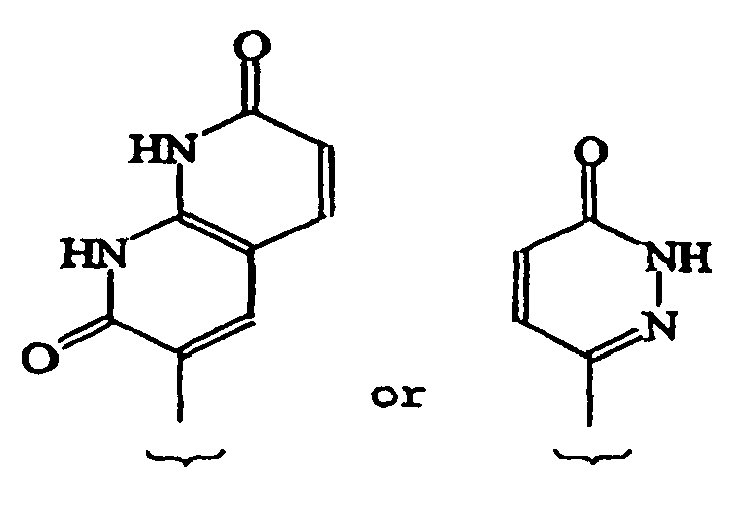
- In other preferred embodiments adenosine-thymidine nucleobase pair recognition moieties have the formula:

wherein
Q is CH or N;
R17 is H or C1-C8 alkyl;
each R11 and R12 is, independently, H, C1-C8 alkyl, or halogen;
or R11 and R12 together with the carbon atoms to which they are attached form a phenyl group. - In another preferred embodiment, the tether connecting the adenosine-thymidine nucleobase pair recognition moiety, A in Formula V or T in Formula II, is -CH2-CH2-NH-,
-CH2-, -CH2-CH2-, -O-CH2-CH2-, or -O-CH2-CH2-CH2-. - In particularly preferred embodiments, monomers of the present invention have the formula V:

L has the formula:
Q is CH or N;
R17 is H or C1-C8 alkyl;
each R11 and R12 is, independently, H, C1-C8 alkyl, or halogen;
or R11 and R12 together with the carbon atoms to which they are attached form a phenyl group;
A is a single bond, a methylene group or a group of formula:
where: - X is O, S, Se, NR3, CH2 or C (CH3)2;
- Y is a single bond, O, S or NR4;
- each p, q, r and s is, independently, zero or an integer from 1 to 5;
- each R1 and R2 is, independently, selected from the group consisting of hydrogen, (C1-C4)alkyl which may be hydroxy- or alkoxy- or alkylthio-substituted, hydroxy, alkoxy, alkylthio, amino and halogen;
- each R3 and R4 is, independently, selected from the group consisting of hydrogen, (C1-C4)alkyl, hydroxy- or alkoxy- or alkylthio-substituted (C1-C4) alkyl, hydroxy, alkoxy, alkylthio and amino;
- R15 is OH, a-protected hydroxyl group, or a protecting group; and
- R16 is H or a protecting group.
- The PNA oligomers and linked PNA oligomers of the present invention are useful for forming PNA2/DNA triple helix structures. Preferred embodiments of the compounds of the invention include triple helix (i.e., triplex) PNA·DNA-PNA structures in which at least one of the PNA strands contains at least one monomer moiety in accordance with Formula II. In more preferred embodiments the two PNA oligomers in the PNA·DNA-PNA are constituent members of a bis-PNA; i.e., the two PNA oligomers are linked together by one or more linking moieties ("linking groups").
- Linking moieties that link PNA oligomers in compounds of the invention are selected such that the PNA oligomers have sufficient freedom to permit formation of the triplex structure. A variety of groups can be used as linking moieties, for example "egl groups" (ethylene glycol) and "Aha groups" (6-amino hexanoic acid) linked together by amino acid groups. A further linking segment includes the above Aha groups interspaced with α-amino acids particularly glycine or lysine. One especially preferred linking moiety is one or more 8-amino-3,6-dioxaoctanoic acid residues which, effectively gives upon coupling, "multiple ethylene glycol units" ("egl").
- A wide range of other compounds are also useful for the linking segment and thus are included within the scope of the present invention. Generally the linking segment is a compound having a primary amino group and a carboxy group separated with a space spanning group, wherein the space spanning group consists of one or more functional groups. Some representative space spanning groups are C1 to C20 alkyl, C2 to C20 alkenyl, C2 to C20 alkynyl, C1 to C20 alkanoyl having at least one O or S atom, C7 to C34 aralkyl, C6-C14 aryl and amino acids. Preferred alkanoyl groups can have from 1 to 10 hetero atoms such as O or S. Preferred alkanoyl groups include methyl, ethyl and propyl alkanoxy particularly polyethoxy, i.e., ethylene glycol. Amino acids including D, L, and DL isomers of α-amino acids as well as longer chain amino acids may also be linked together to form a linking segment. A particularly preferred amino acid is 6-amino hexanoic acid. Aralkyl groups used as space spanning groups may have the amino or the carboxy group located on the aromatic ring or spaced with one or more CH2 groups wherein the total number of CH2 groups is less than or equal to twenty. The position of substitution in an aralkyl linked PNA may be varied; however, ortho and meta are presently preferred because substitution at these positions, especially ortho, induce the bis PNA to be bent, thus facilitating location of the two joined peptide nucleic acid strands in spacial locations parallel to one another. Another group of bis PNAs that include induced bends are those that incorporate cis-alkenyl linkers or a proline linker.
- In selecting a linking segment, one consideration is compatibility with PNA chemistry, and the ability to link a functional group on one end of a PNA to a functional group on one end of a second PNA. Also, the linking segment can be selected so as to be flexible, such that the two linked PNAs are able to interact with ssDNA, ssRNA or dsDNA in similar fashion to the way that two independent PNA single strands would so interact. Some preferred linking segments that have been shown to be effective have lengths of 23 and 24 atoms.
- The term "complementary" as used herein has its accustomed meaning as the ability to form either Watson-Crick or Hoogsteen bonds within a nucleic acid (RNA or DNA) duplex, a PNA-nucleic acid duplex, a triplex structure including nucleic acid, PNA, or mixtures thereof.
- In the PNA2/DNA compounds of the invention, PNA oligomers are typically prepared as Watson-Crick anti-parallel strands, and additional PNA oligomers are prepared as parallel (e.g. Hoogsteen) strands. In one preferred embodiment, the PNA monomers of the invention are used in the Hoogsteen strand in positions that are complementary to thymine or uracil in the target nucleic acid to increase the binding of the Hoogsteen strand, and hence increase the melting temperature (Tm) of the resulting triple helix that is formed.
- As used herein, the term "binding affinity" refers to the ability of a duplex to bind to a target molecule via hydrogen bonds, van der Waals interactions, hydrophobic interactions, or otherwise. Target molecules include single stranded DNA or RNA, as well as duplexes between DNA, RNA, and their analogs such as PNA.
- As used herein, the term "nucleobase" has its accustomed meaning as a heterocyclic base that is capable of participating in Watson-Crick or Hoogsteen bonds in nucleic acid duplex or triplex structures. These include the natural nucleobases adenine, guanine, cytosine, thymine and uracil, as well as unnatural nucleobases (i.e., nucleobase analogs) that are known to mimic the function of the natural nucleobases in DNA or RNA analogs. Representative nucleobase analogs can be found in, for example, Antisense Research and Application, Ed. S. T. Crooke and B. Lebleu, Chapter 15, CRC Press, 1993, and U.S. Patent No. 3,687,808 to Merigan, et al.
- In some preferred embodiments, the PNA oligomers of the present invention form triple helix structures with nucleic acid targets wherein the PNA oligomer has an increased binding affinity relative to previously reported PNA oligomers. The PNA oligomers and linked PNA oligomers having PNA monomer moieties of Formula II and IV in positions complementary to thymine or uracil in a nucleic acid target show increased binding specificity relative to the same triplex structure formed with linked PNA oligomers having adenine in positions that are complementary to thymine or uracil(see Example 5, infra).
- Thus, the PNA oligomers and linked PNA oligomers of the invention find-use in applications where it is desired to detect or identify oligonucleotide sequences containing thymidine residues. Accordingly, the PNA oligomers of the present invention are useful as research reagents and as diagnostic tools. In one preferred embodiment, the oligomers and linked oligomers of the invention are useful for the detection of nucleic acid sequences suspected of being implicated in a disease state, which contain one or more thymine residues. Accordingly, the present invention includes triplex structures containing nucleic acid sequences suspected of being implicated in a disease state, and at least one PNA oligomer of the invention.
- In some preferred embodiments, compositions of the invention including single stranded DNA coding for a sequence suspected of being implicated in a disease state and containing one or more thymine residues; a first peptide nucleic acid that comprises a region that is complementary to a region of the single stranded nucleic acid; and a second peptide nucleic acid comprising a sequence that is complementary to a region of the single stranded nucleic acid, the peptide nucleic acid oligomer having at one or more positions complementary to the thymine residues of the single stranded nucleic acid a residue of Formula II.
- The present invention also provides methods for forming a triple helix compound comprising (a) selecting a single stranded nucleic acid containing one or more thymine residues; (b) providing a first oligomer that comprises a region that is complementary to a region of the single stranded nucleic acid; (c) contacting the single stranded nucleic acid and the first oligomer with a second oligomer, wherein the second oligomer comprises a sequence that is complementary to a region of the single stranded nucleic acid, and has at one or more positions complementary to the thymine residues of the single stranded nucleic acid a residue of Formula II for a time and under conditions effective to form the-triple helix compound.
- In some preferred embodiments, the single stranded nucleic acid will be selected for its biological activity, such as its pathogenic properties. The first oligomer will be then be synthesized to include a region that is complementary to a region of the single stranded nucleic acid, preferably a region with more than one thymine residue. The contacting of the single stranded nucleic acid and the first oligomer with the second oligomer may be accomplished by a variety of means, known in the art, that promotes triplex formation. See for example. United States Patent 6,228,982 for in vitro determination of a nucleic acid in a sample which may be made by pipetting one or more solutions containing said first and second oligomer as well as optionally all reagents necessary for effective triplex formation to the sample.
- In preferred embodiments, methods are provided for the detection of a chemical or microbiological entity which contains a known nucleobase sequence comprising a) selecting a nucleobase sequence from the chemical or microbiological entity which contains one or more thymine residues; b) providing a PNA oligomer that contains a region that is complementary to the selected nucleobase sequence; c) contacting the selected nucleobase sequence of the chemical or microbiological entity and the complementary PNA oligomer with a further PNA oligomer which contains a sequence that is complementary to the selected nucleobase sequence, wherein the further PNA oligomer has at one or more positions complementary to the thymine residues of the selected nucleobase sequence a residue of Formula II to form a triple helix compound; and d) detecting the triple helix compound.
- Detection of the triple helix compound can be accomplished by detection of a reporter molecule, such as a chromophore or fluorophore, that is bound covalently or non-covalently to the compound of the invention as described above. Useful conjugates are described in WO 95/14708, WO 95/16202 and WO 92/20703. Alternatively, detection may be by any of several means, including Tm studies, mass measurements and crosslinking studies.
- The further PNA oligomer can alternatively have attached a moiety enabling immobilization on a solid support, such as polystyrene. One example of such a moiety is biotin which can be bound to polystyrene via a coating of streptavidine. Formation of the triple helical structure can then be accomplished by labels attached to either the other PNA oligomer or to the nucleobase sequence a chemical entity.
- Chemical entities are understood to include chemically synthesized oligomers and chemically or enzymatically (for example via PCR) amplified nucleobase sequences containing compounds. Microbiological entities in connection with this invention are understood to include cells, for example from animals, vertebrates, bacterial or plants, or viruses, like HIV or HBV, plasmids or genomes.
- In these analytical methods, the formation of the triplex structure having the further PNA oligomer incorporated is taken as an indication of the presence of the entity in the sample analyzed, for example the sample containing the chemical or microbiological entity.
- The present invention also provides methods for sequence-specific recognition of a double-stranded polynucleotide, comprising contacting said polynucleotide with a compound of Formula II.
- The present invention further provides methods for sequence-specific recognition of a double-stranded polynucleotide, comprising contacting the polynucleotide with an oligomeric compound that binds to the polynucleotide to form a triplex structure, the oligomeric compound comprising a monomeric unit having the Formula II.
- Additional advantages and novel features of this invention will become apparent to those skilled in the art upon examination of the examples thereof provided below, which should not be construed as limiting the appended claims.
- The synthesis of Compounds II through V are summarized in Scheme 1 below:

- To a solution of 3,6-dichloropyridazine (50.0 mmol, 7.45 g) and 3-aminopropionic acid (60.0 mmol, 5.34 g) in absolute ethanol (20 mL) was added potassium carbonate (30.0 mmol, 4.15 g), and the suspension was heated to reflux for 3 hours. The mixture was allowed to cool to room temperature, and the light brown solid residue was partitioned between ethyl acetate (300 mL) and water (300 mL). The pH of the aqueous phase was adjusted to 3.5 with 2M aqueous hydrochloric acid, and the yellow solid was filtered and washed with absolute ethanol (10 mL) and diethyl ether (2 x 20 mL) to give 5.04 g(50%). The product was pure according to TLC Rf 0.31 (dichloromethane/methanol/acetic acid, 85:10:5).
- Mp 217-218 °C (decomposed); 1H NMR (DMSO-d6): δ 12.24 (bs, 1H, COOH), 7.34 (d, J = 9.0 Hz, 1H, aromatic), 7.22 (m, 1H, NH), 6.92 (d, J = 9.0 Hz, 1H, aromatic), 3.51 (q, J = 6.6 Hz, 2H, (CH2)N), 2.63 (t, J = 6.6 Hz, 2H, (CH2) C (O)). 13C NMR (DMSO-d6) : δ 173.08, 158.18, 145.31, 128.59, 118.58, 36.99, 33.34.
- Sodium hydride (22.0 mmol, 0.88 g) was dissolved in benzyl alcohol (10 mL). To the resulting solution was added N-(3-chloropyridazin-6-yl)-3-aminopropionic acid (10.0 mmol, 2.01 g), and the mixture was heated to about 165 °C (oil bath 180 °C) for 3 hours. After cooling to room temperature, water (120 mL) was added, and the aqueous phase was extracted with dichloromethane (3 x 50 mL). The pH was adjusted to 4.0 with 2M aqueous hydrochloric acid. The light brown precipitate was filtered, washed with water (2 x 1 mL) and dried over phosphorus pentoxide. The resulting solid was dried to give 1.36 g (47%) of the title compound. The product was pure according to TLC Rf 0.16 (dichloromethane/methanol/acetic acid, 85:10:5).
- Mp 258-259 °C; 1HNMR (DMSO-d6) : δ 12.21 (bs, 1H, COOH), 7.5-7.3 (m, 5H, aromatic), 6.93 (d, J = 9.3 Hz, 1H, aromatic), 6.89 (d, J = 9.3 Hz, 1H, aromatic), 6.54 (m, 1H,NH), 5.32 (s, 2H, CH2-Ph), 3.47 (t, J = 6.6 Hz, 2H, (CH2)N), 2.63 (t, J = 6.6 Hz, 2H, (CH2)C(O)); 13C NMR (DMSO-d6) : δ 173.39, 158.60, 156.07, 137.41, 128.39, 128.04, 127.80, 120.71, 119,34, 67.40, 37.25, 33.64; FAB+: 274.1 (M + 1).
- Ethyl N-(2-Boc-aminoethyl)glycinate (1.80 mmol, 444 mg) was dissolved in dimethyl formamide (12 mL), N-(3-benzyloxypyridazin-6-yl)-3-aminopropionic acid (1.98 mmol, 542 mg) and 3-hydroxy-1,2,3-benzotriazine-4(3H)-one (2.0 mmol, 326 mg) were added. The mixture was cooled in an ice bath, and N,N'-dicyclohexyl-carbodiimide (2.2 mmol, 454 mg) was added. After 1 hour, the ice bath was removed, and the mixture was stirred overnight at room temperature. The mixture was evaporated under vacuum, redissolved in dichloromethane (40 mL) and washed with 5-percent aqueous sodium bicarbonate (2 x 20 mL). Acetonitrile (10 mL) was added, and the organic phase was evaporated under vacuum. The crude product was purified on a silica column eluted with dichloromethane/methanol (97:3). Fractions containing the product were pooled and evaporated under vacuum to give 0.704 g (78%) of the title compound. The product was pure according to TLC Rf 0.41 (dichloromethane/ methanol, 90:10).
- 1H NMR (CDCl3) : δ 7.5-7.3 (m, 5H, aromatic), 6.79 (d, J = 9.3 Hz, 1H, aromatic), 6.71 (d, J = 9.3 Hz, 1H, aromatic), 5.72 (m, 1H, NH), 5.40 (s, 2H, CH2-Ph), 5.31 (m, 1H, NH), 4.19 (q, J = 7.1 Hz, 2H, CH2), 4.01 & 4.06 (s, 2H, O(CH2)-Ph), 3.78 (m, 2H, CH2), 3.50 (m, 2H, CH2), 3.26 (m, 2H, CH2), 2.76 & 2.60 (m, 2H, CH2), 1.41 & 1.39(s, 9H, Boc); 13CNMR (CDCl3) : δ 173.30 (mi.) & 173.07 (ma.), 170.01, 169.50, 159.34, 155.99 (mi) & 155.70 (ma.), 137.05, 128.40, 128.18, 127.89, 120.70, 119.94, 79.42, 68.37 (ma.) & 68.27 (mi.), 61.76 (mi.) & 61.36 (ma.), 50.49 (mi.) & 49.24 (ma.), 48.75 (ma.) & 47.60 (mi.), 38.96 (ma.) & 38.77 (mi.), 37.80 (mi.) & 37.50 (ma.), 32.05 (mi.) & 31.93 (ma.), 28.36, 14.11; FAB+: 502.3 (M + 1).
- Ethyl N-(2-Boc-aminoethyl)-N-[N'-((3-benzyloxy)pyridazine-6-yl)-3-aminopropionyl]glycinate (0.88 mmol, 440 mg) was suspended in tetrahydrofuran (4.25 mL). The suspension was cooled, and 1M aqueous lithium hydroxide (2.5 mL) was added. After 30 minutes, dichloromethane (6 mL) was added, and the organic phase was extracted with water (6 mL). The pH of the aqueous phase was adjusted to 4.0 by the dropwise addition 2M aqueous hydrochloric acid, and the aqueous phase was extracted with dichloroethane (6 mL). The organic phase was evaporated under vacuum, and redissolved in absolute ethanol (30 mL), and a palladium/carbon catalyst (240 mg) was added. The mixture was hydrogenated for 2 hours and the catalyst was filtered off. The resulting solution was concentrated under reduced pressure then dried under high vacuum to give 333 mg (80%) of the title compound. The product was pure according to TLC Rf 0.07 (dichloromethane/methanol, 80:20).
- 1H NMR (acetone-d6) : δ 7.09 (d, J = 9.9 Hz, 1H, aromatic), 6.75 (d, J = 9.9 Hz, 1H, aromatic), 6.22 & 6.06 (m, 1H, NH), 5.75 (m, 1H, NH), 4.23 & 4.10 (m, 2H, CH2), 3.46 (m, 2H, CH2), 3.28 & 3.23 (m, 2H, CH2), 2.78 & 2.58 (m, 2H, CH2), 1.39 & 1.38 (s, 9H, Boc); FAB+: 384.1 (M + 1) .
- The synthesis of PNA oligomers including bis-PNA were carried out as illustrated in Egholm, et al., J. Am. Chem. Soc., 1992, 114, 1895-1897 & 9677-9678 also see published PCT Application WO 96/02558 entitled Linked Peptide Nucleic Acids.
- To determine the specificity for thymidine in an oligodeoxynucleotide by a PNA oligomer having a 3-oxo-2,3-dihydropyridazine group, a 16-mer oligodeoxynucleotide containing a 10-mer target sequence was prepared and treated with three bis-PNA's having varying groups at two positions of the Hoogsteen strand. The bis-PNA's were prepared having two 10-mer PNA's joined via three consecutive 8-amino-3,6-dioxaoctanoic acid groups. The two 10-mers were joined anti-parallel as shown below. Positions that would normally have a protonated cytosine (as determined by the target sequence) in the Hoogsteen strand are occupied by pseudoisocytosine (J).

- The three bis-PNA's differed only with respect to the groups designated by the variable X in the figure above. The binding of each bis-PNA was measured on a solution ca. 3 µM in PNA and DNA at pH 7.0 in 100 mM NaCl, 10 mM sodium phosphate, 0.1 mM EDTA. Absorption at 260 nm were recorded with 0.5 °C intervals from 5-90 °C.
SEQ ID No. Oligonucleotide target sequence 1 5'-dCGC AGA TAG TAA ACG C -3' SEQ ID No. Bis-PNA (Tm in °C) 2 X = 3-oxo-2,3-dihydropyridazine (57.0) 3 X = N-acetyl-N-(2-aminoethyl)glycine (47.5) 7 X = Guanine (46.0) - The N-acetyl-N-(2-aminoethyl)glycine group is a null position having no base attached to the backbone. The N-acetyl-N-(2-aminoethyl)glycine group cannot stack or form hydrogen bonds to thymine. Guanine was used as a comparison as it has been reported that guanine interacts with thymine (T) to form fairly stable G:T-A triplets in DNA triple helices (see Best, et al., J. Am. Chem. Soc., 1995, 117, 1187-1193.
- The increased Tm is believed to be due to the increased specificity for the thymidine by the 3-oxo-2,3-dihydropyridazine. The increase is considerably higher than that of guanine.
- The synthesis of PNA oligomers including bis-PNA were carried out as illustrated in Egholm, et al., J. Am. Chem. Soc., 1992, 114, 1895-1897 & 9677-9678 also see published PCT Application WO 96/02558 entitled Linked Peptide Nucleic Acids.
- To determine the specificity for cytidine in an oligodeoxynucleotide by a PNA oligomer having a 3-oxo-2,3-dihydropyridazine group, a 16-mer oligodeoxynucleotide containing a 10-mer target sequence was prepared and treated with three bis-PNA's having varying groups at two positions of the Hoogsteen strand. The bis-PNA's were prepared having two 10-mer PNA's joined via three consecutive 8-amino-3,6-dioxaoctanoic acid (egl) groups. The two 10-mers were joined in anti-parallel orientation as shown below. Positions that would normally have a protonated cytosine (as determined by the target sequence) in the Hoogsteen strand are occupied by pseudoisocytosine (represented as "J").

- The three bis-PNA's differed only with respect to the groups designated by the variable X in the structure shown above. The binding of each bis-PNA was measured on a solution ca. 3 µM in PNA and DNA at pH 7.0 in 100 mM NaCl, 10 mM sodium phosphate, 0.1 mM EDTA. Absorption at 260 nm were recorded with 0.5 °C intervals from 5-90 °C.
SEQ ID No. Oligonucleotide target sequence 5 5'-dCGC AGA CAG CAA ACG C -3' SEQ ID No. Bis-PNA (Tm in °C) 6 X = 3-oxo-2,3-dihydropyridazine (42.0; 48.0) 7 X = N-acetyl-N-(2-aminoethyl)glycine (62.0) 8 X = Cytidine (61.5) - The N-acetyl-N-(2-aminoethyl)glycine group is a null position having no base attached to the backbone. The N-acetyl-N-(2-aminoethyl)glycine group cannot stack or form hydrogen bonds to cytidine.
- The 3-oxo-2,3-dihydropyridazine was incorporated next to the C-G base pair and compared to a null group and to a cytidine group to see if the increased specificity seen with thymidine (57 °C vs. 47 °C for the null base, Example 5) is seen for cytidine. The effect with cytidine as seen by the large drop in the Tm was destabilizing for the triplex structure. The null base (X = N-acetyl-N-(2-aminoethyl)glycine) and the guanidine group show about the same effect; neither appear to be significantly stabilizing or destabilizing relative to the other.
- The binding of a bis PNA (SEQ ID No. 2, Example 5) to 8 different oligodeoxynucleotide target sequences was measured following the procedures illustrated in Example 5. The positions on the oligodeoxynucleotide target sequences that are complementary the two 3-oxo-2,3-dihydropyridazine (hereinafter "ODHP") groups are varied in order to see the effect of a mismatch on the specificity. The target sequences and the resulting Tm's of the triple helix structures formed are shown below.
SEQ ID No. Oligodeoxynucleotide target Tm(°C) 9 5'-dCGC AGA TAG TAA ACG C-3' 57.0 10 5'-dCGC AGA AAG TAA ACG C-3' 45.0 11 5'-dCGC AGA GAG TAA ACG C-3' 40.0 12 5'-dCGC AGA CAG TAA ACG C-3' 40.0 13 5'-dCGC AGA UAG UAA ACG C-3' 63.5 14 5'-dCGC AGA AAG UAA ACG C-3' 49.5 15 5'-dCGC AGA GAG UAA ACG C-3' 44.5 16 5'-dCGC AGA CAG UAA ACG C-3' 44.5 - The formation of the ODHP·T-A triplet proved to be highly specific, as indicated by the dramatic decrease in thermal stability when ODHP was positioned opposite to either adenine, guanine or cytosine. The differences in melt temperatures per mismatch (δ Tm per mismatch) relative to thymine (T) control were 12 °C for A; 16.5 °C for G; and 12.0 °C for C. The increased Tm with SEQ ID # 13 (which has uracil at both variable positions) is believed to reflect interference from the methyl group present in thymine.
- The binding of SEQ ID No. 6 to four different oligodeoxynucleotide target sequences was measured according to the procedures described in Example 5. The positions on the oligodeoxynucleotide target sequences that are complementary to the two 3-oxo-2,3-dihydropyridazine groups were varied in order to see the effect of a mismatch on the specificity. The target sequences and the resulting Tm's of the triple helix structures formed are shown below.
SEQ ID No. Oligodeoxynucleotide target Tm(°C) 17 5'-dCGC AGA CAG CAA ACG C-3' 42.0;48.0 18 5'-dCGC AGA AAG CAA ACG C-3' 50.0 19 5'-dCGC AGA GAG CAA ACG C-3' 50.0 20 5'-dCGC AGA TAG CAA ACG C-3' 51.0 - When the 3-oxo-2,3-dihydropyridazine groups are interacting with C-G base pairs there is a strong destabilizing effect as seen by the Tm. This effect is not seen with either the null base, or with the cytidine group in the position complementary to the C-G base pair.
- The syntheses of monomer synthons having the formulas VI-VIII (Examples 9-17) is shown below:


- To a solution of THF (30 mL) and LDA (24.4 mmol), cooled to -78 °C, was slowly added a solution of di-t-butyl succinate (5.60 g) in THF (4.0 mL). After 15 minutes 3-carbaldehyde-2-pivaloylaminopyridine (2.37 g) dissolved in THF (7 mL) was added. The clear yellow solution was stirred at -78 °C for 15 minutes and then allowed to warm to room temperature. The solution was then poured into saturated aqueous ammonium chloride (200 mL) and extracted with dichloromethane (2 x 100 mL). The organic phase was dried (Na2SO4) and evaporated in vacuo. A solution of the diastereomeric alcohols in a 3:1 mixture of 3M aqueous HCl:THF was heated to reflux for 24 hours. After cooling to room temperature the pH was adjusted to 4 and the resulting solid filtered and dried under vacuum to give 1.52g (65%) of the title compound as a tan colored material.
- 1H NMR (DMSO-d6): δ 12.19 (bs, 1H, NH), 8.48 (dd, j=4.8, 1.8, 1H), 8.09 (dd, j=7.7, 1.8, 1H), 7.86 (s, 1H), 7.24 (dd, 7.7, 4.7, 1H), 3.48 (s, 2H).
- Methyl N-(2-Boc-aminoethyl)glycinate (4.50 mmol) was dissolved in DMF (20 mL) and [1,8]napthyridin-2(1H)-one 3-acetic acid (1.02g, 5.00 mmol), HOAt (0.68 mL, 5.00 mmol) and DIEA (0.871 mL, 5.0 mmol) were added. After cooling to 0 °C DCC (1.13g, 5.5 mmol) was added. After 1 hour the ice bath was removed and the mixture was stirred overnight at room temperature. The mixture was evaporated in vacuo, redissolved in ethyl acetate (150 mL) and washed with saturated aqueous NaHCO3 (2 x 50 mL) followed by water (50 mL). The organic phase was dried (MgSO4) and evaporated in vacuo. The crude product was purified on a silica column eluted with dichloromethane/methanol (9:1, v/v). Fractions containing product were pooled and evaporated in vacuo to give 1.09g (58%) of the title compound as a tan solid.
- 1H NMR (DMSO-d6): δ 12.18 (bs, 1H, NH), 8.49-8.47 (m, 1H, aromatic), 7.79-7.76 (s, 1H, aromatic), 7.25-7.22 (m, 1H, aromatic), 6.91-6.75 (t, 1H, NH), 4.37-4.06 (s, 2H, CH2), 3.67-3.48 (s, 2H, CH2), 3.64 (s, 3H, CH3O), 3.49-3.46 (m, 2H, CH2), 3.20-3.15 (M, 2H, CH2), 1.36-1.35 (s, 9H, CH3, (Boc)). 13C NMR (DMSO-D6) : δ 170.32 (170.54), 170.10, 162.61, 155.83, 149.86, 149.31, 136.52 (136.83), 135.87 (135.99), 129.94 (129.64), 118.46, 114.44, 78.05 (77.81), 51.83 (52.21), 48.19, 47.64 (46.69), 38.46 (38.00), 33.49 (33.82), 28.28. FAB+ MS: 419.22 (M+H+, calc. For C20H26N4O6+H+ 419.19).
- To a solution of methyl N-(2-Boc-aminoethyl)-N-([1,8]napthyridin-2(1H)-on-3-yl)acetyl)glycinate was added 2M aqueous LiOH (6.0 mL, 12.0 mmol). After 20 minutes at room temperature additional water (15 mL) was added and the THF was removed in vacuo. The pH of the aqueous phase was adjusted to 3.0 by addition of 2M HCl. The precipitate was filtered off, washed with water (2 x 10 mL) and dried in vacuo to give 852 mg (88%) of the title compound as a colorless powder.
- 1H NMR (DMSO-d6): δ 12.67 (bs, 1H, COOH), 12.20 (BS, 1H, NH), 8.49-8.46 (m, 1H, aromatic), 7.82-7.76 (s, 1H, aromatic), 7.26-7.22 (m, 1H, aromatic), 6.91-6.74 (t, 1H, NH), 4.25-3.98 (s, 2H, CH2), 3.61-3.47 (s, 2H, CH2), 3.47-3.40 (m, 2H, CH2), 3.22-3.02 (m, 2H, CH2), 1.36-1.35 (s, 9H, CH3, (BoC)). 13C NMR (DMSO-D6): δ 172.58 (172.38), 170.50 (170.14), 162.70, 156.71, 155.75, 155.02, 153.29, 149.89, 136.08, 128.54,128.20, 128.00, 9391, 77.95, 66.49, 52.18 (51.70), 49.65 (49.32), 47.59 (47.37), 33.42, 31.80 (31.42), 28.24 (28.06), 25.40 (24.53), 21.66. FAB+ MS: 405.18 (M+H+, calc. For C19H24N4O6+H+ 405.18).
- To a solution of 2-pivaloylaminoquinoline (5.00 g, 21.92 mmol) in THF (75 mL) at -78 °C was added dropwise BuLi (5.48 mL, 10 M in hexane, 54.80 mmol). After 2 hours at -78 °C the dianion was quenched by the addition of N-formylmorpholine (3.79 g, 37.88 mmol). The reaction mixture was allowed to warm to room temperature and poured into 2M aqueous HCl (20 mL). The pH of the aqueous phase was adjusted to 7.0 by addition of 2M HCl and the aqueous phase was diluted with water (100 mL) and extracted with diethyl ether (2 x 100 mL). The organic phase was dried (MgSO4) and evaporated to dryness in vacuo. The crude product was recrystallized from petrol ether/ethyl acetate to give 2.92g (52%) of the title compound.
- 1H NMR (DMSO-d6): δ 10.70 (bs, 1H, NH), 9.82 (s, 1H, CHO), 8.85 (s, 1H, aromatic), 8.19-8.17 (m, 1H, aromatic), 7.97-7.95 (m, 1H, aromatic), 7.91-7.87 (m, 1H, aromatic), 7.76-7.62 (m, 1H, aromatic), 1.30 (s, 9H, CH3). 13C NMR (DMSO-D6): δ 189.62, 189.55, 178.37, 149.66, 148.15, 140.33, 132.77, 129.82, 127.51, 126.59, 125.48, 123.64, 26.97. FAB+ MS: 257.05 (M+1, calc. For C15H16N2O2+H+ 257.13) and 279.04 (M+Na+, calc. for C15H16N2O2+Na+ 279.11).
- To a solution of THF (15 mL) and LDA (2M in THF, 15.9 mmol, 7.95 mL), cooled to -78 °C, was slowly added a solution of di-t-butyl succinate (15.9 mmol, 3.28 g) in THF (3.0 mL). After 15 minutes at -78 °C 3-Formyl-2-pivaloylaminoquinoline (1.92 g, 7.50 mmol) dissolved in THF (10 mL) was added. The clear yellow solution was stirred at -78 °C for 15 minutes and then allowed to warm to room temperature. The solution was poured into saturated aqueous ammonium chloride (200 mL) and extracted with dichloromethane (2 x 100 mL). The organic phase was dried (MgSO4) and evaporated in vacuo. The crude product of diastereomeric alcohols was heated to reflux for 24 hours in a mixture of THF (5 mL) and HCl (3M, aqueous) and then poured into water (100 mL) and neutralized with K2CO3. The tan precipitate was washed with water (2 x 25 mL) and dried in vacuo overnight. The crude product (1.60 g) was heated in acetonitrile (50 mL) and filtered while hot. The product was washed with ether (2 x 25 mL) and dried in vacuo to give 1.50g (79%) of a material judged to be 61% pure according to HPLC (260 nm).
- Methyl N-(2-Boc-aminoethyl)glycinate (0.812 g, 3.5 mmol) was dissolved in DMF (10 mL) and benzo[b][1,8]napthyridin-2(1H)-one 3 acetic acid (883 mg, 3.5 mmol) was added. The mixture was cooled in an ice bath and HBTU (1.52g, 4.0 mmol) was added. After 1 hour the ice bath was removed and the mixture was stirred overnight at room temperature. The mixture was evaporated in vacuo, redissolved in dichloromethane (100 mL) and washed with saturated aqueous NaHCO3 (2 x 50 mL). The organic phase was dried (MgSO4) and evaporated in vacuo. The crude product was purified on a silica column eluted with dichloromethane/methanol (97:3, v/v). Fractions containing the product were pooled and evaporated in vacuo to give 345mg (21%) of the title compound as a tan solid.
- 1H NMR (DMSO-d6) : δ 12.13 (bs, 1H, NH), 8.70-8.65 (m, 1H, aromatic), 7.91 (s, 1H, aromatic), 7.88 (s, 1H, aromatic), 7.79-7.75 (m, 1H, aromatic), 7.55-7.49 (m, 1H, aromatic), 6.90-6.72 (bs, 1H, NH), 4.36-4.05 (s, 2H, CH2), 4.11 (q, J=, 2H, CH2), 3.67-3.33 (s, 2H, CH2), 3.48-3.53 (m, 2H, CH2), 3.27-3.04 (m, 2H, CH2), 1.35 (s, 9H, CH3 (Boc)). 13C NMR (DMSO-D6) : δ170.17 (170.32), 170.01 (170.39), 163.08 (163.17), 155.75 (155.63), 148.67, 147.02, 136.20 (136.46), 136.07 (136.13), 131.17, 130.16 (129.88), 128.67, 126.90, 124.85 (124.67), 115.67 (115.63), 78.00 (77.76), 51.81 (52.20), 48.18 (48.38), 47.63, 38.43 (38.29), 33.56 (33.87), 28.26. FAB+ MS: 469.10 (M+H+, calc. For C24H28N4O6+H+ 469.21).
- To a solution of Methyl N-(benzo[b][1,8]napthyridin-2(1H)-one 3-yl)-N-(2-Boc-aminoethyl)glycinate (0.426 mmol, 200 mg) in THF (4.0 mL) was added 2M aqueous (1.07 mL, 2.14 mmol). After 15 minutes at room temperature additional water (7.0 mL) was added and the THF was removed in vacuo. The aqueous phase was extracted with dichloromethane (2 x 2 mL) and the pH was adjusted to 3.0 by the addition of 2M aqueous HCl. The precipitate formed was filtered off, washed with water (2 x 5 mL) and dried in vacuo to give 176 mg (91%) of the title compound as a tan powder.
- FAB- MS: 453.42 (M-H+, calc. For C34H26N4O6-H+ 453.18).
- Ethyl N-(2-Boc-aminoethyl)glycinate (443 mg, 1.8 mmol) was dissolved in DMF (10 mL) and quinolin-2(1H)-one-3-acetic acid (prepared as per the procedure of Shanmugam, P., Naturforsch, 1973, 196, 551-553) (406 mg, 2.0 mmol) and HOAt (272 mg, 2.0 mmol) was added. The mixture was cooled on ice and DCC (413 g, 2.0 mmol) was added. After 1 hour the ice bath was removed and the mixture was stirred overnight at room temperature. The mixture was evaporated in vacuo, redissolved in ethyl acetate (100 mL) and washed with saturated aqueous NaHCO3 (2 x 30 mL) followed by water (30 mL). The organic phase was dried (MgSO4) and evaporated in vacuo. The crude product was purified on a silica column eluted with dichloromethane/methanol (9:1, v/v). Fractions containing the product were pooled and evaporated in vacuo to give 476 mg (60%) of the title compound as a tan solid.
- To a solution of methyl N-(2-Boc-aminoethyl)-N-(quinolin-2(1H)-on-3-yl)acetyl)glycinate (427mg, 0.99 mmol) in THF (10 mL) was added 2M aqueous LiOH (2.5 mL, 5 mmol). After 20 minutes at room temperature additional water (10 mL) was added. The THF was evaporated in vacuo and 2M aqueous HC1 (2.5 mL) was added with vigorous stirring. The precipitate was filtered off, washed with water (2 x 10 mL) and dried in vacuo to give 280 mg (74%) of the title compound as a colorless powder.
- 1H NMR (DMSO-d6): δ 11.77 (bs, 1H, NH), 781(7.74)(s, 1H, aromatic), 7.64-7.13 (m, 4H, aromatic), 6.95-6.65 (m, 1H, NH), 3.98(4.25)(s, 2H, CH2), 3.59(3.45)3.30-3.00 (m, 4H, 2xCH2), 1.37(1.35)(s, 9H, CH3(Boc)).
- 2-Hydroxy-10-H-pyrimido[5,4-b][1,4]benzothiazin (653mg, 3.0 mmol) was suspended in DMF (30 mL) and NaH (60% in mineral oil, 132mg, 3.3 mmol) was added in one portion. After 15 minutes ethyl N-bromoacetyl-N-(2-Boc-aminoethyl)-glycinate (1.10g, 3.3 mmol) was added. The mixture was stirred at room temperature for 2 hours, evaporated in vacuo, redissolved in dichloromethane (200 mL) and washed once with saturated aqueous NaHCO3 (100 mL) and once with saturated aqueous NaCl. The mixture was dried (MgSO4) and evaporated to dryness in vacuo. The crude material was purified on a silica gel column using methanol/dichloromethane (1:9, v/v) as the eluent to give 853 mg (57%) of the title compound.
- 1H NMR (DMSO-d6): δ 10.37 (bs, 1H, NH), 7.51 (s, 1H, H-6), 7.09-7.05 (m, 2H, aromatic), 6.94-6.75 (m, 3H, aromatic + NH), 4.66-4.48 (s, 2H, CH2), 4.30-4.04 (s, 2H, CH2), 4.18-4.08 (q, 2H, CH2), 3.41 (m, 2H, CH2), 3.20-3.03 (m, 2H, CH2), 1.38-1.37 (s, 9H, CH3(Boc)), 1.24-1.18 (t, 3H, CH3). 13C NMR (DMSO-D6): δ 169.44+169.09, 167.87+167.58, 160.15, 155.82, 154.58, 141.23, 136.50, 127.49, 126.09, 124.01, 116.97, 115.83+115.76, 93.39, 78.13+77.85, 61.22+60.61, 49.26+49.02, 48.01, 47.09, 38.33, 28.25, 14.109. FAB+ MS: 503.18 (M+H+, calc. For C23H29N5O6S+H+ 504.19).
- Ethyl N-[(2-hydroxy-10-H-pyrimido[5,4-b][1,4]-benzothiazin-1-yl)acetyl]-N-(2-Boc-aminoethyl)glycinate (201 mg, 0.4 mmol) was dissolved in THF (10 mL) and LiOH (2M, aqueous, 1.0 mL) was added. After 15 minutes at room temperature water (10 mL) was added, the THF was evaporated in vacuo and HCl (2M, aqueous, 1.0 mL) was added with vigorous stirring. The solid yellow material was filtered off and dried in vacuo to give 173 mg (91%) of the title compound.
- 1H NMR (DMSO-d6) : δ 10.37 (bs, 1H, NH), 7.51 (s, 1H, H-6), 7.09-7.05 (m, 2H, aromatic), 6.94-6.75 (m, 3H, aromatic + NH), 4.66-4.48 (s, 2H, CH2), 4.30-4.04 (s, 2H, CH2), 3.41 (m, 2H, CH2), 3.20-3.03 (m, 2H, CH2), 1.38-1.37 (s, 9H, CH3(Boc)). FAB+ MS: 476.23 (M+H+, calc. For C21H25N5O6S+H+ 476.16).
- The hybridization of PNA 10 mers having 0, 1, or 3 tricyclic N-(benzo[b][1,8]napthyridin-2(1H)-on-3-yl)acetyl)-N-(2-Boc-aminoethyl)glycine monomers (Example 15) incorporated at selected positions was measured against both PNA (SEQ ID No. 21) and DNA (SEQ ID No. 22) target sequences. The PNA sequences were prepared as illustrated in Egholm, supra.
- The three PNA's differed only with respect to the groups designated by the variable bT in Table below. The binding of each PNA was measured in a solution ca. 3 µM in PNA and DNA or PNA and PNA at pH 7.0 in 100 mM NaCl, 10 mM sodium phosphate, 0.1 mM EDTA. Absorption at 260 nm were recorded at 0.5 °C intervals from 5-90 °C.
SEQ ID No. Target sequence 21 H-AGTGATCTAC-Lys-NH2 (PNA) 22 5'-dAGTGATCTAC-3' (DNA) SEQ ID No. PNA SEQUENCE Tm (°C)
DNA/PNATm (°C)
DNA/PNA23 H-GTAGATCACT-Lys-NH2 51.0/68.5 - 24 H-GTAGA(E1)CACT-Lys-NH2 51.0/68.0 0.0/0.5 25 H-G(E1)AGA(E1)CAC(E1)-Lys-NH2 59.0/68.0 8.0/0.5 - Each variable (E1) is an incorporated N-(benzo[b][1,8]napthyridin-2(1H)-on-3-yl)acetyl)-N-(2-Boc-aminoethyl)glycine monomer. The effect of N-(benzo[b][1,8]napthyridin-2(1H)-on-3-yl)acetyl)-N-(2-Boc-aminoethyl)glycine monomers in a PNA-PNA duplex is null, e.g. not destabilizing. The effect of the three tricyclic monomers in the PNA oligomer has a significant effect on the interaction with the DNA target resulting in an 8 °C increase in Tm.
- 3-Formyl-6-methyl-2-(pivaloylamino)pyridine and 3-Formyl-5-methyl-2-(pivaloylamino)pyridine were prepared according to Turner, J.A. J. Org. Chem. 1990, 55, 4744-4750. Methyl-N-(2-Boc-aminoethyl)glycinate was prepared according to Dueholm et al., Org. Prep. and Proc. Int., 1993, 25, 457-461. The following chemicals were used as received: butyllithium (2.5 M in hexanes, Aldrich 23,071-5), dicyclohexylcarbodiimide (DCC) (Aldrich D,000-2), diisopropylamine (Aldrich 11,001-9) and 3-hydroxy-1,2,3-benzotriazin-4(3H)-one (DhbtOH) (Aldrich 32,796-4).
- Di-tert-butyl succinate was prepared by adding succinic acid chloride (61 g, 0.40 mol) dropwise to a refluxing mixture of dimethylaniline (0,84 mol, 101 g), tert-butylalcohol (57 g, 0.75 mol) and diethyl ether (200 mL). The resulting solution was stirred under reflux for 2h and quenched by addition of water (200 mL). The organic phase was separated, extracted twice with 10 % H2SO4 (25 mL) and NaHCO3 (100 mL), dried (MgSO4) and evaporated to an oil in vacuo. Kugelrohr destillation (116°C, 16 mmHg) afforded the desired product (11 g, 22%) as a white low melting solid. 1H NMR (CDCl3) : 2.48 (s, 4H, CH2), 1.45 (s, 18H, CH3). 13C NMR (CDCl3) : 171.59, 80.50, 30.61, 28.08.
- Phosphoramidites for nucleic acid synthesis were obtained from CruaChem. TLC was performed on silica 60 (Merck 5554 aluminium sheet), column chromatograpy on silica 60 (230-400 mesh ASTM) (Merck 9385). 1H and 13C nmr spectra were obtained at either 250 MHz (Bruker AMX 250) or at 400 MHz (Varian Unity 400) in 5 mm tubes; chemical shifts are positive in the low-field direction. FAB mass spectra were recorded on a Jeol Hx110/110 mass spectrometer. All PNA oligomers were characterised MALDI-TOF mass spectroscopy recorded on a Kratos Compact MALDI II instrument operating in the positive ion mode, using 3,5-dimethoxy-4-hydroxycinnamic acid as the matrix. Tm values were obtained on a Gilford Response spectrophotometer and measured on solutions ca. 3 µM in PNA and DNA at pH 7.0 in 100 mM NaCl, 10 mM Na2HPO4, 0.1 mM EDTA; absorptions at 260 nm were recorded with 0.5°C intervals from 5-90°C. PNA oligomerization was performed as previously described in Dueholm supra. DNA oligomerization was performed according to standard protocols on a MilliGen/Biosearch 8700 DNA synthesizer. PNA sequences were prepared as illustrated in Egholm, supra.
- The preparation of the monomer synthon having the formula IX is shown below (Examples 21-39):

wherein:Monomer R11 R12 R17 E1 (bT) H H H E2 (7-Cl-bT) Cl H H E3 (6-Cl-bT) H Cl H E4 (7-CH3-bT) CH3 H H E5 (6-CH3-bT) H CH3 H E6 (5-CH3-bT) H H CH3 - Inhibition of gene expression by antisense and antigene approaches relies on efficient specific targeting of single and double strandced nucleic acids under physiological conditions. Efficient triplex targeting of dsDNA by oligonucleotides is dependent on protonation of the cytosine N3, and consequently a large number of nucleobases have been synthesized and evluated in order to eliminate this pH dependence. The most successful members of this class of nucleobases are the 5-methylcylosine, 1pseudoisocytosine2 and 8-oxoadenine. While 5-methylcytosine represents a class of mimics of cytosine where the basicity of the N3 is increased as a result of the C-5 substituent, pseudoisocytosine and 8-oxoadenine are "permanently protonised" analogues of cytosine and therefore able to form triplex structures, virtually independent of pH.
- In some preferred embodiments, the present invention provides PNA containing a 1,8-naphthridin-2,7-(I,8H)-dione nucleobase, which has an extended aromatic sruface area, as well-as the ability to mimic the function of protonated cytosine.
- In the following examples, duplex recognition properties of the 1,8-naphthyridine-2(1H)-one heterocyclic systems was assessed by incorporateion of the monomers E1-E6 into 10-mer oligomers of PNA in isolated as well as adjacent sites. Duplexes of these PNA's with DNA, PNA and RNA targets were designed as to have adenine facing the 1,8-naphthyridine-2(1H)-one units in otherwise Watson-Crick complementary PNA-DNA, PNA-PNA, or PNA-RNA oligomeric recognition systems. The thermal stability of complexes containing differently substituted 1,8-naphthyridine-2(1H)-one units was compared to that of the corresponding unsubstituted 1,8-naphthyridine-2(1H)-one and to a thymine containing control.
- The preparation of Compounds E1-6 are shown generally in Scheme 2 below:

- To a solution of 2,6-diaminopyridine (50.0 g, 0.46 mol) in dioxane (250 mL) was added slowly (1h) pivaloylchloride (27.9 g, 0.23 mol), dissolved in dioxane (50 mL). The resulting mixture was stirred for 2h and the white precipitate (2,6-diaminopyridine hydrochloride) filtered off. The organic phase was evaporated to dryness in vacuo, and the crude product recrystalized from n-hexane/ethyl acetate to give the desired product (32.83 g, 74%) as colorless crystals (mp 140-141°C). 1H NMR (DMSO-d6): δ 8.93 (s, 1H), 7.34 (t, 7.9 Hz, 1H), 7.19 (d, 7.6 Hz, 1H), 6.18 (d, 7.6 Hz, 1H), 5.75 (br. s, 2H), 1.19 (s, 9H). 13C NMR (DMSO-d6): δ 176.5, 158.5, 150.4, 138.4, 103.6, 101.5, 39.4, 27.1. FAB+MS (m/z): 193.88 M+H+, calc. for C10H15N3O+H+ 194.1293.
- To a precooled (-10°C) suspension of 6-amino-2-(pivaloylamino)pyridine (28.00 g, 0.145 mol) in conc. aqueous HCl (150 mL) was added potassium nitrite (14.81 g, 0.174 mol) dissolved in water (8 mL) over a 1.5h period. The resulting reaction mixture was stirred for 5h at -10°C under nirogen, before ajustment of the pH to 9 by addition of conc. aqueous NaOH. The aqueous solution was extracted with ethyl acetate (3x100 mL) and the organic fractions washed with 2M NaOH (3x40 mL). The organic phase was dried (MgSO4), evaporated in vacuo and recrystallised from n-hexane/ethyl acetae to give the desired product (17,70 g (58%) as a white powder (m.p. 86-87°C). 1H NMR (DMSO-d6): δ 10.08 (s br, 1H), 8.04 (d, 8.1 Hz, 1H), 7.81 (t, 8.1 Hz, 1H), 7.17 (d, 8.1 Hz, 1H), 1.22 (s, 9H). 13C NMR (DMSO-d6): δ 177.4, 152.5, 147.8, 141.4, 119.0, 112.8, 39.4, 26.8. FAB+MS (m/z): 213.06 M+H+, calc. for C10H13ClN2O+H+ 213.0795.
- To a precooled (-78°C) solution of diisopropylamine (22.03 g, 100 mmol) in diethylether (150 mL) was added BuLi (2.5 M in hexanes) (40 mL, 100 mmol), the solution was stirred at this temperature for 15 min before slow addition of di-tert-butyl succinate (10.83 g, 50.0 mmol) dissolved in diethylether (20 mL). After 20 min at -78°C, 6-chloro-3-formyl-2-(pivaloylamino)pyridine (Turner, J.A., J. Org. Chem., 1990, 55, 4744-4750) (11.32 g, 50.0 mmol) dissolved in dry THF (20 mL, LAB-SCAN C2520, dried over molecular seives) was added slowly. The yellow solution was stirred at -78°C for 30 min and then allowed to warm to rt. The solution was then poured into NH4Cl (sat., aqueous) (200 mL) and the aqueous layer was separated and extracted twice with diethylether (2x100 mL). The combined organic layers were washed once with water (100 mL) and once with brine (100 mL), dried over MgSO4 and evaporated in vacuo. The crude products of diastereomeric alcohols were dissolved in dioxane (150 mL) and HCl (3M, aqueous) (150 mL) and refluxed for 6 h. The resulting yellow precipitate was filtered off, washed once with water and once with diethylether and dried in vacuo to give the desired product as a yellow solid (10.91g, 89%). 1H NMR (DMSO-d6): δ 12.43 (s, 1H, COOH), 8.12 (d, 8.1 Hz, 1H, arom.), 7.87 (s, 1H, arom.), 7.29 (d, 8.1 Hz, 1H, arom.), 3.55 (s, 2H, CH2). 13C NMR (DMSO-d6): δ 171.7, 162.6, 149.9, 149.1, 139.3, 136.4, 129.6, 118.4, 113.5, 35.6. FAB+MS (m/z): 239.04, M+H+, calc. for C10H7ClN2O3+H+ 239.0223. Anal. calc. for C10H7ClN2O3: C 50.33, H 2.96, N 11.74. Found: C 50.49, H 2.98, N 11.96.
- (7-chloro-1,8-naphtphyridin-2(1H)-oxo-3-yl) acetic acid (0.50 g, 2.10 mmol) and DhbtOH (0.34 g, 2.10 mmol) was dissolved in dry DMF (15 mL). The mixture was cooled on ice and DCC (0.43 g, 2.10 mmol) was added and stirred for 40 min. Methyl N-(2-tert-butyloxycarbonyl)aminoethyl)glycinate (0.46 g, 2.10 mmol) dissolved in DMF (5 mL) was added.
After 1 h the ice bath was removed and the mixture was stirred overnight at rt. The mixture was evaporated in vacuo, redissolved in EtOAc (25 mL), filtered and washed with NaHCO3 (5%, aqueous) (3x25 mL) and with brine (2x25 mL). The organic phase was dried (MgSO4), filtered and evaporated in vacuo. The crude product was purified on a silica column eluted with dichloromethane/methanol (9:1 v/v). Fractions containing the product were evaporated in vacuo to yield the desired product (0.61g, 64%) as a slightly yellow solid (mp 68-69°C). 1H NMR (DMSO-d6; this compound exists as two rotamers; chemical shifts for the minor rotamer is given in brackets): δ 12.45 (br. s, 1H, NH), 8.11 (8.16) (d, 8.1 Hz, 1H, arom.), 7.79 (7.81) (s, 1H, arom.), 7.32 (d, 8.1 Hz, 1H, arom.), 6.91 (6.81) (m, 1H, NH), 4.05 (4.36) (s, 2H, CH2), 3.68 (3.67) (s, 2H, CH2), 3.64 (s, 3H, CH3O), 3.49-3.42 (m, 2H, CH2), 3.20-3.15 (3.05-3.00) (m, 2H, CH2), 1.36 (1.35) (s, 9H, CH3(Boc)). 13C NMR (DMSO-d6) : δ 170.33, 170.08, 162.39 (162.48), 155.77, 149.72, 149.04, 139.06, 135.89 (136.16), 130.29 (130.00), 118.32, 113.45, 78.01, 51.79 (52.20), 47.61 (48.15), 38.43, 33.45 (33.78), 28.25. FAB+MS (m/z): 453.1553 (M+H+, calc. for C20H25 N4O6Cl+H+ 453.1540). - Methyl N-(2-(tert-butyloxycarbonyl)-aminoethyl)-N-(7-choro-1,8-naphthyridine-2 (1H)-oxo-3-yl)acetylglycine (0.607 g, 1.34 mmol) was dissolved in THF (10 mL mL, LAB-SCAN C2520, dried over molecular seives) and LiOH (0.42C M, aqueous) (6.90 mL, 2.95 mmol) was added. After 30 min at rt. additional water (10 mL) was added and the THF was removed in vacuo. The pH of the aqueous solution was adjusted to 3.0 by addition of HCl (2M, aqueous). The white precipitate was filtered off, washed with water (2x10 mL) and dried in vacuo to to give the product (355 mg, 60%) as a slightly yellow powder (mp 176-78°C). 1H NMR (DMSO-d6; this compound exists as two rotamers; chemical shifts for th minor rotamer is given in brackets): δ 12.42 (br. s, 1, COOH), 8.07 (8,14) (d, 8.1 Hz, 1H, arom.), 7.84 (7.78) (s, 1H, arom.), 7.30 (d, 8.1 Hz, 1H, arom.), 6. 8B (6,71) (s, 1H, NH) 3.97 (4.23) (s, 2H, CH2), 3.61 (s, 2H, CH2) . 3.47-3.43 (3.33-3.30) (m, 2H, CH2), 3.19-3.16 (3.05-3.03) (m, 2H, CH2), 1.36 (1.34) (s, 9H, CH3 (Boc)). 13C NMR (DMSO-d6): δ 17.1. 92 (171.21), 169.88 (170.22), 162.37 (162.46), 155.74, 144.67, 199.00, 138.95 (139.13), 135.82 (136.06), 1.30.35 (130.30), 118.28, 113.45 (113.51), 77.99 (77.75), 48.10 (50.29), 47.57 (46.75), 38.41 (37.97), (33.75) 33.51, 28.27. FAB+MS (m/z): 439.1371 (M+H+, calc. for C19H23N4O6Cl+H+ 439.1384).
- To a precooled (-78°C) soultion of N,N-diisopropylamine (4.84 g, 48.0 mmol) in diethyl ether (125 mL, dried over molecular seives) was added BuLi (2.5 M in hexanes) (19.0 mL, 48.0 mmol), the solution was stirred at this temperature for 15 min before slow addition of di-tert-butyl succinate (5.75 g, 0.0250 mol) dissolved in diethylether (10 mL). After 20 min at -78°C, 3-formyl-6-chloro-2-(pivaloylamino)pyridine (5.00 g, 23.0 mmol) dissolved in dry THF (10 mL, LAB-SCAN C2520, dried over molecular seives) was slowly added. The resulting yellow solution was stirred at -78°C for 30 min and then allowed to warm to rt. The solution was then poured into NH4Cl (sat., aqueous) (100 mL). The aqueous layer was separated and extracted with diethyl ether (3x50 mL, dried over molecular seives). The combined organic layers were washed once with water (50 mL) and once with brine (50 mL), dried over MgSO4, and evaporated in vacuo. The crude products of diastereomeric alcohols were dissolved in HCl (3M, aqueous) (80 mL) and refluxed for 3.5 h. The aqueous phase was washed with diethyl ether (3x75 mL, dried over molecular seives), with chloroform (3x50 mL) and then adjusted to pH 7 by addition of K2CO3. The resulting yellow precipitate was filtered off, washed once with water and once with diethylether and dried in vacuo to give the desired product (1.25 g, 27%) as a yellow solid. mp. >250°C. 1H NMR (D2O/NaOH, this compound exists as two rotamers; chemical shifts for the minor rotamer is given in brackets): δ 7.53 (d, 8.1 Hz, 1H), 7.31 (s, 1H), 6.69 (d, 8.1 Hz, 1H), 3.20 (s, 2H), 2.25 (s, 3H). 13C NMR (D2O/NaOH): δ 180.4, 172.1, 159.0, 155.7, 136.5, 135.9, 126.6, 116.6, 114.8, 39.6, 23.3. FAB+Ms (m/z): 218.0768 (M+H+, calc. for C11H10N2O3+H+ 219.0770).
- To a precooled (0°C) solution of (7-methyl-1,8-naphthyridin-2(1H)-on-3-yl)acetic acid (0.995 g, 4.60 mmol) and DhbtOH (0.744 g, 4.60 mmol) in DMF (25 mL)was added DCC (1.04 g, 5.00 mmol) and the mixture was stirred for 40 min at 0° before addition of ethyl N-(2-(tert-butyloxycarbonyl)aminoethyl)glycinate (1.10 g, 5.0 mmol). This mixture was stirred at rt overnight, evaporated in vacuo, redissolved in ethyl acetate (75 mL) and washed with 5% aqueous NaHCO3 (3x25 mL) and with brine (2x25 mL). The organic phase was dried over MgSO4, filtered and evaporated in vacuo. The crude product purified on silica using dichloromethane/methanol (90:10 v/v) as the eluent.
Fractions containing the product were pooled and evaporated in vacuo to yield the desired product (790 mg, 41%) (mp 98-100°C). 1H NMR (DMSO-d6; this compound exists as two rotamers; chemical shifts for the minor rotamer is given in brackets): δ 12.05 (s br, 1H), 7.91 (7.96) (d, 8.0 Hz, 1H), 7.74 (7.71) (s, 1H), 7.10 (d, 8.0 Hz, 1H), 6.90 (6.99) (m, 1H), 4.05 (4.36) (s, 2H), 4.09 (q, J=5.2 Hz, 3H), 3.63 (s, 3H), 3.47 (m, 2H), 3.17 (s, 2H), 3.16 (s, 3H), 1.36 (1.35) (s, 9H). 13C NMR (DMSO-d6): δ 170.44 (170.66), 110.11, 162.65 (162.73), 159.22, 155.83 (155.71), 148.99, 136.43 (136.77), 136.04 (136.17), 128.61 (128.29), 118.21, 112.00 (112.07), 78.04, 51.81 (52.20), 47.63 (48.20), 38.59 (38.45), 33.42 (33.75), 28.27, 24.22. FAB+HRMS: 433.2086, calc. C21H29N4O6 433.2087. - To a solution of methyl N-((7-methyl-1,8-naphthyridin-2(1H)-on-3-yl)acetyl)-N-(2-tert-butyloxycarbonylaminoethyl) glycinate (0.775 g, 1.79 mmol) in THF(10 mL, LAB-SCAN C2520, dried over molecular seives) was added LiOH (2M, aqueous) (2.0 mL). The resulting solution was stirred at rt for 30 min, additional water was added, and the THF removed in vacuo. The pH of the aqueous solution was adjusted to pH 3.0 and the precipitate collected, and washed (2x10 mL) by filtration, to yield the desired product (424 mg, 56%) as a colorless precipitate (mp 94-95°C) . 1H NMR (DMSO-d6, this compound exists as two rotamers; chemical shifts for the minor rotamer is given in brackets): 5 12.05 (s br, 1H), 7.90 (7.96) (d, 7.9 Hz, 1H), 7.78 (7.71) (s, 1H), 7.11 (d, 7.9 Hz, 1H), 6.90 (6,73) (m, 1H), 3.97 (4.23) (s, 2H), 3.59 (s, 2H), 3.44 (s, 3H), 3.04 (3.15) (m, 2H), 1.37 (1.36) (s, 9H). 13C NMR (DMSO-d6) : δ 170.94 (171.22), 170.00 (170.16), 162.6, 159.1, 155.7, 148.8, 136.30 (136.57), 135.90 (136.09), 128.28 (128.62), 118.12, 111.96 (112.00), 77.9, 48.08 (48.29), 47.5, 38.39 (38.05), 33.44 (33.66), 28.3, 24.2. FAB+HRMS (m/z): 417.1794, calc. C20H25N4O6 417.1774.
- To a precooled (-78°C) solution of diisopropylamine (35.7 mmol, 3.61 g) in diethyl ether (75 mL, dried over molecular seives) was added BuLi (2.5 M in hexanes) (31.5 mmol, 12.6 mL) and the resulting solution was stirred at rt. for 15 minutes whereafter di-tert-butylsuccinate (18.7 mmol, 3.85 g) dissolved in diethyl ether (50 mL, dried over molecular seives) was slowly added. After 30 min at -78°C, 2,2-dimethyl-N-(3-formyl-5-methyl-2-pyridinyl)propanamide (17 mmol, 3.74 g) dissolved in THF (30 mL, LAB-SCAN C2520, dried over molecular seives) was slowly added and stirring of the resulting yellow mixture was continued at -78°C for additionally 30 min and the solution then allowed to warm to rt. and poored into NH4Cl (sat., aqueous) (100 mL). The aqueous phase was extracted three times with diethyl ether (50 mL, dried over molecular seives) and the organic extracts washed with brine (50 mL), dried over MgSO4 and evaporated in vacuo. The crude product was recrystallised from ethyl acetate/hexane to yield the diastereomeric mixture (3.36 g, 44%) wich was used as such after drying in vacuo. To a solution of the above diastereomeric mixture (7.0 mmol, 3.15 g) in dioxane (25 mL) was added HCl (3M, aqueous) (25 mL) and the resulting solution was stirred under reflux for 10h. The dioxane was evaporated in vacuo, additional water (25 mL) was added and the pH was adjusted to 8.0 before extraction with dichloromethane (50 mL). The aqueous phase was stirred vigorously for 15 min to remove remaining dichloromethane and pH of the aqueous phase was adjusted to 4.0 by addition of HCl (2M, aqueous). The precitate was filtetred of and washed with water (2x5 mL) and dried in vacuo to yield the desired product as a colorless powder (878 mg, 57%). 1H NMR (DMSO-d6): δ 12.10 (s br, 1H, NH), 10.46 (s, 1H, COOH), 8.33 (s, 1H, arom), 7.89 (7.97) (s, 1H, arom), 7.79 (7.55) (s, 1H, arom), 3.34 (s, 2H, CH2). FAB+HRMS: 219.0773 (M+H+, calc. for C11H10N2O3+H+ 219.0770).
- To a solution of 6-methyl-1,8-naphthyridine-2(1H)-oxo-3-acetic acid (3.30 maol, 719 mg) in DMF (20 mL) was added DIEA (3.30 mmol, 427 mg) and HBTU (3.30 mmol, 1.25 g) followed by methyl N-(2-(tert-butyloxycarbonyl)aminoethyl)glycinate (3.00 mmol, 696 mg) and this mixture was stirred for 2h at rt. The mixture was evaporated in vacuo, redissolved in dichloramethane (100 mL) and washed with 5% aqueous NaHCO3 (2x50 mL). The organic phase was dried over MgSO4, filtered and evaporated in vacuo, and the crude product purified on silica using dichloromethane/methanol (95:5 v/v) as the eluent.
Fractions containing the product were evaporated in vacuo to yield the desired product (551 mg, 41 %) as a colorless foam. 1H NMR (DMSO-d6, this compound exists as two rotamers; chemical shifts for the minor rotamer is given in brackets): δ 12.08 (s br, 1H, NH), 8.34 (s, 1H, arom.), 7.84 (7.91) (s, 1H, arom.), 7.73 (7.70) (s, 1H, arom.), 6.91 (6.75) (m, 1H, NH), 4.05 (4.36) (s, 2H, CH2), 3.95-3.66 (two overlapping s and rotamers hereoff, 4H, 2 CH2), 3. 64 (s, 3H, CH3O), 3.20-2.99 (m, 2H, CH2), 2.34 (s, 3H, CH3), 1.36 (1.37) (s, 9H, CH3 (Boc)). 13C NMR (DHSO-d6): δ 170.31 (170.54), 170.06, 162.45 (162.53), 155.17 (155.67), 150.29, 147.45, 136.17 (136.47), 135.42 (135.57), 129.87 (129.55), 127.35 (127.30), 113,96 (114.02), 78.01 (77.66), 51.80 (52.18), 48.20 (46.63), 47.58 (50.12), 40.60, 33.53 (33.84), 28.60, 17.38. FAH+MS: 433.2093 (M+H+, calc. for C21H28N4O6+H+ 433.2087). - To a solution of methyl N-(2-(tert-butyloxycarbonyl)aminoethyl)-N-(6-methyl-1,8-naphthyridin-2(1H)-oxo-3-yl)acetylglycinate (1.0 mmol, 405 mg) dissolved in THF (8 mL, LAB-SCAN C2520, dried over molecular seives) was added LiOH (2M, aqueous) and the resulting solution was strirred at rt for 15 min. additional water (8 mL) was added, the THF was evaporated in vacuo and pH of the aqueous phase was adjusted to 3.0 by addtion of HCl (2M, aqueous). The colorless powder was filtered of and washed with water (2x5 mL) to give the desired product (228 mg, 84%) as a colorless powder, pure according to HPLC (260 nm). 1H NMR (DMSO-d6, this compound exists as two rotamers; chemical shifts for the minor rotamer is given in brackets): δ 12.08 (s br, 1H, NH), 8.33 (s, 1H, arom.), 7.81 (7.90) (s, 1H, arom.), 7.76 (7.70) (s, 1H, arom.), 6.89 (6.73) (m, 1H, NH), 3.97 (4.23) (s, 2H, CH2), 3.59 (s, 2H, CH2), 3.30-3.50 (m, partly covered by water signal, 2H, CH2), 3.18-3.00 (m, 2H, CH2), 2.34 (s, 3H, CH3), 1.36 (1.34) (s, 9H, CH3 (Boc)). 13C NMR (DMSO-d6): δ 170.96 (171.22), 170.14 (170.47), 162.44 (162.51), 155.74, 150.22, 147.41 (147.38), 136.13 (136.35), 135.36 (135.55), 129.90 (129.55), 127.31 (127.27), 113.97 (114.03), 78.00 (77.77), 48.19 (46.71), 47.51 (50.29), 38.98 (38.40), 33.60 (33.81), 28.26, 17.40.
- To a precooled (-78°C) solution of diisopropylamine (46.2 mmol, 4.67 g) in diethyl ether (100 mL, dried over molecular seives) was added BuLi (2.5 M in hexanes) (46.2 mmol, 18.5 mL) and the resulting solution was stirred at rt. for 15 min whereafter di-tert-butylsuccinate (24.2 mmol, 4.99 g) dissolved in diethyl ether (20 mL, dried over molecular seives) was slowly added. After 20 min at -78°C, 2,2-dimethyl-N-(5-chloro-3-formyl-2-pyridinyl)propanamide (22.0 mmol, 5.03 g) dissolved in THF (50 mL, LAB-SCAN C2520, dried over molecular seives) was slowly added and stirring of the resulting yellow mixture was continued at -78°C for 60 min before the solution was allowed to warm to rt. and poored into NH4Cl (sat., aqueous) (100 mL). The aqueous phase was extracted three times with diethyl ether (50 mL, dried over molecular seives) and the organic extracts washed with brine (50 mL), dried over MgSO4 and evaporated in vacuo. The crude product was recrystallised from ethyl acetate/hexane to yield the diastereomeric mixture which was used as such after drying in vacuo: The crude diastereomeric mixture was dissolved in dioxane (75 mL) and HCl (3M, aqueous) (75 mL) was added.
The resulting solution was stirred under reflux for 6h, cooled to rt and filtered. The dioxane was evaporated in vacuo and pH of the aqueous phase was adjusted to 8.0 by addition of K2CO3, and the aqueous phase extracted with diethyl ether (25 mL, dried over molecular seives). The pH of the aqueous phase was then adjusted to pH 3.0 by addition of HCl (4M, aqueous) and the slightly tan precipitate was filtered off and washed with water (2x20 mL). The solid was dried in vacuo to yield the desired product (3.21 g, 58.2%) as a white solid. 1H NMR (DMSO-d6): δ 12.42 (s br, 1H, NH), 10.79 (s, 1H, COOH), 8.52 (d, J=2.6 Hz, 1H, arom.), 8.28 (8.19) (d, J=2.4 Hz, 1H, arom.), 7.84 (7.74) (s, 1H, arom.), 3.50 (s, 2H, CH2). FAB+MS: 239.00 (M+H+, calc. for C10H7N2O3Cl+H+ 239.0223). - To a solution of 6-Chloro-1,8-naphthyridine-2(1H)-oxo-3-acetic acid (313 mg, 1.25 mmol), triethylamine (304 mg, 3.0 mmol), DhbtOH (204 mg, 1.25 mmol) and ethyl N-(2-(tert-butyloxycarbonyl)aminoethyl)glycinate hydrochloride (283 mg, 1.0 mmol) in DMF was added DCC (258 mg, 1.25 mmol). The resulting solution was stirred overnight at rt. and evaporated in vacuo. The mixture was redissolved in dichloromethane (150 mL), filtered, and washed with 5% aqueous NaHCO3 (2x50 mL), and then with brine (50 mL). The organic phase was dried over MgSO4, filtered and evaporated in vacuo. The crude product was purified on silica using ethyl acetate (95:5 v/v) as the eluent. Fractions containing the product were evaporated in vacuo, to yield the desired product (294 mg, 63.0 %) as a colorless powder. 1H NMR (DMSO-d6; this compound exists as two rotamers; chemical shifts for the minor rotamer is given in brackets): δ 12.40 (s br, 1H, NH), 8.51 (d, J=2.5 Hz, 1H, arom.), 8.23 (8.29) (d, J=2.4 Hz, 1H, arom.), 7.77 (7.74) (s, 1H, arom.), 6.90 (6.73) (t br, 1H, NH), 4.07 (4.33) (s, 2H, CH2), 4.09 (4.13) (q, J=7.1Hz, 2H, CH2), 3.64 (3.50) (s, 2H, CH2), 3.48 (3.29) (t, J=6. 9 Hz, 2H, CH2), 3.18 (3.05), (m, 2H, CH2), 1.37 (1.35), (s, 9H, CH3 (Boc)), 1.18 (t, J=7.1Hz, 3H, CH3). 13C NMR (DMSO-d6): δ 169.99 (170.25), 169.47 (169.80), 162.40, 155.77, 147.96 (147.82), 135.61, 134.64 (134.79), 131.41 (131.06), 124.07, 115.32, 78.01 (77.78), 60.51 (61.05), 48.16 (50.26), 47.81 (46.66), 38.46 (37.99), 33.48 (33.89), 28.25, 14.11. FAB+MS: 467.1712 (M+H+, calc. for C21H27N4O6Cl+H+ 467.1697).
- To a solution of methyl N-(2-(tert-butyloxycarbonyl)aminoethyl)-N-(6-chloro-1,8-naphthyridin-2(1H)-oxo-3-yl)acetylglycinate (374 mg, 0.8 mmol) was added LiOH (2M, aqueous). The resulting mixture was stirred at rt for 15 minutes. Then additional water (8 mL) was added and the THF was evaporated in vacuo, the pH of the aqueous phase was adjusted to 3.0 by addition of HCl (4M, aqueous), and the precipitate was filtered of and washed with water (2x5 mL). the resulting solution was strirred at rt for 15 minutes, additional water (8 mL) was added, the THF was evaporated in vacuo and pH of the aqueous phase was adjusted to 3.0 by addtion of HCl (2M, aqueous). The white precipiate was filtered off, washed with water (2x5 mL), and dried in vacuo to give the desired product (281 mg, 80.2%) as a colorless powder, pure according to HPLC (260 nm). 1H NMR (DMSO-d6, this compound exists as two rotamers; chemical shifts for the minor rotamer is given in brackets): δ 12.70 (s vbr, 1H, COOH), 12.39 (s br, 1H, NH), 8.51 (m, 1H, arom.), 8.20 (8.28) (d, J=2.2 Hz, 1H, arom.), 7.80 (7.74) (s, 1H, arom.), 6.88 (6.74) (m, 1H, NH), 4.21 (3.97) (s, 2H, CH2), 3.63 (3.48) (s, 2H, CH2), 3.45 (t, J=6.6 Hz, 2H, CH2), 3.16 (3.04), (m, 2H, CH2), 1.37 (1.35), (s, 9H, CH3 (Boc)). 13C NMR (DMSO-d6): δ 170.96 (171.26), 169.88 (170.22), 162.42, (162.48), 155.78 (155.67), 147.94 (147.82), 135.52, 134.61 (134,79), 131.47, 131.17, 115.33, 78.00 (77.78), 47.45. (50.27), 48.07 (46.71), 38.40 (37.97), 33.42 (33.56), 28.26. FAB+MS: 439.1380 (M+H+, calc. for C19H23N4O6Cl+H+ 439.1384) and 445.1 (M+Li+, calc. for C19H23N4O6Cl+Li+ 445.1466).
- To a precooled (-78°C) solution of 4-methyl-2-(pivaloylamino)pyridine (6.87 g, 36.0 mmol) in diethyl ether (100 mL, dried over molecular seives) was slowly added tert-BuLi (50.0 mL, 75.0 mmol). The resulting solution was stirred at -78°C for 3.5 h prior to the addition of DMF (5.19 g, 71.0 mmol) and was stirred for additionally 30 min at -78°C and then allowed to warm to rt, and poored into 2 M HCl (aqueous, 100 mL). After stirring this mixture for 15 min. the pH was adjusted to 7.0 by addition of K2CO3. The aqueous phase washed with diethyl ether (3x75 mL, dried over molecular seives), and the combined organic fractions was washed with brine (100 mL), dried (MgSO4) and evaporated in vacuo. The crude product was recrystallised from ethyl acetate/hexane to give the desired product (4.66 g, 59%) as a slightly tan crystals (mp 117-20°C). 1H NMR(DMSO-d6): δ 11.19 (s br, 1H), 10.41 (s, 1H), 8.49 (d, 5.0 Hz, 1H), 6.92 (d, 5.0 Hz), 2.69 (s, 3H), 1.37 (s, 9H). 13C NMR (DMSO-d6): δ 192.02, 176.97, 154.15, 152.82, 152.69, 121.70, 116.09, 40.69, 27.46, 18.77. FAB+MS (m/z): 221.1300 (M+H+, calc. for C12H16N2O2+H+ 221.1290).
- To a precooled solution of N,N-diisopropylamine (6.2 mL, 0.044 mol) in diethyl ether (125 mL, dried over molecular seives) was added BuLi (2.5 M in hexanes) (17.8 mL, 0,044 mol) and the resulting solution was stirred at rt. for 15 minutes whereafter di-tert-butylsuccinate (5.35 g, 23 mmol) dissolved in diethyl ether (10 mL, dried over molecular seives) was slowly added. After 30 min at -78°C, 3-formyl-4-methyl-2-(pivaloylamino)-pyridine (4.65 g, 21.0 mmol) dissolved in THF (10 mL, LAB-SCAN C2520, dried over molecular seives) was slowly added, and stirring at this temperature was continued for 30 min. The solution was allowed to warm to rt. and poored into a solution of NH4Cl (sat., aqueous, 100 mL). The aqueous phase was extracted three times with diethylether (3x50 mL) and the organic extracts washed with water (50 mL) and brine (50 mL), dried over MgSO4 and evaporated in vacuo. The crude product was recrystallized from ethyl acetate/hexane to yield the diastereomeric mixture which was used as such after drying in vacuo. The diastereomeric mixture was dissolved in HCl (3M, aqueous, 50 mL) the solution was stirred under reflux for 3.5h, cooled to rt. and washed with diethyl ether (2x50 mL), neutralised with K2CO3 and again washed with chloroform (3x50 mL). After precipitation upon cooling 1.39g (37%) of the title compound was obtained (mp >250°C). 1H NMR (D2O/NaOD): δ 8.25 (d, 4.9 Hz, 1H), 7.71 (s, 1H), 6.84 (d, 4.9 Hz, 1H), 2.36 (s, 2H), 1.05 (s, 3H). 13C NMR (D2O/NaOD): δ 180.30, 171.68, 155.44, 148.84, 146.04, 132.61, 127.08, 117.60, 116.21, 27.22, 16.98. FAB+MS (m/z): 219.10 (M+H+, calc. for C11H10N2O3+H+ 219.0770).
- To a precooled (0°C) solution of (5-methyl-1,8-naphthyridin-2(1H)-on-3-yl) acetic acid (1.20 g, 5.50 mmol) and DhbtOH (0.987 g, 6.10 mmol) in DMF (25 mL) was added DCC (1.25 g, 6.10 mmol) and the resulting mixture was stirred for 40 min. prior to the addition of methyl N-(2-(tert-butyloxycarbonyl)aminoethyl)glycinate (1.32 g, 6.10 mmol). The mixture was stirred at rt. overnight, evaporated in vacuo, redissolved in ethyl acetate (75 mL) and the DCU filtered off. The organic phase was washed with NaHCO3 (3x25 mL) and with brine (2x25 mL), dried (MgSO4) and evaporated in vacuo. The crude product was purified on silica using MeOH/dichloromethane (95:5 to 90:10 v/v) as the eluent. Fractions containing the product were pooled and evaporated in vacuo, to yield the desired product (752 mg, 33 %) (mp 175-77°C). 1H NMR (DMSO-d6, this compound exists as two rotamers; chemical shifts for the minor rotamer is given in brackets): δ 12.10 (12.08), (s br, 1H), 8.33 (8.33) (d, J=4.8 Hz, 1H), 7.96 (7.90) (s, 1H), 7.09 (d, J=4.8 Hz, 1H), 6.92 (6.70) (m, 1H), 4.07 (4.37) (s, 2H), 3.67 (s, 2H), 3.64 (s, 3H), 3.46 (m, 2H), 3.17 (m, 2H), 2.54 (2.53) (s, 3H), 1.37 (1.35) (s, 9H). 13C NMR (DMSO-d6): δ 170.30 (170.50), 170.04, 162.30, 155.73, 149.47, 149.25, 145.16, 132.92 (133.56), 129.12 (129.28), 119.87, 113.35, 77.97, 52,13, 51.76 (50.12), 47.47 (48.16), 38.98 (38.39), 33.81 (33.99), 28.24, 17.66. FAB+MS (m/z): 433.2087 (M+H+, calc. for C21H28N4O6+H+ 433.2086).
- To a solution of methyl N-((5-methyl-1,8-naphthyridin-2(1H)-on-3-yl)acetyl)-N-(2-(tert-butyloxycarbonyl)aminoethyl)glycinate (0.72 g, 1.70 mmol) in THF (10 mL) was added LiOH (aqueous, 2M) (2.0 mL). The resulting solution was stirred at rt. for 45 min, then additional water was added, the THF was evaporated in vacuo and the pH of the aqueous solution was adjusted to 3.0. The resulting precipitate was washed with water (2x10 mL), collected by centrifugation and dried in vacuo to yield the desired product (366 mg, 53%) as a white powder (mp 133-36°C). 1H NMR (DMSO-d6, this compound exists as two rotamers; chemical shifts for the minor rotamer is given in brackets): δ 12.12 (s br, 1H), 8.33 (d, J=4.9 Hz, 1H)., 8.00 (s, 1H), 7.09 (d, J=4.9 Hz, 1H), 6.92 (6.70) (m, 1H), 3.99 (4.26) (s, 2H), 3.62 (s, 2H), 3.45 (m, 2H+H2O), 3.17 (m, 2H), 2.53 (2.52) (s, 3H), 1.36(1.34) (s, 9H) 13C NMR (DMSO-d6): δ 171.07 (171.31), 170.23 (170.54), 162.36, 155.80, 149.53, 149.27, 145.30, 132.67 (133.55), 129.35 (129.20), 119.92, 113.44, 78.01, 48.13, 47.33, 38.60 (38.36), 34.07, 28.27, 17.76. - FAB-HRMS (m/z): 417.1798, calc. C20H26N4O6-H 417.1774.
- The binding of each PNA was measured in a solution ca. 3 µM in PNA and DNA or PNA and PNA at pH 7.0 in 100 mM NaCl, 10 mM sodium phosphate, 0.1 mM EDTA. Absorption at 260 nm were recorded at 0.5 °C intervals from 5-90 °C.
- Substitutions are abreviated as shown below:
- (E1)
- N-(benzo[b][1,8]napthyridin-2(1H)-on-3- yl)acetyl)-N-(2-Boc-aminoethyl)glycine;
- (E2)
- 7-chloro-1,8-naphthyridin-2(1H)-one;
- (E3)
- 6-chloro-1,8-naphthyridin-2(1H)-one;
- (E4)
- 7-methyl-1,8-naphthyridin-2(1H)-one
- (E5)
- 6-methyl-1,8-naphthyridin-2(1H)-one; and
- (E6)
- 5-methyl-1,8-naphthyridin-2(1H)-one.
- ΔTm's are indicated per modification, relative to the thermal stability of thymine containing controls.
- The hybridization of PNA 10 mers having 0 or 1 modifications incorporated at selected positions was measured against both PNA (SEQ ID No. 21) and DNA (SEQ ID No. 22) (see Example 20) target sequences. The PNA sequences were prepared as illustrated in Egholm, supra.
- The PNA 10-mers differ only with respect to a single position within the 10-mer that is occupied by a modified PNA monomer (see table below).
SEQ ID No. PNA SEQUENCE Tm (°C)
DNA/PNATm (°C)
DNA/PNA23 H-GTAGATCACT-Lys-NH2 51.0/68.5 - 24 H-GTAGA(E1)CACT-Lys-NH2 51.0/68.5 0.0/0.0 26 H-GTAGA(E2)CACT-Lys-NH2 53.0/72.5 2.0/4.0 27 H-GTAGA(E3)CACT-Lys-NH2 53.0/69.0 2.0/0.5 28 H-GTAGA(E4)CACT-Lys-NH2 54.0/71.0 3.0/2.5 29 H-GTAGA(E5)CACT-Lys-NH2 51.0/68.0 0.0/0.5 30 H-GTAGA(E6)CACT-Lys-NH2 53.0/70.0 2.0/0.5 - The hybridization of PNA 10 mers having 0 or 3 modifications incorporated at selected positions was measured against both PNA (SEQ ID No. 21) and DNA (SEQ ID No. 22) (see Example 20) target sequences. The PNA sequences were prepared as illustrated in Egholm, supra.
- The PNA 10-mers differ only with respect to three positions within the 10-mer that are occupied by modified PNA monomers (see table below).
SEQ ID No. Target sequence 31 H-CATCATCTAC-Lys-NH2 (PNA) 32 5'-dCATCATCTAC-3' (DNA) SEQ ID No. PNA SEQUENCE Tm (°C)
DNA/PNATm (°C)
DNA/PNA33 H-GTAGATGATG-Lys-NH2 58.5/67.5 - 34 H-G(E1)AGA(E1)GA(E1)G-Lys-NH2 55.0/63.0 -1.7/-1.5 35 H-G(E2)AGA(E2)GA(E2)G-Lys-NH2 67.5/79.5 3.0/ 4.0 36 H-G(E3)AGA(E3)GA(E3)G-Lys-NH2 52.5/64.0 /-1.2 37 H-G(E4)AGA(E4)GA(E4)G-Lys-NH2 58.0/65.0 -0.2/-0.8 38 H-G(E5)AGA(E5)GA(E5)G-Lys-NH2 nd/nd nd/nd 39 H-G(E6)AGA(E6)GA(E6)G-Lys-NH2 53.0/63.5 -1.8/-1.3 - The hybridization of PNA 10 mers having 0 or 3 modifications incorporated at selected positions was measured against both PNA (SEQ ID No. 40) and DNA (SEQ ID No. 41) target sequences. The PNA sequences were prepared as illustrated in Egholm, supra.
- The PNA 10-mers differ only with respect to three positions within the 10-mer that are occupied by modified PNA monomers (see table below).
SEQ ID No. Target sequence 40 H-CTCAAACTCT-Lys-NH2 (PNA) 41 5'-dCTCAAACTCT-3' (DNA) SEQ ID No. PNA SEQUENCE Tm (°C)
DNA/PNATm (°C)
DNA/PNA42 H-AGAGTTTGAG-LysNH2 59.5/66.5 - 43 H-AGAG(E1)(E1)(E1)GAG-LysNH2 58.0/64.5 -0.5/-0.7 44 H-AGAG(E2)(E2)(E2)GAG-LysNH2 75.0/78.0 5.2/ 3.8 45 H-AGAG(E3)(E3)(E3)GAG-LysNH2 64.0/67.0 1.5/ 0.2 46 H-AGAG(E4)(E4)(E4)GAG-LysNH2 63.5/68.0 1.3/ 1.5 47 H-AGAG(E5)(E5)(E5)GAG-LysNH2 nd/nd nd/nd 48 H-AGAG(E6)(E6)(E6)GAG-LysNH2 60.5/66.0 0.3/-0.2 - The hybridization of PNA 10 mers having 0 or 1 modification incorporated at a selected position was measured against PNA and DNA strands that are either complementary or have a single mismatch at the position that is modified in the modified PNA's. An unmodified PNA is also hybridized with the 8 targets as a standard. DNA (5'-dAGT GXT CTA C-3') or PNA (H-AGT GXT CTA C-NH2) were prepared with the X position representing one of A, G, C, or T, thereby giving 8 individual target sequences (see table below).
SEQ ID No. Target sequence 49 H-AGT GAT CTA C-NH2 (PNA) 50 H-AGT GGT CTA C-NH2 (PNA) 51 H-AGT GCT CTA C-NH2 (PNA) 52 H-AGT GTT CTA C-NH2 (PNA) 53 5'-dAGT GAT CTA C-3' (DNA) 54 5'-dAGT GGT CTA C-3' (DNA) 55 5'-dAGT GCT CTA C-3' (DNA) 56 5'-dAGT GTT CTA C-3' (DNA) SEQ. ID No. PNA SEQUENCE X = A
Tm(°C)
DNA
PNAX = G
Tm(°C)
DNA
PNAX = C
Tm(°C)
DNA
PNAX = T
Tm(°C)
DNA
PNA57 H-GTAGATCACT-LysNH2 51.0 37.0 45.0 41.0 68.5 60.0 52.5 50.5 58 H-GTAGA(E1)CACT-LysNH2 51.0 46.5 C.36 43.0 68.5 62.0 50.5 c.48 59 H-GTAGA(E2)CACT-LysNH2 53.0 46.0 48.0 47.0 72.5 60.0 50.5 49.5 - The hybridization of PNA 10 mers having 0 or 3 modifications incorporated at selected positions in the Hoogsteen strand was measured against a 13-mer DNA containing the 7-mer target sequence. Adenines were positioned within the 13-mer DNA target matching positions that were modified in the hoogsteen strand. The synthesis of the bis-PNAs was carried out as illustrated in Egholm, supra. (see table below). The bis-PNA's were prepared having two 10-mer PNA's joined in an anti-parallel orientation via three consecutive 8-amino-3,6-dioxaoctanoic acid (egl) groups. Positions in the Hoogsteen strand that would normally have a protonated cytosine (as determined by the target sequence) are occupied by pseudoisocytosine (represented as "J"). The ΔTm is indicated per modification, relative to the thermal stability of the thymine containing control.
SEQ PNA SEQUENCE Tm/ΔTm(°C) 60 H-TTJTTTJ-(egl)3-CTTTCTT-NH2 59.5/ - 61 H-T(E1)J(E1)T(E1)J-(egl)3-CTTTCTT-NH2 63.0 1.2 62 H-T(E2)J(E2)T(E2)J-(egl)3- CTTTCTT-NH2 65.5/2.0 63 H-T(E3)J(E3)T(E3)J-(egl)3-CTTTCTT-NH2 67.5/2.7 64 H-T(E4)J(E4)T(E4)J-(egl)3-CTTTCTT-NH2 nd/nd 65 H-T(E5)J(E5)T(E5)J-(egl)3-CTTTCTT-NH2 63.0/1.2 66 H-T(E6)J(E6)T(E6)J-(egl)3-CTTTCTT-NH2 64.5/1.7 - The hybridization of PNA 10 mers having 0 or 3 modifications incorporated at selected positions in the Hoogsteen strand was measured against a 13-mer DNA containing the 7-mer target sequence. Adenines were positioned within the 13-mer DNA target matching positions that were modified in the hoogsteen strand. The synthesis of the bis-PNAs was carried out as illustrated in Egholm, ibid. (see table below). The bis-PNA's were prepared having two 10-mer PNA's joined in an anti-parallel orientation via three consecutive 8-amino-3,6-dioxaoctanoic acid (egl) groups. Positions in the Hoogsteen strand that would normally have a protonated cytosine (as determined by the target sequence) are occupied by pseudoisocytosine (represented as "J"). The ΔTm is indicated per modification, relative to the thermal stability of the thymine containing control.
SEQ PNA SEQUENCE Tm/ΔTm(°C) 67 H-TJTTTTJ-(egl)3-CTTTTCT-NH2 61.0/ - 68 H-TJ(E1)(E1)(E1)TJ-(egl)3-CTTTTCT-NH2 65.5/1.5 69 H-TJ(E2) (E2) (E2)TJ-(egl)3- CTTTTCT-NH2 71.5/3.5 70 H-TJ(E3)(E3)(E3)TJ-(egl)3-CTTTTCT-NH2 70.5/3.2 71 H-TJ(E4)(E4)(E4)TJ-(egl)3-CTTTTCT-NH2 63.5/0.8 72 H-TJ(E5) (E5) (E5)TJ-(egl)3-CTTTTCT-NH2 67.5/2.2 73 H-TJ(E6) (E6) (E6)TJ-(egl)3-CTTTTCT-NH2 66.5/1.8 - The preparation of the monomer synthon having the formula X is shown below (Examples 40-42):

- The novel 1,8-naphthyridin-2(1H)-on-3-yl nucleobase is a surrogate for the J base, which in preferred embodiments is capable of recognizing G-containing base pairs in triplex formation motifs.
- A suspension of (7-chloro-1,8-naphthyridin-2(1H)-on-3-yl)acetic acid (4.00 g, 17.0 mmol) ia NaOH (6 M, aqueous) (50 mL) was heated to reflux for 19 hours and then allowed to cool to rt. The pH of the aqueous solution was adjusted to 7.0 by addition of HCl (conc, aqueous) and the resulting precipitate was collected by filtration and washed repetedly with water to give the desired product (3.47 g, 94%) as a colorless powder (mp >250°C). 1H NMR (DMSO-d6): δ 11.83 (br, 2H), 7.81 (d, J=8.8 Hz, 1H), 7.69 (s, 1H), 6.37 (d, J=8.8, 1H), 3.40 (s, 2H, hidden by watersignal). 13C NMR(D2O/NaOD): δ 184.03, 174.45, 173.44, 141.12, 139.79, 122.42, 113.63, 110.97, 41.92. FAB+MS (m/z): 175.92 (M-COOH+H+, calc for C9H7N2O2 176.0586)
- To a precooled solution of (1,8-naphtyridin-2,7(1,8H)-dion-3-yl)acetic acid (1.80 9, 8.38 mmol) and HOAt (1.34 g, 10.1 mmol) in DMF was added DCC (2.08 g, 10.1 mmol) and the mixture was stirred for 40 minutes at 0°C prior to addition of methyl N-(N-tert-butyloxycarbonyl)aminoethyl)-glycinate (2.22 g, 9.00 mmol). The mixture was stirred overnight at rt, evaporated in vacuo, redissolved in dichlorormethans (100 mL) and DCU filtered off. The organic phase was washed with NaHCO3 (sat., aqueous) (3x75 mL), brine (2x100 mL), dried over MgSO4 and evaporated in vacuo. The crude product was purified on silica with AcOH/MeOH/CH2Cl2 (2/9/89 v/v/v) as the eluent. The product containing fractions were pooled and evaporated in vacuo to yield the desired product (1.70 g, 46%) (mp 197-198°C). 1H NMR (DMSO-d6): δ 7.50 (7.55) (d, J=8.8 Hz, 1H), 7.45 (7.40) (s, 1H), 6.93 (6.71) (m, 1H), 5.99 (m, 1H), 4.04 (4.39) (s, 2H), 3.63 (s, 3H), 3.47 (3.50) (m, 2H), 3.32 (3.31) (m, 2H), 3.16 (3.03) (q, J=6.0 Hz, 2H), 1.35 (1.34) (s, 9H). 13C NMR (DMSO-d6): δ 171.54 (171.77), 170.17 (170.53), 165.89, 155.78, 148.79, 138.64, 136.48 (136,93), 118.01 (117.56), 111.67, 101.80, 77.90 (77.72), 51.75 (52.07), 48.21 (50.15), 47.59 (46.51), 38.10, 33.30 (33.88), 28.26. FAB+MS (m/z): 435.1871 (M+H+, calc. for C20H27N4O7 435.1880).
- To a precooled (0°C) solution of methyl N-((1,8-naphthyridin-2,7(1,8H)-dion-3-yl)acetyl)-N-(2-(tert-butyloxycarbonyl)aminoethyl)glycinate (1.70 g, 3.79 mmol) in THF (20 mL) was added NaOH (2M, aqueous) (20 mL). This solution was stirred at rt. for 15 min, additional water was added and the THF evaporated in vacuo. The pH of the aqueous solution was adjusted to 3.0 by addition of HCl (2M, aqueous) and the resulting precipitate washed with water (2x5 mL), collected by centrifugation and dried to yield the desired product (1.31 g, 82%) as a colorless powder (mp 195-97°C). 1H NMR (DMSO-d6) : δ 11.90 (s br, 2H), 7.76 (7.83) (d, J=8.8 Hz, 1H), 7.68 (7.61) (s, 1H), 6.89 (6.72) (m, 1H), 6.39 (6.38) (d, J=8.8 Hz, 1H), 3.96 (4.21) (s, 2H), 3.53 (3.43) (s, 2H), 3.34 (m, 2H hidden by water signal), 3.16 (3.03) (m , 2H), 1.36 (1.35) (s, 9H). 13C NMR (DMSO-d6): δ 171.13 (171.48), 170.82 (170.46), 163.37, 162.51, 197.30, 139.14 (139.33), 137.25 (137.52), 122.17, 109.00, 105.90, 78.01, 48.08 (50.38), 47.60 (46.76), 38.41 (38.02), 33.43 (33.14), 28.27. FAB+MS (m/z): 421.1723 (M+H+, calc. for C19H25N4O7 421.1723), 493.1543 (M+Na+, calc. for C19H24N4O7Na+ 443.1543).
-
- (E7) =
- 1,8-naphthyridin-2,7(1,8H)-dione
- (E8) =
- phenothiazine
- The hybridization of the diketo tautomer of the 1,8-naphthyridin-2,7(1,8H)-dione (E7) is compared to cytosine and pseudoisocytosine in a bis-PNA 7-mer targeted to a complementary target region in a synthetic DNA 5'-dCGCAGAGAAACGC-3' (SEQ ID NO 74).
SEQ PNA SEQUENCE Tm(°C)
pH 9.0/7.0/5.075 H-TCTCTTT-(egl)3-TTTCTCT-NH2 38.5/49.0/69.0 76 H-TJTJTTT-(egl)3-TTTCTCT-NH2 60.5/64.0/67.0 77 H-T(E7)T(E7)TTT-(egl)3-TTTCTCT-NH2 59.5/66.0/73.0 - The hybridization of the diketo tautomer of the 1,8-naphthyridin-2,7(1,8H)-dione (E7) is compared to cytosine, seudoisocytosine, and phenothiazine in a bis-PNA 7-mer targeted to a complementary target region in a synthetic DNA 5'-dCGCAGAGAGACGC-3' (SEQ ID NO 78).
SEQ PNA SEQUENCE Tm(°C)
pH 9.0/7.0/5.079 H-TCTCTCT-(egl)3-TCTCTCT-NH2 42.0/50.5/78.0 80 H-TJTJTJT-(egl)3-TCTCTCT-NH2 nd/66.0/nd 81 H-T (E8) T (E8) T (E8)T- (egl)3-TCTCTCT-NH2 70.0/42.0/41.0 82 H-T(E7)T(E7)T(E7)T-(egl)3-TCTCTCT-NH2 nd/70.5/nd - The hybridization of the diketo tautomer of the 1,8-naphthyridin-2,7(1,8H)-dione (E7) is compared to cytosine, seudoisocytosine, and phenothiazine in a bis-PNA 7-mer targeted to a complementary target region in a synthetic DNA 5'-dCGCAAGGGAACGC-3' (SEQ ID NO 83).
SEQ PNA SEQUENCE Tm(°C)
pH 9.0/7.0/5.084 H-TTCCCTT-(egl)3-TTCCCTT-NH2 36.5/47.5/77.5 85 H-TTJJJTT-(egl)3-TTCCCTT-NH2 nd/62.5/nd 86 H-TT(E8) (E8) (E8)TT-(egl)3-TTCCCTT-NH2 34.5/44.5/74.5 87 H-TT(E7)(E7)(E7)TT-(egl)3-TTCCCTT-NH2 nd/75.5/nd - The preparation of the monomer synthons having the formula XI - XIII is shown below (Examples 44-55):
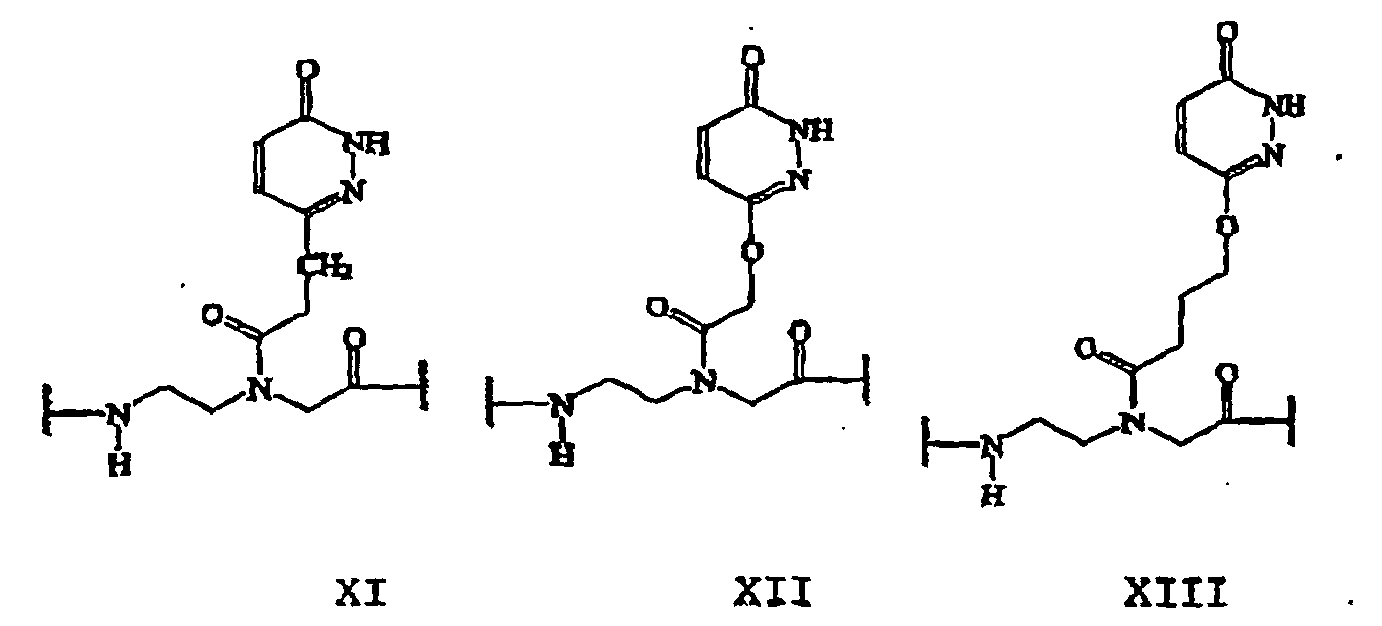
- These nucleobase monomers are advantageously employed in antisense applications, as recognizers of T residues in both duplex and triplex formation.
- To a solution of hydrazine monohydrate (95 mmol, 4.76 g) in abs. ethanol (50 mL) was added diethyl 4-oxopimelate (100 mmol, 23.03 g). The mixture was stirred at rt. for 1h and evaporated to dryness in vacuo to give the desired product (18.96 g, quantitative) as a pure (HPCL 260nm) white solid. The material was analyzed by HPLC (260nm) and found to be pure. UV λmax 242nm. 1H NMR (CDCl3): δ 8.61 (s br, 1H, NH), 4.11 (q, J=7.1 Hz, 2H, CH2), 2.60-2.55 (m, 4H, 2CH2), 2.50.2.40 (m, 4H, 2CH2), 1.22 (t, J=7.1 Hz, 3H, CH3), 13C NMR (CDCl3): δ 172.41, 167.16, 153.35, 60.36, 30.85 29.76, 25.17, 14.00. FAB+MS: 199.1085 (M+H+, calc. for C9H14N2O3+H+ 199.1083).
- To a solution of ethyl (3-oxo-2,3,4,5-tetrahydropyridazin-6-yl)-propionate (50.0 mmol, 9.90 g) in ethanol (50 mL) was added bromine (75.0 mmol, 11.99 g). The mixture was stirred at rt for 14h and the mixture was poored into NaHCO3 (sat. aqueous) (500 mL). The resulting mixture was extracted exhaustively with diethylether (5 x 500 mL). The combined organic fractions were dried over MgSO4 and evaporated in vacuo. The crude product was recrystallized from toluene to give the title compound (3.35 g, 34.1%) as colorless needles of high purity (HPLC at 260nm). UV λmax 228nm and 285 nm. 1H NMR (CDCl3): δ 11.62 (s br, 1H, NH), 7.18 (d, J=9.7 Hz, 1H, arom.), 7.88 (d, J=9.7 Hz, 1H, arom.), 4.11 (q, J=7.1 Hz, 2H, CH2), 2.90 (t, J=7.0 Hz, 2H, CH2), 2.64 (t, J=7.0 Hz, 2H, CH2), 1.25 (t, J=7.1 Hz, 3H, CH3). 13C NMR (CDCl3): δ 172.20, 161.50, 146.73, 134.06, 129.74, 60.45, 31.47, 25.89, 13.97. FAB+MS: 197.10 (M+H+, calc. for C9H12N2O3+H+ 197.0926).
- To a solution of Ethyl (3-oxo-2,3,-dihydropyridazin-6-yl)-propionate (3.00 mmol, 589 mg) in THF was added LiOH (2M, aqueous) (7.50 mL). The solution was stirred at rt. for 15 minutes, additional water (25 mL) was added and the THF removed in vacuo. The pH of the aqueous phase was adjusted to 3.0 by addition of HCl (2M, aqueous) and the solid material filtered off and washed with water (2x3 mL). The solid was dried in vacuo to yield the desired product (461 mg, 91.4%) as a colorless powder. 1H NMR (CDCl3): δ 11.62 (s br, 1H, NH), 7.18 (d, J=9.7 Hz, 1H, arom.), 7.88 (d, J=9.7 Hz, 1H, arom.), 4.11 (q, J=7.1 Hz, 2H, CH2), 2.90 (t, J=7.0 Hz, 2H, CH2), 2.64 (t, J=7.0 Hz, 2H, CH2), 1.25 (t, J=7.1 Hz, 3H, CH3). FAB+MS: 169.0611 (M+H+, calc. for C9H12N2O3+H+ 169.0613).
- To a solution of 3-oxo-2,3,-dihydropyridazin-6-yl-propionic acid (2.00 mmol, 336 mg) in DMF was added triethylamine (2.00 mmol, 202 mg), DhbtOH (2.20 mmol, 359 mg), and methyl N-(2-Boc-aminoethyl)glycinate (2.20 mmol, 464 mg) followed by DCC (2.20 mmol, 454 mg). The solution was stirred overnight at rt and evaporated in vacuo. The resulting oil was taken up in dichloromethane (100 mL), washed twice with NaHCO3 (sat, aqueous, 50 mL), washed with brine (50 mL), dried over MgSO4 and evaporated to dryness in vacuo. The crude product was purified on silica using ethyl acetate/methanol (95:5) as the eluent. Fractions containing the product were pooled and evaporated in vacuo to yield the title compound (405 mg, 53%), as a colorless foam. 1H NMR (DMSO-d6): δ 12.74 (s br, 1H, NH), 7.37 (7.35) (d, J=9.7 Hz, 1H, arom.), 6.79 (d, J=9.7 Hz, 1H, arom.), 6.85 (6.69) (t, 1H, NH), 4.00 (4.24) (s, 2H, CH2), 3.61 (s, 3H, CH3), 3.39 (3.30) (t, 2H, CH2), 3.08 (2.99) (q, 2H, CH2), 2.80-2.50 (m, 4H, 2xCH2), 1.33 (1.36) (s, 9H, Boc). 13C NMR (DMSO-d6) : δ 170.391 (170.66), 168.78 (169.12), 159.08, 154.45, 145.49 (145.58), 133.09 (133.15), 128.25, 76.73 (76.51), 50.50 (50.98), 46 24 (48.48), 46.44 (45.26), 37.09 (36.72), 28.71 (29.12), 28.02 (27.87), 26.99 (27.05).
- To a solution of methyl N-(2-Bocaminoethyl)-N-[3-oxo-2,3,-dihydropyridazin-6-yl-propionyl]glycinate (1.00 mmol, 382 mg) in THF (12.5 mL) was added LiOH (2M, aqueous, 2.0 mL). The solution was stirred at rt. for 15 minutes, additional water (10 mL) was added and the THF was removed in vacuo. The pH of the aqueous phase was adjusted to 3.0 by addition of HC1 (2M, aqueous). The product was isolated by continous extraction with dichloromethane (DCM) followed by evaporation in vacuo to give the desired product (215 mg, 80%) as a colorless powder (UVmax 287 nm). 1H NMR (DMSO-d6): δ 12.73 (s br and s vbr, 2H, NH and COOH), 7.38 (7.35) (d, J=9.7 Hz, 1H, arom.), 6.78 (d, J=9.7 Hz, 1H, arom.), 6.83 (6.70) (t, 1H, NH), 3.92 (4.11) (s, 2H, CH2), 3.39-3.27 (m, 2H, CH2), 3.08 (3.00) (q, 2H, CH2), 2.73-2.66 (m, 2H, CH2), 2.69-2.52 (m, 2H, CH2), 1.33 (1.36) (s, 9H, Boc). 13C NMR (DMSO-d6): δ 171.50 (171.93), 171.04 (171.38), 160.39, 155.73, 146.88 (146.92), 134.41, 129.53, 77.99 (77.76), 47.44 (49.98), 47.61 (46.64), 38.31 (37.97), 30.05 (30.40), 29.31 (29.12), 28.24. FAB+MS: 369.14 (M+H+, calc. for C16H24N4O6+H+ 369.1774).
- 3,6-dihydroxypyridazine (5.00 g, 44.6 mmol) was suspended in abs. ethanol/water (3:1) (40 mL) and KOH (2.10 g, 37.6 mmol) was added. After 30 min ethyl bromoacetate (9.20 g, 54.9 mmol) was slowly added. The suspension was heated to reflux and left overnight. The mixture was evaporated in vacuo and aditional water (30 mL) was added. The aqueous phase was extracted with ethyl acetate (4x50 mL) and the organic fractions evaporated in vacuo. The crude product was purified on a silica gel column using methanol/chloroform (1:4 v/v) containing 1% acetic acid as the eluent. Fractions containing the product were pooled and evaporated in vacuo to give the desired product (1.56 g, 21%) (pure according to TLC, Rf 0.32 using methanol/chloroform (1:4 v/v) containing 1% actic acid). 1H NMR (DMSO-d6): δ 12.10 (s br, 1H, NH), 7.15 (d, J=9.9 Hz, 1H, arom), 6.83 (d, J=9.9 Hz, 1H,arom), 4.29 (s, 2H, CH2). 13C-NMR (DMSO-d6): δ 170.77, 159.77, 152.77, 132.53, 128.23, 65.65. FAB+MS: No signal corresponding to the molecular mass was observed.
- Ethyl N-(2-Bocaminoethyl)glycinate (395 mg, 1,60 mmol) was dissolved in DMF (10 mL) and O-(3-oxo-2,3-dihydropyridazin-6-yl)-2-oxy-acetic acid (300 mg, 1.76 mmol) followed by 3-hydroxy-1,2,3-benzotriazine-4(3H)-one (291 mg, 1.78 mmol) were added. The mixture was cooled on ice and N,N'-dicyclohexylcarbodiimide (404 mg, 1.96 mmol) was added. After 1h the ice bath was removed and the mixture stirred overnight at rt. The mixture was evaporated in vacuo and the crude product was purified on silica using dichloromethane/methanol (93:7 v/v) as the eluent.
Fractions containing the product were pooled and evaporated in vacuo to give the title compound (436 mg, 62%), pure according to TLC, Rf 0.30 (dichloromethane/methanol 90:10 v/v). 1H NMR (DMSO-d6; this compound exists as two rotamers; chemical shifts for the minor rotamer is given in brackets): δ 12.14 (s br, 1H, NH), 7.23 (7.19) (d, J=9.9 Hz, 1H, arom), 6.88 (d, J=9.9 Hz, 1H, arom), 6.71 (m, 1H, NH), 4.94 (4.78) (s, 2H, CH2), 4.08 (q, J=7.1 Hz, 2H, CH2), 4.01 (s, 2H, CH2), 3.12 (m, 2H, CH2), 3.02 (m, 2H, CH2), 1.36 (s, 9H, CH3 (Boc)), 1.17 (t, J=7.1 Hz, 3H, CH3). 13C-NMR (DMSO-d6): δ 169.15 (169-54), 167.15 (167.43), 159.72, 155.79, 151.85, 133.23, 127.57, 78.15 (77.87), 63.04 (63.55), 60.62 (61.20), 47.59 (48.92), 46.82, 38.31 (37.78), 28.25, 14.11. FAB+MS : 398.94 (M+H+, calc. for C17H26N4O7+H+ 399.19). - Ethyl N-(2-Bocaminoethyl)-N-[O-(3-oxo-2,3-dihydropyridazin-6-yl)-2-oxyacetyl] glycinate (402 mg, 1.01 mmol) was suspended in THF (10 mL) and LiOH (2M, aqueous) (2.50 mL) was added. After 90 min, additional water (10 mL) was added and the THF was removed in vacuo. The pH of the aqueous phase was adjusted to 4.0 by addition of HCl (4M, aqueous). The mixture was left in the cold overnight and the resulting precipitate was filtered off, washed with ice cold water (3x10 mL), and dried in vacuo to yield the title compound (124 mg, 34%) as a white powder. The product was pure according to TLC, Rf 0.33 (butanol/acetic acid/water 4:1:1 v/v/v). 1H NMR (DMSO-d6; this compound exists as two rotamers; chemical shifts for the minor rotamer is given in brackets): δ 12.14 (s br, 1H, NH), 7.23 (7.17) (d, J=9.9 Hz, 1H, arom), 6.88 (d, J=9.9 Hz, 1H, arom), 6.72 (m, 1H, NH), 4.92 (4.77) (s, 2H, CH2), 3.99 (4.13) (s, 2H, CH2), 3.13 (m, 2H, CH2), 3.02 (m, 2H, CH2), 1.36 (s, 9H, CH3 (Boc)). 13C NMR (DMSO-d6): δ 170.65 (171.04), 167.02 (167.41), 159.76, 155.84 (155.72), 151-94, 133.24, 127.64, 78.19 (77.91), 63.14 (63.53), 47.39 (48.93), 46.75, 30.28 (37.77), 28.28. FAB-MS: 369.15 (M+H+, calc. for C15H22N4O7-H+ 369.14).
- To a solution of 3,6-dihydroxypyridazine (20.0 mmol, 2.24 g) in DMF (40 mL) was added NaH (60% dispersion im mineral oil) in one portion. The heterogeneous mixture was stirred at rt for 30 min whereafter ethyl 4-bromobutyrate (25.0 mmol, 4.88 g) was added and the heterogeneous mixture stirred at 100°C for 2h. The resulting yellow solution was evaporated in vacuo and taken up into ethylacetate (500 mL) and washed with 5% aqueous NaHCO3 (2x 200 mL) and then with brine (200 mL). The organic phase was dried over MgSO4, filtered and evaporated in vacuo. The resulting crude material was recrystallized from ethylacetate/petroleum ether to yield the desired product as a colorless shiny powder (2.35 g, 52 %). 1H NMR (DMSO-d6): δ 12.14 (s br, 1H, NH), 7.12 (d, J= 9.9 Hz, 1H, arom.), 6.86 (d, J=9.9 Hz, 1H, arom), 4.09-4.03 (m, 4H, overlapping CH2), 2.41 (t, J=7.32 Hz, 2H, CH2), 1.94 (m, 2H, CH2), 1.17 (t, J= 7.0 Hz, 3H, CH3). 13C NMR (DMSO-d6): δ 172.55, 159.66, 152.66, 133.16, 127.72, 65.59, 59.97, 30.22, 23.82, 14.18. FAB+MS: 227.1041 (M+H+, calc. for C15H14O4N2+H+ 227.1041).
- To a solution of Ethyl O-[3-oxo-2,3,-dihydropyridazin-6-yl]4-hydroxybutyrate (5.00 mmol, 1.13 g) in THF (40 mL) was added LiOH (2M, aqueous) (10.0 mL). The solution was stirred at rt. for 15 minutes, additional water (20 mL) was added and the THF was removed in vacuo. The pH of the aqueous phase was adjusted to 3.0 by addition of HCl (2M, aqueous) and the solid material was filtered of and washed with water (2x5 mL). After drying in vacuo the title compound was obtained (909 mg, 91.8%) as a colorless powder. 1H NMR (DMSO-d6): δ 12.14 (s br, 1H, NH), 7.13 (d, J= 9.9 Hz, 1H, arom.), 6.86 (d, J=9.9 Hz, 1H, arom), 4.06 (t, J= 6.5 Hz, 2H, CH2), 2.34 (t, J=7.4 Hz, 2H, CH2), 1.90 (m, 2H, CH2). 13C NMR (DMSO-d6): δ 174.15, 159.71, 133.16, 127.78, 65.72, 30.24, 23.87. FAB+MS: 199.0713 (M+H+, calc. for C15H14O4N2+H+ 199.0719).
- To a solution of O-[3-oxo-2,3,-dihydropyridazin-6-yl]4-hydroxybutyric acid (3.30 mmol, 653 mg) in DMF was added diisopropylethylamine (3.3 mmol, 427 mg) and HBTU (3.30 mmol, 1.25 g) followed by methyl N-(2-Boc-aminoethyl)glycinate (3.0 mmol, 696 mg). The solution was stirred overnight at rt and evaporated in vacuo. The resulting oil was taken up in dichloromethane (200 mL) and washed twice with NaHCO3 (sat, aqueous) (70 mL), then with brine (70 mL) and dried over MgSO4. The solution was filtered and concentrated to dryness in vacuo. The crude product was purified on silica using dichloromethane/methanol (95:5) as the eluent. Fractions containing the product were pooled and evaporated in vacuo to yield the desired product (0.93 9, 75%), as a colorless foam. 1H NMR (DMSO-d6; this compound exists as two rotamers; chemical shifts for the minor rotamer is given in brackets): δ 12.12 (s br, 1H, NH), 7.14 (7.11) (d, J= 9.9 Hz, 1H, arom.), 6.86 (d, J=9.9 Hz, 1H, arom), 4.05 (t, J= 6.4 Hz, 2H, CH2), 3.99 (4.21) (s, 2H, CH2), 3.61 (3.67) (s, 2H, CH2), 3.06 (m, 2H, CH2), 1.91 (m, 2H, CH2), 1.35 (s, 9H, Boc). 13C NMR (DMSO-d6): δ 172.33 (172.16), 170-43 (170.11), 15963, 155.74, 152.72, 133.07, 127-75, 77.97 (77.73), 65.88, 51.74 (52.20), 47.71, 47.43, 39.34 (37.96), 28.24, 24.12. FAB+MS: 413.2042 (M+H+, calc. for C18H28N4O7+H+ 413.2036).
- The title compound is prepared as per the procedures illustrated in Example 51 using the title compound prepared in Example 54.
- As those skilled in the art will appreciate, numerous changes and modifications may be made to the preferred embodiments of the invention. It is intended that all such variations fall within the scope of the invention.
Claims (40)
- An oligomeric compound comprising a monomeric unit having the formula:

wherein:R8 is H, COCH3 or an amino protecting group;R9 is hydrogen or a side chain of a naturally occurring amino acid;R10 is O, NH, O-alkylene or a lysine residue;W is -(CH2)m- where m is from 0 to 6, or
where b is an integer from 0 to 4;k is from 0 to 5;n is 0 or 1;L has the formula
Q is CH or N;
R17 is H or C1-C8 alkyl;
each R12 and R12 is, independently, H, C1-C8 alkyl, or halogen;
or R11 and R12 together with the carbon atoms to which they are attached form a phenyl group;T has the formula: j and z are each, independently, from 0 to 5 with the sum of j and z being from 1 to 7;M is C(=0), S(O)2, phenyl or P(O)2;V is NH, S, or CH2; anda, h and g are each, independently, 0 or 1.
 - A compound having the formula:

wherein:R8 is H, COCH3 or an amino protecting group;R9 is hydrogen or a side chain of a naturally occurring amino acid;R10 is O, NH, O-alkylene or a lysine residue;W is -(CH2)m- where m is from 0 to 6, or
where b is an integer from o to 4;k is from 0 to 5;n is 0 or 1;L has the formula
Q is CH or N;
R17 is H or C2-C8, alkyl;
each R11 and p12 is, independently, H, C1-C8 alkyl, or halogen;
or R11 and R12 together wich the carbon atoms to which they are attached form a phenyl group;T has the formula: j and z are each, independently, from 0 to 5 with the sum of j and z being from 1 to 7;M is C(=O), S(O)2, phenyl or P(O)2;V is NH, S, or CH2;a, h and 9 are each, independently, 0 or 1; andR13 and R14 are each independently H or a nitrogen or oxygen protecting group.
 - The oligomeric compound of claim 1 or the compound of claim 2 wherein L has the formula:

- The oligomeric compound of claim 1 or the compound of claim 2 wherein L has the formula:

- The oligomeric compound of claim 1 or the compound of claim 2 wherein L has the formula:
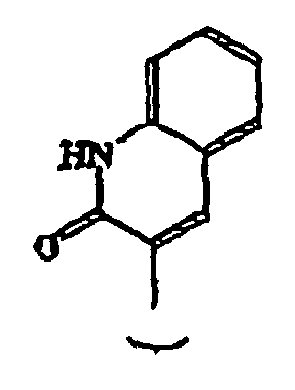
- The oligomeric compound of claim 1 or the compound of claim 2 wherein L has the formula:

- The oligomeric compound of claim 1 or the compound of claim 2 wherein L has the formula:

- The oligomeric compound of claim 1 or the compound of claim 2 wherein 9 and h are each 0.
- The oligomeric compound or compound of claim 8 wherein a is 0.
- The oligomeric compound of claim 1 or the conpound of claim 2 wherein a is 0, 9 is 0, v is NH and h is 1.
- The oligomeric compound of claim 1 or the compound of claim 2 wherein b is 2 or 3.
- The oligomeric compound or compound of claim 11 wherein at least one of Cα or Cβ is in the S configuration.
- The oligomeric compound of claim 1 or the compound of claim 2 wherein T has the formula -CH2-CH2-NH-.
- The oligomeric compound of claim 1 or the compound of claim 2 wherein T has the formula -CH2-.
- The oligomeric compound of claim 1 or the compound of claim 2 wherein T has the formula -CH2-CH2-.
- The oligomeric compound of claim 1 or the compound of claim 2 wherein W is -(CH2)m-.
- The oligomeric compound or compound of claim 16 wherein m is 2.
- The oligomeric compound of claim 1 or the compound of claim 2 wherein W has the formula:

- The oligomeric compound or compound of claim 18 wherein b is 2.
- The oligomeric compound or compound of claim 18 wherein b is 3.
- The oligomeric compound of any one of the preceding claims wherein said oligomeric compound is a peptide nucleic acid.
- A compound consisting of a plurality of peptide nucleic acid oligomers according to claim 1 linked by linking groups.
- The compound of claim 22 wherein two peptide nucleic acid oligomers according to claim 1 are linked by a linking group.
- The compound of claim 22 wherein said linking group comprises one or more 8-amino-3,6-dioxaoctanoic acid groups.
- A compound of formula:
 L has the formula:
 Q is CH or N;R17 is H or C1-C8 alkyl;each R11 and R12 is, independently, H, C1-C8 alkyl, or halogen;or R11 and R12 together with the carbon atoms to which they are attached form a phenyl group;A is a single bond, a methylene group or a group of formula:
 X is O, S, Se, NR3, CH2 or C(CH3)2;Y is a single bond, O, S or NR4;each p, q, r and s is, independently, zero or an integer from 1 to 5;each R1 and R2 is, independently, selected from the group consisting of hydrogen, (C1-C4) alkyl which may be hydroxy- or alkoxy- or alkylthio-substituted, hydroxy, alkoxy, alkylthio, amino and halogen;each R3 and R4 is, independently, selected from the group consisting of hydrogen, (C1-C4)alkyl, hydroxy- or alkoxy- or alkylthio-substituted (C1-C4)alkyl, hydroxy, alkoxy, alkylthio and amino;R15 is OH, a protected hydroxyl group, or a protecting group; andR16 is H or an amino protecting group.
 - A composition comprising:single stranded DNA coding for a sequence suspected of being implicated in a disease state and containing one or more thymine residues;a first peptide nucleic acid oligomer that comprises a region that is complementary to a region of the single stranded nucleic acid; anda second peptide nucleic acid oligomer according to claim 1 comprising a sequence that is complementary to a region of the single stranded nucleic acid and wherein the monomeric unit is at one or more positions complementary to the thymine residues of the single stranded nucleic acid.
- The composition of claim 26 wherein said single stranded DNA, said first peptide nucleic acid, and said second peptide nucleic acid form a triplex.
- An ex vivo method for forming a triple helix compound comprising:(a) selecting a single stranded nucleic acid containing one or more thymine residues;(b) providing a first oligomer that comprises a region that is complementary to a region of said single stranded nucleic acid;(c) contacting said single stranded nucleic acid and said first oligomer with a second oligomer according to claim 1, which comprises a sequence that is complementary to a region of said single stranded nucleic acid, and wherein the monomeric unit is at one or more positions ccmnplementary to said thymine residues of said single stranded nucleic acid for a time and under conditions effective to form the triple helix compound.
- The method of claim 28 wherein said first oligomer is a PNA.
- The method of claim 28 wherein said first oligomer is a DNA.
- The method of claim 28 wherein said first oligomer is oriented antiparallel to said single stranded nucleic acid, and said second oligomer is oriented parallel to said single stranded nucleic acid in said triple helix structure.
- The method of claim 28 wherein said triple helix compound has the formula PNA-DNA-PNA.
- The method of claim 28 wherein said single stranded nucleic acid is a DNA.
- The method of claim 28 wherein said single stranded nucleic acid is an RNA.
- The method of claim 28 wherein said first oligomer is a peptide nucleic acid, and said first oligomer is linked to said second oligomer by a linking moiety.
- The method of claim 35 wherein said first and second oligomers are each from 4 to about 20 nucleobases in length.
- An ex vivo method for the detection of a chemical or microbiological entity which contains a known nucleobase sequence comprising:a) selecting a nucleobase sequence from said chemical or microbiological entity which contairm one or more thymine residues;b) providing a PNA oligomer that contains a region that is complementary to said selected nucleobase sequence;c) contacting said selected nucleobase sequence of said chemical or microbiological entity and said complementary PNA oligomer with a further PNA oligomer according to claim 21 which contains a sequence that is complementary to said selected nucleobase sequence and wherein said monomeric unit is at one or more positions complementary to said thymine residues of said selected nueleobase sequence to form a triple helix compound; andd) detecting the triple helix compound.
- A ex vivo method for sequence-specific recognition of a double-stranded polynucleotide, comprising contacting said polynucleotide with an oligomeric compound of claim 1.
- The method of claim 38, wherein the oligomeric compound binds to said polynucleotide to form a triplex structure.
- The compound of any of claims 1-25 for use in therapy.
Applications Claiming Priority (3)
| Application Number | Priority Date | Filing Date | Title |
|---|---|---|---|
| US862629 | 1986-05-13 | ||
| US08/862,629 US6617422B1 (en) | 1997-05-23 | 1997-05-23 | Peptide nucleic acid monomers and oligomers |
| PCT/US1998/010672 WO1998052595A1 (en) | 1997-05-23 | 1998-05-22 | Peptide nucleic acid monomers and oligomers |
Publications (3)
| Publication Number | Publication Date |
|---|---|
| EP0988045A1 EP0988045A1 (en) | 2000-03-29 |
| EP0988045A4 EP0988045A4 (en) | 2002-07-24 |
| EP0988045B1 true EP0988045B1 (en) | 2006-02-08 |
Family
ID=25338899
Family Applications (1)
| Application Number | Title | Priority Date | Filing Date |
|---|---|---|---|
| EP98923764A Expired - Lifetime EP0988045B1 (en) | 1997-05-23 | 1998-05-22 | Peptide nucleic acid monomers and oligomers |
Country Status (10)
| Country | Link |
|---|---|
| US (2) | US6617422B1 (en) |
| EP (1) | EP0988045B1 (en) |
| JP (1) | JP3595345B2 (en) |
| AT (1) | ATE317265T1 (en) |
| AU (1) | AU737528B2 (en) |
| CA (1) | CA2290950A1 (en) |
| DE (1) | DE69833435D1 (en) |
| IL (1) | IL133054A0 (en) |
| NZ (1) | NZ501290A (en) |
| WO (1) | WO1998052595A1 (en) |
Families Citing this family (20)
| Publication number | Priority date | Publication date | Assignee | Title |
|---|---|---|---|---|
| JPWO2002051797A1 (en) * | 2000-12-26 | 2004-09-02 | 池田 壽文 | Novel functional peptide nucleic acid monomer and its production method |
| RU2005118421A (en) | 2002-11-15 | 2006-01-20 | Айденикс (Кайман) Лимитед (Ky) | 2'-BRANCHED NUCLEOSIDES AND MUTATION FLAVIVIRIDAE |
| US8658608B2 (en) * | 2005-11-23 | 2014-02-25 | Yale University | Modified triple-helix forming oligonucleotides for targeted mutagenesis |
| US7919562B2 (en) | 2006-05-31 | 2011-04-05 | The University Of Western Ontario | Preparation of supramolecular polymers containing sequence-selective hydrogen bonding subunits in their backbone which form double helices |
| WO2008086529A2 (en) * | 2007-01-11 | 2008-07-17 | Yale University | Compositions and methods for targeted inactivation of hiv cell surface receptors |
| US20100284959A1 (en) * | 2008-01-23 | 2010-11-11 | Gene Arrest Ltd. | Sequence specific double-stranded dna/rna binding compounds and uses thereof |
| KR20090098710A (en) | 2008-03-14 | 2009-09-17 | 주식회사 씨티아이바이오 | Peptide Nucleic Acid Derivatives with Good Cell Permeability and Nucleic Acid Binding Capacity |
| JP2013075830A (en) * | 2010-02-03 | 2013-04-25 | Taisho Pharmaceutical Co Ltd | Quinoline derivative |
| US8673998B2 (en) | 2010-09-22 | 2014-03-18 | Bridgestone Corporation | Polymer compositions with improved cold flow |
| EP3416976A2 (en) | 2016-02-16 | 2018-12-26 | Yale University | Compositions for enhancing targeted gene editing and methods of use thereof |
| JP7407592B2 (en) * | 2016-08-08 | 2024-01-04 | オリパス コーポレーション | Androgen receptor antisense oligonucleotide |
| EP3512870B1 (en) * | 2016-09-16 | 2022-08-03 | Olipass Corporation | Scn9a antisense oligonucleotides |
| AU2017385962B2 (en) * | 2016-12-30 | 2021-09-02 | Olipass Corporation | Exon skipping by peptide nucleic acid derivatives |
| JP7503903B2 (en) * | 2017-01-06 | 2024-06-21 | オリパス コーポレーション | SNAP25 antisense oligonucleotides |
| CA3051178A1 (en) * | 2017-01-24 | 2018-08-02 | Olipass Corporation | Scn9a antisense pain killer |
| US20200113821A1 (en) | 2017-04-04 | 2020-04-16 | Yale University | Compositions and methods for in utero delivery |
| WO2019022434A1 (en) * | 2017-07-24 | 2019-01-31 | Olipass Corporation | Tyrosinase antisense oligonucleotides |
| TWI832851B (en) * | 2018-05-18 | 2024-02-21 | 韓商奧利通公司 | Matrix metalloproteinase-1 antisense oligonucleotides |
| KR102304280B1 (en) | 2018-08-14 | 2021-09-23 | 올리패스 주식회사 | Acetyl-CoA Carboxylase2 Antisense Oligonucleotides |
| JP2022541896A (en) * | 2019-07-18 | 2022-09-28 | オリパス コーポレーション | Melanophyllin antisense oligonucleotide |
Family Cites Families (17)
| Publication number | Priority date | Publication date | Assignee | Title |
|---|---|---|---|---|
| US3687808A (en) | 1969-08-14 | 1972-08-29 | Univ Leland Stanford Junior | Synthetic polynucleotides |
| US5719262A (en) | 1993-11-22 | 1998-02-17 | Buchardt, Deceased; Ole | Peptide nucleic acids having amino acid side chains |
| DK51092D0 (en) | 1991-05-24 | 1992-04-15 | Ole Buchardt | OLIGONUCLEOTIDE ANALOGUE DESCRIBED BY PEN, MONOMERIC SYNTHONES AND PROCEDURES FOR PREPARING THEREOF, AND APPLICATIONS THEREOF |
| US6451968B1 (en) | 1991-05-24 | 2002-09-17 | Isis Pharmaceuticals, Inc. | Peptide nucleic acids |
| US5641625A (en) | 1992-05-22 | 1997-06-24 | Isis Pharmaceuticals, Inc. | Cleaving double-stranded DNA with peptide nucleic acids |
| US5539082A (en) | 1993-04-26 | 1996-07-23 | Nielsen; Peter E. | Peptide nucleic acids |
| MX9207334A (en) | 1991-12-18 | 1993-08-01 | Glaxo Inc | NUCLEIC ACIDS PEPTIDICS AND PHARMACEUTICAL FORMULATION CONTAINING THEM |
| GB9211979D0 (en) | 1992-06-05 | 1992-07-15 | Buchard Ole | Uses of nucleic acid analogues |
| US7825215B1 (en) | 1993-04-26 | 2010-11-02 | Peter E. Nielsen | Substituted nucleic acid mimics |
| GB9311386D0 (en) | 1993-06-02 | 1993-07-21 | Pna Diagnostics As | Nucleic acid analogue assay procedures |
| US5502177A (en) | 1993-09-17 | 1996-03-26 | Gilead Sciences, Inc. | Pyrimidine derivatives for labeled binding partners |
| GB2284209A (en) | 1993-11-25 | 1995-05-31 | Ole Buchardt | Nucleic acid analogue-induced transcription of RNA from a double-stranded DNA template |
| GB2284208A (en) | 1993-11-25 | 1995-05-31 | Pna Diagnostics As | Nucleic acid analogues with a chelating functionality for metal ions |
| GB2285445A (en) | 1993-12-06 | 1995-07-12 | Pna Diagnostics As | Protecting nucleic acids and methods of analysis |
| GB2289677A (en) | 1993-12-06 | 1995-11-29 | Pna Diagnostics As | Labelling of nucleic acid analogue-peptide chimerae |
| US5539083A (en) | 1994-02-23 | 1996-07-23 | Isis Pharmaceuticals, Inc. | Peptide nucleic acid combinatorial libraries and improved methods of synthesis |
| DE19504891A1 (en) | 1995-02-14 | 1996-08-22 | Bayerische Motoren Werke Ag | Reciprocating engine, in particular an internal combustion engine with a hypocycloidal crank mechanism |
-
1997
- 1997-05-23 US US08/862,629 patent/US6617422B1/en not_active Expired - Lifetime
-
1998
- 1998-05-22 EP EP98923764A patent/EP0988045B1/en not_active Expired - Lifetime
- 1998-05-22 CA CA002290950A patent/CA2290950A1/en not_active Abandoned
- 1998-05-22 NZ NZ501290A patent/NZ501290A/en unknown
- 1998-05-22 IL IL13305498A patent/IL133054A0/en unknown
- 1998-05-22 JP JP55074898A patent/JP3595345B2/en not_active Expired - Fee Related
- 1998-05-22 DE DE69833435T patent/DE69833435D1/en not_active Expired - Lifetime
- 1998-05-22 AU AU75981/98A patent/AU737528B2/en not_active Ceased
- 1998-05-22 US US09/083,235 patent/US6632919B1/en not_active Expired - Lifetime
- 1998-05-22 WO PCT/US1998/010672 patent/WO1998052595A1/en not_active Ceased
- 1998-05-22 AT AT98923764T patent/ATE317265T1/en not_active IP Right Cessation
Also Published As
| Publication number | Publication date |
|---|---|
| IL133054A0 (en) | 2001-03-19 |
| JP3595345B2 (en) | 2004-12-02 |
| AU737528B2 (en) | 2001-08-23 |
| NZ501290A (en) | 2002-03-28 |
| JP2001500387A (en) | 2001-01-16 |
| US6632919B1 (en) | 2003-10-14 |
| EP0988045A1 (en) | 2000-03-29 |
| WO1998052595A1 (en) | 1998-11-26 |
| EP0988045A4 (en) | 2002-07-24 |
| ATE317265T1 (en) | 2006-02-15 |
| AU7598198A (en) | 1998-12-11 |
| CA2290950A1 (en) | 1998-11-26 |
| US6617422B1 (en) | 2003-09-09 |
| DE69833435D1 (en) | 2006-04-20 |
Similar Documents
| Publication | Publication Date | Title |
|---|---|---|
| US6632919B1 (en) | Peptide nucleic acid monomers and oligomers | |
| US5773571A (en) | Peptide nucleic acids | |
| US5977296A (en) | Chiral peptide nucleic acid monomers and oligomers | |
| EP0773950B1 (en) | Linked peptide nucleic acids | |
| US6107470A (en) | Histidine-containing peptide nucleic acids | |
| US6441130B1 (en) | Linked peptide nucleic acids | |
| US6972328B2 (en) | Non-aggregating non-quenching oligomer comprising nucelotide analogs, method of synthesis and use thereof | |
| US20030207804A1 (en) | Modified peptide nucleic acids | |
| US20020146718A1 (en) | Peptide nucleic acids having 2,6-diaminopurine nucleobases | |
| EP0960121B1 (en) | Peptide nucleic acids having enhanced binding affinity, sequence specificity and solubility | |
| US6713602B1 (en) | Synthetic procedures for peptide nucleic acids | |
| CA2406168C (en) | Polyamide nucleic acid derivatives, agents and methods for producing same | |
| US7569659B1 (en) | Admixture comprising a target molecule and a nucleic acid mimic comprising sterically bulky substituents | |
| WO1996020212A2 (en) | Peptide nucleic acid incorporating a chiral backbone | |
| US20030105286A1 (en) | Linked peptide nucleic acids | |
| Beck et al. | Peptide Nucleic Acid (PNA): A DNA mimic with a pseudopeptide backbone | |
| Dcosta | Synthesis and evaluation of conformationally constrained pyrrolidyl polyamide nucleic acids |
Legal Events
| Date | Code | Title | Description |
|---|---|---|---|
| PUAI | Public reference made under article 153(3) epc to a published international application that has entered the european phase |
Free format text: ORIGINAL CODE: 0009012 |
|
| 17P | Request for examination filed |
Effective date: 19991223 |
|
| AK | Designated contracting states |
Kind code of ref document: A1 Designated state(s): AT BE CH CY DE DK ES FI FR GB GR IE IT LI LU MC NL PT SE |
|
| RIC1 | Information provided on ipc code assigned before grant |
Free format text: 7A 61K 38/04 A, 7C 07K 5/00 B, 7C 07K 7/00 B, 7C 08L 77/00 B |
|
| A4 | Supplementary search report drawn up and despatched |
Effective date: 20020607 |
|
| AK | Designated contracting states |
Kind code of ref document: A4 Designated state(s): AT BE CH CY DE DK ES FI FR GB GR IE IT LI LU MC NL PT SE |
|
| 17Q | First examination report despatched |
Effective date: 20030902 |
|
| GRAP | Despatch of communication of intention to grant a patent |
Free format text: ORIGINAL CODE: EPIDOSNIGR1 |
|
| GRAS | Grant fee paid |
Free format text: ORIGINAL CODE: EPIDOSNIGR3 |
|
| GRAA | (expected) grant |
Free format text: ORIGINAL CODE: 0009210 |
|
| AK | Designated contracting states |
Kind code of ref document: B1 Designated state(s): AT BE CH CY DE DK ES FI FR GB GR IE IT LI LU MC NL PT SE |
|
| PG25 | Lapsed in a contracting state [announced via postgrant information from national office to epo] |
Ref country code: NL Free format text: LAPSE BECAUSE OF FAILURE TO SUBMIT A TRANSLATION OF THE DESCRIPTION OR TO PAY THE FEE WITHIN THE PRESCRIBED TIME-LIMIT Effective date: 20060208 Ref country code: LI Free format text: LAPSE BECAUSE OF FAILURE TO SUBMIT A TRANSLATION OF THE DESCRIPTION OR TO PAY THE FEE WITHIN THE PRESCRIBED TIME-LIMIT Effective date: 20060208 Ref country code: IT Free format text: LAPSE BECAUSE OF FAILURE TO SUBMIT A TRANSLATION OF THE DESCRIPTION OR TO PAY THE FEE WITHIN THE PRESCRIBED TIME-LIMIT;WARNING: LAPSES OF ITALIAN PATENTS WITH EFFECTIVE DATE BEFORE 2007 MAY HAVE OCCURRED AT ANY TIME BEFORE 2007. THE CORRECT EFFECTIVE DATE MAY BE DIFFERENT FROM THE ONE RECORDED. Effective date: 20060208 Ref country code: FI Free format text: LAPSE BECAUSE OF FAILURE TO SUBMIT A TRANSLATION OF THE DESCRIPTION OR TO PAY THE FEE WITHIN THE PRESCRIBED TIME-LIMIT Effective date: 20060208 Ref country code: CH Free format text: LAPSE BECAUSE OF FAILURE TO SUBMIT A TRANSLATION OF THE DESCRIPTION OR TO PAY THE FEE WITHIN THE PRESCRIBED TIME-LIMIT Effective date: 20060208 Ref country code: BE Free format text: LAPSE BECAUSE OF FAILURE TO SUBMIT A TRANSLATION OF THE DESCRIPTION OR TO PAY THE FEE WITHIN THE PRESCRIBED TIME-LIMIT Effective date: 20060208 Ref country code: AT Free format text: LAPSE BECAUSE OF FAILURE TO SUBMIT A TRANSLATION OF THE DESCRIPTION OR TO PAY THE FEE WITHIN THE PRESCRIBED TIME-LIMIT Effective date: 20060208 |
|
| REG | Reference to a national code |
Ref country code: GB Ref legal event code: FG4D |
|
| REG | Reference to a national code |
Ref country code: CH Ref legal event code: EP |
|
| REG | Reference to a national code |
Ref country code: IE Ref legal event code: FG4D |
|
| REF | Corresponds to: |
Ref document number: 69833435 Country of ref document: DE Date of ref document: 20060420 Kind code of ref document: P |
|
| PG25 | Lapsed in a contracting state [announced via postgrant information from national office to epo] |
Ref country code: SE Free format text: LAPSE BECAUSE OF FAILURE TO SUBMIT A TRANSLATION OF THE DESCRIPTION OR TO PAY THE FEE WITHIN THE PRESCRIBED TIME-LIMIT Effective date: 20060508 Ref country code: DK Free format text: LAPSE BECAUSE OF FAILURE TO SUBMIT A TRANSLATION OF THE DESCRIPTION OR TO PAY THE FEE WITHIN THE PRESCRIBED TIME-LIMIT Effective date: 20060508 |
|
| PG25 | Lapsed in a contracting state [announced via postgrant information from national office to epo] |
Ref country code: DE Free format text: LAPSE BECAUSE OF FAILURE TO SUBMIT A TRANSLATION OF THE DESCRIPTION OR TO PAY THE FEE WITHIN THE PRESCRIBED TIME-LIMIT Effective date: 20060509 |
|
| PG25 | Lapsed in a contracting state [announced via postgrant information from national office to epo] |
Ref country code: ES Free format text: LAPSE BECAUSE OF FAILURE TO SUBMIT A TRANSLATION OF THE DESCRIPTION OR TO PAY THE FEE WITHIN THE PRESCRIBED TIME-LIMIT Effective date: 20060519 |
|
| PG25 | Lapsed in a contracting state [announced via postgrant information from national office to epo] |
Ref country code: IE Free format text: LAPSE BECAUSE OF NON-PAYMENT OF DUE FEES Effective date: 20060522 |
|
| PG25 | Lapsed in a contracting state [announced via postgrant information from national office to epo] |
Ref country code: MC Free format text: LAPSE BECAUSE OF NON-PAYMENT OF DUE FEES Effective date: 20060531 |
|
| NLV1 | Nl: lapsed or annulled due to failure to fulfill the requirements of art. 29p and 29m of the patents act | ||
| PG25 | Lapsed in a contracting state [announced via postgrant information from national office to epo] |
Ref country code: PT Free format text: LAPSE BECAUSE OF FAILURE TO SUBMIT A TRANSLATION OF THE DESCRIPTION OR TO PAY THE FEE WITHIN THE PRESCRIBED TIME-LIMIT Effective date: 20060710 |
|
| REG | Reference to a national code |
Ref country code: CH Ref legal event code: PL |
|
| PLBE | No opposition filed within time limit |
Free format text: ORIGINAL CODE: 0009261 |
|
| STAA | Information on the status of an ep patent application or granted ep patent |
Free format text: STATUS: NO OPPOSITION FILED WITHIN TIME LIMIT |
|
| 26N | No opposition filed |
Effective date: 20061109 |
|
| EN | Fr: translation not filed | ||
| PG25 | Lapsed in a contracting state [announced via postgrant information from national office to epo] |
Ref country code: GR Free format text: LAPSE BECAUSE OF FAILURE TO SUBMIT A TRANSLATION OF THE DESCRIPTION OR TO PAY THE FEE WITHIN THE PRESCRIBED TIME-LIMIT Effective date: 20060509 Ref country code: FR Free format text: LAPSE BECAUSE OF FAILURE TO SUBMIT A TRANSLATION OF THE DESCRIPTION OR TO PAY THE FEE WITHIN THE PRESCRIBED TIME-LIMIT Effective date: 20070330 |
|
| PG25 | Lapsed in a contracting state [announced via postgrant information from national office to epo] |
Ref country code: LU Free format text: LAPSE BECAUSE OF NON-PAYMENT OF DUE FEES Effective date: 20060522 |
|
| PG25 | Lapsed in a contracting state [announced via postgrant information from national office to epo] |
Ref country code: FR Free format text: LAPSE BECAUSE OF FAILURE TO SUBMIT A TRANSLATION OF THE DESCRIPTION OR TO PAY THE FEE WITHIN THE PRESCRIBED TIME-LIMIT Effective date: 20060531 |
|
| PG25 | Lapsed in a contracting state [announced via postgrant information from national office to epo] |
Ref country code: CY Free format text: LAPSE BECAUSE OF FAILURE TO SUBMIT A TRANSLATION OF THE DESCRIPTION OR TO PAY THE FEE WITHIN THE PRESCRIBED TIME-LIMIT Effective date: 20060208 Ref country code: FR Free format text: LAPSE BECAUSE OF FAILURE TO SUBMIT A TRANSLATION OF THE DESCRIPTION OR TO PAY THE FEE WITHIN THE PRESCRIBED TIME-LIMIT Effective date: 20060208 |
|
| PGFP | Annual fee paid to national office [announced via postgrant information from national office to epo] |
Ref country code: GB Payment date: 20130425 Year of fee payment: 16 |
|
| GBPC | Gb: european patent ceased through non-payment of renewal fee |
Effective date: 20140522 |
|
| PG25 | Lapsed in a contracting state [announced via postgrant information from national office to epo] |
Ref country code: GB Free format text: LAPSE BECAUSE OF NON-PAYMENT OF DUE FEES Effective date: 20140522 |