EP0987958B1 - Improved fish feed and method of using same - Google Patents
Improved fish feed and method of using same Download PDFInfo
- Publication number
- EP0987958B1 EP0987958B1 EP98928026A EP98928026A EP0987958B1 EP 0987958 B1 EP0987958 B1 EP 0987958B1 EP 98928026 A EP98928026 A EP 98928026A EP 98928026 A EP98928026 A EP 98928026A EP 0987958 B1 EP0987958 B1 EP 0987958B1
- Authority
- EP
- European Patent Office
- Prior art keywords
- feed
- fish
- enhanced
- visibility
- unenhanced
- Prior art date
- Legal status (The legal status is an assumption and is not a legal conclusion. Google has not performed a legal analysis and makes no representation as to the accuracy of the status listed.)
- Revoked
Links
Images



Classifications
-
- A—HUMAN NECESSITIES
- A01—AGRICULTURE; FORESTRY; ANIMAL HUSBANDRY; HUNTING; TRAPPING; FISHING
- A01K—ANIMAL HUSBANDRY; AVICULTURE; APICULTURE; PISCICULTURE; FISHING; REARING OR BREEDING ANIMALS, NOT OTHERWISE PROVIDED FOR; NEW BREEDS OF ANIMALS
- A01K97/00—Accessories for angling
- A01K97/04—Containers for bait; Preparation of bait
- A01K97/045—Preparation of bait; Ingredients
-
- A—HUMAN NECESSITIES
- A01—AGRICULTURE; FORESTRY; ANIMAL HUSBANDRY; HUNTING; TRAPPING; FISHING
- A01K—ANIMAL HUSBANDRY; AVICULTURE; APICULTURE; PISCICULTURE; FISHING; REARING OR BREEDING ANIMALS, NOT OTHERWISE PROVIDED FOR; NEW BREEDS OF ANIMALS
- A01K61/00—Culture of aquatic animals
- A01K61/80—Feeding devices
-
- A—HUMAN NECESSITIES
- A23—FOODS OR FOODSTUFFS; TREATMENT THEREOF, NOT COVERED BY OTHER CLASSES
- A23K—FODDER
- A23K20/00—Accessory food factors for animal feeding-stuffs
- A23K20/10—Organic substances
- A23K20/179—Colouring agents, e.g. pigmenting or dyeing agents
-
- A—HUMAN NECESSITIES
- A23—FOODS OR FOODSTUFFS; TREATMENT THEREOF, NOT COVERED BY OTHER CLASSES
- A23K—FODDER
- A23K50/00—Feeding-stuffs specially adapted for particular animals
- A23K50/80—Feeding-stuffs specially adapted for particular animals for aquatic animals, e.g. fish, crustaceans or molluscs
-
- Y—GENERAL TAGGING OF NEW TECHNOLOGICAL DEVELOPMENTS; GENERAL TAGGING OF CROSS-SECTIONAL TECHNOLOGIES SPANNING OVER SEVERAL SECTIONS OF THE IPC; TECHNICAL SUBJECTS COVERED BY FORMER USPC CROSS-REFERENCE ART COLLECTIONS [XRACs] AND DIGESTS
- Y02—TECHNOLOGIES OR APPLICATIONS FOR MITIGATION OR ADAPTATION AGAINST CLIMATE CHANGE
- Y02A—TECHNOLOGIES FOR ADAPTATION TO CLIMATE CHANGE
- Y02A40/00—Adaptation technologies in agriculture, forestry, livestock or agroalimentary production
- Y02A40/80—Adaptation technologies in agriculture, forestry, livestock or agroalimentary production in fisheries management
- Y02A40/81—Aquaculture, e.g. of fish
-
- Y—GENERAL TAGGING OF NEW TECHNOLOGICAL DEVELOPMENTS; GENERAL TAGGING OF CROSS-SECTIONAL TECHNOLOGIES SPANNING OVER SEVERAL SECTIONS OF THE IPC; TECHNICAL SUBJECTS COVERED BY FORMER USPC CROSS-REFERENCE ART COLLECTIONS [XRACs] AND DIGESTS
- Y10—TECHNICAL SUBJECTS COVERED BY FORMER USPC
- Y10S—TECHNICAL SUBJECTS COVERED BY FORMER USPC CROSS-REFERENCE ART COLLECTIONS [XRACs] AND DIGESTS
- Y10S426/00—Food or edible material: processes, compositions, and products
- Y10S426/805—Pet food for dog, cat, bird, or fish
Definitions
- This invention relates to enhanced fish feed and, more particularly, to a method for feeding fish and the enhanced fish feed used during such feeding.
- Fish are usually raised in fish farms which are situated in open and closed bodies of water including tanks, coastal and freshwater bodies and raceways.
- the fish farms comprise a plurality of pens, cages or other enclosed areas which constrain the fish and in which the fish are fed and raised.
- the fish in the enclosures are fed regularly, conveniently by scattering the fish feed on the surface of the water in each of the individual fish enclosures from walkways in a more or less uniform fashion, frequently using a broadcast type feeder or manually by hand.
- Several techniques exist to determine when to stop feeding including surface feeding visibility of the feed, pellet sensing devices and monitoring ration size.
- the feeding rate and amount is judged based on surface feeding activities of fish such as splashing and mouthing as viewed by the farmer from the surface. Feeding is stopped or the rate is reduced if pellets are not consumed before they fade into the water column.
- Manufactured feeds for farmed fish are normally produced by a process of blending and grinding the ingredients followed by forming the ingredients into pellets.
- pellets in this specification as well as the term “feed” is intended to be inclusive of any particle intended to be ingested by fish and variously formulated, including pressed pellets, crumbs, moist feeds, and non-feed particles which may include tablets containing drugs, vaccines, or other substances.
- the pellets may be coated with fish oil in order to achieve the desired nutritional profile.
- the feed pellets produced and typically presently used for feeding fish are normally a dark brown color.
- Brown pellets are not readily visible from the surface, underwater at depths, under poor water visibility conditions or low lighting conditions. Making pellets more visible (e.g., increasing the contrast of the pellet) will allow farmers to view pellets for a longer period of time as they fade into the water column and therefore offer better control of feed ration and feeding rate. Feeding competition among fish can be reduced and feeding rate can be increased if more fish can see and consume pellets at the same time.
- Feed ration size varies from meal to meal and from day to day and it is a continuous challenge for fish farmers to know when to stop feeding and the optimum amount of feed to use. Feed tables and surface viewing of the pellet by the farmer or operator while feeding are known to be inadequate techniques and result in a lack of control over ration size. However, these methods are common.
- the production of one tonne of salmon or trout requires between 1.1 and 1.3 tonnes or higher of fish feed, and various species of fish, such as the Chinook salmon, may require additional quantities than, for example, the Atlantic salmon.
- the economics of such feeding are of considerable importance to the profitability of fish farms.
- Douglas and Djamgoz The Visual System of Fish, Chapman and Hall 1990
- the contrast of an object between it and its environment allows for greater detection of the object and this contrast may be a difference of shape, pattern, texture, color or brightness.
- Browman and Marcotte (“Effects of prey color and background on feeding by Atlantic salmon alevins.” Prog.Fish.Cult. 49 :140-143 (1987)) disclosed that the background color in aquaria affected choice of prey based on color by fish.
- shading is a particular problem with higher fish populations in the cages. This shading reduces the visibility of the feed within the cages in addition to the atmospheric or water turbidity conditions. Because fish, particularly salmon and trout, are primarily visual feeders and rely upon their power of vision to locate feed, these factors take on some considerable importance.
- an enhanced visibility fish feed for fish ingestion within an enclosure of a fish farm within which fish are raised for commercial harvesting said enhanced fish feed having significantly improved visibility at depth relative to unenhanced fish feed within said enclosure, said significantly improved visibility being obtained by changing the color and/or reflectivity of said unenhanced fish feed, wherein said fish feed is in the form of pellets.
- a method of feeding fish within the enclosure of a fish farm within which fish are raised for commercial harvesting comprising the steps of selecting said enhanced fish feed and distributing a quantity of said enhanced feed on the surface of the water in said enclosure.
- the fish feed for feeding fish within an enclosure of a fish farm may be of a predetermined quantity and have a predetermined contrast with the water conditions within said enclosure.
- a method of increasing the fish feeding volume of water below the water surface and within an enclosure of a fish farm comprising determining the depth visibility of fish feed to an operator according to water conditions within said enclosure and correlating said depth visibility to said operator with a known relationship between said depth visibility to said operator and the depth visibility of said feed to fish, and thereafter distributing an enhanced fish feed of appropriate visibility on the surface of said water within said enclosure.
- a fish farm is illustrated generally at 100 in Figure 1. It comprises a plurality of individual cages, enclosures or pens 101, each of the cages 101 being enclosed on all sides and on the bottom by netting 102 ( Figure 2), the netting being used to constrain the fish within the individual cages 101.
- the cages 101 are anchored by anchors 103 securely located on the ocean bottom 104 and stays in the form of ropes and/or cables 105 extend from the anchors 103 to the cages 101 thereby securely holding the cages 101 in place in their operating location.
- Walkways 110 extend along the top of the cages 101 and the fish within the cages 101 are fed from the walkways 110 by scattering fish feed in a more or less uniform fashion onto the surface of the water in each of the cages 101.
- Cameras 106 are positioned within the respective cages 101 to monitor the feed consumption from a monitoring station 107.
- the surface of the water 111 ( Figure 2) is below the walkways 110 which serve to support the operator and other equipment. Walkways 110 are positioned and connected to buoyant material 115.
- the fish generally illustrated at 112 are concentrated in the upper portion of the cages 101, particularly when the fish 112 are being fed from the walkways 110.
- Camera 106 is positioned beneath the feeding volume to observe the feeding behavior of the fish 112.
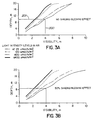
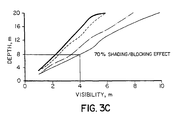
- FIG. 3A The fish farmer, for example, is aware that the day is wintry with relatively low light intensity (25 micromol/s/m2) and he determines that his feed visibility is approximately 4 meters deep within the cage 101. This depth may be arrived at by lowering an object into the cage 101 or, after some period when familiarization has occurred, of using dead reckoning or a permanently installed depth indicator to correlate his feed visibility with depth of the water within the cage 101.
- a vertical line 200 is drawn from the 4 meter dimension on the abscissa of Figure 3A and intersects with the 25 umol/s/m2 visibility curve. From this point of intersection, a horizontal line 201 is extended to the ordinate and intersects it at approximately the 10 meter depth.
- Tables 1 and 2 below illustrate the visible distance to humans of different fish feed types of pellets under relatively low light conditions and clear water at 0.4 meter and 1.5 meter depths, respectively. From Table 1, it can be seen that white pellets may be viewed at the furthest distance with brown pellets only being seen beyond a minimum distance at both depths. Table 2 is similar to Table 1 but under more turbid water conditions.
- Tables 4 and 5 below illustrate responses made by fish under low light and clear water and low light and turbid water conditions, respectively.
- the pellet types are listed and the fish responses are compared to responses to normal brown pellets.
- the resulting conclusion is that the lighter colored pellets or the reflecting or guanine coated pellets have much better visibility to fish due to the large increases in responses by fish to the more desirable pellet colors as opposed to the normal brown pellets.
- Pellet Type Response Regular Response: Coated, Percent more detectable than regular pellet # of times more detectable than regular pellet White 3715 92 148.6 2.5a Green 58 76 31.0 ---- Red 52 54 3.8 ---- Silver/ reflective 40 91 127.5 2.3b Natural guanine 30 80 166.7 2.7b
- the enhanced pellets will be preferably white, a reflective material such as silver or an otherwise light colored material having the color guanine (which is a color similar to the color of fish scale) and any material that increases the visibility of pellets for human and/or fish.
- a reflective material such as silver or an otherwise light colored material having the color guanine (which is a color similar to the color of fish scale) and any material that increases the visibility of pellets for human and/or fish.
- These pellets are produced by many materials (e.g., mica and/or titanium) as a surface coating of the pellets or added as additives in with the materials in the feed, provided the coating or additives are not detrimental to the fish.
- Suitable coatings include a thin layer of a high reflective mica and/or titanium dioxide which can all produce a silver-white reflective sheen which it is contemplated will not only be of enhanced visibility to the fish but which will also stimulate the fish appetites since it is known fish appetites are stimulated by visual signals. Because, in particular, salmon and trout are primarily visual feeders relying upon their powers of vision to locate feed, improving the visibility of the feed by increasing contrast is contemplated to provide benefits.
- the mica and titanium dioxide coating conveniently in a range of from 0.3 to 0.5% should improve the visibility of fish feed and reduce the frenzy or competition for food over the initial depths of the fish cage by increasing the depths at which the feed is seen by the fish and by being readily available for fish located in the deeper and/or less visible regions of the pens.
- mica-titanium dioxide The principal constituents of mica-titanium dioxide are oxides and hydroxyls of aluminium, potassium, silicon and titanium. These constituents are highly inert substances with high melting points and are insoluble in water and acids. Because of the chemical inertness of mica and titanium dioxide, the substances cannot be digested by animals and there is and should be no evidence of toxicity or carcinogenicity.
- a known compound of the two materials, mica and titanium dioxide in the ratio of 81.5% (76-87%) and 18.5% (13-24%), respectively, is known as Mearlin MangaPearl 5000 although there exists a family of similar compounds and materials commonly known as pearlescent pigments which may be colored to combine reflectance with color and so be used to increase the visibility of the feed particles.
- the manufacturing process results in the mica being coated with titanium dioxide and the physical appearance is a fine, silvery powder having a particle size of 32.8 -37.8 micron with a density of 3.2 kg/l or 27 lbs/gal. The production process is set forth in greater detail hereafter.
- the mica/titanium dioxide coated pellets reflect white light and, as such, they had the highest contrast against all background and thus were the desired feed.
- the reflected light from the enhanced feed increased the ability of the fish and the farmer to see the feed in the water which allowed the farmer to more clearly see when the fish have stopped feeding and thereby avoid overfeeding. The chances of underfeeding are also minimised using the enhanced feed.
- the depth over which the feed is visually apparent, particularly to the fish is contemplated to result in an increased depth or increased water volume for feeding fish and whereas using the dark brown pellets of the prior art resulted in somewhat of a frenzy by the fish in the upper water levels when being fed, it is contemplated that there will be less competition at the surface since feed will be readily available and visible to fish at lower depths resulting in less competition and better feeding distribution to the fish.
- an operator of the fish farm 100 will attend to the feeding of the fish 112 within the farm 100 at regular feeding hours. It will be assumed that the operator has available to him a quantity of both brown and enhanced light colored pellets making up the feed.
- the operator will review the ambient light conditions and water color within the farm by inspection. Such light and water conditions may be obtained by instrumentation or, after a period of time, from experience. The operator will also determine the turbidity of the water within the farm 100 conveniently by sampling the water. The operator will further have information available relative to the shading of the farm 100 due to the quantity of fish within the individual enclosures 101 of the farm 100. A camera 106 may conveniently be used to obtain the shading information or the information may be obtained from shading charts. Finally, the operator will require the depth visibility of pellets to him. This information conveniently may be obtained by manually lowering the feed in the form of pellets to a depth where they are no longer visible and measuring this depth.
- the light may come from a coating, conveniently a mica and/or titanium dioxide coating, over the normal or brown feed pellet.
- a coating conveniently a mica and/or titanium dioxide coating
- the use of this combined feed would allow the fish in the upper regions to feed on the usual brown feed in a normal manner with the fish in the lower regions of the cage feeding on the enhanced and light or silver colored feed pellets. It is contemplated that with enhanced visibility of the feed, less aggressive fish may simply await the passage of enhanced feed through the usual feeding areas since whereas the normal brown feed would not be visible in such regions where the less aggressive fish await, the use of enhanced feed would be so visible and available for feeding purposes.
- Dry pellets (not illustrated) are transported with conveyor 201 into a screen 202 where the dust or small and undersize particles are separated. The full size particles fall to a buffer bin in pre-cooler 203 where a feeder 204 feeds the pellets into a weigh bin 210. In the event the pellet is cracked or undersize in the pre-cooler 203, a vacuum system 211 is provided which will return the pellet to the dust return tank (not illustrated) downstream of screen 202.
- the proper quantity of pellets to be coated will be determined by the weight bin 210 and this quantity will fall freely from the weight bin 210 to the mixer or coater 212.
- the correct amount of fish oil to add to the pellets is provided by a second weigh tank 214 located above the coater 212. The correct amount of oil is therefore sprayed into the coater 212 during the vacuum process used in the coater 212.
- the batch coating processing system is useful in giving enhanced accuracy of the fat dose.
- both pellets would be readily and visually identifiable by the fish.
- the feed is contemplated to be ingested proportionately to the amount of feed initially deposited on the surface. If a higher proportion of white feed relative to the dark feed is deposited, most of the dark feed would be eaten leaving the white feed to move downwardly to the lower depths of the fish pen and thereby to be available to the fish at lower depths.
- proper ratios of white and dark pellets it is contemplated that more even feeding would result with less wastage of feed and providing the same nutrient levels to fish throughout the pen.
- pellets are typically used as a feed and non-feed product and have been described in particular detail, other feeds and non-feeds in not pellet form such as pressed pellets and particle and moist feeds would clearly benefit from the teachings of the invention and are intended to be covered thereby.
- mica/titanium dioxide additive is described as an appropriate coating substance, all pigments as illustrated and described herein and other similar pigments which can be used to significantly increase the visibility of the feed or non-feed particle would be suitable for use according to the invention.
Landscapes
- Life Sciences & Earth Sciences (AREA)
- Polymers & Plastics (AREA)
- Environmental Sciences (AREA)
- Chemical & Material Sciences (AREA)
- Animal Husbandry (AREA)
- Zoology (AREA)
- Biodiversity & Conservation Biology (AREA)
- Engineering & Computer Science (AREA)
- Food Science & Technology (AREA)
- Marine Sciences & Fisheries (AREA)
- Insects & Arthropods (AREA)
- Birds (AREA)
- Fodder In General (AREA)
- Feed For Specific Animals (AREA)
Description
| Maximum visible distance (human vision) of different pellet types under low ambient light (0.03 micromol/s/m2) and clear (9.35 NTU) seawater conditions at two(2) depths | |||
| Depth: 0.4 m depth Underwater light level: 0.017 micromol/s/m2 | Depth: 1.5 m depth Underwater light level: 0.017 micromol/s/m2 | ||
| Pellet type | Max.visible distance(cm) | Pellet type | Max.visible distance(cm) |
| White | 460 | White | 274 |
| Fluorescent yellow | 458 | Fluorescent yellow | 272 |
| Fluorescent red | 439 | Fluorescent red | 269 |
| Fluorescent orange | 429 | Fluorescent orange | 268 |
| Fluorescent blue | 425 | Yellow | 245 |
| Silver/reflective | 398 | Silver/reflective | 239 |
| Fluorescent green | 375 | Fluorescent green | 228 |
| Natural guanine | 238 | Fluorescent blue | 216 |
| Yellow | 220 | Natural guanine | 206 |
| Sparkly/speckled | 146 | Orange | 180 |
| Gray | 144 | Sparkly/speckled | 141 |
| Orange | 143 | Blue | 134 |
| Uncoated | 139 | Eggplant | 124 |
| Blue | 123 | Gray | 123 |
| Red | 121 | Uncoated | 121 |
| Green | 119 | | 115 |
| Brown | 116 | | 112 |
| | 112 | Green | 108 |
| Maximum visible distance (human vision) of different pellet types under low ambient light (0.03 micromol/s/m2) and silted (21.8 NTU) seawater conditions at two(2) depths | |||
| Depth: 0.4 m depth Underwater light level: 0.012 micromol/s/m2 | Depth: 1.5 m depth Underwater light level: 0.006 micromol/s/m2 | ||
| Pellet type | Max.visible distance(cm) | Pellet type | Max.visible distance,cm |
| Red | 153 | Eggplant | 155 |
| Eggplant | 147 | Red | 151 |
| White | 143 | Blue | 148 |
| Blue | 143 | Sparkly/speckled | 147 |
| Gray | 142 | Green | 145 |
| Green | 141 | White | 145 |
| Brown | 140 | Gray | 141 |
| Fluorescent yellow | 134 | Brown | 139 |
| Uncoated | 134 | Uncoated | 136 |
| Sparkly/speckled | 134 | Fluorescent yellow | 136 |
| Orange | 132 | Silver/reflective | 129 |
| Silver/reflective | 131 | Natural guanine | 127 |
| Natural guanine | 131 | Fluorescent blue | 126 |
| Yellow | 131 | Orange | 125 |
| Fluorescent blue | 123 | Fluorescent green | 124 |
| Fluorescent red | 115 | Yellow | 120 |
| | 115 | Fluorescent red | 119 |
| Fluorescent green | 114 | Florescent orange | 116 |
| Approximate reflectance (%, in descending order of magnitude) of uncoated and different coated pellet types against a black background under high light (12.75 micromol/s/m2; diffused light from a 1000 W halogen lamp) | |
| Pellet type | Reflectance Values (%) |
| Fluorescent Yellow | 36 |
| White | 34 |
| Fluorescent orange | 30 |
| Fluorescent red | 26 |
| Yellow | 22 |
| Silver | 19 |
| Orange | 13 |
| Natural guanine | 11 |
| Red | 11 |
| | 10 |
| | 8 |
| | 8 |
| | 8 |
| Eggplant | 7 |
| Fluorescent blue | 7 |
| Green | 7 |
| Regular uncoated | 6 |
| Blue | 5 |
| Responses from detectability tests (fish vision) conducted under low light (0.007 micromol/s/m2) and clear water (3.6 NTU). a,b Responses with different letters are significantly different (Chi/2 tests, alpha=0.05) from each other. Underscored coated responses are significantly different (Chi/2 tests, alpha=0.05) from regular pellets. | ||||
| Pellet Type | Response: Regular | Response: Coated | Percent more detectable than regular pellet | # of times more detectable than regular pellet |
| White | 15 | 102 | 580 | 6.8a |
| Green | 65 | 53 | 0 | ---- |
| Red | 46 | 54 | 17.4 | ---- |
| Silver/ reflective | 23 | 94 | 308.7 | 4.1b |
| Natural guanine | 26 | 94 | 261.5 | 3.6b |
| Responses from detectability tests (fish vision) conducted under low light (0.007 micromol/s/m2) and turbid water (20.1 NTU). a,b Responses with different letters are significantly different (Chi/2 tests, alpha=0.05) from each other. Underscored coated responses are significantly different (Chi/2 tests, alpha=0.05) from regular pellets. | ||||
| Pellet Type | Response: Regular | Response: Coated, | Percent more detectable than regular pellet | # of times more detectable than regular pellet |
| White | 3715 | 92 | 148.6 | 2.5a |
| Green | 58 | 76 | 31.0 | ---- |
| Red | 52 | 54 | 3.8 | ---- |
| Silver/ reflective | 40 | 91 | 127.5 | 2.3b |
| Natural guanine | 30 | 80 | 166.7 | 2.7b |
| Contrast values of different pellet types compared to a regular or normal brown or unenhanced pellet with different background values under bright light | |||
| Pellet Type | Blue background | Black background | White background |
| Silver | 0.03 | 2.66 | -0.37 |
| Regular Brown | -0.89 | -0.62 | -0.93 |
| Guanine | 0.04 | 2.70 | -0.36 |
| White | 0.69 | 5.03 | 0.04 |
Claims (40)
- Enhanced visibility fish feed suitable for fish ingestion within an enclosure of a fish farm within which fish are raised for commercial harvesting, said enhanced visibility fish feed having significantly improved visibility at depth relative to unenhanced fish feed within said enclosure, said significantly improved visibility being obtained by changing the color and/or reflectivity of said unenhanced fish feed, wherein said fish feed is in the form of pellets.
- Enhanced visibility fish feed as in claim 1 wherein said color and/or reflectivity is changed by adding an ingredient to said unenhanced fish feed.
- Enhanced visibility fish feed as in claim 2 wherein said pellets are coated with said ingredient.
- Enhanced visibility fish feed as in claim 3 wherein said ingredient is a mica/titanium material.
- Enhanced visibility fish feed as in claim 1 wherein said ingredient is added to the material of said pellets.
- Enhanced visibility fish feed as in claim 5 wherein said ingredient is a colored material.
- Enhanced visibility fish feed as in claim 6 wherein said colored material is a light colored material.
- Enhanced visibility fish feed as in claim 7 wherein said light colored material is white.
- Enhanced visibility fish feed as in claim 2 wherein said ingredient is a material having significantly greater reflectivity than said unenhanced material.
- Enhanced visibility fish feed as in claim 1 wherein said significantly improved visibility is defined by the response rate of said fish to said enhanced feed relative to the response rate of said fish to said unenhanced feed, said response rate being measured under similar conditions within said enclosure.
- Enhanced visibility fish feed as in claim 10 wherein said significantly improved visibility is defined by said response rate of said fish to said enhanced feed being more than 50% greater than said response rate of said fish to said unenhanced feed.
- Enhanced visibility fish feed as in claim 1 wherein said unenhanced fish feed is brown in color.
- Enhanced visibility fish feed as in claim 1 wherein said significantly improved visibility is defined by the contrast of said enhanced fish feed relative to the contrast of said unenhanced fish feed, said contrast being measured against substantially similar backgrounds.
- Enhanced visibility fish feed as in claim 13 wherein said significantly improved visibility is defined by said contrast of said enhanced fish feed relative to said unenhanced feed being more than twice the contrast of said unenhanced fish feed against substantially similar backgrounds.
- Enhanced visibility fish feed as in claim 1 wherein said fish feed is a non-feed product.
- Enhanced visibility fish feed as in claim 15 wherein said non-feed product is a drug or vaccine.
- Method of feeding fish within the enclosure of a fish farm within which fish are raised for commercial harvesting, said method using enhanced visibility fish feed according to claim 1 comprising the steps of selecting said fish feed and distributing a quantity of said fish feed on the surface of the water in said enclosure.
- Method as in claim 17 wherein said enhanced fish feed having significantly improved visibility has a change in color relative to said unenhanced feed.
- Method as in claim 17 wherein said enhanced feed having significantly improved visibility has a change in reflectivity relative to said unenhanced feed.
- Method as in claim 17 wherein said enhanced feed having significantly improved visibility has an increased reflectivity and a change in color relative to said unenhanced feed.
- Method as in claim 18 wherein said color of said enhanced feed is white, silver or guanine.
- Method as in claim 17 wherein said significantly improved visibility of said enhanced fish feed relative to said unenhanced feed is defined by the response rate of said fish to said enhanced feed relative to the response rate of said fish to said unenhanced feed under similar conditions within said enclosure.
- Method as in claim 22 wherein said significantly improved visibility of said enhanced fish feed relative to said unenhanced fish feed is defined by said response rate of said fish to said enhanced feed being more than 50% greater than said response rate of said fish to said unenhanced feed.
- Method as in claim 21 wherein said unenhanced fish feed is brown in color.
- Method as in claim 17 wherein said significantly improved visibility of said enhanced fish feed relative to said unenhanced feed is defined by the contrast of said enhanced fish feed relative to the contrast of said unenhanced.fish feed against substantially similar backgrounds.
- Method as in claim 25 wherein said significantly improved visibility is defined by said contrast of said enhanced fish feed relative to said unenhanced feed being more than twice the contrast of said unenhanced feed against substantially similar backgrounds.
- Method of increasing the fish feeding volume of water below the water surface and within an enclosure of a fish farm, said method comprising determining the depth visibility of fish feed to an operator according to water conditions within said enclosure and correlating said depth visibility to said operator with a known relationship between said depth visibility to said operator and the depth visibility of said feed to fish, and thereafter distributing an enhanced fish feed of appropriate visibility on the surface of said water within said enclosure.
- Method as in claim 27 wherein said known relationship includes water turbidity as a first factor.
- Method as in claim 28 wherein said known relationship includes water color as a second factor.
- Method as in claim 29 wherein said known relationship includes ambient light conditions as a third factor.
- Method as in claim 30 wherein said known relationship includes shading within said enclosure as a fourth factor.
- Method as in claim 31 wherein said appropriate visibility is achieved by changing the color of said feed.
- Method as in claim 31 wherein said color of said feed is white, silver or guanine.
- Method as in claim 27 wherein said feed is pellets and said color is achieved by coating said pellets.
- Method as in claim 31 wherein said appropriate visibility is achieved by changing the reflectivity of said feed.
- Method as in claim 27 wherein said appropriate visibility of said enhanced feed is a significant improvement in visibility relative to unenhanced fish feed.
- Method as in claim 36 wherein said significant improvement in visibility is defined by the response rate of said fish to said enhanced feed relative to the response rate of said fish to said unenhanced feed under similar conditions within said enclosure.
- Method as in claim 37 wherein said response rate of said fish to said enhanced feed is more than 50% greater than said response rate of said fish to said unenhanced feed.
- Method as in claim 36 wherein said significant improvement in visibility is defined by the contrast of said enhanced fish feed relative to the contrast of said unenhanced fish feed against substantially similar backgrounds.
- Method as in claim 39 wherein said contrast of said enhanced feed is more than twice the contrast of said unenhanced feed against substantially similar backgrounds.
Applications Claiming Priority (3)
| Application Number | Priority Date | Filing Date | Title |
|---|---|---|---|
| US4922997P | 1997-06-09 | 1997-06-09 | |
| US49229P | 1997-06-09 | ||
| PCT/CA1998/000565 WO1998056261A1 (en) | 1997-06-09 | 1998-06-09 | Improved fish feed and method of using same |
Publications (2)
| Publication Number | Publication Date |
|---|---|
| EP0987958A1 EP0987958A1 (en) | 2000-03-29 |
| EP0987958B1 true EP0987958B1 (en) | 2004-03-03 |
Family
ID=21958727
Family Applications (1)
| Application Number | Title | Priority Date | Filing Date |
|---|---|---|---|
| EP98928026A Revoked EP0987958B1 (en) | 1997-06-09 | 1998-06-09 | Improved fish feed and method of using same |
Country Status (6)
| Country | Link |
|---|---|
| US (1) | US6669970B2 (en) |
| EP (1) | EP0987958B1 (en) |
| AU (1) | AU8005198A (en) |
| CA (1) | CA2293781A1 (en) |
| NO (1) | NO996090L (en) |
| WO (1) | WO1998056261A1 (en) |
Families Citing this family (19)
| Publication number | Priority date | Publication date | Assignee | Title |
|---|---|---|---|---|
| DE19831869A1 (en) * | 1998-07-16 | 2000-01-20 | Merck Patent Gmbh | Use of pigments based on lamellar substrate for coloring food and pharmaceutical products |
| US7106359B2 (en) * | 2000-05-31 | 2006-09-12 | Fantone Stephen J | Subsurface video observation system |
| US7682387B2 (en) * | 2002-04-24 | 2010-03-23 | Biosensors International Group, Ltd. | Drug-delivery endovascular stent and method for treating restenosis |
| US20040024450A1 (en) * | 2002-04-24 | 2004-02-05 | Sun Biomedical, Ltd. | Drug-delivery endovascular stent and method for treating restenosis |
| JP4424724B2 (en) * | 2003-07-31 | 2010-03-03 | 日本水産株式会社 | Fish feed with colors that attract feeding |
| EP1510125B1 (en) * | 2003-08-26 | 2009-04-15 | Sociedad Comercial E Industrial Equa Limitada | Method for monitoring and controlling the non-consumed food in fish farms |
| US7901451B2 (en) * | 2004-09-24 | 2011-03-08 | Biosensors International Group, Ltd. | Drug-delivery endovascular stent and method for treating restenosis |
| DE102004051244A1 (en) * | 2004-10-20 | 2006-05-04 | Merck Patent Gmbh | Coloring of animal feed |
| US20080097591A1 (en) * | 2006-10-20 | 2008-04-24 | Biosensors International Group | Drug-delivery endovascular stent and method of use |
| US8067055B2 (en) * | 2006-10-20 | 2011-11-29 | Biosensors International Group, Ltd. | Drug-delivery endovascular stent and method of use |
| US20080103584A1 (en) * | 2006-10-25 | 2008-05-01 | Biosensors International Group | Temporal Intraluminal Stent, Methods of Making and Using |
| ES2592716T3 (en) | 2006-12-14 | 2016-12-01 | Sensient Colors Llc | Pearly pigment compositions and methods for making and using them |
| KR100930167B1 (en) * | 2007-09-19 | 2009-12-07 | 삼성전기주식회사 | Ultra wide angle optical system |
| CA2765887C (en) | 2009-06-24 | 2018-08-07 | Land O'lakes Purina Feed Llc | High fat feed particles |
| US11627729B2 (en) | 2015-05-21 | 2023-04-18 | Atlantic Sapphire Ip, Llc | Transfer assembly and system for aquaculture |
| US20210368745A1 (en) * | 2017-12-21 | 2021-12-02 | Gis Gas Infusion Systems Inc. | Method and apparatus for fish farms |
| US11425895B2 (en) | 2020-03-05 | 2022-08-30 | Atlantic Sapphire Ip, Llc | Method for optimization of filtration in an aquaculture system |
| US12114644B2 (en) * | 2021-02-26 | 2024-10-15 | Atlantic Sapphire Ip, Llc | Feed consumption monitoring system |
| JP2024512320A (en) | 2021-03-07 | 2024-03-19 | リールデータ,インコーポレイテッド | System and method for AI-based feeding in land-based fish farms |
Family Cites Families (10)
| Publication number | Priority date | Publication date | Assignee | Title |
|---|---|---|---|---|
| US3719496A (en) * | 1970-09-17 | 1973-03-06 | D Chen | Articles of white food for feeding aquatic animals and method of manufacture |
| US4144353A (en) * | 1976-12-10 | 1979-03-13 | Zaragoza Joe C | Artificial fish eggs and method of making same |
| JPS5651939A (en) * | 1979-10-05 | 1981-05-09 | Denki Kagaku Kogyo Kk | Simulated bait |
| US4599820A (en) * | 1984-10-26 | 1986-07-15 | Hill Loren G | Method and apparatus for selecting fishing lure color |
| US4728514A (en) * | 1986-07-14 | 1988-03-01 | Lechnir Al M | Method for coloring live bait |
| US4828829A (en) | 1988-02-22 | 1989-05-09 | Flow-Rite Of Tennessee, Inc. | Fish attractant with sensory enhancements |
| JPH03280841A (en) | 1990-03-30 | 1991-12-11 | Nippon Soda Co Ltd | Feed additive for ruminant |
| US5415862A (en) | 1991-08-06 | 1995-05-16 | Flow-Rite Of Tennessee, Inc. | Effervescent liquid fish attractant composition with audible, visual, scent and taste enhancements and method of manufacturing the fish attractant |
| JPH09501142A (en) | 1993-02-16 | 1997-02-04 | ウィッターカー,クラーク アンド ダニエルズ,インコーポレーテッド | Light stable coloring composition |
| JPH07150071A (en) * | 1993-11-29 | 1995-06-13 | Merck Japan Kk | Flaky extender pigment and method for producing the same |
-
1998
- 1998-06-09 AU AU80051/98A patent/AU8005198A/en not_active Abandoned
- 1998-06-09 CA CA002293781A patent/CA2293781A1/en not_active Abandoned
- 1998-06-09 EP EP98928026A patent/EP0987958B1/en not_active Revoked
- 1998-06-09 WO PCT/CA1998/000565 patent/WO1998056261A1/en not_active Ceased
- 1998-06-09 US US09/094,366 patent/US6669970B2/en not_active Expired - Fee Related
-
1999
- 1999-12-09 NO NO996090A patent/NO996090L/en not_active Application Discontinuation
Also Published As
| Publication number | Publication date |
|---|---|
| EP0987958A1 (en) | 2000-03-29 |
| NO996090L (en) | 2000-01-18 |
| WO1998056261A1 (en) | 1998-12-17 |
| NO996090D0 (en) | 1999-12-09 |
| US6669970B2 (en) | 2003-12-30 |
| US20030059494A1 (en) | 2003-03-27 |
| CA2293781A1 (en) | 1998-12-17 |
| AU8005198A (en) | 1998-12-30 |
Similar Documents
| Publication | Publication Date | Title |
|---|---|---|
| US6669970B2 (en) | Method of feeding fish | |
| Ang et al. | Control of feed dispensation in seacages using underwater video monitoring: effects on growth and food conversion | |
| Thorpe et al. | Minimising waste through bioenergetically and behaviourally based feeding strategies | |
| McCarthy et al. | The effect of feeding hierarchy on individual variability in daily feeding of rainbow trout, Oncorhynchus mykiss (Walbaum) | |
| Moriarty et al. | Feeding and grazing in lake george, uganda | |
| Talbot et al. | Pattern of feed intake in four species of fish under commercial farming conditions: implications for feeding management | |
| Venkataramiah et al. | Effect of protein level and vegetable matter on growth and food conversion efficiency of brown shrimp | |
| Nunes et al. | Size-related feeding and gastric evacuation measurements for the Southern brown shrimp Penaeus subtilis | |
| Carmona-Osalde et al. | Gonadal development, spawning, growth and survival of the crayfish Procambarus llamasi at three different water temperatures | |
| Davis et al. | Feeding and fish husbandry | |
| Ang et al. | Pellet wastage, and subsurface and surface feeding behaviours associated with different feeding systems in sea cage farming of salmonids | |
| DeWitt et al. | Feeding habits of two bristlemouth fishes, Cyclothone acclinidens and C. signata (Gonostomatidae) | |
| Üstündağ et al. | Effect of different tank colors on growth performance of rainbow trout juvenile (Oncorhynchus mykiss Walbaum, 1792) | |
| Juell et al. | Effect of feeding intensity on food intake and growth of Atlantic salmon, Salmo salar L., in sea cages | |
| CN102687689A (en) | Mi-iuy croaker culture method using deep-water cages | |
| Petrell et al. | Effects of pellet contrast and light intensity on salmonid feeding behaviours | |
| Rowland | The hormone-induced spawning of silver perch, Bidyanus bidyanus (Mitchell)(Teraponidae) | |
| Jobling et al. | Feeding time, feed intake and growth of Baltic salmon, Salmo salar, and brown trout, Salmo trutta, reared in monoculture and duoculture at constant low temperature | |
| Sarvi et al. | A review of the reproduction and rearing of clownfish, Amphiprion clarkii, in captivity | |
| Kop et al. | Length-weight relationship and condition factor as an indicator of growth and feeding intensity of Sea bream (Sparus aurataL, 1758) given feed with different protein contents | |
| Webster et al. | Growth and body composition of juvenile hybrid bluegill Lepomis cyanellus× L. macrochirus fed practical diets containing various percentages of protein | |
| Kajak | Role of invertebrate predators (mainly Procladius sp.) in benthos | |
| Luczkovich et al. | Feeding behavior, prey consumption, and growth of juvenile red hake | |
| Hysmith et al. | A Study of the Effects of Feeding Synthetic Diets to Brown Shrimp (Penaeus aztecus) 1 | |
| Wagner et al. | Performance and behavior of rainbow trout reared in covered raceways |
Legal Events
| Date | Code | Title | Description |
|---|---|---|---|
| PUAI | Public reference made under article 153(3) epc to a published international application that has entered the european phase |
Free format text: ORIGINAL CODE: 0009012 |
|
| 17P | Request for examination filed |
Effective date: 20000110 |
|
| AK | Designated contracting states |
Kind code of ref document: A1 Designated state(s): DK ES FR GB IE IT |
|
| 17Q | First examination report despatched |
Effective date: 20000614 |
|
| GRAH | Despatch of communication of intention to grant a patent |
Free format text: ORIGINAL CODE: EPIDOS IGRA |
|
| GRAS | Grant fee paid |
Free format text: ORIGINAL CODE: EPIDOSNIGR3 |
|
| GRAA | (expected) grant |
Free format text: ORIGINAL CODE: 0009210 |
|
| AK | Designated contracting states |
Kind code of ref document: B1 Designated state(s): DK ES FR GB IE IT |
|
| PG25 | Lapsed in a contracting state [announced via postgrant information from national office to epo] |
Ref country code: IT Free format text: LAPSE BECAUSE OF FAILURE TO SUBMIT A TRANSLATION OF THE DESCRIPTION OR TO PAY THE FEE WITHIN THE PRESCRIBED TIME-LIMIT;WARNING: LAPSES OF ITALIAN PATENTS WITH EFFECTIVE DATE BEFORE 2007 MAY HAVE OCCURRED AT ANY TIME BEFORE 2007. THE CORRECT EFFECTIVE DATE MAY BE DIFFERENT FROM THE ONE RECORDED. Effective date: 20040303 Ref country code: FR Free format text: LAPSE BECAUSE OF FAILURE TO SUBMIT A TRANSLATION OF THE DESCRIPTION OR TO PAY THE FEE WITHIN THE PRESCRIBED TIME-LIMIT Effective date: 20040303 |
|
| REG | Reference to a national code |
Ref country code: GB Ref legal event code: FG4D |
|
| REG | Reference to a national code |
Ref country code: IE Ref legal event code: FG4D |
|
| PG25 | Lapsed in a contracting state [announced via postgrant information from national office to epo] |
Ref country code: DK Free format text: LAPSE BECAUSE OF FAILURE TO SUBMIT A TRANSLATION OF THE DESCRIPTION OR TO PAY THE FEE WITHIN THE PRESCRIBED TIME-LIMIT Effective date: 20040603 |
|
| PG25 | Lapsed in a contracting state [announced via postgrant information from national office to epo] |
Ref country code: IE Free format text: LAPSE BECAUSE OF NON-PAYMENT OF DUE FEES Effective date: 20040609 |
|
| PG25 | Lapsed in a contracting state [announced via postgrant information from national office to epo] |
Ref country code: ES Free format text: LAPSE BECAUSE OF FAILURE TO SUBMIT A TRANSLATION OF THE DESCRIPTION OR TO PAY THE FEE WITHIN THE PRESCRIBED TIME-LIMIT Effective date: 20040614 |
|
| PLBQ | Unpublished change to opponent data |
Free format text: ORIGINAL CODE: EPIDOS OPPO |
|
| PLBI | Opposition filed |
Free format text: ORIGINAL CODE: 0009260 |
|
| 26 | Opposition filed |
Opponent name: CARGILL, INC. Effective date: 20041203 |
|
| PLAX | Notice of opposition and request to file observation + time limit sent |
Free format text: ORIGINAL CODE: EPIDOSNOBS2 |
|
| EN | Fr: translation not filed | ||
| REG | Reference to a national code |
Ref country code: IE Ref legal event code: MM4A |
|
| PLAQ | Examination of admissibility of opposition: information related to despatch of communication + time limit deleted |
Free format text: ORIGINAL CODE: EPIDOSDOPE2 |
|
| PLAR | Examination of admissibility of opposition: information related to receipt of reply deleted |
Free format text: ORIGINAL CODE: EPIDOSDOPE4 |
|
| PLBQ | Unpublished change to opponent data |
Free format text: ORIGINAL CODE: EPIDOS OPPO |
|
| PLAB | Opposition data, opponent's data or that of the opponent's representative modified |
Free format text: ORIGINAL CODE: 0009299OPPO |
|
| PGFP | Annual fee paid to national office [announced via postgrant information from national office to epo] |
Ref country code: GB Payment date: 20050608 Year of fee payment: 8 |
|
| PLAX | Notice of opposition and request to file observation + time limit sent |
Free format text: ORIGINAL CODE: EPIDOSNOBS2 |
|
| R26 | Opposition filed (corrected) |
Opponent name: CARGILL, INC. Effective date: 20041203 |
|
| PLAF | Information modified related to communication of a notice of opposition and request to file observations + time limit |
Free format text: ORIGINAL CODE: EPIDOSCOBS2 |
|
| PG25 | Lapsed in a contracting state [announced via postgrant information from national office to epo] |
Ref country code: GB Free format text: LAPSE BECAUSE OF NON-PAYMENT OF DUE FEES Effective date: 20060609 |
|
| RDAF | Communication despatched that patent is revoked |
Free format text: ORIGINAL CODE: EPIDOSNREV1 |
|
| GBPC | Gb: european patent ceased through non-payment of renewal fee |
Effective date: 20060609 |
|
| RDAG | Patent revoked |
Free format text: ORIGINAL CODE: 0009271 |
|
| STAA | Information on the status of an ep patent application or granted ep patent |
Free format text: STATUS: PATENT REVOKED |
|
| 27W | Patent revoked |
Effective date: 20070211 |