EP0986384B1 - Inhibitors of protein isoprenyl transferases - Google Patents
Inhibitors of protein isoprenyl transferases Download PDFInfo
- Publication number
- EP0986384B1 EP0986384B1 EP98922122A EP98922122A EP0986384B1 EP 0986384 B1 EP0986384 B1 EP 0986384B1 EP 98922122 A EP98922122 A EP 98922122A EP 98922122 A EP98922122 A EP 98922122A EP 0986384 B1 EP0986384 B1 EP 0986384B1
- Authority
- EP
- European Patent Office
- Prior art keywords
- methylphenyl
- benzoyl
- methionine
- cyclohexylethyl
- lithium salt
- Prior art date
- Legal status (The legal status is an assumption and is not a legal conclusion. Google has not performed a legal analysis and makes no representation as to the accuracy of the status listed.)
- Expired - Lifetime
Links
- 0 CC(C)N(CCC1CCCCC1)Cc(cc1)cc(-c2c(C)cccc2)c1C(N[C@@](CC*)C(O)=O)=O Chemical compound CC(C)N(CCC1CCCCC1)Cc(cc1)cc(-c2c(C)cccc2)c1C(N[C@@](CC*)C(O)=O)=O 0.000 description 7
- BIYRTWLBKVFZPK-UHFFFAOYSA-N CC(C)(C)N(CCC1CCCCC1)Cc1ccc(C(OC)=O)c(-c2c(C)cccc2)c1 Chemical compound CC(C)(C)N(CCC1CCCCC1)Cc1ccc(C(OC)=O)c(-c2c(C)cccc2)c1 BIYRTWLBKVFZPK-UHFFFAOYSA-N 0.000 description 1
- SSCKGMFOUGOQET-UHFFFAOYSA-N CC(CCSC)(C(O)=O)NC(C(C=CC(CN(C)CCC1=CCCCC1)C1)=C1c1c(C)cccc1)=O Chemical compound CC(CCSC)(C(O)=O)NC(C(C=CC(CN(C)CCC1=CCCCC1)C1)=C1c1c(C)cccc1)=O SSCKGMFOUGOQET-UHFFFAOYSA-N 0.000 description 1
- AWQJTPOGUWRXBJ-UHFFFAOYSA-N CCCCN(CCc1cc(F)cc(F)c1)Cc1ccc(C(NC(C(OC)=O)OCCSC)=O)c(-c2c(C)cccc2)c1 Chemical compound CCCCN(CCc1cc(F)cc(F)c1)Cc1ccc(C(NC(C(OC)=O)OCCSC)=O)c(-c2c(C)cccc2)c1 AWQJTPOGUWRXBJ-UHFFFAOYSA-N 0.000 description 1
- JQPVRZFYIVCEES-DHUJRADRSA-N CCCCc1ccccc1N(CCC1CCCCC1)Cc(cc1)cc(-c2c(C)cccc2)c1C(N[C@@H](CCSC)C(O)=O)=O Chemical compound CCCCc1ccccc1N(CCC1CCCCC1)Cc(cc1)cc(-c2c(C)cccc2)c1C(N[C@@H](CCSC)C(O)=O)=O JQPVRZFYIVCEES-DHUJRADRSA-N 0.000 description 1
- BWLKFAZOANBIFK-UHFFFAOYSA-N COCCNCCC1CCCCC1 Chemical compound COCCNCCC1CCCCC1 BWLKFAZOANBIFK-UHFFFAOYSA-N 0.000 description 1
- AATPGOKEFXRRFN-NGQVCNFZSA-N C[C@@H](CSC)N(CCC1CCCCC1)Cc(cc1)cc(-c2c(C)cccc2)c1C(N[C@@H](CCSC)C(O)=O)=O Chemical compound C[C@@H](CSC)N(CCC1CCCCC1)Cc(cc1)cc(-c2c(C)cccc2)c1C(N[C@@H](CCSC)C(O)=O)=O AATPGOKEFXRRFN-NGQVCNFZSA-N 0.000 description 1
- MIBGRTDYDLVWPU-UHFFFAOYSA-N Cc(cccc1)c1-c(cc(CCC(O)=O)cc1)c1C(OC)=O Chemical compound Cc(cccc1)c1-c(cc(CCC(O)=O)cc1)c1C(OC)=O MIBGRTDYDLVWPU-UHFFFAOYSA-N 0.000 description 1
- XROBPQFPYCVKNN-LJAQVGFWSA-N Cc(cccc1)c1-c(cc(CN(CCC1CCCCC1)CCSC)cc1)c1C(N[C@@H](CCSC)C(O)=O)=O Chemical compound Cc(cccc1)c1-c(cc(CN(CCC1CCCCC1)CCSC)cc1)c1C(N[C@@H](CCSC)C(O)=O)=O XROBPQFPYCVKNN-LJAQVGFWSA-N 0.000 description 1
- DNCLZMYOVYJWFK-RNWYOQHESA-N Cc(cccc1)c1-c(cc(CN(CCC1CCCCC1)S(CCCC(F)(F)F)(=O)=O)cc1)c1C(NC1([C@H](CSC)C1)C(O)=O)=O Chemical compound Cc(cccc1)c1-c(cc(CN(CCC1CCCCC1)S(CCCC(F)(F)F)(=O)=O)cc1)c1C(NC1([C@H](CSC)C1)C(O)=O)=O DNCLZMYOVYJWFK-RNWYOQHESA-N 0.000 description 1
- IIWJKEALIFJBTH-UHFFFAOYSA-N Cc(cccc1)c1-c(cc(CN(CCC1CCCCC1)S(CCCCl)(=O)=O)cc1)c1C(OC)=O Chemical compound Cc(cccc1)c1-c(cc(CN(CCC1CCCCC1)S(CCCCl)(=O)=O)cc1)c1C(OC)=O IIWJKEALIFJBTH-UHFFFAOYSA-N 0.000 description 1
- PTTIHJZMKRAOLA-UHFFFAOYSA-N O=C(CC1CCCCC1)NCCF Chemical compound O=C(CC1CCCCC1)NCCF PTTIHJZMKRAOLA-UHFFFAOYSA-N 0.000 description 1
Classifications
-
- C—CHEMISTRY; METALLURGY
- C07—ORGANIC CHEMISTRY
- C07D—HETEROCYCLIC COMPOUNDS
- C07D207/00—Heterocyclic compounds containing five-membered rings not condensed with other rings, with one nitrogen atom as the only ring hetero atom
- C07D207/02—Heterocyclic compounds containing five-membered rings not condensed with other rings, with one nitrogen atom as the only ring hetero atom with only hydrogen or carbon atoms directly attached to the ring nitrogen atom
- C07D207/04—Heterocyclic compounds containing five-membered rings not condensed with other rings, with one nitrogen atom as the only ring hetero atom with only hydrogen or carbon atoms directly attached to the ring nitrogen atom having no double bonds between ring members or between ring members and non-ring members
- C07D207/08—Heterocyclic compounds containing five-membered rings not condensed with other rings, with one nitrogen atom as the only ring hetero atom with only hydrogen or carbon atoms directly attached to the ring nitrogen atom having no double bonds between ring members or between ring members and non-ring members with hydrocarbon radicals, substituted by hetero atoms, attached to ring carbon atoms
-
- A—HUMAN NECESSITIES
- A61—MEDICAL OR VETERINARY SCIENCE; HYGIENE
- A61P—SPECIFIC THERAPEUTIC ACTIVITY OF CHEMICAL COMPOUNDS OR MEDICINAL PREPARATIONS
- A61P35/00—Antineoplastic agents
-
- A—HUMAN NECESSITIES
- A61—MEDICAL OR VETERINARY SCIENCE; HYGIENE
- A61P—SPECIFIC THERAPEUTIC ACTIVITY OF CHEMICAL COMPOUNDS OR MEDICINAL PREPARATIONS
- A61P43/00—Drugs for specific purposes, not provided for in groups A61P1/00-A61P41/00
-
- A—HUMAN NECESSITIES
- A61—MEDICAL OR VETERINARY SCIENCE; HYGIENE
- A61P—SPECIFIC THERAPEUTIC ACTIVITY OF CHEMICAL COMPOUNDS OR MEDICINAL PREPARATIONS
- A61P9/00—Drugs for disorders of the cardiovascular system
-
- A—HUMAN NECESSITIES
- A61—MEDICAL OR VETERINARY SCIENCE; HYGIENE
- A61P—SPECIFIC THERAPEUTIC ACTIVITY OF CHEMICAL COMPOUNDS OR MEDICINAL PREPARATIONS
- A61P9/00—Drugs for disorders of the cardiovascular system
- A61P9/10—Drugs for disorders of the cardiovascular system for treating ischaemic or atherosclerotic diseases, e.g. antianginal drugs, coronary vasodilators, drugs for myocardial infarction, retinopathy, cerebrovascula insufficiency, renal arteriosclerosis
-
- C—CHEMISTRY; METALLURGY
- C07—ORGANIC CHEMISTRY
- C07C—ACYCLIC OR CARBOCYCLIC COMPOUNDS
- C07C237/00—Carboxylic acid amides, the carbon skeleton of the acid part being further substituted by amino groups
- C07C237/28—Carboxylic acid amides, the carbon skeleton of the acid part being further substituted by amino groups having the carbon atom of at least one of the carboxamide groups bound to a carbon atom of a non-condensed six-membered aromatic ring of the carbon skeleton
- C07C237/36—Carboxylic acid amides, the carbon skeleton of the acid part being further substituted by amino groups having the carbon atom of at least one of the carboxamide groups bound to a carbon atom of a non-condensed six-membered aromatic ring of the carbon skeleton having the nitrogen atom of the carboxamide group bound to an acyclic carbon atom of a hydrocarbon radical substituted by carboxyl groups
-
- C—CHEMISTRY; METALLURGY
- C07—ORGANIC CHEMISTRY
- C07C—ACYCLIC OR CARBOCYCLIC COMPOUNDS
- C07C239/00—Compounds containing nitrogen-to-halogen bonds; Hydroxylamino compounds or ethers or esters thereof
- C07C239/08—Hydroxylamino compounds or their ethers or esters
- C07C239/20—Hydroxylamino compounds or their ethers or esters having oxygen atoms of hydroxylamino groups etherified
-
- C—CHEMISTRY; METALLURGY
- C07—ORGANIC CHEMISTRY
- C07C—ACYCLIC OR CARBOCYCLIC COMPOUNDS
- C07C271/00—Derivatives of carbamic acids, i.e. compounds containing any of the groups, the nitrogen atom not being part of nitro or nitroso groups
- C07C271/06—Esters of carbamic acids
- C07C271/08—Esters of carbamic acids having oxygen atoms of carbamate groups bound to acyclic carbon atoms
- C07C271/10—Esters of carbamic acids having oxygen atoms of carbamate groups bound to acyclic carbon atoms with the nitrogen atoms of the carbamate groups bound to hydrogen atoms or to acyclic carbon atoms
- C07C271/22—Esters of carbamic acids having oxygen atoms of carbamate groups bound to acyclic carbon atoms with the nitrogen atoms of the carbamate groups bound to hydrogen atoms or to acyclic carbon atoms to carbon atoms of hydrocarbon radicals substituted by carboxyl groups
-
- C—CHEMISTRY; METALLURGY
- C07—ORGANIC CHEMISTRY
- C07C—ACYCLIC OR CARBOCYCLIC COMPOUNDS
- C07C317/00—Sulfones; Sulfoxides
- C07C317/44—Sulfones; Sulfoxides having sulfone or sulfoxide groups and carboxyl groups bound to the same carbon skeleton
- C07C317/48—Sulfones; Sulfoxides having sulfone or sulfoxide groups and carboxyl groups bound to the same carbon skeleton the carbon skeleton being further substituted by singly-bound nitrogen atoms, not being part of nitro or nitroso groups
- C07C317/50—Sulfones; Sulfoxides having sulfone or sulfoxide groups and carboxyl groups bound to the same carbon skeleton the carbon skeleton being further substituted by singly-bound nitrogen atoms, not being part of nitro or nitroso groups at least one of the nitrogen atoms being part of any of the groups, X being a hetero atom, Y being any atom
-
- C—CHEMISTRY; METALLURGY
- C07—ORGANIC CHEMISTRY
- C07C—ACYCLIC OR CARBOCYCLIC COMPOUNDS
- C07C323/00—Thiols, sulfides, hydropolysulfides or polysulfides substituted by halogen, oxygen or nitrogen atoms, or by sulfur atoms not being part of thio groups
- C07C323/50—Thiols, sulfides, hydropolysulfides or polysulfides substituted by halogen, oxygen or nitrogen atoms, or by sulfur atoms not being part of thio groups containing thio groups and carboxyl groups bound to the same carbon skeleton
- C07C323/51—Thiols, sulfides, hydropolysulfides or polysulfides substituted by halogen, oxygen or nitrogen atoms, or by sulfur atoms not being part of thio groups containing thio groups and carboxyl groups bound to the same carbon skeleton having the sulfur atoms of the thio groups bound to acyclic carbon atoms of the carbon skeleton
- C07C323/57—Thiols, sulfides, hydropolysulfides or polysulfides substituted by halogen, oxygen or nitrogen atoms, or by sulfur atoms not being part of thio groups containing thio groups and carboxyl groups bound to the same carbon skeleton having the sulfur atoms of the thio groups bound to acyclic carbon atoms of the carbon skeleton the carbon skeleton being further substituted by nitrogen atoms, not being part of nitro or nitroso groups
- C07C323/58—Thiols, sulfides, hydropolysulfides or polysulfides substituted by halogen, oxygen or nitrogen atoms, or by sulfur atoms not being part of thio groups containing thio groups and carboxyl groups bound to the same carbon skeleton having the sulfur atoms of the thio groups bound to acyclic carbon atoms of the carbon skeleton the carbon skeleton being further substituted by nitrogen atoms, not being part of nitro or nitroso groups with amino groups bound to the carbon skeleton
- C07C323/59—Thiols, sulfides, hydropolysulfides or polysulfides substituted by halogen, oxygen or nitrogen atoms, or by sulfur atoms not being part of thio groups containing thio groups and carboxyl groups bound to the same carbon skeleton having the sulfur atoms of the thio groups bound to acyclic carbon atoms of the carbon skeleton the carbon skeleton being further substituted by nitrogen atoms, not being part of nitro or nitroso groups with amino groups bound to the carbon skeleton with acylated amino groups bound to the carbon skeleton
-
- C—CHEMISTRY; METALLURGY
- C07—ORGANIC CHEMISTRY
- C07C—ACYCLIC OR CARBOCYCLIC COMPOUNDS
- C07C323/00—Thiols, sulfides, hydropolysulfides or polysulfides substituted by halogen, oxygen or nitrogen atoms, or by sulfur atoms not being part of thio groups
- C07C323/50—Thiols, sulfides, hydropolysulfides or polysulfides substituted by halogen, oxygen or nitrogen atoms, or by sulfur atoms not being part of thio groups containing thio groups and carboxyl groups bound to the same carbon skeleton
- C07C323/51—Thiols, sulfides, hydropolysulfides or polysulfides substituted by halogen, oxygen or nitrogen atoms, or by sulfur atoms not being part of thio groups containing thio groups and carboxyl groups bound to the same carbon skeleton having the sulfur atoms of the thio groups bound to acyclic carbon atoms of the carbon skeleton
- C07C323/60—Thiols, sulfides, hydropolysulfides or polysulfides substituted by halogen, oxygen or nitrogen atoms, or by sulfur atoms not being part of thio groups containing thio groups and carboxyl groups bound to the same carbon skeleton having the sulfur atoms of the thio groups bound to acyclic carbon atoms of the carbon skeleton with the carbon atom of at least one of the carboxyl groups bound to nitrogen atoms
-
- C—CHEMISTRY; METALLURGY
- C07—ORGANIC CHEMISTRY
- C07C—ACYCLIC OR CARBOCYCLIC COMPOUNDS
- C07C327/00—Thiocarboxylic acids
- C07C327/38—Amides of thiocarboxylic acids
- C07C327/40—Amides of thiocarboxylic acids having carbon atoms of thiocarboxamide groups bound to hydrogen atoms or to acyclic carbon atoms
- C07C327/42—Amides of thiocarboxylic acids having carbon atoms of thiocarboxamide groups bound to hydrogen atoms or to acyclic carbon atoms to hydrogen atoms or to carbon atoms of a saturated carbon skeleton
-
- C—CHEMISTRY; METALLURGY
- C07—ORGANIC CHEMISTRY
- C07D—HETEROCYCLIC COMPOUNDS
- C07D205/00—Heterocyclic compounds containing four-membered rings with one nitrogen atom as the only ring hetero atom
- C07D205/02—Heterocyclic compounds containing four-membered rings with one nitrogen atom as the only ring hetero atom not condensed with other rings
- C07D205/04—Heterocyclic compounds containing four-membered rings with one nitrogen atom as the only ring hetero atom not condensed with other rings having no double bonds between ring members or between ring members and non-ring members
-
- C—CHEMISTRY; METALLURGY
- C07—ORGANIC CHEMISTRY
- C07D—HETEROCYCLIC COMPOUNDS
- C07D207/00—Heterocyclic compounds containing five-membered rings not condensed with other rings, with one nitrogen atom as the only ring hetero atom
- C07D207/02—Heterocyclic compounds containing five-membered rings not condensed with other rings, with one nitrogen atom as the only ring hetero atom with only hydrogen or carbon atoms directly attached to the ring nitrogen atom
- C07D207/04—Heterocyclic compounds containing five-membered rings not condensed with other rings, with one nitrogen atom as the only ring hetero atom with only hydrogen or carbon atoms directly attached to the ring nitrogen atom having no double bonds between ring members or between ring members and non-ring members
- C07D207/08—Heterocyclic compounds containing five-membered rings not condensed with other rings, with one nitrogen atom as the only ring hetero atom with only hydrogen or carbon atoms directly attached to the ring nitrogen atom having no double bonds between ring members or between ring members and non-ring members with hydrocarbon radicals, substituted by hetero atoms, attached to ring carbon atoms
- C07D207/09—Radicals substituted by nitrogen atoms, not forming part of a nitro radical
-
- C—CHEMISTRY; METALLURGY
- C07—ORGANIC CHEMISTRY
- C07D—HETEROCYCLIC COMPOUNDS
- C07D207/00—Heterocyclic compounds containing five-membered rings not condensed with other rings, with one nitrogen atom as the only ring hetero atom
- C07D207/02—Heterocyclic compounds containing five-membered rings not condensed with other rings, with one nitrogen atom as the only ring hetero atom with only hydrogen or carbon atoms directly attached to the ring nitrogen atom
- C07D207/04—Heterocyclic compounds containing five-membered rings not condensed with other rings, with one nitrogen atom as the only ring hetero atom with only hydrogen or carbon atoms directly attached to the ring nitrogen atom having no double bonds between ring members or between ring members and non-ring members
- C07D207/10—Heterocyclic compounds containing five-membered rings not condensed with other rings, with one nitrogen atom as the only ring hetero atom with only hydrogen or carbon atoms directly attached to the ring nitrogen atom having no double bonds between ring members or between ring members and non-ring members with hetero atoms or with carbon atoms having three bonds to hetero atoms with at the most one bond to halogen, e.g. ester or nitrile radicals, directly attached to ring carbon atoms
-
- C—CHEMISTRY; METALLURGY
- C07—ORGANIC CHEMISTRY
- C07D—HETEROCYCLIC COMPOUNDS
- C07D207/00—Heterocyclic compounds containing five-membered rings not condensed with other rings, with one nitrogen atom as the only ring hetero atom
- C07D207/02—Heterocyclic compounds containing five-membered rings not condensed with other rings, with one nitrogen atom as the only ring hetero atom with only hydrogen or carbon atoms directly attached to the ring nitrogen atom
- C07D207/04—Heterocyclic compounds containing five-membered rings not condensed with other rings, with one nitrogen atom as the only ring hetero atom with only hydrogen or carbon atoms directly attached to the ring nitrogen atom having no double bonds between ring members or between ring members and non-ring members
- C07D207/10—Heterocyclic compounds containing five-membered rings not condensed with other rings, with one nitrogen atom as the only ring hetero atom with only hydrogen or carbon atoms directly attached to the ring nitrogen atom having no double bonds between ring members or between ring members and non-ring members with hetero atoms or with carbon atoms having three bonds to hetero atoms with at the most one bond to halogen, e.g. ester or nitrile radicals, directly attached to ring carbon atoms
- C07D207/12—Oxygen or sulfur atoms
-
- C—CHEMISTRY; METALLURGY
- C07—ORGANIC CHEMISTRY
- C07D—HETEROCYCLIC COMPOUNDS
- C07D207/00—Heterocyclic compounds containing five-membered rings not condensed with other rings, with one nitrogen atom as the only ring hetero atom
- C07D207/02—Heterocyclic compounds containing five-membered rings not condensed with other rings, with one nitrogen atom as the only ring hetero atom with only hydrogen or carbon atoms directly attached to the ring nitrogen atom
- C07D207/18—Heterocyclic compounds containing five-membered rings not condensed with other rings, with one nitrogen atom as the only ring hetero atom with only hydrogen or carbon atoms directly attached to the ring nitrogen atom having one double bond between ring members or between a ring member and a non-ring member
- C07D207/22—Heterocyclic compounds containing five-membered rings not condensed with other rings, with one nitrogen atom as the only ring hetero atom with only hydrogen or carbon atoms directly attached to the ring nitrogen atom having one double bond between ring members or between a ring member and a non-ring member with hetero atoms or with carbon atoms having three bonds to hetero atoms with at the most one bond to halogen, e.g. ester or nitrile radicals, directly attached to ring carbon atoms
- C07D207/24—Oxygen or sulfur atoms
- C07D207/26—2-Pyrrolidones
-
- C—CHEMISTRY; METALLURGY
- C07—ORGANIC CHEMISTRY
- C07D—HETEROCYCLIC COMPOUNDS
- C07D207/00—Heterocyclic compounds containing five-membered rings not condensed with other rings, with one nitrogen atom as the only ring hetero atom
- C07D207/02—Heterocyclic compounds containing five-membered rings not condensed with other rings, with one nitrogen atom as the only ring hetero atom with only hydrogen or carbon atoms directly attached to the ring nitrogen atom
- C07D207/18—Heterocyclic compounds containing five-membered rings not condensed with other rings, with one nitrogen atom as the only ring hetero atom with only hydrogen or carbon atoms directly attached to the ring nitrogen atom having one double bond between ring members or between a ring member and a non-ring member
- C07D207/22—Heterocyclic compounds containing five-membered rings not condensed with other rings, with one nitrogen atom as the only ring hetero atom with only hydrogen or carbon atoms directly attached to the ring nitrogen atom having one double bond between ring members or between a ring member and a non-ring member with hetero atoms or with carbon atoms having three bonds to hetero atoms with at the most one bond to halogen, e.g. ester or nitrile radicals, directly attached to ring carbon atoms
- C07D207/24—Oxygen or sulfur atoms
- C07D207/26—2-Pyrrolidones
- C07D207/263—2-Pyrrolidones with only hydrogen atoms or radicals containing only hydrogen and carbon atoms directly attached to other ring carbon atoms
- C07D207/267—2-Pyrrolidones with only hydrogen atoms or radicals containing only hydrogen and carbon atoms directly attached to other ring carbon atoms with only hydrogen atoms or radicals containing only hydrogen and carbon atoms directly attached to the ring nitrogen atom
-
- C—CHEMISTRY; METALLURGY
- C07—ORGANIC CHEMISTRY
- C07D—HETEROCYCLIC COMPOUNDS
- C07D209/00—Heterocyclic compounds containing five-membered rings, condensed with other rings, with one nitrogen atom as the only ring hetero atom
- C07D209/02—Heterocyclic compounds containing five-membered rings, condensed with other rings, with one nitrogen atom as the only ring hetero atom condensed with one carbocyclic ring
- C07D209/44—Iso-indoles; Hydrogenated iso-indoles
- C07D209/48—Iso-indoles; Hydrogenated iso-indoles with oxygen atoms in positions 1 and 3, e.g. phthalimide
-
- C—CHEMISTRY; METALLURGY
- C07—ORGANIC CHEMISTRY
- C07D—HETEROCYCLIC COMPOUNDS
- C07D211/00—Heterocyclic compounds containing hydrogenated pyridine rings, not condensed with other rings
- C07D211/04—Heterocyclic compounds containing hydrogenated pyridine rings, not condensed with other rings with only hydrogen or carbon atoms directly attached to the ring nitrogen atom
- C07D211/06—Heterocyclic compounds containing hydrogenated pyridine rings, not condensed with other rings with only hydrogen or carbon atoms directly attached to the ring nitrogen atom having no double bonds between ring members or between ring members and non-ring members
- C07D211/08—Heterocyclic compounds containing hydrogenated pyridine rings, not condensed with other rings with only hydrogen or carbon atoms directly attached to the ring nitrogen atom having no double bonds between ring members or between ring members and non-ring members with hydrocarbon or substituted hydrocarbon radicals directly attached to ring carbon atoms
- C07D211/10—Heterocyclic compounds containing hydrogenated pyridine rings, not condensed with other rings with only hydrogen or carbon atoms directly attached to the ring nitrogen atom having no double bonds between ring members or between ring members and non-ring members with hydrocarbon or substituted hydrocarbon radicals directly attached to ring carbon atoms with radicals containing only carbon and hydrogen atoms attached to ring carbon atoms
- C07D211/14—Heterocyclic compounds containing hydrogenated pyridine rings, not condensed with other rings with only hydrogen or carbon atoms directly attached to the ring nitrogen atom having no double bonds between ring members or between ring members and non-ring members with hydrocarbon or substituted hydrocarbon radicals directly attached to ring carbon atoms with radicals containing only carbon and hydrogen atoms attached to ring carbon atoms with hydrocarbon or substituted hydrocarbon radicals attached to the ring nitrogen atom
-
- C—CHEMISTRY; METALLURGY
- C07—ORGANIC CHEMISTRY
- C07D—HETEROCYCLIC COMPOUNDS
- C07D211/00—Heterocyclic compounds containing hydrogenated pyridine rings, not condensed with other rings
- C07D211/04—Heterocyclic compounds containing hydrogenated pyridine rings, not condensed with other rings with only hydrogen or carbon atoms directly attached to the ring nitrogen atom
- C07D211/06—Heterocyclic compounds containing hydrogenated pyridine rings, not condensed with other rings with only hydrogen or carbon atoms directly attached to the ring nitrogen atom having no double bonds between ring members or between ring members and non-ring members
- C07D211/36—Heterocyclic compounds containing hydrogenated pyridine rings, not condensed with other rings with only hydrogen or carbon atoms directly attached to the ring nitrogen atom having no double bonds between ring members or between ring members and non-ring members with hetero atoms or with carbon atoms having three bonds to hetero atoms with at the most one bond to halogen, e.g. ester or nitrile radicals, directly attached to ring carbon atoms
- C07D211/40—Oxygen atoms
- C07D211/42—Oxygen atoms attached in position 3 or 5
-
- C—CHEMISTRY; METALLURGY
- C07—ORGANIC CHEMISTRY
- C07D—HETEROCYCLIC COMPOUNDS
- C07D211/00—Heterocyclic compounds containing hydrogenated pyridine rings, not condensed with other rings
- C07D211/04—Heterocyclic compounds containing hydrogenated pyridine rings, not condensed with other rings with only hydrogen or carbon atoms directly attached to the ring nitrogen atom
- C07D211/06—Heterocyclic compounds containing hydrogenated pyridine rings, not condensed with other rings with only hydrogen or carbon atoms directly attached to the ring nitrogen atom having no double bonds between ring members or between ring members and non-ring members
- C07D211/36—Heterocyclic compounds containing hydrogenated pyridine rings, not condensed with other rings with only hydrogen or carbon atoms directly attached to the ring nitrogen atom having no double bonds between ring members or between ring members and non-ring members with hetero atoms or with carbon atoms having three bonds to hetero atoms with at the most one bond to halogen, e.g. ester or nitrile radicals, directly attached to ring carbon atoms
- C07D211/40—Oxygen atoms
- C07D211/44—Oxygen atoms attached in position 4
- C07D211/52—Oxygen atoms attached in position 4 having an aryl radical as the second substituent in position 4
-
- C—CHEMISTRY; METALLURGY
- C07—ORGANIC CHEMISTRY
- C07D—HETEROCYCLIC COMPOUNDS
- C07D211/00—Heterocyclic compounds containing hydrogenated pyridine rings, not condensed with other rings
- C07D211/04—Heterocyclic compounds containing hydrogenated pyridine rings, not condensed with other rings with only hydrogen or carbon atoms directly attached to the ring nitrogen atom
- C07D211/06—Heterocyclic compounds containing hydrogenated pyridine rings, not condensed with other rings with only hydrogen or carbon atoms directly attached to the ring nitrogen atom having no double bonds between ring members or between ring members and non-ring members
- C07D211/36—Heterocyclic compounds containing hydrogenated pyridine rings, not condensed with other rings with only hydrogen or carbon atoms directly attached to the ring nitrogen atom having no double bonds between ring members or between ring members and non-ring members with hetero atoms or with carbon atoms having three bonds to hetero atoms with at the most one bond to halogen, e.g. ester or nitrile radicals, directly attached to ring carbon atoms
- C07D211/56—Nitrogen atoms
- C07D211/58—Nitrogen atoms attached in position 4
-
- C—CHEMISTRY; METALLURGY
- C07—ORGANIC CHEMISTRY
- C07D—HETEROCYCLIC COMPOUNDS
- C07D213/00—Heterocyclic compounds containing six-membered rings, not condensed with other rings, with one nitrogen atom as the only ring hetero atom and three or more double bonds between ring members or between ring members and non-ring members
- C07D213/02—Heterocyclic compounds containing six-membered rings, not condensed with other rings, with one nitrogen atom as the only ring hetero atom and three or more double bonds between ring members or between ring members and non-ring members having three double bonds between ring members or between ring members and non-ring members
- C07D213/04—Heterocyclic compounds containing six-membered rings, not condensed with other rings, with one nitrogen atom as the only ring hetero atom and three or more double bonds between ring members or between ring members and non-ring members having three double bonds between ring members or between ring members and non-ring members having no bond between the ring nitrogen atom and a non-ring member or having only hydrogen or carbon atoms directly attached to the ring nitrogen atom
- C07D213/24—Heterocyclic compounds containing six-membered rings, not condensed with other rings, with one nitrogen atom as the only ring hetero atom and three or more double bonds between ring members or between ring members and non-ring members having three double bonds between ring members or between ring members and non-ring members having no bond between the ring nitrogen atom and a non-ring member or having only hydrogen or carbon atoms directly attached to the ring nitrogen atom with substituted hydrocarbon radicals attached to ring carbon atoms
- C07D213/28—Radicals substituted by singly-bound oxygen or sulphur atoms
- C07D213/30—Oxygen atoms
-
- C—CHEMISTRY; METALLURGY
- C07—ORGANIC CHEMISTRY
- C07D—HETEROCYCLIC COMPOUNDS
- C07D213/00—Heterocyclic compounds containing six-membered rings, not condensed with other rings, with one nitrogen atom as the only ring hetero atom and three or more double bonds between ring members or between ring members and non-ring members
- C07D213/02—Heterocyclic compounds containing six-membered rings, not condensed with other rings, with one nitrogen atom as the only ring hetero atom and three or more double bonds between ring members or between ring members and non-ring members having three double bonds between ring members or between ring members and non-ring members
- C07D213/04—Heterocyclic compounds containing six-membered rings, not condensed with other rings, with one nitrogen atom as the only ring hetero atom and three or more double bonds between ring members or between ring members and non-ring members having three double bonds between ring members or between ring members and non-ring members having no bond between the ring nitrogen atom and a non-ring member or having only hydrogen or carbon atoms directly attached to the ring nitrogen atom
- C07D213/24—Heterocyclic compounds containing six-membered rings, not condensed with other rings, with one nitrogen atom as the only ring hetero atom and three or more double bonds between ring members or between ring members and non-ring members having three double bonds between ring members or between ring members and non-ring members having no bond between the ring nitrogen atom and a non-ring member or having only hydrogen or carbon atoms directly attached to the ring nitrogen atom with substituted hydrocarbon radicals attached to ring carbon atoms
- C07D213/28—Radicals substituted by singly-bound oxygen or sulphur atoms
- C07D213/32—Sulfur atoms
-
- C—CHEMISTRY; METALLURGY
- C07—ORGANIC CHEMISTRY
- C07D—HETEROCYCLIC COMPOUNDS
- C07D213/00—Heterocyclic compounds containing six-membered rings, not condensed with other rings, with one nitrogen atom as the only ring hetero atom and three or more double bonds between ring members or between ring members and non-ring members
- C07D213/02—Heterocyclic compounds containing six-membered rings, not condensed with other rings, with one nitrogen atom as the only ring hetero atom and three or more double bonds between ring members or between ring members and non-ring members having three double bonds between ring members or between ring members and non-ring members
- C07D213/04—Heterocyclic compounds containing six-membered rings, not condensed with other rings, with one nitrogen atom as the only ring hetero atom and three or more double bonds between ring members or between ring members and non-ring members having three double bonds between ring members or between ring members and non-ring members having no bond between the ring nitrogen atom and a non-ring member or having only hydrogen or carbon atoms directly attached to the ring nitrogen atom
- C07D213/24—Heterocyclic compounds containing six-membered rings, not condensed with other rings, with one nitrogen atom as the only ring hetero atom and three or more double bonds between ring members or between ring members and non-ring members having three double bonds between ring members or between ring members and non-ring members having no bond between the ring nitrogen atom and a non-ring member or having only hydrogen or carbon atoms directly attached to the ring nitrogen atom with substituted hydrocarbon radicals attached to ring carbon atoms
- C07D213/36—Radicals substituted by singly-bound nitrogen atoms
- C07D213/38—Radicals substituted by singly-bound nitrogen atoms having only hydrogen or hydrocarbon radicals attached to the substituent nitrogen atom
-
- C—CHEMISTRY; METALLURGY
- C07—ORGANIC CHEMISTRY
- C07D—HETEROCYCLIC COMPOUNDS
- C07D213/00—Heterocyclic compounds containing six-membered rings, not condensed with other rings, with one nitrogen atom as the only ring hetero atom and three or more double bonds between ring members or between ring members and non-ring members
- C07D213/02—Heterocyclic compounds containing six-membered rings, not condensed with other rings, with one nitrogen atom as the only ring hetero atom and three or more double bonds between ring members or between ring members and non-ring members having three double bonds between ring members or between ring members and non-ring members
- C07D213/04—Heterocyclic compounds containing six-membered rings, not condensed with other rings, with one nitrogen atom as the only ring hetero atom and three or more double bonds between ring members or between ring members and non-ring members having three double bonds between ring members or between ring members and non-ring members having no bond between the ring nitrogen atom and a non-ring member or having only hydrogen or carbon atoms directly attached to the ring nitrogen atom
- C07D213/24—Heterocyclic compounds containing six-membered rings, not condensed with other rings, with one nitrogen atom as the only ring hetero atom and three or more double bonds between ring members or between ring members and non-ring members having three double bonds between ring members or between ring members and non-ring members having no bond between the ring nitrogen atom and a non-ring member or having only hydrogen or carbon atoms directly attached to the ring nitrogen atom with substituted hydrocarbon radicals attached to ring carbon atoms
- C07D213/54—Radicals substituted by carbon atoms having three bonds to hetero atoms with at the most one bond to halogen, e.g. ester or nitrile radicals
- C07D213/56—Amides
-
- C—CHEMISTRY; METALLURGY
- C07—ORGANIC CHEMISTRY
- C07D—HETEROCYCLIC COMPOUNDS
- C07D213/00—Heterocyclic compounds containing six-membered rings, not condensed with other rings, with one nitrogen atom as the only ring hetero atom and three or more double bonds between ring members or between ring members and non-ring members
- C07D213/02—Heterocyclic compounds containing six-membered rings, not condensed with other rings, with one nitrogen atom as the only ring hetero atom and three or more double bonds between ring members or between ring members and non-ring members having three double bonds between ring members or between ring members and non-ring members
- C07D213/04—Heterocyclic compounds containing six-membered rings, not condensed with other rings, with one nitrogen atom as the only ring hetero atom and three or more double bonds between ring members or between ring members and non-ring members having three double bonds between ring members or between ring members and non-ring members having no bond between the ring nitrogen atom and a non-ring member or having only hydrogen or carbon atoms directly attached to the ring nitrogen atom
- C07D213/60—Heterocyclic compounds containing six-membered rings, not condensed with other rings, with one nitrogen atom as the only ring hetero atom and three or more double bonds between ring members or between ring members and non-ring members having three double bonds between ring members or between ring members and non-ring members having no bond between the ring nitrogen atom and a non-ring member or having only hydrogen or carbon atoms directly attached to the ring nitrogen atom with hetero atoms or with carbon atoms having three bonds to hetero atoms with at the most one bond to halogen, e.g. ester or nitrile radicals, directly attached to ring carbon atoms
- C07D213/62—Oxygen or sulfur atoms
- C07D213/63—One oxygen atom
- C07D213/64—One oxygen atom attached in position 2 or 6
-
- C—CHEMISTRY; METALLURGY
- C07—ORGANIC CHEMISTRY
- C07D—HETEROCYCLIC COMPOUNDS
- C07D213/00—Heterocyclic compounds containing six-membered rings, not condensed with other rings, with one nitrogen atom as the only ring hetero atom and three or more double bonds between ring members or between ring members and non-ring members
- C07D213/02—Heterocyclic compounds containing six-membered rings, not condensed with other rings, with one nitrogen atom as the only ring hetero atom and three or more double bonds between ring members or between ring members and non-ring members having three double bonds between ring members or between ring members and non-ring members
- C07D213/04—Heterocyclic compounds containing six-membered rings, not condensed with other rings, with one nitrogen atom as the only ring hetero atom and three or more double bonds between ring members or between ring members and non-ring members having three double bonds between ring members or between ring members and non-ring members having no bond between the ring nitrogen atom and a non-ring member or having only hydrogen or carbon atoms directly attached to the ring nitrogen atom
- C07D213/60—Heterocyclic compounds containing six-membered rings, not condensed with other rings, with one nitrogen atom as the only ring hetero atom and three or more double bonds between ring members or between ring members and non-ring members having three double bonds between ring members or between ring members and non-ring members having no bond between the ring nitrogen atom and a non-ring member or having only hydrogen or carbon atoms directly attached to the ring nitrogen atom with hetero atoms or with carbon atoms having three bonds to hetero atoms with at the most one bond to halogen, e.g. ester or nitrile radicals, directly attached to ring carbon atoms
- C07D213/62—Oxygen or sulfur atoms
- C07D213/63—One oxygen atom
- C07D213/65—One oxygen atom attached in position 3 or 5
-
- C—CHEMISTRY; METALLURGY
- C07—ORGANIC CHEMISTRY
- C07D—HETEROCYCLIC COMPOUNDS
- C07D213/00—Heterocyclic compounds containing six-membered rings, not condensed with other rings, with one nitrogen atom as the only ring hetero atom and three or more double bonds between ring members or between ring members and non-ring members
- C07D213/02—Heterocyclic compounds containing six-membered rings, not condensed with other rings, with one nitrogen atom as the only ring hetero atom and three or more double bonds between ring members or between ring members and non-ring members having three double bonds between ring members or between ring members and non-ring members
- C07D213/04—Heterocyclic compounds containing six-membered rings, not condensed with other rings, with one nitrogen atom as the only ring hetero atom and three or more double bonds between ring members or between ring members and non-ring members having three double bonds between ring members or between ring members and non-ring members having no bond between the ring nitrogen atom and a non-ring member or having only hydrogen or carbon atoms directly attached to the ring nitrogen atom
- C07D213/60—Heterocyclic compounds containing six-membered rings, not condensed with other rings, with one nitrogen atom as the only ring hetero atom and three or more double bonds between ring members or between ring members and non-ring members having three double bonds between ring members or between ring members and non-ring members having no bond between the ring nitrogen atom and a non-ring member or having only hydrogen or carbon atoms directly attached to the ring nitrogen atom with hetero atoms or with carbon atoms having three bonds to hetero atoms with at the most one bond to halogen, e.g. ester or nitrile radicals, directly attached to ring carbon atoms
- C07D213/62—Oxygen or sulfur atoms
- C07D213/63—One oxygen atom
- C07D213/68—One oxygen atom attached in position 4
-
- C—CHEMISTRY; METALLURGY
- C07—ORGANIC CHEMISTRY
- C07D—HETEROCYCLIC COMPOUNDS
- C07D213/00—Heterocyclic compounds containing six-membered rings, not condensed with other rings, with one nitrogen atom as the only ring hetero atom and three or more double bonds between ring members or between ring members and non-ring members
- C07D213/02—Heterocyclic compounds containing six-membered rings, not condensed with other rings, with one nitrogen atom as the only ring hetero atom and three or more double bonds between ring members or between ring members and non-ring members having three double bonds between ring members or between ring members and non-ring members
- C07D213/04—Heterocyclic compounds containing six-membered rings, not condensed with other rings, with one nitrogen atom as the only ring hetero atom and three or more double bonds between ring members or between ring members and non-ring members having three double bonds between ring members or between ring members and non-ring members having no bond between the ring nitrogen atom and a non-ring member or having only hydrogen or carbon atoms directly attached to the ring nitrogen atom
- C07D213/60—Heterocyclic compounds containing six-membered rings, not condensed with other rings, with one nitrogen atom as the only ring hetero atom and three or more double bonds between ring members or between ring members and non-ring members having three double bonds between ring members or between ring members and non-ring members having no bond between the ring nitrogen atom and a non-ring member or having only hydrogen or carbon atoms directly attached to the ring nitrogen atom with hetero atoms or with carbon atoms having three bonds to hetero atoms with at the most one bond to halogen, e.g. ester or nitrile radicals, directly attached to ring carbon atoms
- C07D213/62—Oxygen or sulfur atoms
- C07D213/70—Sulfur atoms
-
- C—CHEMISTRY; METALLURGY
- C07—ORGANIC CHEMISTRY
- C07D—HETEROCYCLIC COMPOUNDS
- C07D213/00—Heterocyclic compounds containing six-membered rings, not condensed with other rings, with one nitrogen atom as the only ring hetero atom and three or more double bonds between ring members or between ring members and non-ring members
- C07D213/02—Heterocyclic compounds containing six-membered rings, not condensed with other rings, with one nitrogen atom as the only ring hetero atom and three or more double bonds between ring members or between ring members and non-ring members having three double bonds between ring members or between ring members and non-ring members
- C07D213/04—Heterocyclic compounds containing six-membered rings, not condensed with other rings, with one nitrogen atom as the only ring hetero atom and three or more double bonds between ring members or between ring members and non-ring members having three double bonds between ring members or between ring members and non-ring members having no bond between the ring nitrogen atom and a non-ring member or having only hydrogen or carbon atoms directly attached to the ring nitrogen atom
- C07D213/60—Heterocyclic compounds containing six-membered rings, not condensed with other rings, with one nitrogen atom as the only ring hetero atom and three or more double bonds between ring members or between ring members and non-ring members having three double bonds between ring members or between ring members and non-ring members having no bond between the ring nitrogen atom and a non-ring member or having only hydrogen or carbon atoms directly attached to the ring nitrogen atom with hetero atoms or with carbon atoms having three bonds to hetero atoms with at the most one bond to halogen, e.g. ester or nitrile radicals, directly attached to ring carbon atoms
- C07D213/62—Oxygen or sulfur atoms
- C07D213/70—Sulfur atoms
- C07D213/71—Sulfur atoms to which a second hetero atom is attached
-
- C—CHEMISTRY; METALLURGY
- C07—ORGANIC CHEMISTRY
- C07D—HETEROCYCLIC COMPOUNDS
- C07D213/00—Heterocyclic compounds containing six-membered rings, not condensed with other rings, with one nitrogen atom as the only ring hetero atom and three or more double bonds between ring members or between ring members and non-ring members
- C07D213/02—Heterocyclic compounds containing six-membered rings, not condensed with other rings, with one nitrogen atom as the only ring hetero atom and three or more double bonds between ring members or between ring members and non-ring members having three double bonds between ring members or between ring members and non-ring members
- C07D213/04—Heterocyclic compounds containing six-membered rings, not condensed with other rings, with one nitrogen atom as the only ring hetero atom and three or more double bonds between ring members or between ring members and non-ring members having three double bonds between ring members or between ring members and non-ring members having no bond between the ring nitrogen atom and a non-ring member or having only hydrogen or carbon atoms directly attached to the ring nitrogen atom
- C07D213/60—Heterocyclic compounds containing six-membered rings, not condensed with other rings, with one nitrogen atom as the only ring hetero atom and three or more double bonds between ring members or between ring members and non-ring members having three double bonds between ring members or between ring members and non-ring members having no bond between the ring nitrogen atom and a non-ring member or having only hydrogen or carbon atoms directly attached to the ring nitrogen atom with hetero atoms or with carbon atoms having three bonds to hetero atoms with at the most one bond to halogen, e.g. ester or nitrile radicals, directly attached to ring carbon atoms
- C07D213/72—Nitrogen atoms
- C07D213/74—Amino or imino radicals substituted by hydrocarbon or substituted hydrocarbon radicals
-
- C—CHEMISTRY; METALLURGY
- C07—ORGANIC CHEMISTRY
- C07D—HETEROCYCLIC COMPOUNDS
- C07D213/00—Heterocyclic compounds containing six-membered rings, not condensed with other rings, with one nitrogen atom as the only ring hetero atom and three or more double bonds between ring members or between ring members and non-ring members
- C07D213/02—Heterocyclic compounds containing six-membered rings, not condensed with other rings, with one nitrogen atom as the only ring hetero atom and three or more double bonds between ring members or between ring members and non-ring members having three double bonds between ring members or between ring members and non-ring members
- C07D213/04—Heterocyclic compounds containing six-membered rings, not condensed with other rings, with one nitrogen atom as the only ring hetero atom and three or more double bonds between ring members or between ring members and non-ring members having three double bonds between ring members or between ring members and non-ring members having no bond between the ring nitrogen atom and a non-ring member or having only hydrogen or carbon atoms directly attached to the ring nitrogen atom
- C07D213/60—Heterocyclic compounds containing six-membered rings, not condensed with other rings, with one nitrogen atom as the only ring hetero atom and three or more double bonds between ring members or between ring members and non-ring members having three double bonds between ring members or between ring members and non-ring members having no bond between the ring nitrogen atom and a non-ring member or having only hydrogen or carbon atoms directly attached to the ring nitrogen atom with hetero atoms or with carbon atoms having three bonds to hetero atoms with at the most one bond to halogen, e.g. ester or nitrile radicals, directly attached to ring carbon atoms
- C07D213/72—Nitrogen atoms
- C07D213/75—Amino or imino radicals, acylated by carboxylic or carbonic acids, or by sulfur or nitrogen analogues thereof, e.g. carbamates
-
- C—CHEMISTRY; METALLURGY
- C07—ORGANIC CHEMISTRY
- C07D—HETEROCYCLIC COMPOUNDS
- C07D213/00—Heterocyclic compounds containing six-membered rings, not condensed with other rings, with one nitrogen atom as the only ring hetero atom and three or more double bonds between ring members or between ring members and non-ring members
- C07D213/02—Heterocyclic compounds containing six-membered rings, not condensed with other rings, with one nitrogen atom as the only ring hetero atom and three or more double bonds between ring members or between ring members and non-ring members having three double bonds between ring members or between ring members and non-ring members
- C07D213/04—Heterocyclic compounds containing six-membered rings, not condensed with other rings, with one nitrogen atom as the only ring hetero atom and three or more double bonds between ring members or between ring members and non-ring members having three double bonds between ring members or between ring members and non-ring members having no bond between the ring nitrogen atom and a non-ring member or having only hydrogen or carbon atoms directly attached to the ring nitrogen atom
- C07D213/60—Heterocyclic compounds containing six-membered rings, not condensed with other rings, with one nitrogen atom as the only ring hetero atom and three or more double bonds between ring members or between ring members and non-ring members having three double bonds between ring members or between ring members and non-ring members having no bond between the ring nitrogen atom and a non-ring member or having only hydrogen or carbon atoms directly attached to the ring nitrogen atom with hetero atoms or with carbon atoms having three bonds to hetero atoms with at the most one bond to halogen, e.g. ester or nitrile radicals, directly attached to ring carbon atoms
- C07D213/72—Nitrogen atoms
- C07D213/76—Nitrogen atoms to which a second hetero atom is attached
-
- C—CHEMISTRY; METALLURGY
- C07—ORGANIC CHEMISTRY
- C07D—HETEROCYCLIC COMPOUNDS
- C07D233/00—Heterocyclic compounds containing 1,3-diazole or hydrogenated 1,3-diazole rings, not condensed with other rings
- C07D233/54—Heterocyclic compounds containing 1,3-diazole or hydrogenated 1,3-diazole rings, not condensed with other rings having two double bonds between ring members or between ring members and non-ring members
- C07D233/64—Heterocyclic compounds containing 1,3-diazole or hydrogenated 1,3-diazole rings, not condensed with other rings having two double bonds between ring members or between ring members and non-ring members with substituted hydrocarbon radicals attached to ring carbon atoms, e.g. histidine
-
- C—CHEMISTRY; METALLURGY
- C07—ORGANIC CHEMISTRY
- C07D—HETEROCYCLIC COMPOUNDS
- C07D235/00—Heterocyclic compounds containing 1,3-diazole or hydrogenated 1,3-diazole rings, condensed with other rings
- C07D235/02—Heterocyclic compounds containing 1,3-diazole or hydrogenated 1,3-diazole rings, condensed with other rings condensed with carbocyclic rings or ring systems
- C07D235/04—Benzimidazoles; Hydrogenated benzimidazoles
- C07D235/06—Benzimidazoles; Hydrogenated benzimidazoles with only hydrogen atoms, hydrocarbon or substituted hydrocarbon radicals, directly attached in position 2
-
- C—CHEMISTRY; METALLURGY
- C07—ORGANIC CHEMISTRY
- C07D—HETEROCYCLIC COMPOUNDS
- C07D237/00—Heterocyclic compounds containing 1,2-diazine or hydrogenated 1,2-diazine rings
- C07D237/02—Heterocyclic compounds containing 1,2-diazine or hydrogenated 1,2-diazine rings not condensed with other rings
- C07D237/06—Heterocyclic compounds containing 1,2-diazine or hydrogenated 1,2-diazine rings not condensed with other rings having three double bonds between ring members or between ring members and non-ring members
- C07D237/10—Heterocyclic compounds containing 1,2-diazine or hydrogenated 1,2-diazine rings not condensed with other rings having three double bonds between ring members or between ring members and non-ring members with hetero atoms or with carbon atoms having three bonds to hetero atoms with at the most one bond to halogen, e.g. ester or nitrile radicals, directly attached to ring carbon atoms
- C07D237/14—Oxygen atoms
-
- C—CHEMISTRY; METALLURGY
- C07—ORGANIC CHEMISTRY
- C07D—HETEROCYCLIC COMPOUNDS
- C07D239/00—Heterocyclic compounds containing 1,3-diazine or hydrogenated 1,3-diazine rings
- C07D239/02—Heterocyclic compounds containing 1,3-diazine or hydrogenated 1,3-diazine rings not condensed with other rings
- C07D239/24—Heterocyclic compounds containing 1,3-diazine or hydrogenated 1,3-diazine rings not condensed with other rings having three or more double bonds between ring members or between ring members and non-ring members
- C07D239/26—Heterocyclic compounds containing 1,3-diazine or hydrogenated 1,3-diazine rings not condensed with other rings having three or more double bonds between ring members or between ring members and non-ring members with only hydrogen atoms, hydrocarbon or substituted hydrocarbon radicals, directly attached to ring carbon atoms
-
- C—CHEMISTRY; METALLURGY
- C07—ORGANIC CHEMISTRY
- C07D—HETEROCYCLIC COMPOUNDS
- C07D239/00—Heterocyclic compounds containing 1,3-diazine or hydrogenated 1,3-diazine rings
- C07D239/02—Heterocyclic compounds containing 1,3-diazine or hydrogenated 1,3-diazine rings not condensed with other rings
- C07D239/24—Heterocyclic compounds containing 1,3-diazine or hydrogenated 1,3-diazine rings not condensed with other rings having three or more double bonds between ring members or between ring members and non-ring members
- C07D239/28—Heterocyclic compounds containing 1,3-diazine or hydrogenated 1,3-diazine rings not condensed with other rings having three or more double bonds between ring members or between ring members and non-ring members with hetero atoms or with carbon atoms having three bonds to hetero atoms with at the most one bond to halogen, directly attached to ring carbon atoms
- C07D239/32—One oxygen, sulfur or nitrogen atom
- C07D239/42—One nitrogen atom
-
- C—CHEMISTRY; METALLURGY
- C07—ORGANIC CHEMISTRY
- C07D—HETEROCYCLIC COMPOUNDS
- C07D241/00—Heterocyclic compounds containing 1,4-diazine or hydrogenated 1,4-diazine rings
- C07D241/02—Heterocyclic compounds containing 1,4-diazine or hydrogenated 1,4-diazine rings not condensed with other rings
- C07D241/04—Heterocyclic compounds containing 1,4-diazine or hydrogenated 1,4-diazine rings not condensed with other rings having no double bonds between ring members or between ring members and non-ring members
-
- C—CHEMISTRY; METALLURGY
- C07—ORGANIC CHEMISTRY
- C07D—HETEROCYCLIC COMPOUNDS
- C07D241/00—Heterocyclic compounds containing 1,4-diazine or hydrogenated 1,4-diazine rings
- C07D241/02—Heterocyclic compounds containing 1,4-diazine or hydrogenated 1,4-diazine rings not condensed with other rings
- C07D241/10—Heterocyclic compounds containing 1,4-diazine or hydrogenated 1,4-diazine rings not condensed with other rings having three double bonds between ring members or between ring members and non-ring members
- C07D241/12—Heterocyclic compounds containing 1,4-diazine or hydrogenated 1,4-diazine rings not condensed with other rings having three double bonds between ring members or between ring members and non-ring members with only hydrogen atoms, hydrocarbon or substituted hydrocarbon radicals, directly attached to ring carbon atoms
-
- C—CHEMISTRY; METALLURGY
- C07—ORGANIC CHEMISTRY
- C07D—HETEROCYCLIC COMPOUNDS
- C07D241/00—Heterocyclic compounds containing 1,4-diazine or hydrogenated 1,4-diazine rings
- C07D241/02—Heterocyclic compounds containing 1,4-diazine or hydrogenated 1,4-diazine rings not condensed with other rings
- C07D241/10—Heterocyclic compounds containing 1,4-diazine or hydrogenated 1,4-diazine rings not condensed with other rings having three double bonds between ring members or between ring members and non-ring members
- C07D241/14—Heterocyclic compounds containing 1,4-diazine or hydrogenated 1,4-diazine rings not condensed with other rings having three double bonds between ring members or between ring members and non-ring members with hetero atoms or with carbon atoms having three bonds to hetero atoms with at the most one bond to halogen, e.g. ester or nitrile radicals, directly attached to ring carbon atoms
- C07D241/18—Oxygen or sulfur atoms
-
- C—CHEMISTRY; METALLURGY
- C07—ORGANIC CHEMISTRY
- C07D—HETEROCYCLIC COMPOUNDS
- C07D253/00—Heterocyclic compounds containing six-membered rings having three nitrogen atoms as the only ring hetero atoms, not provided for by group C07D251/00
- C07D253/02—Heterocyclic compounds containing six-membered rings having three nitrogen atoms as the only ring hetero atoms, not provided for by group C07D251/00 not condensed with other rings
- C07D253/06—1,2,4-Triazines
-
- C—CHEMISTRY; METALLURGY
- C07—ORGANIC CHEMISTRY
- C07D—HETEROCYCLIC COMPOUNDS
- C07D257/00—Heterocyclic compounds containing rings having four nitrogen atoms as the only ring hetero atoms
- C07D257/02—Heterocyclic compounds containing rings having four nitrogen atoms as the only ring hetero atoms not condensed with other rings
- C07D257/04—Five-membered rings
-
- C—CHEMISTRY; METALLURGY
- C07—ORGANIC CHEMISTRY
- C07D—HETEROCYCLIC COMPOUNDS
- C07D261/00—Heterocyclic compounds containing 1,2-oxazole or hydrogenated 1,2-oxazole rings
- C07D261/02—Heterocyclic compounds containing 1,2-oxazole or hydrogenated 1,2-oxazole rings not condensed with other rings
-
- C—CHEMISTRY; METALLURGY
- C07—ORGANIC CHEMISTRY
- C07D—HETEROCYCLIC COMPOUNDS
- C07D263/00—Heterocyclic compounds containing 1,3-oxazole or hydrogenated 1,3-oxazole rings
- C07D263/02—Heterocyclic compounds containing 1,3-oxazole or hydrogenated 1,3-oxazole rings not condensed with other rings
- C07D263/08—Heterocyclic compounds containing 1,3-oxazole or hydrogenated 1,3-oxazole rings not condensed with other rings having one double bond between ring members or between a ring member and a non-ring member
- C07D263/16—Heterocyclic compounds containing 1,3-oxazole or hydrogenated 1,3-oxazole rings not condensed with other rings having one double bond between ring members or between a ring member and a non-ring member with hetero atoms or with carbon atoms having three bonds to hetero atoms with at the most one bond to halogen, e.g. ester or nitrile radicals, directly attached to ring carbon atoms
- C07D263/18—Oxygen atoms
- C07D263/20—Oxygen atoms attached in position 2
- C07D263/22—Oxygen atoms attached in position 2 with only hydrogen atoms or radicals containing only hydrogen and carbon atoms, directly attached to other ring carbon atoms
-
- C—CHEMISTRY; METALLURGY
- C07—ORGANIC CHEMISTRY
- C07D—HETEROCYCLIC COMPOUNDS
- C07D263/00—Heterocyclic compounds containing 1,3-oxazole or hydrogenated 1,3-oxazole rings
- C07D263/02—Heterocyclic compounds containing 1,3-oxazole or hydrogenated 1,3-oxazole rings not condensed with other rings
- C07D263/30—Heterocyclic compounds containing 1,3-oxazole or hydrogenated 1,3-oxazole rings not condensed with other rings having two or three double bonds between ring members or between ring members and non-ring members
- C07D263/32—Heterocyclic compounds containing 1,3-oxazole or hydrogenated 1,3-oxazole rings not condensed with other rings having two or three double bonds between ring members or between ring members and non-ring members with only hydrogen atoms, hydrocarbon or substituted hydrocarbon radicals, directly attached to ring carbon atoms
-
- C—CHEMISTRY; METALLURGY
- C07—ORGANIC CHEMISTRY
- C07D—HETEROCYCLIC COMPOUNDS
- C07D265/00—Heterocyclic compounds containing six-membered rings having one nitrogen atom and one oxygen atom as the only ring hetero atoms
- C07D265/28—1,4-Oxazines; Hydrogenated 1,4-oxazines
- C07D265/30—1,4-Oxazines; Hydrogenated 1,4-oxazines not condensed with other rings
-
- C—CHEMISTRY; METALLURGY
- C07—ORGANIC CHEMISTRY
- C07D—HETEROCYCLIC COMPOUNDS
- C07D277/00—Heterocyclic compounds containing 1,3-thiazole or hydrogenated 1,3-thiazole rings
- C07D277/02—Heterocyclic compounds containing 1,3-thiazole or hydrogenated 1,3-thiazole rings not condensed with other rings
- C07D277/20—Heterocyclic compounds containing 1,3-thiazole or hydrogenated 1,3-thiazole rings not condensed with other rings having two or three double bonds between ring members or between ring members and non-ring members
- C07D277/22—Heterocyclic compounds containing 1,3-thiazole or hydrogenated 1,3-thiazole rings not condensed with other rings having two or three double bonds between ring members or between ring members and non-ring members with only hydrogen atoms, hydrocarbon or substituted hydrocarbon radicals, directly attached to ring carbon atoms
- C07D277/30—Radicals substituted by carbon atoms having three bonds to hetero atoms with at the most one bond to halogen, e.g. ester or nitrile radicals
-
- C—CHEMISTRY; METALLURGY
- C07—ORGANIC CHEMISTRY
- C07D—HETEROCYCLIC COMPOUNDS
- C07D277/00—Heterocyclic compounds containing 1,3-thiazole or hydrogenated 1,3-thiazole rings
- C07D277/02—Heterocyclic compounds containing 1,3-thiazole or hydrogenated 1,3-thiazole rings not condensed with other rings
- C07D277/20—Heterocyclic compounds containing 1,3-thiazole or hydrogenated 1,3-thiazole rings not condensed with other rings having two or three double bonds between ring members or between ring members and non-ring members
- C07D277/32—Heterocyclic compounds containing 1,3-thiazole or hydrogenated 1,3-thiazole rings not condensed with other rings having two or three double bonds between ring members or between ring members and non-ring members with hetero atoms or with carbon atoms having three bonds to hetero atoms with at the most one bond to halogen, e.g. ester or nitrile radicals, directly attached to ring carbon atoms
- C07D277/36—Sulfur atoms
-
- C—CHEMISTRY; METALLURGY
- C07—ORGANIC CHEMISTRY
- C07D—HETEROCYCLIC COMPOUNDS
- C07D277/00—Heterocyclic compounds containing 1,3-thiazole or hydrogenated 1,3-thiazole rings
- C07D277/02—Heterocyclic compounds containing 1,3-thiazole or hydrogenated 1,3-thiazole rings not condensed with other rings
- C07D277/20—Heterocyclic compounds containing 1,3-thiazole or hydrogenated 1,3-thiazole rings not condensed with other rings having two or three double bonds between ring members or between ring members and non-ring members
- C07D277/32—Heterocyclic compounds containing 1,3-thiazole or hydrogenated 1,3-thiazole rings not condensed with other rings having two or three double bonds between ring members or between ring members and non-ring members with hetero atoms or with carbon atoms having three bonds to hetero atoms with at the most one bond to halogen, e.g. ester or nitrile radicals, directly attached to ring carbon atoms
- C07D277/38—Nitrogen atoms
- C07D277/44—Acylated amino or imino radicals
- C07D277/48—Acylated amino or imino radicals by radicals derived from carbonic acid, or sulfur or nitrogen analogues thereof, e.g. carbonylguanidines
-
- C—CHEMISTRY; METALLURGY
- C07—ORGANIC CHEMISTRY
- C07D—HETEROCYCLIC COMPOUNDS
- C07D277/00—Heterocyclic compounds containing 1,3-thiazole or hydrogenated 1,3-thiazole rings
- C07D277/02—Heterocyclic compounds containing 1,3-thiazole or hydrogenated 1,3-thiazole rings not condensed with other rings
- C07D277/20—Heterocyclic compounds containing 1,3-thiazole or hydrogenated 1,3-thiazole rings not condensed with other rings having two or three double bonds between ring members or between ring members and non-ring members
- C07D277/32—Heterocyclic compounds containing 1,3-thiazole or hydrogenated 1,3-thiazole rings not condensed with other rings having two or three double bonds between ring members or between ring members and non-ring members with hetero atoms or with carbon atoms having three bonds to hetero atoms with at the most one bond to halogen, e.g. ester or nitrile radicals, directly attached to ring carbon atoms
- C07D277/38—Nitrogen atoms
- C07D277/50—Nitrogen atoms bound to hetero atoms
-
- C—CHEMISTRY; METALLURGY
- C07—ORGANIC CHEMISTRY
- C07D—HETEROCYCLIC COMPOUNDS
- C07D277/00—Heterocyclic compounds containing 1,3-thiazole or hydrogenated 1,3-thiazole rings
- C07D277/02—Heterocyclic compounds containing 1,3-thiazole or hydrogenated 1,3-thiazole rings not condensed with other rings
- C07D277/20—Heterocyclic compounds containing 1,3-thiazole or hydrogenated 1,3-thiazole rings not condensed with other rings having two or three double bonds between ring members or between ring members and non-ring members
- C07D277/587—Heterocyclic compounds containing 1,3-thiazole or hydrogenated 1,3-thiazole rings not condensed with other rings having two or three double bonds between ring members or between ring members and non-ring members with aliphatic hydrocarbon radicals substituted by carbon atoms having three bonds to hetero atoms with at the most one bond to halogen, e.g. ester or nitrile radicals, directly attached to ring carbon atoms, said aliphatic radicals being substituted in the alpha-position to the ring by a hetero atom, e.g. with m >= 0, Z being a singly or a doubly bound hetero atom
-
- C—CHEMISTRY; METALLURGY
- C07—ORGANIC CHEMISTRY
- C07D—HETEROCYCLIC COMPOUNDS
- C07D279/00—Heterocyclic compounds containing six-membered rings having one nitrogen atom and one sulfur atom as the only ring hetero atoms
- C07D279/10—1,4-Thiazines; Hydrogenated 1,4-thiazines
- C07D279/12—1,4-Thiazines; Hydrogenated 1,4-thiazines not condensed with other rings
-
- C—CHEMISTRY; METALLURGY
- C07—ORGANIC CHEMISTRY
- C07D—HETEROCYCLIC COMPOUNDS
- C07D295/00—Heterocyclic compounds containing polymethylene-imine rings with at least five ring members, 3-azabicyclo [3.2.2] nonane, piperazine, morpholine or thiomorpholine rings, having only hydrogen atoms directly attached to the ring carbon atoms
- C07D295/04—Heterocyclic compounds containing polymethylene-imine rings with at least five ring members, 3-azabicyclo [3.2.2] nonane, piperazine, morpholine or thiomorpholine rings, having only hydrogen atoms directly attached to the ring carbon atoms with substituted hydrocarbon radicals attached to ring nitrogen atoms
- C07D295/08—Heterocyclic compounds containing polymethylene-imine rings with at least five ring members, 3-azabicyclo [3.2.2] nonane, piperazine, morpholine or thiomorpholine rings, having only hydrogen atoms directly attached to the ring carbon atoms with substituted hydrocarbon radicals attached to ring nitrogen atoms substituted by singly bound oxygen or sulfur atoms
- C07D295/084—Heterocyclic compounds containing polymethylene-imine rings with at least five ring members, 3-azabicyclo [3.2.2] nonane, piperazine, morpholine or thiomorpholine rings, having only hydrogen atoms directly attached to the ring carbon atoms with substituted hydrocarbon radicals attached to ring nitrogen atoms substituted by singly bound oxygen or sulfur atoms with the ring nitrogen atoms and the oxygen or sulfur atoms attached to the same carbon chain, which is not interrupted by carbocyclic rings
-
- C—CHEMISTRY; METALLURGY
- C07—ORGANIC CHEMISTRY
- C07D—HETEROCYCLIC COMPOUNDS
- C07D295/00—Heterocyclic compounds containing polymethylene-imine rings with at least five ring members, 3-azabicyclo [3.2.2] nonane, piperazine, morpholine or thiomorpholine rings, having only hydrogen atoms directly attached to the ring carbon atoms
- C07D295/04—Heterocyclic compounds containing polymethylene-imine rings with at least five ring members, 3-azabicyclo [3.2.2] nonane, piperazine, morpholine or thiomorpholine rings, having only hydrogen atoms directly attached to the ring carbon atoms with substituted hydrocarbon radicals attached to ring nitrogen atoms
- C07D295/12—Heterocyclic compounds containing polymethylene-imine rings with at least five ring members, 3-azabicyclo [3.2.2] nonane, piperazine, morpholine or thiomorpholine rings, having only hydrogen atoms directly attached to the ring carbon atoms with substituted hydrocarbon radicals attached to ring nitrogen atoms substituted by singly or doubly bound nitrogen atoms
- C07D295/125—Heterocyclic compounds containing polymethylene-imine rings with at least five ring members, 3-azabicyclo [3.2.2] nonane, piperazine, morpholine or thiomorpholine rings, having only hydrogen atoms directly attached to the ring carbon atoms with substituted hydrocarbon radicals attached to ring nitrogen atoms substituted by singly or doubly bound nitrogen atoms with the ring nitrogen atoms and the substituent nitrogen atoms attached to the same carbon chain, which is not interrupted by carbocyclic rings
- C07D295/13—Heterocyclic compounds containing polymethylene-imine rings with at least five ring members, 3-azabicyclo [3.2.2] nonane, piperazine, morpholine or thiomorpholine rings, having only hydrogen atoms directly attached to the ring carbon atoms with substituted hydrocarbon radicals attached to ring nitrogen atoms substituted by singly or doubly bound nitrogen atoms with the ring nitrogen atoms and the substituent nitrogen atoms attached to the same carbon chain, which is not interrupted by carbocyclic rings to an acyclic saturated chain
-
- C—CHEMISTRY; METALLURGY
- C07—ORGANIC CHEMISTRY
- C07D—HETEROCYCLIC COMPOUNDS
- C07D295/00—Heterocyclic compounds containing polymethylene-imine rings with at least five ring members, 3-azabicyclo [3.2.2] nonane, piperazine, morpholine or thiomorpholine rings, having only hydrogen atoms directly attached to the ring carbon atoms
- C07D295/04—Heterocyclic compounds containing polymethylene-imine rings with at least five ring members, 3-azabicyclo [3.2.2] nonane, piperazine, morpholine or thiomorpholine rings, having only hydrogen atoms directly attached to the ring carbon atoms with substituted hydrocarbon radicals attached to ring nitrogen atoms
- C07D295/14—Heterocyclic compounds containing polymethylene-imine rings with at least five ring members, 3-azabicyclo [3.2.2] nonane, piperazine, morpholine or thiomorpholine rings, having only hydrogen atoms directly attached to the ring carbon atoms with substituted hydrocarbon radicals attached to ring nitrogen atoms substituted by carbon atoms having three bonds to hetero atoms with at the most one bond to halogen, e.g. ester or nitrile radicals
- C07D295/155—Heterocyclic compounds containing polymethylene-imine rings with at least five ring members, 3-azabicyclo [3.2.2] nonane, piperazine, morpholine or thiomorpholine rings, having only hydrogen atoms directly attached to the ring carbon atoms with substituted hydrocarbon radicals attached to ring nitrogen atoms substituted by carbon atoms having three bonds to hetero atoms with at the most one bond to halogen, e.g. ester or nitrile radicals with the ring nitrogen atoms and the carbon atoms with three bonds to hetero atoms separated by carbocyclic rings or by carbon chains interrupted by carbocyclic rings
-
- C—CHEMISTRY; METALLURGY
- C07—ORGANIC CHEMISTRY
- C07D—HETEROCYCLIC COMPOUNDS
- C07D295/00—Heterocyclic compounds containing polymethylene-imine rings with at least five ring members, 3-azabicyclo [3.2.2] nonane, piperazine, morpholine or thiomorpholine rings, having only hydrogen atoms directly attached to the ring carbon atoms
- C07D295/16—Heterocyclic compounds containing polymethylene-imine rings with at least five ring members, 3-azabicyclo [3.2.2] nonane, piperazine, morpholine or thiomorpholine rings, having only hydrogen atoms directly attached to the ring carbon atoms acylated on ring nitrogen atoms
- C07D295/18—Heterocyclic compounds containing polymethylene-imine rings with at least five ring members, 3-azabicyclo [3.2.2] nonane, piperazine, morpholine or thiomorpholine rings, having only hydrogen atoms directly attached to the ring carbon atoms acylated on ring nitrogen atoms by radicals derived from carboxylic acids, or sulfur or nitrogen analogues thereof
- C07D295/182—Radicals derived from carboxylic acids
- C07D295/185—Radicals derived from carboxylic acids from aliphatic carboxylic acids
-
- C—CHEMISTRY; METALLURGY
- C07—ORGANIC CHEMISTRY
- C07D—HETEROCYCLIC COMPOUNDS
- C07D307/00—Heterocyclic compounds containing five-membered rings having one oxygen atom as the only ring hetero atom
- C07D307/02—Heterocyclic compounds containing five-membered rings having one oxygen atom as the only ring hetero atom not condensed with other rings
- C07D307/34—Heterocyclic compounds containing five-membered rings having one oxygen atom as the only ring hetero atom not condensed with other rings having two or three double bonds between ring members or between ring members and non-ring members
- C07D307/38—Heterocyclic compounds containing five-membered rings having one oxygen atom as the only ring hetero atom not condensed with other rings having two or three double bonds between ring members or between ring members and non-ring members with substituted hydrocarbon radicals attached to ring carbon atoms
- C07D307/54—Radicals substituted by carbon atoms having three bonds to hetero atoms with at the most one bond to halogen, e.g. ester or nitrile radicals
-
- C—CHEMISTRY; METALLURGY
- C07—ORGANIC CHEMISTRY
- C07D—HETEROCYCLIC COMPOUNDS
- C07D307/00—Heterocyclic compounds containing five-membered rings having one oxygen atom as the only ring hetero atom
- C07D307/77—Heterocyclic compounds containing five-membered rings having one oxygen atom as the only ring hetero atom ortho- or peri-condensed with carbocyclic rings or ring systems
- C07D307/78—Benzo [b] furans; Hydrogenated benzo [b] furans
- C07D307/79—Benzo [b] furans; Hydrogenated benzo [b] furans with only hydrogen atoms, hydrocarbon or substituted hydrocarbon radicals, directly attached to carbon atoms of the hetero ring
- C07D307/81—Radicals substituted by nitrogen atoms not forming part of a nitro radical
-
- C—CHEMISTRY; METALLURGY
- C07—ORGANIC CHEMISTRY
- C07D—HETEROCYCLIC COMPOUNDS
- C07D317/00—Heterocyclic compounds containing five-membered rings having two oxygen atoms as the only ring hetero atoms
- C07D317/08—Heterocyclic compounds containing five-membered rings having two oxygen atoms as the only ring hetero atoms having the hetero atoms in positions 1 and 3
- C07D317/10—Heterocyclic compounds containing five-membered rings having two oxygen atoms as the only ring hetero atoms having the hetero atoms in positions 1 and 3 not condensed with other rings
- C07D317/14—Heterocyclic compounds containing five-membered rings having two oxygen atoms as the only ring hetero atoms having the hetero atoms in positions 1 and 3 not condensed with other rings with substituted hydrocarbon radicals attached to ring carbon atoms
- C07D317/30—Radicals substituted by carbon atoms having three bonds to hetero atoms with at the most one bond to halogen, e.g. ester or nitrile radicals
-
- C—CHEMISTRY; METALLURGY
- C07—ORGANIC CHEMISTRY
- C07D—HETEROCYCLIC COMPOUNDS
- C07D317/00—Heterocyclic compounds containing five-membered rings having two oxygen atoms as the only ring hetero atoms
- C07D317/08—Heterocyclic compounds containing five-membered rings having two oxygen atoms as the only ring hetero atoms having the hetero atoms in positions 1 and 3
- C07D317/44—Heterocyclic compounds containing five-membered rings having two oxygen atoms as the only ring hetero atoms having the hetero atoms in positions 1 and 3 ortho- or peri-condensed with carbocyclic rings or ring systems
- C07D317/46—Heterocyclic compounds containing five-membered rings having two oxygen atoms as the only ring hetero atoms having the hetero atoms in positions 1 and 3 ortho- or peri-condensed with carbocyclic rings or ring systems condensed with one six-membered ring
- C07D317/48—Methylenedioxybenzenes or hydrogenated methylenedioxybenzenes, unsubstituted on the hetero ring
- C07D317/50—Methylenedioxybenzenes or hydrogenated methylenedioxybenzenes, unsubstituted on the hetero ring with only hydrogen atoms, hydrocarbon or substituted hydrocarbon radicals, directly attached to atoms of the carbocyclic ring
- C07D317/60—Radicals substituted by carbon atoms having three bonds to hetero atoms with at the most one bond to halogen, e.g. ester or nitrile radicals
-
- C—CHEMISTRY; METALLURGY
- C07—ORGANIC CHEMISTRY
- C07D—HETEROCYCLIC COMPOUNDS
- C07D333/00—Heterocyclic compounds containing five-membered rings having one sulfur atom as the only ring hetero atom
- C07D333/02—Heterocyclic compounds containing five-membered rings having one sulfur atom as the only ring hetero atom not condensed with other rings
- C07D333/04—Heterocyclic compounds containing five-membered rings having one sulfur atom as the only ring hetero atom not condensed with other rings not substituted on the ring sulphur atom
- C07D333/06—Heterocyclic compounds containing five-membered rings having one sulfur atom as the only ring hetero atom not condensed with other rings not substituted on the ring sulphur atom with only hydrogen atoms, hydrocarbon or substituted hydrocarbon radicals, directly attached to the ring carbon atoms
- C07D333/14—Radicals substituted by singly bound hetero atoms other than halogen
- C07D333/18—Radicals substituted by singly bound hetero atoms other than halogen by sulfur atoms
-
- C—CHEMISTRY; METALLURGY
- C07—ORGANIC CHEMISTRY
- C07D—HETEROCYCLIC COMPOUNDS
- C07D333/00—Heterocyclic compounds containing five-membered rings having one sulfur atom as the only ring hetero atom
- C07D333/02—Heterocyclic compounds containing five-membered rings having one sulfur atom as the only ring hetero atom not condensed with other rings
- C07D333/04—Heterocyclic compounds containing five-membered rings having one sulfur atom as the only ring hetero atom not condensed with other rings not substituted on the ring sulphur atom
- C07D333/06—Heterocyclic compounds containing five-membered rings having one sulfur atom as the only ring hetero atom not condensed with other rings not substituted on the ring sulphur atom with only hydrogen atoms, hydrocarbon or substituted hydrocarbon radicals, directly attached to the ring carbon atoms
- C07D333/14—Radicals substituted by singly bound hetero atoms other than halogen
- C07D333/20—Radicals substituted by singly bound hetero atoms other than halogen by nitrogen atoms
-
- C—CHEMISTRY; METALLURGY
- C07—ORGANIC CHEMISTRY
- C07D—HETEROCYCLIC COMPOUNDS
- C07D333/00—Heterocyclic compounds containing five-membered rings having one sulfur atom as the only ring hetero atom
- C07D333/02—Heterocyclic compounds containing five-membered rings having one sulfur atom as the only ring hetero atom not condensed with other rings
- C07D333/04—Heterocyclic compounds containing five-membered rings having one sulfur atom as the only ring hetero atom not condensed with other rings not substituted on the ring sulphur atom
- C07D333/06—Heterocyclic compounds containing five-membered rings having one sulfur atom as the only ring hetero atom not condensed with other rings not substituted on the ring sulphur atom with only hydrogen atoms, hydrocarbon or substituted hydrocarbon radicals, directly attached to the ring carbon atoms
- C07D333/24—Radicals substituted by carbon atoms having three bonds to hetero atoms with at the most one bond to halogen, e.g. ester or nitrile radicals
-
- C—CHEMISTRY; METALLURGY
- C07—ORGANIC CHEMISTRY
- C07D—HETEROCYCLIC COMPOUNDS
- C07D487/00—Heterocyclic compounds containing nitrogen atoms as the only ring hetero atoms in the condensed system, not provided for by groups C07D451/00 - C07D477/00
- C07D487/02—Heterocyclic compounds containing nitrogen atoms as the only ring hetero atoms in the condensed system, not provided for by groups C07D451/00 - C07D477/00 in which the condensed system contains two hetero rings
- C07D487/08—Bridged systems
-
- C—CHEMISTRY; METALLURGY
- C07—ORGANIC CHEMISTRY
- C07F—ACYCLIC, CARBOCYCLIC OR HETEROCYCLIC COMPOUNDS CONTAINING ELEMENTS OTHER THAN CARBON, HYDROGEN, HALOGEN, OXYGEN, NITROGEN, SULFUR, SELENIUM OR TELLURIUM
- C07F9/00—Compounds containing elements of Groups 5 or 15 of the Periodic Table
- C07F9/02—Phosphorus compounds
- C07F9/28—Phosphorus compounds with one or more P—C bonds
- C07F9/50—Organo-phosphines
- C07F9/53—Organo-phosphine oxides; Organo-phosphine thioxides
- C07F9/5333—Arylalkane phosphine oxides or thioxides
-
- C—CHEMISTRY; METALLURGY
- C07—ORGANIC CHEMISTRY
- C07B—GENERAL METHODS OF ORGANIC CHEMISTRY; APPARATUS THEREFOR
- C07B2200/00—Indexing scheme relating to specific properties of organic compounds
- C07B2200/07—Optical isomers
-
- C—CHEMISTRY; METALLURGY
- C07—ORGANIC CHEMISTRY
- C07C—ACYCLIC OR CARBOCYCLIC COMPOUNDS
- C07C2601/00—Systems containing only non-condensed rings
- C07C2601/02—Systems containing only non-condensed rings with a three-membered ring
-
- C—CHEMISTRY; METALLURGY
- C07—ORGANIC CHEMISTRY
- C07C—ACYCLIC OR CARBOCYCLIC COMPOUNDS
- C07C2601/00—Systems containing only non-condensed rings
- C07C2601/04—Systems containing only non-condensed rings with a four-membered ring
-
- C—CHEMISTRY; METALLURGY
- C07—ORGANIC CHEMISTRY
- C07C—ACYCLIC OR CARBOCYCLIC COMPOUNDS
- C07C2601/00—Systems containing only non-condensed rings
- C07C2601/12—Systems containing only non-condensed rings with a six-membered ring
- C07C2601/14—The ring being saturated
-
- C—CHEMISTRY; METALLURGY
- C07—ORGANIC CHEMISTRY
- C07C—ACYCLIC OR CARBOCYCLIC COMPOUNDS
- C07C2602/00—Systems containing two condensed rings
- C07C2602/02—Systems containing two condensed rings the rings having only two atoms in common
- C07C2602/04—One of the condensed rings being a six-membered aromatic ring
- C07C2602/08—One of the condensed rings being a six-membered aromatic ring the other ring being five-membered, e.g. indane
-
- C—CHEMISTRY; METALLURGY
- C07—ORGANIC CHEMISTRY
- C07C—ACYCLIC OR CARBOCYCLIC COMPOUNDS
- C07C2603/00—Systems containing at least three condensed rings
- C07C2603/02—Ortho- or ortho- and peri-condensed systems
- C07C2603/04—Ortho- or ortho- and peri-condensed systems containing three rings
- C07C2603/06—Ortho- or ortho- and peri-condensed systems containing three rings containing at least one ring with less than six ring members
- C07C2603/10—Ortho- or ortho- and peri-condensed systems containing three rings containing at least one ring with less than six ring members containing five-membered rings
- C07C2603/12—Ortho- or ortho- and peri-condensed systems containing three rings containing at least one ring with less than six ring members containing five-membered rings only one five-membered ring
- C07C2603/18—Fluorenes; Hydrogenated fluorenes
-
- C—CHEMISTRY; METALLURGY
- C07—ORGANIC CHEMISTRY
- C07C—ACYCLIC OR CARBOCYCLIC COMPOUNDS
- C07C2603/00—Systems containing at least three condensed rings
- C07C2603/02—Ortho- or ortho- and peri-condensed systems
- C07C2603/04—Ortho- or ortho- and peri-condensed systems containing three rings
- C07C2603/22—Ortho- or ortho- and peri-condensed systems containing three rings containing only six-membered rings
- C07C2603/24—Anthracenes; Hydrogenated anthracenes
-
- C—CHEMISTRY; METALLURGY
- C07—ORGANIC CHEMISTRY
- C07C—ACYCLIC OR CARBOCYCLIC COMPOUNDS
- C07C2603/00—Systems containing at least three condensed rings
- C07C2603/56—Ring systems containing bridged rings
- C07C2603/58—Ring systems containing bridged rings containing three rings
- C07C2603/70—Ring systems containing bridged rings containing three rings containing only six-membered rings
- C07C2603/74—Adamantanes
Definitions
- the present invention relates to novel compounds which are useful in inhibiting protein isoprenyl transferases (for example, protein farnesyltransferase and protein geranylgeranyltransferase) and the farnesylation or geranylgeranylation of the oncogene protein Ras and other related small g-proteins, compositions containing such compounds and methods of using such compounds.
- protein isoprenyl transferases for example, protein farnesyltransferase and protein geranylgeranyltransferase
- farnesylation or geranylgeranylation of the oncogene protein Ras and other related small g-proteins compositions containing such compounds and methods of using such compounds.
- Ras oncogenes are the most frequently identified activated oncogenes in human tumors.
- Transformed protein Ras is involved in the proliferation of cancer cells. The Ras must be famesylated before this proliferation can occur.
- Farnesylation of Ras by farnesyl pyrophosphate (FPP) is effected by protein famesyltransferase. Inhibition of protein farnesyltransferase, and whereby farnesylation of the Ras protein, blocks the ability of transformed cells to proliferate. Inhibition of protein geranylgeranyltransferase and, thereby, of geranylgeranylation of Ras proteins, also results in down regulation of Ras protein function.
- Ras and other related small g-proteins that are farnesylated and/or geranylated also partially mediates smooth muscle cell proliferation ( Circulation, I-3: 88 (1993 ), which is hereby incorporated herein by reference).
- Inhibition of protein isoprenyl transferases, and thereby farnesylation or geranylgeranylation of the Ras protein also aids in the prevention of intimal hyperplasia associated with restenosis and atherosclerosis, a condition which compromises the success of angioplasty and surgical bypass for obstructive vascular lesions.
- WO 97/179070 discloses certain inhibitors of protein isoprenyl transferases, which are said to be potentially useful in the treatment of cancer, but none of the compounds disclosed therein have the particular structure recited in the claims of the present application.
- WO 97/06138 discloses certain 4-mercaptopyrrolidone derivatives as being farnesyl transferase inhibitors, and again these are said to be potentially useful in the treatment of cancer, by inhibiting the farnesylation of ras oncogene products.
- the compounds disclosed in WO 97/06138 however have different structures to those recited in the claims of the present application.
- a compound for use in inhibiting or treating cancer in a human or lower mammal alone or in combination with another chemotherapeutic agent.
- a compound for use in treating or preventing intimal hyperplasia associated with restenosis and atherosclerosis in a mammal is disclosed.
- the compounds of the invention can comprise asymmetrically substituted carbon atoms.
- all stereoisomers of the compounds of the invention are meant to be included in the invention, including racemic mixtures, mixtures of diastereomers, as well as single diastereomers of the compounds of the invention.
- the terms "S" and "R” configuration, as used herein, are as defined by the IUPAC 1974 Recommendations for Section E, Fundamental Stereochemistry, Pure Appl. Chem. (1976) 45, 13-30 , which is hereby incorporated herein by reference.
- cysteine As used herein the terms "Cys,” “Glu,” “Leu,” “Lys,””Met,” “nor-Leu,” “nor-Val,” “Phe,” “Ser” and “Val” refer to cysteine, glutamine, leucine, lysine, methionine, norleucine, norvaline, phenylalanine, serine and valine in their L-, D- or DL forms. As used herein these amino acids are in their naturally occuring L- form.
- carboxy protecting group refers to a carboxylic acid protecting ester group employed to block or protect the carboxylic acid functionality while the reactions involving other functional sites of the compound are carried out.
- Carboxy protecting groups are disclosed in Greene, "Protective Groups in Organic Synthesis” pp. 152-186 (1981 ), which is hereby incorporated herein by reference.
- a carboxy protecting group can be used as a prodrug whereby the carboxy protecting group can be readily cleaved in vivo (for example by enzymatic hydrolysis) to release the biologically active parent.
- carboxy protecting groups are C 1 to C 8 loweralkyl (e.g., methyl, ethyl or tertiary butyl and the like); arylalkyl, for example, phenethyl or benzyl and substituted derivatives thereof such as alkoxybenzyl or nitrobenzyl groups and the like; arylalkenyl, for example, phenylethenyl and the like; aryl and substituted derivatives thereof, for example, 5-indanyl and the like; dialkylaminoalkyl (e.g., dimethylaminoethyl and the like); alkanoyloxyalkyl groups such as acetoxymethyl, butyryloxymethyl, valeryloxymethyl, isobutyryloxymethyl, isovaleryloxymethyl, 1-(propionyloxy)-1-ethyl, 1-(pivaloyloxyl)-1-ethyl, 1-methyl-1-(
- Preferred carboxy-protected compounds of the invention are compounds wherein the protected carboxy group is a loweralkyl, cycloalkyl or arylalkyl ester, for example, methyl ester, ethyl ester, propyl ester, isopropyl ester, butyl ester, sec-butyl ester, isobutyl ester, amyl ester, isoamyl ester, octyl ester, cyclohexyl ester, phenylethyl ester and the like or an alkanoyloxyalkyl, cycloalkanoyloxyalkyl, aroyloxyalkyl or an arylalkylcarbonyloxyalkyl ester.
- the protected carboxy group is a loweralkyl, cycloalkyl or arylalkyl ester, for example, methyl ester, ethyl ester, propyl ester, isopropyl ester,
- N-protecting group or “N-protected” as used herein refers to those groups intended to protect the N-terminus of an amino acid or peptide or to protect an amino group against undersirable reactions during synthetic procedures. Commonly used N-protecting groups are disclosed in Greene, “Protective Groups In Organic Synthesis,” (John Wiley & Sons, New York (1981 ).
- N-protecting groups comprise acyl groups such as formyl, acetyl, propionyl, pivaloyl, t-butylacetyl, 2-chloroacetyl, 2-bromoacetyl, trifluoroacetyl, trichloroacetyl, phthalyl, o-nitrophenoxyacetyl, a-chlorobutyryl, benzoyl, 4-chlorobenzoyl, 4-bromobenzoyl, 4-nitrobenzoyl, and the like; sulfonyl groups such as benzenesulfonyl, p-toluenesulfonyl and the like; carbamate forming groups such as benzyloxycarbonyl, p-chlorobenzyloxycarbonyl, p-methoxybenzyloxycarbonyl, p-nitrobenzyloxycarbonyl, 2-nitrobenzyloxycarbonyl, p-bromobenzy
- N-protecting groups are formyl, acetyl, benzoyl, pivaloyl, t-butylacetyl, phenylsulfonyl, benzyl, t-butyloxycarbonyl (Boc) and benzyloxycarbonyl (Cbz).
- alkanoyl refers to R 29 C(O)- wherein R 29 is a loweralkyl group.
- the alkanoyl groups of this invention can be optionally substituted.
- alkanoylaminoalkyl refers to a loweralkyl radical to which is appended R 71 -NH- wherein R 71 is an alkanoyl group.
- alkanoyloxy refers to R 29 C(O)-O- wherein R 29 is a loweralkyl group.
- the alkanoyloxy groups of this invention can be optionally substituted.
- alkanoyloxyalkyl refers to a loweralkyl radical to which is appended an alkanoyloxy group.
- the alkanoyloxyalkyl groups of this invention can be optionally substituted.
- alkenyloxy refers to an alkenyl group attached to the parent molecular group through an oxygen atom.
- alkenyloxyalkyl refers to a loweralkyl group to which is attached an alkenyloxy group.
- alkoxy refers to R 30 O- wherein R 30 is loweralkyl as defined above.
- Representative examples of alkoxy groups include methoxy, ethoxy, t-butoxy and the like.
- the alkoxy groups of this invention can be optionally substituted.
- alkoxyalkyl refers to a loweralkyl group to which is attached an alkoxy group.
- the alkoxyalkyl groups of this invention can be optionally substituted.
- alkoxyalkoxy refers to R 31 O-R 32 O- wherein R 31 is loweralkyl as defined above and R 32 is an alkylene radical.
- Representative examples of alkoxyalkoxy groups include methoxymethoxy, ethoxymethoxy, t-butoxymethoxy and the like.
- alkoxyalkyl refers to an alkoxy group as previously defined appended to an alkyl group as previously defined.
- alkoxyalkyl include, but are not limited to, methoxymethyl, methoxyethyl, isopropoxymethyl and the like.
- the alkoxyalkyl groups of this invention can be optionally substituted.
- alkoxyalkylcarbonyloxyalkyl refers to a loweralkyl radical to which is appended R 65 -C(O)-O- wherein R 66 is an alkoxyalkyl group.
- alkoxyarylalkyl refers to a an arylalkyl group to which is attached an alkoxy group.
- alkoxycarbonyl refers to an alkoxy group as previously defined appended to the parent molecular moiety through a carbonyl group.
- alkoxycarbonyl include methoxycarbonyl, ethoxycarbonyl, isopropoxycarbonyl and the like.
- the alkoxycarbonyl groups of this invention can be optionally substituted.
- alkoxycarbonylalkyl refers to an alkoxylcarbonyl group as previously defined appended to a loweralkyl radical.
- alkoxycarbonylalkyl include methoxycarbonylmethyl, 2-ethoxycarbonylethyl and the like.
- alkoxycarbonylaminoalkyl refers to a loweralkyl radical to which is appended R 69 -NH- wherein R 69 is an alkoxycarbonyl group.
- alkoxycarbonyloxyalkyl refers to a loweralkyl radical to which is appended R 63 -O- wherein R 63 is an alkoxycarbonyl group.
- alkylamino refers to R 35 NH- wherein R 35 is a loweralkyl group, for example, methylamino, ethylamino, butylamino, and the like.
- the alkylamino groups of this invention can be optionally substituted.
- alkylaminoalkyl refers a loweralkyl radical to which is appended an alkylamino group.
- alkylaminocarbonylaminoalkyl refers to a loweralkyl radical to which is appended R 70 -C(O)-NH- wherein R 70 is an alkylamino group.
- R 70 is an alkylamino group.
- the alkylaminocarbonylaminoalkyl groups of this invention can be optionally substituted.
- alkylene refers to a divalent group derived from a straight or branched chain saturated hydrocarbon having from 1 to 10 carbon atoms by the removal of two hydrogen atoms, for example methylene, 1,2-ethylene, 1,1-ethylene, 1,3-propylene, 2,2-dimethylpropylene, and the like.
- the alkylene groups of this invention can be optionally substituted.
- alkylsilyloxy refers to a loweralkyl group to which is attached -OSiR W' R X' R Y' wherein R W' , R X' , and R Y' are selected from the group consisting of loweralkyl.
- alkylsulfinyl refers to R 33 S(O)- wherein R 33 is a loweralkyl group.
- alkylsulfinylalkyl refers to an alkyl group to which is attached a alkylsulfinyl group.
- alkylsulfonyl refers to R 34 S(O) 2 - wherein R 34 is a loweralkyl group.
- alkylsulfonylalkyl refers to a loweralkyl radical to which is appended an alkylsulfonyl group.
- alkylthioalkyl refers to a lower alkyl group as defined herein attached to the parent molecular moiety through a sulfur atom and an alkylene group.
- alkynyl refers to a straight or branched chain hydrocarbon containing from 2 to 10 carbon atoms and also containing at least one carbon-carbon triple bond. Examples of alkynyl include -C ⁇ CH, -CH 2 C ⁇ CH, -CH 2 C ⁇ CCH 3 , and the like.
- alkynylene refers to a divalent group derived from a straight or branched chain hydrocarbon containing from 2 to 10 carbon atoms and also containing at least one carbon-carbon triple bond. Examples of alkynylene include -C ⁇ C-, -CH 2 C ⁇ C-, -CH 2 C ⁇ CCH 2 -, and the like.
- amino refers to -NH 2 .
- aminocarbonyl refers to an amino group attached to the parent molecular group through a carbonyl group.
- aminocarbonylalkyl refers to an alkyl group to which is attached an aminocarbonyl group.
- aminoalkyl refers to a loweralkyl radical to which is appended an amino group.
- aroyloxyalkyl refers to a loweralkyl radical to which is appended an aroyloxy group (i.e., R 61 -C(O)O- wherein R 61 is an aryl group).
- aryl refers to a mono- or bicyclic carbocyclic ring system having one or two aromatic rings including, but not limited to, phenyl, naphthyl, tetrahydronaphthyl, indanyl, indenyl and the like.
- Aryl groups can be unsubstituted or substituted with one, two or three substituents independently selected from loweralkyl, haloalkyl, alkoxy, thioalkoxy, amino, alkylamino, dialkylamino, hydroxy, halo, mercapto, sulfhydryl, nitro, cyano, carboxaldehyde, carboxy, alkoxycarbonyl, haloalkyl-C(O)-NH-, haloalkenyl-C(O)-NH- and carboxamide.
- substituted aryl groups include tetrafluorophenyl and pentafluorophenyl.
- arylalkenyl refers to an alkenyl radical to which is appended an aryl group.
- arylalkenyloxycarbonyloxyalkyl refers to a loweralkyl radical to which is appended R 68 -O-C(O)-O- wherein R 68 is an arylalkenyl group.
- arylalkoxy refers to an alkoxy group to which is attached an aryl group.
- arylalkyl refers to a loweralkyl radical to which is appended an aryl group.
- Representative arylalkyl groups include benzyl, phenylethyl, hydroxybenzyl, fluorobenzyl, fluorophenylethyl and the like.
- arylalkylcarbonyloxyalkyl refers to a loweralkyl radical to which is appended an arylalkylcarbonyloxy group (i.e., R 62 C(O)O- wherein R 62 is an arylalkyl group).
- aryloxy refers to an aryl group attached to the parent molecular group through an oxygen atom.
- aryloxycarbonyl refers to an aryloxy group attached to the parent molecular group through a carbonyl group.
- aryloyl refers to an aryl group attached to the parent molecular group through a carbonyl group.
- arylalkyloxycarbonyloxyalkyl refers to a loweralkyl radical to which is appended R 67 -O-C(O)-O- wherein R 67 is an arylalkyl group.
- aryloxyalkyl refers to a loweralkyl radical to which is appended R 65 -O- wherein R 65 is an aryl group.
- arylalkoxy refers to an alkoxy radical to which is appended R 65 -O- wherein R 65 is an aryl group.
- arylalkyloxyalkyl refers to a loweralkyl radical to which is appended an arylalkoxy group.
- aryloxy refers to R 65 -O- wherein R 65 is an aryl group.
- the aryloxy groups of this invention can be optionally substituted.
- (aryl)oyl refers to an aryl group attached to the parent molecular group through a carbonyl group.
- aryloxythioalkoxyalkyl refers to a loweralkyl radical to which is appended R 75 -S- wherein R 75 is an aryloxyalkyl group.
- aryloxycarbonyloxyalkyl refers to a loweralkyl radical to which is appended R 65 -O-C(O)-O- wherein R 65 is an aryl group.
- arylsulfonyl refers to R 36 S(O) 2 - wherein R 36 is an aryl group.
- arylsulfonyloxy refers to R 37 S(O) 2 O- wherein R 37 is an aryl group.
- carboxyalkyl refers to a loweralkyl radical to which is appended a carboxy (-COOH) group.
- cyanoalkyl refers to a loweralkyl radical to which is appended a cyano (-CN) group.
- carboxydehyde refers to -CHO.
- (carboxaldehyde)alkyl refers to a carboxaldehyde group attached to a loweralkyl group.
- cycloalkanoyl and "(cycloalkyl)oyl” refer to a cycloalkyl group attached to the parent molecular group through a carbonyl group.
- the (cycloalkyl)oyl groups of this invention can be optionally substituted.
- cycloalkanoylalkyl refers to a loweralkyl radical to which is appended a cycloalkanoyl group (i.e., R 60 -C(O)- wherein R 60 is a cycloalkyl group).
- cycloalkylalkoxyalkyl refers to an alkoxyalkyl group to which is attached a cycloalkyl group.
- cycloalkenyl refers to an alicyclic group comprising from 3 to 10 carbon atoms and containing a carbon-carbon double bond including, but not limited to, cyclopentenyl, cyclohexenyl and the like.
- cycloalkoxy refers to a cycloalkyl group attached to the parent molecular group through an oxygen atom.
- cycloalkoxyalkyl refers to a loweralkyl group to which is attached a cycloalkoxy group.
- cycloalkoxycarbonyl refers to a cycloalkoxy group attached to the parent molecular group through a carbonyl group.
- the cycloalkoxycarbonyl groups of this invention can be optionally substituted.
- cycloalkyl refers to an alicyclic group comprising from 3 to 10 carbon atoms including, but not limited to, cyclopropyl, cyclobutyl, cyclopentyl, cyclohexyl, norbornyl, adamantyl and the like.
- the cycloalkyl groups of this invention can be optionally substituted.
- cycloalkylaminocarbonyl refers to NHR 60 -C(O)- wherein R 60' is a cycloalkyl group.
- the cycloalkylaminocarbonyl groups of this invention can be optionally substituted.
- cycloalkylaminothiocarbonyl refers to NHR 60' C(S)-wherein R 60' is defined above.
- the cycloalkylaminothiocarbonyl groups of this invention can be optionally substituted.
- cycloalkylalkoxy refers to an alkoxy radical to which is appended a cycloalkyl group.
- cycloalkylalkoxyalkyl refers to an alkyl radical to which is appended a cycloalkylalkoxy group.
- cycloalkylalkoxycarbonyl refers to a cycloalkylalkoxy radical attached to the parent molecular group through a carbonyl group.
- cycloalkylalkyl refers to a loweralkyl radical to which is appended a cycloalkyl group.
- Representative examples of cycloalkylalkyl include cyclopropylmethyl, cyclohexylmethyl, 2-(cyclopropyl)ethyl, adamantylmethyl and the like.
- the cycloalkylalkyl groups of this invention can be optionally substituted.
- cycloalkyloxycarbonyloxyalkyl refers to a loweralkyl radical to which is appended R 64 -O-C(O)-O- wherein R 64 is a cycloalkyl group.
- dialkoxyalkyl refers to a loweralkyl radical to which is appended two alkoxy groups.
- dialkylamino refers to R 38 R 39 N- wherein R 38 and R 39 are independently selected from loweralkyl, for example dimethylamino, diethylamino, methyl propylamino, and the like.
- dialkylaminoalkyl refers to a loweralkyl radical to which is appended a dialkylamino group.
- dialkyaminocarbonylalkyl refers to a loweralkyl radical to which is appended R 73 -C(O)- wherein R 73 is a dialkylamino group.
- dithioalkoxyalkyl refers to a loweralkyl radical to which is appended two thioalkoxy groups.
- halogen or halo as used herein refers to I, Br, Cl or F.
- haloalkenyl refers to an alkenyl radical, as defined above, bearing at least one halogen substituent.
- haloalkyl refers to a lower alkyl radical, as defined above, bearing at least one halogen substituent, for example, chloromethyl, fluoroethyl or trifluoromethyl and the like.
- Haloalkyl can also include perfluoroalkyl wherein all hydrogens of a loweralkyl group are replaced with fluorides.
- heterocyclic ring or “heterocyclic” or “heterocycle” as used herein refers to a 5-, 6- or 7-membered ring containing one, two or three heteroatoms independently selected from the group consisting of nitrogen, oxygen and sulfur or a 5-membered ring containing 4 nitrogen atoms; and includes a 5-, 6- or 7-membered ring containing one, two or three nitrogen atoms; one oxygen atom; one sulfur atom; one nitrogen and one sulfur atom; one nitrogen and one oxygen atom; two oxygen atoms in non-adjacent positions; one oxygen and one sulfur atom in non-adjacent positions; two sulfur atoms in non-adjacent positions; two sulfur atoms in adjacent positions and one nitrogen atom; two adjacent nitrogen atoms and one sulfur atom; two non-adjacent nitrogen atoms and one sulfur atom; two non-adjacent nitrogen atoms and one oxygen atom.
- heterocyclic also includes bicyclic, tricyclic and tetracyclic groups in which any of the above heterocyclic rings is fused to one or two rings independently selected from the group consisting of an aryl ring, a cyclohexane ring, a cyclohexene ring, a cyclopentane ring, a cyclopentene ring and another monocyclic heterocyclic ring (for example, indolyl, quinolyl, isoquinolyl, tetrahydroquinolyl, benzofuryl or benzothienyl and the like).
- Heterocyclics include: pyrrolyl, pyrrolinyl, pyrrolidinyl, pyrazolyl, pyrazolinyl, pyrazolidinyl, imidazolyl, imidazolinyl, imidazolidinyl, pyridyl, piperidinyl, homopiperidinyl, pyrazinyl, piperazinyl, pyrimidinyl, pyridazinyl, oxazolyl, oxazolidinyl, isoxazolyl, isoxazolidinyl, morpholinyl, thiomorpholinyl, thiazolyl, thiazolidinyl, isothiazolyl, isothiazolidinyl, indolyl, quinolinyl, isoquinolinyl, benzimidazolyl, benzothiazolyl, benzoxazolyl, furyl, thienyl, thiazolidin
- Heterocyclics also include compounds of the formula wherein X* is -CH 2 -, -CH 2 O- or -O- and Y* is -C(O)- or -(C(R") 2 ) v - wherein R" is hydrogen or C 1 -C 4 -alkyl and v is 1, 2 or 3 such as 1,3-benzodioxolyl, 1,4-benzodioxanyl and the like.
- heterocyclicalkoxy refers to an alkoxy group to which is attached a heterocycle.
- heterocyclic alkyl refers to a heterocyclic group as defined above appended to a loweralkyl radical as defined above.
- heterocyclic alkyl examples include 2-pyridylmethyl, 4-pyridylmethyl, 4-quinolinylmethyl and the like.
- heterocyclicoxy refers to a heterocycle connected to the parent molecular group through an oxygen atom.
- (heterocyclic)oxyalkyl refers to a loweralkyl group to which is attached a (heterocyclic)oxy group.
- heterocyclicalkoxyalkyl refers to an alkoxyalkyl group to which is attached a heterocycle.
- heterocycliccarbonyloxyalkyl refers to a loweralkyl radical to which is appended R 72 -C(O)-O- wherein R 72 is a heterocyclic group.
- hydroxy refers to -OH.
- hydroxyalkyl refers to a loweralkyl radical to which is appended an hydroxy group.
- hydroxyarylalkyl refers to a arylalkyl group to which is appended a hydroxy group.
- hydroxythioalkoxy refers to R 51 S- wherein R 51 is a hydroxyalkyl group.
- loweralkyl refers to branched or straight chain alkyl groups comprising one to ten carbon atoms, including methyl, ethyl, propyl, isopropyl, n-butyl, t-butyl, neopentyl and the like.
- the loweralkyl groups of this invention can be optionally substituted.
- N-protected alkylaminoalkyl refers to an alkylaminoalkyl group wherein the nitrogen is N-protected.
- nitro refers to -NO 2 .
- oxyamino(alkyl)carbonylalkyl refers to a -O-NR-C(O)-R' group wherein R and R' are loweralkyl.
- oxyamino(arylalkyl)carbonylalkyl refers to a -O-NR R 3 -C(O)-R group wherein R R 3 is arylalkyl and R is loweralkyl.
- oxyaminocarbonylalkyl refers to -O-NH-C(O)-R group wherein R is loweralkyl.
- spiroalkyl refers to an alkylene diradical, both ends of which are bonded to the same carbon atom of the parent group to form a spirocyclic group.
- sulfhydryl refers to -SH.
- sulfhydrylalkyl refers to a loweralkyl group to which is attached a sulfhydryl group.
- thioalkoxy refers to R 52 S- wherein R 52 is loweralkyl.
- examples of thioalkoxy include, but are not limited to, methylthio, ethylthio and the like.
- thioalkoxyalkyl refers to a thioalkoxy group as previously defined appended to a loweralkyl group as previously defined.
- examples of thioalkoxyalkyl include thiomethoxymethyl, 2-thiomethoxyethyl and the like.
- the thioalkoxyalkyl groups of this invention can be optionally substituted.
- thiocycloalkoxy refers to a cycloalkyl group attached to the parent molecular group through a sulfur atom.
- thiocycloalkoxyalkyl refers to a loweralkyl group to which is attached a thiocycloalkoxy group.
- the ability of the compounds of the invention to inhibit protein farnesyltransferase or protein geranylgeranyltransferase can be measured according to the method of Moores, et al., J. Biol. Chem. 266: 14603 (1991 ) or the method of Vogt, et al., J. Biol. Chem. 270:660-664 (1995 ).
- procedures for determination of the inhibition of farnesylation of the oncogene protein Ras are described by Goldstein, et al., J. Biol. Chem., 266:15575-15578 (1991 ) and by Singh in United States Patent No. 5,245,061 .
- Rat brain protein farnesyltransferase activity is measured using an Amersham Life Science commercial scintillation proximity assay kit and substituting a biotin-K Ras B fragment (biotin-Lys-Lys-Ser-Lys-Thr-Lys-Cys-Val-Ile-Met-CO 2 H), 0.1 mM final concentration, for the biotin-lamin substrate provided by Amersham.
- the enzyme is purified according to Reiss, Y., et al., Cell, 62: 81-88 (1990 ), utilizing steps one through three.
- the specific activity of the enzyme is approximately 10 nmol substrate farnesylated/mg enzyme/hour.
- the percent inhibition of the farnesylation caused by the compounds of the invention (at 10 x 10 -6 M ) compared to an uninhibited control sample is evaluated in the same Amersham test system.
- Assays are performed using the glass fiber filter binding assay procedure with either rabbit reticulocyte lysate or FTase or GGTase I fractions isolated from bovine brains using a combination of hydrophobic and DEAE column chromatography procedures.
- Protein substrates are purchased from Panvera Corporation (H-ras for FTase, H-ras-CVLL for GGTase I).
- Tritium labeled prenyl lipid substrates FPP or GGPP are obtained from Amersham Life Science.
- H-Farnesyldiphosphate final concentration 0.6 ⁇ M
- H-Ras final concentration 5.0 ⁇ M
- test compound test compound
- buffer 50 mM HEPES (pH 7.5)
- 30 mM MgCl 2 20 mM KCI, 10 ⁇ M ZnCl 2 , 5 mM DTT, 0.01 % Triton X-100
- the mixture was brought to 37 °C, enzyme was added, and the reaction is incubated for 30 minutes.
- H-geranylgeranyldiphosphate (final concentration 0.5 ⁇ M), H-Ras-CVLL (final concentration 5.0 ⁇ M) and the test compound (various final concentrations from a stock solution in 1:1 DMSO/water; final concentration DMSO ⁇ 2%) were mixed in buffer (50 mM Tris-HCl (pH 7.2), 30 mM MgCl 2 , 20 mM KCI, 10 ⁇ M ZnCl 2 , 5 mM DTT, 0.01% Triton X-100) to give a final volume of 50 ⁇ L. The mixture was brought to 37 °C, treated with enzyme, and incubated for 30 minutes.
- buffer 50 mM Tris-HCl (pH 7.2), 30 mM MgCl 2 , 20 mM KCI, 10 ⁇ M ZnCl 2 , 5 mM DTT, 0.01% Triton X-100
- the compounds of the present invention can be used in the form of pharmaceutically acceptable salts derived from inorganic or organic acids. These salts include trifluoroacetate.
- Basic addition salts can be prepared in situ during the final isolation and purification of the compounds of formula (I)-(XII) or separately by reacting the carboxylic acid function with a suitable base such as the hydroxide, carbonate or bicarbonate of a pharmaceutically acceptable metal cation
- a suitable base such as the hydroxide, carbonate or bicarbonate of a pharmaceutically acceptable metal cation
- Such pharmaceutically acceptable salts include cations based on the alkali metal, lithium.
- the compounds of the invention are useful (in humans and other mammals) for inhibiting protein isoprenyltransferases (i.e, protein farnesyltransferase and/or protein geranylgeranyltransferase) and the isoprenylation (i.e., farnesylation and/or geranylgeranylation) of Ras.
- protein isoprenyltransferases i.e, protein farnesyltransferase and/or protein geranylgeranyltransferase
- isoprenylation i.e., farnesylation and/or geranylgeranylation
- cancers which may be treated with the compounds of the invention include, but are not limited to, carcinomas such as lung, colorectal, bladder, breast, kidney, ovarian, liver, exocrine pancreatic, cervical, esophageal, stomach and small intestinal; sarcomas such as oesteroma, osteosarcoma, lepoma, liposarcoma, hemanioma and hemangiosarcoma; melanomas such as amelanotic and melanotic; mixed types of cancers such as carcinosarcoma, lymphoid tissue type, follicular reticulum, cell sarcoma and Hodgkins disease and leukemias, such as myeloid, acute lymphoblastic, chronic lymphocytic, acute myloblastic and chronic mylocytic.
- carcinomas such as lung, colorectal, bladder, breast, kidney, ovarian, liver, exocrine pancreatic, cervical, esophageal, stomach and small intestinal
- inhibitors of protein isoprenyltransferases are also useful for treating or preventing restenosis in humans and other mammals.
- the ability of the compounds of the invention to treat or prevent restenosis can be demonstrated according to the methods described by Kranzhofer, R. et al. Circ. Res. 73: 264-268 (1993 ), Mitsuka, M. et al. Circ. Res. 73: 269-275 (1993 ) and Santoian, E.C. et al. Circulation 88: 11-14(1993 ).
- the total daily dose administered to a host in single or divided doses may be in amounts, for example, from 0.01 to 500 mg/kg body weight daily, preferably in amounts from 0.1 to 20 mg/kg body weight daily and more preferably in amounts from 0.5 to 10 mg/kg body weight daily.
- Dosage unit compositions may contain such amounts of submultiples thereof to make up the daily dose.
- the total daily dose administered to a host in single or divided doses may be in amounts, for example, from 0.001 to 1000 mg/kg body weight daily and more preferred from 1.0 to 50 mg/kg body weight daily.
- Dosage unit compositions may contain such amounts of submultiples thereof to make up the daily dose.
- the amount of active ingredient that may be combined with the carrier materials to produce a single dosage form will vary depending upon the host treated and the particular mode of administration.
- the specific dose level for any particular patient will depend upon a variety of factors including the activity of the specific compound employed, the age, body weight, general health, sex, diet, time of administration, route of administration, rate of excretion, drug combination and the severity of the particular disease undergoing therapy.
- the compounds of the present invention may be administered orally, parenterally, sublingually, by inhalation spray, rectally or topically in dosage unit formulations containing conventional nontoxic pharmaceutically acceptable carriers, adjuvants, and vehicles.
- Topical administration may also involve the use of transdermal administration such as transdermal patches or iontophoresis devices.
- parenteral as used herein includes subcutaneous injections, intravenous, intramuscular, intrasternal injection or infusion techniques.
- Injectable preparations for example sterile injectable aqueous or oleagenous suspensions, may be formulated according to the known art using suitable dispersing or wetting and suspending agents.
- the sterile injectable preparation may also be a sterile injectable solution or suspension in a nontoxic parenterally acceptable diluent or solvent (as in a solution in 1,3-propanediol, for example).
- a nontoxic parenterally acceptable diluent or solvent as in a solution in 1,3-propanediol, for example.
- the acceptable vehicles and solvents that may be employed are water, Ringer's solution and isotonic sodium chloride solution.
- sterile, fixed oils are conventionally employed as a solvent or suspending medium.
- any bland fixed oil may be employed including synthetic mono- or diglycerides. Fatty acids such as oleic acid find use in the preparation of injectables.
- Suppositories for rectal administration of the drug can be prepared by mixing the drug with a suitable nonirritating excipient such as cocoa butter and polyethylene glycols which are solid at ordinary temperatures but liquid at rectal temperature and will therefore melt in the rectum and release the drug.
- a suitable nonirritating excipient such as cocoa butter and polyethylene glycols which are solid at ordinary temperatures but liquid at rectal temperature and will therefore melt in the rectum and release the drug.
- Solid dosage forms for oral administration may include capsules, tablets, pills, powders and granules.
- the active compound may be admixed with at least one inert diluent such as sucrose, lactose or starch.
- These dosage forms may also comprise additional substances other than inert diluents such as lubricating agents like magnesium stearate.
- the dosage forms may also comprise buffering agents. Tablets and pills mayalso be prepared with enteric coatings.
- Liquid dosage forms for oral administration may include pharmaceutically acceptable emulsions, solutions, suspensions, syrups and elixirs containing inert diluents commonly used in the art such as water. Such compositions may also comprise adjuvants such as wetting agents, emulsifying and suspending agents and sweetening, flavoring, and perfuming agents.
- the compounds of the present invention can also be administered in the form of liposomes.
- liposomes are generally derived from phospholipids or other lipid substances. Liposomes are formed by mono- or multi-lamellar hydrated liquid crystals dispersed in an aqueous medium. Any non-toxic, physiologically aceptable and metabolizable lipid capable of forming liposomes can be used.
- the present compositions in liposome form can contain, in addition to a compound of the present invention, stabilizers, preservatives, excipients and the like.
- the preferred lipids are the phospholipids and phosphatidyl cholines (lecithins), both natural and synthetic.
- the compounds of the invention can be administered as the sole active pharmaceutical agent for the treatment of cancer, they can also be used in combination with one or more other chemotherapeutic agents.
- chemotherapeutic agents are described in Holleb, et al., Clinical Oncology, American Cancer Society, United States (1991) p 56 et seq .
- alkylating agents such as the nitrogen mustards (mechloethamine, melphalan, chlorambucil, cyclophosphamide and ifosfamide), nitrosoureas (carmustine, lomustine, semustine, streptozocin), alkyl sulfonates (busulfan), triazines (dacarbazine) and ethyenimines (thiotepa, hexamethylmelamine); folic acid analogues (methotrexate); pyrimidine analogues (5-fluorouracil, cytosine arabinoside); purine analogues (6-mercaptopurine, 6-thioguanine); antitumor antibiotics (actinomycin D, the anthracyclines (dox
- the compounds of the invention and the other chemotherapeutic agent can be administered at the recommended maximum clinical dosage or at lower doses. Dosage levels of the active compounds in the compositions of the invention may be varied to obtain a desired therapeutic response depending on the route of administration, severity of the disease and the response of the patient.
- the therapeutic agents When administered as a combination, the therapeutic agents can be formulated as separate compositions which are given at the same time or different times, or the therapeutic agents can be given as a single composition.
- the compounds of the invention can be prepared by the processes illustrated in the following Schemes 1-16.
- Schemes 1-16 compounds of the formula I are used to exemplify the methods, but the methods are intended to be applicable to all of the compounds of the invention.
- Scheme 16 illustrates an alternative method for preparing compounds wherein R 2 is -C(O)NH-CH(R 14 )-C(O)OR 15 or as defined above.
- the title compound is prepared according to the procedure used to prepare Compound 1 but replacing 3-(chloromethyl)benzoyl chloride with 4-(chloromethyl)benzoyl chloride.
- N-BOC-4-aminobenzoic acid 8.77 g, 36.97 mmol
- methionine methyl ester hydrochloride 8.12 g, 40.66 mmol
- This solution was cooled in an ice bath and triethylamine (6.7 mL), EDCI (7.80 g, 40.66 mmol) and hydroxybenzotriazole (HOBT, 5.50 g, 40.66 mmol) were added.
- the mixture was stirred overnight, diluted with more methylene chloride and was extracted three times each with 1 M HCl, 1M NaHCO 3 and water.
- N-BOC-4-aminobenzoyl-Met-OCH 3 (3.53 g, 9.59 mmol) was placed into methylene chloride (30-35 mL) and to it was added 3M HCl/EtO 2 (38.4 mL). After standing, a white precipitate formed. After two hours the solution was decanted and the crystals were collected by centrifugation. The crystals were then washed several times with fresh ether and dried overnight on the vacuum pump. Meanwhile, the filtrate was left to stand overnight to allow additional product to precipitate. The second fraction was washed with ether and dried overnight on the vacuum pump.
- N-BOC-4-amino-3-methylbenzoic acid (2.00 g, 7.96 mmol) was reacted with with methionine methyl ester hydrochloride (1.75 g, 8.76 mmol), triethylamine (1.4 mL), EDCI (1.68 g, 8.76 mmol) and hydroxybenzotriazole (HOBT, 1.18 g, 8.76 mmol) in dry methylene chloride (31.8 mL) according to the procedure described for the preparation of N-BOC-4-aminobenzoyl)-Met-OCH 3 . The resulting solid was recrystallized from ethyl acetate/hexanes to yield the desired product (2.61 g): m.p.
- N-BOC-4-Amino-3-methylbenzoyl-Met-OCH 3 (0.99 g, 2.59 mmol) was dissolved in methylene chloride (15-20 mL) and precipitated with 3M HCl/Et 2 O (20.7 mL). A pale orange precipitate was obtained, washed with ether and dried overnight on the vacuum pump. The total yield of the desired product was 0.83 g: m.p.
- N-BOC-4-amino-3-methoxybenzoic acid (0.35 g, 1.31 mmol) was reacted with with methionine methyl ester hydrochloride (0.9 g, 1.43 mmol) using EDCI according to the procedure described for the preparation of (N-BOC-4-aminobenzoyl)-Met-OCH 3 .
- the resulting solid was recrystallized from ethyl acetate/hexanes to yield the desired product (0.36 g): m.p.
- N-BOC-4-Amino-3-methoxybenzoyl-Met-OCH 3 (0.71 g, 1.79 mmol) was dissolved in methylene chloride (4 mL) and precipitated with 3M HCl/Et 2 O (12 mL). A reddish precipitate was obtained, washed with ether and dried overnight on the vacuum pump. The total yield of the desired product was 0.55 g: m.p.
- N-BOC-4-Amino-naphthoic acid (0.46 g, 1.60 mmol), methionine methyl ester hydrochloride (0.35 g, 1.76 mmol), EDCl (0.43 g, 1.76 mmol), HOBT (0.24 g, 1.76 mmol) and triethylamine (0.27 mL) in methylene chloride (6.4 mL) were reacted as described above for N-BOC-4-aminobenzoyl-Met-OCH3. After workup and recrystallization from ethyl acetate hexanes, the desired product (0.44 g) was obtained as pale pink crystals: m.p.
- the title compound can be prepared according to the method used to prepare Compound 8, only substituting thiophene-2-boronic acid for phenyl boronic acid.
- the title compound can be prepared according to the method used to prepare Compound 8, only substituting 1-naphthylboronic acid for phenylboronic acid.
- the title compound was prepared by Suzuki coupling of 1-bromo-4-nitrobenzene and 1-bromo-3-methylbenzene.
- the title compound was prepared by Suzuki coupling of 1-bromo-4-nitrobenzene and 1-bromo-4-methylbenzene.
- the title compound was prepared by KMnO 4 oxidation of 4-nitro-4'-methylbiphenyl.
- the title compound can be prepared by palladium catalyzed hydrogenation of 4-nitro-4'-biphenyl carboxylic acid.
- the title compound was prepared by Suzuki coupling of 1-bromo-4-nitrobenzene and 1-bromo-3-methylbenzene.
- the title compound was prepared by KMnO 4 oxidation of 4-nitro-3'-methylbiphenyl.
- the title compound can be prepared by palladium catalyzed hydrogenation of 4-nitro-3'-biphenyl carboxylic acid.
- the title compound was prepared by reaction of 1-bromo-2-methoxy-4-nitrobenzene with 3-methylphenylboronic acid in the presence of palladium acetate.
- the title compound was prepared by KMnO 4 oxidation of 2-methoxy-4-nitro-3'-methylbiphenyl.
- the title compound can be prepared by palladium catalyzed hydrogenation of 2-methoxy-4-nitro-3'-biphenyl carboxylic acid.
- the title compound can be prepared by methods analogous to those used to prepare Compound 14.
- the title compound can be prepared by methods analogous to those used to prepare Compound 14.
- the desired compound was prepared by coupling di- tert -butoxycarbonylpiperidine-2-carboxylic acid with [4-amino-2-phenylbenzoyl]methionine methyl ester (compound 8) according to the procedure of Example 184A.
- Lithium hydroxide hydrate (0.411 g, 9.60 mmol) was added to a solution of [4-(di- tert -butoxycarbonylpiperidin-2-yl)carboxyamino-2-phenylmethionine methyl ester ( ca 0.8 g, 1.20 mmol), prepared in Example 185B, in THF/H 2 O (4:1, 12 mL). The solution was stirred for 20 hours and then treated with 1 M aqueous HCl (10 mL).
- the desired compound was prepared according to the method of Example 349A except substituting (S)-(+)-1-ethylthio-3-cyclohexyl-2-propylamine hydrochloride for (S)-(+)-2-amino-3-cyclohexyl-1-propanol hydrochloride.
- Methyl 4-(N-(cyclohexylmethyl)aminoethyl)-2-(2-methylphenyl)benzoate hydrochloride (1.33 g, 3.31 mmol) was treated with sat. LiOH (1.3 mL, 6.95 mmol) in 50 mL methanol at 60 °C until no starting material remained by tlc. The solution was evaporated to dryness and treated with Met-OMe ⁇ HCl (0.99 g, 4.96 mmol), EDAC (1.26 g, 6.6 mmol), HOBt (1.5 g, 9.9 mmol), and TEA (to pH 6 ⁇ 7) in 25 mL DMF.
- Methyl 4-iodo-2-(2-methylphenyl)benzoate (10.0 g, 28.4 mmol), allyltributyl tin (11.3 g, 34.1 mmol), and dichlorobis(triphenylphosphine)palladium (II) (1.0 g, 1.42 mmol) were combined in 50 mL toluene and 20 mL NMP and heated at 125°C for 18 hours. The reaction was diluted with EtOAc, washed with water and brine, dried over Na 2 SO 4 , and chromatographed (5 % EtOAc in hexanes) to provide the title compound in 74 % yield. MS m/e 284 (M+NH 4 ) + .
- N-[4-(N-(cyclohexylmethyl)aminoethyl)-2-(2-methylphenyl)benzoyl methionine methyl ester 300 mg, 0.60 mmol
- cyclohexylcarboxaldehyde 140 mg, 1.21 mmol
- Standard workup followed by flash chromatography (20 % ethyl acetate in hexane) provided 320 mg which was subsequently saponified with LiOH to the title compound.
- N-[4-(N-(2-Cyclohexenylethyl)-N-methylaminomethyl)-2-(2-methylphenyl)benzoyl]methionine methyl ester was converted into the title compound by the procedure in example 608E, and was isolated as a white powder.
- the title compound was prepared from N-[4-(N-(2-cyclohexyl-2-methylpropyl)-N-methylaminomethyl)-2-(2-methylphenyl)benzoyl]methionine methyl ester according to the procedure in example 608E, and was isolated as a white powder.
- example 1094A (1.54 g, 8.2 mmol) provided 1.30 g (92%) of the title compound. MS (DCI, NH 3 ): 172 (MH + ).
- example 1094B (188 mg, 1.10 mmol) provided 288 mg (70%) of the title compound.
- example 1094C (0.28 g, 0.68 mmol) provided 0.25 g (93%) of the title compound. MS (DCI, NH 3 ): 398 (MH + ).
- example 1094D (245 mg, 0.62 mmol) provided 257 mg (77%) of the title compound. MS: (ESI+): 541 (MH) + : (ESI-); 539 (M-H).
- example 1094E (250 mg, 0.46 mmol) provided 240 mg of the title compound.
- example 1104A (1.70 g, 8.54 mmol) provided the title compound (1.56 g, 100%). MS (DCI, NH 3 ): 186 (MH + ).
- example 1104B (186 mg, 1.0 mmol) and example 403G (192 mg, 0.5 mmol) were combined to provide 78 mg (28%) of the title compound.
- 1 H NMR 300 MHz., CDCl 3 ): ⁇ 7.91, dd, 1H; 7.42, dd, 1H; 7.18 - 7.37, m, 4H; 7.17, bs, 1H; 5.89, bd, 1H; 4.64, m, 1H; 3.68, s, 2H; 3.66, s, 3H; 3.45, t, 2H; 3.31, s, 3H; 2.66, t, 2H; 2.50, t, 2H; 2.19, s, 1.5H (o-tolyl); 2.07, s, 1.5H (o-tolyl); 2.05, m, 1H; 2.03, s, 1.5H (SMe); 2.01, s, 1.5H (SMe); 1.85, m,
- example 1105A (1.75 g, 8.44 mmol) was converted into the title compound (1.63 g, 100%). MS (DCI, NH 3 ): 202 (MH + ).
- example 1105B (201 mg, 1.0 mmol) and example 403G (192 mg, 0.5 mmol) were combined to provide 151 mg (53%) of the title compound.
- 1 H NMR 300 MHz., CDCl 3 ): ⁇ 7.91, dd, 1H; 7.42, dd, 1H; 7.18 - 7.37, m, 4H; 7.17, bs, 1H; 5.89, bd, 1H; 4.63, m, 1H; 3.66, s, 3H; 3.63, s, 2H; 2.68, m, 2H; 2.59, m, 2H; 2.48, t, 2H; 1.99 - 2.21, m, 10H; 1.85, m, 1H; 1.62, bm, 6H; 1.36, m, 2H; 1.06 - 1.30, m, 4H; 0.87, m, 2H.
- example 1106A 350 mg, 2.0 mmol
- 6 mL of methylene chloride was cooled in an ice/acetone bath and sequentially treated with triethylamine (0.34 mL, 2.4 mmol) and methanesulfonyl chloride (0.17 mL, 2.2 mmol) and the mixture stirred for 2 hours and then diluted with ether, extracted with water, 1M aqueousphosphoric acid, brine, dried filterd and concentrated to provide a yellow oil that was used directly.
- the mesylate was dissolved in 2 mL of DMF and added to a mixture of sodium thiomethoxide (280 mg, 4.0 mmol) and 5 mL of DMF and the mixture was stirred for 2 hours. The reaction was quenched by the addition of water and the mixture diluted with water and ethyl acetate. The layers were separated and the mixture was extracted with 2 additional portions of ethyl acetate and the combined organic layers washed with water and brine, dried, filtered and concentrated to provide 328 mg (80% overall) of the title compound.
- Example 1106B (320 mg, 1.56 mmol) was dissolved in 2 mL of 4N HCl/dioxane and stirred for 1 Hour. The mixture was diluted with ether and filtered to provide 103 mg (53%) of the title compound as a white solid.
- 1 H NMR 300 MHz., CDCl 3 ): ⁇ 8.56, bs, 3H; 3.51, m, 1H; 2.89, dd, 1H; 2.78, dd, 1H; 2.17, s, 3H; 1.54, d, 3H.
- example 1106C (98 mg, 0.69 mmol)
- example 403G (243 mg, 0.63 mmol)
- diisopropylethylamine (0.12 mL, 0.69 mmol)
- acetic acid (0.18 mL, 3.14 mmol)
- example I 106D (210 mg, 0.36 mmol) provided 110 mg (53%) of the title compound.
- 1 H NMR 300 MHz., CD 3 OD: ⁇ 7.69, d, 1H; 7.56, bd, 1H; 7.37, bd, 1H; 7.09 - 7.32, m, 4H; 4.33, m, 1H; 4.16.
- part 1 Following the procedure of example 1106D, part 1, example 403G (550 mg, 1.43 mmol) and 2-N,N-dimethylaminoethylamine (0.31 mL, 2.86 mmol) and acetic acid (0.82 mL, 14.3 mmol) gave the coressponding secondary amine (673 mg).
- example 1107A (485 mg, 0.85 mmol) provided 382 mg (81%) of the title compound as a white lyophilate.
- 1 H NMR 300 MHz., CD 3 OD: ⁇ 7.66, d, 1H; 7.46, d, 1H; 7.05 - 7.33, m, 5H; 4.35, m, 1H; 3.74, s, 2H; 3.17, t, 1H; 2.82, t, 2H; 2.75, s, 6H; 2.60, m, 2H; .24, bs, 1H; 1.94 - 2.12, m, 6H; 1.85, m, 2H; 1.67, m, 6H; 1.45, m, 2H; 1.21, m, 4H; 0.92, m, 2H.
- Example 1178E and 1178F The procedures descriped in the Example 1178E and 1178F were used here to convert cyclohexylacetyl chloride (1.47 g, 10.0 mmol) and butylamine to the title amine in 85% yield. The amine was not purified before it was used.
- That intermediate was mixed with palladium on carbon (10%, 2.0 g) in ethanol (30 mL), and was stirred under a hydrogen balloon overnight. The mixture was then filtered through Celite TM (5 g), and the filtrate was concentrated. The residue was then redesolved in ether (100 mL) and the solution was filtered through silica gel (30 g). Concentration of the filtrate afforded the title compound (7.27 g, 99% for 2 steps).
- Example 403E and 403F were used here to convert the above intermediate amine to the title methyl ester (58%, 3 steps).
- Example 1178E and 1178F The procedures descriped in the Example 1178E and 1178F were used here to convert butyric chloride and cyclohexylamine to the title amine in 86% yield.
- 1 H NMR 300 MHz, CDCl 3 ) ⁇ 2.62 (t, 2 H), 2.41 (m, 1 H), 1.95-1.00 (m, 15 H), 0.92 (t, 3 H).
- the desired ester was prepared using the method described in Example 403H starting with the compounds described in Example 403G and Example 1171A. m/e (ESI) 585 (MH - )
- the desired amine was prepared using the method described in Example 1171A starting with cyclohexylacetic acid and 2-butylaniline. m/e (DCI/NH 3 ) 260 (MH + )
- Example 4031 The desired compound was prepared according to the method of Example 4031 starting with compound prepared in Example 1172B.
- the desired amine was prepared using the method described in Example 1171A starting with 3,5-difluorophenylacetic acid and butylamine. m/e (DCI/NH 3 ) 214 (MH + )
- example 1178A (194 g, 0.68 mol) in 2:1 THF/methanol ( ⁇ 0.3M) was cooled to 0°C and lithium hydroxide (0.38 L of a 2.2 M aqueous solution, 0.82 mol) was added such that the reaction temperature remained below 10°C.
- the cooling bath was removed and the mixture allowed to warm to 11°C overnight and then warmed to - 20°C over 4 hours.
- the mixture was concentrated to a volume of - 1.2 L and then diluted to 5.6 L with water.
- the mixture was extracted with hexanes and the aqueous layer filtered through celite ( ⁇ 200 g) and the celite pad washed with water.
- 2-Cyclohexylacetic acid (42.66 g, 0.30 mol) was dissolved in 85 mL of thionyl chloride and the mixture heated to reflux for 2 hours. After cooling to room temperature, the yellow solution was concentrated. Toluene was added and the solution was concentrated again and the acid chloride used directly. The acid chloride was diluted with 100 mL of methylene chloride and this solution added to a biphasic mixture of butylamine (60 mL, 0.60 mol) in 100 mL of methylene chloride and 2M aqueous potassium carbonate (150 mL) and the mixture was stirred overnight at ambient temperature.
- a stirred suspension of lithium aluminum hydride (23.74 g, 0.63 mol) in THF (400 mL) was cooled in an ice bath and treated with a solution of example 1178E (49.50 g, 0.26 mol) in THF (300 mL).
- the ice bath was removed and the mixture heated to gentle reflux for 20 hours.
- the solution was cooled in an ice bath and quenched by the careful addition of 24 mL of water in 100 mL of THF, followed by 24 mL of 15% aqueous sodium hydroxide, followed by an additional 72 mL of water.
- the thick slurry was vigorously stirred for 15 minutes at which time 600 mL of methylene chloride and excess sodium sulfate were sequentially added.
- the precipitate was dissolved by extracting with 3 portions of ethyl acetate and the combined ethyl acetate layer were washed with water, 0.5M aqueous phosphoric acid, brine and then dried, filtered and concentrated to give 24.5 g, (86% yield for the two steps) as a cream colored solid.
- This material was dissolved in 200 mL of THF and treated with a solution of 1.55 g (0.037 mol) of lithium hydroxide in 75 mL of water. The mixture was stirred for 15 minutes and the THF removed under vacuum on a rotary evaporator. The mixture was diluted with 500 mL of water and lyophilized to give 20.10 g (89% overall) of the title compound.
- the desired amine was prepared using the method described in Example 1171A starting with cyclohexylacetic acid and t-butylamine. m/e (DCI/NH 3 ) 184 (MH + )
- Example 1178G The desired compound was prepared using the method described in Example 1178G starting with N-t-butyl-N-(2-cyclohexylethyl)amine, prepared as in Example 1181A, and 4-bromomethyl-2-(2-methylphenyl)benzoic acid methyl ester, prepared as in Example 1178A-D.
- the desired acid was prepared using the method described in Example 403E starting with the compound prepared in Example 1181B.
- the desired product was prepared using the methods described in Example 1183A starting with L-norvaline.
- the desired product was prepared using the methods described in Example 403B and 403C starting with the compound prepared in Example 1182A.
- the desired product was prepared using the methods described in Example 1183C starting with the compound prepared in Example 1182B.
- the desired amine was prepared using the method described in Example 1171A, except triethylamine was added, starting with cyclohexylacetic acid and the compound from Example 1182C.
- Example 403H The desired product was prepared using the method described in Example 403H starting with the compound prepared in Example 1182D and N-[4-formyl-2-(2-methylphenyl)benzoyl]methionine methyl ester, prepared as in Example 403G.
- Example 403B and 403C The desired product was prepared using the methods described in Example 403B and 403C starting with the compound prepared in Example 1183A.
- the desired amine was prepared using the method described in Example 1171A. except triethylamine was added, starting with cyclohexylacetic acid and the compound from Example 1183C.
- Example 1178G The desired compound was prepared using the method described in Example 1178G starting with N-(2-cyclohexylethyl)-N-(1-methylbutyl)amine, prepared as in Example 1183D, and 4-bromomethyl-2-(2-methylphenyl)benzoic acid methyl ester, prepared as in Example 1178A-D.
- the desired acid was prepared using the method described in Example 403E starting with the compound prepared in Example 1183E.
- the desired product was prepared using the method described in Example 1174A starting with cyclohexylethylamine and 1-propanesulfonyl chloride.
- Example 1174B The desired product was prepared using the method described in Example 1174B starting with N-(2-cyclohexylethyl)-N-propanesulfonylamine, prepared as in Example 1187A, and 4-bromomethyl-2-(2-methylphenyl)benzoic acid methyl ester, prepared as in Example 1178A-D, m/e (ESI) 472 (MH + )
- the desired acid was prepared using the method described in Example 403E starting with the product from Example 1187B.
- the desired compound was prepared according to the method of Exampl e 4031 starting with the compound prepared in Example 1187D.
- the desired compound was prepared according to the method of Example 4031 starting with the compound from Example 1188B.
- the desired compound was prepared using the method described in Example 1174A starting with cyclohexylethylamine and 3-chloropropanesulfonyl chloride.
- Example 1174B The desired product was prepared using the method described in Example 1174B starting with the compound from Example 1189A and 4-bromomethyl-2-(2-methylphenyl)benzoic acid methyl ester, prepared as in Example 1178A-D.
- the acid was prepared using the method described in Example 403E starting with the product from Example 1189B. Chloride was displaced by ethoxide ion.
- the desired compound was prepared according to the method of Example 403I starting with the compound from Example 1189D.
- Example 1174B The desired product was prepared using the method described in Example 1174B starting with N-(2-cyclohexylethyl)-N-(3-trifluoromethylpropanesulfonyl)amine, prepared as in Example 1190A, and 4-bromomethyl-2-(2-methylphenyl)benzoic acid methyl ester, prepared as in Example 1178A-D.
- the desired acid was prepared using the method described in Example 403E starting with the product from Example 1190B. m/e (ESI) 524 (MH - )
- Example 1174A The desired compound was prepared using the method described in Example 1174A starting with 4-aminomethyl-2-(2-methylphenyl)benzoic acid methyl ester, prepared as in Example 1191B, and butanesulfonyl chloride.
- the desired compound was prepared according to the method of Example 1178D starting with 3-cyclohexyl-1-propanol.
- the desired compound was prepared using the method described in Example 1174B starting with the compounds from Exampl e 1191C and Example 1191D.
- the acid was prepared using the method described in Example 403E starting with the compound from Example 1191 E.
- the desired compound was prepared according to the method of Example 4031 starting with the compound from Example 1191G.
Landscapes
- Chemical & Material Sciences (AREA)
- Organic Chemistry (AREA)
- Health & Medical Sciences (AREA)
- General Health & Medical Sciences (AREA)
- Life Sciences & Earth Sciences (AREA)
- General Chemical & Material Sciences (AREA)
- Chemical Kinetics & Catalysis (AREA)
- Medicinal Chemistry (AREA)
- Nuclear Medicine, Radiotherapy & Molecular Imaging (AREA)
- Pharmacology & Pharmacy (AREA)
- Bioinformatics & Cheminformatics (AREA)
- Animal Behavior & Ethology (AREA)
- Engineering & Computer Science (AREA)
- Public Health (AREA)
- Veterinary Medicine (AREA)
- Heart & Thoracic Surgery (AREA)
- Cardiology (AREA)
- Urology & Nephrology (AREA)
- Vascular Medicine (AREA)
- Biochemistry (AREA)
- Molecular Biology (AREA)
- Pharmaceuticals Containing Other Organic And Inorganic Compounds (AREA)
- Hydrogenated Pyridines (AREA)
- Acyclic And Carbocyclic Compounds In Medicinal Compositions (AREA)
- Nitrogen- Or Sulfur-Containing Heterocyclic Ring Compounds With Rings Of Six Or More Members (AREA)
- Other In-Based Heterocyclic Compounds (AREA)
- Pyrrole Compounds (AREA)
- Heterocyclic Compounds That Contain Two Or More Ring Oxygen Atoms (AREA)
- Furan Compounds (AREA)
- Saccharide Compounds (AREA)
- Thiazole And Isothizaole Compounds (AREA)
- Pyridine Compounds (AREA)
- Heterocyclic Carbon Compounds Containing A Hetero Ring Having Nitrogen And Oxygen As The Only Ring Hetero Atoms (AREA)
- Plural Heterocyclic Compounds (AREA)
- Nitrogen Condensed Heterocyclic Rings (AREA)
- Indole Compounds (AREA)
- Organic Low-Molecular-Weight Compounds And Preparation Thereof (AREA)
- Heterocyclic Compounds Containing Sulfur Atoms (AREA)
- Quinoline Compounds (AREA)
- Pyrane Compounds (AREA)
Abstract
Description
- The present invention relates to novel compounds which are useful in inhibiting protein isoprenyl transferases (for example, protein farnesyltransferase and protein geranylgeranyltransferase) and the farnesylation or geranylgeranylation of the oncogene protein Ras and other related small g-proteins, compositions containing such compounds and methods of using such compounds.
- Ras oncogenes are the most frequently identified activated oncogenes in human tumors. Transformed protein Ras is involved in the proliferation of cancer cells. The Ras must be famesylated before this proliferation can occur. Farnesylation of Ras by farnesyl pyrophosphate (FPP) is effected by protein famesyltransferase. Inhibition of protein farnesyltransferase, and whereby farnesylation of the Ras protein, blocks the ability of transformed cells to proliferate. Inhibition of protein geranylgeranyltransferase and, thereby, of geranylgeranylation of Ras proteins, also results in down regulation of Ras protein function.
- Activation of Ras and other related small g-proteins that are farnesylated and/or geranylated also partially mediates smooth muscle cell proliferation (Circulation, I-3: 88 (1993), which is hereby incorporated herein by reference). Inhibition of protein isoprenyl transferases, and thereby farnesylation or geranylgeranylation of the Ras protein, also aids in the prevention of intimal hyperplasia associated with restenosis and atherosclerosis, a condition which compromises the success of angioplasty and surgical bypass for obstructive vascular lesions.
- There is therefore a need for compounds which are inhibitors of protein farnesyltransferase and protein geranylgeranyltransferase.
-
WO 97/179070 -
WO 97/06138 WO 97/06138 - In its principle embodiment the invention provides a compound having the formula I recited in claim 1 of the claims appended hereto.
- In yet another aspect of the present invention is disclosed a compound for use in inhibiting or treating cancer in a human or lower mammal, alone or in combination with another chemotherapeutic agent.
- In yet another aspect of the present invention is disclosed a compound for use in treating or preventing intimal hyperplasia associated with restenosis and atherosclerosis in a mammal.
- The compounds of the invention can comprise asymmetrically substituted carbon atoms. As a result, all stereoisomers of the compounds of the invention are meant to be included in the invention, including racemic mixtures, mixtures of diastereomers, as well as single diastereomers of the compounds of the invention. The terms "S" and "R" configuration, as used herein, are as defined by the IUPAC 1974 Recommendations for Section E, Fundamental Stereochemistry, Pure Appl. Chem. (1976) 45, 13-30, which is hereby incorporated herein by reference.
- As used herein the terms "Cys," "Glu," "Leu," "Lys,""Met," "nor-Leu," "nor-Val," "Phe," "Ser" and "Val" refer to cysteine, glutamine, leucine, lysine, methionine, norleucine, norvaline, phenylalanine, serine and valine in their L-, D- or DL forms. As used herein these amino acids are in their naturally occuring L- form.
- As used herein, the term "carboxy protecting group" refers to a carboxylic acid protecting ester group employed to block or protect the carboxylic acid functionality while the reactions involving other functional sites of the compound are carried out. Carboxy protecting groups are disclosed in Greene, "Protective Groups in Organic Synthesis" pp. 152-186 (1981), which is hereby incorporated herein by reference. In addition, a carboxy protecting group can be used as a prodrug whereby the carboxy protecting group can be readily cleaved in vivo (for example by enzymatic hydrolysis) to release the biologically active parent. T. Higuchi arid V. Stella provide a thorough discussion of the prodrug concept in "Pro-drugs as Novel Delivery Systems", Vol 14 of the A.C.S. Symposium Series, American Chemical Society (1975), which is hereby incorporated herein by reference. Such carboxy protecting groups are well known to those skilled in the art, having been extensively used in the protection of carboxyl groups in the penicillin and cephalosporin fields (as described in
U.S. Pat. No. 3,840,556 and3,719,667 , the disclosures of which are hereby incorporated herein by reference). Examples of esters useful as prodrugs for compounds containing carboxyl groups can be found on pages 14-21 of "Bioreversible Carriers in Drug Design: Theory and Application", edited by E.B. Roche, Pergamon Press, New York (1987). Representative carboxy protecting groups are C1 to C8 loweralkyl (e.g., methyl, ethyl or tertiary butyl and the like); arylalkyl, for example, phenethyl or benzyl and substituted derivatives thereof such as alkoxybenzyl or nitrobenzyl groups and the like; arylalkenyl, for example, phenylethenyl and the like; aryl and substituted derivatives thereof, for example, 5-indanyl and the like; dialkylaminoalkyl (e.g., dimethylaminoethyl and the like); alkanoyloxyalkyl groups such as acetoxymethyl, butyryloxymethyl, valeryloxymethyl, isobutyryloxymethyl, isovaleryloxymethyl, 1-(propionyloxy)-1-ethyl, 1-(pivaloyloxyl)-1-ethyl, 1-methyl-1-(propionyloxy)-1-ethyl, pivaloyloxymethyl, propionyloxymethyl and the like; cycloalkanoyloxyalkyl groups such as cyclopropylcarbonyloxymethyl, cyclobutylcarbonyloxymethyl, cyclopentylcarbonyloxymethyl, cyclohexylcarbonyloxymethyl and the like; aroyloxyalkyl, such as benzoyloxymethyl, benzoyloxyethyl and the like; arylalkylcarbonyloxyalkyl, such as benzylcarbonyloxymethyl, 2-benzylcarbonyloxyethyl and the like; alkoxycarbonylalkyl or cycloalkyloxycarbonylalkyl, such as methoxycarbonylmethyl, cyclohexyloxycarbonylmethyl, 1-methoxycarbonyl-1-ethyl, and the like; alkoxycarbonyloxyalkyl or cycloalkyloxycarbonyloxyalkyl, such as methoxycarbonyloxymethyl, t-butyloxycarbonyloxymethyl, 1-ethoxycarbonyloxy-1-ethyl, 1-cyclohexyloxycarbonyloxy-1-ethyl and the like; aryloxycarbonyloxyalkyl, such as 2-(phenoxycarbonyloxy)ethyl, 2-(5-indanyloxycarbonyloxy)ethyl and the like; alkoxyalkylcarbonyloxyalkyl, such as 2-(1-methoxy-2-methylpropan-2-oyloxy)ethyl and like; arylalkyloxycarbonyloxyalkyl, such as 2-(benzyloxycarbonyloxy)ethyl and the like; arylalkenyloxycarbonyloxyalkyl, such as 2-(3-phenylpropen-2-yloxycarbonyloxy)ethyl and the like; alkoxycarbonylaminoalkyl, such as t-butyloxycarbonylaminomethyl and the like; alkylaminocarbonylaminoalkyl, such as methylaminocarbonylaminomethyl and the like; alkanoylaminoalkyl, such as acetylaminomethyl and the like; heterocycliccarbonyloxyalkyl, such as 4-methylpiperazinylcarbonyloxymethyl and the like; dialkylaminocarbonylalkyl, such as dimethylaminocarbonylmethyl, diethylaminocarbonylmethyl and the like; (5-(loweralkyl)-2-oxo-1,3-dioxolen-4-yl)alkyl, such as (5-t-butyl-2-oxo-1,3-dioxolen-4-yl)methyl and the like; and (5-phenyl-2-oxo-1,3-dioxolen-4-yl)alkyl, such as (5-phenyl-2-oxo-1,3-dioxolen-4-yl)methyl and the like. - Preferred carboxy-protected compounds of the invention are compounds wherein the protected carboxy group is a loweralkyl, cycloalkyl or arylalkyl ester, for example, methyl ester, ethyl ester, propyl ester, isopropyl ester, butyl ester, sec-butyl ester, isobutyl ester, amyl ester, isoamyl ester, octyl ester, cyclohexyl ester, phenylethyl ester and the like or an alkanoyloxyalkyl, cycloalkanoyloxyalkyl, aroyloxyalkyl or an arylalkylcarbonyloxyalkyl ester.
- The term "N-protecting group" or "N-protected" as used herein refers to those groups intended to protect the N-terminus of an amino acid or peptide or to protect an amino group against undersirable reactions during synthetic procedures. Commonly used N-protecting groups are disclosed in Greene, "Protective Groups In Organic Synthesis," (John Wiley & Sons, New York (1981). N-protecting groups comprise acyl groups such as formyl, acetyl, propionyl, pivaloyl, t-butylacetyl, 2-chloroacetyl, 2-bromoacetyl, trifluoroacetyl, trichloroacetyl, phthalyl, o-nitrophenoxyacetyl, a-chlorobutyryl, benzoyl, 4-chlorobenzoyl, 4-bromobenzoyl, 4-nitrobenzoyl, and the like; sulfonyl groups such as benzenesulfonyl, p-toluenesulfonyl and the like; carbamate forming groups such as benzyloxycarbonyl, p-chlorobenzyloxycarbonyl, p-methoxybenzyloxycarbonyl, p-nitrobenzyloxycarbonyl, 2-nitrobenzyloxycarbonyl, p-bromobenzyloxycarbonyl, 3,4-dimethoxybenzyloxycarbonyl, 3,5-dimethoxybenzyloxycarbonyl, 2,4-dimethoxybenzyloxycarbonyl, 4-methoxybenzyloxycarbonyl, 2-nitro-4,5-dimethoxybenzyloxycarbonyl, 3,4,5-trimethoxybenzyloxycarbonyl, 1-(p-biphenylyl)-1-methylethoxycarbonyl, a,a-dimethyl-3,5-dimethoxybenzyloxycarbonyl, benzhydryloxycarbonyl, t-butyloxycarbonyl, diisopropylmethoxycarbonyl, isopropyloxycarbonyl, ethoxycarbonyl, methoxycarbonyl, allyloxycarbonyl, 2,2,2,-trichloroethoxycarbonyl, phenoxycarbonyl, 4-nitrophenoxycarbonyl, fluorenyl-9-methoxycarbonyl, cyclopentyloxycarbonyl, adamantyloxycarbonyl, cyclohexyloxycarbonyl, phenylthiocarbonyl and the like; alkyl groups such as benzyl, triphenylmethyl, benzyloxymethyl and the like; and silyl groups such as trimethylsilyl and the like. Preferred N-protecting groups are formyl, acetyl, benzoyl, pivaloyl, t-butylacetyl, phenylsulfonyl, benzyl, t-butyloxycarbonyl (Boc) and benzyloxycarbonyl (Cbz).
- The term "alkanoyl" as used herein refers to R29C(O)- wherein R29 is a loweralkyl group. The alkanoyl groups of this invention can be optionally substituted.
- The term "alkanoylaminoalkyl" as used herein refers to a loweralkyl radical to which is appended R71-NH- wherein R71 is an alkanoyl group.
- The term "alkanoyloxy" as used herein refers to R29C(O)-O- wherein R29 is a loweralkyl group. The alkanoyloxy groups of this invention can be optionally substituted.
- The term "alkanoyloxyalkyl" as used herein refers to a loweralkyl radical to which is appended an alkanoyloxy group. The alkanoyloxyalkyl groups of this invention can be optionally substituted.
- The term "alkenyl" as used herein refers to a straight or branched chain hydrocarbon containing from 2 to 10 carbon atoms and also containing at least one carbon-carbon double bond. Examples of alkenyl include -CH=CH2, -CH2CH=CH29 -C(CH3)=CH2, -CH2CH=CHCH3, and the like.
- The term "alkenylene" as used herein refers to a divalent group derived from a straight or branched chain hydrocarbon containing from 2 to 20 carbon atoms and also containing at least one carbon-carbon double bond. Examples of alkenylene include -CH=CH-, -CH2CH=CH-, -C(CH3)=CH-, -CH2CH=CHCH2-, and the like.
- The term "alkenyloxy" as used herein refers to an alkenyl group attached to the parent molecular group through an oxygen atom.
- The term "alkenyloxyalkyl" as used herein refers to a loweralkyl group to which is attached an alkenyloxy group.
- The term "alkoxy" as used herein refers to R30O- wherein R30 is loweralkyl as defined above. Representative examples of alkoxy groups include methoxy, ethoxy, t-butoxy and the like. The alkoxy groups of this invention can be optionally substituted.
- The term "alkoxyalkyl" as used herein refers to a loweralkyl group to which is attached an alkoxy group. The alkoxyalkyl groups of this invention can be optionally substituted.
- The term "alkoxyalkoxy" as used herein refers to R31O-R32O- wherein R31 is loweralkyl as defined above and R32 is an alkylene radical. Representative examples of alkoxyalkoxy groups include methoxymethoxy, ethoxymethoxy, t-butoxymethoxy and the like.
- The term "alkoxyalkyl" as used herein refers to an alkoxy group as previously defined appended to an alkyl group as previously defined. Examples of alkoxyalkyl include, but are not limited to, methoxymethyl, methoxyethyl, isopropoxymethyl and the like. The alkoxyalkyl groups of this invention can be optionally substituted.
- The term "alkoxyalkylcarbonyloxyalkyl" as used herein refers to a loweralkyl radical to which is appended R65-C(O)-O- wherein R66 is an alkoxyalkyl group.
- The term "alkoxyarylalkyl" as used herein refers to a an arylalkyl group to which is attached an alkoxy group.
- The term "alkoxycarbonyl" as used herein refers to an alkoxy group as previously defined appended to the parent molecular moiety through a carbonyl group. Examples of alkoxycarbonyl include methoxycarbonyl, ethoxycarbonyl, isopropoxycarbonyl and the like. The alkoxycarbonyl groups of this invention can be optionally substituted.
- The term "alkoxycarbonylalkyl" as used herein refers to an alkoxylcarbonyl group as previously defined appended to a loweralkyl radical. Examples of alkoxycarbonylalkyl include methoxycarbonylmethyl, 2-ethoxycarbonylethyl and the like.
- The term "alkoxycarbonylaminoalkyl" as used herein refers to a loweralkyl radical to which is appended R69-NH- wherein R69 is an alkoxycarbonyl group.
- The term "alkoxycarbonyloxyalkyl" as used herein refers to a loweralkyl radical to which is appended R63-O- wherein R63 is an alkoxycarbonyl group.
- The term "alkylamino" as used herein refers to R35NH- wherein R35 is a loweralkyl group, for example, methylamino, ethylamino, butylamino, and the like. The alkylamino groups of this invention can be optionally substituted.
- The term "alkylaminoalkyl" as used herein refers a loweralkyl radical to which is appended an alkylamino group.
- The term "alkylaminocarbonylaminoalkyl" as used herein refers to a loweralkyl radical to which is appended R70-C(O)-NH- wherein R70 is an alkylamino group. The alkylaminocarbonylaminoalkyl groups of this invention can be optionally substituted.
- The term "alkylene" as used herein refers to a divalent group derived from a straight or branched chain saturated hydrocarbon having from 1 to 10 carbon atoms by the removal of two hydrogen atoms, for example methylene, 1,2-ethylene, 1,1-ethylene, 1,3-propylene, 2,2-dimethylpropylene, and the like. The alkylene groups of this invention can be optionally substituted.
- The term "alkylsilyloxy" as used herein refers to a loweralkyl group to which is attached -OSiRW'RX'RY' wherein RW', RX', and RY' are selected from the group consisting of loweralkyl.
- The term "alkylsulfinyl" as used herein refers to R33S(O)- wherein R33 is a loweralkyl group.
- The term "alkylsulfinylalkyl" as used herein refers to an alkyl group to which is attached a alkylsulfinyl group.
- The term "alkylsulfonyl" as used herein refers to R34S(O)2- wherein R34 is a loweralkyl group.
- The term "alkylsulfonylalkyl" as used herein refers to a loweralkyl radical to which is appended an alkylsulfonyl group.
- The term alkylthioalkyl as used herein refers to a lower alkyl group as defined herein attached to the parent molecular moiety through a sulfur atom and an alkylene group.
- The term "alkynyl" as used herein refers to a straight or branched chain hydrocarbon containing from 2 to 10 carbon atoms and also containing at least one carbon-carbon triple bond. Examples of alkynyl include -C≡CH, -CH2C≡CH, -CH2C≡CCH3, and the like.
- The term "alkynylene" as used herein refers to a divalent group derived from a straight or branched chain hydrocarbon containing from 2 to 10 carbon atoms and also containing at least one carbon-carbon triple bond. Examples of alkynylene include -C≡C-, -CH2C≡C-, -CH2C≡CCH2-, and the like.
- The term "amino" as used herein refers to -NH2.
- The term "aminocarbonyl" as used herein refers to an amino group attached to the parent molecular group through a carbonyl group.
- The term "aminocarbonylalkyl" as used herein refers to an alkyl group to which is attached an aminocarbonyl group.
- The term "aminoalkyl" as used herein refers to a loweralkyl radical to which is appended an amino group.
- The term "aminothiocarbonyl" as used herein refers to an amino group attached to the parent molecular group through a thiocarbonylcarbonyl (C=S) group.
- The term "aroyloxyalkyl" as used herein refers to a loweralkyl radical to which is appended an aroyloxy group (i.e., R61-C(O)O- wherein R61 is an aryl group).
- The term "aryl" as used herein refers to a mono- or bicyclic carbocyclic ring system having one or two aromatic rings including, but not limited to, phenyl, naphthyl, tetrahydronaphthyl, indanyl, indenyl and the like. Aryl groups (including bicyclic aryl groups) can be unsubstituted or substituted with one, two or three substituents independently selected from loweralkyl, haloalkyl, alkoxy, thioalkoxy, amino, alkylamino, dialkylamino, hydroxy, halo, mercapto, sulfhydryl, nitro, cyano, carboxaldehyde, carboxy, alkoxycarbonyl, haloalkyl-C(O)-NH-, haloalkenyl-C(O)-NH- and carboxamide. In addition, substituted aryl groups include tetrafluorophenyl and pentafluorophenyl.
- The term "arylalkenyl" as used herein refers to an alkenyl radical to which is appended an aryl group.
- The term "arylalkenyloxycarbonyloxyalkyl" as used herein refers to a loweralkyl radical to which is appended R68-O-C(O)-O- wherein R68 is an arylalkenyl group.
- The term "arylalkoxy" as used herein refers to an alkoxy group to which is attached an aryl group.
- The term "arylalkyl" as used herein refers to a loweralkyl radical to which is appended an aryl group. Representative arylalkyl groups include benzyl, phenylethyl, hydroxybenzyl, fluorobenzyl, fluorophenylethyl and the like.
- The term "arylalkylcarbonyloxyalkyl" as used herein refers to a loweralkyl radical to which is appended an arylalkylcarbonyloxy group (i.e., R62C(O)O- wherein R62 is an arylalkyl group).
- The term "aryloxy" as used herein refers to an aryl group attached to the parent molecular group through an oxygen atom.
- The term "aryloxycarbonyl" as used herein refers to an aryloxy group attached to the parent molecular group through a carbonyl group.
- The term "aryloyl" as used herein refers to an aryl group attached to the parent molecular group through a carbonyl group.
- The term "arylalkyloxycarbonyloxyalkyl" as used herein refers to a loweralkyl radical to which is appended R67-O-C(O)-O- wherein R67 is an arylalkyl group.
- The term "aryloxyalkyl" as used herein refers to a loweralkyl radical to which is appended R65-O- wherein R65 is an aryl group.
- The term "arylalkoxy" as used herein refers to an alkoxy radical to which is appended R65-O- wherein R65 is an aryl group.
- The term "arylalkyloxyalkyl" as used herein refers to a loweralkyl radical to which is appended an arylalkoxy group.
- The term "aryloxy" as used herein refers to R65-O- wherein R65 is an aryl group. The aryloxy groups of this invention can be optionally substituted.
- The term "(aryl)oyl" as used herein refers to an aryl group attached to the parent molecular group through a carbonyl group.
- The term "aryloxythioalkoxyalkyl" as used herein refers to a loweralkyl radical to which is appended R75-S- wherein R75 is an aryloxyalkyl group.
- The term "aryloxycarbonyloxyalkyl" as used herein refers to a loweralkyl radical to which is appended R65-O-C(O)-O- wherein R65 is an aryl group.
- The term "arylsulfonyl" as used herein refers to R36S(O)2- wherein R36 is an aryl group.
- The term "arylsulfonyloxy" as used herein refers to R37S(O)2O- wherein R37 is an aryl group.
- The term "carboxy" as used herein refers to -COOH.
- The term "carboxyalkyl" as used herein refers to a loweralkyl radical to which is appended a carboxy (-COOH) group.
- The term "cyanoalkyl" as used herein used herein refers to a loweralkyl radical to which is appended a cyano (-CN) group.
- The term "carboxaldehyde" as used herein used herein refers to -CHO.
- The term "(carboxaldehyde)alkyl" as used herein used herein refers to a carboxaldehyde group attached to a loweralkyl group.
- The terms "cycloalkanoyl" and "(cycloalkyl)oyl" refer to a cycloalkyl group attached to the parent molecular group through a carbonyl group. The (cycloalkyl)oyl groups of this invention can be optionally substituted.
- The term "cycloalkanoylalkyl" as used herein refers to a loweralkyl radical to which is appended a cycloalkanoyl group (i.e., R60-C(O)- wherein R60 is a cycloalkyl group).
- The term "cycloalkylalkoxyalkyl" as used herein refers to an alkoxyalkyl group to which is attached a cycloalkyl group.
- The term "cycloalkenyl" as used herein refers to an alicyclic group comprising from 3 to 10 carbon atoms and containing a carbon-carbon double bond including, but not limited to, cyclopentenyl, cyclohexenyl and the like.
- The term "cycloalkoxy" as used herein refers to a cycloalkyl group attached to the parent molecular group through an oxygen atom.
- The term "cycloalkoxyalkyl" as used herein refers to a loweralkyl group to which is attached a cycloalkoxy group.
- The term "cycloalkoxycarbonyl" as used herein refers to a cycloalkoxy group attached to the parent molecular group through a carbonyl group. The cycloalkoxycarbonyl groups of this invention can be optionally substituted.
- The term "cycloalkyl" as used herein refers to an alicyclic group comprising from 3 to 10 carbon atoms including, but not limited to, cyclopropyl, cyclobutyl, cyclopentyl, cyclohexyl, norbornyl, adamantyl and the like. The cycloalkyl groups of this invention can be optionally substituted.
- The term "cycloalkylaminocarbonyl" as used herein refers to NHR60-C(O)- wherein R60' is a cycloalkyl group. The cycloalkylaminocarbonyl groups of this invention can be optionally substituted.
- The term "cycloalkylaminothiocarbonyl" as used herein refers to NHR60'C(S)-wherein R60' is defined above. The cycloalkylaminothiocarbonyl groups of this invention can be optionally substituted.
- The term "cycloalkylalkoxy" as used herein refers to an alkoxy radical to which is appended a cycloalkyl group.
- The term "cycloalkylalkoxyalkyl" as used herein refers to an alkyl radical to which is appended a cycloalkylalkoxy group.
- The term "cycloalkylalkoxycarbonyl" as used herein refers to a cycloalkylalkoxy radical attached to the parent molecular group through a carbonyl group.
- The term "cycloalkylalkyl" as used herein refers to a loweralkyl radical to which is appended a cycloalkyl group. Representative examples of cycloalkylalkyl include cyclopropylmethyl, cyclohexylmethyl, 2-(cyclopropyl)ethyl, adamantylmethyl and the like. The cycloalkylalkyl groups of this invention can be optionally substituted.
- The term "cycloalkyloxycarbonyloxyalkyl" as used herein refers to a loweralkyl radical to which is appended R64-O-C(O)-O- wherein R64 is a cycloalkyl group.
- The term "dialkoxyalkyl" as used herein refers to a loweralkyl radical to which is appended two alkoxy groups.
- The term "dialkylamino" as used herein refers to R38R39N- wherein R38 and R39 are independently selected from loweralkyl, for example dimethylamino, diethylamino, methyl propylamino, and the like.
- The term "dialkylaminoalkyl" as used herein refers to a loweralkyl radical to which is appended a dialkylamino group.
- The term "dialkyaminocarbonylalkyl" as used herein refers to a loweralkyl radical to which is appended R73-C(O)- wherein R73 is a dialkylamino group.
- The term "dioxoalkyl" as used herein refers to a loweralkyl radical which is substituted with two oxo (=O) groups.
- The term "dithioalkoxyalkyl" as used herein refers to a loweralkyl radical to which is appended two thioalkoxy groups.
- The term "halogen" or "halo" as used herein refers to I, Br, Cl or F.
- The term "haloalkenyl" as used herein refers to an alkenyl radical, as defined above, bearing at least one halogen substituent.
- The term "haloalkyl" as used herein refers to a lower alkyl radical, as defined above, bearing at least one halogen substituent, for example, chloromethyl, fluoroethyl or trifluoromethyl and the like. Haloalkyl can also include perfluoroalkyl wherein all hydrogens of a loweralkyl group are replaced with fluorides.
- The term "heterocyclic ring" or "heterocyclic" or "heterocycle" as used herein refers to a 5-, 6- or 7-membered ring containing one, two or three heteroatoms independently selected from the group consisting of nitrogen, oxygen and sulfur or a 5-membered ring containing 4 nitrogen atoms; and includes a 5-, 6- or 7-membered ring containing one, two or three nitrogen atoms; one oxygen atom; one sulfur atom; one nitrogen and one sulfur atom; one nitrogen and one oxygen atom; two oxygen atoms in non-adjacent positions; one oxygen and one sulfur atom in non-adjacent positions; two sulfur atoms in non-adjacent positions; two sulfur atoms in adjacent positions and one nitrogen atom; two adjacent nitrogen atoms and one sulfur atom; two non-adjacent nitrogen atoms and one sulfur atom; two non-adjacent nitrogen atoms and one oxygen atom. The 5-membered ring has 0-2 double bonds and the 6- and 7-membered rings have 0-3 double bonds. The term "heterocyclic" also includes bicyclic, tricyclic and tetracyclic groups in which any of the above heterocyclic rings is fused to one or two rings independently selected from the group consisting of an aryl ring, a cyclohexane ring, a cyclohexene ring, a cyclopentane ring, a cyclopentene ring and another monocyclic heterocyclic ring (for example, indolyl, quinolyl, isoquinolyl, tetrahydroquinolyl, benzofuryl or benzothienyl and the like). Heterocyclics include: pyrrolyl, pyrrolinyl, pyrrolidinyl, pyrazolyl, pyrazolinyl, pyrazolidinyl, imidazolyl, imidazolinyl, imidazolidinyl, pyridyl, piperidinyl, homopiperidinyl, pyrazinyl, piperazinyl, pyrimidinyl, pyridazinyl, oxazolyl, oxazolidinyl, isoxazolyl, isoxazolidinyl, morpholinyl, thiomorpholinyl, thiazolyl, thiazolidinyl, isothiazolyl, isothiazolidinyl, indolyl, quinolinyl, isoquinolinyl, benzimidazolyl, benzothiazolyl, benzoxazolyl, furyl, thienyl, thiazolidinyl, isothiazolyl, triazolyl, tetrazolyl, oxadiazolyl, thiadiazolyl, pyrimidyl, tetrahydrofuranyl, dihydrofuranyl, tetrahydrothienyl, dihydrothienyl, dihydroindolyl, tetrahydroquinolyl, tetrahydroisoquinolyl, pyranyl, dihydropyranyl, dithiazolyl, benzofuranyl and benzothienyl. Heterocyclics also include bridged bicyclic groups wherein a monocyclic heterocyclic group is bridged by an alkylene group, for example,
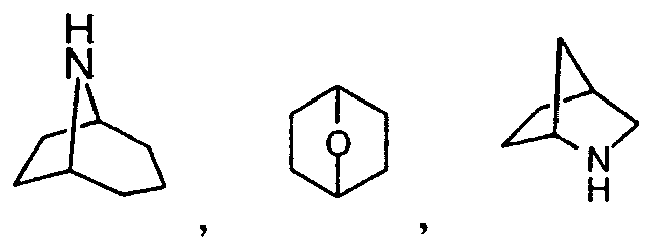
- Heterocyclics also include compounds of the formula

- Heterocyclics can be unsubstituted or substituted with one, two, three, four or five substituents independently selected from the group consisting of a) hydroxy, b) -SH, c) halo, d) oxo (=O), e) thioxo (=S), f) amino,g) -NHOH, h) alkylamino, i) dialkylamino, j) alkoxy, k) alkoxyalkoxy, l) haloalkyl, m) hydroxyalkyl, n) alkoxyalkyl, o) cycloalkyl which is unsubstituted or substituted with one, two, three or four loweralkyl groups, p) cycloalkenyl which is unsubstituted or substituted with one, two, three or four loweralkyl groups, q) alkenyl, r) alkynyl, s) aryl, t) arylalkyl, u) -COOH, v) -SO3H w) loweralkyl, x) alkoxycarbonyl, y) -C(O)NH2, z) -C(S)NH2, aa) -C(=N-OH)NH2, bb) aryl-L16-C(O)- wherein L16 is an alkenylene radical, cc) -S-L17-C(O)OR40 wherein L17 is an alkylene radical which is unsubstituted or substituted with one or two substitutents independently selected from the group consisting of alkanoyl, oxo (=O) or methinylamino (=CHNR41R42 wherein R41 is hydrogen or loweralkyl and R42 is loweralkyl) and R40 is hydrogen or a carboxy-protecting group, dd) -S-L18-C(O)NR43R44 wherein L18 is an alkylene radical which is unsubstituted or substituted with one or two substitutents independently selected from the group consisting of alkanoyl, oxo (=O) or methinylamino (=CHNR41R42 wherein R41 is hydrogen or loweralkyl and R43 and R44 are independently selected from the group consisting of hydrogen, loweralkyl and aryl, ee) -S-L19-CN wherein L19 is an alkylene radical, ff) -S-L20-R45 wherein L20 is absent or is an alkylene radical or an alkenylene radical or an alkynylene radical wherein the alkylene, alkenylene or alkynylene radical is unsubstituted or substituted with oxo (=O) and R45 is hydrogen, aryl, arylalkyl or heterocyclic wherein the heterocyclic is unsubstituted or substituted with one, two or three substituents independently selected from the group consisting of loweralkyl, hydroxy, hydroxyalkyl, halo, nitro, oxo (=O), amino, N-protected amino, alkoxy, thioalkoxy and haloalkyl, gg) -O-L21-R46 wherein L21 is absent or is an alkylene radical or an alkenylene radical or an alkynylene radical wherein the alkylene, alkenylene or alkynylene radical is unsubstituted or substituted with one or two substitutents independently selected from the group consisting of alkanoyl, oxo (=O) or methinylamino (=CHNR41R42 wherein R41 is hydrogen or loweralkyl and R46 is hydrogen, aryl, arylalkyl or heterocyclic wherein the heterocyclic is unsubstituted or substituted with one, two or three substituents independently selected from the group consisting of loweralkyl, hydroxy, hydroxyalkyl, halo, nitro, oxo (=O), amino, N-protected amino, alkoxy, thioalkoxy and haloalkyl, hh) -O-S(O)2-R47 wherein R47 is aryl, arylalkyl, heterocyclic or heterocyclicalkyl wherein the heterocyclic is unsubstituted or substituted with one, two or three substituents independently selected from the group consisting of loweralkyl, hydroxy, hydroxyalkyl, halo, nitro, oxo (=O), amino, N-protected amino, alkoxy, thioalkoxy and haloalkyl, ii) -S(O)2-NH-R48 wherein R48 is aryl, arylalkyl, heterocyclic or heterocyclicalkyl wherein the heterocyclic is unsubstituted or substituted with one, two or three substituents independently selected from the group consisting of loweralkyl, hydroxy, hydroxyalkyl, halo, nitro, oxo (=O), amino, N-protected amino, alkoxy, thioalkoxy and haloalkyl, jj) alkylsulfinyl, kk) alkylsulfonyl, 11) arylsulfonyl, mm) arylsulfonyloxy, nn) -C(=NOR49)C(O)OR50 wherein R49 is hydrogen or loweralkyl and R50 is hydrogen or a carboxy-protecting group, oo) alkoxycarbonylalkyl, pp) carboxyalkyl, qq) cyanoalkyl, rr) alkylaminoalkyl, ss) N-protected alkylaminoalkyl, tt) dialkylaminoalkyl, uu) dioxoalkyl, vv) loweralkyl-C(O)-, ww) loweralkyl-C(S)-, xx) aryl-C(O)-, yy) aryl-C(S)-, zz) loweralkyl-C(O)-O-, aaa) loweralkyl-S-C(S)- bbb) N-protected amino, ccc) aminoalkyl-C(O)-, ddd) N-protected aminoalkyl-C(O)- eee) aminoalkyl-C(S)-, fff) N-protected aminoalkyl-C(S)-, ggg) aminoalkyl, hhh) N-protected aminoalkyl, iii) formyl, jjj) cyano, kkk) nitro, lll) spiroalkyl, mmm) oxoalkyloxy, nnn) R53-L22-, wherein L22 is alkenylene or alkynylene and R53 is aryl or heterocyclic wherein the heterocyclic is unsubstituted or substituted with one, two or three substituents independently selected from the group consisting of loweralkyl, hydroxy, hydroxyalkyl, halo, nitro, oxo (=O), amino, N-protected amino, alkoxy, thioalkoxy and haloalkyl, ooo) aryl-NH-C(O)-, ppp) R54-N=N- wherein R54 is aryl or heterocyclic wherein the heterocyclic is unsubstituted or substituted with one, two or three substituents independently selected from the group consisting of loweralkyl, hydroxy, hydroxyalkyl, halo, nitro, oxo (=O), amino, N-protected amino, alkoxy, thioalkoxy and haloalkyl, qqq) =N-R55 wherein R55 is hydrogen, aryl, heterocyclic, -S(O)2-aryl or -S(O)2-heterocyclic wherein the heterocyclic is unsubstituted or substituted with one, two or three substituents independently selected from the group consisting of loweralkyl, hydroxy, hydroxyalkyl, halo, nitro, oxo (=O), amino, N-protected amino, alkoxy, thioalkoxy and haloalkyl, rrr) diarylalkyl-N=N-, sss) aryl-N(R56)- or arylalkyl-N(R56)- wherein R56 is hydrogen or an N-protecting group, ttt) arylsulfonylalkyl, uuu) heterocyclicsulfonylalkyl wherein the heterocyclic is unsubstituted or substituted with one, two or three substituents independently selected from the group consisting of loweralkyl, hydroxy, hydroxyalkyl, halo, nitro, oxo (=O), amino, N-protected amino, alkoxy, thioalkoxy and haloalkyl, vvv) =C(CN)(C(O)NH2), www) =C(CN)(C(O)O-loweralkyl), xxx) heterocyclic or heterocyclicalkyl wherein the heterocyclic is unsubstituted or substituted with one, two or three substituents independently selected from the group consisting of loweralkyl, hydroxy, hydroxyalkyl, halo, nitro, oxo (=O), amino, N-protected amino, alkoxy, thioalkoxy and haloalkyl, yyy) hydroxythioalkoxy, zzz) aryloxyalkyl, aaaa) aryloxyalkylthioalkoxy, bbbb) dialkoxyalkyl, cccc) dithioalkoxyalkyl, dddd) arylalkyl-NH-L23- wherein L23 is an alkylene group, eeee) heterocyclicalkyl-NH-L24- wherein L24 is an alkylene group, ffff) aryl-S(O)2-NH-L25- wherein L25 is an alkylene group, gggg) heterocyclic-S(O)2-NH-L26- wherein L26 is an alkylene group, hhhh) aryl-C(O)-NH-L27- wherein L27 is an alkylene group and iiii) heterocyclic-C(O)-NH-L28- wherein L28 is an alkylene group, jjjj) Ryy(CH2)n-X-Y-Z-(CH2)m wherein Ryy is cycloalkyl, aryl and loweralkyl, n amd m are independently 0-2, Z is O or absent, Y is absent, CH2, CHOH or C(O), with the proviso that when X is O, Z is absent and with the proviso that when Z is O, X is absent and with the proviso that when Y is CHOH. X and Z are absent.
- The term "(heterocyclic)alkoxy" as used herein refers to an alkoxy group to which is attached a heterocycle.
- The term "(heterocyclic)alkyl" as used herein refers to a heterocyclic group as defined above appended to a loweralkyl radical as defined above. Examples of heterocyclic alkyl include 2-pyridylmethyl, 4-pyridylmethyl, 4-quinolinylmethyl and the like.
- The term "(heterocyclic)oxy" as used herein refers to a heterocycle connected to the parent molecular group through an oxygen atom.
- The term "(heterocyclic)oxyalkyl" as used herein refers to a loweralkyl group to which is attached a (heterocyclic)oxy group.
- The term "(heterocyclic)alkoxyalkyl" as used herein refers to an alkoxyalkyl group to which is attached a heterocycle.
- The term "heterocycliccarbonyloxyalkyl" as used herein refers to a loweralkyl radical to which is appended R72-C(O)-O- wherein R72 is a heterocyclic group.
- The term "hydroxy" as used herein refers to -OH.
- The term "hydroxyalkyl" as used herein refers to a loweralkyl radical to which is appended an hydroxy group.
- The term "hydroxyarylalkyl" as used herein refers to a arylalkyl group to which is appended a hydroxy group.
- The term "hydroxythioalkoxy" as used herein refers to R51S- wherein R51 is a hydroxyalkyl group.
- The term "loweralkyl" as used herein refers to branched or straight chain alkyl groups comprising one to ten carbon atoms, including methyl, ethyl, propyl, isopropyl, n-butyl, t-butyl, neopentyl and the like. The loweralkyl groups of this invention can be optionally substituted.
- The term "N-protected alkylaminoalkyl" as used herein refers to an alkylaminoalkyl group wherein the nitrogen is N-protected.
- The term "nitro" as used herein refers to -NO2.
- The term "oxo" as used herein refers to (=O).
- The term "oxoalkyloxy" as used herein refers to an alkoxy radical wherein the loweralkyl moiety is substituted with an oxo (=O) group.
- The term "oxyamino(alkyl)carbonylalkyl" as used herein refers to a -O-NR-C(O)-R' group wherein R and R' are loweralkyl.
- The term "oxyamino(arylalkyl)carbonylalkyl" as used herein refers to a -O-NRR 3-C(O)-R group wherein RR3 is arylalkyl and R is loweralkyl.
- The term "oxyaminocarbonylalkyl" as used herein refers to -O-NH-C(O)-R group wherein R is loweralkyl.
- The term "spiroalkyl" as used herein refers to an alkylene diradical, both ends of which are bonded to the same carbon atom of the parent group to form a spirocyclic group.
- The term "sulfhydryl" as used herein refers to -SH.
- The term "sulfhydrylalkyl" as used herein refers to a loweralkyl group to which is attached a sulfhydryl group.
- The term "thioalkoxy as used herein refers to R52S- wherein R52 is loweralkyl. Examples of thioalkoxy include, but are not limited to, methylthio, ethylthio and the like.
- The term "thioalkoxyalkyl" as used herein refers to a thioalkoxy group as previously defined appended to a loweralkyl group as previously defined. Examples of thioalkoxyalkyl include thiomethoxymethyl, 2-thiomethoxyethyl and the like. The thioalkoxyalkyl groups of this invention can be optionally substituted.
- The term "thiocycloalkoxy" as used herein refers to a cycloalkyl group attached to the parent molecular group through a sulfur atom.
- The term "thiocycloalkoxyalkyl" as used herein refers to a loweralkyl group to which is attached a thiocycloalkoxy group.
- The ability of the compounds of the invention to inhibit protein farnesyltransferase or protein geranylgeranyltransferase can be measured according to the method of Moores, et al., J. Biol. Chem. 266: 14603 (1991) or the method of Vogt, et al., J. Biol. Chem. 270:660-664 (1995). In addition, procedures for determination of the inhibition of farnesylation of the oncogene protein Ras are described by Goldstein, et al., J. Biol. Chem., 266:15575-15578 (1991) and by Singh in United States Patent No.
5,245,061 . - In addition, in vitro inhibition of protein farnesyltransferase may be measured by the following procedure. Rat brain protein farnesyltransferase activity is measured using an Amersham Life Science commercial scintillation proximity assay kit and substituting a biotin-K Ras B fragment (biotin-Lys-Lys-Ser-Lys-Thr-Lys-Cys-Val-Ile-Met-CO2H), 0.1 mM final concentration, for the biotin-lamin substrate provided by Amersham. The enzyme is purified according to Reiss, Y., et al., Cell, 62: 81-88 (1990), utilizing steps one through three. The specific activity of the enzyme is approximately 10 nmol substrate farnesylated/mg enzyme/hour. The percent inhibition of the farnesylation caused by the compounds of the invention (at 10 x 10-6 M) compared to an uninhibited control sample is evaluated in the same Amersham test system.
- The % inhibition of protein farnesyltransferase was determined for representative compounds, some being compounds of the invention. The results are summarized in Table 1.
- In Vitro Potencies of Representative Compounds
Table 1. Inhibition of farnesyltransferase Example % inhibition at 1X10⁻⁵ M Example % inhibition at 1X10⁻⁵ M 200 93 674 40 350 53 676 76 351 82 678 73 352 52 680 58 353 62 683 57 354 47 684 48 355 43 685 55 356 58 686 48 357 56 687 78 358 45 688 71 359 36 689 73 360 88 690 61 361 97 692 74 362 83 699 74 363 96 700 68 364 69 701 64 365 97 702 79 366 83 704 67 367 81 705 72 368 71 706 53 369 87 707 66 370 86 708 76 371 66 709 55 372 69 710 45 373 76 711 46 374 61 712 69 375 68 713 40 376 80 714 56 377 71 715 67 378 54 717 75 380 45 718 40 381 79 750 44 382 > 50 752 58 383 > 50 753 55 387 > 50 754 40 388 > 50 755 44 390 > 50 756 47 639 44 757 58 659 55 758 46 663 43 759 49 664 75 952 > 50 669 52 955 50 670 78 974 > 50 672 48 Table 2. Inhibition of farnesyltransferase Example % inhibition at 1X10⁻⁶ M Example % inhibition at 1X10⁻⁶ M 157 92 583 98 158 2 587 97 159 84 595 97 160 30 607 96 161 54 610 94 162 12 613 97 163 18 617 99 164 92 620 98 165 74 626 61 166 97 627 85 167 98 632 43 168 92 633 32 183 98 636 72 184 36 641 34 185 93 642 48 186 86 644 54 187 68 386 > 50 188 40 399 > 50 189 88 403 99 190 4 404 98 191 28 405 98 192 95 406 95 193 4 407 98 196 43 435 96 197 1 451 85 201 63 452 96 202 31 453 90 203 76 456 81 204 98 457 92 205 98 460 88 206 67 463 91 207 98 465 92 208 98 466 93 209 74 467 97 210 5 468 96 211 98 469 92 212 12 470 95 213 98 471 94 214 97 472 97 215 82 473 96 216 67 474 92 217 99 475 21 218 89 476 91 219 56 477 98 220 92 478 98 221 55 479 95 222 41 480 87 223 63 481 95 224 41 488 41 225 93 494 96 226 23 495 95 227 94 496 93 228 39 497 94 231 50 498 98 233 65 499 98 234 4 500 98 235 95 501 84 237 98 502 24 238 22 503 57 239 97 504 90 240 98 505 72 241 41 507 95 242 99 507 96 243 23 508 95 244 21 509 77 245 50 510 84 248 79 512 94 249 77 513 96 250 96 514 94 252 98 515 72 253 99 516 95 254 96 525 99 255 98 528 99 256 98 529 99 257 98 530 94 258 98 537 97 259 98 540 40 260 98 645 37 261 98 646 58 262 98 649 86 263 99 650 68 264 98 651 33 265 98 652 41 266 97 653 62 267 96 655 35 268 98 657 32 269 98 658 73 270 98 661 45 271 84 662 68 272 96 665 55 273 96 666 82 274 94 667 83 276 98 671 36 277 98 673 59 278 99 677 37 279 99 682 31 280 98 691 34 281 98 693 53 282 76 694 45 283 98 696 57 284 83 697 39 286 84 703 40 287 24 716 69 288 22 719 90 289 23 720 70 290 74 721 83 291 23 722 96 292 36 723 87 294 98 724 87 295 94 725 78 296 89 726 81 297 65 727 95 298 43 744 84 299 94 749 84 300 22 751 32 301 98 764 88 302 31 765 76 304 99 768 67 305 99 771 72 306 99 772 79 307 82 773 41 308 62 774 48 309 98 775 32 310 98 776 36 311 97 777 83 313 94 782 96 314 97 786 34 315 93 787 70 316 63 788 44 317 54 789 86 318 98 790 88 319 98 791 53 320 93 792 88 321 90 793 94 322 98 794 92 323 98 796 35 324 98 797 35 325 99 806 72 326 91 807 90 327 97 808 88 328 96 809 78 329 98 810 89 330 98 812 94 331 98 813 95 332 26 816 87 333 99 824 90 334 93 831 92 343 72 832 80 344 95 834 55 345 91 835 96 346 98 844 92 347 95 846 85 348 66 850 90 349 99 862 95 379 21 866 62 541 37 867 71 542 67 868 89 544 35 872 74 545 88 878 95 546 97 879 95 547 91 886 35 550 96 889 95 78 902 85 728 552 88 903 78 553 92 908 88 554 96 910 42 555 85 911 65 556 99 918 97 557 93 923 78 560 91 924 77 561 91 925 87 564 98 926 69 565 94 936 69 566 98 937 95 568 93 962 > 50 569 91 964 > 50 572 91 979 26 575 70 982 64 576 88 987 93 577 94 988 92 582 99 989 88 Table 3. Inhibition of farnesyltransferase Example % inhibition at 1X10⁻⁷ M Example % inhibition at 1X10⁻⁷ M 434 93 623 96 436 89 729 73 437 89 730 96 438 90 731 65 439 80 732 84 440 92 733 60 441 91 734 49 442 88 735 96 443 97 736 96 444 95 737 95 445 94 738 54 446 91 739 83 447 91 740 94 448 92 741 89 449 91 742 87 450 96 743 51 455 83 745 93 458 87 746 84 459 92 747 68 461 93 748 56 462 91 769 90 464 86 770 91 482 96 781 91 483 95 785 96 484 97 795 87 485 96 798 95 486 97 799 96 487 81 800 74 489 86 801 87 490 70 802 88 491 94 811 85 492 95 814 81 493 51 815 71 511 82 817 60 519 89 818 78 520 97 822 93 521 94 823 75 522 93 825 79 523 97 839 63 524 99 849 66 526 96 854 78 527 97 855 92 531 74 856 97 532 88 857 92 533 91 859 86 534 84 861 65 535 89 863 72 536 79 864 84 539 89 865 95 548 86 869 92 549 98 874 90 551 93 875 92 558 87 876 92 559 96 891 94 562 95 893 87 563 95 894 89 570 92 895 92 571 88 896 96 573 72 900 95 574 81 906 88 578 90 912 85 579 92 913 89 580 90 914 91 581 96 917 78 584 96 919 91 585 96 921 82 589 91 929 81 590 95 931 98 592 93 933 91 593 86 935 72 594 95 940 92 597 75 941 90 600 93 945 80 601 92 947 79 602 97 948 75 604 86 949 57 609 95 950 71 611 95 951 71 615 94 959 > 50 616 95 983 66 618 89 984 86 621 98 990 84 622 95 993 90 Table 4. Inhibition of farnesyltransferase Example % inhibition at 1X10⁻⁸ M Example % inhibition at 1X10⁻⁸ M 384 91 851 82 397 50 852 79 398 >50 853 85 400 98 858 60 401 66 860 85 408 > 95 870 91 409 84 871 94 410 94 873 97 517 92 877 68 518 90 880 95 567 69 881 69 586 90 882 79 588 68 883 91 591 82 884 94 599 86 885 95 603 94 887 92 605 68 888 86 606 93 892 59 608 91 897 76 612 96 898 82 614 92 899 88 619 95 901 84 760 95 904 85 762 84 905 86 763 92 907 79 766 95 909 79 767 97 916 96 779 70 920 96 780 71 922 96 803 95 927 74 804 95 928 84 805 96 930 66 819 76 932 60 820 66 934 71 821 75 938 61 826 92 939 72 827 77 942 58 828 87 943 79 829 92 944 88 833 78 946 52 836 95 954 > 50 837 91 958 > 50 838 92 960 > 50 840 73 985 89 841 93 986 95 842 88 991 69 843 96 992 93 845 85 994 83 847 85 995 92 848 87 996 80 Table 5. Inhibition of geranylgeranyltransferase I. Example Activity 387 > 50% inhibition at 1 X 10⁻⁶ M 388 > 50% inhibition at 1 X 10⁻⁷ M 389 > 50% inhibition at 1 X 10⁻⁶ M 390 > 50% inhibition at 1 X 10⁻⁵ M 392 > 50% inhibition at 1 X 10⁻⁵ M 399 > 50% inhibition at 1 X 10⁻⁶ M 953 > 50% inhibition at 1 X 10⁻⁶ M 955 > 50% inhibition at 1 X 10⁻⁷ M 962 > 50% inhibition at 1 X 10⁻⁷ M 964 > 50% inhibition at 1 X 10⁻⁶ M 966 > 50% inhibition at 1 X 10⁻⁶ M 967 > 50% inhibition at 1 X 10⁻⁶ M 969 > 50% inhibition at 1 X 10⁻⁵ M 974 > 50% inhibition at 1 X 10⁻⁵ M Table 6. Inhibition of farnesyltransferase at concentrations of 10 mM and 1 mM unless specified as * (0.1 mM) or ** (0.01 mM) Example % inhibition 10 mM % inhibition 1 mM Example % inhibition 10 mM % inhibition 1 mM 997 91** 1199 71 998 79** 1200 97* 999 90 1201 73* 1000 82* 1202 96** 1001 92** 1203 84* 1002 82** 1204 93* 1003 92* 1205 55** 1004 92** 1206 63** 1005 95** 1207 91* 1006 95** 1208 89* 1007 85** 1209 87* 1008 95** 1210 64** 1009 86** 1211 94 1010 90* 1212 86* 1011 92** 1213 79** 1012 88* 1214 92** 1013 80* 1215 17 1014 91 1216 88** 1015 59* 1217 87* 1016 92* 1218 54** 1017 51* 1219 85** 1018 97 1220 1019 70 1221 82** 1020 39 1222 89* 1021 93* 1223 91** 1022 91** 1224 88* 1023 89** 1225 92** 1024 89** 1226 69** 1025 91** 1227 91 1026 74** 1228 88* 1027 81** 1229 66** 1028 92** 1230 77** 1029 82** 1231 93* 1030 92** 1232 68** 1031 90** 1233 77** 1032 93** 1234 71** 1033 76** 1235 86** 1034 77 1236 83** 1035 76 1237 89** 1036 79 1238 91** 1037 88 1239 85* 1038 57 1240 64** 1039 89** 1241 74* 1040 90** 1242 75* 1041 48 1243 95* 1042 88 1244 84 1043 90* 1245 92 1044 76* 1246 82 1045 86* 1247 95* 1046 93 1248 88 1047 95 1249 89 1048 78** 1250 79** 1049 93** 1251 91** 1050 62** 1252 84* 1051 79** 1253 76* 1052 91** 1254 67 1053 60** 1255 82* 1054 89** 1256 95* 1055 85** 1257 93** 1056 75** 1258 97** 1057 82* 1259 89** 1058 89 1260 90** 1059 92* 1261 94 1060 42 1262 95 1061 88* 1263 85* 1062 93 1264 83** 1063 92** 1265 90 1064 95** 1266 85* 1065 78* 1267 96 1066 73** 1268 95* 1067 93* 1269 84** 1068 79** 1270 91** 1069 74* 1271 78** 1070 93** 1272 73** 1071 95* 1273 94* 1072 82* 1274 89* 1073 93** 1275 86** 1074 82 1276 88** 1075 90** 1277 90** 1076 69** 1278 68 1077 93** 1279 87** 1078 86* 1280 78** 1079 90 1281 81* 1080 87 1282 69* 1081 61 1283 74* 1082 84* 1284 86 1083 88 1285 94 1084 76** 1286 85** 1085 93* 1287 95** 1086 87* 1288 69* 1087 76* 1289 93 1088 73* 1290 80 1089 86* 1291 1090 81** 1292 1091 87* 1293 1092 74** 1294 1093 95** 1295 1094 96** 1296 1095 76* 1297 1096 86* 1298 97** 1097 80** 1299 96** 1098 60* 1300 97* 1099 87** 1301 97* 1100 82** 1302 93** 1101 86* 1303 91** 1102 84** 1304 90** 1103 92* 1305 91** 1104 89** 1306 85** 1105 91** 1307 85** 1106 67** 1308 91** 1107 88** 1309 96* 1108 95** 1310 90** 1109 74** 1311 95** 1110 1312 91** 1111 63** 1313 91** 1112 62 1314 96* 1113 55 1315 86* 1114 83** 1316 78* 1115 94* 1317 99 96 1116 91** 1318 1117 92* 1319 79** 1118 86* 1320 79 1119 84** 1321 1120 93 1322 1121 72* 1323 1122 92** 1324 1123 90* 1325 1124 90* 1326 1125 92* 1327 1126 87 1328 1127 90* 1329 1128 86* 1330 1129 92** 1331 1130 88** 1332 92** 1131 96** 1333 95* 1132 97* 1334 72** 1133 75* 1335 90* 1134 95** 1336 74 1135 88* 1337 83** 1136 91 1338 65* 1137 83** 1339 1138 65* 1340 77* 1139 92* 1341 89 1140 77** 1342 1141 80* 1343 88 1142 84** 1344 93** 1143 92* 1345 94** 1144 76* 1346 94* 1145 83* 1347 81** 1146 61** 1348 78** 1147 93* 1349 92** 1148 79** 1350 1149 94* 1351 1150 92* 1352 1151 91* 1353 1152 96* 1354 38 1153 89* 1355 46 1154 93* 1356 80 1155 91* 1357 78 1156 87 1358 1157 66** 1359 1158 75 1360 98** 1159 72* 1361 96* 1160 83* 1362 83** 1161 87* 1363 88** 1162 84* 1364 1163 73** 1365 1164 94 1366 79* 1165 84* 1367 93* 1166 74** 1368 92** 1167 91* 1369 94* 1168 88* 1370 86** 1169 77 1371 94* 1170 74* 1372 95** 1171 74** 1373 95** 1172 38* 1374 93** 1173 89** 1375 80** 1174 79** 1376 86** 1175 96 1377 95* 1176 97* 1378 68 1177 19 1379 41 1178 88** 1380 87** 1179 85* 1381 65** 1180 93* 1382 86** 1181 82* 1383 88* 1182 92** 1384 69** 1183 79** 1385 93* 1184 84** 1386 88* 1185 85** 1387 82** 1186 93** 1392 93* 1187 93** 1397 87** 1188 93** 1398 81* 1189 74** 1399 94 1190 95** 1400 95 1191 85** 1192 91* 1193 95** 1194 78** 1195 94* 1196 87* 1197 85* 1198 86* * % inhibition at 0.1 µM
** % inhibition at 0.01 µM - Additional methods for the measurement of in vitro inhibition of protein prenylation (i.e., inhibition of farnesyltransferase or geranygeranyltransferase) are described below.
- Assays are performed using the glass fiber filter binding assay procedure with either rabbit reticulocyte lysate or FTase or GGTase I fractions isolated from bovine brains using a combination of hydrophobic and DEAE column chromatography procedures. Protein substrates are purchased from Panvera Corporation (H-ras for FTase, H-ras-CVLL for GGTase I). Tritium labeled prenyl lipid substrates (FPP or GGPP) are obtained from Amersham Life Science.
- 3H-Farnesyldiphosphate (final concentration 0.6 µM), H-Ras (final concentration 5.0 µM) and the test compound (various final concentrations from a stock solution in 50% DMSO/water; final concentration DMSO < 2%) were mixed in buffer (50 mM HEPES (pH 7.5), 30 mM MgCl2, 20 mM KCI, 10 µM ZnCl2, 5 mM DTT, 0.01 % Triton X-100) to give a final volume of 50 µL. The mixture was brought to 37 °C, enzyme was added, and the reaction is incubated for 30 minutes. 1 mL of 1 M HCl/ethanol was added to stop the reaction, and the mixture was allowed to stand for 15 minutes at room temperature then diluted with 2 mL of ethanol. The reaction mixture was filtered through a 2.5 cm glass microfiber filter from Whatman and washed with four 2 mL portions of ethanol. The glass filter was transferred to a scintillation vial and 5 mL of scintillation fluid was added. The radioisotope retained on the glass fiber filter was counted to reflect the activity of the enzymes. The IC50 value was calculated by measuring the activity of the enzyme over a suitable range of inhibitor concentrations.
- 3H-geranylgeranyldiphosphate (final concentration 0.5µM), H-Ras-CVLL (final concentration 5.0 µM) and the test compound (various final concentrations from a stock solution in 1:1 DMSO/water; final concentration DMSO < 2%) were mixed in buffer (50 mM Tris-HCl (pH 7.2), 30 mM MgCl2, 20 mM KCI, 10 µM ZnCl2, 5 mM DTT, 0.01% Triton X-100) to give a final volume of 50 µL. The mixture was brought to 37 °C, treated with enzyme, and incubated for 30 minutes. 1 mL of 1 M HCl/ethanol was added to stop the reaction, and the mixture was allowed to stand for 15 minutes at room temperature then diluted with 2 mL of ethanol. The reaction mixture was filtered through a 2.5 cm glass microfiber filter from Whatman and washed with four 2 mL portions of ethanol. The glass filter was transferred to a scintillation vial, and 5 mL scintillation fluid was added. The radioisotope retained on the glass fiber filter was counted to reflect the activity of the enzymes. The IC50 value was calculated by measuring the activity of the enzyme over a suitable range of inhibitor concentrations.
- Additionally, the ability of the compounds of the invention to inhibit prenylation in whole cells, inhibit anchorage-independent tumor cell growth and inhibit human tumor xenograft in mice could be demonstrated according to the methods described in
PCT Patent Application No. WO95/25086, published September 21, 1995 - The compounds of the present invention can be used in the form of pharmaceutically acceptable salts derived from inorganic or organic acids. These salts include trifluoroacetate.
- Basic addition salts can be prepared in situ during the final isolation and purification of the compounds of formula (I)-(XII) or separately by reacting the carboxylic acid function with a suitable base such as the hydroxide, carbonate or bicarbonate of a pharmaceutically acceptable metal cation Such pharmaceutically acceptable salts include cations based on the alkali metal, lithium.
- The compounds of the invention are useful (in humans and other mammals) for inhibiting protein isoprenyltransferases (i.e, protein farnesyltransferase and/or protein geranylgeranyltransferase) and the isoprenylation (i.e., farnesylation and/or geranylgeranylation) of Ras. These inhibitors of protein isoprenyltransferases are also useful for inhibiting or treating cancer in humans and other mammals. Examples of cancers which may be treated with the compounds of the invention include, but are not limited to, carcinomas such as lung, colorectal, bladder, breast, kidney, ovarian, liver, exocrine pancreatic, cervical, esophageal, stomach and small intestinal; sarcomas such as oesteroma, osteosarcoma, lepoma, liposarcoma, hemanioma and hemangiosarcoma; melanomas such as amelanotic and melanotic; mixed types of cancers such as carcinosarcoma, lymphoid tissue type, follicular reticulum, cell sarcoma and Hodgkins disease and leukemias, such as myeloid, acute lymphoblastic, chronic lymphocytic, acute myloblastic and chronic mylocytic.
- The ability of the compounds of the invention to inhibit or treat cancer can be demonstrated according to the methods of Mazerska Z., Woynarowska B., Stefanska B., Borowski S., Drugs Exptl. Clin. Res. 13(6), 345-351 (1987) Bissery, M.C., Guenard F., Guerritte-Voegelein F., Lavelle F., Cancer Res. 51, 4845-4852 (1991) and Rygaard J., and Povlsen C., Acta Pathol. Microbiol. Scand. 77, 758 (1969).
- These inhibitors of protein isoprenyltransferases are also useful for treating or preventing restenosis in humans and other mammals. The ability of the compounds of the invention to treat or prevent restenosis can be demonstrated according to the methods described by Kranzhofer, R. et al. Circ. Res. 73: 264-268 (1993), Mitsuka, M. et al. Circ. Res. 73: 269-275 (1993) and Santoian, E.C. et al. Circulation 88: 11-14(1993).
- For use as a chemotherapeutic agent, the total daily dose administered to a host in single or divided doses may be in amounts, for example, from 0.01 to 500 mg/kg body weight daily, preferably in amounts from 0.1 to 20 mg/kg body weight daily and more preferably in amounts from 0.5 to 10 mg/kg body weight daily. Dosage unit compositions may contain such amounts of submultiples thereof to make up the daily dose.
- For treatment or prevention of restenosis, the total daily dose administered to a host in single or divided doses may be in amounts, for example, from 0.001 to 1000 mg/kg body weight daily and more preferred from 1.0 to 50 mg/kg body weight daily. Dosage unit compositions may contain such amounts of submultiples thereof to make up the daily dose.
- The amount of active ingredient that may be combined with the carrier materials to produce a single dosage form will vary depending upon the host treated and the particular mode of administration.
- It will be understood, however, that the specific dose level for any particular patient will depend upon a variety of factors including the activity of the specific compound employed, the age, body weight, general health, sex, diet, time of administration, route of administration, rate of excretion, drug combination and the severity of the particular disease undergoing therapy.
- The compounds of the present invention may be administered orally, parenterally, sublingually, by inhalation spray, rectally or topically in dosage unit formulations containing conventional nontoxic pharmaceutically acceptable carriers, adjuvants, and vehicles. Topical administration may also involve the use of transdermal administration such as transdermal patches or iontophoresis devices. The term parenteral as used herein includes subcutaneous injections, intravenous, intramuscular, intrasternal injection or infusion techniques.
- Injectable preparations, for example sterile injectable aqueous or oleagenous suspensions, may be formulated according to the known art using suitable dispersing or wetting and suspending agents. The sterile injectable preparation may also be a sterile injectable solution or suspension in a nontoxic parenterally acceptable diluent or solvent (as in a solution in 1,3-propanediol, for example). Among the acceptable vehicles and solvents that may be employed are water, Ringer's solution and isotonic sodium chloride solution. Additionally, sterile, fixed oils are conventionally employed as a solvent or suspending medium. For this purpose, any bland fixed oil may be employed including synthetic mono- or diglycerides. Fatty acids such as oleic acid find use in the preparation of injectables.
- Suppositories for rectal administration of the drug can be prepared by mixing the drug with a suitable nonirritating excipient such as cocoa butter and polyethylene glycols which are solid at ordinary temperatures but liquid at rectal temperature and will therefore melt in the rectum and release the drug.
- Solid dosage forms for oral administration may include capsules, tablets, pills, powders and granules. In such solid dosage forms, the active compound may be admixed with at least one inert diluent such as sucrose, lactose or starch. These dosage forms may also comprise additional substances other than inert diluents such as lubricating agents like magnesium stearate. With capsules, tablets and pills, the dosage forms may also comprise buffering agents. Tablets and pills mayalso be prepared with enteric coatings.
- Liquid dosage forms for oral administration may include pharmaceutically acceptable emulsions, solutions, suspensions, syrups and elixirs containing inert diluents commonly used in the art such as water. Such compositions may also comprise adjuvants such as wetting agents, emulsifying and suspending agents and sweetening, flavoring, and perfuming agents.
- The compounds of the present invention can also be administered in the form of liposomes. As is known in the art, liposomes are generally derived from phospholipids or other lipid substances. Liposomes are formed by mono- or multi-lamellar hydrated liquid crystals dispersed in an aqueous medium. Any non-toxic, physiologically aceptable and metabolizable lipid capable of forming liposomes can be used. The present compositions in liposome form can contain, in addition to a compound of the present invention, stabilizers, preservatives, excipients and the like. The preferred lipids are the phospholipids and phosphatidyl cholines (lecithins), both natural and synthetic.
- Methods to form liposomes are known in the art. See, for example, Prescott, Ed., Methods in Cell Biology, Volume XIV, Academic Press, New York, N.Y. (1976), p. 33 et seq .
- While the compounds of the invention can be administered as the sole active pharmaceutical agent for the treatment of cancer, they can also be used in combination with one or more other chemotherapeutic agents.
- Representative examples of chemotherapeutic agents are described in Holleb, et al., Clinical Oncology, American Cancer Society, United States (1991) p 56 et seq . These agents include alkylating agents such as the nitrogen mustards (mechloethamine, melphalan, chlorambucil, cyclophosphamide and ifosfamide), nitrosoureas (carmustine, lomustine, semustine, streptozocin), alkyl sulfonates (busulfan), triazines (dacarbazine) and ethyenimines (thiotepa, hexamethylmelamine); folic acid analogues (methotrexate); pyrimidine analogues (5-fluorouracil, cytosine arabinoside); purine analogues (6-mercaptopurine, 6-thioguanine); antitumor antibiotics (actinomycin D, the anthracyclines (doxorubicin), bleomycin, mitomycin C, methramycin); plant alkaloids such as vinca alkaloids (vincristine and vinblastine) and etoposide (VP-16); hormones and hormone antagonists (tamoxifen and corticosteroids); and miscellaneous agents (cisplatin, taxol and brequinar).
- The above compounds to be employed in combination with the isoprenyl protein transferase inhibitor of the invention will be used in therapeutic amounts as indicated in the Physicians' Desk Reference (PDR) 47th Edition (1993), or by such therapeutically useful amounts as would be known to one of ordinary skill in the art.
- The compounds of the invention and the other chemotherapeutic agent can be administered at the recommended maximum clinical dosage or at lower doses. Dosage levels of the active compounds in the compositions of the invention may be varied to obtain a desired therapeutic response depending on the route of administration, severity of the disease and the response of the patient.
- When administered as a combination, the therapeutic agents can be formulated as separate compositions which are given at the same time or different times, or the therapeutic agents can be given as a single composition.
- In general, the compounds of the invention can be prepared by the processes illustrated in the following Schemes 1-16. In these general schemes compounds of the formula I are used to exemplify the methods, but the methods are intended to be applicable to all of the compounds of the invention.


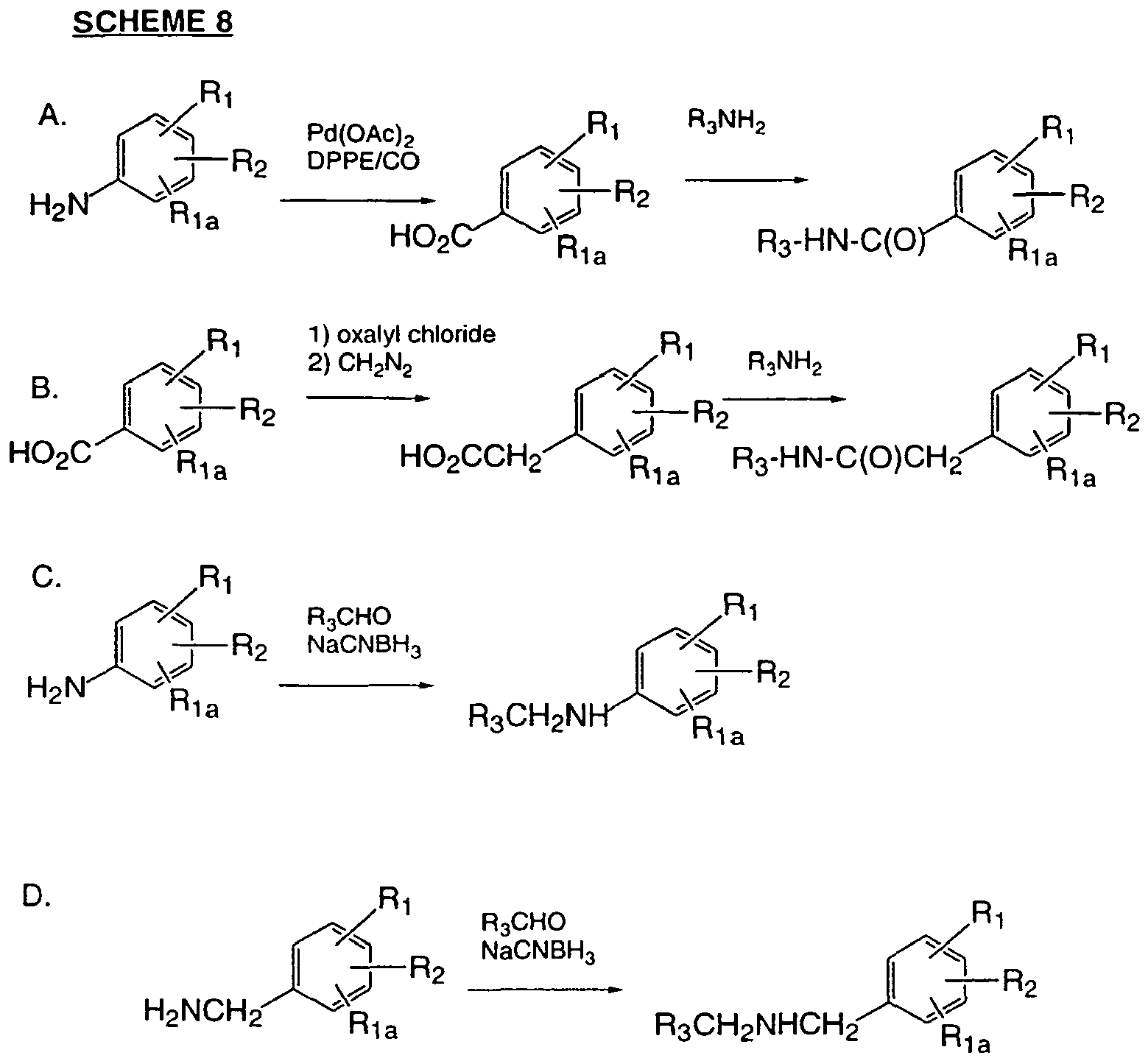


- Scheme 16 illustrates an alternative method for preparing compounds wherein R2 is -C(O)NH-CH(R14)-C(O)OR15 or

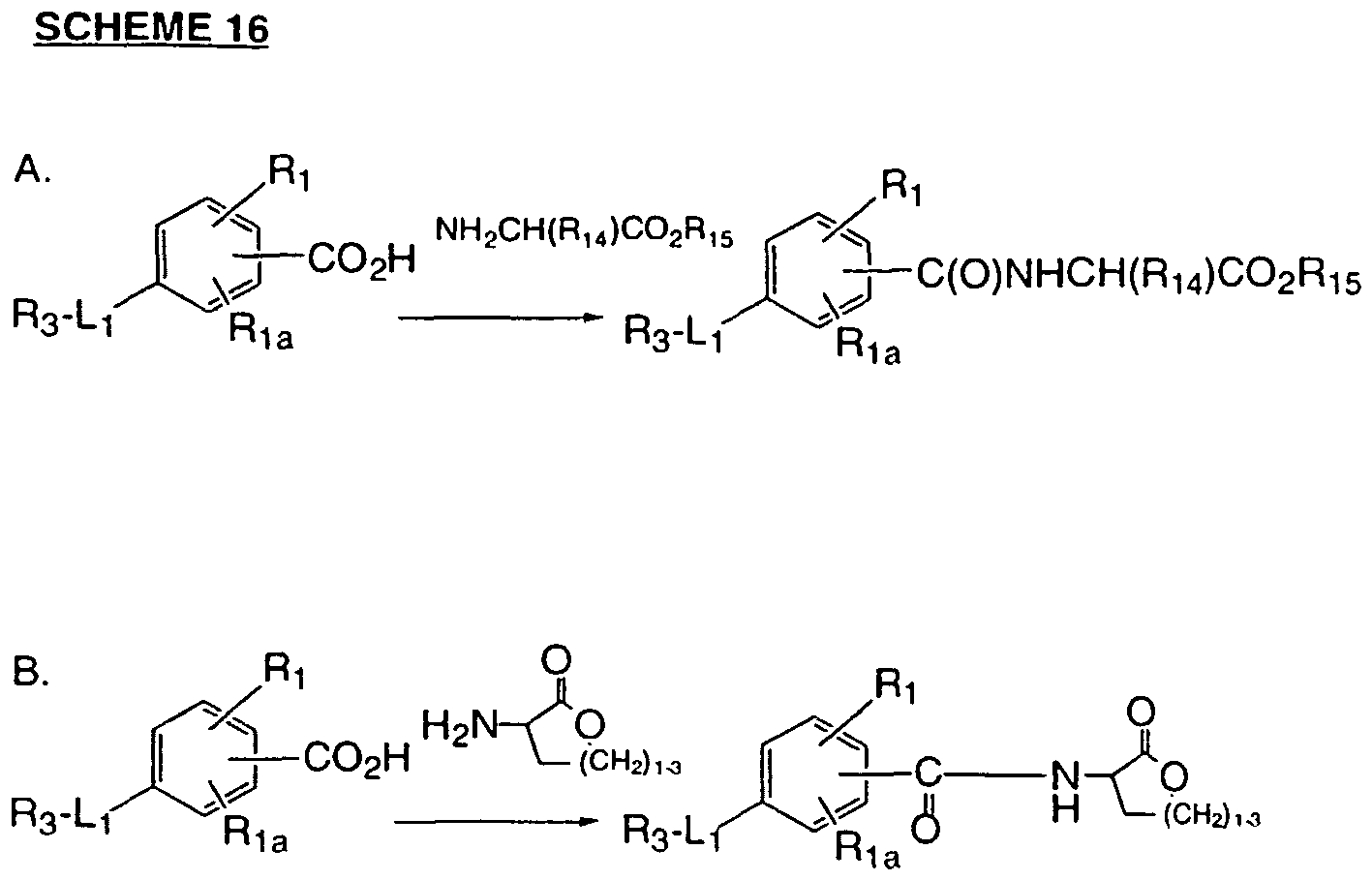
- The foregoing may be better understood by reference to the following examples which are provided for illustration and not intended to limit the scope of the inventive concept.
- In Tables 2-10, the abbreviation bz=benzoyl, bn=benzyl, Ph=phenyl, BOC=t-butyloxycarbonyl and TS=p-toluenesulfonyl.
- To a solution of methionine methyl ester hydrochloride (2.0 g, 10 mmol) and 3-(chloromethyl)benzoyl chloride (2.08 g, 11.0 mmol) in methylene chloride (50 mL) was slowly added triethylamine (3.07 mL, 22.0 mmol) at ice bath temperature for 2 hours. The mixture was washed with 0.5 N HCl (50 mL x 2), brine (50 mL x 2) and water (50 mL x 2) then dried over anhydrous MgSO4 and concentrated under reduced pressure. The residue was purified by flash column chromatography (30% ethyl acetate in hexanes) to give the desired product (3.03 g) as a white solid: m.p. 82-83°C;
1H NMR (CDCl3) d 7.82 (1H, s), 7.74 (1H, d, J=7.7 Hz), 7.53 (1H, d, J=7.7 Hz), 7.42 (1H, t, J=7.7 Hz), 7.06 (1H, br d, J=7.6Hz), 4.92 (1H, ddd, J=7,6, 7.1, 5.1 Hz), 4.59 (2H, s), 3.78 (3H, s), 2.58 (2H, t, J=7.1Hz) 2.26 (1H, sm), 2.15 (1H, m), 2.10 (3H, s); 13C NMR (CDCl3) d 172.59, 166.54, 138.13, 134.25, 131.95, 129.12, 127.42, 126.97, 52.72, 52.14, 45.55, 31.47, 30.12, 15.55. - A suspension of (3-(chloromethyl)benzoyl)-Met-OCH3 (1.58 g, 5.0 mmol) and sodium azide (1.3 g, 20.0 mmol) in DMSO (40 mL) was stirred at 80°C for 7 hours. The mixture was diluted with methylene chloride (100 mL), washed with brine (70 mL x 2) and water (70 mL x 2), and then dried over anhydrous MgSO4. The solvent was evaporated under reduced pressure to give a yellow residue. Chromatography on silica gel (30% ethyl acetate in hexanes) to provide the desired product (1.45 g) as a colorless solid: m.p. 48-49°C; 1H NMR (CDCl3) d 7.78 (2H, m), 7.49 (2H, m), 6.99 (1H, br d, J=7.4 Hz), 4.49 (1H, ddd, J=7.4, 7.1, 5.2 Hz), 4.42 (2H, s), 3.80 (3H,s), 2.60 (2H, t, J=7.4 Hz), 2.29 (1H, m), 2.17 (1H, m), 2.12 (3H, s); 13C NMR (CDCl3) d 177.50. 166.54, 135.97, 134.06, 131.18, 128.89, 126.84, 126.71, 54.09, 52.47, 51.95, 31.38, 30.00,15.30.
- A suspension of (3-(azidomethyl)benzoyl)-Met-OCH3 (1.29 g, 4.0 mmol) and 5% palladium on carbon (0.2 g) in methanol (40 mL) was stirred under a hydrogen atmosphere (1 atm) for two days at room temperature. The catalyst was removed by filtration through celite (1.5 g) and the solvent was evaporated in vacuo. The residue was washed with water (5 mL x 2) and dried to give the desired product (1.12 g) as a colorless foam. 1H NMR (CDCl3) d 7.81 (1H, s), 7.68 (1H, d, J=7.4 Hz), 7.45 (1H, d, J=6.5 Hz), 7.36 (1H, t, J=7.4 Hz), 4.91 (1H, ddd, J=7.3, 7.1, 5.1 Hz), 3.90 (2H, s), 3.77 (3H, s), 3.21 (2H, br s), 2.59 (2H, t, J=7.4 Hz), 2.20 (1H, m), 2.12 (1H, m), 2.09 (3H, s).
- The title compound is prepared according to the procedure used to prepare Compound 1 but replacing 3-(chloromethyl)benzoyl chloride with 4-(chloromethyl)benzoyl chloride.
- The title compound was prepared according to the procedure described in J. Biol. Chem. 269 12410-12413 (1994).
- 4-Aminobenzoic acid (10 g, 72.9 mmol) was placed into a mixture of dioxane (145.8 mL) and 0.5 M NaOH (145.8 mL). The solution was cooled to 0°C and di-t-butyl dicarbonate (23.87 g, 109.5 mmol) was added. The reaction mixture was allowed to warm to room temperature and stirred overnight. The next day, the dioxane was removed, the residue was made acidic and extracted into ethyl acetate. The ethyl acetate fractions were combined and washed with 1N HCl to remove any unreacted starting material. The solution was dried over Na2SO4 and the solvent was removed in vacuo. The crude material was recrystallized from ethyl acetate/hexanes to provide the desired product (12.2 g): m.p. 189-190°C; 1H NMR (CD3OD) d 1.52 (9H, s), 7.49 (2H, d, J=8.6 Hz), 7.91 (2H, d, J=8.6 Hz), 9.28 (1H, s); 13C NMR (CD3OD) d 28.59, 81.29, 118.54, 125.30, 131.81, 145.70, 155.00, 169.80; Anal. Calc. for C12H15NO4, C: 60.76, H: 6.37, N: 5.90; Found, C: 60.52, H: 6.43, N: 5.83; HRMS Calc. for C12H15NO4, 237.0961, Found, 237.1001.
- Into a dried, nitrogen filled flask was placed N-BOC-4-aminobenzoic acid (8.77 g, 36.97 mmol) in dry methylene chloride (148 mL) along with methionine methyl ester hydrochloride (8.12 g, 40.66 mmol). This solution was cooled in an ice bath and triethylamine (6.7 mL), EDCI (7.80 g, 40.66 mmol) and hydroxybenzotriazole (HOBT, 5.50 g, 40.66 mmol) were added. The mixture was stirred overnight, diluted with more methylene chloride and was extracted three times each with 1 M HCl, 1M NaHCO3 and water. The methylene chloride was dried over MgSO4 and the solvent was removed in vacuo. The resulting solid was recrystallized from ethyl acetate/hexanes to yield the desired product (9.72 g): m.p. 184-185°C; 1H NMR (CDCl3) d 1.53 (9H, s), 2.06-2.18 (4H, m), 2.23-2.33 (1H, m), 2.59 (2H, t, J=7.6 Hz), 3.80 (3H, s), 4.92 (1H, m), 7.45 (2H, d, J=8.7 Hz), 7.77 (2H, d, J=8.7 Hz); 13C NMR (CDCl3) d 15.59, 28.34, 30.15, 31.64, 52.10, 52.73, 81.20, 117.73, 127.8, 128.33, 141.88, 152.33, 166.50, 172.75; Anal. Calc. for C18H26N2O5S, C: 56.53, H: 6.85, N: 7.29; Found, C: 56.47, H: 6.86, N: 7.29; m/z (EI) 382 (M).
- N-BOC-4-aminobenzoyl-Met-OCH3 (3.53 g, 9.59 mmol) was placed into methylene chloride (30-35 mL) and to it was added 3M HCl/EtO2 (38.4 mL). After standing, a white precipitate formed. After two hours the solution was decanted and the crystals were collected by centrifugation. The crystals were then washed several times with fresh ether and dried overnight on the vacuum pump. Meanwhile, the filtrate was left to stand overnight to allow additional product to precipitate. The second fraction was washed with ether and dried overnight on the vacuum pump. The total yield of the desired product was 2.87 g: m.p.158-164°C; 1H NMR (CDCl3) d 2.10 (3H, s), 2.12-2.29 (1H, m), 2.52-2.71 (1H, m), 2.59 (2H, t, J=7.6 Hz), 3.75 (3H, s), 4.79 (1H, m), 7.02 (2H, d, J=8.6 Hz), 7.55 (2H, d, J=8.6 Hz); 13C NMR (CDCl3) d 15.23, 31.43, 31.53, 52.91, 52.43, 124.35, 130.56, 135.31, 135.76, 168.95, 173.87; HRMS Calc. for C13H18N2O3S, 282.1038, Found 282.1009.
- 4-Amino-3-methylbenzoic acid (5 g, 33.1 mmol) was reacted according to the same procedure as that used in the process for preparing N-BOC-4-aminobenzoic acid. The resulting orange-brown solid was recrystallized from ethyl acetate and hexanes to provide the desired product (4.99 g) as tan prismatic crystals: m.p. 180-182°C; 1H NMR (CD3OD) d 1.51 (9h, s), 2.27 (3H, s), 7.66 (1H, d, J=8.1 Hz), 7.79-7.82 (2H, m), 8.32 (1H, s); 13C NMR (CD3OD) d 17.98, 28.62, 81.47, 123.12, 127.05, 129.14, 130.65, 132.99, 142.45, 155.33, 168.70; Anal. Calc. for C13H17NO4, C: 62.15, H: 6.82, N: 5.58; Found C: 62.07, H: 6.86, N: 5.46; m/z (EI) 251; HRMS Calc. for C13H17NO4, 251.1158; Found, 251.1153.
- N-BOC-4-amino-3-methylbenzoic acid (2.00 g, 7.96 mmol) was reacted with with methionine methyl ester hydrochloride (1.75 g, 8.76 mmol), triethylamine (1.4 mL), EDCI (1.68 g, 8.76 mmol) and hydroxybenzotriazole (HOBT, 1.18 g, 8.76 mmol) in dry methylene chloride (31.8 mL) according to the procedure described for the preparation of N-BOC-4-aminobenzoyl)-Met-OCH3. The resulting solid was recrystallized from ethyl acetate/hexanes to yield the desired product (2.61 g): m.p. 163-165°C; 1H NMR (CDCl3) d 1.54 (9H, s), 2.06-2.18 (4H, m), 2.23-2.34 (4H, m), 2.59 (2H, t, J=6.8 Hz), 3.80 (3H, s), 4.92 (1H, m), 6.45 (1H, s), 6.88 (1H, d, J=7.5 Hz), 7.63 (1H, d, J=8.6 Hz), 7.66 (1H, s), 8.05 (1H, d, J=8.6 Hz); 13C NMR (CDCl3) d 15.47, 17.61, 28.22, 30.03, 31.55, 51.93, 52.57, 81.04, 118.73, 125.62, 127.66, 129.54, 139.89, 152.34, 166.58, 172.66.
- N-BOC-4-Amino-3-methylbenzoyl-Met-OCH3 (0.99 g, 2.59 mmol) was dissolved in methylene chloride (15-20 mL) and precipitated with 3M HCl/Et2O (20.7 mL). A pale orange precipitate was obtained, washed with ether and dried overnight on the vacuum pump. The total yield of the desired product was 0.83 g: m.p. 157-159°C; 1H NMR (CD3OD) d 2.04 (3H, s), 2.11-2.25 (1H, m), 2.47 (3H, s), 2.52-2.68 (3H, m), 3.74 (3H, s), 4.75-4.80 (1H, m), 7.48 (1H, d, J=8.2 Hz), 7.81 (2H, d, J=8.2 Hz), 7.87 (1H, s); 13C NMR (CD3OD) d 15.23, 17.28, 31.43, 31.51, 52.91, 53.37, 124.41, 127.85, 131.99, 133.63, 134.14, 135.65, 169.05, 173.84; Anal. Calc. for C14H21N2O3S, C: 50.52, H: 6.36, N: 8.42; Found C: 50.71, H: 6.40, N: 8.34.
- 4-Amino-3-methoxybenzoic acid (1 g, 5.98 mmol) was reacted according to the same procedure as that used in the process for preparing N-BOC-4-aminobenzoic acid. The resulting solid was recrystallized from ethyl acetate and hexanes to provide the desired product (1.5 g) as tan crystals: m.p. 176-178°C; 1H NMR (CD3OD d 1.52 (9H, s), 3.92 (3H, s), 7.56 (1H, s), 7.62 (1H, d, J=8.4Hz), 7.96 (1H, s), 8.03 (1H, d, J=8.4 Hz); 13C NMR (CD3OD d 28.53, 56.35, 81.78, 112.01, 118.58, 124.20, 125.76, 133.84, 149.04, 154.20, 169.60; HRMS Calc. for C13H17NO5, 267.1107; Found, 267.1103.
- N-BOC-4-amino-3-methoxybenzoic acid (0.35 g, 1.31 mmol) was reacted with with methionine methyl ester hydrochloride (0.9 g, 1.43 mmol) using EDCI according to the procedure described for the preparation of (N-BOC-4-aminobenzoyl)-Met-OCH3. The resulting solid was recrystallized from ethyl acetate/hexanes to yield the desired product (0.36 g): m.p. 163-165°C; 1H NMR (CDCl3) d 1.53 (9H, s), 2.09-2.18 (4H, m), 2.23-2.35 (1H, m), 2.60 (2H, t, J=6.9 Hz), 3.80 (3H, s), 3.93 (3H, s), 4.92 (1H, br s), 6.93 (1H, d, J=7.6 Hz), 7.25(1H, m), 7.31 (1H, d, J=10.2 Hz), 7.44 (1H, s), 8.15 (1H, d, J=8.5 Hz); 13C NMR (CDCl3) d 15.47, 28.23, 30.09, 31.48, 52.06, 52.54, 55.81, 80.82, 98.06, 109.38, 116.66, 119.31, 131.52, 147.23, 152.31, 166.57, 172.58; m/z (FAB)413(M+1).
- N-BOC-4-Amino-3-methoxybenzoyl-Met-OCH3 (0.71 g, 1.79 mmol) was dissolved in methylene chloride (4 mL) and precipitated with 3M HCl/Et2O (12 mL). A reddish precipitate was obtained, washed with ether and dried overnight on the vacuum pump. The total yield of the desired product was 0.55 g: m.p. 176-177°C; 1H NMR (CD3OD) d 2.08 (3H, s), 2.21 (2H, m), 2.61 (2H, m), 3.74 (3H, s), 4.02 (3H, s), 4.79 (1H, m), 7.50 (1H, d, J=8.2 Hz), 7.57 (1H, d, J=4.1 Hz), 7.67 (1H, s); 13C NMR (CD3OD) d 15.26, 31.34, 31.42, 52.95, 53.38, 57.12, 112.29, 121.43, 124.57, 124.77, 136.15, 153.67, 168.79, 173.81.
- 4-Amino-1-naphthalenecarbonitrile (1.5 g, 8.91 mmol) was suspended in a 50% KOH solution (18 mL). The heterogeneous solution was heated at reflux for 2-3 days. Once the solution became homogeneous and TLC showed no more starting material, the deep red solution was cooled and poured over 200 mL of water. The resulting solution was then filtered and the desired product was precipitated with concentrated HCl. The resulting red crystals were filtered and the filtrate was refiltered to give pink crystals. The first fraction of crystals was treated with activated carbon to remove some of the red color. A total of 1.51 g of the desired product was obtained: m.p. 169-171°C; 1H NMR (CD3OD) d 6.69 (1H, d, J=8.2 Hz), 7.38-7.43 (1H, m), 7.48-7.54 (1H, m), 8.03 (1H, d, J=8.5 Hz), 8.13 (1H, d, J=8.2 Hz), 9.09 (1H, d, J=8.5 Hz); 13C NMR (CD3OD) d 107.39, 114.61, 122.99, 123.92, 125.21, 127.40, 128.48, 135.04, 151.35, 171.44; HRMS Calc. for C11H7NO2, 187.0633; Found, 187.0642.
- 4-Amino-1-naphthoic acid (0.86 g, 4.61 mmol) was dissolved in dioxane (9.2 mL). Di-t-butyl dicarbonate (1.11 g, 5.07 mmol) was added and the mixture was stirred overnight. The reaction mixture was worked up as described above for N-BOC-4-aminobenzoic acid to give 0.76 g of the desired product as a reddish pink solid: m.p. 194-195°C; 1H NMR (CD3OD) d 1.56 (9H, s), 7.53-7.62 (2H, m), 7.79 (1H, d, J=8.1 Hz), 8.12 (1H, d, J=8.0 Hz), 8.22 (1H, d, J=8.18 Hz), 9.02 (1H, d, J=8.9 Hz); 13C NMR (CD3OD) d 26.68, 81.62, 119.06, 123.40, 124.57, 127.03, 127.37, 128.49, 128.77, 131.89, 133.76, 139.86, 155.95, 170.73; Anal. Calc. for C17H17NO4, C: 66.90, H: 5.96, N: 4.88; Found C: 66.49, H: 6.08, N: 4.79; m/z (EI), 289; HRMS Calc. for C16H17NO4, 287.1158; Found, 287.1151.
- N-BOC-4-Amino-naphthoic acid (0.46 g, 1.60 mmol), methionine methyl ester hydrochloride (0.35 g, 1.76 mmol), EDCl (0.43 g, 1.76 mmol), HOBT (0.24 g, 1.76 mmol) and triethylamine (0.27 mL) in methylene chloride (6.4 mL) were reacted as described above for N-BOC-4-aminobenzoyl-Met-OCH3. After workup and recrystallization from ethyl acetate hexanes, the desired product (0.44 g) was obtained as pale pink crystals: m.p. 131-132°C; 1H NMR (CDCl3) d 1.57 (9H, s), 2.11-2.21 (4H, m), 2.29-2.41 (1H, m), 2.65 (2H, t, J=7.1 Hz), 3.83 (3H, s), 4.99-5.06 (1H, m), 6.68 (1H, d, J=8.0 Hz), 7.02 (1H, s), 7.56-7.59 (2H, m) 7.69 (1H, d, J=7.9 Hz), 7.87-7.90 (1H, m), 8.02 (1H, d, J=7.9 Hz), 8.44-8.48 (1H, m); 13C NMR (CDCl3) d 15.56, 28.31, 30.19, 31.65, 52.06, 52.64, 81.17, 115.82, 120.18, 125.79, 126.37, 126.53, 127.18, 131.02, 135.65, 152.93, 169.04, 172.40; HRMS Calc. for C22H28N2O5S, 432.1719; Found, 432.1702; m/z (FAB) 433 (M+1).
- (N-BOC-4-Amino-l-naphtholyl)-Met-OCH3 (0.57 g, 1.31 mmol) was deprotected with HCl/ether to yield the desired product (0.31 g) as a white solid: m.p. 178-181°C; 1H NMR (CD3OD) d 2.08-2.16 (4H, m), 2.20-2.30 (1H, m) 2.57-2.75 (2H, m) 3.82 (3H, s), 4.87-4.91 (1H, m), 7.59 (1H, d, J=7.5 Hz), 7.67 (1H, d, J=7.5 Hz) 7.71-7.80 (2H, m), 8.03 (1H, dd, J=7.1, 2.0 Hz), 8.35 (1H, dd, J=6.8, 1.8 Hz); 13C NMR (CD3OD) d 15.23, 31.40, 53.01, 53.33, 119.90, 122.20, 126.15, 127.41,127.77, 129.09, 129.31, 131.50, 132.33, 135.64, 171.77, 173.83; m/z (FAB), 369 (M+1).
- 2-Bromo-4-nitrotoluene (2.16 g, 10.00 mmol) and phenylboric acid (1.46 g, 12.00 mmol) were dissolved in anhydrous DMF (25 mL) under nitrogen. To this mixture was added Pd(Ph3P)4 (0.58 g, 5%). The mixture was heated at 100°C overnight. The solution was poured onto 1N HCl and extracted with Et2O. The crude product was chromatographed on silica gel using hexanes as eluent. After recrystallization from ethanol, the desired product (1.23 g) was obtained as pale orange needles: m.p. 69-71°C; 1H NMR (CDCl3) d 2.36 (3H, s), 7.29-7.40 (2H, m), 7.41-7.49 (5H, m), 8.07-8.10 (2H, m); 13C NMR (CDCl3) d 20.68, 121.96, 124.51, 127.78, 128.41, 128.83, 131.06, 139.06, 139.44, 142.97, 143.48, 146.05; Anal. Calc. for C13H11NO2, C: 73.26, H: 5.20, N: 6.57; Found, C: 73.10, H: 5.12, N: 6.50; m/z (EI) 213; HRMS Calc. for C13H11NO2, 213.0790; Found, 213.0793.
- 4-Nitro-2-phenyltoluene (0.5 g, 2.34 mmol) was dissolved in water (4.6 mL) and pyridine (2.3 mL). The mixture was heated to reflux and KMnO4 (1.85 g, 11.7 mmol) was added. The reaction mixture was heated overnight and the solution was filtered and washed several times with boiling water. The aqueous solution was made acidic and the product was extracted into ethyl acetate. The ethyl acetate solution was dried over Na2SO4 and the solvent removed in vacuo to provide the desired product (0.37 g): m.p. 174-176°C, 1H NMR (CD3OD) d 7.38-7.48 (5H, m), 7.96 (1H, d, J=8.5 Hz), 8.21 (1H, d, J=2.3 Hz), 8.28 (1H, dd, J=8.48, 2.37 Hz); 13C NMR (CD3OD) d 122.95, 126.09, 129.27, 129.42, 129.49, 131.56, 139.26, 140.42, 144.41, 150.17, 170.52; m/z (EI) 243 (M).
- 4-Nitro-2-phenylbenzoic acid (0.3 g, 1.23 mmol), methionine methyl ester hydrochloride salt (0.27 g, 1.35 mmol), EDCI (0.26 g, 1.35 mmol), HOBT (0.18 g, 1.35 mmol) and triethylamine (0.19 mL) in dry methylene chloride (4.9 mL) were reacted according the procedure described above for (N-BOC-4-aminobenzoyl)-Met-OCH3. After recrystallization of the product from ethyl acetate hexanes, the desired product (0.41 g) was obtained: m.p. 98-101°C; 1H NMR (CDCl3) d 1.62-1.73 (1H, m), 1.79-1.88 (1H, m), 1.91 (3H, s), 1.99 (2H, t, J=7.2 Hz), 3.59 (3H, s), 4.53 (1H, m), 6.45 (1H, d, J=7.8 Hz), 7.33-7.40 (5H, m), 7.67 (1H, d, J=8.3 Hz), 8.07-8.12 (2H, m); 13C NMR (CDCl3) d 14.92, 29.11, 30.67, 51.51, 52.29, 121.86, 124.74, 128.27, 128.60, 128.69, 129.52, 137.50, 140.56, 141.02, 148.09, 167.23, 171.23; m/z (FAB), 389 (M+1).
- (4-Nitro-2-phenylbenzoyl)-Met-OCH3 (0.35 g, 0.90 mmol) was dissolved in ethyl acetate (9.0 mL). To this mixture was added SnCl2 · 2H2O (1.02 g, 4.5 mmol) and the reaction mixture was heated under nitrogen at reflux for one hour. The mixture was poured onto ice, the solution was made basic using NaHCO3 and the product was extracted into ethyl acetate several times (7-8). The ethyl acetate solutions were combined, washed with brine and dried over Na2SO4. The solvent was removed in vacuo to the desired product (0.24 g) as a yellow solid: 1H NMR (CDCl3) d 1.58-1.70 (1H, m), 1.80-1.92 (1H, m), 1.98 (3H, s), 2.06 (2H, t, J=7.7 Hz), 3.62 (3H, s), 4.00 (2H, br s), 4.56-4.63 (1H, m), 5.84 (1H, d, J=7.7 Hz), 6.50 (1H, s), 6.61 (1H, d, J=8.4 Hz) 7.29-7.42 (5H, m), 7.58 (1H, d, J=8.3 Hz); 13C NMR (CDCl3) d 15.02, 29.25, 31.25, 51.57, 52.15, 113.27, 115.88, 123.52, 127.56, 128.37, 128.44, 130.92, 140.66, 141.44, 148.53, 168.58, 171.91.
- The title compound can be prepared according to the method used to prepare Compound 8, only substituting thiophene-2-boronic acid for phenyl boronic acid.
- The title compound can be prepared according to the method used to prepare Compound 8, only substituting 1-naphthylboronic acid for phenylboronic acid.
- The title compound was prepared by Suzuki coupling of 1-bromo-4-nitrobenzene and 1-bromo-3-methylbenzene.
- The title compound was prepared by Suzuki coupling of 1-bromo-4-nitrobenzene and 1-bromo-4-methylbenzene.
- The title compound was prepared by KMnO4 oxidation of 4-nitro-4'-methylbiphenyl.
- The title compound can be prepared by palladium catalyzed hydrogenation of 4-nitro-4'-biphenyl carboxylic acid.
- The title compound was prepared by Suzuki coupling of 1-bromo-4-nitrobenzene and 1-bromo-3-methylbenzene.
- The title compound was prepared by KMnO4 oxidation of 4-nitro-3'-methylbiphenyl.
- The title compound can be prepared by palladium catalyzed hydrogenation of 4-nitro-3'-biphenyl carboxylic acid.
- The title compound was prepared by reaction of 1-bromo-2-methoxy-4-nitrobenzene with 3-methylphenylboronic acid in the presence of palladium acetate.
- The title compound was prepared by KMnO4 oxidation of 2-methoxy-4-nitro-3'-methylbiphenyl.
- The title compound can be prepared by palladium catalyzed hydrogenation of 2-methoxy-4-nitro-3'-biphenyl carboxylic acid.
- The title compound can be prepared by methods analogous to those used to prepare Compound 14.
- The title compound can be prepared by methods analogous to those used to prepare Compound 14.
- 2-Bromo-4-nitrotoluene (5.0 g, 23.14 mmol) was dissolved in pyridine (23 mL) and water (46 mL). The heterogeneous mixture was heated to 60°C and KMnO4 (18.29 g, 115.7 mmol) was added carefully. The mixture was then heated under reflux overnight. The reaction mixture was filtered and washed with boiling water. The solution was then made acidic and extracted into ethyl acetate, dried over Na2SO4 and the solvent was removed in vacuo. The crude product was dissolved in aqueous NaOH and washed with hexanes. The aqueous phase was made acidic and the product was extracted into ethyl acetate. The ethyl acetate solutions were combined and dried over Na2SO4 and the solvent was removed in vacuo to provide the desired product (3.72 g): m.p. 158-160°C; 1H NMR (CD3OD) d 7.81 (1H, d, J=8.5 Hz), 8.08 (1H, d, J=8.5 Hz), 8.30 (1H, s); 13C NMR (CD3OD) d 121.96, 122.75, 129.36, 132.24, 139.52, 149.54, 167.75; Anal. Calc. for C7H4BrNO4 ·0.1 ethyl acetate, C: 34.88, H: 1.90, N: 5.50; Found, C: 34.68, H: 1.86, N: 5.82.
- Magnesium turnings (1.44 g, 59.43 mmol) were coverd with dry THF (18.8 mL) in a dried, nitrogen filled flask fitted with an addition funnel and reflux condenser. To this was added 5-bromo-m-xylene (10 g, 54.03 mmol) in THF (15 mL) after initiation of the Grignard reaction. The addition was carried out over several minutes and the reacton mixture was heated at reflux for 1-2 hours until most of the magnesium had reacted. The reaction mixture was then cooled and transferred to an addition funnel fitted to an nitrogen filled flask containing triisopropyl borate (24.9 mL) at -70°C. The dropwise addition was carried out over several minutes and the mixture warmed to room temperature and stirred overnight. The grey solution was poured onto 2 M HCl and immediately turned yellow. The solution was extracted with Et2O and the Et2O fractions were combined, dried over MgSO4 and the solvent was removed in vacuo to provide the desired product (2.41 g): m.p.249-251°C; 1H NMR (CDCl3) d 2.44 (6H, s), 7.23 (1H, s), 7.84 (2H, s); 13C NMR (CD3OD) d 21.36, 133.28, 134.39, 137.48.
- 2-Bromo-4-nitrobenzoic acid (0.43 g, 2.03 mmol) and 3,5-dimethylphenyl boronic acid (0.334 g, 2.23 mmol) were dissolved in anhydrous DMF (25 mL) under nitrogen. To this mixture was added Cs2CO3 (1.66 g, 5.08 mmol) followed by Pd(Ph3P)4 (0.12 g, 5%). The mixture was heated at 100°C overnight. The solution was poured onto 1N HCl and extracted with Et2O. It was dried over MgSO4 and the solvent was removed in vacuo. The crude product was chromatographed on silica gel using a 9:1 mixture of hexanes and ethyl acetate to provide the desired product (0.34 g): 1H NMR (CDCl3) d 2.36 (6H, s), 6.99 (2H, s), 7.07 (1H, s), 8.03 (1H, d, J=9.0 Hz), 8.23-8.25 (2H, m); 13C NMR (CDCl3) d 21.28, 121.68, 123.68, 125.74, 126.07, 130.22, 131.19, 131.31, 135.04, 138.21, 144.74, 170.75.
- 4-Nitro-2-(3,5-dimethylphenyl)benzoic acid (0.15 g, 0.55 mmol), methionine methyl ester hydrochloride (0.11 g, 0.55 mmol), EDCI (0.11 g, 0.55 mmol), HOBT (0.07 g, 0.55 mmol) and triethylamine (0.08 mL) in dry methylene chloride (2.2 mL) were reacted and worked up according to the procedure for (N-BOC-4-aminobenzoyl)- Met-OCH3 as described above. After recrystallization from ethyl acetate and hexanes, the desired product was obtained (0.13 g): m.p. 122-124°C; 1H NMR (CDCl3) d 1.2-1.84 (1H, m), 1.85-1.97 (1H, m), 2.01 (3H, s), 2.05 (3H, t, J=7.7Hz), 2.38 (6H, s), 3.70 (3H, s), 4.67-4.74 (1H, m), 6.03 (1H, d, J=7.9 Hz), 7.05 (2H, s), 7.09 (1H, s), 7.84-7.87 (1H, m), 7.84-7.87 (1H, m) 8.23-8.26 (2H, m); 13C NMR (CDCl3) d 15.20, 21.26, 29.22, 31.15, 51.79, 52.57, 122.07, 125.11, 126.27, 130.03, 130.53, 137.77, 138.82, 140.29, 141.56, 148.41, 167.14, 171.53.
- (4-Nitro-2-(3,5-dimethylphenyl)benzoyl)-Met-OCH3 (0.11 g, 0.26 mmol) was dissolved in ethyl acetate (3.0 mL). To this mixture was added SnCl2 · 2H2O (0.3 g, 1.30 mmol) and the reacton was heated under nitrogen at reflux for 6 hours. The mixture was worked up as described above for (4-amino-2-phenylbenzoyl)-Met-OCH3 to give the desired product (0.15 g): 1H NMR (CDCl3) d 1.60-1.70 (1H, m), 1.80-1.90 (1H, m), 1.99 (3H, s), 2.05 (2H, t, J=7.6 Hz), 2.33 (6H, s), 3.64 (3H, s), 3.93 (2H, br s), 4.61-4.64 (1H, m), 5.82 (1H, d, J=7.7 Hz), 6.49 (1H, d, J=2.3 Hz) 6.62 (1H, dd, J=8.4, 2.4 Hz), 6.98 (2H, s), 7.00 (1H, s), 7.65 (1H, d, J=8.3 Hz); 13C NMR (CDCl3) d 15.08, 21.17, 29.28, 31.49, 51.70, 52.18, 113.30, 115.94, 123.55, 126.36, 129.32, 131.23, 138.15, 140.72, 141.92, 148.40, 168.45, 172.01.
- The anilines from Table 1, entries 10-126 (B-NH2) are prepared using the procedures for Compounds 1-18 with the exception that methionine methyl ester is replaced by methioninesulfone methyl ester, (S-Me)cysteine methyl ester, serine methyl ester, (O-Me)serine methyl ester, (O-Me)homoserine methyl ester, homoserine lactone, isoleucine methyl ester, leucine methyl ester, norleucine methyl ester, norvaline methyl ester, cyclohexylalanine methyl ester, phenylalanine methyl ester, or glutamic acid dimethyl ester.

- A solution of methyl 4-amino-2-phenylbenzoic acid (1.0 equivalent) in dilute aqueous HBr is treated with NaNO2 (1.1 equivalents) to form the diazonium salt. The reaction is treated with CuBr (1.1 equivalents) and heated. When judged complete by TLC analysis, the mixture is extracted into ethyl acetate which is dried and evaporated. The title arylbromide is purified by chromatography on silica gel.
- To a solution of the resultant compound from Preparation 2A (1.0 equivalent) in a 3:1 mixture of tetrahydrofuran (THF) and water is added an excess (1.5 equivalents) of LiOH. When hydrolysis is judged complete by TLC analysis, the solvent is evaporated and the remaining aqueous layer is acidified to pH = 3 and extracted into ethyl acetate which is dried and evaporated prior to purification by chromatography on silica gel.
- To a solution of the resultant compound from Preparation 2B (1.0 equivalent) in dimethylformamide (DMF) is added 3-hydroxy-1,2,3-benzotriazin-4(3H)-one (1.5 equivalents) followed by methionine methyl ester (1.0 equivalent) and 1-(3-dimehtylaminopropyl)-3-ethylcarbodiimide hydrochloride (1.5 equivalents). When judged complete by TLC analysis, the reaction is taken up in ethyl acetate which is washed by 1N HCl and saturated brine, and then is dried and evaporated. The crude reaction mixture is purified by column chromatography to afford the title product.
- A solution of 4-amino-2-phenylbenzoyl methionine methyl ester (1.0 equivalent) in dilute aqueous HBr is treated with NaNO2 (1.1 equivalents) to form the diazonium salt. The reaction is treated with CuBr (1.1 equivalents) and heated. When judged complete by TLC analysis, the mixture is extracted into ethyl acetate which is dried and evaporated. The title arylbromide is purified by chromatography on silica gel.
- The anilines from Table 1 (B-NH2) are reacted according to the procedures of Preparation 2 to provide the arylbromides listed in Table 2.

- Di-tert-butyl dicarbonate (15.5 g, 70.2 mmol) was added to a solution of piperazine-2-carboxylic acid (4.85 g, 23.4 mmol) and NaOH (98 mL of a 1 M aqueous solution, 98 mmol) in THF (100 mL). The cloudy mixture was stirred for 16 hours and then concentrated under reduced pressure to remove THF. The residue was saturated with solid NaHCO3 and extracted with ether (2 x 30 mL). The aqueous layer was cooled to 0 °C and then adjusted to pH = 3 with 2 M aqueous HCl. A precipitate developed. The mixture was extracted with CH2Cl2 (3 x 75 mL), and the organic extracts were dried over MgSO4, filtered, and concentrated under reduced pressure to provide 7.61 g (98%) of di-tert-butoxycarbonylpiperidine-2-carboxylic acid as a tan solid. 1H NMR (CDCl3) δ 1.45 (s, 18 H), 2.80-2.98 (br, I H), 3.04-3.36 (br comp. 2 H), 3.70-3.83 (br, 1 H), 3.94-4.05 (br, I H), 4.44-4.65 (br comp, 2 H), 4.80-4.95 (br, 1 H). LRMS (CI): 292. 331 (M+1)+, 348 (M+NH4)+.
- The desired compound was prepared by coupling di-tert-butoxycarbonylpiperidine-2-carboxylic acid with [4-amino-2-phenylbenzoyl]methionine methyl ester (compound 8) according to the procedure of Example 184A.
- Lithium hydroxide hydrate (0.411 g, 9.60 mmol) was added to a solution of [4-(di-tert-butoxycarbonylpiperidin-2-yl)carboxyamino-2-phenylmethionine methyl ester (ca 0.8 g, 1.20 mmol), prepared in Example 185B, in THF/H2O (4:1, 12 mL). The solution was stirred for 20 hours and then treated with 1 M aqueous HCl (10 mL). The mixture was extracted with ethyl acetate (5 x 10 mL), and the organic extracts were rinsed with-1:1 brine/ I N HCl (10 mL), dried over Na2SO4, and concentrated under reduced pressure to provide [4-(di-tert-butoxycarbonylpiperidin-2-yl)carboxyamino-2-phenylmethionine (0.72 g) as a white foam (est. 89%). 1H NMR (CD3OD) δ 1.3-1.5 (br, 18 H), 1.7-1.9 (br comp, 2 H), 2.0 (br s, 3 H), 2.1-2.3 (br comp, 2 H), 2.9-4.8 (br comp, 8 H), 7.3-7.5 (br comp, 6 H), 7.5-7.6 (br m, 1 H), 7.6-7.7 (br m, 1 H). LRMS (CI): 657 (M+1)+, 457, 330.
- [4-(di-tert-butoxycarbonylpiperidin-2-ylcarboxyamino)-2-phenylbenzoyl]methionine (0.72 g, 1.07 mmol), prepared in Example 185C, was treated with HCl (9.6 mL of a 4 M solution in dioxane, 38.5 mmol) and the solution was stirred for 5 minutes, at which time a pink precipitate was observed. The mixture was treated with pentane (10 mL) and the precipitate was isolated by filtration to afford [4-(piperidin-2-yl)carboxyamino-2-phenylbenzoyl]methionine hydrochloride (0.448 g, 86%). 1H NMR (CD3OD) δ 1.73-1.88 (m, 1 H), 1.93-2.05 (comp, 4 H), 2.05-2.14 (m, I H), 2.14-2.26 (m, 1 H), 3.32-3.64 (comp, 5 H), 3.68-3.85 (comp, 2 H), 3.97 (dd, 1 H), 4.13 (dd, 1 H), 4.73 (dd, 1 H), 7.35-7.50 (comp, 5 H), 7.51-7.59 (m, 1 H), 7.74-7.80 (m, 1 H). LRMS (CI): 457 (M+1)+.

- The desired compound was prepared according to the method of Example 349A except substituting (S)-(+)-1-ethylthio-3-cyclohexyl-2-propylamine hydrochloride for (S)-(+)-2-amino-3-cyclohexyl-1-propanol hydrochloride. 1H NMR (DMSO-d6, 300 MHz) δ 8.02 (m, 1H), 7.50-7.38 (m, 2H), 7.22-7.05 (m, 4H), 4.21 (m, 1H), 3.88-3.78 (m, 2H), 2.74-2.60 (-m, 2H), 2.51 (s, 3H), 2.44 (q, J=7.5 Hz, 2H), 2.22-1.95 (m, 5H), 1.88-1.50 (m, 7H), 1.45-1.25 (m, 4H), 2.21-1.02 (m, 3H), 1.12 (t, J=7.5 Hz, 3H), 0.90-0.70 (m, 2H). MS (CI/NH3) m/e: 557 (M+H)+ Anal calcd for C31H44N2O3S2 • 1.15 H2O: C, 64.47; H, 8.08; N, 4.85. Found: C, 64.48; H, 7.84; N, 4.72.

- The desired compound was prepared according to the method of Example 158 1H NMR (300 MHz, DMSO) δ 0.80 (d, J=5 Hz, 3H), 0.82 (d, J=5 Hz, 3H), 1.02-1.40 (m, 12H), 1.40-1.65 (m, 12H), 1.75-1.83 (m, 1H), 1.92 (s, 3H), 1.99 (m, 1H), 2.16 (m, 1H), 2.43 (m, 1H), 3.60-3.77 (m, 3H), 6.86-6.95 (m. 1H), 7.08-7.22 (m, 5H), 7.35 (d, J=8.0 Hz, 1H), 7.47 (d, J=8.0 Hz, 1H). MS (APCI(+)) m/z 567 (M+H)+. Anal calcd for C34H49N2O3SLi•1.15H2O: C, 66.99; H, 8.48; N, 4.60. Found: C, 67.03; H, 8.62; N, 4.49.

- The desired compound was prepared according to the method of Example 158. MS (CI/NH3) m/z: (M+H)+ 497; 1H NMR (DMSO-d6, 300 MHz) δ 7.49 (d, J=8 Hz, 1H), 7.32 (dd, J=8, 1Hz, 1H), 7.25-7.06 (m, 4H), 6.93 (d, J=6 Hz, 1H), 3.73-3.64 (m, 1H), 3.49 (s, 2H), 2.32 (t, J=7 Hz, 2H), 2.15 (m, 1H), 2.12 (s, 3H), 2.06-1.80 (m, 3H), 1.92 (s, 3H), 1.74-1.50 (m, 7H), 1.35-1.05 (m, 7H), 0.90-0.76 (m, 2H); Anal. Calcd for C29H39LiN2O3S·1.05 H2O: C, 66.78; H, 7.94; N, 5.37. Found: C, 66.81; H, 7.75; N, 5.07.

- The desired compound was prepared according to the method of Example 158. 1H (300MHz), CDCl3. δ) 7.80-7.60 (2H, m), 7.30-7.00 (5H, m), 6.50 (1H, d, J=8Hz), 4.38 (1H, m), 4.03 (2H, m), 3.67 (1H, m), 2.88 (2H, m), 2.20-2.00 (7H, m), 2.00 (3H, s), 1.80-1.40 (8H, m), 1.33 (6H, d, J=7Hz), 1.30-1.00 (3H, m), 1.00-0.80 (2H, m). m/z (ESI) 525 (MH+) Anal.calc. for C31H44N2O3S·0.50 H2O C 69.76, H 8.50, N 5.25 Found C 69.90, H 8.26, N 5.57

- The desired compound was prepared according to the method of Example 157. 1H (300MHz, CDCl3, δ) 7.99 (1H, m), 7.45 (1H, dd, J=9&2Hz), 7.40-7.10 (5H, m), 5.92 (1H, m), 4.56 (1H, m), 4.44 (2H, s), 3.20 (2H, m), 2.96 (2H, m), 2.20-2.05 (5H, m), 2.02 (3H, s), 2.00-1.70 (3H, m), 1.70-1.30 (10H, m), 1.30-1.00 (4H, m), 0.95 (3H, t, J=8Hz), 0.83 (2H, m). m/z (ESI) 603 (MH+) Anal.calc. for C32H46N2O5S2·0.25 H2O C 63.28, H 7.72, N 4.61 Found C 63.27, H 7.73, N 4.50

- The desired compound was prepared according to the method of Example 158 1H NMR (300 MHz, DMSO) δ 0.85-1.17 (m, 6H), 1.03 (brs, 6H), 1.30-1.35 (m, 2H), 1.51-1.77 (m, 10H), 1.93 (s, 3H), 1.97-2.18 (m, 3H), 2.02 (s, 3H), 3.56 (brs, 2H), 3.59-3.74 (m, 1H), 6.92 (d, J=5.0 Hz, 1H), 7.11-7.23 (m, 5H), 7.34 (d, J=7.7 Hz, 1H), 7.46 (d, J=7.8 Hz, 1H). MS (APCI(+)) m/z 525 (M+H); Analysis calc'd for C31H43LiN2O3S+0.80H2O: C, 68.31; H, 8.25; N, 5.14; found: C, 68.29; H, 8.23; N, 5.04.

- N-[4-(N-(cyclohexylmethyl)aminoethyl)-2-(2-methylphenyl)benzoyl methionine methyl ester (84 mg, 0.17 mmol) was treated with LiOH (1 M, 85 µL) in methanol to provide the title compound.
MS m/e 481 (M-H)-.
1H NMR (d6-DMSO, 300 MHz) δ 0.83 (m, 2H), 1.15 (m, 4H), 1.36 (m, 1H), 1.62 (m, 9H), 1.98 (m, 10H), 3.7 (m, 2H), 4.27 (m, 1H), 6.90 (m, 1H), 7.00 (m, 1H), 7.1-7.3 (m, 4H), 7.44 (m, 1H), 8.24 (m, 1H). - Methyl 4-(N-(cyclohexylmethyl)aminoethyl)-2-(2-methylphenyl)benzoate hydrochloride (1.33 g, 3.31 mmol) was treated with sat. LiOH (1.3 mL, 6.95 mmol) in 50 mL methanol at 60 °C until no starting material remained by tlc. The solution was evaporated to dryness and treated with Met-OMe·HCl (0.99 g, 4.96 mmol), EDAC (1.26 g, 6.6 mmol), HOBt (1.5 g, 9.9 mmol), and TEA (to pH 6~7) in 25 mL DMF. Standard aqueous workup followed by flash chromatography (100 % EtOAc) provided 1.5 g of the title compound.
MS m/e 497 (M-H)-.
1H NMR (CDCl3, 300 MHz) δ 0.88 (m, 2H), 1.2 (m, 4H), 1.6 (m, 8H), 2.1 (m, 8H), 2.47 (m, 2H), 2.9 (m, 4H), 3.68 (s, 3H), 4.63 (m, 1H), 5.89 (d, 1H, J = 7 Hz), 7.04 (s, 1H), 7.19 (m, 1H), 7.3 (m, 4H), 7.91 (m, 1H). - Methyl 4-(propan-3-al)-2-(2-methylphenyl)benzoate (5.0 g, 18.6 mmol) and cyclohexylmethylamine (2.32 g, 10.5 mmol) were dissolved in 250 mL I % acetic acid in methanol. After 10 minutes, sodium cyanoborohydride (1.76 g, 28 mmol) was added. The mixture stirred overnight at room temperature before evaporating to dryness. The residue was dissolved in ether and washed with 5 % NaHCO3, water, and brine, dried over Na2SO4, and treated with anh. HCl. The oily product was crystalized from methanol and ether.
MS m/e 366 (M+H)+.
1H NMR (CDCl3, 300 MHz) δ 0.88 (m, 2H), 1.2 (m, 4H), 1.6 (m, 6H), 2.06 (s, 3H), 2.48 (d, 2H, J = 7 Hz), 2.92 (s, 4H), 3.61 (s, 3H), 7.06 (m, 1H), 7.23 (m, 5H), 7.92 (m, 1H). - Methyl 4-(prop-2-enyl)-2-(2-methylphenyl)benzoate (5.23 g, 19.6 mmol), osmium tetroxide (0.02 mmol/mL t-BuOH, 29.5 mL), and sodium periodate (10.5 g, 49.1 mmol) were combined in 200 mL acetone with 50 mL water. After stirring at ambient temperature for 1 hour, the mixture was diluted with water and extracted with EtOAc. The combined organic extracts were washed with brine and dried over Na2SO4 to give the desired product which was used directly in the next step.
MS m/e 286 (M+NH4)+.
1H NMR (CDCl3, 300 MHz) δ 2.06 (m, 3H), 3.61 (s, 3H), 3.8 (m, 2H), 7.1 (m, 1H), 7.25 (m, 5H), 7.95 (m, 1H), 9.80 (m, 1H). - Methyl 4-iodo-2-(2-methylphenyl)benzoate (10.0 g, 28.4 mmol), allyltributyl tin (11.3 g, 34.1 mmol), and dichlorobis(triphenylphosphine)palladium (II) (1.0 g, 1.42 mmol) were combined in 50 mL toluene and 20 mL NMP and heated at 125°C for 18 hours. The reaction was diluted with EtOAc, washed with water and brine, dried over Na2SO4, and chromatographed (5 % EtOAc in hexanes) to provide the title compound in 74 % yield.
MS m/e 284 (M+NH4)+.
1H NMR (CDCl3, 300 MHz) δ 2.06 (s, 3H), 3.45 (d, 2H, J = 7 Hz), 3.61 (s, 3H), 5.1 (m, 2H), 5.97 (m, 1H), 7.08 (m, 1H), 7.23 (m, 5H), 7.94 (m, 1H).
- N-[4-(N-(cyclohexylmethyl)aminoethyl)-2-(2-methylphenyl)benzoyl methionine methyl ester (300 mg, 0.60 mmol) and cyclohexylcarboxaldehyde (140 mg, 1.21 mmol) were dissolved in 1 % acetic acid in methanol (5 mL) and treated with sodium cyanoborohydride (76 mg, 1.21 mmol). Standard workup followed by flash chromatography (20 % ethyl acetate in hexane) provided 320 mg which was subsequently saponified with LiOH to the title compound.
MS m/e 577 (M-H)-.
1H NMR (d6-DMSO, 300 MHz) δ 0.75 (m, 4H), 1.10 (m, 8H), 1.30 (m, 2H), 1.61 (m, 9H), 2.0 (m, 10H), 2.6 (m, 2H), 2.7 (m, 2H), 3.3 (m, 1H), 3.68 (m, 1H), 6.90 (m, 2H), 7.1 (m, 5H), 7.44 (m, 1H).
- This compound was prepared in a manner analogous to Example 1023 using 1-adamantanecarbonyl chlroide.
MS m/e 643 (M-H)-.
1H NMR (d6-DMSO, 300 MHz) δ 0.87 (m, 8H). 1.15 (m, 4H), 1.6 (m, 14H), 1.9 (m, 12H), 2.85 (m, 1H), 3.18 (m, 2H), 3.6 (m, 2H), 6.91 (m, 1H), 7.02 (m, 1H), 7.2 (m, 5H), 7.48 (m, 1H).
- This compound was prepared in a manner analogous to Example 1023 using di-t-butyldicarbonate.
MS m/e 581 (M-H)-.
1H NMR (d6-DMSO, 300 MHz) δ 0.83 (m, 2H), 1.15 (m, 4H), 1.38 (s, 9H), 1.6 (m, 9H), 1.95 (m, 6H), 2.18 (m, 2H), 2.8 (m, 4H), 3.7 (m, 1H), 6.9 (m, 1H), 7.0 (m, 1H), 7.2 (m, 5H), 7.45 (m, 1H).
- This compound was prepared in a manner analogous to Example 1023 using 2-ethylhexyl chloroformate.
MS m/e 637 (M-H)-.
1H NMR (d6-DMSO, 300 MHz) δ 0.83 (m, 4H), 1.15 (m, 4H), 1.23 (m, 9H), 1.6 (m, 9H), 1.95 (m, 8H), 2.83 (m, 2H), 3.0 (m, 2H), 3.5 (m, 3H), 3.6 (m, 1H), 3.89 (m, 2H), 4.29 (m, 1H), 6.9 (m, 1H), 7.0 (m, 1H), 7.2 (m, 5H), 7.45 (m, 1H).
- This compound was prepared in a manner analogous to Example 1023.
MS m/e 683 (M-H)-.
1H NMR (d6-DMSO, 300 MHz) δ 0.84 (m, 2H), 1.17 (m, 4H), 1.6 (m, 5H), 1.9 (m, 14H), 2.9 (m, 3H), 3.03 (m, 1H), 3.5 (m, 3H), 3.6 (m, 1H), 4.28 (m, 1H), 6.9 (m, 1H), 7.0 (m, 2H), 7.2 (m, 5H), 7.45 (m, 1H).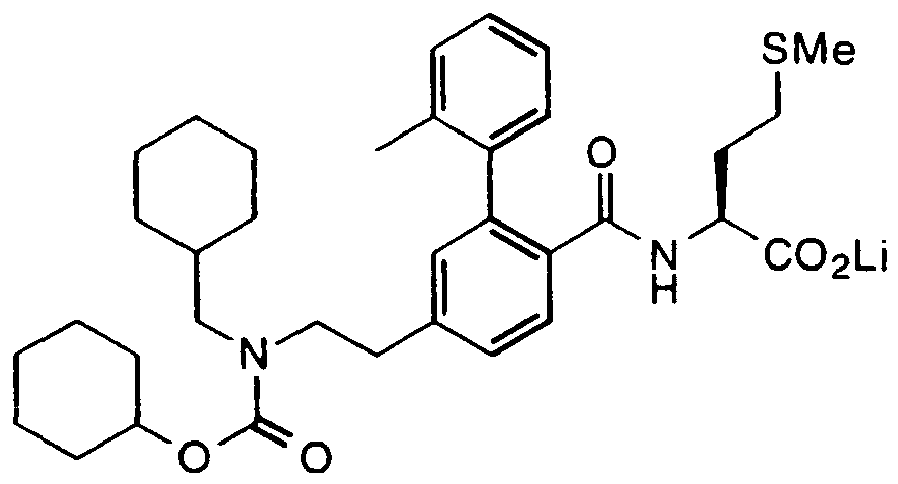
- This compound was prepared in a manner analogous to Example 1023.
MS m/e 607 (M-H)-.
1H NMR (d6-DMSO, 300 MHz) δ 0.84 (m, 4H), 1.17 (m, 4H), 1.3 (m, 6H), 1.6 (m, 10H), 1.95 (m, 8H), 2.17 (m, 1H), 2.9 (m, 4H), 3.6 (m, 1H), 4.53 (m, 1H), 6.9 (m, 1H), 7.0 (m, 1H), 7.2 (m, 5H), 7.47 (m, 1H).
- This compound was prepared in a manner analogous to Example 1023 using adamantyl isocyanate.
MS m/e 658 (M-H)-.
1H NMR (d6-DMSO, 300 MHz) δ 0.83 (m, 6H), 1.13 (m, 6H), 1.6 (m, 13H), 1.95 (m, 12H), 2.18 (m, 1H), 2.79 (m, 2H), 2.91 (m, 2H), 3.65 (m, 2H), 6.9 (m, 1H), 7.0 (m, 1H), 7.2 (m, 5H), 7.46 (m, 1H).
- This compound was prepared in a manner analogous to Example 1023 using adamantyl isothiocyanate.
MS m/e 674 (M-H)-.
1H NMR (d6-DMSO, 300 MHz) δ 0.85 (m, 6H), 1.15 (m, 6H), 1.6 (m, 13H), 2.0 (m, 12H), 2.2 (m, 1H), 2.74 (m, 2H), 2.91 (m, 2H), 3.62 (m, 2H), 6.9-7.5 (m, 8H).
-

- To a slurry of NaH (10g of a 60% dispersion in mineral oil) in dry THF (300mL) was added benzylcyanide (10g) by means of a dropping funnel. Cautious addition of methyl iodide (13mL) caused rapid gas evolution and an increase in temperature which was moderated with an ice bath. After stirring at ambient temperature for 12h, the reaction was quenched cautiously with water (100mL). The mixture was diluted with ether (500mL) and the layers were separated. The ether layer was washed with water (100mL) containing a small amount of Na2SO3 to eliminate the iodine color, then washed with brine (50mL). The organic solution was dried (MgSO4), filtered and concentrated to afford an oil. This material was added neat to a solution of 1M LiAlH4 (85mL, THF) in ether (100mL). If necessary, the reduction was initiated after a small amount of starting material was added by warming with a heat gun. The starting material was then added at a rate which maintained a gentle reflux. After addition was complete, the reaction was stirred without heating or cooling for 1h. The reaction was cautiously quenched with vigorous stirring by the addition of water (3.2mL), 15%NaOH (3.2mL), and more water (10mL). The suspension was filtered through celite, which was rinsed with ether. The filtrate was concentrated to give an oil (ca. 20g) which contained mineral oil from the sodium hydride dispersion. A portion of this material (3.3g) was dissolved in DMF (67mL) along with N-(tert-butoxycarbonyl)glycine (3.5g), followed by addition of N-methylmorpholine (3.3mL), 1-hydroxybenzotriazole (3.0g), and 1-ethyl-3-(3-dimethylaminopropyl)carbodiimide (5.0g). After stirring at ambient temperature for 15h, the reaction was poured into ether (500mL), washed with water
- (2X100mL), 1M HCl (2X100mL), saturated NaHCO3 (2X50mL), and brine (10mL). The organic solution was dried (MgSO4), filtered and concentrated to afford a residue which partly solidified. The residue was triturated with hexane, and filtered to give 4.5g of the title compound. MS(DCI/NH3) 307 (M+H)+.

-

- To a solution of 2-(1-cyclohexenyl)ethylamine (4.0g) in 1,4-dioxane (40mL) was added di-tert-butyldicarbonate (7.7g). After gas evolution ceased (=2h) the reaction was concentrated. A portion of the residue (2g) was dissolved in THF (10mL) followed by addition of LiAlH4 (10mL, 1M THF), which caused an exotherm. After 3h, more LiAlH4 solution was added (4mL), and the reaction was warmed to reflux. After 1h, the reaction was cooled, and quenched cautiously with vigorous stirring by the addition of water (0.57mL), 1M NaOH (0.6mL), and more water (1.5mL). The suspension was filtered through celite, which was washed with ether. The organic solution was concentrated to give the desired product as a volatile oil (0.8g).
1H NMR (300 MHz, CDCl3) δ 1.52-1.67 (m, 4H), 1.89-2.04 (m, 4H), 2.14 (brt, J=7 Hz, 2H), 2.42 (s, 3H), 2.63 (t, J=7 Hz, 2H), 5.45 (m, 1H).
- The title compound was prepared from N-methyl-2-(1-cyclohexenyl)ethylamine according to the procedure in example 608B.
MS (DCI/NH3) 378 (M+H)+.
- The title compound was prepared from 4-(N-(2-cyclohexenylethyl)-N-methylaminomethyl)-2-(2-methylphenyl)benzoic acid methyl ester according to the procedure in examples 608C and D. MS(APCI(+)) 509 (M+H)+. MS(APCI(-)) 543 (M+Cl)-.

- N-[4-(N-(2-Cyclohexenylethyl)-N-methylaminomethyl)-2-(2-methylphenyl)benzoyl]methionine methyl ester was converted into the title compound by the procedure in example 608E, and was isolated as a white powder.
1H NMR (300 MHz, DMSO) δ 1.38-1.75 (m, 4H), 1.80-2.13 (m, 13H), 1.91 (s, 3H), 2.14 (s, 3H), 2.36-2.45 (m, 2H), 3.50 (s, 2H), 3.56-3.67 (brs, 1H), 5.32-5.36 (m, 1H), 6.88-6.92 (m, 1H), 7.05-7.23 (m, 5H), 7.32 (d, J=8.1 Hz, 1H), 7.48 (d, J=8.1 Hz, 1H). MS (APCI(-)) m/e 493 (M-H); Analysis calc'd for C29H37LiN2O3S•1.15H2O: C, 66.81; H, 7.60; N, 5.37; found: C, 66.86; H, 7.34; N, 5.19.
-

- Treatment of 2-phenyl-2-methylpropylamine (example 1048A, 5g) with di-tert-butyldicarbonate according to example 1056A afforded N-tert-butoxycarbonyl-2-phenyl-2-methylpropylamine (10g crude) as a colorless oil. To portion of this material (5g) in methanol (100mL) was added platinum oxide (1g), and the reaction was shaken under hydrogen gas (4atm) for 24h. The reaction was concentrated, diluted with water (100mL), and extracted with chloroform (3X50mL). The organic extracts were washed with brine (20mL), dried (MgSO4), filtered and concentrated. The residue was purified by silica gel chromatography eluting with 10% EtOAc/hexane to afford a colorless oil (1.0g). This material was reduced with LiAlH4 according to the procedure described in example 1056A to afford the title compound (0.8g), as a colorless oil.
1H NMR (300 MHz, CDCl3) δ 0.83 (s, 6H), 0.87-1.29 (m, 6H), 1.60-1.82 (m, 5H), 2.36 (s, 2H), 2.42 (s, 3H).
MS (APCI(+)) m/e 170 (M+H)+.
- The title compound was prepared according to the procedure in example 608B, subsitiuting N-methyl-2-cyclohexyl-2-methylpropylamine for N-methylcyclohexylethylamine, and was isolated as a colorless oil. MS(ESI(+)) m/e 408
(M+H)+.
- The title compound was prepared from 4-(N-(2-cyclohexyl-2-methylpropyl)-N-methylaminomethyl)-2-(2-methylphenyl)benzoic acid methyl ester according to the procedures described in examples 608C, and D, and was isolated as a colorless oil. MS(ESI(+)) m/e 539 (M+H)+. MS(ESI(-)) m/e 537 (M-H)-.
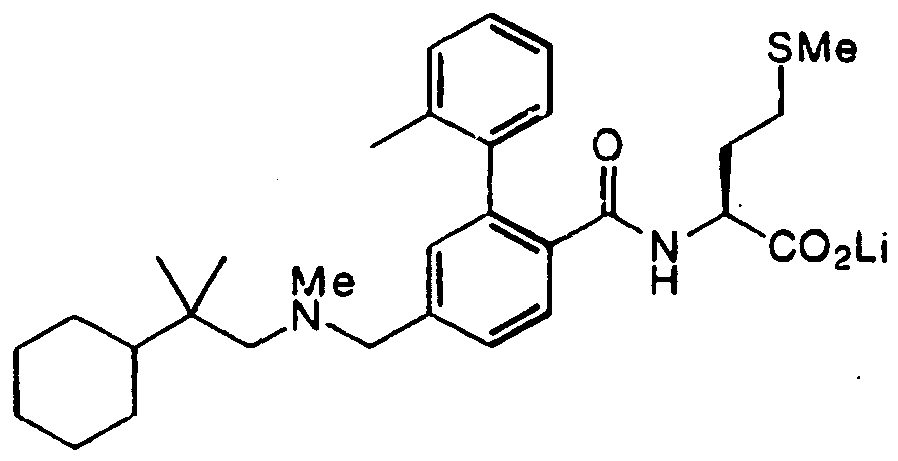
- The title compound was prepared from N-[4-(N-(2-cyclohexyl-2-methylpropyl)-N-methylaminomethyl)-2-(2-methylphenyl)benzoyl]methionine methyl ester according to the procedure in example 608E, and was isolated as a white powder.
1H NMR (300 MHz, DMSO) δ 0.79 (s, 6H), 0.80-1.27 (m, 5H), 1.50-1.74 (m, 6H), 1.75-2.95 (m, 7H), 1.92 (s, 3H), 2.19 (s, 3H), 2.24 (s, 2H), 3.56 (s, 2H), 3.62-3.72 (m, 1H), 6.92 (d, J=6 Hz, 1H), 7.08-7.25 (m, 5H); 7.36 (d, J=7.8 Hz, 1H), 7.49 (d, J=7.8 Hz, 1H).
MS (ESI(-)) m/e 523 (M-H); Analysis calc'd for C31H43LiN2O3S•1.3H2O: C, 67.70; H, 8.29; N, 5.06; found: C, 67.15; H, 8.08; N, 4.97.
MS m/z 385 (M+ - 1, 100).
-

- Following the procedure of example 1178E, 2-fluoroethylamine•HCl (1.00 g, 10.00 mmol) provided 1.58 g (84%) of the title compound.
MS (DCI, NH3): 188 (MH+).
- Following the procedure of example 1178F, example 1094A (1.54 g, 8.2 mmol) provided 1.30 g (92%) of the title compound.
MS (DCI, NH3): 172 (MH+).
- Following the procedure of example 1178G and substituting potassium phosphate for diisopropylethylamine, and heating at 60°C for 60 hours, example 1094B (188 mg, 1.10 mmol) provided 288 mg (70%) of the title compound.
MS (ESI +): 410 (M + NH4 + -F-).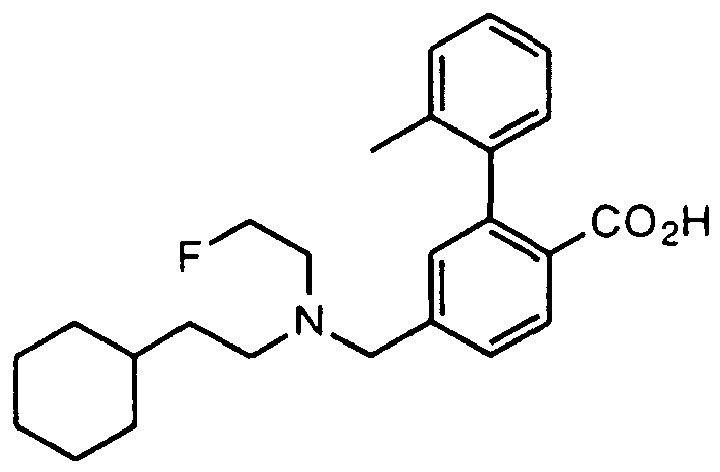
- Following the procedure of example 1178H, example 1094C (0.28 g, 0.68 mmol) provided 0.25 g (93%) of the title compound.
MS (DCI, NH3): 398 (MH+).
- Following the procedure of example 1178 I, example 1094D (245 mg, 0.62 mmol) provided 257 mg (77%) of the title compound. MS: (ESI+): 541 (MH)+: (ESI-); 539 (M-H).

- Following the procedure of example 1104D, example 1094E (250 mg, 0.46 mmol) provided 240 mg of the title compound.
1H NMR (δ ,CDCl3): 7.75 (2H), 7.0-7.4 (4H), 6.4 (1H), 3.8-4.6 (9H), 2.9-3.3 (4H), 0.8-2.3 (21H). MS: (ESI+): 527 (MH)+: (ESI-); 525 (M-H). Calc'd for C30H41FN2O3S•0.90H2O: C 66.12 H 7.92 N 5.14; Found: C 66.13 H 7.77 N 4.86.
-

- Cyclohexylethyamine (1.27 g, 10 mmol) was dissolved in 10 mL of methylene chloride and pyridine (1.8 mL, 15.0 mol) was added and the mixture cooled to -10° C in an ice/acetone bath. The solution was treated with trifluoroacetic anhydride (1.7 mL, 12.0 mmol) in 5 mL of methylene chloride dropwise. After stirring for 2 hours at 0°C the mixture was diluted with 100 mL of ether and extracted with water, 1M aqueous phosphoric acid and satureaed aqueous sodium bicarbonate, dried, filtered and concentrated to give a white solid (2.07g. 92%).
MS (DCI, NH3): 241 (M+NH4)+.
- A solution of lithium aluminum hdydride (9 mL of a 1M solution in THF. 9 mmol) was added to a solution of example 1103A (0.67 g, 3.0 mmol) and the mixture was heated to reflux for 2 hours and then cooled to room temperature. The reaction was quenched by the same procedure as example 1178F to provide 0.58 g (92%) of the title compound.
MS (DCI, NH3): 228 (M+NH4)+.
- A solution of example 1103B (210 mg, 1.0 mmol) and the aldehyde from example 403G (192 mg, 0.5 mmol) in 3 mL of 1,2 dichoroethane was treated with acetic acid (0.14 mL, 2.5 mmol) and the mixture stirred for 10 minutes. The mixture was treated with sodium triacetoxyborohydride (213 mg, 1.0 mmol) and the mixture stirred overnight. The work-up was the same as that of example 1134E. The crude product was purified by chromatography on silica gel (20 g, 20% ethyl acetate/hexanes) to provide 96 mg (33%) of the title compound.
1H NMR (300 MHz., CDCl3): δ 7.91, dd, 1H; 7.42, dd, 1H; 7.18 - 7.36, m, 4H; 7.15, bs, 1H; 5.88, bd, 1H' 4.63, m, 1H; 3.83, s, 2H; 3.65, s, 3H; 3.09, q, 2H; 2.64, t, 2H; 2.18, s, 1.5 H (o-tolyl); 2.07, s, 1.5H (o-tolyl), 2.05, m, 1H; 2.03, s, 1.5H (MeS); 2.01, s, 1.5H (MeS); 1.87, m, 1H; 1.61, bm, 6H; 1.35, m, 2H; 1.20, m 2H; 1.14, m, 2H; 0.85, m, 2H. MS (ESI+): 579 (MH+): (ESI-): 577 (M-H). - Prepared according to the procedure of example 1178J.
1H NMR (300 MHz., dmso d6): δ 7.52, d, 1H; 7.35, d, 1H; 7.23, m, 3H; 7.12, m, 3H; 6.91, d, 1H; 3.81, s, 2H; 3.66, m, 1H; 3.38, q, 2H; 2.56, t, 2H; 2.06, m, 1H; 2.00, bs, 3H; 1.92, s, 3H; 1.58, m, 7H; 1.00 - 1,38, m, 6H; 0.80, m, 2H.
MS (ESI+): 587; 571; 565 (MH+): (ESI-): 563 (M-H). Calc'd for C30H38LiN2O3S•1.75 H2O; C 59.84; H 6.95; N 4.65; Found: C 59.86; H 6.57; N 4.45.
-

- The acid chloride from example 1178E (1.60 g, 10 mmol) in 10 mL of methylene chloride was added dropwise to a cold (0°C) solution of 2-methoxyethylamine (1.3 mL, 15 mmol) and pyridine (1.9 mL, 22 mmol) in 10 mL of methylene chloride and the mixture was stirred overnight. The mixture was diluted with ethyl ether and washed with water, 1M aqueous phosphoric acid , 2M aqueous sodium carbonate and brine, dried, filtered and concentrated to provide 1.70 g (85%) of the title compound as a white solid.
1H NMR (300 MHz., CDCl3): δ 5.89, bs, 1H; 3.46, m, 4H; 3.37, s, 3H; 2.05, d, 2H; 1.79, m, 1H; 1.70, bm, 6H; 1.24, m, 2H; 1.17, m, 1H; 0.95, m, 2H.
MS (DCI, NH3): 200 (MH+).
- Using the procedure of example 1178F, example 1104A (1.70 g, 8.54 mmol) provided the title compound (1.56 g, 100%).
MS (DCI, NH3): 186 (MH+).
- Using the procedure of example 1103C, example 1104B (186 mg, 1.0 mmol) and example 403G (192 mg, 0.5 mmol) were combined to provide 78 mg (28%) of the title compound.
1H NMR (300 MHz., CDCl3): δ 7.91, dd, 1H; 7.42, dd, 1H; 7.18 - 7.37, m, 4H; 7.17, bs, 1H; 5.89, bd, 1H; 4.64, m, 1H; 3.68, s, 2H; 3.66, s, 3H; 3.45, t, 2H; 3.31, s, 3H; 2.66, t, 2H; 2.50, t, 2H; 2.19, s, 1.5H (o-tolyl); 2.07, s, 1.5H (o-tolyl); 2.05, m, 1H; 2.03, s, 1.5H (SMe); 2.01, s, 1.5H (SMe); 1.85, m, 1H; 1.63, bm, 6H; 1.34, m, 2H; 1.06 - 1.29, m, 4H; 0.88, m, 2H.
MS (ESI+): 555 (MH+): (ESI-): 553 (M-H).
- A solution of example 1104C (73 mg, 0.13 mmol) in 2 mL of 3:1 THF/methanol was cooled in an ice bath and treated with lithium hydroxide (0.26 mL of a 1M aqueous solution, 0.26 mmol) and the mixture stirred overnight and then concentrated. The solid was diluted with water and the pH adjusted to 4.5 with 1M aqueous phosphoric acid and then extracted with 3 portions of ethyl acetate. The combined organic fractions were washed with brine, dried filtered and concetrated. The residue was lyophilized to provide 70 mg of the title compound.
1H NMR (300 MHz., CD3OD): δ 7.74, d, 1H; 7.58, d, 1H; 7.37, m, 1H; 7.10 - 7.31, m, 4H; 4.50, m, 3H; 3.66, t, 2H; 3.37, s, 3H; 3.22, t, 2H; 3.04, m, 2H; 2.22, bs, 1H; 2.10, m, 3H; 1.97, s, 3H; 1.90, m, 2H; 1.53 - 1.77, m, 8H; 1.14 - 1.38, m, 4H; 0.96, m, 2H. MS (ESI+): 541 (MH+); (ESI-): 539 (M-H). Calc'd for C31H44N2O4S•0.85 H2O; C 66.96; H 8.28; N 5.04; Found: C 66.97; H 8.34; N 4.87.
-

- Following the procedure of example 1104A, 2-methylthioethylamine (1.0 g, 11 mmol) was converted to the title compound (1.77 g, 89%).
MS (DCI, NH3): 216 (MH+); 233 (M+NH4)+.
- Using the procedure of example 1178F, example 1105A (1.75 g, 8.44 mmol) was converted into the title compound (1.63 g, 100%).
MS (DCI, NH3): 202 (MH+).
- Using the procedure of example 1103C, example 1105B (201 mg, 1.0 mmol) and example 403G (192 mg, 0.5 mmol) were combined to provide 151 mg (53%) of the title compound.
1H NMR (300 MHz., CDCl3): δ 7.91, dd, 1H; 7.42, dd, 1H; 7.18 - 7.37, m, 4H; 7.17, bs, 1H; 5.89, bd, 1H; 4.63, m, 1H; 3.66, s, 3H; 3.63, s, 2H; 2.68, m, 2H; 2.59, m, 2H; 2.48, t, 2H; 1.99 - 2.21, m, 10H; 1.85, m, 1H; 1.62, bm, 6H; 1.36, m, 2H; 1.06 - 1.30, m, 4H; 0.87, m, 2H.
MS (ESI+): 571 (MH+): (ESI-): 569 (M-H).
- N-[4-(N-(2-cyclohexylethyl)-N-2-methylthioethylaminomethyl)-2-(2-methylphenyl)benzoyl]methionine;
- A solution of example 1105C (145 mg, 0.25 mmol) in 2 mL of 3:1 THF/methanol was cooled in an ice bath and treated with lithium hydroxide (0.5 mL of a 1M aqueous solution, 0.5 mmol) and the mixture stirred overnight. The solution was concentrated to dryness and diluted with water and the pH adjusted to 4.5 with 1M aqueous phosphoric acid. The solid collected was by filtration and dried in the air to provide 130 mg (93%) of the title compound.
1H NMR (300 MHz., CD3OD): δ 7.71, d, 1H; 7.57, d, 1H; 7.35, d, 1H; 7.10 - 7.31, m, 4H; 4.32, m, 1H; 4.17, s, 2H; 3.10, m, 2H; 2.94, m, 2H; 2.76, m, 2H; 2.22, bs, 1H; 2.02 - 2.09, m, 3H; 2.10, s, 3H; 1.99, s, 3H; 1.89, m, 2H; 1.68, m, 6H; 1.56, m, 2H; 1.09 - 1.26, m, 4H; 0.93, m, 2H.
MS (ESI+): 557 (MH+): (ESI-): 555 (M-H). Calc'd for C31H44N2O3S2•0.50 H2O; C 65.80; H 8.02; N 4.95; Found: C 65.79; H 7.89; N 4.79.
-
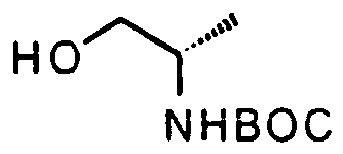
- A stirred solution of 2(S)-amino-1-propanol (1.0 g, 13.3 mmol) in 20 mL of methylene chloride was treated with di-tertbutyldicarbonate (3.19 g, 14.6 mmol) in 5 mL of methylene chloride and then the solution was treated with 10 mL of 2M aqueous sodium carbonate and stirred for 2 hours. The biphasic mixture was diluted with water and the layers were separated. The aqueous layer was extracted with methylene chloride and the combined organic layers were dried, filtered and concentrated to provide 2.35 g (105%) of the title compound.
1H NMR (300 MHz., CDCl3): δ 4.59, bs, 1H; 3.77, m, 1H; 3.64, dd, 1H; 3.52, dd, 1H; 2.42, bs, 1H; 1.44, s, 9H; 1.14, d, 3H.
MS (DCI, NH3): 176 (MH)+; 193 (M+NH4)+.
- A stirred solution of example 1106A (350 mg, 2.0 mmol) in 6 mL of methylene chloride was cooled in an ice/acetone bath and sequentially treated with triethylamine (0.34 mL, 2.4 mmol) and methanesulfonyl chloride (0.17 mL, 2.2 mmol) and the mixture stirred for 2 hours and then diluted with ether, extracted with water, 1M aqueousphosphoric acid, brine, dried filterd and concentrated to provide a yellow oil that was used directly. The mesylate was dissolved in 2 mL of DMF and added to a mixture of sodium thiomethoxide (280 mg, 4.0 mmol) and 5 mL of DMF and the mixture was stirred for 2 hours. The reaction was quenched by the addition of water and the mixture diluted with water and ethyl acetate. The layers were separated and the mixture was extracted with 2 additional portions of ethyl acetate and the combined organic layers washed with water and brine, dried, filtered and concentrated to provide 328 mg (80% overall) of the title compound.
1H NMR (300 MHz., CDCl3): δ 3.86, bs, 1H; 2.65, dd, 1H; 2.56, dd, 1H; 2.14, s, 3H; 1.45, s, 9H; 1.22, d, 3H.
MS (DCI, NH3): 206 (MH)+; 223 (M+NH4)+.
- Example 1106B (320 mg, 1.56 mmol) was dissolved in 2 mL of 4N HCl/dioxane and stirred for 1 Hour. The mixture was diluted with ether and filtered to provide 103 mg (53%) of the title compound as a white solid.
1H NMR (300 MHz., CDCl3): δ 8.56, bs, 3H; 3.51, m, 1H; 2.89, dd, 1H; 2.78, dd, 1H; 2.17, s, 3H; 1.54, d, 3H.
MS (DCI, NH3): 123 (M+NH4)+.
- Part 1. Following the general procedure of example 403H, example 1106C (98 mg, 0.69 mmol), example 403G (243 mg, 0.63 mmol), diisopropylethylamine (0.12 mL, 0.69 mmol) and acetic acid (0.18 mL, 3.14 mmol) were stirred in 4 mL of 1,2-dichloroethane for 2 hours and then treated with sodium triacetoxyborohydride (263 mg, 1.26 mmol). This procedure yielded 332 mg of material that was used in the next step.
- Part 2. The amine prepared in part 1 was treated with 2-cyclohexylacetaldehyde (159 mg, 1.26 mmol), acetic acid (0.36 mL, 6.3 mmol) and sitrred for 2 hours. This solution was treated with sodium triacetoxyborohydride (263 mg, 1.26 mmol) and the mixture stirred overnight. The mixture was quenched and worked-up as described in example 403H. The residue obtained was purified by cloumn chromatography on silica gel (20 g, 20% ethyl acetate/hexanes) to provide 225 mg (61 % overall) of the title compound.
1H NMR (300 MHz., CDCl3): δ 7.89, dd, 1H; 7.47, d, 1H; 7.15 - 7.37, m, 5H; 5.87, bd, 1H; 4.63, m, 1H; 3.67, d, 1H; 3.65, s, 3H; 3.55, d, 1H; 2.96, m, 1H; 2.75, dd, 1H; 2.44, m, 2H; 2.37, dd, 1H; 1.99 - 2.22, m, 10H; 1.84, m, 1H; 1.60, m, 6H; 1.09 - 1.33, m, 6H; 1.08, d, 3H; 0.72 - 1.00, m, 2H.
MS (ESI+): 585 (MH+): (ESI-): 583 (M-H).
- Following the procedure of example 1105D, example I 106D (210 mg, 0.36 mmol) provided 110 mg (53%) of the title compound.
1H NMR (300 MHz., CD3OD): δ7.69, d, 1H; 7.56, bd, 1H; 7.37, bd, 1H; 7.09 - 7.32, m, 4H; 4.33, m, 1H; 4.16. m, 1H; 4.00, m, 1H; 3.32, dt, 1H; 2.89, m, 3H; 2.64, m, 1H; 2.23, bs, 1H; 2.06, m, 2H; 2.04, s, 3H; 1.98, s, 3H; 1.89, m, 2H; 1.65, m, 6H: 1.44, m, 2H; 1.32, d, 3H; 1.28, m, 3H; 0.88, m, 2H.
MS (ESI+): 571 (MH+): (ESI-): 569 (M-H). Calc'd for C32H46N2O3S2; C 67.33; H 8.12; N 4.91; Found: C 67.12; H 8.10; N 4.70.
-

- Part 1. Following the procedure of example 1106D, part 1, example 403G (550 mg, 1.43 mmol) and 2-N,N-dimethylaminoethylamine (0.31 mL, 2.86 mmol) and acetic acid (0.82 mL, 14.3 mmol) gave the coressponding secondary amine (673 mg).
- Part 2. Following the procedure of example 1106D part 2, the amine produced in example 1107A, part 1 (660 mg, 1.44 mmol) and 2-cyclohexyacetaldehyde (364 mg, 2.88 mmol) gave a material that was purified by column chromatography on silica gel (25 g, ethyl acetate then 90/10/0.1 ethyl acetate/methanol/conc. aq. ammonia) providing 498 mg (60% overall) of the title compound.
1H NMR (300 MHz., CDCl3): δ 790, dd, 1H; 7.41, dd, 1H; 7.18 - 7.34, m, 4H; 7.16, bs, 1H; 5.88, bs, 1H; 4.62, m, 1H; 3.65, s, 3H; 3.63, s, 2H; 2.57, m, 2H: 2.47, m, 2H; 2.39, m, 2H; 2.21, s, 6H; 1.99, 2.28, m, 7H; 1.86, m, 1H; 1.63, bm, 6H: 1.35, m, 2H; 1.20 m, 2H; 1.14. m, 2H; 0.85, m, 2H.
MS (ESI+): 568 (MH+): (ESI-): 566 (M-H).
- Following the procedure of example 1104D, example 1107A (485 mg, 0.85 mmol) provided 382 mg (81%) of the title compound as a white lyophilate.
1H NMR (300 MHz., CD3OD): δ 7.66, d, 1H; 7.46, d, 1H; 7.05 - 7.33, m, 5H; 4.35, m, 1H; 3.74, s, 2H; 3.17, t, 1H; 2.82, t, 2H; 2.75, s, 6H; 2.60, m, 2H; .24, bs, 1H; 1.94 - 2.12, m, 6H; 1.85, m, 2H; 1.67, m, 6H; 1.45, m, 2H; 1.21, m, 4H; 0.92, m, 2H.
MS (ESI+): 554 (MH+): (ESI-): 552 (M-H). Calc'd for C32H47N3O3S·1.00 H2O; C 67.22; H 8.64; N 7.35; Found: C 67.23; H 8.43; N 7.26.
-

- A solution of intermediate 1178D (397 g, 1.24 mmol), palladium(II) acetate (22 mg), 1,3-bis(diphenylphosphino)propane (42 mg), N,N-diisopropylethylamine (0.5 mL) in ethanol ( 1 mL) and DMF (5 mL) was stirred at 80 °C under carbon monoxide balloon for 4 hours. The reaction mixture was then partitioned between ethyl acetate (80 mL) and water (20 mL). The organic layer was washed with water (2 X 20 mL), brine (20 mL), dried over anhydrous magnesium sulfate, filtered and concentrated. The residue was purified by column chromatography with 5% ethyl acetate in hexane to give the title compound (233 mg, 58%). 1HNMR (300 MHz, CDCl3) δ 7.94 (d, 1 H), 7.35 (dd, 1 H), 7.30-7.17 (m, 3 H). 7.16 (d, 1 H), 7.07 (br d, 1 H), 4.16 (q, 2 H), 3.67 (s, 2 H), 3.61 (s, 3 H), 2.06 (s, 3 H), 1.25 (t, 3 H). MS(CI/NH3) m/z: 330 (M+NH4)+.

- To the solution of intermediate 1140A (213 mg, 0.682 mmol) in methanol (3 mL) was added NaOH (0.979 M in water, 0.697 mL). After 2 hours, the reaction mixture was acidified with HCl (1.0 M, 1 mL), and was then partitioned between ethyl acetate (80 mL) and water (20 mL). The organic layer was washed with water (2 X 20 mL), brine (20 mL), dried over anhydrous magnesium sulfate, filtered and concentrated. The residue was used witout further purification.

- The procedures descriped in the Example 1178E and 1178F were used here to convert cyclohexylacetyl chloride (1.47 g, 10.0 mmol) and butylamine to the title amine in 85% yield. The amine was not purified before it was used.

- The procedure described in example 1144C was used here to combine intermediate 1140B (311 mg, 1.10 mmol) and intermediate 1140C (205 mg) to give the title compound (247 mg, 52%). 1HNMR (300 MHz, CDCl3) δ 7.94 (d, 1 H), 7.33 (M, 1 H), 7.25-7.15 (m, 3 H), 7.13,7.11 (2 d's, 1 H), 7.05 (m, 1 H), 3.76,3.75 (2 s's, 2 H), 3.60 (s, 3 H), 3.35-3.05 (m, 4H), 2.05,2.04 (2 s's, 3 H), 1.80-1.10 (m, 15 H), 0.91,0.89 (2 t's, 3 H). MS(CI/NH3) m/z: 436 (M+H)+.

- A solution of intermediate 1140D (118 mg, 0.271 mmol) and borane (1.0 M in THF, 0.54 mL) in THF was reluxed for 15 hours. Methanol (0.5 mL) was added dropwisly to the reaction, followed by concentrated HCl (0.5 mL), and the mixture was heated at 60 °C for 1 hour. The it was cooled to room temperature, The reaction mixture was adjusted to pH about 12-14 with sodium carbonate (2.0 M in water). The reaction mixture was then partitioned between ethyl acetate (50 mL) and water (5 mL). The organic layer was washed with water (10 mL), brine (20 mL), dried over anhydrous magnesium sulfate, filtered and concentrated to give the intermediate amine 1140E. The amine was used without further purification. 1HNMR (300 MHz, CDCl3) δ 7.90 (d, 1 H), 7.28-7.17 (m, 4 H), 7.05 (m, 2 H), 3.60 (s, 3 H), 2.75 (m, 2 H), 2.66 (m, 2 H), 2.40 (t, 2 H), 2.19 (d, 2 H), 2.06 (s, 3 H), 1.80-1.10 (m, 15 H), 0.88 (t, 3 H). MS(CI/NH3) m/z: 422 (M+H)+.

- The procedures descriped in the Example 403E and 403F were used here to convert the above intermediate amine 1140E to the title methyl ester (113 mg, 76%, 3 steps from 1140D). 1HNMR (300 MHz, CDCl3) δ 7.90 (2 d's, 1 H), 7.34-7.18 (m, 5 H), 7.01 (s, I H), 5.87 (br d, I H), 4.62 (m, 1 H), 3.65 (s, 3 H), 2.75 (m, 2 H), 2.66 (m, 2 H), 2.4 (t, 2 H), 2.20 (d, 2 H), 2.19-1.98 (m, 8 H), 1.87 (m, 1 H), 1.80-1.10 (m, 16 H), 0.88 (t, 3 H). MS(CI/NH3) m/z: 553 (M+H)+.
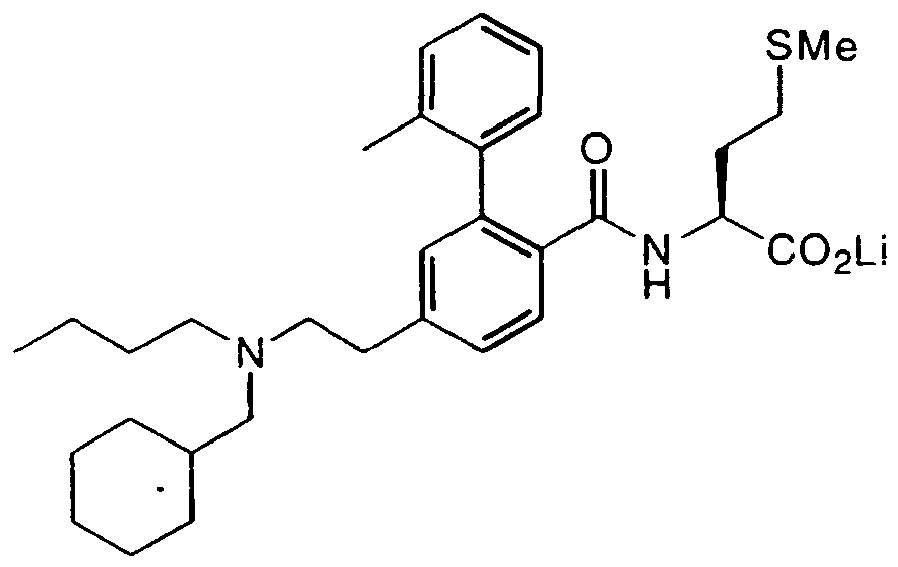
- The procedure descriped in the Example 4031 was used here to convert the intermediate 1140F (107 mg) to the title lithium salt (91 mg, 87%). 1H NMR (300 MHz, dmso-d6) δ 7.51 (d, 1 H), 7.33-7.13 (m, 5 H), 7.05 (br s, 1 H), 6.95 (m, 1 H), 3.71 (m, 1 H), 2.76 (m, 2 H), 2.67 (m, 2 H), 2.42 (t, 2 H), 2.21 (d, 2 H), 2.10-1.82 (m, 8 H), 1.80-1.10 (m, 17 H), 0.88 (t, 3 H). MS(ESI-) m/z: 537 (M-H)-.

-

-
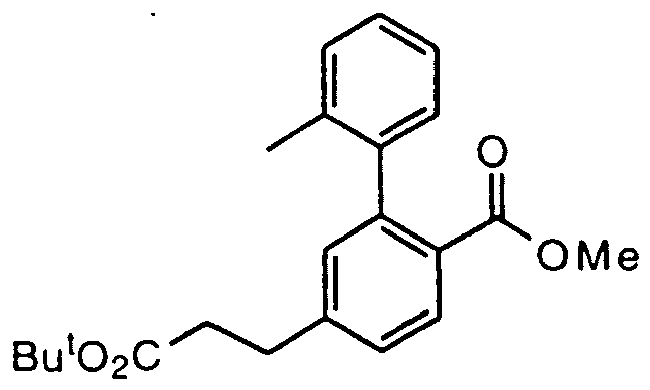
- To a solution of (t-butoxycarbonylmethyl)triphenylphosphonium bromide (10.98 g, 24.0 mmol) in THF (150 mL) at 0 °C was added potassium t-butoxide (1.0 M in THF, 24 mL) over 5 min. After 2 h, the aldehyde from example 1171A (20 mmol) in THF (10 mL) was added slowly over 5 min., and the reaction was further stirred for 30 min. The reaction mixture was diluted with hexane (200 mL), and the resulting muddy mixture was filtered through silica gel (200 g), rinsed with ether, and concentrated to give an intermediate olefin. 1H NMR (300 MHz, CDCl3) δ 7.97 (d, 1 H), 7.59 (d, 1 H), 7.54 (dd, 1 H), 7.37 (d, I H), 7.30-7.27 (m, 3 H), 7.06 (d, 1 H), 6.44 (d, 1 H), 3.61 (s, 3 H), 2.06 (s, 3 H), 1.52 (s, 9 H). MS(CI/NH3) m/z: 353 (M+H)+, 370 (M+NH4)+.
- That intermediate was mixed with palladium on carbon (10%, 2.0 g) in ethanol (30 mL), and was stirred under a hydrogen balloon overnight. The mixture was then filtered through Celite™ (5 g), and the filtrate was concentrated. The residue was then redesolved in ether (100 mL) and the solution was filtered through silica gel (30 g). Concentration of the filtrate afforded the title compound (7.27 g, 99% for 2 steps). 1H NMR (300 MHz, CDCl3) δ 7.91 (d, 1H), 7.28-7.15 (m, 4 H), 7.07-7.03 (m, 2 H), 3.60 (s, 3 H), 2.97 (t, 2 H), 2.57 (t, 2 H), 2.05 (s, 3 H), 1.40 (s, 9 H). MS(CI/NH3) m/z: 355 (M+H)+, 372 (M+NH4)+.

- A solution of intermediate 1144A (5.00 g) in trifluoroacetic acid (20 mL) and methyl sulfide (3 mL) was stirred at room temperature for 7 hours. Sovlent was then evaporated to give an off-white solid, which was used without further purification.

- To a solution of intermediate 1144B (150 mg, 0.50 mmol), oxallyl chloride (2.0 M in DCM, 0.5 mL) in DCM (2 mL) was added a small drop of DMF. After 2 hours at room temperature , the reaction was concentrated to drynees, and redeolved in DCM (3 mL). To it was added cyclohexylamine (99 mg, 1 mmol) and triethylamine (100 mg, 1 mmol). After 15 min., HCl (1.0 M in ether, 2.0 mL) was added to the reaction mixture, and it was filtered through silica gel (5 g). The residue after concentration of the filtrate was purified by column chromatography with 20% ethyl acetate in hexane to give the title compound (152 mg, 80%).
1H NMR (300 MHz, CDCl3) δ 7.90 (d, 1 H), 7.28-7.15 (m, 4 H), 7.07-7.02 (m, 2 H), .5.16 (m, 1 H), 3.72 (m, 1 H), 3.60 (s, 3H), 3.02 (t, 2 H), 2.45 (t, 2 H), 2.05 (s, 3 H), 1.85 (m, 2 H), 1.70-1.55 (m, 3 H), 1.40-0.95 (m, 6 H). MS(CI/NH3) m/z: 380 (M+H)+, 397 (M+NH4)+.
- A solution of intermediate 1144C (150 mg, 0.40 mmol) and borane (1.0 M in THF, 1.0 mL) in THF (1 mL) was reluxed for 15 hours. Methanol (0.5 mL) was added dropwisly to the reaction, followed by concentrated HCl (0.5 mL), and the mixture was heated at 60 °C for 1 hour. The reaction mixture was cooled to room temperature, and was adjusted to pH about 12-14 with sodium carbonate (2.0 M in water). The reaction mixture was then partitioned between ethyl acetate (50 mL) and water (5 mL). The organic layer was washed with water (10 mL), brine (20 mL), dried over anhydrous magnesium sulfate, filtered and concentrated to give the intermediate amine. The amine was used without further purification. MS(CI/NH3) m/z: 366 (M+H)+.
- The procedures descriped in the Example 403E and 403F were used here to convert the above intermediate amine to the title methyl ester (58%, 3 steps).

- The procedure descriped in the Example 4031 was used here to convert the intermediate 1 144D (121 mg) to the title lithium salt (107 mg, 100%). 1H NMR (300 MHz, dmso-d6) δ 7.45 (d, 1 H), 7.27-7.08 (m, 4 H), 7.02-6.93 (m, 2 H), 6.90 (m, 1 H), 3.80 (m, 1 H), 3.65 (m, 1 H), 3.30 (m, 2 H), 2.64 (t, 2 H), 2.20-1.80 (m, 10 H), 1.80-1.45 (m, 7 H), 1.30-0.88 (m, 6 H). MS(ESI-) m/z: 481 (M-H)-.

- To s stirred mixture of 1144E (70 mg, 0.14 mmol) in THF (1 mL) and saturated aqueous sodium bicarbonate (1 mL) was added propionyl chloride (0.10 mL). After 10 min, the reaction mixture was adjusted to pH 4-5, and it was then partitioned between ethyl acetate (50 mL) and water (5 mL). The organic layer was washed with water (10 mL), brine (10 mL), dried over anhydrous magnesium sulfate, filtered and concentrated. The residue was heated at 60 °C under high vacuum for 5 hours to give the title compound (59 mg, 78%). 1H NMR (300 MHz, dmso-d6) δ 7.47 (m, 1 H), 7.32-6.97 (m, 7 H), 4.25 (m, 1 H), 3.57 (m, 1 H), 3.35 (m, 2 H), 2.80-2.60 (m, 2 H), 2.30-1.85 (m, 12 H), 1.85-1.45 (m, 7 H), 1.30-0.88 (m, 9 H). MS(ESI-) m/z: 537 (M-H)-.
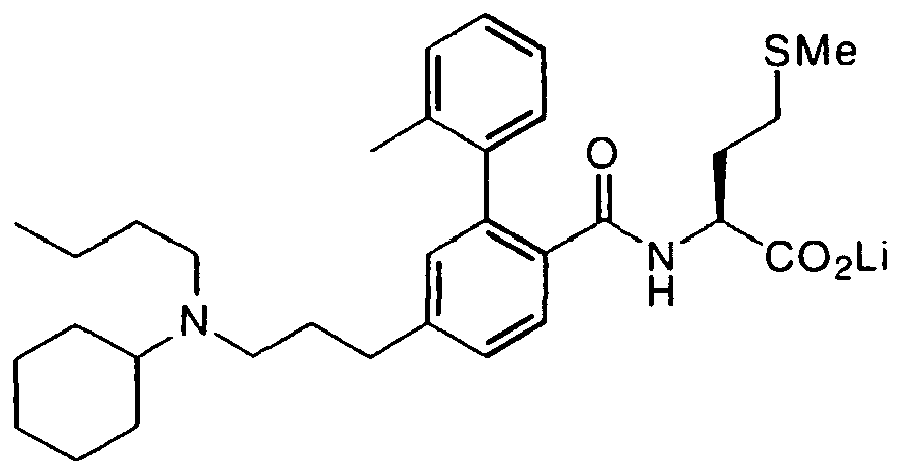
-

- The procedures descriped in the Example 1178E and 1178F were used here to convert butyric chloride and cyclohexylamine to the title amine in 86% yield. 1H NMR (300 MHz, CDCl3) δ 2.62 (t, 2 H), 2.41 (m, 1 H), 1.95-1.00 (m, 15 H), 0.92 (t, 3 H). MS(CI/NH3) m/z: 156 (M+H)+.
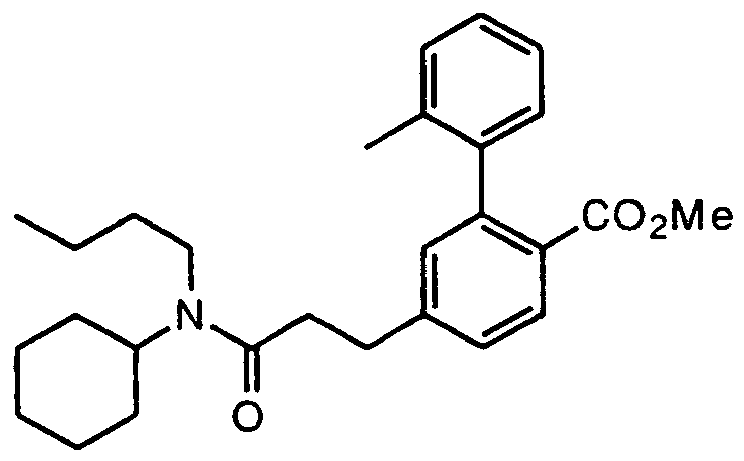
- The procedure descriped in the Example 1144C was used here to convert the intermediate 1144B (298 mg) and N-butylcyclohexylamine (intermediate 1146A, 310 mg, 2.0 mmol) to the title methyl ester (233 mg, 54%). 1H NMR (300 MHz, CDCl3) δ 7.90 (2 d's, 1 H), 7.30-7.15 (m, 4 H), 7.07 (m, 2 H), 4.25 (m, 1 H), 3.60 (s, 3 H), 3.18 (m, 1 H). 3.05 (m, 3 H), 2.62 (m, 2 H), 2.06 (2s's, 3 H), 1.85-1.05 (m, 14 H). 0.90 (2 t's, 3 H). MS(CI/NH3) m/z: 436 (M+H)+.

- The procedure descriped in the Example 1144C was used here to convert the intermediate 1146B (230 mg) to the title methyl ester (184 mg, 63%). 1H NMR (300 MHz, CDCl3) δ 7.90 (2 d's, 1 H), ), 7.35-7.19 (m, 4 H), 7.03 (m, 1 H), 5.89 (m, 1 H), 4.62 (m, 1 H), 3.66 (s, 3 H), 3.05 (m, 1 H), 2.66 (t, 2 H), 2.46 (t, 2 H), 2.41 (t, 2 H), 2.20-2.00 (4 s's, 6 H), 2.05 (m, 2 H), 1.90-1.00 (m, 18 H), 0.90 (t, 3 H). MS(CI/NH3) m/z: 553 (M+H)+.

- The procedure descriped in the Example 4031 was used here to convert the intermediate 1146C (179 mg) to the title lithium salt (153 mg, 81 %). 1H NMR (300 MHz, dmso-d6) δ 7.46 (m, 1 H), 7.35-7.08 (m, 4 H), 7.07-6.90 (m, 2 H), 3.70 (m, 1 H), 3.05 (m, 1 H), 2.64 (t, 2 H), 2.37 (m, 4 H), 2.20-1.90 (m, 8 H), 1.90-0.95 (m, 18 H), 0.85 (t, 3 H). MS(ESI-) m/z: 537 (M-H)-.

-

- To a -78 °C solution of methyl 4-methylthiobutyrate (1.48 g, 10.0 mmol) in THF (20 mL) was added sodium bis(trimethylsilyl)amide (1.0 M in THF, 11 mL). After 30 min, tert-butyl bromoacetate (2.34 g, 12.0 mmol) was added to the reaction, and the reaction mixture was gradually warmed to the room temperature over 6 hours. The reaction mixture was then partitioned between ethyl acetate (80 mL) and water (20 mL). The organic layer was washed with water (2 X 20 mL), brine (20 mL), dried over anhydrous magnesium sulfate, filtered and concentrated. The residue was purified by column chromatography with 5% ethyl acetate in hexane to give the title compound (1.21 g, 46%). 1HNMR (300 MHz, CDCl3) δ 3.75 (s, 3 H), 2.71 (t, 2 H), 2.51 (t, 2 H), 2.32 (m, 1 H), 2.06 (s, 1 H), 1.89 (t, 1 H), 1.41 (s, 9 H). MS(CI/NH3) m/z: 263 (M+H)+.

- To a solution of the acid from example 608C (530 mg, 1.32 mmol) in DCM (2 mL) was added oxallyl chloride (2.0 M in DCM, 1.5 mL), followed by a small drop of DMF. After 2 hours at room temperature , the solvent was removed, and the residue was further dried under high vacuum (1 mmHg) for 1 hour. The solid (acid chloride) was redesolved in THF (5 mL).
- To a -78 °C solution of 1158A (1.21 g, 4.61 mmol) in THF (10 mL) in a separate flask was added sodium bis(trimethylsilyl)amide (1.0 M in THF, 5.28 mL). After 30 min.. the acid chloride solution was added slowly to the reaction mixture via a cannula. After I hour, the reaction mixture was quenched with saturated aqueous ammonium chloride (3 mL) at - 78°C. After it reached the room temperature, the reaction mixture was then partitioned between ethyl acetate (80 mL) and water (20 mL). The organic layer was washed with sodium bicarbonate (saturated in water, 10 mL), water (2 X 10 mL), brine (20 mL), dried over anhydrous magnesium sulfate, filtered and concentrated. The residue was purified by column chromatography with 30% ethyl acetate in hexane to give the title compound (430 mg, 53%). 1HNMR is messy because of 4 diastereomers exist. MS(CI/NH3) m/z: 610 (M+H)+.

- A solution of 1158B (420 mg, 0.69 mmol) in HCl (4.0 M in 1,4-dioxane, 5 mL) was heated at 80 °C for 2 hours. Solvent was evaporated, and the residue was redesolved in ethyl acetate (100 mL). The mixture was then washed with sodium bicarbonate (saturated in water, 20 mL), water (20 mL), brine (20 mL), dried over anhydrous magnesium sulfate, filtered and concentrated. The residue was purified by column chromatography with 30% ethyl acetate in hexane to give the title compound (121 mg, 34%). 1HNMR (300 MHz, CDCl3) δ 7.62 (d, 1 H), 7.40 (br d, 1 H), 7.31-7.12 (m, 4 H), 7.07 (br d, 1 H), 3.62 (s, 3 H), 3.54 (br s, 2 H), 2.85 (m, 1 H), 2.71 (m, 1 H), 2.40 (m, 2 H), 2.35-2.00 (m, 12 H), 1.80-0.80 (m, 15 H). MS(CI/NH3) m/z: 510 (M+H)+.

- The intermediate 1158C (112 mg) in MeOH (2 ML) and lithium hydroxide (1.0 M in water, 0.7 mL) was heated at 50 °C for 5 hours. The reaction mixture was then adjusted to pH 4-5 with KH2PO4 (saturated in water), and extracted with ethyl acetate (3 X 20 mL). The combined extracts were washed with brine, dried over anhydrous magnesium sulfate, filtered and concentrated to give the title compound (110 mg, 100%). 1H NMR (300 MHz, dmso-d6) δ 7.77 (m, 1 H), 7.61 (br d, 1 H), 7.40 (m, 1 H), 7.35-7.15 (m, 3 H), 7.07 (m, 1 H), 4.15 (br loop, 2 H), 2.88 (m, 2 H), 2.69 (m, I H), 2.28 (m, 2 H), 2.22-1.96 (m, 11 H), 1.72-0.80 (m, 15 H). MS(ESI-) m/z: 494 (M-H)-.
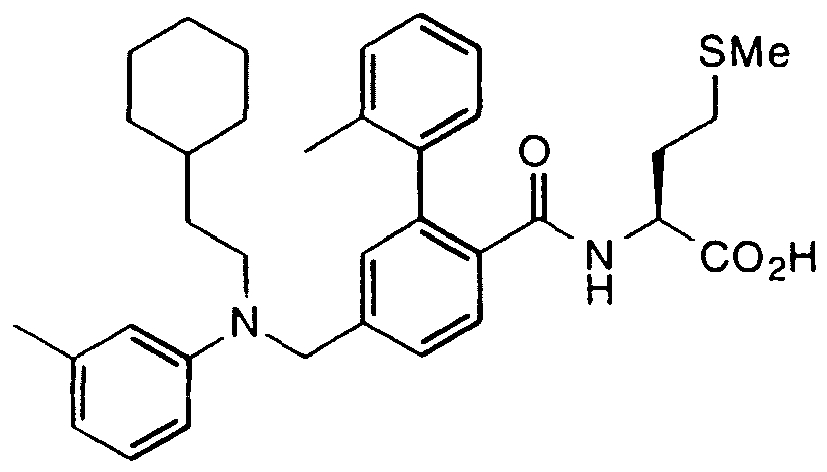
-

- To a stirred solution at ambient temperature of cyclohexylacetic acid (500 mg, 3.52 mmol) and 3-methylaniline (0.45 mL, 4.22 mmol) in DMF (10 mL) was added 1-ethyl-3-(3-dimethylaminopropyl)carbodiimide (809 mg, 4.22 mmol). Reaction stirred overnight at ambient tenperature. Reaction diluted with EtOAc and washed with water, 1.0M NaHCO3 (2x), 1N H3PO4 (2x), and brine. Organic layer dried with Na2SO4, filtered, and concentrated in vacuo. To a solution at ambient temperature under N2 of this residue in anhydrous THF (3 mL) was added a 1.0M lithium aluminum hydride solution (7.00 mL, 7 mmol) in THF. Reaction refluxed overnight. Reaction cooled to 0°C and quenched with successive addition of water (0.27 mL), 15% aqueous NaOH (0.27 mL), and water (0.80 mL). Mixture stirred 30 minutes at ambient temperature, and solids filtered off through celite and washed with EtOAc. Filtrate dried with Na2SO4, filtered, and concentrated in vacuo to produce a colorless oil. m/e (DCI/NH3) 218 (MH+)

- The desired ester was prepared using the method described in Example 403H starting with the compounds described in Example 403G and Example 1171A. m/e (ESI) 585 (MH-)

- The desired compound was prepared according to the method of Example 4031 starting with compound prepared in Example 1171B. 1H (300MHz, CDCl3, δ) 7.92 (1H, t, J=9Hz), 7.40-7.00 (8H, m), 6.47 (2H, m), 5.86 (1H, d, J=8Hz), 4.51 (4H, m), 3.39 (2H, m), 2.25 (3H, s), 2.15-1.80 (8H, m), 1.70 (5H, m), 1.50 (3H, m), 1.40-1.05 (4H, m), 0.96 (2H, m). m/e (ESI) 571 (MH-) Anal.calc. for C35H44N2O3S·1.00 H2O C 71.15, H 7.85, N 4.74 Found C 70.91, H 7.89, N 4.46

-

- The desired amine was prepared using the method described in Example 1171A starting with cyclohexylacetic acid and 2-butylaniline. m/e (DCI/NH3) 260 (MH+)

- The desired ester was prepared using the method described in Example 403H starting with the compounds described in Example 403G and Example 1172A. m/e (ESI) 627 (MH-)

- The desired compound was prepared according to the method of Example 4031 starting with compound prepared in Example 1172B.1H (300MHz, CDCl3, δ) 7.94 (1H, t, J=9Hz), 7.41 (1H, bd, J=8HZ), 7.40-7.00 (9H, m), 5.85 (1H. dd, J=8&2Hz), 4.55 (1H, m), 4.07 (2H, s), 2.91 (2H, m), 2.68 (2H, m), 2.20-1.80 (9H, m), 1.70-1.40 (8H, m), 1.40-1.00 (8H, m), 0.86 (3H, t, J=8Hz), 0.79 (2H, m). m/e (ESI) 613 (MH-) Anal.calc. for C38H50N2O3S·0.25 H2O C 73.69, H 8.22, N 4.52 Found C 73.74, H 8.17, N 4.30

-

- The desired amine was prepared using the method described in Example 1171A starting with 3,5-difluorophenylacetic acid and butylamine. m/e (DCI/NH3) 214 (MH+)

- The desired ester was prepared using the method described in Example 403H starting with the compounds described in Example 403G and Example 1173A. m/e (ESI) 581 (MH-)

- The desired compound was prepared using the method described in Example 403F starting with the product from Example 1174C. m/e (ESI) 480 (MH-)

-

- A mixture of dimethyliodoterephthalate (278 g, 0.87 mol), 2-methylphenylboronic acid (141 g, 1.04 mol) palladium (II) acetate (1.95 g, 0.0087 mol) and triphenylphosphine (9.1 g, 0.035 mol) in 2.2 L of toluene and 2.2 L of 2M sodium carbonate was degassed with nitrogen and heated to 80°C for 1.5 hours and cooled to ambient temperature. The layers were separated and the organic layer filtered through a plug of silica gel (600g) prewetted with methyl t-butylether (MTBE, 1.2 L). The frit was washed with 5 L of MTBE. The mixture was then concentrated to provide 237 g (96%) of the title compound. 1H NMR (CDCl3) δ 8.09, dd, 1H; 8.02, d, 1H; 7.95, d, 1H; 7.20 - 7.34, m, 3H; 7.10, bd, 1H, 3.96, s, 3H; 3.64, s, 3H; 2.08, s, 3H. MS (DCI/NH3) 302 (M + NH4)+.

- A solution of example 1178A (194 g, 0.68 mol) in 2:1 THF/methanol (∼0.3M) was cooled to 0°C and lithium hydroxide (0.38 L of a 2.2 M aqueous solution, 0.82 mol) was added such that the reaction temperature remained below 10°C. The cooling bath was removed and the mixture allowed to warm to 11°C overnight and then warmed to - 20°C over 4 hours. The mixture was concentrated to a volume of - 1.2 L and then diluted to 5.6 L with water. The mixture was extracted with hexanes and the aqueous layer filtered through celite (∼200 g) and the celite pad washed with water. The mixture was diluted with ethyl acetate (6 L) and the pH of the aqueous phase adjusted to 5.5 by the addition of 3M aqueous HCl (-250 mL). The organic phase was removed and concentrated to provide 171 g (93%) of the title compound. The material was ∼ 87% pure. An analytical sample was obtained by recrystallization from aqueous ethanol. 1H NMR (CDCl3) δ 8.14, dd, I H; 8.03, d, 1H; 8.01, d, 1H; 7.28 - 7.42, m, 3H; 7.09, bd, 1H; 3.64, s, 3H; 2.08, s, 3H. MS (DCI/NH3): 271 (MH)+; 288 (M + NH4)+.

- A solution of example 1178B (4.67g, 17.3 mmol) in 35 mL of THF was cooled in an ice bath and treated with borane (0.88M in THF, 39 mL, 34.6 mmol) such that the internal temperature remained below 10°C. The cooling bath was removed and the solution stirred for 3 hours and then cooled in an ice bath. The reaction was quenched by the careful addition of 8 mL of water (vigorous evolution of hydrogen gas) keeping the temperature below 10°C. An additional 8 mL of water was added and the mixture partitioned between ethyl acetate and 2N sodium hydroxide. The layers were separated and the organic layer was extracted with water, dried, filtered and concentrated. The residue was purified by column chromatography on silica gel to provide 3.90 g (88%) of the title compound. 1H NMR (CDCl3) δ 7.98, d, 1H; 743, dd, 1H; 7.16 - 7.28, m, 4H; 7.07, bd, 1H; 4.77, s, 2H; 3.62, s, 3H; 2.05, s, 3H; 1.78, bs, 1H. MS (DCI/NH3): 257 (MH)+; 274 (M + NH4)+.

- A solution of 36 g (140 mmol) of example 1178C and 13.4 g (154 mmol) lithium bromide in DMF (150 mL) was chilled in an ice-water bath, then 40.3 g (14.0 mL, 149 mmol) phosphorous tribromide was added, followed by more DMF (50 mL). After 15 minutes the reaction was partitioned between water (1200 mL) and Et2O (600 mL). The aqueous layer was extracted with Et2O (2 x 150 mL), then the combined Et2O layers were washed with brine, and dried over Na2SO4. After filtration and concentration, recovered 44.5 g (97.5%) slightly cloudy, almost colorless oil that was 2% DMF by weight (determined by NMR). 1H NMR (CDCl3) δ 7.84 (d, 1H), 7.44 (dd, 1H), 7.24 (m, 4H), 7.07 (br d, 1H), 4.50 (s, 2H), 3.62 (s, 3H), 2.07 (s, 3H). MS (DCI/NH3) 336/338 (M+H+NH3)+.

- 2-Cyclohexylacetic acid (42.66 g, 0.30 mol) was dissolved in 85 mL of thionyl chloride and the mixture heated to reflux for 2 hours. After cooling to room temperature, the yellow solution was concentrated. Toluene was added and the solution was concentrated again and the acid chloride used directly. The acid chloride was diluted with 100 mL of methylene chloride and this solution added to a biphasic mixture of butylamine (60 mL, 0.60 mol) in 100 mL of methylene chloride and 2M aqueous potassium carbonate (150 mL) and the mixture was stirred overnight at ambient temperature. An additional 30 mL of butylamine was added and stirring continued for 2 hours and then the mixture was poured into a separatory funnel. The layers were separated and the aqueous phase was extracted with 1 portion of methylene chloride and the combined organic extracts were dried, filtered and concentrated to an off white solid. This material was suspended in 400 mL of 1:1 ether/hexanes and filtered. The solid was washed with 2 additional portions of 1:1 ether/hexanes. The filtrates were extracted with 3 portions of aqueous HCl, dried, filtered and concentrated to a volume of - 200 mL. The solid that formed was collecterd by filtration and combined with the previous solid material and dried under vacuum to give the title compound (49.50 g, 88%). 1H nmr (300 MHz., CDCl3): δ 5.35, bs, 1H; 3.24, q, 2H; 2.02, d, 2H; 1.70, bm, 6H; 1.47, m, 2H; envelope 1.06 - 1.42, 5H; 0.91, m, 5H. MS (DCI-NH3): 198 (MH+); 215 (M+NH4 +).

- A stirred suspension of lithium aluminum hydride (23.74 g, 0.63 mol) in THF (400 mL) was cooled in an ice bath and treated with a solution of example 1178E (49.50 g, 0.26 mol) in THF (300 mL). The ice bath was removed and the mixture heated to gentle reflux for 20 hours. The solution was cooled in an ice bath and quenched by the careful addition of 24 mL of water in 100 mL of THF, followed by 24 mL of 15% aqueous sodium hydroxide, followed by an additional 72 mL of water. The thick slurry was vigorously stirred for 15 minutes at which time 600 mL of methylene chloride and excess sodium sulfate were sequentially added. The mixture was stirred for I hour and then filtered through celite. The celite pad was washed well with methylene chloride and the filtrate concentrated to give the title compound (47.80 g, 100%) which was sufficiently pure for the next step. 1H nmr (300 MHz., CDCl3): δ 2.61, m, 4H; 1.69, m, 5H; envelope 1.05 - 1.53, 11H; 0.91, m, 5H. MS (DCI-NH3): 184 (MH+).

- A solution of example 1178D (22.2 g, 0.070mol) and diisopropylethylamine (15.7 mL, 0.090 mol) in 100 mL of acetonitrile was treated with N-butyl-N-2-cyclohexylethylamine (15.3 g, 0.084 mol). The cloudy mixture was stirred for two hours and then briefly warmed to ∼45C. After cooling to ambient temperature, the mixture was concentrated to remove the acetonitrile and then diluted with 400 mL of water. The pH of the mixture was brought to >10 with solid potassium phosphate and extracted with 3 portions of ethyl ether. The combined ether extracts were extracted with 1 portion of water and two portions of brine, dried, filtered and concentrated. The residue obtained (34.4 g, 117%) was used directly. An analytical sample was obtained by column chromatography on silica gel (3% ethyl acetate/hexanes) to provide pure material. H nmr (300 MHz., CDCl3): δ 7.92, d, 1H; 7.48, dd, 1H; 7.16 - 7.28, m, 4H; 7.07, bd, 1H; 3.62, s, 3H; 3.57, s, 2H; 2.41, quartet, 4H; 2.06, s, 3H; 1.62, bm, 5H; envelope 1.05 - 1.48, 10H; 0.85, bm, 5H. MS (ESI+): 422 (MH+): (ESI-): 420 (M-H).

- A solution of 1178G (34.35 g, 0.081 mol) in 210 mL of ethanol was treated with aqueous sodium hydroxide (4N, 70 mL, 0.28 mol) and the mixture heated to reflux until judged complete by tlc analysis. After cooling to room temperature, the mixture was concentrated to remove the ethanol. The resulting solid was partially dissolved by adding water and the mixture extracted with ethyl ether. The ether layer was then washed with water and then with 1M aqueous phosphoric acid which resulted in an oily precipitate. The precipitate was dissolved by extracting with 3 portions of ethyl acetate and the combined ethyl acetate layer were washed with water, 0.5M aqueous phosphoric acid, brine and then dried, filtered and concentrated to give 24.5 g, (86% yield for the two steps) as a cream colored solid. 1H nmr (300 MHz., CD3OD): δ 7.96, d, 1H; 7.64, dd, 1H; 7.37, d, 1H; 7.22, m, 2H; 7.18, m, 1H; 7.07, d, 1H; 4.41, bs, 2H; 3.12, m, 4H; 2.10, s, 3H; 1.18, bm, 9H; 1.37, sextet, 2H; 1.23, m, 3H; 0.96, t, 3H; 0.94, m, 2H. MS (ESI+): 408 (MH+): (ESI-): 406 (M-H).

- Partitioned 13.2 g (66.1 mmol) L-methionine methyl ester, hydrochloride salt between saturated aqueous NaHCO3 (80 mL) and CH2Cl2 (75 mL). Added the organic layer to the following solution: 24.5 g (60.2 mmol) acid from Example 1178H, 10.0 g (65.3 mmol) HOBT·H2O, and 12.6 g (65.7 mmol) EDCI·HCl in DMF (150 mL). After stirring at RT overnight partitioned the reaction between saturated aqueous NaHCO3 (500 mL) and EtOAc (1200 mL). The organic layer was washed with water and brine, then dried over Na2SO4. After filtration and concentration, recovered 30 g orange oil that was purified by chromatography using hex/EtOAc 3/1. Recovered 22.9 g (69%) of the title compound. 1H NMR (CDCl3) δ 7.90 (m, 1H), 7.40 (d, 1H), 7.30, 7.20, 7.16 (all m, total 5H), 5.88 (br d, 1H), 4.62 (m, 1H), 3.66 (s, 3H), 3.57 (s, 2H), 2.41 (m, 4H), 2.18, 2.13, 2.04 (s, m, m, total 9H), 1.85 (m, 1H), 1.62 (m, 5H), 1.50-1.10 (envelope, 10H), 0.87 (m, 5H). MS (APCI) 553 (M+H)+.

- A solution of example 11781 (22.9 g, 0.041 mol), in 200 mL of 3:1 THF methanol was cooled in an ice bath and then tretaed with aqueous lithium hydroxide (1M, 83 mL, 0.083 mol) dropwise. The ice bath was removed and the mixture was stirred for 20 hours. The solution was concentrated to remove the organics and the resulting thick slurry diluted with water until a clear solution resulted (-1.2 L). The pH of the solution was carefully adjusted to pH∼5 with 1M aqueous phosphoric acid and stirred for 1 hour. The solid was collected by filtration and dried under vacuum over phosphorous pentoxide to provide 19.93 g of a cream colored solid. This material was dissolved in 200 mL of THF and treated with a solution of 1.55 g (0.037 mol) of lithium hydroxide in 75 mL of water. The mixture was stirred for 15 minutes and the THF removed under vacuum on a rotary evaporator. The mixture was diluted with 500 mL of water and lyophilized to give 20.10 g (89% overall) of the title compound. 1H nmr (300 MHz., CD3OD): δ 7.64, m, 1H; 7.41, d, 1H; 7.05 - 7.32, m, 5H; 4.25, m, 1H; 3.69, s, 2H; 2.52, m, 4H; 2.51, s, 1.5H (1/2 o-tolyl); 2.06, s, 1.5 H (1/2 o-tolyl); 1.98, s, 3H; 1.97, m, 1H; 1.73, m, 2H; 1.64, bm, 6H; envelope 1.04 - 1.56, 10H; 0.90, m, 5H. MS (ESI+): 539 (MH+): (ESI-): 537 (M-H). Calc'd for C32H45N2O3SLi·0.60 H2O; C 69.19; H 8.38; N 5.04; Found: C 69.25; H 8.50; N 4.99.

-
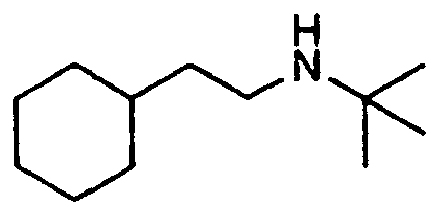
- The desired amine was prepared using the method described in Example 1171A starting with cyclohexylacetic acid and t-butylamine. m/e (DCI/NH3) 184 (MH+)

- The desired compound was prepared using the method described in Example 1178G starting with N-t-butyl-N-(2-cyclohexylethyl)amine, prepared as in Example 1181A, and 4-bromomethyl-2-(2-methylphenyl)benzoic acid methyl ester, prepared as in Example 1178A-D. m/e (ESI) 422 (MH+)

- The desired acid was prepared using the method described in Example 403E starting with the compound prepared in Example 1181B.

- The desired product was prepared using the method described in Example 403F starting with the compound prepared inExample 1181C. m/e (ESI) 553 (MH+)

- The desired compound was prepared according to the method of Example 4031 starting with compound prepared in Example 1181D.1H (300MHz, CDCl3, δ) 7.78 (1H, m), 7.67 (1H, m), 7.40-7.00 (5H, m), 6.21 (1H, m), 4.38 (1H, m), 4.13 (2H, m), 2.93 (2H, m), 2.20-2.00 (7H, m), 2.00 (3H, s), 1.60 (4H, m), 1.43 (12H, bs), 1.40-0.90 (4H, m), 0.75 (2H, m). m/e (ESI) 537 (MH+) Anal.calc. for C32H46N2O3S·0.75 H2O C 69.59, H 8.67, N 5.07 Found C 69.78, H 8.65, N 4.89
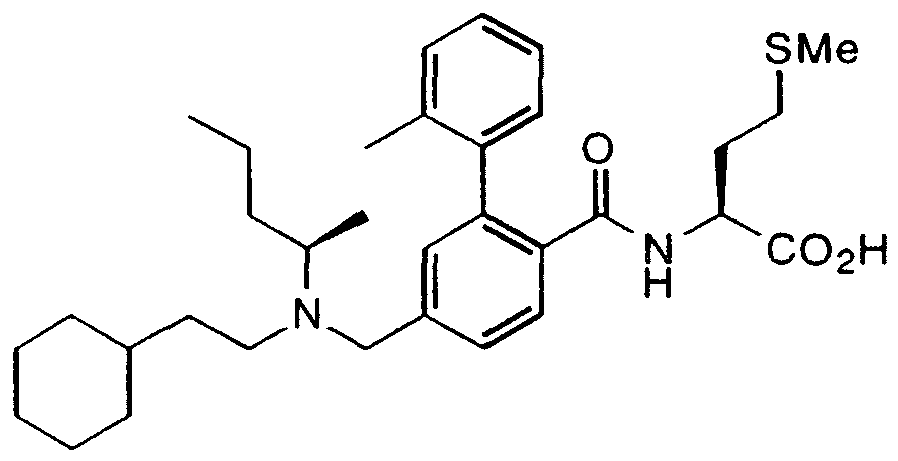
-

- The desired product was prepared using the methods described in Example 1183A starting with L-norvaline.

- The desired product was prepared using the methods described in Example 403B and 403C starting with the compound prepared in Example 1182A.

- The desired product was prepared using the methods described in Example 1183C starting with the compound prepared in Example 1182B.

- The desired amine was prepared using the method described in Example 1171A, except triethylamine was added, starting with cyclohexylacetic acid and the compound from Example 1182C. m/e (DCI) 198 (MH+)

- The desired product was prepared using the method described in Example 403H starting with the compound prepared in Example 1182D and N-[4-formyl-2-(2-methylphenyl)benzoyl]methionine methyl ester, prepared as in Example 403G. m/e (ESI) 567 (MH+)

- The desired compound was prepared according to the method of Example 4031 starting with the compound prepared in Example 1182E.1H (300MHz, CDCl3, δ) 7.74 (1H, m), 7.62 (1H, m), 7.40-7.00 (5H, m), 6.46 (1H, m), 4.37 (1H, m), 3.94 (2H, m), 3.37 (1H, m), 2.90 (2H, m), 2.20-1.80 (8H, m), 1.80-1.60 (6H, m), 1.55-1.25 (6H, m), 1.25-1.00 (8H, m), 0.91 (3H, t, J=8Hz), 0.82 (2H, m). m/e (ESI) 551 (MH-) Anal.calc. for C33H48N2O3S·050 H2O C 70.55, H 8.79, N 4.99 Found C 70.55, H 8.71, N 4.87

-

- To a stirred solution at ambient temperature of D-norvaline (5.00 g, 42.7 mmol) in THF (100 mL) was added an aqueous 4N NaOH solution (21 mL, 84 mmol), di-t-butyl dicarbonate (11.2 g, 51.2 mmol), and tetrabutylammonium bromide (1.0 g). Two-phase solution stirred overnight at ambient temperature. Reaction neutralized with aqueous 3N HCl to pH 6 and extracted with CHCl3 (3x). Extracts dried with Na2SO4, filtered, and concentrated in vacuo to produce a colorless oil. To a stirred solution at 0°C under N2 of the crude residue in anhydrous THF (80 mL) was added dropwise via addition funnel a 1.0M borane-THF complex (100 mL, 100 mmol) in THF. After stirring overnight at ambient temperature, reaction cooled back to 0°C and quenched with an aqueous 4N NaOH solution (50 mL). Mixture stirred one hour at ambient temperature, and then, extracted with CH2Cl2 (3x). Extracts dried with Na2SO4, filtered, and concentrated in vacuo. Residue purified by flash chromatography on silica gel eluting with 30% EtOAc/Hexanes to afford the alcohol as a pale yellow oil (3.87 g, 45%). m/e (DCI) 204 (MH+)

- The desired product was prepared using the methods described in Example 403B and 403C starting with the compound prepared in Example 1183A. m/e (DCI) 248 (MH+)

- To a stirred solution at ambient temperature of (2R)-t-butoxycarbonylamino-1-ethylthiopentane (655 mg, 2.65 mmol), prepared as in Example 1183B, in EtOH (5 mL) was added a 50% slurry of Raney Nickel (2.65 g) in water. Mixture stirred vigorously at 80°C for 2 days. Reaction filtered through celite, and celite and catalyst washed with EOAc. Filtrate concentrated in vacuo to produce a colorless liquid. Residue taken up in a solution of 4N HCl in dioxane (5 mL), and reaction stirred overnight at ambient temperature. Ether added until a solid precipitated. Solid filtered off, washed with ether, and dried to produce the desired compound as a white solid (167 mg, 59%).

- The desired amine was prepared using the method described in Example 1171A. except triethylamine was added, starting with cyclohexylacetic acid and the compound from Example 1183C. 1H NMR (CDCl3, 300 MHz) δ 2.70-2.50 (m, 4H), 1.80-1.60 (m, 6H), 1.50-1.00 (m, 8H), 1.04 (d, 3H, J=8Hz), 1.00-0.80 (m, 5H)

- The desired compound was prepared using the method described in Example 1178G starting with N-(2-cyclohexylethyl)-N-(1-methylbutyl)amine, prepared as in Example 1183D, and 4-bromomethyl-2-(2-methylphenyl)benzoic acid methyl ester, prepared as in Example 1178A-D. m/e (ESI) 436 (MH+)

- The desired acid was prepared using the method described in Example 403E starting with the compound prepared in Example 1183E.

- The desired product was prepared using the method described in Example 403F starting with the compound prepared in Example 1183F. m/e (ESI) 567 (MH+)

- The desired compound was prepared according to the method of Example 4031 starting with the compound from Example 1183G.1H (300MHz, CDCl3, δ 7.69 (2H, m), 7.40-7.00 (5H, m), 6.46 (1H, m), 4.38 (1H, m), 4.05 (2H, m), 3.41 (1H, m), 2.90 (2H, m), 2.20-1.75 (9H, m), 1.75-1.50 (7H, m), 1.50-1.00 (12H, m), 0.90 (5H, m). m/e (ESI) 551 (MH-) Anal.calc. for C33H48N2O3S·0.50 H2O C 70.55, H 8.79, N 4.99 Found C 70.65, H 8.63, N 4.93

-

- The desired product was prepared using the method described in Example 1174A starting with cyclohexylethylamine and 1-propanesulfonyl chloride.

- The desired product was prepared using the method described in Example 1174B starting with N-(2-cyclohexylethyl)-N-propanesulfonylamine, prepared as in Example 1187A, and 4-bromomethyl-2-(2-methylphenyl)benzoic acid methyl ester, prepared as in Example 1178A-D, m/e (ESI) 472 (MH+)

- The desired acid was prepared using the method described in Example 403E starting with the product from Example 1187B.

- The desired compound was prepared using the method described in Example 403F starting with the product from Example 1187C. m/e (ESI) 601 (MH-)

- The desired compound was prepared according to the method of Example 4031 starting with the compound prepared in Example 1187D.1H (300MHz, CDCl3, δ) 8.00 (1H, dd, J=8&7Hz), 7.43 (1H, dd, J=7&2Hz), 7.40-7.10 (5H, m), 5.90 (1H, m), 4.58 (1H, m), 4.42 (2H, s), 3.20 (2H, m), 2.94 (2H, m), 2.20-2.00 (7H, m), 2.00-1.80 (4H, m), 1.60 (6H, m), 1.38 (2H, m), 1.15 (4H, m), 1.05 (3H, t, J=8Hz), 0.86 (2H, m). m/e (ESI) 587 (MH-) Anal.calc. for C31H44N2O5S2·0.25 H2O C 62.75, H 7.56, N 4.72 Found C 62.75, H 7.56, N 4.49

-

- To a stirred solution at -10°C under N2 of N-[4-hydroxymethyl-2-(2-methylphenyl)benzoyl]methionine methyl ester (200 mg, 0.517 mmol), prepared as in Example 403F, and carbon tetrabromide (189 mg, 0.568 mmol) in CH2Cl2 (5 mL) was added triphenylphosphine (163 mg, 0.620 mmol). Reaction stirred one hour at -10°C, and then, solvents concentrated in vacuo to produce a colorless glass. The residue could not be stored, and so, was used directly in the reaction in Example 1188B.

- The desired compound was prepared using the method described in Example 174B (except reaction run at -40°C) starting with the product from Example 188A and N-(3-chloropropanesulfonyl)-N-(2-cyclohexylethyl)amine, prepared as in Example 1189A using the method described in Example 1174A. m/e (ESI) 635 (MH-)

- The desired compound was prepared according to the method of Example 4031 starting with the compound from Example 1188B. H (300MHz, CDCl3, δ) 8.01 (1H, bt, J=8Hz), 7.46 (1H, dd, J=7&2Hz), 7.40-7.10 (5H, m), 5.90 (1H, m), 4.59 (1H, m), 4.45 (2H, s), 3.68 (2H, t, J=8Hz), 3.22 (2H, bt, J=7Hz), 3.12 (2H, t, J=8Hz), 2.31 (2H, m), 2.20-2.05 (4H, m), 2.03 (3H, s), 1.92 (2H, m), 1.60 (6H, m), 1.40 (2H, m), 1.30-1.00 (4H, m), 0.85 (2H, m). m/e (ESI) 621 (MH-) Anal.calc. for C31H43Cl1N2O5S2·0.50 H2O C 58.89, H 7.01, N 4.43 Found C 58.96, H 7.04, N 4.40

-

- The desired compound was prepared using the method described in Example 1174A starting with cyclohexylethylamine and 3-chloropropanesulfonyl chloride.
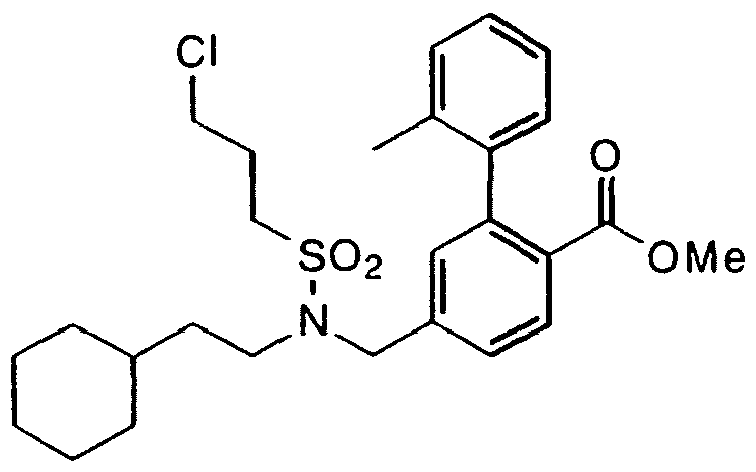
- The desired product was prepared using the method described in Example 1174B starting with the compound from Example 1189A and 4-bromomethyl-2-(2-methylphenyl)benzoic acid methyl ester, prepared as in Example 1178A-D. m/e (ESI) 506 (MH+)

- The acid was prepared using the method described in Example 403E starting with the product from Example 1189B. Chloride was displaced by ethoxide ion.

- The compound was prepared using the method described in Example 403F starting with the product from Example 1189C. m/e (ESI) 645 (MH-)

- The desired compound was prepared according to the method of Example 403I starting with the compound from Example 1189D. 1H (300MHz, DMSO-d6, δ) 7.54 (1H, d, J=8Hz), 7.41 (1H, dd, J=7&2Hz), 7.30-7.10 (5H, m), 6.97 (1H, d, J=7Hz), 4.42 (2H, bs), 3.68 (1H, m), 3.43 (2H, q, J=7Hz), 3.40 (2H, m), 3.16 (4H, m), 2.20-1.95 (5H, m), 1.95 (3H, s), 1.90-1.65 (3H, m), 1.55 (6H, m), 1.27 (2H, m), 1.10 (7H, bt, J=8Hz), 0.78 (2H, m). m/e (ESI) 631 (MH-) Anal.calc. for C33H47LiN2O6S2·0.50 H2O C 61.18, H 7.47, N 4.32 Found C 61.15, H 7.53, N 4.15

-

- To a stirred solution at 0°C under N2 of 4,4,4-trifluoro-1-bromobutane (2.00 g. 10.5 mmol) in anhydrous DMF (10 mL) was added dropwise a slurry of t-butanethiol sodium salt (1.29 g, 11.5 mmol) in anhydrous DMF (25 mL) such that the temperature was maintained below 5°C. Mixture stirred one hour at 0°C, and then, diluted with water and extracted with ether. Extracts dried with Na2SO4, filtered, and concentrated in vacuo. Residue dissolved in 1:1 water/EtOH at 0°C, and to this was bubbled in chlorine gas for 45 minutes. After the chlorine addition, N2 was bubbled into the black-green mixture until the green color disappeared (30 minutes). The mixture was made a more homogeneous solution by addition of CH2Cl2, and to this was added carefully an aqueous 2M Na2CO3 solution until mixture was basic (pH 10). Cyclohexylethylamine (1.14 g, 9.00 mmol) was added, and this two-phase solution was stirred at room temperature overnight. Reaction diluted with water and extracted with CHCl3 (2x). Extracts dried with Na2SO4, filtered, and concentrated. Residue purified by flash chromatography on silica gel eluting with 20% EtOAc/Hexanes to afford the desired product as a light brown oil (1.02 g, 32%). m/e (DCl) 319 (MH+NH3 +)

- The desired product was prepared using the method described in Example 1174B starting with N-(2-cyclohexylethyl)-N-(3-trifluoromethylpropanesulfonyl)amine, prepared as in Example 1190A, and 4-bromomethyl-2-(2-methylphenyl)benzoic acid methyl ester, prepared as in Example 1178A-D.

- The desired acid was prepared using the method described in Example 403E starting with the product from Example 1190B. m/e (ESI) 524 (MH-)

- The desired compound was prepared using the method described in Example 403F starting with the product from Example 1190C. m/e (ESI) 669 (MH-)

- The desired compound was prepared according to the method of Example 4031 starting with the compound in Example 1190D. 1H (300MHz, CDCl3, δ) (rotamer) 8.01 (7.98) (1H, d, J=8Hz), 7.46 (1H, dd, J=7&2Hz), 7.40-7.10 (5H, m), 5.92 (1H, m), 4.80 (1H, bs), 4.58 (1H, m), 4.45 (2H, s), 3.22 (2H, bt, J=7Hz), 3.03 (2H, t, J=8Hz), 2.30 (2H, m), 2.20-2.00 (10H, m), 1.92 (1H, m), 1.62 (6H, m), 1.40 (2H, m), 1.30-1.00 (4H, m), 0.87 (2H, m). m/e (ESI) 655 (MH-) Anal.calc. for C32H43F3N2O5S2 C 58.52, H 6.60, N 4.26 Found C 58.27, H 6.63, N 4.13

-

- To a stirred mixture at 0°C under N2 of sodium azide (1.47 g, 22.6 mmol) in anhydrous DMF (30 mL) was added a solution of 4-bromomethyl-2-(2-methylphenyl)benzoic acid methyl ester (6.00 g, 18.8 mmol), prepared as in Example 1178A-D, in anhydrous DMF (10 mL). Reaction stirred overnight at room temperature. Reaction diluted with EtOAc and washed with water and brine. Organic layer dried with Na2SO4, filtered, and concentrated in vacuo.
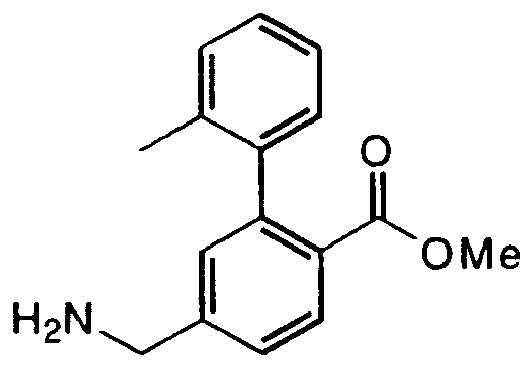
- To a flask at ambient temperature under N2 containing 10% palladium on carbon catalyst (1.0 g) was added a solution of 4-azidomethyl-2-(2-methylphenyl)benzoic acid methyl ester (5.00 g, 17.8 mmol), prepared as in Example 1191A, in MeOH (75 mL). Two drops of conc. HCl added, and reaction stirred vigorously overnight under an atmosphere of H2. Catalyst filtered off through celite and washed with MeOH. Filtrate concentrated in vacuo, and residue taken up in an aqueous 4N NaOH solution. Aqueous solution extracted with CHCl3 (3x), and extracts dried with Na2SO4 filtered, and concentrated in vacuo to afford the desired product (1.37 g, 30%). m/e (DCI) 256 (MH+)

- The desired compound was prepared using the method described in Example 1174A starting with 4-aminomethyl-2-(2-methylphenyl)benzoic acid methyl ester, prepared as in Example 1191B, and butanesulfonyl chloride. m/e (ESI) 374 (MH-)

- The desired compound was prepared according to the method of Example 1178D starting with 3-cyclohexyl-1-propanol. 1H (300MHz, CDCl3, δ) 3.40 (2H, t, J=8Hz), 1.85 (2H, m), 1.80-1.50 (6H, m), 1.40-1.10 (5H, m), 0.90 (2H, m).

- The desired compound was prepared using the method described in Example 1174B starting with the compounds from Example 1191C and Example 1191D. m/e (ESI) 500 (MH+)

- The acid was prepared using the method described in Example 403E starting with the compound from Example 1191 E.

- The compound was prepared using the method described in Example 403F starting with the compound from Example 1191F. m/e (ESI) 629 (MH-)

- The desired compound was prepared according to the method of Example 4031 starting with the compound from Example 1191G.1H (300MHz, DMSO-d6, δ) 7.54 (1H, d, J=8Hz), 7.41 (1H, bd, J=7Hz), 7.30-7.05 (5H, m), 6.97 (1H, d, J=7Hz), 4.42 (2H, s), 3.68 (1H, m), 3.10 (4H, bt, J=7Hz), 2.20-1.95 (5H, m), 1.91 (3H, s), 1.90-1.45 (9H, m), 1.45-1.20 (4H, m), 1.20-0.90 (6H, m), 0.88 (3H, t, J=8Hz), 0.73 (2H, m). m/e (ESI) 615 (MH-) Anal.calc. for C33H47LiN2O5S2·0.75 H2O C 62.29, H 7.68, N 4.40 Found C 62.18, H 7.75, N 4.36
Claims (9)
- A compound having Formula I
 R2 is -L11 - C(R14)(Rv) C(O)OR15, wherein L11 is -C(W)N(R) - wherein R is hydrogen and W is O, Rv is selected from the group consisting of hydrogen and lower alkyl, R15 is selected from the group consisting of (a) hydrogen, (b) alkanoyloxyalkyl, (c) C1-to-C10 alkyl and (d) a carboxy-protecting group, and R14 is thioalkoxyalkyl;L1 is -L4-N(R5)-L5- wherein L4 is absent or C1-to-C10-alkylene, L5 is absent or C1-to-C10-alkylene, and R5 is selected from the group consisting of hydrogen, alkanoyl, alkoxy, alkoxyalkyl, alkoxycarbonyl wherein the alkoxycarbonyl is unsubstituted or substituted with 1, 2 or 3 halogens, alkylaminocarbonylalkyl, cycloalkoxycarbonyl, cycloalkylaminocarbonyl, cycloalkylaminothiocarbonyl, cycloalkylalkyl, (cyclolalkyl)oyl, haloalkyl, C1-to-C10 alkyl, wherein the C1-to-C10 alkyl is unsubstituted or substituted with -NRR' , wherein R and R' are independently: hydrogen; C1-to-C10 alkyl;- SO2-A, wherein A is C1-to-C10 alkyl optionally substituted with alkoxy or 1-5 halogen(s); or thioalkoxyalkyl;Z is a covalent bond;R3 is cycloalkyl, wherein the cycloalkyl is unsubstituted or substituted with substituents selected from the group consisting of (a) alkoxy, (b) C1-to-C10 alkyl, and (c) halogen;and R4 is hydrogen; selected from the group consisting of:N-[4-N-(1-cyclohexyl-6-methylheptan-2-yl)aminomethyl-2-(2-methylphenyl)benzoyl]methionine, lithium salt,N-[4-(N-2-cyclohexylethylaminomethyl)-2-(2-methylphenyl)benzoyl]-methionine, trifluoroacetate salt,N-[4-(N-(2-cyclohexylethyl)-N-methylaminomethyl)-2-(2-methylphenyl)-benzoyl]methionine, lithium salt,N-[4(N-acetyl-N-(2-cyclohexylethyl)aminomethyl)-2-(2-methylphenyl)-benzoyl]methionine, lithium salt,N-[4-(N-(N,N-dimethylamino(carbonyl)-N-(2-cyclohexylethyl-aminomethyl)-2-(2-methylphenyl)benzoyl]methionine,N-[4-(N-(2-cyclohexylethyl)-N-methanesulfonylaminomethyl)-2-(2-methylphenyl)benzoyl]methionine, lithium salt,N-[4-(3-cyclohexylpropan-2-ylaminomethyl)-2-(2-methylphenyl)benzoyl]-methionine,N-[4-(4-cyclohexylbutan-3-ylaminomethyl)-2-(2-methylphenyl)benzoyl]-methionine, lithium salt,N-[4-(6-cyclohexylhexan-5-y[aminomethyl)-2-(2-methy[phenyl)-benzoyl]methionine, lithium salt,N-[4-3-cyclohexyl-1-t-butylthiopropan-2-ylaminomethyl)-2-(2-methylphenyl)-benzoyl]methionine, lithium salt,N-[4-N-t-butyloxycarbonyl-N-2-cyclohexylethylaminomethyl-2-(2-methylphenyl)benzoyl]methionine, lithium salt,N-[4-(N-2-cyclohexylethyl-N-cyclopropylaminomethyl)-2-(2-methylphenyl)benzoyl]methionine,N-[4-(N-(2-cyclohexylethyl)-N-isopropylaminomethyl)-2-(2-methylphenyl)-benzoyl] methio nine,N-[4-(N(butanesulfonyl-N-(2-cyclohexylethyl)aminomethyl)-2-(2-methylphenyl)benzoyl]methionine,N-[4-(N-methyl-N-(1,1-dimethyl-2-cyclohexylethyl)aminomethyl)-2-(2-methylphenyl)-benzoyl]methionine, lithium salt,N-[4-(N-cyclohexylmethylaminoethyl)-2-(2-methylphenyl)benzoyl]methionine, lithium salt,N-[4-(N,N-di-(cyclohexylmethyl)aminoethyl)-2-(2-methylphenyl)benzoyl]-methionine, lithium salt,N-[4-(N-cyclohexylmethyl-N-1-adamantanoylaminoethyl)-2-(2-methylphenyl)-benzoyl]methionine, lithium salt,N-[4-(N-cyclohexylmethyl-N-t-butoxycarbonylaminoethyl)-2-(2-methylphenyl)-benzoyl]methionine, lithium salt,N-[4-(N-cyclohexylmethyl-N-2-ethylhexyloxycarbonylaminoethyl)-2-(2-methylphenyl]benzoyl]methionine, lithium salt,N-[4-(N-cyclohexylmethyl-N-2,2,2-trichloroethoxycarbonylaminoethyl)-2-(2-methylphenyl)benzoyl]methionine, lithium salt,N-[4-(N-cyclohexylmethyl-N-cyclohexyloxycarbonylaminoethyl)-2-(2-methylphenyl)benzoyl]methionine, lithium salt,N-[4-(N-cyclohexylmethyl-N-adamantyloxycarbonylaminoethyl)-2-(2-methylphenyl)benzoyl]methionine, lithium salt,N-[4-(N-cyclohexylmethyl-N-adamant-1-aminocarbonylaminoethyl)2-(2-methylphenyl)benzoyl]methionine, lithium salt,N-[4-(N-cyc[ohexylmethy[-N-adamant-1-aminothiocarbony[aminoethyl)-2-(2-methylphenyl)benzoyl]methionine, lithium salt,N-[4-(N-(2-cyclohexyl-2-methylpropyl)-N-methylaminomethyl)-2-(2-methylphenyl)benzoyl]methionine, lithium salt,N-[4-(N-(2-cyclohexylethyl)-N-2-fluoroethylaminomethyl)-2-(2-methylphenyl)benzoyl]methionine,N-[4-(N-(2-cyclohexylethyl)-N-2,2,2-trifluoroethylaminomethyl)-2-(2-methylphenyl)benzoyl]methionine, lithium salt,N-[4-(N-(2-cyclohexylethyl)-N-2-methoxyethylaminomethyl)-2-(2-methylphenyl)benzoyl]methionine,N-[4(N-(2-cyclohexylethyl)-N-2-methylthioethylaminomethyl)-2-(2-methylphenyl)benzoyl]methionine,N-[4-(N-(2-cyclohexylethyl)-N-1-methyl-2(S)-methylthioethylaminomethyl)-2-(2-methylphenyl)benzoy]methionine,N-[4-(N-(2-cyclohexylethyl)-N-2,N,N-dimethylaminomethyl)-2-(2-methylphenyl)benzoyl]methionine,N-[4-(N-cyclohexylmethyl-N-1)butylaminoethyl)-2-(2-methylphenyl)benzoyl]-methionine, lithium salt,N-[4-(N-cyclohexylpropyl)-2-(2-methylphenyl)benzoyl]methionine, lithium salt,N-[4-(N-cyclohexyl-N-propanoylaminopropyl)-2-(2-methylphenyl)benzoyl]-methionine,N-[4-(N-cyclohexyl-N-butylaminopropyl)-2-(2-methylphenyl)benzoyl]methionine, lithium salt,3-[4-(N-cyclohexyl-N-methylaminomethyl)-2-(2-methylphenyl)benzoyl-methyl]4-methylthiobutyric acid,N-[4-(N-(-2-cyclohexylethyl)-N-butylaminomethyl)-2-(2-methylphenyl)benzoyl]methionine, lithium salt,N-[4-N-t-butyl-N-(2-cyclohexylethyl)aminomethyl-2-(2-methylphenyl)benzoyl]methionine,N-[4-N-(2-cyclohexylethyl)-N-(pent-2-yl)aminomethyl-2-(2-methylphenyl)benzoyl]methionine,N-[4-N-(2-cyclohexylethyl)-N-(pent-2-yl)aminomethyl-2-(2-methylphenyl)]benzoyl] methio nine,N-[4-N-(2-cyclohexylethyl)-N-[propyloxyaminomethyl-2-(2-methylphenyl)benzoyl]methionine, lithium salt,N-[4-N-(2-cyclohexylethyl)-N-propanesulfonylaminomethyl-2-(2-methylphenyl)benzoyl]methionine,N-[4-N-(3-chloropropanesulfonyl)-N-(2-cyclohexylethyl)aminomethyl-2-(2-methylphenyl)benzoyl] methio nine,N-[4-N-(2-cyclohexylethyl)-N-3-ethoxypropanesulfonyl)-aminomethyl-2-(2-methylphenyl)benzoyl]methionine, lithium salt,N-[4-N-(2-cyclohexylethyl)-N-(3-trifluoromethylpropanesulfonyl)-aminomethyl-2-(2-methylphenyl)benzoyl]methionine,N-[4-N-(butanesulfonyl)1-N-(3-cyclohexylpropyl)aminomethyl-2-(2-methylphenyl)benzoyl]methionine, lithium salt,N-[4-(N-(2-cyclohexylethyl)-N-methylaminomethyl)-2-phenylbenzoyl]methionine, lithium salt.
 - A compound according to claim 1 which is N-[4-N-(-2-cyclohexylethyl)-N-butylaminomethyl)2-(2-methylphenyl)-benzoyl]methionine, lithium salt.
- A compound in accordance with claim 1 for use in the inhibition of protein isoprenyltransferases in mammals.
- A compound in accordance with claim 1, alone or in combination with another chemotherapeutic agent, for use in the inhibition or treatment of cancer in a mammal.
- A composition for use in the treatment of cancer comprising a compound of claim 1 in combination with another chemotherapeutic agent and a pharmaceutically acceptable carrier.
- A compound in accordance with claim 1 for use in inhibiting post-translational modification of the oncogenic Ras protein by protein farnesyltransferase, protein geranylgeranyltransferase, or both, in a mammal.
- A composition for use in inhibiting post-translation modification of the oncogenic Ras protein by protein farnesyltransferase, protein geranylgeranyltransferase, or both, comprising a compound of claim 1 in combination with a pharmaceutical carrier.
- A compound in accordance with claim 1 for use in the treatment of intimal hyperplasia associated with restenosis and atherosclerosis in a mammal.
- A composition for use in treating restenosis in a mammal comprising a compound of claim 1 in combination with a pharmaceutically acceptable carrier.
Applications Claiming Priority (3)
| Application Number | Priority Date | Filing Date | Title |
|---|---|---|---|
| US85285897A | 1997-05-07 | 1997-05-07 | |
| US852858 | 1997-05-07 | ||
| PCT/US1998/009296 WO1998050029A1 (en) | 1997-05-07 | 1998-05-07 | Inhibitors of protein isoprenyl transferases |
Publications (3)
| Publication Number | Publication Date |
|---|---|
| EP0986384A1 EP0986384A1 (en) | 2000-03-22 |
| EP0986384A4 EP0986384A4 (en) | 2004-09-15 |
| EP0986384B1 true EP0986384B1 (en) | 2012-02-22 |
Family
ID=25314413
Family Applications (1)
| Application Number | Title | Priority Date | Filing Date |
|---|---|---|---|
| EP98922122A Expired - Lifetime EP0986384B1 (en) | 1997-05-07 | 1998-05-07 | Inhibitors of protein isoprenyl transferases |
Country Status (11)
| Country | Link |
|---|---|
| EP (1) | EP0986384B1 (en) |
| JP (2) | JP2002518985A (en) |
| AR (1) | AR015649A1 (en) |
| AT (1) | ATE546139T1 (en) |
| AU (2) | AU7371998A (en) |
| CA (1) | CA2288330C (en) |
| ES (1) | ES2387211T3 (en) |
| MX (1) | MX211764B (en) |
| PH (2) | PH11998001073B1 (en) |
| TW (2) | TW541302B (en) |
| WO (3) | WO1998050030A1 (en) |
Families Citing this family (58)
| Publication number | Priority date | Publication date | Assignee | Title |
|---|---|---|---|---|
| WO1999038845A1 (en) | 1998-01-29 | 1999-08-05 | Tularik Inc. | Ppar-gamma modulators |
| US6172260B1 (en) * | 1998-12-31 | 2001-01-09 | Eastman Kodak Company | Preparation of high dye-yield couplers and intermediates useful therein |
| US6472533B1 (en) | 1999-04-08 | 2002-10-29 | The Texas A & M University System | Ligands for chiral catalysis |
| GB9907895D0 (en) * | 1999-04-08 | 1999-06-02 | Texas A & M Univ Sys | Novel ligands for chiral catalysis |
| US6503949B1 (en) | 1999-05-17 | 2003-01-07 | Noro Nordisk A/S | Glucagon antagonists/inverse agonists |
| US7041691B1 (en) | 1999-06-30 | 2006-05-09 | Amgen Inc. | Compounds for the modulation of PPARγ activity |
| WO2001014314A1 (en) * | 1999-08-20 | 2001-03-01 | Nippon Kayaku Kabushiki Kaisha | Benzene derivatives having aromatic substituents and processes for the preparation thereof |
| US6451823B1 (en) | 1999-09-23 | 2002-09-17 | G.D. Searle & Co. | Use of substituted N-phenoxy-N-phenyl aminoalcohol compounds for inhibiting cholesteryl ester transfer protein activity |
| US20010018446A1 (en) | 1999-09-23 | 2001-08-30 | G.D. Searle & Co. | Substituted N-Aliphatic-N-Aromatictertiary-Heteroalkylamines useful for inhibiting cholesteryl ester transfer protein activity |
| US6677382B1 (en) | 1999-09-23 | 2004-01-13 | Pharmacia Corporation | Substituted N,N-bis-phenyl aminoalcohol compounds useful for inhibiting cholesteryl ester transfer protein activity |
| US6544974B2 (en) | 1999-09-23 | 2003-04-08 | G.D. Searle & Co. | (R)-chiral halogenated substituted fused heterocyclic amino compounds useful for inhibiting cholesteryl ester transfer protein activity |
| US6248919B1 (en) * | 1999-10-05 | 2001-06-19 | Abbott Laboratories | Process for the preparation of farnesyltransferase inhibitors |
| GB9930318D0 (en) | 1999-12-22 | 2000-02-09 | Zeneca Ltd | Novel compounds |
| GB9930317D0 (en) * | 1999-12-22 | 2000-02-09 | Zeneca Ltd | Novel compounds |
| US6770666B2 (en) | 1999-12-27 | 2004-08-03 | Japan Tobacco Inc. | Fused-ring compounds and use thereof as drugs |
| EP1162196A4 (en) | 1999-12-27 | 2003-04-16 | Japan Tobacco Inc | Fused-ring compounds and use thereof as drugs |
| AU2001228681A1 (en) * | 2000-01-28 | 2001-08-07 | Melacure Therapeutics Ab | Novel aromatic amines and amides acting on the melanocortin receptors |
| US6271418B1 (en) | 2000-02-22 | 2001-08-07 | Nippon Kayaku Co., Ltd. | Process for preparing (hetero) aromatic substituted benzene derivatives |
| KR20030017502A (en) * | 2000-04-28 | 2003-03-03 | 에프. 호프만-라 로슈 아게 | P-(sulfonyl)aryl and heteroaryls |
| US20030171399A1 (en) | 2000-06-28 | 2003-09-11 | Tularik Inc. | Quinolinyl and benzothiazolyl modulators |
| MXPA02012712A (en) | 2000-06-30 | 2003-04-25 | Bristol Myers Squibb Pharma Co | N-ureidoheterocycloaklyl-piperidines as modulators of chemokine receptor activity. |
| GB0126849D0 (en) * | 2001-11-08 | 2002-01-02 | Qinetiq Ltd | Novel compounds |
| US7030141B2 (en) | 2001-11-29 | 2006-04-18 | Christopher Franklin Bigge | Inhibitors of factor Xa and other serine proteases involved in the coagulation cascade |
| EP2399903A1 (en) | 2002-05-24 | 2011-12-28 | Millennium Pharmaceuticals, Inc. | Ccr9 inhibitors and methods of use thereof |
| NZ538986A (en) * | 2002-10-03 | 2006-06-30 | Ecole Polytech | Substrates for O6-alkylguanine-DNA alkyltransferase |
| US7741519B2 (en) | 2007-04-23 | 2010-06-22 | Chemocentryx, Inc. | Bis-aryl sulfonamides |
| US7227035B2 (en) | 2002-11-18 | 2007-06-05 | Chemocentryx | Bis-aryl sulfonamides |
| US7420055B2 (en) | 2002-11-18 | 2008-09-02 | Chemocentryx, Inc. | Aryl sulfonamides |
| AU2003298661B2 (en) | 2002-11-18 | 2007-05-10 | Chemocentryx, Inc. | Aryl sulfonamides |
| JPWO2004106283A1 (en) * | 2003-05-28 | 2006-07-20 | キッセイ薬品工業株式会社 | Aminoalcohol derivatives, pharmaceutical compositions containing them, and uses thereof |
| US7420083B2 (en) | 2003-09-25 | 2008-09-02 | Wyeth | Substituted aryloximes |
| EP1669348A4 (en) | 2003-09-30 | 2009-03-11 | Eisai R&D Man Co Ltd | Novel antifungal agent comprising heterocyclic compound |
| US7223761B2 (en) | 2003-10-03 | 2007-05-29 | Amgen Inc. | Salts and polymorphs of a potent antidiabetic compound |
| US7432281B2 (en) | 2003-10-07 | 2008-10-07 | Renovis, Inc. | Amide derivatives as ion-channel ligands and pharmaceutical compositions and methods of using the same |
| BRPI0511070A (en) * | 2004-06-17 | 2007-11-27 | Infinity Pharmaceuticals Inc | compounds and processes for inhibiting the interaction of bcl proteins with binding partners |
| US7842815B2 (en) | 2004-06-17 | 2010-11-30 | Infinity Pharmaceuticals, Inc. | Compounds and methods for inhibiting the interaction of BCL proteins with binding partners |
| DOP2005000123A (en) | 2004-07-02 | 2011-07-15 | Merck Sharp & Dohme | CETP INHIBITORS |
| WO2006022442A1 (en) * | 2004-08-24 | 2006-03-02 | Santen Pharmaceutical Co., Ltd. | Novel heterocyclic amide derivatives having dihydroorotate dehydrogenase inhibiting activity |
| MX2007008771A (en) * | 2005-01-19 | 2007-09-11 | Mgi Gp Inc | Diazabenzo[de]anthracen-3-one compounds and methods for inhibiting parp. |
| US7576099B2 (en) | 2005-02-28 | 2009-08-18 | Renovis, Inc. | Amide derivatives as ion-channel ligands and pharmaceutical compositions and methods of using the same |
| WO2006106711A1 (en) | 2005-03-30 | 2006-10-12 | Eisai R & D Management Co., Ltd. | Antifungal agent containing pyridine derivative |
| WO2007037187A1 (en) | 2005-09-27 | 2007-04-05 | Shionogi & Co., Ltd. | Sulfonamide derivative having pgd2 receptor antagonistic activity |
| WO2007070173A2 (en) * | 2005-10-31 | 2007-06-21 | Merck & Co., Inc. | Cetp inhibitors |
| TWI385169B (en) | 2005-10-31 | 2013-02-11 | Eisai R&D Man Co Ltd | Heterocyclic substituted pyridine derivatives and antifungal agent containing same |
| CA2642813A1 (en) | 2006-02-28 | 2007-09-07 | Merck & Co., Inc. | Inhibitors of histone deacetylase |
| TWI389895B (en) | 2006-08-21 | 2013-03-21 | Infinity Discovery Inc | Compounds and methods for inhibiting the interaction of bcl proteins with binding partners |
| ES2545121T3 (en) * | 2007-08-21 | 2015-09-08 | Senomyx, Inc. | Compounds that inhibit (block) the bitter taste in compositions, and use thereof |
| US8513287B2 (en) | 2007-12-27 | 2013-08-20 | Eisai R&D Management Co., Ltd. | Heterocyclic ring and phosphonoxymethyl group substituted pyridine derivatives and antifungal agent containing same |
| CN102498091B (en) | 2009-09-16 | 2014-03-05 | 安斯泰来制药株式会社 | Glycine compound |
| EP2483239A4 (en) * | 2009-09-28 | 2014-09-03 | Univ Kentucky Res Found | THIOL CONTAINING COMPOUNDS FOR THE REMOVAL OF CONTAMINATED MEDIA ELEMENTS AND METHODS OF USE THEREOF |
| SG179120A1 (en) | 2009-09-29 | 2012-05-30 | Glaxo Group Ltd | Novel compounds |
| GB201104153D0 (en) | 2011-03-11 | 2011-04-27 | Glaxo Group Ltd | Novel compounds |
| CN103012310A (en) * | 2011-09-23 | 2013-04-03 | 上海医药工业研究院 | Preparation method of thiazole compounds |
| TW201329025A (en) | 2011-11-01 | 2013-07-16 | Astex Therapeutics Ltd | Pharmaceutical compound |
| WO2014041349A1 (en) * | 2012-09-12 | 2014-03-20 | Cancer Therapeutics Crc Pty Ltd | Tetrahydropyran-4-ylethylamino- or tetrahydropyranyl-4-ethyloxy-pyrimidines or -pyridazines as isoprenylcysteincarboxymethyl transferase inhibitors |
| WO2020011209A1 (en) * | 2018-07-11 | 2020-01-16 | 上海和誉生物医药科技有限公司 | Immunosuppressive agent, preparation method therefor and pharmaceutical use thereof |
| PY19106036A (en) | 2018-12-20 | 2021-07-06 | Bayer Ag | HETEROCYCLYL PYRIDAZINE COMPOUNDS AS FUNGICIDES |
| US20240016152A1 (en) | 2020-06-18 | 2024-01-18 | Bayer Aktiengesellschaft | Active compound combinations |
Family Cites Families (9)
| Publication number | Priority date | Publication date | Assignee | Title |
|---|---|---|---|---|
| HUT77406A (en) * | 1994-03-15 | 1998-04-28 | Eisai Co., Ltd., | Peptidomimetics containing 1- (4-Amino-5-thio-pent-2-en) -yl side chain and pharmaceutical compositions containing them |
| JP3929069B2 (en) * | 1995-01-12 | 2007-06-13 | ユニバーシティ オブ ピッツバーグ | Inhibitors of prenyltransferase |
| CA2216564A1 (en) * | 1995-03-29 | 1996-10-03 | Merck & Co., Inc. | Inhibitors of farnesyl-protein transferase |
| US5631280A (en) * | 1995-03-29 | 1997-05-20 | Merck & Co., Inc. | Inhibitors of farnesyl-protein transferase |
| US5710171A (en) * | 1995-05-24 | 1998-01-20 | Merck & Co., Inc. | Bisphenyl inhibitors of farnesyl-protein transferase |
| GB9515975D0 (en) | 1995-08-04 | 1995-10-04 | Zeneca Ltd | Chemical compounds |
| WO1997017070A1 (en) * | 1995-11-06 | 1997-05-15 | University Of Pittsburgh | Inhibitors of protein isoprenyl transferases |
| AU4020897A (en) * | 1996-08-17 | 1998-03-06 | Zeneca Limited | 3-mercaptopyrrolidines as farnesyl protein transferase inhibitors |
| EP0975603A1 (en) * | 1997-01-29 | 2000-02-02 | Zeneca Limited | Inhibitors of farnesyl protein transferase |
-
1998
- 1998-05-07 AU AU73719/98A patent/AU7371998A/en not_active Abandoned
- 1998-05-07 AT AT98922122T patent/ATE546139T1/en active
- 1998-05-07 AU AU74733/98A patent/AU7473398A/en not_active Abandoned
- 1998-05-07 WO PCT/US1998/009297 patent/WO1998050030A1/en not_active Ceased
- 1998-05-07 AR ARP980102144A patent/AR015649A1/en active IP Right Grant
- 1998-05-07 ES ES98922122T patent/ES2387211T3/en not_active Expired - Lifetime
- 1998-05-07 CA CA2288330A patent/CA2288330C/en not_active Expired - Lifetime
- 1998-05-07 WO PCT/US1998/009296 patent/WO1998050029A1/en not_active Ceased
- 1998-05-07 EP EP98922122A patent/EP0986384B1/en not_active Expired - Lifetime
- 1998-05-07 WO PCT/US1998/009298 patent/WO1998050031A1/en not_active Ceased
- 1998-05-07 JP JP54848098A patent/JP2002518985A/en not_active Withdrawn
- 1998-05-07 PH PH11998001073A patent/PH11998001073B1/en unknown
- 1998-05-07 PH PH11998001072A patent/PH11998001072B1/en unknown
- 1998-07-15 TW TW087107183A patent/TW541302B/en not_active IP Right Cessation
- 1998-07-15 TW TW087107182A patent/TW492955B/en not_active IP Right Cessation
-
1999
- 1999-11-05 MX MX9910186A patent/MX211764B/en unknown
-
2009
- 2009-10-06 JP JP2009232240A patent/JP5490481B2/en not_active Expired - Lifetime
Also Published As
| Publication number | Publication date |
|---|---|
| WO1998050031A1 (en) | 1998-11-12 |
| CA2288330A1 (en) | 1998-11-12 |
| JP2002518985A (en) | 2002-06-25 |
| MX211764B (en) | 2002-12-03 |
| AU7371998A (en) | 1998-11-27 |
| ATE546139T1 (en) | 2012-03-15 |
| CA2288330C (en) | 2014-02-11 |
| AR015649A1 (en) | 2001-05-16 |
| PH11998001072B1 (en) | 2006-11-21 |
| WO1998050029A1 (en) | 1998-11-12 |
| TW541302B (en) | 2003-07-11 |
| PH11998001073B1 (en) | 2007-07-23 |
| TW492955B (en) | 2002-07-01 |
| EP0986384A4 (en) | 2004-09-15 |
| ES2387211T3 (en) | 2012-09-18 |
| JP2010100619A (en) | 2010-05-06 |
| EP0986384A1 (en) | 2000-03-22 |
| JP5490481B2 (en) | 2014-05-14 |
| AU7473398A (en) | 1998-11-27 |
| WO1998050030A1 (en) | 1998-11-12 |
Similar Documents
| Publication | Publication Date | Title |
|---|---|---|
| ES2387211T3 (en) | Isoprenyl transferass protein inhibitors | |
| EP0873123B1 (en) | Inhibitors of protein isoprenyl transferases | |
| US5597825A (en) | Biphenyl derivatives, pharmaceutical compositions containing these compounds and processes for preparing them | |
| US6310095B1 (en) | Inhibitors of protein isoprenyl transferases | |
| US6037472A (en) | Matrix metalloprotease inhibitors | |
| SK172098A3 (en) | New amidino derivatives and their use as thrombin inhibitors | |
| CZ300127B6 (en) | Process for preparing retroviral protease inhibiting intermediates | |
| US6221865B1 (en) | Inhibitors of protein isoprenyl transferases | |
| CA1322073C (en) | Thiol-carboxylic acid derivatives | |
| US5491169A (en) | Amino acid derivatives and their therapeutical applications | |
| JP2002537294A (en) | Di- and tripeptide nitrile derivatives as inhibitors of cathepsin L and cathepsin S | |
| US6693123B2 (en) | Inhibitors of protein isoprenyl transferases | |
| US6204293B1 (en) | Inhibitors of protein isoprenyl transferases | |
| WO2003029224A1 (en) | 6-membered unsaturated heterocyclic compounds useful for selective inhibition of the coagulation cascade | |
| WO1992003410A1 (en) | N-(mercaptoalkyl)ureas and carbamates | |
| EP0888340B1 (en) | 4-(benzo-1,3-dioxolyl)-pyrrolidine-3-carboxylic acid derivatives as endothelin antagonists | |
| EP1283825B1 (en) | N-substituted peptidyl nitriles as cysteine cathepsin inhibitors | |
| JPH0523259B2 (en) | ||
| WO1998057933A1 (en) | Pyrrolidine carboxylic acid derivatives as endothelin antagonists | |
| EP0991620A1 (en) | Pyrrolidine carboxylic acid derivatives as endothelin antagonists | |
| AU726236C (en) | New amidino derivatives and their use as thrombin inhibitors | |
| HK1019328B (en) | 4-(benzo-1,3-dioxolyl)-pyrrolidine-3-carboxylic acid derivatives as endothelin antagonists | |
| HK1019328A1 (en) | 4-(benzo-1,3-dioxolyl)-pyrrolidine-3-carboxylic acid derivatives as endothelin antagonists | |
| KR19990087042A (en) | 4- (benzo-1,3-dioxolyl) -pyrrolidine-3-carboxylic acid derivatives as endothelin antagonists | |
| CA2205665A1 (en) | Matrix metalloprotease inhibitors |
Legal Events
| Date | Code | Title | Description |
|---|---|---|---|
| PUAI | Public reference made under article 153(3) epc to a published international application that has entered the european phase |
Free format text: ORIGINAL CODE: 0009012 |
|
| 17P | Request for examination filed |
Effective date: 19991106 |
|
| AK | Designated contracting states |
Kind code of ref document: A1 Designated state(s): AT BE CH CY DE DK ES FI FR GB GR IE IT LI LU MC NL PT SE |
|
| RIN1 | Information on inventor provided before grant (corrected) |
Inventor name: KALVIN, DOUGLAS, M. Inventor name: JANOWICK, DAVID, A. Inventor name: FAKHOURY, STEPHEN, A. Inventor name: DONNER, BERNARD, G. Inventor name: BARR, KENNETH, J. Inventor name: AUGERI, DAVID, J. Inventor name: HAMILTON, ANDREW, D. Inventor name: SEBTI, SAID, M. |
|
| RIN1 | Information on inventor provided before grant (corrected) |
Inventor name: KALVIN, DOUGLAS, M. Inventor name: JANOWICK, DAVID, A. Inventor name: FAKHOURY, STEPHEN, A. Inventor name: DONNER, BERNARD, G. Inventor name: BARR, KENNETH, J. Inventor name: AUGERI, DAVID, J. Inventor name: HAMILTON, ANDREW, D. Inventor name: SEBTI, SAID, M. |
|
| A4 | Supplementary search report drawn up and despatched |
Effective date: 20040729 |
|
| GRAP | Despatch of communication of intention to grant a patent |
Free format text: ORIGINAL CODE: EPIDOSNIGR1 |
|
| GRAS | Grant fee paid |
Free format text: ORIGINAL CODE: EPIDOSNIGR3 |
|
| GRAA | (expected) grant |
Free format text: ORIGINAL CODE: 0009210 |
|
| AK | Designated contracting states |
Kind code of ref document: B1 Designated state(s): AT BE CH CY DE DK ES FI FR GB GR IE IT LI LU MC NL PT SE |
|
| REG | Reference to a national code |
Ref country code: GB Ref legal event code: FG4D |
|
| REG | Reference to a national code |
Ref country code: CH Ref legal event code: EP |
|
| REG | Reference to a national code |
Ref country code: AT Ref legal event code: REF Ref document number: 546139 Country of ref document: AT Kind code of ref document: T Effective date: 20120315 |
|
| REG | Reference to a national code |
Ref country code: IE Ref legal event code: FG4D |
|
| REG | Reference to a national code |
Ref country code: DE Ref legal event code: R096 Ref document number: 69842603 Country of ref document: DE Effective date: 20120419 |
|
| REG | Reference to a national code |
Ref country code: NL Ref legal event code: VDEP Effective date: 20120222 |
|
| PG25 | Lapsed in a contracting state [announced via postgrant information from national office to epo] |
Ref country code: NL Free format text: LAPSE BECAUSE OF FAILURE TO SUBMIT A TRANSLATION OF THE DESCRIPTION OR TO PAY THE FEE WITHIN THE PRESCRIBED TIME-LIMIT Effective date: 20120222 |
|
| PG25 | Lapsed in a contracting state [announced via postgrant information from national office to epo] |
Ref country code: GR Free format text: LAPSE BECAUSE OF FAILURE TO SUBMIT A TRANSLATION OF THE DESCRIPTION OR TO PAY THE FEE WITHIN THE PRESCRIBED TIME-LIMIT Effective date: 20120523 Ref country code: BE Free format text: LAPSE BECAUSE OF FAILURE TO SUBMIT A TRANSLATION OF THE DESCRIPTION OR TO PAY THE FEE WITHIN THE PRESCRIBED TIME-LIMIT Effective date: 20120222 Ref country code: PT Free format text: LAPSE BECAUSE OF FAILURE TO SUBMIT A TRANSLATION OF THE DESCRIPTION OR TO PAY THE FEE WITHIN THE PRESCRIBED TIME-LIMIT Effective date: 20120622 Ref country code: FI Free format text: LAPSE BECAUSE OF FAILURE TO SUBMIT A TRANSLATION OF THE DESCRIPTION OR TO PAY THE FEE WITHIN THE PRESCRIBED TIME-LIMIT Effective date: 20120222 |
|
| REG | Reference to a national code |
Ref country code: AT Ref legal event code: MK05 Ref document number: 546139 Country of ref document: AT Kind code of ref document: T Effective date: 20120222 |
|
| REG | Reference to a national code |
Ref country code: ES Ref legal event code: FG2A Ref document number: 2387211 Country of ref document: ES Kind code of ref document: T3 Effective date: 20120918 |
|
| PG25 | Lapsed in a contracting state [announced via postgrant information from national office to epo] |
Ref country code: CY Free format text: LAPSE BECAUSE OF FAILURE TO SUBMIT A TRANSLATION OF THE DESCRIPTION OR TO PAY THE FEE WITHIN THE PRESCRIBED TIME-LIMIT Effective date: 20120222 |
|
| RAP2 | Party data changed (patent owner data changed or rights of a patent transferred) |
Owner name: UNIVERSITY OF PITTSBURGH |
|
| PG25 | Lapsed in a contracting state [announced via postgrant information from national office to epo] |
Ref country code: SE Free format text: LAPSE BECAUSE OF FAILURE TO SUBMIT A TRANSLATION OF THE DESCRIPTION OR TO PAY THE FEE WITHIN THE PRESCRIBED TIME-LIMIT Effective date: 20120222 Ref country code: DK Free format text: LAPSE BECAUSE OF FAILURE TO SUBMIT A TRANSLATION OF THE DESCRIPTION OR TO PAY THE FEE WITHIN THE PRESCRIBED TIME-LIMIT Effective date: 20120222 |
|
| REG | Reference to a national code |
Ref country code: DE Ref document number: 69842603 Ref country code: DE Ref legal event code: R082 Ref document number: 69842603 Country of ref document: DE Representative=s name: , |
|
| PLBE | No opposition filed within time limit |
Free format text: ORIGINAL CODE: 0009261 |
|
| STAA | Information on the status of an ep patent application or granted ep patent |
Free format text: STATUS: NO OPPOSITION FILED WITHIN TIME LIMIT |
|
| PG25 | Lapsed in a contracting state [announced via postgrant information from national office to epo] |
Ref country code: MC Free format text: LAPSE BECAUSE OF NON-PAYMENT OF DUE FEES Effective date: 20120531 |
|
| REG | Reference to a national code |
Ref country code: CH Ref legal event code: PL |
|
| 26N | No opposition filed |
Effective date: 20121123 |
|
| PG25 | Lapsed in a contracting state [announced via postgrant information from national office to epo] |
Ref country code: CH Free format text: LAPSE BECAUSE OF NON-PAYMENT OF DUE FEES Effective date: 20120531 Ref country code: AT Free format text: LAPSE BECAUSE OF FAILURE TO SUBMIT A TRANSLATION OF THE DESCRIPTION OR TO PAY THE FEE WITHIN THE PRESCRIBED TIME-LIMIT Effective date: 20120222 Ref country code: LI Free format text: LAPSE BECAUSE OF NON-PAYMENT OF DUE FEES Effective date: 20120531 |
|
| REG | Reference to a national code |
Ref country code: IE Ref legal event code: MM4A |
|
| REG | Reference to a national code |
Ref country code: DE Ref legal event code: R097 Ref document number: 69842603 Country of ref document: DE Effective date: 20121123 |
|
| PG25 | Lapsed in a contracting state [announced via postgrant information from national office to epo] |
Ref country code: IE Free format text: LAPSE BECAUSE OF NON-PAYMENT OF DUE FEES Effective date: 20120507 |
|
| PG25 | Lapsed in a contracting state [announced via postgrant information from national office to epo] |
Ref country code: LU Free format text: LAPSE BECAUSE OF NON-PAYMENT OF DUE FEES Effective date: 20120507 |
|
| REG | Reference to a national code |
Ref country code: FR Ref legal event code: PLFP Year of fee payment: 19 |
|
| REG | Reference to a national code |
Ref country code: FR Ref legal event code: PLFP Year of fee payment: 20 |
|
| PGFP | Annual fee paid to national office [announced via postgrant information from national office to epo] |
Ref country code: GB Payment date: 20170503 Year of fee payment: 20 Ref country code: FR Payment date: 20170413 Year of fee payment: 20 Ref country code: DE Payment date: 20170502 Year of fee payment: 20 |
|
| PGFP | Annual fee paid to national office [announced via postgrant information from national office to epo] |
Ref country code: IT Payment date: 20170522 Year of fee payment: 20 Ref country code: ES Payment date: 20170602 Year of fee payment: 20 |
|
| REG | Reference to a national code |
Ref country code: DE Ref legal event code: R071 Ref document number: 69842603 Country of ref document: DE |
|
| REG | Reference to a national code |
Ref country code: GB Ref legal event code: PE20 Expiry date: 20180506 |
|
| PG25 | Lapsed in a contracting state [announced via postgrant information from national office to epo] |
Ref country code: GB Free format text: LAPSE BECAUSE OF EXPIRATION OF PROTECTION Effective date: 20180506 |
|
| REG | Reference to a national code |
Ref country code: ES Ref legal event code: FD2A Effective date: 20220127 |
|
| PG25 | Lapsed in a contracting state [announced via postgrant information from national office to epo] |
Ref country code: ES Free format text: LAPSE BECAUSE OF EXPIRATION OF PROTECTION Effective date: 20180508 |