EP0986285A2 - System and method for implementing a backup line in a telecommunication network - Google Patents
System and method for implementing a backup line in a telecommunication network Download PDFInfo
- Publication number
- EP0986285A2 EP0986285A2 EP19990402047 EP99402047A EP0986285A2 EP 0986285 A2 EP0986285 A2 EP 0986285A2 EP 19990402047 EP19990402047 EP 19990402047 EP 99402047 A EP99402047 A EP 99402047A EP 0986285 A2 EP0986285 A2 EP 0986285A2
- Authority
- EP
- European Patent Office
- Prior art keywords
- line
- subscriber
- backup
- network
- communication
- Prior art date
- Legal status (The legal status is an assumption and is not a legal conclusion. Google has not performed a legal analysis and makes no representation as to the accuracy of the status listed.)
- Withdrawn
Links
- 238000000034 method Methods 0.000 title claims abstract description 13
- 230000000717 retained effect Effects 0.000 description 3
- 238000010276 construction Methods 0.000 description 1
- 238000010586 diagram Methods 0.000 description 1
- 238000009434 installation Methods 0.000 description 1
- 230000011664 signaling Effects 0.000 description 1
Images


Classifications
-
- H—ELECTRICITY
- H04—ELECTRIC COMMUNICATION TECHNIQUE
- H04Q—SELECTING
- H04Q11/00—Selecting arrangements for multiplex systems
- H04Q11/04—Selecting arrangements for multiplex systems for time-division multiplexing
- H04Q11/0428—Integrated services digital network, i.e. systems for transmission of different types of digitised signals, e.g. speech, data, telecentral, television signals
-
- H—ELECTRICITY
- H04—ELECTRIC COMMUNICATION TECHNIQUE
- H04Q—SELECTING
- H04Q2213/00—Indexing scheme relating to selecting arrangements in general and for multiplex systems
- H04Q2213/13098—Mobile subscriber
-
- H—ELECTRICITY
- H04—ELECTRIC COMMUNICATION TECHNIQUE
- H04Q—SELECTING
- H04Q2213/00—Indexing scheme relating to selecting arrangements in general and for multiplex systems
- H04Q2213/13141—Hunting for free outlet, circuit or channel
-
- H—ELECTRICITY
- H04—ELECTRIC COMMUNICATION TECHNIQUE
- H04Q—SELECTING
- H04Q2213/00—Indexing scheme relating to selecting arrangements in general and for multiplex systems
- H04Q2213/13145—Rerouting upon failure
-
- H—ELECTRICITY
- H04—ELECTRIC COMMUNICATION TECHNIQUE
- H04Q—SELECTING
- H04Q2213/00—Indexing scheme relating to selecting arrangements in general and for multiplex systems
- H04Q2213/13163—Fault alarm
-
- H—ELECTRICITY
- H04—ELECTRIC COMMUNICATION TECHNIQUE
- H04Q—SELECTING
- H04Q2213/00—Indexing scheme relating to selecting arrangements in general and for multiplex systems
- H04Q2213/13166—Fault prevention
-
- H—ELECTRICITY
- H04—ELECTRIC COMMUNICATION TECHNIQUE
- H04Q—SELECTING
- H04Q2213/00—Indexing scheme relating to selecting arrangements in general and for multiplex systems
- H04Q2213/13167—Redundant apparatus
Definitions
- the present invention relates to a system and a method for implementing a backup line in a telecommunication network, which is preferentially used in the access systems to data or telephony networks.
- backup line In the present telecommunication networks, there exists the possibility that in the event of a fault in a communication line, use can be made of a second line, usually termed backup line, for the purpose of providing an alternative communication path and so avoid breaks in the communication.
- the communication line belongs to a data network
- the second line belongs to another telecommunication network like, for example, an integrated services digital network (ISDN).
- ISDN integrated services digital network
- a backup line system for this type of communication is known from the United States patent US-A-5.406.564. According to the system proposed in this patent, a backup line provides support for a communication line in the event of a fault occurring on the latter.
- the backup line in the system of the patent mentioned comprises a first and a second backup unit each one coupled to a first and a second subscriber, respectively, and to each other over channels of an integrated services digital network (ISDN).
- Said backup units include backup means which serve to form backup communication channels between said subscribers in the event of a fault occurring on the communication line.
- the backup line by being set up through an ISDN, makes use of cables.
- both lines that is the usual communication line and the backup line are run through cables that are physically laid in parallel and alongside or very close to each other within their network installation route.
- backup access is provided for the user traffic through a mobile telephone network, so that the availability of service is assured in those situations in which both the leased line or data network and the public switched telephone network (PSTN) or the ISDN are out of service.
- PSTN public switched telephone network
- the implementation of the backup line object of the invention consists mainly in incorporating a mobile terminal into an access system, capable of generating calls to a set of numbers previously configured by the user as backup access points.
- FIG. 1 is a block diagram in which the arrangement of the equipment and networks involved in this invention is shown.
- Figure 2 is a flowchart of the process followed by the access equipment pertaining to the system of the present invention, for connecting the users over a backup line.
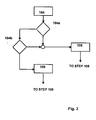
- Figure 3 is a partial flowchart of an alternative process to that of figure 2.
- a first subscriber (1) establishes communication with a second subscriber (2) over a line (3) of a first network (4), which can be a leased line or data transport network, or else a public switched telephone network (PSTN).
- a first network (4) which can be a leased line or data transport network, or else a public switched telephone network (PSTN).
- PSTN public switched telephone network
- This second line (5) offers the characteristics of a conventional backup line.
- both subscribers (1) and (2) are connected to the network preferentially through a multi-service access node (7) and (8), respectively. Notwithstanding, it must be pointed out that other access multiplexing equipment can also be used for carrying out the invention.
- a mobile terminal (71) and (81), respectively, capable of establishing calls to predetermined numbers over a mobile network (9) is included.
- the multi-service access nodes (7 and 8) are multiplexing equipments for user traffic (voice and data), capable of interchanging traffic over the leased lines or data network (4), over the conventional switching network (6) or over the mobile telephone network (9).
- the multi-service access nodes (7 and 8) include the equipment necessary for multiplexing the information streams from the user equipments (1 and 2) and route them onto the telecommunication networks. This equipment is controlled by means of an internal controller (73 and 83), following the instructions given by an operator via an external management system (72 and 82).
- the internal controllers are constituted basically by computers in which are installed access network management programs designed specifically depending on the actual embodiment of the rest of the equipment.
- the external management systems 72 and 82, also computer-based, are connected with the internal controllers in such a manner that a user can configure them and insert the instructions relative to control and management of the access nodes.
- connections between subscribers (1) and (2) are set up by means of commands issued by the management systems (72) and (82) corresponding to each multi-service node, over the first data network (4), or internally by the controllers (73) and (83) of the multi-service nodes, obeying commands from the subscriber terminals (signalling).
- step (103) If, due to an accident, connection between the multi-service node (7) or (8) and the data network is lost, said fault is detected by means of the link quality supervision (102).
- the controller sends a command to the mobile terminal (71, 81) for the latter to make a call to one or more predetermined numbers (105).
- said connection shall serve as backup communication line (10) between the first subscriber (1) and the second subscriber (2), the operation being retained in backup mode (108), this time over a mobile telephony line.
- each multi-service access node acts for rerouting the data streams over the radio backup line (10).
- step (106) of the operation it must be pointed out that if connection is not achieved with the call to the mobile network, the system optionally sets up an alarm call (107) to an operator, and the same operation starting from step (103) is repeated thereafter, that is, the call over the conventional backup line (5).
- a connection route is chosen between the two terminals that partly employs a fixed network (4, 6) for setting up the communication in optimum mode.
- connection with the mobile terminal (81) can be set up either by radio (10) over the entire path and directly to the multi-service access node (8), or else, if the span of line (3) which runs between the first network (4) and the access node (8) is not damaged, over connection (11) which is set up from the mobile network (9) to the fixed network (4), terminating in access node (8) via said span of the communication line (3) that has not been damaged.
- the same operation could be performed by using the second network (6) together with the span of the conventional backup line (5) that remains undamaged.
- step (104) may be observed in which, just as was described with respect to figure 2, a check is made of whether the communication has been set up over a conventional backup line (5).
- the controller sends a command to the mobile terminal (71, 81) for the latter to make a call over the mobile network (9) to one or several predetermined numbers.
- the first predetermined number called (104a) would be a destination number belonging to the first fixed network (4) to which a call is made over the mobile network (9). If the connection is set up, operation will continue in backup mode (108). In the event of failure, a second call (104b) will be made to a predetermined number of the second fixed network (6), also by calling over the mobile network (9). If the connection is set up, operation will continue in backup mode (108). Finally, if the connection is not established, a number belonging to the mobile network (9) will be called as has been described for step (105) and those following in relation with figure 2.
Landscapes
- Engineering & Computer Science (AREA)
- Computer Networks & Wireless Communication (AREA)
- Mobile Radio Communication Systems (AREA)
- Telephonic Communication Services (AREA)
Abstract
System and method for implementing a backup line in a telecommunication network, which comprises at least one communication line (3) in a telecommunication network (4) for establishing communication between a first subscriber (1) and at least a second subscriber (2). Each subscriber is connected to an access system (7, 8) in which a mobile terminal (71) and (81) capable of establishing calls by radio to predetermined numbers is included. In the event of a fault in the communication line (3) of a subscriber, a call is made via the mobile terminal (71, 81) of said subscriber to a predetermined number, making use of a mobile network (9) for establishing a backup line (10, 11). <IMAGE>
Description
The present invention relates to a system and a method for
implementing a backup line in a telecommunication network, which is
preferentially used in the access systems to data or telephony networks.
In the present telecommunication networks, there exists the possibility
that in the event of a fault in a communication line, use can be made of a
second line, usually termed backup line, for the purpose of providing an
alternative communication path and so avoid breaks in the communication.
Normally, the communication line belongs to a data network, whilst
the second line belongs to another telecommunication network like, for
example, an integrated services digital network (ISDN).
A backup line system for this type of communication is known from the
United States patent US-A-5.406.564. According to the system proposed in
this patent, a backup line provides support for a communication line in the
event of a fault occurring on the latter.
The backup line in the system of the patent mentioned comprises a
first and a second backup unit each one coupled to a first and a second
subscriber, respectively, and to each other over channels of an integrated
services digital network (ISDN). Said backup units include backup means
which serve to form backup communication channels between said
subscribers in the event of a fault occurring on the communication line.
According to this arrangement, the backup line, by being set up
through an ISDN, makes use of cables.
In practice, both lines, that is the usual communication line and the
backup line are run through cables that are physically laid in parallel and
alongside or very close to each other within their network installation route.
This occurrence means that the two cables corresponding to the two
lines are equally liable to suffer physical damage produced, for example, by
construction work in the terrain in which both cables are laid or for other
reasons, such as storms.
Consequently, once the circumstances that cause physical harm take
place, said circumstances can affect both cables, leaving both the
communication line and the backup line out of service.
The idea of running each cable over different paths, although
supposing a solution for this problem, would imply a significant increase in
the costs of cable laying and consequently would give rise to another
drawback equally undesirable.
On the other hand, mention has to be made that there are
telecommunication networks in which use is only made of one
communication line and, consequently, said backup line is absent. This case
is encountered in many developing countries where for economic reasons or
lack of resources it has been decided not to lay a backup line for emergency
situations.
In this type of network the main problem is that of obtaining a more
economical, feasible and at the same time effective manner of installing
backup lines for the purposes mentioned earlier.
To overcome the problems above mentioned, the system and the
method for implementing a backup line in a telecommunication network that
make use of radio channels for providing a backup line are proposed.
According to the present invention, backup access is provided for the
user traffic through a mobile telephone network, so that the availability of
service is assured in those situations in which both the leased line or data
network and the public switched telephone network (PSTN) or the ISDN are
out of service.
The implementation of the backup line object of the invention consists
mainly in incorporating a mobile terminal into an access system, capable of
generating calls to a set of numbers previously configured by the user as
backup access points.
Figure 1 is a block diagram in which the arrangement of the
equipment and networks involved in this invention is shown.
Figure 2 is a flowchart of the process followed by the access
equipment pertaining to the system of the present invention, for connecting
the users over a backup line.
Figure 3 is a partial flowchart of an alternative process to that of figure
2.
According to the system of the invention a first subscriber (1)
establishes communication with a second subscriber (2) over a line (3) of a
first network (4), which can be a leased line or data transport network, or
else a public switched telephone network (PSTN).
A second line (5) belonging to a second network (6) for data transport
or for leased lines, or else a PSTN, other than that of the first network (4),
serves as backup line in the event that a fault arises in the communication
over the first line (3) for whatever reason. This second line (5) offers the
characteristics of a conventional backup line.
In the practical embodiment of the invention, both subscribers (1) and
(2) are connected to the network preferentially through a multi-service
access node (7) and (8), respectively. Notwithstanding, it must be pointed
out that other access multiplexing equipment can also be used for carrying
out the invention.
In each one of said nodes (7) and (8) a mobile terminal (71) and (81),
respectively, capable of establishing calls to predetermined numbers over a
mobile network (9) is included.
The multi-service access nodes (7 and 8) are multiplexing equipments
for user traffic (voice and data), capable of interchanging traffic over the
leased lines or data network (4), over the conventional switching network (6)
or over the mobile telephone network (9).
The multi-service access nodes (7 and 8) include the equipment
necessary for multiplexing the information streams from the user equipments
(1 and 2) and route them onto the telecommunication networks. This
equipment is controlled by means of an internal controller (73 and 83),
following the instructions given by an operator via an external management
system (72 and 82).
The internal controllers (73 and 83), are constituted basically by
computers in which are installed access network management programs
designed specifically depending on the actual embodiment of the rest of the
equipment. Likewise, the external management systems (72 and 82), also
computer-based, are connected with the internal controllers in such a
manner that a user can configure them and insert the instructions relative to
control and management of the access nodes.
It is worth noting that in the case where other access multiplexing
equipments are employed, these shall likewise be capable of interchanging
traffic over the leased lines or data network (4), over the conventional
switching network (6) or over the mobile telephone network (9); and they
shall be fitted with internal controllers and external management systems, as
has been described in the case of multi-service access nodes.
A description is now given of an example of the process followed by
the multi-service access nodes for connecting the users over a radio backup
line, with the support of figures 1 and 2 together.
In normal working (101), the connections between subscribers (1) and
(2) are set up by means of commands issued by the management systems
(72) and (82) corresponding to each multi-service node, over the first data
network (4), or internally by the controllers (73) and (83) of the multi-service
nodes, obeying commands from the subscriber terminals (signalling).
If, due to an accident, connection between the multi-service node (7)
or (8) and the data network is lost, said fault is detected by means of the link
quality supervision (102). The controller incorporated in the multi-service
node (73) and (83), or the management system (72, 82) attempts to establish
the communication over the conventional backup line (5) as is shown in step
(103). Subsequently, a check is made to see if communication has been
established (104). If the answer is affirmative, the backup mode is retained
in operation (108), which is being implemented over the conventional backup
line (5).
If it is not possible to set up communication over the conventional
backup line (5), the controller sends a command to the mobile terminal (71,
81) for the latter to make a call to one or more predetermined numbers (105).
Once connection has been made (106) in the call over the mobile network
(9), said connection shall serve as backup communication line (10) between
the first subscriber (1) and the second subscriber (2), the operation being
retained in backup mode (108), this time over a mobile telephony line.
The internal controller (73 and 83) of each multi-service access node
acts for rerouting the data streams over the radio backup line (10).
At the same time, a check is also made whether the communication
line (3) has been repaired (109), the communication being retained over the
radio backup line (10) until the repair has been completed.
Once the checking process (109) reveals the communication line (3)
has been repaired (109), the connection is restored over the latter (110), and
the backup call is released (111).
Returning to step (106) of the operation, it must be pointed out that if
connection is not achieved with the call to the mobile network, the system
optionally sets up an alarm call (107) to an operator, and the same operation
starting from step (103) is repeated thereafter, that is, the call over the
conventional backup line (5).
Advantageously, on carrying out the call through one of the mobile
terminals, for example mobile terminal (71) in figure 1, a connection route is
chosen between the two terminals that partly employs a fixed network (4, 6)
for setting up the communication in optimum mode.
Thus, when a mobile terminal, for example terminal (71), makes a call,
the connection with the mobile terminal (81) can be set up either by radio
(10) over the entire path and directly to the multi-service access node (8), or
else, if the span of line (3) which runs between the first network (4) and the
access node (8) is not damaged, over connection (11) which is set up from
the mobile network (9) to the fixed network (4), terminating in access node
(8) via said span of the communication line (3) that has not been damaged.
The same operation could be performed by using the second network
(6) together with the span of the conventional backup line (5) that remains
undamaged.
The process for carrying out this operation is shown in figure 3 in
which, for reasons of simplification, only those steps which are particularly
necessary for carrying out it are shown, the remaining steps being identical
to those shown in figure 2.
In said figure 3 step (104) may be observed in which, just as was
described with respect to figure 2, a check is made of whether the
communication has been set up over a conventional backup line (5).
If communication over the conventional backup line (5) is not
possible, the controller sends a command to the mobile terminal (71, 81) for
the latter to make a call over the mobile network (9) to one or several
predetermined numbers.
In the operation in question, the first predetermined number called
(104a) would be a destination number belonging to the first fixed network (4)
to which a call is made over the mobile network (9). If the connection is set
up, operation will continue in backup mode (108). In the event of failure, a
second call (104b) will be made to a predetermined number of the second
fixed network (6), also by calling over the mobile network (9). If the
connection is set up, operation will continue in backup mode (108). Finally, if
the connection is not established, a number belonging to the mobile network
(9) will be called as has been described for step (105) and those following in
relation with figure 2.
Claims (8)
- System for implementing a backup line in a telecommunication network, which comprises at least one communication line (3) in a telecommunication network (4) for establishing communication between a first subscriber (1) and at least a second subscriber (2), characterised in that each subscriber is connected to an access multiplexing equipment (7, 8) in which a mobile terminal (71, 81) capable of establishing calls by radio to predetermined numbers is included.
- System, according to the preceding claim, characterised in that each access multiplexing equipment (7, 8) comprises at least one internal controller (73, 83), for following the instructions given by an operator through an external management system (72, 82), and for rerouting the data streams over a radio backup line (10).
- System, according to any one of the preceding claims, characterised in that it comprises a second line (5) pertaining to a second network (6) different from the first network (4), that serves as backup line in the event of a failure occurring in the communication for any reason whatsoever in the first line (3).
- System, according to any one of the preceding claims, characterised in that the access multiplexing equipments (7, 8) are multi-service access nodes.
- Method for implementing a backup line in a telecommunication network, said network comprising at least one communication line (3) in a telecommunication network (4) for establishing communication between a first subscriber (1) and at least a second subscriber (2), characterised by comprising the steps of:detecting a fault in a connection in a communication line (3, 5) between the first subscriber (1) and at least a second subscriber (2) by means of a link quality supervision (102);making a call to one or several predetermined numbers (105) by radio from a mobile terminal (71, 81) to which the first subscriber (1) is connected; andupon establishing a line (10, 11) for connection (106) in said call between said first subscriber and at least a second subscriber, using said line (10, 11) as backup communication line.
- Method, according to the preceding claim, characterised in that the communication is maintained over the radio backup line (10, 11), as long as a connection fault persists, the connection over the communication line (3) being restored once the fault has been cleared, and the line (10, 11) of the radio backup call is released (111).
- Method, according to any one of the claims 5 or 6, characterised in that at least one predetermined number to which the call is made by one of the mobile terminals (71, 81) belongs to a fixed network (4, 6).
- Method, according to any one of the claims 5 to 7, characterised in that in the event that the radio connection is not established, an alarm call (107) is made to an operator.
Applications Claiming Priority (2)
| Application Number | Priority Date | Filing Date | Title |
|---|---|---|---|
| ES9801911 | 1998-09-10 | ||
| ES9801911 | 1998-09-10 |
Publications (1)
| Publication Number | Publication Date |
|---|---|
| EP0986285A2 true EP0986285A2 (en) | 2000-03-15 |
Family
ID=8305131
Family Applications (1)
| Application Number | Title | Priority Date | Filing Date |
|---|---|---|---|
| EP19990402047 Withdrawn EP0986285A2 (en) | 1998-09-10 | 1999-08-12 | System and method for implementing a backup line in a telecommunication network |
Country Status (1)
| Country | Link |
|---|---|
| EP (1) | EP0986285A2 (en) |
Cited By (4)
| Publication number | Priority date | Publication date | Assignee | Title |
|---|---|---|---|---|
| WO2001093615A1 (en) * | 2000-05-30 | 2001-12-06 | Telefonaktiebolaget Lm Ericsson (Publ) | Operations and maintenance of radio base stations in mobile telecommunication systems |
| EP1562390A1 (en) * | 2004-02-09 | 2005-08-10 | Alcatel | High availability broadband connections through switching from wireline to diverse wireless network |
| EP1344143A4 (en) * | 2000-11-03 | 2005-10-12 | Truphone Limited | COOPERATIVE NETWORK FOR MOBILE INTERNET ACCESS |
| EP2528285A4 (en) * | 2010-01-20 | 2013-11-20 | Zte Corp | METHOD, SYSTEM AND ACCESS DEVICE |
-
1999
- 1999-08-12 EP EP19990402047 patent/EP0986285A2/en not_active Withdrawn
Cited By (6)
| Publication number | Priority date | Publication date | Assignee | Title |
|---|---|---|---|---|
| WO2001093615A1 (en) * | 2000-05-30 | 2001-12-06 | Telefonaktiebolaget Lm Ericsson (Publ) | Operations and maintenance of radio base stations in mobile telecommunication systems |
| EP1344143A4 (en) * | 2000-11-03 | 2005-10-12 | Truphone Limited | COOPERATIVE NETWORK FOR MOBILE INTERNET ACCESS |
| EP2288082A1 (en) * | 2000-11-03 | 2011-02-23 | James P. Tagg | Cooperative network for mobile internet access |
| EP1562390A1 (en) * | 2004-02-09 | 2005-08-10 | Alcatel | High availability broadband connections through switching from wireline to diverse wireless network |
| US7590055B2 (en) | 2004-02-09 | 2009-09-15 | Alcatel Lucent | High availability broadband connections through switching from wireline to diverse wireless network |
| EP2528285A4 (en) * | 2010-01-20 | 2013-11-20 | Zte Corp | METHOD, SYSTEM AND ACCESS DEVICE |
Similar Documents
| Publication | Publication Date | Title |
|---|---|---|
| JP3183509B2 (en) | Mobile phone network configuration | |
| US5627889A (en) | Service restoration technique for telecommunications facilities having a single degree of freedom | |
| US5796718A (en) | Method of and system for intelligent access line protect switching | |
| US6370110B1 (en) | Back-up restoration technique for SONET/SHD rings | |
| US6327260B1 (en) | Controlled routing to a plurality of signaling interfaces at a single telephonic switch | |
| US6370232B1 (en) | Procedure and system for ensuring emergency communication | |
| EP0852095B1 (en) | Procedure and system for ensuring emergency communication | |
| US5870032A (en) | Restoration network architecture | |
| US6175552B1 (en) | Disaster recovery in a telecommunications network | |
| EP1271969A2 (en) | Signaling gateway system and network management method | |
| US6215867B1 (en) | Telecommunications network architecture with rapid restoration | |
| US7130398B2 (en) | Method and apparatus for managing signaling links in a signaling link set | |
| JP2001016331A (en) | How to reroute your own digital signal | |
| US6404887B1 (en) | Intra-call control of ancillary telecommunications equipment | |
| US6282423B1 (en) | Wireless communication system with selectable signal routing and method therefor | |
| CA2213467A1 (en) | Establishment of a flexible rate interface link to restore channels from a failed communication link | |
| EP0296832A2 (en) | A call monitor arrangement | |
| EP0980189A2 (en) | Method and apparatus for routing data traffic away from a failing switch | |
| KR100237473B1 (en) | Method of establishing packet pvc's in n-isdn | |
| US7471627B2 (en) | Network level admission control apparatus for a communications network having a sub-IP level protocol | |
| JP3624851B2 (en) | Remote switching system switching method and switching system | |
| KR100226324B1 (en) | Time switch call path exchange method for full-electronic telephone exchange | |
| JPH0423555A (en) | Common line signal processing system | |
| JP3270409B2 (en) | Traffic diversion method of common channel signal relay network by network management system | |
| JP3060038B2 (en) | Exchange module spare switching system |
Legal Events
| Date | Code | Title | Description |
|---|---|---|---|
| PUAI | Public reference made under article 153(3) epc to a published international application that has entered the european phase |
Free format text: ORIGINAL CODE: 0009012 |
|
| AK | Designated contracting states |
Kind code of ref document: A2 Designated state(s): AT BE CH CY DE DK ES FI FR GB GR IE IT LI LU MC NL PT SE |
|
| AX | Request for extension of the european patent |
Free format text: AL;LT;LV;MK;RO;SI |
|
| STAA | Information on the status of an ep patent application or granted ep patent |
Free format text: STATUS: THE APPLICATION HAS BEEN WITHDRAWN |
|
| 18W | Application withdrawn |
Effective date: 20021227 |