EP0985664A2 - Method of producing pyrrolidine derivatives - Google Patents

Method of producing pyrrolidine derivatives Download PDF

Info

Publication number
EP0985664A2
EP0985664A2 EP99307113A EP99307113A EP0985664A2 EP 0985664 A2 EP0985664 A2 EP 0985664A2 EP 99307113 A EP99307113 A EP 99307113A EP 99307113 A EP99307113 A EP 99307113A EP 0985664 A2 EP0985664 A2 EP 0985664A2
Authority
EP
European Patent Office
Prior art keywords
group
formula
cis
butene
alalkyl
Prior art date
Legal status (The legal status is an assumption and is not a legal conclusion. Google has not performed a legal analysis and makes no representation as to the accuracy of the status listed.)
Granted
Application number
EP99307113A
Other languages
German (de)
French (fr)
Other versions
EP0985664A3 (en
EP0985664B1 (en
Inventor
Hideo Muraoka
Haruyo Sato
Current Assignee (The listed assignees may be inaccurate. Google has not performed a legal analysis and makes no representation or warranty as to the accuracy of the list.)
Toray Fine Chemicals Co Ltd
Original Assignee
Toray Fine Chemicals Co Ltd
Toray Industries Inc
Priority date (The priority date is an assumption and is not a legal conclusion. Google has not performed a legal analysis and makes no representation as to the accuracy of the date listed.)
Filing date
Publication date
Priority claimed from JP25430498A external-priority patent/JP4314597B2/en
Application filed by Toray Fine Chemicals Co Ltd, Toray Industries Inc filed Critical Toray Fine Chemicals Co Ltd
Publication of EP0985664A2 publication Critical patent/EP0985664A2/en
Publication of EP0985664A3 publication Critical patent/EP0985664A3/en
Application granted granted Critical
Publication of EP0985664B1 publication Critical patent/EP0985664B1/en
Anticipated expiration legal-status Critical
Expired - Lifetime legal-status Critical Current

Links

Classifications

    • CCHEMISTRY; METALLURGY
    • C07ORGANIC CHEMISTRY
    • C07DHETEROCYCLIC COMPOUNDS
    • C07D491/00Heterocyclic compounds containing in the condensed ring system both one or more rings having oxygen atoms as the only ring hetero atoms and one or more rings having nitrogen atoms as the only ring hetero atoms, not provided for by groups C07D451/00 - C07D459/00, C07D463/00, C07D477/00 or C07D489/00
    • C07D491/02Heterocyclic compounds containing in the condensed ring system both one or more rings having oxygen atoms as the only ring hetero atoms and one or more rings having nitrogen atoms as the only ring hetero atoms, not provided for by groups C07D451/00 - C07D459/00, C07D463/00, C07D477/00 or C07D489/00 in which the condensed system contains two hetero rings
    • C07D491/04Ortho-condensed systems
    • CCHEMISTRY; METALLURGY
    • C07ORGANIC CHEMISTRY
    • C07DHETEROCYCLIC COMPOUNDS
    • C07D207/00Heterocyclic compounds containing five-membered rings not condensed with other rings, with one nitrogen atom as the only ring hetero atom
    • C07D207/02Heterocyclic compounds containing five-membered rings not condensed with other rings, with one nitrogen atom as the only ring hetero atom with only hydrogen or carbon atoms directly attached to the ring nitrogen atom
    • C07D207/04Heterocyclic compounds containing five-membered rings not condensed with other rings, with one nitrogen atom as the only ring hetero atom with only hydrogen or carbon atoms directly attached to the ring nitrogen atom having no double bonds between ring members or between ring members and non-ring members
    • C07D207/10Heterocyclic compounds containing five-membered rings not condensed with other rings, with one nitrogen atom as the only ring hetero atom with only hydrogen or carbon atoms directly attached to the ring nitrogen atom having no double bonds between ring members or between ring members and non-ring members with hetero atoms or with carbon atoms having three bonds to hetero atoms with at the most one bond to halogen, e.g. ester or nitrile radicals, directly attached to ring carbon atoms
    • C07D207/12Oxygen or sulfur atoms
    • CCHEMISTRY; METALLURGY
    • C07ORGANIC CHEMISTRY
    • C07DHETEROCYCLIC COMPOUNDS
    • C07D207/00Heterocyclic compounds containing five-membered rings not condensed with other rings, with one nitrogen atom as the only ring hetero atom
    • C07D207/02Heterocyclic compounds containing five-membered rings not condensed with other rings, with one nitrogen atom as the only ring hetero atom with only hydrogen or carbon atoms directly attached to the ring nitrogen atom
    • C07D207/04Heterocyclic compounds containing five-membered rings not condensed with other rings, with one nitrogen atom as the only ring hetero atom with only hydrogen or carbon atoms directly attached to the ring nitrogen atom having no double bonds between ring members or between ring members and non-ring members
    • C07D207/10Heterocyclic compounds containing five-membered rings not condensed with other rings, with one nitrogen atom as the only ring hetero atom with only hydrogen or carbon atoms directly attached to the ring nitrogen atom having no double bonds between ring members or between ring members and non-ring members with hetero atoms or with carbon atoms having three bonds to hetero atoms with at the most one bond to halogen, e.g. ester or nitrile radicals, directly attached to ring carbon atoms
    • C07D207/14Nitrogen atoms not forming part of a nitro radical

Definitions

  • the present invention relates to methods of producing pyrrolidine derivatives and addresses the problem of providing simple and efficient industrial production of pyrrolidine derivatives such as epoxypyrrolidines and pyrrolidinols. These pyrrolidine derivatives are important and useful synthetic intermediates for pharmaceuticals, and can be transformed to several kinds of pyrrolidine derivatives.
  • the present invention provides a novel method of preparing pyrrolidine derivatives such as 3,4-epoxypyrrolidines, 3-pyrrolidinols, and the like, in a novel, simple and efficient procedure.
  • the invention allows a one-pot synthesis of pyrrolidine derivatives such as 3,4-epoxypyrrolidines and 3-pyrrolidinols from 3-pyrrolines by oxidation with a peroxide in the presence of an acid.
  • pyrrolidine compounds are important and useful synthetic intermediates for synthesis of pharmaceuticals, and can be transformed into several kinds of pyrrolidine derivatives.
  • the invention provides a method for preparing a pyrrolidine derivative such as a 3,4-epoxypyrrolidine or 3-pyrrolidinol, by reacting a 3-pyrroline with at least one peroxide in the presence of at least one acid. Oxidation of the 3-pyrroline having formula (3) may be accelerated using ultraviolet irradiation, if desired.
  • the 3-pyrrolidinol is of formula (1): wherein R 1 is hydrogen (H), a halogen, a cyano group (CN), a nitro group (NO 2 ), a hydroxyl group (OH), an alkoxyl group (OR), a carboxyl group (CO 2 H), an alkoxycarbonyl group (CO 2 R), an acyl group (COR), a carbamoyl group (H 2 NCO), a sulfide group (SH, or SR), a sulfinyl group (SOR), a sulfonyl group (SO 2 R), a sulfamide group (SO 2 NRR'), or a C 1 - C 10 alkyl group, cycloalkyl group, aryl group, alalkyl group which can be optionally substituted, R 2 and R 3 represent a C 1 - C 10 alkyl group, cycloalkyl group, aryl group, alalkyl group which can be optionally substitute
  • the 3-pyrrolidinols include, but are not limited to, 3,4-dihydroxypyrrolidines, such as 3,4-dihydroxypyrrolidine, 1-methyl-3, 4-dihydroxypyrrolidine, 1-cyclohexyl-3,4-dihydroxypyrrolidine, 1-benzyl-3,4-dihydroxypyrrolidine, 1-phenyl-3,4-dihydroxypyrrolidine, 2-[3-chloro-4-(3, 4-dihydroxypyrrolidin-1-yl)phenyl]propionic acid, methyl 2-[3-chloro-4-(3,4-dihydroxypyrrolidin-1-yl)phenyl]propionate, and the like.
  • 3,4-dihydroxypyrrolidines such as 3,4-dihydroxypyrrolidine, 1-methyl-3, 4-dihydroxypyrrolidine, 1-cyclohexyl-3,4-dihydroxypyrrolidine, 1-benzyl-3,4-dihydroxypyrrolidine, 1-phenyl-3,4-dihydroxypyrrol
  • 3-pyrrolidinols include, but are not limited to, 4-amino-3-pyrrolidinols such as 4-amino-3-pyrrolidinol, 1-methyl-4-amino-3-pyrrolidinol, 1-cyclohexyl-4-amino-3-pyrrolidinol, 1-benzyl-4-amino-3-pyrrolidinol, 1-phenyl-4-amino-3-pyrrolidinol, 2-[3-chloro-4-(4-amino-3-hydroxypyrrolidin-1-yl)phenyl]propionic acid, methyl 2-[3-chloro-4-(4-amino-3-hydroxypyrrolidin-1-yl)phenyl]propionate; 4-benzylamino-3-pyrrolidinols such as 4-benzylamino-3-pyrrolidinol, 1-methyl-4-benzylamino-3-pyrrolidinol, 1-cyclohexyl-4-benzyla
  • the 3,4-epoxypyrrolidine is of the formula (2): wherein R 1 is hydrogen (H), a halogen, a cyano group (CN), a nitro group (NO 2 ), a hydroxyl group (OH), an alkoxyl group (OR), a carboxyl group (CO 2 H), an alkoxycarbonyl group (CO 2 R), an acyl group (COR), a carbamoyl group (H 2 NCO), a sulfide group (SH, or SR), a sulfinyl group (SOR), a sulfonyl group (SO 2 R), a sulfamide group (SO 2 NRR'), or a C 1 - C 10 alkyl group, cycloalkyl group, aryl group, alalkyl group which can be optionally substituted; R 2 and R 3 each represent a C 1 - C 10 alkyl group, cycloalkyl group, aryl group, alalkyl group which can
  • the 3,4-epoxypyrrolidines include, but are not limited to 3,4-epoxypyrrolidine, 1-methyl-3, 4-epoxypyrrolidine, 1-cyclohexyl-3,4-epoxypyrrolidine, 1-benzyl-3,4-epoxypyrrolidine, 1-phenyl-3, 4-epoxypyrrolidine, 2-[3-chloro-4-(3,4-epoxypyrrolidin-1-yl)phenyl]propionic acid, methyl 2-[3-chloro-4-(3,4-epoxypyrrolidin-1-yl)phenyl]propionate, and the like.
  • the 3-pyrroline is of formula (3): wherein R 1 is hydrogen (H), a halogen, a cyano group (CN), a nitro group (NO 2 ), a hydroxyl group (OH), an alkoxyl group (OR), a carboxyl group (CO 2 H), an alkoxycarbonyl group (CO 2 R), an acyl group (COR), a carbamoyl group (H 2 NCO), a sulfide group (SH, or SR), a sulfinyl group (SOR), a sulfonyl group (SO 2 R), a sulfamide group (SO 2 NRR'), or a C 1 - C 10 alkyl group, cycloalkyl group, aryl group, alalkyl group which can be optionally substituted; R 2 and R 3 each represent a C 1 - C 10 alkyl group, cycloalkyl group, aryl group, alalkyl group which can be optionally substituted;
  • the 3-pyrrolines include, but are not limited to 3-pyrroline, 1-methyl-3-pyrroline, 1-ethyl-3-pyrroline, 1-propyl-3-pyrroline, 1-cyclohexyl-3-pyrroline, 1-trichloromethyl-3-pyrroline, 1-phenyl-3-pyrroline, 1-tolyl-3-pyrroline, 1-benzyl-3-pyrroline, 2-[3-chloro-4-(3-pyrrolin-1-yl)phenyl]propionic acid, methyl 2-[3-chloro-4-(3-pyrrolin-1-yl)phenyl]propionate, and the like.
  • 3-pyrroline, 1-benzyl-3-pyrroline, 1-cyclohexyl-3-pyrroline are preferred. Most preferred are 1-benzyl-3-pyrroline and 1-cyclohexyl-3-pyrroline.
  • Preferable acids used in the process for oxidation of the 3-pyrroline are compounds whose formula contains a sulfur atom (S), such as sulfuric acid or sulfonic acids having formula (11).
  • Formula (11) is represented by: R 14 SO 3 H (11) wherein R 14 represents a C 1 - C 10 alkyl group, cycloalkyl group, aryl group, alalkyl group which can be optionally substituted by a halogen, a cyano group (CN), a nitro group (NO 2 ), a hydroxyl group (OH), an alkoxyl group (OR), a silyl group (SiR 3 ), a carboxyl group (CO 2 H), an alkoxycarbonyl group (CO 2 R), and/or an acyl group (COR).
  • R 14 represents a C 1 - C 10 alkyl group, cycloalkyl group, aryl group, alalkyl group which can be optionally substituted by a halogen, a cyan
  • sulfonic acids having formula (11) can be classified under four sulfonic acids: alkylsulfonic acids, cycloalkylsulfonic acids, arylsulfonic acids, and alalkylsulfonic acids.
  • alkylsulfonic acids include, but are not limited to methanesulfonic acids, trifluoromethanesulfonic acids, trichloromethanesulfonic acids, ethanesulfonic acids, and the like.
  • Suitable cycloalkylsulfonic acids include, but are not limited to, cyclopropanesulfonic acids, cyclohexanesulfonic acids, and the like.
  • Suitable arylsulfonic acids include, but are not limited to, benzenesulfonic acids, o-, m-, p-fluorobenzenesulfonic acids, o-, m-, p-chlorobenzenesulfonic acids, o-, m-, p-nitrobenzenesulfonic acids, o-, m-, p- cyanobenzenesulfonic acids, o-, m-, p-toluenesulfonic acids, mesitylenesulfonic acids, naphthaleneulfonic acids, and the like.
  • Suitable alalkylsulfonic acids include, but are not limited to, benzylsulfonic acids, o-, m-, p-fluorobenzylsulfonic acids, o-, m-, p-chlorobenzylsulfonic acids, o-, m-, p-nitrobenzylsulfonic acids, o-, m-, p-cyanobenzylsulfonic acids, and the like.
  • sulfuric acid methanesulfonic acids, benzenesulfonic acids, p-chlorobenzenesulfonic acids are preferred.
  • sulfuric acid is most preferably used.
  • the preferable amount of acid used is in the range of about 1.0 - 3.0 mole acid to about 1.0 moles 3-pyrrolines having formula (3) can be used efficiently and economically.
  • Peroxides used in the oxidation of the 3-pyrrolines of formula (3) may be peroxymonosulfuric acids, or their salts (peroxymonosulfates) having formula (4), peroxydisulfuric acids, or their salts (peroxydisulfates) having formula (5).
  • Formula (6) is represented by: wherein R 4 - R 7 represent hydrogen, a C 1 - C 20 alkyl group, a cycloalkyl group, an aryl group, or an alalkyl group.
  • Peroxymonosulfuric acid, salts (peroxymonosulfates) or peroxydisulfuric acid, salts (peroxydisulfates) are preferable.
  • Metal peroxymonosulfates include, but are not limited to, sodium peroxymonosulfate (Na 2 SO 5 ), potassium peroxymonosulfate (K 2 SO 5 ), barium peroxymonosulfate (BaSO 5 ), rubidium peroxymonosulfate (RbSO 5 ), and the like.
  • Metal peroxyhydrogenmonosulfates include, but are not limited to, sodium peroxyhydrogenmonosulfate (NaHSO 5 ), potassium peroxyhydrogenmonosulfate (KHSO 5 ), and the like.
  • Ammonium peroxymonosulfates include, but are not limited to, ammonium peroxymonosulfate ((NH 4 ) 2 SO 5 ), tetramethylammonium peroxymonosulfate ((Me 4 N) 2 SO 5 ), tetraethylammonium peroxymonosulfate ((Et 4 N) 2 SO 5 ), tetrapropylammonium peroxymonosulfate ((Pr 4 N) 2 SO 5 ), tetrabutylammonium peroxymonosulfate ((Bu 4 N) 2 SO 5 ), tetrahexylammonium peroxymonosulfate, tetradecylammonium peroxymonosulfate, tetralaurylammonium peroxymonosulfate, tetrabenzylammonium peroxymonosulfate ((Bn 4 N) 2 SO 5 ), benzyltrimethylammoni
  • Ammonium peroxyhydrogenmonosulfates include, but are not limited to, ammonium peroxyhydrogenmonosulfate ((NH 4 )HSO 5 ), tetramethylammonium peroxyhydrogenmonosulfate ((Me 4 N)HSO 5 ), tetraethylammonium peroxyhydrogenmonosulfate ((Et 4 N)HSO 5 ), tetrapropylammonium peroxyhydrogenmonosulfate ((Pr 4 N)HSO 5 ), tetrabutylammonium peroxyhydrogenmonosulfate ((Bu 4 N)HSO 5 ), tetrahexylammonium peroxyhydrogenmonosulfate, tetradecylammonium peroxyhydrogenmonosulfate, tetralaurylammonium peroxyhydrogenmonosulfate, tetrabenzylammonium peroxyhydrogenmonosulfate
  • Metal peroxydisulfates include, but are not limited to, sodium peroxydisulfate (Na 2 S 2 O 8 ), potassium peroxydisulfate (K 2 S 2 O 8 ), barium peroxydisulfate (BaS 2 O 8 ), rubidium peroxydisulfate (RbS 2 O 8 ), and the like.
  • Metal peroxyhydrogendisulfates include, but are not limited to, sodium peroxyhydrogendisulfate (NaHS 2 O 8 ), potassium peroxyhydrogendisulfate (KHS 2 O 8 ), and the like.
  • Ammonium peroxydisulfates include, but are not limited to, ammonium peroxydisulfate ((NH 4 ) 2 S 2 O 8 ), tetramethylammonium peroxydisulfate ((Me 4 N) 2 S 2 O 8 ), tetraethylammonium peroxydisulfate ((Et 4 N) 2 S 2 O 8 ), tetrapropylammonium peroxydisulfate ((Pr 4 N) 2 S 2 O 8 ), tetrabutylammonium peroxydisulfate ((Bu 4 N) 2 S 2 O 8 ), tetrahexylammonium peroxydisulfate, tetradecylammonium peroxydisulfate, tetralaurylammonium peroxydisulfate, tetrabenzylammonium peroxydisulfate ((Bn 4 N) 2 S 2 O 8 ), benzyltrimethyl
  • Ammonium peroxyhydrogendisulfates include, but are not limited to, ammonium peroxyhydrogendisulfate ((NH 4 )HS 2 O 8 ), tetramethylammonium peroxyhydrogendisulfate ((Me 4 N)HS 2 O 8 ), tetraethylammonium peroxyhydrogendisulfate ((Et 4 N)HS 2 O 8 ), tetrapropylammonium peroxyhydrogendisulfate ((Pr 4 N)HS 2 O 8 ), tetrabutylammonium peroxyhydrogendisulfate ((Bu 4 N)HS 2 O 8 ), tetrahexylammonium peroxyhydrogendisulfate, tetradecylammonium peroxyhydrogendisulfate, tetralaurylammonium peroxyhydrogendisulfate, tetrabenzylammonium peroxyhydrogendisulfate ((Bn 4
  • the preferable peroxymonosulfate is potassium peroxyhydrogenmonosulfate (KHSO 5 )
  • KHSO 5 potassium peroxyhydrogenmonosulfate
  • Na 2 S 2 O 8 sodium peroxydisulfate
  • ammonium peroxydisulfate (NH 4 ) 2 S 2 O 8 ) are the preferred peroxydisulfates.
  • the oxidation can be performed either with peroxysulfates alone or with a peroxysulfate mixture.
  • Suitable amounts of peroxides are in the range of about 1.0 - 2.0 moles of peroxides to 1.0 mole of 3-pyrrolines having formula (3) and can be preferably used efficiently and economically.
  • the substituent group Nu in formula (1) derives from nucleophiles of water, alcohols, amines, and the like.
  • Alcohols include, but are not limited to, methanol (MeOH), ethanol (EtOH), propanol (PrOH), butanol (BuOH), hexanol, cyclohexanol, phenol (PhOH), chlorophenol, dichlorophenol, trichlorophenol, catechol, ethylene glycol, diethylene glycol, and the like.
  • Amines include, but are not limited to, ammonia (NH 3 ), methylamine (MeNH 2 ), ethylamine (EtNH 2 ), propylamine (PrNH 2 ), butylamine (BuNH 2 ), cyclohexylamine, allylamine, homoallylamine, benzylamine (BnNH 2 ), aniline (PhNH 2 ), chloroaniline, bromoaniline, o-, m-, p- toluidine, dimethylamine (Me 2 NH), diethylamine (Et 2 NH), dipropylamine (Pr 2 NH), dibutylamine (Bu 2 NH), dicyclohexylamine, diallylamine, bis(homoallyl)amine, dibenzylamine (Bn 2 NH), N-methylaniline, N-methylchloroaniline, N-methylbromoaniline, benzylmethylamine (BnMeNH), and the like.
  • nucleophiles can be added to the solution either before or after oxidation, so that the one-pot procedure may proceed continuously without isolating the intermediates to obtain the corresponding products, 3-pyrrolidinols.
  • these nucleophiles are not necessary, and can be used as inactive solvents by controlling the reaction temperature.
  • the oxidation of 3-pyrrolines having formula (3) may be accelerated using ultraviolet light.
  • Lamps with wave length from the ultraviolet to the visible light range (200nm - 400nm) can be selected for the irradiation of 3-pyrrolines.
  • such lamps include an Argon Resonance Lamp, a Flash UV (Ultra Violet) Lamp, an Ultra High Pressure Hg (mercury) Lamp, a High Pressure Hg (mercury) Lamp, a Low Pressure Hg (mercury) Lamp, a Deuterium Lamp, a Xe (xenon) Lamp, a W (tungsten) Lamp, a Metal Halide Lamp, and the like.
  • a High Pressure Hg (mercury) Lamp and a Xe (xenon) Lamp are preferable.
  • the reaction system can be changed freely by changing the irradiation time, the irradiation strength or by omitting the irradiation.
  • reaction solvents may be freely selected in the oxidation process.
  • suitable reaction solvents include, but are not limited to, water, methanol, ethanol, propanol, acetone, methylethylkotone, methylisobutylketone, ethyl acetate, methyl propionate, hexane, cyclohexane, benzene, toluene, chloroform, dichloromethane, dichloroethane, tetrahydrofuran, diethyl ether, diisopropyl ether, ethylene glycol, diethylene glycol, and the like. Either only one kind of solvent may be used, or mixtures of solvents may be used. Alternatively, the solvents can be omitted. With regard to combining the above solvents with the nucleophiles from which substituent group Nu in formula (1) derives, they can be made active and/or inactive by controlling the reaction temperature.
  • the reaction temperature will depend on the time required for completing the oxidation. In general, the reaction may be conducted at about 0 - 100°C . In particular, the reaction temperature is about 0 - 30°C for obtaining 3,4-epoxypyrrolidines and is about 30 - 100°C for obtaining 3-pyrrolidinols.
  • 3-pyrrolines having formula (3) may be produced by reacting cis-2-butene derivatives having formula (7) with at least one primary amine having formula (8). This reaction allows cyclization of cis-2-butene derivatives of formula (7) and the formation of 3-pyrrolines of formula (3).
  • Cis-2-butene derivatives of formula (7) may be produced from cis-2-butene-1,4-diols of formula (9) by reacting the cis-2-butene-1,4-diols of formula (9) with a halogenation reagent in the presence of at least one base.
  • R 10 ⁇ NH 2 (8) which are used for preparing 3-pyrrolines, include, but are not limited to, alkyl groups, such as methyl, ethyl, n-, iso-propyl, n-, i-, t-butyl, trifluoromethyl, and the like; cycloalkyl groups, such as cyclohexyl and the like; alkenyl groups, such as vinyl, allyl, methallyl, homoallyl, and the like; aryl groups, such as phenyl, fluorophenyl, difluorophenyl, trifluorophenyl, chlorophenyl, dichlorophenyl, trichlorophenyl, bromophenyl, dibromophenyl, tribromophenyl, nitrophenyl, dinitrophenyl, trinitrophenyl, cyanophenyl, dicyanophenyl, dicyanophenyl, dicyanophenyl,
  • Primary amines include, but are not limited to, methylamine, ethylamine, n-, i- propylamine, n-, i-, t-butylamine, cyclohexylamine, allylamine, allylamine, homoallylamine, benzylamine, aniline, chloroaniline, bromoaniline, toluidine and the like.
  • cyclohexylamine, benzylamine, and aniline are preferable.
  • Suitable amounts of amines are in the range of about 3.0 - 5.0 moles amines to 1.0 mole of cis-2-butene derivatives having formula (7) and can be preferably used efficiently and economically.
  • Formula (7) is represented by: wherein R 8 and R 9 are independently hydrogen (H) or a C 1 - C 10 alkyl group, a cycloalkyl group, an aryl group, or an alalkyl group which can be optionally substituted, A 1 and A 2 are independently halogens or sulfonyloxy groups.
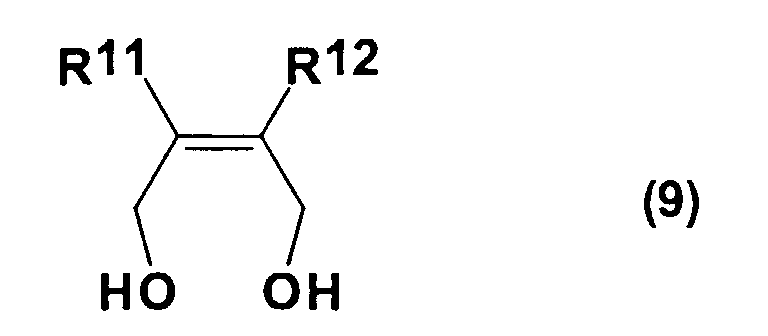
  • Formula (9) is represented by: wherein R 11 and R 12 are independently hydrogen (H) or a C 1 - C 10 alkyl group, a cycloalkyl group, an aryl group, an alalkyl group which can be optionally substituted.
  • Tertiary amines are the preferred bases. Tertiary amines include, but are not limited to, triethylamine, tripropylamine, tributylamine, tribenzylamine, N, N'-dimethylaniline, N, N'-dimethyltoluidine, pyridine, 4-(N, N'-dimethylamino)pyridine, and the like.
  • the amount of bases used is in the range of about 2.0 - 3.0 moles of base to 1.0 mole of cis-2-butene-1,4-diols of formula (9). More preferably the amount of base used is in the range of about 2.0 - 2.2 moles of base and can be used efficiently and economically.
  • the substituent group, A 3 , in the sulfonyl halides of formula (10) which are used as halogenation reagents in the first process include halogens such as Cl, Br, and I.
  • Formula (10) is represented by: R 13 SO 2 A 3 (10) wherein R 13 represents a C 1 - C 10 alkyl group, a cycloalkyl group, an aryl group, or an alalkyl group optionally substituted; and A 3 is a halogen.
  • R 13 represents a C 1 - C 10 alkyl group, a cycloalkyl group, an aryl group, or an alalkyl group optionally substituted
  • a 3 is a halogen.
  • sulfonyl chlorides are preferable.
  • the substituent groups R 13 in the sulfonyl halides, which are used for preparing cis-2-butene derivatives of formula (7) or 3-pyrrolines of formula (3) include, but are not limited to alkyl groups, such as methyl, ethyl, n-, iso-propyl, n-, i-, t-butyl, trifluoromethyl, and the like; cycloalkyl groups, such as cyclohexyl and the like; alkenyl groups, such as vinyl, allyl, methallyl, homoallyl, and the like; aryl groups, such as phenyl, fluorophenyl, difluorophenyl, trifluorophenyl, chlorophenyl, dichlorophenyl, trichlorophenyl, bromophenyl, dibromophenyl, tribromophenyl, nitrophenyl, dinitrophenyl, trinitrophenyl,
  • the sulfonyl chlorides include, but are not limited to, methanesulfonyl chloride, ethanesulfonyl chloride, n-, i-propanesulfonyl chloride, n-, i-, t-butanesulfonyl chloride, cyclohexanesulfonyl chloride, trifluoromethanesulfonyl chloride, benzenesulfonyl chloride, o-, m-, p-chlorobenzenesulfonyl chloride, o-, m- p-toluenesulfonyl chloride, naphthalenesulfonyl chloride, benzylsulfonyl chloride, and the like.
  • the amount of sulfonyl halides used is in the range of about 2.0 - 3.0 moles of base to 1.0 mole cis-2-butene-1,4-diols of formula (9). Preferably, the amount is about 2.0 - 2.2 moles of sulfonyl halides is used for efficiency and economy.
  • Reaction solvents may be selected freely in the preparation process of cis-2-butene derivatives or 3-pyrrolines.
  • acetone, methylethylkotone, methylisobutylketone, ethyl acetate, methyl propionate, hexane, cyclohexane, benzene, toluene, chloroform, dichloromethane, dichloroethane, carbon tetrachloride, tetrahydrofuran, diethyl ether, diisopropyl ether, and the like are suitable reaction solvents. Either one kind of solvent, mixtures thereof, or no solvents can be used.
  • the temperature depends on the time for completing this cyclization reaction. Generally, the temperature is about 0 to 15°C when sulfonyl halides of formula (10) are added to the reaction mixture. Following addition of the sulfonyl halides, the reaction may be performed at about ambient temperature to 60°C with stirring of the solution. Although the temperature in the second stage depends on the reactivity of primary amines of formula (8), the temperature range may be about room temperature to about 100°C.
  • the two processes of the previous stage can be conducted to the next stage continuously without isolating intermediates. If one needs to isolate the products (intermediates), one has only to conduct simple operations such as filtration, extraction, and so on. "Conducting the two processes of the previous stage to the next stage continuously without isolating intermediates” refers to a one-pot reaction, advancing to the next reaction without transferring the solution to the another reactor.
  • the cis-2-butene derivative solution contains the following compounds, wherein R 8 and R 9 are independently hydrogen (H) or a C 1 - C 10 alkyl group, a cycloalkyl group, an aryl group, or an alalkyl group which can be optionally substituted; R 13 represents a C 1 - C 10 alkyl group, a cycloalkyl group, an aryl group, an alalkyl group optionally substituted; and A 3 is a halogen, or if the oxidation solution contains the following two compounds: wherein R 1 is hydrogen (H), a halogen, a cyano group (CN), a nitro group (NO 2 ), a hydroxyl group (OH), an alkoxyl group (OR), a carboxyl group (CO 2 H), an alkoxycarbonyl group (CO 2 R), an acyl group (COR), a carbomyl group (H 2 NCO), a sulfide group (SH,
  • Processing after continuous reaction only involves simple operations such as filtration, extraction, and so on.
  • the following methods may be freely selected: (1) after direct addition and reaction of primary amines to the solution Process (A), both tertiary amine salts and primary amine salts are removed; (2) after removing tertiary amine salts from the solution Process (A), the addition and reaction of primary amines is performed followed by removal of primary amine salts.

Landscapes

  • Chemical & Material Sciences (AREA)
  • Organic Chemistry (AREA)
  • Pyrrole Compounds (AREA)
  • Low-Molecular Organic Synthesis Reactions Using Catalysts (AREA)
  • Catalysts (AREA)
  • Pharmaceuticals Containing Other Organic And Inorganic Compounds (AREA)

Abstract

A method for producing pyrrolidine derivatives such as 3,4-epoxypyrrolodines and 3-pyrrolidols comprises oxidizing 3-pyrrolines with at least one peroxide in the presence of at least one acid. The 3-pyrrolines are obtainable by deriving cis-2-butene compounds from cis-2-butene-1,4-diols and performing a cyclization between the cis-2-butene derivatives and at least one primary amine. The method may be performed as a one-pot synthesis and may be performed as a continuous reaction.

Description

The present invention relates to methods of producing pyrrolidine derivatives and addresses the problem of providing simple and efficient industrial production of pyrrolidine derivatives such as epoxypyrrolidines and pyrrolidinols. These pyrrolidine derivatives are important and useful synthetic intermediates for pharmaceuticals, and can be transformed to several kinds of pyrrolidine derivatives.
There are a few examples of forming 3,4-epoxypyrrolidines having formula (2) by epoxidizing the C=C double bond in 3-pyrrolines having formula (3). U.S. Patent No. 3,657,274 discloses the use of trifluoroperacetic acid; Tetrahedron Letters 36, 1621 (1995) and Tetrahedron Letters 39, 8885 (1998), J. Org. Chem. 60, 398 (1995) disclose the use of m-CPBA (m-chloroperbenzoic acid) and Tetrahedron Letters 37, 3255 (1996) discloses the use of dioxiranes. All of these methods have the following problems: (1) highly dangerous peroxides are used in the reaction, (2) the processes of producing these peroxides are very complex and involve reagents which are hard to use in the industrial methods (e.g. 90% H2O2), (3) in the group at the 1-position of 3-pyrrolines having formula (3), R1, is limited to the less basic compounds (such as amides, carbamates, and sulfamides) than ordinary cyclic amines (such as t-butoxycarbonyl (Boc), benzyloxycarbonyl (Cbz), p-toluenesulfonyl (Ts), and benzoyl (Bz) groups). This is why by-products of 3-pyrroline N-oxides are obtained selectively from ordinary cyclic amines with alkyl, aryl, and/or alalkyl groups at the 1-position of 3-pyrrolines.
On the other hand, there are a few examples in which epoxidation of basic 3-pyrrolines is disclosed. U.S. Patent No. 4,230,718 discloses the formation of 3,4-epoxypyrrolidines via chlorohydrins, from 3-pyrrolines using aqueous HCl and Cl2 gas. Epoxidation of 3-pyrrolines using CH3CN and H2O2 is disclosed in J. Org. Chem. 47, 5196 (1982), and J. Chem. Soc., Chem. Commun. 293 (1995) discloses the use of BF3/OEt2. Unfortunately, 3,4-dichloropyrrolidine by-products are formed in U.S. Patent No. 4,230,718, and pyrrole by-products are formed in J. Org. Chem. 47, 5196 (1982). In the case of J. Chem. Soc., Chem. Commun. 293 (1995), both BF3/OEt2 and dioxiranes are expensive and are difficult to use from the point of industrialization.
Therefore, these kinds of the oxidation reactions without limitation of substituents on nitrogen, and without production of by-products are unknown. Needless to say, nothing in the above reactions is useful for persulfates to be accelerated by irradiation.
Examples of the synthesis of 3-pyrrolidinols having formula (1) from 3,4-epoxypyrrolidines having formula (2) are found in Tetrahedron Letters 35, 7099 (1994), Tetrahedron Letters 39, 8885 (1998), J. Org. Chem 47, 5196 (1982), J. Org. Chem 60, 398 (1995) (by hydrolysis), and in U.S. Patent No. 4,254,135 and German Patent No. 3,906,365 (by alcoholysis and aminolysis). These methods have the following disadvantages: (1) the synthesized 3,4-epoxypyrrolidines must be subjected to several isolation processes including distillation, crystallization, etc. to derivatize 3-pyrrolidinols, (2) total yields are low, (3) operation is inconvenient and costs are high.
(4) There is no known one-pot synthesis of 3-pyrrolidinols having formula (1) from 3-pyrrolines having formula (3).
One-pot synthesis of 3,4-dihydroxypyrrolidines from 3-pyrroline compounds is disclosed by J. Org. Chem. 60, 398 (1995), Tetrahedron Letters 35, 7099 (1998), and Tetrahedron Letters 28, 535 (1987) in which N-methylmorpholine N-oxides are used in the presence of osmium tetroxide (OsO4) or potassium permanganate (KMnO4). However, these methods have the following problems: (1) they are only available for the synthesis of cis-3,4-dihydroxypyrrolidines, (2) waste liquid, including oxidizing reagents of osmium tetroxide (OsO4) and potassium permanganate (KMnO4) can cause problems under certain circumstances.
There are a few examples of the synthesis of 3-pyrrolines having formula (3) with cyclization between cis-2-butene derivatives having formula (7) and primary amines having formula (8). In U.S. Patent No. 3,657,274 cis-1,4-dichloro-2-butene (R8 = R9 = H; A1 = A2 = Cl) is used as a starting material. In Syn. Commun. 20, 227 (1990), cis-2-butene-1, 4-diol dimethanesulfonylate (R8 = R9 = H, A1 = A2 = OSO2CH3) is used as starting material. These methods have the following problems: (1) cis-1,4-dichloro-2-butene (R8 = R9 = H; A1 = A2 = Cl) is not only hard to produce industrially at low cost, but it is also a carcinogen, (2) cis-2-butene-1,4-diol dimethanesulfonylate (R8 = R9 = H; A1 = A2 = OSO2CH3) is unstable in the air and decomposes metals.
The present invention provides a novel method of preparing pyrrolidine derivatives such as 3,4-epoxypyrrolidines, 3-pyrrolidinols, and the like, in a novel, simple and efficient procedure.
The invention allows a one-pot synthesis of pyrrolidine derivatives such as 3,4-epoxypyrrolidines and 3-pyrrolidinols from 3-pyrrolines by oxidation with a peroxide in the presence of an acid. These pyrrolidine compounds are important and useful synthetic intermediates for synthesis of pharmaceuticals, and can be transformed into several kinds of pyrrolidine derivatives.
The invention provides a method for preparing a pyrrolidine derivative such as a 3,4-epoxypyrrolidine or 3-pyrrolidinol, by reacting a 3-pyrroline with at least one peroxide in the presence of at least one acid. Oxidation of the 3-pyrroline having formula (3) may be accelerated using ultraviolet irradiation, if desired.
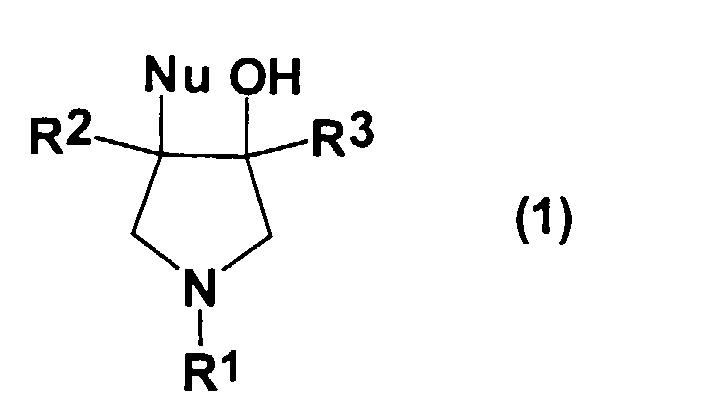
The 3-pyrrolidinol is of formula (1):
Figure 00040001
wherein R1 is hydrogen (H), a halogen, a cyano group (CN), a nitro group (NO2), a hydroxyl group (OH), an alkoxyl group (OR), a carboxyl group (CO2H), an alkoxycarbonyl group (CO2R), an acyl group (COR), a carbamoyl group (H2NCO), a sulfide group (SH, or SR), a sulfinyl group (SOR), a sulfonyl group (SO2R), a sulfamide group (SO2NRR'), or a C1 - C10 alkyl group, cycloalkyl group, aryl group, alalkyl group which can be optionally substituted, R2 and R3 represent a C1 - C10 alkyl group, cycloalkyl group, aryl group, alalkyl group which can be optionally substituted, and Nu is a hydroxyl group (OH), an alkoxyl group (OR), or an amino group (NRR') which can be optionally substituted. Optionally, there may be functional groups on the nitrogen atom and/or pyrrolidine ring.
The 3-pyrrolidinols include, but are not limited to, 3,4-dihydroxypyrrolidines, such as 3,4-dihydroxypyrrolidine, 1-methyl-3, 4-dihydroxypyrrolidine, 1-cyclohexyl-3,4-dihydroxypyrrolidine, 1-benzyl-3,4-dihydroxypyrrolidine, 1-phenyl-3,4-dihydroxypyrrolidine, 2-[3-chloro-4-(3, 4-dihydroxypyrrolidin-1-yl)phenyl]propionic acid, methyl 2-[3-chloro-4-(3,4-dihydroxypyrrolidin-1-yl)phenyl]propionate, and the like.
Specific examples of 3-pyrrolidinols include, but are not limited to, 4-amino-3-pyrrolidinols such as 4-amino-3-pyrrolidinol, 1-methyl-4-amino-3-pyrrolidinol, 1-cyclohexyl-4-amino-3-pyrrolidinol, 1-benzyl-4-amino-3-pyrrolidinol, 1-phenyl-4-amino-3-pyrrolidinol, 2-[3-chloro-4-(4-amino-3-hydroxypyrrolidin-1-yl)phenyl]propionic acid, methyl 2-[3-chloro-4-(4-amino-3-hydroxypyrrolidin-1-yl)phenyl]propionate; 4-benzylamino-3-pyrrolidinols such as 4-benzylamino-3-pyrrolidinol, 1-methyl-4-benzylamino-3-pyrrolidinol, 1-cyclohexyl-4-benzylamino-3-pyrrolidinol, 1-benzyl-4-benzylamino-3-pyrrolidinol, 1-phenyl-4-benzylamino-3-pyrrolidinol, 2-[3-chloro-4-(4-benzylamino-3-hydroxypyrrolidin-1-yl)phenyl]propionic acid, methyl 2-[3-chloro-4-(4-benzylamino-3-hydroxypyrrolidin-1-yl)phenyl]propionate, and the like; 4-alkoxy-3-pyrrolidinols such as 4-methoxy-3-pyrrolidinol, 1-methyl-4-methoxy-3-pyrrolidinol, 1-cyclohexyl-4-methoxy-3-pyrrolidinol, 1-benzyl-4-methoxy-3-pyrrolidinol, 1-phenyl-4-methoxy-3-pyrrolidinol, 2-[3-chloro-4-(4-methoxy-3-hydroxypyrrolidin-1-yl)phenyl]propionic acid, methyl 2-[3-chloro-4-(4-methoxy-3-hydroxypyrrolidin-1-yl)phenyl]propionate, and the like.
The 3,4-epoxypyrrolidine is of the formula (2):
Figure 00050001
wherein R1 is hydrogen (H), a halogen, a cyano group (CN), a nitro group (NO2), a hydroxyl group (OH), an alkoxyl group (OR), a carboxyl group (CO2H), an alkoxycarbonyl group (CO2R), an acyl group (COR), a carbamoyl group (H2NCO), a sulfide group (SH, or SR), a sulfinyl group (SOR), a sulfonyl group (SO2R), a sulfamide group (SO2NRR'), or a C1 - C10 alkyl group, cycloalkyl group, aryl group, alalkyl group which can be optionally substituted; R2 and R3 each represent a C1 - C10 alkyl group, cycloalkyl group, aryl group, alalkyl group which can be optionally substituted. Optionally, there may be functional groups on the nitrogen atom and/or pyrrolidine ring.
The 3,4-epoxypyrrolidines include, but are not limited to 3,4-epoxypyrrolidine, 1-methyl-3, 4-epoxypyrrolidine, 1-cyclohexyl-3,4-epoxypyrrolidine, 1-benzyl-3,4-epoxypyrrolidine, 1-phenyl-3, 4-epoxypyrrolidine, 2-[3-chloro-4-(3,4-epoxypyrrolidin-1-yl)phenyl]propionic acid, methyl 2-[3-chloro-4-(3,4-epoxypyrrolidin-1-yl)phenyl]propionate, and the like.
The 3-pyrroline is of formula (3):
Figure 00060001
wherein R1 is hydrogen (H), a halogen, a cyano group (CN), a nitro group (NO2), a hydroxyl group (OH), an alkoxyl group (OR), a carboxyl group (CO2H), an alkoxycarbonyl group (CO2R), an acyl group (COR), a carbamoyl group (H2NCO), a sulfide group (SH, or SR), a sulfinyl group (SOR), a sulfonyl group (SO2R), a sulfamide group (SO2NRR'), or a C1 - C10 alkyl group, cycloalkyl group, aryl group, alalkyl group which can be optionally substituted; R2 and R3 each represent a C1 - C10 alkyl group, cycloalkyl group, aryl group, alalkyl group which can be optionally substituted. Optionally, there may be functional groups on the nitrogen atom and/or pyrrolidine ring. The 3-pyrrolines include, but are not limited to 3-pyrroline, 1-methyl-3-pyrroline, 1-ethyl-3-pyrroline, 1-propyl-3-pyrroline, 1-cyclohexyl-3-pyrroline, 1-trichloromethyl-3-pyrroline, 1-phenyl-3-pyrroline, 1-tolyl-3-pyrroline, 1-benzyl-3-pyrroline, 2-[3-chloro-4-(3-pyrrolin-1-yl)phenyl]propionic acid, methyl 2-[3-chloro-4-(3-pyrrolin-1-yl)phenyl]propionate, and the like. Of these compounds, 3-pyrroline, 1-benzyl-3-pyrroline, 1-cyclohexyl-3-pyrroline are preferred. Most preferred are 1-benzyl-3-pyrroline and 1-cyclohexyl-3-pyrroline.
Preferable acids used in the process for oxidation of the 3-pyrroline are compounds whose formula contains a sulfur atom (S), such as sulfuric acid or sulfonic acids having formula (11). Formula (11) is represented by: R14SO3H   (11) wherein R14 represents a C1 - C10 alkyl group, cycloalkyl group, aryl group, alalkyl group which can be optionally substituted by a halogen, a cyano group (CN), a nitro group (NO2), a hydroxyl group (OH), an alkoxyl group (OR), a silyl group (SiR3), a carboxyl group (CO2H), an alkoxycarbonyl group (CO2R), and/or an acyl group (COR).
These sulfonic acids having formula (11) can be classified under four sulfonic acids: alkylsulfonic acids, cycloalkylsulfonic acids, arylsulfonic acids, and alalkylsulfonic acids. Suitable alkylsulfonic acids include, but are not limited to methanesulfonic acids, trifluoromethanesulfonic acids, trichloromethanesulfonic acids, ethanesulfonic acids, and the like. Suitable cycloalkylsulfonic acids include, but are not limited to, cyclopropanesulfonic acids, cyclohexanesulfonic acids, and the like. Suitable arylsulfonic acids include, but are not limited to, benzenesulfonic acids, o-, m-, p-fluorobenzenesulfonic acids, o-, m-, p-chlorobenzenesulfonic acids, o-, m-, p-nitrobenzenesulfonic acids, o-, m-, p- cyanobenzenesulfonic acids, o-, m-, p-toluenesulfonic acids, mesitylenesulfonic acids, naphthaleneulfonic acids, and the like. Suitable alalkylsulfonic acids include, but are not limited to, benzylsulfonic acids, o-, m-, p-fluorobenzylsulfonic acids, o-, m-, p-chlorobenzylsulfonic acids, o-, m-, p-nitrobenzylsulfonic acids, o-, m-, p-cyanobenzylsulfonic acids, and the like.
Of these compounds, sulfuric acid, methanesulfonic acids, benzenesulfonic acids, p-chlorobenzenesulfonic acids are preferred. In particular, sulfuric acid is most preferably used.
The preferable amount of acid used is in the range of about 1.0 - 3.0 mole acid to about 1.0 moles 3-pyrrolines having formula (3) can be used efficiently and economically. Peroxides used in the oxidation of the 3-pyrrolines of formula (3) may be peroxymonosulfuric acids, or their salts (peroxymonosulfates) having formula (4), peroxydisulfuric acids, or their salts (peroxydisulfates) having formula (5). Formula (4) is represented by: MxHy(SO5)z   (4) wherein M is an alkali metal (1A in the periodic table), an alkaline earth metal (2A in the periodic table), an element from 3A in the periodic table, or an ammonium group having formula (6), and each of x, y, and z can be represented numerically (0 - 3) provided the relation x + y = 2z is satisfied. Formula (5) is represented by: MxHy(S2O8)z   (5) where M is an alkali metal (1A in the periodic table), an alkaline earth metal (2A in the periodic table), an element from 3A in the periodic table, or an ammonium group having formula (6), and each of x, y, and z can be represented numerically (0 - 3) provided the relation x + y = 2z is satisfied. Formula (6) is represented by:
Figure 00080001
wherein R4 - R7 represent hydrogen, a C1 - C20 alkyl group, a cycloalkyl group, an aryl group, or an alalkyl group. Peroxymonosulfuric acid, salts (peroxymonosulfates) or peroxydisulfuric acid, salts (peroxydisulfates) are preferable.
Metal peroxymonosulfates include, but are not limited to, sodium peroxymonosulfate (Na2SO5), potassium peroxymonosulfate (K2SO5), barium peroxymonosulfate (BaSO5), rubidium peroxymonosulfate (RbSO5), and the like.
Metal peroxyhydrogenmonosulfates include, but are not limited to, sodium peroxyhydrogenmonosulfate (NaHSO5), potassium peroxyhydrogenmonosulfate (KHSO5), and the like.
Ammonium peroxymonosulfates include, but are not limited to, ammonium peroxymonosulfate ((NH4)2SO5), tetramethylammonium peroxymonosulfate ((Me4N)2SO5), tetraethylammonium peroxymonosulfate ((Et4N)2SO5), tetrapropylammonium peroxymonosulfate ((Pr4N)2SO5), tetrabutylammonium peroxymonosulfate ((Bu4N)2SO5), tetrahexylammonium peroxymonosulfate, tetradecylammonium peroxymonosulfate, tetralaurylammonium peroxymonosulfate, tetrabenzylammonium peroxymonosulfate ((Bn4N)2SO5), benzyltrimethylammonium peroxymonosulfate ((BnMe3N)2SO5), benzyltriethylammonium peroxymonosulfate ((BnEt3N)2SO5), benzyltributylammonium peroxymonosulfate ((BnBu3N)2SO5), lauryltrimethylammonium peroxymonosulfate, lauryltriethylammonium peroxymonosulfate, and the like.
Ammonium peroxyhydrogenmonosulfates include, but are not limited to, ammonium peroxyhydrogenmonosulfate ((NH4)HSO5), tetramethylammonium peroxyhydrogenmonosulfate ((Me4N)HSO5), tetraethylammonium peroxyhydrogenmonosulfate ((Et4N)HSO5), tetrapropylammonium peroxyhydrogenmonosulfate ((Pr4N)HSO5), tetrabutylammonium peroxyhydrogenmonosulfate ((Bu4N)HSO5), tetrahexylammonium peroxyhydrogenmonosulfate, tetradecylammonium peroxyhydrogenmonosulfate, tetralaurylammonium peroxyhydrogenmonosulfate, tetrabenzylammonium peroxyhydrogenmonosulfate ((Bn4N)HSO5), benzyltrimethylammonium peroxyhydrogenmonosulfate ((BnMe3N)HSO5), benzyltriethylammonium peroxyhydrogenmonosulfate ((BnEt3N)HSO5), benzyltributylammonium peroxyhydrogenmonosulfate ((BnBu3N)HSO5), lauryltrimethylammonium peroxyhydrogenmonosulfate, lauryltriethylammonium peroxyhydrogenmonosulfate, and the like.
Metal peroxydisulfates include, but are not limited to, sodium peroxydisulfate (Na2S2O8), potassium peroxydisulfate (K2S2O8), barium peroxydisulfate (BaS2O8), rubidium peroxydisulfate (RbS2O8), and the like.
Metal peroxyhydrogendisulfates include, but are not limited to, sodium peroxyhydrogendisulfate (NaHS2O8), potassium peroxyhydrogendisulfate (KHS2O8), and the like.
Ammonium peroxydisulfates include, but are not limited to, ammonium peroxydisulfate ((NH4)2S2O8), tetramethylammonium peroxydisulfate ((Me4N)2S2O8), tetraethylammonium peroxydisulfate ((Et4N)2S2O8), tetrapropylammonium peroxydisulfate ((Pr4N)2S2O8), tetrabutylammonium peroxydisulfate ((Bu4N)2S2O8), tetrahexylammonium peroxydisulfate, tetradecylammonium peroxydisulfate, tetralaurylammonium peroxydisulfate, tetrabenzylammonium peroxydisulfate ((Bn4N)2S2O8), benzyltrimethylammonium peroxydisulfate ((BnMe3N)2SO5), benzyltriethylammonium peroxydisulfate ((BnEt3N)2S2O8), benzyltributylammonium peroxydisulfate ((BnBu3N)2S2O8), lauryltrimethylammonium peroxydisulfate, lauryltriethylammonium peroxydisulfate, and the like.
Ammonium peroxyhydrogendisulfates include, but are not limited to, ammonium peroxyhydrogendisulfate ((NH4)HS2O8), tetramethylammonium peroxyhydrogendisulfate ((Me4N)HS2O8), tetraethylammonium peroxyhydrogendisulfate ((Et4N)HS2O8), tetrapropylammonium peroxyhydrogendisulfate ((Pr4N)HS2O8), tetrabutylammonium peroxyhydrogendisulfate ((Bu4N)HS2O8), tetrahexylammonium peroxyhydrogendisulfate, tetradecylammonium peroxyhydrogendisulfate, tetralaurylammonium peroxyhydrogendisulfate, tetrabenzylammonium peroxyhydrogendisulfate ((Bn4N)HS2O8), benzyltrimethylammonium peroxyhydrogendisulfate ((BnMe3N)HS2O8), benzyltriethylammonium peroxyhydrogendisulfate ((BnEt3N)HS2O8), benzyltributylammonium peroxyhydrogendisulfate ((BnBu3N)HS2O8), lauryltrimethylammonium peroxyhydrogendisulfate, lauryltriethylammonium peroxyhydrogendisulfate, and the like.
The preferable peroxymonosulfate is potassium peroxyhydrogenmonosulfate (KHSO5) Sodium peroxydisulfate (Na2S2O8) and/or ammonium peroxydisulfate ((NH4)2S2O8) are the preferred peroxydisulfates. The oxidation can be performed either with peroxysulfates alone or with a peroxysulfate mixture. For example, suitable peroxides include OXONE (produced by DuPont), which is a mixture of KHSO5/KHSO4/K2SO4 = 2/1/1, stabilized by mixing inorganic compounds deactivated for explosion. Suitable amounts of peroxides are in the range of about 1.0 - 2.0 moles of peroxides to 1.0 mole of 3-pyrrolines having formula (3) and can be preferably used efficiently and economically.
The substituent group Nu in formula (1) derives from nucleophiles of water, alcohols, amines, and the like. Alcohols include, but are not limited to, methanol (MeOH), ethanol (EtOH), propanol (PrOH), butanol (BuOH), hexanol, cyclohexanol, phenol (PhOH), chlorophenol, dichlorophenol, trichlorophenol, catechol, ethylene glycol, diethylene glycol, and the like.
Amines include, but are not limited to, ammonia (NH3), methylamine (MeNH2), ethylamine (EtNH2), propylamine (PrNH2), butylamine (BuNH2), cyclohexylamine, allylamine, homoallylamine, benzylamine (BnNH2), aniline (PhNH2), chloroaniline, bromoaniline, o-, m-, p- toluidine, dimethylamine (Me2NH), diethylamine (Et2NH), dipropylamine (Pr2NH), dibutylamine (Bu2NH), dicyclohexylamine, diallylamine, bis(homoallyl)amine, dibenzylamine (Bn2NH), N-methylaniline, N-methylchloroaniline, N-methylbromoaniline, benzylmethylamine (BnMeNH), and the like. Preferable nucleophiles include water, methanol, ethanol, ammonia, allylamine, cyclohexylamine, and benzylamine.
These nucleophiles can be added to the solution either before or after oxidation, so that the one-pot procedure may proceed continuously without isolating the intermediates to obtain the corresponding products, 3-pyrrolidinols. In the case of preparing 3,4-epoxypyrrolidines having formula (2), these nucleophiles are not necessary, and can be used as inactive solvents by controlling the reaction temperature.
If desired, the oxidation of 3-pyrrolines having formula (3) may be accelerated using ultraviolet light. Lamps with wave length from the ultraviolet to the visible light range (200nm - 400nm) can be selected for the irradiation of 3-pyrrolines. For example, such lamps include an Argon Resonance Lamp, a Flash UV (Ultra Violet) Lamp, an Ultra High Pressure Hg (mercury) Lamp, a High Pressure Hg (mercury) Lamp, a Low Pressure Hg (mercury) Lamp, a Deuterium Lamp, a Xe (xenon) Lamp, a W (tungsten) Lamp, a Metal Halide Lamp, and the like. In particular, a High Pressure Hg (mercury) Lamp and a Xe (xenon) Lamp are preferable.
Although the use of these lamps is able to accelerate oxidation of 3-pyrrolines having formula (3), the reaction system can be changed freely by changing the irradiation time, the irradiation strength or by omitting the irradiation.
The reaction solvents may be freely selected in the oxidation process. For example, suitable reaction solvents include, but are not limited to, water, methanol, ethanol, propanol, acetone, methylethylkotone, methylisobutylketone, ethyl acetate, methyl propionate, hexane, cyclohexane, benzene, toluene, chloroform, dichloromethane, dichloroethane, tetrahydrofuran, diethyl ether, diisopropyl ether, ethylene glycol, diethylene glycol, and the like. Either only one kind of solvent may be used, or mixtures of solvents may be used. Alternatively, the solvents can be omitted. With regard to combining the above solvents with the nucleophiles from which substituent group Nu in formula (1) derives, they can be made active and/or inactive by controlling the reaction temperature.
The reaction temperature will depend on the time required for completing the oxidation. In general, the reaction may be conducted at about 0 - 100°C . In particular, the reaction temperature is about 0 - 30°C for obtaining 3,4-epoxypyrrolidines and is about 30 - 100°C for obtaining 3-pyrrolidinols.
3-pyrrolines having formula (3) may be produced by reacting cis-2-butene derivatives having formula (7) with at least one primary amine having formula (8). This reaction allows cyclization of cis-2-butene derivatives of formula (7) and the formation of 3-pyrrolines of formula (3). Cis-2-butene derivatives of formula (7) may be produced from cis-2-butene-1,4-diols of formula (9) by reacting the cis-2-butene-1,4-diols of formula (9) with a halogenation reagent in the presence of at least one base.
The substituent groups R10 in the primary amines of formula (8): R10―NH2   (8) which are used for preparing 3-pyrrolines, include, but are not limited to, alkyl groups, such as methyl, ethyl, n-, iso-propyl, n-, i-, t-butyl, trifluoromethyl, and the like; cycloalkyl groups, such as cyclohexyl and the like; alkenyl groups, such as vinyl, allyl, methallyl, homoallyl, and the like; aryl groups, such as phenyl, fluorophenyl, difluorophenyl, trifluorophenyl, chlorophenyl, dichlorophenyl, trichlorophenyl, bromophenyl, dibromophenyl, tribromophenyl, nitrophenyl, dinitrophenyl, trinitrophenyl, cyanophenyl, dicyanophenyl, tricyanophenyl, tolyl, dimethylphenyl, trimethylphenyl, trifluoromethylphenyl, naphthyl, and the like; and alalkyl groups, such as benzyl, phenylethyl, phenethyl, naphthylmethyl, 1-, 2-phenylvinyl, and the like.
Primary amines include, but are not limited to, methylamine, ethylamine, n-, i- propylamine, n-, i-, t-butylamine, cyclohexylamine, allylamine, allylamine, homoallylamine, benzylamine, aniline, chloroaniline, bromoaniline, toluidine and the like. Of the suitable primary amines, cyclohexylamine, benzylamine, and aniline are preferable. Suitable amounts of amines are in the range of about 3.0 - 5.0 moles amines to 1.0 mole of cis-2-butene derivatives having formula (7) and can be preferably used efficiently and economically.
Bases used for preparing cis-2-butene derivatives of formula (7) from cis-2-butene-1, 4-diols of formula (9), can be selected freely unless these would react with the starting materials. Formula (7) is represented by:
Figure 00130001
wherein R8 and R9 are independently hydrogen (H) or a C1 - C10 alkyl group, a cycloalkyl group, an aryl group, or an alalkyl group which can be optionally substituted, A1 and A2 are independently halogens or sulfonyloxy groups. Formula (9) is represented by:
Figure 00140001
wherein R11 and R12 are independently hydrogen (H) or a C1 - C10 alkyl group, a cycloalkyl group, an aryl group, an alalkyl group which can be optionally substituted. Tertiary amines are the preferred bases. Tertiary amines include, but are not limited to, triethylamine, tripropylamine, tributylamine, tribenzylamine, N, N'-dimethylaniline, N, N'-dimethyltoluidine, pyridine, 4-(N, N'-dimethylamino)pyridine, and the like. Preferably, the amount of bases used is in the range of about 2.0 - 3.0 moles of base to 1.0 mole of cis-2-butene-1,4-diols of formula (9). More preferably the amount of base used is in the range of about 2.0 - 2.2 moles of base and can be used efficiently and economically.
The substituent group, A3, in the sulfonyl halides of formula (10) which are used as halogenation reagents in the first process include halogens such as Cl, Br, and I. Formula (10) is represented by: R13SO2A3   (10) wherein R13 represents a C1 - C10 alkyl group, a cycloalkyl group, an aryl group, or an alalkyl group optionally substituted; and A3 is a halogen. In particular, sulfonyl chlorides are preferable.
The substituent groups R13 in the sulfonyl halides, which are used for preparing cis-2-butene derivatives of formula (7) or 3-pyrrolines of formula (3), include, but are not limited to alkyl groups, such as methyl, ethyl, n-, iso-propyl, n-, i-, t-butyl, trifluoromethyl, and the like; cycloalkyl groups, such as cyclohexyl and the like; alkenyl groups, such as vinyl, allyl, methallyl, homoallyl, and the like; aryl groups, such as phenyl, fluorophenyl, difluorophenyl, trifluorophenyl, chlorophenyl, dichlorophenyl, trichlorophenyl, bromophenyl, dibromophenyl, tribromophenyl, nitrophenyl, dinitrophenyl, trinitrophenyl, cyanophenyl, dicyanophenyl, tricyanophenyl, tolyl, dimethylphenyl, trimethylphenyl, trifluoromethylphenyl, naphthyl, and the like; and alalkyl groups, such as benzyl, phenylethyl, phenethyl, naphthylmethyl, 1-, 2-phenylvinyl, and the like.
The sulfonyl chlorides include, but are not limited to, methanesulfonyl chloride, ethanesulfonyl chloride, n-, i-propanesulfonyl chloride, n-, i-, t-butanesulfonyl chloride, cyclohexanesulfonyl chloride, trifluoromethanesulfonyl chloride, benzenesulfonyl chloride, o-, m-, p-chlorobenzenesulfonyl chloride, o-, m- p-toluenesulfonyl chloride, naphthalenesulfonyl chloride, benzylsulfonyl chloride, and the like. Of the suitable sulfonyl chlorides, methanesulfonyl chloride, benzenesulfonyl chloride, and p-toluenesulfonyl chloride are preferable.
The amount of sulfonyl halides used is in the range of about 2.0 - 3.0 moles of base to 1.0 mole cis-2-butene-1,4-diols of formula (9). Preferably, the amount is about 2.0 - 2.2 moles of sulfonyl halides is used for efficiency and economy.
In the case where the following two processes:
  • (A) derivation of cis-2-butene compounds from cis-2-butene-1,4-diols having formula (9) and
  • (B) cyclization between cis-2-butene derivatives of formula (7) and primary amines of formula (8)
  • are performed in a continuous process, without isolating cis-2-butene derivatives about 2.0 moles of sulfonyl halides is preferably used to prevent side reactions between excess sulfonyl halides and primary amines.
    Reaction solvents may be selected freely in the preparation process of cis-2-butene derivatives or 3-pyrrolines. For example, acetone, methylethylkotone, methylisobutylketone, ethyl acetate, methyl propionate, hexane, cyclohexane, benzene, toluene, chloroform, dichloromethane, dichloroethane, carbon tetrachloride, tetrahydrofuran, diethyl ether, diisopropyl ether, and the like are suitable reaction solvents. Either one kind of solvent, mixtures thereof, or no solvents can be used.
    In the case where the two processes (A) and (B) are continuously conducted without isolating cis-2-butene derivatives of formula (7), the same solvent can be used through several processes.
    The temperature depends on the time for completing this cyclization reaction. Generally, the temperature is about 0 to 15°C when sulfonyl halides of formula (10) are added to the reaction mixture. Following addition of the sulfonyl halides, the reaction may be performed at about ambient temperature to 60°C with stirring of the solution. Although the temperature in the second stage depends on the reactivity of primary amines of formula (8), the temperature range may be about room temperature to about 100°C.
    With regard to the operation of reaction mixture after completion and the isolation of products, the two processes of the previous stage can be conducted to the next stage continuously without isolating intermediates. If one needs to isolate the products (intermediates), one has only to conduct simple operations such as filtration, extraction, and so on. "Conducting the two processes of the previous stage to the next stage continuously without isolating intermediates" refers to a one-pot reaction, advancing to the next reaction without transferring the solution to the another reactor. For example, if the cis-2-butene derivative solution contains the following compounds,
    Figure 00170001
    wherein R8 and R9 are independently hydrogen (H) or a C1 - C10 alkyl group, a cycloalkyl group, an aryl group, or an alalkyl group which can be optionally substituted; R13 represents a C1 - C10 alkyl group, a cycloalkyl group, an aryl group, an alalkyl group optionally substituted; and A3 is a halogen, or if the oxidation solution contains the following two compounds:
    Figure 00180001
    wherein R1 is hydrogen (H), a halogen, a cyano group (CN), a nitro group (NO2), a hydroxyl group (OH), an alkoxyl group (OR), a carboxyl group (CO2H), an alkoxycarbonyl group (CO2R), an acyl group (COR), a carbomyl group (H2NCO), a sulfide group (SH, or SR), a sulfinyl group (SOR), a sulfonyl group (SO2R), a sulfamide group (SO2NRR'), or a C1 - C10 alkyl group, cycloalkyl group, aryl group, alalkyl group, optionally substituted; R2 and R3 each independently represent a C1 - C10 alkyl group, cycloalkyl group, aryl group, or alalkyl group, optionally substituted, and Nu is a hydroxyl group (OH), alkoxyl group (OR), or amino group (NRR') optionally substituted, we can conduct the solution to the next stage continuously without isolating intermediates.
    Processing after continuous reaction only involves simple operations such as filtration, extraction, and so on. For example, the following methods may be freely selected: (1) after direct addition and reaction of primary amines to the solution Process (A), both tertiary amine salts and primary amine salts are removed; (2) after removing tertiary amine salts from the solution Process (A), the addition and reaction of primary amines is performed followed by removal of primary amine salts.
    Embodiments of the invention are now described in more detail with reference to the following Examples.
    Example 1 Preparation of the cis-2-butene derivative
    In a round-flask reactor containing a solution of 35.4g (0.4mol) of cis-2-butene-1,4-diol, 83.8g (0.8mol) of triethylamine, and 416.6g of ethyl acetate, methanesulfonyl chloride was added dropwise with stirring for 30 min. at about 5°C using an ice-bath. After 2 hours of stirring, the crystallized solid was removed by filtration, and the solvent was evaporated under reduced pressure. 60.0g of residue was obtained, of which the ratio of cis-1,4-dichloro-2-butene:cis-4-chloro-2-butene-1-ol methanesulfonylate:cis-2-butene-1,4-diol dimethanesulfonylate was 5:4:1.
    Example 2 1 -benzyl-3-pyrroline
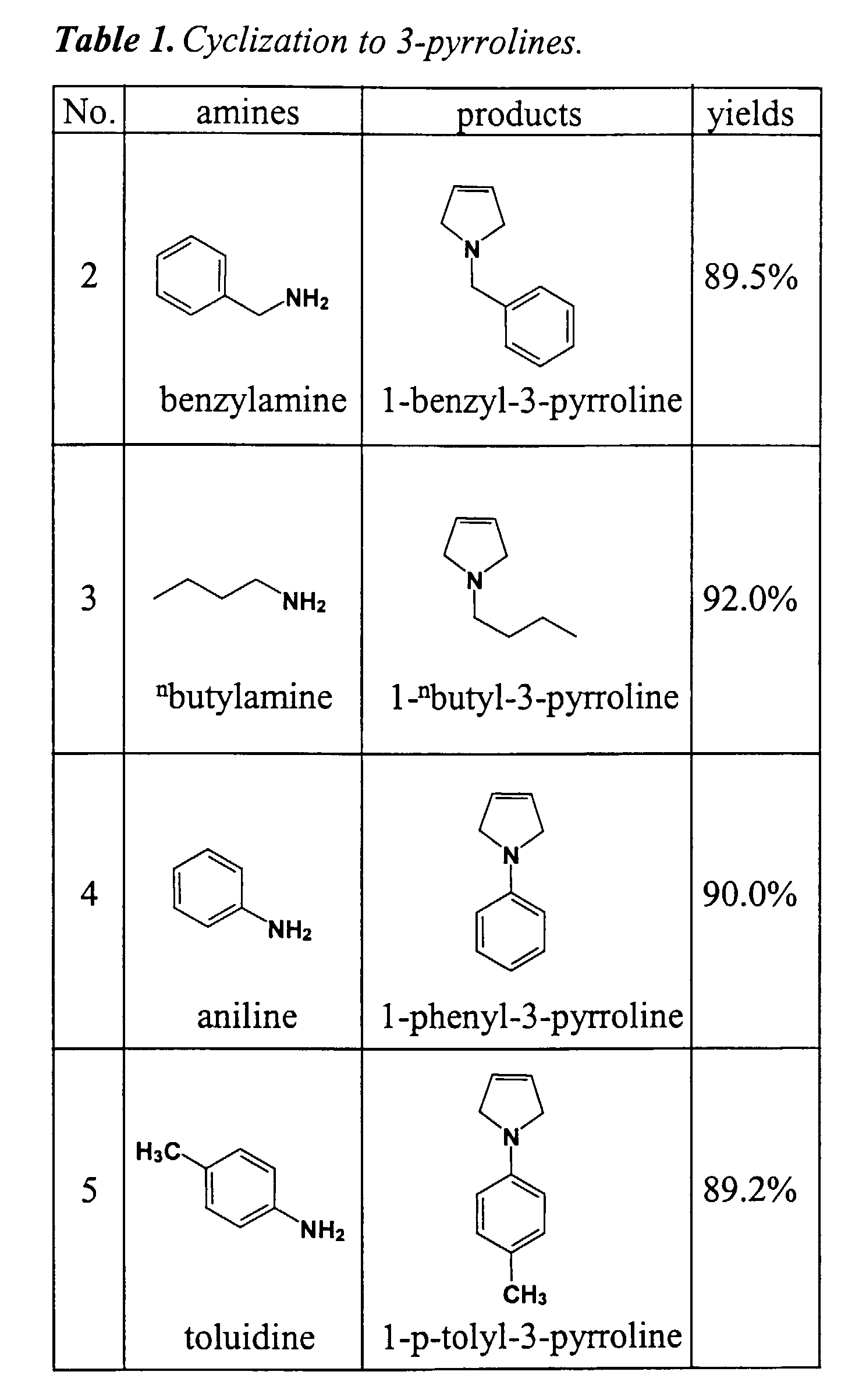
    To a solution of 60.0g of the cis-2-butene derivative solution prepared in Example 1 and 250g of toluene in a round flask reactor, 171.7g (1.6mol) of benzylamine was added dropwise with stirring for 30 min. at ambient temperature. After 2 hours of stirring, the crystallized solid was removed by filtration; 42.0g of 35% HCl (aq) was added to the filtrate, and then excess benzylamine hydrochloride was removed by filtration or extraction. After the solvent was evaporated under reduced pressure, 57.0g of 1-benzyl-3-pyrroline (yield 89.5%) was obtained.
    Example 3 1-butyl-3-pyrroline
    To a solution of 60.0g of the cis-2-butene derivative solution prepared in Example 1 and 250g of toluene in a round flask reactor, 117.0g (1.6mol) of butylamine was added dropwise with stirring for 30 min. at about 5°C using an ice-bath. After 2 hours of stirring, the crystallized solid was removed by filtration; 42.0g of 35% HCl (aq) was added to the filtrate, and then excess benzylamine hydrochloride was removed by filtration or extraction. After the solvent was evaporated under reduced pressure, 46.1g of 1-butyl-3-pyrroline (yield 92.0%) was obtained.
    Example 4 1-phenyl-3-pyrroline
    To a solution of 60.0g of the cis-2-butene derivative solution prepared in Example 1 and 250g of toluene in a round flask reactor, 149.0g (1.6mol) of aniline was added dropwise with stirring for 30 min. at 50°C. After 2 hours of stirring, the crystallized solid was removed by filtration; 42.0g of 35% HCl (aq) was added to the filtrate, and then excess benzylamine hydrochloride was removed by filtration or extraction. After the solvent was evaporated under reduced pressure, 52.2g of 1-phenyl-3-pyrroline (yield 90.0%) was obtained.
    Example 5 1 -tolyl-3 -pyrroline
    To a solution of 60.0g of the cis-2-butene derivative solution prepared in Example 1 and 250g of toluene in a round flask reactor, 171.7g (1.6mol) of toluidine was added dropwise with stirring for 30 min. at 50°C. After 2 hours of stirring, the crystallized solid was removed by filtration; 42.0g of 35% HCl (aq) was added to the filtrate, and then excess benzylamine hydrochloride was removed by filtration or extraction. After the solvent was evaporated under reduced pressure, 56.8g of 1-tolyl-3-pyrroline (yield 89.2%) was obtained.
    The results in the cyclization to 3-pyrrolines from Examples 2 to 5 are summarized in Table 1.
    Figure 00220001
    Example 6 1-benzyl-3-pyrroline (one-pot reaction)
    To a solution containing 35.4g (0.4mol) of cis-2-butene-1,4-diol, 83.8g (0.8mol) of triethylamine, and 416.6g of ethyl acetate in a round flask reactor, methanesulfonyl chloride was added dropwise with stirring for 30 min. at about 5°C using an ice-bath. After addition, the mixture was allowed to react with stirring for 2 hours at room temperature. To the mixture, 171.7g (1.6mol) of benzylamine was added continuously dropwise with stirring for 30 min. at ambient temperature. After 2 hours of stirring, the crystallized solid was removed by filtration; 42.0g of 35% HCl (aq) was added to the filtrate, and then excess benzylamine hydrochloride was removed by filtration or extraction. After the solvent was evaporated under reduced pressure, 52.2g of 1-benzyl-3-pyrroline (yield 82.0%) was obtained.
    Example 7 1-benzyl-3-methyl-3-pyrroline (one-pot reaction)
    To a solution containing 40.8g (0.4mol) of E-2-methyl-2-butene-1,4-diol, 83.8g (0.8mol) of triethylamine, and 416.6g of ethyl acetate in a round flask reactor, methanesulfonyl chloride was added dropwise with stirring for 30 min. at about 5°C using an ice-bath. After addition, the mixture was allowed to react with stirring for 2 hours at room temperature. To the mixture, 171.7g (1.6mol) of benzylamine was added continuously dropwise with stirring for 30 min. at ambient temperature. After 2 hours of stirring, the crystallized solid was removed by filtration; 42.0g of 35% HCl (aq) was added to the filtrate, and then excess benzylamine hydrochloride was removed by filtration or extraction. After the solvent was evaporated under reduced pressure, 54.2g of 1-benzyl-3-methyl-3-pyrroline (yield 78.2%) was obtained.
    The results in the one-pot reaction to 3-pyrrolines from Examples 6 to 7 are summarized in Table 2.
    Figure 00240001
    Example 8 1-benzyl-3,4-epoxypyrrolidine (solvent: acetone)
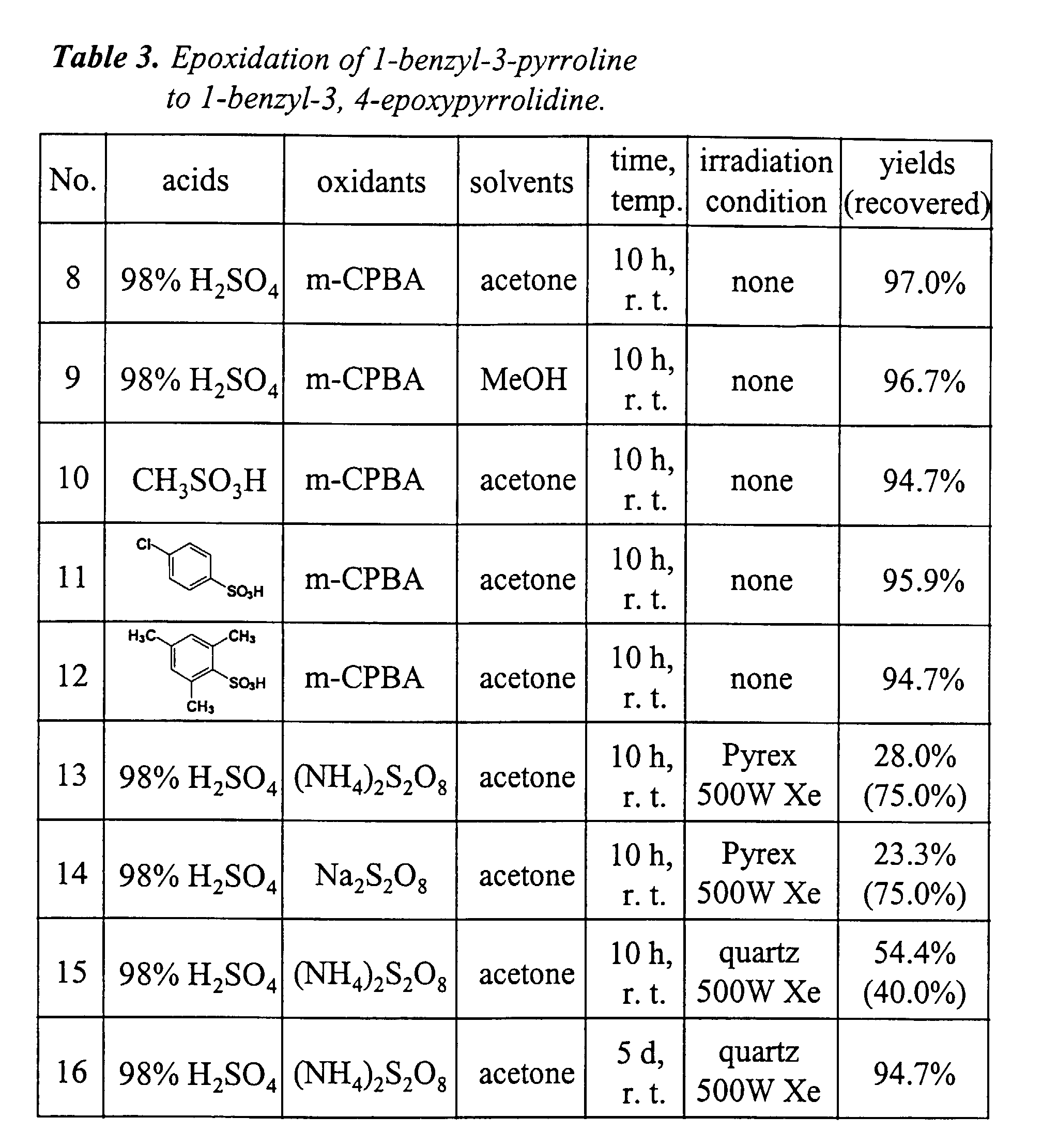
    To a solution of 15.9g (0.1mol) of 1-benzyl-3-pyrroline, 12.0g (0.12mol) of 98% sulfuric acid, 15.0g of water, and 60.0g of acetone in a round flask reactor, 31.1g(0.13mol) of 70% m-CPBA (m-chloroperbenzoic acid produced by Tokyo Chemical Industry Co., Ltd.) was added with stirring and allowed to react for 10 hours at room temperature without irradiation by lamps. After completion, acetone was evaporated under reduced pressure, neutralized by NaOH (aq), and extracted with toluene and water. After the solvent was evaporated under reduced pressure, 17.0g of 1-benzyl-3,4-epoxypyrrolidine (yield 97.0%) was obtained.
    Example 9 1-benzyl-3,4-epoxypyrrolidine (solvent : methanol)
    To a solution of 15.9g (0.1mol) of 1-benzyl-3-pyrroline, 12.0g (0.12mol) of 98% sulfuric acid, 15.0g of water, and 60.0g of methanol in a round flask reactor, 31.1g (0.13mol) of 70% m-CPBA (m-chloroperbenzoic acid produced by Tokyo Chemical Industry Co., Ltd.) was added with stirring and allowed to react for 10 hours at room temperature without irradiation by lamps. After completion, methanol was evaporated under reduced pressure, neutralized by NaOH (aq), and extracted with toluene and water. After the solvent was evaporated under reduced pressure, 16.9g of 1-benzyl-3,4-epoxypyrrolidine (yield 96.7%) was obtained.
    Example 10 1-benzyl-3,4-epoxypyrrolidine (acid : methanesulfonic acid)
    To a solution of 15.9g (0.1mol) of 1-benzyl-3-pyrroline, 13.1g (0.24mol) of methanesulfonic acid (produced by Tokyo Chemical Industry Co., Ltd), 15.0g of water, and 60.0g of acetone in a round flask reactor, 31.1g(0.13mol) of 70% m-CPBA (m-chloroperbenzoic acid produced by Tokyo Chemical Industry Co., Ltd.) was added with stirring and allowed to react for 10 hours at room temperature without irradiation by lamps. After completion, acetone was evaporated under reduced pressure, neutralized by NaOH (aq), and extracted with toluene and water. After the solvent was evaporated under reduced pressure, 16.6g of 1-benzyl-3,4-epoxypyrrolidine (yield 94.7%) was obtained.
    Example 11 1-benzyl-3,4-epoxypyrrolidine (acid : p-chlorobenzenesulfonic acid)
    To a solution of 15.9g (0.1mol) of 1-benzyl-3-pyrroline, 46.2g (0.24mol) of p-chlorobenzenesulfonic acid (produced by Tokyo Chemical Industry Co., Ltd.), 15.0g of water, and 60.0g of acetone in a round flask reactor, 31.1g (0.13mol) of 70% m-CPBA (m-chloroperbenzoic acid produced by Tokyo Chemical Industry Co., Ltd.) was added with stirring and allowed to react for 10 hours at room temperature without irradiation by lamps. After completion, acetone was evaporated under reduced pressure, neutralized by NaOH (aq), and extracted with toluene and water. After the solvent was evaporated under reduced pressure, 16.8g of 1-benzyl-3,4-epoxypyrrolidine (yield 95.9%) was obtained.
    Example 12 1-benzyl-3,4-epoxypyrrolidine (acid : 2-mesitylenesulfonic acid dihydrate)
    To a solution of 15.9g (0.1mol) of 1-benzyl-3-pyrroline, 56.7g (0.24mol) of 2-mesitylenesulfonic acid dihydrate (produced by Aldrich Chemical Co., Inc.), 15.0g of water, and 60.0g of acetone in a round flask reactor, 31.1g (0.13mol) of 70% m-CPBA (m-chloroperbenzoic acid produced by Tokyo Chemical Industry Co., Ltd.) was added with stirring and allowed to react for 10 hours at room temperature without irradiation by lamps. After completion, acetone was evaporated under reduced pressure, neutralized by NaOH (aq), and extracted with toluene and water. After the solvent was evaporated under reduced pressure, 16.6g of 1-benzyl-3,4-epoxypyrrolidine (yield 94.7%) was obtained.
    Example 13 1-benzyl-3,4-epoxypyrrolidine (irradiation condition)
    To a solution of 15.9g (0.1mol) of 1-benzyl-3-pyrroline, 12.0g (0.12mol) of 98% sulfuric acid, 15.0g of water, and 60.0g of acetone in a Pyrex round flask reactor, 45.6g (0.20mol) of (NH4)2S2O8 (ammonium peroxydisulfate produced by Mitsubishi Gas Chemical Industry Co., Ltd.) was added with stirring and allowed to react for 10 hours at room temperature with irradiation by 500W Xe lamps (UXL-500D xenon lamp produced by Ushio). After completion, acetone was evaporated under reduced pressure, neutralized by NaOH (aq), and extracted with toluene and water. After the solvent was evaporated under reduced pressure, 4.9g of 1-benzyl-3,4-epoxypyrrolidine (yield 28.0%) was obtained and 11.9g (yield 75.0%) of 1-benzyl-3-pyrroline was recovered.
    Example 14 1-benzyl-3,4-epoxypyrrolidine (irradiation condition)
    To a solution of 15.9g (0.1mol) of 1-benzyl-3-pyrroline, 12.0g (0.12mol) of 98% sulfuric acid, 15.0g of water, and 60.0g of acetone in a Pyrex round flask reactor, 47.6g (0.20mol) of Na2S2O8 (sodium peroxydisulfate produced by Mitsubishi Gas Chemical Industry Co., Ltd.) was added with stirring and allowed to react for 10 hours at room temperature with irradiation by 500W Xe lamps (UXL-500D xenon lamp produced by Ushio). After completion, acetone was evaporated under reduced pressure, neutralized by NaOH (aq), and extracted with toluene and water. After the solvent was evaporated under reduced pressure, 4.5g of 1-benzyl-3,4-epoxypyrrolidine (yield 23.3%) was obtained and 11.9g (yield 75.0%) of 1-benzyl-3-pyrroline was recovered.
    Example 15 1-benzyl-3,4-epoxypyrrolidine (irradiation condition)
    To a solution of 15.9g (0.1mol) of 1-benzyl-3-pyrroline, 12.0g (0.12mol) of 98% sulfuric acid, 15.0g of water, and 60.0g of acetone in a quartz round flask reactor, 45.6g (0.20mol) of (NH4)2S2O8 (ammonium peroxydisulfate produced by Mitsubishi Gas Chemical Industry Co., Ltd.) was added with stirring and allowed to react for 10 hours at room temperature with irradiation by 500W Xe lamps (UXL-500D xenon lamp produced by Ushio). After completion, acetone was evaporated under reduced pressure, neutralized by NaOH (aq), and extracted with toluene and water. After the solvent was evaporated under reduced pressure, 10.5g of 1-benzyl-3,4-epoxypyrrolidine (yield 54.4%) was obtained and 6.4g (yield 40.0%) of 1-benzyl-3-pyrroline was recovered.
    Example 16 1-benzyl-3,4-epoxypyrrolidine (irradiation condition)
    To a solution of 15.9g (0.1mol) of 1-benzyl-3-pyrroline, 12.0g (0.12mol) of 98% sulfuric acid, 15.0g of water, and 60.0g of acetone in a quartz round flask reactor, 45.6g (0.20mol) of(NH4)2S2O8 (ammonium peroxydisulfate produced by Mitsubishi Gas Chemical Industry Co., Ltd.) was added with stirring and allowed to react for 5 days at room temperature with irradiation by 500W Xe lamps (UXL-500D xenon lamp produced by Ushio). After completion, acetone was evaporated under reduced pressure, neutralized by NaOH (aq), extracted with toluene and water. After the solvent was evaporated under reduced pressure, 16.6g of 1-benzyl-3,4-epoxypyrrolidine (yield 94.7%) was obtained and 1-benzyl-3-pyrroline was not recovered.
    The results in the epoxidation to l-benzyl-3,4-epoxypyrrolidine from Examples 8 to 16 are summarized in Table 3.
    Figure 00290001
    Example 17 1-benzyl-3,4-dihydroxypyrrolidine
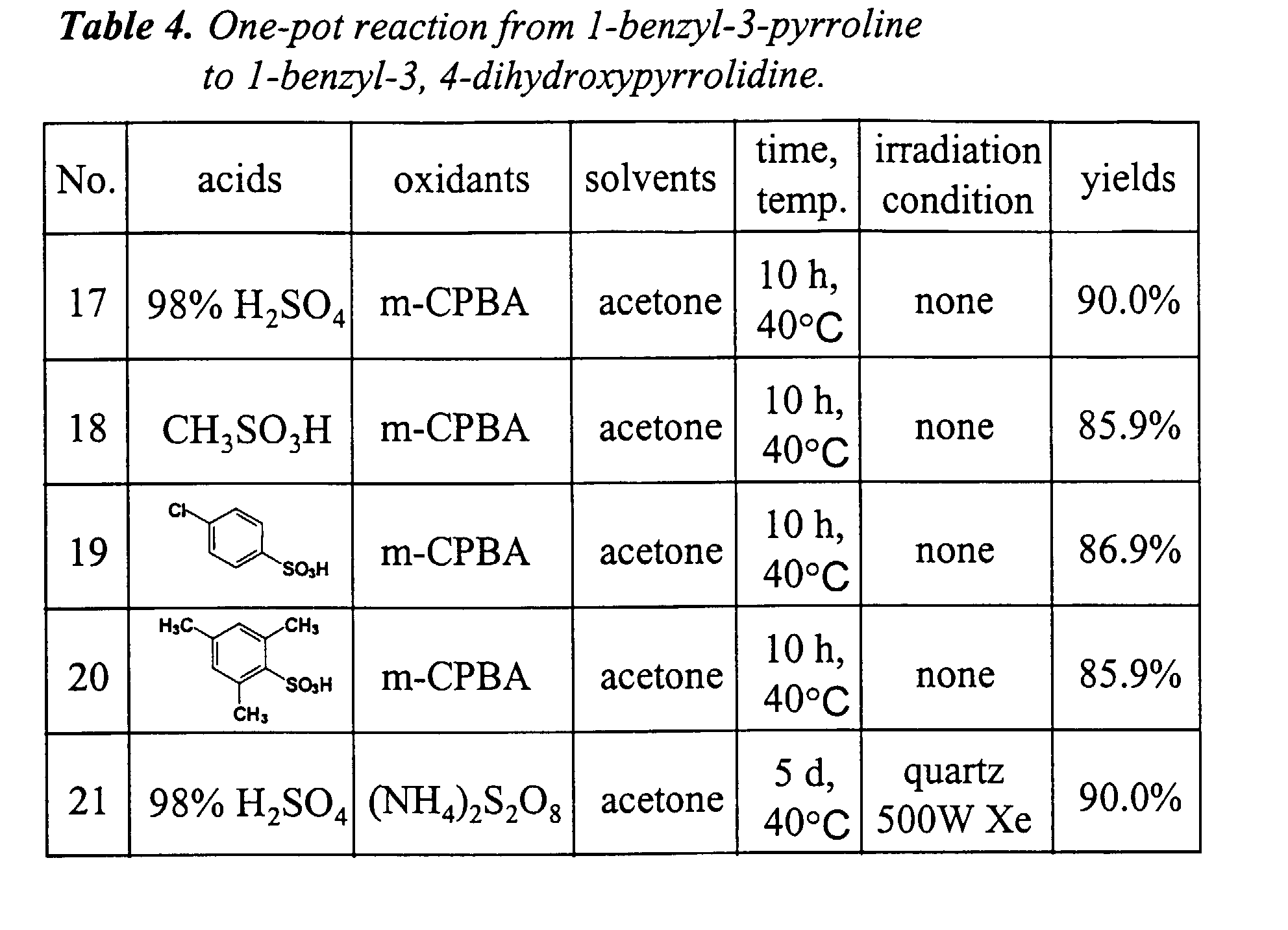
    To a solution of 15.9g (0.1mol) of 1-benzyl-3-pyrroline, 12.0g (0.12mol) of 98% sulfuric acid, 15.0g of water, and 60.0g of acetone in a round flask reactor, 31.1g(0.13mol) of 70% m-CPBA (m-chloroperbenzoic acid produced by Tokyo Chemical Industry Co., Ltd.) was added with stirring and allowed to react for 10 hours at 40°C without irradiation by lamps. After completion, acetone was evaporated under reduced pressure, neutralized by NaOH (aq), and extracted with toluene and water. After the solvent was evaporated under reduced pressure, 17.4g of 1-benzyl-3,4-dihydroxypyrrolidine (yield 90.0%) was obtained.
    Example 18 1-benzyl-3,4-dihydroxypyrrolidine (acid : methanesulfonic acid)
    To a solution of 15.9g (0.1mol) of 1-benzyl-3-pyrroline, 13.1g (0.24mol) of methanesulfonic acid (produced by Tokyo Chemical Industry Co., Ltd.), 15.0g of water, and 60.0g of acetone in a round flask reactor, 31.1g(0.13mol) of 70% m-CPBA (m-chloroperbenzoic acid produced by Tokyo Chemical Industry Co., Ltd.) was added with stirring and allowed to react for 10 hours at 40°C without irradiation by lamps. After completion, acetone was evaporated under reduced pressure, neutralized by NaOH (aq), and extracted with toluene and water. And then after the solvent was evaporated under reduced pressure, 16.6g of 1-benzyl-3,4-dihydroxypyrrolidine (yield 85.9%) was obtained.
    Example 19 1-benzyl-3,4-dihydroxypyrrolidine (acid : p-chlorobenzenesulfonic acid)
    To a solution of 15.9g (0.1mol) of 1-benzyl-3-pyrroline, 46.2g (0.24mol) of p-chlorobenzenesulfonic acid (produced by Tokyo Chemical Industry Co., Ltd.), 15.0g of water, and 60.0g of acetone in a round flask reactor, 31.1g (0.13mol) of 70% m-CPBA (m-chloroperbenzoic acid produced by Tokyo Chemical Industry Co., Ltd.) was added with stirring and allowed to react for 10 hours at 40°C without irradiation by lamps. After completion, acetone was evaporated under reduced pressure, neutralized by NaOH (aq), and extracted with toluene and water. After the solvent was evaporated under reduced pressure, 16.8g of 1-benzyl-3,4-dihydroxypyrrolidine (yield 86.9%) was obtained.
    Example 20 1-benzyl-3,4-dihydroxypyrrolidine (acid : 2-mesitylenesulfonic acid dihydrate)
    To a solution of 15.9g (0.1mol) of 1-benzyl-3-pyrroline, 56.7g (0.24mol) of 2-mesitylenesulfonic acid dihydrate (produced by Aldrich Chemical Co., Inc.), 15.0g of water, and 60.0g of acetone in a round flask reactor, 31.1g (0.13mol) of 70% m-CPBA (m-chloroperbenzoic acid produced by Tokyo Chemical Industry Co., Ltd.) was added with stirring and allowed to react for 10 hours at 40°C without irradiation by lamps. After completion, acetone was evaporated under reduced pressure, neutralized by NaOH (aq), and extracted with toluene and water. After the solvent was evaporated under reduced pressure, 16.6g of 1-benzyl-3,4-dihydroxypyrrolidine (yield 85.9%) was obtained.
    Example 21 1-benzyl-3,4-dihydroxypyrrolidine (irradiation condition)
    To the solution of 15.9g (0.1mol) of 1-benzyl-3-pyrroline, 12.0g (0.12mol) of 98% sulfuric acid, 15.0g of water, and 60.0g of acetone in a quartz round flask reactor, 45.6g (0.20mol) of (NH4)2S2O8 (ammonium peroxydisulfate produced by Mitsubishi Gas Chemical Industry Co., Ltd.) was added with stirring and allowed to react for 5 days at ambient temperature with irradiation by 500W Xe lamps (UXL-500D xenon lamp produced by Ushio). After completion, acetone was evaporated under reduced pressure, neutralized by NaOH (aq), and extracted with toluene and water. After the solvent was evaporated under reduced pressure, 17.4g of 1-benzyl-3,4-dihydroxypyrrolidine (yield 90.0%) was obtained and 1-benzyl-3-pyrroline was not recovered.
    The results in the one-pot reaction to 1-benzyl-3,4-dihydroxypyrrolidine from Examples 17 to 21 are summarized in Table 4.
    Figure 00320001
    Example 22 1-benzyl-4-methoxy-3-pyrrolidinol (irradiation condition)
    To a solution of 15.9g (0.1mol) of 1-benzyl-3-pyrroline, 12.0g (0.12mol) of 98% sulfuric acid, and 60.0g of acetone in a quartz round flask reactor, 45.6g (0.20mol) of (NH4)2S2O8 (ammonium peroxydisulfate produced by Mitsubishi Gas Chemical Industry Co., Ltd.) was added with stirring and allowed to react for 5 days at room temperature with irradiation by 500W Xe lamps (UXL-500D xenon lamp produced by Ushio). 57.9g (0.3mol) of 28wt% NaOMe in methanol solution (produced by Katayama Chemical Industry Co., Ltd.) was continuously added to the reaction mixture and stirred for 5 hours under reflux. After completion, acetone and methanol were evaporated under reduced pressure, and extracted with toluene and water. After the solvent was evaporated under reduced pressure, 15.8g of 1-benzyl-4-methoxy-3-pyrrolidinol (yield 76.0%) was obtained.
    Example 23 1-benzyl-4-benzylamino-3-pyrrolidinol (irradiation condition)
    To a solution of 15.9g (0.1mol) of 1-benzyl-3-pyrroline, 12.0g (0.12mol) of 98% sulfuric acid, 15.0g of water, and 60.0g of acetone in a quartz round flask reactor, 45.6g (0.20mol) of (NH4)2S2O8 (ammonium peroxydisulfate produced by Mitsubishi Gas Chemical Industry Co., Ltd.) was added with stirring and allowed to react for 5 days at room temperature with irradiation by 500W Xe lamps (UXL-500D xenon lamp produced by Ushio). After evaporation of acetone under reduced pressure, continuously 32.1g (0.3mol) of benzylamine (produced by Katayama Chemical Industry Co., Ltd.) was added to the reaction mixture and stirred for 5 hours at 100°C. After completion, excess benzylamine was removed by distillation under reduced pressure, and extracted with toluene and water. After the solvent was evaporated under reduced pressure, 20.9g of 1-benzyl-4-benzylamino-3-pyrrolidinol (yield 74.0%) was obtained.
    Example 24 1-benzyl-4-diethylamino-3-pyrrolidinol (irradiation condition)
    To a solution of 15.9g (0.1mol) of 1-benzyl-3-pyrroline, 12.0g (0.12mol) of 98% sulfuric acid, 15.0g of water, and 60.0g of acetone in a quartz round flask reactor, 45.6g (0.20mol) of (NH4)2S2O8 (ammonium peroxydisulfate produced by Mitsubishi Gas Chemical Industry Co., Ltd.) was added with stirring and allowed to react for 5 days at room temperature with irradiation by 500W Xe lamps (UXL-500D xenon lamp produced by Ushio). 21.9g (0.3mol) of diethylamine (produced by Katayama Chemical Industry Co., Ltd.) was continuously added to the reaction mixture and stirred for 5 hours under reflux. After completion, acetone and excess diethylamine were evaporated under reduced pressure, and extracted with toluene and water. After the solvent was evaporated under reduced pressure, 18.4g of 1-benzyl-4-diethylamino-3-pyrrolidinol (yield 73.9%) was obtained.
    Example 25 1-benzyl-4-phenylthio-3-pyrrolidinol (irradiation condition)
    To a solution of 15.9g (0.1mol) of 1-benzyl-3-pyrroline, 12.0g (0.12mol) of 98% sulfuric acid, 15.0g of water, and 60.0g of acetone in a quartz round flask reactor, 45.6g (0.20mol) of (NH4)2S2O8 (ammonium peroxydisulfate produced by Mitsubishi Gas Chemical Industry Co., Ltd.) was added with stirring and allowed to react for 5 days at room temperature with irradiation by 500W Xe lamps (UXL-500D xenon lamp produced by Ushio). After evaporation of acetone under reduced pressure, continuously, 13.2g (0.12mol) of benzenethiol (produced by produced by Aldrich Chemical Co., Inc.) was added to the reaction mixture and stirred for 5 hours at 100°C. After completion, the reaction mixture was extracted with toluene and water. After the solvent was evaporated under reduced pressure, 20.2g of 1-benzyl-4-phenylthio-3-pyrrolidinol (yield 70.9%) was obtained.
    Example 26 1-benzyl-4-methylthio-3-pyrrolidinol (irradiation condition)
    To a solution of 15.9g (0.1mol) of 1-benzyl-3-pyrroline, 12.0g (0.12mol) of 98% sulfuric acid, 15.0g of water, and 60.0g of acetone in a quartz round flask reactor, 45.6g (0.20mol) of (NH4)2S2O8 (ammonium peroxydisulfate produced by Mitsubishi Gas Chemical Industry Co., Ltd.) was added with stirring and allowed to react for 5 days at room temperature with irradiation by 500W Xe lamps (UXL-500D xenon lamp produced by Ushio). 14.4g (0.3mol) of methanethiol (produced by produced by Aldrich Chemical Co., Inc.) was continuously added to the reaction mixture and stirred for 5 hours under reflux. After completion, acetone and excess diethylamine were evaporated under reduced pressure, and extracted with toluene and water. After the solvent was evaporated under reduced pressure, 14.3g of 1-benzyl-4-methylthio-3-pyrrolidinol (yield 63.9%) was obtained.
    Example 27 1-benzyl-4-methyl-3-pyrrolidinol (irradiation condition)
    To a solution of 15.9g (0.1mol) of 1-benzyl-3-pyrroline, 12.0g (0.12mol) of 98% sulfuric acid, and 60.0g of THE in a quartz round flask reactor, 45.6g (0.20mol) of (NH4)2S2O8 (ammonium peroxydisulfate produced by Mitsubishi Gas Chemical Industry Co., Ltd.) was added with stirring and allowed to react for 5 days at room temperature with irradiation by 500W Xe lamps (UXL-500D xenon lamp produced by Ushio). 300mL (0.30mol) of 1mol/L methyllithium (MeLi) in diethyl ether solution (produced by Kanto Chemical Co., Inc.) was continuously added to the reaction mixture and stirred for 5 hours at about 5°C using an ice-bath. After completion, water was added to destroy excess MeLi at about 5°C using an ice-bath. Acetone and diethyl ether were evaporated under reduced pressure, and extracted with toluene and water. After the solvent was evaporated under reduced pressure, 14.5g of 1-benzyl-4-methyl-3-pyrrolidinol (yield 76.0%) was obtained.
    Example 28 1-benzyl-4-phenyl-3-pyrrolidinol (irradiation condition)
    To a solution of 15.9g (0.1mol) of 1-benzyl-3-pyrroline, 12.0g (0.12mol) of 98% sulfuric acid, and 60.0g of THE in a quartz round flask reactor, 45.6g (0.20mol) of (NH4)2S2O8 (ammonium peroxydisulfate produced by Mitsubishi Gas Chemical Industry Co., Ltd.) was added with stirring and allowed to react for 5 days at room temperature with irradiation by 500W Xe lamps (UXL-500D xenon lamp produced by Ushio). 300mL (0.30mol) of 1mol/L phenyllithium (PhLi) in cyclohexane-diethyl ether solution (produced by Kanto Chemical Co., Inc.) was continuously added to the reaction mixture and stirred for 5 hours at about 5°C using an ice-bath. After completion, water was added to destroy excess PhLi at about 5°C using an ice-bath. Acetone and diethyl ether were evaporated under reduced pressure, and extracted with toluene and water. After the solvent was evaporated under reduced pressure, 19.3g of 1-benzyl-4-phenyl-3-pyrrolidinol (yield 76.3%) was obtained.
    The results in the one-pot reaction to 1-benzyl-3-pyrrolidinols from Examples 21 to 28 are summarized in Table 5.
    One-pot reaction from 1-benzyl-3-pyrroline to 1-benzyl-3-pyrrolidinols
    No. acids oxidants nucleophiles products yields
    21 98% H2SO4 (NH4)2S2O8 H2O 1-benzyl-3, 4-dihydroxy-pyrrolidine 90.0%
    22 98% H2SO4 (NH4)2S2O8 NaOMe 1-benzyl-4-methoxy-3-pyrrolidinol 76.0%
    23 98% H2SO4 (NH4)2S2O8 PhCH2NH2 1-benzyl-4-benzylamino-3-pyrrolidinol 74.0%
    24 98% H2SO4 (NH4)2S2O8 Et2NH 1-benzyl-4-diethylamino-3-pyrrolidinol 73.9%
    25 98% H2SO4 (NH4)2S2O8 PhSH 1-benzyl-4-phenylthio-3-pyrrolidinol 70.9%
    26 98% H2SO4 (NH4)2S2O8 MeSH 1-benzyl-4-methylthio-3-pyrrolidinol 63.9%
    27 98% H2SO4 (NH4)2S2O8 MeLi 1-benzyl-4-methyl-3-pyrrolidinol 76.0%
    28 98% H2SO4 (NH4)2S2O8 PhLi 1-benzyl-4-phenyl-3-pyrrolidinol 76.3%

    Claims (18)

    1. A method for producing a pyrrolidine derivative selected from the group consisting of formula (1) and formula (2), by oxidizing formula (3):
      wherein formula (1) is:
      Figure 00380001
      wherein R1 is hydrogen, a halogen, a cyano group, a nitro group, a hydroxyl group, an alkoxyl group, a carboxyl group, an alkoxycarbonyl group, an acyl group, a carbamoyl group, a sulfide group, a sulfinyl group, a sulfonyl group, a sulfamide group, or a C1 - C10 alkyl group, cycloalkyl group, aryl group, or alalkyl group, optionally substituted; R2 and R3 each independently represent a C1 - C10 alkyl group, cycloalkyl group, aryl group, or alalkyl group optionally substituted; and Nu is selected from the group consisting of a hydroxyl, alkoxyl and amino, optionally substituted;
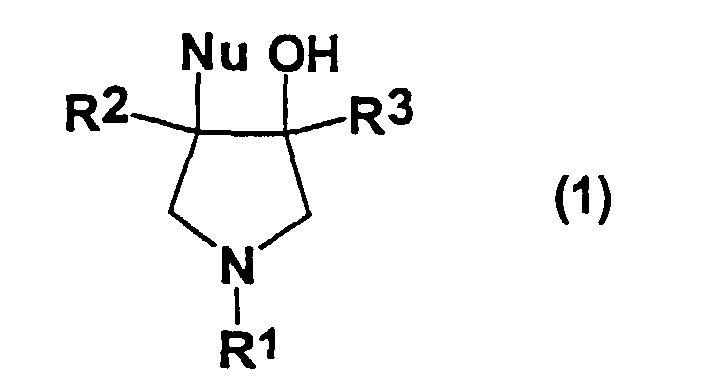
      and wherein formula (2) is an epoxypyrrolidine::
      Figure 00380002
      wherein R1 is hydrogen, a halogen, a cyano group, a nitro group, a hydroxyl group, an alkoxyl group, a carboxyl group, an alkoxycarbonyl group, an acyl group, a carbamoyl group, a sulfide group, a sulfinyl group, a sulfonyl group, a sulfamide group, or a C1 - C10 alkyl group, cycloalkyl group, aryl group, or alalkyl group optionally substituted; R2 and R3 each independently represent a C1 - C10 alkyl group, cycloalkyl group, aryl group, or alalkyl group, optionally substituted;
      and wherein formula (3) is:
      Figure 00390001
      wherein R1 is hydrogen, a halogen, a cyano group, a nitro group, a hydroxyl group, an alkoxyl group, a carboxyl group, an alkoxycarbonyl group, an acyl group, a carbamoyl group, a sulfide group, a sulfinyl group, a sulfonyl group, a sulfamide group, or a C1 - C10 alkyl group, cycloalkyl group, aryl group, alalkyl group optionally substituted; R2 and R3 each independently represent a C1 - C10 alkyl group, cycloalkyl group, aryl group, alalkyl group, optionally substituted;
      which method comprises the step of oxidizing a compound of formula (3) with a peroxide in the presence of an acidic medium.
    2. The method according to claim 1 wherein said pyrrolidine derivative is a 3,4-epoxypyrrolidine of formula (2) produced at a temperature of about 0 to 30 °C.
    3. The method according to claim 1 wherein said pyrrolidine derivative is a 3,4-dihydroxypyrrolidine of formula (1) wherein Nu is a hydroxy group produced at a temperature of about 30 to 100°C in the presence of water.
    4. The method of claim 1, wherein a 4-amino-3-pyrrolidinol , wherein Nu in formula (1) is an amino group, is obtained by oxidizing 3-pyrroline with at least one peroxide in the presence of at least one acid at about 0 to 30°C, and thereafter reacting with at least one amine in the presence of water at about 30 to 100°C.
    5. The method of claim 1, wherein a 4-alkoxy 3-pyrrolidinol , wherein Nu in formula (1) is an alkoxy group is obtained by oxidizing 3-pyrroline with at least one peroxide in the presence of at least one acid at about 0 to 30°C, and thereafter reacting with at least one alcohol at about 30 to 100°C.
    6. The method of claim 1 wherein said peroxide is selected from the group consisting of peroxymonosulfuric acids, peroxymonosulfates of formula (4): MxHy(SO5)z   (4) wherein M is alkali metals, alkaline earth metals, elements of 3A in the periodic table, or ammonium groups of formula (6); and each of x, y, and z are integers from 0 - 3 provided the relation x + y = 2z is satisfied, and
      peroxydisulfuric acids and peroxydisulfates of formula (5): MxHy(S2O8)z   (5) wherein M is alkali metals, alkaline earth metals, elements of 3A in the periodic table, or ammonium groups having formula (6):
      Figure 00410001
      wherein R4, R5, R6 and R7 each independently represent hydrogen, a C1 - C10 alkyl group, cycloalkyl group, aryl group, or alalkyl group,
      and each of x, y and z are integers from 0-3 provided the relation x + y = 2z is satisfied.
    7. The method of claim 1 wherein said 3-pyrroline is oxidized with a peroxide in the presence of said acid by photo-irradiation.
    8. The method of claim 1 wherein said 3-pyrroline is synthesized by cyclization between said cis-2-butene derivatives of formula (7):
      Figure 00410002
      wherein R8 and R9 are each independently hydrogen or a C1 - C10 alkyl group, cycloalkyl group, aryl group, alalkyl group, optionally substituted; and A1 and A2 are each independently halogen or a sulfonyloxy group; and
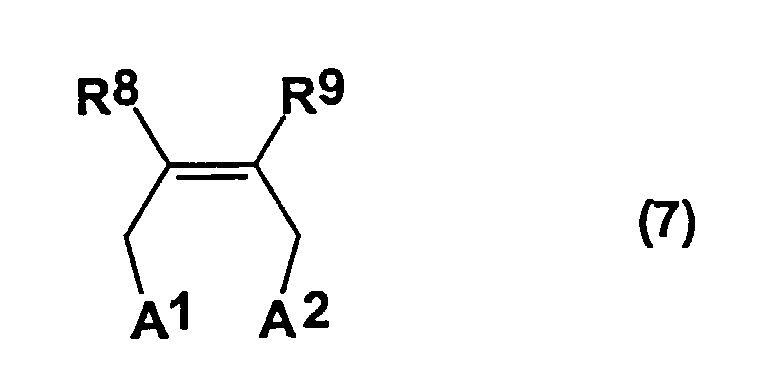
      primary amines of formula (8): R10―NH2   (8) wherein R10 is a C1 - C10 alkyl group, cycloalkyl group, aryl group, alalkyl group optionally substituted.
    9. The method of claim 8 wherein said cis-2-butene derivative of formula (7) is synthesized from cis-2-butene-1,4-diols of formula (9):
      Figure 00420001
      wherein R11 and R12 are each independently hydrogen or a C1 - C10 alkyl group, cycloalkyl group, aryl group, alalkyl group optionally substituted.
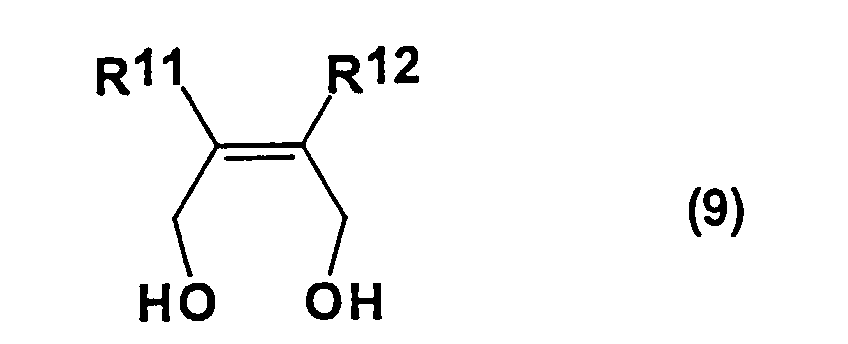
    10. The method of claim 9, wherein said cis-2-butene derivative is synthesized by reacting cis-2-butene-1,4-diols of formula (9) with at least one halogenation reagent in the presence of at least one base.
    11. A method of synthesizing 3-pyrroline comprising the steps of:
      (a) reacting a cis-2-butene-1,4-diol compound of formula (9):
      Figure 00420002
         with at least one halogenation reagent in the presence of at least one base to form at least one cis-2-butene compound of formula (7):
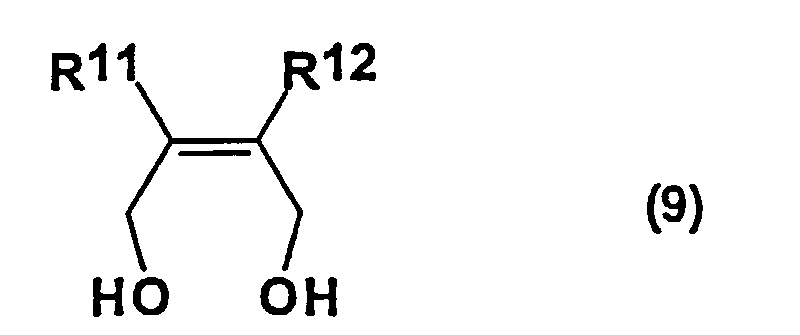
      Figure 00420003
      and
      (b) performing a cyclization reaction of said cis-2-butene compound of formula (7) with at least one primary amine of formula (8): R10―NH2   (8)
    12. The method of claim 11, wherein said cis-2-butene derivative is synthesized by reacting cis-2-butene-1,4-diol of formula (9) with at least one halogenation reagent in the presence of at least one base.
    13. The method of claim 12, wherein said base is a tertiary amine.
    14. The method of claim 12, wherein said halogenation reagent is a sulfonyl halide of formula (10): R13SO2A3   (10) wherein R13 represents a C1 - C10 alkyl group, cycloalkyl group, aryl group, alalkyl group optionally substituted; and A3 is a halogen.
    15. The method of claim 11 wherein said steps are performed continuously.
    16. The method of claim 15 wherein said cis-2-butene derivative is synthesized by reacting cis-2-butene-1,4-diol of formula (9) with at least one halogenation reagent in the presence of at least one base.
    17. The method of claim 15, wherein said base is a tertiary amine.
    18. The method of claim 15, wherein said halogenation reagent is a sulfonyl halide of formula (10): R13SO2A3   (10) wherein R13 represents a C1 - C10 alkyl group, cycloalkyl group, aryl group, alalkyl group optionally substituted; and A3 is a halogen.
    EP99307113A 1998-09-08 1999-09-07 Method of producing pyrrolidine derivatives Expired - Lifetime EP0985664B1 (en)

    Applications Claiming Priority (4)

    Application Number Priority Date Filing Date Title
    JP25430498A JP4314597B2 (en) 1998-09-08 1998-09-08 Method for producing N-substituted-3-pyrroline compound
    JP25430498 1998-09-08
    JP33989398 1998-11-30
    JP33989398 1998-11-30

    Publications (3)

    Publication Number Publication Date
    EP0985664A2 true EP0985664A2 (en) 2000-03-15
    EP0985664A3 EP0985664A3 (en) 2000-05-10
    EP0985664B1 EP0985664B1 (en) 2004-03-31

    Family

    ID=26541624

    Family Applications (1)

    Application Number Title Priority Date Filing Date
    EP99307113A Expired - Lifetime EP0985664B1 (en) 1998-09-08 1999-09-07 Method of producing pyrrolidine derivatives

    Country Status (6)

    Country Link
    US (2) US6130338A (en)
    EP (1) EP0985664B1 (en)
    AT (1) ATE263149T1 (en)
    CA (1) CA2281393A1 (en)
    DE (1) DE69915951T2 (en)
    ES (1) ES2218955T3 (en)

    Cited By (2)

    * Cited by examiner, † Cited by third party
    Publication number Priority date Publication date Assignee Title
    JP2005206526A (en) * 2004-01-23 2005-08-04 Toray Fine Chemicals Co Ltd Method for producing 1-benzyl-3,4-epoxypyrrolidine derivative
    US7297509B2 (en) 2001-04-11 2007-11-20 Adelbert Bacher Intermediates and enzymes of the non-mevalonate isoprenoid pathway

    Families Citing this family (3)

    * Cited by examiner, † Cited by third party
    Publication number Priority date Publication date Assignee Title
    US6130338A (en) 1998-09-08 2000-10-10 Toray Industries, Inc. Method of producing pyrrolidine derivatives
    US10383894B2 (en) * 2010-03-17 2019-08-20 Lutran Industries, Inc. Human medicinal treatment using salt of peroxymonosulfuric acid
    CN113307757B (en) * 2021-05-26 2022-04-29 南京德克瑞医药化工有限公司 A kind of preparation method of pharmaceutical intermediate N-benzyl-3-pyrroline

    Family Cites Families (10)

    * Cited by examiner, † Cited by third party
    Publication number Priority date Publication date Assignee Title
    DE1929237A1 (en) * 1968-06-12 1969-12-18 Sankyo Co Process for the preparation of N-acyl-3,4-epoxy-pyrrolidine derivatives
    US3691198A (en) * 1970-12-21 1972-09-12 Cpc International Inc Synthesis of 1-substituted-3-halopyrrolidines
    JPS566971B2 (en) * 1973-02-12 1981-02-14
    US4175099A (en) * 1975-03-07 1979-11-20 Exxon Research & Engineering Co. Separation and recovery of ethylbenzene from C8 aromatic mixtures using rubidium-X sieves
    US4230718A (en) * 1979-01-09 1980-10-28 A. H. Robins Company, Inc. 1-Substituted-3,4-epoxypyrrolidines
    US4605799A (en) * 1980-08-13 1986-08-12 Toray Industries, Inc. Process for separating a halogenated toluene isomer
    JPS59199642A (en) * 1983-04-28 1984-11-12 Toray Ind Inc Separation of 2,6-dichlorotoluene
    JPH06239808A (en) * 1993-02-15 1994-08-30 Toray Ind Inc Separation of 2-methyl-3-nitrobenzotrifluoride
    US5453560A (en) * 1994-05-20 1995-09-26 Uop Process for adsorptive separation of ethylbenzene from aromatic hydrocarbons
    US6130338A (en) 1998-09-08 2000-10-10 Toray Industries, Inc. Method of producing pyrrolidine derivatives

    Cited By (2)

    * Cited by examiner, † Cited by third party
    Publication number Priority date Publication date Assignee Title
    US7297509B2 (en) 2001-04-11 2007-11-20 Adelbert Bacher Intermediates and enzymes of the non-mevalonate isoprenoid pathway
    JP2005206526A (en) * 2004-01-23 2005-08-04 Toray Fine Chemicals Co Ltd Method for producing 1-benzyl-3,4-epoxypyrrolidine derivative

    Also Published As

    Publication number Publication date
    DE69915951D1 (en) 2004-05-06
    CA2281393A1 (en) 2000-03-08
    ES2218955T3 (en) 2004-11-16
    ATE263149T1 (en) 2004-04-15
    EP0985664A3 (en) 2000-05-10
    US6130338A (en) 2000-10-10
    US6479668B1 (en) 2002-11-12
    DE69915951T2 (en) 2005-01-20
    EP0985664B1 (en) 2004-03-31

    Similar Documents

    Publication Publication Date Title
    US6479668B1 (en) Method of producing pyrrolidine derivatives
    Akutagawa et al. Preparation of S, S-diphenylsulfilimines,-sulfoximines, and-N-(p-tolysulfonyl) sulfonediimines N-substituted with sulfur groups of different oxidation states.
    Mao et al. Synthesis of 1-deoxymannojirimycin analogues using N-tosyl and N-nosyl activated aziridines derived from 1-amino-1-deoxyglucitol
    KR19990067824A (en) Process for the preparation of 3-amino-pyrrolidine derivatives
    US20050033082A1 (en) Method for producing bicalutamide
    CA2281104A1 (en) Selective epoxidation process for preparing pharmaceutical compounds
    Chanet-Ray et al. Synthesis and Reactions of β-Sultams. A Review
    Barry et al. Synthesis of aryl benzyl NH-sulfoximines
    Tayama et al. Synthesis of tertiary alkyl fluorides and chlorides by site-selective nucleophilic ring-opening reaction of α-aryl azetidinium salts
    JPH09316053A (en) Production of sulfonamide derivative and intermediate thereof
    EP3900724B1 (en) Isoquinoline sulfonyl chloride acid addition salts and method of manufacture thereof
    JP2001072659A (en) Production of pyrrolidine derivative
    JPH0597823A (en) Preparation of trans-(5r)-2,4,5-trisubsti- tuted-2-oxazoline
    JP3040265B2 (en) Method for producing dialkyl dicarbonate
    US6229019B1 (en) Phosphinopyrroline compounds and process for producing the same
    US20090221850A1 (en) Method for preparing alkoxyamines by photolysis of dithiocarbamates
    KR970004048B1 (en) Separation method of diastereomer of asymmetric 3-methoxymethyl cephalosporin derivative
    EP1421064B1 (en) Process for the preparation of 3-spiro'cyclohexam-1,3'-'3h!indolin-2'-one! derivatives
    CN118598797A (en) A synthesis method and separation method of chiral 3-hydroxy-4-fluoropiperidine derivative
    KR19980029955A (en) Method for preparing N-alkyloxycarbonyl-B-alkylsulfonylvaline compound
    KR20050022745A (en) Processes for the preparation of an optically active 5,6-dioxopiperazine-2-carboxylic acid derivative
    JPH0327353A (en) Preparation of sulfonium compound
    JP2000001474A (en) Method for producing N-benzyl-3-hydroxyazetidine
    HK40048107A (en) Isoquinolinesulfonyl chloride acid addition salt and method for producing same
    Lucas Approaches to the study of the geometry and mechanisms of nucleophilic substitution at oxygen, sulfur (II), and chlorine: Applications of the endocyclic restriction test

    Legal Events

    Date Code Title Description
    PUAI Public reference made under article 153(3) epc to a published international application that has entered the european phase

    Free format text: ORIGINAL CODE: 0009012

    AK Designated contracting states

    Kind code of ref document: A2

    Designated state(s): AT BE CH CY DE DK ES FI FR GB GR IE IT LI LU MC NL PT SE

    AX Request for extension of the european patent

    Free format text: AL;LT;LV;MK;RO;SI

    PUAL Search report despatched

    Free format text: ORIGINAL CODE: 0009013

    AK Designated contracting states

    Kind code of ref document: A3

    Designated state(s): AT BE CH CY DE DK ES FI FR GB GR IE IT LI LU MC NL PT SE

    AX Request for extension of the european patent

    Free format text: AL;LT;LV;MK;RO;SI

    17P Request for examination filed

    Effective date: 20000626

    AKX Designation fees paid

    Free format text: AT BE CH CY DE DK ES FI FR GB GR IE IT LI LU MC NL PT SE

    17Q First examination report despatched

    Effective date: 20010629

    GRAP Despatch of communication of intention to grant a patent

    Free format text: ORIGINAL CODE: EPIDOSNIGR1

    GRAA (expected) grant

    Free format text: ORIGINAL CODE: 0009210

    GRAS Grant fee paid

    Free format text: ORIGINAL CODE: EPIDOSNIGR3

    RAP1 Party data changed (applicant data changed or rights of an application transferred)

    Owner name: TORAY FINE CHEMICALS CO., LTD.

    RIN1 Information on inventor provided before grant (corrected)

    Inventor name: SATO, HARUYO

    Inventor name: MURAOKA, HIDEO

    AK Designated contracting states

    Kind code of ref document: B1

    Designated state(s): AT BE CH CY DE DK ES FI FR GB GR IE IT LI LU MC NL PT SE

    PG25 Lapsed in a contracting state [announced via postgrant information from national office to epo]

    Ref country code: NL

    Free format text: LAPSE BECAUSE OF FAILURE TO SUBMIT A TRANSLATION OF THE DESCRIPTION OR TO PAY THE FEE WITHIN THE PRESCRIBED TIME-LIMIT

    Effective date: 20040331

    Ref country code: FI

    Free format text: LAPSE BECAUSE OF FAILURE TO SUBMIT A TRANSLATION OF THE DESCRIPTION OR TO PAY THE FEE WITHIN THE PRESCRIBED TIME-LIMIT

    Effective date: 20040331

    Ref country code: CY

    Free format text: LAPSE BECAUSE OF FAILURE TO SUBMIT A TRANSLATION OF THE DESCRIPTION OR TO PAY THE FEE WITHIN THE PRESCRIBED TIME-LIMIT

    Effective date: 20040331

    Ref country code: BE

    Free format text: LAPSE BECAUSE OF FAILURE TO SUBMIT A TRANSLATION OF THE DESCRIPTION OR TO PAY THE FEE WITHIN THE PRESCRIBED TIME-LIMIT

    Effective date: 20040331

    Ref country code: AT

    Free format text: LAPSE BECAUSE OF FAILURE TO SUBMIT A TRANSLATION OF THE DESCRIPTION OR TO PAY THE FEE WITHIN THE PRESCRIBED TIME-LIMIT

    Effective date: 20040331

    REG Reference to a national code

    Ref country code: GB

    Ref legal event code: FG4D

    Ref country code: CH

    Ref legal event code: EP

    REG Reference to a national code

    Ref country code: IE

    Ref legal event code: FG4D

    REF Corresponds to:

    Ref document number: 69915951

    Country of ref document: DE

    Date of ref document: 20040506

    Kind code of ref document: P

    PG25 Lapsed in a contracting state [announced via postgrant information from national office to epo]

    Ref country code: GR

    Free format text: LAPSE BECAUSE OF FAILURE TO SUBMIT A TRANSLATION OF THE DESCRIPTION OR TO PAY THE FEE WITHIN THE PRESCRIBED TIME-LIMIT

    Effective date: 20040630

    Ref country code: DK

    Free format text: LAPSE BECAUSE OF FAILURE TO SUBMIT A TRANSLATION OF THE DESCRIPTION OR TO PAY THE FEE WITHIN THE PRESCRIBED TIME-LIMIT

    Effective date: 20040630

    REG Reference to a national code

    Ref country code: SE

    Ref legal event code: TRGR

    PG25 Lapsed in a contracting state [announced via postgrant information from national office to epo]

    Ref country code: LU

    Free format text: LAPSE BECAUSE OF NON-PAYMENT OF DUE FEES

    Effective date: 20040907

    PG25 Lapsed in a contracting state [announced via postgrant information from national office to epo]

    Ref country code: MC

    Free format text: LAPSE BECAUSE OF NON-PAYMENT OF DUE FEES

    Effective date: 20040930

    NLV1 Nl: lapsed or annulled due to failure to fulfill the requirements of art. 29p and 29m of the patents act
    REG Reference to a national code

    Ref country code: ES

    Ref legal event code: FG2A

    Ref document number: 2218955

    Country of ref document: ES

    Kind code of ref document: T3

    ET Fr: translation filed
    PLBE No opposition filed within time limit

    Free format text: ORIGINAL CODE: 0009261

    STAA Information on the status of an ep patent application or granted ep patent

    Free format text: STATUS: NO OPPOSITION FILED WITHIN TIME LIMIT

    26N No opposition filed

    Effective date: 20050104

    PG25 Lapsed in a contracting state [announced via postgrant information from national office to epo]

    Ref country code: PT

    Free format text: LAPSE BECAUSE OF NON-PAYMENT OF DUE FEES

    Effective date: 20040831

    PGFP Annual fee paid to national office [announced via postgrant information from national office to epo]

    Ref country code: CH

    Payment date: 20110824

    Year of fee payment: 13

    Ref country code: IE

    Payment date: 20110825

    Year of fee payment: 13

    PGFP Annual fee paid to national office [announced via postgrant information from national office to epo]

    Ref country code: FR

    Payment date: 20110901

    Year of fee payment: 13

    Ref country code: ES

    Payment date: 20110908

    Year of fee payment: 13

    Ref country code: DE

    Payment date: 20110824

    Year of fee payment: 13

    Ref country code: SE

    Payment date: 20110824

    Year of fee payment: 13

    Ref country code: GB

    Payment date: 20110819

    Year of fee payment: 13

    PGFP Annual fee paid to national office [announced via postgrant information from national office to epo]

    Ref country code: IT

    Payment date: 20110826

    Year of fee payment: 13

    PG25 Lapsed in a contracting state [announced via postgrant information from national office to epo]

    Ref country code: SE

    Free format text: LAPSE BECAUSE OF NON-PAYMENT OF DUE FEES

    Effective date: 20120908

    REG Reference to a national code

    Ref country code: CH

    Ref legal event code: PL

    Ref country code: SE

    Ref legal event code: EUG

    GBPC Gb: european patent ceased through non-payment of renewal fee

    Effective date: 20120907

    REG Reference to a national code

    Ref country code: IE

    Ref legal event code: MM4A

    REG Reference to a national code

    Ref country code: FR

    Ref legal event code: ST

    Effective date: 20130531

    REG Reference to a national code

    Ref country code: DE

    Ref legal event code: R119

    Ref document number: 69915951

    Country of ref document: DE

    Effective date: 20130403

    PG25 Lapsed in a contracting state [announced via postgrant information from national office to epo]

    Ref country code: DE

    Free format text: LAPSE BECAUSE OF NON-PAYMENT OF DUE FEES

    Effective date: 20130403

    Ref country code: CH

    Free format text: LAPSE BECAUSE OF NON-PAYMENT OF DUE FEES

    Effective date: 20120930

    Ref country code: GB

    Free format text: LAPSE BECAUSE OF NON-PAYMENT OF DUE FEES

    Effective date: 20120907

    Ref country code: IE

    Free format text: LAPSE BECAUSE OF NON-PAYMENT OF DUE FEES

    Effective date: 20120907

    Ref country code: LI

    Free format text: LAPSE BECAUSE OF NON-PAYMENT OF DUE FEES

    Effective date: 20120930

    PG25 Lapsed in a contracting state [announced via postgrant information from national office to epo]

    Ref country code: IT

    Free format text: LAPSE BECAUSE OF NON-PAYMENT OF DUE FEES

    Effective date: 20120907

    Ref country code: FR

    Free format text: LAPSE BECAUSE OF NON-PAYMENT OF DUE FEES

    Effective date: 20121001

    REG Reference to a national code

    Ref country code: ES

    Ref legal event code: FD2A

    Effective date: 20131218

    PG25 Lapsed in a contracting state [announced via postgrant information from national office to epo]

    Ref country code: ES

    Free format text: LAPSE BECAUSE OF NON-PAYMENT OF DUE FEES

    Effective date: 20120908