EP0983663B1 - Verschlüsselungsverfahren und -vorrichtung - Google Patents
Verschlüsselungsverfahren und -vorrichtung Download PDFInfo
- Publication number
- EP0983663B1 EP0983663B1 EP98921395A EP98921395A EP0983663B1 EP 0983663 B1 EP0983663 B1 EP 0983663B1 EP 98921395 A EP98921395 A EP 98921395A EP 98921395 A EP98921395 A EP 98921395A EP 0983663 B1 EP0983663 B1 EP 0983663B1
- Authority
- EP
- European Patent Office
- Prior art keywords
- vernam
- encryptor
- crypto
- key
- cipher
- Prior art date
- Legal status (The legal status is an assumption and is not a legal conclusion. Google has not performed a legal analysis and makes no representation as to the accuracy of the status listed.)
- Expired - Lifetime
Links
Images


Classifications
-
- G—PHYSICS
- G07—CHECKING-DEVICES
- G07F—COIN-FREED OR LIKE APPARATUS
- G07F7/00—Mechanisms actuated by objects other than coins to free or to actuate vending, hiring, coin or paper currency dispensing or refunding apparatus
- G07F7/08—Mechanisms actuated by objects other than coins to free or to actuate vending, hiring, coin or paper currency dispensing or refunding apparatus by coded identity card or credit card or other personal identification means
- G07F7/10—Mechanisms actuated by objects other than coins to free or to actuate vending, hiring, coin or paper currency dispensing or refunding apparatus by coded identity card or credit card or other personal identification means together with a coded signal, e.g. in the form of personal identification information, like personal identification number [PIN] or biometric data
- G07F7/1008—Active credit-cards provided with means to personalise their use, e.g. with PIN-introduction/comparison system
-
- G—PHYSICS
- G06—COMPUTING OR CALCULATING; COUNTING
- G06Q—INFORMATION AND COMMUNICATION TECHNOLOGY [ICT] SPECIALLY ADAPTED FOR ADMINISTRATIVE, COMMERCIAL, FINANCIAL, MANAGERIAL OR SUPERVISORY PURPOSES; SYSTEMS OR METHODS SPECIALLY ADAPTED FOR ADMINISTRATIVE, COMMERCIAL, FINANCIAL, MANAGERIAL OR SUPERVISORY PURPOSES, NOT OTHERWISE PROVIDED FOR
- G06Q20/00—Payment architectures, schemes or protocols
- G06Q20/30—Payment architectures, schemes or protocols characterised by the use of specific devices or networks
- G06Q20/34—Payment architectures, schemes or protocols characterised by the use of specific devices or networks using cards, e.g. integrated circuit [IC] cards or magnetic cards
- G06Q20/341—Active cards, i.e. cards including their own processing means, e.g. including an IC or chip
-
- G—PHYSICS
- G06—COMPUTING OR CALCULATING; COUNTING
- G06Q—INFORMATION AND COMMUNICATION TECHNOLOGY [ICT] SPECIALLY ADAPTED FOR ADMINISTRATIVE, COMMERCIAL, FINANCIAL, MANAGERIAL OR SUPERVISORY PURPOSES; SYSTEMS OR METHODS SPECIALLY ADAPTED FOR ADMINISTRATIVE, COMMERCIAL, FINANCIAL, MANAGERIAL OR SUPERVISORY PURPOSES, NOT OTHERWISE PROVIDED FOR
- G06Q20/00—Payment architectures, schemes or protocols
- G06Q20/38—Payment protocols; Details thereof
- G06Q20/40—Authorisation, e.g. identification of payer or payee, verification of customer or shop credentials; Review and approval of payers, e.g. check credit lines or negative lists
- G06Q20/409—Device specific authentication in transaction processing
- G06Q20/4097—Device specific authentication in transaction processing using mutual authentication between devices and transaction partners
- G06Q20/40975—Device specific authentication in transaction processing using mutual authentication between devices and transaction partners using encryption therefor
-
- H—ELECTRICITY
- H04—ELECTRIC COMMUNICATION TECHNIQUE
- H04L—TRANSMISSION OF DIGITAL INFORMATION, e.g. TELEGRAPHIC COMMUNICATION
- H04L9/00—Cryptographic mechanisms or cryptographic arrangements for secret or secure communications; Network security protocols
- H04L9/06—Cryptographic mechanisms or cryptographic arrangements for secret or secure communications; Network security protocols the encryption apparatus using shift registers or memories for block-wise or stream coding, e.g. DES systems or RC4; Hash functions; Pseudorandom sequence generators
- H04L9/065—Encryption by serially and continuously modifying data stream elements, e.g. stream cipher systems, RC4, SEAL or A5/3
- H04L9/0656—Pseudorandom key sequence combined element-for-element with data sequence, e.g. one-time-pad [OTP] or Vernam's cipher
Definitions
- the invention relates to a method for encryption and an apparatus for performing the method according to the preamble of claim 1 or Claim 5.
- the invention has for its object a method and to provide a device for encrypting, thereby a simplified implementation while avoiding more expensive and incompatible broadband Encryption hardware should be realizable so that inexpensive mass products with integrated Crypto hardware can be equipped in the future making the safety standard of these products essential will be improved.
- the great advantage of the solution according to the invention is in that the encryptors always have the same name Cipher (for example EXOR) can work. You are too can be used without problems if the external crypto or PCMCIA modules (multifunctional PC interface adapter) different symmetrical and asymmetrical ciphers use.
- the Vernam cipher is also for high Throughput rates can be implemented in software so that all Encryptors can do without complex crypto hardware and can be used inexpensively in mass products, because their manufacture is technically simple.
- the external Crypto modules also remain inexpensive because of the Stock key also produced by a low-performing or slow chip card, for example Vernam key storage can be generated can, without the actual working decoupled from it slow down the broadband encryption process.
- the encryptors are described based on the Procedures from the problems of more expensive, more powerful and free each other from incompatible crypto hardware.
- the Vernam cipher on the other hand, is very simple and inexpensive to implement in software and thus by storage. All complex crypto functions are outside of the Encryptor. They are modular and interchangeable yourself in the proposed, inexpensive and slow external crypto modules, for example the chip card or the PCMCIA card, realize.
- the procedures used are in the coordination between sender and receiver to Example negotiated via the transmission route or "Signals".
- the encryptor itself only exists from a software, for example PC software or a any other terminal / information system with integrated Vernam cipher, which is for the actual Encryption process not through a complex Crypto hardware must be supported.
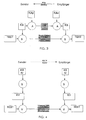
- a Vernam cipher is shown in simplified form.
- the encryption process designated here with "V” can a very simple math operation, for example EXOR, with which a broadband encryption too in software, that is, without the support of a special crypto hardware.
- the disadvantage of this known method is that with "TEXT" marked message with a Vernam key KV must be encrypted using a random number the length of the message to be encrypted. at Long messages are therefore also long Vernam keys needed. This makes the Vernam cipher for the practical use can only be used to a limited extent.
- 2 is a modern symmetric cipher S, for example DES or IDEA shown that even at relatively short Key lengths, usually 128 bits for the secret symmetrical key KS, still an excellent one Offer security.
- DES and IDEA are data encryption Standards (ANSI or ASCOM), ISO 9979.
- Vernam cipher for shipping and Decryption required secret key KS over one independent of the transmission route of the message and secure channel, for example by means of a courier, be replaced.
- the configuration shown in Fig. 3 the reference given in the introduction has the disadvantage of additional use of an asymmetrical cipher A, namely for example the RSA procedure for transmission of the secret encryption key KS avoided.
- the one required at the transmitter for this purpose Public recipient key KAp can be obtained from the Receiver over any unsafe channel be transmitted.
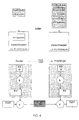
- Fig. 4 is by the Encryption of a secret parameter JV more variable Length, for example n ⁇ 180 bits, with a symmetrical Key KS, for example 128 bits, a very long one (Pseudo) random number generated, the Vernam key KV finally the message to be protected is encrypted.
- JV secret parameter
- KS symmetrical Key
- the courier does not need the recipient here Vernam key to transport KV, but only the key KS and the parameter IV, from which the Vernam key KV easily reproduced on the receiver side as the same configuration as on the Transmitter side is present.
- 5 is the Encryption with combined asymmetrical, symmetric and vernam cipher shown as in Fig. 4. 5, in contrast to FIG. 4, which is a courier needed to exchange the secret key information, analogous to FIG. 3, an asymmetrical cipher for this used.
- the public Receiver key KAp fed in and on the The asymmetrical transmitter key KAs on the receiver side.
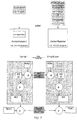
- FIGS. 6 and 7 The advantage of this procedure is shown in FIGS. 6 and 7 disclosed.
- the gray ones Elements represent the existing external crypto hardware either from a chip card or from one Multifunctional PC interface adapter or PCMCIA module with built-in special crypto hardware or one built-in special chip card.
- the encryptor is, however, as a conventional PC, with software or a realized other terminal, but the very except simple Vernam cipher, such as EXOR, which also for the broadband applications in software can be realized, no further crypto technology required.
- the external Crypto modules include all complex crypto functions can, the Vernam key KV as a kind of stock generate and in a suitable buffer, the KV Store memory until it is through by the encryption process the logical operations V are gradually consumed.
- the KV memory can either be in the personal computer or end device or in the crypto module in the form of a Chip card or a PCMCIA module.
- the Vernam cipher is can also be implemented in software for high throughput rates that all encryptors without complex crypto hardware get along and mass-produced and inexpensively can be.
- the external crypto modules also remain cost-effective because the Vernam key is produced in stock also from a low-performing, that is slow chip card, for example in stock for the KV Memory can be generated without being decoupled from it working actual, broadband Slow down the encryption process.
- the encryptors are described based on the Procedures from the problems of expensive, high-performance and free of incompatible crypto hardware.
- the Vernam cipher on the other hand, is very simple and inexpensive to implement in software. All complex Crypto functions are outside the encryptor.
- the Another big advantage is that they are modular are interchangeable and reflected in the proposed inexpensive and slow, external crypto modules to Example of a chip card or a PCMCIA card let it be realized.
- the procedures used are at the coordination between sender and receiver, for example negotiated or signaled on the transmission route.
- the procedure for the cost-effective implementation of high-performance encryption functions in one Encryptor that only from a PC software or any other terminal, information system with integrated Vernam cipher that can exist for the actual encryption process not by one elaborate crypto hardware must be supported is characterized in that by means of a secret key KS with a defined key length and with the help of a variable parameters with a certain bit length any symmetric cipher S a vernam key KV generated with the length of the message to be encrypted who, in turn, uses the Vernam cipher to protective message encrypted, the secret Key KS and the parameter IV either via one of the Separate, secure channel or communication route directly on the messaging route, for example secured by an asymmetrical method A, from the transmitter be transmitted to the recipient, the latter with the method described above the Vernam key KV regenerated to the received message with it to be able to decrypt.
- the symmetrical, if necessary also the asymmetrical cipher and possibly also the Storage for the Vernam key, namely the KV storage are in an external, separate from the encryptor Crypto module, for example in the form of a chip card or a PCMCIA module or similar and housed in Only the Vernam ciphers and remain if applicable, the memory KV for the Vernam key.
Landscapes
- Engineering & Computer Science (AREA)
- Business, Economics & Management (AREA)
- General Physics & Mathematics (AREA)
- Physics & Mathematics (AREA)
- Accounting & Taxation (AREA)
- Theoretical Computer Science (AREA)
- Strategic Management (AREA)
- General Business, Economics & Management (AREA)
- Computer Networks & Wireless Communication (AREA)
- Computer Security & Cryptography (AREA)
- Microelectronics & Electronic Packaging (AREA)
- Signal Processing (AREA)
- Finance (AREA)
- Storage Device Security (AREA)
- Medical Treatment And Welfare Office Work (AREA)
- Radar Systems Or Details Thereof (AREA)
- Eye Examination Apparatus (AREA)
- Electrotherapy Devices (AREA)
Description
- Die Verschlüsselung breitbandiger Signale erfordert den Einbau kostspieliger Kryptohardware in Personalcomputer und Endgeräte. Verfügbare preisgünstige Krypto-Chipkarten arbeiten zur Zeit nur mit einer niedrigen Durchsatzrate von deutlich unter 100 kbit/s.
- Verschlüsselungsverfahren sind häufig geschützt und nicht international standardisiert, so daß keine kostengünstigen Massenprodukte mit integrierter Kryptohardware verfügbar sind.
- Kryptohardware für breitbandige Verschlüsselung verwendet aus Kostengründen häufig nur ein einziges Verschlüsselungsverfahren. Somit können auch die damit ausgestatteten Personalcomputer und andere Endgeräte nicht eine beliebige Anzahl von Verschlüsselungsverfahren unterstützen. Dies führt zu einer starken Einschränkung der Kompatibilität der genannten Geräte.
- Kryptohardware unterliegt strengen internationalen Handelsrestriktionen, so daß der Export zum Beispiel von Verschlüsselungs-Endgeräten sehr stark eingeschränkt ist, weshalb die Verwendung solcher Geräte sehr stark beschränkt ist und die Preise für diese Geräte sehr hoch liegen.
- Fig. 1
- eine vereinfacht dargestellte bekannte Vernam Chiffre;
- Fig. 2
- einen modernen bekannten symmetrischen Chiffre;
- Fig. 3
- eine Konfiguration mit zusätzlichem Einsatz einer asymmentrischen Chiffre;
- Fig. 4
- eine Konfiguration mit Vernam Chiffre;
- Fig. 5
- eine weitere Version mit Vernam Chiffre;
- Fig. 6
- eine Konfiguration mit externem Kryptomodul und
- Fig. 7
- eine weitere Konfiguration mit Kryptomodul.
- KV
- Vernam-Schlüssel
- V
- logische Operation, zum Beispiel EXOR
- KS
- geheimer symmetrischer Schlüssel
- S
- symmetrischer Chiffre, zum Beispiel IDEA
- KAp
- Empfänger-Schlüssel (asymmetrisch)
- KAs
- Sender-Schlüssel (asymmetrisch)
- A
- asymmetrischer Chiffre
- IV
- geheimer variabler Parameter
- PCMCIA
- Multifunktionaler PC Interface Adapter
- PC-SW
- PC Software
Claims (7)
- Verfahren zur vereinfachten Implementierung von Verschlüsselungsverfahren nach dem Vernam Chiffre (V), wobei der Verschlüsselungsprozess eine sehr einfache mathematische Operation, zum Beispiel EXOR, sein kann, dadurch gekennzeichnet, dass mittels eines geheimen Schlüssels (KS) mit einer definierten Schlüssellänge (x Bit) und mit Hilfe eines gegebenenfalls variablen Parameters (IV) mit einer Länge von n * x Bit über eine beliebige symmetrische Chiffre (S) ein Vernam-Schlüssel (KV) mit der Länge der zu verschlüsselnden Nachrichten erzeugt wird,
dass der Vernam-Schlüssel (KV) über logische Operationen der Vernam Chriffre (V) die zu schützende Nachricht verschlüsselt,
dass der geheime Schlüssel (KS) und der Parameter (IV) über einen vom Nachrichtenübermittlungsweg getrennten, sicheren Kanal oder direkt auf dem Nachrichtenübermittlungsweg, gesichert durch ein asymmetrisches Verfahren (A) oder dergleichen, vom Sender zum Empfänger übermittelt werden, und
dass der Empfänger den Vernam-Schlüssel (KV) regeneriert und damit die empfangene Nachricht entschlüsselt. - Verfahren nach Patentanspruch 1, dadurch gekennzeichnet, dass die symmetrische Chiffre und der Speicher für den Vernam-Schlüssel (KV) in einem vom Verschlüssler getrennten Kryptomodul in Form einer Chipkarte, eines Multifunktionalen PC Interface Adapters bzw. -Moduls (PCMCIA) eingebracht werden und
dass im Verschlüssler nur die Vernam Chiffre Operationen durchgeführt werden. - Verfahren nach Patentanspruch 1, dadurch gekennzeichnet, dass die asymmetrische Chiffre und der Speicher für den Vernam-Schlüssel (KV) in einem vom Verschlüssler getrennten externen Kryptomodul realisiert werden und
dass im Verschlüssler die Vernam Chiffre die Verschlüsselungsoperationen steuert. - Verfahren nach einem der Patentansprüche 1 bis 2, dadurch gekennzeichnet, dass im Verschlüssler der Vernam-Schlüssel (KV) abgespeichert wird.
- Vorrichtung zur Durchführung eines Verfahrens zur vereinfachten Implementierung von Verschlüsselungsverfahren nach dem Vernam Chiffre (V), wobei der Verschlüsselungsprozeß eine sehr einfache mathematische Operation, zum Beispiel EXOR, sein kann, nach einem der Patentansprüche 1 bis 4, mit einem Verschlüssler für Verschlüsselungsverfahren, dadurch gekennzeichnet, dass der Verschlüssler für einfache Verschlüsselungsverfahren ausgebildet ist und eine mit dem Verschlüssler zusammenwirkende Kryptohardware vorgesehen ist, die komplexe Kryptofunktion aufweist,
dass die Kryptohardware aus einer Chipkarte oder einem Multifunktionellen PC Interface Adapter, PCMCIA Modul, oder dergleichen mit eingebauter spezieller Kryptohardware besteht, und
dass der Verschlüssler aus einem herkömmlichen Personalcomputer oder dergleichen, Software oder einem anderen Endgerät besteht, der als einfaches mathematisches Verschlüsselungsverfahren eine sehr einfache Vernam Chiffre für breitbandige Anwendungen in Software realisiert, enthält. - Vorrichtung nach Patentanspruch 5, dadurch gekennzeichnet, dass die Kryptohardware als externes Kryptomodul ausgebildet ist und einen Zwischenspeicher zur Vorratsspeicherung des Vernam-Schlüssels (KV) aufweist.
- Vorrichtung nach Patentanspruch 6, dadurch gekennzeichnet, dass der Speicher zum Speichern des Vernam-Schlüssels (KV) entweder im Personalcomputer (PC) oder in einem sonstigen Endgerät angeordnet ist.
Applications Claiming Priority (3)
| Application Number | Priority Date | Filing Date | Title |
|---|---|---|---|
| DE19716861A DE19716861C2 (de) | 1997-04-22 | 1997-04-22 | Verschlüsselungsverfahren und -vorrichtung |
| DE19716861 | 1997-04-22 | ||
| PCT/EP1998/001391 WO1998048540A1 (de) | 1997-04-22 | 1998-03-11 | Verschlüsselungsverfahren und -vorrichtung |
Publications (2)
| Publication Number | Publication Date |
|---|---|
| EP0983663A1 EP0983663A1 (de) | 2000-03-08 |
| EP0983663B1 true EP0983663B1 (de) | 2004-02-11 |
Family
ID=7827316
Family Applications (1)
| Application Number | Title | Priority Date | Filing Date |
|---|---|---|---|
| EP98921395A Expired - Lifetime EP0983663B1 (de) | 1997-04-22 | 1998-03-11 | Verschlüsselungsverfahren und -vorrichtung |
Country Status (7)
| Country | Link |
|---|---|
| US (1) | US8156328B1 (de) |
| EP (1) | EP0983663B1 (de) |
| JP (1) | JP2001521697A (de) |
| AT (1) | ATE259564T1 (de) |
| CA (1) | CA2283208A1 (de) |
| DE (2) | DE19716861C2 (de) |
| WO (1) | WO1998048540A1 (de) |
Families Citing this family (5)
| Publication number | Priority date | Publication date | Assignee | Title |
|---|---|---|---|---|
| CH693295A5 (fr) * | 1999-09-24 | 2003-05-15 | Cardintell Know How Sa | Procédé permettant de sécuriser des données lors detransactions et ensemble pour sa mise enoeuvre. |
| DE10056989A1 (de) * | 2000-11-17 | 2002-05-23 | Secware Technologies Ag | Verschlüsselungssystem |
| EP1376455B1 (de) * | 2002-06-18 | 2010-06-16 | TeleCash Kommunikations-Service GmbH | Verfahren und Vorrichtung zur Steuerung eines Terminals für Chipkarten-Transaktionen |
| JP4608931B2 (ja) | 2004-01-09 | 2011-01-12 | ソニー株式会社 | 情報処理装置および方法、プログラム、並びに記録媒体 |
| WO2009046088A1 (en) | 2007-10-01 | 2009-04-09 | Neology, Inc. | Systems and methods for preventing transmitted cryptographic parameters from compromising privacy |
Family Cites Families (13)
| Publication number | Priority date | Publication date | Assignee | Title |
|---|---|---|---|---|
| US4107458A (en) * | 1976-08-23 | 1978-08-15 | Constant James N | Cipher computer and cryptographic system |
| DE2706421C2 (de) | 1977-02-16 | 1979-03-15 | Licentia Patent-Verwaltungs-Gmbh, 6000 Frankfurt | Verfahren zum Einstellen von Schlüsseltextgeneratoren in Chiffriergeräten |
| US4668103A (en) * | 1982-04-30 | 1987-05-26 | Wilson William J | Polygraphic encryption-decryption communications system |
| DE3889481D1 (de) | 1987-03-04 | 1994-06-16 | Siemens Nixdorf Inf Syst | Schaltungsanordnung zur Sicherung des Zugangs zu einem Datenverarbeitungssystem mit Hilfe einer Chipkarte. |
| JPS63229541A (ja) | 1987-03-04 | 1988-09-26 | シーメンス、アクチエンゲルシヤフト | データ交換システム |
| US5142578A (en) * | 1991-08-22 | 1992-08-25 | International Business Machines Corporation | Hybrid public key algorithm/data encryption algorithm key distribution method based on control vectors |
| US5644354A (en) * | 1992-10-09 | 1997-07-01 | Prevue Interactive, Inc. | Interactive video system |
| TW256969B (de) * | 1993-01-19 | 1995-09-11 | Siemens Ag | |
| US5513261A (en) * | 1993-12-29 | 1996-04-30 | At&T Corp. | Key management scheme for use with electronic cards |
| US5425103A (en) * | 1994-03-14 | 1995-06-13 | Shaw; William Y. | Variable-key cryptography system |
| FR2736484B1 (fr) * | 1995-07-03 | 1997-08-14 | Thomson Multimedia Sa | Procede pour envoyer de maniere sure, sur un canal non sur, un signal numerique entre un emetteur et un recepteur et utilisation de ce procede pour le controle d'acces et/ou le chiffrement de messages |
| US6285991B1 (en) * | 1996-12-13 | 2001-09-04 | Visa International Service Association | Secure interactive electronic account statement delivery system |
| US6169805B1 (en) * | 1997-02-28 | 2001-01-02 | International Business Machines Corporation | System and method of operation for providing user's security on-demand over insecure networks |
-
1997
- 1997-04-22 DE DE19716861A patent/DE19716861C2/de not_active Expired - Fee Related
-
1998
- 1998-03-11 AT AT98921395T patent/ATE259564T1/de active
- 1998-03-11 US US09/403,689 patent/US8156328B1/en not_active Expired - Fee Related
- 1998-03-11 EP EP98921395A patent/EP0983663B1/de not_active Expired - Lifetime
- 1998-03-11 DE DE59810759T patent/DE59810759D1/de not_active Expired - Lifetime
- 1998-03-11 CA CA002283208A patent/CA2283208A1/en not_active Abandoned
- 1998-03-11 WO PCT/EP1998/001391 patent/WO1998048540A1/de not_active Ceased
- 1998-03-11 JP JP54481098A patent/JP2001521697A/ja active Pending
Also Published As
| Publication number | Publication date |
|---|---|
| DE59810759D1 (de) | 2004-03-18 |
| DE19716861C2 (de) | 2000-04-27 |
| JP2001521697A (ja) | 2001-11-06 |
| US8156328B1 (en) | 2012-04-10 |
| WO1998048540A1 (de) | 1998-10-29 |
| EP0983663A1 (de) | 2000-03-08 |
| CA2283208A1 (en) | 1998-10-29 |
| DE19716861A1 (de) | 1998-11-19 |
| ATE259564T1 (de) | 2004-02-15 |
Similar Documents
| Publication | Publication Date | Title |
|---|---|---|
| DE69614944T2 (de) | System und Verfahren zur transparenten Integrierung von verschlüsselten Funktionen von einer IC-Karte mit kryptographischen Diensten auf Basis des Hauptrechners | |
| DE69518199T2 (de) | Sicheres Datenübertragungsverfahren | |
| EP0689368B1 (de) | Vorrichtung zur Übermittlung von Meldungen in einem mobilen Kommunikationsnetz | |
| DE69626678T2 (de) | System und verfahren zur sicherung der geheimhaltung von benutzern in der netzwerkkommunikation | |
| CH656761A5 (de) | Datenuebertragungsanlage, die eine verschluesselungs/entschluesselungs-vorrichtung an jedem ende wenigstens einer datenverbindung aufweist. | |
| EP1872512B1 (de) | Verfahren zur schlüsselverwaltung für kryptographiemodule | |
| DE112010003149B4 (de) | Gemeinschaftliche Verschlüsselung und Entschlüsselung durch Agenten | |
| EP0472714A1 (de) | Verfahren zur authentifizierung eines eine datenstation benutzenden anwenders | |
| EP1116357B1 (de) | Verfahren zur sicheren verteilten generierung eines chiffrierschlüssels | |
| DE10124427A1 (de) | System und Verfahren für einen sicheren Vergleich eines gemeinsamen Geheimnisses von Kommunikationsgeräten | |
| EP0956678B1 (de) | Verfahren und einrichtung zur einbringung eines dienstschlüssels in ein endgerät | |
| EP1027784B2 (de) | Verfahren zum digitalen signieren einer nachricht | |
| EP3206154B1 (de) | Verfahren und vorrichtungen zum sicheren übermitteln von nutzdaten | |
| DE19716861C2 (de) | Verschlüsselungsverfahren und -vorrichtung | |
| WO2008067575A1 (de) | Verfahren zum transferieren von verschlüsselten nachrichten | |
| DE19935285B4 (de) | Verfahren zur Generierung/Regenerierung eines Chiffrierschlüssels für ein Kryptographieverfahren | |
| DE19747827C2 (de) | Verfahren und Einrichtung zur Einbringung eines Dienstschlüssels in ein Endgerät | |
| EP0400362B1 (de) | Verfahren zur hierarchischen Schlüsselverwaltung mit Teilschlüsseln zur Übermittlung digitalisierter Information | |
| DE4420970A1 (de) | Entschlüsselungseinrichtung von Entschlüsselungsalgorithmen und Verfahren zur Durchführung der Ver- und Entschlüsselung derselben | |
| EP0198384A2 (de) | Verfahren und Anordnung zum Verschlüsseln von Daten | |
| DE102013223366A1 (de) | Hardware-kryptomodul und system zur kommunikation mit einer externen umgebung | |
| WO2000059155A1 (de) | Vorrichtung und verfahren für die sichere elektronische datenübertragung | |
| EP3955508A1 (de) | Austausch quantensicherer schlüssel zwischen lokalen netzen | |
| EP4242890B1 (de) | Verfahren zur sicheren identifizierung einer person durch eine verifikationsinstanz | |
| EP3955512B1 (de) | Übertragung quantensicherer schlüssel über intermediären netzwerkknoten |
Legal Events
| Date | Code | Title | Description |
|---|---|---|---|
| PUAI | Public reference made under article 153(3) epc to a published international application that has entered the european phase |
Free format text: ORIGINAL CODE: 0009012 |
|
| 17P | Request for examination filed |
Effective date: 19991122 |
|
| AK | Designated contracting states |
Kind code of ref document: A1 Designated state(s): AT BE CH DE DK ES FI FR GB GR IE IT LI LU MC NL PT SE |
|
| 17Q | First examination report despatched |
Effective date: 20021209 |
|
| GRAP | Despatch of communication of intention to grant a patent |
Free format text: ORIGINAL CODE: EPIDOSNIGR1 |
|
| GRAS | Grant fee paid |
Free format text: ORIGINAL CODE: EPIDOSNIGR3 |
|
| GRAA | (expected) grant |
Free format text: ORIGINAL CODE: 0009210 |
|
| AK | Designated contracting states |
Kind code of ref document: B1 Designated state(s): AT BE CH DE DK ES FI FR GB GR IE IT LI LU MC NL PT SE |
|
| PG25 | Lapsed in a contracting state [announced via postgrant information from national office to epo] |
Ref country code: IE Free format text: LAPSE BECAUSE OF FAILURE TO SUBMIT A TRANSLATION OF THE DESCRIPTION OR TO PAY THE FEE WITHIN THE PRESCRIBED TIME-LIMIT Effective date: 20040211 Ref country code: FI Free format text: LAPSE BECAUSE OF FAILURE TO SUBMIT A TRANSLATION OF THE DESCRIPTION OR TO PAY THE FEE WITHIN THE PRESCRIBED TIME-LIMIT Effective date: 20040211 |
|
| REG | Reference to a national code |
Ref country code: GB Ref legal event code: FG4D Free format text: NOT ENGLISH |
|
| REG | Reference to a national code |
Ref country code: CH Ref legal event code: EP |
|
| REG | Reference to a national code |
Ref country code: CH Ref legal event code: NV Representative=s name: ISLER & PEDRAZZINI AG |
|
| REG | Reference to a national code |
Ref country code: IE Ref legal event code: FG4D Free format text: GERMAN |
|
| PG25 | Lapsed in a contracting state [announced via postgrant information from national office to epo] |
Ref country code: LU Free format text: LAPSE BECAUSE OF NON-PAYMENT OF DUE FEES Effective date: 20040311 |
|
| REF | Corresponds to: |
Ref document number: 59810759 Country of ref document: DE Date of ref document: 20040318 Kind code of ref document: P |
|
| PG25 | Lapsed in a contracting state [announced via postgrant information from national office to epo] |
Ref country code: MC Free format text: LAPSE BECAUSE OF NON-PAYMENT OF DUE FEES Effective date: 20040331 |
|
| PG25 | Lapsed in a contracting state [announced via postgrant information from national office to epo] |
Ref country code: GR Free format text: LAPSE BECAUSE OF FAILURE TO SUBMIT A TRANSLATION OF THE DESCRIPTION OR TO PAY THE FEE WITHIN THE PRESCRIBED TIME-LIMIT Effective date: 20040511 Ref country code: DK Free format text: LAPSE BECAUSE OF FAILURE TO SUBMIT A TRANSLATION OF THE DESCRIPTION OR TO PAY THE FEE WITHIN THE PRESCRIBED TIME-LIMIT Effective date: 20040511 |
|
| PG25 | Lapsed in a contracting state [announced via postgrant information from national office to epo] |
Ref country code: ES Free format text: LAPSE BECAUSE OF FAILURE TO SUBMIT A TRANSLATION OF THE DESCRIPTION OR TO PAY THE FEE WITHIN THE PRESCRIBED TIME-LIMIT Effective date: 20040522 |
|
| GBT | Gb: translation of ep patent filed (gb section 77(6)(a)/1977) |
Effective date: 20040602 |
|
| REG | Reference to a national code |
Ref country code: IE Ref legal event code: FD4D |
|
| ET | Fr: translation filed | ||
| PLBE | No opposition filed within time limit |
Free format text: ORIGINAL CODE: 0009261 |
|
| STAA | Information on the status of an ep patent application or granted ep patent |
Free format text: STATUS: NO OPPOSITION FILED WITHIN TIME LIMIT |
|
| 26N | No opposition filed |
Effective date: 20041112 |
|
| REG | Reference to a national code |
Ref country code: CH Ref legal event code: PCAR Free format text: ISLER & PEDRAZZINI AG;POSTFACH 1772;8027 ZUERICH (CH) |
|
| PG25 | Lapsed in a contracting state [announced via postgrant information from national office to epo] |
Ref country code: PT Free format text: LAPSE BECAUSE OF NON-PAYMENT OF DUE FEES Effective date: 20040711 |
|
| REG | Reference to a national code |
Ref country code: FR Ref legal event code: PLFP Year of fee payment: 19 |
|
| REG | Reference to a national code |
Ref country code: FR Ref legal event code: PLFP Year of fee payment: 20 |
|
| PGFP | Annual fee paid to national office [announced via postgrant information from national office to epo] |
Ref country code: CH Payment date: 20170327 Year of fee payment: 20 Ref country code: FR Payment date: 20170323 Year of fee payment: 20 Ref country code: SE Payment date: 20170327 Year of fee payment: 20 Ref country code: DE Payment date: 20170327 Year of fee payment: 20 Ref country code: NL Payment date: 20170323 Year of fee payment: 20 |
|
| PGFP | Annual fee paid to national office [announced via postgrant information from national office to epo] |
Ref country code: GB Payment date: 20170327 Year of fee payment: 20 Ref country code: BE Payment date: 20170323 Year of fee payment: 20 Ref country code: AT Payment date: 20170322 Year of fee payment: 20 |
|
| PGFP | Annual fee paid to national office [announced via postgrant information from national office to epo] |
Ref country code: IT Payment date: 20170323 Year of fee payment: 20 |
|
| REG | Reference to a national code |
Ref country code: DE Ref legal event code: R071 Ref document number: 59810759 Country of ref document: DE |
|
| REG | Reference to a national code |
Ref country code: NL Ref legal event code: MK Effective date: 20180310 |
|
| REG | Reference to a national code |
Ref country code: CH Ref legal event code: PL |
|
| REG | Reference to a national code |
Ref country code: BE Ref legal event code: MK Effective date: 20180311 |
|
| REG | Reference to a national code |
Ref country code: GB Ref legal event code: PE20 Expiry date: 20180310 |
|
| REG | Reference to a national code |
Ref country code: AT Ref legal event code: MK07 Ref document number: 259564 Country of ref document: AT Kind code of ref document: T Effective date: 20180311 |
|
| PG25 | Lapsed in a contracting state [announced via postgrant information from national office to epo] |
Ref country code: GB Free format text: LAPSE BECAUSE OF EXPIRATION OF PROTECTION Effective date: 20180310 |
|
| REG | Reference to a national code |
Ref country code: SE Ref legal event code: EUG |