EP0982320B1 - Light-absorbing polymers and application thereof to antireflection film - Google Patents
Light-absorbing polymers and application thereof to antireflection film Download PDFInfo
- Publication number
- EP0982320B1 EP0982320B1 EP99907928A EP99907928A EP0982320B1 EP 0982320 B1 EP0982320 B1 EP 0982320B1 EP 99907928 A EP99907928 A EP 99907928A EP 99907928 A EP99907928 A EP 99907928A EP 0982320 B1 EP0982320 B1 EP 0982320B1
- Authority
- EP
- European Patent Office
- Prior art keywords
- group
- substituted
- formula
- groups
- radiation absorbing
- Prior art date
- Legal status (The legal status is an assumption and is not a legal conclusion. Google has not performed a legal analysis and makes no representation as to the accuracy of the status listed.)
- Expired - Lifetime
Links
- 229920000642 polymer Polymers 0.000 title claims abstract description 111
- 238000000034 method Methods 0.000 claims abstract description 29
- 150000001491 aromatic compounds Chemical class 0.000 claims abstract description 11
- 125000003118 aryl group Chemical group 0.000 claims abstract description 4
- 230000005855 radiation Effects 0.000 claims description 83
- 239000006117 anti-reflective coating Substances 0.000 claims description 40
- 150000001875 compounds Chemical class 0.000 claims description 40
- 125000004435 hydrogen atom Chemical group [H]* 0.000 claims description 19
- 125000000962 organic group Chemical group 0.000 claims description 19
- 125000000217 alkyl group Chemical group 0.000 claims description 18
- 125000002887 hydroxy group Chemical group [H]O* 0.000 claims description 18
- 239000000203 mixture Substances 0.000 claims description 15
- 125000003277 amino group Chemical group 0.000 claims description 14
- 125000001997 phenyl group Chemical group [H]C1=C([H])C([H])=C(*)C([H])=C1[H] 0.000 claims description 10
- 125000003545 alkoxy group Chemical group 0.000 claims description 8
- 125000005843 halogen group Chemical group 0.000 claims description 8
- 125000000449 nitro group Chemical group [O-][N+](*)=O 0.000 claims description 8
- 125000003178 carboxy group Chemical group [H]OC(*)=O 0.000 claims description 7
- 229910052757 nitrogen Inorganic materials 0.000 claims description 6
- 125000004433 nitrogen atom Chemical group N* 0.000 claims description 6
- 125000005196 alkyl carbonyloxy group Chemical group 0.000 claims description 5
- 125000003917 carbamoyl group Chemical group [H]N([H])C(*)=O 0.000 claims description 5
- 125000002915 carbonyl group Chemical group [*:2]C([*:1])=O 0.000 claims description 5
- 125000004122 cyclic group Chemical group 0.000 claims description 5
- 125000005462 imide group Chemical group 0.000 claims description 5
- 125000005740 oxycarbonyl group Chemical group [*:1]OC([*:2])=O 0.000 claims description 5
- 125000005415 substituted alkoxy group Chemical group 0.000 claims description 5
- 125000000547 substituted alkyl group Chemical group 0.000 claims description 5
- 125000004430 oxygen atom Chemical group O* 0.000 claims description 4
- 125000002947 alkylene group Chemical group 0.000 claims description 3
- 125000004432 carbon atom Chemical group C* 0.000 claims description 3
- 125000001570 methylene group Chemical group [H]C([H])([*:1])[*:2] 0.000 claims description 3
- 229910052717 sulfur Inorganic materials 0.000 claims description 3
- 125000004434 sulfur atom Chemical group 0.000 claims description 3
- 125000001931 aliphatic group Chemical group 0.000 claims description 2
- 125000000542 sulfonic acid group Chemical group 0.000 claims description 2
- 125000004429 atom Chemical group 0.000 claims 1
- 239000000758 substrate Substances 0.000 abstract description 23
- 238000004519 manufacturing process Methods 0.000 abstract description 8
- 230000015572 biosynthetic process Effects 0.000 abstract description 6
- 125000004018 acid anhydride group Chemical group 0.000 abstract description 5
- 229920001577 copolymer Polymers 0.000 abstract description 4
- OFOBLEOULBTSOW-UHFFFAOYSA-N Propanedioic acid Natural products OC(=O)CC(O)=O OFOBLEOULBTSOW-UHFFFAOYSA-N 0.000 abstract description 2
- 125000001142 dicarboxylic acid group Chemical group 0.000 abstract description 2
- 150000002576 ketones Chemical class 0.000 abstract description 2
- 239000011976 maleic acid Substances 0.000 abstract description 2
- VZCYOOQTPOCHFL-UPHRSURJSA-N maleic acid group Chemical group C(\C=C/C(=O)O)(=O)O VZCYOOQTPOCHFL-UPHRSURJSA-N 0.000 abstract description 2
- VZCYOOQTPOCHFL-UHFFFAOYSA-N trans-butenedioic acid Natural products OC(=O)C=CC(O)=O VZCYOOQTPOCHFL-UHFFFAOYSA-N 0.000 abstract description 2
- LFQSCWFLJHTTHZ-UHFFFAOYSA-N Ethanol Chemical compound CCO LFQSCWFLJHTTHZ-UHFFFAOYSA-N 0.000 abstract 1
- 150000004945 aromatic hydrocarbons Chemical class 0.000 abstract 1
- 150000001244 carboxylic acid anhydrides Chemical group 0.000 abstract 1
- 125000002843 carboxylic acid group Chemical group 0.000 abstract 1
- 150000002148 esters Chemical class 0.000 abstract 1
- 239000003960 organic solvent Substances 0.000 abstract 1
- 239000000243 solution Substances 0.000 description 25
- 239000011248 coating agent Substances 0.000 description 19
- 238000000576 coating method Methods 0.000 description 19
- 238000010521 absorption reaction Methods 0.000 description 15
- 239000002904 solvent Substances 0.000 description 15
- 238000006243 chemical reaction Methods 0.000 description 14
- ZMXDDKWLCZADIW-UHFFFAOYSA-N N,N-Dimethylformamide Chemical compound CN(C)C=O ZMXDDKWLCZADIW-UHFFFAOYSA-N 0.000 description 12
- 0 C*N1C*(*)C1 Chemical compound C*N1C*(*)C1 0.000 description 11
- JHIVVAPYMSGYDF-UHFFFAOYSA-N cyclohexanone Chemical compound O=C1CCCCC1 JHIVVAPYMSGYDF-UHFFFAOYSA-N 0.000 description 10
- LZCLXQDLBQLTDK-UHFFFAOYSA-N ethyl 2-hydroxypropanoate Chemical compound CCOC(=O)C(C)O LZCLXQDLBQLTDK-UHFFFAOYSA-N 0.000 description 10
- 239000000463 material Substances 0.000 description 10
- PPBRXRYQALVLMV-UHFFFAOYSA-N Styrene Chemical compound C=CC1=CC=CC=C1 PPBRXRYQALVLMV-UHFFFAOYSA-N 0.000 description 9
- 229920002120 photoresistant polymer Polymers 0.000 description 9
- ARXJGSRGQADJSQ-UHFFFAOYSA-N 1-methoxypropan-2-ol Chemical compound COCC(C)O ARXJGSRGQADJSQ-UHFFFAOYSA-N 0.000 description 8
- 235000012431 wafers Nutrition 0.000 description 7
- KFZMGEQAYNKOFK-UHFFFAOYSA-N Isopropanol Chemical compound CC(C)O KFZMGEQAYNKOFK-UHFFFAOYSA-N 0.000 description 6
- WGTYBPLFGIVFAS-UHFFFAOYSA-M tetramethylammonium hydroxide Chemical compound [OH-].C[N+](C)(C)C WGTYBPLFGIVFAS-UHFFFAOYSA-M 0.000 description 6
- 238000011161 development Methods 0.000 description 5
- 238000001312 dry etching Methods 0.000 description 5
- 229940116333 ethyl lactate Drugs 0.000 description 5
- 238000002474 experimental method Methods 0.000 description 5
- 239000000178 monomer Substances 0.000 description 5
- LLHKCFNBLRBOGN-UHFFFAOYSA-N propylene glycol methyl ether acetate Chemical compound COCC(C)OC(C)=O LLHKCFNBLRBOGN-UHFFFAOYSA-N 0.000 description 5
- UZKWTJUDCOPSNM-UHFFFAOYSA-N 1-ethenoxybutane Chemical compound CCCCOC=C UZKWTJUDCOPSNM-UHFFFAOYSA-N 0.000 description 4
- YEJRWHAVMIAJKC-UHFFFAOYSA-N 4-Butyrolactone Chemical compound O=C1CCCO1 YEJRWHAVMIAJKC-UHFFFAOYSA-N 0.000 description 4
- SOGAXMICEFXMKE-UHFFFAOYSA-N Butylmethacrylate Chemical compound CCCCOC(=O)C(C)=C SOGAXMICEFXMKE-UHFFFAOYSA-N 0.000 description 4
- BAPJBEWLBFYGME-UHFFFAOYSA-N Methyl acrylate Chemical compound COC(=O)C=C BAPJBEWLBFYGME-UHFFFAOYSA-N 0.000 description 4
- XUIMIQQOPSSXEZ-UHFFFAOYSA-N Silicon Chemical compound [Si] XUIMIQQOPSSXEZ-UHFFFAOYSA-N 0.000 description 4
- 230000000052 comparative effect Effects 0.000 description 4
- FPYJFEHAWHCUMM-UHFFFAOYSA-N maleic anhydride Chemical compound O=C1OC(=O)C=C1 FPYJFEHAWHCUMM-UHFFFAOYSA-N 0.000 description 4
- 229910052710 silicon Inorganic materials 0.000 description 4
- 239000010703 silicon Substances 0.000 description 4
- 239000000126 substance Substances 0.000 description 4
- WHXSMMKQMYFTQS-UHFFFAOYSA-N Lithium Chemical compound [Li] WHXSMMKQMYFTQS-UHFFFAOYSA-N 0.000 description 3
- 229920003171 Poly (ethylene oxide) Polymers 0.000 description 3
- SMWDFEZZVXVKRB-UHFFFAOYSA-N Quinoline Chemical group N1=CC=CC2=CC=CC=C21 SMWDFEZZVXVKRB-UHFFFAOYSA-N 0.000 description 3
- 238000004458 analytical method Methods 0.000 description 3
- YUENFNPLGJCNRB-UHFFFAOYSA-N anthracen-1-amine Chemical compound C1=CC=C2C=C3C(N)=CC=CC3=CC2=C1 YUENFNPLGJCNRB-UHFFFAOYSA-N 0.000 description 3
- 238000007334 copolymerization reaction Methods 0.000 description 3
- 229910052744 lithium Inorganic materials 0.000 description 3
- XJRBAMWJDBPFIM-UHFFFAOYSA-N methyl vinyl ether Chemical compound COC=C XJRBAMWJDBPFIM-UHFFFAOYSA-N 0.000 description 3
- 239000000843 powder Substances 0.000 description 3
- 239000002244 precipitate Substances 0.000 description 3
- 238000012545 processing Methods 0.000 description 3
- 239000011541 reaction mixture Substances 0.000 description 3
- 239000007787 solid Substances 0.000 description 3
- 230000003595 spectral effect Effects 0.000 description 3
- 238000003756 stirring Methods 0.000 description 3
- 238000000859 sublimation Methods 0.000 description 3
- 230000008022 sublimation Effects 0.000 description 3
- 238000003786 synthesis reaction Methods 0.000 description 3
- SVGUNYFQHHUNDJ-UHFFFAOYSA-N (6-fluoro-1-benzothiophen-2-yl)boronic acid Chemical compound C1=C(F)C=C2SC(B(O)O)=CC2=C1 SVGUNYFQHHUNDJ-UHFFFAOYSA-N 0.000 description 2
- KJCVRFUGPWSIIH-UHFFFAOYSA-N 1-naphthol Chemical compound C1=CC=C2C(O)=CC=CC2=C1 KJCVRFUGPWSIIH-UHFFFAOYSA-N 0.000 description 2
- IAZDPXIOMUYVGZ-UHFFFAOYSA-N Dimethylsulphoxide Chemical compound CS(C)=O IAZDPXIOMUYVGZ-UHFFFAOYSA-N 0.000 description 2
- YLQBMQCUIZJEEH-UHFFFAOYSA-N Furan Chemical group C=1C=COC=1 YLQBMQCUIZJEEH-UHFFFAOYSA-N 0.000 description 2
- CERQOIWHTDAKMF-UHFFFAOYSA-N Methacrylic acid Chemical compound CC(=C)C(O)=O CERQOIWHTDAKMF-UHFFFAOYSA-N 0.000 description 2
- VVQNEPGJFQJSBK-UHFFFAOYSA-N Methyl methacrylate Chemical compound COC(=O)C(C)=C VVQNEPGJFQJSBK-UHFFFAOYSA-N 0.000 description 2
- CNCOEDDPFOAUMB-UHFFFAOYSA-N N-Methylolacrylamide Chemical compound OCNC(=O)C=C CNCOEDDPFOAUMB-UHFFFAOYSA-N 0.000 description 2
- UFWIBTONFRDIAS-UHFFFAOYSA-N Naphthalene Chemical group C1=CC=CC2=CC=CC=C21 UFWIBTONFRDIAS-UHFFFAOYSA-N 0.000 description 2
- JUJWROOIHBZHMG-UHFFFAOYSA-N Pyridine Chemical group C1=CC=NC=C1 JUJWROOIHBZHMG-UHFFFAOYSA-N 0.000 description 2
- YTPLMLYBLZKORZ-UHFFFAOYSA-N Thiophene Chemical group C=1C=CSC=1 YTPLMLYBLZKORZ-UHFFFAOYSA-N 0.000 description 2
- 150000008065 acid anhydrides Chemical class 0.000 description 2
- MWPLVEDNUUSJAV-UHFFFAOYSA-N anthracene Chemical group C1=CC=CC2=CC3=CC=CC=C3C=C21 MWPLVEDNUUSJAV-UHFFFAOYSA-N 0.000 description 2
- 239000007864 aqueous solution Substances 0.000 description 2
- 238000004132 cross linking Methods 0.000 description 2
- 238000010828 elution Methods 0.000 description 2
- 238000005530 etching Methods 0.000 description 2
- FJKIXWOMBXYWOQ-UHFFFAOYSA-N ethenoxyethane Chemical compound CCOC=C FJKIXWOMBXYWOQ-UHFFFAOYSA-N 0.000 description 2
- VOZRXNHHFUQHIL-UHFFFAOYSA-N glycidyl methacrylate Chemical compound CC(=C)C(=O)OCC1CO1 VOZRXNHHFUQHIL-UHFFFAOYSA-N 0.000 description 2
- 125000000623 heterocyclic group Chemical group 0.000 description 2
- 125000001624 naphthyl group Chemical group 0.000 description 2
- YNPNZTXNASCQKK-UHFFFAOYSA-N phenanthrene Chemical group C1=CC=C2C3=CC=CC=C3C=CC2=C1 YNPNZTXNASCQKK-UHFFFAOYSA-N 0.000 description 2
- 150000004986 phenylenediamines Chemical class 0.000 description 2
- BASFCYQUMIYNBI-UHFFFAOYSA-N platinum Chemical compound [Pt] BASFCYQUMIYNBI-UHFFFAOYSA-N 0.000 description 2
- 239000002861 polymer material Substances 0.000 description 2
- 238000002310 reflectometry Methods 0.000 description 2
- 238000004528 spin coating Methods 0.000 description 2
- SJMYWORNLPSJQO-UHFFFAOYSA-N tert-butyl 2-methylprop-2-enoate Chemical compound CC(=C)C(=O)OC(C)(C)C SJMYWORNLPSJQO-UHFFFAOYSA-N 0.000 description 2
- 238000012360 testing method Methods 0.000 description 2
- 238000012546 transfer Methods 0.000 description 2
- 238000001771 vacuum deposition Methods 0.000 description 2
- JAMNSIXSLVPNLC-UHFFFAOYSA-N (4-ethenylphenyl) acetate Chemical compound CC(=O)OC1=CC=C(C=C)C=C1 JAMNSIXSLVPNLC-UHFFFAOYSA-N 0.000 description 1
- SKYXLDSRLNRAPS-UHFFFAOYSA-N 1,2,4-trifluoro-5-methoxybenzene Chemical compound COC1=CC(F)=C(F)C=C1F SKYXLDSRLNRAPS-UHFFFAOYSA-N 0.000 description 1
- OZCMOJQQLBXBKI-UHFFFAOYSA-N 1-ethenoxy-2-methylpropane Chemical compound CC(C)COC=C OZCMOJQQLBXBKI-UHFFFAOYSA-N 0.000 description 1
- LHENQXAPVKABON-UHFFFAOYSA-N 1-methoxypropan-1-ol Chemical compound CCC(O)OC LHENQXAPVKABON-UHFFFAOYSA-N 0.000 description 1
- RTBFRGCFXZNCOE-UHFFFAOYSA-N 1-methylsulfonylpiperidin-4-one Chemical compound CS(=O)(=O)N1CCC(=O)CC1 RTBFRGCFXZNCOE-UHFFFAOYSA-N 0.000 description 1
- SMZOUWXMTYCWNB-UHFFFAOYSA-N 2-(2-methoxy-5-methylphenyl)ethanamine Chemical compound COC1=CC=C(C)C=C1CCN SMZOUWXMTYCWNB-UHFFFAOYSA-N 0.000 description 1
- ZWEHNKRNPOVVGH-UHFFFAOYSA-N 2-Butanone Chemical compound CCC(C)=O ZWEHNKRNPOVVGH-UHFFFAOYSA-N 0.000 description 1
- NIXOWILDQLNWCW-UHFFFAOYSA-N 2-Propenoic acid Natural products OC(=O)C=C NIXOWILDQLNWCW-UHFFFAOYSA-N 0.000 description 1
- DPNXHTDWGGVXID-UHFFFAOYSA-N 2-isocyanatoethyl prop-2-enoate Chemical compound C=CC(=O)OCCN=C=O DPNXHTDWGGVXID-UHFFFAOYSA-N 0.000 description 1
- QKJHNPXSYSFZMJ-UHFFFAOYSA-N 4-ethenyl-2-methylphenol Chemical compound CC1=CC(C=C)=CC=C1O QKJHNPXSYSFZMJ-UHFFFAOYSA-N 0.000 description 1
- AUKRYONWZHRJRE-UHFFFAOYSA-N 9-anthrol Chemical compound C1=CC=C2C(O)=C(C=CC=C3)C3=CC2=C1 AUKRYONWZHRJRE-UHFFFAOYSA-N 0.000 description 1
- HRPVXLWXLXDGHG-UHFFFAOYSA-N Acrylamide Chemical compound NC(=O)C=C HRPVXLWXLXDGHG-UHFFFAOYSA-N 0.000 description 1
- NIXOWILDQLNWCW-UHFFFAOYSA-M Acrylate Chemical compound [O-]C(=O)C=C NIXOWILDQLNWCW-UHFFFAOYSA-M 0.000 description 1
- NLHHRLWOUZZQLW-UHFFFAOYSA-N Acrylonitrile Chemical compound C=CC#N NLHHRLWOUZZQLW-UHFFFAOYSA-N 0.000 description 1
- XDTMQSROBMDMFD-UHFFFAOYSA-N Cyclohexane Chemical compound C1CCCCC1 XDTMQSROBMDMFD-UHFFFAOYSA-N 0.000 description 1
- 206010073306 Exposure to radiation Diseases 0.000 description 1
- WOBHKFSMXKNTIM-UHFFFAOYSA-N Hydroxyethyl methacrylate Chemical compound CC(=C)C(=O)OCCO WOBHKFSMXKNTIM-UHFFFAOYSA-N 0.000 description 1
- PEEHTFAAVSWFBL-UHFFFAOYSA-N Maleimide Chemical compound O=C1NC(=O)C=C1 PEEHTFAAVSWFBL-UHFFFAOYSA-N 0.000 description 1
- CERQOIWHTDAKMF-UHFFFAOYSA-M Methacrylate Chemical compound CC(=C)C([O-])=O CERQOIWHTDAKMF-UHFFFAOYSA-M 0.000 description 1
- FXHOOIRPVKKKFG-UHFFFAOYSA-N N,N-Dimethylacetamide Chemical compound CN(C)C(C)=O FXHOOIRPVKKKFG-UHFFFAOYSA-N 0.000 description 1
- SECXISVLQFMRJM-UHFFFAOYSA-N N-Methylpyrrolidone Chemical compound CN1CCCC1=O SECXISVLQFMRJM-UHFFFAOYSA-N 0.000 description 1
- LHNICELDCMPPDE-UHFFFAOYSA-N Nc1c(cccc2)c2cc2c1cccc2 Chemical compound Nc1c(cccc2)c2cc2c1cccc2 LHNICELDCMPPDE-UHFFFAOYSA-N 0.000 description 1
- ISWSIDIOOBJBQZ-UHFFFAOYSA-N Phenol Chemical compound OC1=CC=CC=C1 ISWSIDIOOBJBQZ-UHFFFAOYSA-N 0.000 description 1
- BLRPTPMANUNPDV-UHFFFAOYSA-N Silane Chemical compound [SiH4] BLRPTPMANUNPDV-UHFFFAOYSA-N 0.000 description 1
- NRTOMJZYCJJWKI-UHFFFAOYSA-N Titanium nitride Chemical compound [Ti]#N NRTOMJZYCJJWKI-UHFFFAOYSA-N 0.000 description 1
- XTXRWKRVRITETP-UHFFFAOYSA-N Vinyl acetate Chemical compound CC(=O)OC=C XTXRWKRVRITETP-UHFFFAOYSA-N 0.000 description 1
- BZHJMEDXRYGGRV-UHFFFAOYSA-N Vinyl chloride Chemical compound ClC=C BZHJMEDXRYGGRV-UHFFFAOYSA-N 0.000 description 1
- QYKIQEUNHZKYBP-UHFFFAOYSA-N Vinyl ether Chemical compound C=COC=C QYKIQEUNHZKYBP-UHFFFAOYSA-N 0.000 description 1
- 239000003513 alkali Substances 0.000 description 1
- 125000004448 alkyl carbonyl group Chemical group 0.000 description 1
- -1 alkyl vinyl ether Chemical compound 0.000 description 1
- 150000001408 amides Chemical class 0.000 description 1
- 150000001412 amines Chemical class 0.000 description 1
- JFCQEDHGNNZCLN-UHFFFAOYSA-N anhydrous glutaric acid Natural products OC(=O)CCCC(O)=O JFCQEDHGNNZCLN-UHFFFAOYSA-N 0.000 description 1
- 125000004104 aryloxy group Chemical group 0.000 description 1
- QVGXLLKOCUKJST-UHFFFAOYSA-N atomic oxygen Chemical compound [O] QVGXLLKOCUKJST-UHFFFAOYSA-N 0.000 description 1
- 239000003795 chemical substances by application Substances 0.000 description 1
- 239000003431 cross linking reagent Substances 0.000 description 1
- 230000007547 defect Effects 0.000 description 1
- 150000001991 dicarboxylic acids Chemical class 0.000 description 1
- 230000000694 effects Effects 0.000 description 1
- 238000010894 electron beam technology Methods 0.000 description 1
- 238000005516 engineering process Methods 0.000 description 1
- SUPCQIBBMFXVTL-UHFFFAOYSA-N ethyl 2-methylprop-2-enoate Chemical compound CCOC(=O)C(C)=C SUPCQIBBMFXVTL-UHFFFAOYSA-N 0.000 description 1
- STVZJERGLQHEKB-UHFFFAOYSA-N ethylene glycol dimethacrylate Chemical compound CC(=C)C(=O)OCCOC(=O)C(C)=C STVZJERGLQHEKB-UHFFFAOYSA-N 0.000 description 1
- 239000007888 film coating Substances 0.000 description 1
- 238000009501 film coating Methods 0.000 description 1
- 239000000706 filtrate Substances 0.000 description 1
- 238000001914 filtration Methods 0.000 description 1
- 239000007789 gas Substances 0.000 description 1
- VANNPISTIUFMLH-UHFFFAOYSA-N glutaric anhydride Chemical compound O=C1CCCC(=O)O1 VANNPISTIUFMLH-UHFFFAOYSA-N 0.000 description 1
- 238000010438 heat treatment Methods 0.000 description 1
- 150000003949 imides Chemical class 0.000 description 1
- 150000002484 inorganic compounds Chemical class 0.000 description 1
- 229910010272 inorganic material Inorganic materials 0.000 description 1
- 230000010354 integration Effects 0.000 description 1
- 229910000000 metal hydroxide Inorganic materials 0.000 description 1
- 150000004692 metal hydroxides Chemical class 0.000 description 1
- RBQRWNWVPQDTJJ-UHFFFAOYSA-N methacryloyloxyethyl isocyanate Chemical compound CC(=C)C(=O)OCCN=C=O RBQRWNWVPQDTJJ-UHFFFAOYSA-N 0.000 description 1
- 239000012046 mixed solvent Substances 0.000 description 1
- 229920000620 organic polymer Polymers 0.000 description 1
- 229910052760 oxygen Inorganic materials 0.000 description 1
- 239000001301 oxygen Substances 0.000 description 1
- 238000000206 photolithography Methods 0.000 description 1
- 229910052697 platinum Inorganic materials 0.000 description 1
- 229920006254 polymer film Polymers 0.000 description 1
- UMJSCPRVCHMLSP-UHFFFAOYSA-N pyridine Natural products COC1=CC=CN=C1 UMJSCPRVCHMLSP-UHFFFAOYSA-N 0.000 description 1
- 230000001105 regulatory effect Effects 0.000 description 1
- 238000007761 roller coating Methods 0.000 description 1
- 230000035945 sensitivity Effects 0.000 description 1
- 238000000926 separation method Methods 0.000 description 1
- 229910000077 silane Inorganic materials 0.000 description 1
- 238000003860 storage Methods 0.000 description 1
- 125000001424 substituent group Chemical group 0.000 description 1
- 239000004094 surface-active agent Substances 0.000 description 1
- 229930192474 thiophene Chemical group 0.000 description 1
- 125000000391 vinyl group Chemical group [H]C([*])=C([H])[H] 0.000 description 1
Classifications
-
- G—PHYSICS
- G03—PHOTOGRAPHY; CINEMATOGRAPHY; ANALOGOUS TECHNIQUES USING WAVES OTHER THAN OPTICAL WAVES; ELECTROGRAPHY; HOLOGRAPHY
- G03F—PHOTOMECHANICAL PRODUCTION OF TEXTURED OR PATTERNED SURFACES, e.g. FOR PRINTING, FOR PROCESSING OF SEMICONDUCTOR DEVICES; MATERIALS THEREFOR; ORIGINALS THEREFOR; APPARATUS SPECIALLY ADAPTED THEREFOR
- G03F7/00—Photomechanical, e.g. photolithographic, production of textured or patterned surfaces, e.g. printing surfaces; Materials therefor, e.g. comprising photoresists; Apparatus specially adapted therefor
- G03F7/004—Photosensitive materials
- G03F7/09—Photosensitive materials characterised by structural details, e.g. supports, auxiliary layers
- G03F7/091—Photosensitive materials characterised by structural details, e.g. supports, auxiliary layers characterised by antireflection means or light filtering or absorbing means, e.g. anti-halation, contrast enhancement
-
- C—CHEMISTRY; METALLURGY
- C08—ORGANIC MACROMOLECULAR COMPOUNDS; THEIR PREPARATION OR CHEMICAL WORKING-UP; COMPOSITIONS BASED THEREON
- C08F—MACROMOLECULAR COMPOUNDS OBTAINED BY REACTIONS ONLY INVOLVING CARBON-TO-CARBON UNSATURATED BONDS
- C08F8/00—Chemical modification by after-treatment
- C08F8/14—Esterification
-
- C—CHEMISTRY; METALLURGY
- C08—ORGANIC MACROMOLECULAR COMPOUNDS; THEIR PREPARATION OR CHEMICAL WORKING-UP; COMPOSITIONS BASED THEREON
- C08F—MACROMOLECULAR COMPOUNDS OBTAINED BY REACTIONS ONLY INVOLVING CARBON-TO-CARBON UNSATURATED BONDS
- C08F8/00—Chemical modification by after-treatment
- C08F8/30—Introducing nitrogen atoms or nitrogen-containing groups
-
- C—CHEMISTRY; METALLURGY
- C09—DYES; PAINTS; POLISHES; NATURAL RESINS; ADHESIVES; COMPOSITIONS NOT OTHERWISE PROVIDED FOR; APPLICATIONS OF MATERIALS NOT OTHERWISE PROVIDED FOR
- C09D—COATING COMPOSITIONS, e.g. PAINTS, VARNISHES OR LACQUERS; FILLING PASTES; CHEMICAL PAINT OR INK REMOVERS; INKS; CORRECTING FLUIDS; WOODSTAINS; PASTES OR SOLIDS FOR COLOURING OR PRINTING; USE OF MATERIALS THEREFOR
- C09D5/00—Coating compositions, e.g. paints, varnishes or lacquers, characterised by their physical nature or the effects produced; Filling pastes
- C09D5/32—Radiation-absorbing paints
Definitions
- the present invention relates to a radiation absorbing polymer and application thereof to an anti-reflective coating and in particular to a radiation absorbing polymer suitable as a material for forming an anti-reflective coating in producing fine elements such as integrated circuit elements by photolithographic process, as well as to a method of producing the same, a film forming composition containing the radiation absorbing polymer and an anti-reflective coating therefrom.
- lithographic process In the field of manufacturing integrated circuit elements, miniaturization of processing size in lithographic process is proceeding in order to achieve higher degrees of integration, and in recent years the development of technology enabling fine processing in the submicron order is advancing.
- a resist is applied onto a substrate, and then a mask pattern is transferred to the resist by exposure to radiation and developed with a suitable developer to form a desired resist pattern.
- the known methods include e.g. a method of dispersing, in a resist, a dye having absorption in the wavelength range of exposure light, a method of forming an anti-reflective coating consisting of an inorganic compound coating such as titanium nitride etc. on a substrate by CVD or vacuum deposition, a method of forming an anti-reflective coating by applying onto a substrate an organic polymer solution having a radiation absorbing dye dispersed or dissolved therein, and a method of forming a radiation absorbing coating by applying onto a substrate a radiation absorbing polymer having a chromophore bound chemically to the polymer.
- the method of dispersing a radiation absorbing dye in a resist has problems such as reduction in resist sensitivity, thinning of the resist layer during development and sublimation of the dye during baking.
- the method of using an inorganic anti-reflective coating has various problems such as difficulty in accurate control of coating thickness, difficulty of forming a coating with uniform thickness, requirement for a special apparatus upon conducting vacuum deposition, poor adhesion to a resist film, and necessity of another dry etching process in order to transfer a pattern.
- the method of dispersing a radiation absorbing dye in an anti-reflective coating has problems such as separation of the dye from the polymer upon forming an anti-reflective coating by spin coating, elution of the dye into a resist solvent, and sublimation of the dye into a resist film at the time of baking. Furthermore, some anti-reflective coatings using the organic substance described above, particularly containing a low-molecular dye dispersed in the polymer, fail to form a coating with uniform thickness on a substrate with uneven surface.
- the method of using a radiation-absorbing polymer having a chromophore bound chemically to the polymer does not have such drawbacks, so this method has attracted attention in recent years.
- the method of forming an anti-reflective coating by use of a radiation absorbing polymer, and the radiation absorbing polymer material used in this method are described in e.g. JP-A 6-75378, JP-A 6-118656, WO 9412912, US-A 4,910,122 and US-A 5,057,399.
- anti-reflective coating In production of LSI in recent years, deep ultraviolet rays (DUV) with a wavelength of 248 nm or less comes to be used for exposure of a photoresist to achieve high resolution, and in particular when a certain radiation of such short wavelength is used for exposure, an anti-reflective coating is essential to keep the good resolution and good pattern shape of a resist image to be formed.
- anti-reflective coating materials for i-line using a radiation absorbing polymer anti-reflective coating materials, e.g. AZ® -BARLi® (Clariant Co.), which can form an anti-reflective coating with uniform thickness even on a substrate with uneven surface, that is, which is excellent in step coverage and other characteristics are known.
- the object of the present invention is to provide an anti-reflective coating free of the problems in the prior art described above, that is, a coating which is excellent in step coverage, does not cause transfer and sublimation of a dye during heating, has a high anti-reflectivity effect, is also excellent in adhesion to a substrate, dry etching properties, thermostability and handling, and is capable of forming a high-resolution resist image excellent in pattern shape; a novel radiation absorbing polymer having a radiation absorbing dye bound chemically to a polymer chain thereof, which is used in said coating; a method of preparing the same; and a film forming composition containing said novel radiation absorbing polymer.
- the present inventors found that the problems described above can be solved by linking and introducing a specific radiation absorbing compound to a specific polymer chain, more desirably by selecting the type of the radiation absorbing compound, the amount thereof introduced into a polymer and the type of comonomer or by regulating the copolymerization ratio thereof, and the present invention was thereby completed.
- the present invention relates to a radiation absorbing polymer (first radiation absorbing polymer) comprising at least both a recurring units represented by formula 1 and a recurring units represented by formula 2: wherein R 1 and R 2 may be the same or different and each represent a hydrogen atom, an alkyl group or other organic groups, Ar represents an organic chromophore, and n is 0 or an integer of 1 or more; wherein R 3 and R 4 may be the same or different and each represent a hydrogen atom, a carboxyl group, an alkyl group or other organic groups, and Y represents a hydrogen atom, a substituted or non-substituted alkyl group, a substituted or non-substituted alkoxyl group, a halogen atom, -CN, an alkylcarbonyloxy group, an imide group, a substituted or non-substituted carbamoyl group, a substituted carbonyl group, a substituted or non-substit
- the present invention relates to a method of preparing the first radiation absorbing polymer described above, wherein (a) a polymer comprising at least both at least one recurring unit selected from recurring units represented by formula 3-1 or 3-2 and a recurring unit represented by formula 2 above is reacted with (b) a compound containing a hydroxyl group represented by formula 4: whereinR 1 , R 2 and n have the same meanings as defined above; wherein R 1 , R 2 and n have the same meanings as defined above; Ar-OH (4) wherein Ar has the same meaning as defined above.
- the present invention relates to a radiation absorbing polymer (second radiation absorbing polymer) comprising at least a recurring unit represented by formula 1 above, a recurring unit represented by formula 2 above, and a recurring unit represented by formula 5 and/or formula 6: wherein R 1 , R 2 and n have the same meanings as defined above, Ar 2 represents an organic chromophore bound to X via an oxygen atom, a nitrogen atom or a sulfur atom as necessary, and X represents a direct bond, a methylene group or a linear, branched or cyclic alkylene group containing at least 2 carbon atoms; wherein R 1 , R 2 , Ar 2 , X and n have the same meanings as defined above.
- the organic chromophores represented by Ar and Ar 2 absorb radiation and these are preferably substituted or non-substituted phenyl groups, heterocyclic groups or fused ring groups.
- Ar and Ar 2 may be the same or different.
- Substituents on the substituted or non-substituted phenyl groups include a nitro group, alkoxyl group, aryloxy group, hydroxyl group, alkylcarbonyl group, aromatic cyclic group (e.g. phenyl group or naphthyl group), and a vinyl group unsubstituted or substituted with a phenyl group or naphthyl group. Examples of such substituted or non-substituted phenyl groups include groups derived from the following:
- heterocyclic groups and condensed ring groups include cyclic groups such as pyridine, thiophene, furan, quinoline, naphthalene, anthracene and phenanthrene shown below. These groups may also be substituted with an alkyl group, alkoxyl group, nitro group, halogen group, hydroxyl group etc.
- the present invention relates to a method of preparing the second radiation absorbing polymer, wherein a radiation absorbing polymer comprising at least a recurring unit represented by formula 1 above, a recurring unit represented by formula 2 above, and a recurring unit represented by formula 3-1 and/or formula 3-2 above is reacted with an aromatic compound containing an amino group represented by formula 7: Ar 2 -X-NH 2 (7) wherein Ar 2 and X have the same meanings as defined above.
- the present invention relates to a film forming composition and an anti-reflective coating comprising the first radiation absorbing polymer and/or the second radiation-absorbing polymer described above.
- the first radiation absorbing polymer of the present invention is produced by reacting (a) a polymer having at least both at least one recurring unit selected from recurring units represented by formula 3-1 or 3-2 and a recurring unit represented by formula 2 with (b) a compound containing a hydroxyl group represented by formula 4 above.
- Production of the first radiation absorbing polymer is conducted generally by dissolving the starting polymer (a) and the hydroxyl group-containing compound (b) in a solvent and then esterifying a carboxyl group or an acid anhydride group in the starting polymer (a) with the hydroxyl-group containing compound (b) at raised temperatures.
- the number average molecular weight of the starting polymer is usually 300 to 10,000,000, and this starting polymer is preferably a polymer in which the recurring unit represented by formula 3-1 or 3-2 is 5 to 80 mol-% relative to the total recurring units while the recurring unit represented by formula 2 is 20 to 70 mol-% relative to the total recurring units, and the hydroxyl group-containing compound is used preferably in an amount of 5 to 70 mol-% relative to the total recurring units of formulae 3-1 and 3-2 in the polymer.
- the first radiation absorbing polymer thus produced has a molecular weight of about 30,000 to 1,000,000 and contains at least 5 mol-% recurring unit of formula 1 relative to the total recurring units.
- the monomer components forming the recurring unit represented by formula 3-1 or 3-2 constituting the starting polymer include e.g. dicarboxylic acids and acid anhydrides such as maleic acid, maleic anhydride and derivatives thereof, glutaric acid, glutaric anhydride and derivatives thereof.
- acid anhydrides are preferable, and maleic anhydride is particularly preferable.
- the recurring unit represented by formula 2 is used for conferring good film formability, high radiation absorption, high etch rate, solubility in specific solvents, good storage stability, crosslinking (curing) properties or other preferable characteristics on the polymer.
- Typical examples of monomers for constituting the recurring unit represented by formula 2 include styrene, vinyl ether, acrylate, methacrylate, and derivatives thereof.
- preferable monomers for forming the recurring unit represented by formula 2 include methyl methacrylate, methyl acrylate, 2-hydroxyethyl methacrylate, ethyl methacrylate, 2-(methacryloyloxy)ethyl methacrylate, butyl methacrylate, t-butyl methacrylate, glycidyl methacrylate, methacrylic acid, acrylic acid, acrylonitrile, acrylamide, hydroxymethyl acrylamide, 2-isocyanatoethyl methacrylate, 4-acetoxystyrene, 3-methyl-4-hydroxystyrene, styrene, vinyl chloride, ethyl vinyl ether, butyl vinyl ether, isobutyl vinyl ether, cyclohexyl vinyl ether, methyl vinyl ether, maleimide, vinyl acetate, 2-isocyanatoethyl acrylate etc.
- styrene methyl methacrylate, methacrylic acid, methyl acrylate, hydroxymethyl acrylamide, butyl methacrylate, t-butyl methacrylate, glycidyl methacrylate, methyl vinyl ether and butyl vinyl ether are preferable, and methyl vinyl ether and styrene are more preferable.
- the amount of the hydroxyl group-containing compound is less than an equimolar amount relative to the recurring units represented by formula 3-1 or 3-2 in producing the first radiation absorbing polymer, a part of the recurring units represented by formula 3-1 or 3-2 contained in the starting polymer remain unreacted in the first radiation absorbing polymer.
- the starting polymer is preferably a maleic anhydride /alkyl vinyl ether or styrene copolymer, particularly preferably a maleic anhydride/methyl vinyl ether copolymer represented by formula 12:
- the number average molecular weight of the copolymer represented by formula 12 above is preferably 300 to 10,000,000, particularly preferably 10,000 to 3,000,000.
- hydroxyl group-containing compound represented by formula 4 are compounds represented by formula 8, 9 or 10: wherein R 5 represents an alkyl group, an alkoxyl group, a nitro group or other organic groups, and when m is 2 or more, respective R 5 groups may be the same or different, and m is 0 or an integer of 1 to 5; wherein R 6 represents an alkyl group, an alkoxyl group, a nitro group or other organic groups, and when p is 2 or more, respective R 6 groups may be the same or different, and p is 0 or an integer of 1 to 7; wherein R 7 represents an alkyl group, an alkoxyl group, a nitro group or other organic groups, and when q is 2 or more, respective R 7 groups may be the same or different, and q is 0 or an integer of 1 to 9.
- Preferable examples of compounds represented by formulae 8 to 10 are the compounds (I) to (VI) shown below.
- the compound represented by formula 4 should basically absorb radiation of predetermined wavelength, but as described below, when the first radiation absorbing polymer contains a recurring unit represented by formula 3-1 or 3-2, it is further converted into the second radiation absorbing polymer by reaction with the amino group-containing aromatic compound represented by formula 7, and when this amino group-containing aromatic compound absorbs radiation of predetermined wavelength, it is not necessarily required for the compound represented by formula 4 to absorb radiation of exposure wavelength, that is, radiation of predetermined wavelength.
- the following compounds are preferably used in the relationship with absorption wavelength: the compound of formula (III) is used for i-line (wavelength; 365 nm), the compound of formula (VI) is used for a KrF excimer laser (248 mm), and the compound of formula (I) is used for an ArF excimer laser (193 nm).
- Production of the first radiation-absorbing polymer is not limited to the method described above, and as a matter of course, the first radiation-absorbing polymer can also be produced by copolymerization of monomers necessary for constituting the respective recurring units of the radiation-absorbing polymer.
- the second radiation absorbing polymer of the present invention contains the recurring unit represented by formula 5 or 6 in addition to the recurring units of the first radiation absorbing polymer in order to improve the characteristics of the first polymer.
- the second radiation absorbing polymer of the present invention is produced usually by allowing a carboxyl group or an acid anhydride group in the recurring unit having a dicarboxylic acid group or an acid anhydride group still not reacting with the hydroxyl group-containing compound in the first radiation absorbing polymer to react with the aromatic compound containing an amino group represented by formula 7 thereby further introducing a radiation absorbing group into the main chain of the polymer through an amide and/or imide linkage.
- Ar 2 -X-NH 2 (7) wherein Ar 2 and X have the same meanings as defined above.
- One of preferable examples of the amino group-containing aromatic compound represented by formula 7 is a compound represented by formula 14: wherein Z represents an oxygen atom, a nitrogen atom or a sulfur atom, R 9 is present in the only case where Z is a nitrogen atom, whereupon R 9 represents a hydrogen atom, an alkyl group or other organic groups, h is an integer of 1 to 4, R 8 represents a hydrogen atom, a halogen atom, a hydroxyl group, an amino group, a sulfonic acid group or other organic groups, and when a plurality of R 8 groups are present on the ring, these groups may be the same or different, or R 8 groups may be combined with one another to form an aliphatic or aromatic ring.
- the aminoanthracene strongly absorbs radiation from a KrF excimer laser (248 mm) and thus it is preferable as a material of an anti-reflective coating for the KrF excimer laser.
- the compound containing a reactive amino group may be a compound improving not only the radiation absorption characteristics of a polymer formed but also polymer performance such as film formability etc., and for example, when Ar has absorption at a predetermined wavelength, it is not necessarily required to use a compound having an absorption range at the predetermined wavelength as the amino group-containing compound.
- the second radiation absorbing polymer is not limited to the method described above, and as a matter of course, the second radiation absorbing polymer may also be produced by copolymerization of monomers necessary for constituting the respective recurring units of the second radiation absorbing polymer.
- the radiation absorbing polymer of the present invention when used as an anti-reflective coating in producing integrated circuit elements can become a polymer having an absorption wavelength adjusted to a exposure wavelength for resist ranging from about 180 nm to about 450 nm by suitably combining the hydroxyl group-containing compound of formula 4 above with the amino group-containing aromatic compound of formula 7. Further, a plurality of compounds of formula 4 or 7 each having a different absorption wavelength range can be used to confer absorption of different exposure wavelengths on the polymer, so the radiation absorbing polymer of the present invention is very useful as a material of an anti-reflective coating.
- the first and/or second radiation absorbing polymer described above is dissolved in a suitable solvent to form a film forming composition
- preferable solvents for forming this film forming composition include ⁇ -butyrolactone, cyclohexanone, dimethylacetamide, dimethylformamide, dimethyl sulfoxide, N-methyl pyrrolidone, ethyl lactate (EL), methoxy propanol (PGME), propylene glycol monomethyl ether acetate (PGMEA), or mixtures thereof.
- the solvent used for forming the film forming composition of the present invention is not limited to these specifically enumerated solvents.
- solvents are ⁇ -butyrolactone, cyclohexanone, EL, PGME, and a mixed solvent of PGME and PGMEA.
- concentration of the radiation absorbing polymer in the film forming composition is usually 20 % by weight or less.
- a surface active agent and silane-based leveling agent can be added in a small amount in it to adjust adhesion and coating characteristics onto a substrate.
- low-molecular compounds or polymer materials for example, a crosslinking agent, a crosslinking auxiliary or other radiation absorbing compounds can also be added as necessary.
- the film forming composition of the present invention is used mainly for forming a bottom anti-reflective coating upon producing an integrated circuit, but the purpose of its use is not limited to the field of manufacturing of integrated circuit elements.
- the hydroxyl group-containing compound represented by formula 4 and the amino group-containing aromatic compound represented by formula 7 are suitably combined whereby a radiation absorbing polymer that can well absorb radiation having peaks in the range of 180 nm to 450 nm used for exposure to resists can be obtained, and because of the radiation absorption of this light absorbing polymer, the reflection of exposure radiation off a substrate is prevented, and a defect-free resist pattern with high resolution can be formed.
- the anti-reflective coating of the present invention is formed by applying the film coating composition comprising the radiation absorbing polymer of the present invention onto a substrate by spin coating, cast coating or roller coating as the thickness of its dried film on the substrate is e.g. 500 to 50,000 angstrom and then baking it at suitable temperatures.
- the baking temperature is, for example, 90 to 250 °C or so, preferably 180 to 220 °C.
- the substrate on which the anti-reflective coating has been formed is usually coated with a photoresist in predetermined thickness and then pre-baked to form a photoresist coating thereon.
- solvents for the photoresist include EL, PGMEA and ketones, but the solvent for the photoresist is not limited to these solvents.
- the photoresist whether positive or negative can be used.
- the pre-baking temperature is considerably varied depending on the photoresist used, and usually it is in the range of about 30 to 200 °C.
- exposure radiation for the photoresist can be selected from visible light, ultraviolet rays, deep ultraviolet rays, X-rays and electron beams, depending on the photoresist used.
- the radiation absorbing polymer used in the anti-reflective coating is selected from the polymer which has an absorption range in the exposure wavelength range used for the exposure described above. After the exposure, after-baking is conducted as necessary, followed by development with a developer to form a resist pattern. Then, dry etching of the anti-reflective coating is conducted using gas plasma such as oxygen plasma.
- the developer used may be any one known in the art, such as alkaline aqueous solutions or aqueous alkali solutions in which a metal hydroxide, organic amine or the like is dissolved.
- reaction solution was cooled to room temperature, and the reaction solution was precipitated with isopropanol.
- the precipitate was collected by filtration and dried in vacuum to obtain 31 g of polymer solid.
- GPC analysis using lithium chloride-added dimethylformamide as a mobile phase and polyethylene oxide as a standard substance revealed that the obtained polymer had a weight average molecular weight (Mw) of 59,000, a number average molecular weight (Mn) of 23,000, and a polydispersity (Mw/Mn) of 2.56.
- the k value of the film formed from the polymer solution was about 0.28 at 248 nm, as measured by a spectral ellipsometer.
- reaction solution was cooled to room temperature, and the reaction solution was precipitated with isopropanol in a usual manner.
- the precipitate was dried in vacuum to obtain 33 g of polymer solid.
- GPC analysis using lithium chloride-added dimethylformamide as a mobile phase and polyethylene oxide as a standard substance revealed that the obtained polymer had a weight average molecular weight (Mw) of 54,000, a number average molecular weight (Mn) of 21,000, and a polydispersity (Mw/Mn) of 2.57.
- Mw weight average molecular weight
- Mn number average molecular weight
- Mw/Mn polydispersity
- the k value of the film formed from the polymer solution was about 0.55 at 248 nm, as measured by a spectral ellipsometer.
- the obtained precipitate was dried in vacuum to obtain 25 g of polymer solid.
- GPC analysis using lithium chloride-added dimethylformamide as a mobile phase and polyethylene oxide as a standard substance revealed that the obtained polymer had a weight average molecular weight (Mw) of 50,000, a number average molecular weight (Mn) of 21,000, and a polydispersity (Mw/Mn) of 2.38.
- the k value of the film formed from the polymer solution was about 0.49 at 248 nm, as measured by a spectral ellipsometer.
- the polymers obtained in Examples 1 to 3 were added at a concentration of about 3 % in cyclohexane respectively and stirred at room temperature to be dissolved completely.
- the respective solutions were filtered through a 0.1 ⁇ m filter, and the resulting filtrates were designated coating solutions A, B and C, respectively.
- resist patterns of 1.0 ⁇ m in height were formed on a silicon wafer at pattern intervals of 1 ⁇ m, 3 ⁇ m and 5 ⁇ m, and platinum was vapor-deposited thereon.
- a plurality of these silicon wafers with uneven surface were prepared and spin-coated at 3,000 rpm with the above coating solutions A, B and C and an AZ® -BARLi® solution (manufactured by Clariant Co., hereinafter the same) as comparative examples. After this the coated wafers were baked at 200 °C for 60 seconds on a hot plate to form 1,000 angstrom anti-reflective coatings on the wafers.
- the coating solutions A, B and C obtained in Example 4 above were applied respectively onto silicon wafers and then baked at 160 °C, 180 °C, 200 °C and 220 °C to form films thereon, and resist solvents (MEK, EL, PGMEA and PGME) and a developer (2.38 wt % aqueous solution of tetramethyl ammonium hydroxide (TMAH)) were dropped respectively on the films, and after 60 seconds, the solvents or solutions on the films were wiped off and the reduction of the film thickness was examined.
- resist solvents MEK, EL, PGMEA and PGME
- TMAH tetramethyl ammonium hydroxide
- AZ® -BARLi® was also subjected to the same experiment under the same conditions as above to form a resist pattern by using AZ® DX2034P. Observation of the cross section of each of the thus obtained resist patterns under SEM revealed that there existed some standing waves on the resist pattern and considerable footing of the resist. It was thus found that the anti-reflective coating material of the present invention was more suitable for the DUV resist than AZ® -BARLi® .
- the radiation absorbing polymer of the present invention has a excellent coverage property, good absorption for specific wavelength radiation such as deep ultraviolet rays, good adhesion to a substrate, and easy film formation. Further, this radiation absorbing polymer can be easily produced, and it can form a radiation absorbing polymer having absorption characteristics in a desired absorption range by suitably changing a combination of a hydroxyl group-containing compound and an amino group-containing aromatic compound to be introduced into the polymer main chain, and one kind of composition containing the polymer can serve as an anti-reflective coating material toward a plurality of radiations.
- a film forming composition containing this radiation absorbing polymer is applied to form a coating and then the coating is heated at suitable temperatures to be made insoluble in solvents or developers for resist, so an anti-reflective coating which is not dissolved during formation or development of a resist film can be formed. In addition it can be easily removed by dry etching.
- the radiation absorbing polymer of the present invention possesses preferable film characteristics in photolithography.
- the radiation absorbing polymer of the present invention is used preferably as a radiation absorbing composition and a radiation absorbing coating, in particular an anti-reflective coating upon producing integrated circuit elements.
Landscapes
- Chemical & Material Sciences (AREA)
- Organic Chemistry (AREA)
- General Chemical & Material Sciences (AREA)
- Health & Medical Sciences (AREA)
- Chemical Kinetics & Catalysis (AREA)
- Medicinal Chemistry (AREA)
- Polymers & Plastics (AREA)
- Engineering & Computer Science (AREA)
- Life Sciences & Earth Sciences (AREA)
- Materials Engineering (AREA)
- Wood Science & Technology (AREA)
- Architecture (AREA)
- Structural Engineering (AREA)
- Physics & Mathematics (AREA)
- General Physics & Mathematics (AREA)
- Exposure Of Semiconductors, Excluding Electron Or Ion Beam Exposure (AREA)
- Addition Polymer Or Copolymer, Post-Treatments, Or Chemical Modifications (AREA)
- Paints Or Removers (AREA)
- Materials For Photolithography (AREA)
Abstract
Description
- The present invention relates to a radiation absorbing polymer and application thereof to an anti-reflective coating and in particular to a radiation absorbing polymer suitable as a material for forming an anti-reflective coating in producing fine elements such as integrated circuit elements by photolithographic process, as well as to a method of producing the same, a film forming composition containing the radiation absorbing polymer and an anti-reflective coating therefrom.
- In the field of manufacturing integrated circuit elements, miniaturization of processing size in lithographic process is proceeding in order to achieve higher degrees of integration, and in recent years the development of technology enabling fine processing in the submicron order is advancing. In this lithographic process, a resist is applied onto a substrate, and then a mask pattern is transferred to the resist by exposure to radiation and developed with a suitable developer to form a desired resist pattern. However, many substrates used in the field of manufacturing integrated circuit elements have high reflectivity, and there is a problem of standing waves based on the interference between exposure light and reflected light off a substrate, and another problem is that particularly when a substrate having uneven surface is used as a substrate to be coated with a resist, an exposure light passing through the resist layer is reflected off the substrate whereby the light reaches the resist portion which should not be exposed to the light, thus causing pattern defects or resulting in a failure to obtain a pattern having desired resolution or desired shapes.
- To solve these problems, various methods have been proposed so far. The known methods include e.g. a method of dispersing, in a resist, a dye having absorption in the wavelength range of exposure light, a method of forming an anti-reflective coating consisting of an inorganic compound coating such as titanium nitride etc. on a substrate by CVD or vacuum deposition, a method of forming an anti-reflective coating by applying onto a substrate an organic polymer solution having a radiation absorbing dye dispersed or dissolved therein, and a method of forming a radiation absorbing coating by applying onto a substrate a radiation absorbing polymer having a chromophore bound chemically to the polymer.
- Among these methods, the method of dispersing a radiation absorbing dye in a resist has problems such as reduction in resist sensitivity, thinning of the resist layer during development and sublimation of the dye during baking. On the one hand, the method of using an inorganic anti-reflective coating has various problems such as difficulty in accurate control of coating thickness, difficulty of forming a coating with uniform thickness, requirement for a special apparatus upon conducting vacuum deposition, poor adhesion to a resist film, and necessity of another dry etching process in order to transfer a pattern. Further, the method of dispersing a radiation absorbing dye in an anti-reflective coating has problems such as separation of the dye from the polymer upon forming an anti-reflective coating by spin coating, elution of the dye into a resist solvent, and sublimation of the dye into a resist film at the time of baking. Furthermore, some anti-reflective coatings using the organic substance described above, particularly containing a low-molecular dye dispersed in the polymer, fail to form a coating with uniform thickness on a substrate with uneven surface.
- On the other hand, the method of using a radiation-absorbing polymer having a chromophore bound chemically to the polymer does not have such drawbacks, so this method has attracted attention in recent years. The method of forming an anti-reflective coating by use of a radiation absorbing polymer, and the radiation absorbing polymer material used in this method, are described in e.g. JP-A 6-75378, JP-A 6-118656, WO 9412912, US-A 4,910,122 and US-A 5,057,399. In production of LSI in recent years, deep ultraviolet rays (DUV) with a wavelength of 248 nm or less comes to be used for exposure of a photoresist to achieve high resolution, and in particular when a certain radiation of such short wavelength is used for exposure, an anti-reflective coating is essential to keep the good resolution and good pattern shape of a resist image to be formed. As the anti-reflective coating materials for i-line using a radiation absorbing polymer, anti-reflective coating materials, e.g. AZ® -BARLi® (Clariant Co.), which can form an anti-reflective coating with uniform thickness even on a substrate with uneven surface, that is, which is excellent in step coverage and other characteristics are known. But under the present circumstances, there is no anti-reflective coating material for DUV, which particularly has step coverage similar to or more than that of AZ® -BARLi® and is excellent in other properties such as radiation absorption characteristics, etching characteristics and adhesion to a substrate.
- The object of the present invention is to provide an anti-reflective coating free of the problems in the prior art described above, that is, a coating which is excellent in step coverage, does not cause transfer and sublimation of a dye during heating, has a high anti-reflectivity effect, is also excellent in adhesion to a substrate, dry etching properties, thermostability and handling, and is capable of forming a high-resolution resist image excellent in pattern shape; a novel radiation absorbing polymer having a radiation absorbing dye bound chemically to a polymer chain thereof, which is used in said coating; a method of preparing the same; and a film forming composition containing said novel radiation absorbing polymer.
- As a result of their eager study, the present inventors found that the problems described above can be solved by linking and introducing a specific radiation absorbing compound to a specific polymer chain, more desirably by selecting the type of the radiation absorbing compound, the amount thereof introduced into a polymer and the type of comonomer or by regulating the copolymerization ratio thereof, and the present invention was thereby completed.
- That is, the present invention relates to a radiation absorbing polymer (first radiation absorbing polymer) comprising at least both a recurring units represented by formula 1 and a recurring units represented by formula 2:


- Further, the present invention relates to a method of preparing the first radiation absorbing polymer described above, wherein (a) a polymer comprising at least both at least one recurring unit selected from recurring units represented by formula 3-1 or 3-2 and a recurring unit represented by formula 2 above is reacted with (b) a compound containing a hydroxyl group represented by formula 4:


Ar-OH (4)
wherein Ar has the same meaning as defined above. - Further, the present invention relates to a radiation absorbing polymer (second radiation absorbing polymer) comprising at least a recurring unit represented by formula 1 above, a recurring unit represented by formula 2 above, and a recurring unit represented by formula 5 and/or formula 6:


- In the present invention, the organic chromophores represented by Ar and Ar2 absorb radiation and these are preferably substituted or non-substituted phenyl groups, heterocyclic groups or fused ring groups. In the present invention, Ar and Ar2 may be the same or different. Substituents on the substituted or non-substituted phenyl groups include a nitro group, alkoxyl group, aryloxy group, hydroxyl group, alkylcarbonyl group, aromatic cyclic group (e.g. phenyl group or naphthyl group), and a vinyl group unsubstituted or substituted with a phenyl group or naphthyl group. Examples of such substituted or non-substituted phenyl groups include groups derived from the following:




- The heterocyclic groups and condensed ring groups include cyclic groups such as pyridine, thiophene, furan, quinoline, naphthalene, anthracene and phenanthrene shown below. These groups may also be substituted with an alkyl group, alkoxyl group, nitro group, halogen group, hydroxyl group etc.


- Further, the present invention relates to a method of preparing the second radiation absorbing polymer, wherein a radiation absorbing polymer comprising at least a recurring unit represented by formula 1 above, a recurring unit represented by formula 2 above, and a recurring unit represented by formula 3-1 and/or formula 3-2 above is reacted with an aromatic compound containing an amino group represented by formula 7:
Ar2-X-NH2 (7)
wherein Ar2 and X have the same meanings as defined above. - Further, the present invention relates to a film forming composition and an anti-reflective coating comprising the first radiation absorbing polymer and/or the second radiation-absorbing polymer described above.
- Hereinafter, the present invention is described in more detail.
- The first radiation absorbing polymer of the present invention, as described above, is produced by reacting (a) a polymer having at least both at least one recurring unit selected from recurring units represented by formula 3-1 or 3-2 and a recurring unit represented by formula 2 with (b) a compound containing a hydroxyl group represented by formula 4 above. Production of the first radiation absorbing polymer is conducted generally by dissolving the starting polymer (a) and the hydroxyl group-containing compound (b) in a solvent and then esterifying a carboxyl group or an acid anhydride group in the starting polymer (a) with the hydroxyl-group containing compound (b) at raised temperatures. The number average molecular weight of the starting polymer is usually 300 to 10,000,000, and this starting polymer is preferably a polymer in which the recurring unit represented by formula 3-1 or 3-2 is 5 to 80 mol-% relative to the total recurring units while the recurring unit represented by formula 2 is 20 to 70 mol-% relative to the total recurring units, and the hydroxyl group-containing compound is used preferably in an amount of 5 to 70 mol-% relative to the total recurring units of formulae 3-1 and 3-2 in the polymer. Preferably, the first radiation absorbing polymer thus produced has a molecular weight of about 30,000 to 1,000,000 and contains at least 5 mol-% recurring unit of formula 1 relative to the total recurring units.
- The monomer components forming the recurring unit represented by formula 3-1 or 3-2 constituting the starting polymer include e.g. dicarboxylic acids and acid anhydrides such as maleic acid, maleic anhydride and derivatives thereof, glutaric acid, glutaric anhydride and derivatives thereof. Among these, acid anhydrides are preferable, and maleic anhydride is particularly preferable.
- The recurring unit represented by formula 2 is used for conferring good film formability, high radiation absorption, high etch rate, solubility in specific solvents, good storage stability, crosslinking (curing) properties or other preferable characteristics on the polymer. Typical examples of monomers for constituting the recurring unit represented by formula 2 include styrene, vinyl ether, acrylate, methacrylate, and derivatives thereof. Specific examples of preferable monomers for forming the recurring unit represented by formula 2 include methyl methacrylate, methyl acrylate, 2-hydroxyethyl methacrylate, ethyl methacrylate, 2-(methacryloyloxy)ethyl methacrylate, butyl methacrylate, t-butyl methacrylate, glycidyl methacrylate, methacrylic acid, acrylic acid, acrylonitrile, acrylamide, hydroxymethyl acrylamide, 2-isocyanatoethyl methacrylate, 4-acetoxystyrene, 3-methyl-4-hydroxystyrene, styrene, vinyl chloride, ethyl vinyl ether, butyl vinyl ether, isobutyl vinyl ether, cyclohexyl vinyl ether, methyl vinyl ether, maleimide, vinyl acetate, 2-isocyanatoethyl acrylate etc. Among these, styrene, methyl methacrylate, methacrylic acid, methyl acrylate, hydroxymethyl acrylamide, butyl methacrylate, t-butyl methacrylate, glycidyl methacrylate, methyl vinyl ether and butyl vinyl ether are preferable, and methyl vinyl ether and styrene are more preferable.
- If the amount of the hydroxyl group-containing compound is less than an equimolar amount relative to the recurring units represented by formula 3-1 or 3-2 in producing the first radiation absorbing polymer, a part of the recurring units represented by formula 3-1 or 3-2 contained in the starting polymer remain unreacted in the first radiation absorbing polymer.
- The starting polymer is preferably a maleic anhydride /alkyl vinyl ether or styrene copolymer, particularly preferably a maleic anhydride/methyl vinyl ether copolymer represented by formula 12:

- The number average molecular weight of the copolymer represented by formula 12 above is preferably 300 to 10,000,000, particularly preferably 10,000 to 3,000,000.
- By reaction with the hydroxyl group-containing compound represented by formula 4 above, the recurring unit containing an acid anhydride group in formula 12 above forms the recurring unit represented by formula 13:

- On the other hand, preferable examples of the hydroxyl group-containing compound represented by formula 4 are compounds represented by formula 8, 9 or 10:


- Preferable examples of compounds represented by formulae 8 to 10 are the compounds (I) to (VI) shown below. When the first radiation absorbing polymer is used as the material of an anti-reflective coating, the compound represented by formula 4 should basically absorb radiation of predetermined wavelength, but as described below, when the first radiation absorbing polymer contains a recurring unit represented by formula 3-1 or 3-2, it is further converted into the second radiation absorbing polymer by reaction with the amino group-containing aromatic compound represented by formula 7, and when this amino group-containing aromatic compound absorbs radiation of predetermined wavelength, it is not necessarily required for the compound represented by formula 4 to absorb radiation of exposure wavelength, that is, radiation of predetermined wavelength.



- Among the compounds represented by formula 4, the following compounds are preferably used in the relationship with absorption wavelength: the compound of formula (III) is used for i-line (wavelength; 365 nm), the compound of formula (VI) is used for a KrF excimer laser (248 mm), and the compound of formula (I) is used for an ArF excimer laser (193 nm). Production of the first radiation-absorbing polymer is not limited to the method described above, and as a matter of course, the first radiation-absorbing polymer can also be produced by copolymerization of monomers necessary for constituting the respective recurring units of the radiation-absorbing polymer.
- Further, the second radiation absorbing polymer of the present invention contains the recurring unit represented by formula 5 or 6 in addition to the recurring units of the first radiation absorbing polymer in order to improve the characteristics of the first polymer. The second radiation absorbing polymer of the present invention is produced usually by allowing a carboxyl group or an acid anhydride group in the recurring unit having a dicarboxylic acid group or an acid anhydride group still not reacting with the hydroxyl group-containing compound in the first radiation absorbing polymer to react with the aromatic compound containing an amino group represented by formula 7 thereby further introducing a radiation absorbing group into the main chain of the polymer through an amide and/or imide linkage.
Ar2-X-NH2 (7)
wherein Ar2 and X have the same meanings as defined above. - One of preferable examples of the amino group-containing aromatic compound represented by formula 7 is a compound represented by formula 14:

- Among the compounds represented by formula 14, the compounds represented by formula 11 wherein Z is a nitrogen atom and R9 is a hydrogen atom are particularly preferable.
- Particularly preferable examples of the compounds represented by formula 7 above are the following compounds (VII) to (XIV):
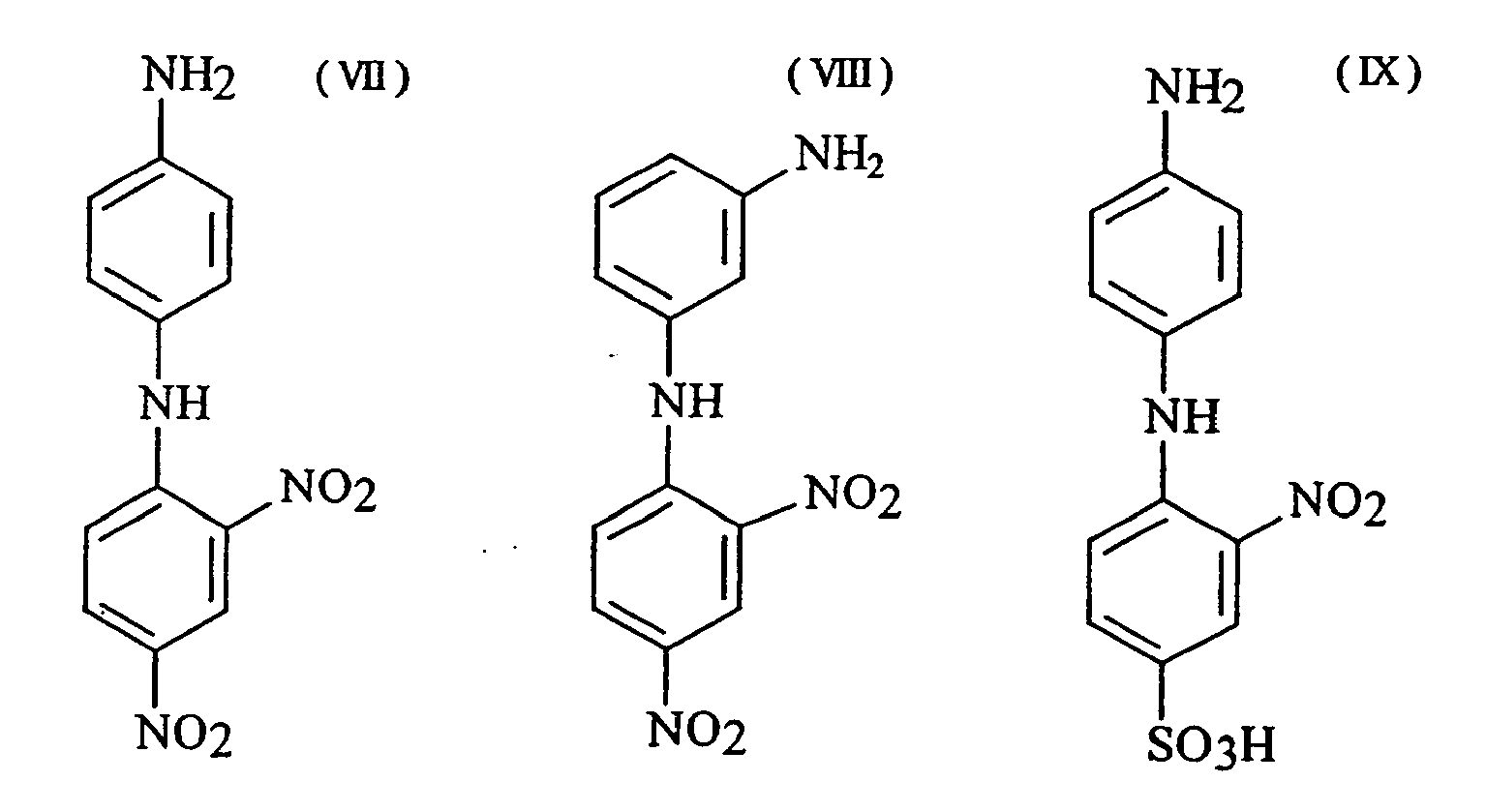


- Among these, the aminoanthracene strongly absorbs radiation from a KrF excimer laser (248 mm) and thus it is preferable as a material of an anti-reflective coating for the KrF excimer laser. However, in the present invention, the compound containing a reactive amino group may be a compound improving not only the radiation absorption characteristics of a polymer formed but also polymer performance such as film formability etc., and for example, when Ar has absorption at a predetermined wavelength, it is not necessarily required to use a compound having an absorption range at the predetermined wavelength as the amino group-containing compound. Further, production of the second radiation absorbing polymer is not limited to the method described above, and as a matter of course, the second radiation absorbing polymer may also be produced by copolymerization of monomers necessary for constituting the respective recurring units of the second radiation absorbing polymer.
- The radiation absorbing polymer of the present invention when used as an anti-reflective coating in producing integrated circuit elements can become a polymer having an absorption wavelength adjusted to a exposure wavelength for resist ranging from about 180 nm to about 450 nm by suitably combining the hydroxyl group-containing compound of formula 4 above with the amino group-containing aromatic compound of formula 7. Further, a plurality of compounds of formula 4 or 7 each having a different absorption wavelength range can be used to confer absorption of different exposure wavelengths on the polymer, so the radiation absorbing polymer of the present invention is very useful as a material of an anti-reflective coating.
- The first and/or second radiation absorbing polymer described above is dissolved in a suitable solvent to form a film forming composition, and preferable solvents for forming this film forming composition include γ-butyrolactone, cyclohexanone, dimethylacetamide, dimethylformamide, dimethyl sulfoxide, N-methyl pyrrolidone, ethyl lactate (EL), methoxy propanol (PGME), propylene glycol monomethyl ether acetate (PGMEA), or mixtures thereof. However, the solvent used for forming the film forming composition of the present invention is not limited to these specifically enumerated solvents. Among these, particularly preferable solvents are γ-butyrolactone, cyclohexanone, EL, PGME, and a mixed solvent of PGME and PGMEA. In addition, the concentration of the radiation absorbing polymer in the film forming composition is usually 20 % by weight or less.
- When the film forming composition is produced by using the radiation absorbing polymer of the present invention, a surface active agent and silane-based leveling agent can be added in a small amount in it to adjust adhesion and coating characteristics onto a substrate. Further, low-molecular compounds or polymer materials, for example, a crosslinking agent, a crosslinking auxiliary or other radiation absorbing compounds can also be added as necessary.
- The film forming composition of the present invention is used mainly for forming a bottom anti-reflective coating upon producing an integrated circuit, but the purpose of its use is not limited to the field of manufacturing of integrated circuit elements. As described above, the hydroxyl group-containing compound represented by formula 4 and the amino group-containing aromatic compound represented by formula 7 are suitably combined whereby a radiation absorbing polymer that can well absorb radiation having peaks in the range of 180 nm to 450 nm used for exposure to resists can be obtained, and because of the radiation absorption of this light absorbing polymer, the reflection of exposure radiation off a substrate is prevented, and a defect-free resist pattern with high resolution can be formed.
- The anti-reflective coating of the present invention is formed by applying the film coating composition comprising the radiation absorbing polymer of the present invention onto a substrate by spin coating, cast coating or roller coating as the thickness of its dried film on the substrate is e.g. 500 to 50,000 angstrom and then baking it at suitable temperatures. The baking temperature is, for example, 90 to 250 °C or so, preferably 180 to 220 °C. The substrate on which the anti-reflective coating has been formed is usually coated with a photoresist in predetermined thickness and then pre-baked to form a photoresist coating thereon. Typical examples of solvents for the photoresist include EL, PGMEA and ketones, but the solvent for the photoresist is not limited to these solvents. The photoresist whether positive or negative can be used. The pre-baking temperature is considerably varied depending on the photoresist used, and usually it is in the range of about 30 to 200 °C. Further, exposure radiation for the photoresist can be selected from visible light, ultraviolet rays, deep ultraviolet rays, X-rays and electron beams, depending on the photoresist used. The radiation absorbing polymer used in the anti-reflective coating is selected from the polymer which has an absorption range in the exposure wavelength range used for the exposure described above. After the exposure, after-baking is conducted as necessary, followed by development with a developer to form a resist pattern. Then, dry etching of the anti-reflective coating is conducted using gas plasma such as oxygen plasma. A resist pattern for processing or treating the substrate is thereby formed. The developer used may be any one known in the art, such as alkaline aqueous solutions or aqueous alkali solutions in which a metal hydroxide, organic amine or the like is dissolved.
- Hereinafter, the present invention is described in more detail by reference to the Examples and Comparative Examples.
- 7.2 g of 1-naphthol was dissolved in 300 g of cyclohexanone, and 17.4 g of commercially available poly(maleic anhydride-co-methylvinyl ether) powder (18459-4, manufactured by Aldrich Co.) was added gradually thereto at room temperature under stirring. After completion of the addition, the reaction mixture was heated up to 140 °C and reacted at this temperature for 4 hours, and the reaction solution was cooled down to 100 °C or less. 13.7 g of N-(2,4-dinitrophenyl) phenylene diamine (Disperse Yellow 9) was added thereto and then the reaction solution was heated at 140 °C for about 4 hours. Thereafter, the reaction solution was cooled to room temperature, and the reaction solution was precipitated with isopropanol. The precipitate was collected by filtration and dried in vacuum to obtain 31 g of polymer solid. GPC analysis using lithium chloride-added dimethylformamide as a mobile phase and polyethylene oxide as a standard substance revealed that the obtained polymer had a weight average molecular weight (Mw) of 59,000, a number average molecular weight (Mn) of 23,000, and a polydispersity (Mw/Mn) of 2.56. The k value of the film formed from the polymer solution was about 0.28 at 248 nm, as measured by a spectral ellipsometer.
- 9.7 g of 9-hydroxyanthracene was dissolved in 320 g of cyclohexanone, and 17.4 g of commercially available poly(maleic anhydride-co-methylvinyl ether) powder (18459-4, manufactured by Aldrich Co.) was added gradually thereto at room temperature under stirring. After completion of the addition, the reaction mixture was heated up to 140 °C and reacted at this temperature for 4 hours, and the reaction solution was cooled down to 100 °C or less. 13.7 g of N-(2,4-dinitrophenyl)phenylene diamine (Disperse Yellow 9) was added thereto and then the reaction solution was heated at 140 °C for about 4 hours. Thereafter, the reaction solution was cooled to room temperature, and the reaction solution was precipitated with isopropanol in a usual manner. The precipitate was dried in vacuum to obtain 33 g of polymer solid. GPC analysis using lithium chloride-added dimethylformamide as a mobile phase and polyethylene oxide as a standard substance revealed that the obtained polymer had a weight average molecular weight (Mw) of 54,000, a number average molecular weight (Mn) of 21,000, and a polydispersity (Mw/Mn) of 2.57. The k value of the film formed from the polymer solution was about 0.55 at 248 nm, as measured by a spectral ellipsometer.
- 4.7 g of phenol was dissolved in 280 g of cyclohexanone, and 17.4 g of commercially available poly(maleic anhydride-co-methylvinyl ether) powder (18459-4, manufactured by Aldrich Co.) was added gradually thereto at room temperature under stirring. After completion of the addition, the reaction mixture was heated up to 140 °C and reacted at this temperature for 4 hours, and the reaction solution was cooled down to 100 °C or less. 9.65 g of 1-aminoanthracene was added thereto and then the reaction solution was heated at 140 °C for about 4 hours. Thereafter, the reaction solution was cooled to room temperature, and the reaction solution was precipitated with isopropanol in a usual manner. The obtained precipitate was dried in vacuum to obtain 25 g of polymer solid. GPC analysis using lithium chloride-added dimethylformamide as a mobile phase and polyethylene oxide as a standard substance revealed that the obtained polymer had a weight average molecular weight (Mw) of 50,000, a number average molecular weight (Mn) of 21,000, and a polydispersity (Mw/Mn) of 2.38. The k value of the film formed from the polymer solution was about 0.49 at 248 nm, as measured by a spectral ellipsometer.
- The polymers obtained in Examples 1 to 3 were added at a concentration of about 3 % in cyclohexane respectively and stirred at room temperature to be dissolved completely. The respective solutions were filtered through a 0.1 µm filter, and the resulting filtrates were designated coating solutions A, B and C, respectively. On the other hand, resist patterns of 1.0 µm in height were formed on a silicon wafer at pattern intervals of 1 µm, 3 µm and 5 µm, and platinum was vapor-deposited thereon. A plurality of these silicon wafers with uneven surface were prepared and spin-coated at 3,000 rpm with the above coating solutions A, B and C and an AZ® -BARLi® solution (manufactured by Clariant Co., hereinafter the same) as comparative examples. After this the coated wafers were baked at 200 °C for 60 seconds on a hot plate to form 1,000 angstrom anti-reflective coatings on the wafers. As the result of the pattern observation of each specimen under a scanning electron microscope (SEM), it was found that the anti-reflective coatings obtained from the polymers of the invention exhibit similar coverage properties to those of the film of AZ® -BARLi® or slightly improved coverage properties as compared with the film of AZ® -BARLi® .
- The coating solutions A, B and C obtained in Example 4 above were applied respectively onto silicon wafers and then baked at 160 °C, 180 °C, 200 °C and 220 °C to form films thereon, and resist solvents (MEK, EL, PGMEA and PGME) and a developer (2.38 wt % aqueous solution of tetramethyl ammonium hydroxide (TMAH)) were dropped respectively on the films, and after 60 seconds, the solvents or solutions on the films were wiped off and the reduction of the film thickness was examined. As a result, it was confirmed that the anti-reflective coatings of the present invention show no reduction of film thickness if baked at 200 °C or more.. Accordingly, it could be confirmed that the anti-reflective coatings prepared at a suitable baking temperature from the anti-reflective coating material of the present invention did not change at the time of coating or development of the resist film.
- Each of the coating solutions obtained in Example 4 above was applied onto a silicon wafer so that a film having 60 nm in thickness was formed thereon after baking at 220 °C for 60 seconds. Thereafter, AZ® DX2034P, a resist for deep ultraviolet ray (DUV) manufactured by Clariant Co. was applied onto it so that a film having 0.75 µm in thickness was formed after pre-baking at 90 °C for 60 seconds. Then, the wafer was exposed to radiation by means of DUV stepper EX10B (exposure wavelength: λ = 248 nm) from Nikon Corporation, then subjected to post-exposure bake at 105 °C for 90 seconds and developed with 2.38 wt % aqueous TMAH. Observation of the cross section of each of the thus obtained resist patterns under SEM revealed that the anti-reflective coatings of the present invention did not have any compatible layer with the resist film, and good resist patterns without having any influence, on the profile of the resist pattern, of standing waves generated by reflection off the substrate were formed.
- Further, AZ® -BARLi® was also subjected to the same experiment under the same conditions as above to form a resist pattern by using AZ® DX2034P. Observation of the cross section of each of the thus obtained resist patterns under SEM revealed that there existed some standing waves on the resist pattern and considerable footing of the resist. It was thus found that the anti-reflective coating material of the present invention was more suitable for the DUV resist than AZ® -BARLi® .
- Anti-reflective coating films formed from the coating solutions obtained in Example 4 above and an anti-reflective coating film formed from AZ® -BARLi® as the Comparative Example, each having the same film thickness, were baked at 200 °C, and they were subjected to an etching comparative test using a dry etching apparatus. As a result, it was found that the polymer films of the present invention have the same degree of etch rate as that of AZ® -BARLi® and some of the films of the present invention exhibited somewhat faster etch rate than that of AZ® -BARLi® .
- As described above, the radiation absorbing polymer of the present invention has a excellent coverage property, good absorption for specific wavelength radiation such as deep ultraviolet rays, good adhesion to a substrate, and easy film formation. Further, this radiation absorbing polymer can be easily produced, and it can form a radiation absorbing polymer having absorption characteristics in a desired absorption range by suitably changing a combination of a hydroxyl group-containing compound and an amino group-containing aromatic compound to be introduced into the polymer main chain, and one kind of composition containing the polymer can serve as an anti-reflective coating material toward a plurality of radiations. Further, a film forming composition containing this radiation absorbing polymer is applied to form a coating and then the coating is heated at suitable temperatures to be made insoluble in solvents or developers for resist, so an anti-reflective coating which is not dissolved during formation or development of a resist film can be formed. In addition it can be easily removed by dry etching. Thus the radiation absorbing polymer of the present invention possesses preferable film characteristics in photolithography.
- As described above, the radiation absorbing polymer of the present invention is used preferably as a radiation absorbing composition and a radiation absorbing coating, in particular an anti-reflective coating upon producing integrated circuit elements.
Claims (8)
- A radiation absorbing polymer comprising at least both a recurring unit represented by formula 1 and a recurring unit represented by formula 2:
 R1 and R2 may be the same or different and each represent a hydrogen atom, an alkyl group or other organic groups, Ar represents an organic chromophore, and n represents 0 or an integer of 1 or more;wherein
 R3 and R4 may be the same or different and each represent a hydrogen atom, an alkyl group, a carboxyl group or other organic groups, and Y represents a hydrogen atom, a substituted or non-substituted alkoxyl group, a substituted or non-substituted alkyl group, a halogen atom, -CN, an alkylcarbonyloxy group, an imide group, a substituted or non-substituted carbamoyl group, a substituted carbonyl group, a substituted or non-substituted oxycarbonyl group or a substituted or non-substituted phenyl group.
 - A method of preparing a polymer described in claim 1 by esterifying a polymer comprising at least both at least one selected from recurring units represented by formula 3-1 or 3-2 and a recurring unit represented by formula 2, with a compound containing a hydroxyl group represented by formula 4:
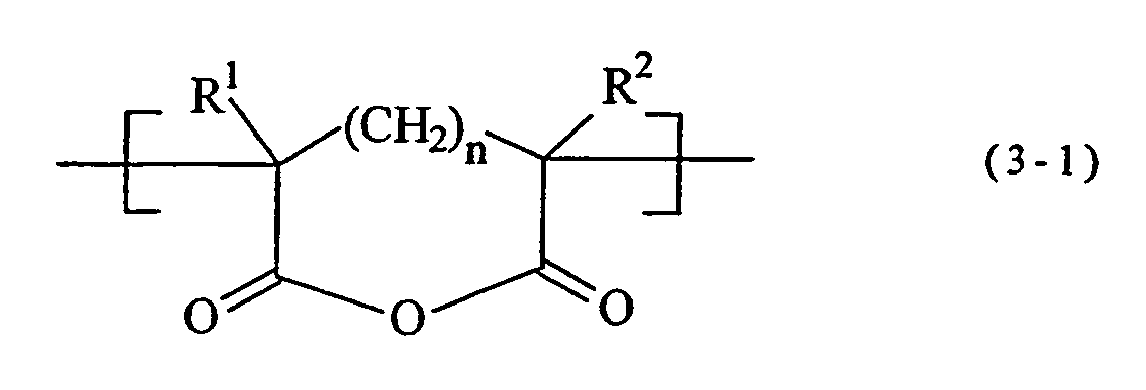 R1 and R2 may be the same or different and each represent a hydrogen atom, an alkyl group or other organic groups, and n represents 0 or an integer of 1 or more;wherein
 R1, R2 and n have the same meanings as defined above;wherein
 R3 and R4 may be the same or different and each represent a hydrogen atom, a carboxyl group, an alkyl group or other organic groups, and Y represents a hydrogen atom, a substituted or non-substituted alkoxyl group, a substituted or non-substituted alkyl group, a halogen atom, -CN, an alkylcarbonyloxy group, an imide group, a substituted or non-substituted carbamoyl group, a substituted carbonyl group, a substituted or non-substituted oxycarbonyl group or a substituted or non-substituted phenyl group;wherein
Ar-OH (4)
Ar represents an organic chromophore. - A radiation absorbing polymer comprising at least a recurring unit represented by formula 1, a recurring unit represented by formula 2 and a recurring unit represented by formula 5 or 6:
 R1 and R2 may be the same or different and each represent a hydrogen atom, an alkyl group or other organic groups, Ar represents an organic chromophore, and n represents 0 or an integer of 1 or more;wherein
 R3 and R4 may be the same or different and each represent a hydrogen atom, a carboxyl group, an alkyl group or other organic groups, and Y represents a hydrogen atom, a substituted or non-substituted alkoxyl group, a substituted or non-substituted alkyl group, a halogen atom, -CN, an alkylcarbonyloxy group, an imide group, a substituted or non-substituted carbamoyl group, a substituted carbonyl group, a substituted or non-substituted oxycarbonyl group or a substituted or non-substituted phenyl group;wherein
 R1, R2 and n have the same meanings as defined above, Ar2 represents an organic chromophore bonded to X via an oxygen atom, a. nitrogen atom or a sulfer atom as necessary, and X represents a direct bond, a methylene group or a linear, branched or cyclic alkylene group containing at least 2 carbon atoms;wherein
 R1, R2, Ar2, X and n have the same meanings as defined above.
 - A method of preparing a polymer described in claim 3 by reacting a radiation absorbing polymer comprising at least a recurring unit represented by formula 1, a recurring unit represented by formula 2 and a recurring unit represented by formula 3-1 or 3-2 with an aromatic compound containing an amino group represented by formula 7:
 R1 and R2 may be the same or different and each represent a hydrogen atom, an alkyl group or other organic groups, Ar represents an organic chromophore, and n represents 0 or an integer of 1 or more;wherein
 R3 and R4 may be the same or different and each represent a hydrogen atom, a carboxyl group, an alkyl group or other organic groups, and Y represents a hydrogen atom, a substituted or non-substituted alkoxyl group, a substituted or non-substituted alkyl group, a halogen atom, -CN, an alkylcarbonyloxy group, an imide group, a substituted or non-substituted carbamoyl group, a substituted carbonyl group, a substituted or non-substituted oxycarbonyl group or a substituted or non-substituted phenyl group;wherein
 R1, R2 and n have the same meanings as defined above;wherein
 R1, R2 and n have the same meanings as defined above,wherein
Ar2-X-NH2 (7)
Ar2 represents an organic chromophore bonded to X via an oxygen atom, a nitrogen atom or a sulfur atom as necessary, and X represents a direct bond, a methylene group, or a linear, branched or cyclic alkylene group containing at least 2 carbon atoms. - The method of preparing a radiation absorbing polymer described in claim 2, wherein the compound containing a hydroxyl group represented by formula 4 is a compound represented by formula 8, 9 or 10:
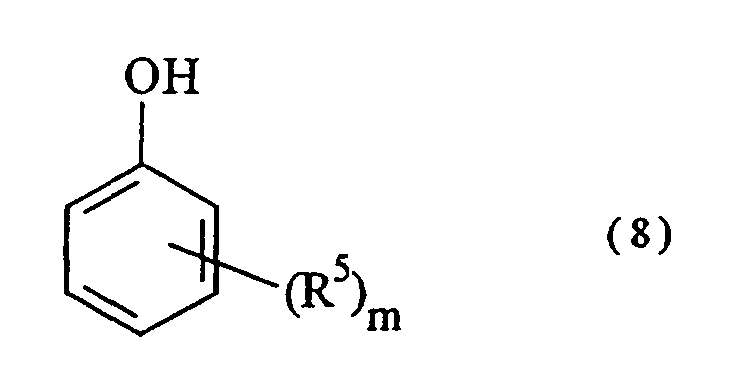 R5 represents an alkyl group, an alkoxyl group, a nitro group or other organic groups and when a plurality of R5 groups are present on the ring, these groups may be the same or different, and m represents 0 or an integer of 1 to 5;wherein
 R6 represents an alkyl group, an alkoxyl group, a nitro group or other organic groups and when a plurality of R6 groups are present on the ring, these groups may be the same or different, and p represents 0 or an integer of 1 to 7;wherein
 R7 represents an alkyl group, an alkoxyl group, a nitro group or other organic groups and when a plurality of R7 groups are present on the ring, these groups may be the same or different, and q represents 0 or an integer of 1 to 9.
 - The method of preparing a radiation absorbing polymer described in claim 4, wherein the aromatic compound containing an amino group represented by formula 7 is a compound represented by formula 11:
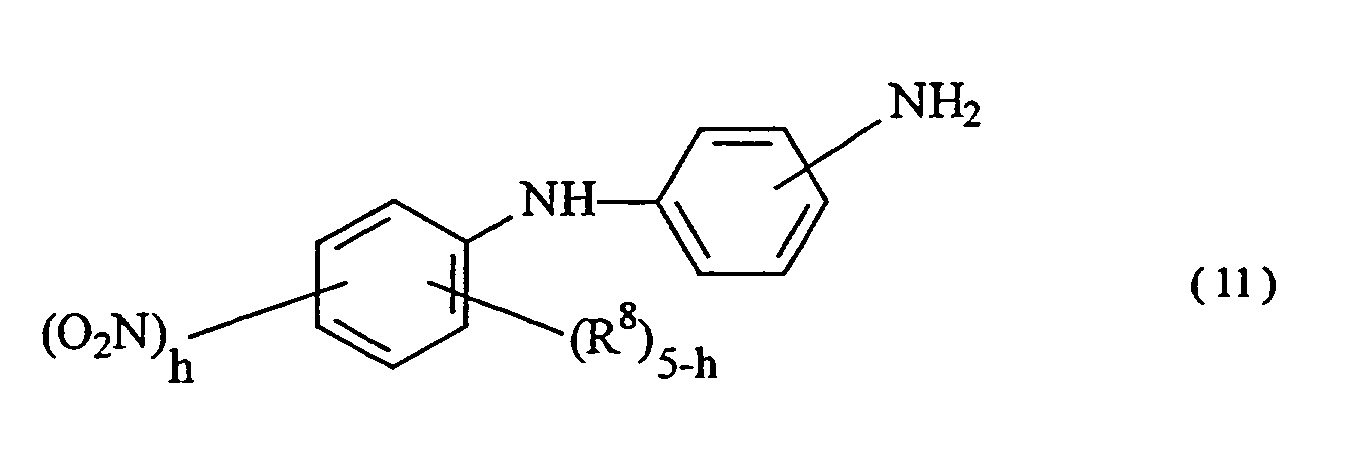 R8 represents a hydrogen atom, a halogen atom, a hydroxyl group, an amino group, a sulfonic acid group or other organic groups and when a plurality of R8 groups are present on the ring, these groups may be the same or different, or R8 groups may be combined with one another to form an aliphatic or aromatic ring, and h is an integer of 1 to 4.
 - A film forming composition containing a radiation absorbing polymer described in claim 1 and/or a radiation absorbing polymer described in claim 3.
- An anti-reflective coating containing a radiation absorbing polymer described in claim 1 and/or a radiation absorbing polymer described in claim 3.
Applications Claiming Priority (3)
| Application Number | Priority Date | Filing Date | Title |
|---|---|---|---|
| JP6662698 | 1998-03-17 | ||
| JP06662698A JP4165922B2 (en) | 1998-03-17 | 1998-03-17 | Light-absorbing polymer and its application to antireflection film |
| PCT/JP1999/001244 WO1999047571A1 (en) | 1998-03-17 | 1999-03-15 | Light-absorbing polymers and application thereof to antireflection film |
Publications (3)
| Publication Number | Publication Date |
|---|---|
| EP0982320A1 EP0982320A1 (en) | 2000-03-01 |
| EP0982320A4 EP0982320A4 (en) | 2004-12-08 |
| EP0982320B1 true EP0982320B1 (en) | 2006-08-09 |
Family
ID=13321302
Family Applications (1)
| Application Number | Title | Priority Date | Filing Date |
|---|---|---|---|
| EP99907928A Expired - Lifetime EP0982320B1 (en) | 1998-03-17 | 1999-03-15 | Light-absorbing polymers and application thereof to antireflection film |
Country Status (8)
| Country | Link |
|---|---|
| US (1) | US6255405B1 (en) |
| EP (1) | EP0982320B1 (en) |
| JP (1) | JP4165922B2 (en) |
| KR (1) | KR20010012648A (en) |
| CN (1) | CN1111547C (en) |
| DE (1) | DE69932676T2 (en) |
| TW (1) | TW408251B (en) |
| WO (1) | WO1999047571A1 (en) |
Families Citing this family (20)
| Publication number | Priority date | Publication date | Assignee | Title |
|---|---|---|---|---|
| KR100687851B1 (en) * | 2000-06-30 | 2007-02-27 | 주식회사 하이닉스반도체 | Organic anti-reflective coating material and preparation thereof |
| JP3509760B2 (en) * | 2001-02-08 | 2004-03-22 | 株式会社半導体先端テクノロジーズ | Method for manufacturing semiconductor device |
| US6927266B2 (en) * | 2001-02-22 | 2005-08-09 | Nissan Chemical Industries, Ltd. | Bottom anti-reflective coat forming composition for lithography |
| US6893684B2 (en) * | 2001-06-05 | 2005-05-17 | Brewer Science Inc. | Anti-reflective coating compositions for use with low k dielectric materials |
| TW591341B (en) * | 2001-09-26 | 2004-06-11 | Shipley Co Llc | Coating compositions for use with an overcoated photoresist |
| JP4798938B2 (en) * | 2003-04-11 | 2011-10-19 | ローム・アンド・ハース・エレクトロニック・マテリアルズ,エル.エル.シー. | Photoresist system |
| US20060246279A1 (en) * | 2003-04-25 | 2006-11-02 | Masakatsu Urairi | Method of producing laser-processed product and adhesive sheet, for laser processing used therefor |
| ATE553638T1 (en) * | 2003-12-25 | 2012-04-15 | Nitto Denko Corp | METHOD FOR PRODUCING WORKPIECES BY LASER |
| JP4854061B2 (en) | 2005-01-14 | 2012-01-11 | 日東電工株式会社 | Manufacturing method of laser processed product and protective sheet for laser processing |
| JP4873863B2 (en) * | 2005-01-14 | 2012-02-08 | 日東電工株式会社 | Manufacturing method of laser processed product and pressure-sensitive adhesive sheet for laser processing |
| EP1829942B1 (en) * | 2006-02-28 | 2012-09-26 | Rohm and Haas Electronic Materials, L.L.C. | Coating compositions for use with an overcoated photoresist |
| US20080251958A1 (en) * | 2006-10-31 | 2008-10-16 | Molock Frank F | Light absorbing prepolymers for use in tinted contact lenses and methods for their production |
| KR100886314B1 (en) * | 2007-06-25 | 2009-03-04 | 금호석유화학 주식회사 | Copolymer for organic anti-reflective coating and Oil-based anti-reflective coating composition comprising same |
| IT1392389B1 (en) * | 2008-12-19 | 2012-03-02 | Eni Spa | IMMIDIZED POLYMERS CONTAINING LUMINESCENT GROUPS AND METHOD FOR THEIR OBJECTION |
| US8557226B2 (en) * | 2009-01-16 | 2013-10-15 | Isp Investments Inc. | Performance-boosting UV-absorbing compounds |
| US9044623B2 (en) * | 2009-01-27 | 2015-06-02 | Isp Investments Inc. | Polymer-bound UV absorbers in personal care compositions |
| KR101301464B1 (en) * | 2011-04-26 | 2013-08-29 | 금호석유화학 주식회사 | Copolymer for organic antireflective layer, monomer and composition comprising the copolymer |
| CN103054093B (en) * | 2012-12-27 | 2014-01-01 | 中国计量学院 | Sargassum fusiforme arsenic removal process |
| WO2014149390A1 (en) | 2013-03-15 | 2014-09-25 | Isp Investments Inc. | Uv-absorbing polymers and formulations thereof |
| KR102662122B1 (en) * | 2016-06-01 | 2024-04-30 | 주식회사 동진쎄미켐 | Composition for forming organic anti-reflective coating layer suitable for negative tone development |
Family Cites Families (9)
| Publication number | Priority date | Publication date | Assignee | Title |
|---|---|---|---|---|
| US3597468A (en) * | 1965-09-06 | 1971-08-03 | Oreal | Colored amine reacted polymers |
| DE2150691C2 (en) * | 1971-10-12 | 1982-09-09 | Basf Ag, 6700 Ludwigshafen | Photosensitive mixture and use of a photosensitive mixture for the production of a planographic printing plate |
| US5294680A (en) * | 1992-07-24 | 1994-03-15 | International Business Machines Corporation | Polymeric dyes for antireflective coatings |
| US5576359A (en) | 1993-07-20 | 1996-11-19 | Wako Pure Chemical Industries, Ltd. | Deep ultraviolet absorbent composition |
| JP3268949B2 (en) * | 1993-07-20 | 2002-03-25 | 和光純薬工業株式会社 | Far-ultraviolet light absorbing material and pattern forming method using the same |
| US5731385A (en) * | 1993-12-16 | 1998-03-24 | International Business Machines Corporation | Polymeric dyes for antireflective coatings |
| JPH07268036A (en) * | 1994-03-30 | 1995-10-17 | Sumitomo Chem Co Ltd | Translucent plastic filter with heat resistance |
| CN1150219C (en) * | 1996-09-18 | 2004-05-19 | 克拉瑞特金融(Bvi)有限公司 | Radiation absorbing polymer, film forming composition and anti-reflective coating containing the same |
| JPH10199789A (en) * | 1997-01-10 | 1998-07-31 | Sony Corp | Antireflection film and patterning method |
-
1998
- 1998-03-17 JP JP06662698A patent/JP4165922B2/en not_active Expired - Lifetime
-
1999
- 1999-03-15 KR KR1019997010609A patent/KR20010012648A/en not_active Ceased
- 1999-03-15 TW TW088103932A patent/TW408251B/en not_active IP Right Cessation
- 1999-03-15 DE DE69932676T patent/DE69932676T2/en not_active Expired - Lifetime
- 1999-03-15 WO PCT/JP1999/001244 patent/WO1999047571A1/en not_active Ceased
- 1999-03-15 CN CN99800304A patent/CN1111547C/en not_active Expired - Lifetime
- 1999-03-15 US US09/424,128 patent/US6255405B1/en not_active Expired - Lifetime
- 1999-03-15 EP EP99907928A patent/EP0982320B1/en not_active Expired - Lifetime
Also Published As
| Publication number | Publication date |
|---|---|
| KR20010012648A (en) | 2001-02-26 |
| WO1999047571A1 (en) | 1999-09-23 |
| JP4165922B2 (en) | 2008-10-15 |
| TW408251B (en) | 2000-10-11 |
| DE69932676T2 (en) | 2007-08-16 |
| CN1258302A (en) | 2000-06-28 |
| CN1111547C (en) | 2003-06-18 |
| JPH11263806A (en) | 1999-09-28 |
| EP0982320A1 (en) | 2000-03-01 |
| US6255405B1 (en) | 2001-07-03 |
| DE69932676D1 (en) | 2006-09-21 |
| EP0982320A4 (en) | 2004-12-08 |
Similar Documents
| Publication | Publication Date | Title |
|---|---|---|
| US6255405B1 (en) | Light-absorbing polymers and application thereof to anti-reflection film | |
| EP0942331B1 (en) | Antireflection or light-absorbing coating composition and polymer therefor | |
| TWI407259B (en) | Positive photoimageable bottom anti-reflective coating | |
| JP5681336B2 (en) | Block isocyanate compound-containing antireflection film-forming composition and antireflection film formed thereby | |
| EP0978015B1 (en) | Light absorbing polymers | |
| JP5613950B2 (en) | Anti-reflective coating composition for photoresist | |
| US5994430A (en) | Antireflective coating compositions for photoresist compositions and use thereof | |
| EP1563343B1 (en) | Antireflective compositions for photoresists | |
| US6468718B1 (en) | Radiation absorbing polymer, composition for radiation absorbing coating, radiation absorbing coating and application thereof as anti-reflective coating | |
| EP0916683B1 (en) | Light-absorbing polymer, composition forming light-absorbing coatings, light-absorbing coatings, and antireflection coating made by using the same | |
| JP4145959B2 (en) | Light-absorbing polymer, synthesis method thereof, film-forming composition using the polymer, and antireflection film | |
| JPWO1998012238A1 (en) | Light-absorbing polymer, synthesis method thereof, film-forming composition using said polymer, and anti-reflective film | |
| KR20020002908A (en) | Organic anti-reflective coating material and preparation thereof |
Legal Events
| Date | Code | Title | Description |
|---|---|---|---|
| PUAI | Public reference made under article 153(3) epc to a published international application that has entered the european phase |
Free format text: ORIGINAL CODE: 0009012 |
|
| AK | Designated contracting states |
Kind code of ref document: A1 Designated state(s): DE FR GB IT |
|
| 17P | Request for examination filed |
Effective date: 20000323 |
|
| A4 | Supplementary search report drawn up and despatched |
Effective date: 20041021 |
|
| RAP1 | Party data changed (applicant data changed or rights of an application transferred) |
Owner name: AZ ELECTRONIC MATERIALS USA CORP. |
|
| 17Q | First examination report despatched |
Effective date: 20050610 |
|
| GRAP | Despatch of communication of intention to grant a patent |
Free format text: ORIGINAL CODE: EPIDOSNIGR1 |
|
| GRAS | Grant fee paid |
Free format text: ORIGINAL CODE: EPIDOSNIGR3 |
|
| GRAA | (expected) grant |
Free format text: ORIGINAL CODE: 0009210 |
|
| AK | Designated contracting states |
Kind code of ref document: B1 Designated state(s): DE FR GB IT |
|
| PG25 | Lapsed in a contracting state [announced via postgrant information from national office to epo] |
Ref country code: IT Free format text: LAPSE BECAUSE OF FAILURE TO SUBMIT A TRANSLATION OF THE DESCRIPTION OR TO PAY THE FEE WITHIN THE PRESCRIBED TIME-LIMIT;WARNING: LAPSES OF ITALIAN PATENTS WITH EFFECTIVE DATE BEFORE 2007 MAY HAVE OCCURRED AT ANY TIME BEFORE 2007. THE CORRECT EFFECTIVE DATE MAY BE DIFFERENT FROM THE ONE RECORDED. Effective date: 20060809 |
|
| REG | Reference to a national code |
Ref country code: GB Ref legal event code: FG4D |
|
| REF | Corresponds to: |
Ref document number: 69932676 Country of ref document: DE Date of ref document: 20060921 Kind code of ref document: P |
|
| EN | Fr: translation not filed | ||
| PLBE | No opposition filed within time limit |
Free format text: ORIGINAL CODE: 0009261 |
|
| STAA | Information on the status of an ep patent application or granted ep patent |
Free format text: STATUS: NO OPPOSITION FILED WITHIN TIME LIMIT |
|
| 26N | No opposition filed |
Effective date: 20070510 |
|
| PG25 | Lapsed in a contracting state [announced via postgrant information from national office to epo] |
Ref country code: FR Free format text: LAPSE BECAUSE OF FAILURE TO SUBMIT A TRANSLATION OF THE DESCRIPTION OR TO PAY THE FEE WITHIN THE PRESCRIBED TIME-LIMIT Effective date: 20070511 |
|
| PG25 | Lapsed in a contracting state [announced via postgrant information from national office to epo] |
Ref country code: FR Free format text: LAPSE BECAUSE OF FAILURE TO SUBMIT A TRANSLATION OF THE DESCRIPTION OR TO PAY THE FEE WITHIN THE PRESCRIBED TIME-LIMIT Effective date: 20060809 |
|
| REG | Reference to a national code |
Ref country code: DE Ref legal event code: R082 Ref document number: 69932676 Country of ref document: DE Representative=s name: PATENTANWAELTE ISENBRUCK BOESL HOERSCHLER LLP, DE |
|
| REG | Reference to a national code |
Ref country code: GB Ref legal event code: 732E Free format text: REGISTERED BETWEEN 20150205 AND 20150211 |
|
| REG | Reference to a national code |
Ref country code: DE Ref legal event code: R082 Ref document number: 69932676 Country of ref document: DE Representative=s name: PATENTANWAELTE ISENBRUCK BOESL HOERSCHLER LLP, DE Effective date: 20150223 Ref country code: DE Ref legal event code: R081 Ref document number: 69932676 Country of ref document: DE Owner name: MERCK PATENT GMBH, DE Free format text: FORMER OWNER: AZ ELECTRONIC MATERIALS USA CORP., SOMERVILLE, N.J., US Effective date: 20150223 |
|
| PGFP | Annual fee paid to national office [announced via postgrant information from national office to epo] |
Ref country code: GB Payment date: 20180314 Year of fee payment: 20 Ref country code: DE Payment date: 20180227 Year of fee payment: 20 |
|
| REG | Reference to a national code |
Ref country code: DE Ref legal event code: R071 Ref document number: 69932676 Country of ref document: DE |
|
| REG | Reference to a national code |
Ref country code: GB Ref legal event code: PE20 Expiry date: 20190314 |
|
| PG25 | Lapsed in a contracting state [announced via postgrant information from national office to epo] |
Ref country code: GB Free format text: LAPSE BECAUSE OF EXPIRATION OF PROTECTION Effective date: 20190314 |