EP0981653B1 - Method of improving fracture toughness in aluminum-lithium alloys - Google Patents
Method of improving fracture toughness in aluminum-lithium alloys Download PDFInfo
- Publication number
- EP0981653B1 EP0981653B1 EP98903777A EP98903777A EP0981653B1 EP 0981653 B1 EP0981653 B1 EP 0981653B1 EP 98903777 A EP98903777 A EP 98903777A EP 98903777 A EP98903777 A EP 98903777A EP 0981653 B1 EP0981653 B1 EP 0981653B1
- Authority
- EP
- European Patent Office
- Prior art keywords
- weight
- aluminum
- fracture toughness
- lithium
- aluminum alloy
- Prior art date
- Legal status (The legal status is an assumption and is not a legal conclusion. Google has not performed a legal analysis and makes no representation as to the accuracy of the status listed.)
- Expired - Lifetime
Links
- 229910001148 Al-Li alloy Inorganic materials 0.000 title claims abstract description 31
- JFBZPFYRPYOZCQ-UHFFFAOYSA-N [Li].[Al] Chemical compound [Li].[Al] JFBZPFYRPYOZCQ-UHFFFAOYSA-N 0.000 title claims abstract description 31
- 239000001989 lithium alloy Substances 0.000 title claims abstract description 27
- 238000000034 method Methods 0.000 title claims description 12
- WHXSMMKQMYFTQS-UHFFFAOYSA-N Lithium Chemical compound [Li] WHXSMMKQMYFTQS-UHFFFAOYSA-N 0.000 claims abstract description 22
- 229910052744 lithium Inorganic materials 0.000 claims abstract description 22
- RYGMFSIKBFXOCR-UHFFFAOYSA-N Copper Chemical compound [Cu] RYGMFSIKBFXOCR-UHFFFAOYSA-N 0.000 claims abstract description 15
- 229910052802 copper Inorganic materials 0.000 claims abstract description 15
- 239000010949 copper Substances 0.000 claims abstract description 15
- QCWXUUIWCKQGHC-UHFFFAOYSA-N Zirconium Chemical compound [Zr] QCWXUUIWCKQGHC-UHFFFAOYSA-N 0.000 claims abstract description 10
- 229910052726 zirconium Inorganic materials 0.000 claims abstract description 10
- 229910000838 Al alloy Inorganic materials 0.000 claims description 26
- 230000032683 aging Effects 0.000 claims description 18
- 239000012535 impurity Substances 0.000 claims description 15
- 229910052782 aluminium Inorganic materials 0.000 claims description 13
- XAGFODPZIPBFFR-UHFFFAOYSA-N aluminium Chemical compound [Al] XAGFODPZIPBFFR-UHFFFAOYSA-N 0.000 claims description 13
- 238000000265 homogenisation Methods 0.000 claims description 9
- 239000011777 magnesium Substances 0.000 claims description 9
- 239000011701 zinc Substances 0.000 claims description 9
- FYYHWMGAXLPEAU-UHFFFAOYSA-N Magnesium Chemical compound [Mg] FYYHWMGAXLPEAU-UHFFFAOYSA-N 0.000 claims description 8
- HCHKCACWOHOZIP-UHFFFAOYSA-N Zinc Chemical compound [Zn] HCHKCACWOHOZIP-UHFFFAOYSA-N 0.000 claims description 8
- 229910052749 magnesium Inorganic materials 0.000 claims description 8
- 229910052725 zinc Inorganic materials 0.000 claims description 8
- WPBNNNQJVZRUHP-UHFFFAOYSA-L manganese(2+);methyl n-[[2-(methoxycarbonylcarbamothioylamino)phenyl]carbamothioyl]carbamate;n-[2-(sulfidocarbothioylamino)ethyl]carbamodithioate Chemical compound [Mn+2].[S-]C(=S)NCCNC([S-])=S.COC(=O)NC(=S)NC1=CC=CC=C1NC(=S)NC(=O)OC WPBNNNQJVZRUHP-UHFFFAOYSA-L 0.000 claims description 7
- 238000010791 quenching Methods 0.000 claims description 6
- 230000000171 quenching effect Effects 0.000 claims description 6
- 238000005266 casting Methods 0.000 claims description 5
- 238000005482 strain hardening Methods 0.000 claims description 5
- ZOXJGFHDIHLPTG-UHFFFAOYSA-N Boron Chemical compound [B] ZOXJGFHDIHLPTG-UHFFFAOYSA-N 0.000 claims description 4
- VYZAMTAEIAYCRO-UHFFFAOYSA-N Chromium Chemical compound [Cr] VYZAMTAEIAYCRO-UHFFFAOYSA-N 0.000 claims description 4
- RTAQQCXQSZGOHL-UHFFFAOYSA-N Titanium Chemical compound [Ti] RTAQQCXQSZGOHL-UHFFFAOYSA-N 0.000 claims description 4
- 229910052796 boron Inorganic materials 0.000 claims description 4
- 229910052804 chromium Inorganic materials 0.000 claims description 4
- 239000011651 chromium Substances 0.000 claims description 4
- 229910052735 hafnium Inorganic materials 0.000 claims description 4
- VBJZVLUMGGDVMO-UHFFFAOYSA-N hafnium atom Chemical compound [Hf] VBJZVLUMGGDVMO-UHFFFAOYSA-N 0.000 claims description 4
- 229910052706 scandium Inorganic materials 0.000 claims description 4
- SIXSYDAISGFNSX-UHFFFAOYSA-N scandium atom Chemical compound [Sc] SIXSYDAISGFNSX-UHFFFAOYSA-N 0.000 claims description 4
- 239000010936 titanium Substances 0.000 claims description 4
- 229910052719 titanium Inorganic materials 0.000 claims description 4
- 229910052720 vanadium Inorganic materials 0.000 claims description 4
- LEONUFNNVUYDNQ-UHFFFAOYSA-N vanadium atom Chemical compound [V] LEONUFNNVUYDNQ-UHFFFAOYSA-N 0.000 claims description 4
- 238000004519 manufacturing process Methods 0.000 claims description 3
- 239000011572 manganese Substances 0.000 abstract description 15
- PWHULOQIROXLJO-UHFFFAOYSA-N Manganese Chemical compound [Mn] PWHULOQIROXLJO-UHFFFAOYSA-N 0.000 abstract description 6
- 229910052748 manganese Inorganic materials 0.000 abstract description 6
- 229910045601 alloy Inorganic materials 0.000 description 19
- 239000000956 alloy Substances 0.000 description 19
- 238000009864 tensile test Methods 0.000 description 16
- 230000006872 improvement Effects 0.000 description 10
- XLYOFNOQVPJJNP-UHFFFAOYSA-N water Substances O XLYOFNOQVPJJNP-UHFFFAOYSA-N 0.000 description 10
- 239000000203 mixture Substances 0.000 description 9
- 239000000047 product Substances 0.000 description 9
- 238000012360 testing method Methods 0.000 description 9
- 239000004288 Sodium dehydroacetate Substances 0.000 description 8
- 230000008901 benefit Effects 0.000 description 6
- 238000005275 alloying Methods 0.000 description 3
- 230000009286 beneficial effect Effects 0.000 description 3
- 239000000463 material Substances 0.000 description 3
- 229910052751 metal Inorganic materials 0.000 description 3
- 239000002184 metal Substances 0.000 description 3
- 239000002244 precipitate Substances 0.000 description 3
- 238000007670 refining Methods 0.000 description 3
- 230000002411 adverse Effects 0.000 description 2
- 230000007797 corrosion Effects 0.000 description 2
- 238000005260 corrosion Methods 0.000 description 2
- 238000005336 cracking Methods 0.000 description 2
- 230000003247 decreasing effect Effects 0.000 description 2
- 239000002245 particle Substances 0.000 description 2
- 230000009467 reduction Effects 0.000 description 2
- 230000035882 stress Effects 0.000 description 2
- 239000000126 substance Substances 0.000 description 2
- 229910016343 Al2Cu Inorganic materials 0.000 description 1
- 238000001816 cooling Methods 0.000 description 1
- 230000001747 exhibiting effect Effects 0.000 description 1
- 238000001125 extrusion Methods 0.000 description 1
- 238000005242 forging Methods 0.000 description 1
- 150000002739 metals Chemical class 0.000 description 1
- 238000001556 precipitation Methods 0.000 description 1
- 230000008569 process Effects 0.000 description 1
- 230000004044 response Effects 0.000 description 1
- 238000005096 rolling process Methods 0.000 description 1
- 229910052709 silver Inorganic materials 0.000 description 1
- 239000004332 silver Substances 0.000 description 1
- 238000005728 strengthening Methods 0.000 description 1
- 238000010998 test method Methods 0.000 description 1
Images

Classifications
-
- C—CHEMISTRY; METALLURGY
- C22—METALLURGY; FERROUS OR NON-FERROUS ALLOYS; TREATMENT OF ALLOYS OR NON-FERROUS METALS
- C22C—ALLOYS
- C22C21/00—Alloys based on aluminium
- C22C21/12—Alloys based on aluminium with copper as the next major constituent
-
- C—CHEMISTRY; METALLURGY
- C22—METALLURGY; FERROUS OR NON-FERROUS ALLOYS; TREATMENT OF ALLOYS OR NON-FERROUS METALS
- C22F—CHANGING THE PHYSICAL STRUCTURE OF NON-FERROUS METALS AND NON-FERROUS ALLOYS
- C22F1/00—Changing the physical structure of non-ferrous metals or alloys by heat treatment or by hot or cold working
- C22F1/04—Changing the physical structure of non-ferrous metals or alloys by heat treatment or by hot or cold working of aluminium or alloys based thereon
- C22F1/057—Changing the physical structure of non-ferrous metals or alloys by heat treatment or by hot or cold working of aluminium or alloys based thereon of alloys with copper as the next major constituent
Definitions
- the present invention is directed to a method of improving the fracture toughness in the short longitudinal direction in aluminum-lithium alloys and a product therefrom and, in particular, to a method which controls the levels of copper, manganese, lithium, and zirconium in the alloys to obtain the improved fracture toughness.
- Aluminum-lithium alloys exhibit improvements in stiffness and strength while reducing density. Consequently, these types of alloys have utility as structural materials in airplane and aerospace applications. Examples of known aluminum-lithium alloys include AA2097 and AA2197. The chemical compositions of these alloys are shown in Table 1 below.
- Toughness values in this direction tend to be significantly lower than toughness values in other directions such as the longitudinal (L-T) direction or the long transverse (T-L) direction.
- US-A-4 648 913 discloses a process for producing an aluminum alloy including the processing steps of casting, homogenizing, hot working, solution heat treating, quenching, optionally stretching and finally aging to obtain an improved fracture toughness alloy, which contains 0.5 to 4 % Lithium, preferably 2.0 to 3.0 % lithium.
- the present invention provides both a method and a product therefrom which significantly increases the fracture toughness of aluminum-lithium alloys in the short longitudinal (S-L) direction, thereby improving their suitability for more commercial applications.
- a first object of the invention is to improve the fracture toughness in the short longitudinal (S-L) direction of aluminum-lithium alloys.
- Another object of the invention is to provide a method of making an aluminum-lithium alloy having improved short longitudinal direction fracture toughness.
- a still further object of the present invention is to utilize an aluminum-lithium alloy having controlled amounts of copper, lithium, manganese, zinc and zirconium to achieve fracture toughness improvements.
- Yet another object of the present invention is to provide an aluminum-lithium alloy product having both improved fracture toughness in the short longitudinal (S-L) direction and acceptable strength in the short transverse direction.
- the present invention provides a method for improving the fracture toughness in the short longitudinal (S-L) direction in an aluminum-lithium alloy article comprising the steps of providing an aluminum alloy consisting of, in weight percent all subsequent alloying levels are weight percent unless otherwise indicated): 2.7 to 3.0% copper, 1.2% to less than 1.3% lithium, 0.30 to 0.32% manganese, 0.04 to 0.18% zirconium, with the balance aluminum and inevitable impurities.
- the aluminum alloy can also include grain refining elements such as at least one of boron, titanium, vanadium, manganese, hafnium, scandium and chromium.
- the aluminum alloy has only impurity levels of zinc so that it is essentially zinc-free, e.g., less than 0.05 weight percent zinc, more preferably less than or equal to 0.02%.
- the lithium content is preferably controlled between about 1.2 to 1.28 weight percent to provide a low density product with good fracture toughness in the short longitudinal direction.
- Manganese is between 0.30 and 0.32 weight percent, with zirconium being about 0.10 weight percent. It should be appreciated that the amounts of alloying elements, other than the amounts of lithium and copper, can be within the ranges described in the preceding paragraph.
- This composition provides higher combined properties of fracture toughness and strength, with slightly higher density.
- additional theta' precipitate particles Al 2 Cu
- T 1 precipitate particles Al 2 CuLi
- Magnesium can be added if desired, in an amount up to 0.35% weight percent, preferably, up to 0.25 weight percent. Small amounts of magnesium may be beneficial in terms of strength and lowering of density. However, excessive amounts may create susceptibility to stress corrosion cracking and do not provide further benefits in terms of strength and density reduction.
- the aluminum alloy is cast into an ingot and homogenized for a select period of time.
- the homogenized ingot is then hot worked into a shape such as a plate and solution heat treated for a select period of time.
- the solution heat treated shape is then quenched, preferably in water, cold worked, preferably by stretching, and aged for a select period of time. With this processing, the cold worked (stretched) and aged shape exhibits equivalent strengths but higher fracture toughness in the short longitudinal (S-L) direction than similar aluminum alloys having lithium contents greater than 1.3%.
- the homogenization and solution heat treating temperatures can range between about (900° and 1030°F) 482 to 554°C, preferably between about (930° F) 499°C and (1000°F) 538°C. More preferably, homogenization temperatures will range between about (940°F) 505°C to (975°F) 524°C , and solution heat treating temperatures will range between about (975°F) 524°C to (1000°F) 538°C. The preferred temperature often depends on the particular alloy composition as will be understood by one skilled in the art. Homogenization times can be about 8 to 48 hours, preferably about 24 to about 36 hours.
- Solution heat treating times can range from about 1 to 10 hours, preferably about 1 hour to 6 hours, more preferably about 2 hours, once the metal reaches a desired temperature.
- the plate may be artificially aged without any cold work. However, it is preferred to provide between about 4% and 8% cold work, preferably by stretching.
- the plate is preferably artificially aged between about (300 and 350°F) 149 to 177°C for between about 4 and about 48 hours, preferably between about 12 and about 36 hours, with the aging .time being a function of the aging temperature.
- an aluminum-lithium alloy article is made having vastly improved fracture toughness in the short longitudinal (S-L) direction.
- the fracture toughness value in the short longitudinal (S-L) direction is at least about 68% of the fracture toughness in the long transverse (T-L) direction.
- the inventive aluminum-lithium alloy articles While exhibiting improved fracture toughness in the short longitudinal (S-L) direction, the inventive aluminum-lithium alloy articles have tensile yield strengths exceeding about (54 KSI) 372.3 MPa.
- the present invention solves a significant problem in the field of aluminum-lithium materials for structural applications such as those found in the aerospace and airplane industry. That is, by controlling the compositional amounts of copper, lithium, manganese and zirconium in these types of alloys, acceptable fracture toughness in the short longitudinal (S-L) direction with acceptable strength in the short transverse (ST) direction is obtained. This unexpected improvement in fracture toughness in the S-L direction permits the use of these types of alloys in a wide variety of structural applications requiring low weight, high strength and stiffness, and good fracture toughness.
- the alloy elements of copper, lithium, manganese and zirconium are controlled in the following ranges to achieve the improvements in fracture toughness: 2.7 to 3.0 weight percent copper, 1.2 to less than 1.3 weight percent lithium, 0.30 to 0.32 weight percent manganese, about 0.04 to 0.16 weight percent zirconium, with the balance aluminum and inevitable impurities.
- One or more grain refining elements can also be added to the aluminum-lithium composition described above.
- the grain refining elements can be selected from the group consisting of titanium in an amount up to 0.2 weight percent, boron in an amount of up to 0.2 weight percent, vanadium in an amount of up to 0.2 weight percent, hafnium in an amount up to 0.2 weight percent, scandium in an amount up to 0.5 weight percent, and chromium in an amount up to 0.3 weight percent.
- the aluminum is free of zinc.
- zinc is present only as an impurity and at levels less than 0.05 weight percent. It is believed that zinc in levels greater than such impurity level adversely affects the mechanical properties of these types of aluminum-lithium alloys.
- the manganese should be higher than 0.05 weight percent to control grain size and homogenous slip behavior during plastic deformation processing.
- the lithium content is controlled between 1.2 and less than 1.3 weight percent.
- the manganese is between 0.3 and 0.32 weight percent with the copper level ranging between about 2.7 and 3.0 weight percent.
- Magnesium can be added if desired, in an amount preferably up to 0.35% weight percent, preferably, up to 0.25 weight percent. Small amount of magnesium may be beneficial in terms of strength and lowering of density. However, excessive amounts may create susceptibility to stress corrosion cracking and do not provide further benefits in terms of strength and density reduction.
- the alloy is processed by the steps of casting, homogenizing, hot working (for instance, by rolling, forging, extruding and combinations thereof), solution heat treating, quenching, cold working (for instance by stretching) and aging to form an aluminum-lithium article having the improvements in fracture toughness in the S-L direction.
- the aluminum-lithium alloy described above is cast into an ingot, billet or other shape to provide suitable stock for the subsequent processing operations.
- the shape can be stress-relieved as is known in the art prior to homogenization.
- the cast shape is then homogenized at temperatures in the range of (930°F to 1,030°F) 499°C to 554.4°C, for a sufficient period of time to dissolve the soluble elements and homogenize the internal structure of the metal.
- a preferred homogenization residence time is in the range of 1 to 36 hours, while longer times do not normally adversely affect the article.
- the homogenization can be conducted at one temperature or in multiple steps utilizing several temperatures.
- the cast shape is then hot worked to produce stock such as sheet, plate, extrusions, or other stock material depending on the desired end use of the aluminum-lithium alloy article.
- stock such as sheet, plate, extrusions, or other stock material depending on the desired end use of the aluminum-lithium alloy article.
- an ingot having a rectangularly shaped cross section could be hot worked into a plate form. Since this hot working step is conventional in the art, a further description thereof is not deemed necessary for understanding of the invention.
- the hot worked shape is then solution heat treated and quenched.
- the hot worked shape is solution heat treated between (930° to 1030°F) 499° to 554°C at a time from less than an hour to up to several hours.
- This solution heat treated shape is preferably rapidly quenched, e.g. quenched in ambient temperature water, to prevent or minimize uncontrolled precipitation of strengthening phases in the alloy.
- the rapid quenching can also include a subsequent air cooling step, if desired.
- the quenched shape is then preferably stretched up to 8% and artificially aged in the temperature range of (150° to 400°F) 66° to 204°C for sufficient time to further increase the yield strength, e.g., up to 100 hours, depending on the temperature, for instance, 24 hours at (300°F) 149°C.
- the stretched and aged shape is then ready for use in any application, particularly an aerospace or airplane application. Alternatively, prior to aging, the shape may be formed into an article and then aged.
- each alloy may contain other elements, with the maximum amount of each other element not exceeding 0.05 wt. % and the total of other elements not exceeding 0.15 wt. %.
- An aluminum alloy consisting of, in weight percent, 2.84 Cu-1.36 Li-.32 Mn.-.1 Zr, the balance aluminum and impurities, was cast into an ingot with a cross section of (16") 406.4 mm and (45") 1143 mm wide.
- the ingot was homogenized at (950°F) 510°C for 36 hours, then hot worked to (4") 101.6 mm thick plate.
- the plate was then solution heat treated in a heat treating furnace at a temperature of (990°F) 532°C for 2 hours and then quenched in water.
- the plate was then stretched by 6% in the longitudinal direction at room temperature. For artificial aging, the stretched samples were aged in an oven at (320°F) 160°C for 24 hours.
- An aluminum alloy consisting of, in weight percent, 2.71 Cu-1.37 Li-.32 Mn.-.1 Zr, the balance aluminum and impurities, was cast into an ingot with a cross section of (16") 406.4 mm and (45") 1143 mm wide.
- the ingot was homogenized at (950°F) 510°C for 36 hours, then hot worked to (4") 101.6 mm thick plate.
- the plate was then solution heat treated in a heat treating furnace at a temperature of (990°F) 532°C for 2 hours and then quenched in water.
- the plate was then stretched by 6% in the longitudinal direction at room temperature. For artificial aging, the stretched samples were aged in an oven at (320°F) 160°C for 24 hours.
- An aluminum alloy consisting of, in weight percent, 2.77 Cu-1.33 Li-.32 Mn.-.11 Zr, the balance aluminum and impurities, was cast into an ingot with a cross section of (16") 406.4 mm and 45" 1143 mm. wide.
- the ingot was homogenized at (950°F) 510°C for 36 hours, then hot worked to (4") 101.6 mm thick plate.
- the plate was then solution heat treated in a heat treating furnace at a temperature of (990°F) 532°C for 2 hours and then quenched in water.
- the plate was then stretched by 6% in the longitudinal direction at room temperature. For artificial aging, the stretched samples were aged in an oven at (320°F) 160°C for 24 hours.
- An aluminum alloy consisting of, in weight percent, 2.89 Cu-1.36 Li-.32 Mn.-0.1 Zr, the balance aluminum and impurities, was cast into an ingot with a cross section of (16") 406.4 mm and (45") 1143 mm wide.
- the ingot was homogenized at (950°F) 510°C for 36 hours, then hot worked to (4") 101.6 mm thick plate.
- the plate was then solution heat treated in a heat treating furnace at a temperature of (990°F) 532°C for 2 hours and then quenched in water.
- the plate was then stretched by 6% in the longitudinal direction at room temperature. For artificial aging, the stretched samples were aged in an oven at (320°F) 160°C for 24 hours.
- An aluminum alloy consisting of, in weight percent, 2.78 Cu-1.21 Li-.31 Mn.-0.1 Zr, the balance aluminum and impurities, was cast into an ingot with a cross section of (16") 406.4 mm and 45" 1143 mm wide.
- the ingot was homogenized at (950°F) 510°C for 36 hours, then hot worked to (4") 101.6 mm thick plate.
- the plate was then solution heat treated in a heat treating furnace at a temperature of 990°F 532°C for 2 hours and then quenched in water.
- the plate was then stretched by 6% in the longitudinal direction at room temperature. For artificial aging, the stretched samples were aged in an oven at (320°F) 160°C for 24 hours.
- An aluminum alloy consisting of, in weight percent, 2.86 Cu-1.28 Li-.3 Mn.-0.1 Zr, the balance aluminum and impurities, was cast into an ingot with a cross section of (16") 406.4 mm and (45") 1143 mm wide.
- the ingot was homogenized at (950°F) 510°C for 36 hours, then hot worked to (4") 101.6 mm thick plate.
- the plate was then solution heat treated in a heat treating furnace at a temperature of (990°F) .532°C for 2 hours and then quenched in water.
- the plate was then stretched by 6% in the longitudinal direction at room temperature. For artificial aging, the stretched samples were aged in an oven at (320°F) 160°C for 24 hours.
- An aluminum alloy consisting of, in weight percent, 2.73 Cu-1.28 Li-.3 Mn.-0.1 Zr, the balance aluminum and impurities, was cast into an ingot with a cross section of (16") 406.4 mm and 45" 1143 mm wide.
- the ingot was homogenized at 950°F 510°C. for 36 hours, then hot worked to (4") 101.6 mm thick plate.
- the plate was then solution heat treated in a heat treating furnace at a temperature of (990°F) 532°C for 2 hours and then quenched in water.
- the plate was then stretched by 6% in the longitudinal direction at room temperature. For artificial aging, the stretched samples were aged in an oven at (320°F) 160°C for 24 hours.
- An aluminum alloy consisting of, in weight percent, 2.83 Cu-1.26 Li-.32 Mn.-0.11 Zr, the balance aluminum and impurities, was cast into an ingot with a cross section of (16") 406.4 mm and (45") 1143 mm wide.
- the ingot was homogenized at (950°F) 510°C for 36 hours, then hot worked to (4") 101.6 mm thick plate.
- the plate was then solution heat treated in a heat treating furnace at a temperature of (990°F) 532°C for 2 hours and then quenched in water.
- the plate was then stretched by 6% in the longitudinal direction at room temperature. For artificial aging, the stretched samples were aged in an oven at (320°F) 160°C for 24 hours.
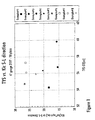
- Figure 1 correlates the fracture toughness values in Tables 2-9 in the S-L direction with tensile yield strengths in the S-T direction.
- Figure 1 shows that the articles made of the present invention provide significantly improved fracture toughness in the S-L direction while maintaining acceptable strength levels in the S-T direction.
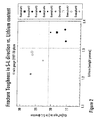
- Figure 2 illustrates the unexpected improvements in fracture toughness in the S-L direction over the prior art.
- the values depicted in Figure 2 demonstrate that the fracture toughness in the S-L direction for Examples 5-8 is vastly superior to that shown for Examples 1-4.
- This improvement, which relates to lithium content, is quite unexpected in view of the prior art.
- Figure 3 emphasizes the fact that the improvements in fracture toughness are related to the lithium content of the alloys.
- Figure 3 demonstrates that the fracture toughness does not vary widely with respect to copper content.
- the fracture toughness appears to remain relatively the same with increasing or decreasing amounts of copper.
- the fracture toughness of Examples 1-4 does not vary widely with increasing or decreasing copper content.
- the lithium content can be as low as 0.8 weight percent while still giving improvements in fracture toughness and maintaining the acceptable strength in the short transverse direction. It is further believed that the same results are obtainable when practicing the inventive processing in accordance with the broad processing variable ranges disclosed above.
Landscapes
- Chemical & Material Sciences (AREA)
- Organic Chemistry (AREA)
- Engineering & Computer Science (AREA)
- Materials Engineering (AREA)
- Mechanical Engineering (AREA)
- Metallurgy (AREA)
- Physics & Mathematics (AREA)
- Crystallography & Structural Chemistry (AREA)
- Thermal Sciences (AREA)
- Forging (AREA)
- Extrusion Of Metal (AREA)
- Battery Electrode And Active Subsutance (AREA)
- Materials For Medical Uses (AREA)
- Powder Metallurgy (AREA)
- Secondary Cells (AREA)
- Wire Bonding (AREA)
- Analysing Materials By The Use Of Radiation (AREA)
Abstract
Description
- This application claims the benefit of U.S. Provisional Application No. 60/036,329, filed January 31, 1997.
- The present invention is directed to a method of improving the fracture toughness in the short longitudinal direction in aluminum-lithium alloys and a product therefrom and, in particular, to a method which controls the levels of copper, manganese, lithium, and zirconium in the alloys to obtain the improved fracture toughness.
- It is well known that adding lithium as an alloying element to aluminum alloys results in beneficial mechanical properties. Aluminum-lithium alloys exhibit improvements in stiffness and strength while reducing density. Consequently, these types of alloys have utility as structural materials in airplane and aerospace applications. Examples of known aluminum-lithium alloys include AA2097 and AA2197. The chemical compositions of these alloys are shown in Table 1 below.
- Problems exist with aluminum-lithium alloys, particularly in thick plate of about(3 inches) 76.2 mm or greater, in terms of fracture toughness in the short longitudinal (S-L) direction. Toughness values in this direction tend to be significantly lower than toughness values in other directions such as the longitudinal (L-T) direction or the long transverse (T-L) direction.
- Metals & Alloys in the unified Numbering System, 7th Ed., Society of Automotive Engineers, USA, 1996, p.30 discloses a composition for a wrought and heat treatable aluminum alloy having 1.2 - 1.8 % lithium.
- US-A-4 648 913 discloses a process for producing an aluminum alloy including the processing steps of casting, homogenizing, hot working, solution heat treating, quenching, optionally stretching and finally aging to obtain an improved fracture toughness alloy, which contains 0.5 to 4 % Lithium, preferably 2.0 to 3.0 % lithium.
- F. W. Gayle et al., Aluminum-Lithium, ed. by M. Peters and P.-J. Winkler, DGM, 1992, p.203-208 discloses a production method for an aluminum alloy including 0.4 % silver and 1 % lithium.
- In view of the drawbacks in aluminum-lithium alloys with respect to fracture toughness, a need has developed to provide a method of improving the short longitudinal (S-L) direction fracture toughness for these types of alloys. In response to this need, the present invention provides both a method and a product therefrom which significantly increases the fracture toughness of aluminum-lithium alloys in the short longitudinal (S-L) direction, thereby improving their suitability for more commercial applications.
- A first object of the invention is to improve the fracture toughness in the short longitudinal (S-L) direction of aluminum-lithium alloys.
- Another object of the invention is to provide a method of making an aluminum-lithium alloy having improved short longitudinal direction fracture toughness.
- A still further object of the present invention is to utilize an aluminum-lithium alloy having controlled amounts of copper, lithium, manganese, zinc and zirconium to achieve fracture toughness improvements.
- Yet another object of the present invention is to provide an aluminum-lithium alloy product having both improved fracture toughness in the short longitudinal (S-L) direction and acceptable strength in the short transverse direction.
- Other objects and advantages of the present invention will become apparent as a description thereof proceeds.
- In satisfaction of the foregoing objects and advantages, the present invention provides a method for improving the fracture toughness in the short longitudinal (S-L) direction in an aluminum-lithium alloy article comprising the steps of providing an aluminum alloy consisting of, in weight percent all subsequent alloying levels are weight percent unless otherwise indicated): 2.7 to 3.0% copper, 1.2% to less than 1.3% lithium, 0.30 to 0.32% manganese, 0.04 to 0.18% zirconium, with the balance aluminum and inevitable impurities. The aluminum alloy can also include grain refining elements such as at least one of boron, titanium, vanadium, manganese, hafnium, scandium and chromium. Preferably, the aluminum alloy has only impurity levels of zinc so that it is essentially zinc-free, e.g., less than 0.05 weight percent zinc, more preferably less than or equal to 0.02%.
- The lithium content is preferably controlled between about 1.2 to 1.28 weight percent to provide a low density product with good fracture toughness in the short longitudinal direction. Manganese is between 0.30 and 0.32 weight percent, with zirconium being about 0.10 weight percent. It should be appreciated that the amounts of alloying elements, other than the amounts of lithium and copper, can be within the ranges described in the preceding paragraph.
- This composition provides higher combined properties of fracture toughness and strength, with slightly higher density. In this composition range, additional theta' precipitate particles (Al2Cu) would precipitate in addition to T1 precipitate particles (Al2CuLi) at the grain boundaries. This would increase the combined properties of strength and fracture toughness in the short longitudinal direction.
- Magnesium can be added if desired, in an amount up to 0.35% weight percent, preferably, up to 0.25 weight percent. Small amounts of magnesium may be beneficial in terms of strength and lowering of density. However, excessive amounts may create susceptibility to stress corrosion cracking and do not provide further benefits in terms of strength and density reduction.
- The aluminum alloy is cast into an ingot and homogenized for a select period of time. The homogenized ingot is then hot worked into a shape such as a plate and solution heat treated for a select period of time. The solution heat treated shape is then quenched, preferably in water, cold worked, preferably by stretching, and aged for a select period of time. With this processing, the cold worked (stretched) and aged shape exhibits equivalent strengths but higher fracture toughness in the short longitudinal (S-L) direction than similar aluminum alloys having lithium contents greater than 1.3%.
- The homogenization and solution heat treating temperatures can range between about (900° and 1030°F) 482 to 554°C, preferably between about (930° F) 499°C and (1000°F) 538°C. More preferably, homogenization temperatures will range between about (940°F) 505°C to (975°F) 524°C , and solution heat treating temperatures will range between about (975°F) 524°C to (1000°F) 538°C. The preferred temperature often depends on the particular alloy composition as will be understood by one skilled in the art. Homogenization times can be about 8 to 48 hours, preferably about 24 to about 36 hours. Solution heat treating times can range from about 1 to 10 hours, preferably about 1 hour to 6 hours, more preferably about 2 hours, once the metal reaches a desired temperature. The plate may be artificially aged without any cold work. However, it is preferred to provide between about 4% and 8% cold work, preferably by stretching. The plate is preferably artificially aged between about (300 and 350°F) 149 to 177°C for between about 4 and about 48 hours, preferably between about 12 and about 36 hours, with the aging .time being a function of the aging temperature.
- Using the inventive processing, an aluminum-lithium alloy article is made having vastly improved fracture toughness in the short longitudinal (S-L) direction. The fracture toughness value in the short longitudinal (S-L) direction is at least about 68% of the fracture toughness in the long transverse (T-L) direction. While exhibiting improved fracture toughness in the short longitudinal (S-L) direction, the inventive aluminum-lithium alloy articles have tensile yield strengths exceeding about (54 KSI) 372.3 MPa.
- Reference is now made to the drawings of the invention wherein:
- Figure 1 compares the invention to the prior art in terms of tensile yield strength in the short transverse direction and fracture toughness in the short longitudinal (S-L) direction;
- Figure 2 compares prior art alloy products and the invention alloy products with respect to lithium content and fracture toughness in the short longitudinal (S-L) direction; and
- Figure 3 compares the prior art alloy products and the invention alloy products with respect to copper content and fracture toughness in the short longitudinal (S-L) direction.
-
- The present invention solves a significant problem in the field of aluminum-lithium materials for structural applications such as those found in the aerospace and airplane industry. That is, by controlling the compositional amounts of copper, lithium, manganese and zirconium in these types of alloys, acceptable fracture toughness in the short longitudinal (S-L) direction with acceptable strength in the short transverse (ST) direction is obtained. This unexpected improvement in fracture toughness in the S-L direction permits the use of these types of alloys in a wide variety of structural applications requiring low weight, high strength and stiffness, and good fracture toughness.
- According to the present invention, the alloy elements of copper, lithium, manganese and zirconium are controlled in the following ranges to achieve the improvements in fracture toughness: 2.7 to 3.0 weight percent copper, 1.2 to less than 1.3 weight percent lithium, 0.30 to 0.32 weight percent manganese, about 0.04 to 0.16 weight percent zirconium, with the balance aluminum and inevitable impurities. One or more grain refining elements can also be added to the aluminum-lithium composition described above. The grain refining elements can be selected from the group consisting of titanium in an amount up to 0.2 weight percent, boron in an amount of up to 0.2 weight percent, vanadium in an amount of up to 0.2 weight percent, hafnium in an amount up to 0.2 weight percent, scandium in an amount up to 0.5 weight percent, and chromium in an amount up to 0.3 weight percent. Preferably the aluminum is free of zinc. In other words, zinc is present only as an impurity and at levels less than 0.05 weight percent. It is believed that zinc in levels greater than such impurity level adversely affects the mechanical properties of these types of aluminum-lithium alloys.
- The manganese should be higher than 0.05 weight percent to control grain size and homogenous slip behavior during plastic deformation processing.
- The lithium content is controlled between 1.2 and less than 1.3 weight percent. The manganese is between 0.3 and 0.32 weight percent with the copper level ranging between about 2.7 and 3.0 weight percent.
- Magnesium can be added if desired, in an amount preferably up to 0.35% weight percent, preferably, up to 0.25 weight percent. Small amount of magnesium may be beneficial in terms of strength and lowering of density. However, excessive amounts may create susceptibility to stress corrosion cracking and do not provide further benefits in terms of strength and density reduction.
- In conjunction with specifying the alloy composition in the aluminum-lithium alloy composition above, the alloy is processed by the steps of casting, homogenizing, hot working (for instance, by rolling, forging, extruding and combinations thereof), solution heat treating, quenching, cold working (for instance by stretching) and aging to form an aluminum-lithium article having the improvements in fracture toughness in the S-L direction.
- As part of this processing, the aluminum-lithium alloy described above is cast into an ingot, billet or other shape to provide suitable stock for the subsequent processing operations. Once the shape is cast, it can be stress-relieved as is known in the art prior to homogenization. The cast shape is then homogenized at temperatures in the range of (930°F to 1,030°F) 499°C to 554.4°C, for a sufficient period of time to dissolve the soluble elements and homogenize the internal structure of the metal. A preferred homogenization residence time is in the range of 1 to 36 hours, while longer times do not normally adversely affect the article. The homogenization can be conducted at one temperature or in multiple steps utilizing several temperatures.
- After homogenization, the cast shape is then hot worked to produce stock such as sheet, plate, extrusions, or other stock material depending on the desired end use of the aluminum-lithium alloy article. For example, an ingot having a rectangularly shaped cross section could be hot worked into a plate form. Since this hot working step is conventional in the art, a further description thereof is not deemed necessary for understanding of the invention.
- Following the hot working step, the hot worked shape is then solution heat treated and quenched. Preferably, the hot worked shape is solution heat treated between (930° to 1030°F) 499° to 554°C at a time from less than an hour to up to several hours. This solution heat treated shape is preferably rapidly quenched, e.g. quenched in ambient temperature water, to prevent or minimize uncontrolled precipitation of strengthening phases in the alloy. The rapid quenching can also include a subsequent air cooling step, if desired.
- The quenched shape is then preferably stretched up to 8% and artificially aged in the temperature range of (150° to 400°F) 66° to 204°C for sufficient time to further increase the yield strength, e.g., up to 100 hours, depending on the temperature, for instance, 24 hours at (300°F) 149°C. The stretched and aged shape is then ready for use in any application, particularly an aerospace or airplane application. Alternatively, prior to aging, the shape may be formed into an article and then aged.
- In order to demonstrate the unexpected improvements associated with the present invention, a comparison was made between properties of articles made from aluminum-lithium alloys of the prior art and articles made from aluminum-lithium alloys according to the invention. In this comparison, four prior art chemistries were selected along with four chemistries according to the invention. An aluminum alloy melt was made from each of the eight chemistries and processed by casting, homogenizing, solution heat treating, quenching, stretching and aging to produce an aluminum-lithium alloy article or product. The aluminum-lithium alloy articles were then subjected to tensile and fracture toughness testing to compare the mechanical properties of the prior art chemistries to those corresponding to the instant invention.
- The following details the processing used and test methods to compare the mechanical properties of the prior art and inventive aluminum-lithium alloy articles. In the comparison, the prior art articles are designated as Examples 1-4, and the articles of the invention are designated as Examples 5-8.
- It should be understood that the processing variables and chemistries disclosed in Examples 5-8 are embodiments of the invention.
Si Fe Cu Mn Mg Zn Zr Ti Li AA2097 0.12 0.15 2.5-3.1 0.10-0.6 0.35 0.35 0.08-0.16 0.15 1.2-1.8 AA2197 0.10 0.10 2.5-3.1 0.10-0.5 0.25 0.05 0.08-0.15 0.12 1.3-1.7 - 1. Chemical compositions are expressed in a weight percent maximum unless shown as a range.
- 2. In addition to the listed elements, each alloy may contain other elements, with the maximum amount of each other element not exceeding 0.05 wt. % and the total of other elements not exceeding 0.15 wt. %.
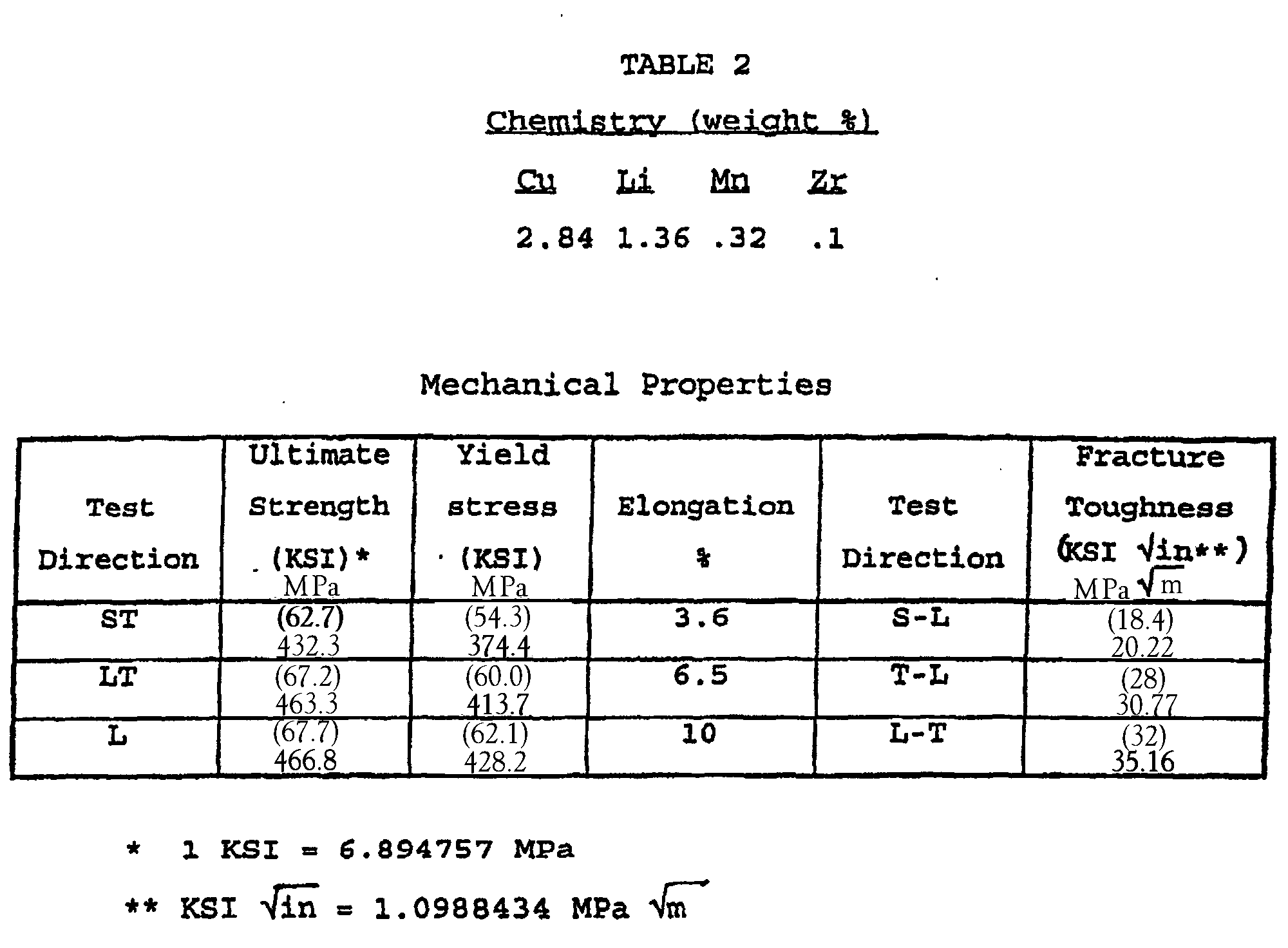
- An aluminum alloy consisting of, in weight percent, 2.84 Cu-1.36 Li-.32 Mn.-.1 Zr, the balance aluminum and impurities, was cast into an ingot with a cross section of (16") 406.4 mm and (45") 1143 mm wide. The ingot was homogenized at (950°F) 510°C for 36 hours, then hot worked to (4") 101.6 mm thick plate. The plate was then solution heat treated in a heat treating furnace at a temperature of (990°F) 532°C for 2 hours and then quenched in water. The plate was then stretched by 6% in the longitudinal direction at room temperature. For artificial aging, the stretched samples were aged in an oven at (320°F) 160°C for 24 hours. Tensile properties were determined at the T/4 plane in accordance with ASTM B-557. Tensile tests in the longitudinal direction and the long transverse direction used round tensile specimens with (.5") 12.7 mm. diameter and (1") 25.4 mm gauge length. Tensile tests in the short transverse direction were conducted with round tensile specimens with (.160") 4.1 mm diameter and (.5") 12.7 mm gauge length. Fracture toughness was determined at the T/4 plane by ASTM standard practice E266 using W= (1.5") 38.1 mm Compact Tension specimens for the short longitudinal direction and W= (2") 50.8 mm Compact Tension specimens for the L-T and T-L directions. The results of these tests are listed in Table 2.
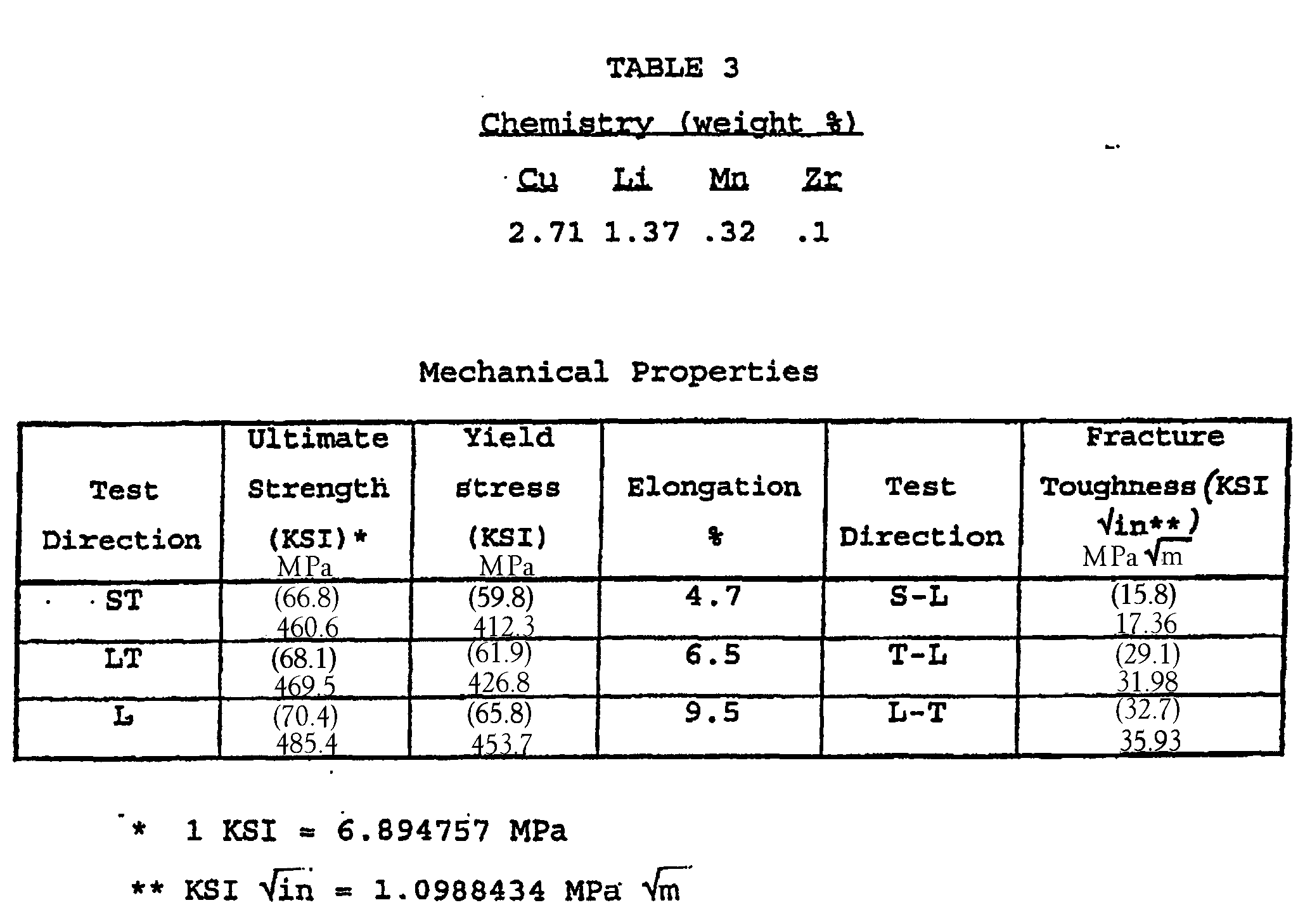
- An aluminum alloy consisting of, in weight percent, 2.71 Cu-1.37 Li-.32 Mn.-.1 Zr, the balance aluminum and impurities, was cast into an ingot with a cross section of (16") 406.4 mm and (45") 1143 mm wide. The ingot was homogenized at (950°F) 510°C for 36 hours, then hot worked to (4") 101.6 mm thick plate. The plate was then solution heat treated in a heat treating furnace at a temperature of (990°F) 532°C for 2 hours and then quenched in water. The plate was then stretched by 6% in the longitudinal direction at room temperature. For artificial aging, the stretched samples were aged in an oven at (320°F) 160°C for 24 hours. Tensile properties were determined at the T/4 plane in accordance with ASTM B-557. Tensile tests in the longitudinal direction and long transverse direction used round tensile specimens with (.5") 12.7 mm diameter and (1") 25.4 mm gauge length. Tensile tests in the short transverse direction were conducted with round tensile specimens with (.160") 4.1 mm diameter and (.5") 12.7 mm gauge length. Fracture toughness was determined at the T/4 plane by ASTM standard practice E266 using W= (1.5") 38.1 mm Compact Tension specimens for the short longitudinal (S-L) direction and W= (2") 50.8 mm Compact Tension specimens for the L-T and T-L directions. The results of these tests are listed in Table 3.
- An aluminum alloy consisting of, in weight percent, 2.77 Cu-1.33 Li-.32 Mn.-.11 Zr, the balance aluminum and impurities, was cast into an ingot with a cross section of (16") 406.4 mm and 45" 1143 mm. wide. The ingot was homogenized at (950°F) 510°C for 36 hours, then hot worked to (4") 101.6 mm thick plate. The plate was then solution heat treated in a heat treating furnace at a temperature of (990°F) 532°C for 2 hours and then quenched in water. The plate was then stretched by 6% in the longitudinal direction at room temperature. For artificial aging, the stretched samples were aged in an oven at (320°F) 160°C for 24 hours. Tensile properties were determined at the T/4 plane in accordance with ASTM B-557. Tensile tests in the longitudinal direction and the long transverse direction used round tensile specimens with .5" 12.7 mm diameter and(1") 25.4 mm gauge length. Tensile tests in short transverse direction were conducted with round tensile specimens with .160" 4.1 mm diameter and (.5") 12.7 mm gauge length. Fracture toughness was determined at the T/4 plane by ASTM standard practice E266 using W= (1.5") 38.1 mm Compact Tension specimens for the short longitudinal direction and W= (2") 50.8 mm Compact Tension specimens for the L-T and T-L directions. The results of these tests are listed in Table 4.
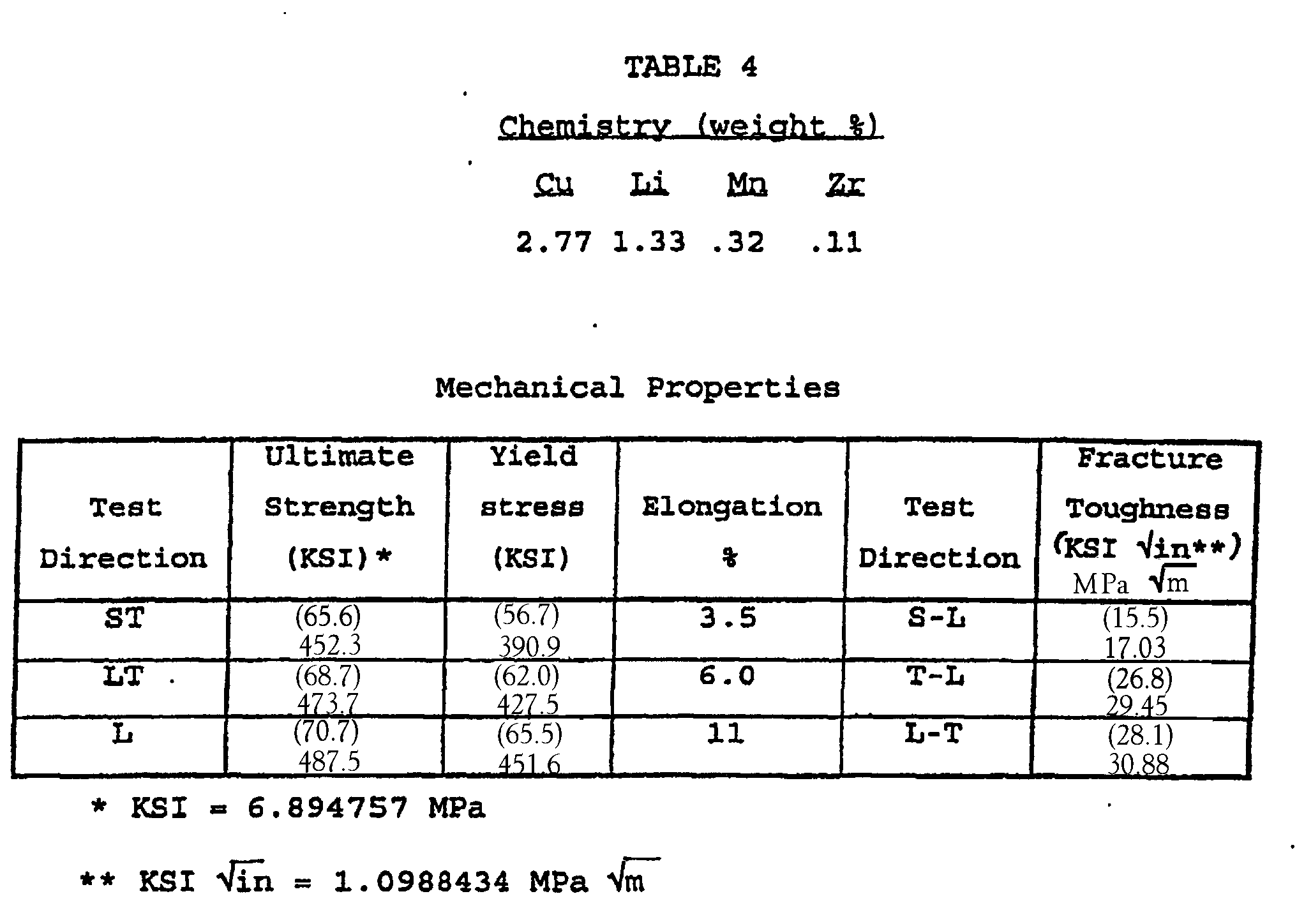
- An aluminum alloy consisting of, in weight percent, 2.89 Cu-1.36 Li-.32 Mn.-0.1 Zr, the balance aluminum and impurities, was cast into an ingot with a cross section of (16") 406.4 mm and (45") 1143 mm wide. The ingot was homogenized at (950°F) 510°C for 36 hours, then hot worked to (4") 101.6 mm thick plate. The plate was then solution heat treated in a heat treating furnace at a temperature of (990°F) 532°C for 2 hours and then quenched in water. The plate was then stretched by 6% in the longitudinal direction at room temperature. For artificial aging, the stretched samples were aged in an oven at (320°F) 160°C for 24 hours. Tensile properties were determined at the T/4 plane in accordance with ASTM B-557. Tensile tests in the longitudinal direction and the long transverse direction used round tensile specimens with (.5") 12.7 mm diameter and (1") 25.4 mm gauge length. Tensile tests in the short transverse direction were conducted with round tensile specimens with (.160") 4.1 mm diameter and (.5") ,12.7 mm gauge length. Fracture toughness was determined at the T/4 plane by ASTM standard practice E266 using W=(1.5") 38.1 mm Compact Tension specimens for the short longitudinal (S-L) direction and W=(2") 50.8 mm Compact Tension specimens for the L-T and T-L directions. The results of these tests are listed in Table 5.

- An aluminum alloy consisting of, in weight percent, 2.78 Cu-1.21 Li-.31 Mn.-0.1 Zr, the balance aluminum and impurities, was cast into an ingot with a cross section of (16") 406.4 mm and 45" 1143 mm wide. The ingot was homogenized at (950°F) 510°C for 36 hours, then hot worked to (4") 101.6 mm thick plate. The plate was then solution heat treated in a heat treating furnace at a temperature of 990°F 532°C for 2 hours and then quenched in water. The plate was then stretched by 6% in the longitudinal direction at room temperature. For artificial aging, the stretched samples were aged in an oven at (320°F) 160°C for 24 hours. Tensile properties were determined at the T/4 plane in accordance with ASTM B-557. Tensile tests in the longitudinal direction and the long transverse direction used round tensile specimens with (.5") 12.7 mm diameter and(1") 25.4 mm gauge length. Tensile tests in the short transverse direction were conducted with round tensile specimens with (.160") 4.1 mm diameter and (.5") 12.7 mm gauge length. Fracture toughness was determined at the T/4 plane by ASTM standard practice E266 using W=(1.5") .38.1 mm Compact Tension specimens for the short longitudinal (S-L) direction and W=(2") 50.8 mm Compact Tension specimens for the L-T and T-L directions. The results of these tests are listed in Table 6.
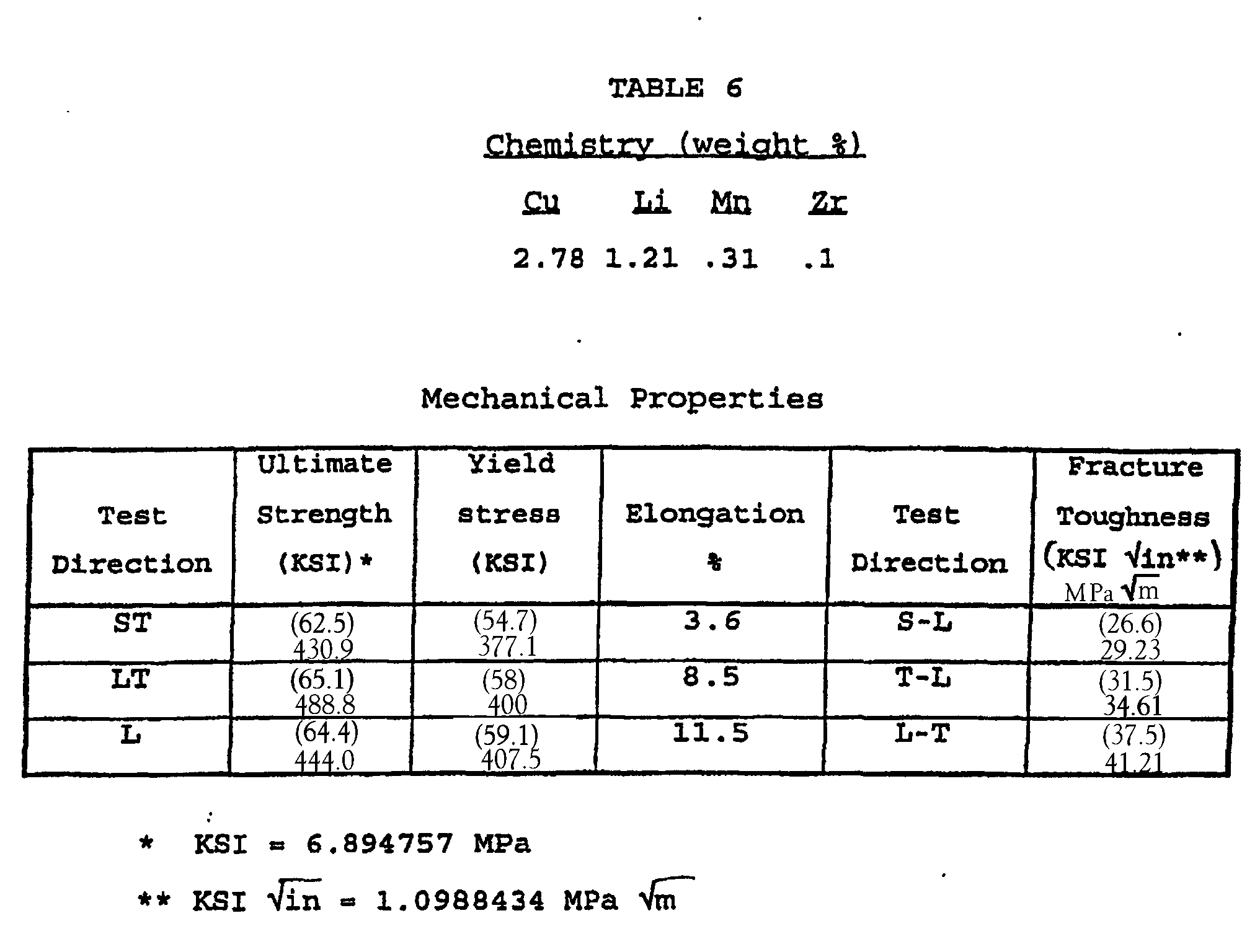
- An aluminum alloy consisting of, in weight percent, 2.86 Cu-1.28 Li-.3 Mn.-0.1 Zr, the balance aluminum and impurities, was cast into an ingot with a cross section of (16") 406.4 mm and (45") 1143 mm wide. The ingot was homogenized at (950°F) 510°C for 36 hours, then hot worked to (4") 101.6 mm thick plate. The plate was then solution heat treated in a heat treating furnace at a temperature of (990°F) .532°C for 2 hours and then quenched in water. The plate was then stretched by 6% in the longitudinal direction at room temperature. For artificial aging, the stretched samples were aged in an oven at (320°F) 160°C for 24 hours. Tensile properties were determined at the T/4 plane in accordance with ASTM B-557. Tensile tests in the longitudinal direction and the long transverse direction used round tensile specimens with (.5") 12.7 mm diameter and 1" 25.4 mm gauge length. Tensile tests in the short transverse direction were conducted with round tensile specimens with (.160") 4.1 mm diameter and (.5") 12.7 mm gauge length. Fracture toughness was determined at THE T/4 plane by ASTM standard practice E266 using W=(1.5") 38.1 mm. Compact Tension specimens for the short longitudinal (S-L) direction and W=(2") 50.8 mm Compact Tension specimens for the L-T and the T-L directions. The results of these tests are listed in Table 7.
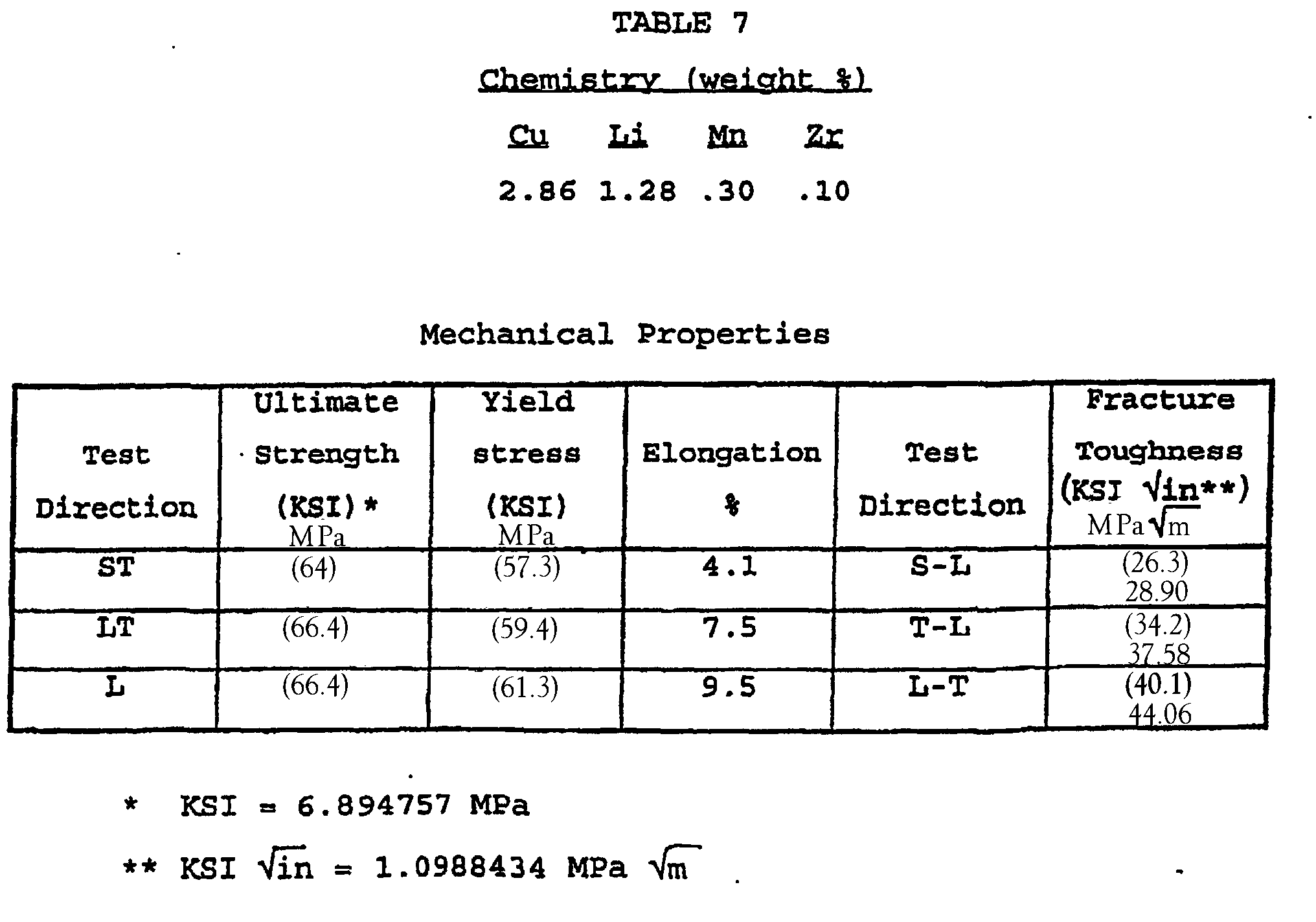
- An aluminum alloy consisting of, in weight percent, 2.73 Cu-1.28 Li-.3 Mn.-0.1 Zr, the balance aluminum and impurities, was cast into an ingot with a cross section of (16") 406.4 mm and 45" 1143 mm wide. The ingot was homogenized at 950°F 510°C. for 36 hours, then hot worked to (4") 101.6 mm thick plate. The plate was then solution heat treated in a heat treating furnace at a temperature of (990°F) 532°C for 2 hours and then quenched in water. The plate was then stretched by 6% in the longitudinal direction at room temperature. For artificial aging, the stretched samples were aged in an oven at (320°F) 160°C for 24 hours. Tensile properties were determined at the T/4 plane in accordance with ASTM B-557. Tensile tests in the longitudinal direction and the long transverse direction used round tensile specimens with (.5") 12.7 mm diameter and 1" 25.4 mm gauge length. Tensile tests in the short transverse direction were conducted with round tensile specimens with .160" (4.1 mm) diameter and (.5") 12.7 mm gauge length. Fracture toughness was determined at the T/4 plane by ASTM standard practice E266 using W=(1.5") 38.1 mm Compact Tension specimens for the short longitudinal (s-L) direction and W=(2") 50.8 mm Compact Tension specimens for the L-T and the T-L directions. The results of these tests are listed in Table 8.

- An aluminum alloy consisting of, in weight percent, 2.83 Cu-1.26 Li-.32 Mn.-0.11 Zr, the balance aluminum and impurities, was cast into an ingot with a cross section of (16") 406.4 mm and (45") 1143 mm wide. The ingot was homogenized at (950°F) 510°C for 36 hours, then hot worked to (4") 101.6 mm thick plate. The plate was then solution heat treated in a heat treating furnace at a temperature of (990°F) 532°C for 2 hours and then quenched in water. The plate was then stretched by 6% in the longitudinal direction at room temperature. For artificial aging, the stretched samples were aged in an oven at (320°F) 160°C for 24 hours. Tensile properties were determined at the T/4 plane in accordance with ASTM B-557. Tensile tests in the longitudinal direction and the long transverse direction used round tensile specimens with (.5") 12.7 mm diameter and(1") .25.4 mm gauge length. Tensile tests in the short transverse direction were conducted with round tensile specimens with (.160") 4.1 mm diameter and (.5") 12.7 mm gauge length. Fracture toughness was determined at the T/4 plane by ASTM standard practice E266 using W=(1.5") 38.1 mm Compact Tension specimens for the short longitudinal (S-L) direction and W=(2") .050.8 mm Compact Tension specimens for the L-T and the T-L directions. The results of these tests are listed in Table 9.

- The advantage of the present invention is shown in Figure 1 which correlates the fracture toughness values in Tables 2-9 in the S-L direction with tensile yield strengths in the S-T direction. As is evident from Figure 1, no compromise is made in the tensile yield strengths between the prior art examples and the examples of the invention. More specifically, the prior art tensile yield strength values range from just above 372.3 MPa. 54 KSI to almost 413.7 MPa (60 KSI). In comparison, the tensile yield strengths of the examples according to the invention range from just below 55 KSI to just above 393 MPa. (57 KSI). Figure 1 demonstrates that the articles made of the present invention provide significantly improved fracture toughness in the S-L direction while maintaining acceptable strength levels in the S-T direction.
- Figure 2 illustrates the unexpected improvements in fracture toughness in the S-L direction over the prior art. The values depicted in Figure 2 demonstrate that the fracture toughness in the S-L direction for Examples 5-8 is vastly superior to that shown for Examples 1-4. This improvement, which relates to lithium content, is quite unexpected in view of the prior art.
- Figure 3 emphasizes the fact that the improvements in fracture toughness are related to the lithium content of the alloys. Figure 3 demonstrates that the fracture toughness does not vary widely with respect to copper content. For Examples 5-8, the fracture toughness appears to remain relatively the same with increasing or decreasing amounts of copper. Similarly, the fracture toughness of Examples 1-4 does not vary widely with increasing or decreasing copper content.
- Referring again to Figure 2, it is believed that the lithium content can be as low as 0.8 weight percent while still giving improvements in fracture toughness and maintaining the acceptable strength in the short transverse direction. It is further believed that the same results are obtainable when practicing the inventive processing in accordance with the broad processing variable ranges disclosed above.
- Accordingly, an invention has been disclosed in terms of preferred embodiments thereof which fulfill each and every one of the objects of the present invention as set forth above and provides a new and improved method for improving the short longitudinal direction fracture toughness of aluminum-lithium alloys.
Claims (11)
- An aluminum-lithium alloy article obtainable by
the process steps of casting, homogenizing, hot working, solution heat treating, quenching, cold working and aging an aluminum alloy consisting of
1.2 to less than 1.3% by weight lithium,
2.7 - 3.0% by weight copper,
0.30 - 0.32% by weight manganese,
up to 0.35% by weight magnesium,
0.04 - 0.18% by weight zirconium,
below 0.05% zinc and
grain refiners selected from the group consisting of
up to 0.2% by weight titanium, up to 0.2% by weight boron, up to 0.2% by weight vanadium,
up to 0.2% weight hafnium, up to 0.5% by weight scandium, up to 0.3% by weight chromium, the balance aluminum and inevitable impurities. - The aluminum alloy article according to claim 1, wherein the homogenization and solution heat treating is performed at temperatures of 499°C to 554°C (930 to 1030°F).
- The aluminum alloy article according to one of the preceding claims, wherein the cold working is stretching between 4 and 8% and the aging temperature is 149°C to 177°C (300 to 350°F).
- The aluminum alloy article according to one of the preceding claims, wherein the fracture toughness in the short longitudinal direction (S-L) is at least by 68.5% of the fracture toughness in the long traverse direction (T-L).
- The aluminum alloy article according to one of the preceding claims, wherein the magnesium is up to 0.25% by weight.
- The aluminum alloy article according to one of the preceding claims, wherein the fracture toughness is at least 23.1 MPa
- The aluminum alloy article according to claim 6, having a tensile yield strength of at least 377.14 MPa (54.7 KSI).
- A method for producing an aluminum-lithium alloy article comprising the steps of
casting, homogenizing, hot working, solution heat treating, quenching, cold working and aging an aluminum alloy consisting of
1.2 to less than 1.3% by weight lithium,
2.7 - 3.0% by weight copper,
0.30-0.32% by weight manganese,
up to 0.35% by weight magnesium,
0.04 - 0.18% by weight zirconium,
below 0.05% zinc and
grain refiners selected from the group consisting of
up to 0.2% by weight titanium, up to 0.2% by weight boron, up to 0.2% by weight vanadium,
up to 0.2% weight hafnium, up to 0.5% by weight scandium, up to 0.3% by weight chromium, the balance aluminum and inevitable impurities. - The method according to claim 8, wherein the homogenization and solution heat treating is performed at temperatures of 499°C to 554°C (930 to 1030°F).
- The method according to claim 8 or 9, wherein the cold working is stretching between 4 and 8% and the aging temperature is 149°C to 177°C (300 to 350°F).
- The method according to claims 8 to 10, wherein the magnesium is up to 0.25% by weight.
Priority Applications (1)
| Application Number | Priority Date | Filing Date | Title |
|---|---|---|---|
| EP03015053.6A EP1359232B9 (en) | 1997-01-31 | 1998-01-30 | Method of improving fracture toughness in aluminium-lithium alloys |
Applications Claiming Priority (3)
| Application Number | Priority Date | Filing Date | Title |
|---|---|---|---|
| US3632997P | 1997-01-31 | 1997-01-31 | |
| US36329P | 1997-01-31 | ||
| PCT/US1998/001584 WO1998033947A1 (en) | 1997-01-31 | 1998-01-30 | Method of improving fracture toughness in aluminum-lithium alloys |
Related Child Applications (1)
| Application Number | Title | Priority Date | Filing Date |
|---|---|---|---|
| EP03015053.6A Division EP1359232B9 (en) | 1997-01-31 | 1998-01-30 | Method of improving fracture toughness in aluminium-lithium alloys |
Publications (3)
| Publication Number | Publication Date |
|---|---|
| EP0981653A1 EP0981653A1 (en) | 2000-03-01 |
| EP0981653A4 EP0981653A4 (en) | 2000-05-17 |
| EP0981653B1 true EP0981653B1 (en) | 2003-09-24 |
Family
ID=21887984
Family Applications (2)
| Application Number | Title | Priority Date | Filing Date |
|---|---|---|---|
| EP98903777A Expired - Lifetime EP0981653B1 (en) | 1997-01-31 | 1998-01-30 | Method of improving fracture toughness in aluminum-lithium alloys |
| EP03015053.6A Expired - Lifetime EP1359232B9 (en) | 1997-01-31 | 1998-01-30 | Method of improving fracture toughness in aluminium-lithium alloys |
Family Applications After (1)
| Application Number | Title | Priority Date | Filing Date |
|---|---|---|---|
| EP03015053.6A Expired - Lifetime EP1359232B9 (en) | 1997-01-31 | 1998-01-30 | Method of improving fracture toughness in aluminium-lithium alloys |
Country Status (5)
| Country | Link |
|---|---|
| EP (2) | EP0981653B1 (en) |
| AT (2) | ATE250675T1 (en) |
| DE (2) | DE69818448T2 (en) |
| ES (1) | ES2278093T5 (en) |
| WO (1) | WO1998033947A1 (en) |
Cited By (1)
| Publication number | Priority date | Publication date | Assignee | Title |
|---|---|---|---|---|
| CN110423926A (en) * | 2019-07-29 | 2019-11-08 | 中国航发北京航空材料研究院 | A kind of heat-resisting aluminium lithium alloy and preparation method thereof |
Families Citing this family (25)
| Publication number | Priority date | Publication date | Assignee | Title |
|---|---|---|---|---|
| FR2925523B1 (en) | 2007-12-21 | 2010-05-21 | Alcan Rhenalu | ALUMINUM-LITHIUM ALLOY IMPROVED LAMINATED PRODUCT FOR AERONAUTICAL APPLICATIONS |
| US8017072B2 (en) | 2008-04-18 | 2011-09-13 | United Technologies Corporation | Dispersion strengthened L12 aluminum alloys |
| US7875131B2 (en) | 2008-04-18 | 2011-01-25 | United Technologies Corporation | L12 strengthened amorphous aluminum alloys |
| US7811395B2 (en) | 2008-04-18 | 2010-10-12 | United Technologies Corporation | High strength L12 aluminum alloys |
| US7871477B2 (en) | 2008-04-18 | 2011-01-18 | United Technologies Corporation | High strength L12 aluminum alloys |
| US7879162B2 (en) | 2008-04-18 | 2011-02-01 | United Technologies Corporation | High strength aluminum alloys with L12 precipitates |
| US7875133B2 (en) | 2008-04-18 | 2011-01-25 | United Technologies Corporation | Heat treatable L12 aluminum alloys |
| US8409373B2 (en) | 2008-04-18 | 2013-04-02 | United Technologies Corporation | L12 aluminum alloys with bimodal and trimodal distribution |
| US8002912B2 (en) | 2008-04-18 | 2011-08-23 | United Technologies Corporation | High strength L12 aluminum alloys |
| US8778099B2 (en) | 2008-12-09 | 2014-07-15 | United Technologies Corporation | Conversion process for heat treatable L12 aluminum alloys |
| US8778098B2 (en) | 2008-12-09 | 2014-07-15 | United Technologies Corporation | Method for producing high strength aluminum alloy powder containing L12 intermetallic dispersoids |
| US9611522B2 (en) | 2009-05-06 | 2017-04-04 | United Technologies Corporation | Spray deposition of L12 aluminum alloys |
| US9127334B2 (en) | 2009-05-07 | 2015-09-08 | United Technologies Corporation | Direct forging and rolling of L12 aluminum alloys for armor applications |
| US8728389B2 (en) | 2009-09-01 | 2014-05-20 | United Technologies Corporation | Fabrication of L12 aluminum alloy tanks and other vessels by roll forming, spin forming, and friction stir welding |
| US8409496B2 (en) | 2009-09-14 | 2013-04-02 | United Technologies Corporation | Superplastic forming high strength L12 aluminum alloys |
| US9194027B2 (en) | 2009-10-14 | 2015-11-24 | United Technologies Corporation | Method of forming high strength aluminum alloy parts containing L12 intermetallic dispersoids by ring rolling |
| US8409497B2 (en) | 2009-10-16 | 2013-04-02 | United Technologies Corporation | Hot and cold rolling high strength L12 aluminum alloys |
| CN105063522B (en) | 2010-09-08 | 2018-09-28 | 奥科宁克公司 | Improved 6xxx aluminum alloy and production method thereof |
| WO2013172910A2 (en) | 2012-03-07 | 2013-11-21 | Alcoa Inc. | Improved 2xxx aluminum alloys, and methods for producing the same |
| US9587298B2 (en) | 2013-02-19 | 2017-03-07 | Arconic Inc. | Heat treatable aluminum alloys having magnesium and zinc and methods for producing the same |
| FR3014905B1 (en) * | 2013-12-13 | 2015-12-11 | Constellium France | ALUMINUM-COPPER-LITHIUM ALLOY PRODUCTS WITH IMPROVED FATIGUE PROPERTIES |
| DE102014011745B4 (en) | 2014-08-07 | 2023-05-11 | Modine Manufacturing Company | Brazed heat exchanger and method of manufacture |
| EP3072985B2 (en) | 2015-03-27 | 2020-08-26 | Otto Fuchs KG | Ag-free al-cu-mg-li alloy |
| WO2018144568A1 (en) * | 2017-01-31 | 2018-08-09 | Universal Alloy Corporation | Low density aluminum-copper-lithium alloy extrusions |
| CN113388793A (en) * | 2021-06-21 | 2021-09-14 | 河北力尔铝业有限公司 | Production process of aluminum alloy gutter profile |
Family Cites Families (4)
| Publication number | Priority date | Publication date | Assignee | Title |
|---|---|---|---|---|
| US4648913A (en) * | 1984-03-29 | 1987-03-10 | Aluminum Company Of America | Aluminum-lithium alloys and method |
| US4869870A (en) * | 1988-03-24 | 1989-09-26 | Aluminum Company Of America | Aluminum-lithium alloys with hafnium |
| US5462712A (en) * | 1988-08-18 | 1995-10-31 | Martin Marietta Corporation | High strength Al-Cu-Li-Zn-Mg alloys |
| US5389165A (en) * | 1991-05-14 | 1995-02-14 | Reynolds Metals Company | Low density, high strength Al-Li alloy having high toughness at elevated temperatures |
-
1998
- 1998-01-30 AT AT98903777T patent/ATE250675T1/en not_active IP Right Cessation
- 1998-01-30 DE DE69818448T patent/DE69818448T2/en not_active Expired - Lifetime
- 1998-01-30 WO PCT/US1998/001584 patent/WO1998033947A1/en not_active Ceased
- 1998-01-30 EP EP98903777A patent/EP0981653B1/en not_active Expired - Lifetime
- 1998-01-30 ES ES03015053.6T patent/ES2278093T5/en not_active Expired - Lifetime
- 1998-01-30 DE DE69836569.0T patent/DE69836569T3/en not_active Expired - Lifetime
- 1998-01-30 AT AT03015053T patent/ATE346963T1/en not_active IP Right Cessation
- 1998-01-30 EP EP03015053.6A patent/EP1359232B9/en not_active Expired - Lifetime
Cited By (1)
| Publication number | Priority date | Publication date | Assignee | Title |
|---|---|---|---|---|
| CN110423926A (en) * | 2019-07-29 | 2019-11-08 | 中国航发北京航空材料研究院 | A kind of heat-resisting aluminium lithium alloy and preparation method thereof |
Also Published As
| Publication number | Publication date |
|---|---|
| EP1359232A2 (en) | 2003-11-05 |
| ES2278093T5 (en) | 2014-07-16 |
| EP0981653A1 (en) | 2000-03-01 |
| DE69836569D1 (en) | 2007-01-11 |
| DE69818448T2 (en) | 2004-07-29 |
| EP1359232B2 (en) | 2014-03-12 |
| DE69836569T3 (en) | 2014-07-31 |
| EP1359232A3 (en) | 2004-01-02 |
| DE69836569T2 (en) | 2008-01-03 |
| ATE250675T1 (en) | 2003-10-15 |
| WO1998033947A1 (en) | 1998-08-06 |
| DE69818448D1 (en) | 2003-10-30 |
| ATE346963T1 (en) | 2006-12-15 |
| EP1359232B1 (en) | 2006-11-29 |
| ES2278093T3 (en) | 2007-08-01 |
| EP1359232B9 (en) | 2014-09-10 |
| EP0981653A4 (en) | 2000-05-17 |
Similar Documents
| Publication | Publication Date | Title |
|---|---|---|
| EP1359232B1 (en) | Method of improving fracture toughness in aluminium-lithium alloys | |
| US4648913A (en) | Aluminum-lithium alloys and method | |
| CA2142462C (en) | Tough aluminum alloy containing copper and magnesium | |
| CA2089171C (en) | Improved lithium aluminum alloy system | |
| EP0247181B1 (en) | Aluminum-lithium alloys and method of making the same | |
| WO1998033947A9 (en) | Method of improving fracture toughness in aluminum-lithium alloys | |
| US5198045A (en) | Low density high strength al-li alloy | |
| US4816087A (en) | Process for producing duplex mode recrystallized high strength aluminum-lithium alloy products with high fracture toughness and method of making the same | |
| US4869870A (en) | Aluminum-lithium alloys with hafnium | |
| EP0031605B1 (en) | Method of manufacturing products from a copper containing aluminium alloy | |
| CA2793885C (en) | 2xxx series aluminum lithium alloys having low strength differential | |
| CA2493401C (en) | Al-cu-mg-si alloy and method for producing the same | |
| US5151136A (en) | Low aspect ratio lithium-containing aluminum extrusions | |
| US4797165A (en) | Aluminum-lithium alloys having improved corrosion resistance and method | |
| US4961792A (en) | Aluminum-lithium alloys having improved corrosion resistance containing Mg and Zn | |
| EP0030070A1 (en) | Method for producing aircraft stringer material | |
| US4790884A (en) | Aluminum-lithium flat rolled product and method of making | |
| JP3540316B2 (en) | Improvement of mechanical properties of aluminum-lithium alloy | |
| JP2001181771A (en) | High strength and heat resistant aluminum alloy material | |
| CN121951336A (en) | An Al-Mg-Si-Mn aluminum alloy profile and its preparation method |
Legal Events
| Date | Code | Title | Description |
|---|---|---|---|
| PUAI | Public reference made under article 153(3) epc to a published international application that has entered the european phase |
Free format text: ORIGINAL CODE: 0009012 |
|
| 17P | Request for examination filed |
Effective date: 19990827 |
|
| AK | Designated contracting states |
Kind code of ref document: A1 Designated state(s): AT BE CH DE DK ES FI FR GB GR IE IT LI LU MC NL PT SE |
|
| RIC1 | Information provided on ipc code assigned before grant |
Free format text: 7C 22C 21/00 A, 7C 22C 21/12 B, 7C 22F 1/057 B |
|
| A4 | Supplementary search report drawn up and despatched |
Effective date: 20000330 |
|
| AK | Designated contracting states |
Kind code of ref document: A4 Designated state(s): AT BE CH DE DK ES FI FR GB GR IE IT LI LU MC NL PT SE |
|
| RIN1 | Information on inventor provided before grant (corrected) |
Inventor name: NIEDZINSKI, MICHAEL, M. Inventor name: GREENE, RICHARD, E. Inventor name: SKILLINGBERG, MICHAEL, H. Inventor name: CHO, ALEX |
|
| RAP1 | Party data changed (applicant data changed or rights of an application transferred) |
Owner name: MCCOOK METALS L.L.C. |
|
| 17Q | First examination report despatched |
Effective date: 20011119 |
|
| GRAH | Despatch of communication of intention to grant a patent |
Free format text: ORIGINAL CODE: EPIDOS IGRA |
|
| RAP1 | Party data changed (applicant data changed or rights of an application transferred) |
Owner name: PECHINEY ROLLED PRODUCTS, LLC |
|
| GRAS | Grant fee paid |
Free format text: ORIGINAL CODE: EPIDOSNIGR3 |
|
| GRAA | (expected) grant |
Free format text: ORIGINAL CODE: 0009210 |
|
| AK | Designated contracting states |
Kind code of ref document: B1 Designated state(s): AT BE CH DE DK ES FI FR GB GR IE IT LI LU MC NL PT SE |
|
| PG25 | Lapsed in a contracting state [announced via postgrant information from national office to epo] |
Ref country code: NL Free format text: LAPSE BECAUSE OF FAILURE TO SUBMIT A TRANSLATION OF THE DESCRIPTION OR TO PAY THE FEE WITHIN THE PRESCRIBED TIME-LIMIT Effective date: 20030924 Ref country code: LI Free format text: LAPSE BECAUSE OF FAILURE TO SUBMIT A TRANSLATION OF THE DESCRIPTION OR TO PAY THE FEE WITHIN THE PRESCRIBED TIME-LIMIT Effective date: 20030924 Ref country code: IT Free format text: LAPSE BECAUSE OF FAILURE TO SUBMIT A TRANSLATION OF THE DESCRIPTION OR TO PAY THE FEE WITHIN THE PRESCRIBED TIME-LIMIT;WARNING: LAPSES OF ITALIAN PATENTS WITH EFFECTIVE DATE BEFORE 2007 MAY HAVE OCCURRED AT ANY TIME BEFORE 2007. THE CORRECT EFFECTIVE DATE MAY BE DIFFERENT FROM THE ONE RECORDED. Effective date: 20030924 Ref country code: FI Free format text: LAPSE BECAUSE OF FAILURE TO SUBMIT A TRANSLATION OF THE DESCRIPTION OR TO PAY THE FEE WITHIN THE PRESCRIBED TIME-LIMIT Effective date: 20030924 Ref country code: CH Free format text: LAPSE BECAUSE OF FAILURE TO SUBMIT A TRANSLATION OF THE DESCRIPTION OR TO PAY THE FEE WITHIN THE PRESCRIBED TIME-LIMIT Effective date: 20030924 Ref country code: BE Free format text: LAPSE BECAUSE OF FAILURE TO SUBMIT A TRANSLATION OF THE DESCRIPTION OR TO PAY THE FEE WITHIN THE PRESCRIBED TIME-LIMIT Effective date: 20030924 Ref country code: AT Free format text: LAPSE BECAUSE OF FAILURE TO SUBMIT A TRANSLATION OF THE DESCRIPTION OR TO PAY THE FEE WITHIN THE PRESCRIBED TIME-LIMIT Effective date: 20030924 |
|
| REG | Reference to a national code |
Ref country code: GB Ref legal event code: FG4D |
|
| REG | Reference to a national code |
Ref country code: CH Ref legal event code: EP |
|
| REG | Reference to a national code |
Ref country code: IE Ref legal event code: FG4D |
|
| REF | Corresponds to: |
Ref document number: 69818448 Country of ref document: DE Date of ref document: 20031030 Kind code of ref document: P |
|
| PG25 | Lapsed in a contracting state [announced via postgrant information from national office to epo] |
Ref country code: SE Free format text: LAPSE BECAUSE OF FAILURE TO SUBMIT A TRANSLATION OF THE DESCRIPTION OR TO PAY THE FEE WITHIN THE PRESCRIBED TIME-LIMIT Effective date: 20031224 Ref country code: GR Free format text: LAPSE BECAUSE OF FAILURE TO SUBMIT A TRANSLATION OF THE DESCRIPTION OR TO PAY THE FEE WITHIN THE PRESCRIBED TIME-LIMIT Effective date: 20031224 Ref country code: DK Free format text: LAPSE BECAUSE OF FAILURE TO SUBMIT A TRANSLATION OF THE DESCRIPTION OR TO PAY THE FEE WITHIN THE PRESCRIBED TIME-LIMIT Effective date: 20031224 |
|
| PG25 | Lapsed in a contracting state [announced via postgrant information from national office to epo] |
Ref country code: ES Free format text: LAPSE BECAUSE OF FAILURE TO SUBMIT A TRANSLATION OF THE DESCRIPTION OR TO PAY THE FEE WITHIN THE PRESCRIBED TIME-LIMIT Effective date: 20040104 |
|
| PG25 | Lapsed in a contracting state [announced via postgrant information from national office to epo] |
Ref country code: LU Free format text: LAPSE BECAUSE OF NON-PAYMENT OF DUE FEES Effective date: 20040130 Ref country code: IE Free format text: LAPSE BECAUSE OF NON-PAYMENT OF DUE FEES Effective date: 20040130 |
|
| PG25 | Lapsed in a contracting state [announced via postgrant information from national office to epo] |
Ref country code: MC Free format text: LAPSE BECAUSE OF NON-PAYMENT OF DUE FEES Effective date: 20040131 |
|
| NLV1 | Nl: lapsed or annulled due to failure to fulfill the requirements of art. 29p and 29m of the patents act | ||
| REG | Reference to a national code |
Ref country code: CH Ref legal event code: PL |
|
| ET | Fr: translation filed | ||
| PLBE | No opposition filed within time limit |
Free format text: ORIGINAL CODE: 0009261 |
|
| STAA | Information on the status of an ep patent application or granted ep patent |
Free format text: STATUS: NO OPPOSITION FILED WITHIN TIME LIMIT |
|
| 26N | No opposition filed |
Effective date: 20040625 |
|
| REG | Reference to a national code |
Ref country code: IE Ref legal event code: MM4A |
|
| REG | Reference to a national code |
Ref country code: FR Ref legal event code: CD |
|
| PG25 | Lapsed in a contracting state [announced via postgrant information from national office to epo] |
Ref country code: PT Free format text: LAPSE BECAUSE OF NON-PAYMENT OF DUE FEES Effective date: 20040224 |
|
| REG | Reference to a national code |
Ref country code: FR Ref legal event code: CD Owner name: CONSTELLIUM ROLLED PRODUCTS RAVENSWOOD, LLC, US Effective date: 20111219 |
|
| REG | Reference to a national code |
Ref country code: DE Ref legal event code: R082 Ref document number: 69818448 Country of ref document: DE Representative=s name: BOEHMERT & BOEHMERT, DE |
|
| REG | Reference to a national code |
Ref country code: DE Ref legal event code: R082 Ref document number: 69818448 Country of ref document: DE Representative=s name: BOEHMERT & BOEHMERT, DE Effective date: 20120622 Ref country code: DE Ref legal event code: R082 Ref document number: 69818448 Country of ref document: DE Representative=s name: BOEHMERT & BOEHMERT ANWALTSPARTNERSCHAFT MBB -, DE Effective date: 20120622 Ref country code: DE Ref legal event code: R081 Ref document number: 69818448 Country of ref document: DE Owner name: CONSTELLIUM ROLLED PRODUCTS RAVENSWOOD, LLC, US Free format text: FORMER OWNER: PECHINEY ROLLED PRODUCTS, LLC, RAVENSWOOD, US Effective date: 20120622 Ref country code: DE Ref legal event code: R081 Ref document number: 69818448 Country of ref document: DE Owner name: CONSTELLIUM ROLLED PRODUCTS RAVENSWOOD, LLC, R, US Free format text: FORMER OWNER: PECHINEY ROLLED PRODUCTS, LLC, RAVENSWOOD, W.VA., US Effective date: 20120622 |
|
| REG | Reference to a national code |
Ref country code: FR Ref legal event code: PLFP Year of fee payment: 19 |
|
| REG | Reference to a national code |
Ref country code: FR Ref legal event code: PLFP Year of fee payment: 20 |
|
| PGFP | Annual fee paid to national office [announced via postgrant information from national office to epo] |
Ref country code: DE Payment date: 20170125 Year of fee payment: 20 Ref country code: FR Payment date: 20170125 Year of fee payment: 20 |
|
| PGFP | Annual fee paid to national office [announced via postgrant information from national office to epo] |
Ref country code: GB Payment date: 20170127 Year of fee payment: 20 |
|
| REG | Reference to a national code |
Ref country code: DE Ref legal event code: R071 Ref document number: 69818448 Country of ref document: DE |
|
| REG | Reference to a national code |
Ref country code: GB Ref legal event code: PE20 Expiry date: 20180129 |
|
| PG25 | Lapsed in a contracting state [announced via postgrant information from national office to epo] |
Ref country code: GB Free format text: LAPSE BECAUSE OF EXPIRATION OF PROTECTION Effective date: 20180129 |