EP0980016B1 - Aligning agent for liquid crystal - Google Patents
Aligning agent for liquid crystal Download PDFInfo
- Publication number
- EP0980016B1 EP0980016B1 EP98917723A EP98917723A EP0980016B1 EP 0980016 B1 EP0980016 B1 EP 0980016B1 EP 98917723 A EP98917723 A EP 98917723A EP 98917723 A EP98917723 A EP 98917723A EP 0980016 B1 EP0980016 B1 EP 0980016B1
- Authority
- EP
- European Patent Office
- Prior art keywords
- liquid crystal
- polyimide
- acid
- crystal alignment
- film
- Prior art date
- Legal status (The legal status is an assumption and is not a legal conclusion. Google has not performed a legal analysis and makes no representation as to the accuracy of the status listed.)
- Expired - Lifetime
Links
- 239000004973 liquid crystal related substance Substances 0.000 title claims description 136
- 239000003795 chemical substances by application Substances 0.000 title claims description 26
- SECXISVLQFMRJM-UHFFFAOYSA-N N-Methylpyrrolidone Chemical compound CN1CCCC1=O SECXISVLQFMRJM-UHFFFAOYSA-N 0.000 claims description 89
- 229920001721 polyimide Polymers 0.000 claims description 70
- 238000000034 method Methods 0.000 claims description 56
- 239000000758 substrate Substances 0.000 claims description 56
- 239000004642 Polyimide Substances 0.000 claims description 54
- 229920000642 polymer Polymers 0.000 claims description 54
- 230000009477 glass transition Effects 0.000 claims description 23
- 239000002243 precursor Substances 0.000 claims description 22
- 229920006122 polyamide resin Polymers 0.000 claims description 19
- 150000001875 compounds Chemical class 0.000 claims description 15
- 125000000962 organic group Chemical group 0.000 claims description 8
- 239000009719 polyimide resin Substances 0.000 claims description 7
- 239000010409 thin film Substances 0.000 claims description 6
- 239000011347 resin Substances 0.000 claims description 4
- 229920005989 resin Polymers 0.000 claims description 4
- 125000004178 (C1-C4) alkyl group Chemical group 0.000 claims description 3
- 125000000229 (C1-C4)alkoxy group Chemical group 0.000 claims description 3
- 125000006650 (C2-C4) alkynyl group Chemical group 0.000 claims description 3
- NAWXUBYGYWOOIX-SFHVURJKSA-N (2s)-2-[[4-[2-(2,4-diaminoquinazolin-6-yl)ethyl]benzoyl]amino]-4-methylidenepentanedioic acid Chemical compound C1=CC2=NC(N)=NC(N)=C2C=C1CCC1=CC=C(C(=O)N[C@@H](CC(=C)C(O)=O)C(O)=O)C=C1 NAWXUBYGYWOOIX-SFHVURJKSA-N 0.000 claims description 2
- 125000006656 (C2-C4) alkenyl group Chemical group 0.000 claims description 2
- PXGOKWXKJXAPGV-UHFFFAOYSA-N Fluorine Chemical compound FF PXGOKWXKJXAPGV-UHFFFAOYSA-N 0.000 claims description 2
- 229910052731 fluorine Inorganic materials 0.000 claims description 2
- 239000011737 fluorine Substances 0.000 claims description 2
- 239000001257 hydrogen Substances 0.000 claims description 2
- 229910052739 hydrogen Inorganic materials 0.000 claims description 2
- 125000004435 hydrogen atom Chemical class [H]* 0.000 claims description 2
- 125000002023 trifluoromethyl group Chemical group FC(F)(F)* 0.000 claims description 2
- 239000010408 film Substances 0.000 description 73
- 239000004952 Polyamide Substances 0.000 description 34
- 229920002647 polyamide Polymers 0.000 description 34
- OKKJLVBELUTLKV-UHFFFAOYSA-N Methanol Chemical compound OC OKKJLVBELUTLKV-UHFFFAOYSA-N 0.000 description 33
- 210000002858 crystal cell Anatomy 0.000 description 26
- 238000010438 heat treatment Methods 0.000 description 25
- 239000011521 glass Substances 0.000 description 23
- 150000004985 diamines Chemical class 0.000 description 22
- 230000007547 defect Effects 0.000 description 21
- 230000010287 polarization Effects 0.000 description 21
- 239000002904 solvent Substances 0.000 description 19
- -1 polyoxyethylene Polymers 0.000 description 17
- IJGRMHOSHXDMSA-UHFFFAOYSA-N Atomic nitrogen Chemical compound N#N IJGRMHOSHXDMSA-UHFFFAOYSA-N 0.000 description 14
- 210000004027 cell Anatomy 0.000 description 14
- UHOVQNZJYSORNB-UHFFFAOYSA-N Benzene Chemical compound C1=CC=CC=C1 UHOVQNZJYSORNB-UHFFFAOYSA-N 0.000 description 12
- ZMXDDKWLCZADIW-UHFFFAOYSA-N N,N-Dimethylformamide Chemical compound CN(C)C=O ZMXDDKWLCZADIW-UHFFFAOYSA-N 0.000 description 12
- JUJWROOIHBZHMG-UHFFFAOYSA-N Pyridine Chemical compound C1=CC=NC=C1 JUJWROOIHBZHMG-UHFFFAOYSA-N 0.000 description 12
- TXXHDPDFNKHHGW-UHFFFAOYSA-N muconic acid Chemical compound OC(=O)C=CC=CC(O)=O TXXHDPDFNKHHGW-UHFFFAOYSA-N 0.000 description 12
- 239000007787 solid Substances 0.000 description 10
- 150000000000 tetracarboxylic acids Chemical class 0.000 description 10
- HVLLSGMXQDNUAL-UHFFFAOYSA-N triphenyl phosphite Chemical compound C=1C=CC=CC=1OP(OC=1C=CC=CC=1)OC1=CC=CC=C1 HVLLSGMXQDNUAL-UHFFFAOYSA-N 0.000 description 10
- OFOBLEOULBTSOW-UHFFFAOYSA-N Malonic acid Chemical compound OC(=O)CC(O)=O OFOBLEOULBTSOW-UHFFFAOYSA-N 0.000 description 9
- 238000001914 filtration Methods 0.000 description 9
- 239000000203 mixture Substances 0.000 description 9
- CSCPPACGZOOCGX-UHFFFAOYSA-N Acetone Chemical compound CC(C)=O CSCPPACGZOOCGX-UHFFFAOYSA-N 0.000 description 8
- 238000006116 polymerization reaction Methods 0.000 description 8
- 229910052757 nitrogen Inorganic materials 0.000 description 7
- 229920006254 polymer film Polymers 0.000 description 7
- 239000002966 varnish Substances 0.000 description 7
- TXXHDPDFNKHHGW-CCAGOZQPSA-N Muconic acid Natural products OC(=O)\C=C/C=C\C(O)=O TXXHDPDFNKHHGW-CCAGOZQPSA-N 0.000 description 6
- ZMANZCXQSJIPKH-UHFFFAOYSA-N Triethylamine Chemical compound CCN(CC)CC ZMANZCXQSJIPKH-UHFFFAOYSA-N 0.000 description 6
- 150000004820 halides Chemical class 0.000 description 6
- 238000012986 modification Methods 0.000 description 6
- UMJSCPRVCHMLSP-UHFFFAOYSA-N pyridine Natural products COC1=CC=CN=C1 UMJSCPRVCHMLSP-UHFFFAOYSA-N 0.000 description 6
- 238000006798 ring closing metathesis reaction Methods 0.000 description 6
- LKFKFNXPGMGBIS-XCVCLJGOSA-N (e)-1,3-bis(4-aminophenyl)prop-2-en-1-one Chemical compound C1=CC(N)=CC=C1\C=C\C(=O)C1=CC=C(N)C=C1 LKFKFNXPGMGBIS-XCVCLJGOSA-N 0.000 description 5
- AJYDKROUZBIMLE-UHFFFAOYSA-N 4-[2-[2-[2-(4-aminophenoxy)phenyl]propan-2-yl]phenoxy]aniline Chemical compound C=1C=CC=C(OC=2C=CC(N)=CC=2)C=1C(C)(C)C1=CC=CC=C1OC1=CC=C(N)C=C1 AJYDKROUZBIMLE-UHFFFAOYSA-N 0.000 description 5
- 0 C1[C@@]2C=CC*[C@@]12 Chemical compound C1[C@@]2C=CC*[C@@]12 0.000 description 5
- 238000006243 chemical reaction Methods 0.000 description 5
- 239000011248 coating agent Substances 0.000 description 5
- 238000000576 coating method Methods 0.000 description 5
- 230000001678 irradiating effect Effects 0.000 description 5
- 239000000178 monomer Substances 0.000 description 5
- 239000002861 polymer material Substances 0.000 description 5
- FXHOOIRPVKKKFG-UHFFFAOYSA-N N,N-Dimethylacetamide Chemical compound CN(C)C(C)=O FXHOOIRPVKKKFG-UHFFFAOYSA-N 0.000 description 4
- GTDPSWPPOUPBNX-UHFFFAOYSA-N ac1mqpva Chemical compound CC12C(=O)OC(=O)C1(C)C1(C)C2(C)C(=O)OC1=O GTDPSWPPOUPBNX-UHFFFAOYSA-N 0.000 description 4
- 239000002253 acid Substances 0.000 description 4
- WNLRTRBMVRJNCN-UHFFFAOYSA-N adipic acid Chemical compound OC(=O)CCCCC(O)=O WNLRTRBMVRJNCN-UHFFFAOYSA-N 0.000 description 4
- 150000001732 carboxylic acid derivatives Chemical class 0.000 description 4
- 229940114081 cinnamate Drugs 0.000 description 4
- 230000018044 dehydration Effects 0.000 description 4
- 238000006297 dehydration reaction Methods 0.000 description 4
- KZTYYGOKRVBIMI-UHFFFAOYSA-N diphenyl sulfone Chemical compound C=1C=CC=CC=1S(=O)(=O)C1=CC=CC=C1 KZTYYGOKRVBIMI-UHFFFAOYSA-N 0.000 description 4
- NAQMVNRVTILPCV-UHFFFAOYSA-N hexane-1,6-diamine Chemical compound NCCCCCCN NAQMVNRVTILPCV-UHFFFAOYSA-N 0.000 description 4
- QSHDDOUJBYECFT-UHFFFAOYSA-N mercury Chemical compound [Hg] QSHDDOUJBYECFT-UHFFFAOYSA-N 0.000 description 4
- 229910052753 mercury Inorganic materials 0.000 description 4
- 239000002245 particle Substances 0.000 description 4
- 238000006068 polycondensation reaction Methods 0.000 description 4
- 238000000746 purification Methods 0.000 description 4
- KIDHWZJUCRJVML-UHFFFAOYSA-N putrescine Chemical compound NCCCCN KIDHWZJUCRJVML-UHFFFAOYSA-N 0.000 description 4
- 239000011541 reaction mixture Substances 0.000 description 4
- 125000006158 tetracarboxylic acid group Chemical group 0.000 description 4
- WBYWAXJHAXSJNI-VOTSOKGWSA-M trans-cinnamate Chemical compound [O-]C(=O)\C=C\C1=CC=CC=C1 WBYWAXJHAXSJNI-VOTSOKGWSA-M 0.000 description 4
- 229920002554 vinyl polymer Polymers 0.000 description 4
- HLBLWEWZXPIGSM-UHFFFAOYSA-N 4-Aminophenyl ether Chemical compound C1=CC(N)=CC=C1OC1=CC=C(N)C=C1 HLBLWEWZXPIGSM-UHFFFAOYSA-N 0.000 description 3
- WFDIJRYMOXRFFG-UHFFFAOYSA-N Acetic anhydride Chemical compound CC(=O)OC(C)=O WFDIJRYMOXRFFG-UHFFFAOYSA-N 0.000 description 3
- YMWUJEATGCHHMB-UHFFFAOYSA-N Dichloromethane Chemical compound ClCCl YMWUJEATGCHHMB-UHFFFAOYSA-N 0.000 description 3
- LYCAIKOWRPUZTN-UHFFFAOYSA-N Ethylene glycol Chemical compound OCCO LYCAIKOWRPUZTN-UHFFFAOYSA-N 0.000 description 3
- MUBZPKHOEPUJKR-UHFFFAOYSA-N Oxalic acid Chemical compound OC(=O)C(O)=O MUBZPKHOEPUJKR-UHFFFAOYSA-N 0.000 description 3
- 239000004962 Polyamide-imide Substances 0.000 description 3
- YXFVVABEGXRONW-UHFFFAOYSA-N Toluene Chemical compound CC1=CC=CC=C1 YXFVVABEGXRONW-UHFFFAOYSA-N 0.000 description 3
- 150000008065 acid anhydrides Chemical class 0.000 description 3
- 125000005907 alkyl ester group Chemical group 0.000 description 3
- YTIVTFGABIZHHX-UHFFFAOYSA-N butynedioic acid Chemical compound OC(=O)C#CC(O)=O YTIVTFGABIZHHX-UHFFFAOYSA-N 0.000 description 3
- 150000001991 dicarboxylic acids Chemical class 0.000 description 3
- 230000000694 effects Effects 0.000 description 3
- 238000004519 manufacturing process Methods 0.000 description 3
- 229920002312 polyamide-imide Polymers 0.000 description 3
- 230000035945 sensitivity Effects 0.000 description 3
- 239000000126 substance Substances 0.000 description 3
- FHBXQJDYHHJCIF-UHFFFAOYSA-N (2,3-diaminophenyl)-phenylmethanone Chemical compound NC1=CC=CC(C(=O)C=2C=CC=CC=2)=C1N FHBXQJDYHHJCIF-UHFFFAOYSA-N 0.000 description 2
- WZCQRUWWHSTZEM-UHFFFAOYSA-N 1,3-phenylenediamine Chemical compound NC1=CC=CC(N)=C1 WZCQRUWWHSTZEM-UHFFFAOYSA-N 0.000 description 2
- CBCKQZAAMUWICA-UHFFFAOYSA-N 1,4-phenylenediamine Chemical compound NC1=CC=C(N)C=C1 CBCKQZAAMUWICA-UHFFFAOYSA-N 0.000 description 2
- XBGKFJWXOIBXHO-UHFFFAOYSA-N 1,8-diaminooct-4-yne-2,7-diol Chemical compound NCC(O)CC#CCC(O)CN XBGKFJWXOIBXHO-UHFFFAOYSA-N 0.000 description 2
- 229940075142 2,5-diaminotoluene Drugs 0.000 description 2
- RLYCRLGLCUXUPO-UHFFFAOYSA-N 2,6-diaminotoluene Chemical compound CC1=C(N)C=CC=C1N RLYCRLGLCUXUPO-UHFFFAOYSA-N 0.000 description 2
- OOQJQODANDEQOT-UHFFFAOYSA-N 2-[2-(2-aminophenyl)ethynyl]aniline Chemical compound NC1=CC=CC=C1C#CC1=CC=CC=C1N OOQJQODANDEQOT-UHFFFAOYSA-N 0.000 description 2
- JABNPIARDMDINX-UHFFFAOYSA-N 2-[2-(4-carboxyphenyl)ethynyl]benzoic acid Chemical compound C1=CC(C(=O)O)=CC=C1C#CC1=CC=CC=C1C(O)=O JABNPIARDMDINX-UHFFFAOYSA-N 0.000 description 2
- OBCSAIDCZQSFQH-UHFFFAOYSA-N 2-methyl-1,4-phenylenediamine Chemical compound CC1=CC(N)=CC=C1N OBCSAIDCZQSFQH-UHFFFAOYSA-N 0.000 description 2
- JRBJSXQPQWSCCF-UHFFFAOYSA-N 3,3'-Dimethoxybenzidine Chemical group C1=C(N)C(OC)=CC(C=2C=C(OC)C(N)=CC=2)=C1 JRBJSXQPQWSCCF-UHFFFAOYSA-N 0.000 description 2
- NUIURNJTPRWVAP-UHFFFAOYSA-N 3,3'-Dimethylbenzidine Chemical group C1=C(N)C(C)=CC(C=2C=C(C)C(N)=CC=2)=C1 NUIURNJTPRWVAP-UHFFFAOYSA-N 0.000 description 2
- PKVBYUDJYGWMSN-UHFFFAOYSA-N 3-[2-(3-aminophenyl)ethynyl]aniline Chemical compound NC1=CC=CC(C#CC=2C=C(N)C=CC=2)=C1 PKVBYUDJYGWMSN-UHFFFAOYSA-N 0.000 description 2
- YAJQMMFQLXNYCU-UHFFFAOYSA-N 3-[2-(3-carboxyphenyl)ethynyl]benzoic acid Chemical compound OC(=O)C1=CC=CC(C#CC=2C=C(C=CC=2)C(O)=O)=C1 YAJQMMFQLXNYCU-UHFFFAOYSA-N 0.000 description 2
- PMLNYCKAQNZOIT-UHFFFAOYSA-N 3-[2-(4-aminophenyl)ethynyl]aniline Chemical compound C1=CC(N)=CC=C1C#CC1=CC=CC(N)=C1 PMLNYCKAQNZOIT-UHFFFAOYSA-N 0.000 description 2
- YEJRWHAVMIAJKC-UHFFFAOYSA-N 4-Butyrolactone Chemical compound O=C1CCCO1 YEJRWHAVMIAJKC-UHFFFAOYSA-N 0.000 description 2
- NWIVYGKSHSJHEF-UHFFFAOYSA-N 4-[(4-amino-3,5-diethylphenyl)methyl]-2,6-diethylaniline Chemical compound CCC1=C(N)C(CC)=CC(CC=2C=C(CC)C(N)=C(CC)C=2)=C1 NWIVYGKSHSJHEF-UHFFFAOYSA-N 0.000 description 2
- IGSBHTZEJMPDSZ-UHFFFAOYSA-N 4-[(4-amino-3-methylcyclohexyl)methyl]-2-methylcyclohexan-1-amine Chemical compound C1CC(N)C(C)CC1CC1CC(C)C(N)CC1 IGSBHTZEJMPDSZ-UHFFFAOYSA-N 0.000 description 2
- DZIHTWJGPDVSGE-UHFFFAOYSA-N 4-[(4-aminocyclohexyl)methyl]cyclohexan-1-amine Chemical compound C1CC(N)CCC1CC1CCC(N)CC1 DZIHTWJGPDVSGE-UHFFFAOYSA-N 0.000 description 2
- ASNOFHCTUSIHOM-UHFFFAOYSA-N 4-[10-(4-aminophenyl)anthracen-9-yl]aniline Chemical compound C1=CC(N)=CC=C1C(C1=CC=CC=C11)=C(C=CC=C2)C2=C1C1=CC=C(N)C=C1 ASNOFHCTUSIHOM-UHFFFAOYSA-N 0.000 description 2
- MEYVIMTVWMTFFN-UHFFFAOYSA-N 4-[2-(3-aminophenyl)ethynyl]-3-(trifluoromethyl)aniline Chemical compound NC1=CC=CC(C#CC=2C(=CC(N)=CC=2)C(F)(F)F)=C1 MEYVIMTVWMTFFN-UHFFFAOYSA-N 0.000 description 2
- BEKFRNOZJSYWKZ-UHFFFAOYSA-N 4-[2-(4-aminophenyl)-1,1,1,3,3,3-hexafluoropropan-2-yl]aniline Chemical compound C1=CC(N)=CC=C1C(C(F)(F)F)(C(F)(F)F)C1=CC=C(N)C=C1 BEKFRNOZJSYWKZ-UHFFFAOYSA-N 0.000 description 2
- WAUKJWLKPXRNKT-UHFFFAOYSA-N 4-[2-(4-aminophenyl)ethynyl]aniline Chemical compound C1=CC(N)=CC=C1C#CC1=CC=C(N)C=C1 WAUKJWLKPXRNKT-UHFFFAOYSA-N 0.000 description 2
- WUPRYUDHUFLKFL-UHFFFAOYSA-N 4-[3-(4-aminophenoxy)phenoxy]aniline Chemical compound C1=CC(N)=CC=C1OC1=CC=CC(OC=2C=CC(N)=CC=2)=C1 WUPRYUDHUFLKFL-UHFFFAOYSA-N 0.000 description 2
- JCRRFJIVUPSNTA-UHFFFAOYSA-N 4-[4-(4-aminophenoxy)phenoxy]aniline Chemical compound C1=CC(N)=CC=C1OC(C=C1)=CC=C1OC1=CC=C(N)C=C1 JCRRFJIVUPSNTA-UHFFFAOYSA-N 0.000 description 2
- HTOVOINXQALKOW-UHFFFAOYSA-N 4-[4-(4-aminophenyl)buta-1,3-dienyl]aniline Chemical compound C1=CC(N)=CC=C1C=CC=CC1=CC=C(N)C=C1 HTOVOINXQALKOW-UHFFFAOYSA-N 0.000 description 2
- QBSMHWVGUPQNJJ-UHFFFAOYSA-N 4-[4-(4-aminophenyl)phenyl]aniline Chemical compound C1=CC(N)=CC=C1C1=CC=C(C=2C=CC(N)=CC=2)C=C1 QBSMHWVGUPQNJJ-UHFFFAOYSA-N 0.000 description 2
- HHLMWQDRYZAENA-UHFFFAOYSA-N 4-[4-[2-[4-(4-aminophenoxy)phenyl]-1,1,1,3,3,3-hexafluoropropan-2-yl]phenoxy]aniline Chemical compound C1=CC(N)=CC=C1OC1=CC=C(C(C=2C=CC(OC=3C=CC(N)=CC=3)=CC=2)(C(F)(F)F)C(F)(F)F)C=C1 HHLMWQDRYZAENA-UHFFFAOYSA-N 0.000 description 2
- KMKWGXGSGPYISJ-UHFFFAOYSA-N 4-[4-[2-[4-(4-aminophenoxy)phenyl]propan-2-yl]phenoxy]aniline Chemical compound C=1C=C(OC=2C=CC(N)=CC=2)C=CC=1C(C)(C)C(C=C1)=CC=C1OC1=CC=C(N)C=C1 KMKWGXGSGPYISJ-UHFFFAOYSA-N 0.000 description 2
- YBNWBQXABYLBMR-UHFFFAOYSA-N 4-dodecoxybenzene-1,3-diamine Chemical compound CCCCCCCCCCCCOC1=CC=C(N)C=C1N YBNWBQXABYLBMR-UHFFFAOYSA-N 0.000 description 2
- YGYCECQIOXZODZ-UHFFFAOYSA-N 4415-87-6 Chemical compound O=C1OC(=O)C2C1C1C(=O)OC(=O)C12 YGYCECQIOXZODZ-UHFFFAOYSA-N 0.000 description 2
- KCVVJZIWEYRUHO-UHFFFAOYSA-N 5-[2-(2-amino-4-methoxyphenyl)ethynyl]-2-nitroaniline Chemical compound NC1=CC(OC)=CC=C1C#CC1=CC=C([N+]([O-])=O)C(N)=C1 KCVVJZIWEYRUHO-UHFFFAOYSA-N 0.000 description 2
- YAPRFPYJKZTPLE-UHFFFAOYSA-N 5-[2-(2-amino-4-nitrophenyl)ethynyl]-2-methoxyaniline Chemical compound C1=C(N)C(OC)=CC=C1C#CC1=CC=C([N+]([O-])=O)C=C1N YAPRFPYJKZTPLE-UHFFFAOYSA-N 0.000 description 2
- OIEUMZOTVNGHFR-UHFFFAOYSA-N 5-[2-(3-aminophenyl)ethynyl]-2-fluoroaniline Chemical compound NC1=CC=CC(C#CC=2C=C(N)C(F)=CC=2)=C1 OIEUMZOTVNGHFR-UHFFFAOYSA-N 0.000 description 2
- HEDRZPFGACZZDS-UHFFFAOYSA-N Chloroform Chemical compound ClC(Cl)Cl HEDRZPFGACZZDS-UHFFFAOYSA-N 0.000 description 2
- MQJKPEGWNLWLTK-UHFFFAOYSA-N Dapsone Chemical compound C1=CC(N)=CC=C1S(=O)(=O)C1=CC=C(N)C=C1 MQJKPEGWNLWLTK-UHFFFAOYSA-N 0.000 description 2
- IAZDPXIOMUYVGZ-UHFFFAOYSA-N Dimethylsulphoxide Chemical compound CS(C)=O IAZDPXIOMUYVGZ-UHFFFAOYSA-N 0.000 description 2
- LFQSCWFLJHTTHZ-UHFFFAOYSA-N Ethanol Chemical compound CCO LFQSCWFLJHTTHZ-UHFFFAOYSA-N 0.000 description 2
- VZCYOOQTPOCHFL-OWOJBTEDSA-N Fumaric acid Chemical compound OC(=O)\C=C\C(O)=O VZCYOOQTPOCHFL-OWOJBTEDSA-N 0.000 description 2
- JLTDJTHDQAWBAV-UHFFFAOYSA-N N,N-dimethylaniline Chemical compound CN(C)C1=CC=CC=C1 JLTDJTHDQAWBAV-UHFFFAOYSA-N 0.000 description 2
- ATUOYWHBWRKTHZ-UHFFFAOYSA-N Propane Chemical compound CCC ATUOYWHBWRKTHZ-UHFFFAOYSA-N 0.000 description 2
- SMWDFEZZVXVKRB-UHFFFAOYSA-N Quinoline Chemical compound N1=CC=CC2=CC=CC=C21 SMWDFEZZVXVKRB-UHFFFAOYSA-N 0.000 description 2
- KKEYFWRCBNTPAC-UHFFFAOYSA-N Terephthalic acid Chemical compound OC(=O)C1=CC=C(C(O)=O)C=C1 KKEYFWRCBNTPAC-UHFFFAOYSA-N 0.000 description 2
- WYURNTSHIVDZCO-UHFFFAOYSA-N Tetrahydrofuran Chemical compound C1CCOC1 WYURNTSHIVDZCO-UHFFFAOYSA-N 0.000 description 2
- 239000001361 adipic acid Substances 0.000 description 2
- 235000011037 adipic acid Nutrition 0.000 description 2
- 125000000217 alkyl group Chemical group 0.000 description 2
- 238000004458 analytical method Methods 0.000 description 2
- 150000004984 aromatic diamines Chemical class 0.000 description 2
- HFACYLZERDEVSX-UHFFFAOYSA-N benzidine Chemical group C1=CC(N)=CC=C1C1=CC=C(N)C=C1 HFACYLZERDEVSX-UHFFFAOYSA-N 0.000 description 2
- 230000015572 biosynthetic process Effects 0.000 description 2
- CSZGEDPWASKNHR-UHFFFAOYSA-N but-2-yne-1,4-diamine Chemical compound NCC#CCN CSZGEDPWASKNHR-UHFFFAOYSA-N 0.000 description 2
- ZMUZQCQPYLSGLV-UHFFFAOYSA-N buta-1,3-diene-1,4-diamine Chemical compound NC=CC=CN ZMUZQCQPYLSGLV-UHFFFAOYSA-N 0.000 description 2
- 239000003054 catalyst Substances 0.000 description 2
- 239000007795 chemical reaction product Substances 0.000 description 2
- 230000000052 comparative effect Effects 0.000 description 2
- 238000011161 development Methods 0.000 description 2
- 230000018109 developmental process Effects 0.000 description 2
- 125000006159 dianhydride group Chemical group 0.000 description 2
- XXJWXESWEXIICW-UHFFFAOYSA-N diethylene glycol monoethyl ether Chemical compound CCOCCOCCO XXJWXESWEXIICW-UHFFFAOYSA-N 0.000 description 2
- ZZTCPWRAHWXWCH-UHFFFAOYSA-N diphenylmethanediamine Chemical compound C=1C=CC=CC=1C(N)(N)C1=CC=CC=C1 ZZTCPWRAHWXWCH-UHFFFAOYSA-N 0.000 description 2
- TVIDDXQYHWJXFK-UHFFFAOYSA-N dodecanedioic acid Chemical compound OC(=O)CCCCCCCCCCC(O)=O TVIDDXQYHWJXFK-UHFFFAOYSA-N 0.000 description 2
- 239000000975 dye Substances 0.000 description 2
- 230000005611 electricity Effects 0.000 description 2
- NVDLDFBUDJQFJA-UHFFFAOYSA-N hex-3-yne-2,5-diamine Chemical compound CC(N)C#CC(C)N NVDLDFBUDJQFJA-UHFFFAOYSA-N 0.000 description 2
- FUGXGSXBBGZIMS-UHFFFAOYSA-N hexa-1,5-diyne-1,6-diamine Chemical compound NC#CCCC#CN FUGXGSXBBGZIMS-UHFFFAOYSA-N 0.000 description 2
- RQSSAGYYIFWWCR-UHFFFAOYSA-N hexa-2,4-diene-1,6-diamine Chemical compound NCC=CC=CCN RQSSAGYYIFWWCR-UHFFFAOYSA-N 0.000 description 2
- 150000002430 hydrocarbons Chemical group 0.000 description 2
- 150000003949 imides Chemical class 0.000 description 2
- QQVIHTHCMHWDBS-UHFFFAOYSA-N isophthalic acid Chemical compound OC(=O)C1=CC=CC(C(O)=O)=C1 QQVIHTHCMHWDBS-UHFFFAOYSA-N 0.000 description 2
- RLSSMJSEOOYNOY-UHFFFAOYSA-N m-cresol Chemical compound CC1=CC=CC(O)=C1 RLSSMJSEOOYNOY-UHFFFAOYSA-N 0.000 description 2
- 229940018564 m-phenylenediamine Drugs 0.000 description 2
- 230000004048 modification Effects 0.000 description 2
- NTNWKDHZTDQSST-UHFFFAOYSA-N naphthalene-1,2-diamine Chemical compound C1=CC=CC2=C(N)C(N)=CC=C21 NTNWKDHZTDQSST-UHFFFAOYSA-N 0.000 description 2
- HFCBKIUSYDEKOB-UHFFFAOYSA-N octa-3,5-diene-1,8-diamine Chemical compound NCCC=CC=CCCN HFCBKIUSYDEKOB-UHFFFAOYSA-N 0.000 description 2
- 239000003960 organic solvent Substances 0.000 description 2
- 238000006552 photochemical reaction Methods 0.000 description 2
- WLJVNTCWHIRURA-UHFFFAOYSA-N pimelic acid Chemical compound OC(=O)CCCCCC(O)=O WLJVNTCWHIRURA-UHFFFAOYSA-N 0.000 description 2
- 229920000728 polyester Polymers 0.000 description 2
- CYIDZMCFTVVTJO-UHFFFAOYSA-N pyromellitic acid Chemical compound OC(=O)C1=CC(C(O)=O)=C(C(O)=O)C=C1C(O)=O CYIDZMCFTVVTJO-UHFFFAOYSA-N 0.000 description 2
- CXMXRPHRNRROMY-UHFFFAOYSA-N sebacic acid Chemical compound OC(=O)CCCCCCCCC(O)=O CXMXRPHRNRROMY-UHFFFAOYSA-N 0.000 description 2
- 230000003068 static effect Effects 0.000 description 2
- TYFQFVWCELRYAO-UHFFFAOYSA-N suberic acid Chemical compound OC(=O)CCCCCCC(O)=O TYFQFVWCELRYAO-UHFFFAOYSA-N 0.000 description 2
- HHVIBTZHLRERCL-UHFFFAOYSA-N sulfonyldimethane Chemical compound CS(C)(=O)=O HHVIBTZHLRERCL-UHFFFAOYSA-N 0.000 description 2
- VZCYOOQTPOCHFL-UHFFFAOYSA-N trans-butenedioic acid Natural products OC(=O)C=CC(O)=O VZCYOOQTPOCHFL-UHFFFAOYSA-N 0.000 description 2
- 229930195735 unsaturated hydrocarbon Natural products 0.000 description 2
- AVQQQNCBBIEMEU-UHFFFAOYSA-N 1,1,3,3-tetramethylurea Chemical compound CN(C)C(=O)N(C)C AVQQQNCBBIEMEU-UHFFFAOYSA-N 0.000 description 1
- RYHBNJHYFVUHQT-UHFFFAOYSA-N 1,4-Dioxane Chemical compound C1COCCO1 RYHBNJHYFVUHQT-UHFFFAOYSA-N 0.000 description 1
- OCWPMDYEIVIALX-UHFFFAOYSA-N 1-(4-aminophenyl)-3-[4-[3-(4-aminophenyl)-3-oxoprop-1-enyl]phenyl]prop-2-en-1-one Chemical compound C1=CC(N)=CC=C1C(=O)C=CC(C=C1)=CC=C1C=CC(=O)C1=CC=C(N)C=C1 OCWPMDYEIVIALX-UHFFFAOYSA-N 0.000 description 1
- ZFPGARUNNKGOBB-UHFFFAOYSA-N 1-Ethyl-2-pyrrolidinone Chemical compound CCN1CCCC1=O ZFPGARUNNKGOBB-UHFFFAOYSA-N 0.000 description 1
- 125000004973 1-butenyl group Chemical group C(=CCC)* 0.000 description 1
- 125000004972 1-butynyl group Chemical group [H]C([H])([H])C([H])([H])C#C* 0.000 description 1
- RTBFRGCFXZNCOE-UHFFFAOYSA-N 1-methylsulfonylpiperidin-4-one Chemical compound CS(=O)(=O)N1CCC(=O)CC1 RTBFRGCFXZNCOE-UHFFFAOYSA-N 0.000 description 1
- SKOCJHSKWRBFEV-UHFFFAOYSA-N 2,7-dimethyloct-4-ynedioic acid Chemical compound OC(=O)C(C)CC#CCC(C)C(O)=O SKOCJHSKWRBFEV-UHFFFAOYSA-N 0.000 description 1
- QGRLTGPSOSPWQN-UHFFFAOYSA-N 2,9-dimethyldec-5-ynedioic acid Chemical compound OC(=O)C(C)CCC#CCCC(C)C(O)=O QGRLTGPSOSPWQN-UHFFFAOYSA-N 0.000 description 1
- OAYXUHPQHDHDDZ-UHFFFAOYSA-N 2-(2-butoxyethoxy)ethanol Chemical compound CCCCOCCOCCO OAYXUHPQHDHDDZ-UHFFFAOYSA-N 0.000 description 1
- JGHQOYHHDZTGIM-UHFFFAOYSA-N 2-[2-(2-carboxyphenyl)ethynyl]benzoic acid Chemical compound OC(=O)C1=CC=CC=C1C#CC1=CC=CC=C1C(O)=O JGHQOYHHDZTGIM-UHFFFAOYSA-N 0.000 description 1
- 125000004974 2-butenyl group Chemical group C(C=CC)* 0.000 description 1
- POAOYUHQDCAZBD-UHFFFAOYSA-N 2-butoxyethanol Chemical compound CCCCOCCO POAOYUHQDCAZBD-UHFFFAOYSA-N 0.000 description 1
- WRMNYQHHSFODSJ-UHFFFAOYSA-N 2-butyltetradeca-3,5-dienedioic acid Chemical compound CCCCC(C(O)=O)C=CC=CCCCCCCCC(O)=O WRMNYQHHSFODSJ-UHFFFAOYSA-N 0.000 description 1
- 125000000069 2-butynyl group Chemical group [H]C([H])([H])C#CC([H])([H])* 0.000 description 1
- ZNQVEEAIQZEUHB-UHFFFAOYSA-N 2-ethoxyethanol Chemical compound CCOCCO ZNQVEEAIQZEUHB-UHFFFAOYSA-N 0.000 description 1
- RLHGFJMGWQXPBW-UHFFFAOYSA-N 2-hydroxy-3-(1h-imidazol-5-ylmethyl)benzamide Chemical compound NC(=O)C1=CC=CC(CC=2NC=NC=2)=C1O RLHGFJMGWQXPBW-UHFFFAOYSA-N 0.000 description 1
- QTWJRLJHJPIABL-UHFFFAOYSA-N 2-methylphenol;3-methylphenol;4-methylphenol Chemical compound CC1=CC=C(O)C=C1.CC1=CC=CC(O)=C1.CC1=CC=CC=C1O QTWJRLJHJPIABL-UHFFFAOYSA-N 0.000 description 1
- 125000003903 2-propenyl group Chemical group [H]C([*])([H])C([H])=C([H])[H] 0.000 description 1
- 125000001494 2-propynyl group Chemical group [H]C#CC([H])([H])* 0.000 description 1
- SEMISGFQJBWMRH-UHFFFAOYSA-N 3,6-dimethyloct-4-ynedioic acid Chemical compound OC(=O)CC(C)C#CC(C)CC(O)=O SEMISGFQJBWMRH-UHFFFAOYSA-N 0.000 description 1
- RQXMGCJERXGBDD-UHFFFAOYSA-N 3-[4-(3-carboxyphenyl)buta-1,3-dienyl]benzoic acid Chemical compound OC(=O)C1=CC=CC(C=CC=CC=2C=C(C=CC=2)C(O)=O)=C1 RQXMGCJERXGBDD-UHFFFAOYSA-N 0.000 description 1
- 125000004975 3-butenyl group Chemical group C(CC=C)* 0.000 description 1
- 125000000474 3-butynyl group Chemical group [H]C#CC([H])([H])C([H])([H])* 0.000 description 1
- SQNMHJHUPDEXMS-UHFFFAOYSA-N 4-(1,2-dicarboxyethyl)-1,2,3,4-tetrahydronaphthalene-1,2-dicarboxylic acid Chemical compound C1=CC=C2C(C(CC(=O)O)C(O)=O)CC(C(O)=O)C(C(O)=O)C2=C1 SQNMHJHUPDEXMS-UHFFFAOYSA-N 0.000 description 1
- ZDVLJCAJPABTSV-UHFFFAOYSA-N 4-(2-carboxyethynyl)benzoic acid Chemical compound OC(=O)C#CC1=CC=C(C(O)=O)C=C1 ZDVLJCAJPABTSV-UHFFFAOYSA-N 0.000 description 1
- UITKHKNFVCYWNG-UHFFFAOYSA-N 4-(3,4-dicarboxybenzoyl)phthalic acid Chemical compound C1=C(C(O)=O)C(C(=O)O)=CC=C1C(=O)C1=CC=C(C(O)=O)C(C(O)=O)=C1 UITKHKNFVCYWNG-UHFFFAOYSA-N 0.000 description 1
- AIVVXPSKEVWKMY-UHFFFAOYSA-N 4-(3,4-dicarboxyphenoxy)phthalic acid Chemical compound C1=C(C(O)=O)C(C(=O)O)=CC=C1OC1=CC=C(C(O)=O)C(C(O)=O)=C1 AIVVXPSKEVWKMY-UHFFFAOYSA-N 0.000 description 1
- LFBALUPVVFCEPA-UHFFFAOYSA-N 4-(3,4-dicarboxyphenyl)phthalic acid Chemical compound C1=C(C(O)=O)C(C(=O)O)=CC=C1C1=CC=C(C(O)=O)C(C(O)=O)=C1 LFBALUPVVFCEPA-UHFFFAOYSA-N 0.000 description 1
- AVCOFPOLGHKJQB-UHFFFAOYSA-N 4-(3,4-dicarboxyphenyl)sulfonylphthalic acid Chemical compound C1=C(C(O)=O)C(C(=O)O)=CC=C1S(=O)(=O)C1=CC=C(C(O)=O)C(C(O)=O)=C1 AVCOFPOLGHKJQB-UHFFFAOYSA-N 0.000 description 1
- XDYLWBWPEDSSLU-UHFFFAOYSA-N 4-(3-carboxyphenyl)benzene-1,2,3-tricarboxylic acid Chemical compound OC(=O)C1=CC=CC(C=2C(=C(C(O)=O)C(C(O)=O)=CC=2)C(O)=O)=C1 XDYLWBWPEDSSLU-UHFFFAOYSA-N 0.000 description 1
- NEQFBGHQPUXOFH-UHFFFAOYSA-N 4-(4-carboxyphenyl)benzoic acid Chemical compound C1=CC(C(=O)O)=CC=C1C1=CC=C(C(O)=O)C=C1 NEQFBGHQPUXOFH-UHFFFAOYSA-N 0.000 description 1
- HNHQPIBXQALMMN-UHFFFAOYSA-N 4-[(3,4-dicarboxyphenyl)-dimethylsilyl]phthalic acid Chemical compound C=1C=C(C(O)=O)C(C(O)=O)=CC=1[Si](C)(C)C1=CC=C(C(O)=O)C(C(O)=O)=C1 HNHQPIBXQALMMN-UHFFFAOYSA-N 0.000 description 1
- MOCQGMXEHQTAEN-UHFFFAOYSA-N 4-[(3,4-dicarboxyphenyl)-diphenylsilyl]phthalic acid Chemical compound C1=C(C(O)=O)C(C(=O)O)=CC=C1[Si](C=1C=C(C(C(O)=O)=CC=1)C(O)=O)(C=1C=CC=CC=1)C1=CC=CC=C1 MOCQGMXEHQTAEN-UHFFFAOYSA-N 0.000 description 1
- IWXCYYWDGDDPAC-UHFFFAOYSA-N 4-[(3,4-dicarboxyphenyl)methyl]phthalic acid Chemical compound C1=C(C(O)=O)C(C(=O)O)=CC=C1CC1=CC=C(C(O)=O)C(C(O)=O)=C1 IWXCYYWDGDDPAC-UHFFFAOYSA-N 0.000 description 1
- APXJLYIVOFARRM-UHFFFAOYSA-N 4-[2-(3,4-dicarboxyphenyl)-1,1,1,3,3,3-hexafluoropropan-2-yl]phthalic acid Chemical compound C1=C(C(O)=O)C(C(=O)O)=CC=C1C(C(F)(F)F)(C(F)(F)F)C1=CC=C(C(O)=O)C(C(O)=O)=C1 APXJLYIVOFARRM-UHFFFAOYSA-N 0.000 description 1
- GEYAGBVEAJGCFB-UHFFFAOYSA-N 4-[2-(3,4-dicarboxyphenyl)propan-2-yl]phthalic acid Chemical compound C=1C=C(C(O)=O)C(C(O)=O)=CC=1C(C)(C)C1=CC=C(C(O)=O)C(C(O)=O)=C1 GEYAGBVEAJGCFB-UHFFFAOYSA-N 0.000 description 1
- ARBAMECCCQZCSR-UHFFFAOYSA-N 4-[2-(4-carboxyphenyl)ethynyl]benzoic acid Chemical compound C1=CC(C(=O)O)=CC=C1C#CC1=CC=C(C(O)=O)C=C1 ARBAMECCCQZCSR-UHFFFAOYSA-N 0.000 description 1
- YPGXCJNQPKHBLH-UHFFFAOYSA-N 4-[2-[2-[2-(4-aminophenoxy)phenyl]-1,1,1,3,3,3-hexafluoropropan-2-yl]phenoxy]aniline Chemical compound C1=CC(N)=CC=C1OC1=CC=CC=C1C(C(F)(F)F)(C(F)(F)F)C1=CC=CC=C1OC1=CC=C(N)C=C1 YPGXCJNQPKHBLH-UHFFFAOYSA-N 0.000 description 1
- AIOXYAOQMKDGIA-UHFFFAOYSA-N 4-[4-(4-carboxyphenyl)buta-1,3-dienyl]benzoic acid Chemical compound C1=CC(C(=O)O)=CC=C1C=CC=CC1=CC=C(C(O)=O)C=C1 AIOXYAOQMKDGIA-UHFFFAOYSA-N 0.000 description 1
- UURATDYSEHCBAO-UHFFFAOYSA-N 4-[6-(3,4-dicarboxyphenyl)pyridin-2-yl]phthalic acid Chemical compound C1=C(C(O)=O)C(C(=O)O)=CC=C1C1=CC=CC(C=2C=C(C(C(O)=O)=CC=2)C(O)=O)=N1 UURATDYSEHCBAO-UHFFFAOYSA-N 0.000 description 1
- ZMWWYPZBEJOZDX-UHFFFAOYSA-N 4-hexadecoxybenzene-1,3-diamine Chemical compound CCCCCCCCCCCCCCCCOC1=CC=C(N)C=C1N ZMWWYPZBEJOZDX-UHFFFAOYSA-N 0.000 description 1
- WCKGDNDMGBXASH-UHFFFAOYSA-N 6-oxohepta-2,4-dienedioic acid Chemical compound OC(=O)C=CC=CC(=O)C(O)=O WCKGDNDMGBXASH-UHFFFAOYSA-N 0.000 description 1
- MMARGCOPBHHYOC-UHFFFAOYSA-N 7-ethenyldeca-2,4,8-trienedioic acid Chemical compound OC(=O)C=CC=CCC(C=C)C=CC(O)=O MMARGCOPBHHYOC-UHFFFAOYSA-N 0.000 description 1
- PFEYJFVLLBBGCA-UHFFFAOYSA-N 7-oxoocta-2,4-dienedioic acid Chemical compound OC(=O)C=CC=CCC(=O)C(O)=O PFEYJFVLLBBGCA-UHFFFAOYSA-N 0.000 description 1
- 125000004399 C1-C4 alkenyl group Chemical group 0.000 description 1
- CGDSCLWCZXPKPF-UHFFFAOYSA-N CNC(=O)C=1P(C(=C(C=1C)C)C)(C)C Chemical compound CNC(=O)C=1P(C(=C(C=1C)C)C)(C)C CGDSCLWCZXPKPF-UHFFFAOYSA-N 0.000 description 1
- ZPAKUZKMGJJMAA-UHFFFAOYSA-N Cyclohexane-1,2,4,5-tetracarboxylic acid Chemical compound OC(=O)C1CC(C(O)=O)C(C(O)=O)CC1C(O)=O ZPAKUZKMGJJMAA-UHFFFAOYSA-N 0.000 description 1
- WHNWPMSKXPGLAX-UHFFFAOYSA-N N-Vinyl-2-pyrrolidone Chemical compound C=CN1CCCC1=O WHNWPMSKXPGLAX-UHFFFAOYSA-N 0.000 description 1
- ZWXPDGCFMMFNRW-UHFFFAOYSA-N N-methylcaprolactam Chemical compound CN1CCCCCC1=O ZWXPDGCFMMFNRW-UHFFFAOYSA-N 0.000 description 1
- XDWLQGNNVSVQQQ-YDWXAUTNSA-N Nc1ccc(/C=C/C(/C=C/c(cc2)ccc2N)=O)cc1 Chemical compound Nc1ccc(/C=C/C(/C=C/c(cc2)ccc2N)=O)cc1 XDWLQGNNVSVQQQ-YDWXAUTNSA-N 0.000 description 1
- 239000004988 Nematic liquid crystal Substances 0.000 description 1
- 239000004677 Nylon Substances 0.000 description 1
- DQFBYFPFKXHELB-QXMHVHEDSA-N O=C(/C=C\c1ccccc1)c1ccccc1 Chemical compound O=C(/C=C\c1ccccc1)c1ccccc1 DQFBYFPFKXHELB-QXMHVHEDSA-N 0.000 description 1
- 229920003171 Poly (ethylene oxide) Polymers 0.000 description 1
- 239000004372 Polyvinyl alcohol Substances 0.000 description 1
- VYPSYNLAJGMNEJ-UHFFFAOYSA-N Silicium dioxide Chemical compound O=[Si]=O VYPSYNLAJGMNEJ-UHFFFAOYSA-N 0.000 description 1
- 239000004990 Smectic liquid crystal Substances 0.000 description 1
- KDYFGRWQOYBRFD-UHFFFAOYSA-N Succinic acid Natural products OC(=O)CCC(O)=O KDYFGRWQOYBRFD-UHFFFAOYSA-N 0.000 description 1
- HSFWRNGVRCDJHI-UHFFFAOYSA-N alpha-acetylene Natural products C#C HSFWRNGVRCDJHI-UHFFFAOYSA-N 0.000 description 1
- 150000008064 anhydrides Chemical class 0.000 description 1
- JFCQEDHGNNZCLN-UHFFFAOYSA-N anhydrous glutaric acid Natural products OC(=O)CCCC(O)=O JFCQEDHGNNZCLN-UHFFFAOYSA-N 0.000 description 1
- BALIDSJNGIOVDT-UHFFFAOYSA-N anthracene-1,2,5,6-tetracarboxylic acid Chemical compound OC(=O)C1=C(C(O)=O)C=CC2=CC3=C(C(O)=O)C(C(=O)O)=CC=C3C=C21 BALIDSJNGIOVDT-UHFFFAOYSA-N 0.000 description 1
- URRLLRVIUROMEQ-UHFFFAOYSA-N anthracene-1,6-dicarboxylic acid Chemical compound OC(=O)C1=CC=CC2=CC3=CC(C(=O)O)=CC=C3C=C21 URRLLRVIUROMEQ-UHFFFAOYSA-N 0.000 description 1
- MRSWDOKCESOYBI-UHFFFAOYSA-N anthracene-2,3,6,7-tetracarboxylic acid Chemical compound OC(=O)C1=C(C(O)=O)C=C2C=C(C=C(C(C(=O)O)=C3)C(O)=O)C3=CC2=C1 MRSWDOKCESOYBI-UHFFFAOYSA-N 0.000 description 1
- XAAYMWLCUICVSL-UHFFFAOYSA-N anthracene-2,6-dicarboxylic acid Chemical compound C1=C(C(O)=O)C=CC2=CC3=CC(C(=O)O)=CC=C3C=C21 XAAYMWLCUICVSL-UHFFFAOYSA-N 0.000 description 1
- 238000000149 argon plasma sintering Methods 0.000 description 1
- 239000000987 azo dye Substances 0.000 description 1
- KDYFGRWQOYBRFD-NUQCWPJISA-N butanedioic acid Chemical compound O[14C](=O)CC[14C](O)=O KDYFGRWQOYBRFD-NUQCWPJISA-N 0.000 description 1
- 125000000484 butyl group Chemical group [H]C([*])([H])C([H])([H])C([H])([H])C([H])([H])[H] 0.000 description 1
- 230000008859 change Effects 0.000 description 1
- QABCGOSYZHCPGN-UHFFFAOYSA-N chloro(dimethyl)silicon Chemical compound C[Si](C)Cl QABCGOSYZHCPGN-UHFFFAOYSA-N 0.000 description 1
- MVPPADPHJFYWMZ-UHFFFAOYSA-N chlorobenzene Chemical compound ClC1=CC=CC=C1 MVPPADPHJFYWMZ-UHFFFAOYSA-N 0.000 description 1
- 238000006482 condensation reaction Methods 0.000 description 1
- 229930003836 cresol Natural products 0.000 description 1
- CURBACXRQKTCKZ-UHFFFAOYSA-N cyclobutane-1,2,3,4-tetracarboxylic acid Chemical compound OC(=O)C1C(C(O)=O)C(C(O)=O)C1C(O)=O CURBACXRQKTCKZ-UHFFFAOYSA-N 0.000 description 1
- PUHJFPNHGYCXSV-UHFFFAOYSA-N cycloocta-1,5-diene-1,2,5,6-tetracarboxylic acid Chemical compound OC(=O)C1=C(C(O)=O)CCC(C(O)=O)=C(C(O)=O)CC1 PUHJFPNHGYCXSV-UHFFFAOYSA-N 0.000 description 1
- WOSVXXBNNCUXMT-UHFFFAOYSA-N cyclopentane-1,2,3,4-tetracarboxylic acid Chemical compound OC(=O)C1CC(C(O)=O)C(C(O)=O)C1C(O)=O WOSVXXBNNCUXMT-UHFFFAOYSA-N 0.000 description 1
- PONDWNUGUOMZCL-UHFFFAOYSA-N dec-4-ynedioic acid Chemical compound OC(=O)CCCCC#CCCC(O)=O PONDWNUGUOMZCL-UHFFFAOYSA-N 0.000 description 1
- MYYSSKJPRXUJHE-UHFFFAOYSA-N dec-5-ynedioic acid Chemical compound OC(=O)CCCC#CCCCC(O)=O MYYSSKJPRXUJHE-UHFFFAOYSA-N 0.000 description 1
- FRWVXIATCBRYHA-UHFFFAOYSA-N deca-2,4-dienedioic acid Chemical compound OC(=O)CCCCC=CC=CC(O)=O FRWVXIATCBRYHA-UHFFFAOYSA-N 0.000 description 1
- 238000000354 decomposition reaction Methods 0.000 description 1
- 238000006471 dimerization reaction Methods 0.000 description 1
- IOVNZISBTAGZDH-UHFFFAOYSA-N dodeca-2,4,10-trienedioic acid Chemical compound OC(=O)C=CCCCCC=CC=CC(O)=O IOVNZISBTAGZDH-UHFFFAOYSA-N 0.000 description 1
- 239000000428 dust Substances 0.000 description 1
- 230000005684 electric field Effects 0.000 description 1
- 230000005685 electric field effect Effects 0.000 description 1
- 238000010894 electron beam technology Methods 0.000 description 1
- 125000001495 ethyl group Chemical group [H]C([H])([H])C([H])([H])* 0.000 description 1
- 125000002534 ethynyl group Chemical group [H]C#C* 0.000 description 1
- 239000004744 fabric Substances 0.000 description 1
- 239000005262 ferroelectric liquid crystals (FLCs) Substances 0.000 description 1
- 239000001530 fumaric acid Substances 0.000 description 1
- 238000005227 gel permeation chromatography Methods 0.000 description 1
- IZBDWDCYFNMNQB-UHFFFAOYSA-N hept-2-ynedioic acid Chemical compound OC(=O)CCCC#CC(O)=O IZBDWDCYFNMNQB-UHFFFAOYSA-N 0.000 description 1
- QZPHITYSQMPDNL-LMFJUDGVSA-N hexa-2,4-dienedioic acid (2E,4E)-hexa-2,4-dienedioic acid Chemical compound OC(=O)C=CC=CC(O)=O.OC(=O)\C=C\C=C\C(O)=O QZPHITYSQMPDNL-LMFJUDGVSA-N 0.000 description 1
- 238000009776 industrial production Methods 0.000 description 1
- 230000001788 irregular Effects 0.000 description 1
- 125000000959 isobutyl group Chemical group [H]C([H])([H])C([H])(C([H])([H])[H])C([H])([H])* 0.000 description 1
- 125000001449 isopropyl group Chemical group [H]C([H])([H])C([H])(*)C([H])([H])[H] 0.000 description 1
- VZCYOOQTPOCHFL-UPHRSURJSA-N maleic acid Chemical compound OC(=O)\C=C/C(O)=O VZCYOOQTPOCHFL-UPHRSURJSA-N 0.000 description 1
- 239000011976 maleic acid Substances 0.000 description 1
- 239000000463 material Substances 0.000 description 1
- 239000011159 matrix material Substances 0.000 description 1
- 230000007246 mechanism Effects 0.000 description 1
- RTWNYYOXLSILQN-UHFFFAOYSA-N methanediamine Chemical compound NCN RTWNYYOXLSILQN-UHFFFAOYSA-N 0.000 description 1
- 125000002496 methyl group Chemical group [H]C([H])([H])* 0.000 description 1
- 238000002156 mixing Methods 0.000 description 1
- OBKARQMATMRWQZ-UHFFFAOYSA-N naphthalene-1,2,5,6-tetracarboxylic acid Chemical compound OC(=O)C1=C(C(O)=O)C=CC2=C(C(O)=O)C(C(=O)O)=CC=C21 OBKARQMATMRWQZ-UHFFFAOYSA-N 0.000 description 1
- OLAPPGSPBNVTRF-UHFFFAOYSA-N naphthalene-1,4,5,8-tetracarboxylic acid Chemical compound C1=CC(C(O)=O)=C2C(C(=O)O)=CC=C(C(O)=O)C2=C1C(O)=O OLAPPGSPBNVTRF-UHFFFAOYSA-N 0.000 description 1
- VAWFFNJAPKXVPH-UHFFFAOYSA-N naphthalene-1,6-dicarboxylic acid Chemical compound OC(=O)C1=CC=CC2=CC(C(=O)O)=CC=C21 VAWFFNJAPKXVPH-UHFFFAOYSA-N 0.000 description 1
- DOBFTMLCEYUAQC-UHFFFAOYSA-N naphthalene-2,3,6,7-tetracarboxylic acid Chemical compound OC(=O)C1=C(C(O)=O)C=C2C=C(C(O)=O)C(C(=O)O)=CC2=C1 DOBFTMLCEYUAQC-UHFFFAOYSA-N 0.000 description 1
- RXOHFPCZGPKIRD-UHFFFAOYSA-N naphthalene-2,6-dicarboxylic acid Chemical compound C1=C(C(O)=O)C=CC2=CC(C(=O)O)=CC=C21 RXOHFPCZGPKIRD-UHFFFAOYSA-N 0.000 description 1
- JBDORKAYXDXDND-UHFFFAOYSA-N nona-2,7-diynedioic acid Chemical compound OC(=O)C#CCCCC#CC(O)=O JBDORKAYXDXDND-UHFFFAOYSA-N 0.000 description 1
- 229920001778 nylon Polymers 0.000 description 1
- PXMPJJIXWLEXEH-UHFFFAOYSA-N oct-2-ynedioic acid Chemical compound OC(=O)CCCCC#CC(O)=O PXMPJJIXWLEXEH-UHFFFAOYSA-N 0.000 description 1
- HPTUAFCRCLYMJK-UHFFFAOYSA-N octa-2,4-dienedioic acid Chemical compound OC(=O)CCC=CC=CC(O)=O HPTUAFCRCLYMJK-UHFFFAOYSA-N 0.000 description 1
- CPSLCRVGIBIEMA-UHFFFAOYSA-N octa-2,6-diynedioic acid Chemical compound OC(=O)C#CCCC#CC(O)=O CPSLCRVGIBIEMA-UHFFFAOYSA-N 0.000 description 1
- FSIZIYWRSBWVAW-UHFFFAOYSA-N octa-3,5-dienedioic acid Chemical compound OC(=O)CC=CC=CCC(O)=O FSIZIYWRSBWVAW-UHFFFAOYSA-N 0.000 description 1
- 230000003287 optical effect Effects 0.000 description 1
- 230000003204 osmotic effect Effects 0.000 description 1
- 235000006408 oxalic acid Nutrition 0.000 description 1
- UFOIOXZLTXNHQH-UHFFFAOYSA-N oxolane-2,3,4,5-tetracarboxylic acid Chemical compound OC(=O)C1OC(C(O)=O)C(C(O)=O)C1C(O)=O UFOIOXZLTXNHQH-UHFFFAOYSA-N 0.000 description 1
- MDECULARTTWCDW-UHFFFAOYSA-N pent-2-ynedioic acid Chemical compound OC(=O)CC#CC(O)=O MDECULARTTWCDW-UHFFFAOYSA-N 0.000 description 1
- 238000000016 photochemical curing Methods 0.000 description 1
- 229920003023 plastic Polymers 0.000 description 1
- 239000004033 plastic Substances 0.000 description 1
- 239000002985 plastic film Substances 0.000 description 1
- 229920006255 plastic film Polymers 0.000 description 1
- 239000002798 polar solvent Substances 0.000 description 1
- 230000000379 polymerizing effect Effects 0.000 description 1
- 229920002635 polyurethane Polymers 0.000 description 1
- 239000004814 polyurethane Substances 0.000 description 1
- 229920002451 polyvinyl alcohol Polymers 0.000 description 1
- 239000000843 powder Substances 0.000 description 1
- 230000008569 process Effects 0.000 description 1
- 239000000047 product Substances 0.000 description 1
- 239000001294 propane Substances 0.000 description 1
- 125000001436 propyl group Chemical group [H]C([*])([H])C([H])([H])C([H])([H])[H] 0.000 description 1
- JREWFSHZWRKNBM-UHFFFAOYSA-N pyridine-2,3,4,5-tetracarboxylic acid Chemical compound OC(=O)C1=CN=C(C(O)=O)C(C(O)=O)=C1C(O)=O JREWFSHZWRKNBM-UHFFFAOYSA-N 0.000 description 1
- HNJBEVLQSNELDL-UHFFFAOYSA-N pyrrolidin-2-one Chemical compound O=C1CCCN1 HNJBEVLQSNELDL-UHFFFAOYSA-N 0.000 description 1
- 238000011160 research Methods 0.000 description 1
- 230000004044 response Effects 0.000 description 1
- 125000002914 sec-butyl group Chemical group [H]C([H])([H])C([H])([H])C([H])(*)C([H])([H])[H] 0.000 description 1
- 239000004065 semiconductor Substances 0.000 description 1
- 229910052814 silicon oxide Inorganic materials 0.000 description 1
- FDNAPBUWERUEDA-UHFFFAOYSA-N silicon tetrachloride Chemical compound Cl[Si](Cl)(Cl)Cl FDNAPBUWERUEDA-UHFFFAOYSA-N 0.000 description 1
- 239000011877 solvent mixture Substances 0.000 description 1
- 238000004528 spin coating Methods 0.000 description 1
- PJANXHGTPQOBST-UHFFFAOYSA-N stilbene Chemical class C=1C=CC=CC=1C=CC1=CC=CC=C1 PJANXHGTPQOBST-UHFFFAOYSA-N 0.000 description 1
- 238000003756 stirring Methods 0.000 description 1
- 238000003786 synthesis reaction Methods 0.000 description 1
- 238000010189 synthetic method Methods 0.000 description 1
- 125000000999 tert-butyl group Chemical group [H]C([H])([H])C(*)(C([H])([H])[H])C([H])([H])[H] 0.000 description 1
- YLQBMQCUIZJEEH-UHFFFAOYSA-N tetrahydrofuran Natural products C=1C=COC=1 YLQBMQCUIZJEEH-UHFFFAOYSA-N 0.000 description 1
- 229920001169 thermoplastic Polymers 0.000 description 1
- 239000004416 thermosoftening plastic Substances 0.000 description 1
- 238000012546 transfer Methods 0.000 description 1
- 238000010023 transfer printing Methods 0.000 description 1
- GLAKGZKQMQIABK-UHFFFAOYSA-N undeca-2,4,7,9-tetraenedioic acid Chemical compound OC(=O)C=CC=CCC=CC=CC(O)=O GLAKGZKQMQIABK-UHFFFAOYSA-N 0.000 description 1
- LWBHHRRTOZQPDM-UHFFFAOYSA-N undecanedioic acid Chemical compound OC(=O)CCCCCCCCCC(O)=O LWBHHRRTOZQPDM-UHFFFAOYSA-N 0.000 description 1
- 238000007740 vapor deposition Methods 0.000 description 1
- 125000000391 vinyl group Chemical group [H]C([*])=C([H])[H] 0.000 description 1
- XLYOFNOQVPJJNP-UHFFFAOYSA-N water Substances O XLYOFNOQVPJJNP-UHFFFAOYSA-N 0.000 description 1
Classifications
-
- G—PHYSICS
- G02—OPTICS
- G02F—OPTICAL DEVICES OR ARRANGEMENTS FOR THE CONTROL OF LIGHT BY MODIFICATION OF THE OPTICAL PROPERTIES OF THE MEDIA OF THE ELEMENTS INVOLVED THEREIN; NON-LINEAR OPTICS; FREQUENCY-CHANGING OF LIGHT; OPTICAL LOGIC ELEMENTS; OPTICAL ANALOGUE/DIGITAL CONVERTERS
- G02F1/00—Devices or arrangements for the control of the intensity, colour, phase, polarisation or direction of light arriving from an independent light source, e.g. switching, gating or modulating; Non-linear optics
- G02F1/01—Devices or arrangements for the control of the intensity, colour, phase, polarisation or direction of light arriving from an independent light source, e.g. switching, gating or modulating; Non-linear optics for the control of the intensity, phase, polarisation or colour
- G02F1/13—Devices or arrangements for the control of the intensity, colour, phase, polarisation or direction of light arriving from an independent light source, e.g. switching, gating or modulating; Non-linear optics for the control of the intensity, phase, polarisation or colour based on liquid crystals, e.g. single liquid crystal display cells
- G02F1/133—Constructional arrangements; Operation of liquid crystal cells; Circuit arrangements
- G02F1/1333—Constructional arrangements; Manufacturing methods
- G02F1/1337—Surface-induced orientation of the liquid crystal molecules, e.g. by alignment layers
- G02F1/133711—Surface-induced orientation of the liquid crystal molecules, e.g. by alignment layers by organic films, e.g. polymeric films
-
- C—CHEMISTRY; METALLURGY
- C09—DYES; PAINTS; POLISHES; NATURAL RESINS; ADHESIVES; COMPOSITIONS NOT OTHERWISE PROVIDED FOR; APPLICATIONS OF MATERIALS NOT OTHERWISE PROVIDED FOR
- C09K—MATERIALS FOR MISCELLANEOUS APPLICATIONS, NOT PROVIDED FOR ELSEWHERE
- C09K19/00—Liquid crystal materials
- C09K19/52—Liquid crystal materials characterised by components which are not liquid crystals, e.g. additives with special physical aspect: solvents, solid particles
- C09K19/54—Additives having no specific mesophase characterised by their chemical composition
- C09K19/56—Aligning agents
-
- G—PHYSICS
- G02—OPTICS
- G02F—OPTICAL DEVICES OR ARRANGEMENTS FOR THE CONTROL OF LIGHT BY MODIFICATION OF THE OPTICAL PROPERTIES OF THE MEDIA OF THE ELEMENTS INVOLVED THEREIN; NON-LINEAR OPTICS; FREQUENCY-CHANGING OF LIGHT; OPTICAL LOGIC ELEMENTS; OPTICAL ANALOGUE/DIGITAL CONVERTERS
- G02F1/00—Devices or arrangements for the control of the intensity, colour, phase, polarisation or direction of light arriving from an independent light source, e.g. switching, gating or modulating; Non-linear optics
- G02F1/01—Devices or arrangements for the control of the intensity, colour, phase, polarisation or direction of light arriving from an independent light source, e.g. switching, gating or modulating; Non-linear optics for the control of the intensity, phase, polarisation or colour
- G02F1/13—Devices or arrangements for the control of the intensity, colour, phase, polarisation or direction of light arriving from an independent light source, e.g. switching, gating or modulating; Non-linear optics for the control of the intensity, phase, polarisation or colour based on liquid crystals, e.g. single liquid crystal display cells
- G02F1/133—Constructional arrangements; Operation of liquid crystal cells; Circuit arrangements
- G02F1/1333—Constructional arrangements; Manufacturing methods
- G02F1/1337—Surface-induced orientation of the liquid crystal molecules, e.g. by alignment layers
-
- G—PHYSICS
- G02—OPTICS
- G02F—OPTICAL DEVICES OR ARRANGEMENTS FOR THE CONTROL OF LIGHT BY MODIFICATION OF THE OPTICAL PROPERTIES OF THE MEDIA OF THE ELEMENTS INVOLVED THEREIN; NON-LINEAR OPTICS; FREQUENCY-CHANGING OF LIGHT; OPTICAL LOGIC ELEMENTS; OPTICAL ANALOGUE/DIGITAL CONVERTERS
- G02F1/00—Devices or arrangements for the control of the intensity, colour, phase, polarisation or direction of light arriving from an independent light source, e.g. switching, gating or modulating; Non-linear optics
- G02F1/01—Devices or arrangements for the control of the intensity, colour, phase, polarisation or direction of light arriving from an independent light source, e.g. switching, gating or modulating; Non-linear optics for the control of the intensity, phase, polarisation or colour
- G02F1/13—Devices or arrangements for the control of the intensity, colour, phase, polarisation or direction of light arriving from an independent light source, e.g. switching, gating or modulating; Non-linear optics for the control of the intensity, phase, polarisation or colour based on liquid crystals, e.g. single liquid crystal display cells
- G02F1/133—Constructional arrangements; Operation of liquid crystal cells; Circuit arrangements
- G02F1/1333—Constructional arrangements; Manufacturing methods
- G02F1/1337—Surface-induced orientation of the liquid crystal molecules, e.g. by alignment layers
- G02F1/133711—Surface-induced orientation of the liquid crystal molecules, e.g. by alignment layers by organic films, e.g. polymeric films
- G02F1/133723—Polyimide, polyamide-imide
-
- C—CHEMISTRY; METALLURGY
- C08—ORGANIC MACROMOLECULAR COMPOUNDS; THEIR PREPARATION OR CHEMICAL WORKING-UP; COMPOSITIONS BASED THEREON
- C08G—MACROMOLECULAR COMPOUNDS OBTAINED OTHERWISE THAN BY REACTIONS ONLY INVOLVING UNSATURATED CARBON-TO-CARBON BONDS
- C08G73/00—Macromolecular compounds obtained by reactions forming a linkage containing nitrogen with or without oxygen or carbon in the main chain of the macromolecule, not provided for in groups C08G12/00 - C08G71/00
- C08G73/06—Polycondensates having nitrogen-containing heterocyclic rings in the main chain of the macromolecule
- C08G73/10—Polyimides; Polyester-imides; Polyamide-imides; Polyamide acids or similar polyimide precursors
-
- C—CHEMISTRY; METALLURGY
- C08—ORGANIC MACROMOLECULAR COMPOUNDS; THEIR PREPARATION OR CHEMICAL WORKING-UP; COMPOSITIONS BASED THEREON
- C08L—COMPOSITIONS OF MACROMOLECULAR COMPOUNDS
- C08L79/00—Compositions of macromolecular compounds obtained by reactions forming in the main chain of the macromolecule a linkage containing nitrogen with or without oxygen or carbon only, not provided for in groups C08L61/00 - C08L77/00
- C08L79/04—Polycondensates having nitrogen-containing heterocyclic rings in the main chain; Polyhydrazides; Polyamide acids or similar polyimide precursors
- C08L79/08—Polyimides; Polyester-imides; Polyamide-imides; Polyamide acids or similar polyimide precursors
-
- C—CHEMISTRY; METALLURGY
- C09—DYES; PAINTS; POLISHES; NATURAL RESINS; ADHESIVES; COMPOSITIONS NOT OTHERWISE PROVIDED FOR; APPLICATIONS OF MATERIALS NOT OTHERWISE PROVIDED FOR
- C09K—MATERIALS FOR MISCELLANEOUS APPLICATIONS, NOT PROVIDED FOR ELSEWHERE
- C09K2323/00—Functional layers of liquid crystal optical display excluding electroactive liquid crystal layer characterised by chemical composition
- C09K2323/02—Alignment layer characterised by chemical composition
-
- C—CHEMISTRY; METALLURGY
- C09—DYES; PAINTS; POLISHES; NATURAL RESINS; ADHESIVES; COMPOSITIONS NOT OTHERWISE PROVIDED FOR; APPLICATIONS OF MATERIALS NOT OTHERWISE PROVIDED FOR
- C09K—MATERIALS FOR MISCELLANEOUS APPLICATIONS, NOT PROVIDED FOR ELSEWHERE
- C09K2323/00—Functional layers of liquid crystal optical display excluding electroactive liquid crystal layer characterised by chemical composition
- C09K2323/02—Alignment layer characterised by chemical composition
- C09K2323/025—Polyamide
-
- C—CHEMISTRY; METALLURGY
- C09—DYES; PAINTS; POLISHES; NATURAL RESINS; ADHESIVES; COMPOSITIONS NOT OTHERWISE PROVIDED FOR; APPLICATIONS OF MATERIALS NOT OTHERWISE PROVIDED FOR
- C09K—MATERIALS FOR MISCELLANEOUS APPLICATIONS, NOT PROVIDED FOR ELSEWHERE
- C09K2323/00—Functional layers of liquid crystal optical display excluding electroactive liquid crystal layer characterised by chemical composition
- C09K2323/02—Alignment layer characterised by chemical composition
- C09K2323/027—Polyimide
-
- G—PHYSICS
- G02—OPTICS
- G02F—OPTICAL DEVICES OR ARRANGEMENTS FOR THE CONTROL OF LIGHT BY MODIFICATION OF THE OPTICAL PROPERTIES OF THE MEDIA OF THE ELEMENTS INVOLVED THEREIN; NON-LINEAR OPTICS; FREQUENCY-CHANGING OF LIGHT; OPTICAL LOGIC ELEMENTS; OPTICAL ANALOGUE/DIGITAL CONVERTERS
- G02F1/00—Devices or arrangements for the control of the intensity, colour, phase, polarisation or direction of light arriving from an independent light source, e.g. switching, gating or modulating; Non-linear optics
- G02F1/01—Devices or arrangements for the control of the intensity, colour, phase, polarisation or direction of light arriving from an independent light source, e.g. switching, gating or modulating; Non-linear optics for the control of the intensity, phase, polarisation or colour
- G02F1/13—Devices or arrangements for the control of the intensity, colour, phase, polarisation or direction of light arriving from an independent light source, e.g. switching, gating or modulating; Non-linear optics for the control of the intensity, phase, polarisation or colour based on liquid crystals, e.g. single liquid crystal display cells
- G02F1/133—Constructional arrangements; Operation of liquid crystal cells; Circuit arrangements
- G02F1/1333—Constructional arrangements; Manufacturing methods
- G02F1/1337—Surface-induced orientation of the liquid crystal molecules, e.g. by alignment layers
- G02F1/133765—Surface-induced orientation of the liquid crystal molecules, e.g. by alignment layers without a surface treatment
-
- G—PHYSICS
- G02—OPTICS
- G02F—OPTICAL DEVICES OR ARRANGEMENTS FOR THE CONTROL OF LIGHT BY MODIFICATION OF THE OPTICAL PROPERTIES OF THE MEDIA OF THE ELEMENTS INVOLVED THEREIN; NON-LINEAR OPTICS; FREQUENCY-CHANGING OF LIGHT; OPTICAL LOGIC ELEMENTS; OPTICAL ANALOGUE/DIGITAL CONVERTERS
- G02F1/00—Devices or arrangements for the control of the intensity, colour, phase, polarisation or direction of light arriving from an independent light source, e.g. switching, gating or modulating; Non-linear optics
- G02F1/01—Devices or arrangements for the control of the intensity, colour, phase, polarisation or direction of light arriving from an independent light source, e.g. switching, gating or modulating; Non-linear optics for the control of the intensity, phase, polarisation or colour
- G02F1/13—Devices or arrangements for the control of the intensity, colour, phase, polarisation or direction of light arriving from an independent light source, e.g. switching, gating or modulating; Non-linear optics for the control of the intensity, phase, polarisation or colour based on liquid crystals, e.g. single liquid crystal display cells
- G02F1/133—Constructional arrangements; Operation of liquid crystal cells; Circuit arrangements
- G02F1/1333—Constructional arrangements; Manufacturing methods
- G02F1/1337—Surface-induced orientation of the liquid crystal molecules, e.g. by alignment layers
- G02F1/13378—Surface-induced orientation of the liquid crystal molecules, e.g. by alignment layers by treatment of the surface, e.g. embossing, rubbing or light irradiation
- G02F1/133788—Surface-induced orientation of the liquid crystal molecules, e.g. by alignment layers by treatment of the surface, e.g. embossing, rubbing or light irradiation by light irradiation, e.g. linearly polarised light photo-polymerisation
-
- G—PHYSICS
- G02—OPTICS
- G02F—OPTICAL DEVICES OR ARRANGEMENTS FOR THE CONTROL OF LIGHT BY MODIFICATION OF THE OPTICAL PROPERTIES OF THE MEDIA OF THE ELEMENTS INVOLVED THEREIN; NON-LINEAR OPTICS; FREQUENCY-CHANGING OF LIGHT; OPTICAL LOGIC ELEMENTS; OPTICAL ANALOGUE/DIGITAL CONVERTERS
- G02F1/00—Devices or arrangements for the control of the intensity, colour, phase, polarisation or direction of light arriving from an independent light source, e.g. switching, gating or modulating; Non-linear optics
- G02F1/01—Devices or arrangements for the control of the intensity, colour, phase, polarisation or direction of light arriving from an independent light source, e.g. switching, gating or modulating; Non-linear optics for the control of the intensity, phase, polarisation or colour
- G02F1/13—Devices or arrangements for the control of the intensity, colour, phase, polarisation or direction of light arriving from an independent light source, e.g. switching, gating or modulating; Non-linear optics for the control of the intensity, phase, polarisation or colour based on liquid crystals, e.g. single liquid crystal display cells
- G02F1/133—Constructional arrangements; Operation of liquid crystal cells; Circuit arrangements
- G02F1/1333—Constructional arrangements; Manufacturing methods
- G02F1/1337—Surface-induced orientation of the liquid crystal molecules, e.g. by alignment layers
- G02F1/13378—Surface-induced orientation of the liquid crystal molecules, e.g. by alignment layers by treatment of the surface, e.g. embossing, rubbing or light irradiation
- G02F1/133792—Surface-induced orientation of the liquid crystal molecules, e.g. by alignment layers by treatment of the surface, e.g. embossing, rubbing or light irradiation by etching
-
- Y—GENERAL TAGGING OF NEW TECHNOLOGICAL DEVELOPMENTS; GENERAL TAGGING OF CROSS-SECTIONAL TECHNOLOGIES SPANNING OVER SEVERAL SECTIONS OF THE IPC; TECHNICAL SUBJECTS COVERED BY FORMER USPC CROSS-REFERENCE ART COLLECTIONS [XRACs] AND DIGESTS
- Y10—TECHNICAL SUBJECTS COVERED BY FORMER USPC
- Y10T—TECHNICAL SUBJECTS COVERED BY FORMER US CLASSIFICATION
- Y10T428/00—Stock material or miscellaneous articles
- Y10T428/31504—Composite [nonstructural laminate]
- Y10T428/31721—Of polyimide
-
- Y—GENERAL TAGGING OF NEW TECHNOLOGICAL DEVELOPMENTS; GENERAL TAGGING OF CROSS-SECTIONAL TECHNOLOGIES SPANNING OVER SEVERAL SECTIONS OF THE IPC; TECHNICAL SUBJECTS COVERED BY FORMER USPC CROSS-REFERENCE ART COLLECTIONS [XRACs] AND DIGESTS
- Y10—TECHNICAL SUBJECTS COVERED BY FORMER USPC
- Y10T—TECHNICAL SUBJECTS COVERED BY FORMER US CLASSIFICATION
- Y10T428/00—Stock material or miscellaneous articles
- Y10T428/31504—Composite [nonstructural laminate]
- Y10T428/31725—Of polyamide
Definitions
- the present invention relates to a treating agent for alignment of liquid crystal, and more particularly, it relates to a novel treating agent for liquid crystal alignment to be used for a method in which liquid crystal molecules are aligned by irradiating ultraviolet rays, etc. on the surface of a polymer thin film without rubbing treatment.
- a liquid crystal display device is a display device utilizing an electro optical change of liquid crystal, and as an apparatus, it is small in size and light in weight and has an attractive feature such that the power consumption is small. Accordingly, in recent years, it has undergone remarkable developments as a display device for various types of displays.
- an electric field effect type liquid crystal display device of twisted nematic type (TN type) is a typical one, wherein nematic liquid crystal having positive dielectric anisotropy is employed, liquid crystal molecules are aligned at the respective interfaces of a pair of electrode substrates disposed to face each other, in parallel with the substrates, and the two substrates are combined so that the alignment directions of liquid crystal molecules will cross each other.
- the first method is a method wherein an inorganic substance such as silicon oxide is vapor-deposited from an oblique direction to a substrate to form an inorganic film on the substrate, so that liquid crystal molecules are aligned in the direction of vapor deposition.
- This method is not industrially efficient, although stabilized alignment with a constant tilt angle can be obtained.
- the second method is a method wherein an organic coating film is formed on the surface of a substrate, and the surface is rubbed with a cloth of e.g. nylon or polyester in a predetermined direction, so that liquid crystal molecules are aligned in the direction of rubbing.
- polyvinyl alcohol, polyoxyethylene, polyamide or polyimide may, for example, be mentioned.
- polyimide is most commonly employed.
- a typical example of such polyimide used for a liquid crystal alignment film one disclosed in JP-A-61-47932 may be mentioned.
- the treating method for aligning liquid crystal by rubbing polyimide is an industrially useful method which is simple and excellent in the productivity.
- Such new display systems include, for example, a STN (super twisted nematic) system wherein the twist angle of the TN type liquid crystal display is increased, an AM (active matrix) system wherein switching elements are formed on individual electrodes, a FLC (ferroelectric) or AFLC (antiferroelectric) system wherein a ferroelectric liquid crystal or an antiferroelectric liquid crystal is employed.
- a so-called "rubbingless" alignment method has been studied wherein liquid crystal is aligned without rubbing, and various methods have been proposed.
- a method wherein photochromic molecules are introduced to the surface of the alignment film, and the molecules at the alignment film surface are aligned by light JP-A-4-2844
- a method wherein a LB film (Langmuir brojet film) is employed to align molecular chains constituting the alignment film S. Kobayashi et al., Jpn. J. Appl.
- a method has been proposed to form periodical irregularities on a film surface by irradiating a highly reliable polyimide film with a high energy light, such as an electron beam ( JP-A-4-97130 ), ⁇ -rays ( JP-A-2-19836 ), X-rays ( JP-A-2-2515 ) or excimer laser ( JP-A-5-53513 ).
- a high energy light such as an electron beam ( JP-A-4-97130 ), ⁇ -rays ( JP-A-2-19836 ), X-rays ( JP-A-2-2515 ) or excimer laser ( JP-A-5-53513 ).
- a high energy light source can hardly be regarded as an efficient method for alignment treatment, when the industrial productivity for continuously carrying out alignment treatment uniformly on the entire surface of a large size substrate, is taken into consideration.
- a photolithographic method may be mentioned.
- polyimide has been used as an insulating film for semiconductors, and in recent years, a so-called photosensitive polyimide has been developed which has a photo-curing property by the polyimide itself.
- the method for liquid crystal alignment employing irradiation of polarized light is still in a basic research stage, but is expected to be a method which is prospective as a new treating method for liquid crystal alignment using no rubbing treatment in the feature.
- liquid crystal molecules are aligned by irradiating polarized ultraviolet rays, etc., to a certain specific polyimide film. It is believed that in this case, polyimide main chains in the predetermined direction are decomposed by the irradiation, whereby liquid crystal alignment is produced.
- the thermal stability of alignment is inadequate, and no adequate reliability has been obtained from the practical viewpoint.
- the structural moieties which produce alignment of liquid crystal are considered to be side chain portions of the polymer, and such may not be necessarily desirable with a view to obtaining uniform and secure alignment of liquid crystal molecules.
- the dye which aligns liquid crystal is of a low molecular weight itself, and from the practical viewpoint, problems remain from the aspect of reliability against heat or light.
- the reliability in e.g. heat resistance is high, but the alignment mechanism is considered to be attributable to decomposition by light, whereby it is likely that in the feature, adequate reliability may not necessarily be obtained from the practical viewpoint.
- WO 96/37807 discloses a liquid crystal alignment film capable of aligning liquid crystals without the need for a rubbing treatment.
- the film is prepared from a resin, such as a polyimide, containing photoisomerizable bichroic structural units e.g. of stilbene derivatives and allows alignment of liquid crystal molecules when irradiated with lineraly polarized light.
- This film can be used in liquid crystal display devices of the electric field driven type.
- the object of the present invention is to provide a treating agent for liquid crystal alignment whereby liquid crystal is aligned by light irradiation to a liquid crystal alignment film without rubbing treatment of the liquid crystal alignment film, and whereby uniform and stable liquid crystal alignment can be secured by a highly heat resistant polymer material.
- the present invention relates to a treating agent for liquid crystal alignment, which is an agent for liquid crystal alignment to be used for a method in which polarized ultraviolet rays or electron rays are irradiated on a polymer thin film formed on a substrate in a predetermined direction relative to the substrate plane, and said substrate is used for aligning liquid crystal without rubbing treatment, wherein said agent for liquid crystal alignment contains a polymer compound having photochemically reactive groups as defined in claim 1 in the polymer main chain and a glass transition temperature of at least 200°C.
- the treating agent for liquid crystal alignment is meant for a polymer thin film formed on an electrode-attached substrate made of glass or plastic or the like, in order to carry out control of e.g. alignment of liquid crystal and the tilt angle.
- the treating agent for liquid crystal alignment of the present invention is one to be used in such a manner that a solution of the treating agent for liquid crystal alignment of the present invention is coated on an electrode-attached substrate, such as a glass sheet or a plastic film provided with transparent electrodes, followed by baking to form a polymer film, and then, polarized ultraviolet rays, etc. are irradiated to the film surface, so that it will be used as a treating agent for liquid crystal alignment without rubbing treatment.
- the polymer thin film formed by the treating agent for liquid crystal alignment of the present invention it is essential to contain in the main chain of the polymer photochemically reactive groups which are chemically changeable under irradiation of light. Namely, for the present invention, it is important that the photochemically reactive groups are introduced in the main chain of the polymer rather than in the side chains of the polymer, in order to obtain effects of the present invention, such as stability of alignment.
- the above polymer has a glass transition point of at least 200°C, or shows no glass transition point. Otherwise, the polymer thin film formed on the substrate may be chemically changed by irradiation, so that the reaction product has a glass transition point of at least 200°C. If the glass transition point is lower than 200°C, it is likely that no adequate stability of alignment is obtainable, such being undesirable.
- the polymer has photochemically reactive groups in its main chain, and the polymer compound and a polymer compound chemically modified by light irradiation have a sufficiently high glass transition point of at least 200°C, whereby liquid crystal molecules can be aligned uniformly and stably in a predetermined direction to the polarized light direction.
- the polymer compound to be incorporated to the treating agent for liquid crystal alignment in the present invention is not particularly limited, so long as it is a compound having photochemically reactive groups in the main chain of the polymer, and having a glass transition point of at least 200°C or showing no glass transition point.
- Specific examples of such a polymer compound include polyimide, polyamide, polyamideimide, polyester and polyurethane.
- a polymer compound whereby high thermal stability can easily be obtained such as polyamide, polyimide or polyamideimide.
- a polymer compound having a structure selected from the following formulae (2) to (4) is preferred from the viewpoint of liquid crystal alignment.
- -C ⁇ C- (3) -C ⁇ C-C ⁇ C- (4) (wherein each of R 3 , R 4 , R 5 and R 6 which are independent of one another is hydrogen, a C 1 -C 4 alkyl group, a C 2 -C 4 alkenyl group, a C 2 -C 4 alkynyl group, a C 1 -C 4 alkoxy group, a trifluoromethyl group or fluorine.)
- photochemically reactive groups may be used alone as one type or in combination of two or more types.
- the C 1 -C 4 alkyl group for R 3 , R 4 , R 5 and R 6 in the above photochemically reactive groups includes, for example, methyl, ethyl, propyl, i-propyl, butyl, i-butyl, s-butyl and t-butyl.
- the C 1 -C 4 alkenyl group includes, for example, ethenyl, allyl, 1-butenyl, 2-butenyl and 3-butenyl.
- the C 2 -C 4 alkynyl group includes, for example, ethynyl, propargyl, 1-butynyl, 2-butynyl and 3-butynyl.
- the C 1 -C 4 alkoxy group includes, for example, methoxy, ethoxy, propoxy, i-propoxy, butoxy, i-butoxy, s-butoxy and t-butoxy.
- a polymer compound having a structure selected from the following formulae (5) to (6) is also preferred from the viewpoint of the liquid crystal alignment property.
- the polymer compound in the present invention is not particularly limited so long as it contains photochemically reactive groups in its main chain and the glass transition point is at least 200°C.
- a photochemically reactive group may be contained in either the carboxylic acid component or the diamine component. Otherwise, photochemically reactive groups may be contained in both the carboxylic acid component and the diamine component.
- other carboxylic acid components or diamine components may be used in combination.
- dicarboxylic acid component having a photochemically reactive group examples include, in addition to dicarboxylic acids having an unsaturated hydrocarbon group with one double bond, dicarboxylic acids such as buta-1,3-diene-1,4-dicarboxylic acid (muconic acid): hexa-1,3-diene-1,6-dicarboxylic acid: hexa-2,4-diene-1,6-dicarboxylic acid: octa-1,3-diene-1,8-dicarboxylic acid: 1-butyldodeca-2,4-diene-1,12-dicarboxylic acid: 4-(4-(4-carboxyphenyl)buta-1,3-dienyl)benzoic acid: 3-(4-(3-carboxyphenyl)buta-1,3-dienyl)benzoic acid: 5-oxopenta-1,3-diene-1,5-dicarboxylic acid: 6-oxohex
- a polyamide employing muconic acid is represented by a repeating unit of the following Formula (8): (wherein R 8 is a bivalent organic group)
- repeating units containing the above-mentioned photochemically reactive groups are contained preferably in an amount of from 20 to 100 mol%, more preferably from 50 to 100 mol%, based on the entire polymer components.
- the common carboxylic acid component having no photochemically reactive group include dicarboxylic acids such as terephthalic acid, isophthalic acid, 2,6-naphthalenedicarboxylic acid, 1,6-naphthalenedicarboxylic acid, 2,6-anthracenedicarboxylic acid, 1, 6-anthracenedicarboxylic acid, 4, 4'-biphenyldicarboxylic acid, oxalic acid, fumaric acid, maleic acid, malonic acid, succinic acid, glutaric acid, adipic acid, pimelic acid, suberic acid, mazelaic acid, sebacic acid, 1,9-nonandicarboxylic acid and 1,10-decanedicarboxylic acid, and their acid halides, acid anhydrides and alkyl esters. Further, a mixture of two or more of them may also be employed.
- dicarboxylic acids such as terephthalic acid, isophthalic acid, 2,6-naphthalened
- a diamine having no photochemically reactive group include aromatic diamines such as p-phenylenediamine, m-phenylenediamine, 2,5-diaminotoluene, 2,6-diaminotoluene, 4,4'-diaminobiphenyl, 3,3'-dimethyl-4,4'-diaminobiphenyl, 3,3'-dimethoxy-4,4'-diaminobiphenyl, diaminodiphenylmethane, diaminodiphenyl ether, 2,2'-diaminodiphenylpropane, bis(3,5-diethyl-4-aminophenyl)methane, diaminodiphenylsulfone, diaminobenzophenone, diaminonaphthalene, 1,4-bis(4-aminophenoxy)benzene, 1,4-bis(4-aminophenyl)benzene, 9,
- a diamine having a long chain alkyl group represented by 4,4'-diamino-3-dodecyldiphenyl ether or 1-dodecanoxy-2,4-diaminobenzene may be used, these diamine components may be used alone or in combination as a mixture of two or more of them.
- a synthetic method for such a polyamide is not particularly limited. Usually, it can be obtained by charging a dicarboxylic acid or its derivative and a diamine in equimolar amounts and subjecting them to a polycondensation reaction in an organic solvent.
- the condensing agent to be used here may, for example, be triphenyl phosphite, tetrachlorosilane or dimethylchlorosilane when a dicarboxylic acid is used as the monomer, or triethylamine, pyridine or N,N-dimethylaniline when a halide of a dicarboxylic acid is used as the monomer.
- this reaction is preferably carried out in an organic solvent
- specific examples of the solvent to be used include N,N-dimethylformamide, N,N-dimethylacetoamide, N-methyl-2-pyrrolidone, N-methylcaprolactam, tetrahydrofuran, dioxane, toluene, chloroform, dimethylsulfoxide, tetramethylurea, pyridine, dimethylsulfone, hexamethylphospholamide, butyllactone and cresol.
- the reaction temperature in this condensation reaction is usually preferably within a temperature range of from room temperature to about 200°C.
- the polycondensation reaction will proceed satisfactorily usually without employing the above-mentioned condensing agent and solvent, by mixing a diamine compound, followed by heat dissolving under vacuum.
- the reduced viscosity of the resin obtained by the above described production method is preferably from 0.05 to 3.0 dl/g (in N-methyl-2-pyrrolidone at a temperature of 30°C, concentration: 0.5 g/dl).
- the number average molecular weight is preferably at least 1000 with a view to utilizing the characteristics of the polymer.
- the molecular weight can be measured by a known method such as gel permeation chromatography, an osmotic method, a light scattering method or a viscosity method.
- the polymer compound in the present invention is not particularly limited so long as it contains photochemically reactive groups in its main chain and has a glass transition point of at least 200°C.
- a photochemically reactive group may be contained in either the tetracarboxylic acid component or the diamine component, or photochemically reactive groups may be contained in both the tetracarboxylic acid component and the diamine component.
- other tetracarboxylic acid components and diamine components may also be incorporated.
- tetracarboxylic acid component having a photochemically reactive group examples include tetracarboxylic acids such as cycloocta-1,5-diene-1,2,5,6-tetracarboxylic acid: and cis-3,7-dibutylcycloocta-1,5-diene-1,2,5,6-tetracarboxylic acid: and their acid halides, acid anhydrides and alkyl esters.
- diamine component having a photochemically reactive group examples include, like a polyamide, buta-1,3-diene-1,4-diamine, hexa-2,4-diene-1,6-diamine, octa-3,5-diene-1,8-diamine, 4-(4-(4-aminophenyl)buta-1,3-dienyl)phenylamine, but-2-yne-1,4-diamine, hex-3-yne-2,5-diamine, 1,8-diaminooct-4-yne-2,7-diol, hex-1,5-diyne-1,6-diamine, 3-(2-(3-aminophenyl)ethynyl)phenylamine, 3-(2-(4-aminophenyl)ethynyl)phenylamine, 4-(2-(4-aminophenyl)ethynyl)phenylamine
- repeating units containing the above-mentioned photochemically reactive groups are contained preferably in an amount of from 20 to 100 mol%, more preferably from 50 to 100 mol%, based on the entire polymer components.
- tetracarboxylic acid having no photochemically reactive group include aromatic tetracarboxylic acids such as 1,2,3,4-cyclobutanetetracarboxylic acid, 1,2,3,4-cyclopentanetetracarboxylic acid, 2,3,4,5-tetrahydrofurantetracarboxylic acid, 1,2,4,5-cyclohexanetetracarboxylic acid, 3,4-dicarboxy-1-cyclohexylsuccinic acid, 3,4-dicarboxy-1,2,3,4-tetrahydro-1-naphthalenesuccinic acid, pyromellitic acid, 2,3,6,7-naphthalenetetracarboxylic acid, 1,2,5,6-naphthalenetetracarboxylic acid, 1,4,5,8-naphthalenetetracarboxylic acid, 2,3,6,7-anthracenetetracarboxylic acid, 1,2,5,6-anthracenetetracarboxylic acid, 3,
- diamine component having no photochemically reactive group in the present invention are primary diamines which are commonly used for the synthesis of polyimides and are not particularly limited.
- Such specific examples include aromatic diamines such as p-phenylenediamine, m-phenylenediamine, 2,5-diaminotoluene, 2,6-diaminotoluene, 4,4'-diaminobiphenyl, 3,3'-dimethyl-4,4'-diaminobiphenyl, 3,3'-dimethoxy-4,4'-diaminobiphenyl, diaminodiphenylmethane, diaminodiphenyl ether, 2,2'-diaminodiphenylpropane, bis(3,5-diethyl-4-aminophenyl)methane, diaminodiphenylsulfone, diaminobenzophenone, diaminonaphthalene, 1,4-bis(4
- a diamine having a long chain alkyl group represented by 4,4'-diamino-3-dodecyldiphenyl ether or 1-dodecanoxy-2,4-diaminobenzene, may be employed.
- diamine components may be used alone or in combination as a mixture of two or more of them.
- the method for producing such polyimides is not particularly limited.
- a tetracarboxylic acid or its derivative is reacted and polymerized with a diamine to form a polyimide precursor, which is subjected to ring closure imide modification.
- a tetracarboxylic acid or its derivative to be used here it is common to employ a tetracarboxylic dianhydride.
- the ratio of the molar amount of the tetracarboxylic dianhydride to the total molar amount of the diamine is preferably from 0.8 to 1.2. Like a usual polycondensation reaction, the closer the molar ratio to 1, the larger the polymerization degree of the resulting polymer.
- the strength of the polyimide film tends to be inadequate when it is used as an alignment film, and alignment of liquid crystal tends to be unstable.
- the polymerization degree of the product in this reaction is preferably such that the reduced viscosity of the polyimide precursor is from 0.05 to 3.0 dl/g (in N-methylpyrrolidone at a temperature of 30°C, concentration: 0.5 g/dl).
- the method for reacting and polymerizing the tetracarboxylic acid dianhydride with the diamine is not particularly limited. Usually, a primary diamine and a tetracarboxylic dianhydride are reacted in an organic polar solvent such as N-methylpyrrolidone, N,N-dimethylacetoamide or N,N-dimethylformamide to obtain a polyimide precursor, followed by dehydration ring closure imide modification.
- an organic polar solvent such as N-methylpyrrolidone, N,N-dimethylacetoamide or N,N-dimethylformamide
- the temperature for the reaction and polymerization of the tetracarboxylic acid or its derivative with the diamine may be at an optional temperature within a range of from -20 to 150°C, but it is particularly preferably within a range of from -5 to 100°C.
- this polyimide precursor may be dehydrated by heating at a temperature of from 100 to 400°C or subjected to chemical imide-modification by means of an imide-modification catalyst which is commonly used, such as a triethylamine/acetic anhydride, to obtain a polyimide.
- an imide-modification catalyst which is commonly used, such as a triethylamine/acetic anhydride
- a polyimide precursor solution may be coated as it is, on a substrate and heated on the substrate for imide-modification to form a polyimide coating film.
- the above-mentioned polymerization solution may be employed as it is, or the formed polyimide precursor solution may be put into a large excess amount of a poor solvent such as water or methanol to precipitate and recover the precursor, which may be dissolved again in a solvent and used.
- the solvent for the diluted solution of the above polyimide precursor solution and/or the redissolved solution of the precipitated and recovered polyimide precursor is not particularly limited so long as it is capable of dissolving the polyimide precursor.
- Such a solvent examples include N-methylpyrrolidone, N,N-dimethylacetoamide and N,N-dimethylformamide. These solvents may be used alone or in combination as a mixture. Further, even in the case of a solvent whereby a uniform solution is hardly obtainable by itself, such a solvent may be added and used within a range where a uniform solution can be obtained.
- an optional temperature within a range of from 100 to 400°C may be employed, but it is preferably within a range of from 150 to 350°C.
- the polyimide precursor solution obtained by reacting a tetracarboxylic dianhydride with a diamine can be imide-modified in the solution to obtain a polyimide solution.
- a method for dehydration ring closure by heating As the temperature for ring closure by dehydration under heating, an optional temperature within a range of from 100 to 350°C, preferably from 120 to 250°C, may be selected.
- a known catalyst for dehydration ring closure may be employed to carry out the ring closure chemically.
- the polyimide solution thus obtained may be used as it is. Otherwise, it may be precipitated in a poor solvent such as methanol or ethanol, then isolated and re-dissolved in a suitable solvent for use.
- a poor solvent such as methanol or ethanol
- the solvent for the redissolution is not particularly limited so long as it is capable of dissolving the obtained polyimide.
- 2-pyrrolidone, N-methylpyrrolidone, N-ethylpyrrolidone, N-vinylpyrrolidone, N,N-dimethylacetoamide, N,N-dimethylformamide and ⁇ -butyrolactone may be mentioned.
- a solvent which is incapable of dissolving a polyimide by itself may be added to the above solvent within a range not to impair the solubility. Even in the case of a solvent whereby a uniform solution can not be obtained, such a solvent may be added and used within a range wherein a uniform solution can be obtained.
- ethyl cellosolve, butyl cellosolve, ethyl carbitol, butyl carbitol, ethyl carbitol acetate or ethylene glycol may be mentioned.
- This solution is coated on a substrate, and the solvent is evaporated to form a polyimide coating film on the substrate.
- the temperature at that time is sufficient if the solvent evaporates, and is usually sufficient at a level of from 80 to 150°C.
- the solution of the treating agent for liquid crystal alignment of the present invention obtained as described above, is coated on a substrate by means of a method such as spin coating or transfer printing, and the coated solution is heated and baked under the above conditions to form a polymer film.
- the thickness of the polymer film at that time is not particularly limited, but is usually from 100 to 3000 nm to be used as a usual liquid crystal alignment film.
- ultraviolet rays polarized via a polarizing plate will be irradiated in a predetermined direction to the substrate.
- ultraviolet rays within a range of from 100 nm to 400 nm may usually be employed.
- a suitable wavelength via e.g. a filter depending upon the type of the polymer to be used.
- the time for irradiation of the ultraviolet rays is usually within a range of from a few seconds to a few hours, but it may be suitably selected depending upon the polymer to be used.
- the method of irradiating the polarize ultraviolet rays is not particularly limited. Irradiation may be made by rotating the plane of polarization, or irradiation may be carried out more than two times by changing the incident angle of the polarized ultraviolet rays. Further, it is sufficient that polarized light is substantially obtained, and non-polarized ultraviolet rays may be irradiated with a certain angle of inclination from the normal line of the substrate.
- a pair of substrates thus irradiated with polarized ultraviolet rays are prepared and disposed so that the polymer film surfaces face to each other with liquid crystal sandwiched between them, whereby liquid crystal molecules can be aligned, and the alignment is thermally stable.
- NMP N-methylpyrrolidone
- a precipitated polymer was collected by filtration and dried. The above operation was repeated again, and purification was carried out to obtain 7 g of a polyamide.
- the obtained polyamide was dissolved in NMP, and its reduced viscosity was measured, whereby it was 1.1 dl/g (concentration: 0.5 g/dl, in NMP, 30°C). Further, the obtained polyamide varnish was coated on a glass substrate and dried to obtain a film, and the glass transition temperature measured by TMA (thermal mechanical analysis) using the film, was 315°C.
- This polyamide was dissolved in NMP to prepare a solution having a total solid content of 3 wt%.
- This solution was spin coated at 3600 rpm on a glass substrate, followed by heat treatment at 80°C for 10 minutes and 180°C for 30 minutes, to obtain a polyamide resin film having a thickness of 100 nm.
- a pair of glass substrates coated with polyamide resin films, thus obtained, were prepared, and on the respective polyamide resin films, polarized ultraviolet rays having a wavelength of from 300 nm to 330 nm from an ultra high pressure mercury lamp with an output power of 700 W, were irradiated for 5 minutes via a band pass filter and a polarizing plate.
- the pair of substrates irradiated with polarized ultraviolet rays were bonded with fine polymer particles of 6 ⁇ m interposed therebetween, so that the polyamide surfaces faced inwardly, and the directions of irradiated polarized ultraviolet rays became parallel to each other, to obtain a liquid crystal cell.
- This cell was maintained at a temperature of at least the isotropic temperature of liquid crystal on a hot plate, and liquid crystal (ZLI-2293, manufactured by Merck Co.) was injected. This cell was cooled to room temperature and then rotated under crossed Nicols of a polarization microscope, whereby a clear contrast appeared, and no defect was observed, and thus it was confirmed that liquid crystal was uniformly aligned.
- the prepared liquid crystal cell was heat treated in an oven of 120°C for one hour and then cooled to room temperature.
- This liquid crystal cell was rotated under crossed Nicols of a polarization microscope, whereby a clear contrast appeared, and no defect was observed, and thus it was confirmed that the uniform alignment of liquid crystal before the heat treatment, was maintained.
- the above operation was repeated again, and purification was carried out to obtain 4 g of a polyamide.
- the obtained polyamide was dissolved in NMP, and its reduced viscosity was measured, and it was 0.8 dl/g (concentration: 0.5 g/dl, in NMP, 30°C). Further, the obtained polyamide varnish was coated on a glass substrate and dried to obtain a film, and using this film, the glass transition temperature was measured by TMA, but no clear glass transition point was shown.
- This polyamide was dissolved in NMP to obtain a solution having a total solid content of 7 wt%.
- This solution was spin-coated at 2800 rpm on a glass substrate, followed by heat treatment at 80°C for 10 minutes and at 120°C for 30 minutes to obtain a polyamide resin film having a thickness of 100 nm.
- polarized ultraviolet rays were irradiated to the polyamide resin film and then a liquid crystal cell was prepared. This cell was rotated under crossed Nicols of a polarization microscope, whereby a clear contrast appeared, and no defect was observed, and thus it was confirmed that the liquid crystal was uniformly aligned.
- the prepared liquid crystal cell was heat treated in an oven of 120°C for one hour and then cooled to room temperature.
- This liquid crystal cell was rotated under crossed Nicols of a polarization microscope, whereby a clear contrast appeared, and no defect was observed, and it was confirmed that the uniform liquid crystal alignment before the heat treatment was maintained.
- a precipitated polymer was collected by filtration and dried. The above operation was repeated again, and purification was carried out to obtain 6.7 g of a polyamide.
- the obtained polyamide was dissolved in NMP, and its reduced viscosity was measured, whereby it was 1.0 dl/g (concentration: 0.5 g/dl, in NMP, at 30°C). Further, the obtained polyamide varnish was coated on a glass substrate and dried to obtain a film, and using the film, the glass transition temperature was measured by TMA, but no clear glass transition point was shown.
- This polyamide was dissolved in NMP to prepare a solution having a total solid content of 7 wt%.
- This solution was spin coated at 3600 rpm on a glass substrate, followed by heat treatment at 80°C for 10 minutes and at 120°C for 30 minutes to obtain a polyamide resin film having a thickness of 100 nm.
- polarized ultraviolet rays were irradiated to the polyamide resin film, and then a liquid crystal cell was prepared. This cell was rotated under crossed Nicols of a polarization microscope, whereby a clear contrast appeared, and no defect was observed, and thus it was confirmed that the liquid crystal was uniformly aligned.
- the prepared liquid crystal cell was heat treated in an oven of 120°C for one hour and then cooled to room temperature.
- This liquid crystal cell was rotated under crossed Nicols of a polarization microscope, whereby a clear contrast appeared, and no defect was observed, and thus it was confirmed that the uniform liquid crystal alignment before heat treatment was maintained.
- a polyamide was synthesized in the same manner as in Example 1 except that 4.2 g (10.0 mmol) of 2,2-bis(4-aminophenoxyphenyl)propane, 5.2 g (10.0 mmol) of 2,2-bis(4-aminophenoxyphenyl)hexafluoropropane and 3.0 g (21.1 mmol) of muconic acid were used as monomers.
- the obtained polyamide was dissolved in NMP, and its reduced viscosity was measured, whereby it was 1.3 dl/g (concentration: 0.5 g/dl, in NMP at 30°C). Further, the obtained polyamide varnish was coated on a glass substrate and dried to obtain a film, and the glass transition temperature measured by TMA using the film, was 330°C.
- This polyamide was dissolved in NMP to prepare a solution having a total solid content of 3 wt%.
- This solution was spin coated at 3800 rpm on a glass substrate, followed by heat treatment at 80°C for 10 minutes and at 180°C for 30 minutes to obtain a polyamide resin film having a thickness of 100 nm.
- a pair of glass substrates coated with the polyamide resin films thus obtained were prepared, and polarized ultraviolet rays with a wavelength of from 300 nm to 330 nm from an ultra high pressure mercury lamp with an output power of 700 W, were irradiated via a band pass filter and a polarizing plate to the respective polyamide resin films, and further, by rotating the plane of polarization at 90°C, polarized ultraviolet rays were irradiated for 25 minutes at an incident angle of 45°.
- the pair of substrates irradiated with the polarized ultraviolet rays were bonded with fine polymer particles of 6 ⁇ m interposed therebetween, so that the polyamide surfaces faced inwardly, and the direction of obliquely irradiated polarized ultraviolet rays would be oppositely in parallel with each other, to obtain a liquid crystal cell.
- This cell was maintained at a temperature of at least the isotropic temperature of liquid crystal on a hot plate, and liquid crystal (ZLI-2293, manufactured by Merck Co.) was injected. This cell was cooled to room temperature and then rotated under crossed Nicols of a polarization microscope, whereby a clear contrast appeared, and no defect was observed, and thus it was confirmed that liquid crystal was uniformly aligned.
- the prepared liquid crystal cell was heat treated in an oven of 120°C for one hour and then cooled to room temperature.
- This liquid crystal cell was rotated under crossed Nicols of a polarization microscope, whereby a clear contrast appeared, and no defect was observed, and thus it was confirmed that the uniform liquid crystal alignment before the heat treatment was maintained.
- a polyamide was synthesized in the same manner as in Example 1 except that 4.2 g (10.0 mmol) of 2,2-bis(4-aminophenoxylphenyl)propane, 3.5 g (10.0 mmol) of 1-hexadecanoxy-2,4-diaminobenzene and 3.0 g (21.1 mmol) of muconic acid were employed as monomers.
- the obtained polyamide was dissolved in NMP, and its reduced viscosity was measured, whereby it was 0.85 dl/g (concentration: 0.5 g/dl, in NMP at 30°C). Further, the obtained polyamide varnish was coated on a glass substrate and dried to obtain a film, and the glass transition temperature measured by TMA using the film, was 250°C.
- This polyamide was dissolved in NMP to prepare a solution having a total solid content of 3 wt%.
- This solution was spin coated at 3000 rpm on a glass substrate, followed by heat treatment at 80°C for 10 minutes and at 180°C for 30 minutes, to obtain a polyamide resin film having a thickness of 100 nm.
- polarized ultraviolet rays were irradiated to the polyamide resin film and then, a liquid crystal cell was prepared. This cell was rotated under crossed Nicols of a polarization microscope, whereby a clear contrast appeared, and no defect was observed, and thus it was confirmed that liquid crystal was uniformly aligned.
- the prepared liquid crystal was heat treated in an oven of 120°C for one hour and then cooled to room temperature.
- This liquid crystal cell was rotated under crossed Nicols of a polarization microscope, whereby a clear contrast appeared, and no defect was observed, and thus it was confirmed that the uniform liquid crystal alignment before the heat treatment was maintained.
- This polyimide was dissolved in NMP, and its reduced viscosity was measured, whereby it was 1.0 dl/g (concentration: 0.5 g/dl, in NMP at 30°C). Further, the obtained polyimide varnish was coated on a glass substrate and dried to obtain a film, and the glass transition point evaluated by TMA using the film, was 280°C.
- This polyimide was dissolved in NMP to prepare a solution having a total solid content of 5 wt%. This solution was spin coated at 3500 rpm on a glass substrate, followed by heat treatment at 80°C for 10 minutes and at 180°C for 30 minutes, to obtain a polyimide resin film having a thickness of 100 nm. A pair of glass substrates coated with polyimide resin films thus obtained, were prepared, and polarized ultraviolet rays with a wavelength of from 240 nm to 280 nm from an ultra high pressure mercury lamp with an output power of 700 W, were irradiated for 5 minutes via a band pass filter and a polarizing plate to the respective polyamide resin films.
- the pair of substrates irradiated with the polarized ultraviolet rays were bonded with fine polymer particles of 6 ⁇ m interposed therebetween, so that the polyamide surfaces faced inwardly and the directions of irradiated polarized ultraviolet rays became in parallel with each other.
- This cell was maintained at a temperature of at least the isotropic temperature of liquid crystal on a hot plate, and liquid crystal (ZLI-2293, manufactured by Merck Co.) was injected. This cell was cooled to room temperature and then rotated under crossed Nicols of a polarization microscope, whereby a clear contrast appeared, and no defect was observed, and thus it was confirmed that liquid crystal was uniformly aligned.
- the prepared liquid crystal cell was heat treated in an oven of 120°C for one hour and then cooled to room temperature.
- This liquid crystal cell was rotated under crossed Nicols of a polarization microscope, whereby a clear contrast appeared, and no defect was observed, and thus it was confirmed that the uniform liquid crystal alignment before the heat treatment was maintained.
- This polyimide precursor was dissolved in NMP to prepare a solution having a solid content of 4 wt%.
- This solution was spin coated at 2000 rpm on a glass substrate, followed by heat treatment at 80°C for 10 minutes and at 250°C for 60 minutes, to obtain a polyimide film having a thickness of 100 nm.
- a pair of glass substrates coated with polyimide resin films thus obtained were prepared, and polarized ultraviolet rays having a wavelength of from 300 nm to 330 nm from an ultra high pressure mercury lamp with an output power of 700 W, were irradiated for one minute via a band pass filter and a polarizing plate to the respective polyamide resin films.
- the pair of substrates irradiated with the polarized ultraviolet rays were bonded with fine polymer particles of 6 ⁇ m interposed therebetween, so that the polyamide surfaces faced inwardly, and the directions of irradiated polarized ultraviolet rays became in parallel with each other, to prepare a liquid crystal cell.
- This cell was maintained at a temperature of at least the isotropic temperature of liquid crystal on a hot plate, and liquid crystal (ZLI-2293, manufactured by Merck Co.) was injected. This cell was cooled to room temperature and then rotated under crossed Nicols of a polarization microscope, whereby a clear contrast appeared, and no defect was observed, and thus it was confirmed that liquid crystal was uniformly aligned.
- liquid crystal ZLI-2293, manufactured by Merck Co.
- the prepared liquid crystal cell was heat treated in an oven of 120°C for 6 hours and then cooled to room temperature.
- This liquid crystal cell was rotated under crossed Nicols of a polarization microscope, whereby a clear contrast appeared, and no defect was observed, and thus it was confirmed that the uniform liquid crystal alignment before the heat treatment was maintained.
- This polyimide precursor was dissolved in NMP to prepare a solution having a solid content of 4 wt%.
- This solution was spin coated at 300 rpm on a glass substrate, followed by heat treatment at 80°C for 10 minutes and at 250°C for 60 minutes, to obtain a polyimide film having a thickness of 100 nm.
- polarized ultraviolet rays were irradiated to the polyimide resin film, and then, a liquid crystal cell was prepared. This cell was rotated under crossed Nicols of a polarization microscope, whereby a clear contrast appeared, and no defect was observed, and thus it was confirmed that liquid crystal was uniformly aligned.
- the prepared liquid crystal cell was heat treated in an oven of 120°C for 6 hours and the cooled to room temperature.
- This liquid crystal cell was rotated under crossed Nicols of a polarization microscope, whereby a clear contrast appeared, and no defect was observed, and thus it was confirmed that the uniform liquid crystal alignment before the heat treatment, was maintained.
- NMP N-methylpyrrolidone
- a precipitated polymer was collected by filtration and dried. The above operation was repeated again, and purification was carried out to obtain 7.5 g of a polyamide.
- the obtained polyamide was dissolved in NMP, and its reduced viscosity was measured, whereby it was 1.0 dl/g (concentration: 0.5 g/dl, in NMP at 30°C). Further, the obtained polyamide varnish was coated on a glass substrate and dried to obtain a film, and the glass transition temperature measured by TMA (thermal mechanical analysis) using the film, was 140°C.
- This polyamide was dissolved in NMP to prepare a solution having a total solid content of 3 wt%.
- This solution was spin coated at 3500 rpm on a glass substrate, followed by heat treatment at 80°C for 10 minutes and at 180°C for 30 minutes, to obtain a polyamide resin film having a thickness of 100 nm.
- polarized ultraviolet rays were irradiated to the polyamide resin film, and then, a liquid crystal cell was prepared. This cell was rotated under crossed Nicols of a polarization microscope, whereby many defects were observed although a certain contrast appeared, and liquid crystal was not uniformly aligned.
- Polyvinyl cinnamate (molecular weight: about 2000) was dissolved in a solvent mixture of monochlorobenzene and dichloromethane to prepare a solution having a total solid content of 2 wt%. This solution was spin coated at 2000 rpm on a glass substrate, followed by heat treatment at 80°C for 10 minutes and at 100°C for one hour, to obtain a coating film having a thickness of 100 nm.
- Example 2 To this polyvinyl cinnamate film, polarized ultraviolet rays were irradiated in the same manner as in Example 1, and a liquid crystal cell was prepared. However, the time for irradiation of the ultraviolet rays was one minute. This cell was rotated under crossed Nicols of a polarization microscope, whereby a clear contrast appeared, and no defect was observed, and thus a uniform liquid crystal alignment was obtained. However, when the liquid crystal cell was heat treated at 120°C and cooled to room temperature, and then the liquid crystal cell was observed under crossed Nicols of a polarization microscope, many defects were observed, and the liquid crystal alignment before the heat treatment was not maintained, and it was confirmed that the alignment was irregular.
- liquid crystal molecules can be aligned uniformly and stably by irradiating polarized ultraviolet rays in a predetermined direction to a resin film surface formed on a substrate, without carrying out rubbing treatment like a conventional treating method for liquid crystal alignment.
Landscapes
- Physics & Mathematics (AREA)
- Nonlinear Science (AREA)
- Chemical & Material Sciences (AREA)
- Crystallography & Structural Chemistry (AREA)
- General Physics & Mathematics (AREA)
- Mathematical Physics (AREA)
- Spectroscopy & Molecular Physics (AREA)
- Optics & Photonics (AREA)
- Engineering & Computer Science (AREA)
- Materials Engineering (AREA)
- Organic Chemistry (AREA)
- Liquid Crystal (AREA)
- Macromolecular Compounds Obtained By Forming Nitrogen-Containing Linkages In General (AREA)
- Polyamides (AREA)
Description
- The present invention relates to a treating agent for alignment of liquid crystal, and more particularly, it relates to a novel treating agent for liquid crystal alignment to be used for a method in which liquid crystal molecules are aligned by irradiating ultraviolet rays, etc. on the surface of a polymer thin film without rubbing treatment.
- A liquid crystal display device is a display device utilizing an electro optical change of liquid crystal, and as an apparatus, it is small in size and light in weight and has an attractive feature such that the power consumption is small. Accordingly, in recent years, it has undergone remarkable developments as a display device for various types of displays. Among them, an electric field effect type liquid crystal display device of twisted nematic type (TN type) is a typical one, wherein nematic liquid crystal having positive dielectric anisotropy is employed, liquid crystal molecules are aligned at the respective interfaces of a pair of electrode substrates disposed to face each other, in parallel with the substrates, and the two substrates are combined so that the alignment directions of liquid crystal molecules will cross each other.
- In such a TN type liquid crystal display device, it is important that long axes directions of liquid crystal molecules are uniformly aligned in parallel on the substrate surface and further that liquid crystal molecules are aligned with a certain inclined alignment angle (hereinafter referred to as a tilt angle) to the substrate.
- Heretofore, two methods have been known as typical methods for aligning liquid crystal molecules in such a manner. The first method is a method wherein an inorganic substance such as silicon oxide is vapor-deposited from an oblique direction to a substrate to form an inorganic film on the substrate, so that liquid crystal molecules are aligned in the direction of vapor deposition. This method is not industrially efficient, although stabilized alignment with a constant tilt angle can be obtained. The second method is a method wherein an organic coating film is formed on the surface of a substrate, and the surface is rubbed with a cloth of e.g. nylon or polyester in a predetermined direction, so that liquid crystal molecules are aligned in the direction of rubbing. By this method, stabilized alignment can be obtained relatively easily, and industrially, this method is mainly employed. As the organic film, polyvinyl alcohol, polyoxyethylene, polyamide or polyimide may, for example, be mentioned. However, from the viewpoint of chemical stability, thermal stability, etc., polyimide is most commonly employed. As a typical example of such polyimide used for a liquid crystal alignment film, one disclosed in
JP-A-61-47932 - The treating method for aligning liquid crystal by rubbing polyimide is an industrially useful method which is simple and excellent in the productivity. However, along with an increasing demand for high performance and high refinement of liquid crystal display devices and accompanying developments of the corresponding new display systems, various problems of the rubbing method have been pointed out. Such new display systems include, for example, a STN (super twisted nematic) system wherein the twist angle of the TN type liquid crystal display is increased, an AM (active matrix) system wherein switching elements are formed on individual electrodes, a FLC (ferroelectric) or AFLC (antiferroelectric) system wherein a ferroelectric liquid crystal or an antiferroelectric liquid crystal is employed. Various problems of the rubbing method have been made apparent such that in the STN system, the contrast is so high that scratches on the surface of the alignment film formed by rubbing tend to be display defects, in the AM system, the mechanical force or static electricity by rubbing is likely to destroy the switching elements, or a dust formed by rubbing is likely to bring about display defects, and in the FLC or AFLC system, it is difficult to satisfy both quick response and uniform alignment of smectic liquid crystal solely by simple rubbing treatment.
- For the purpose of solving these problems, a so-called "rubbingless" alignment method has been studied wherein liquid crystal is aligned without rubbing, and various methods have been proposed. For example, a method wherein photochromic molecules are introduced to the surface of the alignment film, and the molecules at the alignment film surface are aligned by light (
JP-A-4-2844 JP-A-6-43458 - Whereas, various methods have been proposed in which periodical irregularities are intentionally formed on the alignment film surface, so that liquid crystal molecules are aligned along such irregularities. The simplest method among them is a method wherein a replica having periodical irregularities is preliminarily prepared, and a thermoplastic film is heat-pressed thereon to copy the irregularities on the film (
JP-A-4-172320 JP-A-4-296820 JP-A-4-311926 JP-A-4-97130 JP-A-2-19836 JP-A-2-2515 JP-A-5-53513 - On the other hand, as an efficient method for forming periodical irregularities on the surface of a highly reliable polyimide film, a photolithographic method may be mentioned. By virtue of its high insulating property and excellent electrical characteristics, polyimide has been used as an insulating film for semiconductors, and in recent years, a so-called photosensitive polyimide has been developed which has a photo-curing property by the polyimide itself. An attempt has been made to employ this photo-curable polyimide to form periodical irregularities by a photolithographic method. By this method, it has been certainly possible to form irregularities on the polyimide film surface, but the photo-curable polyimide has been initially developed as an insulating film. Accordingly, the property to align liquid crystal has been inadequate, and it has been necessary to coat a buffer layer (
JP-A-4-245224 - As a new method for alignment treatment recently discovered, a method has been proposed wherein polarized ultraviolet rays, etc. are irradiated to the surface of a polymer film, whereby liquid crystal molecules are aligned without rubbing treatment. For example, the following reports are available.
- W.M. Gibbons et al., Nature, 351, 49(1991), Y. Kawanishi et al., Mol. Cryst. Liq. Cryst., 218, 153 (1992), M. Shadt et al., Jpn. J. Appl. Phys. 31, 2155 (1992), and Y. Iimura et al., Jpn. J. Appl. Phys. 32, L93 (1993).
- These methods are characterized in that liquid crystal is aligned in a certain predetermined direction by irradiation with polarized light without requiring conventional rubbing treatment. These methods are free from problems characteristic to the rubbing method such as static electricity or scratches on the film surface and have a merit that they are convenient as a production process when industrial production is taken into consideration.
- Namely, the method for liquid crystal alignment employing irradiation of polarized light, proposed here, is still in a basic research stage, but is expected to be a method which is prospective as a new treating method for liquid crystal alignment using no rubbing treatment in the feature.
- As a film material for liquid crystal alignment used in the previous reports, it has been proposed to employ a polymer compound having photo chemically reactive groups introduced into side chains of the polymer, from the necessity to obtain a photochemical sensitivity to the polarized light. As a typical example, polyvinyl cinnamate may be mentioned. In this case, it is believed that an anisotropy will be formed in the polymer film by dimerization at the side chain portions by light irradiation, whereby liquid crystal is aligned. Further, as another example, it is described that a low molecular weight dichromatic azo dye is dispersed in a polymer material, and polarized light is irradiated to the surface of this film, whereby liquid crystal molecules can be aligned in a predetermined direction. Still further, it is reported that liquid crystal molecules are aligned by irradiating polarized ultraviolet rays, etc., to a certain specific polyimide film. It is believed that in this case, polyimide main chains in the predetermined direction are decomposed by the irradiation, whereby liquid crystal alignment is produced.
- With a polymer material having photo chemically reactive groups introduced to side chains of the polymer, as represented by e.g. polyvinyl cinnamate, the thermal stability of alignment is inadequate, and no adequate reliability has been obtained from the practical viewpoint. Further, in this case, the structural moieties which produce alignment of liquid crystal are considered to be side chain portions of the polymer, and such may not be necessarily desirable with a view to obtaining uniform and secure alignment of liquid crystal molecules. Whereas, in the case where a low molecular weight dichromatic dye is dispersed in a polymer, the dye which aligns liquid crystal is of a low molecular weight itself, and from the practical viewpoint, problems remain from the aspect of reliability against heat or light. Further, with the method wherein polarized ultraviolet rays are irradiated to the specific polyimide, as the polyimide itself, the reliability in e.g. heat resistance, is high, but the alignment mechanism is considered to be attributable to decomposition by light, whereby it is likely that in the feature, adequate reliability may not necessarily be obtained from the practical viewpoint.
-
WO 96/37807 - Namely, in a case where liquid crystal alignment employing this polarized light irradiation is practically applied in the future, it will be required not only to simply align liquid crystal initially, but, from the viewpoint of reliability, to secure more stable alignment. Further, when a practical industrial application is taken into consideration, it is desired to select a polymer structure having also thermally high reliability, and it is also desired to discover a treating agent for alignment using a polymer material having a wider range of selection for the structure. From these viewpoints, polymer materials so far proposed for liquid crystal alignment by irradiation, are not necessarily satisfactory from the aspects of alignment power and its stability, which constitutes a serious problem against practical application of rubbingless alignment by irradiation. The object of the present invention is to provide a treating agent for liquid crystal alignment whereby liquid crystal is aligned by light irradiation to a liquid crystal alignment film without rubbing treatment of the liquid crystal alignment film, and whereby uniform and stable liquid crystal alignment can be secured by a highly heat resistant polymer material.
- As a result of an extensive effort and study to solve the above problems, the present inventors have finally accomplished the present invention. Namely, the present invention relates to a treating agent for liquid crystal alignment, which is an agent for liquid crystal alignment to be used for a method in which polarized ultraviolet rays or electron rays are irradiated on a polymer thin film formed on a substrate in a predetermined direction relative to the substrate plane, and said substrate is used for aligning liquid crystal without rubbing treatment, wherein said agent for liquid crystal alignment contains a polymer compound having photochemically reactive groups as defined in claim 1 in the polymer main chain and a glass transition temperature of at least 200°C.
- In the present invention, the treating agent for liquid crystal alignment is meant for a polymer thin film formed on an electrode-attached substrate made of glass or plastic or the like, in order to carry out control of e.g. alignment of liquid crystal and the tilt angle. Namely, the treating agent for liquid crystal alignment of the present invention is one to be used in such a manner that a solution of the treating agent for liquid crystal alignment of the present invention is coated on an electrode-attached substrate, such as a glass sheet or a plastic film provided with transparent electrodes, followed by baking to form a polymer film, and then, polarized ultraviolet rays, etc. are irradiated to the film surface, so that it will be used as a treating agent for liquid crystal alignment without rubbing treatment. For the polymer thin film formed by the treating agent for liquid crystal alignment of the present invention, it is essential to contain in the main chain of the polymer photochemically reactive groups which are chemically changeable under irradiation of light. Namely, for the present invention, it is important that the photochemically reactive groups are introduced in the main chain of the polymer rather than in the side chains of the polymer, in order to obtain effects of the present invention, such as stability of alignment.
- Further, in order to obtain thermal stability of alignment, it is essential that the above polymer has a glass transition point of at least 200°C, or shows no glass transition point. Otherwise, the polymer thin film formed on the substrate may be chemically changed by irradiation, so that the reaction product has a glass transition point of at least 200°C. If the glass transition point is lower than 200°C, it is likely that no adequate stability of alignment is obtainable, such being undesirable. Namely, to realize stable liquid crystal alignment by light, the polymer has photochemically reactive groups in its main chain, and the polymer compound and a polymer compound chemically modified by light irradiation have a sufficiently high glass transition point of at least 200°C, whereby liquid crystal molecules can be aligned uniformly and stably in a predetermined direction to the polarized light direction.
- The polymer compound to be incorporated to the treating agent for liquid crystal alignment in the present invention, is not particularly limited, so long as it is a compound having photochemically reactive groups in the main chain of the polymer, and having a glass transition point of at least 200°C or showing no glass transition point. Specific examples of such a polymer compound include polyimide, polyamide, polyamideimide, polyester and polyurethane. With a view to obtaining thermal stability of liquid crystal alignment, particularly preferred is a polymer compound whereby high thermal stability can easily be obtained, such as polyamide, polyimide or polyamideimide. Further, with respect to the photochemically reactive groups contained in the main chain of the polymer of the present invention, a polymer compound having a structure selected from the following formulae (2) to (4) is preferred from the viewpoint of liquid crystal alignment.

-C≡C-C≡C- (4)
(wherein each of R3, R4, R5 and R6 which are independent of one another is hydrogen, a C1-C4 alkyl group, a C2-C4 alkenyl group, a C2-C4 alkynyl group, a C1-C4 alkoxy group, a trifluoromethyl group or fluorine.) - Further, these photochemically reactive groups may be used alone as one type or in combination of two or more types.
- The C1-C4 alkyl group for R3, R4, R5 and R6 in the above photochemically reactive groups, includes, for example, methyl, ethyl, propyl, i-propyl, butyl, i-butyl, s-butyl and t-butyl.
- The C1-C4 alkenyl group includes, for example, ethenyl, allyl, 1-butenyl, 2-butenyl and 3-butenyl.
- The C2-C4 alkynyl group includes, for example, ethynyl, propargyl, 1-butynyl, 2-butynyl and 3-butynyl.
- The C1-C4 alkoxy group includes, for example, methoxy, ethoxy, propoxy, i-propoxy, butoxy, i-butoxy, s-butoxy and t-butoxy.
- Further, with respect to the photochemically reactive groups contained in the main chain of the polymer of the present invention, a polymer compound having a structure selected from the following formulae (5) to (6) is also preferred from the viewpoint of the liquid crystal alignment property.


- The polymer compound in the present invention is not particularly limited so long as it contains photochemically reactive groups in its main chain and the glass transition point is at least 200°C. For example, in the polyamide represented by the following formula

- Specific examples of the dicarboxylic acid component having a photochemically reactive group include, in addition to dicarboxylic acids having an unsaturated hydrocarbon group with one double bond, dicarboxylic acids such as buta-1,3-diene-1,4-dicarboxylic acid (muconic acid):


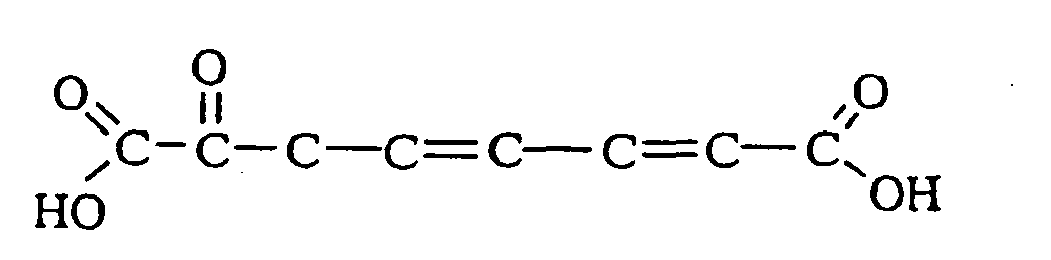


- Further, from the viewpoint of the stability of liquid crystal alignment, muconic acid is preferred. A polyamide employing muconic acid is represented by a repeating unit of the following Formula (8):

- Specific examples of the diamine compound having a photochemically reactive group, include, in addition to diamines having one unsaturated hydrocarbon group, buta-1,3-diene-1,4-diamine:
H2N-C=C-C=C-NH2 (1)
hexa-2,4-diene-1,6-diamine:
H2N-C-C=C-C=C-C-NH2 (2)
octa-3,5-diene-1,8-diamine:
H2N-C- C-C=C-C=C-C- C-NH2 (3)
4-(4-(4-aminophenyl)buta-1,3-dienyl)phenylamine:
H2N-C-C≡C-C-NH2 (5)
hex-3-yne-2,5-diamine:

H2N-C≡C-C-C≡C-C-NH2 (8)
3-(2-(3-aminophenyl)ethynyl)phenylamine:


- Further, from the viewpoint of the sensitivity to the photochemical reaction, 4,4'-diaminochalcone, 1,4-(bis-(4-aminobenzoylethenyl))benzene or 1,3-(bis-(4-aminobenzylidene))acetone is preferred.
- From the viewpoint of the stability of alignment of liquid crystal, repeating units containing the above-mentioned photochemically reactive groups are contained preferably in an amount of from 20 to 100 mol%, more preferably from 50 to 100 mol%, based on the entire polymer components.
- Further, specific examples of the common carboxylic acid component having no photochemically reactive group, include dicarboxylic acids such as terephthalic acid, isophthalic acid, 2,6-naphthalenedicarboxylic acid, 1,6-naphthalenedicarboxylic acid, 2,6-anthracenedicarboxylic acid, 1, 6-anthracenedicarboxylic acid, 4, 4'-biphenyldicarboxylic acid, oxalic acid, fumaric acid, maleic acid, malonic acid, succinic acid, glutaric acid, adipic acid, pimelic acid, suberic acid, mazelaic acid, sebacic acid, 1,9-nonandicarboxylic acid and 1,10-decanedicarboxylic acid, and their acid halides, acid anhydrides and alkyl esters. Further, a mixture of two or more of them may also be employed.
- Further, specific examples of a diamine having no photochemically reactive group, include aromatic diamines such as p-phenylenediamine, m-phenylenediamine, 2,5-diaminotoluene, 2,6-diaminotoluene, 4,4'-diaminobiphenyl, 3,3'-dimethyl-4,4'-diaminobiphenyl, 3,3'-dimethoxy-4,4'-diaminobiphenyl, diaminodiphenylmethane, diaminodiphenyl ether, 2,2'-diaminodiphenylpropane, bis(3,5-diethyl-4-aminophenyl)methane, diaminodiphenylsulfone, diaminobenzophenone, diaminonaphthalene, 1,4-bis(4-aminophenoxy)benzene, 1,4-bis(4-aminophenyl)benzene, 9,10-bis(4-aminophenyl)anthracene, 1,3-bis(4-aminophenoxy)benzene, 4,4'-bis(4-aminophenoxy)diphenylsulfone, 2,2-bis[4-(4-aminophenoxy)phenyl]propane, 2,2-bis(4-aminophenyl)hexafluoropropane, and 2,2-bis[4-(4-aminophenoxy)phenyl]hexafluoropropane, alicyclic diamines such as bis(4-aminocyclohexyl)methane and bis(4-amino-3-methylcyclohexyl)methane, and aliphatic diamines such as tetramethylenediamine and hexamethylenediamine, as well as diaminosiloxanes such as

- Further, for the purpose of increasing the tilt angle, a diamine having a long chain alkyl group represented by 4,4'-diamino-3-dodecyldiphenyl ether or 1-dodecanoxy-2,4-diaminobenzene, may be used, these diamine components may be used alone or in combination as a mixture of two or more of them.
- A synthetic method for such a polyamide is not particularly limited. Usually, it can be obtained by charging a dicarboxylic acid or its derivative and a diamine in equimolar amounts and subjecting them to a polycondensation reaction in an organic solvent.
- This polycondensation reaction proceeds smoothly in the presence of a condensing agent. The condensing agent to be used here may, for example, be triphenyl phosphite, tetrachlorosilane or dimethylchlorosilane when a dicarboxylic acid is used as the monomer, or triethylamine, pyridine or N,N-dimethylaniline when a halide of a dicarboxylic acid is used as the monomer.
- Further, this reaction is preferably carried out in an organic solvent, and specific examples of the solvent to be used include N,N-dimethylformamide, N,N-dimethylacetoamide, N-methyl-2-pyrrolidone, N-methylcaprolactam, tetrahydrofuran, dioxane, toluene, chloroform, dimethylsulfoxide, tetramethylurea, pyridine, dimethylsulfone, hexamethylphospholamide, butyllactone and cresol.
- The reaction temperature in this condensation reaction is usually preferably within a temperature range of from room temperature to about 200°C.
- On the other hand, in a case where the above-mentioned dicarboxylic anhydride or alkyl ester compound is employed as a monomer, the polycondensation reaction will proceed satisfactorily usually without employing the above-mentioned condensing agent and solvent, by mixing a diamine compound, followed by heat dissolving under vacuum.
- The reduced viscosity of the resin obtained by the above described production method is preferably from 0.05 to 3.0 dl/g (in N-methyl-2-pyrrolidone at a temperature of 30°C, concentration: 0.5 g/dl). Further, the number average molecular weight is preferably at least 1000 with a view to utilizing the characteristics of the polymer. The molecular weight can be measured by a known method such as gel permeation chromatography, an osmotic method, a light scattering method or a viscosity method.
- The polymer compound in the present invention is not particularly limited so long as it contains photochemically reactive groups in its main chain and has a glass transition point of at least 200°C. For example, in a polyimide represented by the following formula (10):

- Specific examples of the tetracarboxylic acid component having a photochemically reactive group include tetracarboxylic acids such as cycloocta-1,5-diene-1,2,5,6-tetracarboxylic acid:


- Specific examples of the diamine component having a photochemically reactive group include, like a polyamide, buta-1,3-diene-1,4-diamine, hexa-2,4-diene-1,6-diamine, octa-3,5-diene-1,8-diamine, 4-(4-(4-aminophenyl)buta-1,3-dienyl)phenylamine, but-2-yne-1,4-diamine, hex-3-yne-2,5-diamine, 1,8-diaminooct-4-yne-2,7-diol, hex-1,5-diyne-1,6-diamine, 3-(2-(3-aminophenyl)ethynyl)phenylamine, 3-(2-(4-aminophenyl)ethynyl)phenylamine, 4-(2-(4-aminophenyl)ethynyl)phenylamine, 2-(2-(2-aminophenyl)ethynyl)phenylamine, 5-(2-(3-aminophenyl)ethynyl)-2-fluorophenylamine, 4-(2-(3-aminophenyl)ethynyl)-3-(trifluoromethyl)phenylamine, 5-(2-(2-amino-4-methoxyphenyl)ethynyl)-2-nitrophenylamine, 2-(2-(3-amino-4-methoxyphenyl)ethynyl)-5-nitrophenylamine, 4,4'-diaminochalcone, 1,4-(bis-(4-aminobenzoylethenyl))benzene and 1,3-(bis-(4-aminobenzylidene))acetone. These diamine compounds may be used alone or in combination as a mixture of two or more of them.
- Further, from the viewpoint of the sensitivity for the photochemical reaction, 4,4'-diaminochalcone, 1,4-(bis-(4-aminobenzoylethenyl))benzene or 1,3-(bis-(4-aminobenzylidene))acetone is preferred.
- From the viewpoint of the stability of alignment of liquid crystal, repeating units containing the above-mentioned photochemically reactive groups are contained preferably in an amount of from 20 to 100 mol%, more preferably from 50 to 100 mol%, based on the entire polymer components.
- Specific examples of the tetracarboxylic acid having no photochemically reactive group, include aromatic tetracarboxylic acids such as 1,2,3,4-cyclobutanetetracarboxylic acid, 1,2,3,4-cyclopentanetetracarboxylic acid, 2,3,4,5-tetrahydrofurantetracarboxylic acid, 1,2,4,5-cyclohexanetetracarboxylic acid, 3,4-dicarboxy-1-cyclohexylsuccinic acid, 3,4-dicarboxy-1,2,3,4-tetrahydro-1-naphthalenesuccinic acid, pyromellitic acid, 2,3,6,7-naphthalenetetracarboxylic acid, 1,2,5,6-naphthalenetetracarboxylic acid, 1,4,5,8-naphthalenetetracarboxylic acid, 2,3,6,7-anthracenetetracarboxylic acid, 1,2,5,6-anthracenetetracarboxylic acid, 3,3',4,4'-biphenyltetracarboxylic acid, 2,3,3',4-biphenyltetracarboxylic acid, bis(3,4-dicarboxyphenyl)ether, 3,3',4,4'-benzophenonetetracarboxylic acid, bis(3,4-dicarboxyphenyl)sulfone, bis(3,4-dicarboxyphenyl)methane, 2,2-bis(3,4-dicarboxyphenyl)propane, 1,1,1,3,3,3-hexafluoro-2,2-bis(3,4-dicarboxyphenyl)propane, bis(3,4-dicarboxyphenyl)dimethylsilane, bis(3,4-dicarboxyphenyl)diphenylsilane, 2,3,4,5-pyridinetetracarboxylic acid and 2,6-bis(3,4-dicarboxyphenyl)pyridine, and their dianhydrides and dicarboxylic acid diacid halides, and aliphatic tetracarboxylic acids such as 1,2,3,4-butanetetracarboxylic acid, and their dianhydrides and dicarboxylic acid diacid halides. Further, these tetracarboxylic acids and their derivatives may be used alone or in combination as a mixture of two or more of them.
- Further, specific examples of the diamine component having no photochemically reactive group in the present invention, are primary diamines which are commonly used for the synthesis of polyimides and are not particularly limited. Such specific examples include aromatic diamines such as p-phenylenediamine, m-phenylenediamine, 2,5-diaminotoluene, 2,6-diaminotoluene, 4,4'-diaminobiphenyl, 3,3'-dimethyl-4,4'-diaminobiphenyl, 3,3'-dimethoxy-4,4'-diaminobiphenyl, diaminodiphenylmethane, diaminodiphenyl ether, 2,2'-diaminodiphenylpropane, bis(3,5-diethyl-4-aminophenyl)methane, diaminodiphenylsulfone, diaminobenzophenone, diaminonaphthalene, 1,4-bis(4-aminophenoxy)benzene, 1,4-bis(4-aminophenyl)benzene, 9,10-bis(4-aminophenyl)anthracene, 1,3-bis(4-aminophenoxy)benzene, 4,4'-bis(4-aminophenoxy)diphenylsulfone, 2,2-bis[4-(4-aminophenoxy)phenyl]propane, 2,2-bis(4-aminophenyl)hexafluoropropane, and 2,2-bis[4-(4-aminophenoxy)phenyl]hexafluoropropane, alicyclic diamines such as bis(4-aminocyclohexyl)methane and bis(4-amino-3-methylcyclohexyl)methane, and aliphatic diamines such as tetramethylenediamine and hexamethylenediamine, as well as diaminosiloxanes such as

- Further, for the purpose of increasing the tilt angle, a diamine having a long chain alkyl group, represented by 4,4'-diamino-3-dodecyldiphenyl ether or 1-dodecanoxy-2,4-diaminobenzene, may be employed. These diamine components may be used alone or in combination as a mixture of two or more of them.
- The method for producing such polyimides is not particularly limited. Usually, a tetracarboxylic acid or its derivative is reacted and polymerized with a diamine to form a polyimide precursor, which is subjected to ring closure imide modification. As the tetracarboxylic acid or its derivative to be used here, it is common to employ a tetracarboxylic dianhydride. The ratio of the molar amount of the tetracarboxylic dianhydride to the total molar amount of the diamine is preferably from 0.8 to 1.2. Like a usual polycondensation reaction, the closer the molar ratio to 1, the larger the polymerization degree of the resulting polymer.
- If the polymerization degree is too small, the strength of the polyimide film tends to be inadequate when it is used as an alignment film, and alignment of liquid crystal tends to be unstable.
- On the other hand, if the polymerization degree is too large, the operation efficiency during formation of a polyimide film is likely to be poor.
- Accordingly, the polymerization degree of the product in this reaction is preferably such that the reduced viscosity of the polyimide precursor is from 0.05 to 3.0 dl/g (in N-methylpyrrolidone at a temperature of 30°C, concentration: 0.5 g/dl).
- The method for reacting and polymerizing the tetracarboxylic acid dianhydride with the diamine is not particularly limited. Usually, a primary diamine and a tetracarboxylic dianhydride are reacted in an organic polar solvent such as N-methylpyrrolidone, N,N-dimethylacetoamide or N,N-dimethylformamide to obtain a polyimide precursor, followed by dehydration ring closure imide modification.
- The temperature for the reaction and polymerization of the tetracarboxylic acid or its derivative with the diamine may be at an optional temperature within a range of from -20 to 150°C, but it is particularly preferably within a range of from -5 to 100°C.
- Further, this polyimide precursor may be dehydrated by heating at a temperature of from 100 to 400°C or subjected to chemical imide-modification by means of an imide-modification catalyst which is commonly used, such as a triethylamine/acetic anhydride, to obtain a polyimide.
- Further, to form a polyimide coating film, usually, a polyimide precursor solution may be coated as it is, on a substrate and heated on the substrate for imide-modification to form a polyimide coating film. For the polyimide precursor solution to be used here, the above-mentioned polymerization solution may be employed as it is, or the formed polyimide precursor solution may be put into a large excess amount of a poor solvent such as water or methanol to precipitate and recover the precursor, which may be dissolved again in a solvent and used. The solvent for the diluted solution of the above polyimide precursor solution and/or the redissolved solution of the precipitated and recovered polyimide precursor, is not particularly limited so long as it is capable of dissolving the polyimide precursor.
- Specific examples of such a solvent include N-methylpyrrolidone, N,N-dimethylacetoamide and N,N-dimethylformamide. These solvents may be used alone or in combination as a mixture. Further, even in the case of a solvent whereby a uniform solution is hardly obtainable by itself, such a solvent may be added and used within a range where a uniform solution can be obtained.
- Further, as the temperature for heating on the substrate for imide-modification, an optional temperature within a range of from 100 to 400°C may be employed, but it is preferably within a range of from 150 to 350°C.
- On the other hand, when the polyimide is soluble in a solvent, the polyimide precursor solution obtained by reacting a tetracarboxylic dianhydride with a diamine, can be imide-modified in the solution to obtain a polyimide solution.
- For conversion of the polyimide precursor to a polyimide, it is common to employ a method for dehydration ring closure by heating. As the temperature for ring closure by dehydration under heating, an optional temperature within a range of from 100 to 350°C, preferably from 120 to 250°C, may be selected.
- Further, as another method for converting the polyimide precursor to a polyimide, a known catalyst for dehydration ring closure may be employed to carry out the ring closure chemically.
- The polyimide solution thus obtained may be used as it is. Otherwise, it may be precipitated in a poor solvent such as methanol or ethanol, then isolated and re-dissolved in a suitable solvent for use.
- The solvent for the redissolution is not particularly limited so long as it is capable of dissolving the obtained polyimide. For example, 2-pyrrolidone, N-methylpyrrolidone, N-ethylpyrrolidone, N-vinylpyrrolidone, N,N-dimethylacetoamide, N,N-dimethylformamide and γ-butyrolactone may be mentioned.
- Further, even a solvent which is incapable of dissolving a polyimide by itself, may be added to the above solvent within a range not to impair the solubility. Even in the case of a solvent whereby a uniform solution can not be obtained, such a solvent may be added and used within a range wherein a uniform solution can be obtained. As such an example, ethyl cellosolve, butyl cellosolve, ethyl carbitol, butyl carbitol, ethyl carbitol acetate or ethylene glycol may be mentioned.
- This solution is coated on a substrate, and the solvent is evaporated to form a polyimide coating film on the substrate. The temperature at that time is sufficient if the solvent evaporates, and is usually sufficient at a level of from 80 to 150°C.
- The solution of the treating agent for liquid crystal alignment of the present invention obtained as described above, is coated on a substrate by means of a method such as spin coating or transfer printing, and the coated solution is heated and baked under the above conditions to form a polymer film. The thickness of the polymer film at that time, is not particularly limited, but is usually from 100 to 3000 nm to be used as a usual liquid crystal alignment film.
- Then, on the surface of the polymer film, ultraviolet rays polarized via a polarizing plate will be irradiated in a predetermined direction to the substrate. With respect to the wavelength of the ultraviolet rays to be used, ultraviolet rays within a range of from 100 nm to 400 nm may usually be employed. Particularly preferably, it is advisable to select a suitable wavelength via e.g. a filter depending upon the type of the polymer to be used.
- The time for irradiation of the ultraviolet rays is usually within a range of from a few seconds to a few hours, but it may be suitably selected depending upon the polymer to be used.
- Further, the method of irradiating the polarize ultraviolet rays is not particularly limited. Irradiation may be made by rotating the plane of polarization, or irradiation may be carried out more than two times by changing the incident angle of the polarized ultraviolet rays. Further, it is sufficient that polarized light is substantially obtained, and non-polarized ultraviolet rays may be irradiated with a certain angle of inclination from the normal line of the substrate.
- A pair of substrates thus irradiated with polarized ultraviolet rays, are prepared and disposed so that the polymer film surfaces face to each other with liquid crystal sandwiched between them, whereby liquid crystal molecules can be aligned, and the alignment is thermally stable.
- Now, the present invention will be described in further detail with reference to Examples, but the present invention is by no means restricted thereto.
- In a nitrogen stream, 8.5 g (20.7 mmol) of 2,2-bis(4-aminopheoxyphenyl)propane and 3.0 g (21.1 mmol) of muconic acid were dissolved in 70 cc of N-methylpyrrolidone (hereinafter referred to simply as NMP). To this solution, 13.1 g (42.2 mmol) of triphenyl phosphite and 10.5 cc of pyridine were sequentially added. The mixture was stirred at 100°C for 3 hours. The obtained reaction mixture was diluted with NMP and then poured into methanol. A precipitated polymer was collected by filtration and dried. This was again dissolved in NMP and then poured into methanol. A precipitated polymer was collected by filtration and dried. The above operation was repeated again, and purification was carried out to obtain 7 g of a polyamide. The obtained polyamide was dissolved in NMP, and its reduced viscosity was measured, whereby it was 1.1 dl/g (concentration: 0.5 g/dl, in NMP, 30°C). Further, the obtained polyamide varnish was coated on a glass substrate and dried to obtain a film, and the glass transition temperature measured by TMA (thermal mechanical analysis) using the film, was 315°C.
- This polyamide was dissolved in NMP to prepare a solution having a total solid content of 3 wt%. This solution was spin coated at 3600 rpm on a glass substrate, followed by heat treatment at 80°C for 10 minutes and 180°C for 30 minutes, to obtain a polyamide resin film having a thickness of 100 nm. A pair of glass substrates coated with polyamide resin films, thus obtained, were prepared, and on the respective polyamide resin films, polarized ultraviolet rays having a wavelength of from 300 nm to 330 nm from an ultra high pressure mercury lamp with an output power of 700 W, were irradiated for 5 minutes via a band pass filter and a polarizing plate. The pair of substrates irradiated with polarized ultraviolet rays were bonded with fine polymer particles of 6 µm interposed therebetween, so that the polyamide surfaces faced inwardly, and the directions of irradiated polarized ultraviolet rays became parallel to each other, to obtain a liquid crystal cell. This cell was maintained at a temperature of at least the isotropic temperature of liquid crystal on a hot plate, and liquid crystal (ZLI-2293, manufactured by Merck Co.) was injected. This cell was cooled to room temperature and then rotated under crossed Nicols of a polarization microscope, whereby a clear contrast appeared, and no defect was observed, and thus it was confirmed that liquid crystal was uniformly aligned.
- Further, the prepared liquid crystal cell was heat treated in an oven of 120°C for one hour and then cooled to room temperature. This liquid crystal cell was rotated under crossed Nicols of a polarization microscope, whereby a clear contrast appeared, and no defect was observed, and thus it was confirmed that the uniform alignment of liquid crystal before the heat treatment, was maintained.
- In a nitrogen stream, 3.6 g (8.7 mmol) of 2,2-bis(4-aminophenoxyphenyl)propane and 1.0 g (8.85 mmol) of acetylenedicarboxylic acid were dissolved in 30 cc of NMP. To this solution, 5.4 g (17.4 mmol) of triphenyl phosphite and 2.6 cc of pyridine were sequentially added. This was stirred at 100°C for 4 hours. The obtained reaction mixture was diluted with NMP and then poured into methanol. A precipitated polymer was collected by filtration and dried. This was again dissolved in NMP and then poured into methanol. A precipitated polymer was collected by filtration and dried. The above operation was repeated again, and purification was carried out to obtain 4 g of a polyamide. The obtained polyamide was dissolved in NMP, and its reduced viscosity was measured, and it was 0.8 dl/g (concentration: 0.5 g/dl, in NMP, 30°C). Further, the obtained polyamide varnish was coated on a glass substrate and dried to obtain a film, and using this film, the glass transition temperature was measured by TMA, but no clear glass transition point was shown.
- This polyamide was dissolved in NMP to obtain a solution having a total solid content of 7 wt%. This solution was spin-coated at 2800 rpm on a glass substrate, followed by heat treatment at 80°C for 10 minutes and at 120°C for 30 minutes to obtain a polyamide resin film having a thickness of 100 nm. In the same manner as in Example 1, polarized ultraviolet rays were irradiated to the polyamide resin film and then a liquid crystal cell was prepared. This cell was rotated under crossed Nicols of a polarization microscope, whereby a clear contrast appeared, and no defect was observed, and thus it was confirmed that the liquid crystal was uniformly aligned.
- Further, the prepared liquid crystal cell was heat treated in an oven of 120°C for one hour and then cooled to room temperature. This liquid crystal cell was rotated under crossed Nicols of a polarization microscope, whereby a clear contrast appeared, and no defect was observed, and it was confirmed that the uniform liquid crystal alignment before the heat treatment was maintained.
- In a nitrogen stream, 4.7 g (11.6 mmol) of 2,2-bis(4-aminophenoxyphenyl)propane, 1.2 g (8.3 mmol) of muconic acid and 0.4 g (3.5 mmol) of acetylene dicarboxylic acid were dissolved in 55 cc of NMP. To this solution, 7.2 g (23.1 mmol) of triphenyl phosphite and 3.5 cc of pyridine were sequentially added. This was stirred at 100°C for 4 hours. The obtained reaction mixture was diluted with NMP and then poured into methanol. A precipitated polymer was collected by filtration and dried. This was again dissolved in NMP and then poured into methanol. A precipitated polymer was collected by filtration and dried. The above operation was repeated again, and purification was carried out to obtain 6.7 g of a polyamide. The obtained polyamide was dissolved in NMP, and its reduced viscosity was measured, whereby it was 1.0 dl/g (concentration: 0.5 g/dl, in NMP, at 30°C). Further, the obtained polyamide varnish was coated on a glass substrate and dried to obtain a film, and using the film, the glass transition temperature was measured by TMA, but no clear glass transition point was shown.
- This polyamide was dissolved in NMP to prepare a solution having a total solid content of 7 wt%. This solution was spin coated at 3600 rpm on a glass substrate, followed by heat treatment at 80°C for 10 minutes and at 120°C for 30 minutes to obtain a polyamide resin film having a thickness of 100 nm. In the same manner as in Example 1, polarized ultraviolet rays were irradiated to the polyamide resin film, and then a liquid crystal cell was prepared. This cell was rotated under crossed Nicols of a polarization microscope, whereby a clear contrast appeared, and no defect was observed, and thus it was confirmed that the liquid crystal was uniformly aligned.
- Further, the prepared liquid crystal cell was heat treated in an oven of 120°C for one hour and then cooled to room temperature. This liquid crystal cell was rotated under crossed Nicols of a polarization microscope, whereby a clear contrast appeared, and no defect was observed, and thus it was confirmed that the uniform liquid crystal alignment before heat treatment was maintained.
- A polyamide was synthesized in the same manner as in Example 1 except that 4.2 g (10.0 mmol) of 2,2-bis(4-aminophenoxyphenyl)propane, 5.2 g (10.0 mmol) of 2,2-bis(4-aminophenoxyphenyl)hexafluoropropane and 3.0 g (21.1 mmol) of muconic acid were used as monomers. The obtained polyamide was dissolved in NMP, and its reduced viscosity was measured, whereby it was 1.3 dl/g (concentration: 0.5 g/dl, in NMP at 30°C). Further, the obtained polyamide varnish was coated on a glass substrate and dried to obtain a film, and the glass transition temperature measured by TMA using the film, was 330°C.
- This polyamide was dissolved in NMP to prepare a solution having a total solid content of 3 wt%. This solution was spin coated at 3800 rpm on a glass substrate, followed by heat treatment at 80°C for 10 minutes and at 180°C for 30 minutes to obtain a polyamide resin film having a thickness of 100 nm. A pair of glass substrates coated with the polyamide resin films thus obtained, were prepared, and polarized ultraviolet rays with a wavelength of from 300 nm to 330 nm from an ultra high pressure mercury lamp with an output power of 700 W, were irradiated via a band pass filter and a polarizing plate to the respective polyamide resin films, and further, by rotating the plane of polarization at 90°C, polarized ultraviolet rays were irradiated for 25 minutes at an incident angle of 45°. The pair of substrates irradiated with the polarized ultraviolet rays were bonded with fine polymer particles of 6 µm interposed therebetween, so that the polyamide surfaces faced inwardly, and the direction of obliquely irradiated polarized ultraviolet rays would be oppositely in parallel with each other, to obtain a liquid crystal cell. This cell was maintained at a temperature of at least the isotropic temperature of liquid crystal on a hot plate, and liquid crystal (ZLI-2293, manufactured by Merck Co.) was injected. This cell was cooled to room temperature and then rotated under crossed Nicols of a polarization microscope, whereby a clear contrast appeared, and no defect was observed, and thus it was confirmed that liquid crystal was uniformly aligned.
- Further, the prepared liquid crystal cell was heat treated in an oven of 120°C for one hour and then cooled to room temperature. This liquid crystal cell was rotated under crossed Nicols of a polarization microscope, whereby a clear contrast appeared, and no defect was observed, and thus it was confirmed that the uniform liquid crystal alignment before the heat treatment was maintained.
- A polyamide was synthesized in the same manner as in Example 1 except that 4.2 g (10.0 mmol) of 2,2-bis(4-aminophenoxylphenyl)propane, 3.5 g (10.0 mmol) of 1-hexadecanoxy-2,4-diaminobenzene and 3.0 g (21.1 mmol) of muconic acid were employed as monomers. The obtained polyamide was dissolved in NMP, and its reduced viscosity was measured, whereby it was 0.85 dl/g (concentration: 0.5 g/dl, in NMP at 30°C). Further, the obtained polyamide varnish was coated on a glass substrate and dried to obtain a film, and the glass transition temperature measured by TMA using the film, was 250°C.
- This polyamide was dissolved in NMP to prepare a solution having a total solid content of 3 wt%. This solution was spin coated at 3000 rpm on a glass substrate, followed by heat treatment at 80°C for 10 minutes and at 180°C for 30 minutes, to obtain a polyamide resin film having a thickness of 100 nm. In the same manner as in Example 4, polarized ultraviolet rays were irradiated to the polyamide resin film and then, a liquid crystal cell was prepared. This cell was rotated under crossed Nicols of a polarization microscope, whereby a clear contrast appeared, and no defect was observed, and thus it was confirmed that liquid crystal was uniformly aligned.
- Further, the prepared liquid crystal was heat treated in an oven of 120°C for one hour and then cooled to room temperature. This liquid crystal cell was rotated under crossed Nicols of a polarization microscope, whereby a clear contrast appeared, and no defect was observed, and thus it was confirmed that the uniform liquid crystal alignment before the heat treatment was maintained.
- In a nitrogen stream, 2.5 g (6.9 mmol) of cis-3,7-dibutylcycloocta-1,5-diene-1,2,5,6-tetracarboxylic acid and 1.4 g (6.9 mmol) of 4,4'-diaminodiphenyl ether were dissolved in 25 mℓ of m-cresol. 0.8 mℓ of quinoline was added thereto, followed by stirring at 110°C for 44 hours. The obtained reaction product was poured into methanol, and a precipitated polymer was collected by filtration and dried to obtain a polyimide powder. This polyimide was dissolved in NMP, and its reduced viscosity was measured, whereby it was 1.0 dl/g (concentration: 0.5 g/dl, in NMP at 30°C). Further, the obtained polyimide varnish was coated on a glass substrate and dried to obtain a film, and the glass transition point evaluated by TMA using the film, was 280°C.
- This polyimide was dissolved in NMP to prepare a solution having a total solid content of 5 wt%. This solution was spin coated at 3500 rpm on a glass substrate, followed by heat treatment at 80°C for 10 minutes and at 180°C for 30 minutes, to obtain a polyimide resin film having a thickness of 100 nm. A pair of glass substrates coated with polyimide resin films thus obtained, were prepared, and polarized ultraviolet rays with a wavelength of from 240 nm to 280 nm from an ultra high pressure mercury lamp with an output power of 700 W, were irradiated for 5 minutes via a band pass filter and a polarizing plate to the respective polyamide resin films. The pair of substrates irradiated with the polarized ultraviolet rays were bonded with fine polymer particles of 6 µm interposed therebetween, so that the polyamide surfaces faced inwardly and the directions of irradiated polarized ultraviolet rays became in parallel with each other. This cell was maintained at a temperature of at least the isotropic temperature of liquid crystal on a hot plate, and liquid crystal (ZLI-2293, manufactured by Merck Co.) was injected. This cell was cooled to room temperature and then rotated under crossed Nicols of a polarization microscope, whereby a clear contrast appeared, and no defect was observed, and thus it was confirmed that liquid crystal was uniformly aligned.
- Further, the prepared liquid crystal cell was heat treated in an oven of 120°C for one hour and then cooled to room temperature. This liquid crystal cell was rotated under crossed Nicols of a polarization microscope, whereby a clear contrast appeared, and no defect was observed, and thus it was confirmed that the uniform liquid crystal alignment before the heat treatment was maintained.
- In a nitrogen stream, 15 g (59 mmol) of 4,4'-diaminochalcone and 11.5 g (59 mmol) of 1,2,3,4-cyclobutanetetracarboxylic dianhydride were dissolved in 150 mℓ of NMP and reacted at room temperature. Then, polymerization was further carried out for 48 hours. The reduced viscosity of the obtained polyimide precursor was 0.56 dl/g (concentration: 0.5 g/dl, in NMP at 30°C). Further, the polyimide precursor was coated on a substrate and subjected to heat treatment to obtain a film, and the glass transition point measured by TMA using the film, was 310°C.
- This polyimide precursor was dissolved in NMP to prepare a solution having a solid content of 4 wt%. This solution was spin coated at 2000 rpm on a glass substrate, followed by heat treatment at 80°C for 10 minutes and at 250°C for 60 minutes, to obtain a polyimide film having a thickness of 100 nm.
- A pair of glass substrates coated with polyimide resin films thus obtained, were prepared, and polarized ultraviolet rays having a wavelength of from 300 nm to 330 nm from an ultra high pressure mercury lamp with an output power of 700 W, were irradiated for one minute via a band pass filter and a polarizing plate to the respective polyamide resin films. The pair of substrates irradiated with the polarized ultraviolet rays, were bonded with fine polymer particles of 6 µm interposed therebetween, so that the polyamide surfaces faced inwardly, and the directions of irradiated polarized ultraviolet rays became in parallel with each other, to prepare a liquid crystal cell. This cell was maintained at a temperature of at least the isotropic temperature of liquid crystal on a hot plate, and liquid crystal (ZLI-2293, manufactured by Merck Co.) was injected. This cell was cooled to room temperature and then rotated under crossed Nicols of a polarization microscope, whereby a clear contrast appeared, and no defect was observed, and thus it was confirmed that liquid crystal was uniformly aligned.
- Further, the prepared liquid crystal cell was heat treated in an oven of 120°C for 6 hours and then cooled to room temperature. This liquid crystal cell was rotated under crossed Nicols of a polarization microscope, whereby a clear contrast appeared, and no defect was observed, and thus it was confirmed that the uniform liquid crystal alignment before the heat treatment was maintained.
- In a nitrogen stream, 23 g (62 mmol) of 1,4-bis(2-(4-aminobenzoyl)ethenyl)benzene and 12.2 g (62 mmol) of 1,2,3,4-cyclobutanetetracarboxylic dianhydride were dissolved in 230 mℓ of N-methylpyrrolidone, and polymerization was carried out in the same manner as in Example 7. The reduced viscosity of the obtained polyimide precursor was 0.72 dl/g (concentration: 0.5 g/dl, in MMP at 30°C). Further, the polyimide precursor was coated on a substrate and subjected to heat treatment to obtain a film, and the glass transition point was measured by TMA using the film, but no clear glass transition point was observed.
- This polyimide precursor was dissolved in NMP to prepare a solution having a solid content of 4 wt%. This solution was spin coated at 300 rpm on a glass substrate, followed by heat treatment at 80°C for 10 minutes and at 250°C for 60 minutes, to obtain a polyimide film having a thickness of 100 nm. In the same manner as in Example 7, polarized ultraviolet rays were irradiated to the polyimide resin film, and then, a liquid crystal cell was prepared. This cell was rotated under crossed Nicols of a polarization microscope, whereby a clear contrast appeared, and no defect was observed, and thus it was confirmed that liquid crystal was uniformly aligned.
- Further, the prepared liquid crystal cell was heat treated in an oven of 120°C for 6 hours and the cooled to room temperature. This liquid crystal cell was rotated under crossed Nicols of a polarization microscope, whereby a clear contrast appeared, and no defect was observed, and thus it was confirmed that the uniform liquid crystal alignment before the heat treatment, was maintained.
- In a nitrogen stream, 5.6 g (13.7 mmol) of 2,2-bis(4-aminophenoxyphenyl)propane and 2.0 g (13.7 mmol) of adipic acid were dissolved in 50 cc of N-methylpyrrolidone (hereinafter referred to simply as NMP). To this solution, 8.5 g (27.4 mmol) of triphenyl phosphite and 6.6 cc of pyridine were sequentially added. This was stirred at 100°C for 4.5 hours. The obtained reaction mixture was diluted with NMP and then poured into methanol. A precipitated polymer was collected by filtration and dried. This was again dissolved in NMP and then poured into methanol. A precipitated polymer was collected by filtration and dried. The above operation was repeated again, and purification was carried out to obtain 7.5 g of a polyamide. The obtained polyamide was dissolved in NMP, and its reduced viscosity was measured, whereby it was 1.0 dl/g (concentration: 0.5 g/dl, in NMP at 30°C). Further, the obtained polyamide varnish was coated on a glass substrate and dried to obtain a film, and the glass transition temperature measured by TMA (thermal mechanical analysis) using the film, was 140°C.
- This polyamide was dissolved in NMP to prepare a solution having a total solid content of 3 wt%. This solution was spin coated at 3500 rpm on a glass substrate, followed by heat treatment at 80°C for 10 minutes and at 180°C for 30 minutes, to obtain a polyamide resin film having a thickness of 100 nm. In the same manner as in Example 1, polarized ultraviolet rays were irradiated to the polyamide resin film, and then, a liquid crystal cell was prepared. This cell was rotated under crossed Nicols of a polarization microscope, whereby many defects were observed although a certain contrast appeared, and liquid crystal was not uniformly aligned.
- Polyvinyl cinnamate (molecular weight: about 2000) was dissolved in a solvent mixture of monochlorobenzene and dichloromethane to prepare a solution having a total solid content of 2 wt%. This solution was spin coated at 2000 rpm on a glass substrate, followed by heat treatment at 80°C for 10 minutes and at 100°C for one hour, to obtain a coating film having a thickness of 100 nm.
- To this polyvinyl cinnamate film, polarized ultraviolet rays were irradiated in the same manner as in Example 1, and a liquid crystal cell was prepared. However, the time for irradiation of the ultraviolet rays was one minute. This cell was rotated under crossed Nicols of a polarization microscope, whereby a clear contrast appeared, and no defect was observed, and thus a uniform liquid crystal alignment was obtained. However, when the liquid crystal cell was heat treated at 120°C and cooled to room temperature, and then the liquid crystal cell was observed under crossed Nicols of a polarization microscope, many defects were observed, and the liquid crystal alignment before the heat treatment was not maintained, and it was confirmed that the alignment was irregular.
- With the treating agent for liquid crystal alignment of the present invention, liquid crystal molecules can be aligned uniformly and stably by irradiating polarized ultraviolet rays in a predetermined direction to a resin film surface formed on a substrate, without carrying out rubbing treatment like a conventional treating method for liquid crystal alignment.
Claims (5)
- A treating agent for liquid crystal alignment, which is an agent for liquid crystal alignment to be used for a method in which polarized ultraviolet rays or electron rays are irradiated on a polymer thin film formed on a substrate in a predetermined direction relative to the substrate plane, and said substrate is used for aligning liquid crystal without rubbing treatment,
wherein said agent for liquid crystal alignment contains a polymer compound having photochemically reactive groups of at least one type selected from the following structural units (2) to (6) in the polymer main chain and a glass transition temperature of at least 200°C:
-C≡C (3)
-C≡C-C≡C- (4)


- The treating agent for liquid crystal alignment according to Claim 1, wherein the polymer compound is a polyamide resin having repeating units represented by the formula (7):

- The treating agent for liquid crystal alignment according to Claim 2, wherein the polyamide resin is a polyamide resin containing from 20 to 100 mol% of repeating units represented by the following formula (8):

- The treating agent for liquid crystal alignment according to Claim 1, wherein the polymer compound is a polyimide having repeating units represented by the formula (9):

- The treating agent for liquid crystal alignment according to Claim 4, wherein in the polyimide resin having the repeating units of the above formula (9), R10 is represented by the following formula (10) or (11):


Applications Claiming Priority (3)
| Application Number | Priority Date | Filing Date | Title |
|---|---|---|---|
| JP11300297 | 1997-04-30 | ||
| JP11300297 | 1997-04-30 | ||
| PCT/JP1998/001955 WO1998049596A1 (en) | 1997-04-30 | 1998-04-28 | Aligning agent for liquid crystal |
Publications (3)
| Publication Number | Publication Date |
|---|---|
| EP0980016A1 EP0980016A1 (en) | 2000-02-16 |
| EP0980016A4 EP0980016A4 (en) | 2000-10-11 |
| EP0980016B1 true EP0980016B1 (en) | 2008-09-24 |
Family
ID=14600990
Family Applications (1)
| Application Number | Title | Priority Date | Filing Date |
|---|---|---|---|
| EP98917723A Expired - Lifetime EP0980016B1 (en) | 1997-04-30 | 1998-04-28 | Aligning agent for liquid crystal |
Country Status (8)
| Country | Link |
|---|---|
| US (1) | US6274695B1 (en) |
| EP (1) | EP0980016B1 (en) |
| JP (1) | JP4022985B2 (en) |
| KR (1) | KR100553513B1 (en) |
| CN (1) | CN1114125C (en) |
| DE (1) | DE69840045D1 (en) |
| TW (1) | TW461980B (en) |
| WO (1) | WO1998049596A1 (en) |
Families Citing this family (19)
| Publication number | Priority date | Publication date | Assignee | Title |
|---|---|---|---|---|
| US6808766B1 (en) * | 1998-08-26 | 2004-10-26 | Nissan Chemical Industries, Ltd. | Liquid crystal alignment agent and liquid crystal device using the liquid crystal alignment and method for alignment of liquid crystal molecules |
| EP1206975A3 (en) * | 2000-11-14 | 2004-07-14 | Matsushita Electric Industrial Co., Ltd. | Chemical adsorption solution and method of producing chemically adsorbed film using the chemical adsorption solution |
| KR100685944B1 (en) * | 2000-12-05 | 2007-02-23 | 엘지.필립스 엘시디 주식회사 | Optical alignment material and liquid crystal display device using same |
| US6603413B2 (en) | 2001-02-07 | 2003-08-05 | Canon Kabushiki Kaisha | Variable-length decoding apparatus and method |
| WO2003069400A1 (en) * | 2002-02-15 | 2003-08-21 | Dai Nippon Printing Co., Ltd. | Alignment layer, process for producing alignment layer, substrate with alignment layer and liquid crystal display |
| CN100427529C (en) * | 2003-11-26 | 2008-10-22 | 日产化学工业株式会社 | Liquid crystal alignment treatment agent for vertical alignment and liquid crystal display element |
| JP4779974B2 (en) * | 2004-12-22 | 2011-09-28 | 日産化学工業株式会社 | Liquid crystal aligning agent and liquid crystal display element using the same |
| TWI422927B (en) * | 2006-03-16 | 2014-01-11 | Jnc Corp | Light alignment film and liquid crystal display device |
| JP5090370B2 (en) * | 2007-01-04 | 2012-12-05 | エルジー・ケム・リミテッド | Liquid crystal alignment composition, liquid crystal alignment film produced thereby, and liquid crystal display including the same |
| CN101359128B (en) * | 2007-08-03 | 2010-11-24 | 群康科技(深圳)有限公司 | Liquid crystal panel, alignment film of the liquid crystal panel and method for manufacturing same |
| JP5712856B2 (en) | 2010-09-22 | 2015-05-07 | Jnc株式会社 | Photosensitive compound and photosensitive polymer comprising the compound |
| JP6057895B2 (en) * | 2011-06-28 | 2017-01-11 | 日産化学工業株式会社 | Method for producing liquid crystal alignment film, liquid crystal alignment film, and liquid crystal display element |
| WO2013002345A1 (en) * | 2011-06-28 | 2013-01-03 | 日産化学工業株式会社 | Method for producing liquid crystal alignment film, liquid crystal alignment film, and liquid crystal display element |
| WO2013081067A1 (en) * | 2011-11-30 | 2013-06-06 | 日産化学工業株式会社 | Liquid crystal alignment film, method for producing liquid crystal alignment film, and liquid crystal display element |
| CN104126148B (en) * | 2011-12-21 | 2017-05-31 | 日产化学工业株式会社 | Liquid crystal aligning agent, liquid crystal aligning film, liquid crystal display element using the liquid crystal aligning film, and compound |
| CN104335112A (en) * | 2012-03-30 | 2015-02-04 | 日产化学工业株式会社 | Liquid crystal display element and manufacturing method therefor |
| KR20150101514A (en) * | 2014-02-26 | 2015-09-04 | 삼성디스플레이 주식회사 | Photo alignment agent, liquid crystal display device including the same and method of manufacturing the same |
| KR20170023284A (en) * | 2015-08-20 | 2017-03-03 | 삼성디스플레이 주식회사 | Rework method of photo alignment film and manufacturing method of liquid crystal display having the same |
| JP6610333B2 (en) * | 2016-02-29 | 2019-11-27 | Jsr株式会社 | Liquid crystal aligning agent, liquid crystal aligning film, manufacturing method thereof, and liquid crystal element |
Family Cites Families (9)
| Publication number | Priority date | Publication date | Assignee | Title |
|---|---|---|---|---|
| JPH01115928A (en) * | 1987-10-29 | 1989-05-09 | Agency Of Ind Science & Technol | Diacetylene group containing polyamide |
| JPH0749481B2 (en) * | 1989-01-18 | 1995-05-31 | チッソ株式会社 | Process for producing photosensitive heat-resistant polymer |
| JPH0381327A (en) * | 1989-08-24 | 1991-04-05 | Asahi Chem Ind Co Ltd | Diacetylenic polyamic acid, derivative thereof, and polyimide |
| US5539074A (en) * | 1993-02-17 | 1996-07-23 | Hoffmann-La Roche Inc. | Linear and cyclic polymers or oligomers having a photoreactive ethene group |
| JP2777056B2 (en) * | 1993-05-20 | 1998-07-16 | エルジー電子株式会社 | Liquid crystal cell alignment material |
| JPH08328005A (en) * | 1995-05-26 | 1996-12-13 | Hitachi Chem Co Ltd | Liquid crystal oriented film, treatment of liquid crystal oriented film, liquid crystal holding substrate, liquid crystal display element, production of liquid crystal display element and material for liquid crystal oriented film |
| JPH08328015A (en) * | 1995-05-31 | 1996-12-13 | Casio Comput Co Ltd | Liquid crystal display device and manufacturing method thereof |
| DE69725733T2 (en) * | 1996-03-05 | 2004-07-29 | Nissan Chemical Industries, Ltd. | METHOD FOR ALIGNING LIQUID CRYSTALS |
| JP3179025B2 (en) | 1996-06-26 | 2001-06-25 | 株式会社タカラ | Diorama toy |
-
1998
- 1998-04-27 TW TW087106448A patent/TW461980B/en not_active IP Right Cessation
- 1998-04-28 EP EP98917723A patent/EP0980016B1/en not_active Expired - Lifetime
- 1998-04-28 CN CN98804506A patent/CN1114125C/en not_active Expired - Lifetime
- 1998-04-28 DE DE69840045T patent/DE69840045D1/en not_active Expired - Lifetime
- 1998-04-28 US US09/403,766 patent/US6274695B1/en not_active Expired - Lifetime
- 1998-04-28 WO PCT/JP1998/001955 patent/WO1998049596A1/en not_active Ceased
- 1998-04-28 KR KR1019997009738A patent/KR100553513B1/en not_active Expired - Lifetime
- 1998-04-30 JP JP12094198A patent/JP4022985B2/en not_active Expired - Lifetime
Also Published As
| Publication number | Publication date |
|---|---|
| JP4022985B2 (en) | 2007-12-19 |
| US6274695B1 (en) | 2001-08-14 |
| EP0980016A1 (en) | 2000-02-16 |
| TW461980B (en) | 2001-11-01 |
| DE69840045D1 (en) | 2008-11-06 |
| KR100553513B1 (en) | 2006-02-20 |
| WO1998049596A1 (en) | 1998-11-05 |
| JPH1115001A (en) | 1999-01-22 |
| CN1253635A (en) | 2000-05-17 |
| EP0980016A4 (en) | 2000-10-11 |
| KR20010020171A (en) | 2001-03-15 |
| CN1114125C (en) | 2003-07-09 |
Similar Documents
| Publication | Publication Date | Title |
|---|---|---|
| US6063829A (en) | Method for liquid crystal alignment | |
| US6274695B1 (en) | Aligning agent for liquid crystal | |
| US6808766B1 (en) | Liquid crystal alignment agent and liquid crystal device using the liquid crystal alignment and method for alignment of liquid crystal molecules | |
| TWI391758B (en) | A liquid crystal alignment agent and a liquid crystal display device using the same | |
| US5298590A (en) | Liquid crystal alignment treating agent | |
| US5773559A (en) | Polyimide block copolymer and liquid crystal alignment layer forming agent | |
| JP3893659B2 (en) | Liquid crystal alignment treatment method | |
| JP3169062B2 (en) | Liquid crystal cell alignment agent | |
| TWI276899B (en) | Material for liquid crystal alignment and liquid crystal displays using the same | |
| US5420233A (en) | Agent for vertical orientation treatment | |
| JPWO2000013058A1 (en) | Liquid crystal alignment treatment agent, liquid crystal element using the same, and liquid crystal alignment method | |
| KR20010024294A (en) | Photocrosslinkable polyimides | |
| KR20140027550A (en) | Liquid crystal aligning agent, liquid crystal alignment film, and liquid crystal display element | |
| JP2004117634A (en) | Liquid crystal alignment treatment agent and liquid crystal display element | |
| WO2011074546A1 (en) | Liquid crystal aligning agent and liquid crystal display element using same | |
| JPH0543688A (en) | Orienting agent for liquid crystal cell | |
| JP2012012493A (en) | Liquid crystal aligning agent and liquid crystal display element using the same | |
| EP0911680A1 (en) | Aligning agent for liquid-crystal cells | |
| JP4610596B2 (en) | Liquid crystal aligning agent, liquid crystal element using the same, and liquid crystal aligning method | |
| EP0587122A1 (en) | Agent for alignment treatment for a liquid crystal cell | |
| CN111575023A (en) | Novel compound additive, liquid crystal aligning agent prepared from novel compound additive and liquid crystal aligning film |
Legal Events
| Date | Code | Title | Description |
|---|---|---|---|
| PUAI | Public reference made under article 153(3) epc to a published international application that has entered the european phase |
Free format text: ORIGINAL CODE: 0009012 |
|
| 17P | Request for examination filed |
Effective date: 19991027 |
|
| AK | Designated contracting states |
Kind code of ref document: A1 Designated state(s): DE FR GB IT NL |
|
| A4 | Supplementary search report drawn up and despatched |
Effective date: 20000824 |
|
| AK | Designated contracting states |
Kind code of ref document: A4 Designated state(s): DE FR GB IT NL |
|
| GRAP | Despatch of communication of intention to grant a patent |
Free format text: ORIGINAL CODE: EPIDOSNIGR1 |
|
| GRAS | Grant fee paid |
Free format text: ORIGINAL CODE: EPIDOSNIGR3 |
|
| GRAA | (expected) grant |
Free format text: ORIGINAL CODE: 0009210 |
|
| AK | Designated contracting states |
Kind code of ref document: B1 Designated state(s): DE FR GB IT NL |
|
| REG | Reference to a national code |
Ref country code: GB Ref legal event code: FG4D |
|
| REF | Corresponds to: |
Ref document number: 69840045 Country of ref document: DE Date of ref document: 20081106 Kind code of ref document: P |
|
| NLV1 | Nl: lapsed or annulled due to failure to fulfill the requirements of art. 29p and 29m of the patents act | ||
| PG25 | Lapsed in a contracting state [announced via postgrant information from national office to epo] |
Ref country code: NL Free format text: LAPSE BECAUSE OF FAILURE TO SUBMIT A TRANSLATION OF THE DESCRIPTION OR TO PAY THE FEE WITHIN THE PRESCRIBED TIME-LIMIT Effective date: 20080924 |
|
| PLBE | No opposition filed within time limit |
Free format text: ORIGINAL CODE: 0009261 |
|
| STAA | Information on the status of an ep patent application or granted ep patent |
Free format text: STATUS: NO OPPOSITION FILED WITHIN TIME LIMIT |
|
| PG25 | Lapsed in a contracting state [announced via postgrant information from national office to epo] |
Ref country code: IT Free format text: LAPSE BECAUSE OF FAILURE TO SUBMIT A TRANSLATION OF THE DESCRIPTION OR TO PAY THE FEE WITHIN THE PRESCRIBED TIME-LIMIT Effective date: 20080924 |
|
| 26N | No opposition filed |
Effective date: 20090625 |
|
| REG | Reference to a national code |
Ref country code: FR Ref legal event code: PLFP Year of fee payment: 19 |
|
| REG | Reference to a national code |
Ref country code: FR Ref legal event code: PLFP Year of fee payment: 20 |
|
| PGFP | Annual fee paid to national office [announced via postgrant information from national office to epo] |
Ref country code: FR Payment date: 20170313 Year of fee payment: 20 |
|
| PGFP | Annual fee paid to national office [announced via postgrant information from national office to epo] |
Ref country code: GB Payment date: 20170426 Year of fee payment: 20 Ref country code: DE Payment date: 20170426 Year of fee payment: 20 |
|
| REG | Reference to a national code |
Ref country code: DE Ref legal event code: R071 Ref document number: 69840045 Country of ref document: DE |
|
| REG | Reference to a national code |
Ref country code: GB Ref legal event code: PE20 Expiry date: 20180427 |
|
| PG25 | Lapsed in a contracting state [announced via postgrant information from national office to epo] |
Ref country code: GB Free format text: LAPSE BECAUSE OF EXPIRATION OF PROTECTION Effective date: 20180427 |