EP0978016B1 - Antireflective coating compositions for photoresist compositions and use thereof - Google Patents
Antireflective coating compositions for photoresist compositions and use thereof Download PDFInfo
- Publication number
- EP0978016B1 EP0978016B1 EP98922750A EP98922750A EP0978016B1 EP 0978016 B1 EP0978016 B1 EP 0978016B1 EP 98922750 A EP98922750 A EP 98922750A EP 98922750 A EP98922750 A EP 98922750A EP 0978016 B1 EP0978016 B1 EP 0978016B1
- Authority
- EP
- European Patent Office
- Prior art keywords
- photoresist
- coating
- alkyl
- composition according
- composition
- Prior art date
- Legal status (The legal status is an assumption and is not a legal conclusion. Google has not performed a legal analysis and makes no representation as to the accuracy of the status listed.)
- Expired - Lifetime
Links
- 229920002120 photoresistant polymer Polymers 0.000 title claims description 90
- 239000006117 anti-reflective coating Substances 0.000 title claims description 63
- 239000000203 mixture Substances 0.000 title claims description 62
- 229920000642 polymer Polymers 0.000 claims description 65
- 239000000243 solution Substances 0.000 claims description 60
- 238000000576 coating method Methods 0.000 claims description 47
- 239000011248 coating agent Substances 0.000 claims description 45
- 239000000758 substrate Substances 0.000 claims description 40
- -1 amino, hydroxy Chemical group 0.000 claims description 37
- XLYOFNOQVPJJNP-UHFFFAOYSA-N water Substances O XLYOFNOQVPJJNP-UHFFFAOYSA-N 0.000 claims description 36
- 239000002904 solvent Substances 0.000 claims description 35
- 238000000034 method Methods 0.000 claims description 31
- LZCLXQDLBQLTDK-UHFFFAOYSA-N ethyl 2-hydroxypropanoate Chemical compound CCOC(=O)C(C)O LZCLXQDLBQLTDK-UHFFFAOYSA-N 0.000 claims description 28
- 230000008569 process Effects 0.000 claims description 27
- 125000000217 alkyl group Chemical group 0.000 claims description 23
- 239000000178 monomer Substances 0.000 claims description 17
- 125000003118 aryl group Chemical group 0.000 claims description 16
- 150000001732 carboxylic acid derivatives Chemical class 0.000 claims description 16
- LSNNMFCWUKXFEE-UHFFFAOYSA-M Bisulfite Chemical compound OS([O-])=O LSNNMFCWUKXFEE-UHFFFAOYSA-M 0.000 claims description 15
- 229940116333 ethyl lactate Drugs 0.000 claims description 14
- 125000003545 alkoxy group Chemical group 0.000 claims description 13
- 238000004132 cross linking Methods 0.000 claims description 12
- 150000002148 esters Chemical class 0.000 claims description 12
- 150000001447 alkali salts Chemical class 0.000 claims description 11
- 150000001733 carboxylic acid esters Chemical class 0.000 claims description 11
- 125000003709 fluoroalkyl group Chemical group 0.000 claims description 11
- 229910052739 hydrogen Inorganic materials 0.000 claims description 11
- 239000001257 hydrogen Substances 0.000 claims description 11
- 125000004435 hydrogen atom Chemical class [H]* 0.000 claims description 11
- LFQSCWFLJHTTHZ-UHFFFAOYSA-N Ethanol Chemical compound CCO LFQSCWFLJHTTHZ-UHFFFAOYSA-N 0.000 claims description 10
- 125000003710 aryl alkyl group Chemical group 0.000 claims description 10
- 238000010438 heat treatment Methods 0.000 claims description 10
- 239000002253 acid Substances 0.000 claims description 8
- 150000001875 compounds Chemical class 0.000 claims description 8
- 238000011161 development Methods 0.000 claims description 8
- 150000005215 alkyl ethers Chemical class 0.000 claims description 7
- 150000001408 amides Chemical class 0.000 claims description 7
- 150000001735 carboxylic acids Chemical class 0.000 claims description 7
- 239000003431 cross linking reagent Substances 0.000 claims description 7
- 125000004093 cyano group Chemical group *C#N 0.000 claims description 7
- 150000003460 sulfonic acids Chemical class 0.000 claims description 7
- JHIVVAPYMSGYDF-UHFFFAOYSA-N cyclohexanone Chemical compound O=C1CCCCC1 JHIVVAPYMSGYDF-UHFFFAOYSA-N 0.000 claims description 6
- BGTOWKSIORTVQH-UHFFFAOYSA-N cyclopentanone Chemical compound O=C1CCCC1 BGTOWKSIORTVQH-UHFFFAOYSA-N 0.000 claims description 6
- 229910021645 metal ion Inorganic materials 0.000 claims description 5
- 239000007864 aqueous solution Substances 0.000 claims description 4
- 125000000623 heterocyclic group Chemical group 0.000 claims description 4
- 150000002576 ketones Chemical class 0.000 claims description 4
- 229920005989 resin Polymers 0.000 claims description 4
- 239000011347 resin Substances 0.000 claims description 4
- 229920002554 vinyl polymer Polymers 0.000 claims description 4
- 150000008064 anhydrides Chemical group 0.000 claims description 3
- 238000001312 dry etching Methods 0.000 claims description 3
- 229920003986 novolac Polymers 0.000 claims description 3
- 238000000206 photolithography Methods 0.000 claims description 3
- 125000000391 vinyl group Chemical group [H]C([*])=C([H])[H] 0.000 claims description 3
- JMDHCJDATBJFJS-UHFFFAOYSA-N Disperse yellow 9 Chemical compound C1=CC(N)=CC=C1NC1=CC=C([N+]([O-])=O)C=C1[N+]([O-])=O JMDHCJDATBJFJS-UHFFFAOYSA-N 0.000 claims description 2
- 239000008199 coating composition Substances 0.000 claims description 2
- 239000003112 inhibitor Substances 0.000 claims description 2
- 125000001475 halogen functional group Chemical group 0.000 claims 6
- ZIHQUWYJSTVYAT-UHFFFAOYSA-N [NH-][N+]([O-])=O Chemical compound [NH-][N+]([O-])=O ZIHQUWYJSTVYAT-UHFFFAOYSA-N 0.000 claims 4
- KWOLFJPFCHCOCG-UHFFFAOYSA-N Acetophenone Chemical compound CC(=O)C1=CC=CC=C1 KWOLFJPFCHCOCG-UHFFFAOYSA-N 0.000 claims 2
- FZERHIULMFGESH-UHFFFAOYSA-N N-phenylacetamide Chemical compound CC(=O)NC1=CC=CC=C1 FZERHIULMFGESH-UHFFFAOYSA-N 0.000 claims 2
- JUJWROOIHBZHMG-UHFFFAOYSA-N Pyridine Chemical compound C1=CC=NC=C1 JUJWROOIHBZHMG-UHFFFAOYSA-N 0.000 claims 2
- RDOXTESZEPMUJZ-UHFFFAOYSA-N anisole Chemical compound COC1=CC=CC=C1 RDOXTESZEPMUJZ-UHFFFAOYSA-N 0.000 claims 2
- WPYMKLBDIGXBTP-UHFFFAOYSA-N benzoic acid Chemical compound OC(=O)C1=CC=CC=C1 WPYMKLBDIGXBTP-UHFFFAOYSA-N 0.000 claims 2
- CATSNJVOTSVZJV-UHFFFAOYSA-N heptan-2-one Chemical compound CCCCCC(C)=O CATSNJVOTSVZJV-UHFFFAOYSA-N 0.000 claims 2
- LQNUZADURLCDLV-UHFFFAOYSA-N nitrobenzene Chemical compound [O-][N+](=O)C1=CC=CC=C1 LQNUZADURLCDLV-UHFFFAOYSA-N 0.000 claims 2
- ARXJGSRGQADJSQ-UHFFFAOYSA-N 1-methoxypropan-2-ol Chemical compound COCC(C)O ARXJGSRGQADJSQ-UHFFFAOYSA-N 0.000 claims 1
- SVONRAPFKPVNKG-UHFFFAOYSA-N 2-ethoxyethyl acetate Chemical compound CCOCCOC(C)=O SVONRAPFKPVNKG-UHFFFAOYSA-N 0.000 claims 1
- 239000005711 Benzoic acid Substances 0.000 claims 1
- 229960001413 acetanilide Drugs 0.000 claims 1
- SRSXLGNVWSONIS-UHFFFAOYSA-N benzenesulfonic acid Chemical compound OS(=O)(=O)C1=CC=CC=C1 SRSXLGNVWSONIS-UHFFFAOYSA-N 0.000 claims 1
- 235000010233 benzoic acid Nutrition 0.000 claims 1
- 238000004090 dissolution Methods 0.000 claims 1
- BHXIWUJLHYHGSJ-UHFFFAOYSA-N ethyl 3-ethoxypropanoate Chemical compound CCOCCC(=O)OCC BHXIWUJLHYHGSJ-UHFFFAOYSA-N 0.000 claims 1
- JBTWLSYIZRCDFO-UHFFFAOYSA-N ethyl methyl carbonate Chemical compound CCOC(=O)OC JBTWLSYIZRCDFO-UHFFFAOYSA-N 0.000 claims 1
- XLYOFNOQVPJJNP-UHFFFAOYSA-M hydroxide Chemical compound [OH-] XLYOFNOQVPJJNP-UHFFFAOYSA-M 0.000 claims 1
- UZKWTJUDCOPSNM-UHFFFAOYSA-N methoxybenzene Substances CCCCOC=C UZKWTJUDCOPSNM-UHFFFAOYSA-N 0.000 claims 1
- LLHKCFNBLRBOGN-UHFFFAOYSA-N propylene glycol methyl ether acetate Chemical compound COCC(C)OC(C)=O LLHKCFNBLRBOGN-UHFFFAOYSA-N 0.000 claims 1
- WGTYBPLFGIVFAS-UHFFFAOYSA-M tetramethylammonium hydroxide Chemical compound [OH-].C[N+](C)(C)C WGTYBPLFGIVFAS-UHFFFAOYSA-M 0.000 description 36
- 239000010408 film Substances 0.000 description 33
- 239000000975 dye Substances 0.000 description 24
- 235000012431 wafers Nutrition 0.000 description 24
- WYURNTSHIVDZCO-UHFFFAOYSA-N Tetrahydrofuran Chemical compound C1CCOC1 WYURNTSHIVDZCO-UHFFFAOYSA-N 0.000 description 16
- 238000010521 absorption reaction Methods 0.000 description 13
- 239000012954 diazonium Substances 0.000 description 11
- 238000005859 coupling reaction Methods 0.000 description 10
- 150000001989 diazonium salts Chemical class 0.000 description 10
- XUIMIQQOPSSXEZ-UHFFFAOYSA-N Silicon Chemical compound [Si] XUIMIQQOPSSXEZ-UHFFFAOYSA-N 0.000 description 9
- 230000003667 anti-reflective effect Effects 0.000 description 9
- 230000005855 radiation Effects 0.000 description 9
- 229910052710 silicon Inorganic materials 0.000 description 9
- 239000010703 silicon Substances 0.000 description 9
- 125000005843 halogen group Chemical group 0.000 description 8
- YLQBMQCUIZJEEH-UHFFFAOYSA-N tetrahydrofuran Natural products C=1C=COC=1 YLQBMQCUIZJEEH-UHFFFAOYSA-N 0.000 description 8
- 238000006243 chemical reaction Methods 0.000 description 7
- 230000009467 reduction Effects 0.000 description 7
- 229920013683 Celanese Polymers 0.000 description 6
- HEMHJVSKTPXQMS-UHFFFAOYSA-M Sodium hydroxide Chemical compound [OH-].[Na+] HEMHJVSKTPXQMS-UHFFFAOYSA-M 0.000 description 6
- 231100000053 low toxicity Toxicity 0.000 description 6
- 238000002310 reflectometry Methods 0.000 description 6
- 239000004065 semiconductor Substances 0.000 description 6
- 238000003756 stirring Methods 0.000 description 6
- 125000001424 substituent group Chemical group 0.000 description 6
- IOVCWXUNBOPUCH-UHFFFAOYSA-M Nitrite anion Chemical compound [O-]N=O IOVCWXUNBOPUCH-UHFFFAOYSA-M 0.000 description 5
- 150000001298 alcohols Chemical class 0.000 description 5
- 238000006193 diazotization reaction Methods 0.000 description 5
- 238000012546 transfer Methods 0.000 description 5
- NIXOWILDQLNWCW-UHFFFAOYSA-N 2-Propenoic acid Natural products OC(=O)C=C NIXOWILDQLNWCW-UHFFFAOYSA-N 0.000 description 4
- 238000004519 manufacturing process Methods 0.000 description 4
- 239000003960 organic solvent Substances 0.000 description 4
- NLKNQRATVPKPDG-UHFFFAOYSA-M potassium iodide Chemical compound [K+].[I-] NLKNQRATVPKPDG-UHFFFAOYSA-M 0.000 description 4
- 231100000419 toxicity Toxicity 0.000 description 4
- 230000001988 toxicity Effects 0.000 description 4
- CSCPPACGZOOCGX-UHFFFAOYSA-N Acetone Chemical compound CC(C)=O CSCPPACGZOOCGX-UHFFFAOYSA-N 0.000 description 3
- 229920003270 Cymel® Polymers 0.000 description 3
- WSFSSNUMVMOOMR-UHFFFAOYSA-N Formaldehyde Chemical compound O=C WSFSSNUMVMOOMR-UHFFFAOYSA-N 0.000 description 3
- KFZMGEQAYNKOFK-UHFFFAOYSA-N Isopropanol Chemical compound CC(C)O KFZMGEQAYNKOFK-UHFFFAOYSA-N 0.000 description 3
- MUBZPKHOEPUJKR-UHFFFAOYSA-N Oxalic acid Chemical compound OC(=O)C(O)=O MUBZPKHOEPUJKR-UHFFFAOYSA-N 0.000 description 3
- 150000007513 acids Chemical class 0.000 description 3
- QVGXLLKOCUKJST-UHFFFAOYSA-N atomic oxygen Chemical compound [O] QVGXLLKOCUKJST-UHFFFAOYSA-N 0.000 description 3
- 238000001035 drying Methods 0.000 description 3
- FPYJFEHAWHCUMM-UHFFFAOYSA-N maleic anhydride Chemical compound O=C1OC(=O)C=C1 FPYJFEHAWHCUMM-UHFFFAOYSA-N 0.000 description 3
- 239000011159 matrix material Substances 0.000 description 3
- JDSHMPZPIAZGSV-UHFFFAOYSA-N melamine Chemical compound NC1=NC(N)=NC(N)=N1 JDSHMPZPIAZGSV-UHFFFAOYSA-N 0.000 description 3
- LNOPIUAQISRISI-UHFFFAOYSA-N n'-hydroxy-2-propan-2-ylsulfonylethanimidamide Chemical compound CC(C)S(=O)(=O)CC(N)=NO LNOPIUAQISRISI-UHFFFAOYSA-N 0.000 description 3
- 125000000449 nitro group Chemical group [O-][N+](*)=O 0.000 description 3
- 150000007524 organic acids Chemical class 0.000 description 3
- 229910052760 oxygen Inorganic materials 0.000 description 3
- 239000001301 oxygen Substances 0.000 description 3
- 238000006116 polymerization reaction Methods 0.000 description 3
- 229920001343 polytetrafluoroethylene Polymers 0.000 description 3
- 239000004810 polytetrafluoroethylene Substances 0.000 description 3
- 239000000725 suspension Substances 0.000 description 3
- 238000011282 treatment Methods 0.000 description 3
- 125000006527 (C1-C5) alkyl group Chemical group 0.000 description 2
- SMZOUWXMTYCWNB-UHFFFAOYSA-N 2-(2-methoxy-5-methylphenyl)ethanamine Chemical compound COC1=CC=C(C)C=C1CCN SMZOUWXMTYCWNB-UHFFFAOYSA-N 0.000 description 2
- YEJRWHAVMIAJKC-UHFFFAOYSA-N 4-Butyrolactone Chemical compound O=C1CCCO1 YEJRWHAVMIAJKC-UHFFFAOYSA-N 0.000 description 2
- HVBSAKJJOYLTQU-UHFFFAOYSA-N 4-aminobenzenesulfonic acid Chemical compound NC1=CC=C(S(O)(=O)=O)C=C1 HVBSAKJJOYLTQU-UHFFFAOYSA-N 0.000 description 2
- ALYNCZNDIQEVRV-UHFFFAOYSA-N 4-aminobenzoic acid Chemical compound NC1=CC=C(C(O)=O)C=C1 ALYNCZNDIQEVRV-UHFFFAOYSA-N 0.000 description 2
- PAYRUJLWNCNPSJ-UHFFFAOYSA-N Aniline Chemical compound NC1=CC=CC=C1 PAYRUJLWNCNPSJ-UHFFFAOYSA-N 0.000 description 2
- IJGRMHOSHXDMSA-UHFFFAOYSA-N Atomic nitrogen Chemical group N#N IJGRMHOSHXDMSA-UHFFFAOYSA-N 0.000 description 2
- KAKZBPTYRLMSJV-UHFFFAOYSA-N Butadiene Chemical group C=CC=C KAKZBPTYRLMSJV-UHFFFAOYSA-N 0.000 description 2
- 239000004593 Epoxy Substances 0.000 description 2
- 206010073306 Exposure to radiation Diseases 0.000 description 2
- UFWIBTONFRDIAS-UHFFFAOYSA-N Naphthalene Chemical compound C1=CC=CC2=CC=CC=C21 UFWIBTONFRDIAS-UHFFFAOYSA-N 0.000 description 2
- 229920002472 Starch Polymers 0.000 description 2
- QYKIQEUNHZKYBP-UHFFFAOYSA-N Vinyl ether Chemical compound C=COC=C QYKIQEUNHZKYBP-UHFFFAOYSA-N 0.000 description 2
- 239000000654 additive Substances 0.000 description 2
- MWPLVEDNUUSJAV-UHFFFAOYSA-N anthracene Chemical compound C1=CC=CC2=CC3=CC=CC=C3C=C21 MWPLVEDNUUSJAV-UHFFFAOYSA-N 0.000 description 2
- 239000011324 bead Substances 0.000 description 2
- BLFLLBZGZJTVJG-UHFFFAOYSA-N benzocaine Chemical compound CCOC(=O)C1=CC=C(N)C=C1 BLFLLBZGZJTVJG-UHFFFAOYSA-N 0.000 description 2
- VFLDPWHFBUODDF-FCXRPNKRSA-N curcumin Chemical compound C1=C(O)C(OC)=CC(\C=C\C(=O)CC(=O)\C=C\C=2C=C(OC)C(O)=CC=2)=C1 VFLDPWHFBUODDF-FCXRPNKRSA-N 0.000 description 2
- 125000006165 cyclic alkyl group Chemical group 0.000 description 2
- 125000004122 cyclic group Chemical group 0.000 description 2
- 125000002887 hydroxy group Chemical group [H]O* 0.000 description 2
- 238000003384 imaging method Methods 0.000 description 2
- APNSGVMLAYLYCT-UHFFFAOYSA-N isobutyl nitrite Chemical compound CC(C)CON=O APNSGVMLAYLYCT-UHFFFAOYSA-N 0.000 description 2
- 239000012046 mixed solvent Substances 0.000 description 2
- 125000002950 monocyclic group Chemical group 0.000 description 2
- 125000001147 pentyl group Chemical group C(CCCC)* 0.000 description 2
- ISWSIDIOOBJBQZ-UHFFFAOYSA-N phenol group Chemical group C1(=CC=CC=C1)O ISWSIDIOOBJBQZ-UHFFFAOYSA-N 0.000 description 2
- 125000001997 phenyl group Chemical group [H]C1=C([H])C([H])=C(*)C([H])=C1[H] 0.000 description 2
- 238000002360 preparation method Methods 0.000 description 2
- 238000012545 processing Methods 0.000 description 2
- QQONPFPTGQHPMA-UHFFFAOYSA-N propylene Natural products CC=C QQONPFPTGQHPMA-UHFFFAOYSA-N 0.000 description 2
- 125000004805 propylene group Chemical group [H]C([H])([H])C([H])([*:1])C([H])([H])[*:2] 0.000 description 2
- 239000010453 quartz Substances 0.000 description 2
- 239000011541 reaction mixture Substances 0.000 description 2
- 239000013557 residual solvent Substances 0.000 description 2
- 230000035945 sensitivity Effects 0.000 description 2
- VYPSYNLAJGMNEJ-UHFFFAOYSA-N silicon dioxide Inorganic materials O=[Si]=O VYPSYNLAJGMNEJ-UHFFFAOYSA-N 0.000 description 2
- LPXPTNMVRIOKMN-UHFFFAOYSA-M sodium nitrite Chemical compound [Na+].[O-]N=O LPXPTNMVRIOKMN-UHFFFAOYSA-M 0.000 description 2
- 239000008107 starch Substances 0.000 description 2
- 238000000859 sublimation Methods 0.000 description 2
- 230000008022 sublimation Effects 0.000 description 2
- 239000000126 substance Substances 0.000 description 2
- IOGXOCVLYRDXLW-UHFFFAOYSA-N tert-butyl nitrite Chemical compound CC(C)(C)ON=O IOGXOCVLYRDXLW-UHFFFAOYSA-N 0.000 description 2
- 239000010409 thin film Substances 0.000 description 2
- JOXIMZWYDAKGHI-UHFFFAOYSA-N toluene-4-sulfonic acid Chemical compound CC1=CC=C(S(O)(=O)=O)C=C1 JOXIMZWYDAKGHI-UHFFFAOYSA-N 0.000 description 2
- 238000012876 topography Methods 0.000 description 2
- JWZZKOKVBUJMES-UHFFFAOYSA-N (+-)-Isoprenaline Chemical compound CC(C)NCC(O)C1=CC=C(O)C(O)=C1 JWZZKOKVBUJMES-UHFFFAOYSA-N 0.000 description 1
- 125000004178 (C1-C4) alkyl group Chemical group 0.000 description 1
- 125000005838 1,3-cyclopentylene group Chemical group [H]C1([H])C([H])([H])C([H])([*:2])C([H])([H])C1([H])[*:1] 0.000 description 1
- 125000004955 1,4-cyclohexylene group Chemical group [H]C1([H])C([H])([H])C([H])([*:1])C([H])([H])C([H])([H])C1([H])[*:2] 0.000 description 1
- GPRYKVSEZCQIHD-UHFFFAOYSA-N 1-(4-aminophenyl)ethanone Chemical compound CC(=O)C1=CC=C(N)C=C1 GPRYKVSEZCQIHD-UHFFFAOYSA-N 0.000 description 1
- FFRBMBIXVSCUFS-UHFFFAOYSA-N 2,4-dinitro-1-naphthol Chemical compound C1=CC=C2C(O)=C([N+]([O-])=O)C=C([N+]([O-])=O)C2=C1 FFRBMBIXVSCUFS-UHFFFAOYSA-N 0.000 description 1
- UPJVUFCLBYQKFH-UHFFFAOYSA-N 2-amino-4-ethylsulfonylphenol Chemical compound CCS(=O)(=O)C1=CC=C(O)C(N)=C1 UPJVUFCLBYQKFH-UHFFFAOYSA-N 0.000 description 1
- LNMKZGOWZHXVLG-UHFFFAOYSA-N 2h-benzotriazole;4-ethenylphenol Chemical compound C1=CC=CC2=NNN=C21.OC1=CC=C(C=C)C=C1 LNMKZGOWZHXVLG-UHFFFAOYSA-N 0.000 description 1
- MCUGGDKVCGPOFT-UHFFFAOYSA-N 3-amino-4-hydroxybenzenesulfonic acid;hydrate Chemical compound O.NC1=CC(S(O)(=O)=O)=CC=C1O MCUGGDKVCGPOFT-UHFFFAOYSA-N 0.000 description 1
- WTQZSMDDRMKJRI-UHFFFAOYSA-N 4-diazoniophenolate Chemical class [O-]C1=CC=C([N+]#N)C=C1 WTQZSMDDRMKJRI-UHFFFAOYSA-N 0.000 description 1
- TYMLOMAKGOJONV-UHFFFAOYSA-N 4-nitroaniline Chemical compound NC1=CC=C([N+]([O-])=O)C=C1 TYMLOMAKGOJONV-UHFFFAOYSA-N 0.000 description 1
- HRPVXLWXLXDGHG-UHFFFAOYSA-N Acrylamide Chemical compound NC(=O)C=C HRPVXLWXLXDGHG-UHFFFAOYSA-N 0.000 description 1
- QGZKDVFQNNGYKY-UHFFFAOYSA-O Ammonium Chemical compound [NH4+] QGZKDVFQNNGYKY-UHFFFAOYSA-O 0.000 description 1
- DKPFZGUDAPQIHT-UHFFFAOYSA-N Butyl acetate Natural products CCCCOC(C)=O DKPFZGUDAPQIHT-UHFFFAOYSA-N 0.000 description 1
- LCGLNKUTAGEVQW-UHFFFAOYSA-N Dimethyl ether Chemical compound COC LCGLNKUTAGEVQW-UHFFFAOYSA-N 0.000 description 1
- VGGSQFUCUMXWEO-UHFFFAOYSA-N Ethene Chemical compound C=C VGGSQFUCUMXWEO-UHFFFAOYSA-N 0.000 description 1
- IMROMDMJAWUWLK-UHFFFAOYSA-N Ethenol Chemical compound OC=C IMROMDMJAWUWLK-UHFFFAOYSA-N 0.000 description 1
- 239000005977 Ethylene Substances 0.000 description 1
- 229920000877 Melamine resin Polymers 0.000 description 1
- CERQOIWHTDAKMF-UHFFFAOYSA-N Methacrylic acid Chemical compound CC(=C)C(O)=O CERQOIWHTDAKMF-UHFFFAOYSA-N 0.000 description 1
- VVQNEPGJFQJSBK-UHFFFAOYSA-N Methyl methacrylate Chemical compound COC(=O)C(C)=C VVQNEPGJFQJSBK-UHFFFAOYSA-N 0.000 description 1
- 239000004677 Nylon Substances 0.000 description 1
- 206010034972 Photosensitivity reaction Diseases 0.000 description 1
- 239000004642 Polyimide Substances 0.000 description 1
- 229910006127 SO3X Inorganic materials 0.000 description 1
- NINIDFKCEFEMDL-UHFFFAOYSA-N Sulfur Chemical group [S] NINIDFKCEFEMDL-UHFFFAOYSA-N 0.000 description 1
- TUVYSBJZBYRDHP-UHFFFAOYSA-N acetic acid;methoxymethane Chemical compound COC.CC(O)=O TUVYSBJZBYRDHP-UHFFFAOYSA-N 0.000 description 1
- 239000003377 acid catalyst Substances 0.000 description 1
- 150000003926 acrylamides Chemical class 0.000 description 1
- 239000002318 adhesion promoter Substances 0.000 description 1
- 230000002411 adverse Effects 0.000 description 1
- 125000001931 aliphatic group Chemical group 0.000 description 1
- 229910052783 alkali metal Inorganic materials 0.000 description 1
- 150000001340 alkali metals Chemical class 0.000 description 1
- 125000005210 alkyl ammonium group Chemical group 0.000 description 1
- 150000001412 amines Chemical class 0.000 description 1
- 229960004050 aminobenzoic acid Drugs 0.000 description 1
- 239000002518 antifoaming agent Substances 0.000 description 1
- 238000013459 approach Methods 0.000 description 1
- 239000000987 azo dye Substances 0.000 description 1
- 230000008901 benefit Effects 0.000 description 1
- ZYGHJZDHTFUPRJ-UHFFFAOYSA-N benzo-alpha-pyrone Natural products C1=CC=C2OC(=O)C=CC2=C1 ZYGHJZDHTFUPRJ-UHFFFAOYSA-N 0.000 description 1
- 125000003354 benzotriazolyl group Chemical group N1N=NC2=C1C=CC=C2* 0.000 description 1
- 125000002619 bicyclic group Chemical group 0.000 description 1
- 150000001616 biphenylenes Chemical class 0.000 description 1
- 229920001400 block copolymer Polymers 0.000 description 1
- 125000000484 butyl group Chemical group [H]C([*])([H])C([H])([H])C([H])([H])C([H])([H])[H] 0.000 description 1
- 125000004432 carbon atom Chemical group C* 0.000 description 1
- JBTHDAVBDKKSRW-UHFFFAOYSA-N chembl1552233 Chemical compound CC1=CC(C)=CC=C1N=NC1=C(O)C=CC2=CC=CC=C12 JBTHDAVBDKKSRW-UHFFFAOYSA-N 0.000 description 1
- 239000003795 chemical substances by application Substances 0.000 description 1
- 229920001688 coating polymer Polymers 0.000 description 1
- 235000001671 coumarin Nutrition 0.000 description 1
- 125000000332 coumarinyl group Chemical class O1C(=O)C(=CC2=CC=CC=C12)* 0.000 description 1
- 229940109262 curcumin Drugs 0.000 description 1
- 235000012754 curcumin Nutrition 0.000 description 1
- 239000004148 curcumin Substances 0.000 description 1
- 239000008367 deionised water Substances 0.000 description 1
- 229910021641 deionized water Inorganic materials 0.000 description 1
- 230000002939 deleterious effect Effects 0.000 description 1
- 230000001419 dependent effect Effects 0.000 description 1
- VFLDPWHFBUODDF-UHFFFAOYSA-N diferuloylmethane Natural products C1=C(O)C(OC)=CC(C=CC(=O)CC(=O)C=CC=2C=C(OC)C(O)=CC=2)=C1 VFLDPWHFBUODDF-UHFFFAOYSA-N 0.000 description 1
- 238000009792 diffusion process Methods 0.000 description 1
- 238000007598 dipping method Methods 0.000 description 1
- 238000010894 electron beam technology Methods 0.000 description 1
- 230000008030 elimination Effects 0.000 description 1
- 238000003379 elimination reaction Methods 0.000 description 1
- SEACYXSIPDVVMV-UHFFFAOYSA-L eosin Y Chemical compound [Na+].[Na+].[O-]C(=O)C1=CC=CC=C1C1=C2C=C(Br)C(=O)C(Br)=C2OC2=C(Br)C([O-])=C(Br)C=C21 SEACYXSIPDVVMV-UHFFFAOYSA-L 0.000 description 1
- 238000005530 etching Methods 0.000 description 1
- BLCTWBJQROOONQ-UHFFFAOYSA-N ethenyl prop-2-enoate Chemical compound C=COC(=O)C=C BLCTWBJQROOONQ-UHFFFAOYSA-N 0.000 description 1
- 125000001495 ethyl group Chemical group [H]C([H])([H])C([H])([H])* 0.000 description 1
- 238000007687 exposure technique Methods 0.000 description 1
- 238000000605 extraction Methods 0.000 description 1
- 238000001914 filtration Methods 0.000 description 1
- VPVSTMAPERLKKM-UHFFFAOYSA-N glycoluril Chemical compound N1C(=O)NC2NC(=O)NC21 VPVSTMAPERLKKM-UHFFFAOYSA-N 0.000 description 1
- 125000005842 heteroatom Chemical group 0.000 description 1
- FUZZWVXGSFPDMH-UHFFFAOYSA-N hexanoic acid Chemical compound CCCCCC(O)=O FUZZWVXGSFPDMH-UHFFFAOYSA-N 0.000 description 1
- 125000004051 hexyl group Chemical group [H]C([H])([H])C([H])([H])C([H])([H])C([H])([H])C([H])([H])C([H])([H])* 0.000 description 1
- 238000005342 ion exchange Methods 0.000 description 1
- 238000012690 ionic polymerization Methods 0.000 description 1
- 239000012948 isocyanate Substances 0.000 description 1
- 150000002513 isocyanates Chemical class 0.000 description 1
- 125000001449 isopropyl group Chemical group [H]C([H])([H])C([H])(*)C([H])([H])[H] 0.000 description 1
- 239000000463 material Substances 0.000 description 1
- 150000007974 melamines Chemical class 0.000 description 1
- 125000002496 methyl group Chemical group [H]C([H])([H])* 0.000 description 1
- 125000001570 methylene group Chemical group [H]C([H])([*:1])[*:2] 0.000 description 1
- 238000001393 microlithography Methods 0.000 description 1
- CHMBIJAOCISYEW-UHFFFAOYSA-N n-(4-aminophenyl)acetamide Chemical compound CC(=O)NC1=CC=C(N)C=C1 CHMBIJAOCISYEW-UHFFFAOYSA-N 0.000 description 1
- QVEIBLDXZNGPHR-UHFFFAOYSA-N naphthalene-1,4-dione;diazide Chemical class [N-]=[N+]=[N-].[N-]=[N+]=[N-].C1=CC=C2C(=O)C=CC(=O)C2=C1 QVEIBLDXZNGPHR-UHFFFAOYSA-N 0.000 description 1
- NRZRRZAVMCAKEP-UHFFFAOYSA-N naphthionic acid Chemical compound C1=CC=C2C(N)=CC=C(S(O)(=O)=O)C2=C1 NRZRRZAVMCAKEP-UHFFFAOYSA-N 0.000 description 1
- 229910052757 nitrogen Inorganic materials 0.000 description 1
- 229920001778 nylon Polymers 0.000 description 1
- 125000002347 octyl group Chemical group [H]C([*])([H])C([H])([H])C([H])([H])C([H])([H])C([H])([H])C([H])([H])C([H])([H])C([H])([H])[H] 0.000 description 1
- 230000003287 optical effect Effects 0.000 description 1
- 125000000962 organic group Chemical group 0.000 description 1
- 229920000620 organic polymer Polymers 0.000 description 1
- 235000006408 oxalic acid Nutrition 0.000 description 1
- 239000002245 particle Substances 0.000 description 1
- 125000006340 pentafluoro ethyl group Chemical group FC(F)(F)C(F)(F)* 0.000 description 1
- 125000005003 perfluorobutyl group Chemical group FC(F)(F)C(F)(F)C(F)(F)C(F)(F)* 0.000 description 1
- 125000005009 perfluoropropyl group Chemical group FC(C(C(F)(F)F)(F)F)(F)* 0.000 description 1
- 150000002989 phenols Chemical class 0.000 description 1
- 125000000843 phenylene group Chemical group C1(=C(C=CC=C1)*)* 0.000 description 1
- 230000036211 photosensitivity Effects 0.000 description 1
- 229920002492 poly(sulfone) Polymers 0.000 description 1
- 229920001721 polyimide Polymers 0.000 description 1
- 230000000379 polymerizing effect Effects 0.000 description 1
- 239000002243 precursor Substances 0.000 description 1
- 125000001436 propyl group Chemical group [H]C([*])([H])C([H])([H])C([H])([H])[H] 0.000 description 1
- 238000010526 radical polymerization reaction Methods 0.000 description 1
- 229920005604 random copolymer Polymers 0.000 description 1
- 238000006462 rearrangement reaction Methods 0.000 description 1
- 150000003839 salts Chemical class 0.000 description 1
- 235000010288 sodium nitrite Nutrition 0.000 description 1
- 239000007787 solid Substances 0.000 description 1
- 238000004528 spin coating Methods 0.000 description 1
- 238000005507 spraying Methods 0.000 description 1
- 125000003107 substituted aryl group Chemical group 0.000 description 1
- 229950000244 sulfanilic acid Drugs 0.000 description 1
- 229910052717 sulfur Inorganic materials 0.000 description 1
- 239000011593 sulfur Chemical group 0.000 description 1
- 125000000999 tert-butyl group Chemical group [H]C([H])([H])C(*)(C([H])([H])[H])C([H])([H])[H] 0.000 description 1
- 238000012360 testing method Methods 0.000 description 1
- CXWXQJXEFPUFDZ-UHFFFAOYSA-N tetralin Chemical class C1=CC=C2CCCCC2=C1 CXWXQJXEFPUFDZ-UHFFFAOYSA-N 0.000 description 1
- 125000003944 tolyl group Chemical group 0.000 description 1
- 125000002023 trifluoromethyl group Chemical group FC(F)(F)* 0.000 description 1
- NLVXSWCKKBEXTG-UHFFFAOYSA-N vinylsulfonic acid Chemical compound OS(=O)(=O)C=C NLVXSWCKKBEXTG-UHFFFAOYSA-N 0.000 description 1
Classifications
-
- C—CHEMISTRY; METALLURGY
- C09—DYES; PAINTS; POLISHES; NATURAL RESINS; ADHESIVES; COMPOSITIONS NOT OTHERWISE PROVIDED FOR; APPLICATIONS OF MATERIALS NOT OTHERWISE PROVIDED FOR
- C09B—ORGANIC DYES OR CLOSELY-RELATED COMPOUNDS FOR PRODUCING DYES, e.g. PIGMENTS; MORDANTS; LAKES
- C09B69/00—Dyes not provided for by a single group of this subclass
- C09B69/10—Polymeric dyes; Reaction products of dyes with monomers or with macromolecular compounds
- C09B69/106—Polymeric dyes; Reaction products of dyes with monomers or with macromolecular compounds containing an azo dye
-
- C—CHEMISTRY; METALLURGY
- C08—ORGANIC MACROMOLECULAR COMPOUNDS; THEIR PREPARATION OR CHEMICAL WORKING-UP; COMPOSITIONS BASED THEREON
- C08F—MACROMOLECULAR COMPOUNDS OBTAINED BY REACTIONS ONLY INVOLVING CARBON-TO-CARBON UNSATURATED BONDS
- C08F8/00—Chemical modification by after-treatment
- C08F8/30—Introducing nitrogen atoms or nitrogen-containing groups
-
- C—CHEMISTRY; METALLURGY
- C08—ORGANIC MACROMOLECULAR COMPOUNDS; THEIR PREPARATION OR CHEMICAL WORKING-UP; COMPOSITIONS BASED THEREON
- C08L—COMPOSITIONS OF MACROMOLECULAR COMPOUNDS
- C08L81/00—Compositions of macromolecular compounds obtained by reactions forming in the main chain of the macromolecule a linkage containing sulfur with or without nitrogen, oxygen or carbon only; Compositions of polysulfones; Compositions of derivatives of such polymers
- C08L81/06—Polysulfones; Polyethersulfones
-
- C—CHEMISTRY; METALLURGY
- C09—DYES; PAINTS; POLISHES; NATURAL RESINS; ADHESIVES; COMPOSITIONS NOT OTHERWISE PROVIDED FOR; APPLICATIONS OF MATERIALS NOT OTHERWISE PROVIDED FOR
- C09D—COATING COMPOSITIONS, e.g. PAINTS, VARNISHES OR LACQUERS; FILLING PASTES; CHEMICAL PAINT OR INK REMOVERS; INKS; CORRECTING FLUIDS; WOODSTAINS; PASTES OR SOLIDS FOR COLOURING OR PRINTING; USE OF MATERIALS THEREFOR
- C09D5/00—Coating compositions, e.g. paints, varnishes or lacquers, characterised by their physical nature or the effects produced; Filling pastes
- C09D5/006—Anti-reflective coatings
-
- G—PHYSICS
- G03—PHOTOGRAPHY; CINEMATOGRAPHY; ANALOGOUS TECHNIQUES USING WAVES OTHER THAN OPTICAL WAVES; ELECTROGRAPHY; HOLOGRAPHY
- G03C—PHOTOSENSITIVE MATERIALS FOR PHOTOGRAPHIC PURPOSES; PHOTOGRAPHIC PROCESSES, e.g. CINE, X-RAY, COLOUR, STEREO-PHOTOGRAPHIC PROCESSES; AUXILIARY PROCESSES IN PHOTOGRAPHY
- G03C1/00—Photosensitive materials
- G03C1/76—Photosensitive materials characterised by the base or auxiliary layers
- G03C1/825—Photosensitive materials characterised by the base or auxiliary layers characterised by antireflection means or visible-light filtering means, e.g. antihalation
- G03C1/835—Macromolecular substances therefor, e.g. mordants
-
- G—PHYSICS
- G03—PHOTOGRAPHY; CINEMATOGRAPHY; ANALOGOUS TECHNIQUES USING WAVES OTHER THAN OPTICAL WAVES; ELECTROGRAPHY; HOLOGRAPHY
- G03F—PHOTOMECHANICAL PRODUCTION OF TEXTURED OR PATTERNED SURFACES, e.g. FOR PRINTING, FOR PROCESSING OF SEMICONDUCTOR DEVICES; MATERIALS THEREFOR; ORIGINALS THEREFOR; APPARATUS SPECIALLY ADAPTED THEREFOR
- G03F7/00—Photomechanical, e.g. photolithographic, production of textured or patterned surfaces, e.g. printing surfaces; Materials therefor, e.g. comprising photoresists; Apparatus specially adapted therefor
- G03F7/004—Photosensitive materials
- G03F7/09—Photosensitive materials characterised by structural details, e.g. supports, auxiliary layers
-
- G—PHYSICS
- G03—PHOTOGRAPHY; CINEMATOGRAPHY; ANALOGOUS TECHNIQUES USING WAVES OTHER THAN OPTICAL WAVES; ELECTROGRAPHY; HOLOGRAPHY
- G03F—PHOTOMECHANICAL PRODUCTION OF TEXTURED OR PATTERNED SURFACES, e.g. FOR PRINTING, FOR PROCESSING OF SEMICONDUCTOR DEVICES; MATERIALS THEREFOR; ORIGINALS THEREFOR; APPARATUS SPECIALLY ADAPTED THEREFOR
- G03F7/00—Photomechanical, e.g. photolithographic, production of textured or patterned surfaces, e.g. printing surfaces; Materials therefor, e.g. comprising photoresists; Apparatus specially adapted therefor
- G03F7/004—Photosensitive materials
- G03F7/09—Photosensitive materials characterised by structural details, e.g. supports, auxiliary layers
- G03F7/091—Photosensitive materials characterised by structural details, e.g. supports, auxiliary layers characterised by antireflection means or light filtering or absorbing means, e.g. anti-halation, contrast enhancement
Definitions
- the present invention relates to novel antireflective coating compositions and their use in image processing by either forming a thin layer between a reflective substrate and a photoresist coating or above the photoresist coating.
- Such compositions are especially useful in the fabrication of semiconductor devices by photolithographic techniques.
- Photoresist compositions are used in microlithography processes for making miniaturized electronic components such as in the fabrication of computer chips and integrated circuits.
- a thin coating of film of a photoresist composition is first applied to a substrate material, such as silicon wafers used for making integrated circuits.
- the coated substrate is then baked to evaporate any solvent in the photoresist composition and to fix the coating onto the substrate.
- the baked coated surface of the substrate is next subjected to an image-wise exposure to radiation.
- This radiation exposure causes a chemical transformation in the exposed areas of the coated surface.
- Visible light, ultraviolet (UV) light, electron beam and X-ray radiant energy are radiation types commonly used today in microlithographic processes.
- the coated substrate is treated with a developer solution to dissolve and remove either the radiation-exposed or the unexposed areas of the photoresist.
- Bottom antireflective coatings function by absorbing the radiation used for exposing the photoresist, thus reducing R 2 and thereby reducing the swing ratio. Reflective notching becomes severe as the photoresist is patterned over substrates containing topographical features, which scatter light through the photoresist film, leading to linewidth variations, and in the extreme case, forming regions with complete resist loss. Similarily dyed top antireflective coatings reduce the swing ratio by reducing R 1 , where the coating has the optimal values for refractive index and absorption characteristics, such as absorbing wavelength and intensity.
- dyed photoresists have been utilized to solve these reflectivity problems.
- dyed resists only reduce reflectivity from the substrate but do not substantially eliminate it.
- dyed resists also cause reduction in the lithographic performance of the photoresist, together with possible sublimation of the dye and incompatibility of the dye in resist films.
- the use of a top or bottom antireflective coating provides the best solution for reflectivity.
- the bottom antireflective coating is applied to the substrate prior to coating with the photoresist and prior to exposure.
- the resist is exposed imagewise and developed.
- the antireflective coating in the exposed area is then etched, typically in an oxygen plasma, and the resist pattern is thus transferred to the substrate.
- the etch rate of the antireflective film should be relatively high in comparison to the photoresist so that the antireflective film is etched without excessive loss of the resist film during the etch process.
- the top antireflective coating is applied on top of a film of photoresist. The system is then imagewise exposed and developed to give a pattern on the substrate. Top antireflective coatings are disclosed in EP 522,990 , JP 7,153,682 , JP 7,333,855 and in pending patent application with U.S. serial number 08/811,807, filed on March 6,1997 , based on provisional application 60/013,007, filed on March 7, 1996 , now abandoned, and all incorporated herein by reference.
- Antireflective coatings containing a dye for absorption of the light and an organic polymer to give coating properties are known.
- the possibility of sublimation and diffusion of the dye into the environment and into the photoresist layer during heating make these types of antireflective compositions undesirable.
- US 5,525,457 relates to a reflection-preventing film and process for forming resist pattern using the same.
- the film is composed of a polymer containing acrylic acid recurring units, ethylene-based recurring units and dye units.
- GB-A-2 152 937 relates to polymer compositions detectable in water.
- the polymers can form dyes by reaction with a diazonium aromatic compound.
- polymeric organic antireflective coatings are known in the art as described in EP 583,205 , and incorporated herein by reference.
- the antireflective films as disclosed in EP 583,205 are cast from organic solvents, such as cyclohexanone and cyclopentanone.
- organic solvents such as cyclohexanone and cyclopentanone.
- the potential hazards of working with such organic solvents have lead to the development of the antireflective coating composition of the instant invention, where the solid components of the antireflective coating are both soluble and spin castable from solvents having lesser toxicity hazards.
- the preferred solvents that are known in the semiconductor industry to have low toxicity among others are propylene gycol monomethyl ether acetate (PGMEA), propylene gycol monomethyl ether (PGME), and ethyl lactate (EL).
- An even more preferred solvent is water for its ease of handling and transportation.
- the antireflective coating of the present invention can be cast from these low toxicity solvents, water, or mixtures of water and lower alcohols, ketones or esters that are miscible in water. Antireflective coatings are also disclosed in U.S. 5,525,457 and in pending patent applications with U.S.
- the antireflective coatings also has good dry etching properties, which enable a good image transfer from the resist to the substrate and good absorption characteristics to prevent reflective notching and linewidth variations.
- the antireflective coating could also be formed on top of the photoresist and function as dyed top antireflective coating, where preferrably the top coat is cast from an aqueous polymeric solution.
- the present invention relates to a novel antireflecting coating composition, where the composition comprises a dyed polymer and a solvent composition.
- the invention further comprises processes for the use of such a composition in photolithography.
- the novel polymer of the composition comprises at least one unit with a dye functionality and at least one unit without an aromatic group.
- the dye functionality is one that strongly absorbs radiation ranging from about 180 nm (nanometer) to about 450 nm.
- the polymer of this invention comprises dyed monomeric units that are defined by the following structure: where,
- Heterocyclic refers to 5-7 membered rings containing heteroatoms such as oxygen, nitrogen, sulfur or combinations thereof.
- the antireflective coating polymer is dissolved in organic solvents, in particular in solvents that are of low toxicity and additionally have good coating and solubility properties.
- organic solvents that are well known for having low toxicity and are also useful for dissolving the present polymer are PGME, PGMEA or EL, although other low toxicity solvents can also be used alone or as mixtures.
- the antireflective coating is soluble in water or mixtures of water and lower alcohols, ketones or esters.
- the invention further comprises a process for forming an image on a substrate.
- the substrate is coated with the film of the antireflective coating of the instant invention and heated to remove any residual solvent and to insolubilize the coating.
- a film from a photoresist solution is then formed on top of the antireflective coating and further heated to substantially remove the photoresist solvent.
- the photoresist film is imagewise exposed through a mask with ultraviolet radiation ranging from about 180 nm to about 450 nm and processed in an aqueous alkaline developer to give a photoresist pattern.
- the substrate may be heated prior to and after the development step to give an image of superior quality.
- the exposed antireflective film can then be dry etched, usually in an oxygen-containing plasma, with the photoresist pattern acting as an etch mask.
- the invention further comprises a process of coating a photoresist with a solution of the novel polymer, preferrably an aqueous solution, imagewise exposing and developing to give a pattern of the photoresist on the substrate.
- a solution of the novel polymer preferrably an aqueous solution
- imagewise exposing and developing to give a pattern of the photoresist on the substrate.
- the substrate may be heated prior to or after the development step.
- the antireflective compositions of the present invention comprise a novel polymer and a suitable solvent.
- the novel polymer comprises at least one unit with a dye functionality and at least one other unit that does not contain an aromatic group, and where the polymer thus obtained strongly absorbs ultraviolet light having a wavelength in the range of 180 nm to about 450 nm.
- the present invention further provides for a process of coating and baking the antireflective coating on a substrate, applying and imaging a photoresist film on top of the antireflective coating, and etching the antireflective coating.
- the invention also provides for a process of coating a photoresist with a solution of the novel polymer, preferrably an aqueous solution, imagewise exposing and developing to give a pattern of the photoresist on the substrate.
- the chemical structure of the dye chromophore is critical to provide the appropriate absorption, etch characteristics and solubility in the solvents that are of low toxicity, particularily aqueous solubility.
- the particularily good absorption characteristics of the dye unit are provided through the X and Y groups being conjugatively attached to the phenolic moeity.
- Y can be any organic group that can be optimally selected to give the desired absorption, etch characteristics, and solubility.
- Additional dye monomers known in the art may be incorporated into the polymer if desired providing the functional performance of the polymer is not degraded, an example of such a monomer could be 4-hydroxystyrene benzotriazole.
- alkyl means linear and branched alkyl having the desirable number of carbon atoms and valence.
- alkyl also includes aliphatic cyclic groups, which may be monocyclic, bicyclic, tricyclic and so on. Suitable linear alkyl groups include methyl, ethyl, propyl, butyl, pentyl, etc.; branched alkyl groups include isopropyl, iso or tert butyl, branched pentyl, hexyl, octyl, etc; monocyclic or multicyclic alkyl groups may also be used.
- R 4 could be a cyclic ring fused to the phenyl moiety, where derivatives of tetralin are an example of such a system.
- the cyclic alkyl groups may be substituted with groups such as alkyl, alkoxy, ester, hydroxyl or halo groups.
- alkyl substituents envisioned as being within the scope of this invention are divalent groups such as methylene, 1,1- or 1,2-ethylene, 1,1-, 1,2-, or 1,3 propylene and so on; a divalent cyclic alkyl group may be 1,2- or 1,3-cyclopentylene, 1,2-, 1,3-, or 1,4-cyclohexylene, and the like.
- Aryl substituents include unsubstituted or alkyl, alkoxy, hydroxyl, ester or halo substituted aryl groups, such as, phenyl, tolyl, bisphenyls, trisphenyls, phenylenes, biphenylenes, naphthalene, anthracene and others.
- Fluoroalky groups may be linear or branched and can be represented by trifluoromethyl, 1,1,2-trifluoroethyl, pentafluoroethyl, perfluoropropyl, perfluorobutyl, and 1,1,2,3,3-pentafluorobutyl.
- Alkoxy substituents can include methoxy, ethoxy, n-propoxy, isopropoxy, n-butoxy, isobutoxy, tert-butoxy, pentyloxy, hexyloxy, heptyloxy, octyloxy, nonanyloxy, decanyloxy, 4-methylhexyloxy, 2-propylheptyloxy, 2-ethyloctyloxy, phenoxy, tolyloxy, xylyloxy, phenylmethoxy, amongst others.
- alkyl is C 1 -C 5 alkyl; aryl is 1-3 aromatic rings; halo is chloro- fluoro- or bromo- and carboxylic acid is a C 1 -C 5 alkyl or aryl carboxylic acid.
- the dyed polymer contains other monomer or monomers that do not have aromatic groups.
- a large degree of aromaticity is not desirable for antireflective coatings since this increases the etch rate relative to the photoresist and therefore reduces selectivity during the etch process.
- the polymer in addition to the dyed monomer, may contain units of the following structure: where, R 6 -R 9 are independently hydrogen, alkyl, alkoxy, halo, alkyl ether, amino, hydroxy, fluoroalkyl, amide, alkyl amide, carboxylic acid, carboxylic ester, sulfonic acid, sulfonic ester, alkali salts of carboxylic acid and sulfonic acid, crosslinking group or R 8 and R 9 combined to form an anhydride group.
- R 6 -R 9 are independently hydrogen, alkyl, alkoxy, halo, alkyl ether, amino, hydroxy, fluoroalkyl, amide, alkyl amide, carboxylic acid, carboxylic ester, sulfonic acid, sulfonic ester, alkali salts of carboxylic acid and sulfonic acid, crosslinking group or R 8 and R 9 combined to form an anhydride group.
- the polymer may be derived from comonomers such as acrylic acid or its esters, methacrylic acid or its esters, maleic anhydride, vinyl acrylate, vinyl ether, acrylamide, vinyl carboxylic acid, vinyl alcohol or vinyl sulphonic acid.
- comonomers such as acrylic acid or its esters, methacrylic acid or its esters, maleic anhydride, vinyl acrylate, vinyl ether, acrylamide, vinyl carboxylic acid, vinyl alcohol or vinyl sulphonic acid.
- Monomers containing benzotriazole groups may also be incorporated into the polymer to give additional absorption.
- a particular monomer that can be used is methyl methacrylate.
- the comonomer chosen could have a crosslinking group that can crosslink the polymer in the presence of an acid, a latent acid or heat.
- hydrophilic substitiuents such as acids or their salts
- additional comonomers such as vinyl ethers, maleic anhydride, fumaric anhydride, vinyl pyrollidones and acrylamides, that promote aqueous solubility
- the final chemical structure of the dyed polymer is optimized by having those types and ratios of monomeric units that give the desired properties for the antireflective coating; for example, wavelength of absorption, intensity of absorption, solubility characteristics, refractive index, etch characteristics and coating properties.
- the wavelength of the polymer of the antireflective coating is matched to that of the irradiation wavelength. Typically, these wavelengths range from 180 nm to 450 nm, preferably, 436 nm and 365 nm for g- and i-line exposures respectively, 248 nm for KrF laser and 193 nm for ArF laser.
- Broadband exposure units require polymers that absorb over a broad range of wavelengths.
- a strongly absorbing polymer prevents light from reflecting back into the photoresist and acts as an effective antireflective coating.
- the choice of comonomers and substituents allows for the refractive index and the absorption wavelength and intensity of the polymer to be optimized to give the minimum back reflection into the photoresist.
- a strongly absorbing polymer allows for thinner coatings to be used beneath the photoresist, thus resulting in a better image transfer.
- Solubility of the dyed polymer in solvents of lower toxicity, such as PGMEA, PGME or EL and particularly water, is another very important charateristic of the present invention. Changing the substituents on the polymer can further optimize the solubility characteristics of the polymer.
- the process used for polymerization can be any of the ones known in the art for polymerizing vinyl polymers, such as, ionic or free radical polymerization.
- the polymer structure formed can be composed of alternate, block or random copolymers.
- the weight average molecular weight of the polymer ranges from about 2,500 to about 1,000,000.
- the mole % of the dye containing monomer can range from about 5 to 90, and the mole % of the comonomer or comonomers can range from about 10 to about 95 in the final polymer. Additionally, the polymer may contain unreacted precursors and/or monomers from the synthetic steps of the preparation of the polymer.
- the dye functionality can be incorporated in the monomer prior to polymerization or reacted with the phenolic pendant group after polymerization.
- the antireflective coating composition comprises the polymer of the instant invention and a suitable solvent or mixtures of solvents.
- Other components may be added to enhance the performance of the coating, e.g. monomeric crosslinking agents, monomeric dyes, lower alcohols, additives to promote crosslinking, surface levelling agents, adhesion promoters, antifoaming agents, etc.
- crosslinking agents include, but are not limited to, melamines, glycoluril, hydroxy alkyl amides, epoxy and epoxy amine resins, blocked isocyanates, and divinyl monomers.
- Additives to promote crosslinking that can be added to the antireflective coating solution containing crosslinking agents are acids, such as p-toluene sulfonic acid, and latent acids, such as, 2,1,4- or 2,1,5- diazo naphthoquinones.
- Monomeric dyes may also be added to the antireflective coating, examples of which are sudan orange, 2,4-dinitronaphthol, curcumin, coumarins and others.
- the absorption of the antireflective coating can be optimized for a certain wavelength or ranges of wavelengths by the suitable choice of substituents on the dye functionality. Using substituents that are electron-withdrawing or electron donating generally shifts the absorption wavelength to longer or shorter wavelengths respectively.
- the solubility of the antireflective polymer in a particularily prefered solvent can be adjusted by the appropriate choice of substituents on the monomers.
- the polymer of the antireflective coating composition is present in the range of about 1% to about 30% by total weight of solution. The exact weight used is dependent on the molecular weight of the polymer and the film thickness of the coating desired. Typical solvents, used as mixtures or alone, that can be used are PGME, PGMEA, EL, cyclopentanone, cyclohexanone, and gamma butyrolactone, but PGME, PGMEA and EL or mixtures thereof are preferred. Solvents with a lower degree of toxicity, good coating and solubility properties are generally preferred.
- Another embodiment of the invention is a composition comprising the dyed polymer of this invention and water or water and lower alcohols, ketones or esters that are miscible with water. Examples of lower alcohols or esters are ethanol, isopropyl alcohol, butyl acetate and acetone.
- the antireflective film is coated on top of the substrate and is further subjected to dry etching, it is envisoned that the film is of sufficiently low metal ion level and purity that the properties of the semiconductor device are not adversely effected.
- Treatments such as passing a solution of the polymer through an ion exchange column, filtration, and extraction processes can be used to reduce the concentration of metal ions and to reduce particles.
- the antireflective coating composition is coated on the substrate using techniques well known to those skilled in the art, such as dipping, spincoating or spraying.
- the film thickness of the antireflective coating ranges from about 0.1 ⁇ m (micrometer) to about 1 ⁇ m (micrometer).
- the coating is further heated on a hot plate or convection oven to remove any residual solvent and induce crosslinking if desired, and insolubilizing the antireflective coatings to prevent intermixing between the antireflective coating and the photoresist.
- Photoresists can be any of the types used in the semiconductor industry provided the sensitivity of the photoactive compound in the photoresist matches that of the antireflective coating.
- photoresist compositions there are two types, negative-working and positive-working.
- negative-working photoresist compositions When negative-working photoresist compositions are exposed image-wise to radiation, the areas of the resist composition exposed to the radiation become less soluble to a developer solution (e.g. a crosslinking reaction occurs) while the unexposed areas of the photoresist coating remain relatively soluble to such a solution.
- a developer solution e.g. a crosslinking reaction occurs
- treatment of an exposed negative-working resist with a developer causes removal of the non-exposed areas of the photoresist coating and the creation of a negative image in the coating, thereby uncovering a desired portion of the underlying substrate surface on which the photoresist composition was deposited.
- Photoresist resolution is defined as the smallest feature which the resist composition can transfer from the photomask to the substrate with a high degree of image edge acuity after exposure and development. In many manufacturing applications today, resist resolution on the order of less than one micron are necessary. In addition, it is almost always desirable that the developed photoresist wall profiles be near vertical relative to the substrate. Such demarcations between developed and undeveloped areas of the resist coating translate into accurate pattern transfer of the mask image onto the substrate. This becomes even more critical as the push toward miniaturization reduces the critical dimensions on the devices.
- Positive-acting photoresists comprising novolak resins and quinonediazide compounds as photoactive compounds are well known in the art.
- Novolak resins are typically produced by condensing formaldehyde and one or more multi-substituted phenols, in the presence of an acid catalyst, such as oxalic acid.
- Photoactive compounds are generally obtained by reacting multihydroxyphenolic compounds with naphthoquinone diazide acids or their derivatives. The sensitivity of these types of resists typically ranges from about 350 nm to 440 nm.
- Photoresists sensitive to short wavelengths between about 180 nm and about 350 nm can also be used. These resists, sensitive around 248 nm, normally comprise polyhydroxystyrene or substituted polyhydroxystyrene derivatives, a photoactive compound, and optionally a solubility inhibitor.
- the following references exemplify the types of photoresists used and are incorporated herein by reference, U.S. 4,491,628 , U.S. 5,069,997 and U.S. 5,350,660 . Similarily, resists sensitive around 193 nm, can also be used.
- the process of the instant invention further comprises coating a substrate with the novel antireflective coating and heating on a hotplate or convection oven at a sufficiently high temperature for sufficient length of time to remove the coating solvent, and crosslink the polymer if necessary, to a sufficient extent so that the coating is not soluble in the coating solution of the photoresist or in the aqueous alkaline developer.
- An edge bead remover may be applied to clean the edges of the substrate using processes well known in the art.
- the preferred range of temperature is from about 70°C to about 250°C. If the temperature is below 70°C then insufficient loss of solvent or insufficient amount of crosslinking takes place, and at temperatures above 250°C the polymer may become chemically unstable.
- a film of photoresist is then coated on top of the antireflective coating and baked to substantially remove the photoresist solvent.
- the photoresist is imagewise exposed and developed in an aqueous developer to remove the treated resist.
- An optional heating step can be incorporated into the process prior to development and after exposure.
- the process of coating and imaging photoresists is well known to those skilled in the art and is optimized for the specific type of resist used.
- the patterned substrate can then be dry etched in a suitable etch chamber to remove the exposed portions of the antireflective film, with the remaining photoresist acting as an etch mask.
- An intermediate layer may be placed between the antireflective coating and the photoresist to prevent intermixing, and is envisioned as lying within the scope of this invention.
- the intermediate layer is an inert polymer cast from a solvent, where examples of the polymer are polysulfone and polyimides.
- the process of the instant invention further comprises coating a substrate with a photoresist, coating the photoresist with the novel antireflective coating composition and heating to remove solvents.
- the photoresist is then imagewise exposed using standard exposure techniques and developed with an aqueous alkaline developer.
- the antireflective coating comprises a solution of the novel polymer in water. This is desirable since the top layer is removed during the development step and the complete process is simplified.
- 4-Aminoacetanilide (0.035 mol, 5.25 g) was mixed with 17.5 ml of 6 N HCl at room temperature for 30 minutes and then cooled to 0°C. To this suspension solution was added dropwise cold isobutyl nitrite (0.039 mol, 4.02 g). The solution was stirred at 0-5°C for one hour in the presence of excess nitrite indicated by the dark color of potassium iodide(KI)-starch paper. The excess nitrite was then neutralized with 1 ml of 10 wt% aqueous sulfamic acid and the diazonium salt solution was kept at 0°C for the coupling reaction.
- tetrahydrofuran THF
- PHS-MMA poly 4-hydroxystyrene-co-methyl methacrylate
- 10 ml of 10% sodium hydroxide 100 ml water were added.
- the PHS-MMA was precipitated first and then redissolved in the THF/water mixed solvents.
- the pH of the solution was about 13.5.
- the diazonium salt solution formed above was added dropwise to the PHS-MMA solution at less than 10°C while the pH was maintained at 10.8-13.5 by adding a 25% aqueous tetramethyl ammonium hydroxide (TMAH) solution.
- TMAH aqueous tetramethyl ammonium hydroxide
- Ethyl 4-aminobenzoate (0.035 mol, 5.78 g) was mixed with 17.5 ml of 6 N HCl at room temperature for 30 minutes and then cooled to 0°C. To this suspension was added dropwise cold isobutyl nitrite (0.039 mol, 4.02 g). The solution was stirred at 0-5°C for one hour in the presence of excess nitrite indicated by the dark color of KI-starch paper. The excess nitrite was then neutralized with 1 ml of 10 wt% aqueous sulfamic acid and the diazonium salt solution was kept at 0°C for the coupling reaction.
- Table 1 the PHS-MMA based azo dyes synthesized using the general preparation procedures described in Examples 1 and 2 and the ⁇ max's for these dyes.
- Table 1 Example Starting Aniline ⁇ max (nm) 3 1-Amino-4-naphthalene sulfonic acid 380 4 2-Aminoterphthalic acid 330 5 4-Aminoacetophenone 335 6 4-Anisilide 354 7 N-(2,4-Dinitrophenyl)-1,4-phenylenediamine 303 8 2-Amino-4-(ethyl sulfonyl)phenol 389 9 4-Nitroaniline 399
- the coated wafers were then immersed in PGMEA and EL separately for 20 seconds and in AZ ® 300 MIF TMAH developer (available from Hoechst Celanese Corporation) for 40 seconds. After spin drying, no film loss was observed in any of these cases.
- the dyed polymer solutions described in Examples 13 and 14 were spin coated on 10.16 cm (4") silicon wafers, then baked on a hot plate at 170°C for 60 seconds to achieve a thickness of 2000 ⁇ .
- the coated wafers were subsequently spin coated with 5000 ⁇ of AZ ® 7805 photoresist (available from Hoechst Celanese Corporation, 70 Meister Ave., Somerville, NJ 08876) and baked at 90°C on a hot plate for 60 seconds.
- a 10.16 cm (4") silicon wafer coated with 5000 ⁇ AZ ® 7805 photoresist was baked at 90°C on a hot plate for 60 seconds and used as the reference.
- These wafers were imagewise exposed with a NIKON ® 0.54 NA i-line stepper using a reticle with various line sizes from 0.2-1.2 ⁇ m (micrometer) and exposed using a 15x21 focus-exposure matrix with dose increments of 2 mJ/cm 2 and focus increments of 0.2 ⁇ m (micrometer).
- the exposed wafers were baked at 110°C for 60 seconds and puddle developed with AZ ® 300 MIF TMAH developer on an Optitrack ® coating track for 35 seconds.
- the resist pattern generated on these wafers was evaluated by a Hitachi ® S-4000 field emission scanning electron microscope.
- Table 2 shows the comparison of AZ ® 7805 photoresist with the antireflective coatings of the present invention against AZ ® 7805 photoresist without the antireflective coating (A.R.C.) on bare silicon wafer.
- Table 2 Sample DTP (mJ/cm2) Resolution Standing wave Example 13 170 0.32 ⁇ m No Example 14 152 0.30 ⁇ m No No A.R.C. 195 0.38 ⁇ m Severe DTP is dose to print.
- the samples with the antireflective coatings of the present invention clearly show better resolution, suppress the standing waves and maintain comparable photosensitivity.
- the swing ratio of a photoresist is closely related to the linewidth variation of the photoresist pattern over a highly reflective substrate or topography commonly encountered in semiconductor device manufacturing. The lower the swing ratio, the better the linwidth control over reflective substrate or topography.
- the swing curve was generated by ploting the dose required to clear a resist film after developement as a function of the resist thickness.
- the exposed wafers were then baked at 110°C for 60 seconds and puddle developed with AZ ® 300 MIF TMAH developer on an Optitrack ® coating track for 35 seconds.
- the minimum dose required to clear the film was plotted as a function of the corresponding resist thickness.
- a sinusoidal curve was obtained and referred to as the swing curve.
- the Swing ratio of each A.R.C. was calculated by the equation described above.
- the wafers were then coated with with AZ ® 7805 photoresist (available from Hoechst Celanese Corporation, 70 Meister Ave., Somerville, NJ 08876) and baked using a temperature of 90°C for 60 seconds to give photoresist film thicknesses from 0.3 to 0.5 ⁇ m (micrometer).
- These wafers were imagewise exposed with a NIKON ® 0.54 NA i-line stepper using a clear quartz reticle and a program that directed the stepper to print a 11x11 exposure matrix with dose increments of 2 mJ/cm 2 .
- the exposed wafers were baked at 110°C for 60 seconds and puddle developed with AZ ® 300 MIF TMAH developer for 35 seconds.
- the minimum dose required to clear the film was defined as the dose-to-clear (E o ).
- E o dose-to-clear
- a silicon wafer is coated with a photoresist solution, e.g. AZ ® 7805 photoresist and baked using a temperature of 90°C for 60 seconds to give a photoresist film thickness of about 0.5 micrometer.
- a photoresist solution e.g. AZ ® 7805 photoresist and baked using a temperature of 90°C for 60 seconds to give a photoresist film thickness of about 0.5 micrometer.
- An aqueous coating of the novel polymer is coated on top of the photoresist.
- the wafer is then exposed with an i-line stepper through a mask to give the desired pattern.
- the substrate is then baked at 110°C for 60 seconds and developed with AZ ® 300 MIF TMAH developer for 35 seconds.
- This example illustrates the use of the novel polymer coating as a dyed top antireflective coating.
Landscapes
- Chemical & Material Sciences (AREA)
- Engineering & Computer Science (AREA)
- Physics & Mathematics (AREA)
- General Physics & Mathematics (AREA)
- Organic Chemistry (AREA)
- Architecture (AREA)
- Structural Engineering (AREA)
- Materials Engineering (AREA)
- Health & Medical Sciences (AREA)
- Chemical Kinetics & Catalysis (AREA)
- Medicinal Chemistry (AREA)
- Polymers & Plastics (AREA)
- Life Sciences & Earth Sciences (AREA)
- Wood Science & Technology (AREA)
- General Chemical & Material Sciences (AREA)
- Spectroscopy & Molecular Physics (AREA)
- Exposure Of Semiconductors, Excluding Electron Or Ion Beam Exposure (AREA)
- Paints Or Removers (AREA)
- Materials For Photolithography (AREA)
Description
- The present invention relates to novel antireflective coating compositions and their use in image processing by either forming a thin layer between a reflective substrate and a photoresist coating or above the photoresist coating. Such compositions are especially useful in the fabrication of semiconductor devices by photolithographic techniques.
- Photoresist compositions are used in microlithography processes for making miniaturized electronic components such as in the fabrication of computer chips and integrated circuits. Generally, in these processes, a thin coating of film of a photoresist composition is first applied to a substrate material, such as silicon wafers used for making integrated circuits. The coated substrate is then baked to evaporate any solvent in the photoresist composition and to fix the coating onto the substrate. The baked coated surface of the substrate is next subjected to an image-wise exposure to radiation.
- This radiation exposure causes a chemical transformation in the exposed areas of the coated surface. Visible light, ultraviolet (UV) light, electron beam and X-ray radiant energy are radiation types commonly used today in microlithographic processes. After this image-wise exposure, the coated substrate is treated with a developer solution to dissolve and remove either the radiation-exposed or the unexposed areas of the photoresist.
- The trend towards the minitiarization of semiconductor devices has lead to the use of sophisticated multilevel systems to overcome difficulties associated with such minitiarization. The use of highly absorbing antireflective coatings in photolithography is a simpler approach to diminish the problems that result from back reflection of light from highly reflective substrates. Two deleterious effects of back reflectivity are thin film interference and reflective notching. Thin film interference results in changes in critical linewidth dimensions caused by variations in the total light intensity in the resist film as the thickness of the resist changes. Variations of linewidth are proportional to the swing ratio (S) and therefore must be minimized for better linewidth control. Swing ratio is defined by:

where R1 is the reflectivity at the resist/air or resist/top coat interface,
where R2 is the reflectivity at the resist/substrate interface,
where α is the resist optical absorption coefficient, and
D is the film thickness.
Bottom antireflective coatings function by absorbing the radiation used for exposing the photoresist, thus reducing R2 and thereby reducing the swing ratio. Reflective notching becomes severe as the photoresist is patterned over substrates containing topographical features, which scatter light through the photoresist film, leading to linewidth variations, and in the extreme case, forming regions with complete resist loss. Similarily dyed top antireflective coatings reduce the swing ratio by reducing R1, where the coating has the optimal values for refractive index and absorption characteristics, such as absorbing wavelength and intensity. - In the past dyed photoresists have been utilized to solve these reflectivity problems. However, it is generally known that dyed resists only reduce reflectivity from the substrate but do not substantially eliminate it. In addition, dyed resists also cause reduction in the lithographic performance of the photoresist, together with possible sublimation of the dye and incompatibility of the dye in resist films. In cases where further reduction or elimination of the swing ratio is required, the use of a top or bottom antireflective coating provides the best solution for reflectivity. The bottom antireflective coating is applied to the substrate prior to coating with the photoresist and prior to exposure. The resist is exposed imagewise and developed. The antireflective coating in the exposed area is then etched, typically in an oxygen plasma, and the resist pattern is thus transferred to the substrate. The etch rate of the antireflective film should be relatively high in comparison to the photoresist so that the antireflective film is etched without excessive loss of the resist film during the etch process. The top antireflective coating is applied on top of a film of photoresist. The system is then imagewise exposed and developed to give a pattern on the substrate. Top antireflective coatings are disclosed in
EP 522,990 JP 7,153,682 JP 7,333,855 U.S. serial number 08/811,807, filed on March 6,1997 , based on provisional application60/013,007, filed on March 7, 1996 - Antireflective coatings containing a dye for absorption of the light and an organic polymer to give coating properties are known. However, the possibility of sublimation and diffusion of the dye into the environment and into the photoresist layer during heating make these types of antireflective compositions undesirable.
-
US 5,525,457 relates to a reflection-preventing film and process for forming resist pattern using the same. The film is composed of a polymer containing acrylic acid recurring units, ethylene-based recurring units and dye units. -
GB-A-2 152 937 - Polymeric organic antireflective coatings are known in the art as described in
EP 583,205 EP 583,205 U.S. 5,525,457 and in pending patent applications withU.S. serial numbers 08/698,742 filed on August 16, 1996 ,08/699,001 filed on August 16, 1996 , and08/724,109 filed on September 30, 1996, and all incorporated herein by reference. However, the novel dye functionality of the instant invention when attached to the specific types of monomer described, makes the instant invention significantly different from the prior art referred to previously. Another advantage of using antireflective coatings soluble in the preferred, lower toxicity solvents, is that these same solvents can also be used to remove the edge bead of the antireflective coating and no additional hazards or equipment expense is incurred, since these solvents are also used for photoresist and photoresist processing. The antireflective coating composition also has good solution stability. Additionally, substantially no intermixing is present between the antireflective coating and the photoresist film. The antireflective coatings also has good dry etching properties, which enable a good image transfer from the resist to the substrate and good absorption characteristics to prevent reflective notching and linewidth variations. - In another embodiment the antireflective coating could also be formed on top of the photoresist and function as dyed top antireflective coating, where preferrably the top coat is cast from an aqueous polymeric solution.
- The present invention relates to a novel antireflecting coating composition, where the composition comprises a dyed polymer and a solvent composition. The invention further comprises processes for the use of such a composition in photolithography. The novel polymer of the composition comprises at least one unit with a dye functionality and at least one unit without an aromatic group. The dye functionality is one that strongly absorbs radiation ranging from about 180 nm (nanometer) to about 450 nm. The polymer of this invention comprises dyed monomeric units that are defined by the following structure:

- R1-R4
- are independently hydrogen, alkyl, alkoxy, halo, cyano, divinylcyano, aryl, aralkyl, amino, hydroxy, fluoroalkyl, nitro, alkyl ether, amide, alkyl amide, sulfonic acid, sulfonate ester, carboxylic acid, carboxylic ester or alkali salts of carboxylic or sulfonic acids;
- X
- is N=N ;
- Y
- is aryl, aralkyl, heterocyclic or alkyl;
- m
- = 1-3; and
- Heterocyclic refers to 5-7 membered rings containing heteroatoms such as oxygen, nitrogen, sulfur or combinations thereof.
- The antireflective coating polymer is dissolved in organic solvents, in particular in solvents that are of low toxicity and additionally have good coating and solubility properties. The preferred choice of organic solvents that are well known for having low toxicity and are also useful for dissolving the present polymer are PGME, PGMEA or EL, although other low toxicity solvents can also be used alone or as mixtures. In another embodiment of the invention, by judicious choice of substituents and /or comonomers, the antireflective coating is soluble in water or mixtures of water and lower alcohols, ketones or esters.
- The invention further comprises a process for forming an image on a substrate. The substrate is coated with the film of the antireflective coating of the instant invention and heated to remove any residual solvent and to insolubilize the coating. A film from a photoresist solution is then formed on top of the antireflective coating and further heated to substantially remove the photoresist solvent. The photoresist film is imagewise exposed through a mask with ultraviolet radiation ranging from about 180 nm to about 450 nm and processed in an aqueous alkaline developer to give a photoresist pattern. The substrate may be heated prior to and after the development step to give an image of superior quality. The exposed antireflective film can then be dry etched, usually in an oxygen-containing plasma, with the photoresist pattern acting as an etch mask.
- The invention further comprises a process of coating a photoresist with a solution of the novel polymer, preferrably an aqueous solution, imagewise exposing and developing to give a pattern of the photoresist on the substrate. Optionally the substrate may be heated prior to or after the development step.
- The antireflective compositions of the present invention comprise a novel polymer and a suitable solvent. The novel polymer comprises at least one unit with a dye functionality and at least one other unit that does not contain an aromatic group, and where the polymer thus obtained strongly absorbs ultraviolet light having a wavelength in the range of 180 nm to about 450 nm. The present invention further provides for a process of coating and baking the antireflective coating on a substrate, applying and imaging a photoresist film on top of the antireflective coating, and etching the antireflective coating. The invention also provides for a process of coating a photoresist with a solution of the novel polymer, preferrably an aqueous solution, imagewise exposing and developing to give a pattern of the photoresist on the substrate.
- The preferred types of dyed monomeric units that can be used are defined by the following structure:

- R1-R4
- are independently hydrogen, alkyl, alkoxy, halo, cyano, divinylcyano, aryl, aralkyl, amino, hydroxy, fluoroalkyl, nitro, alkyl ether, amide, alkyl amide, sulfonic acid, sulfonate ester, carboxylic acid, carboxylic ester or alkali salts of carboxylic or sulfonic acids;
- X
- is N=N ;
- Y
- is aryl, aralkyl, heterocyclic or alkyl;
- m
- = 1-3.
- The chemical structure of the dye chromophore is critical to provide the appropriate absorption, etch characteristics and solubility in the solvents that are of low toxicity, particularily aqueous solubility. In this invention the particularily good absorption characteristics of the dye unit are provided through the X and Y groups being conjugatively attached to the phenolic moeity. X is N=N. Y can be any organic group that can be optimally selected to give the desired absorption, etch characteristics, and solubility. Examples of groups that can function as Y are:


- Additional dye monomers known in the art may be incorporated into the polymer if desired providing the functional performance of the polymer is not degraded, an example of such a monomer could be 4-hydroxystyrene benzotriazole.
- In the above definitions and throughout the present specification, alkyl means linear and branched alkyl having the desirable number of carbon atoms and valence. Furthermore, alkyl also includes aliphatic cyclic groups, which may be monocyclic, bicyclic, tricyclic and so on. Suitable linear alkyl groups include methyl, ethyl, propyl, butyl, pentyl, etc.; branched alkyl groups include isopropyl, iso or tert butyl, branched pentyl, hexyl, octyl, etc; monocyclic or multicyclic alkyl groups may also be used. Furthermore, R4, could be a cyclic ring fused to the phenyl moiety, where derivatives of tetralin are an example of such a system. As mentioned herein the cyclic alkyl groups may be substituted with groups such as alkyl, alkoxy, ester, hydroxyl or halo groups.
- Other alkyl substituents envisioned as being within the scope of this invention are divalent groups such as methylene, 1,1- or 1,2-ethylene, 1,1-, 1,2-, or 1,3 propylene and so on; a divalent cyclic alkyl group may be 1,2- or 1,3-cyclopentylene, 1,2-, 1,3-, or 1,4-cyclohexylene, and the like.
- Aryl substituents include unsubstituted or alkyl, alkoxy, hydroxyl, ester or halo substituted aryl groups, such as, phenyl, tolyl, bisphenyls, trisphenyls, phenylenes, biphenylenes, naphthalene, anthracene and others. Fluoroalky groups may be linear or branched and can be represented by trifluoromethyl, 1,1,2-trifluoroethyl, pentafluoroethyl, perfluoropropyl, perfluorobutyl, and 1,1,2,3,3-pentafluorobutyl. Alkoxy substituents can include methoxy, ethoxy, n-propoxy, isopropoxy, n-butoxy, isobutoxy, tert-butoxy, pentyloxy, hexyloxy, heptyloxy, octyloxy, nonanyloxy, decanyloxy, 4-methylhexyloxy, 2-propylheptyloxy, 2-ethyloctyloxy, phenoxy, tolyloxy, xylyloxy, phenylmethoxy, amongst others.
- Unless otherwise specified alkyl is C1-C5 alkyl; aryl is 1-3 aromatic rings; halo is chloro- fluoro- or bromo- and carboxylic acid is a C1-C5 alkyl or aryl carboxylic acid.
- In addition to the dye monomer, the dyed polymer contains other monomer or monomers that do not have aromatic groups. A large degree of aromaticity is not desirable for antireflective coatings since this increases the etch rate relative to the photoresist and therefore reduces selectivity during the etch process. The polymer, in addition to the dyed monomer, may contain units of the following structure:

- Specifically, the polymer may be derived from comonomers such as acrylic acid or its esters, methacrylic acid or its esters, maleic anhydride, vinyl acrylate, vinyl ether, acrylamide, vinyl carboxylic acid, vinyl alcohol or vinyl sulphonic acid. One or more of these monomers may be incorporated into the polymer. Monomers containing benzotriazole groups may also be incorporated into the polymer to give additional absorption. A particular monomer that can be used is methyl methacrylate. The comonomer chosen could have a crosslinking group that can crosslink the polymer in the presence of an acid, a latent acid or heat. Comonomers with hydrophilic substitiuents, such as acids or their salts, and additional comonomers, such as vinyl ethers, maleic anhydride, fumaric anhydride, vinyl pyrollidones and acrylamides, that promote aqueous solubility may be used. The hydrophilic group can be represented by O(CH2)2-O-(CH2)-OH, O(CH2)2-OH, (CH2)n-OH (where n=1-4), COO(C1-C4)alkyl, COOX, SO3X (where X is H, alkali metal, ammonium or alkyl ammonium), and CONHCH2OH.
- The final chemical structure of the dyed polymer is optimized by having those types and ratios of monomeric units that give the desired properties for the antireflective coating; for example, wavelength of absorption, intensity of absorption, solubility characteristics, refractive index, etch characteristics and coating properties. The wavelength of the polymer of the antireflective coating is matched to that of the irradiation wavelength. Typically, these wavelengths range from 180 nm to 450 nm, preferably, 436 nm and 365 nm for g- and i-line exposures respectively, 248 nm for KrF laser and 193 nm for ArF laser. Broadband exposure units require polymers that absorb over a broad range of wavelengths. A strongly absorbing polymer prevents light from reflecting back into the photoresist and acts as an effective antireflective coating. The choice of comonomers and substituents allows for the refractive index and the absorption wavelength and intensity of the polymer to be optimized to give the minimum back reflection into the photoresist. Furthermore, a strongly absorbing polymer allows for thinner coatings to be used beneath the photoresist, thus resulting in a better image transfer. Solubility of the dyed polymer in solvents of lower toxicity, such as PGMEA, PGME or EL and particularly water, is another very important charateristic of the present invention. Changing the substituents on the polymer can further optimize the solubility characteristics of the polymer.
- The process used for polymerization can be any of the ones known in the art for polymerizing vinyl polymers, such as, ionic or free radical polymerization. The polymer structure formed can be composed of alternate, block or random copolymers. The weight average molecular weight of the polymer ranges from about 2,500 to about 1,000,000.
- The mole % of the dye containing monomer can range from about 5 to 90, and the mole % of the comonomer or comonomers can range from about 10 to about 95 in the final polymer. Additionally, the polymer may contain unreacted precursors and/or monomers from the synthetic steps of the preparation of the polymer. The dye functionality can be incorporated in the monomer prior to polymerization or reacted with the phenolic pendant group after polymerization.
- The antireflective coating composition comprises the polymer of the instant invention and a suitable solvent or mixtures of solvents. Other components may be added to enhance the performance of the coating, e.g. monomeric crosslinking agents, monomeric dyes, lower alcohols, additives to promote crosslinking, surface levelling agents, adhesion promoters, antifoaming agents, etc. Examples of crosslinking agents include, but are not limited to, melamines, glycoluril, hydroxy alkyl amides, epoxy and epoxy amine resins, blocked isocyanates, and divinyl monomers. Additives to promote crosslinking that can be added to the antireflective coating solution containing crosslinking agents are acids, such as p-toluene sulfonic acid, and latent acids, such as, 2,1,4- or 2,1,5- diazo naphthoquinones. Monomeric dyes may also be added to the antireflective coating, examples of which are sudan orange, 2,4-dinitronaphthol, curcumin, coumarins and others.
- The absorption of the antireflective coating can be optimized for a certain wavelength or ranges of wavelengths by the suitable choice of substituents on the dye functionality. Using substituents that are electron-withdrawing or electron donating generally shifts the absorption wavelength to longer or shorter wavelengths respectively. In addition, the solubility of the antireflective polymer in a particularily prefered solvent can be adjusted by the appropriate choice of substituents on the monomers.
- The polymer of the antireflective coating composition is present in the range of about 1% to about 30% by total weight of solution. The exact weight used is dependent on the molecular weight of the polymer and the film thickness of the coating desired. Typical solvents, used as mixtures or alone, that can be used are PGME, PGMEA, EL, cyclopentanone, cyclohexanone, and gamma butyrolactone, but PGME, PGMEA and EL or mixtures thereof are preferred. Solvents with a lower degree of toxicity, good coating and solubility properties are generally preferred. Another embodiment of the invention is a composition comprising the dyed polymer of this invention and water or water and lower alcohols, ketones or esters that are miscible with water. Examples of lower alcohols or esters are ethanol, isopropyl alcohol, butyl acetate and acetone.
- Since the antireflective film is coated on top of the substrate and is further subjected to dry etching, it is envisoned that the film is of sufficiently low metal ion level and purity that the properties of the semiconductor device are not adversely effected. Treatments such as passing a solution of the polymer through an ion exchange column, filtration, and extraction processes can be used to reduce the concentration of metal ions and to reduce particles.
- The antireflective coating composition is coated on the substrate using techniques well known to those skilled in the art, such as dipping, spincoating or spraying. The film thickness of the antireflective coating ranges from about 0.1 µm (micrometer) to about 1 µm (micrometer). The coating is further heated on a hot plate or convection oven to remove any residual solvent and induce crosslinking if desired, and insolubilizing the antireflective coatings to prevent intermixing between the antireflective coating and the photoresist.
- Photoresists can be any of the types used in the semiconductor industry provided the sensitivity of the photoactive compound in the photoresist matches that of the antireflective coating.
- There are two types of photoresist compositions, negative-working and positive-working. When negative-working photoresist compositions are exposed image-wise to radiation, the areas of the resist composition exposed to the radiation become less soluble to a developer solution (e.g. a crosslinking reaction occurs) while the unexposed areas of the photoresist coating remain relatively soluble to such a solution. Thus, treatment of an exposed negative-working resist with a developer causes removal of the non-exposed areas of the photoresist coating and the creation of a negative image in the coating, thereby uncovering a desired portion of the underlying substrate surface on which the photoresist composition was deposited.
- On the other hand, when positive-working photoresist compositions are exposed image-wise to radiation, those areas of the photoresist composition exposed to the radiation become more soluble to the developer solution (e.g. a rearrangement reaction occurs) while those areas not exposed remain relatively insoluble to the developer solution. Thus, treatment of an exposed positive-working photoresist with the developer causes removal of the exposed areas of the coating and the creation of a positive image in the photoresist coating. Again, a desired portion of the underlying surface is uncovered.
- Positive working photoresist compositions are currently favored over negative working resists because the former generally have better resolution capabilities and pattern transfer characteristics. Photoresist resolution is defined as the smallest feature which the resist composition can transfer from the photomask to the substrate with a high degree of image edge acuity after exposure and development. In many manufacturing applications today, resist resolution on the order of less than one micron are necessary. In addition, it is almost always desirable that the developed photoresist wall profiles be near vertical relative to the substrate. Such demarcations between developed and undeveloped areas of the resist coating translate into accurate pattern transfer of the mask image onto the substrate. This becomes even more critical as the push toward miniaturization reduces the critical dimensions on the devices.
- Positive-acting photoresists comprising novolak resins and quinonediazide compounds as photoactive compounds are well known in the art. Novolak resins are typically produced by condensing formaldehyde and one or more multi-substituted phenols, in the presence of an acid catalyst, such as oxalic acid. Photoactive compounds are generally obtained by reacting multihydroxyphenolic compounds with naphthoquinone diazide acids or their derivatives. The sensitivity of these types of resists typically ranges from about 350 nm to 440 nm.
- Photoresists sensitive to short wavelengths, between about 180 nm and about 350 nm can also be used. These resists, sensitive around 248 nm, normally comprise polyhydroxystyrene or substituted polyhydroxystyrene derivatives, a photoactive compound, and optionally a solubility inhibitor. The following references exemplify the types of photoresists used and are incorporated herein by reference,
U.S. 4,491,628 ,U.S. 5,069,997 andU.S. 5,350,660 . Similarily, resists sensitive around 193 nm, can also be used. - The process of the instant invention further comprises coating a substrate with the novel antireflective coating and heating on a hotplate or convection oven at a sufficiently high temperature for sufficient length of time to remove the coating solvent, and crosslink the polymer if necessary, to a sufficient extent so that the coating is not soluble in the coating solution of the photoresist or in the aqueous alkaline developer. An edge bead remover may be applied to clean the edges of the substrate using processes well known in the art. The preferred range of temperature is from about 70°C to about 250°C. If the temperature is below 70°C then insufficient loss of solvent or insufficient amount of crosslinking takes place, and at temperatures above 250°C the polymer may become chemically unstable. A film of photoresist is then coated on top of the antireflective coating and baked to substantially remove the photoresist solvent. The photoresist is imagewise exposed and developed in an aqueous developer to remove the treated resist. An optional heating step can be incorporated into the process prior to development and after exposure. The process of coating and imaging photoresists is well known to those skilled in the art and is optimized for the specific type of resist used. The patterned substrate can then be dry etched in a suitable etch chamber to remove the exposed portions of the antireflective film, with the remaining photoresist acting as an etch mask.
- An intermediate layer may be placed between the antireflective coating and the photoresist to prevent intermixing, and is envisioned as lying within the scope of this invention. The intermediate layer is an inert polymer cast from a solvent, where examples of the polymer are polysulfone and polyimides.
- The process of the instant invention further comprises coating a substrate with a photoresist, coating the photoresist with the novel antireflective coating composition and heating to remove solvents. The photoresist is then imagewise exposed using standard exposure techniques and developed with an aqueous alkaline developer. In a preferred embodiment the antireflective coating comprises a solution of the novel polymer in water. This is desirable since the top layer is removed during the development step and the complete process is simplified.
- The following specific examples will provide detailed illustrations of the methods of producing and utilizing compositions of the present invention. These examples are not intended, however, to limit or restrict the scope of the invention in any way and should not be construed as providing conditions, parameters or values which must be utilized exclusively in order to practice the present invention.
- 4-Aminoacetanilide (0.035 mol, 5.25 g) was mixed with 17.5 ml of 6 N HCl at room temperature for 30 minutes and then cooled to 0°C. To this suspension solution was added dropwise cold isobutyl nitrite (0.039 mol, 4.02 g). The solution was stirred at 0-5°C for one hour in the presence of excess nitrite indicated by the dark color of potassium iodide(KI)-starch paper. The excess nitrite was then neutralized with 1 ml of 10 wt% aqueous sulfamic acid and the diazonium salt solution was kept at 0°C for the coupling reaction.
- To a cooled 200 ml of tetrahydrofuran (THF) containing 7.70 g (0.035 mol) poly 4-hydroxystyrene-co-methyl methacrylate (PHS-MMA), 10 ml of 10% sodium hydroxide and 100 ml water were added. The PHS-MMA was precipitated first and then redissolved in the THF/water mixed solvents. The pH of the solution was about 13.5. The diazonium salt solution formed above was added dropwise to the PHS-MMA solution at less than 10°C while the pH was maintained at 10.8-13.5 by adding a 25% aqueous tetramethyl ammonium hydroxide (TMAH) solution. After stirring at 10°C for one hour, the polymer was precipitated out of 800 ml of water containing 10 ml of concentrated HCl, filtered, and dried in a vacuum oven. The UV-Visible spectrograph of the reacted polymer in ethyl lactate showed λmax at 358 nm.
- Ethyl 4-aminobenzoate (0.035 mol, 5.78 g) was mixed with 17.5 ml of 6 N HCl at room temperature for 30 minutes and then cooled to 0°C. To this suspension was added dropwise cold isobutyl nitrite (0.039 mol, 4.02 g). The solution was stirred at 0-5°C for one hour in the presence of excess nitrite indicated by the dark color of KI-starch paper. The excess nitrite was then neutralized with 1 ml of 10 wt% aqueous sulfamic acid and the diazonium salt solution was kept at 0°C for the coupling reaction.
- To a cooled 100 ml of THF containing 7.70 g (0.035 mol) PHS-MMA, was added about 5 ml of 10% sodium hydroxide and 50 ml water. The PHS-MMA was precipitated first and then redissolved in the THF/water mixed solvents. The pH of the solution was about 13. The diazonium salt solution formed above was added dropwise to the PHS-MMA solution at less than 10°C while the pH was maintained at 10.0-10.5 by adding TMAH (25 % in water). Additional 80 ml of THF was added during the reaction and the reaction mixture was separated into two layers. After stirring at 10°C for one and a half hours, the pH was adjusted to 1.3 by adding concentrated HCl. The polymer was then precipitated out of 1600 ml of water, filtered, and dried in a vacuum oven. The UV-Visible spectograph of the reacted polymer in EL showed λmax at 331 nm.
- In Table 1 are listed the PHS-MMA based azo dyes synthesized using the general preparation procedures described in Examples 1 and 2 and the λmax's for these dyes.
Table 1 Example Starting Aniline λmax (nm) 3 1-Amino-4-naphthalene sulfonic acid 380 4 2-Aminoterphthalic acid 330 5 4-Aminoacetophenone 335 6 4-Anisilide 354 7 N-(2,4-Dinitrophenyl)-1,4-phenylenediamine 303 8 2-Amino-4-(ethyl sulfonyl)phenol 389 9 4-Nitroaniline 399 - Sulfanilic acid (0.05 mol, 8.66 g) was dissolved in 18.2 ml of 25% aqueous TMAH and cooled to 0-5°C. To this solution was added 7.0 ml of cold t-butyl nitrite (0.06 mol), followed by slow addition of 6 N HCl (0.10 mol, 16.7 ml). The resultant diazonium salt was suspended in the solution, stirred for one hour, and then kept at 0°C for the coupling reaction.
- To a solution of PHS-MMA (0.05 mol, 11.0 g) in 50 ml THF and 50 ml water was added 30 ml of 25% TMAH in water. The PHS-MMA was precipitated initially and then slowly redissolved. The pH of the solution was about 14. The diazonium salt solution formed above was added slowly to the PHS-MMA solution at less than 10°C. Additional 13 ml of TMAH solution were added during the reaction to maintain the pH at about 10-11 and at the end of the reaction the pH was adjusted to 7.5. After stirring at 10°C for one hour, the polymer was precipitated in 1000 ml ethanol and filtered. The UV-Visible spectrograph of the polymer in water showed a λmax of 330 nm.
- 4-Aminobenzoic acid (0.10 mol, 13.7 g) was suspended in 41.7 ml of 6 N HCl at room temperature for 30 minutes and then cooled to 0°C. To this suspension was added dropwise cold t-butyl nitrite (0.11 mol, 12.9 ml). The reaction was stirred at 0-5°C for one hour. The diazonium salt dissolved in water to give a clean solution which was kept at 0°C for the coupling reaction.
- To a solution of PHS-MMA (0.10 mol, 22.0 g) in 100 ml THF and 50 ml water was added 50 ml of 25% TMAH in water. The PHS-MMA was precipitated immediately and then slowly redissolved. The pH of the solution was about 14. The diazonium salt solution formed above was added slowly to the PHS-MMA solution at less than 10°C while the pH was maintained at 10-11 by adding additional 25% aqueous TMAH. After stirring at 10°C for two hours, the polymer was precipitated in 1300 ml of 30% ethanol, filtered, and dried in a vacuum oven. The UV-Visible spectrograph of the polymer in ethyl lactate showed a λmax at 330 nm.
- To 50 ml of water was added in sequence 3-amino-4-hydroxybenzenesulfonic acid monohydrate (0.05 mol, 10.30 g), TMAH (25% in water, 0.05 mol, 18.2 ml), and sodium nitrite (0.06 mol, 4.07 g). The solution was cooled to 0°C and then added slowly to a cold 6 N HCl solution (0.10 mol, 16.7 ml). After stirring at 0-5°C for one hour, sulfamic acid solution was added to neutralize the excess nitrite. The diazonium salt solution was kept at 0°C for the coupling reaction.
- To a solution of PHS-MMA (0.05 mol, 11.0 g) in 100 ml ethanol and 100 ml water was added 25 ml of 25% TMAH in water. The PHS-MMA was precipitated initially and then slowly redissolved. The pH of the solution was about 15. The diazonium salt solution formed above was added slowly to the PHS-MMA solution at less than 10°C. The reaction mixture was allowed to stir at 10°C for an additional hour. The UV-Visible spectrograph of the polymer in water showed a λmax of 367 nm.
- 4.29 g of the polymeric dye described in Example 1 was dissolved in 64.90 g of EL. To this was added 0.65 g of CYMEL®303, a crosslinking agent (available from Cytec Industries Inc.) and 0.08 g of Cycat® 296-9, an organic acid, (available from Cytec Industries Inc.). The solution was filtered through 0.2 µm (micrometer) polytetrafluoroethylene (PTFE) filter, spin coated on several 10.16 cm (4") silicon wafers to give an uniform coating, and baked on a hot plate at 175°C for 60 seconds. The coated wafers were then immersed in PGMEA and EL separately for 20 seconds and in AZ® 300 MIF TMAH developer (available from Hoechst Celanese Corporation) for 40 seconds. After spin drying, no film loss was observed in any of these cases.
- To a solution of 4.00 g of the polymeric dye, described in Example 2, in 53.07 g of PGMEA was added 0.41 g of CYMEL® 303, a crosslinking agent (available from Cytec Industries Inc.) and 0.048 g of Cycat® 600, an organic acid (available from Cytec Industries Inc.). The solution was filtered with 0.2 µm (micrometer) PTFE filter, spin coated on several 10.16 cm (4") silicon wafers to give an uniform coating, and baked on a hot plate at 175°C for 60 seconds. The coated wafers were then immersed in PGMEA and EL separately for 20 seconds and in AZ® 300 MIF TMAH developer (available from Hoechst Celanese Corporation) for 40 seconds. After spin drying no film loss was observed in any of these cases.
- The dyed polymer solutions described in Examples 13 and 14 were spin coated on 10.16 cm (4") silicon wafers, then baked on a hot plate at 170°C for 60 seconds to achieve a thickness of 2000 Â. The coated wafers were subsequently spin coated with 5000 Â of AZ® 7805 photoresist (available from Hoechst Celanese Corporation, 70 Meister Ave., Somerville, NJ 08876) and baked at 90°C on a hot plate for 60 seconds. A 10.16 cm (4") silicon wafer coated with 5000 Â AZ® 7805 photoresist was baked at 90°C on a hot plate for 60 seconds and used as the reference. These wafers were imagewise exposed with a NIKON® 0.54 NA i-line stepper using a reticle with various line sizes from 0.2-1.2 µm (micrometer) and exposed using a 15x21 focus-exposure matrix with dose increments of 2 mJ/cm2 and focus increments of 0.2 µm (micrometer). The exposed wafers were baked at 110°C for 60 seconds and puddle developed with AZ® 300 MIF TMAH developer on an Optitrack® coating track for 35 seconds. The resist pattern generated on these wafers was evaluated by a Hitachi® S-4000 field emission scanning electron microscope. Table 2 shows the comparison of AZ® 7805 photoresist with the antireflective coatings of the present invention against AZ® 7805 photoresist without the antireflective coating (A.R.C.) on bare silicon wafer.
Table 2 Sample DTP (mJ/cm2) Resolution Standing wave Example 13 170 0.32 µm No Example 14 152 0.30 µm No No A.R.C. 195 0.38 µm Severe DTP is dose to print. - The samples with the antireflective coatings of the present invention clearly show better resolution, suppress the standing waves and maintain comparable photosensitivity.
- The swing ratio of a photoresist is closely related to the linewidth variation of the photoresist pattern over a highly reflective substrate or topography commonly encountered in semiconductor device manufacturing. The lower the swing ratio, the better the linwidth control over reflective substrate or topography. The swing ratio was calculated using the equation:

where Emax and Emin correspond to the dose-to-clear a resist film thickness at the maximum and minimum on a swing curve. The swing curve was generated by ploting the dose required to clear a resist film after developement as a function of the resist thickness. - Several 10.16 cm (4") wafers were coated with the antireflective coating from Examples 13 and 14 and baked at 170°C for 60 seconds, then coated with AZ® 7805 photoresist on a MTI-Flexifab® coater using a soft bake temperature of 90°C for 60 seconds to give thickness from 0.5 µm (micrometer) to 0.9 µm (micrometer). These wafers were imagewise exposed with a NIKON® 0.54 NA i-line stepper using clear quartz as the reticle and a program that directed the stepper to print a 11x11 exposure matrix with dose increments of 2 mJ/cm2. The exposed wafers were then baked at 110°C for 60 seconds and puddle developed with AZ® 300 MIF TMAH developer on an Optitrack® coating track for 35 seconds. The minimum dose required to clear the film was plotted as a function of the corresponding resist thickness. A sinusoidal curve was obtained and referred to as the swing curve.
- The Swing ratio of each A.R.C. was calculated by the equation described above. The % swing reduction is determined by the following equation:

Table 3 A.R.C. Polymer % Swing Reduction No A.R.C. 0 Example 13 88.87 Example 14 90.26 - It can be clearly demonstrated from Table 3 that the antireflective coatings of the present invention effectively reduce the swing of the photoresist tested.
- To a solution of 2.29 grams of the polymeric dye, from Example 10, in 43.0 g of water was added 1.14 g of CYMEL® 373, a crosslinking agent (available from Cytec Industries Inc.) and 0.16 g of Cycat® 600, an organic acid (available from Cytec Industries Inc.). The solution was filtered with 0.2 µm (micrometer) nylon filter, spin coated on a 10.16 cm (4") silicon wafer to give an uniform coating, and baked on a hot plate at 200°C for 60 seconds. The coated wafers were then immersed in PGMEA and EL separately for 20 seconds and in AZ® 300 MIF TMAH developer (available from Hoechst Celanese Corporation) for 40 seconds. After spin drying, no film loss was observed.
- Several 10.16 cm (4") silicon wafers were primed with AZ® 300 MIF TMAH developer (available from the Hoechst Celanese Corporation, AZ Photoresist Products, 70 Meister Ave, Somerville NJ 08876, U.S.A.) and then rinsed with deionized water. The aqueous solution of the A.R.C. polymer described in Example 17 was spin coated on these developer primed 10.16 cm (4") wafers and baked on a hot plate at 200°C for 120 seconds to give a thickness of 2000 Â. The wafers were then coated with with AZ® 7805 photoresist (available from Hoechst Celanese Corporation, 70 Meister Ave., Somerville, NJ 08876) and baked using a temperature of 90°C for 60 seconds to give photoresist film thicknesses from 0.3 to 0.5 µm (micrometer). These wafers were imagewise exposed with a NIKON® 0.54 NA i-line stepper using a clear quartz reticle and a program that directed the stepper to print a 11x11 exposure matrix with dose increments of 2 mJ/cm2. The exposed wafers were baked at 110°C for 60 seconds and puddle developed with AZ® 300 MIF TMAH developer for 35 seconds. The minimum dose required to clear the film was defined as the dose-to-clear (Eo). When Eo was plotted as a function of the corresponding resist thickness, a sinusoidal curve, called a swing curve, was obtained.
- The swing ratios of AZ® 7805 photoresist with and without the A.R.C. polymer were measured as described in Example 16 and the results are given in the following table.
Table 4 Sample Swing Ratio % Swing Reduction AZ® 7805 29.02% 0 A.R.C. of Ex. 17 and AZ® 7805 11.11% 61.7% - It is clearly demonstrated that the antireflective coating of the Example 17 effectively reduces the swing ratio by 61.7%.
- A silicon wafer is coated with a photoresist solution, e.g. AZ® 7805 photoresist and baked using a temperature of 90°C for 60 seconds to give a photoresist film thickness of about 0.5 micrometer. An aqueous coating of the novel polymer is coated on top of the photoresist. The wafer is then exposed with an i-line stepper through a mask to give the desired pattern. The substrate is then baked at 110°C for 60 seconds and developed with AZ® 300 MIF TMAH developer for 35 seconds.
- This example illustrates the use of the novel polymer coating as a dyed top antireflective coating.

R6-R9 are independently hydrogen, alkyl, alkoxy, halo, amino, hydroxy, fluoroalkyl, alkyl ether, amide, alkyl amide, carboxylic acid, carboxylic ester, sulfonic acid, sulfonic ester, alkali salts of carboxylic acid and sulfonic acid, crosslinking group, or R8 and R9 combined to form an anhydride group.
Claims (25)
- An antireflecting coating composition suitable for use in photolithography, comprising:a) a polymer comprising at least one dye unit having the structure:
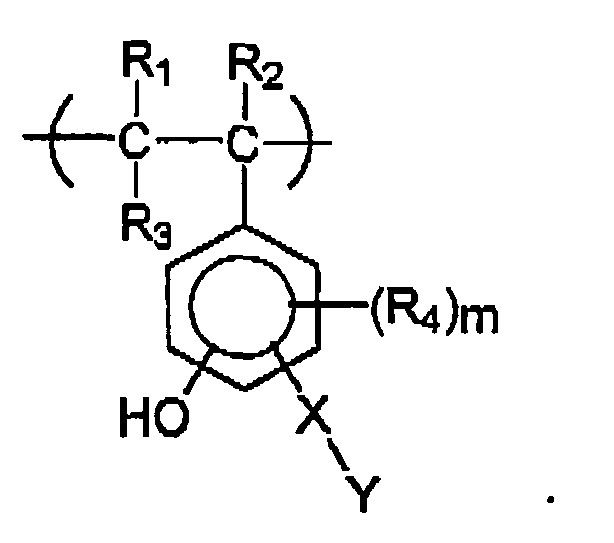 R1-R4 are independently hydrogen, alkyl, alkoxy, alkyl ether, halo, cyano, divinylcyano, aryl, aralkyl, amino, hydroxy, fluoroalkyl, nitro, amide, alkyl amide, sulfonic acid, sulfonate ester, carboxylic acid, carboxylic ester or alkali salts of carboxylic or sulfonic acids;X is N=N ;Y is aryl, aralkyl, heterocyclic or alkyl;m = 1-3; andand at least one nonaromatic comonomer unit of the formula,
R6-R9 are independently hydrogen, alkyl, alkoxy, halo, alkyl ether, amino, hydroxy, fluoroalkyl, amide, alkyl amide, carboxylic acid, carboxylic ester, sulfonic acid, sulfonic ester, alkali salts of carboxylic acid and sulfonic acid, crosslinking group or R8 and R9 combined to form an anhydride group; andb) a solvent composition. - The composition according to claim 1, wherein the dye unit has the structure:

- The composition according to claim 1, wherein the polymer has a dye unit of the structure:


- The composition according to claim 1, wherein Y is selected from a group consisting of 2-pyridine, 4-pyridine, benzoic acid, acetophenone, acetanilide, nitrobenzene, benzenesulphonic acid and N-(2,4-dinitrophenyl)-1,4-phenylenediamine.
- The composition according to claim 1, where the comonomer unit has the structure:

- The composition according to claim 1, where the solvent composition is selected from propylene glycol monomethyl ether acetate, propylene glycol monomethyl ether, ethyl lactate, ethyl 3-ethoxy propionate, cellosolve acetate, anisole, cyclohexanone, cyclopentanone, 2-heptanone or mixtures thereof.
- The composition according to claim 1, where the solvent composition comprises water.
- The composition according to claim 1, where the solvent composition comprises water and a water miscible lower alcohol, ketone or ester solvent.
- The composition according to claim 1, where a dye is dissolved in the composition.
- The composition according to claim 1, where a crosslinking agent is dissolved in the composition.
- The composition according to claim 1, where an acid is dissolved in the composition.
- The composition according to claim 1, where a latent acid is dissolved in the composition.
- The composition according to claim 1, wherein the polymer has a weight average molecular weight in the range of about 2,500 to about 1,000,000.
- The composition according to claim 1, wherein the metal ion level is less than 50 ppb each metal ion.
- The composition according to claim 1, wherein the polymer further comprises one or more vinyl monomers that are nonabsorbing and nonaromatic.
- The composition according to claim 1, wherein the polymer further comprises one or more vinyl monomers that contain a crosslinking group.
- A process for forming an image on a substrate comprising the steps of:a) coating the substrate with the antireflective coating composition of claim 1;b) heating the antireflective coating;c) forming a coating from a photoresist solution on the antireflective coating;d) heating the photoresist coating to substantially remove solvent from the coating;e) imagewise exposing the photoresist coating;f) developing an image using an aqueous alkaline developer;g) optionally, heating the substrate prior to and after development; andh) dry etching the antireflective coating.
- The process of claim 17, wherein the photoresist solution comprises a novolak resin, a photosensitive compound and a photoresist solvent.
- The process of claim 17, wherein the photoresist solution comprises a substituted polyhydroxystyrene, a photoactive compound and a photoresist solvent.
- The process of claim 17, wherein the photoresist solution comprises polyhydroxystyrene, a photoactive compound, a dissolution inhibitor and a photoresist solvent.
- The process of claim 17, wherein the heating temperature for the antireflective coating ranges from about 70°C to about 250°C.
- The process of claim 17, wherein the imagewise exposure uses irradiation between 180 nm and 450 nm.
- The process of claim 17, wherein the developer is an aqueous solution of metal ion free alkaline hydroxide.
- A process for forming an image on a substrate comprising the steps of:a) forming a coating from a photoresist solution on the substrate;b) coating the photoresist with the antireflective coating composition of claim 1;c) heating to substantially remove solvent from the coatings;d) imagewise exposing the photoresist coating;e) developing an image using an aqueous alkaline developer; andf) optionally, heating the substrate prior to and after development.
- The process according to claim 24, wherein the solvent for the antireflective coating comprises water.
Applications Claiming Priority (3)
| Application Number | Priority Date | Filing Date | Title |
|---|---|---|---|
| US08/841,750 US5994430A (en) | 1997-04-30 | 1997-04-30 | Antireflective coating compositions for photoresist compositions and use thereof |
| US841750 | 1997-04-30 | ||
| PCT/EP1998/002334 WO1998049603A1 (en) | 1997-04-30 | 1998-04-21 | Antireflective coating compositions for photoresist compositions and use thereof |
Publications (2)
| Publication Number | Publication Date |
|---|---|
| EP0978016A1 EP0978016A1 (en) | 2000-02-09 |
| EP0978016B1 true EP0978016B1 (en) | 2009-06-17 |
Family
ID=25285612
Family Applications (1)
| Application Number | Title | Priority Date | Filing Date |
|---|---|---|---|
| EP98922750A Expired - Lifetime EP0978016B1 (en) | 1997-04-30 | 1998-04-21 | Antireflective coating compositions for photoresist compositions and use thereof |
Country Status (8)
| Country | Link |
|---|---|
| US (1) | US5994430A (en) |
| EP (1) | EP0978016B1 (en) |
| JP (1) | JP3231794B2 (en) |
| KR (1) | KR100567639B1 (en) |
| CN (1) | CN1159627C (en) |
| DE (1) | DE69840910D1 (en) |
| TW (1) | TW530193B (en) |
| WO (1) | WO1998049603A1 (en) |
Families Citing this family (31)
| Publication number | Priority date | Publication date | Assignee | Title |
|---|---|---|---|---|
| US6808869B1 (en) * | 1996-12-24 | 2004-10-26 | Fuji Photo Film Co., Ltd. | Bottom anti-reflective coating material composition and method for forming resist pattern using the same |
| US7361444B1 (en) * | 1998-02-23 | 2008-04-22 | International Business Machines Corporation | Multilayered resist systems using tuned polymer films as underlayers and methods of fabrication thereof |
| US6251562B1 (en) * | 1998-12-23 | 2001-06-26 | International Business Machines Corporation | Antireflective polymer and method of use |
| CN100468393C (en) * | 1999-04-01 | 2009-03-11 | Oce印刷系统有限公司 | Device and method for processing and printing information |
| US6187506B1 (en) * | 1999-08-05 | 2001-02-13 | Clariant Finance (Bvi) Limited | Antireflective coating for photoresist compositions |
| US6346361B1 (en) * | 1999-10-06 | 2002-02-12 | Clariant Finance (Bvi) Limited | Method for synthesizing polymeric AZO dyes |
| US6686124B1 (en) * | 2000-03-14 | 2004-02-03 | International Business Machines Corporation | Multifunctional polymeric materials and use thereof |
| JP3509760B2 (en) | 2001-02-08 | 2004-03-22 | 株式会社半導体先端テクノロジーズ | Method for manufacturing semiconductor device |
| JP3445584B2 (en) * | 2001-08-10 | 2003-09-08 | 沖電気工業株式会社 | Anti-reflection coating etching method |
| JP3851594B2 (en) * | 2002-07-04 | 2006-11-29 | Azエレクトロニックマテリアルズ株式会社 | Anti-reflection coating composition and pattern forming method |
| US20060060096A1 (en) * | 2002-10-15 | 2006-03-23 | Agfa-Gevaert | Polymer for heat-sensitive lithographic printing plate precursor |
| US7238462B2 (en) * | 2002-11-27 | 2007-07-03 | Tokyo Ohka Kogyo Co., Ltd. | Undercoating material for wiring, embedded material, and wiring formation method |
| US7029821B2 (en) * | 2003-02-11 | 2006-04-18 | Rohm And Haas Electronic Materials Llc | Photoresist and organic antireflective coating compositions |
| CN100440431C (en) * | 2003-03-04 | 2008-12-03 | 东京応化工业株式会社 | Immersion liquid for liquid immersion exposure process and resist pattern forming method using the same |
| CN1774673B (en) | 2003-04-17 | 2010-09-29 | 日产化学工业株式会社 | Porous lower layer film and lower layer film forming composition for forming porous lower layer film |
| TWI347741B (en) * | 2003-05-30 | 2011-08-21 | Asml Netherlands Bv | Lithographic apparatus and device manufacturing method |
| US6867844B2 (en) | 2003-06-19 | 2005-03-15 | Asml Holding N.V. | Immersion photolithography system and method using microchannel nozzles |
| KR100586541B1 (en) * | 2003-07-16 | 2006-06-07 | 주식회사 하이닉스반도체 | Organic antireflection film composition and pattern formation method using same |
| KR100570206B1 (en) * | 2003-10-15 | 2006-04-12 | 주식회사 하이닉스반도체 | A light absorbing polymer for organic antireflection film, a method for preparing the same, and an organic antireflection film composition comprising the polymer |
| TWI360726B (en) * | 2003-10-30 | 2012-03-21 | Nissan Chemical Ind Ltd | Sublayer coating-forming composition containing de |
| US7534555B2 (en) * | 2003-12-10 | 2009-05-19 | Hitachi Global Storage Technologies Netherlands B.V. | Plating using copolymer |
| DE602005027888D1 (en) * | 2004-12-03 | 2011-06-16 | Jsr Corp | COMPOSITION FOR FORMING AN ANTI-REFLECTION FILM, COATED PRODUCT AND METHOD FOR PRODUCING A RESISTANCE STRUCTURE |
| US20060177772A1 (en) * | 2005-02-10 | 2006-08-10 | Abdallah David J | Process of imaging a photoresist with multiple antireflective coatings |
| CN101305023B (en) * | 2005-11-11 | 2011-03-02 | 佳能株式会社 | Polymer having sulfonic acid group or sulfonic acid ester group and amide group, and toner for developing electrostatic latent image having the polymer |
| US7968650B2 (en) | 2006-10-31 | 2011-06-28 | Johnson & Johnson Vision Care, Inc. | Polymeric compositions comprising at least one volume excluding polymer |
| JP6157160B2 (en) * | 2013-03-15 | 2017-07-05 | アーゼッド・エレクトロニック・マテリアルズ(ルクセンブルグ)ソシエテ・ア・レスポンサビリテ・リミテ | Upper layer film forming composition and resist pattern forming method using the same |
| US9541829B2 (en) * | 2013-07-24 | 2017-01-10 | Orthogonal, Inc. | Cross-linkable fluorinated photopolymer |
| KR20160118340A (en) | 2014-02-07 | 2016-10-11 | 올싸거널 인코포레이티드 | Cross-linkable fluorinated photopolymer |
| CN114686057B (en) * | 2020-12-28 | 2023-06-02 | 中国科学院微电子研究所 | Anti-reflection coating composition for patterning and patterning method |
| US12191147B2 (en) * | 2021-05-27 | 2025-01-07 | Taiwan Semiconductor Manufacturing Company, Ltd. | Coating composition for photolithography |
| CN117820910A (en) * | 2022-06-30 | 2024-04-05 | 华为技术有限公司 | Coating material, integrated circuit, preparation method, and electronic device |
Family Cites Families (25)
| Publication number | Priority date | Publication date | Assignee | Title |
|---|---|---|---|---|
| US3625919A (en) * | 1967-02-10 | 1971-12-07 | Hiroyoshi Kamogawa | Process for the preparation of diazotized vinylphenol polymers having phototropic properties |
| US3709724A (en) * | 1969-09-18 | 1973-01-09 | Basf Ag | Process for finishing leather and synthetic leather substitutes |
| JPS5851515A (en) * | 1981-09-22 | 1983-03-26 | Fujitsu Ltd | Exposing method for resist film |
| DE3211400A1 (en) * | 1982-03-27 | 1983-09-29 | Basf Ag, 6700 Ludwigshafen | POLYMERS WITH MESOGENIC GROUPS AND DYE REMAINS IN THE SIDE CHAINS |
| US4491628A (en) * | 1982-08-23 | 1985-01-01 | International Business Machines Corporation | Positive- and negative-working resist compositions with acid generating photoinitiator and polymer with acid labile groups pendant from polymer backbone |
| GB8401166D0 (en) * | 1984-01-17 | 1984-02-22 | Bevaloid Ltd | Labelled polymer compositions |
| US5207952A (en) * | 1986-10-10 | 1993-05-04 | University Of Southern Mississippi | Side chain liquid crystalline polymers as nonlinear optical materials |
| JPS63202915A (en) * | 1987-02-19 | 1988-08-22 | Oki Electric Ind Co Ltd | Manufacture of semiconductor device |
| DE3817012A1 (en) * | 1988-05-19 | 1989-11-30 | Basf Ag | POSITIVE AND NEGATIVE WORKING RADIATION-SENSITIVE MIXTURES AND METHOD FOR THE PRODUCTION OF RELIEF PATTERNS |
| JP2640137B2 (en) * | 1989-02-28 | 1997-08-13 | 富士写真フイルム株式会社 | Positive photoresist composition |
| FR2668158B1 (en) * | 1990-10-22 | 1994-05-06 | Thomson Csf | CROSSLINKABLE POLYMER FOR NONLINEAR OPTICAL APPLICATIONS. |
| JP2643056B2 (en) * | 1991-06-28 | 1997-08-20 | インターナショナル・ビジネス・マシーンズ・コーポレイション | Surface anti-reflective coating forming composition and use thereof |
| US5472827A (en) * | 1991-12-30 | 1995-12-05 | Sony Corporation | Method of forming a resist pattern using an anti-reflective layer |
| US5294680A (en) * | 1992-07-24 | 1994-03-15 | International Business Machines Corporation | Polymeric dyes for antireflective coatings |
| DE4232394A1 (en) * | 1992-09-26 | 1994-03-31 | Basf Ag | Copolymers with non-linear optical properties and their use |
| FR2709755B1 (en) * | 1993-09-06 | 1995-11-17 | France Telecom | Crosslinkable polymeric material, usable in non-linear optics, and its production process. |
| SG52630A1 (en) * | 1993-10-12 | 1998-09-28 | Hoechst Ag | Top anti-reflective coating films |
| JP3334304B2 (en) * | 1993-11-30 | 2002-10-15 | ソニー株式会社 | Method for manufacturing semiconductor device |
| JP3248353B2 (en) * | 1994-06-29 | 2002-01-21 | ソニー株式会社 | Anti-reflection coating design method |
| US5525457A (en) * | 1994-12-09 | 1996-06-11 | Japan Synthetic Rubber Co., Ltd. | Reflection preventing film and process for forming resist pattern using the same |
| WO1997033201A1 (en) * | 1996-03-07 | 1997-09-12 | Clariant International, Ltd. | Bottom antireflective coatings through refractive index modification by anomalous dispersion |
| TW357395B (en) * | 1996-03-07 | 1999-05-01 | Clariant Finance Bvi Ltd | Light-absorbing antireflective layers with improved performance due to refractive index optimization |
| US5652317A (en) * | 1996-08-16 | 1997-07-29 | Hoechst Celanese Corporation | Antireflective coatings for photoresist compositions |
| US5652297A (en) * | 1996-08-16 | 1997-07-29 | Hoechst Celanese Corporation | Aqueous antireflective coatings for photoresist compositions |
| US5981145A (en) | 1997-04-30 | 1999-11-09 | Clariant Finance (Bvi) Limited | Light absorbing polymers |
-
1997
- 1997-04-30 US US08/841,750 patent/US5994430A/en not_active Expired - Lifetime
-
1998
- 1998-04-21 EP EP98922750A patent/EP0978016B1/en not_active Expired - Lifetime
- 1998-04-21 JP JP54655898A patent/JP3231794B2/en not_active Expired - Lifetime
- 1998-04-21 CN CNB988045893A patent/CN1159627C/en not_active Expired - Lifetime
- 1998-04-21 DE DE69840910T patent/DE69840910D1/en not_active Expired - Lifetime
- 1998-04-21 WO PCT/EP1998/002334 patent/WO1998049603A1/en not_active Ceased
- 1998-04-21 KR KR1019997009978A patent/KR100567639B1/en not_active Expired - Lifetime
- 1998-04-29 TW TW087106633A patent/TW530193B/en not_active IP Right Cessation
Also Published As
| Publication number | Publication date |
|---|---|
| KR20010020358A (en) | 2001-03-15 |
| US5994430A (en) | 1999-11-30 |
| TW530193B (en) | 2003-05-01 |
| EP0978016A1 (en) | 2000-02-09 |
| KR100567639B1 (en) | 2006-04-05 |
| JP3231794B2 (en) | 2001-11-26 |
| CN1253639A (en) | 2000-05-17 |
| DE69840910D1 (en) | 2009-07-30 |
| CN1159627C (en) | 2004-07-28 |
| JP2000512402A (en) | 2000-09-19 |
| WO1998049603A1 (en) | 1998-11-05 |
Similar Documents
| Publication | Publication Date | Title |
|---|---|---|
| EP0978015B1 (en) | Light absorbing polymers | |
| US5994430A (en) | Antireflective coating compositions for photoresist compositions and use thereof | |
| US5733714A (en) | Antireflective coating for photoresist compositions | |
| EP0919013B1 (en) | Antireflective coatings for photoresist compositions | |
| EP1131678B1 (en) | Antireflective composition for a deep ultraviolet photoresist | |
| EP1210651B1 (en) | Antireflective coating for photoresist compositions | |
| EP1634916B1 (en) | Hydroxy-amino thermally cured undercoat for 193 NM lithography | |
| JP5019338B2 (en) | Photoimaging positive bottom antireflection film | |
| EP0929842B1 (en) | Bottom antireflective coatings containing an arylhydrazo dye | |
| EP0904568B1 (en) | Metal ion reduction of aminoaromatic chromophores and their use in the synthesis of low metal bottom anti-reflective coatings for photoresists |
Legal Events
| Date | Code | Title | Description |
|---|---|---|---|
| PUAI | Public reference made under article 153(3) epc to a published international application that has entered the european phase |
Free format text: ORIGINAL CODE: 0009012 |
|
| 17P | Request for examination filed |
Effective date: 19991130 |
|
| AK | Designated contracting states |
Kind code of ref document: A1 Designated state(s): BE DE FR GB IT NL |
|
| RIN1 | Information on inventor provided before grant (corrected) |
Inventor name: RAHMAN, M., DALIL Inventor name: DAMMEL, RALPH, R. Inventor name: DURHAM, DANA, L. Inventor name: SHAN, JIANHUI Inventor name: KHANNA, DINESH, N. Inventor name: LU, PING-HUNG Inventor name: DING, SHUJI |
|
| RAP1 | Party data changed (applicant data changed or rights of an application transferred) |
Owner name: CLARIANT FINANCE (BVI) LIMITED |
|
| RAP1 | Party data changed (applicant data changed or rights of an application transferred) |
Owner name: AZ ELECTRONIC MATERIALS USA CORP. |
|
| RIN1 | Information on inventor provided before grant (corrected) |
Inventor name: RAHMAN, M., DALIL Inventor name: DAMMEL, RALPH, R. Inventor name: DURHAM, DANA, L. Inventor name: SHAN, JIANHUI Inventor name: KHANNA, DINESH, N. Inventor name: LU, PING-HUNG Inventor name: DING, SHUJI |
|
| 17Q | First examination report despatched |
Effective date: 20070530 |
|
| GRAP | Despatch of communication of intention to grant a patent |
Free format text: ORIGINAL CODE: EPIDOSNIGR1 |
|
| GRAS | Grant fee paid |
Free format text: ORIGINAL CODE: EPIDOSNIGR3 |
|
| GRAA | (expected) grant |
Free format text: ORIGINAL CODE: 0009210 |
|
| AK | Designated contracting states |
Kind code of ref document: B1 Designated state(s): BE DE FR GB IT NL |
|
| REG | Reference to a national code |
Ref country code: GB Ref legal event code: FG4D |
|
| REF | Corresponds to: |
Ref document number: 69840910 Country of ref document: DE Date of ref document: 20090730 Kind code of ref document: P |
|
| PLBE | No opposition filed within time limit |
Free format text: ORIGINAL CODE: 0009261 |
|
| STAA | Information on the status of an ep patent application or granted ep patent |
Free format text: STATUS: NO OPPOSITION FILED WITHIN TIME LIMIT |
|
| 26N | No opposition filed |
Effective date: 20100318 |
|
| GBPC | Gb: european patent ceased through non-payment of renewal fee |
Effective date: 20100421 |
|
| PG25 | Lapsed in a contracting state [announced via postgrant information from national office to epo] |
Ref country code: GB Free format text: LAPSE BECAUSE OF NON-PAYMENT OF DUE FEES Effective date: 20100421 |
|
| REG | Reference to a national code |
Ref country code: NL Ref legal event code: V1 Effective date: 20111101 |
|
| REG | Reference to a national code |
Ref country code: DE Ref legal event code: R082 Ref document number: 69840910 Country of ref document: DE Representative=s name: PATENTANWAELTE ISENBRUCK BOESL HOERSCHLER LLP, DE |
|
| REG | Reference to a national code |
Ref country code: FR Ref legal event code: TP Owner name: MERCK PATENT GMBH, DE Effective date: 20150204 |
|
| REG | Reference to a national code |
Ref country code: NL Ref legal event code: SD Effective date: 20150324 |
|
| REG | Reference to a national code |
Ref country code: DE Ref legal event code: R082 Ref document number: 69840910 Country of ref document: DE Representative=s name: PATENTANWAELTE ISENBRUCK BOESL HOERSCHLER LLP, DE Effective date: 20150223 Ref country code: DE Ref legal event code: R081 Ref document number: 69840910 Country of ref document: DE Owner name: MERCK PATENT GMBH, DE Free format text: FORMER OWNER: AZ ELECTRONIC MATERIALS USA CORP., SOMERVILLE, N.J., US Effective date: 20150223 |
|
| REG | Reference to a national code |
Ref country code: FR Ref legal event code: PLFP Year of fee payment: 19 |
|
| REG | Reference to a national code |
Ref country code: FR Ref legal event code: PLFP Year of fee payment: 20 |
|
| PGFP | Annual fee paid to national office [announced via postgrant information from national office to epo] |
Ref country code: FR Payment date: 20170313 Year of fee payment: 20 Ref country code: NL Payment date: 20170320 Year of fee payment: 20 |
|
| PGFP | Annual fee paid to national office [announced via postgrant information from national office to epo] |
Ref country code: BE Payment date: 20170313 Year of fee payment: 20 |
|
| PGFP | Annual fee paid to national office [announced via postgrant information from national office to epo] |
Ref country code: DE Payment date: 20170420 Year of fee payment: 20 |
|
| PGFP | Annual fee paid to national office [announced via postgrant information from national office to epo] |
Ref country code: IT Payment date: 20170420 Year of fee payment: 20 |
|
| REG | Reference to a national code |
Ref country code: DE Ref legal event code: R071 Ref document number: 69840910 Country of ref document: DE |
|
| REG | Reference to a national code |
Ref country code: NL Ref legal event code: MK Effective date: 20180420 |
|
| REG | Reference to a national code |
Ref country code: BE Ref legal event code: PD Owner name: MERCK PATENT GMBH; DE Free format text: DETAILS ASSIGNMENT: CHANGE OF OWNER(S), AFFECTATION / CESSION; FORMER OWNER NAME: AZ ELECTRONIC MATERIALS USA CORP. Effective date: 20150121 Ref country code: BE Ref legal event code: MK Effective date: 20180421 |