EP0977489B1 - Fat emulsions - Google Patents
Fat emulsions Download PDFInfo
- Publication number
- EP0977489B1 EP0977489B1 EP98921457A EP98921457A EP0977489B1 EP 0977489 B1 EP0977489 B1 EP 0977489B1 EP 98921457 A EP98921457 A EP 98921457A EP 98921457 A EP98921457 A EP 98921457A EP 0977489 B1 EP0977489 B1 EP 0977489B1
- Authority
- EP
- European Patent Office
- Prior art keywords
- fat
- continuous emulsion
- emulsion according
- oil
- blend
- Prior art date
- Legal status (The legal status is an assumption and is not a legal conclusion. Google has not performed a legal analysis and makes no representation as to the accuracy of the status listed.)
- Expired - Lifetime
Links
- 239000000839 emulsion Substances 0.000 title claims abstract description 35
- 239000000203 mixture Substances 0.000 claims abstract description 28
- 125000004432 carbon atom Chemical group C* 0.000 claims abstract description 11
- 230000001804 emulsifying effect Effects 0.000 claims abstract description 11
- 125000005456 glyceride group Chemical group 0.000 claims abstract description 8
- LFQSCWFLJHTTHZ-UHFFFAOYSA-N Ethanol Chemical compound CCO LFQSCWFLJHTTHZ-UHFFFAOYSA-N 0.000 claims abstract description 7
- 150000003904 phospholipids Chemical class 0.000 claims abstract description 4
- 125000003158 alcohol group Chemical group 0.000 claims abstract description 3
- 239000003925 fat Substances 0.000 claims description 28
- 235000019197 fats Nutrition 0.000 claims description 28
- 239000003995 emulsifying agent Substances 0.000 claims description 16
- IIZPXYDJLKNOIY-JXPKJXOSSA-N 1-palmitoyl-2-arachidonoyl-sn-glycero-3-phosphocholine Chemical compound CCCCCCCCCCCCCCCC(=O)OC[C@H](COP([O-])(=O)OCC[N+](C)(C)C)OC(=O)CCC\C=C/C\C=C/C\C=C/C\C=C/CCCCC IIZPXYDJLKNOIY-JXPKJXOSSA-N 0.000 claims description 10
- 235000010445 lecithin Nutrition 0.000 claims description 10
- 239000000787 lecithin Substances 0.000 claims description 10
- 229940067606 lecithin Drugs 0.000 claims description 10
- 239000003921 oil Substances 0.000 claims description 7
- ZQPPMHVWECSIRJ-KTKRTIGZSA-N oleic acid group Chemical group C(CCCCCCC\C=C/CCCCCCCC)(=O)O ZQPPMHVWECSIRJ-KTKRTIGZSA-N 0.000 claims description 7
- 239000003549 soybean oil Substances 0.000 claims description 7
- 235000012424 soybean oil Nutrition 0.000 claims description 7
- 235000019482 Palm oil Nutrition 0.000 claims description 6
- 235000019198 oils Nutrition 0.000 claims description 6
- 239000002540 palm oil Substances 0.000 claims description 6
- XLYOFNOQVPJJNP-UHFFFAOYSA-N water Substances O XLYOFNOQVPJJNP-UHFFFAOYSA-N 0.000 claims description 6
- 125000005313 fatty acid group Chemical group 0.000 claims description 5
- 108090000623 proteins and genes Proteins 0.000 claims description 5
- 102000004169 proteins and genes Human genes 0.000 claims description 5
- 235000019484 Rapeseed oil Nutrition 0.000 claims description 4
- 235000019486 Sunflower oil Nutrition 0.000 claims description 4
- 239000007788 liquid Substances 0.000 claims description 4
- 229920006395 saturated elastomer Polymers 0.000 claims description 4
- 239000007787 solid Substances 0.000 claims description 4
- 239000002600 sunflower oil Substances 0.000 claims description 4
- 239000002562 thickening agent Substances 0.000 claims description 3
- 108010010803 Gelatin Proteins 0.000 claims description 2
- 229920002907 Guar gum Polymers 0.000 claims description 2
- 229920000161 Locust bean gum Polymers 0.000 claims description 2
- 239000004368 Modified starch Substances 0.000 claims description 2
- 229920000881 Modified starch Polymers 0.000 claims description 2
- 229920002472 Starch Polymers 0.000 claims description 2
- OGBUMNBNEWYMNJ-UHFFFAOYSA-N batilol Chemical class CCCCCCCCCCCCCCCCCCOCC(O)CO OGBUMNBNEWYMNJ-UHFFFAOYSA-N 0.000 claims description 2
- 235000010418 carrageenan Nutrition 0.000 claims description 2
- 239000000679 carrageenan Substances 0.000 claims description 2
- 229920001525 carrageenan Polymers 0.000 claims description 2
- 229940113118 carrageenan Drugs 0.000 claims description 2
- 239000002285 corn oil Substances 0.000 claims description 2
- 235000005687 corn oil Nutrition 0.000 claims description 2
- 229920000159 gelatin Polymers 0.000 claims description 2
- 239000008273 gelatin Substances 0.000 claims description 2
- 235000019322 gelatine Nutrition 0.000 claims description 2
- 235000011852 gelatine desserts Nutrition 0.000 claims description 2
- 239000000665 guar gum Substances 0.000 claims description 2
- 235000010417 guar gum Nutrition 0.000 claims description 2
- 229960002154 guar gum Drugs 0.000 claims description 2
- 235000010420 locust bean gum Nutrition 0.000 claims description 2
- 239000000711 locust bean gum Substances 0.000 claims description 2
- 235000019426 modified starch Nutrition 0.000 claims description 2
- 239000003346 palm kernel oil Substances 0.000 claims description 2
- 235000019865 palm kernel oil Nutrition 0.000 claims description 2
- 235000019698 starch Nutrition 0.000 claims description 2
- 239000008107 starch Substances 0.000 claims description 2
- 150000003626 triacylglycerols Chemical class 0.000 claims description 2
- PHYFQTYBJUILEZ-IUPFWZBJSA-N triolein Chemical compound CCCCCCCC\C=C/CCCCCCCC(=O)OCC(OC(=O)CCCCCCC\C=C/CCCCCCCC)COC(=O)CCCCCCC\C=C/CCCCCCCC PHYFQTYBJUILEZ-IUPFWZBJSA-N 0.000 claims description 2
- UHVMMEOXYDMDKI-JKYCWFKZSA-L zinc;1-(5-cyanopyridin-2-yl)-3-[(1s,2s)-2-(6-fluoro-2-hydroxy-3-propanoylphenyl)cyclopropyl]urea;diacetate Chemical compound [Zn+2].CC([O-])=O.CC([O-])=O.CCC(=O)C1=CC=C(F)C([C@H]2[C@H](C2)NC(=O)NC=2N=CC(=CC=2)C#N)=C1O UHVMMEOXYDMDKI-JKYCWFKZSA-L 0.000 claims description 2
- 238000002156 mixing Methods 0.000 abstract 1
- 235000013305 food Nutrition 0.000 description 9
- 235000013310 margarine Nutrition 0.000 description 6
- CNNRPFQICPFDPO-UHFFFAOYSA-N octacosan-1-ol Chemical compound CCCCCCCCCCCCCCCCCCCCCCCCCCCCO CNNRPFQICPFDPO-UHFFFAOYSA-N 0.000 description 6
- 239000003264 margarine Substances 0.000 description 5
- 150000001298 alcohols Chemical class 0.000 description 4
- HVYWMOMLDIMFJA-DPAQBDIFSA-N cholesterol Chemical compound C1C=C2C[C@@H](O)CC[C@]2(C)[C@@H]2[C@@H]1[C@@H]1CC[C@H]([C@H](C)CCCC(C)C)[C@@]1(C)CC2 HVYWMOMLDIMFJA-DPAQBDIFSA-N 0.000 description 4
- 229960001109 policosanol Drugs 0.000 description 4
- BDERNNFJNOPAEC-UHFFFAOYSA-N propan-1-ol Chemical compound CCCO BDERNNFJNOPAEC-UHFFFAOYSA-N 0.000 description 4
- DCXXMTOCNZCJGO-UHFFFAOYSA-N tristearoylglycerol Chemical compound CCCCCCCCCCCCCCCCCC(=O)OCC(OC(=O)CCCCCCCCCCCCCCCCC)COC(=O)CCCCCCCCCCCCCCCCC DCXXMTOCNZCJGO-UHFFFAOYSA-N 0.000 description 4
- 229960002666 1-octacosanol Drugs 0.000 description 3
- 230000000694 effects Effects 0.000 description 3
- 235000013871 bee wax Nutrition 0.000 description 2
- 239000012166 beeswax Substances 0.000 description 2
- 235000013361 beverage Nutrition 0.000 description 2
- 235000012000 cholesterol Nutrition 0.000 description 2
- 230000000050 nutritive effect Effects 0.000 description 2
- 235000020777 polyunsaturated fatty acids Nutrition 0.000 description 2
- 239000001993 wax Substances 0.000 description 2
- WRIDQFICGBMAFQ-UHFFFAOYSA-N (E)-8-Octadecenoic acid Natural products CCCCCCCCCC=CCCCCCCC(O)=O WRIDQFICGBMAFQ-UHFFFAOYSA-N 0.000 description 1
- ZIIUUSVHCHPIQD-UHFFFAOYSA-N 2,4,6-trimethyl-N-[3-(trifluoromethyl)phenyl]benzenesulfonamide Chemical compound CC1=CC(C)=CC(C)=C1S(=O)(=O)NC1=CC=CC(C(F)(F)F)=C1 ZIIUUSVHCHPIQD-UHFFFAOYSA-N 0.000 description 1
- LQJBNNIYVWPHFW-UHFFFAOYSA-N 20:1omega9c fatty acid Natural products CCCCCCCCCCC=CCCCCCCCC(O)=O LQJBNNIYVWPHFW-UHFFFAOYSA-N 0.000 description 1
- QSBYPNXLFMSGKH-UHFFFAOYSA-N 9-Heptadecensaeure Natural products CCCCCCCC=CCCCCCCCC(O)=O QSBYPNXLFMSGKH-UHFFFAOYSA-N 0.000 description 1
- OYHQOLUKZRVURQ-HZJYTTRNSA-N Linoleic acid Chemical compound CCCCC\C=C/C\C=C/CCCCCCCC(O)=O OYHQOLUKZRVURQ-HZJYTTRNSA-N 0.000 description 1
- ZQPPMHVWECSIRJ-UHFFFAOYSA-N Oleic acid Natural products CCCCCCCCC=CCCCCCCCC(O)=O ZQPPMHVWECSIRJ-UHFFFAOYSA-N 0.000 description 1
- 239000005642 Oleic acid Substances 0.000 description 1
- 102000015439 Phospholipases Human genes 0.000 description 1
- 108010064785 Phospholipases Proteins 0.000 description 1
- 235000019496 Pine nut oil Nutrition 0.000 description 1
- 244000126608 Ruta angustifolia Species 0.000 description 1
- 240000000111 Saccharum officinarum Species 0.000 description 1
- 235000007201 Saccharum officinarum Nutrition 0.000 description 1
- 230000009286 beneficial effect Effects 0.000 description 1
- 239000004203 carnauba wax Substances 0.000 description 1
- 235000013869 carnauba wax Nutrition 0.000 description 1
- 229940082483 carnauba wax Drugs 0.000 description 1
- 239000006071 cream Substances 0.000 description 1
- 238000002481 ethanol extraction Methods 0.000 description 1
- 239000000796 flavoring agent Substances 0.000 description 1
- 235000019634 flavors Nutrition 0.000 description 1
- 230000007407 health benefit Effects 0.000 description 1
- 239000004615 ingredient Substances 0.000 description 1
- QXJSBBXBKPUZAA-UHFFFAOYSA-N isooleic acid Natural products CCCCCCCC=CCCCCCCCCC(O)=O QXJSBBXBKPUZAA-UHFFFAOYSA-N 0.000 description 1
- 235000020778 linoleic acid Nutrition 0.000 description 1
- OYHQOLUKZRVURQ-IXWMQOLASA-N linoleic acid Natural products CCCCC\C=C/C\C=C\CCCCCCCC(O)=O OYHQOLUKZRVURQ-IXWMQOLASA-N 0.000 description 1
- 239000002960 lipid emulsion Substances 0.000 description 1
- 235000004213 low-fat Nutrition 0.000 description 1
- 239000008268 mayonnaise Substances 0.000 description 1
- 235000010746 mayonnaise Nutrition 0.000 description 1
- 238000005259 measurement Methods 0.000 description 1
- 235000013336 milk Nutrition 0.000 description 1
- 239000008267 milk Substances 0.000 description 1
- 210000004080 milk Anatomy 0.000 description 1
- 235000021281 monounsaturated fatty acids Nutrition 0.000 description 1
- 229930014626 natural product Natural products 0.000 description 1
- 239000010490 pine nut oil Substances 0.000 description 1
- 238000002360 preparation method Methods 0.000 description 1
- 230000000284 resting effect Effects 0.000 description 1
- 235000019384 rice bran wax Nutrition 0.000 description 1
- 239000004170 rice bran wax Substances 0.000 description 1
- 239000000523 sample Substances 0.000 description 1
- 150000004671 saturated fatty acids Chemical class 0.000 description 1
- 235000003441 saturated fatty acids Nutrition 0.000 description 1
- -1 wheatgerm-wax Natural products 0.000 description 1
Classifications
-
- A—HUMAN NECESSITIES
- A23—FOODS OR FOODSTUFFS; TREATMENT THEREOF, NOT COVERED BY OTHER CLASSES
- A23D—EDIBLE OILS OR FATS, e.g. MARGARINES, SHORTENINGS OR COOKING OILS
- A23D7/00—Edible oil or fat compositions containing an aqueous phase, e.g. margarines
- A23D7/005—Edible oil or fat compositions containing an aqueous phase, e.g. margarines characterised by ingredients other than fatty acid triglycerides
- A23D7/0056—Spread compositions
-
- A—HUMAN NECESSITIES
- A23—FOODS OR FOODSTUFFS; TREATMENT THEREOF, NOT COVERED BY OTHER CLASSES
- A23D—EDIBLE OILS OR FATS, e.g. MARGARINES, SHORTENINGS OR COOKING OILS
- A23D7/00—Edible oil or fat compositions containing an aqueous phase, e.g. margarines
- A23D7/005—Edible oil or fat compositions containing an aqueous phase, e.g. margarines characterised by ingredients other than fatty acid triglycerides
- A23D7/0053—Compositions other than spreads
-
- A—HUMAN NECESSITIES
- A23—FOODS OR FOODSTUFFS; TREATMENT THEREOF, NOT COVERED BY OTHER CLASSES
- A23D—EDIBLE OILS OR FATS, e.g. MARGARINES, SHORTENINGS OR COOKING OILS
- A23D7/00—Edible oil or fat compositions containing an aqueous phase, e.g. margarines
- A23D7/015—Reducing calorie content; Reducing fat content, e.g. "halvarines"
-
- C—CHEMISTRY; METALLURGY
- C09—DYES; PAINTS; POLISHES; NATURAL RESINS; ADHESIVES; COMPOSITIONS NOT OTHERWISE PROVIDED FOR; APPLICATIONS OF MATERIALS NOT OTHERWISE PROVIDED FOR
- C09K—MATERIALS FOR MISCELLANEOUS APPLICATIONS, NOT PROVIDED FOR ELSEWHERE
- C09K23/00—Use of substances as emulsifying, wetting, dispersing, or foam-producing agents
- C09K23/017—Mixtures of compounds
- C09K23/018—Mixtures of two or more different organic oxygen-containing compounds
Definitions
- Food products often contain emulsifying systems.
- Components for these emulsifying systems can be selected from many sources but often they comprise partial glycerides and phospholipids.
- these emulsifying systems can give good to acceptable results when applied in food products containing a fat emulsion, such as spreads, dressings, mayonnaise, creams etc we also found that product properties like spreadability, melt down or flavour release still were not optimal.
- This problem is known for in particular water-in-oil emulsions such as spreads, more particularly low fat spreads, wherein the emulsifier system has a critical role. This is in particular the case in products wherein a component is required that can provide structuring to the food products.
- the food products from nowadays need to contain components that make them healthier than the food products known so far.
- WO 95 28 847 discloses in example 1 a margarine (with its oil emulsion) that contains 77% soybean oil, 0,22% lecithin, 0.18 % partial glycerides and 2.5 % beeswax. As beeswax contains about 1-7% free long chain alcohols (cf EP 654 262) the margarine of WO 95 28 847 will contain more than 0,01 % long chain alcohols. However the Nr. value of the fat applied will be lower than 5 (i.e about 0). This has a negative effect on the hardness of the product.
- our invention concerns in the first instance fat-continuous emulsions of fat and water, having a fat content of 10-99.5 wt%, preferably 10-90 wt%, most preferably 15-85 wt% and containing an emulsifier system, wherein the emulsifier system is a blend of components, with emulsifying properties, comprising components (A), (B) and (C), wherein:
- emulsifier blends component (A) is selected from the group consisting of saturated and unsaturated monoglycerides, saturated or unsaturated or mixed diglycerides, or mixtures thereof with emulsifying properties.
- Very convenient products are based on partial glycerides derived from saturated fatty acids with 2-22 carbon atoms in particular 8-18 carbon atoms, most preferably 16-18 carbon atoms.
- partial glycerides based on mono or polyunsaturated fatty acid residues can be used successfully as well.
- partial glycerides derived from oleic acid and linoleic acid perform well.
- Component (B) of above blends can be selected from the group consisting of lecithin, enzymically treated lecithin, fractions of lecithin.
- the enzymically treated lecithin preferably is a lecithin treated with phospholipase A and/or D. Also fractions of lecithin can be used successfully eg a fraction obtained after ethanol extraction performs very good.
- Component (C) is the healthy component in above emulsifier blends.
- This component is preferably a straight chain alcohol with more than 20 carbon atoms, in particular having 26-30 C atoms.
- the health benefits of these components (C) are disclosed in the two documents referred to earlier. However the positive impact on the structuring properties of the blend is not disclosed therein.
- This component is present in a number of natural products such as wheatgerm-wax, carnauba-wax, rice bran wax and sugar cane wax. Commercial products, containing these can be obtained from eg Garuda, Int or Dalmar Lab and are known as Octacosanol®, Ateromixol®.
- fat-continuous emulsions of fat and water having a fat content of 10 99.5 wt%, preferably 10-90 wt%, most preferably 15-85 wt% and containing an emulsifier system, wherein the emulsifier system is a blend as disclosed above are part of our invention.
- These emulsions contain the emulsifier blend according to the invention in amounts such that the ratio fat: emulsifier blend in the emulsion ranges from 99.9:0.1 to 90:10.
- the solid fat content is measured on a fat that was subjected to the following T-regime:melt at 80 oC , cool to 0 oC and keep it 1 hr at 0 oC, warm up to measurement temperature and keep it at this temperature for half an hour.
- Very suitable fats comprise at least two components (D) and (E) from which (D) has an N20>20 and (E) has a content mono and diunsaturated fatty acid residues of at least 25 %, preferably at least 45 %, in particular 45-70 %.
- component (D) can be selected from the group consisting of palm kernel fractions, palm fractions, interesterified mixtures thereof, interesterified hardened palm oil and hardened palm kernel oil and fractions thereof, interesterified mixtures of liquid oils and hardened liquid oils, and fractions thereof, fats containing at least 20 wt%, preferably at least 35 wt% of SUS triglycerides.
- Preferred fats D are interesterified palm oil fractions; interesterified mixtures of palm oil 58 and palm kernel 41, and its fractions, interesterified palm stearin/palm kernel stearin and its fractions and interesterified soybean oil/soybean oil 65 and its fractions.
- Component (E) suitably is selected from the group consisting of sunflower oil, high oleic sunflower oil, rape seed oil, high oleic rape seed oil, palm oil olein, corn oil, soybean oil, high oleic soybean oil.
- the emulsions that are obtained are fat continuous and preferably do not contain water soluble emulsifiers, other than proteins.
- the emulsions can also contain other ingredients eg proteins in particular proteins derived from milk.
- Another component that is useful for in particular achieving a structuring of the waterphase, in particular in those products that are low in fat content are thickeners.
- Useful thickeners can be selected from the group consisting of starch, modified starch, guar gum, carrageenan, locust bean gum and gelatin.
Landscapes
- Chemical & Material Sciences (AREA)
- Engineering & Computer Science (AREA)
- Oil, Petroleum & Natural Gas (AREA)
- Life Sciences & Earth Sciences (AREA)
- Food Science & Technology (AREA)
- Polymers & Plastics (AREA)
- Materials Engineering (AREA)
- Organic Chemistry (AREA)
- Edible Oils And Fats (AREA)
Abstract
Description
- Food products often contain emulsifying systems. Components for these emulsifying systems can be selected from many sources but often they comprise partial glycerides and phospholipids. Although these emulsifying systems can give good to acceptable results when applied in food products containing a fat emulsion, such as spreads, dressings, mayonnaise, creams etc we also found that product properties like spreadability, melt down or flavour release still were not optimal. This problem is known for in particular water-in-oil emulsions such as spreads, more particularly low fat spreads, wherein the emulsifier system has a critical role. This is in particular the case in products wherein a component is required that can provide structuring to the food products. Moreover the food products from nowadays need to contain components that make them healthier than the food products known so far.
- WO 95 28 847 discloses in example 1 a margarine (with its oil emulsion) that contains 77% soybean oil, 0,22% lecithin, 0.18 % partial glycerides and 2.5 % beeswax. As beeswax contains about 1-7% free long chain alcohols (cf EP 654 262) the margarine of WO 95 28 847 will contain more than 0,01 % long chain alcohols. However the Nr. value of the fat applied will be lower than 5 (i.e about 0). This has a negative effect on the hardness of the product.
- Long chain alcohols are applied in food products such as beverages to improve stability of the beverage emulsion. (cf JP 63/219357). Herefore a water soluble emulsifier should be present in the composition. In this document nothing is disclosed about the use of these compositions in fat continuous emulsions let it be about the improvements in product properties that can be achieved by this use. From JP 62/224258 it is known that nutritive foods can be obtained that contain 5 out of 7 components named per se. One of these components is octacosanol ie a component comprising a long chain alcohol in high amounts. This document however does not disclose the use of the long
- chain alcohol in fat continuous emulsions neither per se nor combined with other emulsifiers.
From JP 61/058536 nutritive food compositions are known that contain high amounts of pine nut oil and polyunsaturated fatty acids such as CLA, EPA and DHA. The compositions also contain a small amount of an oil soluble, physiologically active component, which could be octacosanol (cf claim 4). Although the examples also illustrate the preparation of a margarine the margarine prepared does not contain policosanol. Therefore it cannot be derived from this document that the use of long chain alcohols in fat continuous emulsions has a beneficial effect on product performance.
We studied, whether we could find a new blend with emulsifying properties comprising also a very healthy component that provides structuring properties to fat-continuous emulsions, while also providing simultaneously cholesterol lowering properties to the food products. Although the cholesterol lowering component per se is known for this purpose cf EP 654 262 and WO 94/07830 the positive impact of the component on the structuring properties of fat-continuous systems is not disclosed in these documents. This structuring effect is noticed as a higher hardness for the fat continuous emulsion (Stevens value). - Therefore our invention concerns in the first instance fat-continuous emulsions of fat and water, having a fat content of 10-99.5 wt%, preferably 10-90 wt%, most preferably 15-85 wt% and containing an emulsifier system, wherein the emulsifier system is a blend of components, with emulsifying properties, comprising components (A), (B) and (C), wherein:
- A= a partial glyceride, containing at least one fatty acid residue with at least 2 carbon atoms
- B= a phospholipid and
- C= a long chain alcohol having at least 20 carbon atoms in the alcohol chain, while (A), (B) and (C) are present in amounts, based on the total emulsifier blend of:
- 2-90 wt% of (A), preferably 2-60 wt %, most preferably 10-40 wt%.
- 2-80 wt% of (B), preferably 2-60 wt%, most preferably 10-40 wt%
- 0.01-99.98 wt% of (C), preferably 2-70 wt%, most preferably 10-60 wt%, and the total amount of components (A) and (B) in this blend always being at least 0.02 wt%, while the fat of the fat-continuous emulsion displays a solid fat content (measured by NMR on a non-stab fat) at 5°C of > 10 and at 35°C of < 7.
-
- In above emulsifier blends component (A) is selected from the group consisting of saturated and unsaturated monoglycerides, saturated or unsaturated or mixed diglycerides, or mixtures thereof with emulsifying properties.
Very convenient products are based on partial glycerides derived from saturated fatty acids with 2-22 carbon atoms in particular 8-18 carbon atoms, most preferably 16-18 carbon atoms. However partial glycerides based on mono or polyunsaturated fatty acid residues can be used successfully as well. In particular partial glycerides derived from oleic acid and linoleic acid perform well. - Component (B) of above blends can be selected from the group consisting of lecithin, enzymically treated lecithin, fractions of lecithin. The enzymically treated lecithin preferably is a lecithin treated with phospholipase A and/or D. Also fractions of lecithin can be used successfully eg a fraction obtained after ethanol extraction performs very good.
- Component (C) is the healthy component in above emulsifier blends. This component is preferably a straight chain alcohol with more than 20 carbon atoms, in particular having 26-30 C atoms.
The health benefits of these components (C) are disclosed in the two documents referred to earlier. However the positive impact on the structuring properties of the blend is not disclosed therein. This component is present in a number of natural products such as wheatgerm-wax, carnauba-wax, rice bran wax and sugar cane wax. Commercial products, containing these can be obtained from eg Garuda, Int or Dalmar Lab and are known as Octacosanol®, Ateromixol®. - Thus fat-continuous emulsions of fat and water having a fat content of 10 99.5 wt%, preferably 10-90 wt%, most preferably 15-85 wt% and containing an emulsifier system, wherein the emulsifier system is a blend as disclosed above are part of our invention. These emulsions contain the emulsifier blend according to the invention in amounts such that the ratio fat: emulsifier blend in the emulsion ranges from 99.9:0.1 to 90:10.
- Preferred fats that are applied in our emulsions are fats that display a solid fat content (measured by NMR on a non stabilised fat) at 5 oC (=N5) of >20 and at 35 °C(=N35) <3. The solid fat content is measured on a fat that was subjected to the following T-regime:melt at 80 oC , cool to 0 oC and keep it 1 hr at 0 oC, warm up to measurement temperature and keep it at this temperature for half an hour.
Very suitable fats comprise at least two components (D) and (E) from which (D) has an N20>20 and (E) has a content mono and diunsaturated fatty acid residues of at least 25 %, preferably at least 45 %, in particular 45-70 %. Herein component (D) can be selected from the group consisting of palm kernel fractions, palm fractions, interesterified mixtures thereof, interesterified hardened palm oil and hardened palm kernel oil and fractions thereof, interesterified mixtures of liquid oils and hardened liquid oils, and fractions thereof, fats containing at least 20 wt%, preferably at least 35 wt% of SUS triglycerides. Preferred fats D are interesterified palm oil fractions; interesterified mixtures of palm oil 58 and palm kernel 41, and its fractions, interesterified palm stearin/palm kernel stearin and its fractions and interesterified soybean oil/soybean oil 65 and its fractions.
Component (E) suitably is selected from the group consisting of sunflower oil, high oleic sunflower oil, rape seed oil, high oleic rape seed oil, palm oil olein, corn oil, soybean oil, high oleic soybean oil. - The emulsions that are obtained are fat continuous and preferably do not contain water soluble emulsifiers, other than proteins.
- The emulsions can also contain other ingredients eg proteins in particular proteins derived from milk. Another component that is useful for in particular achieving a structuring of the waterphase, in particular in those products that are low in fat content are thickeners. Useful thickeners can be selected from the group consisting of starch, modified starch, guar gum, carrageenan, locust bean gum and gelatin.
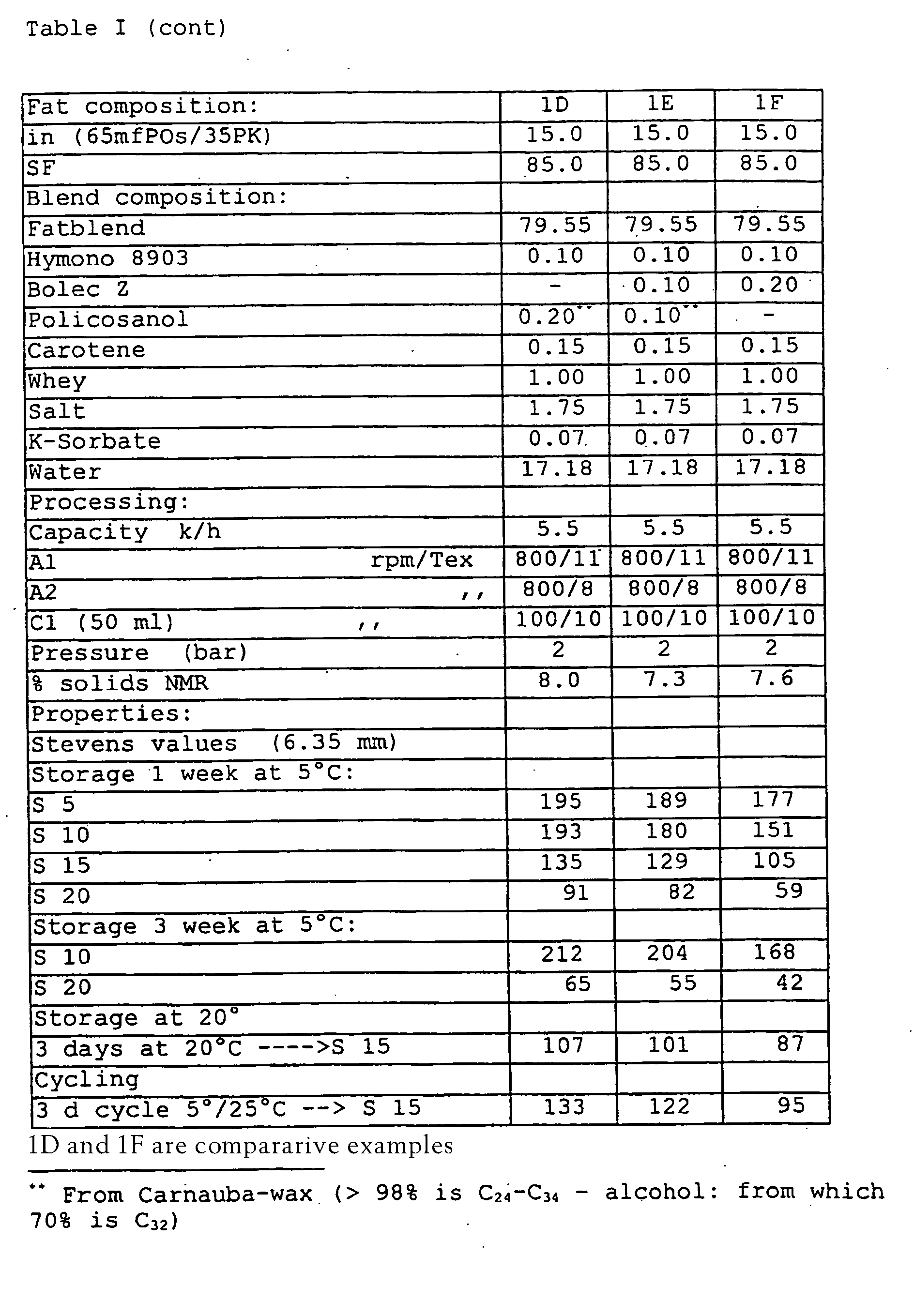
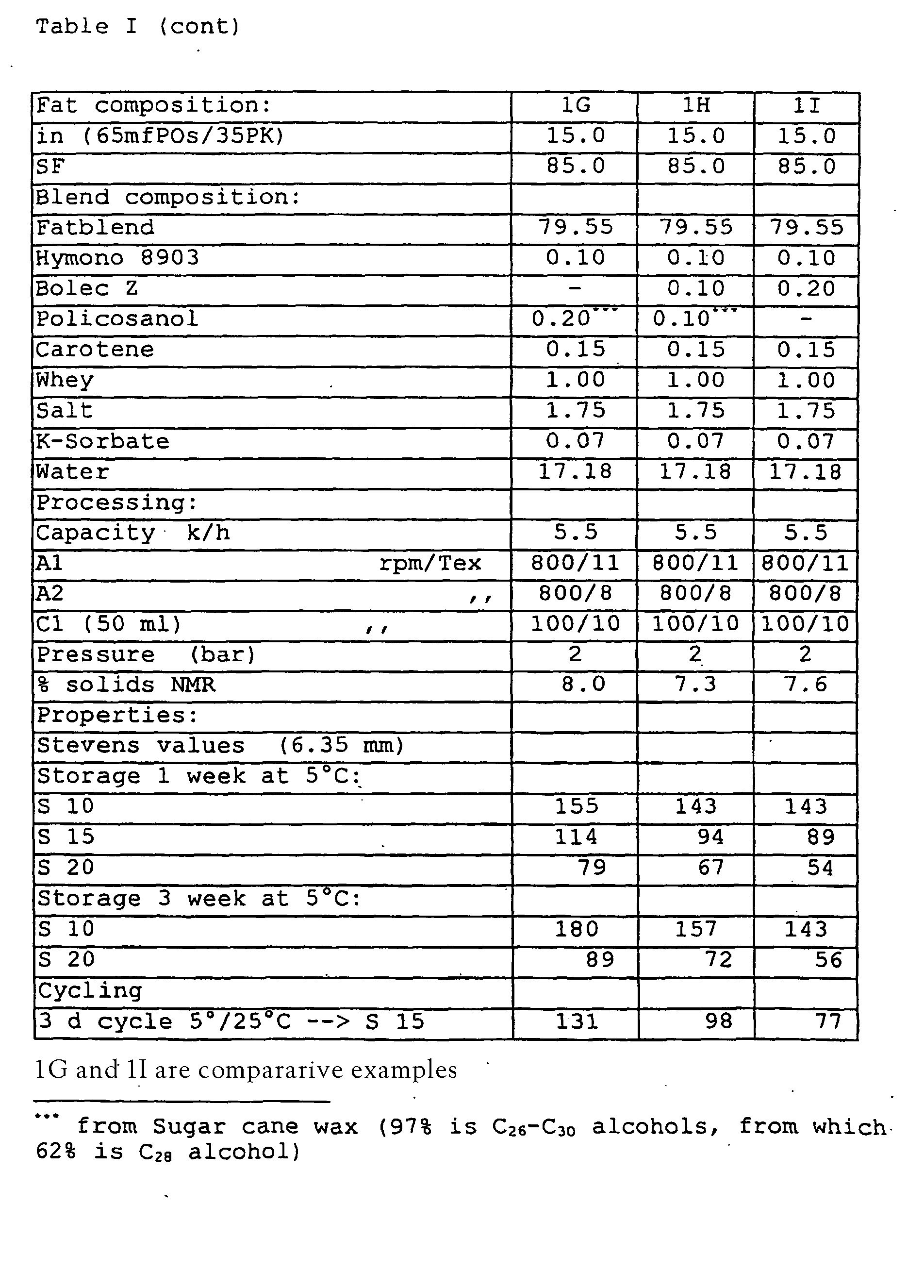
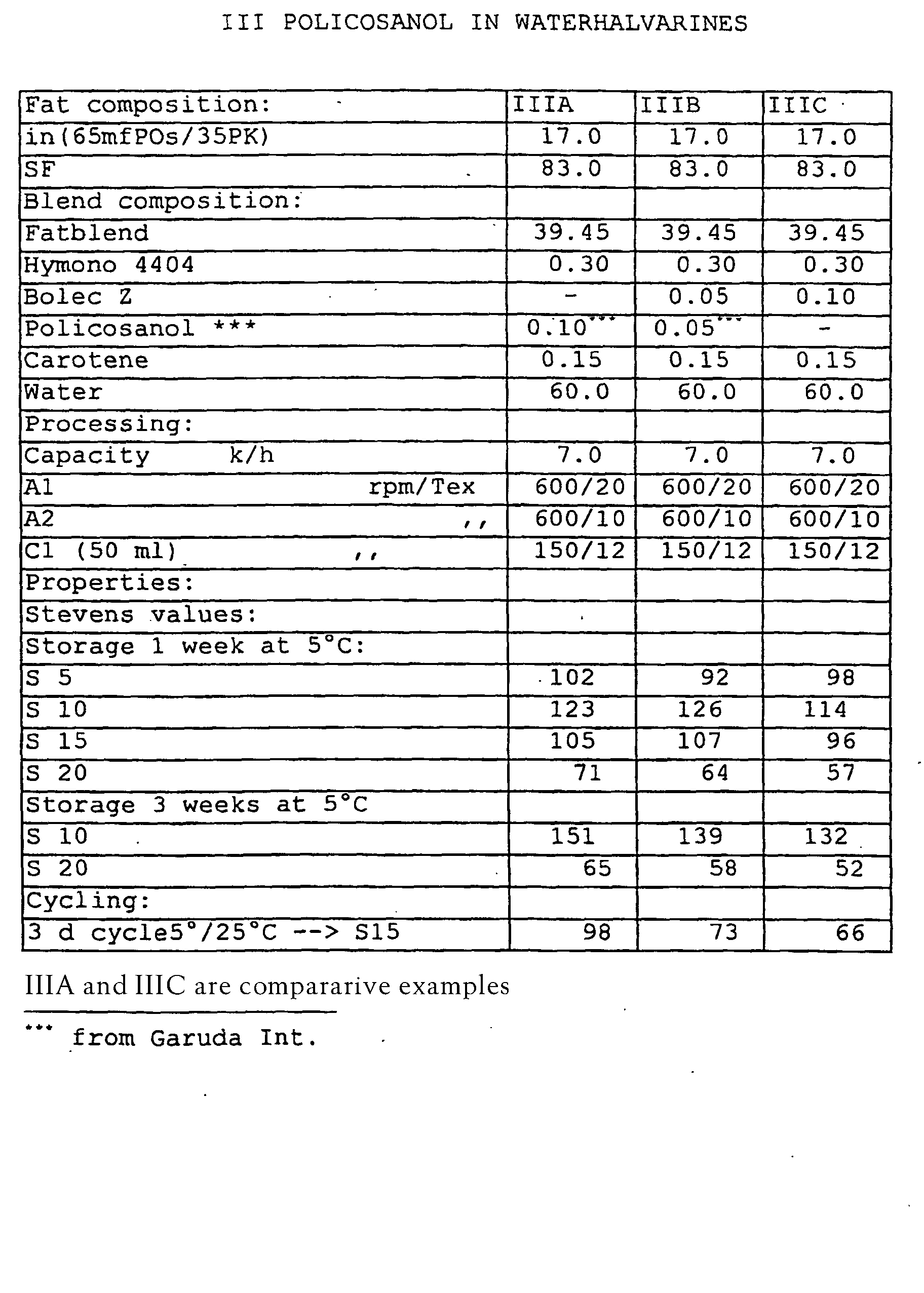
- Margarines and halvarines (protein based and water based) were made according to the recipe mentioned in tables I-III. The processing was performes as follows:
- A premix was made at 60 °C of the components given in the amounts indicated. The premix was processed in a system consisting of an A1, an A2 and a C1 unit, wherein A1 and A2 are two scraped surface heat exchanger whereas C1 was a resting unit in case a margarine was made and an inventor in case a halverine was made.
-
- The hardness of the products was measured on a Stevens texture analyser provided with a probe of 6.35 mm under standard conditions.
The results are given in tables I-III. It can be concluded that the products containing a policosanol were in general harder than the products without this component, although the total of (hymono + bolec + policosanol) was always 0.3 %, except for the waterhalverines were this total was always 0.4 %. The results also demonstrates that the effect was bigger the more policosanol was present.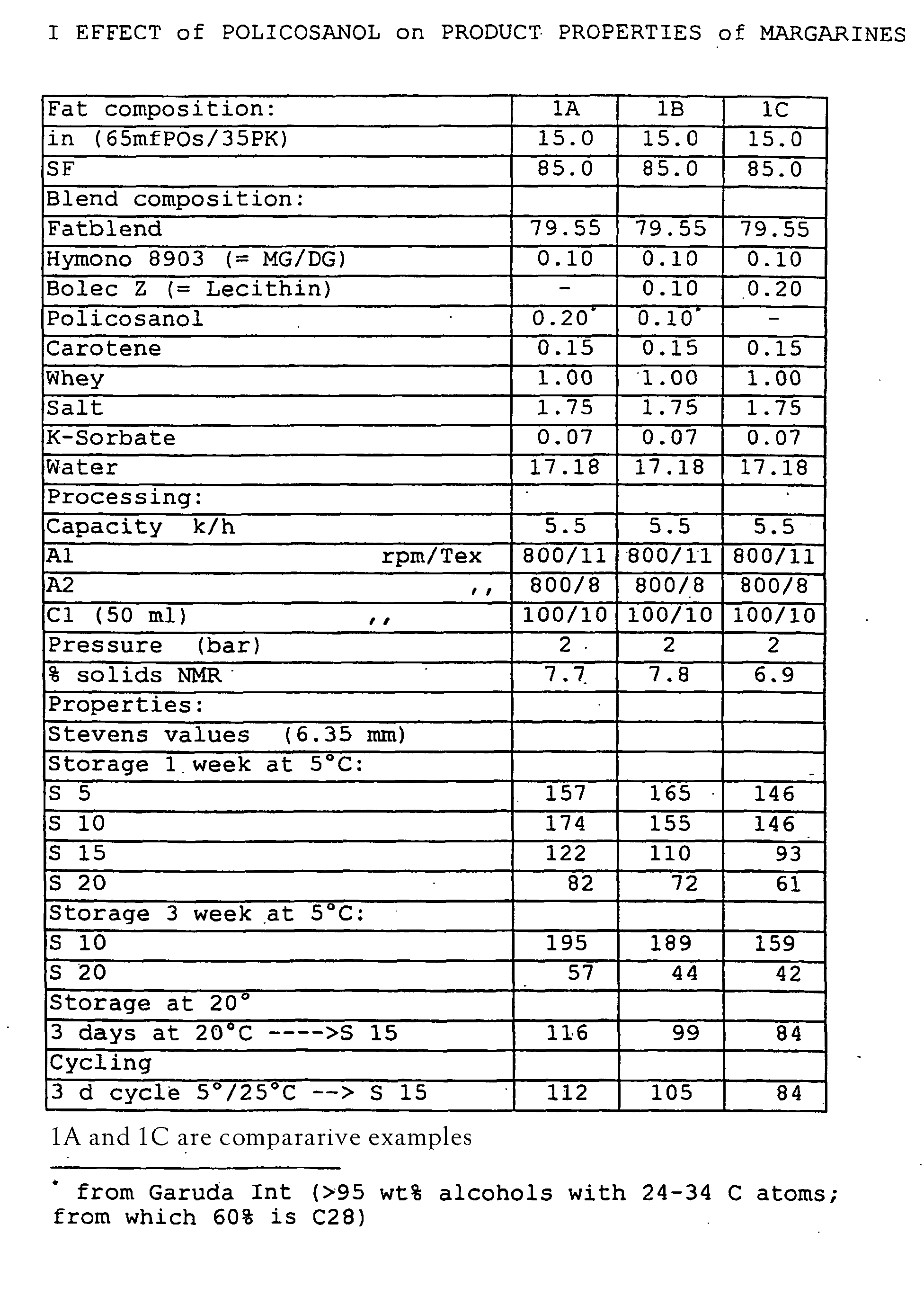


Claims (12)
- Fat continuous emulsion of fat and water having a fat content of 10-99.5 wt%, and containing an emulsifier system, wherein the emulsifier system is a blend of components with emulsifying properties, comprising components (A), (B) and (C), wherein:while (A), (B) and (C) are present in amounts, based on the total emulsifier blend of:A= a partial glyceride, containing at least one fatty acid residue with at least 2 carbon atomsB= a phospholipid andC= a long chain alcohol having at least 20 carbon atoms in the alcohol chain,2 - 90 wt% of (A).2 - 80 wt% of (B),0.01-99.98 wt% of (C), and the total amount of components (A) and (B) in this blend always being at least 0.02 wt%, while the fat of the fat-continuous emulsion displays a solid fat content (measured by NMR on a non stabilised fat) at 5 oC (=N5) of >10 and at 35 oC (=N35) < 7.
- Fat continuous emulsion according to claim 1, wherein component (A) is selected from the group consisting of saturated and unsaturated monoglycerides, saturated or unsaturated or mixed diglycerides, or mixtures thereof with emulsifying properties.
- Fat continuous emulsion according to claim 1, wherein component (B) is selected from the group consisting of lecithin, enzymically treated lecithin, fractions of lecithin.
- Fat continuous emulsion according to claim 1, wherein component (C) is a straight chain alcohol with more than 20 carbon atoms.
- Fat-continuous emulsion according to claim 1, wherein the emulsion contains the blend of components A, B and C with the emulsifying properties in amounts such that the ratio fat: blend with emulsifying properties ranges from 99.9:0.1 to 90:10.
- Fat-continuous emulsion according to claims 1-5, wherein the fat comprises at least two components (D) and (E) from which (D) has an N20>20 and (E) has a content mono and diunsaturated fatty acid residues of at least 25 %.
- Fat-continuous emulsion according to claim 6, wherein component (D) is selected from the group consisting of palm fractions, interesterified hardened palm oil and hardened palm kernel oil and fractions thereof, interesterified mixtures of liquid oils and hardened liquid oils, and fractions thereof, fats containing at least 20 wt% of SUS triglycerides.
- Fat-continuous emulsion according to claim 6, wherein component (E) is selected from the group consisting of sunflower oil, high oleic sunflower oil, rape seed oil, high oleic rape seed oil, palm oil olein, corn oil, soybean oil, high oleic soybean oil.
- Fat-continuous emulsion according to claim 1-8, wherein the emulsion contains > 1 wt % of a protein.
- Fat-continuous emulsion according to claim 1-9, wherein the emulsion contains a thickener, selected from the group consisting of starch, modified starch, guar gum, carrageenan, locust bean gum and gelatin.
- Fat-continuous emulsion according to any one of claims 1-10, wherein (A) is present in an amount of 2-60 wt%.
- Fat-continuous emulsion according to any one of claims I-II, wherein (B) is present in an amount of 2-60 wt %.
Priority Applications (1)
| Application Number | Priority Date | Filing Date | Title |
|---|---|---|---|
| EP98921457A EP0977489B1 (en) | 1997-04-24 | 1998-04-02 | Fat emulsions |
Applications Claiming Priority (4)
| Application Number | Priority Date | Filing Date | Title |
|---|---|---|---|
| EP97302826 | 1997-04-24 | ||
| EP97302826 | 1997-04-24 | ||
| EP98921457A EP0977489B1 (en) | 1997-04-24 | 1998-04-02 | Fat emulsions |
| PCT/EP1998/002135 WO1998047385A1 (en) | 1997-04-24 | 1998-04-02 | Fat emulsions |
Publications (2)
| Publication Number | Publication Date |
|---|---|
| EP0977489A1 EP0977489A1 (en) | 2000-02-09 |
| EP0977489B1 true EP0977489B1 (en) | 2005-11-23 |
Family
ID=8229309
Family Applications (1)
| Application Number | Title | Priority Date | Filing Date |
|---|---|---|---|
| EP98921457A Expired - Lifetime EP0977489B1 (en) | 1997-04-24 | 1998-04-02 | Fat emulsions |
Country Status (5)
| Country | Link |
|---|---|
| US (1) | US6277430B1 (en) |
| EP (1) | EP0977489B1 (en) |
| AU (1) | AU7430698A (en) |
| DE (1) | DE69832477T2 (en) |
| WO (1) | WO1998047385A1 (en) |
Cited By (1)
| Publication number | Priority date | Publication date | Assignee | Title |
|---|---|---|---|---|
| EP1063897A1 (en) | 1998-03-18 | 2001-01-03 | Kal Kan Foods, Inc. | Multicomponent food product and methods of making and using the same |
Families Citing this family (14)
| Publication number | Priority date | Publication date | Assignee | Title |
|---|---|---|---|---|
| JP3779505B2 (en) * | 1999-08-24 | 2006-05-31 | 花王株式会社 | Oil composition |
| NZ508692A (en) * | 1999-12-15 | 2002-10-25 | Mcneil Ppc Inc | Cholesterol lowering comestibles comprising policosanol (predominately octasanol) and sterol |
| US6355274B1 (en) | 1999-12-15 | 2002-03-12 | Mcneil-Ppc, Inc. | Encapsulated long chain alcohols |
| US7232574B1 (en) * | 1999-12-15 | 2007-06-19 | Mcneil-Ppc, Inc. | Long chain alcohols provided in edible oils |
| RU2302743C2 (en) * | 2001-12-19 | 2007-07-20 | Юнилевер Н.В. | Triglyceride fat, method for production thereof and foodstuff containing the same |
| US7214394B2 (en) * | 2002-05-31 | 2007-05-08 | Archer-Daniels-Midland Company | Policosanol compositions, extraction from novel sources, and uses thereof |
| US7247222B2 (en) * | 2002-07-24 | 2007-07-24 | Applied Materials, Inc. | Electrochemical processing cell |
| US7531196B2 (en) * | 2003-05-30 | 2009-05-12 | Pacific Specialty Oils, Inc. | Cosmeceutical formulation containing palm oils |
| JP4098276B2 (en) * | 2003-06-16 | 2008-06-11 | 花王株式会社 | Acid oil-in-water emulsified composition |
| US20060177550A1 (en) * | 2003-07-24 | 2006-08-10 | John Van De Sype | Emulsions |
| WO2005016025A2 (en) * | 2003-07-24 | 2005-02-24 | Cargill, Incorporated | A food composition contain lecithin |
| TWI363600B (en) * | 2004-09-21 | 2012-05-11 | Kao Corp | Acidic oil-in-water emulsion composition |
| DE102005011334A1 (en) * | 2005-03-11 | 2006-09-21 | Cognis Ip Management Gmbh | Emulsifier composition based on pentaerythritol esters and alkoxylated nonionic emulsifiers |
| GB201120274D0 (en) | 2011-11-24 | 2012-01-04 | Welding Inst | Friction stir welding tool |
Family Cites Families (12)
| Publication number | Priority date | Publication date | Assignee | Title |
|---|---|---|---|---|
| ES336574A1 (en) | 1966-03-08 | 1968-08-16 | Grace W R & Co | A method of preparing a plastic low-fat content food spread |
| JPS6158536A (en) * | 1984-08-31 | 1986-03-25 | Nippon Oil & Fats Co Ltd | Nutrient composition |
| JPS61258536A (en) | 1985-05-10 | 1986-11-15 | Mitsubishi Electric Corp | Double error correction decoder |
| JPS62224258A (en) | 1986-03-25 | 1987-10-02 | Jun Kawai | Nourishing food |
| JPH0732671B2 (en) | 1986-05-30 | 1995-04-12 | 日本油脂株式会社 | Oil-in-water emulsified oil and fat for kneading noodle dough |
| JPS63219357A (en) | 1987-03-07 | 1988-09-13 | Nippon Oil & Fats Co Ltd | Production of octacosanol-containing beverage |
| JPH01274836A (en) | 1988-04-26 | 1989-11-02 | Nippon Oil & Fats Co Ltd | Production of solubilized high-melting-point oily material |
| US5085856A (en) * | 1990-07-25 | 1992-02-04 | Elizabeth Arden Co., Division Of Conopco, Inc. | Cosmetic water-in-oil emulsion lipstick comprising a phospholipid and glycerol fatty acid esters emulsifying system |
| AU697809B2 (en) * | 1993-10-18 | 1998-10-15 | Procter & Gamble Company, The | Non-sweating lipsticks |
| CU22412A1 (en) | 1993-11-09 | 1996-01-31 | Dalmer Lab Sa | A natural mixture composed of superior primary aliphatic alcohol obtained from bees wax for treating gastric ulcers and duodenals which also present anti-inflammatory activity |
| US6022578A (en) * | 1994-04-22 | 2000-02-08 | Kraft Foods, Inc. | Tablespread product containing liquid fat and process for preparing same |
| WO1995028847A1 (en) | 1994-04-22 | 1995-11-02 | Kraft Foods, Inc. | Tablespread product containing liquid fat and process for preparing same |
-
1998
- 1998-04-02 AU AU74306/98A patent/AU7430698A/en not_active Abandoned
- 1998-04-02 US US09/403,546 patent/US6277430B1/en not_active Expired - Fee Related
- 1998-04-02 EP EP98921457A patent/EP0977489B1/en not_active Expired - Lifetime
- 1998-04-02 WO PCT/EP1998/002135 patent/WO1998047385A1/en not_active Ceased
- 1998-04-02 DE DE69832477T patent/DE69832477T2/en not_active Expired - Lifetime
Cited By (1)
| Publication number | Priority date | Publication date | Assignee | Title |
|---|---|---|---|---|
| EP1063897A1 (en) | 1998-03-18 | 2001-01-03 | Kal Kan Foods, Inc. | Multicomponent food product and methods of making and using the same |
Also Published As
| Publication number | Publication date |
|---|---|
| US6277430B1 (en) | 2001-08-21 |
| DE69832477T2 (en) | 2006-08-03 |
| WO1998047385A1 (en) | 1998-10-29 |
| AU7430698A (en) | 1998-11-13 |
| DE69832477D1 (en) | 2005-12-29 |
| EP0977489A1 (en) | 2000-02-09 |
Similar Documents
| Publication | Publication Date | Title |
|---|---|---|
| Wassell et al. | Food applications of trans fatty acid substitutes | |
| AU2002220655B2 (en) | Edible spread containing a natural fat phase | |
| CA2253855C (en) | Liquid fatty component containing composition | |
| US6277430B1 (en) | Fat emulsions | |
| AU2002220655A1 (en) | Edible spread containing a natural fat phase | |
| JPH0614836B2 (en) | Method for producing fat mixture | |
| KR20210143755A (en) | Plant-based buttery composition | |
| EP0253429B1 (en) | Phosphatide-containing compositions and process for making same | |
| EP1551230A1 (en) | Triglyceride fat | |
| EP0192284A1 (en) | Fat blends containing milk fat or a milk fat fraction and a non-milk fat, and spreads containing said fat blends | |
| JP4496178B2 (en) | Oil and fat composition and method for producing the same, oil-in-water emulsion, and compound cream | |
| CN105558092B (en) | Low-saturated water-in-oil fat composition | |
| JP2015502982A (en) | Composition | |
| WO1996032022A1 (en) | Edible plastic spread | |
| EP2749174B1 (en) | Oil/fat composition | |
| JP7409579B1 (en) | Shea butter fraction | |
| WO2023146460A1 (en) | Plant-based butter | |
| CN103763931A (en) | Oil/fat composition | |
| JP2024511157A (en) | Fat compositions, fat blends, and water-in-oil emulsions | |
| JP3103766B2 (en) | Triglycerides rich in polyunsaturated fatty acids | |
| US12156526B2 (en) | Compositions and methods relating to shortening | |
| EP4297579A1 (en) | Spread composition comprising sterols | |
| EP1205113A1 (en) | Edible fat based products | |
| EP3154361A1 (en) | Liquid edible frying medium | |
| ZA200306441B (en) | Edible spread containing a natural fat phase. |
Legal Events
| Date | Code | Title | Description |
|---|---|---|---|
| PUAI | Public reference made under article 153(3) epc to a published international application that has entered the european phase |
Free format text: ORIGINAL CODE: 0009012 |
|
| 17P | Request for examination filed |
Effective date: 19990916 |
|
| AK | Designated contracting states |
Kind code of ref document: A1 Designated state(s): DE GB |
|
| 17Q | First examination report despatched |
Effective date: 20030218 |
|
| RAP1 | Party data changed (applicant data changed or rights of an application transferred) |
Owner name: LODERS CROKLAAN B.V. |
|
| RAP1 | Party data changed (applicant data changed or rights of an application transferred) |
Owner name: LODERS CROKLAAN B.V. |
|
| GRAP | Despatch of communication of intention to grant a patent |
Free format text: ORIGINAL CODE: EPIDOSNIGR1 |
|
| GRAS | Grant fee paid |
Free format text: ORIGINAL CODE: EPIDOSNIGR3 |
|
| GRAA | (expected) grant |
Free format text: ORIGINAL CODE: 0009210 |
|
| AK | Designated contracting states |
Kind code of ref document: B1 Designated state(s): DE GB |
|
| REG | Reference to a national code |
Ref country code: GB Ref legal event code: FG4D |
|
| REF | Corresponds to: |
Ref document number: 69832477 Country of ref document: DE Date of ref document: 20051229 Kind code of ref document: P |
|
| PLBE | No opposition filed within time limit |
Free format text: ORIGINAL CODE: 0009261 |
|
| STAA | Information on the status of an ep patent application or granted ep patent |
Free format text: STATUS: NO OPPOSITION FILED WITHIN TIME LIMIT |
|
| 26N | No opposition filed |
Effective date: 20060824 |
|
| PGFP | Annual fee paid to national office [announced via postgrant information from national office to epo] |
Ref country code: DE Payment date: 20110330 Year of fee payment: 14 Ref country code: GB Payment date: 20110330 Year of fee payment: 14 |
|
| GBPC | Gb: european patent ceased through non-payment of renewal fee |
Effective date: 20120402 |
|
| PG25 | Lapsed in a contracting state [announced via postgrant information from national office to epo] |
Ref country code: GB Free format text: LAPSE BECAUSE OF NON-PAYMENT OF DUE FEES Effective date: 20120402 |
|
| REG | Reference to a national code |
Ref country code: DE Ref legal event code: R119 Ref document number: 69832477 Country of ref document: DE Effective date: 20121101 |
|
| PG25 | Lapsed in a contracting state [announced via postgrant information from national office to epo] |
Ref country code: DE Free format text: LAPSE BECAUSE OF NON-PAYMENT OF DUE FEES Effective date: 20121101 |