EP0977377A1 - Method for allocating radio channel for radio communication - Google Patents
Method for allocating radio channel for radio communication Download PDFInfo
- Publication number
- EP0977377A1 EP0977377A1 EP97947966A EP97947966A EP0977377A1 EP 0977377 A1 EP0977377 A1 EP 0977377A1 EP 97947966 A EP97947966 A EP 97947966A EP 97947966 A EP97947966 A EP 97947966A EP 0977377 A1 EP0977377 A1 EP 0977377A1
- Authority
- EP
- European Patent Office
- Prior art keywords
- radio
- base station
- channels
- channel assignment
- channel
- Prior art date
- Legal status (The legal status is an assumption and is not a legal conclusion. Google has not performed a legal analysis and makes no representation as to the accuracy of the status listed.)
- Withdrawn
Links
Images



Classifications
-
- H—ELECTRICITY
- H04—ELECTRIC COMMUNICATION TECHNIQUE
- H04W—WIRELESS COMMUNICATION NETWORKS
- H04W72/00—Local resource management
- H04W72/50—Allocation or scheduling criteria for wireless resources
- H04W72/52—Allocation or scheduling criteria for wireless resources based on load
-
- H—ELECTRICITY
- H04—ELECTRIC COMMUNICATION TECHNIQUE
- H04W—WIRELESS COMMUNICATION NETWORKS
- H04W72/00—Local resource management
- H04W72/50—Allocation or scheduling criteria for wireless resources
- H04W72/54—Allocation or scheduling criteria for wireless resources based on quality criteria
-
- H—ELECTRICITY
- H04—ELECTRIC COMMUNICATION TECHNIQUE
- H04W—WIRELESS COMMUNICATION NETWORKS
- H04W72/00—Local resource management
- H04W72/50—Allocation or scheduling criteria for wireless resources
- H04W72/56—Allocation or scheduling criteria for wireless resources based on priority criteria
-
- H—ELECTRICITY
- H04—ELECTRIC COMMUNICATION TECHNIQUE
- H04W—WIRELESS COMMUNICATION NETWORKS
- H04W74/00—Wireless channel access
- H04W74/04—Scheduled access
Definitions
- the present invention relates to a method of radio channel assignment for radio communications between one base station and a plurality of radio terminals which are in its radio zone, such as portable radiotelephones, cordless telephones and personal handy phones (PHS).
- radio zone such as portable radiotelephones, cordless telephones and personal handy phones (PHS).
- PHS personal handy phones
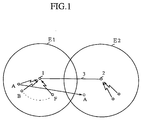
- Fig. 1 is a diagrammatic showing of the configuration of a conventional communication network system, in which base stations 1 and 2 of radio zones respectively E1 and E2 are interconnected through a public switched telephone network 3.
- Radio terminals A to F in radio zone E1 communicate with the base station 1, for example, by frequency division multiple access (FDMA) or time division multiple access (TDMA).
- FDMA frequency division multiple access
- TDMA time division multiple access
- the amount of data for communication (hereafter communication data) is constant, and hence they need only to be assigned a radio channel of a fixed channel capacity.
- the amount of communication data increases or decreases according to the state of access.
- channel capacity factors as the number of channels and slots and the frequency bandwidth remain unchanged despite an increased amount of data, resources run short which results in a failure to achieve a satisfactory transmission speed.
- the amount of communication data decreases, the degree of unused resources increases and radio channels are not effectively used.
- the present invention is intended to solve the above problem, and has the object of increasing the speed of data communication and reducing waste in the use of radio channels through the effective utilization of a limited number of channels on the basis of changing the number of channels, the number of slots, the frequency bandwidth, or similar channel factors in accordance with the amount of communication data or the rate of change in the amount of communication data per unit time.
- a radio channel assignment method for radio communication between a base station and a plurality of radio terminals in its radio zone it is possible to speed up data communication and reduce inefficient use of radio channels through effective use of a limited number of radio channels by increasing or decreasing the number of radio channels in accordance with the amount of communication data between the base station and each radio terminal.
- a radio channel assignment method for radio communications between a base station and a plurality of radio terminals in its radio zone it is possible to speed up the data communication and reduce inefficient use of radio channels through effective use of a limited number of radio channels by determining the number of radio channels to be assigned, by the base station, in accordance with the rate of change of the amount of stored data per unit time.
- a radio channel assignment method for radio communications between a base station and a plurality of radio terminals in the radio zone of the base station it is possible to speed up the data communication and reduce inefficient use of radio channels through effective use of a limited number of radio channels by determining the number of radio channels to be assigned, by each radio terminal, in accordance with the rate of change of the amount of stored data per unit time.
- a radio channel assignment method for radio communication between a base station and a plurality of radio terminals staying in the radio zone of the base station it is possible to speed up the data communication and reduce inefficient use of radio channels through effective use of a limited number of radio channels by sending, upon occurrence of a hand-over, the number of assigned channels to a base station with which the radio terminal newly communicates.
- Fig. 1 is a diagram illustrating a communication network system
- Fig. 2 is a block diagram depicting the configuration of a radio communication system in which a plurality of radio terminals communicate with one base station by frequency division multiple access (FDMA);
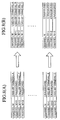
- Fig. 3 is an explanatory diagram of variation in radio channel assignment when the amount of communication data is larger than a preset threshold;
- Fig. 4 is an explanatory diagram of the variation in the radio channel assignment when the amount of communication data is smaller than the preset threshold;
- Fig. 5 is an explanatory diagram of the variation in radio channel assignment when a terminal C, which uses a plurality of channels, hops;
- Fig. 1 is a diagram illustrating a communication network system
- Fig. 2 is a block diagram depicting the configuration of a radio communication system in which a plurality of radio terminals communicate with one base station by frequency division multiple access (FDMA);
- Fig. 3 is an explanatory diagram of variation in radio channel assignment when the amount of communication data is larger than
- Fig. 6 is an explanatory diagram of variation in radio channel assignment when a terminal adjacent the terminal C, which uses a plurality of channels, hops;
- Fig. 7 is an explanatory diagram of variation in radio channel assignment in the absence of available channels;
- Fig. 8 is an explanatory diagram of variation in radio channel assignment when fragmented channels are gathered together;
- Fig. 9 is a block diagram illustrating the configuration of a radio communication system in which a plurality of radio terminals communicate with one base station by time division multiple access (TDMA);
- Fig. 10 is an explanatory diagram of variation in radio channel assignment when the amount of communication data is larger than a preset threshold;
- Fig. 11 is an explanatory diagram of variation in radio channel assignment when the amount of communication data is smaller than the preset threshold;
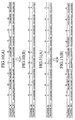
- Fig. 12 is an explanatory diagram of variation in radio channel assignment when a terminal C, which uses a plurality of slots, hops
- Fig. 13 is an explanatory diagram of variation in radio channel assignment when a terminal adjacent the terminal C, which uses a plurality of slots, hops
- Fig. 14 is an explanatory diagram of variation in radio channel assignment for decreasing the number of slots assigned to channel C down to one when no slots are available
- Fig. 15 is an explanatory diagram of variation in radio channel assignment for assigning one of the slots assigned to the terminal C to another terminal when no slots are available
- Fig. 16 is an explanatory diagram of variation in radio channel assignment when fragmented channels are gathered together
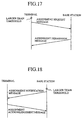
- Fig. 17 is a diagram showing a sequence for the radio terminal side to request the base station side to change the radio channel assignment
- Fig. 18 is a diagram showing a sequence for the base station side to request the radio terminal side to change the radio channel assignment.
- Fig. 2 is a block diagram depicting a radio communication system according to Embodiment 1 of the present invention in which a plurality of radio terminals A (5A) to F (5F) communicate with one base station 1 by frequency division multiple access (FDMA).
- FDMA frequency division multiple access
- the radio terminals A (5A) to F (5F) are each composed of: a buffer 11 for storing data to be sent; an amount-of-data monitor 12 for detecting the amount of data stored in the buffer 11, for example, in terms of software under program control; a controller 13 for controlling the radio terminal; a modulator 14 which performs modulation (changing the bandwidth) as determined by the controller 13; a transmitter 15; a demodulator 16; and a receiver 17.
- the base station 1 is provided with: individual base stations 1A to 1F corresponding to the radio terminals A (5A) to F (5F), respectively; a controller 4 for controlling the individual base stations 1A to 1F; and a channel assignment monitor 5 for monitoring the channel assignment of the base station 1.
- the individual base stations 1A to 1F are each made up of: a receiver 21; a demodulator 22; a buffer 23 for storing received data; an amount-of-data monitor 24 for detecting the amount of data stored in the buffer 23, for example, in terms of software under program control; a modulator 25; and a transmitter 26.
- the individual base station 1A demodulates the signal received by the receiver 21 with the demodulator 22; checks the demodulated data by the controller 4; determines whether or not to respond to an inquiry of the radio channel assignment request message from the radio terminal A (5A), based on the result of monitoring by the monitor 5; and sends the determination result from the controller 4 to the radio terminal A (5A) via the modulator 25 and the transmitter 26 of the individual base station 1A.
- the radio terminal A (5A) Based on a radio channel assignment permission message sent from the individual base station 1A, the radio terminal A (5A) sends communication data from the buffer 11 by the transmitter 15 via the modulator 15 to the individual base station 1A.
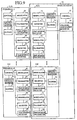
- Fig. 9 is a block diagram illustrating the configuration of a radio communication system according to Embodiment 2 of the present invention in which a plurality of radio terminals communicate through a single base station by time division multiple access (TDMA).
- TDMA time division multiple access
- reference characters A (51A) to F (51F) denote radio terminals, and 52 a base station.
- the radio terminals A (51A) to F (51F) are each composed of: a buffer 61 for storing data to send; an amount-of-data monitor 62 for detecting the amount of data stored in the buffer 61, for example, in terms of software under program control; a controller 63 for controlling the radio terminal; a modulator 64; a transmitter 65; a demodulator 66; a receiver 67; a time-division transmitter 68 for determining transmission timing; and a time-division receiver 69 for determining reception timing.
- the base station 52 comprises: individual base stations 52A to 52F correspond to the radio terminals A (51A) to F (51F), respectively; a controller 53 for controlling the individual base stations 52A to 52F; and a channel assignment monitor 54 for monitoring the channel assignment of the base station 52.
- the individual base stations 52A to 52F are each made up of: a receiver 71; a demodulator 72; a buffer 73 for storing received data; an amount-of-data monitor 74 for detecting the amount of data stored in the buffer 73, for example, in terms of software under program control; a modulator 75; a transmitter 76; time-division receiver 77 for determining reception timing; and a time-division transmitter 78 for determining transmission timing.
- the radio terminal A (51A) stores communication data in the buffer 61; monitors the amount of data stored therein by the amount-of-data monitor 62; decides a required channel capacity for communication, by the controller 63 based on the result of monitoring; and sends a channel capacity change request message based on the decision result to the base station 52 via the modulator 64 from the transmitter 65 at the transmission timing provided from the time-division transmitter 69.
- the individual base station 52A uses the demodulator 22 to demodulate the signal received by the receiver 71 at the reception timing provided from the time-division receiver 77. It checks the demodulated data by the controller 53, determines whether or not to respond to the radio channel assignment request message from the radio terminal A (51A), based on the result of monitoring by the monitor 54, and sends the determination result from the controller 53 of the base station 52 to the radio terminal A (51A) via the modulator 75 and the transmitter 76 of the individual base station 52A at the timing for transmission provided by the time-division transmitter 78.
- the radio terminal A (51A) receives the instruction signal from the individual base station 52A at the reception timing provided by the time-division receiver 67; and sends the communication data, stored in the buffer 61, via the modulator 64 to the base station 52A from the transmitter 65 over the radio channel instructed by the base station 52A.
- the assignment of radio channels between radio terminals and a base station can be changed by sending an assignment permission message from the base station side to the radio terminal side in response to a channel assignment change request from the latter to the former as shown in Fig. 17, or by sending an assignment permission message from the radio terminal side to the base station side in response to a channel assignment change request from the latter to the former as depicted in Fig. 18.
- channel assignment is varied depending on the amount of communication data.
- varying channel assignment with the rate of change of communication data per unit time also allows effective use of a limited number of channels, speeds up data communication and reduces inefficient use of channels.
- the radio channel assignment method according to the present invention changes channel assignments in response to variation in the amount of communication data per unit time. Hence it permits speeding up data communication and reducing inefficient use of channels by effectively using a limited number of channels.
- the number of channels used between the radio terminal concerned and the previous base station is posted to the new base station. In this way, it is possible to speed up data communication between the new base station and the radio terminal and reduce inefficient use of channels.
Landscapes
- Engineering & Computer Science (AREA)
- Computer Networks & Wireless Communication (AREA)
- Signal Processing (AREA)
- Mobile Radio Communication Systems (AREA)
Abstract
Description
Claims (15)
- A radio channel assignment method for radio communications between a base station and a plurality of radio terminals in the radio zone of said base station, characterized in that the number of channels between each said radio terminal and said base station is changed in response to an amount of communication data therebetween.
- The radio channel assignment method for radio communication according to claim 1, characterized in that when an amount of communication data is smaller than a preset reference value, one radio channel is assigned, and that when the amount of communication data is larger than a preset reference value, a plurality of adjacent radio channels are assigned.
- The radio channel assignment method for radio communication according to claim 2, characterized in that when an amount of communication data is larger than a preset reference value, a plurality of available radio channels are assigned.
- The radio channel assignment method for radio communication according to claim 2, characterized in that a base station sends a radio channel assignment message to a radio terminal to assign a plurality of consecutive available radio channels to said radio terminal.
- The radio channel assignment method for radio communication according to claim 2, characterized in that a radio terminal sends a radio channel assignment message to a base station to assign a plurality of consecutive available radio channels to said radio terminal.
- The radio channel assignment method for radio communication according to claim 1, characterized in that a radio terminal which requires a plurality of consecutive available radio channels assigns another radio terminal which has been assigned the channel which it requires to a different radio channel.
- The radio channel assignment method for radio communication according to claim 6, characterized in that a base station sends a message to a radio terminal assigned a radio channel which is required by another radio terminal so that the radio terminal to which the channel had been assigned is assigned a different radio channel.
- The radio channel assignment method for radio communication according to claim 6, characterized in that a radio terminal sends a radio channel assignment request message to a base station, and said base station sends a message to another radio terminal which is assigned a radio channel required by the radio terminal in order to assign a different radio channel to the other radio terminal.
- The radio channel assignment method for radio communication according to claim 1, characterized in that when a radio terminal is added to a radio channel, the number of radio channels assigned to a certain radio terminal is decreased to make one of them unassigned.
- The radio channel assignment method for radio communication according to claim 2, characterized in that a radio channel made unassigned by changing the radio channel assignment is assigned to a radio terminal required to carry out communication over a plurality of radio channels.
- The radio channel assignment method for radio communication according to any one of claims 1 to 10, characterized in that radio channels connected between radio terminals and a base station are frequency division multiple access channels.
- The radio channel assignment method for radio communication according to any one of claims 1 to 10, characterized in that radio channels between radio terminals and a base station are time division multiple access channels.
- A radio channel assignment method for radio communication between a base station and a plurality of radio terminals in the radio zone of said base station, characterized in that said base station determines a number of channels to be assigned according to the rate of increase of stored data per unit time.
- A radio channel assignment method for radio communication between a base station and a plurality of radio terminals in the radio zone of said base station, characterized in that said radio terminals each determine a number of channels to be assigned according to the rate of increase of stored data per unit time.
- A radio channel assignment method for radio communication between a base station and a plurality of radio terminals in the radio zone of said base station, characterized in that said base station transmits, upon occurrence of a hand-over, a number of assigned channels to said base station with which the radio terminal newly communicates.
Applications Claiming Priority (1)
| Application Number | Priority Date | Filing Date | Title |
|---|---|---|---|
| PCT/JP1997/004644 WO1999031823A1 (en) | 1997-12-16 | 1997-12-16 | Method for allocating radio channel for radio communication |
Publications (2)
| Publication Number | Publication Date |
|---|---|
| EP0977377A1 true EP0977377A1 (en) | 2000-02-02 |
| EP0977377A4 EP0977377A4 (en) | 2002-11-05 |
Family
ID=14181668
Family Applications (1)
| Application Number | Title | Priority Date | Filing Date |
|---|---|---|---|
| EP19970947966 Withdrawn EP0977377A4 (en) | 1997-12-16 | 1997-12-16 | METHOD FOR ALLOCATING A RADIO CHANNEL FOR RADIOCOMMUNICATION |
Country Status (5)
| Country | Link |
|---|---|
| US (1) | US7035644B1 (en) |
| EP (1) | EP0977377A4 (en) |
| JP (1) | JP3204992B2 (en) |
| CN (1) | CN1161894C (en) |
| WO (1) | WO1999031823A1 (en) |
Cited By (4)
| Publication number | Priority date | Publication date | Assignee | Title |
|---|---|---|---|---|
| EP1217858A1 (en) * | 2000-12-19 | 2002-06-26 | NTT DoCoMo, Inc. | Wireless channel changeover method and mobile communication system |
| EP1175117A3 (en) * | 2000-07-18 | 2002-11-20 | Canon Kabushiki Kaisha | Wireless communication apparatus |
| WO2004049631A1 (en) | 2002-11-22 | 2004-06-10 | Koninklijke Philips Electronics N.V. | Robust communication system |
| WO2010027306A1 (en) | 2008-09-03 | 2010-03-11 | Telefonaktiebolaget L M Ericsson (Publ) | A method for allocating communication bandwidth and associated apparatuses |
Families Citing this family (21)
| Publication number | Priority date | Publication date | Assignee | Title |
|---|---|---|---|---|
| FI106172B (en) * | 1998-01-29 | 2000-11-30 | Nokia Networks Oy | A method for reconfiguring a connection in a cellular radio network |
| JP3424661B2 (en) | 2000-06-27 | 2003-07-07 | 日本電気株式会社 | Mobile communication system and mobile communication method |
| JP3530118B2 (en) * | 2000-08-29 | 2004-05-24 | 松下電器産業株式会社 | Base station apparatus and wireless communication method |
| US8111689B2 (en) | 2001-01-16 | 2012-02-07 | Nokia Corporation | System for uplink scheduling packet based data traffic in wireless system |
| US20030128686A1 (en) * | 2001-12-06 | 2003-07-10 | Hur Nam Chun | Variable delay buffer |
| DE10213370B4 (en) * | 2002-03-21 | 2011-05-12 | Deutsche Telekom Ag | Method and apparatus for channel allocation for a channel-based radio communication network with fixed channel assignment |
| US8279782B2 (en) * | 2002-07-19 | 2012-10-02 | Alcatel Lucent | Systems and methods for the assignment of a plurality of processors to a plurality of data servers |
| EP1536657A1 (en) * | 2002-09-06 | 2005-06-01 | Mitsubishi Denki Kabushiki Kaisha | Radio communication system time slot allocation method |
| JP3512783B1 (en) * | 2002-10-08 | 2004-03-31 | 松下電器産業株式会社 | Communication terminal device and base station device |
| CA2515983C (en) * | 2003-02-12 | 2010-05-11 | Research In Motion Limited | Apparatus, and associated method, for facilitating initiation of channe l allocation to communicate data in a radio communication system |
| CN1922900A (en) * | 2004-02-23 | 2007-02-28 | 日本电气株式会社 | Mobile subscriber network and resource management method |
| JP2006019850A (en) * | 2004-06-30 | 2006-01-19 | Hitachi Ltd | Wireless communication method, wireless communication base station, and wireless communication terminal |
| JP4652008B2 (en) * | 2004-09-30 | 2011-03-16 | 京セラ株式会社 | COMMUNICATION SYSTEM, COMMUNICATION DEVICE, AND COMMUNICATION CHANNEL USE CONTROL METHOD |
| US8169953B2 (en) * | 2005-05-17 | 2012-05-01 | Qualcomm Incorporated | Method and apparatus for wireless multi-carrier communications |
| US8626172B2 (en) | 2005-08-10 | 2014-01-07 | Qualcomm Incorporated | Method and apparatus for simultaneous communication utilizing multiple wireless communication systems |
| JP4355333B2 (en) * | 2006-09-13 | 2009-10-28 | 京セラ株式会社 | Mobile communication system, mobile station apparatus, base station apparatus, and channel allocation method |
| EP2469925B1 (en) | 2009-08-20 | 2017-02-22 | Fujitsu Limited | Base station device, base station control device, mobile terminal, communication system, and base station device control method |
| JP5027263B2 (en) * | 2010-02-10 | 2012-09-19 | 株式会社日立製作所 | Wireless communication method, wireless communication base station, and wireless communication terminal |
| US10504360B2 (en) | 2011-04-08 | 2019-12-10 | Ross Gilson | Remote control interference avoidance |
| JP5266405B2 (en) * | 2012-03-19 | 2013-08-21 | 株式会社日立製作所 | Wireless communication method |
| GB201410025D0 (en) * | 2014-06-05 | 2014-07-16 | Ocado Ltd | Systems and methods for communication |
Family Cites Families (18)
| Publication number | Priority date | Publication date | Assignee | Title |
|---|---|---|---|---|
| SE8802229D0 (en) * | 1988-06-14 | 1988-06-14 | Ericsson Telefon Ab L M | MOBILE RADIO STATION PROCEDURE |
| CA2032325C (en) * | 1990-12-14 | 1998-07-07 | Leo Strawczynski | Intra-cell call hand-over in radio communication systems with dynamic channel allocation |
| US5351240A (en) | 1992-05-08 | 1994-09-27 | Scientific-Atlanta, Inc. | Communication link having dynamically allocatable auxiliary channel for data bursts |
| JP3242709B2 (en) * | 1992-08-25 | 2001-12-25 | 富士通株式会社 | Mobile communication system |
| FR2700086B1 (en) * | 1992-12-30 | 1995-04-28 | Alcatel Radiotelephone | Method for transmitting information at high speed by multiple allocation of blocks, associated reception method and reception device for implementing it. |
| JP3212169B2 (en) | 1993-01-06 | 2001-09-25 | 株式会社東芝 | Wireless communication system and base station |
| US5457680A (en) * | 1993-05-18 | 1995-10-10 | International Business Machines Corporation | Data gateway for mobile data radio terminals in a data communication network |
| US5448759A (en) * | 1993-08-20 | 1995-09-05 | Motorola, Inc. | Method for efficient bandwidth utilization when transceiving varying bandwidth messages |
| ZA946674B (en) | 1993-09-08 | 1995-05-02 | Qualcomm Inc | Method and apparatus for determining the transmission data rate in a multi-user communication system |
| JP3260950B2 (en) | 1994-02-18 | 2002-02-25 | 松下電器産業株式会社 | Data communication device |
| JP2960653B2 (en) | 1994-09-26 | 1999-10-12 | エヌ・ティ・ティ移動通信網株式会社 | Radio channel allocation method in mobile communication system |
| JP3231210B2 (en) * | 1995-03-03 | 2001-11-19 | 株式会社日立製作所 | Wireless communication system |
| US5625877A (en) * | 1995-03-15 | 1997-04-29 | International Business Machines Corporation | Wireless variable bandwidth air-link system |
| JP2817677B2 (en) * | 1995-08-30 | 1998-10-30 | 日本電気株式会社 | Wireless communication device |
| JPH09163431A (en) | 1995-12-12 | 1997-06-20 | Fujitsu Ltd | Radio channel allocation method |
| FI101332B1 (en) | 1995-12-18 | 1998-05-29 | Nokia Telecommunications Oy | Discontinuous transmission in a multi-channel high-speed data transmission |
| US5781583A (en) * | 1996-01-19 | 1998-07-14 | Motorola, Inc. | Method and system for communication over multiple channels in a spread spectrum communication system |
| US5940763A (en) * | 1997-04-23 | 1999-08-17 | Ericsson, Inc. | Enhanced preemption within a mobile telecommunications network |
-
1997
- 1997-12-16 WO PCT/JP1997/004644 patent/WO1999031823A1/en not_active Ceased
- 1997-12-16 US US09/355,732 patent/US7035644B1/en not_active Expired - Fee Related
- 1997-12-16 JP JP50541799A patent/JP3204992B2/en not_active Expired - Fee Related
- 1997-12-16 CN CNB97181807XA patent/CN1161894C/en not_active Expired - Fee Related
- 1997-12-16 EP EP19970947966 patent/EP0977377A4/en not_active Withdrawn
Cited By (7)
| Publication number | Priority date | Publication date | Assignee | Title |
|---|---|---|---|---|
| EP1175117A3 (en) * | 2000-07-18 | 2002-11-20 | Canon Kabushiki Kaisha | Wireless communication apparatus |
| US6904284B2 (en) | 2000-07-18 | 2005-06-07 | Canon Kabushiki Kaisha | Wireless communication apparatus |
| EP1217858A1 (en) * | 2000-12-19 | 2002-06-26 | NTT DoCoMo, Inc. | Wireless channel changeover method and mobile communication system |
| US6907250B2 (en) | 2000-12-19 | 2005-06-14 | Ntt Docomo, Inc. | Wireless channel changeover method and mobile communication system |
| WO2004049631A1 (en) | 2002-11-22 | 2004-06-10 | Koninklijke Philips Electronics N.V. | Robust communication system |
| WO2010027306A1 (en) | 2008-09-03 | 2010-03-11 | Telefonaktiebolaget L M Ericsson (Publ) | A method for allocating communication bandwidth and associated apparatuses |
| US8547919B2 (en) | 2008-09-03 | 2013-10-01 | Telefonaktiebolaget Lm Ericsson (Publ) | Method for allocating communication bandwidth and associated apparatuses |
Also Published As
| Publication number | Publication date |
|---|---|
| EP0977377A4 (en) | 2002-11-05 |
| JP3204992B2 (en) | 2001-09-04 |
| WO1999031823A1 (en) | 1999-06-24 |
| US7035644B1 (en) | 2006-04-25 |
| CN1161894C (en) | 2004-08-11 |
| CN1246226A (en) | 2000-03-01 |
Similar Documents
| Publication | Publication Date | Title |
|---|---|---|
| US7035644B1 (en) | Method for allocating radio channel for radio communication | |
| CA2025228C (en) | Beacon carrier | |
| US6091717A (en) | Method for scheduling packet data transmission | |
| JPWO1999031823A1 (en) | Method for allocating radio lines for wireless communication | |
| KR100760726B1 (en) | Communication method in wireless communication terminal | |
| US5465253A (en) | Method and apparatus for demand-assigned reduced-rate out-of-band signaling channel | |
| EP0750440A2 (en) | Method and apparatus for call admission control in CDMA mobile communication system | |
| JPH0823567A (en) | Wireless communication system and call channel allocation method | |
| EP0907263B1 (en) | CDMA cellular communication system using frame offset distribution of all base stations to avoid traffic peak | |
| EP0819364B1 (en) | Stabilized control channel planning using loosely coupled dedicated traffic channels | |
| US8099110B2 (en) | Apparatus and method for efficient determination of mobile station location in a wireless network | |
| EP0920230A1 (en) | Hand-off switching system for mobile communications | |
| US6600731B2 (en) | Method and base station system for calling mobile stations for the transmission of packet data | |
| RU2120181C1 (en) | Method for reduction of unnecessary power consumption in hand sets of cellular telephone network | |
| US6628611B1 (en) | Traffic control system and method for constant-rate and variable-rate modes of transmission | |
| JPH0685739A (en) | Mobile radio communication control system | |
| US5329574A (en) | Method for improving telephone resource access in a communication system network | |
| EP1072164A2 (en) | On-demand channel allocation for packet data | |
| JP2791306B2 (en) | Mobile communication system | |
| JP3242709B2 (en) | Mobile communication system | |
| JP3439022B2 (en) | Mobile radio communication system | |
| NO325602B1 (en) | Method of controlling load in a communication system | |
| JP3040244B2 (en) | Wireless channel allocation method | |
| KR100347732B1 (en) | Method for controlling traffic of wireless mobile communications | |
| JPH11266478A (en) | TDMA mobile communication system |
Legal Events
| Date | Code | Title | Description |
|---|---|---|---|
| PUAI | Public reference made under article 153(3) epc to a published international application that has entered the european phase |
Free format text: ORIGINAL CODE: 0009012 |
|
| 17P | Request for examination filed |
Effective date: 19990813 |
|
| AK | Designated contracting states |
Kind code of ref document: A1 Designated state(s): DE FR GB |
|
| RIC1 | Information provided on ipc code assigned before grant |
Free format text: 7H 04B 7/26 A, 7H 04Q 7/38 B |
|
| A4 | Supplementary search report drawn up and despatched | ||
| AK | Designated contracting states |
Kind code of ref document: A4 Designated state(s): DE FR GB |
|
| A4 | Supplementary search report drawn up and despatched |
Effective date: 20021105 |
|
| 17Q | First examination report despatched |
Effective date: 20040607 |
|
| RAP1 | Party data changed (applicant data changed or rights of an application transferred) |
Owner name: MITSUBISHI DENKI KABUSHIKI KAISHA |
|
| STAA | Information on the status of an ep patent application or granted ep patent |
Free format text: STATUS: THE APPLICATION IS DEEMED TO BE WITHDRAWN |
|
| 18D | Application deemed to be withdrawn |
Effective date: 20060214 |