EP0977148B1 - Dispositif électronique de recalage automatique d'images - Google Patents
Dispositif électronique de recalage automatique d'images Download PDFInfo
- Publication number
- EP0977148B1 EP0977148B1 EP99401881A EP99401881A EP0977148B1 EP 0977148 B1 EP0977148 B1 EP 0977148B1 EP 99401881 A EP99401881 A EP 99401881A EP 99401881 A EP99401881 A EP 99401881A EP 0977148 B1 EP0977148 B1 EP 0977148B1
- Authority
- EP
- European Patent Office
- Prior art keywords
- data
- registration
- image
- transformation
- module
- Prior art date
- Legal status (The legal status is an assumption and is not a legal conclusion. Google has not performed a legal analysis and makes no representation as to the accuracy of the status listed.)
- Expired - Lifetime
Links
Images


Classifications
-
- G—PHYSICS
- G06—COMPUTING OR CALCULATING; COUNTING
- G06T—IMAGE DATA PROCESSING OR GENERATION, IN GENERAL
- G06T3/00—Geometric image transformations in the plane of the image
- G06T3/40—Scaling of whole images or parts thereof, e.g. expanding or contracting
- G06T3/4053—Scaling of whole images or parts thereof, e.g. expanding or contracting based on super-resolution, i.e. the output image resolution being higher than the sensor resolution
- G06T3/4061—Scaling of whole images or parts thereof, e.g. expanding or contracting based on super-resolution, i.e. the output image resolution being higher than the sensor resolution by injecting details from different spectral ranges
Definitions
- the invention relates to the field of couples treatment comparable, "two-dimensional” (2D) or "three-dimensional” (3D), and more particularly the registration of a first image relative to a second image.
- readjustment is meant the fact of determining, from the clearances data representing the two comparable digital images, a transformation allowing to pass from one of them, called the “reference” image, to the other, called the image “Floating". In other words, it's about superimposing “on better "of the structures contained in two comparable images.
- Voxel is the smallest element volume (3D) or area (2D) of an image.
- 3D element volume
- 2D area
- Such voxel-oriented techniques involve, for example example, the WOODS criterion, or the VIOLA criterion, or so-called "mutual" information. These techniques do not provide complete satisfaction, especially when used for the registration of multimodal images.
- the present invention proposes to provide an alternative to aforementioned techniques.
- a registration module comprising, part, a first module capable of calculating a function main representative of correlation reports (such as defined below) between the data of a first dataset representative of a first image, called the reference image, and the data from a second set of data representative of a second image, called floating, and on the other hand, a second module having function to determine a registration transformation allowing to superimpose the floating image on the image of reference from the main function calculated by the first module.
- correlation relationship means, the function of probability theory, which is not usually symmetrical, and which measures for a first set of data, how similar it is to a second set of data, regardless of the intensity levels of either datasets.
- probability theory which measures for a first set of data, how similar it is to a second set of data, regardless of the intensity levels of either datasets.
- the correlation ratio (as a function) must be understood as well in its classical acceptance, i.e. accompanied by a qualified Euclidean standard "of order 2", that in a very general acceptance in which it is accompanied by either a non-Euclidean standard of any order other than 2, or of a quadratic form any order 2.
- the registration module provides the registration module with a third module for estimating a joint probability density function (or histogram two-dimensional), representative of the intensity of the second image (floating) according to the intensity of the first image (reference), from the first and second sets of data, the first module then being arranged to calculate the correlation ratio from this density function of joint probability (FDPC).
- FDPC density function of joint probability
- a fourth module to transform the first or second set of data (reference game or floating game) in a third game of data including data whose components of position correspond to each of the position components of the data from the second game (floating game) or the first game (game from reference), respectively.
- the intensity components of third and second (or first) games can thus be directly compared in each voxel, since the associated position components correspond.
- the fourth module directly feeds either the first module for calculating the correlation ratio, i.e. third module for calculating the density function of joint probability.
- the transformation of the first (or second) set of data in third dataset is done by application at the first (or second) set of a registration transformation initialization followed by interpolation, preferably trilinear type.
- the second module determines the main function (correlation ratio) by selecting according to a chosen criterion a maximum of this function among the maximum or maxima it possesses, the registration transformation is then determined from this maximum selected.
- the registration transformations are preferably chosen among the n-dimensional geometric transformations any, n being chosen at least from the values 2 and 3 depending on the size of the images.
- the registration transformation is determined in the set of n-dimensional transformations affines, and in particular those called “rigid”. But, one could also determine it among the transformations say “not rigid", in particular.
- the transformation registration is calculated iteratively.
- the second module is arranged to determine if the registration transformation which has just been determined from of the main function (correlation ratio), checks a chosen criterion. If this criterion is not verified, the registration transformation just checked is addressed in the fourth module to replace the transformation previously used to obtain the third set of data. A new correlation report is then recalculated, then a new registration transformation. This operation is then repeated until a registration transformation satisfies the verification criterion, or else the operation has been repeated a number of times equal to a predetermined value, possibly adaptable.
- the correlation ratio can be estimated from part (s) of the first and / or second games that satisfy a chosen criterion, for example intensity or of belonging to a region.
- the invention applies very particularly, although so non-exclusive, digital medical images, and more particularly still to images obtained by techniques different acquisition.
- the invention also provides a method of treating two datasets representing respectively first and second comparable digital images, including a step of registration of the second image on the first image, subdivided in a first substep consisting in calculating a main function representative of correlation relationships between the data of the first game and the data of the second game, and a second substep consisting in determining a transformation of one of the two images on the other image at from this main calculated function.
- Image registration is becoming more and more important great, in many areas when it comes to perform comparative analyzes of images obtained be from different techniques, or from a single technical but at different times.
- nD n-dimensional image
- devices such as x-ray scanners or magnetic resonance devices nuclear, or more generally any type of device capable acquire images with varying intensity.
- the techniques commonly used acquisition systems are known as magnetic resonance (MRI), computed tomography or CT scan, and positron emission tomography (PET).
- MRI magnetic resonance
- CT scan computed tomography
- PET positron emission tomography
- a data from a data set representing an image Nd comprises so at least one position component representing n coordinates spatial with respect to a three-dimensional coordinate system and a intensity component representing the value of the quantity physics measured in this position, generally between the values 0 and 1 or 1 and 256.
- the physical quantity measured obviously depends on the acquisition technique used.
- the data of a game form a ordered list (or table), and the position of the data in this list implicitly provides the position coordinates.
- the image 3D acquired consists of a multiplicity of 2D sections stacked, in which the intensity variations represent the proton density of the tissues.
- the device according to the invention is suitable for treating pairs of such representative datasets of first and second images. It is more precisely adapted to the registration of the second image, called the floating image If, on the first image, said reference image Ir.
- This device generally part of a computer connected to interface means man / machine and video monitor type display means allowing viewing of unprocessed and processed images.
- the device according to the invention comprises a registration module 1 (partially and schematically illustrated in Figure 1) who receives a first J1 [I1] and a second J2 [I2] sets of data, either directly or through a module designation 2.
- a registration module 1 (partially and schematically illustrated in Figure 1) who receives a first J1 [I1] and a second J2 [I2] sets of data, either directly or through a module designation 2.
- this designation module is to designate one of the two images as a "reference” image Ir, and the other image as as a "floating" image If; the floating image If to be readjusted on the reference image Ir.
- a designation module can be managed “mechanically” by an operator, by example via the man / machine interface, and in this case, the operator can itself designate the reference image and the image floating after viewing the first and second images. But it can also be “autonomous” if it includes a sub-module decision able to compare the first and second images according to a criterion chosen to designate the image of reference and the floating image.
- the function of the registration module 1 is to determine a registration adjustment T between the first and second images. This transformation makes it possible to obtain a superposition first and second images with accuracy up to one tenth of a volume element (or voxel). But maybe from any type, but preferably it is of the type said "rigid”.
- This registration module 1 comprises at least a first module for estimate a similarity function between the two images If and Ir, as well as a second module 5 more particularly intended for determine the registration transformation T which will make it possible to reposition the second image (or floating image) on the first image (or reference image), and which is delivered on a exit 3.
- the output 3 generally feeds an analysis module allowing, for example, to measure deformation fields from readjusted images.
- the similarity function also called the main function, or correlation ratio (as a function), is designated below ⁇ (If / r (T)).
- the first module 4 determines the correlation ratio ⁇ from a two-dimensional joint histogram provided by a third module 6.
- a density function of joint probability FDPC, or joint histogram representative the intensity of the second image as a function of the intensity of the first image, then, from this FDPC, we associates with each image a histogram which is interpreted as a marginal probability density function.
- This FDPC joint probability density function is determined from the first and second or more images specifically, from the first J1 [I1] and second J2 [I2] sets of data.
- registration module 1 for a fourth module 7 intended to transform the first set of data J1 (representative of the reference image Ir) into a third set of data J3 [ r (Tn)] which presents data whose position components are substantially identical to the position components of the data of the second data set J2 representative of the floating image If.
- a fourth module 7 intended to transform the first set of data J1 (representative of the reference image Ir) into a third set of data J3 [ r (Tn)] which presents data whose position components are substantially identical to the position components of the data of the second data set J2 representative of the floating image If.
- r (Tn) presents data whose position components are substantially identical to the position components of the data of the second data set J2 representative of the floating image
- each grid represents a structure with simple cubic meshes, the vertices of each mesh representing a voxel.
- G1 for the reference image Ir
- G2 for the image floating If.
- the grids could be different configurations.
- the second grid of the floating image does not correspond not to the first grid of the reference image. So we are going try to match the two grids G1 and G2 according to a affine transformation, preferably. In some cases, we limit to affine transformations called "rigid", compositions of rotation and translation.
- the data of the first dataset presents new position components (at least for part of them), because they are measured in a benchmark linked to the floating image If and therefore to the second grid G2. he must then determine the new intensity components of data whose position components have been changed from made of the application of the transformation Tn.
- a trilinear type interpolation is preferably carried out.
- the interpolation can be followed by a rounding operation so that the value of the intensity interpolated in a given position component is rounded to the nearest integer.
- the data (or voxels) of the first transformed grid which do not have a chosen number, for example equal to 8, of neighbors in the second grid G2, are eliminated.
- the transformation followed by the interpolation, and possibly the operations of rounding and elimination of particular voxels, applied to the first data set provides the third data set J3 associated with the transformed image [ r (Tn)].
- the fourth module 7 provides the third module 6 with the second J2 [If] and the third J3 [ r (Tn)], so that it determines the joint probability density function FDPC (or joint histogram).
- This function, and the mathematical path allowing it to be obtained, are given in appendix 1.
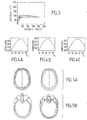
- FIG. 3 An example of such an FDPC histogram is illustrated in the figure 3, where the readjusted image (second image) was obtained by CT scan, while the reference image (first image) was obtained using an MRI type technique.
- variable X or Y which represents the intensity component of each data in a game of data is therefore assimilated to a random variable.
- the joint probability density function FDPC estimated by the third module 6, is provided to the first module 4 so that it determines the correlation ratio (as a function) ⁇ .
- the invention can be implemented in many types of spaces provided with various standards.
- L 2 ( ) real random variables of summable square.
- This space is a Hilbert space for the scalar product and has a Euclidean norm of standard type (qualified as order 2).
- L 1 ( ) provided with the norm 1 standard, or in other sets provided with a non-Euclidean norm of any order other than 2, or even in spaces provided with any quadratic form of order 2.
- the correlation ratio is a function of two real random variables X and Y which, with this pair (X, Y) of random variables, associates a real value belonging to the closed set [0; 1].
- X and Y represent the intensity components of r (Tn) and If, this function measures the resemblance of the two "objects" represented by the reference image Ir and the floating image If, independently of the intensity levels of one of these two images, and preferably of those of the reference image Ir.
- this function (correlation ratio) makes it possible to quantify the degree of functional dependence between the two random variables which represent the intensity components of the first and second images.
- the determined correlation ratio (as a function), ⁇ , provided by the first module 4 is then transmitted to the second module 5.
- ⁇ ratio of correlation
- the calculation module 8 is arranged to choose one of these maxima and associate it with registration transformation.
- the method used for choosing a maximum depends on the algorithm implemented by the calculation module 8.
- a selection criterion may consist of the comparison of each maximum of ⁇ to a threshold value. In the assumption that ⁇ presents only a single maximum, like this is illustrated in FIG. 4A (which illustrates the ratio of correlation deduced from the probability density function joint illustrated in Figure 3), determining the registration transformation T is particularly simple, and it there is no real need to apply the choice.
- the registration transformation T is determined among the rigid three-dimensional transformations well known to those skilled in the art. But it is clear that we could use other types of transformations to determine the re-registration transformation T, and in particular transformations not rigid.
- the determination of the registration transformation is carried out iteratively.
- the transformation Tn determined by the calculation module 8 presents the desired degree of precision, which can be fixed by the operator.
- a test module 9 which subjects the transformation Tn to a test, in comparing it for example to a chosen stopping criterion.
- criterion may relate to the difference in variation between two successive Tn-1 and Tn transformations, the stop being decided when the variation difference is less than a chosen threshold (so-called convergence criterion).
- convergence criterion is usually integrated directly into the optimization algorithm implemented.
- test criteria such as a criterion relating to the degree of superimposition of the floating image on the image of reference.
- the test module 9 presents, in the example illustrated on the FIG. 1, two outputs including output 3 of the registration module 1, which delivers the "final" registration transformation T when Tn checks the selected criterion, and an output 10 which is connected to the fourth module 7 so as to provide it with the transformation of registration Tn when it does not check the chosen criterion.
- the test module 9 when the registration transformation Tn determined by the calculation module 8 is judged to be of quality sufficient by the test module 9, it delivers on its output 3 the final registration transformation T, while, when Tn is judged to be of insufficient quality, the test module 9 transmits, via its output 10, the registration transformation Tn in the fourth module 7.
- the Tn registration transformation is provided directly to the first module 4, or to the third module 6.
- the registration transformation Tn which the fourth module 7 receives (in this example) then replaces the previous transformation which was stored, and which made it possible to determine the third data set J3 [ r (Tn)).
- the transformation T0 used by the fourth module 7 can be considered as an initialization transformation.
- this mode only concerns devices in which the registration module 1 performs iterative processing, such as illustrated in figure 1.
- the fourth module 7 determines a new third set of data J3 [ r (Tn)] which it then transmits to the third module 6 (of course when the device includes one) so that the joint probability density function FDPC is calculated again, then transmitted to the first module 4 for the purpose of determination of a new correlation ratio ⁇ associated with the last transformation Tn calculated.
- the calculation module 8 can set implements an optimization algorithm, for example of the Powell type, well known to those skilled in the art.
- This Powell algorithm is based on a multidimensional direction set method coupled with an optimization of Brent lines of the type of that described in the publication by W.H. Press, B.P. Flannery, S.A. Teukolski and W.T. Vetterling, Numerical Recipes in C. Cambridge University Press, 2nd edition, 1992.
- others optimization algorithms can be used.
- the calculation module 8 uses both the new correlation ⁇ which has just been recalculated by the first module 4, and of the previous Ti registration transformations stored in memory 11.
- the new Tn registration transformation which results from this calculation is then transmitted to the test module 9 which decides, by application of the chosen criterion, either of the deliver on output 3 in the form of transformation of T registration, or to deliver it on output 10 of so that a new iteration is performed.
- This mechanism can be repeated, either until a transformation final registration T verifying the chosen criterion, either when the number of iterations exceeds a predetermined threshold number, which can be adapted by the operator, if necessary.
- the method according to the invention comprises a first step 100 in which the first image is designated as the reference image Ir and the second image as the floating image If.
- a second step 110 the first data set representing the reference image Ir (Tn) is transformed, so as to obtain a superposition of the position components of the data of the first data set on the position components of the data from the second dataset.
- an interpolation preferably of the trilinear type, is performed on the transformed data of the first set of data, so as to determine the new intensity components corresponding to the new position components of the first set J1.
- This provides a third J3 dataset [ r (Tn)] associated with the first set J1.
- a joint probability density function FDPC is determined from the second data set J2 and from the third data set J3 [ r (Tn)], so as to obtain a probabilistic representation of the reference images Ir (in fact r (Tn)) and floating point If.
- a function is calculated main representative of the correlation relationships between data from the first game J1 (in fact those from the third game J3) and the data from the second set J2.
- a test 160 on the Tn registration transformation so that to determine whether it is of sufficient quality. If the registration transformation Tn determined in step 150 verifies the criterion applied to it during test 160, then said Tn registration transformation is considered to be the transformation finalization of registration T, which ends the process. In however, if the transformation Tn does not satisfy the criterion applied during test 160, then said transformation of registration Tn is returned to the second step 110 where it comes replace the previous transformation, which had been applied to the reference image Ir represented by the first dataset. Steps 110 to 160 are then repeated as many times as it takes to get a transformation T final of sufficient quality, or as many times as the process allows, when it contains a maximum number of iterations chosen, and possibly adaptable.
- step 100 we could go directly from step 100 to step 140, without transforming the first set, interpolating and calculating the probability density function joint FDPC. Besides, we could do without the single step 130, while retaining steps 110 and 120.
- FIGS. 4A to 4C are illustrated three examples of processing the reference image data sets and floating for three different data selections (again called subsampling).
- Correlation report illustrated in Figure 4A was obtained from a subsampling of the second dataset representing the image floating (obtained by a CT scan) of a factor 2x2x1. In in other words, one data out of two in the X direction and one in two data in the Y direction has been deleted.
- FIGS. 4B and 4C respectively illustrate the ratios of correlation for subsampling of data from the second play of a floating image (obtained by CT scan) by factors 8x8x1, and 12x12x1, respectively.
- FIGS. 5A and 5B Two examples of image registration (obtained by CT scan) are illustrated in FIGS. 5A and 5B, the left parts of these figures representing the readjusted image (CT scan), while that the straight parts of these figures represent the images MRI type reference on which the outline of the relevant parts of the readjusted image (CT scan).
- the device according to the invention can be implanted in a memory, for example mass, of one or more means of workstation and / or computer type calculation, under the form of software modules.
- a 2D image processing device has been described or 3D, and the associated method, intended to process images in particular medical, and in particular of the brain. But he is It is clear that the invention is not limited to this single field. She also applies to other sectors of the medical field, as well as non-medical fields for which registration of 2D or 3D object images is of particular interest.
- n-dimensional registration transformations affines in particular of rigid type.
- the invention extends more generally to registration transformations non-rigid, in particular n-dimensional geometric transformations any, such as transformations spline type.
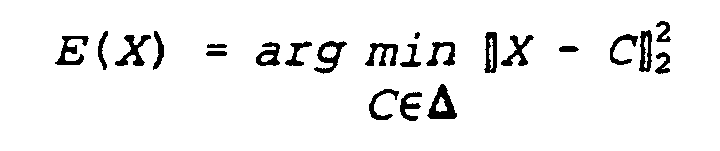
- L 2 also contains the one-dimensional space ⁇ of the deterministic variables, ie those which are constant in the space of the states ⁇ . So, either a variable X, the expectation E can then be rewritten:
- E (X) is therefore the orthogonal projection of X on ⁇ .
- E (X) is therefore the orthogonal projection of X on ⁇ .
- the correlation ratio is defined by the ratio: ⁇ ( Y
- X ) Var [ E ( Y
- X ) E x [ Var ( Y
- X x )] Var ( Y )
- P T is here the joint probability density of the two variables X and Y T and, P X, T and P Y, T are the marginal probability densities of said variables.
Landscapes
- Physics & Mathematics (AREA)
- Spectroscopy & Molecular Physics (AREA)
- General Physics & Mathematics (AREA)
- Engineering & Computer Science (AREA)
- Theoretical Computer Science (AREA)
- Image Analysis (AREA)
- Image Processing (AREA)
- Measuring And Recording Apparatus For Diagnosis (AREA)
Description
- la figure 1 illustre schématiquement un mode de réalisation préférentiel de l'invention;
- la figure 2 est un diagramme bloc illustrant les étapes de traitement d'un procédé préférentiel selon l'invention;
- la figure 3 illustre une fonction de densité de probabilité conjointe (FDPC) d'images obtenues respectivement par résonance magnétique, dite image IRM, et par tomographie assistée par ordinateur ou scanographie;
- les figures 4A à 4C illustrent le rapport de corrélation, associé à la FDPC de la figure 3, en fonction d'une translation dans le voisinage de la transformation standard d'or, de paramètre tx égal à environ 26,3 mm, respectivement pour des sous-échantillonnages de rapports 2x2x1 (A), 8x8x1 (B) et 12x12x1 (C); et
- les figures 5A et 5B illustrent respectivement pour leur partie gauche, deux images de scanographie recalées sur des images IRM comparables d'un cerveau, et pour leur partie droite les deux images IRM du cerveau sur lesquelles ont été superposés des contours des images scanographie recalées de la partie gauche; ces images correspondant sensiblement à la fonction FDPC et aux rapports de corrélation illustrés respectivement sur les figures 3 et 4.






Ex, l'opérateur défini par









Claims (17)
- Dispositif électronique de traitement de données, destiné à recevoir des premier et second jeux de données représentant des première et seconde images numériques comparables, chaque donnée comprenant une composante de position et une composante d'intensité, et comprenant des moyens de recalage (1) propres, à partir de ces deux jeux de données, à déterminer une transformation de recalage entre l'une des images et l'autre,
caractérisé en ce que lesdits moyens de recalage (1) comprennent un premier module (4) propre à calculer une fonction principale représentative des rapports de corrélation entre les données dudit premier jeu et les données dudit second jeu, et un second module (5) propre à déterminer ladite transformation de recalage à partir de ladite fonction principale. - Dispositif selon la revendication 1, caractérisé en ce que le calcul de ladite fonction principale s'effectue dans un espace muni d'une norme choisie.
- Dispositif selon la revendication 2, caractérisé en ce que ledit espace est un espace de Hilbert.
- Dispositif selon l'une des revendications 1 à 3, caractérisé en ce que lesdits moyens de recalage (1) comprennent un troisième module (6) propre à estimer une fonction de densité de probabilité conjointe à partir desdits premier et second jeux de données, et en ce que le premier module (4) est agencé pour calculer ladite fonction principale à partir de ladite fonction de densité de probabilité conjointe.
- Dispositif selon la revendication 4, caractérisé en ce que le calcul de la fonction de densité de probabilité conjointe porte sur les composantes d'intensité des données desdits jeux.
- Dispositif selon l'une des revendications 1 à 5, caractérisé en ce qu'il comprend des moyens (2) pour permettre la désignation de l'une des deux images, dite première image, en tant qu'image "de référence", et de l'autre image, dite seconde image, en tant qu'image "flottante", de sorte que ladite transformation de recalage soit déterminée pour le recalage de ladite image flottante sur ladite image de référence.
- Dispositif selon l'une des revendications 4 à 6, caractérisé en ce qu'il comprend un quatrième module (7) agencé pour transformer ledit premier jeu de données en un troisième jeu de données comprenant des données dont les composantes de position correspondent à chacune des composantes de position des données du second jeu.
- Dispositif selon la revendication 7, caractérisé en ce que ladite transformation du premier jeu de données comporte l'application d'une transformation de recalage d'initialisation et une interpolation.
- Dispositif selon la revendication 8, caractérisé en ce que ladite interpolation est de type trilinéaire.
- Dispositif selon l'une des revendications 1 à 9, caractérisé en ce que ledit second module (5) est agencé pour choisir une valeur maximale de la fonction principale selon un critère choisi et déterminer la transformation de recalage à partir de ladite valeur maximale.
- Dispositif selon l'une des revendications 1 à 10, caractérisé en ce que lesdites transformations de recalage sont déterminées dans l'ensemble des transformations géométriques n-dimensionnelles quelconques, n étant choisi au moins parmi les valeurs 2 et 3 selon la dimension des images.
- Dispositif selon la revendication 11, caractérisé en ce que lesdites transformations géométriques n-dimensionnelles sont déterminées dans l'ensemble des transformations n-dimensionnelles affines, en particulier celles dites "rigides".
- Dispositif selon l'une des revendications 8 à 12 en combinaison avec la revendication 4, caractérisé en ce que ledit second module (5) est agencé pour déterminer si ladite transformation de recalage vérifie un critère choisi, en cas de non vérification dudit critère la transformation de recalage étant adressée au troisième module (6) de manière à remplacer ladite transformation précédemment utilisée pour l'obtention dudit troisième jeu de données en vue d'une nouvelle détermination de transformation de recalage.
- Dispositif selon l'une des revendications 1 à 13, caractérisé en ce que les moyens de recalage (1) sont agencés pour estimer ladite fonction principale à partir de données desdits premier et second jeux vérifiant un critère choisi.
- Dispositif selon l'une des revendications précédentes, caractérisé en ce que les images numériques comparables sont des images médicales.
- Dispositif selon l'une des revendications précédentes, caractérisé en ce que la première et la seconde image proviennent de techniques d'acquisition différentes.
- Procédé de traitement de deux jeux de données représentant respectivement des première et seconde images numériques comparables, et comprenant une étape dans laquelle on détermine une transformation de recalage entre l'une des images et l'autre, à partir des deux jeux de données,
caractérisé en ce que ladite étape comprend les sous-étapes suivantes :a) calculer une fonction principale représentative des rapports de corrélation entre les données dudit premier jeu et dudit second jeu, etb) déterminer ladite transformation de recalage à partir de ladite fonction principale calculée.
Applications Claiming Priority (2)
| Application Number | Priority Date | Filing Date | Title |
|---|---|---|---|
| FR9809649A FR2781906B1 (fr) | 1998-07-28 | 1998-07-28 | Dispositif electronique de recalage automatique d'images |
| FR9809649 | 1998-07-28 |
Publications (2)
| Publication Number | Publication Date |
|---|---|
| EP0977148A1 EP0977148A1 (fr) | 2000-02-02 |
| EP0977148B1 true EP0977148B1 (fr) | 2004-08-18 |
Family
ID=9529115
Family Applications (1)
| Application Number | Title | Priority Date | Filing Date |
|---|---|---|---|
| EP99401881A Expired - Lifetime EP0977148B1 (fr) | 1998-07-28 | 1999-07-23 | Dispositif électronique de recalage automatique d'images |
Country Status (4)
| Country | Link |
|---|---|
| US (1) | US6539127B1 (fr) |
| EP (1) | EP0977148B1 (fr) |
| DE (1) | DE69919464T2 (fr) |
| FR (1) | FR2781906B1 (fr) |
Families Citing this family (34)
| Publication number | Priority date | Publication date | Assignee | Title |
|---|---|---|---|---|
| US6728424B1 (en) * | 2000-09-15 | 2004-04-27 | Koninklijke Philips Electronics, N.V. | Imaging registration system and method using likelihood maximization |
| US7106891B2 (en) * | 2001-10-15 | 2006-09-12 | Insightful Corporation | System and method for determining convergence of image set registration |
| US8150495B2 (en) | 2003-08-11 | 2012-04-03 | Veran Medical Technologies, Inc. | Bodily sealants and methods and apparatus for image-guided delivery of same |
| US7398116B2 (en) * | 2003-08-11 | 2008-07-08 | Veran Medical Technologies, Inc. | Methods, apparatuses, and systems useful in conducting image guided interventions |
| GB0320973D0 (en) | 2003-09-08 | 2003-10-08 | Isis Innovation | Improvements in or relating to similarity measures |
| JP2007515714A (ja) * | 2003-12-08 | 2007-06-14 | コーニンクレッカ フィリップス エレクトロニクス エヌ ヴィ | 適応型である点ベースの弾性的画像照合 |
| US20050207674A1 (en) * | 2004-03-16 | 2005-09-22 | Applied Research Associates New Zealand Limited | Method, system and software for the registration of data sets |
| US7639896B2 (en) * | 2004-08-09 | 2009-12-29 | Carestream Health, Inc. | Multimodal image registration using compound mutual information |
| EP1815432B1 (fr) * | 2004-11-17 | 2016-08-03 | Koninklijke Philips N.V. | Fonctionnalite d'enregistrement d'image elastique amelioree |
| JP2008534109A (ja) * | 2005-03-31 | 2008-08-28 | パイエオン インコーポレイテッド | 管状器官内の機器を位置決めする装置および方法 |
| US7532214B2 (en) * | 2005-05-25 | 2009-05-12 | Spectra Ab | Automated medical image visualization using volume rendering with local histograms |
| US7259762B2 (en) * | 2005-06-29 | 2007-08-21 | General Electric Company | Method and system for automatically transforming CT studies to a common reference frame |
| US7738683B2 (en) * | 2005-07-22 | 2010-06-15 | Carestream Health, Inc. | Abnormality detection in medical images |
| WO2007033206A2 (fr) | 2005-09-13 | 2007-03-22 | Veran Medical Technologies, Inc. | Dispositif et procede de verification de precision utilisant un guidage par images |
| US20070066881A1 (en) * | 2005-09-13 | 2007-03-22 | Edwards Jerome R | Apparatus and method for image guided accuracy verification |
| ATE432511T1 (de) * | 2005-12-08 | 2009-06-15 | Koninkl Philips Electronics Nv | System und verfahren zur ermöglichung der auswahl einer bildregistrations-transformation |
| US20070167784A1 (en) * | 2005-12-13 | 2007-07-19 | Raj Shekhar | Real-time Elastic Registration to Determine Temporal Evolution of Internal Tissues for Image-Guided Interventions |
| US8538108B2 (en) * | 2005-12-20 | 2013-09-17 | University Of Maryland, Baltimore | Method and apparatus for accelerated elastic registration of multiple scans of internal properties of a body |
| US8041129B2 (en) | 2006-05-16 | 2011-10-18 | Sectra Ab | Image data set compression based on viewing parameters for storing medical image data from multidimensional data sets, related systems, methods and computer products |
| WO2008085193A2 (fr) * | 2006-08-14 | 2008-07-17 | University Of Maryland | Analyse quantitative d'épreuve d'effort en 4d en temps réel |
| US7830381B2 (en) * | 2006-12-21 | 2010-11-09 | Sectra Ab | Systems for visualizing images using explicit quality prioritization of a feature(s) in multidimensional image data sets, related methods and computer products |
| US9597041B2 (en) * | 2007-03-30 | 2017-03-21 | General Electric Company | Sequential image acquisition with updating method and system |
| US20090324041A1 (en) * | 2008-01-23 | 2009-12-31 | Eigen, Llc | Apparatus for real-time 3d biopsy |
| CN103118596B (zh) | 2010-05-04 | 2015-11-25 | 开创治疗股份有限公司 | 用于使用伪特征进行腹部表面匹配的系统 |
| EP3659490B1 (fr) | 2010-08-20 | 2025-10-01 | Veran Medical Technologies, Inc. | Appareil et procédé de navigation en quatre dimensions dans un tissu mou |
| US9138165B2 (en) | 2012-02-22 | 2015-09-22 | Veran Medical Technologies, Inc. | Systems, methods and devices for forming respiratory-gated point cloud for four dimensional soft tissue navigation |
| US20150305612A1 (en) | 2014-04-23 | 2015-10-29 | Mark Hunter | Apparatuses and methods for registering a real-time image feed from an imaging device to a steerable catheter |
| US20150305650A1 (en) | 2014-04-23 | 2015-10-29 | Mark Hunter | Apparatuses and methods for endobronchial navigation to and confirmation of the location of a target tissue and percutaneous interception of the target tissue |
| US9633431B2 (en) | 2014-07-02 | 2017-04-25 | Covidien Lp | Fluoroscopic pose estimation |
| US9974525B2 (en) | 2014-10-31 | 2018-05-22 | Covidien Lp | Computed tomography enhanced fluoroscopic system, device, and method of utilizing the same |
| US11172895B2 (en) | 2015-12-07 | 2021-11-16 | Covidien Lp | Visualization, navigation, and planning with electromagnetic navigation bronchoscopy and cone beam computed tomography integrated |
| AU2016266019A1 (en) | 2016-11-30 | 2018-06-14 | Canon Kabushiki Kaisha | Image registration method |
| CN108171738B (zh) * | 2018-01-25 | 2022-02-01 | 北京雅森科技发展有限公司 | 基于脑功能模板的多模态医学图像配准方法 |
| US11436761B2 (en) * | 2020-03-18 | 2022-09-06 | International Business Machines Corporation | Preventing feature loss when compressing images |
Family Cites Families (7)
| Publication number | Priority date | Publication date | Assignee | Title |
|---|---|---|---|---|
| GB1437161A (fr) * | 1973-02-12 | 1976-05-26 | ||
| US5179441A (en) * | 1991-12-18 | 1993-01-12 | The United States Of America As Represented By The Administrator Of The National Aeronautics And Space Administration | Near real-time stereo vision system |
| DE69332042T2 (de) * | 1992-12-18 | 2003-01-02 | Koninklijke Philips Electronics N.V., Eindhoven | Ortungszurückstellung von relativ elastisch verformten räumlichen Bildern durch übereinstimmende Flächen |
| US5911035A (en) * | 1995-04-12 | 1999-06-08 | Tsao; Thomas | Method and apparatus for determining binocular affine disparity and affine invariant distance between two image patterns |
| AU2928097A (en) * | 1996-04-29 | 1997-11-19 | Government Of The United States Of America, As Represented By The Secretary Of The Department Of Health And Human Services, The | Iterative image registration process using closest corresponding voxels |
| US6269323B1 (en) * | 1996-10-04 | 2001-07-31 | At&T | Support vector method for function estimation |
| US5944669A (en) * | 1997-11-20 | 1999-08-31 | Lifecor, Inc. | Apparatus and method for sensing cardiac function |
-
1998
- 1998-07-28 FR FR9809649A patent/FR2781906B1/fr not_active Expired - Fee Related
-
1999
- 1999-07-23 DE DE69919464T patent/DE69919464T2/de not_active Expired - Lifetime
- 1999-07-23 EP EP99401881A patent/EP0977148B1/fr not_active Expired - Lifetime
- 1999-07-27 US US09/361,313 patent/US6539127B1/en not_active Expired - Lifetime
Also Published As
| Publication number | Publication date |
|---|---|
| FR2781906B1 (fr) | 2000-09-29 |
| FR2781906A1 (fr) | 2000-02-04 |
| US6539127B1 (en) | 2003-03-25 |
| EP0977148A1 (fr) | 2000-02-02 |
| DE69919464D1 (de) | 2004-09-23 |
| DE69919464T2 (de) | 2004-12-23 |
Similar Documents
| Publication | Publication Date | Title |
|---|---|---|
| EP0977148A1 (fr) | Dispositif électronique de recalage automatique d'images | |
| Xu et al. | SDPNet: A deep network for pan-sharpening with enhanced information representation | |
| Ye et al. | Deep back projection for sparse-view CT reconstruction | |
| EP0927405B1 (fr) | Dispositif electronique de traitement d'images pour la detection de variations dimensionnelles | |
| Song et al. | Unsupervised denoising for satellite imagery using wavelet directional CycleGAN | |
| Bonneel et al. | Wasserstein barycentric coordinates: histogram regression using optimal transport. | |
| JP7187476B2 (ja) | 深層学習に基づくトモグラフィ再構成 | |
| Ayhan et al. | A novel utilization of image registration techniques to process mastcam images in mars rover with applications to image fusion, pixel clustering, and anomaly detection | |
| EP3671531A1 (fr) | Segmentation sémantique d'ensembles de données 3d non euclidiennes à l'aide d'apprentissage profond | |
| US20240185485A1 (en) | Machine learning-based improvement in iterative image reconstruction | |
| Yu et al. | Efficient patch-wise non-uniform deblurring for a single image | |
| EP4338126B1 (fr) | Méthode de génération d'images médicales rares pour l'entrainement d'algorithmes d'apprentissage profond | |
| EP0692772A1 (fr) | Procédé et dispositif pour détecter des points clés situés sur le contour d'un objet | |
| CN114663578A (zh) | 一种基于深度学习的多目标场景偏振三维成像方法 | |
| WO2013106512A1 (fr) | Procédés et systèmes de reconstruction tomographique | |
| Rai et al. | An unsupervised deep learning framework for medical image denoising | |
| US12567235B2 (en) | Visual explanation of classification | |
| Ye et al. | Unified supervised-unsupervised (SUPER) learning for X-ray CT image reconstruction | |
| FR2884013A1 (fr) | Systeme et procede d'amelioration d'images volumetriques | |
| FR3085217A1 (fr) | Procede de determination de pose et d'identification d'une vue tridimensionnelle de visage | |
| KR102506203B1 (ko) | 메탈 아티팩트를 제거하기 위한 비지도 학습 기반 뉴럴 네트워크를 이용한 단층촬영영상 처리 방법 및 그 장치 | |
| EP3411851B1 (fr) | Procédé de contrôle non-destructif d'une pièce par redressement | |
| Cheikh et al. | A tomographical reconstruction method from unknown direction projections for 2D gray-level images | |
| CN121033313A (zh) | 多视图三维重建方法、装置、设备及存储介质 | |
| EP4287122B1 (fr) | Procede de generation de modele de representation de relief par photogrammetrie |
Legal Events
| Date | Code | Title | Description |
|---|---|---|---|
| PUAI | Public reference made under article 153(3) epc to a published international application that has entered the european phase |
Free format text: ORIGINAL CODE: 0009012 |
|
| AK | Designated contracting states |
Kind code of ref document: A1 Designated state(s): BE DE ES GB IT NL |
|
| AX | Request for extension of the european patent |
Free format text: AL;LT;LV;MK;RO;SI |
|
| 17P | Request for examination filed |
Effective date: 20000204 |
|
| AKX | Designation fees paid |
Free format text: BE DE ES GB IT NL |
|
| 17Q | First examination report despatched |
Effective date: 20030210 |
|
| GRAP | Despatch of communication of intention to grant a patent |
Free format text: ORIGINAL CODE: EPIDOSNIGR1 |
|
| GRAS | Grant fee paid |
Free format text: ORIGINAL CODE: EPIDOSNIGR3 |
|
| GRAA | (expected) grant |
Free format text: ORIGINAL CODE: 0009210 |
|
| AK | Designated contracting states |
Kind code of ref document: B1 Designated state(s): BE DE ES GB IT NL |
|
| REG | Reference to a national code |
Ref country code: GB Ref legal event code: FG4D Free format text: NOT ENGLISH |
|
| REF | Corresponds to: |
Ref document number: 69919464 Country of ref document: DE Date of ref document: 20040923 Kind code of ref document: P |
|
| PG25 | Lapsed in a contracting state [announced via postgrant information from national office to epo] |
Ref country code: ES Free format text: LAPSE BECAUSE OF FAILURE TO SUBMIT A TRANSLATION OF THE DESCRIPTION OR TO PAY THE FEE WITHIN THE PRESCRIBED TIME-LIMIT Effective date: 20041129 |
|
| PLBE | No opposition filed within time limit |
Free format text: ORIGINAL CODE: 0009261 |
|
| STAA | Information on the status of an ep patent application or granted ep patent |
Free format text: STATUS: NO OPPOSITION FILED WITHIN TIME LIMIT |
|
| PG25 | Lapsed in a contracting state [announced via postgrant information from national office to epo] |
Ref country code: BE Free format text: LAPSE BECAUSE OF NON-PAYMENT OF DUE FEES Effective date: 20050731 |
|
| 26N | No opposition filed |
Effective date: 20050519 |
|
| BERE | Be: lapsed |
Owner name: INSTITUT NATIONAL DE RECHERCHE EN INFORMATIQUE ET Effective date: 20050731 |
|
| PGFP | Annual fee paid to national office [announced via postgrant information from national office to epo] |
Ref country code: IT Payment date: 20100730 Year of fee payment: 12 |
|
| PG25 | Lapsed in a contracting state [announced via postgrant information from national office to epo] |
Ref country code: IT Free format text: LAPSE BECAUSE OF NON-PAYMENT OF DUE FEES Effective date: 20110723 |
|
| PGFP | Annual fee paid to national office [announced via postgrant information from national office to epo] |
Ref country code: NL Payment date: 20140728 Year of fee payment: 16 |
|
| REG | Reference to a national code |
Ref country code: NL Ref legal event code: MM Effective date: 20150801 |
|
| PG25 | Lapsed in a contracting state [announced via postgrant information from national office to epo] |
Ref country code: NL Free format text: LAPSE BECAUSE OF NON-PAYMENT OF DUE FEES Effective date: 20150801 |
|
| PGFP | Annual fee paid to national office [announced via postgrant information from national office to epo] |
Ref country code: GB Payment date: 20160721 Year of fee payment: 18 Ref country code: DE Payment date: 20160722 Year of fee payment: 18 |
|
| REG | Reference to a national code |
Ref country code: DE Ref legal event code: R119 Ref document number: 69919464 Country of ref document: DE |
|
| GBPC | Gb: european patent ceased through non-payment of renewal fee |
Effective date: 20170723 |
|
| PG25 | Lapsed in a contracting state [announced via postgrant information from national office to epo] |
Ref country code: DE Free format text: LAPSE BECAUSE OF NON-PAYMENT OF DUE FEES Effective date: 20180201 Ref country code: GB Free format text: LAPSE BECAUSE OF NON-PAYMENT OF DUE FEES Effective date: 20170723 |