EP0976291B1 - Enhanced hand off signaling for high speed data and multimedia - Google Patents
Enhanced hand off signaling for high speed data and multimedia Download PDFInfo
- Publication number
- EP0976291B1 EP0976291B1 EP99902101A EP99902101A EP0976291B1 EP 0976291 B1 EP0976291 B1 EP 0976291B1 EP 99902101 A EP99902101 A EP 99902101A EP 99902101 A EP99902101 A EP 99902101A EP 0976291 B1 EP0976291 B1 EP 0976291B1
- Authority
- EP
- European Patent Office
- Prior art keywords
- air interface
- mobile station
- attributes
- target system
- interface attributes
- Prior art date
- Legal status (The legal status is an assumption and is not a legal conclusion. Google has not performed a legal analysis and makes no representation as to the accuracy of the status listed.)
- Expired - Lifetime
Links
- 230000011664 signaling Effects 0.000 title claims abstract description 73
- 238000000034 method Methods 0.000 claims abstract description 40
- 230000004044 response Effects 0.000 claims description 12
- 238000004590 computer program Methods 0.000 claims 11
- 238000001228 spectrum Methods 0.000 abstract description 11
- 230000001413 cellular effect Effects 0.000 description 7
- 230000008901 benefit Effects 0.000 description 6
- 230000005540 biological transmission Effects 0.000 description 5
- 210000004271 bone marrow stromal cell Anatomy 0.000 description 5
- 210000004027 cell Anatomy 0.000 description 5
- 238000012545 processing Methods 0.000 description 5
- 230000008569 process Effects 0.000 description 4
- 238000010295 mobile communication Methods 0.000 description 3
- 230000010267 cellular communication Effects 0.000 description 2
- 230000000694 effects Effects 0.000 description 2
- 238000000926 separation method Methods 0.000 description 2
- 230000032258 transport Effects 0.000 description 2
- 238000013459 approach Methods 0.000 description 1
- 238000004891 communication Methods 0.000 description 1
- 238000005562 fading Methods 0.000 description 1
- 230000003993 interaction Effects 0.000 description 1
- 238000013507 mapping Methods 0.000 description 1
- 230000007246 mechanism Effects 0.000 description 1
- 238000012986 modification Methods 0.000 description 1
- 230000004048 modification Effects 0.000 description 1
- 238000012546 transfer Methods 0.000 description 1
Images



Classifications
-
- H—ELECTRICITY
- H04—ELECTRIC COMMUNICATION TECHNIQUE
- H04W—WIRELESS COMMUNICATION NETWORKS
- H04W36/00—Hand-off or reselection arrangements
- H04W36/0005—Control or signalling for completing the hand-off
- H04W36/0055—Transmission or use of information for re-establishing the radio link
- H04W36/0066—Transmission or use of information for re-establishing the radio link of control information between different types of networks in order to establish a new radio link in the target network
Definitions
- This invention relates in general to communication systems, and more particularly to an enhanced handoff signaling for high speed data and multimedia.
- AMPS Analog Mobile Phone Systems
- EIA/TIA Electronics Industry Association/Telecommunications Industry Association
- Second generation standards include the U.S. Time Division Multiple Access (TDMA) standard, IS-54/IS-136, GSM (Global System for Mobile communications), and a Code Division Multiple Access (CDMA) standard, IS-95.
- TDMA Time Division Multiple Access
- GSM Global System for Mobile communications
- CDMA Code Division Multiple Access
- a major driver for the evolution to third generation cellular communication systems is the provision of high speed data and multimedia services.
- future wireless systems will have micro/picocellular architectures in order to provide the higher capacity needed to support high speed data services. Due to the small coverage area of micro/picocells and characteristics of the multipath and shadow fading radio environment, hand-off events in future microcellular systems will occur at a much higher rate as compared to today's macrocellular systems, and control of such systems will introduce a new set of challenges including handling the increased load on the wireless spectrum during handoff negotiations.
- Wireless/mobile connections may be viewed as consisting of paths (or routes) through the backbone network; and radio links between the mobile, wireless terminals and base stations (or access points) which connect mobile users to the fixed backbone network through mobile switching centers (MSC), or functionally equivalent entities.
- MSC mobile switching centers
- wireless network refers to the base stations and MSCs, or functionally equivalent entities.
- Hand-off requires the establishment of a new route, which transports the user data destined to (or originated from) the wireless terminal to (or from) the new base station.
- network call processing functions need to be invoked in order to set up such a route and ensure that the newly established route maintains acceptable quality-of-service (QOS) to both the wireless connection and to pre-existing calls sharing links of the new route.
- QOS quality-of-service
- Service attributes are relevant to the calling party and called party's applications and are independent of air interface attributes. Examples of service attributes are an indication whether the bit rates are the same in both directions (symmetric) or not (asymmetric), the bit rate range, acceptable residual error rate, acceptable delay, etc.
- Air interface attributes are relevant only to the air interface. For example, in IS-95, these attributes specify characteristics such as the multiplex option, rate set, etc. In essence air interface attributes provide the information required for building and interpreting traffic channel frames. With the advent of third generation systems, it is quite possible that there will be various types of base stations, i.e., base stations that support different sets of air interface attributes.
- ASC Application Service Configuration
- HSDSC High Speed Data Service Configuration
- Handoff between systems cannot be carried out unless a service negotiation take place so the target system and mobile terminal can agree on HSDSC that are compatible with their respective capabilities and also meet the service requirements, as indicated by the ASC.
- Service negotiation has to be efficient to minimize duration of service disruption caused by handoff, and minimize signaling load on spectrum resources.
- WO9723110 discloses a method for a handover between mobile switching centers (MSC-A, MSC-B) of a cellular mobile network in high-speed data transmission wherein several channels are allocated to a mobile station (MS).
- WO9610320 discloses data transmission method in a TDMA mobile communication system.
- a mobile communication system employing a so-called multi-slot access technique one or more time-slots may be allocated to a mobile station for data transmission at the data transfer rate required by an application using the mobile station.
- the present invention discloses an enhanced handoff signaling technique, according to claim 1, 16 and 26.
- the present invention solves the above-described problems by providing an enhanced handoff signaling method that provides a short negotiation time by avoiding the need to downgrade and upgrade, provides greater efficiency by preventing calls from being dropped due to unsuccessful negotiation after the mobile station has moved to the target system, minimizes the signaling load on the radio spectrum during handoff negotiations, and provides the option to switch to new HSDSC at the target system, when the HSDSC currently in use is not available at the target system.
- a method in accordance with the principles of the present invention includes the steps of negotiating air interface attributes that the target system can grant, sending a single message to the mobile station to order the mobile station to execute a handoff and to convey granted air interface attributes to the mobile station, and executing a handoff of the mobile station to channels on the target system in accordance with the granted air interface attributes.
- step of negotiating air interface attributes includes the step of sending the target system a single signaling message.
- the step of sending the target system a single signaling message includes the step of advertising ASC and capabilities of the mobile station.
- the step of negotiating further includes the steps of determining whether the target system can grant an HSDSC that satisfies the ASC and that is compatible with the capabilities of the mobile station, returning a signaling message to the source system representing the HSDSC granted by the target system in response to a positive identification of air interface attributes that satisfy the service attributes and that are compatible with the capabilities of the mobile station, sending a message from the source system to the mobile station to convey the granted air interface attributes, and executing the handoff of the mobile station to the target system in accordance with the granted air interface attributes.
- the method further includes the step of returning a signaling message to the source system from the target system indicating rejection in response to a negative identification of air interface attributes that satisfy the service attributes and that are compatible with the capabilities of the mobile station.
- the step of sending the target system a single signaling message includes the step of indicating to the target system air interface attributes that cause service disruption when granted by the target system.
- Another aspect of the present invention is that the target system can choose a preferred air interface attribute that will minimize disruption of service.
- the target system may have air interface attributes different from the air interface attributes currently being used at the source system, wherein the air interface attributes at the target system meet the service attributes and are compatible with the mobile station capabilities so that the call is not dropped.
- Still another aspect of the present invention is that the target system may grant air interface attributes which result in quality of service that better match the preferred service attributes than those currently provided by the source system.
- Another aspect of the present invention is that the single signaling message minimizes the signaling load on the wireless link.
- ASC ASC, HSDSC and MS capabilities are coded in concise form by using option values.
- Another aspect of the present invention is that the ASC, HSDSC and MS capabilities are explicitly enumerated.
- Another aspect of the present invention is that the signaling messages to determine the air interface attributes granted by the target system are transported over potentially high speed wireline links between the source system and the target system, thereby saving valuable radio spectrum resources while achieving faster response.
- the step of sending a single message to convey granted air interface attributes further comprises the step of concisely conveying the granted air interface attributes in the form of a Boolean flag when the granted air interface attributes do not differ from air interface attributes of the source system.
- the present invention provides an enhanced handoff signaling scheme that has the flexibility to allow handoff between systems with dissimilar air interface attributes, as long as service requirements and compatibilities with the mobile terminal are satisfied.
- the enhanced handoff signaling provides an explicit separation of service attributes and air interface attributes.
- Such a separation makes handoff more flexible by allowing handoff to a target system which has air interface attributes different from the ones of the source system.
- the only requirement is that the air interface attributes in the target system satisfy the service attributes, and are compatible with the capabilities of the mobile terminal.
- the air interface attributes have to be compatible with these facilities as well.
- An example of such a facility is the InterWorking Function (IWF).
- a signaling process is required to determine the appropriate air interface attributes at the target system, based on service attributes, facilities involved at the source system, and mobile terminal's capabilities. In current systems, a handoff between dissimilar systems is not possible, and the call is dropped. In what follows, such a signaling process will be referred to as service negotiation.
- Fig. 1 illustrates a cellular mobile radio telephone system 100 that requires handoffs when the quality of a radio link between a mobile unit and its base station degrades.
- the system depicted herein includes ten cells. Those skilled in the art will recognize that a cellular mobile radio telephone system may include many more cells, and thus the system depicted herein may be seen as merely an isolated portion of a larger system.
- Fig. 1 for each cell C1 110 to C10 128, there is a base station B1 130 to B10 148. Base stations 130-148 are situated in the vicinity of the respective cell centers. Ten mobile stations M1 150 to M10 168 are movable within the cells 110-128. Those skilled in the art will recognize that the number of mobile stations 150-168 is presented for illustrations only.
- Fig. 1 also illustrates mobile switching centers MSC 170, 198.
- the mobile switching center 170 is shown connected to nine illustrated base stations 130-146.
- MSC 198 is connected to base station 148.
- the mobile switching centers 170, 198 may be connected to the ten base stations 130-148 by wires or other means, e.g., fixed radio links.
- a new access point or base station with acceptable quality must be found, i.e., a handoff must be executed.
- the hand-off requires the establishment of a new route, e.g. from M1 150 to B4 136 rather than form M1 150 to B8 148.
- the information is transported to (or from) the mobile station M1 150 from (or to) the new access point, B4 136.
- network call processing functions need to be invoked in order to set up such a route and ensure that the newly established route maintains acceptable quality-of-service (QOS) to both the mobile station M1 150 and to pre-existing calls sharing links of the new route.
- QOS quality-of-service
- the two mobile switching centers involved 170, 198 must first ensure that the new wireless connection does not overload the new base station B4 136 before the a radio link between the mobile station M1 150 and the new base station B4 136 is created.
- a substantial number of call processing and control functions of the fixed and wireless network must be invoked to complete a hand-off event.
- a handoff may be required between systems with dissimilar air interface attributes.
- such a handoff is possible, as long as service requirements and compatibilities with the mobile station are satisfied. Nevertheless, the handoff should minimize negotiation times.
- the negotiation should minimize the signaling load on the wireless spectrum by using wireline links.
- the present invention defines a service negotiation process that is fast and therefore has very little effect on service disruption duration. Further, the method according to the present invention is applicable in general to any standard. Nevertheless, by way of example, the present invention will be described with regard to a system based on the IS-41 signaling protocol.
- IS-41 is a standardized mechanism for mobility management, which includes location and tracking within a cellular telephone network.
- IS-41 defines a hierarchical database structure, consisting of a Home Location Register (HLR) and a Visitor Location Register (VLR). The interaction of mobile switches with the VLR and HLR is defined in IS-41.
- HLR Home Location Register
- VLR Visitor Location Register
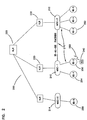
- Fig. 2 illustrates the architecture 200 for IS-41.
- Mobile terminal 240 alternatively referred to as cellular subscriber stations or mobile stations, communicate via a channel established through a base station 250.
- the IS-41 standard is built on top of what is called Signaling System #7.
- the mobile switching centers (MSC) 210, 212 are the central authority and do most processing. In particular it is responsible for the following:
- a location database is divided hierarchically into a Home Location Register (HLR) 220 and a Visitor Location Register (VLR) 230, 232.
- the IS-41 standard allows a single VLR to support multiple MSCs, so that when a terminal 240 moves it often has to notify only the VLR of the changed MSC.
- the enhanced handoff signaling method may be illustrated.
- the case of an inter-MSC handoff is considered. That is, the source and target base stations, BS-2 250 and BS-3 252 in the example, subtend different MSCs, i.e., MSC-1 210 and MSC-2 212 respectively in the example.
- the source system corresponds to the BS-2 250/MSC-1 210 combination
- the target system corresponds to the BS-3 252/MSC-2 212 combination.
- the present invention is equally applicable to the case of handoffs between two base stations subtending a common MSC (intra-MSC handoff).
- the source system conceptually corresponds to the source base station 250/common MSC 210 and the target system corresponds to the target base station 254/common MSC 210. Signaling between the source system and the target system becomes internal to the common MSC 210.
- the description below assumes that the source and target base stations subtend different MSCs
- the service negotiation process for the enhanced handoff signaling is based on two key ideas.
- the first key idea is to use a source system, i.e., BS-2 250/MSC-1 210 combination, herein referred to as the source system 250/210, for a mobile terminal 240 as a proxy to negotiate with the target system, i.e., BS-3 252/MSC-2 212 combination, herein referred to as target system 250/212, on behalf of the mobile terminal 240.
- the target system i.e., BS-3 252/MSC-2 212 combination
- all of the negotiation signaling takes place on wireline links 270 rather than radio links 280.
- the benefits are the higher speed of the wireline links 270, and a reduced signaling load on the spectrum.
- the second key idea is to send all the needed information (ASC and MS capabilities) to the target system 252/212 by the source system 250/210 in one shot. Consequently, no further signaling exchange is required, except for the target system 252/212 to inform the source system 250/210 of the new air interface attributes.
- the new attributes are conveyed to the mobile terminal 240 along with the order to execute handoff, The mobile terminal 240 executes handoff and immediately tunes in to the new attributes.
- mobile station capabilities have passed from the source system 250/210 to the target system 252/212, the information can be used for a subsequent handoff after the handoff is executed.
- the present invention is applicable to the IS-41 signaling protocol, with the appropriate extensions to support high speed data.
- the extended messages are denoted IS-41-HS.
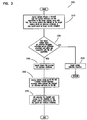
- Fig. 3 is a flow chart 300 of the enhanced handoff procedure.
- the source system initiates a handoff by sending an message with the service attributes, e.g., a facilities directive invoke or other signaling message according to IS-41-HS, to the target system, along with the MS (mobile station, mobile terminal or cellular subscriber station) capabilities 310.
- the service attributes e.g., a facilities directive invoke or other signaling message according to IS-41-HS.
- the source system 250/210 can determine the MS capabilities in one of two ways.
- the first way is used when the existing call has already had a handoff from another system, e.g. BS-0 256/MSC-0 214, to the current source system 250/210.
- the capabilities of the MS 240 were sent with a facilities directive invoke from BS-0 256/MSC-0 214, which acted as an initial source system, as part of the previous handoff process.
- the second way is used when the call has never had a handoff. In that case, the source system 250/210 determines the capabilities of the MS 240 from the service subscription profile downloaded from the HLR 220.
- the source system 250/210 can obtain the information directly from the MS 240, e.g., at call setup time. The information can be sent by the MS 240 spontaneously, or upon query from the source system.
- SIM Subscriber Identity Module
- the source system can also provide additional information, e.g., air interface attributes that, if granted by the target system, would result in longer service disruptions.
- RLP Radio Link Protocol
- IWF InterWorking Function
- the IWF may house an instance of Radio Link Protocol (RLP) that keeps running after handoff is executed.
- RLP Radio Link Protocol
- the target system chooses air interface attributes that are not compatible with the RLP currently in use (i.e., require to close the current RLP and restart a new one of a different type), data loss may occur.
- the source system can also indicate to the target system which air interface attributes, if any, would result in longer service disruption 310.
- the target system can choose on a preferential basis the air interface attributes that will not require an RLP restart.
- the target system determines if it can grant air interface attributes that satisfy the service attributes, and which are compatible with the MS capabilities 330. If the target system determines that such a grant is possible, the target system returns the granted air interface attributes in a positive response to IS-41-HS FACDIR2, or some variant 340. The target system may be sent a single signal identifying capabilities of the mobile station. If not, the target system indicates rejection in a negative response 350.
- the source system sends an IS-95-HS Extended Handoff Direction message which conveys the granted air interface attributes to the MS 360.
- the MS executes the handoff and moves to the channels on the target system, in accordance with the granted air interface attributes 370.
- the length of the IS-95-HS Extended Handoff Direction message may be minimized by sending a Boolean flag, rather than the granted air interface attributes, if the granted air interface attributes do not differ from the ones of the source system.
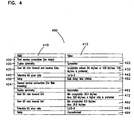
- Fig. 4 illustrates a table 400 containing the service attributes for real-time video 402 concurrently with Web browsing 404.
- the differing service requirements of real-time video and Web browsing are translated into tow distinct service connections.
- the table includes a field column 410 and a value column 412.
- the fields 410 for the service attributes are the type of duplex symmetry 420, user bit rates on forward and reverse links 430, tolerable bit error rate 440 and delay 450.
- the value column 412 indicates that for video 402, the type of duplex symmetry is symmetric 422 (bit rates are the same in both directions), the acceptable bit rate values are 64 kb/sec or 128 kb/sec, with preference for 128 kb/sec 432, the tolerable bit error rate is 1x10 -3 442, and the maximum bulk delay is 200 ms 452.
- the value column 412 indicates that the type of duplex symmetry is asymmetric 462 (bit rates are not the same in both directions), bit rate range on the forward link is 38.4 to 500 kb/sec, with preference for higher values in the range 472, bit rate range on the reverse link is 9.6 to 28.8 kb/sec, with no preference 482, the tolerable bit error rate is 1x10 -6 492, and the delay is unconstrained 496.
- Fig. 5 illustrates the MS capabilities 500. Again, the table includes a field column 510 and a value column 512.
- the maximum number of service connections 520 is shown to be 4 522
- the maximum number of traffic channels overall 530 is 16 532
- the maximum number of traffic channels per service connection (in each direction) 540 is 16 542
- the attributes for a type 1 traffic channel 550 includes a transmission rate of 9.6 kb/sec that can work in either packet or circuit mode 552
- the attributes for a type 2 traffic channel 560 includes a transmission rate of 14.4 kb/sec that can work in either packet or circuit mode 562.
- Fig. 6 illustrates the air interface attributes 600 on the source system before handoff.
- the table in Fig. 6 includes a field column 622 and a value column 624.
- Fig. 6 illustrates the attributes for real-time video 602 concurrently with Web browsing 604 on the source system.
- the number of traffic channels in each direction 620 is five channels of type 2 622.
- the mode for a traffic channel 630 is circuit mode 632.
- the number of traffic channels on the forward link 640 is three channels of type 2 642
- the number of traffic channels on the reverse link 650 is one channel of type 2
- the mode for a traffic channel 660 is packet 666.
- MAC priority class is used to prioritize user access to the shared channels in packet mode. Note that due to some reason, e.g., lack of resources, the source system may not grant the preferred service attributes, e.g., if only 64 kb/sec is allocated to the video service connection.
- Fig. 7 illustrates the capabilities 700 of the target system.
- the table in Fig. 7 includes a field column 722 and a value column 724.
- the target system determines the air interface attributes that satisfy the service attributes and which are compatible with the MS capabilities.
- the current rate is determined according to the available traffic channels.
- the source system has indicated to the target system that the MS capabilities include both type 1 730 and type 2 740 traffic channels, but type 2 is currently being used. So the target system will attempt to grant type 2 channels, to minimize service disruption caused by switching from one type to another.
- the target system has enough resources available to grant type 2 channels 750.
- the target system can grant the preferred higher bit rate, i.e., 128 kb/sec, to the video service connection, rather than 64 kb/sec. A higher rate is also allocated to the forward link of the Web browsing service connection. However, the user is downgraded from medium priority to low priority class 760.
- Fig. 8 illustrates the air interface attributes granted by the target system.
- the table in Fig. 8 includes a field column 822 and a value column 824.
- the attributes granted by the target system for real-time video 802 concurrently with Web browsing 804 are shown.
- the number of traffic channels in each direction 820 is nine channels of type 2 822.
- the mode for a traffic channel 830 is circuit mode 832.
- the number of traffic channels on the forward link 840 is four channels of type 2 842
- the number of traffic channels on the reverse link 850 is one channel of type 2
- the mode for a traffic channel 860 is packet 862.
- the call is not dropped even when the target system has capabilities different from the source system, and a higher bandwidth is allocated to the user.
- the ASC, HSDSC and MS capabilities can be coded in the form of option values.
- An option value is a value for which the target and source system have a common understanding. For example, if ASC is coded with an option value, instead of having to send a long list of service attributes, the source system can send only a single value that is translated by the target system into specific service attributes, according to a previously agreed upon understanding with the source system.
- service attributes specify multiple service connections, multiple service options are required, one for each service connection.
- Options values are most appropriate for commonly used ASC, HSDSC and MS capabilities.
- the present invention extends the concept of service option in Telecommunication Systems Bulletin 58 to three distinct concepts: air interface attributes, service attributes and MS capabilities, to which the idea of option value can be applied.
- the present invention provides an enhanced handoff signaling scheme that has the flexibility to allow handoff between systems with dissimilar air interface attributes, as long as service requirements and compatibilities with the mobile terminal are satisfied.
- the time to perform the required service negotiation is kept short by using the source system as a proxy to negotiate with the target system on behalf of the mobile terminal.
- Most of the signaling takes place on wireline links rather than radio links.
- the benefits are the higher speed of the wireline links, and a reduced signaling load on the spectrum sending all the needed information to the target system in one shot. Consequently, no further signaling exchange is required, except for the target system to inform the source system of the new air interface attributes.
- the mobile terminal can then execute the handoff and immediately tune in to the new air interface attributes.
- the present invention provides increased flexibility through service negotiation, yet little service disruption caused by service negotiation. Flexibility is increased because handoff between systems with dissimilar capabilities (e.g., with different rate sets and/or multiplex options) is now made possible, as long as the capabilities on the target system meet the service requirements and are compatible with the mobile terminal's capabilities. Service negotiation time is kept short because only one round of signaling messages is exchanged, and the negotiation messages are transported over the high speed wireline signaling channels; another advantage is that no additional signaling load is put on the spectrum. Another benefit of flexibility is the target system can allocate new air interface attributes resulting in a quality of service, e.g., error rate, delay, etc., which better meet the service attributes than before the handoff in the source system.
- a quality of service e.g., error rate, delay, etc.
Landscapes
- Engineering & Computer Science (AREA)
- Computer Networks & Wireless Communication (AREA)
- Signal Processing (AREA)
- Mobile Radio Communication Systems (AREA)
- Two-Way Televisions, Distribution Of Moving Picture Or The Like (AREA)
Abstract
Description
- This invention relates in general to communication systems, and more particularly to an enhanced handoff signaling for high speed data and multimedia.
- Cellular communication systems, operate on various air interface standards. For example, there is the first generation Analog Mobile Phone Systems (AMPS) whose air interface is described in detail in EIA/TIA (Electronics Industry Association/Telecommunications Industry Association) IS-553. Second generation standards include the U.S. Time Division Multiple Access (TDMA) standard, IS-54/IS-136, GSM (Global System for Mobile communications), and a Code Division Multiple Access (CDMA) standard, IS-95. In addition, there are standards for wireless local area networks that specify the air interface between stations and between stations and access points.
- A major driver for the evolution to third generation cellular communication systems is the provision of high speed data and multimedia services. This implies that wireless networks must provide high speed packet-based and circuit-based transport and bandwidth-upon-demand, as well as support multimedia applications. Since the radio spectrum is limited, future wireless systems will have micro/picocellular architectures in order to provide the higher capacity needed to support high speed data services. Due to the small coverage area of micro/picocells and characteristics of the multipath and shadow fading radio environment, hand-off events in future microcellular systems will occur at a much higher rate as compared to today's macrocellular systems, and control of such systems will introduce a new set of challenges including handling the increased load on the wireless spectrum during handoff negotiations.
- Wireless/mobile connections may be viewed as consisting of paths (or routes) through the backbone network; and radio links between the mobile, wireless terminals and base stations (or access points) which connect mobile users to the fixed backbone network through mobile switching centers (MSC), or functionally equivalent entities. In what follows, "wireless network" refers to the base stations and MSCs, or functionally equivalent entities.
- When the quality of a radio link between a wireless terminal and its base station degrades, a new base station with acceptable quality must be found (hand-off), and network control functions need to be invoked in the wireless network, and possibly in the fixed network. Hand-off requires the establishment of a new route, which transports the user data destined to (or originated from) the wireless terminal to (or from) the new base station. Here, network call processing functions need to be invoked in order to set up such a route and ensure that the newly established route maintains acceptable quality-of-service (QOS) to both the wireless connection and to pre-existing calls sharing links of the new route. Furthermore, to execute hand-off, one must first ensure that the new wireless connection does not overload the new system and then create a radio link between the mobile terminal and the new base station. As one can see, a substantial number of call processing and control functions of the fixed and wireless network must be invoked to complete a hand-off event.
- High speed data services require more complex service and air interface attributes than speech or lower speed data services. Service attributes are relevant to the calling party and called party's applications and are independent of air interface attributes. Examples of service attributes are an indication whether the bit rates are the same in both directions (symmetric) or not (asymmetric), the bit rate range, acceptable residual error rate, acceptable delay, etc. Air interface attributes are relevant only to the air interface. For example, in IS-95, these attributes specify characteristics such as the multiplex option, rate set, etc. In essence air interface attributes provide the information required for building and interpreting traffic channel frames. With the advent of third generation systems, it is quite possible that there will be various types of base stations, i.e., base stations that support different sets of air interface attributes.
- For convenience and conciseness, the collection of service attributes pertaining to a call are referred to as the Application Service Configuration (ASC). Herein below, ASC will be used interchangeably with service attributes. Note that the term "call" is used here in the broadest sense, and may include a multimedia conference or packet data session. The air interface attributes are referred to as High Speed Data Service Configuration (HSDSC). Herein below, HSDSC will be used interchangeably with air interface attributes. If a system does not have the required resources, the HSDSC may only meet the minimum requirements of the ASC, not the preferred ones. Examples of ASC and HSDSC will be discussed below. In what follows, in the most general case, "system" refers to a base station and the associated MSC.
- Handoff between systems cannot be carried out unless a service negotiation take place so the target system and mobile terminal can agree on HSDSC that are compatible with their respective capabilities and also meet the service requirements, as indicated by the ASC. Service negotiation has to be efficient to minimize duration of service disruption caused by handoff, and minimize signaling load on spectrum resources.
- One approach is to downgrade the radio channels to a default lower speed, carry out the handoff using the existing second generation handoff signaling procedure (for lower speed data), and perform service negotiation once the mobile is on the target system. After negotiation is completed, the air interface may be upgraded to the agreed upon higher bandwidth. The drawbacks of the method are a longer negotiation time, caused by the additional steps to downgrade and upgrade, and lower efficiency, caused by the possibility of the call being dropped due to unsuccessful negotiation after handoff is performed. Also, there is a heavier signaling load on the wireless link, where bandwidth is at a premium.
WO9723110 -
WO9610320 - It can be seen that there is a need for an enhanced handoff signaling method that provides a short negotiation time by avoiding the need to downgrade and upgrade.
- It can also be seen that there is a need for an enhanced handoff signaling method that provides greater efficiency by preventing calls from being dropped due to unsuccessful negotiation after the mobile station (MS) has moved to the target system.
- It can also be seen that there is a need for an enhanced handoff signaling method that minimizes the signaling load on the wireless spectrum during handoff negotiations.
- It can also be seen that there is a need for a target system to be capable of granting air interface attributes that more closely match the preferred service attributes, when the target system has the resources to do so, and when the air interface attributes currently in effect on the source system happens to not match the preferred service attributes.
- It can also be seen that there is a need for an enhanced handoff signaling method that gives the option to switch to a new HSDSC, provided the new HSDSC is compatible with the mobile terminal's capabilities and meets the service requirements.
- To overcome the limitations in the prior art described above, and to overcome other limitations that will become apparent upon reading and understanding the present specification, the present invention discloses an enhanced handoff signaling technique, according to
claim - The present invention solves the above-described problems by providing an enhanced handoff signaling method that provides a short negotiation time by avoiding the need to downgrade and upgrade, provides greater efficiency by preventing calls from being dropped due to unsuccessful negotiation after the mobile station has moved to the target system, minimizes the signaling load on the radio spectrum during handoff negotiations, and provides the option to switch to new HSDSC at the target system, when the HSDSC currently in use is not available at the target system.
- A method in accordance with the principles of the present invention includes the steps of negotiating air interface attributes that the target system can grant, sending a single message to the mobile station to order the mobile station to execute a handoff and to convey granted air interface attributes to the mobile station, and executing a handoff of the mobile station to channels on the target system in accordance with the granted air interface attributes.
- Other embodiments of a method in accordance with the principles of the invention may include alternative, additional or optional additional aspects. One such aspect of the present invention is that the step of negotiating air interface attributes includes the step of sending the target system a single signaling message.
- Another aspect of the present invention is that the step of sending the target system a single signaling message includes the step of advertising ASC and capabilities of the mobile station.
- Another aspect of the present invention is that the step of negotiating further includes the steps of determining whether the target system can grant an HSDSC that satisfies the ASC and that is compatible with the capabilities of the mobile station, returning a signaling message to the source system representing the HSDSC granted by the target system in response to a positive identification of air interface attributes that satisfy the service attributes and that are compatible with the capabilities of the mobile station, sending a message from the source system to the mobile station to convey the granted air interface attributes, and executing the handoff of the mobile station to the target system in accordance with the granted air interface attributes.
- Another aspect of the present invention is that the method further includes the step of returning a signaling message to the source system from the target system indicating rejection in response to a negative identification of air interface attributes that satisfy the service attributes and that are compatible with the capabilities of the mobile station.
- Yet another aspect of the present invention is that the step of sending the target system a single signaling message includes the step of indicating to the target system air interface attributes that cause service disruption when granted by the target system.
- Another aspect of the present invention is that the target system can choose a preferred air interface attribute that will minimize disruption of service.
- Another aspect of the present invention is that the target system may have air interface attributes different from the air interface attributes currently being used at the source system, wherein the air interface attributes at the target system meet the service attributes and are compatible with the mobile station capabilities so that the call is not dropped.
- Still another aspect of the present invention is that the target system may grant air interface attributes which result in quality of service that better match the preferred service attributes than those currently provided by the source system.
- Another aspect of the present invention is that the single signaling message minimizes the signaling load on the wireless link.
- Another aspect of the present invention is that the ASC, HSDSC and MS capabilities are coded in concise form by using option values.
- Another aspect of the present invention is that the ASC, HSDSC and MS capabilities are explicitly enumerated.
- Another aspect of the present invention is that the signaling messages to determine the air interface attributes granted by the target system are transported over potentially high speed wireline links between the source system and the target system, thereby saving valuable radio spectrum resources while achieving faster response.
- Another aspect of the present invention is that the step of sending a single message to convey granted air interface attributes further comprises the step of concisely conveying the granted air interface attributes in the form of a Boolean flag when the granted air interface attributes do not differ from air interface attributes of the source system.
- These and various other advantages and features of novelty which characterize the invention are pointed out with particularity in the claims annexed hereto and form a part hereof. However, for a better understanding of the invention, its advantages, and the objects obtained by its use, reference should be made to the drawings which form a further part hereof, and to accompanying descriptive matter, in which there are illustrated and described specific examples of an apparatus in accordance with the invention.
- Referring now to the drawings in which like reference numbers represent corresponding parts throughout:
-
Fig. 1 illustrates a cellular mobile radio telephone system that requires handoffs when the quality of a radio link between a mobile unit and its base station degrades; -
Fig. 2 illustrates the architecture for IS-41-like systems; -
Fig. 3 is a flow chart of the enhanced handoff procedure; -
Fig. 4 illustrates a table containing the service attributes for real-time video concurrently with web browsing; -
Fig. 5 illustrates the MS capabilities; -
Fig. 6 illustrates the air interface attributes on the source system before handoff; -
Fig. 7 illustrates the capabilities of the target system; and -
Fig. 8 illustrates the air interface attributes that satisfy the service attributes and which are compatible with the MS capabilities. - In the following description of the exemplary embodiment, reference is made to the accompanying drawings which form a part hereof, and in which is shown by way of illustration the specific embodiment in which the invention may be practiced. It is to be understood that other embodiments may be utilized as structural changes may be made without departing from the scope of the present invention.
- The present invention provides an enhanced handoff signaling scheme that has the flexibility to allow handoff between systems with dissimilar air interface attributes, as long as service requirements and compatibilities with the mobile terminal are satisfied.
- The enhanced handoff signaling provides an explicit separation of service attributes and air interface attributes. Such a separation makes handoff more flexible by allowing handoff to a target system which has air interface attributes different from the ones of the source system. The only requirement is that the air interface attributes in the target system satisfy the service attributes, and are compatible with the capabilities of the mobile terminal. In addition, if some facilities of the source system remain involved in the call after handoff, the air interface attributes have to be compatible with these facilities as well. An example of such a facility is the InterWorking Function (IWF).
- A signaling process is required to determine the appropriate air interface attributes at the target system, based on service attributes, facilities involved at the source system, and mobile terminal's capabilities. In current systems, a handoff between dissimilar systems is not possible, and the call is dropped. In what follows, such a signaling process will be referred to as service negotiation.
-
Fig. 1 illustrates a cellular mobileradio telephone system 100 that requires handoffs when the quality of a radio link between a mobile unit and its base station degrades. For purposes of description, the system depicted herein includes ten cells. Those skilled in the art will recognize that a cellular mobile radio telephone system may include many more cells, and thus the system depicted herein may be seen as merely an isolated portion of a larger system. - In
Fig. 1 , for eachcell C1 110 toC10 128, there is abase station B1 130 toB10 148. Base stations 130-148 are situated in the vicinity of the respective cell centers. Tenmobile stations M1 150 toM10 168 are movable within the cells 110-128. Those skilled in the art will recognize that the number of mobile stations 150-168 is presented for illustrations only. -
Fig. 1 also illustrates mobile switching centersMSC mobile switching center 170 is shown connected to nine illustrated base stations 130-146.MSC 198 is connected tobase station 148. Those skilled in the art will recognize that the mobile switching centers 170, 198 may be connected to the ten base stations 130-148 by wires or other means, e.g., fixed radio links. - When the quality of a radio link between
mobile station M1 150 andbase station B8 144 degrades, a new access point or base station with acceptable quality must be found, i.e., a handoff must be executed. InFig. 1 , the hand-off requires the establishment of a new route, e.g. fromM1 150 toB4 136 rather than formM1 150 toB8 148. After the handoff, the information is transported to (or from) themobile station M1 150 from (or to) the new access point,B4 136. - When a handoff is to be executed, network call processing functions need to be invoked in order to set up such a route and ensure that the newly established route maintains acceptable quality-of-service (QOS) to both the
mobile station M1 150 and to pre-existing calls sharing links of the new route. Furthermore, to execute hand-off, the two mobile switching centers involved 170, 198 must first ensure that the new wireless connection does not overload the newbase station B4 136 before the a radio link between themobile station M1 150 and the newbase station B4 136 is created. As one can see, a substantial number of call processing and control functions of the fixed and wireless network must be invoked to complete a hand-off event. - However, a handoff may be required between systems with dissimilar air interface attributes. With the present invention, such a handoff is possible, as long as service requirements and compatibilities with the mobile station are satisfied. Nevertheless, the handoff should minimize negotiation times. Finally, the negotiation should minimize the signaling load on the wireless spectrum by using wireline links.
- The present invention defines a service negotiation process that is fast and therefore has very little effect on service disruption duration. Further, the method according to the present invention is applicable in general to any standard. Nevertheless, by way of example, the present invention will be described with regard to a system based on the IS-41 signaling protocol.
- IS-41 is a standardized mechanism for mobility management, which includes location and tracking within a cellular telephone network. IS-41 defines a hierarchical database structure, consisting of a Home Location Register (HLR) and a Visitor Location Register (VLR). The interaction of mobile switches with the VLR and HLR is defined in IS-41.
-
Fig. 2 illustrates thearchitecture 200 for IS-41.Mobile terminal 240, alternatively referred to as cellular subscriber stations or mobile stations, communicate via a channel established through abase station 250. The IS-41 standard is built on top of what is called Signaling System #7. The mobile switching centers (MSC) 210, 212 are the central authority and do most processing. In particular it is responsible for the following: - Coordinates the broadcast of system parameters
- Processes registrations
- Queries the location registers
- Manages paging and selects the nearest base station
- Establishes connections and
- Coordinates handoff between base stations and MSCs
- A location database is divided hierarchically into a Home Location Register (HLR) 220 and a Visitor Location Register (VLR) 230, 232. The IS-41 standard allows a single VLR to support multiple MSCs, so that when a terminal 240 moves it often has to notify only the VLR of the changed MSC. However, in many practical implementations, there is a one-to-one mapping between a
MSC VLR HLR 220. - By reference to
Fig. 2 , the enhanced handoff signaling method according to the present invention may be illustrated. For broadest generality, the case of an inter-MSC handoff is considered. That is, the source and target base stations, BS-2 250 and BS-3 252 in the example, subtend different MSCs, i.e., MSC-1 210 and MSC-2 212 respectively in the example. InFig. 2 , the source system corresponds to the BS-2 250/MSC-1 210 combination, and the target system corresponds to the BS-3 252/MSC-2 212 combination. - Those skilled in the art will recognize that the present invention is equally applicable to the case of handoffs between two base stations subtending a common MSC (intra-MSC handoff). In this case, the source system conceptually corresponds to the
source base station 250/common MSC 210 and the target system corresponds to thetarget base station 254/common MSC 210. Signaling between the source system and the target system becomes internal to thecommon MSC 210. However, the description below assumes that the source and target base stations subtend different MSCs - The service negotiation process for the enhanced handoff signaling is based on two key ideas. The first key idea is to use a source system, i.e., BS-2 250/MSC-1 210 combination, herein referred to as the
source system 250/210, for amobile terminal 240 as a proxy to negotiate with the target system, i.e., BS-3 252/MSC-2 212 combination, herein referred to astarget system 250/212, on behalf of themobile terminal 240. As a result, all of the negotiation signaling takes place onwireline links 270 rather thanradio links 280. The benefits are the higher speed of the wireline links 270, and a reduced signaling load on the spectrum. The second key idea is to send all the needed information (ASC and MS capabilities) to thetarget system 252/212 by thesource system 250/210 in one shot. Consequently, no further signaling exchange is required, except for thetarget system 252/212 to inform thesource system 250/210 of the new air interface attributes. The new attributes are conveyed to themobile terminal 240 along with the order to execute handoff, Themobile terminal 240 executes handoff and immediately tunes in to the new attributes. When mobile station capabilities have passed from thesource system 250/210 to thetarget system 252/212, the information can be used for a subsequent handoff after the handoff is executed. - The present invention is applicable to the IS-41 signaling protocol, with the appropriate extensions to support high speed data. The extended messages are denoted IS-41-HS.
Fig. 3 is aflow chart 300 of the enhanced handoff procedure. - According to
Fig. 3 , the source system initiates a handoff by sending an message with the service attributes, e.g., a facilities directive invoke or other signaling message according to IS-41-HS, to the target system, along with the MS (mobile station, mobile terminal or cellular subscriber station)capabilities 310. - The
source system 250/210 can determine the MS capabilities in one of two ways. The first way is used when the existing call has already had a handoff from another system, e.g. BS-0 256/MSC-0 214, to thecurrent source system 250/210. In that case, the capabilities of theMS 240 were sent with a facilities directive invoke from BS-0 256/MSC-0 214, which acted as an initial source system, as part of the previous handoff process. The second way is used when the call has never had a handoff. In that case, thesource system 250/210 determines the capabilities of theMS 240 from the service subscription profile downloaded from theHLR 220. If the capabilities of theMS 240 cannot be determined from the service subscription profile, e.g., because the subscriber has a Subscriber Identity Module (SIM) which allows it to use different mobile terminals with different capabilities, thesource system 250/210 can obtain the information directly from theMS 240, e.g., at call setup time. The information can be sent by theMS 240 spontaneously, or upon query from the source system. - The source system can also provide additional information, e.g., air interface attributes that, if granted by the target system, would result in longer service disruptions. To illustrates the idea of service disruption, an example of Radio Link Protocol (RLP) and InterWorking Function (IWF) will be described.
- There may be facilities at the source system, like an IWF, which remain involved in the call after the handoff. The IWF may house an instance of Radio Link Protocol (RLP) that keeps running after handoff is executed. If the target system chooses air interface attributes that are not compatible with the RLP currently in use (i.e., require to close the current RLP and restart a new one of a different type), data loss may occur. To minimize this problem, the source system can also indicate to the target system which air interface attributes, if any, would result in
longer service disruption 310. The target system can choose on a preferential basis the air interface attributes that will not require an RLP restart. - The target system then determines if it can grant air interface attributes that satisfy the service attributes, and which are compatible with the
MS capabilities 330. If the target system determines that such a grant is possible, the target system returns the granted air interface attributes in a positive response to IS-41-HS FACDIR2, or somevariant 340. The target system may be sent a single signal identifying capabilities of the mobile station. If not, the target system indicates rejection in anegative response 350. - After the target system returns the granted air interface attributes, the source system sends an IS-95-HS Extended Handoff Direction message which conveys the granted air interface attributes to the
MS 360. The MS then executes the handoff and moves to the channels on the target system, in accordance with the granted air interface attributes 370. The length of the IS-95-HS Extended Handoff Direction message may be minimized by sending a Boolean flag, rather than the granted air interface attributes, if the granted air interface attributes do not differ from the ones of the source system. - The invention will be more specifically described with reference to
Figs. 4-8 . The following are simplified examples of service attributes, air interface attributes, MS capabilities. -
Fig. 4 illustrates a table 400 containing the service attributes for real-time video 402 concurrently withWeb browsing 404. The differing service requirements of real-time video and Web browsing are translated into tow distinct service connections. InFig. 4 , the table includes afield column 410 and avalue column 412. Thefields 410 for the service attributes are the type ofduplex symmetry 420, user bit rates on forward and reverselinks 430, tolerablebit error rate 440 anddelay 450. Thevalue column 412 indicates that forvideo 402, the type of duplex symmetry is symmetric 422 (bit rates are the same in both directions), the acceptable bit rate values are 64 kb/sec or 128 kb/sec, with preference for 128 kb/sec 432, the tolerable bit error rate is 1x10⁻³ 442, and the maximum bulk delay is 200ms 452. ForWeb browsing 404, thevalue column 412 indicates that the type of duplex symmetry is asymmetric 462 (bit rates are not the same in both directions), bit rate range on the forward link is 38.4 to 500 kb/sec, with preference for higher values in therange 472, bit rate range on the reverse link is 9.6 to 28.8 kb/sec, with nopreference 482, the tolerable bit error rate is 1x10⁻⁶ 492, and the delay is unconstrained 496. -
Fig. 5 illustrates theMS capabilities 500. Again, the table includes afield column 510 and avalue column 512. InFig. 5 , the maximum number ofservice connections 520 is shown to be 4 522, the maximum number of traffic channels overall 530 is 16 532, the maximum number of traffic channels per service connection (in each direction) 540 is 16 542, the attributes for atype 1traffic channel 550 includes a transmission rate of 9.6 kb/sec that can work in either packet orcircuit mode 552, and the attributes for atype 2traffic channel 560 includes a transmission rate of 14.4 kb/sec that can work in either packet orcircuit mode 562. -
Fig. 6 illustrates the air interface attributes 600 on the source system before handoff. The table inFig. 6 includes afield column 622 and avalue column 624. Once a handoff occurs, the source system sends an IS-41-HS FACDIR2 (or some variant) to the target system, along with the service attributes and the MS capabilities. -
Fig. 6 illustrates the attributes for real-time video 602 concurrently with Web browsing 604 on the source system. Forvideo 602, the number of traffic channels in eachdirection 620 is five channels oftype 2 622. The mode for atraffic channel 630 iscircuit mode 632. - For Web browsing 604, the number of traffic channels on the forward link 640 is three channels of
type 2 642, the number of traffic channels on thereverse link 650 is one channel oftype 2, and the mode for atraffic channel 660 ispacket 666. - MAC priority class is used to prioritize user access to the shared channels in packet mode. Note that due to some reason, e.g., lack of resources, the source system may not grant the preferred service attributes, e.g., if only 64 kb/sec is allocated to the video service connection.
-
Fig. 7 illustrates thecapabilities 700 of the target system. The table inFig. 7 includes afield column 722 and avalue column 724. The target system determines the air interface attributes that satisfy the service attributes and which are compatible with the MS capabilities. The current rate is determined according to the available traffic channels. - The source system has indicated to the target system that the MS capabilities include both
type 1 730 andtype 2 740 traffic channels, buttype 2 is currently being used. So the target system will attempt to granttype 2 channels, to minimize service disruption caused by switching from one type to another. The target system has enough resources available to granttype 2channels 750. Furthermore, the target system can grant the preferred higher bit rate, i.e., 128 kb/sec, to the video service connection, rather than 64 kb/sec. A higher rate is also allocated to the forward link of the Web browsing service connection. However, the user is downgraded from medium priority tolow priority class 760. -
Fig. 8 illustrates the air interface attributes granted by the target system. The table inFig. 8 includes afield column 822 and avalue column 824. InFig. 8 , the attributes granted by the target system for real-time video 802 concurrently withWeb browsing 804 are shown. Forvideo 802, the number of traffic channels in eachdirection 820 is nine channels oftype 2 822. The mode for atraffic channel 830 iscircuit mode 832. - For
Web browsing 804, the number of traffic channels on theforward link 840 is four channels oftype 2 842, the number of traffic channels on thereverse link 850 is one channel oftype 2, and the mode for atraffic channel 860 ispacket 862. - As a result of the enhanced handoff scheme, the call is not dropped even when the target system has capabilities different from the source system, and a higher bandwidth is allocated to the user.
- Although not shown in the examples, the ASC, HSDSC and MS capabilities can be coded in the form of option values. An option value is a value for which the target and source system have a common understanding. For example, if ASC is coded with an option value, instead of having to send a long list of service attributes, the source system can send only a single value that is translated by the target system into specific service attributes, according to a previously agreed upon understanding with the source system.
- If the service attributes specify multiple service connections, multiple service options are required, one for each service connection. Options values are most appropriate for commonly used ASC, HSDSC and MS capabilities. The present invention extends the concept of service option in Telecommunication Systems Bulletin 58 to three distinct concepts: air interface attributes, service attributes and MS capabilities, to which the idea of option value can be applied.
- In summary, the present invention provides an enhanced handoff signaling scheme that has the flexibility to allow handoff between systems with dissimilar air interface attributes, as long as service requirements and compatibilities with the mobile terminal are satisfied. The time to perform the required service negotiation is kept short by using the source system as a proxy to negotiate with the target system on behalf of the mobile terminal. Most of the signaling takes place on wireline links rather than radio links. The benefits are the higher speed of the wireline links, and a reduced signaling load on the spectrum sending all the needed information to the target system in one shot. Consequently, no further signaling exchange is required, except for the target system to inform the source system of the new air interface attributes. The mobile terminal can then execute the handoff and immediately tune in to the new air interface attributes.
- The present invention provides increased flexibility through service negotiation, yet little service disruption caused by service negotiation. Flexibility is increased because handoff between systems with dissimilar capabilities (e.g., with different rate sets and/or multiplex options) is now made possible, as long as the capabilities on the target system meet the service requirements and are compatible with the mobile terminal's capabilities. Service negotiation time is kept short because only one round of signaling messages is exchanged, and the negotiation messages are transported over the high speed wireline signaling channels; another advantage is that no additional signaling load is put on the spectrum. Another benefit of flexibility is the target system can allocate new air interface attributes resulting in a quality of service, e.g., error rate, delay, etc., which better meet the service attributes than before the handoff in the source system.
- The foregoing description of the exemplary embodiment of the invention has been presented for the purposes of illustration and description. It is not intended to be exhaustive or to limit the invention to the precise form disclosed. Many modifications and variations are possible in light of the above teaching. It is intended that the scope of the invention be limited not with this detailed description, but rather by the claims appended hereto.
Claims (39)
- A method for executing an enhanced handoff between a source system and a target system of a current call for a mobile station, the source system (210, 250) and the target system (212, 252) having dissimilar air interface attributes, the method comprising:providing the source system as a proxy to negotiate with the target system on behalf of the mobile station (240);negotiating, between the source system and the target system, air interface attributes that the target system can grant, wherein all information needed to determine air interface attributes to be granted to the mobile station is sent from the proxy source system to the target system in a single signalling message; said single signalling message advertising application service configuration, ASC, and capabilies of the mobile station;sending a single message from the source system to the mobile station to order the mobile station to execute a handoff and to convey granted air interface attributes to the mobile station; andexecuting a handoff of the mobile station to channels on the target system in accordance with the granted air interface attributes.
- The method of claim 1 wherein the negotiating further comprises:advertising to the target system by the source system service attributes of the current call and mobile station capabilities;determining by the target system whether the target system can grant air interface attributes that satisfy the service attributes and that are compatible with the capabilities of the mobile station; andreturning a signaling message to the source system representing air interface attributes granted by the target system in response to a positive identification of air interface attributes that satisfy the service attributes and that are compatible with the capabilities of the mobile station.
- The method of claim 1 wherein the negotiating further comprises eliminating signaling between the mobile station and the source system to reduce a signaling load on a wireless link.
- The method of claim 1 wherein the negotiating further includes eliminating signaling between the mobile station and the target system to reduce a signaling load on a wireless link.
- The method of claims 1 further comprising returning a signaling massage to the source system from the target system indicating rejection in response to a negative identification of air interface attributes that satisfy the service attributes and that are compatible with the capabilities of the mobile station.
- The method of claim 1 wherein the advertising includes indicating to the target system air interface attributes that result in service disruption.
- The method of claim 1 wherein the handoff is permitted even when the target system has air interface attributes different from the air interface attributes of the source system.
- The method of claim 1 wherein the source system provides a first set of air interface attributes and wherein the granted air interface attributes by the target system result in a quality of service more compatible to the preferred service attributes than the first set of air interface attributes provided by the source system prior to the handoff.
- The method of claim 1 wherein the granted air interface attributes, service attributes, and mobile station, MS, capabilities are coded in the form of an option value.
- The method of claim 9 wherein the option value reduces signaling delay by keeping signaling messages short.
- The method of claim 1 wherein the negotiating is performed over wireline links between the source system and the target system.
- The method of claim 1 further comprising determining the mobile station capabilities once at the beginning of the call from a service subscription profile downloaded from a home location register, HLR, or from information received directly from the mobile station.
- The method of claim 12 further comprising the passing the mobile station capabilities from the source system to the target system at a subsequent handoff after the handoff is executed.
- The method of claim 1 wherein the sending of the single message to convey granted air interface attributes further comprises concisely conveying the granted air interface attributes in the form of a Boolean flag when the granted air interface attributes do not differ from air interface attributes of the source system.
- The method of claim 1, wherein the enhanced handoff is executed using a code division multiple access, CDMA, air interface standard.
- A computer program embodied on a computer readable medium for executing an enhanced handoff between a source system and a target system of a current call for a mobile station, the source system (210, 250) and the target system (212, 252) having dissimilar air interface attributes, the computer program being configured, in response to execution, to perform the steps of:providing a source system as a proxy to negotiate with the target system on behalf of the mobile station (240);negotiating, between the source system and the target system, air interface attributes that the target system can grant, wherein all information needed to determine air interface attributes to be granted to the mobile station is sent from the proxy source system to the target system in a single signalling message; said signalling message advertising application service configuration, ASC, and capabilities of the mobile station;sending a single message from the source system to the mobile station to order the mobile station to execute a handoff and to convey granted air interface attributes to the mobile station; andexecuting a handoff of the mobile station to channels on the target system in accordance with the granted air interface attributes.
- The computer program of claim 16 wherein the negotiating further comprises:advertising to the target system by the source system service attributes of the current call and mobile station capabilities;determining by the target system whether the target system can grant air interface attributes that satisfy the service attributes and that are compatible with the capabilities of the mobile station; andreturning a signaling message to the source system representing air interface attributes granted by the target system in response to a positive identification of air interface attributes that satisfy the service attributes and that are compatible with the capabilities of the mobile station.
- The computer program of claim 16 wherein the negotiating further comprises eliminating signaling between the mobile station and the source system to reduce a signaling load on a wireless link.
- The computer program of claim 16 wherein the negotiating further comprises eliminating signaling between the mobile station and the target system to reduce a signaling load on a wireless link.
- The computer program of claim 16 further comprising returning a signaling message to the source system from the target system indicating rejection in response to a negative identification of air interface attributes that satisfy the service attributes and that are compatibles with the capabilities of the mobile station.
- The computer program of claim 16 wherein the source system provides a first set of air interface attributes and wherein the granted air interface attributes by the target system result in a quality of service more compatible to the preferred service attributes than the first set of air interface attributes provided by the source system prior to the handoff.
- The computer program of claim 16 further comprising determining the mobile station capabilities once at the beginning of the call from a service subscription profile downloaded from a home location register, HLR, or from information received directly from the mobile station.
- The computer program of claim 22 further comprising the passing the mobile station capabilities from the source system to the target system at a subsequent hand-off after the handoff is executed.
- The computer program of claim 16 wherein the sending of the single message to convey granted air interface attributes further comprises concisely conveying the granted air interface attributes in the form of a Boolean flag when the granted air interface attributes do not differ from air interface attributes of the source system.
- The computer program of claim 16, wherein the enhanced handoff is executed using a. code division multiple access, CDMA, air interface standard.
- A system configured to execute an enhanced handoff between a source system and a target system of a current call for a mobile station, the system configured to:advertise to the target system service attributes of the current call and mobile station capabilities;negotiate with the target system on-behalf of the mobile station (240);negotiate, between the source system as a proxy and the target system, air interface attributes that the target system can grant, wherein all information needed to determine air interface attributes to be granted to the mobile station is sent from the source system to the target system in a single signalling message; said single signalling message advertising to the target system services attributes of the current cell and mobile station capabilities;send a single message from the source system to the mobile station to order the mobile station to execute a handoff and to convey granted air interface attributes to the mobile station; andexecute a handoff of the mobile station to channels on the target system in accordance with the granted air interface attributes.
- The system of claim 26, wherein the target system determines whether the target system can grant air interface attributes that satisfy the service attributes and that are compatible with the capabilities of the mobile station, and wherein the source system is configured to receive a signaling message representing air interface attributes granted by the target system in response to a positive identification of air interface attributes that satisfy the service attributes and that are compatible with the capabilities of the mobile station.
- The system of claim 26 further configured to eliminate signaling with the mobile station to reduce a signaling load on a wireless link.
- The system of claim 26 further configured to eliminate signaling between the mobile station and the target system to reduce a signaling load on a wireless link.
- The system of claim 27, wherein the source system is further configured to receive from the target system a signalling message indicating rejection in response to a negative identification of air interface attributes that satisfy the service attributes and that are compatible with the capabilities of the mobile station.
- The system of claim 27, wherein the advertising includes indicating to the target system air interface attributes that result in service disruption.
- The system of claim 27, wherein the handoff is permitted even when the target system has air interface attributes different from the air interface attributes of the source system.
- The system of claim 26, wherein the granted air interface attributes, service attributes, and mobile station, MS, capabilities are coded in the form of an option value.
- The system of claim 33, wherein the option value reduces signaling delay by keeping signaling messages short.
- The system of claim 26, wherein the negoatiating is performed over wireline links between the source system and the target system.
- The system of claim 26, wherein the source system is further configured to determine the mobile station capabilities once at the beginning of the call from a service subscription profile downloaded from a home location register, HLR, or from information received directly from the mobile station.
- The system of claim 26, wherein the source system is further configured to pass the mobile station capabilities to the target system at a subsequent handoff after the handoff is executed.
- The system of claim 26, wherein sending of the single message to convey granted air interface attributes further comprises concisely conveying the granted air interface attributes in the form of a Boolean flag when the granted air interface attributes do not differ from air interface attributes of the source system.
- The system of claim 26, wherein the enhanced handoff is executed-using a.code division multiple access, CDMA, air interface standard.
Applications Claiming Priority (3)
| Application Number | Priority Date | Filing Date | Title |
|---|---|---|---|
| US4086 | 1987-01-15 | ||
| US09/004,086 US6205128B1 (en) | 1998-01-07 | 1998-01-07 | Enhanced handoff signaling for high speed data and multimedia |
| PCT/US1999/000335 WO1999035872A1 (en) | 1998-01-07 | 1999-01-07 | Enhanced hand off signaling for high speed data and multimedia |
Publications (2)
| Publication Number | Publication Date |
|---|---|
| EP0976291A1 EP0976291A1 (en) | 2000-02-02 |
| EP0976291B1 true EP0976291B1 (en) | 2010-09-15 |
Family
ID=21709067
Family Applications (1)
| Application Number | Title | Priority Date | Filing Date |
|---|---|---|---|
| EP99902101A Expired - Lifetime EP0976291B1 (en) | 1998-01-07 | 1999-01-07 | Enhanced hand off signaling for high speed data and multimedia |
Country Status (9)
| Country | Link |
|---|---|
| US (1) | US6205128B1 (en) |
| EP (1) | EP0976291B1 (en) |
| JP (1) | JP2001515689A (en) |
| CN (1) | CN100373982C (en) |
| AT (1) | ATE481843T1 (en) |
| AU (1) | AU749933B2 (en) |
| DE (1) | DE69942761D1 (en) |
| NO (1) | NO994318D0 (en) |
| WO (1) | WO1999035872A1 (en) |
Families Citing this family (31)
| Publication number | Priority date | Publication date | Assignee | Title |
|---|---|---|---|---|
| SE9801172D0 (en) * | 1998-04-01 | 1998-04-01 | Ericsson Telefon Ab L M | Cell selection in a system with different cell capabilities |
| US6459695B1 (en) * | 1999-02-22 | 2002-10-01 | Lucent Technologies Inc. | System and method for determining radio frequency coverage trouble spots in a wireless communication system |
| USRE47895E1 (en) | 1999-03-08 | 2020-03-03 | Ipcom Gmbh & Co. Kg | Method of allocating access rights to a telecommunications channel to subscriber stations of a telecommunications network and subscriber station |
| US6947399B1 (en) * | 1999-07-19 | 2005-09-20 | Nortel Networks Limited | Handoff mechanisms to support real-time delay-critical services in a next generation network |
| CA2380015C (en) * | 1999-07-22 | 2016-09-20 | Telefonaktiebolaget Lm Ericsson (Publ) | A system and method of communicating operating capabilities in a telecommunication network |
| JP2001045532A (en) * | 1999-07-27 | 2001-02-16 | Nec Corp | Soft hand-off method between cdma base station controllers |
| DE19942768B4 (en) * | 1999-08-30 | 2019-08-14 | Ipcom Gmbh & Co. Kg | Method for transmitting signaling information, transmitting station, mobile station and message elements |
| EP1236368B1 (en) * | 1999-08-30 | 2009-10-21 | IPCom GmbH & Co. KG | Method for transmitting signalling information, a master station, a mobile station and message elements |
| KR20010046636A (en) * | 1999-11-13 | 2001-06-15 | 윤종용 | CALL PROCESSING METHOD AND APPARATUS FOR Effective QoS(Quality of Service) Control IN A MOBILE TELECOMMUNICATION SYSTEM |
| GB0004671D0 (en) * | 2000-02-28 | 2000-04-19 | Nokia Networks Oy | Handover in a communication system |
| US7254392B2 (en) * | 2000-02-28 | 2007-08-07 | Nokia Corporation | Intersystem handover with modified parameters |
| US6542744B1 (en) * | 2000-06-20 | 2003-04-01 | Motorola, Inc. | Handoff in a cellular network |
| TW494691B (en) * | 2000-11-21 | 2002-07-11 | Koninkl Philips Electronics Nv | Mobile device, auxiliary rendering device and arrangement |
| US20020085514A1 (en) * | 2000-12-28 | 2002-07-04 | Illidge William E. | Method for switching between high-speed packet data service option and non-high-speed circuit switched or packet data service options without disrupting user data flow |
| US7295536B2 (en) | 2001-01-04 | 2007-11-13 | Ericsson Inc. | Systems and methods for soft handoff and other diversity communication using base stations supporting common radio configurations |
| JP2003110574A (en) * | 2001-09-27 | 2003-04-11 | Matsushita Electric Ind Co Ltd | Wireless communication system, packet transmission device and access point used therefor |
| US6839541B2 (en) | 2001-12-04 | 2005-01-04 | Illinois Institute Of Technology | Technique for establishing a virtual backbone in an ad hoc wireless network |
| KR100532263B1 (en) * | 2001-12-29 | 2005-11-29 | 삼성전자주식회사 | Method and apparatus for beginning broadcasting service by mobile station in mobile telecommunication system |
| US7961682B2 (en) | 2002-04-11 | 2011-06-14 | Qualcomm Incorporated | Handoff between base stations of different protocol revisions in a CDMA system |
| US20030211848A1 (en) * | 2002-05-09 | 2003-11-13 | Samsung Electronics Co., Ltd. | System and method for providing service negotiation during a hard handoff of a mobile station in a wireless communication system |
| US7039408B2 (en) * | 2002-06-03 | 2006-05-02 | Interdigital Technology Corporation | Method and apparatus for interconnection of personal area networks (PANs) |
| US7623865B2 (en) * | 2002-07-31 | 2009-11-24 | Telefonaktiebolaget Lm Ericsson (Publ) | Forced registration in concurrent services mobile station handoff |
| US7003040B2 (en) * | 2002-09-24 | 2006-02-21 | Lg Electronics Inc. | System and method for multiplexing media information over a network using reduced communications resources and prior knowledge/experience of a called or calling party |
| US20040121778A1 (en) * | 2002-10-08 | 2004-06-24 | Interdigital Technology Corporation | Quality of service mapping between various types of wireless communication systems |
| KR100594101B1 (en) * | 2003-01-20 | 2006-06-30 | 삼성전자주식회사 | System and method for supporting multimedia broadcast/multicast service in non tracking area |
| TWI245513B (en) * | 2003-08-26 | 2005-12-11 | Ind Tech Res Inst | Method and apparatus for controlling multi-radio access |
| JP4651441B2 (en) * | 2005-04-11 | 2011-03-16 | 株式会社エヌ・ティ・ティ・ドコモ | Mobile communication system and mobile device |
| JP4606943B2 (en) * | 2005-05-30 | 2011-01-05 | 京セラ株式会社 | DATA COMMUNICATION METHOD, Narrow Wireless Communication System Apparatus, and Mobile Device |
| US20100015979A1 (en) * | 2005-11-28 | 2010-01-21 | Kyocera Corporation | Communication Method, Mobile Terminal and Base Station |
| JP4963453B2 (en) * | 2007-08-21 | 2012-06-27 | 株式会社エヌ・ティ・ティ・ドコモ | Wireless communication system, wireless communication method, and wireless terminal |
| US9949187B2 (en) * | 2015-08-28 | 2018-04-17 | Panasonic Intellectual Property Management Co., Ltd. | Mobile wireless terminal and control method |
Family Cites Families (7)
| Publication number | Priority date | Publication date | Assignee | Title |
|---|---|---|---|---|
| US5796727A (en) * | 1993-04-30 | 1998-08-18 | International Business Machines Corporation | Wide-area wireless lan access |
| US5608780A (en) * | 1993-11-24 | 1997-03-04 | Lucent Technologies Inc. | Wireless communication system having base units which extracts channel and setup information from nearby base units |
| FI96557C (en) | 1994-09-27 | 1996-07-10 | Nokia Telecommunications Oy | Method for data transmission in a TDMA mobile radio system and a mobile radio system for carrying out the method |
| US5857153A (en) * | 1995-10-13 | 1999-01-05 | Telefonaktiebolaget Lm Ericsson (Publ) | Cellular telecommunications network having seamless interoperability between exchanges while providing voice, asynchronous data and facsimile services in multiple frequency hyperbands |
| FI101924B (en) | 1995-12-18 | 1998-09-15 | Nokia Telecommunications Oy | Handover between mobile exchanges for high speed data transmission |
| US5794149A (en) * | 1995-12-29 | 1998-08-11 | Lucent Technologies Inc. | Base station controlled handoff method and apparatus |
| US6014429A (en) * | 1996-08-12 | 2000-01-11 | Lucent Technologies, Inc. | Two-way wireless messaging system with transaction server |
-
1998
- 1998-01-07 US US09/004,086 patent/US6205128B1/en not_active Expired - Fee Related
-
1999
- 1999-01-07 AU AU22157/99A patent/AU749933B2/en not_active Ceased
- 1999-01-07 CN CNB99800023XA patent/CN100373982C/en not_active Expired - Lifetime
- 1999-01-07 WO PCT/US1999/000335 patent/WO1999035872A1/en not_active Ceased
- 1999-01-07 DE DE69942761T patent/DE69942761D1/en not_active Expired - Lifetime
- 1999-01-07 AT AT99902101T patent/ATE481843T1/en not_active IP Right Cessation
- 1999-01-07 EP EP99902101A patent/EP0976291B1/en not_active Expired - Lifetime
- 1999-01-07 JP JP53637099A patent/JP2001515689A/en not_active Ceased
- 1999-09-06 NO NO994318A patent/NO994318D0/en not_active Application Discontinuation
Also Published As
| Publication number | Publication date |
|---|---|
| WO1999035872A1 (en) | 1999-07-15 |
| US6205128B1 (en) | 2001-03-20 |
| EP0976291A1 (en) | 2000-02-02 |
| NO994318L (en) | 1999-09-06 |
| AU2215799A (en) | 1999-07-26 |
| NO994318D0 (en) | 1999-09-06 |
| CN1256057A (en) | 2000-06-07 |
| JP2001515689A (en) | 2001-09-18 |
| DE69942761D1 (en) | 2010-10-28 |
| AU749933B2 (en) | 2002-07-04 |
| ATE481843T1 (en) | 2010-10-15 |
| CN100373982C (en) | 2008-03-05 |
Similar Documents
| Publication | Publication Date | Title |
|---|---|---|
| AU749933B2 (en) | Enhanced hand off signaling for high speed data and multimedia | |
| US8213381B2 (en) | Mobile communication system, core network node selection method, and base station and mobile station used therefor | |
| US7254392B2 (en) | Intersystem handover with modified parameters | |
| US6230005B1 (en) | Method and apparatus for providing overlay to support third generation cellular services | |
| FI101924B (en) | Handover between mobile exchanges for high speed data transmission | |
| US5761623A (en) | Cellular telecommunications network having seamless interoperability between exchanges while supporting operation in multiple frequency hyperbands | |
| US5857153A (en) | Cellular telecommunications network having seamless interoperability between exchanges while providing voice, asynchronous data and facsimile services in multiple frequency hyperbands | |
| US6125276A (en) | Inter-exchange signaling for in-call service change requests | |
| US20060256753A1 (en) | Method for providing concurrent service handoff in a mobile communication system | |
| US7065062B2 (en) | Mobile IP mobility management at dormant hand-over in CDMA IP-based cellular packet-data network | |
| KR20030059547A (en) | Method and apparatus for beginning broadcasting service in mobile telecommunication system | |
| KR20020043591A (en) | Handover between wireless telecommunication networks/systems | |
| US5873036A (en) | Apparatus and method for improving cellular communication by associating users on a mobile platform with a common platform identifier | |
| US20030119511A1 (en) | Mobile communication system and method of processing handoff for the same | |
| EP1260112B1 (en) | Intersystem handover with modified parameters | |
| KR100336590B1 (en) | Method and apparatus for completing a handover between wireless communication systems | |
| KR101005176B1 (en) | Handover Method in Mobile Communication Network with Asynchronous and Synchronous Networks | |
| JPH066294A (en) | Inter-system Handoff Control Method for Mobile Communication Systems | |
| KR100695234B1 (en) | How to switch to 1X traffic channel state in EV-DO active data session in mobile communication system | |
| KR100531360B1 (en) | Method for hard hand-off in moile communication systems | |
| KR100475241B1 (en) | Method for handling active handoff and mobile telecommunication system | |
| KR100589959B1 (en) | Handover Method from Asynchronous Mobile Network to Synchronous Mobile Network during Incoming Alerting | |
| KR100579808B1 (en) | Radio Resource Information Processing Method for Handover from Asynchronous Mobile Network to Synchronous Mobile Network | |
| Wei | Evaluation of roaming and download times in universal cellular/wireless LAN systems |
Legal Events
| Date | Code | Title | Description |
|---|---|---|---|
| PUAI | Public reference made under article 153(3) epc to a published international application that has entered the european phase |
Free format text: ORIGINAL CODE: 0009012 |
|
| AK | Designated contracting states |
Kind code of ref document: A1 Designated state(s): AT BE CH DE FI FR GB IT LI NL SE |
|
| 17P | Request for examination filed |
Effective date: 20000117 |
|
| 17Q | First examination report despatched |
Effective date: 20060315 |
|
| RIC1 | Information provided on ipc code assigned before grant |
Ipc: H04W 36/14 20090101AFI20090929BHEP |
|
| RAP1 | Party data changed (applicant data changed or rights of an application transferred) |
Owner name: AMOSMET INVESTMENTS LLC |
|
| GRAP | Despatch of communication of intention to grant a patent |
Free format text: ORIGINAL CODE: EPIDOSNIGR1 |
|
| GRAS | Grant fee paid |
Free format text: ORIGINAL CODE: EPIDOSNIGR3 |
|
| GRAA | (expected) grant |
Free format text: ORIGINAL CODE: 0009210 |
|
| AK | Designated contracting states |
Kind code of ref document: B1 Designated state(s): AT BE CH DE FI FR GB IT LI NL SE |
|
| REG | Reference to a national code |
Ref country code: GB Ref legal event code: FG4D Ref country code: CH Ref legal event code: EP |
|
| REF | Corresponds to: |
Ref document number: 69942761 Country of ref document: DE Date of ref document: 20101028 Kind code of ref document: P |
|
| REG | Reference to a national code |
Ref country code: NL Ref legal event code: VDEP Effective date: 20100915 |
|
| PG25 | Lapsed in a contracting state [announced via postgrant information from national office to epo] |
Ref country code: FI Free format text: LAPSE BECAUSE OF FAILURE TO SUBMIT A TRANSLATION OF THE DESCRIPTION OR TO PAY THE FEE WITHIN THE PRESCRIBED TIME-LIMIT Effective date: 20100915 Ref country code: AT Free format text: LAPSE BECAUSE OF FAILURE TO SUBMIT A TRANSLATION OF THE DESCRIPTION OR TO PAY THE FEE WITHIN THE PRESCRIBED TIME-LIMIT Effective date: 20100915 |
|
| PG25 | Lapsed in a contracting state [announced via postgrant information from national office to epo] |
Ref country code: SE Free format text: LAPSE BECAUSE OF FAILURE TO SUBMIT A TRANSLATION OF THE DESCRIPTION OR TO PAY THE FEE WITHIN THE PRESCRIBED TIME-LIMIT Effective date: 20100915 |
|
| PG25 | Lapsed in a contracting state [announced via postgrant information from national office to epo] |
Ref country code: IT Free format text: LAPSE BECAUSE OF FAILURE TO SUBMIT A TRANSLATION OF THE DESCRIPTION OR TO PAY THE FEE WITHIN THE PRESCRIBED TIME-LIMIT Effective date: 20100915 Ref country code: NL Free format text: LAPSE BECAUSE OF FAILURE TO SUBMIT A TRANSLATION OF THE DESCRIPTION OR TO PAY THE FEE WITHIN THE PRESCRIBED TIME-LIMIT Effective date: 20100915 |
|
| PG25 | Lapsed in a contracting state [announced via postgrant information from national office to epo] |
Ref country code: BE Free format text: LAPSE BECAUSE OF FAILURE TO SUBMIT A TRANSLATION OF THE DESCRIPTION OR TO PAY THE FEE WITHIN THE PRESCRIBED TIME-LIMIT Effective date: 20100915 |
|
| PLBE | No opposition filed within time limit |
Free format text: ORIGINAL CODE: 0009261 |
|
| STAA | Information on the status of an ep patent application or granted ep patent |
Free format text: STATUS: NO OPPOSITION FILED WITHIN TIME LIMIT |
|
| 26N | No opposition filed |
Effective date: 20110616 |
|
| REG | Reference to a national code |
Ref country code: CH Ref legal event code: PL |
|
| REG | Reference to a national code |
Ref country code: DE Ref legal event code: R097 Ref document number: 69942761 Country of ref document: DE Effective date: 20110616 |
|
| PG25 | Lapsed in a contracting state [announced via postgrant information from national office to epo] |
Ref country code: CH Free format text: LAPSE BECAUSE OF NON-PAYMENT OF DUE FEES Effective date: 20110131 Ref country code: LI Free format text: LAPSE BECAUSE OF NON-PAYMENT OF DUE FEES Effective date: 20110131 |
|
| REG | Reference to a national code |
Ref country code: FR Ref legal event code: PLFP Year of fee payment: 18 |
|
| REG | Reference to a national code |
Ref country code: FR Ref legal event code: PLFP Year of fee payment: 19 |
|
| PGFP | Annual fee paid to national office [announced via postgrant information from national office to epo] |
Ref country code: DE Payment date: 20170131 Year of fee payment: 19 |
|
| REG | Reference to a national code |
Ref country code: FR Ref legal event code: PLFP Year of fee payment: 20 |
|
| PGFP | Annual fee paid to national office [announced via postgrant information from national office to epo] |
Ref country code: FR Payment date: 20171220 Year of fee payment: 20 |
|
| PGFP | Annual fee paid to national office [announced via postgrant information from national office to epo] |
Ref country code: GB Payment date: 20171228 Year of fee payment: 20 |
|
| REG | Reference to a national code |
Ref country code: DE Ref legal event code: R119 Ref document number: 69942761 Country of ref document: DE |
|
| PG25 | Lapsed in a contracting state [announced via postgrant information from national office to epo] |
Ref country code: DE Free format text: LAPSE BECAUSE OF NON-PAYMENT OF DUE FEES Effective date: 20180801 |
|
| REG | Reference to a national code |
Ref country code: GB Ref legal event code: PE20 Expiry date: 20190106 |
|
| PG25 | Lapsed in a contracting state [announced via postgrant information from national office to epo] |
Ref country code: GB Free format text: LAPSE BECAUSE OF EXPIRATION OF PROTECTION Effective date: 20190106 |