EP0972783B1 - Method for producing amphoteric resin having dispersing function - Google Patents
Method for producing amphoteric resin having dispersing function Download PDFInfo
- Publication number
- EP0972783B1 EP0972783B1 EP99305531A EP99305531A EP0972783B1 EP 0972783 B1 EP0972783 B1 EP 0972783B1 EP 99305531 A EP99305531 A EP 99305531A EP 99305531 A EP99305531 A EP 99305531A EP 0972783 B1 EP0972783 B1 EP 0972783B1
- Authority
- EP
- European Patent Office
- Prior art keywords
- prepolymer
- weight
- obtainable
- resin
- amount
- Prior art date
- Legal status (The legal status is an assumption and is not a legal conclusion. Google has not performed a legal analysis and makes no representation as to the accuracy of the status listed.)
- Expired - Lifetime
Links
- 239000011347 resin Substances 0.000 title claims abstract description 49
- 229920005989 resin Polymers 0.000 title claims abstract description 49
- 238000004519 manufacturing process Methods 0.000 title description 4
- 150000001875 compounds Chemical class 0.000 claims abstract description 57
- 239000000049 pigment Substances 0.000 claims abstract description 36
- 125000003178 carboxy group Chemical group [H]OC(*)=O 0.000 claims abstract description 20
- 125000003277 amino group Chemical group 0.000 claims abstract description 18
- 239000003505 polymerization initiator Substances 0.000 claims abstract description 15
- 238000000034 method Methods 0.000 claims abstract description 14
- 125000003700 epoxy group Chemical group 0.000 claims abstract description 9
- 125000002496 methyl group Chemical group [H]C([H])([H])* 0.000 claims abstract description 5
- 125000000008 (C1-C10) alkyl group Chemical group 0.000 claims abstract 2
- 239000003973 paint Substances 0.000 claims description 13
- 239000000178 monomer Substances 0.000 claims description 6
- 229920000642 polymer Polymers 0.000 claims description 4
- 230000000379 polymerizing effect Effects 0.000 claims description 3
- 230000002378 acidificating effect Effects 0.000 abstract description 12
- 238000006116 polymerization reaction Methods 0.000 abstract description 9
- YXFVVABEGXRONW-UHFFFAOYSA-N Toluene Chemical compound CC1=CC=CC=C1 YXFVVABEGXRONW-UHFFFAOYSA-N 0.000 description 24
- 239000000203 mixture Substances 0.000 description 12
- 229920001577 copolymer Polymers 0.000 description 11
- IJGRMHOSHXDMSA-UHFFFAOYSA-N Atomic nitrogen Chemical compound N#N IJGRMHOSHXDMSA-UHFFFAOYSA-N 0.000 description 10
- 239000002966 varnish Substances 0.000 description 10
- OZAIFHULBGXAKX-UHFFFAOYSA-N 2-(2-cyanopropan-2-yldiazenyl)-2-methylpropanenitrile Chemical compound N#CC(C)(C)N=NC(C)(C)C#N OZAIFHULBGXAKX-UHFFFAOYSA-N 0.000 description 8
- 238000002360 preparation method Methods 0.000 description 8
- DKPFZGUDAPQIHT-UHFFFAOYSA-N butyl acetate Chemical compound CCCCOC(C)=O DKPFZGUDAPQIHT-UHFFFAOYSA-N 0.000 description 7
- 239000006185 dispersion Substances 0.000 description 7
- ZMANZCXQSJIPKH-UHFFFAOYSA-N Triethylamine Chemical compound CCN(CC)CC ZMANZCXQSJIPKH-UHFFFAOYSA-N 0.000 description 6
- 239000000470 constituent Substances 0.000 description 6
- 238000011156 evaluation Methods 0.000 description 6
- 238000009472 formulation Methods 0.000 description 6
- SMZOUWXMTYCWNB-UHFFFAOYSA-N 2-(2-methoxy-5-methylphenyl)ethanamine Chemical compound COC1=CC=C(C)C=C1CCN SMZOUWXMTYCWNB-UHFFFAOYSA-N 0.000 description 5
- NIXOWILDQLNWCW-UHFFFAOYSA-N 2-Propenoic acid Natural products OC(=O)C=C NIXOWILDQLNWCW-UHFFFAOYSA-N 0.000 description 5
- 238000010528 free radical solution polymerization reaction Methods 0.000 description 5
- FUZZWVXGSFPDMH-UHFFFAOYSA-N hexanoic acid Chemical compound CCCCCC(O)=O FUZZWVXGSFPDMH-UHFFFAOYSA-N 0.000 description 5
- 229910052757 nitrogen Inorganic materials 0.000 description 5
- QIGBRXMKCJKVMJ-UHFFFAOYSA-N Hydroquinone Chemical compound OC1=CC=C(O)C=C1 QIGBRXMKCJKVMJ-UHFFFAOYSA-N 0.000 description 4
- CERQOIWHTDAKMF-UHFFFAOYSA-N Methacrylic acid Chemical compound CC(=C)C(O)=O CERQOIWHTDAKMF-UHFFFAOYSA-N 0.000 description 4
- 239000002253 acid Chemical group 0.000 description 4
- 238000007259 addition reaction Methods 0.000 description 4
- 239000011230 binding agent Substances 0.000 description 4
- OIWOHHBRDFKZNC-UHFFFAOYSA-N cyclohexyl 2-methylprop-2-enoate Chemical compound CC(=C)C(=O)OC1CCCCC1 OIWOHHBRDFKZNC-UHFFFAOYSA-N 0.000 description 4
- 239000002270 dispersing agent Substances 0.000 description 4
- 238000000926 separation method Methods 0.000 description 4
- -1 tertiary amino compound Chemical class 0.000 description 4
- JKNCOURZONDCGV-UHFFFAOYSA-N 2-(dimethylamino)ethyl 2-methylprop-2-enoate Chemical compound CN(C)CCOC(=O)C(C)=C JKNCOURZONDCGV-UHFFFAOYSA-N 0.000 description 3
- ZWEHNKRNPOVVGH-UHFFFAOYSA-N 2-Butanone Chemical compound CCC(C)=O ZWEHNKRNPOVVGH-UHFFFAOYSA-N 0.000 description 3
- CSCPPACGZOOCGX-UHFFFAOYSA-N Acetone Chemical compound CC(C)=O CSCPPACGZOOCGX-UHFFFAOYSA-N 0.000 description 3
- NIXOWILDQLNWCW-UHFFFAOYSA-M Acrylate Chemical compound [O-]C(=O)C=C NIXOWILDQLNWCW-UHFFFAOYSA-M 0.000 description 3
- XEKOWRVHYACXOJ-UHFFFAOYSA-N Ethyl acetate Chemical compound CCOC(C)=O XEKOWRVHYACXOJ-UHFFFAOYSA-N 0.000 description 3
- KFZMGEQAYNKOFK-UHFFFAOYSA-N Isopropanol Chemical compound CC(C)O KFZMGEQAYNKOFK-UHFFFAOYSA-N 0.000 description 3
- 150000001298 alcohols Chemical class 0.000 description 3
- 125000000217 alkyl group Chemical group 0.000 description 3
- 229910052799 carbon Inorganic materials 0.000 description 3
- 230000000052 comparative effect Effects 0.000 description 3
- GMSCBRSQMRDRCD-UHFFFAOYSA-N dodecyl 2-methylprop-2-enoate Chemical compound CCCCCCCCCCCCOC(=O)C(C)=C GMSCBRSQMRDRCD-UHFFFAOYSA-N 0.000 description 3
- VOZRXNHHFUQHIL-UHFFFAOYSA-N glycidyl methacrylate Chemical compound CC(=C)C(=O)OCC1CO1 VOZRXNHHFUQHIL-UHFFFAOYSA-N 0.000 description 3
- 239000000976 ink Substances 0.000 description 3
- 150000002576 ketones Chemical class 0.000 description 3
- 239000012299 nitrogen atmosphere Substances 0.000 description 3
- 239000002904 solvent Substances 0.000 description 3
- JAHNSTQSQJOJLO-UHFFFAOYSA-N 2-(3-fluorophenyl)-1h-imidazole Chemical compound FC1=CC=CC(C=2NC=CN=2)=C1 JAHNSTQSQJOJLO-UHFFFAOYSA-N 0.000 description 2
- SVONRAPFKPVNKG-UHFFFAOYSA-N 2-ethoxyethyl acetate Chemical compound CCOCCOC(C)=O SVONRAPFKPVNKG-UHFFFAOYSA-N 0.000 description 2
- VFXXTYGQYWRHJP-UHFFFAOYSA-N 4,4'-azobis(4-cyanopentanoic acid) Chemical compound OC(=O)CCC(C)(C#N)N=NC(C)(CCC(O)=O)C#N VFXXTYGQYWRHJP-UHFFFAOYSA-N 0.000 description 2
- SOGAXMICEFXMKE-UHFFFAOYSA-N Butylmethacrylate Chemical compound CCCCOC(=O)C(C)=C SOGAXMICEFXMKE-UHFFFAOYSA-N 0.000 description 2
- OKTJSMMVPCPJKN-UHFFFAOYSA-N Carbon Chemical compound [C] OKTJSMMVPCPJKN-UHFFFAOYSA-N 0.000 description 2
- WOBHKFSMXKNTIM-UHFFFAOYSA-N Hydroxyethyl methacrylate Chemical compound CC(=C)C(=O)OCCO WOBHKFSMXKNTIM-UHFFFAOYSA-N 0.000 description 2
- BAPJBEWLBFYGME-UHFFFAOYSA-N Methyl acrylate Chemical compound COC(=O)C=C BAPJBEWLBFYGME-UHFFFAOYSA-N 0.000 description 2
- LRHPLDYGYMQRHN-UHFFFAOYSA-N N-Butanol Chemical compound CCCCO LRHPLDYGYMQRHN-UHFFFAOYSA-N 0.000 description 2
- OFOBLEOULBTSOW-UHFFFAOYSA-N Propanedioic acid Natural products OC(=O)CC(O)=O OFOBLEOULBTSOW-UHFFFAOYSA-N 0.000 description 2
- PPBRXRYQALVLMV-UHFFFAOYSA-N Styrene Chemical compound C=CC1=CC=CC=C1 PPBRXRYQALVLMV-UHFFFAOYSA-N 0.000 description 2
- 150000001252 acrylic acid derivatives Chemical class 0.000 description 2
- 238000005054 agglomeration Methods 0.000 description 2
- 230000002776 aggregation Effects 0.000 description 2
- QVGXLLKOCUKJST-UHFFFAOYSA-N atomic oxygen Chemical compound [O] QVGXLLKOCUKJST-UHFFFAOYSA-N 0.000 description 2
- CQEYYJKEWSMYFG-UHFFFAOYSA-N butyl acrylate Chemical compound CCCCOC(=O)C=C CQEYYJKEWSMYFG-UHFFFAOYSA-N 0.000 description 2
- 125000004432 carbon atom Chemical group C* 0.000 description 2
- 238000006243 chemical reaction Methods 0.000 description 2
- 238000007334 copolymerization reaction Methods 0.000 description 2
- 239000007789 gas Substances 0.000 description 2
- 238000001879 gelation Methods 0.000 description 2
- 239000003112 inhibitor Substances 0.000 description 2
- VZCYOOQTPOCHFL-UPHRSURJSA-N maleic acid Chemical compound OC(=O)\C=C/C(O)=O VZCYOOQTPOCHFL-UPHRSURJSA-N 0.000 description 2
- 239000011976 maleic acid Substances 0.000 description 2
- FQPSGWSUVKBHSU-UHFFFAOYSA-N methacrylamide Chemical class CC(=C)C(N)=O FQPSGWSUVKBHSU-UHFFFAOYSA-N 0.000 description 2
- LVHBHZANLOWSRM-UHFFFAOYSA-N methylenebutanedioic acid Natural products OC(=O)CC(=C)C(O)=O LVHBHZANLOWSRM-UHFFFAOYSA-N 0.000 description 2
- 239000001301 oxygen Substances 0.000 description 2
- 229910052760 oxygen Inorganic materials 0.000 description 2
- VZCYOOQTPOCHFL-UHFFFAOYSA-N trans-butenedioic acid Natural products OC(=O)C=CC(O)=O VZCYOOQTPOCHFL-UHFFFAOYSA-N 0.000 description 2
- VMEZXMFPKOMWHR-UHFFFAOYSA-N (dimethylamino)methyl prop-2-enoate Chemical compound CN(C)COC(=O)C=C VMEZXMFPKOMWHR-UHFFFAOYSA-N 0.000 description 1
- IEQWWMKDFZUMMU-UHFFFAOYSA-N 2-(2-prop-2-enoyloxyethyl)butanedioic acid Chemical compound OC(=O)CC(C(O)=O)CCOC(=O)C=C IEQWWMKDFZUMMU-UHFFFAOYSA-N 0.000 description 1
- QHVBLSNVXDSMEB-UHFFFAOYSA-N 2-(diethylamino)ethyl prop-2-enoate Chemical compound CCN(CC)CCOC(=O)C=C QHVBLSNVXDSMEB-UHFFFAOYSA-N 0.000 description 1
- DPBJAVGHACCNRL-UHFFFAOYSA-N 2-(dimethylamino)ethyl prop-2-enoate Chemical compound CN(C)CCOC(=O)C=C DPBJAVGHACCNRL-UHFFFAOYSA-N 0.000 description 1
- FXUGUYXCZSDFLG-UHFFFAOYSA-N 2-(ditert-butylamino)ethyl prop-2-enoate Chemical compound CC(C)(C)N(C(C)(C)C)CCOC(=O)C=C FXUGUYXCZSDFLG-UHFFFAOYSA-N 0.000 description 1
- GOXQRTZXKQZDDN-UHFFFAOYSA-N 2-Ethylhexyl acrylate Chemical compound CCCCC(CC)COC(=O)C=C GOXQRTZXKQZDDN-UHFFFAOYSA-N 0.000 description 1
- WDQMWEYDKDCEHT-UHFFFAOYSA-N 2-ethylhexyl 2-methylprop-2-enoate Chemical compound CCCCC(CC)COC(=O)C(C)=C WDQMWEYDKDCEHT-UHFFFAOYSA-N 0.000 description 1
- OMIGHNLMNHATMP-UHFFFAOYSA-N 2-hydroxyethyl prop-2-enoate Chemical compound OCCOC(=O)C=C OMIGHNLMNHATMP-UHFFFAOYSA-N 0.000 description 1
- RUMACXVDVNRZJZ-UHFFFAOYSA-N 2-methylpropyl 2-methylprop-2-enoate Chemical compound CC(C)COC(=O)C(C)=C RUMACXVDVNRZJZ-UHFFFAOYSA-N 0.000 description 1
- CFVWNXQPGQOHRJ-UHFFFAOYSA-N 2-methylpropyl prop-2-enoate Chemical compound CC(C)COC(=O)C=C CFVWNXQPGQOHRJ-UHFFFAOYSA-N 0.000 description 1
- UXTGJIIBLZIQPK-UHFFFAOYSA-N 3-(2-prop-2-enoyloxyethyl)phthalic acid Chemical compound OC(=O)C1=CC=CC(CCOC(=O)C=C)=C1C(O)=O UXTGJIIBLZIQPK-UHFFFAOYSA-N 0.000 description 1
- DWTKNKBWDQHROK-UHFFFAOYSA-N 3-[2-(2-methylprop-2-enoyloxy)ethyl]phthalic acid Chemical compound CC(=C)C(=O)OCCC1=CC=CC(C(O)=O)=C1C(O)=O DWTKNKBWDQHROK-UHFFFAOYSA-N 0.000 description 1
- GNSFRPWPOGYVLO-UHFFFAOYSA-N 3-hydroxypropyl 2-methylprop-2-enoate Chemical compound CC(=C)C(=O)OCCCO GNSFRPWPOGYVLO-UHFFFAOYSA-N 0.000 description 1
- QZPSOSOOLFHYRR-UHFFFAOYSA-N 3-hydroxypropyl prop-2-enoate Chemical compound OCCCOC(=O)C=C QZPSOSOOLFHYRR-UHFFFAOYSA-N 0.000 description 1
- ABVOWWBKOKYKNH-UHFFFAOYSA-N 6-(ditert-butylamino)hexyl prop-2-enoate Chemical compound CC(C)(C)N(C(C)(C)C)CCCCCCOC(=O)C=C ABVOWWBKOKYKNH-UHFFFAOYSA-N 0.000 description 1
- HRPVXLWXLXDGHG-UHFFFAOYSA-N Acrylamide Chemical compound NC(=O)C=C HRPVXLWXLXDGHG-UHFFFAOYSA-N 0.000 description 1
- 239000004925 Acrylic resin Substances 0.000 description 1
- 229920000178 Acrylic resin Polymers 0.000 description 1
- NLHHRLWOUZZQLW-UHFFFAOYSA-N Acrylonitrile Chemical compound C=CC#N NLHHRLWOUZZQLW-UHFFFAOYSA-N 0.000 description 1
- 239000004342 Benzoyl peroxide Substances 0.000 description 1
- OMPJBNCRMGITSC-UHFFFAOYSA-N Benzoylperoxide Chemical compound C=1C=CC=CC=1C(=O)OOC(=O)C1=CC=CC=C1 OMPJBNCRMGITSC-UHFFFAOYSA-N 0.000 description 1
- JIGUQPWFLRLWPJ-UHFFFAOYSA-N Ethyl acrylate Chemical compound CCOC(=O)C=C JIGUQPWFLRLWPJ-UHFFFAOYSA-N 0.000 description 1
- JOYRKODLDBILNP-UHFFFAOYSA-N Ethyl urethane Chemical compound CCOC(N)=O JOYRKODLDBILNP-UHFFFAOYSA-N 0.000 description 1
- NTIZESTWPVYFNL-UHFFFAOYSA-N Methyl isobutyl ketone Chemical compound CC(C)CC(C)=O NTIZESTWPVYFNL-UHFFFAOYSA-N 0.000 description 1
- UIHCLUNTQKBZGK-UHFFFAOYSA-N Methyl isobutyl ketone Natural products CCC(C)C(C)=O UIHCLUNTQKBZGK-UHFFFAOYSA-N 0.000 description 1
- VVQNEPGJFQJSBK-UHFFFAOYSA-N Methyl methacrylate Chemical compound COC(=O)C(C)=C VVQNEPGJFQJSBK-UHFFFAOYSA-N 0.000 description 1
- GYCMBHHDWRMZGG-UHFFFAOYSA-N Methylacrylonitrile Chemical compound CC(=C)C#N GYCMBHHDWRMZGG-UHFFFAOYSA-N 0.000 description 1
- NIPNSKYNPDTRPC-UHFFFAOYSA-N N-[2-oxo-2-(2,4,6,7-tetrahydrotriazolo[4,5-c]pyridin-5-yl)ethyl]-2-[[3-(trifluoromethoxy)phenyl]methylamino]pyrimidine-5-carboxamide Chemical group O=C(CNC(=O)C=1C=NC(=NC=1)NCC1=CC(=CC=C1)OC(F)(F)F)N1CC2=C(CC1)NN=N2 NIPNSKYNPDTRPC-UHFFFAOYSA-N 0.000 description 1
- CTQNGGLPUBDAKN-UHFFFAOYSA-N O-Xylene Chemical compound CC1=CC=CC=C1C CTQNGGLPUBDAKN-UHFFFAOYSA-N 0.000 description 1
- GWEVSGVZZGPLCZ-UHFFFAOYSA-N Titan oxide Chemical compound O=[Ti]=O GWEVSGVZZGPLCZ-UHFFFAOYSA-N 0.000 description 1
- XTXRWKRVRITETP-UHFFFAOYSA-N Vinyl acetate Chemical compound CC(=O)OC=C XTXRWKRVRITETP-UHFFFAOYSA-N 0.000 description 1
- LLHJSKOOUPNAMP-UHFFFAOYSA-N [2-amino-6-methyl-2-(4-methylpentyl)heptyl] prop-2-enoate Chemical compound CC(C)CCCC(N)(CCCC(C)C)COC(=O)C=C LLHJSKOOUPNAMP-UHFFFAOYSA-N 0.000 description 1
- 150000007513 acids Chemical class 0.000 description 1
- 150000003926 acrylamides Chemical class 0.000 description 1
- 229920006243 acrylic copolymer Polymers 0.000 description 1
- XYLMUPLGERFSHI-UHFFFAOYSA-N alpha-Methylstyrene Chemical compound CC(=C)C1=CC=CC=C1 XYLMUPLGERFSHI-UHFFFAOYSA-N 0.000 description 1
- 150000001412 amines Chemical class 0.000 description 1
- 239000003849 aromatic solvent Substances 0.000 description 1
- 239000007869 azo polymerization initiator Substances 0.000 description 1
- 235000019400 benzoyl peroxide Nutrition 0.000 description 1
- 150000001735 carboxylic acids Chemical class 0.000 description 1
- 239000011248 coating agent Substances 0.000 description 1
- 238000000576 coating method Methods 0.000 description 1
- 125000000753 cycloalkyl group Chemical group 0.000 description 1
- KBLWLMPSVYBVDK-UHFFFAOYSA-N cyclohexyl prop-2-enoate Chemical compound C=CC(=O)OC1CCCCC1 KBLWLMPSVYBVDK-UHFFFAOYSA-N 0.000 description 1
- 230000006866 deterioration Effects 0.000 description 1
- KQJLZBJOEUYHIM-UHFFFAOYSA-N diethylaminomethyl prop-2-enoate Chemical compound CCN(CC)COC(=O)C=C KQJLZBJOEUYHIM-UHFFFAOYSA-N 0.000 description 1
- 238000001035 drying Methods 0.000 description 1
- 230000000694 effects Effects 0.000 description 1
- 150000002148 esters Chemical class 0.000 description 1
- SUPCQIBBMFXVTL-UHFFFAOYSA-N ethyl 2-methylprop-2-enoate Chemical compound CCOC(=O)C(C)=C SUPCQIBBMFXVTL-UHFFFAOYSA-N 0.000 description 1
- 239000011521 glass Substances 0.000 description 1
- 229920000578 graft copolymer Polymers 0.000 description 1
- 125000002768 hydroxyalkyl group Chemical group 0.000 description 1
- ZXEKIIBDNHEJCQ-UHFFFAOYSA-N isobutanol Chemical compound CC(C)CO ZXEKIIBDNHEJCQ-UHFFFAOYSA-N 0.000 description 1
- PBOSTUDLECTMNL-UHFFFAOYSA-N lauryl acrylate Chemical compound CCCCCCCCCCCCOC(=O)C=C PBOSTUDLECTMNL-UHFFFAOYSA-N 0.000 description 1
- 150000002734 metacrylic acid derivatives Chemical class 0.000 description 1
- 239000011259 mixed solution Substances 0.000 description 1
- YPHQUSNPXDGUHL-UHFFFAOYSA-N n-methylprop-2-enamide Chemical compound CNC(=O)C=C YPHQUSNPXDGUHL-UHFFFAOYSA-N 0.000 description 1
- RPQRDASANLAFCM-UHFFFAOYSA-N oxiran-2-ylmethyl prop-2-enoate Chemical compound C=CC(=O)OCC1CO1 RPQRDASANLAFCM-UHFFFAOYSA-N 0.000 description 1
- PNJWIWWMYCMZRO-UHFFFAOYSA-N pent‐4‐en‐2‐one Natural products CC(=O)CC=C PNJWIWWMYCMZRO-UHFFFAOYSA-N 0.000 description 1
- 150000002978 peroxides Chemical class 0.000 description 1
- HJWLCRVIBGQPNF-UHFFFAOYSA-N prop-2-enylbenzene Chemical compound C=CCC1=CC=CC=C1 HJWLCRVIBGQPNF-UHFFFAOYSA-N 0.000 description 1
- 239000011541 reaction mixture Substances 0.000 description 1
- 239000000126 substance Substances 0.000 description 1
- SJMYWORNLPSJQO-UHFFFAOYSA-N tert-butyl 2-methylprop-2-enoate Chemical compound CC(=C)C(=O)OC(C)(C)C SJMYWORNLPSJQO-UHFFFAOYSA-N 0.000 description 1
- ISXSCDLOGDJUNJ-UHFFFAOYSA-N tert-butyl prop-2-enoate Chemical compound CC(C)(C)OC(=O)C=C ISXSCDLOGDJUNJ-UHFFFAOYSA-N 0.000 description 1
- OGIDPMRJRNCKJF-UHFFFAOYSA-N titanium oxide Inorganic materials [Ti]=O OGIDPMRJRNCKJF-UHFFFAOYSA-N 0.000 description 1
- 125000000391 vinyl group Chemical group [H]C([*])=C([H])[H] 0.000 description 1
- 229920002554 vinyl polymer Polymers 0.000 description 1
- 239000008096 xylene Substances 0.000 description 1
Classifications
-
- C—CHEMISTRY; METALLURGY
- C09—DYES; PAINTS; POLISHES; NATURAL RESINS; ADHESIVES; COMPOSITIONS NOT OTHERWISE PROVIDED FOR; APPLICATIONS OF MATERIALS NOT OTHERWISE PROVIDED FOR
- C09D—COATING COMPOSITIONS, e.g. PAINTS, VARNISHES OR LACQUERS; FILLING PASTES; CHEMICAL PAINT OR INK REMOVERS; INKS; CORRECTING FLUIDS; WOODSTAINS; PASTES OR SOLIDS FOR COLOURING OR PRINTING; USE OF MATERIALS THEREFOR
- C09D11/00—Inks
- C09D11/02—Printing inks
- C09D11/03—Printing inks characterised by features other than the chemical nature of the binder
-
- C—CHEMISTRY; METALLURGY
- C08—ORGANIC MACROMOLECULAR COMPOUNDS; THEIR PREPARATION OR CHEMICAL WORKING-UP; COMPOSITIONS BASED THEREON
- C08F—MACROMOLECULAR COMPOUNDS OBTAINED BY REACTIONS ONLY INVOLVING CARBON-TO-CARBON UNSATURATED BONDS
- C08F290/00—Macromolecular compounds obtained by polymerising monomers on to polymers modified by introduction of aliphatic unsaturated end or side groups
- C08F290/02—Macromolecular compounds obtained by polymerising monomers on to polymers modified by introduction of aliphatic unsaturated end or side groups on to polymers modified by introduction of unsaturated end groups
- C08F290/04—Polymers provided for in subclasses C08C or C08F
-
- C—CHEMISTRY; METALLURGY
- C08—ORGANIC MACROMOLECULAR COMPOUNDS; THEIR PREPARATION OR CHEMICAL WORKING-UP; COMPOSITIONS BASED THEREON
- C08F—MACROMOLECULAR COMPOUNDS OBTAINED BY REACTIONS ONLY INVOLVING CARBON-TO-CARBON UNSATURATED BONDS
- C08F290/00—Macromolecular compounds obtained by polymerising monomers on to polymers modified by introduction of aliphatic unsaturated end or side groups
- C08F290/08—Macromolecular compounds obtained by polymerising monomers on to polymers modified by introduction of aliphatic unsaturated end or side groups on to polymers modified by introduction of unsaturated side groups
- C08F290/12—Polymers provided for in subclasses C08C or C08F
-
- C—CHEMISTRY; METALLURGY
- C09—DYES; PAINTS; POLISHES; NATURAL RESINS; ADHESIVES; COMPOSITIONS NOT OTHERWISE PROVIDED FOR; APPLICATIONS OF MATERIALS NOT OTHERWISE PROVIDED FOR
- C09D—COATING COMPOSITIONS, e.g. PAINTS, VARNISHES OR LACQUERS; FILLING PASTES; CHEMICAL PAINT OR INK REMOVERS; INKS; CORRECTING FLUIDS; WOODSTAINS; PASTES OR SOLIDS FOR COLOURING OR PRINTING; USE OF MATERIALS THEREFOR
- C09D151/00—Coating compositions based on graft polymers in which the grafted component is obtained by reactions only involving carbon-to-carbon unsaturated bonds; Coating compositions based on derivatives of such polymers
-
- C—CHEMISTRY; METALLURGY
- C09—DYES; PAINTS; POLISHES; NATURAL RESINS; ADHESIVES; COMPOSITIONS NOT OTHERWISE PROVIDED FOR; APPLICATIONS OF MATERIALS NOT OTHERWISE PROVIDED FOR
- C09D—COATING COMPOSITIONS, e.g. PAINTS, VARNISHES OR LACQUERS; FILLING PASTES; CHEMICAL PAINT OR INK REMOVERS; INKS; CORRECTING FLUIDS; WOODSTAINS; PASTES OR SOLIDS FOR COLOURING OR PRINTING; USE OF MATERIALS THEREFOR
- C09D17/00—Pigment pastes, e.g. for mixing in paints
-
- C—CHEMISTRY; METALLURGY
- C09—DYES; PAINTS; POLISHES; NATURAL RESINS; ADHESIVES; COMPOSITIONS NOT OTHERWISE PROVIDED FOR; APPLICATIONS OF MATERIALS NOT OTHERWISE PROVIDED FOR
- C09D—COATING COMPOSITIONS, e.g. PAINTS, VARNISHES OR LACQUERS; FILLING PASTES; CHEMICAL PAINT OR INK REMOVERS; INKS; CORRECTING FLUIDS; WOODSTAINS; PASTES OR SOLIDS FOR COLOURING OR PRINTING; USE OF MATERIALS THEREFOR
- C09D7/00—Features of coating compositions, not provided for in group C09D5/00; Processes for incorporating ingredients in coating compositions
- C09D7/40—Additives
- C09D7/45—Anti-settling agents
-
- Y—GENERAL TAGGING OF NEW TECHNOLOGICAL DEVELOPMENTS; GENERAL TAGGING OF CROSS-SECTIONAL TECHNOLOGIES SPANNING OVER SEVERAL SECTIONS OF THE IPC; TECHNICAL SUBJECTS COVERED BY FORMER USPC CROSS-REFERENCE ART COLLECTIONS [XRACs] AND DIGESTS
- Y10—TECHNICAL SUBJECTS COVERED BY FORMER USPC
- Y10S—TECHNICAL SUBJECTS COVERED BY FORMER USPC CROSS-REFERENCE ART COLLECTIONS [XRACs] AND DIGESTS
- Y10S526/00—Synthetic resins or natural rubbers -- part of the class 520 series
- Y10S526/911—Emulsifying agents
-
- Y—GENERAL TAGGING OF NEW TECHNOLOGICAL DEVELOPMENTS; GENERAL TAGGING OF CROSS-SECTIONAL TECHNOLOGIES SPANNING OVER SEVERAL SECTIONS OF THE IPC; TECHNICAL SUBJECTS COVERED BY FORMER USPC CROSS-REFERENCE ART COLLECTIONS [XRACs] AND DIGESTS
- Y10—TECHNICAL SUBJECTS COVERED BY FORMER USPC
- Y10S—TECHNICAL SUBJECTS COVERED BY FORMER USPC CROSS-REFERENCE ART COLLECTIONS [XRACs] AND DIGESTS
- Y10S526/00—Synthetic resins or natural rubbers -- part of the class 520 series
- Y10S526/932—Thickener or dispersant for aqueous system
Definitions
- the present invention relates to a method for producing an amphoteric resin (copolymer) having function as a dispersant which is used for dispersing a functional compound. More particularly, it relates to a method for producing an amphoteric resin having function as a dispersant or a binder for functional compounds which resin is excellent in dispersibility for functional compounds such as pigments and excellent in wettability with the functional compounds, and consequently provides satisfactory weather resistance for the resin after dispersion (dispersion system).
- Familiar functional compounds are pigments used for paints and inks, and these are generally used in combination rather than being used each alone.
- resins are demanded which have excellent function as a dispersant such that dispersibility for the functional compounds is not different so much even in any combination of the compounds differing in surface characteristics.
- paints and inks are required to have weather resistance and endurance, and hence it is strongly demanded that wettability of functional compounds concerning these properties with binders, namely, dispersibility of the compounds in binders is satisfactory.
- a resin for dispersion of pigment a graft copolymer which comprises an acrylic resin in which is incorporated a basic prepolymer comprising an amino group-containing polymerizable compound such as dimethylaminoethyl methacrylate.
- a graft copolymer which comprises an acrylic resin in which is incorporated a basic prepolymer comprising an amino group-containing polymerizable compound such as dimethylaminoethyl methacrylate.
- the conventionally proposed acrylic copolymers grafted with basic prepolymer are superior in dispersibility for acidic pigments, they are inferior in dispersibility for basic pigments to cause sometimes a phenomenon of pigment separation as floating or flooding or pigment agglomeration.
- the basic prepolymers comprise amines such as dimethylaminoethyl methacrylate, if they are used in a large amount, the coat is yellowed and damaged in weather resistance. Thus, it is difficult to obtain a resin system having desirable dispersing function.
- the object of the present invention is to provide resins which are effective for improving simultaneously dispersibility for the functional compounds, endurance and weather resistance of the resulting resins and especially which can disperse indiscriminately any of acidic and basic functional compounds irrespective of using each alone or in combination.
- the present invention is a method for producing an amphoteric resin having dispersing function which comprises polymerizing the following prepolymer A 2 , prepolymer B 2 and component C as essential components to graft copolymerize the prepolymer A 2 and the prepolymer B 2 on the main chain of the polymer of the component C so that amount of A 2 is in the range of 0.1-85% by weight, that of B 2 is in the range of 0.1-85% by weight, and that of C is in the range of 0.1-96% by weight with the total amount of A 2 , B 2 and C being 100% by weight:
- the prepolymer A 1 is a prepolymer having a weight-average molecular weight of 1000-30000 which is obtained by the solution polymerization of an amino group-containing ⁇ , ⁇ -ethylenically polymerizable compound and other polymerizable compound using a polymerization initiator containing a carboxyl group at an end by a conventional polymerization method at a temperature of 80-180°C in a nitrogen stream.
- the polymerization initiators having a carboxyl group at an end used in the present invention include, for example, 4,4'-azobis-4-cyanovaleric acid.
- the amino group-containing ⁇ , ⁇ -ethylenically polymerizable compounds used in the present invention include, for example, acrylates such as dimethylaminomethyl acrylate, diethylaminomethyl acrylate, dibutylaminomethyl acrylate, dihexylaminomethyl acrylate, dimethylaminoethyl acrylate, diethylaminoethyl acrylate, di(t-butyl)aminoethyl acrylate, diisohexyl-aminoethyl acrylate, dihexylaminopropyl acrylate, and di(t-butyl)aminohexyl acrylate, and methacrylates corresponding to these acrylates.
- acrylates such as dimethylaminomethyl acrylate, diethylaminomethyl acrylate, dibutylaminomethyl acrylate, dihexylaminomethyl acrylate, dimethylaminoethyl acryl
- amount of the amino group-containing polymerizable compound is at least 30% by weight of the components of the prepolymer A 1 . If it is less than 30% by weight, the resulting resin (copolymer) cannot completely or sufficiently disperse an acidic pigment.
- the other ⁇ , ⁇ -ethylenically polymerizable compounds used in the present invention include, for example, (1) monomers, e.g., alkyl or cycloalkyl esters of acrylic acid or methacrylic acid, such as methyl acrylate, methyl methacrylate, ethyl acrylate, ethyl methacrylate, n-butyl acrylate, n-butyl methacrylate, i-butyl acrylate, i-butyl methacrylate, t-butyl acrylate, t-butyl methacrylate, cyclohexyl acrylate, cyclohexyl methacrylate, 2-ethylhexyl acrylate, 2-ethylhexyl methacrylate, lauryl acrylate, and lauryl methacrylate, (2) vinyl monomers such as styrene, vinyltoluene, ⁇ -methylstyrene, vinyl
- Solvents usable, for example, in the solution polymerization include aromatic solvents such as toluene and xylene, ketones such as acetone, methyl ethyl ketone, and methyl isobutyl ketone, alcohols such as n-butanol, i-butanol, and isopropyl alcohol, and esters such as ethyl acetate and n-butyl acetate. These may be used each alone or in combination. Among them, preferred are alcohols and ketones which are high in dissolvability for the amino group-containing polymerizable compounds.
- Molecular weight of the prepolymer A 1 can be optionally selected within the range of 1000-30000 in weight-average molecular weight, and is preferably 1500-10000. If the molecular weight is less than 1000, dispersibility for acidic pigments is not sufficient, and if it is more than 30000, stability of paints is deteriorated depending on the kind of pigments.
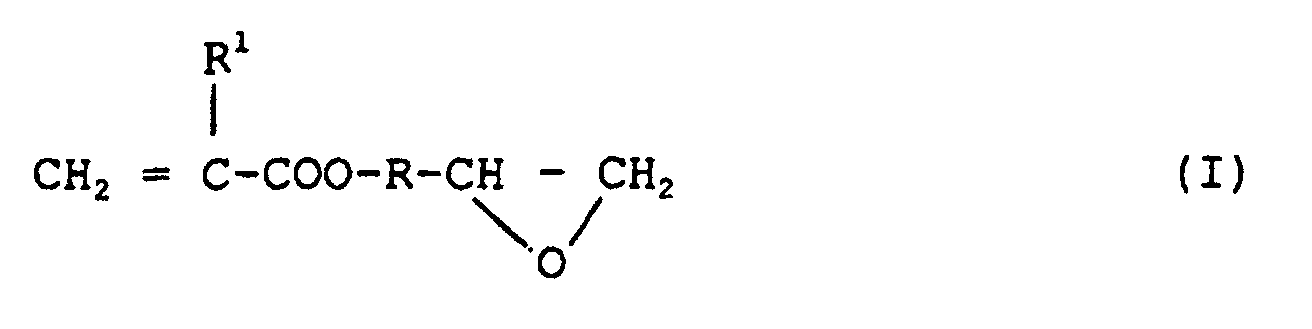
- the reactive prepolymer A 2 in the present invention is an ⁇ , ⁇ -ethylenically copolymerizable reactive prepolymer having a copolymerizable double bond and an amino group and an acid group together which is obtained by addition reaction of the prepolymer A 1 with a compound having an epoxy group represented by the following formula (I) : (wherein R 1 represents H or a methyl group, and R represents a straight or branched chain alkyl group of 1-10 carbon atoms) in an amount of 0.1-1.0 equivalent for amino group equivalent of the prepolymer A 1 in the presence of a polymerization inhibitor and a tertiary amino compound at 80-200°C in a mixed gas stream, for example, comprising 93% of nitrogen and 7% of oxygen.
- a compound having an epoxy group represented by the following formula (I) (wherein R 1 represents H or a methyl group, and R represents a straight or branched chain alkyl group of 1-10 carbon atoms) in an amount of 0.1
- the epoxy group-containing ⁇ , ⁇ -ethylenically polymerizable compounds in the present invention include glycidyl acrylate, glycidyl methacrylate and the like represented by the formula (I). These may be used each alone or in combination. These compounds can be subjected to addition reaction with the prepolymer A 1 in an amount of 0.1-1.0 equivalent for the amino group equivalent of the prepolymer A 1 , whereby a polymerizable double bond can be introduced.
- the prepolymer B 1 used in the present invention is a prepolymer having a weight-average molecular weight of 1000-30000 which is obtained by the solution polymerization of a carboxyl group-containing ⁇ , ⁇ -ethylenically polymerizable compound and other polymerizable compound using a polymerization initiator (a polymerization initiator having a carboxyl group at an end and/or a usual polymerization initiator) by a conventional polymerization method at a temperature of 80-180°C in a nitrogen stream.
- a polymerization initiator a polymerization initiator having a carboxyl group at an end and/or a usual polymerization initiator
- polymerization initiators having a carboxyl group used in preparation of the prepolymer B 1 there may be used the same polymerization initiators as used for the preparation of the prepolymer A 1 , and as the usual polymerization initiators, mention may be made of, for example, azo polymerization initiators such as azobisisobutyronitrile and peroxide polymerization initiators such as benzoyl peroxide. These may be used each alone or in combination.
- the carboxyl group-containing ⁇ , ⁇ -ethylenically polymerizable compounds used in the present invention include, for example, acids such as acrylic acid, methacrylic acid, maleic acid, itaconic acid, 2-acryloyloxyethylsuccinic acid, and 2-acryloyloxyethylphthalic acid. These may be used each alone or in combination. It is necessary that amount of the carboxyl group-containing ⁇ , ⁇ -ethylenically polymerizable compounds is at least 30% by weight of the components of the prepolymer B 1 . If it is less than 30% by weight, the resulting resin can have no or insufficient dispersibility for basic pigments. As the other polymerizable compounds in the present invention, there may be used the same compounds as used for the preparation of the prepolymer A 1 each alone or in combination.
- the prepolymer B 1 used in the present invention is a prepolymer having a weight-average molecular weight of 1000-30000 which is obtained by the polymerization of the above components by a conventional polymerization method.
- the solvents usable in the solution polymerization there may be used the same solvents as used for the preparation of the prepolymer A 1 each alone or in combination.
- preferred are alcohols and ketones which are good in dissolvability for the carboxyl group-containing polymerizable compounds.
- Molecular weight of the prepolymer B 1 can be optionally selected within the range of 1000-30000 in weight-average molecular weight, and is preferably 1500-10000. If the molecular weight is less than 1000, dispersibility for basic pigments is not sufficient, and if it is more than 30000, stability of paints is deteriorated depending on the kind of pigments used.
- the reactive prepolymer B 2 in the present invention is a copolymerizable reactive prepolymer having a copolymerizable double bond and an acid group together which is obtained by addition reaction of the prepolymer B 1 with a compound having an epoxy group represented by the formula (I) in an amount of 0.1-1.0 equivalent for carboxyl group equivalent of the prepolymer B 1 in the presence of a polymerization inhibitor and a tertiary amino compound at 80-200°C in a mixed gas stream, for example, comprising 93% of nitrogen and 7% of oxygen.
- the epoxy group-containing ⁇ , ⁇ -ethylenically polymerizable compounds can be subjected to addition reaction in an amount of 0.1-1.0 equivalent for the carboxyl group equivalent, whereby a polymerizable double bond can be introduced.
- the equivalent amount of these compounds exceeds 0.5 for the carboxyl group equivalent, gelation sometimes occurs at the copolymerization reaction of the reactive prepolymer A 2 , the reactive prepolymer B 2 , and the other ⁇ , ⁇ -ethylenically polymerizable compound, and thus 0.1-0.5 equivalent for the carboxyl group equivalent is preferred.
- the amphoteric resin obtained by the present invention comprises the copolymerizable prepolymers A 2 and B 2 and a component C which is ⁇ , ⁇ -ethylenically copolymerizable with the prepolymers A 2 and B 2 as essential components.
- the component C in addition to the other ⁇ , ⁇ -ethylenically polymerizable compounds in the preparation of the prepolymers A 1 and B 1 , there may be used (4) ⁇ , ⁇ -ethylenically unsaturated carboxylic acids such as acrylic acid, methacrylic acid, itaconic acid, and maleic acid and (5) acrylamides and methacrylamides such as acrylamide, methacrylamide and N-methylacrylamide each alone or in combination.
- the amphoteric resin (copolymer) can be obtained by carrying out a conventional solution polymerization using a conventional polymerization initiator at 80-180°C in a nitrogen stream to graft copolymerize the prepolymers A 2 and B 2 on the main chain of the polymer of the component C.
- amount of the prepolymer A 2 which is a constituent of the amphoteric resin can be optionally selected within the range of 0.5-20% by weight of the constituents of the amphoteric resin. If the amount of the prepolymer A 2 is less than 0.5% by weight of the constituents, the resin has no or insufficient dispersibility for acidic pigments, and if it is more than 20% by weight, the resin is markedly deteriorated in weather resistance and stability of paints becomes inferior depending on the kind of pigments to be dispersed. The amount is preferably 1.0-10% by weight.
- Amount of the prepolymer B 2 which is a constituent of the amphoteric resin can be optionally selected within the range of 0.5-30% by weight of the constituents of the amphoteric resin. If the amount of the prepolymer B 2 is less than 0.5% by weight of the constituents, the resin has no or insufficient dispersibility for basic pigments, and if it is more than 30% by weight, stability of paints is sometimes deteriorated depending on the kind of pigments. The amount is preferably 1.0-15% by weight.
- amphoteric resins (copolymers) obtained by the present invention are satisfactory in dispersibility for acidic pigments because they have a basic prepolymer on the graft chain, and further they are also satisfactory in dispersibility for basic pigments because they have an acidic prepolymer on the graft chain.
- components A 2 and B 2 in combination and introducing a small amount of a basic prepolymer into the copolymer, dispersibility for various pigments differing in polarity is improved, and as a result, deterioration of the weather resistance of the resins caused by amine group can be inhibited and weather resistance can be remarkably improved.
- the resins are very useful.
- amphoteric resins (copolymers) having dispersion function obtained by the present invention are used as dispersion resins, dispersibility for functional compounds such as pigments is improved, and, furthermore, wettability with the functional compounds is improved and as a result the resins after the compounds are dispersed exhibit excellent weather resistance.
- the amphoteric resins obtained by the present invention have a function as dispersant or binder for the functional compounds and can be used for various uses such as paints and inks.
- amphoteric resins (copolymers) obtained by the present invention are excellent in dispersibility for functional compounds, particularly, pigments, they are suitable as resins for dispersion of pigments, and, besides, since they have the copolymer component C, they are excellent in weather resistance and can also be used for top coating over various paints.
- composition I 4,4'-Azobis-4-cyanovaleric acid 4.3 parts Triethylamine 1.4 parts Cellosolve acetate 22.0 parts
- Composition II Dimethylaminoethyl methacrylate 17.3 parts Butyl acetate 5.0 parts
- the evaluation method about dispersibility of each pigment is measured by grind gage and the evaluation data are shown by the depth of channel in the page. And then the results of evaluation on the dispersibility are shown by the following grade. Depth of channel Grade Less than 5 micron o ⁇ 5-10 ⁇ 10-20 ⁇ 20-30 ⁇ More than 30 micron ⁇
- the black pigments and the white pigments prepared using the varnish of Example 6 were both good in dispersibility and also good in pigment separation as floating or flooding and weather resistance.
Landscapes
- Chemical & Material Sciences (AREA)
- Organic Chemistry (AREA)
- Life Sciences & Earth Sciences (AREA)
- Engineering & Computer Science (AREA)
- Materials Engineering (AREA)
- Wood Science & Technology (AREA)
- Chemical Kinetics & Catalysis (AREA)
- Health & Medical Sciences (AREA)
- Medicinal Chemistry (AREA)
- Polymers & Plastics (AREA)
- General Chemical & Material Sciences (AREA)
- Paints Or Removers (AREA)
- Macromonomer-Based Addition Polymer (AREA)
- Pigments, Carbon Blacks, Or Wood Stains (AREA)
- Addition Polymer Or Copolymer, Post-Treatments, Or Chemical Modifications (AREA)
- Processes Of Treating Macromolecular Substances (AREA)
Abstract
Description
- The present invention relates to a method for producing an amphoteric resin (copolymer) having function as a dispersant which is used for dispersing a functional compound. More particularly, it relates to a method for producing an amphoteric resin having function as a dispersant or a binder for functional compounds which resin is excellent in dispersibility for functional compounds such as pigments and excellent in wettability with the functional compounds, and consequently provides satisfactory weather resistance for the resin after dispersion (dispersion system).
- Familiar functional compounds are pigments used for paints and inks, and these are generally used in combination rather than being used each alone. As well known, when these functional compounds are used in combination, since they differ in surface chemical characteristics, resins are demanded which have excellent function as a dispersant such that dispersibility for the functional compounds is not different so much even in any combination of the compounds differing in surface characteristics. Especially, at present, paints and inks are required to have weather resistance and endurance, and hence it is strongly demanded that wettability of functional compounds concerning these properties with binders, namely, dispersibility of the compounds in binders is satisfactory.
- Conventionally, for giving good dispersibility to various pigments, it is proposed to use as a resin for dispersion of pigment a graft copolymer which comprises an acrylic resin in which is incorporated a basic prepolymer comprising an amino group-containing polymerizable compound such as dimethylaminoethyl methacrylate. (See, for example, JP-B-Hei 5 (1993)-49715, JP-Appln. No. Sho 58 (1983)-91930, and JP-A-Sho 59 (1984)-217769).
- However, although the conventionally proposed acrylic copolymers grafted with basic prepolymer are superior in dispersibility for acidic pigments, they are inferior in dispersibility for basic pigments to cause sometimes a phenomenon of pigment separation as floating or flooding or pigment agglomeration. Moreover, since the basic prepolymers comprise amines such as dimethylaminoethyl methacrylate, if they are used in a large amount, the coat is yellowed and damaged in weather resistance. Thus, it is difficult to obtain a resin system having desirable dispersing function.
- On the other hand, it is proposed for obtaining resins superior in weather resistance to use cyclohexyl methacrylate as a monomer (See, for example, JP-A-Hei 6 (1994)-207142). However, though resins prepared using cyclohexyl methacrylate are superior in weather resistance, the phenomenon such as pigment separation as floating or flooding or pigment agglomeration caused by the inferior pigment dispersibility cannot be avoided. Thus, for satisfying both the dispersibility for the functional compounds and the weather resistance for the resin after dispersion, it can be considered to use the above-mentioned resins of both types. However, sufficient effect cannot still be obtained even with using the resins in combination.
- The object of the present invention is to provide resins which are effective for improving simultaneously dispersibility for the functional compounds, endurance and weather resistance of the resulting resins and especially which can disperse indiscriminately any of acidic and basic functional compounds irrespective of using each alone or in combination.
- As a result of intensive research conducted by the inventors in an attempt to develop resins having characteristics to improve both the dispersibility and the weather resistance, they have succeeded in obtaining a novel amphoteric resin by graft copolymerizing a basic prepolymer and an acidic prepolymer on the main chain of a polymer. Thus, the present invention has been accomplished.
- The present invention is a method for producing an amphoteric resin having dispersing function which comprises polymerizing the following prepolymer A2, prepolymer B2 and component C as essential components to graft copolymerize the prepolymer A2 and the prepolymer B2 on the main chain of the polymer of the component C so that amount of A2 is in the range of 0.1-85% by weight, that of B2 is in the range of 0.1-85% by weight, and that of C is in the range of 0.1-96% by weight with the total amount of A2, B2 and C being 100% by weight:
- prepolymer A2 which is copolymerizable and has
a copolymerizable double bond and an amino group and an
acid group together and which is obtained by reacting a
prepolymer A1 having a weight-average molecular weight of
1000-30000 and being obtained by polymerization of a
polymerization initiator having a carboxyl group at an
end, an amino group-containing α,β-ethylenically
polymerizable compound and other α,β-ethylenically
polymerizable compound, with a compound having an epoxy
group represented by the following formula (I):
(wherein R1 represents H or a methyl group, and R represents a straight or branched chain alkyl group of 1-10 carbon atoms) in an amount of 0.1-1.0 equivalent for amino group equivalent of the prepolymer A1;
- prepolymer B2 which is copolymerizable and is obtained by reacting a prepolymer B1 having a weight-average molecular weight of 1000-30000 and being obtained by polymerization of a polymerization initiator, a carboxyl group-containing α,β-ethylenically polymerizable compound and other α,β-ethylenically polymerizable compound, with a compound having an epoxy group represented by the above formula (I) in an amount of 0.1-1.0 equivalent for carboxyl group equivalent of the prepolymer B1; and
- component C which is α,β-ethylenically copolymerizable with A2 and B2.
-
- The embodiments of the present invention will be explained in more detail.
- In the present invention, the prepolymer A1 is a prepolymer having a weight-average molecular weight of 1000-30000 which is obtained by the solution polymerization of an amino group-containing α,β-ethylenically polymerizable compound and other polymerizable compound using a polymerization initiator containing a carboxyl group at an end by a conventional polymerization method at a temperature of 80-180°C in a nitrogen stream.
- The polymerization initiators having a carboxyl group at an end used in the present invention include, for example, 4,4'-azobis-4-cyanovaleric acid.
- The amino group-containing α,β-ethylenically polymerizable compounds used in the present invention include, for example, acrylates such as dimethylaminomethyl acrylate, diethylaminomethyl acrylate, dibutylaminomethyl acrylate, dihexylaminomethyl acrylate, dimethylaminoethyl acrylate, diethylaminoethyl acrylate, di(t-butyl)aminoethyl acrylate, diisohexyl-aminoethyl acrylate, dihexylaminopropyl acrylate, and di(t-butyl)aminohexyl acrylate, and methacrylates corresponding to these acrylates. These may be used each alone or in combination. It is necessary that amount of the amino group-containing polymerizable compound is at least 30% by weight of the components of the prepolymer A1. If it is less than 30% by weight, the resulting resin (copolymer) cannot completely or sufficiently disperse an acidic pigment.
- The other α,β-ethylenically polymerizable compounds used in the present invention include, for example, (1) monomers, e.g., alkyl or cycloalkyl esters of acrylic acid or methacrylic acid, such as methyl acrylate, methyl methacrylate, ethyl acrylate, ethyl methacrylate, n-butyl acrylate, n-butyl methacrylate, i-butyl acrylate, i-butyl methacrylate, t-butyl acrylate, t-butyl methacrylate, cyclohexyl acrylate, cyclohexyl methacrylate, 2-ethylhexyl acrylate, 2-ethylhexyl methacrylate, lauryl acrylate, and lauryl methacrylate, (2) vinyl monomers such as styrene, vinyltoluene, α-methylstyrene, vinyl acetate, acrylonitrile, and methacrylonitrile, and (3) monomers, e.g., hydroxyalkyl esters of acrylic acid or methacrylic acid, such as 2-hydroxyethyl acrylate, 2-hydroxyethyl methacrylate, hydroxypropyl acrylate, and hydroxypropyl methacrylate. These may be used each alone or in combination.
- Solvents usable, for example, in the solution polymerization include aromatic solvents such as toluene and xylene, ketones such as acetone, methyl ethyl ketone, and methyl isobutyl ketone, alcohols such as n-butanol, i-butanol, and isopropyl alcohol, and esters such as ethyl acetate and n-butyl acetate. These may be used each alone or in combination. Among them, preferred are alcohols and ketones which are high in dissolvability for the amino group-containing polymerizable compounds.
- Molecular weight of the prepolymer A1 can be optionally selected within the range of 1000-30000 in weight-average molecular weight, and is preferably 1500-10000. If the molecular weight is less than 1000, dispersibility for acidic pigments is not sufficient, and if it is more than 30000, stability of paints is deteriorated depending on the kind of pigments.
- The reactive prepolymer A2 in the present invention is an α,β-ethylenically copolymerizable reactive prepolymer having a copolymerizable double bond and an amino group and an acid group together which is obtained by addition reaction of the prepolymer A1 with a compound having an epoxy group represented by the following formula (I) :(wherein R1 represents H or a methyl group, and R represents a straight or branched chain alkyl group of 1-10 carbon atoms) in an amount of 0.1-1.0 equivalent for amino group equivalent of the prepolymer A1 in the presence of a polymerization inhibitor and a tertiary amino compound at 80-200°C in a mixed gas stream, for example, comprising 93% of nitrogen and 7% of oxygen.

- The epoxy group-containing α,β-ethylenically polymerizable compounds in the present invention include glycidyl acrylate, glycidyl methacrylate and the like represented by the formula (I). These may be used each alone or in combination. These compounds can be subjected to addition reaction with the prepolymer A1 in an amount of 0.1-1.0 equivalent for the amino group equivalent of the prepolymer A1, whereby a polymerizable double bond can be introduced. However, if the equivalent amount of these compounds exceeds 0.5 for the amino group equivalent, gelation sometimes occurs at the copolymerization reaction of the reactive prepolymer A2, the reactive prepolymer B2, and the other α,β-ethylenically polymerizable compound, and thus 0.1-0.5 equivalent for the amino group equivalent is preferred.
- The prepolymer B1 used in the present invention is a prepolymer having a weight-average molecular weight of 1000-30000 which is obtained by the solution polymerization of a carboxyl group-containing α,β-ethylenically polymerizable compound and other polymerizable compound using a polymerization initiator (a polymerization initiator having a carboxyl group at an end and/or a usual polymerization initiator) by a conventional polymerization method at a temperature of 80-180°C in a nitrogen stream.
- As the polymerization initiators having a carboxyl group used in preparation of the prepolymer B1, there may be used the same polymerization initiators as used for the preparation of the prepolymer A1, and as the usual polymerization initiators, mention may be made of, for example, azo polymerization initiators such as azobisisobutyronitrile and peroxide polymerization initiators such as benzoyl peroxide. These may be used each alone or in combination.
- The carboxyl group-containing α,β-ethylenically polymerizable compounds used in the present invention include, for example, acids such as acrylic acid, methacrylic acid, maleic acid, itaconic acid, 2-acryloyloxyethylsuccinic acid, and 2-acryloyloxyethylphthalic acid. These may be used each alone or in combination. It is necessary that amount of the carboxyl group-containing α,β-ethylenically polymerizable compounds is at least 30% by weight of the components of the prepolymer B1. If it is less than 30% by weight, the resulting resin can have no or insufficient dispersibility for basic pigments. As the other polymerizable compounds in the present invention, there may be used the same compounds as used for the preparation of the prepolymer A1 each alone or in combination.
- The prepolymer B1 used in the present invention is a prepolymer having a weight-average molecular weight of 1000-30000 which is obtained by the polymerization of the above components by a conventional polymerization method.
- As the solvents usable in the solution polymerization, there may be used the same solvents as used for the preparation of the prepolymer A1 each alone or in combination. Among them, preferred are alcohols and ketones which are good in dissolvability for the carboxyl group-containing polymerizable compounds.
- Molecular weight of the prepolymer B1 can be optionally selected within the range of 1000-30000 in weight-average molecular weight, and is preferably 1500-10000. If the molecular weight is less than 1000, dispersibility for basic pigments is not sufficient, and if it is more than 30000, stability of paints is deteriorated depending on the kind of pigments used.
- The reactive prepolymer B2 in the present invention is a copolymerizable reactive prepolymer having a copolymerizable double bond and an acid group together which is obtained by addition reaction of the prepolymer B1 with a compound having an epoxy group represented by the formula (I) in an amount of 0.1-1.0 equivalent for carboxyl group equivalent of the prepolymer B1 in the presence of a polymerization inhibitor and a tertiary amino compound at 80-200°C in a mixed gas stream, for example, comprising 93% of nitrogen and 7% of oxygen.
- The epoxy group-containing α,β-ethylenically polymerizable compounds can be subjected to addition reaction in an amount of 0.1-1.0 equivalent for the carboxyl group equivalent, whereby a polymerizable double bond can be introduced. However, if the equivalent amount of these compounds exceeds 0.5 for the carboxyl group equivalent, gelation sometimes occurs at the copolymerization reaction of the reactive prepolymer A2, the reactive prepolymer B2, and the other α,β-ethylenically polymerizable compound, and thus 0.1-0.5 equivalent for the carboxyl group equivalent is preferred.
- The amphoteric resin obtained by the present invention comprises the copolymerizable prepolymers A2 and B2 and a component C which is α,β-ethylenically copolymerizable with the prepolymers A2 and B2 as essential components. As the component C, in addition to the other α,β-ethylenically polymerizable compounds in the preparation of the prepolymers A1 and B1, there may be used (4) α,β-ethylenically unsaturated carboxylic acids such as acrylic acid, methacrylic acid, itaconic acid, and maleic acid and (5) acrylamides and methacrylamides such as acrylamide, methacrylamide and N-methylacrylamide each alone or in combination. In the present invention, the amphoteric resin (copolymer) can be obtained by carrying out a conventional solution polymerization using a conventional polymerization initiator at 80-180°C in a nitrogen stream to graft copolymerize the prepolymers A2 and B2 on the main chain of the polymer of the component C.
- In the present invention, amount of the prepolymer A2 which is a constituent of the amphoteric resin can be optionally selected within the range of 0.5-20% by weight of the constituents of the amphoteric resin. If the amount of the prepolymer A2 is less than 0.5% by weight of the constituents, the resin has no or insufficient dispersibility for acidic pigments, and if it is more than 20% by weight, the resin is markedly deteriorated in weather resistance and stability of paints becomes inferior depending on the kind of pigments to be dispersed. The amount is preferably 1.0-10% by weight.
- Amount of the prepolymer B2 which is a constituent of the amphoteric resin can be optionally selected within the range of 0.5-30% by weight of the constituents of the amphoteric resin. If the amount of the prepolymer B2 is less than 0.5% by weight of the constituents, the resin has no or insufficient dispersibility for basic pigments, and if it is more than 30% by weight, stability of paints is sometimes deteriorated depending on the kind of pigments. The amount is preferably 1.0-15% by weight.
- The amphoteric resins (copolymers) obtained by the present invention are satisfactory in dispersibility for acidic pigments because they have a basic prepolymer on the graft chain, and further they are also satisfactory in dispersibility for basic pigments because they have an acidic prepolymer on the graft chain. By using components A2 and B2 in combination and introducing a small amount of a basic prepolymer into the copolymer, dispersibility for various pigments differing in polarity is improved, and as a result, deterioration of the weather resistance of the resins caused by amine group can be inhibited and weather resistance can be remarkably improved. Thus, the resins are very useful.
- When the amphoteric resins (copolymers) having dispersion function obtained by the present invention are used as dispersion resins, dispersibility for functional compounds such as pigments is improved, and, furthermore, wettability with the functional compounds is improved and as a result the resins after the compounds are dispersed exhibit excellent weather resistance. Thus, the amphoteric resins obtained by the present invention have a function as dispersant or binder for the functional compounds and can be used for various uses such as paints and inks. Since the amphoteric resins (copolymers) obtained by the present invention are excellent in dispersibility for functional compounds, particularly, pigments, they are suitable as resins for dispersion of pigments, and, besides, since they have the copolymer component C, they are excellent in weather resistance and can also be used for top coating over various paints.
- The present invention will be explained by the following examples.
- 47 Parts of butyl acetate was charged in a flask equipped with a stirrer, a dropping funnel, a condenser tube, and a thermometer and heated to 120°C in a nitrogen atmosphere. A mixture of the following compositions I and II was charged in the dropping funnel and added dropwise at an equal rate over a period of 3 hours.
Composition I: 4,4'-Azobis-4-cyanovaleric acid 4.3 parts Triethylamine 1.4 parts Cellosolve acetate 22.0 parts Composition II: Dimethylaminoethyl methacrylate 17.3 parts Butyl acetate 5.0 parts - After lapse of 30 minutes from the completion of the addition, 0.01 part of hydroquinone was added, and then 3.6 parts of glycidyl methacrylate was added, followed by carrying out the reaction for further 2 hours to obtain the basic prepolymer A2.
- 35 Parts of butyl acetate was charged in a flask equipped with a stirrer, a dropping funnel, a condenser tube, and a thermometer and heated to 120°C in a nitrogen atmosphere. The following composition was charged in the dropping funnel and added dropwise at an equal rate over a period of 3 hours.
2-Methacryloyloxyethylphthalic acid 20.0 parts Azobisisobutyronitrile 4.0 parts Butyl acetate 10.0 parts - After lapse of 30 minutes from the completion of the addition, 0.01 part of hydroquinone was added, and then 2.0 parts of glycidyl methacrylate and 0.6 part of triethylamine were added, followed by carrying out the reaction for further 2 hours to obtain the acidic prepolymer B2.
- 10 Parts of butyl acetate and 10 parts of cellosolve acetate were charged in a flask equipped with a stirrer, a dropping funnel, a condenser tube, and a thermometer and heated to 120°C in a nitrogen atmosphere. The following prepolymer composition was charged in the dropping funnel and added dropwise at an equal rate over a period of 2 hours.
Cyclohexyl methacrylate 23 parts Methyl methacryate 5 parts Butyl acrylate 15 parts 2-Hydroxyethyl methacrylate 7 parts Basic prepolymer A2 obtained in Example 1 3 parts Acidic prepolymer B2 obtained in Example 2 3 parts Acrylic acid 0.3 part Azobisisobutyronitrile 1 part - After lapse of 1 hour from the completion of the addition, a mixed solution of 0.2 part of azobisisobutyronitrile and 10 parts of toluene were added dropwise at an equal rate over a period of 2 hours. After kept at 120°C for 1 hour from the completion of the addition, the reaction mixture was cooled and thereafter diluted with 9 parts of toluene, and an amphoteric resin (copolymer) was taken out as a varnish.
- In the same manner as in Example 3, copolymer varnishes were obtained at the formulation as shown in the following Table 1.

- In the same manner as in Example 3, copolymer varnishes were obtained at the formulation as shown in the following Table 2.
- The properties of varnish described in the above Examples and Comparative Examples are shown in the following Table 3.


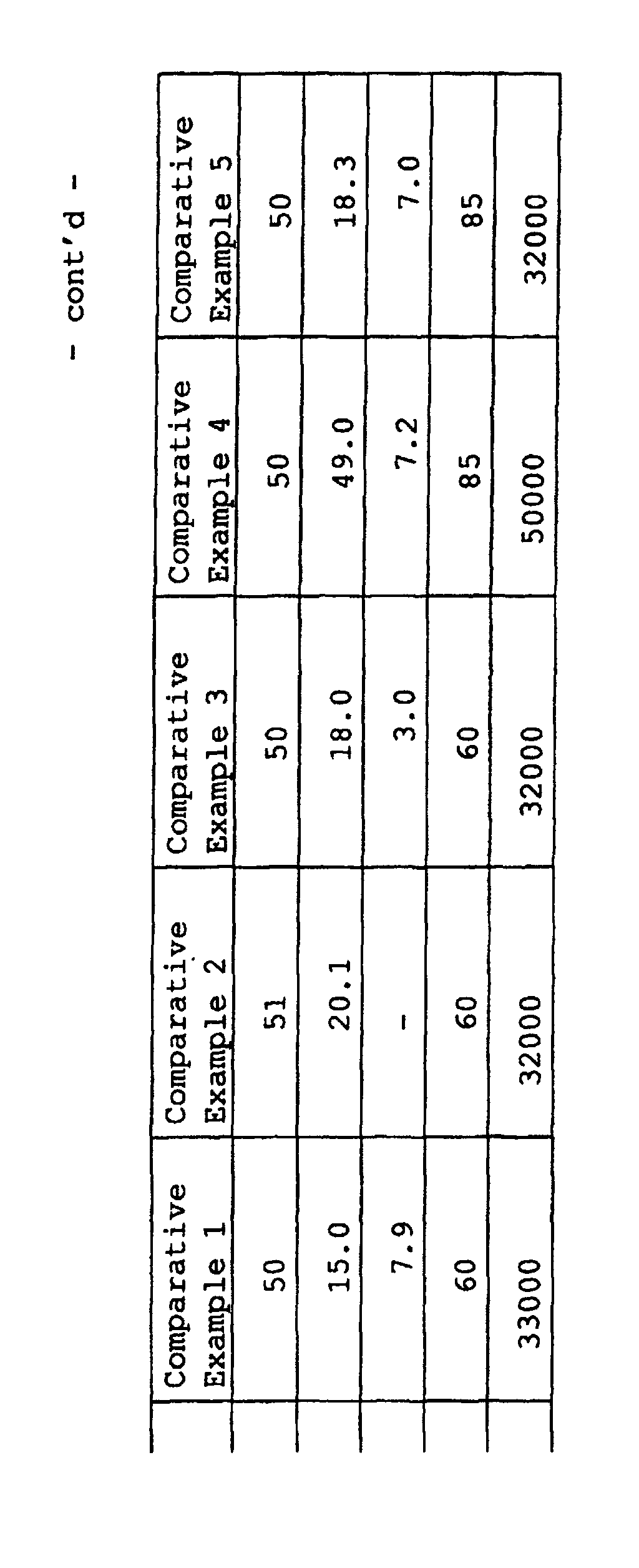
- Using the varnishes obtained in Example 3, Examples 4-8 and Comparative Examples 1-5, pigment was dispersed at the following paint formulation by a paint shaker to obtain black and white paints.
(Paint formulation): Mill base formulation: Carbon 7.0 parts Varnish 32.0 parts Toluene 31.0 parts 70.0 parts Titanium oxide 40.0 parts Varnish 20.0 parts Toluene 15.0 parts 75.0 parts Let down formulation Black mill base 22.0 parts Varnish 66.0 parts Toluene 12.0 parts 100.0 parts White mill base 40.0 parts Varnish 54.0 parts Toluene 6.0 parts 100.0 parts - 90 Parts of the above white fundamental color and 10 parts of the black fundamental color were diluted with 10 parts of toluene, and applied to a glass plate at a film thickness of 100 microns by an applicator. Just before drying to the touch, the film was rubbed, and color difference between the rubbed portion and the unrubbed portion was measured. Furthermore, the white primary color pigment was coated on an urethane plate and subjected to weathering test by a carbon sunshine weather meter for 500 hours. Then, color difference between the film subjected to the test and the initial film was measured. The color difference ΔE was measured by Lab method in accordance with JIS Z8730-1995 using ND-504AA manufactured by Nihon Denshoku Co., Ltd. The results of evaluation are shown in Table 4.

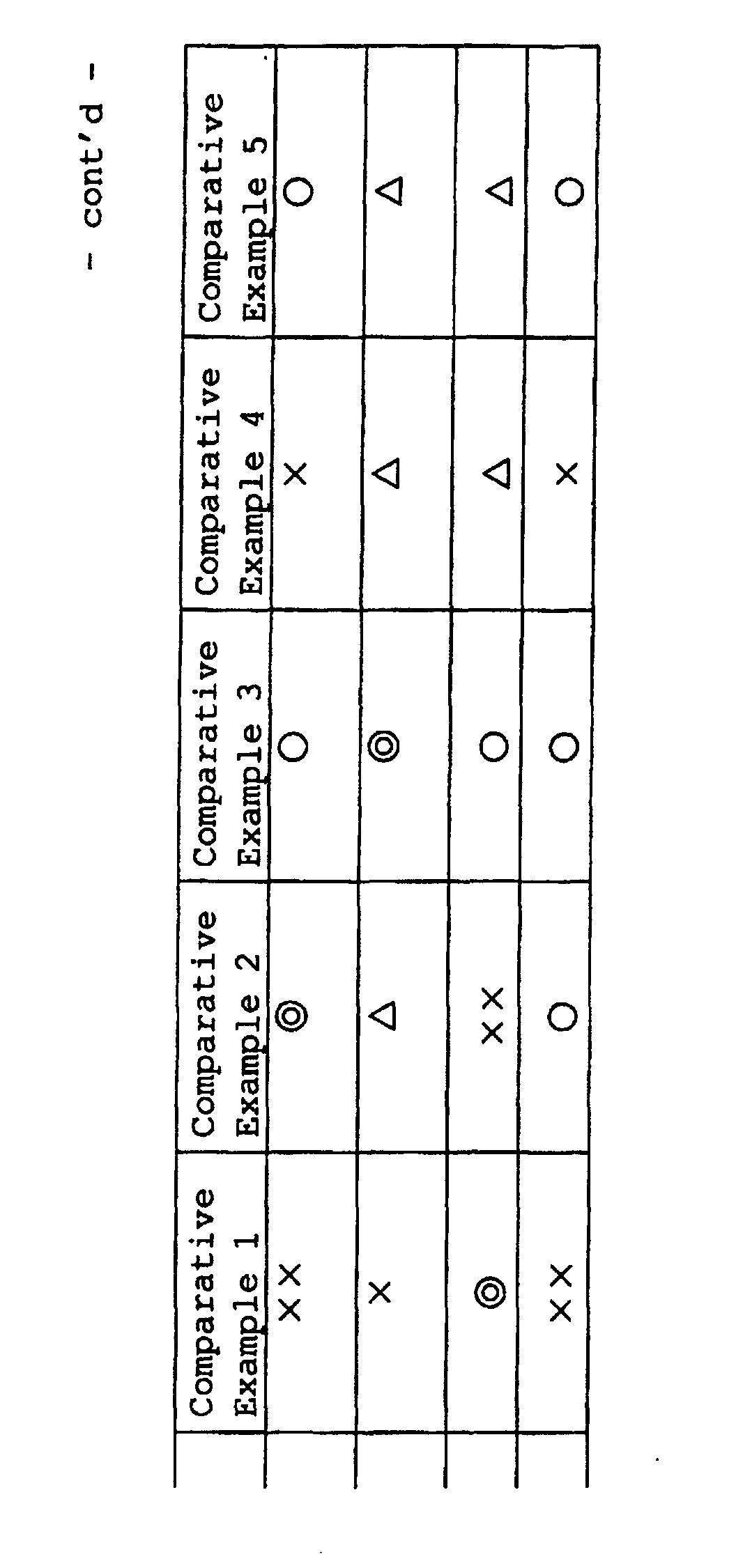
- The evaluation method about dispersibility of each pigment is measured by grind gage and the evaluation data are shown by the depth of channel in the page. And then the results of evaluation on the dispersibility are shown by the following grade.
Depth of channel Grade Less than 5 micron o ○ 5-10 ○ 10-20 Δ 20-30 × More than 30 micron ×× - Results of evaluation on pigment separation as floating or flooding are shown by the following grade.
ΔE Grade Less than 0.3 o ○ 0.3 - 0.5 ○ 0.5 - 1.0 Δ 1.0 - 3.0 × More than 3.0 ×× - Results of evaluation on weather resistance are shown by the following grade.
ΔE Grade Less than 0.5 o ○ 0.5 - 1.0 ○ 1.0 - 2.0 Δ 2.0 - 3.0 × More than 3.0 ×× - The black pigments and the white pigments prepared using the varnish of Example 6 were both good in dispersibility and also good in pigment separation as floating or flooding and weather resistance.
Claims (9)
- A process for producing an amphoteric resin having a dispersing function, which process comprises graft copolymerizing, on the main chain of the polymer of an α,β-ethylenically unsaturated component C, a prepolymer A2 and a prepolymer B2, whereinand wherein the amount of A2 is from 0.1-85% by weight, that of B2 is from 0.1-85% by weight, and that of C is from 0.1-96% by weight, the total amount of A2, B2 and C being 100% by weight.a) the prepolymer A2 is copolymerizable and is obtainable by reacting together (i) a prepolymer A1 which has a weight-average molecular weight of 1000-30000 and is obtainable by polymerizing a first α,β-ethylenically polymerizable compound which contains an amino group, a second α,β-ethylenically polymerizable compound and a polymerization initiator containing a terminal carboxyl group, and (ii) a compound which has an epoxy group of formula (I):wherein R1 is H or methyl and R is straight or branched C1-C10 alkyl, in an amount of 0.1-1.0 equivalents to the amino group equivalent of the prepolymer A1; and
 b) the prepolymer B2 is copolymerizable and is obtainable by reacting together (i) a prepolymer B1 which has a weight average molecular weight of 1000-30000 and is obtainable by polymerizing a first α,β-ethylenically polymerizable compound which contains a carboxyl group, a second α,β-ethylenically polymerizable compound and a polymerization initiator, and (ii) a compound which has an epoxy group of formula (I) as defined above in an amount of 0.1-1.0 equivalents to the carboxyl group equivalent of the prepolymer B1;
 - A process according to claim 1 wherein component C comprises at least one monomer containing an amino group.
- A process according to claim 1 wherein component C comprises at least one monomer containing a carboxyl group.
- A process according to any one of the preceding claims wherein the resin contains A2 and B2 in a total amount of at least 2% by weight.
- A process according to any one of the preceding claims wherein the resin contains each of A2 and B2 in an amount of at least 2% by weight
- An amphoteric resin having a dispersing function which is obtainable by a process as defined in any one of claims 1 to 5.
- An amphoteric resin according to claim 6 which further includes a dispersed pigment.
- A paint or ink which comprises an amphoteric resin as defined in claim 6 or 7.
- An article which is coated with an amphoteric resin as defined in any one of claims 6 or 7.
Applications Claiming Priority (2)
| Application Number | Priority Date | Filing Date | Title |
|---|---|---|---|
| JP20054498 | 1998-07-15 | ||
| JP10200544A JP2963897B1 (en) | 1998-07-15 | 1998-07-15 | Method for producing amphoteric resin having dispersing function |
Publications (2)
| Publication Number | Publication Date |
|---|---|
| EP0972783A1 EP0972783A1 (en) | 2000-01-19 |
| EP0972783B1 true EP0972783B1 (en) | 2003-05-28 |
Family
ID=16426079
Family Applications (1)
| Application Number | Title | Priority Date | Filing Date |
|---|---|---|---|
| EP99305531A Expired - Lifetime EP0972783B1 (en) | 1998-07-15 | 1999-07-13 | Method for producing amphoteric resin having dispersing function |
Country Status (5)
| Country | Link |
|---|---|
| US (1) | US6174963B1 (en) |
| EP (1) | EP0972783B1 (en) |
| JP (1) | JP2963897B1 (en) |
| AT (1) | ATE241653T1 (en) |
| DE (1) | DE69908250T2 (en) |
Families Citing this family (4)
| Publication number | Priority date | Publication date | Assignee | Title |
|---|---|---|---|---|
| JP2002136025A (en) * | 2000-10-26 | 2002-05-10 | Mitsubishi Electric Corp | Electromagnetic equipment |
| US7737237B2 (en) * | 2002-11-07 | 2010-06-15 | Phodia Chimie | Controlled structure copolymer comprising an amphoteric or zwitterionic part |
| JP3828877B2 (en) | 2003-04-10 | 2006-10-04 | 大成化工株式会社 | Method for producing a coloring agent (colorant) having excellent color development |
| JP4145705B2 (en) | 2003-04-15 | 2008-09-03 | 大成化工株式会社 | Method for producing colorant (colorant) |
Family Cites Families (10)
| Publication number | Priority date | Publication date | Assignee | Title |
|---|---|---|---|---|
| US4659781A (en) * | 1983-05-19 | 1987-04-21 | Nippon Paint Co., Ltd. | Reactive acrylic oligomer, grafted acrylic resinous composition based on said oligomer and coating composition containing the same |
| JPH0680088B2 (en) * | 1986-05-24 | 1994-10-12 | 綜研化学株式会社 | Manufacturing method of macromonomer |
| US5134187A (en) * | 1987-06-26 | 1992-07-28 | Kansai Paint Co., Ltd. | Cationic aqueous pigment dispersion |
| JPH0549715A (en) | 1991-08-24 | 1993-03-02 | Maruman Golf Corp | Golf club heads |
| US5288828A (en) | 1993-03-08 | 1994-02-22 | The Sherwin-Williams Company | Dispersant polymers |
| JPH0757857B2 (en) | 1993-11-29 | 1995-06-21 | 株式会社日本触媒 | Urethane resin coating composition |
| DE4409903A1 (en) | 1994-03-23 | 1995-09-28 | Basf Ag | Graft polymers containing N-vinyl units, process for their preparation and their use |
| JP3884065B2 (en) * | 1994-05-19 | 2007-02-21 | イー・アイ・デュポン・ドゥ・ヌムール・アンド・カンパニー | Paint containing self-stabilizing latex prepared in aqueous carrier |
| IL113600A0 (en) * | 1994-05-19 | 1995-08-31 | Du Pont | Aqueous coatings comprising self-stabilized lattices |
| US5708095A (en) | 1996-08-30 | 1998-01-13 | E. I. Du Pont De Nemours And Company | Graft copolymers containing sulfonate and phosphonate groups having particular utility as pigmented ink dispersants |
-
1998
- 1998-07-15 JP JP10200544A patent/JP2963897B1/en not_active Expired - Lifetime
-
1999
- 1999-07-13 DE DE69908250T patent/DE69908250T2/en not_active Expired - Lifetime
- 1999-07-13 AT AT99305531T patent/ATE241653T1/en not_active IP Right Cessation
- 1999-07-13 EP EP99305531A patent/EP0972783B1/en not_active Expired - Lifetime
- 1999-07-14 US US09/353,610 patent/US6174963B1/en not_active Expired - Lifetime
Also Published As
| Publication number | Publication date |
|---|---|
| JP2000026560A (en) | 2000-01-25 |
| ATE241653T1 (en) | 2003-06-15 |
| US6174963B1 (en) | 2001-01-16 |
| DE69908250D1 (en) | 2003-07-03 |
| EP0972783A1 (en) | 2000-01-19 |
| JP2963897B1 (en) | 1999-10-18 |
| DE69908250T2 (en) | 2004-03-25 |
Similar Documents
| Publication | Publication Date | Title |
|---|---|---|
| US4740546A (en) | Aqueous dispersion of vinyl copolymer resin | |
| US9012027B2 (en) | Aqueous emulsion | |
| AU743666B2 (en) | Polymer compositions | |
| KR20160025584A (en) | Use of a 2-octyl acrylate polymer as a binding agent in a coating composition | |
| JP2927701B2 (en) | Methacrylic copolymers and dispersants of non-aqueous paint pigments containing the copolymers | |
| MXPA01001456A (en) | Surfactant free aqueous emulsions. | |
| US4659781A (en) | Reactive acrylic oligomer, grafted acrylic resinous composition based on said oligomer and coating composition containing the same | |
| US5491192A (en) | Non-aqueous dispersion for alkyd formulation | |
| JP2719582B2 (en) | Resin composition for paint | |
| US6174963B1 (en) | Method for producing amphoteric resin having dispersing function | |
| US4395444A (en) | Thermosetting cationic acrylic latex compositions containing blocked isocyanates | |
| US6465589B2 (en) | Paint composition | |
| JP4000573B2 (en) | Cationic electrodeposition coating composition having excellent repellency resistance | |
| US6372866B2 (en) | Process for producing cationic emulsion | |
| EP4010387B1 (en) | Water-borne polymers polymerized by radical polymerization with azo initiators, a process for making such and the applications thereof | |
| JPH0796665B2 (en) | Aqueous resin dispersion | |
| CA1321435C (en) | Non-aqueous polymeric dispersion compositions having improved metal adhesion | |
| JPH0269507A (en) | Dispersion composition for room-temperature curable coatings | |
| AU604978B2 (en) | Thickeners for physically drying paints and coating materials and preparation of the thickeners | |
| JP3532976B2 (en) | Base resin for toning | |
| JP3272824B2 (en) | Base resin for toning | |
| EP0272021B1 (en) | Non-aqueous polymeric dispersion compositions and processes for making them | |
| JPH0741728A (en) | Base resin for toning | |
| JP3003279B2 (en) | Aqueous coating composition | |
| JPS62220564A (en) | Resin composition for coating material |
Legal Events
| Date | Code | Title | Description |
|---|---|---|---|
| PUAI | Public reference made under article 153(3) epc to a published international application that has entered the european phase |
Free format text: ORIGINAL CODE: 0009012 |
|
| 17P | Request for examination filed |
Effective date: 19990722 |
|
| AK | Designated contracting states |
Kind code of ref document: A1 Designated state(s): AT BE CH CY DE DK ES FI FR GB GR IE IT LI LU MC NL PT SE |
|
| AX | Request for extension of the european patent |
Free format text: AL;LT;LV;MK;RO;SI |
|
| AKX | Designation fees paid |
Free format text: AT BE CH CY DE DK ES FI FR GB GR IE IT LI LU MC NL PT SE |
|
| GRAH | Despatch of communication of intention to grant a patent |
Free format text: ORIGINAL CODE: EPIDOS IGRA |
|
| GRAH | Despatch of communication of intention to grant a patent |
Free format text: ORIGINAL CODE: EPIDOS IGRA |
|
| GRAA | (expected) grant |
Free format text: ORIGINAL CODE: 0009210 |
|
| AK | Designated contracting states |
Designated state(s): AT BE CH CY DE DK ES FI FR GB GR IE IT LI LU MC NL PT SE |
|
| PG25 | Lapsed in a contracting state [announced via postgrant information from national office to epo] |
Ref country code: LI Free format text: LAPSE BECAUSE OF FAILURE TO SUBMIT A TRANSLATION OF THE DESCRIPTION OR TO PAY THE FEE WITHIN THE PRESCRIBED TIME-LIMIT Effective date: 20030528 Ref country code: FI Free format text: LAPSE BECAUSE OF FAILURE TO SUBMIT A TRANSLATION OF THE DESCRIPTION OR TO PAY THE FEE WITHIN THE PRESCRIBED TIME-LIMIT Effective date: 20030528 Ref country code: CH Free format text: LAPSE BECAUSE OF FAILURE TO SUBMIT A TRANSLATION OF THE DESCRIPTION OR TO PAY THE FEE WITHIN THE PRESCRIBED TIME-LIMIT Effective date: 20030528 Ref country code: AT Free format text: LAPSE BECAUSE OF FAILURE TO SUBMIT A TRANSLATION OF THE DESCRIPTION OR TO PAY THE FEE WITHIN THE PRESCRIBED TIME-LIMIT Effective date: 20030528 |
|
| REG | Reference to a national code |
Ref country code: GB Ref legal event code: FG4D |
|
| REG | Reference to a national code |
Ref country code: CH Ref legal event code: EP |
|
| REG | Reference to a national code |
Ref country code: IE Ref legal event code: FG4D |
|
| REF | Corresponds to: |
Ref document number: 69908250 Country of ref document: DE Date of ref document: 20030703 Kind code of ref document: P |
|
| PG25 | Lapsed in a contracting state [announced via postgrant information from national office to epo] |
Ref country code: LU Free format text: LAPSE BECAUSE OF NON-PAYMENT OF DUE FEES Effective date: 20030713 Ref country code: CY Free format text: LAPSE BECAUSE OF FAILURE TO SUBMIT A TRANSLATION OF THE DESCRIPTION OR TO PAY THE FEE WITHIN THE PRESCRIBED TIME-LIMIT Effective date: 20030713 |
|
| PG25 | Lapsed in a contracting state [announced via postgrant information from national office to epo] |
Ref country code: IE Free format text: LAPSE BECAUSE OF NON-PAYMENT OF DUE FEES Effective date: 20030714 |
|
| PG25 | Lapsed in a contracting state [announced via postgrant information from national office to epo] |
Ref country code: MC Free format text: LAPSE BECAUSE OF NON-PAYMENT OF DUE FEES Effective date: 20030731 |
|
| PG25 | Lapsed in a contracting state [announced via postgrant information from national office to epo] |
Ref country code: SE Free format text: LAPSE BECAUSE OF FAILURE TO SUBMIT A TRANSLATION OF THE DESCRIPTION OR TO PAY THE FEE WITHIN THE PRESCRIBED TIME-LIMIT Effective date: 20030828 Ref country code: PT Free format text: LAPSE BECAUSE OF FAILURE TO SUBMIT A TRANSLATION OF THE DESCRIPTION OR TO PAY THE FEE WITHIN THE PRESCRIBED TIME-LIMIT Effective date: 20030828 Ref country code: GR Free format text: LAPSE BECAUSE OF FAILURE TO SUBMIT A TRANSLATION OF THE DESCRIPTION OR TO PAY THE FEE WITHIN THE PRESCRIBED TIME-LIMIT Effective date: 20030828 Ref country code: DK Free format text: LAPSE BECAUSE OF FAILURE TO SUBMIT A TRANSLATION OF THE DESCRIPTION OR TO PAY THE FEE WITHIN THE PRESCRIBED TIME-LIMIT Effective date: 20030828 |
|
| PG25 | Lapsed in a contracting state [announced via postgrant information from national office to epo] |
Ref country code: ES Free format text: LAPSE BECAUSE OF FAILURE TO SUBMIT A TRANSLATION OF THE DESCRIPTION OR TO PAY THE FEE WITHIN THE PRESCRIBED TIME-LIMIT Effective date: 20030908 |
|
| REG | Reference to a national code |
Ref country code: CH Ref legal event code: PL |
|
| PLBE | No opposition filed within time limit |
Free format text: ORIGINAL CODE: 0009261 |
|
| STAA | Information on the status of an ep patent application or granted ep patent |
Free format text: STATUS: NO OPPOSITION FILED WITHIN TIME LIMIT |
|
| ET | Fr: translation filed | ||
| REG | Reference to a national code |
Ref country code: IE Ref legal event code: MM4A |
|
| 26N | No opposition filed |
Effective date: 20040302 |
|
| REG | Reference to a national code |
Ref country code: FR Ref legal event code: PLFP Year of fee payment: 18 |
|
| REG | Reference to a national code |
Ref country code: FR Ref legal event code: PLFP Year of fee payment: 19 |
|
| REG | Reference to a national code |
Ref country code: DE Ref legal event code: R082 Ref document number: 69908250 Country of ref document: DE Representative=s name: PATENTANWAELTE HENKEL, BREUER & PARTNER MBB, DE Ref country code: DE Ref legal event code: R082 Ref document number: 69908250 Country of ref document: DE Representative=s name: PATENTANWAELTE HENKEL, BREUER & PARTNER, DE Ref country code: DE Ref legal event code: R081 Ref document number: 69908250 Country of ref document: DE Owner name: TAISEI HOLDINGS CO., LTD., JP Free format text: FORMER OWNER: TAISEI CHEMICAL INDUSTRIES LTD., TOKIO/TOKYO, JP |
|
| REG | Reference to a national code |
Ref country code: NL Ref legal event code: HC Owner name: TAISEI HOLDINGS CO., LTD; JP Free format text: DETAILS ASSIGNMENT: CHANGE OF OWNER(S), CHANGE OF OWNER(S) NAME; FORMER OWNER NAME: TAISEI CHEMICAL INDUSTRIES LTD Effective date: 20171103 |
|
| REG | Reference to a national code |
Ref country code: BE Ref legal event code: HC Owner name: TAISEI HOLDINGS CO., LTD.; JP Free format text: DETAILS ASSIGNMENT: CHANGE OF OWNER(S), CHANGEMENT NOM PROPRIETAIRE; FORMER OWNER NAME: TAISEI CHEMICAL INDUSTRIES LTD Effective date: 20171004 |
|
| REG | Reference to a national code |
Ref country code: FR Ref legal event code: CD Owner name: TAISEI HOLDINGS CO., LTD, JP Effective date: 20180119 |
|
| REG | Reference to a national code |
Ref country code: FR Ref legal event code: PLFP Year of fee payment: 20 |
|
| PGFP | Annual fee paid to national office [announced via postgrant information from national office to epo] |
Ref country code: BE Payment date: 20180621 Year of fee payment: 20 Ref country code: FR Payment date: 20180620 Year of fee payment: 20 |
|
| PGFP | Annual fee paid to national office [announced via postgrant information from national office to epo] |
Ref country code: IT Payment date: 20180703 Year of fee payment: 20 Ref country code: NL Payment date: 20180702 Year of fee payment: 20 Ref country code: DE Payment date: 20180727 Year of fee payment: 20 |
|
| PGFP | Annual fee paid to national office [announced via postgrant information from national office to epo] |
Ref country code: GB Payment date: 20180711 Year of fee payment: 20 |
|
| REG | Reference to a national code |
Ref country code: DE Ref legal event code: R071 Ref document number: 69908250 Country of ref document: DE |
|
| REG | Reference to a national code |
Ref country code: NL Ref legal event code: MK Effective date: 20190712 |
|
| REG | Reference to a national code |
Ref country code: GB Ref legal event code: PE20 Expiry date: 20190712 |
|
| REG | Reference to a national code |
Ref country code: BE Ref legal event code: MK Effective date: 20190713 |
|
| PG25 | Lapsed in a contracting state [announced via postgrant information from national office to epo] |
Ref country code: GB Free format text: LAPSE BECAUSE OF EXPIRATION OF PROTECTION Effective date: 20190712 |