EP0971713B1 - Use of cholinesterase inhibitors to treat disorders of attention - Google Patents
Use of cholinesterase inhibitors to treat disorders of attention Download PDFInfo
- Publication number
- EP0971713B1 EP0971713B1 EP98905121A EP98905121A EP0971713B1 EP 0971713 B1 EP0971713 B1 EP 0971713B1 EP 98905121 A EP98905121 A EP 98905121A EP 98905121 A EP98905121 A EP 98905121A EP 0971713 B1 EP0971713 B1 EP 0971713B1
- Authority
- EP
- European Patent Office
- Prior art keywords
- group
- indanon
- benzyl
- methylpiperidine
- dimethoxy
- Prior art date
- Legal status (The legal status is an assumption and is not a legal conclusion. Google has not performed a legal analysis and makes no representation as to the accuracy of the status listed.)
- Expired - Lifetime
Links
- 0 CC(*[N+](C)[O-])N(C)NC Chemical compound CC(*[N+](C)[O-])N(C)NC 0.000 description 2
- YCTWCNHIJNIFCO-UHFFFAOYSA-N COC(C(OC)=C1)=CC(CC2CC3CCN(Cc4ccccc4)CC3)C1C2=O Chemical compound COC(C(OC)=C1)=CC(CC2CC3CCN(Cc4ccccc4)CC3)C1C2=O YCTWCNHIJNIFCO-UHFFFAOYSA-N 0.000 description 1
- YXFVVABEGXRONW-UHFFFAOYSA-N Cc1ccccc1 Chemical compound Cc1ccccc1 YXFVVABEGXRONW-UHFFFAOYSA-N 0.000 description 1
Classifications
-
- A—HUMAN NECESSITIES
- A61—MEDICAL OR VETERINARY SCIENCE; HYGIENE
- A61K—PREPARATIONS FOR MEDICAL, DENTAL OR TOILETRY PURPOSES
- A61K31/00—Medicinal preparations containing organic active ingredients
- A61K31/33—Heterocyclic compounds
- A61K31/395—Heterocyclic compounds having nitrogen as a ring hetero atom, e.g. guanethidine or rifamycins
- A61K31/435—Heterocyclic compounds having nitrogen as a ring hetero atom, e.g. guanethidine or rifamycins having six-membered rings with one nitrogen as the only ring hetero atom
- A61K31/44—Non condensed pyridines; Hydrogenated derivatives thereof
- A61K31/445—Non condensed piperidines, e.g. piperocaine
-
- A—HUMAN NECESSITIES
- A61—MEDICAL OR VETERINARY SCIENCE; HYGIENE
- A61P—SPECIFIC THERAPEUTIC ACTIVITY OF CHEMICAL COMPOUNDS OR MEDICINAL PREPARATIONS
- A61P25/00—Drugs for disorders of the nervous system
-
- A—HUMAN NECESSITIES
- A61—MEDICAL OR VETERINARY SCIENCE; HYGIENE
- A61P—SPECIFIC THERAPEUTIC ACTIVITY OF CHEMICAL COMPOUNDS OR MEDICINAL PREPARATIONS
- A61P25/00—Drugs for disorders of the nervous system
- A61P25/28—Drugs for disorders of the nervous system for treating neurodegenerative disorders of the central nervous system, e.g. nootropic agents, cognition enhancers, drugs for treating Alzheimer's disease or other forms of dementia
Definitions
- This invention relates to the use of cholinesterase inhibitor compounds for treatment of disorders of attention, such as Attention Deficit Disorder (ADD).
- ADD Attention Deficit Disorder
- the compounds are also useful as a replacement for other substances which patients commonly use to self-medicate for these disorders, and which can have undesirable side effects.
- Attention disorders are also associated with indirect costs. For example, there is evidence that patients with attention disorders often "self-medicate" in destructive ways. These patients have a higher than average incidence of cigarette smoking and alcoholism. They also have a higher than average incidence of illegal drug use (Barkley, R.A. In Attention Deficit Hyperactivitiy Disorder, Guilford Press, New York, (1990) Chapter 4, pp. 106-129). Thus, an effective treatment for attention disorders would be also be a useful treatment for some substance dependencies.
- tricyclic antidepressents Current alternatives to stimulants for the treatment of attention disorders are the tricyclic antidepressents and clonidine.
- the use of tricyclic antidepressants is more likely than the use of stimulants to cause cardiac arrhythmias in children.
- tricyclic antidepressants and clonidine are often tried first (Maxmen, J.S. and Ward, N.G. Essential Psychopathology and Its Treatment, p. 443, Second Edition, Norton & Co., New York, (1995))
- nicotine may be an effective treatment for attention deficit disorder (Levin, E.D. et al. Psychopharmacology 123:55 (1996)).
- nicotine acts at multiple pharmacological sites in the body, can be addictive and also has undesirable side effects, and its mode of action is not known. It is not known, for example, which of nicotine's pharmacological effects are responsible for the increased attention displayed by subjects to whom nicotine was administered.
- Alzheimer's disease involves progressive and profound loss of memory, postulated to involve a deficiency in brain cortical acetylcholine affecting cholinergic synapses. This deficiency is thought to be caused by selective degeneration of acetylcholine-releasing neurons (Coyle, supra ).
- Disorders of attention and ADD which are concerned with mental concentration as opposed to memory, are not thought to be caused by acetylcholine defficiencies.
- acetylcholine as a neural transmitter, to transmit messages across the synapse to a cholinergic receptor.
- acetylcholine crosses the synaptic gap to carry the message by stimulating the cholinergic receptor.
- Memory is thought to be related, at least in part, to post-synaptic changes which occur as a result of the timing and strength of acetylcholine stimulation during learning, with certain experiences tending to block or facilitate corresponding neural pathways, i.e. making it more or less difficult to stimulate the same post-synaptic receptor at a future time (Deutsch, The Cholinergic Synapse and the Site of Memory, Science 174:788-94 (1971)).
- Acetylcholine also is rapidly destroyed by the enzyme cholinesterase. Thus, insufficient acetylcholine or excess cholinesterase can interfere with synaptic transmission by too rapidly destroying the acetylcholine message, resulting in weak cholinergic stimulation which can be experienced as memory loss. When this condition is chronic, i.e. from degeneration of acetylcholine-releasing neurons, the Alzheimer's syndrome may develop.
- One way of counteracting this imbalance is by interfering with the ability of cholinesterase to degrade acetylcholine, as by treatment with a cholinesterase inhibitor (Sugimoto et al., U.S. Patent No. 4,895,841).
- Attention is related to memory in that attention is a prerequisite to memory.
- Disorders of attention or learning, including ADD do not typically involve memory loss, and are characterized by symptoms such as motor restlessness, short attention span, poor concentration and organizational skills, impulsive behavior, and lack of task persistence.
- the cause or causes of ADD is unknown.
- Several theories have been proposed, and include impaired ability of the frontal lobes to process current experiences and integrate them with memory (frontal lobe disinhibition), as well as abnormalities or imbalances in one or more of dopamine and norepinephrine in the brain (the catecholemine hypothesis).
- Cholinesterase inhibitors provide one method of augmenting cholinergic transmission. They tend to be associated with fewer side effects than other methods because they augment the effects of endogenous acetylcholine rather than acting directly.
- cholinesterase inhibitors are more specific to areas of the body where endogenous acetylcholine is being released. They have a longer duration of action than nicotine, which is rapidly metabolized.
- Donepezil hydrochloride and its congeners are cholinesterase inhibitors that offer the additional advantage of specificity for acetylcholinesterase, the predominant form of the enzyme in the brain. For example, donepezil hydrochloride has approximately 1200-fold specificity for acetylcholinesterase relative to butyrlcholinesterase, the most common cholinesterase outside the brain and central nervous system.
- the present invention provides the use of a cholinesterase inhibitor in the manufacture of a medicament for use in treating attention deficit hyperactivity disorder in a human.
- the cholinesterase inhibitor has the formula: in which J is
- J is (a) or (b).
- monovalent groups of (2), (3) and (5) and divalent groups of (2) are preferable.
- These preferable groups of (B) may be connected with (b) of J, in particular (2) of (b).
- Q is nitrogen, T is carbon and q is 1 or 3; and Q is carbon, T is nitrogen and q is 2. It is most preferable that Q is nitrogen, T is carbon and q is 2.
- K is a phenylalkyl or a phenylalkyl having a substituent(s) on the phenyl.
- Preferable compounds have the above shown formula in which J is (b).
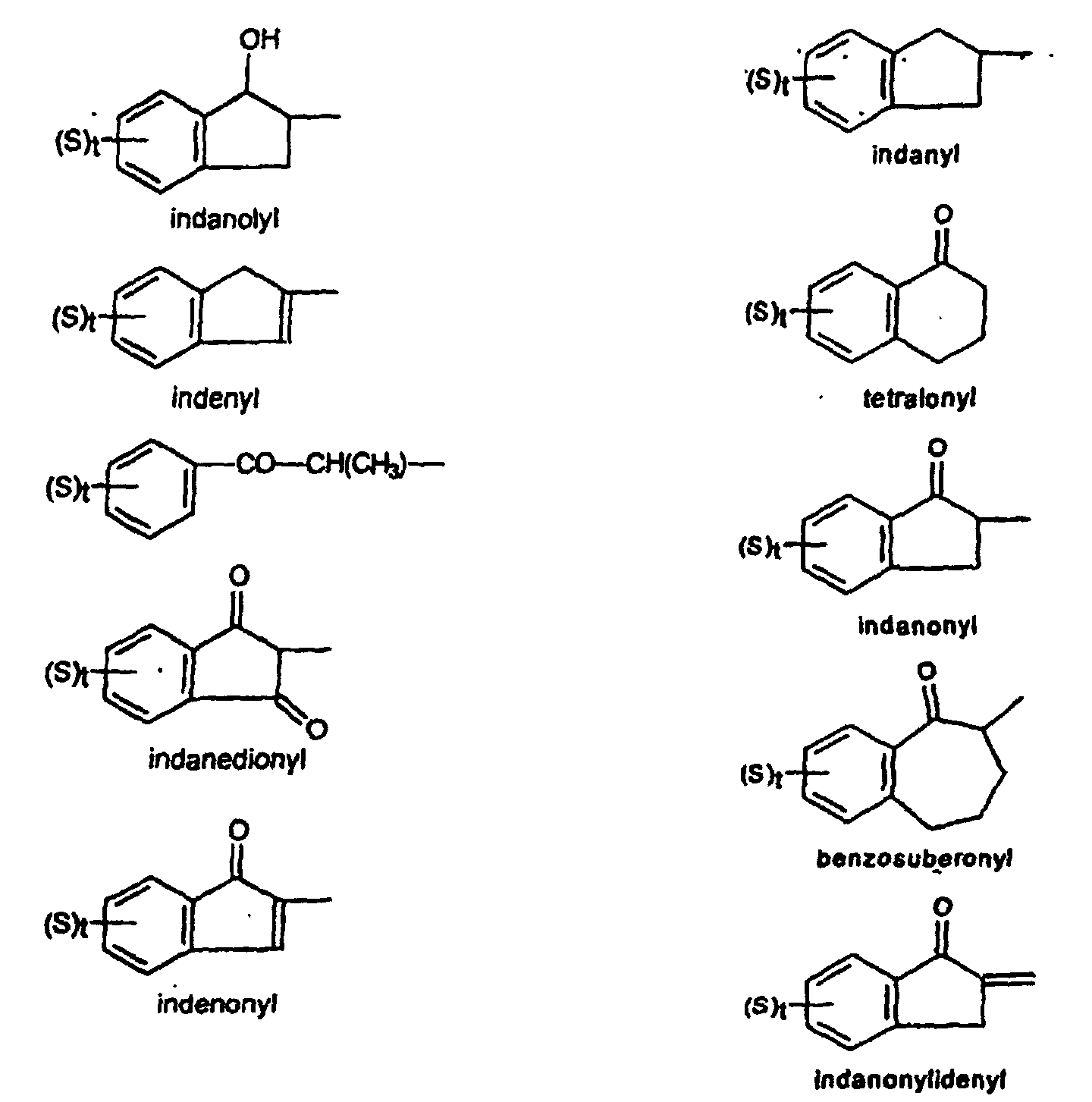
- the group (b) includes ten groups having the respective formulae shown below.
- S is hydrogen or a substituent such as a lower alkyl having 1 to 6 carbon atoms and a lower alkoxy having 1 to 6 carbon atoms and t is an integer of 1 to 4.
- methoxy is most preferred.
- the phenyl is most preferred to have 1 to 3 methoxy groups.
- (S) may form a methylene dioxy group or ethylene dioxy group on two adjacent carbon atoms of the phenyl group.
- J in the formula is (b), the monovalent or divalent group.
- indanonyl, indanedionyl and indenyl are most preferable, optionally having one or more substituents on the phenyl.
- the ring including T and Q may be a 5-, 6-or 7-membered ring. It is preferable that Q is nitrogen, T is carbon or nitrogen and n is 2; Q is nitrogen, T is carbon and n is 1 or 3; and Q is carbon, T is nitrogen and n is 2.
- phenyl, an arylalkyl and cinnamyl are preferable, optionally having one or more substituents on the phenyl.
- the cholinesterase inhibitor is a cyclic amine compound of the formula: wherein
- the cyclic amine compound is:
- the cyclic amine compound is 1-benzyl-4-((5,6-dimethoxy-1-indanon)- 2-yl)methylpiperidine.
- X is a member selected from the group represented by the formulas a dialkylaminoalkylcarbonyl group, and a lower alkoxycarbonyl group, wherein R 4 is a hydrogen atom, a lower alkyl group, an acyl group, a lower alkylsulfonyl group, or a substituted or unsubstituted phenyl or benzyl and R 5 is a hydrogen atom, a lower alkyl group, or a phenyl group, and wherein the n's in the above definition of X are each independently an integer of 0 to 6,
- R 2 is a substituted or unsubstituted phenyl group, a substituted or unsubstituted arylalkyl group, a cinnamyl group, a lower alkyl group, a pyridylmethyl group, a cycloalkylalkyl group, an adamantanemethyl group, or a furoylmethyl group, and the symbol, means a single bond or a double bond.
- lower alkyl group used in the above definition of R 1 , R 2 , R 4 and R 5 with respect to the compound (I) of the present invention is intended to mean a straight-chain or branched alkyl group having 1 to 6 carbon atoms, and examples thereof include methyl, ethyl, propyl, isopropyl, butyl, isobutyl, sec-butyl, tert-butyl, pentyl (amyl), isopenthyl, neopentyl, tert-pentyl, 1-methylbutyl, 2-methylbutyl, 1,2-dimethylpropyl, hexyl, isohexyl, 1-methylpentyl, 2-methylpentyl, 3-methylpentyl, 1,1-dimethylbutyl, 1,2-dimenthylbutyl, 2,2-dimethylbutyl, 1,3-dimethylbutyl, 2,3-dimenthylbutyl,
- Examples of the substituents (1)-(8) in the definition of R 1 above include lower alkyl groups having 1 to 6 carbon atoms, such as methyl, ethyl, n-propyl, isopropyl, n-butyl, isobutyl, and tert-butyl groups; lower alkoxy groups corresponding to the above-described lower alkyl groups, such as methoxy and ethoxy groups; a nitro group; halogen atoms such as chlorine, bromine, and fluorine; a carboxyl group; lower alkoxycarbonyl groups corresponding to the above-described lower alkoxy groups, such as methoxycarbonyl, ethoxycarbonyl, isopropoxycarbonyl, n-propoxycarbonyl, and n-butyloxycarbonyl groups; an amino group; a lower monoalkylamino group; a lower dialkylamino group, a carbamoyl group; acylamino groups derived from ali
- the substitutent is a phenyl group
- the following group is within the scope of the substituted phenyl group: wherein G is a member of a group selected from the formulas ⁇ O ⁇ , ⁇ CH 2 ⁇ O ⁇ , ⁇ CH 2 ⁇ SO 2 and a group represented by the formula and E is a carbon or nitrogen atom.
- substituents for the phenyl group include lower alkyl, lower alkoxy, nitro, halogenated lower alkyl, lower alkoxycarbonyl, formyl, hydroxyl, and lower alkoxy lower alkyl groups, halogen atoms, and benzoyl and benzylsulfonyl groups.
- the substituent may be two or more of them which may be the same or different.
- substituent for the pyridyl group include lower alkyl and amino groups and halogen atoms.
- substituent for the pyrazyl group include lower alkoxycarbonyl, carboxyl, acylamino, carbamoyl, and cycloalkyloxycarbonyl groups.
- the pyridyl group is preferably a 2-pyridyl, 3-pyridyl, or 4-pyridyl group;
- the pyrazyl group is preferably a 2-pyrazinyl group;
- the quinolyl group is preferably a 2-quinolyl or 3-quinolyl group;
- the quinoxalinyl group is preferable a 2-quinoxalinyl or 3-quinoxalinyl group;
- the furyl group is preferably a 2-furyl group.
- preferable monovalent or divalent group derived from an indanone having an unsubstituted or substituted phenyl ring include those represented by the following formulae (II) and (III): wherein each m is an integer from 1 to 4 and each A, which may be the same or different, is one of the substituents described in the above items (1) to (8) of the definition of R 1 or a hydrogen atom, preferably a hydrogen atom (i.e. unsubstituted), a lower alkyl group, or a lower alkoxy group, and most preferably the indanone group is unsubstituted or substituted with 1 to 3 methoxy groups.
- Examples of the monovalent group derived from a cyclic amide compound include quinazolone, tetrahydroisoquinolinone, tetrahydrobenzodiazepinone, and hexahydrobenzazocinone.
- the monovalent group may be any one having a cyclic amide group in the structural formula thereof and is not limited to the above-described specific examples only.
- the cyclic amide group may be one derived from a monocyclic or condensed heterocyclic ring.
- the condensed heterocylcic ring is preferably one formed by condensation with a phenyl ring.
- the phenyl ring may be substituted with a lower alkyl group having 1 to 6 carbon atoms, preferably a methyl group, or a lower alkoxy group having 1 to 6 carbon atoms, preferably a methoxy group.
- a lower alkyl group having 1 to 6 carbon atoms preferably a methyl group
- a lower alkoxy group having 1 to 6 carbon atoms preferably a methoxy group.
- the monovalent group include the following groups:
- Y's in the formulae (i) and (1) are each a hydrogen atom or a lower alkyl group
- V in the formula (k) is a hydrogen atom or a lower alkoxy group
- W 1 and W 2 in the formulae (m) and (n) are each a hydrogen atom, a lower alkyl group, or a lower alkoxy group
- W 3 is a hydrogen atom or a lower alkyl group.
- the right-hand ring in each of the formulae (j) and (1) is a seven-membered ring, while the right-hand ring in the formula (k) is an eight-membered ring.
- R 1 includes a monovalent group derived from an indanone having an unsubstituted or substituted phenyl group and a monovalent group derived from a cyclic amide compound.
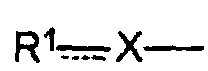
- the most preferable examples of the above-defined X include a group represented by the formula ⁇ (CH2) n ⁇ , a group having an amide group, and groups represented by the above formulae wherein n is 2. Therefore, it is most preferable that any portion of a group represented by the formula have a carbonyl or amide group.
- arylalkyl group is intended to mean an unsubstituted benzyl or phenethyl group, etc.
- pyridylmethyl group examples include 2-pyridylmethyl, 3-pyridylmethyl, and 4-pyridylmethyl groups.
- R 2 include benzyl and phenethyl groups.
- the symbol means either a single or a double bond. This bond is a double bond only when R' is the above-described divalent group (III) derived from an indanone having an unsubstituted or substituted phenyl ring, while it is a single bond in other cases.
- the compounds of the present invention may have an asymmetric carbon atom depending upon the kind of the substituent and, therefore, have stereoisomers. They are, of course, within the scope of the present invention.
- R 1 has an indanone skeleton
- the compound of the present invention has an asymmetric carbon atom and, therefore, may have stereoisomers, optical isomers, diastereomers, etc. All of these isomers are within the scope of the present invention.
- the term "pharmacologically acceptable salt” includes those of inorganic acids, such as hydrochloride, sulfate, hydrobromide, and phosphate, and those of organic acids, such as formate, acetate, trifluoroacetate, methanesulfonate, benzenesulfonate, and toluenesulfonate.
- the compound of the present invention may form, e.g., alkali metal salts such as a sodium or potassium salt, alkaline earth metal-sate such as a calcium or magnesium salt, organic amine salts such as a salt with trimethylamine, triethylamine, pyridine, picoline, dicyclohexylamine, or N,N'-dibenzylethylenediamine.
- alkali metal salts such as a sodium or potassium salt
- alkaline earth metal-sate such as a calcium or magnesium salt
- organic amine salts such as a salt with trimethylamine, triethylamine, pyridine, picoline, dicyclohexylamine, or N,N'-dibenzylethylenediamine.
- the acetylcholinesterase inhibitor compounds of the present invention may be orally or parenterally administered. In general, they are parenterally administered in the form of injections, such as intravenous, subcutaneous, and intramuscular injections, suppositories, or sublingual tablets.
- the dose will vary depending upon the symptoms, age, sex, weight, and sensitivity of patients, method of administration, time and intervals of administration and properties, dispensing, and kind of pharmaceutical preparations, kind of effective ingredients, etc., so that there is no particular limitation with respect to the dose.
- the compound may be administered in a dose of about 0.1 to 300 mg, preferably 1 to 100 mg, per day per patient, ordinarily in one to four portions.
- compositions in the dosage form of, e.g., injections, suppositories, sublingual tablets, tablets, and capsules are prepared according to methods which are commonly accepted in the art.
- the effective ingredient is blended, if necessary, with a pH modifier, a buffer, a suspending agent, a solubilizing agent, a stabilizer, a tonicity agent, a preservative, etc., followed by preparation of an intravenous, subcutaneous, or intramuscular injection according to an ordinary method. In this case, if necessary, it is possible to lyophilize these preparations according to an ordinary method.
- suspending agents examples include methylcellulose, Polysorbate 80, hydroxyethylcellulose, acacia, powdered tragacanth, sodium carboxymethylcellulose, and. polyoxyethylene sorbitan monolaurate.
- solubilizing agent examples include polyoxyethylene hydrogenated castor oil, Polysorbate 80, nicotinamide, polyoxyethylene sorbitan monolaurate, Macrogol, and an ethyl ester of castor oil fatty acid.
- examples of the stabilizer include sodium sulfite, sodium metasulfite, and ether
- examples of the preservative include methyl p-hydroxybenzoate, ethyl p-hydroxybenzoate, sorbic acid, phenol, cresol, and chlorocresol.
- the compounds of the uses of the present invention may be prepared by various processes.
- a representative process for the synthesis of the compound 1-benzyl-4-[(5,6-dimethoxy-1-indanone)-2-yl]-methylpiperidine hydrochloride is detailed below as Example 1.
- Other representative processes for preparing the compounds used in the present invention can be found in U.S. Patent 4,895,841, incorporated herein by reference in its entirety.
- the oil was incorporated into 40 ml of methanol and 40 ml of IN hydrochloric acid was added to the solution. It was heated so as to reflux for 3 hours and then concentrated at a reduced pressure. The residue was dissolved in water. An aqueous solution of sodium hydroxide was added to the solution to give a pH value of 12 and the solution was extracted with methylene chloride. The extract was washed with saturated salt solution and dried with magnesium sulfate. It was further concentrated at a reduced pressure and the residue was purified in a column charged with silica gel. 2.77 g of the intended compound was obtained with a yield of 54 percent.
- This compound may also be produced according to the methods shown in (1) Arm. Kim. Zh., 36(9), 614-17 (1983) by R. A. Kuroyan, A. I. Markosyan, G. M. Snkhchyan and S. A. Vartangan and (2) Ind. Chim. Beige, 32, 64-5 (1967) by B. Hermans and P. Van Daele.
Landscapes
- Health & Medical Sciences (AREA)
- Medicinal Chemistry (AREA)
- Veterinary Medicine (AREA)
- Public Health (AREA)
- General Health & Medical Sciences (AREA)
- Animal Behavior & Ethology (AREA)
- Life Sciences & Earth Sciences (AREA)
- Pharmacology & Pharmacy (AREA)
- Chemical & Material Sciences (AREA)
- Neurosurgery (AREA)
- Engineering & Computer Science (AREA)
- Neurology (AREA)
- Biomedical Technology (AREA)
- Bioinformatics & Cheminformatics (AREA)
- Chemical Kinetics & Catalysis (AREA)
- Nuclear Medicine, Radiotherapy & Molecular Imaging (AREA)
- Organic Chemistry (AREA)
- General Chemical & Material Sciences (AREA)
- Epidemiology (AREA)
- Psychiatry (AREA)
- Hospice & Palliative Care (AREA)
- Pharmaceuticals Containing Other Organic And Inorganic Compounds (AREA)
- Hydrogenated Pyridines (AREA)
- Medicines That Contain Protein Lipid Enzymes And Other Medicines (AREA)
- Acyclic And Carbocyclic Compounds In Medicinal Compositions (AREA)
- Medicines Containing Material From Animals Or Micro-Organisms (AREA)
- Enzymes And Modification Thereof (AREA)
Abstract
Description
- This invention relates to the use of cholinesterase inhibitor compounds for treatment of disorders of attention, such as Attention Deficit Disorder (ADD). The compounds are also useful as a replacement for other substances which patients commonly use to self-medicate for these disorders, and which can have undesirable side effects.
- Disorders of attention are a significant public health problem. Primary attention deficit disorder is estimated to affect 6 to 9 percent of school aged children (Anderson, J.C. et al. Arch. Gen. Psych. 44:69 (1987); Safer, D.J. et al. JAMA 260:2256 (1988)). Well-designed follow-up studies have demonstrated that this disorder is not confined to childhood but is present in up to 50 percent of young adults who have the disorder as children (Mannuzza, S. et al. Arch. Gen. Psych. 50:565; Willens, T.E. et al. In Nadeau, K. Ed. A Comprehensive Guide to Attention Deficit Disorder, Brunne/Mazel, Inc. New York, (1993). This suggests that up to 2 to 4 percent of the adults in the United States may exhibit symptoms of a primary attention deficit disorder. Disorders of attention often lead to poor performance in school and at work and are correlated with antisocial behavior. These behaviors carry a high cost to individuals in lost time and effort, as well as imposing direct costs on society.
- Attention disorders are also associated with indirect costs. For example, there is evidence that patients with attention disorders often "self-medicate" in destructive ways. These patients have a higher than average incidence of cigarette smoking and alcoholism. They also have a higher than average incidence of illegal drug use (Barkley, R.A. In Attention Deficit Hyperactivitiy Disorder, Guilford Press, New York, (1990) Chapter 4, pp. 106-129). Thus, an effective treatment for attention disorders would be also be a useful treatment for some substance dependencies.
- Current approved treatments for attention deficit disorder are limited to drugs that affect amine metabolism in the brain (Spencer, T. et al. J. Am. Acad. Child Adolesc. Psych. 35:409 (1996)). These drugs have significant limitations including side effects and abuse potential, making currently available treatments controversial. Such medications include the stimulants methylphenidate and dextroamphetamine. Pemoline is another stimulant sometimes used to treat attention deficit disorder in children. These stimulant drugs can have cardiac side effects, which are less pronounced in the case of methylphenidate. These stimulants can also cause growth suppression in children, and are potentially addictive for adolescents and adults.
- Current alternatives to stimulants for the treatment of attention disorders are the tricyclic antidepressents and clonidine. The use of tricyclic antidepressants is more likely than the use of stimulants to cause cardiac arrhythmias in children. However, because of the likelihood of stimulant abuse by adolescents and adults with attention disorders, tricyclic antidepressants and clonidine are often tried first (Maxmen, J.S. and Ward, N.G. Essential Psychopathology and Its Treatment, p. 443, Second Edition, Norton & Co., New York, (1995))
- Recent studies have shown that nicotine may be an effective treatment for attention deficit disorder (Levin, E.D. et al. Psychopharmacology 123:55 (1996)). However, nicotine acts at multiple pharmacological sites in the body, can be addictive and also has undesirable side effects, and its mode of action is not known. It is not known, for example, which of nicotine's pharmacological effects are responsible for the increased attention displayed by subjects to whom nicotine was administered.
- Impaired attention may also be a characteristic of Alzheimer's disease, although Alzheimer's patients typically remain alert (Coyle et al., Alzheimer's Disease: A Disorder of Cholinergic Innervation, Science 219:1184-90 (1983)), and the underlying disorders and known treatments are very different (Grady, C.L. et al. J. Clin. Exp. Neuropsychology 10:576 (1988)). Alzheimer's disease involves progressive and profound loss of memory, postulated to involve a deficiency in brain cortical acetylcholine affecting cholinergic synapses. This deficiency is thought to be caused by selective degeneration of acetylcholine-releasing neurons (Coyle, supra). Disorders of attention and ADD, which are concerned with mental concentration as opposed to memory, are not thought to be caused by acetylcholine defficiencies.
- Certain synapses of the brain use acetylcholine as a neural transmitter, to transmit messages across the synapse to a cholinergic receptor. During normal transmission, acetylcholine crosses the synaptic gap to carry the message by stimulating the cholinergic receptor. Memory is thought to be related, at least in part, to post-synaptic changes which occur as a result of the timing and strength of acetylcholine stimulation during learning, with certain experiences tending to block or facilitate corresponding neural pathways, i.e. making it more or less difficult to stimulate the same post-synaptic receptor at a future time (Deutsch, The Cholinergic Synapse and the Site of Memory, Science 174:788-94 (1971)). Acetylcholine also is rapidly destroyed by the enzyme cholinesterase. Thus, insufficient acetylcholine or excess cholinesterase can interfere with synaptic transmission by too rapidly destroying the acetylcholine message, resulting in weak cholinergic stimulation which can be experienced as memory loss. When this condition is chronic, i.e. from degeneration of acetylcholine-releasing neurons, the Alzheimer's syndrome may develop. One way of counteracting this imbalance is by interfering with the ability of cholinesterase to degrade acetylcholine, as by treatment with a cholinesterase inhibitor (Sugimoto et al., U.S. Patent No. 4,895,841).
- Attention is related to memory in that attention is a prerequisite to memory. Disorders of attention or learning, including ADD, do not typically involve memory loss, and are characterized by symptoms such as motor restlessness, short attention span, poor concentration and organizational skills, impulsive behavior, and lack of task persistence. The cause or causes of ADD is unknown. Several theories have been proposed, and include impaired ability of the frontal lobes to process current experiences and integrate them with memory (frontal lobe disinhibition), as well as abnormalities or imbalances in one or more of dopamine and norepinephrine in the brain (the catecholemine hypothesis). However, studies of these catecholamines in both animals and man, as well as other neurotransmitters such as serotonin, have yielded inconsistent results regarding the biochemical basis for ADD. Although impaired use of dopamine, norepinephrine, and serotonin is implicated in ADD, the underlying neurochemical dysfunction is not well understood, nor are there satisfactory and well-recognized therapies for ADD.
- Thus, a need exists for additional therapies which effectively treat disorders of attention generally, and ADD specifically. Therapies which are specific to loss of attention, and which are not addictive, do not promote cardiac imbalance, and do not have other undesirable characteristics are particularly needed.
- It has now been surprisingly discovered that augmentation of cholinergic transmission is an effective treatment for attention deficit disorder. It has also been discovered that the compounds of this invention are useful for the treatment of disorders of attention, including attention deficit disorder.
- Cholinesterase inhibitors provide one method of augmenting cholinergic transmission. They tend to be associated with fewer side effects than other methods because they augment the effects of endogenous acetylcholine rather than acting directly.
- Additionally, cholinesterase inhibitors are more specific to areas of the body where endogenous acetylcholine is being released. They have a longer duration of action than nicotine, which is rapidly metabolized. Donepezil hydrochloride and its congeners are cholinesterase inhibitors that offer the additional advantage of specificity for acetylcholinesterase, the predominant form of the enzyme in the brain. For example, donepezil hydrochloride has approximately 1200-fold specificity for acetylcholinesterase relative to butyrlcholinesterase, the most common cholinesterase outside the brain and central nervous system.
- The present invention provides the use of a cholinesterase inhibitor in the manufacture of a medicament for use in treating attention deficit hyperactivity disorder in a human.
- Preferably, the cholinesterase inhibitor has the formula:in which J is

- (a) a group, substituted or unsubstituted, selected from the group consisting of (1) phenyl, (2) pyridyl, (3) pyrazyl, (4) quinolyl, (5) cyclohexyl, (6) quinoxalyl and (7) furyl;
- (b) a monovalent or divalent group, in which the phenyl may have a substituent(s), selected from the group consisting of (1) indanyl, (2) indanonyl, (3) indenyl, (4) indenonyl. (5) indanedionyl, (6) tetralonyl, (7) benzosuberonyl, (8) indanolyl and (9) C6 H5 ―CO―CH(CH3)―;
- (c) a monovalent group derived from a cyclic amide compound;
- (d) a lower alkyl or
- (e) a group of R21 ―CH=CH― in which R21 is hydrogen or a lower
alkoxycarbonyl;
- B is ―(CHR22)r―, ―CO―(CHR22)r―, ―NR4―(CHR22)r―, R4 being hydrogen, a lower alkyl, an acyl, a lower alkylsulfonyl, phenyl, a substituted phenyl, benzyl or a substituted benzyl, ―CO―NR5―(CHR22)r―, R5 being hydrogen, a lower alkyl or phenyl, ―CH=CH ―(CHR22)r―, ―OCOO―(CHR22)r―, ―OOC―NH―(CHR22)r―, ―NH-CO-(CHR22)r―, ―CH2―CO―NH―(CHR22)r―, ―(CH2)2―NH―(CHR22)r―, ―CH(OH)―(CHR22)r―, r being zero or an integer of 1 to 10, R22 being hydrogen or methyl so that one alkylene group may have no methyl branch or one or more methyl branch, =(CH―CH=CH)b―, b being an integer of 1 to 3, =CH―(CH2)c―, c being zero or an integer of 1 to 9, =(CH―CH)d=, d being zero or an integer of 1 to 5; ―CO―CH=CH―CH2―, ―CO―CH2―CH(OH)―CH2―, ―CH(CH3)―CO―NH―CH2―, ―CH=CH―CO―NH―(CH2)2―, ―NH―, ―O―, ―S―, a dialkylaminoalkylcarbonyl or a lower alkoxycarbonyl;
- T is a nitrogen or carbon;
- Q is nitrogen, carbon or
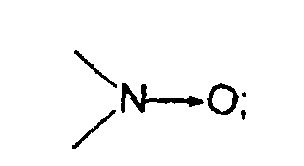
- and q is an integer of 1 to 3;
- K is hydrogen, phenyl, a substituted phenyl, an arylalkyl in which the phenyl
may have a substituent, cinnamyl, a lower alkyl, pyridylmethyl, a cycloalkylalkyl,
adamantanemethyl, furylmenthyl, a cycloalkyl, a lower alkoxycarbonyl or an acyl; and
shows a single bond or a double bond.

-
- In the compounds having the formula (XXV), it is preferable that J is (a) or (b). In the definition (b), monovalent groups of (2), (3) and (5) and divalent groups of (2) are preferable. In the definition of B, ―(CHR22)r―, =(CH―CH=CH)b―, =CH―(CH2)c― and =(CH―CH)d= are preferable. These preferable groups of (B) may be connected with (b) of J, in particular (2) of (b).
- It is preferable in the formula (XXV) that Q is nitrogen, T is carbon and q is 1 or 3; and Q is carbon, T is nitrogen and q is 2. It is most preferable that Q is nitrogen, T is carbon and q is 2.
- It is preferable that K is a phenylalkyl or a phenylalkyl having a substituent(s) on the phenyl.
- Preferable compounds have the above shown formula in which J is (b). The group (b) includes ten groups having the respective formulae shown below. S is hydrogen or a substituent such as a lower alkyl having 1 to 6 carbon atoms and a lower alkoxy having 1 to 6 carbon atoms and t is an integer of 1 to 4. Among the substituents, methoxy is most preferred. The phenyl is most preferred to have 1 to 3 methoxy groups. (S), may form a methylene dioxy group or ethylene dioxy group on two adjacent carbon atoms of the phenyl group.
- A preferable definition of B includes ―(CHR22)r―, ―CO―(CHR22)r―, =(CH―CH=CH)b―, =CH―(CH2)c― and =(CH―CH)d=. The group ―(CHR22)r― in which R22 is hydrogen and r is an integer of 1 to 3 and then the group =CH―(CH2)c― are most preferable.
- In the above defined cyclic amine compounds of the methods of the invention, it is preferable that J in the formula is (b), the monovalent or divalent group. In the definition (b), indanonyl, indanedionyl and indenyl are most preferable, optionally having one or more substituents on the phenyl.
- In the definition B,―(CHR22)r― and =CH―(CH2)c― are preferable.
- The ring including T and Q may be a 5-, 6-or 7-membered ring. It is preferable that Q is nitrogen, T is carbon or nitrogen and n is 2; Q is nitrogen, T is carbon and n is 1 or 3; and Q is carbon, T is nitrogen and n is 2.
- In the definition K, phenyl, an arylalkyl and cinnamyl are preferable, optionally having one or more substituents on the phenyl. (b) Substituents
- More preferably, the cholinesterase inhibitor is a cyclic amine compound of the formula:wherein

- r is an integer of 1 to 10, R22 is hydrogen or methyl
and the R22 radicals can be the same or different when r is from 2 to 10; - K is phenalkyl or phenalkyl having a substituent on the phenyl ring;
- S is hydrogen or a substituent on the phenyl ring, and
- t is an integer of 1 to 4, with the proviso that (S)t can be a methylenedioxy group or an ethylenedioxy group joined to two adjacent carbon atoms of the phenyl ring; and
- q is an integer of I to 3
or a pharmacologically acceptable salt thereof. -
- More preferably, the cyclic amine compound is:
- 1-benzyl-4-((5,6-dimethoxy-1-indanon)-2-yl)methylpiperidine;
- I-benzyl-4-((5,6-dimethoxy-1-indanon)-2-ylidenyl)methylpiperidine;
- l-benzyl-4-((5-methoxy-1-indanon)-2-yl)methylpiperidine;
- 1-benzyl-4-((5,6-diethoxy-1-indanon)-2-yl)methylpiperidine;
- 1-benzyl-4-((5,6-methnylenedioxy-1-indanon)-2-yl)methylpiperidine;
- 1-(m-nitrobenzyl)-4-((5,6-dimethoxy-1-indanon)-2-yl)methylpiperidine;
- 1-cyclohexymethyl-4-((5,6-dimethoxy-1-indanon)-2-yl)methylpiperidine;
- 1-(m-fluorobenzyl)-4-((5,6-dimethoxy-1-indanon)-2-yl)methylpiperidine;
- 1-benzyl-4-((5,6-dimethoxy-1-indanon)-2-yl)propylpiperidine;
- 1-benzyl-4-((5-isopropoxy-6-methoxy-1-indanon)-2-yl)methylpiperidine; or
- 1-benzyl-4-((5,6-dimethoxy-1-oxoindanon)-2-yl)propenylpiperidine.
-
- Most preferably, the cyclic amine compound is 1-benzyl-4-((5,6-dimethoxy-1-indanon)- 2-yl)methylpiperidine.

- The invention is explained in detail in view of the piperidine compounds which fall within the scope of the above defined compounds of formula XXV. It will be understood, however, that this explanation applies to the use of the entire group of cyclic amine compounds for the treatment of attention disorders.
- The piperidine compounds of the methods of the invention are defined by the formula (I):wherein R1 is the following substituted or unsubstituted group: 1) a phenyl group, 2) a pyridyl group, 3) a pyrazyl group, 4) a quinolyl group, 5) an indanyl group, 6) a cyclohexyl group, 7) a quinoxalyl group, or 8) a furyl group; a monovalent or divalent group derived from an indanone having an unsubstituted or substituted phenyl ring; a monovalent group derived from a cyclic amide, compound; a lower alkyl group or a group represented by the formula R3―CH=C― (wherein R3 is a hydrogen atom or a lower alkoxycarbonyl group),

- X is a member selected from the group represented by the formulas






 a dialkylaminoalkylcarbonyl group, and a lower alkoxycarbonyl group, wherein R4 is a hydrogen atom, a lower alkyl group, an acyl group, a lower alkylsulfonyl group, or a substituted or unsubstituted phenyl or benzyl and R5 is a hydrogen atom, a lower alkyl group, or a phenyl group, and wherein the n's in the above definition of X are each independently an integer of 0 to 6,
- R2 is a substituted or unsubstituted phenyl group, a substituted or unsubstituted arylalkyl group, a cinnamyl group, a lower alkyl group, a pyridylmethyl group, a cycloalkylalkyl group, an adamantanemethyl group, or a furoylmethyl group, and the symbol,means a single bond or a double bond.

- The term "lower alkyl group" used in the above definition of R1, R2, R4 and R5 with respect to the compound (I) of the present invention is intended to mean a straight-chain or branched alkyl group having 1 to 6 carbon atoms, and examples thereof include methyl, ethyl, propyl, isopropyl, butyl, isobutyl, sec-butyl, tert-butyl, pentyl (amyl), isopenthyl, neopentyl, tert-pentyl, 1-methylbutyl, 2-methylbutyl, 1,2-dimethylpropyl, hexyl, isohexyl, 1-methylpentyl, 2-methylpentyl, 3-methylpentyl, 1,1-dimethylbutyl, 1,2-dimenthylbutyl, 2,2-dimethylbutyl, 1,3-dimethylbutyl, 2,3-dimenthylbutyl, 3,3-dimethylbutyl, 1-ethylbutyl, 2-ethylbutyl, 1,1,2-trimethylpropyl, 1,2,2-trimethylpropyl, 1-ethyl-1-methylpropyl, and 1-ethyl-2-methylpropyl groups. Among these, methyl, ethyl, propyl, and isopropyl groups are preferable. A methyl group is the most preferable.
- Examples of the substituents (1)-(8) in the definition of R1 above include lower alkyl groups having 1 to 6 carbon atoms, such as methyl, ethyl, n-propyl, isopropyl, n-butyl, isobutyl, and tert-butyl groups; lower alkoxy groups corresponding to the above-described lower alkyl groups, such as methoxy and ethoxy groups; a nitro group; halogen atoms such as chlorine, bromine, and fluorine; a carboxyl group; lower alkoxycarbonyl groups corresponding to the above-described lower alkoxy groups, such as methoxycarbonyl, ethoxycarbonyl, isopropoxycarbonyl, n-propoxycarbonyl, and n-butyloxycarbonyl groups; an amino group; a lower monoalkylamino group; a lower dialkylamino group, a carbamoyl group; acylamino groups derived from aliphatic saturated monocarboxylic acids having 1 to 6 carbon atoms, such as acetylamino, propionylamino, butyrylamino, isobutyrylamino, valerylamino, and pivaloylamino groups; cycloalkyloxycarbonyl groups such as a cyclohexyloxycarbonyl group; lower alkylaminocarbonyl groups such as methylaminocarbonyl and ethylaminocarbonyl groups; lower alkylcarbonyloxy groups corresponding to the above-defined lower alkyl groups, such as methylcarbonyloxy, ethylcarbonyloxy, and n-propylcarbonyloxy groups; halogentated lower alkyl groups including a trifluoromethyl group; a hydroxyl group; a formyl group; and lower alkoxy lower alkyl groups such as ethoxymethyl, methoxymethyl, and methoxyethyl groups. The "lower alkyl groups" and "lower alkoxyl groups" in the above description of the substituent include all the groups derived from the above-mentioned groups. The substitutent may be one to three of them which may be the same or different.
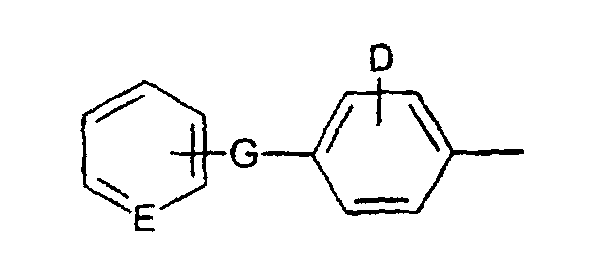
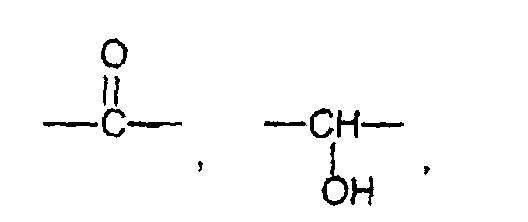
- When the substitutent is a phenyl group, the following group is within the scope of the substituted phenyl group:wherein G is a member of a group selected from the formulas ―O―, ―CH2―O―,―CH2 ―SO2
 and a group represented by the formula
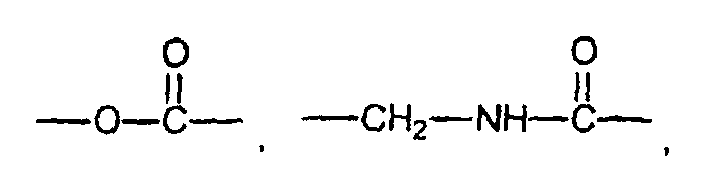 and E is a carbon or nitrogen atom.
- Preferable examples of the substituents for the phenyl group include lower alkyl, lower alkoxy, nitro, halogenated lower alkyl, lower alkoxycarbonyl, formyl, hydroxyl, and lower alkoxy lower alkyl groups, halogen atoms, and benzoyl and benzylsulfonyl groups. The substituent may be two or more of them which may be the same or different.
- Preferable examples of the substituent for the pyridyl group include lower alkyl and amino groups and halogen atoms.
- Preferable examples of the substituent for the pyrazyl group include lower alkoxycarbonyl, carboxyl, acylamino, carbamoyl, and cycloalkyloxycarbonyl groups.
- With respect to R1, the pyridyl group is preferably a 2-pyridyl, 3-pyridyl, or 4-pyridyl group; the pyrazyl group is preferably a 2-pyrazinyl group; the quinolyl group is preferably a 2-quinolyl or 3-quinolyl group; the quinoxalinyl group is preferable a 2-quinoxalinyl or 3-quinoxalinyl group; and the furyl group is preferably a 2-furyl group.
- Specific examples of preferable monovalent or divalent group derived from an indanone having an unsubstituted or substituted phenyl ring include those represented by the following formulae (II) and (III):
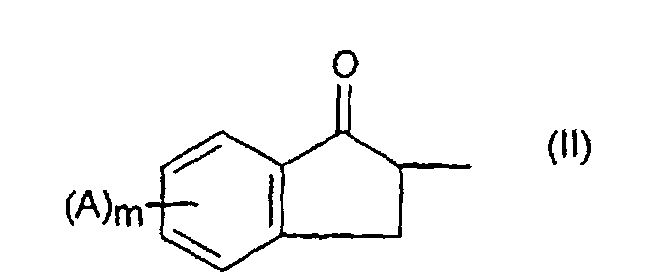 wherein each m is an integer from 1 to 4 and each A, which may be the same or different, is one of the substituents described in the above items (1) to (8) of the definition of R1 or a hydrogen atom, preferably a hydrogen atom (i.e. unsubstituted), a lower alkyl group, or a lower alkoxy group, and most preferably the indanone group is unsubstituted or substituted with 1 to 3 methoxy groups.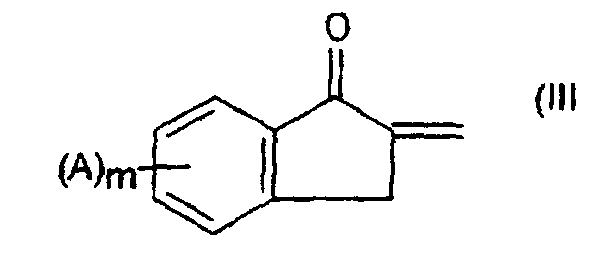
- Examples of the monovalent group derived from a cyclic amide compound include quinazolone, tetrahydroisoquinolinone, tetrahydrobenzodiazepinone, and hexahydrobenzazocinone. However, the monovalent group may be any one having a cyclic amide group in the structural formula thereof and is not limited to the above-described specific examples only. The cyclic amide group may be one derived from a monocyclic or condensed heterocyclic ring. The condensed heterocylcic ring is preferably one formed by condensation with a phenyl ring. In this case, the phenyl ring may be substituted with a lower alkyl group having 1 to 6 carbon atoms, preferably a methyl group, or a lower alkoxy group having 1 to 6 carbon atoms, preferably a methoxy group. Preferable examples of the monovalent group include the following groups:

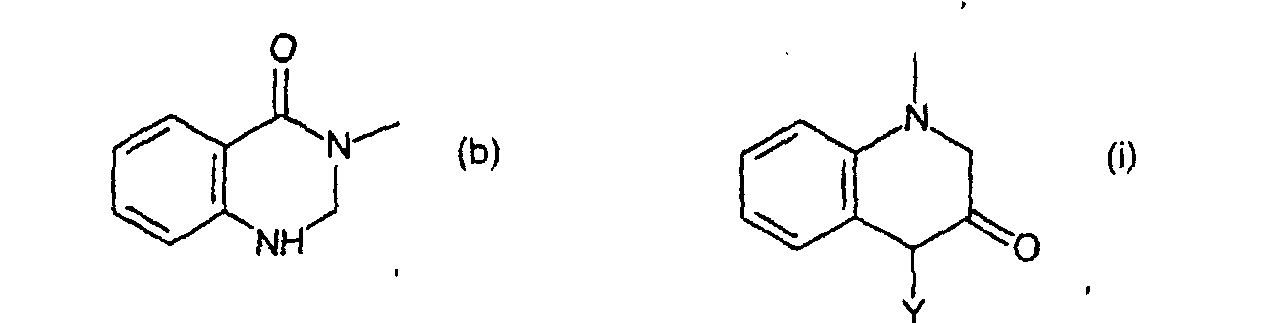

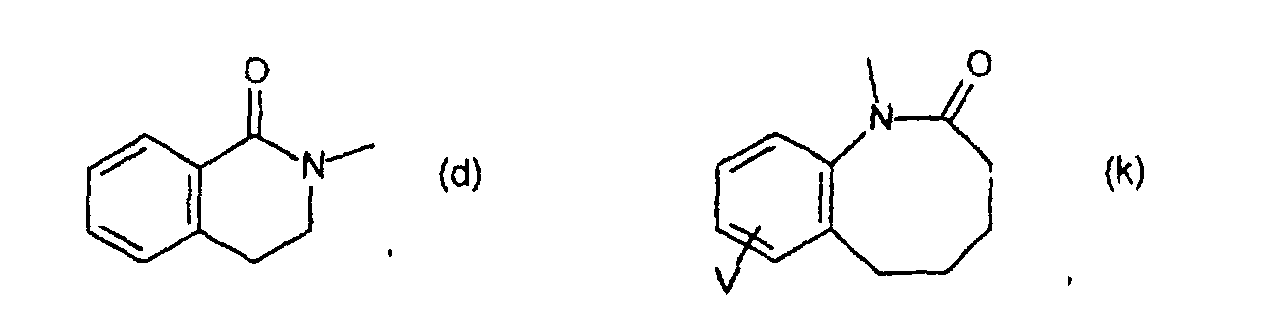


- In the above formulae, Y's in the formulae (i) and (1) are each a hydrogen atom or a lower alkyl group, V in the formula (k) is a hydrogen atom or a lower alkoxy group, W1 and W2 in the formulae (m) and (n) are each a hydrogen atom, a lower alkyl group, or a lower alkoxy group and W3 is a hydrogen atom or a lower alkyl group.
- The right-hand ring in each of the formulae (j) and (1) is a seven-membered ring, while the right-hand ring in the formula (k) is an eight-membered ring.
- The most preferable examples of the above-defined R1 include a monovalent group derived from an indanone having an unsubstituted or substituted phenyl group and a monovalent group derived from a cyclic amide compound.
- The most preferable examples of the above-defined X include a group represented by the formula ―(CH2)n―, a group having an amide group, and groups represented by the above formulae wherein n is 2. Therefore, it is most preferable that any portion of a group represented by the formulahave a carbonyl or amide group.
- The substituents involved in the expressions "a substituted or unsubstituted phenyl group" and "a substituted or unsubstituted arylalkyl group" in the above definition of R2 are the same as those described in the above items (1) to (8) of the definition for R1.
- The term "arylalkyl group" is intended to mean an unsubstituted benzyl or phenethyl group, etc.
- Specific examples of the pyridylmethyl group include 2-pyridylmethyl, 3-pyridylmethyl, and 4-pyridylmethyl groups.
- Preferable examples of R2 include benzyl and phenethyl groups. The symbol
means either a single or a double bond. This bond is a double bond only when R' is the above-described divalent group (III) derived from an indanone having an unsubstituted or substituted phenyl ring, while it is a single bond in other cases.
- Moreover, the compounds of the present invention may have an asymmetric carbon atom depending upon the kind of the substituent and, therefore, have stereoisomers. They are, of course, within the scope of the present invention.
- When R1 has an indanone skeleton, the compound of the present invention has an asymmetric carbon atom and, therefore, may have stereoisomers, optical isomers, diastereomers, etc. All of these isomers are within the scope of the present invention.
- In the present invention, the term "pharmacologically acceptable salt" includes those of inorganic acids, such as hydrochloride, sulfate, hydrobromide, and phosphate, and those of organic acids, such as formate, acetate, trifluoroacetate, methanesulfonate, benzenesulfonate, and toluenesulfonate. Further, when a certain kind of substituent is selected, the compound of the present invention may form, e.g., alkali metal salts such as a sodium or potassium salt, alkaline earth metal-sate such as a calcium or magnesium salt, organic amine salts such as a salt with trimethylamine, triethylamine, pyridine, picoline, dicyclohexylamine, or N,N'-dibenzylethylenediamine.
- The acetylcholinesterase inhibitor compounds of the present invention may be orally or parenterally administered. In general, they are parenterally administered in the form of injections, such as intravenous, subcutaneous, and intramuscular injections, suppositories, or sublingual tablets. The dose will vary depending upon the symptoms, age, sex, weight, and sensitivity of patients, method of administration, time and intervals of administration and properties, dispensing, and kind of pharmaceutical preparations, kind of effective ingredients, etc., so that there is no particular limitation with respect to the dose. Normally the compound may be administered in a dose of about 0.1 to 300 mg, preferably 1 to 100 mg, per day per patient, ordinarily in one to four portions.
- Pharmaceutical preparations in the dosage form of, e.g., injections, suppositories, sublingual tablets, tablets, and capsules are prepared according to methods which are commonly accepted in the art.
- In preparing injections, the effective ingredient is blended, if necessary, with a pH modifier, a buffer, a suspending agent, a solubilizing agent, a stabilizer, a tonicity agent, a preservative, etc., followed by preparation of an intravenous, subcutaneous, or intramuscular injection according to an ordinary method. In this case, if necessary, it is possible to lyophilize these preparations according to an ordinary method.
- Examples of the suspending agents include methylcellulose, Polysorbate 80, hydroxyethylcellulose, acacia, powdered tragacanth, sodium carboxymethylcellulose, and. polyoxyethylene sorbitan monolaurate.
- Examples of the solubilizing agent include polyoxyethylene hydrogenated castor oil, Polysorbate 80, nicotinamide, polyoxyethylene sorbitan monolaurate, Macrogol, and an ethyl ester of castor oil fatty acid.
- Examples of the stabilizer include sodium sulfite, sodium metasulfite, and ether, and examples of the preservative include methyl p-hydroxybenzoate, ethyl p-hydroxybenzoate, sorbic acid, phenol, cresol, and chlorocresol.
- The compounds of the uses of the present invention may be prepared by various processes. A representative process for the synthesis of the compound 1-benzyl-4-[(5,6-dimethoxy-1-indanone)-2-yl]-methylpiperidine hydrochloride is detailed below as Example 1. Other representative processes for preparing the compounds used in the present invention can be found in U.S. Patent 4,895,841, incorporated herein by reference in its entirety.
- 1-benzyl-4-((5,6-dimethoxy-1-indanon)-2-yl)methylpiperidine
- 1-benzyl-4-piperidine-carboaldehyde having the formula:was prepared in the following way.
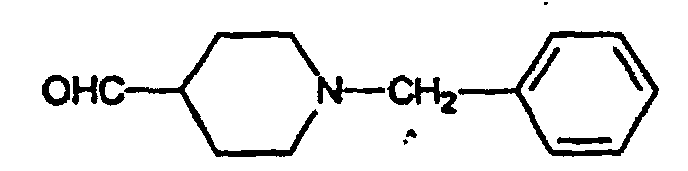
- 26 grams of methoxymethylene-triphenylphosophonium chloride was suspended in 200 ml of anhydrous ether. A 1.6M solution in hexane of n-butyl lithium was added dropwise to the suspension at room temperature. The mixture was stirred at room temperature for 30 minutes and cooled down to 0°C. Then 30 ml of a solution in anhydrous ether of 14.35 g.of 1-benzyl-4-piperidone was added to the mixture. It was stirred at room temperature for 3 hours and filtrated to remove the insolubles. The filtrate liquid was concentrated at a reduced pressure. The obtained concentrate was dissolved in ether and extracted with IN hydrochloric acid. An aqueous solution of sodium hydroxide was added to the extract to give a pH value of 12, followed by extraction with methylene chloride. The extract was dried with magnesium sulfate and concentrated at a reduced pressure. The residue was purified with a column filled with silica gel to obtain 5.50 g of an oil with a yield of 33 percent.
- The oil was incorporated into 40 ml of methanol and 40 ml of IN hydrochloric acid was added to the solution. It was heated so as to reflux for 3 hours and then concentrated at a reduced pressure. The residue was dissolved in water. An aqueous solution of sodium hydroxide was added to the solution to give a pH value of 12 and the solution was extracted with methylene chloride. The extract was washed with saturated salt solution and dried with magnesium sulfate. It was further concentrated at a reduced pressure and the residue was purified in a column charged with silica gel. 2.77 g of the intended compound was obtained with a yield of 54 percent. In analysis, its molecular formula was found to be C13H17NO and 1H--NMR (CDCl3)δ, 1.40-2.40 (7H, m), 2.78 (2H, dt), 3.45 (2H, S), 7.20 (5H, S), 9.51 (1H, d).
- This compound may also be produced according to the methods shown in (1) Arm. Kim. Zh., 36(9), 614-17 (1983) by R. A. Kuroyan, A. I. Markosyan, G. M. Snkhchyan and S. A. Vartangan and (2) Ind. Chim. Beige, 32, 64-5 (1967) by B. Hermans and P. Van Daele.
- 1-Benzyl-4-[(5,6-dimethoxy-1-indanon)-2-ylidenyl-methylpiperidine hydrochloride:was prepared via a reaction conducted in an argon atmosphere.
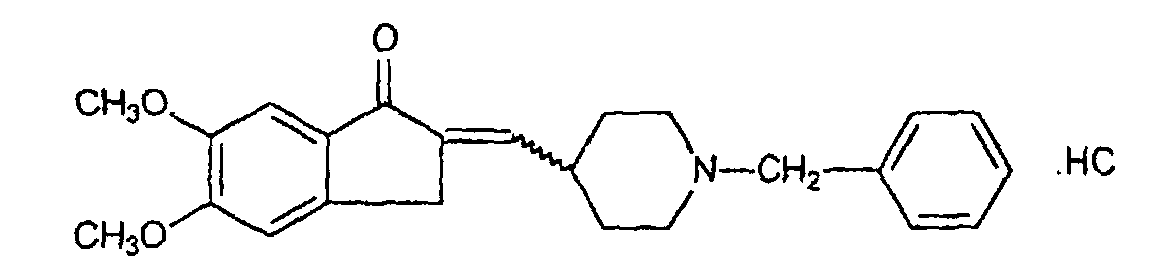
- 2.05 ml of diisopropylamine was added to 10 ml of anhydrous THF, followed by addition of 9.12 ml of a 1.6M solution of n-butyllithium in hexane at 0°C. The mixture was stirred at 0°C. for 10 min and then cooled to -78°C., and a solution of 2.55 g of 5,6-dimethoxy-1-indanone in 30 ml of anhydrous THF and 2.31 ml of hexamethyl-phosphoric amide were added . The mixture was stirred at -78°C. for 15 min, and a solution of 2.70 g of 1-benzyl-4-piperidinecarboaldehyde in 30 ml of anhydrous THF was added . The temperature of the mixture was gradually raised to room temperature, followed by stirring for 2 hr. An aqueous 1% ammonium chloride solution was added , and the organic phase was separated. The water phase was extracted with ethyl acetate, and the organic phases were combined with each other. The combined organic phase was washed with a saturated saline solution, dried over magnesium sulfate, and concentrated in vacuo. The resulting residue was purified on a silica gel column (methylene chloride:methanol=500:1-100: 1). The eluate was concentrated in vacuo, and the residue was dissolved in methylene chloride. A 10% solution of hydrochloric acid in ethyl acetate was added to the resulting solution, followed by concentration in vacuo to obtain a crystal, which was recrystallized from methanol/IPE to obtain 3.40 g (yield: 62%) of the title compound having the following properties: m.p. (°C.): 237°-238°C. (dec.) elementary analysis: C24 H7NO3.HCl. C (69.64% calculated; 69.51% found). H (6.82% calculated; 6.78% found). N (3.38% calculated; 3.30% found).
- 1-Benzyl-4-[(5,6-dimethoxy-1-indanon)-2-yl]-methylpiperidine hydrochloride (donepezil hydrochloride):was prepared from the precursors as follows.
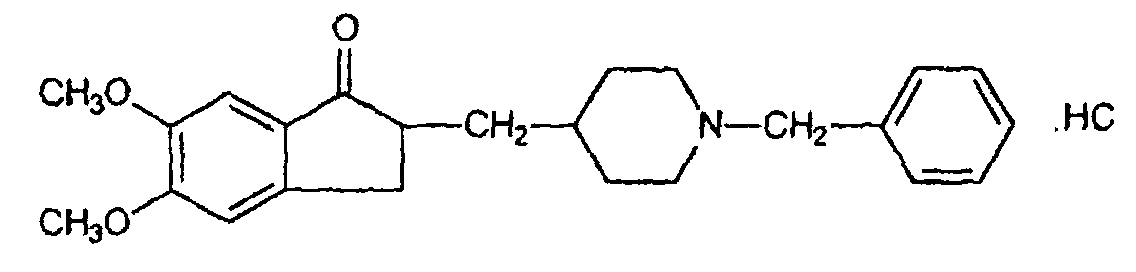
- 0.4 g of 1-benzyl-4-[(5,6-dimethoxy-1-indanon)-2-ylidenyl]methylpiperidine was dissolved in 16 ml of THF, followed by addition of 0.04 g of 10% palladium-carbon. The mixture was hydrogenated at room temperature under atmospheric pressure for 6 hr. The catalyst was filtered off, and the filtrate was concentrated in vacuo. The residue was purified. by making use of a silica gel column (methylene chloride: methanol=50: 1). The eluate was concentrated in vacuo, and the residue was dissolved in methylene chloride. A 10% solution of hydrochloric acid in ethyl acetate was added to the resulting solution, followed by concentration in vacuo to obtain a crystal, which was recrystallized from methanol/IPE to obtain 0.36 g (yield: 82%) of the title compound having the following properties: m.p. (°C.): 211°-212°C. (dec.) elementary analysis: C24H29NO3.HCl. C (69.30% calculated; 69.33% found). H (7.27% calculated; 7.15% found); N (3.37% calculated; 3.22% found).
- Beneficial effects of donepezil hydrochloride on attention were observed in a study of healthy volunteers who received single 5 or 10 mg daily doses for a total of 3 weeks. One of these subjects had been suffering from a disorder of attention since childhood. He reported that he was able to concentrate better during treatment. As a result of his increased concentration, he was able to complete a music project, which would normally have required more time, in one sitting. A second volunteer reported that he was less distracted and was able to concentrate on specific tasks longer during treatment with donezipil hydrochloride. These benefits wore off after treatment was discontinued.
- Collectively, these results indicate that the administration of cholinesterase inhibitors, and in particular the compounds of the invention, surprisingly improves attention in humans, including healthy volunteers given a task to perform, and persons suffering from disorders of attention such as ADD.
Claims (11)
- Use of a cholinesterase inhibitor in the manufacture of a medicament for use in treating attention deficit hyperactivity disorder in a human.
- The use of claim 1, wherein the cholinesterase inhibitor is a cyclic amine compound of the formula:wherein
 r is an integer of 1 to 10, R22 is hydrogen or methyl
and the R22 radicals can be the same or different when r is from 2 to 10;K is phenalkyl or phenalkyl having a substituent on the phenyl ring;S is hydrogen or a substituent on the phenyl ring, andt is an integer of 1 to 4, with the proviso that (S)t can be a methylenedioxy group or an ethylenedioxy group joined to two adjacent carbon atoms of the phenyl ring; andq is an integer of 1 to 3 or a pharmacologically acceptable salt thereof. - The use of claim 2, wherein said cyclic amine compound is:1-benzyl-4-((5,6-dimethoxy-1-indanon)-2-yl)methylpiperidine;1-benzyl-4-((5,6-dimethoxy-1-indanon)-2-ylidenyl)methylpiperidine;1-benzyl-4-((5-methoxy-1-indanon)-2-yl)methylpiperidine;1-benzyl-4-((5,6-diethoxy-1-indanon)-2-yl)methylpiperidine;1-benzyl-4-((5,6-methnylenedioxy-1-indanon)-2-yl)methylpiperidine;1-(m-nitrobenzyl)-4-((5,6-dimethoxy-1-indanon)-2-yl)methylpiperidine;1-cyclohexymethyl-4-((5,6-dimethoxy-1-indanon)-2-yl)methylpiperidine;1-(m-florobenzyl)-4-((5,6-dimethoxy-1-indanon)-2-yl)methylpiperidine;1-benzyl-4-((5,6-dimethoxy-1-indanon)-2-yl)propylpiperidine;1-benzyl-4-((5-isopropoxy-6-methoxy-1-indanon)-2-yl)methylpiperidine; or1-benzyl-4-((5,6-dimethoxy-1-oxoindanon)-2-yl)propenylpiperidine.
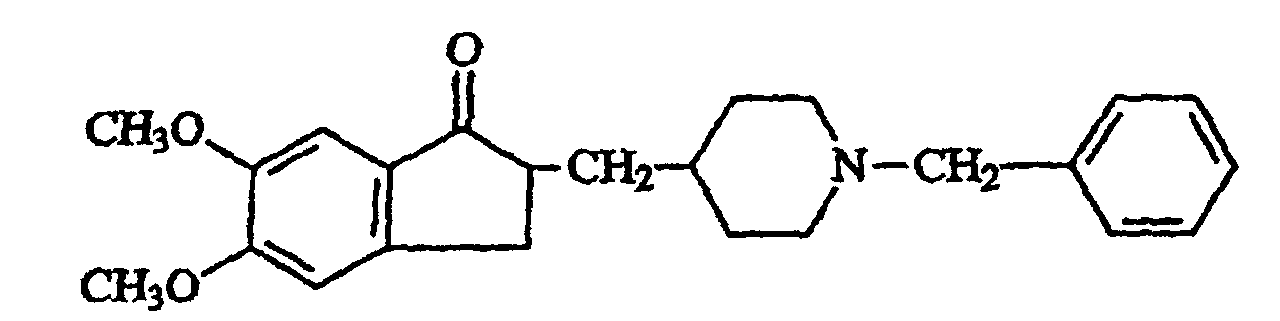
- The use of claim 3, wherein said cyclic amine compound is 1-benzyl-4-((5,6-dimethoxy-1-indanon)-2-yl)methylpiperidine.
- The use of claim 2 wherein the cyclic amine compound is of the formula:or a stereoisomer thereof.
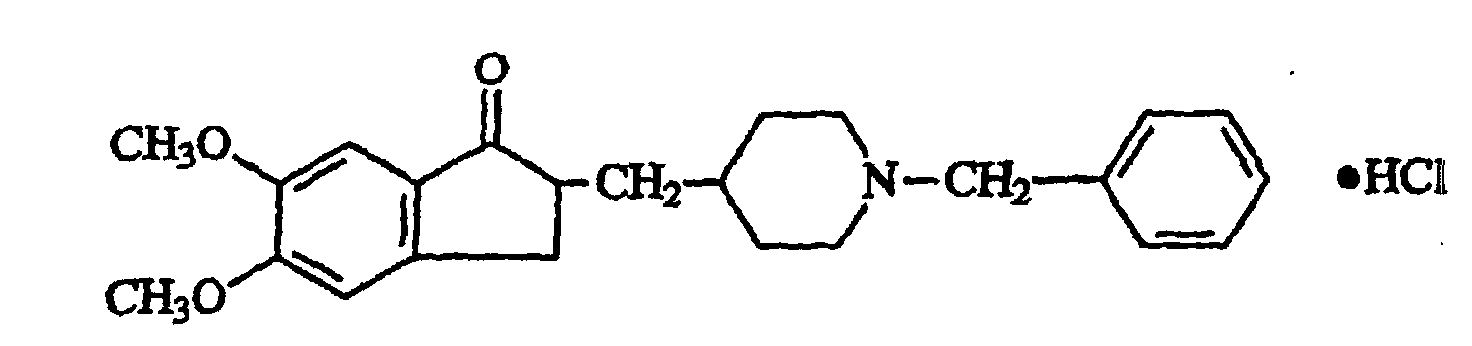
- The use of claim 2 wherein the pharmaceutically acceptable salt of the cyclic amine compound is of the formula:or a stereoisomer thereof.
- The use of claim 5 wherein the cyclic amine compound is donepezil.
- The use of claim 6 wherein the pharmaceutically acceptable salt of the cyclic amine compound is donepezil hydrochloride.
- The use of any one of claims 1 to 8, wherein the medicament contains from 1 to 100 mg of the cholinesterase inhibitor.
- The use of any one of claims 1 to 9, wherein the medicament contains from 5 to 10 mg of the cholinesterase in hibitor.
- The use of any one of claims 1 to 10 further comprising administering a pharmaceutically acceptable carrier.
Applications Claiming Priority (3)
| Application Number | Priority Date | Filing Date | Title |
|---|---|---|---|
| US3983297P | 1997-03-03 | 1997-03-03 | |
| US39832P | 1997-03-03 | ||
| PCT/IB1998/000508 WO1998039000A1 (en) | 1997-03-03 | 1998-03-03 | Use of cholinesterase inhibitors to treat disorders of attention |
Publications (2)
| Publication Number | Publication Date |
|---|---|
| EP0971713A1 EP0971713A1 (en) | 2000-01-19 |
| EP0971713B1 true EP0971713B1 (en) | 2003-05-28 |
Family
ID=21907565
Family Applications (1)
| Application Number | Title | Priority Date | Filing Date |
|---|---|---|---|
| EP98905121A Expired - Lifetime EP0971713B1 (en) | 1997-03-03 | 1998-03-03 | Use of cholinesterase inhibitors to treat disorders of attention |
Country Status (12)
| Country | Link |
|---|---|
| US (2) | US6455544B1 (en) |
| EP (1) | EP0971713B1 (en) |
| JP (1) | JP4095676B2 (en) |
| AT (1) | ATE241358T1 (en) |
| AU (1) | AU743609B2 (en) |
| CA (1) | CA2282654C (en) |
| DE (1) | DE69815090T2 (en) |
| DK (1) | DK0971713T3 (en) |
| ES (1) | ES2200313T3 (en) |
| NZ (1) | NZ337515A (en) |
| PT (1) | PT971713E (en) |
| WO (1) | WO1998039000A1 (en) |
Families Citing this family (49)
| Publication number | Priority date | Publication date | Assignee | Title |
|---|---|---|---|---|
| DK0971713T3 (en) * | 1997-03-03 | 2003-09-22 | Eisai Co Ltd | Use of cholinesterase inhibitors to treat attention disorders |
| GB9716879D0 (en) * | 1997-08-08 | 1997-10-15 | Shire Int Licensing Bv | Treatment of attention deficit disorders |
| US6429207B1 (en) | 1997-11-21 | 2002-08-06 | Nps Pharmaceuticals, Inc. | Metabotropic glutamate receptor antagonists and their use for treating central nervous system diseases |
| US20030153598A1 (en) * | 2000-07-25 | 2003-08-14 | Raymond Pratt | Methods for treating Parkinson's disease with cholinesterase inhibitors |
| US20060183776A9 (en) * | 2000-03-03 | 2006-08-17 | Eisai Co., Ltd. | Liquid dosage formulations of donepezil |
| WO2001066114A1 (en) | 2000-03-03 | 2001-09-13 | Eisai Co., Ltd. | Novel methods using cholinesterase inhibitors |
| EP1764101A1 (en) * | 2000-03-03 | 2007-03-21 | Eisai R&D Management Co., Ltd. | Use of a cholinesterase inhibitor for the treatment of dementia and cognitive impairments |
| CA2428971A1 (en) * | 2000-11-14 | 2003-05-01 | New River Pharmaceuticals Inc. | Conjugates of a therapeutic agent and a peptide carrier |
| AU2003298514A1 (en) * | 2002-05-17 | 2004-05-04 | Eisai Co., Ltd. | Methods and compositions using cholinesterase inhibitors |
| US20070053976A1 (en) * | 2002-05-17 | 2007-03-08 | Eisai R & D Management Co., Ltd. | Novel combination of drugs as antidepressant |
| US20050256130A1 (en) * | 2002-06-12 | 2005-11-17 | Chemocentryx, Inc. | Substituted piperazines |
| MXPA04012393A (en) * | 2002-06-12 | 2005-06-17 | Chemocentryx | 1-aryl-4-substituted piperazines derivatives for use as ccr1 antagonists for the treatment of inflammation and immune disorders. |
| US7842693B2 (en) * | 2002-06-12 | 2010-11-30 | Chemocentryx, Inc. | Substituted piperazines |
| US7589199B2 (en) | 2002-06-12 | 2009-09-15 | Chemocentryx, Inc. | Substituted piperazines |
| CA2552221A1 (en) * | 2003-12-31 | 2005-07-21 | Actavis Group Hf | Donepezil formulations |
| US7435831B2 (en) | 2004-03-03 | 2008-10-14 | Chemocentryx, Inc. | Bicyclic and bridged nitrogen heterocycles |
| CN1950082B (en) | 2004-03-03 | 2013-02-06 | 凯莫森特里克斯股份有限公司 | Bicyclic and bridged nitrogen heterocycles |
| WO2005105742A1 (en) | 2004-04-28 | 2005-11-10 | Eisai R&D Management Co., Ltd. | Processes for producing 1-benzyl-4-[(5,6-dimethoxy-1indanon)-2-yl]methylpiperidine and hydrochloride thereof |
| US7718674B2 (en) * | 2004-09-27 | 2010-05-18 | Bridge Pharma, Inc. | Methods of relieving neuropathic pain with the S-isomer of 2-{2[N-(2-indanyl)-N-phenylamino]ethyl}piperidine |
| WO2006037047A2 (en) * | 2004-09-27 | 2006-04-06 | Bridge Pharma, Inc. | The r-isomer of 2-{2-[n-(2-indanyl)-n-phenylamino]ethyl}piperidine and other dermal anesthetic agents |
| WO2006050359A2 (en) | 2004-11-02 | 2006-05-11 | Northwestern University | Pyridazine compounds and methods |
| AU2006209216A1 (en) | 2005-01-25 | 2006-08-03 | Galenea Corp | Substituted arylamine compounds and their use as 5-HT6 modulators |
| ATE511843T1 (en) * | 2005-04-04 | 2011-06-15 | Eisai R&D Man Co Ltd | DIHYDROPYRIDINE COMPOUNDS FOR NEURODEGENERATIVE DISEASES AND DEMENTIA |
| AU2006300492B2 (en) * | 2005-10-14 | 2011-08-25 | Eisai R & D Management Co., Ltd. | Process for producing 1-benzyl-4-[(5,6-dimethoxy-1indanon)-2-yl]methylpiperidine or hydrochloride thereof |
| JP2009515945A (en) * | 2005-11-14 | 2009-04-16 | メディチェム エセ.ア. | Improved synthesis and preparation of intermediates and novel polymorphs useful for the preparation of donepezil hydrochloride |
| WO2007127474A2 (en) | 2006-04-28 | 2007-11-08 | Northwestern University | Compositions and treatments using pyridazine compounds and cholinesterase inhibitors |
| WO2008011161A2 (en) * | 2006-07-21 | 2008-01-24 | Bridge Pharma, Inc. | Dermal anesthetic compounds |
| KR101408454B1 (en) * | 2006-12-01 | 2014-06-17 | 닛토덴코 가부시키가이샤 | Method for prevention of coloration in donepezil-containing skin adhesive preparation, and method for reducing the production of donepezil analogue in donepezil-containing skin adhesive preparation |
| JP5237112B2 (en) * | 2006-12-01 | 2013-07-17 | 日東電工株式会社 | Transdermal absorption preparation |
| US20100099714A1 (en) * | 2007-03-05 | 2010-04-22 | Eisai R&D Management Co., Ltd. | AMPA and NMDA Receptor Antagonists for Neurodegenerative Diseases |
| US20100130537A1 (en) * | 2007-04-26 | 2010-05-27 | Eisai R&D Management Co., Ltd | Cinnamide compounds for dementia |
| KR100914691B1 (en) * | 2007-08-10 | 2009-08-28 | 주식회사유한양행 | Method of preparing donepezil or an intermediate for its preparation |
| RU2483729C2 (en) * | 2008-05-30 | 2013-06-10 | Нитто Денко Корпорейшн | Percutaneously absorbable preparation |
| RU2481826C2 (en) * | 2008-05-30 | 2013-05-20 | Нитто Денко Корпорейшн | Donepezil-containing adhesive medication and package for it |
| US20110212928A1 (en) | 2010-02-09 | 2011-09-01 | The Johns Hopkins University | Methods and compositions for improving cognitive function |
| EP2642998B1 (en) | 2010-11-24 | 2020-09-16 | The Trustees of Columbia University in the City of New York | A non-retinoid rbp4 antagonist for treatment of age-related macular degeneration and stargardt disease |
| WO2013166037A1 (en) | 2012-05-01 | 2013-11-07 | The Trustees Of Columbia University In The City Of New York | Non-retinoid antagonists for treatment of eye disorders |
| WO2014078568A1 (en) | 2012-11-14 | 2014-05-22 | The Johns Hopkins University | Methods and compositions for treating schizophrenia |
| US9265458B2 (en) | 2012-12-04 | 2016-02-23 | Sync-Think, Inc. | Application of smooth pursuit cognitive testing paradigms to clinical drug development |
| US9380976B2 (en) | 2013-03-11 | 2016-07-05 | Sync-Think, Inc. | Optical neuroinformatics |
| WO2014152013A1 (en) | 2013-03-14 | 2014-09-25 | The Trustees Of Columbia University In The City Of New York | 4-phenylpiperidines, their preparation and use |
| ES2700541T3 (en) | 2013-03-14 | 2019-02-18 | Univ Columbia | Octahidrociclopentapirroles, its preparation and use |
| US9938291B2 (en) | 2013-03-14 | 2018-04-10 | The Trustess Of Columbia University In The City Of New York | N-alkyl-2-phenoxyethanamines, their preparation and use |
| WO2014151936A1 (en) | 2013-03-14 | 2014-09-25 | The Trustees Of Columbia University In The City Of New York | Octahydropyrrolopyrroles, their preparation and use |
| EP2968220B1 (en) | 2013-03-15 | 2021-05-05 | Agenebio, Inc. | Methods and compositions for improving cognitive function |
| WO2014144663A1 (en) | 2013-03-15 | 2014-09-18 | The Johns Hopkins University | Methods and compositions for improving cognitive function |
| DK4036094T3 (en) | 2014-04-30 | 2026-03-23 | Univ Columbia | SUBSTITUTED 4-PHENYLPIPERIDINES, THEIR PRODUCTION AND USE |
| KR101732776B1 (en) * | 2014-10-08 | 2017-05-04 | 영남대학교 산학협력단 | Novel Indeno Pyridinium chloride compound and a method for manufacturing the same |
| NZ738682A (en) | 2015-05-22 | 2022-01-28 | Agenebio Inc | Extended release pharmaceutical compositions of levetiracetam |
Citations (2)
| Publication number | Priority date | Publication date | Assignee | Title |
|---|---|---|---|---|
| US4895841A (en) * | 1987-06-22 | 1990-01-23 | Eisai Co., Ltd. | Cyclic amine compounds with activity against acetylcholinesterase |
| WO1997046527A1 (en) * | 1996-06-07 | 1997-12-11 | Eisai Co., Ltd. | Polymorphs of donepezil hydrochloride and process for production |
Family Cites Families (3)
| Publication number | Priority date | Publication date | Assignee | Title |
|---|---|---|---|---|
| US5064858A (en) * | 1988-08-17 | 1991-11-12 | Spectrum Pharmaceutical Corporation | Protected complex of procaine for the treatment of symptoms from narcotics addiction, tinnitus and Alzheimer's disease |
| EP0840610A1 (en) * | 1995-07-14 | 1998-05-13 | Medeva Europe Limited | Composition comprising d-threo-methylphenidate and another drug |
| DK0971713T3 (en) * | 1997-03-03 | 2003-09-22 | Eisai Co Ltd | Use of cholinesterase inhibitors to treat attention disorders |
-
1998
- 1998-03-03 DK DK98905121T patent/DK0971713T3/en active
- 1998-03-03 US US09/033,880 patent/US6455544B1/en not_active Expired - Lifetime
- 1998-03-03 NZ NZ337515A patent/NZ337515A/en not_active IP Right Cessation
- 1998-03-03 EP EP98905121A patent/EP0971713B1/en not_active Expired - Lifetime
- 1998-03-03 AT AT98905121T patent/ATE241358T1/en active
- 1998-03-03 WO PCT/IB1998/000508 patent/WO1998039000A1/en not_active Ceased
- 1998-03-03 ES ES98905121T patent/ES2200313T3/en not_active Expired - Lifetime
- 1998-03-03 DE DE69815090T patent/DE69815090T2/en not_active Expired - Lifetime
- 1998-03-03 JP JP53831598A patent/JP4095676B2/en not_active Expired - Lifetime
- 1998-03-03 PT PT98905121T patent/PT971713E/en unknown
- 1998-03-03 CA CA002282654A patent/CA2282654C/en not_active Expired - Fee Related
- 1998-03-03 AU AU73215/98A patent/AU743609B2/en not_active Ceased
-
2002
- 2002-09-24 US US10/253,731 patent/US7105540B2/en not_active Expired - Fee Related
Patent Citations (2)
| Publication number | Priority date | Publication date | Assignee | Title |
|---|---|---|---|---|
| US4895841A (en) * | 1987-06-22 | 1990-01-23 | Eisai Co., Ltd. | Cyclic amine compounds with activity against acetylcholinesterase |
| WO1997046527A1 (en) * | 1996-06-07 | 1997-12-11 | Eisai Co., Ltd. | Polymorphs of donepezil hydrochloride and process for production |
Also Published As
| Publication number | Publication date |
|---|---|
| CA2282654A1 (en) | 1998-09-11 |
| JP2001515480A (en) | 2001-09-18 |
| US7105540B2 (en) | 2006-09-12 |
| NZ337515A (en) | 2002-07-26 |
| AU7321598A (en) | 1998-09-22 |
| US20030055040A1 (en) | 2003-03-20 |
| DE69815090D1 (en) | 2003-07-03 |
| PT971713E (en) | 2003-09-30 |
| DE69815090T2 (en) | 2004-02-19 |
| EP0971713A1 (en) | 2000-01-19 |
| ATE241358T1 (en) | 2003-06-15 |
| CA2282654C (en) | 2009-02-03 |
| AU743609B2 (en) | 2002-01-31 |
| DK0971713T3 (en) | 2003-09-22 |
| US6455544B1 (en) | 2002-09-24 |
| JP4095676B2 (en) | 2008-06-04 |
| ES2200313T3 (en) | 2004-03-01 |
| WO1998039000A1 (en) | 1998-09-11 |
Similar Documents
| Publication | Publication Date | Title |
|---|---|---|
| US6455544B1 (en) | Use of cholinesterase inhibitors to treat disorders of attention | |
| EP0296560B1 (en) | 1,4-Substituted piperidines as acetylcholinesterase inhibitors and their use for the treatment of Alzheimer's disease | |
| US6482838B2 (en) | Methods for treating cognitive impairments caused by traumatic brain injuries | |
| Weinstock | The pharmacotherapy of Alzheimer's disease based on the cholinergic hypothesis: an update | |
| US5922736A (en) | Chronic, bolus administration of D-threo methylphenidate | |
| EP1112067B1 (en) | Use of acetylcholinesterase inhibitors for the preparation of pharmaceutical compositions for the treatment of functional and/or organic pain syndromes | |
| CA2453510C (en) | Treatment of fatigue and cognitive side effects associated with cancer, cancer treatments and menopause with d-threo-methyphenidate | |
| US20090156639A1 (en) | Compositions and methods of treatment using l-type calcium channel blockers and cholinesterase inhibitors | |
| HU213271B (en) | Process for producing (+)-alpha-(2,3-dimethoxi-phenyl)-1-[2-(4-fluoric-phenyl)-ethyl]-4-piperidine-methanole and pharmaceutical compositions containing the same | |
| WO1998030243A1 (en) | Acetylcholinesterase inhibitors in combination with muscarinic agonists for the treatment of alzheimer's disease | |
| US20030153598A1 (en) | Methods for treating Parkinson's disease with cholinesterase inhibitors | |
| EP0796619A1 (en) | Use of (+)-alpha-(2,3-dimethoxyphenyl)-1-(2-(4-fluorophenyl)ethyl)-4-piperidinemethanol in treating depressive disorders and bipolar disorders | |
| JPH0421670A (en) | Optically active indanone derivative | |
| US5652249A (en) | Method of treating depression | |
| JP2006077006A (en) | Therapeutic agent against hyperactive bladder with age | |
| KR100764532B1 (en) | Pharmaceutical composition for the treatment of sleep disorders of R (+)-α- (2,3-dimethoxyphenyl) -1- [2- (4-fluorophenyl) ethyl] -4-piperidinemethanol | |
| JPH0249725A (en) | Nerve metabolism activator | |
| HK1111361A (en) | Chronic, bolus administration of d-treo methylphenidate |
Legal Events
| Date | Code | Title | Description |
|---|---|---|---|
| PUAI | Public reference made under article 153(3) epc to a published international application that has entered the european phase |
Free format text: ORIGINAL CODE: 0009012 |
|
| 17P | Request for examination filed |
Effective date: 19991001 |
|
| AK | Designated contracting states |
Kind code of ref document: A1 Designated state(s): AT BE CH DE DK ES FI FR GB GR IE IT LI LU MC NL PT SE |
|
| RAP1 | Party data changed (applicant data changed or rights of an application transferred) |
Owner name: EISAI CO., LTD. |
|
| 17Q | First examination report despatched |
Effective date: 20010419 |
|
| RIC1 | Information provided on ipc code assigned before grant |
Free format text: 7A 61K 31/445 A, 7A 61P 25/00 B |
|
| GRAH | Despatch of communication of intention to grant a patent |
Free format text: ORIGINAL CODE: EPIDOS IGRA |
|
| GRAH | Despatch of communication of intention to grant a patent |
Free format text: ORIGINAL CODE: EPIDOS IGRA |
|
| GRAA | (expected) grant |
Free format text: ORIGINAL CODE: 0009210 |
|
| AK | Designated contracting states |
Designated state(s): AT BE CH DE DK ES FI FR GB GR IE IT LI LU MC NL PT SE |
|
| REG | Reference to a national code |
Ref country code: GB Ref legal event code: FG4D |
|
| REG | Reference to a national code |
Ref country code: CH Ref legal event code: EP |
|
| REG | Reference to a national code |
Ref country code: IE Ref legal event code: FG4D |
|
| REF | Corresponds to: |
Ref document number: 69815090 Country of ref document: DE Date of ref document: 20030703 Kind code of ref document: P |
|
| REG | Reference to a national code |
Ref country code: CH Ref legal event code: NV Representative=s name: PATENTANWAELTE FELDMANN & PARTNER AG |
|
| REG | Reference to a national code |
Ref country code: DK Ref legal event code: T3 |
|
| REG | Reference to a national code |
Ref country code: SE Ref legal event code: TRGR |
|
| REG | Reference to a national code |
Ref country code: GR Ref legal event code: EP Ref document number: 20030403385 Country of ref document: GR |
|
| REG | Reference to a national code |
Ref country code: PT Ref legal event code: SC4A Free format text: AVAILABILITY OF NATIONAL TRANSLATION Effective date: 20030729 |
|
| REG | Reference to a national code |
Ref country code: ES Ref legal event code: FG2A Ref document number: 2200313 Country of ref document: ES Kind code of ref document: T3 |
|
| ET | Fr: translation filed | ||
| PLBE | No opposition filed within time limit |
Free format text: ORIGINAL CODE: 0009261 |
|
| STAA | Information on the status of an ep patent application or granted ep patent |
Free format text: STATUS: NO OPPOSITION FILED WITHIN TIME LIMIT |
|
| 26N | No opposition filed |
Effective date: 20040302 |
|
| PG25 | Lapsed in a contracting state [announced via postgrant information from national office to epo] |
Ref country code: IT Free format text: LAPSE BECAUSE OF NON-PAYMENT OF DUE FEES Effective date: 20080303 |
|
| REG | Reference to a national code |
Ref country code: FR Ref legal event code: PLFP Year of fee payment: 18 |
|
| PGFP | Annual fee paid to national office [announced via postgrant information from national office to epo] |
Ref country code: NL Payment date: 20150210 Year of fee payment: 18 |
|
| PGFP | Annual fee paid to national office [announced via postgrant information from national office to epo] |
Ref country code: IT Payment date: 20150223 Year of fee payment: 18 Ref country code: IE Payment date: 20150309 Year of fee payment: 18 Ref country code: DE Payment date: 20150224 Year of fee payment: 18 Ref country code: PT Payment date: 20150302 Year of fee payment: 18 Ref country code: LU Payment date: 20150213 Year of fee payment: 18 Ref country code: DK Payment date: 20150310 Year of fee payment: 18 Ref country code: CH Payment date: 20150313 Year of fee payment: 18 Ref country code: MC Payment date: 20150210 Year of fee payment: 18 Ref country code: FI Payment date: 20150311 Year of fee payment: 18 Ref country code: ES Payment date: 20150212 Year of fee payment: 18 |
|
| PGFP | Annual fee paid to national office [announced via postgrant information from national office to epo] |
Ref country code: GB Payment date: 20150225 Year of fee payment: 18 Ref country code: AT Payment date: 20150225 Year of fee payment: 18 Ref country code: SE Payment date: 20150311 Year of fee payment: 18 Ref country code: FR Payment date: 20150309 Year of fee payment: 18 Ref country code: GR Payment date: 20150211 Year of fee payment: 18 |
|
| PGFP | Annual fee paid to national office [announced via postgrant information from national office to epo] |
Ref country code: BE Payment date: 20150311 Year of fee payment: 18 |
|
| PG25 | Lapsed in a contracting state [announced via postgrant information from national office to epo] |
Ref country code: BE Free format text: LAPSE BECAUSE OF NON-PAYMENT OF DUE FEES Effective date: 20160331 |
|
| REG | Reference to a national code |
Ref country code: DE Ref legal event code: R119 Ref document number: 69815090 Country of ref document: DE |
|
| REG | Reference to a national code |
Ref country code: DK Ref legal event code: EBP Effective date: 20160331 |
|
| PG25 | Lapsed in a contracting state [announced via postgrant information from national office to epo] |
Ref country code: FI Free format text: LAPSE BECAUSE OF NON-PAYMENT OF DUE FEES Effective date: 20160303 Ref country code: MC Free format text: LAPSE BECAUSE OF NON-PAYMENT OF DUE FEES Effective date: 20160331 Ref country code: LU Free format text: LAPSE BECAUSE OF NON-PAYMENT OF DUE FEES Effective date: 20160303 |
|
| REG | Reference to a national code |
Ref country code: CH Ref legal event code: PL |
|
| REG | Reference to a national code |
Ref country code: SE Ref legal event code: EUG |
|
| REG | Reference to a national code |
Ref country code: AT Ref legal event code: MM01 Ref document number: 241358 Country of ref document: AT Kind code of ref document: T Effective date: 20160303 |
|
| REG | Reference to a national code |
Ref country code: NL Ref legal event code: MM Effective date: 20160401 |
|
| GBPC | Gb: european patent ceased through non-payment of renewal fee |
Effective date: 20160303 |
|
| PG25 | Lapsed in a contracting state [announced via postgrant information from national office to epo] |
Ref country code: PT Free format text: LAPSE BECAUSE OF NON-PAYMENT OF DUE FEES Effective date: 20160905 Ref country code: SE Free format text: LAPSE BECAUSE OF NON-PAYMENT OF DUE FEES Effective date: 20160304 |
|
| REG | Reference to a national code |
Ref country code: IE Ref legal event code: MM4A |
|
| REG | Reference to a national code |
Ref country code: FR Ref legal event code: ST Effective date: 20161130 |
|
| PG25 | Lapsed in a contracting state [announced via postgrant information from national office to epo] |
Ref country code: LI Free format text: LAPSE BECAUSE OF NON-PAYMENT OF DUE FEES Effective date: 20160331 Ref country code: IE Free format text: LAPSE BECAUSE OF NON-PAYMENT OF DUE FEES Effective date: 20160303 Ref country code: DE Free format text: LAPSE BECAUSE OF NON-PAYMENT OF DUE FEES Effective date: 20161001 Ref country code: CH Free format text: LAPSE BECAUSE OF NON-PAYMENT OF DUE FEES Effective date: 20160331 Ref country code: FR Free format text: LAPSE BECAUSE OF NON-PAYMENT OF DUE FEES Effective date: 20160331 Ref country code: NL Free format text: LAPSE BECAUSE OF NON-PAYMENT OF DUE FEES Effective date: 20160401 Ref country code: GB Free format text: LAPSE BECAUSE OF NON-PAYMENT OF DUE FEES Effective date: 20160303 |
|
| REG | Reference to a national code |
Ref country code: GR Ref legal event code: ML Ref document number: 20030403385 Country of ref document: GR Effective date: 20161006 |
|
| PG25 | Lapsed in a contracting state [announced via postgrant information from national office to epo] |
Ref country code: GR Free format text: LAPSE BECAUSE OF NON-PAYMENT OF DUE FEES Effective date: 20161006 Ref country code: AT Free format text: LAPSE BECAUSE OF NON-PAYMENT OF DUE FEES Effective date: 20160303 Ref country code: IT Free format text: LAPSE BECAUSE OF NON-PAYMENT OF DUE FEES Effective date: 20160303 |
|
| REG | Reference to a national code |
Ref country code: ES Ref legal event code: FD2A Effective date: 20170427 |
|
| PG25 | Lapsed in a contracting state [announced via postgrant information from national office to epo] |
Ref country code: DK Free format text: LAPSE BECAUSE OF NON-PAYMENT OF DUE FEES Effective date: 20160331 |
|
| PG25 | Lapsed in a contracting state [announced via postgrant information from national office to epo] |
Ref country code: ES Free format text: LAPSE BECAUSE OF NON-PAYMENT OF DUE FEES Effective date: 20160304 |