EP0970464B1 - A method for enhancing 3-d localization of speech - Google Patents
A method for enhancing 3-d localization of speech Download PDFInfo
- Publication number
- EP0970464B1 EP0970464B1 EP98901213A EP98901213A EP0970464B1 EP 0970464 B1 EP0970464 B1 EP 0970464B1 EP 98901213 A EP98901213 A EP 98901213A EP 98901213 A EP98901213 A EP 98901213A EP 0970464 B1 EP0970464 B1 EP 0970464B1
- Authority
- EP
- European Patent Office
- Prior art keywords
- speech signal
- wide
- speech
- band
- sampling rate
- Prior art date
- Legal status (The legal status is an assumption and is not a legal conclusion. Google has not performed a legal analysis and makes no representation as to the accuracy of the status listed.)
- Expired - Lifetime
Links
- 230000004807 localization Effects 0.000 title claims abstract description 23
- 238000000034 method Methods 0.000 title claims description 18
- 230000002708 enhancing effect Effects 0.000 title claims description 4
- 238000005070 sampling Methods 0.000 claims abstract description 37
- 230000001965 increasing effect Effects 0.000 claims abstract description 25
- 230000004044 response Effects 0.000 claims abstract description 3
- 238000004590 computer program Methods 0.000 claims description 3
- 230000006835 compression Effects 0.000 description 4
- 238000007906 compression Methods 0.000 description 4
- 230000001413 cellular effect Effects 0.000 description 3
- 230000005236 sound signal Effects 0.000 description 3
- 238000013500 data storage Methods 0.000 description 2
- 230000000694 effects Effects 0.000 description 2
- 238000012015 optical character recognition Methods 0.000 description 2
- 230000008447 perception Effects 0.000 description 2
- 230000003068 static effect Effects 0.000 description 2
- 238000012952 Resampling Methods 0.000 description 1
- 230000005540 biological transmission Effects 0.000 description 1
- 230000001627 detrimental effect Effects 0.000 description 1
- 238000010586 diagram Methods 0.000 description 1
- 230000003287 optical effect Effects 0.000 description 1
Images


Classifications
-
- G—PHYSICS
- G10—MUSICAL INSTRUMENTS; ACOUSTICS
- G10L—SPEECH ANALYSIS TECHNIQUES OR SPEECH SYNTHESIS; SPEECH RECOGNITION; SPEECH OR VOICE PROCESSING TECHNIQUES; SPEECH OR AUDIO CODING OR DECODING
- G10L21/00—Speech or voice signal processing techniques to produce another audible or non-audible signal, e.g. visual or tactile, in order to modify its quality or its intelligibility
- G10L21/04—Time compression or expansion
- G10L21/043—Time compression or expansion by changing speed
-
- G—PHYSICS
- G10—MUSICAL INSTRUMENTS; ACOUSTICS
- G10L—SPEECH ANALYSIS TECHNIQUES OR SPEECH SYNTHESIS; SPEECH RECOGNITION; SPEECH OR VOICE PROCESSING TECHNIQUES; SPEECH OR AUDIO CODING OR DECODING
- G10L21/00—Speech or voice signal processing techniques to produce another audible or non-audible signal, e.g. visual or tactile, in order to modify its quality or its intelligibility
- G10L21/02—Speech enhancement, e.g. noise reduction or echo cancellation
Definitions
- the present invention relates to speech processing. More specifically, the invention relates to a method and apparatus for enhancing 3-D (three-dimensional) localization of speech.
- Normal human speech contains a wide range of frequency components, usually varying from about 100 Hz (hertz) to several KHz (kilohertz). For instance, human speech has a low frequency fundamental, but the harmonics of human speech has a fairly wide scale. Due to the wide range of frequencies found in human speech, one is able to localize a source of speech when one is speaking to someone. In other words, one is generally able to locate and identify the source of speech with a particular individual.
- a listener In order to determine the intelligibility or message of the speech, a listener does not require the higher-frequency components contained in the speech. Therefore, many communication systems, such as cellular phones, video phones and telephone systems that use speech compression algorithms, discard the high-frequency information found in a speech source. Thus, most of the high-frequency content above 4 kilohertz (KHz) is discarded. This solution is adequate when localization of the speech is not needed. But for applications that require or desire localization of the speech (e.g., virtual reality), the loss of the high-frequency components of the speech proves to be detrimental. This is because the higher-frequencies are required for speech localization by a listener. The high-frequency content in speech helps a listener to mentally perceive where a sound is located.
- KHz kilohertz
- EP-A-0653897 discloses a method and apparatus for producing one or more audio spatial effects in an original audio signal.
- a spatially disorienting signal typified by a modified white noise pattern, is combined with the original audio signal and a spatially reorienting signal is also combined with the original audio signal so as to provide a listener with the perception that sound emanates from a predetermined direction.
- a computer-implemented method for enhanced 3-D (three-dimensional) localization of speech is disclosed.
- a speech signal that has been sampled at a predetermined rate per second is received.
- a maximum frequency for the speech signal is determined.
- the predetermined rate of sampling is increased.
- a low-level, wide-band noise is added to the speech signal to create a new speech signal with higher-frequency components.
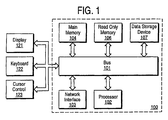
- Figure 1 illustrates an exemplary computer system in which the present invention may be implemented.
- Figure 2 is a flow chart illustrating one embodiment of the present invention.
- FIG. 3 illustrates one hardware embodiment that may be used in the present invention.
- the present invention enhances 3-D localization of speech by providing high-frequency content to speech. This is required because the high-frequency content (e.g., higher than 4 KHz) of speech is often removed by speech compression algorithms during transmission. As a result, the high-frequency components in speech, which may be used for spatial localization cues, are lost. Consequently, the listener of compressed and localized speech is unable to accurately perceive the location of a speech source. Thus, the present invention corrects this problem by adding high-frequency, wide-band noise to the compressed speech after increasing its sampling rate and before performing localization.
- the high-frequency content e.g., higher than 4 KHz
- Computer system 100 comprises a bus or other communication device 101 that communicates information, and a processor 102 coupled to the bus 101 that processes information.
- System 100 further comprises a random access memory (RAM) or other dynamic storage device 104 (referred to as main memory), coupled to a bus 101 that stores information and instructions to be executed by processor 102.
- Main memory may also be used for storing temporary variables or other intermediate information during execution of instructions by processor 102.
- Computer system 100 also comprises a read only memory (ROM) and/or other static storage devices 106 coupled to bus 101 that stores static information and instructions for processor 102.
- Data storage device 107 is coupled to bus 101 and stores information and instructions.
- a data storage device 107 such as a magnetic disk or an optical disk, and its corresponding disk drive, may be coupled to computer system 100.
- Network interface 103 is coupled to bus 101.
- Network interface 103 operates to connect computer system 100 to a network of computer systems (not shown).
- Computer system 100 may also be coupled via bus 101 to a display device 121, such as a cathode ray tube (CRT), for displaying information to a computer user.
- a display device 121 such as a cathode ray tube (CRT)
- An alpha numeric input device 122 is typically coupled to bus 101 for communicating information and command selections to processor 102.
- cursor control 123 is Another type of user input device
- cursor control 123 such as a mask, a trackball, a cursor direction keys for communicating direction information and command selections to processor 102 and for controlling cursor movement on display 121.
- This input device typically has two degrees of freedom and two accesses, a first access (e.g., X) and a second access (e.g., Y), which allows the device to specify positions in a plane.
- a displayed object on a computer screen can be selected by using a stylist or pen to touch the displayed object.
- the computer detects a selection by implementing a touch sensitive screen.
- a system may also lack a keyboard such as 122 and all the interfaces are provided via the stylist as a writing instrument (like a pen) and the written text is interpreted using optical character recognition (OCR) techniques.
- compressed speech signals can also arrive at the computer via communication channels such as an Internet or local area network (LAN) connection.
- FIG. 2 illustrates one embodiment of the present invention.
- a digital speech source (signal) is received from a communication network.
- possible digital speech sources are cellular phones, video phones and video-teleconferencing.
- the high-frequency content e.g., greater than 4 KHz
- the high-frequency components of speech are not required for intelligibility of the speech.
- the high-frequency components of the speech are also discarded by speech compression algorithms.
- step 202 the frequency content of the received digital speech is analyzed.
- step 204 the maximum frequency of the digital speech signal is calculated from the sampling rate of the received signal according to Nyquist's Law. In other words, the sampling rate of a signal is assumed to be twice the maximum frequency of the transmitted signal. For example, if the sampling rate of the digital speech source is 8 kilohertz (KHz), then the maximum frequency is equal to half of (8 KHz), which is 4 KHz. Thus, the maximum frequency of the transmitted signal is 4,000 Hertz.
- the high-frequency content of the speech has already been removed (e.g., by a speech compression algorithm) and may not be used to provide directionality via spatial cues. More high-frequency information must be added to the speech to enhance 3-D localization. This is accomplished by first resampling the speech at a higher rate.
- the sampling rate e.g., 8 KHz
- the sampling rate can be increased from 8 KHz to a value ranging between 16 KHz to 48 KHz.
- the sampling rate is increased from 8,000 times per second to 22,050 times per second (or about 22 KHz).
- a sampling rate of 22,050 times per second is the standard sampling rate for mid-range music and is similar to FM (Frequency Modulation) radio quality. For example, at 22 KHz, one hears more than just speech; one is also able to hear the tonal quality of instruments and sound-effects. Thus, the sampling rate is increased, but no additional high-frequency components are added.
- FM Frequency Modulation
- wide-band Gaussian noise is added to the speech signal with the increased sampling rate.
- the added wide-band Gaussian noise is at the Nyquist frequency corresponding to the increased sampling rate. For example, if the sampling rate was increased to 22 KHz or 22,050 times per second, then the wide-band Gaussian noise will also have a frequency band of 11025 hertz or half of the increased sampling rate. It will be appreciated that the Gaussian noise may have a different frequency than the increased sampling rate. It will also be appreciated that the wide-band Gaussian noise can have a frequency that is proportional to the increased sampling rate. In one embodiment, the added wide-band Gaussian noise can range from between about 8 KHz to about 24 KHz.
- the energy of the wide-band Gaussian noise is usually kept low enough so that it does not interfere with the intelligibility of the speech.
- the wide-band Gaussian noise that is added is approximately 20 to 30 decibels lower than the originally received digital speech signal.
- the wide-band Gaussian noise adds high-frequency components to the original digital speech source. This is important for enhanced 3-D localization of the sound which may be introduced via a filter, for example, to recreate the speech source for a listener in a virtual-reality experience.
- the resulting wide-band speech can be transmitted to a 3-D speech localization routine in a computer system in step 212.
- positional information regarding the digital speech source can be added at this time.
- Positional information that corresponds to the speech source creates a more realistic virtual experience. For example, if one is in a multi-point video conference with five different people, whose pictures are each visible on a computer screen, then this positional information connects the speech with the appropriate person's picture on the display screen. For instance, if the person, whose picture is shown on the left-hand side of the screen, is speaking, then the speech source should sound like it is coming from the left-hand side of the screen. The speech should not be perceived by the listener as if it is coming from the person whose picture is on the right-hand side of the screen.
- Another application for this invention is in a 3-D virtual-reality scene. For example, one is in a shared virtual-space or 3-D room where people are meeting and talking to a 3-D representation of each person. If the 3-D representation of a particular person is speaking audibly and not as text, the present invention should enable the receiver of the speech to connect the speech with the appropriate 3-D representation as the speech source. Thus, if a user were to walk from one group of speakers to another group, the speech received by the user should vary accordingly.
- a digital speech signal 301 is received by a receiver 303.
- the digital speech signal 301 is transmitted from a communication network, such as a cellular phone.
- a communication network such as a cellular phone.
- human speech is first received as an analog signal that is then converted to a digital speech signal.
- This digital speech signal 301 is often compressed or band-limited before it reaches the receiver 303.
- high-frequency components e.g., greater than 4 KHz
- the receiver 303 also determines the maximum frequency of the received digital speech signal.
- the receiver 303 utilizes Nyquist's Law to determine the maximum frequency of the digital speech signal according to the digital sampling rate. For example, if the sampling rate is 6 KHz, then the maximum frequency according to Nyquist's Law is 3 KHz, which is half of the sampling rate.
- the converter 305 then converts or increases this minimum sampling rate to an increased sampling rate.
- the increased sampling rate can be, in one embodiment, two-to-six times greater than the previous sampling rate.
- a generator 307 then creates wide-band Gaussian noise in order to increase the high-frequency content of the received digital speech signal 301. This is necessary because the high-frequency content of the speech enables a listener to better localize the digital speech. In other words, after 3-D localization, the high-frequency content of the speech enables a listener to determine if the speech source is located to the listener's right or left, or above or below the listener, or in front of or behind the listener. The 3-D localization of the speech enhances a listener's experience of the speech.
- the speech signal with the increased sampling rate and the wide-band Gaussian noise are combined in the adder 309.
- the resulting wide-band speech signal is then stored in a memory 311 before being transmitted to a filter generation unit 313.
- This filter may be a finite-impulse response (FIR) filter in one embodiment. It is to be appreciated that other filters can be used.
- FIR finite-impulse response
- the digital speech signal 301 without its high-frequency content (e.g., above 4 KHz) was often directly transmitted to the filter generation unit 313.
- the resulting digital speech often lacked perceptible 3-D localization cues.
- the present invention allows a listener to have enhanced 3-D localization capabilities or perception of a speech source. Thus, the listener enjoys a more realistic experience of the speech source.
Landscapes
- Engineering & Computer Science (AREA)
- Acoustics & Sound (AREA)
- Computational Linguistics (AREA)
- Signal Processing (AREA)
- Health & Medical Sciences (AREA)
- Audiology, Speech & Language Pathology (AREA)
- Human Computer Interaction (AREA)
- Quality & Reliability (AREA)
- Physics & Mathematics (AREA)
- Multimedia (AREA)
- Stereophonic System (AREA)
- Stereo-Broadcasting Methods (AREA)
- Compression, Expansion, Code Conversion, And Decoders (AREA)
- Two-Way Televisions, Distribution Of Moving Picture Or The Like (AREA)
- Electrophonic Musical Instruments (AREA)
- Machine Translation (AREA)
- Testing, Inspecting, Measuring Of Stereoscopic Televisions And Televisions (AREA)
Abstract
Description
Claims (10)
- A computer-implemented method for enhanced 3-D localisation of speech, comprising:receiving (200) a speech signal that has been sampled at a predetermined rate;determining (202) a maximum frequency for the speech signal;increasing the rate of sampling for the speech signal (208);adding a low-level, wide-band noise to the speech signal (210) to create a new speech signal with higher-frequency components; andtransmitting the new speech signal to a 3-D speech localisation filter (212).
- The method of claim 1 , wherein the increased rate of sampling is at least twice the maximum frequency.
- The method of claim 2, wherein the rate of sampling is increased by a factor that ranges between two-to-six.
- The method of any preceding claim, wherein the low-level, wide-band noise has approximately half the frequency of the increased rate of sampling.
- The method of any preceding claim, wherein the low-level, wide-band noise is approximately 20 to 30 decibels lower than the speech signal.
- The method of claim 1, wherein the low-level, wide-band noise has a frequency in the range of about 8 KHz to about 24 KHz.
- A computer-readable medium having stored thereon sequences of instructions, the sequences of instructions including instructions, which when executed by a processor, causes the processor to perform the steps of:receiving (200) a digital speech signal;determining (202) a maximum frequency that occurs in the digital speech signal;determining a sampling rate for the digital speech signal;increasing the sampling rate of the digital speech signal (208) to an increased sampling rate;adding a wide-band Gaussian noise (210) to the digital speech signal to create a wide-band digital speech signal with higher frequencies; andtransmitting the wide-band digital speech signal to a 3-D speech localisation filter (212).
- A programmable apparatus for enhancing 3-D localisation of speech, comprising:a receiver (303) for receiving a speech signal;a converter (305), coupled to the receiver (303), for increasing the speech signal's sampling rate to an increased sampling rate;a generator (307) for generating a wide-band noise;an adder (309) coupled to the converter (305) and the generator (307), for combining the wide-band noise to the speech signal with the increased sampling rate to create a wide-band speech signal;a memory (311) coupled to the adder (309), wherein the memory (311) stores the wide-band speech signal; anda filter generation unit (313) coupled with the memory (311) for receiving the stored wide-band speech signal.
- The apparatus of claim 8, wherein the filter generation unit (313) is a finite-impulse response filter.
- A computer program comprising computer program code means adapted to perform all the steps of claim 1 when that program is run on a computer.
Applications Claiming Priority (3)
| Application Number | Priority Date | Filing Date | Title |
|---|---|---|---|
| US08/826,016 US5864790A (en) | 1997-03-26 | 1997-03-26 | Method for enhancing 3-D localization of speech |
| US826016 | 1997-03-26 | ||
| PCT/US1998/000427 WO1998043239A1 (en) | 1997-03-26 | 1998-01-06 | A method for enhancing 3-d localization of speech |
Publications (3)
| Publication Number | Publication Date |
|---|---|
| EP0970464A1 EP0970464A1 (en) | 2000-01-12 |
| EP0970464A4 EP0970464A4 (en) | 2000-12-27 |
| EP0970464B1 true EP0970464B1 (en) | 2003-09-17 |
Family
ID=25245475
Family Applications (1)
| Application Number | Title | Priority Date | Filing Date |
|---|---|---|---|
| EP98901213A Expired - Lifetime EP0970464B1 (en) | 1997-03-26 | 1998-01-06 | A method for enhancing 3-d localization of speech |
Country Status (9)
| Country | Link |
|---|---|
| US (1) | US5864790A (en) |
| EP (1) | EP0970464B1 (en) |
| KR (1) | KR100310283B1 (en) |
| CN (1) | CN1119799C (en) |
| AT (1) | ATE250271T1 (en) |
| AU (1) | AU5734498A (en) |
| DE (1) | DE69818238T2 (en) |
| TW (1) | TW403892B (en) |
| WO (1) | WO1998043239A1 (en) |
Families Citing this family (3)
| Publication number | Priority date | Publication date | Assignee | Title |
|---|---|---|---|---|
| JP2001508197A (en) * | 1997-10-31 | 2001-06-19 | コーニンクレッカ フィリップス エレクトロニクス エヌ ヴィ | Method and apparatus for audio reproduction of speech encoded according to the LPC principle by adding noise to a constituent signal |
| US7371175B2 (en) * | 2003-01-13 | 2008-05-13 | At&T Corp. | Method and system for enhanced audio communications in an interactive environment |
| CN114023351B (en) * | 2021-12-17 | 2022-07-08 | 广东讯飞启明科技发展有限公司 | Speech enhancement method and system based on noisy environment |
Citations (1)
| Publication number | Priority date | Publication date | Assignee | Title |
|---|---|---|---|---|
| EP0653897A2 (en) * | 1993-11-12 | 1995-05-17 | SPHERIC AUDIO LABORATORIES, Inc. | Method and apparatus for generating audiospatial effects |
Family Cites Families (10)
| Publication number | Priority date | Publication date | Assignee | Title |
|---|---|---|---|---|
| US3974336A (en) * | 1975-05-27 | 1976-08-10 | Iowa State University Research Foundation, Inc. | Speech processing system |
| JPS52134303A (en) * | 1976-05-06 | 1977-11-10 | Tadamutsu Hirata | Device for processing audio pitch correcting signal |
| CA1214112A (en) * | 1983-10-12 | 1986-11-18 | William A. Cole | Noise reduction system |
| CA1220282A (en) * | 1985-04-03 | 1987-04-07 | Northern Telecom Limited | Transmission of wideband speech signals |
| US5083310A (en) * | 1989-11-14 | 1992-01-21 | Apple Computer, Inc. | Compression and expansion technique for digital audio data |
| JP2779886B2 (en) * | 1992-10-05 | 1998-07-23 | 日本電信電話株式会社 | Wideband audio signal restoration method |
| US5561736A (en) * | 1993-06-04 | 1996-10-01 | International Business Machines Corporation | Three dimensional speech synthesis |
| JPH07160299A (en) * | 1993-12-06 | 1995-06-23 | Hitachi Denshi Ltd | Audio signal band compression / expansion device, audio signal band compression transmission system and reproduction system |
| DE4343366C2 (en) * | 1993-12-18 | 1996-02-29 | Grundig Emv | Method and circuit arrangement for increasing the bandwidth of narrowband speech signals |
| US5687243A (en) * | 1995-09-29 | 1997-11-11 | Motorola, Inc. | Noise suppression apparatus and method |
-
1997
- 1997-03-26 US US08/826,016 patent/US5864790A/en not_active Expired - Fee Related
-
1998
- 1998-01-06 AT AT98901213T patent/ATE250271T1/en not_active IP Right Cessation
- 1998-01-06 AU AU57344/98A patent/AU5734498A/en not_active Abandoned
- 1998-01-06 DE DE69818238T patent/DE69818238T2/en not_active Expired - Lifetime
- 1998-01-06 CN CN98803591A patent/CN1119799C/en not_active Expired - Fee Related
- 1998-01-06 WO PCT/US1998/000427 patent/WO1998043239A1/en not_active Ceased
- 1998-01-06 EP EP98901213A patent/EP0970464B1/en not_active Expired - Lifetime
- 1998-03-19 TW TW087104113A patent/TW403892B/en not_active IP Right Cessation
-
1999
- 1999-09-22 KR KR1019997008728A patent/KR100310283B1/en not_active Expired - Fee Related
Patent Citations (1)
| Publication number | Priority date | Publication date | Assignee | Title |
|---|---|---|---|---|
| EP0653897A2 (en) * | 1993-11-12 | 1995-05-17 | SPHERIC AUDIO LABORATORIES, Inc. | Method and apparatus for generating audiospatial effects |
Also Published As
| Publication number | Publication date |
|---|---|
| CN1251195A (en) | 2000-04-19 |
| TW403892B (en) | 2000-09-01 |
| DE69818238T2 (en) | 2004-04-08 |
| EP0970464A1 (en) | 2000-01-12 |
| EP0970464A4 (en) | 2000-12-27 |
| KR100310283B1 (en) | 2001-09-29 |
| ATE250271T1 (en) | 2003-10-15 |
| AU5734498A (en) | 1998-10-20 |
| KR20010005660A (en) | 2001-01-15 |
| US5864790A (en) | 1999-01-26 |
| HK1025176A1 (en) | 2000-11-03 |
| CN1119799C (en) | 2003-08-27 |
| WO1998043239A1 (en) | 1998-10-01 |
| DE69818238D1 (en) | 2003-10-23 |
Similar Documents
| Publication | Publication Date | Title |
|---|---|---|
| EP2215858B1 (en) | Method and arrangement for fitting a hearing system | |
| Shilling et al. | Virtual auditory displays | |
| CN107168518B (en) | Synchronization method and device for head-mounted display and head-mounted display | |
| KR101315070B1 (en) | A method of and a device for generating 3D sound | |
| JP4921470B2 (en) | Method and apparatus for generating and processing parameters representing head related transfer functions | |
| US8509454B2 (en) | Focusing on a portion of an audio scene for an audio signal | |
| CN110113316A (en) | Conference access method, device, equipment and computer readable storage medium | |
| CN114501297B (en) | Audio processing method and electronic equipment | |
| EP0663771B1 (en) | Method of transmitting signals between communication stations | |
| EP3716038A1 (en) | An apparatus, method, computer program or system for indicating audibility of audio content rendered in a virtual space | |
| US5864790A (en) | Method for enhancing 3-D localization of speech | |
| CN112689825B (en) | Device, method and computer program for enabling remote users to access mediated reality content | |
| US20250267423A1 (en) | Virtual auditory display filters and associated systems, methods, and non-transitory computer-readable media | |
| US20250324188A1 (en) | Audio mixed reality and associated systems, methods, devices, and non-transitory computer-readable media | |
| HK1025176B (en) | A method for enhancing 3-d localization of speech | |
| EP4101181B1 (en) | Signaling loudness adjustment for an audio scene | |
| CN113301294B (en) | Call control method and device and intelligent terminal | |
| KR20150087017A (en) | Audio control device based on eye-tracking and method for visual communications using the device | |
| JP2022128177A (en) | Sound generation device, sound reproduction device, sound reproduction method, and sound signal processing program | |
| JPH07131770A (en) | Integrated control device for video and audio | |
| JPH08125761A (en) | Voice receiver | |
| EP1617702A1 (en) | Portable electronic equipment with 3D audio rendering | |
| CN120812305A (en) | Audio processing method, device, electronic equipment, user equipment and storage medium | |
| CN120075693A (en) | Equipment sound effect processing method and device, electronic equipment and storage medium | |
| JP2020194021A (en) | Speech processing device, speech processing method and program |
Legal Events
| Date | Code | Title | Description |
|---|---|---|---|
| PUAI | Public reference made under article 153(3) epc to a published international application that has entered the european phase |
Free format text: ORIGINAL CODE: 0009012 |
|
| 17P | Request for examination filed |
Effective date: 19991011 |
|
| AK | Designated contracting states |
Kind code of ref document: A1 Designated state(s): AT DE FI FR GB IT |
|
| RIN1 | Information on inventor provided before grant (corrected) |
Inventor name: LEAVY, MARK |
|
| RIC1 | Information provided on ipc code assigned before grant |
Free format text: 7G 10L 3/02 A, 7G 10L 21/02 B |
|
| A4 | Supplementary search report drawn up and despatched |
Effective date: 20001115 |
|
| AK | Designated contracting states |
Kind code of ref document: A4 Designated state(s): AT DE FI FR GB IT |
|
| 17Q | First examination report despatched |
Effective date: 20020606 |
|
| GRAH | Despatch of communication of intention to grant a patent |
Free format text: ORIGINAL CODE: EPIDOS IGRA |
|
| GRAH | Despatch of communication of intention to grant a patent |
Free format text: ORIGINAL CODE: EPIDOS IGRA |
|
| GRAA | (expected) grant |
Free format text: ORIGINAL CODE: 0009210 |
|
| RIC1 | Information provided on ipc code assigned before grant |
Ipc: 7G 10L 21/02 A |
|
| AK | Designated contracting states |
Kind code of ref document: B1 Designated state(s): AT DE FI FR GB IT |
|
| REG | Reference to a national code |
Ref country code: GB Ref legal event code: FG4D |
|
| REF | Corresponds to: |
Ref document number: 69818238 Country of ref document: DE Date of ref document: 20031023 Kind code of ref document: P |
|
| ET | Fr: translation filed | ||
| PLBE | No opposition filed within time limit |
Free format text: ORIGINAL CODE: 0009261 |
|
| STAA | Information on the status of an ep patent application or granted ep patent |
Free format text: STATUS: NO OPPOSITION FILED WITHIN TIME LIMIT |
|
| REG | Reference to a national code |
Ref country code: HK Ref legal event code: GR Ref document number: 1025176 Country of ref document: HK |
|
| 26N | No opposition filed |
Effective date: 20040618 |
|
| PGFP | Annual fee paid to national office [announced via postgrant information from national office to epo] |
Ref country code: IT Payment date: 20100127 Year of fee payment: 13 Ref country code: FR Payment date: 20100205 Year of fee payment: 13 Ref country code: FI Payment date: 20100128 Year of fee payment: 13 |
|
| PGFP | Annual fee paid to national office [announced via postgrant information from national office to epo] |
Ref country code: AT Payment date: 20091223 Year of fee payment: 13 |
|
| REG | Reference to a national code |
Ref country code: FR Ref legal event code: ST Effective date: 20110930 |
|
| PG25 | Lapsed in a contracting state [announced via postgrant information from national office to epo] |
Ref country code: FR Free format text: LAPSE BECAUSE OF NON-PAYMENT OF DUE FEES Effective date: 20110131 |
|
| PG25 | Lapsed in a contracting state [announced via postgrant information from national office to epo] |
Ref country code: AT Free format text: LAPSE BECAUSE OF NON-PAYMENT OF DUE FEES Effective date: 20110106 Ref country code: FI Free format text: LAPSE BECAUSE OF NON-PAYMENT OF DUE FEES Effective date: 20110106 |
|
| PG25 | Lapsed in a contracting state [announced via postgrant information from national office to epo] |
Ref country code: IT Free format text: LAPSE BECAUSE OF NON-PAYMENT OF DUE FEES Effective date: 20110106 |
|
| PGFP | Annual fee paid to national office [announced via postgrant information from national office to epo] |
Ref country code: GB Payment date: 20141231 Year of fee payment: 18 |
|
| PGFP | Annual fee paid to national office [announced via postgrant information from national office to epo] |
Ref country code: DE Payment date: 20141231 Year of fee payment: 18 |
|
| REG | Reference to a national code |
Ref country code: DE Ref legal event code: R119 Ref document number: 69818238 Country of ref document: DE |
|
| GBPC | Gb: european patent ceased through non-payment of renewal fee |
Effective date: 20160106 |
|
| PG25 | Lapsed in a contracting state [announced via postgrant information from national office to epo] |
Ref country code: DE Free format text: LAPSE BECAUSE OF NON-PAYMENT OF DUE FEES Effective date: 20160802 Ref country code: GB Free format text: LAPSE BECAUSE OF NON-PAYMENT OF DUE FEES Effective date: 20160106 |